Month: September 2026

  • Volunteer Community Connections That Actually Last

    Volunteer Community Connections That Actually Last

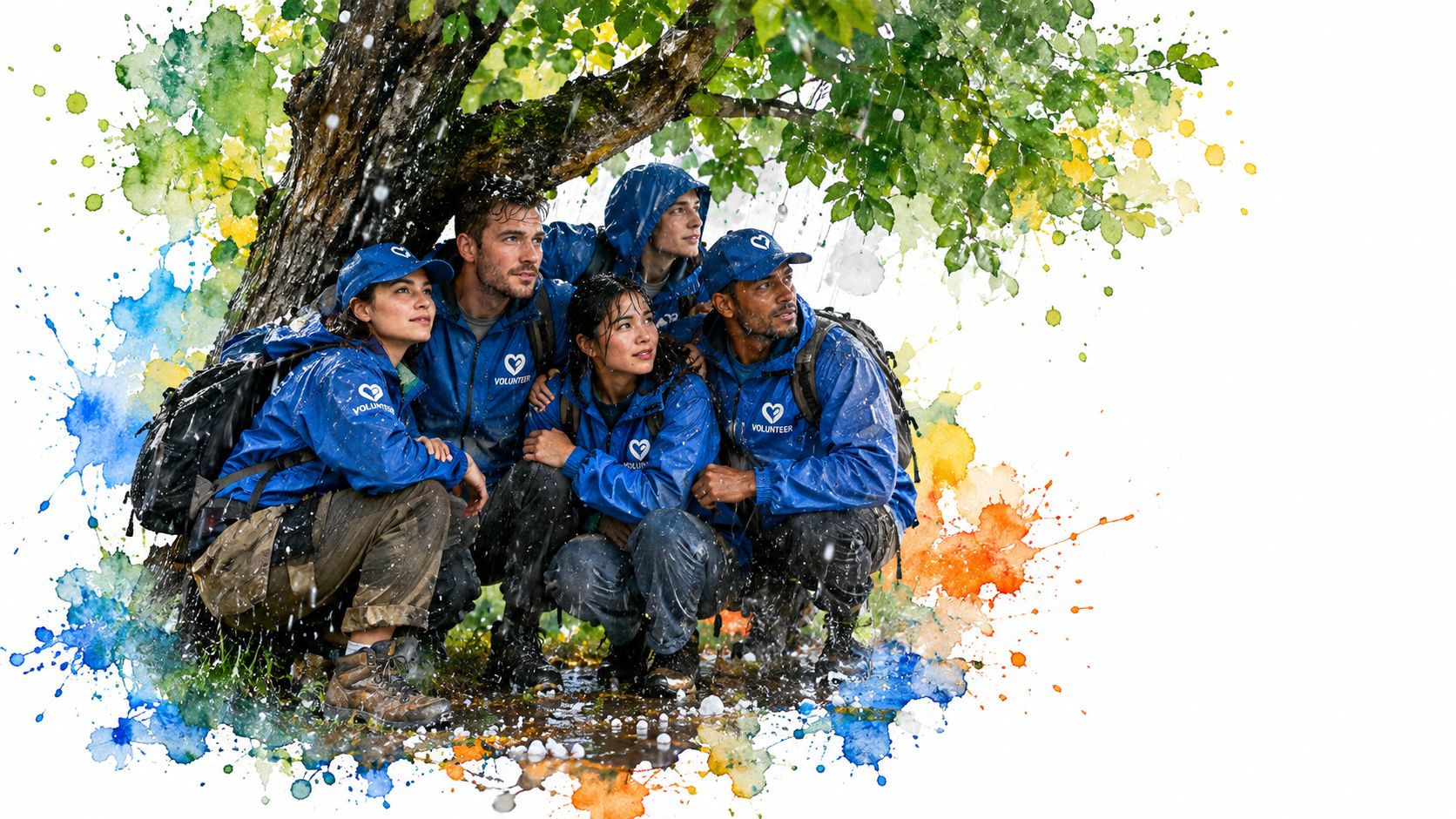
    At 9 a.m. on a Saturday, three strangers huddled under a picnic shelter while hail rattled off the roof. Their trash bags were half full, their Uber kept canceling, and by lunchtime they had exchanged numbers, shared a poncho, and made plans to meet again.

    The Hail Storm That Started a Friend Group

    The first cleanup had all the polish of a bad adventure. Three people arrived at a park, found a flag with a caterpillar on it, and started collecting bottle caps, food wrappers, and damp cardboard. Nobody knew each other. The morning felt ordinary until the sky turned white.

    Hail hit the path hard enough to make everyone run for the picnic shelter. Three newcomers squeezed onto one bench. One person held the grabbers, another tried to keep the bags from blowing away, and a third stared at a phone while an Uber driver canceled again.

    The problem gave them something to solve together. They compared ride options, messaged people in the group chat, and called someone who might drive over. Someone passed around a poncho. Someone else started humming the Litter Caterpillars theme song, which made no practical sense and somehow made the storm easier to take.

    Twenty minutes earlier, these people had been strangers. Under the shelter, they became a small crew with a shared problem, a shared joke, and a reason to keep talking after the weather cleared. They swapped phone numbers so nobody would get stranded. Later, they drank coffee and retold the story with exaggerated sound effects.

    That pattern explains why volunteer community connections often last longer when the event gives people room to meet before they work. The trash creates an excuse. The flag gives people a place to find one another. A Saturday morning gives the group a repeatable rhythm. The friendships grow in the gaps between tasks, during the walk to the next block, and while somebody searches for a missing glove.

    The scale of volunteering supports this local, relationship-based view. The United Nations Volunteers analysis summarized by NCVO reports that more than 1 billion people volunteer worldwide, with work equal to about 109 million full-time workers. Roughly 70% of volunteer activity happens informally, between people in their communities rather than through organizations. Women perform 57% of all volunteer work and 59% of informal volunteering, which connects volunteering closely to everyday neighborhood and care networks.

    The flip: Design the event so connection leads and cleanup follows. People may arrive for the litter, but they return for the people.

    Finding Your Volunteer Group Without Wasting Saturdays

    You don't need to spend every weekend testing random events. Use a short search path that tells you whether a group values repeat attendance, easy entry, and conversation.

    Start with the schedule

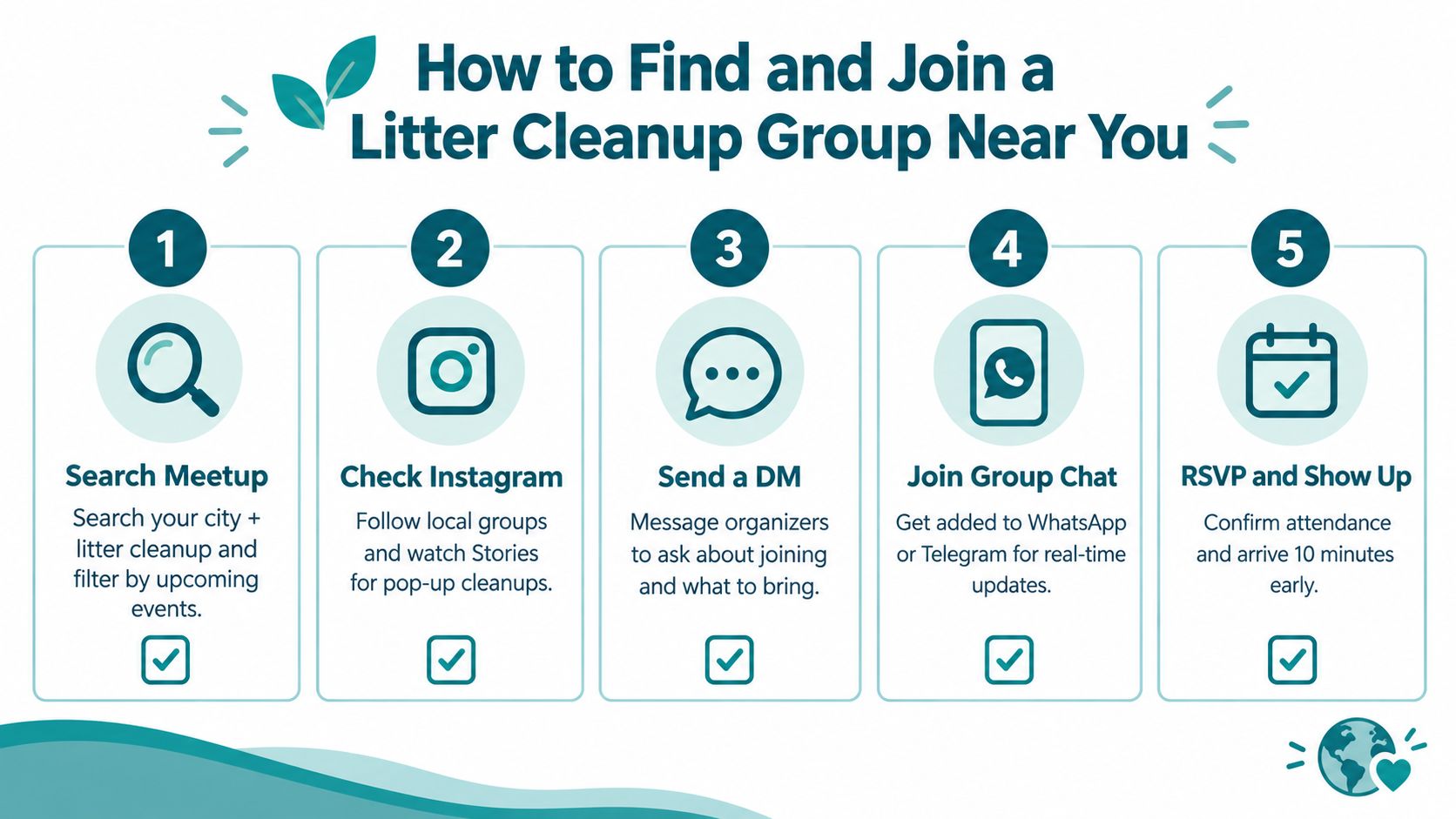
    Open Meetup and Eventbrite and search for “park cleanup,” “neighborhood beautification,” and “volunteer community connections.” Filter for weekend morning slots within a 20-minute drive of your home. A nearby event lowers the small friction that turns good intentions into a missed Saturday.

    Read the listing twice. Look for a recurring schedule, a clear meeting point, a named organizer, and a signup form that doesn't make you feel as if you need to justify your interest. The Litter Caterpillars Saturday volunteer page is an example of the kind of recurring weekend information that helps a newcomer decide quickly.

    Check the group before you arrive

    Search Instagram and TikTok for local handles posting trash-bag selfies, flags, park photos, and short clips from actual meetups. Comment on a recent post before you attend. Write something simple, such as, “I'm planning to join Saturday. Is the blue flag near the north entrance?”

    That comment does two jobs. It tells the organizer you're real, and it gives you a familiar name to look for when you arrive. You don't need a polished introduction. A small online exchange can make the first in-person greeting less awkward.

    Read the signals

    Marker Strong Signal Red Flag
    Schedule Recurring weekend mornings with a clear start time Vague dates or frequent last-minute changes
    Signup A short, low-pressure form Donation asks before you can attend
    Communication Open group chat for weather and ride updates No contact method after registration
    Welcome Instructions for newcomers and families Assumption that everyone already knows the route
    Equipment Clear notes about gloves, grabbers, and bags Volunteers expected to guess what to bring

    Look for an open group chat and join it the morning of the event. Groups with a Litter Caterpillars-style setup use chat to post cancellations, weather calls, ride-share options, and coffee plans. That last detail matters. A cleanup can end when the bags reach the pickup point, or it can continue at a nearby table.

    Copy and send this DM:

    Hi, I'd like to join your next cleanup. What's your rain policy, and do you provide gloves, grabbers, and bags? Are families welcome, and where should I meet the group?

    A good answer should make the first visit feel manageable. If the response sounds annoyed by basic questions, keep searching. Your Saturday should buy you a useful morning and a chance to meet people, not a guessing game.

    First Meetup Moves That Turn Strangers Into Friends

    A newcomer can stand in a group of twenty people and still feel invisible. I prevent that with visible signals and short, repeatable introductions.

    Before people arrive, I choose something that helps us spot new faces. Colored gloves work well. So do bright grabbers, name stickers, or a small marker beside the signup sheet. When a newcomer walks up, a returning volunteer should greet them by name within two minutes.

    Pair people before assigning tasks

    Don't send a first-timer down a path alone with a trash bag. Pair them with a returning volunteer for the first 15 minutes. The returning person can explain the route, show where sharp objects go, and keep the conversation moving while both people work.

    Use the two-question handoff:

    1. Ask where the person lives.
    2. Ask what brought them out today.
    3. Introduce them to one other person by name.

    The questions stay easy, but they open doors. Someone might live three blocks away, study at a nearby college, care for a parent, or know a coffee shop nobody else has tried. You don't need a forced icebreaker. You need a path from one name to another.

    Try this organizer script:

    “Hey, this is Maya. She's new and loves trail running. Can you show her the creekside loop?”

    The returning volunteer now has a clear job, and Maya has a person to follow. The introduction also gives the second volunteer a useful detail to remember.

    Make contact exchange feel normal

    Many people want to continue the conversation but hesitate to ask. Give them a natural line:

    “Can I grab your number? Our crew sometimes gets tacos after. Want in?”

    A phone number isn't a friendship contract. It keeps the door open for the next cleanup, a ride-share, or a quick coffee. If someone prefers the group chat, let that work too.

    At the end, take a same-day group photo and post it in the chat with names attached. “Saturday crew, Maya, Luis, Priya, and Devon” gives faces a second chance to stick. Then start a standing Tuesday lunch thread. It can survive a rainy weekend and keep the group from disappearing between events.

    Volunteer participation already creates repeated contact for many people. In NCVO's Time Well Spent findings, 89% of volunteers said they had met new people through volunteering, 78% had come into contact with people from different backgrounds, and 68% said volunteering helped them feel less isolated. The same survey reports that 77% said volunteering improved their mental health and wellbeing. Your job as an organizer is to turn those possible encounters into actual introductions.

    Safety and Logistics as the Retention Engine
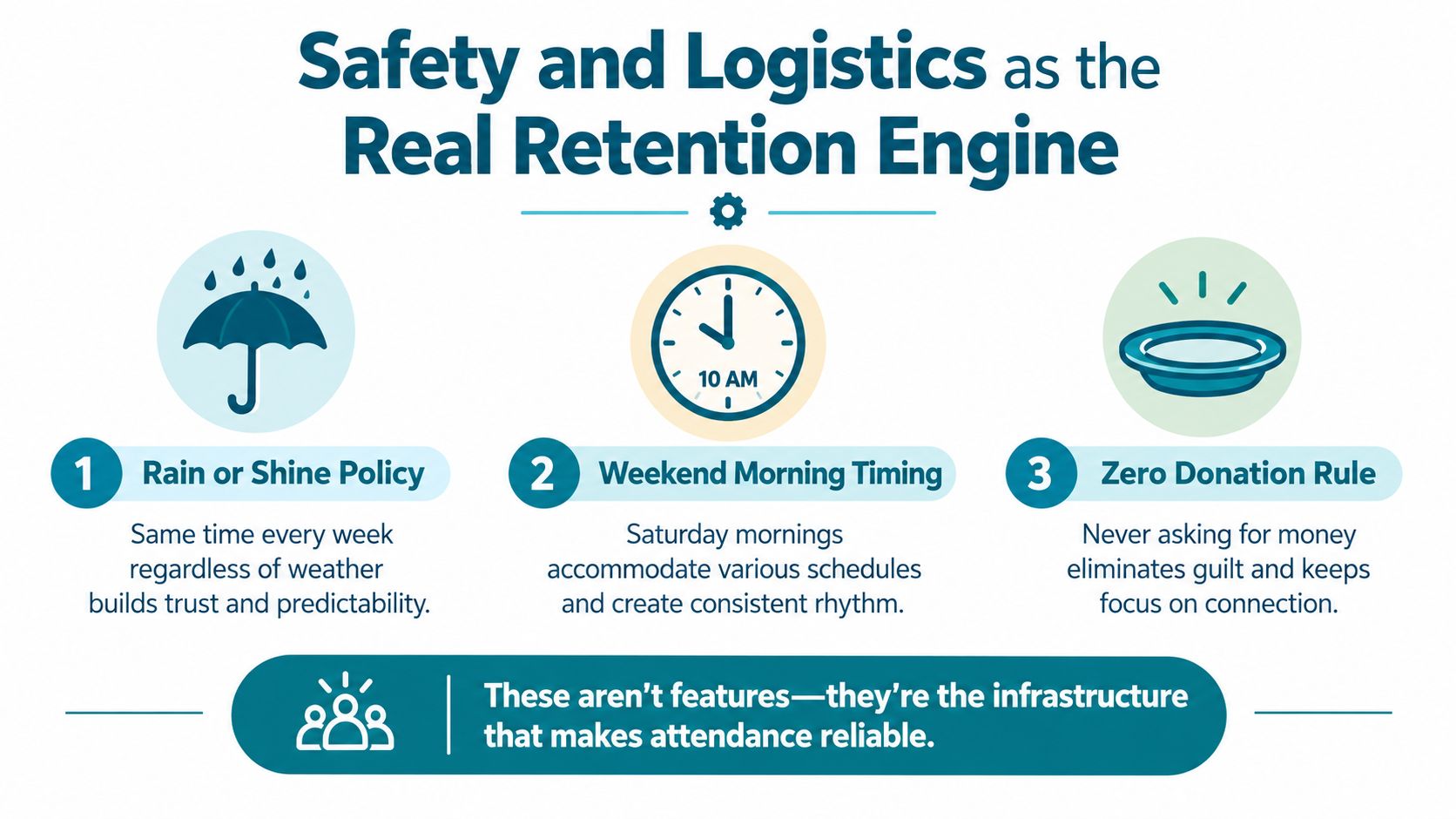
    An infographic titled Safety and Logistics as the Real Retention Engine detailing three key volunteer strategies.

    A soaked volunteer once arrived at our cleanup with no gloves, no clear meeting point, and no idea when the morning would end. She left after twenty minutes. People remember whether an organizer respected their time, explained the plan, and helped them get home. Those details turn a first cleanup into a second RSVP.

    Litter Caterpillars keeps its weekend-morning rhythm, flags, and theme songs, while leaving room for judgment when weather turns unsafe. A rain-or-shine promise should never mean standing outside through dangerous conditions. Weekend mornings also leave the rest of the day open for family duties, classes, shifts, or evening plans. A zero-donation rule removes the awkward question of whether a college student or gig worker is expected to pay to attend.

    The neighborhood cleanup guidance from STOHub recommends planning around weekend schedules and setting a backup date for weather changes. People can plan when the rhythm stays predictable. They also trust the organizer more when a clear weather decision arrives before they are left waiting.

    Build the morning before the morning

    Send a meetup pin 24 hours ahead. Include the nearest entrance, transit stop, and a landmark people can recognize from the street. State whether volunteers need gloves, water, closed shoes, or a reflective layer.

    Use the group chat for ride-shares, weather calls, and late arrivals. Assign every newcomer a buddy before the first bag fills. If someone arrives alone, a volunteer should walk over and bring them to the group, rather than pointing from across the park.

    The hailstorm crew showed why these choices matter. Uber drivers kept canceling, and nobody asked for money. Volunteers shared what they had, searched for rides home, and stayed together until each person had a safe option. The weather made the morning difficult, but the group did not leave one person to solve the problem alone.

    The Urban Institute volunteer management paper points to recognition, training, screening, professional development, and task matching as support for retention. Put that into practice by assigning a safe task that fits the volunteer, explaining it clearly, and recognizing the effort before departure.

    Retention test: If a newcomer can find you, understand the plan, get home safely, and know how to join again, your logistics are doing social work.

    Designing Events So Connection Comes Before the Task

    I've watched volunteers arrive early, work hard, and leave without learning a single name. The bags looked good at the end, but the group felt temporary. Pride changes that. When people feel they belong to a crew, they carry the memory of the morning with them.

    Start the social part before cleanup. Put the flags where people can see them from the path. Play a shared theme song from a Bluetooth speaker at the welcome circle. Take the group photo before anyone picks up a grabber. Recognize first-timers by name, then give them a small job that lets them participate immediately.

    Put the welcome before the work

    Use a two-minute pair-up. Ask each person to share why they came, then have partners introduce each other to the circle. Keep the prompt practical: “What brought you here today?” and “What part of the neighborhood do you know best?”

    A theme song can feel silly until you see what it does. People hum while they work. They laugh when someone misses a lyric. The cleanup stops feeling like a silent chore and starts feeling like a shared activity with its own identity.

    Give first-timers a named recognition moment:

    “Before we split up, let's welcome Maya, Luis, and Priya. They're joining us for the first time, and they're taking the creekside loop.”

    That sentence doesn't flatter people with vague praise. It gives them a place in the story of the day.

    Let coffee carry the friendship

    Choose a nearby coffee shop before the event and mention it during the welcome. The destination gives people a simple reason to stay after the work ends. Over coffee, conversations move away from litter and toward jobs, hobbies, neighborhoods, food, and plans.

    A rotating host keeps the same three people from carrying every introduction and every mood lift. One week, the photo lead welcomes arrivals. The next week, the supply runner brings the coffee list. Another volunteer picks the song and takes the group photo.

    The friendship-building activities from Litter Caterpillars can help organizers turn a cleanup into a social event with simple shared rituals. The point isn't to pack the morning with games. It's to create enough structure that people don't have to manufacture connection from nothing.

    The evidence supports this design choice. A 2025 study on volunteering and social connection describes low-formality social activities where relationships can form spontaneously and on more equal footing. A cleanup already has shared work. Add a welcome circle, a partner task, and a post-event table, and you give those relationships places to begin.

    Your 30 60 90 Day Plan for a Volunteer Circle That Lasts

    Friendship usually needs a rhythm before it needs a grand gesture. I use a 30, 60, 90-day plan because it turns a hopeful first visit into a series of small actions.

    Days 1 through 30

    Attend the first three events you can manage, and aim to show up at least twice. Learn two names beyond your own. Exchange contact information with one or two people through the group chat, then use it for something concrete, such as a ride-share, coffee plan, or reminder about the next route.

    Don't wait until you feel fully included. Return while the first names still feel fresh. Repetition makes the greeting easier for everyone.

    Days 31 through 60

    Deepen the connection by proposing a side hangout. Suggest coffee, tacos, a walk, or a shared lunch after cleanup. Join a small role, such as the photo team, supply runner, welcome host, or route checker.

    Attend one social event that isn't a cleanup. That change of setting helps you see people as more than task partners. You may discover that the person who sorts gloves also knows every independent bookstore nearby.

    The volunteer retention strategies from Litter Caterpillars give organizers a practical place to build this rhythm into their events.

    Days 61 through 90

    Anchor yourself by co-hosting an event. Bring a friend, welcome a newcomer, or mentor someone through their first meetup. Take ownership of one small responsibility, not the entire morning.
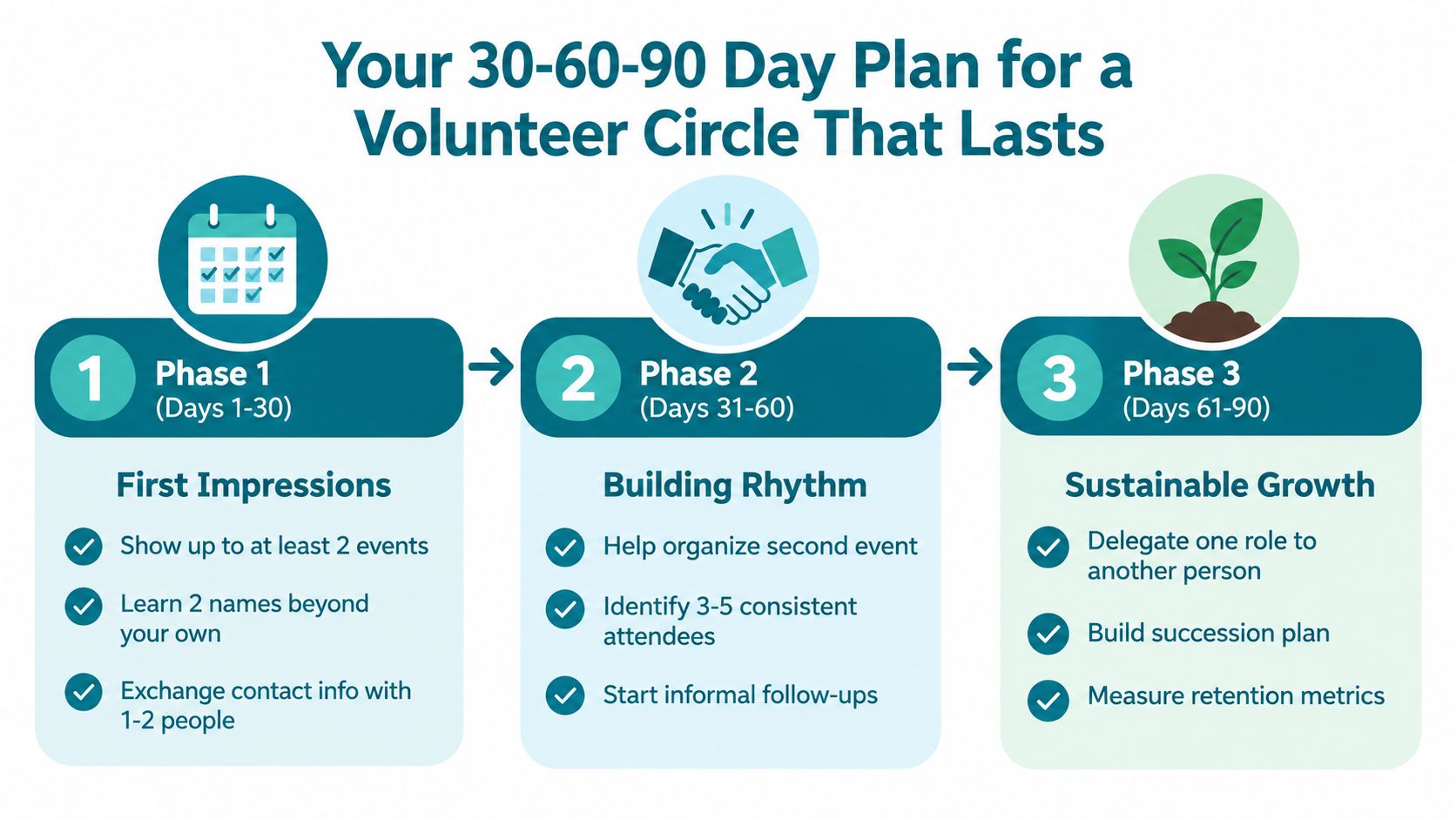
    A 30-60-90 day planning guide for building a long-lasting volunteer community through three phases of engagement.

    The plan works because it moves you from guest to participant to host. It also gives organizers a simple way to notice whether people return, take a role, and bring someone new. Those are useful retention signals, even when nobody tracks a formal scorecard.

    Here's the failure mode I trust most because I've watched it happen. One person organizes every route, buys every supply, answers every message, takes every photo, and keeps every newcomer comfortable. By month four, that person burns out, and the circle feels hollow because nobody else learned how to carry it.

    Hand off one task at every event. Ask someone else to choose the coffee spot, welcome the next newcomer, post the photo, or make the weather call. A volunteer circle lasts when people share the work of connection, not when one generous organizer performs it alone.


    If you're in Chicago and want a free weekend trash pickup where flags, group chats, shared work, and friendship all have a place, visit Litter Caterpillars. Choose an upcoming morning, join the conversation, and bring one person who could use a reason to meet the neighborhood.

  • Cleanup Volunteer Work: A Beginner’s Guide for 2026

    Cleanup Volunteer Work: A Beginner’s Guide for 2026

    The hail hit the Chicago Riverwalk sideways. I had one glove, a half-filled bag of dog waste and plastic shards, and frozen rain biting my bare hand while traffic roared along Wacker Drive. Five minutes later, three strangers were laughing, sharing grabbers, and working like teammates.

    You may want to find cleanup volunteer work, join a crew without feeling awkward, or organize your own event. I've done all three, and I've run the same weekly crew for three years through rain, heat, blizzards, wind chills, and hail. This guide covers the practical parts, including finding events in Chicago and other cities, showing up prepared, staying safe, building a crew, and solving the harder problem. How do you get people to return after the second week?

    The Day I Got Caught in a Hailstorm Picking Up Trash

    The sky over the Chicago Riverwalk turned the color of old steel. The river smelled like wet stone, diesel, and something sour hiding under the docks. Hail rattled against the railings and bounced off the pavement, leaving tiny white beads around my boots.

    My gloves filled with grit. Frozen rain stung the skin between my fingers. At my feet sat a bag that still needed room for a torn food wrapper, two plastic shards, and a leaking pouch of dog waste. I wanted to finish the block. I also wanted to crawl into a warm car.

    Then someone handed me a spare glove.

    A woman from the next group grabbed a litter picker. A man moved the bag away from the walking path. Another volunteer pointed toward a dry patch under the bridge. We didn't know each other, but cleanup work gives strangers a job before it gives them a conversation. Within five flat minutes, we had a plan.

    A dedicated volunteer cleaning up litter along the snowy Chicago Riverwalk during a cold winter day.

    That's why I keep returning. The work can feel grimy, cold, repetitive, and occasionally ridiculous. It can also turn a silent morning into a shared story.

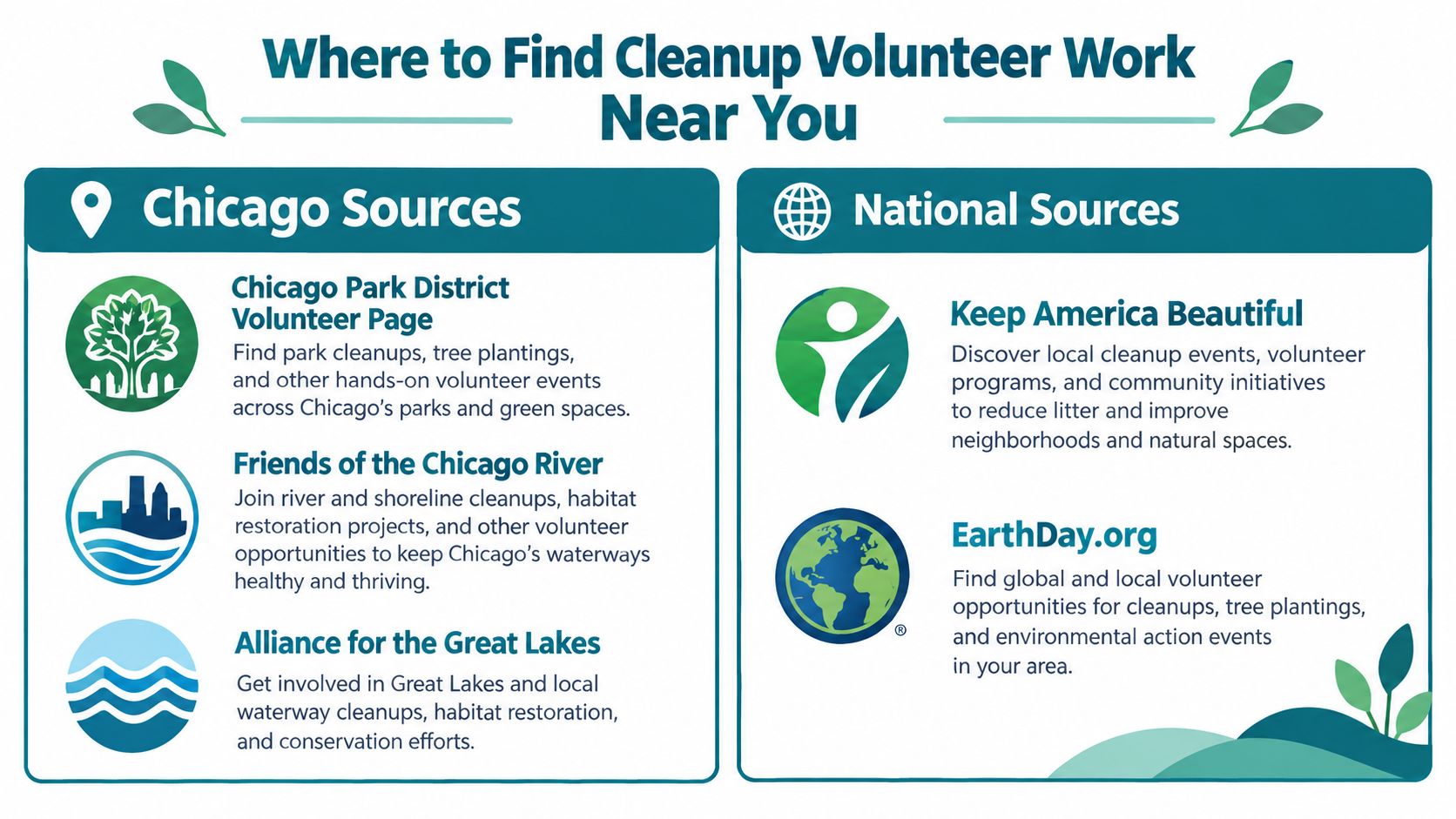
    If you're looking for cleanup volunteer work in Chicago, start with the Chicago Park District volunteer page, the Friends of the Chicago River calendar, alderperson-led neighborhood cleanups, or the city's Adopt-a-Portion program for street and alley segments. Other cities usually have similar routes through parks departments, watershed groups, conservancies, and neighborhood offices.

    I'll also show you how to join without standing alone beside the sign-in table, what to wear, what to leave untouched, and how to organize a safe event from scratch. Most of all, I'll focus on keeping people around after the first event, because a full sign-up sheet means little if the same people never return.

    Where to Find Cleanup Volunteer Work Near You

    I usually start local, then widen the search. In Chicago, the Chicago Park District volunteer page is useful for park projects, while Friends of the Chicago River lists river-related events. Alderperson offices often announce ward cleanups in newsletters and social posts. The city's Adopt-a-Portion program can connect volunteers with a street or alley segment that needs regular attention.

    Search by the place, not only by the activity. “Cleanup volunteer work Chicago” can return polished pages with no current event. “Litter pickup Logan Square,” “river cleanup near me,” “beach sweep South Shore,” or “trail cleanup Cook County” usually gets closer to an actual gathering.

    Search paths that usually work

    • VolunteerMatch: Filter by your ZIP code and search for litter, parks, rivers, or environmental volunteering.
    • All for Good: Search your city and nearby suburbs, then check the event date carefully.
    • Meetup: Filter by “environment” and “cleanup.” Some groups post recurring events there.
    • Eventbrite: Search local nonprofit listings, then confirm that the organizer still has supplies and permission.
    • Alliance for the Great Lakes: Look for shoreline cleanup events around the Great Lakes.
    • Forest preserve districts: Search for trail days, habitat workdays, and preserve volunteer calendars.

    Neighborhood Facebook groups and Nextdoor can surface small cleanups that never reach larger platforms. I also check Instagram accounts for local conservancies, park friends groups, and river organizations. A photo from last month may point you toward a recurring crew even when the group's website looks quiet.

    An infographic titled Where to Find Cleanup Volunteer Work Near You listing Chicago and National sources.

    You can also browse this guide to environmental volunteering near you for additional search ideas.

    Try calling. The best event may live in an organizer's phone, not on a webpage. Ask three questions: where do volunteers meet, what equipment does the group provide, and what happens when the weather turns bad?

    How to Join Your First Cleanup Without Feeling Lost

    Your first event feels easier once you know the sequence. Register through the event link, then read the confirmation email all the way through. It should tell you the meeting point, parking options, start time, and what the organizer provides.

    Arrive ten minutes early. Find the person with the gloves and clipboard. That person usually knows where newcomers should sign in, where the bags sit, and which section needs the most help.

    Bring less than you think

    Wear closed-toe shoes, layers, a hat, work gloves, and sunscreen. Carry water and a small backpack for your phone, keys, and anything you don't want inside a trash bag.

    Most organized crews lend grabbers, bags, and safety vests. Take a grabber even if you think you can work faster with your hands. You'll protect your back, avoid mystery residue, and reach beneath benches without kneeling in wet litter.

    Pair up with someone who has attended before. You don't need to make conversation right away. I've worked beside people for an hour before learning their names. The silence usually breaks at the bag pile, when someone pulls out a bicycle wheel, a bowling ball, or a tire and everyone wants to know the story.

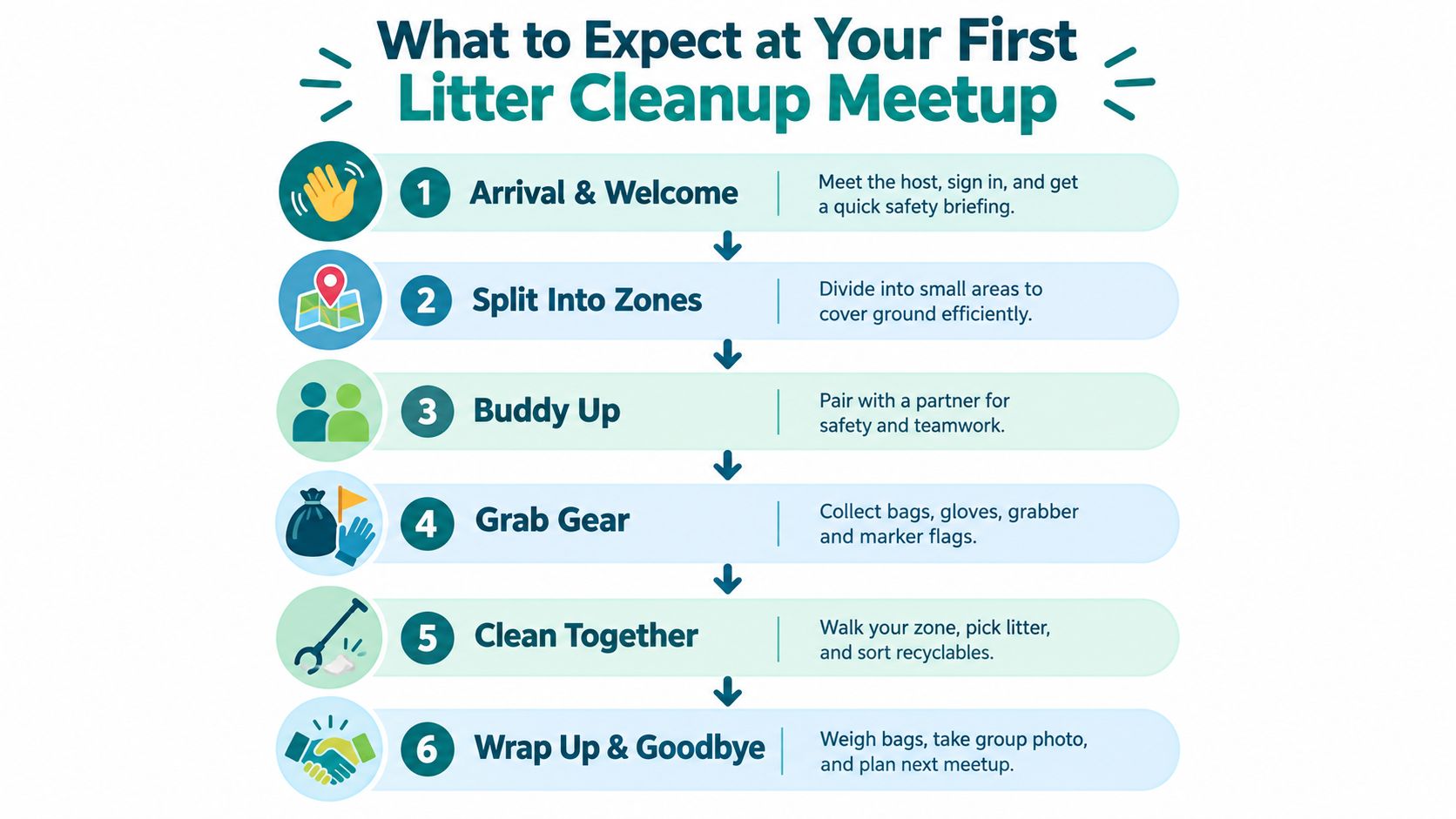
    A typical event starts with a short safety talk and a route assignment. Then you pick for sixty to ninety minutes, bring the bags back, weigh or count the results, and take a group photo. Some crews finish with coffee. Others find a nearby bar or café. The post-cleanup gathering often creates the friendships that make the next event feel less like an appointment.

    First-timer rule: Nobody expects you to perform. Pick up what you can handle, ask when you're unsure, and stay near the route.

    Before you leave, thank the organizer and join the email list or group chat. Mark the next date while the memory still feels fresh. This litter cleanup volunteer guide can help you compare different ways to get involved.

    Safety Rules Every Volunteer Crew Actually Uses

    I've watched a clean street turn dangerous in seconds. A car cuts too close. A volunteer reaches for something sharp. Heat builds under a dark shirt. Good crews prevent those moments before the first bag opens.

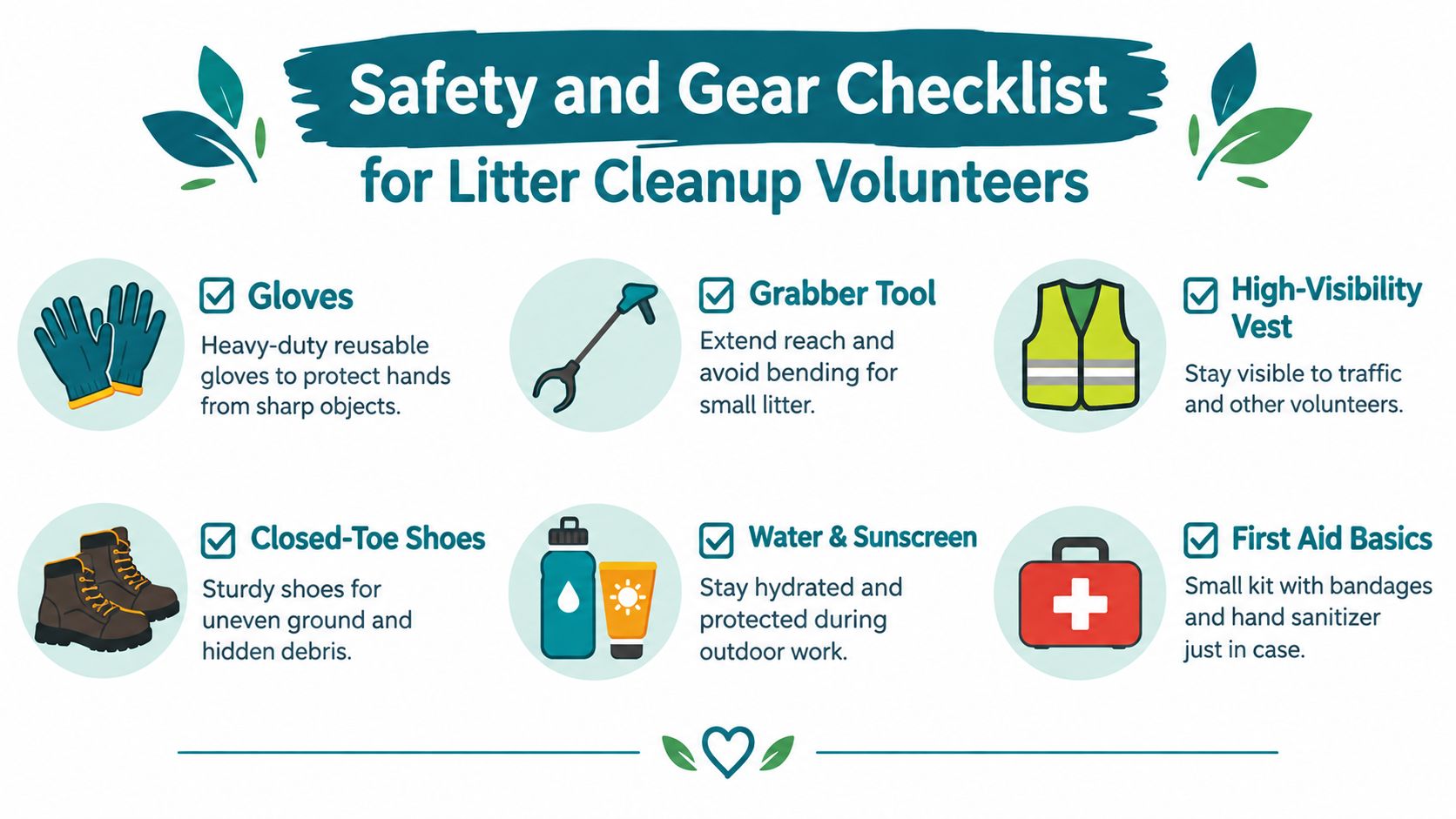
    Start with clothing. Wear closed-toe shoes, puncture-resistant gloves, long sleeves, and layers that match the weather. Use a high-visibility vest near streets. Bring water, sunscreen, and a small first-aid kit.

    Seattle guidance tells volunteers to stay out of roadways, medians, and roundabouts. It also warns against bridges, steep slopes, guardrails, construction areas, utility sites, headphones, alcohol, and mind-altering substances. Work in daylight only, and use a litter grabber instead of bare hands. You can review the Seattle Adopt-a-Street safety guide before planning roadside work.

    Treat unknown objects as unknown

    Use the stick-before-touch rule. Tap or move ordinary-looking material with a grabber or stick before you lift it. Annapolis guidance recommends using a rake or stick to identify an item, and sweeping dangerous litter with a broom and dustpan. Its cleanup checklist also tells volunteers to obey traffic signals and wear gloves.

    Leave needles, syringes, chemicals, weapons, medical waste, dead animals, and anything poisonous for trained handlers. Don't squeeze, kick, open, or carry an object just because it fits in your bag. Report illegal dumping through the city's 311 system when that route applies, and ask the organizer how the crew handles hazardous material.

    Jacksonville guidance says crews should park off the roadway, work on one side at a time, wear bright clothing, safety vests, gloves, and protective footwear, and carry plenty of water. It also says volunteers shouldn't enter the roadway or shoulder or work on bridges, tunnels, or overpasses. The Jacksonville cleanup safety guidance gives a clear model for leaders.

    North Carolina rules set a minimum age of 12, and volunteers aged 12 to 17 need supervision from adults aged 21 or older. The rules also require daylight work, a distance of at least five feet from the pavement edge, small groups, facing oncoming traffic, and stopping during bad weather. Read the North Carolina DOT safety rules before taking a crew beside a road.

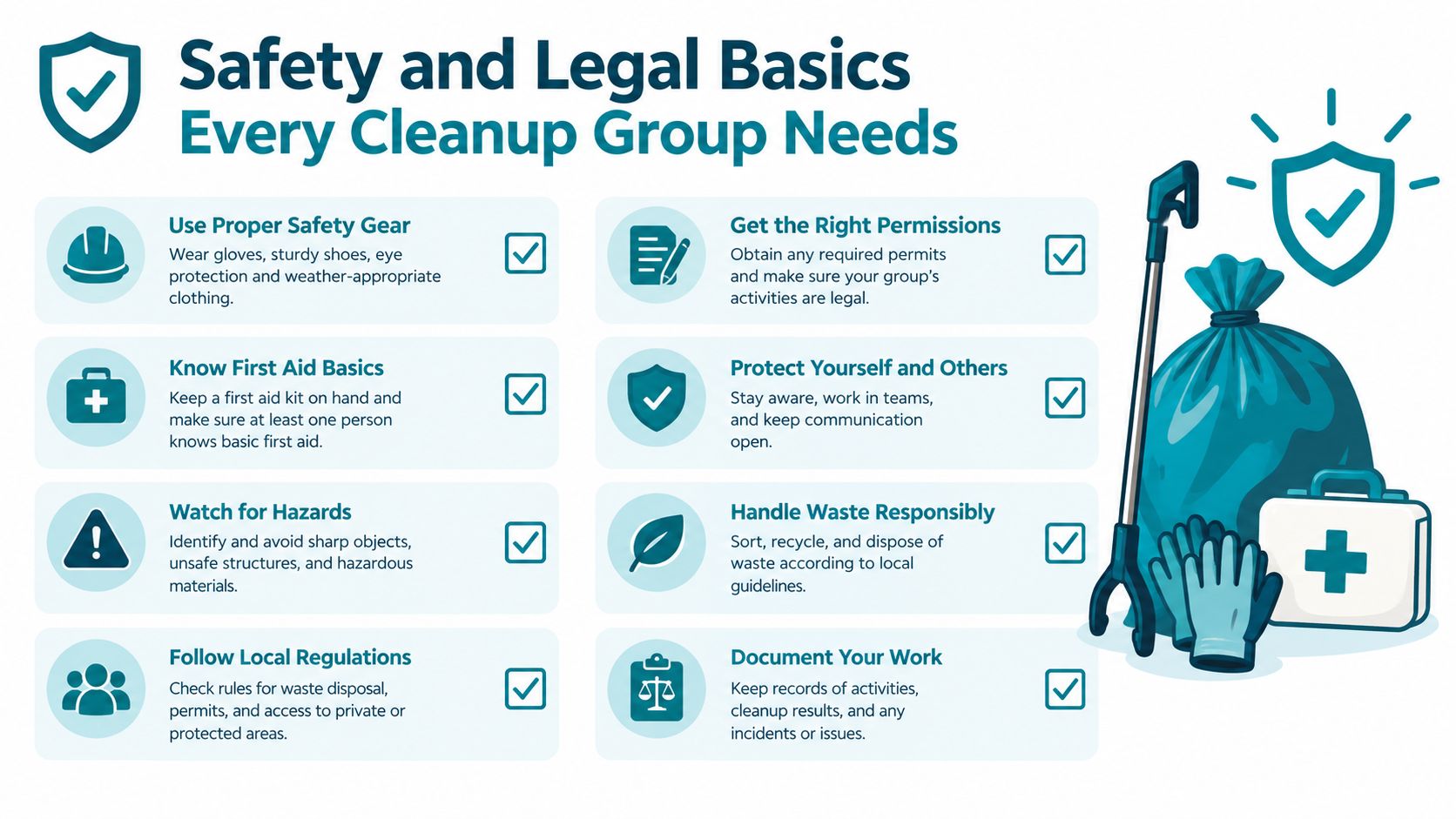
    Before anyone starts, I run a quick check:

    • Route: Are we away from traffic, steep edges, unstable ground, and water hazards?
    • Gear: Does everyone have gloves, a grabber, a bag, and visible clothing where needed?
    • Buddy: Does every volunteer have a partner or a clear group?
    • Weather: Do we have water, shade, warm layers, and a stop plan?
    • Hazards: Does everyone know what stays on the ground?
    • Emergency: Does the leader have a phone, first-aid supplies, and emergency contacts?

    This volunteer safety checklist gives you a compact version to use before your next event.

    Why People Stop Showing Up and How to Keep Them

    The first Saturday can draw a crowd. The third Saturday tells you whether you built a crew.

    I've seen volunteers disappear after one cold morning, one confusing meeting point, or one event where nobody remembered their name. Cleanup programs often focus on sign-ups because sign-ups look good. I care more about the person who returns, learns the route, and starts bringing a friend.

    Make the event easy to remember

    Pick the same day, time, and meeting place whenever you can. People can build a cleanup into a weekly routine when they don't have to solve a new puzzle every time.

    Weather causes obvious trouble. Chicago can give you heat, rain, snow, wind, and hail in the same broad season. I use rain dates when possible, move seasonal events to more comfortable times, and keep an indoor backup task ready, like sorting recyclables or preparing supplies.

    Social connection matters, but you don't need forced games or loud introductions. A crew that grabs coffee afterward gives people a natural place to talk. Volunteers often connect while washing muddy tools, comparing strange finds, or arguing over whether a soaked sofa cushion counts as one item or two.

    People return when they know where to go, who will be there, and what their work changed.

    Show the work without turning it into a sales pitch

    Post bag counts, before-and-after photos, and short notes about the route. Keep a simple attendance record. The Durham Adopt-a-Street program tracked 10,914 pounds of litter over one year, with an average of 7.75 cleanup events and 893 pounds per month, then estimated the removed material at $21,037 using a public removal cost of $1.93 per pound. Its cost-benefit analysis shows why weight records tell a clearer story than bag counts alone.

    Give returning volunteers ownership. Ask one person to manage supplies. Ask another to lead a route. Celebrate milestones at five and twenty events, and use name tags so people don't have to rebuild the group from scratch each week.

    A retention benchmark cited in the provided volunteer-sector coverage places nonprofit volunteer retention at around 65%, meaning roughly one-third may not return year over year. The volunteer retention discussion makes the practical gap plain. Recruitment fills a calendar. Predictability, friendship, and visible results help fill the next one.

    How to Organize Your Own Cleanup From Scratch

    Choose a site you can finish or revisit. A four-to-six-block stretch, one park, or a half-mile riverbank gives a new organizer a manageable boundary. Walk it first. Look for traffic, water, construction, broken glass, dumping, restrooms, shade, and a place to stage full bags.

    Get permission before you advertise. In Chicago, contact the Chicago Park District for park work, ask an alderperson's office about ward coordination, or approach Friends of the Parks for a park partnership. A short email should name the site, proposed date, cleanup limits, disposal plan, and safety approach.

    Build the smallest useful kit

    • Bags: Use 50-gallon contractor bags for bulky litter.
    • Tools: Gather grabbers, rakes, and dustpans.
    • Protection: Provide gloves, hand sanitizer, and a first-aid kit.
    • Water: Bring a cooler or water station.
    • Hazard control: Use sharps containers only through a trained disposal process.

    Recruit in places where people already gather. Post in neighborhood Facebook groups and Nextdoor. Contact LISC Chicago networks, university service boards, local businesses, and corporate volunteer coordinators. Ask a nearby café if it wants to host a post-cleanup stop.

    Set one route captain at each boundary. Give everyone a meeting point and a stop time. Weigh the bags before disposal, record the date and site, and photograph the same view before and after the work. Ocean Conservancy's International Coastal Cleanup guidance also encourages item data and cleanup cards, so organizers can track what volunteers remove instead of relying on a vague pile of bags.

    Send a thank-you message soon after the event. Include the route photo, weight, next date, and one clear way to help. A person who returns quickly can become a route captain before the group loses momentum.

    Your First Saturday Morning and What Comes After

    I arrive before the crew. I check the meeting point, set out gloves and grabbers, and walk the first section for new hazards. Then people appear in twos and threes. We sign in, run the safety talk, pair up, and start at the first bend in the river or the first block of the park.

    The first ten minutes feel quiet. Then somebody finds a shopping cart. Somebody else pulls a tire from the weeds. A new volunteer asks where to put a cracked bottle, and suddenly they're part of the crew.

    After the bags go to the weigh-in spot, we take a photo and get coffee. That small ritual often matters more than a speech. On the second visit, people recognize the meeting place. On the third, they recognize each other.

    Over the next six months, you might join a smaller core group, take ownership of a parkway, or mentor the next newcomer. You don't need to plan six months today. You need to make the next Saturday easy.

    This week, RSVP to a Chicago cleanup through the Park District, Friends of the Chicago River, an alderperson's office, or a local group, then add the next event to your calendar before you leave. The second time you show up is where cleanup volunteer work starts becoming a habit.


    Litter Caterpillars organizes Chicago trash pickup events where volunteers gather, pair up, and clean neighborhood areas with supplies such as grabbers, bags, gloves, and hand sanitizer. Visit Litter Caterpillars to find a crew, join an upcoming pickup, and take your next Saturday morning outside.

  • 8 Resilience Building Activities That Build Courage

    8 Resilience Building Activities That Build Courage

    Three people huddled under a tree while hail struck the street around us. The cold kept building, Ubers kept canceling, and we faced a simple choice: leave or stay together until it became safe.

    That first cleanup taught me that resilience grows through repeatable action, not a performance of toughness. You practice it when you pick up one piece of trash, make one difficult call, return after missing a week, or ask someone to walk beside you.

    The eight resilience building activities below move from short cleanup walks to neighborhood projects, shared challenges, personal barriers, and volunteer care. Choose by your age, available time, energy, access needs, and comfort with groups. You can do several alone. You can also invite one person and make the task lighter.

    You build trust in yourself one doable action at a time.

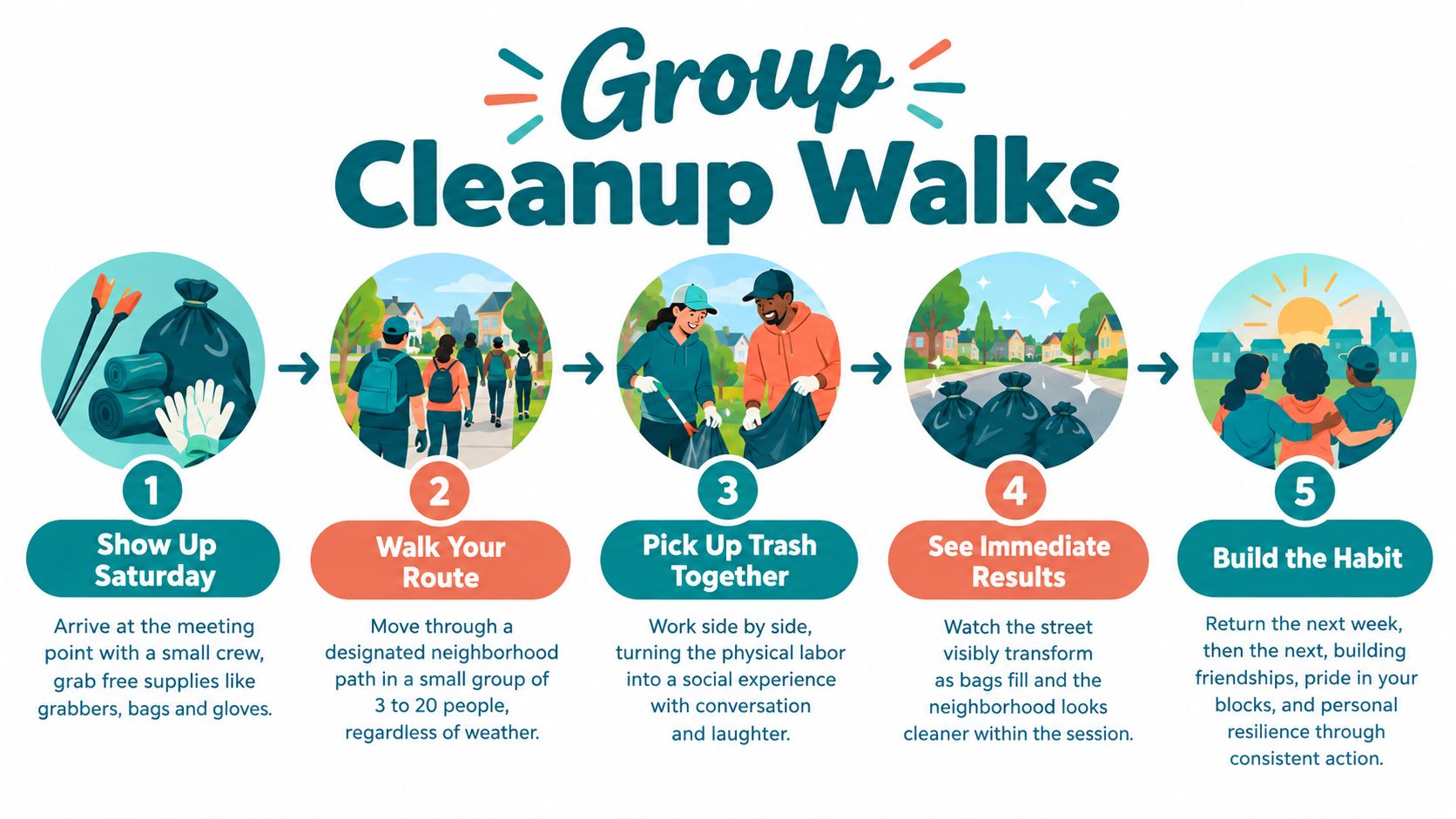
    1. Group Cleanup Walks

    On a Saturday morning, I grab a trash picker, a bag, and a few people who want to move. We walk. The trash disappears as we go, and the work gives our attention somewhere concrete to land.

    Cleaning someone else's mess can feel easier than cleaning your own. You don't have to sort through the memories attached to a gum wrapper or an old food container. You pick it up, place it in the bag, and move on. That small motion can teach you to release what doesn't deserve a permanent place in your mind.

    Litter Caterpillars has used this format during a highway cleanup after a bike-event shutdown and through weekly rotations in Englewood, South Shore, Pilsen, and other Chicago neighborhoods. Over time, groups create their own jokes, routines, and small traditions. The cleanup becomes a walk with a shared purpose.

    Make the walk easy to repeat

    Wear clothes you can dirty. Bring water and a snack, especially during hot weather. Talk while you walk, because conversation gives the task a social pulse. Notice which blocks need more attention instead of staring only at the bag.

    • Keep the first route manageable: Choose one block, one path, or one visible problem area.
    • Invite different formats: A solo walker can use the same practice with music or quiet observation.
    • Return at a regular time: Repetition helps turn a good intention into a habit.

    For a first group session, use this volunteer trash pickup guide to prepare. Come for strange fun, not to fix an entire city in one morning.

    2. Neighborhood Transformation Projects

    A cleanup removes a problem. A transformation asks you to stay long enough to create something new.

    Litter Caterpillars won an empty lot at auction in Englewood and turned it into Caterpillar Park. That work required volunteers to move dirt, plant, paint, and return across many weekends. A block transformation with murals and benches follows the same pattern. You begin with a neglected space, then give people a reason to picture its next life.

    An illustrated step-by-step guide on organizing group cleanup walks to improve neighborhood cleanliness and social connections.

    When I return to a project months later, I notice more than the physical change. I remember the awkward first meeting, the dirt under my fingernails, and the moment someone finally saw the plan. Each visit gives the group proof that patient work can produce a place people recognize as theirs.

    Build the project in small pieces

    Start with one corner, one lot, or one block face. Get local permission before work begins. Break the project into tasks that fit across multiple weekends, then photograph each stage so volunteers and residents can see what changed.

    Invite nearby residents early. They know the space, its history, and the people who use it. Let them help decide what belongs there.

    Watch this community cleanup video before you plan a workday. Celebrate the first cleared patch, the first planted area, and the first repaired bench. You don't have to wait for a finished park to recognize progress.

    3. Consistent Weekly Commitment

    A volunteer checks the calendar, sees Saturday morning, and laces up before motivation arrives. That small act, repeated through changing moods and weather, gives resilience a practical shape.

    For about three years, I've watched Litter Caterpillars meet weekly through rain, blizzards, negative wind chills, and scorching heat. People join, leave, return, and gradually accept more responsibility. Some volunteers have attended for more than 40 consecutive weeks and grown into team leaders. The meeting remains steady even as the people change.

    Your self-image shifts with that rhythm. You stop waiting to feel ready. You check the calendar, put on your shoes, and go. Courage becomes a door you keep opening.

    Make the promise fit your life

    Choose a recurring time you can protect. A solo cleanup, a neighborhood walk, or a group service hour can all count. Tell one person, add it to your calendar, and use a weekend cleaning schedule to find a regular service window.

    Keep these rules visible:

    • Return the next week: One missed session does not erase the habit.
    • Break the slide: After two missed weeks, restart with a shorter, easier task.
    • Use a backup person: Ask a friend to text when motivation fades.
    • Change the format: Work alone, bring a group, or choose an age-appropriate task for children and older adults.
    • Respect conditions: Wear winter gear, carry water in summer, shorten the route, and stop when safety requires it.

    A steady commitment should stretch you without trapping you. The goal is a practice you can repeat, adjust, and trust.

    4. Shared Suffering and Bonding

    Cold weather changes a conversation. So does heat, rain, a heavy bag, or a long walk back to the meeting point.

    During the first spring hailstorm, three of us huddled under a tree and watched every Uber cancel. We shivered, laughed, and waited until we could move safely. The hardship became part of our shared story. Later, winter cleanups and summer runs in 95-degree heat created more stories that people remembered because everyone had felt the same discomfort.

    Shared challenge can bring people closer, but you need to handle it with care. A freezing cleanup shouldn't become a test of loyalty. Someone who leaves because the conditions feel unsafe hasn't failed. They made a sound decision.

    Three friends sitting under a tree, sharing hot drinks from a thermos during a snowy hike.

    Let safety set the limit

    Check weather conditions before you meet. Bring seasonal gear, plan a warm place to go afterward in winter, and carry water during hot sessions. Choose a shorter route when the group runs low on energy.

    Hardship can become a good story when everyone has permission to stop.

    Name the discomfort instead of pretending it's easy. Then add a small reward, such as coffee after hail or ice cream after heat. A solo version might involve a brisk walk in manageable weather, followed by a warm drink and a short note about what you noticed. A group version can include children or older adults when the route, pace, and conditions fit them.

    5. Identity and Pride Building

    After a cleanup, Ella Duke's volunteer-made theme song can stay in your head. Litter Caterpillars also uses a logo, flags, and badges. These details give a practical task a recognizable shape. You arrive to collect trash and leave with a clearer identity: I'm someone who shows up for my city.

    That feeling can begin with a playful choice. Name the group, give the route a nickname, sew a patch, or take the same closing photo after each session. A solo volunteer might draw the route in a notebook or mark each visit with a personal symbol. Children can design cards, while older adults can choose a quieter tradition that feels comfortable and safe.

    Pride should point back to conduct. A group that values kindness greets newcomers and shares equipment. A group that values bravery makes room for beginners who feel awkward. A group that values unity treats badges as reminders, not rankings.

    Try a small marker, such as a sticker, pin, scarf, or handmade card. Celebrate concrete actions: returning, helping someone new, or making a route safer. Let volunteers add traditions instead of receiving a finished script.

    Keep the ritual human. A photo, a short story, or a sentence about the day can make participation feel real. In a group, share that moment aloud. Alone, write it down before heading home.

    Choose symbols that match the work. A badge cannot replace care, and a slogan cannot create belonging by itself. Identity grows when the marker reminds you what you did, including the ordinary sessions when showing up took effort. That practice can fit a short solo walk, a neighborhood team, or a service project adapted for age, time, and mobility.

    6. Cross-Ward Exploration and Neighborhood Knowledge

    Chicago has 50 wards, yet many residents spend most of their time in only a few familiar areas. Cleanup work can turn the city from an abstract map into a collection of streets, neighbors, storefronts, parks, and stories.

    Through ongoing work in Englewood, volunteers can learn the routes, recurring trouble spots, and people who care for the area. A visit to South Shore can reveal a safer walking path, a friendly neighbor, or a quiet block you hadn't noticed before. You begin to understand a place through contact, not assumption.

    Exploration also asks for humility. You're a guest when you volunteer in a neighborhood you don't know well. The litter tells you one part of the story. Residents can tell you what needs attention, what already works, and what outsiders often misunderstand.

    Turn a route into a learning practice

    Before you arrive, read a little about the ward's history. Talk with residents and listen without treating the conversation like research you need to collect. Look for beauty, ordinary care, and useful local knowledge alongside the trash.

    Keep a map or list of all 50 wards if tracking routes motivates you. Bring photographs back to other volunteers, while respecting people's privacy and asking before you photograph them. A solo version can include a short observation note after each walk. A group version can end with everyone sharing one thing they learned.

    This activity builds courage through unfamiliarity. You practice entering a new place with attention, respect, and a willingness to revise your first impression.

    7. Overcoming Personal Barriers Through Action

    I started Litter Caterpillars because I couldn't clean my own apartment. Each object carried a story. An old jar of blueberry jam could connect to a trip, a failed healthy-eating plan, or a relationship I didn't know how to release. A piece of trash weighed very little, yet moving it felt impossible.

    Cleaning someone else's space gave me a way in. The street didn't carry my memories, so I could pick something up and place it in a bag. Repeating that action taught me that I could begin before I felt ready. Eventually, I could use the same lesson at home.

    Shrink the barrier until you can move

    Start with the smallest action you can complete. You might attend for 20 minutes, greet one person, carry supplies instead of using a picker, or clean one surface at home after a group session. Track whether you showed up and tried. Those answers tell you more than a dramatic promise.

    A social-anxiety barrier may need a gradual plan. You can read this guide on how to overcome social anxiety and choose one low-pressure interaction before attempting a large group event.

    Tell one person what feels hard. Ask them to check in after the session. You don't need to explain every detail to everyone. A short sentence can work: “I'm practicing being around people, so I may stay quiet today.”

    Give the process time. Two weeks won't rewrite every habit. The trash is the task in front of you. The deeper practice is learning that you can act while resistance speaks.

    8. Community Partnership and Volunteer Stewardship

    A cleanup reaches farther when a corner shop, nonprofit, city agency, alderman, and residents each add something useful. One partner may supply gloves. Another may clarify permissions or suggest a neglected route. A shop might offer coffee after the walk. Before the event, agree on the contribution and the volunteer need. That simple exchange prevents confusion.

    Litter Caterpillars works with partners across all 50 wards and uses sponsorships to keep events free for volunteers. Meetup, Instagram, and open group chats help people find events and stay connected. A clear date, location, contact, task, and time commitment can turn good intentions into attendance.

    Volunteer care shapes whether people return. Give a group a short safety briefing, suitable equipment, water or breaks, and tasks that match different ages, abilities, energy levels, and comfort with social contact. A solo volunteer can sort supplies or document a route. A group can divide welcoming, cleanup, and follow-up roles. For extreme weather, unsafe areas, or limited mobility, offer an indoor, shorter, or remote task instead.

    After the event, ask what felt easy, tiring, or unclear. Make it simple to leave early without embarrassment. Thank the person who prepared materials as warmly as the person who filled a bag. Partners need the same reliable communication.

    A workable partnership follows four habits:

    • Start close to home: Choose a nearby partner whose values fit the project.
    • Name the exchange: State what you need and what you can return.
    • Keep events accessible: Offer varied tasks, formats, and time commitments.
    • Recognize real help: Thank people for preparation, welcoming, cleanup, and follow-up.

    NCVO's 2023 Time Well Spent survey found that 92% of recent formal volunteers in England were very or fairly satisfied, while 69% would recommend or had already recommended their volunteering. The survey connected satisfaction with enjoyment, appreciation, visible difference, and safety, according to NCVO's survey summary. Build those conditions into each event, whether you volunteer alone or with a team.

    8-Point Resilience Activities Comparison

    Initiative Implementation Complexity 🔄 Resource Requirements ⚡ Expected Outcomes ⭐📊 Ideal Use Cases 💡 Key Advantages ⭐
    Group Cleanup Walks Low 🔄, simple routes, minimal planning Low ⚡, basic supplies provided Immediate visible cleanliness; short-term pride ⭐⭐ 📊 Onboarding volunteers; regular neighborhood upkeep Accessible, social, low barrier ⭐
    Neighborhood Transformation Projects High 🔄🔄, permits, multi-week coordination High ⚡⚡, funding, skilled labor, materials Permanent physical change; media and donor attention ⭐⭐⭐ 📊 Long-term site rehab, park/lot conversions Lasting impact; skill-building and partnerships ⭐
    Consistent Weekly Commitment Moderate 🔄, schedule management and rotation Low–Moderate ⚡, recurring volunteer time Habit formation; steady volunteer retention ⭐⭐ 📊 Behavior change, leadership development Predictability fosters reliability and identity ⭐
    Shared Suffering and Bonding Low–Moderate 🔄, event safety planning needed Low ⚡, weather gear and contingency plans Rapid, durable friendships; strong cohesion ⭐⭐ 📊 Team-building; deepening volunteer commitment Fast trust-building; memorable shared stories ⭐
    Identity and Pride Building Moderate 🔄, branding and recognition systems Moderate ⚡, merch, media, milestone tracking Strong volunteer identity and sustained engagement ⭐⭐⭐ 📊 Retention strategies; culture- and brand-building Genuine belonging and internal motivation ⭐
    Cross-Ward Exploration & Knowledge Moderate 🔄, logistics for rotating locations Moderate ⚡, transport, maps, time Broader city knowledge; improved advocacy ⭐⭐ 📊 Outreach, education, recruiting diverse volunteers Citywide awareness; cross-neighborhood connections ⭐
    Overcoming Personal Barriers Through Action Low 🔄, individual support within group setting Low ⚡, consistent attendance and peer support Incremental personal growth; better habits ⭐⭐ 📊 Supporting isolated individuals; confidence-building Practical empowerment; compounding small wins ⭐
    Community Partnership & Volunteer Stewardship High 🔄🔄, stakeholder coordination, communications Moderate–High ⚡⚡, partnership management, staff time Sustainable model; institutional trust and resources ⭐⭐⭐ 📊 Scaling, fundraising, institutional collaboration Protects volunteer energy; durable partnerships ⭐

    Choose Your Next Brave Step

    You don't need to choose the hardest activity. Choose the one you can repeat.

    If your energy feels low, take a short solo reset. Walk one block, collect a few safe items with suitable equipment, or write about what made starting difficult. Expressive writing can use a direct 20-minute exercise, where you write continuously about an issue and push toward your deepest thoughts and feelings, as described in this resilience writing practice. Stop if the exercise overwhelms you, and choose a gentler activity instead.

    If you want contact without a large commitment, join a one-hour group session. A cleanup walk gives you a task to hold while you meet people. You won't need to invent conversation from nothing. You can point out a full bag, a difficult corner, or a block that needs another visit.

    If you want a habit, choose a weekly commitment. Pick a realistic weekend morning, tell one person, and put it on your calendar. England's 2023/24 volunteering survey found that 28% of adults, about 12.9 million people, took part in formal volunteering at least once during the previous year, while 16% volunteered at least monthly, according to NCVO's volunteering data. A recurring service time can give your week a reliable point of contact.

    For a longer project, choose one corner, lot, or block face. Get permission, invite residents, divide the work, and photograph the changes. Community resilience planning can include stakeholder engagement, social networks, health-promoting opportunities, plans for at-risk people such as children, and response and rebuilding plans that can activate after a disaster, as outlined in this community resilience framework.

    Your action plan can stay simple:

    • Choose a format: Solo reset, group hour, weekly service, or neighborhood project.
    • Set a small date: Put a specific day and time on your calendar.
    • Invite one person: Ask a friend to join, or join Litter Caterpillars through its website.
    • Record the result: Write what you did, what felt difficult, and what helped.
    • Return once more: Let the second attempt teach you more than the first.

    Challenge needs room for rest, consent, access needs, weather changes, and changing plans. Resilience doesn't require you to ignore pain or prove toughness. It grows when you take a manageable step, care for yourself and others, then decide to continue.

    Turn one Saturday morning into the start of a steadier habit. Choose the route, pack water, invite someone, and show up at a pace you can safely repeat.


    Litter Caterpillars gives Chicago volunteers a weekly way to clean neighborhoods, meet people, and practice courage through hands-on service. Visit Litter Caterpillars to find a cleanup and take your next small step with the group.

  • Graffiti Removal Chicago How to Clean Report and Prevent

    Graffiti Removal Chicago How to Clean Report and Prevent

    I found a fresh silver tag on a brick garage after a night of sleet, and by breakfast the whole alley felt different. You know that feeling. One mark turns a clean wall into permission for the next one.

    Why Graffiti Removal in Chicago Feels Different

    Last July, a neighbor on our block found a black tag rolled across the side of his shop before he even got the gate up. By lunch, two of us had photos on our phones, one person had called 311, and somebody else was already asking if the city crew or a volunteer cleanup made more sense for that wall. That speed is the part outsiders miss. In Chicago, graffiti cleanup works best when it becomes a habit your block already knows how to do.

    That habit feels familiar if you have ever worked a cleanup with friends in an alley after a storm. You do not hold a meeting about one busted bag of trash. You pick it up before the mess spreads. Graffiti works the same way. A fresh mark changes how a storefront, garage, or viaduct feels, and quick action keeps one tag from turning into a cluster.

    A person stands on a sidewalk looking at vibrant graffiti art on a brick wall in Chicago.

    The city already treats it like block maintenance

    Chicago does not handle graffiti like a rare emergency. It runs it as regular city work. The city's records show graffiti requests and completions going back to January 1, 2011, and Streets and Sanitation lists a 10 day target in its city performance metrics dataset.

    That matters because you are not begging for special treatment when you report a tag. You are using a standing service. If the wall needs city equipment, city paint-over, or city blasting, report it fast and get in line early.

    I have learned to treat 311 like calling in a pothole or a missed cart pickup. It is part of keeping the block steady.

    Why the job feels different here

    Chicago has alley walls, brick flats, painted cinder block, old limestone, corrugated metal gates, and storefront trim all packed tight on the same stretch. One cleanup method can help on one wall and scar the next. Add winter salt, summer heat, wind off the lake, and foot traffic that never really quits, and you get a city where timing matters almost as much as technique.

    That is also why volunteer crews matter. A block with neighbors who report fast, wipe off the easy stuff, and call in city help for the harder surfaces stays cleaner longer. Groups like Litter Caterpillars fit right into that rhythm. They make cleanup social and regular instead of turning every tag into a private headache for one property owner.

    What I check first

    Before I grab a rag, I slow down for a minute.

    • Is this a city job or a neighbor job? Painted walls and raw masonry do not get handled the same way.
    • How fresh is the mark? A new tag usually comes off easier than one that has sat through heat, grit, and rain.
    • Will a rushed cleanup make the wall uglier? I have seen that happen plenty.

    A tag can make your blood rise. I get it. But anger ruins surfaces. I once watched a guy go after old brick like he was stripping rust off a trailer. He got the paint lighter. He also chewed up the face of the wall.

    The blocks that stay clear are usually not the blocks with the fanciest tools. They are the blocks that act fast, use 311 at the right time, and know when to bring in a few neighbors instead of letting one mark sit all week.

    Read the Wall Before You Touch It

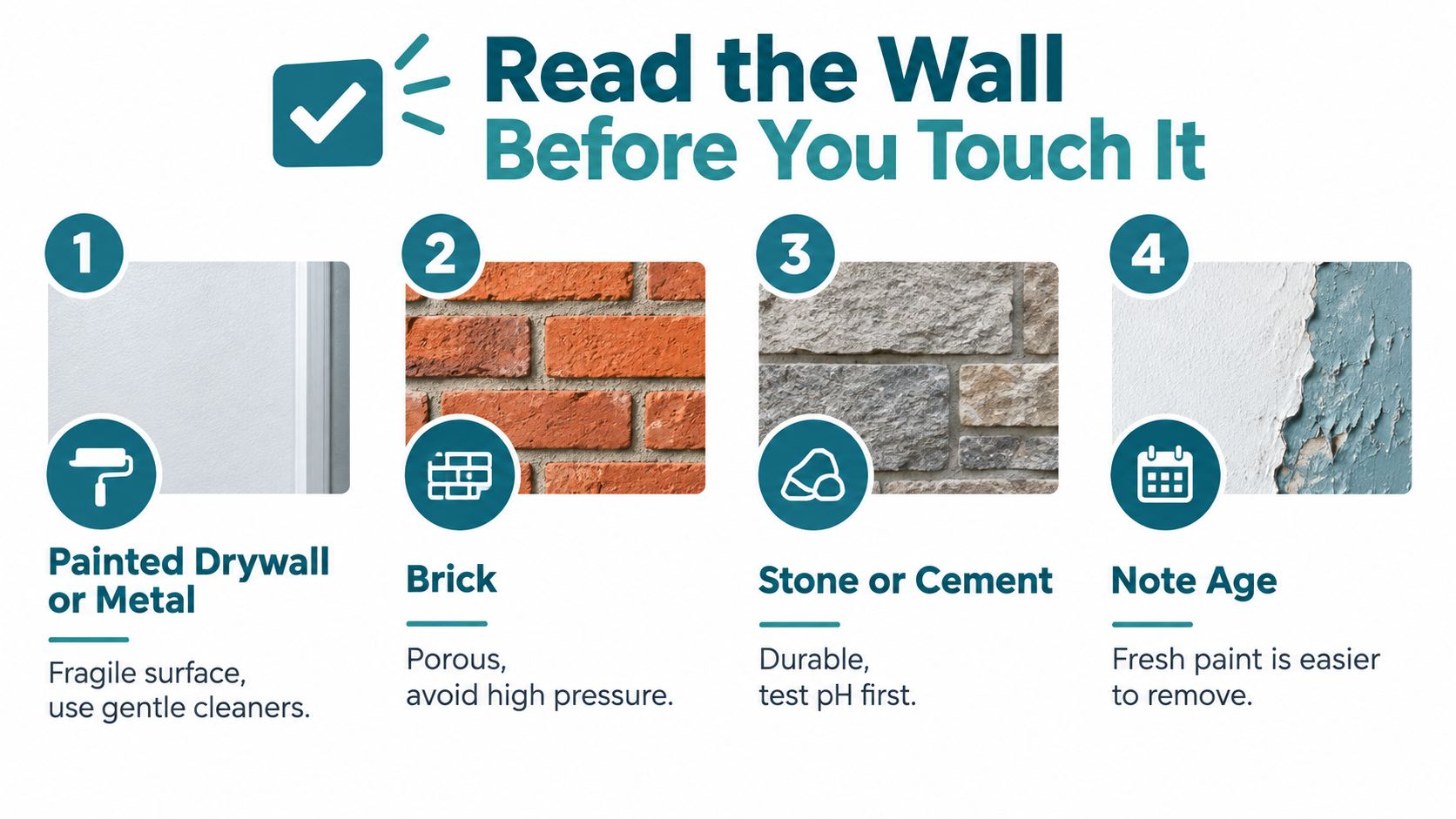
    A wall tells you how to clean it if you slow down long enough to look. I treat that first glance the way I treat a pan in the sink. Cast iron, nonstick, and stainless all need different hands. Your wall does too.

    The fastest mistake is thinking all graffiti removal is scrubbing. It isn't. In Chicago, the city itself splits the work by surface. It paints over graffiti on painted surfaces, and it blasts graffiti off brick, cement, or stone with a high-pressure baking soda-and-water solution through its 311 service listing.

    An infographic detailing four important wall surface types and considerations before starting a graffiti removal project.

    My one-minute wall check

    I do this in about a minute. You can too.

    • Surface first: Is it painted drywall, painted wood, raw brick, stone, cement, or metal?
    • Age next: Does the paint look fresh and glossy, or old and sun-baked?
    • Size and shape: Is it a small marker tag, a spray outline, or a thick fill?
    • Location: Is it above a doorway, behind shrubs, near parked cars, or close to plants?

    That last part matters more than people think. A wall with roses planted below it needs a different setup than a bare alley wall. So does a storefront with cars bumper-to-bumper out front.

    How I read tricky surfaces

    Old brick makes me slow down. Soft masonry can scar if you come in too hard. Painted metal is the opposite problem. You can strip the finish before you remove the tag, then you've traded one ugly patch for another.

    Here's the quick read I use:

    Surface What I assume first My first move
    Painted wall Paint may lift Test a hidden spot
    Metal Finish may dull Try the gentlest wipe
    Brick Surface may absorb paint Start mild and patient
    Stone or cement May handle more, but still test Check a small patch first

    Fresh tags are like wet pancake batter on a counter. Old tags are like syrup burned onto the stove.

    What to photograph before you act

    I always take photos before I clean or report. Nothing fancy. Just clear, useful pictures.

    • Wide shot: Show the full wall and where it sits on the building.
    • Close shot: Capture the paint color and edges of the tag.
    • Reference shot: Include a door, sign, or window so the city crew can spot it fast.
    • Angle shot: If the surface is rough, take one side angle to show texture.

    Those photos help you with 311, and they help you if the tag returns later. You don't need a whole file system. A simple album on your phone by address works.

    The choice usually comes down to two paths

    Most of the time, you're deciding between blast or cover. Raw mineral surfaces like brick, stone, and cement usually point one way. Painted or finished surfaces usually point the other.

    If you're unsure, that's your answer. Slow down and call the city instead of guessing with somebody's facade.

    Safe Ways to Remove Graffiti Without Damaging Surfaces

    I once watched a guy attack a tagged brick wall with so much pressure that he cut pale stripes into the masonry. The tag faded. The scar stayed. That wall looked like it had been clawed.

    That's the whole game right there. You want the graffiti gone, not the wall with it.

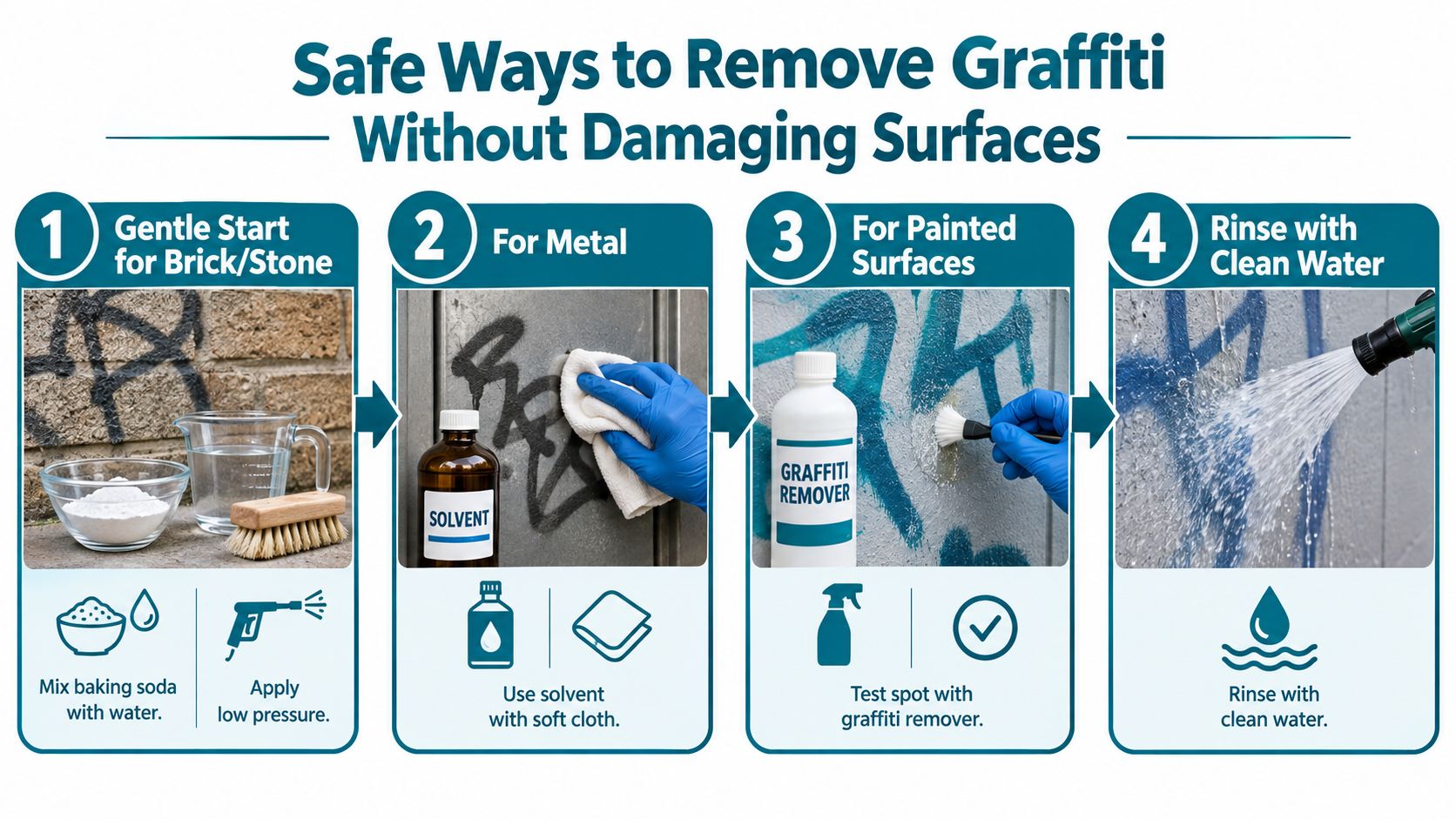
    Here's the city's basic split: blast trucks use baking soda under high water pressure on painted graffiti over brick, stone, and other mineral surfaces, while paint trucks cover graffiti on metal or wood, as the city explains in its graffiti removal program page. That surface-first logic is the safest place to start.

    An infographic showing four safe methods for removing graffiti from brick, metal, and painted surfaces using various cleaners.

    On brick and stone, start softer than your instincts want

    The city has also described using baking soda-water, citric acid-water, and citrus-based oil in its operations, with tougher cases sometimes ending in repainting. The same city material warns that too-narrow or too-strong pressure-washing can etch masonry, so soft or historic brick should get the gentlest method first in the Department of Streets and Sanitation overview.

    That matches what I've learned the hard way. Your first pass should feel almost boring.

    Try this order:

    1. Test a small corner you won't notice if it changes.
    2. Use the mildest method first on porous surfaces.
    3. Check the color of the runoff and the wall face itself.
    4. Stop if the wall lightens unevenly or starts to fuzz.

    If the wall starts looking chalky or scraped, back off. You're cleaning paint, not stripping a deck.

    Painted surfaces often need cover, not combat

    Painted wood, painted metal, and already-coated walls are a different animal. Sometimes the cleanest fix is color-matched paint. I know people hate hearing that because it feels less satisfying than removal. But a good cover coat often beats a patch of smeared solvent damage.

    I keep the process plain:

    • Match the finish: Flat, satin, and gloss don't hide the same way.
    • Feather the edges: Don't paint a hard little square if you can blend wider.
    • Let the first coat dry: Rushing the second coat can drag pigment.
    • Stand back across the street: That's the test, not your nose-to-wall test.

    If you're already in cleanup mode outside, it helps to tidy the whole scene too. A clean sidewalk makes a cleaned wall feel complete. I like the basic habits in this guide on how to clean sidewalks because the same rule applies. Start gentle, protect what's nearby, and don't spread the mess farther down the block.

    Here's a quick visual for the flow before you start:

    Protect what sits around the wall

    Graffiti cleanup gets messy fast. I've seen overspray hit leaves, runoff stain concrete, and rinse water carry color toward a storm drain.

    So before I begin, I check the area around the wall:

    • Cars nearby: Ask the owner to move if you can.
    • Plants at the base: Cover them or redirect runoff.
    • Windows and signs: Mask what might catch splash.
    • Foot traffic: Keep people clear of wet surfaces.

    Use the gentlest tool that gets movement. You can always step up. You can't un-etch brick.

    When I stop and hand it off

    I stop the moment a wall gives me a bad signal. That might be soft old masonry, a weird coating I can't identify, or a patch where the graffiti has sunk deep into pores.

    That's not quitting. That's judgment.

    A lot of bad cleanup jobs come from pride. People keep going because they've started. I'd rather leave a tag for city crews than leave permanent damage for the owner.

    Chicago Rules Permits and How to Use 311 Right

    Rules get annoying when they are written like a maze. So I boil Chicago's graffiti rules down to kitchen-table language.

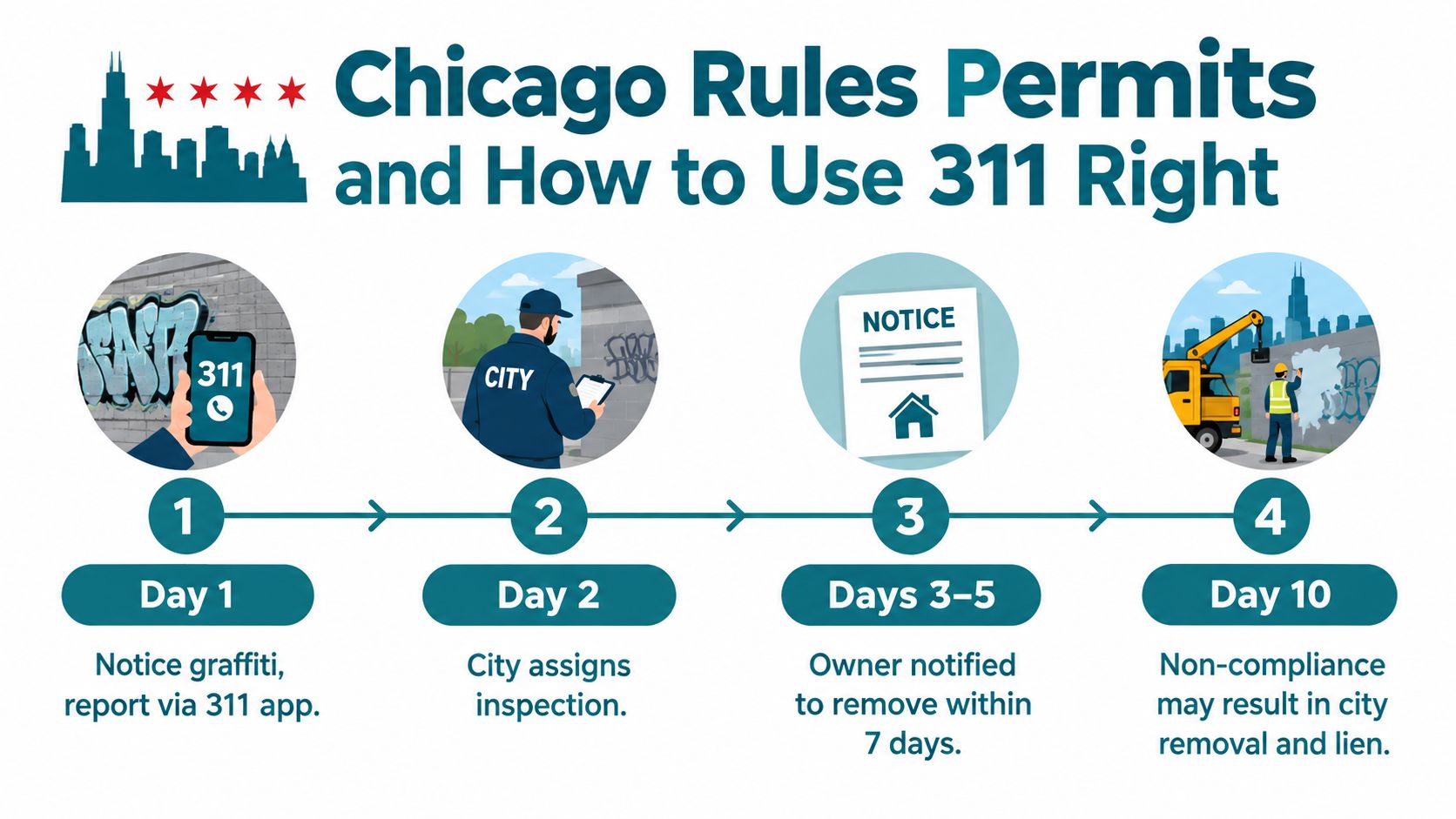
    If graffiti shows up on your building and it isn't registered under the city's rules, Chicago treats it as a public nuisance. The owner has to remove or conceal it as soon as it appears, and if the owner doesn't act, the Department of Streets and Sanitation can post notice and then enter the property to abate it after five days, excluding Saturdays, Sundays, and legal holidays, under the Chicago municipal code.

    A four-step infographic explaining the Chicago city process for reporting and removing graffiti via 311.

    When a permit enters the picture

    A lot of owners miss this part. Chicago also has a permit rule for chemical graffiti-removal work on buildings and similar architectural surfaces. If the Department of Streets and Sanitation does the graffiti removal, you don't need that permit. But if you sandblast, grind, or chemically wash a building, structure, statue, or other architectural surface, the permit costs $200 per surface under the Chicago building code provision.

    That means the cheap shortcut can get expensive if you skip the paperwork.

    If you're already sorting cleanup materials for a property, I'd also keep disposal in mind. This page on City of Chicago hazardous waste disposal is a useful gut check when you're dealing with leftover chemicals, paint-related waste, or other cleanup byproducts.

    How I file a 311 request so it moves cleanly

    Chicago routes graffiti complaints through 311, and the hotline runs 24/7 at 311 or 312-744-5000, according to this Chicago 311 service information page.

    When I report graffiti, I keep the details tight:

    • Exact address: Front, alley, garage, viaduct, or side wall.
    • Surface type: Brick, metal, wood, painted wall.
    • Access note: Gate opened, dog in yard, wall faces alley, and so on.
    • Photo set: The same shots you took during your wall check.

    Small details help crews avoid wasted trips. “Back wall off alley, red brick, left of garage door” is better than “garage has graffiti.”

    What timing feels like right now

    Demand is still heavy. Chicago dashboards show 35.3k graffiti-removal requests from January 1 to May 15, 2026, versus 34k over the same period in 2025, a 4% increase, on Transparent Chicago's graffiti metrics page.

    That volume changes your expectations. You should report right away. You should give clean location details. And you should understand that a city with tens of thousands of requests in the first part of the year is juggling a lot at once.

    Report fast, then decide whether you should also handle an easy cover-up yourself. Waiting to “see if it gets worse” usually wastes time.

    Clean Together With Neighbors and Litter Caterpillars

    The easiest cleanup I ever did was not easy at all. Four of us met on a cold Saturday. One person brought gloves. One brought coffee. I brought extra trash bags and a tiny paint sample card that matched a fence almost perfectly. We cleaned a tagged side wall, swept glass from the curb, and by noon the corner looked like somebody loved it again.

    That's why I like neighborhood cleanup as a habit, not a heroic act. You don't need a speech. You need two or three people who will show up.

    A small crew beats a perfect plan

    I keep volunteer jobs simple because simple jobs happen.

    Here's the split I use on a block cleanup morning:

    • One person handles photos and 311 notes. That person documents before and after.
    • One person manages supplies. Gloves, rags, tape, water, paint, and cleanup bags.
    • One or two people work the wall. They test, wipe, cover, and rinse carefully.
    • Another person watches the edges. Cars, foot traffic, kids, pets, and runoff.

    That setup keeps people from bunching around the same spot. It also lowers the chance that somebody gets bored and starts improvising with the wrong tool.

    Weekend mornings work for a reason

    I've found that early weekend meetups pull in the right energy. People come ready to work, then they still have the rest of the day. You don't need to run a military operation. You need a clear start time, a meeting corner, and one person willing to say, “You take that side. I'll tape the trim.”

    If you want a framework for the people side of it, this guide on how to organize a neighborhood cleanup has the bones of a plan that works on a Chicago block.

    A simple outreach note gets better replies than a fancy one. I use something like this:

    “Hey neighbors, a fresh tag showed up on the side wall by the alley. I'm meeting there Saturday morning for a short cleanup and photo report. If you can bring gloves or just an extra set of hands, come by.”

    How I talk with shops and landlords

    Store owners and landlords usually want the same thing you want. They want the mess gone without drama.

    So I keep the ask direct:

    Who I'm asking What I ask for
    Store owner Permission to access wall and match paint
    Landlord Contact info, paint details, and gate access
    Neighbor Extra water, ladder hold, or photo help

    I don't oversell it. I don't turn it into a campaign. I ask for one concrete thing.

    Celebrate the finish line a little

    People come back when the cleanup feels human. After we wrap, I like a group photo, a coffee run, or even five minutes of standing around admiring the now-boring wall.

    That boring wall is the prize.

    And there's another payoff. When several neighbors see the cleanup happen with their own eyes, they start reporting new tags faster next time. The block learns the rhythm.

    Keep It Clear With Prevention and Quick Reporting

    A clean wall needs a routine, same as a swept porch. If you treat graffiti as a one-time fight, you'll keep reliving the same Saturday. If you treat it as a weekly habit, the job gets lighter.

    I use a short loop. Walk the block. Spot new marks. Report what needs city help. Handle the easy stuff quickly. Make notes on what keeps getting hit.

    The habits that cut repeat work

    Some prevention is plain common sense. Good lighting helps. Fast cleanup helps more. A wall that stays tagged for days keeps inviting attention.

    I also like permission-based murals in spots that attract repeat tagging, and anti-graffiti coatings where the surface and budget make sense. Those choices depend on the property. I don't push one answer for every wall.

    My basic weekly loop looks like this:

    • Check the usual spots: Alley doors, side walls, garage panels, utility-facing walls.
    • Log fresh tags right away: Don't wait for a bigger batch.
    • Keep a simple note: Date, location, surface, what worked.
    • Watch patterns: Same corner, same color, same blind spot.

    What I'd put on the fridge

    This is the reminder I'd tape up at home:

    Clean it fast. Match the method to the wall. Report early. Make the block boring to tag.

    That line keeps me from overthinking it. You don't need a giant system. You need repetition.

    Your next move this week

    Pick one wall you pass all the time. Photograph it. Check whether the surface is painted or mineral. Save the right reporting info in your phone. If a tag shows up, you won't waste a day deciding what to do.

    That's how blocks stay cleaner longer. People don't wait for the perfect city response, and they don't wreck surfaces with rushed DIY fixes either. They build a neighborhood reflex. See it. Read it. Act on it.


    If you want backup, Litter Caterpillars brings Chicago volunteers together for real, hands-on neighborhood cleanup work, the kind that makes graffiti response and block care easier to sustain. You can join a weekend crew, meet people who show up, and turn one cleaned wall into a cleaner stretch of street.

  • Trash Pickup Tool Guide for Cleaner Volunteer Events

    Trash Pickup Tool Guide for Cleaner Volunteer Events

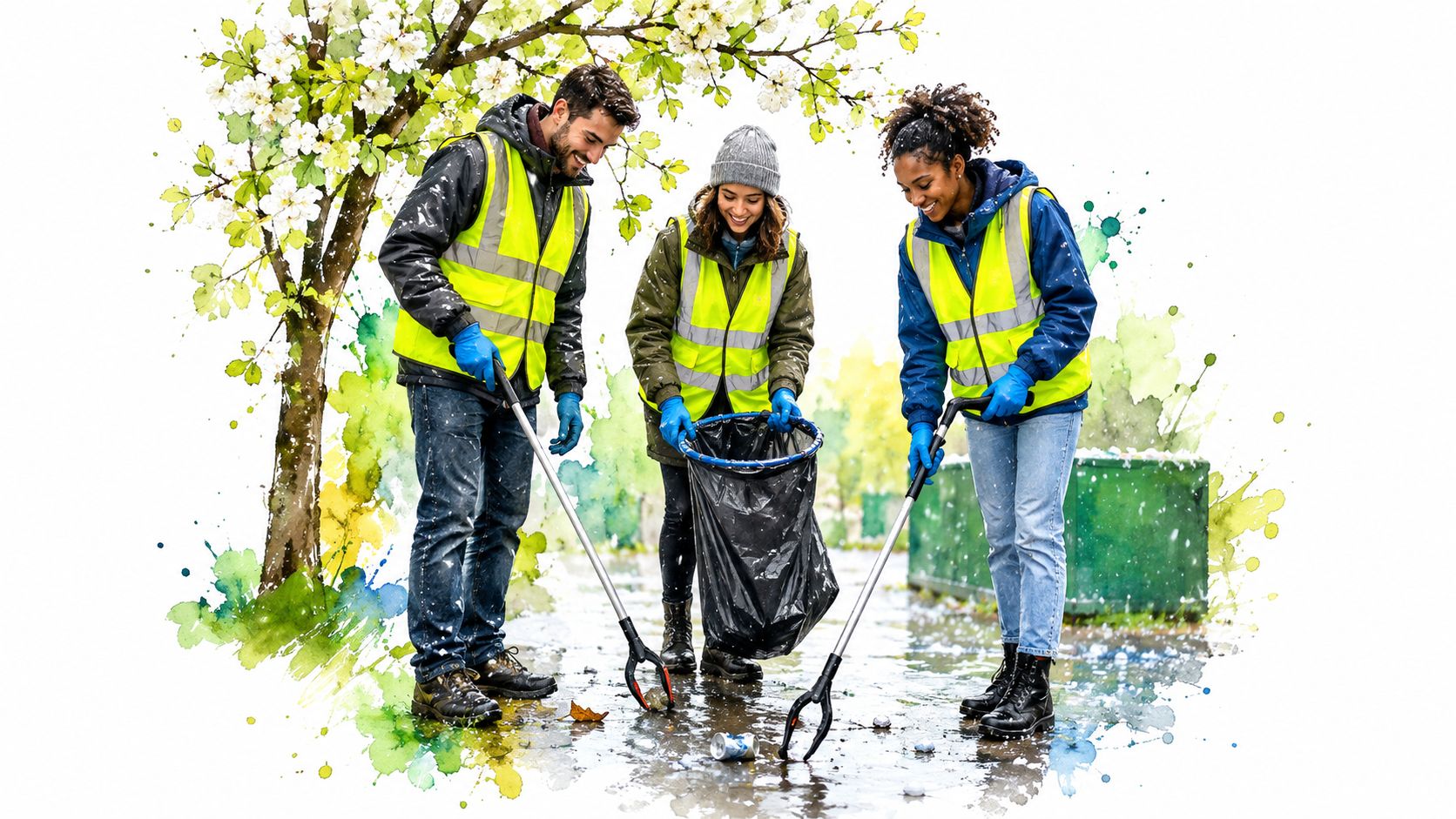
    Three of us stood under a tree while spring hail smacked our sleeves. Our Uber kept canceling, our fingers were numb, and we still finished the block because each of us had a good grabber, decent gloves, and a bag that stayed open in the wind.

    Why Your Trash Pickup Tool Choice Matters More Than You Think

    That morning taught me something I still use on every cleanup. A trash pickup tool doesn't feel like a gadget when you're cold, wet, and staring at a curb packed with soggy cups, cigarette butts, and broken fast-food lids. It feels like the difference between flinching and moving.

    I started picking up litter because cleaning my own mess felt weirdly heavy. Cleaning a sidewalk felt lighter. You bend once, hear the click of the grabber, drop the trash in the bag, and your brain says, fine, I can do one more. Then one more. Then the whole block looks different.

    Three volunteers wearing high-visibility vests use trash pickup tools to clean up litter in a park.

    The tool changes your mood first

    I've led cleanups in heat that made the bags stick to your leg and in wind that tried to turn every wrapper into a kite. In both cases, the volunteers who had the right tool settled in fast. They didn't hover over each piece deciding whether it was too gross or too awkward. They just worked.

    That's why I tell new people to stop thinking about "trash pickup tool" like it's one thing. A picker for dry cans on a sidewalk is one job. A tool for soggy paper in grass is another. A tool for a cigarette butt field near a bus stop is another again.

    If you're curious why so many of us keep showing up, I wrote more about that pull in why people pick up litter in the first place.

    Practical rule: If a tool makes you hesitate less, it is the right tool for that moment.

    Safety, speed, and a little joy

    Trash pickup tools have changed a lot over time. Horse-drawn trash carts gave way to motorized collection vehicles in the early 20th century, and by 1929 garbage trucks had hoppers so workers no longer had to lift bins overhead. Front-loader trucks with hydraulics became common in the 1970s, and by the mid-1990s modern trash and recycling trucks could haul up to 20 tons. You can trace a straight line there from brute lifting to smarter handling in the history of trash collection equipment.

    That same logic works at volunteer scale. You want less strain, less touching, less awkward bending, and fewer bad decisions.

    I learned that across weekly cleanups in every kind of Chicago weather. The right tool speeds up the easy stuff. More important, it tells you what not to touch. That boundary is gold. Once you know where your grabber's job ends, you clean with more confidence and a calmer head.

    How to Choose the Right Trash Pickup Tool for Your Cleanup

    On a hot Saturday in Little Village, I watched two volunteers work the same block. One had a sturdy claw grabber and cleared cups, cans, and takeout boxes in a steady rhythm. The other had a flimsy picker with weak jaws. Every crushed can slipped. Every pickup took two tries. By the end of the alley, one person was still fresh and the other was rubbing a sore wrist.

    That is how I choose a trash pickup tool. I start with the mess in front of me, then I match the tool to the hazard, the surface, and the distance I want between my hand and the item.

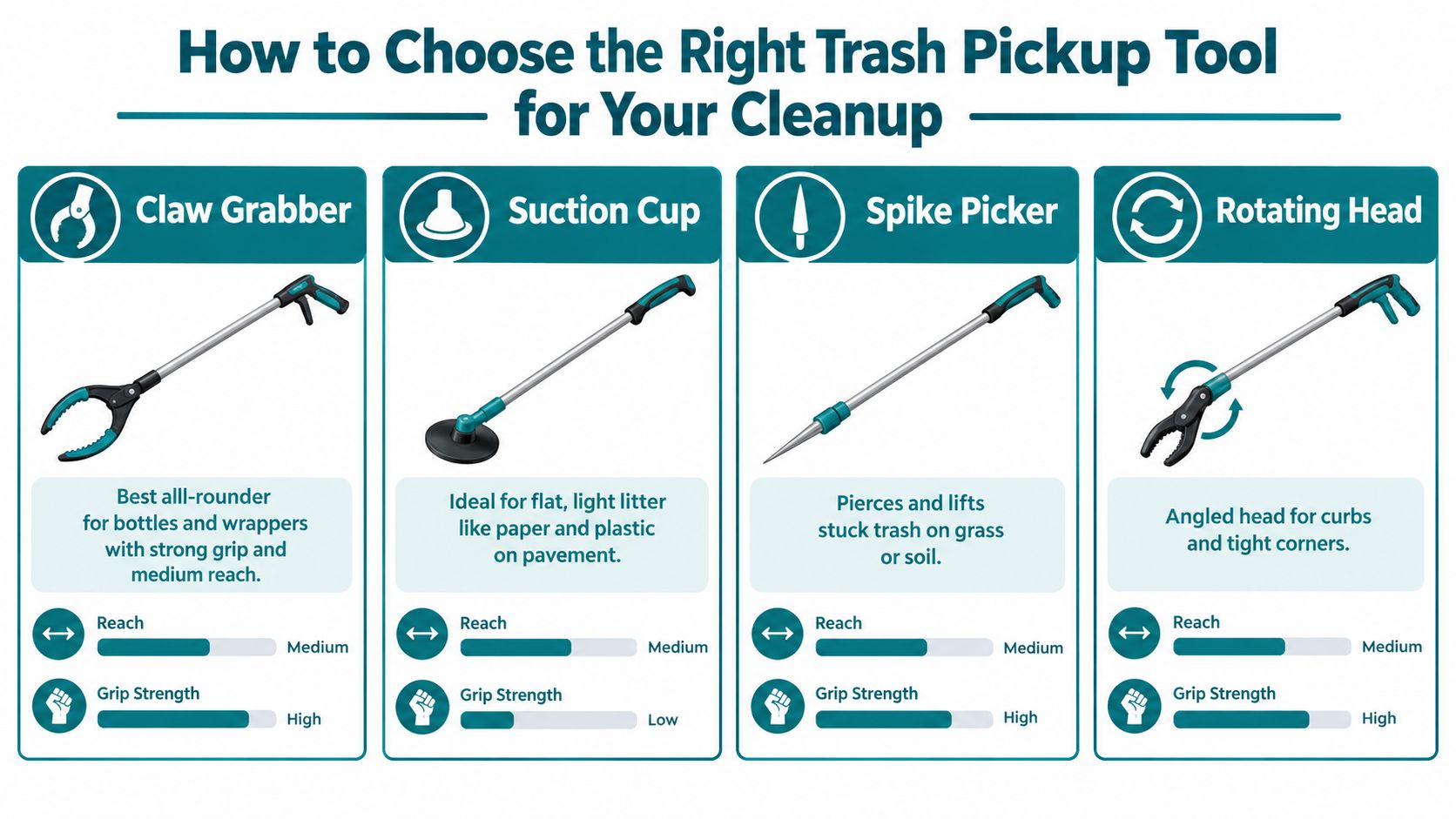
    An infographic showing four different types of trash pickup tools with descriptions for their specific uses.

    Start with the litter, not the catalog

    A typical grabber gives enough reach for sidewalk work without forcing you to bend over every few seconds. One folding model, for example, lists a 17-inch folded length and a 1.5-inch suction cup in this grabber product example. Specs like that matter, but only after you know what you are picking up.

    I sort tools into jobs:

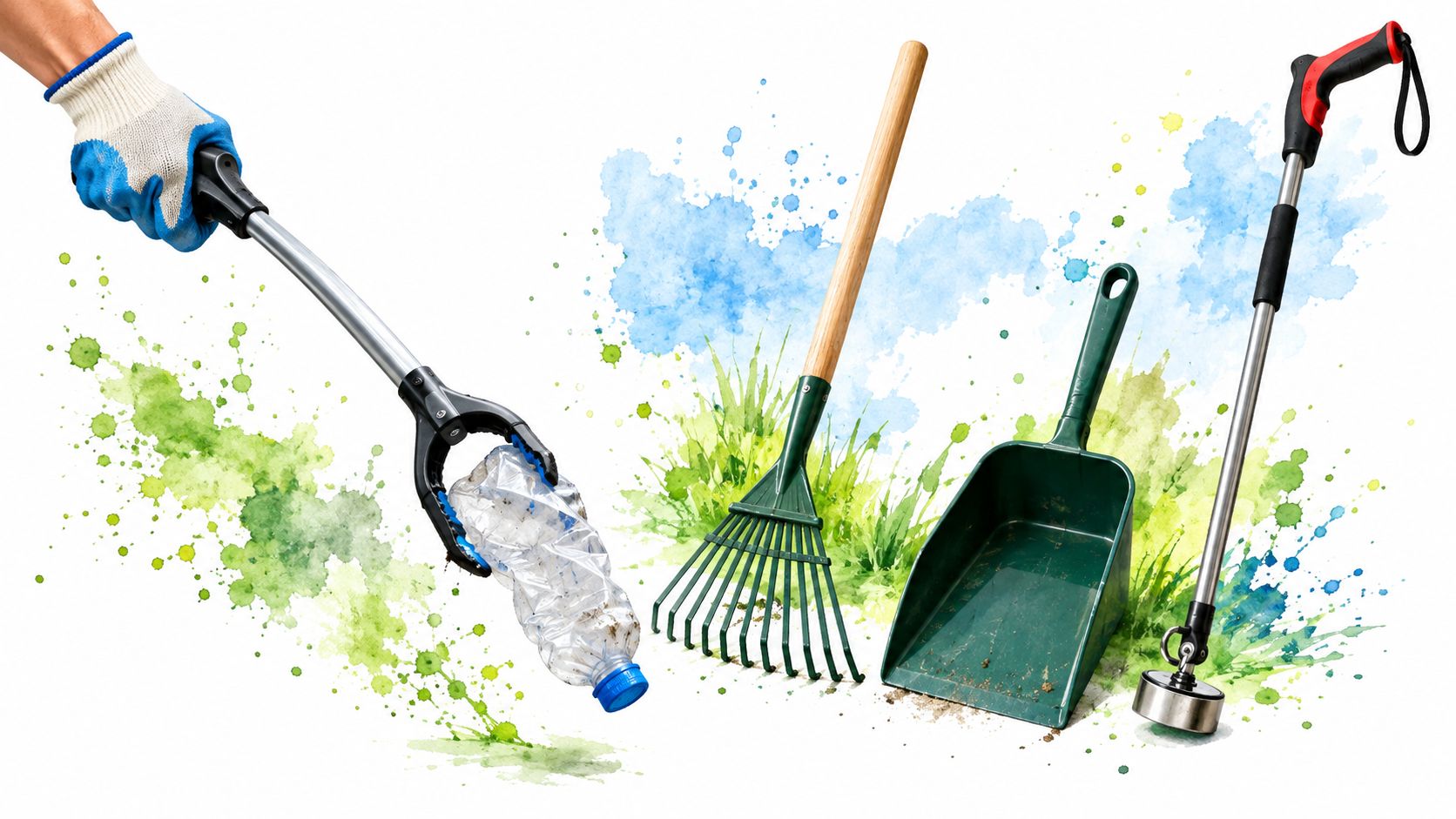
    • Claw grabber: My default for bottles, cans, food containers, and heavier wrappers. It holds its grip when the bag is open and the wind is pushing back.
    • Suction cup style: Better for flat, light litter on smooth pavement. Flyers, napkins, and thin plastic come up faster when the ground is doing half the work.
    • Spike picker: Useful for debris stuck in grass or pressed into damp soil.
    • Rotating head grabber: Best near curbs, fence lines, hedges, and parked cars where straight-on reach is awkward.

    A weak tool slows the whole crew. A mismatched tool does something worse. It pushes volunteers to pinch with gloved fingers, kick items loose with a shoe, or reach toward something they should have left alone.

    My decision rules in the field

    I use quick rules, not brand loyalty.

    Cleanup Scenario Best Tool Type Why It Fits
    Sidewalk with cups, cans, wrappers Claw grabber Strong grip and easy drops into a bag
    Smooth pavement with paper and thin plastic Suction cup Lifts flat litter cleanly
    Park grass with stuck debris Spike picker Frees pieces caught in roots or soil
    Curbs, hedges, tight edges Rotating head Reaches odd angles without twisting your wrist
    Cigarette-butt heavy corner Fine-tip claw or spike Small-target control matters more than jaw strength
    Suspected sharps or hazardous waste No standard grabber Stop, mark the spot, report it

    That last row matters most.

    One safety guide says volunteers should use grabbers for ordinary litter, wear high-visibility clothing, gloves, and hard-soled shoes, and report large items, hazardous waste, and sharps instead of handling them directly in this litter grabber safety guidance.

    If an item could cut, puncture, leak, or spread contamination, the tool choice is simple. Do not pick it up yourself.

    I have made that call in alleys after storms, beside bus stops, and along vacant lots where the grass hides surprises. A grabber is enough for routine litter. It is not enough for needles, broken containers with residue, leaking bags, dead animals, or anything you cannot identify from a safe distance. In those cases, I flag the spot, take a photo if needed, and pass it to the city, park staff, or a trained crew.

    Cigarette butts are a good example of why scenario beats marketing copy. They are small, dirty, and often packed into cracks, mulch, or mud. A big claw that works great on bottles can feel clumsy there. Cleanup groups also run into glass and contaminated debris in the same stretch, which is why broad product claims fall apart fast. The safer approach is to match the tip shape to the target, and leave risky items for pros.

    If you want a plain-English list of what belongs in a basic cleanup setup, this trash pickup equipment guide for volunteer cleanups is a useful starting point.

    A short demo helps if you're a visual learner.

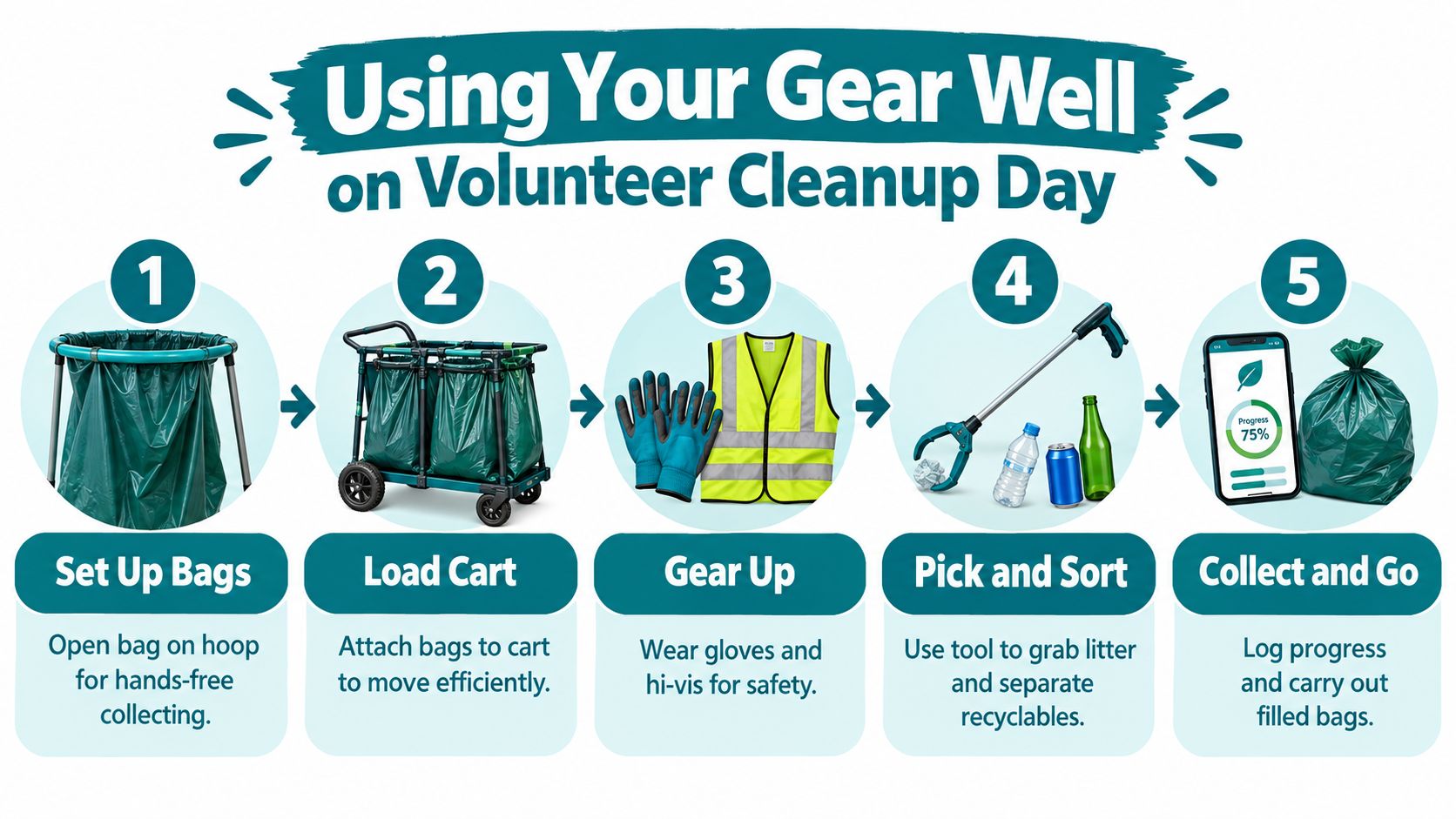
    Using Your Gear Well on Volunteer Cleanup Day

    A cleanup goes smoothly when your setup is boring. I mean that as praise. The bag stays open. The gloves fit. The grabber opens and closes without drama. Nobody is asking where to put the glass bottle or who has the extra bags.

    A five-step infographic showing how to use cleanup gear efficiently for a community volunteer trash collection event.

    My field routine

    I start by staging the boring stuff first.

    1. Open the bags before you need them. A hoop keeps the mouth of the bag open so your grabber can drop trash cleanly.
    2. Load a cart or trolley if the route is long. Carrying full bags by hand burns energy fast.
    3. Put on gloves, hi-vis, and hard-soled shoes. You want protection before the first pickup, not after the first bad surprise.
    4. Sort as you go. I like one stream for organics, one for recyclables, one for garbage.
    5. Keep a phone handy. You may need photos, notes, or a report for a dangerous item.

    Volunteer kit guidance backs up that setup. It recommends bin bags, recyclable bags, gloves, a hoop to keep bags open, a cart or trolley, a mobile phone, and a first aid kit in this cleanup equipment list for volunteer groups.

    Turn a cleanup into usable data

    When I want more than a feel-good morning, I borrow a simple audit method. Use fixed survey zones. Pick up only what you can handle safely. Separate waste into categories during collection. Weigh each category after the session.

    One campus litter audit used a 3-hour collection window, waste tongs, and three bags for organics, recyclables, and garbage in this campus litter audit report. I like that model because it turns "we cleaned a lot" into something you can compare later.

    The trap is sloppy definitions. If one team counts the bus stop and another stops at the tree line, your numbers won't match. If one volunteer tosses cans into garbage and another sorts them into recycling, same problem.

    Field note: Keep the zone fixed and the sorting rules fixed, or don't pretend the results compare.

    For groups that want benchmark-style tracking over time, repeated standard surveys beat random one-off counts. The NSW litter reporting method is a good example. It surveys 1,000 sites twice yearly with a standard method and tracks both volume and item counts. That same source also warns against treating one metric as the whole truth. I agree. A block can look cleaner and still hide dense pockets of cigarette butts in the grass line.

    If you're new and want a simple walkthrough, this how to pick up trash guide covers the basics in plain language.

    Building a Volunteer Ready Kit on Any Budget

    When I pack for a group, I don't think in terms of one magic picker. I think like a cook setting up a line before dinner rush. If the knife is sharp but the pans are missing, service falls apart. Same deal here.

    A collage showing volunteers picking up trash with various cleanup tools and supplies on a white background.

    The kit I want at the curb

    For a small team, I want enough grabbers for the people who hate bending, extra gloves, bags that won't rip, and one way to move full loads without carrying them like dead weight. A cart changes the mood of a cleanup more than people expect. It turns the bag pile into one rolling station.

    I also standardize the kit so every site feels familiar. Same bag colors. Same spot for gloves. Same rule for where filled bags go. That way a volunteer can join in a new neighborhood and still know the rhythm within a minute.

    I keep these points in mind:

    • For hands: grabbers in a few styles, plus backup gloves
    • For sorting: separate bags that volunteers can identify quickly
    • For movement: one cart or trolley if the route is spread out
    • For safety: hi-vis, first aid basics, and a charged phone
    • For weird days: spare liners, tape, and an extra outer bag for wet or sharp-edged trash

    Why group logistics matter more than people think

    Most advice online talks about grip strength and handle comfort. Fine. But group cleanup failure usually starts with logistics. The bags won't stay open. Nobody brought enough supplies. One person is carrying everything. People walk half a block to find the right bag.

    That matters even more because the litter itself doesn't always behave the way people expect. A major U.S. litter study cited by an industry source found nearly 50 billion pieces of litter along roadways and waterways, equal to 152 items per U.S. resident and more than 2,000 pieces per mile. It also counted 25.9 billion pieces along waterways and 23.7 billion along roadways, and said cigarette butts remained the most littered item even after falling by almost 70% in the 2021 litter figures summarized here.

    Those numbers match what a lot of volunteers feel on the ground. A place can seem cleaner overall and still hand you a miserable hour of scattered bottle caps, half-buried plastic, and butt clusters around benches and curb drains.

    A group cleanup kit should solve friction first. If volunteers keep stopping to adjust, search, carry, or sort, the day gets longer fast.

    If you're on foot, pack foldable tools and split supplies across two backpacks. If you're on a bike, strap the hoop flat and carry bags inside a bin or pannier. If you're in a car, store grabbers folded and grouped so setup takes minutes, not rummaging.

    Simple Care and Safety Habits That Keep Tools Working

    Last July, a teenager on my crew used a grabber to drag a waterlogged rug out of a park hedge. The jaws twisted. The spring started clicking. By the second block, the tool would close on a bottle and drop it two steps later.

    That is the kind of failure you can prevent.

    A trash pickup tool lasts longer when you match it to the hazard and stop asking it to do a job meant for gloves, a broom, a shovel, or a city crew. Grabbers are for loose, light litter you can lift cleanly. They are poor choices for sodden fabric, sharp metal, leaking containers, and anything stuck fast in mud or ice.

    The two minute check

    Before I leave home, I give each tool a quick test in the alley. I squeeze the handle. I watch the jaws meet. I look for a loose hinge, a split rubber tip, or a bent shaft from the last cleanup. After wet or gritty events, I wipe the tool down, dry it fully, and clear the grit out of the moving parts before it hardens into a grinding paste.

    If you use a folding model, fold it and store it dry. Some compact grabbers fold to about 17 inches, which is handy for a car bin or closet shelf, but the win is keeping the hinge clean so it still locks straight next time.

    My routine stays simple:

    • Before you leave: check jaw alignment, hinge tension, and gloves
    • After rain or snow: wipe the shaft and jaws, then let the tool dry fully
    • After sand, mulch, or glassy grit: rinse or brush out the hinge and trigger area
    • Before the next event: test the grip on something small and something bulky, like a bottle cap and a can

    One fast test saves a frustrating morning.

    The line I don't cross

    I learned this one on a windy cleanup near Western Avenue. A volunteer spotted litter just past the curb and started reaching from the grass. Cars were moving too fast, and the grabber gave her a false sense of reach. I pulled her back and left the trash where it was.

    That call was right. Some public roadside guidance says not to pick litter from roads or carriageways, to avoid roads with speed limits over 30 mph, and to stay on pavements, paths, and walkways, as described in this roadside litter picking guidance.

    I give new volunteers a plain rule. If you need to step into traffic space, stretch under a guardrail, reach into blind brush, or handle something that could cut, poke, leak, or break, the grabber is no longer enough.

    Then we switch to the relay rule. Pick up the safe stuff. Mark or photograph the dangerous find if your group does that. Report sharps, chemical containers, bulky dumping, dead animals, and anything you cannot identify to the city, park staff, or another trained crew.

    A working tool is only half the job. A volunteer who knows when to stop keeps the whole cleanup safer.

    Your Next Block Is Waiting

    I like weekend mornings for this work. The city is still rubbing its eyes. The light is honest. You can hear someone's laugh from half a block away while a bag rustles and a grabber clicks like a metronome.

    That's how a habit starts. You don't need a massive route. Pick one corner store block, one bus stop stretch, one park edge. Bring one friend if you can. If nobody comes, go anyway and make it short enough that you'll want to come back next week.

    I've seen strange little victories pile up. A volunteer who was shy starts waving at strangers. Someone who came for one event comes back with gloves for a friend. A neglected patch of grass starts looking like part of the neighborhood again instead of a place people ignore. That's how friendships grow too. You're side by side, doing something plain and good, and conversation gets easier because your hands already know what to do.

    Keep the celebration simple. Take a photo. Mark the block on your map. Give the weird hailstorm, hot wind, or perfect sunrise its due. Those details are part of why you'll remember the morning and do it again.

    You don't need perfect gear. You need gear that matches the job, a few safety rules you won't bend, and the nerve to start.

    Then your block starts talking back. Cleaner curb. Fewer cans in the grass. A corner that feels cared for.

    That's enough to get going.


    If you want people to clean with, Litter Caterpillars runs volunteer trash pickup events in Chicago and provides basics like grabbers, bags, and gloves for many outings. If this guide helped you think more clearly about which trash pickup tool fits which cleanup, come join a morning and put those choices to work on a real block.

  • Litter Pickup Tool Guide That Makes Cleanup Easier

    Litter Pickup Tool Guide That Makes Cleanup Easier

    The first time I led a cleanup in a cold Chicago blow, I watched a new volunteer bend for every gum wrapper along the curb. Ten minutes later, I handed her a grabber, and her whole morning changed.

    Why Your First Cleanup Feels Different With the Right Tool

    I still think about one of our early Litter Caterpillars mornings, back when hail came sideways and we huddled under a tree waiting on rides that never showed. We were wet, shivering, and laughing anyway. What kept that cleanup from turning into a miserable slog was simple gear. A bag in one hand, a litter pickup tool in the other, and suddenly the work felt less like punishment and more like a strange little neighborhood adventure.

    A first-person view of a person using a litter pickup tool to clean a park in Chicago.

    When you're new, you think pickup is about grit. Just bend down and get it done. I used to think that too. Then I saw what happens over a long sidewalk, a busy alley, or a park fence line. Bending for every cigarette pack and fast-food lid drains you fast. A decent tool keeps you upright, keeps your hands cleaner, and lets you stay in rhythm.

    Why the tool changes the whole mood

    A litter pickup tool doesn't just add reach. It changes your pace.

    You stop doing this:

    • Bend, grab, stand, step
    • Bend again for the next tiny piece
    • Break your rhythm every few seconds

    You start doing this:

    • Walk and scan
    • Pinch and lift
    • Drop into the bag and keep moving

    That feels small until you've worked one long block. Then it feels like the difference between carrying groceries by hand and using a cart.

    Practical rule: If your cleanup pace feels jerky and your back starts talking to you early, your tool choice is off.

    I also want to be honest about the emotional side. The right gear makes cleanup more fun. That's not corny. When your body isn't fighting the work, your brain has room to notice the jokes, the murals, the weird little treasures people find, the conversations that start between strangers.

    What you should expect from a good fit

    I want you to leave your first cleanup thinking, "I can do that again next weekend."

    A good litter pickup tool helps you:

    • Save energy so you don't burn out halfway down the block
    • Stay safer around sharp or nasty trash
    • Move faster without rushing
    • Feel more confident when the ground is muddy, windy, or full of mixed debris

    There's a bigger cleanup economy around these tools too. Washington State's litter programs collected more than 5.2 million pounds of litter and cleaned more than 18,000 miles of road in 2024, and the same market coverage says the global litter picker market reached about USD 1.19 billion in 2024 with a projected 6.3% CAGR to roughly USD 2.06 billion by 2033 (Washington cleanup scale and litter picker market figures). I don't bring that up to sound fancy. I bring it up because these tools get used hard, at scale, by real cleanup crews and volunteers.

    What a Litter Pickup Tool Is and How It Works

    On a Chicago cleanup, I can usually tell who borrowed the wrong tool in the first five minutes. They are poking at a wet flyer by the curb, bending at the waist, then chasing a bottle cap that slips out of the jaws. The tool is in their hand, but it is not doing enough work for them.

    A litter pickup tool is a handheld tool that extends your reach so you can lift trash without touching it and without folding yourself over every few steps. On our routes, that usually means one thing. A grabber or tong-style picker with a handle, a long shaft, and a gripping end.

    The basic idea works like kitchen tongs on a stick. Your hand makes a small motion at the grip. The tool turns that into a bigger motion at the far end, where the jaws open and close around the trash.

    An infographic explaining what a litter pickup tool is, its core components, and how it works.

    The three parts that matter most

    Nearly every litter pickup tool has three working parts, and each one changes how the tool feels on a real block.

    1. The handle or grip
      This is your control point. Some tools use a trigger. Some use a full-hand squeeze. If you are picking along Milwaukee Avenue for an hour, a stiff grip will wear you out long before the bag is full.

    2. The shaft
      The shaft gives you reach. It also sets your posture. On a flat sidewalk, the right length keeps you more upright. In a weeded lot or along a guardrail, it helps you reach trash without stepping into the mess.

    3. The grabbing end
      This part meets the trash. Wide jaws can catch cups and bottles. Narrow tips do better with cigarette packs, caps, and scraps pinned in grass. That is why one tool can feel great on a boulevard and clumsy near a storm drain.

    How the motion works

    Most tools follow the same cycle:

    • Squeeze the handle
    • Open or close the jaws, depending on the design
    • Set the jaws on the item
    • Grip it firmly
    • Lift and drop it into your bag or bucket

    That cycle repeats hundreds of times in one cleanup.

    A good tool makes that rhythm feel steady. A bad one turns every pickup into two or three tries, which is how a short route starts to feel long. The Conservation Volunteers describes the same basic benefit in its beginner guide. A grabber lets you pick litter at a distance, so you avoid constant bending and direct contact with trash (beginner litter-picking guidance from TCV).

    Why length changes how the tool behaves

    This part trips people up, so I keep it simple. Longer reach helps until it starts to hurt your control.

    On open ground, a longer tool can save steps and cut bending. On a crowded city sidewalk, that same extra length can feel like carrying a canoe paddle into a hallway. You can reach farther, but you lose some precision around fences, parked cars, and bus-stop poles.

    You will also see a big spread in tool lengths on the market, from shorter models around the low-30-inch range to specialty tools that go much longer. Sellers often list the reach and skip the tradeoff. More length can mean less control, more swing weight, and slower pickups in tight spaces (litter tool length and design variation examples).

    Here is the curbside version I give new volunteers:

    • Shorter tools feel quicker in tight spots but ask more from your back
    • Mid-length tools fit the widest range of ward cleanups
    • Very long tools help with ditches, slopes, or barriers, but they can feel awkward on narrow sidewalks

    That is the whole machine. Your hand sends force through the handle. The shaft carries it outward. The jaws turn it into a grip on the trash. Once you see those three pieces working together, picking the right tool gets a lot less confusing.

    Main Types of Litter Pickup Tools and When to Use Each

    Chicago cleanup routes aren't all the same. A lakefront path, an alley behind a restaurant strip, and a highway shoulder each ask for different moves. That's why I don't like generic feature lists. I like matching the tool to the mess.

    Grabbers for mixed city trash

    If you only buy one tool, start with a standard grabber. This is the everyday workhorse. It handles wrappers, bottles, cups, cans, and all the annoying little curb pieces that collect around bus stops and chain-link fences.

    I especially like a rotating-head grabber when I'm working parked-car edges or reaching under hedges. You can angle the jaws instead of twisting your whole wrist. That's handy when you're trying to pick a bottle off a sloped curb or fish a can from between weeds.

    Rakes and scoops for light spread-out debris

    A rake is useful when the ground is covered in leaves mixed with paper bits, napkins, or foam cups. I use that kind of setup in park edges and vacant-lot corners where litter sits in a thin layer across dirt or grass.

    Scoops help when tiny scraps pile up in one spot. Think broken bits around a bench, mulch beds full of candy wrappers, or the grit line near a storm drain. A scoop can gather what a claw keeps missing.

    If your route has mostly flat, light debris, a rake or scoop can beat a grabber on speed. If the trash is mixed and awkward, a grabber usually wins on control.

    Magnet poles and simple DIY options

    Magnet poles do one job. They pick up metal. If you're collecting nails, caps, or small ferrous scraps near construction edges, they help. For paper, plastic, or glass, they won't do much.

    DIY tools can work in a pinch. I've seen people use barbecue tongs, improvised sticks, and garden tools. That's fine for a quick solo block if you're careful, but for group cleanups I want actual pickup tools with predictable grip and reach.

    Here's the fast match guide I use.

    Which Litter Pickup Tool Fits Your Cleanup Job

    Tool Type Best For Watch Out For
    Standard grabber Sidewalk litter, bottles, cans, wrappers, park paths Cheap jaws can slip on thin or wet items
    Rotating-head grabber Curbs, fence lines, under bushes, awkward angles More moving parts can feel looser over time
    Rake Leaves mixed with light litter on grass or dirt Hard to control for single items
    Scoop Small scraps gathered in one area Clumsy on uneven ground
    Magnet pole Metal bits near construction or alleys Useless on plastic, paper, and most common street litter
    DIY tongs or improvised tool Very light personal use Weak grip, less safe, poor control

    My Chicago ward rule of thumb

    When I lead volunteers, I think in terrain first.

    • Busy commercial strips: Bring a grabber for cups, receipts, and food containers around curbs and planters.
    • Residential blocks after wind: Use a grabber, and add a small scoop if the tree lawn has shredded paper bits.
    • Alleys: Choose a stronger jaw that can handle bottles, cans, and damp trash.
    • Vacant lots: Mix tools. One person with a grabber, one with a rake for loose litter in grass.
    • Shoulders and rough edges: Longer reach helps, but too much length makes control sloppy.

    If you want to compare common cleanup gear before an event, I like using a practical roundup like trash pickup equipment for volunteer cleanups as a planning reference.

    Safety and Ergonomics That Keep You Picking Longer

    The fastest way to wear out a new volunteer is simple. Hand them a tool that fights their body.

    I learned that on a cold ward cleanup near an alley off Milwaukee. One volunteer brought a short bargain grabber from home. It looked fine in the parking lot. Twenty minutes later, she was bending for every cup and twisting her wrist to reach under parked cars. Another volunteer had a longer, lighter tool with a grip that sat naturally in the hand. Same route. Same trash. One person was fading, and the other was still moving smoothly an hour later.

    A litter pickup tool should feel like a good broom. It should extend your reach without changing the way your body wants to stand and move.

    A safety and ergonomics infographic for a litter pickup tool, highlighting adjustable shaft length, lightweight balance, and comfortable grip features.

    Start with posture, not features

    On Chicago sidewalks, posture usually matters more than an extra gadget on the tool.

    Your back should stay relaxed and fairly upright. Your shoulders should stay low. Your wrist should stay close to straight when the jaws meet the ground. If one of those three starts working too hard, the tool is the problem.

    Length drives most of that. A tool that is too short makes you fold at the waist, especially on long curb runs. A tool that is too long can feel sloppy in tight spots like bus stops, chain-link fence lines, and the space between trash cans in alleys. Weight matters too. A heavy picker may feel solid for the first few grabs, then start dragging on your forearm once you have walked two or three blocks.

    Before I send a group out, I ask people to do a simple test.

    • Stand naturally with the tip near the ground
    • Reach for a spot near your shoe without hunching
    • Check your wrist to see if it stays mostly straight
    • Swap tools if your shoulder lifts or your grip feels strained

    That thirty-second check saves a lot of complaints later.

    Match the tool to the block

    Ergonomics are not just about your body in the abstract. They depend on where you are picking.

    On a flat residential sidewalk with wrappers and cans, a standard reach tool usually lets you keep a nice rhythm. In an alley with damp bags, broken-down boxes, and heavy drink containers, stronger jaws and a steadier shaft matter because you do not want to squeeze twice for every pickup. Along a boulevard edge or a weedy vacant lot, extra reach helps, but only if you can still control the tip. Too much length out there feels like trying to write your name with a yardstick.

    That is why I choose for terrain first, then comfort. The right ergonomic tool is the one that keeps your body neutral while handling the trash sitting in that ward.

    Gloves are required

    I never let volunteers treat gloves as optional.

    You should always wear heavy-duty gloves and use a litter picker when possible. Safety guidance from Keep Britain Tidy warns against picking litter up by hand because sharp objects can hide inside ordinary trash (heavy-duty glove and tool guidance from Keep Britain Tidy).

    Street trash hides surprises. A paper sack can cover broken glass. Wet leaves can hide a can lid. A crushed bottle near the curb can break again when the jaws press down on it. Gloves and a pickup tool give you one more layer between your skin and the mess.

    Build the pause-before-you-pick habit

    Good volunteers get faster by slowing down for one beat.

    I teach people to pause, read the item, then grab. Volunteer risk guidance advises using litter pickers where possible and checking items for sharp edges or contamination before handling them (volunteer litter-picking risk guidance).

    On the street, that habit looks like this:

    • Look first for shine, jagged edges, or leaking spots
    • Notice the surface if the item is wet, torn, or partly buried
    • Grab from the safest angle instead of rushing straight in
    • Leave it and report it if it looks hazardous

    If you want a plain-language refresher, this guide on how to pick up trash safely during community cleanups pairs well with what I teach on weekend routes.

    One last thing. If a tool makes you shrug your shoulders, clamp your hand too hard, or bend every few steps, do not try to tough it out. Switch tools early. A cleanup should leave you tired in the normal way, not sore from fighting your gear.

    Cost Tiers and Volunteer Friendly Models You Can Trust

    You don't need to overthink your first buy. You aren't outfitting a moon mission. You're trying to clean your block without wrecking your back or buying junk that quits after two Saturdays.

    I sort litter pickup tools into three practical tiers. I don't need an exact sticker price to make the decision. I just look at use frequency, trash type, and whether I'm buying for one person or a whole crew.

    A comparison chart showing three different tiers of litter pickup tools based on price and features.

    Budget tools for casual block walks

    Foldable grabbers and basic pickup claws usually sit here. They're fine for occasional walks, quick curb checks, or someone who wants to keep a tool in the car.

    The tradeoff is feel. Budget tools can be perfectly usable, but they often have shakier jaws, less comfortable grips, and more flex in the shaft. If you're only doing short sessions, that may not bother you. If you're doing weekly pickups, you'll notice.

    Mid-range tools for regular volunteers

    This is the sweet spot for those I clean with. A stronger shaft, better grip, and more reliable jaw shape make a difference over time. If you pick up mixed litter on sidewalks, alleys, and parks every weekend, this is usually where your money works hardest.

    I also like this tier for student groups and neighborhood captains. The tools usually hold up better when different people use them back-to-back.

    Heavy-duty and machine-assisted setups for big events

    This tier is a different animal. Once you get into municipal or industrial cleanup, the upgrade is the collection system, not just the hand grip.

    Some vacuum-based litter pickers pair with a 240-liter container and suction systems that can ingest mixed debris like cans, bags, and bottles. Larger municipal machines use 80-gallon tanks, 16-gauge steel construction, and about a 2:1 compaction ratio, which extends service time and cuts dump frequency because crews spend less time stopping to unload (industrial litter system container and compaction specs).

    For a volunteer group, that idea matters even if you never touch a machine. Bigger bags, smarter staging, and fewer dump runs keep your crew working instead of walking trash back and forth.

    How I buy for a group

    I don't buy every tool at the same level. I mix the kit.

    • For new volunteers: Keep a batch of simple, dependable grabbers that fit most.
    • For regulars: Add sturdier ergonomic models for longer routes and rougher debris.
    • For specialty jobs: Keep a few oddballs around, like stronger jaws for alley glass or a rake for lot edges.

    If you're joining a cleanup instead of buying your own right away, one practical option is a group that already supplies tools. Litter Caterpillars runs volunteer trash pickups in Chicago where grabbers are part of the event setup, so you can test what feels right before spending money.

    Simple Maintenance and Storage That Extends Tool Life

    I've seen good tools die early from one lazy habit. People toss them in a wet trunk, leave grime in the jaws, and forget about them until next weekend. Then the spring sticks, the grip smells weird, or the claw stops closing cleanly right when the route starts.

    You don't need a fancy routine. You need a repeatable one.

    My three-minute post-cleanup reset

    When I get back from a pickup, I do the same quick sequence every time.

    1. Wipe the shaft
      Dirt and street residue build up fast, especially after rain.

    2. Check the jaws
      Look for lodged plastic, string, or sharp fragments.

    3. Dry the tool fully
      Moisture is what turns a decent tool into a cranky one.

    4. Test the action
      Open and close it a few times. You want a clean snap, not a sluggish chew.

    Clean tools are safer to handle next time. They also make wear easier to spot before a volunteer ends up fighting a half-broken grip.

    Where to store it in real life

    Storage doesn't need to be pretty. It just needs to keep the tool dry and easy to grab.

    • Apartment living: Hang it in a closet corner or behind a door so the jaws don't snag bags or coats.
    • Garage setup: Keep it off the floor. Wall hooks work well.
    • Group shed or shared space: Stand tools upright or hang them by type so people don't crush lighter grabbers under heavier gear.

    What wear looks like before failure

    A tool usually warns you before it quits.

    Watch for:

    • Loose jaws that wiggle side to side
    • Sticky triggers that don't spring back smoothly
    • Hairline cracks near the grip or hinge
    • Bent shafts after rough alley work

    When I see those signs, I pull the tool from group use until I can test it. Mid-route failures waste time, but worse than that, they frustrate new volunteers who are still deciding whether cleanup feels welcoming or annoying.

    Pick Your Tool and Join the Next Chicago Cleanup

    When you strip away the product chatter, the decision is pretty simple. Match your tool to your height, your route, and the kind of trash you see.

    If you're cleaning a regular city sidewalk, start with a mid-length grabber that feels light and controlled in your hand. If you're taller, give yourself more shaft length so you can stay upright. If you're heading into grass, lot edges, or places with spread-out light debris, add a rake or scoop to the plan.

    My simple choice filter

    Ask yourself three questions:

    • Where am I cleaning? Sidewalk, alley, park edge, vacant lot
    • What am I picking up? Wrappers, bottles, cans, leaves, metal bits
    • How long will I be out? Quick block walk or full morning shift

    That gets you most of the way there. The right litter pickup tool should feel obvious once you stop shopping by gimmick and start shopping by route.

    Why this matters on a weekend morning

    When your gear fits the job, your attention shifts. You stop thinking about your lower back, your sore grip, or whether you should've stayed home. You start noticing the people next to you. You talk. You laugh. You finish a block and want one more.

    That's the good stuff.

    If you're ready to test your setup with other people, join a Chicago litter cleanup volunteer event and try your tool on real streets, real curbs, and real mixed trash. One solid morning will teach you more than a week of scrolling product pages.

    Pick one tool. Walk one block. Let the city teach you the rest.


    If you want a place to use a litter pickup tool with other kind, brave people, Litter Caterpillars organizes weekend Chicago cleanups where volunteers can show up, grab gear, and get to work together. It's a simple way to test what tool feels right on real sidewalks, meet people, and help clean the city one block at a time.

  • Volunteer Uniforms That Build Pride and Keep You Safe

    Volunteer Uniforms That Build Pride and Keep You Safe

    A Chicago hailstorm caught three of us halfway through our first cleanup. We huddled under a tree, shivering while every Uber canceled, and our shared flags became the only clear sign that we belonged together.

    Why Volunteer Uniforms Matter More Than a Logo

    That day taught me something I still use when I think about volunteer uniforms. A shirt can carry a logo, but a uniform system has to do more work. It has to help the public find you, help volunteers find one another, and help a newcomer feel included before they know anyone's name.

    The first approved volunteer uniform in the U.S. National Park Service VIP program was an orange “pop-on” smock, approved in December 1970 when the program began. By 1975, the Service had introduced a distinctive cardigan vest, described in agency materials as sunny gold trimmed in loden green, with versions for men and women. Volunteers whose main duty involved visitor contact had to wear it. The National Park Service history of volunteer uniforms shows how quickly a simple garment can become a public signal.

    A diverse group of volunteers in blue jackets and caps huddling under a tree during rain.

    The three jobs your uniform must do

    A stranger on a Chicago sidewalk shouldn't have to guess whether you're part of the cleanup. A bright flag, visible badge, or shared jacket gives them an answer before you speak.

    A volunteer arriving alone needs the same answer. They should spot the check-in table, recognize the group near the corner, and know whom to ask for gloves. That small moment can turn anxiety into movement.

    The third job happens. A newcomer puts on a vest, pins on a name tag, or receives a team flag. Suddenly, they aren't watching from the edge. They have a place.

    A useful test: If your uniform idea doesn't improve recognition, safety, comfort, or belonging, leave it out.

    I think about uniforms as a bridge between identity and action. The logo matters because it tells a story, yet the garment also has to survive bending, lifting, rain, sweat, and a hurried bus ride home. A practical campaign t-shirt guide can help you think through message, artwork, and shirt choices before you commit to a design.

    Uniforms can also shape group habits. You can read more about organizational culture building when you're trying to turn occasional attendance into a shared practice. Start with the people, the work, and the hazards. Add the logo after those pieces make sense.

    Design Your Volunteer Uniform System Before You Shop

    Start with a map, not a catalog. Before you buy shirts, write down where volunteers work, what they carry, how long they stay outside, and which roles face moving vehicles, poor light, wet pavement, or heavy lifting.

    I use two layers. The core identity layer carries the group's shared look. It might include a shirt, cap, name tag, or small flag. The functional layer comes on top when the task requires visibility, rain protection, cold-weather coverage, or a role marker.

    That separation keeps branding from carrying a safety burden it can't meet. Street clothes can work beneath a logo vest in some settings, yet roadway-facing volunteers need a complete compliant safety garment rather than a bright shirt paired with an unrelated vest.

    A three-step guide to designing volunteer uniforms featuring a t-shirt, utility vest, and a distribution kit.

    Build the brief in four passes

    Map the roles. Separate sidewalk collectors, traffic-facing spotters, team leads, photographers, supply runners, and check-in volunteers. They don't all need identical clothing.

    Map the conditions. List normal weather, low-light periods, wet locations, wind, heat, and the movements each role makes. A person who bends for hours needs different comfort from someone standing at a check-in table.

    Choose the identity layer. Pick a color that stays readable in street scenes and photographs. Place the logo where a jacket, vest, or open coat won't hide it. Use names or role labels when volunteers need quick identification.

    Choose the safety layer. Specify the exact vest or outerwear model, the label class, the available sizes, and the conditions that trigger use. If you need help thinking through fabric weight, stretch, or garment construction, find custom team uniform fabrics before you send a purchase request.

    Your finished brief can fit on one page:

    • Identity: approved shirt, cap, badge, flag, or name tag.
    • Safety: approved high-visibility outerwear and label check.
    • Weather: rain, snow, heat, and cold layers.
    • Roles: who wears each add-on and when.
    • Fit: size range, alternate garments, and spare stock.
    • Care: washing, drying, storage, repairs, and returns.
    • Conduct: visible identification, photo rules, and prohibited lookalike gear.

    Keep the brief plain enough for a new volunteer lead to use without a meeting. If someone has to interpret every line, the system will change from event to event.

    Sourcing Volunteer Uniforms on a Grassroots Budget

    A low-cost uniform doesn't have to look careless. I've seen groups spend their limited money in the wrong place, then discover they can't replace a missing size or a damaged vest. The better question is simple: what can you issue, wash, repair, and replace through a full season of cleanups?

    Sourcing Option Best For Trade Off
    Bulk tees Groups that meet often and want one shared identity layer Sizes and fabric quality need careful planning
    Thrift shirts with iron-on marks Small pilots and mixed personal styles Matching color and long-term durability can vary
    Logo vests over personal clothing Inclusive programs with limited shirt stock The vest still needs clear fit and care rules
    Donated high-visibility vests Roadside work with a very tight budget Donations may arrive in mixed classes, sizes, and condition
    One approved hi-vis model Groups that need repeatable street-work practice Upfront sorting and replacement planning take attention

    Spend first on the layer that protects people

    For roadway work, spend on the safety garment before you spend on a polished shirt. Fluorescent high-visibility clothing grew from a longer safety-apparel history. Bob Switzer developed fluorescent garments in the 1930s after an injury, UK railway workers trialed high-visibility clothing in Glasgow in 1964, and the first ANSI/ISEA 107 standard arrived in 1999, according to this history of high-visibility clothing.

    A logo shirt can wait. A compliant vest can't when volunteers work near public access roads.

    Match the purchase to the group

    A small group can test a few shirt colors and issue reusable name tags. A growing group needs a size record, a storage bin, and a rule for who receives roadway gear. A group that works in changing neighborhoods may prefer logo vests over personal clothing, since volunteers can arrive in comfortable layers while the group still looks connected.

    I'd also reserve money for spare sizes and simple replacements. One approved hi-vis model makes training easier, reduces confusion at check-in, and lets a volunteer lead spot a mismatch quickly. A small badge or flag can carry group pride when shirts fade, stretch, or disappear into laundry baskets.

    Buy what your team can maintain. A cheap garment that no one can fit, wash, or replace becomes expensive friction.

    Ask every vendor the same questions. What sizes can you order later? Does the logo survive ordinary washing? Can you replace one damaged piece? Does the safety garment carry the required label? A grassroots budget works best when you protect repeatability rather than chase a perfect first order.

    Fit Distribution and Care That Keeps Volunteers Coming Back

    The clothing table can either welcome people or push them away. I've watched a volunteer arrive on a cold morning, wait while someone searches through a box, try on a shirt that pulls across the shoulders, then leave before the first bag fills. The cleanup lost a pair of hands before it reached the sidewalk.

    Treat distribution like a short ritual. Sort garments before people arrive. Label bins by size. Pre-pack a kit with the garment, name tag, role note, and return instructions. Keep a small fitting area where someone can change without an audience.

    A three-step process infographic for volunteer uniforms including sizing, distribution check-ins, and the laundering return cycle.

    Make fit part of safety

    Offer more than one cut when you can. Keep enough room for bending, reaching, layering, and walking. A volunteer uniform should allow comfortable movement without weakening a professional appearance, as described in this hospital volunteer clothing guidance.

    A vest over personal clothing can help when a volunteer can't use the standard shirt because of sensory needs, religious dress, mobility needs, body shape, or weather. An alternate garment still needs a clear safety rule and visible identification. Inclusion works best when you write the option into the policy instead of treating it like a special favor.

    Run the check-in table quickly

    Use a simple record with the volunteer's name, issued size, role layer, and return status. Keep a bin for clean stock and another for used garments. Put the return location on a small card inside every kit.

    Name labels can save time when several people own similar jackets. These tips for school uniform labels give useful ideas for durable placement and readable identification, even though cleanup teams need to adapt them for outdoor workwear.

    Care rule: Every issued item returns clean, dry, complete, and ready for the next person.

    The U.S. Forest Service volunteer-uniform manual calls for uniforms to remain neat, clean, and complete, and it treats high-visibility vests as an approved exception for special circumstances. That manual's uniform guidance supports a modular approach, identity underneath and safety or weather layers above.

    Wash according to the garment label. Dry wet gear before storage. Repair loose seams early. Retire damaged reflective material instead of hoping the next volunteer won't notice.

    Here's a short visual reminder you can share with team leads:

    A smooth clothing ritual tells volunteers that their time matters. They get in, get equipped, and get moving.

    You can pair this process with practical volunteer retention strategies that reduce avoidable friction before and after each cleanup.

    Safety Visibility and Weather Rules You Can Actually Enforce

    A roadside vest is not decoration. Seattle's Adopt-A-Street guide says volunteers must wear the safety vest at all times, and Texas DOT requires volunteers to wear the agency-provided safety vests during cleanup. Seattle's Adopt-A-Street safety guidance gives the plainest version of the rule: if you work beside traffic, keep the vest on.

    A comparison chart outlining the pros and cons of implementing safety visibility gear and volunteer uniform rules.

    Treat the vest as tested equipment

    ANSI/ISEA 107 high-visibility safety apparel requirements cover fluorescent background colors and retroreflective materials. Roadway-facing volunteer work generally belongs in the worker PPE category, not the branding category.

    A bright vest alone doesn't prove compliance. Class 2 apparel has one cited benchmark of at least 775 square inches of fluorescent background material and 201 square inches of retroreflective material, with requirements around tested construction, minimum material areas, and 360-degree conspicuity. This ANSI/ISEA 107 explanation describes the benchmark and why a random bright garment can fall short.

    Assign hi-vis outerwear to the volunteers who face the road. Before each event, check the garment label and condition. Keep ordinary street clothes outside the compliance layer, since a mixed outfit can interrupt the intended visibility pattern.

    Give every weather condition a simple response

    Rain changes the system. Add waterproof outerwear over the identity layer, keep reflective areas visible, and replace soaked gear after the event. A hood shouldn't block side vision.

    Snow and cold require room for layers, dry socks, gloves, and footwear that lets volunteers walk and bend safely. Don't force a thin branded shirt to carry the whole weather burden.

    Heat calls for breathable base clothing, sun protection, water, and breaks. Long pants and sleeves may still fit the task, yet the fabric and fit must allow movement and airflow. Public volunteer guidance commonly names layered clothing, waterproof clothing, sunscreen, and season-specific protection. Hamilton's safety material also points volunteers toward bright or reflective clothing, closed-toe shoes, and garments that don't restrict vision or movement. The NCTCOG cleanup guide adds boots, hats or caps, long pants, and long-sleeved shirts for outdoor work.

    Kickoff rule: Roadside volunteers wear the approved vest. Everyone wears closed-toe shoes and clothing suited to the weather. Anyone who can't stay comfortable, visible, and mobile pauses or changes roles.

    Use this volunteer safety checklist to turn the rule into a pre-event habit. A policy works when a lead can explain it in one breath and enforce it without guessing.

    Make It Stick With Policy Templates and Pride

    A good uniform policy should fit on a page. It should tell people what to wear, when to add safety gear, how to request an alternative, and where to return issued items. It shouldn't make volunteers decode a legal document before they pick up a grabber.

    Copy-ready policy language

    Volunteer uniform policy: Wear the approved identity layer during group activities. Add the approved high-visibility garment when you work on or near a public access roadway, in low light, or in another condition named by the event lead. Keep identification visible. Wear closed-toe shoes and clothing that allows safe movement and fits the weather. Don't use garments that resemble police, military, or public security uniforms. Ask the lead for an approved alternative if the standard garment conflicts with faith, health, mobility, body-fit, or sensory needs.

    The Red Cross and Red Crescent volunteer security manual says volunteers should carry photo identification or wear a badge or recognized uniform, keep uniforms and emblems clearly visible, avoid police or military lookalikes, and avoid metal badges that could cause accidents. Its volunteer security guidance gives you a practical foundation for identification and appearance rules.

    Let pride have a place

    Policy handles the edges. Pride keeps the center alive.

    A small flag can lead a group down the block. A cloth badge can turn a borrowed vest into something people want to wear. A theme song can make a wet morning feel like the opening scene of a shared story. Those details don't replace safety gear. They give the safe gear a human face.

    I learned that under the tree during the hailstorm. Three strangers looked miserable, yet the flags, the jokes, and the shared colors gave us a reason to stay together. Years later, the same principle still works at a cleanup near an empty lot, a bus stop, or a corner where everyone else walks past.

    Write a one-paragraph volunteer agreement beside the policy:

    I'll wear the assigned gear for my role, keep identification visible, follow weather and roadway directions, tell a lead when my clothing or equipment doesn't fit safely, and return shared items clean, dry, and complete.

    Read it at check-in. Ask for consent before taking photos. Give people a way to decline or request a different image. Keep exceptions private, practical, and easy to approve.

    Your uniform system should feel like a hand on the shoulder, not a locked gate. Start with one identity layer, one approved safety model, a few weather options, and a distribution ritual you can repeat next weekend.


    Visit Litter Caterpillars to see how a Chicago volunteer cleanup group combines safety, friendship, flags, badges, and shared purpose in real field conditions. Join the next cleanup, test your uniform system with us, and help turn one cold or rainy morning into a team memory.

  • Best Trash Pickup Schedule for Volunteer Groups

    Best Trash Pickup Schedule for Volunteer Groups

    At 9:14 on a Saturday morning, my gloves were soaked, the hail was bouncing off the cemetery pavement, and five of us were still trying to keep our trash bags from filling with water. That cleanup taught me the best trash pickup schedule isn't the one that looks neat on a calendar. It's the one people can trust.

    The First Pickup That Started Everything

    Our first cleanup began under a cemetery awning on Chicago's North Side. Hail hammered the sidewalk. The bags sagged like water weights, and every glove felt useless within minutes. Five volunteers huddled together, watching the sky and wondering whether the person who planned the event had lost his mind.

    That person was me.

    I had wanted a clean start, a simple act of service, and a reason to bring people together. Instead, I got a Chicago spring storm that turned a short litter walk into a cold endurance test. We still picked up what we could. We laughed at the absurdity, took shelter when the weather demanded it, and went home with a lesson I couldn't ignore.

    A schedule isn't bureaucracy. It's a promise between the organizer and the volunteer. It tells people when to wake up, what to wear, where to park, how long they'll work, and who will make the call if the weather turns rough. Without that promise, a cleanup depends on enthusiasm alone. Enthusiasm fades quickly when people don't know whether anyone else will show.

    Practical rule: A schedule should make showing up feel simple before the work begins.

    Municipal systems often use weekly collection as the baseline for basic household waste service. The UN SDG metadata defines basic collection as service at least once a week for one year, which helps explain why weekly pickup remains a familiar reference point in many communities (UN SDG metadata on household waste collection). Volunteer groups can borrow that rhythm without copying a city route. A recurring morning gives the group a dependable beat.

    Since that first storm, I've learned that the calendar matters less than the habit built around it. The rest of this guide draws from that hailstorm, winter cleanups, hot Chicago mornings, and every Saturday when a small crew became a reliable one.

    Choosing the Right Day Time and Frequency

    Start with your volunteers, not your preferred time. Send one simple poll: “What recurring cleanup slot can you attend most often?” Give people a short list of realistic choices, then choose the slot that receives dependable support rather than the slot that sounds ideal.

    Use a four-part decision

    1. Pick a fixed window. Try 8 a.m. Saturday for families and early risers, 6 p.m. Thursday for after-work crews, or the second Sunday of each month for a monthly stewardship group. Keep the day and start time stable long enough for people to build it into their lives.

    2. Match frequency to litter pressure. Busy corridors usually need a weekly visit. A park may work better on a biweekly rhythm, while a quieter greenway may only need a monthly cleanup. Waste collection systems already use different cadences for different streams. A 2020 door-to-door study found that households set out paper and cardboard at weekly, two-week, and monthly intervals, while glass followed a less frequent pattern for many participants (material-specific collection behavior in a door-to-door system). Your group can use the same logic. Let the site tell you how often to return.

    3. Set a route limit. Use the 60/90 rule. Plan for a route that takes about an hour, and never let the full event run longer than 90 minutes from arrival to group photo. Volunteers who finish with energy are more likely to come back. Volunteers who finish exhausted often remember the strain more clearly than the result.

    4. Review after several visits. Track attendance, bag count, weather, problem spots, and actual finish time. A mediocre slot that runs consistently for six months beats a perfect slot that your team abandons after three attempts.

    Route length also affects safety. A compact route keeps the group visible, makes supply support easier, and limits the distance people carry full bags. For larger service areas, use a planning sequence that moves from policy review to broad route design, route balancing, crew paths, and later adjustment. The waste collection planning guidance recommends compact, non-overlapping routes, balanced collection and hauling time, and avoiding heavily traveled streets during rush periods.

    I treat the schedule as a social contract. The route can change after you learn more, but the promise to meet should change only for a clear reason.

    Why Weekend Mornings Win Every Time

    The first cold Saturday morning usually reveals whether a cleanup can become a habit. People arrive with coffee, daylight, and enough time to settle into the route. Weekend mornings give volunteer groups a reliable starting point: cooler air makes walking and lifting easier, daylight exposes hazards, and coffee or brunch offers a social finish that a work shift rarely provides.

    Weekday evenings can serve a committed crew, especially near offices or transit. They bring more friction, though. Commuting delays, darkness, dinner plans, and end-of-day fatigue can turn a willing volunteer into a no-show. Evening events work best as a supplement, not the only chance to participate.

    Pop-up pickups help when a storm, festival, illegal dumping incident, or construction project changes a block quickly. Their flexibility comes at a cost. People cannot build a standing habit around an uncertain date. Recent operations research examines collection models that use bin-fill information, traffic, weather, and route re-optimization instead of relying on a rigid calendar (dynamic waste collection and route re-optimization research). Volunteer groups can borrow that flexibility for urgent work while keeping a dependable weekly rhythm for the people who return.

    Metric Weekend Morning Weekday Evening On-Demand / Pop-Up
    Attendance pattern Usually steadier for recurring groups More sensitive to work and travel Unpredictable unless the issue feels urgent
    Energy Fresh start, cooler conditions, daylight Mixed energy after the workday Depends on notice and event urgency
    Social habit Easy to connect cleanup with coffee or brunch Social time competes with dinner and commuting Requires fast coordination
    Best use Weekly community routine Supplementary crew or special route Overflow, urgent litter, or event response
    Main trade-off Competes with family, sports, and religious plans Darkness and fatigue Weak routine and difficult planning

    Before setting a recurring date, check youth sports schedules, religious calendars, neighborhood festivals, and major city events. A short local survey can prevent months of weak attendance. Organizers planning public-facing weekend outreach can also use these weekend canvassing best practices to manage arrival points and volunteer flow.

    The exact Chicago day may change, but consistency matters more than perfection. A weekend cleaning schedule gives people a repeatable way to make service part of their identity. Weekend mornings work for many groups because one time slot supports attendance, safety, conversation, and the return habit together.

    Seasonal Adjustments and Weather Contingencies

    Chicago weather demands a plan with branches. I don't treat a forecast as an automatic cancellation. I treat it as a design variable that changes the route, start time, supplies, and decision deadline.

    An infographic detailing seasonal adjustments for volunteer trash collection in Chicago, including weather-specific scheduling strategies.

    Build the year around conditions

    Spring, April through May: Give the group its longest routes when temperatures feel manageable and daylight arrives early. Alley garbage often needs attention after winter, so start with routes that have visible accumulation. Keep a storm alternative ready because spring can turn quickly.

    Summer, June through August: Start at 7 a.m. to avoid the hottest part of the day. Cap the shift at 90 minutes, schedule hydration breaks every 30 minutes, provide sun protection, and use buddy checks every 20 minutes. If heat or thunderstorms threaten the route, shorten the coverage rather than asking people to push through.

    Fall, September through October: Return to the standard 8 to 10 a.m. window. Use the season to welcome people returning from summer travel, but watch for gusty conditions, wet leaves, and neighborhood conflicts around fall cleanup work.

    Winter, November through March: Compress the route to busy, visible areas. Shorten the shift to 60 minutes, prepare cold-injury training, and place hand warmers with the supplies. A small crew on a short route can do better work than a large group standing around in dangerous cold.

    Use three weather colors

    • Green, proceed: Keep the route and normal start time.
    • Yellow, proceed with adjustments: Shorten the route, add water or warm gear, change the start time, or move the meeting point.
    • Red, postpone: Cancel outdoor work or move indoors to sort recyclables and prepare supplies.

    The A Rocha cleanup manual recommends morning starts, daylight operations, and avoiding the coldest and hottest hours. It also advises fixed meeting points, closing times, multiple volunteer groups, and designated safety officers (community litter cleanup safety guidance).

    Check the forecast at 72, 48, and 12 hours before pickup. Send every update through one channel, whether that's a text tree, GroupMe, or WhatsApp. Name one cancellation authority. Volunteers shouldn't debate safety in five separate chats while standing outside in hail.

    Ready to Use Schedule Templates

    A reliable template protects volunteer energy before the first bag is filled. Keep the recurring pieces fixed, then put changing details in one shared Google Sheet. Static fields should cover safety rules, supply standards, waiver language, role descriptions, and the weather decision process. The sheet can track dates, captains, routes, attendance, conditions, and follow-up notes.

    Template A for a neighborhood cleanup

    Copy this structure into your event document:

    • Schedule: Second Saturday of every month, 9:00 to 10:30 a.m.
    • Meeting point: Park pavilion.
    • Route plan: Rotate three two-block routes.
    • Leadership: Two co-leaders, one route captain per assigned route.
    • Supplies: Gloves, bags, grabbers, first-aid kit, water, sanitizer, and a weighing method.
    • Registration: RSVP link plus emergency contact and waiver fields.
    • Closing ritual: Group photo, bag count, and post-pickup coffee.
    • Google Sheet fields: Month, route, captain, theme, attendance, conditions, supply gaps, and next action.

    The fixed structure makes the cleanup familiar, while the monthly route and theme give returning volunteers something new to own. Keep the signup fields, safety language, and role definitions fixed. Organizers building a shared sheet can also use these free volunteer scheduling tools.

    Use a 12-month map so each pickup has a clear reason to return:

    Month Route Captain Theme
    January Park edge Assigned captain Winter walkway check
    February Residential blocks Assigned captain Snowmelt litter sweep
    March Alley route Assigned captain Alley Sweep
    April Creek edge Assigned captain Creek Cleanup and Earth Day tie-in
    May Tree-lined blocks Assigned captain Arbor Day route
    June Park perimeter Assigned captain Summer Park Patrol
    July Commercial corridor Assigned captain Busy-block cleanup
    August Greenway Assigned captain Greenway Care
    September School approach Assigned captain Back-to-routine sweep
    October Alleys Assigned captain Fall Alley Sweep
    November River access route Assigned captain River Stewardship
    December Short central route Assigned captain Winter Welcome

    Change the captain and route in the sheet, but leave the operating language alone. For larger operations, organizers can adapt ideas from workflow scheduling for operations managers to clarify route ownership, dependencies, and handoffs. That distinction matters in Chicago: a familiar process helps people arrive ready, while clear ownership prevents a rainy morning or a missing supply from derailing the group.

    Template B for a special event pickup

    Use the week before the event for permits, gear staging, and the volunteer roster. Set a cap of 40 volunteers so station leads can keep sight of the group. A larger crowd may collect more quickly, but it also creates more check-in, communication, and safety work. On event day, use this sequence:

    Time Action
    7:00 a.m. Setup, supplies, signs, and check-in
    8:00 a.m. Safety briefing and zone assignments
    8:30 a.m. Stations open
    11:30 a.m. Final sweep and bag consolidation
    Noon Wrap and group photo
    1:00 p.m. Debrief with station leads

    The Chicago River Day model offers a useful structure. Place stations at regular intervals, use color-coded zones, and complete release-of-liability paperwork before crews leave the meeting point. Keep the signup sheet consistent across both templates: name, email, t-shirt size, emergency contact, waiver status, and role. Roles should include greeter, photographer, route lead, and supply manager.

    Element Neighborhood Weekly Special Event
    Planning window Recurring monthly setup Pre-event permits and staging
    Volunteer size Flexible small crew Capped roster
    Route design Three rotating routes Color-coded zones and stations
    Leadership Two co-leaders Station leads and event coordinator
    Follow-up Coffee and next date Debrief and issue log

    Turning First Timers Into Regulars

    A route map gets people to the meeting point. Belonging gets them back. After a first pickup, people return when the group remembers their name, trusts them with a role, and gives them a clear reason to expect the next meeting. That social habit matters as much as the schedule.

    Five habits that build return visits

    1. Start with a 10-minute welcome circle. Introduce everyone by first name, ask why they came, and pair newcomers with a buddy. Keep it brief so the work begins on time and nobody feels stuck before the cleanup.

    2. Make the result visible. Weigh the bags at the end of the shift and post the totals in a shared channel. A concrete record helps volunteers connect one hour of work with a visible result. Use the same simple process each week.

    3. Name the role, not the task. Assign titles such as Route Lead, Sort Captain, or Safety Officer. A title signals trust and clarifies how that person contributes. “Volunteer” explains why someone arrived. A role explains what they own.

    4. Build a closing ritual. Coffee, donuts, and a five-minute story from a returning member create a natural ending. People remember conversations, jokes, familiar faces, and the cleaned block together. That social connection makes the next invitation feel like a standing part of the neighborhood, rather than another obligation.

    5. Send the next invitation within 48 hours. Include a personal thank-you, a photo, and the next month's date. Make the return path obvious so the person does not have to search for the group again.

    These habits match the identity-first approach in volunteer retention strategies. The organizer's job is to remove the awkward gap between “I came once” and “this is my group.” In Chicago weather, that connection also helps people stay committed when a cold morning or a changed plan tests turnout.

    Neighborhood crews show the pattern in different ways. A Logan Square group I followed grew from a small starting crew into a much larger base of regulars. A Rogers Park shoreline team saw fewer dropouts after assigning clear roles, while a Pilsen cleanup brought more first-timers back after adding the 48-hour invitation. These are local operating stories from the groups used for this article, not published benchmarks. Use them to shape your own experiments, not to promise a fixed result.

    An infographic titled Turning First Timers Into Regulars outlining five steps to improve volunteer retention and engagement.

    Your First Month Checklist

    A first month succeeds when volunteers know what will happen before they arrive, and when the organizer learns enough to make the next pickup easier. Track the meeting point, route length, timing, weather decision, and arrival instructions. These details turn a one-off event into a weekly habit.

    Week one, set the foundation

    • Announce the recurring Saturday slot.
    • Choose a first route near a home, park, or familiar landmark.
    • Assign a cleanup captain.
    • Recruit 2 to 3 co-volunteers.
    • Confirm gloves, bags, grabbers, water, first aid, and communication access.
    • Create a signup sheet with roles, emergency contacts, and waiver status.

    Keep the public message short. State the meeting point, arrival time, route length, expected finish, clothing advice, and weather policy. A clear commitment helps people decide quickly, especially when the cleanup competes with errands, family plans, or a cold Chicago morning.

    Week two, run the first pickup

    Arrive before the group. Test sign-in, inspect the route, and explain safety boundaries before anyone starts collecting. Record the actual start and finish times, weather, bag volume, confusing intersections, and locations that need city collection rather than volunteer handling.

    Run through the cancellation protocol, even under a calm forecast. Volunteers should know who sends the message, which channel carries it, and what happens after postponement. For a practical inspection routine, adapt use this checklist for daily walk-throughs to sidewalks, alleys, parks, and supply areas.

    Week three, adjust with evidence

    Review attendance and comments while the details are fresh. If people arrive late, clarify the arrival time or move the meeting point. If the route ends early, add a nearby block. If it runs long, remove the least visible segment. Change one variable at a time so the crew can tell what improved the experience.

    Send a thank-you message with a group photo and the next date. Ask one direct question: “What would make the next pickup easier to attend?”

    Week four, lock the backup plan

    Choose seasonal backup dates. Assign a co-organizer by day 30, so the schedule does not depend on one person's memory, phone, or energy. Store the route map, contact list, supply inventory, and weather decision in one shared location.

    Live litter reports, QR-code sign-ins, weather, traffic, and route changes may eventually help crews direct time toward areas that need attention. Those tools support judgment, but a dependable invitation still creates the habit. Volunteers return because the meeting rhythm is clear and the crew feels like theirs.

    Block the next four Saturdays now, then assign a cleanup captain to each one.

    A four-week infographic guide detailing a step-by-step schedule for organizing community trash pickup events and volunteer efforts.

  • Litter Cleanup Volunteer Guide How to Join and Help

    Litter Cleanup Volunteer Guide How to Join and Help

    The hail started before we finished our first bag. Three of us huddled beneath a tree, shivering while our rides kept canceling, and somehow we were laughing. That was my first litter cleanup, and I learned that cleaning other people's mess can feel easier than facing your own.

    Why I Started Picking Up Trash and Why You Might Too

    For years, I could not keep my own things organized. Every object seemed to demand a memory. An old jar brought back a trip, while a forgotten snack recalled an attempt to eat better. Even a small mess became a decision I kept postponing.

    Street litter asked less of me. A bottle had no personal history, and a wrapper did not make me remember where I bought it. I could reach down with a grabber, drop the item into a bag, and keep walking.

    The first storm changed what volunteering meant to me. The weather was miserable, yet it gave the morning a shared story. We were three people trying to finish an odd little adventure, and the cold made our jokes better.

    A young female volunteer happily picks up litter in a scenic park using a grabber tool.

    Why showing up matters

    I returned because the work offered a clear promise. I could arrive, carry a bag, and leave one small place cleaner. I did not have to feel organized first. I needed gloves, some courage, and people willing to stand beside me.

    The Litter Caterpillars follow that same rhythm. The group cleans across Chicago's wards, including areas other groups may avoid, and meets on weekend mornings. Volunteers bring flags, theme songs, and badges, turning an ordinary sidewalk into a place with its own shared identity.

    Rain or shine, that routine changes people. You learn to keep showing up, and familiar faces become friends because you have sweated, shivered, and worked beside them.

    My rule: Choose one cleanup before you decide whether volunteering fits you.

    Litter cleanup also has a broad community history. Keep America Beautiful describes volunteer work spanning community events and public spaces across the United States. Its overview of litter cleanup volunteerism shows how a simple bag-and-grabber routine can connect people at a much larger scale. Keep America Beautiful describes the scale of litter cleanup volunteerism.

    You do not need to fix the whole city. Choose one morning, meet people outdoors, and let the bag fill gradually. Consistency becomes easier when friends are waiting for you, and a small act can leave you braver than when you arrived.

    How to Find and Join a Litter Cleanup Group Near You

    I usually begin with Meetup, because event listings give me a date, meeting place, and host in one screen. Search your city with phrases like “litter cleanup,” “trash pickup,” or “community cleanup,” then filter for upcoming events.

    Read the listing before you RSVP. Look for the meeting point, expected pace, supplied equipment, weather plan, age rules, and contact method. A clear listing should tell you what happens after you arrive, not leave you guessing beside a park entrance.

    Use Meetup and Instagram together

    Instagram helps when groups announce smaller events quickly. Search your city name with “litter pickup” and follow local groups, parks, neighborhood associations, and environmental volunteers. Watch Stories for pop-up cleanups, route changes, and weather notices.

    Send a short direct message:

    Hi, I'm interested in joining your next litter cleanup. Is the event open to new volunteers, and should I bring anything?

    That message does enough. You don't need a personal essay. Hosts can tell you whether they provide grabbers, gloves, and bags, or whether you should bring your own.

    An infographic showing five easy steps to find and join a local litter cleanup group volunteer event.

    Choose a first event you can actually attend

    Weekend mornings work well for many volunteer groups because the schedule leaves room for service and conversation. Pick a site that feels manageable, with a clear meeting point and a host who answers questions.

    A group chat can make the first visit easier. Ask whether the organizers use WhatsApp, Telegram, or another open chat for last-minute updates. RSVP, save the address, and arrive early enough to find the host without rushing.

    If you're searching around Chicago, browse local volunteer trash pickup events near you and compare the next available meetup with your schedule. Then make the decision concrete. RSVP before you talk yourself out of it, send the host your question, and put the event on your calendar.

    What to Expect at Your First Litter Cleanup Meetup

    My first calm meetup began with a small circle of people near the starting point. The host welcomed everyone, explained the route, and gave a short safety briefing. Nobody expected a speech or a perfect introduction. We signed in, collected supplies, and started talking while we prepared.

    The group split the area into small zones. That choice kept us from crowding one patch of sidewalk while another remained untouched. I paired with a buddy, took a grabber and bag, and followed the boundary of our assigned block.

    At first, I felt awkward. My buddy found a cup beneath a hedge, and I found a tangled receipt near a curb. After a few minutes, the pattern became almost meditative. Reach, squeeze, drop. Reach, squeeze, drop. Between finds, we talked about neighborhoods, pets, jobs, and whatever had happened that week.

    A simple rhythm carries the morning

    The host checked routes and kept the group together without hurrying anyone. We took breaks for water and paused when the ground, traffic, or weather made a section unsuitable. A first-time litter cleanup volunteer doesn't need to compete with anyone. A steady pace works better than a frantic one.

    You may meet students, neighbors, people new to the city, and regulars who know every shortcut around the block. Some people talk constantly. Others work without a word. Both styles fit.

    An infographic titled What to Expect at Your First Litter Cleanup Meetup, outlining six steps to follow.

    Near the end, volunteers bring filled bags to the agreed pickup point. Some groups sort recyclables or record what they find. The group may take a photo, thank everyone, and discuss the next route. The goodbye often feels warmer than the greeting because you've shared a task that leaves visible evidence.

    You don't have to arrive confident. You can borrow confidence from the person walking beside you.

    The meetup may include laughter, quiet concentration, muddy shoes, and an unexpected weather change. That mixture makes the experience memorable. You leave with cleaner streets behind you and a few names you can recognize at the next gathering.

    Safety and Gear Checklist for Litter Cleanup Volunteers

    I pack the night before because a rushed volunteer forgets the item that matters most. Start with gloves, a grabber, high-visibility clothing, closed-toe shoes, water, and sunscreen. Add layers when wind or heat may change the feel of the morning.

    Use this checklist:

    • Gloves: Wear sturdy gloves that protect your hands from hidden sharp edges. Never pick up litter with bare hands.
    • Grabber: Use a grabber instead of reaching into bushes, gaps, or piles. It keeps your hands farther from unknown objects.
    • High-visibility vest: Wear reflective gear near any traffic or parking area so drivers and teammates can see you.
    • Closed-toe footwear: Choose hard-soled shoes or work boots that handle uneven ground and concealed debris.
    • Water and sunscreen: Drink regularly, take breaks, and protect exposed skin during outdoor work.
    • Basic first aid: Carry bandages and hand sanitizer for small needs after you finish handling bags.

    See the litter cleanup equipment options used for trash pickup work before your first event.

    Follow the route, then stop for hazards

    A safe workflow starts with a site inspection. The leader checks for traffic, water, unstable ground, construction, severe weather, and other hazards. The team divides the area into small zones, works in buddy pairs, fills only manageable bags, and places tied bags at a safe pickup point.

    Stay off the roadway. Work in daylight, avoid wet or poor-visibility conditions, and never choose a busy road to collect more litter. Minnesota's Adopt a Highway guidance also tells volunteers to face oncoming traffic, avoid bridges and open water, and leave enough room for crews to tie bags shut. Read the Minnesota volunteer safety guidance.

    Some objects belong to trained responders. Leave needles, broken glass, batteries, dead animals, heavy or bulky objects, sealed containers, and unknown substances alone. Tell the group leader, who can report the item to the right authority.

    Hazard rule: If you can't identify it or lift it safely, don't touch it.

    A county roadside program requires safety training, a vest, gloves, and hard-soled shoes or work boots before participation. Review the Will County roadside terms and conditions. Texas guidance also places volunteers in a defined right-of-way workflow, asks groups to carpool, and says bags should remain tied and reachable for collection. Read the Texas cleanup safety tips.

    When you finish, wash your hands and disinfect reusable equipment. Safety keeps one enjoyable morning from becoming a reason to quit.

    A safety and gear checklist for litter cleanup volunteers featuring essential items like gloves, tools, and protective equipment.

    Cleanup Etiquette That Keeps Teams Kind and Unified

    A cleanup group works best when nobody treats the morning like a competition. I share the awkward finds, the heavy sections, and the boring stretches. Someone else may take the next bag, hold a flag, or walk with a newer volunteer who feels unsure.

    Keep your footprint light in the neighborhood. Stay aware of entrances, gardens, parked cars, and people using the sidewalk. Keep voices reasonable, leave private property alone, and let the leader handle questions from residents or tricky waste.

    Small teams make the work easier to supervise. Assign one side of a road at a time, keep buddy pairs together, and use a clear handoff for anything hazardous. Never pressure someone to work faster, lift beyond their capacity, or enter a place that feels unsafe.

    Protect the volunteer mood

    A volunteer-first group protects energy. Leaders should explain the plan, notice fatigue, and make breaks normal. Nobody should feel embarrassed for sitting out a difficult patch or leaving when the weather turns.

    Celebration helps too. A flag, a theme song, or a badge can turn a plain bag of litter into a shared achievement without turning service into a performance. I like the moment when everyone sees the same block at the end and recognizes the difference.

    • Do welcome newcomers: Introduce yourself and explain the next simple task.
    • Do share information: Tell the leader about hazards instead of trying to solve them alone.
    • Don't pressure donations: People arrive to give time, and organizers should respect that.
    • Don't shame residents: Clean the space without turning strangers into targets.
    • Do thank the team: A sincere goodbye makes returning feel easy.

    Before joining a group, read its volunteer code of conduct so you understand how it handles respect, safety, and shared work.

    How Volunteering Transforms You and Your City

    The first time hail hit during a cleanup, I nearly headed home. Then a friend tightened her hood, laughed, and kept walking. We filled bags between showers. That morning changed my idea of service. A cleanup clears one sidewalk, while returning regularly changes how you see yourself and your neighborhood.
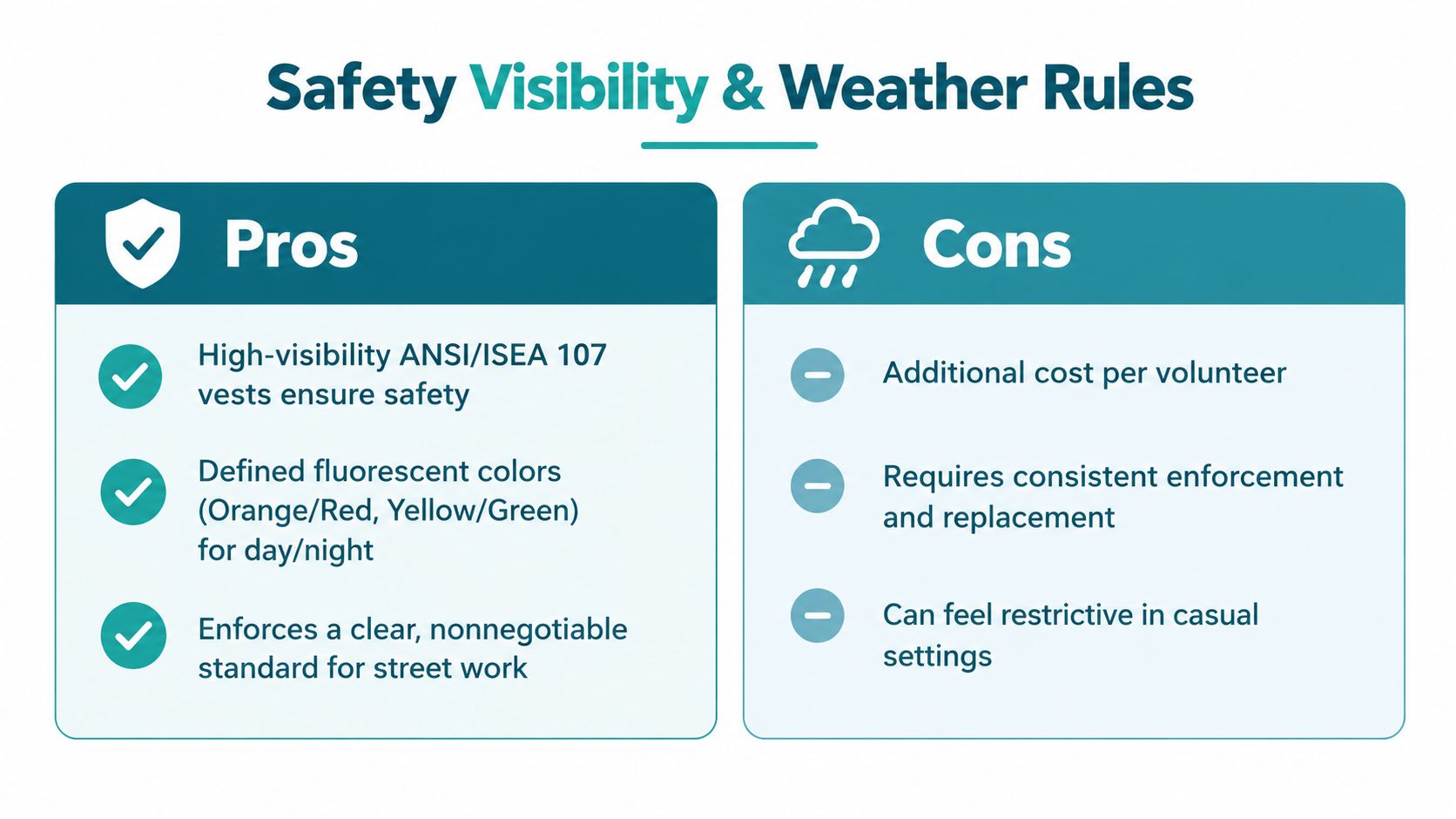
    The Litter Caterpillars' rain-or-shine, all-wards approach makes that change visible. You learn to show up before you feel ready, work beside people you did not know, and trust a plan when the weather turns. Bravery becomes an ordinary habit, built one meetup at a time.

    Friendship grows through repetition. You meet the same people at the gathering point, follow familiar routes, and learn how someone laughs when a bag snags on a thorn. Those small moments create belonging without demanding an instant friendship.

    Chicago looks different with a grabber in your hand. Walking through its wards has led me down streets I might otherwise overlook. Projects such as Caterpillar Park in Englewood also give volunteers a place where shared work can continue beyond one cleanup morning.
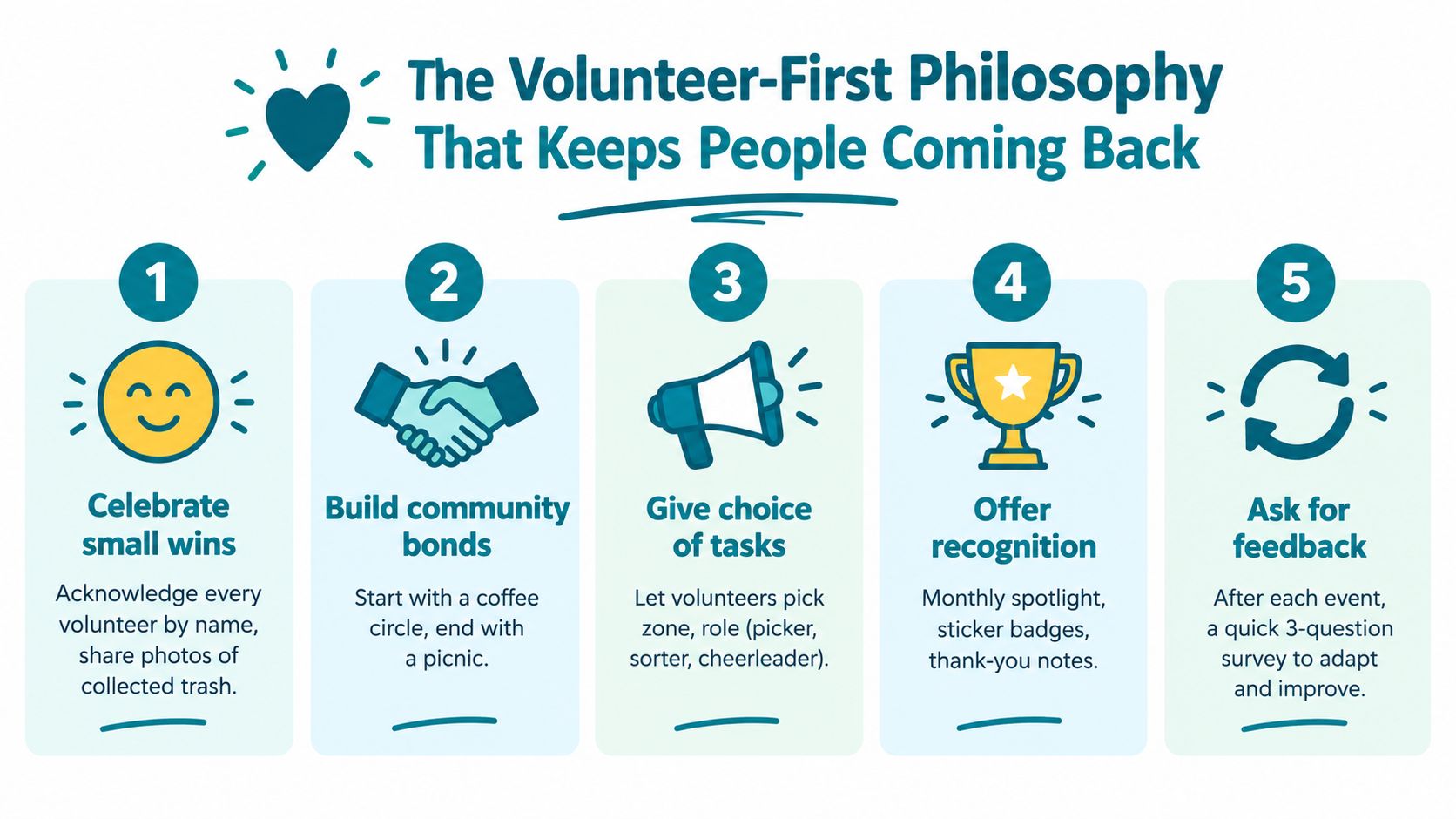
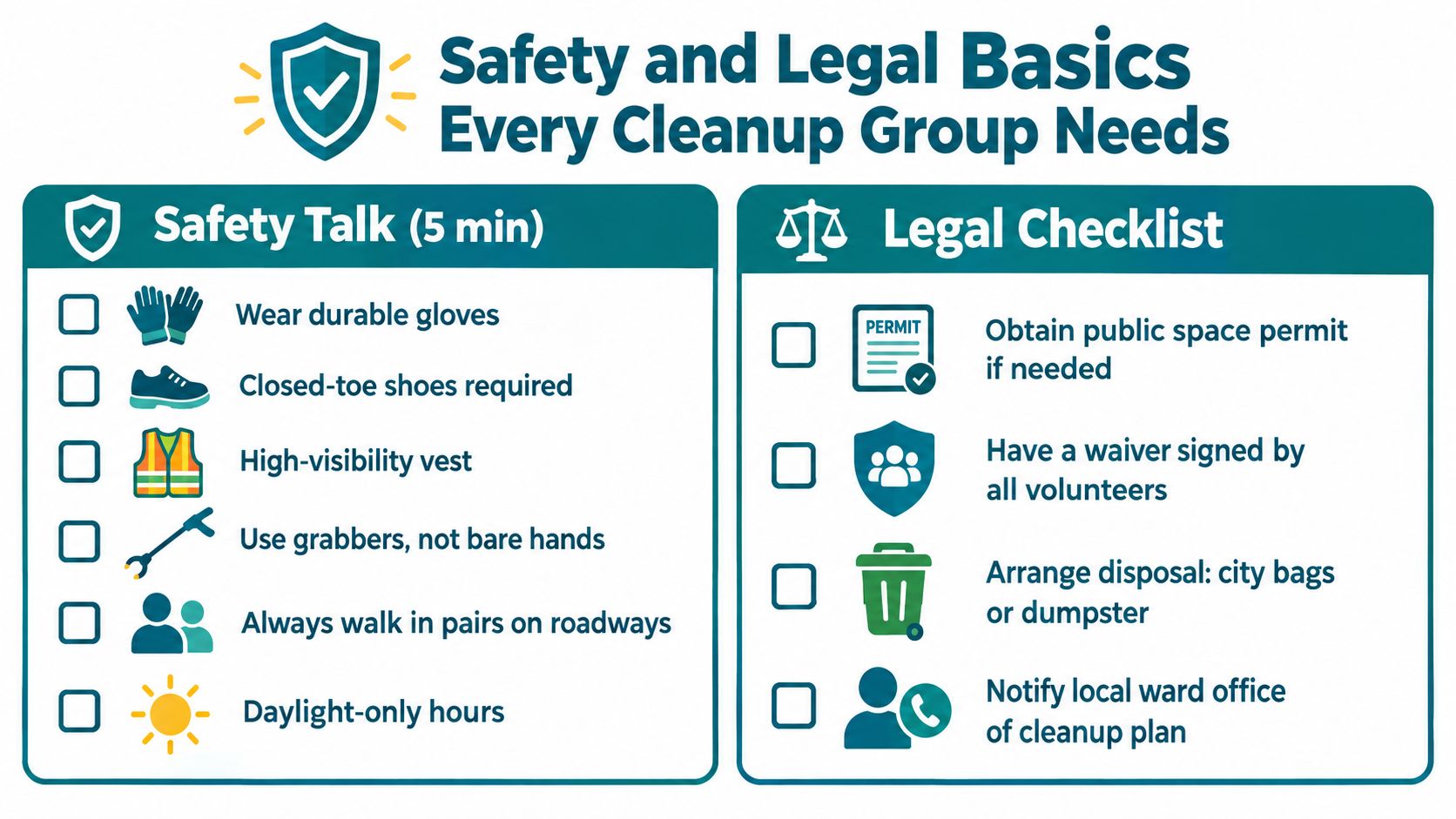
    Turn one morning into a practice

    Keep the first commitment modest. RSVP for one event, bring a friend, and decide beforehand which weather would send you home. Afterward, record the next date while the experience still feels fresh.

    For another community view of waste reduction and local action, read Fillaree's guide to the top reasons Durham is zero-waste capital.

    The broader participation is encouraging. Keep Britain Tidy reports that many adults take part in litter picking regularly, and that hundreds of thousands of volunteers collected hundreds of thousands of rubbish bags in one year. The scale shows that local service can become a shared public habit.

    You do not need a heroic plan. Choose a meeting point, wear shoes you trust, and let the people beside you make the morning lighter. Return before the habit disappears.

    Litter Caterpillars organizes volunteer trash pickup events across Chicago, provides grabbers, bags, and gloves, and offers a practical way to meet people while cleaning local streets. Visit Litter Caterpillars, RSVP for a weekend cleanup, and bring a friend to your first morning.

  • How to Build a Community Litter Cleanup Program That Works

    How to Build a Community Litter Cleanup Program That Works

    At 7:30 on a Chicago Saturday morning, I hand an orange bucket to a new volunteer, point toward the alley, and watch the group split into pairs. By 10, the pop-up tent holds full bags, dusty grabbers, and a crew already asking where we're cleaning next.

    What a Weekly Cleanup Looks Like Before You Build One

    The first arrivals gather at a familiar corner. Someone brings coffee. Someone else checks the weather and counts gloves. I pass out orange buckets, grabbers, bags, and safety vests while people trade quick introductions.

    Then we move.

    Two volunteers take the alley on the east side of the block. Two head west. The grabbers make a light scraping sound against the pavement as they catch bottle caps, wrappers, food containers, and scraps of plastic tucked beneath parked cars. The work has a rhythm. Bend, pinch, lift, bag. Talk, laugh, point, keep moving.

    A homeowner opens the front door and offers lemonade. One volunteer switches to a smaller bag because the large one keeps dragging through the narrow passage. A child watches us sort the pile and asks why we leave recyclables on the curb. I explain that our disposal plan depends on the city and the site, so we separate what we can and never make promises we can't keep.

    At 10, we meet beneath the pop-up tent. We count bags, record the route, photograph the pile, and check that nobody has a cut, sore back, or overheated face. The numbers matter, though they never tell the whole story. The same corner looks different when people see us return every week.

    Our Chicago group cleans across all 50 wards every week, and we've learned that consistency carries more weight than a dramatic one-day push. The International Coastal Cleanup shows how far volunteer action can reach. In its 2023 report, nearly 470,000 volunteers across 97 countries collected more than 4,000 tons of trash and plastics, recording 15,519,392 items across 15,508 miles of coastline and waterways (Ocean Conservancy report).

    A diverse group of volunteers cleaning up litter in a park with a city skyline backdrop.

    That scene contains the whole machine in miniature: a meeting point, supplies, routes, captains, safety rules, records, and a reason to return. The rest of this guide breaks down the choices behind it.

    What a Community Litter Cleanup Program Actually Is

    A community litter cleanup program is a recurring volunteer group that removes litter from defined neighborhoods on a fixed schedule. The schedule matters because a one-time event can clear a place, while a recurring crew can notice what returns, who needs help, and which routes demand attention.

    I think of the program as a kitchen.

    The captains are the head chefs. They choose the site, brief the crew, assign routes, and stop work when conditions turn unsafe. Volunteers are the line cooks. They arrive ready to work, follow the site plan, and tell the captain when a task or object creates a problem. Routes are the menu, because they tell everyone where to go and what the crew can finish during that morning.

    Supplies are the pantry staples. Keep gloves, closed-toe shoes guidance, grabbers, bags, water, first aid supplies, and high-visibility vests ready before people arrive. A shared group chat is the open kitchen line. Volunteers use it to find the meeting point, report a blocked route, ask about disposal, and invite a friend.

    The basic operating pieces

    A small group can begin with a notebook and a phone. I'd still build these parts from the start:

    • Recurring time: Pick a day and hour people can remember.
    • Defined zone: Use a block, park edge, alley network, shoreline, or ward route.
    • Sign-in process: Record names, emergency contacts, and waivers where required.
    • Supply kit: Store gear in labeled bins so setup doesn't depend on one person's memory.
    • Data log: Track bags, weight when available, hours, location, and unusual hazards.
    • Newcomer path: Give people one simple page or group-chat message that shows the next event.

    Wollongong's Rise and Shine program began in 1986 and recorded 99 community volunteer events, 1,436 participants, and 44.58 tonnes of waste in 2025 (Mirage News). A program can start with three people on one block and grow into a citywide operation when every new site uses the same basic recipe.

    A five-step guide on the volunteer-first philosophy to encourage community litter cleanup program participation and retention.

    The Volunteer-First Philosophy That Keeps People Coming Back

    I keep our values in the group chat because volunteers need to know what kind of room they're walking into. We talk about bravery, kindness, unity, and service. Those words only matter when they guide an uncomfortable decision.

    We schedule pickups on weekend mornings because working people need a real chance to attend. A volunteer shouldn't have to choose between earning a living and helping clean a block. Weekend timing also gives newcomers a predictable habit. They can bring a friend, learn the route, and return without asking when the next event will happen.

    Safety outranks donations. Happiness outranks publicity. We never pressure volunteers for money, and we won't ask anyone to touch a sharp object to make a photo look better.

    What the rule looks like on the pavement

    A new volunteer shadows a captain during the first session. The captain demonstrates how to use a grabber, where to place a bag, and when to step away. If someone finds glass, a needle, a suspicious container, or anything they can't identify, they call the captain instead of reaching in.

    Captains can cancel a site or change the route when weather, traffic, harassment, flooding, or unstable ground creates too much risk. That authority protects the crew from the quiet pressure to finish a route at any cost.

    Our working rule: A full bag never matters more than a volunteer going home safe and willing to return.

    Groups that chase sponsorship money before they protect volunteer energy often create the wrong bargain. They add meetings, branding demands, reporting tasks, or public appearances until the people doing the cleanup feel like unpaid marketing staff. Money can buy bags. It can't replace trust after a volunteer feels ignored or pushed into danger.

    We've used volunteer retention strategies to keep the focus on belonging, clear roles, and a reason to come back. If you're planning a cleanup with activities, polls, or team challenges, designing an interactive event can help you shape participation without turning the morning into a performance.

    The discipline compounds. First-timers learn the route. Regulars learn to lead. Captains learn to train someone else. That chain gives a community litter cleanup program a future beyond its founder.

    An infographic titled Safety and Legal Basics for cleanup groups listing safety gear and legal requirements.

    Safety and Legal Basics Every Cleanup Group Needs

    I start with a five-minute safety talk, even when half the crew has attended before. Repetition catches the person who arrived late, the volunteer who forgot gloves, and the captain who assumes everyone understands roadside risk.

    Everyone needs durable gloves and closed-toe shoes. Give volunteers grabbers so they can keep bare hands away from the ground. Use high-visibility vests near traffic, keep work in daylight, and have people walk in pairs or groups of three instead of working alone. A volunteer safety briefing also warns against direct contact with broken glass, fish hooks, and hypodermic needles (Litter Free Dorset safety briefing).

    Match the plan to the site

    Parks need attention around play areas, benches, drainage points, and brush. Keep volunteers away from unstable branches, wildlife, steep slopes, and areas where children could encounter hidden sharps.

    Alleys require careful footing and awareness of vehicles, gates, dogs, and private property. Stay on approved public space, leave blocked or unsafe sections alone, and never enter a yard or building to reach litter.

    Roadways create the highest exposure to moving traffic. Stay off medians, bridges, roundabouts, rail tracks, construction zones, steep slopes, and high-traffic edges. One city guide limits adopt-a-street work to public property, daylight hours, and lower-risk locations (Seattle Public Utilities safety guidance).

    Waterways add slippery banks, hooks, changing water levels, and wildlife. Wear suitable footwear, keep a safe distance from the waterline, and stop when the bank becomes unstable.

    Never pick up needles, weapons, ammunition, car batteries, chemicals, dead wildlife, or unknown containers. Put distance between the item and the crew, keep children away, photograph the location if you can do so safely, and contact the responsible city department or trained responder. Public guidance draws this boundary clearly for hazardous litter (Cobb County volunteer guide).

    Handle the paperwork before people arrive

    Ask the parks, sanitation, transportation, or ward office whether your route needs a permit. Use a waiver suited to your location and group. Set an age policy, require adult supervision where appropriate, and keep emergency contacts with the captain.

    Bring water, a light snack, sunscreen, and a first aid kit. Hardware stores, municipal solid-waste departments, and neighborhood businesses may donate gloves, bags, vests, or grabbers. One cleanup guide lists garden gloves, closed-toe shoes, water, snacks, and grabbers as basic preparation (North Central Texas Council of Governments guidelines).

    If something goes wrong, the captain stops the route, moves volunteers away from danger, calls emergency services when needed, contacts the program lead, and records the time, place, object, weather, witnesses, and action taken. Keep the report factual. Don't hide a minor injury because you fear paperwork.

    An infographic titled Safety and Legal Basics for cleanup groups highlighting eight essential safety and compliance tips.

    For a printable preparation list, use this volunteer safety checklist.

    Partnerships and Funding Without Losing Your Independence

    I divide outside support into three lanes: in-kind donations, local sponsorships, and grants. Each lane can help, and each can change how your Saturday works.

    In-kind support usually creates the least paperwork. A hardware store might provide gloves, bags, or grabbers. A café might provide water. The trade is simple, though you still need to track what you receive and avoid promising public promotion you can't maintain.

    Local sponsorships can pay for shirts, storage, printing, or disposal. They also can bring logo requests, exclusive access demands, or pressure to post branded content. A sponsor should make the route easier. If the sponsor wants to approve every photo or claim ownership of a public space, the cost exceeds the check.

    Grants can support planning, equipment, and larger site work. They usually demand a clear proposal, a budget, progress records, and a final report. When I prepare a short inquiry, I explain the route, the volunteer need, the safety plan, the disposal plan, and the records we already keep. A resource on using Grantlas for grant letters can help organize that first written ask.

    Funding Type What You Get What It Costs You Best Fit For
    In-kind donations Bags, gloves, water, grabbers, printing Pickup coordination and basic thanks New groups and regular routes
    Local sponsorships Supplies, shirts, storage, disposal support Branding requests and relationship management Established neighborhood crews
    Grants Project funding and equipment Applications, budgets, reports, and deadlines Programs with records and a defined project

    Write a one-page ask

    Use a named location instead of a broad promise. Show a route photo, your schedule, the number of regular volunteers qualitatively, your safety controls, and the exact item or expense you need covered. Sponsors and funders want to see that their help will reach the pavement.

    I also avoid exclusive cleanup rights, mandatory logos on every shirt, and social-post quotas. Those terms can turn volunteers into a promotional channel.

    My partnership test: If the deal creates more Saturday work than it removes, I decline it.

    The International Coastal Cleanup tracks individual items as well as collected trash, which shows why a simple data log can make a volunteer program easier to explain to partners (Ocean Conservancy annual report). Your partner doesn't need a glossy presentation. They need a clear request, a safe plan, and honest evidence.

    Measuring Impact and Turning Cleanup Into a Park

    For years, I watched people count bags and stop there. Bags are easy to see, but they can hide the difference between a light route and a heavy one. They also say nothing about whether the same corner stays cleaner after the crew leaves.

    Our sheet now records the location, date, volunteer hours, bag count, weight when available, unusual litter categories, and a quick cleanliness score for repeat sites. We take a photo from the same position whenever possible. That turns a vague memory into a comparison.

    The five-minute field sheet

    At the end of each pickup, one person records:

    • Where: Street, alley, park edge, or waterway section.
    • Who: Volunteer count and total hours.
    • What: Bags, weight, and notable items.
    • Condition: A simple clean-to-heavy-litter rating.
    • Follow-up: Disposal completed, hazard reported, or return visit needed.

    The monthly summary should fit on one screen. List the locations, show the photos, name the volunteers who led routes, and explain what changed. People read records when the records help them see their own street.

    The data also gives you a way to ask harder questions. A route that produces fewer bags may have improved. A route with repeated heavy litter may need a bin, enforcement, better collection, or a conversation with the property owner. Cleanup removes the symptom. Source control and waste infrastructure still determine what returns.

    A major Australian litter report counted plastics at 80.8% of litter items in its reported litter stream (Clean Up Australia litter report). That kind of category record helps a group discuss prevention rather than treating every pickup as an isolated chore.

    From an empty lot to Caterpillar Park

    We photographed the same empty lot in Englewood during weekly pickups. The images showed the broken glass, wrappers, dumped material, and weeds, but they also showed people returning with a plan. Neighbors could point to a named place instead of describing a general problem.

    Those photos and route records helped us speak with the alderman, neighbors, and a land-bank partner. We won the empty lot at auction and turned it into Caterpillar Park. The park didn't appear because we had one heroic cleanup. It grew from repeated visits, visible care, and records that made the request concrete.

    The strongest measure remains simple: does the place we cleaned last month still look clean this month? This community impact measurement guide can help you build a record that people can understand and use.

    Your First 30 Days of Running a Cleanup Program

    Start small enough that you can keep your promise. Choose one neighborhood block and one recurring time slot. Don't begin by claiming an entire city if you haven't tested your supplies, route, waiver, disposal plan, and captain coverage.

    Week one, choose the ground

    Walk the block during daylight. Note traffic, alleys, vacant lots, drainage areas, steep sections, private property, and places where volunteers could step into danger. Contact the local parks or sanitation department and ask about permits, bags, disposal, and public-space rules.

    Pick a meeting point that people can find without guessing. Write the address, time, route boundary, weather policy, and contact person in one short message.

    Week two, recruit a small regular crew

    Print a flyer for the block. Publish one social post with the same details. Ask directly for five regulars, and give each person a role. One person can manage supplies, another can lead the route, another can record data, and another can welcome newcomers.

    Keep the invitation honest. Tell people how long the pickup lasts, what gear they need, what the group won't handle, and where the bags will go. People trust a clear boundary more than a grand promise.

    Week three, run the first cleanup

    Bring printed waivers, gloves, closed-toe footwear reminders, grabbers, bags, water, first aid supplies, and a phone with emergency contacts. Start with the safety talk. Keep people in pairs where traffic creates risk, stay in daylight, and stop for heat, cold, broken glass, needles, wildlife, harassment, or unsafe footing.

    Take a before photo. Record the route, volunteer hours, bags, weight if available, and unusual litter. Take an after photo from the same position. Dispose of the bags through the arrangement you confirmed before the event.

    Week four, return and review

    Repeat the same route at the same time. Ask each volunteer what felt smooth, what felt confusing, and what would make the next pickup easier. Store the answers with the field sheet instead of letting them vanish in conversation.

    At day 30, success looks modest and real:

    • A returning crew: People came back without needing a new sales pitch.
    • A shared calendar link: Everyone can find the next event.
    • A safer route: You removed or changed tasks that created risk.
    • A before-and-after pair: You can show one named place and what changed.
    • A usable record: You know what to repeat, revise, or stop.

    On Monday, walk one block and choose the first Saturday time. Then invite five people before you buy anything fancy. A community litter cleanup program becomes durable when the first promise stays small enough to keep.


    Litter Caterpillars organizes weekly volunteer trash pickups across Chicago, with supplies such as grabbers, bags, and gloves available for participants. Visit Litter Caterpillars to find a cleanup, meet the group, and turn your first route into a steady community practice.