

What will your teammates remember after the event ends, the winning score and a quick group photo, or the morning your crew tackled a hard Chicago block and left visible proof behind? Many team days disappear once the snacks run out. A shared challenge can stay with people because everyone carries part of the story.
These team building ideas Chicago teams can try range from indoor creative work to outdoor service, recurring neighborhood programs, leadership tracks, and simple add-ons that give a one-off outing more shape. I'll help you compare group size, estimated cost, timing, accessibility, safety, weather backup, and the kind of connection each idea can create. Some activities need little more than gloves and a meeting point. Others need a sponsor, a trained coordinator, or advance transit planning.
Chicago already gives service-based outings a strong starting point. In the Chicago-Naperville-Elgin metro area, 1,967,127 volunteers contributed 151.1 million hours, and 25.6% of residents volunteered, according to AmeriCorps's Chicago city profile. If your team wants to pick up litter together and build friendships through service, Litter Caterpillars gives you a Chicago-specific place to begin. You can even make the day feel like a team uniform exercise with embroidered hats for teams.
1. Neighborhood Cleanup Challenges with Friendly Competition
The first bag fills quickly. One squad finds bottles near a bus stop, another works beside an alley, and a third team spots the odd prize, perhaps a broken sign or a lonely kitchen object. Give each group a Chicago neighborhood or block, and the cleanup starts to feel like a mission instead of a chore.
Litter Caterpillars can inspire a weekly ward rotation, while a company might assign teams to different neighborhoods for quarterly cleanups. A block club can run the same format on its own street and nearby alleys. Each squad owns its zone for the morning, then shares what it found.
Use a simple scorecard. Track area covered, bags filled, unusual objects, or before-and-after photos. Keep the contest friendly, and celebrate persistence as much as the winning score. You want people to compare notes, not hide useful information from another squad.
Make the zones personal
Let people choose areas where they live, work, commute, or already feel curious. Rotate zones later so the group explores another part of Chicago. Before the first event, read this guide to organizing a neighborhood cleanup and confirm supplies, disposal plans, traffic boundaries, and a contact person.
A small team can walk one compact route. A larger group can split into squads with one lead per zone. Cost stays low when volunteers bring weather gear and organizers arrange basic supplies, though hauling, disposal, and coordinator time still need attention. Choose wide paths for mobility needs, avoid active traffic lanes, and create a seated check-in spot.
For another low-cost outdoor option, pair the cleanup with outdoor activities for any age. End with coffee, a group photo, and one sentence from each squad about the strangest thing it found.
2. Trash Treasure Hunt and Upcycling Workshop
A cracked chair leg becomes a design question. A piece of reclaimed wood becomes the start of a small library. Your team first searches for safe, reusable materials, then gathers around a worktable to turn those finds into something useful.
Scout the route before the event. Mark objects that may work for art, furniture, gifts, or a neighborhood project, and remove anything sharp, contaminated, unstable, or difficult to transport. A maker, artist, or craft studio can provide space and guidance. Bring paint, wood stain, nails, wire, glue, and protective equipment.

Let the objects decide the project
One team might build a small book-sharing box from reclaimed wood. Another might create a wall piece for a nonprofit office. The best result doesn't need to look perfect. It needs to show how people divided tasks, solved problems, changed plans, and finished something together.
Keep the cleanup portion accessible by assigning walking, sorting, photography, carrying, and workshop roles. A compact group can use one studio table. A larger group should create stations, with one person managing safety at each station. Your main costs may include workshop space, tools, materials, transport, and disposal.
Safety first: Treat every found object as unknown until someone checks it. Skip sealed containers, medical waste, needles, damaged electronics, and anything with chemical residue.
Use a morning hunt, a midday meal, and an afternoon workshop. Close with a small exhibit of the finished pieces. Teams remember the moment someone holds up a rough object and says, “We can make something from this.”
3. All-Weather Endurance Cleanups
Rain taps the park shelter. Gloves cling to cold fingers. Someone suggests canceling, then another teammate points toward the first bag and starts walking. The weather becomes part of the story when your group prepares well and chooses safe limits.
Litter Caterpillars describes a three-year track record of weekly pickups in all conditions, including blizzards and heat, through its own organization story. You can borrow the spirit without copying the risk. Weekend mornings work well for teams that want a consistent habit, while weekday groups can choose a shorter service window before work.
Build toughness without ignoring safety
Give volunteers clear gear guidance. Ask people to bring layers, water, sun protection, sturdy shoes, and gloves suited to the conditions. Plan warm-up locations for winter work, and prepare an indoor discussion, sorting session, or planning meeting for dangerous weather. Lightning, unsafe heat, flooding, and severe cold should end the outdoor portion.
Chicago summer weekends can feel very different by hour. Daytime highs typically sit in the high 70s to high 80s Fahrenheit from mid-June through mid-September, and heatwaves can move past 90°F, while mornings often begin in the mid-60s to low 70s Fahrenheit, according to Offsite's Chicago planning guide. Start early, carry water, provide shade breaks, and shorten the route when the pavement starts radiating heat.
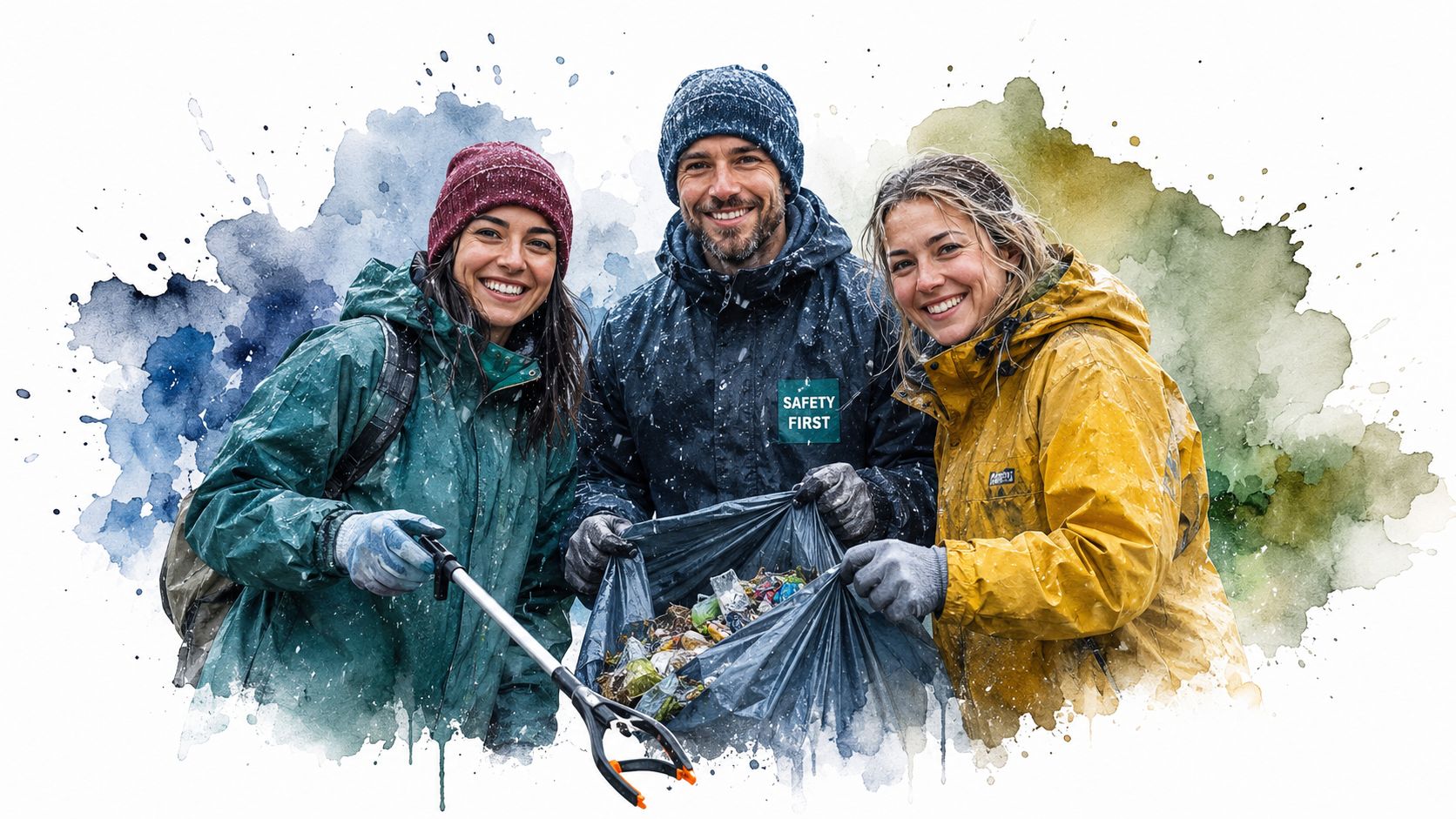
A small, committed team can build a strong rhythm with little spending. A large company needs more supervisors, supplies, rest points, and a firm emergency plan. Celebrate attendance, brave weather choices, and thoughtful decisions. The win is showing up prepared, then knowing when to stop.
4. Adopt-a-Block Program with Recurring Ownership
A single cleanup gives you a snapshot. A recurring block gives you a relationship.
Choose one street, alley, plaza, or park edge that matters to your team. Return monthly or quarterly. The first visit may feel messy and slow. Later, your crew recognizes the problem spots, greets neighbors, and notices changes that a one-day group would miss.
Litter Caterpillars points to the transformation of an Englewood lot into Caterpillar Park, a project that gives volunteers a shared place to care for over time. A block club can maintain its own street, and a company can adopt a park or plaza with local partners. Keep the promise manageable. A small team that returns regularly can do more than a large team that disappears after one event.
Give the block a memory
Invite neighbors to join. Ask nearby businesses about supplies, storage, or a place to meet. Take photos from similar angles during each visit, and record short notes about what changed. When your group reaches a chosen milestone, hold a simple gathering with food and stories.
Accessibility needs attention from the first visit. Walk the route, check surfaces, identify seating, and provide roles for people who can't bend, lift, or walk far. Keep tools matched to the task. Separate traffic areas from work zones, and arrange disposal before volunteers arrive.
This format works for teams that want a habit rather than a single morale event. Cost depends on equipment, transport, disposal, and any improvements you add. Start with cleanup. Let the larger project earn its way into the calendar.
5. Themed Cleanup Days with Costumes, Celebration, Photo Documentary and Social Campaign
Flags snap in the wind. A theme song starts from a phone speaker. Someone pins on a badge, and a routine pickup suddenly feels like a team tradition.
Litter Caterpillars uses flags, a theme song, and badges to give volunteers a shared identity. Your team can create its own version with superhero capes, neighborhood colors, movie-inspired clues, or a theme chosen by vote. Keep costumes practical. A cape that catches on branches isn't worth a funny photo.
Turn the morning into a small production
Assign one or two people to document the event. Ask permission before sharing volunteer photos, especially when you post on Instagram, Meetup, or an internal company channel. Capture the empty route, the first bag, the group at work, unusual discoveries, and the final view. A before-and-after pair often tells the story better than a long caption.
Make the theme repeatable. A monthly “superhero Saturday” or a rotating neighborhood color gives people something to anticipate. Create simple badges for first cleanup, route captain, safe sorting, new volunteer welcome, or perfect attendance. Let people earn recognition through helpful actions, not only through speed.
A themed day can suit small teams in one park or large groups spread across several zones. Your main expenses may include badges, printing, music, costumes, food, and photography. Keep a quiet role available for people who dislike costumes or cameras. Someone can manage supplies, map routes, or document the day.
Close with a meal and a short photo review. The group should leave with a cleaner place and a shared visual record of how it got there.
6. Cleanup Skills Workshop and Training Series
Before the bags come out, a local naturalist explains why one patch of weeds attracts more litter than another. A waste professional demonstrates sorting. An experienced volunteer shows a newcomer how to use a grabber without twisting a shoulder.
A short workshop gives people confidence before they enter the route. Teach safe handling, sorting, recycling, first aid, local ecology, neighborhood history, traffic awareness, or safe responses to hazardous items. Keep each lesson practical and brief. The plan calls for 30 to 45 minutes maximum before hands-on work.
Pair every lesson with practice
A Chicago ecology session can lead into a park cleanup. A sorting lesson can lead into a station where teams separate materials. A safety session can lead into a route walk that identifies traffic boundaries and meeting points. Rotate instructors so your team develops more than cleanup muscle.
You can build a simple progression with badges or certificates. Record sessions for people who miss them, and keep written instructions with the supplies. For a coordinator-focused version, use Litter Caterpillars' volunteer coordinator training as a planning reference.
Accessibility improves when you provide seated learning, printed instructions, captions for recordings, and multiple work roles. A workshop also gives people an indoor backup when weather changes. Costs may include instructor time, room rental, training materials, first-aid supplies, and transportation.
Finish with a real task. People retain a skill more easily when they use it immediately, then explain it to someone else.
7. Community Partnership and Block Leader Network
One cleanup crew can cover one route. A network can let neighbors lead where they already live.
Start with block club presidents, community leaders, faith communities, neighborhood organizers, or trusted employees. Give each person a simple playbook, basic supplies, safety rules, and room to adapt the event. Litter Caterpillars describes distributed leadership across all 50 wards, a model that shows how separate neighborhood crews can connect under one shared identity.
Give leaders tools and freedom
Begin with three to five people you know and trust, as the planning model suggests. Meet monthly, trade stories, solve supply problems, and let leaders run their own style of cleanup. A private group chat can answer quick questions, welcome new volunteers, and keep people from planning alone.
Supply kits might include bags, gloves, grabbers, route maps, badges, and emergency contacts. A company can train employees as neighborhood ambassadors. A faith community can ask its leaders to coordinate local squads. A block club can set its own meeting point and pace.
Group size changes the work. One leader can guide a compact crew on a familiar route. Larger events need zone leads, check-in support, clear boundaries, and a central contact. Cost grows with supplies, printing, transportation, storage, and coordinator time, so set expectations before launch.
Give leaders public thanks, but don't turn recognition into pressure. Some people want responsibility for a season, then need to step back. A healthy network makes room for that change. The best leader leaves a route organized enough for someone else to continue.
8. Sustainability Challenge and Waste Reduction Goal Setting
A poster goes up in the break room. Every cleanup adds a mark. The team watches the route fill in, then argues cheerfully about whether the next goal should focus on blocks, plastic, or total litter removed.
Set a shared target that people can understand. Your group might choose a litter weight goal, a number of blocks, a plastic-removal aim, or a company waste-reduction project. The plan can include a target of 1,000 pounds of litter in a quarter, though you should choose a figure that matches your route, equipment, disposal access, and volunteer capacity.
Measure what people can see
Track progress on a poster, shared document, or digital dashboard. Break the larger aim into weekly or monthly steps. Celebrate each milestone, even when the team misses the final target. If a route produces less litter than expected, shift the goal toward coverage, sorting quality, or neighborhood participation.
Don't let one number decide whether the day mattered. A crew may collect less material because another group cleaned the area earlier. A mobility-friendly route may cover less ground while bringing more people into the activity. Set goals around neighborhood needs, then use data to adjust the plan.
Costs vary by the tool you use, printing, supplies, disposal, and any measuring equipment. Small teams can use a paper chart. Larger companies may want a coordinator who checks entries and posts updates.
End each event with a quick review. Ask what worked, what slowed the group down, and what the next route needs. The dashboard should guide decisions, not turn volunteers into a scoreboard.
9. Cross-Neighborhood Team Exchanges and Rotation Events
A volunteer who usually works near home steps off the train in another neighborhood. A local block leader explains the route. New teammates pair up, trade questions, and discover that every area has its own patterns, stories, and problem spots.
Use exchanges to move people through different Chicago zones. Litter Caterpillars describes work across all 50 wards, which gives teams a citywide model for pairing neighborhoods and connecting volunteers. You can arrange a smaller exchange between two block clubs, or create a citywide day where each group represents its own area.
Choose meeting points carefully. Provide written directions, transit notes, a phone contact, and a visible check-in location. CTA has a dedicated Group Sales contact at 1-888-YOUR-CTA (968-7282), extension 12742, available weekdays from 8:30 a.m. to 4:30 p.m., according to CTA's group travel information. Contact the agency rather than guessing about fare arrangements for a larger outing.
Make transit part of the team day
Mix experienced volunteers with newcomers. Pair neighborhoods that can teach each other something. Keep the cleanup route manageable, then share food and stories afterward. A field-trip feeling helps people approach the day with curiosity.
Metra's group policy applies discounted travel to groups of 25 to 135 paying riders traveling together, with arrangements made at least 21 days before travel. Full payment falls due at least 14 days before travel, and discounted travel windows include weekdays from 9 a.m. to 3 p.m., after 7 p.m., plus weekends and certain holidays, according to Metra group-travel details. Confirm current terms before booking.
Transit access, walking distance, rest points, and weather backup matter more than a clever route. End with a photo that mixes neighborhoods, then ask each person what surprised them.
10. Mentorship Ladder and Leadership Development Track
A newcomer arrives unsure how to start. An experienced volunteer pairs with them, explains the tools, and checks in after the first route. Later, that newcomer leads a squad, trains another person, and takes responsibility for a block.
Create a clear path from participant to Volunteer, Squad Lead, Mentor, and Block Leader. Give each stage a name, simple criteria, training, and recognition. Litter Caterpillars' volunteer mentor programs provide a Chicago-specific reference for building that kind of progression.
Make advancement supportive
Define what each role includes. A squad lead may welcome people, explain the route, and check supplies. A mentor may train newcomers and answer questions. A block leader may coordinate with neighbors and set recurring dates. Use attendance, skills, reliability, and contribution as guideposts, not as a rigid test.
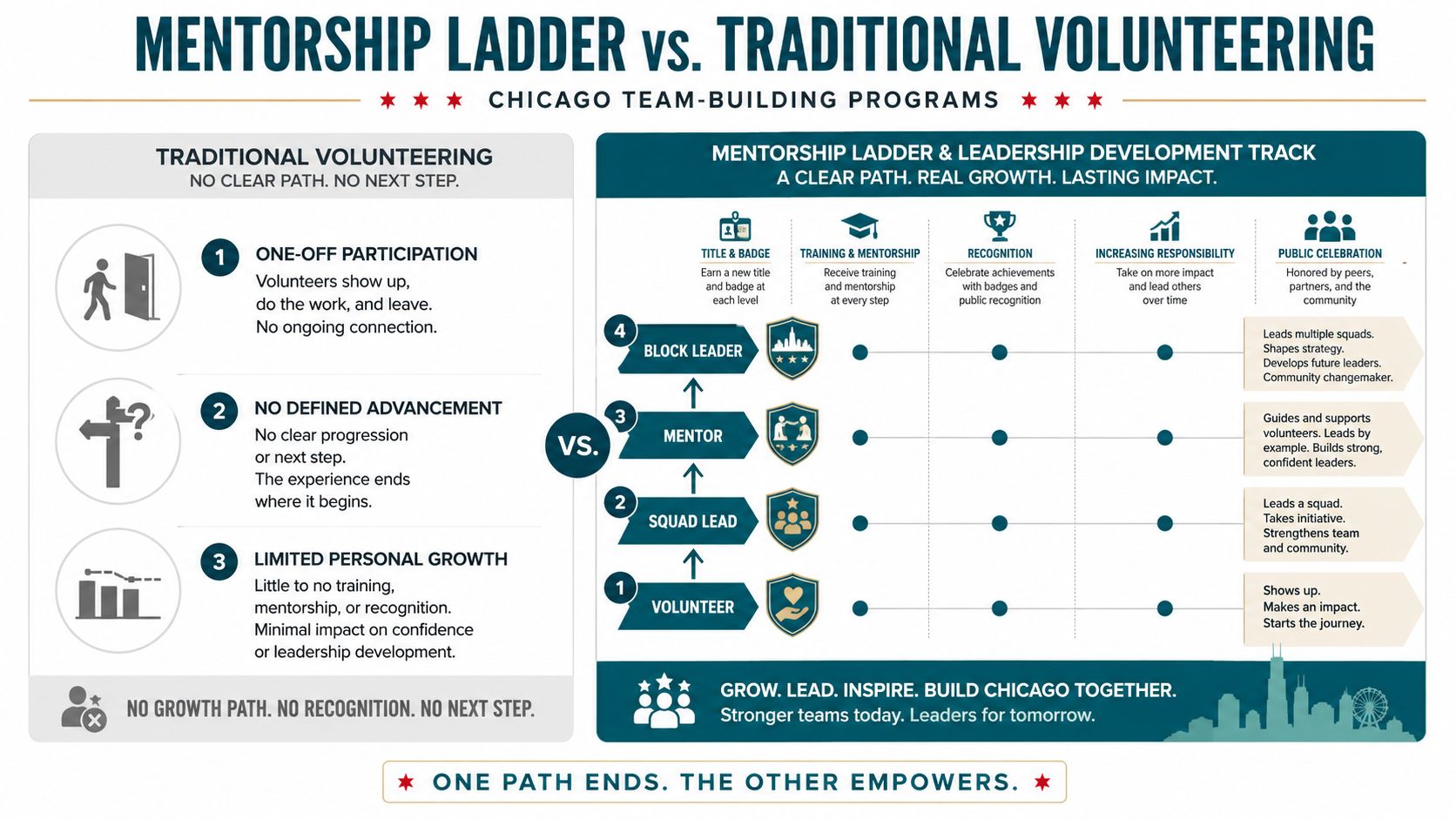
Pair people one-on-one, celebrate advancement in person or online, and train every new lead before handing over a route. Rotate roles so volunteers can test different responsibilities. Let someone step back without embarrassment when work, family, health, or energy changes.
A small organization can use a handwritten progression card. A company can connect the track to leadership development, service hours, or employee resource groups. Costs may include training time, badges, supplies, transport, and coordinator support.
This idea works indoors and outdoors. Hold a planning session inside, then practice on a safe route. End with a conversation between mentors and newcomers about what felt easy, what felt strange, and what they want to try next.
10 Chicago Cleanup Team-Building Ideas Compared
| Approach | 🔄 Implementation complexity | ⚡ Resource requirements & efficiency | 📊 Expected outcomes (⭐ quality) | Ideal use cases | 💡 Key tips |
|---|---|---|---|---|---|
| Neighborhood Cleanup Challenges with Friendly Competition | 🔄 Medium, zone coord. and score tracking | ⚡ Low–Medium, basic supplies, simple scorecards; quick setup | 📊 Visible, measurable local impact; ⭐⭐⭐ | Teams seeking fun competition and ward coverage | 💡 Assign zones by interest, use scorecards, rotate zones |
| Trash Treasure Hunt and Upcycling Workshop | 🔄 Medium–High, salvage sorting + workshop logistics | ⚡ Medium, workshop space, tools; low material cost (found items) | 📊 Waste diversion + memorable artifacts; ⭐⭐⭐⭐ | Creative groups, education, events that combine cleanup + craft | 💡 Scout sites, partner with makers, set safety rules |
| All-Weather Endurance Cleanups | 🔄 High, safety protocols & leadership needed | ⚡ Medium, quality gear required; slower in extreme weather | 📊 Builds resilience, trust, strong retention; ⭐⭐⭐ | Groups aiming to form a committed core and strong culture | 💡 Provide gear, warm-up/heat breaks, indoor contingencies |
| Adopt-a-Block Program with Recurring Ownership | 🔄 Medium, scheduling and long-term coordination | ⚡ Low–Medium, recurring supplies; logistics simplify over time | 📊 Deep neighborhood trust and compound improvements; ⭐⭐⭐⭐ | Long-term community transformation and partnership building | 💡 Start with a meaningful block, invite neighbors, document progress |
| Themed Cleanup Days with Costumes & Social Campaign | 🔄 Medium, event planning, media coordination | ⚡ Medium, costumes/props and photo coverage; high visibility per event | 📊 High recruitment and social reach; memorable identity; ⭐⭐⭐ | Recruiting, awareness campaigns, volunteer engagement boosts | 💡 Let team pick themes, assign documenters, ask photo permissions |
| Cleanup Skills Workshop and Training Series | 🔄 Medium, instructor sourcing and curriculum | ⚡ Medium, indoor space, materials; slower but builds capacity | 📊 Increased competence, safety, and retention; ⭐⭐⭐⭐ | Training volunteers, building leadership and safety standards | 💡 Keep sessions short, follow with hands-on practice, record sessions |
| Community Partnership & Block Leader Network | 🔄 High, training infrastructure and coordination | ⚡ Medium, starter kits and comms systems; highly scalable | 📊 Multiplies impact citywide; sustainable local leadership; ⭐⭐⭐⭐ | Scaling across neighborhoods, building distributed leadership | 💡 Start with trusted leaders, provide playbook and supplies, meet monthly |
| Sustainability Challenge & Waste Reduction Goal Setting | 🔄 Medium, goal-setting and tracking systems | ⚡ Low–Medium, dashboards and measurement tools; motivates action | 📊 Measurable environmental impact and team focus; ⭐⭐⭐⭐ | Goal-oriented teams, corporate sustainability programs | 💡 Set team-created achievable goals, track visually, break into milestones |
| Cross-Neighborhood Team Exchanges & Rotations | 🔄 Medium, transport and cross-group coordination | ⚡ Medium, transport logistics and scheduling; energizing but time-consuming | 📊 Builds citywide solidarity and learning; ⭐⭐⭐ | Building cross-community ties and shared understanding | 💡 Partner with block leaders, mix experienced/new volunteers, debrief with social time |
| Mentorship Ladder & Leadership Development Track | 🔄 High, mentorship systems, criteria, training | ⚡ Medium, time and training resources; high long-term ROI | 📊 Strong retention and leadership pipeline; ⭐⭐⭐⭐ | Long-term organizational growth and volunteer advancement | 💡 Define clear criteria, mentor one-on-one, celebrate advancement, rotate roles |
Turn One Team Day Into a Habit
Choose the idea by asking what your team can sustain, not what looks most exciting in a planning deck.
A small group with limited funds can start with a neighborhood cleanup, a themed route, or a skills workshop. A larger company may need zones, team leads, transit coordination, and a disposal plan. Habitat Chicago's corporate builds can require a $5,000 sponsorship for 10 people, scaling at $500 per person, while other group programs work around 30-person construction-site capacity or 80-plus-person warehouse formats, according to Habitat Chicago's corporate group inquiry. Ask about minimum commitments before you promise a service day to your team.
Your budget also depends on what you already have. Gloves, bags, grabbers, transport, food, workshop space, badges, photography, and disposal can all change the estimate. Write down the cost of supplies and coordination separately. A low-spend event still needs a clear owner.
Season changes the plan. Chicago summer mornings can feel easier than midday heat, while rain, snow, and cold require layers, warm-up space, and a decision point for cancellation. Choose indoor training, upcycling, trivia, cooking, or planning when outdoor conditions become unsafe. For outdoor scavenger hunts and group missions, locations including Millennium Park, the Chicago Riverwalk, Grant Park, Navy Pier, and Lincoln Park can give you ready-made backdrops, according to Adventure Games' Chicago location guide.
Mobility needs should shape the route before anyone arrives. Check surfaces, stairs, crossings, seating, restrooms, transit access, and the distance between meeting points. Offer roles that involve sorting, welcoming, documenting, mapping, teaching, or coordinating. People can contribute without walking the longest route or lifting the heaviest bag.
Use this simple first step:
- Pick a date: Choose a morning that gives people enough notice and leaves room for a weather decision.
- Name a leader: Give one person authority over the route, supplies, safety, and final call.
- Confirm materials: Check gloves, bags, grabbers, water, first aid, disposal, directions, and contact numbers.
- Set safety rules: Explain traffic boundaries, hazardous items, buddy systems, heat breaks, and when volunteers should stop.
- Create a backup: Prepare an indoor workshop, planning session, meal, or rescheduled date before the forecast turns.
- Leave time to talk: Share food, compare discoveries, thank people, and ask what the team should repeat.
The best first event may feel simple. A team meets, works, laughs, gets tired, and looks back at a cleaner route. Then someone asks when you're doing it again.
For a ready-made Chicago service experience, explore Litter Caterpillars. The volunteer-driven group holds weekly trash pickups across Chicago, works in all 50 wards, schedules events on weekend mornings, and builds connection through shared service, flags, theme songs, badges, and open group communication. Its story includes difficult weather, neighborhood cleanup, friendship, and the transformation of an Englewood lot into Caterpillar Park.
Choose the idea that fits your people today. Then give it a date, a leader, a safe route, and a reason to return. Your teammates may forget the score, but they'll remember the block they cleaned, the stranger they met, the storm they handled, and the story they carried home.
Litter Caterpillars gives Chicago teams a way to join weekly trash pickups, meet other volunteers, and build a service habit across neighborhoods. Visit Litter Caterpillars to choose an upcoming event or explore a group cleanup that can give your team a shared story.
Leave a Reply