
Author: Kevin Tao

  • Weekend Cleaning Schedule That Actually Sticks

    Weekend Cleaning Schedule That Actually Sticks

    At 6:10 on a Saturday morning, frost coated my gloves before the first bag filled. Three neighbors watched the street wake up, then one of them tied a second bag to the cart and said, “Let's keep going.”

    That small decision captures a weekend cleaning schedule better than any color-coded calendar. The hard part isn't writing a list. It's protecting enough energy, clarity, and goodwill for people to show up again next week.

    Why a Weekend Cleaning Schedule Is Worth Building

    At one cleanup, rain soaked my sleeves before the first row was finished. A volunteer who had never joined us before stood beside the bag pile, unsure where to start. Another regular greeted them, pointed out the boundary, and worked alongside them until the route felt familiar. By the end, the newcomer stayed for the final count and asked about the next Saturday.

    That morning changed how I judge a weekend cleaning schedule. Its value is not a prettier checklist. It is the shared ritual around the work: people know where to meet, what to bring, how long the effort lasts, and who will notice when they arrive.

    The household version carries a similar weight. A household cleaning survey reported by Home Clean Secrets found that Americans spend nearly six hours each week cleaning their homes. Without a plan, that work can occupy every spare pocket of a weekend. A scheduled block gives chores a visible place, so the rest of the day does not feel like an unfinished job waiting in every room.

    I learned the human side through small failures. One new volunteer left early because nobody explained the route. Another came back after a difficult week because someone greeted them by name, offered a familiar task, and showed them exactly where to work.

    Those details decide whether a group becomes a recurring crew. The greeting at arrival, the gear table, the safety circle, and the closing thank-you create a rhythm people can trust. Volunteers may forget how many bags they filled. They remember whether they felt lost, rushed, or welcome.

    Practical rule: Build the morning so a tired person can understand it within a few minutes.

    For a home reset, the same principle applies. A schedule should make the work visible without making the household feel trapped by it. The point is a repeatable Saturday ritual that leaves room for changing weather, uneven energy, and the people doing the work.

    Why Saturday Mornings Win for Cleaning
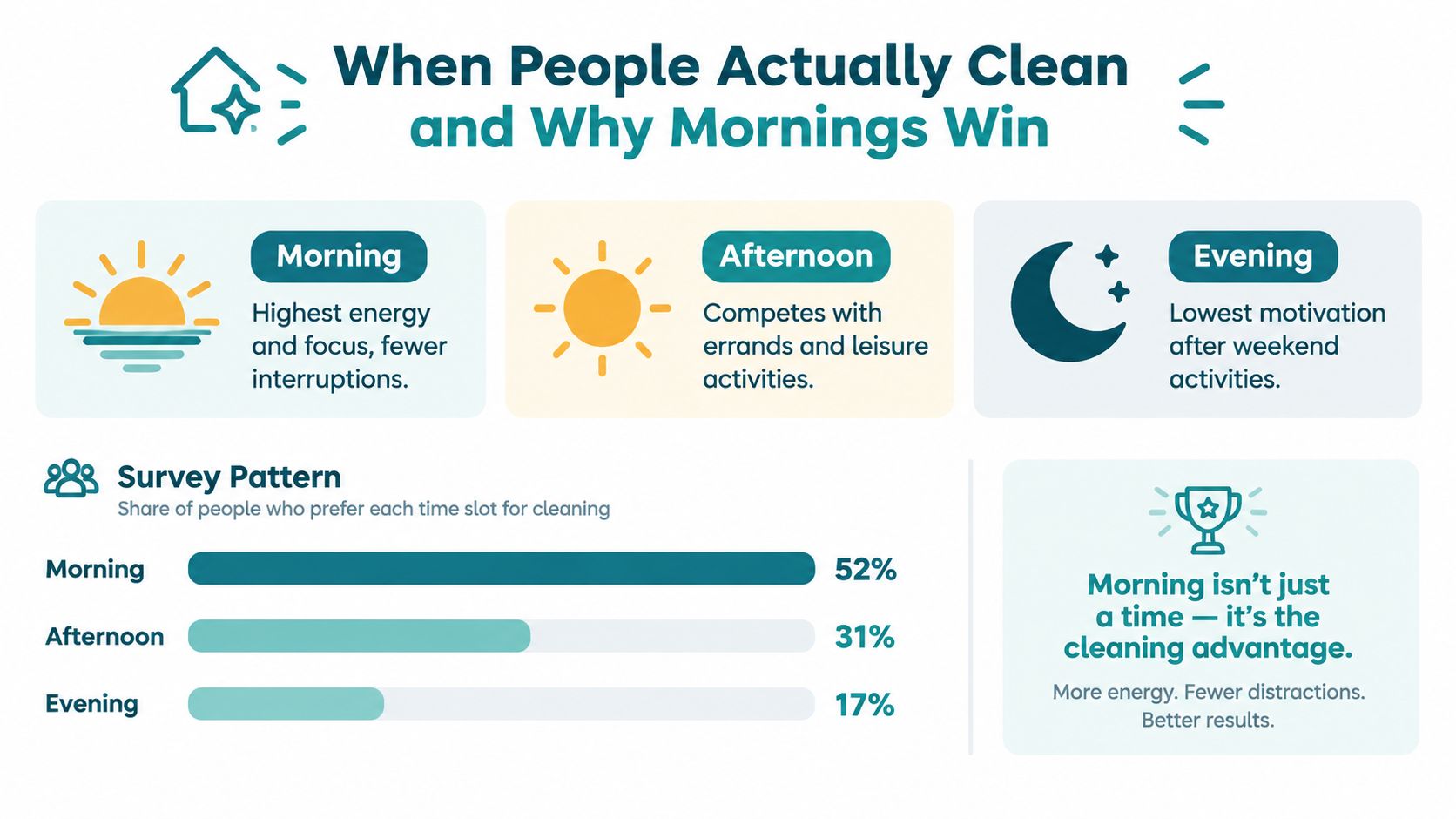
    An infographic showing that most people prefer cleaning in the morning due to higher energy and focus.

    At our Saturday cleanups, the first hour often decided the whole day. People arrived with more focus, daylight made hazards easier to see, and finishing early left room for family plans or recovery. A commissioned study likewise found Saturday morning was the most popular cleaning time, while Sunday night and early Monday morning ranked among the least popular periods, according to Study Finds' summary of the cleaning survey.

    That timing matters for a volunteer crew because energy is shared. On a hot morning, a clear start helped us collect more before fatigue turned small frustrations into arguments. In winter, daylight and a defined finish made the work feel manageable. The schedule had to respect the people carrying it, not only the bags or tools.

    U.S. time-use data shows that weekend days bring more housework than weekdays, 40% compared with 35%, while food preparation and cleanup appear slightly more often on weekdays, 66% compared with 63%, according to HerWay's household chore statistics. That supports a practical split. Put the higher-friction work in a weekend morning block, then leave space for errands, worship, rest, recreation, or an unplanned change of weather.

    Morning, afternoon, or evening

    Time What helps What gets in the way
    Morning Cooler air, daylight, sharper focus, and a clean finish before the day expands Shift workers, religious observance, sleeping children, and local noise rules
    Afternoon More daylight and easier access for people who need a slower start Heat, errands, sports, shopping, and family plans
    Evening Cooler temperatures in summer and availability after work Low motivation, darkness, traffic visibility, and Sunday-night fatigue

    A flexible household rhythm can also protect goodwill. People do not all bring the same energy each weekend, so the morning block should absorb the tasks that keep being postponed rather than demand one exhausting marathon.

    A workable default

    Start on Saturday at 8:00 a.m., work for three hours, and keep Sunday morning available for Saturday conflicts. In a home, shorten the block to the jobs that create the most resistance, while routine wiping, dishes, and tidying stay on other days. For overnight workers or people observing Saturday religious practices, Sunday morning preserves the same social ritual without asking anyone to choose between participation and personal commitments.

    Your Sample Weekend Morning Itinerary

    At 8:00 a.m., I put the map on the hood of the truck, greet each volunteer by name, and give the morning a visible shape. Short blocks keep instructions from competing with the work, while the closing count gives people proof that their cold hands or tired legs changed the site.

    The three-hour plan below follows the creek-litter cleanup protocol, using a briefing, fixed sections, a collection point, and material counting.
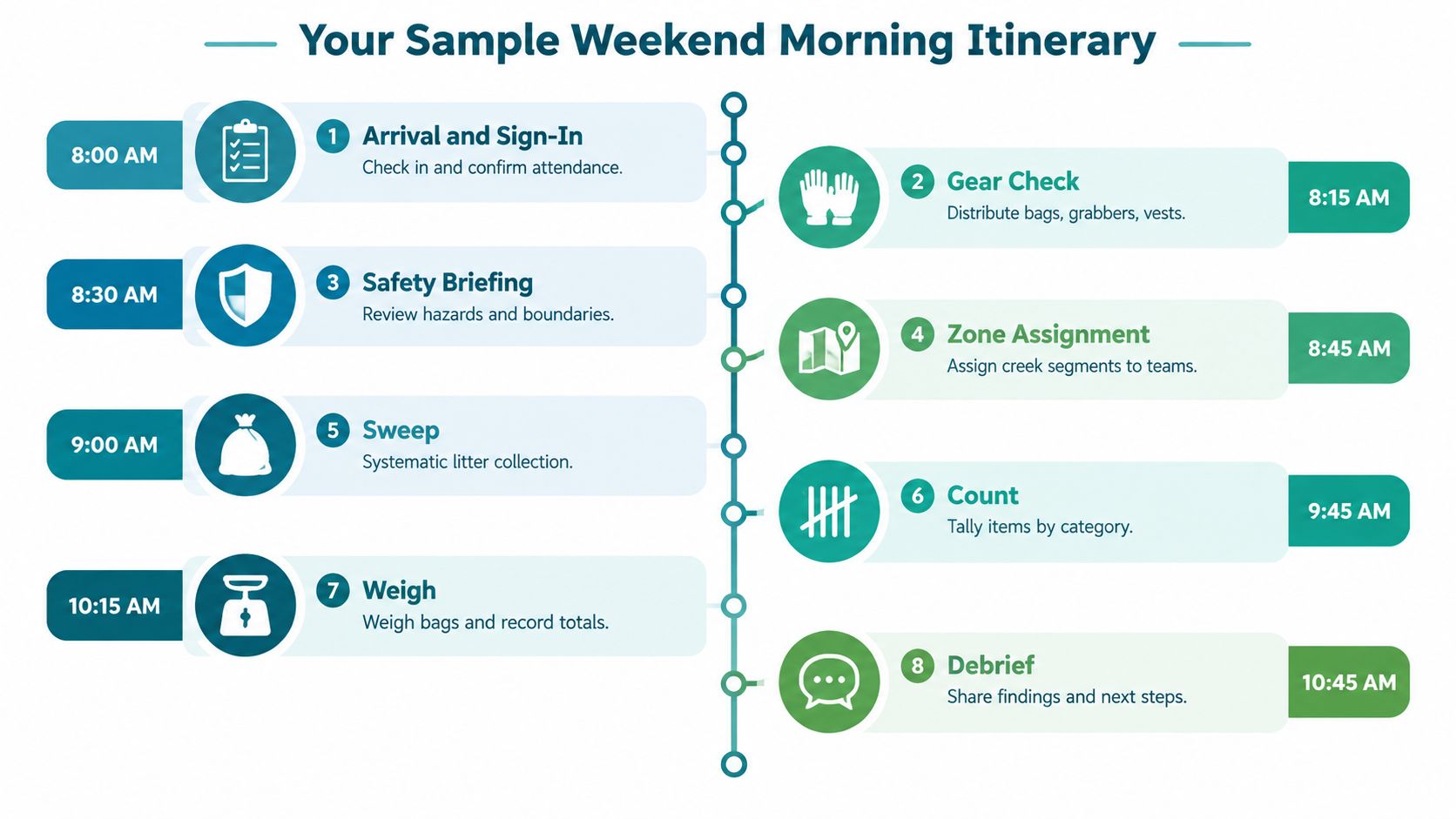
    A visual itinerary graphic showing eight sequential steps for a weekend volunteer community cleaning event schedule.

    The three-hour version

    • 8:00 to 8:15, arrival and sign-in: The captain greets each person, records attendance, checks emergency contacts if the group uses them, and hands out a map. Late arrivals use a visible sign-in point instead of breaking into the briefing.
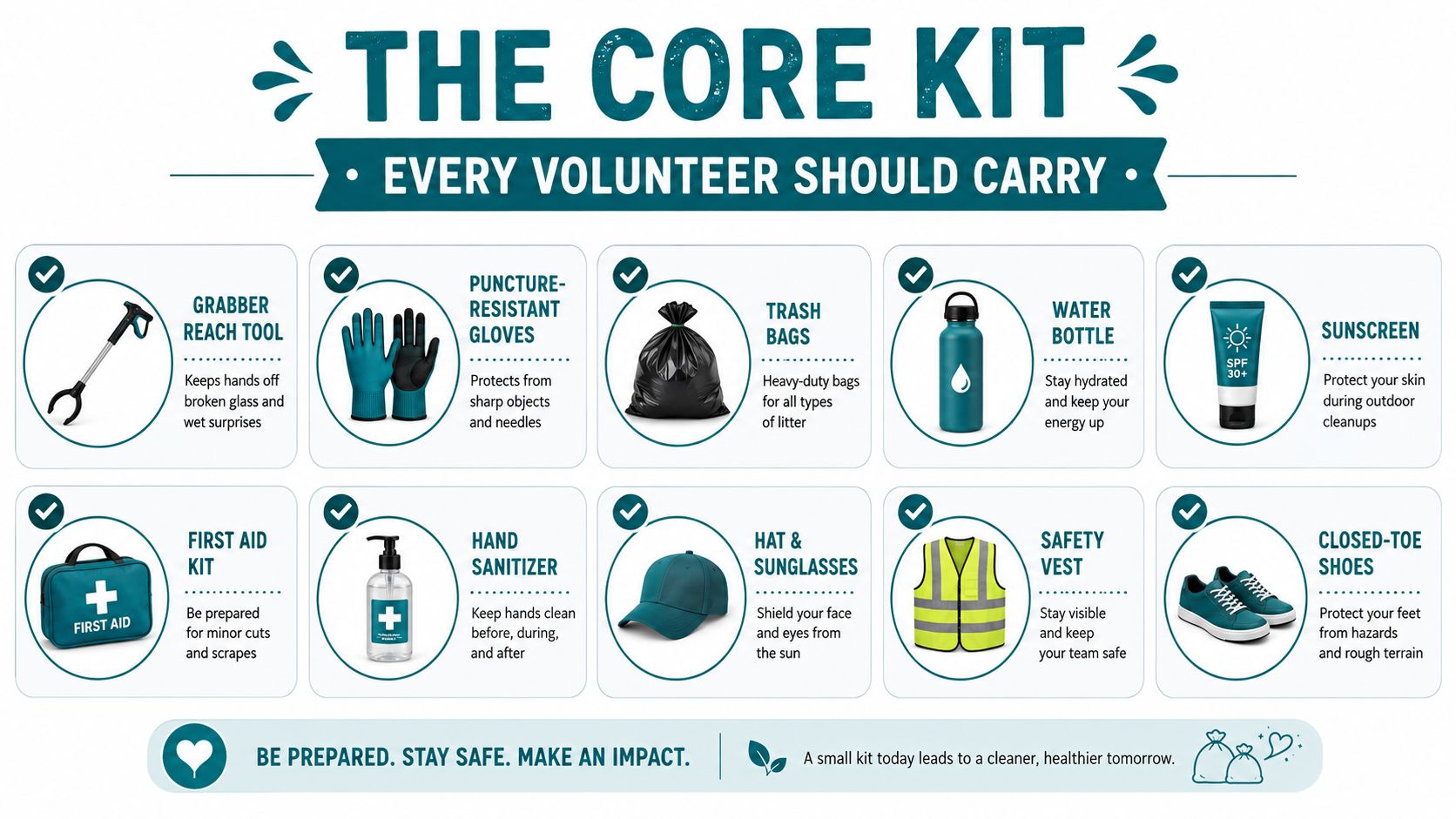
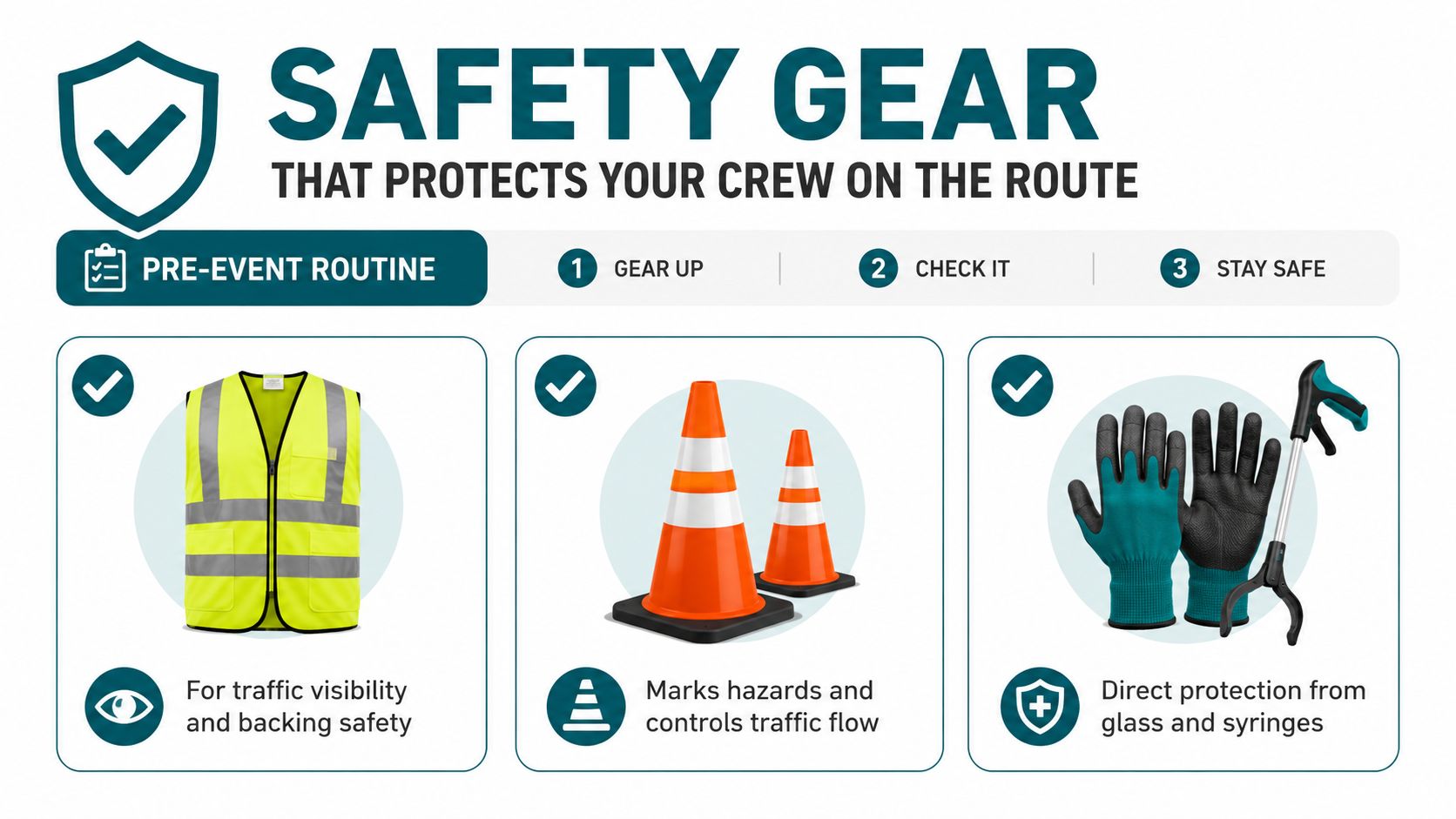
    • 8:15 to 8:30, gear check: A supply lead distributes bags, grabbers, gloves, water reminders, and high-visibility clothing for roadside work. Everyone confirms a buddy before leaving the meeting point.
    • 8:30 to 8:45, safety briefing: The captain names boundaries, traffic risks, unstable ground, heat concerns, sharps handling, and the buddy rule. Volunteers learn which items stay untouched and whom to contact when they find one.
    • 8:45 to 9:00, zone assignment: The route lead gives each team a fixed start and end point. Volunteers repeat their segment aloud, which prevents wandering and makes the route easy to check.
    • 9:00 to 9:45, systematic sweep: Teams move in one direction, fill bags, leave hazardous items alone, and bring full bags to the agreed drop point. The lead watches the pace and checks that nobody works alone.
    • 9:45 to 10:15, count and sort: The sort team groups material by category and records totals on a tally sheet. A full count can expose debris a visual scan misses and show how material accumulates over time, as described in this roadside-litter audit framework.
    • 10:15 to 10:45, weigh and record: The captain records bag totals, unusual items, and unfinished areas. The group photographs the final collection point when that image will help plan the next visit.
    • 10:45 to 11:00, debrief and recognition: Each volunteer shares one observation. The captain thanks named contributors, then the team agrees on the next meeting point.

    The 90-minute version

    For a smaller group, use 8:00 to 8:15 for arrival and gear, 8:15 to 8:25 for safety, 8:25 to 8:35 for segment assignments, 8:35 to 9:10 for the sweep, 9:10 to 9:25 for sorting and counting, and 9:25 to 9:30 for weighing, cleanup, and thanks. Keep the order even when the blocks shrink.

    Captain's cue sheet: “Check in, choose a buddy, inspect your gear, hear the hazards, repeat your segment, sweep toward the drop point, leave dangerous objects alone, bring bags back, count what we collected, and finish together.”

    Splitting the Crew Into Roles and Segments

    At one cleanup, I told everyone to spread out and search. Within minutes, two volunteers were picking through the same pile while another stood alone near the road. Since then, I assign ownership before anyone leaves the parking lot. Clear roles protect the work and the people doing it.

    The creek-cleanup methodology uses briefings, subteams, fixed sections, and a central collection point. I adapt that structure for weekend mornings, where a familiar routine helps new volunteers join without feeling lost.
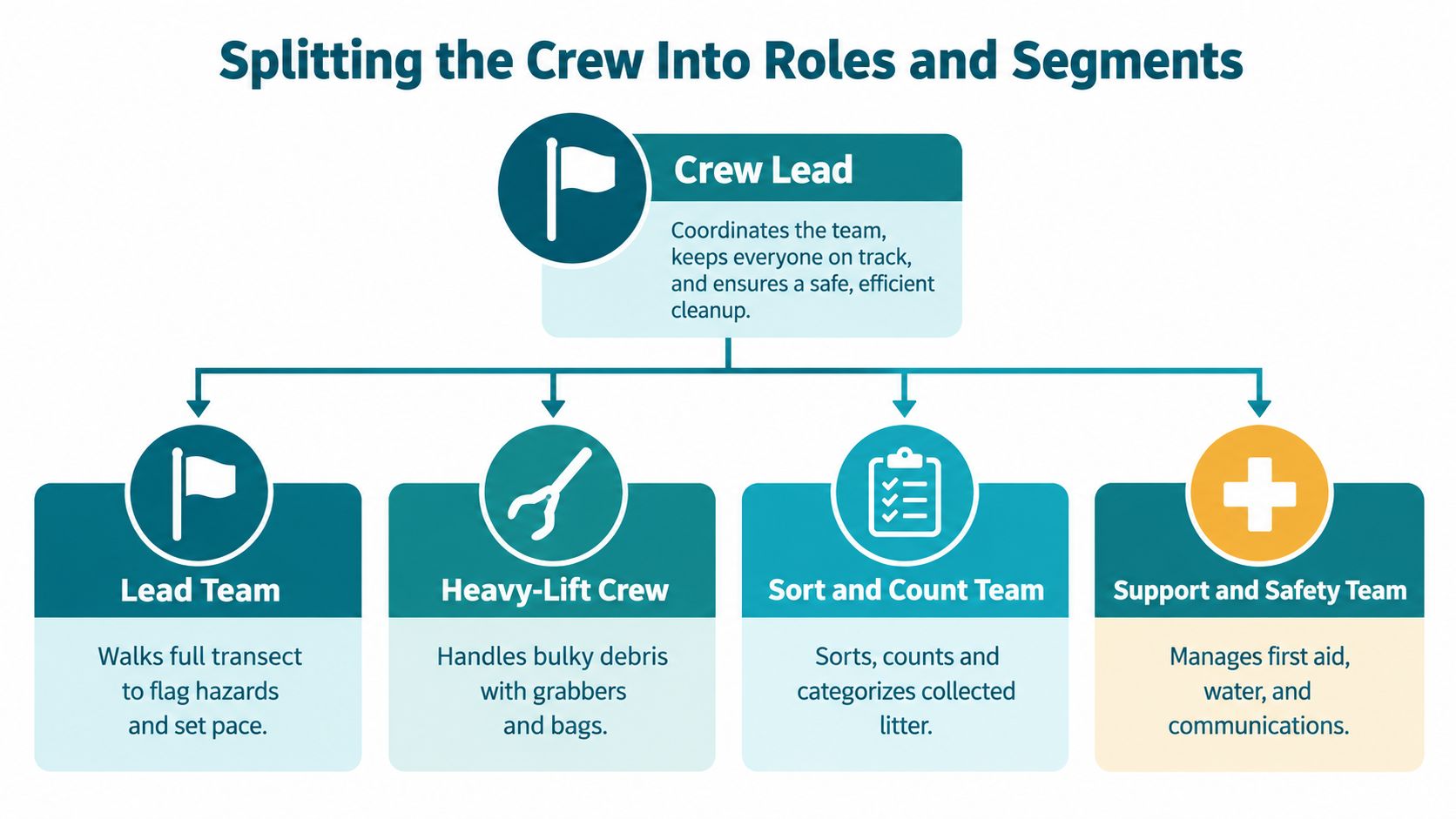
    A diagram outlining the roles and responsibilities of a cleanup crew, including leads, heavy-lift, sort, and safety.

    Four roles that prevent drift

    • Lead team: Two people check the route, mark hazards, confirm the boundaries, and set a pace that keeps volunteers connected.
    • Heavy-lift crew: Volunteers with grabbers and sturdy bags handle bulky debris within safe reach. They leave objects that are dangerously heavy, unstable, or too deep to retrieve.
    • Sort-and-count team: This group stays near the collection point, separates material by type, and records each category on a tally sheet. One litter audit recorded 5,348 items before an intervention and 4,933 afterward across 27 litter types. Your local count can be smaller. Consistency matters more than scale.
    • Support and safety team: This pair carries first-aid supplies, watches traffic and footing, tracks water pauses, and checks that each person remains with a buddy.

    I write every assignment on a card and tape it to a grabber or supply kit. New volunteers work beside experienced people for their first few sessions. They learn the route, the signals, and the quiet habits that keep a group together.

    Fixed segments make the work measurable

    Give each subteam a printed map showing its start, finish, bag drop, and regroup time. If one group finds a dense patch, the lead records it rather than sending everyone toward the same pile.

    A fixed segment also gives returning volunteers a clear memory of what changed. One litter report found that plastics made up 80.7% of counted litter at surveyed sites. That finding may support a plastic-focused plan on one route, while another area calls for attention to glass, food packaging, or construction scraps. The point is to let each weekend's record shape the next assignment, without turning volunteers into competing crews.

    Weather, Safety, and No-Show Contingencies

    Chicago has taught me to respect forecasts and distrust optimism. I've stood under hail with a crew that wanted to keep going, and I've sent people home on a bright morning because the route had become unsafe. A captain protects the people first, then the bags.

    Use a laminated contingency card. Read it before every cleanup, even when the sky looks friendly.
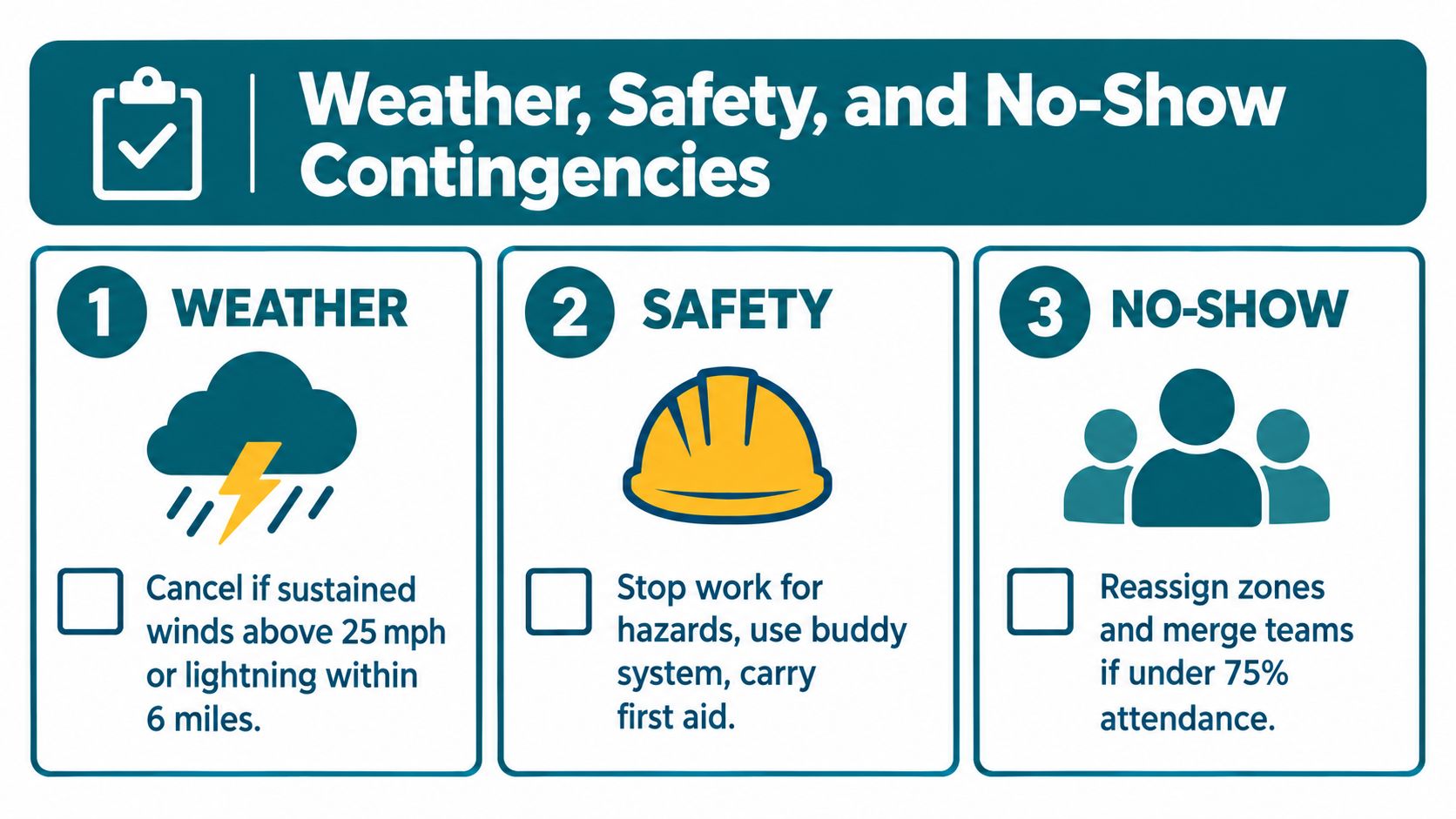
    A safety infographic detailing contingency plans for severe weather, workplace hazards, and low staff attendance rates.

    Weather changes the plan

    Set your weather decision before volunteers leave home. A captain can cancel, shorten, or move the event when conditions create unsafe footing, poor visibility, dangerous heat, or lightning exposure. Send the message early, include the next meeting option, and don't make people wait at the site for a debate.

    For hot mornings, start earlier, build in water pauses, and keep the route near shade when possible. For cold or wet mornings, ask volunteers to bring layers and spare socks. The volunteer site manager guide advises gloves, closed-toe or sturdy shoes, long pants or sleeves, bright clothing for roadside work, sunscreen, and water.

    Hazardous debris stops the sweep

    Never let enthusiasm turn into hand-to-hand contact with danger. Volunteers must leave syringes, needles, sharp metal, old batteries, and unidentifiable objects alone. Mark the location, notify the lead, and contact the responsible authority for disposal, following the guidance in this household hazardous-waste cleanup safety guide.

    Every volunteer should work with a buddy. Official cleanup guidance says crews should receive a safety briefing, work in teams of at least two, and use adult supervision for minors. The community cleanup safety checklist gives captains a practical reference for repeating that briefing.

    No-shows need a quiet backup plan

    Design each role so the work still functions when attendance drops. Pack supplies in role kits, print the tally sheet before arrival, and keep a two-person fallback team ready to absorb extra people or cover a missing group. If a zone becomes too large, close it and record it for a later morning instead of stretching volunteers beyond safe limits.

    Keeping Volunteers Coming Back Week After Week

    Pizza helps, but it rarely explains why someone returns in freezing rain. I've seen people come back because another volunteer remembered their name, handed them the flag, or saved them a place in the circle.

    People need a visible way to belong. A cloth patch or wristband after a volunteer completes a third cleanup gives regulars a small marker they can wear. A shared song, a group photo, or a familiar route can create the same feeling without spending much money.

    Give the morning a repeatable rhythm

    Start each event with the same short circle. Everyone says their name, assigned segment, and one small fact. The format takes little time, but it lets new people speak before the work begins and gives returning volunteers a reason to greet one another.

    End with a few rituals that make effort visible:

    • Read shoutouts aloud: Thank someone who carried heavy bags, helped a newcomer, spotted a hazard, or kept the count organized.
    • Update the tally board: Write the morning's categories where people can see them before they leave.
    • Take one group photo: Stand beside the collected bags, with permission from everyone included.
    • Rotate ownership: Let a different volunteer carry the flag, choose the song, lead the tally, or bring snacks.

    I've found that identity works better than pressure. Volunteers shouldn't feel trapped by guilt or asked to prove their worth. They should know that their presence changes the morning and that the group will welcome them when life interrupts.

    For more ideas on building a dependable group, review these volunteer retention strategies. Then send a short Sunday evening message with the count, two photos, and the next segment. That message keeps the thread alive without turning service into an obligation.

    Your First Saturday With This Schedule

    Your first event will feel exposed. People will watch for direction, the weather may change, and a small delay can decide whether the morning feels warm or chaotic. You don't need a perfect production. You need a captain who arrives prepared and speaks clearly.

    Arrive 15 minutes early. Post the route map, set out bags and grabbers, place water where everyone can see it, and keep a printed roster beside your phone. Run a brief safety talk, pair people into two- or three-person pods, and give every pod a fixed section. Announce the end time before anyone starts so parents, shift workers, and people with afternoon plans can trust the schedule.

    The final 10 minutes should include bag counting, one specific thank-you, and notes for next week. Write down a missing supply, a confusing turn, a slippery area, or a segment that took longer than expected. Those notes turn one morning into a system.

    First-weekend checklist

    • Route: Print the map and mark start, finish, bag drop, and regroup points.
    • Safety: Prepare the briefing, first-aid supplies, hazard instructions, and buddy assignments.
    • Gear: Pack gloves, grabbers, bags, bright clothing, and sturdy footwear.
    • Comfort: Bring water, sunscreen, layers, and a hat when conditions call for them.
    • Communication: Charge your phone and save the lead contact before arrival.
    • Attendance: Print the roster and leave space for walk-in volunteers.
    • Closeout: Carry a tally sheet, pen, camera, and a place to record next week's notes.

    Groups looking for a regular service rhythm can study weekend volunteer work on Saturdays and adapt the same approach to their own block, home, school, or park.

    The first Saturday may produce fewer bags than you hoped. That's fine. People will remember whether they felt safe, useful, and welcome. One morning repeated with care can outlast a large event that leaves everyone exhausted.


    Litter Caterpillars organizes recurring weekend morning trash pickups in Chicago, with clear meetup details, shared roles, and a volunteer-first approach to safety and friendship. Visit Litter Caterpillars to find an upcoming cleanup and bring this weekend cleaning schedule to life with a crew.
  • Logo and Identity: A Practical Guide for Community Groups

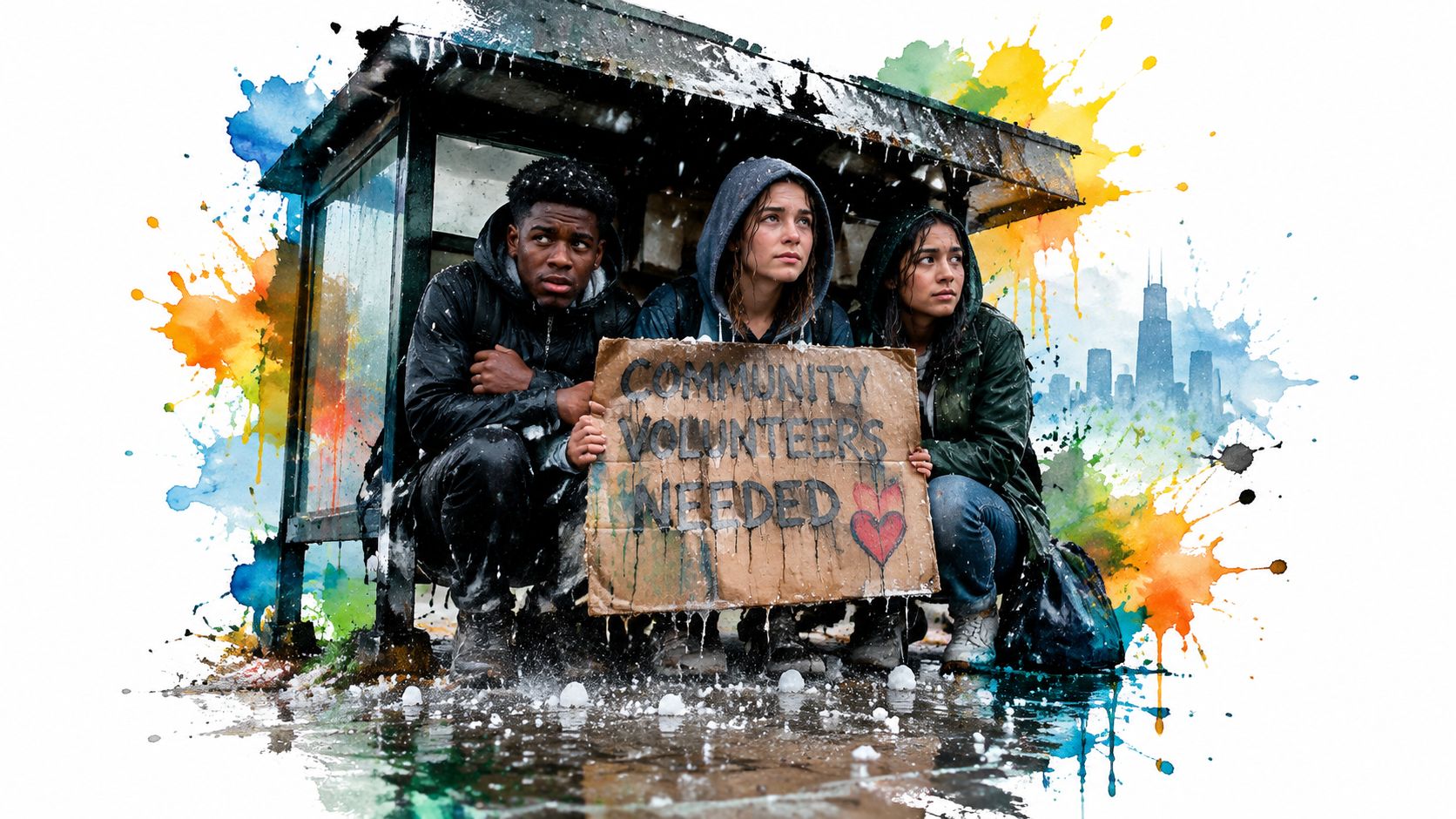
    Three volunteers had just finished a litter pickup on Chicago's South Side when hail drove them under a trail shelter. Their cardboard sign dissolved in the rain, but that night, from memory, we drew the first Litter Caterpillars logo.

    The Day Three Volunteers Got Caught in a Chicago Hail Storm

    The spring afternoon had started smoothly. Three of us walked back toward the trail shelter after picking up trash, carrying full bags, wet gloves, and the loose confidence that comes from thinking the weather will hold for one more block.

    Then the sky changed. Hail hit the path hard enough to sting our faces. The cardboard sign reading “volunteers needed” sagged in our hands, and every ride we tried to call canceled while we stood there shivering. We crowded beneath the shelter, watching the field we had just cleaned disappear behind a sheet of gray weather.

    Three young people huddled together in a rain-covered bus stop holding a community volunteers needed sign.

    That storm became our first identity lesson. We didn't create a logo after a long meeting about market position. We drew it later because we needed a way to remember what had happened. The mark carried the three people, the soaked sign, the cold, and the strange laughter that arrived after we realized we'd have to wait it out together.

    A mark born from the work

    Our name, Litter Caterpillars, already held a story. A caterpillar moves slowly, keeps going, and changes along the way. We weren't presenting ourselves as perfect organizers. We were people trying to practice cleanliness, consistency, bravery, and friendship through service.

    The first sketch captured that feeling. It gave us something to put on a sign, then a shirt, then a flag. Each use told a small part of the same story to someone who hadn't been under that shelter with us.

    A logo can carry memory in a compact form. One recent compilation reports that 75% of people say they recognize a brand by its logo, and consumers typically need 5 to 7 exposures before they remember a brand, according to logo recognition and memory data. Those figures describe brands broadly, yet the practical lesson works for a volunteer crew too. People need repeated chances to connect your mark with your people and your work.

    Our practical rule: Draw the thing your group has already lived. A polished mark with no story feels rented. A rough mark tied to a real memory can give people somewhere to belong.

    The rest of this guide follows that approach. Use what you have, keep the system easy to repeat, and let the identity grow from the mornings when people show up.

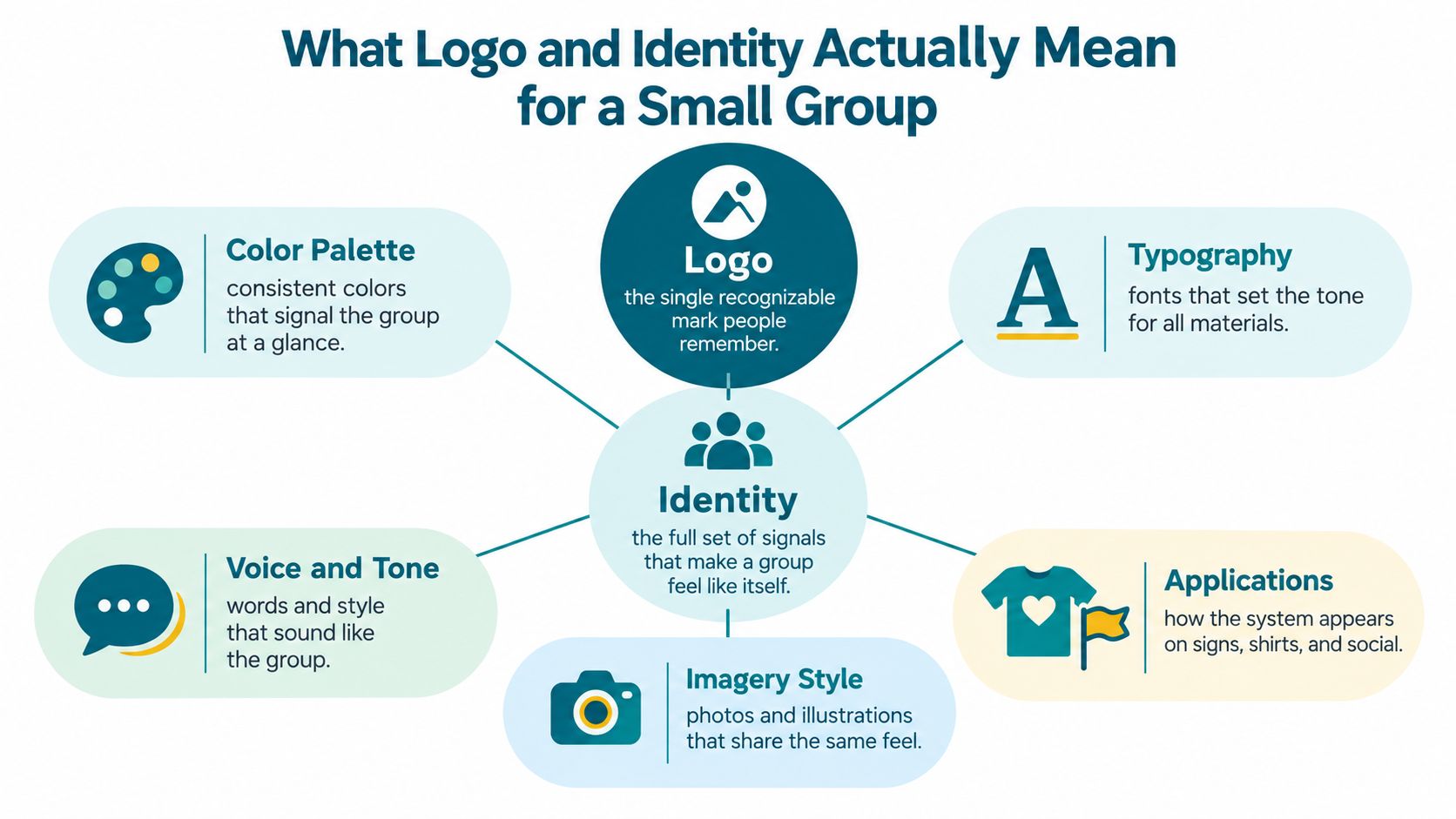
    What Logo and Identity Actually Mean for a Small Group

    A logo is the single mark people can recognize and remember. It might be a caterpillar, a hand, a tree, a neighborhood outline, or a wordmark built from your group's name.

    Identity is larger. It includes every repeated signal that makes the group feel like itself: colors, type, badges, flags, phrases, photographs, meeting rituals, and sound. When those pieces work together, a volunteer can spot your table across a park before reading the sign.

    An infographic titled What Logo and Identity Actually Mean for a Small Group, illustrating core branding components.

    Think in signals, not files

    The Caterpillar Park badge makes the difference easy to see. The badge has the mark, the group color, the park name, and the feeling of having helped turn an empty lot in Englewood into a place people could use. The badge isn't only a graphic file. It becomes a patch on a jacket, a small sign at an event, and a reminder that volunteers helped make the place.

    You can map your own system with a short list:

    • Logo: The mark people identify first.
    • Color: A repeatable visual cue for signs, shirts, and posts.
    • Typography: Letterforms people can read on a windy banner or a small phone screen.
    • Badge: A compact symbol for membership, service, or achievement.
    • Flag: A large signal that helps people locate your group from a distance.
    • Voice: The words and tone people hear in invitations and announcements.
    • Sound: A short theme or sonic signature that can bring the group to mind.

    Flags and badges already carry group meaning outside volunteer work. The Governor General of Canada's heraldry guide explains that flags can identify a country, school, sports team, province, or cause, while badges can show belonging to a group or belief in a cause. That matches what happens at a cleanup. A flag tells a newcomer where to walk. A badge tells a returning volunteer, “You're part of this.”

    For a deeper look at making a mark that remains useful over time, how to design a lasting logo gives practical design guidance. Keep your own standard simple: if a volunteer can't redraw the idea, explain it, or use it without special software, the system needs less complexity.

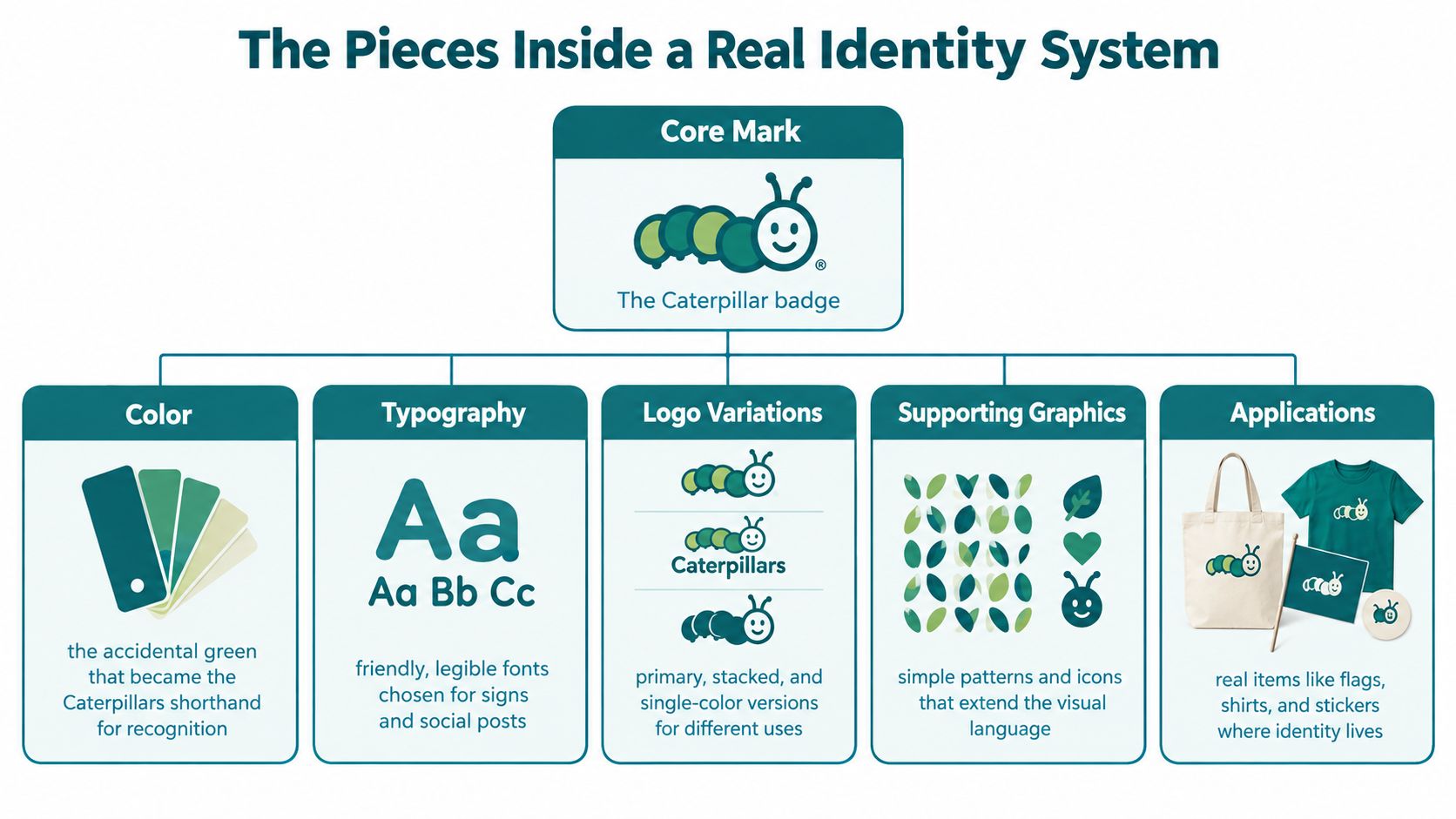
    The Pieces Inside a Real Identity System

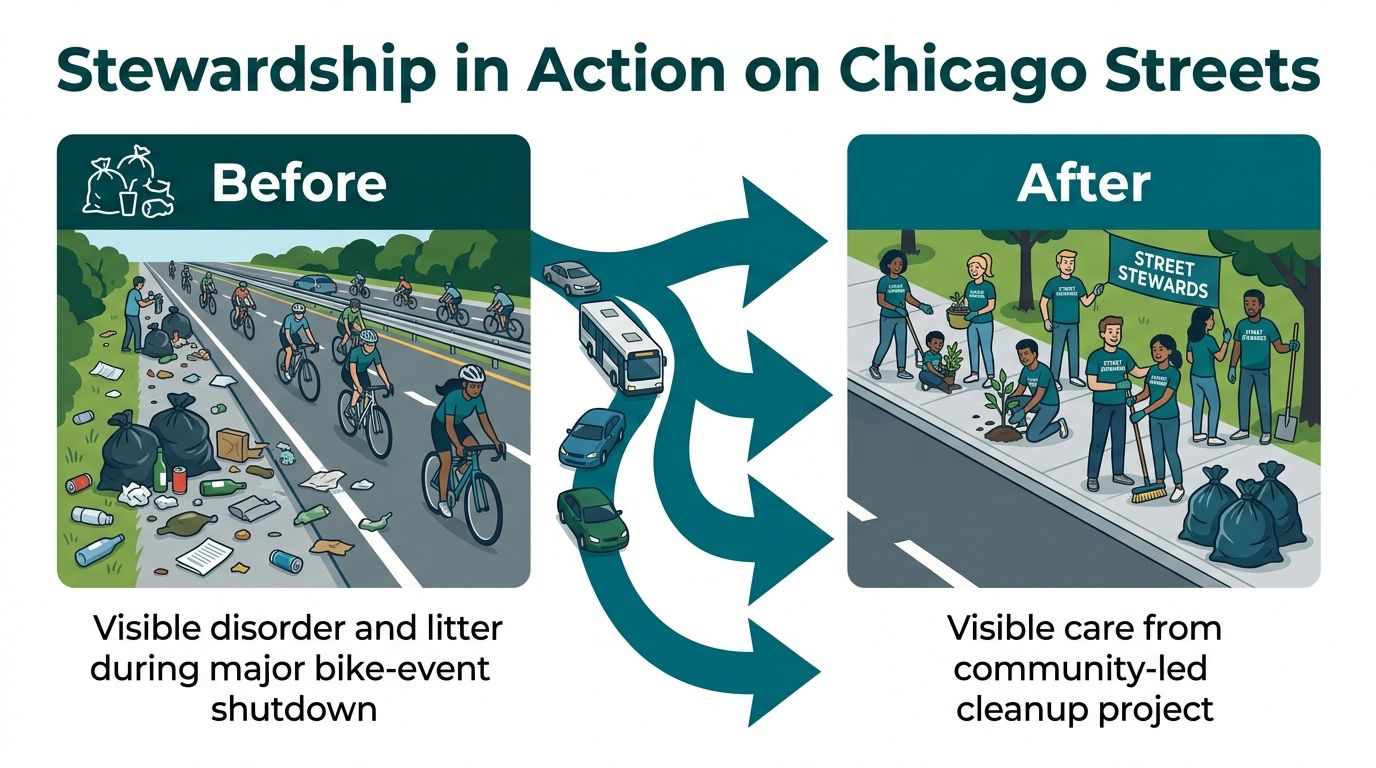
    At a highway bike-event shutdown, our flying caterpillar flag did a job that a small logo couldn't do alone. Volunteers needed to know where the crew gathered, drivers needed to see the closed work area, and passersby needed a quick answer to the question, “Who is doing this?”

    One color can become a shortcut

    Our green started by accident. We used the green material we had, then repeated it because buying another color made no sense. Soon, green meant Caterpillars before anyone read the name.

    Color helps, but shape carries the mark when printing gets messy or a screen turns small. A 2026 cross-market analysis reported that shape-based assets reached 40% Fame and 71% Uniqueness, while color assets reached 12% Fame and 39% Uniqueness, as described in the analysis of shape and color brand assets. I take that as a useful budget rule. Protect the silhouette first, then choose colors that help people find it.

    Research on logo familiarity also shows that people remember color more strongly when they already know a brand, while low- and mid-familiarity conditions don't show the same memory-color effect, according to research on color and shape in logo memory. New groups should keep both the shape and the color consistent while people learn them.

    Type needs to survive the park

    We picked friendly, readable lettering because a banner can flap, fold, and sit several steps away from the person reading it. A decorative font might look lively on a laptop and become mud on a windy fence.

    Badges handle close viewing. Flags handle distance. A wordmark handles names and announcements. Supporting graphics, like a repeating caterpillar pattern or a simple leaf icon, fill empty space without forcing the main logo into every corner.

    A diagram titled The Pieces Inside a Real Identity System showing logo, typography, color, and applications.

    At the bike event, those pieces worked as a set. The flag helped people find us. The badge identified volunteers up close. The banner explained the temporary boundary. The same green and caterpillar shape made the separate objects feel connected.

    Budget test: Print the mark in one color, shrink it to a profile picture, and view it from across a room. If people lose the shape or the name, simplify before you buy more gear.

    Sound can join the system too. A sonic logo is a short sequence of notes, effects, or vocalizations that helps bring a brand to mind when people hear it, according to this review of sound branding and sonic logos. Our theme song gives event videos and group moments another way to feel connected.

    How a Volunteer Crew Builds Identity From Scratch

    You don't need an agency presentation to begin. You need a Saturday morning, a notebook, a few examples, and people willing to make decisions instead of leaving every choice open forever.

    Start with the story

    Gather examples that feel close to your group. Look at a park sign, a sports patch, a neighborhood flag, or an old volunteer shirt. Each person should bring one example and explain what they like about it. Don't copy the artwork. Notice the qualities: bold, welcoming, practical, playful, serious.

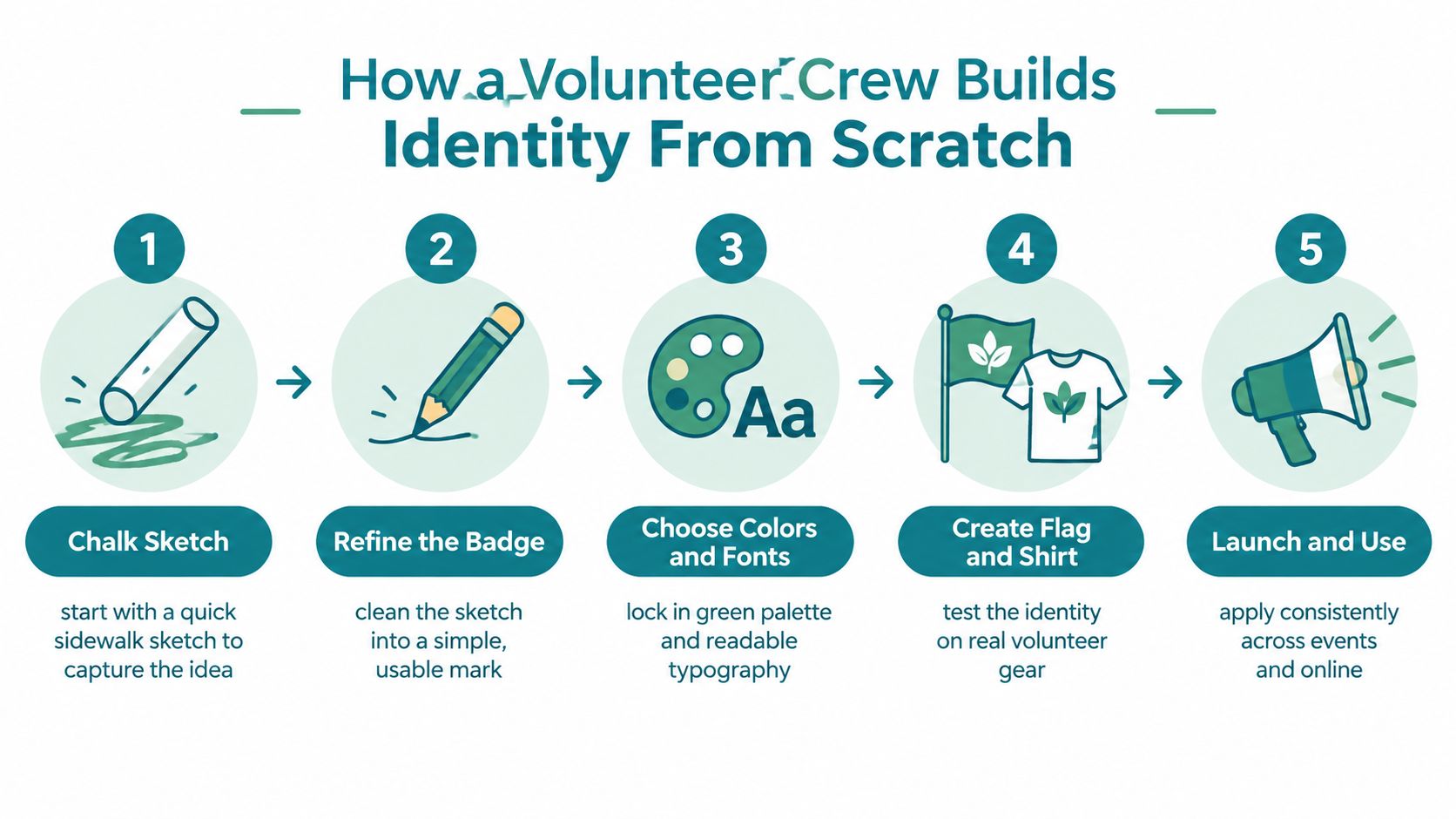
    Then sketch together. The Litter Caterpillars idea began as a chalk drawing on a sidewalk before it became a working badge, flag, and logo lockup. Draw quickly in a shared notebook. Try animals, tools, hands, streets, plants, and letter shapes. Keep the first round loose.

    Build the smallest usable set

    Use this sequence:

    1. Clean the badge: Choose one sketch and remove details that disappear when the mark gets small.
    2. Choose two colors: Pick colors that still print clearly through the cheapest printer setting. Keep green if it carries your group's story, but test it on white, dark fabric, and plain paper.
    3. Choose one wordmark: Use readable type for the full group name. Save decorative lettering for optional event art.
    4. Make a flag: Create a large version that people can spot at a rally, cleanup, or shared public space.
    5. Test a shirt: Put the badge on a sleeve or chest, then ask volunteers whether they can read it while moving.
    6. Write one page of rules: Show the primary logo, the small logo, the colors, the type choice, clear space around the mark, and examples of what not to do.
    7. Use a shared folder: Store editable files, print files, transparent images, and the one-page guide where the whole crew can find them.

    A step-by-step infographic showing five stages of a volunteer crew creating a new brand identity.

    Your group can build the visuals alongside its habits. The Litter Caterpillars approach to organizational culture building connects identity with the repeated choices volunteers make together. Keep the process friendly. A system that only one person understands will fail when that person misses a cleanup.

    Where Identity Shows Up in the Real World

    At Caterpillar Park, the flag hangs from the picnic shelter before volunteers arrive. Someone walking along the path can see the color moving in the wind and find the gathering point without checking a message thread.

    That same person sees the badge later on a hi-vis vest. At close range, the patch answers a different question. The flag says, “We're over here.” The badge says, “This person belongs to the crew.” A mark on a shirt can also open a conversation. People ask what the group does, and a volunteer can invite them to the next pickup.

    Objects give the system a place to live

    At the highway bike-event shutdown, a banner stretched across the closed lane made the temporary space readable. The logo didn't replace the safety instructions, cones, or event signs. It gave the work a visible owner and helped pedestrians connect the people managing the space with the group they had seen online.

    Volunteers also use smaller surfaces:

    • Shirts and vests: Put the badge where people can see it while working.
    • Totes and stickers: Use the single-color mark when printing space or budget is tight.
    • Event flyers: Keep the group name readable before adding extra artwork.
    • Meetup thumbnails: Use the silhouette so it survives a small crop.
    • Instagram posts: Repeat the same color treatment without forcing every photo into an identical template.

    If you need practical help preparing crisp custom apparel logos from Raccoon Transfers, focus first on the file format, size, placement, and fabric color your volunteers will use. A beautiful mark can still fail if the smallest text disappears into a vest seam.

    Digital identity needs the same field test as physical identity. Shrink your logo until it fits a profile image. Remove extra wording if the name becomes unreadable. Then check whether a new volunteer can identify the account among several event listings.

    The Litter Caterpillars guide to social media for volunteer recruitment treats posts as invitations to participate, not as a gallery of perfect designs. Show the gloves, bags, weather, jokes, and finished blocks. Your identity should help those moments feel connected.

    A group symbol can also change how people see the group around it. Research on logos, flags, and similar emblems found that shared symbols can make a collection of people seem more unified, effective, and coordinated, even when members don't look alike on their own, according to this summary of group-symbol research. That effect doesn't require expensive merchandise. It begins when people wear, carry, and repeat the same small signals while doing work together.

    Why Identity Is More Than Decoration

    A logo can look decorative when it sits alone on a file. It behaves differently when volunteers use it to make daily decisions.

    During the Caterpillar Park push in Englewood, the badge helped people recognize which meetings, signs, and workdays belonged to the effort. The green gave flyers a familiar thread. The same phrases and symbols helped new volunteers understand the group's tone before they knew everyone's names.

    A shared memory for a changing crew

    Volunteer groups rotate. One person moves, another starts a new job, and someone who organized every Saturday may disappear from the group chat. A consistent identity keeps a piece of the group's memory available when the original organizers aren't in the room.

    That doesn't mean every object needs the logo. It means the group can ask simple questions:

    • Does this invitation sound like us?
    • Would this sign make sense beside our flag?
    • Does this badge belong on a cleanup vest?
    • Will a new volunteer know what they're joining?

    The answers reduce arguments and save time. You don't need to debate every color for every flyer. You choose from a small set of decisions the crew already made.

    Shared symbols can also support pride. A study on national pride and sports found that identification with a national team before a final match predicted later pride in both the team and the country, as reported in research on team identification and national pride. A neighborhood cleanup isn't a championship, yet the emotional pattern feels familiar. People carry a shared symbol, do difficult work together, and feel connected to something beyond the single task.

    The Litter Caterpillars guide to stewardship puts service at the center of that feeling. The logo reminds volunteers what they chose to practice, even on a cold morning when the work feels heavier than expected.

    What Story Does Your Identity Tell

    The first Litter Caterpillars logo came from three people under a shelter, watching hail strike the field they had just cleaned. That story still gives the mark its shape. It says service can be hard, friendship can make hard work lighter, and a group can grow from one uncomfortable afternoon.

    Your group probably has a moment like that.

    Maybe it was the cleanup after the Fourth of July parade, when everyone found themselves carrying bags long after the crowd left. Maybe only one person arrived on a Saturday morning, and that person worked anyway. Maybe a child drew the first doodle on the back of a flyer while adults argued about the event name.

    Write the moment in one honest sentence. Then ask three questions:

    • What object appeared in that story?
    • What color belonged there?
    • What shape could someone recognize before reading the group name?

    Your answer might become a badge, a flag, a wordmark, or a theme song. It doesn't need to explain everything. It needs to help the right people recognize the feeling of showing up.

    Logo and identity work best when they compress belonging into something people can carry. Start with one sentence and one rough sketch. Let the volunteers test both in the places where your group works.


    Litter Caterpillars organizes volunteer trash pickups across Chicago, including workdays that bring neighbors together outdoors and build friendships through service. Visit Litter Caterpillars to find an upcoming event, meet the crew, and see how flags, badges, songs, and a simple logo can give a volunteer group a shared story.

  • How to Build Trust in Teams That Actually Lasts

    How to Build Trust in Teams That Actually Lasts

    The hail hit halfway through our first Litter Caterpillars cleanup, hard enough to sting through a winter coat. Three strangers stood under one tree, passing trash bags around as makeshift ponchos while every Uber canceled, and nobody left.

    What a Chicago Hailstorm Taught Me About Trust

    It was a bitter April Saturday along the riverwalk. We had started with a simple plan, pick up litter, fill some bags, and head home before lunch. Halfway through the route, Chicago changed the rules. Hail rattled against the pavement, gloves soaked through, and the wind turned every exposed hand numb.

    I had a choice. I could call it and squeeze everyone into a Portillo's, or I could ask three people I barely knew to keep working in miserable weather. I didn't want to confuse toughness with good judgment, so I checked that everyone could get warm and stay safe. Then something surprised me. The group chose to stay.

    We tied trash bags over our coats. We moved closer together. One person held the bag open while another grabbed bottles from the mud. We laughed at how ridiculous we looked, then finished the route. We didn't build trust through a speech. We built it by sharing discomfort, watching each other's backs, and doing what we said we'd do when the easy option disappeared.

    That experience changed how I think about how to build trust in teams. Trust grows through repeated evidence. People watch whether you arrive when conditions get rough, tell the truth when a plan fails, and protect one another when someone makes a mistake.

    Psychological safety gives teams a foundation for that work. Amy Edmondson's 1999 study of 51 work teams connected psychological safety with learning behavior, while learning behavior helped explain the relationship between safety and team performance. Edmondson's study describes a practical condition: people can speak up, ask for help, admit mistakes, and offer ideas before small problems grow.

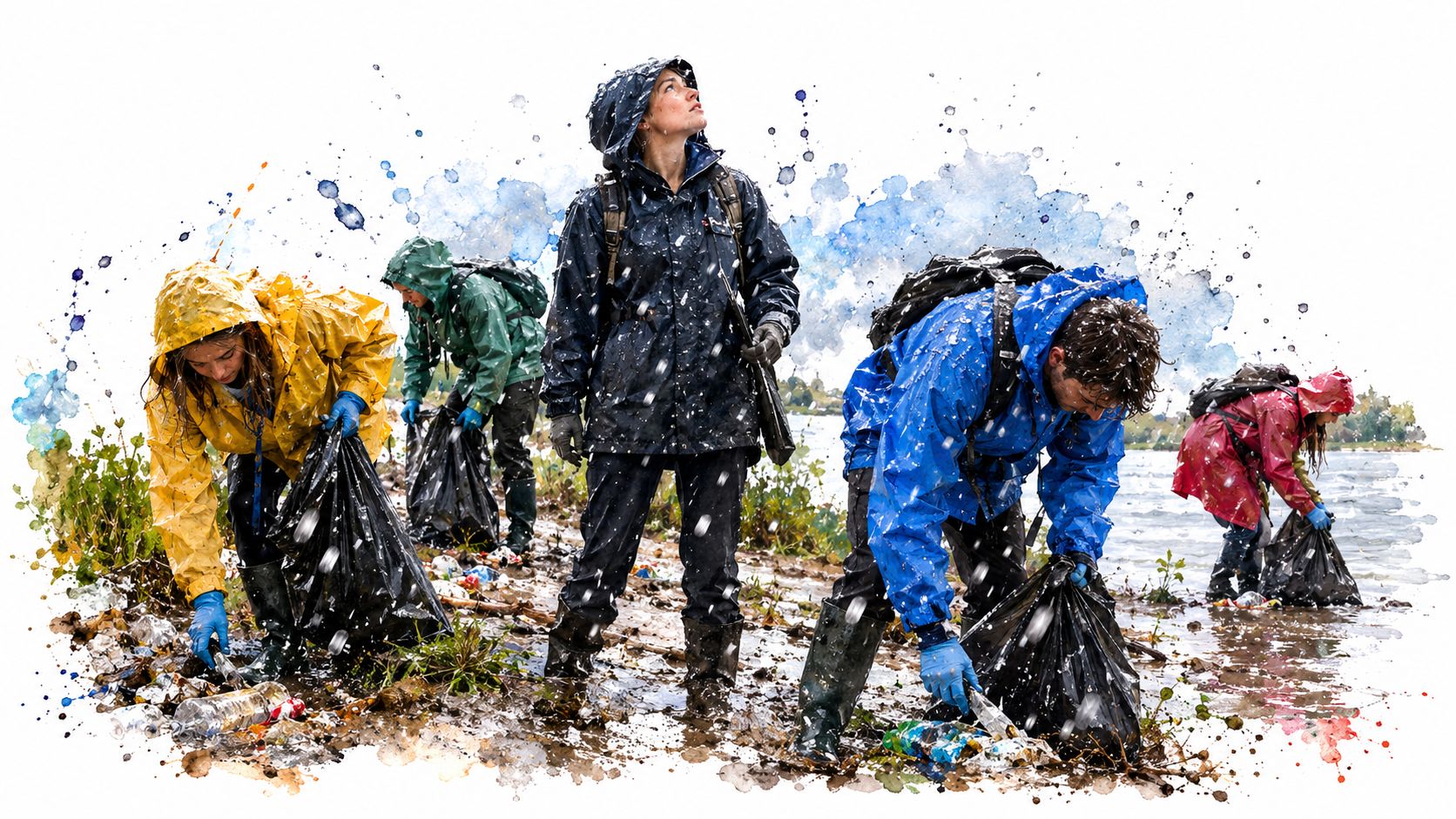
    A diverse group of volunteers in colorful rain gear cleaning up trash along a muddy riverbank.

    You can build that kind of team in a volunteer crew, a nonprofit committee, or a workplace squad facing a deadline. The setting changes. The proof stays familiar. Someone shows up, tells the truth, follows through, and makes it easier for the next person to do the same.

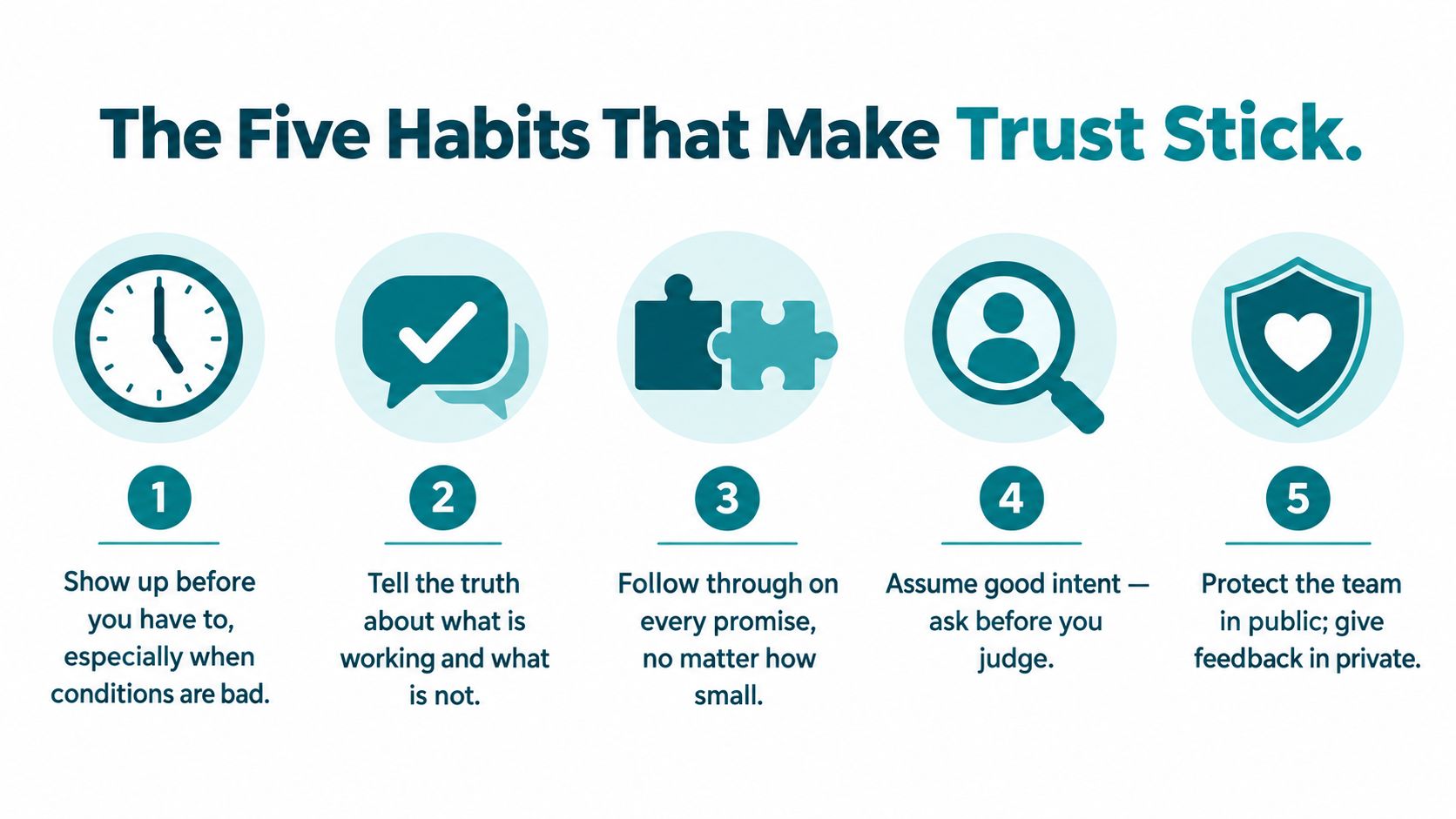
    The Five Habits That Make Trust Stick

    Trust doesn't arrive because everyone shares pizza or tells one personal story. It forms through small habits that people can see.

    Show up before you have to

    On bad-weather cleanup days, I arrive early enough to check the route, bags, gloves, and safety concerns before volunteers gather. That quiet preparation tells people they won't have to carry the whole plan themselves.

    The same habit works on a work team. Join the call prepared. Read the document before the meeting. Reach out when a deadline looks shaky instead of waiting for someone to chase you.

    Tell the truth about what you saw

    A Sunday shift almost fell apart because we underestimated the amount of litter near a service road. I could have called the route “fine” and hoped energy would carry us through. Instead, I said, “This area is worse than we expected, and we won't finish it safely with the people and supplies we have.”

    That sentence gave us choices. We shortened the route, split the work, and left with a clear plan for the next visit. Honesty gives a team usable information.

    Finish small promises

    If you say you'll bring extra bags, bring them. If you promise to send notes, send them when you said you would. People accept larger commitments more readily after they watch you complete ordinary ones.

    Research supports this practical approach. A meta-analysis of 112 independent studies across 7,763 teams found an above-average positive relationship between intrateam trust and team performance, with ρ = .30. A separate review of 84 studies covering 5,582 teams found a moderate positive association, with a mean r = 0.34 and corrected r = 0.40. The PubMed review also supports recurring measurement because trust results vary by context and measurement method.

    Route work toward people's strengths

    On our crew, one volunteer remembers every route turn, another talks easily with newcomers, and another spots broken glass before anyone else. I name those strengths and match work accordingly. That doesn't trap people in one role. It lets the team start from competence while people try new tasks.

    On a remote team, ask, “What part of this work feels clear to you, and where would a second set of eyes help?” You may learn more from that question than from a generic skills inventory.

    Apologize fast, then get specific

    A teammate once admitted during a remote retrospective that she had missed a deadline. She didn't hide behind a system problem. She explained what she missed, what the delay affected, and what she would change next time. Her honesty made it easier for others to discuss their own blockers.

    Use the same pattern yourself: “I said I would send the route plan Friday. I sent it late, and that left you without enough time to prepare. I'm sorry. I'll send the next plan by Thursday afternoon.”

    For a fuller workplace framework, trust-building strategies for HR can help HR teams turn these behaviors into regular team practices. You can also connect these habits with servant leadership, where the leader takes responsibility for the conditions people need to do good work.

    An infographic titled The Five Habits That Make Trust Stick, featuring five numbered icons and corresponding advice.

    Weekly Rituals That Compound Trust Over Time

    A trust ritual should fit into the work already happening. If people need a special retreat to practice honesty, they won't practice it often enough.

    Friday roundup

    Send one short message at the end of the week:

    “Here is what worked, and here is what I need help with.”

    Then name one real win and one honest worry. On a cleanup crew, that might mean celebrating a full route while admitting that equipment ran short. On a product team, it might mean naming a finished release and a handoff that still feels unclear.

    The ritual activates low-stakes honesty. People learn that a worry can enter the group before it becomes a crisis.

    Two-minute pickup standup

    At the start of every pickup, ask each person two questions:

    “What are you bringing today, and where do you need help?”

    A person might bring route knowledge, extra gloves, or patience with a new volunteer. Someone else might need help carrying a heavy bag or navigating an unfamiliar block. Keep answers brief and make space for every voice.

    Google's Project Aristotle studied 180 teams across 250 attributes and identified psychological safety as the strongest factor separating top-performing teams from the rest. Google's team-effectiveness guide lists psychological safety, dependability, structure and clarity, meaning of work, and impact of work in that order. A short standup touches the first three without turning the meeting into a performance.

    Sunday reflection email

    Ask one question:

    “What surprised the team this week?”

    A surprise might reveal a route hazard, an overlooked success, or a communication gap. Read the replies before the next gathering and act on at least one useful point. Reflection loses credibility when people share observations and nothing changes.

    Monthly shared meal

    Keep it simple. Cold pizza on a tailgate counts. So does soup after a winter pickup or coffee at the end of a Saturday shift. The meal gives people room to meet outside their assigned task, which helps them see one another as full people rather than names on a schedule.

    These rituals work because they repeat. A single honest message may feel small. A pattern of honest messages teaches people what happens when they speak plainly. Over time, that pattern helps a team handle larger mistakes, tighter deadlines, and sudden changes without waiting for a perfect meeting.

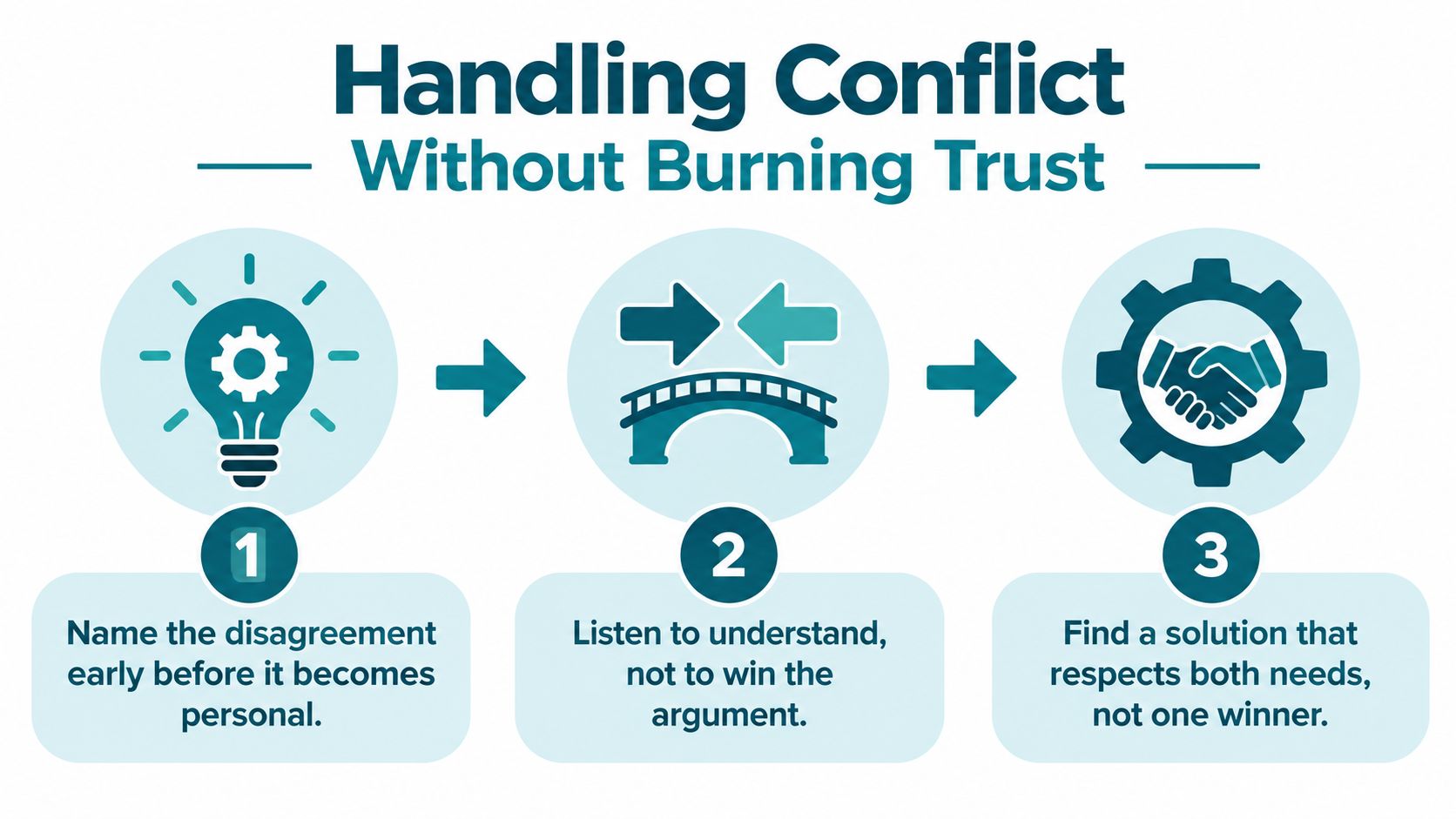
    Handling Conflict Without Burning Trust

    A disagreement tells you more about a team than a cheerful team-building exercise. People learn whether trust exists by watching what happens when two reasonable people want different things.

    Two regular volunteers nearly quit after a public argument about route safety. One wanted to continue toward a difficult stretch. The other believed the group should leave before traffic and weather made the route unsafe. The argument grew because each person felt the other had ignored a real concern.

    I stepped in with one sentence:

    “I want to hear both of you fully before we decide anything.”

    Then I used a simple sequence.

    Name what happened

    Say what you observed without assigning motives: “We disagreed about whether this route was safe, and the conversation became public and sharp.”

    Name the feeling underneath

    Ask what the disagreement brought up: “I hear concern about safety. I also hear frustration that the group's time and effort might get wasted.” Naming the feeling gives people a way to discuss the need beneath the position.

    Agree on one repair step

    The repair might involve a route rule, a private follow-up, a new safety check, or a decision about who can stop the work. Make the step concrete: “We'll pause at the first blocked section, check traffic together, and leave if either safety lead recommends it.”

    Follow up next time

    Open the next meeting by asking whether the repair worked. Without follow-up, an apology can sound like a way to end the uncomfortable conversation.

    Fast apologies often feel fake because people rush to remove tension before they understand the harm. A slower acknowledgment rebuilds credibility more reliably: “I interrupted you twice, dismissed the safety concern, and made it harder for you to speak. I'm sorry. Next time, I'll let you finish before I respond.”

    A team can disagree and still trust one another. It needs rules that protect candor, safety, and dignity at the same time.

    A three-step infographic on how to resolve conflicts professionally without damaging trust within a team.

    When the disagreement involves power, identity, or political differences, use structure instead of demanding agreement. State the shared purpose, pair people who rarely work together, and give each person time to speak before the group decides. A divided team needs room for real disagreement and a clear reason to keep working together.

    Onboarding New People the Right Way

    A new person doesn't experience onboarding as paperwork. They experience it as a series of answers to one question: “Can I rely on these people?”

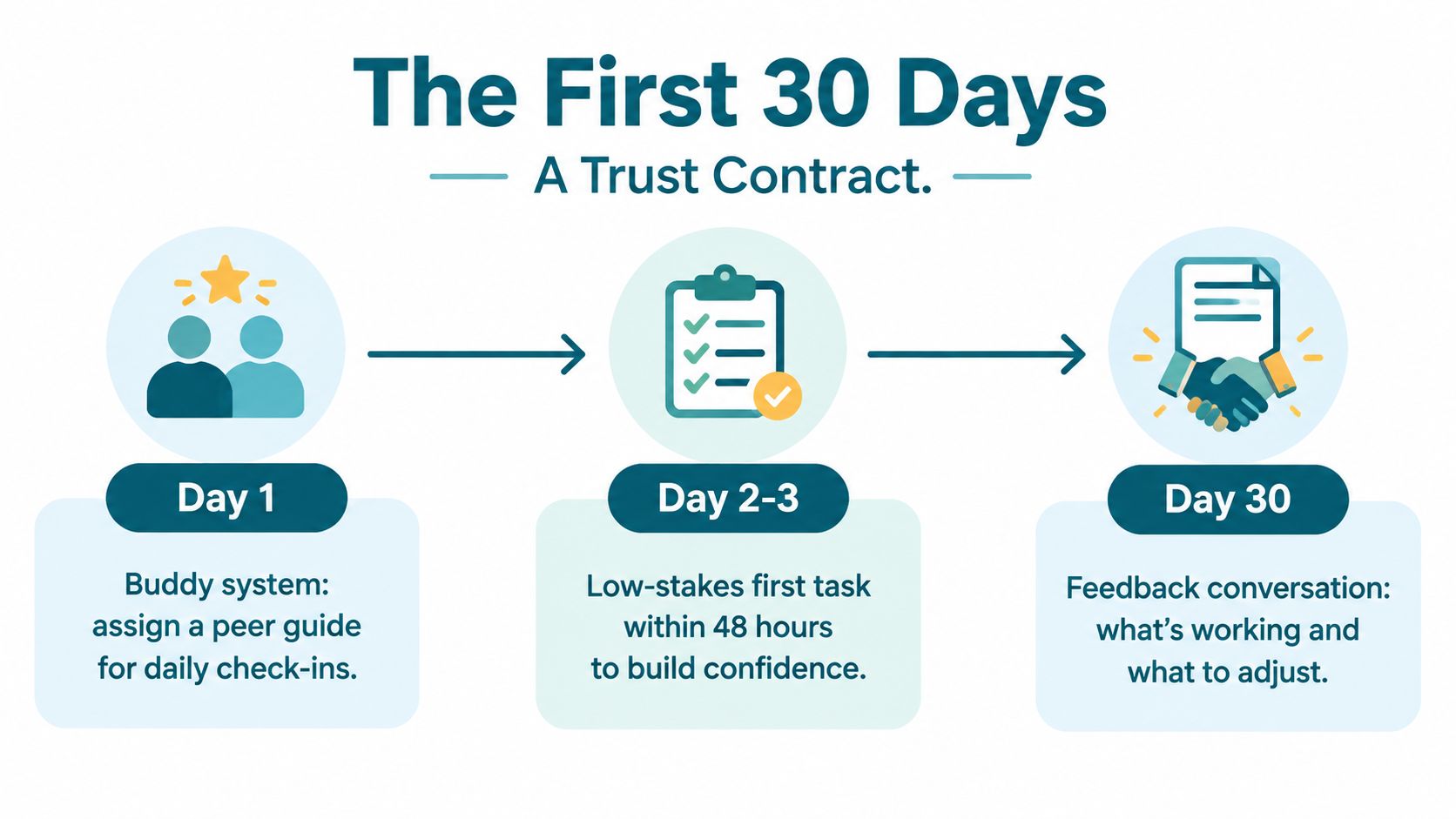
    I use a trust contract for the first month. On day one, pair the newcomer with a buddy who can answer ordinary questions without making the person feel foolish. The buddy should explain where supplies sit, how decisions happen, what safety rule matters most, and who to contact when something changes.

    Within 48 hours, give the new person a low-stakes task. On a winter pickup, that might mean sorting gloves, carrying bags with a buddy, or helping mark a short route. On a small product team, it might mean updating one straightforward ticket and reviewing the result together.

    At the end of the first week, hold a 10-minute check-in. Ask, “What feels clear? What feels confusing? What question haven't you asked yet?” Silence should concern you more than a beginner's mistake. A quiet newcomer may still be trying to figure out whether honesty is welcome.

    Build clarity through the month

    Use week two for a feedback loop. Tell the person what they already do well, then name one adjustment with a clear example. By week four, explain the full role picture, including decisions they can make, decisions that need approval, and how their work connects to the group's purpose.

    A volunteer can review volunteer job descriptions before arriving, while a workplace manager can use an employee onboarding checklist guide to organize conversations and tasks.

    Warmth helps people feel welcome. Clarity helps them act with confidence. Give both, then keep the promises you make during the first month.

    A visual guide illustrating a 30-day onboarding trust contract process with steps for new employee integration.

    Simple Ways to Measure Trust as You Go

    You don't need a long survey to learn whether people trust the team. Use a small pulse that fits on an index card and ask people to answer privately.

    Ask:

    • Speaking up: “Would you flag a mistake before it grows?”
    • Disagreeing: “Can you disagree with the lead without fearing embarrassment or punishment?”
    • Helping: “Would you help a teammate without waiting to be asked?”

    Read the answers over time rather than treating one response as a verdict. Psychological safety concerns the team climate that lets members ask questions, offer different viewpoints, and admit mistakes without punishment. The CIPD evidence review also warns that cross-sectional and single-source studies can produce larger trust-performance effects than time-lagged and different-source studies. That gives me a simple rule: pair what people say with what they do.

    Watch for these behaviors:

    • Meetings start when the team says they will.
    • People say “I don't know” before guessing.
    • Small problems surface early.
    • Teammates ask for help without apologizing for needing it.
    • People complete small commitments without repeated reminders.

    Don't confuse happiness with trust. A friendly group can avoid hard conversations. A trusting group can disagree, report a mistake, and still expect a fair response.

    Signal What It Actually Means Why It Matters
    Early issue reports People believe the team can handle bad news Leaders can act before the problem spreads
    Honest uncertainty People don't need to perform certainty The team gets better information
    Reliable starts and handoffs Members can predict one another's behavior Work moves with fewer anxious follow-ups
    Unprompted help People feel mutual responsibility The group can respond when plans change
    Pulse answers over time People can describe their experience directly You can compare perception with behavior

    Use volunteer program evaluation methods when you need a wider view of participation and team experience. Keep the pulse separate from punishment, rankings, or performance pay. The moment people think honesty will cost them, the measurement starts hiding the condition you want to understand.

    Your 30 Day Trust Building Checklist

    Trust begins in hard weather, then grows through ordinary follow-through. Print this list, put it in your notebook, and check each item with the team.

    Week 1

    • Set the habits: Introduce showing up, telling the truth, finishing promises, naming strengths, and apologizing specifically at kickoff.
    • Name a conflict liaison: Give the team one trusted person to contact when disagreement starts to spread.
    • Run the first pulse: Ask about mistakes, disagreement, and unprompted help. Keep responses private.

    Week 2

    • Install two rituals: Try a Monday intention round and a Friday shoutout, or use the pickup standup and Friday roundup.
    • Close one loop: Act on a concern someone raised during the first week.

    Week 3

    • Practice conflict: Use the sentence, “I want to hear both of you fully before we decide anything.”
    • Repair clearly: Name what happened, name the feeling, agree on one repair step, and revisit it at the next meeting.

    Week 4

    • Onboard one person: Assign a buddy, give a low-stakes task within 48 hours, check in after week one, and hold a feedback conversation by day 30.
    • Share the pulse pattern: Tell the team what you learned without exposing individual answers.
    • Choose the next habit: Pick one behavior to repeat for the next month.

    For more practical reading on team routines and workplace tools, browse the latest articles from Expressify AI. Trust compounds when someone keeps showing up after the forecast turns ugly, the schedule changes, or the first plan falls apart.


    Litter Caterpillars gives volunteers a hands-on way to practice these habits through regular Chicago cleanups, shared routes, and real service alongside neighbors. Visit Litter Caterpillars to join an upcoming pickup, meet the crew, and build trust by showing up together.

  • Group Decision Making That Keeps Volunteers Moving

    Group Decision Making That Keeps Volunteers Moving

    The rain had turned the vacant lot into brown soup by the time our crew gathered. Ten volunteers stood around a folding table, trying to choose a cleanup site, set safety rules, and pick a Saturday schedule before the coffee went cold.

    Why Group Choices Feel Hard on Volunteer Crews

    A volunteer huddle has a different rhythm from a workplace meeting. Nobody clocks in under one boss. People arrive with different experience, different energy, and sometimes different ideas about what “safe” means. A longtime scout may know which alley floods, while a first-time volunteer may notice a broken fence nobody else saw.

    That mix helps the crew, but it can also jam the gears. One person wants the South Side lot with the worst litter. Another wants a smaller site that beginners can handle. Someone checks the weather. Someone else worries about transit. Meanwhile, the clock keeps moving and the crew still needs gloves, bags, water, and a starting point.

    A diverse group of hikers gathered together in a circle, collaboratively planning their route on a large map.

    Why volunteers need a clear decision path

    Friendship adds another layer. You may hesitate to question a friend's site choice because you don't want to sound difficult. A new volunteer may stay quiet because everyone else seems confident. A safety lead may see a problem but soften the warning until nobody understands how serious it is.

    I've learned to treat group decision making as a crew skill, much like sorting sharp objects or tying a full trash bag. You can practice it. You can give it a simple sequence. You can decide in advance which choices need broad agreement, which choices need a vote, and which choices belong with one trained lead.

    The research gives us a useful reason to care about that structure. In a review of hierarchical team decisions, team informity, staff validity, and hierarchical sensitivity explained between 25% and 65% of the variance in decision accuracy, while one cited study found team informity alone explained 24% (review of team decision accuracy). In plain language, more people won't automatically produce a better call. The right information must reach the right person, someone must turn field observations into sound advice, and the person with final authority must weigh that advice correctly.

    Field rule: Give every decision a method before the discussion gets noisy.

    This guide works as a field manual. You'll find a mental model, a method comparison, warning signs, meeting scripts, and short cleanup examples. Use the parts that fit your crew, then adjust them after the next wet Saturday.

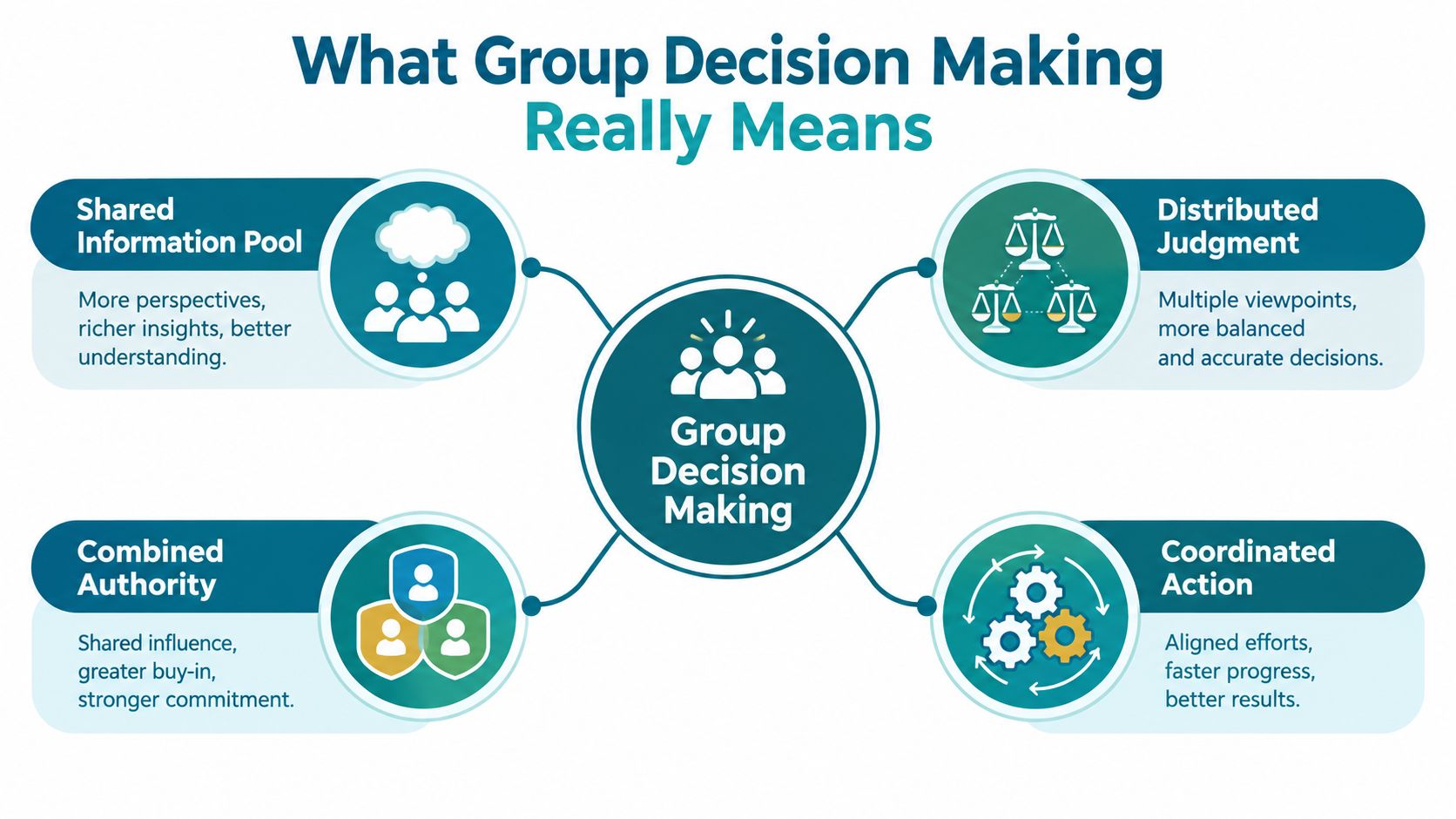
    What Group Decision Making Really Means

    Group decision making means a group gathers information, weighs options, assigns authority, and acts on one choice. That sounds formal, but I see it every time volunteers carry a heavy tarp.

    If one person pulls hard, the tarp twists. If three people lift while two people drag, the load swings. The crew moves well when each person shares what they know, listens to the others, and follows a clear call about direction. A decision works the same way.

    A diagram illustrating the four key components of group decision making: information, judgment, authority, and coordinated action.

    The information layer

    Start with team informity, which means the decision group has access to the information that matters. A scout might report needles near the fence, standing water behind the shed, or a locked gate at the usual entrance. That report only helps if the group hears it before choosing the site.

    Use role-specific observations instead of general chatter. Ask the site scout about access. Ask the safety lead about hazards. Ask the scheduler about volunteer availability. Each person brings a different piece of the map.

    The judgment layer

    Next comes staff validity, the quality of the recommendations people give after they receive and interpret information. A volunteer may see broken glass but still recommend a route that passes directly through it. Another volunteer may connect the hazard to the right action, such as closing that section or adding a tool restriction.

    You don't need everyone to become a specialist. You do need people to explain the reasoning behind their advice.

    The authority layer

    Finally, hierarchical sensitivity describes how well the final decision-maker weighs the information and recommendations from the group. On a volunteer crew, that person might be the safety lead during a storm call or the event lead during a site choice. Authority doesn't erase participation. It tells everyone who makes the final call when time or risk makes full agreement impractical.

    A practical decision record can use four questions:

    • What do we know? Record direct observations.
    • What do we think it means? State the recommendation and its reason.
    • Who decides? Name the lead or rule.
    • What happens next? Assign the first action.

    That model keeps the crew from confusing more voices with better information flow. A large circle can still miss a hazard if nobody reports it clearly or nobody knows who must act.

    Five Common Methods Compared and When to Use Each

    On a rainy cleanup morning, the crew may need to choose a site, close a path, and set the next workday before anyone has found dry gloves. Each choice calls for a different method. Consensus builds support when local knowledge matters. Majority voting gives a clear result for routine choices. Delegation keeps people safe when waiting would expose them to danger.

    I match the method to the decision. A site choice benefits from shared knowledge about access, hazards, and nearby residents. A sudden lightning warning needs a named safety authority. A schedule ranking can use private votes when volunteers have different availability and may not want to defend it aloud.

    Method How It Works Speed vs Buy-in Best Volunteer Use
    Consensus The group discusses options until members can support or accept one choice. Slower, with strong buy-in. Site selection when access, safety, and neighborhood knowledge need careful discussion.
    Majority vote Members vote, and the option with the most support wins. Faster, with uneven buy-in. Choosing among routine dates or locations when the group needs a clear result.
    Delegated decision The group gives a lead authority to decide within stated limits. Fastest, with buy-in tied to trust and follow-up. Weather calls, hazard closures, equipment limits, and route changes.
    Delphi Members give views separately through repeated rounds, often without direct debate. Slower, with less social pressure. Planning a recurring schedule when volunteers may hesitate to speak in the room.
    Multi-voting Members rank or distribute votes across several options, then the group uses the combined priorities. Moderate speed, with broad input. Narrowing several cleanup sites or ranking possible Saturdays.

    Choosing between consensus and voting

    Consensus needs a clear rule, or the crew can keep circling the same muddy puddle. Unanimity Minus Two, or U-2, lets a proposal pass when up to two members dissent. The Open Group standards guide describes U-2 for groups of about five to nine people, with U-3 suggested for groups of 10 to 14 and U-4 for groups of 15 to 20 (consensus decision rules).

    Majority rule usually moves faster. A comparison of formal decision rules found that majority rule approves proposals more often than unanimity rule within the same group size, while unanimity creates more delay in small and large groups (comparison of majority and unanimity rules). Use the slower agreement process when shared support will affect follow-through. Use a vote when the crew needs a fair, visible result and the stakes allow some members to disagree.

    A simple field match keeps the choice practical:

    • Use consensus for a site with uncertain hazards.
    • Use majority voting for a routine schedule.
    • Use delegation for immediate safety.
    • Use Delphi when quieter volunteers may hold useful information.
    • Use multi-voting when several sites or Saturdays must be narrowed without letting the first loud opinion decide.

    Afterward, record the method and result in one sentence. Volunteers who join later can see how the crew chose, not only what it chose.

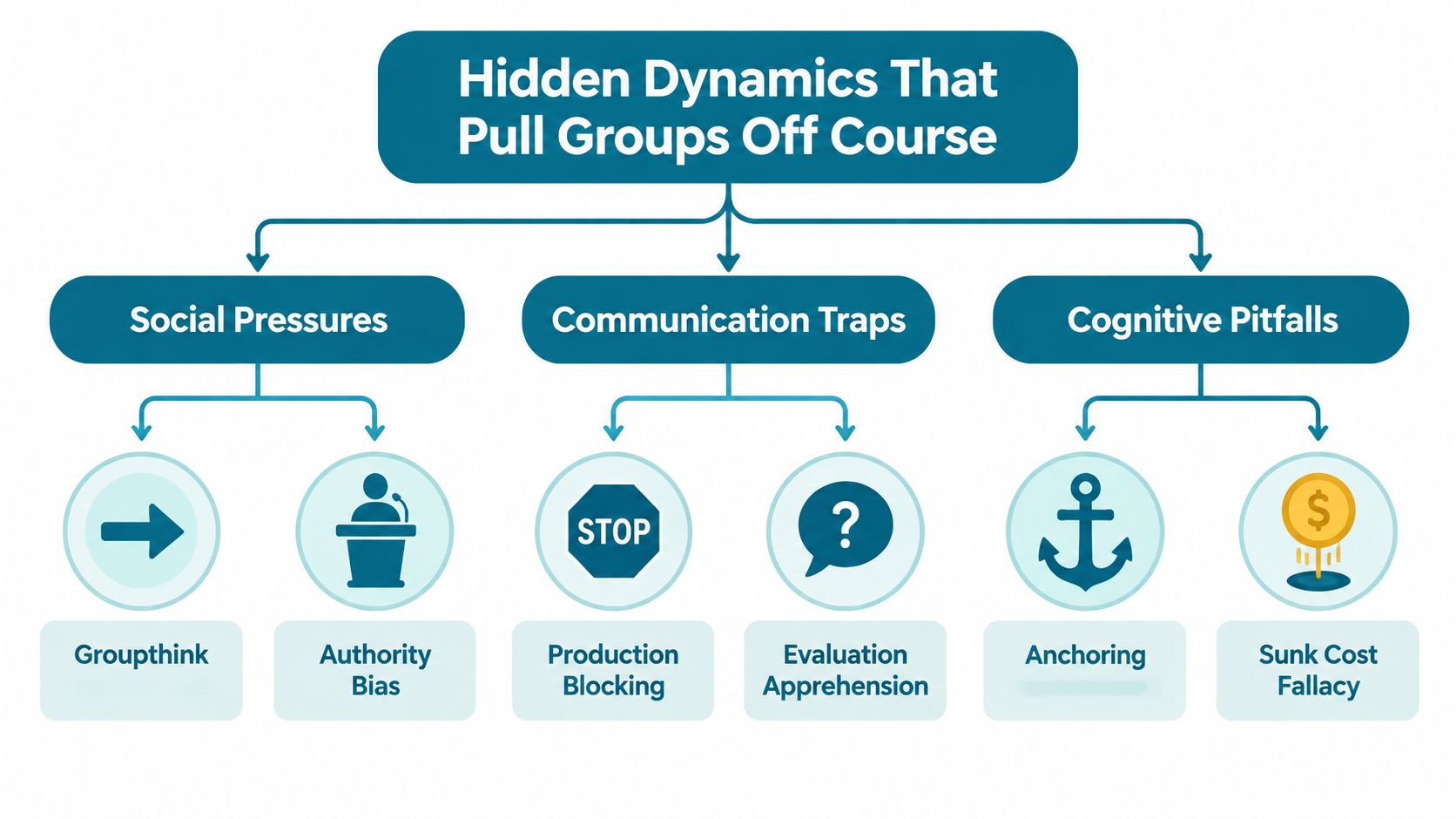
    Hidden Dynamics That Pull Groups Off Course

    A friendly huddle can still choose badly. During one rainy cleanup, our crew picked the nearest entrance because a familiar volunteer recommended it. We moved on before checking the flooded gate. A quieter scout already knew the path was blocked, but the discussion ended before that information surfaced.

    Research on 37 student decision groups found that groups using a unanimity rule reached more cognitive consensus than groups using a majority rule. Consensus and satisfaction were connected with behaviors such as asking why someone preferred an option, treating other views as legitimate, and using those views in the group's reasoning (study of information exchange and group consensus). Agreement by itself does not make a choice sound. The crew must examine the reasons beneath each view.

    A chart showing hidden dynamics like social pressures, communication traps, and cognitive pitfalls that hinder group decision making.

    Watch for premature agreement

    Listen for “whatever works,” “we always do that,” or “I'm sure the lead knows.” These phrases can signal comfort, but they can also cover uncertainty. Ask, “What could make this choice fail?”

    Give a dissenting volunteer a reason to explain, not a reason to retreat. Say, “Tell us what you're seeing,” then leave room for an answer. Structured turn-taking helps quieter people contribute because the fastest speaker no longer controls the whole conversation. On a high-turnover crew, that pause may reveal a hazard known only by someone who arrived last week.

    More participation doesn't guarantee a better call

    A 2025 randomized experiment with 1,475 participants in 281 five-person groups found that an LLM facilitator increased information sharing and raised the minimum engagement level, yet did not significantly improve the final decision compared with no facilitation (2025 randomized facilitation experiment). For a volunteer lead, the warning is practical. More airtime can improve the process while leaving the final choice unchanged.

    Before a vote, ask whether the crew has combined the information or merely collected it. Name the strongest argument for each option, then identify the fact that could disprove it. If the decision concerns a flooded route or unstable bank, keep checking until the safety evidence is clear. For a routine snack order, delegation may be enough.

    Diversity can slow the crew

    Different backgrounds and experiences can improve decision quality, while differences in perspective can slow execution and reduce commitment. A 2025 social-science study reported a positive effect of team diversity on decision quality alongside a “social categorization tax” that delayed execution and reduced team commitment. The quality effect was strongest when psychological safety was high (study of diversity, decision quality, and execution).

    On a volunteer crew, match the discussion to the risk. Use consensus for a site hazard or route affecting inexperienced volunteers. Let one person handle a minor supply choice. Use a quick check-in when weather changes, and explain the safety reason behind the call so a rotating crew can accept it.

    If disagreement continues after the practical choice is clear, use this conflict resolution guide for volunteer groups instead of asking a pre-work huddle to settle every relationship issue.

    Here's a short visual reminder before the next discussion:

    Facilitation Frameworks and Meeting Scripts You Can Run

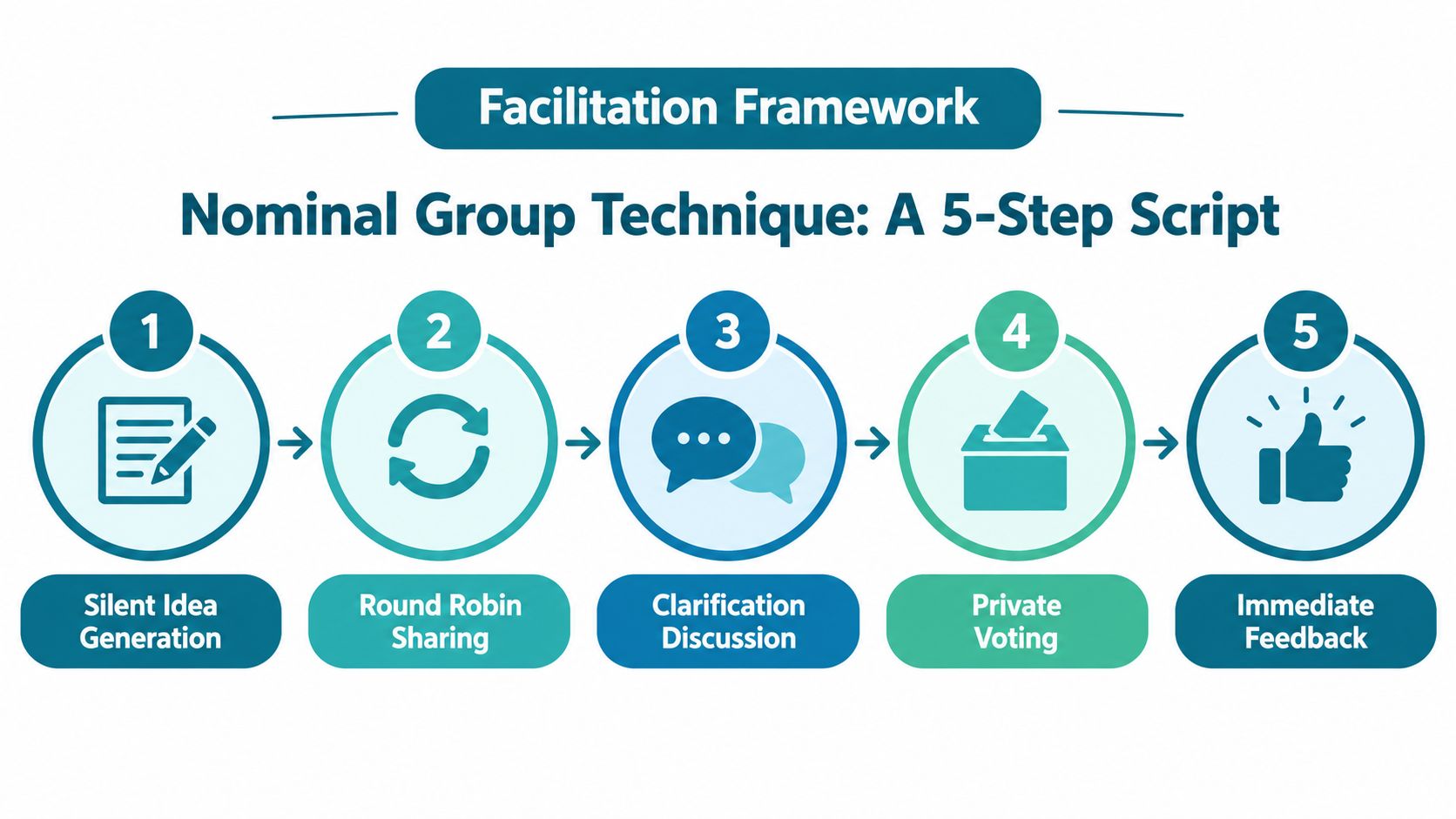
    On a rainy Saturday, I have watched a confident volunteer fill the whiteboard while three quieter people kept their best safety observations to themselves. A fixed process gives every voice a place, especially on crews with high turnover and little formal authority. I often use the Nominal Group Technique when a crew has many ideas or strong personalities. Its five steps are to define the problem, generate ideas without speaking, share them in a round-robin, discuss the list, and vote privately (Nominal Group Technique guide).

    A five-step flowchart illustrating the Nominal Group Technique process for collaborative decision making and team facilitation.

    The five-step huddle

    1. Define the problem. Say, “We need one cleanup site for Saturday that the crew can reach safely.”
    2. Write in silence. Give everyone paper or a phone note. Allow about 5 to 10 minutes for options and concerns.
    3. Share one idea at a time. Go around the circle. Record each idea without debate.
    4. Discuss for clarity. Ask what an option means and what evidence supports it. Hold criticism until the comparison stage.
    5. Vote privately. Let each person rank or select options, then combine the votes into a group priority list.

    Use clear guardrails. During the first round, people write alone, with no discussion or clarification questions. Each person gives one idea per turn, and the group removes an idea only by unanimous agreement or when it duplicates another (ASQ Nominal Group Technique guidance).

    A 15-minute script

    Set a timer and keep the language plain.

    • Minute 1: “Our decision is ____. The decision-maker is ____. Safety limits are ____.”
    • Minutes 2 to 5: Everyone writes options and concerns without speaking.
    • Minutes 6 to 9: Each person shares one item per turn. Record every distinct option.
    • Minutes 10 to 12: Ask, “What reason supports this option?” and “What risk have we missed?”
    • Minutes 13 to 14: Vote privately or apply the agreed consensus rule.
    • Minute 15: State the result, the reason, the lead, and the first action.

    Match the method to the decision. Use consensus for a site hazard that affects inexperienced volunteers. Use a vote when several workable sites remain and the group needs a fair preference. Delegate a time-sensitive weather or safety call to the assigned lead, then explain the reason and invite relevant facts. That approach protects safety without treating buy-in as permission for everyone to control every decision.

    Do not turn participation into a performance. Ask volunteers to connect information to a choice, rather than rewarding whoever speaks longest.

    A one-page decision note can contain:

    • Decision: What must we choose?
    • Options: What choices did we consider?
    • Facts: What did scouts, safety leads, and schedulers report?
    • Rule: Consensus, vote, delegation, Delphi, or multi-voting?
    • Authority: Who makes the final call?
    • Reason: Why did this option win?
    • Action: Who does what first?
    • Review: What will we check after the cleanup?

    For practice building repeatable huddle habits, see this volunteer coordinator training. If I close a route because of exposed glass, I say, “I made the safety call. Does anyone have information that changes it?” The crew hears the boundary, the reason, and the proper way to add new evidence.

    Short Case Studies From Cleanup Crews in Action

    On a South Side cleanup morning, a crew had three possible lots. One lot had the worst visible litter. Another had easier transit access. The third had a scout's report of a blocked gate, though it sat near a neighborhood that rarely received cleanup attention.

    The lead asked volunteers to write their first choice and their reason. The crew then shared the options in a round-robin and used multi-voting to narrow the list. After discussion, the group used U-2 consensus. Two people still preferred the worst-litter lot, but they accepted the transit-friendly site because more volunteers could arrive safely and the crew could reach the work area without climbing around the blocked gate.

    The process took longer than a quick show of hands, yet it kept the scout's information in the decision. Nobody had to win an argument by speaking the loudest.

    Site choice takeaway: Gather field facts first, rank options second, and set the agreement rule before debate begins.

    A different crew faced a sudden weather call. Rain had started, wind pushed loose branches across the route, and several first-time volunteers waited near the meeting point. The lead had delegated authority for weather safety, so she called off the exposed route rather than asking the whole group to reach agreement in the rain.

    She used a short script: “I'm closing this route because the branches and visibility make it unsafe. We can move to the sheltered block if the safety check passes, or we can end today's event. I'll hear concerns now, then I'll make the final call.” The group moved to the alternate block after a quick check, and two volunteers chose to leave without pressure.

    The lead acted quickly, though she didn't hide the reasoning. That balance protected safety and gave people a fair chance to share information.

    Weather takeaway: Give a trained lead authority for urgent hazards, then explain the call and invite new facts.

    Keep Buy-In Strong After the Decision Is Made

    A decision isn't finished when hands go up. Volunteers need to know what happened, who made the call, and what they should do next.

    I use a simple four-part loop:

    • Announce: State the choice in one sentence.
    • Explain: Name the rule and the reason.
    • Assign: Give each next action to one person.
    • Check: Ask about safety and willingness before work begins.

    For example: “We chose the transit-friendly lot through multi-voting and U-2 consensus. Maya will check the gate, Luis will bring grabbers, and I'll mark the safe route. Does anyone see a safety problem or need a different task?”

    That question gives people a graceful way to speak up. It also prevents the common mistake of treating agreement with the site as agreement with every task.

    Keep a short record after each event. Write down what worked, what surprised you, whether the decision rule fit the situation, and what you'll change next time. A crew that reviews its choices learns faster than a crew that repeats its habits.

    Pride can help people return. Flags, badges, a theme song, and a sincere shout-out can make service feel shared without pressuring volunteers for money. For more practical ideas, use these volunteer retention strategies.

    Before the next huddle, ask yourself:

    Did the right information reach the right person? Did we choose the right decision method? Did the final authority act clearly? Did every volunteer leave knowing the next step?


    Litter Caterpillars uses structured event signups for volunteer trash pickups, including event pages and shift-based participation. Visit Litter Caterpillars to find a cleanup, join the next crew, and practice group decision making block by block.

  • 9 Team Bonding Activities That Serve Chicago

    9 Team Bonding Activities That Serve Chicago

    Three of us crouched beneath a Chicago tree while hail struck the pavement and every Uber canceled. We had set out to pick up litter, yet that soaked, miserable morning gave us something better than a clean block. It gave us a shared task, a story, and a reason to return.

    That's the thread running through these team bonding activities. Service becomes the activity, and friendship becomes the bond. If you're organizing Chicago volunteers, I'll help you think through group size, supplies, safety, access, scheduling, identity, and simple ways to track results. Litter Caterpillars offers one local example, with weekend-morning cleanups, volunteer-first care, and visible block-by-block work across the city.

    You won't need an elaborate retreat or a forced game. A team can build trust while sorting gloves, carrying bags, checking a map, or laughing beside a pile of leaves. The right project gives people a reason to talk while their hands stay busy. It lets friendship grow without demanding a performance.

    1. Themed Service Days with Group Identity

    A purple flag snaps above the sidewalk. Someone starts a song. A new volunteer receives a small badge after finishing the cleanup. Suddenly, the group feels less like a collection of strangers and more like a crew with a story.

    I've seen how a shared identity changes the way people enter a difficult morning. Sports teams use jersey colors and songs to create loyalty. Military units use insignia and shared symbols to build recognition. A cleanup team can use the same simple language without turning service into theater.

    Litter Caterpillars connects its identity to that first hailstorm, when three people huddled under a tree and watched rides disappear from the app. The logo carries that messy beginning. Flags, theme songs, and badges give volunteers a way to remember what they did together.

    A diverse group of four smiling young adults standing together outdoors, wearing matching shirts with scarves and holding a flag.

    Build the symbol from a real memory

    Start with an event your group already remembers. Maybe your first cleanup ended beside a flooded alley, or your team rescued a park entrance before a neighborhood festival. Let volunteers help design the badge, choose the color, or suggest a song. People accept an identity more readily when they help shape it.

    Use the same symbol in your group chat, sign-up posts, shirts, and event photos. When a new person earns a badge, say what it means. A small ritual can give a cold morning some warmth.

    Practical rule: Let the identity grow from shared work. Don't force a slogan onto people who haven't created a memory together.

    For clothing ideas, compare this tournament-ready team apparel with a practical t shirts and hoodies guide. Keep the design comfortable, visible, and easy to recognize from across a Chicago block. You can also borrow ideas from Litter Caterpillars' theme songs for teams when you want the group to carry its identity beyond the cleanup.

    2. Consistent Weekend Morning Scheduling

    Saturday morning arrives. The coffee shop has just opened, the sidewalks still look damp, and the same people begin appearing with gloves and reusable water bottles. One person brings a friend. Another remembers someone's name from the previous week. That's how a service group starts to feel dependable.

    I prefer a fixed weekend-morning schedule because it makes attendance easier to understand. People who choose that time often want a regular service habit. The schedule also gives friendships a natural rhythm. You don't need to invent a separate reason to see one another when everyone already knows where to meet.

    Litter Caterpillars describes a weekly weekend-morning cleanup practice that has continued for about three years, including rain, snow, and heat. That kind of repetition turns a volunteer day into a standing appointment. The work matters, yet the expectation of seeing familiar faces matters too.

    Protect the appointment

    Publish the time and meeting place clearly on every channel. Keep the routine steady when turnout feels small. A quiet morning can still give two people enough time to talk, learn the route, and build trust.

    The Saturday volunteer work guide from Litter Caterpillars gives this schedule a practical shape. You can copy the habit without copying every detail. Choose a public meeting point, explain the route, name the finish time, and tell people what to bring.

    • Keep the calendar predictable: Let volunteers plan around the cleanup instead of waiting for a new announcement.
    • Recognize rough-weather attendance: Thank people who arrive prepared, while never shaming anyone who stays home for safety.
    • Use the walk to build friendship: Pair newcomers with regulars so conversation happens before the first bag fills.

    “The work gets easier when people know they'll see one another again.”

    A 2023 survey study found a significant relationship between how often employees joined team-building activities and both engagement and satisfaction. The same research reported that participants preferred recurring events over one-off gatherings, with 36.5% favoring monthly activities and 31.4% favoring quarterly activities in the study's cited survey data. For a Chicago cleanup crew, a monthly or quarterly fallback can help people stay connected when weekly attendance isn't realistic.

    3. Volunteer-First Fundraising and No-Pressure Donations

    A volunteer arrives ready to lift bags. Before the first introduction, someone asks for a donation. The volunteer's shoulders tighten. The morning now feels like a sales funnel.

    I'd rather protect the reason people came. A volunteer-first group tells participants that their time and energy matter more than their wallets. Litter Caterpillars follows that approach by avoiding pressure on volunteers to donate. Support can come from local businesses, foundations, grants, and people who want to give without joining a cleanup.

    That separation keeps the relationship clean. You show up to serve. Someone else may provide money, equipment, food, or printing. Nobody needs to prove their commitment with a payment.

    Make the funding story easy to understand

    Transparency still matters. Tell volunteers how the group pays for bags, gloves, grabbers, water, storage, transportation, and first-aid supplies. If a local business supplies equipment, thank it openly. If a supporter gives money, accept the gift without turning every volunteer into a prospect.

    Community gardens often use grants and in-kind support while keeping volunteer work separate from financial giving. Faith communities can do the same by separating service opportunities from donation appeals. The model works because people know where they stand.

    • Explain support without pressure: Share the basic funding picture during orientation or in the event description.
    • Invite practical contributions: Let people bring supplies if they want, but keep participation open to those who arrive with only themselves.
    • Thank ambassadors: Volunteers who enjoy the work may tell friends about it because they feel respected, not recruited.

    A field experiment on workplace bonding found stronger collegiality, better workplace friendships, and improved office-level performance after structured social connection interventions. It also reported a 40% reduction in short-run turnover, while finding no statistically significant improvement in individual productivity according to the study's findings. That distinction helps you judge a volunteer team fairly. Look for return visits, introductions, and group connection instead of demanding that each person work faster.

    4. Shared Adversity and Challenge-Based Activities

    The first Chicago hailstorm changed my view of discomfort. Three people stood under a tree, cold and annoyed, while rides canceled one after another. We could have called the cleanup a failure. Instead, the weather gave us a story nobody had to manufacture.

    Hard conditions can make people pay attention to one another. Someone checks whether you need dry gloves. Someone shares a poncho. Someone spots a dangerous piece of glass before you reach for it. Those small acts create a record of mutual care.

    Litter Caterpillars describes returning through blizzards, negative wind chills, rain, and scorching heat. You shouldn't treat dangerous weather as a badge of honor, though. Challenge works when volunteers can choose their limits and organizers take responsibility for the conditions.

    Three happy women wearing colorful rain gear and backpacks walking together through a rainstorm outdoors.

    Make difficulty hard, safe, and achievable

    Tell the group why the day may feel demanding. Then provide water, rest periods, weather alerts, reflective gear, gloves, and a clear stopping plan. Match the route to the group's ability. A short cleanup in cold rain can create a shared memory. A reckless route can break trust.

    Military training, wilderness expeditions, and sports teams all use shared challenge to create connection, yet volunteer organizers don't need to imitate their harshest methods. Your purpose is service and friendship, not punishment.

    After a difficult cleanup, sit down for a short debrief. Ask what surprised people, where they helped one another, and what the group should change next time. Give volunteers room to laugh about the soaked cardboard and the runaway bags. The story belongs to them.

    Safety boundary: A difficult morning should leave people proud and tired. It shouldn't leave anyone injured, stranded, or ashamed for turning back.

    5. Cross-Neighborhood Exploration and Presence

    A cleanup can begin with a map spread across a folding table. Volunteers lean over it, trace a route, and realize they've never walked that part of Chicago. By the end of the morning, they've learned a street name, met a neighbor, and left a visible change behind.

    Litter Caterpillars has committed to cleaning across all 50 Chicago wards, according to the group's own account. That kind of citywide route gives regular volunteers a shared expedition. Each weekend can bring a new corner, while repeated visits can help the team learn which local partners and safety conditions matter.

    The map also gives people something to discuss while they work. One person knows the nearest train stop. Another recognizes a community garden. A third notices that the same alley needs a different approach after rain.

    A female volunteer explains map locations to two young volunteers during a team bonding activity.

    Give every route a human context

    Don't choose neighborhoods randomly and treat them like points on a game board. Contact local groups when possible. Ask about blocked sidewalks, upcoming events, disposal rules, and places where volunteers should avoid working alone. A neighborhood partner can give your team better information than a map can.

    Create a simple coverage map. Mark completed areas, recurring routes, and future stops. Take before-and-after photos from consistent angles, while respecting residents' privacy.

    • Rotate with purpose: Mix familiar routes, where relationships can grow, with new routes, where curiosity keeps the work fresh.
    • Record the story: Note what the group learned about the block, not only how many bags it filled.
    • Invite local knowledge: Let residents suggest problem areas and tell you what would help.

    The social connection evidence brief reports that conversation usually remains stable at about four participants, because larger groups face cognitive limits and become less efficient in its 2024 evidence summary. Split a large cleanup into small route teams, then bring everyone together for a short closing circle.

    6. Friendship-Building as the Primary Goal

    At the end of a cleanup, the bags sit by the disposal point. The volunteers stay. Someone asks about a new job. Someone else mentions a birthday. Two people compare coffee orders and make plans for the following Saturday.

    That scene tells me whether a service group has built connection. The litter gives people a reason to meet, yet friendship gives them a reason to return. Running clubs often work the same way. People arrive for the run and stay for the conversations afterward.

    You can design for that outcome without making the morning feel artificial. Ask volunteers about their lives, remember what they tell you, and make introductions that have a real basis. If someone just moved to Chicago, connect them with a person who knows the neighborhood. If two people share a hobby, let them discover it naturally.

    Leave room for the conversation

    Schedule coffee, a picnic, or a short social period after the cleanup. Keep it optional and accessible. Nobody should need to buy an expensive meal to belong. A thermos, a park bench, or a potluck can give people enough space to continue talking.

    • Pair newcomers thoughtfully: Match a first-time volunteer with someone who can explain the route and introduce them to others.
    • Remember personal details: Ask about the interview, class, race, move, or family event someone mentioned.
    • Celebrate life outside service: A new job or birthday can receive the same warmth as a completed cleanup area.
    • Create shared references: A funny sign, stubborn shopping cart, or muddy shortcut can become part of the group's language.

    Employee engagement research found a significant relationship between recurring team-building activity frequency, engagement, and satisfaction. In a related preference survey, 36.5% chose monthly activities and 31.4% chose quarterly activities in the reported findings. Use that as a planning signal, not a command. Choose a cadence your volunteers can sustain.

    7. Skill-Building and Personal Transformation Focus

    I started cleaning because I struggled with clutter, consistency, and bravery. A small piece of trash could feel heavier than it looked. Picking up someone else's mess became a way to practice moving through tasks that once stopped me.

    That story gives service another layer. A volunteer learns how to use a grabber, sort a route, speak with a neighbor, or lead a safety briefing. They also practice returning after a hard week. The physical task stays concrete, while the personal change happens through repetition.

    Litter Caterpillars uses the caterpillar as an image for that process. Volunteers don't need to arrive polished or fearless. They can arrive unsure, make mistakes, and learn alongside other people.

    Turn reflection into part of the activity

    Give the group a few minutes after cleanup to name one thing they learned. Keep the questions simple. What felt difficult? Who helped you? What would you try next time? A volunteer may mention a new skill, a brave conversation, or the moment they finally picked up an object they usually would have ignored.

    The volunteer mentor programs from Litter Caterpillars can inspire a buddy structure for people who want more responsibility. Pair an experienced volunteer with someone new, then let the new person take the lead when they feel ready.

    • Share your own story: Tell people why you began, without presenting yourself as finished.
    • Name small growth: Notice a first route briefing, a first return visit, or a first conversation with a resident.
    • Connect action to values: Use words like bravery, kindness, unity, and consistency.
    • Keep a reflection record: Invite volunteers to write a sentence after each event or share one thought in the group chat.

    A 2021 randomized study of team-building through video games found measurable gains in coordinated task performance. One task showed average improvement of 49.6% for teams receiving the team-building treatment, compared with 20.3% for control teams, a difference of 29.3 percentage points, with statistical significance reported at p<.001 in the study. The setting differs from a Chicago cleanup, yet the lesson fits: repeated shared objectives can give social connection a practical outlet.

    8. Safety-First Culture with Volunteer Happiness as Priority Two

    Before anyone reaches for a bag, I want the group to know the order: safety first, volunteer happiness second, task completion third. That order changes the morning. People feel more comfortable saying they need a break, avoiding broken glass, or leaving when weather turns dangerous.

    A cleanup leader should know the forecast, inspect the route, identify disposal points, and explain what volunteers shouldn't touch. You need a simple emergency plan. You also need a culture where nobody treats caution as weakness.

    Professional sports teams, climbing groups, and outdoor education programs build their activities around safety systems. A volunteer cleanup can use the same habit at a simpler scale. Start with a short briefing. Check in during the route. End with a headcount and a question about how people feel.

    Make safety visible

    Give every volunteer gloves, bags, and clear instructions. Add grabbers when the route includes sharp or unpleasant objects. Bring water, first-aid supplies, weather protection, and a way to communicate if the group splits.

    • Check the conditions: Adjust or cancel the route when heat, lightning, flooding, ice, or poor visibility creates an unsafe setting.
    • Name the hazards: Explain how to handle glass, needles, chemicals, heavy objects, and traffic-adjacent areas.
    • Invite people to stop: Tell volunteers they can tap out without explaining or apologizing.
    • Review the day: Ask what felt unsafe and change the plan before the next event.

    A 2021 randomized study found that structured team-building through video games improved performance on one controlled task, yet that result doesn't replace safety judgment in outdoor service as reported in the study. Your best outcome is a group that finishes safely and wants to come back.

    Here's a short visual reminder to place before the next planning meeting:

    9. Multi-Channel Accessibility and Low-Barrier Entry

    One person finds your cleanup on Meetup. Another sees an Instagram post. A neighbor hears about it in a group chat. Someone else arrives because a friend mentioned the corner while buying coffee.

    That mix matters because people don't all enter community life through the same door. Litter Caterpillars uses Meetup, Instagram, and open group chats so newcomers can find information in familiar places. A low barrier says, “You can join before you know everyone.”

    Make the practical details impossible to miss. State the date, time, meeting point, route, transit options, expected conditions, and supplies. Tell people whether they need to RSVP. If they can show up, say so.

    Remove the small frictions

    You don't need an application, a special title, or a perfect volunteer history. You need a clear welcome and a person ready to answer questions. A newcomer orientation can take a few minutes. Explain where to stand, how to use the equipment, what not to pick up, and who to ask for help.

    • Keep every channel current: Update Meetup, Instagram, and group chats when the location or weather plan changes.
    • Use welcoming language: Assume people want to help, even if they don't know the local vocabulary.
    • Answer quickly: A short reply can turn uncertainty into attendance.
    • Share real-time updates: Use the group chat for transit changes, route notes, and friendly introductions.
    • Skip unnecessary gatekeeping: Encourage RSVPs when they help with supplies, but don't make them a condition of belonging.

    Recent hybrid-work coverage describes structured virtual social events, asynchronous recognition, and virtual watercooler channels as low-cost ways to maintain connection. It also describes smaller wellbeing-oriented formats, including yoga, sound baths, and mindful workshops, for teams dealing with burnout in its discussion of remote and hybrid bonding. For a Chicago volunteer group, the same principle can mean a group chat check-in for people who can't attend every cleanup.

    9-Point Comparison of Team Bonding Activities

    Item 🔄 Implementation Complexity ⚡ Resource Requirements 📊 Expected Outcomes ⭐ Key Advantages 💡 Ideal Use Cases / Tips
    Themed Service Days with Group Identity Medium, requires brand design and rollout Moderate, merchandise, design time, production costs Greater cohesion, higher visibility, social sharing Builds belonging and recognition; attracts recruits Best for established groups; co-design with volunteers; base on origin story
    Consistent Weekend Morning Scheduling Low, set and maintain routine Low, scheduling discipline and communication Reliable turnout, habit formation, self-selection Filters committed volunteers; builds trust and predictability Stick to schedule; communicate clearly; celebrate dedication
    Volunteer-First Fundraising and No-Pressure Donations Medium, requires alternative funding strategy Moderate, time to cultivate grants/partners, donor relations Deep volunteer trust; volunteers become authentic ambassadors Protects volunteer energy; inclusive participation Be transparent about funding; pursue external partners; accept non-volunteer gifts
    Shared Adversity and Challenge-Based Activities Medium–High, needs planning and risk management Moderate, safety gear, training, contingency planning Strong bonds, resilience, memorable narratives Creates deep camaraderie; attracts purpose-driven people Frame challenges as growth; enforce safety; debrief after events
    Cross-Neighborhood Exploration and Presence Medium, logistics and rotation planning Moderate–High, transport, coordination, mapping tools Broad impact, novelty, stronger citywide relationships Demonstrates commitment across areas; builds diverse connections Map coverage; partner locally; document before/after
    Friendship-Building as the Primary Goal Medium, cultural shift and ongoing attention Low–Moderate, time for social moments and communications High retention, loyalty, organic recruitment Sustainable engagement; reduces turnover and burnout Schedule social time; pair newcomers with veterans; celebrate milestones
    Skill-Building and Personal Transformation Focus Medium, requires curriculum and reflection practices Moderate, mentors, facilitation time, materials Personal growth, increased commitment, self-efficacy Gives deeper meaning; attracts growth-seeking volunteers Share transformation stories; create reflection windows; track progress
    Safety-First Culture with Volunteer Happiness as Priority Two Medium, establish protocols and training Moderate–High, first aid kits, training, management time Increased trust, fewer incidents, psychological safety Signals care; lowers liability; enables authentic participation Start with safety briefings; use buddy systems; have clear weather policies
    Multi-Channel Accessibility and Low-Barrier Entry Medium, maintain multiple platforms consistently Low–Moderate, time to update channels and manage messages Wider reach, diverse participants, spontaneous engagement Low friction onboarding; flexible engagement options Keep info identical across channels; simplify join steps; respond promptly

    Turn One Cleanup Into a Team Habit

    Choose one activity, one Chicago location, one weekend morning, and one identity element. That's enough for a first event. You might clean a park entrance, meet near a transit stop, wear matching green shirts, and give every participant a simple route badge. Don't wait until you have a perfect logo, a large turnout, or a full year of dates.

    Start with a public place where your team can work without blocking pedestrians. Check the route before inviting people. Ask whether a neighborhood organization already knows about the area. Decide where full bags will go, how volunteers will get home, and what weather would change the plan.

    Bring the basics:

    • Gloves and bags: Give each volunteer equipment that fits the task.
    • Grabbers: Use them for objects that could cut, stain, or strain someone.
    • Water and weather protection: Prepare for Chicago sun, rain, cold, and sudden changes.
    • First-aid supplies: Keep them visible and assign someone to carry them.
    • Clear communication: Share the meeting point, route, safety rules, finish time, and cancellation plan.

    Open with a two-minute welcome. Tell people why you chose the block. Introduce newcomers to regulars. Explain what the team will do and what it won't do. Then send small groups onto the route so people can talk while they work.

    Afterward, measure the parts that tell you whether friendship and service are growing together. Record volunteer attendance, return rate, bags or areas completed, new introductions, and quick safety and happiness check-ins. Ask one simple question before people leave: “Would you want to do this again?” Track the answers over time instead of chasing a dramatic result from one morning.

    A historical review describes three phases in the development of team building: 1900 to 1950, when organizations recognized the value of workplace teams, 1950 to 1969, when social interaction received more attention, and 1970 to 1989, when team building became a stand-alone educational process in the review. Your volunteer day doesn't need corporate language. It can still use the same basic lesson: people work better together when they have repeated chances to communicate and trust one another.

    Research on team-building interventions in sports found that researchers needed an intervention period of at least two weeks before they observed measurable changes in group cohesion in the study. Treat that as a reason to schedule a short run of cleanups rather than judging the group after one awkward introduction. Return to the same place, then explore another route when the team has found its rhythm.

    Keep the focus where it belongs. You're not gathering people to complete a perfect performance. You're inviting them to serve safely, learn one another's names, and leave with a story worth retelling. Litter Caterpillars gives Chicago residents a local way to find that rhythm through its website, Meetup, Instagram, and open group chats. Show up with supplies, listen to your volunteers, and make the next invitation easy to accept.


    Litter Caterpillars brings Chicago volunteers together for recurring, weekend-morning trash pickups that build friendship through hands-on service. Visit Litter Caterpillars to find an upcoming cleanup, join the group through its open channels, and take part in a safe team habit that helps your block.

  • 8 Theme Songs for Teams That Bring People Together

    8 Theme Songs for Teams That Bring People Together

    A volunteer arrives on a cold weekend morning, hands tucked into a coat, wondering whether anyone will notice if they turn around. Then the group's song starts. Someone claps the beat, a newcomer catches the chorus, and the first task suddenly feels less like an entrance exam.

    That's what the best theme songs for teams can do. They give people a shared phrase, a pace for the work, and a memory they can carry home. Football supporters have used chants and songs since the late nineteenth century, with Norwich City's “On the Ball, City” written in the 1890s and still associated with the club today according to The New York Times. A team song can be grand, funny, rough around the edges, or as short as a repeated clap and name.

    Ella Duke's Litter Caterpillars theme song gives us a real reference point for a volunteer group built around bravery, kindness, unity, and service in Chicago. The eight ideas below match specific moments, from personal transformation and first arrival to neighborhood work, friendship, and the closing celebration. Before you use a commercial recording, check permission and licensing. If you commission original music, put ownership and usage rights in writing.

    1. The Anthem of Transformation

    A hail storm can become the first verse.

    Three people huddle beneath a tree, shivering while Ubers repeatedly cancel. The cleanup hasn't gone according to plan, yet the story has already changed. Litter feels easier to move than the private mess each person carried in, and the miserable weather adds a strange spark. That scene gives a transformation anthem its spine.

    The song begins in disorder. It moves through the moment someone picks up the first piece of trash, meets a stranger, or realizes they can return next weekend. Then it rises into a chorus about becoming a little braver through repeated service. A caterpillar works well as the central image because transformation happens gradually. The song can leave room for imperfect people who still show up.

    Build the story from real voices

    Ask volunteers for a short memory. One person might describe arriving after a difficult season. Another might remember the first time they led a task. A third might talk about finding clarity while walking block by block.

    Use those memories to shape verses, then keep the chorus simple enough for everyone to join. A full recording can carry the emotional story, while a short cut can open an event before the group starts moving.

    Practical rule: Let volunteers recognize themselves in the song before you ask them to sing it.

    Play the full version while people gather and talk. Bring in the shorter refrain when you need the room to stand up straighter. The song should make a nervous volunteer think, “I can begin here,” rather than suggest that everyone must already feel fearless.

    A smiling young woman in a recycling t-shirt stands before a watercolor illustration of butterfly metamorphosis.

    2. The Sunday Morning Rally Cry

    The rally song needs to wake up the room before the coffee does.

    Keep the lyric direct. Give people a line they can repeat while they pull on gloves, check supplies, and step toward the first block. A driving beat can turn a quiet weekend morning into a shared departure. The song doesn't need a complicated story. It needs a clear invitation to move.

    Sports teams have long used fight songs and chants before competition. Football supporters often repeat a club name in a clap pattern, creating a call-and-response rhythm that works even when people don't know a full song as described in this overview of football chants. A volunteer group can borrow that mechanic without copying a stadium performance.

    Teach the chorus at the door

    Start with the leader singing one short line. Let the group answer. Repeat it until new volunteers can join without studying a lyric sheet.

    You can use a simple structure:

    • Leader's line: Call the group name or the day's purpose.
    • Group response: Repeat a short phrase about showing up.
    • Clap pattern: Use a steady rhythm that people can follow while standing.
    • Final lift: End with the neighborhood or destination.

    Run the rally cry in the first moments of every event. A newcomer might arrive tense and silent, then discover that participation requires one echoed phrase, not a solo performance. That small success lowers the social barrier.

    Record volunteers singing it together, including the rough edges. A polished track can sound distant. A living version with footsteps, laughter, and uneven voices tells people that the invitation belongs to them.

    3. The Neighborhood Explorer's Ballad

    A Chicago cleanup can feel like a walk through a giant storybook. One block gives you brick walls and corner stores. Another gives you a park, a viaduct, or a view that a newcomer would've missed from a car.

    Build the ballad like a map. Each verse can name a neighborhood, a local detail, or a moment volunteers experienced there. Start with several places and let residents help write the sections that describe them. A person who grew up nearby may supply the image that turns a generic city song into something honest.

    Woody Guthrie used folk songs to name American regions and working people. Local guides and city musicians also use songs to give places a voice. Your group can create a similar travel log through service, with volunteers discovering Chicago while they clean it.

    Let residents write the route

    Invite people from each neighborhood to contribute a line, story, or spoken introduction. Give volunteers a lyric sheet so they can follow the route during the song. A chorus can return to Caterpillar Park in Englewood, while the verses move through the wider city.

    Keep the song flexible. Record each neighborhood section separately, then release or play the relevant verse when the group works there. That approach gives residents room to hear their own place without forcing every event to use the full version.

    For planning, pair the song with Chicago neighborhoods to explore. Ask participants what they noticed, what they learned, and which detail deserves a line next time.

    The ballad should feel like an invitation to pay attention. A volunteer doesn't only collect litter. They learn the rhythm of a street, meet the people who live there, and carry a clearer sense of the city into the next cleanup.

    A pair of hands holding a watercolor map illustration featuring New York City landmarks and musical notes.

    4. The Friendship Multiplier

    A newcomer joins for the cleanup and stays for the person beside them.

    That person might be a nurse, a student, a longtime resident, or someone who also came alone. They bend, pick up, walk, and talk. By the end, they've exchanged names. Later, they text about another event, a difficult week, or a funny piece of trash someone found beneath a bush.

    A friendship song should leave room for that surprise. Make it playful rather than sugary. Write about mismatched personalities, awkward introductions, shared gloves, and the jokes that appear after an hour of work. The chorus can say that people came to move litter and found one another along the way.

    Use real laughter

    Record the song with volunteer voices. Keep a little laughter in the background if it feels natural. A perfectly clean vocal track can lose the warmth that makes a group feel accessible.

    Play the song near the end of an event, when people have already worked side by side. That timing lets the lyric describe something they've just experienced. You can also use it in recruitment posts aimed at people who want community but feel tired of shallow introductions.

    Try a chorus with a simple question and answer:

    • Question: Who showed up today?
    • Answer: We showed up together.
    • Question: Who did we meet?
    • Answer: A friend by the next block.

    The song can point people toward friendship-building activities after the cleanup. Keep the invitation gentle. Some volunteers will sing loudly. Others will listen while they pack their supplies. Both people belong in the circle.

    5. The Bravery Anthem

    Fear walks into the cleanup before the volunteer does.

    A person may worry about entering an unfamiliar neighborhood, talking to strangers, handling a difficult task, or looking clumsy in front of experienced volunteers. A bravery anthem gives that fear a place in the story. It says that showing up counts, especially when confidence hasn't arrived yet.

    Use the hail storm as the central image. The sky turns rough. The group takes cover. The phones keep showing cancelled rides. Nobody looks heroic, yet everyone remains part of the adventure. That scene makes bravery tangible. It isn't a cape. It's a wet coat, cold hands, and one more decision to keep going.

    Make courage repeatable

    Write lyrics that describe small choices. Someone introduces themselves. Someone asks for help. Someone tries a new route. Someone returns after an embarrassing first attempt.

    Volunteer testimonials can supply the strongest lines. Ask when a person felt nervous and what they did anyway. Let the song celebrate action without pretending that suffering feels easy.

    You can play the anthem before a new task or an unfamiliar route. Pair it with a small recognition ritual, perhaps a badge or a spoken thank-you. The badge shouldn't rank people. It should give a visible name to the choice they made.

    “Bravery can sound like a group singing while the weather refuses to cooperate.”

    Keep the melody accessible. If the song demands a dramatic vocal performance, nervous people may stay quiet. If the chorus feels like a promise the whole group can make, they'll have a way into it.

    A comparison chart showing differences between generic traditional motivational songs and authentic, vulnerable bravery anthems for teams.

    6. The Work Song

    The work song needs to fit the hands.

    A volunteer bends. Picks up. Walks. Drops litter into a bag. Repeats. The music should support that cycle without demanding attention. Bass and percussion can provide a steady floor, while a sparse melody leaves enough space for conversation.

    Sailors used sea shanties to coordinate shared physical effort. Labor songs also matched repeated tasks with repeated rhythms. A cleanup group can adapt the idea for gloves, grabbers, bags, and long walks. The song doesn't need to tell people how to work. It can make the pace feel less scattered.

    Test it on the actual route

    Play an early version while volunteers clean. Watch the pace, then ask what felt comfortable. A track that sounds energetic through headphones may feel exhausting outside. Another may leave too much silence between movements.

    Build a loop that can continue through the cleanup, but keep the arrangement light. People need to hear safety instructions, street noise, and one another. Let the refrain return often enough to create structure without turning the task into a drill.

    Use this volunteer team-building activities resource when you pair the work song with a cooperative task. The music can support movement, while the activity gives people a reason to communicate.

    The right work song creates a quiet physical rhythm. A group spreads across a block, then slowly gathers again. Bags fill. Conversations come and go. Nobody needs to announce unity because their steps already share a pace.

    Before you finalize the track, listen to this example for a sense of the kind of rhythmic energy a group song can carry.

    7. The Newcomer's Welcome Song

    The first ten minutes can decide whether someone returns.

    A newcomer stands near the briefing, holding supplies too tightly and scanning faces for a place to land. They don't know the jokes, the route, or the names. A welcome song can give them a clear signal before anyone finds the perfect conversation starter.

    Keep the lyric warm and slightly self-aware. Admit that arriving alone feels strange. Thank people for taking the first step. Say that nobody needs to perform, know every name, or understand the whole group immediately.

    Make the welcome visible

    Have current volunteers sing toward the newcomer rather than leaving them to decode an established circle. Eye contact matters. So does the next action. Follow the song with a low-pressure icebreaker, such as sharing a name and one small reason for coming.

    A camp welcome song can ease homesickness. Greeting rituals in recovery groups can give newcomers a defined place in the room. College orientation programs also use music and group rituals to reduce the awkwardness of arrival. Your version can use the same basic human move, a repeated invitation that people can accept at their own speed.

    Keep the chorus short. A new volunteer may remember only one line, and that's enough. The song should make belonging feel available before the person has completed a task.

    Avoid turning the welcome into a public test. Nobody should have to sing alone, clap on the correct beat, or explain personal details. Let listening count as participation.

    8. The Victory Celebration Song

    The bags sit in a row. The tools return to their containers. People drop onto benches, tired and smiling, with dirt on their shoes and a story from the last block.

    That's when the celebration song begins.

    Sports teams often sing after victories, and some clubs repeat their song during entrance, after a win, and in the clubrooms afterward as described in this overview of music at sporting events. The Chicago Bears even had players sing the “1985 Super Bowl Shuffle,” while the Boston Red Sox turned Neil Diamond's “Sweet Caroline,” released in 1969, into a seventh or eighth-inning Fenway Park ritual since the late 1990s according to Sports Illustrated.

    A volunteer group can create a smaller, kinder version of that ritual. Keep the song short. Let the lyrics mention what the group finished that day, whether they cleared a difficult corner, worked through cold weather, or welcomed several first-time volunteers.

    End with choice, not pressure

    Save the song until everyone sits down. Some people will sing. Some will clap. Others will listen and enjoy the pause. Make every form of participation acceptable.

    Leave a space where the leader can add a line about the day. That detail makes the ending feel earned. The group hears its own work named, then gets a clear emotional finish before people leave.

    You can record the final chorus if everyone agrees, but ask permission before posting anyone's voice or image. The memory should belong to the volunteers first.

    A diverse group of volunteers joining hands in a team spirit gesture during a community cleanup project.

    8-Point Comparison of Team Theme Songs

    Song 🔄 Implementation complexity ⚡ Resource requirements 📊 Expected outcomes 💡 Ideal use cases ⭐ Key advantages
    The Anthem of Transformation 🔄 High, careful narrative crafting and multiple versions ⚡ Moderate–High, songwriting, recording, volunteer stories Deep emotional connection; stronger purpose alignment Pre-event gathering, recruitment, storytelling moments ⭐ Strong cross-demographic resonance; durable storytelling asset
    The Sunday Morning Rally Cry 🔄 Low, simple hook and chant structure ⚡ Low, minimal production, leader to lead chant Immediate energy boost; higher turnout and motivation Event starts, quick social media clips, wake-up reminders ⭐ Highly memorable and easy to teach
    The Neighborhood Explorer's Ballad 🔄 Medium–High, rotating verses and ongoing updates ⚡ Moderate, resident contributions, periodic recording updates Increased local belonging; educates volunteers about places Area-specific events, neighborhood outreach, social storytelling ⭐ Builds place-based pride and talking points
    The Friendship Multiplier 🔄 Medium, authentic voice, playful arrangement ⚡ Low–Moderate, recordings with volunteer voices, informal production Stronger social ties; improved word-of-mouth recruitment Recruitment events, post-event socials, young-professional outreach ⭐ Drives retention by emphasizing social connection
    The Bravery Anthem 🔄 Medium, needs authentic testimonials and rising intensity ⚡ Moderate, careful tonality and quality production Reduces hesitation; attracts growth-oriented volunteers Introducing new tasks/neighborhoods, confidence-building moments ⭐ Powerful at countering imposter syndrome and fear
    The Work Song 🔄 Low–Medium, tempo testing and loopable structure ⚡ Moderate, tempo trials, looped recording, volume management Improved efficiency and synchronized group flow During cleanup work, long-duration physical tasks ⭐ Enhances coordination and creates meditative flow
    The Newcomer's Welcome Song 🔄 Low, short, direct, warm arrangement ⚡ Low, simple recording, consistent playback at events Higher first-time retention; lowers social friction First 10 minutes of event, onboarding, briefing ⭐ Strong immediate impact on newcomer belonging
    The Victory Celebration Song 🔄 Low, short and punchy; timing sensitive ⚡ Low, brief recording or group sing-along Ritual closure; reinforces return likelihood Post-event wrap-ups, group photos, reflection circles ⭐ Leaves a positive final memory that boosts return rates

    Give Your Group a Soundtrack

    Choose the song from the moment that needs help.

    If people arrive nervous, start with the Newcomer's Welcome Song. If the group needs energy before the first task, try the Sunday Morning Rally Cry. If volunteers lose rhythm during physical work, write the Work Song. If fear keeps people from trying unfamiliar tasks, use the Bravery Anthem.

    The other four ideas answer different needs. The Friendship Multiplier fits a group that wants deeper connections. The Neighborhood Explorer's Ballad gives Chicago service a sense of place. The Anthem of Transformation tells the story of why people changed through showing up. The Victory Celebration Song gives the day a warm finish people can remember.

    You don't need a full album. Start with one chorus and test it in the room where you'll use it.

    1. Name the audience: Decide whether you're writing for newcomers, longtime volunteers, children, workers, residents, or everyone together.
    2. Choose the emotion: Pick one feeling for the first version, such as courage, welcome, motion, friendship, pride, or relief.
    3. Write one repeatable line: Keep the words short enough for a person to learn after hearing them once.
    4. Test a brief version: Use the song at one event before you spend time on a polished recording.
    5. Ask what felt true: Invite honest reactions from people who sang, listened, or stayed quiet.
    6. Revise before recording: Remove lines that sound forced, confusing, or too personal for a group setting.

    Music can support cooperation when people hear upbeat songs. In Cornell lab experiments, teams exposed to upbeat music contributed about one-third more to a shared group good than teams hearing unpleasant music, and the effect continued when researchers compared them with a no-music control Cornell's report explains the experiment. For a volunteer team, that points toward familiar, welcoming, low-friction tracks. Aggressive or unpleasant music may create the wrong mood for shared work.

    Choose carefully when the group includes people with different experience levels. Music can build affiliation, yet a group goal can also divide people when the attempt ends in failure or embarrassment, according to research on music-making and group identity from the University of Cambridge repository. A song should invite shared success, not turn singing into another performance test.

    Permission matters too. Check the rights before you play or publish a commercial recording. When you commission original music, write down who owns the composition, recording, and future uses. A distinct sonic identity can help a team avoid relying only on generic licensed tracks. An analysis of 154 brands found that custom or original music made up 6.4% of average brand audio content, while 80% of A-Grade and B-Grade brands used owned music at least some of the time as reported by BestAudioBrands. Treat those figures as context for audio branding, not a promise that every team needs a custom song.

    A group finishing a cleanup hears its own voices. The chorus wobbles. Someone laughs. The last bag moves into place. Next weekend, that sound can bring the memory back before anyone picks up a grabber.


    Litter Caterpillars brings Chicago volunteers together for weekly trash pickups, neighborhood service, friendship, and team identity through flags, badges, and theme songs. Visit Litter Caterpillars to find an upcoming event, meet the group, and help create a shared sound for the next cleanup.

  • Why Is Community Engagement Important

    Why Is Community Engagement Important

    The hail hit so hard that Kevin, two volunteers, and I could barely hear each other under a West Side street tree. We watched ice bounce off our phones while one Uber after another canceled, then laughed, pulled our wet jackets tight, and kept walking.

    The Night Three People Got Caught in a Chicago Hailstorm

    The leaves rattled above us. Water ran down my sleeves. Kevin checked his phone again, shook his head, and showed us another canceled ride. Nobody had planned to become friends under a tree during a Chicago storm, but there we were, three tired people holding grabbers and trash bags while hail knocked against the sidewalk.

    We could've called it a night. Instead, we waited for the worst of it to pass, then finished the route. We picked up what we could, talked between gusts, and learned each other's names. That small choice still explains community engagement better than any poster I've read.

    Community engagement looks like people who show up, do something together, and return after the weather changes. It can happen in a cleanup, a neighborhood meeting, a school project, or a group checking on neighbors after a storm. The activity matters, but the repeated contact matters more. You begin as strangers. Then you recognize the same face. Later, you know who to call.

    That is why I keep thinking about that hailstorm when someone asks, why is community engagement important? The answer starts with a simple scene. Three people showed up anyway, stayed connected when the easy option disappeared, and left the block a little more cared for than they found it.

    Three shocked people standing in the rain outside in Chicago while looking at their smartphones together.

    What that storm taught me

    A community doesn't form because people share an address. It forms when people share time, work, attention, and small acts of trust. The story of the vacant lot follows that same pattern. A place changes after people decide to keep returning to it.

    England's 2025/26 Community and Engagement Survey found that 46% of people aged 16 and older took part in civic participation, consultation, or activism during the prior 12 months, compared with 41% in 2024/25. Civic participation alone reached 38%, up from 34% the year before, according to the Community and Engagement Survey report.

    Those figures give a name to what I saw under that tree. When people have a clear local issue and an easy way to act, participation can rise quickly. The rest of the answer lives in the ordinary details, who returns, who feels safe, who gets heard, and what changes on the ground.

    What Community Engagement Really Means in Plain Words

    I explain community engagement this way: show up, do visible work with other people, and come back next week. You don't need a perfect plan, a loud personality, or a special title. You need a reason to step outside and a task that other people can see.

    Living on a block doesn't automatically create a community. You can pass the same apartment doors for years without learning a neighbor's name. You can sign a petition, share a post, or send a donation and still never meet the people facing the same problem.

    I think of it as a block potluck. Every household brings one dish, even if the dish comes from a grocery store. People stand around comparing recipes, asking who lives upstairs, and learning who has a ladder or a spare shovel. A locked apartment door and a takeout menu may feed one person, but they don't help neighbors find one another.

    An infographic comparing active community engagement, showing people cleaning a park, with passive support, such as online donations.

    Five levels of showing up

    A public participation model from the International Association for Public Participation describes five levels:

    • Inform: Give people clear facts and updates.
    • Consult: Ask for views before making a choice.
    • Involve: Keep residents part of the process.
    • Collaborate: Make decisions with the people affected.
    • Enable: Give the community real authority over the result.

    I see those levels on Chicago sidewalks. A group chat can inform volunteers about a cleanup. A neighbor can suggest a dangerous alley, which creates consultation. A regular crew can plan the route together. Residents can collaborate on what happens to a vacant lot. In the strongest version, neighbors help decide how that space will operate.

    People can also turn community into sponsorships when a shared effort grows into a clear local project. The point remains simple. Engagement asks people to take part in a relationship with their neighborhood, not merely react to a message.

    A practical test: If people can see what they did, meet someone new, and find a reason to return, you have created an opening for engagement.

    Four Ways Engagement Changes a Neighborhood

    I've watched one Saturday cleanup produce several results at once. We arrive with bags and grabbers, but we leave with more information, more familiar faces, and a better sense of what the block needs.

    Safety begins with familiar faces

    Kevin can name the block where drivers began slowing down after seeing the same yellow vests each Saturday. The vests didn't replace signs or traffic rules. They made people notice that residents and volunteers watched the street and cared about what happened there.

    That visibility changes the feel of a corner. A person walking home sees faces they recognize. A child sees adults working together. A driver sees people who may speak up when something looks dangerous.

    Resilience grows before the emergency

    The crew that picks up bottles can also notice a blocked drain, a fallen branch, or an older neighbor who needs help carrying something. After a storm, those relationships reduce the time people spend figuring out who can respond.

    We don't need to know everything. We need enough trust to knock on a door, send a message, or ask another volunteer to check a nearby house. A cleanup group can become a small network before anyone calls it one.

    Social ties form during ordinary work

    Two volunteers who met over grabbers in 2022 are now godparents. I've also watched new arrivals to Chicago find a friendly face on their first cleanup. Nobody had to force a bonding exercise. People talked while sorting bottles from cans, carried full bags together, and shared snacks afterward.

    The Census Bureau and AmeriCorps reported that 75.7 million Americans aged 16 and older, or 28.3% of the population, formally volunteered through an organization between September 2022 and September 2023. The Census Bureau account of civic engagement and volunteerism shows how many people already turn concern into action.

    Organized voices reach services more clearly

    Aldermen and city crews can respond more easily when a group sends dated photos, a location, a short description, and one named contact. Scattered complaints can disappear across separate channels. A group can collect the same problem in one place and follow up with a person who knows the details.

    That structure also gives residents a way to ask what happened after they reported an issue. A 2025 survey found that 94% of residents want local governments to report how their input was used, according to the State of Community Engagement survey. People want a response they can see, not only a form they can complete.

    These outcomes stack. The same Saturday morning can make a street feel watched, give neighbors a contact during a storm, create friendships, and produce a cleaner report for city staff.

    An infographic titled Four Ways Engagement Changes a Neighborhood, showing safety, social trust, property values, and youth engagement.

    The video below gives another way to see how shared action can bring residents into the same work.

    What Real Impact Looks Like Block by Block

    The first scene happened beside a highway. A mattress sat near the ramp. Shattered glass glittered in the dirt, and fast-food wrappers had collected where the wind pushed them. Volunteers worked through the mess until the asphalt edge looked open again.

    Neighbors watched from nearby. Their surprise said plenty. A road can feel different when people remove the objects that make everyone expect neglect. We didn't need a speech to explain the change. Anyone passing could see the clean stretch.

    Caterpillar Park gave children somewhere to run

    In Englewood, an empty lot once held the usual mix of trash, weeds, and things nobody wanted to touch. The group won the lot at auction and began working on it. People painted murals, planted flowers, and built benches.

    Later, children ran toward the space instead of around it. Neighbors sat on the benches they helped build. The work didn't end when the first bags left the lot. People kept returning because they could see their own hands in the place.

    A warning didn't decide the future

    People told us to stay away from one ward. We listened to the safety concerns, planned carefully, and returned on Saturday mornings with a clear buddy system. At first, strangers watched from windows and doorways. Over time, faces became familiar.

    The trash bags grew smaller. Conversations grew longer. Someone waved from a porch. Someone else asked when we'd return. That kind of change takes repetition, because one cleanup can remove debris while regular visits can change expectations.

    The three scenes share a pattern. People pointed to the result, a cleared ramp, a usable lot, and a cleaner route. Then they pointed to the people who made it happen. That is what impact looks like to me. You can smell the difference near the highway, sit on the bench in Englewood, and recognize the neighbor at the end of the block.

    How to Build Participation Where You Live

    Start with a rhythm people can remember. Litter Caterpillars meets on weekend mornings, often at 9 a.m., so someone can learn the time once and return without searching through a new announcement every week.

    Choose one meeting corner and one small first task. One hour on one block feels possible. A volunteer who thinks, “I can try this once,” may stay when the work ends with a visible result.

    Make the first visit easy

    Bring the gear. Grabbers, gloves, bags, and water remove the awkward question of whether a new person owns the right supplies. Pair a first-timer with someone who knows the route, the safety rules, and what to do with sharp objects.

    Use bright vests and a buddy system. Keep people away from traffic, explain which items require special handling, and stop when the conditions become unsafe. Volunteer safety comes before a full bag.

    Reach people through ordinary places

    Post in a local Facebook group, but don't stop there. Tell people at church, near school pickup, and in the barbershop. A neighbor may ignore a general announcement and respond when someone they recognize invites them directly.

    Finish with a group photo and a shared snack. That small ending gives people a moment to talk after the work, and it helps the event feel like a gathering rather than an unpaid chore.

    A good first event has three parts: a clear meeting place, a short task, and a warm ending.

    Repeat the pattern before changing it. New organizers can also read community engagement strategies from Litter Caterpillars for more practical ideas. If your group relies on a campaign or a fundraising push, planning for post-campaign backer retention can help you keep people connected after the first action ends.

    Measuring Whether Your Effort Is Working

    I don't need fancy software to tell whether a cleanup has momentum. I keep a shared note with the basics, who came, who came for the first time, and who returned later.

    The return matters more than a crowded first event. A person who comes back has learned the route, met someone, and decided the time feels worth protecting. That choice tells me more about trust than a large one-day turnout.

    I also photograph the same alley or sidewalk from the same angle. The picture helps a skeptical neighbor see the change, and it gives a new volunteer a clear reason to join. We count bags or debris, but we read that number carefully. Smaller totals can mean the block needs less cleanup because residents have started treating it with care.

    A simple tracking table

    Metric How to Track Healthy Sign
    Weekly attendance Record names or a headcount after each cleanup Familiar faces return while new people still find the group
    First-time volunteers Mark first visits in the shared note Outreach reaches people beyond the regular crew
    Repeat participation Check who returns during later cleanups More people build the habit of coming back
    Visible condition Photograph the same spot each time The route stays cleaner between visits
    Neighbor response Note waves, conversations, and offers of help Residents approach the crew without an invitation
    Local support Record water, snacks, gear, or space offered by businesses Nearby businesses begin helping with the work

    The community impact measurement guide from Litter Caterpillars can help you turn those notes into a simple routine. Keep the record public enough for volunteers to understand, while protecting private information.

    Engagement can also touch health and confidence. A meta-analysis of 131 studies found statistically meaningful improvements in health behavior, health outcomes, self-efficacy, and perceived social support in programs that included community engagement, with reported effect sizes of δ = 0.16 for health consequences, δ = 0.41 for health behavior self-efficacy, and δ = 0.41 for perceived social support in the review of community engagement interventions. I see the street version when a quiet volunteer takes a harder route because a friend is walking beside them.

    Start Small and Keep Showing Up

    Kevin started by grabbing trash alone on weekends. He didn't wait for a large crew, a perfect budget, or a citywide plan. He picked up what he could, then invited people into a routine that kept going.

    That routine matters because community engagement grows through repetition. A one-time heroic cleanup can fill bags. A weekly habit can teach neighbors who you are, what you do, and when they can find you.

    Pick one action this week:

    • Pick up five pieces of litter on your block and dispose of them safely.
    • Attend one local meeting and introduce yourself to a person sitting nearby.
    • Say hello to two neighbors and ask what they want to improve on the block.

    Then repeat the same action. Walk the same route. Attend the next meeting. Greet those neighbors again. The work may feel small, but repetition gives people a chance to trust the pattern.

    In Chicago parking lots, our weekly meetups at 9 a.m. make that pattern visible. People know where to go, what to bring, and who might be waiting. Rain changes the jackets. Snow changes the pace. The habit remains.

    The answer to why is community engagement important lives there. A lonely street becomes a cared-for place when people keep bringing their names, hands, and attention back to it. Choose one action today, put it on your calendar, and return before the first burst of excitement fades.


    Litter Caterpillars hosts weekly Chicago trash pickups where you can bring friends, meet neighbors, and work safely with shared gear. Visit Litter Caterpillars to find an upcoming cleanup and choose the Saturday when you'll show up.

  • Servant Leadership in Action: My Unlikely Story

    Servant Leadership in Action: My Unlikely Story

    The first time I led a trash pickup, hail bounced off our jackets while three of us huddled under a tree. Every Uber canceled. We were cold, soaked, and laughing, and I realized that cleaning up someone else's mess felt easier than facing my own.

    It All Started With a Mess

    For most of my life, I struggled to clean and organize my things. My apartment collected stories instead of order. An old jar of blueberry jam reminded me of a trip to Michigan. A bag of nuts represented an abandoned attempt to eat better. Each item looked small, but moving it felt impossible.

    As my living space became more chaotic, my life followed. I ended a long relationship with someone selfish and always ready to party. I felt stuck, embarrassed, and tired of repeating the same patterns. I decided to change my social circle and face the things I had avoided for years, cleanliness, consistency, and bravery.

    A distressed young woman sits cross-legged on the floor surrounded by scattered papers and coffee cups.

    Then I tried cleaning a public space. At that first pickup, only three of us showed up. A spring hailstorm rolled in, and we ducked under a tree while ice hit the pavement around us. Our rides kept canceling. We shivered, complained, and laughed because the situation had become too strange to take seriously.

    That day changed my idea of leadership. I didn't give a speech. I didn't have a perfect plan. I stood beside two other people in terrible weather, shared the discomfort, and kept asking what would help us continue safely. That was servant leadership in action before I had language for it.

    Robert K. Greenleaf first named servant leadership in 1970, framing it around listening, persuasion, and foresight, according to the Greenleaf Center's history of servant leadership. The concept has more than five decades of development, yet I discovered it through a trash bag, frozen fingers, and a group of people willing to stay.

    The mess taught me something

    Cleaning my own apartment forced me to face shame. Cleaning a street gave me a shared task. I could focus on the next bottle, wrapper, or food container instead of judging my entire life.

    That work also brought a strange kind of fun. The cold added flavor. The canceled rides became part of the story. Each difficult event advanced the plot.

    I don't lead because I have solved everything. I lead because service gives me a way to move while I'm still becoming the person I want to be.

    Your People Always Come First Period

    I built Litter Caterpillars around one rule: volunteers come first. That rule has two parts. Safety comes first, and happiness comes second.

    Volunteer energy is fragile. You can't spend it carelessly and expect people to return with the same spirit. A leader who ignores fatigue, fear, weather, or confusion asks people to pay for the mission with their bodies and attention.

    Screenshot from https://www.littercaterpillars.com

    Before an outdoor event, I check the conditions, the location, the tools, and the people. A basic safety checklist includes:

    • Wear protective clothing: Use gloves, long pants, long sleeves, and thick-soled shoes.
    • Protect against sun: Apply sunscreen and bring water.
    • Avoid preventable injuries: Don't wear open-toed shoes.
    • Respect the weather: Reschedule when conditions are poor.
    • Respect comfort levels: Nobody needs to enter an area or handle an object that feels unsafe.

    These rules come from a volunteer outdoor safety checklist, and I treat them as operating rules rather than suggestions. If the weather turns dangerous, I cancel. A clean street isn't worth a volunteer getting hurt.

    Happiness needs practical care

    Happiness doesn't mean constant excitement. It means people know where to go, what to do, and who will help them. It means a new volunteer can arrive alone without feeling lost. It means nobody gets pressured for money.

    I send clear meeting details, explain parking, name the nearest restroom, and tell people what equipment to bring. I pair newcomers with friendly volunteers instead of leaving them to decode the group. For leaders who need to teach repeatable procedures, this guide to employee training videos can help turn spoken instructions into simple visual reminders.

    Our approach also connects with organizational culture building, because culture appears in the small choices people experience before the work starts.

    Here's the order I follow:

    1. Make the setting physically safe.
    2. Make the instructions easy to understand.
    3. Make the social welcome warm.
    4. Let people stop without guilt.

    Practical rule: If volunteers must choose between protecting themselves and pleasing the leader, the leader has already failed.

    After the briefing, I invite questions and watch faces. Someone may say they're fine while gripping a tool too tightly or standing far from the group. I ask again, privately and without pressure. Service means paying attention to the person in front of me, not merely completing the cleanup.

    Give Your Team an Identity to Be Proud Of

    A trash pickup can feel like a chore, or it can feel like an adventure. The physical work doesn't change. The meaning people attach to it does.

    Tom Sawyer understood this when Aunt Polly punished him by making him paint a fence. Instead of treating the work as punishment, he framed it as a special opportunity. His friends wanted in. The task became desirable because the story around it changed.

    I use the same idea with Litter Caterpillars, without pretending that dirty work is effortless. We use flags, a theme song, badges, and shared language. These symbols give volunteers something to carry, wear, sing, and remember. Kind people deserve access to pride and identity too.

    A diagram illustrating the four key components for building a proud team identity: mission, values, symbols, and impact.

    Make the story easy to join

    A strong identity answers four simple questions:

    • Why are we here? We clean public spaces and build friendships through service.
    • How do we act? We practice bravery, kindness, and unity.
    • What do we share? We carry symbols, rituals, songs, and badges.
    • What changed because we came? A block looks cleaner, people feel connected, and volunteers leave with a story.

    The symbols don't replace the work. They give the work a shape people can recognize. A flag can help a scattered group find each other. A song can break the awkward silence at the beginning. A badge can remind someone that they showed up when staying home would have felt easier.

    A meta-analytic review covering 85 studies found a strong association between servant leadership and higher organizational commitment and identification with the group, according to this meta-analytic review from the University of Illinois Chicago. I see that connection grow when volunteers recognize one another, remember shared challenges, and feel proud of how they spent their morning.

    Pride should point back to service

    Identity can become empty if it turns into ego. I don't want people wearing a badge merely to feel superior to people who didn't attend. I want the badge to remind them that they took responsibility for a place they share with others.

    Leaders who want to build that kind of group can study practical leadership for a better culture, then adapt the ideas to their own setting. Keep the symbols low-cost and consistent. Let volunteers help choose them. Give people a role in the story.

    When the group feels like a team, a difficult morning becomes easier to enter. People still get tired. They still get wet. They still pick up unpleasant things. But they also laugh, encourage one another, and leave with proof that they can do hard work together.

    The Practical Playbook for a Service Event

    Good intentions disappear quickly when an event feels confusing. I use a repeatable run-sheet so volunteers don't have to guess what happens next. The structure protects their time, reduces uncertainty, and gives me a way to notice problems before they grow.

    The volunteer event planning resources from Litter Caterpillars follow this same practical instinct. A run-sheet doesn't make an event rigid. It gives people enough clarity to participate freely.

    Before people arrive

    I send one message with the meeting point, arrival details, expected conditions, clothing guidance, equipment information, and a contact method. I don't bury the important facts in a long announcement. A person who has never met us should know how to find us and what to expect.

    When volunteers arrive, I greet them by name when I can. I introduce newcomers to at least one other person, then explain the purpose of the cleanup in plain language. The welcome circle creates a shared starting point before everyone spreads across the site.

    During the work

    The safety briefing covers hazards, boundaries, tools, weather, and the signal for stopping. I assign small groups or pairs so nobody works alone or disappears from view. I also make decision rights clear. Volunteers can pause, ask for help, or leave without defending the choice.

    The work period needs rhythm. I check in, rotate tasks when possible, and watch for fatigue. I don't measure leadership by how much trash I personally collect. I measure it by whether people can work safely, ask questions, and return with energy left.

    Time Activity Servant Leadership Goal
    Before arrival Send meeting and gear details Remove uncertainty
    Welcome Greet people and explain the mission Build belonging
    Safety briefing Review hazards, boundaries, and stop signals Protect volunteers
    Cleanup Work in pairs or small groups Support autonomy
    Check-in Ask about comfort, tools, and conditions Practice listening
    Wrap-up Gather bags and review the work Make progress visible
    Social time Share food, conversation, or photos Support friendships

    After the last bag

    The wrap-up matters because people need to see what they did. We gather, count the bags qualitatively as a visible pile, discuss any hazards we found, and thank the people who took unfamiliar or unpleasant tasks. Then we make room for conversation.

    Research on putting servant leadership into practice points toward observable outcomes, including trust in leaders and perceptions of fairness. A clear event playbook makes those principles easier to repeat, as described in this practical servant leadership review.

    People trust a leader who makes the next step clear and stays nearby when the plan changes.

    I write down what worked, what confused people, and what we should change before the next event. That small review turns one cleanup into a better system for the next group.

    You Are Not Perfect But You Are Transforming

    I still have unfinished parts of my life. I still face days when cleaning, organizing, or making a decision feels heavier than it should. The difference is that I no longer wait to become perfect before I act.

    A caterpillar doesn't look like the creature it will become. It moves slowly, eats, rests, and changes inside a process it can't rush. I use that image because I recognize myself in it. Litter Caterpillars grew from a messy apartment, a painful breakup, and a hailstorm that stranded three people under a tree.

    The group now meets weekly across Chicago, in rain, heat, and difficult conditions. I still lead by checking the weather, preparing the run-sheet, listening to volunteers, and accepting that some plans need to change. That work keeps teaching me how to trust myself and forgive myself.

    Transformation has an order

    Research describes servant leadership through a three-step progression: trust and fairness first, follower autonomy and support for growth next, then group performance and service quality. You can read the framework in this review of servant leadership mechanisms.

    I see the same pattern in a cleanup. People first ask whether I will protect them and treat them fairly. Once they believe the answer is yes, they make more decisions on their own. Then the group moves with less direction from me, handles work more smoothly, and gives better care to the place we came to serve.

    Some leaders express identity through shirts, patches, or other DTF custom apparel examples. I care less about the item than the reminder it carries. A symbol can say, “I showed up, and I helped.”

    You don't need a title to begin. You need one person to serve, one problem to face, and one practical promise you can keep. If you want a related leadership framework, explore what transformational leadership means, then bring the idea down to earth with a checklist, a welcome, and a willingness to get dirty.


    Litter Caterpillars organizes volunteer trash pickups across Chicago, with a focus on safety, friendship, and steady service in every ward. Visit Litter Caterpillars to find an upcoming cleanup, meet people who want to help, and take your own first step into servant leadership in action.

  • Why Is Stewardship Important: A Real Look at What It Does

    Why Is Stewardship Important: A Real Look at What It Does

    Kevin Tao's first Litter Caterpillars cleanup began with hail bouncing off a car hood, three people huddled beside a vacant lot, and a pickle picker that felt too small for the mess ahead. Someone lifted a grocery bag packed with wet cardboard, and the group decided to meet again the next Saturday.

    That scene taught me what stewardship looks like before anyone gives it a polished name. You take responsibility for a place you don't own, bring the tools you have, and return when the weather makes staying home easier.

    A Storm, Three People, and a Trash Picker

    Kevin stood in a Chicago vacant lot during a spring storm, gripping a pickle picker while hail struck his hood and the pavement. Two other people stood nearby, strangers at first, each trying to decide whether the cold had already beaten the plan.

    We talked about which block to tackle first. The conversation stayed practical because nobody knew what else to say. Then a picker caught the handle of a grocery bag. Kevin pulled, and the bag came up heavy with wet cardboard, food packaging, and water that ran down his glove.

    That first cleanup didn't look like a civic ceremony. It looked like three people shivering beside a pile of trash, making one small corner easier to walk through.

    A diverse group of volunteers collecting litter with grabber tools in a snowy urban field.

    I've learned that stewardship starts in the hands. A trash picker bends, closes, and lifts. A bag fills. A sidewalk appears beneath the wrappers. You don't need to feel ready before you begin, and you don't need to know everyone on the block.

    The group chose a return time for the following week. That small promise eventually became a weekly routine across Chicago, through rain, blizzards, wind chills, and heat. The question stayed with me: why does one uncomfortable Saturday keep sending people back?

    The answer has two parts. The street needs care, and people often find belonging, purpose, and a clear sense of progress while giving it.

    What Stewardship Really Means

    I use stewardship to mean ongoing care for shared resources by people who may not own them but still feel responsible for their condition. A park, alley, riverbank, vacant lot, or sidewalk belongs to a larger public system. You live with its condition, so your choices affect it.

    Compliance asks you to meet a rule. Stewardship asks you to notice what the place needs after the rule stops speaking. The EPA's description of environmental stewardship includes people, businesses, communities, and governments sharing responsibility for environmental quality. The EPA also describes stewardship as action that goes beyond minimum compliance, including reducing pollution at its source, recycling as much as possible, and using energy and natural resources efficiently in its environmental stewardship guidance.

    An infographic titled What Stewardship Really Means, comparing the concepts of Care and Compliance.

    A clean block usually needs several hands:

    • A resident picks up loose litter before wind and rain move it.
    • A shop provides a bin and keeps its frontage clear.
    • A community group schedules volunteers and supplies a plan.
    • A sanitation crew handles the heavy haul and removes material that a small group can't safely move.

    Each actor handles a different part of the same job. One person can't repair every weak point, and a government crew can't see every wrapper as soon as it lands.

    For organizations choosing packaging, material decisions belong in this same conversation. A resource on biodegradable packaging material selection 2026 can help a business think about what happens before a discarded item reaches a sidewalk.

    Litter Caterpillars fits into this shared system by organizing volunteers across Chicago's 50 wards. The group doesn't replace sanitation crews, stores, or residents. It gives people a regular way to act alongside them.

    The Global Waste Problem You Can See on Your Block

    A curb can make a global waste problem feel ordinary. I see a plastic wrapper pressed against a storm drain, a cup tucked beneath a bus-stop bench, or a broken bottle shining in an alley. Each item looks small until rain, wind, traffic, and time move it somewhere harder to reach.

    The 2024 Global Waste Management Outlook from UNEP and ISWA reports that the world generated about 2.3 billion tonnes of municipal solid waste in 2023. The report projects that amount will reach 3.8 billion tonnes by 2050. In 2020, 38% of municipal solid waste, about 810 million tonnes, was uncontrolled, meaning people dumped it or burned it in the open.

    Waste management already costs money before pollution and illness enter the calculation. UNEP and ISWA put global waste-management spending at US$252 billion in 2020. When hidden costs from pollution, poor health, and climate change enter the estimate, the annual cost reached US$361 billion in 2020 and could rise to US$640.3 billion by 2050, a projection from the same outlook.

    Global Waste at a Glance

    Metric Figure
    Municipal solid waste generated in 2023 About 2.3 billion tonnes
    Projected municipal solid waste in 2050 3.8 billion tonnes
    Uncontrolled municipal solid waste in 2020 38%, about 810 million tonnes
    Global waste-management spending in 2020 US$252 billion
    Estimated annual cost including hidden costs in 2020 US$361 billion
    Projected annual cost including hidden costs in 2050 US$640.3 billion

    Those figures don't live in a distant spreadsheet. They show up as litter that blocks a drain, attracts pests, breaks into smaller pieces, and travels beyond the block where someone dropped it. A Saturday pickup can't solve the whole system, but it can interrupt one part of it with the simplest available action, remove the material before it moves.

    Stewardship in Action on Chicago Streets

    During a major Chicago bike-event shutdown, diverted traffic exposed layers of roadside debris that regular movement had hidden. Volunteers put on safety vests, spread out with grabbers and bags, and worked lane by lane. In roughly three hours, the crew filled a truck.

    The work felt repetitive, which helped. One person watched the pavement. Another held the bag. A third checked the shoulder for glass and sharp metal. The group didn't need a grand speech. It needed a route, safe spacing, and people willing to keep bending down.

    A split image showing a litter-filled street during a bike event and volunteers cleaning the sidewalk.

    The second project began with an empty lot in Englewood. Dumped tires, mattresses, fast-food wrappers, and other debris covered the ground. Volunteers returned over four weekends, cleared the lot, planted native grasses, and turned the parcel into Caterpillar Park, a place neighbors could use and see from their porches.

    A cleanup becomes easier to repeat when people can see the change before they leave.

    The highway project removed a buried layer of roadside neglect. Caterpillar Park changed what an empty lot invited people to do. Both projects depended on the same ordinary sequence: plan the work, show up, lift the material, sort what you can, and return for the part that remains.

    Stewardship becomes muscle memory. You don't wait for perfect conditions. You build a routine that lets a group handle the next visible problem.

    How Litter Becomes a Water Problem

    Take one plastic bottle on a Chicago curb. On a dry morning, it looks stationary. Once rain arrives, the bottle can slide toward the gutter, catch against leaves, or break apart under traffic.

    Follow the route

    1. The curb collects runoff. Rainwater moves downhill along the street and carries loose wrappers, cigarette filters, grit, and fragments with it.
    2. The catch basin receives the flow. The drain gathers water from the gutter, along with whatever the water has picked up.
    3. The sewer carries the mixture. In parts of Chicago, combined sewers carry stormwater and wastewater through the same system.
    4. Heavy rain can push water into waterways. When the system overflows, polluted water can reach the Chicago River and Lake Michigan.

    Recent microbiology research describes urban runoff as a pathway carrying microplastics and other human-made pollution from catchments into local aquatic systems, with runoff management needed because litter discharge into nearby water environments remains prominent. You can read the findings in this research on microplastics and urban runoff.

    Litter doesn't stay where you see it. Storms and snowmelt mobilize it, and small pieces become harder to collect after they enter a drain or waterway. A pickup on a dry Saturday interrupts the route at the curb, before a treatment plant, riverbank crew, or shoreline volunteer has to deal with it.

    Visit the Litter Caterpillars watershed protection resources for more ways to connect street cleanup with water care.

    Practical rule: If you can safely remove litter before rain reaches it, you've chosen the simplest point in the chain.

    Pickup is prevention. One bag won't repair a sewer system, but it can keep loose material from entering one.

    Why People Keep Showing Up Week After Week

    At 9 a.m. on Saturday, the first volunteers usually look a little uncertain. They check the meeting point, adjust a glove, and ask whether they should take a picker or a bag. By the end, they talk about the strangest object they found and compare the block before and after.

    That rhythm gives people four reasons to return: belonging, learning, accomplishment, and a mental reset. The UBC study on stewardship volunteering found that the strongest motivators included accomplishment, group solidarity, learning and skills, and personal welfare, as described in this University of British Columbia research on stewardship volunteering.

    A separate study in the same source material found that continued participation connected more strongly with personal, social, and community-building goals than with environmental motives alone. That matches what I see in the group. People come for the street, then return for the people, the small skills, and the satisfaction of finishing something visible.

    Four Reasons Volunteers Return

    Reward What It Looks Like at a Cleanup Supporting Evidence
    Belonging Low-stakes conversation while two people share a route Group solidarity ranked among the strongest motivators in the UBC study
    Learning New volunteers learn safe handling, sorting, and route planning Learning and skills ranked among the strongest motivators in the UBC study
    Accomplishment A weigh-in station records what the crew collected Accomplishment ranked among the strongest motivators in the UBC study
    Mental reset Volunteers work outdoors, move their bodies, and leave with a clear finish Personal welfare ranked among the strongest motivators in the UBC study

    The schedule matters too. Finishing by 11 a.m. leaves the rest of Saturday open. Rotating the neighborhood keeps the route fresh, while the familiar start time gives the habit a place in the week.

    The pandemic showed how fragile that routine can become. Research on environmental stewardship groups found that 50% of groups reported volunteer-event cancellations as the most widespread pandemic impact, while 56% of respondents said they spent “a lot less” time engaging with stewardship groups after COVID-19 disruptions, according to the UNEP and ISWA executive summary.

    For people looking for a steady, friendly way to practice care, Litter Caterpillars' care-for-real approach puts that rhythm into a weekend activity.

    Small Cleanups, Big Compound Effects

    Someone eventually points at a half-filled bag and asks whether it can matter. I understand the question. One outing won't remove every piece of litter in Chicago, and a single volunteer can't repair every neglected lot.

    The answer comes from repetition. Litter Caterpillars has spent about three years cleaning across all 50 wards, according to the group's account of its weekly routine. The value sits in the return visits. A cleaner block makes the next piece of litter easier to notice, gives neighbors a reason to talk, and lets a group work on the same problem before it grows.

    What repeats can change

    • Visible norms: People see a maintained sidewalk and may think twice before dropping the next wrapper.
    • Civic trust: Residents see shared spaces receive regular care, while government crews gain clearer information about places that need larger work.
    • Volunteer capacity: One person brings a friend, the friend learns the routine, and the crew can cover another route.
    • Local use: A cleared lot such as Caterpillar Park gives neighbors a reason to walk through, gather, and watch the space.

    The social effect matters because stewardship depends on people continuing to participate. The Nature Conservancy's 2024 Volunteer Impact Report says more than 37% of volunteer time falls within the stewardship family. That figure places cleanup, restoration, and care within a large share of civic volunteering.

    England's government also reported that conservation volunteer hours rose 5% in the most recent year and 44% from 2000 to 2023, according to its volunteer time statistics. Participation can grow when groups make service easy to repeat.

    A symbolic cleanup can still lift morale. Structural change starts when someone records the problem, returns to it, recruits another person, and builds a routine that lasts.

    Your First Steps Into Stewardship

    You don't need to form an organization before you pick up your first bag. Join an existing group, learn its safety habits, and let someone else handle the route plan while you get comfortable.

    In Chicago, you can start with a Litter Caterpillars Saturday cleanup, a park conservancy, a riverkeeper chapter, or an Adopt-a-Highway program. The EPA's litter-management guidance describes volunteer cleanups as one way municipalities can organize residents, while community groups can run their own cleanup events and shifts.

    Bring a simple kit

    • Sturdy gloves: Choose a pair that protects your hands without making it hard to grip small pieces.
    • A trash picker: A grabber keeps your back straighter and helps you avoid direct contact.
    • A five-gallon bucket: Use it for heavier items or for separating material while you walk.
    • A high-visibility vest: Wear one near roads, parking lots, or moving vehicles.
    • Water: Bring enough for the weather and the amount of walking you expect.
    • A data sheet: Record what you collect, where you find it, and any repeated sources of litter.

    Start with one outing in a quarter if your schedule feels crowded. Move to monthly visits when the meeting time feels familiar. Try weekly service when you want the habit to carry itself.

    Take a before-and-after photo from the same position. Invite one friend, especially someone who says they want to help but doesn't know where to begin. Report hazards and larger dumping sites through your local 311 system, and keep volunteer collection data separate from municipal reports so each record stays clear.

    Safety comes first. Don't handle needles, unknown chemicals, unstable piles, or heavy objects alone. Ask the group leader how they mark hazards, where they place filled bags, and what they leave for a sanitation crew.
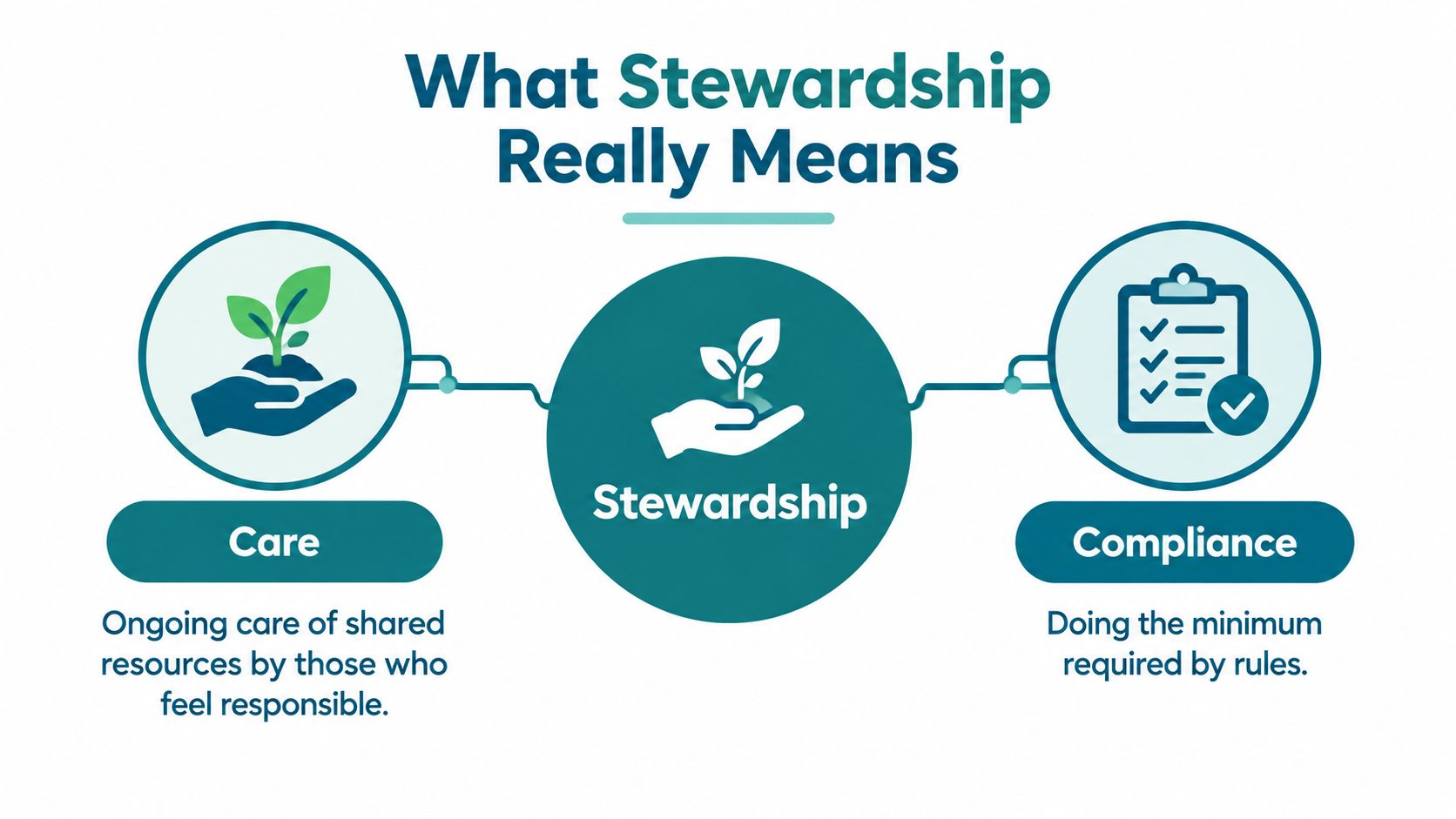
    Stewardship isn't a personality trait that some people inherit. It works more like a skill. You practice noticing, lifting, sorting, recording, and returning. After a while, Saturday morning feels less like an appointment and more like a promise you know how to keep.
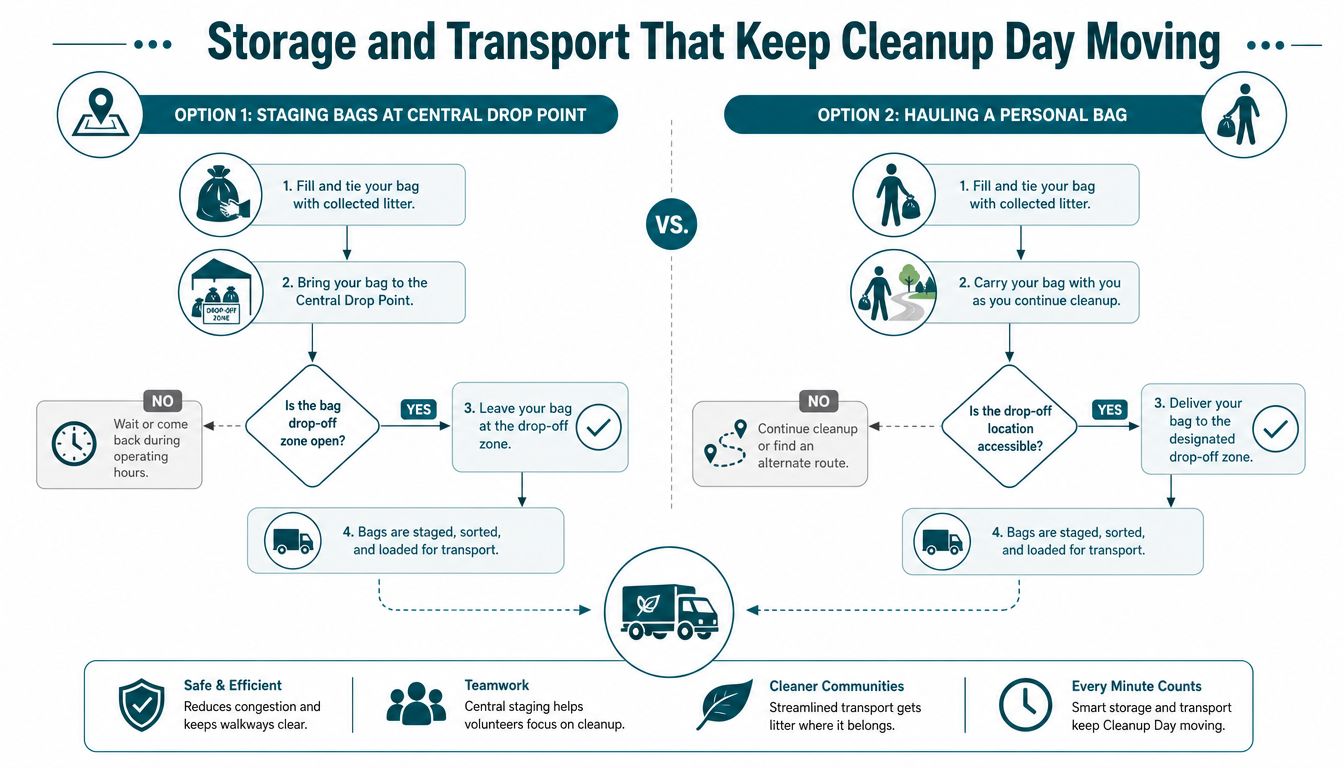

    Litter Caterpillars organizes volunteer trash pickups across Chicago, giving you a practical way to care for streets, parks, lots, and waterways while meeting people who want the same kind of weekend service. Visit Litter Caterpillars to find a cleanup, bring a friend, and take your first Saturday shift.

  • Trash Pickup Equipment: What Volunteer Groups Actually Need

    Trash Pickup Equipment: What Volunteer Groups Actually Need

    In one October storm, twelve of us worked along the Lake Michigan shoreline with plastic grocery bags. Rain soaked the paper-thin gloves we had, wind pushed debris through our feet, and nobody had a real grabber. We finished the route, but the gear rescued us less often than we rescued the gear.

    After three years of weekly cleanups across Chicago, I judge trash pickup equipment by a simple test. Can a mixed group use it in rain, snow, cold wind, and summer heat without slowing down or getting hurt? The right tools don't need to look impressive. They need to keep working when cardboard turns to sludge, a bag catches on a thorn, or a volunteer finds broken glass under wet leaves.

    Why Equipment Choices Matter More Than You Think

    The first failures usually happen in predictable places: the grabber jaw stops closing, the glove seam splits, or the bag handle tears. A cheap kit can look fine on a store shelf and fall apart halfway through a cleanup. Then someone ties two grocery bags together, bends over every few steps, and starts handling litter with exposed fingers.

    That pattern creates a slow, frustrating morning. Volunteers wait for replacement tools, carry leaking bags, or leave a route unfinished because the equipment no longer matches the work. A new organizer often thinks the main job involves choosing a meeting point and sending reminders. Those tasks matter, but the equipment list decides whether people can finish the route comfortably.

    I've watched a group lose momentum because the only usable grabber belonged to the organizer. Everyone else stood around while one person picked up the small pieces. I've also seen a sturdy cart turn an awkward pile of wet bags into a clean handoff. The difference wasn't dramatic on paper. It came from choosing tools around real movement, real debris, and real weather.

    Start with the volunteer, not the catalog

    A volunteer may have long arms, short arms, a stiff back, small hands, or a wrist that tires quickly. One person may work on flat sidewalk, while another crosses muddy grass and a curb gutter. A single universal kit usually fits nobody especially well.

    Before buying, ask three questions:

    • What will people touch indirectly? Broken glass, wet food containers, needles, and sharp metal require reach tools and protective gloves.
    • Where will people carry the load? A long route needs better bags and a way to move full ones.
    • What happens when something fails? Bring spare grabbers, tape, gloves, and bags instead of hoping every item survives.

    The world generates about 11.2 billion tonnes of solid waste each year, and as of 2021, global collection covered 77% of solid waste while 33% was openly dumped, according to Waste360's account of refuse-truck evolution and collection conditions. That context doesn't tell you which grabber to buy, but it does explain why collection work demands equipment built for repeated handling and uneven conditions.

    Your job as a leader isn't to buy the most expensive pile of gear. It's to remove the small failures that make volunteers cold, tired, invisible, or unwilling to return. For liability planning alongside gear planning, review volunteer liability insurance considerations.

    The Core Kit Every Volunteer Should Carry

    A basic kit should let a volunteer reach litter, protect their hands, close a bag, and clean up afterward. I don't send people out with one tool and a cheerful warning to “be careful.” The pieces work together.

    An infographic titled The Core Kit displaying essential safety equipment for volunteers to carry during trash cleanups.

    The grabber does the reaching

    Choose a grabber with a jaw that closes firmly and a handle that feels natural in a gloved hand. The tool should pick up cans, wrappers, food containers, and small pieces of litter without forcing the volunteer to squeeze hard every time. A rotating jaw helps in some tight spaces, but simplicity often wins when several people share equipment.

    Test the trigger before an event. If it sticks, wobbles, or opens only halfway, put it aside. A grabber keeps hands away from broken glass and wet surprises, but it doesn't turn an unsafe object into a safe one. Volunteers still need permission to leave suspicious or dangerous items alone.

    Gloves need a real fit

    Use puncture-resistant gloves in several sizes. One oversized pair slips when someone grips a can, while a tight pair leaves fingertips sore. I keep nitrile-coated work gloves for wet gutter muck and cut-resistant gloves for broken glass or sharp metal.

    Gloves don't replace a grabber. They add a second layer between skin and the mess, especially when a volunteer holds a bag open or moves a harmless-looking object that shifts unexpectedly.

    Bags carry more than trash

    Heavy-duty contractor bags handle wet cardboard and rough pavement better than thin grocery bags. Use a bag hoop or have a second person hold the opening so the picker can work without wrestling the plastic. Tie full bags before they become too heavy to move.

    Closed-toe boots or sturdy sneakers belong in the kit conversation too. Sandals leave feet exposed to glass, nails, mud, and cold water. Add hand sanitizer and a basic first-aid item, then keep both with the route leader rather than burying them in a supply bin.

    Practical rule: Every item should prevent a specific failure. If you can't name the failure, reconsider the purchase.

    A high-visibility vest helps drivers and cyclists see volunteers along parkways and street edges. It also gives the group a visual identity, which makes it easier to spot someone who has wandered too far from the route. The vest doesn't control traffic, so keep people away from moving vehicles and use a separate traffic plan when the route demands it.

    Safety Gear That Protects Your Crew on the Route

    I run the safety briefing before anyone opens a bag. It takes a few minutes, and it changes how new volunteers read the route. I point out broken pavement, fast-moving traffic, steep banks, suspicious containers, and places where a vehicle might reverse.

    A safety infographic displaying high-visibility vests, traffic cones, and protective gloves for trash pickup teams.

    Build the check before the route

    Hand out gloves and grabbers first. Ask volunteers to show that their grabber closes and that their gloves fit. Then distribute high-visibility vests or tabards, check footwear, and point out the boundaries of the route.

    In summer, add hats, sunscreen, and water. In spring, pack extra layers because wind beside the lake can cut through a warm afternoon. In rain or snow, give people a clear stopping point. A volunteer who gets soaked early may lose warmth long before the event ends.

    Official guidance for volunteer litter picking calls for protective gloves and high-visibility clothing, with reflective clothing suited to roads where speed limits reach 30 mph or less, or up to 50 mph in one district guide, depending on the local guidance. Read the South Oxfordshire group litter-picking guidance before placing a crew near traffic. If the road runs faster than the guidance allows, choose another site or use stronger controls.

    Control movement around vehicles

    Cones help mark a boundary, but they don't give volunteers permission to stand in traffic. Larger crews may need flags, a spotter, or a route that keeps people away from the road edge. Small groups can sometimes work with vests and a tight boundary, but every group needs a rule about vehicles and backing.

    NIOSH recorded 450 refuse-collection worker deaths from 1980 to 1992, with 303, or 67%, vehicle-related. Among those vehicle-related deaths, 110 involved slipping, falling, being struck, or being run over by the refuse vehicle, and 20 happened during backing maneuvers, according to NIOSH guidance on preventing refuse-collection worker injuries. Your volunteers may collect litter rather than operate refuse trucks, but the lesson carries over: never assume a driver sees a person near a vehicle.

    Show volunteers how to use the grabber. No waving it around, no poking at people, and no running. A UK council briefing also recommends working in pairs, with one person holding the bag while the other picks, a simple relay that keeps hands and feet organized. Wash hands thoroughly after the cleanup, even if gloves stayed intact.

    Play the safety video before the first route if your group benefits from a visual briefing.

    If a volunteer reaches for a suspicious bucket, stop them. If someone finds a needle, aerosol container, chemical bottle, animal remains, or heavy object, they should mark the location and call the leader. No piece of trash deserves a hospital visit.

    Choosing Grabbers, Bags, and Gloves for Real Terrain

    Chicago routes change every few blocks. Parkway grass hides bottle caps and wire. Curb gutters hold oily grit and wet leaves. Wooded lots catch bags on thorny branches. Alleys punish weak wheels and thin plastic.

    A longer grabber gives more reach, but longer isn't always better. A 40-inch tool can feel useful beside a hedge and awkward in a tight creek bed. The extra shaft can reduce wrist control and make repeated pickups tiring. For most volunteers, a moderate-length grabber with a comfortable trigger works better than the longest model on the rack.

    Jaw style matters too. Wide rubber tips suit cans and paper. Narrow serrated jaws can hold small objects, but they may snag fabric or require more hand force. Test several tools with gloves on, because a trigger that feels easy barehanded can feel stiff after a morning of use.

    Match the kit to the ground

    Terrain Grabber Length Glove Type Bag Choice
    Parkway grass Medium reach, firm wide jaw General work glove with puncture resistance Heavy contractor bag
    Curb gutter Short to medium reach for control Nitrile-dipped glove Heavy contractor bag
    Wooded lots Medium reach with narrow jaw Cut-resistant glove Thick contractor bag, plus tape
    Alley pavement Medium reach, durable trigger Cut-resistant or coated work glove Contractor bag with strong tie handles

    Glove material should follow the debris. Nitrile-dipped gloves handle wet grime well. Cut-resistant gloves make more sense around broken glass. Leather can help with rough demolition lumber, but it isn't a reason to lift an object that feels unstable or too heavy.

    Bag choice creates its own trade-off. Contractor bags stretch and hold wet material, but wire can tear them. Leaf bags cost less for light, clean litter, yet sharp edges can split them quickly. For weekly mixed debris, 42-gallon contractor bags usually give me the most practical balance between capacity and handling.

    For a closer look at sack construction and load choices, use this MSP Packaging heavy duty sacks guide. I also keep one roll of strong tape in the route bin. A strip over a small tear can save a bag long enough to reach the drop point.

    The guide to picking up trash safely helps new volunteers connect the tool choice with the movement that follows. Equipment works best when people keep the grabber low, avoid twisting, and stop before a small object turns into a strained wrist.

    Budget-Friendly Equipment Plans for Any Group Size

    Your first purchase should match the group you have, not the group you hope to build. I'd rather equip five people properly than buy a large pile of weak tools for an imagined crowd.

    The amounts below are planning targets, not market quotes. Prices change by store, brand, and order size, so use the tiers to organize priorities rather than treat them as fixed invoices.

    Tier Group Size Total Budget Per-Volunteer Cost Key Gear
    Starter Five people Under $150 Under $30 Basic grabbers, bulk nitrile gloves, contractor bags
    Mid-range Ten to twenty people Not fixed Not fixed Hi-vis vests, first-aid kit, foldable cart
    Sustained Twenty or more people Not fixed Not fixed Bulk bags, rigid sharps containers, replacement grabbers

    The starter plan should spend first on reliable grabbers and gloves. Those items touch the work repeatedly, and failure there slows every person on the route. Buy contractor bags in a size that volunteers can carry when full, then add a small repair supply with tape and spare gloves.

    For occasional use, three items can stay simple: basic bag hoops, plain high-visibility vests, and a folding bucket for loose supplies. They don't need elaborate construction if the group uses them lightly and stores them indoors.

    A group of ten to twenty people benefits from a real first-aid kit and a foldable cart. Those additions reduce the amount of time the leader spends carrying supplies and give you a place to stage gloves, water, extra bags, and route maps. Keep replacement grabbers in reserve because a shared tool takes more abuse than a personal one.

    Plan for repeated mornings

    A sustained group of twenty or more should buy bags in bulk when storage allows, keep rigid containers for sharps, and set aside money for replacement grabbers. The equipment budget should include wear, not only the first purchase. A broken trigger on event day is a small expense that becomes a large coordination problem.

    I also label bins by function: personal kit, route safety, bag transport, and end-of-day handoff. That system costs almost nothing and lets a new leader find the supplies without emptying the entire trunk.

    Storage and Transport That Keep Cleanup Day Moving

    A cleanup can run smoothly on the route and fall apart at the drop point. Full bags become awkward fast, especially after rain. Volunteers carry one too far, set it on a sidewalk, and then someone has to retrace the route to collect it.

    Choose one of two systems. With a central drop point, volunteers carry smaller loads and return to the same place. That works well in parks, compact neighborhoods, and routes where a leader can watch the staging area. With personal carry bags, each person owns the load from pickup to handoff. That works better on spread-out routes where a central point would interrupt the walk.

    A foldable wagon handles several bags and supplies, but small wheels struggle with curbs. A two-wheel garden cart climbs a curb more cleanly when you tilt it, though it gives you less room for loose items. Test the wheels over the actual route before event day. A cheap cart that catches on every curb becomes another tool people avoid.

    A flowchart comparing two methods for managing litter bags during community cleanup events.

    Protect the vehicle

    Line a sedan trunk, SUV cargo area, or pickup bed before loading anything. A contractor bag works as a liner for smaller bins, while a rigid tote gives wet bags a stable wall. Keep full bags upright and separate recycling from general waste before the pile grows.

    For larger recurring cleanups, a trailer may make sense when the group moves carts, bins, or other heavy equipment. This guide to finding the right equipment hauling trailers can help you compare hauling setups without treating a personal car as a permanent utility vehicle.

    At the end, label bags for city pickup or the agreed disposal point. Separate recycling only when your local arrangement accepts it, and place sharps in a rigid container. Never toss a needle into a flexible plastic bag.

    Use free recycle bins for cleanup supplies when you need a simple way to separate recoverable material. Tape a checklist inside the trunk lid:

    • Load: Bags, cart, grabbers, gloves, vests, first aid.
    • Route: Map, meeting point, boundaries, emergency contact.
    • Handoff: General waste, recycling, rigid sharps container.
    • Reset: Dry tools, replace used gloves, restock bags.

    The next leader should be able to open the vehicle and understand the whole system in a minute.

    A Volunteer-First Way to Think About Every Purchase

    I make every equipment decision in this order:

    1. Does it protect the volunteer?
    2. Does it make the work finishable in a normal morning?
    3. Does it serve the place we're cleaning?

    That order changes small purchases. I'll choose cut-resistant gloves over the cheapest gloves when broken glass appears on a route, even if the stronger pair costs $4 more. I'll use high-visibility vests in a low-traffic park because cyclists, delivery workers, and other volunteers still need to see the group.

    I won't hand a rusty dollar-store grabber to a teenager on a highway-adjacent route. The tool may technically pick up a wrapper, but it sends the wrong message about what we expect people to risk. A volunteer sees the equipment before they see the route. That first impression tells them whether the organizer planned for their safety.

    A pyramid chart outlining a volunteer-first approach to purchasing, emphasizing safety, efficiency, and community impact.

    Safety comes before the tally

    A group I worked with changed its kit after a close call with broken glass. One volunteer reached through leaves, the grabber slipped, and the glass cracked against the pavement beside their shoe. Nobody needed medical care, but we stopped the route, replaced the weak tools, added better gloves, and changed the briefing.

    We never went back to the old setup. The upgrade didn't make volunteers reckless. It made them more willing to work carefully because they knew the group would not trade their safety for a fuller bag.

    The same thinking applies to larger waste operations. A worker safety asset management approach can help teams track equipment condition, inspections, and replacement needs. For a volunteer group, that may be as simple as a labeled checklist and a monthly tool check. The principle stays the same: a tool that fails repeatedly belongs on a replacement list, not in someone's hand.

    Finishable work keeps people returning

    I don't measure a cleanup only by bag count. I watch whether volunteers can walk, reach, lift, and pause without fighting the equipment. A cart that reduces long carries can matter more than another box of bags. A bag hoop can matter more than a larger bag if it keeps one person from holding plastic open all morning.

    The waste management equipment market was estimated at USD 19.93 billion in 2026 and projected to reach USD 25.64 billion by 2031, with a projected 5.17% CAGR from 2026 through 2031, according to Mordor Intelligence's waste management equipment market data. Volunteer leaders don't need industrial machinery for a neighborhood route, but the same practical question applies at every scale: does the equipment fit the work?

    Protect the volunteer first. Make the work finishable second. Serve the parkway, alley, shoreline, or vacant lot third. Volunteers who feel protected come back. Volunteers who feel used don't, and the equipment list is where that promise becomes real.


    Litter Caterpillars uses practical trash pickup equipment, including grabbers and heavy-duty contractor bags, for weekly Chicago cleanups across every ward and every season. Visit Litter Caterpillars to find an upcoming cleanup, meet the group, and bring your energy to a route where safety and friendship come first.