
I once stood in my kitchen holding a jar of ancient blueberry jam like it was evidence from a lost life. Then I looked around at the clutter, the silence, the fallout from a relationship that had drained me, and I realized I didn’t just need to clean my apartment. I needed to rebuild my people.
The Loneliness Problem I Couldn't Clean Up
My place used to look like my inner life felt. Crowded. Stale. Weirdly sentimental about things that should’ve gone out weeks ago.
I had trash with backstories. A half-finished bag of nuts from my brief healthy era. Old receipts from days I couldn’t even remember. The blueberry jam from a trip that mattered more in my memory than it ever did in real life. None of it weighed much, but every item felt heavy. I’m talking emotional cinder block heavy.
Then a chaotic relationship ended, and the whole illusion cracked. I had spent too long tolerating selfishness, too long calling inconsistency “chemistry,” too long acting like loneliness would solve itself if I just stayed busy. It didn’t. It spread.

When your life gets smaller
The hardest part of loneliness as an adult isn’t always dramatic. Sometimes it’s stupidly ordinary. You go through a whole weekend and realize nobody saw you outside of a cashier and a screen. You have a funny story and no one to text it to. You need help moving a chair and think, “Who would I even ask?”
That private pain isn’t just in your head. A 2021 survey on close friendships among U.S. adults found that the share of adults reporting 10 or more close friends fell from 33% in 1990 to 13% in 2021, while 12% reported having no close friends at all.
That hit me because it explained something I had felt but couldn’t name. I wasn’t failing at adulthood because friendship got harder. Friendship had gotten harder, period.
Practical rule: If your social life feels broken, stop treating it like a personality defect. Treat it like a problem that needs design, repetition, and courage.
Why cleaning up someone else’s mess helped me
I learned something strange when I started helping clean outdoor spaces. Other people’s mess felt easier to face than my own. A candy wrapper on the sidewalk didn’t come with shame. A bottle in the grass didn’t carry my history. I could bend down, grab it, toss it, and feel one tiny burst of order.
That mattered.
Because once you’ve spent enough time stuck, momentum matters more than insight. You don’t need another podcast telling you to “put yourself out there.” You need a place to stand, something useful to do with your hands, and a reason to show up when your feelings say stay home.
I’ve written before about fighting social anxiety one piece of trash at a time, and that phrase still feels true to me. Service gave me a side door into connection. I didn’t have to be dazzling. I just had to be present.
That’s when I started seeing friendship differently. Not as luck. Not as chemistry. Not as something that falls from the sky when your life gets cute enough.
More like cleanup.
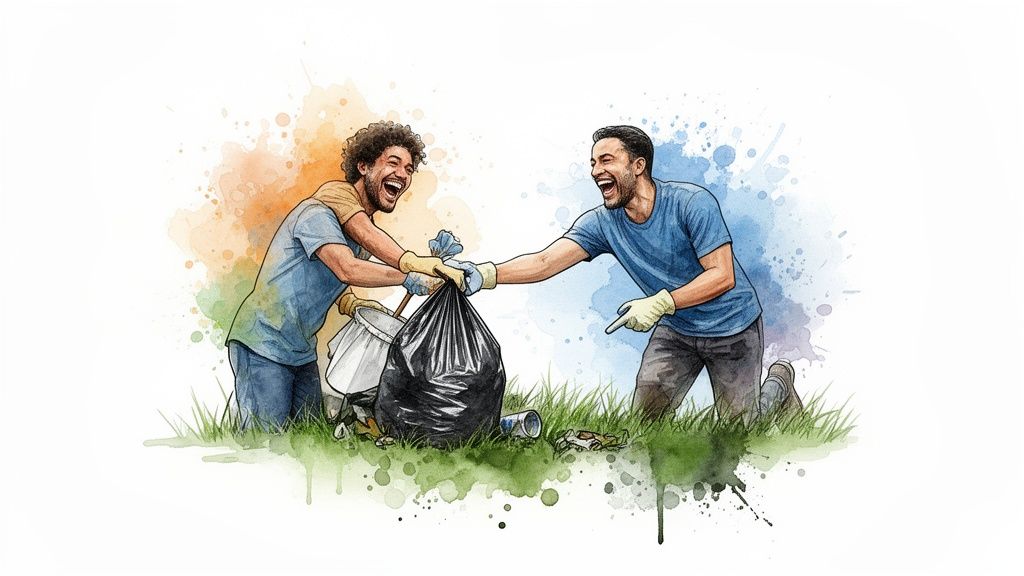
You show up. You pick one thing up. Then another. Then another. And one day the place looks different.
So do you.
How to Find Your People by Filtering for Givers
Most adult friendship advice is too polite. It tells you to join a club, download an app, go to a mixer, smile more. Fine. But if you’re serious about how to make friends as an adult, you need a better question than “Where do I meet people?”
Ask this instead. What kind of activity makes selfish people less likely to show up?
That question changed everything for me.
I used to think I had a bad picker in romance and friendship. But the truth was less mysterious. I kept putting myself in environments that rewarded charm, spontaneity, and vibes. Those places can be fun, but they’re terrible filters. A loud room hides a lot. So does a casual social scene where nobody has to sacrifice anything.
If you want better friends, pick better proving grounds.

Why challenge reveals character
A warm café is great for catching up with people you already trust. It’s not great for screening new ones. Everybody looks generous when the lighting is soft and the stakes are zero.
A service activity in bad weather tells you more.
You notice who shows up early.
You notice who shares gloves.
You notice who complains for two hours and who makes the whole thing feel lighter.
You notice who sees an older volunteer struggling with a bag and helps without turning it into theater.
That’s what I mean by filtering for givers. Not saints. Not perfect people. Givers. People who can carry a little discomfort without making it everyone else’s problem.
A strong social life doesn’t come from collecting whoever is available. It comes from building around people with the right instincts.
The activity is the filter
The best social settings aren’t always the most comfortable. They’re the most revealing.
A weekend morning volunteer shift does something a random happy hour doesn’t. It asks for effort. It asks for wakefulness. It asks for a tiny act of selflessness before brunch and errands and scrolling can swallow the day. That alone changes who walks through the door.
The logic here is simple. If the activity requires consistency, a little grit, and some public usefulness, it naturally attracts people who value those things.
That isn’t just my opinion. Jen Hatmaker’s article on finding your people includes this idea directly: strategically engineering social circles by activity design is a powerful filtering tool, and scheduling volunteer events on weekend mornings can naturally attract givers over partiers. The same verified material notes that a 2025 Corporation for National & Community Service report found volunteer retention doubles in adversity-groups, which supports the point that shared struggle builds committed circles.
If you keep meeting flaky, self-involved people, stop blaming your luck and start auditing your settings.
What this looks like in real life
I’ve watched people bond faster while carrying trash bags through wind than they ever did at polished networking events. Not because suffering is magical. Because challenge strips away performance.
Here’s what service-based challenge gives you that generic social advice doesn’t:
- A built-in job: You don’t have to invent conversation from thin air. You already share a task.
- Visible character clues: You see kindness, patience, grit, and selfishness in motion.
- Low-pressure repetition: People come back regularly, so you don’t have to force instant intimacy.
- A reason to care together: Shared purpose gives the interaction weight.
That’s why meeting like-minded people through intentional community settings works better than floating through random social noise. The right structure does half the work for you.
Stop waiting for spontaneous friendship
A lot of adults still cling to a high school fantasy. You sit near someone enough times, say a few funny things, and suddenly you’re close. That happened more easily when life shoved us into shared spaces every day. Adult life doesn’t do that.
You have to build your own ecosystem now.
That means choosing places where the social outcome isn’t the only point. Ironically, that’s what makes connection more likely. When people focus on helping, hauling, sorting, carrying, or fixing, they relax. They reveal themselves. They become easier to trust.
And trust is the whole game.
You don’t need to become more universally appealing. You need to become more intentional about where you invest your hours. Friendship grows best where values show up in behavior.
If you want a tribe, don’t just chase people. Chase a cause that forces good people to become visible.
Your Step-by-Step Guide to Making the First Move
The first move feels huge when you’ve been lonely for a while. Your brain turns “say hi” into “perform a TED Talk while being judged by a panel.” I know that feeling well.
I used to stand near people I wanted to know and act busy. I’d tie a bag. Adjust my sleeve. Look very interested in a random leaf. I was physically present and socially absent. That’s a brutal habit because it lets you tell yourself you’re trying when you’re really hiding.
The fix started with one idea. You probably think people like you less than they do.
The liking gap is messing with you
Dr. Marisa G. Franco’s Acceptance Prophecy Methodology addresses the liking gap, where people underestimate how much others like them by 50-60%. Her approach is simple but powerful. Assume baseline likability. That shift can increase your own friendliness by up to 40% and can raise the success rate of turning group acquaintances into one-on-one friends to 70%, as described in Dr. Franco’s guide to making friends as an adult.
That idea changed the script in my head.
Before, I’d leave an interaction thinking, “I was awkward.” After learning this, I started asking, “What if they enjoyed that more than I think?” That one question made me warmer, more direct, and less weirdly defensive.
You do not need certainty before you act. You need a more generous interpretation of how you’re being received.
The four-part move
I like simple systems because anxiety loves fog. Here’s the one I use.
1. Show up enough times for familiarity to do its job
Don’t treat the first event like speed dating for best friends. Your first task is repeat exposure. Come back. Let people see your face enough times that your presence starts to feel normal.
If you disappear after one appearance, nobody has enough material to trust you yet.
2. Assume they’ll be glad you spoke
This is the inner move. Before you walk over, say something like, “They probably don’t need me to be impressive. They just need me to be human.”
That sounds small. It isn’t. It changes your body language. You smile sooner. You stop overediting. You become easier to talk to.
3. Open with the obvious truth in front of you
Forget clever. Use what’s happening right now.
A lot of people freeze because they think the opener has to sparkle. It doesn’t. It has to land. Real life already gives you material.
Here are a few openers that work because they’re specific and low-pressure:
| Conversation Starters That Actually Work | |
|---|---|
| The Situation | Your Opening Line |
| You’re both grabbing supplies | “Hey, have you done this route before, or are you winging it like me?” |
| It’s freezing or raining | “I can’t decide if this weather is miserable or kind of funny.” |
| They did something helpful | “That was kind of you. You noticed that fast.” |
| You keep seeing them each week | “I think we’ve been orbiting the same events for a while. I’m glad we finally said hi.” |
| You’re walking between tasks | “What made you start coming out to this kind of thing?” |
| The event just ended | “I’m starving after that. Are you headed straight home or doing a recovery snack somewhere?” |
4. Make the tiny invitation before the moment closes
Many hesitate at this stage. They have a decent conversation, then leave with a polite smile and no bridge to the next one.
You need a bridge.
Not a giant one. A wooden plank. Something easy.
Try these:
- After a good chat: “I liked talking with you. Want to grab coffee after this next time?”
- When you’ve seen them more than once: “You seem fun and solid. Want to swap numbers so we can coordinate next week?”
- When you share a local connection: “You’re in my area too? We should do a neighborhood walk sometime.”
None of these lines are too much. They’re clear. Adults appreciate clear.
What awkward people do wrong
I say this with love because I’ve done every one of these.
- You hover instead of entering: You stand nearby and hope someone rescues you.
- You wait for perfect timing: There isn’t any.
- You talk once and vanish: Repetition builds trust.
- You confuse chemistry with momentum: A pleasant moment means nothing if nobody follows up.
- You make the invitation too big: Don’t jump to “we should all take a weekend trip.” Start with coffee.
A script for the whole interaction
If you want a practical sequence, use this:
- Approach: “Hey, I’m [your name].”
- Anchor to the moment: “This wind is trying to humble us.”
- Ask one simple question: “How’d you get into this?”
- Reflect something back: “That makes sense. I like that.”
- End with a small next step: “I’m glad we talked. Want to swap numbers and say hi next time?”
That’s enough. Really.
For more ideas on community-building activities for adults, look for settings where people do something together instead of only talking about doing something someday. Shared action makes every one of these steps easier.
The tough-love truth
Nobody is coming to tap you on the shoulder and announce that now it’s socially safe for you to begin. Adult friendship often starts when one person decides to risk a mildly awkward moment on purpose.
Let that person be you.
You don’t need swagger. You need reps. You need to stop worshipping coolness and start practicing contact. Most friendship failure doesn’t come from rejection. It comes from stalled effort.
Say hi. Stay a few minutes longer. Ask the follow-up. Make the small invitation.
That’s how strangers stop being scenery.
The 200-Hour Journey From Acquaintance to Friend
Most adults quit too early.
They meet someone good, have one nice conversation, maybe even exchange numbers, and then they expect the friendship to self-assemble. When it doesn’t, they decide the spark wasn’t real. I used to do that too. I thought closeness should feel spontaneous if it was “meant to be.”
Friendship is less like lightning and more like stacking firewood. One log doesn’t heat the house. Enough logs, placed regularly, will.
Friendship takes longer than you think
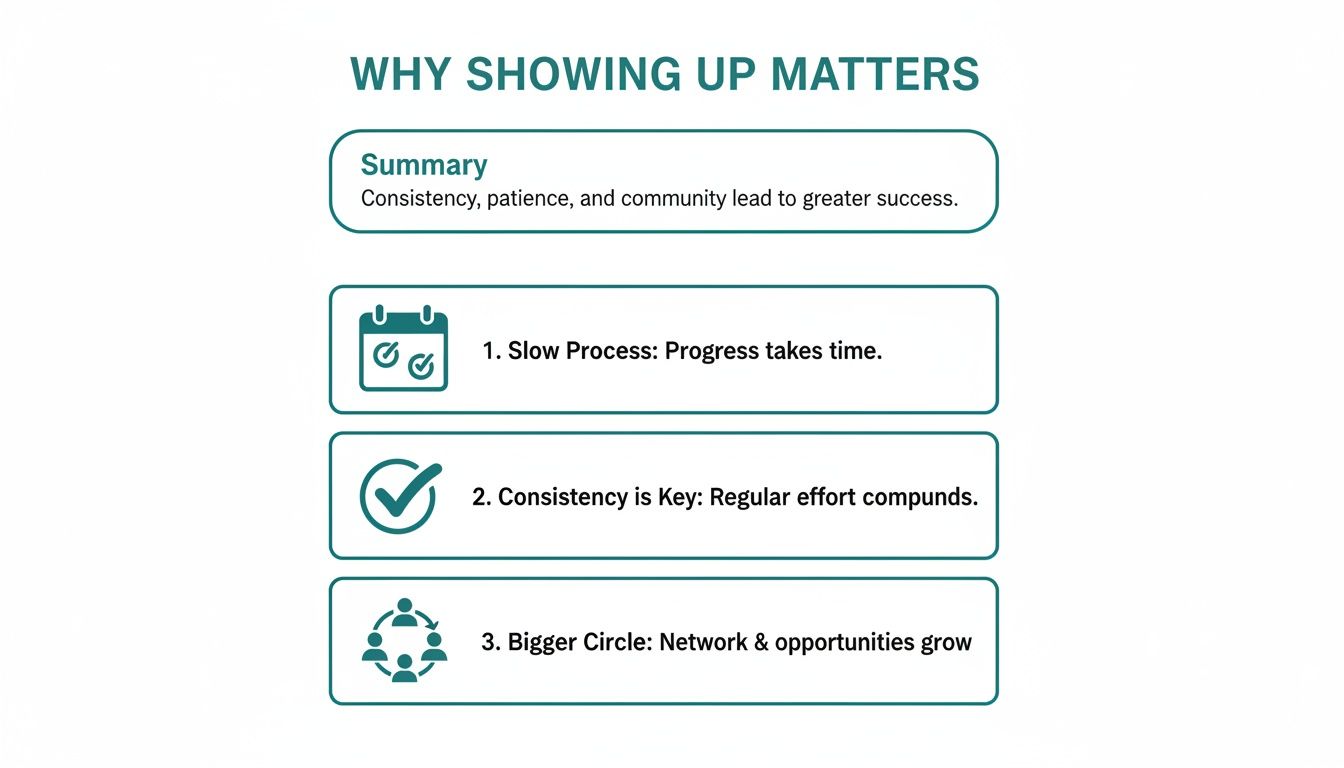
Research from the University of Kansas found that adult friendship grows through time spent together. It takes about 50 hours to move from acquaintance to casual friend, 90 hours for a real friendship, and more than 200 hours for a close bond, according to this summary of the University of Kansas friendship research.
That number can feel discouraging until you understand what it means. It doesn’t mean you need one giant emotional marathon. It means closeness comes from repeated ordinary contact.

Why recurring activities are a friendship accelerator
This is why recurring service matters so much. A weekly event solves three adult friendship problems at once.
First, it removes decision fatigue. You don’t have to keep inventing plans.
Second, it gives you a stable backdrop for repeated contact.
Third, it creates a rhythm where following up feels normal instead of random.
A one-off party gives you a spike. A weekly habit gives you a ladder.
A working rule: Don’t ask, “Did we click?” Ask, “Did we spend enough time together for trust to form?”
What those hours actually look like
People hear 200 hours and picture some dramatic montage. Real friendship is usually built from much less glamorous moments.
It’s the walk to the train after the event.
It’s the ten-minute chat while sorting supplies.
It’s the shared snack afterward.
It’s texting, “You still going tomorrow?”
It’s seeing how someone acts when plans get messy.
The hours count because they accumulate context. You stop knowing only their funny side. You start learning how they handle stress, disappointment, lateness, weather, tiredness, small joy, and boring tasks. That’s when trust stops being theoretical.
A practical rhythm for the long game
If you’ve met someone promising, don’t leave it to chance. Use a rhythm.
Week one
Talk at the event. Keep it light. Find one point of overlap. Neighborhood, work rhythm, food, books, weird weather tolerance, anything.
Send a short follow-up if you swapped numbers:
“I liked talking with you today. Glad we met.”
Week two
Find them again. Reference the earlier conversation.
“How did that exam go?”
“Did you ever try that coffee place?”
“Are you still on for next weekend?”
That one callback matters. It tells them you weren’t just being socially polished. You were paying attention.
Week three or four
Add a small one-on-one extension connected to the shared activity.
- Grab coffee after
- Walk to the station together
- Share a meal nearby
- Invite them to a related errand or neighborhood stop
Short is better than elaborate. You’re not trying to impress them. You’re trying to widen the lane.
The mistake of waiting for intensity
A lot of adults think a real friend should arrive with instant emotional depth. That expectation wrecks good beginnings.
Close friendship usually starts off humble. You joke about gloves. You compare terrible apartment stories. You complain about wind chill. You remember each other’s names. You carry bags. That can look small from the outside. It isn’t.
Small interactions are deposits. Keep making them.
Here’s what helps those deposits grow:
- Consistency beats charisma: I trust the person who returns.
- Specific invitations beat vague hopes: “Coffee after next Saturday?” works better than “We should hang sometime.”
- Shared labor beats endless talking: Doing a task together gives the bond a spine.
- Follow-up beats fantasy: If you don’t act on a good interaction, it evaporates.
How to know when to deepen the friendship
You don’t need a formal milestone. Watch for these signals instead:
- Conversation expands naturally: You’re not forcing topics anymore.
- They initiate too: They text first, save you a spot, or ask if you’re coming.
- You’ve seen each other in different moods: Tired, rushed, happy, annoyed.
- The hangouts leave the original setting: You talk before or after, not just during.
When that happens, deepen carefully. Offer a little more of yourself. Not a trauma dump. Just more reality.
Try:
“I’ve been trying to build a more solid circle lately.”
“I’m glad I started showing up here. I needed this more than I realized.”
“You seem like someone who follows through. I appreciate that.”
That kind of honesty opens the door without kicking it off the hinges.
A simple model for reaching 200 hours
You don’t need to calculate this like a spreadsheet, but it helps to think in seasons.
If you spend a few hours a week around the same people, plus occasional follow-ups outside the event, those hours add up. The magic isn’t speed. It’s regularity. Adult closeness grows when time stops being accidental.
I like to think of it in layers:
Recognition
You know each other’s names and faces.Familiarity
You’ve had enough repetition that the interaction feels easy.Reliability
You expect to see each other and notice when the other person isn’t there.Trust
You share more truth. You help each other. The friendship starts existing outside the original context.Belonging
The person becomes part of your real life, not just your Saturday life.
That’s the journey.
The emotional payoff of the slow build
The beauty of recurring challenge is that it sneaks the hours past your resistance. You’re not sitting across from a stranger trying to force intimacy over one expensive drink. You’re living side by side for a while. That’s closer to how childhood and college friendships formed. Not by magic. By repeated exposure, shared inconvenience, and enough ordinary moments to become known.
If you’ve struggled with how to make friends as an adult, this is the part to tattoo on your brain. Stop judging early connections by intensity. Start judging them by whether the structure allows enough hours to accumulate.
A good recurring activity isn’t just where you meet people. It’s the machine that turns contact into closeness.
Show up. Keep showing up. Then make the extra half-step after the event. That’s how acquaintance becomes friend without either of you needing to force it.
Friendship Is the Reward for Becoming a Better You
At some point I realized I had been asking the wrong question.
I kept asking, “How do I get friends?”
A better question was, “Who am I becoming when nobody’s watching?”
That question annoyed me at first because I wanted a social solution, not a character arc. I wanted a better calendar, not a better backbone. But friendship kept teaching me the same lesson. The people I most wanted in my life were drawn to bravery, steadiness, kindness, and effort. So if I wanted that kind of circle, I had to practice those traits before I felt fully ready.
Service changes your posture
When you serve, something subtle happens. You stop standing in the center of your own insecurity. You still feel shy sometimes. You still overthink. But your attention has somewhere better to go.
A bag needs carrying.
A corner needs cleaning.
A new person looks nervous.
Someone forgot gloves.
The job is right there.
That shift matters because self-consciousness is sticky. Purpose unsticks it.
I’ve seen people arrive withdrawn, unsure, half-apologetic for taking up space. Then they spend enough time doing useful work beside good people and their whole posture changes. Their jokes come out easier. Their eye contact steadies. Their standards rise. They stop chasing random approval because they’ve started building earned self-respect.
Friendship often arrives as a side effect. You become more trustworthy to yourself first.
You don’t attract what you want. You attract what you rehearse
Tough love enters the scene.
If you rehearse flakiness, you’ll keep building flaky dynamics.
If you rehearse hiding, you’ll keep collecting shallow contact.
If you rehearse chasing exciting but unreliable people, you’ll keep ending up lonely in crowded rooms.
You need new reps.
Mark Manson’s Selective Effort Principle argues that investing 10+ hours a week in personal growth can boost your baseline attractiveness by 40%, and that passionate people attract 2.7x more invitations, as described in Mark Manson’s article on making friends. The deeper point matters more than the numbers. Shift from hunting for friends to becoming a person who naturally draws healthier connection.
That tracks with what I’ve lived. The strongest friendships in my adult life didn’t start when I got more charming. They started when I got more solid.
Pride helps more than people admit
A lot of adults feel embarrassed by visible belonging. They think pride is corny. I used to think that too.
Now I think pride is fuel.
Teams know this. Marching bands know this. Cities know this. Shared symbols matter because they turn a loose gathering into a living identity. A badge, a ritual, a nickname, a song, a repeated joke, a familiar route, even a goofy tradition after the work is done. Those things say, “We are not just random individuals floating near each other. We are building something.”
That sense of identity protects friendship because it gives people a reason to return even when life gets messy.
Here’s what healthy group pride can do:
- It makes consistency easier: People return to identities, not just events.
- It softens awkwardness: Ritual gives shy people a script.
- It creates memory: Shared symbols make ordinary effort feel meaningful.
- It strengthens courage: Belonging helps people try harder things.
I’m not saying you need costumes and chants. I’m saying don’t underestimate the power of shared spirit. Adults need it too.
The caterpillar lesson
I love the image of a caterpillar because it’s honest. A caterpillar isn’t sleek. It’s not glamorous. It crawls. It does the work slowly. It looks a little ridiculous if you judge it too early.
That’s most of us in the middle of rebuilding.
We are not polished when we begin. We are trying. We are carrying our own mess, our old habits, our fear of rejection, our shame about how long we stayed isolated. We are learning consistency after years of drift. We are learning bravery in public. We are learning to be kinder than our old environments taught us to be.
And if we keep going, we change.
Not in the fake self-help way where your life becomes perfectly curated. In the real way. You trust yourself more because you’ve kept promises to yourself. You forgive yourself more because you’ve done something useful with your pain. You become easier to love because you’re no longer living entirely from defense.
That’s when friendship deepens. Not because you performed your way into a circle, but because the person standing there is more available, more grounded, and more aligned.
What to do this week
If you’re lonely, don’t turn this article into a thought exercise. Pick a challenge with a purpose and put it on your calendar.
Do it even if you feel awkward.
Do it even if you don’t feel instantly at home.
Do it even if you have to go alone.
Then return.
Talk to one person.
Remember their name.
Ask one follow-up question.
Make one tiny invitation.
Come back next week.
That’s the playbook. Not glamorous. Effective.
You do not build a tribe by wishing for one. You build it by becoming someone who can help carry the bags, laugh in bad weather, and stay when the novelty wears off.
And the wild part is this. Once you start doing that, you won’t just find better friends.
You’ll like yourself more in their company.
If you want a place to practice this in real life, Litter Caterpillars offers a simple, brave way in. You show up on a weekend morning, help clean a piece of Chicago, and meet people who chose service over sleep and excuses. That’s a strong starting point for anyone serious about how to make friends as an adult.