
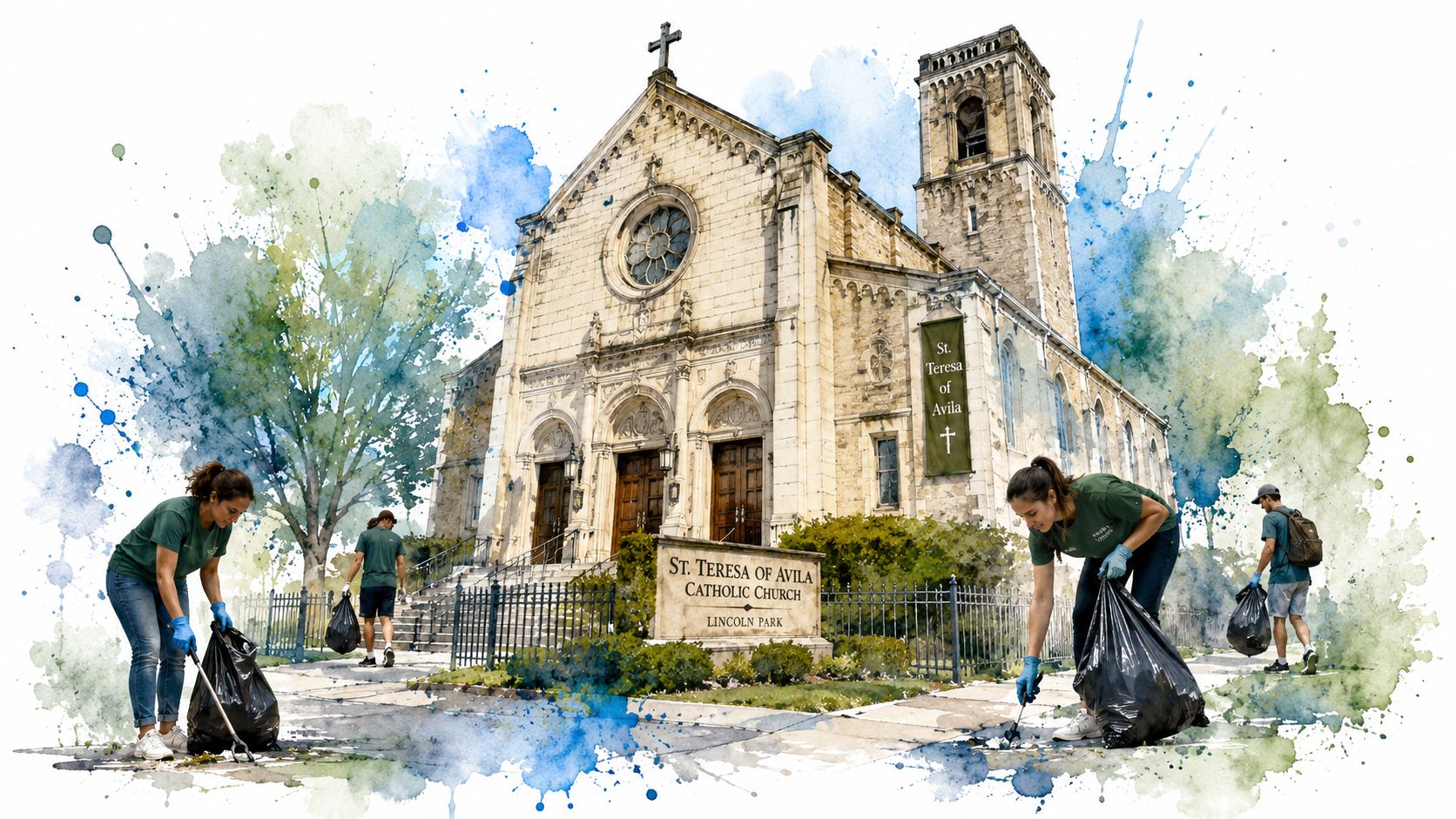
I once walked down Armitage half-distracted, coffee in hand, thinking about my own mess of a week, and I looked up at St. Teresa of Avila Church like I was seeing it for the first time. It stopped being background and started feeling like a door.
More Than Just a Building on Armitage
Some places in Chicago hide in plain sight. You pass them on your way to class, work, brunch, a bad date, a better date, the train, the grocery store. Then one day your life feels a little scraped up, and the same old building suddenly looks like a place where you could breathe.
That's how I think about St. Teresa of Avila Chicago.
It sits at 1037 W Armitage Ave, Chicago, IL 60614, right in the DePaul and Lincoln Park orbit, where people are always arriving and leaving, starting over, trying on new versions of themselves. In a city like this, that matters. You can feel surrounded all day and still feel unknown.
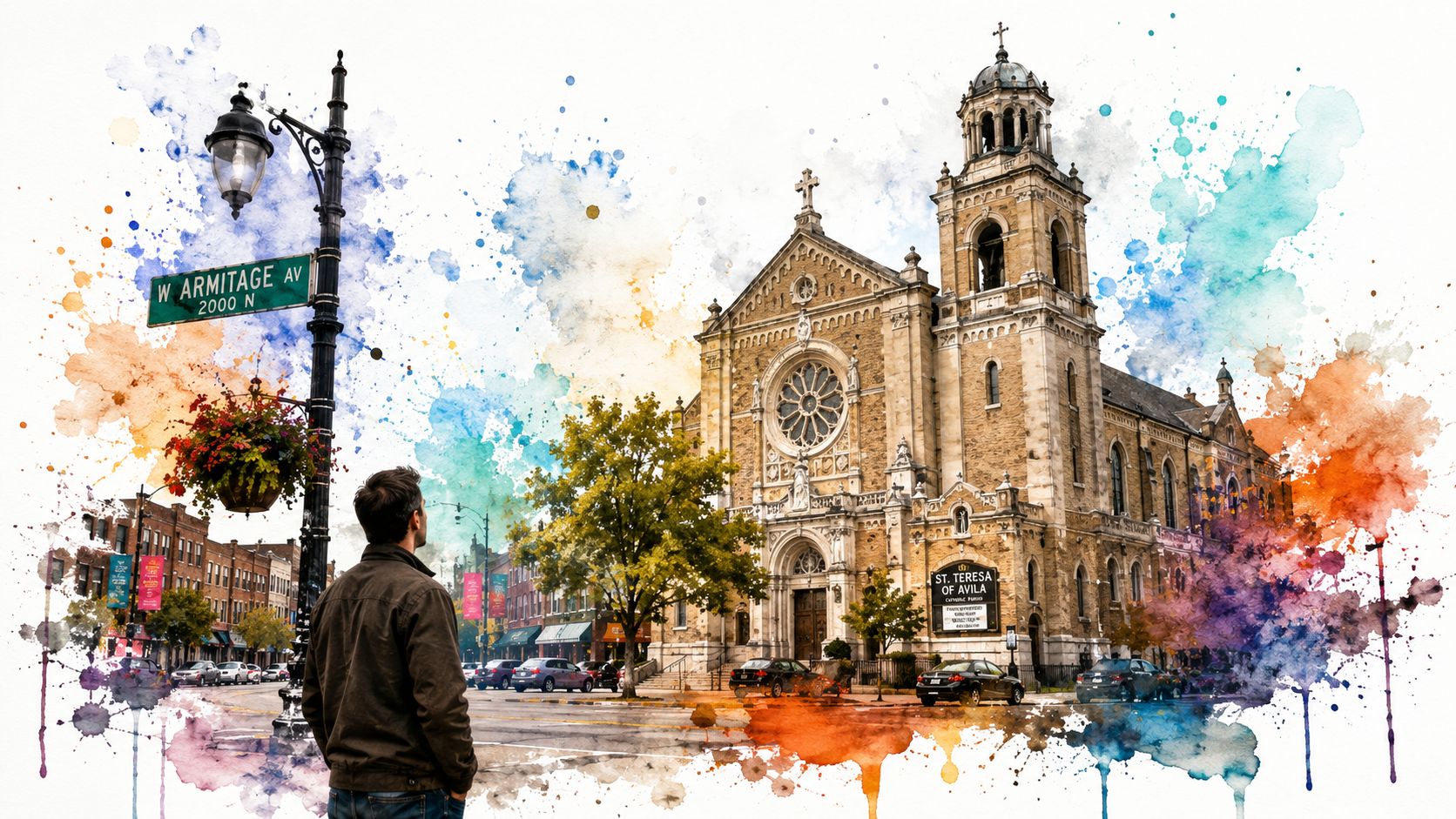
When a familiar place turns personal
I've learned that neighborhoods are a lot like bookshelves. Most of us only pull down the titles we already know. We keep walking past the rest.
Then something shifts. Maybe you're new to Chicago. Maybe you've lived here for years but your people moved away, your schedule changed, your faith got quieter, or your habits got too small. A church you ignored can start to look less like an old landmark and more like a bench after a long walk.
St. Teresa's has that kind of pull. The parish says it welcomes everyone without exception, and that line lands differently when you're the one wondering where you fit. I like places that don't make you audition for belonging.
Practical rule: If you keep passing a place and thinking, “I should go in sometime,” go in. Curiosity is often your better self trying to get your attention.
What I notice on this block
Armitage is busy, but the church changes the tempo. You feel it. The street still moves, but your eyes slow down.
That's useful in Chicago. We rush so much here. We optimize, schedule, commute, swipe, compare. We can treat the whole city like a vending machine and then wonder why we feel hollow. A parish like this gives you another option. You can show up with no big speech ready. You can sit down. You can listen. You can let a neighborhood become more than a map.
A church isn't magic. Bricks don't fix loneliness by themselves. But a real place with real people can interrupt the drift.
How to see your own neighborhood differently
If you're curious about St. Teresa of Avila Chicago, or any place like it, I'd start simple:
- Walk slower: Don't arrive with headphones and your head down. Look at the doors, the bulletin boards, the people lingering after Mass.
- Notice repeated life: A place becomes a community when you see the same faces doing ordinary things again and again.
- Ask one small question: “When should I visit?” works better than waiting until you've solved your whole spiritual biography.
- Let place shape you: You don't need a dramatic conversion story. Sometimes change starts with learning one corner of your neighborhood by heart.
That's the first gift of a place like this. It reminds you that your life in the city doesn't have to stay scattered.
The Story of This Chicago Parish
Before you visit a church, it helps to know whose name is on the door. In this case, the story starts far from Lincoln Park.
Saint Teresa of Ávila was born on March 28, 1515, in Ávila, Spain, and died on October 4, 1582, at 67. She was the first woman named a Doctor of the Church, an honor Pope Paul VI gave her in 1970, and Britannica's biography of Saint Teresa of Ávila notes that she founded 14 new Discalced Carmelite convents and played a major part in the Carmelite Reform despite years of ill health.
Keep the two stories separate
I think it helps to hold two facts in your head at once.
First, the saint and the Chicago parish are not the same thing. The woman lived in 1500s Spain. The church on Armitage is a neighborhood parish in modern Chicago that carries her name.
Second, names matter. When a parish takes the name of someone like Teresa, it borrows a kind of tone. Teresa's life had grit. She kept traveling, organizing, writing, and rebuilding even when her body made things hard. That doesn't mean a church named after her automatically becomes brave. It means the name itself is a challenge.
A short way to understand the namesake
If church history usually makes your eyes glaze over, think of Teresa this way. She was like the friend who walks into a cluttered room, opens the windows, and says, “We can live better than this.” Then she gets to work.
Her major books include The Interior Castle, written in 1577 and published in 1588, and The Way of Perfection, both named by Britannica as major works of Spanish Renaissance literature and Christian mysticism. She was canonized on March 12, 1622, and her feast day is October 15, but what grabs me most isn't the list of honors. It's the stubbornness.
Teresa's story feels less like a museum plaque and more like a hand on your shoulder saying, “Start with what you can repair today.”
The parish in Chicago
The Chicago church has its own long life. A multimedia book marks 125 years of parish history, and that tells me this isn't a pop-up community or a trendy experiment. People have been gathering here through different city eras, different neighborhood moods, different family stories.
That matters in Lincoln Park, where so much can feel temporary. Apartments turn over. Students graduate. People move after a lease, a breakup, a job switch. A parish with that much local memory can become a steadying place for people who feel like they're always in transit.
I wouldn't romanticize that history. Old institutions can get sleepy. But they can also become useful when they keep opening the door to the next wave of people who need a place to land.
Planning Your Visit to St. Teresa of Avila
If you want to visit, keep it easy. Don't turn it into a research project that never leaves your notes app.
The basic facts are enough to get you out the door. According to the St. Teresa of Avila Catholic Church listing on Yelp, the church is at 1037 W Armitage Ave, Chicago, IL 60614, and Mass times include Saturday at 5:00 pm and Sunday at 9:00 am, 10:30 am (Spanish), 12:00 pm, and 6:00 pm.
Parish details at a glance
| Service/Info | Details |
|---|---|
| Church name | St. Teresa of Avila Catholic Church |
| Address | 1037 W Armitage Ave, Chicago, IL 60614 |
| Saturday Mass | 5:00 pm |
| Sunday Mass | 9:00 am |
| Sunday Spanish Mass | 10:30 am |
| Sunday Mass | 12:00 pm |
| Sunday Mass | 6:00 pm |
How I'd choose a time
If you're nervous, I'd pick the time that creates the least friction.
- For families: The 9:00 am Sunday Mass is listed as the family Mass in the parish details noted earlier in the article.
- For Spanish speakers: The 10:30 am Sunday Mass is in Spanish.
- For a lower-pressure first step: A Saturday evening visit can feel easier if your Sunday mornings are chaos.
- For students and working adults: The 6:00 pm Sunday Mass may fit better if weekends get swallowed by errands and recovery.
If you're trying to build a fuller weekend around neighborhood connection, I'd also keep an eye on Chicago community events from Litter Caterpillars. Even if you're only browsing, it helps to think of a visit as part of a real life in the city, not an isolated errand.
A few practical tips
Lincoln Park can feel easy until you're circling the block. Give yourself extra time. Chicago punishes the person who leaves “just enough” buffer.
Wear shoes you can walk in, arrive a little early, and let yourself sit for a minute before deciding what the place means to you.
You don't need a perfect outfit, a polished prayer life, or insider knowledge. You just need to show up.
Finding Community Inside and Out
The most interesting thing about a parish usually isn't the building. It's the kind of human temperature you feel once you get close.
At St. Teresa's, the language of welcome matters. The parish presents itself as open to everyone without exception, and that kind of sentence is easy to print and harder to live. In Lincoln Park, where people can sort themselves into tiny islands by age, income, politics, school, or comfort level, a church has to make welcome concrete or the words go flat.
What welcome feels like
I think real welcome has texture. It sounds like hearing different languages in the same place. It looks like a young person who doesn't know the routine standing next to someone who does. It feels like not being treated as a problem to solve.
St. Teresa's has that possibility because of where it is and who passes by it every day. Students. longtime residents. people raising kids. people carrying grief. people who like church. people who haven't trusted church in a while but still miss the smell of candles and the rhythm of prayer.
That mix can be awkward. Good. Awkward means real humans are in the room.
Inside the walls and beyond them
The church's modern identity is centered on caring for each other, faith, and community. I like that because it pulls faith out of the abstract. Caring for each other is concrete. It's casseroles, phone calls, names remembered, rides arranged, kids wrangled, prayers said for somebody who looks exhausted.
But neighborhood community shouldn't end at the door. If you live near Armitage, then the sidewalk, the curb, the bus stop, and the park bench are all part of your moral life too. A parish that talks about social justice has a chance to make that visible in the everyday fabric of the block.
If you're someone who wants friendship and service to grow together, I'd also read this guide on how to make friends in Chicago. I like advice that treats friendship as something you practice, not something that magically appears.
Community gets real when people do ordinary work together often enough to stop being strangers.
A simple test
When I'm trying to understand whether a place could become part of my life, I ask three plain questions:
- Do people seem reachable? Not polished. Reachable.
- Is there room for my actual life? My schedule, my doubts, my energy level.
- Can this place move from talk to action? Even small action counts.
That last question matters most to me. Warmth is good. Shared work is better. That's where a neighborhood starts feeling less like rented space and more like home.
A New Way to Serve the Neighborhood
I keep thinking about a simple mismatch.
St. Teresa's has language around social justice and service. It also has a neighborhood right outside its doors that needs care in ordinary, physical ways. Yet one documented gap keeps hanging in the air: while 72% of urban social-justice Catholics in Chicago prefer hands-on environmental service, St. Teresa's volunteer page focuses on indoor roles and shows no public collaboration with grassroots cleanup groups in the last year, according to this documented critique of the parish's public-facing service gap.
That doesn't mean nobody at the parish cares about the street. It means the public path from belief to visible neighborhood cleanup is hard to see.
Why outdoor service changes people
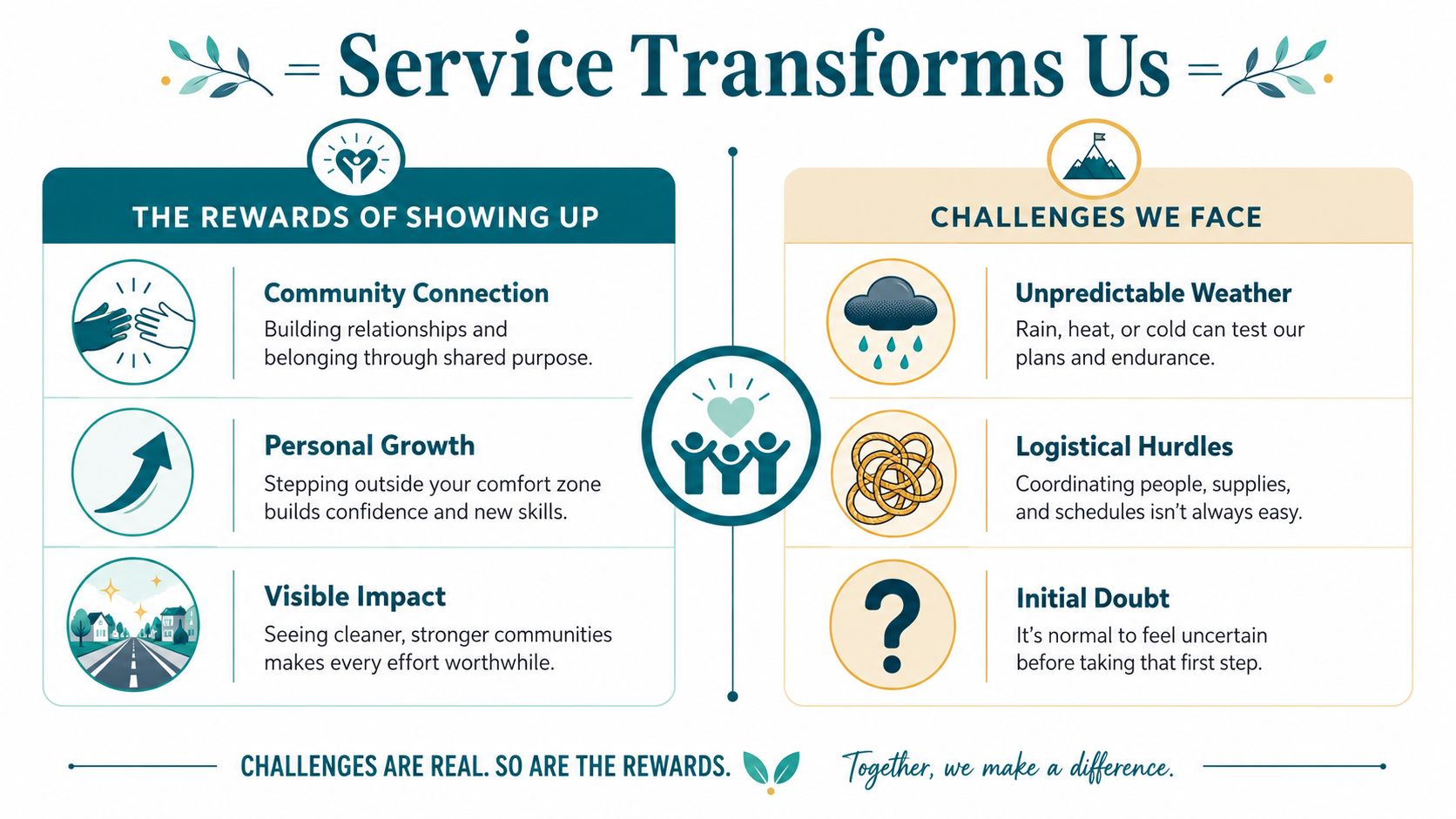
Indoor volunteer work matters. Meals, hospitality, setup, administration, all of that counts. But outdoor service has a different feeling.
You can't fake it on a sidewalk. A bag fills up or it doesn't. A block looks cleaner or it doesn't. You meet weather, mess, inconvenience, and your own resistance all at once. Then you work anyway.
That kind of service strips away a lot of fluff. It gets you out of the “I support good things” posture and into “I bent down and picked that up with my own hand.” For people who are restless, skeptical, young, new to the city, or tired of talk, that matters.
What this could look like near Armitage
If I were sketching a practical model for St. Teresa of Avila Chicago, I wouldn't start with a giant program. I'd start small and visible.
- A monthly neighborhood cleanup after Mass: One hour. Gloves, bags, simple route, clear meeting point.
- A student-and-neighbor team: DePaul students and longtime parishioners working side by side changes the social chemistry fast.
- A prayer-to-action rhythm: Gather, receive a short blessing, head outside, clean the block.
- A recurring invitation for newcomers: The easiest way to meet people is to have a job together.
You don't need complicated branding for that. You need consistency.
A church says what it believes with its calendar almost as much as with its sermons.
Why this fits the parish better than people might assume
The namesake of the parish was a reformer. The parish itself talks about care, faith, and welcome. A neighborhood cleanup is one of the simplest ways to make those words solid.
I'm not talking about replacing worship with activism. I'm talking about letting worship spill onto the sidewalk. If a church says “serve the Poor,” then cleaner streets, safer paths, and shared labor in public view are one honest way to say it with your body.
And there's another gift in it. Outdoor service creates friendships with less awkwardness. People who hate small talk often do great with a trash grabber in hand because the work gives the conversation somewhere to stand. You don't have to invent connection from scratch. The task does part of the work for you.
The courage piece
Every service project has a small wall at the beginning. Weather might be bad. Turnout might be uneven. Somebody might feel silly. Somebody always does.
But neighborhoods rarely change because everyone felt perfectly ready. They change because a few people decided that visible care was better than private approval.
That's why this question matters to me: if St. Teresa of Avila in Chicago wants social justice to feel tangible, what would happen if the parish treated the block outside as part of its ministry?
I think a lot of people are waiting for someone to ask that out loud.
Show Up and Transform Yourself
I've seen people change when they stop waiting for the perfect mood and just show up. You can watch it happen in tiny ways. A stiff face relaxes. A shy person starts joking. Someone who came alone leaves with plans for coffee.
That's why I keep coming back to the power of a weekend habit. According to Litter Caterpillars' own explanation of its volunteer schedule, the group intentionally places events on Saturday or Sunday mornings to attract “givers” and build a community around service, kindness, and friendship. I like the bluntness of that. Your calendar is a filter. It shapes who you become.
Start smaller than your excuses
Maybe your version of showing up is simple. Visit St. Teresa's one weekend. Sit in the back if you want. Stay for a few minutes after. Learn the feel of the room.
Maybe your next move is service. If that's you, this guide on how to start volunteering is a good nudge because it treats action like a thing you can begin before you feel fully ready.
I think of Tom Sawyer and the fence. Work changes when you stop treating it like punishment and start treating it like participation in a story. The block needs care. Your life probably does too. Sometimes the best way to begin fixing your own scattered heart is to help clean one corner of your city.
You don't need a grand plan. You need one honest morning.
If you want a simple way to meet kind people and do visible good in Chicago, check out Litter Caterpillars. Show up for one cleanup, bring gloves if you have them, and let the city introduce you to a better version of yourself.