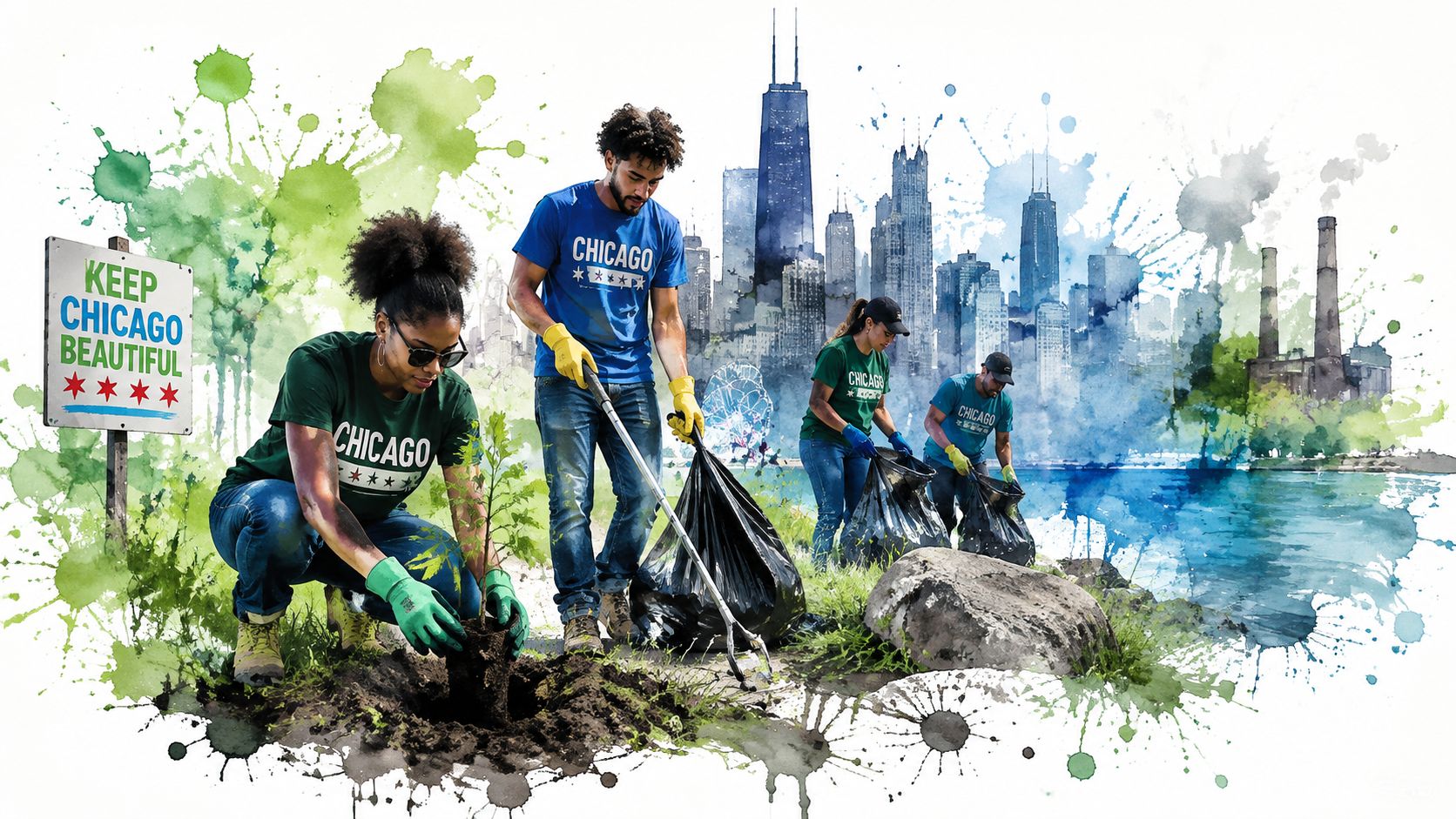
The contractor bag split open beside the alley at 63rd and King Drive, and a dozen fast-food wrappers skittered under a parked car. I tied it shut again, then went back for the syringe near the fence.
Why I Started Picking Up Trash Where Others Won't
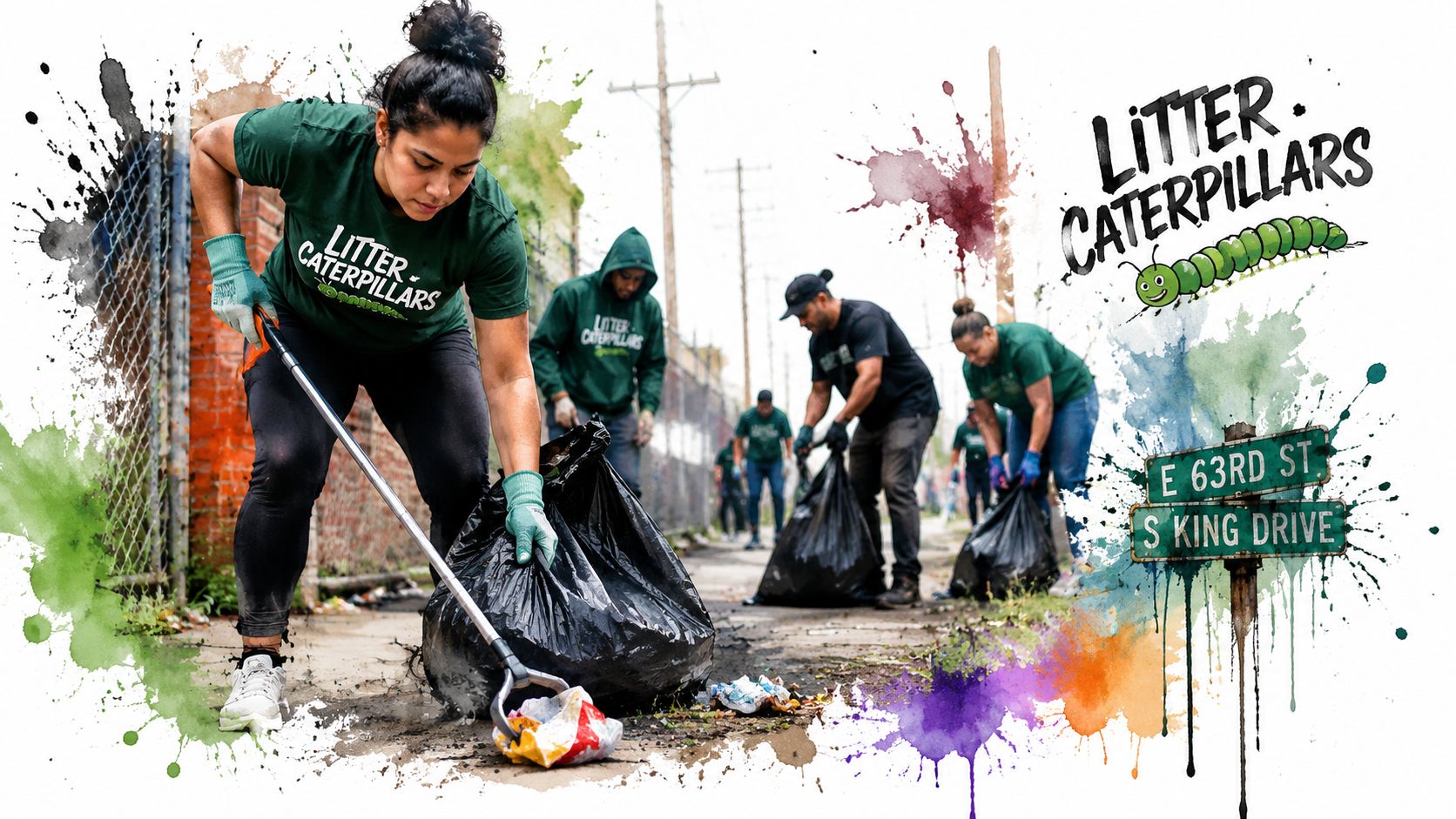
I spent that Saturday morning with the Litter Caterpillars, working through an alley on Chicago's South Side. We filled bags with wrappers, bottles, broken plastic, syringes, and black grit from worn tires. A child pulled a small wagon behind us. An older neighbor watched from her porch, then came out with gloves of her own.
The alley told a story before I opened a city map. Industry and heavy traffic had pressed close to homes in many South and West Side neighborhoods. Residents saw the residue, the overflowing corners, and the places where people dumped waste. Official reports counted some of those conditions through different measures, often one pollutant or one permit at a time.
That gap stayed with me. A clean block can still carry invisible exposure, and a block with litter can also sit near traffic, industrial activity, or missing air monitors. Picking up trash became my way into the larger question: who gets clean air, safe streets, shade, parks, and a real voice in decisions about land?
What the bags can and can't tell us
A cleanup gives me immediate work. I can remove a tire, clear a drain, or make a corner safer to walk past. It can't tell me what a child breathes each day, whether a proposed facility will add pollution, or whether a neighborhood has enough monitors to measure that exposure.
That's why I use weekly cleanup work as a starting point, not a complete answer. The Litter Caterpillars and similar crews let us connect gloves-on service with neighborhood data, public meetings, and resident demands. In this guide, I'll move from South and West Side sidewalks to Chicago's history, maps, health pressures, and practical ways you can join the work.
What Environmental Justice Actually Means in Chicago
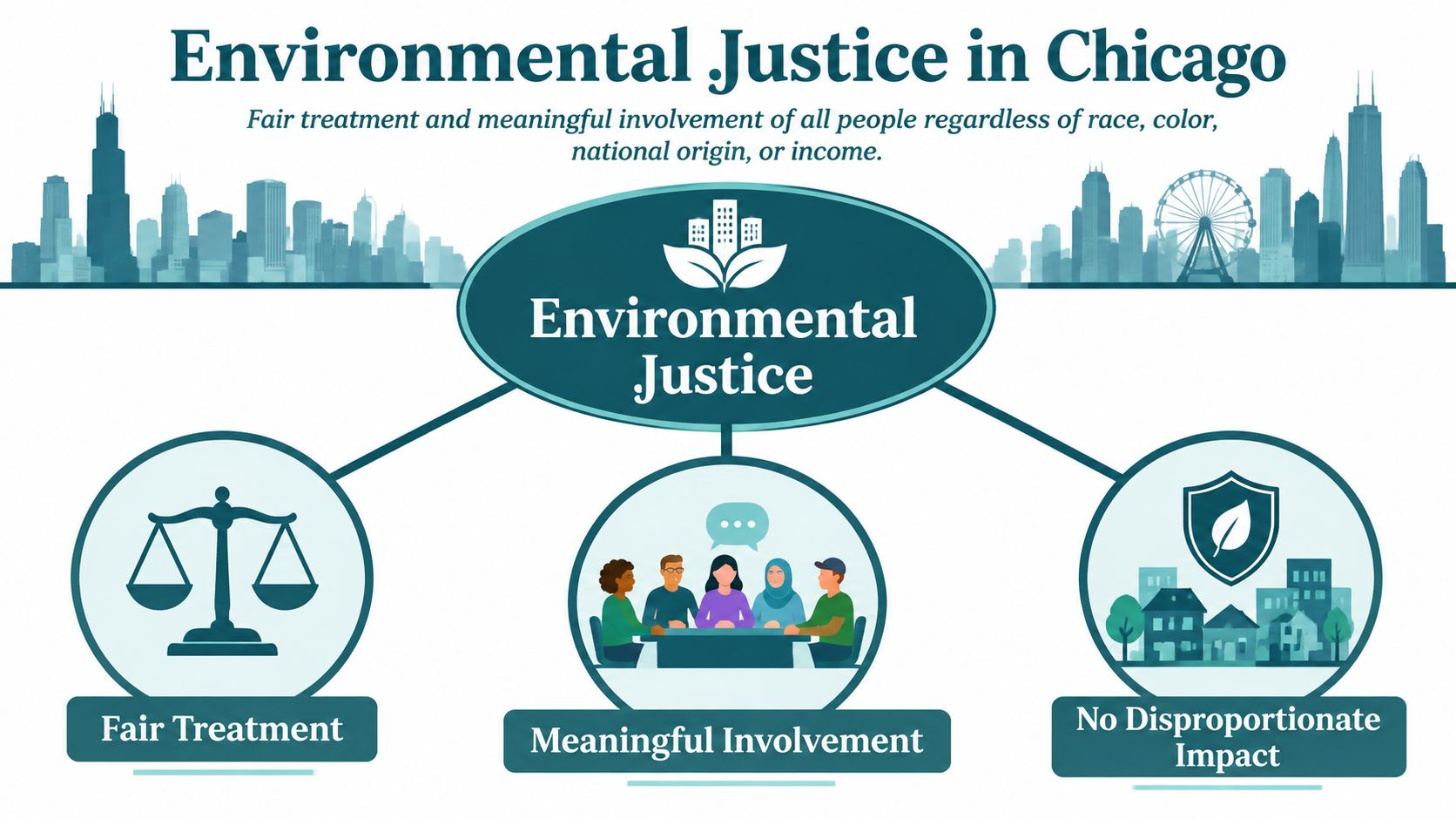
Environmental justice asks a direct question: does every community receive fair treatment and meaningful involvement when officials make environmental decisions? Chicago's Executive Order 2023-3 defines fair treatment as making sure no group carries a disproportionate share of harmful environmental consequences or receives an unfairly small share of environmental benefits. It also calls for meaningful involvement by all people, regardless of race, color, national origin, or income, in environmental laws, regulations, and policies. Chicago's Executive Order 2023-3 sets out that framework.
I think about a coffee cup on a kitchen table. One spill takes a towel. A second spill lands beside it. Then someone keeps placing cups on the same corner, and the wood starts to swell. Cumulative impacts work the same way. Traffic, industrial emissions, flooding, limited green space, and social stress can pile up in one neighborhood even when each decision looks small by itself.
Environmental equity often means distributing benefits and burdens fairly. Environmental justice goes further. It asks who made the decision, who had a chance to speak, whose knowledge counted, and whether officials considered the full load already carried by a place. Chicago's Environmental Justice Action Agenda and Just Transition framework fit that wider view, while Illinois law uses data to define Environmental Justice Communities for decisions about pollution and permits.
For a plain explanation of the term, see what environmental justice means in Chicago.
Two sentences for a town hall
“Please evaluate this proposal alongside the pollution and vulnerability already present in our census tract. Residents need meaningful involvement before officials approve a decision that could add another burden.”
Those words keep the conversation grounded. You don't need to memorize legal language. You need to name the existing conditions, ask for cumulative review, and request a clear public process.
Mapping the Neighborhoods That Carry the Heaviest Burden
On a Saturday cleanup, I can cross a street and see the difference. One block has traffic rumbling past homes. Another sits beside an industrial corridor, a vacant lot, or a drainage problem. A citywide average can smooth over those details, so Chicago's Environmental Justice Index works at the census-tract level. It looks at pollution exposure, vulnerable populations, and socioeconomic stress together.
Chicago designates a tract as an EJ Neighborhood when it scores 75 or higher, or when it scores 70 or higher and touches a tract scoring 75 or higher. The city's methodology explains how those thresholds work.
Almost 30% of Chicago's 234 census tracts receive that designation, according to the city's cumulative-impact assessment. The highest burdens cluster on the South and West Sides. That changes how I plan a cleanup. A route near a highway or industrial corridor may call for more attention to air, traffic, and where volunteers stand, even if the litter looks no different from litter on another block.
The highest-scoring group includes South Lawndale, East Garfield Park, North Lawndale, Austin, West Englewood, Englewood, Greater Grand Crossing, and Riverdale. Industrial corridors, former Stock Yards activity, scrap yards, sewage plants, metal work, coke and asphalt operations, and the I-57 corridor help explain the clusters. The Northeastern Illinois environmental map helps connect a Saturday's block-by-block work with the wider regional geography.
A street-level reading of the map
| Community Area | Dominant Pollution Sources | Top Health Pressure |
|---|---|---|
| South Lawndale | Industrial corridors and heavy traffic | Air pollution exposure |
| East Garfield Park | Traffic and nearby industrial activity | Cumulative exposure |
| North Lawndale | Traffic and industrial corridors | Air quality burden |
| Austin | Major roads and commercial activity | Exposure combined with social vulnerability |
| West Englewood | Traffic and corridor activity | Cumulative health stress |
| Englewood | Industrial and traffic-related sources | Air pollution burden |
| Greater Grand Crossing | Highway and industrial corridor pressure | Fine-particle exposure |
| Riverdale | Industrial sites, sewage facilities, and I-57 traffic | Multiple overlapping exposures |
The table makes a complicated index easier to read, but it cannot replace local knowledge. A resident knows which gate stays open, which truck route rattles windows, and which vacant lot floods after rain. I bring that knowledge back from the cleanup, then use the map to place it in public planning.
How Chicago Became the Birthplace of This Movement
Hazel Johnson started with what she could see around Altgeld Gardens and nearby South Side neighborhoods. She found severe pollution problems and connected those hazards to racial inequity. In 1979, she founded People for Community Recovery, according to the organization's history of community environmental justice work.
Johnson didn't begin with a polished policy vocabulary. She began with neighbors living near pollution and asking why their health and surroundings received so little protection. By 1985, People for Community Recovery had pressured the city to install water and sewer lines in Maryland Manor, a small development for elderly and low-income Black residents. That local win showed how a resident group could turn a neglected basic service into a public demand.
From Altgeld Gardens to federal policy
Chicago organizers helped connect neighborhood conditions with the language of environmental racism. In 1994, President Clinton issued Executive Order 12898, which required 17 federal agencies to address environmental justice in their work. Chicago's organizing helped place local experiences inside that federal conversation.
The work continued through groups and residents across the city, including organizers on the Southeast Side and South Side. Janice Johnson carried her mother's work into present campaigns, keeping attention on the way permitting, health, and neighborhood voice fit together.
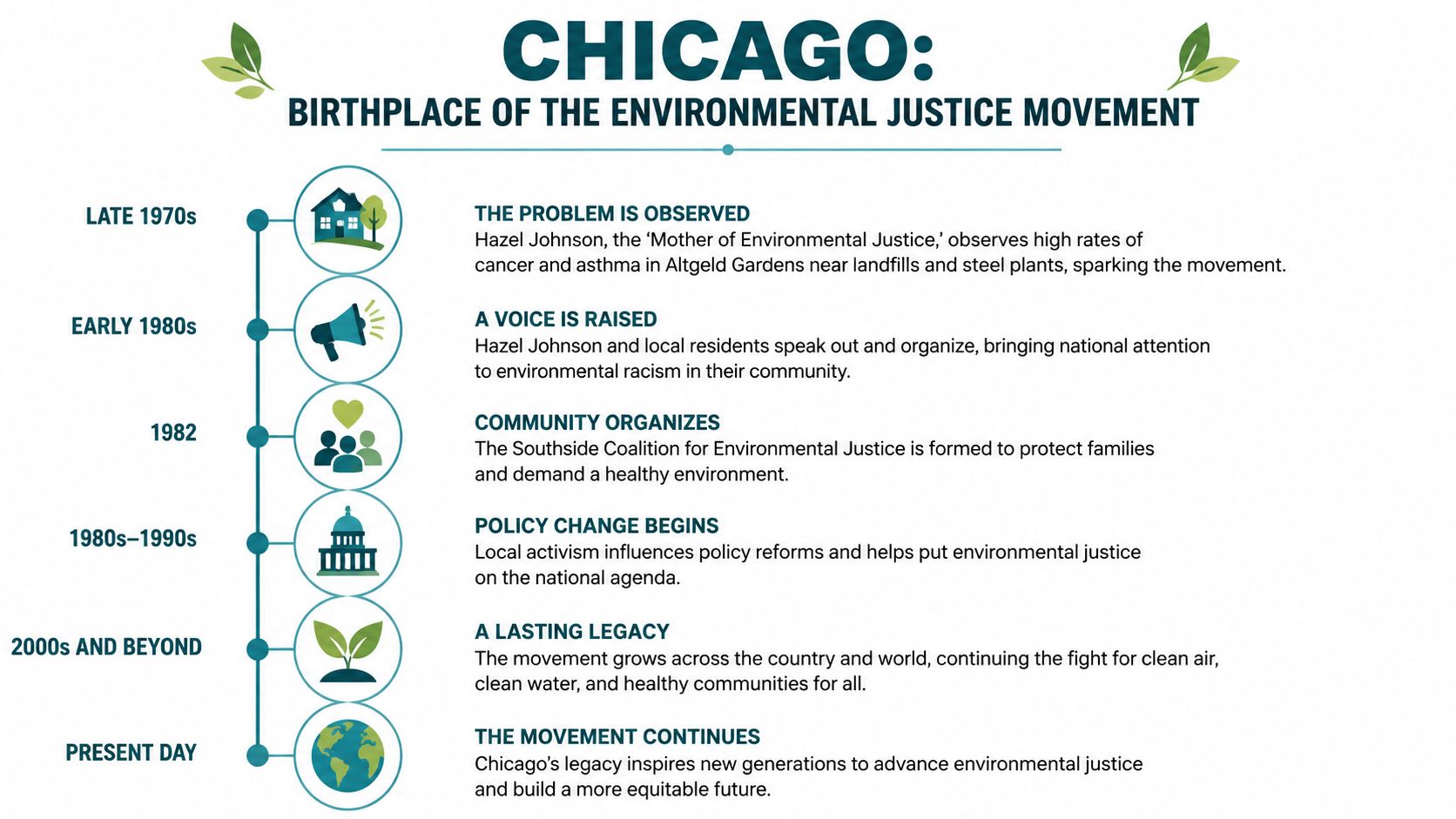
In 2025, Mayor Brandon Johnson proposed the Hazel Johnson Cumulative Impacts Ordinance. The proposal would require applicants seeking zoning permits for heavy industrial land uses to complete a cumulative impact study, then face Special Use or Planned Development review. It would also create an Environmental Justice Advisory Board to review plans and support public education, as described in the mayor's ordinance announcement.
The video below gives another way to hear the story and place current organizing beside the earlier fights.
Where Pollution, Health, and Climate Risk Stack Up
On a Saturday cleanup, I can fill a bag before lunch and still miss the pollution residents breathe every day. On Chicago's South and West Sides, a block may sit near industrial facilities, lack fine-particle monitors, and face flooding shaped by the same infrastructure that has served residents poorly. A peer-reviewed study found that more than 60% of industrial sites were in areas with the highest Social Vulnerability Index values, with a reported r² of 0.94 between industrial siting and social vulnerability. It also found that most vulnerable industrial hotspots lacked PM2.5 monitors. The peer-reviewed Chicago air-quality study records that measurement gap.
That missing monitor matters on the block. A neighbor may smell diesel, see dust, or wipe soot from a windowsill without having a nearby instrument that records fine-particle exposure. Litter Caterpillars and other cleanup groups make visible waste easier to document, while residents still need monitoring advocacy for emissions that cannot be picked up with gloves and a trash bag. You can read more on Chicago's environmental issues and how they connect to EJ before deciding what evidence to collect.
Flooding brings a second risk. The Little Calumet and Chicago Sanitary and Ship Canal corridors connect water exposure with roads, industry, and limited green space. Heat islands, legacy lead, food access, transportation, and public-health capacity also shape environmental justice. Chicago's Air Quality and Health resources publish block-group scores and indicator data, giving residents a way to examine conditions beyond smokestacks through Chicago's air quality and health data.
Read the table without false precision
Public materials do not offer one consistent set of neighborhood values for annual PM2.5 means, pediatric asthma rates, and flood-risk scores. I will not fill those cells with guesses. A fair comparison asks whether each measure covers the same geography, time period, and population.
| Neighborhood | PM2.5 (annual mean) | Pediatric asthma rate | Flood risk score |
|---|---|---|---|
| South Side EJ tracts | Check block-group data | Check city health data | Check local flood mapping |
| West Side EJ tracts | Check block-group data | Check city health data | Check local flood mapping |
| Southeast Side corridors | Check monitor coverage first | Check health indicators | Check corridor flood exposure |
The practical lesson is simple. When residents ask for a new permit review, they should bring the whole record: monitor gaps, traffic, flooding, health indicators, and green-space conditions. A cleanup log can help start that record, connecting what we see on one corner with the cumulative impacts affecting the wider neighborhood.
How You Can Plug In and Make a Difference
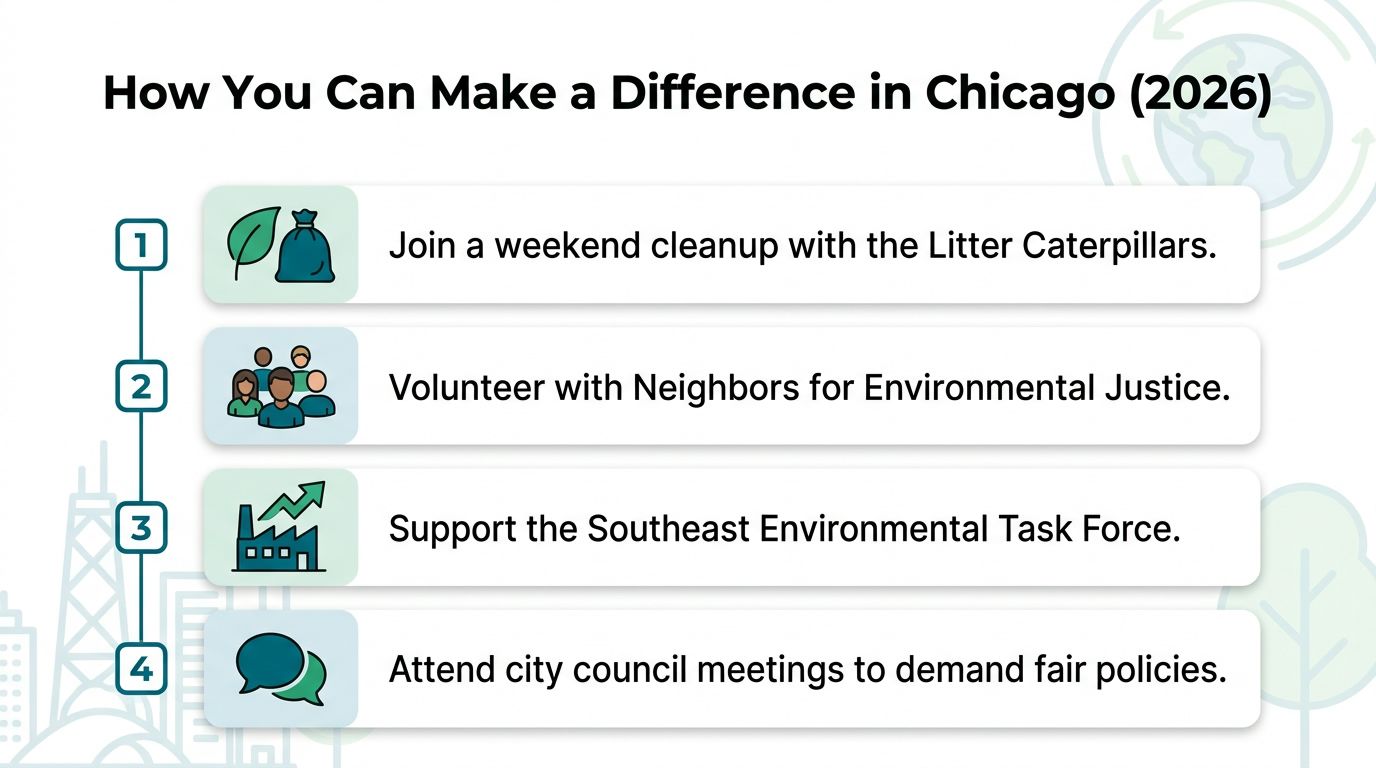
I've learned to start with one action that fits your Saturday, your schedule, and your comfort level. You don't need to join every campaign at once. Pick a place where you can return, learn names, and notice what changes.
Start with your block
Join a cleanup: Sign up for a weekend event with Litter Caterpillars, Neighbors for Environmental Justice, or the Southeast Environmental Task Force. Ask about gloves, sharps procedures, weather plans, and where bags go after collection.
Bring a notebook: Record the location of illegal dumping, blocked drains, truck traffic, strong odors, and damaged sidewalks. Take photographs only from safe public places, and never handle needles or unknown containers.
Return to the same route: A one-time cleanup shows what sits on the ground. Repeated visits show what comes back, which corners need lighting, and where a public agency or property owner must act.
Enter the public process
The Environmental Justice Advisory Board gives residents a place to follow city plans and public education. Check the city's meeting notices, attend EJAB meetings at City Hall, and sign up for public comment when the agenda allows it. Bring a short statement with the address, the existing conditions, the harm you're concerned about, and the action you want officials to take.
When a cumulative-impact permit application opens for public comment, read the application, share the notice with neighbors, and submit comments before the deadline. Contact your alderman and ask for support for the Hazel Johnson Cumulative Impacts Ordinance, stronger air monitoring, and meaningful resident participation.
A useful public comment has a place, a condition, and a request.
Support groups that already know the streets
Volunteer with People for Community Recovery, the Little Village Environmental Justice Organization, or the Chicago Environmental Equity Network. Each group has its own campaigns and needs, so ask whether they need canvassing, translation, research, meeting support, legal-fund donations, or help sharing notices.
You can also track the city's interactive EJ map for new permit filings. If energy costs or clean-energy access enter your neighborhood conversations, this community solar resource from Unitism can help you understand a shared-solar option before you discuss it with neighbors.
Keep one folder on your phone for meeting dates, permit documents, photos, and contact names. Organized records help neighbors move from frustration to a specific request.
Your Next Step in Chicago's Environmental Justice Story
Last Saturday, a kid pulled a red wagon beside me while we worked along a South Side block. The wagon carried water, spare gloves, and a few sealed bags. A neighbor who had never joined us before walked over, put on a pair of gloves, and asked where we should begin.
We started at the corner where wind pushed wrappers against a fence. Then we moved toward the vacant lot, checking the ground before we touched anything. Nobody solved industrial emissions that morning. Nobody rewrote a zoning rule. We did create a record of what residents faced, and we gave one more person a place to begin.
That small scene connects to the larger work. The city's cumulative-impact method gives officials a way to see overlapping burdens at the tract level. The proposed Hazel Johnson ordinance would bring cumulative review into heavy industrial zoning decisions. EJAB meetings give residents a public room for questions and testimony. People's Climate Justice Chicago agenda work places clean air, green space, flooding, transportation, and health in the same neighborhood conversation.
Choose one action and write it down
Don't leave your next step floating in your head. Put one of these on your calendar this month:
- Attend one cleanup. Choose a South or West Side route, ask about safety procedures, and show up ready to listen as well as work.
- Attend one public meeting. Find the next EJAB hearing, read the agenda, and prepare one concise question.
- Contact your alderman. Ask for support for cumulative-impact review and better air-monitoring coverage in neighborhoods carrying overlapping burdens.
Write down the date, the address, and the person you'll contact. Then tell one neighbor. Repeated block-level habits give residents the observations and relationships they need when a permit, zoning application, or public investment reaches the table.
Chicago's environmental justice story continues through the 2026 election cycle, the next EJAB hearing, and ongoing fights around industrial corridors. I can't predict which proposal will arrive next or how officials will respond. I can say what helps: residents who read the map, protect one another during cleanups, document conditions, speak at meetings, and return after the meeting ends.
The kid with the wagon may remember the bags. The first-time volunteer may remember a neighbor learning their name. I remember the corner looking different because several people decided that it belonged to all of us. Choose one action, write it down, and bring someone with you.
Litter Caterpillars organizes volunteer trash pickups and neighborhood cleanup events across Chicago, giving you a practical way to connect block-by-block service with environmental justice work. Visit Litter Caterpillars to find a weekend cleanup, meet other residents, and take your next step.