
You feel that nudge, don't you? A quiet but persistent pulse telling you to do something real for Chicago. I know it well. Becoming a chicago food bank volunteer is one of the most direct ways I’ve found to answer that call, turning my time into a full table for a neighbor.
Why This Work Actually Changes Everything
I know that feeling. It’s a deep pull, a yearning to connect with your city beyond just living in it, to be a participant, not a spectator. It's the same energy that grabbed me and pulled me into community work years ago. This isn’t about checking off a "good deed" box; it's about answering an inner summons.
When you sign up for a shift at a food bank, you make a conscious choice. You choose to be the reason a family gets to sit down together for a meal tonight. You become the hands that bridge a gap too wide for some to cross alone.
From One Person to a Citywide Movement
Your single act of showing up is a stone tossed into Lake Michigan. The ripples spread, touching lives in neighborhoods you might never even visit, spreading outward in unseen waves of impact. You aren't just sorting cans. You aren’t just packing boxes. You are weaving resilience into the very fabric of our city.
I remember my first shift. My stomach was a knot of nerves. I had no idea what to expect. But within minutes, I found myself shoulder-to-shoulder with strangers who felt like teammates, our focus narrowed to one simple, powerful goal. The energy was electric, a shared current running through us all.
Your time is the fuel that powers Chicago’s fight against hunger. It’s not just about the food; it’s about you and me showing up for each other, proving this community takes care of its own.
This collective effort creates a staggering impact. Think about the Greater Chicago Food Depository—every year, more than 25,000 volunteers like you and me put in nearly 100,000 hours of service. Our work gets over 7 million pounds of food repacked and out the door. That's millions of meals. You can read more about the vital role of volunteers on their site to see how it all adds up.
Tying Your "Why" to the Work
What really matters is the "why" that brought you here. Are you moved by a desire to fight injustice? Do you crave a real connection with people? Or is it just a simple, powerful urge to help?
Hold onto that reason. It's the engine that transforms a few hours of your time into something monumental.
- You're giving hope. For a family struggling, a box of groceries is a lifeline. It’s breathing room. It’s a moment of peace.
- You're building community. When we serve together, we build trust. We tear down the invisible walls that separate us.
- You're changing yourself. You will walk away different, with a clearer sense of your own power to make an impact.
Becoming a Chicago food bank volunteer isn't just about what you give. It’s about who you become in the process. You are stepping up to be part of the solution, one shift at a time.
Alright, you’re fired up and ready. But in a city as huge as Chicago, finding the right place can feel like searching for a specific face in a packed L train. It’s not just about finding an opening; it’s about finding your opening. Let’s find the spot where you don’t just show up, but where you truly belong.
Think of it like choosing your spot at a Cubs game. Do you want to be in the bleachers, part of a massive, loud, energetic crowd? Or do you prefer a seat closer to the action, where you can see every play up close?
The big players, like the massive Greater Chicago Food Depository, are the bleachers. They are incredible, well-oiled machines. I’ve volunteered at their repack shifts, and the sheer scale is mind-blowing—you’re part of a huge team making a dent in hunger on an industrial level. It's fast, loud, and you can physically see the pallets of food piling up around you.
But the real heart of Chicago often beats on the side streets.
Discovering Neighborhood Gems
Tucked away in church basements and small storefronts, you'll find hundreds of local food pantries. These places serve their immediate blocks with a fierce, personal dedication. They know their neighbors by name. The St. Cyprian food pantry in Dunning is a perfect example of this.
Volunteering at a smaller spot is a completely different vibe. It’s intimate. You’re not just packing a box; you might be having a real conversation with the person you’re helping. It’s less about the massive numbers and more about that direct, human connection. So, how do you find these hidden spots?
- Go hyper-local with your search: I want you to forget generic terms. Try "food pantry near me" or "volunteer [your neighborhood] food bank." This will turn up places you walk by every day and never noticed.
- Check the old-school spots: Look for flyers at your local library, coffee shop, or even your alderman’s office. I've found these places are still the central nervous system for community action.
- Just walk around your block: Seriously. I have discovered some of the most dedicated, under-the-radar organizations just by being curious about a sign on a church door in my own neighborhood.
Choosing where to be a Chicago food bank volunteer is a gut-check moment. Ask yourself: Do I want the energy of a huge team, or the quiet connection of a small one? There’s no wrong answer, only what’s right for you.
Matching Your Vibe and Your Schedule
Finding the right fit also means being brutally honest with yourself. Can you actually commit to a weekly shift every Tuesday morning, or is a one-off Saturday thing more your speed? Most places have online sign-up calendars where you can see every available slot. If you want to cast a wider net, our guide on the best volunteer opportunities in Chicago has even more ideas for you.
Your personality matters, too. Some roles are all about being on your feet and interacting with people, while others are more focused and behind-the-scenes. I want you to think about what kind of work will leave you feeling energized, not drained.
To give you a better idea, here's a quick breakdown of the most common jobs you'll find. Think about which one sounds less like work and more like you.
Common Chicago Food Bank Volunteer Roles
| Volunteer Role | Typical Tasks | Best For You If… |
|---|---|---|
| Warehouse Repacker | I've sorted bulk food donations, packed boxes, and labeled cans. | You love a fast-paced, physical task and the energy of a big team. Great for audiobook or podcast lovers. |
| Pantry Distributor | You'll greet guests, hand out groceries, and help people "shop" for their items. | You're a people person who enjoys direct interaction and making others feel welcome and respected. |
| Delivery Driver | I've seen volunteers transport food from a central hub to smaller, local pantries across the city. | You enjoy driving, know the city's streets, and prefer working more independently. |
The goal here isn't to just fill a slot—it's to find a role that lights you up. When you match what you’re good at with what the community needs, you’re not just helping out. You’re bringing your best self to the table, and that’s an impact that lasts.
What Your First Volunteer Shift Will Really Be Like
I get it. That little knot in your stomach before your first shift is real. You're probably wondering what it's actually going to be like. Will I know what to do? Will I just get in the way? I have been there, and I’m going to pull back the curtain for you.
Forget any ideas about being thrown into chaos. These places are like a well-rehearsed play, and the shift supervisor is your director for the day. Their job is to get you up to speed and put you right where you're needed most.
From Arrival to Action
The moment you walk in, you’ll sign in, get a quick lay of the land, and meet the other folks you’ll be working alongside. The energy is usually upbeat and focused. We’re all there for the same reason—to get things done.
You won't be left to figure things out on your own. The first few minutes are all about orientation. I’ll walk you through it: you’ll learn the basic rules (like how to safely lift boxes), get your specific task for the shift, and have a chance to ask any last-minute questions. It’s a smooth process, and you’re a key part of it for the next few hours.
This simple path from finding an opportunity to joining the team on the floor is designed to be straightforward.
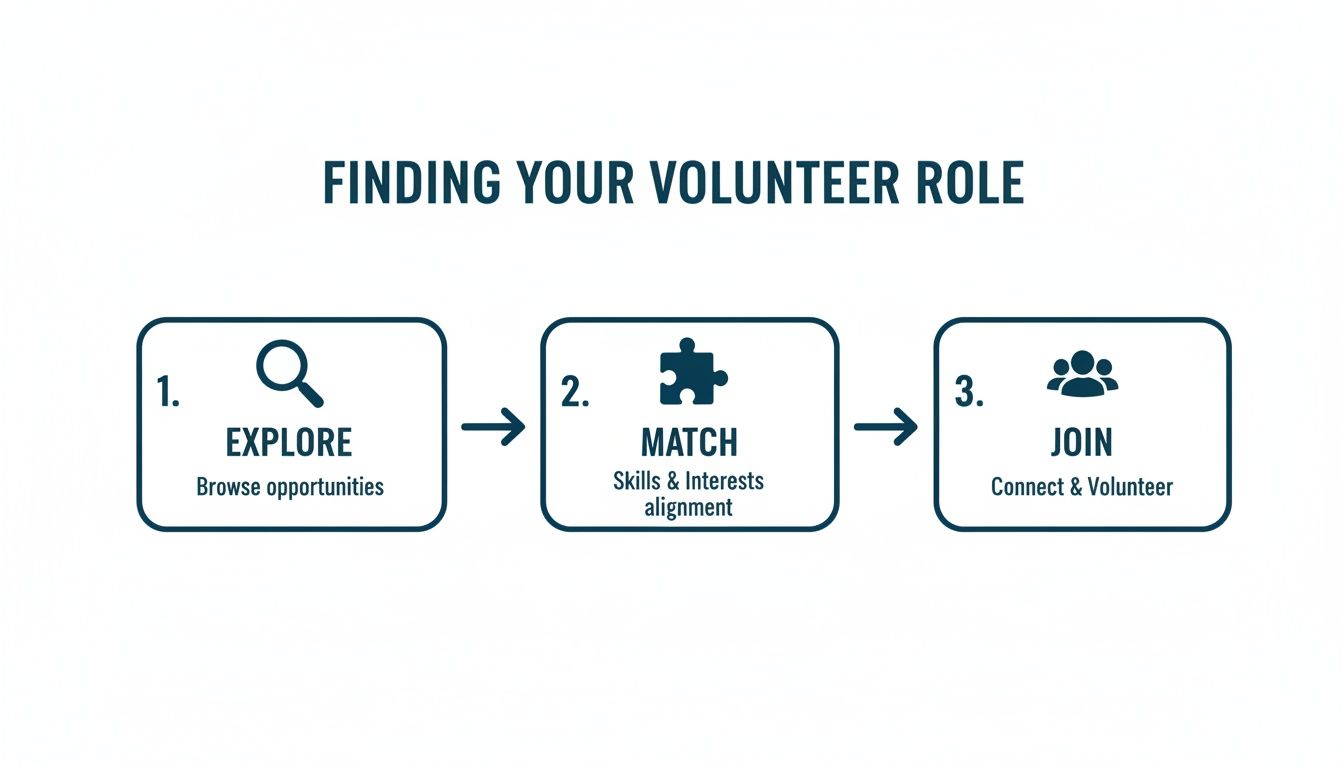
By making it easy for you to find a role that fits, you show up for your shift ready to make a real impact from the get-go.
What You'll Actually Be Doing
Your job for the day depends entirely on the immediate need. A typical chicago food bank volunteer shift could have you doing any number of things:
- Repacking Bulk Foods: You might find yourself on an assembly line, transforming giant bags of rice, pasta, or oats into smaller, family-sized packages. I've done this many times; it's rhythmic and satisfying.
- Sorting Donations: This is like a treasure hunt with a purpose. You’ll be checking expiration dates and sorting canned goods, fresh produce, and other groceries into the right bins.
- Building Emergency Boxes: This is where you assemble pre-packed boxes with a variety of staple foods, getting them ready to ship out to local pantries like the one at Casa Catalina. You can learn more about their work here.
The work is tangible. I love that you can physically see the results of your effort as the pile of unsorted donations shrinks and the pallets of ready-to-go boxes grow taller.
You're not just moving food around a warehouse. You’re moving hope. Every single box you pack is a direct lifeline to a family, a senior, or a child in our city.
This is especially true as food distribution evolves. For instance, I've watched initiatives like Chicago's Community Kitchens work to distribute up to 10,000 prepared meals every day. And now, 32 percent of all food distributed is fresh fruits and vegetables. Your hands-on work is what makes this push for healthier, more dignified food access a reality.
The hours will fly by. Before you know it, the shift manager will call out the final tally—how many pounds of food you sorted or how many boxes you packed. It’s a moment of shared victory with people who were strangers just a few hours before. You’ll leave tired, but you’ll also leave full, knowing you didn’t just spend your time; you invested it.
Think Outside the Box: More Ways to Fight Hunger
So, maybe the fast-paced warehouse shift just isn't your vibe. Or maybe your schedule is as unpredictable as Chicago weather in April. That’s more than okay. The most important thing you bring to this is your will to help.
Fighting hunger is not a single-lane road; it's a giant highway with on-ramps everywhere. If packing boxes feels like a bad fit, I want you to know there are tons of other ways to be a chicago food bank volunteer. It's all about finding the role that just clicks for you.
Your Skills Are a Superpower
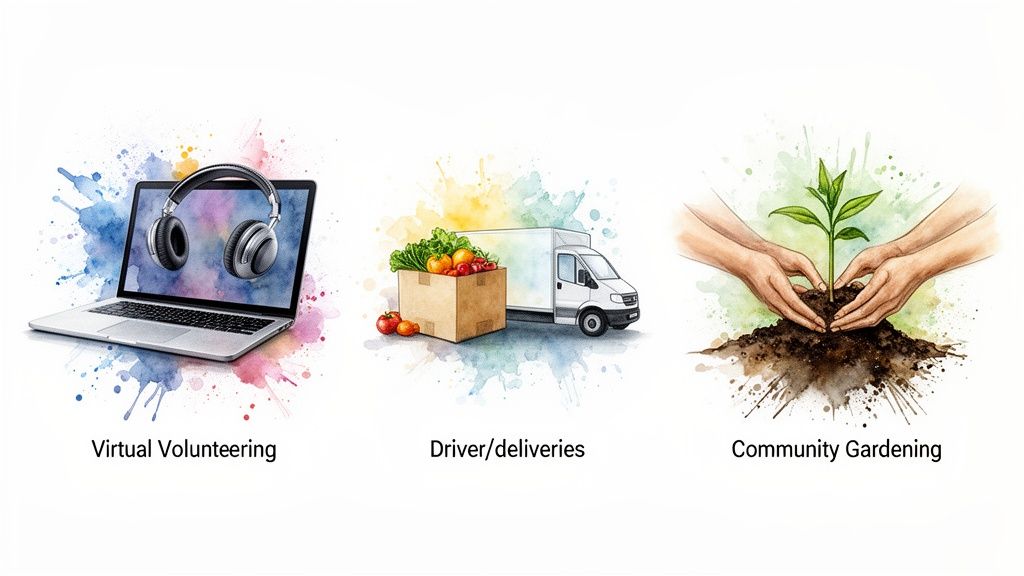
Seriously. Your professional talents are a secret weapon. Are you a wizard with spreadsheets? A creative genius with graphic design? A wordsmith who can tell a compelling story? I've seen firsthand how desperately food banks need these skills, and you can often contribute right from your own couch.
It’s a different kind of impact, but it’s huge. Think about it:
- Data Entry: You could be the person organizing volunteer lists or donation records from home, creating order from chaos.
- Grant Writing: Your writing could be the very thing that secures thousands of dollars in funding for an organization.
- Social Media: You could design a single post that brings in a flood of donations for a food drive.
This is the behind-the-scenes work that keeps the whole operation moving. It’s like being the mission control for the rocket ship. While others are on the front lines, you're the one drawing the map that gets everyone where they need to go. You’re using your brain to tackle a massive problem.
Hit the Road or Dig in the Dirt
If you’d rather be out in the world but still want something different, there are some incredible options. Do you love driving and seeing the city? Volunteer drivers are the unsung heroes of this whole thing. I’ve heard stories from guys like Thomas LeClair, who’s put in hundreds of hours and says he meets the “most beautiful people” delivering food across Chicago. It's a way you can feel the real pulse of the city, one delivery at a time.
Sometimes the most powerful work happens far from the main building. Your car can become a vehicle for hope. Your voice can become an engine for change.
Or maybe you’re someone with a green thumb. I’ve seen urban farms and community gardens that supply fresh produce to food pantries, and they are always looking for help. Imagine spending a morning tending to basil and parsley, knowing it will end up on someone’s plate that very week.
It all connects. When we take care of our communities—whether I’m delivering food or you’re beautifying a public space—we’re building a sense of pride and wellness that goes hand-in-hand with food security. You can even see how different acts of service add up by exploring other charities in Chicago and finding your fit. Every small act gets us closer to a stronger Chicago.
From One Shift to Part of the Family
You finish that first shift. You’re tired, your back might be a little sore, but you’re buzzing. It’s a good feeling—a real, earned sense of purpose.
But that buzz from one shift? It’s just the ignition. The real magic happens when you decide to come back. That first time is a spark. Consistency is what builds the fire that keeps a community warm.
Making It Your Thing
I remember feeling that pull. That feeling that once wasn't enough. I needed to make my chicago food bank volunteer work a regular thing. The first real step was simple: I put it on my calendar. I treated it just like a doctor's appointment or a meeting with my boss.
It became “my Tuesday morning shift.” It was no longer a question of if I was going, but when.
This is how a good deed transforms into a habit of service. This is how you go from just helping out to being part of the bedrock of the organization. It's like a single drop of water, which does little, but a steady drip over time can carve stone. Your consistent effort has that same power.
This isn't just a nice thought; it’s how massive change happens. Look at the Greater Chicago Food Depository. They went from distributing 500,000 pounds of food in their first year to 11.2 million pounds just four years later. That’s what a dedicated, volunteer-driven effort does. You can see how that grassroots fire started by learning about the Food Depository's early history.
Finding Your People
Then something else starts to happen. As you keep showing up, the faces you see every week stop being strangers. They become your crew.
You start to learn their stories. You meet the retired firefighter who tends the hydroponic garden. You meet the flight attendant who’s a natural at guiding new volunteers. You meet the group of college friends who make packing produce boxes their weekly catch-up.
You don't just find a place to volunteer; you find your tribe. You find the people who share your commitment to showing up for Chicago, and together, you become an unstoppable force.
This is what keeps you coming back, even on those mornings when you’re tired or the weather sucks. You’re not just accountable to the mission anymore. You’re accountable to each other.
Here’s how you make that happen:
- Stick to the same shift. If you can, try to sign up for the same day and time. That's how I built connections with a core group of regulars.
- Just be open. Ask people their names. Share a little about yourself. I’ve made some of my closest friends in this city just by starting a conversation over a pallet of potatoes.
- Learn the ropes. Once you're a regular, people start to trust you with more. Maybe you’ll train newcomers or take the lead on a specific project. This is you, growing from a helper to a leader.
Before you know it, volunteering stops being something you do. It becomes part of who you are. You start seeing Chicago not just as the place you live, but as the community you are actively building, one shift at a time.
Got Questions? Let's Get Real.
It's normal to have a million questions running through your head before your first shift. I’ve been there. You want to show up and do a good job, not get in the way. Let’s cut through the noise and get you some straight answers based on what I've seen and what I hear other first-timers ask all the time.
Am I Too Young (or Old) for This?
Every place is different, but most have a spot for you. Big operations like the Greater Chicago Food Depository are amazing—they often welcome volunteers as young as 11 as long as an adult is with them. I've seen it myself, and it's an incredible thing for a kid to witness that kind of impact firsthand.
Smaller neighborhood pantries might need you to be 14 or 16 just because of the work or the size of their space. The golden rule is simple: just check the volunteer description before you sign up. They're always crystal clear about age.
Can I Bring My Friends?
Heck yes! Volunteering with your crew is one of the best ways I know to do it. It stops being a "shift" and starts being a bonding experience. I’ve seen corporate teams, high school clubs, and just groups of friends have an absolute blast sorting food and making a difference together.
Most food banks love groups and have a separate sign-up for them. One piece of advice I can give you: plan ahead. Those group spots, especially on weekends or near the holidays, get snatched up months in advance.
The most important skill you can bring to a Chicago food bank is a good attitude and a real willingness to help. I can teach you everything else you need to know in five minutes.
Do I Need Any Special Skills?
For 99% of the roles, you don't need any special skills. I'm serious. The work is designed for everyday people like you and me to show up and get it done. Your most powerful tool is your willingness to just be there and help.
You'll get a quick orientation at the start that shows you exactly what to do, whether it's packing boxes or sorting produce. It's simple, satisfying work that adds up to something huge.
What If I Have to Cancel?
Life happens. Your kid gets sick, your boss moves a meeting, you just feel off. I get it, and so do the food banks. They rely on people like us, and they know that means being flexible.
Most places have an online system where you can cancel your shift with a few clicks. When you do that, your spot opens up for someone else who's been waiting for a chance to help. The key is to give as much notice as you can—they plan their whole day around the number of volunteers they expect. Don't feel guilty, just be courteous and cancel as soon as you know.
At Litter Caterpillars, we believe that showing up for your community—whether you’re packing food boxes or cleaning a park—is how you find your people and build a better Chicago. If you're looking for another way to serve, join us for a cleanup event and see the city change right before your eyes.