
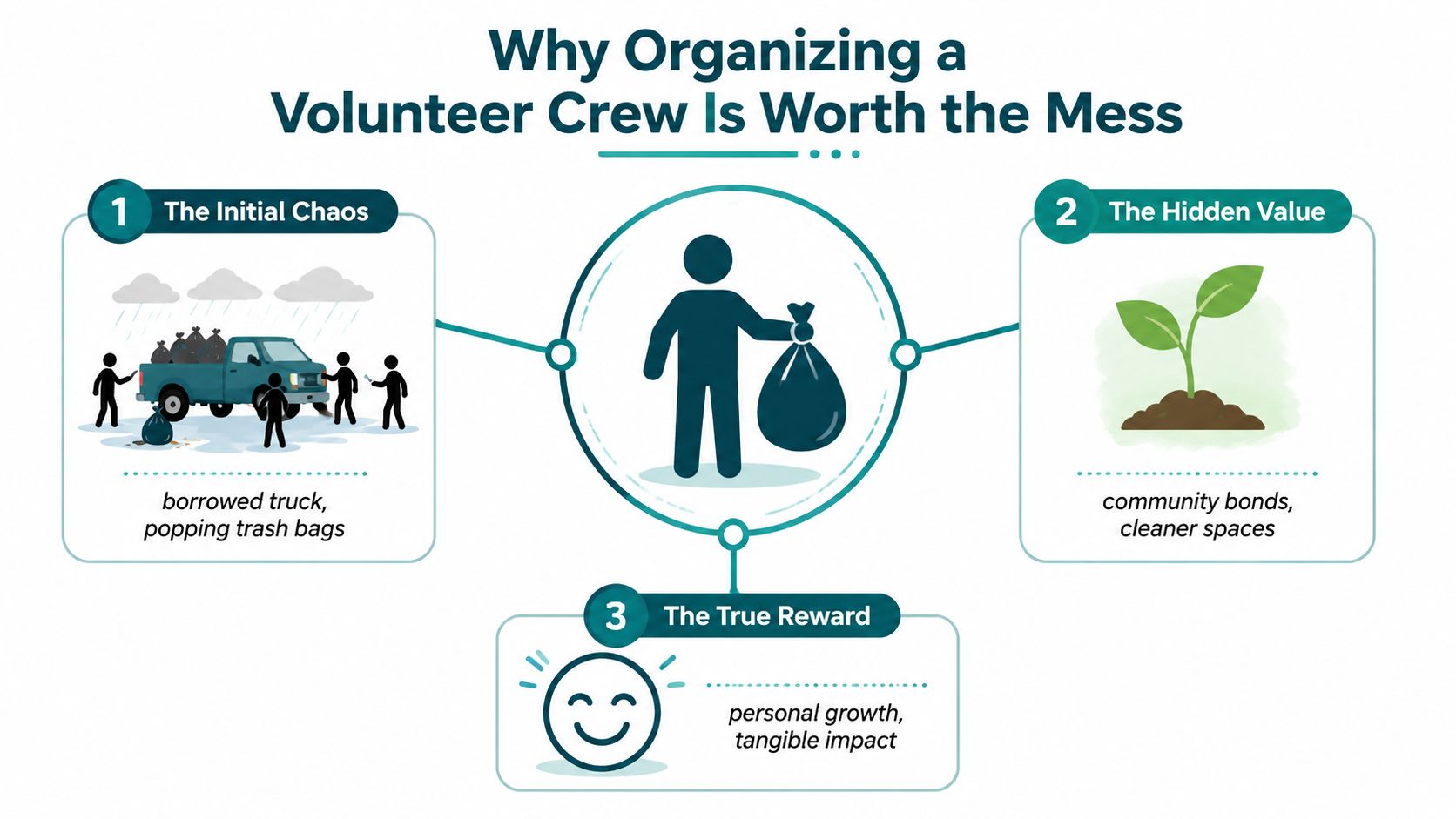
The first Litter Caterpillars cleanup had three people, one borrowed truck, and trash bags that kept popping open in the rain. We huddled under a tree while Chicago threw hail at us, then went back to picking up cans.
Three years later, we still meet every week, through heat, rain, blizzards, and the kind of wind that makes a trash grabber feel like a fishing rod. I've learned that how to organize volunteers has less to do with perfect plans and more to do with making the next Saturday easy to understand, safe to join, and worth remembering.
Why Organizing a Volunteer Crew Is Worth the Mess
That first pickup looked ridiculous. Water ran down the street, the truck bed filled with soggy bags, and every Uber seemed to cancel while we stood there shivering. Yet nobody wanted to leave empty-handed. We finished the block, loaded what we could, and took a photo that looked less like a nonprofit campaign and more like evidence from a minor weather disaster.
That's the strange wealth a cleanup crew can build. You collect cleaner sidewalks, familiar faces, small jokes, and friendships that survive bad forecasts. You also get the quiet satisfaction of seeing a filthy stretch of Chicago become walkable again. The work stays physical and ordinary. That's exactly why people remember it.
A recurring cleanup needs more structure than a casual “who wants to help?” message. A major 2023 volunteer-management survey found that 63% of nonprofits involving volunteers had a paid staff member or volunteer engagement professional managing volunteers, compared with 62% in 2003 and 65.2% in 2019. The median engagement professional spent 40% to 50% of their time on volunteer engagement in 2022, compared with about 30% in 2003. (The State of Volunteer Engagement)
That doesn't mean you need a full-time coordinator for a Saturday cleanup. It means someone needs to own the details. A named person should know who signed up, where supplies are, what the weather looks like, and who can lead a new group.
The mess teaches you what the spreadsheet misses
You'll learn why vague meeting points create wandering volunteers. You'll learn why one experienced person can calm an entire first-timer group. You'll learn why a hot drink in November can matter more than a polished slogan.
This field-tested playbook moves through the practical pieces:
- Finding the first people: Where I post, what I say, and how I lower the ask.
- Building one shift: Roles, time blocks, supplies, zones, and a clean ending.
- Protecting the crew: Safety rules, waivers, emergency contacts, and incident notes.
- Turning helpers into regulars: Onboarding, recognition, rituals, and shift leads.
- Saving your evenings: Tools, templates, and a weekly rhythm that doesn't eat your life.
If you want shirts, flags, or other identity pieces for a fundraiser, the 2026 nonprofit fundraising apparel guide from T-Shirt Envy can help you think through apparel without making it the center of the operation. Start with people, give them a clear job, and let the branding follow the friendships.
Finding Your First Volunteers and Getting Them to Show Up
Recruiting starts with a specific invitation. “Help clean Chicago” sounds noble, but it gives a stranger too many unanswered questions. Which neighborhood? What time? How long? Do I need equipment? Can I leave early?
I use Meetup for the public event page, Instagram for photos and reach, and an open group chat for last-minute details. Litter Caterpillars also describes its approach to finding and coordinating participants through a Meetup page and group chat in its guide to finding volunteers.
Give people a small first step
My event copy usually names the exact place, the exact time, and the smallest reasonable commitment. You can adapt these examples:
Meetup description
Join us at McKinley Park near the fieldhouse on Saturday at 10 a.m. We'll clean the paths and nearby sidewalk for two hours. Bring water if you have it, and come for thirty minutes if that's all you can manage. We'll provide bags, grabbers, and gloves.
Instagram caption
Saturday cleanup at McKinley Park. Meet by the fieldhouse at 10 a.m. We're picking up litter, meeting neighbors, and heading home before lunch. Come for thirty minutes or stay for the full shift. First-timers are welcome.
Neighborhood group-chat message
Hey neighbors, I'm taking a small crew to clean the corner of 47th and Wolcott this Saturday at 9:30 a.m. We'll work for about two hours, but come for thirty minutes if you can. I'll bring bags and grabbers. Reply “in” and I'll send the meeting pin.
Post early enough for people to see the invitation before their weekend fills up. Then send a direct reminder the day before. A reminder should repeat the meeting point, start time, expected duration, weather plan, and what you'll supply.
The first event may feel like shouting into a canyon. Design the event so a small turnout can still finish a real patch of ground. One volunteer with a grabber can make a morning useful. Ten volunteers can make it lively.

Invite by motivation, not by résumé
People join for different reasons. One person wants a cleaner park. Another wants weekend friends. A student needs service hours. A newcomer wants to learn the city block by block. Your message should give each person a doorway.
A 2025 volunteer-management survey identified role matching as a problem for 11.7% of organizations, alongside recruitment at 26.4% and retention at 9%. (Insight into Volunteering) I take that as a warning against one giant signup labeled “volunteer.” Write separate tasks instead: route scout, supply runner, photo helper, bag carrier, or zone captain.
Designing One Cleanup Shift From Start to Finish
A first-timer should know where to stand, what to carry, and when the work ends. If people need to decode the event while cars pass and bags blow down the sidewalk, you've already made the morning harder than it needs to be.
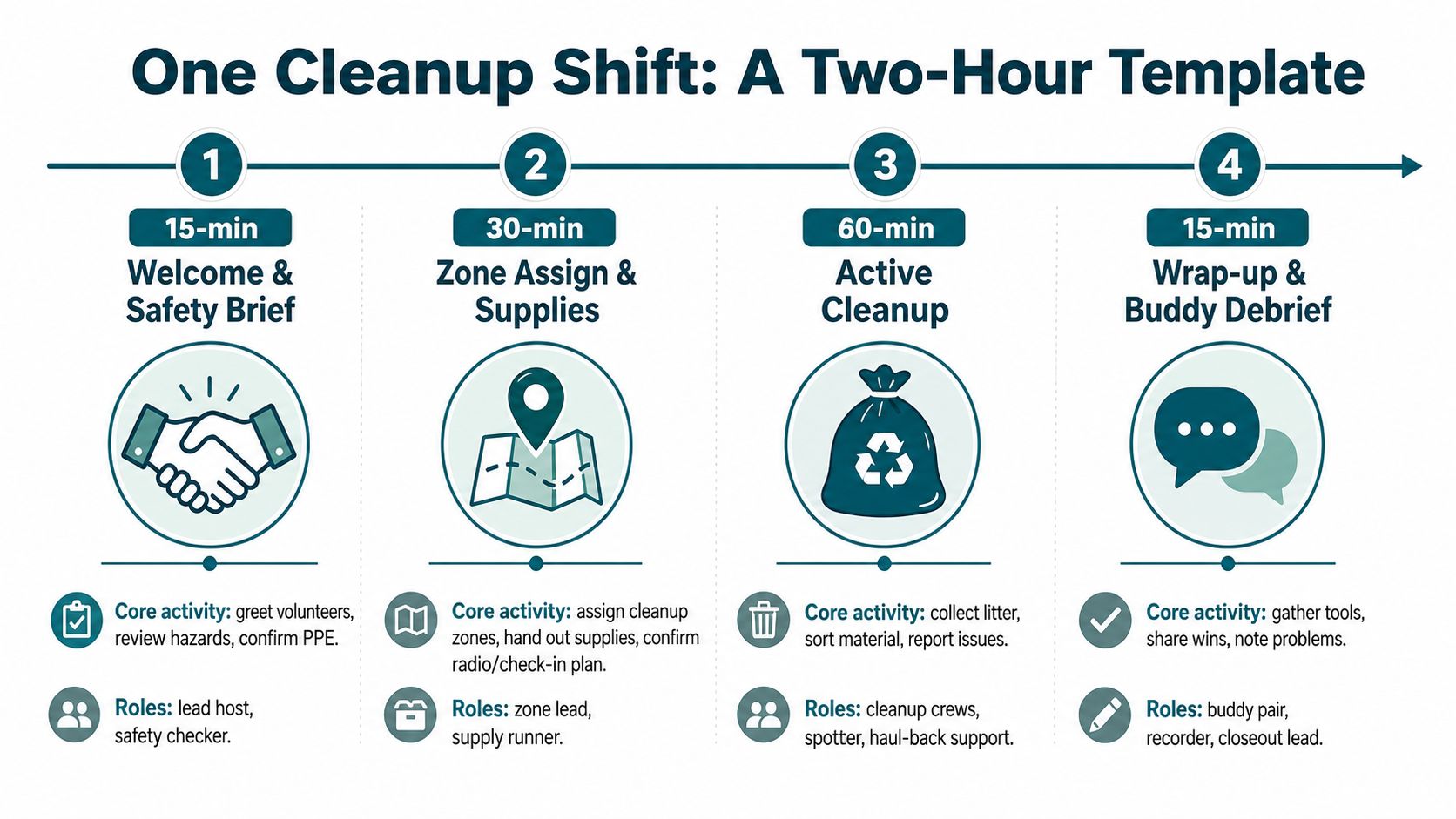
I use a two-hour shape. It gives the shift a beginning, a middle, and a finish people can remember.
A simple two-hour template
The exact breakdown can flex, but I plan the morning like this:
- 15 minutes for sign-in and safety: Welcome people, collect waivers, explain the route, point out the restrooms, and name the person handling questions.
- 75 minutes for pickup: Divide the area into assigned zones. Keep each group small enough for the captain to see everyone.
- 30 minutes for sorting and closing: Bring bags back, separate anything your local disposal plan requires, weigh bags if you track that, take a group photo, and finish with a cheer.
A source on volunteer shifts recommends defining the task, location, and duration before anyone signs up. It also recommends immediate confirmation and reminders 48 to 72 hours before a shift, with day-of nudges for critical roles. (How to Schedule Volunteers) For a recurring crew, I split the schedule by area instead of dumping every assignment into one long list.
Give every responsibility a name
Keep the core crew roles to four:
- Zone Captain: Explains the boundary, watches the group, and reports hazards.
- Supply Chief: Carries bags, grabbers, gloves, sanitizer, water, and the sharps container.
- Photo Lead: Takes the opening and closing photos, with permission from participants.
- Waiver Wrangler: Checks forms, tracks attendance, and knows the emergency contact process.
Here's my printable supply checklist:
- Heavy-duty trash bags
- Pickup grabbers
- Work gloves in several sizes
- Closed-toe footwear reminder
- High-vis vests for roadside work
- Sharps container
- Hand sanitizer and wipes
- Water and weather supplies
- First-aid kit
- Phone charger
- Printed route map
- Photo-release and emergency-contact records
Draw the zone map like a child explaining a treasure hunt. Mark the meeting point with a star, the supply station with a square, and each boundary with a thick line. Write “return here” near the finish. Nobody should wonder whether the east side of the park belongs to them.
The volunteer event planning guide can help you turn that outline into a repeatable event plan.
Practical rule: Give people a clear job, a visible boundary, and a known ending. Confusion burns energy faster than trash pickup.
Keeping the Crew Safe, Happy, and Protected From Liability
Safety comes before fun, photos, and group identity. I'd rather have one untouched pile of litter than one volunteer walking away with an injury because I rushed the briefing.
Start with rules people can understand without a legal dictionary. Closed-toe shoes stay on. Gloves stay on during pickup. High-vis vests go on near roads. Nobody reaches into a hidden pile. Nobody picks up needles, broken glass, or another sharp object by hand. The Zone Captain calls over the Supply Chief and uses the sharps container.
A volunteer policy source says people should learn about foreseeable hazardous materials, equipment, and processes before they do the work. (Volunteer safety policy guidance) I explain the hazards before the first bag leaves the supply station.
Build protection into the signup
A short Google Form can collect:
- Assumption of risk
- Emergency contact
- Photo release
- Medical information the volunteer chooses to share
- Agreement to follow the safety briefing
- Permission to receive event updates
Digital forms work better than a clipboard when rain turns paper into oatmeal. Keep the form readable, explain what volunteers should expect, and tell them how to ask questions before arrival. You can use these volunteer agreement templates from Closer Innovation Labs Corp. as a starting point, then ask a qualified professional to review language for your group and location.
A cleanup group also needs a liability plan. You might arrange volunteer insurance, work with a sponsor nonprofit, or ask a local partner to review the activity before you invite the public. The Litter Caterpillars volunteer liability insurance guide gives organizers a place to begin that conversation.
Make comfort part of safety
Chicago weather doesn't care about your event calendar. I keep a stash of high-vis vests, watch heat and storms, and give people permission to stop. If someone feels unsafe stepping into the street, that person sits out. No debate, no guilt.
In summer, shade matters. In November, hot cocoa can rescue the mood. At the end, I hold a short safety debrief and ask what felt unclear or risky. If an injury happens, I record it the same day with the date, location, people involved, what happened, and what action followed.
Turning First-Timers Into Regulars Through Onboarding and Identity
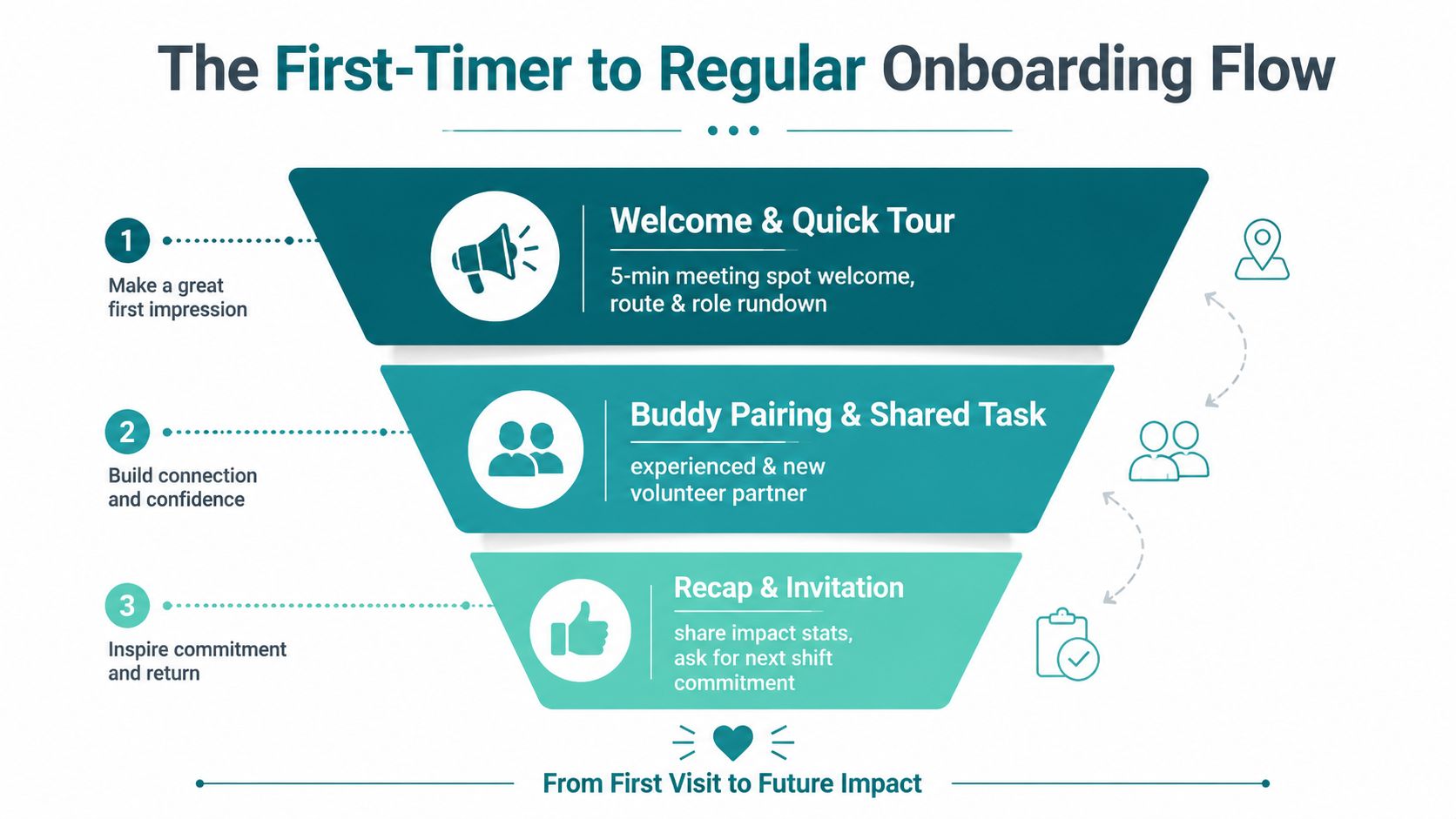
The first shift decides whether someone sees your cleanup as a friendly invitation or a confusing errand. I try to make the first five minutes feel like entering a small club with the doors already open.
I greet the new person by name, point out the meeting spot, explain the route, and give them one job they can finish quickly. Then I pair them with someone who has done a cleanup before. A new volunteer shouldn't spend the morning guessing which bag to use or wondering whether the group will notice if they fall behind.
A systematic review and meta-analysis connected volunteer turnover with job satisfaction, affective commitment, engagement, organizational commitment, communication, organizational support, and leader-member relationships. (Volunteer turnover meta-analysis) A separate study found that appropriate training increased the odds of a volunteer becoming an organizational promoter by more than eight times, with an odds ratio of 8.457, in its original survey data. (Volunteer training and promotion study) I read that plainly: teach people what to do, answer them quickly, and let them feel useful.
Give the crew a vocabulary
Names create memory. We have regulars, Zone Captains, the supply stash, the traveling flag, and the final cheer. A signature flag moves from park to park. A goofy theme song comes out of a Bluetooth speaker when the crew needs a lift. Stickers or photo badges can recognize five, ten, or twenty-five events.
Recognition works because people want to know that someone noticed. A UK national volunteer-retention survey found that 80% of volunteers said they were likely to continue with their main organization over the next twelve months, while 53% said they were very likely. Attachment to the organization reached 52%, attachment to the cause reached 49%, and changing circumstances ranked as the most common reason for leaving at 33%. (Volunteer retention survey)
That's why I'd choose a monthly Instagram shoutout, a Crew Member of the Month post, or a tiny trophy before I'd spend the whole budget on free pizza. Food is nice. Being known lasts longer.
At the end of each shift, we form a recap circle. Each person shares one strange thing they found. Someone finds a garden gnome head. Someone else finds a receipt from a restaurant that closed years ago. The stories turn a pile of trash into a shared morning.
Here's the handoff that keeps the founder from becoming a permanent bottleneck:
- Ask a reliable volunteer to lead one zone.
- Give that person the map, safety notes, contact list, and supply checklist.
- Let them run the briefing while you watch.
- Debrief privately afterward.
- Invite them to lead the next shift.
A recent study found that experienced volunteers on a shift increased new volunteer retention by 52%, and by 125% for group volunteers. (Volunteer experience and retention study) Pairing people does more than make the work smoother. It gives a first-timer a human reason to return.
Tools, Templates, and Weekly Rhythms That Save Your Sanity
I don't need a complicated volunteer-management system for a Saturday cleanup. I need a few tools that each do one job and don't make me hunt through six apps for a phone number.
- Meetup: Public event page, RSVPs, meeting details, and first-time discovery.
- Instagram: Photos, volunteer stories, reminders, and repostable updates.
- WhatsApp or GroupMe: Day-of logistics, weather calls, directions, and quick questions.
- Google Forms: Waivers, emergency contacts, attendance, and post-event feedback.
- Shared calendar: Recurring events, supply reminders, and leader assignments.
The schedule below protects my Tuesday evening because I don't rebuild the event from scratch each week.
| Day | Core Task | Tool Used |
|---|---|---|
| Sunday night | Post the next cleanup | Meetup and Instagram |
| Tuesday | Send an RSVP reminder | Meetup and group chat |
| Thursday | Check the forecast and route | Weather app and shared calendar |
| Friday | Confirm headcount and leaders | Group chat and Google Forms |
| Saturday morning | Run the cleanup | Printed map and supply checklist |
| Sunday | Post photos and thank-yous | Instagram and group chat |
Keep four templates ready
RSVP confirmation
You're on the list for Saturday at [time] near [meeting spot]. We'll work for [duration]. I'll bring bags, grabbers, and gloves. Please wear closed-toe shoes. Reply here if you need directions or can't make it.
Waiver form
I understand the cleanup may include walking near roads, lifting bags, uneven ground, and contact with discarded materials. I'll follow the safety briefing, ask for help, and report hazards immediately. Emergency contact: [name and phone]. Photo preference: [choice].
Shift-leader handoff
Route: [area]. Meeting point: [location]. Supply location: [location]. Zone boundaries: [description]. Volunteers assigned: [names]. Weather plan: [plan]. Incident contact: [name and phone]. Closing task: [task].
Recap post
Today we cleaned [place] with [crew description]. We found [odd item], met [community detail], and left the route ready for the next walkers. Thanks to everyone who showed up. Next cleanup: [date, time, place].
Set the event to repeat on your calendar. Save a weather-cancellation message. Keep one shared checklist for bags, gloves, grabbers, vests, water, first aid, and the sharps container. Your future self will thank you while drinking coffee instead of rebuilding a spreadsheet at midnight.
Showing Up Is the Whole Point
I used to think a successful cleanup needed a big crowd and a perfect result. Chicago corrected me. One volunteer, one Saturday, and one filled trash bag can start a habit that lasts longer than a grand plan sitting in a draft folder.
The people matter more than the pound count. A first-timer who learns a neighbor's name may return next week. A regular who becomes a Zone Captain may bring someone who never would have come alone. A person who shows up in the rain learns that service can feel like a real part of life, not an item waiting for a convenient day.
Build the smallest event you can repeat. Name the meeting spot. Bring enough gear. Give everyone a buddy. End with a cheer, a photo, or one ridiculous story from the sidewalk.
My mantra is simple: make Saturday easy to join, useful to finish, and warm enough to remember.
Post your next cleanup before the weekend ends. Choose one Chicago block, invite your group chat, and ask people to come for thirty minutes. Then show up, even if the forecast looks rude.
Litter Caterpillars organizes weekly Chicago trash pickups where volunteers meet, learn the route, share gear, and clean together across the city's neighborhoods. If you want a practical place to start building your own crew, visit Litter Caterpillars, find an upcoming cleanup, and come see how a clear plan turns strangers into Saturday regulars.