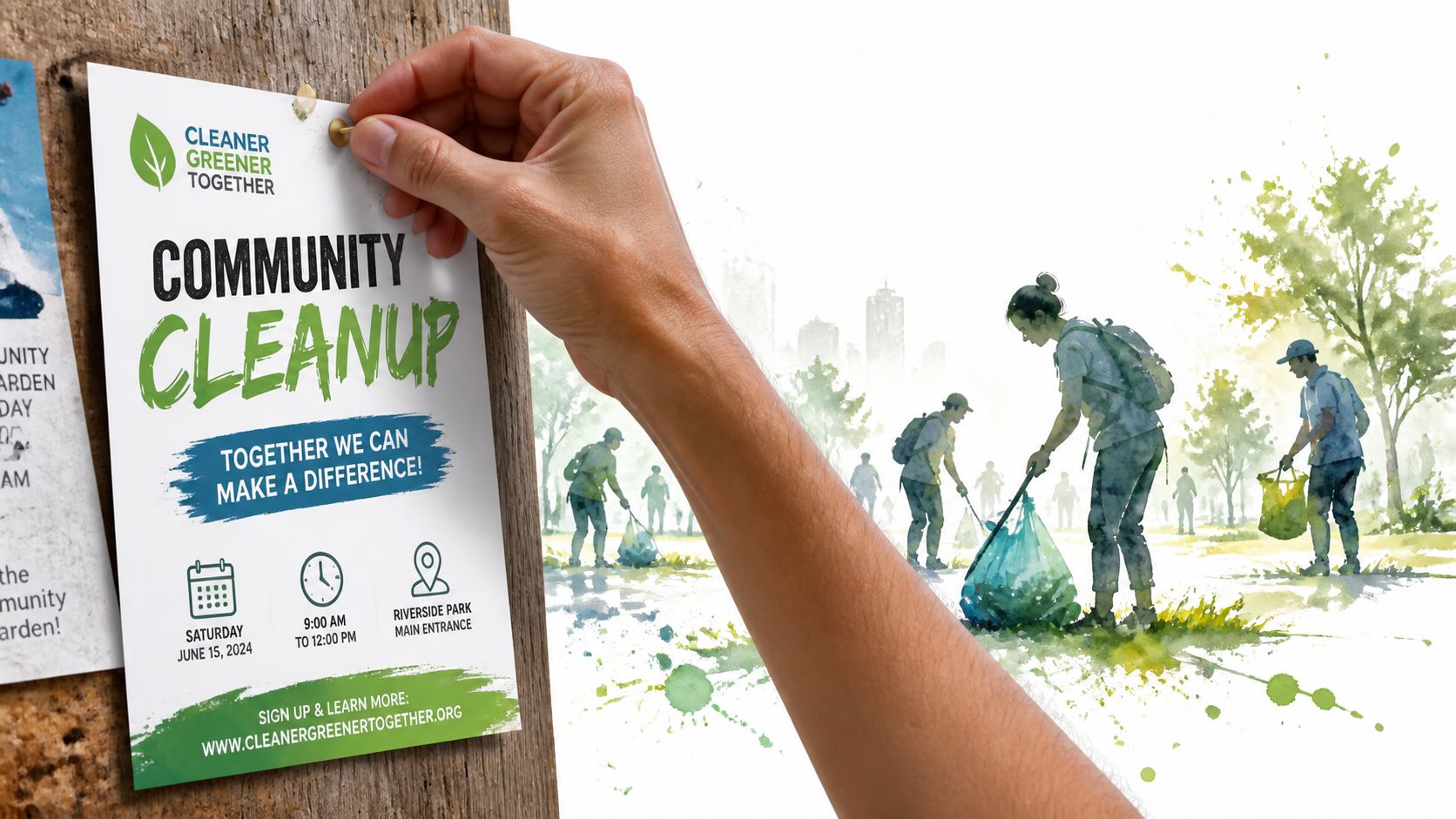
A woman walks past a crowded bulletin board, catches one bold line, and slows down. Saturday morning. Bring a friend. Clean our block. She can keep walking, or she can scan the code and join. The strongest community cleanup flyer gives her one reason to care, one simple action, and enough detail to feel safe showing up. I'll walk through six formats built around bravery, friendship, clear logistics, neighborhood pride, and visible progress, then connect them to Litter Caterpillars' volunteer-first weekend mornings in Chicago. The group meets rain or shine, builds friendships through service, and never pressures volunteers for donations. Your flyer should create that same feeling before anyone reaches the first trash bag.
1. Bold Call-to-Action Header with High-Contrast Colors
A passerby has only a moment to notice your flyer. Give that moment a job.
Put the action at the top in large type. JOIN US. CLEAN WITH US. TRANSFORM WITH US. Bright colors can pop against a dark background, while a bold font can make the message readable from a distance. Chicago volunteer groups could place this format near L stations, coffee shops, libraries, and busy neighborhood entrances. A flyer for a Lincoln Square cleanup should say Lincoln Square early. A Pilsen event should name Pilsen before a reader has to hunt for it.
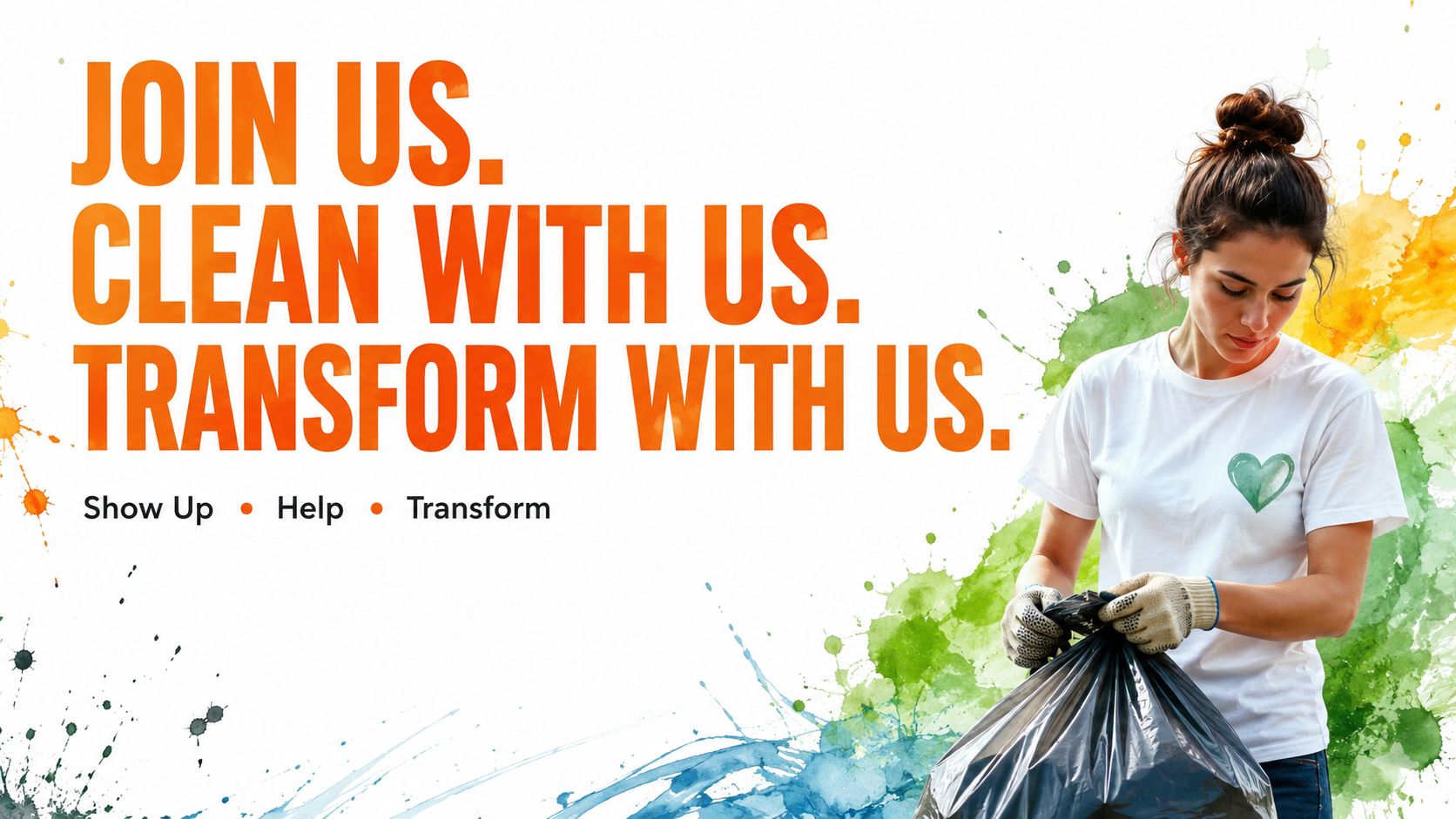
Use your group's own colors when you have them. Litter Caterpillars could adapt the headline to SHOW UP. CLEAN UP. TRANSFORM UP. The words should sound like the group, while the next line should tell people exactly what happens next.
Practical rule: Test the flyer from about fifteen feet away. If you can't read the main action, neither can someone hurrying past.
Keep the lower half calm. Add the date, weekend-morning time, meeting place, and a QR code without competing with the headline. Use social media for volunteer recruitment to repeat the same short invitation online, then ask volunteers to share it with a friend.
Your photo should show a real person doing the work. A gloved hand holding a grabber, a full bag beside a cleared sidewalk, or a smiling volunteer in a group shirt gives the headline a human landing place. Avoid turning the flyer into a donation appeal. The action is simple, show up and clean together.
2. Story-Driven Personal Narrative Layout
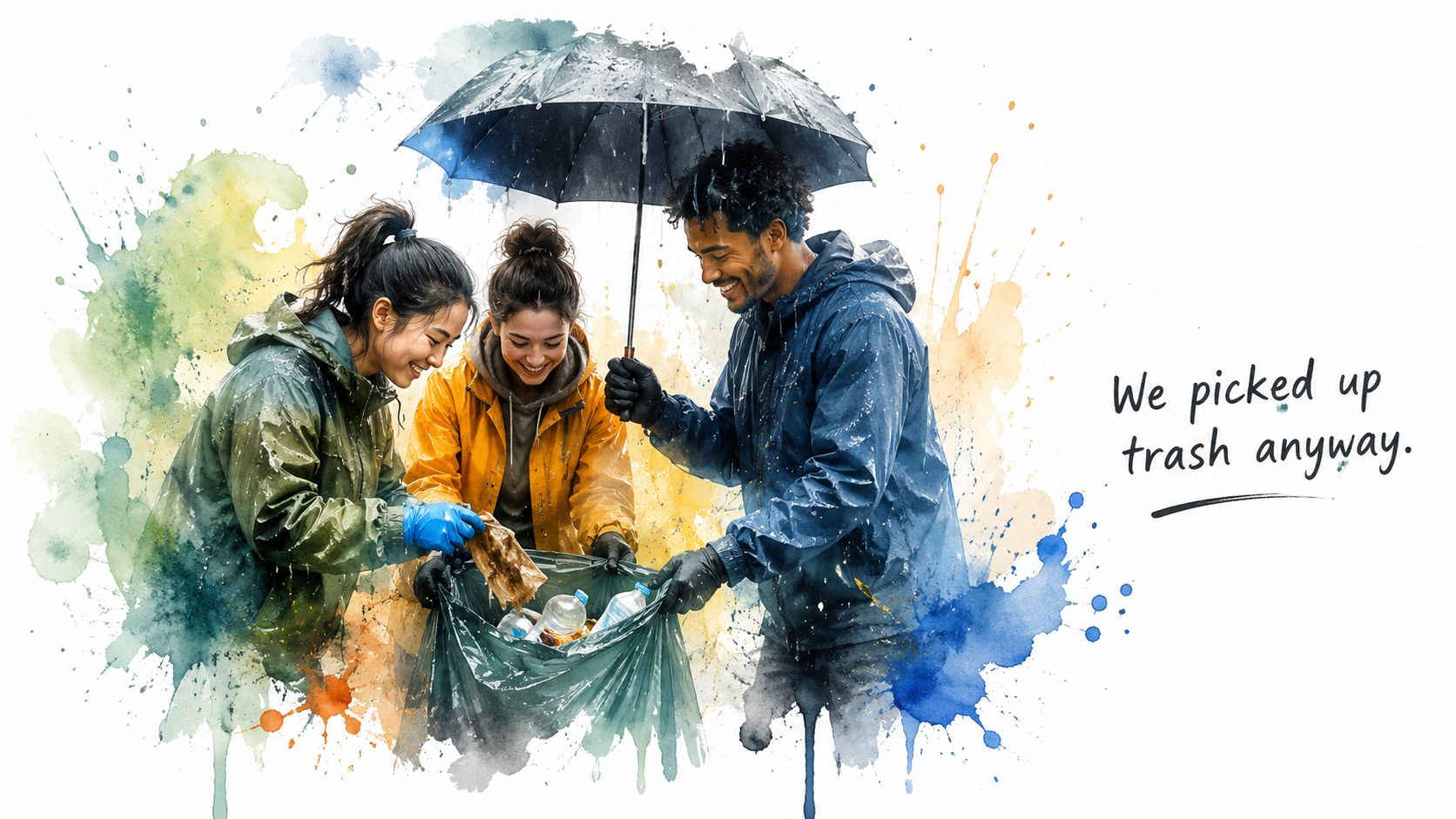
Three people huddle under a tree while hail hits the pavement. Their Ubers keep canceling. The bags stay empty for a moment, then someone laughs, steps back into the storm, and grabs the first piece of litter.
That moment can carry an entire flyer. Litter Caterpillars began with three people caught in a springtime hailstorm, and the group's story turns bad weather into a scene with tension, humor, and friendship. A reader doesn't need a broad promise about community improvement. The reader needs a reason to enter the story.
Write the opening like a real memory:
- Start with a physical detail: hail on a jacket, wet gloves, a bus arriving, or the sharp smell after rain.
- Give the reader a small problem: nobody knows whether the weather will break, the bags keep sliding, or the block looks worse than expected.
- End with an invitation: “Come write the next part with us Saturday morning.”
Use one strong photograph and plenty of white space. The story should remain readable beside the image. If a volunteer gave you permission to use a real quote, include that person's exact words and name. Otherwise, write in your own voice and label the moment accurately.
“Cleaning someone else's mess felt easier than cleaning my own.”
That line connects to the group's personal story without asking readers to pretend cleanup feels easy. The flyer can say that first-time volunteers may arrive alone, work beside others, and leave with a new friend. It can name Englewood, Rogers Park, or another specific neighborhood instead of hiding behind a generic city image.
The final line should turn emotion into movement: Meet us at the listed location. Wear clothes you can work in. No experience needed.
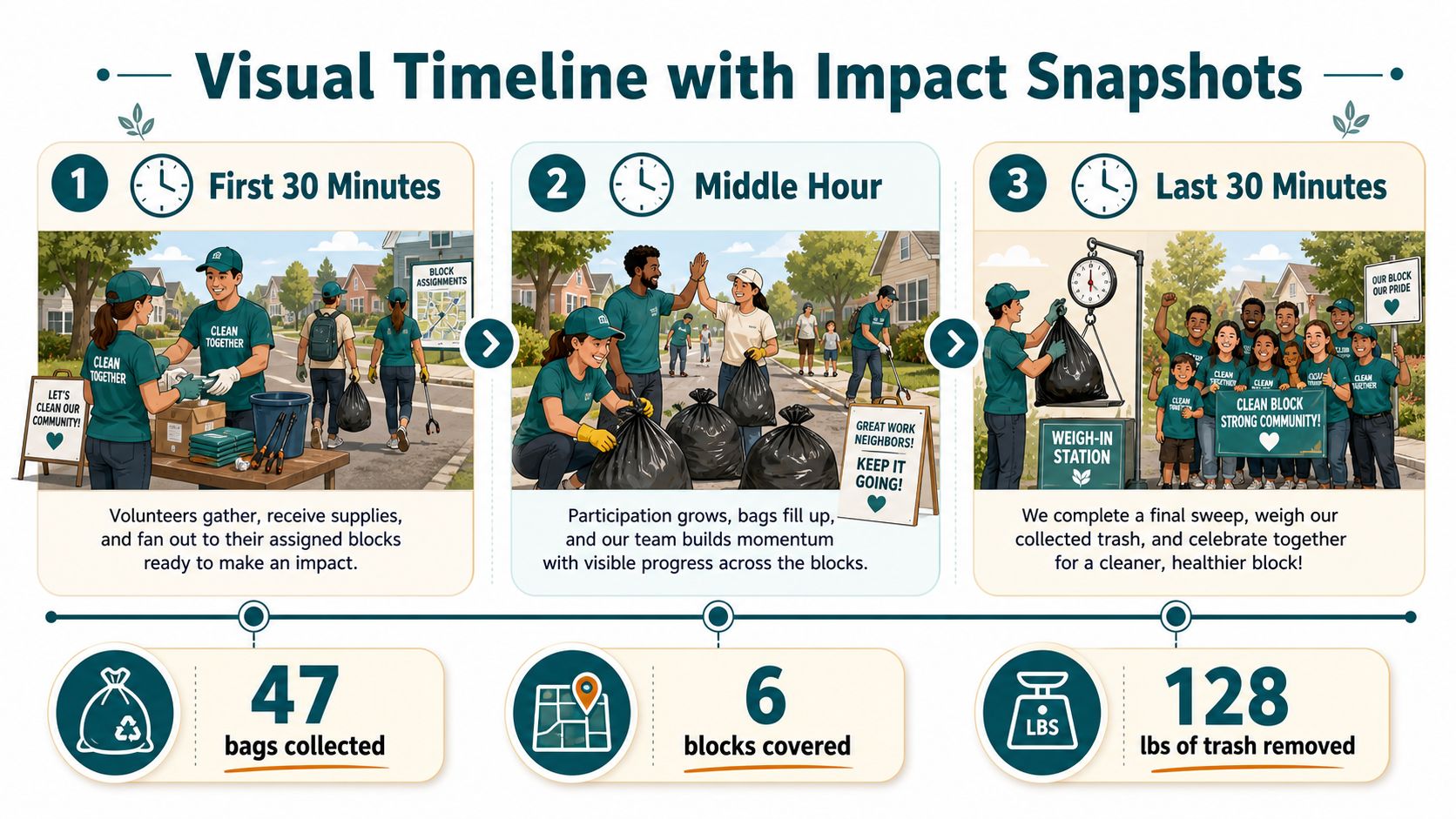
3. Visual Timeline with Impact Snapshots
A volunteer sees the first bag fill and realizes the block can change before lunch. A timeline lets someone feel that progression before arriving.
Divide the flyer into clear stages. Use First 30 Minutes, Middle Hour, and Last 30 Minutes as visual anchors, then place a small photo or icon beside each stage. The first panel might show the team meeting, putting on gloves, and hearing the safety briefing. The middle panel might show volunteers sorting tasks, carrying bags, or logging litter. The final panel might show the cleared block and a team photo.
Use actual photos from your own cleanups. A rainy-day beginning can lead into a row of full bags, then a bright group portrait. That sequence gives the reader a role in the story. They can see where they enter and what they'll do after they arrive.
The timeline can also make room for different kinds of volunteers:
- Trash pickup: Walk a defined area with gloves and a litter picker.
- Data logging: Record what the group finds.
- Traffic watch: Keep eyes on nearby movement and alert the team.
- Photo support: Capture the work and the finished space.
- Short-shift help: Join for one segment when a full event won't fit your schedule.
Add small badges at the end of each segment if your group uses a badge system. A first badge might represent courage, another teamwork, and another a finished block. Keep the language honest. Say what volunteers did, rather than promising a dramatic result you can't document.
The Great American Cleanup gives organizers a sense of the scale that a simple event can reach. In 2025, more than 60,000 community events took place in the United States, and participants cleaned more than 94,000 public spaces, according to Keep America Beautiful's Great American Cleanup details. Your flyer doesn't need giant numbers. It needs a visible sequence that makes the first step feel manageable.
4. Community Map Highlighting Neighborhood Coverage
A Chicago map can turn a flyer into a personal question: Do you see your block?
Place the city map in the center, then mark the next cleanup with a bright color. Add the ward number and neighborhood name beside it. A legend should explain every symbol. One color can show completed areas, another can show upcoming events, and a third can invite people to suggest a new location. Keep the map readable. A dense outline with tiny labels will make people walk away.
Litter Caterpillars can use this Northeastern Illinois map as a reference point for geographic communication, then build a Chicago version around its own events. The publisher describes a goal of cleaning across all 50 Chicago wards, so a map can show the next three scheduled cleanups while leaving room for neighbors to point toward another area.
Add a recognizable landmark when it helps. A park, train station, school, or major intersection can answer the question people ask first: “Is this near me?” Use the meeting point in plain language underneath the map. A bright pin should never replace a street address.
The map also works well for neighborhood-specific handouts. A flyer for one ward can show the current area in strong color, then use lighter marks for adjacent neighborhoods. That approach speaks to a resident who wants to help nearby without making the whole city feel abstract.
Clean Up Australia's FY24 report records 1,077,127 registered volunteers at 16,320 cleanup sites, with about 2,154,254 hours contributed, according to its litter report. You don't need to copy that scale onto a local flyer. The useful lesson is simpler: show where people act, name the site, and give the next volunteer a clear place to join.
5. Identity and Pride-Focused Design with Badges and Symbols
A volunteer arrives wearing the same green shirt as someone they've never met. They spot the caterpillar logo, exchange a grin, and start filling bags together. Identity can make that first meeting less awkward.
Build the flyer around a recognizable logo, mascot, color pair, or symbol. Litter Caterpillars can use its caterpillar transformation logo, green and orange colors, flags, theme songs, and badges. A group without a mascot can choose a simple neighborhood mark, an illustrated glove, or a symbol tied to the local park.
Keep the visual system consistent across flyers, shirts, signs, and social posts. A person should recognize the group before reading every word. Use three to five badge designs only when the group can explain what each one means. Possible badges might represent a first cleanup, a new neighborhood, a safety role, or bringing a friend. Avoid making badges feel like a contest. Let them celebrate participation rather than rank people.
Give the symbol a human story
The logo can show the original three-person hailstorm, followed by a larger group holding flags. That image gives the flyer a beginning and a present-day invitation. A small music-note icon can point readers toward the group's theme song, if the song fits the event's tone.
A pride-focused flyer still needs practical information. Place the identity artwork near the top, then reserve a clean section for date, meeting place, clothing, and safety. A beautiful badge won't tell someone whether they can bring a child, take a short shift, or avoid heavy lifting.
Use language that welcomes newcomers:
You don't need a uniform, a history with the group, or cleanup experience. Bring yourself, and we'll show you the first step.
The design should make friendship visible without promising instant closeness. Show volunteers greeting each other, carrying bags side by side, or posing with flags after the work. Kindness, unity, and bravery can appear in the copy through specific actions. “We check on new volunteers before we start” feels more useful than a vague statement about values.
6. Practical Details-First Template with Scannable Information Architecture
A student finds your flyer outside a coffee shop. She has ten seconds before her bus arrives. She needs the date, place, time, and answer to one private question: “What do I need to bring?”
Put logistics first. Use the largest type for When, Where, and How to Join. Divide the rest into short blocks:
- When: Weekend morning, with the exact date and start time.
- Where: Neighborhood, ward, meeting point, and a clear landmark.
- What to wear: Closed-toe shoes, work clothes, gloves if the group asks volunteers to bring them, and weather-ready layers.
- What we provide: Bags, litter pickers, briefing, and role choices when available.
- Who you'll meet: Organizers, neighbors, first-time volunteers, and returning members.
- How to join: QR code, Meetup, email, text, Instagram, or an open group chat.
A QR code should lead directly to the signup page. Test it with more than one phone before printing. Put a short readable URL under it for anyone who prefers typing. For planning support, use volunteer event planning guidance from Litter Caterpillars, then adapt the wording to your actual event.
Safety needs room on the page. Cleanup guidance says organizers should keep sites away from roadsides when possible, brief volunteers on local hazards, and provide gloves, high-visibility clothing, sensible footwear, and weather-appropriate clothing, as described in this community litter-picking safety guide. Another volunteer safety briefing says people should never use bare hands, should use litter pickers, and should leave weapons or medical waste for local officials.
Add one friendly line: No experience needed. No donations asked. Just show up. Then check the print size with this marketing flyer size reference. A practical layout should help someone decide quickly, without forcing them to decode a crowded design.
Community Cleanup Flyer Designs, 6-Point Comparison
| Template | 🔄 Implementation complexity | ⚡ Resource requirements | 📊 Expected outcomes | 💡 Ideal use cases | ⭐ Key advantages |
|---|---|---|---|---|---|
| Bold Call-to-Action Header with High-Contrast Colors | Moderate, strong typography and color contrast skills required | Low–Moderate, designer time, bold inks or bright digital assets; quick turnaround | High visibility and immediate attention; fast responses from passersby | High-traffic poles, bulletin boards, short-term recruitment drives | Grabs attention from distance; very clear CTA; concise |
| Story-Driven Personal Narrative Layout | High, needs skilled writing and careful image selection | Moderate, real photos or commissioned imagery and copy editing | Strong emotional engagement and memory; attracts committed volunteers | Recruiting committed volunteers, storytelling campaigns, newsletters | Builds authenticity and belonging; filters for aligned volunteers |
| Visual Timeline with Impact Snapshots | Moderate, infographic/layout design with sequential flow | Moderate, quality photos from events, metric collection, designer time | Clear expectations and perceived progress; motivates repeat attendance | Structured events, visual learners, recurring weekly cleanups | Conveys concrete impact and satisfying progression |
| Community Map Highlighting Neighborhood Coverage | Moderate, map design and accurate geodata required | Moderate, map assets, up-to-date location data, designer work | Communicates scale and momentum; attracts geographically motivated helpers | City-wide outreach, ward-based recruitment, expansion campaigns | Shows organized reach and where help is needed; easy to update |
| Identity and Pride-Focused Design with Badges and Symbols | High, requires cohesive brand system and visual consistency | High, logo/badge design, brand guidelines, possible merch production | Strong retention and group identification; increased repeat participation | Long-term community building, retention programs, brand-led events | Creates pride/affiliation; differentiates group; encourages repeat turnout |
| Practical Details-First Template with Scannable Information Architecture | Low, straightforward hierarchy and clear sections | Low, QR codes, clear type, basic layout; easy to update | Reduces friction; quick decisions and higher sign-up conversions | Coffee shops, community centers, posters where people need logistics fast | Maximizes clarity and actionability; fast to scan and update |
Turn a Good Flyer Into a Show-Up Moment
Choose one format that fits your group's real personality. A brave group may use the hailstorm story. A neighborhood network may need the map. A busy weekly cleanup may work best with the details-first layout. You can combine parts, too. Use the bold headline from the first format, the personal photo from the second, and the safety block from the sixth.
Run a small print test before you cover every bulletin board. Ask someone who has never attended the cleanup to read the flyer from a distance. Ask them to find the meeting point, start time, clothing guidance, and signup link without help. Watch where their eyes go. If they miss the action, change the hierarchy.
Check every date and location twice. Walk the route yourself. Confirm that the QR code opens the right page. If the event sits near traffic, rewrite the plan before you print. Road-cleanup guidance says volunteers should face oncoming traffic, wear high-visibility vests, work on one side at a time, and stay out of carriageways and restricted areas, as described in this community cleanup guide. A flyer should describe the conditions, not a safer version that exists only on paper.
Place copies where volunteers already spend time. Try coffee shops, libraries, community centers, workplace boards, apartment entrances, and partner locations. Add a reminder online several days before the event, then ask a few people to invite someone directly. A Tunis neighborhood cleanup experiment found that flyer recruitment alone produced only 3% participation among initially recruited heads of household, and neighbor-to-neighbor pressure didn't meaningfully raise turnout, according to the study record. That result gives you a practical lesson: a flyer starts the conversation, while personal welcomes and reminders help people finish the decision.
Your final print should feel like a handshake. Choose readable type and suitable stock, using this guide to paper choice for business flyers as a reference. Make the action easy, make the welcome clear, and give people a reason to show up together.
Litter Caterpillars publishes Chicago cleanup events with a meeting time, an agenda, and a volunteer-first approach built around safety, friendship, and service. Visit Litter Caterpillars to find an event, see how the group organizes neighborhood cleanups, and join the next weekend morning.