Tag: community cleanup

  • Volunteer Community Connections That Actually Last

    Volunteer Community Connections That Actually Last

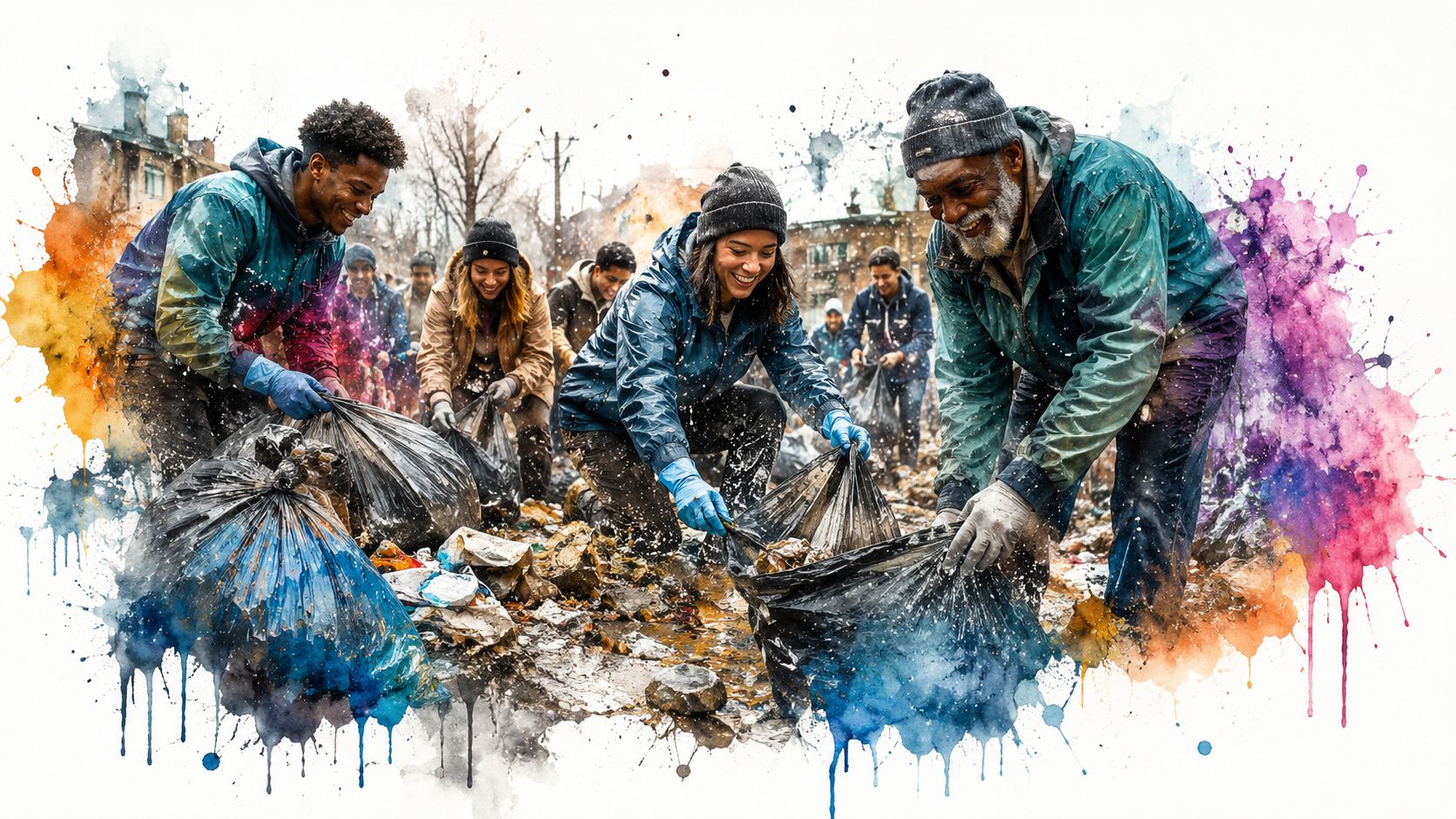
    At 9 a.m. on a Saturday, three strangers huddled under a picnic shelter while hail rattled off the roof. Their trash bags were half full, their Uber kept canceling, and by lunchtime they had exchanged numbers, shared a poncho, and made plans to meet again.

    The Hail Storm That Started a Friend Group

    The first cleanup had all the polish of a bad adventure. Three people arrived at a park, found a flag with a caterpillar on it, and started collecting bottle caps, food wrappers, and damp cardboard. Nobody knew each other. The morning felt ordinary until the sky turned white.

    Hail hit the path hard enough to make everyone run for the picnic shelter. Three newcomers squeezed onto one bench. One person held the grabbers, another tried to keep the bags from blowing away, and a third stared at a phone while an Uber driver canceled again.

    The problem gave them something to solve together. They compared ride options, messaged people in the group chat, and called someone who might drive over. Someone passed around a poncho. Someone else started humming the Litter Caterpillars theme song, which made no practical sense and somehow made the storm easier to take.

    Twenty minutes earlier, these people had been strangers. Under the shelter, they became a small crew with a shared problem, a shared joke, and a reason to keep talking after the weather cleared. They swapped phone numbers so nobody would get stranded. Later, they drank coffee and retold the story with exaggerated sound effects.

    That pattern explains why volunteer community connections often last longer when the event gives people room to meet before they work. The trash creates an excuse. The flag gives people a place to find one another. A Saturday morning gives the group a repeatable rhythm. The friendships grow in the gaps between tasks, during the walk to the next block, and while somebody searches for a missing glove.

    The scale of volunteering supports this local, relationship-based view. The United Nations Volunteers analysis summarized by NCVO reports that more than 1 billion people volunteer worldwide, with work equal to about 109 million full-time workers. Roughly 70% of volunteer activity happens informally, between people in their communities rather than through organizations. Women perform 57% of all volunteer work and 59% of informal volunteering, which connects volunteering closely to everyday neighborhood and care networks.

    The flip: Design the event so connection leads and cleanup follows. People may arrive for the litter, but they return for the people.

    Finding Your Volunteer Group Without Wasting Saturdays

    You don't need to spend every weekend testing random events. Use a short search path that tells you whether a group values repeat attendance, easy entry, and conversation.

    Start with the schedule

    Open Meetup and Eventbrite and search for “park cleanup,” “neighborhood beautification,” and “volunteer community connections.” Filter for weekend morning slots within a 20-minute drive of your home. A nearby event lowers the small friction that turns good intentions into a missed Saturday.

    Read the listing twice. Look for a recurring schedule, a clear meeting point, a named organizer, and a signup form that doesn't make you feel as if you need to justify your interest. The Litter Caterpillars Saturday volunteer page is an example of the kind of recurring weekend information that helps a newcomer decide quickly.

    Check the group before you arrive

    Search Instagram and TikTok for local handles posting trash-bag selfies, flags, park photos, and short clips from actual meetups. Comment on a recent post before you attend. Write something simple, such as, “I'm planning to join Saturday. Is the blue flag near the north entrance?”

    That comment does two jobs. It tells the organizer you're real, and it gives you a familiar name to look for when you arrive. You don't need a polished introduction. A small online exchange can make the first in-person greeting less awkward.

    Read the signals

    Marker Strong Signal Red Flag
    Schedule Recurring weekend mornings with a clear start time Vague dates or frequent last-minute changes
    Signup A short, low-pressure form Donation asks before you can attend
    Communication Open group chat for weather and ride updates No contact method after registration
    Welcome Instructions for newcomers and families Assumption that everyone already knows the route
    Equipment Clear notes about gloves, grabbers, and bags Volunteers expected to guess what to bring

    Look for an open group chat and join it the morning of the event. Groups with a Litter Caterpillars-style setup use chat to post cancellations, weather calls, ride-share options, and coffee plans. That last detail matters. A cleanup can end when the bags reach the pickup point, or it can continue at a nearby table.

    Copy and send this DM:

    Hi, I'd like to join your next cleanup. What's your rain policy, and do you provide gloves, grabbers, and bags? Are families welcome, and where should I meet the group?

    A good answer should make the first visit feel manageable. If the response sounds annoyed by basic questions, keep searching. Your Saturday should buy you a useful morning and a chance to meet people, not a guessing game.

    First Meetup Moves That Turn Strangers Into Friends

    A newcomer can stand in a group of twenty people and still feel invisible. I prevent that with visible signals and short, repeatable introductions.

    Before people arrive, I choose something that helps us spot new faces. Colored gloves work well. So do bright grabbers, name stickers, or a small marker beside the signup sheet. When a newcomer walks up, a returning volunteer should greet them by name within two minutes.

    Pair people before assigning tasks

    Don't send a first-timer down a path alone with a trash bag. Pair them with a returning volunteer for the first 15 minutes. The returning person can explain the route, show where sharp objects go, and keep the conversation moving while both people work.

    Use the two-question handoff:

    1. Ask where the person lives.
    2. Ask what brought them out today.
    3. Introduce them to one other person by name.

    The questions stay easy, but they open doors. Someone might live three blocks away, study at a nearby college, care for a parent, or know a coffee shop nobody else has tried. You don't need a forced icebreaker. You need a path from one name to another.

    Try this organizer script:

    “Hey, this is Maya. She's new and loves trail running. Can you show her the creekside loop?”

    The returning volunteer now has a clear job, and Maya has a person to follow. The introduction also gives the second volunteer a useful detail to remember.

    Make contact exchange feel normal

    Many people want to continue the conversation but hesitate to ask. Give them a natural line:

    “Can I grab your number? Our crew sometimes gets tacos after. Want in?”

    A phone number isn't a friendship contract. It keeps the door open for the next cleanup, a ride-share, or a quick coffee. If someone prefers the group chat, let that work too.

    At the end, take a same-day group photo and post it in the chat with names attached. “Saturday crew, Maya, Luis, Priya, and Devon” gives faces a second chance to stick. Then start a standing Tuesday lunch thread. It can survive a rainy weekend and keep the group from disappearing between events.

    Volunteer participation already creates repeated contact for many people. In NCVO's Time Well Spent findings, 89% of volunteers said they had met new people through volunteering, 78% had come into contact with people from different backgrounds, and 68% said volunteering helped them feel less isolated. The same survey reports that 77% said volunteering improved their mental health and wellbeing. Your job as an organizer is to turn those possible encounters into actual introductions.

    Safety and Logistics as the Retention Engine
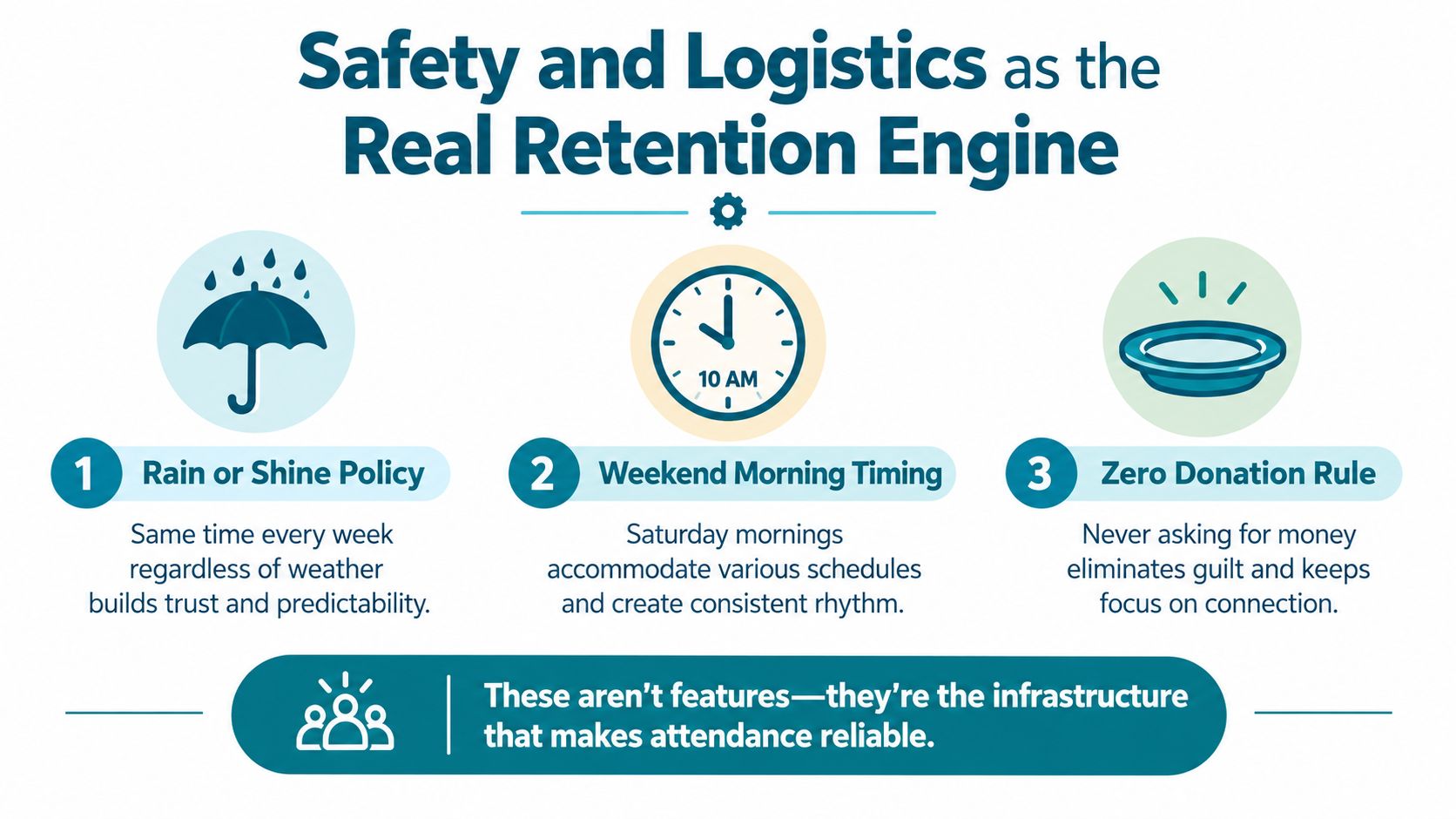
    An infographic titled Safety and Logistics as the Real Retention Engine detailing three key volunteer strategies.

    A soaked volunteer once arrived at our cleanup with no gloves, no clear meeting point, and no idea when the morning would end. She left after twenty minutes. People remember whether an organizer respected their time, explained the plan, and helped them get home. Those details turn a first cleanup into a second RSVP.

    Litter Caterpillars keeps its weekend-morning rhythm, flags, and theme songs, while leaving room for judgment when weather turns unsafe. A rain-or-shine promise should never mean standing outside through dangerous conditions. Weekend mornings also leave the rest of the day open for family duties, classes, shifts, or evening plans. A zero-donation rule removes the awkward question of whether a college student or gig worker is expected to pay to attend.

    The neighborhood cleanup guidance from STOHub recommends planning around weekend schedules and setting a backup date for weather changes. People can plan when the rhythm stays predictable. They also trust the organizer more when a clear weather decision arrives before they are left waiting.

    Build the morning before the morning

    Send a meetup pin 24 hours ahead. Include the nearest entrance, transit stop, and a landmark people can recognize from the street. State whether volunteers need gloves, water, closed shoes, or a reflective layer.

    Use the group chat for ride-shares, weather calls, and late arrivals. Assign every newcomer a buddy before the first bag fills. If someone arrives alone, a volunteer should walk over and bring them to the group, rather than pointing from across the park.

    The hailstorm crew showed why these choices matter. Uber drivers kept canceling, and nobody asked for money. Volunteers shared what they had, searched for rides home, and stayed together until each person had a safe option. The weather made the morning difficult, but the group did not leave one person to solve the problem alone.

    The Urban Institute volunteer management paper points to recognition, training, screening, professional development, and task matching as support for retention. Put that into practice by assigning a safe task that fits the volunteer, explaining it clearly, and recognizing the effort before departure.

    Retention test: If a newcomer can find you, understand the plan, get home safely, and know how to join again, your logistics are doing social work.

    Designing Events So Connection Comes Before the Task

    I've watched volunteers arrive early, work hard, and leave without learning a single name. The bags looked good at the end, but the group felt temporary. Pride changes that. When people feel they belong to a crew, they carry the memory of the morning with them.

    Start the social part before cleanup. Put the flags where people can see them from the path. Play a shared theme song from a Bluetooth speaker at the welcome circle. Take the group photo before anyone picks up a grabber. Recognize first-timers by name, then give them a small job that lets them participate immediately.

    Put the welcome before the work

    Use a two-minute pair-up. Ask each person to share why they came, then have partners introduce each other to the circle. Keep the prompt practical: “What brought you here today?” and “What part of the neighborhood do you know best?”

    A theme song can feel silly until you see what it does. People hum while they work. They laugh when someone misses a lyric. The cleanup stops feeling like a silent chore and starts feeling like a shared activity with its own identity.

    Give first-timers a named recognition moment:

    “Before we split up, let's welcome Maya, Luis, and Priya. They're joining us for the first time, and they're taking the creekside loop.”

    That sentence doesn't flatter people with vague praise. It gives them a place in the story of the day.

    Let coffee carry the friendship

    Choose a nearby coffee shop before the event and mention it during the welcome. The destination gives people a simple reason to stay after the work ends. Over coffee, conversations move away from litter and toward jobs, hobbies, neighborhoods, food, and plans.

    A rotating host keeps the same three people from carrying every introduction and every mood lift. One week, the photo lead welcomes arrivals. The next week, the supply runner brings the coffee list. Another volunteer picks the song and takes the group photo.

    The friendship-building activities from Litter Caterpillars can help organizers turn a cleanup into a social event with simple shared rituals. The point isn't to pack the morning with games. It's to create enough structure that people don't have to manufacture connection from nothing.

    The evidence supports this design choice. A 2025 study on volunteering and social connection describes low-formality social activities where relationships can form spontaneously and on more equal footing. A cleanup already has shared work. Add a welcome circle, a partner task, and a post-event table, and you give those relationships places to begin.

    Your 30 60 90 Day Plan for a Volunteer Circle That Lasts

    Friendship usually needs a rhythm before it needs a grand gesture. I use a 30, 60, 90-day plan because it turns a hopeful first visit into a series of small actions.

    Days 1 through 30

    Attend the first three events you can manage, and aim to show up at least twice. Learn two names beyond your own. Exchange contact information with one or two people through the group chat, then use it for something concrete, such as a ride-share, coffee plan, or reminder about the next route.

    Don't wait until you feel fully included. Return while the first names still feel fresh. Repetition makes the greeting easier for everyone.

    Days 31 through 60

    Deepen the connection by proposing a side hangout. Suggest coffee, tacos, a walk, or a shared lunch after cleanup. Join a small role, such as the photo team, supply runner, welcome host, or route checker.

    Attend one social event that isn't a cleanup. That change of setting helps you see people as more than task partners. You may discover that the person who sorts gloves also knows every independent bookstore nearby.

    The volunteer retention strategies from Litter Caterpillars give organizers a practical place to build this rhythm into their events.

    Days 61 through 90

    Anchor yourself by co-hosting an event. Bring a friend, welcome a newcomer, or mentor someone through their first meetup. Take ownership of one small responsibility, not the entire morning.
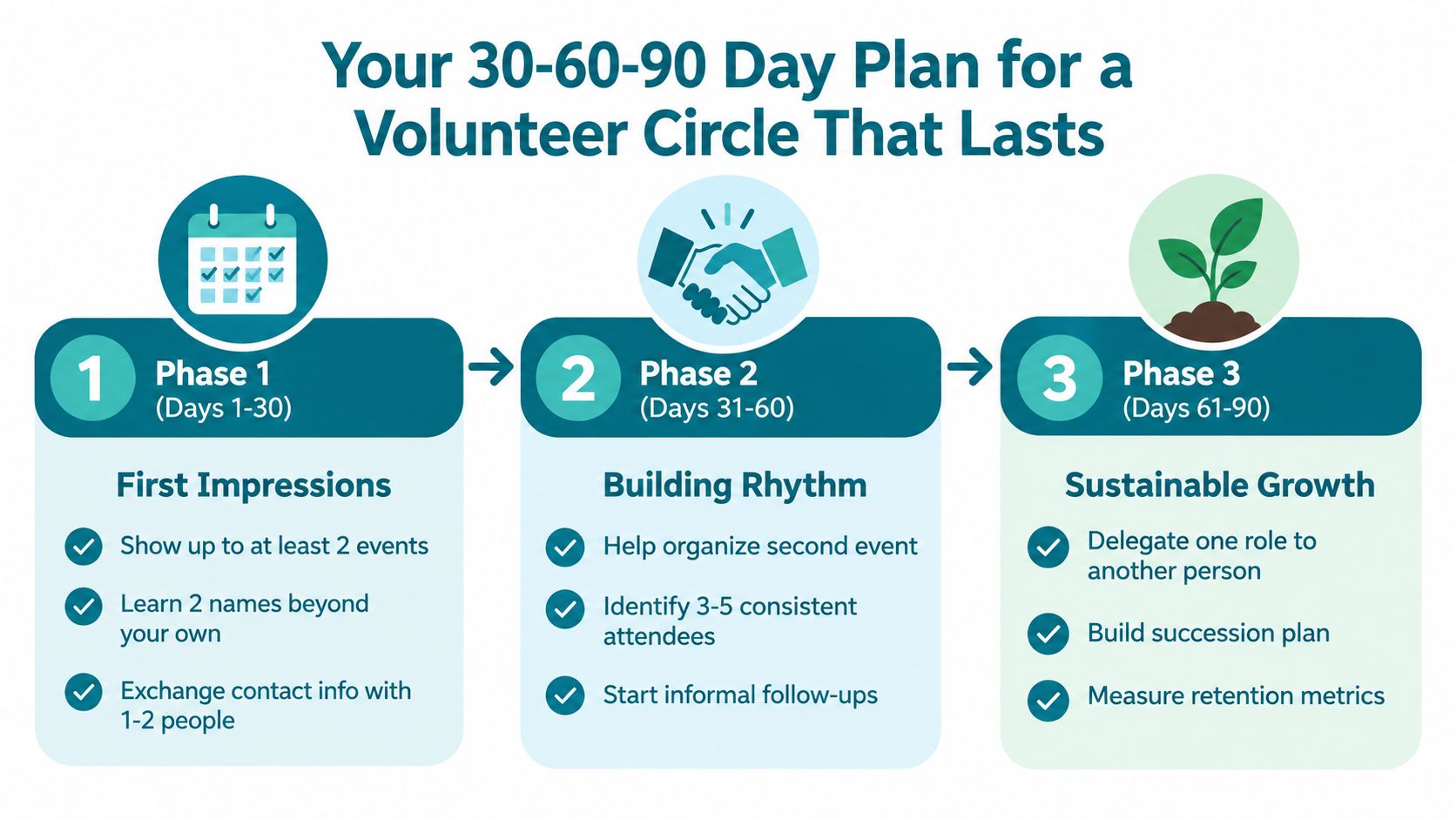
    A 30-60-90 day planning guide for building a long-lasting volunteer community through three phases of engagement.

    The plan works because it moves you from guest to participant to host. It also gives organizers a simple way to notice whether people return, take a role, and bring someone new. Those are useful retention signals, even when nobody tracks a formal scorecard.

    Here's the failure mode I trust most because I've watched it happen. One person organizes every route, buys every supply, answers every message, takes every photo, and keeps every newcomer comfortable. By month four, that person burns out, and the circle feels hollow because nobody else learned how to carry it.

    Hand off one task at every event. Ask someone else to choose the coffee spot, welcome the next newcomer, post the photo, or make the weather call. A volunteer circle lasts when people share the work of connection, not when one generous organizer performs it alone.


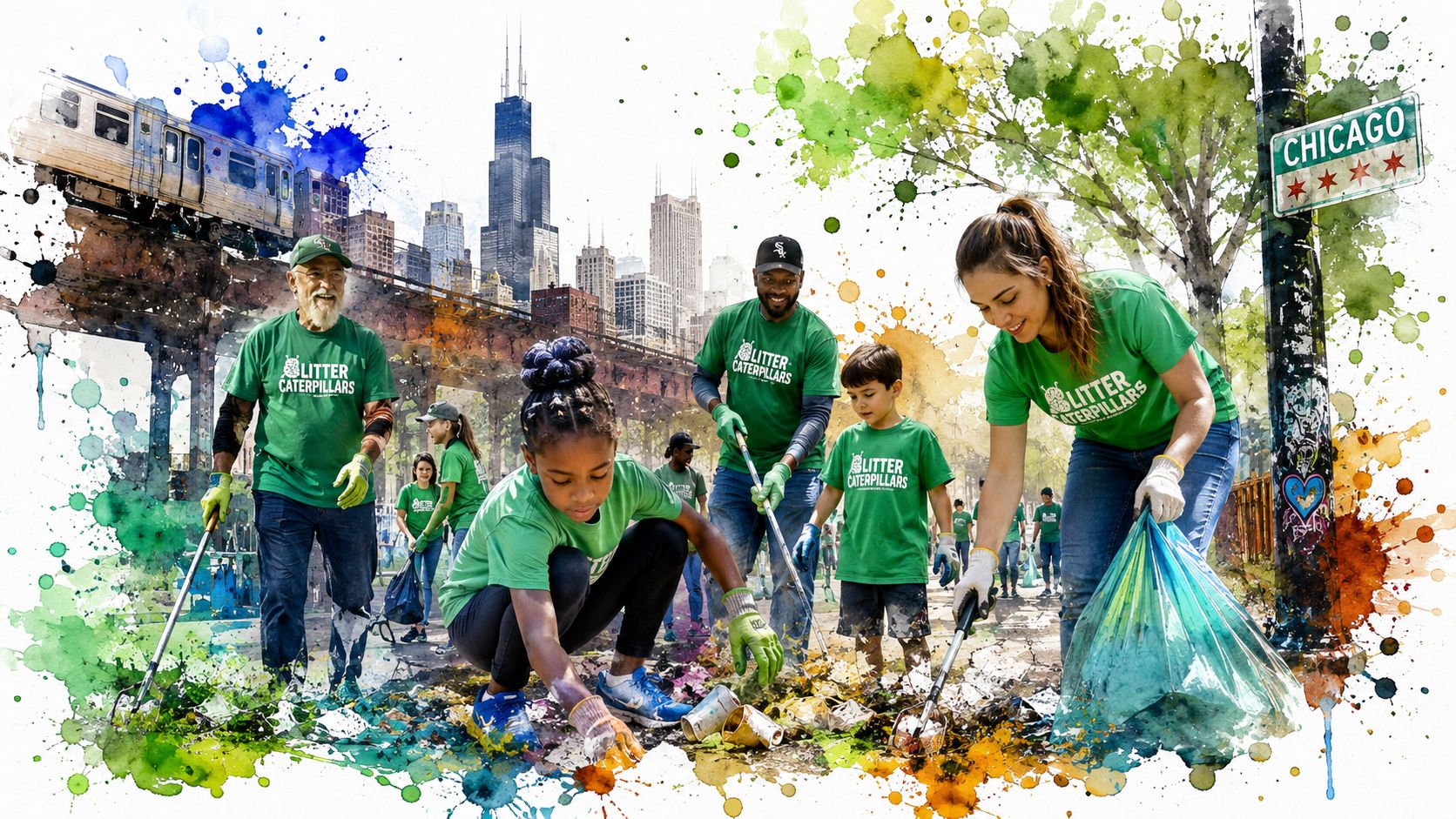
    If you're in Chicago and want a free weekend trash pickup where flags, group chats, shared work, and friendship all have a place, visit Litter Caterpillars. Choose an upcoming morning, join the conversation, and bring one person who could use a reason to meet the neighborhood.

  • Cleanup Volunteer Work: A Beginner’s Guide for 2026

    Cleanup Volunteer Work: A Beginner’s Guide for 2026

    The hail hit the Chicago Riverwalk sideways. I had one glove, a half-filled bag of dog waste and plastic shards, and frozen rain biting my bare hand while traffic roared along Wacker Drive. Five minutes later, three strangers were laughing, sharing grabbers, and working like teammates.

    You may want to find cleanup volunteer work, join a crew without feeling awkward, or organize your own event. I've done all three, and I've run the same weekly crew for three years through rain, heat, blizzards, wind chills, and hail. This guide covers the practical parts, including finding events in Chicago and other cities, showing up prepared, staying safe, building a crew, and solving the harder problem. How do you get people to return after the second week?

    The Day I Got Caught in a Hailstorm Picking Up Trash

    The sky over the Chicago Riverwalk turned the color of old steel. The river smelled like wet stone, diesel, and something sour hiding under the docks. Hail rattled against the railings and bounced off the pavement, leaving tiny white beads around my boots.

    My gloves filled with grit. Frozen rain stung the skin between my fingers. At my feet sat a bag that still needed room for a torn food wrapper, two plastic shards, and a leaking pouch of dog waste. I wanted to finish the block. I also wanted to crawl into a warm car.

    Then someone handed me a spare glove.

    A woman from the next group grabbed a litter picker. A man moved the bag away from the walking path. Another volunteer pointed toward a dry patch under the bridge. We didn't know each other, but cleanup work gives strangers a job before it gives them a conversation. Within five flat minutes, we had a plan.

    A dedicated volunteer cleaning up litter along the snowy Chicago Riverwalk during a cold winter day.

    That's why I keep returning. The work can feel grimy, cold, repetitive, and occasionally ridiculous. It can also turn a silent morning into a shared story.

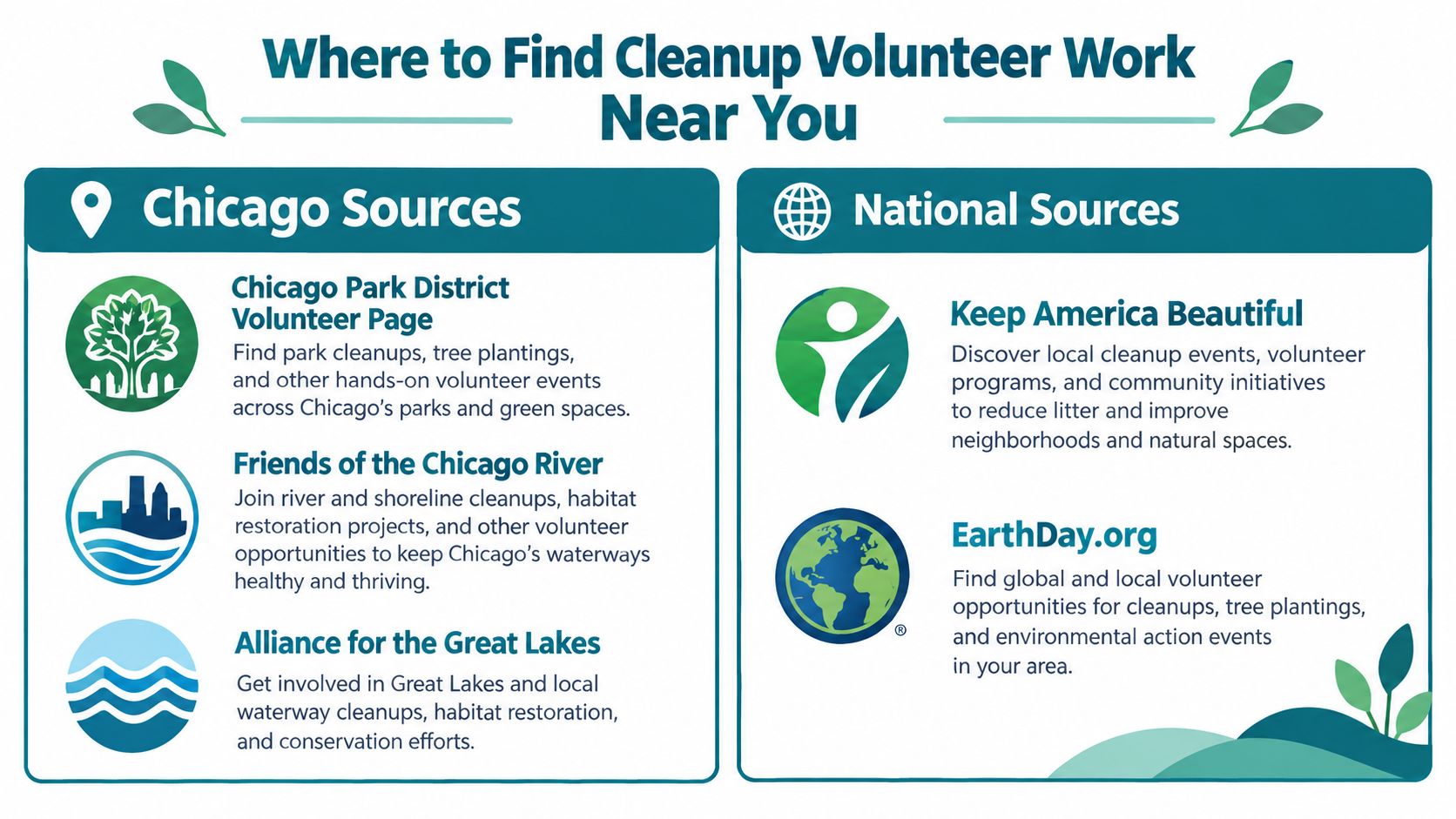
    If you're looking for cleanup volunteer work in Chicago, start with the Chicago Park District volunteer page, the Friends of the Chicago River calendar, alderperson-led neighborhood cleanups, or the city's Adopt-a-Portion program for street and alley segments. Other cities usually have similar routes through parks departments, watershed groups, conservancies, and neighborhood offices.

    I'll also show you how to join without standing alone beside the sign-in table, what to wear, what to leave untouched, and how to organize a safe event from scratch. Most of all, I'll focus on keeping people around after the first event, because a full sign-up sheet means little if the same people never return.

    Where to Find Cleanup Volunteer Work Near You

    I usually start local, then widen the search. In Chicago, the Chicago Park District volunteer page is useful for park projects, while Friends of the Chicago River lists river-related events. Alderperson offices often announce ward cleanups in newsletters and social posts. The city's Adopt-a-Portion program can connect volunteers with a street or alley segment that needs regular attention.

    Search by the place, not only by the activity. “Cleanup volunteer work Chicago” can return polished pages with no current event. “Litter pickup Logan Square,” “river cleanup near me,” “beach sweep South Shore,” or “trail cleanup Cook County” usually gets closer to an actual gathering.

    Search paths that usually work

    • VolunteerMatch: Filter by your ZIP code and search for litter, parks, rivers, or environmental volunteering.
    • All for Good: Search your city and nearby suburbs, then check the event date carefully.
    • Meetup: Filter by “environment” and “cleanup.” Some groups post recurring events there.
    • Eventbrite: Search local nonprofit listings, then confirm that the organizer still has supplies and permission.
    • Alliance for the Great Lakes: Look for shoreline cleanup events around the Great Lakes.
    • Forest preserve districts: Search for trail days, habitat workdays, and preserve volunteer calendars.

    Neighborhood Facebook groups and Nextdoor can surface small cleanups that never reach larger platforms. I also check Instagram accounts for local conservancies, park friends groups, and river organizations. A photo from last month may point you toward a recurring crew even when the group's website looks quiet.

    An infographic titled Where to Find Cleanup Volunteer Work Near You listing Chicago and National sources.

    You can also browse this guide to environmental volunteering near you for additional search ideas.

    Try calling. The best event may live in an organizer's phone, not on a webpage. Ask three questions: where do volunteers meet, what equipment does the group provide, and what happens when the weather turns bad?

    How to Join Your First Cleanup Without Feeling Lost

    Your first event feels easier once you know the sequence. Register through the event link, then read the confirmation email all the way through. It should tell you the meeting point, parking options, start time, and what the organizer provides.

    Arrive ten minutes early. Find the person with the gloves and clipboard. That person usually knows where newcomers should sign in, where the bags sit, and which section needs the most help.

    Bring less than you think

    Wear closed-toe shoes, layers, a hat, work gloves, and sunscreen. Carry water and a small backpack for your phone, keys, and anything you don't want inside a trash bag.

    Most organized crews lend grabbers, bags, and safety vests. Take a grabber even if you think you can work faster with your hands. You'll protect your back, avoid mystery residue, and reach beneath benches without kneeling in wet litter.

    Pair up with someone who has attended before. You don't need to make conversation right away. I've worked beside people for an hour before learning their names. The silence usually breaks at the bag pile, when someone pulls out a bicycle wheel, a bowling ball, or a tire and everyone wants to know the story.

    A typical event starts with a short safety talk and a route assignment. Then you pick for sixty to ninety minutes, bring the bags back, weigh or count the results, and take a group photo. Some crews finish with coffee. Others find a nearby bar or café. The post-cleanup gathering often creates the friendships that make the next event feel less like an appointment.

    First-timer rule: Nobody expects you to perform. Pick up what you can handle, ask when you're unsure, and stay near the route.

    Before you leave, thank the organizer and join the email list or group chat. Mark the next date while the memory still feels fresh. This litter cleanup volunteer guide can help you compare different ways to get involved.

    Safety Rules Every Volunteer Crew Actually Uses

    I've watched a clean street turn dangerous in seconds. A car cuts too close. A volunteer reaches for something sharp. Heat builds under a dark shirt. Good crews prevent those moments before the first bag opens.

    Start with clothing. Wear closed-toe shoes, puncture-resistant gloves, long sleeves, and layers that match the weather. Use a high-visibility vest near streets. Bring water, sunscreen, and a small first-aid kit.

    Seattle guidance tells volunteers to stay out of roadways, medians, and roundabouts. It also warns against bridges, steep slopes, guardrails, construction areas, utility sites, headphones, alcohol, and mind-altering substances. Work in daylight only, and use a litter grabber instead of bare hands. You can review the Seattle Adopt-a-Street safety guide before planning roadside work.

    Treat unknown objects as unknown

    Use the stick-before-touch rule. Tap or move ordinary-looking material with a grabber or stick before you lift it. Annapolis guidance recommends using a rake or stick to identify an item, and sweeping dangerous litter with a broom and dustpan. Its cleanup checklist also tells volunteers to obey traffic signals and wear gloves.

    Leave needles, syringes, chemicals, weapons, medical waste, dead animals, and anything poisonous for trained handlers. Don't squeeze, kick, open, or carry an object just because it fits in your bag. Report illegal dumping through the city's 311 system when that route applies, and ask the organizer how the crew handles hazardous material.

    Jacksonville guidance says crews should park off the roadway, work on one side at a time, wear bright clothing, safety vests, gloves, and protective footwear, and carry plenty of water. It also says volunteers shouldn't enter the roadway or shoulder or work on bridges, tunnels, or overpasses. The Jacksonville cleanup safety guidance gives a clear model for leaders.

    North Carolina rules set a minimum age of 12, and volunteers aged 12 to 17 need supervision from adults aged 21 or older. The rules also require daylight work, a distance of at least five feet from the pavement edge, small groups, facing oncoming traffic, and stopping during bad weather. Read the North Carolina DOT safety rules before taking a crew beside a road.

    Before anyone starts, I run a quick check:

    • Route: Are we away from traffic, steep edges, unstable ground, and water hazards?
    • Gear: Does everyone have gloves, a grabber, a bag, and visible clothing where needed?
    • Buddy: Does every volunteer have a partner or a clear group?
    • Weather: Do we have water, shade, warm layers, and a stop plan?
    • Hazards: Does everyone know what stays on the ground?
    • Emergency: Does the leader have a phone, first-aid supplies, and emergency contacts?

    This volunteer safety checklist gives you a compact version to use before your next event.

    Why People Stop Showing Up and How to Keep Them

    The first Saturday can draw a crowd. The third Saturday tells you whether you built a crew.

    I've seen volunteers disappear after one cold morning, one confusing meeting point, or one event where nobody remembered their name. Cleanup programs often focus on sign-ups because sign-ups look good. I care more about the person who returns, learns the route, and starts bringing a friend.

    Make the event easy to remember

    Pick the same day, time, and meeting place whenever you can. People can build a cleanup into a weekly routine when they don't have to solve a new puzzle every time.

    Weather causes obvious trouble. Chicago can give you heat, rain, snow, wind, and hail in the same broad season. I use rain dates when possible, move seasonal events to more comfortable times, and keep an indoor backup task ready, like sorting recyclables or preparing supplies.

    Social connection matters, but you don't need forced games or loud introductions. A crew that grabs coffee afterward gives people a natural place to talk. Volunteers often connect while washing muddy tools, comparing strange finds, or arguing over whether a soaked sofa cushion counts as one item or two.

    People return when they know where to go, who will be there, and what their work changed.

    Show the work without turning it into a sales pitch

    Post bag counts, before-and-after photos, and short notes about the route. Keep a simple attendance record. The Durham Adopt-a-Street program tracked 10,914 pounds of litter over one year, with an average of 7.75 cleanup events and 893 pounds per month, then estimated the removed material at $21,037 using a public removal cost of $1.93 per pound. Its cost-benefit analysis shows why weight records tell a clearer story than bag counts alone.

    Give returning volunteers ownership. Ask one person to manage supplies. Ask another to lead a route. Celebrate milestones at five and twenty events, and use name tags so people don't have to rebuild the group from scratch each week.

    A retention benchmark cited in the provided volunteer-sector coverage places nonprofit volunteer retention at around 65%, meaning roughly one-third may not return year over year. The volunteer retention discussion makes the practical gap plain. Recruitment fills a calendar. Predictability, friendship, and visible results help fill the next one.

    How to Organize Your Own Cleanup From Scratch

    Choose a site you can finish or revisit. A four-to-six-block stretch, one park, or a half-mile riverbank gives a new organizer a manageable boundary. Walk it first. Look for traffic, water, construction, broken glass, dumping, restrooms, shade, and a place to stage full bags.

    Get permission before you advertise. In Chicago, contact the Chicago Park District for park work, ask an alderperson's office about ward coordination, or approach Friends of the Parks for a park partnership. A short email should name the site, proposed date, cleanup limits, disposal plan, and safety approach.

    Build the smallest useful kit

    • Bags: Use 50-gallon contractor bags for bulky litter.
    • Tools: Gather grabbers, rakes, and dustpans.
    • Protection: Provide gloves, hand sanitizer, and a first-aid kit.
    • Water: Bring a cooler or water station.
    • Hazard control: Use sharps containers only through a trained disposal process.

    Recruit in places where people already gather. Post in neighborhood Facebook groups and Nextdoor. Contact LISC Chicago networks, university service boards, local businesses, and corporate volunteer coordinators. Ask a nearby café if it wants to host a post-cleanup stop.

    Set one route captain at each boundary. Give everyone a meeting point and a stop time. Weigh the bags before disposal, record the date and site, and photograph the same view before and after the work. Ocean Conservancy's International Coastal Cleanup guidance also encourages item data and cleanup cards, so organizers can track what volunteers remove instead of relying on a vague pile of bags.

    Send a thank-you message soon after the event. Include the route photo, weight, next date, and one clear way to help. A person who returns quickly can become a route captain before the group loses momentum.

    Your First Saturday Morning and What Comes After

    I arrive before the crew. I check the meeting point, set out gloves and grabbers, and walk the first section for new hazards. Then people appear in twos and threes. We sign in, run the safety talk, pair up, and start at the first bend in the river or the first block of the park.

    The first ten minutes feel quiet. Then somebody finds a shopping cart. Somebody else pulls a tire from the weeds. A new volunteer asks where to put a cracked bottle, and suddenly they're part of the crew.

    After the bags go to the weigh-in spot, we take a photo and get coffee. That small ritual often matters more than a speech. On the second visit, people recognize the meeting place. On the third, they recognize each other.

    Over the next six months, you might join a smaller core group, take ownership of a parkway, or mentor the next newcomer. You don't need to plan six months today. You need to make the next Saturday easy.

    This week, RSVP to a Chicago cleanup through the Park District, Friends of the Chicago River, an alderperson's office, or a local group, then add the next event to your calendar before you leave. The second time you show up is where cleanup volunteer work starts becoming a habit.


    Litter Caterpillars organizes Chicago trash pickup events where volunteers gather, pair up, and clean neighborhood areas with supplies such as grabbers, bags, gloves, and hand sanitizer. Visit Litter Caterpillars to find a crew, join an upcoming pickup, and take your next Saturday morning outside.

  • Volunteer Uniforms That Build Pride and Keep You Safe

    Volunteer Uniforms That Build Pride and Keep You Safe

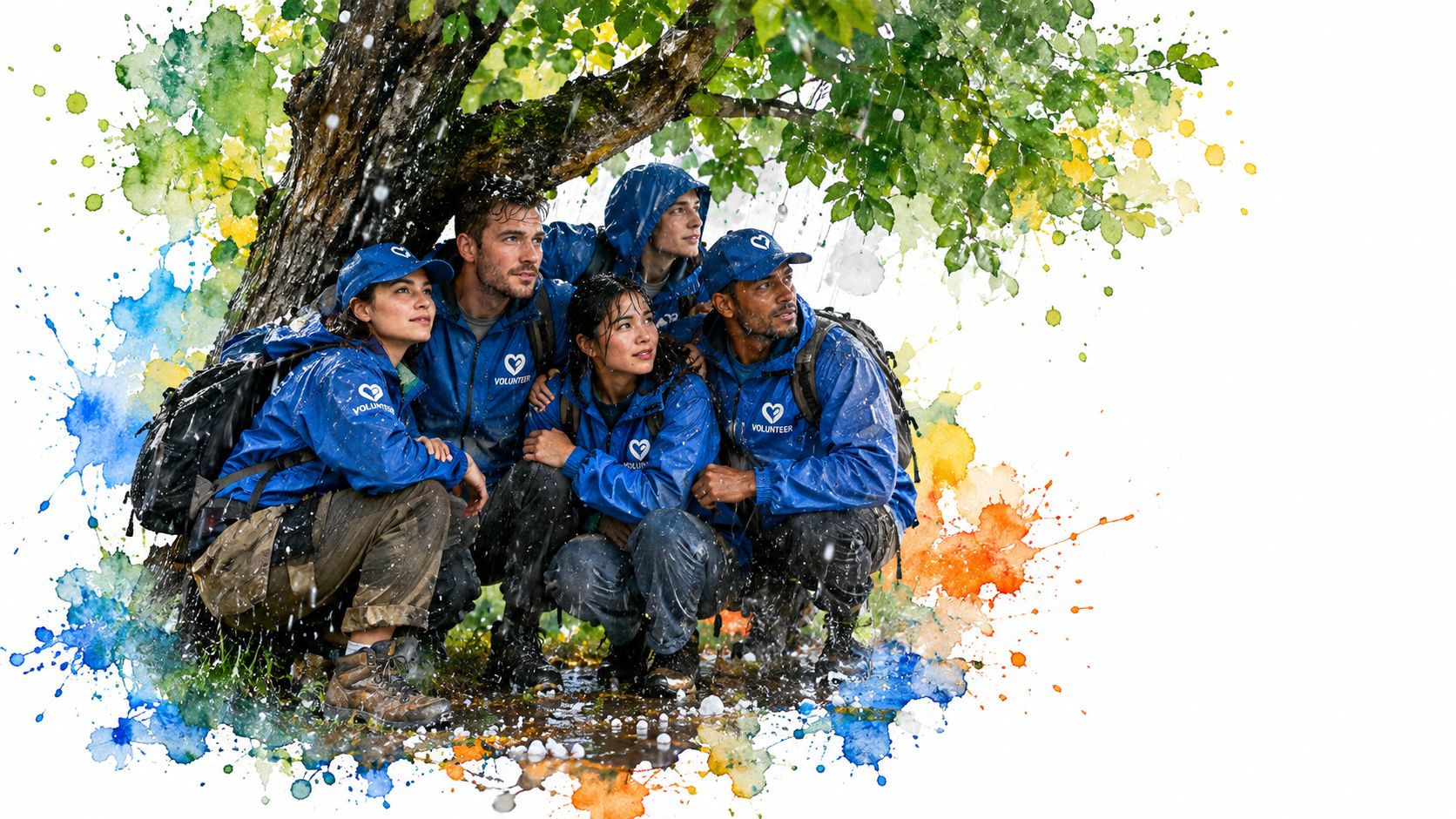
    A Chicago hailstorm caught three of us halfway through our first cleanup. We huddled under a tree, shivering while every Uber canceled, and our shared flags became the only clear sign that we belonged together.

    Why Volunteer Uniforms Matter More Than a Logo

    That day taught me something I still use when I think about volunteer uniforms. A shirt can carry a logo, but a uniform system has to do more work. It has to help the public find you, help volunteers find one another, and help a newcomer feel included before they know anyone's name.

    The first approved volunteer uniform in the U.S. National Park Service VIP program was an orange “pop-on” smock, approved in December 1970 when the program began. By 1975, the Service had introduced a distinctive cardigan vest, described in agency materials as sunny gold trimmed in loden green, with versions for men and women. Volunteers whose main duty involved visitor contact had to wear it. The National Park Service history of volunteer uniforms shows how quickly a simple garment can become a public signal.

    A diverse group of volunteers in blue jackets and caps huddling under a tree during rain.

    The three jobs your uniform must do

    A stranger on a Chicago sidewalk shouldn't have to guess whether you're part of the cleanup. A bright flag, visible badge, or shared jacket gives them an answer before you speak.

    A volunteer arriving alone needs the same answer. They should spot the check-in table, recognize the group near the corner, and know whom to ask for gloves. That small moment can turn anxiety into movement.

    The third job happens. A newcomer puts on a vest, pins on a name tag, or receives a team flag. Suddenly, they aren't watching from the edge. They have a place.

    A useful test: If your uniform idea doesn't improve recognition, safety, comfort, or belonging, leave it out.

    I think about uniforms as a bridge between identity and action. The logo matters because it tells a story, yet the garment also has to survive bending, lifting, rain, sweat, and a hurried bus ride home. A practical campaign t-shirt guide can help you think through message, artwork, and shirt choices before you commit to a design.

    Uniforms can also shape group habits. You can read more about organizational culture building when you're trying to turn occasional attendance into a shared practice. Start with the people, the work, and the hazards. Add the logo after those pieces make sense.

    Design Your Volunteer Uniform System Before You Shop

    Start with a map, not a catalog. Before you buy shirts, write down where volunteers work, what they carry, how long they stay outside, and which roles face moving vehicles, poor light, wet pavement, or heavy lifting.

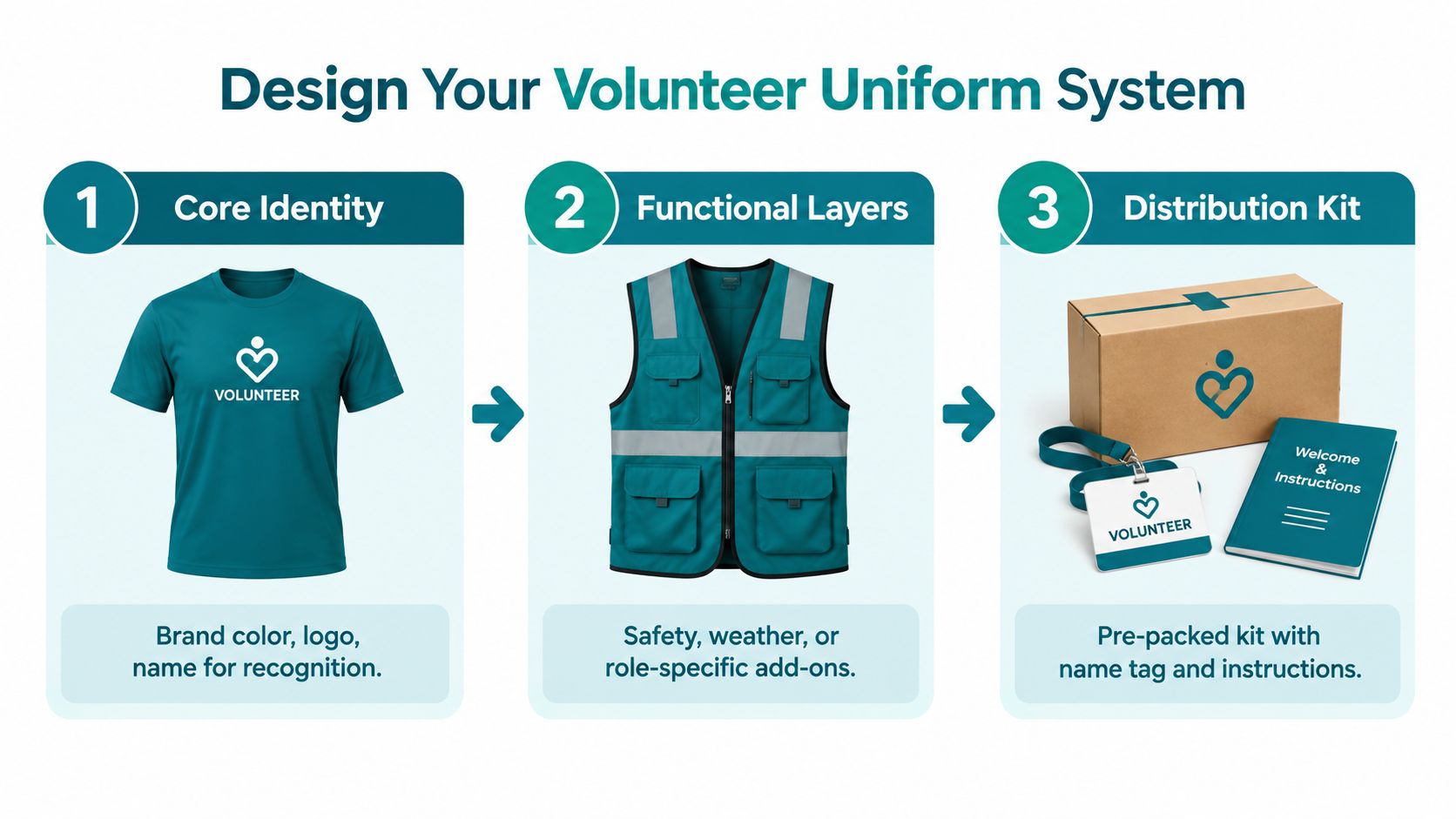
    I use two layers. The core identity layer carries the group's shared look. It might include a shirt, cap, name tag, or small flag. The functional layer comes on top when the task requires visibility, rain protection, cold-weather coverage, or a role marker.

    That separation keeps branding from carrying a safety burden it can't meet. Street clothes can work beneath a logo vest in some settings, yet roadway-facing volunteers need a complete compliant safety garment rather than a bright shirt paired with an unrelated vest.

    A three-step guide to designing volunteer uniforms featuring a t-shirt, utility vest, and a distribution kit.

    Build the brief in four passes

    Map the roles. Separate sidewalk collectors, traffic-facing spotters, team leads, photographers, supply runners, and check-in volunteers. They don't all need identical clothing.

    Map the conditions. List normal weather, low-light periods, wet locations, wind, heat, and the movements each role makes. A person who bends for hours needs different comfort from someone standing at a check-in table.

    Choose the identity layer. Pick a color that stays readable in street scenes and photographs. Place the logo where a jacket, vest, or open coat won't hide it. Use names or role labels when volunteers need quick identification.

    Choose the safety layer. Specify the exact vest or outerwear model, the label class, the available sizes, and the conditions that trigger use. If you need help thinking through fabric weight, stretch, or garment construction, find custom team uniform fabrics before you send a purchase request.

    Your finished brief can fit on one page:

    • Identity: approved shirt, cap, badge, flag, or name tag.
    • Safety: approved high-visibility outerwear and label check.
    • Weather: rain, snow, heat, and cold layers.
    • Roles: who wears each add-on and when.
    • Fit: size range, alternate garments, and spare stock.
    • Care: washing, drying, storage, repairs, and returns.
    • Conduct: visible identification, photo rules, and prohibited lookalike gear.

    Keep the brief plain enough for a new volunteer lead to use without a meeting. If someone has to interpret every line, the system will change from event to event.

    Sourcing Volunteer Uniforms on a Grassroots Budget

    A low-cost uniform doesn't have to look careless. I've seen groups spend their limited money in the wrong place, then discover they can't replace a missing size or a damaged vest. The better question is simple: what can you issue, wash, repair, and replace through a full season of cleanups?

    Sourcing Option Best For Trade Off
    Bulk tees Groups that meet often and want one shared identity layer Sizes and fabric quality need careful planning
    Thrift shirts with iron-on marks Small pilots and mixed personal styles Matching color and long-term durability can vary
    Logo vests over personal clothing Inclusive programs with limited shirt stock The vest still needs clear fit and care rules
    Donated high-visibility vests Roadside work with a very tight budget Donations may arrive in mixed classes, sizes, and condition
    One approved hi-vis model Groups that need repeatable street-work practice Upfront sorting and replacement planning take attention

    Spend first on the layer that protects people

    For roadway work, spend on the safety garment before you spend on a polished shirt. Fluorescent high-visibility clothing grew from a longer safety-apparel history. Bob Switzer developed fluorescent garments in the 1930s after an injury, UK railway workers trialed high-visibility clothing in Glasgow in 1964, and the first ANSI/ISEA 107 standard arrived in 1999, according to this history of high-visibility clothing.

    A logo shirt can wait. A compliant vest can't when volunteers work near public access roads.

    Match the purchase to the group

    A small group can test a few shirt colors and issue reusable name tags. A growing group needs a size record, a storage bin, and a rule for who receives roadway gear. A group that works in changing neighborhoods may prefer logo vests over personal clothing, since volunteers can arrive in comfortable layers while the group still looks connected.

    I'd also reserve money for spare sizes and simple replacements. One approved hi-vis model makes training easier, reduces confusion at check-in, and lets a volunteer lead spot a mismatch quickly. A small badge or flag can carry group pride when shirts fade, stretch, or disappear into laundry baskets.

    Buy what your team can maintain. A cheap garment that no one can fit, wash, or replace becomes expensive friction.

    Ask every vendor the same questions. What sizes can you order later? Does the logo survive ordinary washing? Can you replace one damaged piece? Does the safety garment carry the required label? A grassroots budget works best when you protect repeatability rather than chase a perfect first order.

    Fit Distribution and Care That Keeps Volunteers Coming Back

    The clothing table can either welcome people or push them away. I've watched a volunteer arrive on a cold morning, wait while someone searches through a box, try on a shirt that pulls across the shoulders, then leave before the first bag fills. The cleanup lost a pair of hands before it reached the sidewalk.

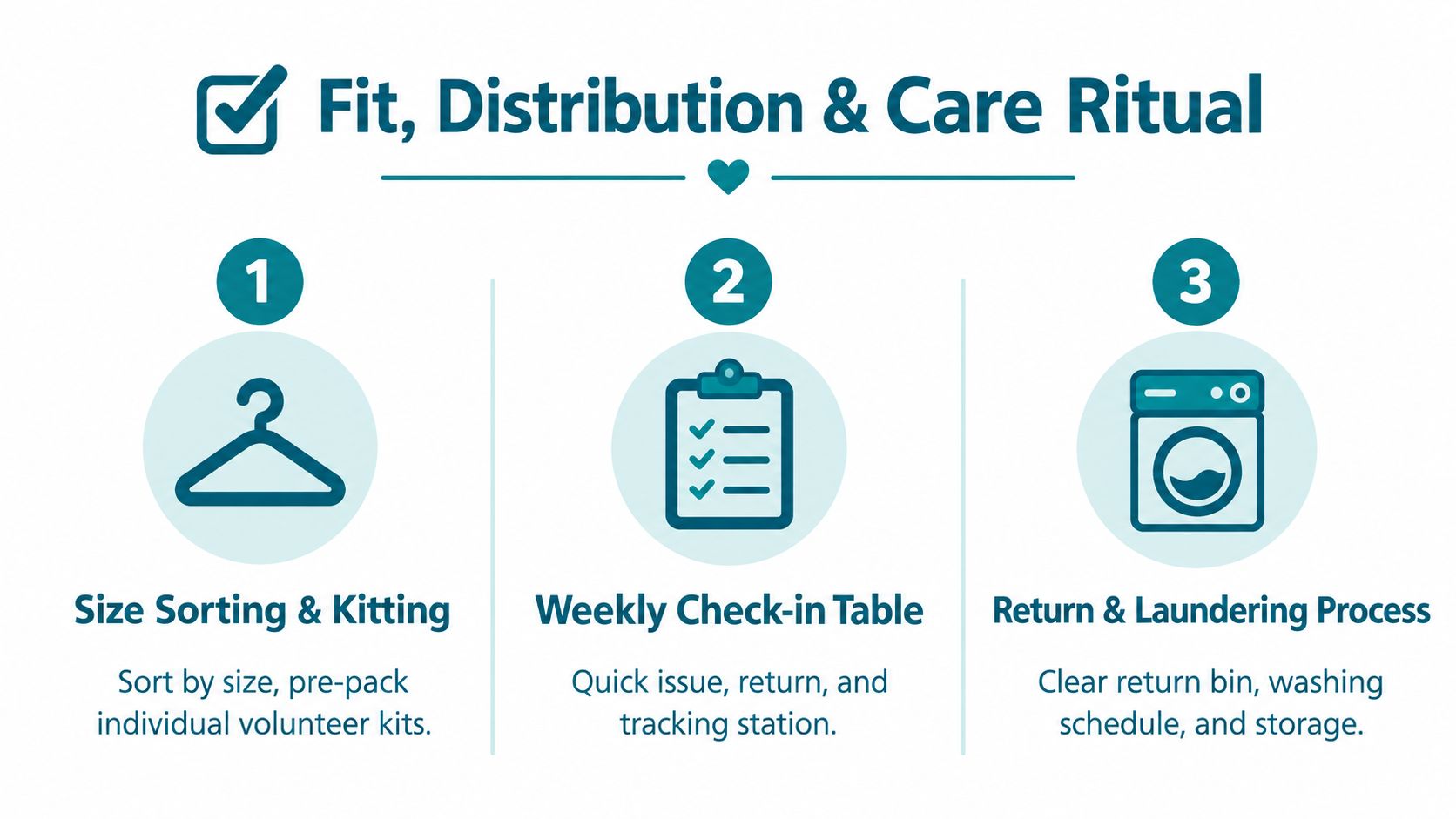
    Treat distribution like a short ritual. Sort garments before people arrive. Label bins by size. Pre-pack a kit with the garment, name tag, role note, and return instructions. Keep a small fitting area where someone can change without an audience.

    A three-step process infographic for volunteer uniforms including sizing, distribution check-ins, and the laundering return cycle.

    Make fit part of safety

    Offer more than one cut when you can. Keep enough room for bending, reaching, layering, and walking. A volunteer uniform should allow comfortable movement without weakening a professional appearance, as described in this hospital volunteer clothing guidance.

    A vest over personal clothing can help when a volunteer can't use the standard shirt because of sensory needs, religious dress, mobility needs, body shape, or weather. An alternate garment still needs a clear safety rule and visible identification. Inclusion works best when you write the option into the policy instead of treating it like a special favor.

    Run the check-in table quickly

    Use a simple record with the volunteer's name, issued size, role layer, and return status. Keep a bin for clean stock and another for used garments. Put the return location on a small card inside every kit.

    Name labels can save time when several people own similar jackets. These tips for school uniform labels give useful ideas for durable placement and readable identification, even though cleanup teams need to adapt them for outdoor workwear.

    Care rule: Every issued item returns clean, dry, complete, and ready for the next person.

    The U.S. Forest Service volunteer-uniform manual calls for uniforms to remain neat, clean, and complete, and it treats high-visibility vests as an approved exception for special circumstances. That manual's uniform guidance supports a modular approach, identity underneath and safety or weather layers above.

    Wash according to the garment label. Dry wet gear before storage. Repair loose seams early. Retire damaged reflective material instead of hoping the next volunteer won't notice.

    Here's a short visual reminder you can share with team leads:

    A smooth clothing ritual tells volunteers that their time matters. They get in, get equipped, and get moving.

    You can pair this process with practical volunteer retention strategies that reduce avoidable friction before and after each cleanup.

    Safety Visibility and Weather Rules You Can Actually Enforce

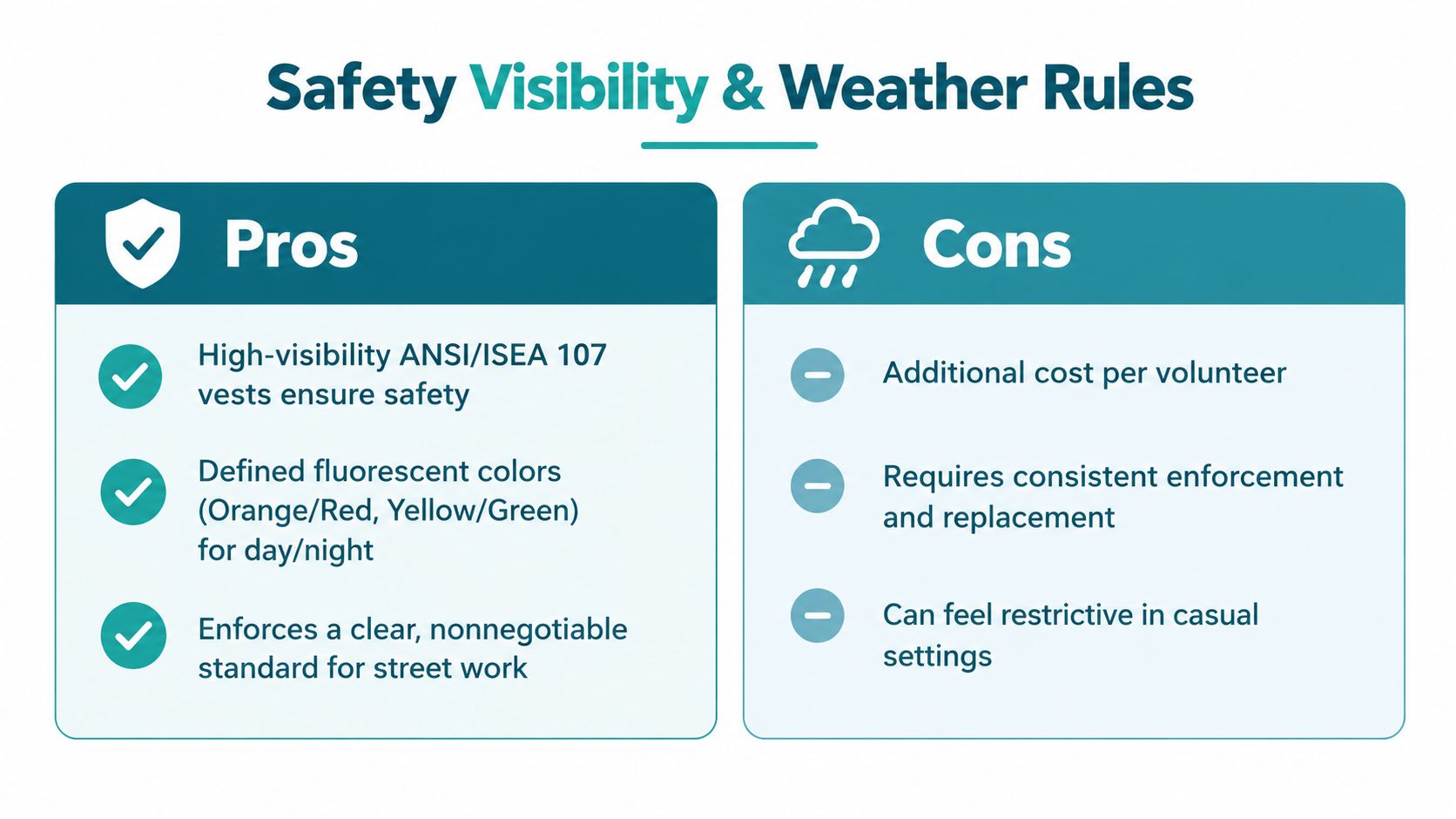
    A roadside vest is not decoration. Seattle's Adopt-A-Street guide says volunteers must wear the safety vest at all times, and Texas DOT requires volunteers to wear the agency-provided safety vests during cleanup. Seattle's Adopt-A-Street safety guidance gives the plainest version of the rule: if you work beside traffic, keep the vest on.

    A comparison chart outlining the pros and cons of implementing safety visibility gear and volunteer uniform rules.

    Treat the vest as tested equipment

    ANSI/ISEA 107 high-visibility safety apparel requirements cover fluorescent background colors and retroreflective materials. Roadway-facing volunteer work generally belongs in the worker PPE category, not the branding category.

    A bright vest alone doesn't prove compliance. Class 2 apparel has one cited benchmark of at least 775 square inches of fluorescent background material and 201 square inches of retroreflective material, with requirements around tested construction, minimum material areas, and 360-degree conspicuity. This ANSI/ISEA 107 explanation describes the benchmark and why a random bright garment can fall short.

    Assign hi-vis outerwear to the volunteers who face the road. Before each event, check the garment label and condition. Keep ordinary street clothes outside the compliance layer, since a mixed outfit can interrupt the intended visibility pattern.

    Give every weather condition a simple response

    Rain changes the system. Add waterproof outerwear over the identity layer, keep reflective areas visible, and replace soaked gear after the event. A hood shouldn't block side vision.

    Snow and cold require room for layers, dry socks, gloves, and footwear that lets volunteers walk and bend safely. Don't force a thin branded shirt to carry the whole weather burden.

    Heat calls for breathable base clothing, sun protection, water, and breaks. Long pants and sleeves may still fit the task, yet the fabric and fit must allow movement and airflow. Public volunteer guidance commonly names layered clothing, waterproof clothing, sunscreen, and season-specific protection. Hamilton's safety material also points volunteers toward bright or reflective clothing, closed-toe shoes, and garments that don't restrict vision or movement. The NCTCOG cleanup guide adds boots, hats or caps, long pants, and long-sleeved shirts for outdoor work.

    Kickoff rule: Roadside volunteers wear the approved vest. Everyone wears closed-toe shoes and clothing suited to the weather. Anyone who can't stay comfortable, visible, and mobile pauses or changes roles.

    Use this volunteer safety checklist to turn the rule into a pre-event habit. A policy works when a lead can explain it in one breath and enforce it without guessing.

    Make It Stick With Policy Templates and Pride

    A good uniform policy should fit on a page. It should tell people what to wear, when to add safety gear, how to request an alternative, and where to return issued items. It shouldn't make volunteers decode a legal document before they pick up a grabber.

    Copy-ready policy language

    Volunteer uniform policy: Wear the approved identity layer during group activities. Add the approved high-visibility garment when you work on or near a public access roadway, in low light, or in another condition named by the event lead. Keep identification visible. Wear closed-toe shoes and clothing that allows safe movement and fits the weather. Don't use garments that resemble police, military, or public security uniforms. Ask the lead for an approved alternative if the standard garment conflicts with faith, health, mobility, body-fit, or sensory needs.

    The Red Cross and Red Crescent volunteer security manual says volunteers should carry photo identification or wear a badge or recognized uniform, keep uniforms and emblems clearly visible, avoid police or military lookalikes, and avoid metal badges that could cause accidents. Its volunteer security guidance gives you a practical foundation for identification and appearance rules.

    Let pride have a place

    Policy handles the edges. Pride keeps the center alive.

    A small flag can lead a group down the block. A cloth badge can turn a borrowed vest into something people want to wear. A theme song can make a wet morning feel like the opening scene of a shared story. Those details don't replace safety gear. They give the safe gear a human face.

    I learned that under the tree during the hailstorm. Three strangers looked miserable, yet the flags, the jokes, and the shared colors gave us a reason to stay together. Years later, the same principle still works at a cleanup near an empty lot, a bus stop, or a corner where everyone else walks past.

    Write a one-paragraph volunteer agreement beside the policy:

    I'll wear the assigned gear for my role, keep identification visible, follow weather and roadway directions, tell a lead when my clothing or equipment doesn't fit safely, and return shared items clean, dry, and complete.

    Read it at check-in. Ask for consent before taking photos. Give people a way to decline or request a different image. Keep exceptions private, practical, and easy to approve.

    Your uniform system should feel like a hand on the shoulder, not a locked gate. Start with one identity layer, one approved safety model, a few weather options, and a distribution ritual you can repeat next weekend.


    Visit Litter Caterpillars to see how a Chicago volunteer cleanup group combines safety, friendship, flags, badges, and shared purpose in real field conditions. Join the next cleanup, test your uniform system with us, and help turn one cold or rainy morning into a team memory.

  • Litter Cleanup Volunteer Guide How to Join and Help

    Litter Cleanup Volunteer Guide How to Join and Help

    The hail started before we finished our first bag. Three of us huddled beneath a tree, shivering while our rides kept canceling, and somehow we were laughing. That was my first litter cleanup, and I learned that cleaning other people's mess can feel easier than facing your own.

    Why I Started Picking Up Trash and Why You Might Too

    For years, I could not keep my own things organized. Every object seemed to demand a memory. An old jar brought back a trip, while a forgotten snack recalled an attempt to eat better. Even a small mess became a decision I kept postponing.

    Street litter asked less of me. A bottle had no personal history, and a wrapper did not make me remember where I bought it. I could reach down with a grabber, drop the item into a bag, and keep walking.

    The first storm changed what volunteering meant to me. The weather was miserable, yet it gave the morning a shared story. We were three people trying to finish an odd little adventure, and the cold made our jokes better.

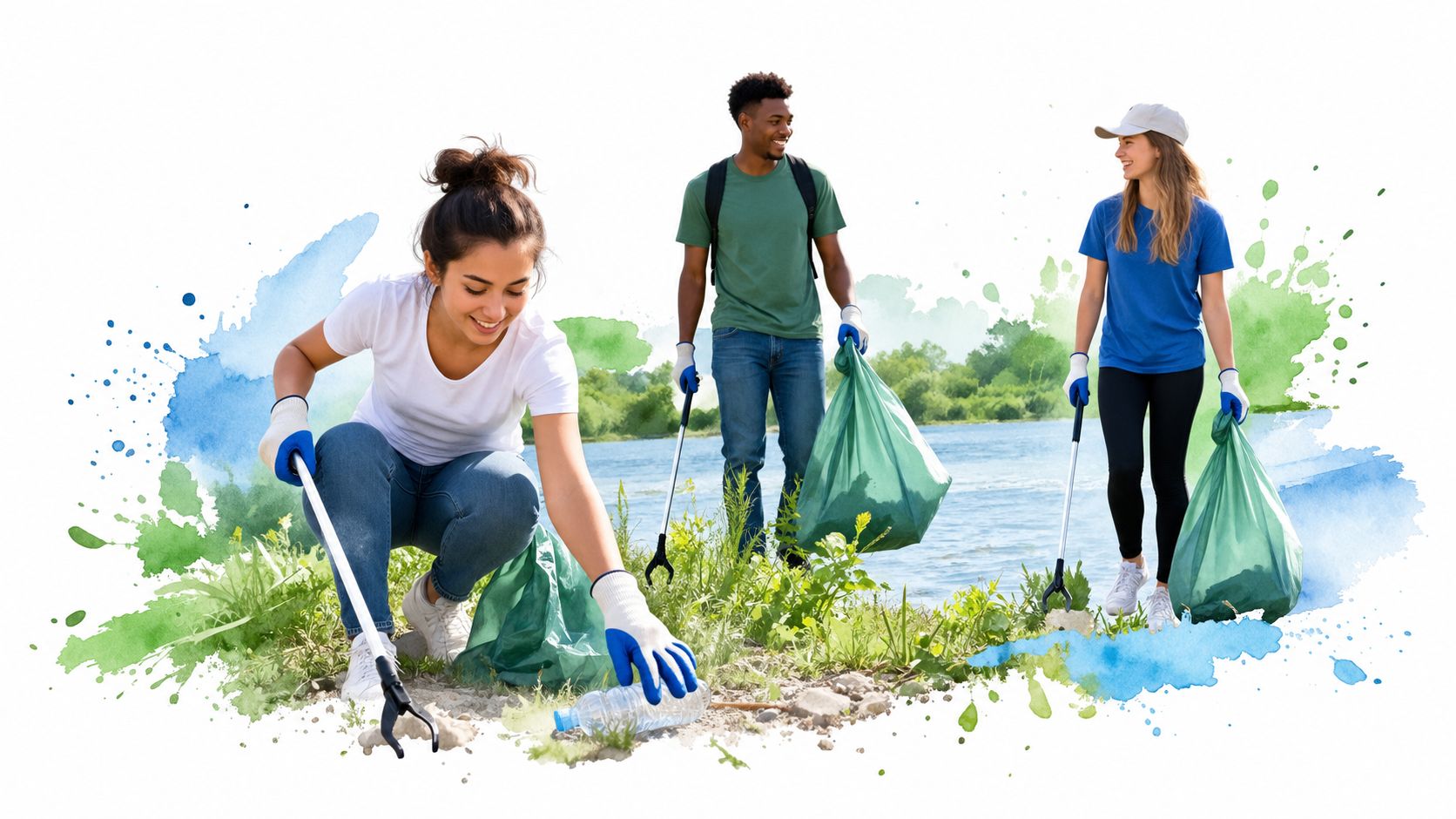
    A young female volunteer happily picks up litter in a scenic park using a grabber tool.

    Why showing up matters

    I returned because the work offered a clear promise. I could arrive, carry a bag, and leave one small place cleaner. I did not have to feel organized first. I needed gloves, some courage, and people willing to stand beside me.

    The Litter Caterpillars follow that same rhythm. The group cleans across Chicago's wards, including areas other groups may avoid, and meets on weekend mornings. Volunteers bring flags, theme songs, and badges, turning an ordinary sidewalk into a place with its own shared identity.

    Rain or shine, that routine changes people. You learn to keep showing up, and familiar faces become friends because you have sweated, shivered, and worked beside them.

    My rule: Choose one cleanup before you decide whether volunteering fits you.

    Litter cleanup also has a broad community history. Keep America Beautiful describes volunteer work spanning community events and public spaces across the United States. Its overview of litter cleanup volunteerism shows how a simple bag-and-grabber routine can connect people at a much larger scale. Keep America Beautiful describes the scale of litter cleanup volunteerism.

    You do not need to fix the whole city. Choose one morning, meet people outdoors, and let the bag fill gradually. Consistency becomes easier when friends are waiting for you, and a small act can leave you braver than when you arrived.

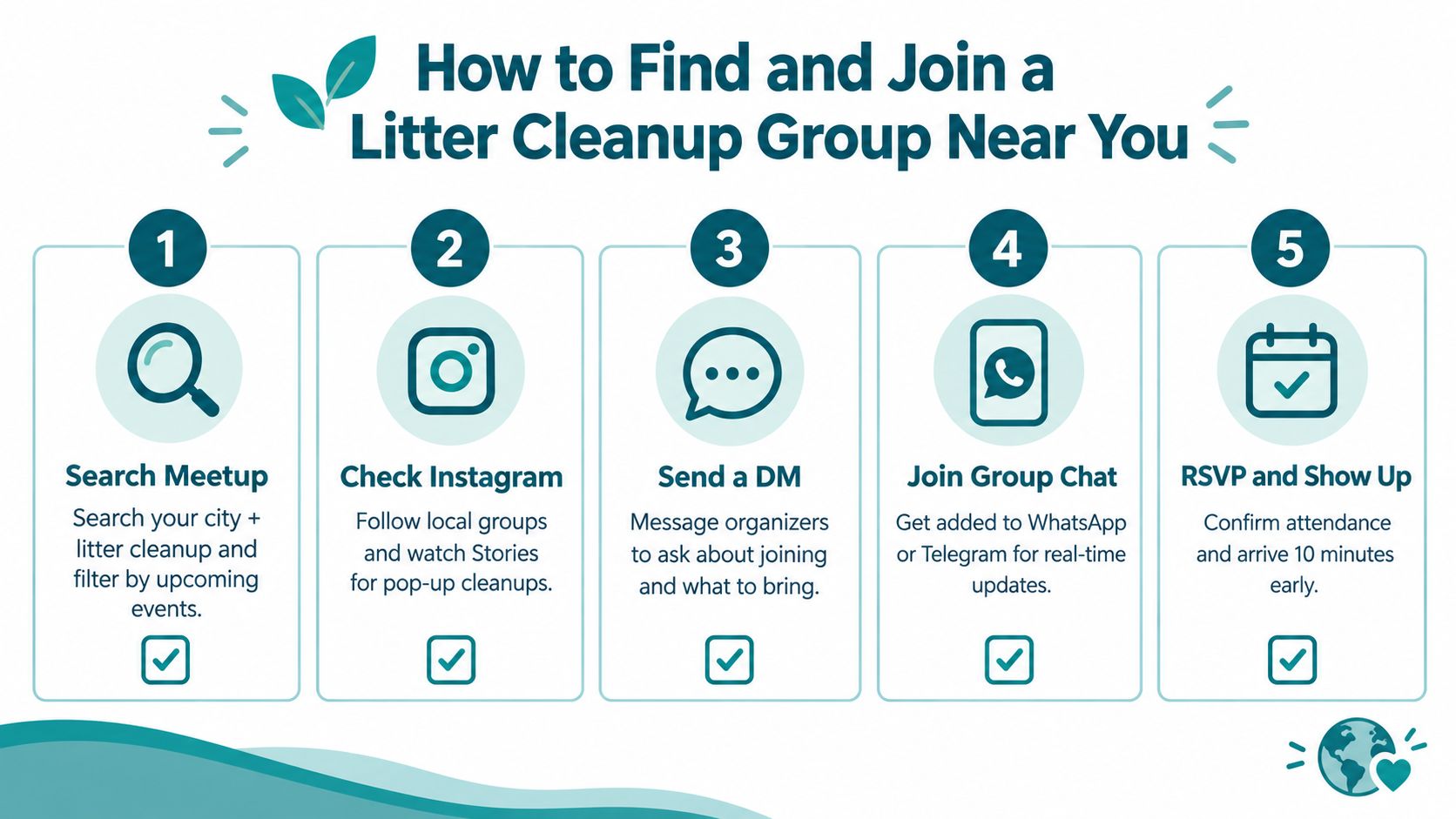
    How to Find and Join a Litter Cleanup Group Near You

    I usually begin with Meetup, because event listings give me a date, meeting place, and host in one screen. Search your city with phrases like “litter cleanup,” “trash pickup,” or “community cleanup,” then filter for upcoming events.

    Read the listing before you RSVP. Look for the meeting point, expected pace, supplied equipment, weather plan, age rules, and contact method. A clear listing should tell you what happens after you arrive, not leave you guessing beside a park entrance.

    Use Meetup and Instagram together

    Instagram helps when groups announce smaller events quickly. Search your city name with “litter pickup” and follow local groups, parks, neighborhood associations, and environmental volunteers. Watch Stories for pop-up cleanups, route changes, and weather notices.

    Send a short direct message:

    Hi, I'm interested in joining your next litter cleanup. Is the event open to new volunteers, and should I bring anything?

    That message does enough. You don't need a personal essay. Hosts can tell you whether they provide grabbers, gloves, and bags, or whether you should bring your own.

    An infographic showing five easy steps to find and join a local litter cleanup group volunteer event.

    Choose a first event you can actually attend

    Weekend mornings work well for many volunteer groups because the schedule leaves room for service and conversation. Pick a site that feels manageable, with a clear meeting point and a host who answers questions.

    A group chat can make the first visit easier. Ask whether the organizers use WhatsApp, Telegram, or another open chat for last-minute updates. RSVP, save the address, and arrive early enough to find the host without rushing.

    If you're searching around Chicago, browse local volunteer trash pickup events near you and compare the next available meetup with your schedule. Then make the decision concrete. RSVP before you talk yourself out of it, send the host your question, and put the event on your calendar.

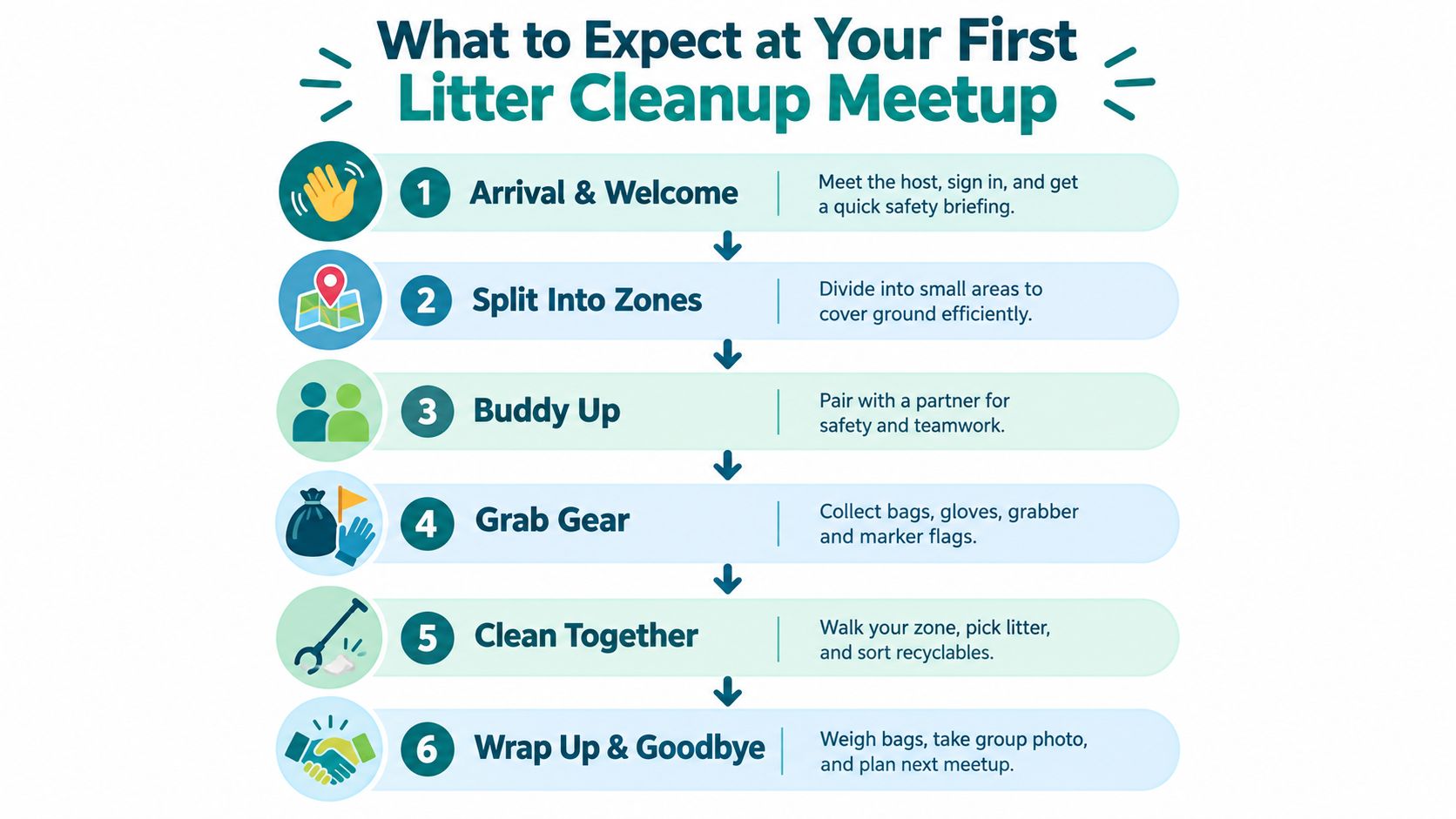
    What to Expect at Your First Litter Cleanup Meetup

    My first calm meetup began with a small circle of people near the starting point. The host welcomed everyone, explained the route, and gave a short safety briefing. Nobody expected a speech or a perfect introduction. We signed in, collected supplies, and started talking while we prepared.

    The group split the area into small zones. That choice kept us from crowding one patch of sidewalk while another remained untouched. I paired with a buddy, took a grabber and bag, and followed the boundary of our assigned block.

    At first, I felt awkward. My buddy found a cup beneath a hedge, and I found a tangled receipt near a curb. After a few minutes, the pattern became almost meditative. Reach, squeeze, drop. Reach, squeeze, drop. Between finds, we talked about neighborhoods, pets, jobs, and whatever had happened that week.

    A simple rhythm carries the morning

    The host checked routes and kept the group together without hurrying anyone. We took breaks for water and paused when the ground, traffic, or weather made a section unsuitable. A first-time litter cleanup volunteer doesn't need to compete with anyone. A steady pace works better than a frantic one.

    You may meet students, neighbors, people new to the city, and regulars who know every shortcut around the block. Some people talk constantly. Others work without a word. Both styles fit.

    An infographic titled What to Expect at Your First Litter Cleanup Meetup, outlining six steps to follow.

    Near the end, volunteers bring filled bags to the agreed pickup point. Some groups sort recyclables or record what they find. The group may take a photo, thank everyone, and discuss the next route. The goodbye often feels warmer than the greeting because you've shared a task that leaves visible evidence.

    You don't have to arrive confident. You can borrow confidence from the person walking beside you.

    The meetup may include laughter, quiet concentration, muddy shoes, and an unexpected weather change. That mixture makes the experience memorable. You leave with cleaner streets behind you and a few names you can recognize at the next gathering.

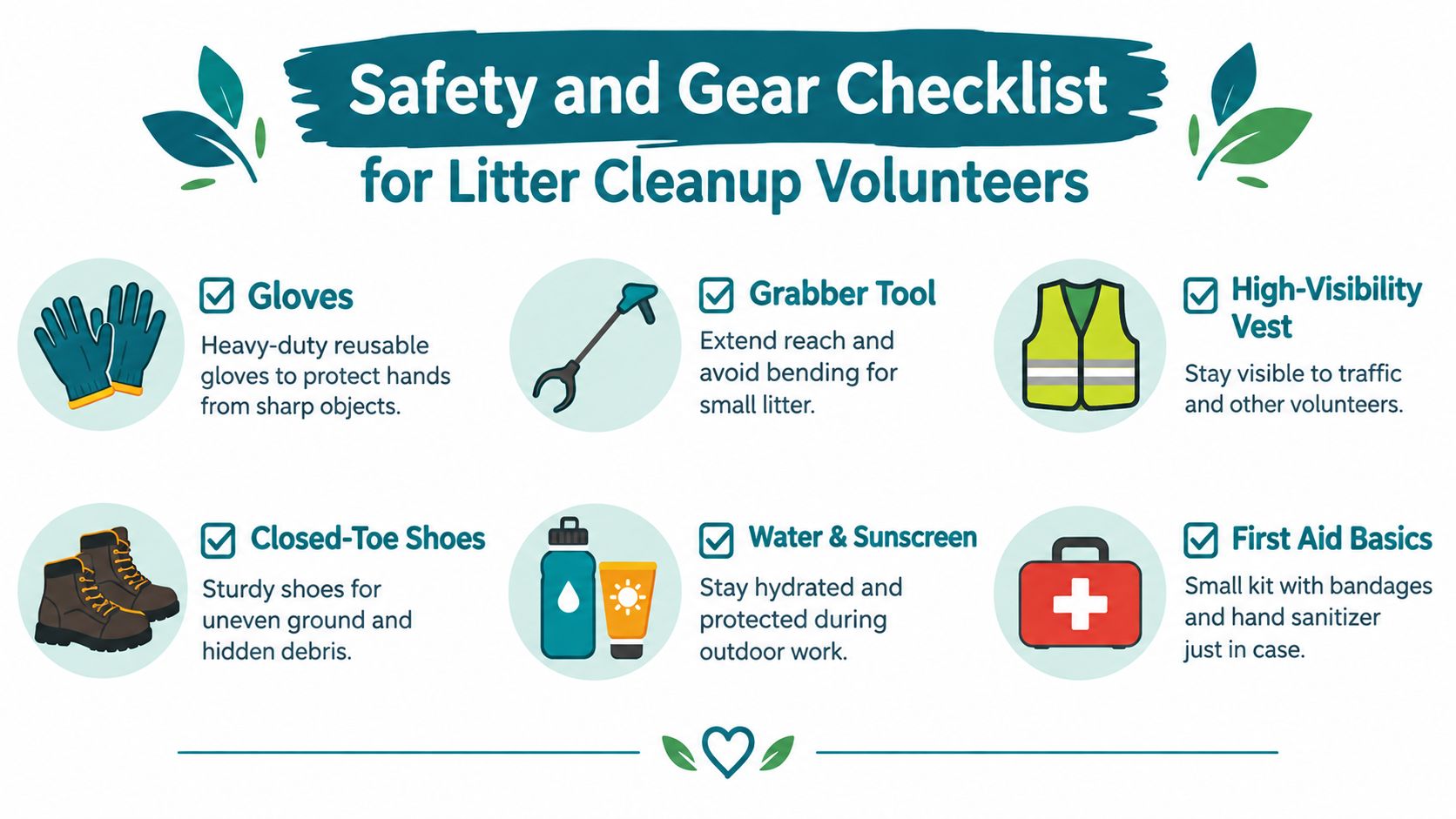
    Safety and Gear Checklist for Litter Cleanup Volunteers

    I pack the night before because a rushed volunteer forgets the item that matters most. Start with gloves, a grabber, high-visibility clothing, closed-toe shoes, water, and sunscreen. Add layers when wind or heat may change the feel of the morning.

    Use this checklist:

    • Gloves: Wear sturdy gloves that protect your hands from hidden sharp edges. Never pick up litter with bare hands.
    • Grabber: Use a grabber instead of reaching into bushes, gaps, or piles. It keeps your hands farther from unknown objects.
    • High-visibility vest: Wear reflective gear near any traffic or parking area so drivers and teammates can see you.
    • Closed-toe footwear: Choose hard-soled shoes or work boots that handle uneven ground and concealed debris.
    • Water and sunscreen: Drink regularly, take breaks, and protect exposed skin during outdoor work.
    • Basic first aid: Carry bandages and hand sanitizer for small needs after you finish handling bags.

    See the litter cleanup equipment options used for trash pickup work before your first event.

    Follow the route, then stop for hazards

    A safe workflow starts with a site inspection. The leader checks for traffic, water, unstable ground, construction, severe weather, and other hazards. The team divides the area into small zones, works in buddy pairs, fills only manageable bags, and places tied bags at a safe pickup point.

    Stay off the roadway. Work in daylight, avoid wet or poor-visibility conditions, and never choose a busy road to collect more litter. Minnesota's Adopt a Highway guidance also tells volunteers to face oncoming traffic, avoid bridges and open water, and leave enough room for crews to tie bags shut. Read the Minnesota volunteer safety guidance.

    Some objects belong to trained responders. Leave needles, broken glass, batteries, dead animals, heavy or bulky objects, sealed containers, and unknown substances alone. Tell the group leader, who can report the item to the right authority.

    Hazard rule: If you can't identify it or lift it safely, don't touch it.

    A county roadside program requires safety training, a vest, gloves, and hard-soled shoes or work boots before participation. Review the Will County roadside terms and conditions. Texas guidance also places volunteers in a defined right-of-way workflow, asks groups to carpool, and says bags should remain tied and reachable for collection. Read the Texas cleanup safety tips.

    When you finish, wash your hands and disinfect reusable equipment. Safety keeps one enjoyable morning from becoming a reason to quit.

    A safety and gear checklist for litter cleanup volunteers featuring essential items like gloves, tools, and protective equipment.

    Cleanup Etiquette That Keeps Teams Kind and Unified

    A cleanup group works best when nobody treats the morning like a competition. I share the awkward finds, the heavy sections, and the boring stretches. Someone else may take the next bag, hold a flag, or walk with a newer volunteer who feels unsure.

    Keep your footprint light in the neighborhood. Stay aware of entrances, gardens, parked cars, and people using the sidewalk. Keep voices reasonable, leave private property alone, and let the leader handle questions from residents or tricky waste.
    Small teams make the work easier to supervise. Assign one side of a road at a time, keep buddy pairs together, and use a clear handoff for anything hazardous. Never pressure someone to work faster, lift beyond their capacity, or enter a place that feels unsafe.

    Protect the volunteer mood

    A volunteer-first group protects energy. Leaders should explain the plan, notice fatigue, and make breaks normal. Nobody should feel embarrassed for sitting out a difficult patch or leaving when the weather turns.

    Celebration helps too. A flag, a theme song, or a badge can turn a plain bag of litter into a shared achievement without turning service into a performance. I like the moment when everyone sees the same block at the end and recognizes the difference.

    • Do welcome newcomers: Introduce yourself and explain the next simple task.
    • Do share information: Tell the leader about hazards instead of trying to solve them alone.
    • Don't pressure donations: People arrive to give time, and organizers should respect that.
    • Don't shame residents: Clean the space without turning strangers into targets.
    • Do thank the team: A sincere goodbye makes returning feel easy.

    Before joining a group, read its volunteer code of conduct so you understand how it handles respect, safety, and shared work.

    How Volunteering Transforms You and Your City

    The first time hail hit during a cleanup, I nearly headed home. Then a friend tightened her hood, laughed, and kept walking. We filled bags between showers. That morning changed my idea of service. A cleanup clears one sidewalk, while returning regularly changes how you see yourself and your neighborhood.

    The Litter Caterpillars' rain-or-shine, all-wards approach makes that change visible. You learn to show up before you feel ready, work beside people you did not know, and trust a plan when the weather turns. Bravery becomes an ordinary habit, built one meetup at a time.

    Friendship grows through repetition. You meet the same people at the gathering point, follow familiar routes, and learn how someone laughs when a bag snags on a thorn. Those small moments create belonging without demanding an instant friendship.

    Chicago looks different with a grabber in your hand. Walking through its wards has led me down streets I might otherwise overlook. Projects such as Caterpillar Park in Englewood also give volunteers a place where shared work can continue beyond one cleanup morning.

    Turn one morning into a practice

    Keep the first commitment modest. RSVP for one event, bring a friend, and decide beforehand which weather would send you home. Afterward, record the next date while the experience still feels fresh.

    For another community view of waste reduction and local action, read Fillaree's guide to the top reasons Durham is zero-waste capital.

    The broader participation is encouraging. Keep Britain Tidy reports that many adults take part in litter picking regularly, and that hundreds of thousands of volunteers collected hundreds of thousands of rubbish bags in one year. The scale shows that local service can become a shared public habit.

    You do not need a heroic plan. Choose a meeting point, wear shoes you trust, and let the people beside you make the morning lighter. Return before the habit disappears.

    Litter Caterpillars organizes volunteer trash pickup events across Chicago, provides grabbers, bags, and gloves, and offers a practical way to meet people while cleaning local streets. Visit Litter Caterpillars, RSVP for a weekend cleanup, and bring a friend to your first morning.

  • Trash Pickup Equipment: What Volunteer Groups Actually Need

    Trash Pickup Equipment: What Volunteer Groups Actually Need

    In one October storm, twelve of us worked along the Lake Michigan shoreline with plastic grocery bags. Rain soaked the paper-thin gloves we had, wind pushed debris through our feet, and nobody had a real grabber. We finished the route, but the gear rescued us less often than we rescued the gear.

    After three years of weekly cleanups across Chicago, I judge trash pickup equipment by a simple test. Can a mixed group use it in rain, snow, cold wind, and summer heat without slowing down or getting hurt? The right tools don't need to look impressive. They need to keep working when cardboard turns to sludge, a bag catches on a thorn, or a volunteer finds broken glass under wet leaves.

    Why Equipment Choices Matter More Than You Think

    The first failures usually happen in predictable places: the grabber jaw stops closing, the glove seam splits, or the bag handle tears. A cheap kit can look fine on a store shelf and fall apart halfway through a cleanup. Then someone ties two grocery bags together, bends over every few steps, and starts handling litter with exposed fingers.

    That pattern creates a slow, frustrating morning. Volunteers wait for replacement tools, carry leaking bags, or leave a route unfinished because the equipment no longer matches the work. A new organizer often thinks the main job involves choosing a meeting point and sending reminders. Those tasks matter, but the equipment list decides whether people can finish the route comfortably.

    I've watched a group lose momentum because the only usable grabber belonged to the organizer. Everyone else stood around while one person picked up the small pieces. I've also seen a sturdy cart turn an awkward pile of wet bags into a clean handoff. The difference wasn't dramatic on paper. It came from choosing tools around real movement, real debris, and real weather.

    Start with the volunteer, not the catalog

    A volunteer may have long arms, short arms, a stiff back, small hands, or a wrist that tires quickly. One person may work on flat sidewalk, while another crosses muddy grass and a curb gutter. A single universal kit usually fits nobody especially well.

    Before buying, ask three questions:

    • What will people touch indirectly? Broken glass, wet food containers, needles, and sharp metal require reach tools and protective gloves.
    • Where will people carry the load? A long route needs better bags and a way to move full ones.
    • What happens when something fails? Bring spare grabbers, tape, gloves, and bags instead of hoping every item survives.

    The world generates about 11.2 billion tonnes of solid waste each year, and as of 2021, global collection covered 77% of solid waste while 33% was openly dumped, according to Waste360's account of refuse-truck evolution and collection conditions. That context doesn't tell you which grabber to buy, but it does explain why collection work demands equipment built for repeated handling and uneven conditions.

    Your job as a leader isn't to buy the most expensive pile of gear. It's to remove the small failures that make volunteers cold, tired, invisible, or unwilling to return. For liability planning alongside gear planning, review volunteer liability insurance considerations.

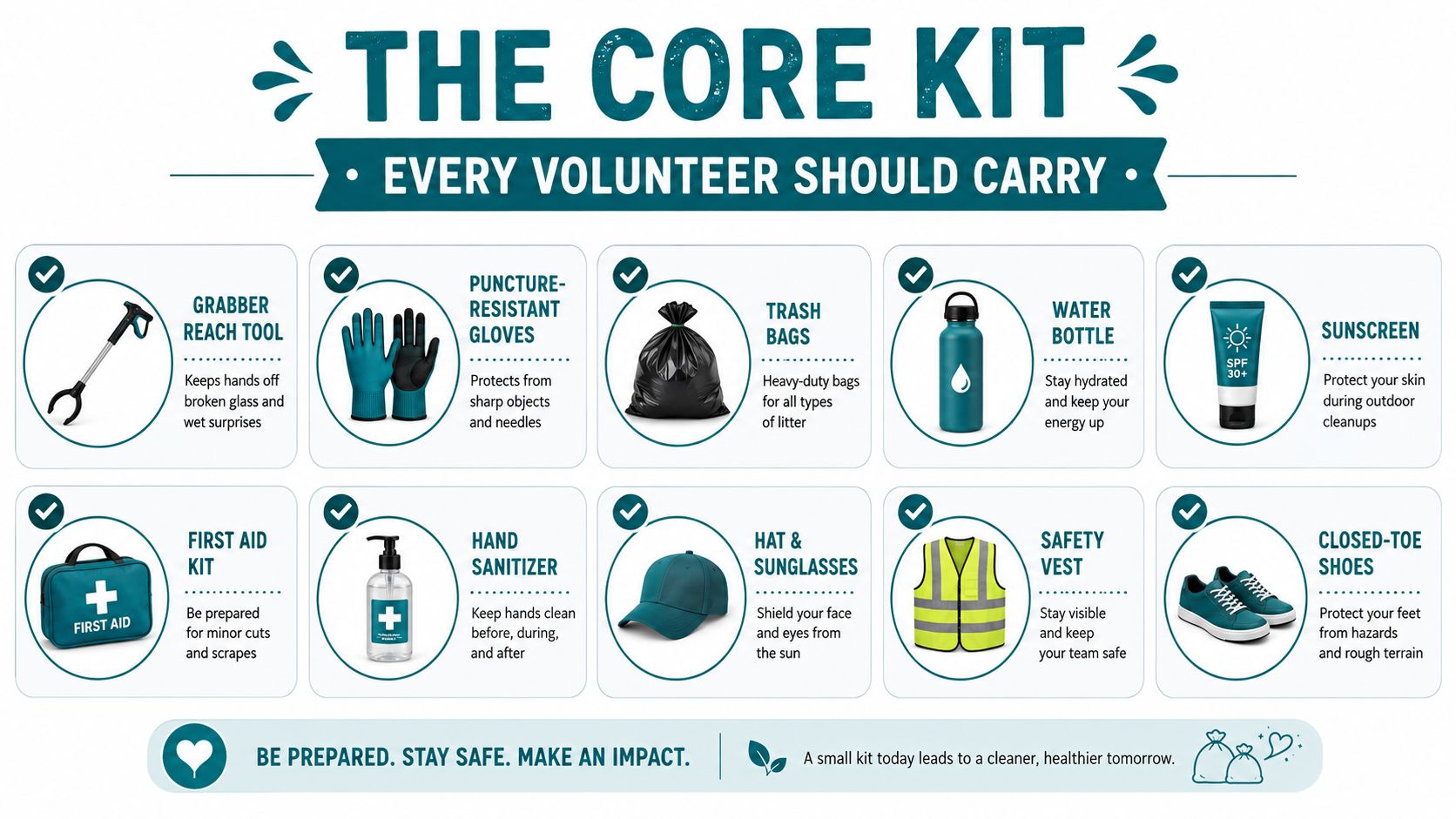
    The Core Kit Every Volunteer Should Carry

    A basic kit should let a volunteer reach litter, protect their hands, close a bag, and clean up afterward. I don't send people out with one tool and a cheerful warning to “be careful.” The pieces work together.

    An infographic titled The Core Kit displaying essential safety equipment for volunteers to carry during trash cleanups.

    The grabber does the reaching

    Choose a grabber with a jaw that closes firmly and a handle that feels natural in a gloved hand. The tool should pick up cans, wrappers, food containers, and small pieces of litter without forcing the volunteer to squeeze hard every time. A rotating jaw helps in some tight spaces, but simplicity often wins when several people share equipment.

    Test the trigger before an event. If it sticks, wobbles, or opens only halfway, put it aside. A grabber keeps hands away from broken glass and wet surprises, but it doesn't turn an unsafe object into a safe one. Volunteers still need permission to leave suspicious or dangerous items alone.

    Gloves need a real fit

    Use puncture-resistant gloves in several sizes. One oversized pair slips when someone grips a can, while a tight pair leaves fingertips sore. I keep nitrile-coated work gloves for wet gutter muck and cut-resistant gloves for broken glass or sharp metal.

    Gloves don't replace a grabber. They add a second layer between skin and the mess, especially when a volunteer holds a bag open or moves a harmless-looking object that shifts unexpectedly.

    Bags carry more than trash

    Heavy-duty contractor bags handle wet cardboard and rough pavement better than thin grocery bags. Use a bag hoop or have a second person hold the opening so the picker can work without wrestling the plastic. Tie full bags before they become too heavy to move.

    Closed-toe boots or sturdy sneakers belong in the kit conversation too. Sandals leave feet exposed to glass, nails, mud, and cold water. Add hand sanitizer and a basic first-aid item, then keep both with the route leader rather than burying them in a supply bin.

    Practical rule: Every item should prevent a specific failure. If you can't name the failure, reconsider the purchase.

    A high-visibility vest helps drivers and cyclists see volunteers along parkways and street edges. It also gives the group a visual identity, which makes it easier to spot someone who has wandered too far from the route. The vest doesn't control traffic, so keep people away from moving vehicles and use a separate traffic plan when the route demands it.

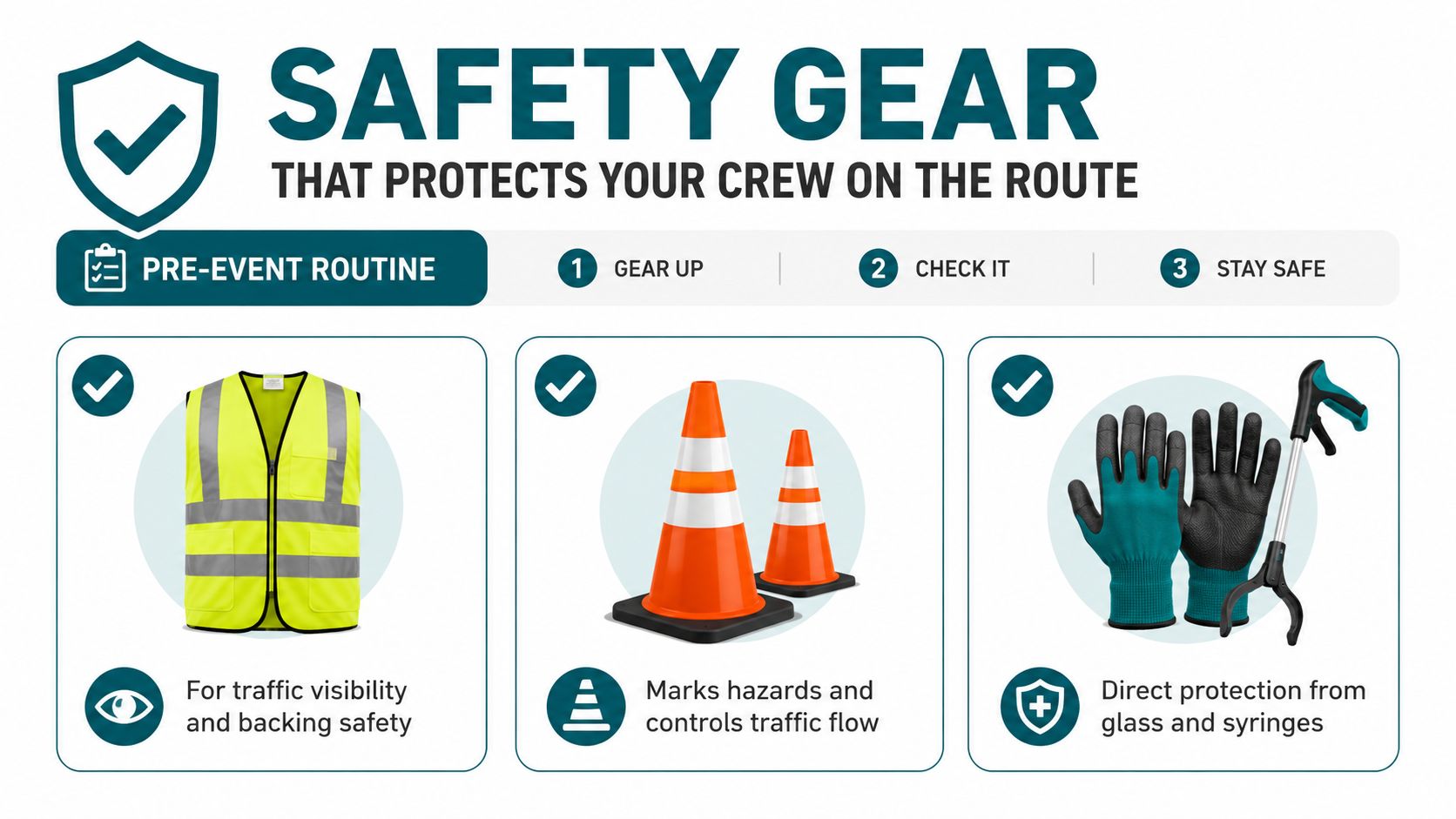
    Safety Gear That Protects Your Crew on the Route

    I run the safety briefing before anyone opens a bag. It takes a few minutes, and it changes how new volunteers read the route. I point out broken pavement, fast-moving traffic, steep banks, suspicious containers, and places where a vehicle might reverse.

    A safety infographic displaying high-visibility vests, traffic cones, and protective gloves for trash pickup teams.

    Build the check before the route

    Hand out gloves and grabbers first. Ask volunteers to show that their grabber closes and that their gloves fit. Then distribute high-visibility vests or tabards, check footwear, and point out the boundaries of the route.

    In summer, add hats, sunscreen, and water. In spring, pack extra layers because wind beside the lake can cut through a warm afternoon. In rain or snow, give people a clear stopping point. A volunteer who gets soaked early may lose warmth long before the event ends.

    Official guidance for volunteer litter picking calls for protective gloves and high-visibility clothing, with reflective clothing suited to roads where speed limits reach 30 mph or less, or up to 50 mph in one district guide, depending on the local guidance. Read the South Oxfordshire group litter-picking guidance before placing a crew near traffic. If the road runs faster than the guidance allows, choose another site or use stronger controls.

    Control movement around vehicles

    Cones help mark a boundary, but they don't give volunteers permission to stand in traffic. Larger crews may need flags, a spotter, or a route that keeps people away from the road edge. Small groups can sometimes work with vests and a tight boundary, but every group needs a rule about vehicles and backing.

    NIOSH recorded 450 refuse-collection worker deaths from 1980 to 1992, with 303, or 67%, vehicle-related. Among those vehicle-related deaths, 110 involved slipping, falling, being struck, or being run over by the refuse vehicle, and 20 happened during backing maneuvers, according to NIOSH guidance on preventing refuse-collection worker injuries. Your volunteers may collect litter rather than operate refuse trucks, but the lesson carries over: never assume a driver sees a person near a vehicle.

    Show volunteers how to use the grabber. No waving it around, no poking at people, and no running. A UK council briefing also recommends working in pairs, with one person holding the bag while the other picks, a simple relay that keeps hands and feet organized. Wash hands thoroughly after the cleanup, even if gloves stayed intact.

    Play the safety video before the first route if your group benefits from a visual briefing.

    If a volunteer reaches for a suspicious bucket, stop them. If someone finds a needle, aerosol container, chemical bottle, animal remains, or heavy object, they should mark the location and call the leader. No piece of trash deserves a hospital visit.

    Choosing Grabbers, Bags, and Gloves for Real Terrain

    Chicago routes change every few blocks. Parkway grass hides bottle caps and wire. Curb gutters hold oily grit and wet leaves. Wooded lots catch bags on thorny branches. Alleys punish weak wheels and thin plastic.

    A longer grabber gives more reach, but longer isn't always better. A 40-inch tool can feel useful beside a hedge and awkward in a tight creek bed. The extra shaft can reduce wrist control and make repeated pickups tiring. For most volunteers, a moderate-length grabber with a comfortable trigger works better than the longest model on the rack.

    Jaw style matters too. Wide rubber tips suit cans and paper. Narrow serrated jaws can hold small objects, but they may snag fabric or require more hand force. Test several tools with gloves on, because a trigger that feels easy barehanded can feel stiff after a morning of use.

    Match the kit to the ground

    Terrain Grabber Length Glove Type Bag Choice
    Parkway grass Medium reach, firm wide jaw General work glove with puncture resistance Heavy contractor bag
    Curb gutter Short to medium reach for control Nitrile-dipped glove Heavy contractor bag
    Wooded lots Medium reach with narrow jaw Cut-resistant glove Thick contractor bag, plus tape
    Alley pavement Medium reach, durable trigger Cut-resistant or coated work glove Contractor bag with strong tie handles

    Glove material should follow the debris. Nitrile-dipped gloves handle wet grime well. Cut-resistant gloves make more sense around broken glass. Leather can help with rough demolition lumber, but it isn't a reason to lift an object that feels unstable or too heavy.

    Bag choice creates its own trade-off. Contractor bags stretch and hold wet material, but wire can tear them. Leaf bags cost less for light, clean litter, yet sharp edges can split them quickly. For weekly mixed debris, 42-gallon contractor bags usually give me the most practical balance between capacity and handling.

    For a closer look at sack construction and load choices, use this MSP Packaging heavy duty sacks guide. I also keep one roll of strong tape in the route bin. A strip over a small tear can save a bag long enough to reach the drop point.

    The guide to picking up trash safely helps new volunteers connect the tool choice with the movement that follows. Equipment works best when people keep the grabber low, avoid twisting, and stop before a small object turns into a strained wrist.

    Budget-Friendly Equipment Plans for Any Group Size

    Your first purchase should match the group you have, not the group you hope to build. I'd rather equip five people properly than buy a large pile of weak tools for an imagined crowd.

    The amounts below are planning targets, not market quotes. Prices change by store, brand, and order size, so use the tiers to organize priorities rather than treat them as fixed invoices.

    Tier Group Size Total Budget Per-Volunteer Cost Key Gear
    Starter Five people Under $150 Under $30 Basic grabbers, bulk nitrile gloves, contractor bags
    Mid-range Ten to twenty people Not fixed Not fixed Hi-vis vests, first-aid kit, foldable cart
    Sustained Twenty or more people Not fixed Not fixed Bulk bags, rigid sharps containers, replacement grabbers

    The starter plan should spend first on reliable grabbers and gloves. Those items touch the work repeatedly, and failure there slows every person on the route. Buy contractor bags in a size that volunteers can carry when full, then add a small repair supply with tape and spare gloves.

    For occasional use, three items can stay simple: basic bag hoops, plain high-visibility vests, and a folding bucket for loose supplies. They don't need elaborate construction if the group uses them lightly and stores them indoors.

    A group of ten to twenty people benefits from a real first-aid kit and a foldable cart. Those additions reduce the amount of time the leader spends carrying supplies and give you a place to stage gloves, water, extra bags, and route maps. Keep replacement grabbers in reserve because a shared tool takes more abuse than a personal one.

    Plan for repeated mornings

    A sustained group of twenty or more should buy bags in bulk when storage allows, keep rigid containers for sharps, and set aside money for replacement grabbers. The equipment budget should include wear, not only the first purchase. A broken trigger on event day is a small expense that becomes a large coordination problem.

    I also label bins by function: personal kit, route safety, bag transport, and end-of-day handoff. That system costs almost nothing and lets a new leader find the supplies without emptying the entire trunk.

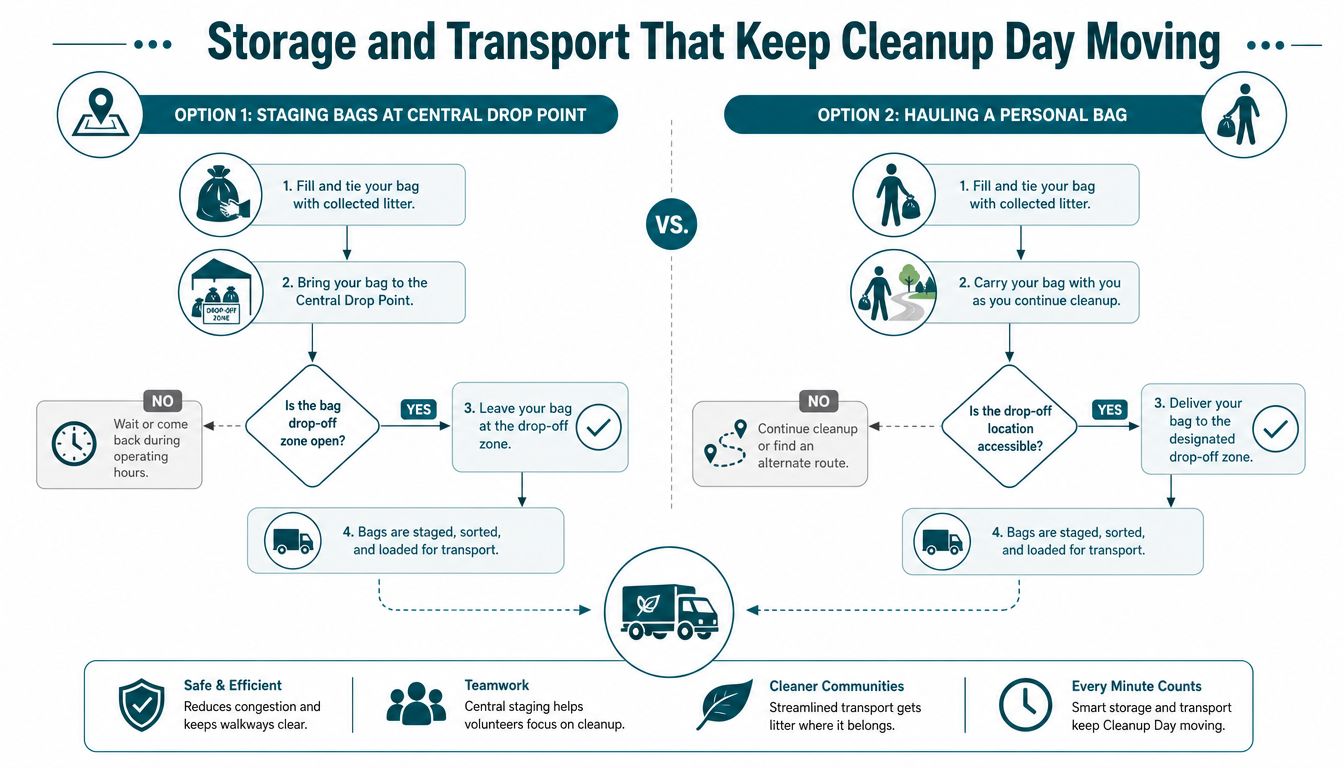
    Storage and Transport That Keep Cleanup Day Moving

    A cleanup can run smoothly on the route and fall apart at the drop point. Full bags become awkward fast, especially after rain. Volunteers carry one too far, set it on a sidewalk, and then someone has to retrace the route to collect it.

    Choose one of two systems. With a central drop point, volunteers carry smaller loads and return to the same place. That works well in parks, compact neighborhoods, and routes where a leader can watch the staging area. With personal carry bags, each person owns the load from pickup to handoff. That works better on spread-out routes where a central point would interrupt the walk.

    A foldable wagon handles several bags and supplies, but small wheels struggle with curbs. A two-wheel garden cart climbs a curb more cleanly when you tilt it, though it gives you less room for loose items. Test the wheels over the actual route before event day. A cheap cart that catches on every curb becomes another tool people avoid.

    A flowchart comparing two methods for managing litter bags during community cleanup events.

    Protect the vehicle

    Line a sedan trunk, SUV cargo area, or pickup bed before loading anything. A contractor bag works as a liner for smaller bins, while a rigid tote gives wet bags a stable wall. Keep full bags upright and separate recycling from general waste before the pile grows.

    For larger recurring cleanups, a trailer may make sense when the group moves carts, bins, or other heavy equipment. This guide to finding the right equipment hauling trailers can help you compare hauling setups without treating a personal car as a permanent utility vehicle.

    At the end, label bags for city pickup or the agreed disposal point. Separate recycling only when your local arrangement accepts it, and place sharps in a rigid container. Never toss a needle into a flexible plastic bag.

    Use free recycle bins for cleanup supplies when you need a simple way to separate recoverable material. Tape a checklist inside the trunk lid:

    • Load: Bags, cart, grabbers, gloves, vests, first aid.
    • Route: Map, meeting point, boundaries, emergency contact.
    • Handoff: General waste, recycling, rigid sharps container.
    • Reset: Dry tools, replace used gloves, restock bags.

    The next leader should be able to open the vehicle and understand the whole system in a minute.

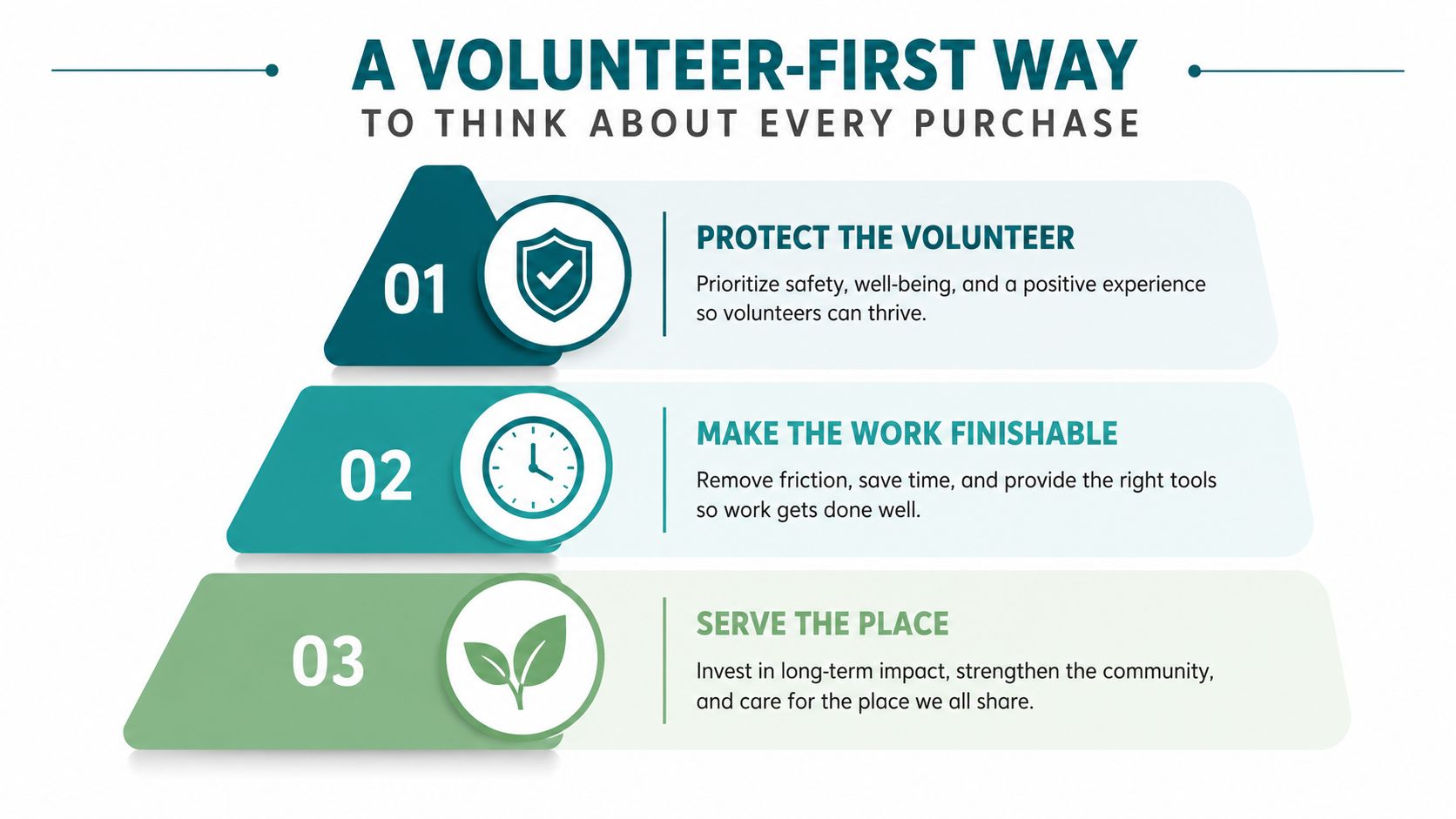
    A Volunteer-First Way to Think About Every Purchase

    I make every equipment decision in this order:

    1. Does it protect the volunteer?
    2. Does it make the work finishable in a normal morning?
    3. Does it serve the place we're cleaning?

    That order changes small purchases. I'll choose cut-resistant gloves over the cheapest gloves when broken glass appears on a route, even if the stronger pair costs $4 more. I'll use high-visibility vests in a low-traffic park because cyclists, delivery workers, and other volunteers still need to see the group.

    I won't hand a rusty dollar-store grabber to a teenager on a highway-adjacent route. The tool may technically pick up a wrapper, but it sends the wrong message about what we expect people to risk. A volunteer sees the equipment before they see the route. That first impression tells them whether the organizer planned for their safety.

    A pyramid chart outlining a volunteer-first approach to purchasing, emphasizing safety, efficiency, and community impact.

    Safety comes before the tally

    A group I worked with changed its kit after a close call with broken glass. One volunteer reached through leaves, the grabber slipped, and the glass cracked against the pavement beside their shoe. Nobody needed medical care, but we stopped the route, replaced the weak tools, added better gloves, and changed the briefing.

    We never went back to the old setup. The upgrade didn't make volunteers reckless. It made them more willing to work carefully because they knew the group would not trade their safety for a fuller bag.

    The same thinking applies to larger waste operations. A worker safety asset management approach can help teams track equipment condition, inspections, and replacement needs. For a volunteer group, that may be as simple as a labeled checklist and a monthly tool check. The principle stays the same: a tool that fails repeatedly belongs on a replacement list, not in someone's hand.

    Finishable work keeps people returning

    I don't measure a cleanup only by bag count. I watch whether volunteers can walk, reach, lift, and pause without fighting the equipment. A cart that reduces long carries can matter more than another box of bags. A bag hoop can matter more than a larger bag if it keeps one person from holding plastic open all morning.

    The waste management equipment market was estimated at USD 19.93 billion in 2026 and projected to reach USD 25.64 billion by 2031, with a projected 5.17% CAGR from 2026 through 2031, according to Mordor Intelligence's waste management equipment market data. Volunteer leaders don't need industrial machinery for a neighborhood route, but the same practical question applies at every scale: does the equipment fit the work?

    Protect the volunteer first. Make the work finishable second. Serve the parkway, alley, shoreline, or vacant lot third. Volunteers who feel protected come back. Volunteers who feel used don't, and the equipment list is where that promise becomes real.


    Litter Caterpillars uses practical trash pickup equipment, including grabbers and heavy-duty contractor bags, for weekly Chicago cleanups across every ward and every season. Visit Litter Caterpillars to find an upcoming cleanup, meet the group, and bring your energy to a route where safety and friendship come first.

  • Watershed Protection: A Community Guide You Can Use

    Watershed Protection: A Community Guide You Can Use

    On a Saturday morning beside Chicago's North Branch, I watched a volunteer pull cigarette butts from a wet curb. Two feet away, a storm drain waited for the next hard rain.

    Why Litter on Your Curb Is Really a Watershed Story

    I've learned to treat every block as a small watershed. A watershed is the land area that sends water toward the same creek, river, lake, or wetland. On our street, a raindrop hits a roof, rolls into a gutter, slips through a storm drain, travels through a sewer or channel, and eventually reaches the Chicago River system and Lake Michigan.

    That trip gives ordinary trash a route. A wrapper near the curb can move with rainwater. Pet waste can wash from a sidewalk into the same drainage network. Lawn chemicals can leave a yard during a storm. The Environmental Protection Agency's explanation of stormwater runoff describes how rain and snowmelt pick up sediment and contaminants from streets, rooftops, and lawns before reaching surface water or groundwater.

    Chicago's combined sewer system adds another layer. During heavy rain, stormwater and wastewater can enter the same system, and that can create overflow problems. A single summer storm can move a day's worth of loose litter off the curb before a crew gets back to it.

    An educational infographic explaining how litter on streets travels through storm drains to impact local watersheds.

    Follow the drop

    Friends of the Chicago River has reported bacteria and nutrient readings over the years that connect street-level behavior with water quality. I don't need a laboratory result to understand the basic chain. When a crew removes waste before rain reaches the drain, we remove material from the water's path.

    Field rule: If you can see trash beside a drain, treat it as a watershed input, not a cosmetic problem.

    The same logic applies to soil. The USDA Natural Resources Conservation Service reports that watershed projects across the United States generate more than $2.2 billion in average annual benefits for more than 48 million people, while reducing 92,341,221 tons of soil erosion per year. Those benefits include flood protection and agricultural and non-agricultural gains, so watershed protection reaches beyond cleaner water to the land around it. You can read the USDA watershed benefits fact sheet for the full breakdown.

    I keep a bag of curb litter separate from the rest of our haul when possible. It helps volunteers see what they removed from the drainage route. That bag becomes a simple, measurable record of what the next storm didn't carry downstream. For more practical reasons to remove it, see this guide to picking up litter before it travels.

    How to Plan a Cleanup That Protects a Watershed

    A cleanup protects a watershed when you choose the site, record the waste, and handle disposal with the next storm in mind. I start with a map, not a stack of bags.

    Two weeks before the cleanup

    Pick a site beside a storm drain, outfall, creek, or riverbank. Walk the route after rain if you can. Look for clogged inlets, low points where wrappers collect, bare soil, and places where people cut across grass toward the water.

    Check event calendars from the Chicago Park District and Friends of the Chicago River before you announce anything. Confirm permission, access, disposal rules, and whether the site needs a permit. Notify Chicago Streets and Sanitation, the ward office, nearby property managers, local sponsors, and any park or river partner connected to the location.

    Recruit through a school, block club, church, neighborhood group, or alderman's office. Give each person a clear meeting point and a short description of the work. A volunteer who knows the route and safety plan arrives ready to help.

    A step-by-step infographic on how to organize a volunteer cleanup event to protect local watersheds.

    One week before the cleanup

    Gather heavy-duty bags, nitrile gloves, work gloves, grabbers, buckets, first-aid supplies, water, reflective vests, sunscreen, hand sanitizer, and a scale. Bring puncture-resistant containers for sharp objects. Arrange transportation for the filled bags and decide who will contact the city if illegal dumping appears.

    Create a simple sorting sheet:

    • Plastic and food packaging: Record the common items and where you found them.
    • Cigarette waste: Keep it separate because it often concentrates along curbs and entrances.
    • Glass and sharp objects: Let a trained adult handle them.
    • Metal and bulky waste: Photograph unusual items and report them through the proper city channel.
    • Pet waste: Use sealed bags and keep it away from other collected material.

    Use the Alliance for the Great Lakes Adopt-a-Beach app to log the data. Take photos before work begins and after the route looks clear. Stencil storm drains only with permission and approved materials. The message should tell people where the water goes, not just ask them to keep the street tidy.

    Event day and the follow-up

    Open with a safety briefing. Review traffic, broken glass, needles, unstable banks, heat, hydration, and the rule that nobody reaches into hidden spaces. Assign one person to supervise children and one person to track bags, weights, categories, and photographs.

    After the cleanup, place waste where the city or site partner instructed. Weigh and sort before disposal when conditions allow. Meet for a short debrief, write down blocked drains and recurring litter spots, then upload the record and share it with your partners.

    For a practical event model, use this community cleanup planning guide as a starting point. The point of the data isn't to decorate a report. It helps you choose the next drain, the next block, and the next stormwater fix.

    Stormwater Moves You Can Run on Your Block

    I rank stormwater work by effort, cost, and how close it sits to the runoff source. Start where water leaves your property, then work outward with neighbors.

    A roof can send a surprising volume toward the street. One inch of rain on a 1,000-square-foot roof produces about 600 gallons of runoff, according to the National Oceanic and Atmospheric Administration's rain barrel guidance. Check the exact roof area and local rules before choosing a barrel size.

    Start with small habits

    Redirect downspouts toward a lawn or approved rain barrel. Sweep sidewalks instead of hosing them. Pick up pet waste within a day, and avoid spreading fertilizer before rain. These actions take little equipment, and they keep loose material away from the curb.

    Medium-effort projects include a rain barrel, a downspout planter, a small rain garden near a garage or side yard, and native deep-rooted grasses. Disconnect a sump pump from the sewer only where local rules allow it, and confirm the discharge won't send water toward a neighbor's foundation.

    At block scale, plant trees through programs such as TreeKeeper or Openlands' Tree Census. A mature oak can intercept thousands of gallons per year, according to Openlands' tree information. Consider permeable pavers for a parking pad and work with neighbors on bioswales near bus stops. Chicago examples include green alleys in Avalon Park and rain gardens at the Chicago Center for Green Technology.

    Move Effort Estimated Runoff Benefit
    Sweep instead of hosing Low Keeps loose sediment and litter out of drains
    Redirect a downspout Low Sends roof water toward soil instead of pavement
    Pick up pet waste Low Removes a direct contamination source
    Install a rain barrel Medium Stores roof runoff for later garden use
    Build a small rain garden Medium Holds and filters water near the source
    Plant deep-rooted natives Medium Helps soil absorb and hold water
    Plant a street tree High Adds canopy interception and soil uptake
    Install permeable pavers High Lets rainfall enter the ground through the surface
    Partner on a bioswale High Slows and filters runoff across a shared route

    For tree selection and Chicago planting ideas, browse this guide to trees in Illinois. Match the move to the problem. Pooling calls for storage and infiltration. Basement seepage calls for careful grading and downspout control. Hot, dirty runoff calls for shade, soil, and planted filtration.

    Green Infrastructure Options From Easiest to Most Ambitious

    The right project depends on what your block needs, what your soil can absorb, and who controls the land. Chicago's heavy clay can slow infiltration, so a rain garden may need an underdrain or a different soil mix. Don't dig first and investigate later. Check utilities, property lines, drainage patterns, and approval requirements.

    Option Cost Effort Footprint Watershed Impact Permit?
    Rain barrel Low Weekend Small Stores roof runoff for later use Check local rules
    Downspout planter Low to medium Weekend Small Filters water near the building Check local rules
    Rain garden Medium Weekend to several days Small to medium Holds and filters runoff Confirm with local office
    Alley bioswale Medium to high Multi-weekend Medium Slows shared pavement runoff Coordinate with city
    Permeable paver parking pad High Several days Medium Sends rainfall into a porous surface Confirm paving rules
    Tree trench under sidewalk strip High Multi-month Medium to large Adds soil storage and canopy Coordinate with city
    Curb-cut bioswale High Multi-month Large Captures street runoff at the curb Coordinate with city and Space to Grow

    Match the tool to the water

    A rain barrel works when you need to hold roof water and have a safe overflow route. A downspout planter fits a tight side yard. A rain garden needs a low point, but it shouldn't sit beside a foundation or where standing water creates a hazard.

    An alley bioswale makes more sense when several properties send runoff toward the same route. Permeable pavers can help a parking area, but the base must drain properly. A tree trench needs room beneath the sidewalk, cooperation from the city, and a long maintenance plan.

    Curb-cut bioswales require the most coordination. Chicago's Space to Grow program can provide a useful partnership model for schoolyards and public sites, though each project still needs site review and approval.

    Choose by failure point: Fix the place where water pools, seeps, heats up, or carries sediment. A larger project isn't automatically a better one.

    Test the soil before you commit. If water sits in a test hole for too long, ask a qualified designer about underdrains, amended soil, or a different location. Keep overflow away from basements and neighboring lots. Green infrastructure works through placement and maintenance, not appearance alone.

    Monitoring Water Quality Without Fancy Lab Gear

    I've seen volunteers avoid monitoring because the equipment looks technical. Start with observations and keep your notes consistent. A simple record from the same location can tell you more than a single dramatic sample.

    Four field checks

    1. Visual clarity tube: Fill a clear tube and record what you can see through the water. Note floating trash, foam, oil sheen, unusual color, and sediment.
    2. Turbidity check: Use a Secchi disk or a simple DIY disk to track cloudiness. More cloudiness can point to suspended sediment or disturbed material.
    3. Dissolved oxygen: Use a Hach drop kit or another simple chemical kit. The reading helps you understand whether the water holds oxygen for aquatic life.
    4. Bacteria screening: Use E. coli test strips from a science supply store. Treat the result as a screening signal, follow the kit directions, and avoid contact with the sample.

    Record the date, time, weather, recent rainfall, location, water level, smell, color, clarity, and every test result in a shared spreadsheet. Use the same container, method, and sampling spot each time. Add photographs from the same angle so your visual record stays useful.

    Avoid the two common traps

    Testing immediately after rain can make every result look worse because runoff stirs sediment and carries fresh contaminants. That doesn't make post-rain testing useless, but label the conditions clearly and compare it with dry-weather readings.

    The second mistake is waiting for perfect gear. A clear tube, a notebook, photographs, and careful descriptions can establish a baseline. Escalate unusual color, strong odors, fish distress, repeated sewage indicators, or unsafe conditions to Friends of the Chicago River or the Metropolitan Water Reclamation District. Don't handle suspicious material yourself.

    Building Partnerships and Telling the Right People

    A cleanup that happens twice can disappear from a neighborhood's memory. A cleanup that returns on the same route with the same sponsor creates a habit, a record, and a reason for people to keep the drain clear.

    Start with the person who can say yes. For a hardware store donation, ask the store manager instead of sending a message to a corporate office. For an aldermanic support letter, contact the ward office and send a short one-page request. For a school or church base, ask for a recurring weekend meeting place, storage space, or volunteer announcement.

    Use a plain pitch

    “We're organizing a neighborhood cleanup beside [specific site]. We'll remove and sort litter, record the waste, photograph the route, and share the results. Could you provide [specific supplies, space, volunteers, or letter] for [specific event or recurring schedule]?”

    Ask for a concrete in-kind contribution or dollar amount that fits the partner's capacity. Request bags, gloves, grabbers, water, printing, hauling help, or a small project budget. Don't ask for “support” without saying what support means.

    Chicago has several useful doors: local watershed groups, the city's Green Stormwater Infrastructure team, neighborhood chambers, schools, park partners, and nearby businesses. Give each partner a job that connects to its reason for participating. A hardware store can supply tools. A school can recruit families. A ward office can help route a report about blocked drains.

    Follow up after the event with photos, the sorted waste record, and one sentence about what you'll do next. Send a thank-you soon after the work, then return with a specific year-two request when you have a new date and a clear task. Consistency makes the next ask easier because the partner can see where its help went.

    Your 30 Day Watershed Protection Plan

    I'd start on Monday with one block, one drainage route, and five neighbors. You don't need to solve the whole river. You need to learn where water moves and keep showing up there.

    Week one, walk and map

    Walk the neighborhood and mark storm drains, pooling spots, litter traps, downspouts, and access points near the North Branch Chicago River. Recruit five neighbors for a kickoff cleanup. Choose a safe meeting point and contact the relevant site partner before you set the date.

    Week two, audit and prepare

    Run a household stormwater audit. Trace each downspout, inspect the route from roof to street, look for bare soil, and note where water reaches pavement. Swap a small planting area to native plants, and sign up for monitoring training through Friends of the Chicago River.

    Week three, install one move

    Choose one project that fits the problem. A rain barrel can handle roof runoff. A downspout planter can help a tight side yard. A curb-cut rain garden on a Logan Square boulevard needs permission, design review, and coordination, so treat it as a shared project rather than a casual weekend dig.

    A professional four-week infographic timeline illustrating a step-by-step plan for community watershed protection and environmental cleanup.

    Week four, document and ask

    Hold the public cleanup. Photograph the route before and after, sort and record the waste, and run a basic water-quality check before and after under clearly labeled conditions. Send the photo set and results to the local alderman, then write a specific request for a Green Infrastructure Grant.

    The first time I ran a cleanup, I wanted a heroic result. I wanted one hard morning to fix the block. The work taught me something plainer. Measurable outcomes follow consistency, not heroics.

    Pick one block and show up four Saturdays in a row. Bring a friend, track what you remove, watch what returns, and adjust the next move to the water's path.


    Litter Caterpillars brings Chicago volunteers together for recurring, hands-on cleanups built around safety, friendship, and block-by-block service. Visit Litter Caterpillars to find a cleanup, meet the crew, and turn your next Saturday morning into practical watershed protection.

  • 8-Step Volunteer Safety Checklist for Cleanup Events

    8-Step Volunteer Safety Checklist for Cleanup Events

    Before the first bag fills, a cleanup crew can face a serious decision. Your team reaches a busy street, spots broken glass beside the curb, and must choose whether to keep moving, change the route, or stop and report it.

    A volunteer safety checklist works like a flight plan. It gives everyone a shared route, clear stop signals, and a way home when conditions change. The checklist below follows the volunteer journey from the first briefing to the final incident note, covering route hazards, equipment, buddy coverage, weather, biohazards, first response, inclusive roles, wellbeing checks, and cancellation decisions.

    At Litter Caterpillars, the litter count never outranks volunteer safety or happiness. Our Chicago group works across all 50 wards, including places where traffic, ice, construction, abandoned materials, or changing public activity can make a normal cleanup unpredictable. A good plan lets people act with courage without asking them to gamble with their health.

    1. Brief Your Team on the Day's Route and Hazards

    Start with a map, then turn the map into a conversation. Tell volunteers which streets they'll walk, where the group will regroup, and what they might encounter. Point out broken-glass areas, busy crossings, aggressive dogs, potholes, poor lighting, ice, slippery pavement, and places where foot traffic changes quickly.

    I learned this during an early highway cleanup held during a bike-event shutdown. One volunteer nearly stepped into a pothole because the road condition hadn't made it into the briefing. Since then, I've treated route knowledge as equipment. Before heading into Englewood, where we won our lot for Caterpillar Park, I explained the potholes and the blocks with heavier foot traffic. Nobody got hurt because people knew what to watch for.

    Use landmarks instead of vague directions. “Stay near the blue mural and regroup at the corner store” gives people something they can see. Ask whether anyone has worked in the area before. Local observations often reveal a loose dog, a blocked sidewalk, or a slippery corner that a map won't show.

    Practical rule: Give volunteers enough information to make a safe choice. Specific warnings respect people. They don't frighten them.

    The IFRC volunteer safety guidance calls for risk assessment, situation analysis, basic information gathering, and scenario planning before volunteers act. Apply that logic in plain language. Explain what could change, who makes the call, and when volunteers should leave a threatening situation.

    2. Provide Proper Protective Equipment and Know How to Use It

    A pair of thin gloves doesn't make every object safe. Cleanup crews need equipment that matches the work, fits the volunteer, and stays within reach. At a minimum, prepare sturdy gloves, grabbers, bright safety vests, suitable footwear, water, a first aid kit, and a reliable way to contact the coordinator.

    Greenville County's National Cleanup Day safety guidance says each group should carry a first aid kit, water, and a cell phone. It also calls for orange safety vests, group work, facing oncoming traffic, and working on one side of the road at a time. Those details turn a casual outing into a controlled field task.

    At Litter Caterpillars, volunteers can keep their bright vests. The color helps drivers see the group, and the vest gives the crew a shared identity. Volunteers have told me that wearing the gear makes the event feel organized rather than improvised. That feeling matters because people make better decisions when they understand that the team takes safety seriously.

    Read our guide to becoming a trash pickup volunteer before your first event, then demonstrate every tool at the opening briefing. Show how to squeeze a grabber, how to keep sharp objects away from the body, and how to place a filled bag without dragging it across a walkway. Never let a newcomer improvise with bare hands.

    A volunteer using a picker tool to collect a plastic bottle with safety gear nearby.

    Keep spare gloves and grabbers for late arrivals. Record what you issue, inspect damaged equipment, and replace items before someone needs them. If volunteers need eye protection, explain how to pick safety glasses for any work setting.

    A short demonstration prevents a dangerous shortcut.

    A team of volunteers reviewing a map of the route and safety hazards on a clipboard.

    3. Establish a Buddy System So Nobody Works Alone

    Pair people before the first bag leaves the staging area. A buddy gives each volunteer a nearby person who can notice a fall, hear a concern, help find the route, or call the coordinator. The system also reduces wandering, especially when a crew spreads across several blocks.

    Let people choose partners when practical, then mix newcomers with experienced volunteers when you need broader support. Give every pair a defined area. You should know which pair covers which block, path, or park edge without searching through a group chat.

    During winter events, I've watched buddy pairs spot icy patches before either person stepped forward. One volunteer points, the other slows down, and the pair changes direction. That small exchange can prevent a fall. Many friendships in our group began with two strangers sharing a grabber and watching the pavement for each other.

    Build coverage into the route

    Set a communication rhythm before the event begins. Check in with teams every 20 to 30 minutes, especially in unfamiliar neighborhoods. Use a call, text, group-chat message, or visible return to the staging point. The method matters less than the habit.

    A buddy system fails when partners separate without telling anyone. Ask pairs to stay within sight or voice range, avoid entering closed areas, and report route changes. If one person needs to leave, the pair tells the coordinator and returns together or receives a new partner.

    The OnRoute guide to safeguarding field teams can help organizers think through lone-worker exposure and communication coverage. Adapt the approach to your group, but don't allow “I'll only be gone for a minute” to become the default plan.

    4. Monitor Weather Conditions and Adjust Your Event Accordingly

    Weather decisions need an owner, a review time, and a defined response. Check conditions the night before and again on the cleanup morning. Then tell volunteers whether the event will start earlier, use a shorter route, change tasks, move indoors, pause, or cancel.

    Rain can hide potholes and turn pavement slick. Wind can shift loose debris or push objects toward the group. Heat can drain a volunteer before they recognize the warning signs. Cold can cause numbness, shivering, and poor hand control. Lightning means stopping work and leaving exposed areas. Assign one coordinator to make these calls rather than waiting for volunteers to interpret the sky.

    On hot days, our team has started at 7 a.m. instead of 9 a.m. and moved indoors for planning or meetings by noon. During severe cold, we ask volunteers to layer clothing, watch for numbness and shivering, and take shorter outdoor assignments. People can manage difficult conditions when they know the risks and can leave without shame.

    “If the forecast changes, the plan changes.”

    The IFRC implementation guide links volunteer safety with security and wellbeing at local and national levels. For a cleanup, weather belongs in the live operating plan, not only on the registration page.

    Put plain triggers in the group chat:

    • “Lightning nearby means stop work.”
    • “Confusion, weakness, numbness, or unusual cold means report it immediately.”
    • “The coordinator can pause or end the event.”

    Use the heat exhaustion prevention tips from Litter Caterpillars during the heat briefing, and give the coordinator clear authority to change the plan.

    5. Train Volunteers on Hazardous Materials and Biohazards

    Treat unknown objects as unknown. Volunteers may find broken glass, syringes, animal waste, chemical containers, medical waste, white powder, or material that looks dumped from a worksite. A cleanup crew shouldn't handle items that can cut, puncture, poison, infect, or expose people to contamination.

    Give the team one simple response: stop, step back, warn nearby volunteers, and flag the location. The coordinator can photograph the item from a safe distance and report it through the right city channel. Needles go to the Chicago Department of Streets and Sanitation. Animal-waste problems go to animal control, and chemical spills go to the city. Serious hazards need professional response.

    I've seen volunteers move toward a syringe because they wanted to help quickly. The right action took less time than a risky pickup. We stopped work around the area, reported the material, and moved the team to another section. A volunteer once spotted what looked like industrial dumping and reported it instead of touching it. That protocol protected the crew and gave the city useful information.

    Teach the stop-work phrase

    Put photos of syringes, chemical bottles, suspicious powders, and contaminated materials on a one-page handout. Keep the language direct:

    • Stop: Freeze the task and keep hands away.
    • Flag: Mark the area from a safe position.
    • Report: Contact the coordinator and the appropriate city service.
    • Move: Shift the group away until someone qualified handles the hazard.

    Share Chicago cleanup opportunities through Litter Caterpillars volunteer opportunities, then give every new volunteer the same hazard briefing. Consistency matters. A confident newcomer should know that bravery means reporting a danger, not touching it.

    6. Keep a First Aid Kit and Know Basic First Response

    Keep the first aid kit in the coordination bag, not buried in a vehicle under spare bags. Everyone should know where it sits. At least one event leader should know how to respond to bleeding, scrapes, sprains, shock, and the first steps of an emergency call.

    Stock the kit with antiseptic wipes, gauze, bandages, antibiotic ointment, elastic bandages, pain reliever, and a small emergency blanket. Check it regularly, replace used or expired supplies, and label it so a volunteer can find it without asking three people.

    A glass cut needs a calm response. Stop the activity, move the injured volunteer away from the work area, clean and cover the wound, and decide whether they need further care. A twisted ankle needs rest and assessment before anyone asks the person to continue. Light duty may work for a minor problem, but the injured volunteer gets the final say.

    Make emergency location simple

    Before volunteers spread out, identify the nearest accessible meeting point and the person holding the phone. If you call 911, describe the street, nearest landmark, route access, and what happened. A city block can feel confusing when someone is bleeding and traffic is moving around you.

    Take a first aid course by Cura Academy or use a local Red Cross training option. Training doesn't turn a volunteer into a medical professional. It does help a leader stay composed, protect the scene, and get appropriate help quickly.

    First response principle: Treat the person before you protect the schedule. The bags can wait.

    7. Communicate Clear Expectations About Physical Ability and Mental Readiness

    A cleanup may involve walking, bending, carrying, standing, watching traffic, tolerating noise, and working around unfamiliar conditions. Explain the terrain, route length, pace, weather, and physical tasks before volunteers arrive. Offer choices without asking anyone to disclose private medical details in front of the group.

    A volunteer may manage asthma, limited mobility, back pain, medication effects, sensory sensitivity, anxiety, or a difficult day. They may want to help while avoiding traffic exposure or an unfamiliar block. Give them a clear way into the work, and let them change roles without having to justify the decision.

    • Pickup role: Use a grabber on a suitable surface.
    • Supply role: Sort gloves, bags, water, and tools at the base point.
    • Welcome role: Greet volunteers, explain the route, and answer questions.
    • Documentation role: Record locations, photograph progress, or note hazards.
    • Low-exposure role: Work in a familiar area with close access to support.

    Match the role to the person's capacity that day. A volunteer with a chronic back issue may collect litter during one event, then manage supplies or greet newcomers at another. Both assignments keep the cleanup moving. A first-time volunteer can begin on an easier street and choose a more demanding route after gaining confidence.

    Use private check-ins, opt-in assignments, and clear permission to leave without penalty. Mental readiness matters too. Unfamiliar waste, traffic, conflict, or distressing scenes can affect participation, so explain what volunteers may encounter and identify a leader they can approach.

    Do not praise exhaustion as proof of service. Praise good judgment, steady participation, and helping someone find a role they can perform safely.

    8. Establish a Check-In System and Know When to Cancel or Pause

    A check-in only works when the leader listens to the answer. Ask how people feel, look for changes in pace or behavior, and accept “I need to stop” without debate. A volunteer who sits down more often, looks flushed, shivers, speaks unclearly, seems confused, or favors an injury needs attention before the issue grows.

    Use a simple group rhythm. Ask everyone how they're doing at regular intervals, then speak privately with anyone who looks unwell or unusually quiet. You can use a shared scale: “If you're at a 10, tell me you're great. If you're at a 5, tell me you're okay. If you're at a 1, tell me immediately.”

    Give leaders permission to change the plan

    One Saturday, our route was partly closed by construction. We regrouped, moved to a backup location, and kept the group together. On another hot day, I noticed a volunteer slowing down and sitting more often. I moved them into shade, brought water, and offered lighter work for the rest of the event.

    The Australian volunteer worker duties guidance uses numbered questions about induction, safe equipment, PPE, emergency procedures, hazard reporting, and contact arrangements. It says a “No” answer requires corrective action. Use that same discipline during the event. If the route, gear, communication, or weather fails the check, fix it before work continues.

    Cancel when you can't control the exposure. Pause for water, shade, warmth, route changes, or medical attention. Volunteers will remember that you protected them, and they'll trust the next event more because of it.

    Volunteer Safety: 8-Point Comparison

    Item Implementation Complexity 🔄 Resource & Logistics ⚡ Expected Outcomes 📊 Key Advantages ⭐ Quick Tip 💡
    Brief Your Team on the Day's Route and Hazards Low–Medium: 10–15 min briefing plus some advance scouting Low: leader time, route notes, map/clipboard Increased situational awareness; fewer surprises/incidents Prevents hazards; builds trust and readiness Keep it conversational; point out landmarks
    Provide Proper Protective Equipment and Know How to Use It Medium: sourcing, sizing, demos required Moderate–High: gloves, grabbers, vests, first aid; maintenance ($300–500 initial for small group) Fewer cuts/infections; higher volunteer confidence & professionalism Dramatically reduces injuries; improves visibility Bring extras; demonstrate grabber use; log gear
    Establish a Buddy System So Nobody Works Alone Low: pairing and basic coordination Low: assignment logistics, handle odd numbers Faster response to incidents; reduced isolation Improves safety; deters unwanted attention; builds bonds Mix experienced with newcomers; assign specific blocks
    Monitor Weather Conditions and Adjust Your Event Accordingly Medium: forecast checks and contingency planning Moderate: water, shade/warming stations, possible reschedule Prevents heat/cold illness; keeps events safe and adaptable Reduces weather-related injuries; shows planning maturity Check forecast night/morning; use heat/cold protocols
    Train Volunteers on Hazardous Materials and Biohazards Medium: brief training + reporting protocols Low–Moderate: one-page handouts, photos, contact lists, city coordination Fewer exposures; correct escalation to authorities; less liability Protects against bloodborne/toxic hazards; ensures proper reporting Use photo handout; adopt "stop and flag" system
    Keep a First Aid Kit and Know Basic First Response Medium: kit upkeep and at least one trained responder Low–Moderate: kit cost, occasional training, monthly checks Immediate care for minor injuries; reduced infections; documented incidents Prevents complications from minor injuries; builds trust Take a Red Cross course; check kit monthly
    Communicate Clear Expectations About Physical Ability and Mental Readiness Medium: prepare role options and communicate clearly Low: clear descriptions, support roles, flexible assignments Fewer injuries; higher inclusion; reduced burnout Inclusive participation; sustained volunteer retention State terrain/distances up front; offer light-duty roles
    Establish a Check-In System and Know When to Cancel or Pause Medium: scheduled check-ins and decision criteria Low–Moderate: leader attention, documentation for pauses/reschedules Catches problems early; prevents escalation; increases trust Encourages speaking up; protects volunteers; enables safe pivots Do group check-ins every 20–30 min; set clear stop-work rules

    Pack the Checklist With the Grabbers

    A printed event card should fit inside the coordinator's folder and answer one question quickly: Who does what, where, and what happens when conditions change? Don't leave responsibility floating between several friendly people. Assign each duty before volunteers arrive.

    Write the route, backup route, staging point, and no-go areas at the top. Add the route hazards you discussed, including broken glass, traffic patterns, dogs, potholes, ice, construction, steep slopes, guardrails, medians, bridges, roundabouts, concrete walls, utility sites, and private property. Seattle's cleanup guidance lists those areas as off-limits for litter pickup and tells volunteers to stay on public property.

    List the equipment owner next. Name the person carrying first aid supplies, the person holding the phone, the weather decision-maker, and the person who tracks buddy pairs. Record where the water, PPE, spare grabbers, and emergency contacts are located. The Nonprofit Risk Management Center field guide recommends learning the area, mapping the route, charging phones, leaving an itinerary, and checking vehicle lights, brakes, tires, and fuel before field assignments.

    Your event card should include:

    • Route and hazards: List streets, landmarks, restricted areas, and backup locations.
    • Equipment: Confirm gloves, grabbers, vests, water, bags, first aid, and safe footwear.
    • Buddy pairs: Record each pair and its assigned area.
    • Weather call: Name the person who can shorten, pause, switch, or cancel the event.
    • Hazard rules: Tell volunteers what they must never touch and how they report it.
    • Emergency response: Note the first aid location, phone holder, meeting point, and 911 details.
    • Accessible roles: Prepare lighter, seated, lower-exposure, supply, greeting, and documentation work.
    • Check-ins: Set the communication rhythm and the signs that require immediate action.
    • Incident notes: Record injuries, near misses, hazards, route changes, reports, and follow-up needs.

    Review the card aloud at the briefing. Ask volunteers to repeat the stop-work rule in their own words. If someone can't explain what to do after finding a syringe or seeing lightning, slow down and clarify before the crew moves out.

    After the cleanup, don't throw the card into a drawer. Record what happened while the details remain fresh. Note the icy corner, blocked sidewalk, loose dog, missing glove size, weather change, or confusing instruction. Then update the next event plan. A checklist earns its place when people use what they learned.

    Litter Caterpillars built its volunteer-first approach through weekly Chicago cleanups in rain, heat, blizzards, and cold wind. The group's identity includes flags, theme songs, badges, and shared pride, yet the operating rule stays plain: volunteers come first, happiness comes next, and the litter can wait. A safer cleanup gives people the chance to return next weekend with energy, trust, and a story worth telling.


    Litter Caterpillars gives Chicago volunteers a practical way to clean neighborhoods, meet people, and take on outdoor service with safety and friendship at the center. Visit Litter Caterpillars to find an upcoming cleanup, join the group chat, and bring this volunteer safety checklist into the field.

  • 8 Heat Exhaustion Prevention Tips for Volunteers

    8 Heat Exhaustion Prevention Tips for Volunteers

    Drink water every 15 to 20 minutes in the heat, move the hardest work to cooler hours, and start cooling down long before thirst hits. A good cleanup crew protects itself with shade breaks, loose light clothing, sunscreen, and a clear stop signal when someone starts feeling off.

    It always starts the same way on a Saturday morning. The Litter Caterpillars show up for a weekend cleanup, the air still feels easy, and the trash bags look lighter than the day ahead. Then the sun climbs, the pavement heats up, and the same people who felt fresh at 9 a.m. start moving like they're carrying bricks instead of litter.

    That's where a cleanup turns from “let's get it done” into “let's get it done safely.” I'd rather lose a few bags than lose a volunteer to heat exhaustion. The right move is to plan the shift before anyone grabs a picker, so the crew runs like a small field team instead of a bunch of people guessing in the sun.

    I think about heat safety as a group cleanup system. Water, shade, timing, clothing, and buddy checks all work together. If one piece fails, the rest have to carry too much weight. If the whole crew treats the day like a paced route, everybody gets home tired, sweaty, and fine.

    A weekend-morning group like Litter Caterpillars already has the right instinct, because the work feels social and practical at the same time. The trick is keeping that energy steady when the heat starts pushing back. Here are eight heat exhaustion prevention tips I use when I want the bags collected and the people still smiling.

    1. Drink Water Before, During, and After Your Cleanup Shift

    I learned fast that thirst is a late signal. By the time I feel thirsty on a hot cleanup day, my body has already started losing ground, so I treat water like gear, not like a backup plan. OSHA guidance and workplace safety sources say to drink about 8 ounces every 15 to 20 minutes in hot conditions, Texas safety guidance says workers should drink at least one pint every hour, and the World Health Organization advises 1 cup per hour and 2 to 3 liters per day while avoiding alcohol and limiting caffeine and sugar, because hydration should start before thirst does, not after it OSHA and related workplace heat guidance.

    Make water part of the rhythm

    I tell volunteers to sip on a timer, the same way they'd check their phone or scan the street for litter. That little habit keeps people from entering the red zone without noticing. It also helps if you're moving fast and not thinking about yourself, which happens all the time during a good cleanup.

    Bring a big bottle, then keep a second bottle cold at the site if you can. If plain water feels boring, a slice of lemon or lime helps people drink more without turning the cooler into a science project. I've found that the key win is consistency, because a crew that drinks early usually stays calmer, lighter, and easier to guide.

    Practical rule: if someone says they're “fine” but hasn't had a sip in a while, hand them water anyway.

    The same logic helps after the shift. Sweat doesn't stop just because the last bag is tied off, so I keep people drinking on the ride home and at the post-cleanup hangout. If you want the body to recover well, you can't treat the work window like the only time hydration matters.

    2. Wear Light-Colored, Loose-Fitting Clothing

    Clothes matter more than most first-time volunteers expect. Dark, tight clothing soaks up heat and traps it close to the body, while light colors and looser cuts help the body dump heat more easily. I've worn both on the same kind of morning, and the difference shows up fast once the sun gets serious.

    Dress like you plan to be outside for hours

    I usually reach for a white or light gray shirt on cleanup days, then pair it with loose shorts when the weather allows. If I know I'm going to be out for a long stretch, I'll pick breathable fabric instead of something thick and heavy. The point is simple, sweat has to evaporate if you want to cool down, and tight clothes fight that process.

    A wide-brimmed hat helps too, especially one with enough brim to shade the face, ears, and neck. If you want to go further, UV-blocking clothes make sense for long exposure days. I don't love seeing volunteers in dark jeans on hot pavement, because they usually regret that choice by the time the first water break arrives.

    • Choose light colors: White, light gray, and other pale shades reflect more sun than dark fabric.
    • Pick looser cuts: Air needs room to move around your skin.
    • Use breathable fabric: Cotton works well for many people, and moisture-wicking fabric helps when sweat runs heavy.
    • Add head coverage: A wide brim reduces direct sun on your face and neck.
    • Skip heavy denim: Dark jeans turn a cleanup into a slow bake.

    The trade-off is obvious. You may not look like you're headed to a photo shoot, but you'll feel better, move easier, and last longer. That's the goal when the work is trash pickup, not a runway.

    3. Take Regular Breaks in Shaded Areas

    I build breaks into every hot cleanup I run, because nobody earns points for pretending they're invincible. Shade is where a crew resets, drinks, and comes back with a body temperature that's closer to normal. OSHA's heat guidance and related public-health advice both push regular rest in shade, and the CDC archive says to limit exercise in hot environments and rest frequently in shade CDC heat safety archive.

    Treat the break like part of the route

    Every 30 to 45 minutes, I call for a stop. Ten or 15 minutes in the shade gives people time to sit, drink, talk, and notice if they're starting to wobble. That pause also changes the mood in a good way, because people breathe again and remember they're a team, not just a line of arms with trash grabbers.

    I scout for shade before a cleanup starts. A tree works, a building overhang works, and even a parked truck can work if it's the only option. If a site has almost no shade, I bring a pop-up tent or a large umbrella, because I'd rather carry one extra item than gamble with a volunteer's health.

    Shade is not a luxury on a hot day. It is part of the plan.

    Use break time to check faces, not just bags. If somebody looks flushed, sluggish, or unusually quiet, that's a cue to slow down. I want volunteers sitting fully down, too, because standing around in the heat isn't the same thing as resting.

    4. Recognize Early Heat Exhaustion Symptoms in Yourself and Others

    Heat exhaustion usually shows up in the middle of a cleanup, not at the start. A volunteer can keep bending, lifting, and walking for a while after judgment has already slipped, so the crew has to catch the warning signs early. I've seen people try to keep pace because they didn't want to slow the group down. That is how a small problem turns into a group problem.

    A volunteer providing water and shade with an umbrella to a woman suffering from heat exhaustion.

    Learn the warning signs before the heat hits

    The signs I watch for are heavy sweating, weakness, dizziness, nausea, headache, and muscle cramps. If someone starts moving slowly, looks pale, or stops answering in their usual way, I ask them to sit down right away. If I feel dizzy, I do not try to push through and prove anything, I stop, tell the crew, and get out of the sun.

    Buddy checks make this work better than a solo mindset. Pairing newer volunteers with experienced ones gives the group two sets of eyes on the same workload, and a quick verbal check-in can catch trouble before it gets worse. I like asking, “How are you really feeling?” because that question is direct enough to get a real answer. A volunteer who says they are fine but sounds off still needs attention.

    Crew culture matters here too. the health benefits of volunteering in a crew go beyond social connection, because people who know each other's pace notice when someone falls behind. That makes it easier to speak up without turning a safety check into a personal slight. Heat safety gets stronger when the group treats slowdown as normal information, not a weakness.

    When someone shows symptoms, I move them to shade, give them water if they can drink, and keep one person with them while the rest of the crew keeps working or stops with them. That response is simple, but it keeps the whole cleanup from drifting into confusion. A calm call, a shaded seat, and a buddy who stays alert can stop an emergency before it starts.

    5. Apply Sunscreen and Reapply Regularly

    Sunburn and overheating often show up together, and I don't treat them like separate problems. Your skin takes a hit from UV exposure, and burned skin has a harder time helping your body manage heat well. I apply sunscreen before I leave, then I reapply during the cleanup if sweat starts wiping it off.

    Use sunscreen like part of your uniform

    I put it on about 15 minutes before I head out, so it has time to set. For longer outdoor time, I use SPF 30 minimum, and SPF 50 makes sense when I know I'll be outside for hours. A full-body application takes more than a quick dab on the nose, so I don't rush it.

    Reapply after heavy sweating or after about two hours, and keep a small bottle in the cleanup kit so nobody has to improvise. Spray sunscreen can help when a group needs fast touch-ups without a mess. Cloudy weather doesn't give you a pass either, because UV rays still get through.

    I think of sunscreen as a shield, not a force field. It cuts down damage, but it only works when you actually use it.

    I've seen volunteers ignore sunscreen because the morning feels mild, then spend the afternoon rubbing their shoulders and necks because the sun won anyway. That kind of burn makes the rest of the day harder. If your skin starts to cook, your whole cleanup feels heavier.

    6. Adjust Your Work Intensity Based on Heat Index, Not Just Temperature

    Temperature alone can fool you. A humid day can make a moderate number feel much worse because sweat does not evaporate well, and your body loses one of its main cooling tools. That is why I check the heat index before a hot-weather cleanup, not just the temperature on my phone.

    Let the forecast shape the job

    If the heat index looks rough, I change the work plan before volunteers arrive. Heavy hauling turns into lighter sorting, sweeping, or bag staging. Shorter shifts make more sense too, because I would rather get a smaller area cleaned well than push people into a bad afternoon.

    Use the forecast like a traffic light. If the heat index is above 103°F, I treat that as dangerous and think hard about rescheduling or doing only minimal work. If it lands between 90 and 103°F, I expect frequent breaks and lighter tasks, not full-speed hauling. That call feels conservative at first, then smart when the crew finishes steady instead of fried.

    I tell volunteers the plan before they show up, because nobody likes discovering a heat-downshift after they have already committed their day. If I know the afternoon is going to be ugly, I also keep an indoor backup option or an early dismissal plan ready. How I organize a neighborhood cleanup in extreme heat starts with that kind of honest timing call.

    The trade-off is simple. You may collect less trash in one session, but you keep the crew healthy enough to come back next week. That matters more than trying to squeeze every last block into one hot push.

    7. Eat a Light Meal and Avoid Alcohol Before and During Heat Activity

    Hot work takes fuel, but heavy fuel can backfire. I eat something light before cleanup, usually carbs with a bit of protein, because I want energy without a stomach that feels like it's working a second shift. Heavy, fatty meals slow people down, and alcohol makes the whole situation worse by dehydrating the body.

    Keep the stomach calm and the energy steady

    A banana, toast, or yogurt usually sits better than a big greasy breakfast. If I know the cleanup starts late enough that people may show up hungry, I bring light snacks so nobody tries to work on fumes. Nuts, fruit, and energy bars are easy to hand out and easy to eat in the shade.

    Timing matters here too. Eating 2 to 3 hours before you start gives the body a chance to settle before you're moving in the heat. That spacing makes a volunteer feel less stuffed and less sluggish when the work starts.

    • Choose simple fuel: Carbs and light protein usually sit better than fatty food.
    • Bring backup snacks: Fruit, nuts, and energy bars help late arrivals.
    • Avoid alcohol before and during heat work: It dries you out when you need fluids most.
    • Wait on celebratory drinks: If you're still hot and sweaty, give your body time first.

    I've seen post-cleanup beers turn into a bad idea fast when people are still overheated. Wait until evening if you want one. Your body will thank you for not asking it to cool down while you're handing it alcohol at the same time.

    8. Avoid Peak Heat Hours by Scheduling Cleanups for Morning or Early Evening

    This is the move I trust most. I schedule weekend cleanups in the morning because it gives us cooler air, fresher people, and less friction before the day gets mean. The sun tends to hit hardest between 10 a.m. and 4 p.m., with the worst stretch usually between noon and 3 p.m., so I want the hard work done before that window bites down Litter Caterpillars cleanup timing.

    Start early and the whole day gets easier

    For summer cleanups, I like a start time of 9 a.m. or earlier. If we absolutely have to work later, I'd rather wait until 4 to 5 p.m. than drag people through midday heat. Morning cleanups also give me more control over pacing, because I can plan a longer route when the temperature is still kind.

    Clear timing helps volunteers, too. If they know the event starts early, they can drink water before leaving home, eat properly, and show up already prepared. That makes the whole group easier to manage, because nobody arrives late and overheated before the work even starts.

    Early scheduling is the cheapest heat tool I know. It doesn't cost more gear, it just costs a little discipline.

    I like weekend mornings for another reason. The people who show up early usually want to be there, and that energy helps the crew move with purpose without rushing. It's a cleaner rhythm, and it gives us a better shot at finishing strong without anyone getting cooked.

    8-Point Heat Exhaustion Prevention Comparison

    Item 🔄 Implementation ⚡ Resources ⭐ Expected effectiveness 📊 Ideal use case 💡 Key tip
    Drink Water Before, During, and After Your Cleanup Shift Low, habit + reminders Minimal, bottle, cooler ⭐⭐⭐⭐ Any outdoor cleanup, especially hot/long shifts Pre-hydrate 2–3 hrs; sip every 15–20 min; bring ≥32 oz
    Wear Light-Colored, Loose-Fitting Clothing Low, choose clothing Minimal, light breathable fabrics, hat ⭐⭐⭐⭐ Sunny hot days, prolonged exposure Use breathable fabrics and a wide‑brim hat
    Take Regular Breaks in Shaded Areas Medium, schedule and enforce breaks Low, shade, umbrella or pop‑up if needed ⭐⭐⭐⭐ Strenuous or long cleanups in heat Break every 30–45 min for 10–15 min; sit and hydrate
    Recognize Early Heat Exhaustion Symptoms in Yourself and Others Medium, training + buddy checks Low, training time, monitoring ⭐⭐⭐⭐⭐ All group activities; critical for volunteer safety Learn symptoms; check volunteers every 30 min; act early
    Apply Sunscreen and Reapply Regularly Low, routine application Low, SPF30+ sunscreen, carry spare ⭐⭐⭐ Sunny days, long exposure Apply 15 min before; reapply every 2 hours or after heavy sweating
    Adjust Your Work Intensity Based on Heat Index, Not Just Temperature Medium–High, monitoring and planning Low, heat index data, alternative tasks ⭐⭐⭐⭐ Humid climates or high heat-index days Check heat index morning; lighten tasks or reschedule >103°F
    Eat a Light Meal and Avoid Alcohol Before and During Heat Activity Low, meal timing planning Minimal, light snacks ⭐⭐⭐ Volunteers who come straight from home or long shifts Eat 2–3 hrs before; choose light carbs/protein; skip alcohol
    Avoid Peak Heat Hours by Scheduling Cleanups for Morning or Early Evening Low–Medium, schedule coordination Minimal, timing adjustments ⭐⭐⭐⭐⭐ Summer cleanups; high daytime temperatures Start before 10 a.m. (ideally ~9 a.m.) or after 4 p.m.; communicate time clearly

    Leave the Cleanup for Another Day

    When I run a hot-weather cleanup, I keep the routine simple. I check the heat index the night before and again in the morning, then I move the start time if the forecast turns ugly. I pack water, shade, sunscreen, and snacks, then I brief the buddy system so every volunteer has someone watching out for them.

    I also set break times before anyone starts grabbing bags. That way, the rest stops feel normal instead of like punishment. If the day gets hotter than expected, I cut the workload, switch people to lighter tasks, or end early. A good cleanup plan bends before people do.

    The emergency response should stay just as plain. If someone shows heat exhaustion signs, I move them to shade, cool them, and give water when they can drink. Then I keep monitoring them, and I get help if symptoms don't improve or if they turn severe. I'd rather make that call early than gamble on somebody's pride.

    That's the volunteer-first way I like to run a crew. The bags can wait, the block can wait, and the next stretch of litter can wait too. A safe, happy volunteer comes back next week, and that gives you more cleanups, more trust, and a crew that lasts.


    If you want to clean Chicago without burning out your people, join Litter Caterpillars. We run volunteer-first cleanups that keep safety, timing, and teamwork at the front of the day, so you can help your neighborhood and still feel good when you head home.

  • Environmental Justice Initiatives: A Community Guide 2026

    Environmental Justice Initiatives: A Community Guide 2026

    We were knee-deep in slush on a Chicago block when a stranger rolled down a window and asked why we bothered. I pointed at the curb, the alley, the torn bags snagged in a fence, and said, “Because nobody else showed up for this street.” A few minutes later, that same stranger came back with gloves.

    What Environmental Justice Initiatives Are

    I still remember standing in a hailstorm with three other people, bent over a sidewalk full of wet wrappers and broken glass. The neighborhood had been written off by people who never walked it, and the mess told the same story. We kept picking up trash anyway, because environmental justice initiatives begin when regular people decide that neglect is not normal.

    A diverse group of volunteers wearing warm clothing working together to clean up litter in a neighborhood.

    What I mean when I say environmental justice

    Environmental justice means the people breathing the dirtiest air, living near toxic sites, or carrying the heaviest public health burdens should not bear that load alone. The policy roots go back to Executive Order 12898, signed in 1994 by President Bill Clinton, which directed federal agencies to identify and address disproportionate environmental and health burdens on minority and low-income communities (PMC environmental justice factsheet).

    That is different from general environmentalism, which often starts with nature in the abstract. I love trees and rivers too, but a tree-planting event in a wealthy suburb does not solve the same problem as a cleanup crew working in a food desert where trash piles up because no one has invested there in years. One protects scenery. The other tries to make daily life safer and more livable.

    Practical rule: If a project does not ask who carries the burden, where the burden sits, and who gets left out, it is not doing environmental justice work.

    The pattern is hard to ignore. People of color are 42% of the U.S. population, yet they account for 57% of residents in counties with unhealthy air pollution and 53% of residents in counties with the worst air quality (University of Michigan factsheet via PMC). In 2010, 45% of people living within 2 miles of toxic waste facilities were people of color, compared with 28% farther away. That is geography, infrastructure, and power stacking up in the same places.

    The Legal and Policy Framework Behind Environmental Justice

    A cleanup crew can spend a Saturday clearing bottles, tires, and broken furniture from a vacant lot, then go home and still see the same block overloaded with pollution risks the next morning. That gap between volunteer effort and lasting change is why the policy side matters so much. Federal environmental justice rules now try to turn community harm into something agencies have to measure, document, and answer for, not just acknowledge.

    The clearest example is Justice40, which directs federal agencies to deliver 40% of the overall benefits from certain climate, clean energy, affordable housing, clean water, and related investments to underserved communities (White House fact sheet). That target matters because agencies now have to track who benefits, where those benefits land, and whether the people living with the burden see relief. The promise sounds clean on paper. The hard part is making it work in a place where volunteers are hauling trash bags in the rain and still waiting for a grant call back.

    An infographic titled Foundations of Environmental Justice showing three key initiatives for addressing environmental inequalities.

    How policy turns into a local map

    The policy shift shows up in census-tract-scale screening and cumulative-impact analysis. EPA guidance says agencies should look at demographic and socioeconomic data, pollution-source location, and historical, current, and projected emissions or concentrations together, because a single-pollutant check misses the full burden (EPA EJ technical guidance). That is why geocoded facility data and tract-level demographic layers matter. They let a neighborhood organizer stand at a block club meeting and show why the same streets keep getting hit from more than one direction.

    The public-facing tools matter too. The CDC/ATSDR Environmental Justice Index uses multiple indicators and community-level data, including EPA Facility Registry Service records and mine datasets. For a volunteer crew that has spent months picking up the same litter hotspot, a map like that can turn lived experience into something agencies are supposed to take seriously.

    EPA's enforcement and funding reports show how the machinery works once those complaints reach the federal level. In one progress report, EPA said it concluded 531 enforcement cases covering 562 facilities in areas with potential environmental justice concerns, and those cases were estimated to reduce pollution by 37.3 million pounds (EPA progress report). The same report also noted $3.0 billion for EPA Climate and Environmental Justice grants in 2022 under the Inflation Reduction Act, along with $108.0 million for EPA environmental justice activities in the Consolidated Appropriations Act, 2023. Those numbers show that federal attention exists, even if local groups still have to fight to reach it.

    For groups trying to document cleanup work in the same plain, accountable way, data center e-waste compliance 2026 is a useful example of how reporting can support oversight. A small team that keeps records on what it removed, where it worked, and how waste was handled has a much stronger story when it asks for support.

    Local advocates also need people who can translate policy into pressure. The Illinois Environmental Council helps community groups think beyond one-off events and into permit comments, policy language, and sustained public pressure. That kind of support matters because the gap is not only about knowing the rules, it is about having someone who can use them without losing the neighborhood voice that brought the issue forward.

    Why Federal Funding Does Not Always Reach Grassroots Groups

    I've stood in parking lots with volunteers whose hands were raw from trash bags and winter wind, and I've watched those same people get edged out by grant systems built for staff-heavy organizations. Justice40 spans 500 programs across 19 federal agencies, yet the groups closest to polluted lots, illegal dumping, and broken sidewalks still run into barriers when they try to access support (GAO). The problem is not a lack of need. It is that small crews doing the work on the ground often have to compete with applicants that can hire grant writers, manage compliance, and package their work in polished language.

    Who is eligible to apply

    Federal programs often reward paperwork skill as much as fieldwork. A block club, a tribe, or a neighborhood cleanup team may understand the problem better than anyone on paper, but if no one on the team has time to assemble a grant packet, the money usually goes to a better-resourced applicant. If you need a plain-English place to start, the community grant funding guide can help you sort out the basics before you spend a week chasing forms.

    Small groups often lose not because they lack need, but because they lack time.

    I tell groups to treat grant access like its own cleanup route. Keep one file with your mission, photos, event logs, volunteer counts, and cleanup locations, then update it every time you show up. When a funding window opens, that folder becomes the difference between scrambling and submitting something that proves your work exists.

    The other part nobody likes to say out loud is displacement. EPA says brownfield reuse should include strategies to prevent or minimize displacement, ensure affordable housing, and create living-wage jobs (EPA brownfields environmental justice page). I've seen an empty lot get cleaned, then watched speculators circle before longtime residents had any protection. The grass looks better, and then the rent notice arrives.

    Federal money has to do more than reach a city office. Grassroots groups need patient funding, local ownership, and rules that keep benefits in place after the ribbon-cutting. A cleanup that makes a street more desirable, then pushes out the people who kept that block together, is not a full win. The work has to stay with the neighborhood.
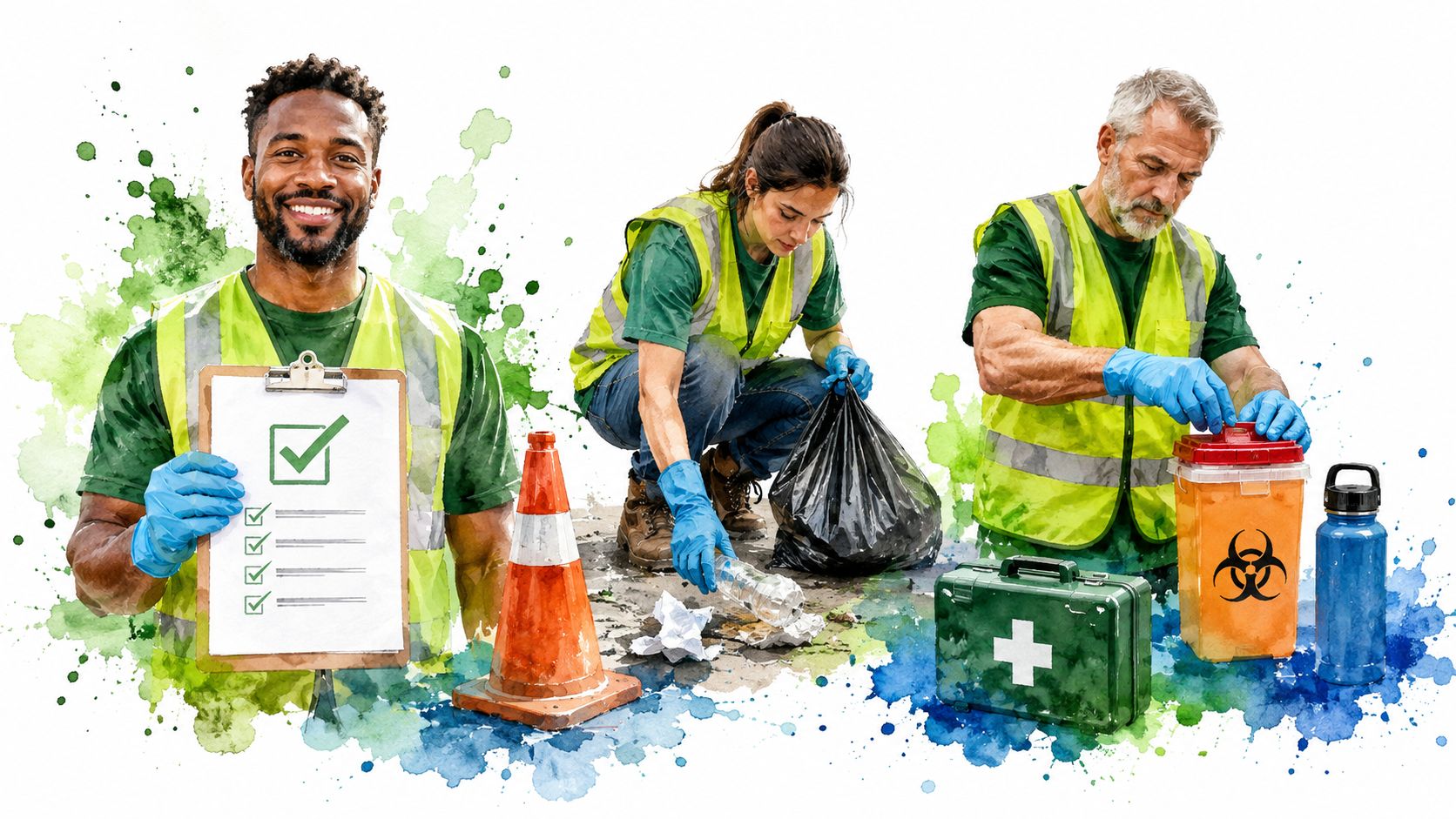
    Community-Led Initiatives That Create Real Change

    I keep coming back to the same winter cleanup in Chicago. People showed up in heavy coats, boots slushy from the curb, and gloves stiff in the cold, but they kept working because the block needed it. That is the kind of environmental justice work that changes a neighborhood from the ground up, and it is why groups like the Litter Caterpillars matter when they post up in bad weather, keep returning, and build trust one pickup at a time. Their Green City Project follows that same spirit, turning repeated cleanup days into something residents can recognize and use.

    A diverse group of volunteers cleaning litter in Chicago with the Willis Tower in the background.

    What happens when neighbors act first

    I have seen a crew clean a highway shoulder during a bike-event shutdown, and the scene said more than any flyer could. Cars slowed. People noticed the bags, the gloves, the work boots, the sweat. The mess stopped feeling hidden, and the neighbors doing the work stopped feeling like they were asking permission to care about their own streets.

    Caterpillar Park in Englewood shows the same lesson in another form. A group won an empty lot at auction and turned it into a place people could gather, rest, and return to. That kind of project moves cleanup beyond a one-time sweep and into place-making, where the block gains something lasting instead of just looking better for a day.

    Local lesson: A cleanup is stronger when it gives people a reason to come back.

    Identity matters more than people admit. A flag, a theme song, or a badge can sound small from the outside, but on the ground it gives volunteers a shared point of pride. I have watched someone come out for one litter pickup, then return the next week because the group felt familiar, steady, and worth belonging to. That feeling keeps a crew together after the first rush wears off.

    The work still has to stay grounded. Trash pickup, land reclamation, and policy pressure all matter, and the groups that last are the ones that keep all three in view. A street sweep tells residents the block is worth maintaining. A park project makes that care visible. A campaign pushes the city to fund what the neighborhood needs next.

    How to Start or Join Environmental Justice Work in Your Neighborhood

    I still remember the first time I joined a cleanup where the rain never let up. A few of us were picking up bottles along a curb line while neighbors came out with coffee, asked questions, and pointed to the spots where trash always gathered. That kind of morning teaches you fast. Environmental justice work starts with people already carrying the load, not with a polished announcement.

    Start with the crews already on the block. Look for block clubs, cleanup teams, church groups, school volunteers, and local advocates who keep showing up even when no one is filming. Go once before you try to lead. One visit tells you more than a month of scrolling posts.

    A four-step infographic guide explaining how to take action for environmental justice within local communities.

    Four effective steps

    1. Find local groups. Look for crews already cleaning, planting, lobbying, or organizing in your area. If they meet on weekend mornings and keep the atmosphere welcoming, they probably know how to bring volunteers back.

    2. Identify community needs. Walk the block, talk to residents, and compare what you hear with tract-level screening results. The census-tract approach in EPA guidance helps people decide where litter pickup, park repair, or outreach should go first.

    3. Volunteer your time. Bring gloves, bags, water, and a steady attitude. Litter Caterpillars is one example of a group that builds around weekend mornings, keeps pressure off donors, and centers safe, steady participation.

    4. Advocate for policy change. Show up at meetings, write comments, and ask who benefits from cleanup dollars. If a project says it serves everyone, ask how it counts the people who live closest to the harm.

    The schedule matters more than a lot of people admit. Weekend mornings tend to draw people who want to give before errands, family obligations, or noise take over the day. I protect volunteer energy the same way I protect a fresh water cooler on a hot block. Safety first. Happiness second. Shame never.

    If you are starting something new, keep the setup simple. Use Meetup to find or post events, Instagram to share real before-and-after photos, and group chats to make the first visit less awkward. Build the crew first, then let the name grow out of the work.

    The Personal Transformation That Comes From Showing Up

    The odd thing about service work is that it cleans you while you clean the street. When you stand outside in bad weather with people who chose to be there, you learn who shows up when comfort disappears. You also learn that cleaning someone else's mess is often easier than facing your own habits, excuses, and clutter.

    The first time I felt that, I was freezing, tired, and weirdly alive. The hail hit hard, the bags got heavy, and the block still needed us. I left with a sore back and a clearer head, and I've seen that happen to other volunteers too.

    What steady service changes in people

    It makes you braver because you stop waiting for perfect conditions. It makes you kinder because you keep meeting people where they are, not where you wish they were. It makes you more resilient because you've already worked through cold mornings, awkward silences, and the feeling that nobody will notice.

    Show up enough times, and the city starts feeling less like a place that happens to you and more like a place you help hold together.

    That's why I care so much about volunteer-first structure. If people leave feeling drained, embarrassed, or used, they won't come back. If they leave with a cleaner block, a new friend, and a little more trust in themselves, they probably will.

    Environmental justice work does not end when the trash bags fill up. It keeps going in the habits people build, the pride they carry, and the way they start treating their own homes and neighbors. That's the quiet payoff nobody can put in a spreadsheet.


    If you want to do this work with people who show up rain or shine, Litter Caterpillars runs weekly Chicago cleanups, builds friendships through service, and keeps the focus on volunteer safety and happiness. Come grab gloves, meet the crew, and put your energy into a block that needs it.

  • Why Pick Up Litter: The Real Reasons It Matters

    Why Pick Up Litter: The Real Reasons It Matters

    Three of us stood under a tree in a Chicago hailstorm, laughing like fools while Uber kept canceling. My gloves were soaked, the chips bags were stuck to the curb, and somehow I felt better than I had in weeks.

    The First Time I Picked Up Litter in a Chicago Hailstorm

    That first night with Litter Caterpillars changed how I think about a Saturday. We started with three people, a spring storm, and the kind of cold that makes you hunch your shoulders and question your own ideas. We were huddled under a tree, watching ride after ride disappear from our phones, and I remember thinking that cleaning up other people's messes felt strangely easier than cleaning up my own life.

    The weird part was the fun

    Nobody told me pickup would feel this alive. I expected duty, maybe a little pride, then a trip home with numb fingers. Instead I got the simple rush that comes when you and two other people decide to stay outside anyway, even when the sky turns mean.

    The work was small and obvious. A wrapper in the grass, a bottle cap by the curb, a paper cup flattened in a puddle. Each piece made the block look a little less abandoned, and each bend to the ground made me feel a little less stuck in my own head.

    Practical rule: if a job makes you notice your hands, your breath, and the people beside you, it's doing more than cleaning a street.

    That night gave me the core answer to why pick up litter. It's not because I woke up one day and turned into a saint. It's because the act itself changes the person holding the bag. You feel agency again. You stop waiting for perfect weather, perfect neighbors, or perfect motivation.

    The rest of this piece is just the reasoning behind that feeling.

    Why Litter Is Really a Source-Control Problem

    A candy wrapper in a gutter is like a dropped receipt in a river. Once it leaves your hand and starts moving, you can't call it back. That's the part people miss when they treat pickup like sidewalk decoration.

    Once trash moves, it gets harder to stop

    A chip bag on a parking lot doesn't stay a chip bag forever. Wind tears it, rain pushes it, and the pieces slide toward a storm drain. From there, the mess can move downstream, break apart, and keep going. That's why I think of litter pickup as source control, not cleanup for show.

    If I see a bottle cap near a curb, I don't see one cap. I see something that can bounce, roll, and end up where a dog drinks or a drain catches debris. If I see glass by a bike path, I know the risk goes up the longer I leave it there. The best move is simple, remove the trash before it disperses.

    An infographic illustrating how litter dropped into waterways breaks down into microplastics, highlighting the importance of source control.

    The highest-value habit is early removal

    That's why I care so much about crews who hit the same blocks, drains, and edges again and again. A wrapper near a storm drain is the kind of thing you can grab in two seconds. If you wait, it becomes fragments, mess, and then a harder problem for the next rain.

    I use the same logic when I talk with new volunteers about litter prevention programs. Start where trash collects. Pick up the loose stuff before it travels. Do it before the block gets another round of weather.

    The point isn't to pretend cleanup solves everything. The point is that pickup can stop a small problem from becoming a spread-out one. That's a real job, and it's one a person can do with gloves and a bag.

    What Pickup Actually Saves Wildlife, Water, and Public Money

    When I walk a block in Chicago, I'm looking at more than a messy corner. I'm looking at where birds peck, where rain runs, and where city crews come back again and again. Litter doesn't sit still, and the bill for it doesn't stay small.

    The mess is bigger than the block in front of you

    Keep America Beautiful's 2020 National Litter Study estimated about 49.6 billion pieces of litter near U.S. roadways and waterways, including 25.9 billion near waterways and 23.7 billion near roadways, or 152 littered items per U.S. resident and more than 2,000 pieces per mile. The same study said if everyone in the U.S. picked up just 152 pieces of litter, the country would effectively clear the existing load until new litter showed up. A later update said litter was down 34%, yet 35 billion pieces still remained in parks, waterways, and public spaces. Keep America Beautiful's litter study summary

    That's why a small crew can do something visible fast. A few bags of trash taken off one stretch of sidewalk can feel tiny in the hand and huge to the block. The ratio matters.

    The old numbers still tell a useful story

    A 2009 Keep America Beautiful study found more than 51 billion pieces of litter on U.S. roadways each year, or 6,729 items per mile annually, with 91% smaller than 4 inches. It also estimated cleanup costs of more than $11 billion per year and found 38% of roadway litter was tobacco-related, with paper at 21.9% and plastic at 19.3%. Keep America Beautiful litter research summary

    That mix matters on the ground. If most of what I'm picking up is small, then a gloved hand, a grabber, and a bucket can remove a lot of it without fancy gear. If tobacco bits keep showing up, I know where to look. If plastic and paper keep collecting in the same gutter, I know the wind and the curb are doing predictable work.

    On a Saturday route, I'm not solving the whole city. I'm taking away the pieces that would have kept moving.

    If you want the blunt version, pickup saves wildlife from ingestion and entanglement, keeps trash from leaching into soil and water, and cuts down on repeated cleanup work. I like that kind of math because it's plain. You can see the bag fill up, and you can see the block improve.

    The cleanup side of this is also why I keep sending people to cleaning up a river. Water carries everything farther than people think.

    An infographic showing the benefits of picking up litter for wildlife, water safety, and public money savings.

    Why Cleanup Is Only One Piece of the Puzzle

    I hear the objection all the time. If trash keeps coming back, why bother? That question is fair. I'd ask it too if I hadn't spent years watching the same blocks fill up again after a storm or a busy weekend.

    Cleanup helps now, prevention helps later

    Pickup gives immediate relief. It protects a bird from one plastic scrap, keeps a drain from clogging, and makes a corner feel cared for. But the long game is prevention, better packaging, fewer escape points from waste systems, and a city where people don't treat the sidewalk like a bin.

    A clean block also changes the mood of a place. When a street looks cared for, people notice. They're less likely to toss the next wrapper. I've seen that happen on blocks where volunteers return often, because care is visible before a single word gets said.

    The British litter guidance from Keep Britain Tidy puts this plainly, cleanup matters, but it should sit inside a broader prevention effort. Why do we need to pick litter

    I don't ask people to pick up litter because it fixes everything

    I ask because it fixes something real, right now. It removes a mess that would otherwise spread. It shows your block that someone is paying attention. It gives you a job you can finish on a Saturday morning.

    That's enough for me. It should be enough for you, too, if you want to do the part that belongs to a regular person.

    The Real Reasons People Don't Pick Up Litter and How to Get Past Them

    People don't avoid pickup because they're lazy. They avoid it because the task feels gross, risky, or pointless. I respect all three of those reactions, because I've had them myself.

    The gross factor is real

    Nobody enjoys reaching toward mystery sludge with bare hands. That's why I never go out without thick gloves and a grabber. If something looks slimy, sharp, or weird, I leave it alone and move on.

    Needles, broken glass, and other unsafe items need a different response. I teach people to carry a sharps container when it makes sense, and to skip anything they shouldn't touch. I'd rather someone pick up ten safe items than hurt themselves on one dangerous one.

    Safety and futility need simple rules

    If you're worried about safety, stay in familiar, well-lit spots or go with a group. I like the buddy system because it lowers stress and makes the hour feel lighter. You talk, you work, you keep an eye on each other.

    If you think one person can't make a difference, use a smaller target. One block. One bag. One curb line. I've seen the mood on a street change after one clean sweep.

    Practical rule: make the goal small enough that you can finish it before your brain starts negotiating.

    The second half of this comes from the people who keep showing up. Keep Nature Wild says that if every person picked up just one piece of trash today, the world would have over 300 million fewer pieces of litter, and if every person picked up 10 pieces, that would mean 3 billion fewer pieces. That's a simple mechanic, not a pep talk.

    An infographic listing common barriers to picking up litter and practical tips to overcome them safely.

    The point is not that everyone should love trash pickup. The point is that the common objections all have workarounds. Once you name the barrier, the job gets less mysterious.

    What Weekly Cleanup Actually Does to a Neighborhood and Its People

    I think about one cold Saturday on a Chicago block where the trash had been building for weeks. Nothing looked dramatic at first. A few cups near a fence, wrappers in the grass, bottles by the curb, the usual stuff you stop seeing until someone points at it.

    Before, during, after

    Before the cleanup, people walked fast and kept their eyes forward. During the cleanup, strangers started talking while they bent down for the same pile of debris. After an hour, the block looked open again, and people who had never met were joking like they'd known each other for months.

    That's the part I didn't expect when I started. The work brings people together because it gives everyone a simple shared task. Nobody needs a speech. Nobody needs to agree on politics or style or anything else. You just fill bags and keep moving.

    The regular-participation research on litter walking says 80% of participants did it regularly at least 1 to 3 times per week, and regular participation was significantly associated with previous cleanup experience, physical-activity motivation, and middle age. Litter walking research

    That matches what I see in Chicago. People stick with the habit when it feels like a walk they already know how to do. They come back because the work fits into life instead of taking over life.

    The friendships are part of the outcome

    I've watched people start with a bag in one hand and leave with a new group chat. I've watched shy first-timers relax after the first curb. I've watched regulars become the people who notice who's missing and text them before the next event.

    That matters to me as much as the cleaner block. A neighborhood that lets strangers become helpers gets stronger in ways you can feel right away. The trash leaves, sure. The bigger change is that people stop acting alone.

    How to Plug In If You Live in Chicago

    If you're in the city and you want to try it, keep it simple. Litter Caterpillars runs weekend mornings, in all 50 wards, rain or shine. The group uses Meetup and Instagram as the main doors in, and nobody gets pushed for money when they show up.

    What a first event looks like

    Wear shoes you don't mind dirtying. Bring water, gloves if you have them, and a jacket if the forecast looks ugly. Show up early enough to hear the route plan, then stick with the group until the bags are done.

    I'd also say this. Don't wait until you feel like a seasoned volunteer. The first time is enough. People come back because the work is direct and the mood stays human.

    Screenshot from https://www.littercaterpillars.com

    What grew from one pickup

    Caterpillar Park in Englewood is proof that a first cleanup can lead somewhere bigger for a neighborhood. I like that story because it starts with ordinary hands and ends with people taking ownership of a place they used to pass by.

    If you want the direct route, check the trash pickup volunteer page and pick a Saturday morning that works for you. That's all it takes to find out whether this kind of work fits you.

    The Question Behind the Question

    The question isn't whether one wrapper matters. It's what kind of person you want to be on a Saturday morning when nobody's grading you and nobody's forcing your hand.

    I go back to that hailstorm a lot. Three of us under a tree, cold, half-laughing, watching Uber cancel again and again. We stayed anyway, and that choice taught me more than any lecture ever could.

    So when people ask me why pick up litter, I give them the honest answer. Because it's good for the block. Because it's good for the water. Because it's good for the person who bends down and decides to care in public.


    Litter Caterpillars runs Chicago trash pickup events that put you on a real block with real people, and the whole point is to make the work feel doable, social, and steady. If you want to try one Saturday morning, visit Litter Caterpillars, see what's coming up, and come find out what it feels like to leave a place better than you found it.