Tag: community engagement

  • Why Is Community Engagement Important

    Why Is Community Engagement Important

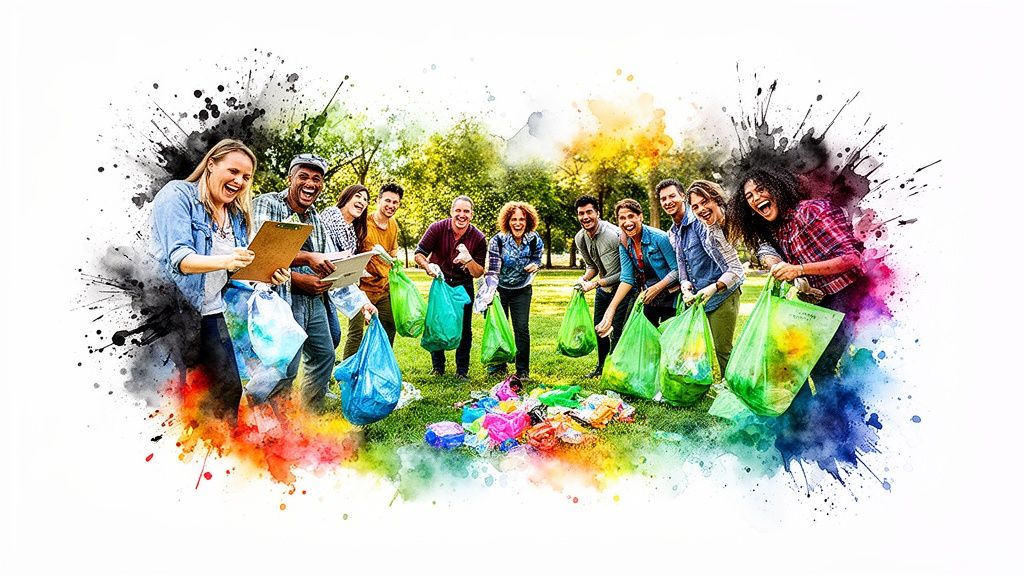
    The hail hit so hard that Kevin, two volunteers, and I could barely hear each other under a West Side street tree. We watched ice bounce off our phones while one Uber after another canceled, then laughed, pulled our wet jackets tight, and kept walking.

    The Night Three People Got Caught in a Chicago Hailstorm

    The leaves rattled above us. Water ran down my sleeves. Kevin checked his phone again, shook his head, and showed us another canceled ride. Nobody had planned to become friends under a tree during a Chicago storm, but there we were, three tired people holding grabbers and trash bags while hail knocked against the sidewalk.

    We could've called it a night. Instead, we waited for the worst of it to pass, then finished the route. We picked up what we could, talked between gusts, and learned each other's names. That small choice still explains community engagement better than any poster I've read.

    Community engagement looks like people who show up, do something together, and return after the weather changes. It can happen in a cleanup, a neighborhood meeting, a school project, or a group checking on neighbors after a storm. The activity matters, but the repeated contact matters more. You begin as strangers. Then you recognize the same face. Later, you know who to call.

    That is why I keep thinking about that hailstorm when someone asks, why is community engagement important? The answer starts with a simple scene. Three people showed up anyway, stayed connected when the easy option disappeared, and left the block a little more cared for than they found it.
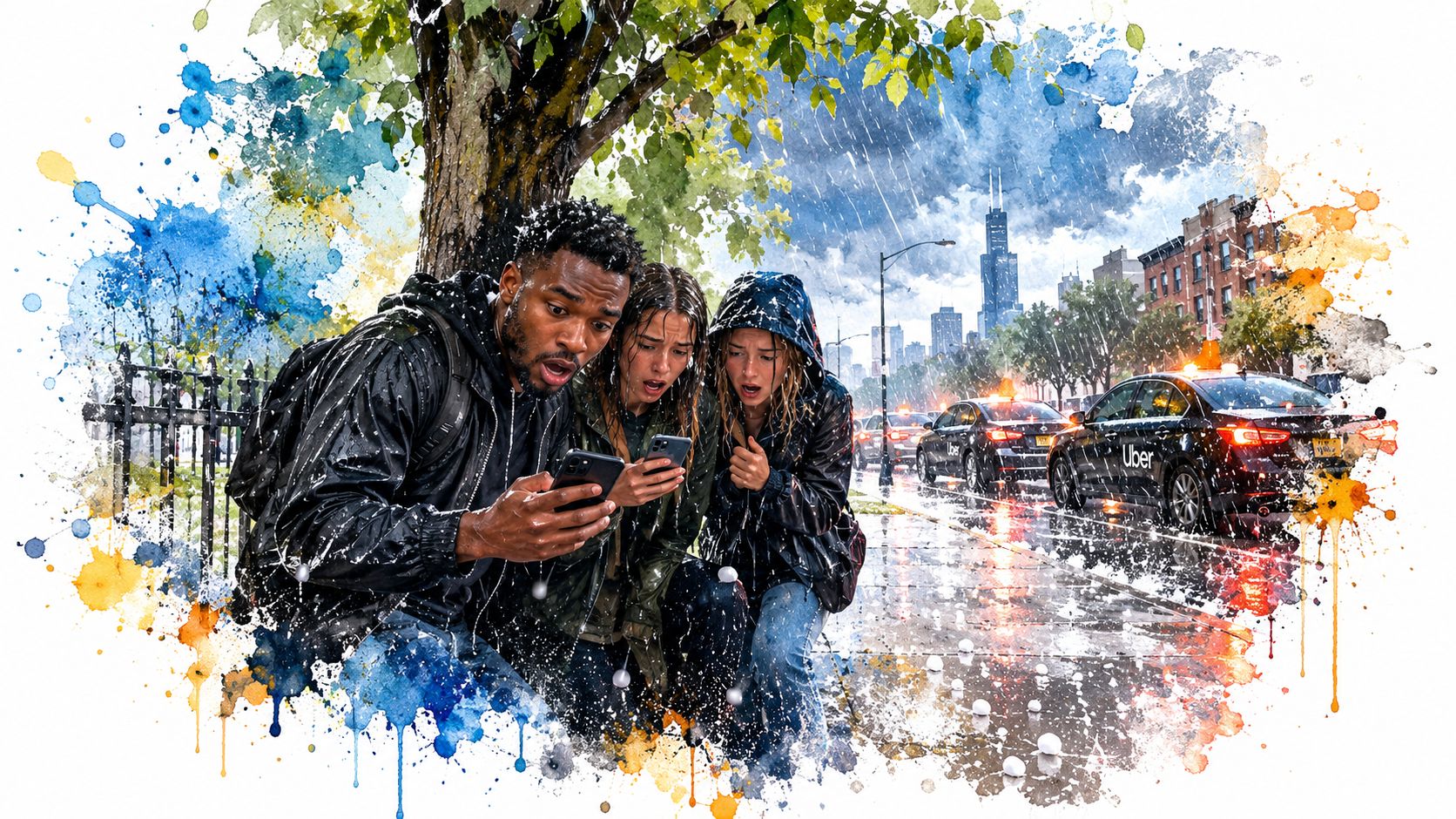
    Three shocked people standing in the rain outside in Chicago while looking at their smartphones together.

    What that storm taught me

    A community doesn't form because people share an address. It forms when people share time, work, attention, and small acts of trust. The story of the vacant lot follows that same pattern. A place changes after people decide to keep returning to it.

    England's 2025/26 Community and Engagement Survey found that 46% of people aged 16 and older took part in civic participation, consultation, or activism during the prior 12 months, compared with 41% in 2024/25. Civic participation alone reached 38%, up from 34% the year before, according to the Community and Engagement Survey report.

    Those figures give a name to what I saw under that tree. When people have a clear local issue and an easy way to act, participation can rise quickly. The rest of the answer lives in the ordinary details, who returns, who feels safe, who gets heard, and what changes on the ground.

    What Community Engagement Really Means in Plain Words

    I explain community engagement this way: show up, do visible work with other people, and come back next week. You don't need a perfect plan, a loud personality, or a special title. You need a reason to step outside and a task that other people can see.

    Living on a block doesn't automatically create a community. You can pass the same apartment doors for years without learning a neighbor's name. You can sign a petition, share a post, or send a donation and still never meet the people facing the same problem.

    I think of it as a block potluck. Every household brings one dish, even if the dish comes from a grocery store. People stand around comparing recipes, asking who lives upstairs, and learning who has a ladder or a spare shovel. A locked apartment door and a takeout menu may feed one person, but they don't help neighbors find one another.
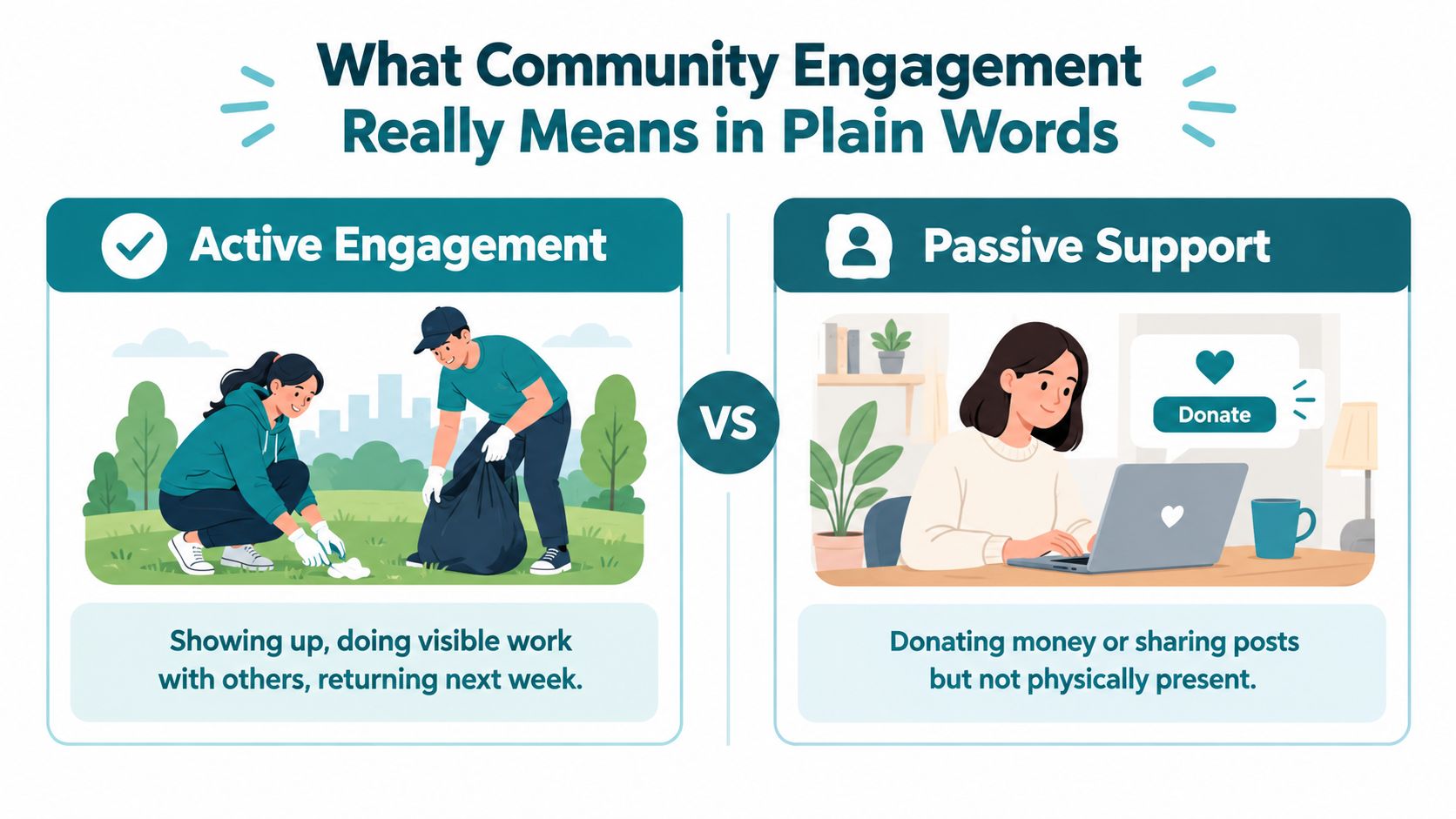
    An infographic comparing active community engagement, showing people cleaning a park, with passive support, such as online donations.

    Five levels of showing up

    A public participation model from the International Association for Public Participation describes five levels:

    • Inform: Give people clear facts and updates.
    • Consult: Ask for views before making a choice.
    • Involve: Keep residents part of the process.
    • Collaborate: Make decisions with the people affected.
    • Enable: Give the community real authority over the result.

    I see those levels on Chicago sidewalks. A group chat can inform volunteers about a cleanup. A neighbor can suggest a dangerous alley, which creates consultation. A regular crew can plan the route together. Residents can collaborate on what happens to a vacant lot. In the strongest version, neighbors help decide how that space will operate.

    People can also turn community into sponsorships when a shared effort grows into a clear local project. The point remains simple. Engagement asks people to take part in a relationship with their neighborhood, not merely react to a message.

    A practical test: If people can see what they did, meet someone new, and find a reason to return, you have created an opening for engagement.

    Four Ways Engagement Changes a Neighborhood

    I've watched one Saturday cleanup produce several results at once. We arrive with bags and grabbers, but we leave with more information, more familiar faces, and a better sense of what the block needs.

    Safety begins with familiar faces

    Kevin can name the block where drivers began slowing down after seeing the same yellow vests each Saturday. The vests didn't replace signs or traffic rules. They made people notice that residents and volunteers watched the street and cared about what happened there.

    That visibility changes the feel of a corner. A person walking home sees faces they recognize. A child sees adults working together. A driver sees people who may speak up when something looks dangerous.

    Resilience grows before the emergency

    The crew that picks up bottles can also notice a blocked drain, a fallen branch, or an older neighbor who needs help carrying something. After a storm, those relationships reduce the time people spend figuring out who can respond.

    We don't need to know everything. We need enough trust to knock on a door, send a message, or ask another volunteer to check a nearby house. A cleanup group can become a small network before anyone calls it one.

    Social ties form during ordinary work

    Two volunteers who met over grabbers in 2022 are now godparents. I've also watched new arrivals to Chicago find a friendly face on their first cleanup. Nobody had to force a bonding exercise. People talked while sorting bottles from cans, carried full bags together, and shared snacks afterward.

    The Census Bureau and AmeriCorps reported that 75.7 million Americans aged 16 and older, or 28.3% of the population, formally volunteered through an organization between September 2022 and September 2023. The Census Bureau account of civic engagement and volunteerism shows how many people already turn concern into action.

    Organized voices reach services more clearly

    Aldermen and city crews can respond more easily when a group sends dated photos, a location, a short description, and one named contact. Scattered complaints can disappear across separate channels. A group can collect the same problem in one place and follow up with a person who knows the details.

    That structure also gives residents a way to ask what happened after they reported an issue. A 2025 survey found that 94% of residents want local governments to report how their input was used, according to the State of Community Engagement survey. People want a response they can see, not only a form they can complete.

    These outcomes stack. The same Saturday morning can make a street feel watched, give neighbors a contact during a storm, create friendships, and produce a cleaner report for city staff.
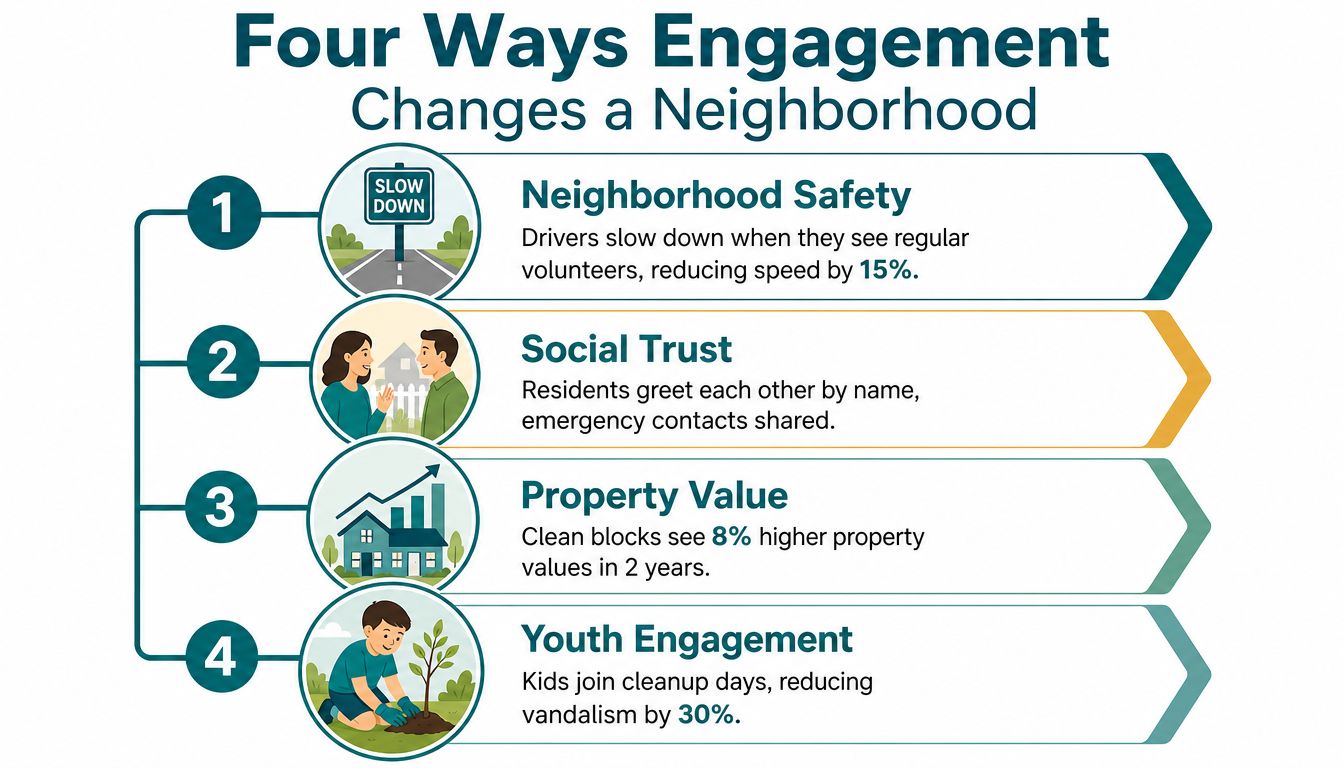
    An infographic titled Four Ways Engagement Changes a Neighborhood, showing safety, social trust, property values, and youth engagement.

    The video below gives another way to see how shared action can bring residents into the same work.

    What Real Impact Looks Like Block by Block

    The first scene happened beside a highway. A mattress sat near the ramp. Shattered glass glittered in the dirt, and fast-food wrappers had collected where the wind pushed them. Volunteers worked through the mess until the asphalt edge looked open again.

    Neighbors watched from nearby. Their surprise said plenty. A road can feel different when people remove the objects that make everyone expect neglect. We didn't need a speech to explain the change. Anyone passing could see the clean stretch.

    Caterpillar Park gave children somewhere to run

    In Englewood, an empty lot once held the usual mix of trash, weeds, and things nobody wanted to touch. The group won the lot at auction and began working on it. People painted murals, planted flowers, and built benches.

    Later, children ran toward the space instead of around it. Neighbors sat on the benches they helped build. The work didn't end when the first bags left the lot. People kept returning because they could see their own hands in the place.

    A warning didn't decide the future

    People told us to stay away from one ward. We listened to the safety concerns, planned carefully, and returned on Saturday mornings with a clear buddy system. At first, strangers watched from windows and doorways. Over time, faces became familiar.

    The trash bags grew smaller. Conversations grew longer. Someone waved from a porch. Someone else asked when we'd return. That kind of change takes repetition, because one cleanup can remove debris while regular visits can change expectations.

    The three scenes share a pattern. People pointed to the result, a cleared ramp, a usable lot, and a cleaner route. Then they pointed to the people who made it happen. That is what impact looks like to me. You can smell the difference near the highway, sit on the bench in Englewood, and recognize the neighbor at the end of the block.

    How to Build Participation Where You Live

    Start with a rhythm people can remember. Litter Caterpillars meets on weekend mornings, often at 9 a.m., so someone can learn the time once and return without searching through a new announcement every week.

    Choose one meeting corner and one small first task. One hour on one block feels possible. A volunteer who thinks, “I can try this once,” may stay when the work ends with a visible result.

    Make the first visit easy

    Bring the gear. Grabbers, gloves, bags, and water remove the awkward question of whether a new person owns the right supplies. Pair a first-timer with someone who knows the route, the safety rules, and what to do with sharp objects.

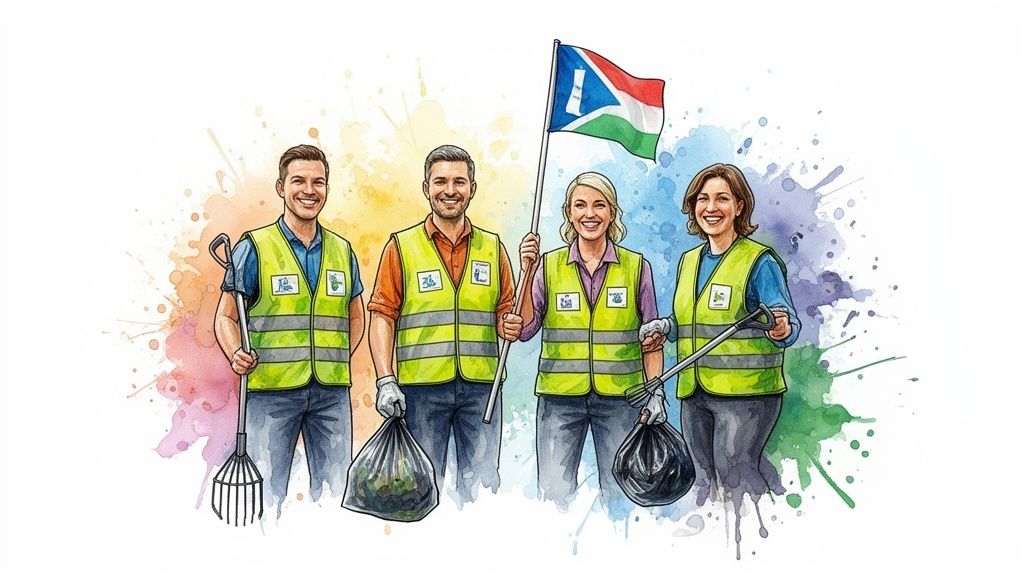
    Use bright vests and a buddy system. Keep people away from traffic, explain which items require special handling, and stop when the conditions become unsafe. Volunteer safety comes before a full bag.

    Reach people through ordinary places

    Post in a local Facebook group, but don't stop there. Tell people at church, near school pickup, and in the barbershop. A neighbor may ignore a general announcement and respond when someone they recognize invites them directly.

    Finish with a group photo and a shared snack. That small ending gives people a moment to talk after the work, and it helps the event feel like a gathering rather than an unpaid chore.

    A good first event has three parts: a clear meeting place, a short task, and a warm ending.

    Repeat the pattern before changing it. New organizers can also read community engagement strategies from Litter Caterpillars for more practical ideas. If your group relies on a campaign or a fundraising push, planning for post-campaign backer retention can help you keep people connected after the first action ends.

    Measuring Whether Your Effort Is Working

    I don't need fancy software to tell whether a cleanup has momentum. I keep a shared note with the basics, who came, who came for the first time, and who returned later.

    The return matters more than a crowded first event. A person who comes back has learned the route, met someone, and decided the time feels worth protecting. That choice tells me more about trust than a large one-day turnout.

    I also photograph the same alley or sidewalk from the same angle. The picture helps a skeptical neighbor see the change, and it gives a new volunteer a clear reason to join. We count bags or debris, but we read that number carefully. Smaller totals can mean the block needs less cleanup because residents have started treating it with care.

    A simple tracking table

    Metric How to Track Healthy Sign
    Weekly attendance Record names or a headcount after each cleanup Familiar faces return while new people still find the group
    First-time volunteers Mark first visits in the shared note Outreach reaches people beyond the regular crew
    Repeat participation Check who returns during later cleanups More people build the habit of coming back
    Visible condition Photograph the same spot each time The route stays cleaner between visits
    Neighbor response Note waves, conversations, and offers of help Residents approach the crew without an invitation
    Local support Record water, snacks, gear, or space offered by businesses Nearby businesses begin helping with the work

    The community impact measurement guide from Litter Caterpillars can help you turn those notes into a simple routine. Keep the record public enough for volunteers to understand, while protecting private information.

    Engagement can also touch health and confidence. A meta-analysis of 131 studies found statistically meaningful improvements in health behavior, health outcomes, self-efficacy, and perceived social support in programs that included community engagement, with reported effect sizes of δ = 0.16 for health consequences, δ = 0.41 for health behavior self-efficacy, and δ = 0.41 for perceived social support in the review of community engagement interventions. I see the street version when a quiet volunteer takes a harder route because a friend is walking beside them.

    Start Small and Keep Showing Up

    Kevin started by grabbing trash alone on weekends. He didn't wait for a large crew, a perfect budget, or a citywide plan. He picked up what he could, then invited people into a routine that kept going.

    That routine matters because community engagement grows through repetition. A one-time heroic cleanup can fill bags. A weekly habit can teach neighbors who you are, what you do, and when they can find you.

    Pick one action this week:

    • Pick up five pieces of litter on your block and dispose of them safely.
    • Attend one local meeting and introduce yourself to a person sitting nearby.
    • Say hello to two neighbors and ask what they want to improve on the block.

    Then repeat the same action. Walk the same route. Attend the next meeting. Greet those neighbors again. The work may feel small, but repetition gives people a chance to trust the pattern.

    In Chicago parking lots, our weekly meetups at 9 a.m. make that pattern visible. People know where to go, what to bring, and who might be waiting. Rain changes the jackets. Snow changes the pace. The habit remains.

    The answer to why is community engagement important lives there. A lonely street becomes a cared-for place when people keep bringing their names, hands, and attention back to it. Choose one action today, put it on your calendar, and return before the first burst of excitement fades.


    Litter Caterpillars hosts weekly Chicago trash pickups where you can bring friends, meet neighbors, and work safely with shared gear. Visit Litter Caterpillars to find an upcoming cleanup and choose the Saturday when you'll show up.
  • Volunteer Program Evaluation: A No-Nonsense Playbook

    Volunteer Program Evaluation: A No-Nonsense Playbook

    Three people stood under a tree in a Chicago hailstorm, holding trash bags and waiting for rides that never came. We were freezing, half laughing, and already learning the first rule of volunteer work. If you don't decide what counts as progress, the weather, the chaos, and other people's opinions will decide for you.

    Your Program is a Story Not a Spreadsheet

    After a cleanup, I do not start with the sign-in sheet. I start with the curb.

    Did the block feel different. Did the volunteers leave taller than they arrived. Did a neighbor stop to talk instead of walking past with that shut-down look city residents get when they have given up on a corner?

    That is evaluation at street level. It starts with what changed in real life, then works backward to the numbers that prove it. Groups that begin with a giant spreadsheet usually end up measuring whatever is easiest to log. Hours. Names. Bags. Posts. Those figures matter, but they are only fragments. A volunteer program lives or dies on whether the work changed the place, the people, or both.

    Corporate-style evaluation often strips out the part that matters most. It treats volunteers like labor inputs and outcomes like tidy boxes. That approach misses too much. A cleanup can produce fewer bags than usual and still be one of your best days if a nervous first-timer comes back next week, two neighbors trade numbers, or a teenager realizes they can lead a block instead of complaining about it.

    I have learned to treat evaluation more like field notes than office reporting. Gather proof from several angles, then line it up against the mission.

    Here is the kind of proof that holds up:

    • Visible proof: before-and-after photos, route maps, filled bags, finished tasks
    • Behavior proof: turnout, repeat attendance, friend referrals, volunteers who stay to help after the official end
    • Experience proof: short feedback forms, comments in the group chat, quick check-ins as the day concludes
    • Mission proof: signs that the work changed habits, trust, confidence, pride, or connection to place

    Mission proof is where many groups get sloppy. They assume everyone knows what the deeper goal is. They do not. If your mission is cleaner streets, document cleaner streets. If your mission is reducing isolation, ask whether people made new connections. If your mission is building courage, look for the shy volunteer who starts speaking up, leading a team, or inviting someone else.

    That is why stories belong in your evaluation system. A page of volunteer testimonials from cleanup experiences can show the human shift behind the numbers. It captures fear turning into confidence, strangers turning into teammates, and one-time volunteers turning into regulars. A spreadsheet cannot carry that by itself.

    Litter Caterpillars uses this approach because the mission is bigger than trash removal. We want cleaner blocks, yes. We also want people to feel ownership, pride, and connection in places that often get written off. If we only count bags, we miss half the work. If we only collect stories, we cannot improve the operation. Good evaluation does both. It keeps the soul of the group in view while giving you enough evidence to fix what is weak, repeat what works, and stay honest about what changed.

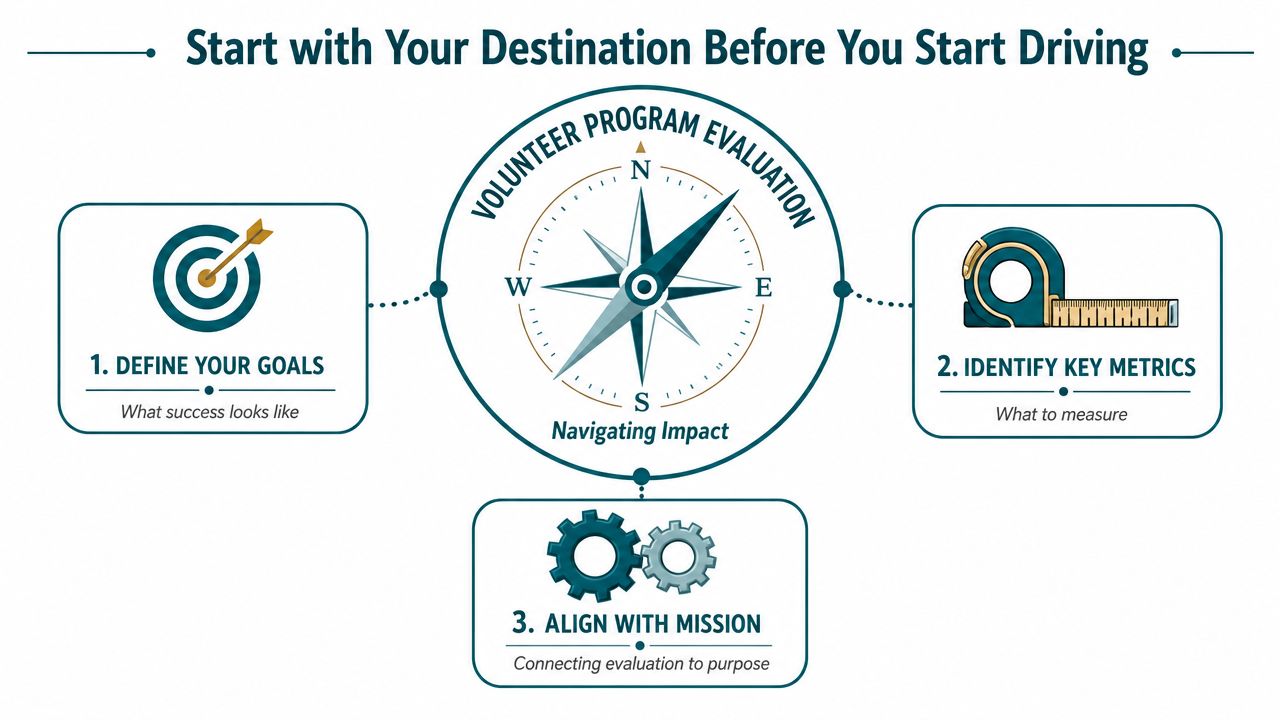
    Start with Your Destination Before You Start Driving

    If you got in your car, closed your eyes, and hit the gas, nobody would call that a road trip. They'd call it a bad decision. Yet that's how many groups run evaluation. They collect random data before they define success.

    Your mission is the destination. Your evaluation is the map in the glove box.

    A diagram illustrating a volunteer program evaluation framework with goal setting, key metrics, and mission alignment.

    Build a simple map

    People hear "logic model" and tense up. Relax. It's just a chain of cause and effect.

    You do an activity.
    That activity creates an output.
    That output should lead to a change.

    A volunteer group that picks up trash on weekend mornings might map it like this:

    Part of the map Plain-English version
    Inputs volunteers, gloves, bags, grabbers, time, leaders
    Activities cleanups, check-ins, group chats, photo posts
    Outputs hours served, blocks cleaned, bags filled, events run
    Outcomes stronger habits, new friendships, more neighborhood pride, repeat volunteers

    That map keeps you honest. It also stops you from measuring whatever is easiest.

    Start with baseline and mission outcomes

    Before you measure anything, set a baseline. VolunteerHub's practical guide to measuring volunteer impact makes that point clearly. You need to know where you are today or your future numbers mean nothing. The same guide says to clarify your top 3 mission outcomes and assign 2 to 3 metrics for each outcome, including at least one output measure and one outcome measure.

    That sounds formal, but it is freeing.

    If your mission outcome is cleaner public space, your output measure might be hours served and your outcome measure might be visible site improvement documented through photos and field notes.

    If your mission outcome is stronger community ties, your output measure might be event attendance and your outcome measure might be volunteer comments about friendships, trust, and whether they'd recommend the experience.

    A map doesn't make the work less human. It keeps the human part from getting lost.

    Use the five-step cycle

    A rigorous volunteer program evaluation follows a five-step methodology: Plan, Collect, Analyze, Report, and Improve, as explained in Qomon's volunteer program evaluation framework. I like this cycle because it cuts through nonprofit fog.

    The situation on the ground is as follows:

    1. Plan: pick the questions that matter.
    2. Collect: gather only the data you can use.
    3. Analyze: look for patterns, surprises, and weak spots.
    4. Report: tell the story in plain language.
    5. Improve: change the next event, training, or communication.

    That's the whole machine. No shrine to paperwork. No giant consultant deck.

    One rough example

    Say your group values bravery. Fine. Define it.

    You might describe bravery as people showing up in uncomfortable conditions, returning after a hard first event, or trying unfamiliar neighborhoods and tasks. Then you can observe it. You can note weather, turnout consistency, and volunteer reflections. Suddenly a value that sounded abstract becomes something you can watch in real life.

    That is what a good map does. It turns ideals into observable behavior.

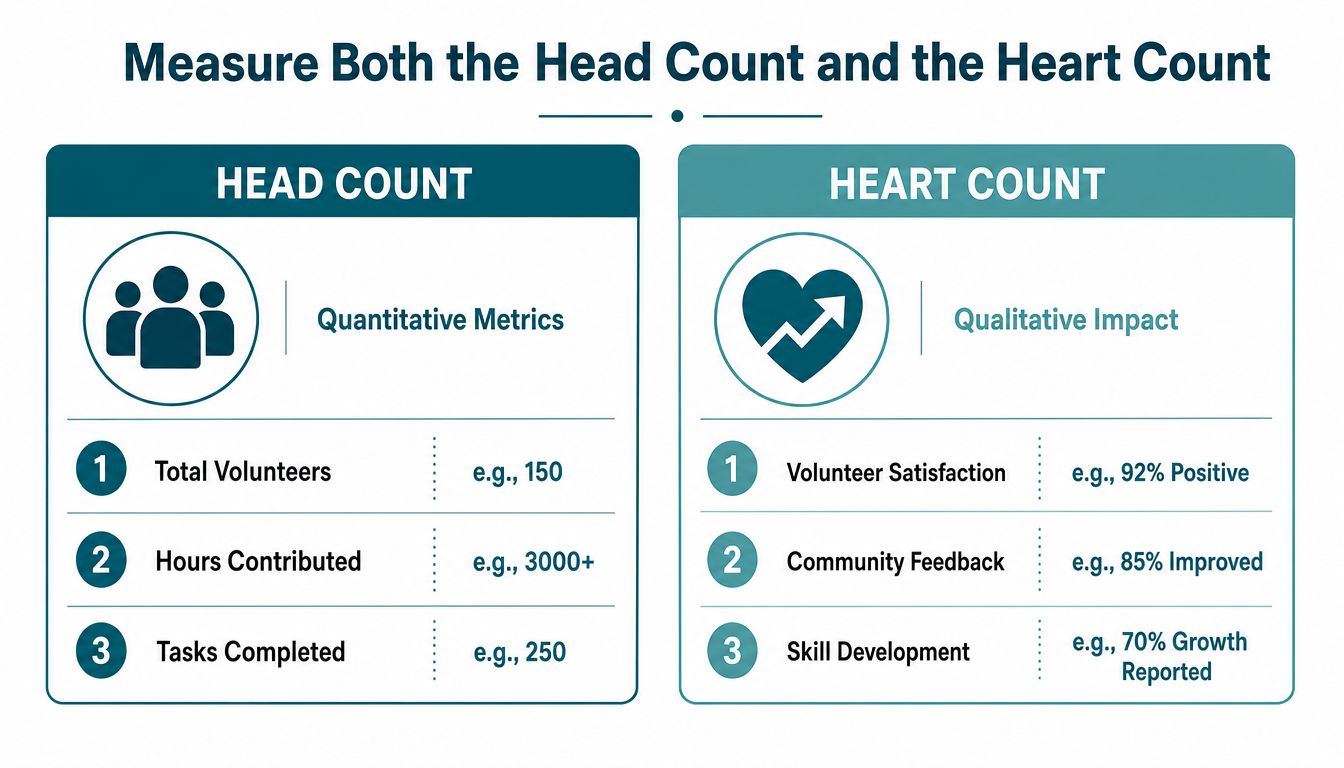
    Measure Both the Head Count and the Heart Count

    At one of our early cleanups, I made the rookie mistake of calling the day a win because the pile of filled trash bags looked huge. Then I checked what happened after. A lot of first-timers never returned. We had moved a lot of rubbish, but we had not built much staying power.

    That is why I track two kinds of proof.

    Head Count shows what the group did in the world.
    Heart Count shows what the experience did to the people doing it.

    You need both if you want a volunteer program that lasts.

    An infographic comparing quantitative Head Count metrics and qualitative Heart Count impacts for measuring volunteer program success.

    Head Count metrics

    These are the plain, visible markers of effort. They matter because grassroots groups can drift into good intentions unless somebody keeps score.

    Useful measures include:

    • Participation rates: who registered, who showed up, and who came back
    • Total hours: how much volunteer time the work required
    • Task completion: whether the route, outreach shift, sorting job, or cleanup target got finished
    • Opportunity count: how often people had a real chance to serve
    • Retention: whether the same volunteers return often enough to build skill and trust

    I keep Head Count simple on purpose. If your team needs ten fields and a training manual just to record attendance, the system is too heavy for street-level work.

    Heart Count metrics

    Heart Count is where volunteer evaluation stops sounding corporate and starts sounding honest.

    People join for one reason and stay for another. They may come because a friend invited them, because the mission matters, or because they felt guilty scrolling past a littered park. They return because they felt useful, safe, welcomed, and connected to something real. If you never measure that part, you miss the reason your group grows or fades.

    Ask direct questions. Keep them short.

    • Did today feel worth your time?
    • Would you come again?
    • Would you bring a friend?
    • Did you feel safe and supported?
    • What frustrated you?
    • What made you feel proud?

    Heart Count can include:

    Heart Count signal What it tells you
    Satisfaction score whether the experience felt good enough to repeat
    Recommendation likelihood whether trust is strong
    Return behavior whether people want another round
    Open comments what the numbers miss
    Social spillover whether volunteers stay, talk, and build ties

    I trust return behavior more than smiles in a group photo. Plenty of events look cheerful for ninety minutes and still fail the ultimate test. The ultimate test is whether people come back on a wet Saturday when the novelty is gone.

    For more grounded systems, I like volunteer management best practices for grassroots groups because they keep the focus on habits, safety, and repeat participation instead of vanity metrics.

    Here's a short video take on the subject before I get more tactical:

    Don't confuse output with meaning

    A hundred bags of trash can mean the day went well. It can also mean the site was in terrible shape, the route was poorly chosen, or your group spent too much time fixing preventable mess.

    I have seen smaller cleanups produce better results. Fewer bags. Better volunteer energy. Safer movement through the area. Stronger conversations with passersby. Higher return rates the next week. That is a better day for a mission-driven group, even if the raw pile looks less dramatic on Instagram.

    Litter Caterpillars is a good example of this trade-off. If twelve people clear a modest stretch of street, talk with residents, take before-and-after photos, and eight of them sign up again, that session has more long-term value than a one-off turnout surge that burns people out.

    Measure the work. Measure the experience. Then compare them side by side.

    If the job gets done and people want to return, the program is healthy. If one side is strong and the other is weak, you found the problem early enough to fix it.

    Your Toolkit for Gathering Street-Level Data

    You don't need enterprise software. You need a system volunteers won't hate.

    The best data tools are the ones people will use while they're tired, dirty, sweaty, cold, or rushing to catch the train home. In practice, that usually means your phone, a free form, a shared sheet, and a habit.

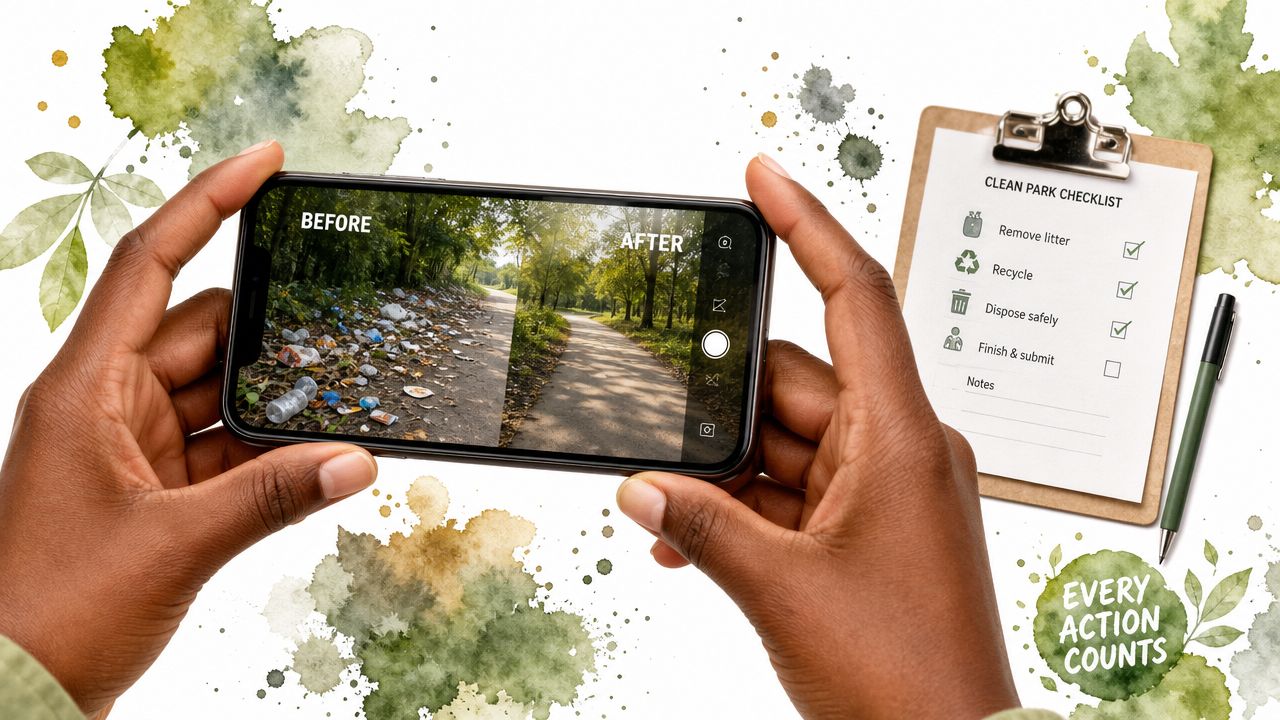
    A person holds a phone showing a before and after comparison of a cleaned park path beside a checklist.

    Keep the tools boring and fast

    Use simple gear:

    • Google Forms: for post-event check-ins and short surveys.
    • Google Sheets: for attendance, hours, return visits, and site notes.
    • Meetup check-ins or a shared note: for quick turnout tracking.
    • Phone camera: for before-and-after proof.
    • QR codes: so nobody has to type a long survey link on the sidewalk.
    • Instagram analytics: to see which impact posts get people talking and sharing.

    Often, a lot of groups overbuild. They imagine a giant database when they really need one clean form.

    A practical method is the session snapshot. After each event, run a simple 3 to 5 question check-in. Qomon's volunteer impact measurement guide says this approach gives you immediate impact data and avoids burdening volunteers with long surveys, which helps you track things like total hours and task completion in near real time.

    The street version of a survey

    At the end of an event, ask only what you need. I like questions that fit on one phone screen:

    1. Rate your experience from 1 to 5.
    2. Would you recommend this to a friend?
    3. What did you work on today?
    4. About how long did you volunteer?
    5. One word for how today felt.

    That's enough to spot trends without turning service into homework.

    If your group works in different parts of a city, a route map helps too. A simple neighborhood tracker or geotagged map can show coverage, gaps, and repeated problem spots. A visual tool like the Northeastern Illinois cleanup map makes patterns easier to spot than a raw address list.

    Collect more than one kind of evidence

    One reason evaluation fails is that people trust only one channel. A survey catches some truth. It misses a lot too.

    Use a mixed bag:

    • Photos: good for visible change.
    • Field notes: good for safety issues and weird on-the-ground details.
    • Volunteer comments: good for culture and motivation.
    • Attendance logs: good for consistency.
    • Observation: good for things people don't write down, like who helps newcomers.

    If you're running regular shifts, the data should feel like part of the rhythm. Gloves on, cleanup, group photo, quick QR scan, done. If it takes longer than a few minutes, you will lose people.

    The Litter Caterpillars Case Study From a Mess to a Mission

    The first version of a volunteer group is usually messy. That's normal. At the start, the data is often just memory. Who came. What got cleaned. Which corner felt rough. Who stayed cheerful in bad weather.

    Over time, the trick is to turn those scraps into a pattern without killing the spirit that made people show up in the first place.

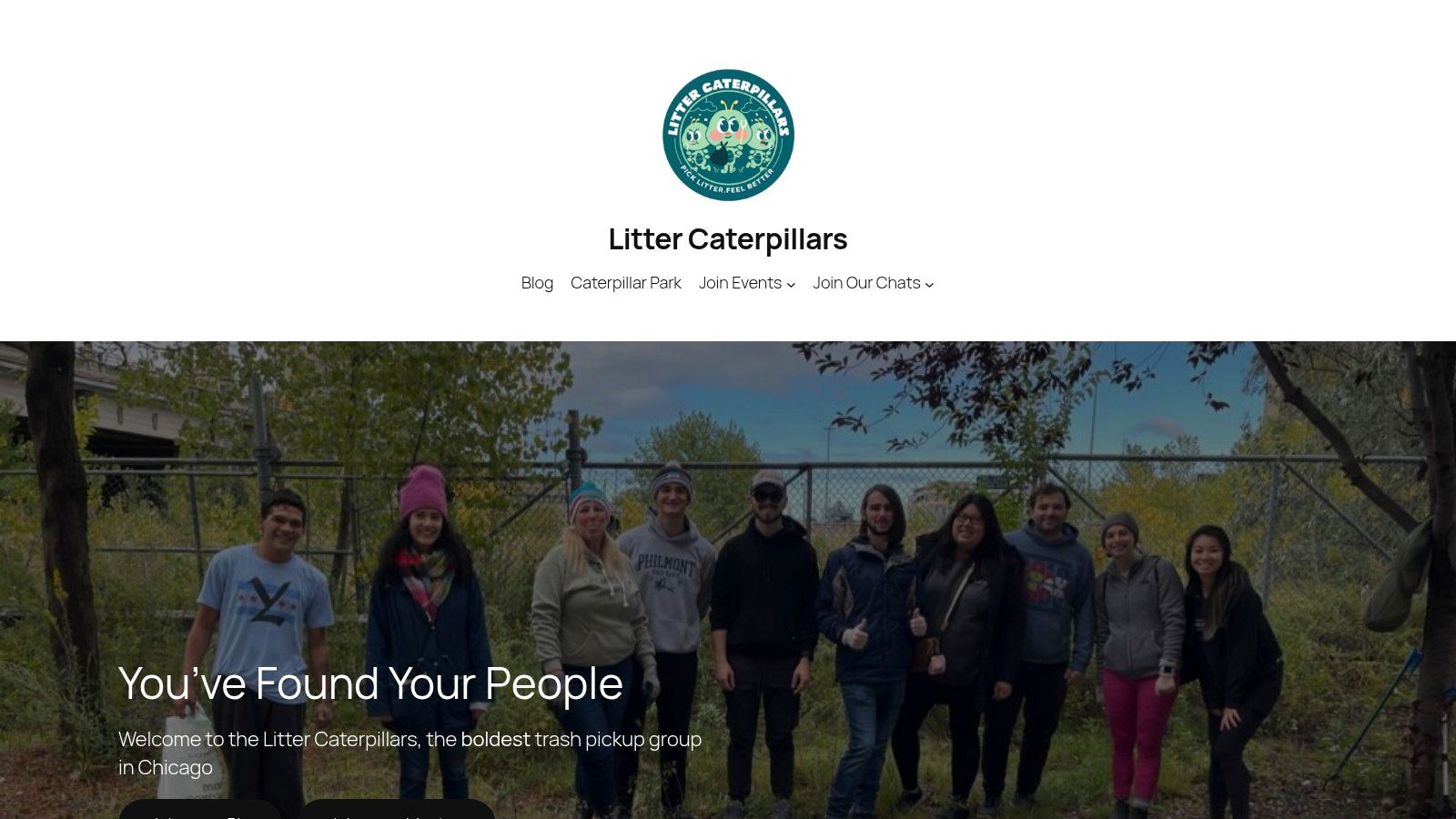
    Screenshot from https://www.littercaterpillars.com

    What the raw version looked like

    At the beginning, a cleanup group might know only a few things for sure. The weather was bad. The turnout was small. The site looked better at the end than it did at the beginning. Volunteers talked afterward. Somebody said, "That was weirdly fun."

    That isn't polished data, but it is data.

    The mistake would be to throw that away because it doesn't look formal. The better move is to organize it. Save photos by date and location. Keep a running sheet of turnout and hours. Write down one or two sentences after each event while the details are still fresh.

    How the story tightens

    Once a group gets more consistent, the pattern gets clearer. Weekend morning events attract a certain type of person. Hard weather filters for dedication. Before-and-after photos bring in fresh interest. Repeat attendance tells you whether the experience has enough pull to become habit.

    A strong volunteer program evaluation can use both numbers and narrative at once. For example:

    What happened What it may mean
    Same volunteers return across multiple events the culture is sticky
    New people join after impact photos are posted visual proof motivates action
    Certain routes draw stronger turnout location and comfort matter
    Volunteers ask for a permanent project the group is ready for deeper ownership

    That last point matters. A temporary action like a cleanup can awaken appetite for permanent work. When volunteers start wanting a place to keep building, you're no longer dealing with a one-off event series. You're dealing with a community.

    Numbers tell you the shape of the work. Stories tell you why the shape matters.

    What this kind of case study teaches

    The takeaway isn't that every group should track the exact same things, but that your evaluation should grow up with your mission.

    A scrappy city cleanup group might begin with turnout, hours, and photo evidence. Later it might add retention, recommendation likelihood, volunteer comments, and route coverage. Later still it might study which kinds of events produce stronger friendships or steadier habits.

    If your values include bravery, kindness, unity, and a volunteer-first culture, your evaluation should include signs of those values in action. Did people feel safe. Did new volunteers get welcomed. Did leaders respect the group's energy. Did people come back because the work made them stronger, calmer, or more connected.

    That is how a mess becomes a mission. You don't clean up the story by making it more corporate. You clean it up by making it more honest.

    Close the Loop Make Your Data Do Something

    I have watched groups collect feedback with good intentions, then do nothing with it. A volunteer says the meetup spot felt unsafe. Another says check-in was chaotic. Three people stop showing up. The form gets saved, everyone stays busy, and the same problem shows up at the next event.

    That is how trust leaks out of a volunteer group.

    Evaluation has to change the next decision. If a route feels off, move it. If new people keep arriving late because the instructions are muddy, rewrite the text message and post a map pin. If regulars are carrying the whole event, train one more person to lead check-in. Street-level evaluation lives on the calendar, in the group chat, and at the start of Saturday morning.

    Where groups get stuck

    The pattern is usually simple.

    • They over-rely on surveys. A form catches some truth, but not the look on a new volunteer's face when nobody greets them.
    • They never ask people why they stopped coming. Departing volunteers often say the quiet part out loud.
    • Nobody owns the fix. Feedback gets discussed, then drifts.
    • Volunteers never hear what changed. People stop giving useful input when it disappears into a void.

    I have learned more from a two-minute conversation after an event than from a polished spreadsheet sent a month later. Forms still help. They just cannot carry the whole load.

    Use a loop your volunteers can actually see

    Keep it plain.

    1. Collect it. Ask one or two questions after the event. Ask one honest question when someone leaves.
    2. Group it. Sort the responses into safety, logistics, culture, and mission fit.
    3. Pick one fix. Choose something small enough to change before the next event.
    4. Say it out loud. Tell volunteers what you changed and why.
    5. Check whether it worked. Ask again after the next few events.

    That last step gets skipped all the time. A leader changes one detail and assumes the issue is solved. Sometimes it is. Sometimes the underlying problem was something nearby, like poor signage instead of poor timing, or a cold welcome instead of a long route.

    A useful rhythm is to revisit the review process every few months so it still fits the group you have, not the one you had six months ago, as noted in VolPro's guide to outcome metrics for volunteer recruitment and retention.

    Give the group proof that feedback matters

    Volunteers do not need a glossy report. They need evidence that speaking up changes things.

    Say, "You told us the corner by the underpass felt rough, so we switched the start point to the library lot."

    Say, "You told us the first fifteen minutes felt awkward, so now one person is assigned to greet every newcomer."

    Say, "Several of you wanted shorter routes in the heat, so we split the team in two."

    Those sentences build credibility fast. They also protect the culture. People feel taken seriously, which makes them more honest next time.

    Do a real yearly review, even if your group is small

    A scrappy volunteer group still needs a moment each year to stop, look back, and make decisions on purpose.

    One practical model is to include more than one point of view in the review, such as leaders, volunteers, community members, and people affected by the work, as described in this overview of volunteer program performance evaluation. Another useful practice is to review participation, hours, feedback, changes, and ongoing problems in one place so leadership can decide what to keep, stop, or repair, as explained in Lodestar at ASU's guidance on systematic evaluation.

    For Litter Caterpillars, that kind of review would not look corporate. It would look like a table at the end of the season, phones out, route photos up, volunteer comments open, and a blunt conversation about what worked. Which cleanup sites built energy. Which ones drained it. Where new people became regulars. Where leaders protected the spirit of the group, and where we let sloppiness chew it up.

    The point is improvement you can feel.

    If your evaluation never changes the route, the welcome, the pace, the leadership, or the way volunteers experience the mission, it is just record-keeping. If it helps the group become safer, warmer, more effective, and more honest, then the numbers and stories are doing their job.

    If you want to join a group that puts this kind of street-level learning into practice, take a look at Litter Caterpillars. We pick up trash across Chicago, build friendships in the process, and treat volunteer energy like something worth protecting.

  • Environmental Stewardship Programs: How to Transform Your Community Today

    Environmental Stewardship Programs: How to Transform Your Community Today

    You might think environmental stewardship programs are just about picking up trash. But you’d be missing the best part. They’re really about personal transformation and community building. I’m telling you, these programs take the simple act of caring for your neighborhood and turn it into a journey. It’s a journey that can change your whole outlook, introduce you to lifelong friends, and build a stronger, tougher you.

    The Day I Declared War On My Own Clutter

    Let me tell you a story. For the longest time, my apartment was a perfect reflection of my life—cluttered, chaotic, completely weighed down by the past. Every single thing held a story I couldn't seem to let go of. Four-year-old jam in the back of the fridge. Snacks from a health kick I’d already abandoned. Each item felt like it weighed 500 pounds, a heavy anchor holding me in place.

    Things finally hit a breaking point after a really tough breakup. I knew I needed a radical change. I decided I was going to build a life surrounded by givers, not takers. It was time to finally stare down the things I was most afraid of: consistency, cleanliness, and bravery.

    From Inner Chaos to Outer Action

    That’s when it hit me. The battle wasn't just inside my own four walls; it was happening right outside my front door. All over my neighborhood. The same feelings of neglect and being completely overwhelmed were visible on the streets, in the overflowing bins and forgotten lots. This realization sparked an idea, something that would grow into something much bigger than I ever imagined: Litter Caterpillars.

    It all started with a simple truth I stumbled upon by accident.

    Cleaning up other people's messes is way easier than cleaning up your own. It creates a strange, new kind of fun, and facing a little adversity together—like a freak hailstorm—just makes the story that much better.

    This pivot, this jump from an internal struggle to external action, changed everything for me. My focus shifted away from my own clutter and onto a shared mission. It became less about what was wrong with me and more about what we could all make right, together.

    The Unexpected Start of a Movement

    Our very first cleanup was just three of us. We were ready to go, but Chicago, of course, had other plans. Out of nowhere, a bizarre spring hailstorm erupted. It forced us to huddle under a tree, shivering, as a string of Ubers canceled on us one by one. But in that moment of shared misery, something clicked. We weren't just picking up trash. We were building resilience. Forging a bond.

    That day taught me that environmental stewardship isn't a chore. It’s a transformative act that can literally rewire your brain. It proves that you can show up, face down discomfort, and create a visible, positive impact with your own two hands. This is the foundation of all effective environmental stewardship programs: they start with a simple decision to act, turning personal frustration into collective power and creating friendships in the most unexpected places.

    What Are Environmental Stewardship Programs, Really?

    Forget the dry, academic definitions. Let's get real.

    Imagine our planet is a huge, beautiful, and kinda neglected community garden. An environmental stewardship program is just you deciding to roll up your sleeves and start weeding your patch. It’s that simple, powerful act of taking responsibility for the world right outside your door.

    Some of these programs are massive, like global initiatives steering billions of dollars to protect entire ecosystems. Others? As pure and simple as three friends meeting up on a Saturday morning to pick up trash on their street. There's no single "right" way to do it.

    From Global Giants to Neighborhood Heroes

    The scale can be wild. On one end, you have behemoths like the World Bank's Global Program on Sustainability. In fiscal year 2023 alone, they influenced over $4.2 billion in investments for sustainable land use, expanding their work to 26 countries. This is stewardship at the highest level—shaping national policies, directing huge sums of money.

    But here’s the secret: that global impact starts with the exact same spark we felt huddled under a tree in a hailstorm. It's the decision to act. You don’t need a billion-dollar budget. You just need to care enough to show up.

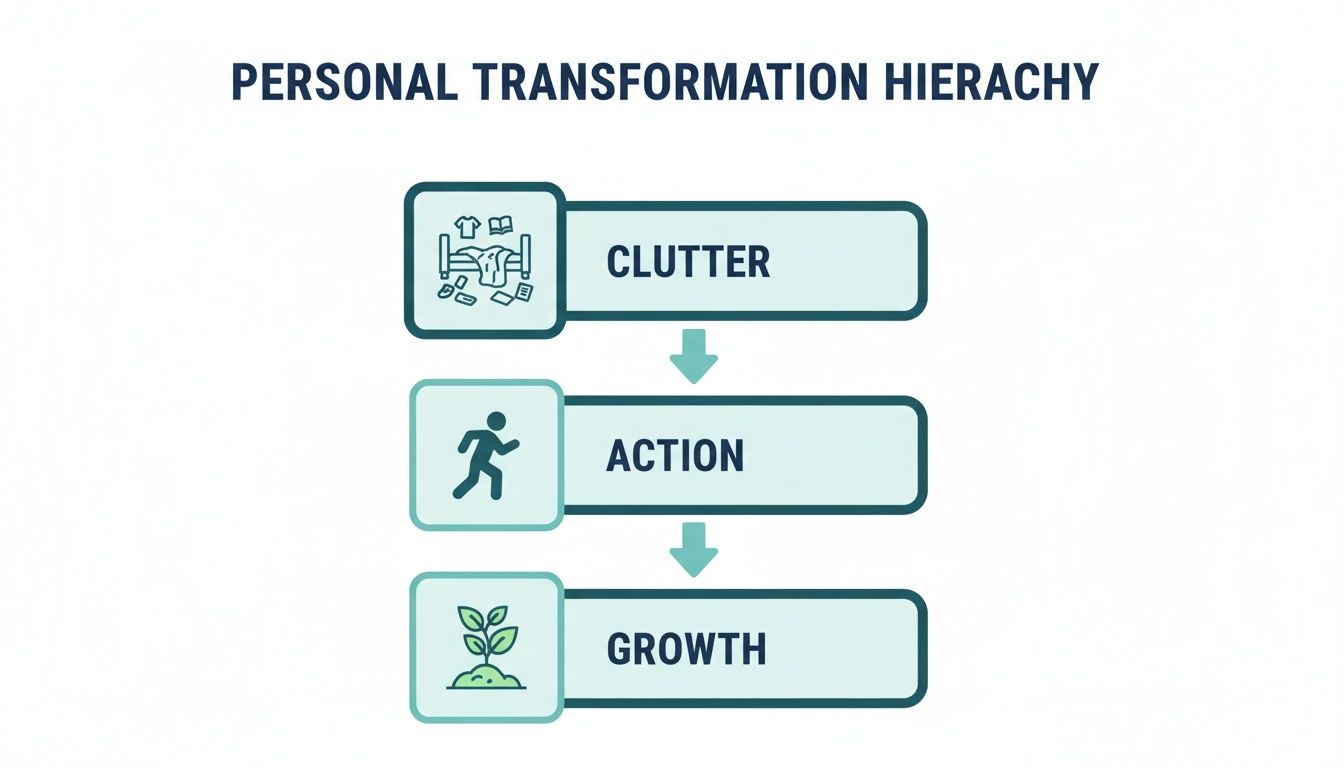
    The journey from feeling overwhelmed by a mess to taking real action is a powerful one. It’s a simple but profound path from chaos to growth that lies at the very heart of stewardship. I’ve lived it.

    Hierarchy diagram showing personal transformation: Clutter leads to Action, which leads to Growth.

    This process—moving from clutter to action and finally to growth—is exactly what stewardship is all about. It changes our environment. And it changes us, too.

    The Different Flavors of Stewardship

    Think of these programs like different kinds of teams. They all have their own playbook and goals, but we're all playing the same game: caring for our shared home.

    To give you a better sense of the landscape, here's a quick look at the different ways people like you and me organize to care for our environment, from global organizations to neighborhood groups.

    Program Type Who Runs It Example Best For
    Government-Led City, state, or national environmental agencies. A city parks department's "Adopt-a-Park" program. Structured, large-scale projects with official backing.
    Corporate-Sponsored Companies, as part of their CSR (Corporate Social Responsibility). An annual company-wide volunteer day at a local beach. Mobilizing lots of people for a single, high-impact event.
    Nonprofit/NGO Mission-driven 501(c)(3) organizations. The Ocean Conservancy or The Nature Conservancy. Focused, long-term campaigns on specific issues (e.g., ocean plastic).
    Grassroots Community Passionate local volunteers (like us!). Litter Caterpillars, a neighborhood garden club. Hyper-local, flexible action built on community passion.

    Each model has its own strengths, and there’s a place for everyone.

    You might start by joining a city-wide cleanup and then realize you want to create something more personal, more consistent, right in your own neighborhood. That’s the beauty of it.

    Stewardship isn't an academic term—it’s a choice you make. A community you build. A power you claim for yourself.

    The Unexpected Rewards of Showing Up

    When you first sign up for an environmental stewardship program, you probably think you know what you're getting into. You show up. You pick up some bottles and wrappers. You go home. But let me tell you, you walk away with so much more than a cleaner park. You walk away changed.

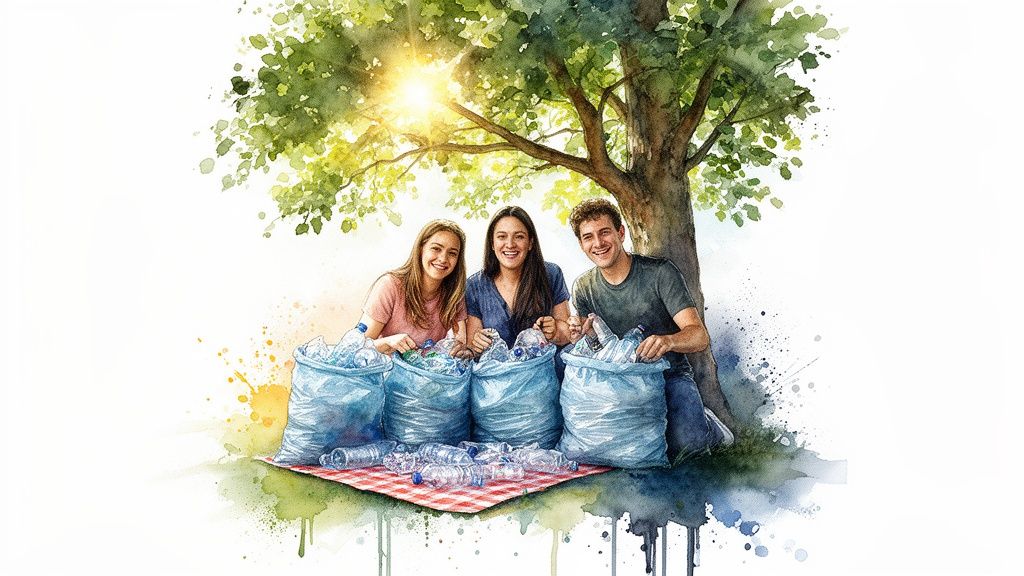
    Three smiling young people collect plastic bottles for recycling under a tree in a watercolor style.

    It’s about turning a chore into a shared mission. It's like the 'Tom Sawyer effect.' Remember that? When Tom was stuck painting a fence, he didn't complain. No, he made it seem like the most exciting, exclusive activity in the world. Pretty soon his friends were paying him for the privilege of helping out.

    That's the magic. That's what happens when you turn individual work into a collective goal. Suddenly, sorting recycling or clearing an overgrown lot isn't a burden; it's an adventure.

    From Strangers to a Tight-Knit Crew

    I’ve seen the most incredible friendships forged in the middle of a cleanup. You're working side-by-side, united by a simple, tangible purpose. The usual social barriers? They just melt away.

    You bond over the weirdest things you find. You celebrate filling another bag. And you get to know people on a level that just doesn't happen at a bar or a networking event. This shared effort creates a unique kind of connection, built on action rather than just words.

    It’s in facing a little adversity—a sudden downpour, a scorching summer day—that the real camaraderie is built. Those are the moments that become stories, the shared experiences that turn a group of volunteers into a team.

    You build a unique kind of toughness together. When you’ve survived a surprise Chicago blizzard just to clean a small patch of land, you know you can count on the people shivering next to you.

    More Than Just a Clean Street

    The benefits go far deeper than just community bonds. There's a powerful mental shift that happens when you're outside, working with your hands. Science tells us that spending time in nature reduces stress and improves mood, and I see it happen in real-time every single weekend.

    The mix of sunlight, fresh air, and physical activity is a potent remedy for feeling stuck or powerless. You’re not just passively consuming nature; you are actively healing it.

    Here’s what I’ve personally noticed:

    • A Shift from Powerless to Powerful: Seeing a street go from trash-strewn to pristine in just a couple of hours is incredibly satisfying. It’s tangible proof that your actions matter. It fights those feelings of helplessness about bigger environmental issues.
    • A Boost in Confidence: Consistently showing up and doing something hard builds self-respect. You prove to yourself that you are someone who follows through, someone who contributes.
    • A Deeper Connection to Your City: When you’ve cleaned a place, you feel a sense of ownership and pride. It's no longer just a random block; it’s your block.

    This is the real reward of getting involved in environmental stewardship programs. You might start by exploring the best ways for cleaning up trash in your community, but you end up discovering a new version of yourself—stronger, more connected, and filled with a quiet pride that can only come from making a real difference.

    You don’t just clean a park. You reclaim a piece of your world and a piece of yourself.

    How We Built a Movement From Nothing

    Let me tell you about one of our proudest moments—a story that gets right to the heart of who we are. In Englewood, there was this abandoned lot. Overflowing with trash. It was a total eyesore, the kind of place you’d cross the street to avoid. But we didn't see neglect. We saw potential.

    After months of sheer persistence—I’m talking endless calls, meetings, paperwork—we won that lot at a city auction. It was a massive win for us. Now, we're in the middle of turning that forgotten space into 'Caterpillar Park,' a green oasis built by and for the community.

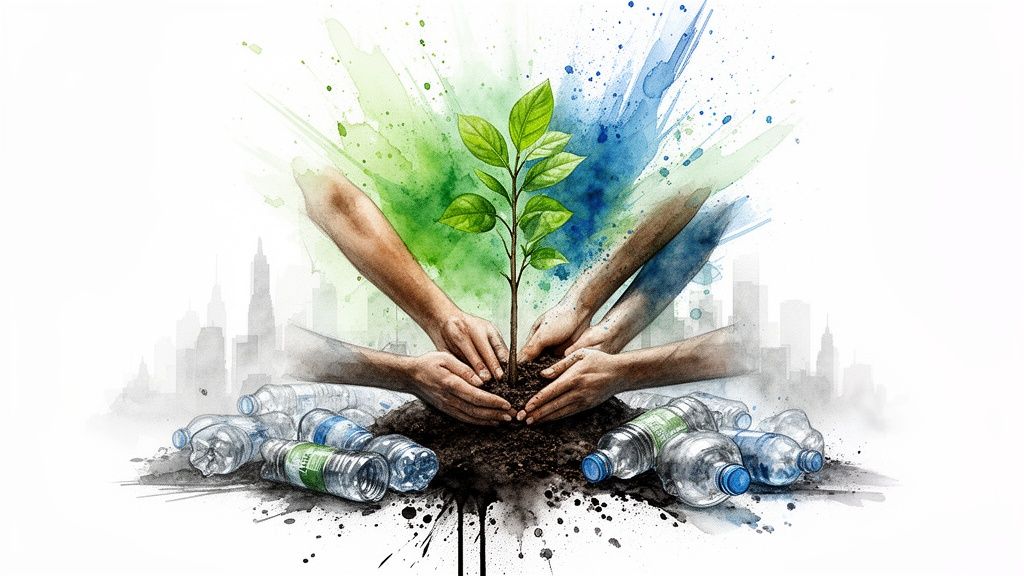
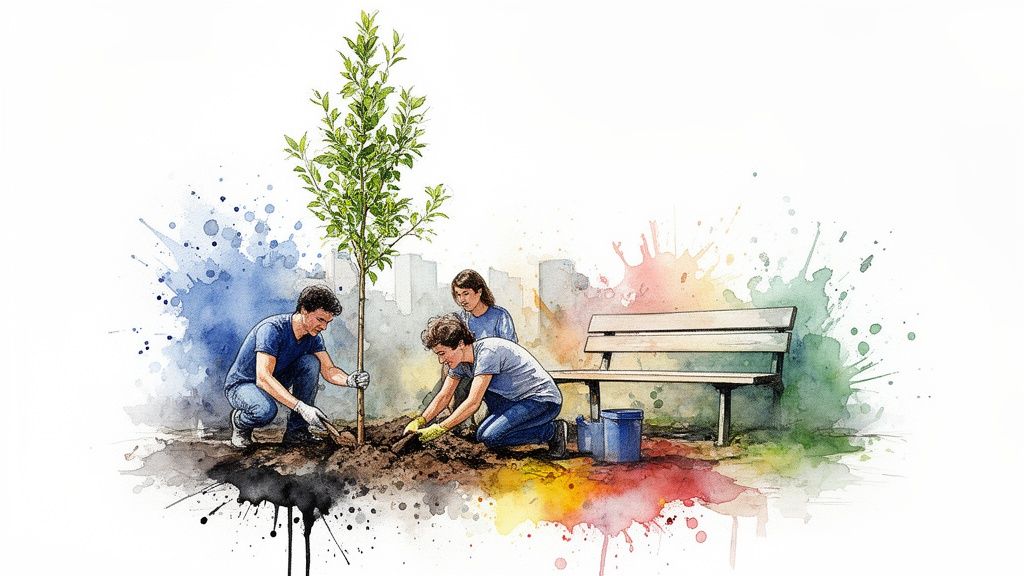
    Watercolor illustration of three people planting a tree in a park, symbolizing environmental stewardship.

    This isn't just one story; it's a whole collection of them, full of highs and lows. It’s the story of how we built a tough, impactful movement from absolutely nothing.

    Living Our Values Out Loud

    Every decision we make, every cleanup we host, is guided by a few core values. These aren't just pretty words on a website. They’re the compass that keeps us pointed in the right direction, especially when things get hard.

    Our values are simple but they're everything to me:

    • Bravery: Showing up when it’s cold, wet, or just plain miserable. It’s cleaning a highway during a bike race or tackling a lot that’s been ignored for decades.
    • Kindness: Always looking out for each other. Our volunteer-first philosophy means we protect your energy and well-being above all else. That’s our golden rule.
    • Unity: Bringing people together from every corner of the city. We know the mission is stronger when everyone has a place in it.

    These principles shape our environmental stewardship programs and build a culture where people don't just volunteer—they belong. I've learned that building a movement is less about logistics and more about creating a shared identity rooted in real, actionable values.

    The Power of Identity and Pride

    Ever notice how sports teams have flags, songs, and mascots? It’s all about building pride. A sense of shared purpose. We thought, why can't service have that same energy? Kind people deserve to feel powerful, too.

    So, we gave ourselves an identity. We fly our own flags proudly at every single event. We even have an official theme song that captures our spirit of joyful grit.

    Pride is a crucial, natural emotion. When you give people a banner to rally under and a song to sing, you turn a simple act of service into a powerful statement. You make it feel like you're part of something much bigger than yourself.

    We also created badges for our volunteers. These aren't just little trinkets; they're symbols of commitment, marking milestones. They celebrate the consistency and bravery it takes to show up week after week, rain or shine, across all 50 Chicago wards.

    Creating this strong identity was a turning point. It transformed our cleanups from quiet acts of service into vibrant, inspiring events that pull people in. It made volunteering feel less like a duty and more like joining a team you’re damn proud of.

    A Blueprint for Your Own Movement

    This story isn't just about us. I'm sharing it because it's a blueprint. It's proof that you don't need a huge budget or some formal organization to start making a real difference.

    You just need a clear 'why' and the guts to start. You have to believe in the power of showing up, even when you're the only one there. Our journey, my journey, from a few friends shivering under a tree to a city-wide movement was built one small, consistent step at a time.

    It started with seeing potential where others only saw trash. It grew by creating a culture of bravery and kindness. And it became a movement by giving people a reason to feel proud of the work they were doing. This is how you build something that not only cleans a city but also changes lives—including your own.

    Your Guide to Starting a Stewardship Movement

    Got that fire in your belly? You don’t need a fancy nonprofit status or a truckload of cash to actually change things. All you need is a couple of friends and a rock-solid answer to one simple question: Why am I doing this?

    This is your no-fluff guide to getting your own environmental stewardship thing off the ground. Forget the complicated fundraising plans for now. You start by just doing the work.

    Getting Into the Arena

    First things first: pick your battlefield. Is it that local park where the trash cans are always puking out garbage? That forgotten, weed-choked lot on your block? Pick a spot that means something to you, a place where winning a small battle will feel like winning a war.

    Next, get your gear. Seriously. All you need to start are some tough trash bags and a good pair of gloves for everybody. Don't get hung up on the details. The whole point is to tear down the excuses and just begin.

    Then, pick a time and carve it in stone. We do our cleanups on weekend mornings. That's not an accident. It's a filter. It selects for a certain type of person: the giver. These are the folks who will pick service over sleeping in, and that kind of heart is the foundation you build a real community on.

    Finding Your People

    Getting the right kind of volunteers is everything. You're not just looking for warm bodies to fill bags; you’re building an army. You want the people who show up for the mission, not just a selfie for their Instagram.

    Here’s how I built our crew of givers:

    • Be a Rock: Show up. Same time, same place, every single week. When people see you out there, sweating and committed, they start to believe. Then they join.
    • Keep It Simple: Focus on one thing: the work. Don't bury your first events under a pile of sign-up sheets or long, boring speeches. Just say hi, hand them a bag, and get to it.
    • Make It Fun: Your energy sets the tone. Make it a good time, high-five over a particularly gross find, and let people connect. Friendships will bloom in the dirt.

    Our entire volunteer-first philosophy is built on this. We guard your energy and your time because we know that’s the most precious thing we have. If you need some more ideas, check out our guide on how to organize an effective volunteer trash pickup. It's packed with simple, straight-to-the-point tips.

    Get ready for a hard truth: this won't always be easy. Some days, only two people will show up. Some days, it'll pour rain. You have to be relentless. This isn't about one heroic cleanup; it's about building something that doesn't quit.

    The Bigger Picture

    It’s easy to feel defeated. I get it. You look at the global picture and it's bleak. In 2022, the world lost 5.8 million hectares of forest. That's an area bigger than Croatia, and farming is behind almost 90% of it. We've got 41 out of 42 major climate indicators flashing red, nowhere near our goals. It can feel like we’re losing.

    But that’s exactly why what you’re doing matters so damn much.

    Every bag of trash you pull out of a ditch is an act of defiance. It’s a middle finger to apathy. It's in these moments—getting your hands dirty, facing a little bit of discomfort together—that we build the grit and the bond we need to even think about bigger change. Your small movement is a shockwave. It proves that change starts right where you stand.

    Finding Your People and Growing Your Impact

    A movement is just a good idea until people start showing up. But where do you find them? And maybe more importantly, how do you convince them to stick around? This is the human side of environmental stewardship programs, and if I'm being honest, it's the only part that really matters. You can have the best plan in the world, but without your people, you’re just one person picking up trash by yourself.

    Think of it like tending a garden. You're not just yanking out weeds; you're cultivating a whole ecosystem. We use simple stuff like Meetup and Instagram to spread the word. The secret isn't some slick marketing campaign—it's showing the real, unfiltered grit and joy of what we do. People are starving for authenticity. They want to see the smiling, muddy faces and know they’re joining something genuine.

    Building a Crew That Lasts

    Getting people to show up once is just the first step. Getting them to come back is where you build real power. Why do people stay? It's not for the free trash bags, I can tell you that. They stay because they feel like they belong.

    This is where communication becomes our secret weapon. We run open group chats where we make plans, share stupid jokes, and build friendships that go way beyond cleanup day. It turns a weekend chore into a real part of your social life. That constant, easy connection is the glue holding our community together. If you're stuck on this, our team put together a no-nonsense guide on how to find volunteers for your cleanup that cuts right to the chase.

    Measuring What Actually Matters

    So, how do you know if you're winning? Forget just counting the pounds of trash you collect. That’s a decent start, but it misses the entire point. The real signs of a healthy movement are human.

    We measure our impact by the number of volunteers who come back again and again. I measure it by the laughter I hear during a tough cleanup. We measure it in the visible change of a neighborhood, week after week, because a dedicated crew just refuses to give up on it.

    This is where the real magic happens. A recent UN report on the Sustainable Development Goals pointed out something huge: while global progress is stalling, small, focused stewardship programs driven by local passion are making incredible waves. Public trust in ethical stewardship is on the rise, hitting 45%, because people are seeing the results with their own eyes. When you transform your own block, it's a small-scale version of how bigger programs change policy on a national level. You can read the full 2023 SDG report from UN DESA to see how the dots connect.

    The goal isn't just to clean a street. It's to build a culture so positive and welcoming that people don’t just want to join—they feel like they've finally found their people. That's how you build something that lasts.

    Your Questions Answered

    Got questions? Good. It means you’re really thinking about this. About taking that first brave step. Let's get into some of the common worries I hear from people who are right where you are now, ready to join or start one of these environmental stewardship programs.

    What If I Am Not Physically Fit Enough For a Cleanup?

    This is a totally fair question, but let me put your mind at ease. Any program worth its salt is inclusive. At Litter Caterpillars, our first and most important rule is always: "go at your own pace."

    You don’t have to be a superhero. Seriously. There are so many ways you can be part of the mission. Some of our volunteers focus on a small, manageable patch. Others help by organizing supplies, taking incredible photos, or just being there to cheer everyone on. The real magic is in the collective effort, not individual heroics. Your presence alone is a huge contribution.

    How Do I Find a Good Group Near Me?

    Start by thinking local. Platforms like Meetup.com are a great place to look—that’s how a ton of our own volunteers find us. You can also search social media for hashtags like #[YourCity]Cleanup or #[YourNeighborhood]Volunteers.

    Keep an eye out for a few signs of a healthy group:

    • They show up: A consistent schedule shows they’re serious, not just a flash in the pan.
    • They communicate: It should be easy for you to find out when and where to be.
    • They're volunteer-first: The focus is on taking care of their people, not just fundraising or getting good press.

    Don't be afraid to try out a few different crews. You'll know when you find the right one.

    The right group won't feel like an obligation; it will feel like coming home. You'll know it when you find it because the focus will be on the shared mission and the friendships you build along the way.

    I Want to Start a Group, But I'm Worried About Safety.

    That concern is not just valid—it's the most important thing to get right. Safety is, and always will be, priority number one for me. No exceptions.

    For your first few events, pick a public spot with plenty of visibility. Always have the essential gear on hand: good gloves, bright safety vests, and a solid first-aid kit. Before every single cleanup, gather everyone for a quick safety huddle. Remind people to watch for traffic, steer clear of hazardous materials, and stick together. The goal is to build a culture where everyone looks out for everyone else.

    What’s the Most Important Thing for Making a New Program Successful?

    Consistency. Hands down, it’s consistency.

    It's not about that one massive cleanup that gets all the attention. It’s about you showing up, week after week, even when it’s raining, even when it’s cold, and even when only a few people make it out. That's what builds trust in the community. That's what creates real momentum. Most importantly, it forges a habit of service in you and your core team. When people know you’ll be there, rain or shine, they will eventually join you.


    Ready to find your people and start making a difference? Join Litter Caterpillars at our next cleanup. We’re out there every weekend, building friendships, and making Chicago a little brighter, one piece of trash at a time. Find our next event at https://www.littercaterpillars.com.

  • Corporate Social Responsibility Examples That Drive Real Impact

    Corporate Social Responsibility Examples That Drive Real Impact

    You've seen them, right? The glossy photos. A dozen employees in matching t-shirts, awkwardly planting a single, sad-looking tree. It all feels a bit… staged. Like a box-checking exercise built for a press release. But what if corporate social responsibility wasn't about looking good? What if it was about actually being good? What if it could change not just a community, but your team, your brand, and maybe even you?

    I know it can. I’ve lived it.

    For a long time, my own life was a mess, literally and figuratively. I started a small trash pickup group right here in Chicago—we call ourselves Litter Caterpillars now—mostly to get a handle on my own issues with consistency and keeping things clean. What happened next blew my mind. We found this strange, unexpected joy in doing hard things together, even freezing our butts off in a Chicago hailstorm. I discovered that cleaning up somebody else's mess was often way easier than facing my own. That simple act of service started changing us. From the inside out.

    So this article isn't another boring list of forgettable photo-ops. I want to take you on a deep dive into 12 powerful corporate social responsibility examples, many of them inspired by the raw, real lessons we learned out on the streets. I’ll share stories from my own journey, break down exactly what makes these ideas tick, and give you stuff you can actually use to build a program with a real heart and soul. Forget the empty gestures. It's time to build something that actually matters.

    1. Community-Led Environmental Cleanup Programs

    Picture this. You’re turning a neglected, trash-strewn street corner—a place you usually hurry past—into a spot that fills the whole neighborhood with pride. That’s the magic of these community-led cleanup programs. They aren't just about picking up litter. They are potent examples of corporate social responsibility that build a tangible, visible impact right where you live. When you sponsor or join one of these events, you're directly investing in the well-being of the communities you serve.

    This is how CSR stops being some abstract idea and becomes a hands-on, team-building adventure. It’s more than just cutting a check. It’s about you, showing up. Getting your hands dirty. And creating immediate, visible change right alongside your neighbors and your team.

    Strategic Insights & Actionable Takeaways

    This whole model is like a campfire. It needs consistent fuel—that’s the community spirit—to keep burning bright. The goal isn't a one-off event. It’s a sustainable movement that makes people feel connected and gives them a sense of ownership.

    • Build a Habit: You have to be consistent. It's everything. Our Litter Caterpillars group in Chicago hosts cleanups every single week. This makes it a regular, easy-to-join thing, not some rare, special occasion. That’s how you build momentum and a crew of dedicated volunteers.
    • Create Team Identity: You need to inspire pride. A feeling of belonging. Use branded gear like t-shirts, come up with team chants, or offer little achievement badges. This transforms a simple cleanup into a shared mission.
    • Focus on Underserved Areas: You can maximize your impact by going where help is needed the most. This shows you’re genuinely committed to equity and caring for the community, not just chasing easy PR wins.
    • Prioritize People: The best programs I've seen put their volunteers' safety and happiness first. If you create a positive, supportive vibe, people will come back. They’ll become your biggest advocates.

    By partnering with a program like this, your company can grow deep community roots and show a powerful commitment to local environmental health. You can see how this all works and find ways to get involved with local cleanup events.

    2. Land Acquisition and Community Space Development

    Imagine an abandoned, overgrown lot. Now, imagine it transforming into a vibrant hub where neighbors meet, kids play, and fresh food grows right out of the ground. This is what land acquisition and community space development can do. It's one of the most lasting corporate social responsibility examples I can think of. When your organization buys and redevelops a neglected property, you’re making a permanent, physical investment in a neighborhood’s future.

    This kind of project isn't just a temporary fix. You're creating lasting assets—community gardens, little pocket parks, maybe even food forests—that become a part of the local fabric. When you help create a place like Caterpillar Park in Englewood, you're not just cleaning up a space; you're building a legacy of community health, connection, and pride.

    Strategic Insights & Actionable Takeaways

    This kind of thing is like planting a redwood. It needs a long-term vision and you have to work deeply with the community. Your goal is to create a self-sustaining space that the residents truly own and love.

    • Co-Create with the Community: The best spaces are designed with residents, not just for them. You have to host design workshops and planning sessions from day one. This makes sure the final space actually meets what people in the community need and want.
    • Plan for Longevity: A beautiful park is useless if it gets overrun with weeds a year later. You need a sustainable maintenance plan with a dedicated volunteer crew or partnerships with local groups before you even break ground.
    • Document the Journey: You have to tell the story of the transformation. Use photos and videos to show the whole process, from neglected lot to vibrant community hub. This creates amazing marketing content and shows your tangible impact.
    • Activate the Space: A park is just land until people use it. Partner with local groups to host regular events—farmers' markets, outdoor movie nights, gardening workshops. You have to make sure the space becomes a lively center of activity.

    When you invest in land, you invest in people. You can learn more about how a small group turned an auctioned lot into a beloved community asset and find inspiration by exploring the story of Caterpillar Park.

    3. Friendship, Social Connection, and Branded Identity

    What if your corporate social responsibility initiative felt less like a chore and more like joining your favorite team? That's the power you get when you build a program around friendship and a shared identity. These initiatives intentionally create deep social bonds. They turn volunteering from a one-time act into a core part of someone's community life. It's about making people feel like they belong to something bigger than themselves.

    This approach gets that the strongest movements are built on relationships, not just tasks. By fostering real connections and a proud, branded identity—with symbols like flags or team songs—you create an environment where people want to show up. It becomes a source of joy and belonging that fuels long-term engagement and turns your volunteers into passionate advocates for the mission.

    Two diverse young adults laughing, holding flags, against a vibrant watercolor splash background.

    Strategic Insights & Actionable Takeaways

    Think of social connection as your main goal, not just a nice side effect. You're trying to build a resilient community that sustains itself through a shared purpose and real friendship.

    • Create a Shared Identity: You have to go beyond just a logo. Develop traditions, symbols, and celebrations that bond your team. At Litter Caterpillars, we use a theme song, unique flags, and achievement badges to forge a powerful group identity.
    • Facilitate Social Time: You have to intentionally build in time for people to connect. Always schedule some informal social time before or after your events so relationships can form naturally.
    • Build Consistent Teams: Assign your volunteers to small, consistent groups. When people work with the same crew regularly, trust builds way faster. Acquaintances turn into real friends.
    • Celebrate People, Not Just Metrics: You have to publicly recognize personal milestones, volunteer stories, and individual growth. This shows you value the people behind the work, and that fosters deep loyalty and a positive culture.

    When you focus on building a community, you create a self-sustaining volunteer movement that is resilient, joyful, and deeply impactful. You can explore how to apply these community-building activities for adults to your own CSR programs.

    4. Volunteer-First Fundraising Model

    Imagine you join a cause you believe in. You're ready to give your time and energy, but then you're hit with constant pressure to donate money. That feeling can turn your inspiration into a sense of obligation. The volunteer-first fundraising model flips this whole script. It's one of the most powerful and authentic corporate social responsibility examples because it protects the volunteer experience by separating the act of service from the act of fundraising.

    This model is like building a great band. You find passionate musicians first, and then you find a record label to support them. You build a passionate community first. Instead of asking volunteers to open their wallets, you get your funding through corporate sponsorships, grants, and major donors. This lets everyone, no matter their financial situation, contribute in a meaningful way. For a company like yours, supporting this model means you're funding pure, uncompromised community action.

    Strategic Insights & Actionable Takeaways

    This approach is about valuing human energy as your most precious resource. Your role as a corporate partner is to fuel that energy, not to extract value from it.

    • Build Diverse Revenue Streams: Don't put all your eggs in one basket. We actively seek a mix of corporate sponsors, apply for grants, and develop partnerships to make sure our operations are sustainable without ever asking our volunteers for a dime.
    • Create Clear Sponsorship Tiers: You need to develop attractive sponsorship packages that offer clear value to businesses. This could be brand visibility on gear, social media shout-outs, or dedicated cleanup events for your employees.
    • Prioritize Transparency: You have to be open with your volunteers about how you're funded. When they know that corporate partners and grants make their work possible, it builds trust and shows them how valuable their contribution truly is.
    • Focus on Impact Metrics: Track and publicize the results of what your volunteers are doing—pounds of litter collected, number of community members engaged. These metrics are powerful tools for attracting and keeping high-impact funders who want to see real results.

    By sponsoring a volunteer-first model, your company shows a profound respect for the community and empowers people to give their best. You can see how this philosophy creates an incredible volunteer culture and explore sponsorship opportunities.

    5. All-Weather, Year-Round Service Commitment

    What does real commitment look like? I'll tell you. It’s showing up when it’s inconvenient. It’s facing a snowstorm or a heatwave and choosing to serve anyway. This is the heart of an all-weather, year-round service commitment. It's a powerful model of corporate social responsibility that proves your dedication isn't just for the sunny days. It shows that community needs don’t take a break for bad weather, and neither do you.

    This approach builds incredible credibility. It creates a culture of resilience. When your team braves the elements together, you’re not just cleaning a park; you’re forging a bond built on shared hardship and unwavering purpose. This sends a clear signal to your community, employees, and customers that your values are non-negotiable.

    Strategic Insights & Actionable Takeaways

    This model is like being a lighthouse keeper. It's built on a foundation of safety, preparation, and a culture that finds strength in adversity. It’s about being stubborn for the right reasons.

    • Embrace the Elements: You have to make resilience a core part of your identity. At Litter Caterpillars, we operate in rain, snow, and extreme heat. We never cancel an event. This unwavering consistency proves our commitment is absolute.
    • Safety Is Non-Negotiable: Create clear, weather-specific safety protocols. This could mean providing hand warmers in winter, extra water in summer, or changing routes during storms. The goal is to show up, but to do it safely.
    • Communicate and Prepare: Let your volunteers know what to expect and how to prepare. When you're transparent, you build trust and make sure everyone shows up with the right gear and the right mindset.
    • Celebrate the Grit: You have to acknowledge and honor the effort. Share photos of your team working through tough weather on social media. Frame the challenge not as a problem, but as a source of shared pride and accomplishment.

    Adopting an all-weather philosophy shows your company’s character. Your grit. It’s a tangible way to demonstrate that your commitment to the community is truly unconditional. You can see this dedication firsthand and find ways to join a mission that never stops.

    6. Neighborhood-Specific and Equity-Focused Service

    Think about your city. Think about the neighborhoods that get all the resources and the ones that are often forgotten. True corporate social responsibility examples don't just pop up in the most convenient places; they go where the need is greatest. This approach intentionally focuses on underserved and marginalized communities. It makes sure that efforts toward beautification and environmental health are distributed equitably.

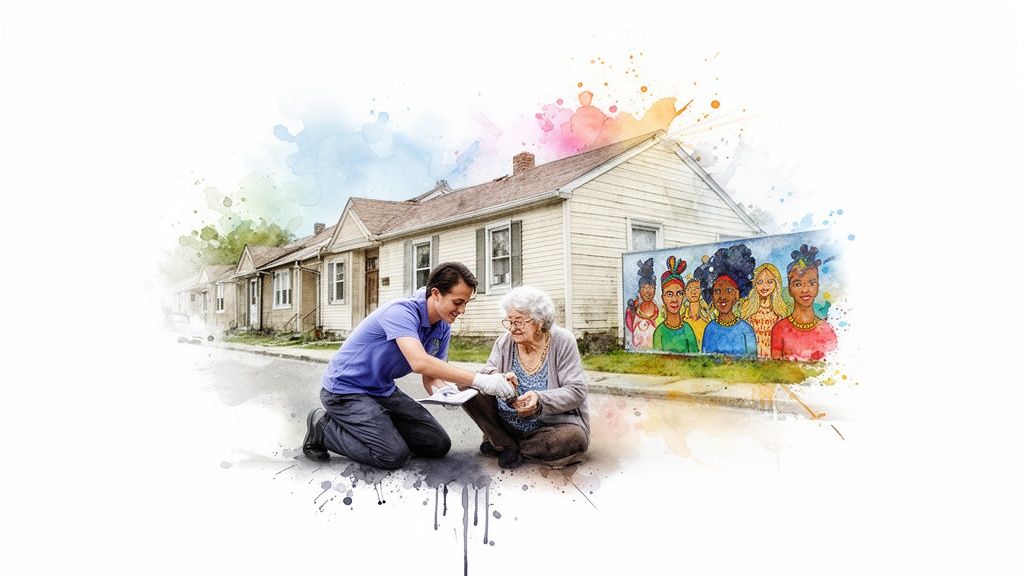
    A young man helps an elderly woman on a street with houses and a vibrant mural.

    It’s about moving beyond photo ops and tackling environmental justice head-on. When you commit to showing up in all neighborhoods, not just the ones with the best PR value, you build genuine trust. You prove your commitment is about people, not just perception. This is how you transform a volunteer program into a real force for systemic change.

    Strategic Insights & Actionable Takeaways

    This model is like being a good neighbor. It's built on trust, respect, and a long-term vision. The goal is to become a reliable partner, not just a temporary visitor. You do that by empowering the residents you serve.

    • Map for Equity: Don't just go where it's easy. You need a systematic plan to cover all neighborhoods, prioritizing those with the highest need. We're trying to do this at Litter Caterpillars by working to serve all 50 city wards, including places like Englewood that are often overlooked.
    • Hire from the Community: The most powerful leaders are the ones with lived experience. You have to hire and develop team leaders from the neighborhoods you serve to make sure your efforts are authentic and culturally resonant.
    • Listen First: When you first go into a new neighborhood, your most important job is to listen. Partner with community organizations that are already there. Let their wisdom guide your actions. Building relationships is the foundation for everything else.
    • Commit for the Long Haul: Avoid one-off events. A sustained presence shows a real investment in the community's future and helps address the root causes of neglect, not just the symptoms.

    By adopting an equity-focused strategy, your company can move beyond surface-level CSR and contribute to meaningful, lasting change where it matters most. You can see how this philosophy drives impact and find ways to join a mission-driven cleanup.

    7. Personal Transformation and Resilience Building

    What if volunteering could do more than just clean a park? What if it could help you rebuild a life? This is the core idea behind CSR programs that focus on personal transformation. These initiatives frame service not just as an act of giving, but as a journey of healing, growth, and resilience. By creating a safe and supportive space, you offer a place where overcoming challenges becomes a shared experience.

    This model elevates corporate social responsibility from a PR effort into something deeply human. It's about recognizing that your volunteers and employees come with their own stories, their own struggles. When you facilitate mentorship and create opportunities for real connection, you invest in their personal well-being just as much as you invest in the community. It’s a powerful way to show you care about people, not just productivity.

    Strategic Insights & Actionable Takeaways

    This approach is like building a support group. It's built on vulnerability, trust, and celebrating personal wins. The goal is to create a community where people feel safe enough to grow through their service.

    • Lead with Your Story: Authenticity builds trust. I openly share my personal journey of transformation as the founder of Litter Caterpillars. Sharing your own "why" creates a foundation for other people to feel safe sharing theirs.
    • Focus on Growth Milestones: Shift your focus from just service metrics to personal progress. Celebrate a volunteer's courage to lead a team for the first time or their consistency in showing up.
    • Create Spaces for Reflection: Meaningful service requires you to process it. Dedicate time after events for volunteers to reflect and share what the experience meant to them. This turns a simple cleanup into a lesson in resilience.
    • Train for Emotional Intelligence: You have to equip your leaders with skills like active listening and empathy. The goal is to create a supportive network, not just manage a task list. A leader who knows how to listen is more valuable than one who only knows how to delegate.

    By building a program that honors the journey of each individual, your company can foster profound loyalty and create an impact that goes far beyond clean streets. You can learn more about how Litter Caterpillars uses service for personal growth.

    8. Demographic-Specific Volunteer Recruitment

    What if you could design a volunteer program that speaks directly to the heart of a specific community? That’s what demographic-specific volunteer recruitment does. Instead of a one-size-fits-all approach, this strategy tailors its message, its timing, and its activities to connect with the unique motivations of a particular group. This makes it one of the most effective corporate social responsibility examples for deep engagement.

    This approach turns your CSR initiative from a generic call for help into a personal invitation. It acknowledges that different people volunteer for different reasons. Some are looking for career skills, others want friendship, and many are just seeking a sense of purpose. When you understand and address these specific desires, you create a program that feels not just welcoming, but like it was truly made for them.

    Strategic Insights & Actionable Takeaways

    This model succeeds when you move beyond assumptions and genuinely get to know your audience. The goal is to build an authentic connection that makes people feel seen, valued, and essential to your mission.

    • Understand Motivations: Don’t guess what people want. For example, we successfully engage a lot of young women by focusing on empowerment, community, and creating visible, inspiring change. You need to research what drives your target group.
    • Recruit in Their Spaces: You have to go where your audience already is. If you're targeting new professionals, connect through LinkedIn or company resource groups. For students, focus on campus events and the social media platforms they actually use.
    • Design for Their Lives: Respect their constraints. Offer weekend events for people who work 9-to-5, or flexible scheduling for parents. Your logistics should remove barriers to joining, not create new ones.
    • Center Their Voices: Feature testimonials and leaders from within the target demographic. When people see others who look like them in leadership roles, it builds trust and shows them a clear path for involvement and growth.

    By tailoring your outreach, you can build a more diverse, dedicated, and passionate volunteer base. You can find more targeted strategies and learn how to find volunteers who are a perfect fit for your cause.

    9. Digital-First Community Building and Accessibility

    What if your company’s impact wasn't limited by your physical presence? That's the power of digital-first community building. These initiatives use online platforms not just for promotion, but as the central hub for organizing, connecting, and making volunteerism accessible to everyone, no matter their schedule or social comfort level. It’s about meeting people right where they are—online—and guiding them toward real-world impact.

    This strategy transforms corporate social responsibility into an ongoing conversation. Instead of just announcing an event, you’re creating a space for questions, sharing stories, and fostering connections long before and after the work is done. It removes barriers. It makes it easy for someone just scrolling on their phone to find a purpose and a community.

    Strategic Insights & Actionable Takeaways

    A strong digital presence turns passive interest into active participation. It's like having a friendly greeter at your front door, 24/7. Your goal is to create a seamless, welcoming journey from online discovery to offline engagement.

    • Be Where Your People Are: Don't expect people to find you; you have to go to them. Groups like ours use a multi-platform approach, leveraging Instagram for visual storytelling, Meetup for event logistics, and Reddit for grassroots outreach. This ensures you reach all sorts of different people.
    • Create a Clear Path to Action: Your digital channels should make it incredibly easy to get involved. A clear link to sign up, a visible schedule, and a friendly FAQ can be the difference between a "like" and a new volunteer showing up.
    • Foster a Digital Community: Engagement shouldn't stop when an event ends. Use your platforms to celebrate volunteers, share photos, and ask for feedback. This builds a sense of belonging and keeps your mission top-of-mind.
    • Prioritize Responsiveness: In a digital world, speed matters. When you respond quickly and warmly to messages and comments, it shows you value your community’s time and interest. It builds trust and encourages people to participate.

    By adopting a digital-first mindset, your company can build a more inclusive, dynamic, and resilient volunteer program. You can see how this works and explore digital organizing in action to inspire your own strategy.

    10. Strategic Partnerships with Local Nonprofits and Institutions

    Imagine trying to build a house all by yourself versus with a team of expert carpenters, plumbers, and electricians. That's the difference between going it alone and forming strategic partnerships. This approach to corporate social responsibility is all about teaming up with established local nonprofits and institutions to amplify your impact. By joining forces, you tap into existing community trust, resources, and expertise. You turn your good intentions into powerful, coordinated action.

    This model is all about synergy. It transforms CSR from an isolated corporate project into a deeply integrated community effort. Instead of reinventing the wheel, you align with partners who already know the neighborhood, understand the needs, and have the infrastructure to make things happen. It’s about lending your unique strengths—whether it's funding, volunteers, or skills—to a mission that’s bigger than any single one of you.

    Strategic Insights & Actionable Takeaways

    A successful partnership is a two-way street. It's built on shared goals and mutual respect. Your objective is to create a combined force that achieves more than either of you could on your own.

    • Align Your Missions: Seek partners whose values mirror your own. Our partnerships with Chicago-area nonprofits and government agencies are effective because we all share a common goal: a cleaner, healthier community for everyone.
    • Formalize Expectations: Don't leave things to chance. You need to create clear agreements that outline roles, resources, and goals. This makes sure both sides are on the same page and accountable.
    • Amplify Your Story, Together: Develop a joint communications strategy. Co-branded materials and shared social media campaigns celebrate the partnership and show a united front. This strengthens both of your brands.
    • Celebrate Your Partners Publicly: You have to give credit where it's due. Highlighting your partners’ contributions builds goodwill and shows a genuine commitment to collaboration over competition.

    By forming strategic alliances, your company can move from simply funding causes to co-creating lasting community solutions. You can explore how groups like Litter Caterpillars build these powerful local partnerships to maximize their positive impact.

    11. Adventure and Exploration Through Service

    What if volunteering felt less like a chore and more like an urban expedition? This approach reframes community service as an exciting adventure. It turns a simple cleanup into a journey of discovery. By tapping into our natural curiosity, programs that blend service with exploration motivate people who are drawn to novelty and challenge. This makes your corporate social responsibility examples feel fresh and dynamic.

    This model transforms civic duty into a compelling quest. It’s not just about giving back; it's about exploring new neighborhoods, uncovering hidden gems, and seeing your city through a whole new lens. Your team gets to connect with different communities and each other, all while leaving a positive, tangible mark on every place you visit.

    Strategic Insights & Actionable Takeaways

    This strategy is like a treasure hunt. It's built on curiosity and purpose. The goal is to make every service event a unique experience that combines genuine community benefit with the thrill of exploration.

    • Map Your Adventure: Treat your service plan like an expedition map. At Litter Caterpillars, for instance, we have a goal to clean in all 50 of Chicago's wards. This turns our mission into a city-wide exploration. You can create a rotation plan to visit unique and diverse neighborhoods.
    • Narrate the Journey: Frame your work through a story of adventure. Use your recruitment messages to highlight the exploration element. Share photos and stories from each location to build excitement for the next "mission."
    • Balance Adventure with Impact: The adventure is the hook, but the service is the heart. You have to make sure the community benefit is clear and genuine. Partner with local community members or historians to deepen your team's understanding and connection to the area.
    • Equip Your Explorers: Provide tools that enhance both the service and the adventure. Think branded gear, neighborhood fact sheets, or even photo challenges. This adds a layer of fun and identity to the experience.

    By adopting an adventure-based model, your company can attract a wider range of volunteers and transform your CSR program into an ongoing story of discovery and impact. You can see how this works by following the Litter Caterpillars’ journey across Chicago.

    12. Transparent Communication of Organizational Values and Decision-Making

    Imagine knowing not just what your favorite company does, but why they do it. This is the heart of transparent communication. It's a powerful form of corporate social responsibility. It’s about pulling back the curtain and sharing the values, the motivations, and even the struggles behind your decisions. This practice builds unshakable trust with your customers, your employees, and your community partners.

    When you openly share your journey, you invite people to become part of the story, not just spectators. It transforms a business transaction into a relationship built on shared principles and mutual respect. This isn't just about public relations; it's about creating a culture of accountability and authenticity that resonates deeply with people who want to support businesses that truly stand for something.

    Strategic Insights & Actionable Takeaways

    This approach is like having an honest conversation. It's rooted in vulnerability and consistency. Your goal is to build a community that feels heard, valued, and connected to your mission because they understand the "why" behind your actions.

    • Share Your Origin Story: People connect with people. I openly share my own story and personal motivations for starting Litter Caterpillars. This creates an immediate human connection and makes the core values driving the organization crystal clear.
    • Explain the 'Why,' Not Just the 'What': When you make a decision, communicate the reasoning behind it. This invites understanding and shows respect for your stakeholders, even if they don’t agree with the outcome.
    • Embrace Imperfection: Be honest about your challenges, your failures, and what you’ve learned. Transparency isn't about being perfect; it's about being real. This builds credibility far more effectively than a flawless facade ever could.
    • Create Feedback Loops: Actively ask for input and, crucially, show how that feedback influences your decisions. This demonstrates that you don’t just listen; you act on what you hear. It makes your community a true partner.

    By embedding transparency into your company’s DNA, you can cultivate a loyal following and prove that your commitment to social responsibility is more than just a marketing slogan. It’s a core part of who you are and how you operate.

    Comparison of 12 CSR Initiatives

    Approach 🔄 Implementation Complexity ⚡ Resource Requirements 📊 Expected Outcomes 💡 Ideal Use Cases ⭐ Key Advantages
    Community-Led Environmental Cleanup Programs 🔄 Medium — recurring coordination, scheduling, permits ⚡ Low–Medium: volunteers, basic supplies, modest branding 📊 Visible local remediation, social cohesion, behavior change 💡 Neighborhood engagement, low-cost civic action, pilot projects ⭐ Strong social bonds, measurable local impact, low barrier to entry
    Land Acquisition and Community Space Development 🔄 High — legal, zoning, long-term planning ⚡ High: land purchase, construction, ongoing maintenance 📊 Lasting public assets, property value increase, long-term revitalization 💡 Legacy projects, neighborhood redevelopment, multi-stakeholder partnerships ⭐ Durable community assets, attracts investment and permanence
    Friendship, Social Connection, and Branded Identity 🔄 Medium — facilitation, cohort management, branding ⚡ Low–Medium: design materials, events, small budgets 📊 High retention, movement-building, mental-health benefits 💡 Volunteer retention, community-building, identity-driven programs ⭐ Deep volunteer loyalty and public visibility
    Volunteer-First Fundraising Model 🔄 Medium — fundraising strategy, sponsor cultivation ⚡ Medium–High: grant writing, donor relations, sponsorships 📊 Inclusive participation, sustained volunteer engagement, authenticity 💡 Programs prioritizing accessibility and volunteer experience ⭐ Protects volunteer energy; increases inclusivity
    All-Weather, Year-Round Service Commitment 🔄 Medium — safety protocols, weather adaptations ⚡ Low–Medium: PPE, insurance, training, communication 📊 Consistent service, organizational credibility, resilient volunteers 💡 Organizations valuing reliability and strong identity ⭐ Signals commitment; builds resilience and respect
    Neighborhood-Specific and Equity-Focused Service 🔄 Medium–High — cultural competency, trust-building ⚡ Medium: partnerships, training, safety planning 📊 Environmental equity, community trust, targeted impact 💡 Environmental justice work, underserved neighborhoods ⭐ Targets greatest need; fosters long-term trust
    Personal Transformation and Resilience Building 🔄 High — mentorship, reflection processes, skilled facilitation ⚡ Medium: leader training, program design time 📊 Deep personal growth, leadership development, high retention 💡 Recovery, personal-development-focused volunteering ⭐ Produces authentic leaders and durable commitment
    Demographic-Specific Volunteer Recruitment 🔄 Medium — tailored outreach, cultural nuance ⚡ Low–Medium: targeted marketing, representative leadership 📊 Efficient recruitment, peer networks, improved fit 💡 Recruiting underrepresented or affinity groups ⭐ Higher recruitment efficiency and aligned retention
    Digital-First Community Building and Accessibility 🔄 Low–Medium — platform management and moderation ⚡ Low: social platforms, content creation, coordination tools 📊 Greater accessibility, steady recruitment, persistent community 💡 Scaling outreach, remote coordination, younger audiences ⭐ Low barrier to entry; real-time coordination and documentation
    Strategic Partnerships with Local Nonprofits and Institutions 🔄 Medium — formal agreements, shared governance ⚡ Medium: partner management, joint programming resources 📊 Amplified impact, legitimacy, resource efficiency 💡 Expanding reach, accessing institutional resources ⭐ Leverages credibility and shared resources for scale
    Adventure and Exploration Through Service 🔄 Low–Medium — route planning, novelty management ⚡ Low: logistics for varied sites, storytelling resources 📊 High engagement, memorable experiences, broad geographic reach 💡 Recruiting adventurous volunteers; novelty-driven campaigns ⭐ Attracts explorers and younger demographics; high engagement
    Transparent Communication of Organizational Values and Decision-Making 🔄 Medium — reporting systems, feedback loops ⚡ Low–Medium: communications, impact reporting tools 📊 Increased trust, aligned volunteers, accountability 💡 Building credibility, value-aligned recruitment, partnership development ⭐ Builds trust, reduces conflict, attracts aligned supporters

    Your Turn to Be Brave: How to Start Small and Create Real Change

    Reading a long list of corporate social responsibility examples is the easy part. It’s inspiring. You see what companies like Patagonia, Lego, and even local Chicago heroes are doing. But inspiration without action is just a pleasant daydream. The hard part is taking that first step. I know this because I’ve lived it.

    For me, that step was picking up a single piece of trash on my block. It wasn't some grand, world-saving gesture. It was about saving myself from a cycle of frustration and inaction. It was about looking at a problem and not feeling so powerless. What I learned from that one small act, and the thousands that followed, is that bravery isn't what you see in the movies. It’s not about one single, heroic moment.

    Real bravery is quiet. It’s showing up when it's cold, rainy, and inconvenient. It's embracing a little bit of discomfort because you know that's where growth happens. It's choosing connection over comfort, purpose over passivity.

    From Ideas to Impact: Your First Brave Step

    You've seen how diverse CSR can be. It's not just about writing a check. It’s about building something real.

    • It’s about showing up consistently. Just like that all-weather commitment I talked about, your company’s impact grows from reliability, not from a single, splashy event.
    • It's about deep listening. True change comes from understanding a neighborhood's specific needs, not from imposing your own top-down solution.
    • It’s about building community. The strongest initiatives create social connection and a shared identity, turning isolated individuals into a unified force for good.

    You don't need a massive budget or a C-suite sign-off to start this journey. The most powerful movements start small. Think of it like planting a seed. You don't just throw it on the ground and expect a forest to appear. You find good soil. You plant it. You water it. You protect it. Day by day, it grows.

    Your Actionable Starting Point

    So, what’s your first step? Let's make it real. Forget about crafting the perfect press release or designing a flawless, multi-year strategy right now. Start with one simple, tangible action.

    1. Find Your People: Identify a local group already doing the work you admire. Here in Chicago, organizations like ours are on the ground every single weekend, building community through environmental cleanup. Don’t reinvent the wheel; join the people already pushing it forward.
    2. Ask, "How Can We Help?": Instead of telling them what you want to do, ask them what they need. Is it sponsoring their cleanup equipment? Is it providing snacks and coffee for their volunteers on a cold morning? Is it using your marketing skills to amplify their message?
    3. Show Up: Commit to one event. Bring a small team. Rain or shine. Experience the work firsthand. Feel the energy of the community. See the direct impact of your time and effort.

    This is how real change begins. Not with a boardroom decision. It begins with a human connection. It's built on a foundation of small, brave, consistent actions that ripple outward. The world doesn't need another perfectly polished corporate photo-op. It needs your heart. It needs your hands. It needs you.


    Ready to take that first brave step? You can see these corporate social responsibility examples in action by connecting with a grassroots movement making a real difference. Join or support Litter Caterpillars to help build cleaner, kinder, and more connected communities across Chicago. Litter Caterpillars

  • Community Building Activities for Adults: 10 Fearless Ways to Build Real Friends

    Community Building Activities for Adults: 10 Fearless Ways to Build Real Friends

    It can feel like a secret, but cleaning up other people’s messes is way easier than cleaning up our own. And somewhere between a plastic bottle and a forgotten shopping bag, a strange, new kind of fun is born, the kind that builds real friendships.

    For three years, every single week, the Litter Caterpillars have shown up in Chicago. Rain, shine, blizzard, or heatwave. We discovered that suffering through a little hail together isn't a bug; it's a feature. It adds flavor. It advances the plot of your life. This isn't just a list of 'nice' ideas. This is a fearless guide to community building activities for adults that forge the kind of bonds that last, proving that changing your world (and finding your people) is a lot easier, and way more fun, than you think.

    Making friends as an adult often feels like a puzzle with missing pieces. We wait for the perfect moment or the right group to appear, but the truth is simpler and more profound: shared purpose is the shortcut. It’s the powerful, magnetic force that pulls people together, transforming strangers into a team. When you work side-by-side to make something better, you skip the small talk and get straight to what matters.

    This guide is our blueprint, built from thousands of hours spent on Chicago’s streets. We’ll show you how to turn a simple cleanup into a neighborhood celebration, how to build skills that empower you and your neighbors, and how to create a support system that feels like family. These aren't just theories; they are field-tested strategies for creating connection, sparking joy, and making a tangible impact. Let’s get started.

    1. Weekly Themed Group Cleanups with Identity & Pride Elements

    Imagine transforming a simple, solitary act like picking up litter into a weekly celebration of community, connection, and shared purpose. This is the magic behind consistent, themed group cleanups. It's more than just tidying up a neighborhood; it's about creating a reliable rhythm where people know they can show up, belong, and make a tangible difference together. By establishing a fixed day and time, you build a dependable social anchor in people’s lives, turning strangers into a true team.

    Four smiling volunteers in safety vests with cleanup tools, trash bags, and a flag.

    The secret sauce is identity. Think of it like a sports team. A logo, a team song, or even just matching vests gives everyone a visual cue that they are part of something bigger. Chicago's own Litter Caterpillars mastered this by creating a vibrant, consistent presence across the city's 50 wards for over three years. Their flag isn't just fabric; it's a beacon of hope and a symbol of unity.

    How to Make It Happen

    This approach is one of the most powerful community building activities for adults because it combines purpose with predictability. It’s perfect for new groups wanting to establish a strong foundation or existing organizations aiming to deepen member engagement.

    • Set a Rhythm: Lock in a consistent day and time (e.g., every Saturday at 10 AM). This removes the mental load of scheduling and builds a powerful habit for your members.
    • Build an Identity: Invest in simple, visible branding. This could be a shared theme song played at the start, custom-designed badges, or a group flag. These small symbols create immense pride and a sense of belonging.
    • Rotate Locations: To build a city-wide community, rotate cleanup locations. This demonstrates an equitable commitment to all neighborhoods and keeps the experience fresh and adventurous for your volunteers.
    • Celebrate People, Not Just Pounds: Focus on celebrating individual contributions and personal growth. Acknowledge a new volunteer’s first event or a regular’s 10th cleanup. The real victory is the community you build, not just the trash you collect.

    2. Neighborhood Exploration & Friendship-First Service Outings

    What if a community event felt less like a chore and more like an urban adventure with new friends? This is the heart of a "friendship-first" service outing, where the main goal isn't just cleaning a street, but discovering the soul of a neighborhood and forging genuine connections. It transforms service into a vehicle for exploration and belonging, making it perfect for newcomers or anyone looking to deepen their relationship with their city. The service activity becomes the perfect excuse to explore, ask questions, and meet people.

    Four smiling adults walk down a vibrant street, holding books and connecting.

    This approach shifts the focus from task to experience. Instead of just picking up litter, you’re on a guided tour of a community's hidden gems, led by the very people who live there. It’s an invitation to see the city not as a map, but as a collection of stories. Organizations like Litter Caterpillars use this model to explore Chicago's 50 wards, turning each event into a unique expedition. This method makes making an impact feel fun and effortless, proving you can build friendships and a better city at the same time.

    How to Make It Happen

    This is one of the most welcoming community building activities for adults because it lowers the barrier to entry and prioritizes human connection over output. It’s ideal for groups aiming to attract new members or those wanting to foster a more inclusive and adventurous culture.

    • Frame it as an Adventure: Market your events as neighborhood tours or "service safaris." This sparks curiosity and appeals to people's desire for new experiences, not just their sense of duty.
    • Create a "Passport": Design a simple booklet or digital tracker where volunteers can get a stamp for each new neighborhood they serve in. This gamifies the experience and encourages consistent participation across different areas.
    • Invite Local Storytellers: Partner with long-time residents or local historians to share stories about the neighborhood's landmarks, history, and culture during the event. This adds incredible depth and value.
    • Plan a "Third Place": Always schedule a post-event gathering at a local coffee shop, brewery, or park. This designated social time is where the real bonding happens, allowing conversations to continue naturally.

    3. Skill-Building Workshops & Personal Transformation Circles

    Community service is often a powerful catalyst for personal change. Imagine a space where cleaning up a neighborhood and cleaning up your own life happen side-by-side, supported by a group that understands both struggles. This is the heart of a skill-building workshop or personal transformation circle. It’s a brave space built on the truth that many of us, even those leading the charge, grapple with messiness, inconsistency, or disorganization in our own homes and habits.

    These gatherings merge the accountability of recovery programs with the vulnerability of Brené Brown’s courage-building groups. It’s a profound acknowledgment that showing up for the community is an act of showing up for yourself. The weekly cleanup becomes more than a civic duty; it becomes the hands-on practice for the personal goals we set together, proving that small, consistent actions create massive change both inside and out.

    How to Make It Happen

    This is one of the most transformative community building activities for adults because it directly links external action with internal growth. It’s ideal for groups who want to foster deep, authentic connections and support members holistically.

    • Lead with Vulnerability: Start by sharing a personal story. The Litter Caterpillars founder often talks about how her own journey from personal messiness to community service sparked the entire movement. This creates a foundation of trust and authenticity.
    • Create Consent Structures: Make it clear that sharing is always optional. Use phrases like, "I'd like to open the floor for anyone who feels called to share." This ensures the circle remains a safe space, not a pressure cooker.
    • Link Service to Personal Goals: Frame the cleanup as the "lab" for personal development. If someone’s goal is consistency, their accountability is simply showing up to the next event. The action reinforces the habit.
    • Celebrate Personal Wins: Acknowledge personal victories with the same energy as community milestones. Cheer for someone who organized their closet for the first time just as loud as you would for collecting 10 bags of trash. This shows you value the whole person.

    4. Community Land Transformation & Place-Making Projects

    What if you could turn a forgotten patch of earth into a vibrant testament to your community's love and resilience? This is the heart of place-making. It’s a journey that moves beyond temporary cleanups into creating permanent, cherished assets, transforming neglected dumping grounds into beautiful, functional spaces that reflect the soul of the neighborhood. This isn't just about planting flowers; it's about planting roots of ownership and pride that will grow for years.

    This deeper level of engagement forges an unbreakable bond among volunteers. When a group collectively dreams, plans, and builds something tangible, like Litter Caterpillars' Caterpillar Park in Englewood, they create a shared legacy. They turn an eyesore into a landmark, a symbol of what’s possible when people refuse to accept blight and instead choose to build beauty.

    How to Make It Happen

    This is one of the most profound community building activities for adults because it creates a permanent, positive footprint. It’s ideal for established groups ready to take their commitment to the next level, cementing their impact and inspiring long-term neighborhood investment.

    • Listen First, Build Second: Begin by asking neighbors what they truly want for the space, not what you think they need. Host listening sessions to ensure the project reflects the community's desires and dreams.
    • Document the Transformation: Capture every step of the journey with photos and videos. This creates a powerful story to share on social media, demonstrating your impact and inspiring others to join or donate.
    • Create Diverse Roles: A transformation project needs more than just muscle. Create volunteer roles for designers, fundraisers, event planners, and maintenance crew leaders. This allows people with different skills to contribute meaningfully.
    • Plan for the Future: Before the grand opening, establish a clear maintenance plan. Create rotating volunteer schedules or an "adopt-a-plot" system to ensure the space remains beautiful and cared for long after the initial build.
    • Celebrate the Victory: Host a grand opening celebration to honor the volunteers and officially gift the space to the neighborhood. This event cements the feeling of shared ownership and marks a powerful moment of collective achievement.

    5. Adversity Bonding Challenges & 'Flavor-Adding' Events

    Most groups cancel events when the weather turns bad. We lean into it. This approach transforms potential setbacks like a sudden downpour, biting wind, or even a hailstorm into the very catalyst for your community's strongest bonds. It's founded on a simple, powerful truth: shared struggle creates unshakable connection. By intentionally embracing difficulty, you reframe hardship not as something to be avoided, but as an ingredient that “adds flavor” to the experience and “advances the plot” of your group’s story.

    This philosophy is baked into the DNA of Litter Caterpillars. Our very first event was hit by an unexpected, freezing hailstorm. We could have scattered, but we stayed, laughing and working through the chaos. That single moment became our origin myth, a legendary tale of resilience that bonded the founding members instantly. It taught us that overcoming a challenge together is a far more potent community glue than a perfect, sunny day ever could be.

    How to Make It Happen

    This strategy is one of the most profound community building activities for adults because it builds not just camaraderie, but deep psychological resilience. It’s perfect for groups ready to move beyond surface-level connections and forge a core identity rooted in shared strength and memorable stories.

    • Frame the Narrative: Use language that transforms difficulty into adventure. Talk about "adding flavor" or "advancing the plot." Lead with your own stories of overcoming challenges, like our founding hailstorm, to set an inspirational tone.
    • Prioritize Safety Invisibly: Have robust safety protocols in place, but don't make them the focus. Volunteers should feel an exhilarating sense of challenge while knowing, implicitly, that their well-being is guaranteed.
    • Capture the Moment: Document everything. Photos and videos of people smiling, laughing, and working together through tough conditions are powerful proof of your community's spirit. These images become legendary.
    • Create a Ritual of Celebration: After a challenging event, immediately create a space for connection and reflection. Sharing warm drinks after a cold cleanup or celebrating in a dry spot after a rainy one allows the group to bond over their shared accomplishment.

    6. Social Accountability Partnerships & Volunteer Matching

    The biggest barrier to consistent action isn't a lack of desire; it's the quiet battle we fight alone to just show up. An Accountability Partnership transforms this solo struggle into a shared journey. It pairs two people together with one simple, powerful mission: help each other get out the door. This isn't about pressure; it's about mutual encouragement, turning the intimidating act of joining a group into an exciting pact between friends.

    Think of the proven power behind an AA sponsor, a marathon training buddy, or a Peloton partner. These systems work because they build a direct, personal link of support. A simple text message like, “Hey, you still coming Saturday?” can be the difference between a volunteer staying home and them showing up to make an impact. It forges deep, meaningful friendships within the larger community, creating a resilient network of people who genuinely care for one another.

    How to Make It Happen

    This is one of the most effective community building activities for adults because it tackles the universal challenge of inertia head-on. It’s perfect for groups looking to boost attendance, reduce volunteer drop-off, and cultivate a culture of unwavering support. It also provides a structured way to find new volunteers by offering an immediate support system.

    • Host "Partner Pairing" Events: Dedicate specific meetups for new and existing members to connect. Use simple icebreakers focused on shared goals or neighborhoods to help people find a good match.
    • Match Strategically: When pairing people manually, consider proximity (can they commute together?), shared personal goals, and personality. The goal is to create a natural, easy connection.
    • Keep Check-ins Simple: Create a simple text message template for partners to use (e.g., "See you Saturday at 10?"). Simplicity is key to making the system stick.
    • Celebrate the Partnerships: Publicly celebrate partner milestones and share their stories on social media. This reinforces the value of the system and inspires others to join in. Framing it as mutual support, not judgment, is crucial.

    7. Volunteer Recognition & Celebration Ceremonies

    True community isn't built on tasks completed; it's forged in shared moments of acknowledgment and celebration. A recognition ceremony transforms volunteering from a transactional activity into a journey of personal evolution. It’s a powerful ritual that publicly honors the bravery, kindness, and growth of individuals, reminding everyone that their personal transformation is just as important as the physical work they do. This is how you build a culture where people feel seen, valued, and inspired.

    The power lies in celebrating the story behind the contribution. Think of the military’s use of medals and ranks or even TED Talks elevating speakers to a global stage. These systems aren't just about rewarding effort; they are about creating symbols of identity and shared values. When you award a badge for consistency or a certificate for kindness, you’re not just giving paper or fabric. You’re giving someone a tangible piece of their own inspiring story, a symbol that says, “You showed up, you grew, and you made us all better.”

    How to Make It Happen

    This is one of the most profound community building activities for adults because it reinforces the human element of your mission. It's perfect for groups looking to deepen bonds, reduce volunteer burnout, and create a legacy of positive role models.

    • Celebrate Transformation, Not Just Tasks: Frame recognition around personal growth. Did someone overcome their shyness to lead a small group? Did a volunteer invent a new, more efficient way to work? Share these stories to show that the real impact is personal.
    • Create Meaningful Symbols: Develop simple, inexpensive but meaningful symbols of recognition like custom badges, certificates, or even special titles. Link each symbol to a core value, such as “The Kindness Captain” or “The Consistency Champion.”
    • Empower Peer-to-Peer Recognition: Don't let recognition be a top-down process. Create a simple system, like a "shout-out jar" or a dedicated Slack channel, where members can publicly acknowledge and celebrate each other’s acts of kindness and bravery.
    • Focus on Inspiration: When presenting an award, frame it as, “You inspire us because…” This shifts the focus from competition to collective inspiration. Feature recognized volunteers and their stories on social media to amplify their impact and motivate others.

    8. Barrier-Free Volunteer Accessibility & Inclusive Participation Tracks

    True community is a circle where everyone has a space, regardless of their physical ability, schedule, or life circumstances. This principle transforms volunteering from a simple task into a profound act of inclusion. By intentionally designing multiple ways to contribute, you’re not just getting more done; you’re sending a powerful message that every person’s contribution is valued and necessary. It’s about recognizing that strength isn’t just about lifting heavy bags, it’s also about coordinating logistics, offering a ride, or providing a warm smile.

    This approach dismantles the hidden barriers that keep willing hearts on the sidelines. Think of organizations like Move for Hunger, which offers diverse roles from packing boxes and driving to coordinating events and virtual advocacy. They understand that the collective power of a community comes from embracing its diverse talents. By creating different "tracks" for participation, you ensure that anyone who wants to help can find a meaningful way to do so, fostering a genuinely welcoming environment.

    How to Make It Happen

    This is one of the most vital community building activities for adults because it prioritizes kindness and ensures your group’s growth is sustainable and equitable. It's perfect for any organization that wants to authentically live its values and attract a wider, more diverse group of members.

    • Offer Diverse Roles: Create and clearly define roles that don't require physical labor. This could include a "Welcome Captain" to greet new volunteers, a "Social Media Ambassador" to document the event, or a "Logistics Guru" to manage supplies.
    • Ask, Don't Assume: Proactively and kindly ask about accessibility needs in your sign-up forms or welcome emails. Frame it as a way to ensure everyone has a great experience, not as a burden.
    • Make Accessibility the Default: Design your events with inclusivity in mind from the start. Choose locations that are wheelchair accessible and close to public transit. Consider offering childcare or creating family-friendly roles.
    • Celebrate All Contributions: Shine an equal spotlight on every type of volunteer. Feature the person who coordinated transportation on social media with the same enthusiasm as the person who collected the most litter. This reinforces that every role is heroic.

    9. Partnership & Sponsorship Development for Volunteer Support

    Imagine your volunteer group is a well-loved local sports team. While the players' passion is the heart of the game, the support from the community, like local shops providing water or a restaurant offering post-game meals, makes the season possible. Strategic partnerships are that essential support system. This isn't about chasing corporate dollars; it's about building genuine relationships with businesses and institutions that believe in your mission and want to help your volunteers thrive.

    This approach creates a powerful win-win scenario. Partners gain a meaningful association with dedicated community members, and your group gets the tools, spaces, or resources needed to create exceptional experiences. Litter Caterpillars, for example, partners with local Chicago businesses not for cash, but for tangible support like providing supplies or hosting events. It’s about creating a true ecosystem of community care where everyone contributes what they can.

    How to Make It Happen

    This is one of the most sustainable community building activities for adults because it amplifies your impact without compromising your volunteer-first philosophy. It’s perfect for groups ready to scale their operations or enhance the quality of their events.

    • Start with Specific Asks: Instead of a vague request for "sponsorship," approach a potential partner with a concrete need. Ask a hardware store for 20 pairs of gloves or a local café for coffee for a chilly morning event. These small, tangible requests are easy to say "yes" to.
    • Align Your Values: Seek out partners who genuinely share your community's ethos. A partnership with a local, eco-conscious business will feel more authentic and meaningful than one with a random corporation.
    • Create "Partner Volunteer Days": Invite your partners to step away from the sidelines and join the action. When their employees volunteer alongside your members, it transforms a transactional relationship into a personal, shared experience.
    • Celebrate, Don't Advertise: Visibly thank your partners on social media, at events, and in newsletters. Frame their contribution as support for the volunteers, ensuring the focus remains on the people doing the work, not just the brand providing the supplies.

    10. Neighborhood-Based Micro-Communities & Ward Captains Leadership Structure

    True, lasting change doesn't come from a single hero at the top; it grows from empowered leaders on every block. This is the heart of a decentralized, ward-based model. Instead of relying on a central command, you cultivate a network of passionate, local "Ward Captains" who become the champions for their own neighborhoods. This structure transforms a city-wide movement into a deeply personal, hyper-local mission, creating ownership and a sense of place.

    This approach turns your organization into a living, breathing ecosystem. Each micro-community, led by its Ward Captain, can adapt to the unique needs, culture, and rhythm of its specific area while staying connected to the larger group's identity and mission. It's like a franchise model for doing good, where the core values are shared, but the local flavor is celebrated. This is how you build a resilient, scalable community that can make a genuine, lasting impact across an entire city.

    How to Make It Happen

    This is one of the most advanced community building activities for adults, perfect for established groups ready to scale their impact and empower their members. It’s about building leaders, not just followers.

    • Identify Natural Leaders: Look for volunteers who consistently show initiative, welcome newcomers, and embody your group's spirit. These are your future Ward Captains.
    • Define the Role Clearly: Create a clear, manageable role description for Ward Captains. Outline their responsibilities, like organizing local events and communicating with their ward's volunteers, so they know exactly how to succeed.
    • Invest in Training: Develop a robust onboarding process and offer monthly training sessions. Equip your captains with the skills they need for leadership, conflict resolution, and effective outreach. For more ideas on this, explore our guide on community engagement strategies.
    • Foster Peer Support: Create a dedicated communication channel (like a group chat) for all Ward Captains. This allows them to share victories, solve problems together, and build a powerful support network. The best mentors are often their peers on the same journey.
    • Celebrate Your Captains: Your Ward Captains are the backbone of your organization. Acknowledge their hard work publicly, feature them in communications, and create pathways for their continued growth. They are the living proof that anyone can step up and make a difference.

    10-Point Comparison: Adult Community-Building Activities

    Option Implementation Complexity 🔄 Resource Requirements ⚡ Expected Outcomes 📊 Ideal Use Cases 💡 Key Advantages ⭐
    Weekly Themed Group Cleanups with Identity & Pride Elements 🔄🔄 — scheduled leadership, branding upkeep ⚡⚡ — basic supplies, apparel, comms Predictable attendance; community cohesion; measurable cleanup impact; ⭐⭐⭐⭐ Build regular volunteer base; newcomers seeking belonging; weekend engagement Predictable touchpoints; strong identity/pride; easy impact tracking
    Neighborhood Exploration & Friendship-First Service Outings 🔄🔄🔄 — route planning, neighborhood research ⚡⚡ — route guides, light refreshments, comms Deep friendships; neighborhood knowledge; higher retention; ⭐⭐⭐⭐ Newcomers, explorers, young professionals wanting social-first service Service feels like adventure; natural conversation starters; local investment
    Skill-Building Workshops & Personal Transformation Circles 🔄🔄🔄 — facilitator training; psychological safety needs ⚡⚡ — facilitator time, materials, small-group space Faster vulnerability and retention; habit change; personal transformation; ⭐⭐⭐⭐ People seeking growth, habit-change, and consistent accountability Addresses root motivation; strong word-of-mouth via transformations
    Community Land Transformation & Place‑Making Projects 🔄🔄🔄 — permits, long planning, multi-stakeholder coordination ⚡⚡⚡⚡ — funding, materials, partner support, maintenance plans Permanent visible legacy; media attention; long-term ownership; ⭐⭐⭐⭐⭐ Long-term volunteers; neighborhood revitalization projects; fundraising cases Tangible lasting impact; attracts partners; inspires community pride
    Adversity Bonding Challenges & "Flavor-Adding" Events 🔄🔄 — safety protocols and messaging required ⚡⚡ — gear, documentation, post-event hospitality Intense bonding; resilience-building; compelling stories; ⭐⭐⭐⭐ Adventurous volunteers seeking growth and memorable experiences Creates memorable narratives; filters for values-aligned volunteers
    Social Accountability Partnerships & Volunteer Matching 🔄🔄 — matching logistics and check-in systems ⚡⚡ — coordination time, simple templates/tools Increased attendance and consistency; intimate friendships; ⭐⭐⭐⭐ Introverts, newcomers, people needing accountability Boosts show-up rates; fosters deep one-on-one support
    Volunteer Recognition & Celebration Ceremonies 🔄🔄 — event planning, inclusive design ⚡⚡ — badges, certificates, events, social content Reinforced pride and identity; role modeling; retention boost; ⭐⭐⭐ All volunteers, especially those seeking validation and inspiration Makes emotional work visible; creates aspirational volunteers
    Barrier‑Free Volunteer Accessibility & Inclusive Tracks 🔄🔄🔄 — program design for multiple tracks and accommodations ⚡⚡⚡ — adaptive equipment, training, support services Broader participation; diverse skills leveraged; stronger inclusion; ⭐⭐⭐⭐ People with disabilities, caregivers, remote contributors Expands volunteer base; honors inclusion; increases resilience
    Partnership & Sponsorship Development for Volunteer Support 🔄🔄 — relationship building and alignment management ⚡⚡⚡ — staff time to cultivate partners, logistics coordination Improved volunteer experience; reduced costs; expanded capacity; ⭐⭐⭐⭐ Scaling operations; corporate engagement; supply/resource needs In‑kind support, enhanced credibility, volunteer-first resourcing
    Neighborhood-Based Micro‑Communities & Ward Captains Leadership Structure 🔄🔄🔄 — distributed leadership training and governance ⚡⚡⚡ — onboarding, regular training, coordination systems Distributed ownership; leadership pipeline; sustainable scale; ⭐⭐⭐⭐⭐ City-wide growth; building local leaders and deep neighborhood trust Scalable, resilient model; hyperlocal customization and pride

    You’re Not Alone in This. Now, Go Advance the Plot.

    We've just walked through a whole universe of community building activities for adults, from themed cleanups that spark neighborhood pride to personal transformation circles that build deep, resilient bonds. We’ve talked about turning forgotten lots into vibrant gardens, celebrating every small victory, and designing events where every single person feels not just welcome, but truly needed. But let’s be honest. This isn't just a list of things to do. It’s a map to a different way of living.

    Think of your life as a story. Are you a background character, waiting for something to happen? Or are you the protagonist, the one who decides to turn the page? For a long time, many of us feel like we’re waiting. Waiting for the right friends, the right moment, the right feeling of belonging. The secret we've discovered, picking up litter on a Saturday morning with strangers, is that belonging isn’t something you find. It’s something you build, one brave and kind act at a time.

    The Real Takeaway: From Ideas to Identity

    The true power behind every activity we discussed isn’t the activity itself. It’s the shift in mindset that comes with it.

    • Action Creates Connection: You don't make friends by thinking about making friends. You make them by doing things alongside them. Shared purpose is the most powerful social glue on the planet. When you work together to clean a park or plant a garden, the conversations flow naturally. The shared accomplishment forges a bond much stronger than small talk ever could.
    • Vulnerability is a Superpower: Showing up to a volunteer event, especially for the first time, is an act of courage. It says, "I care, and I'm willing to be seen caring." This vulnerability is magnetic. It attracts other people who also care, creating a space where authenticity isn't just allowed; it's the entire point.
    • You Are More Capable Than You Think: Many of our volunteers arrive thinking they're just there to pick up trash. They leave realizing they can lead a team, organize a project, or inspire a stranger. Service reveals the strength you never knew you had. It’s a direct path to personal growth disguised as a neighborhood cleanup.

    The Tom Sawyer Effect in Real Life

    Remember the story of Tom Sawyer tricking his friends into whitewashing a fence? He made the chore look so desirable, so exclusive, that everyone was begging to take a turn. That’s the magic we’ve tapped into. The "chore" of cleaning our city isn't a punishment; it's an invitation. It's a chance to be part of something bigger, to reclaim our public spaces, and to find our people while doing it.

    We’ve seen it happen hundreds of times. A person shows up, quiet and hesitant, holding a trash grabber for the first time. By the end of the day, they're laughing with new friends, taking a proud selfie in front of 20 bags of collected litter, and already planning which event they’ll attend next week. They didn't just clean a street; they advanced the plot of their own lives. They chose to become a main character.

    This is your invitation. Stop waiting for the community you crave to appear out of thin air. Grab a bucket, extend a hand, and start building it. The world is desperate for more kind people to step into their power and prove that making a massive impact is easier, and a lot more fun, than anyone imagines. Be brave. Be kind. And watch how beautifully your world, and your story, begins to change.


    Ready to stop reading about community and start building it? Litter Caterpillars is your launchpad for meaningful community building activities for adults right here in Chicago. Join one of our upcoming events and discover how simple acts of service can lead to profound friendships and personal transformation.