

The hail hit us sideways that first morning. Three of us crouched beneath a tree, shivering while every Uber cancelled, and somehow we kept laughing.
That scene taught me more about organizational culture building than any values workshop could have. People learn who they are together when the weather turns, the work gets awkward, and someone still hands you another trash bag.
How Shared Struggle Creates Instant Culture
Most advice about organizational culture building starts with mission statements, posters, and values sessions. I've found that order backwards. A group discovers its real culture when people face an unpleasant task together and decide whether they'll keep showing up.
That first Litter Caterpillars cleanup gave us three lessons. Cleaning someone else's mess felt easier than cleaning our own. Suffering together created a strange kind of fun. The hail added flavor to the story, a difficult chapter we could retell whenever a new person joined.

Hard moments reveal the rules
Comfort can hide selfishness. A pleasant event lets everyone act agreeable for a few hours. A cold morning reveals who checks on a stranger, who shares gloves, who carries the overloaded bag, and who stays after the official end time.
You don't need to manufacture misery. You need a real task with a clear finish line and enough difficulty to require cooperation. A neighborhood cleanup, food distribution shift, trail repair day, or community garden work session can create that setting. Give people roles, let them solve small problems together, and let the group talk afterward about what happened.
Practical rule: Choose a challenge that asks people to depend on one another, then make room for the story that follows.
Groups often fail because they chase comfort before trust. They plan polished introductions, fill the schedule with announcements, and avoid anything that might feel inconvenient. Volunteers then leave with pleasant memories but few relationships and no shared language for future decisions.
A useful guide to improving organizational culture can help leaders map values, behavior, communication, and feedback. For a volunteer group, I'd add one question: What hard thing will we do together often enough that it becomes part of our identity?
Design the return
Shared hardship only builds culture when people can return safely and willingly. Set a dependable meeting rhythm, explain the task before people arrive, and make sure a leader models the behavior you want. If rain changes the plan, communicate early. If a volunteer struggles, give them an easier role without making them feel small.
Over time, the repeated pattern matters more than one dramatic day. People remember the hail, but they trust the group because someone kept organizing the next cleanup.
Defining Values That Actually Filter People
A value that never changes a decision isn't a value. It's decoration.
I write values as instructions for behavior. Bravery means showing up when the work feels uncomfortable and trying again after failure. Kindness means treating residents, teammates, and yourself with care. Unity means moving with other people instead of treating service as a private performance.
Those words matter because they filter. They tell people what kind of group they're joining, what the group expects, and what the group won't reward.
Turn ideals into visible choices
Start with a recent moment that tested your group. Ask what a good volunteer did, what a harmful volunteer did, and what a leader should have done sooner. Then write the value around the action.
“Excellence” might sound impressive, but it doesn't tell a volunteer whether to slow down for a new participant. “Bravery in bad weather” gives people a clearer picture. “Kindness during disagreement” tells a coordinator how to handle conflict. “Unity across neighborhoods” guides who gets invited and how teams share work.
Use your values to decide:
- Who joins: Choose people who want to give time and attention, not people seeking a personal audience.
- When you meet: Weekend mornings can filter for people ready to build a service habit. That schedule won't suit everyone, and that's part of its purpose.
- How leaders act: A coordinator who leaves early while others finish teaches a different value than the one written on the website.
- What you praise: Recognize the person who welcomes a newcomer, notices a safety issue, or helps another volunteer finish.
Your volunteer job descriptions should carry the same behavioral language. A role description can say that a person sorts supplies, but it should also explain how that person treats the team and responds when plans change.
Make effort feel like pride
Tom Sawyer understood a useful social trick. He turned an unpleasant fence-painting task into an opportunity his friends wanted to claim. I don't use that story to disguise bad work or pressure people into pretending they enjoy it. I use it to ask how a group can give honest effort a sense of pride.
A badge, a team name, or a simple recognition ritual can make service feel like a chosen identity. The work remains work. The volunteer also gets a story, a place in the group, and proof that they did something difficult.
Write values that attract generous people and repel behavior that drains everyone else. Your culture gets clearer each time a leader makes a decision in public and explains which value guided it.
Building Pride Through Symbols and Rituals
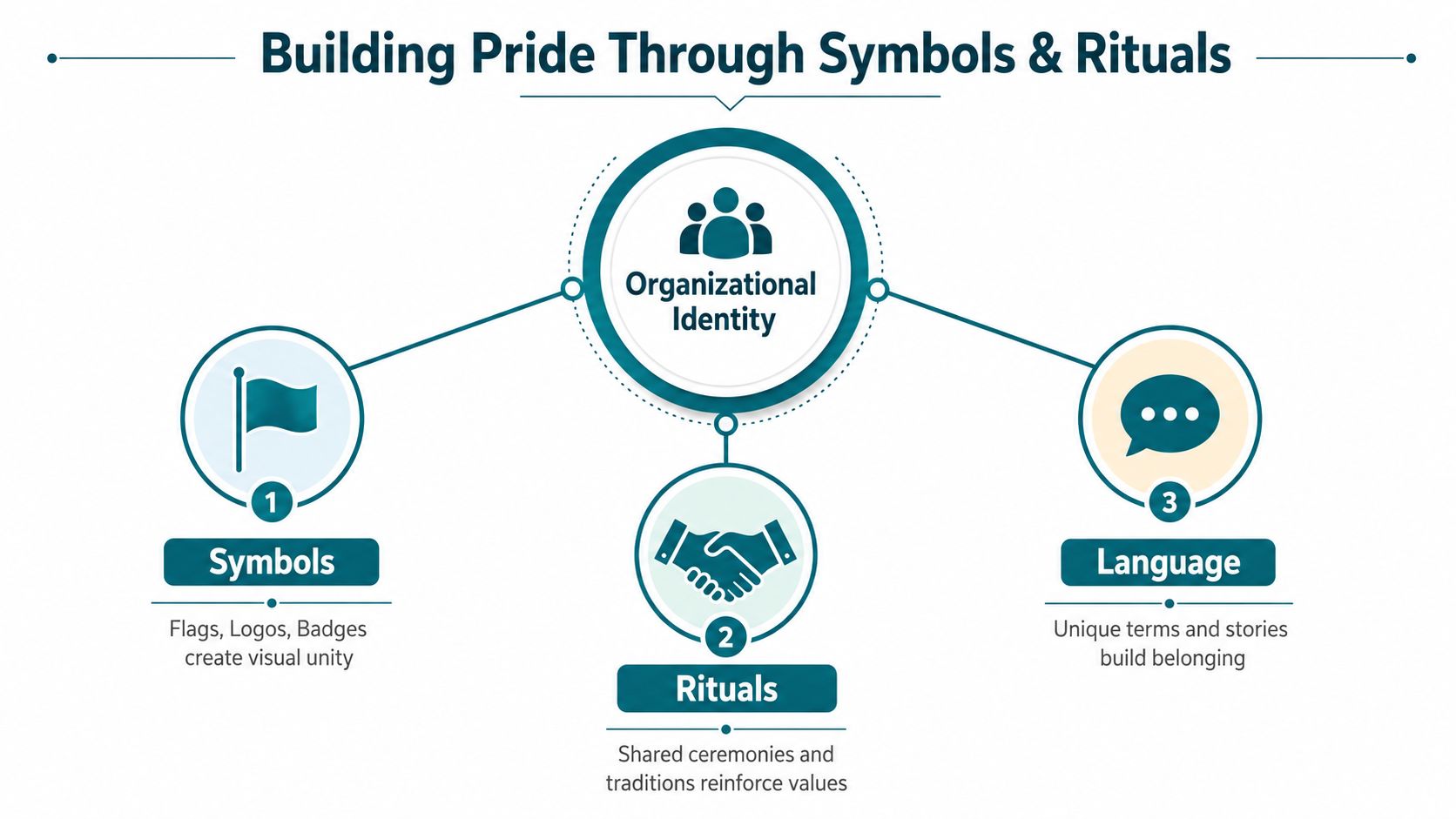
On a cleanup morning, a flag can do what a long speech can't. It tells a new volunteer where to stand, gives the group a visible center, and lets people recognize one another from across a block.
The Litter Caterpillars logo comes from that first hailstorm. It carries the memory of three people under a tree, waiting out the weather and choosing to keep the story going. A volunteer-made theme song gives arrivals another way to enter the group. Flags travel to events. Badges show progress. These objects help people say, “I belong here,” without needing a formal introduction.
Give the story physical form
Choose one symbol from your group's own history. It might be a patched tool bag, a hand-painted sign, a shared color, or a small object from the first event. Don't copy a corporate badge system because it looks polished. Use something that people can explain in one sentence.
Then build rituals around real moments:
- A short welcome for first-time volunteers.
- A safety check before the work begins.
- A group photo after the final bag leaves the site.
- A thank-you circle where people name a helpful action they saw.
- A badge or token for learning a new role.
Consistency matters more than cleverness. If you change the ritual every week, people can't anticipate it or pass it to newcomers. Keep the shape stable while letting the stories change.
Let repetition build resilience
A rain-or-shine schedule can become a promise. Volunteers know the group will meet, leaders know they must prepare, and the neighborhood sees a dependable presence. That doesn't mean ignoring unsafe conditions. A leader must change or cancel an event when conditions put people at risk, then explain the decision plainly.
Language matters too. Groups develop terms for tasks, places, and small victories. Those words compress shared experience. A new volunteer learns them by listening, then starts using them with someone else.
Recognition can stay simple. A handwritten note, a public thank-you, or a badge tied to a real contribution often carries more weight than a generic announcement. You can find practical ideas in these volunteer recognition ideas.
The song below gives another example of how a volunteer's creative work can become part of a group's shared memory.
Protecting Volunteer Energy With Safety First
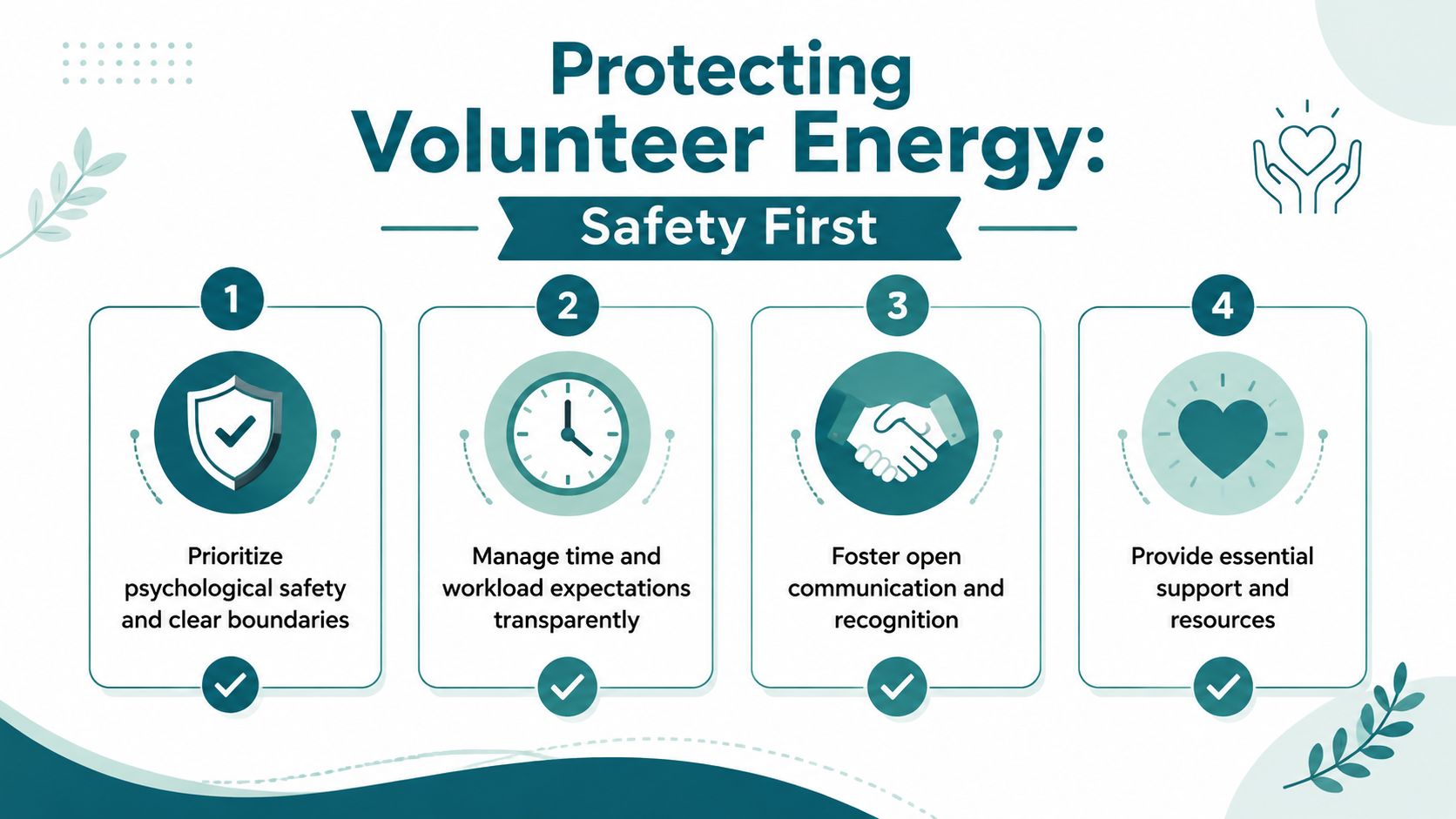
Volunteer energy lets a group keep moving, and it can disappear after one preventable injury, one humiliating interaction, or one event that leaves people confused and exhausted. I put safety first, happiness second, and fundraising somewhere outside the volunteer relationship.
A volunteer-first policy starts with boundaries. Tell people what the task involves, what equipment you provide, which conditions can change the plan, and who makes the final call. Psychological safety matters too. People should be able to say “I'm uncomfortable,” “I need a break,” or “I don't know how to do that” without losing respect.
Teach safety, then repeat it
A safety orientation at the start gives people a common baseline. It should cover tools, lifting, traffic, sharp objects, weather, personal boundaries, and the process for reporting a concern. Keep the language plain and demonstrate the actions instead of reading a long policy aloud.
Safety guidance for volunteer organizations recommends keeping current safe-work policies and procedures on a notice board or app, giving people a suggestions box for safety ideas, and holding regular meetings about safer ways to work. Safe Work Australia's volunteer safety guidance gives that rhythm a practical shape.
A separate volunteer safety guide recommends an opening orientation followed by regular communication about health and safety. People forget instructions when they use them rarely, so repeat one small reminder before each event.
Make participation easy and pressure-free
Publish the meeting point, expected duration, clothing advice, accessibility notes, and cancellation process in the same place. Use Meetup, Instagram, and open group chats to help people find an event without a private invitation or a long application.
Don't turn a service day into a donation pitch. A zero-pressure policy protects the reason people arrived. Let volunteers make friends, learn a role, and leave with enough energy to return. Schedule realistic work, provide pauses, and assign a person to welcome anyone standing alone.
Volunteer-first practice: If your event needs volunteer energy to succeed, your planning must protect that energy before it asks for more.
Leaders should watch for quiet signs of strain. Someone who stops talking, rushes through unsafe work, or avoids a familiar role may need a check-in. Ask privately, listen without defending the plan, and change the system when the same concern appears more than once.
Measuring What Matters for Long-Term Retention
At a cleanup in a neglected corner of the neighborhood, twelve people may sign in, yet only four return the following week. The attendance sheet records the first number. It cannot show who stood alone, who found a friend, or which confusing task sent someone home for good.
Research on episodic volunteering found different retention drivers at different stages. For first-time volunteers, satisfaction and social norms predicted retention. For volunteers with 2 to 4 years of intermittent service, satisfaction and commitment predicted retention. Among sustained volunteers, financial support, social norms, satisfaction, and commitment all showed positive coefficients. The episodic volunteering research explains these distinctions.
Track the reason behind the return
Send a short pulse check after each event. Ask what felt good, what felt difficult, whether the volunteer felt welcomed, and whether they plan to return. Leave one open question for the detail a checkbox cannot capture.
A small group can track:
- First return: Did a new volunteer come back, and did someone introduce them to others?
- Satisfaction: Did the work feel manageable, social, and worth the time?
- Commitment: Does the volunteer take ownership of a role or invite someone else?
- Support: Did the group provide the tools, information, and care experienced volunteers needed?
- Friendship formation: Can people name someone they met through service?
- Event consistency: Did cancellations, late starts, or unclear locations interrupt trust?
- Ward coverage: Did the group reach the neighborhoods it planned to serve?
A volunteer program evaluation framework can help organize these questions without turning a community ritual into paperwork.
Read the answers by experience level, team, manager, location, and tenure where useful. An overall average can hide a local problem. One Litter Caterpillars crew may welcome newcomers at the curb while another leaves them at the edge of the circle.
| Experience Level | Primary Retention Drivers | What to Measure |
|---|---|---|
| First-time volunteers | Satisfaction and social norms | Welcome quality, task clarity, social connection, return intention |
| Volunteers with 2 to 4 years of intermittent service | Satisfaction and commitment | Role ownership, follow-through, feedback, continued participation |
| Sustained volunteers | Financial support, social norms, satisfaction, and commitment | Support resources, leadership trust, recognition, mentoring, responsibility |
Keep the metric set small
Culture-metrics guidance recommends 6 to 10 KPIs, combining early signals such as engagement or eNPS with outcomes such as voluntary turnover, absenteeism, productivity, and customer NPS, then segmenting results to find where culture breaks down. A volunteer group can borrow that approach without copying workplace measures.
Choose one or two North Star measures, collect pulse responses on a fixed cadence, and pair the results with conversation. If satisfaction falls in one crew, speak with that crew before changing the whole program. Numbers mark the place to look. Volunteers explain what happened, and their experience shows whether the ritual is strong enough to bring them back.
Common Mistakes That Kill Volunteer Culture
I've watched groups chase a cheerful message while their actual schedule kept changing. I've seen leaders count every signup, ignore the people who felt lost, and call the result growth. A culture survives through repeated actions, so slogans can't rescue a broken routine.
Gallup reports that 31% of U.S. employees were engaged at work in 2024, matching the low point last seen in 2014, while 17% were actively disengaged. Gallup also reports that global engagement declined again in 2025, reaching its lowest level since 2020. Those figures come from a workplace context, yet they give volunteer leaders a useful warning: enthusiasm needs daily reinforcement, not a one-time speech. Gallup's engagement report provides the details.
Mistakes that look harmless at first
Motivational messaging without action creates cynicism. If leaders praise kindness but ignore a volunteer who bullies others, people learn the actual rule quickly.
Attendance as the only success measure rewards volume over experience. Ask whether people felt welcomed, learned a role, formed a friendship, and chose to return.
Unsafe improvisation damages trust faster than a cancelled event. Give people orientation, repeat safety guidance, update policies, and accept that leaders may need to stop work.
Donation pressure changes the relationship. Volunteers who arrived to serve can start feeling like customers on a list. Keep giving optional and separate from the welcome, recognition, and work itself.
Inconsistent scheduling breaks the habit that brings people back. Publish a dependable rhythm, communicate changes early, and avoid making volunteers guess whether an event still exists.
Trying to suit everyone makes the group hard to understand. Clear values will turn some people away, and that can protect the people who want the same kind of service.
Fix the system, not the poster
A culture review identifies three conditions that help people follow group norms: expectations must stay visible, people must broadly agree with them, and rewards or sanctions must carry enough intensity to matter. Read the culture review on norms and organizations for the underlying framework.
Write the rules in plain language. Ask volunteers whether the rules match the lived experience. Praise behavior that keeps the group healthy, and address behavior that harms others quickly and consistently.
Organizational culture change works better as a staged operating system than as a slogan campaign. One benchmark describes planning, analysis, integration, implementation, and operational maturity, while McKinsey reports that only about one in four large-organization transformations achieve long-term success, as summarized in this culture-change benchmark.
For a volunteer group, the rollout can stay practical:
- Plan the behavior: Choose the actions you want people to repeat.
- Study the gap: Ask where current events fail those expectations.
- Integrate the rules: Put them into event plans, safety checks, recognition, and leader roles.
- Pilot the routine: Try it with a few teams and listen closely.
- Scale with evidence: Expand only after volunteers show that the routine works.
Litter Caterpillars brings people together for weekly Chicago cleanups, rain or shine, with flags, badges, friendships, and safety practices that make service easier to repeat. Visit Litter Caterpillars to find an event, meet people who give their time, and help build a culture of care block by block.