
I know that ache in your chest. You stand there, staring at a cracked patch of asphalt at school, but in your mind's eye, you see it. You see kids with dirt under their fingernails. You see them tasting a carrot they grew themselves. You see a green sanctuary humming with life, built by their own small hands. But then, the real world crashes in. Soil, seeds, lumber, shovels… it all costs money. Your dream feels like a boulder you’re supposed to move all by yourself.
When I first started Litter Caterpillars, I stumbled upon a weird little secret. It's often easier to clean up someone else's mess—or in this case, to green up a shared space—than it is to tackle the clutter in our own lives. There's a power in shared purpose. You just need a nudge, a map, and a few friends to help you lift.
This is your map. I'm going to guide you through the maze of garden grants for schools, but not like some boring textbook. Think of this as a treasure hunt. We’ll unearth national giants like the USDA and the Whole Kids Foundation, and we’ll also dig into hyper-local champions like Chicago's Space to Grow. For every grant, I’ll tell you the real story—the deadlines, the dollar amounts, and the insider tips that make an application sing.
I'll show you exactly where to dig to find the gold that turns concrete into a classroom. This isn't just about getting a check. It’s about building something that echoes. Something that teaches courage, kindness, and togetherness, one tiny seed at a time. Let's go find that money and get our hands dirty.
1. Whole Kids Foundation – Garden Grant
If you're just dipping your toes into the world of garden grants for schools, let me introduce you to the Whole Kids Foundation. Think of them as the friendly, reliable neighbor who gets you started. Their whole process feels less like a sterile application and more like a handshake from a partner who genuinely wants to see you succeed. They have a predictable annual cycle, which is a gift when you're trying to plan a project.
This grant is a beautiful, straightforward $3,000 cash award. You can use it for anything—from building the raised beds themselves to buying the soil that fills them and the seeds that will sprout from them. They designed it specifically for educational gardens, whether you’re breaking ground for the first time or expanding a garden you already love. Because they're so well-known, you can find stories of past winners all over the internet. It’s like getting a peek into hundreds of other schools' dreams to fuel your own.
Now, while that $3,000 is a perfect catalyst for many, it can be competitive. My advice? Don't put all your seeds in one pot. You can learn how to mix and match funding by checking out our guide on finding a variety of grants for your garden.
- Award: $3,000
- Eligibility: K–12 schools, school districts, and non-profit organizations.
- Best For: You, if you’re looking for a simple cash grant to kickstart or grow your educational garden.
Apply Here
2. USDA Farm to School Grant Program (Food and Nutrition Service)
What if you're dreaming bigger than just a few garden beds? What if you see a future where your whole district changes its relationship with food? Then you need to meet the USDA Farm to School Grant Program. This is the heavyweight champion. This isn't just about planting kale; it's about rewriting the entire food story of your school, connecting the garden plot directly to the cafeteria tray, and building an educational legacy. The federal application is a beast, I won't lie. But the power you can unleash is breathtaking.

This grant is all about scale. With awards climbing up to half a million dollars, you can fund everything from curriculum design and teacher training to massive high-tunnel greenhouses. It’s built for sprawling, comprehensive projects that weave together local food, school lunches, and classroom lessons. You can see how different "tracks," like "Implementation" or "State Agency," let you choose your own adventure based on how big your dream is.
The flip side of that massive potential? You need a team. You can't write this grant on a single Saturday. It’s an ironman triathlon, not a 5K. But it’s an opportunity to forge the partnerships and build the administrative muscle you need for real, systemic change, especially if you’re chasing those bigger garden grants for schools.
- Award: Up to $500,000, depending on the grant track.
- Eligibility: Schools, school districts, state and local agencies, tribal organizations, and non-profits working with you.
- Best For: You and your district, if you're ready to build a comprehensive farm-to-school program with a serious budget.
3. KidsGardening – Youth Garden Grant
If you're looking for the godmother of school garden grants, you’ve found her. KidsGardening has been doing this for decades, and you can feel their wisdom in every part of the process. Winning their Youth Garden Grant is like being welcomed into a long, proud lineage of garden educators. They provide a mix of cash and gear to bring your garden vision to life.

What I love about this program is its holistic approach. You don't just get a check. You get a package that often includes cash alongside a thoughtfully curated box of tools, seeds, and curriculum from amazing sponsors. And get this—they have a Common Application system. You fill out one application and they consider you for several of their grant opportunities. It's a brilliant time-saver that gets your school’s story in front of multiple funders at once.
The catch? This incredible support makes it fiercely competitive. Also, the award packages change from year to year depending on who the sponsors are, so you might not know the exact value when you apply. You have to think of it less like a guaranteed cash prize and more like a complete "garden-in-a-box" starter kit, which, for many of us, is exactly what we need.
- Award: Varies; typically a package of cash and in-kind products/tools.
- Eligibility: PreK–12 schools, school districts, and non-profit youth organizations in the US.
- Best For: You, if you want a comprehensive package of funding, tools, and curriculum to launch or enrich your garden program.
4. GroMoreGood Grassroots Grant (KidsGardening + The Scotts Miracle‑Gro Foundation)
Sometimes, you just need a little push. A little gust of wind at your back to get a project moving. The GroMoreGood Grassroots Grant, a team-up between KidsGardening and The Scotts Miracle-Gro Foundation, is that push. I tell everyone who feels intimidated by massive federal grants to look here first. It's designed to be approachable, to sprinkle its impact far and wide. The application is refreshingly simple, and they even offer it in Spanish, which tells me they really care about reaching everyone.
What makes this grant a gem is its focus on small, winnable goals and the sheer number of awards they give out. You should think of it less as funding for a total garden makeover and more as a seed packet of money to buy your first raised bed, a fresh set of trowels, or a small hydroponics tower. A typical award is around $750, making it one of the absolute best garden grants for schools that are just starting or just need one specific thing to take their garden to the next level.
That modest award size is its strength. It’s perfect for a specific need, but it won't build you a whole new garden from scratch. But because of that, your odds of winning are higher than with some of the bigger fish. It’s a fantastic confidence-builder. So don't be afraid to apply for just one piece of your bigger garden puzzle.
- Award: Typically around $750
- Eligibility: Schools and non-profit youth-serving organizations.
- Best For: You, if you're a first-timer or just need a quick shot of cash for a specific garden part or upgrade.
5. Captain Planet Foundation – Project Learning Garden (PLG)
If you're looking for the "easy button," the Captain Planet Foundation’s Project Learning Garden (PLG) is it. I think of this less as a grant and more like a complete garden starter kit dropped on your school's doorstep by a friendly superhero. They designed this program to eliminate the headaches. They give you everything you need to get growing, from the garden beds themselves to a mobile kitchen cart for cooking lessons. It’s an unbelievable resource if you feel overwhelmed by the thought of sourcing every single item yourself.

The magic of PLG is its turnkey approach. Instead of cash, you typically get an in-kind package valued at around $6,000. That includes supplies, curriculum, and even training for you. It's one of the best garden grants for schools if you want to dive deep into hands-on learning and nutrition education. The foundation also partners with companies for regional contests, sometimes giving away full installations, which makes it even more exciting.
The big challenge here is that availability is often tied to specific regions and corporate sponsorships. That makes it super competitive and not always an annual option where you live. You have to watch their website like a hawk for announcements in your area. But even if you don't win, the resources they offer are a fantastic blueprint for planning your own program.
- Award: In-kind package (garden beds, supplies, mobile kitchen, curriculum) valued at ~$6,000.
- Eligibility: K–12 schools, with availability dependent on regional sponsorships.
- Best For: You, if you want a complete, turnkey garden and curriculum package with a strong focus on hands-on cooking and learning.
6. Captain Planet Foundation – ecoSolution Grants
What if you could empower your students to be the heroes of their own environmental story? The Captain Planet Foundation's ecoSolution Grants are designed for exactly that. These grants are for projects driven by the kids themselves. It shifts the focus from just building a garden to solving a real-world environmental problem, making the garden a tool for change. This is the perfect way to connect your garden project to STEM goals and let genuine student leadership bloom.
These grants are amazing because they are flexible and they celebrate creativity. They support a huge range of projects, from creating pollinator habitats to building hydroponic systems, as long as your students are in the driver's seat. Because the awards are smaller, it feels more attainable for schools just starting to explore grants. You can think of it as a powerful first step that validates your students' big ideas and gives them the confidence to dream even bigger next time.
Now, while these smaller awards are perfect for specific projects, you'll likely need to pair them with other funds to build out a full garden. But I see this as an incredible teaching opportunity. This grant lets you teach your students about project management and budgeting, showing them how to build something meaningful, piece by piece. It’s a real-world lesson in what environmental stewardship means, right in your own schoolyard. You can dive deeper into this idea with your class by exploring what environmental stewardship means.
- Award: Varies, typically $500–$2,500
- Eligibility: K–12 schools and non-profit organizations.
- Best For: You and your classroom, if you want to fund a student-led, problem-solving environmental project with strong STEM connections.
Apply Here
7. SeedMoney – Garden Grants + Crowdfunding Challenge
If you're ready to rally your entire community, SeedMoney offers a unique and powerful way to secure garden grants for schools. It isn’t just a one-time handout. Instead, they give you a platform that combines a small starter grant with a 30-day crowdfunding challenge. It’s like a digital barn-raising for your garden. SeedMoney provides the first few beams, and then they empower you to build the rest with support from parents, local shops, and neighbors. You get to build both a garden and a loyal support system at the same time.

The real genius is in this hybrid model. You start with a small grant from them, then you launch your own fundraising page on their site. You keep 100% of the money you raise, and you can even win extra bonus grants by being one of the top fundraisers. They give you toolkits, graphics, and even garden design software to help you succeed. This approach means your funding isn't capped; it’s scalable.
The main thing to know is that this requires you to run an active campaign. Your success is all about your ability to reach out and get people excited. If your school has a buzzing PTA or a strong social media game, this could be the most rewarding path you take. It turns the boring grant process into an inspiring, community-wide celebration.
- Award: Micro-grants plus 100% of funds raised via crowdfunding and potential bonus grants.
- Eligibility: Public and private schools, non-profits, and community groups planning food garden projects.
- Best For: You and your school, if you have a strong community network you can activate for a fun fundraising campaign.
8. Wild Ones – Lorrie Otto Seeds for Education (SFE) Grants
If your vision for a school garden is less about neat rows of lettuce and more about buzzing bees, fluttering butterflies, and plants that sing a song of your local ecosystem, then you need to know about the Wild Ones Lorrie Otto Seeds for Education Grant. This isn't just about getting money; it’s about joining a tribe. A tribe of people who are passionate about restoring native habitats. They don't just mail you a check. They connect you with a network of local chapter members who become your mentors, helping you choose the right native species and plan your planting day.
This grant is specifically for creating outdoor classrooms that feature native plants. The funding is usually modest, but it’s perfectly aimed at buying the materials you need for a pollinator or habitat garden. What makes this program truly special is the emphasis on getting kids involved and the incredible support from the Wild Ones chapter network. These local experts give you priceless advice, turning your grant from a simple transaction into a long-term community partnership. This is one of the best garden grants for schools that want to focus on ecology.
Now, while this is a golden opportunity for a habitat project, you have to remember its specific focus. This grant isn't for edible vegetable gardens. If your dream is a "farm-to-table" program, you’ll need to look at other options on this list. But if you want to teach your students about biodiversity and the magic of your local ecosystem, the SFE grant gives you the seed money—and more importantly, the community roots—to make it happen.
- Award: Varies, typically around $500 in funds and/or materials.
- Eligibility: Schools and non-profit organizations serving youth (preschool through high school).
- Best For: You, if you're focused on creating native plant habitats, pollinator gardens, and outdoor ecological classrooms.
9. American Heart Association – Teaching Gardens / Teaching Gardens Network
What if your school garden was more than just a place to grow vegetables? What if it became a living, breathing laboratory for heart health and good nutrition? That's the powerful vision behind the American Heart Association's Teaching Gardens Network. I think this program is brilliant because it frames the garden's purpose in a way that your principal and district leaders will instantly understand and support: it’s about student wellness. When you connect your garden to health outcomes, you make an incredibly strong case for support.

Joining their network is free, and it immediately unlocks a treasure chest of resources for you—lesson plans, training, and a community of other educators. While this isn’t a traditional grant with a guaranteed annual check, the AHA periodically offers mini-grants or fully-stocked garden kits to members of its network. You should think of it less as a one-time funding shot and more as a long-term partnership. The free resources help you build a stronger program, which makes your school a top candidate when those special funding opportunities do pop up. It's a fantastic way to find other funding while tying your garden to a mission of lifelong health. Plus, you can always integrate native plants to attract wildlife and teach ecology, which you can learn about at your local native plant sale.
Even if the funding isn't a sure thing every year, the educational framework they give you is priceless. The real value is the powerful, health-focused story it helps you tell about your project.
- Award: Varies; periodic mini-grants and garden kits. Main benefit is free access to a resource network.
- Eligibility: K–12 schools can join the free network; grant opportunities are for network members.
- Best For: You, if you want to connect your garden to a strong health and nutrition curriculum and gain access to a supportive educational community.
10. Sprouts Healthy Communities Foundation – School Garden Support
If your school is lucky enough to be near a Sprouts Farmers Market, you have an incredible partner hiding in plain sight. The Sprouts Healthy Communities Foundation doesn’t just write checks from a distance; they roll up their sleeves and dive in with you. Think of them as the energetic neighbor who shows up on build day with tools, a team of helpers, and expert advice, turning your garden project into a true community festival. Their support goes way beyond a simple cash award, often including donated materials and, best of all, volunteer build days with their own team members.

This foundation is unique because it invests in the whole school garden ecosystem. Yes, they give grants, but they also fund professional development for teachers and host summits to help you become a more confident garden leader. This focus on building your capacity means their impact lasts long after the grant money has been spent. They fund schools directly and also support the local non-profits that help school gardens thrive, creating a powerful web of resources.
The main thing to keep in mind is geography—their support is focused on communities near their stores. Some of their funding might also be by invitation only. My advice? Get to know your local Sprouts store manager. Making that personal connection can be the single best first step you take toward securing one of these valuable garden grants for schools.
- Award: Varies (includes financial grants, in-kind support, and volunteer labor).
- Eligibility: K–12 schools and non-profit organizations located near Sprouts Farmers Market stores.
- Best For: You, if your school is in a Sprouts community and you're looking for a hands-on partner to help with builds, training, and community buzz.
Apply Here
11. Illinois Schoolyard Habitat Action Grant (SHAG)
For my fellow Illinois educators, especially those of you in the Chicago area, let me put a spotlight on the Schoolyard Habitat Action Grant, or SHAG. This isn't your average garden grant. It’s a special program designed to help you transform a piece of your school grounds into a vibrant native Illinois habitat. I want you to think less about vegetable rows and more about creating a pocket of prairie, a pollinator garden buzzing with life, or a rain garden that solves a drainage problem while teaching science. It’s about building a living lab that connects your students directly to our state's natural heritage.

The state's focus on native species makes this grant a perfect match for integrating local ecology into your science lessons. They give you two paths: one provides a pre-selected pollinator garden kit, and the other lets you design a more custom habitat project for up to $2,000. This is one of the most powerful garden grants for schools if you want to foster biodiversity and teach critical environmental science.
Here's the key thing you need to plan for: this is a reimbursement grant. That means your school has to buy the materials first and then submit the receipts to get paid back. So, this works best if you have some starter funds or a super supportive PTO. Also, since edible gardens aren't eligible, you need to be sure your vision aligns perfectly with creating a native Illinois ecosystem on your campus.
- Award: Up to $2,000 (reimbursement-based).
- Eligibility: Illinois schools, both public and private.
- Best For: You, if you're an Illinois educator focused on creating a native pollinator, prairie, or rain garden that connects to your science standards.
12. Space to Grow – Chicago Green Schoolyards (CPS partnership program)
For my Chicago Public Schools family, let's talk about dreaming big. I mean, really big. Space to Grow isn't a garden grant; it's a total schoolyard reinvention. This is a powerful partnership between Healthy Schools Campaign, Openlands, and CPS that transforms entire asphalt deserts into vibrant green spaces with outdoor classrooms, natural play areas, and stunning native gardens.
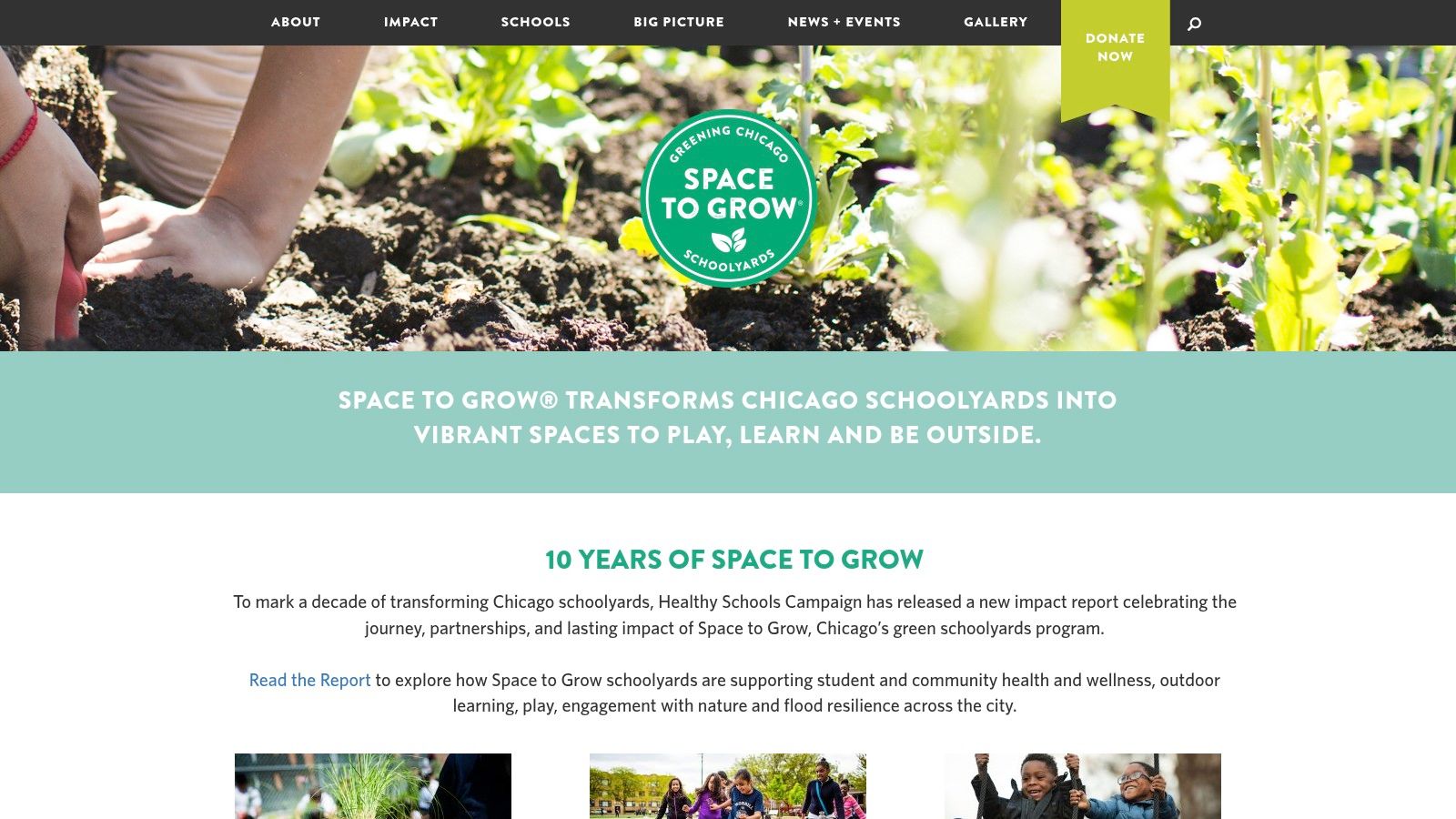
This is the ultimate makeover for a CPS schoolyard. Instead of giving you a check, Space to Grow brings in a team of experts to design and build a green schoolyard that also manages stormwater—a huge issue for our city. It's a complete campus revitalization that gives your students a world-class outdoor environment for years to come. You have to think of this less as a grant and more as a deep, multi-year collaboration.
Because this is a massive capital project, the process is much longer and more competitive than a simple equipment grant. This isn't a quick victory. It's a deep, lasting one for the schools that are chosen for the cohort. If your school is ready for a major, transformative change, you have to explore a partnership with Space to Grow.
- Award: Full schoolyard redesign and capital project (value is in the hundreds of thousands).
- Eligibility: Chicago Public Schools (CPS) only.
- Best For: You, if your CPS school is ready for a major, long-term capital improvement project that integrates gardens, play, and environmental education.
School Garden Grants: 12-Program Comparison
| Program | Funding & Value 💰 | Core Features ✨ | Best for 👥 | Ease & Admin ★ | Standout 🏆 |
|---|---|---|---|---|---|
| Whole Kids Foundation – Garden Grant | 💰 $3,000 flat | ✨ Annual cycle, webinars, K–12 edible gardens | 👥 Schools & youth orgs starting edible gardens | ★★★★☆ (straightforward) | 🏆 Predictable, educator-focused |
| USDA Farm to School Grant Program | 💰 High — multi-year/district funding | ✨ Multiple tracks; equipment, training, curriculum support | 👥 Districts & multi-site programs | ★★☆☆☆ (complex federal process) | 🏆 Large-scale, systemic impact |
| KidsGardening – Youth Garden Grant | 💰 Variable (competitively awarded) | ✨ Common Application; strong educator resources | 👥 PreK–12 classrooms & youth groups | ★★★★☆ (streamlined across programs) | 🏆 Teacher-friendly support & materials |
| GroMoreGood Grassroots Grant | 💰 ~$750 micro-grant | ✨ Many awards; flexible uses; Spanish materials | 👥 First-time applicants & small projects | ★★★★★ (easy, short app) | 🏆 Accessible with high award odds |
| Captain Planet – Project Learning Garden | 💰 In-kind package ≈ $6,000 value | ✨ Turnkey beds, Mobile Kitchen Cart, curriculum & installs | 👥 Schools wanting turnkey garden + cooking lessons | ★★★☆☆ (region/sponsor-dependent) | 🏆 Reduces procurement & logistics |
| Captain Planet – ecoSolution Grants | 💰 Small mini-grants | ✨ Student-led, STEM-linked projects with measurable outcomes | 👥 Student teams & project-based classrooms | ★★★★☆ (flexible, project-focused) | 🏆 Emphasis on student leadership |
| SeedMoney – Grants + Crowdfunding Challenge | 💰 Variable — crowdfunding + bonuses | ✨ Hybrid micro-grant + 30-day campaign; toolkits & design tools | 👥 Schools with strong community outreach | ★★★☆☆ (requires active fundraising) | 🏆 Scalable via community donations |
| Wild Ones – Lorrie Otto Seeds for Education | 💰 Modest awards for native plants | ✨ Native/pollinator focus; chapter mentorship & plant sourcing | 👥 Schools building pollinator/native habitats | ★★★★☆ (local chapter support) | 🏆 Excellent for native habitat education |
| American Heart Association – Teaching Gardens | 💰 Variable; network resources often free | ✨ Nutrition & heart-health curriculum, training, mini-grants | 👥 Schools tying gardens to health education | ★★★★☆ (resource-rich network) | 🏆 Health framing aids district buy-in |
| Sprouts Healthy Communities Foundation | 💰 Grants & in-kind near Sprouts markets | ✨ Volunteer build days, PD, media support | 👥 Schools/partners in Sprouts communities | ★★★☆☆ (geo-limited/opportunity-based) | 🏆 High-visibility volunteer engagement |
| Illinois Schoolyard Habitat Action Grant (SHAG) | 💰 Up to $2,000 (reimbursement) | ✨ Native habitat projects; clear tutorial & options | 👥 Illinois schools (Chicago-area relevant) | ★★★☆☆ (reimbursement admin) | 🏆 State-tailored for Illinois ecology |
| Space to Grow – Chicago Green Schoolyards | 💰 Capital program — major builds | ✨ Full yard redesign, stormwater, outdoor classrooms | 👥 Chicago Public Schools seeking large transformation | ★★☆☆☆ (competitive, long timeline) | 🏆 Transformational, multi-agency backed |
Your Turn to Be Brave: How to Make Your Garden Dream a Reality
So, we've walked through a whole forest of possibilities. You've met the big national players like the Whole Kids Foundation and the USDA Farm to School Grant, programs that can fund enormous projects. We've peeked into specialized paths, like the Wild Ones grant for native habitats or the brilliant crowdfunding model of SeedMoney. And for my fellow Chicagoans, we've zeroed in on our local heroes like the Illinois Schoolyard Habitat Action Grant and the game-changing Space to Grow program.
I get it. It’s a lot. Looking at all those applications and deadlines can make your field of dreams feel more like a mountain of paperwork. But let me tell you a secret I learned during a freak Chicago hailstorm, huddled under an awning with the very first Litter Caterpillars volunteers. We were cold. We were soaked. We had only cleaned up half a block. It felt like we were failing.
But you know what? That struggle is the best part of our story now. It's the flavor. Shivering together is what bonded us. It’s what made the eventual sunshine feel so much warmer.
From List to Action: Your First Brave Step
The real challenge isn’t finding the right grant. It’s finding the courage to start writing. It’s scary to ask for money. I know. It feels vulnerable to put your school's dream on paper, knowing you might get a "no."
But that fear is the price of admission for doing something meaningful. It's true for starting a community group, and it's absolutely true for you as you chase one of these garden grants for schools. The fear tells you that you're aiming for something that matters.
So, here is my challenge to you:
- Pick just one. Don't let yourself get overwhelmed. Are you just starting out? The KidsGardening Youth Garden Grant is a fantastic place to begin. Are you an established Chicago program ready for a massive transformation? You need to look hard at Space to Grow. Choose the one that whispers, "this could be us."
- Download the application. Go to the website right now. Find the PDF. Look at the online portal. Just look at it. You don't have to fill it out yet. I just want you to do this one simple thing. It turns an abstract idea into a concrete task.
- Start telling your story. Forget what you think "grant writing" sounds like. Just write. Why do you want this garden? What's the story of that ugly asphalt lot you want to destroy? Who is the one student you keep picturing with their hands in the soil for the first time? You need to tell that story. Perfection is a myth. Passion is a magnet.
Your first grant application might feel small and clumsy. You might feel like just a few people shivering under a tree. That’s okay. That is exactly how transformations begin. Every beautiful community garden you've ever admired started with one person's brave "what if."
Remember, grant funders don't just fund projects; they invest in your vision and in you. They want to know you have support. They want to see that you have a team. Sometimes, the best way to show them that is to get your hands dirty before you even get the check.
Think about it. A proposal that says, "We partnered with a local volunteer group to clean up our proposed garden site" is a hundred times stronger than one that doesn't. It shows you have initiative. It shows you can rally people. It shows you’re a good bet.
So go be brave. Go download that application. Go paint that fence, or pull those weeds, or just start talking to people. You have everything you need to begin.
Ready to show grant funders you have real community buy-in for your school garden project? Partner with Litter Caterpillars for a schoolyard cleanup event that proves you’re ready to build. We bring the people, the energy, and the spirit of service to make your site sparkle, giving you the perfect "before" and "after" story for your application. Get in touch with Litter Caterpillars today and let’s build this dream together.