Tag: environmental advocacy

  • 7 Best Sources for Ocean Pollution Images in 2026

    7 Best Sources for Ocean Pollution Images in 2026

    More Than Just a Sad Picture

    I used to think my old jam jars and bags of nuts were just trash. But they felt heavy, like they weighed 500 pounds. Each one carried a little memory, a failed promise, a version of me I didn't know how to let go of.

    Cleaning up my own mess felt impossible. Then I found something strange and freeing. Cleaning up other people's messes was easier, and somehow it helped me start cleaning up my own life. A strong image works the same way. The right ocean pollution images don't only show damage. They give you a before photo that makes someone want to help build the after. If you're trying to move people from sadness to action, the source you choose matters.

    1. NOAA Marine Debris Program Photo Gallery

    When I need an image that feels grounded, I usually start with NOAA's Marine Debris Program photo gallery. It feels like walking into a file cabinet run by people who care about evidence, not drama. You can move from plastics to fishing gear to microplastics to wildlife impact without getting lost in random stock-photo noise.

    That matters because the most dramatic ocean pollution images can distort the story. As The Ocean Agency's plastic image archive notes, the most shareable visuals often overrepresent surface trash and underrepresent microplastics, fisheries gear, and sewage-linked pollution. I like NOAA here because the captions usually push me back toward the actual source of the mess.

    Why I trust it for real campaigns

    For a volunteer flyer, a school slideshow, or a neighborhood cleanup page, rights simplicity saves time and stress. Many NOAA-credited images are public domain, which is great when you don't want to spend your Saturday decoding license terms instead of making posters.

    A few things I like right away:

    • Public-domain potential: Many NOAA-credited photos are free to use, which is a gift for nonprofits, classrooms, and local groups.
    • Strong topic grouping: You can browse by debris type, impact, research, and prevention instead of scrolling forever.
    • Useful U.S. relevance: If you're telling a Chicago-to-Great-Lakes-to-ocean story, NOAA's framing fits naturally.

    Practical rule: Always check the credit line on each NOAA image. Some partner photos have different rights.

    This gallery isn't glossy. That's part of the appeal. It feels more like a field notebook than an ad campaign, and sometimes that honesty is exactly what your story needs.

    2. NOAA Office of Response and Restoration Image Collections

    Some days you don't need a perfect hero image. You need proof. You need shoreline mess, field boots, removal work, and the kind of before-and-after documentation that says, "People showed up and did something." That's when I turn to the NOAA Office of Response and Restoration marine debris image collections.
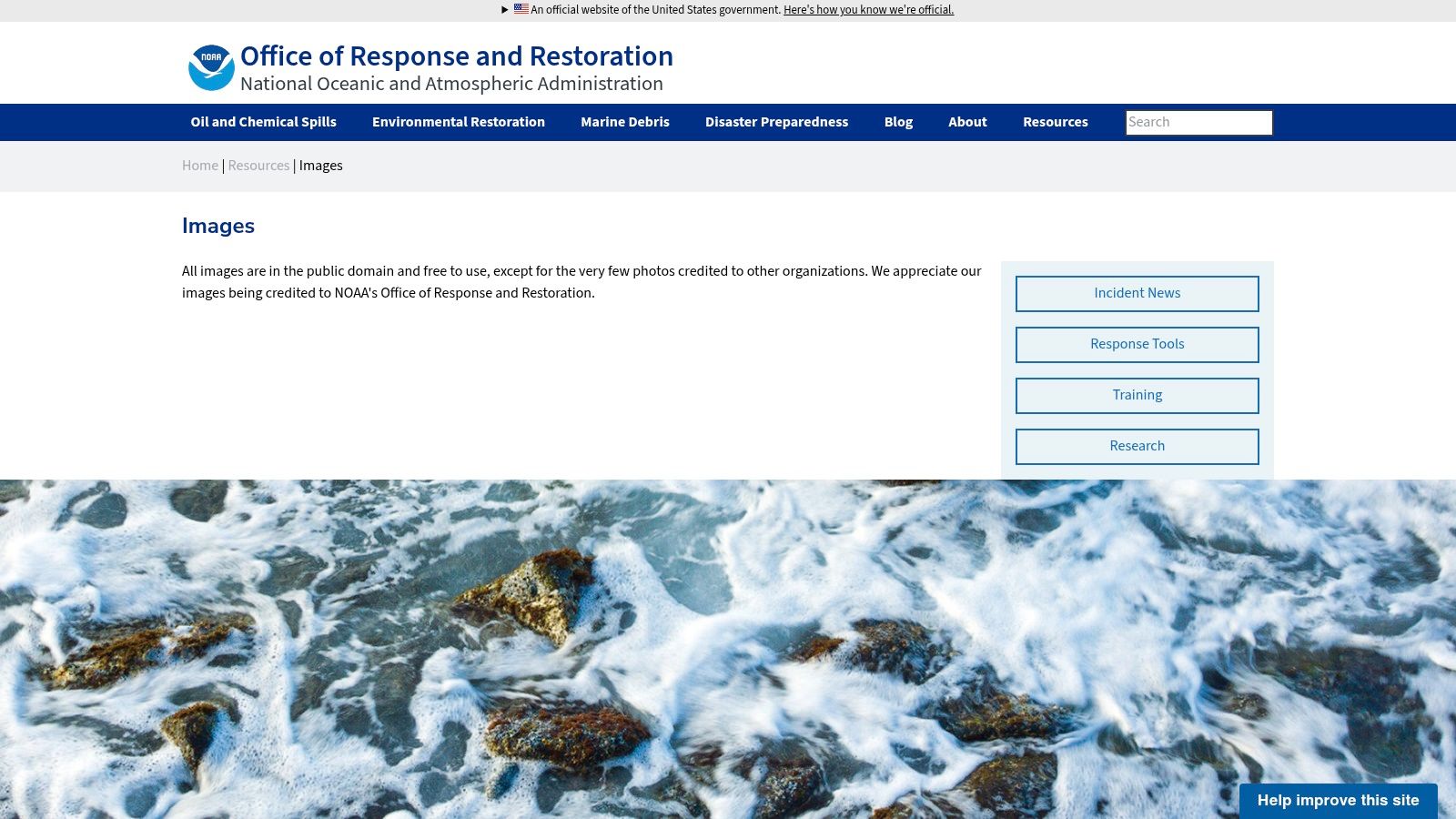
    NOAA Office of Response & Restoration – Image Collections (Marine Debris)

    This archive has a different mood from the first NOAA library. It feels closer to response work. Storm aftermath, debris on shorelines, crews in the field. If your story is about action after impact, these images do the job.

    Best for documenting the work itself

    I think of this collection like work gloves. Not fancy. Very useful.

    You can use it well when you need:

    • Clear response scenes: Debris removal, restoration, and field conditions.
    • Before-and-after framing: Good for explainers, grants, and volunteer recaps.
    • Public-domain guidance: NOAA states that most images are public domain and free to use, though you still need to check details.

    There's another reason these images matter. Roughly 80% of ocean pollution comes from land-based sources, according to The Ocean Cleanup's explainer. So if your photo shows trash caught in a shoreline, canal edge, or storm-battered coast, it may tell a more honest story than a generic "floating island of trash" visual.

    A cleanup story gets stronger when the photo shows where the waste came from, not only where it ended up.

    The downside is style. Some files feel older, some are mixed in quality, and you may need to hunt for the right resolution. Still, if you want images with dirt under the fingernails, this is a good place to dig.

    3. Wikimedia Commons Marine Debris Category

    Wikimedia Commons is where I go when I want range. The Marine debris category on Wikimedia Commons feels a bit like a giant community garage. You can find excellent stuff, odd stuff, very specific stuff, and a few things that need patience.
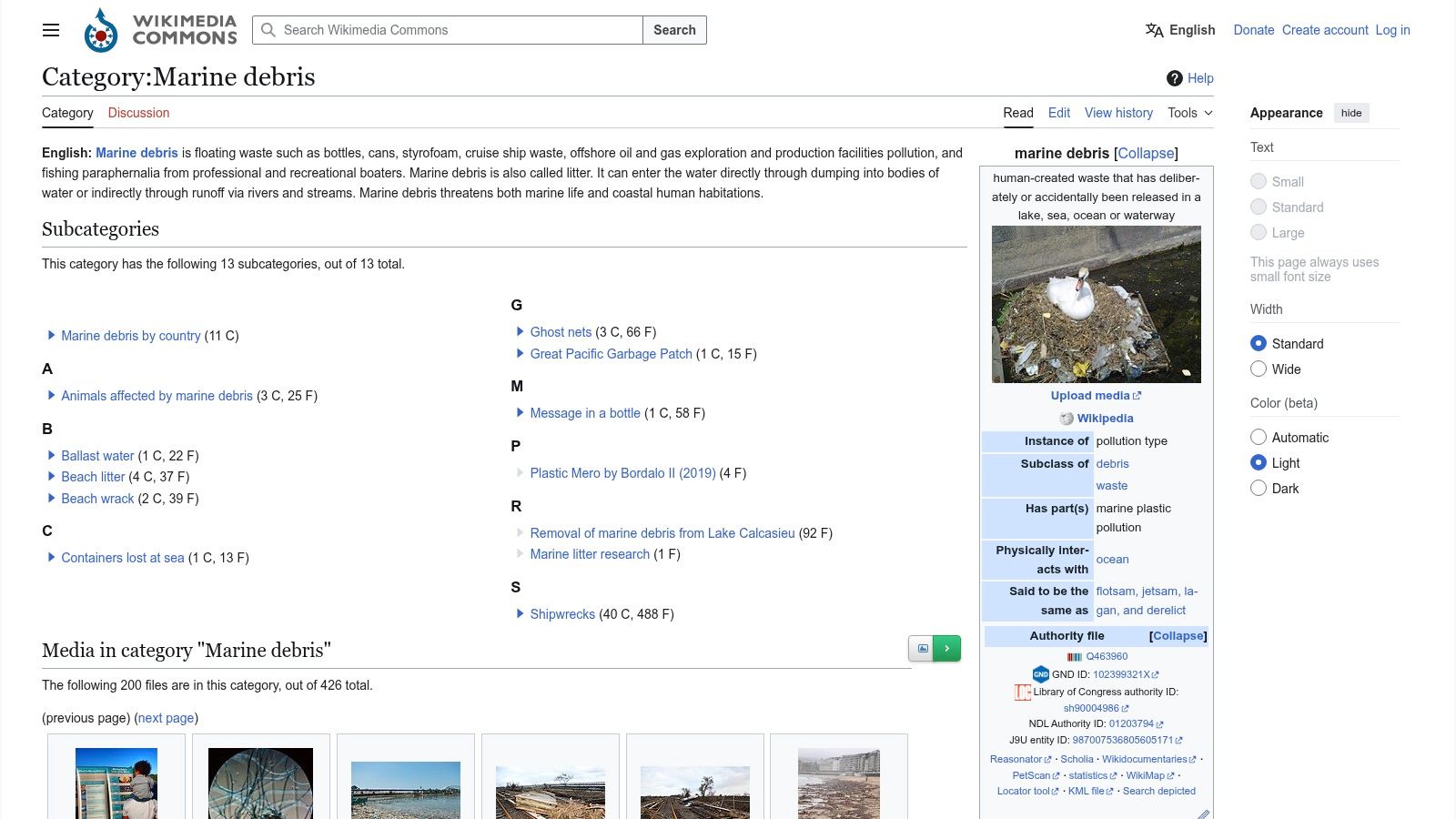
    Wikimedia Commons – Marine Debris category

    I like it because every file page forces me to slow down. Who took this? What year? What license? What am I allowed to do with it? That pause is healthy. Ocean pollution images are easy to recycle until they become generic symbols with no place, no time, and no specific problem attached.

    Best when you need global variety

    This is where Wikimedia shines. You can look beyond one country and one visual style. Beach litter, entanglement, cleanup work, close-up debris, wide shoreline shots. You often get mirrored institutional images too, including public-domain material from government sources.

    Keep these habits in mind:

    • Read each file page: Wikimedia tells you the exact license and the attribution terms.
    • Curate hard: Quality varies a lot, so don't grab the first thing you see.
    • Use the details: Author names, dates, and descriptions make your caption stronger.

    Adobe Stock's ocean pollution search pages point to a real problem with visual repetition. Big image libraries can flatten very different problems into one vague category of "trash in water." Wikimedia helps you fight that because it pushes specificity. Plastic on a beach is not ghost gear. Ghost gear is not oil contamination. Those are different stories, and they need different solutions.

    If you care about context as much as aesthetics, Wikimedia is a strong free option.

    4. Unsplash Ocean Pollution Search

    Last spring, I was building a cleanup sign-up page after a long beach walk that left me angry and oddly hopeful at the same time. The page needed one image. Not ten. One. I opened Unsplash's ocean pollution search, found a sharp photo of plastic scattered along a shoreline, and felt the whole message click into place. Suddenly the event was not a vague good deed. It was a response to a mess people could see.

    That is why I keep Unsplash in the mix. It helps when you need an image that grabs attention fast and still feels human. The library leans polished, which can be a strength if you are making a campaign page, event header, slide deck, or social graphic that needs people to stop scrolling.

    Best for clean, modern visuals that pull people in

    Unsplash works well at the start of the story. You are not always trying to document every detail of the problem. Sometimes you are trying to get one neighbor, one teacher, or one tired volunteer to care enough to take the next step.

    What I like most:

    • Strong visual style: High-resolution images with a modern look that fits websites, presentations, and social posts.
    • Easy reuse: The Unsplash License is simple for many common nonprofit and community uses.
    • Good emotional range: You can find stark litter scenes, cleanup moments, and more symbolic images that set a mood.

    I still slow down before I choose. Some Unsplash photos are closer to visual metaphor than field evidence. A bottle drifting underwater can be striking, but it may not help someone understand what is piling up on their local beach, where it came from, or what kind of cleanup is needed.

    That gap matters.

    A strong ocean pollution image should do more than signal sadness. It should give your audience a foothold. If you are working in the spirit of Litter Caterpillars, the goal is transformation. Mess into mission. Spectator into participant. The right Unsplash image can open that door, especially if you pair it with a caption that names the scene clearly and points to action.

    I use Unsplash for the first spark. Then I make sure the story gets specific.

    5. Pexels Ocean Pollution Search

    Last spring, I was helping put together a beach cleanup flyer for a small neighborhood event. We did not need a polished campaign image. We needed a photo that would still make sense on a phone screen, on a printer at the library, and on a poster taped beside the coffee shop register. That is the kind of moment when I open Pexels' ocean pollution search.

    Pexels is practical. It gives you a wide mix of free images, and I often find vertical shots, tighter crops, or simpler compositions that work better for grassroots outreach than a beautiful image that falls apart the second you resize it.

    That choice shapes the story.

    A cleanup poster with the wrong photo can feel distant or generic. The right one can make a local problem feel local. A bottle half-buried in sand, a volunteer lifting a bag from the shoreline, a tangle of trash caught in rocks. Those scenes give people somewhere to stand emotionally. They can see the mess, and they can see what action looks like.

    Good for flyers, posts, and quick local outreach

    I reach for Pexels when I need fast options and enough variety to match the format, not just the theme.

    What I look for:

    • Orientation variety: Strong mix of horizontal and vertical images for posters, stories, and handouts.
    • Easy reuse: The Pexels License works well for many community and nonprofit projects.
    • Useful range: You can find gritty cleanup photos, beach litter shots, and more composed images for simple awareness pieces.

    The limit is context. Pexels usually will not give you the deeper captioning or institutional detail you would get from a scientific archive, so I treat every image as raw material for a story, not the full story itself. If a photo includes wildlife, people, logos, or branded packaging, I pause and check whether the image supports the message accurately and fits the intended use.

    That matters a lot with ocean pollution work. Wildlife photos can hit hard, but shock alone rarely builds commitment. If you are working in the spirit of Litter Caterpillars, the goal is transformation. Show the harm, yes, then help people see the next step. Add a caption that names what is happening, where action is possible, and how a person can join in.

    Pexels works well when your mission needs motion. It helps you get a real, usable image into the world fast, then turn that image into an invitation to act.

    6. Shutterstock Ocean Plastic Pollution Search

    Last spring, I helped a volunteer group pull together a sponsor deck after a muddy shoreline cleanup. We had strong photos from the day, but they did not fit together. One was raw and grey, another looked like a vacation ad with a stray bottle in the corner, and a third could not be cleared for broader campaign use. We needed visuals that felt consistent, legally usable, and strong enough to carry the story from local mess to public action. That is the moment I open Shutterstock's ocean plastic pollution results.

    Shutterstock helps when the image has to do more than shock. It has to work across a banner, a slide, a paid ad, and a printed handout without sending mixed signals. The filters are a significant advantage. You can sort for commercial use, isolate illustrations from photos, choose horizontal or vertical frames, and build a set that looks like one campaign instead of a pile of unrelated downloads.

    Best for polished campaigns with outside approval

    I use Shutterstock when the audience includes sponsors, schools, local officials, or brand reviewers. Those projects usually need cleaner licensing terms and a more controlled visual style.

    What I look for:

    • Matched image sets: Easier to build a campaign that feels unified across web, print, and social.
    • Commercial-friendly options: Better fit for ads, partner materials, and branded outreach.
    • Precise search control: Useful when you need a specific scene, subject, or composition fast.

    There is a tradeoff. Shutterstock costs money, and the license choice still matters. You have to read the usage terms and make sure the file matches the job.

    I also stay alert for stock-photo drift. A polished image can look convincing while saying almost nothing. Ocean pollution storytelling breaks down fast when every visual is just a lone bottle floating in blue water. The issue gets flattened into a cliché, and people stop seeing the systems, habits, and cleanup work behind the scene.

    That is where the Litter Caterpillars mindset helps me. I do not ask only, "Does this image look professional?" I ask, "Does it move the story from mess to mission?" The right Shutterstock image can do that well. A gloved hand lifting tangled line from rocks. Volunteers sorting plastic by type. A shoreline before cleanup, then after. Those images give people a way in. They show harm, but they also show change.

    If your project needs polish, consistency, and fewer licensing surprises, Shutterstock earns its place. Use it to choose images that do more than decorate the message. Choose ones that help people believe cleanup is possible, and worth joining.

    7. Getty Images Ocean Pollution Collection

    A city council packet lands on your desk at 9 p.m. The meeting is in the morning. You need one image that can survive scrutiny from reporters, staff, and residents who will ask the hard question fast: where did this photo come from? That is when I open Getty Images' ocean pollution collection.

    Getty helps when the image has to carry more than emotion. It often gives you editorial photos tied to real events, with captions that name the place, date, and situation. That context matters. A turtle wrapped in netting can stop a reader for a second. A documented photo from a harbor cleanup, a protest, or a shoreline survey can hold attention longer because it feels anchored to real life.

    I learned to treat Getty like a reporting tool, not just a gallery. If I am building a policy brief, a press page, or a sponsor-facing report, I want visuals that can stand beside serious copy without feeling staged. That is where Getty earns the price.

    Getty is strongest for:

    • Editorial provenance: Useful for news, public affairs, and issue reporting where source details matter.
    • Licensing precision: Helpful when placement, region, and usage terms need close review.
    • High production quality: Good for print layouts, presentation decks, and formal publications.

    The main challenge is still storytelling. A dramatic frame can pull people in, but it cannot prove every claim you make. One shoreline photo shows one shoreline. One cleanup scene shows one moment. If your copy speaks about a neighborhood, choose an image that feels rooted in a neighborhood. If your message is about systems, policy, or consumption habits, say that in the caption and supporting text.

    That is the Litter Caterpillars test I come back to. Does this image leave people stranded in the mess, or does it help them see a path from mess to mission? Getty can do that well when you choose photos with human stakes and traceable context. A fisher hauling plastic from a net. Students cataloging debris after a beach survey. Residents standing beside bags of trash they removed by hand.

    Those images do more than look credible. They help people believe their own work can become part of the story.

    Comparison of 7 Ocean Pollution Image Sources

    Source Complexity 🔄 Resources ⚡ Expected outcomes 📊 Ideal use cases ⭐ Key advantages 💡
    NOAA Marine Debris Program – Photo Gallery Low, curated browsing; check credits per image Low, public domain images; free to download Credible, science‑based visuals for outreach and education Nonprofits, classrooms, local storytelling (U.S. & Great Lakes) Rights‑simple NOAA images with trusted captions; check partner credits
    NOAA Office of Response & Restoration – Image Collections (Marine Debris) Low–Medium, searchable taxonomy; review usage notes Low, many images public domain; some high‑res requests possible Documentary before/after and event imagery useful for explainers Restoration reports, shoreline documentation, field response stories Clear usage notes and response/restoration focus; good for real‑world documentation
    Wikimedia Commons – Marine Debris category Medium, license varies per file; must confirm each file page Low, free but may require CC attribution or SA compliance Wide geographic and topical coverage; variable image quality Research, global examples, supplementary imagery Large repository with explicit license metadata on each file page
    Unsplash – Ocean Pollution collection Low, simple search and license terms Low, free, high‑resolution modern visuals Visually consistent, campaign‑ready hero images Web, slides, social campaigns, marketing Designer‑forward aesthetic and permissive license; vet releases for endorsements
    Pexels – Ocean Pollution searches Low, straightforward UX and filtering Low, free with generous license Flexible assets in many orientations for layouts Social posts, flyers, alternative to Unsplash Rights‑simple alternative with varied orientations; check images with identifiable people
    Shutterstock – Ocean Plastic/Pollution stock Medium, select correct license (Standard/Enhanced) High, subscription or per‑asset costs High‑resolution, cohesive series suitable for campaigns Advertising, sponsorships, high‑print quality campaigns Reliable model/property releases, advanced filters, brand‑safety tools
    Getty Images – Ocean Pollution collection High, rights‑managed vs RF choices; licensing controls needed High, premium per‑asset pricing and plans High‑impact editorial visuals with documented provenance Press, policy reporting, high‑visibility placements Authoritative captions, detailed licensing options, strong editorial coverage

    Start Your Story, Start the Cleanup

    Three volunteers. Wet gloves. A tree that barely blocked the hail.

    That was one of our first cleanup mornings with Litter Caterpillars. We were cold, annoyed, and laughing anyway, watching the weather try to shut the day down. We still picked up trash. We still left with a story. That memory changed how I look at ocean pollution images, because the photo that matters most is rarely the one that only says, "things are bad." The one people remember carries grit, place, and the next step.

    A gull tangled in fishing line can stop a scroll. A child holding a full trash bag on a local beach can start a plan. Both images matter. One shows the wound. The other shows what healing looks like when ordinary people show up.

    That choice is the core work.

    Picking a photo from NOAA, Wikimedia Commons, Unsplash, Pexels, Shutterstock, or Getty is not just filling space on a page. You are deciding what story your reader enters. Do they see a disaster so big it feels hopeless? Or do they see one shoreline, one cleanup crew, one honest mess that a community can face together?

    I keep coming back to transformation. Trash on the sand is the before picture. A volunteer with muddy shoes and a tired grin is the middle. A cleaner shoreline, or even one small cleared patch, is the proof that change has started. That is the spirit behind Litter Caterpillars too. Mess can become mission, and a strong image can help someone believe that before they ever grab a bucket.

    If you are building outreach for a cleanup, keep your visual story simple. Choose one image with real stakes. Add one plain sentence about where the litter comes from. Follow it with one direct invitation people can act on this week.

    Make the image carry more than sadness. Let it carry momentum.

    Go pick the photo that tells the truth and leaves room for courage. That is how a stranger becomes a volunteer. That is how a hard image becomes the start of a cleaner block, beach, or harbor.
  • Join the illinois environmental council to drive statewide action

    Join the illinois environmental council to drive statewide action

    It all begins with that twisting in your gut, doesn't it? The moment you see a street you adore buried under a sea of trash. I know that feeling down to my bones. You see, for me, untangling the messes in my own life—my cluttered apartment, my complicated relationships—was a revelation. I discovered that cleaning things up, truly making them right, brings this strange, profound peace.

    That spark is the very soul of why Litter Caterpillars exists. It’s never been just about picking up someone else’s garbage. It's about seizing a piece of your world, your neighborhood, and wrestling it back into something you can be proud of.

    From Our Sidewalks to the Statehouse

    But here’s the truth I’ve stumbled upon over the last few years: our relentless work on the ground, our sweat and our sore backs, is only the opening chapter. In this guide, I want to pull back the curtain and show you how our grassroots hustle on a drizzly Saturday morning connects directly, powerfully, to the monumental changes orchestrated by the Illinois Environmental Council.

    Imagine it like this: we are the frontline soldiers, the boots on the ground, and they are our strategic allies in the capitol building. They take the raw, gritty work we pour our hearts into and forge it into the unyielding steel of actual laws. This is the story of how our small, seemingly isolated acts of defiance ripple outward, gathering momentum until they create a tidal wave of change for all of Illinois.

    When you and I show up with our trash bags and grabbers, we’re doing something far more revolutionary than just cleaning a street. We’re sending a signal.

    Every single piece of litter we wrestle into a bag is like casting a vote for a cleaner, healthier future. We are demonstrating what we value, not with flimsy words, but with undeniable, back-breaking action. That action creates a powerful narrative, a story that echoes far beyond the confines of our own block.

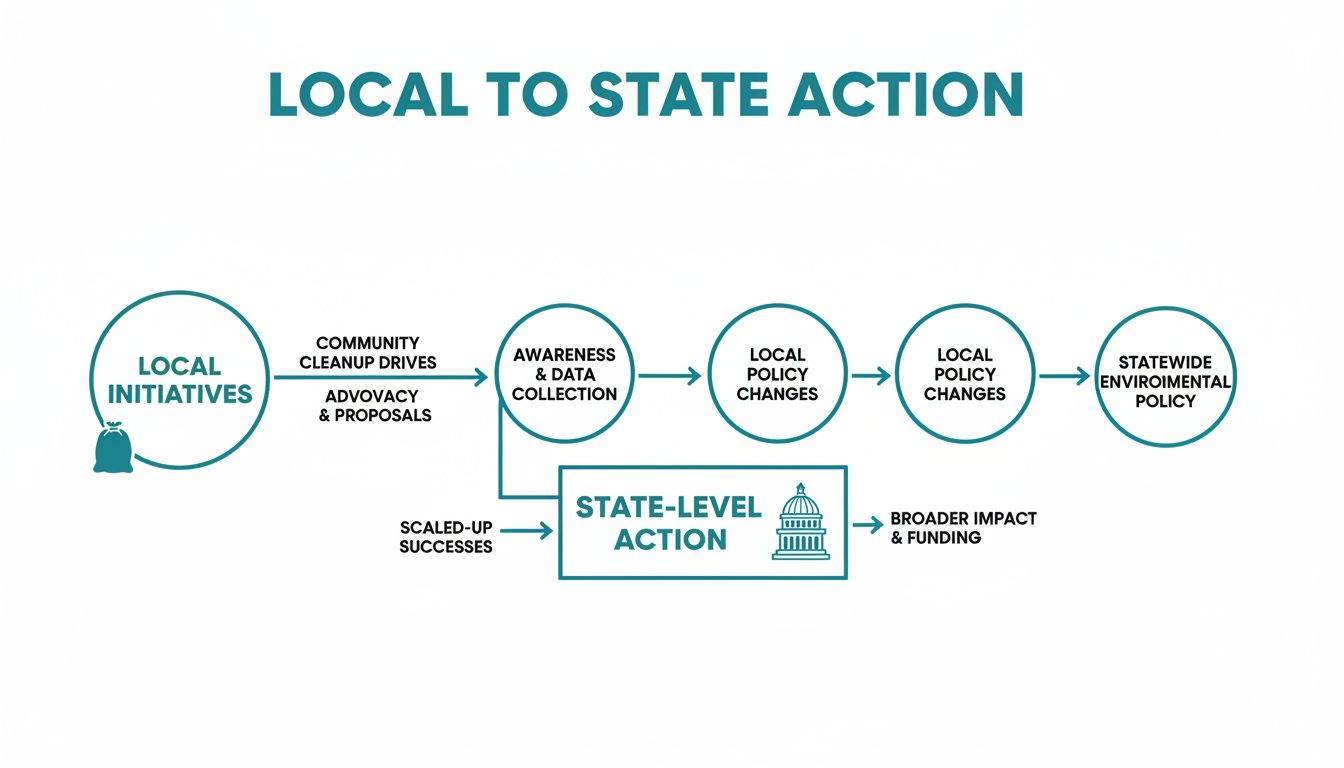
    This chart I made shows you precisely what I mean. It lays out the beautifully simple, yet profoundly powerful, path from our weekend cleanups to real, enforceable statewide policy.

    Diagram illustrating the progression from local environmental initiatives to statewide environmental policy through state-level action.

    It’s crystal clear, isn't it? Our hands-on dedication is the very fuel that powers the advocacy engine, the machine that makes long-term, lasting change an actual reality.

    Turning Local Action Into Statewide Impact

    So, how does that incredible leap actually happen? How does you plucking a single plastic bottle from a gutter in Chicago somehow influence a lawmaker deep down in Springfield? That, my friend, is the alchemy of organizing. The Illinois Environmental Council operates like a colossal megaphone, amplifying the voices of thousands upon thousands of people just like us, spread across the entire state.

    They gather all our individual, scattered efforts, bundle them into an undeniable force, and translate our raw passion into the precise, unignorable language of policy and law. It’s a partnership of breathtaking power.

    You and I focus on the tangible—the immediate, visible mess right in front of us. They, in turn, focus on dismantling the broken, corrupt system that allows our neighborhoods to become dumping grounds in the first place. If you're intrigued by the mechanics of this, you should read up on how community organizing works and discover why it’s such a potent force for change.

    Why It Matters to You

    This profound connection is exactly why your effort on a Saturday morning matters so damn much. You are not just one person cleaning one lonely block; you are a vital part of a massive, statewide movement that is fiercely demanding a better future.

    When the Illinois Environmental Council steps into the ring to fight for stronger anti-pollution laws or to champion clean energy, they are backed by the undeniable actions of people like you. Your very presence at a cleanup proves that everyday Illinoisans care deeply. It gives them the real-world stories, the human faces, they desperately need to win those brutal political battles.

    We are the "why." They are the "how." And together, we get it done.

    What Is the Illinois Environmental Council?

    So, who exactly are these people at the Illinois Environmental Council? I like to think of them as the head coach for ‘Team Illinois Environment.’ Since way back in 1975, they’ve been the indispensable, unifying force that gathers hundreds of us smaller, local groups—the scrappy underdogs—together under one massive banner.

    Just picture it for a second. Imagine all of us—the Litter Caterpillars, the local garden clubs, the passionate conservation folks—all trying to scream at the state capital at the same time. It would be a cacophony, a meaningless wall of noise. The IEC is the conductor that gathers all those individual voices, all that raw energy, and harmonizes it into a single, powerful chorus that lawmakers in Springfield simply cannot ignore.

    They are our champions on the ground, fighting tooth and nail for the laws that protect our clean air, our fresh water, and the beautiful natural spaces that are our birthright. They're the brilliant strategists and the policy wizards who transform our passion into a genuine, formidable political force.

    From Our Streets to Their Scorecard

    Here’s how I see the whole thing playing out: when you and I are out in a park on a Saturday morning, getting our hands dirty, we're doing so much more than just picking up trash. We're making a bold, public declaration about what we, as a community, truly value.

    The Illinois Environmental Council takes that declaration, that statement written in sweat and effort, and carries it directly into the halls of power where laws are born. They are the central nervous system connecting our hard work on the streets to protective, top-down policies that change everything.

    And their influence is undeniably growing. One of their most devastatingly effective tools is the annual Environmental Scorecard, a report that grades every single legislator on how they voted on more than 30 crucial environmental bills.

    The results? They speak for themselves, loud and clear. In a recent legislative session, an astonishing 50 percent of sitting State House Representatives and 45 percent of State Senators earned a perfect 100 percent score.

    That's not just a small change; it's a seismic shift. It's proof positive that our collective environmental push is translating into real, tangible legislative victories. For a group like ours, it shows that our cleanups are part of a much bigger, more intricate ecosystem of change. You can dive into the full scorecard details on their website and see exactly where your own representatives stand.

    The Power of a Unified Voice

    This is precisely why their work is so absolutely critical to what we do. While you and I focus on the visible symptom—the litter choking our streets—the IEC attacks the disease at its source. They fight for policies that slash pollution at the starting line and hold massive corporations accountable for the messes they create.

    They provide our sweat equity with a permanent, legal backbone. They ensure that the hard work we pour into our neighborhoods doesn't just evaporate, but instead builds toward lasting, statewide change that protects the very places we fight so hard to clean. It’s a perfect, powerful partnership.

    The Big Fights They Win For Us

    Illustration of a wind turbine, U.S. Capitol, policy document, leaf with water drop, and growing plant.

    So what does the Illinois Environmental Council actually do? They're out there fighting the colossal battles we couldn’t possibly wage on our own, and they do it by winning one grueling policy fight after another. This is where it gets incredibly exciting, because their work directly impacts the quality of the air you breathe and the water you drink every single day.

    Think of it this way: while we at Litter Caterpillars are on the streets treating the symptom—the endless tide of trash—the IEC is going after the disease itself. They go to the source. They work to dismantle the broken systems that allow all this pollution to pour into our lives in the first place.

    They’re fighting for a future where our cleanups become less necessary, a world where there’s simply less toxic plastic being produced and fewer poisons leaking into the soil of our neighborhoods.

    Building a Clean Energy Future

    One of their most monumental victories is a law you’ve almost certainly heard whispers of: the Climate and Equitable Jobs Act (CEJA). This wasn’t just some minor skirmish; it was a historic, knockout blow against the fossil fuel industry. It's as if they're constructing a brand-new, beautiful house for Illinois’ energy future while the old one was rotting from the inside out, filled with toxins and decay.

    This single law sets our state on a direct path to 100% clean energy by 2050. Just let that sink in for a moment. Imagine a world with no more disgusting coal plants spewing filth into our skies. It also funnels a river of money into creating green jobs, especially for people in the very neighborhoods that have borne the brunt of pollution for decades.

    This means the work you and I do to make our blocks beautiful is now backed by a statewide promise of a cleaner, healthier life for every single person. It’s a straight, unbroken line from our efforts to a more just and sustainable Illinois.

    When you or I pick up a single plastic bottle, we're showing we care about our block. When the Illinois Environmental Council passes a law like CEJA, they are ensuring the entire state gets cleaner for generations to come. It’s the ultimate one-two punch.

    From Our Bags to Their Bills

    And they don't just fight the big, glamorous energy wars. They’re tackling the exact same plastic junk we curse on our cleanups. While you and I are bagging up endless single-use bottles and chip bags, the IEC is deep in the trenches in Springfield, pushing for laws that sever the plastic problem at its root.

    Here’s a quick glimpse at a few of the major fights where they serve as our champions:

    • Protecting Our Water: They work tirelessly to ensure that every single community, from the towers of Chicago down to the riverbanks of Cairo, has access to safe, lead-free drinking water.
    • Fighting Industrial Pollution: They hold the massive corporate polluters' feet to the fire, fighting for stronger regulations on factory farms and industrial plants that threaten our land and poison our rivers.
    • Saving Natural Lands: They champion the crucial funding needed to protect and resurrect Illinois’ breathtaking prairies, forests, and wetlands.

    Every bottle you pick up, every bag you fill—it's a story. It’s a testament. The Illinois Environmental Council takes all our small, individual stories and transforms them into a mountain of powerful evidence. You can see the direct, undeniable line from a discarded coffee cup on your street all the way to a high-stakes policy debate in the statehouse. Their success is our success, magnified a thousand times over.

    Our Part in a Bigger Story of Restoration

    A person plants seedlings in a vibrant field with butterflies and wildflowers, overlooking a distant lake.

    It’s so easy to feel small, to feel insignificant. I get it. You hear that Illinois has lost nearly all of its native prairies and wetlands, and the news hits you like a physical blow, a punch to the gut. But I want to tell you a story of hope—a story that shows how we, the Litter Caterpillars, are plugged into something so much bigger, so much more profound, than just one trashed lot or one neglected neighborhood.

    This is the story of an incredible, breathtaking comeback happening right here in our state. And every single one of us has a vital part to play.

    From Small Lots to Sprawling Prairies

    Do you remember when we first laid eyes on that trashed, forgotten lot and started dreaming up Caterpillar Park? We saw a patch of derelict dirt, choked with weeds and debris, and together, we dared to imagine what it could be.

    Now, I want you to picture that same fierce energy, that same defiant vision, but magnified to a massive, landscape-altering scale. That’s precisely what’s happening at places like the Midewin National Tallgrass Prairie. These are hugely ambitious projects, audacious efforts to bring nature roaring back from the brink, proving that healing our land is not just a dream but an achievable reality when thousands of people get involved.

    The numbers can be brutal, I know. It's true that Illinois has lost a staggering 90% of its original wetlands and that less than 0.01% of its native prairie remains. But even against those devastating losses, a powerful, determined comeback is underway. Since the early 2000s, incredible partnerships between groups like the Illinois Environmental Council, state agencies, and passionate volunteers have restored or enhanced over 100,000 acres of wetlands. That is a colossal victory for our water quality and our wildlife. You can see the proof for yourself and read about these incredible conservation wins in northeastern Illinois.

    Connecting Your Work to a Statewide Comeback

    This is where it all clicks together, where the puzzle pieces snap into place. The work you do with us on a Saturday morning isn't just a drop in an endless bucket. It is a critical, indispensable piece of this statewide mosaic of recovery.

    When you spend an hour with us clearing invasive buckthorn from a small city park, you are helping a massive forest preserve hundreds of miles away breathe a little easier. When you haul old tires out of a riverbank, you are helping a downstream wetland restoration project succeed. You are a vital, active part of the recovery.

    You are directly contributing to the health and vitality of our state’s entire ecosystem. This is the very essence of what it means to practice real what is environmental stewardship: taking personal, profound responsibility for the world that surrounds us.

    Our work sends a powerful signal. It demonstrates to everyone that we believe in bringing things back to life, whether it’s a single city block or thousands of acres of sprawling prairie. You aren’t just picking up trash—you are an active, crucial player in one of the greatest environmental comeback stories our state has ever seen. And that, my friend, is a legacy to be damn proud of.

    How You Can Join the Statewide Movement

    Are you feeling that fire in your belly? You know that surge of pride you get after a cleanup, when you look back at a clean street and know you made it happen? That feeling is the beginning of something much bigger. You’re ready to move beyond our weekend meetups, and I’m going to show you exactly how to channel that energy.

    This is your personal guide to plugging our raw Litter Caterpillars energy directly into the powerhouse that is the Illinois Environmental Council (IEC). Think of it as a beautiful partnership: we bring the fearless passion and the dedicated people, and they bring the statewide megaphone. This is the mechanism by which our hard, sweaty work on the ground transforms into real, lasting change that echoes across all of Illinois.

    From Street Level to State Level

    So, how do we actually make this leap? It's far easier and more accessible than you might think. The IEC has flung open several doors for people like us, whether you have five minutes to spare or you’re ready to dive headfirst into the deep end.

    A ridiculously simple first step is to become an IEC Activist. This isn't some massive, life-altering commitment; it just means you sign up for their emails. When a critical environmental bill is teetering on the edge of a vote, they’ll send you an alert with a dead-simple way to email or call your state representative. It’s an incredibly fast, surprisingly powerful way to make your voice roar without ever leaving your house.

    You can also show up to their events. The Illinois Environmental Council hosts everything from intimate online talks about clean water to their massive, high-energy annual Environmental Lobby Day in Springfield. These are amazing opportunities to meet other people who share your fire, to learn how the system really works, and to feel the immense, collective power of this movement. It’s genuinely inspiring.

    Powering Up as a Group

    For a scrappy crew like ours, the next monumental step is becoming an official member organization. The moment we join the IEC, we’re not just the Litter Caterpillars anymore—we become part of a powerful coalition of over 100 other groups fighting the exact same fight. Suddenly, our voice gets louder, and we gain access to a level of support and resources we could only dream of on our own.

    I’m also genuinely excited about their grant opportunities. This could be our chance to secure funding for bigger, more ambitious projects—just imagine getting the money for better equipment, or even transforming more empty lots into vibrant community parks just like we did with Caterpillar Park. It’s a real, tangible possibility.

    This entire journey, from picking up a single piece of forgotten trash to shaping statewide policy, is what real, meaningful change actually looks like. It's the very core of what being an active, engaged citizen is all about. If you want to delve into the philosophy behind this powerful idea, you should check out the real meaning of civic engagement in our guide.

    Ways to Connect With the Illinois Environmental Council

    Here's a quick, no-nonsense guide on the different ways you can get involved with the IEC, from individual actions you can take right now to powerful group partnerships.

    Action What It Involves Best For
    Become an IEC Activist Signing up for email alerts on key legislation and taking quick, powerful online actions. Individuals who want to make their voice heard instantly.
    Attend an Event Participating in town halls, webinars, or the annual, high-energy Environmental Lobby Day. Anyone wanting to learn more, feel the energy, and connect with others.
    Organizational Membership Your group (like us!) joins the IEC network for advocacy support, resources, and a louder voice. Volunteer groups and non-profits seeking to amplify their impact.
    Donate Providing financial support for their critical legislative and educational work. Individuals and groups who want to invest directly in statewide policy change.

    No matter how you choose to plug in, you’re taking a massive, important step. You’re helping to forge the connection between our gritty work on the streets of Chicago and the hallowed halls of power in Springfield. Let’s do this.

    Your Questions About Working With the IEC

    You've got questions. That's a fantastic sign. It means you’re already looking past the trash bag in your hand and thinking bigger, more strategically. I absolutely love it.

    When I first heard about the Illinois Environmental Council, I had a million questions myself. To me, it sounded like some big, faceless, official organization down in Springfield. I couldn’t for the life of me see how a bunch of us who just like picking up litter could possibly fit into that world.

    It turns out, we fit in perfectly. I’ve put together some straight-up answers to the questions I get asked all the time to show you how a single weekend with the Litter Caterpillars can connect you directly to a powerful, statewide movement.

    Do I Need to Be a Policy Expert to Get Involved?

    Absolutely, unequivocally not. This is the biggest, most damaging myth I hear, and it stops so many good, passionate people from even trying. You don't need to know the first thing about how a bill becomes a law. Seriously. I don't.

    The IEC’s entire job is to wrestle with the tangled, complicated policy stuff. They have the lawyers and the lobbyists who live and breathe that world. Your job is infinitely simpler, and honestly, a thousand times more powerful: just tell your story.

    When you talk to a lawmaker, they don't want a dry lecture on legal jargon. They need to hear why keeping your local park clean matters to you, one of their actual voters who can either keep them in office or kick them out. Your passion is your expertise.

    Think of it this way: you bring the "why," and the Illinois Environmental Council provides the "how." Your voice, as a real human being living in their district, is the living proof they need to show other legislators that these aren't just abstract issues on a piece of paper—they're real issues that real people care about deeply.

    How Can a Small Group Like Ours Influence State Law?

    I asked myself this exact question when we first started. We’re just one small group cleaning up one part of Chicago. How in the world can we possibly change anything in Springfield?

    The answer is collective power. On our own, we’re a single, easily dismissed voice. But as a member of the Illinois Environmental Council, we are suddenly part of a massive coalition of over 100 other organizations. All of a sudden, we represent thousands and thousands of people all across Illinois.

    When the IEC walks into the state capitol, they don't just speak for themselves. They get to say, “I’m here speaking for the Litter Caterpillars in Chicago, and the garden club in Peoria, and the conservation group down in Carbondale.” Our voice gets amplified a hundred times over.

    It's just like a choir. One person singing a song is nice, but it’s easy to ignore. A hundred voices singing the same song in perfect harmony? That’s a force. That’s something that makes people stop in their tracks and listen. By joining together, we stop being a small, insignificant group and become part of a massive team they simply cannot brush aside.

    What's the Difference Between the IEC and the Illinois EPA?

    Fantastic question. I know it's confusing, but the difference between them is incredibly important. Here’s the analogy I always use:

    Think of it like a football game, with a team and the referees.

    • The Illinois Environmental Protection Agency (IEPA) is the government agency—they're the referees. Their job is to enforce the rules that are already on the books. They issue permits, monitor pollution levels, and make sure everyone is playing by the current environmental laws.

    • The Illinois Environmental Council (IEC) is an independent advocacy group—we’re the players and the passionate fans. We are the ones on the field, pushing to change the rules of the game for the better. We fight for new, stronger, tougher laws to protect our air, our water, and our land.

    So, the IEPA is the agency that makes sure a factory is following today’s pollution laws. But the IEC is the group that probably fought for years, even decades, to get those pollution laws passed in the first place.

    The IEPA might manage the cleanup of a toxic waste site, but the IEC is the group that likely spent a decade convincing lawmakers to create the fund that pays for it. They both work tirelessly for a healthier Illinois, just from two very different, but equally vital, angles. You can check out the IEPA’s official role and history over on their website.


    Ready to turn your passion into action and friendship? The Litter Caterpillars meet every single week. Join us for our next cleanup