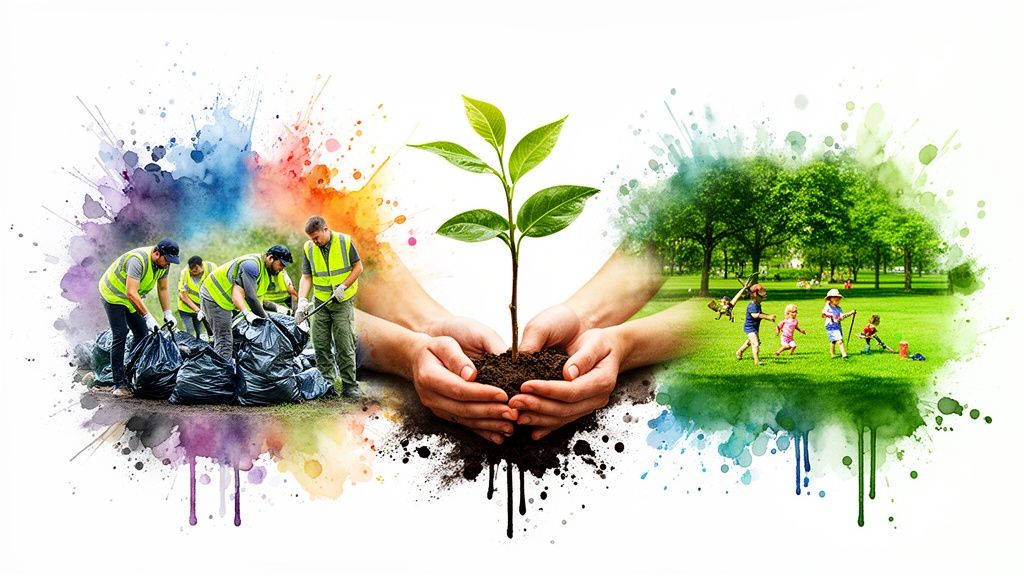
Forget the dry, academic stuff. I want to tell you what environmental justice really is. It’s a simple, ferocious idea: everyone, and I mean everyone, deserves to live in a healthy, clean place, no matter who you are, how much you make, or where you live.
It's about fairness. It’s that simple.
What Is Environmental Justice Really About?
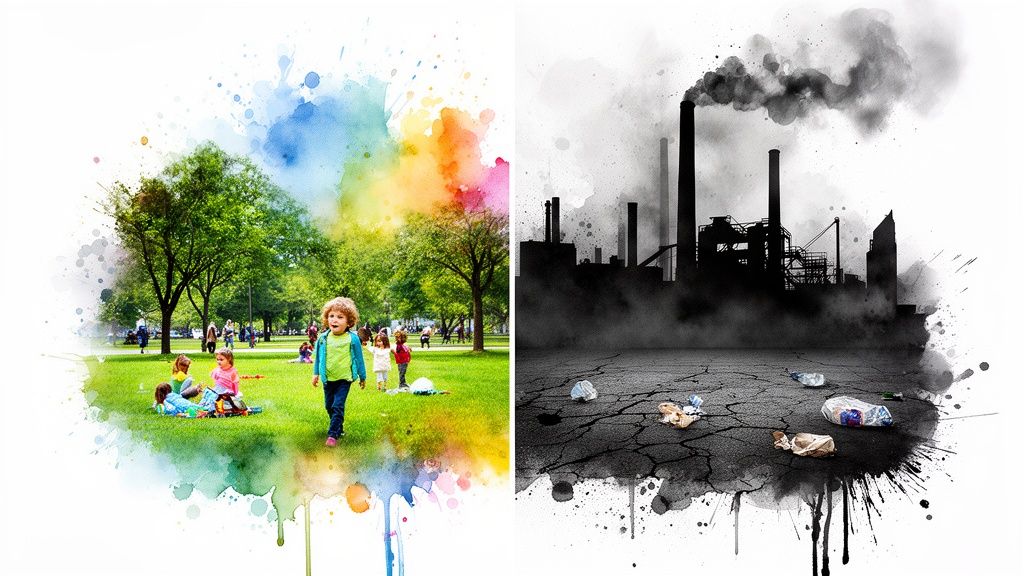
Have you ever driven across town and noticed how things just… change? In one part of town, you’ll find yourself surrounded by big, beautiful parks where kids laugh and the air feels crisp. But then, just a few miles away, the story is completely different. Maybe a factory looms over homes, spewing smoke, or the streets are littered with trash, and you wouldn't dream of letting your kids play outside.
I promise you, that's not a coincidence. That’s injustice.
Imagine your city is one giant house. For decades, all the trash, all the pollution, all the gross, unwanted stuff gets dumped into the same few rooms, over and over again. The people living in those rooms? They'd get sick. They couldn’t sleep. You’re telling them their health, their dignity, doesn’t matter. It’s fundamentally wrong.
The fight for environmental justice is you standing up and shouting, "Enough. Everyone deserves a clean room." It's about demanding basic human dignity.
The Four Pillars of This Fight
At its core, this whole battle for environmental justice comes down to a few key ideas. These aren’t just words on a page; they're the roadmap I use to fight for a fairer world, and they explain why we do what we do at Litter Caterpillars.
When you look at it this way, a huge, complicated problem suddenly becomes something you and I can actually tackle.
The Four Pillars of Environmental Justice
These core principles break down the environmental justice movement into clear, actionable ideas for building a fairer world.
| Principle | What It Means for You and Me |
|---|---|
| Distributive Justice | This is all about where we put the bad stuff. It means one neighborhood shouldn't be the designated dumping ground for landfills, polluting factories, or highways just because of the race or income of the people who live there. You spread the burden fairly. |
| Procedural Justice | You get a seat at the table. This means you have a real, powerful voice in any decision that affects your environment—from where a new plant gets built to how your local parks are taken care of. No more backroom deals. |
| Corrective Justice | This is about cleaning up old messes. If your community has been choked by pollution for decades, you deserve to have that damage undone. We clean up the old sites and make things right for the people who have suffered. |
| Recognitional Justice | This means we see you, we hear you, and we respect you. It’s about finally admitting that different people and cultures have unique connections to the environment and that your knowledge and traditions are valuable. |
These principles show you that cleaning a street isn’t just cleaning a street. It’s a bold act of justice. It’s my way of showing up and fighting for your right to a healthy, safe home.
This is what I’m all about at Litter Caterpillars. When we clean up a neglected lot or haul bags of junk off a forgotten street, we're not just picking up litter. We’re taking a stand. We're screaming, "This community matters. You matter."
It connects directly to a much bigger picture, something you can read about in my guide on what is environmental activism. This whole fight isn't some distant political game; it’s about you and me showing up for each other, right here, and making our world better one piece of trash at a time.
My Journey From Personal Mess to Public Mission
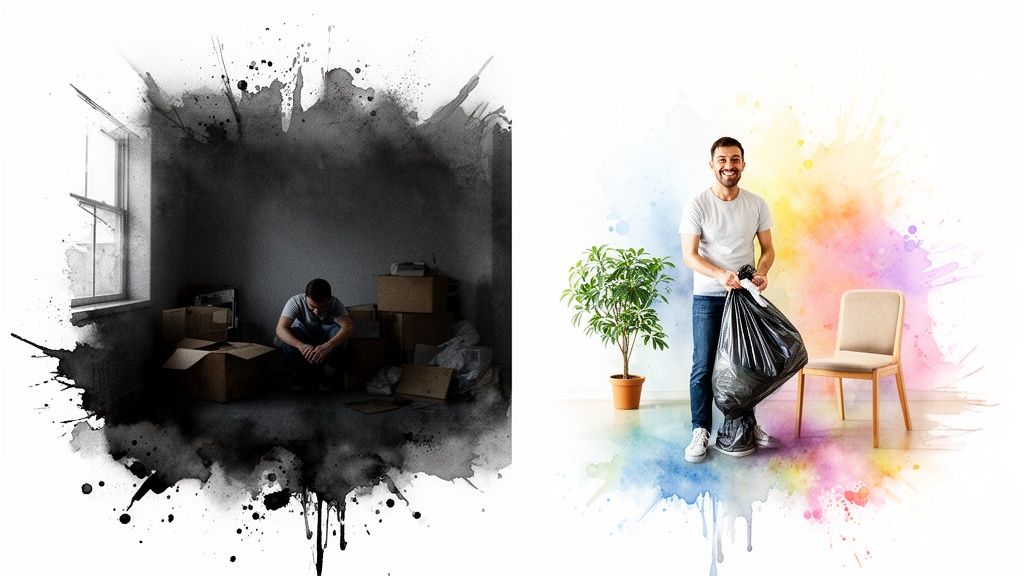
Long before I ever thought about big ideas like "environmental justice" for Chicago, I had to face the chaos in my own apartment. It was a disaster, buried under a mountain of stuff I couldn't let go of. Each old takeout box, every forgotten gadget, felt like a tiny anchor holding me down.
That clutter was a mirror for my life. A long, turbulent relationship had just ended, and my world felt just as messy, just as stuck. I knew I needed a complete reset, not just a quick fix.
I had to build a new life from the ground up, and I wanted it to be filled with kind, giving people. That meant I had to confront the things I was worst at: cleanliness, consistency, and bravery. That's the little seed from which Litter Caterpillars sprouted.
From Personal Cleanup to Public Action
My journey started with a selfish need to fix my own life. It’s strange, but cleaning up someone else’s mess felt so much easier than tackling my own. Picking up trash in a park didn't have the emotional weight of, say, finally tossing a four-year-old jar of jam from my own fridge.
Doing something for you, for others, for a whole community… it was liberating. By showing up for a neighborhood, I was also, unexpectedly, showing up for myself. I was building that consistency and bravery I so desperately needed.
The lesson hit me like a ton of bricks: Transforming your immediate world gives you the strength and vision to help transform the community around you. You find this incredible power in serving others, a power that helps you clean up your own life in the process.
This is the bridge from your own struggle to a public mission. You start by cleaning your own room, so to speak, and before you know it, you’re looking at the whole city. That’s how a simple act of tidying up can blossom into an act of environmental justice.
The Uncomfortable Truth About Environmental Injustice
This idea of environmental justice didn't just appear out of nowhere. Its story is woven into the fabric of the Civil Rights movement of the 1960s. For decades, activists on the ground just knew something was deeply wrong. By the 1980s, they started connecting the dots with data, and the picture that emerged was horrifying.
What they uncovered wasn't an accident. It was a brutal, intentional pattern.
I saw how communities of color and low-income neighborhoods were systematically chosen to be the city’s dumping grounds. The landfills nobody wanted, the toxic waste sites, the factories spewing poison into the air—they all ended up in the same kinds of places. This wasn’t bad luck. It was policy.
A Pattern Proven by Numbers
The real bombshell dropped in 1987. A groundbreaking study, "Toxic Wastes and Race," exposed the entire rotten system. It proved, with cold, hard facts, that race was the single biggest factor in deciding where a hazardous waste facility was built. It mattered more than how much money you made, the value of your home, or anything else.
And this isn't some ghost story from the past. I see it happening right now, in our own backyards. The numbers just punch you in the gut.
The disparity is shocking: today, more than half of the people living within just one mile of America's most hazardous waste sites—the ones the EPA has targeted for cleanup—are people of color.
This tells you everything you need to know. Environmental injustice isn’t a series of unfortunate events. It's a system. It's a machine built over generations that sorts people by the color of their skin and decides who gets clean air and who gets a toxic inheritance.
From History to Action
When you understand this history, it changes everything. It shows you that when we fight for a clean park or push back against a new polluting factory, we're not just talking about trees and trash. We are fighting for racial justice. We are trying to dismantle a system that has always treated certain lives as disposable.
This is where the real work begins—right here, where you and I live. When we get together to clean up a street, we are directly defying that history of neglect. To see how you can turn this anger and understanding into real power, check out my guide on what is community organizing. It’s the next logical step after you see the problem: you do something about it.
Bringing the Fight for Justice to Chicago's Backyards
Environmental injustice isn't some abstract idea you read about. It's right here, in Chicago's own neighborhoods. You and I see it every single day. It's stitched into the very fabric of our city, a place where the air you breathe can change with your zip code.
For years, people in our own communities have been fighting battles they shouldn't have to. I think about Little Village, a proud, majority-Latino neighborhood on the Southwest Side. For decades, the people there lived under the smokestacks of the Crawford and Fisk coal plants, fighting for every clean breath against a constant rain of soot that was making their families sick.
They organized, they protested, they refused to give up. And they won. But then, the fight just changed its costume.
New Battles, Old Wounds
Soon after the plants shut down, a new giant moved in—a massive warehouse for Target. This brought endless fleets of diesel trucks rumbling down their residential streets, trading one kind of poison for another. This is exactly what environmental injustice feels like when you live it. It’s a suffocating cycle of having to fight for the basic right to be safe in your own home.
Or I think about Englewood on the South Side. For years, you could look out your window there and see nothing but vacant lots and crumbling buildings. These aren't just ugly; they're open wounds, physical signs that say, "This place has been forgotten."
But these aren't just stories of struggle. They're stories of unbelievable strength. When you stand up to a polluting company or fight to turn a derelict lot into a park, you are practicing environmental justice. It’s about looking at your home and refusing to let it be a sacrifice zone.
This is the entire reason I started Litter Caterpillars. When we show up to clear a trash-filled lot in Englewood, we’re doing so much more than picking up garbage. We’re sending a message, loud and clear: this neighborhood is not forgotten. The people here deserve beauty, safety, and respect.
A Small Park, A Big Victory
I saw this power with my own eyes. A small group of us volunteers decided to bid on an empty, junk-filled lot at a city auction. We scraped together what little money we had and, honestly, against all odds, we won it. That little piece of land is now becoming Caterpillar Park—a green space for the community, built by the community.
That one small act—taking back one forgotten lot—was a direct punch against the story of neglect. It was environmental justice in action, born from my simple idea of bringing something good to a place that deserved it. Our weekly cleanups are a continuation of that same fight. We show up, week after week, with our bags and gloves to prove that every single backyard in Chicago matters to me.
How Picking Up Trash Becomes an Act of Justice
You’re probably thinking, “It’s just litter. How is picking up a potato chip bag going to fix a massive, complicated problem?” I get it. I’ve thought it too. But the line from that chip bag to real justice is deeper than you can imagine. It's everything.
Think about it with me. Which neighborhoods have the most trash blowing down the street? Where do you see dumpsters overflowing for weeks on end? It’s almost always the same communities already choked by industrial pollution and ignored for decades.
Litter is the most in-your-face symptom of systemic neglect. It’s a daily, soul-crushing reminder that someone with power decided this place, and the people in it, weren't worth the effort to keep clean. When garbage piles up, it screams a message: this community is disposable.
From Neglect To Action
So when we, the Litter Caterpillars, show up every single week—rain, shine, blizzard, or heatwave—we're screaming a different message. We are shouting from the sidewalks, "This neighborhood matters! You who live here matter!"
Our work is an act of pure defiance. It’s my direct challenge to the quiet apathy that let the mess grow in the first place.
This is the simple, powerful process we live by. We interrupt neglect and we transform it into real, tangible justice.
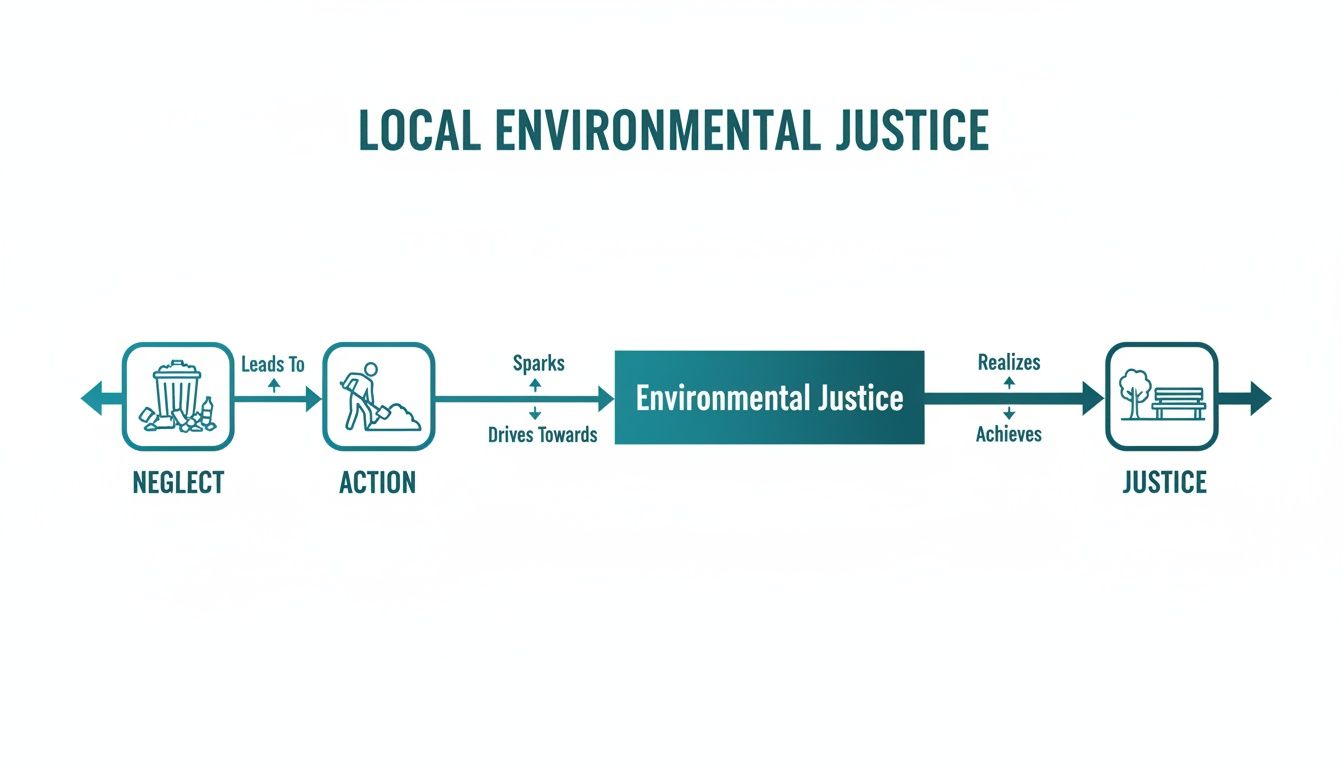
This image tells the whole story. A simple, direct action shatters the cycle of neglect. It’s the very first step toward justice and restoring a community’s spirit.
Cleaning messes someone else made is how you and I give a place its dignity back. It’s an immediate, hands-on way to fight. We’re showing up with bravery and kindness, together. Every single bag of trash we haul away is a small victory, a piece of reclaimed pride for a neighborhood that deserves it.
This is how we answer the big questions with our own two hands.
It’s a powerful statement. We are physically mending the tears in our social fabric, one fast-food container at a time. We're not just cleaning a street; we are healing a small part of our city.
And that’s the beautiful thing about this work. It isn’t some abstract idea. You can see the impact right away.
If you feel that fire and want to take this kind of direct action yourself, check out my guide on how to start a volunteer trash pickup in your own neighborhood. It always starts with one person, you, deciding to show up.
You Can Join This Movement Today
Are you feeling that fire in your gut right now? That little spark that says, “This isn’t right, and I want to do something about it”? I know that feeling intimately. It’s what started this whole crazy journey for me, and I’m personally inviting you to join us.
You don’t have to be a policy wizard or a seasoned activist to make a real, lasting difference. Real change starts small. It starts with the simplest and bravest step you can take: just show up.
Your First Step Is Showing Up
Every weekend morning, we gather to build a real community of givers. I’m not asking for your money; I’m asking for your time and your energy. We provide the gloves, the bags, the grabbers, and the great company—you just have to bring yourself.
This is how we put the big ideas of environmental justice into action. For us Chicagoans, this is personal. Our weekly cleanups across all the city's wards, from highways to the future Caterpillar Park in Englewood, are my way of fighting back. We intentionally go to the neglected spaces where low-income and minority residents live surrounded by litter-choked streets, showing you that you are seen and valued. Read more about these climate inequality findings to see how this work makes equity visible.
What to Expect at Your First Cleanup
Throw away any idea you have about volunteering being a boring chore. This is different. Your first cleanup with us is more than just picking up trash; it’s an adventure. You’ll meet people from every walk of life, all connected by a shared desire to do something good.
You’ll probably get a little sweaty, share some laughs, and feel an incredible sense of purpose. We make it fun with music, our iconic flags, and a genuine spirit of teamwork that’s hard to find anywhere else.
The real magic isn't in the trash we take away; it's in the friendships we forge and the personal strength we discover. By investing your time to transform your city, you end up transforming yourself.
This is how we fight back against the idea that some neighborhoods are disposable. We prove it wrong with our actions, our bravery in blizzards and heat waves, and our shared pride. Come find our next event, show up, and see for yourself how good it feels to be part of the solution.
Your Questions Answered
When you start digging into this stuff, questions pop up. That’s good. It means you’re paying attention. I get asked these all the time, so let me tell you what I think.
Isn't Cleaning up Litter the City's Job?
Yes. Of course it is. But have you ever noticed how some neighborhoods seem to be consistently skipped over? I see it all the time. Our work isn't about replacing city services; it's about forcing the issue.
When we show up and clean a neglected block, we're planting a flag. We're saying, "This place matters. These people matter." It's our way of taking pride back into our own hands, and it puts friendly pressure on the city to spread its resources more fairly. You and I lead by example.
I'm Just One Person. Can I Really Make a Difference?
Yes. I'm going to say it again: yes. This whole group started with me, one person, feeling totally crushed by my own mess. Now, we're a community of hundreds, changing the face of Chicago.
It’s all about momentum. One person picking up trash is a start. But 50 people showing up together, week after week, doesn't just clean a street—it transforms a neighborhood. You build a wave that's impossible to ignore. Your presence alone gives someone else the courage to join you.
You are never just one person. When you show up, you are a symbol of hope and an invitation for others to join. You are the spark.
What if I'm Not in Chicago? How Can I Help?
Environmental justice isn't just a Chicago problem, so the solution can't be just in Chicago. If you're not here with me, I challenge you: find a group doing this work in your town. And if you can't find one? Start your own.
Seriously, my model couldn't be simpler:
- Find a spot in your community that everyone else ignores.
- Grab a few friends who want to do some good.
- Start cleaning. And don't forget to have some fun with it—that part's crucial.
Post what you're doing online. Tell people your story. That positive energy is what builds a community and gives you the power to push for real change. The Litter Caterpillars spirit can and should exist everywhere.
Does This Work Actually Change Policy?
It can, and it does. I’ve learned there's almost nothing more powerful than a community that consistently shows up. When we clean a forgotten alley and I share its story, we're not just picking up junk. We're creating public proof that a problem exists, and we're putting firm, friendly pressure on officials to act.
My work has directly led to more city services in overlooked spots. I’ve seen community gardens pop up in lots that used to be filled with trash. I've seen residents find their voice and speak with confidence at local meetings. We clean with our hands, and we advocate with our voices. It’s a one-two punch for justice.
Ready to stop asking and start doing? At Litter Caterpillars, I know that service changes us and our city. Come to our next cleanup. It’s time for you to show up, make some real friends, and be the change.
Learn more and find your place with us at https://www.littercaterpillars.com.