A few years ago, I stared at a jar of blueberry jam in my fridge and couldn't throw it away. Then I walked outside, saw trash stuck in a gutter after rain, and felt the same paralysis.
Your Mess Is The City's Mess
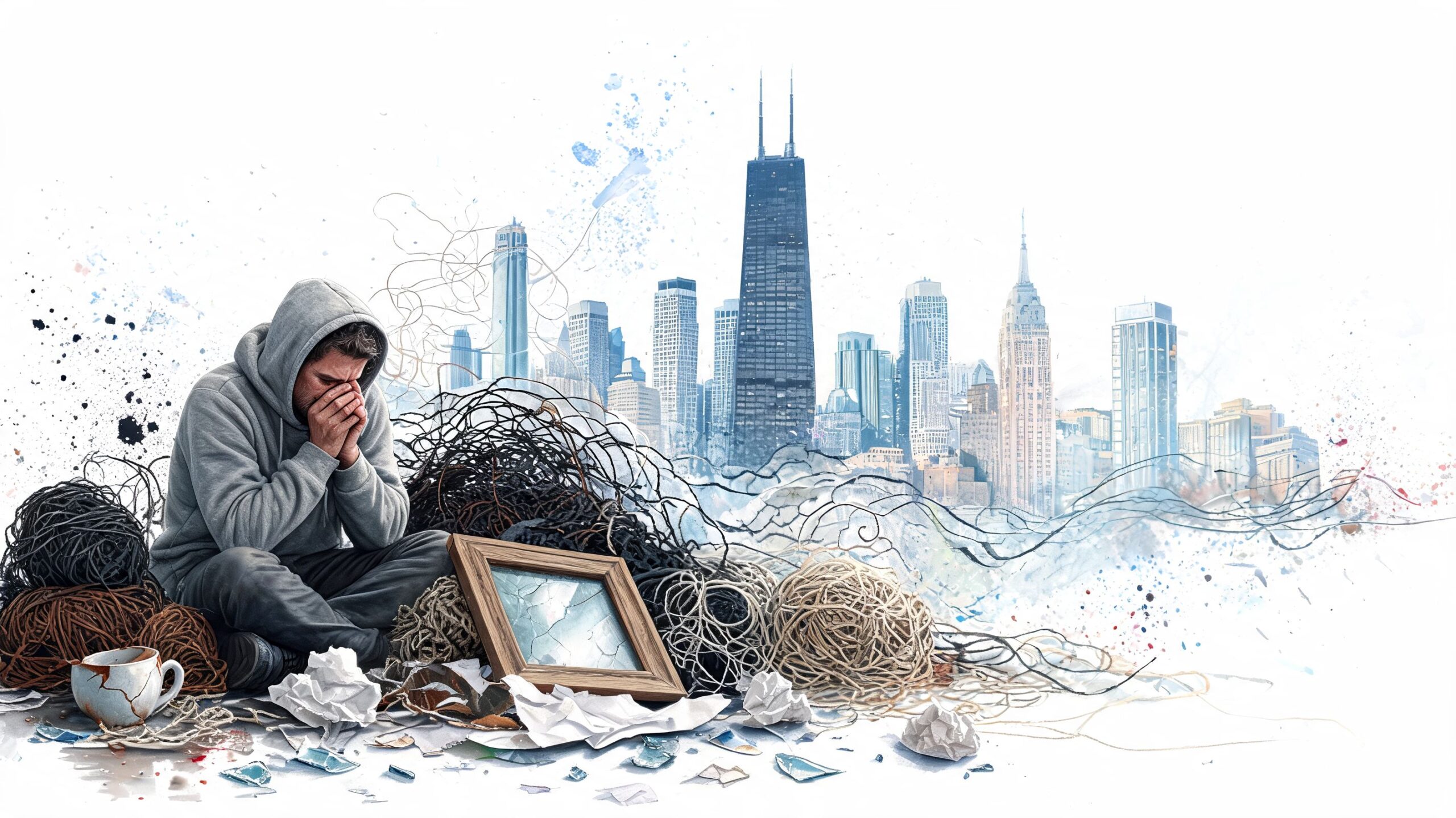
My room used to look like a stalled negotiation between who I was and who I kept pretending I'd become. Old bags of nuts from my healthy phase. Tangled cords from gadgets I swore I'd use again. Receipts, wrappers, clothes on chairs, memories disguised as junk.
I didn't just have a mess. I had a loyalty problem.
I stayed loyal to objects long after they stopped serving me. I did the same with people. I held onto bad relationships because throwing things away, whether a moldy container or a selfish person, felt violent. That sounds dramatic until you've tried to toss a four-year-old jar of jam and felt your chest tighten like you're betraying a former version of yourself.
The day I stopped separating my life from the sidewalk
After a long chaotic relationship ended, I made a simple promise to myself. I would stop building my life around avoidance. I would practice cleanliness, consistency, and bravery, even if I had to do it badly at first.
Cleaning my own space still felt heavy. Weirdly, cleaning the street didn't.
That's part of how this started. Picking up a bottle from a curb felt easier than facing the pile in my bedroom. Someone else's mess didn't carry my history. It didn't argue with me. It didn't ask me to revisit my mistakes. I could just bend down, grab it, and keep moving.
Practical rule: If your own life feels too tangled to fix, start with one corner of the world you can touch.
That rule changed me. It also changed how I see chicago environmental issues. People talk about pollution, waste, and environmental justice like they're giant policy topics floating over our heads. I don't experience them that way. I experience them as a sticky can in the grass, a blocked drain before a storm, a sidewalk that tells you nobody has cared for this block in a while.
Why bravery starts small
The first cleanup that became our origin story had only three of us. We got caught in a spring hailstorm and huddled under a tree while every Uber seemed to cancel. We were cold, annoyed, laughing, and slightly miserable.
And I remember thinking three things:
- Other people's mess is easier: I could pick up street trash faster than I could sort my own emotional junk.
- Service creates a strange kind of fun: Suffering a little with good people makes a story.
- Action beats rumination: A full trash bag quiets your mind in a way endless thinking never does.
If you live here, your city probably feels personal already. The block where you walk your dog. The alley behind your apartment. The recycling confusion in your building. If you want a practical place to start sorting that part out, I like using local guides such as Chicago recycling centers.
I started with trash because I needed a battle I could win. A lot of people do.
The Invisible Problems Air and Water
You can ignore bad air because you can't hold it in your hand. That's what makes it slippery. It slips past your attention and goes straight into your lungs.
Think of Chicago like one giant shared room. We all breathe inside it. Some people are near the open window. Some people are sleeping next to the machine that's coughing smoke.

What a bad air day really means
When people say the air feels off, they're often talking about something real, even if they don't have the language for it. The Chicago-Naperville metro area ranked 15th worst in the nation for ozone pollution, with 20.3 unhealthy ozone days per year in the American Lung Association's 2025 State of the Air report. That same report said the metro area ranked 13th worst in the nation for year-round particle pollution, and it noted a worsening from the previous year. It also said 156 million people, nearly half of Americans, live in places with unhealthy air, which puts Chicago inside a much bigger public health problem, not outside it. You can read that in the American Lung Association's Illinois release on the 2025 State of the Air report.
That matters because "bad air" isn't an aesthetic complaint. It isn't just haze over the skyline. It's the stuff your body has to process while you bike to work, wait for the bus, or crack a window at night because your apartment is too hot.
Air pollution feels democratic because the sky covers everybody. It isn't democratic in how it lands.
Air is shared. Exposure isn't.
I think about air the same way I think about roommates. If one roommate smokes in the kitchen, everyone deals with it. But the person sleeping closest to the kitchen gets the worst of it.
That's why citywide averages can fool you. They smooth out the rough edges. They turn somebody's daily burden into a bland sentence.
Here's the simple version:
| What you notice | What might be happening |
|---|---|
| Burning smell, haze, irritated throat | Ozone and particles may be high |
| Dust near heavy industry or trucking routes | Localized particulate exposure may be worse |
| Fine layer of grime on windowsills or cars | Material handling and traffic may be nearby contributors |
Our water is our shared glass
Now think about water. Lake Michigan is our giant drinking glass. Most of us don't wake up thinking about intake pipes or sewer systems. We turn the faucet and expect trust.
That trust is fragile.
Water has a complex hidden life in a city. It gets pulled, treated, pushed through old pipes, used in kitchens and bathrooms, then sent back through another buried network that is rarely seen. When rain hits hard, all that hidden infrastructure gets stress-tested at once. So does our illusion that flushing means "gone."
A lot of chicago environmental issues work like that. The problem disappears from view, then comes back in another form. Air enters your chest. Water moves through old systems. You don't need a chemistry degree to care. You just need to realize you're already inside the system.
The Problems You Can See and Feel
I can show you two blocks that feel like two different cities.
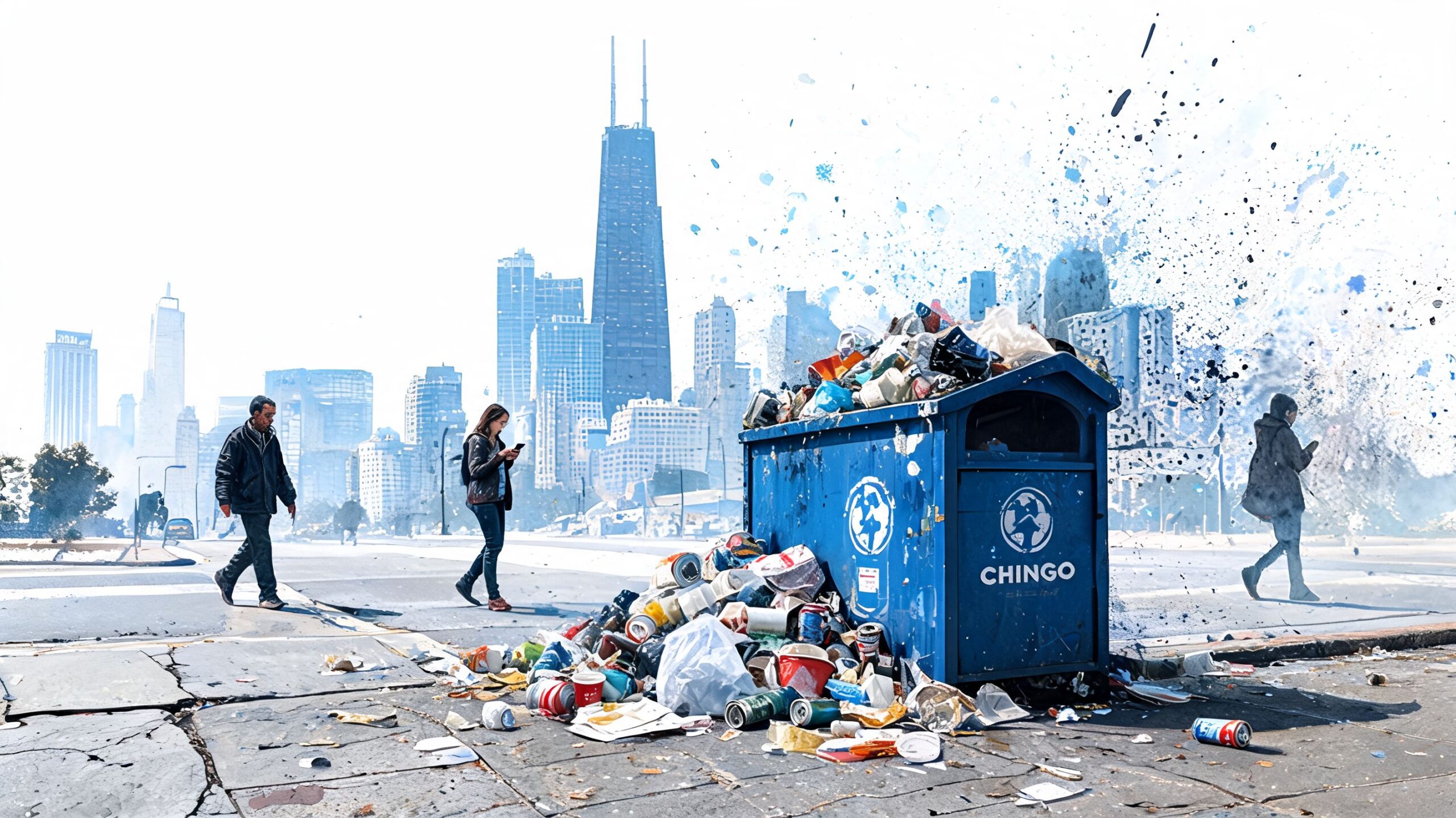
On one block, somebody swept the storefront, the bins weren't spilling over, and a tree threw enough shade to make you slow down. On the next block, a plastic bag whipped around a fence, cups sat in the gutter, and the sidewalk radiated heat back into your shins.
That's not theory. That's mood. That's blood pressure. That's whether you walk with your shoulders relaxed or tight.
What one dirty corner does to your brain
Trash multiplies socially. One cup on the ground gives the next person permission. An overflowing bin tells you the system has already given up for the week. Illegal dumping says something even harsher. It says this place is where unwanted things go.
People feel that message in their body before they put it into words.
I think that's why cleanups affect volunteers so quickly. We don't just remove objects. We interrupt a script. We tell the block, "No, this isn't where garbage belongs. People belong here."
A cleaner street changes what people expect from each other.
Heat makes neglect feel physical
Then there's the summer version of the same problem. Streets with more asphalt and fewer trees can feel punishing. You wait at a light and the heat bounces off the road, the cars, the brick, your own face.
A shaded block changes everything. It changes how long elders can sit outside. It changes whether kids run around or retreat indoors. It changes whether a walk to the store feels normal or draining.
Here are the differences I notice right away when I move from one block to another:
- Shade: Trees lower the emotional aggression of a hot day. A block without shade feels sharper.
- Surface temperature: Blacktop and concrete hold heat and throw it back at you.
- Street care: Overflowing trash and neglected lots make heat feel worse because the whole place reads as abandoned.
I don't call these small annoyances. I call them daily conditions. If you live with them long enough, they shape your habits. You go outside less. You trust your neighbors less. You stop expecting beauty from the place where you live.
That is why visible chicago environmental issues matter. You don't need a report to know when a block feels hostile. Your legs, lungs, eyes, and patience already know.
Where The Burden Falls Hardest
Some neighborhoods carry the city's dirtier bargain.
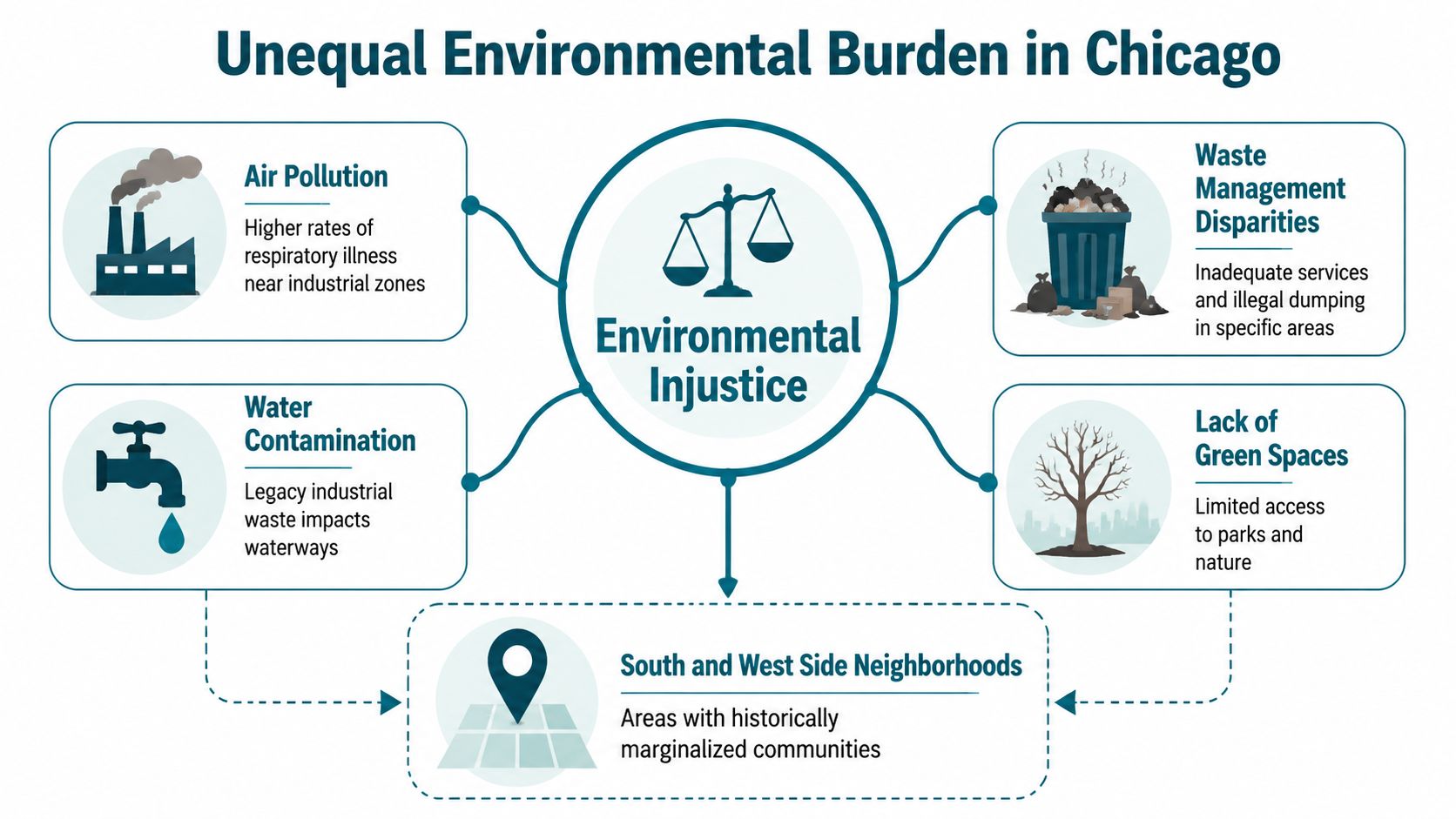
If you want honesty about chicago environmental issues, you have to stop pretending the burden lands evenly. It doesn't. The city has areas where pollution is a topic, and areas where pollution is a routine neighbor.
What the map tells you
A 2025 factsheet on limited pollution exposure found that Latine Chicagoans are 30% of the citywide population but 37% of the people living in areas with the highest overall pollution exposure. The same report said estimated PM2.5 levels across Chicago range from about 9 to 12 μg/m3, which is above the 2024 U.S. EPA long-term public health standard of 9 μg/m3. You can read that in the CMAP limited pollution exposure factsheet.
That isn't abstract to me. It means some families live in the part of the shared room where the air is worse, more often, for longer. It means "city average" can hide a street-level truth.
The Southeast Side problem
The Southeast Side hits hard because it's not one cleanly isolated source. It's a multi-source industrial exposure zone. Steel production, metal recycling, petroleum handling, and petcoke storage can all add to particulate and metals burdens in the air. EPA notes tied to the area say petroleum coke in southeast Chicago has generated fugitive dust complaints, actions have been taken against petroleum handlers along the Calumet River, and high airborne metals, especially manganese, have been identified there.
That complexity matters. If several operations can produce overlapping dust and metals, then finger-pointing gets easy and solving the problem gets harder.
I view it this way:
- If you measure citywide averages only, you can miss the block that is taking the hit.
- If sources overlap, one company can shrug and say the dust came from somewhere else.
- If monitoring is too coarse, residents keep living with uncertainty while officials debate attribution.
The practical answer is local. Dust suppression. Enclosed conveyance. Paved and cleaned haul roads. Real-time monitoring near active bulk-material handling sites. That kind of targeted work fits the problem better than broad city averages.
Justice has to be local or it isn't real
I don't use the phrase environmental justice because it sounds polished. I use it because when one part of the city breathes more grime, drinks through older riskier systems, and gets less day-to-day relief, the issue is moral before it is technical.
If you want a clearer grounding in that idea, I like this plain-language explainer on what environmental justice means.
Below is a simple way to think about unequal burden across neighborhoods:
| Burden on the ground | What residents may face |
|---|---|
| Nearby industrial emissions and dust | More daily concern about breathing and outdoor activity |
| Older infrastructure and neglected basics | More stress around water, housing, and health |
| Less tree cover and fewer buffers | Hotter blocks and fewer places to recover outside |
| Illegal dumping and weaker upkeep | Constant signals that care arrives late, if at all |
When people say "the environment," I think that's too vague. I think about who gets the dirty truck route, who gets the dust, who gets the hotter block, who gets told to wait.
The City's Promises Versus Reality
The city has plans. Cities always have plans.
The harder question is whether a parent on the South Side or West Side can feel those plans in daily life. Can they drink from the tap without worrying about old pipes? Can they open a window without bringing in the smell of industrial activity? Can they see a pace that matches the urgency?
Budget lines don't clean a sink by themselves
Recent reporting noted that Chicago has made larger investments, including a nearly $200 million FY2022 climate and environmental justice budget, while many households on the South and West Sides still face burdens tied to lead-contaminated drinking water pipes and concentrated industrial pollution. That same reporting frames the issue well. Progress is uneven, and the practical question is whether money is closing gaps fast enough where people need relief most. You can read that in this look at Chicago's environmental justice battles, impacts, and solutions.
I don't say that to sneer at public spending. Budgets matter. Plans matter. But if a block still lives with the old problem, then the plan hasn't finished the job.
Reality check: A promise feels real only when a resident can point to a changed pipe, cleaner air, cooler street, or cleaner lot.
The pace problem
Disillusionment sets in, leading to burnout. They hear that money has been allocated. They hear that a department has a strategy. They hear language about justice and investment. Then they go outside and the same basics still feel stuck.
The system has habits that make delay look normal:
- Slow rules: Agencies move at government speed, even when residents live at body speed.
- Competing priorities: The neighborhood with the loudest political protection often gets faster attention.
- Patchwork fixes: One grant, one pilot, one announcement. Meanwhile daily life keeps arriving every morning.
I don't need every city effort to fail before I criticize the gap. I just need to compare the promise to the pace. If a household still deals with old lead service lines and concentrated pollution after years of speeches, the criticism writes itself.
What I listen for now
When officials talk, I try to translate their language into street language.
| Official language | Street translation |
|---|---|
| Investment | Did anything get fixed on the block |
| Equity | Did the hardest-hit area move first |
| Environmental justice | Did the burden actually get lighter |
| Climate plan | Can people feel the change in summer, at the tap, or in the air |
That may sound blunt. Good. Blunt is useful when people have waited too long.
Finding Your People and Your Power
I don't think people need more guilt. I think they need a crew.
When my life felt scrambled, I did not improve because somebody won an argument online about systems. I improved because I started showing up outdoors with other people and doing one useful thing with my hands.
The first cleanup that changed me
Our first real cleanup felt ridiculous. Three people. Cold weather snapping at our fingers. Hail coming down. We hid under a tree and watched ride requests vanish. It was inconvenient and kind of funny.
That day taught me that service gives you structure when your inner life doesn't have much. Pick up. Bag it. Tie it. Move forward. Repeat.
And something else happened. Friendship got simpler. You don't need perfect small talk when you're dragging soaked trash bags together in bad weather. Shared effort breaks the ice faster than cleverness ever will.
What people can actually do
A lot of environmental talk stays stuck at the level of opinion. I care more about motion.
If you're serious, your options look more like this:
- Join a cleanup group: A local volunteer group such as Litter Caterpillars organizes regular trash pickups in Chicago, which gives people a direct way to work on visible waste problems with others.
- Adopt a block habit: Bring a bag on your walk. Clear one stretch over and over until your body knows the route.
- Pay attention to hotspots: The Southeast Side industrial corridor has overlapping sources tied to airborne metals like manganese and particulate dust from petcoke piles, which means local solutions have to match local conditions rather than rely on citywide averages, as described by Chicago CHEC's overview of issues in Chicago.
- Stay human: If you recruit friends, make it social. Food after. Coffee after. A group photo. People return when the work has warmth.
You don't need to feel pure before you start serving. You start serving, and some of the mess inside you begins to loosen.
Why community action changes the person doing it
We talk a lot about fixing neighborhoods. I care about that. I also care about what happens to the volunteer.
Service teaches a stubborn kind of self-respect. You say you'll wake up on a weekend morning and go. Then you go. You endure weather. You do something mildly uncomfortable on purpose. That pattern spills into the rest of your life.
I've seen people arrive unsure, shy, scattered, hungover from a bad month, and leave steadier. Not healed forever. Just steadier. Sometimes that's enough to start.
Our values came out of that reality. Bravery because fear and discomfort are part of growth. Kindness because nobody sticks around in a cold moralizing club. Unity because service is easier to sustain when people laugh together.
I care about policy. I care about monitoring and budgets and all the hard public stuff. But if you ask me where power starts, I won't point first to a document. I'll point to a few people on a sidewalk doing the job in front of them.
Take Your First Brave Step
You do not have to solve Chicago.
You probably shouldn't try. That's one fast way to get overwhelmed and stay home.
Start smaller. Start with a bag, gloves, one morning, one corner. Start with the piece of trash that annoys you every time you pass it. Start with the block you secretly wish felt different. Start with one act that turns you from spectator into participant.
A first move that is small enough to do
If you want your first step to be concrete, use a rule like this:
- Pick one recurring place you already pass.
- Bring one simple tool such as a bag or grabber.
- Work for a short window so you build consistency instead of drama.
- Come back again before your brain can turn it into a grand impossible mission.
That pattern matters. It teaches your body that care is a habit, not a mood.
Why this changes more than the street
The strange gift of environmental service is that it cleans two places at once. You clear a sidewalk, and something in you clears too. Shame gets a little quieter. Isolation loosens. You start trusting yourself because you did what you said you'd do.
If water and air feel too large, begin with what your hands can reach. If you want an outdoor version of that first brave step, one option is joining efforts that clean up rivers and nearby public spaces.
I think a lot of people are hungry for a more honorable weekend. Less scrolling. Less hiding. More sun, more movement, more usefulness, more people who mean well.
You don't become brave by waiting to feel ready. You become brave by doing one slightly uncomfortable good thing, then doing another.
If you want that kind of weekend, take a look at Litter Caterpillars. It's a simple way to meet people, pick up trash, and practice the kind of service that can change a block and steady a life.