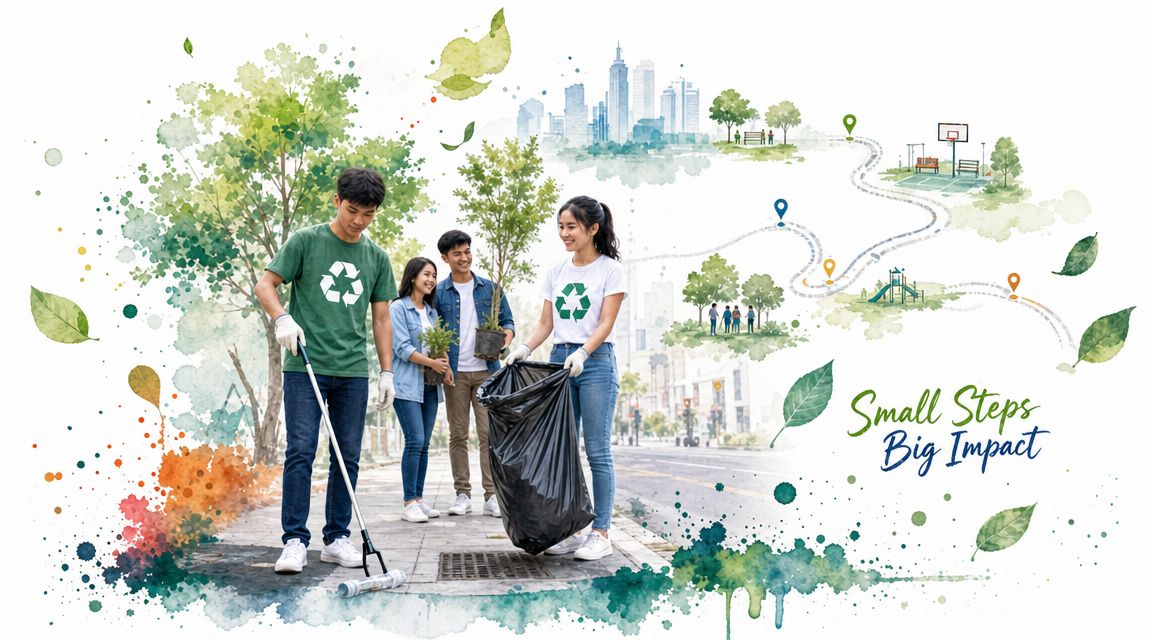
The first time I went out to pick up trash, there were three of us, cold hands, cheap gloves, and sky that looked like trouble. Then Chicago threw hail at us, every Uber canceled, and I remember thinking, weirdly, that this was the most alive I'd felt in a long time.
That's where a green city project can begin. Not with a grant. Not with a board meeting. With one ugly corner, one honest reason, and one day when you decide you're tired of walking past the mess.
Finding Your 'Why' Behind the Project
I didn't start outside because I had my life together. I started outside because I didn't.
My apartment was a museum of stalled decisions. Old jars in the fridge. Half-used bags of food from failed health kicks. Random objects with sentimental stories attached to them like little anchors. Any normal piece of trash weighed almost nothing, but to me it felt like it weighed a truckload. I could see the mess. I hated the mess. I still couldn't move it.
Then one relationship in my life blew up in the way bad relationships do. Chaos, selfishness, too much noise, too little honesty. After that, I made a promise to myself. I'd build a life around cleanliness, consistency, and bravery, even if I had to do it in a crooked, awkward way at first.
So I tried something sideways. If I couldn't clean my own mess, maybe I could clean up someone else's.

Start with the pain you can feel
That first reason matters more than people think. If your reason is thin, your project dies the first time it rains. If your reason is personal, you'll keep going when it gets annoying, lonely, or embarrassing.
Maybe your why is simple:
- Your block embarrasses you: You're tired of guests stepping around fast-food wrappers.
- Your kid noticed the litter: That kind of comment gets under your skin.
- You need better friends: You want to meet people who wake up to give, not just to consume.
- You need a reset: Service is sometimes the fastest way to stop obsessing over yourself.
A lot of people wait for a polished mission statement. I think that's backward. Your first why can be rough. It can be selfish in the healthiest sense. You want to feel stronger. You want to trust yourself again. Good. Use that.
Practical rule: Don't start by asking, “What citywide plan should I create?” Start by asking, “What corner am I willing to care about every week?”
Big institutions usually think about green cities from high above. The term itself has often been used in large benchmark projects. The Siemens Green City Index summary evaluated over 120 cities worldwide, and the North American edition rated 27 cities across the U.S. and Canada using indicators like CO2 emissions, water, waste, transport, and energy use.
That kind of work is useful. It helps cities compare real systems instead of just slapping a green label on themselves.
Your small start is an advantage
But you and I don't need to begin at that altitude.
You can begin with a bus stop full of cups. An alley behind your building. A vacant lot everyone has given up on. Large systems matter, but local courage matters too. You can move faster than a committee because your project has a heartbeat.
If you need a push because you're still circling the idea, look at this guide on how to find volunteer work that actually fits your life. Don't overthink your identity before you act. Action is what reveals identity.
I've learned that a good green city project doesn't begin when you feel ready. It begins when your discomfort finally gets a direction.
From Idea to Your First Cleanup
Our first cleanup was half joke, half dare, half spiritual experiment. Yes, that's three halves. That's what it felt like.
There were only three of us. We picked a spot, showed up, and then got hit by a freak spring hailstorm. We hid under a tree, shaking, laughing, checking our phones while ride after ride disappeared. It was miserable in the way a camping trip can be miserable. You're wet, your plans are broken, and later it becomes the only story anyone wants to hear.
That day taught me something useful. You don't need an elegant launch. You need a start.
Pick a target you can finish
Your first cleanup should be almost embarrassingly manageable. Don't announce a mission to transform your entire city. Pick one place where success is visible.
I like spots with a clear border:
- A single block
- One park edge
- One alley
- A bus stop corridor
- A lot line near a fence
When you finish a defined area, people feel the win in their body. They can see before and after without needing a chart.
The logic here matches how bigger planning methods often work. The Cambodian Green City Strategic Planning Methodology starts by defining goals and priority actions before trying to tackle everything at once. That's not city-hall-only advice. That's street-level advice too.
Use the ugly simple plan
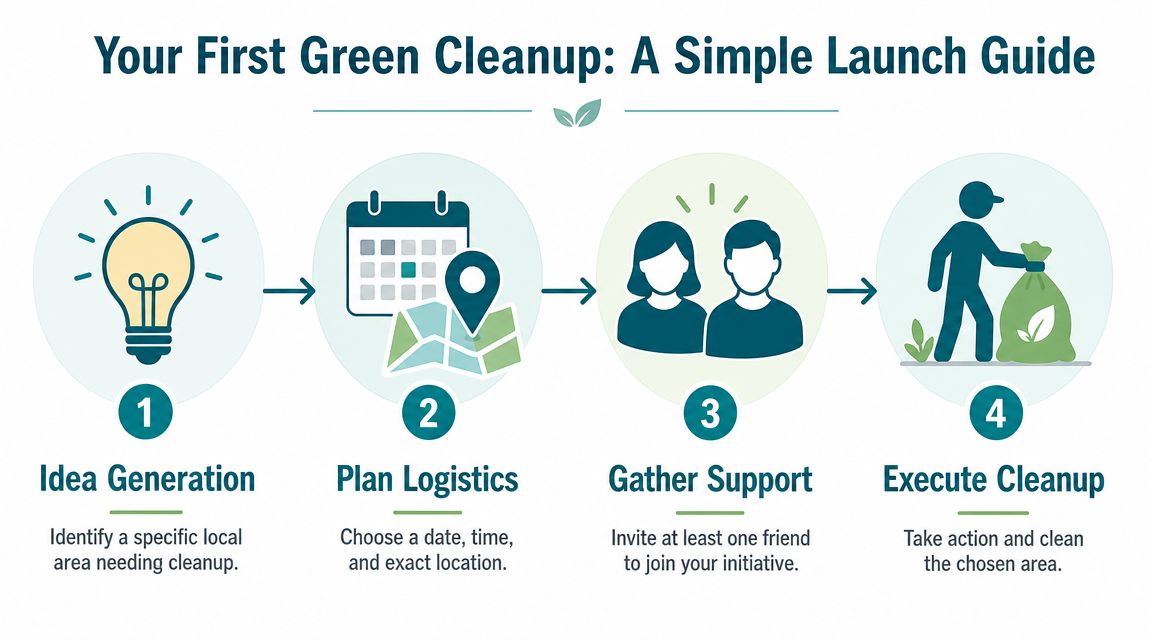
You can launch your first cleanup inside a week if you do this:
- Choose the place: Walk it first. Make sure you know where people can meet.
- Set a date: Weekend mornings work well because people show up fresh and less distracted.
- Invite one friend: One reliable person beats ten vague maybes.
- Bring basic gear: Gloves, trash bags, hand sanitizer, water.
- Decide your finish line: One hour, ninety minutes, or “until this block is clear.”
That's enough.
I've seen people spend more time designing a logo than choosing a corner. Don't do that. A green city project lives or dies on repeated action, not on branding at the start.
If you can put a date on a calendar and a pin on a map, you're already farther along than most people with “big ideas.”
Make the first event easy to join
Your invitation should sound like a human wrote it.
Try something like this:
| What to say | Why it works |
|---|---|
| “I'm cleaning this block Saturday morning. Want to join?” | It's direct and casual. |
| “No experience needed. I'll bring supplies.” | It removes friction. |
| “We're only out for an hour.” | It respects people's time. |
| “Come even if you're shy.” | It gives nervous people permission. |
You don't need to impress people. You need to lower the emotional cost of showing up.
If you want a model for organizing a first event in a simple, public way, look at a live example of a volunteer trash pickup listing. Notice what matters. Date. place. expectation. That's the skeleton.
Let the first cleanup be a little imperfect
Rain might come. Someone might cancel. You might bring the wrong gloves or forget water or realize the lot is nastier than you thought.
Good.
Your first event should leave you with three things:
- A visible result
- A story
- A reason to do it again
The hailstorm gave us all three. It was cold and ridiculous, but it proved the idea had teeth. If people are willing to freeze a little and still laugh, then you've found something stronger than convenience.
Building Your Crew and Keeping Them Safe
A cleanup group is only as healthy as the people inside it. If volunteers feel unsafe, confused, or used, they won't come back. If they feel protected and welcomed, they bring their friends.
I learned early that I had to treat volunteer energy like a flame in high wind. It can light a whole block. It can also go out fast.
Safety first means real scouting
Before I ask anyone to join me at a site, I try to walk it myself. I'm looking for the obvious stuff and the annoying stuff.
Here's what I check:
- Traffic risk: Fast corners, blind turns, bad shoulders, aggressive merging.
- Ground risk: Broken glass, needles, metal, deep mud, unstable surfaces.
- Weather exposure: Not just rain, but heat, wind, icy patches, and poor shade.
- Exit options: Where can people stop, rest, or leave if something goes wrong?
Formal green city planning often uses broad criteria like water, waste, transport, climate impacts, and disaster frequency. The Global Green Growth Institute guidelines frame green city work through systems and local risk awareness. At our scale, I translate that into one basic rule. Know the environment you're bringing people into.
That means you don't just ask, “Is there trash there?” You ask, “Can I bring people here and keep them safe?”
Protect people before you try to inspire them
I keep my volunteer-first philosophy simple.
| Priority | What it means on the ground |
|---|---|
| Safety | I won't run a cleanup in conditions that feel reckless. |
| Happiness | I want people to leave lighter than they arrived. |
| Dignity | I don't pressure volunteers for money or guilt them into more. |
Many groups inadvertently burn out the very people they depend on. They ask too much, communicate poorly, and act like sacrifice is endless. It isn't.
If you're building your own crew, read through these volunteer management best practices. Even if your group is tiny, habits form early.
Build a crew, not a roster
A list of names isn't a community. A community is what happens when people remember each other's stories.
I like weekend mornings for a reason. The people who come out then are usually ready to give something of themselves. That creates a different kind of group chemistry. Less flaky. Less performative. More grounded.
Ways to turn strangers into teammates:
- Use a group chat: It keeps momentum between events.
- Learn names fast: Nothing warms a group quicker.
- Give people jobs: One person hands out gloves. One tracks bags. One watches traffic.
- End with a small ritual: Coffee, snacks, a group photo, even a goofy cheer.
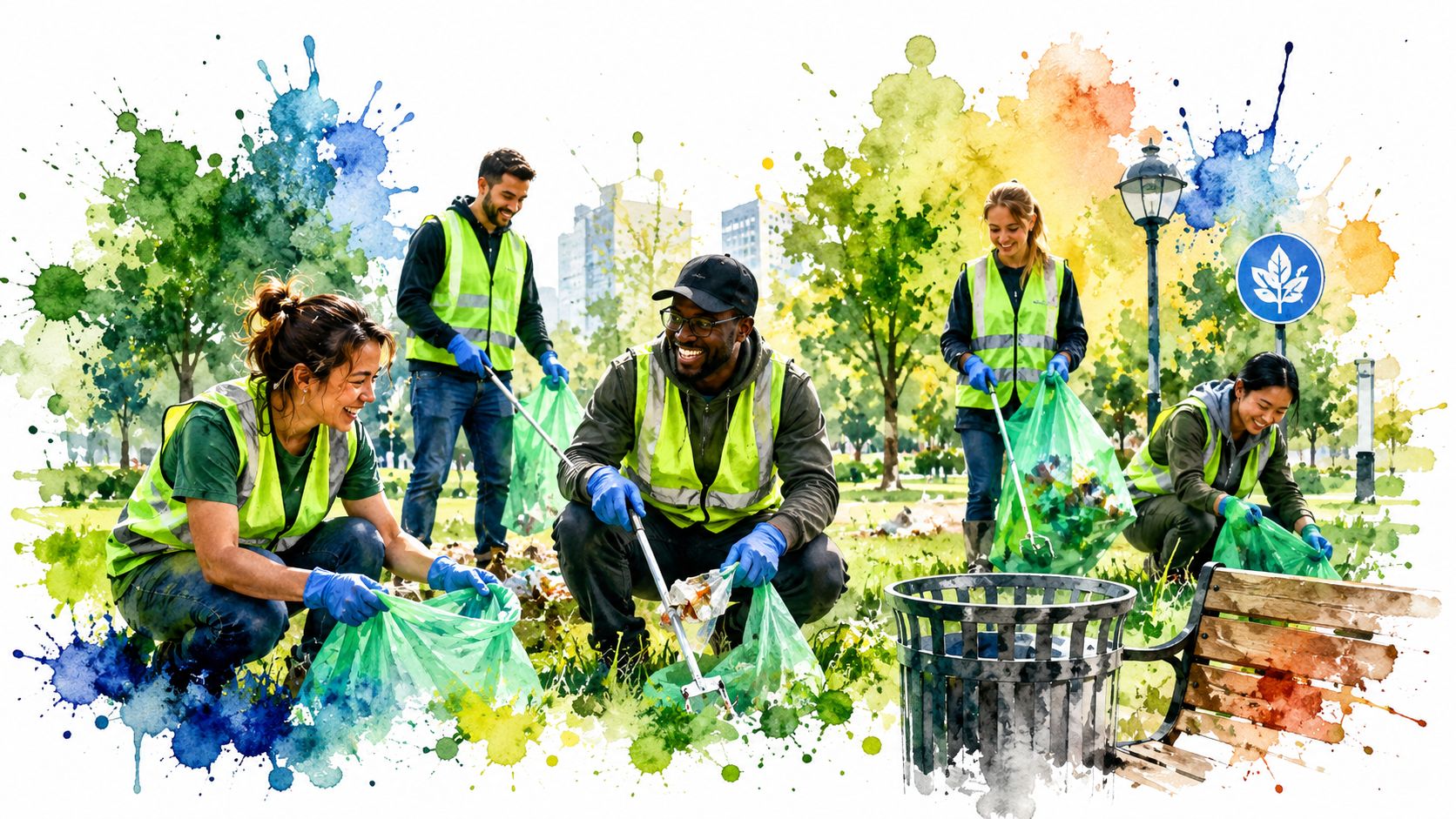
Here's a look at the kind of spirit that helps a crew stick together over time.
Field note: People return when the work feels meaningful and the atmosphere feels safe. They don't return because your signup form was impressive.
You also need to be honest about your limits. If a site feels sketchy, skip it or redesign the event. If the weather is nasty in a dangerous way, cancel. Bravery is real. So is common sense.
I'd rather have a group that lasts than one dramatic day that scares everyone off.
Creating an Identity People Are Proud Of
Trash pickup can feel like punishment if you frame it badly. That's why identity matters.
I think about Tom Sawyer and the fence all the time. He turned boring labor into something people wanted to join. I'm not interested in tricking anybody, but I am interested in the same human truth. People want to belong to something that feels honorable, brave, and alive.
Give the work a flag
Most volunteer groups stop at logistics. Date, time, supplies, done. That gets bodies to a site, but it doesn't always build pride.
Pride is useful when it's tied to service.
A strong green city project has cultural signals. Maybe that's a flag. Maybe it's a phrase you repeat. Maybe it's a shared playlist on the drive home. In our case, flags, badges, and a theme song helped turn “I picked up trash once” into “I'm part of something.”
That sounds small until the work gets hard. Identity is what gets people out of bed when novelty has worn off.
Use symbols honestly
You don't need to fake intensity. You just need to make goodness feel bold.
Try a few things:
- A name people can wear proudly: It should feel alive in conversation.
- A simple visual marker: Pins, patches, stickers, gloves in one color.
- A repeatable ritual: Group photo, chant, snack stop, post-cleanup walk.
- Language with backbone: Words like bravery, kindness, unity, grit.
Sports teams do this. Countries do this. Clubs do this. Human beings like banners. We like songs. We like the feeling that our effort belongs to a story bigger than one Saturday morning.
A broom in your hand feels different when you think, “I'm helping out,” versus “This is who I am.”
Make service feel like a privilege
At this point, a lot of leaders get squeamish. They worry that making volunteer work feel special somehow cheapens it.
I think the opposite is true.
If your group treats cleanup like a sad obligation, people will feel that. If your group treats service like a proud act of courage, people rise to it. They stand taller. They invite friends. They wear the shirt.
You don't need hype. You need meaning that people can feel in their chest.
And the best part is that identity doesn't cost much. A handwritten sign, a shared joke, a song on someone's phone, a nickname for your regulars. Those things create glue. Once your group has glue, the work stops feeling like random labor and starts feeling like a mission people chose with open eyes.
Expanding Your Impact Beyond Trash Pickup
At some point, the cleanup ends and you keep staring at the space.
That's when your project starts changing shape.
I've felt that shift on blocks where we came back again and again. At first you notice the litter. Then you notice the busted fence, the dead corner, the empty lot, the way everybody walks past like the place is already lost. If you keep showing up, your eyes change. You stop asking, “How do we clean this?” and start asking, “What could this become?”
Consistency earns bigger chances
We grew by doing the unglamorous thing over and over. Weekly cleanups. Rain. Heat. Bitter cold. The city started to feel less like a set of separate neighborhoods and more like one giant body with sore spots.
Then odd opportunities appeared.
A bigger event needed cleanup help along a major route. We said yes. Later, an empty lot became more than an eyesore in our minds. It became a possible future park. That kind of leap sounds huge when you say it fast, but it doesn't feel huge when it grows out of regular work. It feels like the next honest step.
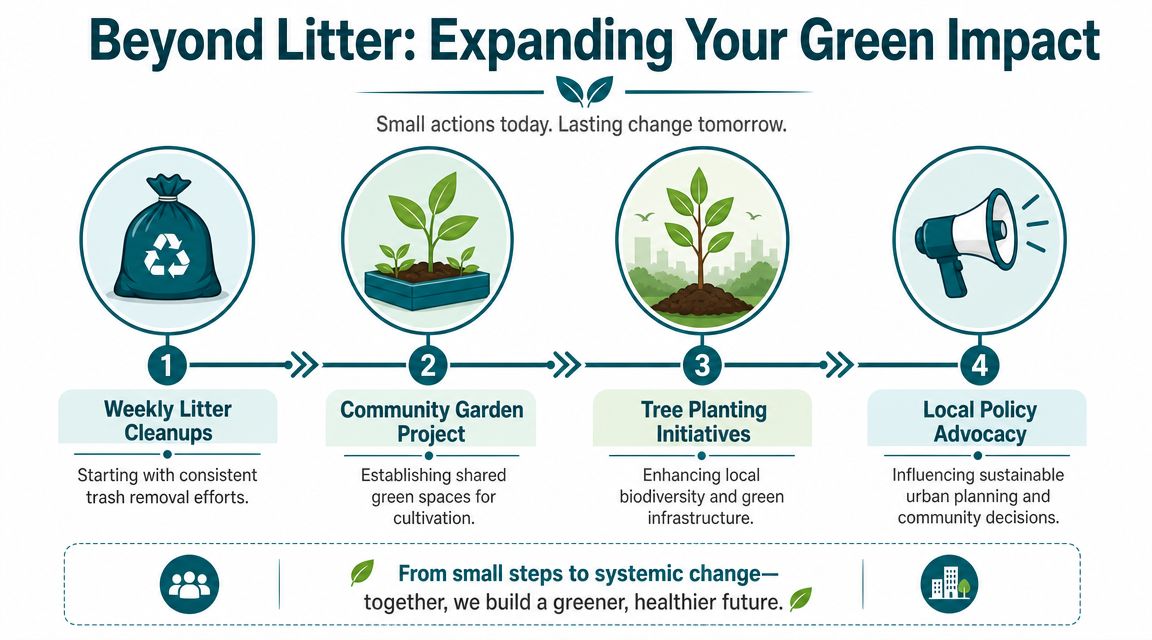
Think in layers, not in leaps
A local green city project often grows best in this order:
| Layer | What it looks like |
|---|---|
| Cleanup | Repeated litter removal in one area |
| Stewardship | Returning, monitoring, reporting, caring |
| Transformation | Planting, beautifying, repairing, reusing land |
| Partnership | Working with neighbors, businesses, event organizers, or city staff |
People get stuck because they jump from “one cleanup” to “citywide movement” in their head. That gap is too wide. Layers are easier.
One lot. Then repeated care. Then a small physical improvement. Then a larger ask.
Ask for the next thing, not the final thing
When you approach a partner, don't pitch a fantasy. Pitch the next visible step.
That might mean:
- Borrowing tools
- Getting permission to access a site
- Finding a place for bag disposal
- Asking a nearby business for water or storage
- Raising support for one specific lot improvement
Many projects often drift into vague mission language. I try to avoid that. Many green initiatives have big ideals but weak outcome reporting. The current Green City Project site leaves a real opening for clearer, tangible results, and that's the lesson I take from it. If you want people to believe in you, show them a changed place they can point to.
One solid lot transformed beats a thousand dreamy sentences about change.
That's how you expand without getting fake. You let the ground itself make the argument.
If you want examples of different cleanup formats, neighborhood actions, and recurring volunteer work, Litter Caterpillars is one group that organizes public trash pickup events in Chicago through open signups and recurring meetups. That kind of repeated public action is one workable model. It isn't the only model, but it shows how consistency can build enough trust for bigger projects later.
Measuring What Matters and Sustaining Momentum
People love asking for one clean metric. How many bags? How many pounds? How many blocks? I understand the urge. Numbers feel solid.
But if you run a green city project long enough, you learn that one metric can lie to you.
A rough site can produce lots of trash one week and less the next. A smaller cleanup can be harder and more useful than a big easy one. A volunteer who comes once and then changes their whole weekend routine has experienced a real victory, even if your spreadsheet barely notices.
Don't worship a single score
Project success is slippery because local conditions change everything. Culture changes it. Money changes it. Weather changes it. Capacity changes it. One commentary on project outcomes says it is almost impossible to measure success accurately with a single global metric because local conditions shape results so heavily. The same piece points to a smart-sustainable-cities report where 60% of surveyed initiatives focused on planning, while 25% emphasized Smart Living and 21% Smart Environment, and it also notes bottlenecks like interoperability, mixed data sources, and low capacity to connect data to analytical models in implementation work, as discussed in this project success commentary.
That lands with me because I've seen groups become obsessed with planning and image while the ground stays dirty.
Track what keeps the project alive
I care about a different set of questions.
- Did we show up again?
- Did people feel safe?
- Did anyone make a friend?
- Did someone become braver because they came?
- Did we leave the place better than we found it?
Those aren't soft questions to me. They are survival questions.
The project lasts when it gives people energy back. If every cleanup drains your crew, the calendar will eventually go blank.
You can still keep simple records. Attendance notes. Photos. Repeated locations. Specific site changes. Those things help. But don't confuse easy-to-count with most important.
Momentum comes from rhythm
Burnout usually doesn't arrive with a trumpet. It creeps in subtly. One skipped week. Then two. Then the group chat gets stale. Then the project becomes a memory everyone still “cares about.”
Rhythm fights that.
A few ways I protect momentum:
- Keep the schedule predictable. Same general time pattern beats constant rescheduling.
- Make the events finite. Leave people wanting a little more.
- Let people rest without shame. Guilt is a bad fuel source.
- Celebrate tiny wins. Clean curb line. New regular. A volunteer who smiled all morning.
The true measure of a green city project is whether it keeps changing both the place and the people. If the street gets cleaner while your volunteers get steadier, kinder, and more connected, that's success I can trust.
If you want a real-world place to plug in, Litter Caterpillars runs volunteer-driven Chicago cleanups built around bravery, kindness, unity, and a volunteer-first approach. Join an event, meet good people, and start building your own version of a green city project one block at a time.