
I once had a fridge full of old memories. A four-year-old jar of blueberry jam from a trip. A bag of nuts from a failed health kick. Each item felt like it weighed 500 pounds. I couldn't move them.
Then I learned something weird. Cleaning up somebody else's mess is easier than cleaning your own. A bottle on the curb has no backstory. You grab it, drop it in a bag, and keep walking. If you're hunting for environmental volunteer opportunities, you might think this is about saving the planet. I think it can also help you save yourself.
1. Litter Caterpillars
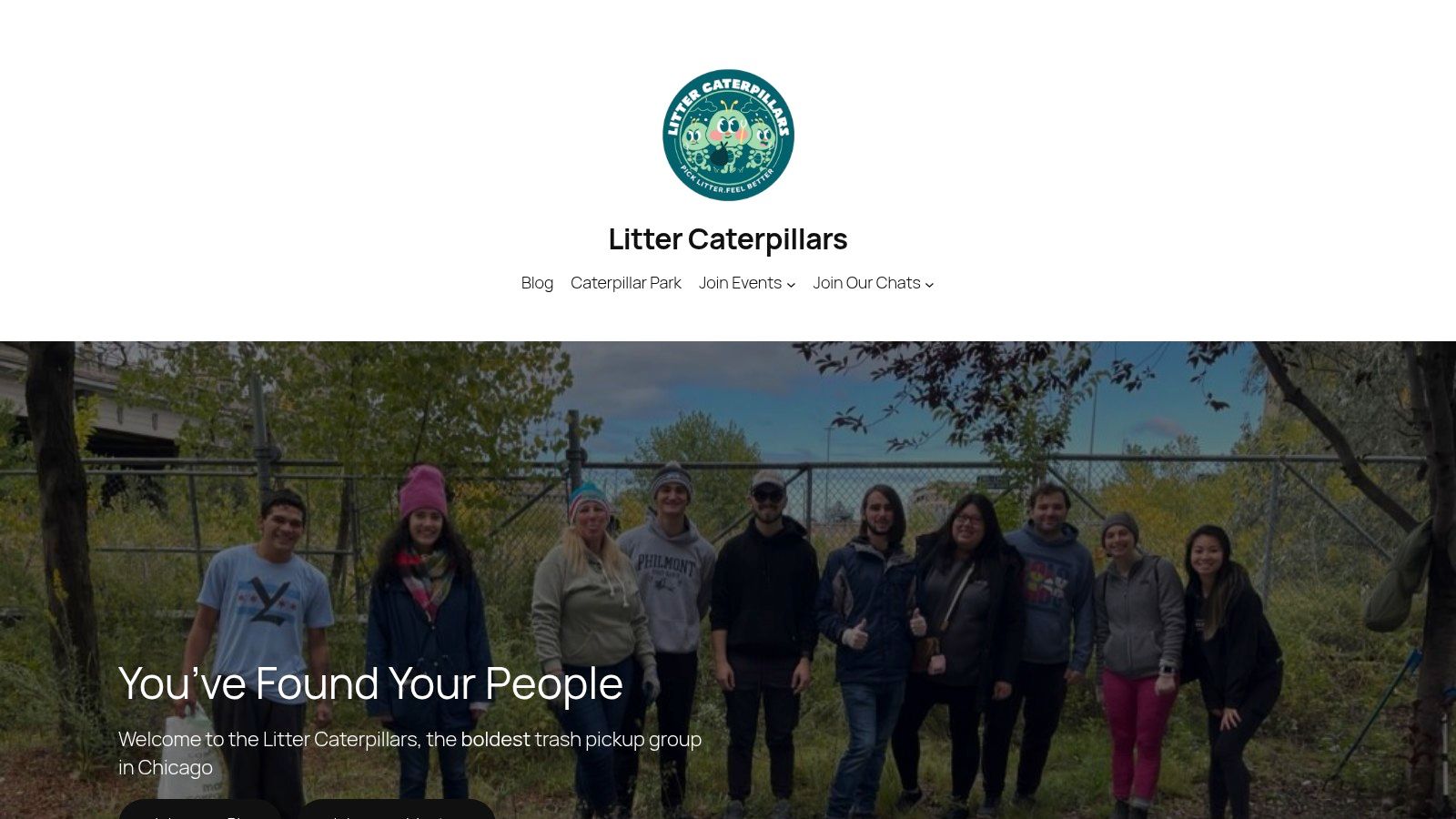
A friend once told me the hardest trash to pick up is the stuff with your name on it. Old boxes in the hallway. Clothes in the chair. The drawer you avoid opening. Kevin Tao, who started Litter Caterpillars, ran into that same wall. Cleaning his own mess felt heavy. Cleaning a sidewalk felt possible. He grabbed a bag, picked up what was in front of him, and built a habit out of that simple act.
That origin story matters to me because it gets at something a lot of environmental volunteer opportunities miss. Sometimes you show up for the park or the block, and end up finding your nerve. You prove to yourself that you can face ugliness, do something about it, and leave a place better than you found it. That changes people.
Litter Caterpillars has the feel of a real crew, not a nameless shift on a weekend calendar. You see it in the small stuff. Flags. Badges. A theme song. Group chats that make it easier to return the next week instead of talking yourself out of it. If you've ever arrived at a volunteer event alone and spent the first twenty minutes pretending to check your phone, you know why that matters.
Why this one sticks with people
The group meets weekly, and that rhythm does something powerful. One cleanup can give you a good morning. Repeating it can give you a new identity. You stop being someone who keeps meaning to help and become someone who shows up.
I also respect the way the group treats volunteers. Safety comes first. Volunteer happiness comes second. There's no constant push to donate, no feeling that your body is useful only if your wallet follows. That sounds basic. It isn't.
Picking up litter with other people can break a kind of paralysis. Your hands keep moving, your brain gets quieter, and the day opens up.
The work is physical and visible. You walk, bend, lift, sort, and watch a block change in real time. By the end of a cleanup, you don't need a report to tell you whether your effort mattered. You can see the empty sidewalk, the cleared grass, the bags lined up at the curb.
Best fit and tradeoffs
- Best for brave beginners: A strong choice if you want environmental volunteer opportunities that feel social, active, and a little uncomfortable in the right way.
- Best for building courage through repetition: Weekly meetups help you turn good intentions into a practice.
- Best for finding community fast: The rituals and shared identity help solo volunteers stop feeling like outsiders.
- Best for seeing more of Chicago: Cleanups pull you beyond your usual route and into neighborhoods you might never know otherwise.
There is a tradeoff. This work asks something from your body, and the weather does not always cooperate. If you want indoor volunteering with predictable comfort, choose something else. If you want a grassroots group where service feels personal, a little gritty, and surprisingly life-giving, Litter Caterpillars stands out.
2. Alliance for the Great Lakes Adopt-a-Beach
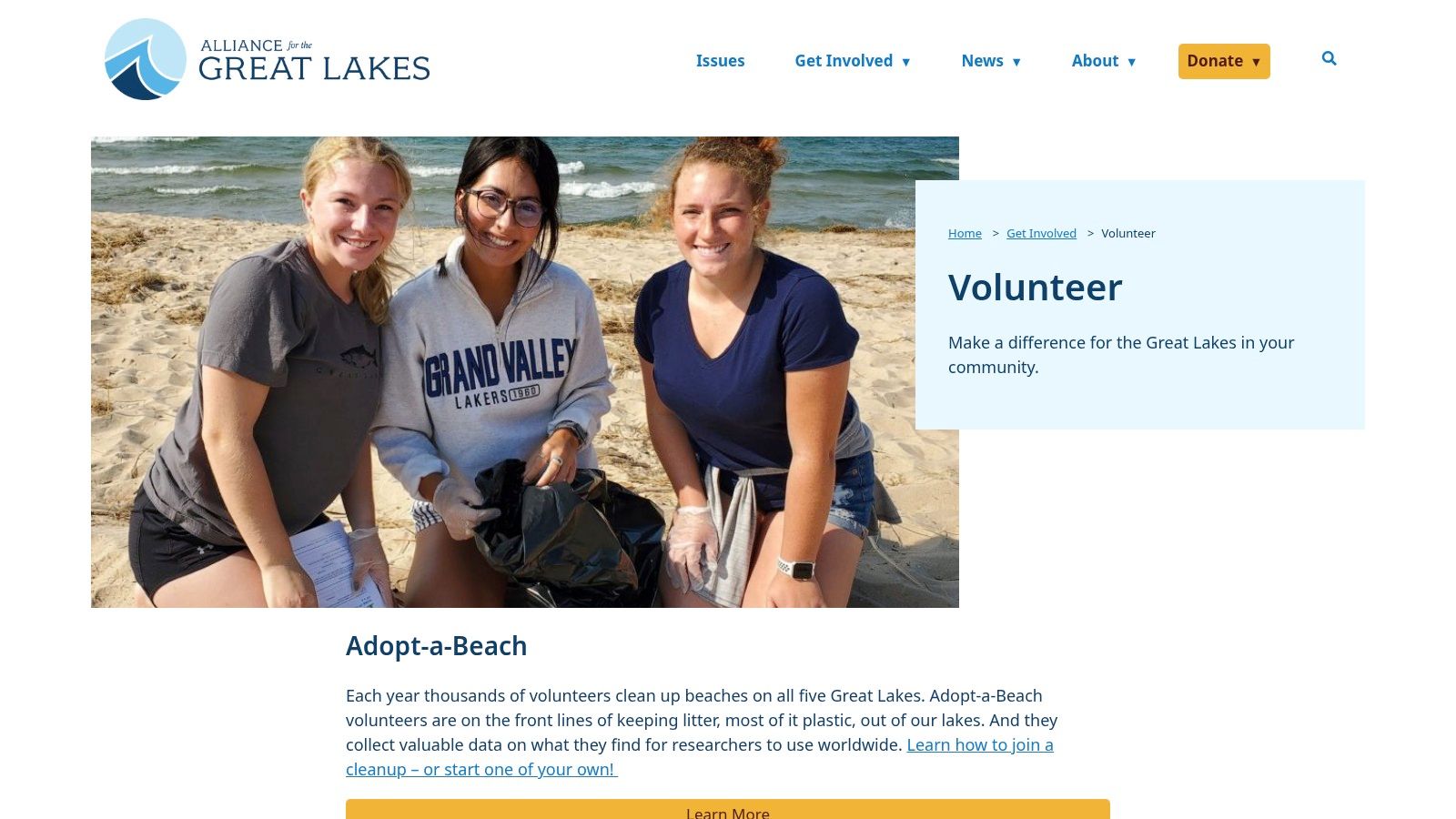
The first time you pick litter out of sand, you notice something fast. Beach trash is sneaky. It hides in seaweed, under driftwood, in that thin line where the water leaves things behind. You stop strolling and start scanning.
That's why I like Alliance for the Great Lakes Adopt-a-Beach. It gives you a clean entry point into environmental volunteer opportunities, but it doesn't stop at “grab bag, fill bag, go home.” Volunteers can also collect litter data, which gives the work a sharper edge.
What you actually do
You can join scheduled cleanups, sign up to lead one, or move into an ambassador role that leans more into public education. That mix matters. Some people want pure hands-on work. Some want to talk with neighbors and explain why the mess keeps coming back.
There's also a practical lesson here. Cleanup programs often work best when they pair removal with measurement and prevention, not just a one-off trash sweep. That's one reason this model feels solid to me.
Practical rule: If you get energized by both action and evidence, choose a program that tracks what volunteers collect.
A lot of environmental volunteer opportunities still bury the details people need. Is it one-time or recurring? Do you need training? Is it family-friendly? Programs like this make that matching process easier, which is exactly the kind of gap many volunteer seekers run into, as noted by The Nature Conservancy's volunteer guidance.
Best fit and tradeoffs
- Best for first-timers: Beach cleanups feel intuitive. You don't need much background to start.
- Best for families and teams: The work is easy to understand and the setting is inviting.
- Best for people who like structure: The data side gives the day more purpose.
The downside is seasonality. Lakefront volunteering depends on weather, and popular events can fill up fast.
3. Friends of the Chicago River Chicago River Day and Stewardship Workdays
A river cleanup has a different mood from a sidewalk cleanup. The mess feels older. Tangled. Like the place has been carrying human neglect for a long time and is tired of it.
That's why Friends of the Chicago River volunteer events pull people in. Chicago River Day gives you that big shared push, while the recurring stewardship workdays let you come back and do slower, steadier work. Trash removal, invasive control, native planting, trail care. It's all there.
Why it works for people who need momentum
Some of us need a flagship event on the calendar. We need a date, a crowd, a reason to commit. Then, once we've broken the seal, we can keep going. This group gets that. The big day draws you in. The follow-up work keeps you attached.
I also like that the tasks vary. If you get bored doing the same thing every time, this helps. One day you're hauling litter. Another day you're working near native plants and learning the shape of the river system by touching the river system itself.
Best fit and tradeoffs
- Best for group energy: If you want a strong community feel, the citywide event is a good on-ramp.
- Best for repeat volunteers: Stewardship days make it easy to return.
- Best for people who learn by doing: You pick up local ecological knowledge without sitting through a lecture.
The catch is that some tasks are more physical than people expect. River-edge work can mean uneven ground, tools, mud, and early registration.
4. Shedd Aquarium Action Days
Some people want a low-friction first step. They don't want to decode ten pages of instructions. They want a date, a location, and a clear task. I get it. When motivation is fragile, friction kills it.
Shedd Aquarium volunteer programs are strong for that reason. Action Days take volunteers into the community for cleanups and habitat work around Chicago, while deeper in-building roles exist for people who want a more serious ongoing commitment.
Two paths, two very different experiences
The outside Action Days are the easy door. Good for students, groups, and anybody who wants short-term service hours without overthinking it. You show up, do the work, and leave with that clean-body, clear-head feeling that outdoor service gives you.
The in-aquarium roles are another animal. Those have application windows and more commitment, but they also open up a wider set of experiences. Neutral institutional programs often divide volunteer work into specific modules like aquarium care, trail maintenance, gardening, office support, tours, and outreach, as seen in the Smithsonian Environmental Research Center volunteer program. Shedd fits that more structured model.
Some people need spontaneity. Some need a role. If you know which one you are, you'll choose better.
Best fit and tradeoffs
- Best for cautious starters: Action Days are simple and approachable.
- Best for students: Short-term events work well if your schedule shifts a lot.
- Best for growth-minded volunteers: You can start outside and aim for a deeper role later.
The tradeoff is access. The in-building roles run on set windows, and competition can be real.
5. Openlands TreeKeepers and TreePlanters Grants
Picking up trash gives you a fast win. Caring for trees gives you a longer relationship.
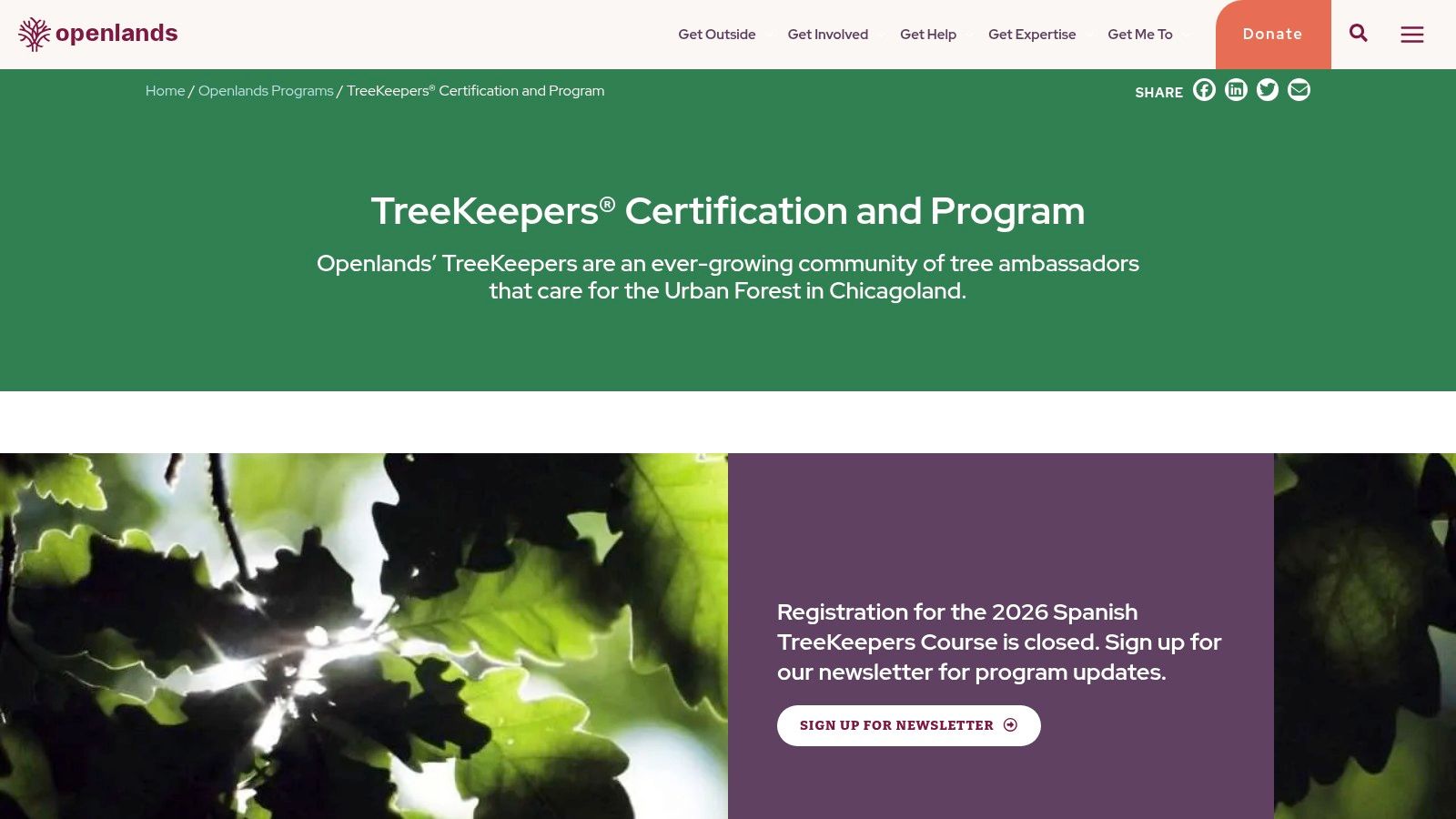
That's why Openlands TreeKeepers and TreePlanters hit a different nerve. This isn't just “come help for a morning.” This is “learn enough to take care of your own block better.” I love volunteer work that leaves you more capable than when you arrived.
The skill-building option
TreeKeepers trains residents to care for street and park trees. TreePlanters Grants help neighborhoods organize planting days with coaching and support. That means you're not just joining an event. You're learning how to become useful in a durable way.
Environmental volunteer opportunities have widened far beyond simple cleanup work. Public programs now include trail clearing, wildlife surveys, water assessments, beach cleanups, education support, and stewardship agreements, as shown by the New York State Department of Environmental Conservation volunteer page. Openlands fits that broader skills-based style. You leave with knowledge, not just sore legs.
Best fit and tradeoffs
- Best for neighborhood builders: If you care about your exact street, this is a strong match.
- Best for people who like training: Certification gives the work shape.
- Best for future leaders: Organizing tree days forces you to talk to neighbors and take initiative.
The downside is that scheduled courses can feel less spontaneous than a simple cleanup. If you're craving instant action this weekend, this may feel slower. If you want roots, that slowness is the point.
6. Friends of the Forest Preserves Restoration Workdays
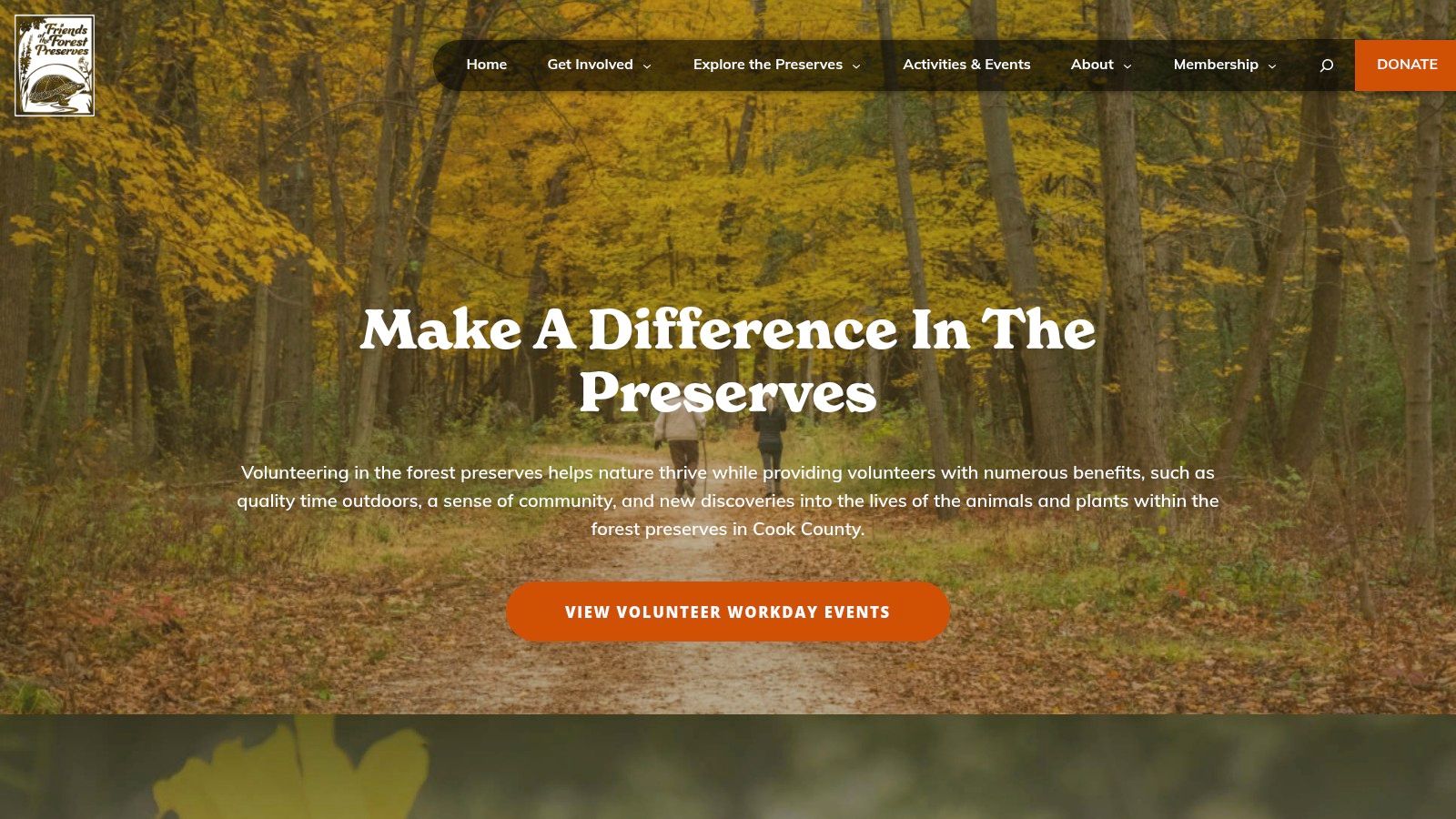
Forest preserve workdays are for people who don't mind getting dirty in a less glamorous way. This isn't the cinematic beach cleanup. This is brush, mud, seeds, tools, and the strange satisfaction of pulling out what shouldn't be there so something better can grow.
That's what I like about Friends of the Forest Preserves volunteer workdays. The work is concrete. Invasive removal, seed collecting, trail work, litter cleanup. You start to see restoration as active repair, not vague good intentions.
What you learn with your hands
If you've ever wondered what environmental restoration means on the ground, this guide to environmental restoration helps put language to what volunteers do in places like these.
And there's a bigger reason to take this kind of role seriously in your own life. Many environmental programs now rely on specialized task design, training, registration, and role-based scheduling instead of generic signup pages. That's because tasks like habitat work, invasive removal, and data collection ask different things from different bodies and skill levels. You can see that pattern in many institutional volunteer programs, and it tends to make recurring service easier to sustain.
I've found that hard manual work in a preserve clears my head faster than almost anything on a screen.
Best fit and tradeoffs
- Best for outdoorsy volunteers: If you'd rather be in prairie, woodland, or wetland than on a city sidewalk, go here.
- Best for repeat learning: Returning to the same site lets you notice change over time.
- Best for people who want depth: You start seeing ecology as a set of relationships, not scenery.
The drawback is terrain and weather. Natural areas don't smooth themselves out for your convenience.
7. Chicago Parks Foundation It's Your Park Day and Hosted Park Cleanups
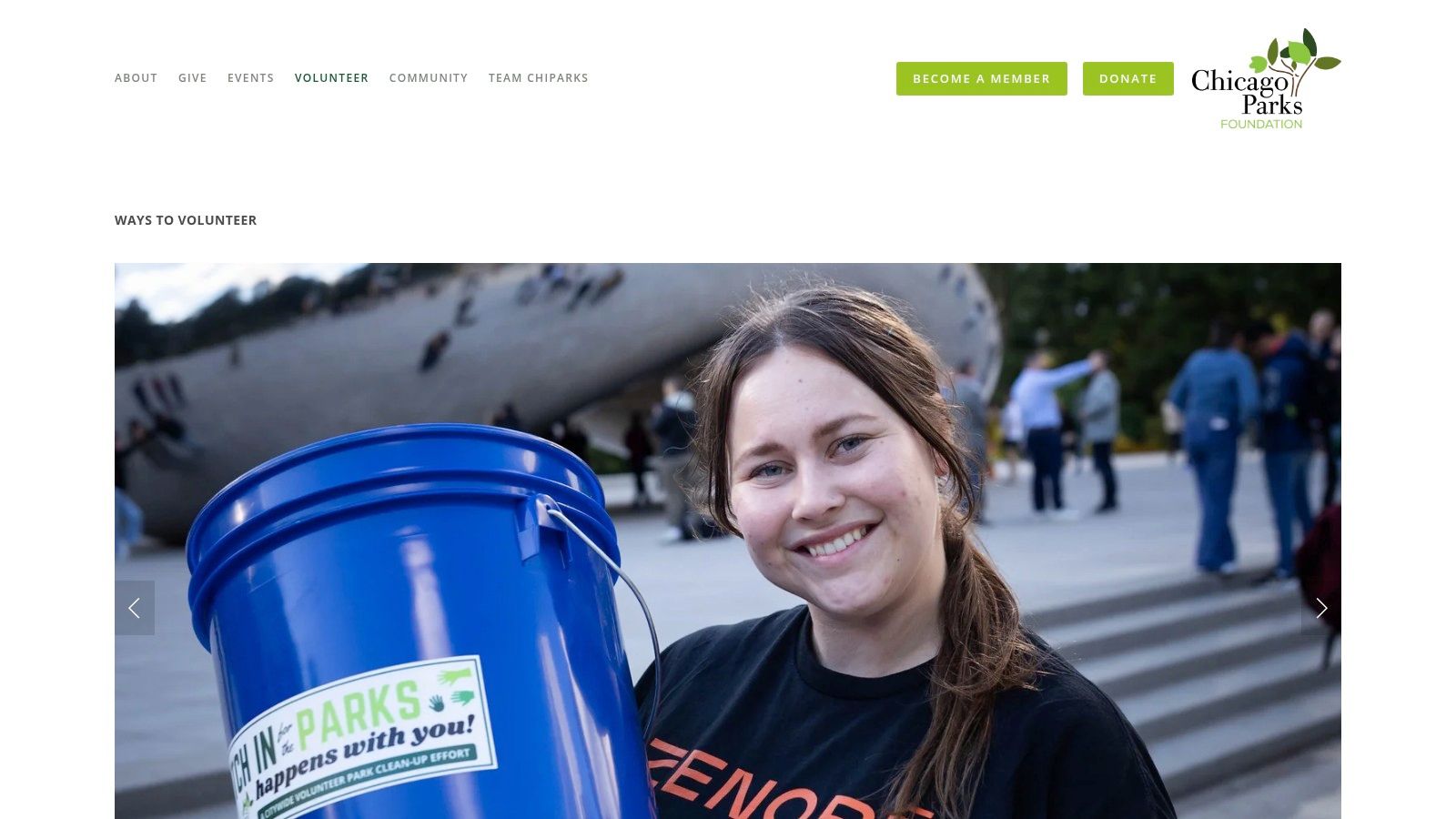
I've seen people hesitate over volunteering because they assume it has to be dramatic. A kayak on the river. A whole Saturday in the woods. Special knowledge. Then they spend two hours in a neighborhood park, filling bags, pulling weeds from a fence line, talking to a stranger who lives three blocks away, and something shifts.
That's what makes Chicago Parks Foundation volunteer events different. The work happens in plain view, in the places where life is already unfolding. Dog walkers pass by. Kids cut across the field. Someone thanks you without stopping. You go home knowing you changed a patch of the city you will see again on Tuesday.
I like that honesty.
The founder story behind Litter Caterpillars carries that same lesson. You do not need a grand plan to begin repairing a mess. You start with what is in front of you. In a park cleanup, that might mean bottles under a bench or trash caught in shrubs after a windy week. The cleanup is literal, but the change in you is not just physical. You get less precious. Less avoidant. You stop waiting for the perfect role and become the kind of person who helps.
Chicago Parks Foundation supports citywide volunteer days like It's Your Park Day and helps groups host their own cleanups with supplies and on site support. That makes it a strong fit if you want to bring classmates, coworkers, or neighbors into something useful without spending weeks organizing every detail yourself.
There is a social courage to this kind of work, too. In a preserve, you can disappear into the task. In a neighborhood park, you are part of the public face of care. People see who showed up. Sometimes that is exactly what helps you grow. If you have been lonely, unsure, or stuck in your own head, shared work in a familiar place can crack that open fast.
Best fit and tradeoffs
- Best for people who want visible change: You can walk past the park later and see what your morning accomplished.
- Best for new volunteers: The setting feels familiar, which lowers the friction of starting.
- Best for groups that want simple logistics: Hosted cleanups can make turnout easier to manage.
The drawback is that neighborhood events can feel less adventurous than river or forest work. If you only chase the dramatic version of service, you might miss the one that changes your actual daily life.
7 Environmental Volunteer Opportunities, Quick Comparison
| Item | Complexity 🔄 | Resource requirements ⚡ | Outcomes 📊 | Ideal use cases 💡 | Effectiveness ⭐ |
|---|---|---|---|---|---|
| Litter Caterpillars | Low, volunteer‑run, informal weekly coordination | Minimal, volunteer time, basic cleanup gear, social channels | Visible neighborhood cleanup; civic engagement; created Caterpillar Park | Regular weekend volunteers, social community building, adventurous cleanups | ⭐⭐⭐ |
| Alliance for the Great Lakes, Adopt‑a‑Beach | Moderate, standardized protocols and leader roles | Moderate, training, data tools, seasonal site logistics | Shoreline litter removal + research‑grade data for policy use | Beach cleanups, data collection, family and team events | ⭐⭐⭐ |
| Friends of the Chicago River, Chicago River Day + Stewardship | Moderate, multi‑site event planning and recurring stewardship | Low–Moderate, tools provided, some registration required | River trash removal, native plantings, trail maintenance | Group service days, first‑timers, visible riverfront impact | ⭐⭐⭐ |
| Shedd Aquarium, Action Days | Low, short‑term community events; in‑building roles require applications | Low–Moderate, organized events; competitive application windows for deeper roles | Short‑term service hours; pathways to aquarium volunteer roles | Student groups, short service commitments, those seeking structured growth | ⭐⭐ |
| Openlands, TreeKeepers + TreePlanters | Moderate–High, training, certification, grant coordination | Moderate, training time, organizing neighbors, possible fees | Long‑term tree care, street greening, leadership development | Residents seeking skills, long‑term stewardship, neighborhood plantings | ⭐⭐⭐ |
| Friends of the Forest Preserves, Restoration Workdays | Low–Moderate, scheduled workdays with staff support | Low, tools/equipment provided; some physical effort required | Habitat restoration, invasive removal, skills in ecology | Hands‑on ecology volunteers, repeat stewardship, corporate groups | ⭐⭐⭐ |
| Chicago Parks Foundation, "It's Your Park Day" | Low, turnkey or staff‑led park cleanups | Low, CPF supplies and optional on‑site leadership | Quick neighborhood beautification with high local visibility | Block clubs, company service days, school groups | ⭐⭐ |
Find Your People, Find Your Purpose
A woman once showed up to a cleanup because her week had gone sideways. She did not come to save the planet. She came because she needed somewhere to put her hands. An hour later, she was laughing with strangers over a ridiculous haul of cups, wrappers, and one busted lawn chair dragged out of the weeds. By the end of the morning, she had done more than fill a trash bag. She had crossed the hardest line, the one between meaning to help and showing up.
That pattern matters.
You might start at the lake, cold wind in your face, picking bottle caps out of the sand. You might end up learning tree care until neighbors ask you what species is planted on the block. You might spend a Saturday knee-deep in mud near the river or pulling invasives in the forest preserves. The work changes with each group, but the deeper reward is strangely consistent. You leave more steady than you arrived.
I have seen cleanup work do something subtle and tough at the same time. It shrinks the distance between your values and your schedule. It gives you a visible problem, a bag, a pair of gloves, and a few other people who decided their morning would count for something. In a life cluttered with abstract worries, that kind of direct action can reset you.
The founder's story behind Litter Caterpillars carries that lesson all the way through this list. Cleaning up a block can become practice for cleaning up other parts of your life. You get less afraid of awkward introductions. You get better at doing small hard things. You start recognizing familiar faces. Then one day it stops feeling like volunteer work and starts feeling like your people.
Fun helps, too.
Not fake, forced fun. Real fun. Dirt on your shoes. Sore arms. A conversation that starts stiff and ends with plans for coffee. The small pride of looking back at a stretch of park or sidewalk and knowing it looks different because you were there.
So pick the one that fits your life right now. Pick the beach, the river, the trees, the forest preserves, the park near your apartment, or the cleanup crew that first showed you service can make you braver.
If you want a place to start this weekend, join Litter Caterpillars. As noted earlier, it offers a simple way to get outside, clean a block, meet good people, and build courage by doing something real.