Tag: grassroots organizing

  • How to Start a Volunteer Group: Your 2026 Playbook

    How to Start a Volunteer Group: Your 2026 Playbook

    Three of us stood under a tree in a spring hail storm, shaking, waiting for Ubers that kept canceling. We had trash bags in our hands, numb fingers, and one weird thought that changed everything: cleaning other people's messes felt easier than cleaning our own.

    The Spark That Starts the Cleanup

    I didn't start with a grand plan. I started with a mess.

    My apartment was a mess, but that wasn't the hard part. The hard part was that every useless object had a little emotional hook in it. An old jar of blueberry jam from a trip years ago. A stale bag of nuts from one of those short-lived healthy phases. None of it weighed much, but in my head it was all heavy.

    Then my life blew up a bit. A chaotic relationship ended. I looked around and realized I didn't trust myself much. I wasn't consistent. I avoided hard things. I let clutter win.

    So I tried something sideways. I went outside and picked up litter.

    A woman sitting on the floor surrounded by messy paperwork with a bright lightbulb icon above.

    Why other people's messes feel lighter

    This is the part most guides miss. Service isn't only about output. It changes you while you do it.

    When you clean your own mess, shame gets involved. Memory gets involved. Regret gets involved. When you clean a sidewalk, a vacant lot, or an alley, the task is cleaner in your mind. There's a bottle on the ground. You pick it up. The story ends there.

    That simplicity matters.

    I learned a strange truth fast: cleaning other people's messes is way easier than cleaning up our own. And because it's easier, you do it. Then you finish. Then you feel useful. Then your brain starts collecting proof that you can show up and make things better.

    Cleaning public messes gave me a way to practice self-respect without staring directly at my own failures.

    That's a solid starting point for how to start a volunteer group. Your first spark doesn't need to sound noble. It just needs to be honest. Maybe you're lonely. Maybe you're angry at what you keep seeing in your neighborhood. Maybe you need structure. Maybe you need sunlight and better friends.

    Any of those reasons can work.

    Find the part that hits you in the chest

    Your group's early energy comes from one thing: a real motive. People can feel the difference between borrowed language and a lived reason.

    Ask yourself:

    • What problem makes you stop walking? Trash on your block, seniors who need rides, a park nobody uses because it feels neglected.
    • What kind of action gives instant proof? Tangible work helps. You can see a clean street, a painted fence, a stocked pantry.
    • What personal wound does this work bypass? Sometimes service opens a back door into healing.

    A volunteer group gets stronger when the founder knows why they're doing it. Not the polished answer. The true one.

    Mine was simple. I wanted to become cleaner, braver, and more consistent. I wanted to build a social circle around giving instead of taking. Picking up litter gave me a practice field.

    And weirdly, the hardship helped. The cold. The rain. The hail. Shared discomfort gave the day flavor. It turned a chore into a story.

    That story is often where your group begins.

    Find Your Mission Before You Find Your People

    A lot of people start backwards. They make an Instagram page, brainstorm names, invite friends, and only then ask what the group is for.

    That's how you end up with vague energy and weak turnout.

    If you want to learn how to start a volunteer group that lasts, get specific before you recruit. The first real move is a needs assessment. Before you write a mission statement, you must conduct a thorough needs assessment to identify what your community lacks. Given that 6.5% of the global working-age population engages in formal volunteering, your group has to prove why your use of people's time is worth choosing.

    Start with the block, not the brand

    Don't ask, “What kind of organization should I build?”

    Ask, “What is broken near me, and what can I fix with a small crew?”

    Walk your area. Take notes. Talk to the people who already live with the problem. If you care about litter, don't just say, “The city is dirty.” That's too broad. Find the repeated pain points.

    A simple needs assessment can be ugly and still work:

    1. Walk three to five target areas and write down what you see.
    2. Look for repeated patterns like overflowing corners, illegal dumping spots, or neglected park edges.
    3. Ask locals one direct question. What do you wish somebody would fix around here?
    4. Check what already exists so you don't duplicate someone else's effort.
    5. Pick one visible win your group can own.

    That's enough to start.

    Choose a problem people can feel

    Some missions are worthy but fuzzy. Fuzzy missions are harder to recruit for.

    Visible problems have an advantage. If a volunteer shows up for two hours and can see the before and after, the work lands deeper. People feel the shift in their body. The street looks different. Their hands did that.

    Practical rule: Pick a mission that a stranger can understand in one sentence and spot from across the street.

    That's one reason cleanup groups are sticky. The result is concrete. The bag fills up. The lot opens up. The curb stops looking abandoned.

    Filter for the right people

    Focus is your friend. If you try to attract everyone, you attract almost no one.

    Weekend mornings, for example, create a quiet filter. People who show up then usually want to give. They chose service over sleeping in, brunch, or a late night. That doesn't make them better. It just means they fit the culture you're trying to build.

    Your mission needs three clean edges:

    • The problem you solve
    • The kind of person you want beside you
    • The kind of energy you won't build around

    Write your mission after that.

    Keep it plain. “We clean neglected blocks every Saturday morning.” “We visit shut-ins with groceries and conversation.” “We restore neighborhood gardens one bed at a time.” Short beats fancy. Direct beats broad.

    People don't join blur. They join clarity.

    Build an Identity People Want to Join

    Plenty of groups can get a volunteer to show up once. The hard part is getting them to feel like they belong.

    Identity does that job better than logistics ever will.

    My favorite example is still that first cleanup in the hail storm. Three people. Cold hands. No easy exit. It should have been miserable. Instead, it became funny, memorable, and weirdly bonding. We suffered a little together, and the day stopped being a task. It became an origin story.

    A group needs flavor

    Most volunteer groups stop at the practical layer. Gloves, sign-up form, safety talk, group photo. Fine. You need those.

    But if you stop there, your group feels like an errand.

    People stay when the group has flavor. I mean a real shared feel. A logo that means something. A phrase people repeat. A song. A flag. A ritual after the event. Even a running joke. These things sound small until you watch them work.
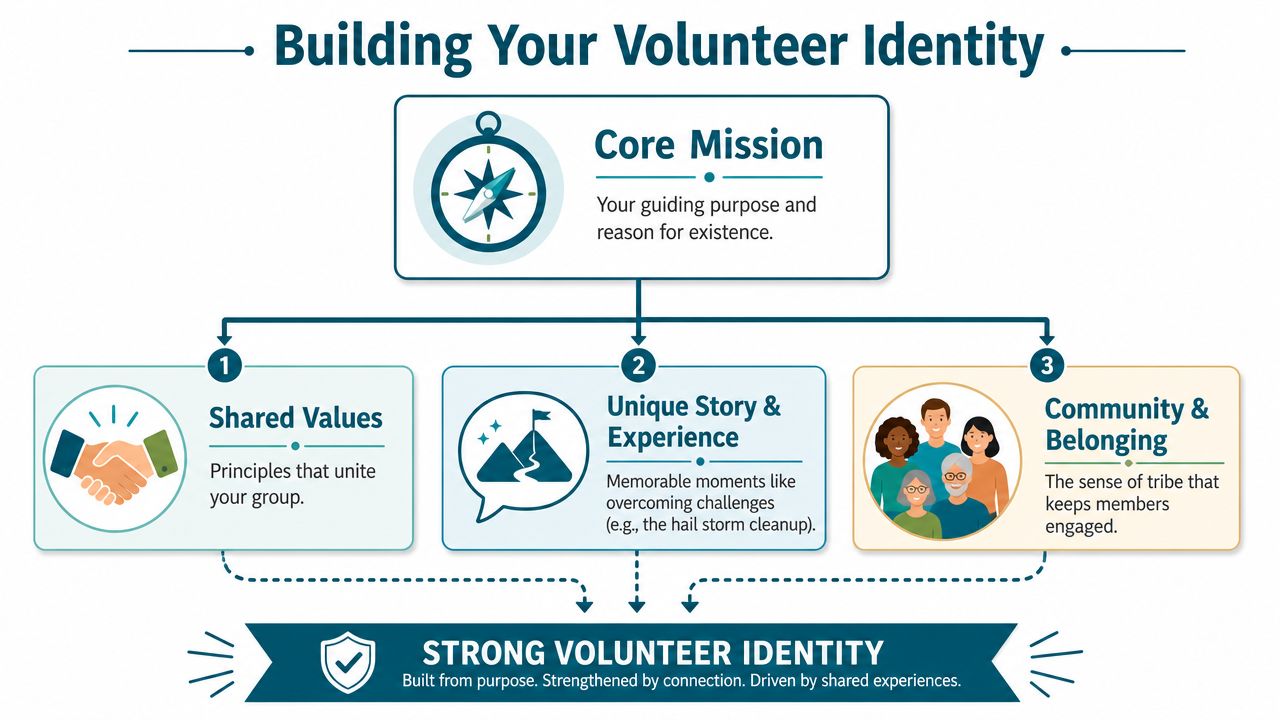
    An infographic titled Building Your Volunteer Identity, showing the core mission supported by values, stories, and community.

    Pride rituals matter because volunteering is not only labor. It is identity. According to Stand Together's volunteering piece, groups that use badges, theme songs, and flags retain 3.4 times more participants and report 68% higher happiness scores. The same source says 79% of volunteers report higher emotional fulfillment when they tackle visible, tangible problems like litter.

    That tracks with what I've seen. People don't only want to help. They want to feel part of a story worth repeating.

    Borrow from sports, not from office culture

    Sports teams understand something volunteer groups often ignore. People love symbols.

    A jersey, chant, flag, and mascot can turn strangers into a unit fast. You don't need to become corny, but you do need to give your people something to rally around. Office culture gives people name tags and stale muffins. Teams give people colors and songs.

    Use the team model.

    Here are a few identity tools that work:

    • A repeating symbol: A patch, sticker, button, or badge gives people a visible marker.
    • A ritual start: A short huddle, motto, or group photo at the same point each event builds rhythm.
    • A hardship story: Your hail storm, flat tire, muddy cleanup, or freezing morning becomes shared folklore.
    • A playful language: Little phrases and inside jokes make the group feel lived in.

    Pride is not vanity. Pride tells volunteers, “I'm the kind of person who does this.”

    Make volunteers the heroes

    A bad group identity makes the founder the main character. A good one makes the volunteers feel like they joined a crew with a mission.

    That changes how you speak. Don't build your story around your personal sacrifice. Build it around the kind of person your volunteers become when they keep showing up.

    You want someone to leave an event thinking:

    • I'm braver than I thought.
    • I can do hard things with other people.
    • This is my kind of crowd.
    • I want the next chapter.

    That's the deeper answer to how to start a volunteer group people remember. Give the work shape. Give the group a soul. Give the hard days a story people will laugh about later.

    Gather Your First Crew and Get to Work

    Your first crew doesn't need to be big. Mine wasn't. Three people is enough to start a story.

    What matters is that people can say yes fast. If your invite reads like homework, they'll scroll past. If it feels simple, safe, and concrete, you've got a shot.
    Screenshot from https://www.littercaterpillars.com

    Start with direct invitations

    Don't hide behind branding. Text people.

    A first invite should answer five things in plain English: what, where, when, why, and what to bring. Meetup, Instagram, and group chats are enough at the start. You don't need a polished funnel. You need clear words and a real event.

    Here's the shape I like:

    • What we're doing: “Neighborhood trash pickup”
    • Where we're meeting: “Corner of X and Y”
    • When: “Saturday at 9 a.m.”
    • Why it matters: “This block keeps getting ignored”
    • What to bring: “Closed-toe shoes, water, clothes you don't mind getting dirty”

    That's it.

    If you want more ideas on messaging and channels, this guide on volunteer recruitment strategies is a useful place to compare outreach approaches.

    Recruit by role, not by vague enthusiasm

    People respond better when they know the lane they're stepping into.

    That's especially true across age groups. When recruiting, know your audience. 27.2% of Gen X leads in formal volunteering, which makes them a strong fit for structured roles, while 58.7% of Baby Boomers lead in informal helping, which makes them a strong fit for flexible, ad-hoc actions.

    So don't post one mushy invitation and hope for the best. Match the ask to the person.

    A practical split looks like this:

    Group Better ask Example
    Gen X Structured roles Weekly route lead, supply organizer, check-in helper
    Baby Boomers Flexible actions Drop-in cleanup, snack support, one-off neighborhood push
    Students and young professionals Social plus visible work Morning cleanup followed by coffee
    Existing friends Starter roles with low friction Bring gloves, invite one person, help collect bags

    Plan day one like a small field operation

    The first event should feel easy to enter. I like a short script.

    1. Meet at a location people can find without confusion.
    2. Greet everyone by name.
    3. Hand out supplies fast.
    4. Give a short safety talk.
    5. Split into pairs or small teams.
    6. Set a clear end time.
    7. Take one group photo.
    8. End with a quick recap and casual hangout if people want it.

    You don't need to impress people. You need to remove uncertainty.

    If volunteers spend the first twenty minutes wondering what's happening, you've already lost energy you may not get back.

    A good first event also has a visible finish line. Don't try to clean an entire neighborhood on day one. Pick one stretch, one lot, one alley, one park edge. Let people experience completion.

    Here's a look at the kind of field energy that gets people moving:

    Keep the ask honest

    I've learned to avoid overpromising. Don't tell people they're joining a movement if you've never run a cleanup before. Tell them the truth.

    “We're starting small.”
    “We're trying this consistently.”
    “We're building a good crew.”
    “We want this to be useful and fun.”

    That honesty helps the right people trust you.

    And one more thing. End on time.

    A volunteer who gives you two clean hours and leaves smiling is more likely to come back than a volunteer trapped in a sloppy four-hour marathon. Respect the edge of people's energy. That's one of the oldest rules in the game.

    Create a Safe and Simple Structure

    A volunteer group falls apart in boring ways. Confusing sign-ups. Missing waivers. No safety rules. No one knows who is in charge. A new person arrives and just sort of stands there.

    That's avoidable.

    The structure you build is not bureaucracy. It is care. It tells people, “Your time matters. Your body matters. We thought about your first day before you got here.”

    Make joining easy

    The front door matters more than people think. A registration process that takes more than 3 minutes increases volunteer dropout by 45%, and 32% of early volunteer burnout comes from people feeling their role is meaningless according to CivicPlus on creating an effective volunteer program.

    That means your sign-up should feel almost frictionless.

    Use a simple mobile-friendly form. Ask only what you need. Name, contact info, emergency contact if relevant, and anything tied to safety. Don't bury people in fields and legal language before they've even met you.

    Then follow fast with a clear message:
    where to go, what to wear, what to expect, who to contact if they're lost.

    Give every person a role with edges

    A volunteer burns out faster when the role feels foggy. “Come help however” sounds relaxed, but it often creates confusion.

    People feel better when they know where they fit. Keep roles simple:

    • Greeter: Welcomes people and checks names
    • Safety lead: Reviews hazards and watches pace
    • Supply runner: Manages gloves, bags, grabbers, water
    • Route lead: Knows the area and keeps the team together

    That doesn't mean you need a huge hierarchy. It means each person can answer one question: what am I doing today?

    If your work carries physical risk, get smart about it. Review your legal setup, waivers, and coverage early. This overview of volunteer liability insurance is a practical starting point for thinking through protection.

    Your First Cleanup Event Checklist

    Category Item Notes
    Planning Meeting point Pick a place that is easy to find and easy to leave from
    Planning End time Tell people when the event ends before work starts
    Safety Gloves Bring extras in multiple sizes
    Safety Closed-toe shoe reminder Send this before the event, not at the event
    Safety Hazard policy Tell volunteers what they should never pick up
    Supplies Trash bags Bring more than you think you need
    Supplies Grabbers or pickers Helpful, but not required for a first event
    Supplies Water Keep extra on hand
    Communication Group chat or text thread Use one channel so updates don't scatter
    Onboarding Quick briefing Explain the route, the goal, and who to ask for help
    Onboarding New volunteer buddy Pair first-timers with someone calm and friendly
    Wrap-up Disposal plan Know where the collected trash goes before you start

    Field rule: If a first-timer doesn't know where to stand, what to do, or what matters, your system is too loose.

    Written policies calm people down

    Written policies sound formal, but they remove tension. Put basic rules in one place. Weather policy. Safety boundaries. Photo consent. Conduct expectations. What happens if someone finds a needle or other dangerous item. What to do if a volunteer feels sick or unsafe.

    Keep the tone human. Short sentences. Real examples.

    A simple structure lowers anxiety. And lower anxiety gives you more energy for the work itself.

    Keep the Fire Burning with Friendship and Purpose

    Starting is exciting. Staying steady is harder.

    A group lasts because people build habits and relationships around the mission. If your volunteers only feel useful, they may drift away. If they feel useful and connected, they start protecting the group with their own effort.

    Consistency beats intensity

    I like weekly rhythms. Same morning. Same general pattern. People begin to build their life around it.

    That consistency creates trust. It also lowers the mental cost of showing up. Nobody has to wonder when the next chance is. They already know.

    To keep that rhythm healthy, you must develop written policies for safety and consistency, and prepare training that gives volunteers space to ask questions and hear the rules clearly, as explained by VolunteerMatters on starting a volunteer program.

    That kind of structure doesn't make a group stiff. It makes the group dependable.

    Friendship is retention in human form

    I don't think money is the main fuel in volunteer work. Energy is. Attention is. Trust is. Friendship is.

    People come back when they know somebody will smile when they arrive. They come back when there's a shared joke, a post-cleanup coffee, a familiar walking partner, a sense that they'd be missed.

    If you want practical ways to keep people engaged over time, these volunteer retention strategies are worth reading alongside your own observations.

    Try a few simple habits:

    • Celebrate small wins: Name the block you finished, the lot you cleared, or the story from the day.
    • Protect volunteer energy: Don't guilt people. Don't pressure them for money. Don't treat goodwill like an unlimited resource.
    • Leave room for conversation: A few unhurried minutes before or after the event often matters more than one more bag of trash.

    A volunteer group becomes durable when people join for the mission and stay for the friendships.

    Keep reminding people who they are becoming

    The work changes people slowly. That's one of my favorite parts.

    Someone who felt shy starts greeting new volunteers. Someone who never woke up early starts protecting Saturday morning. Someone who felt stuck starts trusting themselves because they kept one promise over and over.

    That's the deeper reward. You clean a street, sure. But you also practice courage, consistency, and care in public with other people. Done long enough, that starts to spill into the rest of life.

    If you're thinking about how to start a volunteer group, start smaller than your ego wants and with more heart than your spreadsheet wants. Then keep showing up. The group will teach you what it needs next.


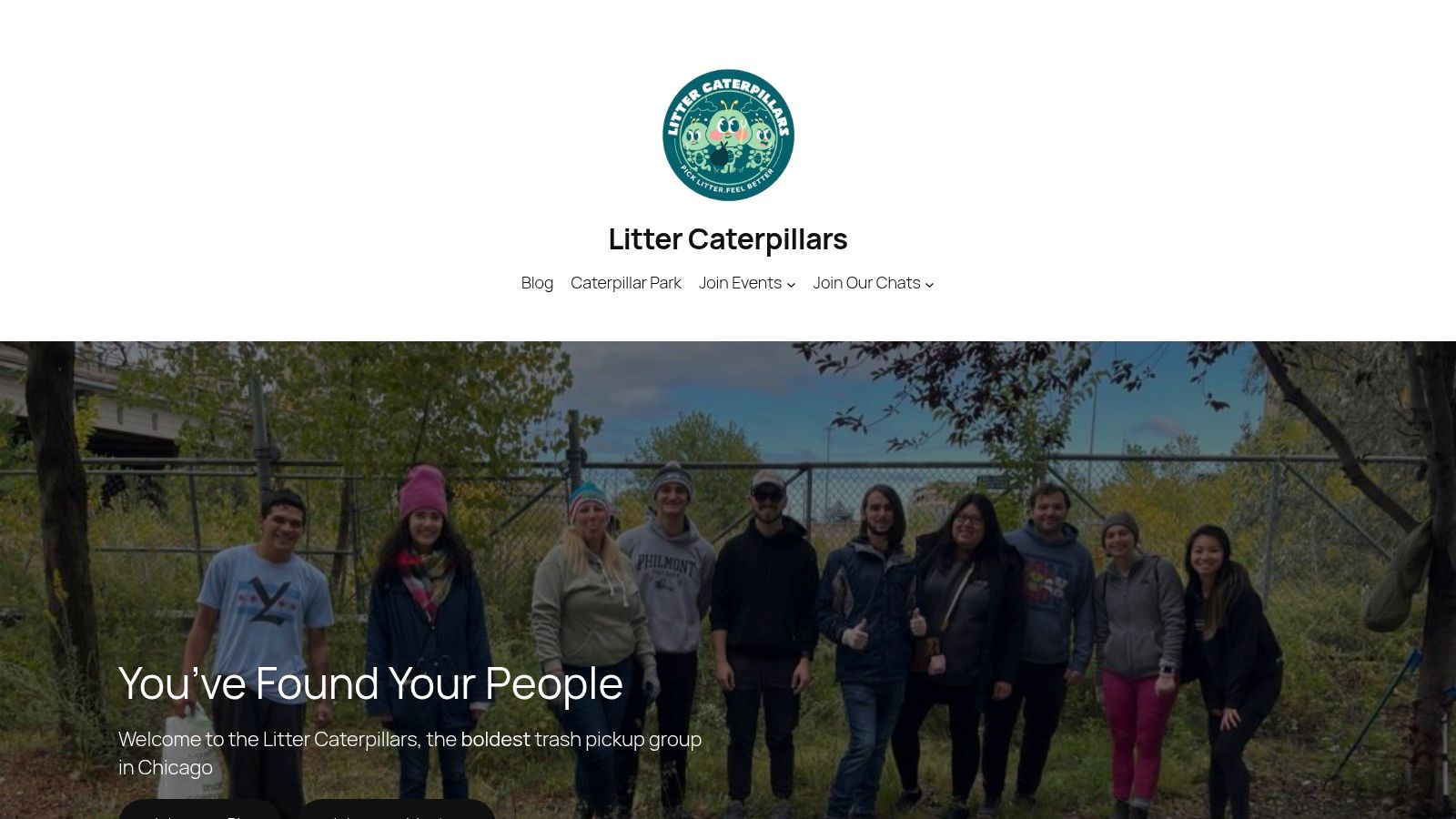
    If you want a real-world example of this kind of work in motion, visit Litter Caterpillars. You'll find a volunteer-driven cleanup group built on bravery, kindness, friendship, and the belief that service can change a block and the person holding the trash bag.
  • Top Picks: Volunteer Scheduling Software Free for 2026

    Top Picks: Volunteer Scheduling Software Free for 2026

    I learned this the hard way on cold Chicago mornings. I'd spend all week trying to organize a cleanup, then lose half my time chasing people through group chats, DMs, and a spreadsheet that looked fine on Tuesday and felt cursed by Saturday.

    Starting a volunteer group felt weirdly similar to trying to clean my old apartment. Every object had a story. Every loose end had emotion tied to it. A simple sign-up list somehow turned into a pile of messages, exceptions, late arrivals, weather changes, and one person asking, "Wait, are we meeting at the alley or the park?" The work itself was simple. The coordination wasn't.

    Nonprofit guides now describe volunteer management software as one system for recruitment, scheduling, communication, and hour tracking instead of patching things together with spreadsheets, and that's exactly why I went looking for volunteer scheduling software free options that regular people could use without a tech team or a budget according to this volunteer management software guide. I didn't want software for software's sake. I wanted fewer flakes, fewer lost messages, and a cleaner handoff between "I want to help" and "I'm here with gloves on."

    So here are the tools I'd recommend for a small, scrappy volunteer team. Some are simple sign-up sheets. Some feel more like a real volunteer system. All of them solve a real headache.

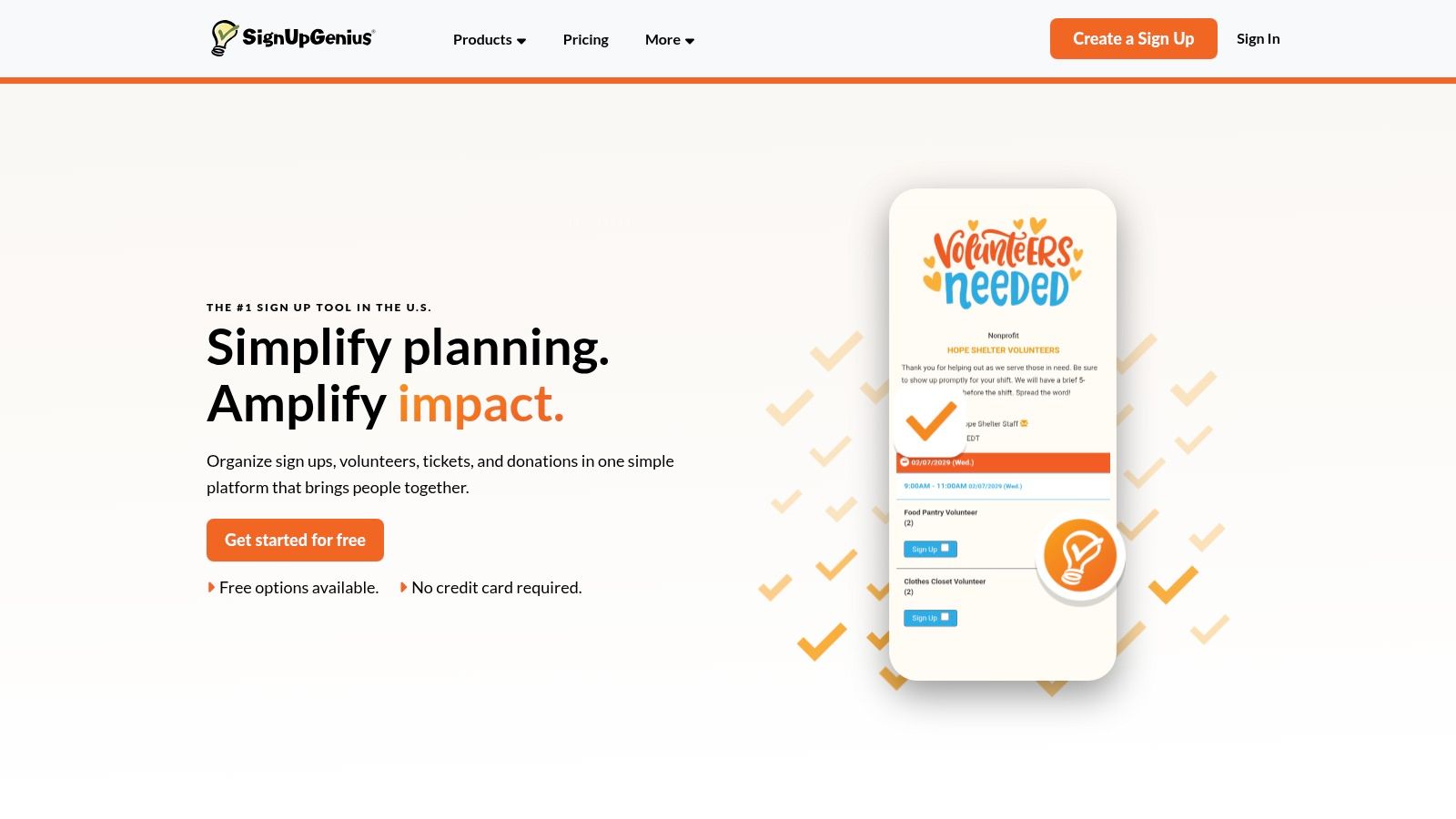
    1. SignUpGenius

    SignUpGenius

    When I need to get people into slots fast, I still think about SignUpGenius first. It feels like the paper signup board from a school hallway, except it lives on your phone and doesn't blow away in the wind.

    That's its superpower. You don't need to teach anyone how to use it. You send a link, people tap a time, and the thing moves forward. For volunteer groups, that low-friction start matters more than fancy dashboards.

    Why I'd use it

    If your group has recurring cleanups, supply lists, and simple roles like "picker," "spotter," or "snack runner," SignUpGenius keeps the machine moving.

    • Fast setup: I can build a new Saturday event quickly and share it in a text, post, or QR code.
    • Clear slot control: You can cap spaces so you don't get twenty people showing up for a job meant for six.
    • Built-in reminders: Automatic confirmations and reminders take pressure off your brain.

    The weak point is admin depth. On the free plan, ads are there, and if your team grows into multiple coordinators or deeper reporting, you'll feel the ceiling.

    Practical rule: If your volunteers are casual and you need them signed up in under a minute, simple beats sophisticated.

    I also like this tool for groups still learning the basics of coordination. If you need help tightening your process around communication, arrival flow, and event follow-up, my guide to volunteer management best practices pairs well with a tool this simple.

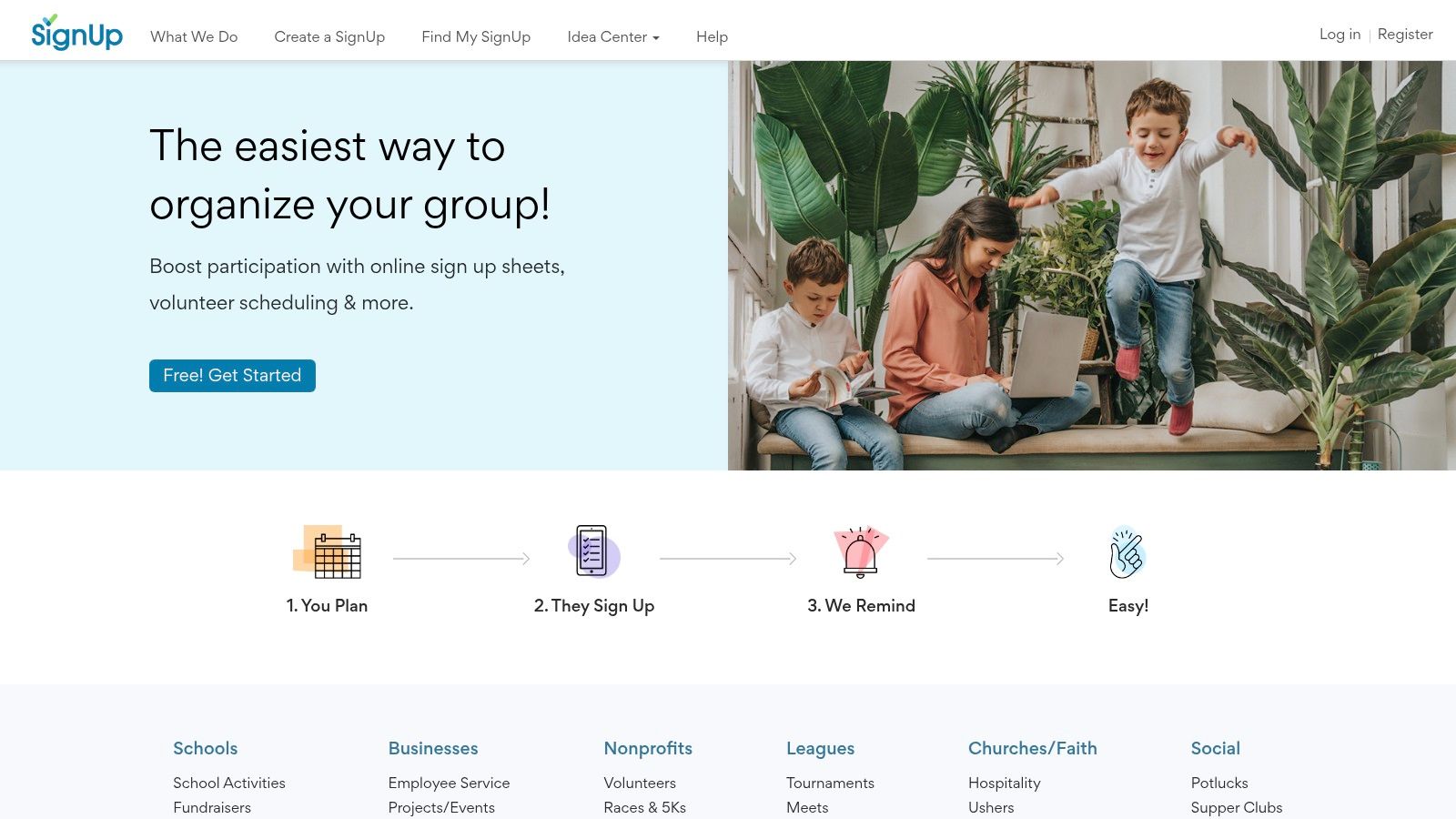
    2. SignUp.com

    SignUp.com

    SignUp.com feels like the neighbor who may not dress flashy but always shows up with the folding table, extra tape, and the right extension cord. It isn't glamorous. It is useful.

    I've seen tools lose people because the organizer gets excited and the volunteer gets confused. SignUp.com usually avoids that. It keeps the path short between "I might come" and "I'm on the list."

    Where it fits best

    I like this one for neighborhood events, school-style volunteering, and community groups that need straightforward self-signups without a lot of ceremony.

    A few things make it easy to live with:

    • Free sign-up sheets and calendars: Good for shifts, supply drops, and attendance planning.
    • Reminders and confirmations: Helpful when people signed up days ago and forgot.
    • Easy sharing: You can push the link out almost anywhere your volunteers already gather.

    The tradeoff is feel. Some organizers think the interface feels older, and if you care a lot about branding or cleaner visuals, you may want something more modern. Still, old and dependable can be a blessing.

    Sometimes the actual issue isn't software. It's that you don't yet have enough people in the funnel. If that's where you are, start there. This playbook on how to find volunteers will do more for you than any dashboard.

    "A tool can't rescue a weak invitation. It can only make a good invitation easier to answer."

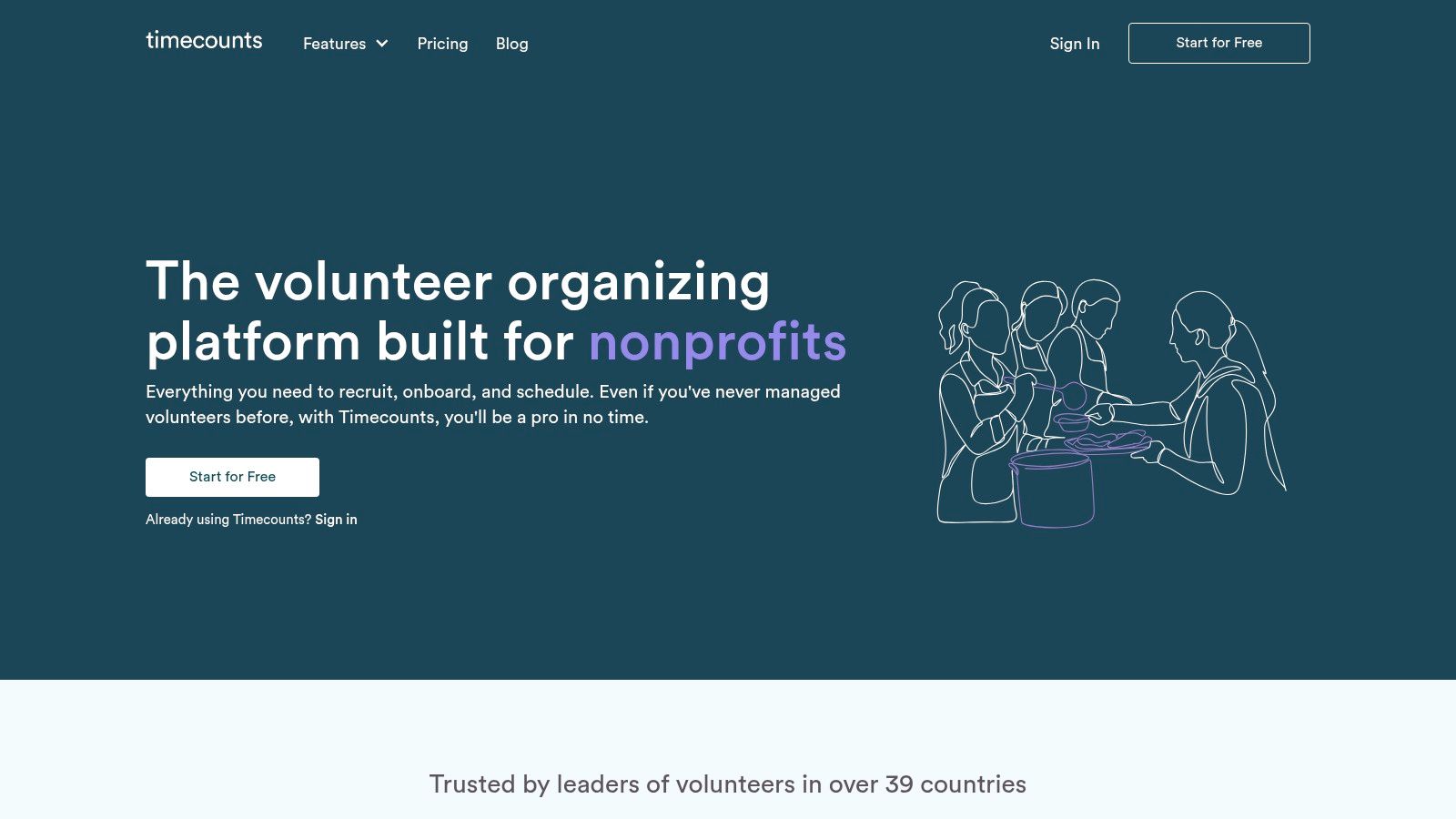
    3. Timecounts

    Timecounts

    There comes a point when a sign-up sheet stops being enough. You don't just need names in slots. You need onboarding forms, volunteer history, rosters, and a cleaner way to remember who keeps showing up.

    That's where Timecounts starts to make sense to me. It feels like moving from sticky notes on the fridge to labeled shelves in the garage. You still have clutter, but now you can find the gloves, the grabbers, and the person who always arrives early.

    When I'd move up to it

    I'd pick Timecounts when your group has started to grow roots. Maybe you have recurring volunteers, special event volunteers, and people who came once through Instagram and might return if you keep in touch well.

    What I like:

    • Volunteer database and forms: Better than collecting info through random messages.
    • Shifts, rosters, and hour tracking: More structure for teams that need history.
    • Emailing and segmentation: Helpful when one cleanup crew wants river work and another prefers neighborhood routes.

    The downside is setup time. This isn't the "send a link in thirty seconds" option. You need a little patience at the front end.

    That extra structure can pay off if you're trying to keep people around. Retention usually breaks when volunteers feel forgotten or when rejoining is harder than joining. My guide on volunteer retention strategies gets a lot easier to apply once your software remembers people.

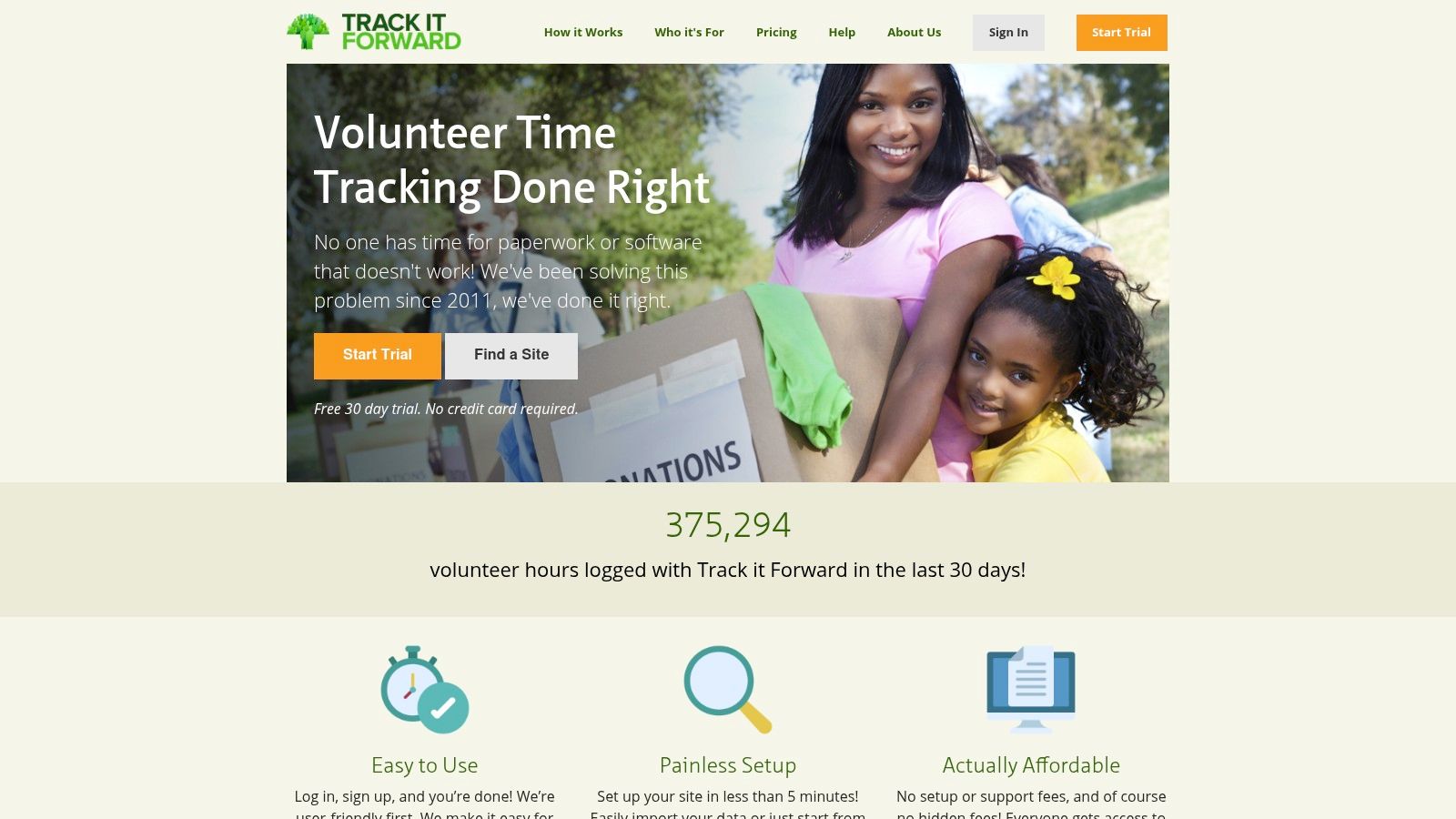
    4. Track It Forward

    Track It Forward makes me think of clipboards done right. If your group needs clean hour logs, approvals, and a record you can trust later, this one leans into that.

    Some volunteer tools treat hours like an afterthought. This one doesn't. That matters if you work with schools, grants, service requirements, or partners who ask, "Can you show me who did what?"

    Track It Forward

    Best for compact teams that track hours closely

    I wouldn't call this my first pick for huge, loose, come-and-go public events. I would call it a strong fit for a compact crew that wants accountability.

    • Event sign-ups tied to hours: Less manual cleanup after the event ends.
    • Approvals and portfolios: Useful when volunteers need proof of service.
    • Kiosk and mobile check-in: Good for coordinators who want cleaner attendance records.

    The biggest catch is scale. Coverage of free tiers notes that Track It Forward is free for volunteers, while organizations are capped at 25 volunteers on the free tier. If your team is tiny most weeks and spikes during special events, that matters. You don't want to get attached to a system that feels roomy in month one and cramped in month three.

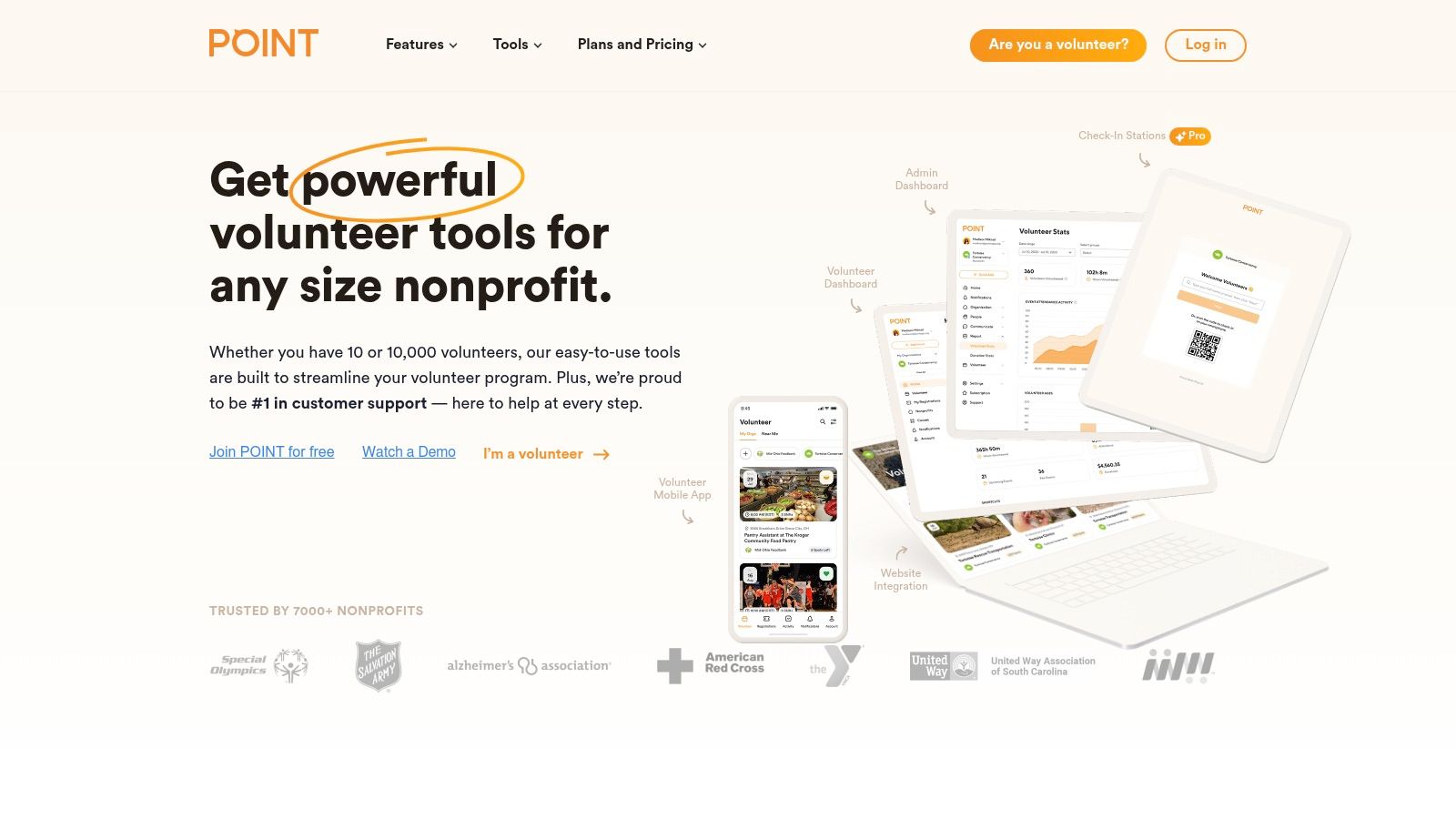
    5. POINT

    POINT

    The first time I tried to recruit volunteers outside our usual friend circle, I made a mess of it. Sign-ups were in one place, reminders were in a text thread, and hour logs lived in a spreadsheet I forgot to update. A college student showed up asking where to check in, and I had no good answer.

    POINT would have saved me that scramble.

    What stood out to me is that POINT puts the volunteer-facing side front and center. People can find opportunities, sign up on their phones, get updates, and keep track of their service in one place. For a small grassroots crew, that matters because every extra step loses somebody.

    Best for groups that need scheduling and discovery in the same tool

    I would use POINT for the kind of event where half the room is new. Mutual aid drives, cleanup days, school supply sorting, one-off service projects. If your group depends on public sign-ups instead of the same ten reliable people every week, a mobile-first system helps keep that front door open.

    According to POINT's pricing page, the platform offers a free plan, which makes it a realistic place to start if you're trying to get organized before you have a software budget.

    Here's where I see it helping most:

    • Mobile sign-ups: Easier for volunteers who do everything from their phones.
    • Reminders and roster updates: Less manual follow-up from the organizer.
    • Public opportunity listings: Helpful when you want new people to find your work.
    • Hour tracking: Useful if volunteers need a record afterward.

    The catch is fit. Some groups need a simple private scheduler for a known team, and POINT can feel bigger than that. I'd check the account setup and feature limits early, especially if you're an informal community group and not a registered nonprofit.

    For the right team, though, it solves a real problem I learned about the hard way. Getting people to care is hard enough. Your scheduling tool should not make showing up harder.

    6. Sling by Toast

    Sling wasn't made just for volunteers, and that's part of why some scrappy groups love it. Sometimes volunteer scheduling software free options built for nonprofits can feel heavy. Sling feels like a shift scheduler that got dragged into community work and ended up being pretty good at it.

    If you run multiple crews, rotating roles, or a weekend operation with a lot of moving pieces, drag-and-drop scheduling is a relief. You stop rebuilding the same roster over and over.

    The roster machine

    The free plan covers up to 30 users, which makes it one of the more generous free scheduling setups in this space. For a neighborhood cleanup team with role-based staffing, that's enough room to test a real system before committing.

    Here's where Sling earns its keep:

    • Availability and open shifts: Easier for people to raise their hand for what they can do.
    • Messaging: Better than stuffing updates into unrelated chat threads.
    • Mobile notifications: Handy for weather changes and last-minute role swaps.

    But it isn't volunteer-specific. You won't walk in and find built-in waivers or a volunteer profile flow designed for nonprofits. You may have to adapt it.

    I see Sling as a strong "operations first" choice. If your problem is pure scheduling chaos, it can calm things down fast. If your problem is volunteer lifecycle stuff, another tool may fit better.

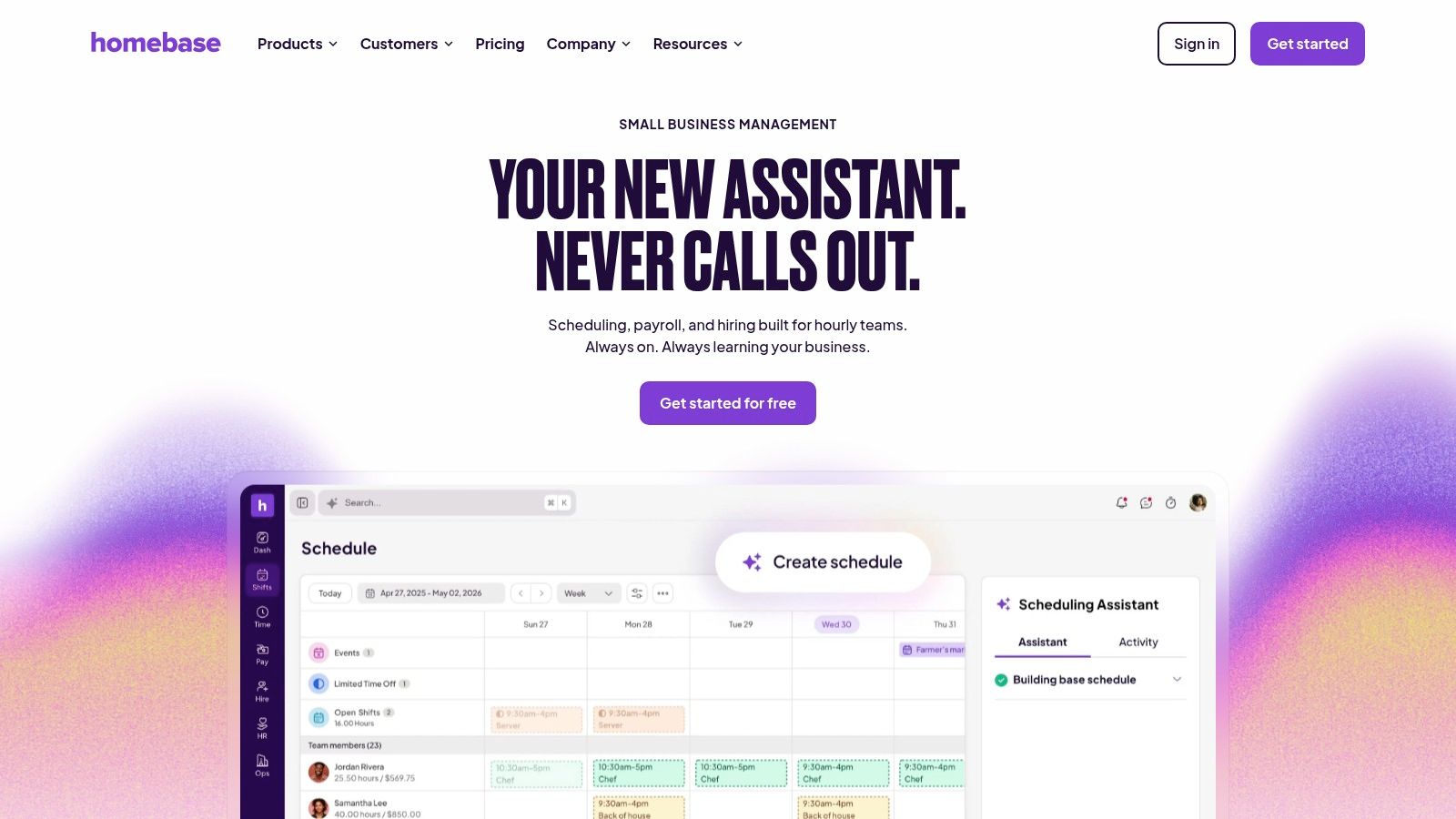
    7. Homebase

    Homebase

    Homebase makes sense to me when a volunteer event works a little like a shift-based team. Maybe everyone meets at one spot, checks in there, gets assigned, and heads out. In that setup, Homebase can feel surprisingly natural.

    I think of it as a meetup-point tool. If your cleanups begin at the same church parking lot, park fieldhouse, or corner storefront each week, that one-location setup can be a plus instead of a limitation.

    Good for a stable home base

    This is the kind of tool I'd test if I wanted scheduling plus a simple time clock feel for a small recurring team.

    • Basic scheduling and time tracking: Nice for leaders who want attendance in one place.
    • Shift reminders in the app: Good for volunteers who forget what they promised.
    • Single-location focus: Useful if your operation begins from one anchor spot.

    The catch is that Homebase is best when your structure is tight. If your volunteers scatter across many pickup zones with multiple leaders, you may outgrow it or have to bend your process to fit the tool.

    Cloud scheduling has become normal enough that even free or free-access systems now promise access from any device, automated reminders, and around-the-clock self-booking, and one cloud scheduling platform even advertises 99.96% uptime for schedule access. That's the standard volunteers are getting used to. Homebase benefits from that same expectation of always-on access.

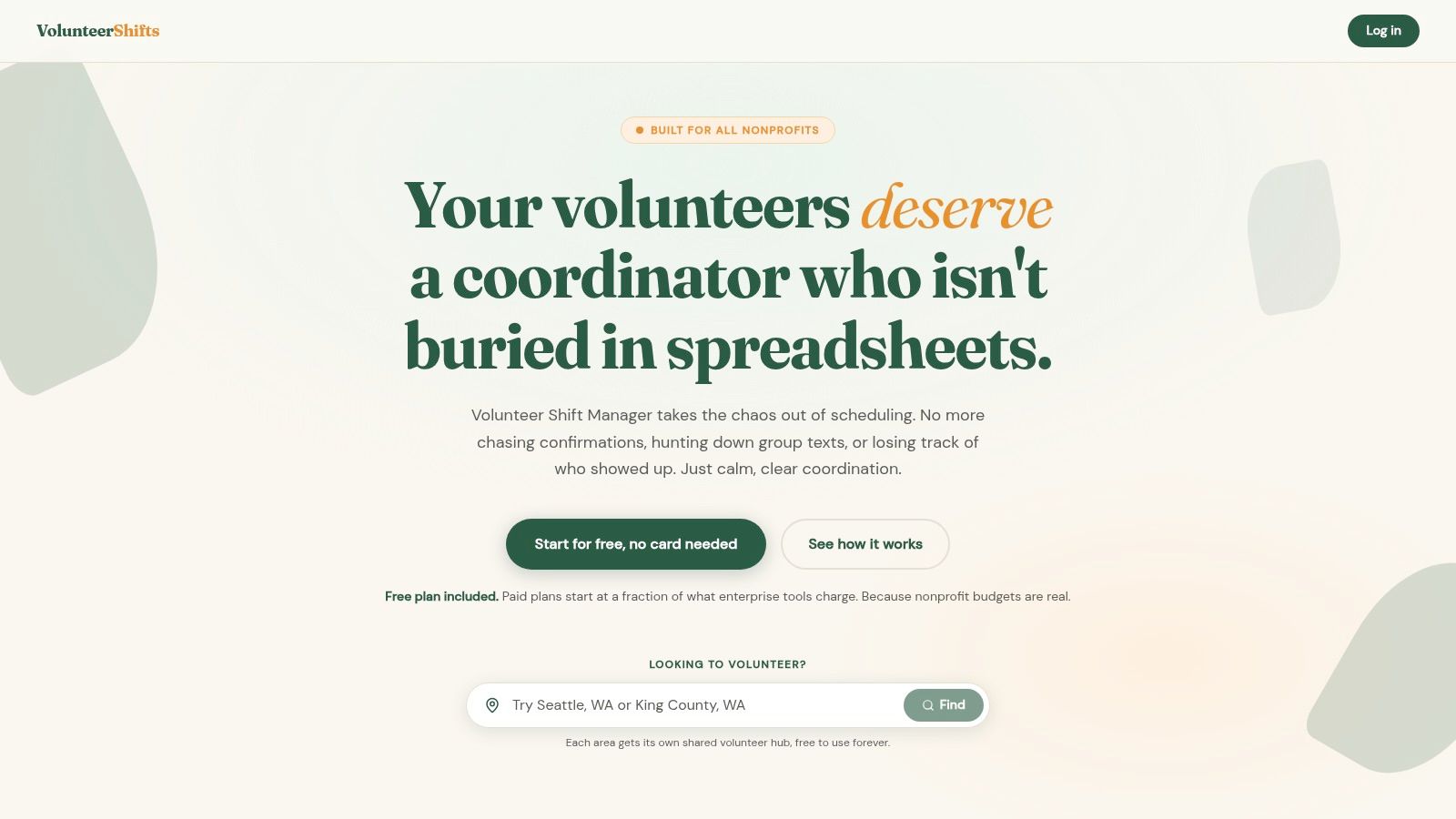
    8. Volunteer Shift Manager

    Volunteer Shift Manager

    Sometimes I don't want a giant platform. I want the equivalent of a clean folding table with clipboards already set out. Volunteer Shift Manager fits that mood.

    This one is lightweight and purpose-built for shift-based volunteer work. You create events, set caps, publish sign-up pages, and move on with your life.

    Why small groups may love it

    Volunteer Shift Manager is the kind of tool I would hand to a new organizer who feels intimidated by larger systems. It keeps the center of gravity on the event itself.

    A few reasons it works:

    • Public sign-up pages: Easy for community sharing.
    • Roster exports: Useful if you still do some coordination off-platform.
    • Email confirmations and reminders: Helps keep attendance from getting fuzzy.

    Its free plan goes up to 50 volunteers, which is a practical middle ground for groups that have moved beyond a tiny core team but aren't running a giant operation. That's exactly the hidden-limit question many "free" roundups skip. They tell you a product is free, then go quiet on what happens when your volunteer count jumps from a normal week to a special event.

    Field note: Always test the free plan against your busiest month, not your calmest week.

    Because this tool is smaller, expect fewer integrations and fewer deep automations than the bigger names. For a lot of grassroots groups, that's a fair trade.

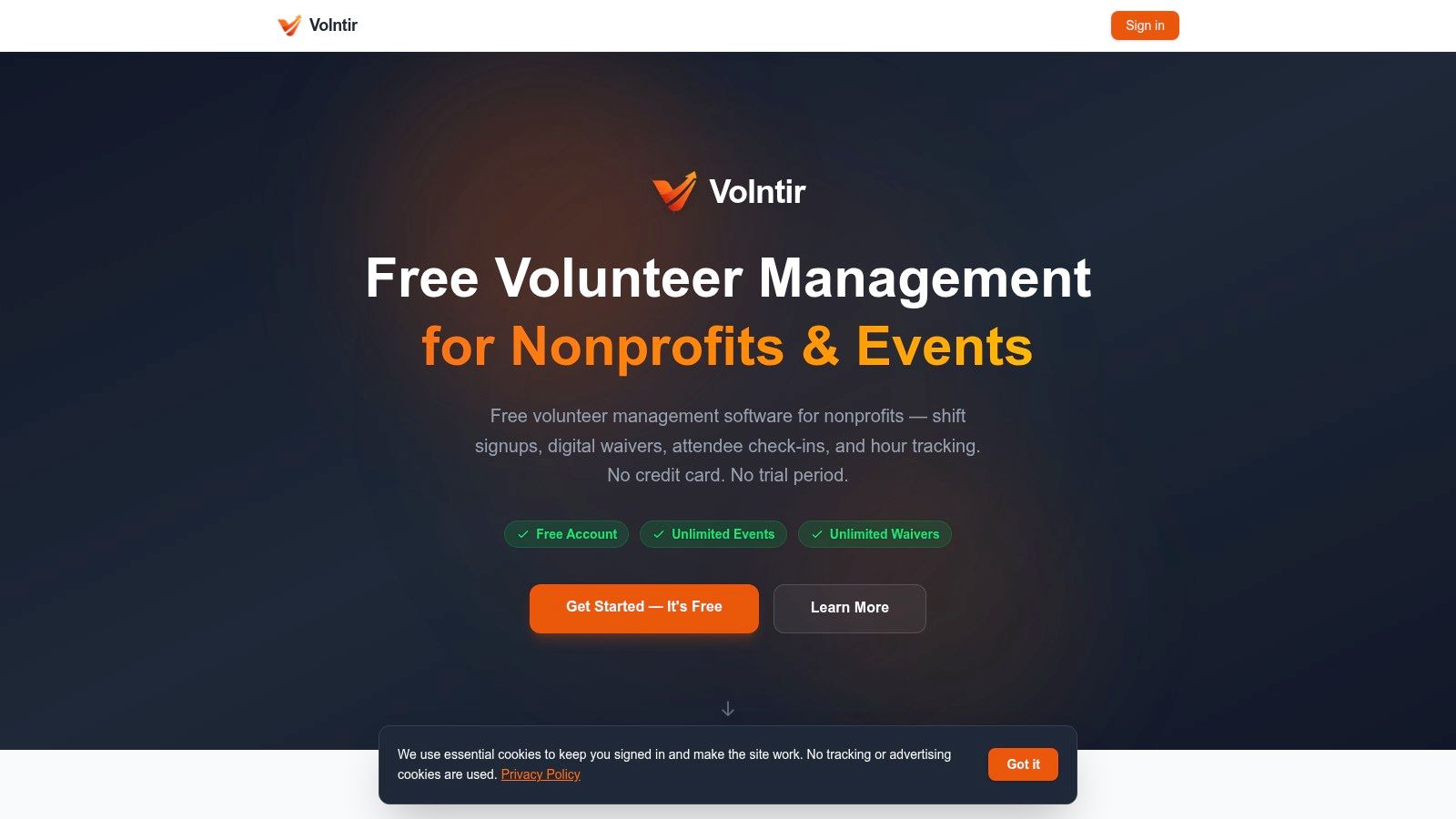
    9. Volntir

    Volntir

    Volntir caught my attention because it bundles a few annoying jobs together. Sign-up, digital waiver, check-in, and hours tracking in one mobile-friendly flow is the kind of thing that can save your Saturday morning.

    For cleanup groups, waivers are one of those details everybody remembers at the worst time. Usually that's when people are already arriving, someone forgot pens, and the wind is trying to steal your papers. A digital path is cleaner.

    A good bet if paperwork slows you down

    What I like here is the all-in-one feel for event day logistics.

    • Capacity-based shift sign-ups: Good for role control.
    • Digital waivers and signatures: Less paper chaos.
    • Check-in and hour tracking: Better records without extra steps.

    The caution is right in the product stage. It's in beta, so I'd expect changes, rough edges, and a smaller support setup. If you're comfortable testing newer tools, that's fine. If you need rock-solid stability for a large established program, maybe wait.

    This also ties into a bigger practical question I care about. Will a richer platform reduce no-shows and last-minute holes better than a simple spreadsheet or no-login sign-up? The honest answer is that tool complexity can help or hurt, depending on your volunteers. Some groups need structure. Some need less friction.

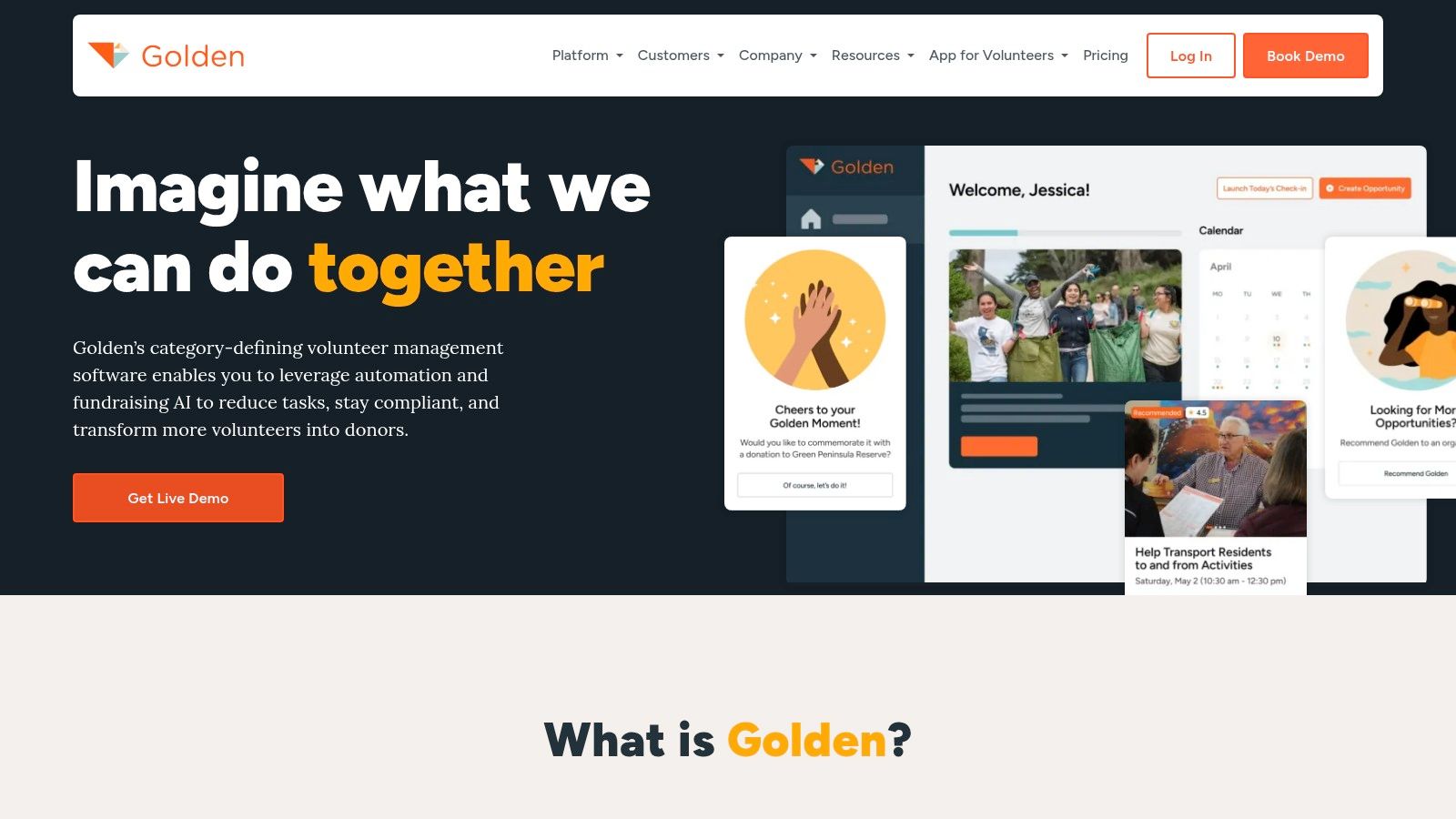
    10. Golden

    Golden

    One spring, our usual cleanup crew vanished into real life. Two families got sick, one team lead had to work, and the weather report scared off half the maybes. By Friday night, I was not looking for a better color-coded schedule. I was looking for actual people.

    That is the situation where Golden makes more sense to me than a plain sign-up sheet.

    Some tools are best once you already have a dependable bench of regulars. Golden stands out because it also helps people find your opportunities. For a small grassroots group, that matters. There were plenty of weeks when our problem was not organizing twenty volunteers. Our problem was finding six.

    Best for groups that need scheduling and visibility

    What I like here is the combination. You can post events and shifts, send reminders, track attendance, and put your opportunities where new volunteers can discover them. If your turnout changes from week to week, that extra exposure can do real work.

    Here is how I would use it:

    • Event and shift listings: Clear enough for people to claim a spot without a long back-and-forth text chain.
    • Volunteer communication: Helpful when you need reminders out before the morning rush.
    • Attendance tracking: Useful if you are trying to see who shows up and who might become a reliable lead later.
    • Discovery through Golden's network: A practical option when your own mailing list is still small.

    The trade-off is pretty simple. If your team is already full every weekend and everybody knows the routine, Golden may feel bigger than you need. But if you are still building your base, or you run public-facing events where new people join all the time, I can see the appeal fast.

    I also pay attention to why more tools like this keep showing up. Analysts at Dataintelo estimate the volunteer management software market will keep growing over the next several years, which helps explain why small groups now have more choices than they used to, including tools built for recruiting as well as scheduling. You can see that estimate in their volunteer management software market report.

    For me, Golden fits the stage where a group is still trying to become predictable. You are not just filling shifts. You are trying to build a volunteer habit around your mission.

    Top 10 Free Volunteer Scheduling Tools Comparison

    Tool Core features ✨ UX / Quality ★ Value & Pricing 💰 Best for 👥 Standout 🏆
    SignUpGenius Unlimited free pages, slot caps, reminders Familiar, very low learning curve ★★★★ Free (ads) → paid for multi-admin/advanced 💰 Weekend cleanups & quick shift claims 👥 Fast setup & volunteer familiarity 🏆
    SignUp.com Free sign-up sheets, calendars, reminders Straightforward but slightly dated UI ★★★ Free plan covers simple needs, ads on free 💰 Schools, neighborhood events, small nonprofits 👥 Reliable basic self-signups
    Timecounts Volunteer DB, onboarding, shift rosters, hours Clean modern interface volunteers like ★★★★ True nonprofit free plan; Pro for automations 💰 Growing groups needing CRM & onboarding 👥 Scales from casual to structured programs 🏆
    Track It Forward Event sign-ups + auto hours logging, timesheets Solid reporting and audit trail ★★★★ Free for <25 volunteers; paid tiers for scale 💰 Grants/partners & hour-sensitive reporting 👥 Best-in-class volunteer hours audit 🏆
    POINT Mobile apps, discovery, automated reminders Smooth mobile experience ★★★★ Core free for US 501(c)(3)s; Pro features paid 💰 Verified nonprofits seeking recruits & mobile checks 👥 Nonprofit-focused platform with discovery 🏆
    Sling (by Toast) Drag‑drop rosters, availability, swaps Fast roster building, team messaging ★★★★ Generous free tier up to ~30 users 💰 Multi-team logistics, rosters for larger crews 👥 Generous free scheduling for teams 🏆
    Homebase Scheduling + time clocks, shift reminders Practical app for small teams ★★★ Free for one location / small headcount 💰 Single meetup points & small volunteer squads 👥 Built-in clock & shift reminders 🏆
    Volunteer Shift Manager Events, shift rosters, public sign-up pages Simple, transparent, easy onboarding ★★★ Real free plan up to 50 volunteers 💰 Shift-based nonprofit events and rosters 👥 Clear pricing and quick setup 🏆
    Volntir Shift sign-ups, digital waivers, check-in & hours Mobile-friendly web, no app required ★★★ Permanently free core (beta) 💰 Groups needing waivers + simple workflows 👥 Waivers + sign-up + check-in in one flow 🏆
    Golden Event listings, self-scheduling, recruitment Decent UX, marketplace-centric ★★★ Free entry plan; paid for advanced features 💰 Teams wanting marketplace exposure to fill shifts 👥 Access to volunteer marketplace to fill shifts 🏆

    The Tool Is Just the Start, You Are the Engine

    No software is going to create a real volunteer culture for you. It won't make someone wake up early on a freezing Saturday. It won't make a nervous new person feel welcome. It won't turn a group of strangers into friends. You do that part.

    But the right tool can clear brush off the trail. That's how I think about it. When my life was messier, every little task felt heavier than it should've. Throwing away old junk felt impossible. Answering messages felt impossible. Planning one cleanup with good people somehow felt harder than walking a long block with a trash picker. Software didn't fix me. It did remove a few dumb obstacles that kept draining my energy.

    That's why I like to split these tools into three rough camps. If you need speed and almost no learning curve, start with SignUpGenius or SignUp.com. If you're growing and need real volunteer records, Timecounts or POINT makes more sense. If your events run like shifts and logistics matter more than nonprofit-specific extras, Sling or Homebase can do the job. Then you have the special cases. Track It Forward if hours are central. Volunteer Shift Manager if you want lightweight simplicity. Volntir if waivers are slowing you down. Golden if discovery matters.

    There's also a practical truth people don't say enough. "Free" is only free until your group hits the limits that matter to your real life. Maybe that's admin seats. Maybe it's volunteer count. Maybe it's reporting. Maybe it's whether people can self-book without creating a whole account. So don't choose based on the word free alone. Choose based on your Saturday morning. Choose based on your messiest event, your rainiest forecast, your flakiest week, your newest volunteer, your least technical team lead.

    I started Litter Caterpillars because I needed to change. I had spent too much of my life stuck in disorder, sentiment, and avoidance. Picking up trash with other people taught me something embarrassing and beautiful. Cleaning up someone else's mess was easier than cleaning up my own, and somehow that started helping me do both. Organization worked the same way. Once I found tools that took some weight off my brain, I had more room to lead, welcome people, and keep promises.

    So pick one. Don't overthink it for a month. Set up your next event, send the link, and learn by doing. Your community doesn't need perfect software. It needs you, a working system, and one clear invitation to show up.


    If you're in Chicago and you want a real-world example of volunteer energy done the hard way, come join Litter Caterpillars. We clean in weekend mornings, we make friends, and we keep showing up rain or shine. If you want to build your own group, partner with us, or just see how we organize messy, passionate volunteers into something steady, start there.

  • 10 Volunteer Recruitment Strategies for Your Group

    10 Volunteer Recruitment Strategies for Your Group

    The first cleanup I ever organized felt half noble, half ridiculous. Three of us showed up in Chicago, a spring hailstorm rolled through, every Uber canceled, and we ended up huddled under a tree with trash bags in our hands, cold enough to question our judgment.

    Two things happened that morning. We picked up a lot less trash than I hoped. We built the kind of memory people talk about later.

    That was the day I stopped treating volunteer recruitment like a numbers problem. A signup form can fill a shift. It cannot build the kind of crew that jokes through sleet, notices when a new person is nervous, and comes back the next weekend with a neighbor. If you're trying to grow something real, that difference matters.

    I learned this the hard way while building a community that asks people to do a strange thing on purpose. Wake up early. Meet outdoors. Walk into alleys, curbs, vacant lots, and icy sidewalks. Pick up trash with strangers. Then do it again next week. The people who say yes to that are not responding to a generic call for volunteers. They're responding to identity, challenge, belonging, and the feeling that they just found their people.

    That is why my best volunteer recruitment strategies have never started with, "How do I fill more slots?" They start with a different question. Who would be proud to be part of this?

    A lot of organizations struggle to recruit and keep volunteers. I found some relief in that, but not because it made the problem smaller. It just confirmed what I was already living. This work is hard for almost everyone, especially at the beginning, when the group is tiny and the weather is bad and nobody knows if this thing will last.

    Still, it is learnable.

    You can build a team with a pulse, a personality, and a reason to return. You can make service feel less like an obligation and more like joining a tribe. That shift changed everything for us, and the rest of this guide comes from doing exactly that on Chicago streets, in heat, in rain, and yes, in blizzards.

    1. Social Media Community Building

    One February morning, I posted a photo of six volunteers standing around a mountain of black trash bags with snow blowing sideways into their faces. Nobody looked polished. One guy was holding a grabber like a victory sword. Another had a coffee in one hand and a frozen smile that said, I cannot believe I got out of bed for this. That post brought in more real volunteers than a stack of clean flyers ever did.

    People were not joining because we wrote a clever mission statement. They were joining because they could see the scene. They could tell we were alive, active, and weird in a good way.

    Show the scene people are joining

    That was the shift for me. Social media worked once I stopped treating it like a bulletin board and started treating it like a window. If someone is considering spending their Saturday picking up trash in Chicago cold, they want to know what that feels like. They want faces. They want the weather. They want the full bags, the muddy boots, the group photo, the little joke in the caption, and the proof that they will not arrive to a lonely corner wondering if they got tricked.

    Instagram helped us because cleanup is visual. Meetup helped because it removed friction. A person could see the energy on one platform, then find the date, time, and meeting point on the other without sending three awkward messages.

    That matters because people increasingly find volunteer opportunities online. In its Volunteering and Civic Life in America research, AmeriCorps reports that about 28 percent of Americans formally volunteered between September 2022 and September 2023, and many organizations now compete for attention in the same digital spaces where people decide how to spend their time. If your group is hard to find, looks inactive, or feels generic, you lose people before they ever give you a chance.

    A few things consistently worked for us:

    • Post real volunteers, not graphics: Faces in gloves and winter hats recruited better than polished quote cards ever did.
    • Show before and after results: A filthy alley becoming a clean block gives people a fast emotional payoff.
    • Name the neighborhood clearly: Logan Square, Austin, Hyde Park, Englewood. Local pride is powerful.
    • Make the event page easy: Date, time, exact meeting point, what to wear, what to expect.
    • Capture the mood: The laughs, the grit, the absurd weather, the hot coffee afterward. That is the tribe people are joining.

    Here's a good example of the kind of visual storytelling that helps people picture themselves joining:

    Make posting part of the ritual

    I stopped seeing social media as something you do after the event. For us, it became part of the event. We took the group photo. We filmed the ridiculous wind. We grabbed a short quote from the new volunteer who said, "I thought this would be miserable, and it was fun." That gave us next week's invitation while everyone was still buzzing from the work.

    The best posts never sounded like announcements. They sounded like an open door.

    Practical rule: Post like you're inviting a friend to join a crew, not asking the internet to admire your organization.

    2. Identity And Pride-Based Recruitment

    One of the strangest things I've learned is that people join causes, but they stay for identity.

    If you give volunteers a plain task, some will come once. If you give them a symbol, a story, a name, a flag, a badge, or even a silly song they secretly love, now they have something to belong to. That changes the emotional weight of showing up.

    A hand placing a badge with the letter U onto a background featuring a Dominican flag.

    Give people something to wear in their heart

    Our group identity came from a rough morning. Three of us, freezing, hiding from hail, trying to get home after picking up trash. That day became our logo story. It wasn't polished. It was real. And because it was real, people could feel it.

    I think a lot of groups skip this because it seems extra. It isn't. Sports teams know this. So do service groups, schools, and every community with staying power. People like being part of a thing with inside meaning.

    Try a few simple identity markers:

    • Name your people: “Volunteers” is fine. A distinct name is better.
    • Create visible symbols: Shirts, stickers, flags, badges, patches, or even color themes help people feel they belong.
    • Celebrate lore: Your weird first day, your funniest mistake, your hardest event. That's your mythology.

    People want to feel proud of doing good. Help them feel it.

    Pride makes effort easier

    I used to think pride was shallow. Now I think healthy pride is fuel. When someone feels proud to be seen with your group, early wakeups become easier. Bad weather becomes more bearable. Inviting a friend becomes less awkward.

    This kind of recruitment doesn't look like recruitment at first. It looks like culture. That's why it works.

    3. Strategic Scheduling

    The first time I noticed scheduling could recruit people, it was a freezing Chicago morning. The kind where the wind makes you question your life choices before 8 a.m. I figured we might get two people. Instead, a small crew showed up in gloves, boots, and ridiculous determination, ready to pick up trash before the rest of the city had finished breakfast.

    That morning taught me something I still use. The schedule is part of the message. It tells people who this group is for.

    We meet on weekend mornings on purpose. That time attracts a certain kind of person. People who like structure. People who want to do something hard before lunch. People who feel good starting the day outside with a bag in one hand and coffee in the other. It also filters out the crowd looking for vague, maybe-I'll-come social plans, and that filtering has helped us more than any clever recruitment copy ever did.

    I learned this by getting it wrong first. Random times felt flexible and friendly, but they created a weak center. People had to keep deciding whether to come. The event felt optional because the schedule felt optional. Once we got consistent, the group got stronger fast.

    A recurring time builds ritual. Saturday morning stops being another calendar invite and starts becoming part of someone's identity. They don't just attend. They become the kind of person who shows up.

    That matters more than people admit. Volunteer recruitment strategies often focus on how to get a yes once. Scheduling shapes who keeps saying yes.

    Make the event easy to trust

    Dependability has carried us through snow, heat, drizzle, and those gray mornings when everyone would rather stay under a blanket. We adjust for safety, but we do not drift all over the calendar. People know where we'll be and when we'll be there. That reliability creates trust long before anyone grabs a litter picker.

    Here's what a dependable schedule does:

    • Builds habit: Recurring times are easier to remember than scattered events.
    • Sets the tone: An early, consistent start says this group takes itself seriously.
    • Sharpens culture: The same rhythm brings back the same kind of committed people, and that gives the group a clear personality.

    A good comparison is a running club that meets at the same hour every week. People join for the activity, then stay because the ritual changes them. Our cleanup schedule works the same way. It helps us fill bags, yes. Beyond the task, it helps us build a tribe people are proud to belong to.

    4. Story-Driven Personal Transformation Narrative

    I didn't start this group because I had my life together. I started it because I didn't.

    My apartment had become a museum of unfinished intentions. Old food in the fridge. Random junk with sentimental weight. Tiny pieces of trash that somehow felt emotionally unliftable. I could clean other people's messes more easily than my own, and once I noticed that, something clicked.

    Tell the story underneath the service

    A lot of volunteer recruitment strategies sound like job descriptions. I think that's a mistake. People don't just join tasks. They join emotional arcs.

    For me, the true narrative was this: I was attempting to transform into a person who was more courageous, organized, reliable, and less inclined to center my existence on disorder. Collecting litter served as the external expression of an internal restoration process. When I began voicing that realization, the appropriate individuals began to seek me out.

    You probably have a version of this too. Maybe your group began after burnout, grief, a neighborhood problem that made you mad, or a moment when you got tired of waiting for someone else to care. That's your recruiting story. Use it.

    Let people join for their own reasons

    The beauty of a personal story is that other people hear their own life inside it. Someone joins because they want to make friends. Someone else joins because they're new to the city. Someone joins because they're recovering from a rough year and need a reason to get out of bed on a Saturday.

    I don't try to flatten those motives into one neat message. I tell the truth and let people connect where they connect.

    If your story makes you feel a little exposed, you're probably getting close to the real thing.

    5. Neighborhood And Ward-Based Geographic Expansion

    One winter morning, we posted a cleanup for a specific ward instead of another vague call to “help clean Chicago.” The response felt different right away. People wrote back with things like, “I live two blocks from there,” and “I pass that corner every day.”

    That was the lesson. Citywide missions can inspire people, but neighborhood names get them out the door.

    A pair of casual sneakers resting on a hand-drawn map with colorful watercolor park sections.

    Make the map part of the mission

    Chicago is huge. If you tell people you clean “the city,” the idea can feel blurry. If you tell them you're heading to the 25th Ward, or cleaning a stretch in Rogers Park, or meeting by a park in Austin after fresh snow, they can place themselves in the story fast.

    Our goal of cleaning all 50 wards changed everything because it gave the mission a visible shape. People could watch the map fill in. They could claim a home base. They could also join us in parts of the city they had never explored before, which turned cleanup days into little expeditions instead of another calendar obligation.

    I kept noticing that volunteers usually joined through one of three local reasons:

    • They wanted to care for the neighborhood they already loved
    • They wanted to represent their ward
    • They wanted an excuse to discover a new part of Chicago

    Those motives are simple, but they are strong.

    Use neighborhood names people actually recognize

    If I'm inviting people to a cleanup in Pilsen, I say Pilsen. If we're working along the river, I say that. If the problem spot is a vacant lot behind a strip mall, I describe the lot behind the strip mall.

    Messaging for specific neighborhoods works better because it sounds like real life. Real places carry memory. People remember the alley where they walk their dog, the station entrance covered in trash, the park edge that looks rough after the snow melts.

    That specificity also helps your group feel grounded. You stop sounding like an organization trying to fill volunteer slots anywhere. You sound like a crew with boots on the ground, showing up block by block, ward by ward, building a tribe tough enough to pick up trash in a Chicago blizzard and proud enough to say, “This is our corner. We take care of it.”

    6. Friendship And Relationship-First Culture

    One January morning, the wind was sharp enough to make the grabbers sting through gloves. We were scraping frozen cups out of a curb lane on the Northwest Side, and I watched two volunteers who had met only twenty minutes earlier start talking like old friends. By the end of the cleanup, they were teasing each other in the group photo and making plans to grab coffee nearby.

    That pattern showed up again and again. People signed up because they cared about the city. They came back because they started recognizing names, faces, and inside jokes.

    Three happy friends laughing together while wearing orange winter scarves against a festive artistic background.

    Make it easy for strangers to become friends

    A cleanup can feel awkward at first. Someone shows up alone, looks around, and wonders whether everybody else already knows each other. If you miss that moment, you can lose them before the first trash bag opens.

    I learned to treat the first five minutes like part of the work. I greet people fast. I introduce them by name. I point out one thing they already have in common with someone else. “You both came from the South Side.” “You're both on your first cleanup.” “He was crazy enough to come out in this weather too.”

    Researchers at the Corporation for National and Community Service found that people who volunteer with friends or in groups are more likely to keep volunteering than people who serve alone. That matches what I saw on the ground. Social roots hold better than good intentions.

    A few habits helped us:

    • Name people out loud early. New volunteers stop feeling invisible.
    • Pair people while walking routes. Side-by-side work starts conversations faster than a big circle does.
    • Leave a little unstructured time after cleanup. Photos, coffee, or a few extra minutes on the sidewalk matter.
    • Keep the group chat human. Not just logistics. Memes, weather jokes, muddy boot photos, and “great seeing you” messages.

    Friendship is part of what people are joining

    I used to talk about friendship like it was a nice bonus. It is not a bonus. It is part of the offer.

    We pick up trash, yes. We also give people a way to belong to a tough, cheerful crew that will show up in slush, lake wind, and those gray Chicago mornings when staying home would be easier. That identity gets stronger every time someone hears, “You coming Saturday?” and knows the question is real.

    Useful work gets attention. Friendship gets return visits.

    If you want a group that lasts, build the kind of culture where someone who misses a cleanup gets a text, someone new gets folded in fast, and the mission feels a little more like a team than a shift.

    7. Diverse Demographic Targeting With Tailored Messaging

    One winter, two new volunteers showed up for the same cleanup. One was a DePaul student in sneakers that were absolutely not made for snow. The other was a guy in his thirties who had just moved to Chicago for work and looked like he had spent the week talking to nobody. By the end of the morning, the student was asking about our next cleanup because it sounded more fun than another brunch. The new guy stayed after to ask which neighborhoods he should explore next.

    Same cleanup. Different reasons for saying yes.

    I used to think speaking differently to different people meant being fake. What changed my mind was recruiting in real life. If you invite everyone with the same flat line about “making a difference,” you miss what pulls them out of bed on a cold Saturday. People join for their own reasons. Your job is to notice them.

    Say the same truth in different ways

    I do not change who we are. I change which part of the story I put first.

    For someone new to the city, I talk about learning Chicago block by block and meeting solid people fast. For a young professional who spends all week behind a screen, I talk about doing something physical and useful with a morning. For the person who misses being on a team, I talk about showing up, getting counted on, and earning that post-cleanup coffee. For the person who lights up when the forecast looks ugly, I talk about lake wind, snowbanks, and the strange pride of doing hard things with other cheerful weirdos.

    That last group is more important than it sounds.

    We are not recruiting for a quiet library shift. We are asking people to join a crew that hauls bags through alleys, vacant lots, and slushy curbs in Chicago weather. The invitation should sound like the actual experience. The people who respond to that version usually stick.

    A 2023 report from the U.S. Census Bureau and AmeriCorps found that formal volunteering was highest among younger adults when they were connected through organizations, schools, and community groups. That matches what I saw. Younger volunteers rarely needed a polished pitch. They needed language that felt native to their stage of life and an invitation that sounded human.

    Focus on motive first

    Age, job title, and neighborhood can help. Motive helps more.

    Here are the motives I kept seeing:

    • Looking for people: “I just got here and want to meet good humans.”
    • Looking for rhythm: “I need one healthy thing that gets me out every week.”
    • Looking for proof: “I want to do something real, not just repost it.”
    • Looking for a test: “This sounds kind of intense. I'm in.”

    When I started writing event posts with one clear person in mind, response got better. Not because the copy was clever. Because it sounded like it came from someone who understood why that person might care.

    That is the whole trick. Keep the mission the same. Change the doorway. If you want a tribe instead of a signup list, talk to the reasons people are searching for one.

    8. Volunteer-First Philosophy And No-Pressure Fundraising

    The rule got tested fast.

    A new volunteer showed up to a cleanup on a freezing morning, worked hard for two hours, then pulled me aside like she was about to confess something. She said, "I should tell you now, I can't donate." I laughed because the thought had not even crossed my mind. I told her we were glad she came, and that hauling soaked trash bags through snow counted for plenty.

    She came back the next week. Then she brought a friend.

    That moment taught me more about recruitment than any fundraising playbook ever did. A lot of people have been trained to expect the hidden ask. They sign up to help and wait for the pivot into ticket sales, donation tiers, sponsorship pitches, or guilt. If your group wants real trust, you have to remove that feeling completely.

    Say the quiet part out loud

    I started being blunt about it. Come volunteer. Do the work. Meet people. Go home. If you never give us a dollar, you are still fully welcome here.

    That clarity changes the room.

    People stop scanning for strings attached. They stop wondering what happens after they hand over their email. They relax, and relaxed volunteers do something guarded volunteers rarely do. They invite friends without adding a warning label.

    For a group like ours, that matters. We are asking people to show up in gloves and boots, sometimes in rough weather, sometimes before the city feels awake. The whole pitch only works if people believe the mission is real and the community is clean. No bait. No funnel. No emotional invoice waiting at the end.

    Protect volunteer energy

    I learned to treat volunteer goodwill like a campfire in winter. Useful, warm, and easy to kill if you smother it.

    So we keep fundraising in its place. Separate from the volunteer invitation. Separate from the thank-you. Separate from the culture. If someone asks how to support financially, great. We answer. If they do not ask, we do not chase them down.

    We still pay attention behind the scenes. I track who comes back, which event descriptions attract the right people, and where new volunteers heard about us. But I do not let that tracking leak into the human experience. Nobody wants to feel like they joined a neighborhood cleanup and got turned into a metric with gloves on.

    Your volunteers should feel appreciated, not extracted from.

    9. Challenge And Adventure-Based Framing

    Some people light up when you promise convenience. Other people light up when you promise a story.

    I recruit the second kind. Not only them, but definitely them. The people who grin when you say the weather might be ugly. The people who like doing something physical and good before most of the city wakes up. The people who want more from a Saturday than brunch and vague regret.

    Make difficulty part of the appeal

    I learned this in bad weather. Every time we cleaned in conditions that looked mildly ridiculous, the day became memorable. People told stories about it later. Those stories brought people back.

    A lot of mainstream volunteer advice leans hard toward flexibility and ease. I get why. It helps many people participate. But some groups need another lane too. The gap write-up from VolunteerHub's recruitment strategies article points out that common guidance often ignores high-commitment, adverse-weather outdoor cleanups. That's exactly where I live. If your group works in hard conditions, don't hide that. Recruit for it.

    Adventure creates its own gravity

    This doesn't mean being reckless. Safety still comes first. It means naming the appeal clearly. You're outside. You're moving. You're doing real work. You're seeing corners of the city many individuals ignore. You're building a slightly tougher version of yourself.

    I like language that feels alive:

    • Brave the cold
    • Help us clean a rough stretch nobody else wants
    • Come earn your coffee
    • See a hidden part of the city and leave it cleaner

    People who want comfort won't come. That's fine. You're not trying to recruit everyone. You're trying to recruit your people.

    10. Partnership And Institutional Collaboration

    One winter, a cleanup got a lot bigger because a coffee shop owner said yes.

    We were already going out in the cold. Gloves on, grabbers in hand, snow piled at the curb. The difference was that this time, thirty people had a warm place to meet, use the restroom, and thaw out afterward. A neighborhood group shared the event. A school counselor passed it to students who needed service hours. The morning felt less like a random volunteer shift and more like a real civic ritual.

    That is what good partnerships do. They do not just fill spots. They make your group easier to trust, easier to join, and easier to remember.

    I learned early that institutions can lend you things that take years to build on your own. A school can lend credibility. A business can lend a staging area, supplies, or free coffee. A block club can lend local context, which matters a lot when you are asking strangers to care about one ugly stretch of sidewalk in February.

    The best version of collaboration feels local and specific. A park advisory council helps you pick the right site. A church gets the word out to people who already show up for their neighborhood. A university club brings a crew of friends instead of one disconnected signup at a time. That last part matters more than people think. Groups join faster than individuals, and they stay longer too.

    But there is a trap here.

    A partner can send you bodies and still weaken the thing you are building if the fit is wrong. I have seen cleanups get flattened into generic service hours, where people arrive late, leave early, and never learn the group's name. If you want a tribe, not a revolving door, you have to protect the culture every time you collaborate.

    So I keep a few rules.

    • Pick partners with real alignment: I would rather work with a small neighborhood org that cares than a big institution that treats us like a box to check.
    • State the culture plainly: We start early. We work hard. We respect the block. We make it social. We leave the place better than we found it.
    • Keep your identity visible: Your signs, shirts, language, and rituals should still feel like you.
    • Give the partner a clear role: Promotion, check-in space, supplies, volunteer referrals, route selection. People help more when the ask is specific.

    Digital matching can help too, especially when institutions want a simple way to route interested volunteers toward real-world events. I would not build the whole operation around a platform. I would use one if it saves time and gets the right people to the right cleanup.

    The point is not scale for its own sake. The point is getting more of your people into the work. If your group is the kind that will pick up trash in a Chicago blizzard, choose partners who respect that spirit and make it stronger.

    Volunteer Recruitment Strategies: 10-Point Comparison

    Strategy 🔄 Implementation Complexity ⚡ Resource Requirements 📊 Expected Outcomes & Ideal Use Cases ⭐ Key Advantages 💡 Quick Tips
    Social Media Community Building (Instagram & Meetup) Moderate, requires continuous content cadence and platform management Low–Medium, time for content creation, basic tools, occasional ad spend Increased visibility and casual signups; ideal for recruiting digitally-native volunteers and promoting events Wide reach, low cost, strong visual storytelling and event discovery Post weekend mornings; use location tags, consistent hashtags, encourage volunteer shares
    Identity & Pride-Based Recruitment Medium–High, branding, merchandise, and cultural design work Medium, design, production of flags/badges, some upfront cost Higher retention and repeat participation; ideal for creating a movement and loyal members Strong emotional connection, organic word-of-mouth, increased retention Develop an authentic origin story; invest in visible symbols and inclusive branding
    Strategic Scheduling (Weekend Morning Events) Low, policy and scheduling discipline Low, basic coordination and communication Self-selection for committed volunteers and habit formation; ideal for reliable weekly participation Predictability, higher commitment, easier habit building Keep schedule non‑negotiable (rain-or-shine); aim for consistent 8–9am starts
    Story-Driven Personal Transformation Narrative Moderate, requires authentic, ongoing storytelling Low–Medium, content production and curation of volunteer stories Deep emotional engagement and differentiation; ideal for people seeking personal growth Powerful recruitment gravity, strong word-of-mouth, vulnerability welcomes seekers Share founder & volunteer transformations; maintain authenticity and variety of stories
    Neighborhood & Ward-Based Geographic Expansion High, logistics, rotation planning, local coordination High, volunteer capacity, transport, local partnerships Visible, measurable citywide impact; ideal for hyperlocal engagement and civic partnerships Tangible impact per area, geographic targeting, local credibility Publish a public map, promote ward-specific events, partner with local leaders
    Friendship & Relationship-First Culture Medium, culture-building and small-group facilitation Low–Medium, time for socials, communication channels Exceptional retention and consistent turnout; ideal for newcomer integration and community-first groups Intrinsic motivation, strong volunteer loyalty, social retention mechanisms Prioritize informal social time, active onboarding, and group chats
    Diverse Demographic Targeting with Tailored Messaging High, segmentation, tailored content, and channel management Medium, multiple channels, targeted creatives, research Broader and more inclusive volunteer base; ideal for expanding to underrepresented groups Increases diversity and relevance across segments Use testimonials per demographic, choose channels that match audiences
    Volunteer-First Philosophy & No-Pressure Fundraising Low–Medium, policy setting and funding strategy alignment Medium, requires alternative funding (grants, partners) Deep trust and volunteer longevity; ideal for mission-driven, ethical organizations Builds loyalty, reduces burnout, preserves intrinsic motivation Make no-pressure policy explicit; seek diversified funding and transparency
    Challenge & Adventure-Based Framing Low–Moderate, messaging and milestone design Low, storytelling, modest gear/recognition costs Attracts adventurous, growth-minded volunteers; ideal for younger demographics seeking challenge Memorable experiences, strong bonding, differentiates recruitment Celebrate extreme-weather stories, create challenge milestones (e.g., 50 wards)
    Partnership & Institutional Collaboration High, partnership negotiation and management Medium–High, coordination, shared resources, possible sponsorships Scales reach and resources quickly; ideal for big events, schools, and corporate volunteers Access to volunteers, credibility, pooled resources Align values before partnering; protect volunteer-first culture and clear roles

    Your Turn to Build Something That Lasts

    One January morning in Chicago, a new volunteer showed up wearing sneakers in slush. He looked around at the gray sky, the half-frozen alley, the five of us clutching grabbers with red hands, and said, “People really do this?”

    We did. We filled bags, joked about whose fingers were going numb first, and found a strange amount of joy in a block nobody else wanted to think about. That guy came back the next week. Then he brought a friend. That is how this kind of group grows.

    I learned all of this the slow way with Litter Caterpillars. Through wet gloves, missed trains, awkward first events, quiet group chats, and the long work of noticing who returned and why. Recruitment looked a lot less like marketing once I was living it. It looked more like tending a small fire in bad weather. You start with whoever is willing to crouch down with you. You protect the spark. You feed what catches.

    The biggest change came when I stopped trying to make volunteering sound easy for everyone. I started describing it the way it felt. We wake up early. We clean places that smell bad. We go out when the forecast looks rude. We laugh a lot. We care about guts, kindness, and being the kind of person who shows up for a neighborhood that cannot pay you back.

    That kind of honesty does the sorting for you.

    If you are building from scratch, start with one move that people can feel. Post the story of why you began. Set one dependable event time and keep it. Show real faces, not stock smiles. Pick one symbol, phrase, or ritual that makes people feel like they are joining a tribe instead of filling a shift. Choose one block, one park, one ward, and talk about it with affection.

    You do not need a crowd.

    Five people is enough to build a culture if those five people like being there. Three returners can become the spine of a team. Small groups let you notice things big organizations miss, who stays after cleanup to talk, who starts welcoming newcomers without being asked, who sends the photo to a friend and says, “Come with me next time.”

    Those are the signals I trust. A signup is interest. A second appearance is momentum. A volunteer who feels proud to be associated with your group is the beginning of something durable.

    If this has felt harder lately, you are not imagining it. A lot of organizations are competing for thinner attention, busier weekends, and people who are tired. I do not find that discouraging. I find it clarifying. You cannot coast on generic appeals anymore. People want a reason, a crew, and a story they can step into.

    Your job is to make your group easy to find and easy to feel.

    Start before your systems are polished. Stay honest about what the work is. Build for the kind of people you would want beside you in a Chicago blizzard, laughing while they pick up trash.

    If you want to see these volunteer recruitment strategies in real life, join Litter Caterpillars. Come pick up trash with us in Chicago, meet good people, and help us clean every corner of the city, rain or shine.