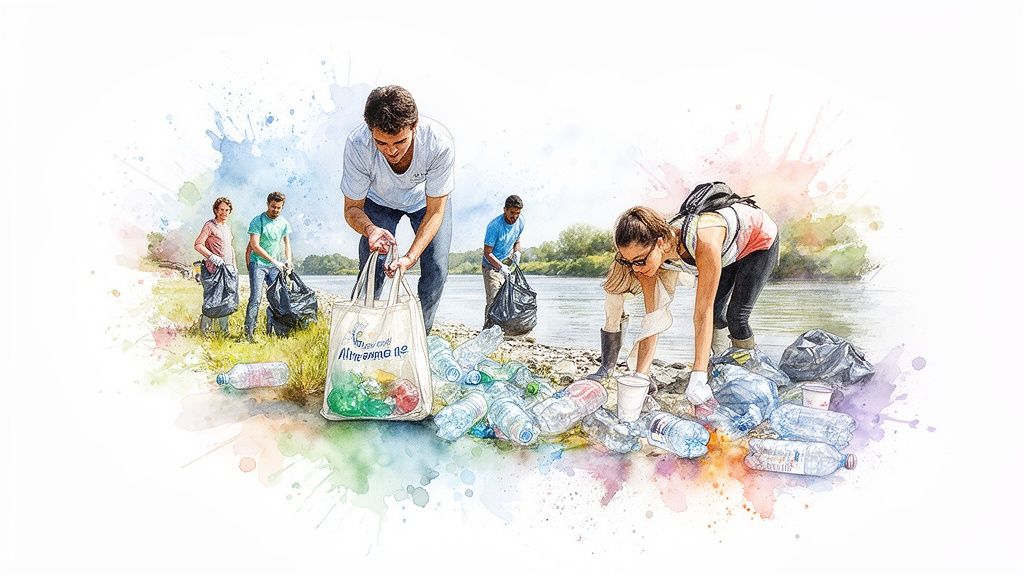
I’m going to tell you a secret: you can absolutely make a dent in plastic pollution. I know, I know. It feels like this giant, overwhelming global crisis. But forget that for a second. It all starts when you decide to take direct, local action—even if it’s just picking up a single, lonely piece of trash. That one small act, that tiny decision, builds a momentum that can ripple out and change your entire community.
Your Mess Is Your Superpower
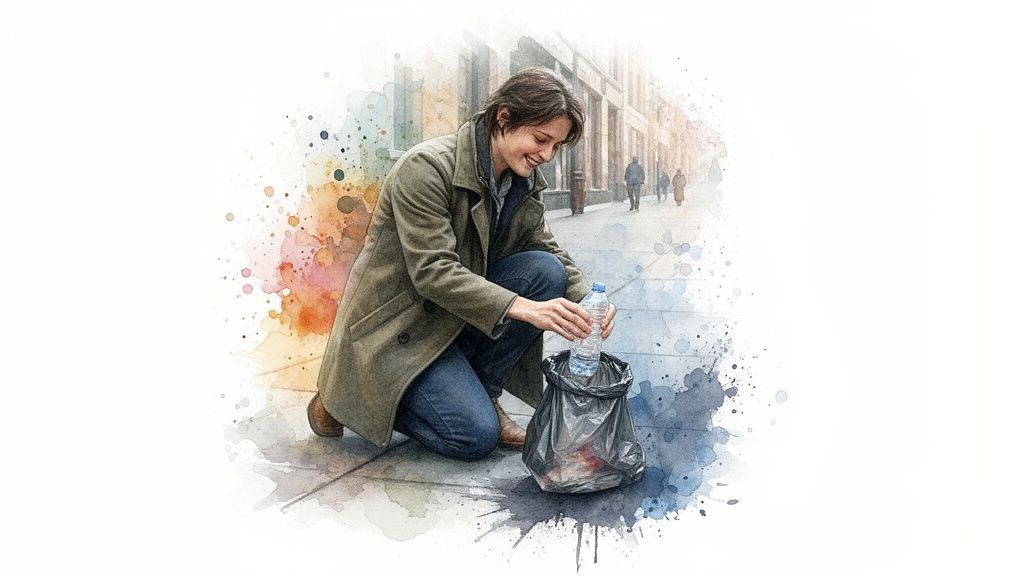
I know that feeling. The paralysis that comes from staring at a mess so big you don't know where to start. It could be the plastic containers overflowing in your kitchen, a silent monument to takeout dinners past. Or maybe it’s the litter you have to sidestep on your daily walk, a constant, nagging reminder of collective neglect. For me, it was both.
My apartment used to be a fortress of clutter. Every single item felt like it held a story I couldn't bear to part with. An old jar of blueberry jam from a trip four years ago, a bag of nuts from a health kick that lasted all of a week—each thing was tiny, but together, their weight felt impossibly heavy. The chaos inside my home was a perfect, suffocating mirror for the chaos I felt in my life.
The Turning Point in a Hailstorm
Then, one day, something snapped. A shift in the universe, or maybe just in me. I found myself standing in a Chicago hailstorm with just two other souls. Our mission was profoundly simple: pick up trash. It was cold. It was ridiculous. And frankly, a little miserable.
But as our hands grew numb and our bags slowly filled, I had this lightning bolt of an insight. Cleaning up someone else’s mess, this public, anonymous mess, was a thousand times easier than facing my own. And the weirdest part? It was fun.
That one small, defiant act of service lit a fire in me. A pilot light I didn't even know had gone out. It was the spark that eventually grew into Litter Caterpillars, our volunteer cleanup group. This is the story of how that happened, but it's also your invitation. I want to show you how tackling the very real, very tangible problem of plastic in your neighborhood can become the key that unlocks the bigger, messier challenges in your own life.
It’s about discovering you have the power to create order, both in your community and within yourself, one piece of trash at a time. It’s a strange but powerful truth: your mess can become your superpower.
This isn't just another guide on how to reduce plastic pollution on some grand, impersonal scale. It's about you finding your strength through action and connection. Together, we're going to walk through how you can:
- Build Personal Momentum: I'll show you how tiny, consistent actions create an unstoppable force for change in your own life.
- Inspire Your Community: You'll learn the practical, no-nonsense steps to turn a solo effort into a thriving group of volunteers who show up, rain or shine.
- Drive Real-World Impact: We'll move beyond cleanups to push for policies and partnerships that tackle plastic waste at its source.
You don't need all the answers. You just need to be willing to take that first step—to bend down and pick up that first bottle. I promise you, the journey from there is more rewarding than you can possibly imagine.
Winning Your First Fight Against Plastic Waste
Starting to cut down on plastic can feel like staring up at a mountain, lost in the clouds. It’s overwhelming. But like any grand journey, it doesn’t start with a perfect, color-coded plan. It starts with one small, brave step. This is your no-fluff guide to what actually works.
Forget about being perfect. We're aiming for progress, one simple swap at a time. I’ve found the best place to begin is with what I call the 'Big Four' of single-use plastics—the stuff you see everywhere, clogging storm drains, tangling in trees, and messing up our parks.
- Plastic Bags: Those flimsy, floating villains of the grocery store.
- Water Bottles: The single-sip containers that stick around for centuries.
- Straws: The tiny plastic tubes we barely even think about, yet use by the millions.
- Disposable Cups: Your daily coffee's temporary, landfill-bound home.
Taking on these four is your first big win. It’s like beating the first-level bosses in a video game; you build up your strength and confidence for the bigger challenges that wait. You don't need expensive gear, just a few smart, easy swaps.
Become a Plastic Detective in Your Own Home
Before you can change anything, you’ve got to know your enemy. Honestly, this part can be kind of fun. Think of yourself as a detective on a mission: I want you to conduct a 'trash audit' in your own home for one week. Just pay attention to every single piece of plastic you throw away.
No judgment. Just observe. Keep a little notepad on the counter or a running list on your phone. Three yogurt cups today? The plastic wrap from a block of cheese? The goal isn't to shame yourself; it's to figure out where the bulk of your plastic is actually coming from.
You might be surprised by what you find. I certainly was. I assumed my biggest issue was takeout containers, but my audit revealed a shocking number of plastic-wrapped snack bars. That simple, clear-eyed observation gave me a target. It turned the huge, vague problem of "plastic pollution" into something specific I could actually solve: "find a better way to buy snacks."
This isn't just about swapping products. It’s about shifting your entire mindset from being a passive consumer to an active participant in your own life. You’re taking back control.
You'll quickly discover that reducing plastic use isn't about deprivation. It's about empowerment. It's the daily practice of choosing what kind of world you want to live in, one small decision at a time.
Building Your Plastic-Fighting Superpowers
Once you know where your plastic is coming from, you can start building new habits. This is where you gain your superpowers. It feels a little clumsy at first, like learning any new skill, but I promise it gets easier until it's second nature.
Just start with one thing. Maybe it's just remembering to bring your reusable tote bags to the grocery store. I used to forget mine all the time. My trick was simple: I started hanging them on the doorknob the night before I planned to go shopping. Now, I feel naked leaving the house without them.
Next, get a reusable water bottle that you actually like. Make it your sidekick. Take it everywhere. You’ll be stunned how quickly you stop even considering buying bottled water. It’s a simple change, but the numbers add up—the average American goes through 156 plastic bottles a year. Imagine wiping that number out completely, just like that.
These aren't just little eco-tips. They are acts of personal empowerment that build an unstoppable momentum. You can find more targeted strategies in our comprehensive guide on how to reduce plastic use in your daily life. Each successful swap, each time you remember your reusable cup, is a small victory. These wins stack up, building the confidence you need to take on the bigger battles ahead.
Understanding Our Staggering Plastic Problem
It’s easy to pick up a single plastic bottle and feel like it’s just one drop in an overflowing ocean. And you know what? You're right—but that's exactly why we have to act. To really get why your effort matters, you have to look the staggering reality of the numbers right in the eye.
This isn’t about scaring you into inaction. I want these stats to be your fuel. They're the "why" behind every cleanup, every reusable cup, every small act of defiance. When you understand the massive, terrifying gap between how much plastic we make and our ability to actually manage the waste, you realize your action isn't just helpful—it's essential.
The Scale of the Plastic Flood
Picture our planet as a bathtub. For decades, we've had the plastic faucet turned on full blast, pouring out a torrent of packaging, gadgets, and containers. The problem? We never built a big enough drain. Now, the tub is overflowing, and the mess is spilling into every corner of our world.
That overflow is happening in real-time. Right now, an estimated 130 million metric tons of new plastic pollution enters our environment every single year. This isn't just floating in the oceans; it’s buried in our soil and even floating in the air we breathe.
Without a massive global shift, that number is set to more than double by 2040. Imagine this: it's like dumping nearly a garbage truck's worth of plastic waste into our environment every single second. You can dig into the full, eye-opening data in the Breaking the Plastic Wave report from Pew.
The numbers below paint a stark picture of where we're headed if we don't change course.
| Metric | 2025 (Annual) | 2040 (Projected Annual) | Change |
|---|---|---|---|
| Plastic Production | 460 million metric tons | 850 million metric tons | +85% |
| Plastic Pollution Leakage | 130 million metric tons | 280 million metric tons | +115% |
| Mismanaged Waste | 90 million metric tons | 200 million metric tons | +122% |
These projections show that our current waste management systems are nowhere near equipped to handle the flood of new plastic being produced. The gap is only getting wider.
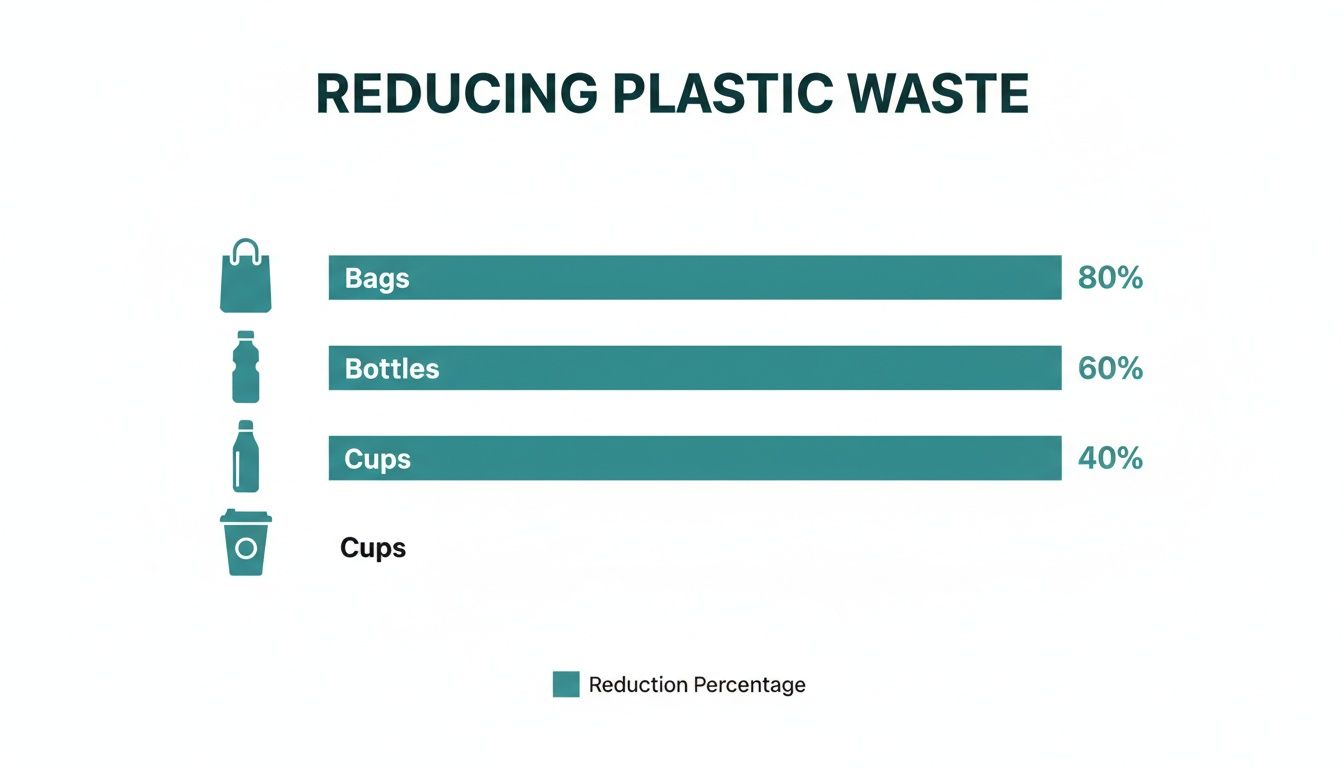
This simple chart really drives the point home: tackling the most common everyday items, especially single-use bags, gives us the biggest bang for our buck. It's an immediate and substantial way to cut down on plastic.
Why Recycling Isn't a Magic Fix
I used to believe that if I just tossed something in the blue bin, I'd done my part. The truth is a lot messier. Globally, a shockingly low percentage of plastic is ever actually recycled—the most common figure you'll see is less than 10%.
The system just isn't built for the sheer volume and variety of plastics we crank out. Many items you might think are recyclable, like flimsy plastic bags or certain food containers, can actually jam up the machinery at recycling facilities, bringing the whole process to a screeching halt.
This is a hard truth to swallow, but it’s also a liberating one. It means we can't just recycle our way out of this crisis. We have to stop the flood at its source.
This knowledge transforms the act of picking up a piece of litter. It's no longer just a chore; it becomes a powerful statement—a vote against a broken system and a vote for a cleaner world.
Your Action as an Antidote
So, what can you do when faced with numbers this big? You anchor yourself in what you can actually control. You start right where you are, in your own community.
- Focus on the "Big Four": We've said it before, but it bears repeating. Targeting plastic bags, bottles, straws, and cups is your most effective starting point. These are the low-hanging fruit of plastic pollution.
- See Waste as a Resource: Every piece of plastic you pick up tells a story. Is it a bottle from a specific brand? A wrapper from a local store? This information is gold.
- Share Your "Why": When people see you cleaning up, they don't just see someone picking up trash. They see someone who cares. That inspiration is contagious. It’s what turns one person with a trash bag into a community movement.
When you internalize the scale of the problem, you realize your individual actions are not just drops in the ocean. They are ripples. Each bottle you refuse and each cleanup you join sends a message that you demand better—from companies, from policymakers, and from each other. That’s how we begin to turn off the faucet.
The Litter Caterpillars Community Playbook
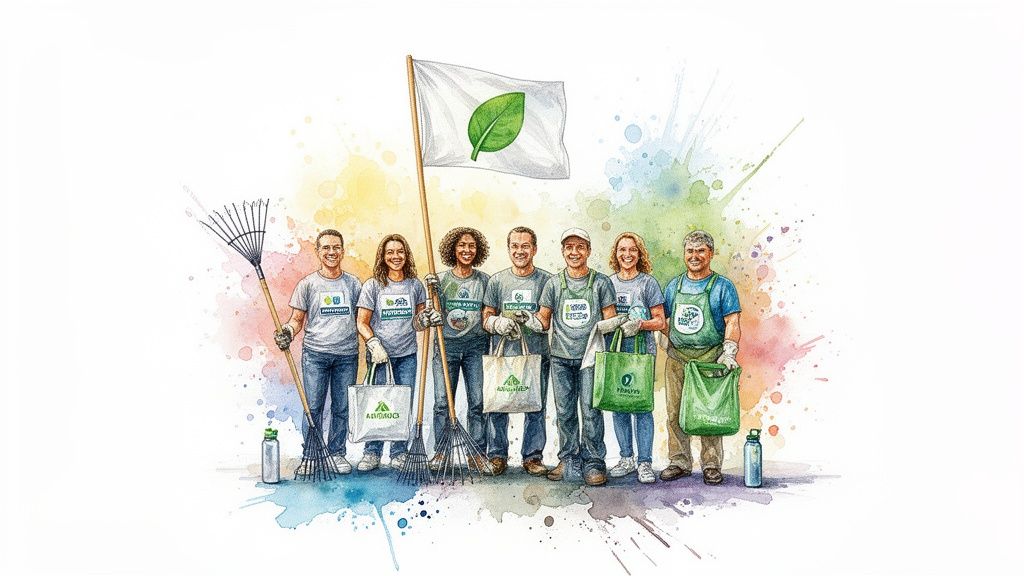
So, you're doing the work. You're refusing the plastic straws, carrying that reusable water bottle everywhere, and getting funny looks from cashiers when you whip out your own shopping bags. That’s awesome. But now you feel it, don't you? That pull to do something bigger.
You want to know how you go from one person picking up trash on a lonely walk to leading a small army that shows up every weekend, ready to get their hands dirty.
This is our playbook. It’s how Litter Caterpillars went from three people shivering under a tree in a freak hailstorm to a city-wide movement. I’m giving you the real story, the stuff that actually works, so you can turn a chore into something people are proud to be a part of.
Laying the Groundwork for Your First Cleanup
First rule: keep it simple. Seriously. You don’t need to file for non-profit status or build a fancy website. All you need is a place, a time, and a handful of people who care. That's it.
Start by picking a spot that personally bugs you. You know the one. That local park with overflowing bins, the street corner on your way to work that’s always a disaster. A visible spot is gold because it sends a message to the whole neighborhood: someone cares enough to do something about this.
Next, pick a time. We intentionally schedule our events on weekend mornings. It's a filter. The folks who show up at 10 AM on a Saturday are the givers, the builders. They aren't there to take; they’re there to contribute.
Getting the word out doesn’t have to be complicated. Use what’s free and easy:
- Social Media: Slap together a quick event on Facebook. Post an Instagram story with the details.
- Neighborhood Groups: Drop a friendly, personal note in the local Nextdoor group or on a community subreddit.
- Old-School Flyers: Never underestimate the raw power of a piece of paper taped to a telephone pole or pinned to a coffee shop bulletin board.
Don't you dare obsess about numbers for your first event. If three people show up, you’ve won. That’s exactly how we started.
Building a Culture People Want to Join
Here’s the secret no one tells you: the trash is almost beside the point. Your real job is to build a culture of bravery, kindness, and connection. People don’t come back for the litter; they come back for the feeling.
At Litter Caterpillars, we lean into what makes us weird. We have flags. We have a theme song. I know it sounds a little silly, but think about it—sports teams and entire countries use these very things to create identity and pride. Why can’t kind people step into their power, too?
You're not just organizing a trash pickup; you're creating a team. Give that team an identity. A story. A reason to feel proud of what you're building together.
We also give out little badges for hitting milestones, like showing up to your fifth cleanup or braving a cleanup in the snow. It’s a tiny thing that says, “I see you. Your effort matters.” This is how you build a community, not just a volunteer group. If you want to see it in action, check if there's a volunteer trash pickup event near you and come experience it for yourself.
The Nuts and Bolts of Cleanup Day
Alright, let's talk gear. You need way less than you think. Don't let a lack of equipment become an excuse not to start.
Here’s your bare-bones kit. The absolute essentials:
- Trash Bags: The one non-negotiable. Get the sturdy kind.
- Gloves: Any thick work or gardening gloves will do. This is a must for safety.
- A Positive Attitude: This is your most powerful tool. As the organizer, your energy sets the tone for the entire event.
Later, as you grow, you can add things like litter grabbers, buckets, and a first-aid kit. But for now, bags and gloves are plenty. I always encourage people to bring their own if they can; it creates a sense of shared responsibility right from the start.
On event day, get there early. Be the first one to arrive and the last to leave. Greet every single person with a real smile. Before you start, pull everyone into a quick huddle. Thank them for being there, give a one-minute rundown of the plan, and mention a couple of safety tips (e.g., “Don’t touch anything sharp”).
Then, turn them loose. Trust your volunteers. You don’t have to micromanage them. The real magic happens when they start talking to each other, building friendships while they work. That’s the good stuff. That’s the win.
Driving Change Beyond the Cleanup
Picking up trash is powerful. I mean that. It’s a real, tangible, hands-on way to reclaim a piece of your community.
But after a few cleanups, you start to feel it. That nagging sense that you're bailing out a sinking boat with a teaspoon while someone left the hose on full blast. You’re dealing with the mess, but you’re not stopping what's making the mess in the first place.
To really make a dent in plastic pollution, you have to go bigger. You have to take the fight to the source. This is how you and your crew can start pushing for real change that actually turns off that hose. It starts with a simple shift in your thinking: stop seeing trash as just trash. Start seeing it as evidence.
Turning Trash into Evidence
Next time you’re out on a cleanup, I want you to try something new. It’s called a brand audit.
Instead of just chucking everything into a bag, pause for a second. Look at what you’re finding. Who made this junk?
Grab a clipboard or just use the notes app on your phone and start a simple tally. How many Coke bottles? How many McDonald's containers? How many Dunkin' cups? Just like that, your cleanup transforms from a community service project into a research mission.
You're no longer just a bunch of well-meaning volunteers. You're citizen scientists, gathering cold, hard proof of who is trashing your streets. This data is your new superpower. It’s the concrete evidence you can slap on the table in front of local businesses and politicians to demand they do something about it.
The scale of this is insane. We know that since the 1950s, a mind-boggling 8.3 billion metric tons of plastic have been created. A whopping 79% of it is now clogging up landfills or choking our environment. Your brand audit creates a hyperlocal snapshot of this global disaster.
From Data to Dialogue
Once you have that data, you’re not just showing up with a complaint. You’re showing up with a story backed by facts. This is where you can start making things happen, right in your own backyard.
Look at the businesses behind the trash you're collecting. If you're constantly picking up coffee cups from that one cafe down the street, your data is the perfect conversation starter. It’s your ticket in the door.
I want you to walk in and say, "Hey, we're a local cleanup group and we love your coffee! We just wanted to let you know we're finding tons of your cups in the park. Have you ever thought about offering a small discount for people who bring their own mugs?"
It's not about pointing fingers or getting aggressive. It's about being a helpful neighbor. You're offering a solution, not just bitching about a problem. You’d be shocked how many small business owners actually want to do the right thing but are just too swamped to think about it.
This approach builds bridges instead of burning them. A lot of businesses want to be seen as good community partners. By talking to them like a human, you can check out their options for more sustainable practices and see how your group might even help them through different corporate social responsibility programs.
Taking Your Voice to City Hall
Sometimes, the problem is bigger than one shop. Maybe there aren't enough public recycling bins in a busy area, or the city's waste collection is a joke. This is when you take your data and your story to the next level: your local government.
Going to a city council meeting can sound intimidating, but trust me, you don’t need to be a slick lobbyist. You are an expert on your own neighborhood. Your real-world, on-the-ground experience is worth more than any fancy PowerPoint presentation.
Here’s how you get them to listen:
- Tell Your Story: Keep it short, personal, and to the point. Start with who you are and why you give a damn. "My name is Sarah, I live on Elm Street, and every weekend my friends and I pick up trash at the park."
- Show Them the Data: This is where your brand audit becomes your weapon. "In the last month alone, we picked up over 500 single-use plastic bottles from that park. A couple of recycling bins would make a huge difference."
- Give Them a Clear Ask: Don’t just complain. Give them a specific, doable solution. "We're here tonight to ask the council to install two new recycling bins near the park entrance."
This is how you go from just cleaning up the symptoms to fixing the disease. You use your voice, your experience, and your data to demand a cleaner world, starting right where you live.
Your Toughest Questions, Answered
After every cleanup, standing there with bags of trash, surrounded by people who chose to show up, the same questions always surface. They come from a place of frustration, but also from a deep well of hope. I hear you. I've asked them all myself.
Let’s get into the real talk. No fluff, just the straight answers I've learned from being out there, week after week, in the rain, sun, and snow.
Is It Even Worth It If Big Companies Don't Change?
I hear this one all the time. It feels like you're trying to mop up a flood while someone else has the firehose cranked to full blast. And you know what? You're not wrong to feel that way. Corporate pollution is the elephant in the room.
But here’s the thing we see on the ground: it's not an "either/or" fight. Thinking that way is a trap, a clever illusion that leads to doing nothing.
Your actions—showing up, cleaning a park, talking to your neighbors—create a visible, undeniable demand for change. You're showing your local businesses and city council members what kind of community you're willing to fight for. Your "small" actions create the social pressure that makes it impossible for them to ignore the problem. You are the force that makes the big players uncomfortable enough to act.
What About the Health Impacts on People?
This question gets to the very core of why this work matters. This isn't just about making a park look pretty. It's a public health crisis hiding in plain sight.
The danger starts way before a plastic bottle ever gets tossed on the ground. The communities living near plastic production plants often bear the worst of the health consequences. And the numbers are just staggering. It's predicted that in 2025 alone, the world will lose 5.6 million years of healthy life due to plastic pollution. By 2040, that number is expected to jump by 75% to 9.8 million years. If you want to dig deeper, this report on plastic pollution's health impacts lays it all out.
When you join a cleanup, you're not just picking up litter. You are fighting for the health of your family, your neighbors, and people in communities you'll never meet. It's a profound act of care.
Am I a Hypocrite if I'm Not Perfectly Zero-Waste?
No. Full stop. Let me say it again: absolutely not.
Perfection is a myth. Chasing it is the fastest way to burn out and give up. This isn't a purity contest; it's about showing up and making progress.
I still use plastic. We all do. We live in the modern world. The goal isn't to become a plastic-free saint—that's basically impossible and will drive you crazy. The goal is to be more mindful, to make a better choice when you can, and to not beat yourself up when you can't.
Your power isn't in being perfect. It's in being persistent. It's in the grit of showing up when you don't feel like it. That consistency is a thousand times more powerful than one person's flawless, Instagram-perfect zero-waste life.
Forgot your reusable bags? It happens. The real win is building the habit, not getting a perfect score every single time.
How Do I Stay Motivated When It Feels Hopeless?
Oh, I know this feeling. It can be soul-crushing. You spend a Saturday making a place beautiful, and two weeks later, it’s trashed again. Some days, it feels like you're losing.
The antidote isn't more optimism. It's people.
You cannot do this alone. Don't even try. The secret is to find your crew. When you're standing shoulder-to-shoulder with someone else who cares, the weight is lighter. You can laugh together about the weird stuff you find. You can share the satisfaction of a full trash bag.
Your community will carry you on the hard days. And you’ll carry them on theirs. That shared struggle, that human connection—that’s the fuel. That's how we keep going.
At Litter Caterpillars, we believe service, friendship, and a little bit of bravery can transform you and your city. If you're ready to find your people and get in the fight, we're ready for you.
Find your community and your purpose with us at https://www.littercaterpillars.com.