
You know that feeling. You turn the corner by your alley, or pull up beside the lot near the bus stop, and there it is again. A couch with the stuffing ripped out. A busted toilet. A mountain of drywall that showed up overnight like somebody emptied a whole renovation into your block and vanished before sunrise.
That kind of mess gets under your skin.
I know because that anger is part of why I started cleaning. My own place was a mess for a long time. I had a weird emotional attachment to trash. Every old container, every dead battery, every forgotten bag in the corner felt heavy to me. Then my life cracked open after a chaotic relationship ended, and I made myself a promise. I was going to build a different kind of life with different kinds of people. Cleaner. Braver. More honest.
Cleaning other people's trash turned out to be easier than cleaning my own.
The first time we went out, there were only three of us. Chicago hit us with that classic nonsense weather. Hail, slush, freezing wind, rides canceling one after another while we huddled under a tree laughing at our own bad decisions. But something clicked for me in that storm. Service changed the story. Suffering gave it flavor. We weren't helpless anymore.
That's the spirit behind illegal dumping prevention. You don't need to wait for a perfect grant, a formal committee, or some polished city plan. You can start with one disgusting pile and one stubborn decision.
Your Call to Action Starts with a Mess
A dumped couch is never just a couch.
It's a message. Somebody looked at your block and thought, “Nobody will stop me here.” That stings. It feels personal even when it isn't. You see the same thing enough times and your brain starts telling you that this is just how your street is now.
I stopped believing that the day I picked up my first bag.
The pile that changed me
For me, it wasn't one dramatic crime scene. It was the slow drip of trash and disorder, outside and inside my own life. I had spent years struggling to clean my room, clear my fridge, throw away things that were obviously dead weight. Then I started cleaning outside with other people, and I felt lighter almost right away.
That's still one of the strangest truths I know. Cleaning up a stranger's mess can wake you up to your own power.
One morning we found a stretch of street littered with the usual suspects. Food containers, broken plastic, fast-food cups, random clothes, a shopping cart missing a wheel. We didn't fix the whole neighborhood that day. We just filled bags until our hands hurt and the block looked cared for again. Neighbors started talking to us. One brought water. Another pointed toward a side lot and said, “If you can help over there too, that's where they really dump.”
That's how it starts. One pile points to another. One cleanup turns into a map in your head.
You don't need permission to care about a place.
This isn't a tiny problem. In the United States, people illegally dump about 1.5 million tons of waste each year, and cost avoidance is a common reason people do it. A surprising number of businesses also say they don't know the fines for dumping construction waste, according to these illegal dumping facts from BigRentz.
Start angry, stay useful
Anger is fine. I've felt it a hundred times.
What matters is what you do next. If you let that feeling harden into cynicism, the dumpers win. If you turn it into movement, even small movement, your block starts changing. You start changing too.
Illegal dumping prevention begins long before cameras, calls, and fines. It begins when you stop walking past the mess like it belongs there.
Find Your Ground Zero
Don't try to save the whole city on day one. Pick one place that keeps bothering you. Your alley mouth. That dead-end lot. The side of the viaduct where people toss mattresses like they're feeding a beast.
That spot is your ground zero.

When I started doing this seriously, I realized many onlookers view a dumping site as a gross blur. You need to look at it like a detective looks at a room. The pile tells a story if you slow down enough to read it.
If you want to work block by block, it helps to see how your target site fits into the wider area. I like checking a broader neighborhood view with the Northeastern Illinois map and then zooming back into the exact trouble spot.
Read the trash
The first clue is the material itself.
Household bags, old toys, kitchen chairs, and clothing usually point one way. Drywall, shingles, concrete chunks, and paint buckets point another. Tires tell their own story. So do mattresses. You don't need to play detective with perfect certainty. You just need a working theory.
Use a simple checklist:
What is it
Write down the types of waste you see. Don't say “junk.” Say “broken dresser, carpet padding, black bags, tire, drywall scraps.”When did it appear
If the pile is fresh on Monday morning, weekend activity is a possibility. If it grows in small bits every night, that tells a different story.How easy is the site
Look for curb cuts, alley openings, darkness, fences with gaps, and places where a truck can back in fast and leave fast.
Sketch the scene
I'm a big believer in ugly field notes. You don't need fancy software. Use your phone, a notebook, or a screenshot with scribbles all over it.
Mark these things:
- Access points where a vehicle can pull in
- Sight lines where nearby homes or stores can see the area
- Shadows where bad lighting gives cover
- Nearby anchors like schools, churches, loading docks, and vacant buildings
A little hand-drawn map can save you weeks of guessing.
Practical rule: Don't study ten bad spots badly. Study one bad spot well.
Look for patterns, not drama
One of the biggest mistakes I see is people reacting only to the latest ugly thing. They chase the newest mattress and ignore the pattern underneath it.
The pattern is the primary enemy.
Once you know why a place gets used, your next move gets easier. Maybe the answer is access control. Maybe it's lighting. Maybe it's regular cleanup. Maybe it's a nearby property owner who has stopped paying attention. But you won't know that from a quick glare out the car window. You'll know it because you stood there long enough to understand the place.
Make Your Spot Un-Dump-Able
The fastest way to invite dumping is to let a place look abandoned.
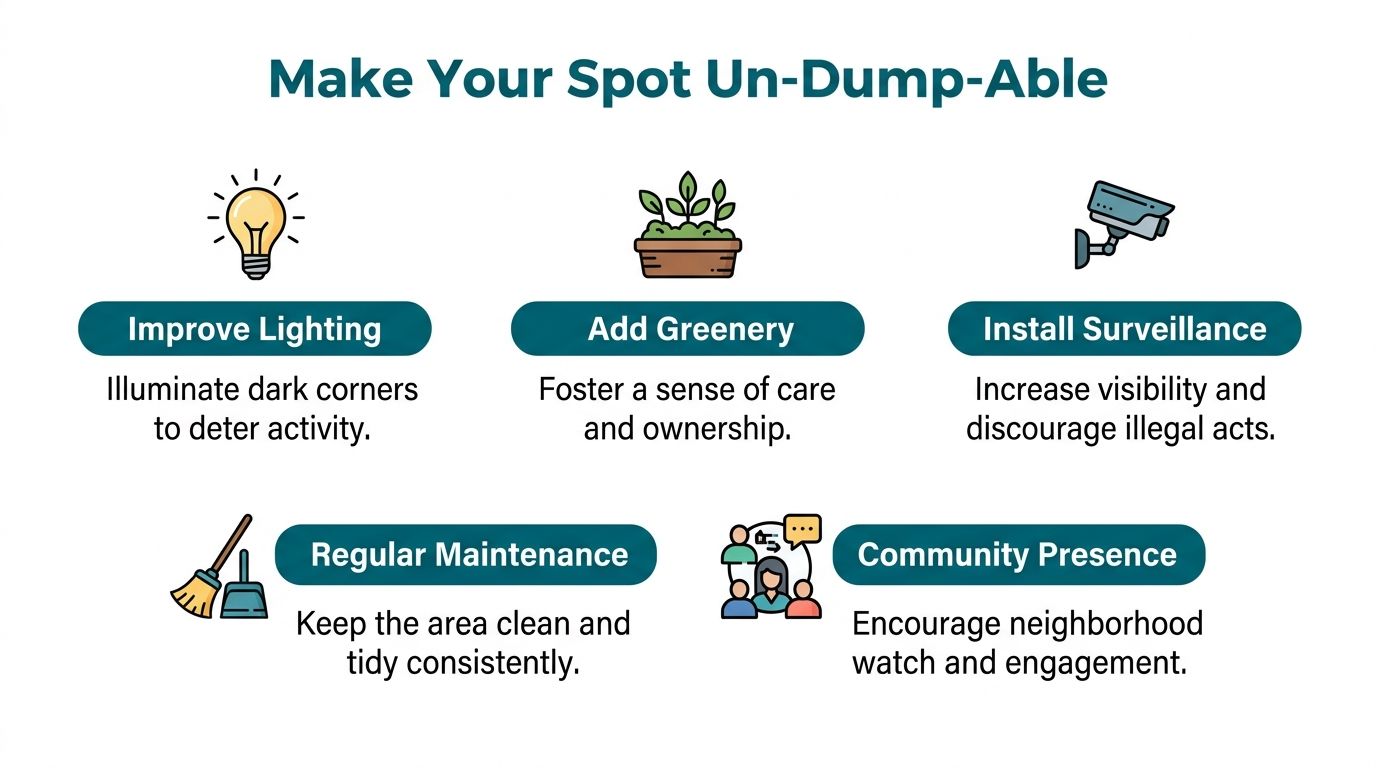
Dumpers love a spot that feels unloved. Dirt patch, busted fence, no lights, no foot traffic, nobody claiming it. That kind of place is like an unsecured bike outside a train station. You don't have to make your site perfect. You just have to make it feel watched, used, and claimed.
I think about Tom Sawyer here. He got punished with a fence and turned it into a source of pride. That's how I approach ugly corners. The point isn't to act cheerful about neglect. The point is to flip the script. You make care contagious.
Make the place feel alive
I've watched a dead-looking lot change personality with a few simple moves. We cleared the scattered trash, cut back the overgrowth, and gave the edges shape. Once a place has edges, people read it differently. It stops feeling like nowhere.
Pilot studies show that regular mowing and cleanup make vacant lots less attractive for dumping because they signal active stewardship. Benches, walkways, and high-visibility lighting also remove the secluded feeling dumpers look for, according to this guide on preventing illegal dumping through site design.
That matches what I've seen with my own eyes. A lot doesn't need to become some fancy mini-park overnight. Even a modest cleanup plus visible care can change behavior.
Here's the video version of that idea in action.
Use obstacles that make sense
You're trying to make illegal dumping inconvenient.
That can mean beauty. It can also mean friction.
A few moves work well together:
- Block the easy drive-in with heavy planters, big rocks, or bollards where cars and trucks usually back up.
- Light the blind corner with a solar spotlight or other visible lighting.
- Keep the ground readable by removing scattered debris fast so one bag doesn't invite five more.
- Give the wall a face with a mural, painted fence, or even bold cleanup signage created by neighbors.
If you want ideas from groups working on neighborhood care, I'd browse these litter prevention programs and steal what fits your block.
A quick field table
| Site problem | What I'd try first |
|---|---|
| Trucks can back right in | Planters, rocks, or barriers |
| People dump at night | Lighting and repeat check-ins |
| Lot looks abandoned | Mowing, edge cleanup, simple beautification |
| Trash returns after each cleanup | Faster follow-up and a visible community presence |
A cared-for place is harder to treat like a landfill.
The point of illegal dumping prevention at the site level is simple. You want the dumper to feel exposed, inconvenienced, and uncertain. You want your neighbors to feel invited. Same block. Different message.
Build Your Crew Not Just a Volunteer List
The morning I knew we had something real, three people showed up before sunrise to a nasty little corner lot that kept filling with mattresses and busted cabinets. Nobody asked if enough volunteers had RSVP'd. One neighbor brought coffee in a dented thermos. Another had extra gloves in a grocery bag. We spent two hours hauling wet junk, talking about kids, rent, and who on the block might come next time.
That is how a crew starts.

A signup sheet can help you count heads. It cannot build trust. Illegal dumping prevention lasts when people feel responsible for each other, not just responsible for a task. On the blocks where we kept the mess from coming back, the difference was never a giant database of names. It was a handful of regulars who knew who needed a ride, who hated lifting tires, and who could make everybody laugh when the work got grim.
Friendship keeps people coming back.
Cleanup groups burn out when the whole day feels like free labor with no human warmth. People stay when somebody remembers their name, notices they forgot water, or says, "Take the lighter bags, I got this one." That kind of care turns a Saturday chore into shared ground.
If you are building from scratch, keep the structure light and the rhythm steady:
- Start with the people already saying yes. Two committed neighbors beat twenty vague maybes.
- Use one simple group chat. Fast communication matters more than fancy tools.
- Pick a repeat time. First Saturday or every other Sunday works better than random calls for help.
- Give the crew a small identity. A team name, a group photo, or post-cleanup coffee gives people something to belong to.
If you want practical ways to bring in the right people, these volunteer recruitment strategies can help you start without turning your block into an office job.
Some of the strongest bonds in our crew were built in bad weather. Cold hands. Muddy boots. A tire that should have taken one person but took three. Those mornings changed people. Neighbors who barely nodded before started checking on each other during the week. Quiet folks began leading corners of the cleanup. A person who came once to "help out" started talking like the block belonged to them, in the best possible way.
That shift matters. Grassroots dumping prevention works because ordinary people stop seeing themselves as bystanders. They become stewards.
I would still rather have six steady people than sixty names on a list. Here is what has helped us keep those six coming back:
| If you want | Do this |
|---|---|
| Better turnout | Keep the day and time consistent |
| Better retention | End with coffee, snacks, or a short hangout |
| Better trust | Pair new people with regulars |
| Better morale | Celebrate the strange wins and the hard days |
Litter Caterpillars is one example of a Chicago cleanup group built around recurring meetups and open group chats, which gives neighbors a simple way to join and return.
People come for the cleanup. They stay because the crew starts to feel like theirs.
That is the part outsiders miss. We are not just removing trash. We are rebuilding the habit of showing up for one another, and that habit keeps a block cleaner longer than a one-time burst of volunteers ever will.
Report Smartly and Safely
When you catch fresh dumping or find a new pile, your first job is not to play hero.
Your first job is to stay safe.
Too many people feel pressure to confront someone in the act. I get the urge. I really do. But the smarter move is distance, detail, and documentation. You are much more useful to your neighborhood when you gather clear information and go home safely.
Evidence beats outrage
A vague complaint is easy to ignore. A precise report is harder to shrug off.
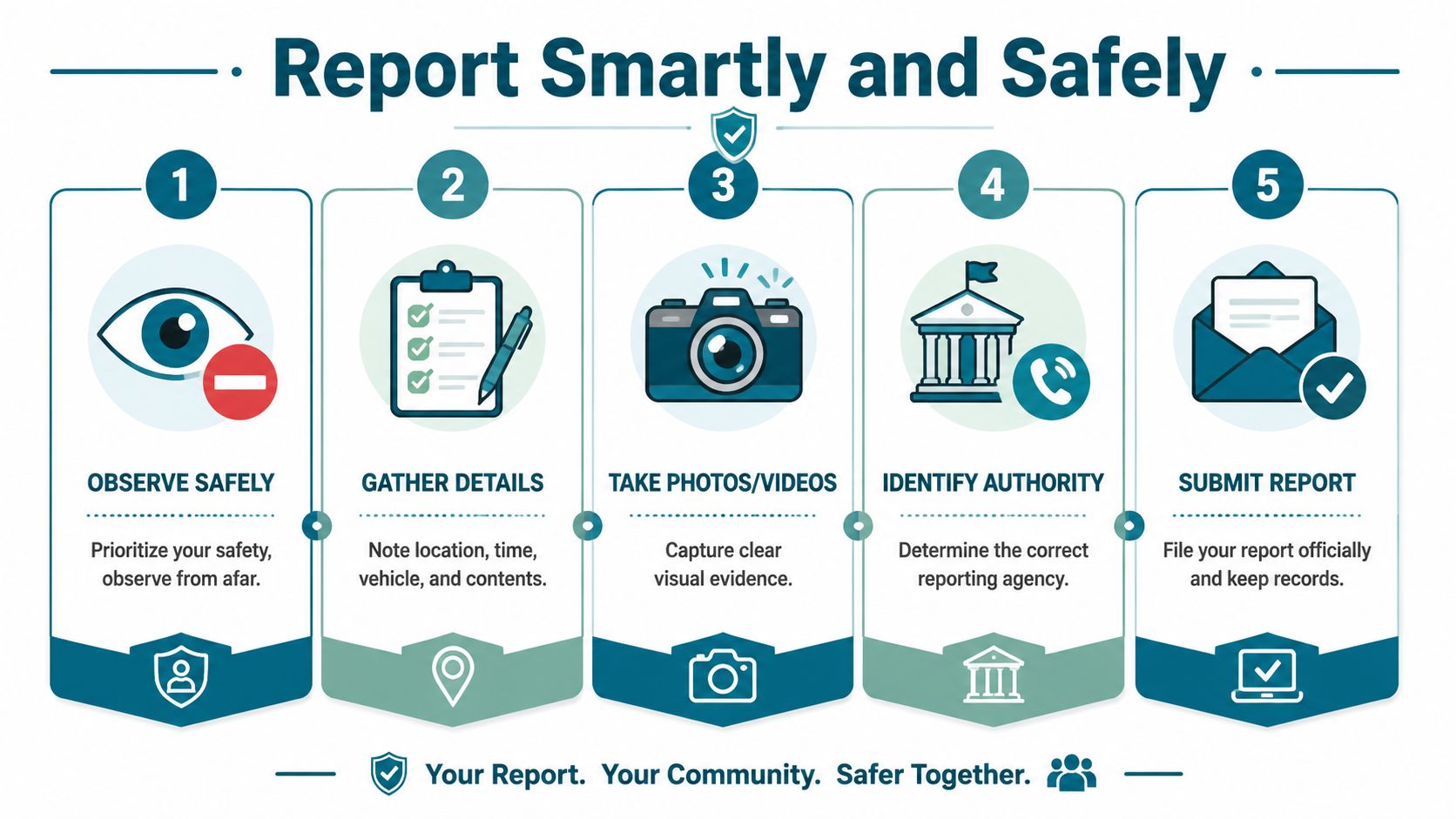
If you can do it safely, take photos from a distance. Get the whole pile first. Then capture anything that helps identify the dump, like nearby addresses, alley entrances, company names on debris, or vehicle details if that can be done without risk.
Use this sequence:
Observe from afar
If someone is present, don't confront them.Record the location
Use the exact address or the nearest cross streets and which side of the alley or lot the waste sits on.Describe the contents
Say what's there in plain words. Construction debris, furniture, black bags, tires, appliance parts.Submit through the right channel
In Chicago, that often means 311.Keep your own record
Save the photos, date, and report confirmation if you get one.
Know the stakes
Good reporting matters because the penalties can stack up.
In Chicago, illegal dumping carries a mandatory fine of at least $300 and up to $600 for each offense, and each day the violation continues can count separately under Chicago Municipal Code 7-28-710.
That doesn't mean every report leads to consequences. It means your documentation has real value when the city has enough detail to act.
If you report, report like someone who wants the case to move.
Protect yourself first
You don't owe anyone a face-to-face confrontation.
If you're worried about retaliation, stay even more disciplined. Shoot from farther back. Don't linger. Don't argue. Don't post identifiable details publicly while you're still near the site. Keep the chain simple and official.
Illegal dumping prevention works better when residents act like calm witnesses, not street enforcers. Your power is in the record.
Find Your Allies in City Hall
A report is a transaction. A relationship is a tool.
Once I learned that, things got easier.
For a long time, I treated city government like a giant brick wall. You complain, wait, and maybe somebody somewhere sends a truck. But when your crew has field notes, cleanup photos, dates, and a clear ask, the whole interaction changes. You stop sounding like a person venting into the void. You sound like a neighbor who is already doing the work and needs one specific hurdle overcome.
Show up as a partner
Your local officials can help with things you can't do alone. They can point you toward the right department, help with special pickups, connect you with property owners, and sometimes support improvements on neglected land.
I've had much better luck when I send a short message that includes:
Who we are
A neighborhood cleanup crew or a few residents who have been working one site.What we've seen
The pattern, not just one ugly incident.What we've done
Cleanup dates, basic documentation, before-and-after photos.What we need
A sign, a pickup, contact with a landlord, guidance on the lot, or a meeting.
That last part matters. Ask for one next step, not ten.
Property owners matter more than people think
Some blocks get trapped because everybody blames “the city” when the primary choke point is a private owner who stopped caring.
That's why official connections matter. A survey of successful programs found that 73.1% of respondents rated “Business & Landlord Engagement” as a highly effective intervention, according to the Mattress Recycling Council's illegal dumping best practices report.
I've seen this play out in a very ordinary way. A lot stays filthy for months. Neighbors keep cleaning the edges. Reports go in. Nothing sticks. Then one conversation finally connects the crew, the office, and the owner or manager who can authorize access, cleanup coordination, or a barrier fix. Suddenly the logjam breaks.
Bring receipts and invite them outside
Email is useful. Walking the site together is better.
If you can get an alderperson's office, ward staffer, or another local official to visit your ground zero, do it. Let them stand where you stand. Let them see the blind corner, the tire ruts, the alley access, the weak fence line.
People move faster when they can smell the problem.
That's not about drama. It's about clarity. Your photos help. Your notes help. But a real site visit makes the ask concrete. You are no longer one more complaint in a crowded inbox. You are the organized neighbor who already picked up bags, mapped the problem, and came ready to work with them.
That's the lane. Stay in it.
The Real Win Is Keeping It Clean
On our block, the first cleanup felt like a victory parade. We filled truck beds, stacked busted furniture at the curb, and took the photo everybody takes when a place finally looks like someone loves it again. Four days later, a torn mattress and three contractor bags showed up in the same corner.
That was the lesson.
A single cleanup can change the mood of a block. Keeping a place clean changes its future. The work gets quieter after the first big push, and that quieter work is what decides whether a dumping spot dies or keeps coming back.
I've watched good people burn themselves out by treating one Saturday like the finish line. Then the next mess lands, and it feels personal. It isn't. It usually means the spot still has easy access, weak visibility, or no regular set of eyes on it. A comeback pile does not cancel what you did. It tells you where the next layer of the job is.
Stewardship beats one-time heroics
The cleanest corners I know are not maintained by superheroes. They're held by neighbors with a rhythm.
On one alley we worked, an older guy walking his dog every morning became the first line of defense without ever calling himself an organizer. He noticed new debris fast. A younger neighbor snapped photos and filed reports. Another person could handle a quick bag pickup when it was safe. Nobody did everything. Together, they kept the spot from sliding back into that familiar signal every dumper reads instantly: nobody's watching.
A simple rotation works:
- One watcher who notices changes early
- One reporter who sends clear photos and location details
- One fixer who handles small, safe touch-up cleanup
- One connector who keeps nearby neighbors in the loop
That little bit of structure matters more than hype. A place stays cleaner when care becomes routine.
Ask why people dump here
We learned this the hard way too. Some sites attract dumping because they feel hidden. Others attract it because getting rid of bulky trash legally is expensive, confusing, or both.
Those causes need different answers.
Research on illegal dumping has found that cost and disposal access can drive the problem, and Los Angeles sanitation officials reported sharp drops in dumping in some areas after free bulky-item collection efforts were expanded, as noted in the City of Los Angeles Bureau of Sanitation report on illegal dumping prevention and bulky item strategies. That matches what we see on the ground. If legal disposal is hard to reach, some people choose the alley and hope nobody stops them.
So ask the plain question. Is this spot getting hit by opportunists, by contractors dodging fees, by neighbors with no easy pickup option, or by all three? The answer changes your next move.
Keep the human goal in view
A clean lot gives people room to breathe.
You notice it in small ways first. Kids stop skirting around broken glass. The woman from two houses down lingers on the sidewalk instead of rushing past. Somebody drags out a chair. Somebody plants flowers by a fence that used to collect trash. The space starts acting like part of the neighborhood again.
That is why we keep showing up.
We may begin with grabbers, gloves, and a pile that makes everybody angry. If we stay with it, we end up with something bigger than a cleanup. We build trust. We build habits. We help each other believe that a block does not have to stay the way we found it.
Illegal dumping prevention works best when regular people decide a place is worth defending, then keep proving it in public.
If you want to do this with other people who already know the rhythm of weekend cleanups, hard weather, and stubborn blocks, join Litter Caterpillars. Bring gloves, bring a friend, and start with one mess. That's enough.