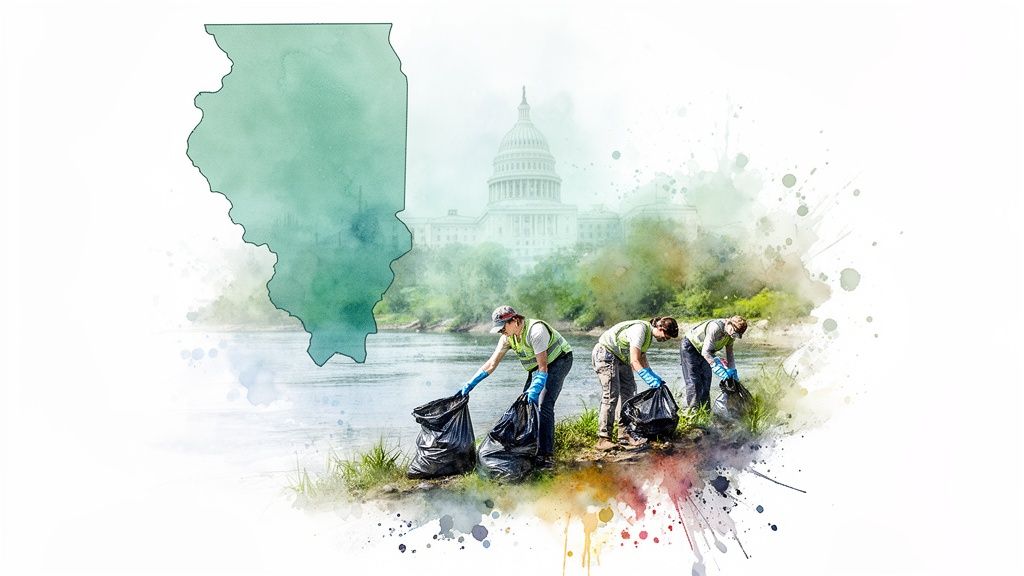
It all begins with that twisting in your gut, doesn't it? The moment you see a street you adore buried under a sea of trash. I know that feeling down to my bones. You see, for me, untangling the messes in my own life—my cluttered apartment, my complicated relationships—was a revelation. I discovered that cleaning things up, truly making them right, brings this strange, profound peace.
That spark is the very soul of why Litter Caterpillars exists. It’s never been just about picking up someone else’s garbage. It's about seizing a piece of your world, your neighborhood, and wrestling it back into something you can be proud of.
From Our Sidewalks to the Statehouse
But here’s the truth I’ve stumbled upon over the last few years: our relentless work on the ground, our sweat and our sore backs, is only the opening chapter. In this guide, I want to pull back the curtain and show you how our grassroots hustle on a drizzly Saturday morning connects directly, powerfully, to the monumental changes orchestrated by the Illinois Environmental Council.
Imagine it like this: we are the frontline soldiers, the boots on the ground, and they are our strategic allies in the capitol building. They take the raw, gritty work we pour our hearts into and forge it into the unyielding steel of actual laws. This is the story of how our small, seemingly isolated acts of defiance ripple outward, gathering momentum until they create a tidal wave of change for all of Illinois.
When you and I show up with our trash bags and grabbers, we’re doing something far more revolutionary than just cleaning a street. We’re sending a signal.
Every single piece of litter we wrestle into a bag is like casting a vote for a cleaner, healthier future. We are demonstrating what we value, not with flimsy words, but with undeniable, back-breaking action. That action creates a powerful narrative, a story that echoes far beyond the confines of our own block.
This chart I made shows you precisely what I mean. It lays out the beautifully simple, yet profoundly powerful, path from our weekend cleanups to real, enforceable statewide policy.
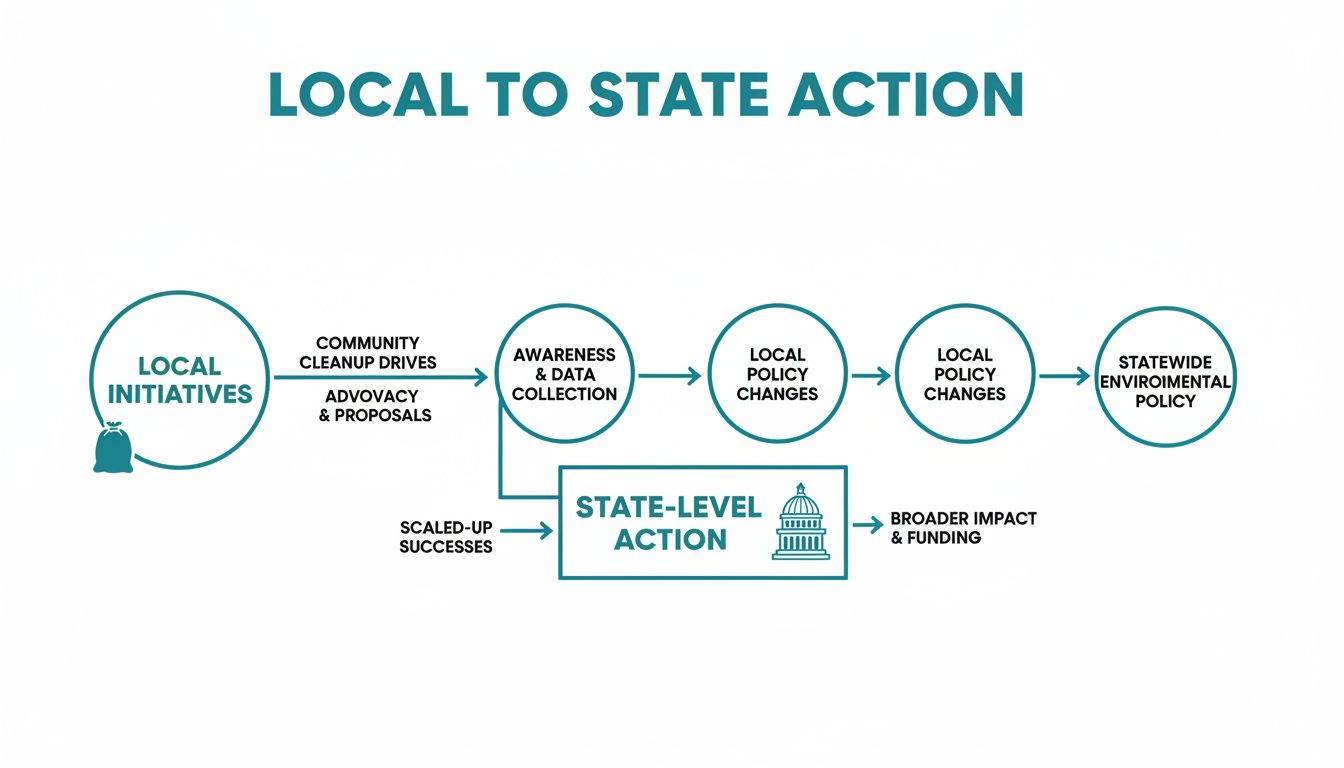
It’s crystal clear, isn't it? Our hands-on dedication is the very fuel that powers the advocacy engine, the machine that makes long-term, lasting change an actual reality.
Turning Local Action Into Statewide Impact
So, how does that incredible leap actually happen? How does you plucking a single plastic bottle from a gutter in Chicago somehow influence a lawmaker deep down in Springfield? That, my friend, is the alchemy of organizing. The Illinois Environmental Council operates like a colossal megaphone, amplifying the voices of thousands upon thousands of people just like us, spread across the entire state.
They gather all our individual, scattered efforts, bundle them into an undeniable force, and translate our raw passion into the precise, unignorable language of policy and law. It’s a partnership of breathtaking power.
You and I focus on the tangible—the immediate, visible mess right in front of us. They, in turn, focus on dismantling the broken, corrupt system that allows our neighborhoods to become dumping grounds in the first place. If you're intrigued by the mechanics of this, you should read up on how community organizing works and discover why it’s such a potent force for change.
Why It Matters to You
This profound connection is exactly why your effort on a Saturday morning matters so damn much. You are not just one person cleaning one lonely block; you are a vital part of a massive, statewide movement that is fiercely demanding a better future.
When the Illinois Environmental Council steps into the ring to fight for stronger anti-pollution laws or to champion clean energy, they are backed by the undeniable actions of people like you. Your very presence at a cleanup proves that everyday Illinoisans care deeply. It gives them the real-world stories, the human faces, they desperately need to win those brutal political battles.
We are the "why." They are the "how." And together, we get it done.
What Is the Illinois Environmental Council?
So, who exactly are these people at the Illinois Environmental Council? I like to think of them as the head coach for ‘Team Illinois Environment.’ Since way back in 1975, they’ve been the indispensable, unifying force that gathers hundreds of us smaller, local groups—the scrappy underdogs—together under one massive banner.
Just picture it for a second. Imagine all of us—the Litter Caterpillars, the local garden clubs, the passionate conservation folks—all trying to scream at the state capital at the same time. It would be a cacophony, a meaningless wall of noise. The IEC is the conductor that gathers all those individual voices, all that raw energy, and harmonizes it into a single, powerful chorus that lawmakers in Springfield simply cannot ignore.
They are our champions on the ground, fighting tooth and nail for the laws that protect our clean air, our fresh water, and the beautiful natural spaces that are our birthright. They're the brilliant strategists and the policy wizards who transform our passion into a genuine, formidable political force.
From Our Streets to Their Scorecard
Here’s how I see the whole thing playing out: when you and I are out in a park on a Saturday morning, getting our hands dirty, we're doing so much more than just picking up trash. We're making a bold, public declaration about what we, as a community, truly value.
The Illinois Environmental Council takes that declaration, that statement written in sweat and effort, and carries it directly into the halls of power where laws are born. They are the central nervous system connecting our hard work on the streets to protective, top-down policies that change everything.
And their influence is undeniably growing. One of their most devastatingly effective tools is the annual Environmental Scorecard, a report that grades every single legislator on how they voted on more than 30 crucial environmental bills.
The results? They speak for themselves, loud and clear. In a recent legislative session, an astonishing 50 percent of sitting State House Representatives and 45 percent of State Senators earned a perfect 100 percent score.
That's not just a small change; it's a seismic shift. It's proof positive that our collective environmental push is translating into real, tangible legislative victories. For a group like ours, it shows that our cleanups are part of a much bigger, more intricate ecosystem of change. You can dive into the full scorecard details on their website and see exactly where your own representatives stand.
The Power of a Unified Voice
This is precisely why their work is so absolutely critical to what we do. While you and I focus on the visible symptom—the litter choking our streets—the IEC attacks the disease at its source. They fight for policies that slash pollution at the starting line and hold massive corporations accountable for the messes they create.
They provide our sweat equity with a permanent, legal backbone. They ensure that the hard work we pour into our neighborhoods doesn't just evaporate, but instead builds toward lasting, statewide change that protects the very places we fight so hard to clean. It’s a perfect, powerful partnership.
The Big Fights They Win For Us
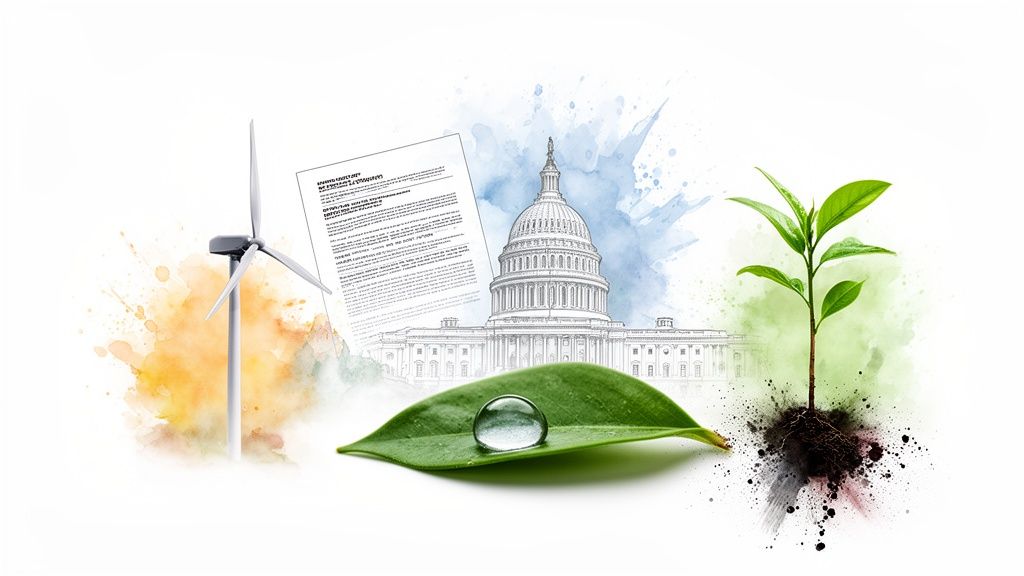
So what does the Illinois Environmental Council actually do? They're out there fighting the colossal battles we couldn’t possibly wage on our own, and they do it by winning one grueling policy fight after another. This is where it gets incredibly exciting, because their work directly impacts the quality of the air you breathe and the water you drink every single day.
Think of it this way: while we at Litter Caterpillars are on the streets treating the symptom—the endless tide of trash—the IEC is going after the disease itself. They go to the source. They work to dismantle the broken systems that allow all this pollution to pour into our lives in the first place.
They’re fighting for a future where our cleanups become less necessary, a world where there’s simply less toxic plastic being produced and fewer poisons leaking into the soil of our neighborhoods.
Building a Clean Energy Future
One of their most monumental victories is a law you’ve almost certainly heard whispers of: the Climate and Equitable Jobs Act (CEJA). This wasn’t just some minor skirmish; it was a historic, knockout blow against the fossil fuel industry. It's as if they're constructing a brand-new, beautiful house for Illinois’ energy future while the old one was rotting from the inside out, filled with toxins and decay.
This single law sets our state on a direct path to 100% clean energy by 2050. Just let that sink in for a moment. Imagine a world with no more disgusting coal plants spewing filth into our skies. It also funnels a river of money into creating green jobs, especially for people in the very neighborhoods that have borne the brunt of pollution for decades.
This means the work you and I do to make our blocks beautiful is now backed by a statewide promise of a cleaner, healthier life for every single person. It’s a straight, unbroken line from our efforts to a more just and sustainable Illinois.
When you or I pick up a single plastic bottle, we're showing we care about our block. When the Illinois Environmental Council passes a law like CEJA, they are ensuring the entire state gets cleaner for generations to come. It’s the ultimate one-two punch.
From Our Bags to Their Bills
And they don't just fight the big, glamorous energy wars. They’re tackling the exact same plastic junk we curse on our cleanups. While you and I are bagging up endless single-use bottles and chip bags, the IEC is deep in the trenches in Springfield, pushing for laws that sever the plastic problem at its root.
Here’s a quick glimpse at a few of the major fights where they serve as our champions:
- Protecting Our Water: They work tirelessly to ensure that every single community, from the towers of Chicago down to the riverbanks of Cairo, has access to safe, lead-free drinking water.
- Fighting Industrial Pollution: They hold the massive corporate polluters' feet to the fire, fighting for stronger regulations on factory farms and industrial plants that threaten our land and poison our rivers.
- Saving Natural Lands: They champion the crucial funding needed to protect and resurrect Illinois’ breathtaking prairies, forests, and wetlands.
Every bottle you pick up, every bag you fill—it's a story. It’s a testament. The Illinois Environmental Council takes all our small, individual stories and transforms them into a mountain of powerful evidence. You can see the direct, undeniable line from a discarded coffee cup on your street all the way to a high-stakes policy debate in the statehouse. Their success is our success, magnified a thousand times over.
Our Part in a Bigger Story of Restoration

It’s so easy to feel small, to feel insignificant. I get it. You hear that Illinois has lost nearly all of its native prairies and wetlands, and the news hits you like a physical blow, a punch to the gut. But I want to tell you a story of hope—a story that shows how we, the Litter Caterpillars, are plugged into something so much bigger, so much more profound, than just one trashed lot or one neglected neighborhood.
This is the story of an incredible, breathtaking comeback happening right here in our state. And every single one of us has a vital part to play.
From Small Lots to Sprawling Prairies
Do you remember when we first laid eyes on that trashed, forgotten lot and started dreaming up Caterpillar Park? We saw a patch of derelict dirt, choked with weeds and debris, and together, we dared to imagine what it could be.
Now, I want you to picture that same fierce energy, that same defiant vision, but magnified to a massive, landscape-altering scale. That’s precisely what’s happening at places like the Midewin National Tallgrass Prairie. These are hugely ambitious projects, audacious efforts to bring nature roaring back from the brink, proving that healing our land is not just a dream but an achievable reality when thousands of people get involved.
The numbers can be brutal, I know. It's true that Illinois has lost a staggering 90% of its original wetlands and that less than 0.01% of its native prairie remains. But even against those devastating losses, a powerful, determined comeback is underway. Since the early 2000s, incredible partnerships between groups like the Illinois Environmental Council, state agencies, and passionate volunteers have restored or enhanced over 100,000 acres of wetlands. That is a colossal victory for our water quality and our wildlife. You can see the proof for yourself and read about these incredible conservation wins in northeastern Illinois.
Connecting Your Work to a Statewide Comeback
This is where it all clicks together, where the puzzle pieces snap into place. The work you do with us on a Saturday morning isn't just a drop in an endless bucket. It is a critical, indispensable piece of this statewide mosaic of recovery.
When you spend an hour with us clearing invasive buckthorn from a small city park, you are helping a massive forest preserve hundreds of miles away breathe a little easier. When you haul old tires out of a riverbank, you are helping a downstream wetland restoration project succeed. You are a vital, active part of the recovery.
You are directly contributing to the health and vitality of our state’s entire ecosystem. This is the very essence of what it means to practice real what is environmental stewardship: taking personal, profound responsibility for the world that surrounds us.
Our work sends a powerful signal. It demonstrates to everyone that we believe in bringing things back to life, whether it’s a single city block or thousands of acres of sprawling prairie. You aren’t just picking up trash—you are an active, crucial player in one of the greatest environmental comeback stories our state has ever seen. And that, my friend, is a legacy to be damn proud of.
How You Can Join the Statewide Movement
Are you feeling that fire in your belly? You know that surge of pride you get after a cleanup, when you look back at a clean street and know you made it happen? That feeling is the beginning of something much bigger. You’re ready to move beyond our weekend meetups, and I’m going to show you exactly how to channel that energy.
This is your personal guide to plugging our raw Litter Caterpillars energy directly into the powerhouse that is the Illinois Environmental Council (IEC). Think of it as a beautiful partnership: we bring the fearless passion and the dedicated people, and they bring the statewide megaphone. This is the mechanism by which our hard, sweaty work on the ground transforms into real, lasting change that echoes across all of Illinois.
From Street Level to State Level
So, how do we actually make this leap? It's far easier and more accessible than you might think. The IEC has flung open several doors for people like us, whether you have five minutes to spare or you’re ready to dive headfirst into the deep end.
A ridiculously simple first step is to become an IEC Activist. This isn't some massive, life-altering commitment; it just means you sign up for their emails. When a critical environmental bill is teetering on the edge of a vote, they’ll send you an alert with a dead-simple way to email or call your state representative. It’s an incredibly fast, surprisingly powerful way to make your voice roar without ever leaving your house.
You can also show up to their events. The Illinois Environmental Council hosts everything from intimate online talks about clean water to their massive, high-energy annual Environmental Lobby Day in Springfield. These are amazing opportunities to meet other people who share your fire, to learn how the system really works, and to feel the immense, collective power of this movement. It’s genuinely inspiring.
Powering Up as a Group
For a scrappy crew like ours, the next monumental step is becoming an official member organization. The moment we join the IEC, we’re not just the Litter Caterpillars anymore—we become part of a powerful coalition of over 100 other groups fighting the exact same fight. Suddenly, our voice gets louder, and we gain access to a level of support and resources we could only dream of on our own.
I’m also genuinely excited about their grant opportunities. This could be our chance to secure funding for bigger, more ambitious projects—just imagine getting the money for better equipment, or even transforming more empty lots into vibrant community parks just like we did with Caterpillar Park. It’s a real, tangible possibility.
This entire journey, from picking up a single piece of forgotten trash to shaping statewide policy, is what real, meaningful change actually looks like. It's the very core of what being an active, engaged citizen is all about. If you want to delve into the philosophy behind this powerful idea, you should check out the real meaning of civic engagement in our guide.
Ways to Connect With the Illinois Environmental Council
Here's a quick, no-nonsense guide on the different ways you can get involved with the IEC, from individual actions you can take right now to powerful group partnerships.
| Action | What It Involves | Best For |
|---|---|---|
| Become an IEC Activist | Signing up for email alerts on key legislation and taking quick, powerful online actions. | Individuals who want to make their voice heard instantly. |
| Attend an Event | Participating in town halls, webinars, or the annual, high-energy Environmental Lobby Day. | Anyone wanting to learn more, feel the energy, and connect with others. |
| Organizational Membership | Your group (like us!) joins the IEC network for advocacy support, resources, and a louder voice. | Volunteer groups and non-profits seeking to amplify their impact. |
| Donate | Providing financial support for their critical legislative and educational work. | Individuals and groups who want to invest directly in statewide policy change. |
No matter how you choose to plug in, you’re taking a massive, important step. You’re helping to forge the connection between our gritty work on the streets of Chicago and the hallowed halls of power in Springfield. Let’s do this.
Your Questions About Working With the IEC
You've got questions. That's a fantastic sign. It means you’re already looking past the trash bag in your hand and thinking bigger, more strategically. I absolutely love it.
When I first heard about the Illinois Environmental Council, I had a million questions myself. To me, it sounded like some big, faceless, official organization down in Springfield. I couldn’t for the life of me see how a bunch of us who just like picking up litter could possibly fit into that world.
It turns out, we fit in perfectly. I’ve put together some straight-up answers to the questions I get asked all the time to show you how a single weekend with the Litter Caterpillars can connect you directly to a powerful, statewide movement.
Do I Need to Be a Policy Expert to Get Involved?
Absolutely, unequivocally not. This is the biggest, most damaging myth I hear, and it stops so many good, passionate people from even trying. You don't need to know the first thing about how a bill becomes a law. Seriously. I don't.
The IEC’s entire job is to wrestle with the tangled, complicated policy stuff. They have the lawyers and the lobbyists who live and breathe that world. Your job is infinitely simpler, and honestly, a thousand times more powerful: just tell your story.
When you talk to a lawmaker, they don't want a dry lecture on legal jargon. They need to hear why keeping your local park clean matters to you, one of their actual voters who can either keep them in office or kick them out. Your passion is your expertise.
Think of it this way: you bring the "why," and the Illinois Environmental Council provides the "how." Your voice, as a real human being living in their district, is the living proof they need to show other legislators that these aren't just abstract issues on a piece of paper—they're real issues that real people care about deeply.
How Can a Small Group Like Ours Influence State Law?
I asked myself this exact question when we first started. We’re just one small group cleaning up one part of Chicago. How in the world can we possibly change anything in Springfield?
The answer is collective power. On our own, we’re a single, easily dismissed voice. But as a member of the Illinois Environmental Council, we are suddenly part of a massive coalition of over 100 other organizations. All of a sudden, we represent thousands and thousands of people all across Illinois.
When the IEC walks into the state capitol, they don't just speak for themselves. They get to say, “I’m here speaking for the Litter Caterpillars in Chicago, and the garden club in Peoria, and the conservation group down in Carbondale.” Our voice gets amplified a hundred times over.
It's just like a choir. One person singing a song is nice, but it’s easy to ignore. A hundred voices singing the same song in perfect harmony? That’s a force. That’s something that makes people stop in their tracks and listen. By joining together, we stop being a small, insignificant group and become part of a massive team they simply cannot brush aside.
What's the Difference Between the IEC and the Illinois EPA?
Fantastic question. I know it's confusing, but the difference between them is incredibly important. Here’s the analogy I always use:
Think of it like a football game, with a team and the referees.
The Illinois Environmental Protection Agency (IEPA) is the government agency—they're the referees. Their job is to enforce the rules that are already on the books. They issue permits, monitor pollution levels, and make sure everyone is playing by the current environmental laws.
The Illinois Environmental Council (IEC) is an independent advocacy group—we’re the players and the passionate fans. We are the ones on the field, pushing to change the rules of the game for the better. We fight for new, stronger, tougher laws to protect our air, our water, and our land.
So, the IEPA is the agency that makes sure a factory is following today’s pollution laws. But the IEC is the group that probably fought for years, even decades, to get those pollution laws passed in the first place.
The IEPA might manage the cleanup of a toxic waste site, but the IEC is the group that likely spent a decade convincing lawmakers to create the fund that pays for it. They both work tirelessly for a healthier Illinois, just from two very different, but equally vital, angles. You can check out the IEPA’s official role and history over on their website.
Ready to turn your passion into action and friendship? The Litter Caterpillars meet every single week. Join us for our next cleanup