You step outside on a Saturday with coffee in your hand. You see a bag stuck in a fence, cups in the gutter, and a bottle rolling toward a drain. You type community clean ups near me into your phone, and you get a list of dates with no real answers.
You wonder if you can show up alone. You wonder what you bring, how long you stay, and what happens if you run late. I get those questions every week, and I answer them below in plain order, one step at a time.
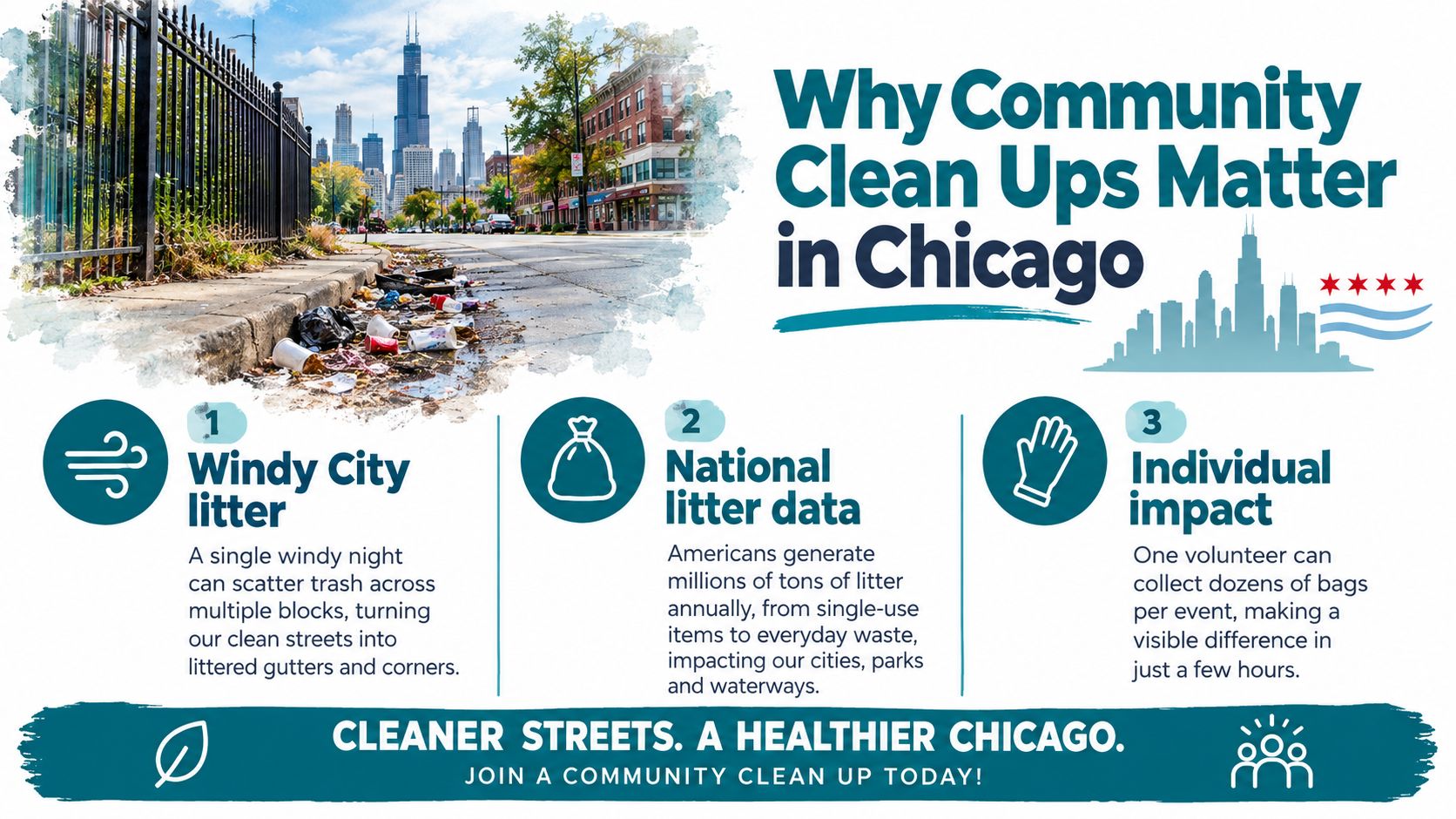
Why Community Clean Ups Matter in Chicago
I remember a windy night on the West Side. Wind pushed trash down the block like tumbleweeds made of plastic. By morning, fences held bags, gutters held cans, and one alley looked like a dumpster had tipped over.
You clean that kind of mess one piece at a time. You grab a cup. You grab a wrapper. Soon your bag feels heavy, and the corner looks different.
The Numbers Behind Your Block
Keep America Beautiful's 2020 National Litter Study estimated nearly 50 billion pieces of litter along U.S. roadways and waterways, about 152 pieces for every resident. That number turns a huge problem into a personal picture. You can picture 152 items. You can picture picking them up over a few Saturday mornings.
The same study found roadside litter declined by approximately 54% over the decade before the study. People changed habits, cities changed systems, and volunteers kept showing up. Your work fits that pattern.
One cleaned block is not a drop in the bucket. One cleaned block is the bucket, because neighbors see it and treat the block with more care.
Why Your One Morning Counts
Think of litter like dishes in a sink. One plate looks small. A week of plates fills the counter and makes the whole kitchen feel dirty. Streets work the same way, and wind spreads the mess faster than people expect.
You also meet people when you clean. A neighbor asks what you're doing. A kid asks for a grabber. A shop owner brings water. I wrote more about that ripple effect in my notes on why you should pick up litter, and I see the same idea in social responsibility at SANS, where a company ties daily choices to care for other people.
You remove trash: You keep plastic and paper out of drains and waterways.
You change signals: You show neighbors that someone cares about this block.
You learn your area: You spot dumping spots, broken lights, and overflowing bins early.
You don't fix Chicago in one morning. You fix one corner, and you learn how to fix the next one faster.
What a Community Clean Up Actually Looks Like
You arrive at a park gate or a street corner. A coordinator in a bright vest waves you over to a table. You sign in, you grab gloves, and you hear a short talk about the route and the rules.
That first ten minutes calms most nerves. You learn where you walk, where you put full bags, and who you call if you find something strange. You don't guess. You follow a simple plan.
How a Morning Flows
Most groups split you into small teams. One person leads the route, one person carries extra bags, and everyone picks up what they see. You walk slowly, you talk, and you fill bags as you go.
Meet and gear up: You check in and take gloves, a bag, and a grabber if the group has one.
Walk your route: You cover a few blocks or one park edge with a buddy.
Stage full bags: You tie bags shut and leave them at one pickup spot.
Count and close: You return tools, wash hands, and hear the bag count.
One Day Events and Weekly Groups Differ
A one day park event suits you if you want a low promise. You show up once, you work, and you go home. A weekly neighborhood group suits you if you want friends and a routine, because you see the same faces and you learn the same streets.
City crews still do the heavy base work. Chicago's Bureau of Sanitation collects residential garbage from approximately 600,000 households, and city street sweepers clean approximately 295,000 lane miles of Chicago streets each year. You fill gaps between those runs in alleys, lots, and park edges, and you work best as a recurring, place based supplement to city sanitation.
What I tell first timers: You don't need speed. You need steady eyes, closed bags, and a buddy within sight.
You leave tired in a good way. You also leave with a clear before and after picture in your head, and that picture pulls many people back.
How to Find Clean Ups Near You
You find good events when you search by place and by routine. Start close to home, because a short trip removes half the excuses. I tell people to pick a spot they can reach by bus, train, bike, or a short walk.
Search results often skip the details you need. You need the meeting point, the end time, the gear plan, and a contact name. You ask for those details before you commit your morning.
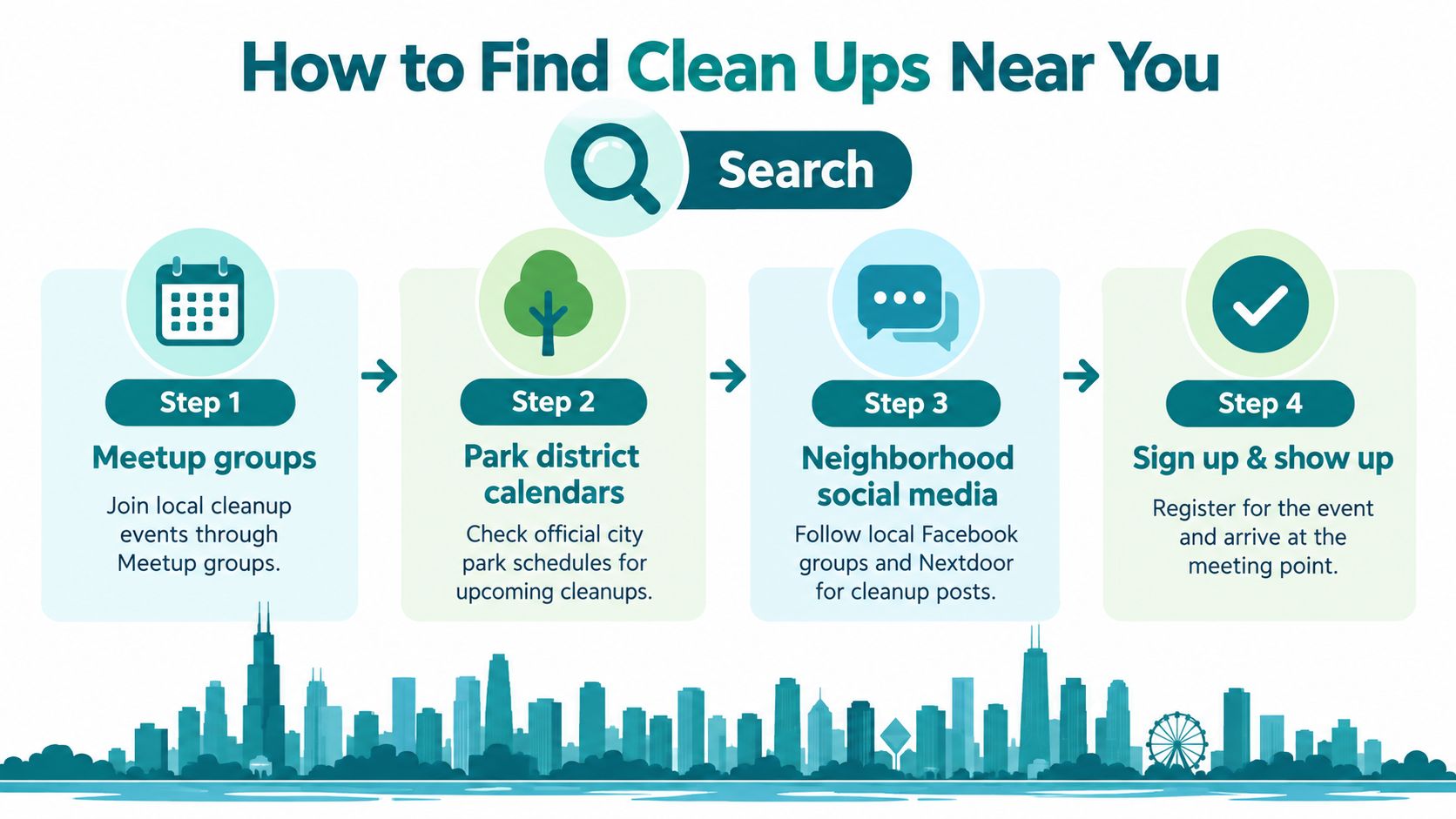
Four Places I Check First
Meetup groups: You search cleanup and your neighborhood name, then you read recent photos and comments.
Park district calendars: You check official park pages for stewardship days and one day workdays.
Neighborhood social media: You follow local Facebook groups and Nextdoor posts from block clubs.
Local park staff: You call or visit your nearest park and you ask about the next workday.
You can also learn from groups in other cities. I like how the Durham refill shopping guide lists exact local options in one place, because clear local lists help people act instead of guessing.
The Friction That Stops People
International volunteering research found 65% of respondents identified limited resources for transportation, meals, or balancing work with volunteering as barriers, and 61% cited insufficient knowledge about available opportunities. A separate 2026 Gallup survey found 54% of Americans with time and interest in community involvement were unsure how to get involved.
Those numbers match what I hear at sign in tables. You care, but you lack a clear first step. So you ask direct questions, can I come alone, can I arrive late, and where do I meet if I miss the start?
Arrive late? Text the lead, go to the home base table, and join the nearest team. Don't wander off alone to catch up.
Good groups welcome solo newcomers and pair you with a returning volunteer. You judge fit by clear answers, a named lead, and a set end time.
What to Bring and How to Prepare
You prepare like you prepare for a long walk with work gloves. Simple gear keeps you comfortable, and comfort keeps you out there for the full route. I pack the night before so I don't rush in the morning.
Groups often supply gloves, bags, and grabbers. You still bring your own basics, because sizes run out and weather changes fast in Chicago. You ask the organizer what the group has before you leave home.
Your Packing List
Closed toe shoes: You protect your feet from glass, metal, and uneven ground.
Long pants: You guard your legs from brush, bugs, and sharp edges.
Water and a hat: You stay cool and you avoid a headache by mid morning.
Sun protection: You cover skin that sun hits while you bend and walk.
Phone with charge: You reach your lead and you mark spots that need a report.
Dress in layers you can shed. Wind off the lake can turn a warm forecast cold in one block. I also bring a small snack for the train ride home.
Paperwork and Clean Hands
Many park events ask you to sign a waiver before you start. You complete that step online or at the table, and you give yourself a few extra minutes. Some longer term roles ask for more steps, so you read the signup page with care.
After you finish, you wash your hands well. You can read about regular soap vs antibacterial dish soap if you wonder what soap to keep at home, but plain soap, water, and a good scrub handle the job after a cleanup. You also wash before you eat, every time.
If you wouldn't wear it for a long walk, don't wear it to a cleanup.
You bring a good attitude too. You greet people, you learn names, and you ask questions when you feel unsure.
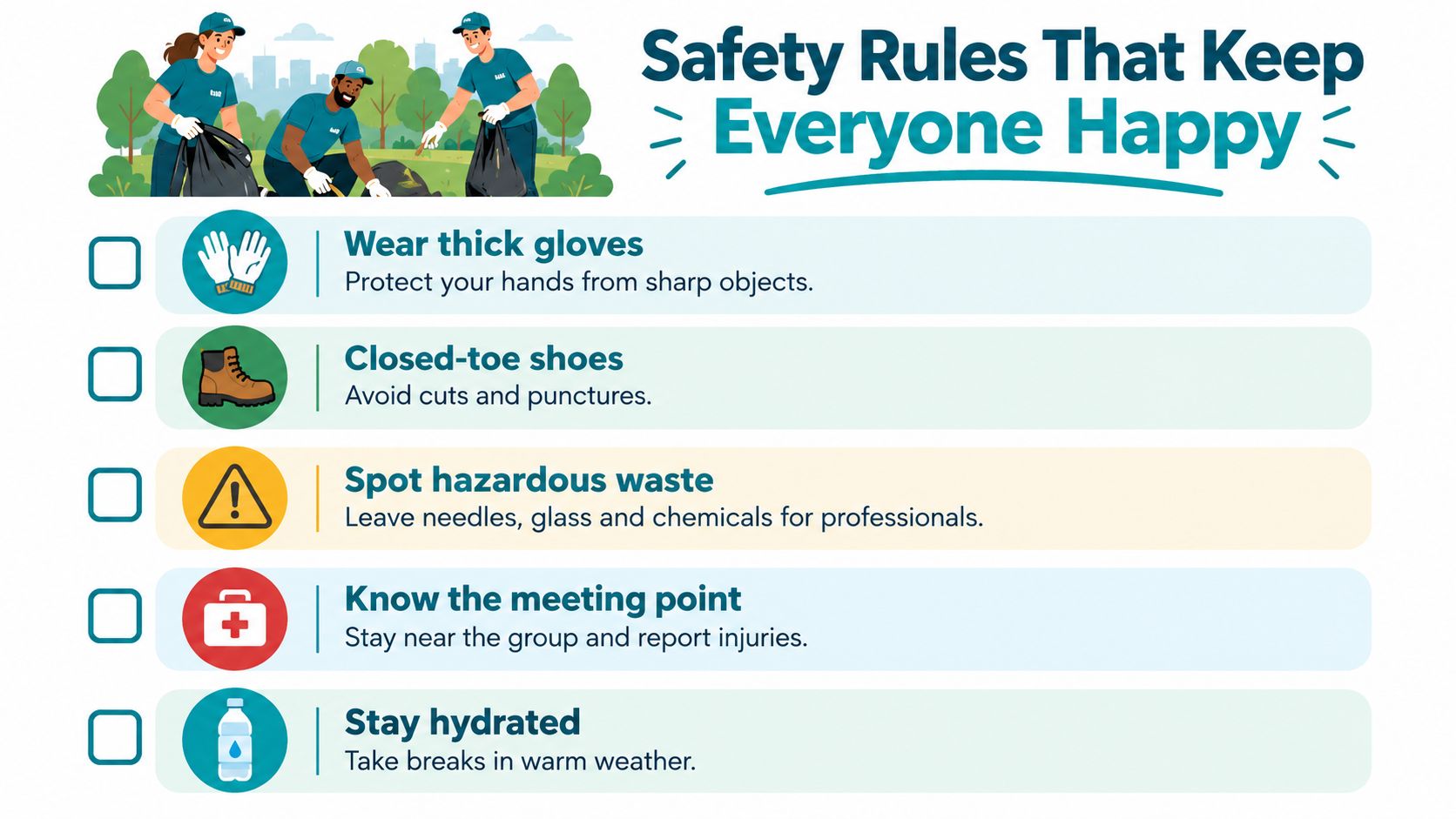
Safety Rules That Keep Everyone Happy
You might think a good volunteer picks up everything. I teach the opposite rule. A good volunteer picks up ordinary litter and reports danger fast.
Gutters and bushes hide sharp and dirty items. You slow down, you look before you reach, and you keep your hands where you can see them. That habit prevents most injuries.
Use the See It Rule
Ask yourself one question. Can I see the whole item clearly, and can I grasp it safely with gloved hands or a grabber? If you answer yes, you ask your lead if it belongs in your bag, and if you answer no, you leave it alone.
The University of Kansas Community Tool Box recommends defining in advance what volunteers may and may not collect, with immediate stop and report rules for needles, medical waste, unknown chemicals, fuel or oil spills, suspected asbestos, unstable structures, electrical hazards, weapons, explosives, and dead animals. I use that same line in Chicago, and I put the details in our volunteer safety checklist for cleanup days.
Stop, Mark, Report
Stop: You step back and keep others away from the item.
Mark: You note the nearest address or landmark and you take a photo from a safe distance.
Report: You tell your lead right away so the lead can route the issue to the right city service.
Glass and sharps: You leave them for a lead with the right tools.
Bulky dumping: You report tires, furniture, and construction debris, and you don't drag them.
Bad ground: You skip steep banks, fast water, and dark underpasses.
Bags filled matter. Hazards reported correctly matter too, because one bad grab can end a volunteer's season.
You wear bright clothing near traffic, you drink water, and you take shade breaks. You speak up when you feel dizzy, cold, or unsafe, and a good lead thanks you for speaking up.
Real Cleanups in Chicago You Can Join
I start newcomers with two paths. You can join a park stewardship day for a set task in one place. You can join a weekly neighborhood group for a moving route and a social routine.
Both paths welcome first timers. You choose based on your schedule, your energy, and how much structure you want. I suggest you try one of each in your first month.
Park District Stewardship Days
Chicago Park District stewardship days welcome people of every age, background, and experience level. You must sign a liability waiver before you start, and if you bring a child younger than 13, a parent or guardian must accompany that child and sign the waiver.
Work varies by site and season. You might pick up litter, mulch a trail, remove invasive plants, or plant native plants. You wear long pants and closed toe shoes, you bring water and a hat, and you plan ahead because many sites lack bathrooms.
A Small Group That Kept Showing Up
Our first outing had three people. A spring hail storm hit us, rides kept canceling, and we huddled under a tree and laughed at the mess. That cold morning taught me a lesson I still use, cleaning someone else's mess feels easier than cleaning your own, and shared discomfort bonds people fast.
That small start grew into Litter Caterpillars, a volunteer group that meets on weekend mornings in different Chicago neighborhoods and supplies gloves, bags, and grabbers at events. The group later won an empty lot at auction and turned that lot into Caterpillar Park in Englewood. You can see one route focus in our Chicago River cleanup work, where water edges need extra care and extra eyes.
You want structure: You pick a park day with staff, a waiver, and a set task list.
You want a routine: You pick a weekly group with the same meeting style each time.
You want to explore: You pick a moving route that visits new blocks and wards.
Every regular you meet once stood at a sign in table and felt unsure. Someone handed that person gloves and said, walk with me.
You don't need experience. You need a meeting point, a start time, and a willingness to say hello first.
How to Make Cleanups a Habit
You build a habit when you make the next step easy. Pick the same morning, lay out your clothes, and put water by the door. Small prep beats big motivation on a cold Saturday.
You also return for people. Names become faces, faces become friends, and friends notice when you miss a week. That social pull carries you through weather that might stop a solo effort.
Why People Come Back
A longitudinal analysis using UK survey datasets found a bidirectional relationship between social cohesion and volunteering, stronger cohesion predicted later volunteering, while volunteering predicted greater later cohesion. In plain words, you show up, you belong more, and belonging helps you show up again.
Predictable attendance builds trust. Trust helps you learn routes, follow safety rules, and work faster with less confusion. You start to spot patterns, like which corner fills after a game or which lot needs a report.
A Simple Four Week Plan
Week one: You attend once and you learn names.
Week two: You return and you take a small role, like carrying extra bags.
Week three: You invite one friend and you show that friend the ropes.
Week four: You decide your rhythm, weekly, twice a month, or once a month.
Track your streak: You mark each outing on a calendar you see daily.
Pair the habit: You link cleanup to coffee, a farmers market, or a walk home.
Rest without quitting: You skip a week when life gets busy, and you book the next one right away.
Don't aim for perfect attendance. Aim for a next date on your calendar.
Pick one event from your search for community clean ups near me, show up once, and see how your block looks through new eyes. Chicago changes one block at a time, and you can start your block this weekend.
Join a weekend morning pickup with Litter Caterpillars, grab gloves and a bag from our table, and walk a route with friendly Chicago neighbors who will pair you with a buddy. Pick your first date today, show up as you are, and help us clean one more block together.
At sunrise on a Chicago curb, I once watched cigarette butts freeze into gray slush while a broken bottle glittered under the streetlights. Three volunteers laughed through numb fingers, and by 9 a.m. that ugly corner had become our meeting place.
Why Your Neighborhood Trash Cleanup Starts with a Story
People rarely join a neighborhood trash cleanup because they want another item on a civic calendar. They join because a place has become personal. Maybe your child found glass beside the playground. Maybe the alley behind your apartment collects fast-food wrappers after every windy night. Maybe you walk one block to the train each morning and finally decide you're done stepping around the same mess.
I learned to lead with that honest reason. I don't announce a grand campaign to clean an entire city. I say, “We're clearing the alley behind the school because kids use it every day.” That sentence gives neighbors something they can see, understand, and remember.
A small starting point also protects your crew from exhaustion. Choose one block, one alley, or one park strip. Set a defined radius, a two-hour window, and a volunteer cap that lets everyone talk to one another. A sprawling route creates confusion, weakens safety, and leaves new volunteers wondering whether their effort changed anything.
Give the cleanup a shape
Before you post an invitation, write down:
The place: Name the cross streets, entrance, or alley.
The reason: Explain who uses the space and what keeps bothering you.
The promise: Describe what volunteers can finish during the event.
The limit: State where the route ends and when everyone goes home.
That boundary matters for the work and for the story. A cleanup guide from A Rocha's litter cleanup manual recommends fixing the cleanup area before anyone starts, recording litter inside that agreed space, and noting hazards that need later attention. When you keep the boundary clear, you can compare one event with the next instead of relying on a vague feeling that the block looked better.
Let the first story recruit the second crew
At the end, take one group photo at the same landmark. Tell people how many volunteers came, how long they worked, and what they collected, if you counted or weighed it. Then post the story in plain language.
“Three people cleared the curb where the bus stop meets the viaduct. We found broken glass, food containers, and a tire. Next Saturday, we're taking the next block.”
That message feels reachable. It also filters out people who want a grand gesture without showing up for ordinary work. A tight first event gives committed neighbors a place to return, and it gives you a real story to share when you recruit again.
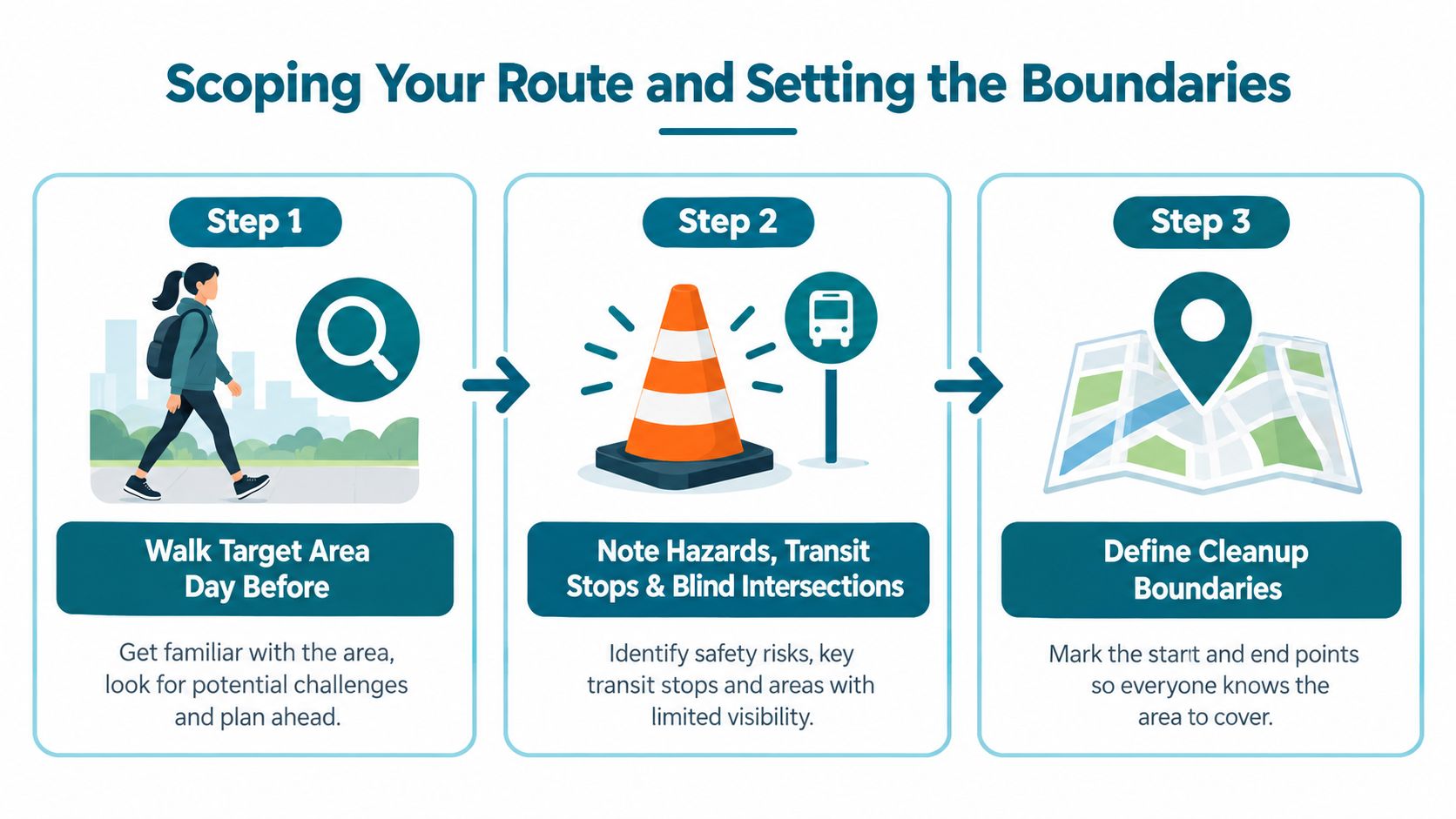
Scoping Your Route and Setting the Boundaries
Walk the target area the day before. I carry my phone, a small notebook, and a pair of work gloves because I want to see the route as a volunteer will see it, not as a map suggests. I note bus stops, alleys, drainage grates, steep curbs, blind intersections, broken pavement, and spots where cars move quickly.
Choose a meeting point that reduces friction. A library entrance, church lot, park shelter, or corner near legal parking can work. Look for shade in warm weather, shelter during rain, and restroom access when possible. Tell volunteers exactly where to meet, then send a map pin and the nearest cross streets in every announcement.
Build a route people can finish
A Saturday morning window between 8:00 and 10:00 a.m. gives people a clear commitment. Write the start and end time in the title, not buried in the description. I also divide the route into zones, then give each zone a color, a name, and a leader.
You can mark zones with colored tape on bags, a shared map, or simple cards:
Red zone: the alley behind the apartments
Blue zone: the park edge and nearby sidewalk
Green zone: the bus stop and drainage line
A fixed boundary keeps your records useful. The cleanup manual linked above recommends counting items or weighing them, photographing the site, and preventing collected litter from spreading again through wind or animals. You can use a bathroom scale for bag weight, a tally app for item counts, and before-and-after photos from the same camera position.
Measure what you can repeat
Pick one measurement system before the event. Record volunteer count, volunteer hours, route length or area, bags, pounds, tires, and the exact boundary when those measures fit your event. Washington State reports about 38 million pounds, or 7 billion pieces, of litter each year, and its funded programs removed more than 5.2 million pounds while cleaning more than 18,000 roadway miles in 2024, according to Washington's litter prevention program. You don't need to copy a state program. You do need a record that lets you compare your own route.
For help thinking about how clear visual records can attract attention, review this real Instagram growth case study and borrow the discipline of consistent images, locations, and captions. Your cleanup numbers and photos can give city partners a reason to return your call.
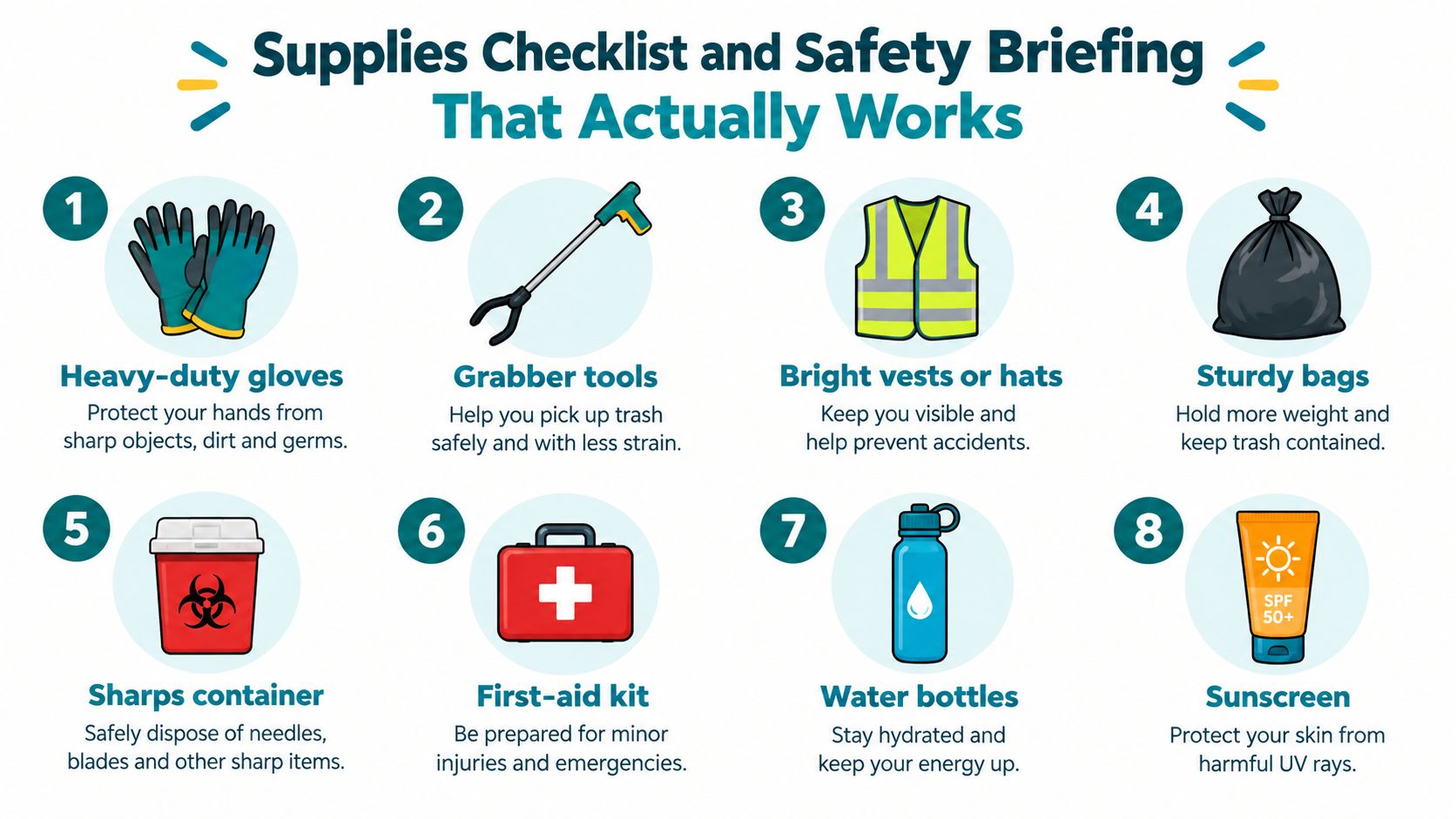
Supplies Checklist and Safety Briefing That Actually Works
I've seen a fun cleanup turn tense in seconds because someone reached toward a dark pile without looking. Pack for the strange object, the changing weather, and the volunteer who gets dizzy halfway through the route.
Bring heavy-duty gloves, grabber tools, bright vests or hats, sturdy bags, a sharps container, a first-aid kit, water, snacks, sunscreen, and a printed safety sheet. I also bring tape or flags for hazards, a marker, hand sanitizer, and a phone charger. If you need dependable stock for a larger event, compare in-stock trash bags before pickup day.
Keep the supply table where every volunteer can see it. A host guide from the Sanitation Foundation recommends arriving with tools and a first-aid kit, then giving a safety briefing before collection begins. That small pause changes the mood. People start with a shared plan instead of grabbing whatever sits closest.
Run the same five-minute talk
I use five plain rules:
Use tools first: Pick up litter with grabbers or gloved hands only when you can see and control it.
Leave danger alone: Don't touch needles, broken glass, propane tanks, leaking containers, odd-colored liquids, sanitary products, dead animals, or anything that may contain hazardous waste.
Mark the location: Flag or photograph dangerous objects, then contact 311 or your local sanitation partner.
Work with a buddy: Stay within sight of another volunteer, especially near traffic, ice, heat, slopes, or isolated lots.
Stop early when needed: Send anyone who feels unwell back to the meeting point, offer water, and keep the first-aid kit there.
The Cobb County volunteer best practices guide advises safety vests, traffic awareness, grabbers or gloves, keeping hands away from the face, and placing waste in closable bags or containers with secure lids. A neighborhood trash pickup equipment guide can help you fill gaps in your equipment list before you invite people.
Tell volunteers what to do with bulky items too. They should photograph and flag mattresses, appliances, tires, and dumping piles instead of trying to move them. The briefing may feel repetitive after a few events. Repetition helps people react correctly when they uncover something dangerous.
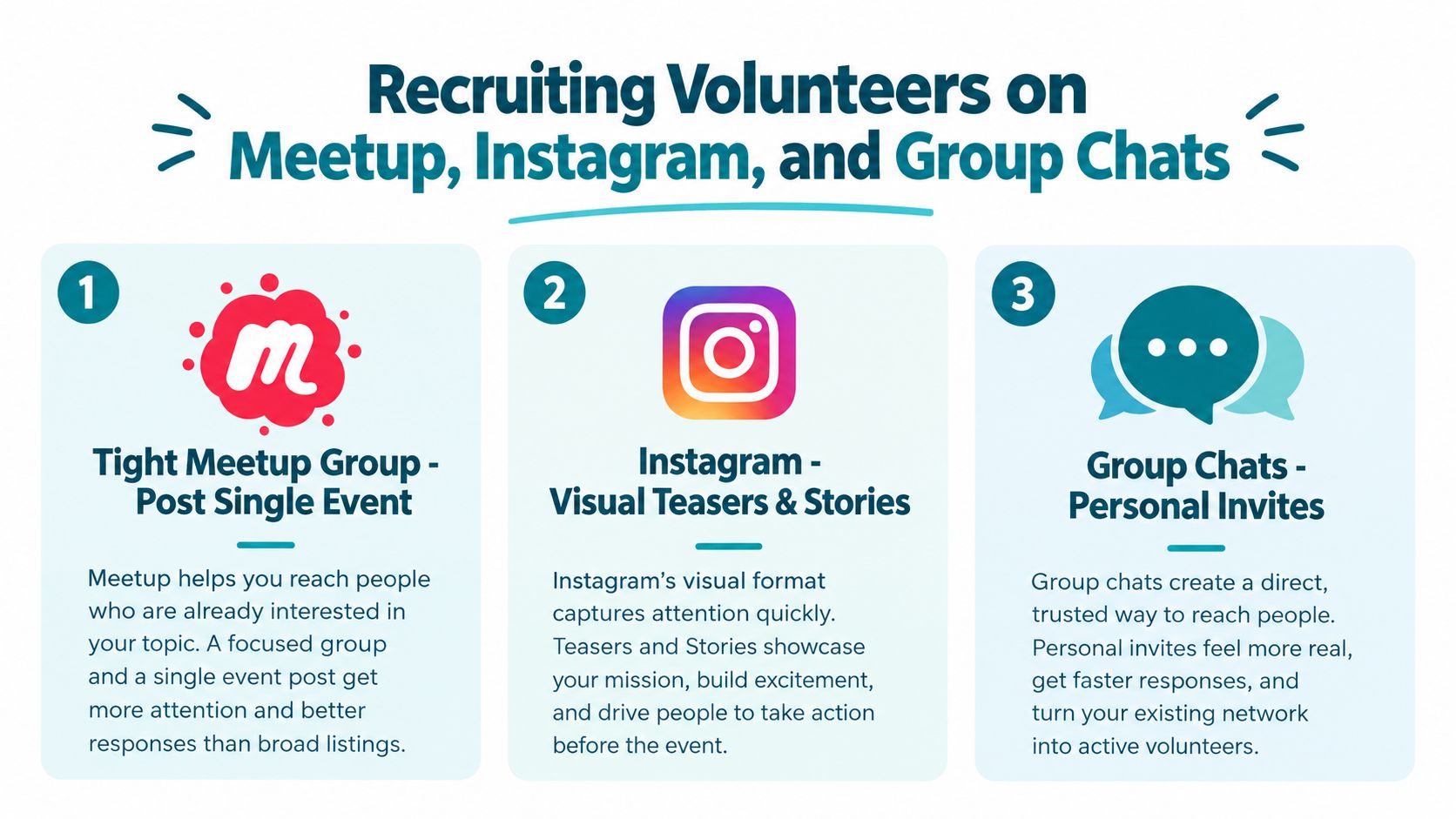
Recruiting Volunteers on Meetup, Instagram, and Group Chats
Your recruitment message should feel like a calendar entry from a friend, not a city press release. I use one recurring title, one meeting point, and one short promise. “Saturday 9 a.m. cleanup at 47th and Ashland, two hours, gloves provided” tells people enough to decide.
Meetup works when you build a tight group around a repeatable event. Keep the title consistent so returning volunteers recognize it immediately. Instagram works through contrast. Post the ugly curb, the half-filled bags, and the clean finish. Use short captions, tag the cross streets, and keep the same cover photo style so the event remains recognizable in a crowded feed.
Group chats fill the last spots fastest because a personal invitation creates accountability. I send the meeting pin, the weather note, and one direct question: “Can you take the blue zone this Saturday?” People answer faster when they know what you need from them.
Use the start time as a filter
I schedule weekend mornings because the time attracts people who want to give part of their weekend to the block. A 9:00 a.m. Saturday start also creates a useful rhythm. People can work, see family, or run errands afterward, while the crew gets the cooler air and the first light.
Ask for two hours, not an entire day. A small promise feels manageable, and volunteers can test the group without giving up every weekend. People who enjoy the work will return because they remember names, routes, and the breakfast stop.
Use the same details everywhere:
Meeting pin: Place it at the exact entrance, not a general neighborhood label.
Cross streets: Include them in the first sentence.
Route limit: Tell people what you will cover.
Weather rule: State whether you postpone or work in light rain.
Reply method: Give one way to confirm attendance.
For more ideas on turning posts into direct volunteer invitations, use this guide to social media for volunteer recruitment. The aim isn't a giant list. You want a dependable group chat with people who answer, arrive, and help welcome the next person.
Partnering with Local Groups Without Losing Your Voice
Partnerships can give you supplies, permission, tables, coffee, disposal help, or access to a school and its families. They can also pull a simple Saturday cleanup into meetings, committees, logos, and approval chains. I decide based on the missing piece, not the partner's name.
A church basement may provide coffee and tables. A hardware store may trade gloves for a logo on your flyer. A city steward may arrange bags and a pickup route. A local nonprofit may help you reach a school. Each offer has a practical use, and each one needs a clear limit.
Factor
Fully Independent
Partnered with Local Group
Decision speed
You choose the route and timing
You may need shared approval
Supplies
You buy, borrow, or collect them
A partner may provide equipment
Public access
You recruit through your own channels
A partner may open schools or lots
Disposal
You arrange pickup yourself
A city or sanitation partner may coordinate it
Voice
Your tone stays intact
Branding rules may shape the message
Attendance
You build the list gradually
A partner can bring an existing audience
Responsibility
You carry the planning load
You share tasks and expectations
Use a short decision test
Partner when you need scale, permission, or disposal support. Stay independent when the work belongs to one block, one group of neighbors, and a weekly rhythm that already runs smoothly.
I once declined a sponsor that wanted a large logo but no one willing to arrive at 7 a.m. That deal would have added design work without adding hands. A business that supplies gloves, a nonprofit that sends volunteers, or a city contact who confirms pickup gives you something you can use on the curb.
Before you ask, write one page with the route, date, volunteer target, supplies needed, pickup plan, partner contribution, and recognition you'll provide. Say what you won't change. A partner should know whether you'll use its logo, invite its staff to speak, or just thank it in the recap. These local business support tips can help you frame a request around a real exchange rather than a vague sponsorship pitch. For a deeper planning framework, use this guide to community partnership development.
Turning Cleanup Day Into a Weekly Crew
A parent named Maya came to one cleanup because her child found broken glass near a playground. She planned to stay for a short while, finish the dangerous patch, and leave. The following Saturday, one volunteer remembered her name, another saved her a grabber, and someone handed her the coffee thermos before she asked.
Maya returned. She didn't return because the route got easier. She returned because the group made room for her.
That small exchange taught me more about retention than any polished flyer. A weekly crew needs rituals that make people feel expected. We start at the same time, gather at the same landmark, and finish with a group photo. Someone brings a speaker. Someone chooses a theme song. Someone posts the haul in the chat like a scoreboard update.
Design belonging on purpose
Give the crew a name people can say easily. Use a flag on the pickup truck, matching shirts or armbands, and a shared playlist. These details may look playful, but they help strangers recognize one another when they arrive cold, tired, or unsure.
Practical rule: Remember one personal detail about every new volunteer, then use it at the next cleanup.
Choose a post-cleanup breakfast spot and treat it as part of the route. The meal doesn't need ceremony. The point is the conversation after the gloves come off. That's where a newcomer learns who lives nearby, who has a spare grabber, and who will answer the group chat during the next snowstorm.
The Litter Caterpillars group in Chicago uses weekly weekend cleanups, shared identity, and open communication through Meetup, Instagram, and group chats to help volunteers join neighborhood trash pickup across the city. You can copy the structure without copying the name. Your crew might be the Ashland Sweepers, the Blue Line Brush-Off, or six neighbors who meet beside the same bench every Saturday.
Friendship keeps people coming when the weather turns harsh. Pride helps them carry the bags when the route feels repetitive. A simple identity gives volunteers a reason to show up through blizzards, heat, and slow Sundays.
Your First Cleanup Weekend and What Comes Next
Your first Saturday should feel calm because you've already made the decisions that usually create confusion. Arrive 30 minutes early. Put the supply table at the meeting point, place bags and grabbers where people can reach them, mark the zones, and keep water and the first-aid kit visible.
The New York City volunteer cleanup guide recommends bagging collected trash and placing it at an intersection or address along the route. Another cleanup workflow asks volunteers to meet at a pre-arranged spot, review safety points, sign a waiver, return with bags, and weigh them before disposal. Use that simple sequence so the event has a clean beginning and finish.
Run the morning by the clock
Time
Action
8:00 a.m.
Set out supplies, confirm the route, and check the meeting point
8:10 a.m.
Welcome volunteers and collect contact details or waivers
8:15 a.m.
Give the five-minute safety talk
8:20 a.m.
Send zone teams to their assigned areas
9:20 a.m.
Check zones, replace full bags, and flag hazards
10:00 a.m.
Bring bags to the pickup point and weigh or count them
10:15 a.m.
Take the group photo and thank everyone
10:30 a.m.
Wrap up, confirm disposal, and leave the site clear
Record the number of volunteers, the time they worked, the bags collected, and the weight when you can measure it. Photograph the same landmark before and after. Keep your notes in one shared file so next week's leader can see which zone filled fastest and where litter returned.
Build the next four Saturdays
Week one establishes the route and teaches your crew the safety rhythm. Week two invites a local nonprofit to join one zone. Week three asks a coffee shop to sponsor donuts or provide a meeting point. Week four adds a second route only if the first one still feels manageable.
Keep the rules quiet and consistent. Start at the same time, finish at the same place, credit every volunteer by name when appropriate, and post the recap by evening. Your neighborhood trash cleanup becomes a habit when people know where to stand, who will greet them, and what happens after the last bag closes.
Litter Caterpillars helps volunteers find and join hands-on trash pickup events across Chicago, with weekend morning cleanups and supplies provided for neighborhood routes. Visit Litter Caterpillars to find the next cleanup, meet a crew, or bring your own block into the weekly rhythm.
My mess was my life, so I started cleaning up someone else’s.
I used to have trouble cleaning my own stuff. As my apartment got worse, my life got worse with it. The old blueberry jam from a trip to Michigan. The bag of nuts from a failed health kick. Every piece of trash had a little memory attached to it, and even though each thing weighed almost nothing, to me it felt like 500 pounds.
Then I ended a chaotic relationship with someone selfish, and I hit the kind of wall that makes you either stay stuck or do something weird. I decided I was done building my life around mess, fear, and flaky people. I wanted to face the stuff that had always beaten me up: cleanliness, consistency, and bravery.
So I tried something sideways. I cleaned up public spaces.
It was easier to pick up a bottle off the sidewalk than to throw away my own old junk. It was easier to show up for a block than to show up for myself. But after a while, that line started to blur. The more I helped clean a street, the more I could feel some of the static leaving my own head. It was work, sure. Sometimes cold, wet, gross work. But it was also weirdly fun.
That’s how the Litter Caterpillars started.
If you’re looking for community service ideas for college students, I want to give you more than a bland list you half-read between classes. I want to give you options you can picture yourself doing on a Saturday morning when your room is a mess, your brain is loud, and you need a reason to get outside and be around better people. Some of these ideas are simple. Some take real organizing. All of them can change your week if you let them.
You don’t need to wait until you feel polished. Start while you’re still a little lost. Sometimes service is how you find your footing.
1. Neighborhood Litter Cleanup Events
The first cleanup I ever led was small enough to fail unnoticed. A few gloves. A couple of trash bags. One block I was tired of walking past with my shoulders up around my ears.
What surprised me was how fast the mood changed. You bend down for one bottle, then a chip bag, then a pile of soggy flyers stuck to the curb, and suddenly you are not stuck in your own head anymore. You are doing something with your hands. You are standing next to other people who showed up for the same unglamorous reason. The street looks better in under an hour, and some part of you does too.
That is why neighborhood litter cleanup events work so well for college students. You do not need a big budget, a fancy title, or weeks of training. You need a spot people already care about, a time that works, and a clear place to meet. If your life feels scattered, this kind of service gives you a win you can see.
I would keep the first one almost boring on purpose. Pick a route you can finish. Pick a corner store, bus stop, park edge, or sidewalk near campus where people will notice the difference. If you want a real example of how simple cleanup work can grow into something bigger, the story behind this vacant lot project shows what can happen when people keep coming back to the same place.
How I’d make it stick
A cleanup becomes a real habit when people know it is not a one-time burst of guilt.
Choose a short route: Finishing feels better than overpromising.
Bring visible gear: Gloves, grabbers, buckets, and bright vests help people spot the group and join in.
Talk to people outside the group: A quick conversation with a nearby resident or shop owner can turn strangers into future volunteers.
Stay for ten extra minutes: Coffee on the curb, bagels in the park, or just talking after the work is often what makes people return.
I love cleanup events because they strip away excuses. The problem is right there in front of you. The progress is right there too. You do not have to wonder if you helped.
And if you are in one of those seasons where your room is a mess, your phone is full of half-finished plans, and you do not totally trust yourself to follow through, start here. Pick up one block with other people. Come back the next week. Sometimes that is how you build courage. Not all at once. One bag at a time.
2. Vacant Lot Transformation Projects
A vacant lot can feel like a physical form of giving up. Broken glass, weeds, dumped furniture, old tires, random plastic, silence. Everybody walks past it like it belongs to no one.
That’s exactly why transforming one can hit so hard.
I love this idea because it starts ugly. You don’t need to pretend it’s charming. You take a dead-looking patch of land and ask, “What if this became a place kids could run through, neighbors could sit in, and volunteers could point at with pride?” That question alone changes how you walk through a neighborhood.
Here’s a real example from the Litter Caterpillars story. The group won an empty lot at auction and started turning it into a park in Englewood. If you want to see the story behind that move, read the tale of the vacant lot.
What the work actually feels like
At first, it’s not glamorous. It’s hauling junk, clearing brush, calling people back, and learning that “community project” often means “you will repeat yourself many times.” But that’s part of why this is such a strong service idea for college students. It forces you to grow up a little without making you hard.
Before-and-after photos matter here. So do neighborhood conversations. If the lot becomes a garden, a sitting area, or a mini-park, local people should shape that decision with you.
Watch a lot become something else:
Ground rule: Don’t “fix” a space for a neighborhood without talking to the people who already live there.
This kind of service has a long memory. A cleanup ends and you go home. A lot transformation keeps asking for your consistency. That’s why I’d recommend it to students who are ready for a longer arc, not just a one-day burst.
3. Highway and Major Corridor Cleanup
The first time I helped on a road-edge cleanup, I felt weirdly small. Trucks ripped past. The shoulder shook. Every bottle and fast-food wrapper looked like it had been pinned there by speed itself.
That’s what makes this kind of service stick with you.
A neighborhood cleanup can feel warm and local. A major corridor cleanup feels exposed. You’re standing in one of the hardest places to ignore, picking up what thousands of people passed without seeing. If your life feels noisy or scattered, there’s something honest about that setting. You cannot pretend your way through it. You put on the vest, grab the bag, and do the next ugly, simple thing.
I’ve heard students talk about these cleanups around closed-street events, bike races, and city-led road projects, and I like that model because access changes everything. A road that usually tells you to keep out suddenly becomes walkable. You notice how much trash collects in medians, along fences, near ramps, and under guardrails. You also notice your own nerves. Then, after twenty minutes, you’re just working.
How to do it without turning it into chaos
This project lives or dies on coordination. Call the city, transportation department, or event organizer early. Ask a few plain questions. Which sections are safe for volunteers? Where should filled bags go? Who removes large debris? What counts as off-limits?
Then keep the plan tight.
Divide the route into short sections: People work better when they know exactly where their part begins and ends.
Give one clear safety briefing: Cover traffic boundaries, protective gear, weather, and items nobody should touch.
Choose visible bag drop spots: Long walks with full trash bags drain the group fast.
Use shorter shifts: Major roads are tiring. An hour of focused work often beats a long, sloppy stretch.
This idea also does something quieter. It builds courage.
Not fake courage. Real, ordinary courage. The kind you get when you show up in an uncomfortable place, do a job that isn’t glamorous, and stay with it long enough to see a difference. For some college students, that matters as much as the cleanup itself. If you’ve been living in a fog of missed deadlines, bad habits, or low-grade panic, a project like this can cut through the noise. By the end, the roadside looks better, and you do too.
4. Student Environmental Education and Awareness Campaigns
The first time I helped with a cleanup lesson for kids, I made the classic college-student mistake. I showed up with facts, a recycling chart, and way too many words. Their eyes drifted fast.
Then one kid picked up a chip bag from the sidewalk outside and asked, "So this ends up in the drain?"
That was the whole lesson. Not my notes. Not my little speech. That crumpled bag in his hand.
If you care about the environment but do not want all your service hours to look like gloves, grabbers, and trash bags, education work gives you another lane. You can visit an after-school program, partner with a library, or run a short workshop in a residence hall or community center. The goal is simple. Help people connect the mess they see every day to something they can do about it.
Keep it close to real life
Students tune out fast when a campaign sounds like homework with a greener title. They pay attention when you bring the problem down to sidewalk level.
Show what washes into storm drains after rain. Bring common trash items and ask where each one usually gets dropped. Have kids map the litter they pass on the way to school, then compare notes. If you can pair the lesson with seed planting, a mini cleanup, or a trash audit, even better. People remember what they touch.
I would build two or three repeatable workshops and keep them tight. One on litter and runoff. One on recycling mistakes people make at home or on campus. One on gardens, trees, and public green spaces people use every week.
A good campaign changes you, too.
You learn how to hold a room. You learn how to explain something without hiding behind jargon. You learn that leadership is often one awkward conversation, one folding table, one group of restless middle-schoolers, and the choice to keep going anyway. If your own life feels scattered, this kind of service can steady you. You stop performing concern and start practicing it.
The best moment is usually small. A child points at the curb outside and says they have seen the same trash there for weeks. A classmate asks if your dorm can do a waste-sorting table at lunch. Someone starts noticing. That is where change begins.
5. Adopt-a-Block or Neighborhood Stewardship Programs
The first time I helped clean the same block twice, I almost missed what had changed.
The chip bags were back by the fence. Someone had tossed a coffee cup near the curb again. But an older man walking his dog nodded at us like we belonged there. A woman from the corner house came out and said, "Glad you came back." That second part hit harder than the full trash bag in my hand.
Adopt a block, and the work gets personal fast. You stop treating a neighborhood like a weekend project and start treating it like a relationship. You learn where the gutters clog after rain. You notice which alley gets ignored. You remember the tree pit you cleared three Saturdays ago and feel weirdly proud when it stays clean a little longer.
That repetition changes you, too. If your life feels noisy, showing up to the same stretch of sidewalk every week can calm it down. You make one promise. Then you keep it. For a lot of college students, that is not small.
Why staying with one place works
A single cleanup can feel satisfying. A stewardship program lets you see cause and effect.
You start spotting patterns instead of reacting to random messes. Maybe flyers blow down from one pole every Friday. Maybe the problem is not careless neighbors, but a trash can that is always overflowing by Sunday night. Once you know the block, your help gets smarter. You are not just picking things up. You are paying attention.
I would keep the structure simple and local. Assign students to a block near where they already live, study, or commute. The easier it is to reach, the better chance people will stick with it when classes get heavy and motivation drops.
A few ways to keep it going:
Keep shifts short: One hour works better than a big heroic Saturday that burns everyone out.
Give each team a defined zone: Specific corners, alleys, planters, or bus stops help people know what they own.
Use a simple check-in: A photo, a text update, or a shared note is enough.
Build in backup: Let people swap weeks so the block does not depend on one perfect volunteer.
The best part is what happens after a month or two. You are no longer a stranger passing through with a grabber and gloves. You are one of the people who noticed, came back, and kept going. Sometimes that is how you start cleaning up more than a street. Sometimes that is how you start cleaning up your own life.
6. Community Cleanup-to-Event Model with Social Gathering
The first cleanup I helped organize that felt alive ended with pizza on a folding table.
We had spent the morning pulling bottles out of weeds behind a bus stop and scraping old flyers off a light pole. Everyone looked a little rough. Gloves dirty, shirts damp, hair wrecked by wind. Then somebody opened two pizza boxes, another person passed around clementines, and the whole mood changed. People stopped standing in their polite little circles. They started telling the truth. One student admitted she had come because she was lonely. Another said he signed up after a bad semester and needed a reason to leave his room on a Saturday.
That is why I believe in the cleanup-to-event model. The work cracks something open. The hangout is where people decide whether they want to come back.
For college students, this matters more than people admit. Service hours are nice. A cleaner park is nice. But sometimes the true win is smaller and more personal. You show up feeling scattered, awkward, half checked out. You leave with dirt on your shoes, three new names in your phone, and a weird little spark of courage. I have seen that happen over and over.
The social part should not be an afterthought. Build it into the day from the start.
Here’s a version that works:
Start with a defined cleanup: one park edge, one alley, one stretch near campus, one hour or two
End close to the site: food trucks, coffee, bagels, a picnic, or a potluck keeps the shift from dissolving the second the bags are tied
Make conversation easier: name tags, simple icebreakers, or a question on a sign-in sheet gives shy people a way in
Keep one small tradition: group photo, shared playlist, silly award for weirdest item found, or a post-cleanup snack everybody expects
I like this model because it does two jobs at once. It helps a neighborhood look cared for. It also gives students a low-pressure way to build community without pretending networking is fun.
And if I am being honest, that second part can change your life.
A lot of us arrive on campus carrying chaos we do not talk about. Grief. Debt. Anxiety. A breakup. Family mess. The simple act of cleaning a public space with other people can steady you for a minute. Then the meal after gives you room to breathe and be seen. You are no longer just completing a task. You are practicing how to belong.
The best gatherings are simple. Cheap food is fine. A shaded patch of grass is fine. Music from a phone speaker is fine. What matters is that you leave time for the part after the trash bags are full, because that is often where the bravery starts.
7. Partnership with Local Nonprofits and Environmental Organizations
The first time I partnered with a local cleanup group, I showed up thinking I was late to somebody else’s mission. I left feeling like I had borrowed a spine.
There were no big speeches. A woman in work gloves handed me a grabber, pointed toward a weedy stretch behind a neighborhood creek, and said they had been coming back to this spot for months because trash kept sliding down from the road above. That changed how I saw service. You stop treating a cleanup like a one-off volunteer day and start seeing it as a relationship. With a place. With the people protecting it. With the version of yourself that keeps coming back.
That is why partnerships matter.
You do not need to invent the whole project, recruit everyone yourself, or guess your way through permits and safety rules. A local nonprofit or environmental group already knows the terrain. They know which park floods after rain, which lot gets dumped on every weekend, which trail needs restoration instead of another bag count, and which neighbors have been carrying the work long before students arrived.
I’d look for groups doing river cleanups, habitat restoration, park stewardship, urban gardening, compost education, or neighborhood environmental justice work. The best fit is usually not the flashiest one. It is the group with a clear routine and a real need for steady hands.
What makes this different from the last section is the depth. You are not just showing up for one social afternoon and then drifting off after snacks. You are stepping into work that already has memory. That can humble you fast, and I mean that in a good way.
If you want to be useful quickly, do the plain jobs well first.
Show up to orientation. Learn the rules. Ask what keeps falling through the cracks. Sometimes that means hauling tools, signing people in, sorting gloves by size, or pulling invasive plants for two hours without posting about it once. That kind of service can feel small until you realize it is the reason the whole day holds together.
I also love partnerships because they test you in a different way. A student-run project lets you stay in your comfort zone. An established nonprofit puts you next to longtime organizers, retired neighbors, city staff, high school volunteers, and people who know the block better than you ever will. You learn how to listen. You learn how to take direction without shrinking. You learn that helping is not the same thing as leading.
And if your life feels messy, that matters.
There were seasons when I could not fix the bigger chaos. Money stress. Family stuff. My own head. But I could show up at 8 a.m., pull on gloves, and work beside people who had built something steady out of care and repetition. That steadiness rubbed off on me. Service did not solve everything. It gave me practice. Practice being reliable. Practice staying when a task got dull. Practice belonging to something bigger than my own spiral.
A good partnership can give you hours, experience, and references. More than that, it can give you a model for how to live. Find the people already tending a damaged place, then ask where your hands fit. That question can change more than your weekend.
8. Bike Event and Outdoor Festival Cleanup Coordination
The first time I helped clean up after a bike race, the fun was over before the actual work started. Music cut out. Food trucks pulled away. The crowd vanished fast. What stayed behind was the truth of the day. Crushed cans in the grass, zip ties near the barricades, paper plates stuck to the curb, and a little creek of trash drifting toward a storm drain.
I remember standing there with a grabber in one hand, sweaty and annoyed, thinking this looked a lot like my life at the time. Loud from a distance. Messy up close. Harder to ignore once everyone else went home.
That is why I think this kind of service hits differently.
Bike rides, street fairs, concerts, and outdoor festivals need cleanup crews before, during, and after the event. If you are the kind of person who does well with movement, noise, and a job you can see in front of you, this work gives you a clear target. You do not have to guess whether you helped. A trash-heavy block turns walkable again because you showed up.
Start by contacting organizers early. Ask where waste piles up, which areas get slammed, and who handles supplies and disposal. Event cleanup works better when students are assigned to zones and shifts instead of wandering around trying to look useful.
I would set it up like this:
Pre-event crew: check trash and recycling stations, pick up old litter, and make sure high-traffic spots are covered before people arrive
During-event crew: patrol food areas, entrances, restrooms, bike parking, and seating zones before overflow turns into a bigger mess
Post-event crew: move fast once the event ends, covering the full route or festival footprint while volunteers still have energy
Supply runner: keep gloves, bags, water, and sanitizer stocked so the whole team does not stall out
This work also teaches a blunt lesson. Public fun leaves a tab. Somebody has to pay it in labor.
You can be one of the people who pays attention, grabs a bag, and handles what everybody else steps around. And if your own life feels scattered, there is something grounding about restoring a place in plain sight. You pick up one bottle, then ten, then a whole corner. The block looks better. Sometimes you do too.
9. Student-Led Sustainability Initiatives and Campus-to-Community Outreach
I knew a student who got tired of watching move-out week turn the dorm dumpster area into a small disaster. Lamps with working bulbs. Half-full detergent. Mini fridges left in hallways. Good stuff, trashed because nobody had a plan. She started with one table, three bins, and a handwritten sign in her residence hall lobby. By the end of the week, students were dropping off food, clothes, and school supplies instead of shoving them into the trash room.
That is how a real sustainability project usually starts. Small. A little messy. Close enough to touch.
If you are the person who keeps asking why waste keeps showing up in the same places, this kind of service fits. You are not only cleaning up what is already broken. You are fixing the system that keeps making the mess.
Start on campus, where you already know the people, the routines, and the weak spots. Build something practical, then carry it beyond the edge of school property. A dorm recycling campaign can turn into apartment outreach for students living off campus. A compost pilot in one dining hall can grow into a partnership with a neighborhood garden. A move-out donation drive can feed a local mutual aid network instead of a landfill.
I like this model because it changes you while you build it. You stop waiting for permission. You make the sign. You reserve the table. You ask the facilities staff what keeps failing. You hear "no" a few times and keep going anyway.
Keep the first version small enough that tired students can still run it during midterms. One dorm. One residence hall floor. One monthly collection day. One student club and one nearby block. If the system only works when everybody is excited all the time, it will fall apart fast.
Write down the steps. Keep the handoff simple. Make a one-page guide the next student can follow without texting you twelve times.
That is the difference between a nice idea and a project that lasts.
If you want examples of how service work can shape confidence, purpose, and real-world skills, read these benefits of volunteering for students. Then build something other people can inherit.
This route works well for students who like organizing, teaching peers, and setting up repeatable habits. It is quieter than a big public cleanup. It is also how campuses stop creating the same pile of problems every semester.
10. Volunteer Team Building and Peer Leadership Development
The first time I asked another student to lead part of a cleanup, I was nervous for all the wrong reasons. I thought they would do it differently. I thought the check-in table would get messy, the route would run late, somebody would forget gloves, and I would spend the whole morning fixing it.
What happened was better. A quiet sophomore named Elena took ten volunteers down one side street, came back muddy and smiling, and told me two new people wanted to help run the next event. That was the day I stopped trying to be the hero and started building a crew.
If your service project depends on one exhausted organizer, it is already fragile. The strongest student groups spread responsibility early, while the stakes are still small. Give one person the sign-in sheet. Give another person the safety talk. Let someone else welcome first-timers so they do not spend twenty minutes standing around feeling awkward.
That shift changes the project, and it changes you. You stop proving you can carry everything alone. You start trusting people. You start seeing leadership for what it is during service work. Clear communication, calm decisions, and follow-through when the weather turns ugly and half the group is tempted to head back for coffee.
I like a simple progression that people can grow into:
Show-up role: learns the basics, arrives on time, helps without needing much direction
Crew lead: keeps a small team on task and watches pace, safety, and morale
Support lead: handles supplies, check-in, photos, volunteer questions, or neighbor conversations
Event lead: runs the day, solves problems, and helps new leaders take over next time
Keep it real. Titles mean nothing if they do not come with responsibility.
One of the best things about service is how fast it exposes your habits. If you avoid speaking up, leading a crew will force you to use your voice. If you panic when plans change, a rainy cleanup with missing supplies will teach you how to stay steady. If you have spent a semester feeling scattered, being responsible for five other students can pull you together in a way a classroom never does.
I have seen that happen.
A student who barely made eye contact at the first event becomes the person who can calm a late volunteer, redirect a confused group, and make a neighborhood resident feel heard in the same five minutes. That kind of growth is why these benefits of volunteering for students hit harder when you are not just participating, but helping other people show up too.
Ask for one volunteer to lead a small piece of the day. Then let them do it. That is how a service project becomes a team, and how a team becomes the place where you finally find your people.
Builds leaders, resilience, and long‑term program stability
You’ve Found Your People. Are You Bold Enough?
We believe in the power of service to our environment, to the outdoors, to sunlight, and to friendship. That’s why we are Caterpillars. We’re not perfect, but we’re all trying to transform ourselves. Through service, we can learn to trust ourselves and forgive ourselves.
I didn’t learn that from a book. I learned it while being cold and uncomfortable and slightly ridiculous with other people.
The first time we picked up trash, only three of us showed up. We got caught in a hail storm and ended up shivering under a tree while rides kept canceling on us. It should’ve been miserable. In some ways, it was. But I remember realizing that something strange was happening. Cleaning up other people’s messes was easier than cleaning up my own. Being out there with other people made the suffering feel less empty. It had texture. It had flavor. It pushed the story forward.
That’s still how I think about service.
A lot of people come looking for community service ideas for college students because they need hours, experience, or something decent to do on a weekend. Fine. Start there if you need to. I’m not going to pretend everybody starts from pure motives. Sometimes you just know your life feels stale and you need to get out of your room.
That’s enough.
Pick the version that feels doable. Maybe that’s a neighborhood litter cleanup. Maybe it’s teaching kids about waste. Maybe it’s helping a nonprofit with a project that already has structure. Maybe it’s adopting one block and taking care of it until the place starts to feel familiar. Maybe it’s leading your own small team and finding out you’re braver than you thought.
The point is to choose something that puts your body and your attention in the same place. That matters more than people admit. When you’re outside, using your hands, talking to real humans, and doing work with a visible end point, your head can quiet down a little. You stop spiraling for a minute. You stop performing. You just do the job in front of you.
And then something else happens.
You start to notice who shows up early. Who shares gloves. Who laughs when the weather gets bad. Who doesn’t act above the work. Who stays for the coffee after. Those are your people. That’s how you build a social circle with givers instead of takers. You don’t find them by talking about values all day. You find them by seeing who will hold a trash bag open while you dump in the gross stuff.
I think a lot of us are waiting to become more organized, more healed, more confident, more ready. I did that for too long. Service can be the thing that starts building those traits in you. You don’t have to arrive transformed. You can arrive awkward, unsure, inconsistent, a little ashamed, and still start.
That first step might look tiny. A sign-up. A text to a friend. A pair of gloves in your backpack. Waking up early on a Saturday when part of you wants to hide.
Do it anyway.
Your story doesn’t need a dramatic beginning. Mine started with trash. Maybe yours will too.
If you want a place to start, join Litter Caterpillars and come clean a block with us. Show up on a weekend morning, meet good people, get some sunlight, and do something real with your hands. You don’t need to be perfect. You just need to come outside.
My life felt like a cluttered garage. You know the one. Full of things I couldn't part with. An old bike tire wasn't just rubber; it was that one perfect summer afternoon. Every piece of junk had a story, a weight that pulled me down, even if it was just a few ounces. It’s funny how memories can feel like anchors.
Then, a sudden storm in my personal life forced me to clean house. I realized I had to build something new, something that demanded the very things I’d always dodged: consistency, cleanliness, courage. And just like that, Litter Caterpillars crawled into existence.
I remember our first cleanup. Three of us, caught in a freak Chicago hailstorm. We huddled under an oak tree, soaked and shivering, watching Ubers cancel on us one by one. And in that miserable, beautiful moment, a thought struck me like lightning. Cleaning up a stranger's mess is a thousand times easier than facing your own. It was fun. It became a story. We weren't just picking up trash anymore; we were writing a new chapter.
That day, I learned that tackling a huge, messy problem together makes you stronger. A huge part of that is knowing what to do with everything you find. It’s not just about bagging it. It's about giving it a second chance. This guide isn't just a list of addresses for you. It's my map, our playbook for turning forgotten waste into a resource. These are the very recycling centers Chicago needs to complete the circle, to make our hard work mean something. Think of this as your secret weapon for making a real, lasting mark on our city, one bottle, one box, one piece of forgotten metal at a time.
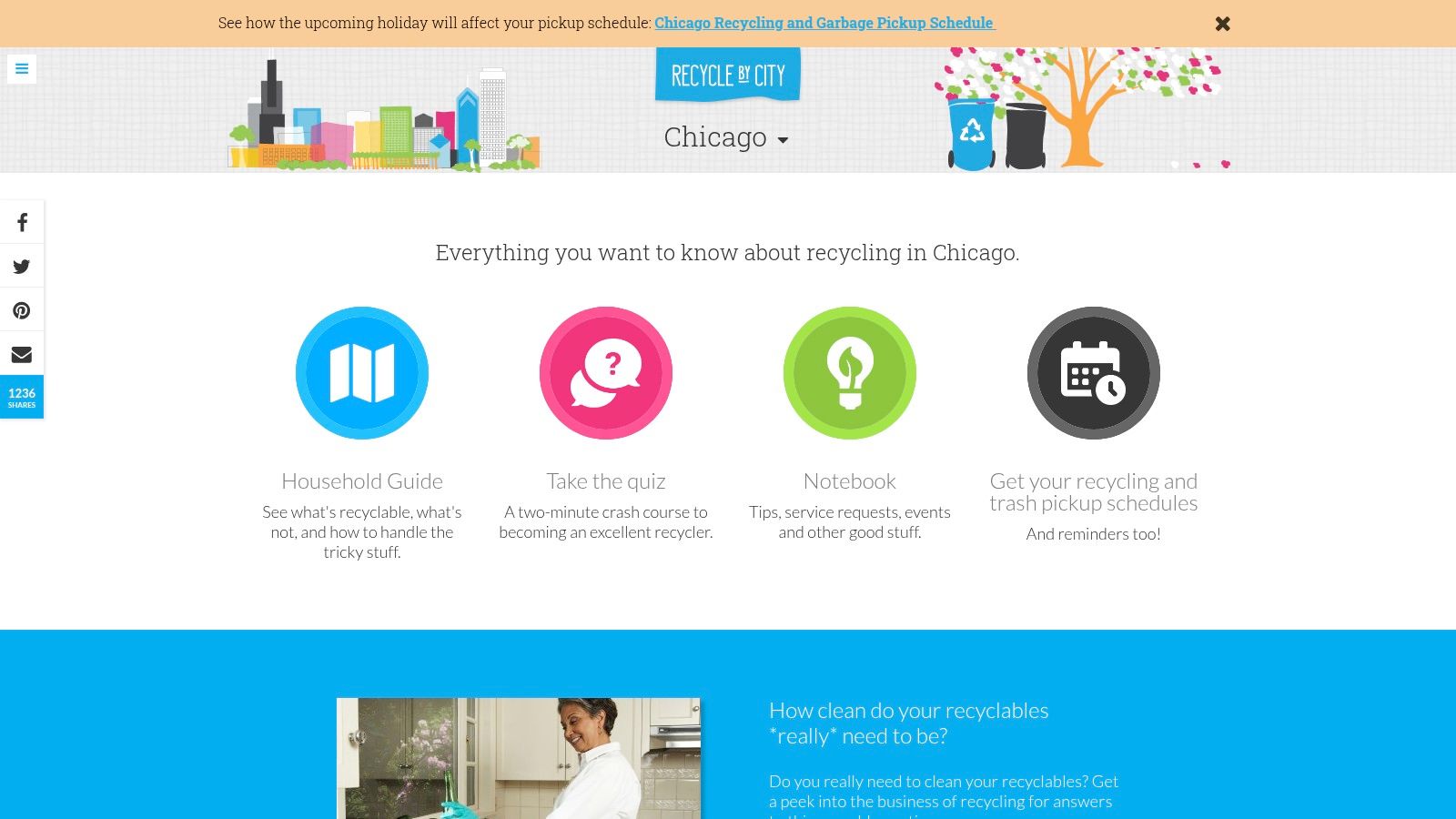
1. Recycle by City – Chicago: Your Official Blue Cart Rulebook
Before you haul anything anywhere, you have to start here. This is your foundation. Think of this website as the official rulebook for the game of Chicago recycling. It’s the ground truth for everyone with a blue cart, cutting through the fog of "I think this is recyclable?" that so often sends our good intentions straight to the dump. I pull it up on my phone constantly. It’s my North Star for sorting.
I tell every Litter Caterpillars volunteer that this resource is non-negotiable. When you’re out there leading a cleanup and someone holds up a greasy pizza box or a weird plastic clamshell, you become the judge and jury. You can settle the debate instantly. The “What Goes Where” search tool is my favorite part; it’s like having a recycling guru in your pocket, whispering the right answer. It makes sure our efforts actually feed the recycling stream, not just clog it with trash. It’s free, it works on your phone, and it’s the first step to understanding the system.
Key Features & Assessment
Feature
My Take
"What Goes Where" Tool
Your secret weapon for on-the-spot checks. No more "wish-cycling."
Pickup Schedules
Look up your blue cart day by address. Perfect for planning.
Drop-Off Center Info
All the details for the city's Household Chemicals & Computer Recycling Facilities (HCCRF).
Pros: It’s the official word, straight from the city. The mobile site is clean and dead simple to use.
Cons: It only covers residential blue carts and city-run spots, so you won't find help for commercial needs or specialty items here.
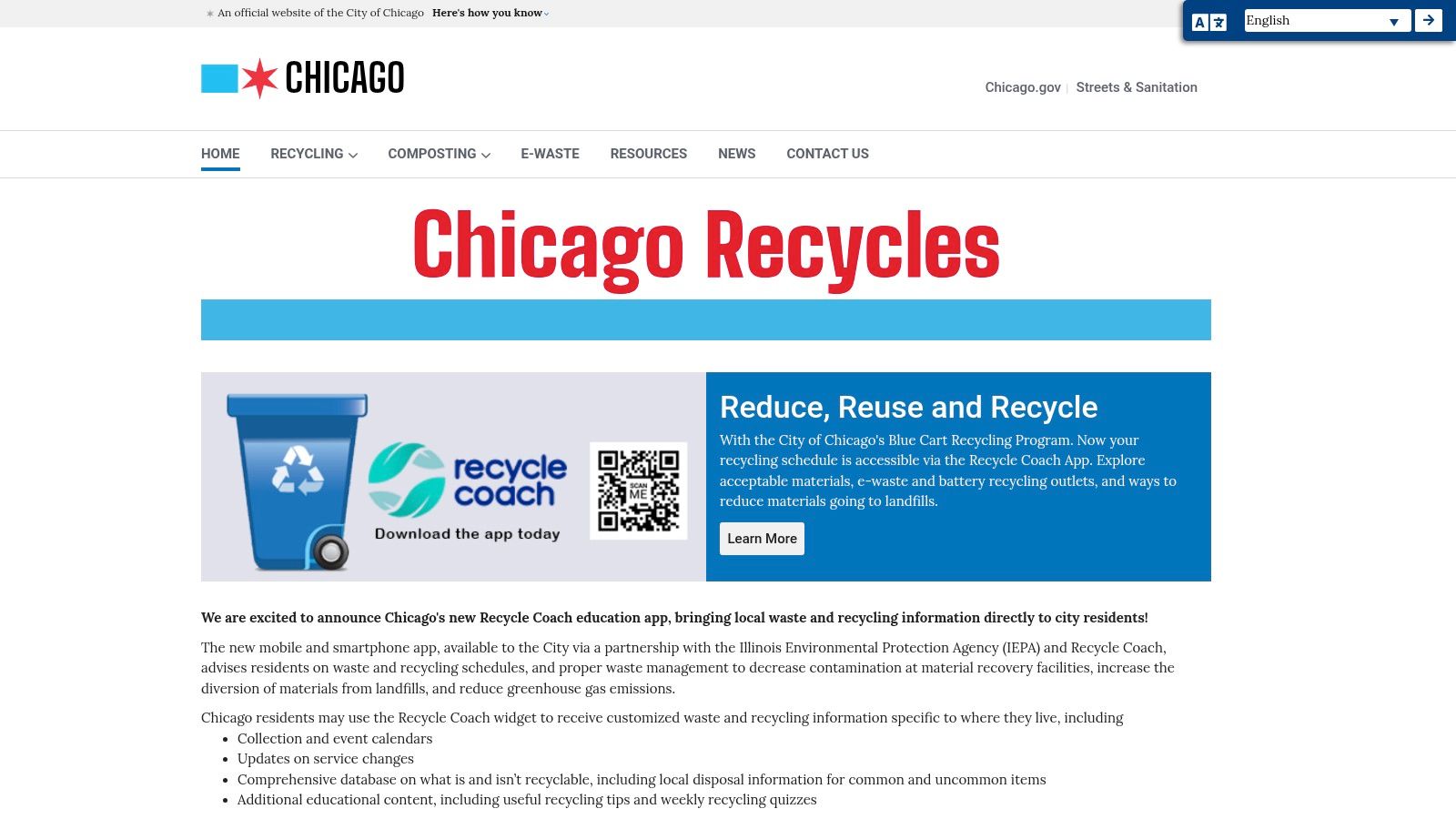
If Recycle by City is the rulebook, think of Chicago Recycles as your personal coach. This isn't just a static website; it’s an active partner. You plug in your address, and it builds a personalized game plan just for you. A calendar. Pickup reminders. Hyper-specific instructions. It’s like having a friend who texts you, "Hey, don't forget the blue cart goes out tomorrow!"
I love this tool for its pure, simple convenience, especially when I'm organizing a weekend cleanup. You can quickly check pickup days for any address we're targeting, which means the bags we collect don't sit on the curb for a week like sad, forgotten soldiers. The "What Goes Where" search is just as powerful as the main city site, but it's wrapped in a slicker package. This portal also becomes a star during special city events, like the holiday tree recycling program. It’s the perfect digital sidekick for your recycling life, whether for your own home or for a massive neighborhood effort.
Key Features & Assessment
Feature
My Take
Address-Based Calendars
Takes all the guesswork out of your pickup day. A lifesaver if you're new to a neighborhood or helping out elsewhere.
Collection Alerts
The app pings you so you never miss a collection. It's surprisingly motivating.
"What Goes Where" Tool
A fast, reliable search for tricky items, right in the app or on the site.
Pros: It’s an official city tool, totally free, and easy to use. The personalized alerts make it incredibly practical.
Cons: This is purely for information and scheduling. It won't help you find private recycling centers in Chicago or book any services.
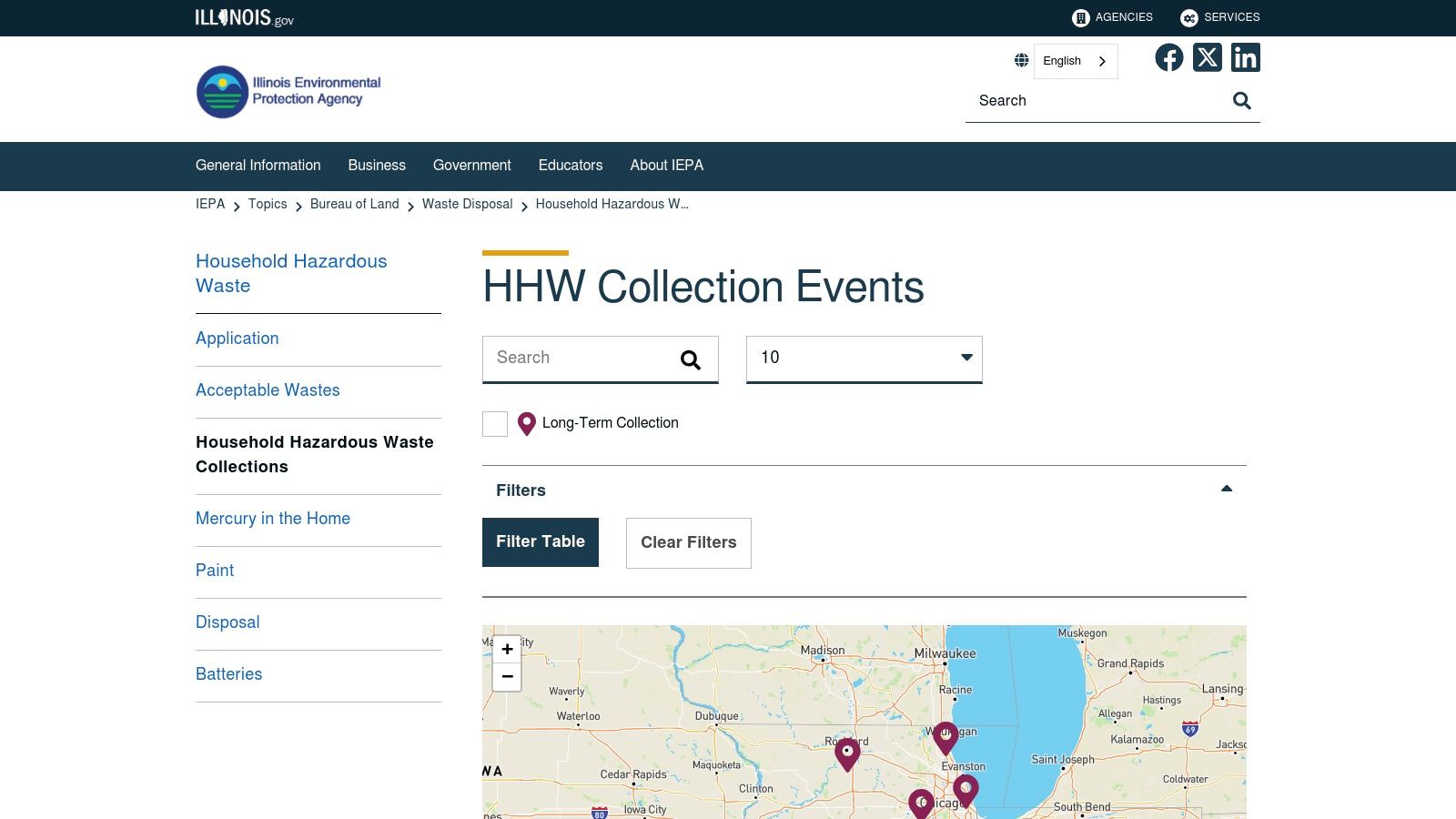
Then you find the weird stuff. The really nasty stuff. A half-empty can of paint from the 90s. Mysterious cleaning chemicals under the sink. A mountain of dead batteries. Your blue cart can't help you here. This is when you turn to the Illinois EPA's website. I see it as the hazardous materials command center, the place you go to learn how to handle the things that could seriously poison our corner of the world. It’s the official source, giving you the confidence that you’re doing it right.
For Litter Caterpillars, this page is our mission control when we organize a special collection day for electronics or hazardous materials. We use it to lock down the hours and exact location of Chicago's permanent facility on North Branch Street before we even tell anyone about the event. The list of what they take—and what they don't—is critical. It stops us from collecting a pile of, say, latex paint only to find out it’s not accepted (pro-tip: you have to dry it out first!). This site makes our specialized efforts smart and effective.
Key Features & Assessment
Feature
My Take
Official HCCRF Info
The final word on Chicago’s permanent HHW facility hours and address.
Statewide Site Listings
Great for finding other drop-off points if the Chicago location is out of your way.
Accepted Materials List
A clear, authoritative guide on what you can and cannot bring. Plan your attack with this.
Pros: It’s an authoritative, state-level resource that’s regularly updated. It clears up the confusing rules around hazardous and electronic waste.
Cons: It's a library, not an interactive tool. You might still need to call the facility if you have a really weird item.
4. LRS (Lakeshore Recycling Systems): The Big-Project Powerhouse
Sometimes you graduate from bags to mountains. A gut rehab. A massive spring cleaning. Or when a Litter Caterpillars cleanup uncovers a huge illegal dump site. Your blue cart will just laugh at you. That's when you call in the big guns. That’s LRS. Think of them as the special forces of recycling for businesses, big apartment buildings, and huge community projects. This isn't a place you drop off your weekly cans; it's who you call for a full-scale assault on waste.
I remember we once coordinated a vacant lot overhaul in Englewood that needed a massive roll-off dumpster. LRS was the company that made it happen. Their website is your portal to these larger services, from ordering construction and demolition recycling containers to setting up ongoing commercial pickups. They're a key part of the city’s whole recycling machine, running one of the major material recovery facilities (MRFs) where everything gets sorted. Knowing about them helps you see the entire picture of how our city's waste gets a new life.
Key Features & Assessment
Feature
My Take
Commercial & Construction Recycling
Essential for businesses and contractors who need a reliable, scheduled service.
Roll-Off Container Ordering
The go-to solution for huge cleanups, renovations, or community projects.
Material Recovery Facility (MRF)
They operate key infrastructure, making them a pillar of Chicago's recycling system.
Service Scalability
They handle everything from small business bins to giant industrial compactors.
Pros: An established local player with immense capacity for big jobs. They fill a critical gap the city can't.
Cons: Not a public walk-in place for you and me. All services are by contract and need a quote, so it’s not for casual drop-offs.
5. GreenWay Recycling Services: Get Paid for Your Recycling Efforts
Your garage is bursting with cardboard from a move. You've collected a mountain of plastic bottles after a block party. The blue cart isn't big enough. You need a place like GreenWay Recycling Services. This is one of the few real-deal recycling centers in Chicago where you, a regular person, can drive right up, weigh your materials, and sometimes even walk away with cash in your pocket. It’s a total game-changer.
I’ve brought truckloads here after our biggest Litter Caterpillars events, especially when we’ve sorted out a huge volume of good, clean cardboard. Driving onto their scale feels powerful. It's like you’re pulling back the curtain and seeing the industrial heart of recycling. It reminds you that these materials aren't just trash; they have real value. Seeing that firsthand is incredibly motivating. Their website is your first stop to check their hours—thankfully including Saturdays—and see what they're buying.
Key Features & Assessment
Feature
My Take
Public Drop-Off & Scale
A drive-through process for dropping off large volumes of recyclables.
Material Purchasing
They buy qualifying materials like cardboard and certain plastics, with rates that change with the market.
Extended Hours
Open on Saturdays, which is a massive help for weekend warriors like us.
Pros: You can get paid for your work. Their central location is convenient, and the process is easy for large quantities.
Cons: It’s an industrial site, so you have to follow their safety rules. The list of what they buy and how much they pay can change, so always check their site first.
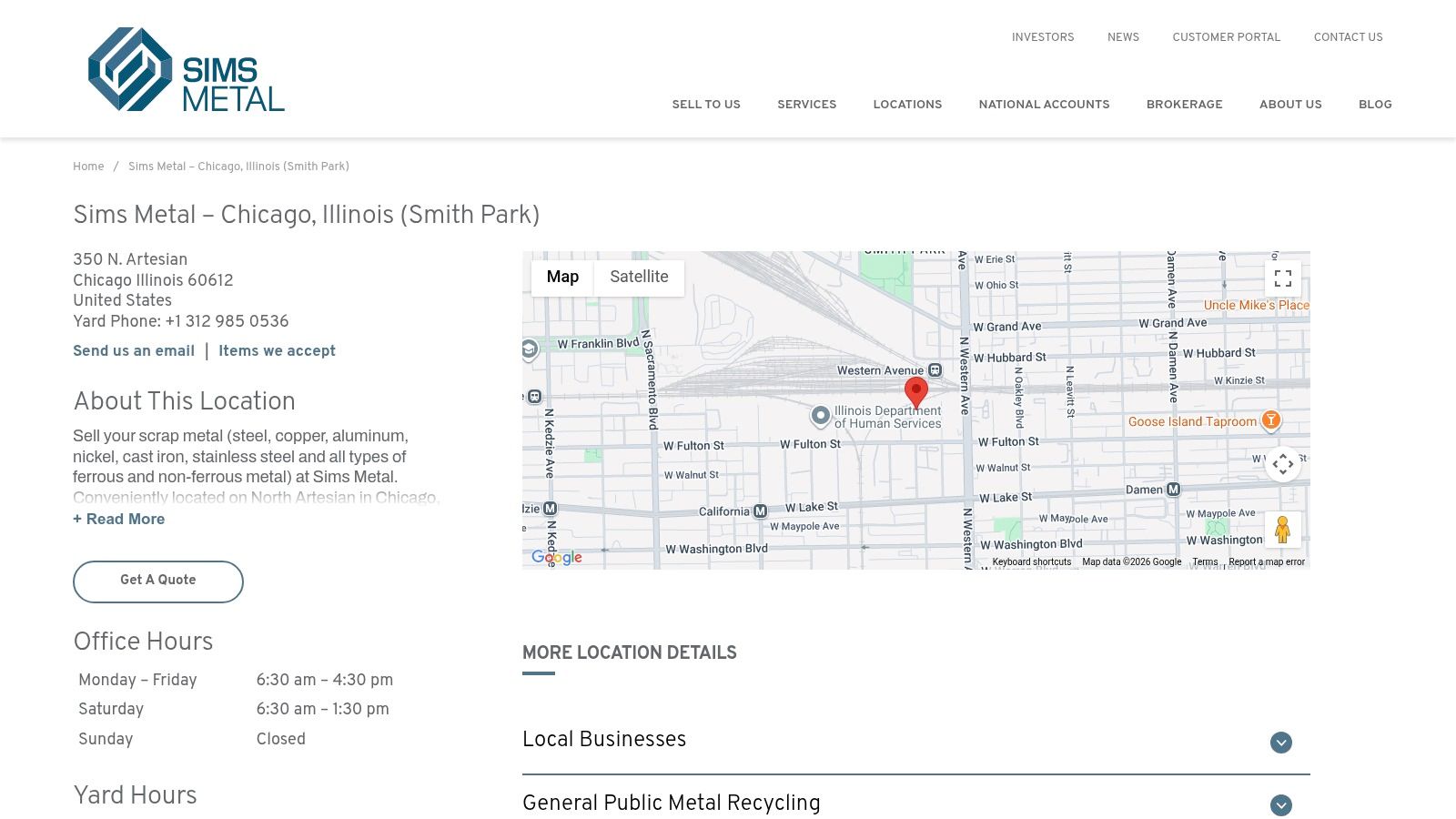
When our cleanups unearth heavy-duty stuff—old pipes, rusty fences, a dead washing machine—it’s a whole different ballgame. This isn’t just about diverting waste from a landfill. It's an opportunity. You can turn that trash into treasure. That's where a professional scrap yard like Sims Metal becomes your secret weapon. You shouldn't think of it as just a drop-off; it’s a fundraising engine fueled by metal.
I've organized community scrap drives with our Litter Caterpillars volunteers, and the experience at Sims is surprisingly simple. You haul in your metal, they weigh it on a giant scale, and you get paid on the spot. It's an incredible feeling to watch a pile of blight from a vacant lot transform into actual money that buys more gloves and bags for the next event. Their website is your pre-game strategy guide; use it to see what they accept so you can sort everything and get the biggest payout. It’s one of the most direct ways you can see your hard work pay off.
Key Features & Assessment
Feature
My Take
Public Scrap Buying
Getting paid for scrap is a game-changer for fundraising.
Accepted Materials List
You have to check their site before you go to avoid rejected items. Pre-sorting is key.
Location & Hours
Convenient weekday and Saturday hours make it accessible for weekend cleanups.
Pros: It’s a reputable, professional operation. They offer a transparent way to make money from metal waste. Great for big cleanups.
Cons: This is only for metal. It's not a solution for your everyday plastics, paper, or glass. Scrap prices also change every single day.
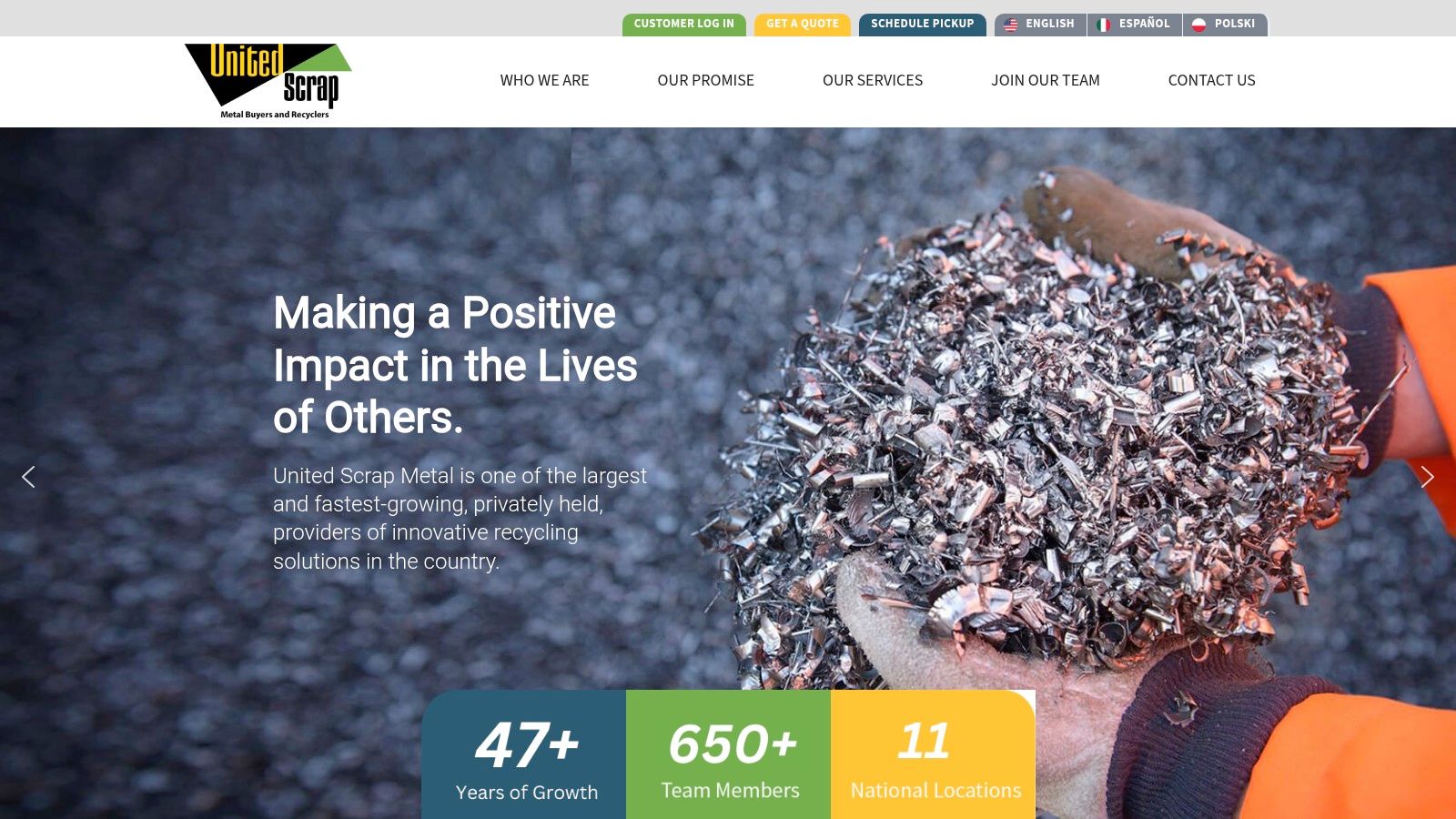
Sometimes, you find more than just bottles and cans. When we tackle illegal dump sites or help people clear out alleys, we find metal. Piles of it. Old appliances, rusty pipes, discarded construction materials. My brain immediately switches from the blue cart to a place like United Scrap Metal. This isn't your normal recycling center. It's a place where junk metal transforms from a neighborhood eyesore into actual cash, money we can pour right back into our community projects.
They're just outside the city in Cicero, but their public yard and pickup services make them a vital resource for all of us in Chicagoland. I've used their website to figure out exactly what kinds of metals they accept and to get the details I need to schedule a pickup for a really big haul. There’s something empowering about taking a pile of what someone considered worthless trash and watching it get weighed, valued, and properly recycled. This is one of the best recycling centers Chicago volunteers can use for a massive metal clear-out.
Key Features & Assessment
Feature
My Take
Public Retail Yard
Great for dropping off metal you collected during a cleanup and getting paid for it.
Commercial Programs
For bigger, ongoing projects, this is how you can form a more formal partnership.
Pickup Scheduling
A lifesaver when you’ve collected too much scrap to fit in a volunteer's pickup truck.
Pros: They pay you for your scrap metal, which can be a great fundraising source. Their capacity is huge, and they offer convenient pickups for large loads.
Cons: It's a commercial operation, so wait times and rates can vary. I always call ahead to confirm the details before I drive over with a full load.
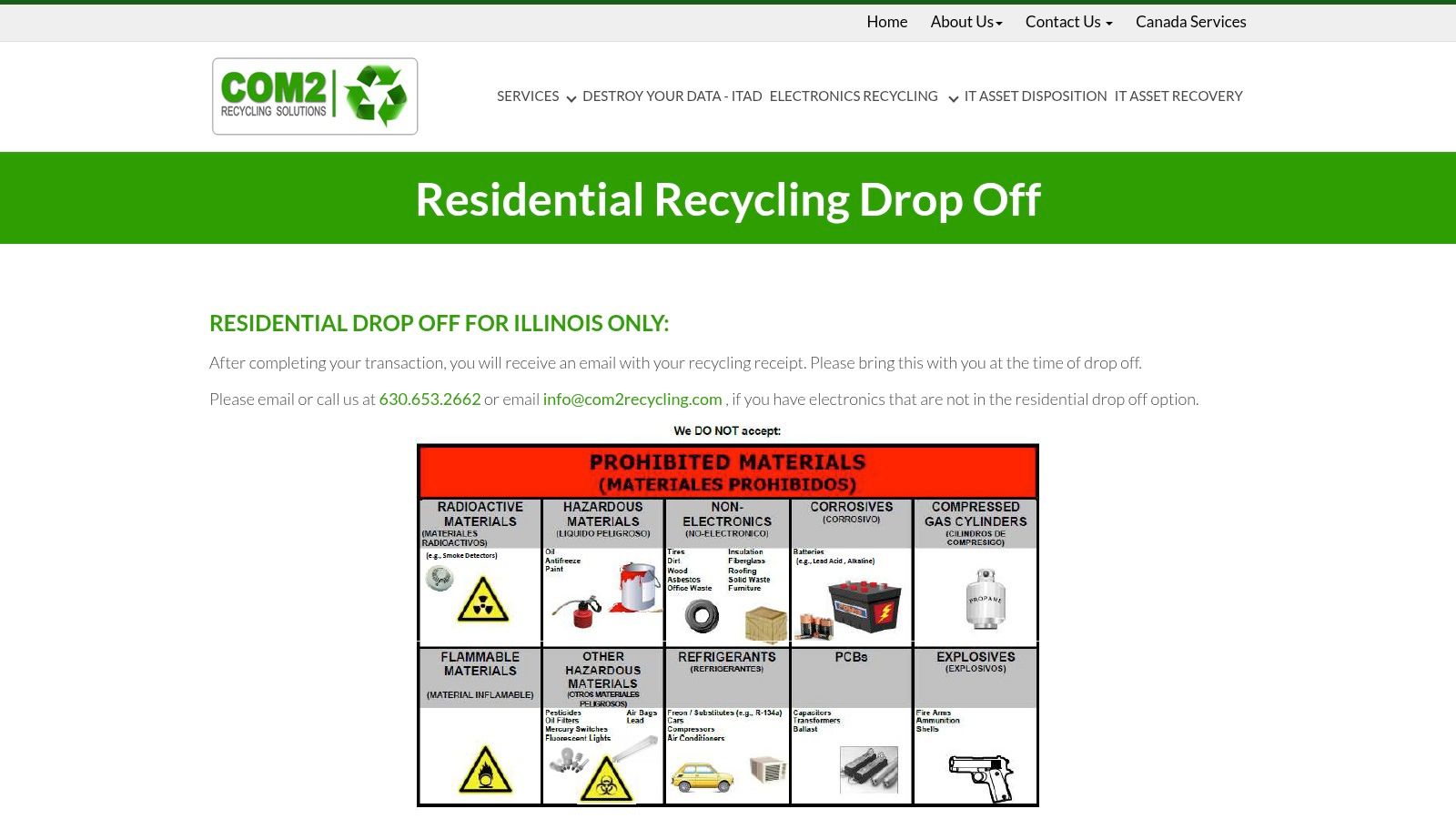
E-waste is one of the biggest monsters we have to face. Finding a place you can trust with your old electronics can feel like a quest. COM2 Recycling Solutions attacks this problem head-on with a process so simple and clear, it removes all the usual excuses. What I love about their website is the transparency. They built an online checkout system for dropping off items, so you know exactly what you'll pay, if anything, before you even leave home. No surprises. No mystery fees.
This system is a revolution for our neighborhood e-waste drives. Instead of guessing, we can point everyone to their site to pre-pay for their old TVs or monitors. It makes our event logistics so much smoother. Knowing they are a certified recycler gives me peace of mind that the devices we collect are being handled with integrity, not just dumped in a landfill overseas. It’s a professional-level solution that’s open to every single resident, making it an essential tool for any group serious about tackling electronic waste in Chicago.
Key Features & Assessment
Feature
My Take
Online Checkout/Pre-payment
Brilliant. You pay for your TV/monitor recycling online and just bring the receipt. It simplifies everything.
Free Core E-Waste Recycling
They take computers, laptops, tablets, phones, and more for free, which covers most of what you have.
Clear Fee Structure
All potential costs for bulky items are posted right on their website. The transparency is a breath of fresh air.
Pros: The pre-payment system is unique and incredibly smart. Their certified status means they do things the right way.
Cons: You have to unload your own car, so be ready to lift. The program is only for the electronics listed on their site.
9. AVA Recycling: The E-Waste Professionals with Security in Mind
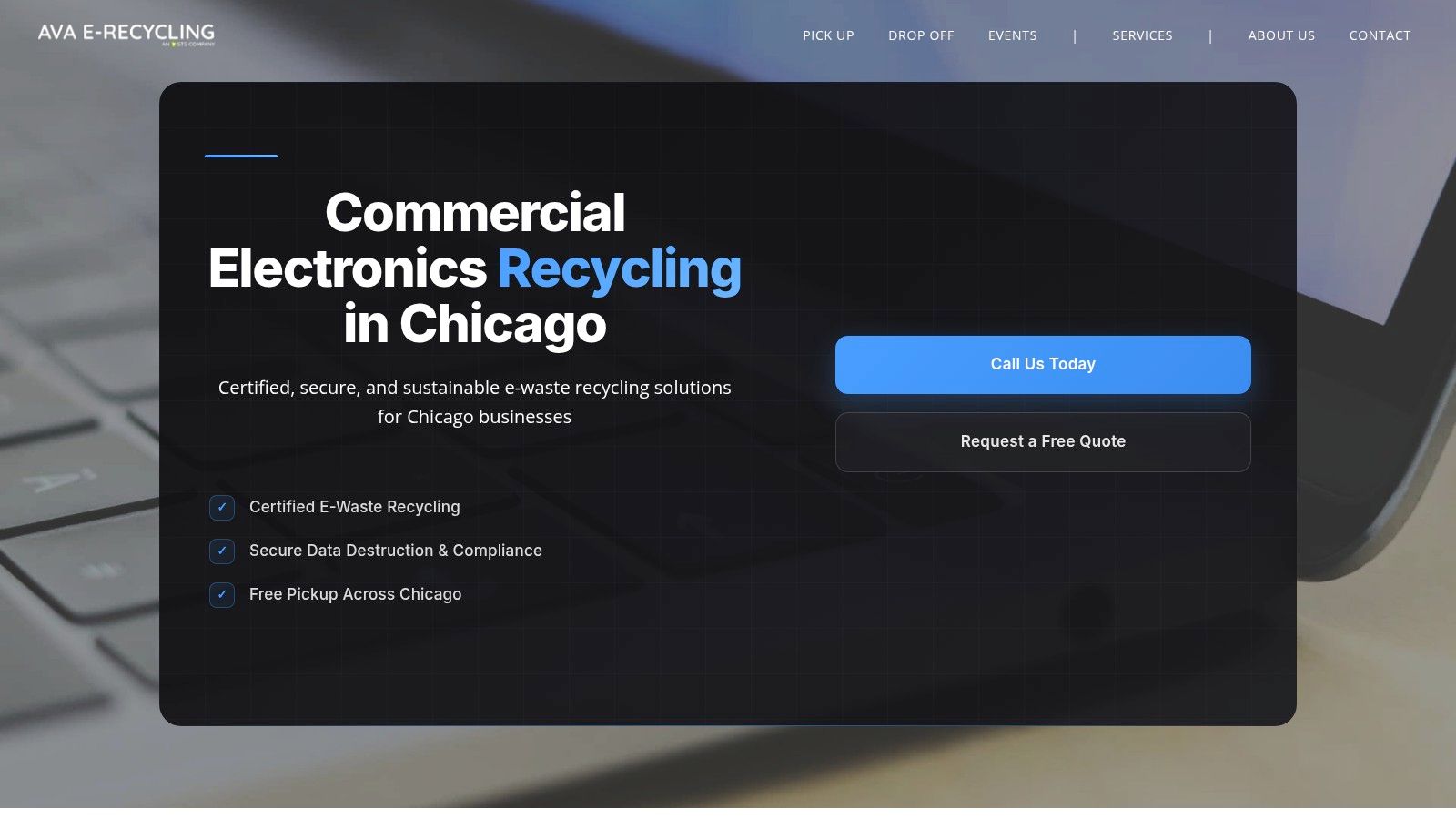
When you're dealing with electronics, it's about more than just keeping heavy metals out of the ground. It's about data security. AVA Recycling understands this perfectly. For our Litter Caterpillars events, especially when we partner with local businesses or after a big neighborhood garage sale, we end up with a pile of old computers, monitors, and printers. AVA is my go-to recommendation for anyone worried about the personal info left on those old hard drives. They don't just recycle your hardware; they vaporize your digital ghost.
What makes them different is their professional touch. They offer scheduled pickups, which is a godsend when you’re dealing with bulky items like an old tube TV or a whole office's worth of desktops. They can even give you certificates of data destruction, which is official proof that your sensitive information was handled properly. This professional-grade service, available for both you and for businesses, makes AVA one of the most trusted e-waste recycling centers in Chicago when you need that extra layer of security and convenience.
Key Features & Assessment
Feature
My Take
Scheduled Pickups
Incredibly convenient for large quantities or heavy items like TVs and appliances.
Secure Data Destruction
NIST-compliant data wiping with optional certificates. This is a huge peace-of-mind feature.
Broad Coverage
They serve the entire Chicagoland area, making them accessible for almost any project.
Pros: They combine secure e-waste recycling with convenience. The certificate of destruction is a major plus for businesses or anyone with sensitive data.
Cons: This isn't a free service. Pricing is based on a quote, and certain items like old CRT TVs will have a fee, so you need to plan ahead.
You’ve found one. A rogue battery during a cleanup. It feels like a tiny, hazardous hot potato. You can't put it in the blue cart, and you definitely can't toss it in the trash where it can leak or start a fire. This is where Call2Recycle becomes one of my most important digital tools. It’s not one single center, but a powerful map that turns places you already go—like Home Depot or Staples—into convenient drop-off points for rechargeable batteries.
This website is a game-changer for our post-cleanup sorting parties. Instead of hoarding old laptop batteries or power tool cells until someone can make a special trip, we can instantly find a dozen nearby drop-off spots. I especially appreciate their clear instructions on how to safely prep batteries for recycling, like taping the ends. It’s a simple step that prevents fires and shows a level of care that I think reflects our whole mission. For anyone searching for recycling centers in Chicago specifically for batteries, this is where you start.
Key Features & Assessment
Feature
My Take
Drop-Off Locator
Type in a zip code and get an instant map of participating stores. Simple and brilliant.
Safe Handling Guides
Essential for preventing fires. Their visual guides make it easy to do it right.
Battery ID Resources
Helps you figure out what kind of battery you've got and if they'll take it.
Pros: It’s a free, massive network that makes responsible battery disposal incredibly easy. The safety advice is top-notch.
Cons: Not all locations take every type of battery, and single-use alkaline battery acceptance can be spotty, so you might need to check with the store first.
The city’s blue cart program is great, but it has its limits. Earth911 is the search engine that takes over where the official resources stop. I think of it as the wise old librarian of recycling. You can bring it your weirdest problems—a pile of old batteries, a can of latex paint, a worn-out yoga mat—and it pulls out a map showing you exactly who in your area wants it. It’s my secret weapon for finding specialty recycling centers in Chicago beyond the usual suspects.
For Litter Caterpillars, this tool is a lifesaver when we find hazardous or unusual stuff during a cleanup. Instead of just shrugging and bagging something questionable for the landfill, we can quickly search Earth911 by material and zip code. This helps us responsibly handle things that don't belong in a blue cart, like single-use batteries, making our cleanups as sustainable as they can be. For example, I used it to find drop-off points for a bag of old batteries we collected, which you can read more about our battery recycling process.
Key Features & Assessment
Feature
My Take
Material & Zip-Code Search
The core function is incredibly powerful. You can search for almost anything, from aerosol cans to Ziploc bags.
Center Details & Accepted Items
It gives you addresses, hours, and contact info for each location, saving you a ton of research.
Educational Articles
Great for learning the "why" behind recycling certain things, not just the "where."
Pros: The massive size of its database for specialty items is unmatched. It’s an essential tool for finding private recyclers who handle what the city can’t.
Cons: Because it's a national database, sometimes the listings can be out of date. I always, always call a place to confirm before I drive over.
If you're looking for a recycling partner with a deep, soulful connection to Chicago, you've found it. The Resource Center is it. They started way back in 1975. This nonprofit isn't just a service; it's part of the city's DNA. I think of them as the seasoned community organizers of the recycling world, focused on a mission, not just on hauling stuff. Their work fits perfectly with the Litter Caterpillars idea of creating real, grassroots change that lasts.
For me, the Resource Center is the ideal partner for bigger community events or for setting up a new neighborhood recycling program. When we're planning a big cleanup and need more than just a place to drop bags, this is who I think of. They get the subtleties of community engagement and zero-waste projects from the ground up. Partnering with them means you're not just hiring a hauler; you're investing in a local organization that has been fighting the good fight for sustainability in Chicago for decades.
Key Features & Assessment
Feature
My Take
Community Diversion Programs
Their expertise goes way beyond bins, focusing on education and community-based solutions.
Nonprofit Mission
Working with them means our efforts support a local nonprofit, not some corporate bottom line.
Zero-Waste Initiatives
Great for event planning when you're trying to have a minimal impact on the landfill.
Local Focus
They have an institutional knowledge of Chicago's neighborhoods that is priceless.
Pros: Deep local roots and a mission-driven approach. They're experienced in community programs, making them a perfect partner for events.
Cons: Their website and programs can be in flux because of organizational changes. You absolutely have to call to check on their current services, hours, and availability.
Locator for battery drop-off sites & prep guidance
Retail network + battery safety prep tips ✨
★★★★ — widely available network
Consumers with rechargeable batteries 👥
Free at participating stores 💰
Earth911 – Recycling locator
National recycling search by material type
Broad specialty coverage & education ✨
★★★ — comprehensive but listings can lag
Users seeking specialty recyclers or comparisons 👥
Free 💰
Resource Center (Chicago)
Nonprofit recycling & community diversion programs
Mission-driven partnerships & zero-waste support ✨
★★★ — deep local roots; program variability
Events, nonprofits, community partnerships 👥
Variable; mission-aligned value 💰
Join Us: Let's Go Far, Together
We've just walked through a hidden map of our city. This isn't a map of 'L' stops or tourist spots. It’s a map of renewal, a network of places from the City of Chicago's official blue cart program to specialized powerhouses like Sims Metal and COM2 Recycling Solutions. Looking at this list, you can see that recycling is so much more than just a bin on the curb.
It’s a city-wide circulatory system. It's powered by people who believe that waste is just a resource in the wrong place. Each of the recycling centers in Chicago that we explored is like a different organ, each with a special job. One handles the city’s metallic skeleton, another its electronic brain, and yet another safely processes the toxic stuff we can’t just toss away.
When you know how to navigate this system, something inside you shifts. You’re no longer just a person throwing things away; you become an active participant in our city’s health and rebirth.
From Information to Action
I remember feeling overwhelmed when I first started this journey. I had a bag full of dead batteries, a broken laptop, and a can of old paint, and I felt paralyzed. Where do I even start? This guide is the answer I wish I had back then. It’s a tool. A compass.
For everyday items: Rely on your blue cart and the Chicago Recycles portal. It’s your foundation for building great habits.
For the tricky stuff: Bookmark the Illinois EPA's HHW page and the Earth911 locator. These are your go-to resources for those "what do I do with this?" moments.
For large or specialized loads: Places like LRS, GreenWay, and United Scrap Metal are your heavy hitters. They’re built for the big jobs, turning what looks like junk into valuable raw materials.
Think of it like learning to cook. At first, you follow a recipe exactly. But soon, you understand how the ingredients work together. You start to improvise. To create. This guide is your recipe book. The more you use it, the more you’ll understand the rhythm of recycling in Chicago, and the more confident you'll become in your ability to make a real difference.
More Than Just Trash
Remember Tom Sawyer convincing his friends that painting a fence was a grand adventure? I believe cleaning our city is one of the most fun and rewarding things you can do. I can tell you from experience, it’s about so much more than picking up litter.
It’s about taking tangible pride in our home. It’s about showing up, rain or shine, and doing something real with your hands and your heart. Most of all, it’s about the incredible friendships you forge when you're working side-by-side for a common goal. I’ve met some of my closest friends while sorting recyclables and clearing out a neglected alley.
We are the Litter Caterpillars because we know we’re not perfect. We’re all just trying to transform, to grow into something better. Through service, you learn to trust yourself, forgive your mistakes, and evolve. This guide to recycling centers in Chicago is a powerful tool, but the real power comes from you. It comes from your decision to show up. To be brave. And to be kind.
There’s an old saying I love: "If you want to go fast, go alone. If you want to go far, go together." We want to go far. Come with us.
Ready to turn this knowledge into action and meet amazing people along the way? Join Litter Caterpillars this weekend. We use this guide every week to properly dispose of everything we collect, turning neighborhood cleanups into true recycling missions. Find your community and make a real impact with us at Litter Caterpillars.