Tag: local activism

  • 10 Neighborhood Improvement Projects to Start Now

    10 Neighborhood Improvement Projects to Start Now

    My life used to be a mess. My apartment was chaotic, and my life felt the same way. Every piece of trash had a story, and every story felt too heavy for me to throw away.

    So I did something strange. I cleaned up someone else's mess instead. I went outside with two friends, grabbed bags, and started picking up litter. Then the sky turned on us. Hail. Wind. Cold fingers. Canceled rides. We stood there shivering under a tree, laughing like idiots.

    That day taught me something I still carry. Hard work with good people changes you. It scrapes off excuses. It gets you out of your head. It gives you a small win you can hold in your hands. One full trash bag. One cleaner block. One proof that you can face discomfort and keep moving.

    That's how I think about neighborhood improvement projects. Sure, they fix streets, lots, sidewalks, and parks. But they also fix something inside the people who show up. You learn consistency. You learn courage. You learn that friendship comes easier when your hands are busy and the work is real.

    If your life feels stuck, don't wait for some perfect plan. Start outside. Start with something ugly and neglected. Put your back into it. Let the work introduce you to a stronger version of yourself.

    1. Community Litter Cleanup Crews

    The first cleanup crew I joined had all the polish of a garage band's first show. We had bags, gloves, bad timing, and no clue what weather was coming. It was miserable for about ten minutes. Then it became fun, because struggle shared with other people has a weird way of turning into glue.

    That's why cleanup crews work. You're not asking people to care in theory. You're giving them a route, a bag, and a visible problem they can attack together. A block with trash on it feels hopeless. A block with six people cleaning it feels alive.
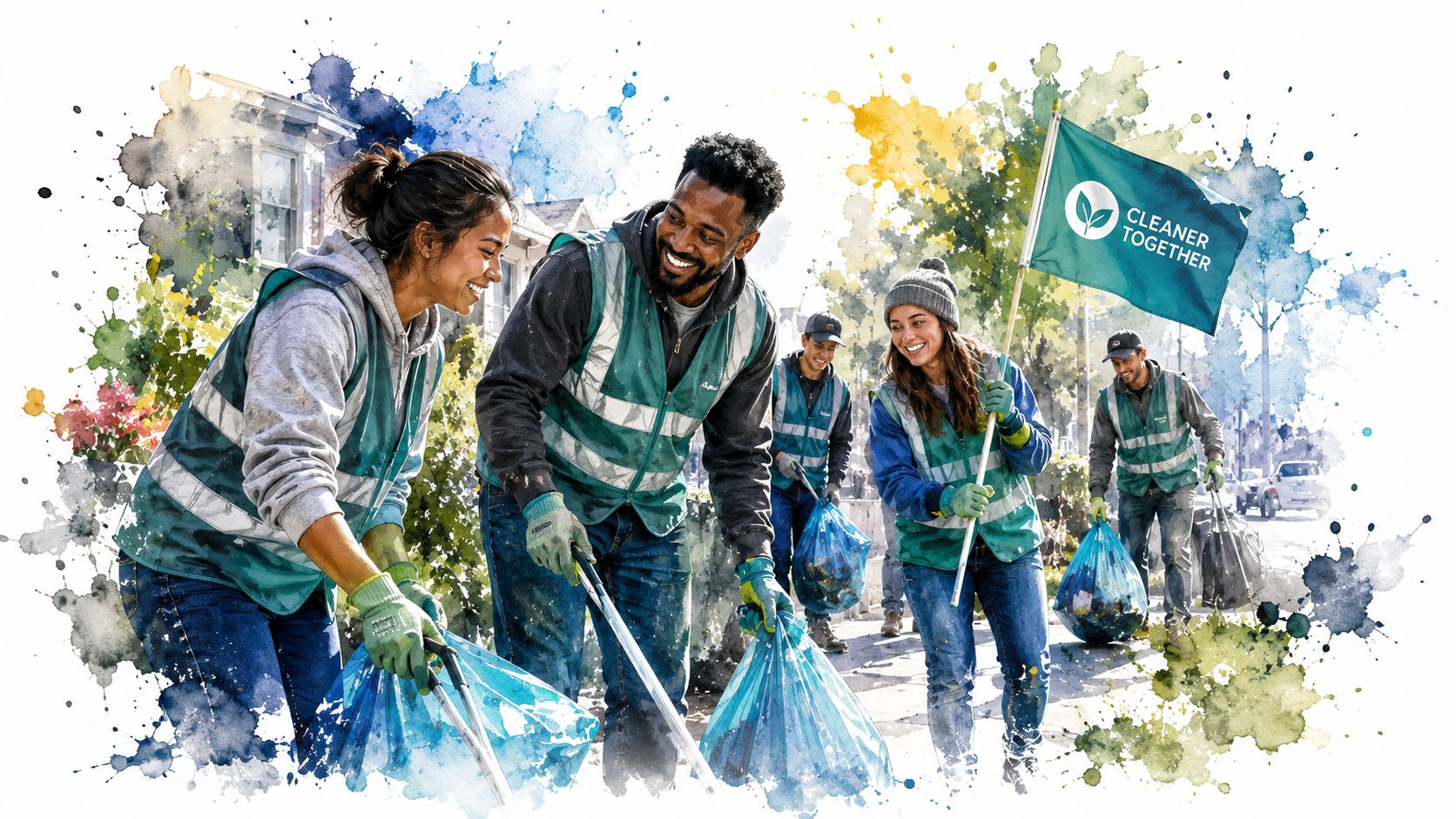
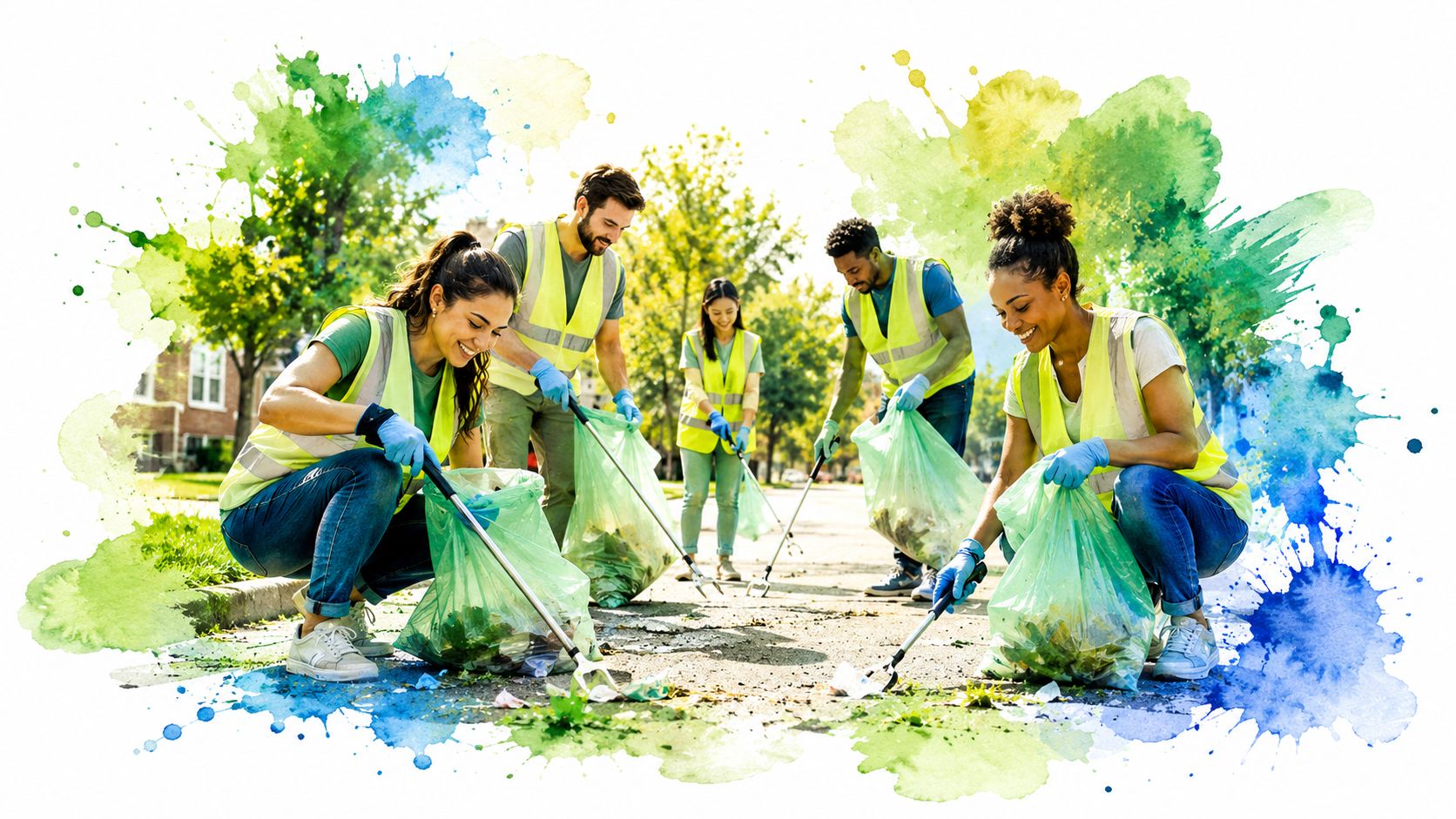
    A diverse group of volunteers in high-visibility vests working together to clean up their neighborhood streets.

    Build a crew, not a one-off event

    I like to think of litter crews like a rec league team. The point isn't one heroic Saturday. The point is rhythm. You show up on the same morning, people start trusting the schedule, and strangers slowly become the kind of friends who text each other when they're running late.

    One lesson matters more than commonly assumed. Weekend mornings filter for a different kind of volunteer. A Mercatus neighborhood-strength brief makes the same point plainly: weekend morning timing is the sharpest filter for attracting givers instead of party people.

    Practical rule: Pick a schedule that shapes the culture you want. Time is a filter.

    If you want help getting one off the ground, use this guide on how to organize a neighborhood cleanup.

    • Start with one dependable route: One alley, one park edge, one commercial strip. Let consistency beat ambition.
    • Pair rookies with regulars: People stay longer when they feel useful in the first hour.
    • Give the crew an identity: Safety vests, a flag, matching grabbers, even a dumb team nickname. Pride matters.
    • Protect volunteer energy: Don't turn every cleanup into a fundraising pitch. Let the work be the work.

    Chicago's Litter Caterpillars built their name through weekly pickups across the city, rain or shine. You can do the same on a smaller scale. Your first crew doesn't need to look impressive. It just needs to return next week.

    2. Vacant Lot Transformation into Parks

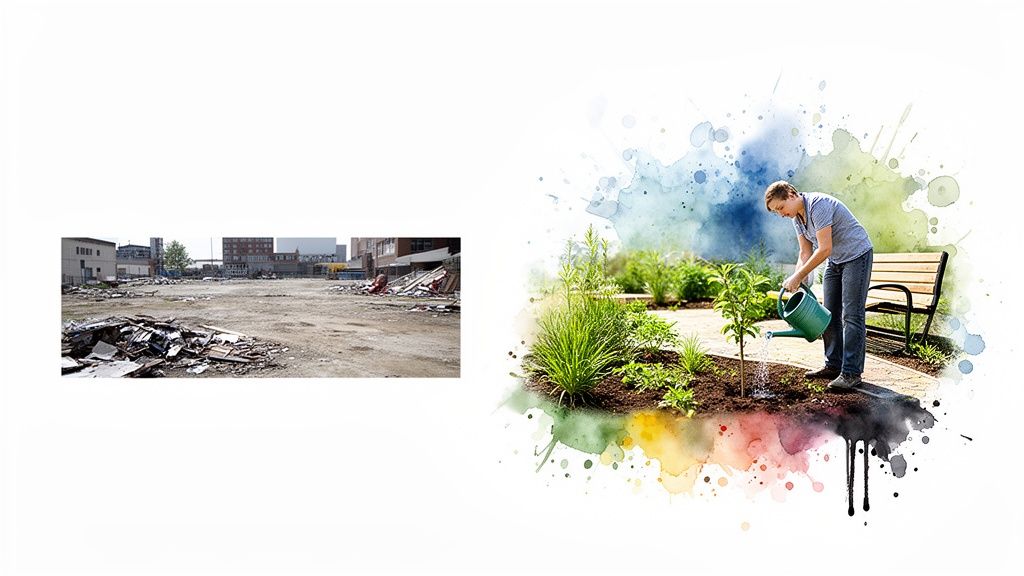
    An empty lot can mess with your head. You walk past it enough times and start accepting neglect as normal. Broken fence. Weeds. Dumped junk. Dead space. Then one day somebody cuts it back, clears it out, puts down seating, and suddenly the same ground feels like a different world.

    That kind of change hits hard because it's physical. You can point at the dirt and say, “Yeah, this used to be a mess.”

    For me, this project always feels personal. Taking land that people gave up on and turning it into a gathering place is a lot like rebuilding your own life after chaos. You don't begin with perfection. You begin by clearing what's rotten.

    Video tells that story better than theory sometimes.

    Start rough, then keep shaping it

    In Englewood, Litter Caterpillars bought two adjacent lots at 6316 and 6318 South Sangamon Street for exactly $10,000 at a wide land auction organized by Hilco in April 2025. I love that story because it isn't polished. It's direct. See a problem. Get the lot. Start building.

    You can read more of that journey in the tale of the vacant lot.

    A park project doesn't need fancy bones on day one. It needs clearing, a path people can walk, and a reason to pause there.

    What people actually use

    • Add seating early: A bench or simple chairs invite people to stay, and staying changes how a place feels.
    • Create a maintenance rhythm: If nobody owns the weeds, the weeds win.
    • Ask neighbors one blunt question: “What would make you come here?” Kids' play space, shade, flowers, a grill area, raised beds. Let the answer shape the site.
    • Open it with a real gathering: Music, snacks, cleanup supplies, introductions. A place becomes public when people make a memory in it.

    Philadelphia, Detroit, and Chicago all have examples of neighbors reclaiming forgotten land this way. The pattern is simple. Dead ground drags people down. Shared green space lifts them back up.

    3. Street Mural and Public Art Programs

    Some blocks look tired before anybody even says a word. Blank walls do that. They flatten a place. Then a mural goes up and the whole street gets a pulse.

    I've seen people stop in front of painted walls the way they stop in front of a campfire. They lean in. They talk. They take pictures. They straighten up a little. Color gives people a reason to look longer, and looking longer is the first step toward caring.

    An artist on a ladder paints a colorful community mural featuring city silhouettes for observers.

    Paint changes the temperature of a block

    Think about neighborhoods like living rooms. A bare cinderblock wall says, “Get through this space.” A mural says, “Somebody bothered.” That emotional shift matters. It can make nearby residents more protective of the area and more willing to join cleanups or report damage when they see it.

    Chicago's Pilsen neighborhood, Philadelphia's long-running mural culture, and Denver's RiNo all give you strong models. The lesson isn't “copy their style.” The lesson is “use art to make care visible.”

    A good mural gives a block a face. Once a place has a face, people treat it differently.

    Keep the project grounded

    • Get permission in writing: Don't skip this. Enthusiasm isn't a permit.
    • Use local artists first: Art lands better when it sounds like the neighborhood that has to live with it.
    • Invite residents into the design: Ask for themes, names, symbols, memories.
    • Plan touch-ups from the start: Sun, weather, and tags don't care how beautiful the wall is.

    One of the best versions of this project is simple. Pick the ugliest wall on a route people walk. Then replace “nobody cares” with something people want to show their friends.

    4. Community Garden and Green Space Development

    Gardens are sneaky. You think you're building raised beds and tomato cages. Then a month later you realize you've also built a place where people slow down enough to talk.

    I love community gardens because they give people a clean, honest feedback loop. You water. It grows. You ignore it. It droops. That kind of clarity is rare in modern life.
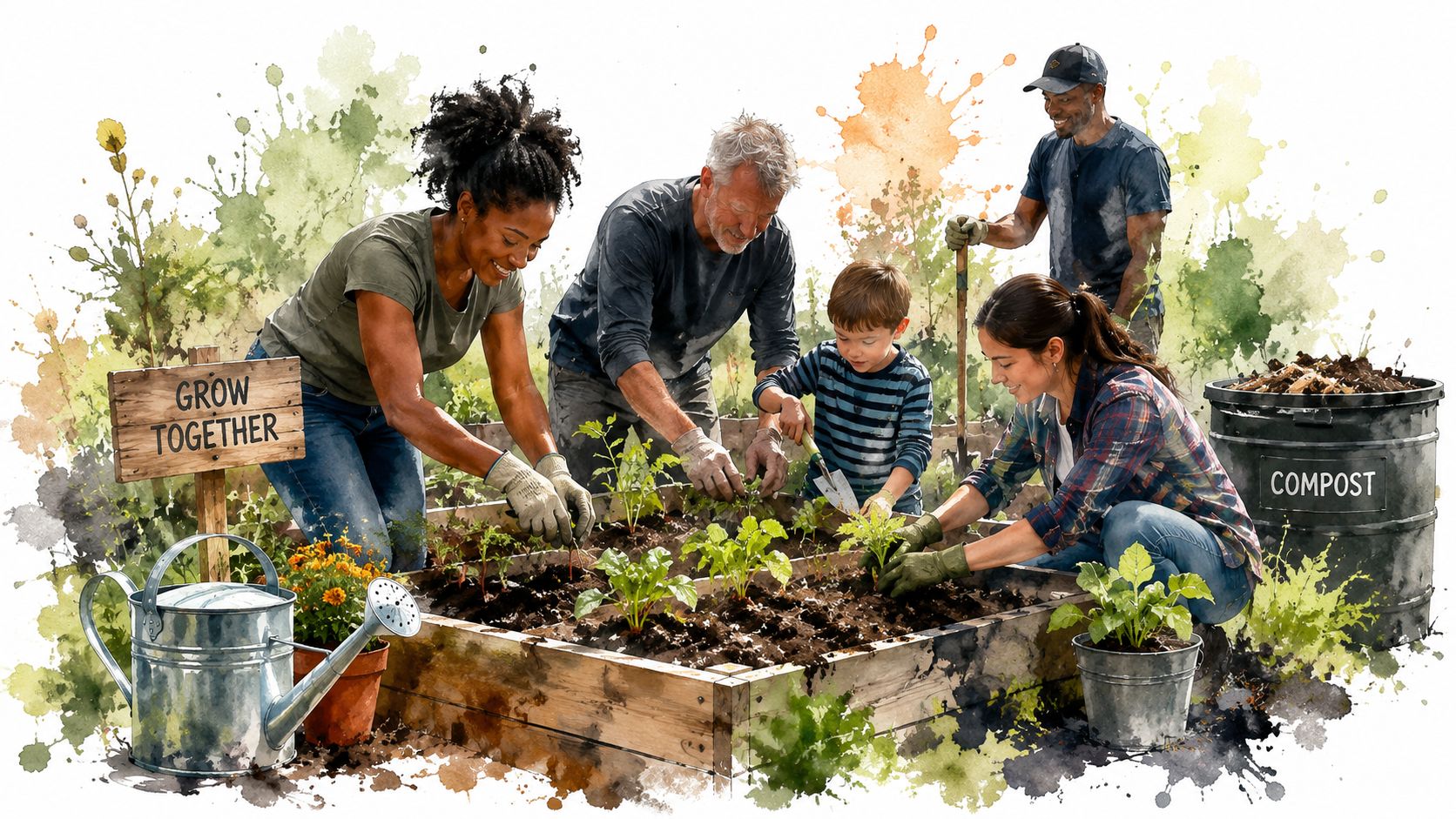
    A multi-generational diverse group of people planting vegetables together in a community garden raised bed.

    A garden teaches people they can tend something

    In Mexico, the Hábitat para el Desarrollo program randomly allocated $68 million across low-income urban neighborhoods, averaging $567 per household, and the investment improved infrastructure access while also triggering private investment in housing stock. I like this example because it shows a basic truth. When people see a place improve, they often start investing their own effort and money too.

    A garden can create that same chain reaction on a smaller patch of land. One clean bed turns into three. One tomato plant turns into a conversation about fencing, water access, herbs, compost, and whose grandma knows how to grow peppers right.

    If you want local inspiration, check out these community gardens in Chicago, IL.

    Keep the first season humble

    • Begin with a manageable footprint: A few plots beat a giant failed field.
    • Install water access before planting day: Hope is not irrigation.
    • Mix skilled gardeners with beginners: Mentorship keeps a garden from becoming a clique.
    • Celebrate harvests out loud: A shared meal does more for neighborhood trust than a rule sheet ever will.

    Brooklyn, Detroit, Los Angeles, and Chicago all have gardens built on land that once looked useless. That's why I push this project so hard. A garden lets people practice hope with their hands.

    5. Neighborhood Beautification Through Tree Planting

    Tree planting is one of the few projects where you get two rewards at once. You get a workday now, with shovels and muddy shoes and jokes, and you get shade later. It's friendship in the present and patience planted in the ground.

    I've always liked projects that ask you to think beyond your own mood. A tree doesn't care if you're in a slump. It still needs mulch, water, and a little room to root. That's healthy for people like me. It drags your attention out of your own mess.

    Plant where people will notice the change

    Street trees can soften a hard block fast. Even before they mature, they tell residents that somebody expects this place to have a future. Schools, church edges, bus-stop corridors, and stretches with too much concrete are all strong starting points.

    The trick is follow-through. Planting day gets the photos. Watering day keeps the promise.

    • Work with a city forestry team or local nonprofit: They'll help you avoid bad species choices and bad planting spots.
    • Choose native or climate-suited trees: Don't set volunteers up to fail with something fragile.
    • Tag stewards to each tree: One person checking in beats everybody assuming somebody else did it.
    • Use schools when you can: Kids remember the tree they planted. So do their parents.

    Chicago, Los Angeles, New York, and London all give you versions of this playbook. If you want a project that feels both practical and hopeful, this is one of the best neighborhood improvement projects you can start.

    6. Neighborhood Walking Tours and Wayfinding Improvements

    A lot of people “know” a neighborhood only through a windshield. That isn't knowing. That's passing through. When you walk a place, you notice the mural tucked behind the corner store, the old church stonework, the block where the gardens are thriving, the café owner who remembers names.

    That's why walking tours matter. They teach residents and visitors to see what speed hides.

    Help people move through the neighborhood with confidence

    Wayfinding can be simple. Printed maps. Painted markers. Pole signs. A route that links transit, local businesses, public art, and places to rest. None of that sounds dramatic, but it changes behavior. People linger when they know where they're going.

    I've seen longtime residents light up when a tour guide tells a story about a building they pass every week. Familiar streets start feeling fresh again, and that creates a different kind of ownership.

    On-the-ground lesson: If you want people to care about a place, slow their bodies down long enough for their eyes to wake up.

    Make the route human

    • Interview people who've lived there a long time: Their stories beat any generic script.
    • Train a few local guides: Don't let one person become the whole program.
    • Add rest points: Benches, shade, water, bathrooms. Hospitality matters.
    • Link the walk to local shops: Coffee after the tour keeps people talking.

    Chicago has great neighborhood routes for this kind of work, and cities like Boston and San Francisco have long shown how a walking path can change how people relate to an area. If your neighborhood has history, beauty, food, odd little landmarks, or even just one great story per block, you already have material.

    7. Graffiti Prevention and Removal Programs

    Graffiti hits differently depending on the wall. A commissioned mural is one thing. A fresh tag sprayed across a storefront gate or brick wall can make a block feel like nobody's paying attention.

    That's why speed matters. When residents remove new tags fast, they send a message right back. We saw it. We care. We're not asleep.

    Respond fast, then create legal outlets

    This project works best when you split it in two. First, rapid removal. Second, approved spaces for real art. If you only remove, you create a cat-and-mouse fight. If you only permit murals, you ignore the immediate frustration residents feel when tags keep appearing on homes and small businesses.

    A good volunteer program trains people on safe paint matching, solvents, reporting, and when to leave gang-related markings to trained city crews or law enforcement.

    • Set up a simple reporting channel: Group chat, form, or neighborhood text thread.
    • Map repeat spots: Patterns tell you where lighting, cameras, barriers, or outreach may help.
    • Work with property owners: Fast permission beats delays that let tags linger.
    • Pull young artists into legal projects: Respect grows when people have a real wall to paint.

    Chicago, Los Angeles, San Francisco, and New York have all used combinations of removal and sanctioned art. The heart of the project is simple. Don't let neglect sit there long enough to become normal.

    8. Neighborhood Safety and Lighting Improvements

    Fear changes how people move. A dark block empties out fast. A well-lit one invites dog walkers, commuters, kids with parents, and the ordinary flow of human eyes that makes a place feel less tense.

    I care about this project because safety is practical, not abstract. If volunteers don't feel safe, they won't keep showing up. If seniors don't feel safe, they won't walk. If parents don't feel safe, they won't let kids use the park after dinner.

    Start with what people avoid

    Ask residents where they don't like walking at night. They'll tell you fast. The underlit bus stop. The stretch where trees block the lamp. The path by the lot. The corner where a broken fixture has been dead for months.

    Then walk those spots in person. At dusk. On a weeknight. Don't guess from daylight.

    A solid safety project can include better lighting requests, trimming overgrowth, cleaning around poles, documenting outages, and organizing evening walks after repairs so people reclaim the route together.

    Use a simple field method

    • Map dark gaps block by block: Don't rely on memory.
    • Photograph dead lights and obstructed fixtures: Clear evidence helps city requests move.
    • Trim what you can legally trim: Overgrowth can swallow half a lamp's reach.
    • Bring residents back outside afterward: A safer block still needs people on it.

    Cities like Chicago, Los Angeles, New York, and Philadelphia have all pushed lighting work in neighborhoods where people asked for it. If you want a project with immediate psychological payoff, this is one. Better light changes how a street feels the same night it works.

    9. Sidewalk and Parkway Maintenance and Repair

    Broken sidewalks don't look dramatic until you trip on one. Or try pushing a stroller over it. Or roll a wheelchair into a slab that has lifted like a crooked tooth. Then it gets real fast.

    That's why I respect this work so much. It's plain. It's useful. Nobody needs a theory lecture to understand why a cracked walkway matters.

    Fix the path people actually use

    Community Development Block Grant neighborhood improvement projects have shown a very local housing-price effect. Homes within 500 feet of completed projects saw a 4.1% to 4.2% increase relative to untreated homes, with the effect emerging three years after completion and fading beyond 1,000 feet. I bring that up for one reason. Hyperlocal work matters. Improvement is often block-level, not magical citywide vapor.

    So start where feet and wheels already go. Routes to schools. Routes to transit. Corners with missing curb cuts. Parkway strips full of weeds or broken edges.

    Repair what people touch every day. That's where trust grows.

    Mix volunteer work with city pressure

    • Document hazards carefully: Photos, addresses, notes on who uses the route.
    • Prioritize ADA barriers first: Accessibility is not an extra.
    • Handle what volunteers can handle: Parkway cleanup, weeds, debris, minor surface prep where allowed.
    • Stay on the city: Repairs often move because residents keep calling, emailing, and showing up.

    Chicago, Boston, New York, and San Francisco all have neighborhoods where residents pushed hard for safer walking conditions. This project isn't glamorous. Good. Sometimes the best work looks boring right up until it changes somebody's daily life.

    10. Community Events, Gatherings, and Skill-Building Programs

    A neighborhood can have clean streets and still feel lonely. People need reasons to be together that aren't emergencies, complaints, or awkward nods from across a fence.

    That's where events and classes come in. A block party, repair café, tool-share workshop, gardening lesson, or bike-fix day gives people a softer entry point into community life. Some folks won't come to a cleanup first. They will come to music, food, or a class where they learn something useful.

    Let people arrive for fun and stay for purpose

    I've seen this happen over and over. Somebody comes for a casual event, meets two decent people, hears about the next service project, and suddenly they're part of something. Skill-building helps because it gives adults a rare gift. Beginner status without shame.

    Teach bike repair. Teach basic home patching. Teach composting. Teach how to use a drill without fear. When people fix one small thing with their own hands, they start believing they can fix other things too.

    Build the social glue on purpose

    • Start smaller than your ego wants: One good annual event beats a giant flop.
    • Recruit role-based volunteers: Setup, welcome, food, cleanup, kids' area, instructor support.
    • Create time to linger: Conversation before or after the activity matters as much as the activity.
    • Turn learners into teachers: The strongest programs keep recycling leadership back into the neighborhood.

    There's another reason I like these gatherings. A major World Bank neighborhood upgrading project in unplanned settlements directly benefitted 367,562 people with improved access to infrastructure and basic services, exceeding its revised target of 150,000 by more than two-fold. Big systems matter, sure. But in ordinary neighborhood life, shared services and shared spaces work best when people know each other.

    Comparison of 10 Neighborhood Improvement Projects

    Initiative Implementation Complexity 🔄 Resource Requirements ⚡ Expected Outcomes 📊 Ideal Use Cases 💡 Key Advantages ⭐
    Community Litter Cleanup Crews Low, volunteer scheduling, route assignment Low, gloves, bags, grabbers, disposal coordination Immediate visible cleanliness; stronger neighbor ties Quick wins; volunteer onboarding; frequent visible impact High immediate impact; easy to scale; strong community building
    Vacant Lot Transformation into Parks High, land acquisition, legal work, design, permits High, capital for purchase, infrastructure, long-term maintenance Long-term neighborhood pride; increased property values; gathering space Long-term revitalization; reclaiming blight; multi-use public space Transformative physical change; high socio-economic return
    Street Mural & Public Art Programs Medium, approvals, artist collaboration, design review Low–Medium, paint, scaffolding, artist fees, maintenance Rapid aesthetic improvement; increased foot traffic and pride Beautification corridors; youth engagement; cultural storytelling High visual impact; relatively affordable; deters vandalism
    Community Garden & Green Space Development Medium, land access, plot design, irrigation setup Medium, soil, tools, water access, education resources Fresh food, skills transfer, social ties, improved mental health Food-insecure areas; skill-building; multi-generational engagement Produces tangible food + social resilience; year-round benefits
    Neighborhood Tree Planting Medium, planning with forestry, species selection Medium, saplings, tools, training, watering stewardship Long-term environmental benefits; shade; improved streetscape Climate-resilience projects; long-term beautification Long-lasting environmental & property value gains
    Walking Tours & Wayfinding Improvements Low–Medium, research, guide training, signage permits Low, signage production, printed/digital guides, promotion Increased foot traffic; stronger place identity; local economic boost Cultural/historic neighborhoods; visitor engagement; small budgets Low-cost activation; immediate community storytelling
    Graffiti Prevention & Removal Programs Medium, monitoring system, rapid response teams Low–Medium, cleaning supplies, trained volunteers, approved walls Reduced visual blight; deterred crime signals; outlet for artists Areas with frequent tagging; youth engagement through legal art Immediate visible results; engages artists; prevents neglect
    Safety & Lighting Improvements High, coordination with city, infrastructure upgrades High, LED fixtures, installation, maintenance, permits Increased night-time safety; more active streets; reduced accidents High-crime or poorly lit corridors; enabling evening activities Structural safety improvement with broad ripple effects
    Sidewalk & Parkway Maintenance Medium, assessment, city coordination, some contracting Medium–High, materials, contractors, volunteer prep work Improved accessibility and safety; immediate visible repairs ADA access improvements; areas with damaged sidewalks Directly improves mobility and safety; tangible results
    Community Events & Skill-Building Programs Low–Medium, event planning, volunteer roles, partnerships Low–Medium, supplies, permits, instructors, promotion Strong social cohesion; skill transfer; volunteer recruitment Outreach, recruitment, education, launching larger initiatives Builds relationships, attracts diverse residents, versatile impact

    Just Start. Bravery Is a Muscle

    Don't overwhelm yourself by staring at the whole city. That's like standing in front of a filthy garage and deciding you have to organize every shelf before you touch a broom. You'll freeze. I know that freeze. I've lived in it.

    Start smaller than your pride wants. Pick up one bag of trash. Clear one lot corner. Report one dead streetlight. Ask one older neighbor what this block used to look like. Plant one tree. Paint one wall with permission. Build one raised bed. Lead one walk. Host one little class with six folding chairs and a box of donuts.

    That's enough.

    Bravery isn't something you're handed. You build it the same way you build muscle. Reps. You do one hard thing. Then another. Then another. At first it feels awkward and heavy. Then one day you notice you don't panic as fast. You don't quit as fast either.

    I think people make a mistake when they wait to feel ready before they act. Readiness usually comes after action, not before it. You get stronger by carrying weight, not by studying dumbbells from across the room. Neighborhood improvement projects work the same way. The project outside becomes training for the project inside.

    And yes, some days will be annoying. You'll get rained on. People won't show up. Bureaucracy will drag. Somebody will leave a fresh pile of trash right after you clean. Good. That's part of the story. Friction gives the work texture. A little suffering makes the memory stick. It gives you something to laugh about later with the people who stayed.

    That's another thing worth saying plainly. You're not only fixing places. You're finding your people. Real friendship often grows sideways. Not from trying too hard to network, but from carrying mulch together, scraping stickers off poles, pushing wheelbarrows, or huddling under a tree in bad weather because you were stubborn enough to show up.

    So don't wait for permission to become the kind of person who acts. Choose a block. Choose a morning. Choose a project. Then go do the unglamorous thing with your whole heart.

    You might walk home dirty, tired, and sore.

    You also might walk home a little cleaner inside.


    If you want a place to start, join Litter Caterpillars. Show up on a weekend morning, grab a bag, and do one hard, useful thing with good people. That's how cleaner streets begin, and it's also how a different life begins.

  • How to Organize a Neighborhood Cleanup: The Giver’s Guide

    How to Organize a Neighborhood Cleanup: The Giver’s Guide

    I remember standing on a sidewalk with two trash bags, frozen fingers, and no idea if anyone else would come back next week. By the end of that morning, the block looked better, but the stranger thing was this. I did too.

    The Mess That Started It All

    I didn't start cleaning streets because I had my life together. I started because I didn't.

    My apartment was a disaster. Not movie-disaster. Real disaster. The kind where every object had a little emotional hook in it. An old jar of blueberry jam in the back of the fridge from a trip years ago. A stale bag of almonds from the month I tried to become a healthy person. A shirt on the chair that belonged to some version of me I didn't even like anymore.

    A man looking distressed while sitting in a very cluttered, messy, and disorganized apartment living room.

    Why someone else's trash feels lighter

    Here's the weird part. I could barely throw out my own junk, but I could pick up a stranger's burger wrapper all day.

    That wrapper didn't come with memory. It didn't come with guilt. It didn't whisper, “Remember who you were when you bought me?” It was just trash. Easy. Clean decision. In the same way cleaning an old fridge at home can feel like opening a time capsule of your own mistakes, cleaning a sidewalk feels like mercy. You see the problem, you remove it, you move on.

    That's why I tell people this isn't really about trash. Trash is just the handle.

    A cleanup gives you a simple win when the rest of life feels tangled. You bend down. You pick something up. The block changes. You change a little with it.

    Cleaning a public space can feel easier than cleaning your own room because the emotional weight is different. You're not sorting your past. You're practicing action.

    I learned that during a rough stretch after a chaotic relationship ended. I looked around and realized I had let too many selfish patterns into my life. Mess in my home. Mess in my habits. Mess in my relationships. So I made a stubborn decision. I'd start building a life around cleanliness, consistency, and brave acts.

    A neighborhood cleanup is perfect for that. It asks for your body before it asks for your biography. You don't need a polished origin story. You need gloves, a bag, and the willingness to show up.

    The real reason to start a cleanup group

    If you're learning how to organize a neighborhood cleanup, start with the part most guides skip. Ask yourself why you want this.

    Maybe you're angry that your block gets ignored. Maybe you want to meet people who keep their word. Maybe you need a ritual that gets you out of the apartment and back into your body. All of those reasons are good.

    I've found that cleanup groups become a filter. The people who show up to do hard, unglamorous work on a weekend morning tend to bring a certain energy. They're usually generous. They're usually game. They know how to laugh while carrying gross things to a pile.

    That's the weird magic. The bags matter. The friendships matter more.

    • A cleanup gives you motion: When life feels stuck, physical work breaks the spell.
    • A cleanup reveals character: You find out fast who complains, who helps, and who sticks around.
    • A cleanup builds trust: People believe what they can see. A cleaner block is visible proof.

    It's akin to clearing a path through overgrowth. You start by removing litter from a curb. Then you notice you're also removing excuses, stale habits, and a few people who never planned to grow with you anyway.

    Your First Four Weeks The Cleanup Playbook

    The first cleanup I ever ran taught me this fast. Good intentions are cheap. Saturday at 9 a.m. is where the truth lives.

    I had a volunteer named Denise show up early with coffee and work gloves from her garage. I had another guy text me at 8:47 asking if we were still on because it looked “a little cloudy.” By 11, Denise had recruited two neighbors on the spot, and Cloudy Guy never appeared. That morning gave me a better blueprint than any tidy checklist ever could. A cleanup group lasts when you build for real humans, real weather, and real follow-through.

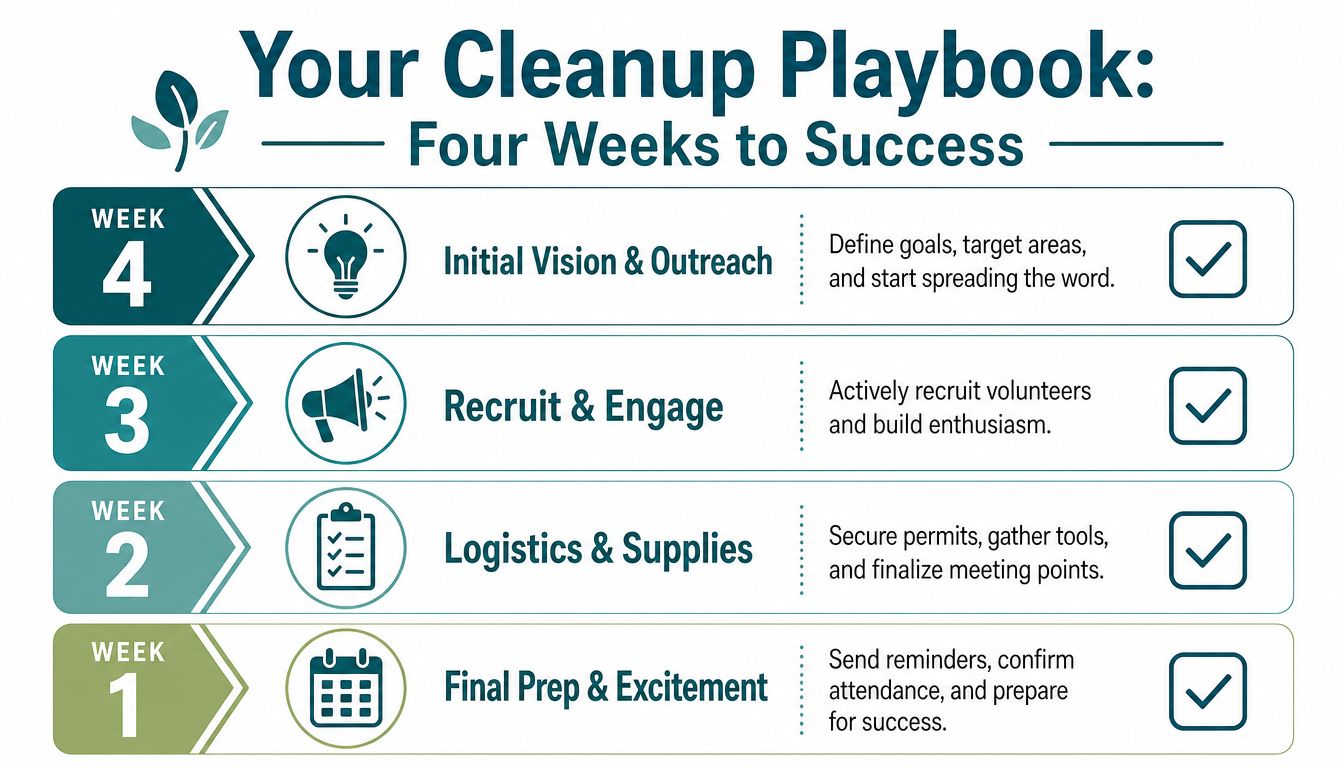
    A four-week roadmap infographic for organizing a successful community cleanup event, from vision to final preparation.

    Week four, walk the ground until the block starts talking

    Do not plan your route from a couch.

    Walk the area at the same time of day you want to clean it. A block can look calm on Tuesday afternoon and turn into a traffic mess on Saturday morning. I learned that after choosing a “perfect” meetup corner that became a parking circus the minute a youth game let out nearby.

    Bring your phone, take notes, and get specific. “The park is dirty” is useless. “South fence line has bottles and chip bags, alley behind the deli has dumped furniture, bus stop has broken glass” gives you something you can act on.

    I break the route into plain chunks:

    • Corner one: cups, wrappers, loose paper
    • Alley stretch: dumped bags, bulky trash
    • Fence line: cans, bottles, food containers
    • Busy curb: experienced volunteers only, bright clothing only

    That walk does more than help you estimate supplies. It starts a relationship with the place. You stop seeing “the neighborhood” as an abstract cause and start seeing Mrs. Alvarez's stoop, the corner kids' snack wrappers, the lot everybody complains about but nobody claims. That shift matters. People return for places they feel connected to.

    Week three, make the city useful and make your plan smaller

    This is phone call week.

    Call sanitation. Call the council office. Call the neighborhood association. Call whoever answers and ask for one clear thing. Bag pickup. Trash collection. A dumpster. Extra gloves. You are giving them a chance to say yes to something concrete, not sending a vague plea into the void.

    Keep your message simple. Date. Rain date. Target area. Estimated turnout. What you need. Then write down the name of the person you spoke with, because nothing tests your patience like hearing, “We never got that request.”

    Also pick your meetup point now, not three days before. Choose a spot people can find without twenty text messages. If there's shade, parking, or a bathroom nearby, even better. Small comforts change the mood. A confused volunteer drifts. A grounded volunteer stays and helps stack bags at the end.

    Week two, gather gear that earns its place

    People get seduced by nonsense.

    You do not need custom banners before you have enough gloves. You do not need branded merch before you have water. A cleanup group gets stronger when people trust that the basics will be there every time.

    Bring what gets the job done:

    Item Worth bringing Why
    Trash bags Yes You always need more than you guessed
    Gloves Yes New people forget, or bring the wrong kind
    Grabbers Yes They help with sharp or gross litter
    Folding table Yes Check-in feels calmer and more organized
    Fancy branded gear No Basics beat aesthetics every time

    Assign a few simple roles before the day arrives. One person handles check-in. One person carries backup supplies. One person tracks full bags and bulky items. One person takes photos if you want them. Order lowers stress, and lower stress makes people kinder to each other.

    If you need a practical guide for finding reliable cleanup volunteers, use it here, before you start sending frantic messages the night before.

    Week one, invite people into a ritual, not just an event

    This week is about tone.

    A flat post that says “community cleanup this Saturday, all welcome” gets casual interest. A better message tells people who this is for and why it matters. I've had stronger turnout from a plain text message that said, “We're cleaning the three blocks around the elementary school because kids deserve better than broken glass on the walk in,” than from polished graphics that looked like they came from a marketing team.

    Put the date, time, rain date, meetup point, and what to bring in every message. Then repeat yourself. Send a reminder a few days before. Send one the night before. Confirm your key helpers directly, one by one. People are busy. Good groups survive because somebody cared enough to follow up.

    By this point, the cleanup is already bigger than trash bags and grabbers. You are building a tiny culture. People are learning whether this group is flaky or steady, warm or cold, all talk or all hands. Four good weeks set that tone. Then Saturday shows you who's ready to build something real.

    Finding Your People Who Shows Up on a Saturday Morning

    A cleanup can get bodies pretty easily. A free Saturday event, a few nice graphics, some feel-good copy, and people click “interested.”

    That's not enough.

    You don't need a crowd that vanishes after one sweaty hour. You need people who like giving more than performing. I'm picky about that now. I'd rather have eight steady volunteers than thirty tourists collecting content for their stories.

    Screenshot from https://www.littercaterpillars.com

    Why Saturday morning works

    There's a reason I like weekend mornings. They act like a filter.

    The NYLCVEF community cleanup guide says the most effective volunteer recruitment strategy is scheduling events on weekend mornings, which yields 45 to 50% higher turnout than other time slots. The same guide says social media with before-and-after photos can boost repeat participation by about 38%.

    That matches real life. Morning volunteers arrive clearer, kinder, and more ready to work. The event starts before the day gets crowded with excuses. You also get the tiny secret reward of being done by lunch, which makes people feel weirdly heroic.

    Recruit for identity, not attendance

    Most volunteer posts read like dentist reminders.

    “Join us this Saturday to beautify the neighborhood.” Fine. Dead. Nobody feels anything.

    Instead, write like you're inviting people into a crew. People return when they feel they belong to something. If you want more ideas on that side of outreach, I like this guide on how to find volunteers who actually stick.

    Here are two templates I'd use.

    Instagram caption

    • Opening line: Saturday morning. Gloves on. We're cleaning this block because someone should, and that someone is us.
    • Details: Meet at 9:00 AM. Wear closed-toe shoes. We'll bring bags and gloves.
    • Tone: Come if you're tired of complaining and ready to help.
    • Closer: Bring a friend who likes doing hard things with kind people.

    Meetup description

    • First sentence: This is for people who want a cleaner neighborhood and better friends.
    • Middle: We'll split into teams, clean a defined route, and take before-and-after photos.
    • Expectation: Show up on time, ready to work, and ready to talk to strangers.
    • Finish: Rain date is listed. If the weather turns, we adapt.

    You're not recruiting “volunteers.” You're recruiting future regulars, future captains, future friends.

    How to ask local businesses for help

    Ask like a partner, not a charity case.

    Walk into the coffee shop, hardware store, or corner market and say: “We're organizing a neighborhood cleanup nearby. We're bringing people to this block. Would you be up for donating water, gloves, or a meetup space?”

    Keep the ask narrow. One business might give bottled water. Another might let you post a flyer. Another might chip in contractor bags. Make it easy to say yes.

    Three things matter here:

    • Specific ask: “Can you donate cases of water for Saturday morning?”
    • Visible connection: “We're cleaning the blocks around your business.”
    • Low drama: “No long sponsorship deck. Just direct neighborhood help.”

    The right people will respond to that. And those right people are the whole game.

    Bravery with a Plan Safety and Handling the Unexpected

    The day I learned this for real, one of our volunteers held up a trash bag with one hand and pointed at a syringe with the other. Nobody panicked. Nobody tried to play hero. We backed the group up, marked the spot, texted the safety lead, and kept moving on the rest of the block. Ten minutes later, people were laughing again and hauling out bottles from the weeds.

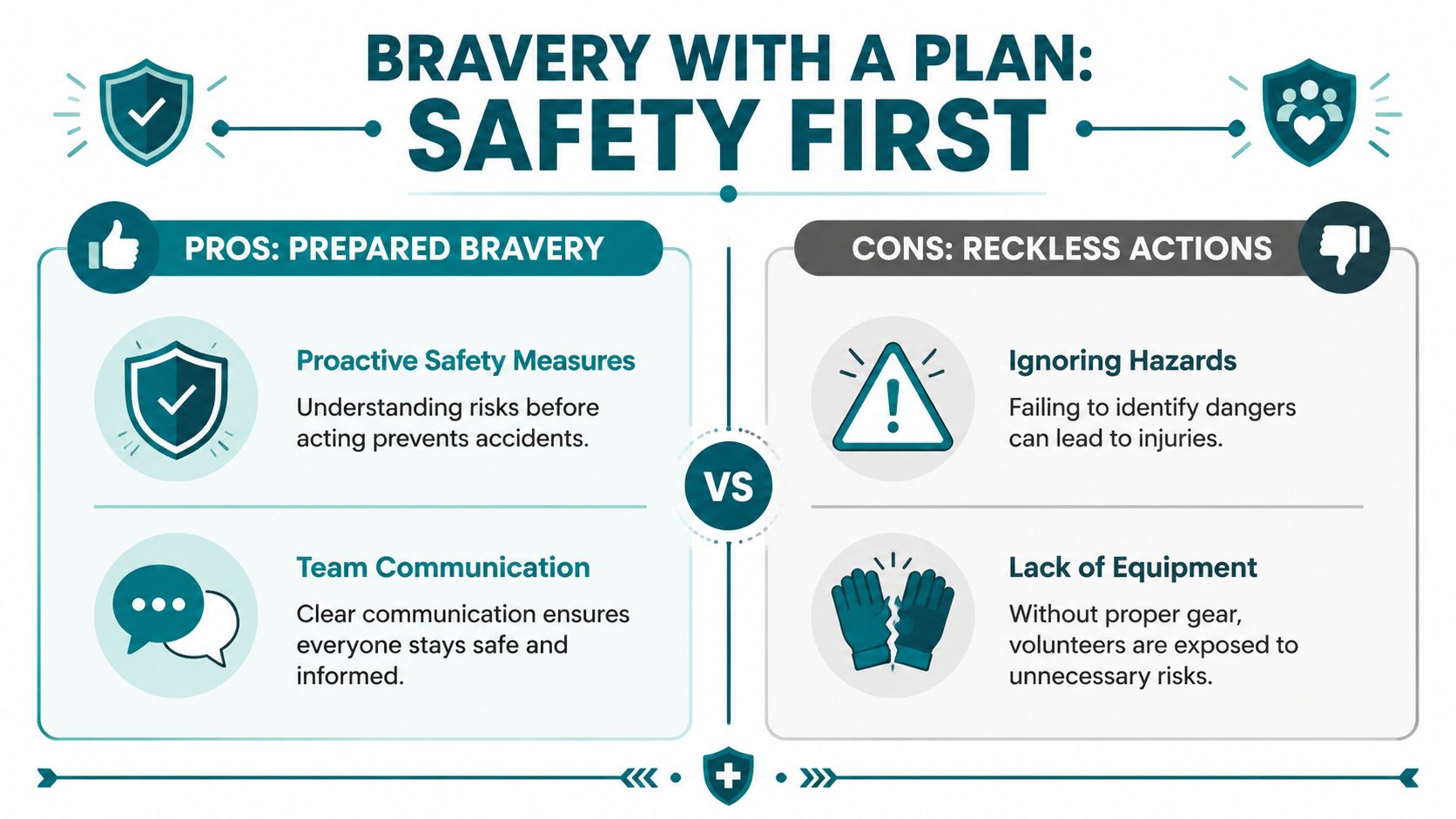
    That is what good safety feels like. Calm, clear, a little boring. Boring keeps your group coming back.

    That matters most on the rougher sites. Busy roads. Dumped lots. Broken glass in the grass where kids cut through after school. Those places can pull people into proving something. I'd rather build a crew that knows when to stop, ask for help, and protect each other.

    An infographic comparing prepared bravery through safety measures against the dangers of reckless, unplanned volunteer actions.

    Scout first, assign second

    The strongest safety decision happens before anybody puts on gloves.

    I walk the route ahead of time and make notes like a slightly paranoid neighbor. Where does traffic move fast. Which alley has illegal dumping. Which corner floods. Which lot has thorny brush, busted furniture, or the kind of debris that needs city pickup instead of volunteer enthusiasm.

    Analysts cited on Litter Caterpillars found volunteer injuries rise when organizers skip hazard scouting and clear team assignments. That matches what I've seen on the ground. If people arrive to a vague plan, they start making their own. That is when somebody wanders too close to traffic or grabs something they should have left alone.

    So I sort the route before the event. General litter goes to newer volunteers. Road edges go to trusted people in high-visibility gear. Dump sites get a separate plan, or they wait for the city if the risk is wrong for our crew.

    If you want the insurance side spelled out in plain English, this guide on volunteer liability insurance is worth reading before your first big event.

    The small command center

    A cleanup does better with a tiny core team than with a crowd of half-leaders.

    The Community Tool Box guidance on neighborhood cleanup programs recommends clear coordination roles, and I'm with them. On our best days, three people hold the whole thing steady. One person owns route changes and city calls. One person handles safety questions. One person floats, bringing supplies, helping late arrivals, and solving the weird little problems that pop up every hour.

    Three calm people can settle fifty excited ones.

    If a volunteer has to guess what to do with a hazard, the organizer failed them.

    What volunteers should never touch

    Some finds are trash. Some are a report.

    You need that line clear before the day starts. Needles, suspicious containers, heavy debris, unstable piles, dead animals, and anything that could cut, poke, leak, or trap somebody stays where it is until the right service handles it. I have watched good-hearted people drift toward bad decisions because they wanted to be useful. That instinct needs guardrails.

    Our field rule is short and easy to remember:

    1. Mark the spot.
    2. Take a photo if it helps.
    3. Contact the safety lead.
    4. Keep everybody back.
    5. Report it to the city, property owner, or sanitation contact.

    A group lasts when people feel safe enough to return next month. That is the deeper win here. Cleaning the block matters. Building trust matters more. Every time you protect a volunteer from a dumb injury or an avoidable scare, you are teaching the group something bigger than litter pickup. You are teaching them that this community takes care of its own.

    Running the Big Day From Chaos to Clean

    At our third cleanup, a guy named Marcus showed up in church shoes, holding a gas station coffee and asking, “So what exactly do I do?”

    Ten minutes later he was tying full bags like he'd done it for years, joking with a teenager from two blocks over, and pointing newcomers toward the right team before I could even open my mouth. That is how these mornings usually go. They start scattered. Then, if you run them well, the whole thing clicks and the block starts feeling like a crew instead of a crowd.

    The job on cleanup day is not to control every person. The job is to create enough structure that people can relax, work, and surprise you.

    Check-in should feel like a welcome, not a clipboard ambush

    Your sign-in table sets the tone fast.

    If people walk up and nobody looks at them, they turn into free-floating confusion. If somebody greets them by name, hands them gloves, and says, “Glad you made it, you're with the alley team,” they settle down right away. They stop feeling like extras in somebody else's project.

    I keep the setup plain and easy:

    • Sign-in sheet: name, phone, email
    • Team sheet: captain name and cleanup zone
    • Supply spot: gloves, bags, grabbers, vests
    • One warm human: the person who answers the obvious questions without making anybody feel stupid

    That last part matters more than organizers admit. A lot of people arrive alone. They are wondering whether they belong there. Your check-in table answers that question before the cleanup even starts.

    Give a tight briefing, then get people moving

    Nobody came for a lecture at 9:15 on a Saturday.

    I gather everyone in a half-circle, thank them for showing up, point to the team captains, explain where the full bags go, and remind them what gets reported instead of picked up. Then I send them out while the energy is still high.

    My version usually sounds like this:

    Good morning. We're cleaning this stretch, these alleys, and the park edge. Stay with your team. If you find something sharp, leaking, heavy, or sketchy, call your captain and leave it alone. Full bags go to the pickup point by the table. Take photos if you see a wild before shot. We'll meet back here at the end for the count and a group picture.

    That is enough.

    People remember short instructions. They forget the fancy stuff the second somebody cracks a joke or spots the first tire in the bushes.

    Give each team a piece of the map and a clear win

    A cleanup falls apart when everybody drifts toward the same visible corner and nobody touches the awkward spots.

    Split the area before the start. Put one team on the commercial strip, one on the fence line, one in the alley cluster, one in the park edges. I like captains to have their zone written down on paper or in a text thread, because spoken directions evaporate fast in a parking lot.

    You also need a home base that people can find without thinking. Extra bags, water, first aid, and the growing mountain of filled trash should all land in one obvious place. If someone has to wander three blocks for supplies, you lose momentum and people start peeling off early.

    A simple run sheet keeps the whole morning steady:

    Time What happens
    8:30 AM Setup table, supplies, signs
    9:00 AM Volunteer check-in
    9:15 AM Briefing and team launch
    Mid-event Captain check-in by phone or in person
    End Bag count, group photo, final sweep

    Keep the story of the day, not just the trash count

    I learned this the hard way. If you forget the before photos, people clean half the block and later swear it “wasn't even that bad.”

    Take the photos early, from the exact spots you can return to later. Count the bags. Snap the funny moments too. The kid holding a grabber like a knight's sword. The neighbor who came out “just to say hi” and ended up filling two bags. The retired guy who suddenly becomes your unofficial tire expert.

    Those details do real work for you. They help with future recruiting, they give the city or property owner a clear record, and they remind volunteers that they changed something visible. If your crew pulls recyclable material aside, make sure it goes to the right place. If people ask where they can keep that habit going after the event, send them to local options like these Chicago recycling centers for drop-off and reuse.

    End with a strong finish, not a slow fade

    The last half hour matters more than organizers think.

    This is when people get tired, routes blur, and half-full bags start appearing in random places. I bring captains back in, confirm each zone got covered, stack bags in the pickup area, and do one final pass for the weird leftovers. Then we count what came out of the neighborhood and get the group photo before people disappear.

    A good ending gives the morning a shape. People leave seeing the pile they conquered, the street they changed, and the faces of the strangers who did it with them.

    That is how chaos turns clean. More important, it is how a cleanup starts turning into a community people want to come back to.

    After the Cleanup. Building a Lasting Crew

    Two hours after one of our early cleanups, my phone buzzed with a photo from a volunteer named Marcus. He had dragged an old chair frame out of an alley that morning, laughed about it with three strangers, then gone home and started a group text with them. A week later, they were back out together with coffee, gloves, and one extra friend each.

    That is the part people miss.

    The bags matter. The cleaner block matters. But if everyone heads home with nothing except sore backs and a nice photo, the energy leaks out by Monday. What keeps a cleanup alive is the follow-up, the small rituals, and the feeling that people just joined something bigger than a trash pickup.

    Send proof before the spell breaks

    I send a message the same day, while people still have dirty shoes by the door.

    It is simple. Thank everybody by name if you can. Share the before-and-after shots. Show the pile of bags. Toss in the candid photo where somebody is grinning like they just won a prize fight. People want to see that their morning changed something they can point to.

    Then give them one next move. One. Too many options and the whole thing goes soft. Invite them to the next cleanup, a post-event coffee, or point them toward practical ways to keep going between meetups, like these Chicago recycling centers for drop-off and reuse.

    Give the group a pulse

    I learned this the slow way.

    At first, I thought good organizing meant clipboards, routes, and enough grabbers for everybody. That stuff matters, sure. It just does not make people come back. People return because they remember who teased them for finding a traffic cone in a bush, who handed them water at the right moment, who cheered when the worst corner on the block finally looked human again.

    So build that on purpose.

    • Name the crew: even if it is a little ridiculous
    • Repeat a few rituals: same photo pose, same snack stop, same victory shout
    • Notice people out loud: who hauled the strangest item, who brought a nervous friend, who kept the mood up when everyone got tired
    • Make introductions normal: help the shy person meet someone before they drift out

    The cleanup is the excuse. The community is the thing you're building.

    Turn turnout into habit

    The best sign that your group is working has nothing to do with bag counts.

    It is when somebody starts shaping their week around showing up. They go to bed earlier on Friday. They text a neighbor to come with them. They start recognizing the guy from three buildings down and the teenager who always finds bottle caps under parked cars. A public space gets cleaner, yes. A person gets steadier too.

    That is how a Saturday event becomes part of the neighborhood's rhythm.

    So close the loop. Send the photos. Tell the stories. Keep the jokes alive. Give people a reason to return that goes deeper than civic duty. A clean street feels good for a day. A crew that keeps showing up for one another can change a block for years.

  • Your Northeastern Illinois Map for Action

    Your Northeastern Illinois Map for Action

    I once followed a clean-looking map to a park edge on Chicago's northwest side and found the mess fifty feet off the path, hidden behind a fence where the map showed nothing. We filled bag after bag in a place no pin had named.

    Starting Your Journey on the Map

    The first time I stared at a Northeastern Illinois map, I felt dwarfed by it. Streets stacked on streets. Forest preserves. industrial strips. River bends. Rail lines. Neighborhoods I hadn't walked and places I couldn't pronounce yet. It looked less like guidance and more like a dare.

    That feeling is normal. You open a map of the Chicago region and your brain starts bargaining with you. Stay local. Keep it easy. Pick one block you already know. Don't wander into the unknown. I've heard that voice in my own head plenty of times.

    Then I learned to look at the map like a scavenger hunt.

    A park isn't just green space. It's where cups collect at the edge of a parking lot after a windy weekend. A commercial corridor isn't just a strip of stores. It's where receipts, scratch-offs, and takeout bags tumble toward a storm drain. A dead-end street isn't boring. It's where dumped furniture and busted contractor bags like to hide.

    Maps don't tell you where courage begins. They just get you close enough to step out of the car.

    That's the shift. A map is not there to comfort you. It's there to get you moving. When you stop treating it like a sterile tool and start treating it like a field notebook, the whole region changes shape.

    The first real lesson

    I've had mornings where I picked a spot because it looked simple on the screen and then spent hours finding weird pockets the map never warned me about. A sidewalk ended. A service road curved behind warehouses. A patch of brush swallowed cans, bottles, and fast-food wrappers like a magnet. The map got me to the block. My eyes did the rest.

    So when you start, don't ask, “Can I master all of northeastern Illinois?” Ask something smaller and better.

    • What can I learn in one morning: One ward, one trail entrance, one ugly strip behind one shopping center.
    • What can I carry: Gloves, bags, water, and enough humility to change plans when the ground tells you more than the screen.
    • What am I willing to notice: Overflowing bins, no bins, desire paths, bus stops, fence lines, creek edges.

    A good journey on the map starts with one honest act. You go. You look. You do the work.

    Defining Our Territory

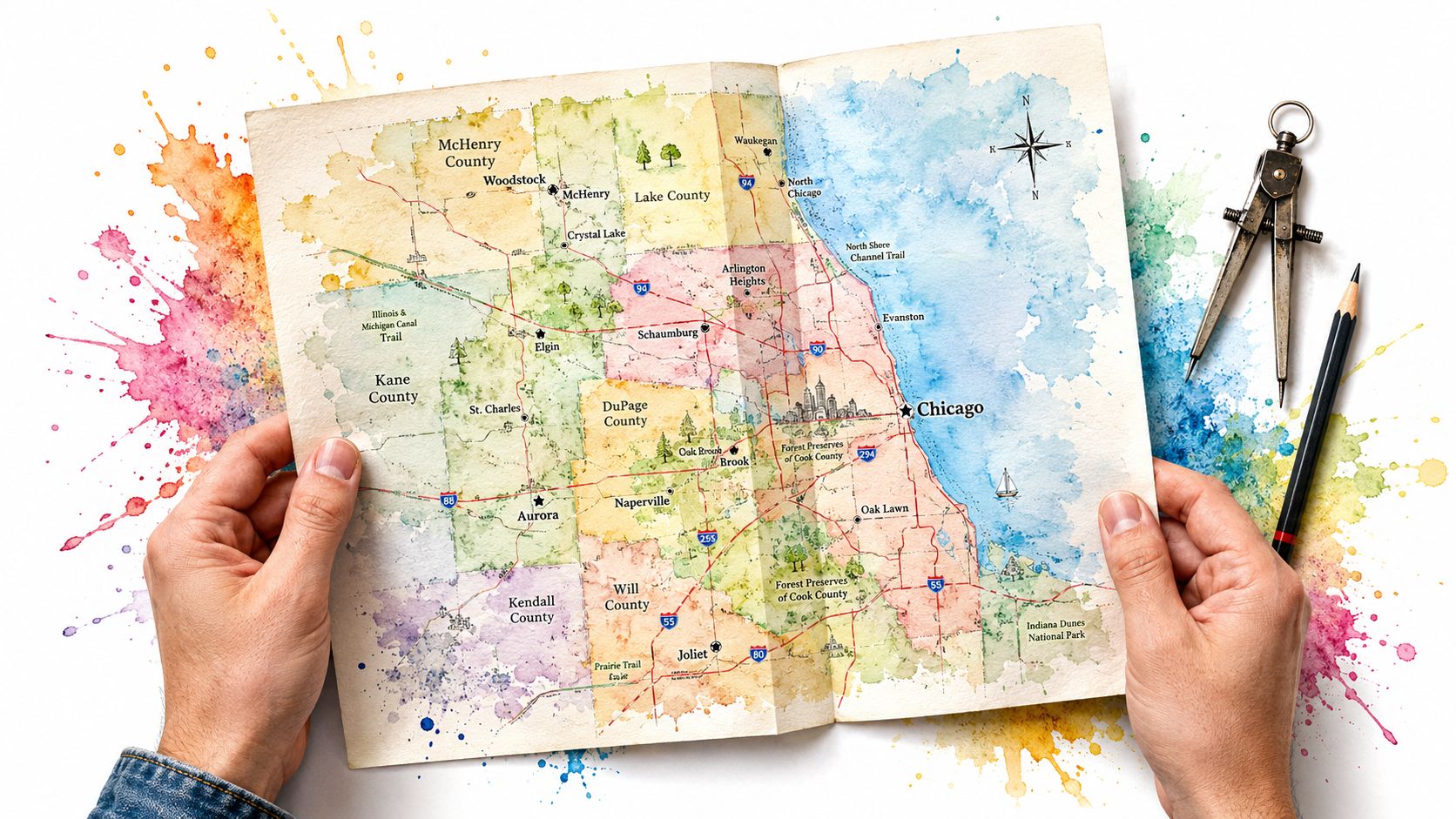
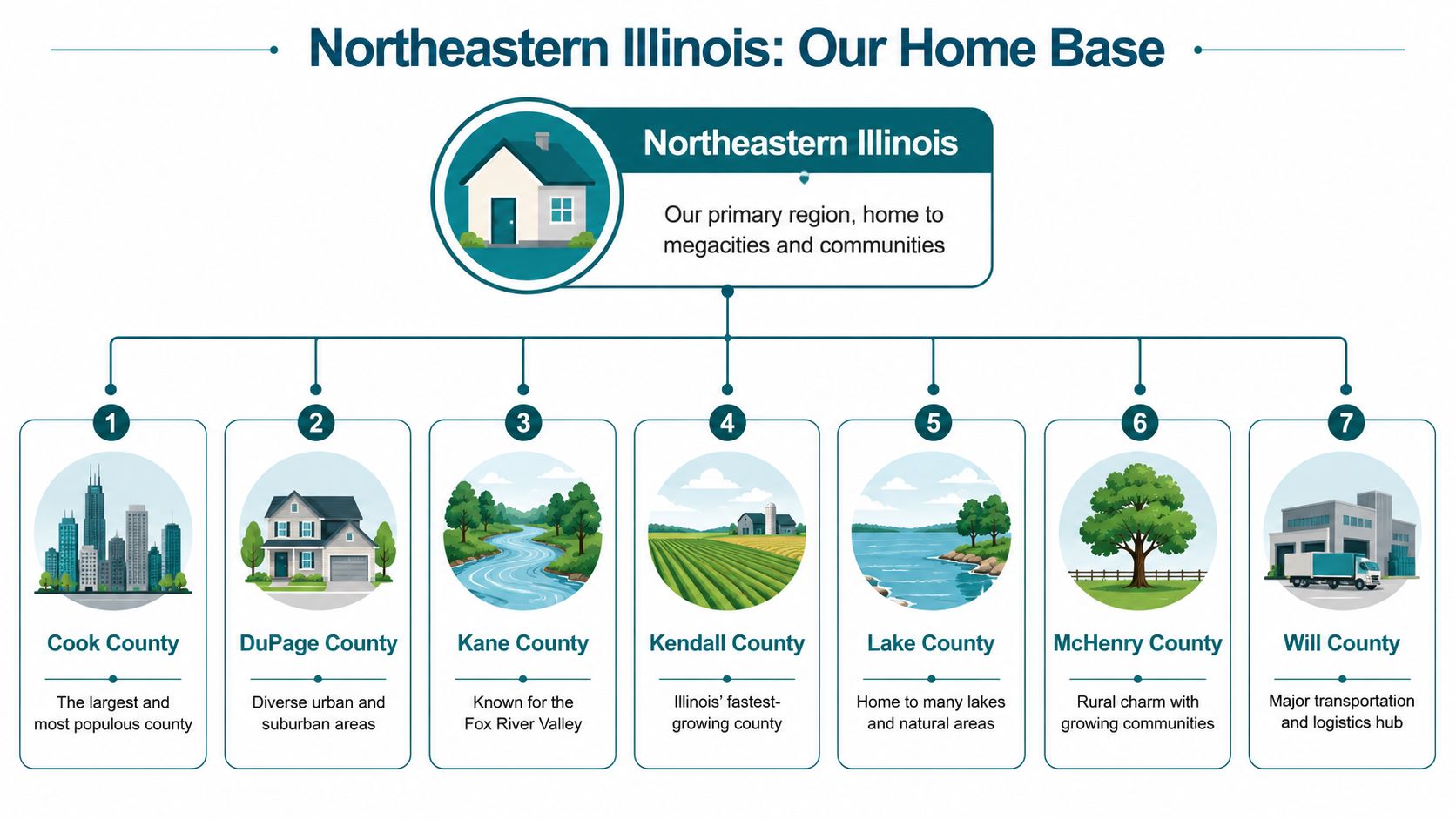
    When I say northeastern Illinois, I don't mean some vague blob around Chicago. I mean a real operating zone. Cook, DuPage, Kane, Kendall, Lake, McHenry, and Will. Big city blocks. Quiet cul-de-sacs. Forest preserve trails. Warehouse belts. Old downtowns. New subdivisions.

    A diagram illustrating the seven counties of Northeastern Illinois with descriptions for each of the regions.

    When you look at the region that way, the map stops feeling abstract. It becomes a work area. You can see where pressure builds. More people, more roads, more parking lots, more edges where litter gets trapped and forgotten.

    The scale matters. Northeastern Illinois, specifically the region containing Chicago, accounts for 84 percent of the entire state's population growth, and the seven fastest-growing municipalities, Chicago, Aurora, Naperville, Joliet, Waukegan, Cicero, and Elgin, are all clustered here, according to the Chicago Metropolitan Agency for Planning archive.

    What that means on the ground

    I don't read that fact like a planner sitting in an office. I read it like somebody holding a trash grabber. Growth means traffic at curbs. Packaging in parking lots. More use of trails and preserves. More pressure on public bins. More corners that look fine on a county map and ugly when you walk them.

    If you want to understand your territory, break it down like this:

    • Cook County: Dense blocks, alleys, transit stops, commercial corridors, and endless little trouble spots.
    • Collar counties: Big roads, retail clusters, creek edges, trailheads, and suburban spaces where people assume somebody else will clean it.
    • Outer edges of the region: Places that look open on a map but still collect roadside dumping and windblown trash.

    How I read the region fast

    I start with a simple scan.

    What I look for Why it matters
    Major roads and interchanges Trash gathers where cars stop, merge, and idle
    Preserves and trails Beautiful places still catch bottles, cans, and snack waste
    Retail strips High turnover means high litter risk
    Borders between land uses The seam between businesses, roads, and green space is often rough

    When I want a reset from city blocks, I spend time studying nearby preserves too. A page like forest preserve paths around Chicago reminds me that “territory” isn't only concrete. It's also woods, water, and the places people use to breathe.

    Field rule: If a map shows connection, look for neglect at the edges of that connection.

    That's the territory. Not glamorous. Real.

    Choosing the Right Map for the Mission

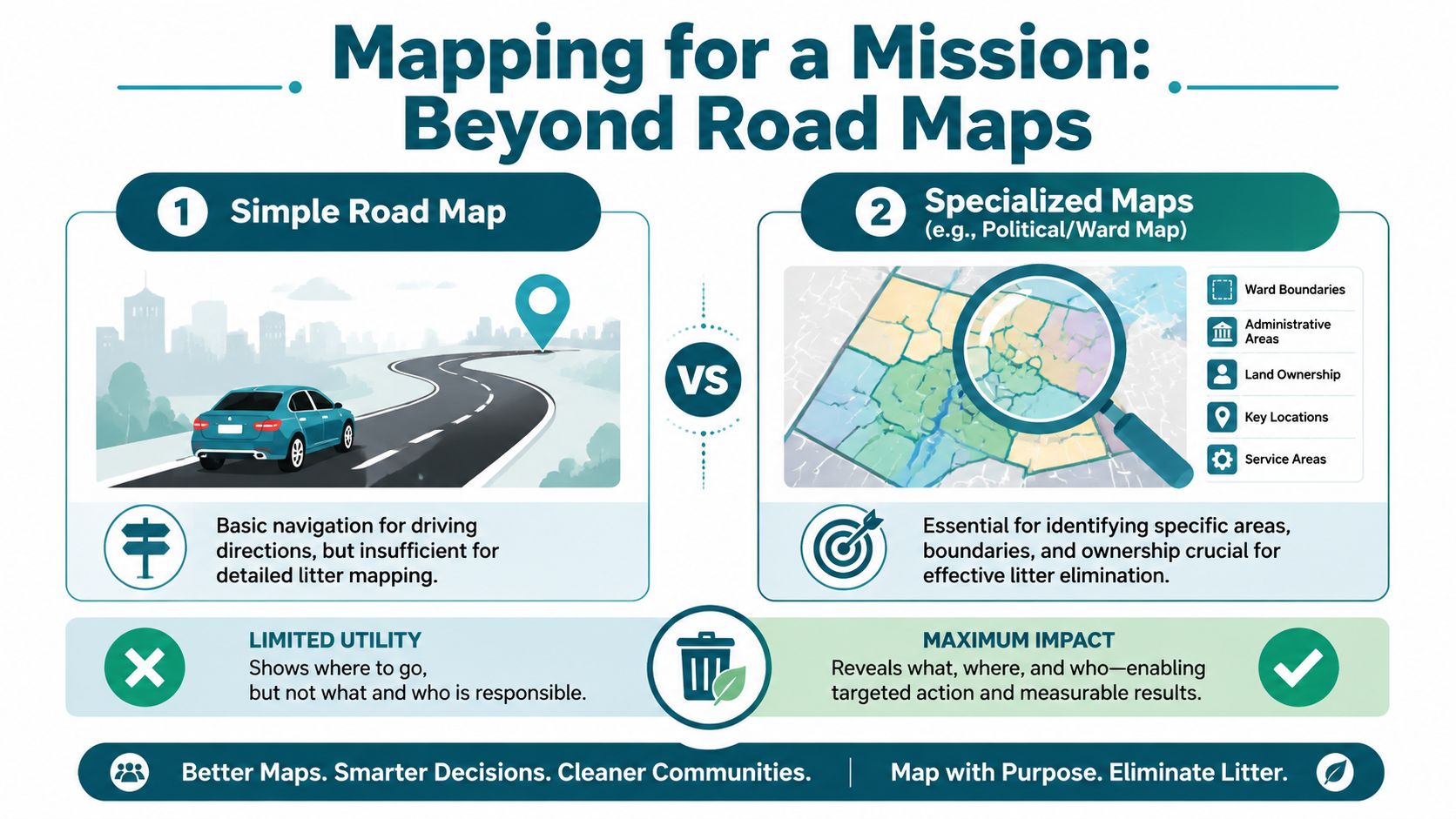
    A road map is fine if all you want is directions. It's weak if you're trying to solve a mess. For cleanup work, I need different maps for different jobs, the way a mechanic needs more than one wrench.

    An infographic comparing simple road maps to specialized maps for effective community litter management and environmental planning.

    The easiest mistake is trusting one map to answer every question. It won't. One map gets you there. Another tells you whose boundary you're crossing. Another hints at why trash keeps showing up in the same ugly pocket after every rain.

    The side by side test

    Here's how I compare map types when I'm planning a mission.

    Map type What it helps me do Where it falls short
    Road map Reach a site fast It hides ownership, terrain, and odd dead spaces
    Ward or political map Track cleanup coverage by area It doesn't show slope, dumping pockets, or trail cut-throughs
    Trail map Find entrances, paths, and hidden access points It may skip nearby commercial spillover
    Historical map Expose old corridors and forgotten uses of land It needs current ground truth to matter

    A ward map can turn a giant city into a checklist. A trail map can show a hidden entrance where volunteers can safely walk in. A historical map can explain why one strange strip behind businesses keeps attracting dumping. Old patterns linger.

    That last part matters in northeastern Illinois. The region's settlement pattern was largely determined in the 1830s by federal surveys that mapped and sold “Canal Lands” to private interests, drastically redrawing where new towns and farms would spring up, as described by the Encyclopedia of Chicago entry on northeastern Illinois. You can still feel that old carving-up of land when you run into awkward corridors, industrial leftovers, and disconnected spaces where nobody quite feels responsible.

    Map choice changes your behavior

    I've learned to match the map to the problem.

    • For block cleanups: I want ward boundaries and street grids.
    • For river or trail days: I want path maps and entry points first.
    • For weird dumping zones: I want old land-use clues and current satellite views.
    • For volunteer planning: I want transit access, parking, bathrooms, and a sane walking route.

    Sometimes I'll study a route before heading toward a trail system like the Des Plaines River Trail near Chicago, because linear spaces fool people. They look simple. Then you arrive and realize the actual work is at the trailhead, under the bridge, beside the lot, and in the brush off the curve.

    The wrong map wastes your legs before you even start.

    If you want a Northeastern Illinois map that helps you act, stop asking which map is best. Ask which map matches the mess in front of you.

    Finding and Using Digital Maps

    Paper maps still have charm, but digital maps are where planning gets sharp. I use them before I leave the house because I'd rather spend my energy cleaning than wandering in circles.

    A hand holding a smartphone showing wildfire risk data next to a computer displaying complex environmental maps.

    The phrase GIS scares people off, but it shouldn't. Geographic Information Systems just means layered maps with useful information. You click around, turn layers on and off, and start seeing a place in context instead of as one flat picture.

    A simple way to scout from home

    One tool worth knowing is the northeastern IL Development Database Web Map. It is an interactive platform built on ArcGIS Online that lets users click on map shapes to get detailed information about development projects, helping groups target areas with high potential for litter and community impact.

    That kind of map is practical. New construction can mean debris on edges, disrupted foot traffic, temporary fencing, and all the little spillover messes that show up when a place is in transition.

    Here's how I use digital maps before a cleanup:

    1. Start broad: Find the zone, then zoom in to the blocks or parcels that look active.
    2. Check access: Parking, sidewalks, trailheads, transit stops, and whether volunteers can move safely.
    3. Look for tension points: Construction near retail, open lots near busy roads, green space near commuter routes.
    4. Save notes: Mark likely hotspots so you're not relying on memory in the field.

    Use the map, then test it

    A screen can save you time, but it can also lie by omission. That's why I like planning digitally and confirming physically. I might spot a development area online, then pair it with a real-world route through a place like the Fox River Valley where public use, natural edges, and commercial activity can overlap in messy ways.

    This quick video helps if you want to think more visually about map-based environmental planning.

    Practical rule: Digital maps are for reducing guesswork, not replacing your judgment.

    The shift is mental. You stop acting like a random person showing up with gloves and start acting like somebody who studied the terrain. That confidence matters. It gets more people to say yes, because your plan sounds real and feels safe.

    Reading Between the Lines What Maps Miss

    The most honest thing I can tell you is this. A map is never the whole truth.

    I've cleaned spots that sat a few yards away from clean lines on a screen and looked like a different universe in person. The official map had roads, parcels, and green patches. What it didn't have was the strip behind the business where cups and mini liquor bottles had piled into wet leaves. It didn't show the shoulder by an event route where people tossed trash fast because they thought nobody would come back for it.

    A hand pointing to a blank space on a colorful watercolor map illustrating urban city planning.

    That blind spot is more extensive than generally perceived. Public maps often define “underserved areas” too broadly for targeted action, and research shows many high-litter zones are in micro-locations like unmarked vacant lots or commercial blocks without bins that standard GIS layers don't capture, according to the CMAP Data Hub material on persistent poverty areas in northeastern Illinois.

    The block is not the block

    A census tract can look like one thing on paper and feel totally different from corner to corner. One side has a bus stop, no public bin, and a stream of foot traffic. The next side has a fence line where wind pins every wrapper. Across the alley, there's an empty lot nobody claims with any pride.

    If you're trying to help a place, broad labels don't save you. Specific observation does.

    • Look behind the front face: Retail strips often hide their worst mess behind the building, not in front.
    • Check the edges of movement: Bus stops, corner stores, trail entrances, and parking lot exits are repeat offenders.
    • Notice what's missing: No trash can is a map detail too. You feel its absence when you're standing there.

    Bravery starts where the map gets fuzzy

    Here, people either level up or stay comfortable. It's easy to clean the obvious park path. It takes a little nerve to inspect the unnamed cut-through, the weedy curb behind the loading dock, or the blank patch beside a highway ramp where the map turns vague.

    Trust your eyes when the map gets quiet.

    I don't mean be reckless. I mean be awake. Go with a buddy. Stay aware. Respect property and safety. But don't let a polished map trick you into thinking the worst problems come with neat labels.

    The true work often lives in the margins. That's why the best Northeastern Illinois map is half official tool and half memory. You build it by walking, noticing, returning, and refusing to avert your eyes.

    Drawing Your Own Map of Impact

    After enough mornings outside, your map changes. So do you.

    You start by thinking you're learning streets, wards, preserves, and counties. Then you notice something else. You're learning your own habits. You're teaching yourself to show up in the cold. To do work that doesn't get applause. To stay cheerful when the corner is worse than you expected.

    That's why I keep coming back to the old Tom Sawyer idea. He turned fence painting into an adventure. I think cleanup work can work the same way, if you choose to see it that way. A hard job gets lighter when you bring curiosity, grit, and a little play into it.

    What your own map starts to include

    • Places you no longer avoid: The weird block doesn't scare you once you've served it.
    • People you know by effort: Friends made while hauling bags feel different from casual acquaintances.
    • Proof that you can change: Every return trip to a cleaner corner teaches your brain that action beats despair.

    You don't need to know every inch of the region before you begin. You just need to claim one piece of it with your own hands. Then another. Then another.

    A Northeastern Illinois map can guide your route. It can't supply your courage. That part is yours.


    If you want to turn Saturday morning into something bold, join Litter Caterpillars. We clean Chicago block by block, make real friends, and go where others usually keep driving. Show up, grab a bag, and help us leave the city better than we found it.

  • What Is Environmental Activism: A Guide for People Ready to Make a Difference

    What Is Environmental Activism: A Guide for People Ready to Make a Difference

    What is environmental activism, really?

    Let me tell you. At its core, it's the conscious choice you make to stop being a bystander and start being a participant in the story of our planet's future. It's any action—big or small—you take to protect our shared home.

    Redefining What It Means to Be an Activist

    When you hear "environmental activism," your mind probably leaps straight to dramatic protests, people chaining themselves to ancient trees. And yes, that's one theatrical scene in a much larger play. But the real story? It's much simpler, much closer to home, and frankly, much more accessible to you and me. It's less a job title and more a state of mind.

    Imagine our world as a vast, sprawling garden. Some people possess the influence to plant entire forests, shifting national policies with the stroke of a pen. Others, like me, start by pulling a single, stubborn weed when we pick up litter on a Chicago street. Both actions matter. Both are, in their own way, profound acts of activism.

    I founded Litter Caterpillars during a time when my own life felt chaotic, completely out of my control. The simple, tangible act of cleaning up trash became my anchor; I could make one small corner of the world visibly, undeniably better. It returned a sense of purpose to me.

    That's the essence right there—recognizing a problem, whether it's the colossal threat of global climate change or a single plastic bottle marring your sidewalk, and deciding you will be part of the solution.

    From Global Ideas to Personal Action

    The beautiful thing about activism is its scalability. A global concern, like the deluge of plastic choking our oceans, can cascade down to inspire local community action, which is ultimately powered by your personal decision to show up. It's a direct current flowing from the grand, abstract idea right down to your own two hands.

    This map illustrates precisely how those levels interconnect, from the highest echelons of global awareness to the local and personal actions you can take.

    The crucial takeaway? You don't have to carry the weight of solving the world's problems all at once. Your true power lies in translating those big, intimidating ideas into small, consistent actions, right where you stand.

    This concept of taking personal responsibility for our shared spaces is incredibly potent. It's often the first step toward something even bigger: what is known as environmental stewardship. If you're curious how these ideas intertwine, our guide breaks it all down. It begins with that simple, powerful choice to care.

    The Many Faces of Environmental Activism

    Activism is not a monolith; it's a vibrant spectrum of action. There's a place for you, regardless of your personality or resources. Here’s a glimpse at the different ways people show up, from sweeping global movements right down to what you can do on your own block.

    Type of Activism What It Looks Like Who It's For
    Community-Based Action Organizing neighborhood cleanups, planting community gardens, setting up local recycling drives. People like you who love hands-on work and seeing immediate, tangible results in their own neighborhood.
    Policy & Legal Advocacy Calling elected officials, signing petitions, supporting environmental legislation, or even filing lawsuits. Those of you passionate about systems-level change, unafraid to engage with the political machinery.
    Education & Awareness Writing blog posts, creating social media content, giving talks at schools, or just sharing what you know with friends and family. The natural teachers and storytellers among us who want to inspire others to join the cause.
    Direct Action & Protest Participating in marches, sit-ins, and public demonstrations to draw urgent attention to a critical issue. Anyone willing to be a visible, vocal presence for a cause that sets their heart on fire.
    Lifestyle Choices Reducing personal waste, composting, choosing sustainable products, biking instead of driving. Absolutely everyone. This is the foundation—the daily, personal choices that reflect your deepest values.

    This table merely scratches the surface, but it proves there's no single "right" way to be an activist. It’s about you finding the method that resonates with your spirit and fits into your life.

    This reframing is vital. Environmental activism isn't some exclusive club for a heroic, chosen few. It is a series of choices available to every single one of us, every single day. You find it in the reusable cup you carry, the local cleanup you join, or the conversation you start with a friend.

    It’s you, deciding to make a difference.

    How a Single Spark Can Ignite a Global Movement

    Every monumental movement you've ever read about in a history book began with a single person. You and I forget this so easily when we see massive crowds on the news, but it is the simple, unvarnished truth. It always starts with one individual who looks at a problem and decides, “Okay, I’m going to do something about this.” Everything else is just a ripple effect.

    Think about Greta Thunberg. She was just a teenager who decided one Friday to skip school and protest climate inaction outside the Swedish parliament. Can you imagine how small, how utterly futile that might have felt at first? But that single, solitary act of courage was a spark.

    That spark ignited a wildfire that swept the globe. Her solo protest inspired millions of students across the world to join her, birthing the Fridays for Future movement. That is the incredible, almost alchemical power of one person’s conviction.

    Your individual actions, no matter how insignificant they seem to you, possess the latent potential to create massive, unpredictable waves of change. It’s not about becoming a perfect hero; it's about being a person who simply shows up.

    The Power of Showing Up

    I know this from my own experience. I will never forget the very first Litter Caterpillars cleanup. There were just three of us, and we were ambushed by a freak Chicago hailstorm. We huddled under a tree, shivering, watching Ubers cancel on us one after another.

    It felt small, miserable, and frankly, a bit ridiculous. But that shared ordeal forged an unbreakable bond between us. We learned the most important lesson about what environmental activism truly is: simply showing up, especially when it’s hard, is how real movements are born.

    That small, soggy beginning blossomed into a community that meets every single week, regardless of the weather. It all started because three people decided to try.

    From One Voice to Millions

    This isn't just some feel-good story; it’s a proven pattern. The initial spark from one person can snowball into something that shapes history. For example, the youth-led movements inspired by that single school strike culminated in the Global Climate Strike of 2019, which mobilized an estimated 4 million protesters worldwide.

    It was the largest coordinated climate demonstration in history. Protests erupted in over 150 countries, all because one person decided her voice mattered. You can dive into more data about global protest trends at the Carnegie Endowment for International Peace.

    This is the central lesson for anyone wondering how they can possibly make a difference. It doesn't begin with a crowd. It begins with you. It begins with your decision to pick up one piece of trash, join one local meeting, or have one difficult conversation. That’s your spark.

    Does All That Noise Actually Work?

    You see the headlines, the massive crowds, the passionate speeches. It's only natural to wonder if all that noise actually adds up to tangible change.

    The short answer is yes, but the mechanism is not as straightforward as you might think. Marches and protests are exceptionally good at one thing: seizing attention. They get people talking, dominate news cycles, and can genuinely make people care about an issue. They force a conversation that might otherwise remain buried under the weight of indifference.

    But here’s the strange paradox I keep observing. More and more people tell surveyors they're deeply worried about the climate, but that visceral fear doesn't consistently translate into action. It's a bizarre sensation, like knowing your house is on fire but feeling like you don't have a bucket.

    The Growing Gap Between Knowing and Doing

    This is the great challenge we face: how do we transform that helpless anxiety into real, meaningful action? It’s something I ponder constantly. The problem feels so colossal that picking up a single piece of trash can feel like trying to empty Lake Michigan with a teaspoon.

    The data tells a fascinating, almost contradictory story. On one hand, research absolutely confirms that activism works. A comprehensive review of 50 different studies found 'strong evidence' that protests crank up climate awareness without alienating the public. In Germany, major climate events actually boosted public concern by 1.2 percentage points.

    But then you look at another global survey and see a punch to the gut: the number of people who identify as 'activists or willing contributors' is actually decreasing. You can delve into the nitty-gritty of these studies over at The Commons Social Change Library.

    That’s the chasm, right there. More awareness, but less action. People feel the immense weight of the problem, but they don't see their own role in the solution.

    How Your Own Two Hands Bridge That Gap

    I see this gap play out every single weekend with Litter Caterpillars. People arrive at our cleanups feeling utterly overwhelmed by the tide of trash choking Chicago’s parks and streets. They carry all this frustration and awareness bottled up with nowhere for it to go.

    Then something incredible happens.

    They spend just one morning with us, and by the end, they are holding a full garbage bag. They can point to a patch of ground and say, "I cleared that." They have transmuted that giant, crushing feeling into a concrete, physical result.

    That is the magic of rolling up your sleeves and getting your hands dirty. It closes that chasm between knowing and doing. It takes an impossibly big problem and shrinks it down to a single bag of trash—a visible task you can complete right alongside other people who feel the exact same way you do. It’s the perfect first step.

    Finding Your First Step Into Activism in Chicago

    So, you feel that fire in your gut. You’re ready to do something. But the question looms large: what can I actually do?

    Let's make this simple. Forget about saving the entire world by next Tuesday. Your entire journey can begin with one single step, and I believe the easiest, most powerful first step is to just volunteer.

    Find a local group whose mission resonates with you, and just show up. That’s it. For us at Litter Caterpillars, that simple idea is everything.

    We meet every single weekend, rain or shine. You don't need any experience—just bring yourself. We have the gloves, the bags, the grabbers, and most importantly, the community. Showing up to clean a local park is environmental activism in its purest, most immediate form.

    Why Volunteering Is Your Secret Weapon

    Volunteering might seem like a small thing, but it’s a direct conduit to making a real difference. It’s not about sending an email and hoping someone reads it; it's about physically transforming the space around you for the better. This hands-on work builds a crucial bridge between your concern and a concrete result.

    It is also the ultimate antidote to feeling overwhelmed. The world's problems can feel crushing, but a few hours of service provide you with a tangible victory. You can look at a clean stretch of sidewalk and know, "I did that."

    That feeling is everything. It’s not about guilt or obligation. It's about you finding genuine joy in the action itself. That joy is what keeps you coming back, turning a one-time event into a lifelong habit of making an impact.

    How to Find Your Tribe in Chicago

    Finding the right group is like finding the right friends—it’s about shared values and a vibe that feels like home. Chicago is brimming with amazing people doing incredible work. You just need to know where to look.

    Here are a few practical ways for you to start your search:

    • Explore Local Cleanup Groups: Start with organizations in your own neighborhood. We operate all over the city, but you can also find groups dedicated to specific parks, rivers, or communities. Check out our guide on environmental volunteer opportunities in Chicago to see a whole list of groups you can join.
    • Check Out Community Gardens: If you love getting your hands dirty, look for urban farms or community gardens. These are amazing hubs for people who care about local food, green spaces, and sustainability.
    • Connect with Nature Preserves: The Forest Preserves of Cook County and other local conservation groups often need volunteers for trail maintenance, invasive species removal, and habitat restoration.

    Your first step doesn't need to be perfect. Just pick one, sign up, and show up. You will be amazed at how quickly you find your place and your people. It’s all about building a better world, one garbage bag and one new friend at a time.

    Building a Movement One Friendship at a Time

    Here’s a secret about activism they don't always tell you: it’s not just about the cause. It's about the people.

    The real reason Litter Caterpillars has survived Chicago blizzards and brutal heatwaves isn't just because we all hate litter. It’s because we have built something much stronger: a real community. We've built friendships.

    When you’re standing in the freezing cold with someone, sharing a laugh while picking up soggy pizza boxes from a gutter, you form a bond that plunges far deeper than a shared interest. That shared struggle, that moment of doing something hard together, is the very adhesive that holds a movement together.

    The Power of Showing Up for Each Other

    I started this group with a clear purpose: to mindfully filter selfish people out of my life and find fellow 'givers.' Our weekend morning schedule is not an accident; it is part of that filter. It takes a certain kind of person to consistently choose service over sleeping in.

    This shared commitment creates a powerful foundation. Lasting change, the kind that survives bad weather and burnout, is always powered by human connection. It's the feeling that you’re not just fighting for something, but you’re fighting with people who have your back.

    Activism is sustained by relationships. The cause gets you in the door, but the community is what makes you stay. When you feel like you belong, you feel like you can change the world.

    This section is all about the 'how' behind building that kind of resilient community. It’s about creating an environment where you feel seen, valued, and inspired to keep coming back.

    More Than a Cleanup, It’s a Team

    We intentionally borrow ideas from sports teams and other groups that build incredible pride and identity. I want people to feel like they are part of something special, because they are.

    • Flags and a Theme Song: We use flags and even have our own theme song to build a sense of unity and pride. It might sound silly, but it gives us an identity—it makes our shared effort feel like a celebration, not just a chore.
    • Core Values: Everything we do is guided by our core values: bravery, kindness, and unity. These aren't just words on a website; they are the principles that shape how we treat each other and the city we serve.
    • Building Friendships First: I always say that our real mission is to help people make friends. The clean city is just a happy byproduct of that. You can learn more about how we structure our events to encourage connection in our guide to community building activities for adults.

    Making the world a better place shouldn't feel like a punishment. It should be inspiring, joyful, and make you feel like you’ve finally found your people. That's the energy that fuels a true movement, one friendship at a time.

    Why Your Local Action Is More Important Than Ever

    Let's be real for a moment. Despite all the headlines, the protests, and the billions thrown at clean energy, we are not winning the fight against climate change. When you look at the actual data, it's a gut punch.

    The global response is falling tragically short, and almost every single indicator is flashing bright red. It's so easy to hear that and just feel… defeated. I get it. I really do.

    But I don't see that as a reason to give up. I see it as a call to arms. It means the gritty, volunteer-led, local work—the work we do right here on the ground—is more critical now than it has ever been.

    When Top-Down Fails, We Rise From the Bottom Up

    When the big, top-down solutions falter, bottom-up change becomes our most potent hope. This is the entire reason we do what we do at Litter Caterpillars.

    It’s why my friends and I bought an empty lot at a city auction to build a community park in Englewood. It’s why we cleaned an entire highway during a bike event.

    These are not just feel-good stories; they're acts of defiance against despair. They are living, breathing proof that a small group of dedicated people can physically reshape their own environment. You do not have to wait for anyone's permission.

    This is the hard truth that should light a fire under you: the global progress is 'alarmingly inadequate.' Your energy, your time, and your hands are the most valuable resources we have left.

    The World Resources Institute's 2025 climate report is brutally blunt. It shows that while clean energy investment hit a record $1.3 trillion in 2023, nearly all of the 45 key climate indicators are "well off track." This means the pace of change needs to literally double or even quadruple to hit our goals. You can see all the details in the State of Climate Action 2025 report.

    Your Energy Is the Resource That Matters Most

    That gap—the one between all that money and the real-world results—is where you come in. It’s where environmental activism on a local scale becomes the true engine for change.

    We aren't waiting for some perfect global plan to save us. We are out here picking up trash, planting gardens, and building community on our own streets, right now.

    Your choice to show up for your neighborhood isn't just a drop in the ocean. In a world of inadequate responses, it's the start of a tidal wave.

    Your Questions Answered

    Jumping into something new always brings questions. I get it. Every weekend, I see new faces at our cleanups, and many of you share the same worries. It’s completely normal, so let’s get those out of the way right now.

    The biggest thing I want you to hear is this: your willingness to show up is the only qualification you will ever need.

    "Do I Need Any Special Skills?"

    Nope! Absolutely not. This is probably the number one myth that keeps good people like you on the sidelines. You do not need a degree in environmental science or a background in policy to make a real difference. Honestly, the most powerful activism begins with just showing up.

    For a group like ours, the only "skill" you need is being able to pick something up off the ground. We handle the rest—the gloves, the bags, the plan. A good attitude is worth more to me than a PhD out here. You will learn everything you need to know on the job, side-by-side with people who are happy to show you how it’s done.

    "What if I Don't Have Much Time?"

    That’s life! It’s busy, and I don't expect you to drop everything. Any time you can give is a gift, so never feel bad about what you can't do. People often think they need to commit their whole lives to a cause, but even one hour a month sends ripples out into the community.

    We meet at Litter Caterpillars every week, but we have zero attendance requirements. Some folks are with us every Saturday, rain or shine. Others pop in once a season when they have a free morning. Both are perfect.

    The goal is for you to find a rhythm that feels good and sustainable for you. Don't let the idea of a "perfect" commitment stop you from doing any good at all.

    Whatever you can give, it matters. Period.

    "Is It Safe?"

    Safety is everything. It is, without a doubt, my number one priority. Nothing else happens if our volunteers aren't safe—it's the foundation of everything we do.

    We provide high-visibility safety vests, tough gloves, and I give clear instructions before anyone picks up a single piece of trash. We stick together in groups, and we make sure everyone knows the game plan. Any group worth its salt will have safety locked down, but if you ever feel unsure, just ask the organizer. Your well-being is what makes all of this possible.


    Ready to see for yourself? Come join Litter Caterpillars at our next cleanup. We’re a no-pressure, friendly crew making Chicago beautiful and building a real community, one block at a time. Find our next event and sign up here!

  • You Don’t Need Permission to Fix Your Neighborhood

    You Don’t Need Permission to Fix Your Neighborhood

    I used to think cleaning up my own life was impossible. Every old jar, every dusty bag, it all felt like it weighed 500 pounds. My apartment was a mess, and so was my life. Then, a funny thing happened during a freak Chicago hailstorm with two friends. Huddled under a tree, freezing and trying to pick up trash, I realized something profound: cleaning up someone else’s mess is way easier than cleaning our own.

    And suffering together? It's not just bearable; it’s fun. It advances the plot.

    That moment of clarity, cold and soaking wet, is the real heart of this article. This isn't a list of generic tips. It’s a battle plan born from that storm, built for people who are tired of waiting for permission to make a difference. We’re going to share 10 powerful community engagement strategies that turn fear into fuel, strangers into friends, and neglected spaces into something beautiful and cared for. These are the exact methods we used to build Litter Caterpillars from a wild idea into a city-wide movement.

    This guide is for anyone who believes, deep down, that making an impact should be an adventure. Forget what you’ve been told about how hard it is to change things. It's time to be brave, get a little weird, and prove that real change is easier and more joyful than you ever imagined.

    1. Volunteer-First Community Mobilization

    Imagine you're building a fire. You could spend all day looking for a fancy lighter and a pile of perfect, dry logs. Or, you could find two good sticks and a spark. A Volunteer-First strategy is about finding that spark—the raw human energy that starts every great movement. It flips the old model on its head. Instead of chasing grants and donors, you obsess over creating an incredible, empowering, and fun experience for your people.

    This isn't about money; it’s about connection. An hour of someone's time is a far more precious gift than a few dollars. When people see their own sweat and smiles transforming a space, they become its fiercest protectors. They become the fire itself. The focus shifts from financial transactions to human relationships, which fosters deep ownership and pride.

    When to Use This Strategy

    This is the brave way to begin. If you have more heart than cash, this is your blueprint. It’s perfect for initiatives that thrive on hands-on participation, like a weekly cleanup or a community garden. You're not building an institution; you're building a tribe.

    Key Insight: Protecting your volunteers' energy is your most sacred duty. This means learning to say 'no' to opportunities that might bring in money but would burn out your people. A happy, motivated volunteer base is your greatest asset.

    How to Implement It

    • Create Zero-Pressure Participation: Make it clear that your time is the only donation you'll ever ask for. At Litter Caterpillars, we say, "Your presence is the only present we need."
    • Build a Simple Rhythm: Pick a time and stick to it, like "every Saturday at 10 AM." This removes the guesswork and makes showing up a joyful habit.
    • Celebrate the Humans: Take a group photo. Give a shout-out. Acknowledge the effort. Make people feel seen and cherished.
    • Let Leaders Emerge: Encourage experienced volunteers to welcome newcomers. This builds a self-sustaining culture of kindness.

    This is one of the most powerful community engagement strategies because it’s built on trust, not transactions. It creates a movement that can weather any storm. Ready to see it in action? You can find volunteer work that fits your passion and feel the difference.

    2. Scheduled Weekend Morning Events for Values Alignment

    What if your schedule could be a secret handshake? A quiet signal that calls out to your kind of people? Scheduling events on weekend mornings is one of the most powerful, unspoken community engagement strategies for building a dedicated team. It’s a filter for the soul.

    Think about it. Who shows up at 10 AM on a Saturday? Not the person nursing a hangover. It's the person who finds joy in starting their day with purpose, who would rather build community than sleep in. It’s a magnet for the givers, the doers, and the believers. This isn't about excluding anyone; it's about intentionally creating a culture of brave, kind people who show up.

    When to Use This Strategy

    This is for organizers who value deep engagement over sheer numbers. If you want to build a reliable core crew—the kind of people who show up even when it rains—this is your method. It’s how Litter Caterpillars built its unwavering Saturday and Sunday morning rhythm.

    Key Insight: Your schedule is a statement of your values. By claiming weekend mornings for community action, you are saying, "We prioritize building a better world together, and we start our day with that purpose."

    How to Implement It

    • Make the Schedule Sacred: Cement your weekend morning slot. Consistency turns an event into a community ritual.
    • Embrace the Weather: Get ponchos. Get sunscreen. Showing up in "bad" weather becomes a badge of honor. It’s part of the adventure.
    • Create a Post-Event Ritual: Grab coffee. Go for brunch. Turn a morning of service into a full-fledged social connection.
    • Frame the Commitment with Pride: Use language like, "While others sleep in, we're building the neighborhood we want to see." This reinforces a shared identity.

    This strategy is one of the most effective community engagement strategies because it builds your foundation with people who are already on your wavelength. It's not just scheduling an event; it's curating a community of the willing.

    3. Identity and Pride Building Through Symbols

    Humans are wired for belonging. We rally behind flags and wear team colors with passion. This strategy taps into that deep need by creating a visual identity for your tribe. It’s the difference between showing up for a workout and putting on the jersey for game day. It turns the simple act of volunteering into a role, a membership, and a source of personal pride.

    A white flag with a green caterpillar, two pins, and a man's sketch with colorful watercolor splashes.

    A logo, a pin, or a flag gives your people a shared language and a tangible piece of the mission. When someone wears a Litter Caterpillars pin, they aren't just a person who picks up trash; they are a visible ambassador for a cleaner, kinder city. The symbol holds the story of every laugh, every rainstorm, every bag of trash collected together.

    When to Use This Strategy

    Use this once your group has a beating heart—a consistent core of people. It’s time to give that heart a face. This is how you shift from a loose collection of individuals to a cohesive, motivated team that feels like they are a part of something bigger than themselves.

    Key Insight: A symbol isn't just a design; it's a container for every shared memory, laugh, and moment of triumph your group has ever had. It becomes more powerful with every story it represents.

    How to Implement It

    • Create it Together: Involve your core volunteers in designing the logo or flag. When they have a hand in creating the symbol, their sense of ownership deepens immensely.
    • Tell the Story: Every symbol needs a story. Explain why you chose a caterpillar, what the colors on your flag mean. This transforms a simple image into a meaningful emblem.
    • Make it Real: Print it on flags. Create enamel pins. Make stickers. Tangible things people can see, hold, and wear make the identity feel real.
    • Celebrate with Ceremony: Make a little moment out of earning a badge or receiving a pin for the first time. This public recognition reinforces the value of showing up.

    By building a strong symbolic identity, you are implementing one of the most profound community engagement strategies available. You give people something to belong to, turning their service into a story they are proud to tell and wear.

    4. All-Neighborhood Equity and Geographic Saturation

    True community care doesn't play favorites. It doesn't just clean the "nice" streets. This strategy is a bold promise to show up for everyone, everywhere. It’s like drawing a map of your entire city and promising to color it in, one cleanup at a time. It ensures that no community is overlooked, especially those that other organizations might ignore.

    This method turns volunteering into an urban expedition of empathy. By intentionally going to unfamiliar areas, volunteers break down invisible barriers and witness the shared humanity connecting every corner of the city. This strategy proves that when we say we care about our city, we mean all of it.

    When to Use This Strategy

    This is for established groups ready to scale their mission beyond their own backyard. If your goal is to make a city-wide statement about equity, this is your path. It’s perfect for organizations like Litter Caterpillars, which is committed to hosting cleanups in all 50 of Chicago's wards.

    Key Insight: Bravery isn’t the absence of fear; it's showing up with kindness where it's needed most. Tackling a "difficult" neighborhood isn't a burden, it's an honor and a powerful act of solidarity.

    How to Implement It

    • Create a Public Rota: Develop and share a schedule that shows when you'll be in each neighborhood. This builds anticipation and shows a transparent commitment to fairness.
    • Find Local Allies: Partner with local leaders, block clubs, or passionate residents. Their insight is gold for building trust and being truly helpful.
    • Celebrate Every Community: Frame every cleanup as a victory. Use stories and photos to highlight the beauty and resilience you find in every corner of the city.
    • Address Safety with Honesty: Acknowledge any concerns transparently. Provide clear guidelines and work with local contacts to ensure a positive experience.
    • Don't Be a Tourist: Plan to return. Don't make your visit a one-time event. Build trust and show long-term commitment.

    This is one of the most profound community engagement strategies because it actively dismantles inequality. When you commit to every map dot, you inspire volunteers to see the city not as separate parts, but as one shared, beautiful home.

    5. Digital Hub Integration (Multi-Platform Accessibility)

    Your community doesn't live in one place; it lives across a dozen different apps. A Digital Hub strategy meets people where they already are. Some people discover events on Instagram, others live on Meetup, and many build friendships in a group chat. This approach makes it incredibly easy for anyone to find you and take that first brave step to join in.

    Think of it like building several bridges to the same beautiful island. Each platform has a job: Instagram tells the emotional, visual story; Meetup handles the official schedule; and a group chat fosters the inside jokes that turn strangers into friends. By weaving them together, you create a seamless and welcoming experience that feels effortless.

    When to Use This Strategy

    This is a powerful growth strategy when you're ready to expand beyond your immediate circle. If you want to attract different kinds of people, creating a multi-platform presence is your next move. It's especially effective for groups like Litter Caterpillars that thrive on a steady stream of new friends.

    Key Insight: Don’t try to make every platform do everything. Assign a clear 'job' to each channel. This clarity prevents confusion for your members and burnout for you. One platform is for logistics, another is for inspiration, and a third is for community chatter.

    How to Implement It

    • Establish a 'Source of Truth': Designate one platform, like Meetup, as the official hub for all event details. All other platforms should point back to this central source.
    • Use Channels for Their Strengths: Use Instagram for telling brave stories. Use a group chat for informal updates and community building. Use Facebook Groups for hyperlocal outreach.
    • Create One-Click Pathways: A post on Instagram should have a direct, easy link to sign up. Make it so simple a person can't say no.
    • Be a Broken Record: Post your weekly schedule and reminders across all channels. Repetition builds habit and ensures no one misses out.

    By implementing these community engagement strategies, you lower the barrier to entry so significantly that joining becomes an easy and exciting decision. You show people you respect their time, making your movement accessible to all.

    6. Reframing Hardship and Challenge as Growth Opportunity

    True community isn't forged in comfort; it's welded in the fire of shared struggle. This strategy is about deliberately embracing the hard stuff—the rain, the heat, the overwhelming mess—and reframing it as an opportunity for adventure, courage, and bonding.

    Think of your favorite movie. The hero doesn't become a hero when everything is easy. They become a hero when they face the storm. When a group endures a challenge together, they don't just clean a street; they build a shared story of triumph. The hardship becomes a badge of honor. This is how you transform a casual gathering into a legendary crew.

    When to Use This Strategy

    This mindset is essential for any group that operates in the real world, where things get messy. It’s perfect for organizations like Litter Caterpillars that pride themselves on consistency, rain or shine. Use this to cultivate a culture of grit, attracting members who are seeking a genuine adventure.

    Key Insight: The story you tell about the struggle is more important than the struggle itself. Frame every challenge not as a setback, but as the next chapter in your community's epic saga of courage and impact.

    How to Implement It

    • Lead with a Smile: As a leader, your enthusiasm in the pouring rain sets the tone. Show up with joy, demonstrating that the mission is bigger than your comfort.
    • Tell the Story: Celebrate the "worst" days. Our origin story is literally a hailstorm. We talk about it constantly because it reminds us that we can handle anything together.
    • Prepare, Don't Prevent: Offer ponchos, hand warmers, or extra water. The goal isn't to eliminate hardship, but to equip your team to face it bravely.
    • Use the Language of Courage: Talk about bravery, resilience, and strength. Frame showing up in tough conditions as a heroic act, because it is.
    • Make It Optional but Celebrated: Always stress that showing up in extreme weather is not required, but give extra love to those who do.

    Reframing hardship is one of the most potent community engagement strategies because it builds an unbreakable culture. You create a team that doesn't just show up when it's convenient; they show up for each other, no matter what.

    7. Environmental Intervention and Visible Impact Creation

    Picking up litter is where the journey begins, but it doesn't have to end there. This strategy is about graduating from maintenance to creation. It’s about looking at a trash-filled vacant lot and seeing a future park. It’s about turning your community’s sweat equity into a lasting legacy.

    Two panels contrasting a desolate, rubble-filled lot with a man watering a new plant in a vibrant garden.

    This approach transforms your group from a cleanup crew into neighborhood builders. It's one thing to say you cleaned a street; it's another to stand in a beautiful garden and say, "We built this." This creates a profound sense of ownership and pride that inspires even deeper commitment from everyone. It's undeniable proof that you have the power to make real, lasting change.

    When to Use This Strategy

    This is for established groups ready to take a brave leap. Once you have a consistent crew, you can channel that energy into a bigger project. It’s perfect when you’ve identified a specific eyesore and have the community support to dream bigger. You're shifting from reacting to problems to proactively building solutions.

    Key Insight: The story of transformation is your most powerful recruitment tool. Documenting the journey from a desolate space to a vibrant community hub proves that real change is possible and inspires others to join the cause.

    How to Implement It

    • Start Small, Win Big: Begin with a manageable project, like installing a few planters, to build confidence before tackling a full park.
    • Document Everything: Take "before" photos. Film the process. Interview your people. This visual story becomes a cornerstone of your outreach.
    • Build with the Community: Involve neighbors in the design. This ensures the project truly serves their needs and fosters deep ownership.
    • Make Friends at City Hall: Start conversations with city officials early. Understand the process for permits and land use to avoid roadblocks. Our own Caterpillar Park in Englewood started this way.
    • Throw a Party: Host a grand opening when the project is done. This rewards your volunteers and signals a new chapter for the entire neighborhood.

    This is one of the most rewarding community engagement strategies because it leaves a physical legacy of your group's love. If you’re ready to move from cleaning up to building up, you can learn more about the impact of targeted cleaning projects and start planning your transformation.

    8. Friendship and Relationship Building as Primary Outcome

    What if the amount of trash you collect is just the excuse? This strategy redefines success by treating friendships as the main goal, not just a happy accident. We aren’t just cleaning a street; we are building a family. The real magic happens when people stop showing up for the cause and start showing up for each other.

    Three laughing men toasting with mugs on a bench, surrounded by colorful watercolor splashes.

    This approach recognizes a fundamental human truth: people stay where they feel they belong. When your group becomes a source of genuine social connection, participation becomes sustainable and deeply meaningful. The work of cleaning up becomes the joyful reason for the community to gather, creating a resilient movement powered by authentic human bonds.

    When to Use This Strategy

    This is one of the most vital community engagement strategies for long-term survival. If you want to build a lasting presence rather than just hosting one-off events, this is your guiding star. It’s about creating a culture where people feel seen, valued, and connected beyond the task at hand.

    Key Insight: The strongest communities are not built on shared tasks, but on shared lives. When you create a space where people can bring their whole selves, celebrate milestones, and support each other, the work becomes secondary to the relationships.

    How to Implement It

    • Design for Social Time: Intentionally schedule time for non-work socializing. A pre-cleanup coffee circle or a post-event gathering at a local cafe works wonders.
    • Create Post-Event Rituals: Establish a fun, optional tradition after every event, like grabbing breakfast together. This is where friendships deepen.
    • Bridge the Gaps: Use a group chat to maintain connections between events. Share photos, celebrate personal wins, and keep the conversation flowing.
    • Make Warm Introductions: When a new person joins, don't just point them to the supplies. Introduce them warmly to a few regulars by name.
    • Celebrate the People: Acknowledge birthdays and new jobs. This shows you care about your members as whole people, not just as volunteers.

    9. Values-Driven Recruitment and Participant Selection

    A strong community isn't just a random collection of people; it's a tapestry woven together by shared beliefs. This strategy is about being so clear and loud about your values—like bravery and kindness—that the right people feel an undeniable pull to join. It isn't about exclusion; it's about creating a powerful gravity field around your mission.

    When your group is filled with people who embody bravery and kindness, those values become the air you breathe. Newcomers either thrive in that environment or realize it's not for them. This approach prioritizes the health of your culture over sheer numbers, knowing that a small, committed group is infinitely more powerful than a large, disconnected crowd.

    When to Use This Strategy

    This is essential when how you do the work matters as much as what you do. If you're building a long-term movement founded on trust, this is non-negotiable. It's how groups like Litter Caterpillars ensure the experience of cleaning together is always positive and supportive.

    Key Insight: Your community's culture is your most precious creation. Protecting it means being unapologetically clear about who you are and what you stand for. The people meant for your mission will find you.

    How to Implement It

    • Broadcast Your Values Boldly: Weave your core values (bravery, kindness, unity) into every piece of communication. Don't just list them; tell stories that show them in action.
    • Let Your Structure Do the Filtering: Our Saturday morning cleanups and volunteer-only model aren't accidental. They naturally select for people who are committed and generous.
    • Celebrate Value-Aligned Behavior: When you see a volunteer help a newcomer or tackle a tough spot with a smile, celebrate it publicly. This reinforces what your community cherishes.
    • Share Your "Why": When a new person joins, tell them your origin story. Talk about the heart behind the work. This connects them to the mission from day one.

    Building a team based on shared beliefs is one of the most sustainable community engagement strategies you can employ. If you're looking for practical ways to attract the right people, our guide on how to find volunteers offers deeper insights.

    10. Personal Transformation Narrative and Self-Development Positioning

    Sometimes, picking up a piece of trash isn't just about cleaning a street. It’s about picking up a piece of yourself. This strategy reframes community service not just as giving back, but as a brave journey of personal growth. It positions showing up as a way to build discipline, self-trust, and resilience.

    This approach connects the external work of improving a neighborhood with the internal work of becoming a stronger version of oneself. It taps into a deep human desire for meaning. When people see that showing up for their community is also a way to show up for themselves, their motivation becomes incredibly powerful. This is one of the most resonant community engagement strategies because it honors the whole person, not just their helping hands.

    When to Use This Strategy

    This is perfect for leaders with an authentic story rooted in personal change. If your group's "why" is tied to overcoming your own struggles, this approach will feel true. It’s also highly effective for attracting individuals who are seeking meaning, connection, and a way to believe in themselves again.

    Key Insight: Your story of struggle is your superpower. Being open about your own journey-the doubts, the fears, the small wins-gives others permission to be on their own journey without shame. Transformation isn’t about perfection; it's about progress.

    How to Implement It

    • Share Your Origin Story Authentically: Tell the real story of why your group started. My own journey with Litter Caterpillars began as a way to find discipline when I felt lost. This truth connects with others on a human level.
    • Use Transformational Language: We call ourselves "Litter Caterpillars" for a reason. Frame participation as a metamorphosis. Use words that evoke growth and becoming.
    • Connect Service to Inner Strength: Explicitly link showing up consistently to building personal discipline. Frame cleaning a neglected space as an act of forgiveness—for the community and for oneself.
    • Create Space for Reflection: End your events with a brief moment for volunteers to share what the experience meant to them. This helps cement the connection between the outer work and their inner world.
    • Celebrate Personal Journeys: Invite volunteers to share their own stories of transformation, creating a culture where personal growth is seen and honored.

    10-Point Community Engagement Strategies Comparison

    Approach 🔄 Implementation Complexity ⚡ Resource Requirements 📊 Expected Outcomes 💡 Ideal Use Cases ⭐ Key Advantages
    Volunteer-First Community Mobilization 🔄 Medium — decentralized coordination; volunteer care systems ⚡ Low $; high volunteer-management time 📊 Deep trust & sustained participation; slower scale 💡 Grassroots cleanups; community-led programs ⭐ High retention, authentic engagement, low overhead
    Scheduled Weekend Morning Events for Values Alignment 🔄 Low — fixed schedule, simple logistics ⚡ Low–Moderate; consistent volunteer commitment 📊 Reliable, aligned volunteer base; habit formation 💡 Values-filtering recruitment; family-friendly events ⭐ Consistency, reduced flakiness, ritual culture
    Identity and Pride Building Through Symbols 🔄 Medium — design + ongoing reinforcement ⚡ Moderate $ for creative resources & merch 📊 Increased pride, visibility, and social sharing 💡 Brand-building; retention-focused groups ⭐ Strong belonging and shareable identity
    All-Neighborhood Equity and Geographic Saturation 🔄 High — complex routing, safety & partnerships ⚡ High time/travel costs; liaison roles required 📊 Citywide visible impact; equitable coverage 💡 Citywide programs; equity-driven missions ⭐ Broad reach, prevents service gaps, builds city unity
    Digital Hub Integration (Multi-Platform Accessibility) 🔄 Medium — multi-channel upkeep & consistency ⚡ Moderate time for content; low platform costs 📊 Greater discovery, multiple engagement touchpoints 💡 Outreach to diverse digital audiences; scalable signups ⭐ Low barrier entry; flexible, real-time communication
    Reframing Hardship as Growth Opportunity 🔄 Medium — cultural framing plus safety protocols ⚡ Low–Moderate; training and protective gear 📊 Strong bonding; attracts resilient, growth-minded volunteers 💡 Challenge-oriented communities; resilience-building ⭐ Deep cohesion and memorable experiences
    Environmental Intervention and Visible Impact Creation 🔄 High — permits, project management, partnerships ⚡ High $ and diverse skills; long timelines 📊 Lasting, tangible legacy; media and public recognition 💡 Long-term transformation projects; fundraising goals ⭐ Tangible legacy, increased pride, recruitment draw
    Friendship & Relationship Building as Primary Outcome 🔄 Medium — intentional facilitation and social design ⚡ Low $; time for social programming and follow-up 📊 High retention; resilient social networks beyond events 💡 Community cohesion; mental-health and social support ⭐ Sustained engagement through friendships and belonging
    Values-Driven Recruitment and Participant Selection 🔄 Medium — messaging, modeling, and onboarding ⚡ Low–Moderate; leadership time for consistent messaging 📊 Cohesive culture; self-selecting, mission-aligned participants 💡 Mission-focused groups seeking cultural alignment ⭐ Reduced conflict; clearer decision-making and culture fit
    Personal Transformation Narrative & Self-Development 🔄 Medium — storytelling, reflection practices ⚡ Low–Moderate; needs programmatic reflection time 📊 Attracts growth-minded volunteers; deeper meaning & retention 💡 Personal-development seekers; retention strategy ⭐ Deep intrinsic motivation and long-term commitment

    Your Turn to Advance the Plot

    You’ve just been handed a toolkit full of community engagement strategies. But a toolkit is useless until you pick up a tool and start building. The real secret isn't mastering all ten of these at once. It’s understanding the simple, brave truth that connects them all: turning work into play, and turning strangers into friends.

    The Tom Sawyer Secret

    Remember Tom Sawyer, stuck with the dreadful chore of whitewashing a fence? He didn't complain. He reframed it. With a spark of genius, he convinced his friends that painting a fence wasn't work at all—it was a rare and exclusive privilege. Soon, they were trading their treasures just for a chance to help.

    This is the secret sauce. The best community engagement strategies don’t delegate tasks; they invite people into an adventure. They turn the "hard stuff"—the challenges we’d normally avoid—into the very thing that makes the story worth telling. The hardship isn’t the obstacle; it’s the plot twist. It’s what makes the experience meaningful.

    From Strategy to Action

    Looking back at these strategies, you can see this principle everywhere:

    • Volunteer-First Mobilization and Friendship as the Primary Outcome are about building a crew for your adventure.
    • Identity Building Through Symbols and Values-Driven Recruitment create the feeling of being part of an exclusive club, just like Tom’s fence-painting crew.
    • Reframing Hardship as Growth is the ultimate Tom Sawyer move. It takes the "chore" and turns it into a powerful opportunity for personal transformation.

    You don't need a perfectly polished plan or a 501(c)(3) to begin. You don’t need permission. All you need is the courage to show up, the kindness to welcome others, and the willingness to face a little discomfort. We are all caterpillars, a little messy and imperfect, inching our way forward. But through simple acts of service and friendship, we build the cocoon for our collective transformation.

    So, here is your call to adventure. Don’t get overwhelmed. Just pick one.

    Which strategy sparked something in you? Was it creating a symbol for your neighborhood? Or the simple act of scheduling a consistent weekend event? Whatever it is, choose that one thing.

    Commit to trying it this weekend. Send that text. Make that social media post. Show up at the park with a trash bag and a smile. You’ll be amazed at how quickly others join when they see someone leading with bravery and kindness. Because if you want to go fast, you can go alone. But if you want to go far, we must go together.

    Let’s go far.


    Here in Chicago, Litter Caterpillars puts these community engagement strategies into practice every single weekend, transforming neighborhood cleanups into joyful adventures in friendship and self-discovery. If you’re ready to see these ideas in action and advance your own plot, we invite you to join us. Find your next cleanup and see for yourself at Litter Caterpillars.