
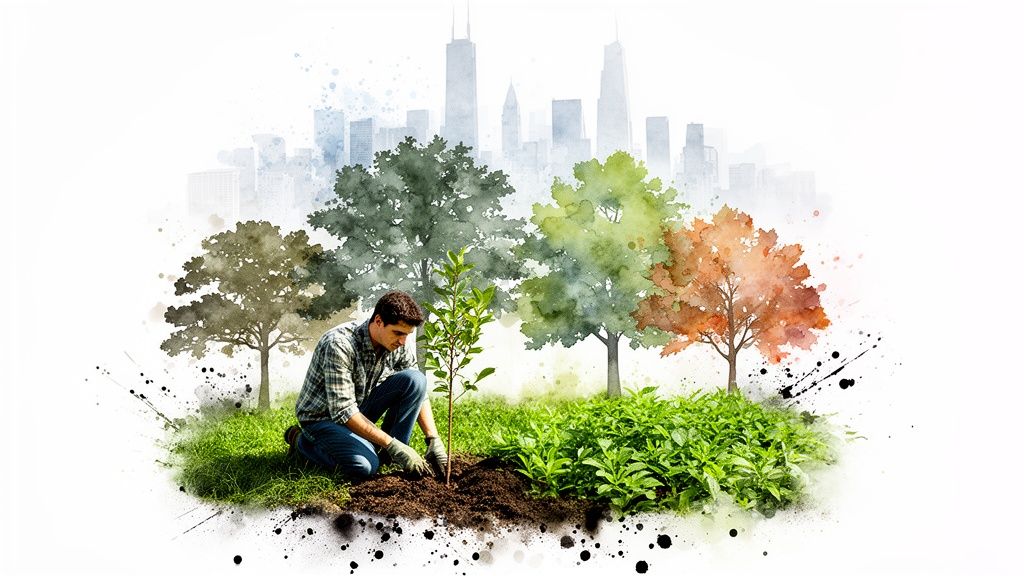
I remember the first time I got caught in one of those wild Chicago spring storms, hail and all, with our tiny group of Litter Caterpillars. We huddled under a shivering tree. And I realized something powerful. Cleaning up a mess that isn't yours is easier than facing your own. That suffering, that shared struggle—it advances the plot of your life. It’s the same with planting a tree. You’re not just putting a sapling in the ground. It’s an act of bravery. A vote for the future.
You're planting a landmark for future volunteers to meet under. You're giving shade for summer picnics. You're adding a new character to your neighborhood's story. Just like cleaning up, planting these native trees of Illinois is my way, our way, to transform ourselves and our city, one brave act at a time. It’s how I turned a messy lot, like my own life once was, into something with purpose and beauty.
I wrote this guide as your blueprint for that transformation. It’s more than a list; it’s a story starter. For each tree, you’ll find:
- Actionable ID Tips: I'll show you how to spot a Bur Oak on your block or a Serviceberry in a park.
- Site-Specific Advice: You'll learn which trees thrive in the tight spaces of Lincoln Park versus the open areas of Pullman.
- Planting & Care: I give you simple, direct guidance to help your tree survive and flourish.
- Community Projects: I've included ideas to rally your neighbors and make a real, visible impact.
We're not just picking up trash anymore; we're building a forest. I invite you to help us write the next chapter. Let's dig in.
1. White Oak (Quercus alba)
The White Oak is more than just a tree; it’s a living monument. When you plant a White Oak, you are making a promise to the future, a commitment that will stand strong for hundreds of years. Imagine it like building a natural cathedral. It’s a place of shelter and life that will serve generations long after you and I are gone. Its incredible longevity, often stretching past 300 years, makes it one of the most foundational native trees of Illinois. For me and the Litter Caterpillars, the White Oak symbolizes the permanence we strive for. It will provide shade for future volunteers gathering in the very parks we clean today.
A Keystone for Urban Ecosystems
This isn't just a pretty tree. It's an ecological powerhouse. The White Oak supports more than 500 species of caterpillars alone, making it a critical food source for birds and other wildlife. You can see majestic examples standing tall in historic Chicago parks like Lincoln Park or within the restored oak groves of Grant Park. These trees are living proof that nature can thrive in the heart of the city. They create pockets of biodiversity that enrich our urban landscape. Planting one is like plugging an entire ecosystem into your neighborhood.
The White Oak is a true legacy tree. Planting one is an act of profound optimism, a gift to a future you may never see, but one you are helping create right now.
How to Plant a Legacy
Are you ready to make a long-term impact? Planting a White Oak is a powerful step. Here’s how you can ensure its success:
- Timing is Key: You should plant in the fall, ideally between October and November. This gives the tree's roots time to establish before the ground freezes, setting it up for strong spring growth.
- Site Selection: Find a spot with well-drained soil, away from areas where road salt accumulates in winter. You must give it plenty of room to grow to its magnificent full size.
- Initial Care: You need to water it deeply once a week during its first year. Apply a 3-4 inch layer of mulch around its base, but be sure to keep the mulch from touching the trunk itself to prevent rot.
Imagine a White Oak as the centerpiece of a new community pocket park or lining a restored streetscape. Its strong branches and dense summer canopy offer incredible shade and beauty. If you want to dig deeper into choosing the right species, you can explore our guide to trees in Illinois for more project ideas.
2. Black Walnut (Juglans nigra)
The Black Walnut is a tree with a powerful, almost magical quality. It’s an architect of its own environment, thoughtfully clearing the space around it to ensure it can thrive. For me, the Black Walnut represents nature’s own tidying crew. Its roots release a substance called juglone, which acts as a natural herbicide, preventing many invasive plants from crowding its space. This tree teaches me that sometimes, creating a healthy ecosystem means setting boundaries. It means curating a space for what truly matters. As one of the most distinctive native trees of Illinois, it’s a living lesson in self-regulation and strength.
A Keystone for Urban Ecosystems
This is a tree of immense character and value. The Black Walnut is a living workshop. It produces rich, dark wood prized by artisans and delicious nuts that are a high-energy food source for wildlife and people like you and me. You can find beautiful specimens in the native groves of DuPage County or standing proudly in the University of Illinois research forests. In an urban setting, this tree offers a unique opportunity for education. Its ability to manage its understory shows how ecosystems can maintain their own balance, a powerful concept I love to share with volunteers cleaning up our city parks.
The Black Walnut is nature's minimalist. It reminds me that a healthy environment isn't about having more, but about having what’s right, and clearing out what doesn't belong.
How to Plant a Legacy
Are you ready to plant a tree that actively manages its own little corner of the world? A Black Walnut makes a bold statement. Here’s how you can help it succeed:
- Timing is Key: Plant your Black Walnut in late fall, after it has gone dormant but before the ground freezes solid. This helps the roots acclimate without the stress of summer heat.
- Site Selection: This is the most critical step. You have to choose a location with deep, well-drained soil, at least 50-60 feet away from gardens, sensitive shrubs, or other trees that might be affected by its juglone. It’s perfect for a large, open area in a park restoration zone.
- Initial Care: You should water it generously during its first few growing seasons, especially during dry spells. An annual application of compost in the spring will give it the nutrients it needs to grow strong and healthy.
Imagine a grove of Black Walnuts in a newly restored natural area, their fallen branches used in community nature art projects. Their presence naturally reduces weedy ground cover, making long-term maintenance easier for volunteer teams like ours. If you want to dig deeper into choosing the right species, you can explore our guide to trees in Illinois for more project ideas.
3. Sugar Maple (Acer saccharum)
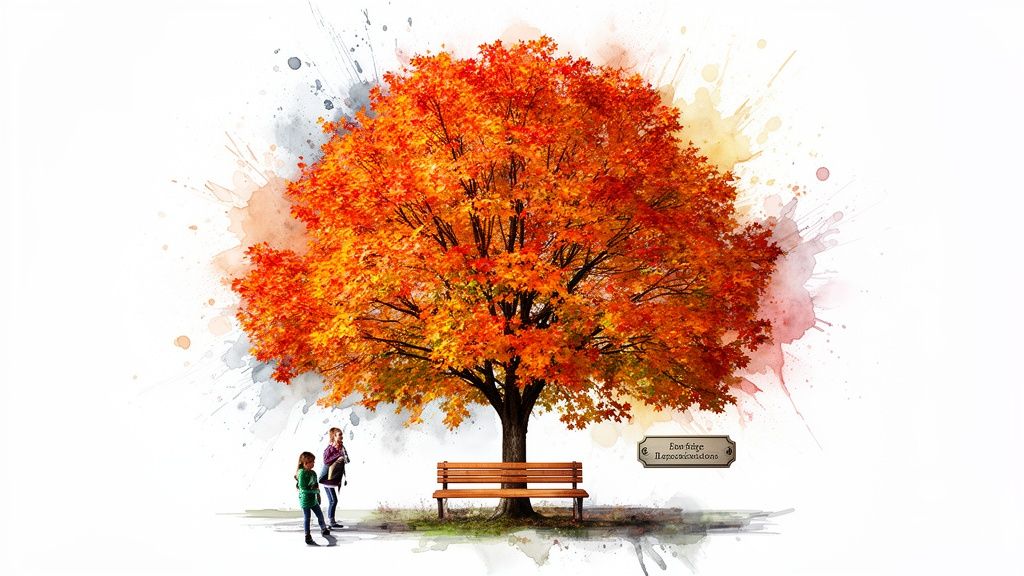
The Sugar Maple is the artist of the Illinois autumn. It paints our neighborhoods in brilliant shades of yellow, orange, and red. When you plant one, it’s like setting a yearly appointment with beauty. A promise that every fall will bring a breathtaking finale to the season. For me, the Sugar Maple represents renewal and transformation. It’s a living symbol of how my cleanup efforts pave the way for lasting, visible change, turning a forgotten corner into a community landmark. Its reliable beauty and sturdy presence make it one of the most cherished native trees of Illinois.
A Keystone for Urban Ecosystems
Beyond its spectacular fall display, the Sugar Maple is a workhorse for urban health. Its dense canopy provides significant summer shade, cooling your streets and reducing energy costs, while its root system helps manage stormwater runoff. You can see glorious examples adding grace to the tree-lined streets of the North Shore or standing as focal points within the Chicago Botanic Garden. These trees are living proof that ecological function and stunning aesthetics can go hand-in-hand. They improve our city one block at a time.
The Sugar Maple reminds me that community work is not just about cleaning up; it’s about creating moments of shared joy, like a neighborhood walk under a canopy of autumn fire.
How to Plant a Legacy
Ready to bring this seasonal spectacle to your neighborhood? Planting a Sugar Maple is a wonderful community project you can start. Here’s how you can get it started:
- Timing is Key: You should plant in the fall to give its roots a head start. This allows the tree to establish itself during the dormant season for vigorous growth in the spring.
- Site Selection: Choose a location protected from road salt and heavy foot traffic, which can compact the soil. You need to give it room to spread, spacing it 30-40 feet from other large trees or buildings.
- Initial Care: Water it regularly during its first year, especially during dry spells. You should apply a 3-4 inch layer of organic mulch around the base, keeping it away from the trunk to prevent moisture buildup and potential rot.
Imagine organizing community "fall foliage walks" where your neighbors can connect and admire the trees you planted together. If you want to dig deeper into choosing the right species, you can explore our guide to trees in Illinois for more project ideas.
4. Eastern Redbud (Cercis canadensis)
The Eastern Redbud is the joyful announcement that spring has officially arrived. After a long gray winter, its burst of vibrant magenta-pink flowers is a powerful symbol of renewal and hope. For me, the Redbud represents the beauty that emerges from our collective effort, like a splash of color appearing in a park we just finished cleaning. This small, graceful tree doesn't demand vast open spaces. It thrives in the margins, bringing life to the edges of our urban world and reminding me that beauty can flourish anywhere you make a little room for it.
A Beacon of Hope for City Spaces
The Eastern Redbud is perfectly suited for city life. Its smaller stature and tolerance for partial shade make it a star player in tight urban quarters where larger trees won't fit. You can see its spectacular spring show at the Chicago Botanic Garden or brightening the restored landscapes of Grant Park. Imagine clusters of these trees transforming a neglected neighborhood pocket park into a springtime destination. Planting a Redbud is like painting with nature; you're adding a stroke of brilliant color that signals new beginnings for your whole community. As one of the most brilliant native trees of Illinois, it’s a perfect choice for beautification projects.
The Eastern Redbud teaches me that even in the toughest urban environments, startling beauty can emerge. It's a living reminder that our work creates space for hope to bloom.
How to Plant a Pop of Color
Are you ready to bring this burst of spring joy to your neighborhood? Planting an Eastern Redbud is a simple yet impactful project. Here’s how you can get it started:
- Group for Impact: You should plant Redbuds in small clusters of 3-5. This mimics their natural growth habit and creates a stunning, concentrated floral display in the spring.
- Find the Right Spot: Choose a location with well-drained soil that gets some afternoon shade. This protects the tree from the harshest summer sun and helps it thrive.
- Planting and Care: The best time for you to plant is in the fall, around October, to give its roots a head start. It needs minimal pruning; just remove any dead wood each year to keep it healthy and shapely.
A row of Eastern Redbuds can turn a simple sidewalk into a breathtaking spring walkway. You might consider underplanting them with shade-loving perennials to create a layered garden effect. If you're inspired to organize a community planting day, you can find saplings and other native plants at our upcoming Litter Caterpillars native plant sale.
5. Red Maple (Acer rubrum)
The Red Maple is the sprinter of the urban forest. While an oak builds its legacy over centuries, the Red Maple bursts onto the scene. It offers quick, visible change that can transform a neglected space in just a few years. It’s a symbol of accelerated results. The perfect tree for demonstrating the immediate connection between your cleanup efforts and the beautiful, green future you’re building. For me, the Red Maple represents a 'quick win' for a neighborhood, showing everyone how fast their hard work can bear fruit, making it one of the most rewarding native trees of Illinois.
A Keystone for Urban Ecosystems
Don’t let its speed fool you; the Red Maple is a versatile champion. Its brilliant red flowers are among the first signs of spring, providing a critical early-season nectar source for bees. Its adaptability is remarkable. It thrives in the wet, compacted soils often found in urban areas where other trees struggle. You can see its vibrant fall colors lighting up the perimeters of Millennium Park and along campus walkways at the University of Chicago. It’s a fantastic choice for wetland restoration projects, proving that even challenging sites can become havens for wildlife.
The Red Maple is a catalyst for change. Planting one is an investment in rapid transformation, a way for you to show a community that a greener, more beautiful tomorrow can start today.
How to Plant a Legacy
Ready to bring some fast-growing beauty to your neighborhood? Planting a Red Maple is a fantastic way to create immediate impact. Here’s how you can make sure it thrives:
- Timing is Key: You should plant in early spring or fall. This allows the tree to establish its root system during cooler, wetter weather, preparing it for summer heat or winter cold.
- Site Selection: Red Maples are incredibly adaptable but perform best with full to partial sun. They are an excellent choice for rain gardens or areas with poor drainage. You need to give each tree about 25-30 feet of space to allow its crown to develop fully.
- Initial Care: Water it deeply once a week during its first two years, especially during dry spells. If you prune it early, you will help establish a strong central leader and a good branching structure for a long, healthy life.
Imagine a row of Red Maples bringing a splash of year-round color to a once-barren street, their growth documented month-by-month to inspire your fellow volunteers. For more ideas on how to use fast-growing species in your projects, you can explore our guide to trees in Illinois to get started.
6. Shagbark Hickory (Carya ovata)
The Shagbark Hickory is a tree with character. I can spot it from a distance by its unique, shaggy bark that peels away in long, curving strips. It looks like it’s wearing a rugged, layered coat. For me and the Litter Caterpillars, this tree is a landmark. Its unforgettable texture stands out in a forest, serving as a perfect meeting point or a natural marker showing how far we’ve cleaned. More than just a visual anchor, the Shagbark Hickory is one of the most resilient and historically significant native trees of Illinois, a living sculpture that connects me to the state's primeval forests.
An Anchor for Restored Woodlands
This tree is a true survivor. It's a cornerstone of forest health. It’s not one for your manicured city streets; it belongs in wilder spaces where its deep taproot can dig in without disturbance. You can find beautiful specimens in the restored woodlands of the Midewin National Tallgrass Prairie or within the forest remnants of Cook County, where they provide food and shelter for countless species. The nuts are a vital food source for squirrels, woodpeckers, and foxes, and their sweet flavor was prized by Native Americans and early settlers. Planting one is an act of rewilding, bringing a piece of Illinois's untamed spirit back to our parks and preserves.
The Shagbark Hickory teaches me that true strength often has a rough exterior. Its shaggy bark is a record of its journey, a beautiful testament to its resilience and longevity.
How to Plant a Forest Landmark
Are you ready to add this distinctive character to a restoration project? The Shagbark Hickory requires a bit more patience from you, but the payoff is a tree that will define the landscape for over a century. Here's how you can plant one:
- Timing is Key: Plant in the fall to allow its sensitive taproot to get established before winter. I've found that growing from a locally sourced nut is often the best way to ensure it’s adapted to your specific site.
- Site Selection: You must find a spot in a larger, naturalized area with well-drained soil. It needs room to grow and does not tolerate soil compaction, so you have to keep it away from high-traffic paths.
- Initial Care: Water it deeply during its first few years. You'll want to apply a thick, 4-6 inch layer of mulch to mimic a natural forest floor, conserve moisture, and protect its roots, but keep mulch from touching the trunk.
7. American Elm (Ulmus americana)
The American Elm is a story of resilience, a symbol of Chicago’s ability to recover and rebuild. For decades, its graceful, vase-shaped canopy formed cathedral-like arches over our city streets, defining the character of entire neighborhoods. While Dutch Elm Disease devastated these urban forests, the story isn't over. I’ve seen new disease-resistant cultivars making a comeback, allowing us to restore this iconic species. For me, planting an American Elm is an act of reclamation, a way to bring back a piece of Chicago's soul and provide a majestic canopy for the communities you and I serve.
Restoring a Living Legacy
This isn't just about planting a tree. It's about restoring a historic streetscape and reviving a key part of our urban forest. The American Elm’s fast growth and arching branches create magnificent shade. This makes it a perfect choice for parks and wide parkways. You can witness the beginning of this comeback in restoration projects within Lincoln Park and Grant Park, where new generations of elms are taking root. Planting these trees is my way of honoring the past while building a greener, more beautiful future, one street at a time.
The American Elm represents urban renewal in its purest form. When you replant it, you are not just restoring a tree; you are restoring neighborhood identity and a piece of our shared history.
How to Plant for a Comeback
Ready to join the elm revival? Planting disease-resistant American Elms is a powerful statement of hope and dedication you can make. Here's how you can ensure these graceful giants thrive:
- Choose Wisely: You must only plant certified disease-resistant cultivars like 'Accolade', 'Princeton', or 'New Harmony'. This is the most critical step for long-term survival.
- Give It Space: You need to select a site with excellent drainage and good air circulation. To create that classic arched canopy, space trees 40-50 feet apart.
- Plant for Impact: I suggest you organize a community planting event to restore an entire block. This creates a powerful visual and celebrates Chicago's heritage, turning a simple planting day into a story of neighborhood transformation.
Imagine a row of young American Elms lining a street that your team just cleaned, their branches beginning to reach for each other. They stand as a living testament to community effort and renewal, one of the most inspiring native trees of Illinois. To get involved in similar restoration projects, you can explore our guide to trees in Illinois for more ideas.
8. Bur Oak (Quercus macrocarpa)
The Bur Oak is the definition of strength through adversity. With its thick, corky bark that can resist fire and its massive, spreading form, this tree embodies sheer resilience. I see the Bur Oak as a symbol of our own work at Litter Caterpillars: thriving in difficult urban environments and transforming neglected spaces into shaded, welcoming gathering areas. This iconic savanna tree is one of the toughest native trees of Illinois. A true survivor built for the long haul. Its presence on the landscape is a quiet declaration of persistence.
A Keystone for Urban Resilience
This is a tree built for the city’s challenges. The Bur Oak is incredibly tolerant of drought, heat, and poor soils once it’s established, making it a perfect candidate for harsh urban sites where other trees might fail. You can witness its powerful stature in the restored oak savannas of Grant Park or as a signature tree standing against the open skies at Midewin National Tallgrass Prairie. Planting a Bur Oak is like installing a living anchor in your community, a point of stability that will grow stronger with each passing year.
The Bur Oak teaches me a lesson in patience and strength. Its slow, steady growth is a testament to the idea that lasting change doesn't happen overnight, but through your consistent, determined effort.
How to Plant a Survivor
Ready to plant a tree that will stand as a landmark for future generations? The Bur Oak is a powerful choice for you. Here’s how you can give it a strong start:
- Start Young: You should plant young nursery stock (1-2 inches in trunk diameter) for a much higher survival rate and better root establishment.
- Site Selection: Give it what it craves: full sun and well-drained soil. This tree needs space, so you must plan for its mature crown by spacing it 40-50 feet away from buildings and other trees.
- Initial Care: Water it deeply during its establishment period, which can last 3-5 years. After that, it’s remarkably self-sufficient. Minimal pruning is required; just let it develop its natural, majestic form.
Imagine a row of young Bur Oaks transforming a barren parkway or a single, magnificent specimen becoming the centerpiece of a community garden. You can see similar historic oaks anchoring the landscapes in many of our local nature sanctuaries. To get inspired by these foundational ecosystems, you can discover the beauty of Forest Preserves in Illinois and see what’s possible.
9. Serviceberry/Amelanchier (Amelanchier species)
The Serviceberry is the quiet artist of the Illinois landscape. While some trees shout for attention with their size, the Serviceberry whispers. It has delicate white spring flowers that offer a gentle beauty that feels personal and welcoming. For me, it represents the power of subtle, yet meaningful, transformation. It shows how even the smallest spaces, like forgotten corners of a park or narrow planting strips, can be turned into something beautiful and productive. This graceful tree is one of the most versatile native trees of Illinois, a perfect fit for the intimate scale of your neighborhood greening.
An Edible Oasis in Urban Spaces
This small tree is a powerhouse of generosity. It offers something for everyone. Its early spring blossoms are among the first food sources for pollinators, and its sweet, blueberry-like summer fruits are a feast for birds and people like us. You can see its multi-stemmed elegance in the understory plantings at the Chicago Botanic Garden or tucked into the woodland edges at the University of Chicago. When you plant a Serviceberry, it's like opening a small, four-season cafe for local wildlife, creating a reliable source of food and shelter right where it’s needed most.
The Serviceberry reminds me that true impact isn't always about grand scale. It's about providing consistent, accessible nourishment and beauty, one small, graceful act at a time.
How to Plant a Community Gem
Ready to bring this four-season star to your neighborhood? Planting a Serviceberry is a simple way you can add beauty and ecological value. Here’s how you can make it thrive:
- Timing is Key: You should plant in the fall or early spring. This allows the root system to establish before the stress of summer heat or winter cold.
- Site Selection: Find a spot with dappled sunlight, mimicking its natural understory habitat. It’s adaptable to various soils but prefers good drainage. I suggest you plant in groups of 3-5 for a stunning floral display and better berry production.
- Initial Care: Water it deeply once a week during its first year, especially in dry spells. You should apply a 3-4 inch layer of mulch to retain moisture, but keep it from touching the trunk. A little pruning to remove dead wood will maintain its lovely form.
Imagine a small grove of Serviceberries at the entrance to a community garden, welcoming you with spring flowers and offering a sweet snack in the summer. For more ideas on integrating understory trees into your projects, you can explore our guide to trees in Illinois to find the perfect fit.
10. American Sycamore (Platanus occidentalis)
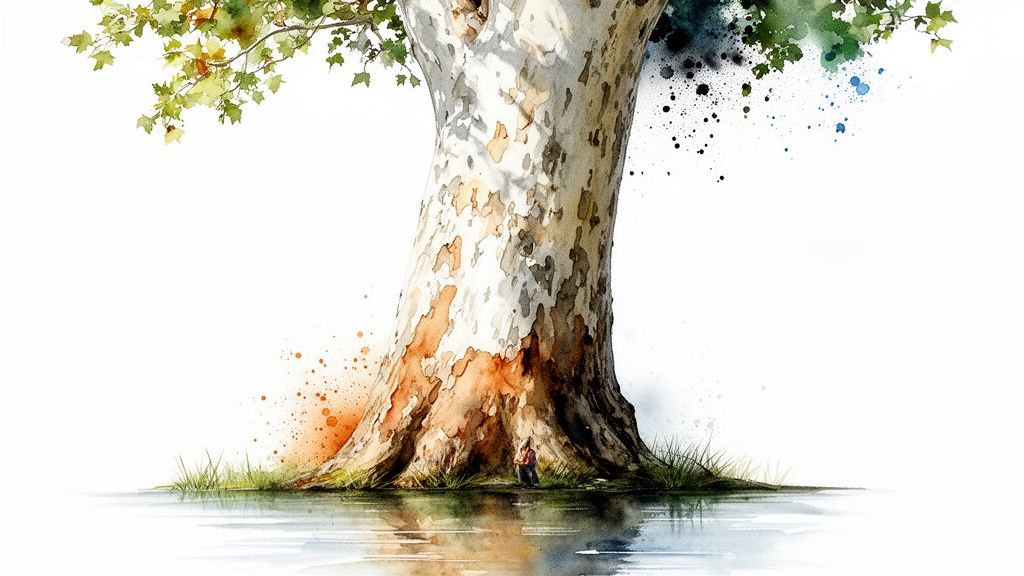
The American Sycamore is a tree of dramatic presence. Its most striking feature is its beautiful, exfoliating bark. It peels back to reveal a patchwork of white, gray, and tan, almost like a natural work of camouflage art. For me, the Sycamore represents visible, breathtaking transformation. Just as its bark sheds its old layers to reveal something bright and new beneath, you can transform overlooked, damp corners of your communities into stunning landmarks. A single Sycamore can redefine a forgotten streamside, turning it into a destination.
A Guardian of the Waterways
This tree is an absolute giant. A true master of moist bottomlands and riverbanks. It thrives in wet soil, growing quickly and providing immense ecological benefits. You can see these magnificent trees along the Des Plaines River greenway or as part of riparian restoration efforts along Salt Creek, where their roots stabilize the soil and prevent erosion. By planting Sycamores, you’re not just adding beauty; you are actively restoring the health of our local waterways and creating vital habitats. It’s a perfect choice for one of the most important native trees of Illinois.
The American Sycamore is a living sculpture. Its ghostly white branches reaching into the winter sky are an unforgettable sight, a reminder that you can find beauty and strength even in the harshest seasons.
How to Plant a Riverside Giant
Ready to create a neighborhood landmark? The Sycamore needs a specific home, but when you site it correctly, it works wonders. Here’s how you can make it happen:
- Location, Location, Location: This is not a tree for a small, dry yard. You must plant it exclusively in moist to wet areas like stream banks, detention basins, or low-lying parklands where water collects.
- Give It Space: This tree gets enormous. You have to plan for its mature size by spacing it at least 50-60 feet away from buildings, power lines, and other trees.
- Waterway Restoration: Coordinate with local watershed groups or your park district. Planting Sycamores as part of a riparian buffer is a powerful way for you to contribute to larger conservation goals and improve water quality.
Imagine a line of Sycamores marking a newly restored creek, their white branches visible from blocks away, creating a beautiful and functional green corridor. Their massive, welcoming shade is perfect for your future volunteer gatherings after a clean-up event. If you want to dig deeper into choosing the right species, you can explore our guide to trees in Illinois for more project ideas.
Comparison of 10 Native Illinois Trees
| Tree | 🔄 Implementation Complexity | ⚡ Resource Requirements | 📊 Expected Outcomes | 💡 Ideal Use Cases | ⭐ Key Advantages |
|---|---|---|---|---|---|
| White Oak (Quercus alba) | High — large specimen planting, slow establishment (3–5+ yrs) | High space/cost; deep soil, long-term maintenance | Long-term canopy, legacy shade, high biodiversity (200–300+ yrs) | Parks, major streetscapes, legacy community plantings | Exceptional longevity, wildlife support, stormwater benefits |
| Black Walnut (Juglans nigra) | Medium–High — juglone planning, large root system | Medium — wide spacing, nut/branch management, timber value | Cleaner understory, nut production, ecological demonstration | Large restoration zones, educational sites, woodcraft projects | Natural understory control, edible nuts, timber value |
| Sugar Maple (Acer saccharum) | Medium — moderate establishment, sensitive to salt/compaction | Medium — moisture needs early, spaced planting, moderate cost | Strong seasonal aesthetics, cooling and stormwater mitigation | Streetscapes, parks, neighborhood beautification | Brilliant fall color, cooling, long-lived landmark |
| Eastern Redbud (Cercis canadensis) | Low–Medium — small tree, prone to canker if stressed | Low — small footprint, minimal initial maintenance | Early spring color, pollinator support, quick visual uplift | Pocket parks, understory plantings, school projects | Early blooms, ideal for tight spaces, pollinator attraction |
| Red Maple (Acer rubrum) | Low — fast-growing, needs early pruning for form | Low–Medium — adaptable soils, regular early watering | Rapid canopy cover, four‑season interest, quick neighborhood impact | Rapid greening, wet areas, rain gardens | Fast growth, adaptable, cost-effective for quick wins |
| Shagbark Hickory (Carya ovata) | High — slow establishment, sensitive taproot, woodland preference | Medium–High — well‑drained uplands, long-term care, nut cleanup | Distinctive landmark, wildlife food source, long-term woodland recovery | Woodland and savanna restorations, legacy plantings | Unique bark, edible nuts, drought-tolerant once established |
| American Elm (Ulmus americana) | Medium — use certified resistant cultivars, disease monitoring | Medium — certified stock, good drainage, spacing for vase form | Rapid shade restoration, historic streetscape re-establishment | Streetscapes, community canopy restoration, memorial plantings | Iconic vase form, fast establishment, disease-resistant options |
| Bur Oak (Quercus macrocarpa) | High — very slow growth, long-term planning required | Medium–High — full sun, well-drained sites, young stock preferred | Durable canopy, exceptional drought/heat tolerance, savanna character | Harsh urban sites, savanna restoration, climate-resilient projects | Extreme resilience, long lifespan, wildlife-supporting acorns |
| Serviceberry (Amelanchier spp.) | Low — easy understory planting, simple pruning | Low — small footprint, low cost, moderate moisture early | Multi-season interest (flowers, berries, fall color), wildlife food | Pocket parks, understory buffers, community foraging areas | Edible berries, low maintenance, four‑season appeal |
| American Sycamore (Platanus occidentalis) | High — very large, needs riparian siting and structural pruning | High — significant space, consistent moisture, professional planting | Dramatic landmark tree, rapid transformation, riparian benefits | Floodplains, waterways, riparian restoration corridors | Extremely fast growth, striking exfoliating bark, massive shade |
Your Turn to Paint the Fence
Do you remember Tom Sawyer? He was punished and forced to whitewash a fence, but he reframed the entire experience. He convinced his friends it wasn't a chore; it was a rare and wonderful opportunity. Soon, they were not only doing the work for him but actually paying him for the privilege.
That's the spirit I want you to carry forward from this article. Planting native trees of Illinois isn't a task for you to check off a list. It’s a chance to "paint the fence" in your own corner of the world, to turn a simple action into an act of creation, community, and profound connection.
From List to Legacy
We've just walked through a gallery of Illinois's most resilient and beautiful residents. You've met the stately White Oak, a living monument that can stand for centuries. And the cheerful Eastern Redbud, which paints our gray cityscapes with vibrant magenta each spring. You've learned how the rugged Bur Oak can thrive even in the packed clay of a Chicago parkway, and how a single Serviceberry can feed dozens of bird species.
This isn't just botanical trivia. This is your toolkit. These are the "paintbrushes" I was talking about. Each species offers you a different stroke, a different color, a different texture for the canvas of our community.
- A Shagbark Hickory you plant in a park isn't just a tree; it’s a future food source for wildlife and a living sculpture with its unique, peeling bark.
- An American Sycamore along a riverbank isn't just for shade; its massive roots are actively fighting erosion, holding our precious soil in place.
- A row of Sugar Maples on a residential street isn't just for curb appeal; it’s a promise of fiery autumn color and a collective memory for generations of your neighbors.
The most important takeaway for you is this: you hold the power to make a tangible, lasting impact. You don't need a massive budget or a city permit to start. You just need a shovel, a bit of knowledge from this guide, and the will to begin.
Your First Brushstroke
So, where do you start? The thought of planting a tree can feel big, but your first step is small. It starts with you looking at your own block with new eyes.
Is there a barren patch of grass in front of your apartment building? That's a spot for a Redbud. Is there a wide-open space in your local park that gets tons of sun? That’s where a mighty Oak belongs. The real magic happens when you stop seeing empty spaces and start seeing possibilities.
I believe in the power of service, sunlight, and friendship to transform us, just like a caterpillar. You don't have to be perfect. You just have to be willing to show up.
This isn’t about you becoming a master arborist overnight. It’s about you taking one small, courageous action. It’s about choosing a tree from this list, finding a spot that needs it, and putting a root ball in the ground. It’s about watering it through that first hot summer and watching, with a sense of pride, as it begins to grow.
The fence is waiting. Our city is waiting. It’s your turn to pick up a brush and leave your mark, to help us paint Chicago a vibrant, living green.
Ready to stop reading and start doing? Join Litter Caterpillars this weekend. I turn the work of planting native trees and beautifying neighborhoods into a fun, social event where you’ll make a real impact and even better friends. Find your next project and grab a shovel with us at Litter Caterpillars.