Tag: neighborhood improvement

  • How to Measure Community Impact: Guide for Volunteer Groups

    How to Measure Community Impact: Guide for Volunteer Groups

    You finish a cleanup and your body knows it before your brain does. Your gloves stink. Your back is tight. Your water bottle is empty. You look down the block and see a street that looked defeated three hours ago and now looks like somebody finally cared.

    Then you look at the pile.

    Bags. Broken glass. Fast food cups. Rusted cans. Cigarette packs. Maybe a tire if your day got weird.

    And then the question hits you. Sure, we filled bags. But what did we really change?

    I know that question well. I started cleaning streets during a season when my own life felt cluttered and jammed up. Cleaning other people's messes felt easier than facing my own. Strange but true. Out on the street, with a grabber in my hand and wind in my face, things got simple. Pick it up. Keep moving. Come back next week. Somewhere in that rhythm, I changed.

    That's why I care so much about measurement. Not because I love spreadsheets. I don't. I care because volunteers give you their Saturday morning, their sweat, their safety, and their hope. You owe them a real answer when they ask, “Did this matter?”

    If you want to learn how to measure community impact, start there. Start with respect. Start with honesty. Start with the belief that visible work deserves visible proof.

    More Than Just Bags of Trash

    You already know the first trap. You clean a block, count the bags, post the photo, and call it impact. I get it. A pile of trash is satisfying. It feels like a scoreboard.

    But a cleanup group isn't in the bag business. You're in the change business.
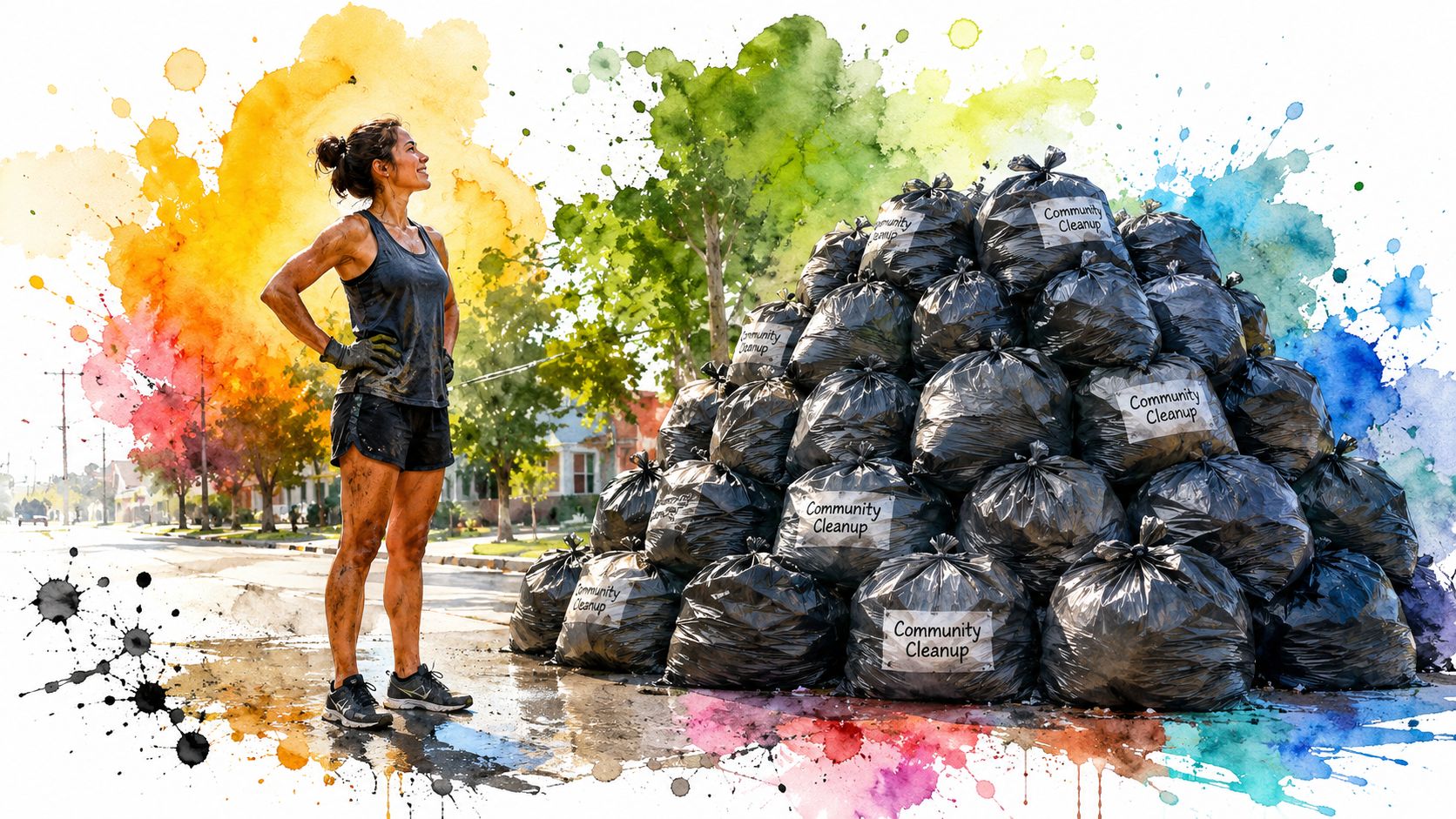
    A woman stands proudly next to a large pile of garbage bags labeled Community Cleanup, symbolizing environmental impact.

    When I first got serious about neighborhood cleanup, I thought hard work would speak for itself. It doesn't. Streets change. People forget. New volunteers show up with no memory of what the block looked like before. Residents notice a difference, but if you never capture it, the story disappears.

    That's why I treat measurement like cleanup's second half. The first half is doing the work. The second half is proving the work changed something.

    What the pile can't tell you

    A pile of bags can't tell you if the same volunteers came back because they felt connected. It can't tell you whether a resident finally stopped to say thanks after ignoring your group for months. It can't tell you if a corner that always felt abandoned now feels watched over.

    That kind of proof takes intention.

    Practical rule: If all you track is what you removed, you miss what you repaired.

    Sometimes the strongest record of your work is simple. A before photo. An after photo. A note that says, “Two residents asked how to join.” A screenshot of the group chat after the event. A quick log of which block got cleaned and who showed up. That's how a cleanup turns into a body of evidence, not a fading memory.

    If you want an example of what visible service looks like in the world, spend a minute looking at trash cleanup work in action. You can feel the difference between activity and proof.

    Measurement is respect

    I've seen groups burn out because they kept asking people to show up without showing them what their effort built. People need fuel. Proof is fuel.

    So yes, count the bags. Then go one step further. Ask what changed on that block, in your crew, and in the people who watched you work. That's where community impact starts to come into focus.

    Start with Your Story Not Your Numbers

    Most volunteer groups mess this up at the beginning. They start with a spreadsheet before they start with a sentence.

    That's backwards.

    If you don't know your story, your numbers will drift. You'll track whatever is easy. Bags collected. Gloves handed out. Posts published. None of that means much if it isn't tied to a living reason for why your group exists.

    Find the spark

    My own spark was personal. I had trouble cleaning and organizing my own life. Trash felt heavier than it should have. Tiny things carried emotional weight. Service outside gave me a way to build discipline and bravery inside. That became the engine.

    Your spark may be different. Maybe your block got trashed every Monday after the weekend crowds. Maybe your kids had to walk past broken glass on the way to school. Maybe you moved to a new city and needed friends who cared about more than brunch and talk.

    Write that down in plain language.
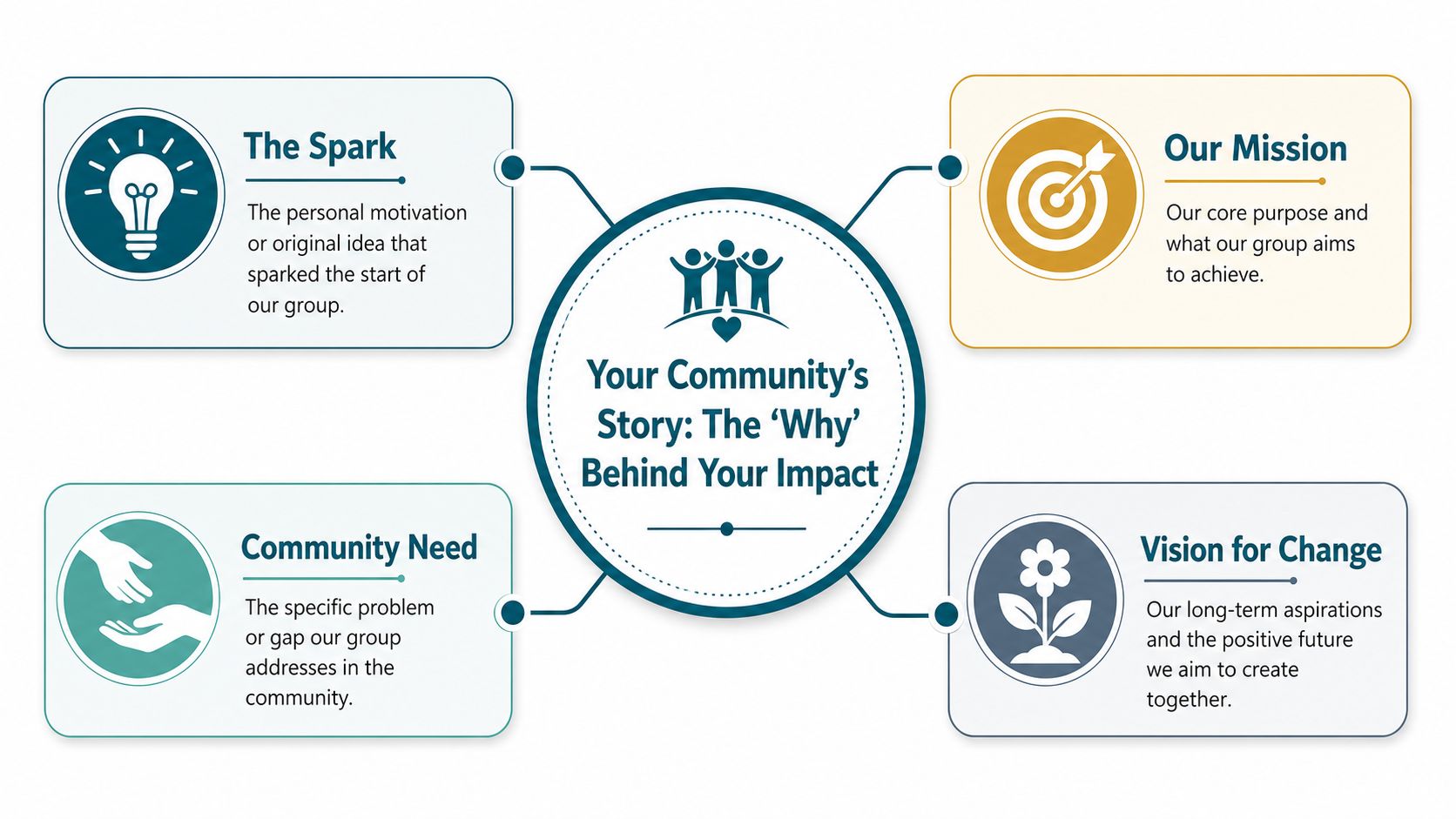
    A diagram illustrating the four key components to define a community story and understand its impact.

    Turn the spark into a mission

    A usable mission is short and human. It says who you help, what you do, and what change you expect.

    Try this fill-in-the-blank:

    • Who we show up for
      The residents, volunteers, and small businesses on neglected blocks.

    • What we do
      We clean littered areas consistently and invite people to join us.

    • What we think will change
      Streets look cared for, people build trust, and more neighbors step into service.

    That's enough to guide your measurement. You don't need corporate language. You need clarity.

    One good way to test your mission is this: if a new volunteer reads it in ten seconds, do they understand what they're joining?

    Build goals from the mission

    Once your story is clear, your goals stop being random. They become evidence of your values in motion.

    The best practice is plain. You need a baseline before the work starts, clear goals tied to your mission, people affected by the work helping define the metrics, mixed methods that combine numbers with stories, and honest reporting about what went well and what didn't, as outlined in this guidance on measuring community impact effectively.

    That means you should decide things like:

    1. What your baseline is
      What did the block look like before regular cleanups began? How many volunteers usually showed up? How did residents talk about the area?

    2. What “better” means
      Cleaner sidewalks? Stronger volunteer retention? More conversations with neighbors? Fewer repeat problem spots?

    3. Who helps define success
      Volunteers. Residents. Store owners. School staff. The people near the work usually know what progress looks like.

    If your mission is personal but your metrics are generic, your proof will feel hollow.

    For a good gut check, read a few volunteer testimonials from cleanup experiences. Listen for what people remember. They rarely start with numbers. They start with belonging, courage, routine, pride, and visible change. Your metrics should support that story, not replace it.

    Choose What to Count and What to Ask

    Here's the cleanest way I know to explain measurement. Outputs are the reps. Outcomes are the muscle.

    A cleanup group can do a ton of reps. Bags filled. Blocks covered. Volunteer hours logged. Those matter. But if you stop there, you're mistaking motion for change.

    Outputs tell you what you did

    Outputs are the easiest things to count because they happen right in front of you. You can tally them while still wearing gloves.

    Examples include:

    • Volunteer participation. Who came, how often, and from which neighborhoods or backgrounds.
    • Cleanup activity. Bags filled, blocks covered, sharp objects removed, graffiti reported.
    • Time invested. Start time, end time, volunteer hours, repeat attendance.

    These numbers help you stay organized. They also help you answer simple operational questions. Which locations need more tools? Which dates pull the best turnout? Which team leads keep events moving?

    Outcomes tell you what changed

    Outcomes are tougher. They ask whether your work had an effect beyond the event itself.

    Maybe residents start greeting the team. Maybe a business owner asks you to come back. Maybe volunteers say they feel safer, more connected, or more rooted in the neighborhood. Maybe a stretch of sidewalk stays cleaner longer because people stop treating it like a dumping zone.

    A strong warning from practice is this: many groups over-rely on outputs like trash bags collected and miss outcomes like whether residents feel safer or better about the area. To keep your measurement valid, use 3+ indicators and mix hard secondary data with qualitative input. Also, break your data apart by demographics because that kind of disaggregation reveals participation disparities in 60–70% of community projects, according to Bridgespan's discussion of impact measurement.

    That one habit changes everything. If the same type of person always shows up, your group may be active but still narrow. You won't see that unless you look.

    A simple table for cleanup leaders

    Metric Type What It Measures Example Why It's Useful
    Output Work completed Bags of trash removed from one corridor Shows effort and event scale
    Output Participation Number of volunteers who attended Helps with planning and retention
    Output Coverage Blocks, alleys, or lots cleaned Shows geographic reach
    Outcome Resident response Short comments about how the block feels now Captures lived experience
    Outcome Volunteer experience Group chat poll on pride, connection, or safety Shows whether people want to return
    Outcome Neighborhood condition over time Repeat photos of the same hotspot across weeks Shows whether change sticks

    Pick fewer metrics and ask better questions

    Most volunteer crews don't need a giant dashboard. They need a tight set of indicators they'll track.

    Try a small stack like this:

    • One operational metric
      Attendance by event.

    • One visible condition metric
      Repeat photo of the same corner each visit.

    • One experience metric
      A one-question volunteer poll after each cleanup.

    • One community voice metric
      A short note from a resident, worker, or passerby.

    That's enough to start seeing patterns.

    If you want a practical benchmark for shaping your own system, this kind of volunteer program evaluation approach is a smart model. It keeps measurement tied to real people instead of turning it into paperwork theater.

    Your data should fit in your hands. If tracking it feels heavier than the cleanup itself, you built the wrong system.

    Simple Ways to Gather Your Proof

    You don't need fancy software to measure community impact. You need habits. Your phone already has most of the tools.

    The trick is to collect proof while the day is still alive. If you wait until Sunday night to remember what happened Saturday morning, half the good stuff is gone.
    Screenshot from https://www.littercaterpillars.com

    Use the four-layer street version

    A solid framework breaks impact into four layers: participation, experience, outcome, and return. It also treats measurement as continuous capture instead of a once-a-year survey, as described in Sopact's overview of community impact measurement. I like this because it matches how cleanup groups live. You don't work once a year. You show up again and again.

    Here's the street version of those four layers:

    • Participation
      Track who came, who led, who was new, and who returned.

    • Experience
      Ask how people felt. Safe? Proud? Included? Tired but happy?

    • Outcome
      Record what changed in the place or in the people.

    • Return
      Show the evidence back to your volunteers and neighbors, then ask if it rings true.

    That last part matters. If your report says one thing and the block says another, trust the block and fix your method.

    Scrappy tools that actually work

    I like tools that survive dirt, rain, and low attention spans. Use what your crew will keep using.

    • Before-and-after phone photos
      Stand in the same spot each time. Face the same direction. If you can, save them in a shared Google Drive folder labeled by date and location.

    • Pinned Google Map
      Drop a pin for each cleanup site. Add photos and a one-line note. Over time, you build a visual trail of where your crew has worked.

    • Notes app or Google Form
      One volunteer can log attendance, unusual finds, resident comments, and follow-up needs in under two minutes.

    • Tally counter
      Cheap and effective for counting needles, tires, shopping carts, or illegal dump items.

    • Group chat poll
      Ask one question after the event. “How connected did you feel today?” or “Would you return to this spot next month?”

    Keep it moving while the energy is high

    Your best data often comes in the first ten minutes after cleanup ends. People are still buzzing. Don't waste that window.

    Ask a volunteer to record a quick voice memo. Grab one sentence from a resident. Snap the final photo before the bags get hauled away. Log the location before you drive off and forget the cross street.

    This short clip captures the kind of hands-on energy that numbers alone can't carry:

    Don't make data a second job

    The system should feel light. If your volunteers dread the paperwork, they'll skip it. I'd rather see a group consistently gather five simple data points than attempt a giant form nobody finishes.

    A clean weekly routine might look like this:

    1. Before cleanup
      Take the opening photo and note the location.

    2. During cleanup
      Count a few chosen items and track who joined.

    3. Right after cleanup
      Take the after photo and run one quick poll.

    4. That afternoon
      Save everything in one folder and write three sentences about what stood out.

    That's it. Small proof, gathered often, beats a perfect system you never use.

    Turn Your Data into a Powerful Story

    Raw data is like a pile of bricks. Useful, but nobody wants to live in a pile of bricks. You have to build something with it.

    For cleanup groups, that “something” is an Impact Snapshot. One page. One image. One fast read. People should understand the win before they finish their coffee.

    What goes in the snapshot

    Your snapshot should feel like a movie trailer, not a tax return. It needs just enough structure to be credible and just enough human texture to feel alive.
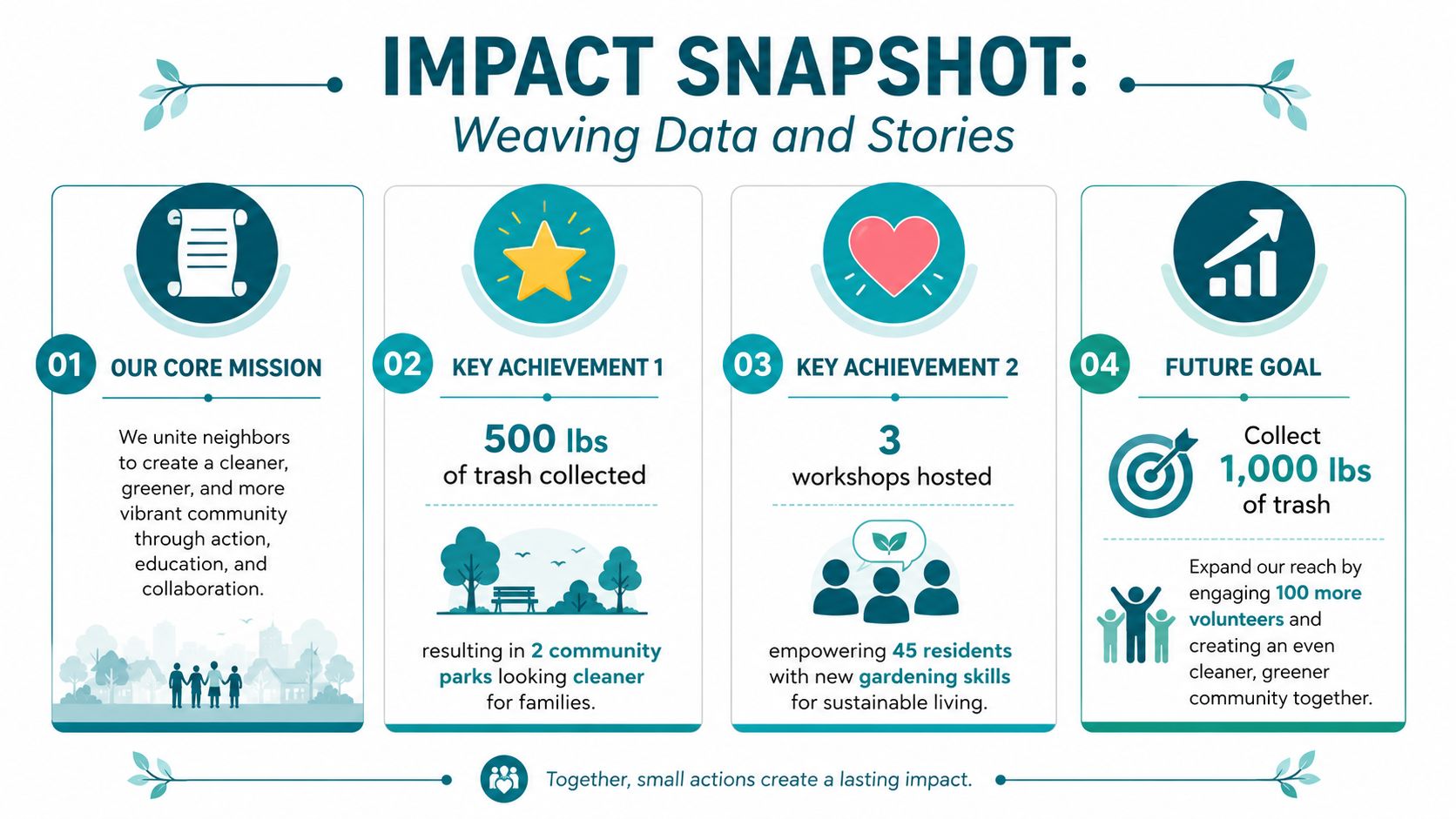
    An infographic titled Impact Snapshot showing community mission, achievements in trash collection and workshops, and future goals.

    Use this template:

    • Top section
      Your strongest before-and-after photo pair.

    • Middle section
      A few numbers from the event or the month. Keep them tied to the metrics you already decided to track.

    • Bottom section
      One short quote from a volunteer, resident, or local partner.

    • Footer
      The next action. Join us. Partner with us. Follow the next cleanup route.

    Pair evidence with voice

    A number proves activity. A quote proves meaning. Put them together and the story lands.

    A good quote isn't polished. It's real. Something like, “I'd walked past this lot for months and felt defeated. Today it finally looked cared for.” That line gives your numbers a heartbeat.

    When your numbers and your people say the same thing, trust grows fast.

    If you don't have a quote every time, use a short field note. “Two residents thanked the team and asked when we'd return.” Simple works.

    Keep the design rough but clean

    You do not need a designer to make this. Canva is enough. Google Docs is enough. Even an Instagram carousel can work if you keep it consistent.

    Stick to a repeatable layout:

    • same title placement
    • same photo size
    • same metric order
    • same closing invitation

    That consistency builds memory. After a few weeks, people start recognizing your receipts on sight.

    Build a public record

    One snapshot is nice. Ten snapshots become proof. People stop seeing your cleanup group as a one-off burst of energy and start seeing a pattern. Patterns earn trust.

    Many volunteer groups accidentally gain power through consistency. They keep showing up, keep documenting, keep reporting. Then a resident, funder, school, alderman, or store owner can scroll back and see that the work is real. No inflated claims. No fog. Just evidence stacked over time.

    Use Your Proof to Grow Your Army

    Proof changes how people respond to you.

    Without proof, you sound hopeful. With proof, you sound solid.

    That matters when you ask someone to wake up early and spend their weekend picking up litter. It matters when you ask a small business for gloves, trash bags, or water. It matters when you invite a neighbor who feels cynical and tired.

    People join what they can see

    Most volunteers don't join because of a mission statement alone. They join because they can picture themselves inside the work.

    An Impact Snapshot gives them that picture. They see the block. They see the faces. They see the kind of change a small group made in a short stretch of time. Suddenly joining doesn't feel abstract. It feels doable.

    Use your proof in a few direct ways:

    • Recruiting posts
      Share snapshots on Instagram, Meetup, email, or group chats with one clear invite.

    • Partner asks
      Bring a printed snapshot when you talk to a hardware store, coffee shop, school, or church.

    • Volunteer retention
      Send the snapshot to everyone who joined. Let them feel the win again while it's fresh.

    • Neighborhood trust
      Post it where local residents can see what happened on their block.

    Proof also keeps you honest

    This part matters just as much. Measurement doesn't only help you grow. It helps you correct.

    If a site keeps getting trashed again in two days, your method may need to change. If first-time volunteers come once and vanish, your experience may be weak even if the cleanup looked productive. If your demographic breakdown shows the same slice of people every week, your outreach may be narrow.

    That's good news. Honest proof gives you something to fix.

    Brave groups don't hide weak spots. They learn in public and keep moving.

    If you want to know how to measure community impact in a way that helps your crew, this is the answer. Track what you did. Listen for what changed. Show the evidence. Invite more people in. Repeat.

    That's how a cleanup turns into a movement. One block. One morning. One clear receipt at a time.


    If you want to join a crew that cleans hard, builds real friendships, and shows its work, check out Litter Caterpillars. Show up on a weekend morning, grab a picker, and help turn service into something people can see and feel.

  • Illegal Dumping Prevention Your Community Playbook

    Illegal Dumping Prevention Your Community Playbook

    You know that feeling. You turn the corner by your alley, or pull up beside the lot near the bus stop, and there it is again. A couch with the stuffing ripped out. A busted toilet. A mountain of drywall that showed up overnight like somebody emptied a whole renovation into your block and vanished before sunrise.

    That kind of mess gets under your skin.

    I know because that anger is part of why I started cleaning. My own place was a mess for a long time. I had a weird emotional attachment to trash. Every old container, every dead battery, every forgotten bag in the corner felt heavy to me. Then my life cracked open after a chaotic relationship ended, and I made myself a promise. I was going to build a different kind of life with different kinds of people. Cleaner. Braver. More honest.

    Cleaning other people's trash turned out to be easier than cleaning my own.

    The first time we went out, there were only three of us. Chicago hit us with that classic nonsense weather. Hail, slush, freezing wind, rides canceling one after another while we huddled under a tree laughing at our own bad decisions. But something clicked for me in that storm. Service changed the story. Suffering gave it flavor. We weren't helpless anymore.

    That's the spirit behind illegal dumping prevention. You don't need to wait for a perfect grant, a formal committee, or some polished city plan. You can start with one disgusting pile and one stubborn decision.

    Your Call to Action Starts with a Mess

    A dumped couch is never just a couch.

    It's a message. Somebody looked at your block and thought, “Nobody will stop me here.” That stings. It feels personal even when it isn't. You see the same thing enough times and your brain starts telling you that this is just how your street is now.

    I stopped believing that the day I picked up my first bag.

    The pile that changed me

    For me, it wasn't one dramatic crime scene. It was the slow drip of trash and disorder, outside and inside my own life. I had spent years struggling to clean my room, clear my fridge, throw away things that were obviously dead weight. Then I started cleaning outside with other people, and I felt lighter almost right away.

    That's still one of the strangest truths I know. Cleaning up a stranger's mess can wake you up to your own power.

    One morning we found a stretch of street littered with the usual suspects. Food containers, broken plastic, fast-food cups, random clothes, a shopping cart missing a wheel. We didn't fix the whole neighborhood that day. We just filled bags until our hands hurt and the block looked cared for again. Neighbors started talking to us. One brought water. Another pointed toward a side lot and said, “If you can help over there too, that's where they really dump.”

    That's how it starts. One pile points to another. One cleanup turns into a map in your head.

    You don't need permission to care about a place.

    This isn't a tiny problem. In the United States, people illegally dump about 1.5 million tons of waste each year, and cost avoidance is a common reason people do it. A surprising number of businesses also say they don't know the fines for dumping construction waste, according to these illegal dumping facts from BigRentz.

    Start angry, stay useful

    Anger is fine. I've felt it a hundred times.

    What matters is what you do next. If you let that feeling harden into cynicism, the dumpers win. If you turn it into movement, even small movement, your block starts changing. You start changing too.

    Illegal dumping prevention begins long before cameras, calls, and fines. It begins when you stop walking past the mess like it belongs there.

    Find Your Ground Zero

    Don't try to save the whole city on day one. Pick one place that keeps bothering you. Your alley mouth. That dead-end lot. The side of the viaduct where people toss mattresses like they're feeding a beast.

    That spot is your ground zero.

    A woman with a backpack takes notes in front of a ruined building surrounded by illegal trash.

    When I started doing this seriously, I realized many onlookers view a dumping site as a gross blur. You need to look at it like a detective looks at a room. The pile tells a story if you slow down enough to read it.

    If you want to work block by block, it helps to see how your target site fits into the wider area. I like checking a broader neighborhood view with the Northeastern Illinois map and then zooming back into the exact trouble spot.

    Read the trash

    The first clue is the material itself.

    Household bags, old toys, kitchen chairs, and clothing usually point one way. Drywall, shingles, concrete chunks, and paint buckets point another. Tires tell their own story. So do mattresses. You don't need to play detective with perfect certainty. You just need a working theory.

    Use a simple checklist:

    1. What is it
      Write down the types of waste you see. Don't say “junk.” Say “broken dresser, carpet padding, black bags, tire, drywall scraps.”

    2. When did it appear
      If the pile is fresh on Monday morning, weekend activity is a possibility. If it grows in small bits every night, that tells a different story.

    3. How easy is the site
      Look for curb cuts, alley openings, darkness, fences with gaps, and places where a truck can back in fast and leave fast.

    Sketch the scene

    I'm a big believer in ugly field notes. You don't need fancy software. Use your phone, a notebook, or a screenshot with scribbles all over it.

    Mark these things:

    • Access points where a vehicle can pull in
    • Sight lines where nearby homes or stores can see the area
    • Shadows where bad lighting gives cover
    • Nearby anchors like schools, churches, loading docks, and vacant buildings

    A little hand-drawn map can save you weeks of guessing.

    Practical rule: Don't study ten bad spots badly. Study one bad spot well.

    Look for patterns, not drama

    One of the biggest mistakes I see is people reacting only to the latest ugly thing. They chase the newest mattress and ignore the pattern underneath it.

    The pattern is the primary enemy.

    Once you know why a place gets used, your next move gets easier. Maybe the answer is access control. Maybe it's lighting. Maybe it's regular cleanup. Maybe it's a nearby property owner who has stopped paying attention. But you won't know that from a quick glare out the car window. You'll know it because you stood there long enough to understand the place.

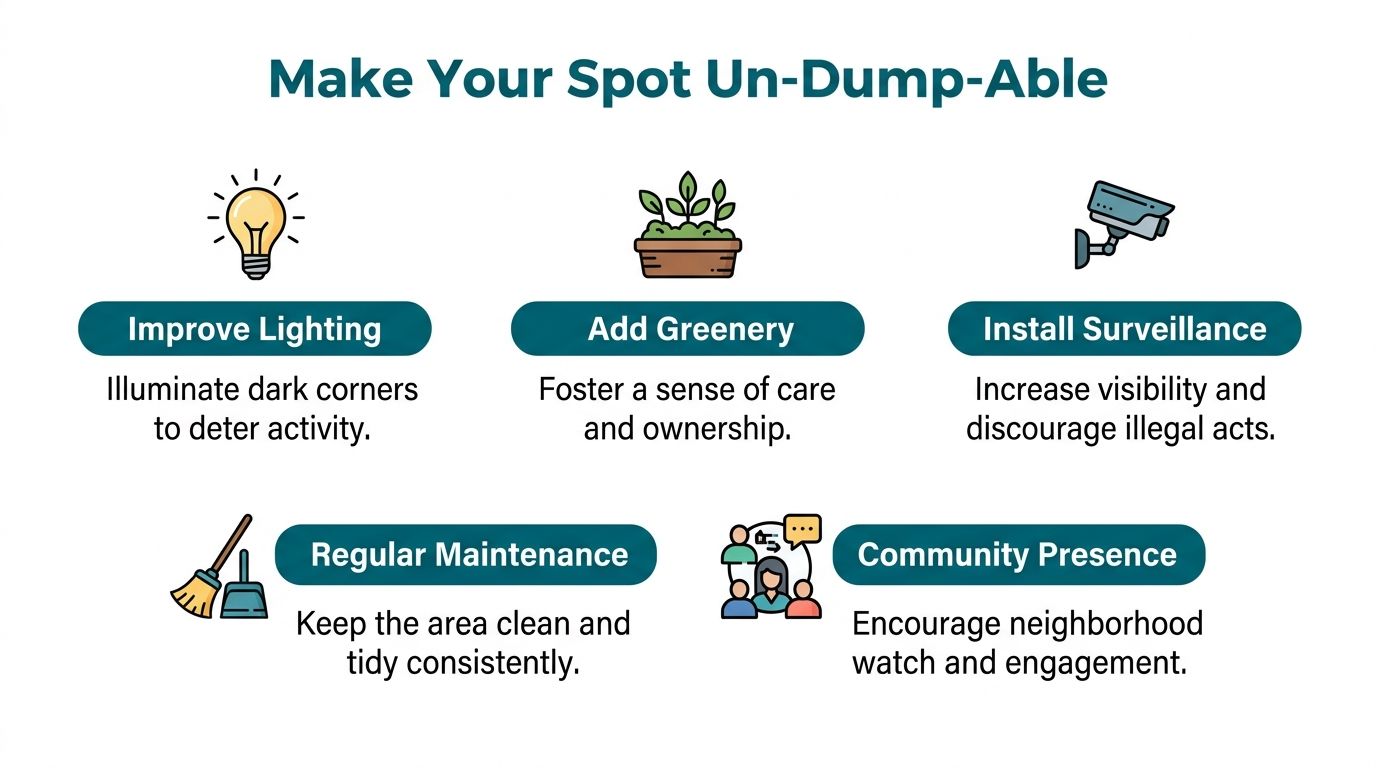
    Make Your Spot Un-Dump-Able

    The fastest way to invite dumping is to let a place look abandoned.

    Dumpers love a spot that feels unloved. Dirt patch, busted fence, no lights, no foot traffic, nobody claiming it. That kind of place is like an unsecured bike outside a train station. You don't have to make your site perfect. You just have to make it feel watched, used, and claimed.

    An infographic titled Make Your Spot Un-Dump-Able with five tips to prevent illegal dumping in areas.

    I think about Tom Sawyer here. He got punished with a fence and turned it into a source of pride. That's how I approach ugly corners. The point isn't to act cheerful about neglect. The point is to flip the script. You make care contagious.

    Make the place feel alive

    I've watched a dead-looking lot change personality with a few simple moves. We cleared the scattered trash, cut back the overgrowth, and gave the edges shape. Once a place has edges, people read it differently. It stops feeling like nowhere.

    Pilot studies show that regular mowing and cleanup make vacant lots less attractive for dumping because they signal active stewardship. Benches, walkways, and high-visibility lighting also remove the secluded feeling dumpers look for, according to this guide on preventing illegal dumping through site design.

    That matches what I've seen with my own eyes. A lot doesn't need to become some fancy mini-park overnight. Even a modest cleanup plus visible care can change behavior.

    Here's the video version of that idea in action.

    Use obstacles that make sense

    You're trying to make illegal dumping inconvenient.

    That can mean beauty. It can also mean friction.

    A few moves work well together:

    • Block the easy drive-in with heavy planters, big rocks, or bollards where cars and trucks usually back up.
    • Light the blind corner with a solar spotlight or other visible lighting.
    • Keep the ground readable by removing scattered debris fast so one bag doesn't invite five more.
    • Give the wall a face with a mural, painted fence, or even bold cleanup signage created by neighbors.

    If you want ideas from groups working on neighborhood care, I'd browse these litter prevention programs and steal what fits your block.

    A quick field table

    Site problem What I'd try first
    Trucks can back right in Planters, rocks, or barriers
    People dump at night Lighting and repeat check-ins
    Lot looks abandoned Mowing, edge cleanup, simple beautification
    Trash returns after each cleanup Faster follow-up and a visible community presence

    A cared-for place is harder to treat like a landfill.

    The point of illegal dumping prevention at the site level is simple. You want the dumper to feel exposed, inconvenienced, and uncertain. You want your neighbors to feel invited. Same block. Different message.

    Build Your Crew Not Just a Volunteer List

    The morning I knew we had something real, three people showed up before sunrise to a nasty little corner lot that kept filling with mattresses and busted cabinets. Nobody asked if enough volunteers had RSVP'd. One neighbor brought coffee in a dented thermos. Another had extra gloves in a grocery bag. We spent two hours hauling wet junk, talking about kids, rent, and who on the block might come next time.

    That is how a crew starts.

    A diverse group of friends smiling and working together on community gardening and home improvement projects.

    A signup sheet can help you count heads. It cannot build trust. Illegal dumping prevention lasts when people feel responsible for each other, not just responsible for a task. On the blocks where we kept the mess from coming back, the difference was never a giant database of names. It was a handful of regulars who knew who needed a ride, who hated lifting tires, and who could make everybody laugh when the work got grim.

    Friendship keeps people coming back.

    Cleanup groups burn out when the whole day feels like free labor with no human warmth. People stay when somebody remembers their name, notices they forgot water, or says, "Take the lighter bags, I got this one." That kind of care turns a Saturday chore into shared ground.

    If you are building from scratch, keep the structure light and the rhythm steady:

    • Start with the people already saying yes. Two committed neighbors beat twenty vague maybes.
    • Use one simple group chat. Fast communication matters more than fancy tools.
    • Pick a repeat time. First Saturday or every other Sunday works better than random calls for help.
    • Give the crew a small identity. A team name, a group photo, or post-cleanup coffee gives people something to belong to.

    If you want practical ways to bring in the right people, these volunteer recruitment strategies can help you start without turning your block into an office job.

    Some of the strongest bonds in our crew were built in bad weather. Cold hands. Muddy boots. A tire that should have taken one person but took three. Those mornings changed people. Neighbors who barely nodded before started checking on each other during the week. Quiet folks began leading corners of the cleanup. A person who came once to "help out" started talking like the block belonged to them, in the best possible way.

    That shift matters. Grassroots dumping prevention works because ordinary people stop seeing themselves as bystanders. They become stewards.

    I would still rather have six steady people than sixty names on a list. Here is what has helped us keep those six coming back:

    If you want Do this
    Better turnout Keep the day and time consistent
    Better retention End with coffee, snacks, or a short hangout
    Better trust Pair new people with regulars
    Better morale Celebrate the strange wins and the hard days

    Litter Caterpillars is one example of a Chicago cleanup group built around recurring meetups and open group chats, which gives neighbors a simple way to join and return.

    People come for the cleanup. They stay because the crew starts to feel like theirs.

    That is the part outsiders miss. We are not just removing trash. We are rebuilding the habit of showing up for one another, and that habit keeps a block cleaner longer than a one-time burst of volunteers ever will.

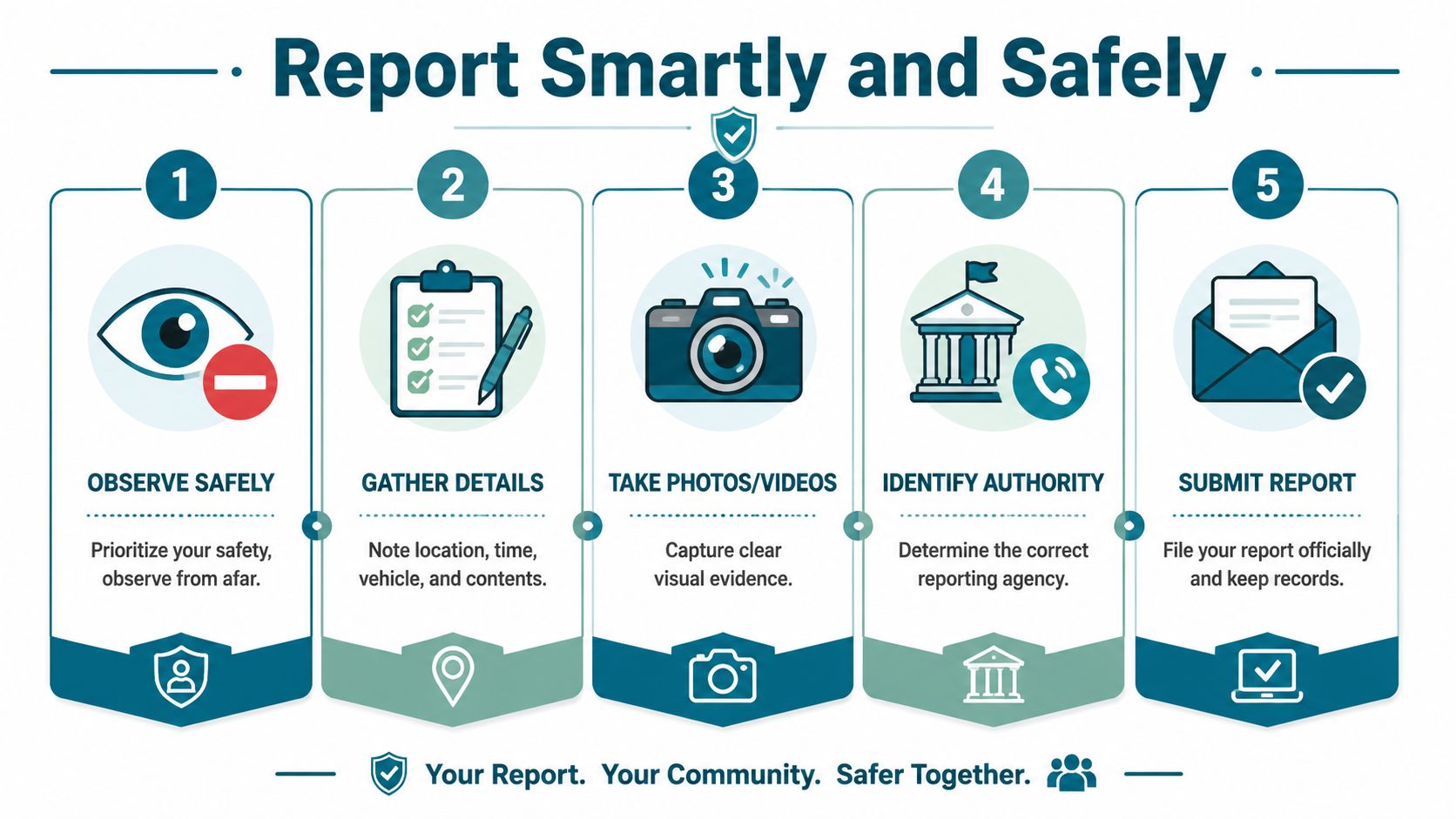
    Report Smartly and Safely

    When you catch fresh dumping or find a new pile, your first job is not to play hero.

    Your first job is to stay safe.

    Too many people feel pressure to confront someone in the act. I get the urge. I really do. But the smarter move is distance, detail, and documentation. You are much more useful to your neighborhood when you gather clear information and go home safely.

    An infographic detailing five numbered steps to report incidents smartly and safely in your community.

    Evidence beats outrage

    A vague complaint is easy to ignore. A precise report is harder to shrug off.

    If you can do it safely, take photos from a distance. Get the whole pile first. Then capture anything that helps identify the dump, like nearby addresses, alley entrances, company names on debris, or vehicle details if that can be done without risk.

    Use this sequence:

    1. Observe from afar
      If someone is present, don't confront them.

    2. Record the location
      Use the exact address or the nearest cross streets and which side of the alley or lot the waste sits on.

    3. Describe the contents
      Say what's there in plain words. Construction debris, furniture, black bags, tires, appliance parts.

    4. Submit through the right channel
      In Chicago, that often means 311.

    5. Keep your own record
      Save the photos, date, and report confirmation if you get one.

    Know the stakes

    Good reporting matters because the penalties can stack up.

    In Chicago, illegal dumping carries a mandatory fine of at least $300 and up to $600 for each offense, and each day the violation continues can count separately under Chicago Municipal Code 7-28-710.

    That doesn't mean every report leads to consequences. It means your documentation has real value when the city has enough detail to act.

    If you report, report like someone who wants the case to move.

    Protect yourself first

    You don't owe anyone a face-to-face confrontation.

    If you're worried about retaliation, stay even more disciplined. Shoot from farther back. Don't linger. Don't argue. Don't post identifiable details publicly while you're still near the site. Keep the chain simple and official.

    Illegal dumping prevention works better when residents act like calm witnesses, not street enforcers. Your power is in the record.

    Find Your Allies in City Hall

    A report is a transaction. A relationship is a tool.

    Once I learned that, things got easier.

    For a long time, I treated city government like a giant brick wall. You complain, wait, and maybe somebody somewhere sends a truck. But when your crew has field notes, cleanup photos, dates, and a clear ask, the whole interaction changes. You stop sounding like a person venting into the void. You sound like a neighbor who is already doing the work and needs one specific hurdle overcome.

    Show up as a partner

    Your local officials can help with things you can't do alone. They can point you toward the right department, help with special pickups, connect you with property owners, and sometimes support improvements on neglected land.

    I've had much better luck when I send a short message that includes:

    • Who we are
      A neighborhood cleanup crew or a few residents who have been working one site.

    • What we've seen
      The pattern, not just one ugly incident.

    • What we've done
      Cleanup dates, basic documentation, before-and-after photos.

    • What we need
      A sign, a pickup, contact with a landlord, guidance on the lot, or a meeting.

    That last part matters. Ask for one next step, not ten.

    Property owners matter more than people think

    Some blocks get trapped because everybody blames “the city” when the primary choke point is a private owner who stopped caring.

    That's why official connections matter. A survey of successful programs found that 73.1% of respondents rated “Business & Landlord Engagement” as a highly effective intervention, according to the Mattress Recycling Council's illegal dumping best practices report.

    I've seen this play out in a very ordinary way. A lot stays filthy for months. Neighbors keep cleaning the edges. Reports go in. Nothing sticks. Then one conversation finally connects the crew, the office, and the owner or manager who can authorize access, cleanup coordination, or a barrier fix. Suddenly the logjam breaks.

    Bring receipts and invite them outside

    Email is useful. Walking the site together is better.

    If you can get an alderperson's office, ward staffer, or another local official to visit your ground zero, do it. Let them stand where you stand. Let them see the blind corner, the tire ruts, the alley access, the weak fence line.

    People move faster when they can smell the problem.

    That's not about drama. It's about clarity. Your photos help. Your notes help. But a real site visit makes the ask concrete. You are no longer one more complaint in a crowded inbox. You are the organized neighbor who already picked up bags, mapped the problem, and came ready to work with them.

    That's the lane. Stay in it.

    The Real Win Is Keeping It Clean

    On our block, the first cleanup felt like a victory parade. We filled truck beds, stacked busted furniture at the curb, and took the photo everybody takes when a place finally looks like someone loves it again. Four days later, a torn mattress and three contractor bags showed up in the same corner.

    That was the lesson.

    A single cleanup can change the mood of a block. Keeping a place clean changes its future. The work gets quieter after the first big push, and that quieter work is what decides whether a dumping spot dies or keeps coming back.

    I've watched good people burn themselves out by treating one Saturday like the finish line. Then the next mess lands, and it feels personal. It isn't. It usually means the spot still has easy access, weak visibility, or no regular set of eyes on it. A comeback pile does not cancel what you did. It tells you where the next layer of the job is.

    Stewardship beats one-time heroics

    The cleanest corners I know are not maintained by superheroes. They're held by neighbors with a rhythm.

    On one alley we worked, an older guy walking his dog every morning became the first line of defense without ever calling himself an organizer. He noticed new debris fast. A younger neighbor snapped photos and filed reports. Another person could handle a quick bag pickup when it was safe. Nobody did everything. Together, they kept the spot from sliding back into that familiar signal every dumper reads instantly: nobody's watching.

    A simple rotation works:

    • One watcher who notices changes early
    • One reporter who sends clear photos and location details
    • One fixer who handles small, safe touch-up cleanup
    • One connector who keeps nearby neighbors in the loop

    That little bit of structure matters more than hype. A place stays cleaner when care becomes routine.

    Ask why people dump here

    We learned this the hard way too. Some sites attract dumping because they feel hidden. Others attract it because getting rid of bulky trash legally is expensive, confusing, or both.

    Those causes need different answers.

    Research on illegal dumping has found that cost and disposal access can drive the problem, and Los Angeles sanitation officials reported sharp drops in dumping in some areas after free bulky-item collection efforts were expanded, as noted in the City of Los Angeles Bureau of Sanitation report on illegal dumping prevention and bulky item strategies. That matches what we see on the ground. If legal disposal is hard to reach, some people choose the alley and hope nobody stops them.

    So ask the plain question. Is this spot getting hit by opportunists, by contractors dodging fees, by neighbors with no easy pickup option, or by all three? The answer changes your next move.

    Keep the human goal in view

    A clean lot gives people room to breathe.

    You notice it in small ways first. Kids stop skirting around broken glass. The woman from two houses down lingers on the sidewalk instead of rushing past. Somebody drags out a chair. Somebody plants flowers by a fence that used to collect trash. The space starts acting like part of the neighborhood again.

    That is why we keep showing up.

    We may begin with grabbers, gloves, and a pile that makes everybody angry. If we stay with it, we end up with something bigger than a cleanup. We build trust. We build habits. We help each other believe that a block does not have to stay the way we found it.

    Illegal dumping prevention works best when regular people decide a place is worth defending, then keep proving it in public.

    If you want to do this with other people who already know the rhythm of weekend cleanups, hard weather, and stubborn blocks, join Litter Caterpillars. Bring gloves, bring a friend, and start with one mess. That's enough.

  • Green City Project: A Practical Guide to Local Success

    Green City Project: A Practical Guide to Local Success

    The first time I went out to pick up trash, there were three of us, cold hands, cheap gloves, and sky that looked like trouble. Then Chicago threw hail at us, every Uber canceled, and I remember thinking, weirdly, that this was the most alive I'd felt in a long time.

    That's where a green city project can begin. Not with a grant. Not with a board meeting. With one ugly corner, one honest reason, and one day when you decide you're tired of walking past the mess.

    Finding Your 'Why' Behind the Project

    I didn't start outside because I had my life together. I started outside because I didn't.

    My apartment was a museum of stalled decisions. Old jars in the fridge. Half-used bags of food from failed health kicks. Random objects with sentimental stories attached to them like little anchors. Any normal piece of trash weighed almost nothing, but to me it felt like it weighed a truckload. I could see the mess. I hated the mess. I still couldn't move it.

    Then one relationship in my life blew up in the way bad relationships do. Chaos, selfishness, too much noise, too little honesty. After that, I made a promise to myself. I'd build a life around cleanliness, consistency, and bravery, even if I had to do it in a crooked, awkward way at first.

    So I tried something sideways. If I couldn't clean my own mess, maybe I could clean up someone else's.

    A young woman reflecting on a green city project with sustainable home and business ideas sketched around her.

    Start with the pain you can feel

    That first reason matters more than people think. If your reason is thin, your project dies the first time it rains. If your reason is personal, you'll keep going when it gets annoying, lonely, or embarrassing.

    Maybe your why is simple:

    • Your block embarrasses you: You're tired of guests stepping around fast-food wrappers.
    • Your kid noticed the litter: That kind of comment gets under your skin.
    • You need better friends: You want to meet people who wake up to give, not just to consume.
    • You need a reset: Service is sometimes the fastest way to stop obsessing over yourself.

    A lot of people wait for a polished mission statement. I think that's backward. Your first why can be rough. It can be selfish in the healthiest sense. You want to feel stronger. You want to trust yourself again. Good. Use that.

    Practical rule: Don't start by asking, “What citywide plan should I create?” Start by asking, “What corner am I willing to care about every week?”

    Big institutions usually think about green cities from high above. The term itself has often been used in large benchmark projects. The Siemens Green City Index summary evaluated over 120 cities worldwide, and the North American edition rated 27 cities across the U.S. and Canada using indicators like CO2 emissions, water, waste, transport, and energy use.

    That kind of work is useful. It helps cities compare real systems instead of just slapping a green label on themselves.

    Your small start is an advantage

    But you and I don't need to begin at that altitude.

    You can begin with a bus stop full of cups. An alley behind your building. A vacant lot everyone has given up on. Large systems matter, but local courage matters too. You can move faster than a committee because your project has a heartbeat.

    If you need a push because you're still circling the idea, look at this guide on how to find volunteer work that actually fits your life. Don't overthink your identity before you act. Action is what reveals identity.

    I've learned that a good green city project doesn't begin when you feel ready. It begins when your discomfort finally gets a direction.

    From Idea to Your First Cleanup

    Our first cleanup was half joke, half dare, half spiritual experiment. Yes, that's three halves. That's what it felt like.

    There were only three of us. We picked a spot, showed up, and then got hit by a freak spring hailstorm. We hid under a tree, shaking, laughing, checking our phones while ride after ride disappeared. It was miserable in the way a camping trip can be miserable. You're wet, your plans are broken, and later it becomes the only story anyone wants to hear.

    That day taught me something useful. You don't need an elegant launch. You need a start.

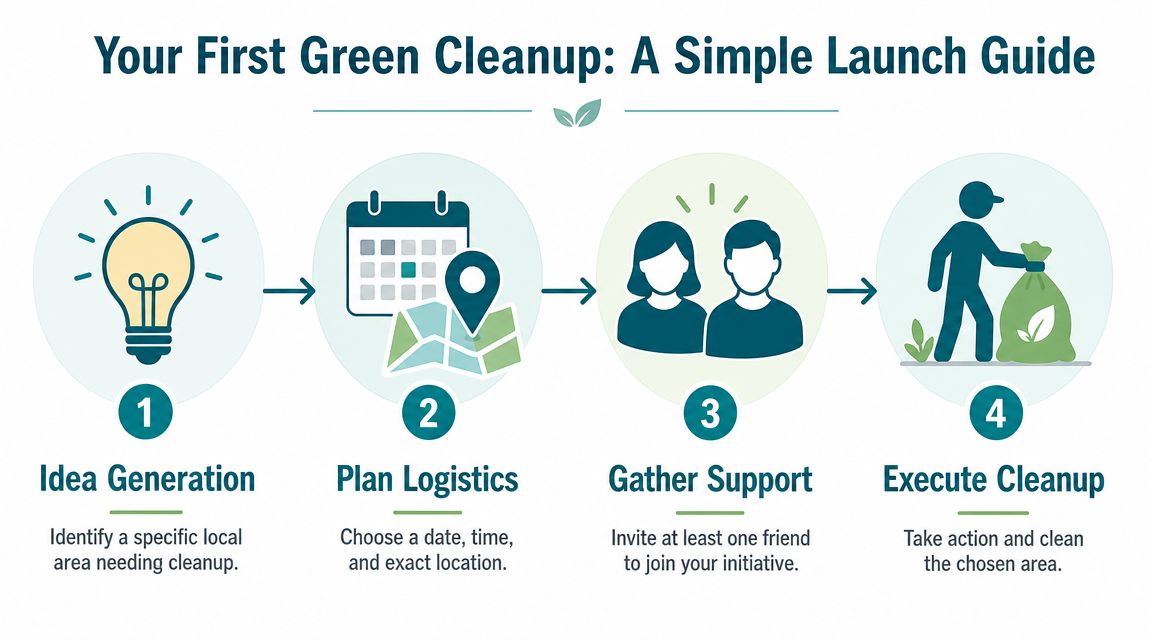
    A four-step infographic illustrating a simple guide for launching a local green cleanup project.

    Pick a target you can finish

    Your first cleanup should be almost embarrassingly manageable. Don't announce a mission to transform your entire city. Pick one place where success is visible.

    I like spots with a clear border:

    1. A single block
    2. One park edge
    3. One alley
    4. A bus stop corridor
    5. A lot line near a fence

    When you finish a defined area, people feel the win in their body. They can see before and after without needing a chart.

    The logic here matches how bigger planning methods often work. The Cambodian Green City Strategic Planning Methodology starts by defining goals and priority actions before trying to tackle everything at once. That's not city-hall-only advice. That's street-level advice too.

    Use the ugly simple plan

    You can launch your first cleanup inside a week if you do this:

    • Choose the place: Walk it first. Make sure you know where people can meet.
    • Set a date: Weekend mornings work well because people show up fresh and less distracted.
    • Invite one friend: One reliable person beats ten vague maybes.
    • Bring basic gear: Gloves, trash bags, hand sanitizer, water.
    • Decide your finish line: One hour, ninety minutes, or “until this block is clear.”

    That's enough.

    I've seen people spend more time designing a logo than choosing a corner. Don't do that. A green city project lives or dies on repeated action, not on branding at the start.

    If you can put a date on a calendar and a pin on a map, you're already farther along than most people with “big ideas.”

    Make the first event easy to join

    Your invitation should sound like a human wrote it.

    Try something like this:

    What to say Why it works
    “I'm cleaning this block Saturday morning. Want to join?” It's direct and casual.
    “No experience needed. I'll bring supplies.” It removes friction.
    “We're only out for an hour.” It respects people's time.
    “Come even if you're shy.” It gives nervous people permission.

    You don't need to impress people. You need to lower the emotional cost of showing up.

    If you want a model for organizing a first event in a simple, public way, look at a live example of a volunteer trash pickup listing. Notice what matters. Date. place. expectation. That's the skeleton.

    Let the first cleanup be a little imperfect

    Rain might come. Someone might cancel. You might bring the wrong gloves or forget water or realize the lot is nastier than you thought.

    Good.

    Your first event should leave you with three things:

    • A visible result
    • A story
    • A reason to do it again

    The hailstorm gave us all three. It was cold and ridiculous, but it proved the idea had teeth. If people are willing to freeze a little and still laugh, then you've found something stronger than convenience.

    Building Your Crew and Keeping Them Safe

    A cleanup group is only as healthy as the people inside it. If volunteers feel unsafe, confused, or used, they won't come back. If they feel protected and welcomed, they bring their friends.

    I learned early that I had to treat volunteer energy like a flame in high wind. It can light a whole block. It can also go out fast.

    A group of diverse volunteers in high-visibility vests picking up litter in a green city park.

    Safety first means real scouting

    Before I ask anyone to join me at a site, I try to walk it myself. I'm looking for the obvious stuff and the annoying stuff.

    Here's what I check:

    • Traffic risk: Fast corners, blind turns, bad shoulders, aggressive merging.
    • Ground risk: Broken glass, needles, metal, deep mud, unstable surfaces.
    • Weather exposure: Not just rain, but heat, wind, icy patches, and poor shade.
    • Exit options: Where can people stop, rest, or leave if something goes wrong?

    Formal green city planning often uses broad criteria like water, waste, transport, climate impacts, and disaster frequency. The Global Green Growth Institute guidelines frame green city work through systems and local risk awareness. At our scale, I translate that into one basic rule. Know the environment you're bringing people into.

    That means you don't just ask, “Is there trash there?” You ask, “Can I bring people here and keep them safe?”

    Protect people before you try to inspire them

    I keep my volunteer-first philosophy simple.

    Priority What it means on the ground
    Safety I won't run a cleanup in conditions that feel reckless.
    Happiness I want people to leave lighter than they arrived.
    Dignity I don't pressure volunteers for money or guilt them into more.

    Many groups inadvertently burn out the very people they depend on. They ask too much, communicate poorly, and act like sacrifice is endless. It isn't.

    If you're building your own crew, read through these volunteer management best practices. Even if your group is tiny, habits form early.

    Build a crew, not a roster

    A list of names isn't a community. A community is what happens when people remember each other's stories.

    I like weekend mornings for a reason. The people who come out then are usually ready to give something of themselves. That creates a different kind of group chemistry. Less flaky. Less performative. More grounded.

    Ways to turn strangers into teammates:

    • Use a group chat: It keeps momentum between events.
    • Learn names fast: Nothing warms a group quicker.
    • Give people jobs: One person hands out gloves. One tracks bags. One watches traffic.
    • End with a small ritual: Coffee, snacks, a group photo, even a goofy cheer.

    Here's a look at the kind of spirit that helps a crew stick together over time.

    Field note: People return when the work feels meaningful and the atmosphere feels safe. They don't return because your signup form was impressive.

    You also need to be honest about your limits. If a site feels sketchy, skip it or redesign the event. If the weather is nasty in a dangerous way, cancel. Bravery is real. So is common sense.

    I'd rather have a group that lasts than one dramatic day that scares everyone off.

    Creating an Identity People Are Proud Of

    Trash pickup can feel like punishment if you frame it badly. That's why identity matters.

    I think about Tom Sawyer and the fence all the time. He turned boring labor into something people wanted to join. I'm not interested in tricking anybody, but I am interested in the same human truth. People want to belong to something that feels honorable, brave, and alive.

    Give the work a flag

    Most volunteer groups stop at logistics. Date, time, supplies, done. That gets bodies to a site, but it doesn't always build pride.

    Pride is useful when it's tied to service.

    A strong green city project has cultural signals. Maybe that's a flag. Maybe it's a phrase you repeat. Maybe it's a shared playlist on the drive home. In our case, flags, badges, and a theme song helped turn “I picked up trash once” into “I'm part of something.”

    That sounds small until the work gets hard. Identity is what gets people out of bed when novelty has worn off.

    Use symbols honestly

    You don't need to fake intensity. You just need to make goodness feel bold.

    Try a few things:

    • A name people can wear proudly: It should feel alive in conversation.
    • A simple visual marker: Pins, patches, stickers, gloves in one color.
    • A repeatable ritual: Group photo, chant, snack stop, post-cleanup walk.
    • Language with backbone: Words like bravery, kindness, unity, grit.

    Sports teams do this. Countries do this. Clubs do this. Human beings like banners. We like songs. We like the feeling that our effort belongs to a story bigger than one Saturday morning.

    A broom in your hand feels different when you think, “I'm helping out,” versus “This is who I am.”

    Make service feel like a privilege

    At this point, a lot of leaders get squeamish. They worry that making volunteer work feel special somehow cheapens it.

    I think the opposite is true.

    If your group treats cleanup like a sad obligation, people will feel that. If your group treats service like a proud act of courage, people rise to it. They stand taller. They invite friends. They wear the shirt.

    You don't need hype. You need meaning that people can feel in their chest.

    And the best part is that identity doesn't cost much. A handwritten sign, a shared joke, a song on someone's phone, a nickname for your regulars. Those things create glue. Once your group has glue, the work stops feeling like random labor and starts feeling like a mission people chose with open eyes.

    Expanding Your Impact Beyond Trash Pickup

    At some point, the cleanup ends and you keep staring at the space.

    That's when your project starts changing shape.

    I've felt that shift on blocks where we came back again and again. At first you notice the litter. Then you notice the busted fence, the dead corner, the empty lot, the way everybody walks past like the place is already lost. If you keep showing up, your eyes change. You stop asking, “How do we clean this?” and start asking, “What could this become?”

    Consistency earns bigger chances

    We grew by doing the unglamorous thing over and over. Weekly cleanups. Rain. Heat. Bitter cold. The city started to feel less like a set of separate neighborhoods and more like one giant body with sore spots.

    Then odd opportunities appeared.

    A bigger event needed cleanup help along a major route. We said yes. Later, an empty lot became more than an eyesore in our minds. It became a possible future park. That kind of leap sounds huge when you say it fast, but it doesn't feel huge when it grows out of regular work. It feels like the next honest step.

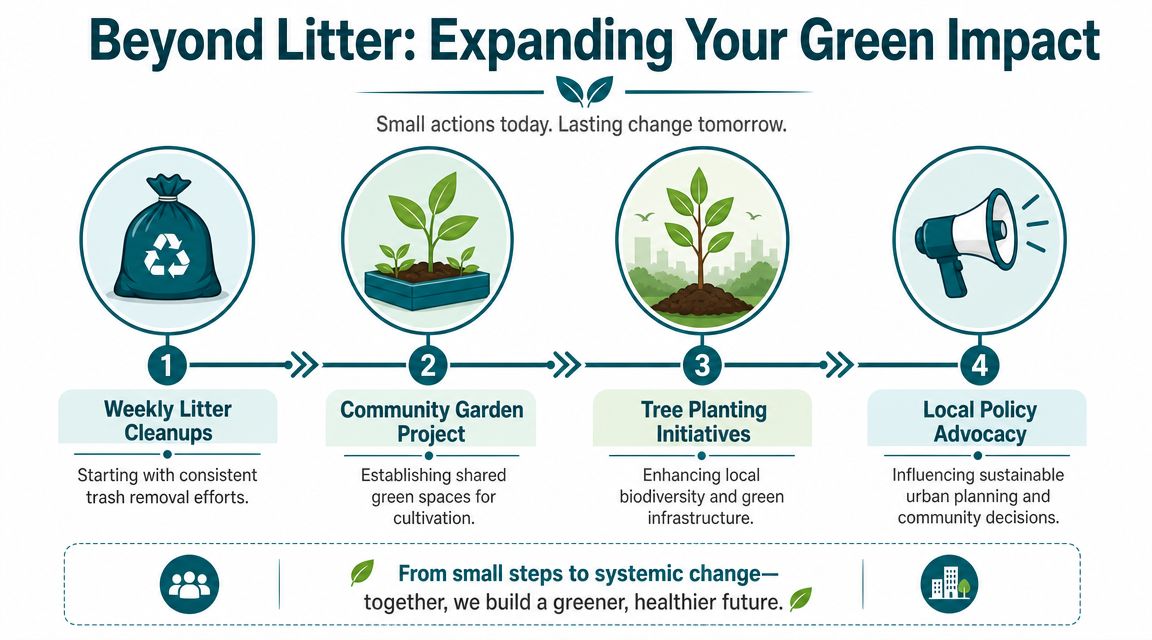
    An infographic showing four steps for expanding green impact: litter cleanups, community gardens, tree planting, and policy advocacy.

    Think in layers, not in leaps

    A local green city project often grows best in this order:

    Layer What it looks like
    Cleanup Repeated litter removal in one area
    Stewardship Returning, monitoring, reporting, caring
    Transformation Planting, beautifying, repairing, reusing land
    Partnership Working with neighbors, businesses, event organizers, or city staff

    People get stuck because they jump from “one cleanup” to “citywide movement” in their head. That gap is too wide. Layers are easier.

    One lot. Then repeated care. Then a small physical improvement. Then a larger ask.

    Ask for the next thing, not the final thing

    When you approach a partner, don't pitch a fantasy. Pitch the next visible step.

    That might mean:

    • Borrowing tools
    • Getting permission to access a site
    • Finding a place for bag disposal
    • Asking a nearby business for water or storage
    • Raising support for one specific lot improvement

    Many projects often drift into vague mission language. I try to avoid that. Many green initiatives have big ideals but weak outcome reporting. The current Green City Project site leaves a real opening for clearer, tangible results, and that's the lesson I take from it. If you want people to believe in you, show them a changed place they can point to.

    One solid lot transformed beats a thousand dreamy sentences about change.

    That's how you expand without getting fake. You let the ground itself make the argument.

    If you want examples of different cleanup formats, neighborhood actions, and recurring volunteer work, Litter Caterpillars is one group that organizes public trash pickup events in Chicago through open signups and recurring meetups. That kind of repeated public action is one workable model. It isn't the only model, but it shows how consistency can build enough trust for bigger projects later.

    Measuring What Matters and Sustaining Momentum

    People love asking for one clean metric. How many bags? How many pounds? How many blocks? I understand the urge. Numbers feel solid.

    But if you run a green city project long enough, you learn that one metric can lie to you.

    A rough site can produce lots of trash one week and less the next. A smaller cleanup can be harder and more useful than a big easy one. A volunteer who comes once and then changes their whole weekend routine has experienced a real victory, even if your spreadsheet barely notices.

    Don't worship a single score

    Project success is slippery because local conditions change everything. Culture changes it. Money changes it. Weather changes it. Capacity changes it. One commentary on project outcomes says it is almost impossible to measure success accurately with a single global metric because local conditions shape results so heavily. The same piece points to a smart-sustainable-cities report where 60% of surveyed initiatives focused on planning, while 25% emphasized Smart Living and 21% Smart Environment, and it also notes bottlenecks like interoperability, mixed data sources, and low capacity to connect data to analytical models in implementation work, as discussed in this project success commentary.

    That lands with me because I've seen groups become obsessed with planning and image while the ground stays dirty.

    Track what keeps the project alive

    I care about a different set of questions.

    • Did we show up again?
    • Did people feel safe?
    • Did anyone make a friend?
    • Did someone become braver because they came?
    • Did we leave the place better than we found it?

    Those aren't soft questions to me. They are survival questions.

    The project lasts when it gives people energy back. If every cleanup drains your crew, the calendar will eventually go blank.

    You can still keep simple records. Attendance notes. Photos. Repeated locations. Specific site changes. Those things help. But don't confuse easy-to-count with most important.

    Momentum comes from rhythm

    Burnout usually doesn't arrive with a trumpet. It creeps in subtly. One skipped week. Then two. Then the group chat gets stale. Then the project becomes a memory everyone still “cares about.”

    Rhythm fights that.

    A few ways I protect momentum:

    1. Keep the schedule predictable. Same general time pattern beats constant rescheduling.
    2. Make the events finite. Leave people wanting a little more.
    3. Let people rest without shame. Guilt is a bad fuel source.
    4. Celebrate tiny wins. Clean curb line. New regular. A volunteer who smiled all morning.

    The true measure of a green city project is whether it keeps changing both the place and the people. If the street gets cleaner while your volunteers get steadier, kinder, and more connected, that's success I can trust.


    If you want a real-world place to plug in, Litter Caterpillars runs volunteer-driven Chicago cleanups built around bravery, kindness, unity, and a volunteer-first approach. Join an event, meet good people, and start building your own version of a green city project one block at a time.

  • Litter Clean Up: Plan a Community-Driven Effort That Sparks Change

    Litter Clean Up: Plan a Community-Driven Effort That Sparks Change

    Picking up litter is about so much more than just, well, picking up litter. It’s a way to take back your neighborhood and find a little bit of clarity for yourself. It’s how you turn a trashed-out street corner into something you're proud of, proving that small, steady actions can make a huge, visible difference. I wrote this guide as your playbook for turning that simple idea into a movement.

    Find Your Why and a Place to Start

    I know the feeling. Life gets messy, and the very idea of cleaning up your own space feels like trying to climb a mountain. I've been there. The dishes are piled high, the laundry basket is a monster, and every single piece of clutter seems attached to some memory or emotion that makes it impossible to touch.

    But I stumbled on a secret, a kind of life hack for the soul: cleaning up someone else's mess is a thousand times easier. There’s a strange freedom in it.

    Two women in coats clean litter around a tree, one bagging trash, the other using a grabber.

    From Personal Chaos to Community Action

    My whole journey with Litter Caterpillars kicked off when my own life felt like a total train wreck. The mess in my apartment was a perfect reflection of the chaos in my head. A physical manifestation of my internal static. So, instead of trying to tackle my own disaster, I decided to go after the mess in my neighborhood. It just felt more manageable, something with a clear beginning and end.

    That one decision led me to organize a tiny cleanup with just two friends. Of course, this is Chicago, so a freak hailstorm decided to crash our party. We ended up huddled under a tree, absolutely freezing, watching Ubers cancel on us one by one. And right there, in that moment of shared, ridiculous misery picking up soggy chip bags, we found something real.

    We found clarity.

    That's the unexpected magic of a litter cleanup. You go out thinking you’re going to fix a little piece of the world, and you end up fixing a little piece of yourself. It cuts through the noise. It gives you a real, tangible win in a world that often feels way too complicated.

    You're Not the Only One Who Feels This Way

    This urge to do something, to make a real impact, is a global thing. It’s universal. Look at World Cleanup Day—it shattered records by getting 25 million volunteers on the streets worldwide, with the story reaching a staggering 2.4 billion people through media. That’s a massive wave of regular people deciding to roll up their sleeves and create change, block by block.

    It's the same fire that gets our group out there every single week, hitting all 50 wards of Chicago, even the spots people tell you to avoid. You can read more about this incredible global effort and see how your own cleanup connects to a much bigger story.

    That small act of leaning into a little chaos on a stormy day was the first step in turning my own life around. It taught me that sometimes, the best way to move your own story forward is to step outside of it for a minute and serve something bigger than yourself. A litter cleanup can be that perfect first chapter for you, too.

    Assemble Your Crew and Scout a Location

    First things first: you can’t do this alone. And honestly, you wouldn't want to. The real magic of a cleanup isn’t just the trash you bag; it’s the stories you swap and the friendships you build doing something that actually matters.

    Trying to tackle a big mess by yourself is like trying to move a piano solo. You might budge it an inch, but you'll just end up wiped out and frustrated. Bring a few friends, and suddenly it’s not just doable—it’s an adventure.

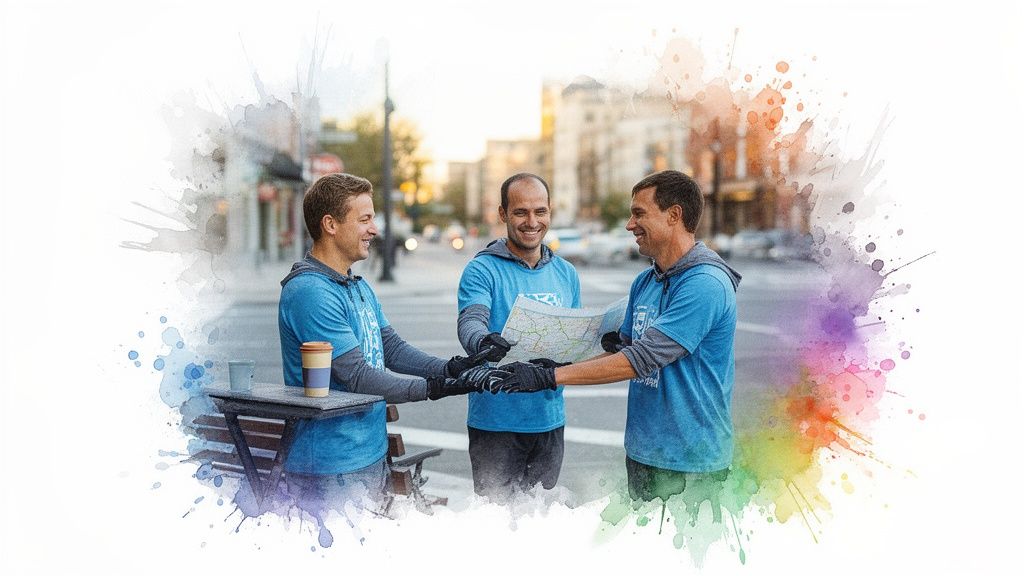
    Three smiling men in blue shirts and gloves discuss a map outdoors during a community event.

    Finding Your First Volunteers

    Let's get one thing straight: recruiting doesn't have to be some awkward, salesy pitch. You don’t need to be a charismatic leader or a social media guru. You just have to be real and make the ask simple. Your goal is to find the 'givers'—the kind of people who are just naturally wired to show up.

    I’ve found the best filter for finding these people is scheduling cleanups on weekend mornings. It’s a natural barrier. The ones who drag themselves out of bed at 9 AM on a Saturday are the ones you can build a movement with. They're your people.

    Here are a few low-pressure ways to get your first crew together:

    • The Personal Text: Shoot a message to a couple of friends you know care about the neighborhood. "Hey, I'm doing a quick litter blitz on Saturday morning at [Park Name]. Want to join? No pressure, but it'd be cool to do it together."
    • The Social Media Post: Snap a picture of a spot that's been bugging you and throw it on your Instagram story. Keep it simple: "This corner needs some love. I’m going to clean it up this weekend. DM me if you want to help!"
    • The Group Chat Invite: Drop a line in a group chat—coworkers, neighbors, whatever. You’ll be surprised who raises their hand when given the chance.

    If you want to go deeper on building your team, check out our guide on how to find volunteers who are genuinely committed. It’s full of strategies that have worked for us time and time again.

    How to Scout the Perfect Location

    Once you have a few people saying "I'm in," it's time to choose your battlefield. This is one of my favorite parts. It’s where you start seeing your city with new eyes—not just looking for dirty streets, but for opportunities to make a huge, visible dent.

    A great location is like a good story; it needs a clear beginning, middle, and a satisfying end. I don’t just pick a random block. I look for what I call high-impact zones. These are places that are super visible but constantly ignored. Think about spots like:

    • The grassy medians along a busy road.
    • The forgotten corners of a neighborhood park.
    • The alleys behind local shops.

    These spots are perfect because the transformation you create is immediately obvious to hundreds, if not thousands, of people every single day. It sends a powerful message that someone cares.

    The best cleanups aren't about covering the most ground. They're about creating the most dramatic "before and after" picture in a place that people see every day. That’s how you inspire others to join in.

    When you're out scouting, look for a route that's both safe and satisfying. A good route is usually just a few city blocks long, letting your team focus their energy and see a tangible result in an hour or two. Steer clear of areas with dangerously high-speed traffic or no sidewalk. Your crew's safety is everything.

    Remember, up to 40% of roadside litter comes from unsecured loads falling off trucks. This means hitting major roads can deliver that massive visual payoff you're after. Choosing your spot is where your vision starts to take shape. You're not just picking up trash; you're curating an experience that leaves everyone feeling proud and accomplished.

    Gather Your Gear for a Safe and Effective Cleanup

    Think of it this way: you wouldn't head out for a hike in the woods without water, good shoes, and a map, right? Showing up to a cleanup unprepared is the same deal. It's not just less effective; it can be risky. The energy and enthusiasm of your volunteers is everything, and your number one job is to keep them safe so they can focus on the mission.

    Having the right gear isn't about being fancy—it's about being smart. Good equipment is the armor that protects your crew from the unexpected. It’s the shield.

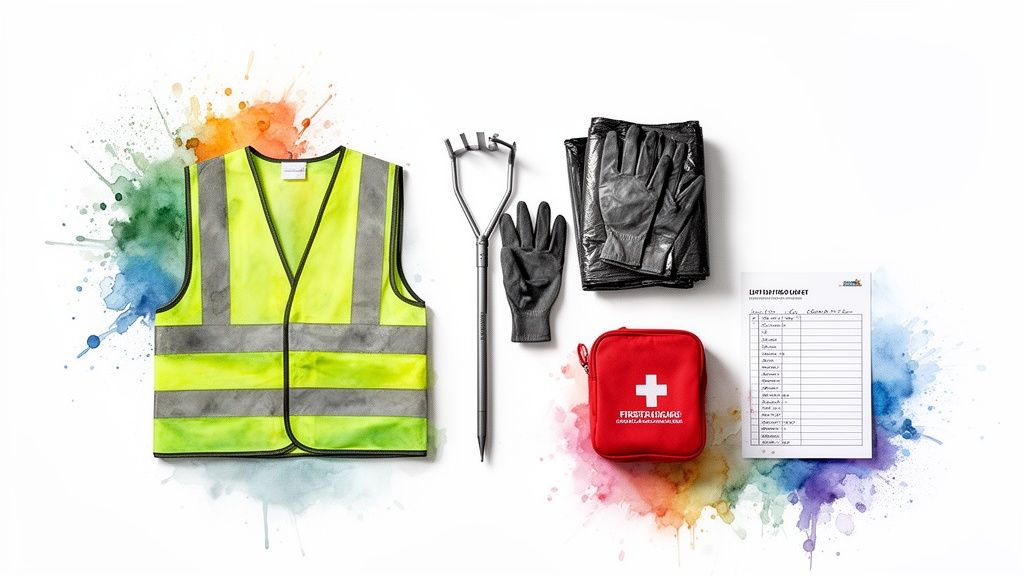
    A flat lay of safety and clean-up equipment, including a vest, picker, gloves, and first aid kit on a watercolor background.

    The Essentials Your Cleanup Crew Needs

    After three years of weekly cleanups in every kind of Chicago weather, I've learned what you absolutely can't skip. You don’t need a massive budget, but you can’t skimp on the basics. I keep a simple "go-kit" that's ready for every single event.

    Here are the non-negotiables for your kit:

    • Heavy-Duty Gloves: Forget those flimsy, disposable things. You need thick, puncture-resistant work gloves for every single person. This is your first line of defense against broken glass and sharp objects.
    • Durable Trash Bags: Spring for the contractor-grade bags. Yeah, they cost a bit more, but they won't bust open and spill a morning's hard work all over the sidewalk. Trust me, you don't want to learn that lesson the hard way.
    • Litter Grabbers: These are total game-changers. They save your back from bending over a hundred times and create a safe buffer between you and whatever you're picking up.
    • High-Visibility Vests: If you're cleaning anywhere near a street, these are a must. They make your team impossible to miss, which is crucial for staying safe around traffic.

    A great pro-tip: check with your local government. Many cities have programs to support volunteer groups. Your local sanitation or public works department might hook you up with bags, gloves, and even vests for free. All you have to do is ask!

    Your Essential Cleanup Gear Checklist

    Here's a quick reference guide to make sure you have all the must-have supplies before you head out.

    Category Essential Items Pro Tips
    Personal Safety Thick work gloves, high-visibility vests, closed-toe shoes Bring a few extra pairs of gloves. Someone always forgets!
    Cleanup Tools Litter grabbers/pickers, heavy-duty trash bags Bring a few buckets for collecting sharp items like glass or needles separately.
    Health & Comfort First-aid kit, hand sanitizer, water bottles, sunscreen Pack extra water, especially on hot days. Hydration is key.
    Waste Disposal Designated bags for recycling vs. trash, sharps container (optional) Know your local disposal plan in advance. Don't just leave bags by a can.

    Having this stuff ready to go makes everything run smoother and shows your volunteers that you've got their back.

    The Safety Briefing That People Actually Hear

    Before anyone picks up a single piece of trash, you have to run through the safety rules. I know, it sounds like a boring lecture. But it’s all in how you frame it. Don't just read a list of rules; tell a story and connect with your crew.

    I start every event with a quick, five-minute huddle. I make eye contact, keep the energy positive, and focus on the why behind the rules. It's not about being bossy; it's about making sure we can all come back and do this again next week.

    A safety briefing isn't a lecture; it's a pact. It's the moment you all agree to look out for each other. You’re building a team, not just handing out assignments.

    Here’s what I always cover in my briefing:

    1. "If You Don't Know, Don't Touch": This is my golden rule. Needles, sketchy-looking chemical containers, or anything that feels off gets left alone. We mark the spot and report it.
    2. The "Buddy System" on Busy Streets: No one cleans along a busy road by themselves. Period. One person works while a spotter keeps an eye on traffic.
    3. Hydration and Breaks: I always remind everyone that this isn't a race. Listen to your body, take breaks, and drink water. Burnout is the enemy of any long-term movement.

    Dealing with potentially dangerous items is a real part of this work. To get the full rundown, you can learn more about how to handle hazardous waste disposal from our city partners. This knowledge gives your team the confidence to make smart, safe decisions.

    Leading the Cleanup and Making It Fun

    Alright, the moment is here. Your volunteers are rolling in, the sun is out (or maybe it’s hailing, Chicago-style), and it’s time to kick this thing off. This is where all that prep work pays off and the real fun begins.

    You’re not just managing a crew; you’re leading an experience. It’s on you to set the tone from the very first minute. I call this the "Tom Sawyer" principle. Remember how he tricked his friends into believing that painting a fence wasn't a punishment, but a privilege they should pay him for? That's our cleanup. It’s an adventure, not a chore.

    Kicking Things Off with Energy

    As your first volunteers arrive, greet them with real excitement. A simple "I'm so glad you're here!" makes a huge difference. This isn't some corporate meeting; it's a gathering of people who decided to do something awesome together.

    Once everyone’s there, I pull them into a quick huddle. I keep the intro short, hit the safety basics we covered earlier, and then I crank up my portable speaker. A killer playlist is non-negotiable. It instantly changes the vibe from "work" to a block party.

    Another thing I always bring is our Litter Caterpillars flag. The second we finish a particularly nasty stretch, we plant it. It might sound goofy, but it's a powerful symbol of victory. It screams, "We were here, and we made this place better." These little rituals build a shared pride that keeps everyone going.

    This is more than just picking up litter; it's a collective transformation. You're creating a space where people feel connected, powerful, and proud of what they can do together. Never underestimate the power of that feeling.

    The whole point is to create an environment where people feel energized and comfortable enough to connect. You can find more ideas for building this kind of atmosphere in our guide on volunteer team-building activities.

    Managing the Trash Haul

    As the bags start piling up, you’ve got a new problem to solve: where does it all go? A successful cleanup doesn't end when the last wrapper is bagged. It ends when every single bag is properly disposed of. Dropping the ball here is a rookie mistake that can undo all your hard work.

    Here’s my system for handling the haul:

    1. Consolidate Everything: Don't leave a trail of half-full bags scattered everywhere. Pick a single collection point along your route—a spot that’s easy for a truck to get to but won’t block the sidewalk.
    2. Stack with a System: I stack the bags neatly, almost like building a monument to our hard work. It makes for an epic "after" photo and keeps the area tidy while you wait for the pickup. It shows you’re organized and respect the space you just cleaned.
    3. Coordinate the Pickup: This is the most important part. Never assume the city will just find and collect your bags. You need a plan before the event even starts.

    Most cities have a specific process for this. For my cleanups, I call Chicago’s 311 service ahead of time and schedule a bulk pickup for our designated spot. I just give them the address and a rough bag count. It’s a simple phone call that makes all the difference.

    You absolutely cannot skip this step. The scale of our waste problem is insane; global plastic pollution has already hit 130 million tonnes a year, and that's projected to more than double by 2040. When you organize a proper pickup, you make sure your effort is part of the solution, not just moving the problem a few feet down the street. You can learn more about the state of the ocean plastic crisis from 4ocean.com.

    As you finish up, bring everyone together for one last huddle. Thank them genuinely, celebrate the mountain of trash you collected, and, most importantly, snap that final group photo. It’s proof of that moment when a bunch of strangers became a team and left a corner of their city better than they found it.

    Telling Your Story to Build a Movement

    Think your cleanup is done when you tie off that last trash bag? Not even close. That's just the halfway point.

    The real magic happens afterward. The story you tell is the engine that turns one morning of hard work into a movement that actually grows. It’s how you bottle up that amazing energy from the day and share it with everyone else, making them feel what you felt and want to be a part of it.

    You did something real. Something tangible. You took a space someone forgot about and you filled it with care. Now, you’ve got to show people that transformation.

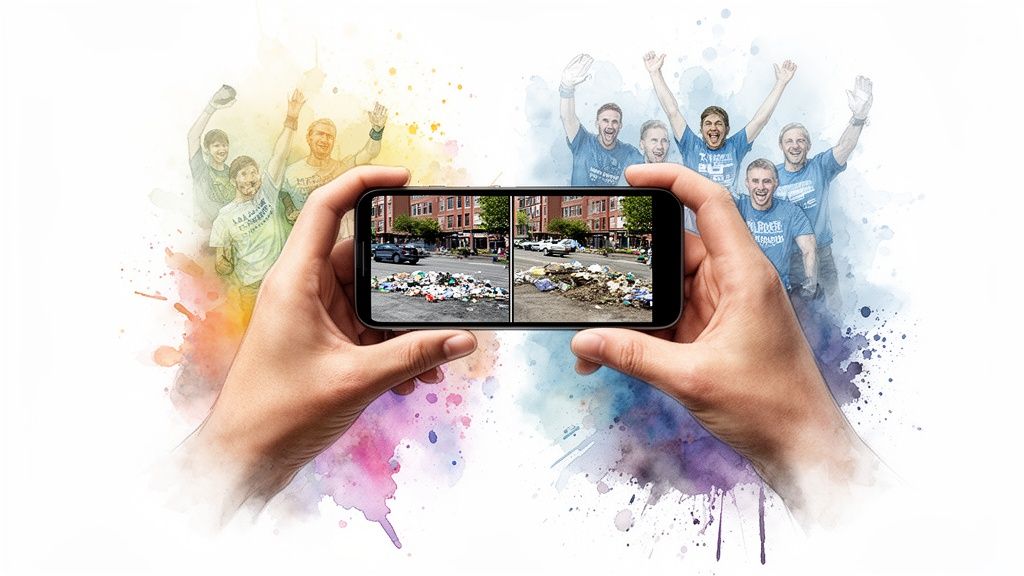
    Hands holding a phone showing street litter, flanked by cheering people in watercolor style.

    Capture the Transformation

    You don't need some fancy camera rig. Your phone is all you need. The trick is to think like you're making a mini-movie—you need a beginning, a middle, and a triumphant finale.

    Before anyone even picks up a grabber, get that "before" shot. I mean really get in there. Get low to the ground and capture the mess in all its chaotic glory. This isn't just a photo of trash; it’s the villain of your story.

    Then, as your crew gets going, snap photos of them in action. People laughing, working side-by-side, those candid moments of teamwork. These are your heroes.

    Finally, the grand finale: the "after" shot. Go back to the exact same spot where you took your "before" photo and frame it the same way. This creates an undeniable, side-by-side visual of the impact you just made. Trust me, it’s the most satisfying photo you’ll ever post online.

    Craft an Inspiring Story

    When you post on social media, your job isn't to lecture or shame people. It's to celebrate. Every single time. Your story should hit these three points, no exceptions:

    • Celebrate the Heroes: This is non-negotiable. Tag your volunteers. Thank them by name. Your post is a tribute to the awesome people who showed up and put in the work.
    • Showcase the Impact: Put that "before" shot right next to the "after." Let the pictures do the heavy lifting. Then, throw in a fun, punchy stat like "25 bags of trash GONE in just one hour!"
    • Extend the Invitation: End with a warm, no-pressure invitation to the next cleanup. Frame it as what it is: a chance to be part of something positive and make new friends.

    This simple formula transforms your social media from a boring report into an ongoing story of a community that cares. It pulls people in.

    Your story isn't just about cleaning up litter. It's about what happens when people decide to show up for each other and for their city. That’s a story everyone wants to be a part of.

    And this isn't just something we feel in our own neighborhood; it's a global current. Just look at the recent Global Ocean Cleanup initiative. It brought together 54 cleanups across 25 countries, pulling a mind-blowing 47.4 tons of waste out of the ocean.

    One person who took part said it was incredible seeing people worldwide give up their weekend just to clean up trash. When you share your story, you’re tapping into that exact same powerful energy. You can learn more about this amazing global effort at Oceanic Society.

    By sharing these small victories, week after week, you're building a library of proof that change is possible. Every post is a seed you plant. Over time, those seeds grow into a forest of givers, making sure your impact gets bigger and stronger with every single cleanup.

    Common Questions I Get About Organizing a Cleanup

    When you start talking about organizing a litter cleanup, the same questions always seem to pop up. After three years of running these events every single week—through Chicago hailstorms, blistering summer heat, and everything in between—I’ve heard them all.

    These aren't just hypotheticals; they're the real worries that can stop good people from starting something amazing. So, let's tackle them head-on. This is me sharing what I’ve learned from being out there on the streets, so you can start your own journey with a little more confidence and a lot less guesswork.

    What If Only a Few People Show Up?

    This is the number one fear I hear. My answer is always the same: that's perfect.

    My very first event had only three people, and it remains one of the most powerful and memorable cleanups I've ever done. We got caught in a freak hailstorm, huddled under a tree, and realized we were onto something special. There's a certain magic in a small crew.

    Small groups are fast. They’re nimble. And you actually get to know each other. You can make an absolutely massive visual impact on a single city block that will blow your mind. Don't fall into the trap of measuring success by the size of the crowd, especially not at first.

    Instead, measure it by the feeling. Did you have a good time? Did you leave a space cleaner than you found it? If the answer is yes, your event was a roaring success. The crowds will come later if you stay consistent and tell your story well.

    How Do You Handle People Who Are Negative?

    Honestly, this happens way less than you'd think. I’ve found that 99% of the interactions you'll have are incredibly positive. People will honk their horns in support, bring you water, or just shout a "Thank you!" from their window. It's amazing.

    But for that rare 1% who might be skeptical or even a little hostile, my strategy is simple: lead with unwavering bravery and kindness. Just smile, keep a friendly posture, and explain what you're doing. "We're just a group of neighbors who love this community and want to help tidy up."

    Kindness is your superpower. It disarms suspicion and turns potential conflict into a non-event. Your positive actions will always, always speak louder than any negative comment.

    When people see you showing up week after week with a great attitude, their curiosity eventually wins out over their skepticism. I've seen it happen time and time again. Your consistency is the most convincing argument you have.

    I'm Worried About the Cost of Supplies

    You can absolutely do this on a shoestring budget. Don't let the thought of expensive gear stop you from getting started. Your passion and willingness to show up are the only tools you really need.

    For your very first litter cleanup, you can get everything you need for less than the price of a pizza. A box of contractor trash bags and a few pairs of sturdy work gloves from the dollar store are more than enough to make a real difference.

    But you might not even have to spend that. Here’s a little secret I've learned:

    • Call your city: Many sanitation or public works departments have programs specifically to support volunteer groups. They often provide free bags, gloves, and sometimes even litter grabbers. Just ask!
    • Talk to local businesses: Walk into your local hardware store and tell them what you're planning. You’d be surprised how many are willing to donate a box of bags or a few pairs of gloves to a good community cause.

    Your most valuable resource isn't money; it's the energy of people who care. Focus on gathering that, and the physical supplies will follow. The goal is just to start.

    What Is the Best Way to Keep Volunteers Coming Back?

    Making a place clean is great, but making people feel seen and valued is what builds a movement. If you want people to come back, you have to make the experience about more than just trash. It has to be about connection.

    This is where you shift from being an organizer to a community builder. I make it a point to learn everyone's name. I introduce people to each other, pointing out shared interests. After the cleanup, we always hang out for a bit—grab coffee, sit in the park we just cleaned, and just talk.

    These moments are just as important as the cleanup itself. People don't just come back to pick up litter. They come back for the friendships, for the feeling of being part of a team, for that sense of shared purpose that is so hard to find. You're not just offering a chance to volunteer; you're offering a chance to belong.


    At Litter Caterpillars, we've built our entire community around this idea of service, friendship, and personal growth. If you’re in Chicago and ready to see the city, make new friends, and be part of a team that shows up no matter what, we’d love for you to join us.

    Find our next event at https://www.littercaterpillars.com.

  • What is civic pride? How it strengthens neighborhoods – what is civic pride

    What is civic pride? How it strengthens neighborhoods – what is civic pride

    So, what is civic pride? Let me break it down for you. At its heart, it’s choosing to treat your neighborhood—your block, your city—like an extension of your own home. It’s that deep feeling of ownership and responsibility for the spaces we all share, not just what’s inside your four walls.

    Finding Pride Beyond Your Front Door

    For my whole life, I’ve had a secret struggle: I couldn't keep my own apartment clean. It was a mess. And as the clutter grew, my life felt messier, too. Every piece of trash told a story I couldn't let go of. A four-year-old jar of jam from a trip to Michigan. A bag of nuts from a failed health kick. Each item might as well have weighed 500 pounds because I felt paralyzed, unable to move it.

    My own space was a mess, and honestly, so was my head.

    It took hitting a personal rock bottom for me to stumble upon something wild. While I couldn't clean up my own life, I found this incredible surge of purpose cleaning up someone else's mess. This is what civic pride means to me. It's not some abstract, patriotic slogan you see on a billboard; it’s a hands-on, get-your-boots-dirty commitment to the world right outside your door.

    The Shift from 'Me' to 'We'

    That journey from personal chaos to collective action is where real civic pride is born. It's that click in your brain when you stop seeing a trashed-out park as "the city's problem" and start seeing it as our park. You start to believe, really believe, that your small actions can ripple outward, sparking a powerful change for everyone.

    Civic pride is the radical belief that your individual effort matters to the collective whole. It’s the decision to show up for your community, even when no one is watching, because you feel a genuine stake in its success and well-being.

    It all boils down to this:

    A conceptual framework illustrating how responsibility fosters civic pride, which then leads to ownership.

    The idea is simple. When you take responsibility for the shared spaces around you, you naturally build a powerful sense of ownership. That feeling of ownership is the engine that drives true civic pride.

    The Four Pillars of Civic Pride

    You can build civic pride on four core actions—things anyone can do in their own community.

    Pillar What It Looks Like in Action
    Responsibility You see a piece of trash on the sidewalk and you pick it up instead of walking past it.
    Connection You get to know your neighbors by name and actually check in on them.
    Contribution You volunteer for a local cleanup or join a community garden.
    Celebration You go to a neighborhood block party or cheer for a local sports team.

    These pillars aren't just concepts; they are tangible actions. When you practice them together, you create a strong, vibrant community spirit.

    More Than Just a Feeling

    Civic pride is something you do, not just something you feel. It's about actively building something better, together.

    Imagine a sports team. Their success isn't just about raw talent. It's about players who feel a deep pride in their jersey, their city, and each other. They grind it out together because they share a common identity and a common goal. This is exactly what we’re building with projects like Litter Caterpillars all across Chicago.

    This idea is closely related to a bigger concept. You can learn more about how all these individual actions add up in our article on what is civic engagement. It's the practical, real-world application of the pride we all feel for our home.

    The Surprising Power of a Shared Mess

    Let me tell you the story of how our group, Litter Caterpillars, was truly born. It wasn't in some sterile meeting room with a whiteboard. Nope. It was under a soggy tree during a freak Chicago hailstorm.

    A few of us were out picking up trash when the sky just opened up and dumped on us. Ice pellets hammered down, forcing us to huddle together, shivering. I remember watching as Uber after Uber canceled, leaving us stranded, cold, clutching bags of strangers' garbage. Right there, in that moment of shared misery, something clicked.

    There’s a strange kind of magic in cleaning up a mess that isn't yours. It's often way more satisfying than finally tackling the disaster in your own room. But facing that challenge together? That turns a chore into a real adventure. It adds a "flavor" to the story that makes you feel connected and alive.

    From Chore to Adventure

    This gets to the real psychology behind civic pride. It’s like a modern-day Tom Sawyer convincing his friends that painting a fence is the coolest adventure they could possibly have. He didn't just get a fence painted; he created an experience. He turned a punishment into a game, a solo job into a community event.

    That's exactly what happens when we team up to tackle a shared problem. We aren't just picking up litter; we're writing a story of resilience together.

    The shared struggle is a powerful glue. It forges bonds that simple, pleasant interactions never could. Overcoming a small bit of chaos together creates a profound sense of "us."

    This collective effort taps into a deep human need to belong and to contribute to something bigger than ourselves. Study after study on group dynamics shows that teams who face and overcome obstacles together have way higher levels of trust and cohesion. Each piece of trash you pick up becomes a tiny victory, a visible trophy of your collective power. For more practical tips, check out our blog on cleaning up trash effectively.

    Why Shared Suffering Builds Stronger Bonds

    It might sound crazy, but that hailstorm was one of the best things to ever happen to our group. It bonded us in a way a sunny, easy day never could have. Facing that unexpected hardship created a unique, shared memory that’s now part of our origin story.

    Psychologically, this makes total sense. Enduring a challenge with other people triggers a release of hormones linked to bonding and cooperation. It creates an instant camaraderie. You’ve been through something together.

    You can see this principle everywhere in community efforts:

    • Community Gardens: You aren't just planting vegetables; you're fighting off weeds, droughts, and pests as a unit.
    • Neighborhood Watch: You're not just looking out a window; you're collectively standing against uncertainty to create a safer block for everyone.
    • Barn Raising: The classic example where an entire community shows up to build something essential, knowing that many hands make light work of a huge task.

    In every case, the effort is the point. The struggle becomes the story, and that story becomes the foundation of your shared pride. You look at what you’ve built, and you don’t just see a clean park or a new shed—you see the strength of your connection. You see what you can accomplish when you do it together.

    Discovering the Real Benefits of Community Care

    Five volunteers cleaning up litter in a park, placing trash into black bags under a tree.

    When you start to actually care for the spaces around you, something incredible happens. I’ve seen it time and again, from Rogers Park all the way to Englewood—picking up litter is never just about the trash. It’s about forging a community that’s more connected, more resilient, and way more beautiful for every single one of us.

    The payoffs go so much deeper than just a clean street. They hit you personally and then spread through the whole neighborhood like wildfire.

    The Psychological Boost of Visible Impact

    You feel this powerful surge of self-respect when you see the immediate result of your work. You can literally stand back, look at a park that was just a mess of debris, and think, "I did that." This isn't just about feeling good for a moment; it's about proving to yourself that you have the power to make a real, positive change.

    That feeling of purpose is a potent antidote to the helplessness we all feel sometimes. It's a tangible win. You're not just wishing for a better neighborhood; you're physically building it, one piece of trash at a time. This kind of direct action beefs up your sense of agency. And what is civic pride if not believing in your own power to make a difference?

    Seeing the immediate impact of your work creates a positive feedback loop. The more you do, the more you believe you can do, which fuels even greater action and deeper community investment.

    Forging Friendships Through Shared Action

    The social side of this is just as huge. When you're working side-by-side with your neighbors, you stop being just acquaintances. You become teammates. You’ve got a common goal, you’re sweating together, and you're celebrating the wins together.

    Honestly, I’ve met some of my best friends while hauling bags of junk. These aren't the kinds of bonds you form over small talk; they're forged over a shared commitment to our city. These relationships strengthen the very fabric of a neighborhood, turning a collection of houses into a real community where people actually look out for each other.

    And this kind of engagement is happening everywhere. In fact, a recent study found 58% of LGBTQ young people got involved in at least one form of civic action last year, from community service to contacting officials. You can check out the full research on youth civic engagement from The Trevor Project.

    Environmental Wins That Build Momentum

    Of course, the environmental perks are obvious—cleaner parks, safer streets, and healthier local ecosystems. But the ripple effect is even bigger than that. A clean space sends a clear message: "This place is cared for."

    This visibility alone discourages more littering and vandalism, sparking a cycle of positive reinforcement. When people see that a space is respected, they’re far more likely to respect it themselves. Your small act of picking up a few bottles can inspire an entire block to keep things tidy, leading to lasting environmental improvements that make your community a better place to live for everyone.

    See How Civic Pride Transforms a Community

    It’s one thing to talk about civic pride. It’s another thing entirely to watch it explode into reality. Let me tell you about Caterpillar Park—our biggest, boldest, and most heart-filling project yet. This is where you can see what civic pride looks like when it stops being a feeling and becomes a physical place you can stand in.

    It all started with a forgotten, trash-filled lot in Englewood. You know the kind of space I'm talking about. The ones you walk past and try not to look at, a glaring symbol of neglect. But we saw something else. We saw potential.

    So, we did something that felt a little crazy. A bunch of us dedicated volunteers pooled our energy, fought through the bureaucracy, and actually won that lot at a city auction. It was ours. Suddenly, this wasn't just another cleanup; this was about reclaiming a piece of our city for our city.

    From Dirt to Determination

    This project was never just about planting a few flowers or putting in a bench. It was an act of defiance against apathy. It was us, a group of ordinary Chicagoans, pouring our souls into a patch of dirt because we believed, truly believed, it could be beautiful.

    We ran into every challenge you can imagine. Hauling away decades of illegally dumped junk. Dealing with skeptical looks from passersby. Figuring out how to turn hard, compacted soil into something that could actually grow life. There were days I thought we’d bitten off way more than we could chew.

    Caterpillar Park is our proof. It's living evidence that when a community is brave enough to care, they can create something beautiful and lasting from nothing more than dirt and determination.

    Small Wins and a Shared Vision

    But the real magic wasn't in the big, dramatic moments. It was in the small victories that kept us going. The day the very first seedling poked through the soil. The afternoon a neighbor, who’d been watching us for weeks, finally came over with a cold bottle of water and stayed to help pull weeds. The sound of kids laughing on the grass where there had only been broken glass before.

    Each tiny win fueled our energy. You could literally feel the shift on the block. The park became a magnet for positive connection, a rallying point for a vision we all started to share.

    This transformation shows the true power of civic pride. It moves from an abstract idea into a tangible reality you can touch, see, and feel. It’s a place built by love.

    Simple Ways to Cultivate Civic Pride Where You Live

    A group of smiling people collaboratively planting colorful flowers in a raised garden bed.

    So you’ve got that fire in your belly. Good. You don't need a huge, elaborate plan or a fully-funded nonprofit to start making a real difference. The truth is, the most powerful movements begin small. You already have everything you need to spark a change, right now, on your own block.

    Civic pride isn’t born in a city council meeting. It’s grown in the soil of our neighborhoods through small, consistent acts of care. It’s about taking that abstract feeling of pride and making it something you can actually see and touch.

    Make Your Care Visible

    The first step is often the simplest: create visible signs that scream, "this place is loved." It could be as easy as putting a colorful planter on your porch or as bold as organizing a mural on a wall that's been a graffiti magnet for years. Visible care is contagious. When one person starts, others notice.

    Think about these simple, but powerful, moves:

    • Organize a Weekend Cleanup: Just pick a Saturday. Grab some trash bags and gloves, and text a few neighbors. You’ll be floored by what you can get done in just a couple of hours.
    • Start a Community Garden: Find a forgotten patch of dirt, get permission, and plant something beautiful. A garden is a living, breathing symbol of shared investment and hope.
    • Create Public Art: Even small art installations can completely shift the energy of a place. They can turn an overlooked corner into a spot that makes people stop, smile, and feel a little spark of pride.

    These actions do way more than just make a space look nice. They send a powerful signal to every single person who walks by.

    Turn Chores into Celebrations

    Let’s be real: picking up trash isn't exactly glamorous. Here at Litter Caterpillars, we stumbled upon a secret early on: you have to turn it into an event. We transformed our cleanups into celebrations by creating little rituals that built a shared identity and a real connection between us.

    It's an art form. We have theme songs. We give out badges for hitting milestones. Our weekly meetups have become a social gathering people actually look forward to. By layering in fun and ceremony, we took a chore and turned it into a ritual we all cherish. You can do this, too. Make a playlist for your cleanup day, have a potluck afterward, or design a simple t-shirt for your block’s "Green Team." You can check out more of our community engagement strategies that have worked for us.

    The key is to inject the work with joy and a sense of shared mission. When people feel like they’re part of a team, their motivation goes through the roof.

    Foster Visibility and Connection

    Creating chances for people to feel seen and connected is the absolute core of building civic pride. This can look like a lot of different things—from a classic neighborhood block party to bigger initiatives that celebrate a community’s identity. Just look at Pride events globally. A recent report showed events were held in at least 101 out of 193 UN member states. These gatherings are powerful. They build awareness, connect people who might feel isolated, and send a clear message about a community's presence and strength. You can learn more about how Pride builds community worldwide in this awesome report.

    The lesson here is huge: when you make your community’s spirit visible, you strengthen the bonds that hold it all together. You don't need a parade. You just need to create spaces where people can show up, be themselves, and feel like they’re part of something good.

    Your Questions About Civic Pride Answered

    I know what you're thinking. You're feeling that fire in your belly, but there's a little voice of doubt whispering in your ear. What if I'm the only one who cares? What if people are just negative? What if I burn out?

    These are real questions. Let's tackle them head-on.

    The fear of being the lone weirdo picking up trash while everyone else walks by is a big one. And yeah, sometimes that happens. You might even get a cynical comment or two.

    But here’s the thing: you’re not doing it for them. You’re doing it because you know a better neighborhood is possible. Your actions, week after week, become a quiet, steady force. You’d be surprised how many people you inspire without ever knowing it.

    Pride vs. Nationalism: This Is a Big One

    It’s really important we get this straight. Healthy civic pride is not the same as blind nationalism. Not even close.

    Think of it like this: True civic pride is like loving your family. You see their flaws, you want to help them grow, and you're committed to them, warts and all. Nationalism is like insisting your family is perfect and better than every other family, and refusing to see any problems.

    Civic pride says, "I love this place, and I’m all in on making it better for everyone." Nationalism often says, "My place is the best, and I will ignore its problems to prove it." One builds community; the other builds walls.

    Knowing the difference keeps your work pure. Your motivation comes from a place of genuine care, not ego.

    Why Your Small Effort Is Actually Huge

    Look, staying motivated is tough. I get it. The secret is to see how your small actions connect to a much bigger picture. We're all more connected than we think.

    A global survey found that 1 in 2 adults knows someone who is gay or lesbian, and it showed huge generational shifts in how we see each other. You can read more about these community connections at Ipsos.

    What does that have to do with picking up litter? Everything. It shows that individual lives and experiences ripple out and change the consciousness of the whole community. Your small act of care does the exact same thing. You’re part of a massive, unspoken network of people who believe in showing up. That’s why this work matters so much.


    At Litter Caterpillars, we turn that belief into action every single week. If you're ready to stop wondering and start doing, join us. Find an event and see for yourself how good it feels to build a better Chicago, together. https://www.littercaterpillars.com

  • A Guide to Volunteer Team Building Activities for Community Cleanup

    A Guide to Volunteer Team Building Activities for Community Cleanup

    Let me tell you a story. It starts with a messy apartment and a chaotic breakup. My life felt like the back of my fridge, full of old things I couldn't bring myself to throw away. Each piece of trash, each forgotten jam jar, was a weight. It wasn't until I faced a different kind of mess, the litter on Chicago's streets, that I found a way forward.

    Huddled under a tree during a freak hailstorm with two other volunteers, shivering and laughing, I realized something profound: cleaning up someone else's mess can actually help you clean up your own. This journey isn't just about making our city sparkle. It's about personal transformation, about forging unbreakable bonds through shared challenges. We, the Litter Caterpillars, believe that the best volunteer team building activities aren't about trust falls or corporate icebreakers; they're about showing up, together, when it's hard.

    These activities are the bedrock of our movement, turning a simple chore into an epic quest and a group of strangers into a chosen family. You'll discover how to create a team that's resilient, deeply connected, and powered by a shared mission. If you're ready to build a volunteer team that feels more like a legendary crew, a group that finds joy and purpose in every collected bottle cap and windswept wrapper, you've come to the right place. This guide is your blueprint for building something that truly matters.

    1. Themed Cleanup Challenges with Pride & Identity

    Ever notice how wearing a team jersey makes you feel part of something bigger? You can bring that same electric energy to your cleanups. Instead of just picking up litter, you’re creating a tribe, a shared mission with its own unique culture. This is one of the most powerful volunteer team building activities because it transforms a chore into a celebrated ritual, building deep bonds and a fierce sense of belonging.

    Three diverse volunteers smiling, holding flags and a trash bag, against a colorful watercolor background.

    I believe this approach is about creating an identity that volunteers are proud to wear. Think of it like a local sports team for neighborhood good. It’s not just about the work; it’s about the symbols, the stories, and the shared victories. My goal is to make every volunteer feel like a hero in an ongoing saga of community improvement.

    How to Bring It to Life

    The key is to build a universe around your cleanup efforts. You can start small and let your volunteers co-create the identity with you.

    • Create Your Team Identity: Brainstorm a team name, colors, and a simple logo. Maybe you're the "Wicker Park Warriors" or the "Lincoln Park Litter Legends." I suggest getting t-shirts printed or simply providing colored bandanas.
    • Develop Rituals and Symbols: Design a team flag to plant at your meeting spot. You can create a simple team chant or song to kick off and close each event. These small rituals build powerful muscle memory for team spirit.
    • Implement a Badge System: Recognize achievements with tangible rewards. The Litter Caterpillars, a Chicago-based group I'm a part of, mastered this by creating a series of collectible badges for milestones like "First Cleanup," "Recycling Rockstar," or "Rainy Day Hero." You can learn more from their detailed guide on community engagement best practices. Awarding these badges in a small ceremony makes each volunteer's contribution feel seen and valued.

    This strategy works because it taps into a fundamental human need: to belong and be recognized. By turning cleanups into themed missions, you’re not just cleaning a street; you’re building a community legend, one piece of litter at a time.

    2. Neighborhood Rotation & Ward-by-Ward Coverage

    Imagine your volunteer group as explorers, charting a map of your entire city, not with ink, but with acts of care. Instead of sticking to the same familiar blocks, you embark on a systematic journey, ensuring no neighborhood is left behind. This is one of the most expansive volunteer team building activities because it breaks down invisible city barriers, fosters a deeper sense of civic unity, and shows every community that they matter.

    I see this model as a tool for equitable impact and shared discovery. By systematically rotating through different wards or districts, your team gains a comprehensive understanding of the city's diverse challenges and charms. It transforms your group from a localized crew into a city-wide force for good, building bonds not just with each other, but with the very fabric of the metropolis.

    How to Bring It to Life

    The key is to create a clear, visible, and exciting schedule that turns your coverage plan into an adventure for everyone.

    • Create a Visible Rotation Map: I recommend you design a large map of your city and color in each neighborhood or ward as you clean it. Post this online and bring it to events. This visual progress tracker builds anticipation and a powerful sense of collective accomplishment.
    • Partner with Local Insiders: Before you visit a new neighborhood, connect with a local community organization, library, or residents' association. They can provide crucial context on problem spots and help you invite local residents to join, making your efforts a true collaboration.
    • Celebrate Each Neighborhood's Story: Use your social media to spotlight the unique character of each area you visit. I’d share before-and-after photos, but also highlight a local landmark, a great coffee shop, or a story you learned from a resident. Frame each cleanup as a chapter in your city-wide exploration. The Litter Caterpillars, for example, are on a mission to cover all 50 of Chicago's wards, using our journey to help volunteers discover the entire city.

    This strategy works because it broadens horizons and demonstrates a profound commitment to fairness. By exploring and serving every corner of your city, you’re not just picking up trash; you're weaving a stronger, more connected community, one neighborhood at a time.

    3. Weather-Defiant Consistency (Rain, Snow, Heat Protocol)

    What separates a casual hobby from a true commitment? I think it’s showing up when it’s hard. By establishing a protocol to serve in almost any weather, you’re not just cleaning up; you’re forging an unbreakable team identity. This is one of the most profound volunteer team building activities because it turns an obstacle into a legendary origin story, attracting the most dedicated and passionate individuals.

    A man in a yellow raincoat and green boots holds an umbrella and a rake in the rain.

    This approach transforms adverse weather from a deterrent into a badge of honor. You communicate a powerful message: our mission is more important than our comfort. The stories born from these challenging days, like the Litter Caterpillars' infamous first cleanup in a hailstorm that I mentioned, become the folklore that binds your group together and inspires new members to join a team that means business.

    How to Bring It to Life

    Your goal should be to frame weather challenges as character-building flavor, not as punishment. Safety and preparation are everything.

    • Establish Clear Safety Thresholds: Your commitment is inspiring, but safety comes first. You must define non-negotiable limits for wind speed, extreme temperatures, or lightning. Communicate these clearly so everyone knows you’re prepared, not reckless.
    • Provide Weather-Appropriate Gear: I suggest building a small "weather library" of extra gloves, rain ponchos, hand warmers, or cooling towels. This simple act shows you care and removes a barrier for volunteers who might not have the right equipment.
    • Celebrate the Survivors: Create a "Weather Warrior" award or a "Legend Board" to publicly recognize those who show up on the toughest days. You can document these moments on social media; a photo of smiling volunteers in the snow is far more powerful than a sunny day shot.
    • Adapt the Mission: Don’t just cancel. You can shorten the event during a heatwave or shift focus to a covered area during rain. For truly severe weather, have a cozy indoor alternative planned, like sorting recyclables or planning the next event at a local coffee shop.

    This strategy works because shared hardship creates the strongest bonds. When your team looks back and says, "Remember that time we cleaned up in a blizzard?" they’re not just recalling an event; they’re celebrating their collective resilience and unwavering dedication to the cause.

    4. Open-Access Digital Community Building (Meetup, Social Media, Group Chats)

    The magic of a great cleanup doesn't have to end when the last bag of litter is tied. Think of your volunteer group like a garden. The cleanup events are when you plant the seeds, but the real growth happens between gatherings. This is where accessible digital tools come in, turning one-time helpers into a vibrant, year-round family. These platforms are powerful volunteer team building activities because they keep the fire of connection burning long after the work is done.

    I believe this strategy is about meeting people where they are: online. By creating low-barrier entry points like a free Meetup group, an engaging Instagram profile, and a casual group chat, you build an ecosystem of connection. You ensure no one feels left out and empower volunteers to build genuine friendships, share their stories, and stay motivated. The goal is to make your volunteer group feel less like an event and more like a social hub with a shared purpose.

    How to Bring It to Life

    Building a digital home for your community is about consistency and authenticity. Let your platforms reflect the warm, welcoming spirit of your in-person events.

    • Be a Beacon on Meetup: This is your front door. I advise you to post your cleanup events at a consistent day and time, like every Saturday morning. This predictability helps volunteers build a routine. Make your event descriptions warm and inviting, emphasizing the social aspect as much as the cleanup itself.
    • Tell Your Story on Instagram: This is your highlight reel. You should post photos that feature your volunteers' smiling faces, not just bags of trash. Share their stories in the captions. Use Instagram Stories during events for real-time updates and Reels to create compelling before-and-after transformation videos.
    • Foster Friendship in Group Chats: This is your living room. Create a space on a platform like WhatsApp or Discord for casual conversation. Sure, you can post logistics, but also encourage members to share photos of their pets, ask for local recommendations, or organize informal social meetups. I always try to keep it personal and fun, not corporate.

    This approach works because it nurtures the human connections that are the true foundation of any volunteer movement. Groups like the Litter Caterpillars have used this model to grow a thriving community, proving that by making it easy to join and stay connected online, you build a resilient, passionate team that shows up offline.

    5. Skill-Building Through Service (Resilience, Consistency, Courage)

    What if volunteering wasn't just about giving back, but also about building yourself up? Imagine framing every cleanup as a workout for your character, a gym for your soul. This approach transforms service from a simple act of charity into a powerful journey of personal development, making it one of the most profound volunteer team building activities you can facilitate.

    The idea is to explicitly connect the physical act of cleaning with the internal growth of virtues like resilience, consistency, and courage. When I see a volunteer show up on a cold, drizzly morning, they aren't just picking up trash; they're practicing resilience. When they attend their tenth event in a row, they are building the muscle of consistency. This reframe makes every action meaningful on multiple levels.

    How to Bring It to Life

    You can intentionally weave personal growth into the fabric of your volunteer program. It starts with being transparent about this dual mission: we’re here to clean our community and to become better versions of ourselves.

    • Define Your Core Skills: Be explicit about the virtues you want to cultivate. The Litter Caterpillars, for example, built our entire mission around developing "bravery, kindness, and unity." You should choose skills that resonate with your group's purpose.
    • Share Transformation Stories: Authenticity is key. I share my own story of how leading or participating has changed me. You can feature volunteer spotlights on social media that go beyond their cleanup efforts and touch on how they've grown personally.
    • Create Growth-Oriented Rituals: Start a "consistency club" with special recognition or badges for attendance streaks. You can end events with a brief reflection circle, asking questions like, "What felt brave for you today?" or "Where did you have to be resilient?"
    • Connect Service to Personal Goals: Help volunteers see the link between showing up for a cleanup and achieving their own dreams. I have found this powerful connection is a cornerstone of effective volunteer retention strategies.

    This strategy works because it offers a dual reward. Volunteers see a tangible impact on their neighborhood and feel a profound, internal shift in themselves. You’re not just creating a cleaner city; you’re building stronger, more courageous citizens.

    6. Weekend Morning Scheduling to Attract 'Givers' and Filter Values Alignment

    Think about the most dedicated communities you know. Military units doing PT at dawn, religious groups gathering for morning services, or committed athletes training before the world wakes up. What do they have in common? I believe they show up when it’s not always easy. This same principle can transform your volunteer group into a tight-knit force for good.

    Strategic scheduling is one of the most underrated volunteer team building activities because it’s a silent filter. By hosting events on weekend mornings, you naturally attract people whose primary motivation is service, not a social alternative to a night out. This isn't about exclusion; it's about building a culture of dedication and shared values from the moment people decide to show up. It sends a clear message: we are here to make a real difference, together.

    How to Bring It to Life

    The magic is in the consistency and the framing. You’re not just asking people to wake up early; you’re inviting them to start their weekend with purpose and a sense of accomplishment that lasts.

    • Communicate Your "Why": Be transparent about your scheduling philosophy in your recruitment materials. You can frame it as a positive: "We meet on Saturday mornings to start our weekend with positive action and a clear mind." This turns the timing into a feature, not a bug.
    • Create Morning Rituals: Make the morning special. I recommend you start with a quick team huddle, a shared coffee, or a simple theme song. These rituals become anchors that make the early start a cherished part of the experience.
    • Share Transformation Stories: Feature volunteers who initially struggled with the timing but now love it. A simple social media post like, "I used to sleep in, but now I can't imagine my Saturday without this team!" is incredibly powerful.
    • Stay Welcoming and Flexible: Emphasize that early rising is part of the culture, not a strict requirement. You must be incredibly kind and welcoming to those who can only make it occasionally. You can also offer a few special weekday evening events a year to include everyone.

    This approach works because it builds a team around a shared sense of discipline and commitment. When people choose to give their weekend morning, they're making a statement about their values, forging powerful bonds with others who made the same choice. You're not just cleaning a park; you're building a culture of givers.

    7. Volunteer-First Fundraising (No Pressure Donations, Partner Sponsorships)

    Nothing drains the energy from a passion project faster than the constant pressure to ask for money. When you start asking your volunteers to open their wallets, you risk changing the entire dynamic. This is why a volunteer-first fundraising model is one of the most powerful, trust-building volunteer team building activities you can adopt. It protects the core mission by ensuring your volunteers’ time and energy are the most valued currency, not their cash.

    This approach reframes your financial strategy to be about community partnership, not participant obligation. It makes your group accessible to everyone, regardless of their financial situation, and keeps the focus purely on the collective action of cleaning up. My goal is to build a sustainable organization where volunteers feel appreciated for their work, not sized up for their donation potential.

    How to Bring It to Life

    Shifting your focus to external support builds incredible goodwill and keeps your internal culture pure. You’re building a movement, and you want everyone to feel they belong.

    • Proactively Seek Partnerships: Instead of asking volunteers for five dollars, I would ask a local coffee shop to sponsor a cleanup. You can approach real estate agents, hardware stores, and local restaurants who benefit directly from cleaner, more beautiful streets. Frame it as a partnership in community improvement.
    • Create Graceful Donation Channels: Have a donation link on your website, but never push it during events. You should frame it for those who want to give financially but may not have the time to volunteer. This respects both forms of contribution equally.
    • Maintain Radical Transparency: One of the best ways I have found to build trust is to show exactly where the money goes. The Litter Caterpillars, for example, maintain a public ledger of all our expenses. When people see that funds are used for essentials like trash bags, gloves, and community grants, they are more inspired to support the mission without ever being asked.
    • Celebrate All Contributions: When you thank your community, always lead by thanking your volunteers for their time and effort. You should acknowledge your financial sponsors and donors separately but equally. This reinforces the core value that time is just as precious as money.

    This strategy works because it removes a major barrier to participation and eliminates the awkwardness of mixing passion with financial asks. By focusing on partnerships, you’re not just funding your activities; you’re weaving your organization into the very fabric of the local economy and community.

    8. Friendship-First Community Building (Social Connection Over Task Completion)

    What if the primary goal of your cleanup wasn't cleaning up? Imagine framing your events so the litter collected is simply the byproduct of a more important mission: building genuine friendships. This approach flips the script, positioning your group as a community hub first and a cleanup crew second. It's one of the most fulfilling volunteer team building activities because it tackles loneliness head-on, creating a support system that lasts long after the trash bags are full.

    This philosophy is about intentionally designing your events for human connection. The cleanup itself becomes the perfect, low-pressure backdrop for conversation and shared experience. You're not just picking up trash side-by-side; you're sharing stories, discovering common interests, and building the foundation of real relationships that make a neighborhood feel like home.

    How to Bring It to Life

    The key is to create dedicated, structured time for socializing and to celebrate the relationships being built. It’s about being explicit that friendship is the real prize.

    • Schedule Social Time: I recommend you formally block out 20-30 minutes before or after every cleanup for coffee, snacks, and unstructured conversation. Don't make it optional; frame it as a core part of the event itself.
    • Pair People Up: Use a buddy system, intentionally pairing newcomers with veteran members. This simple act removes the anxiety of joining a new group and immediately gives someone a friendly face to connect with.
    • Host Social-Only Events: Organize monthly potlucks, game nights, or park hangouts that have nothing to do with cleaning. This reinforces that the group's value lies in its people, not just its work. You can discover more ideas for fostering these connections in this guide to community building activities for adults.
    • Celebrate Friendships Publicly: When you share photos on social media, don't just post pictures of the work. I would post pictures of volunteers laughing together and write captions that celebrate the friendships being formed.

    This strategy works because it addresses a deep human need for connection. By making friendship the mission, you create a powerful, self-sustaining community where people show up for each other first and the cause second, ensuring long-term passion and participation.

    9. Safety-First Protocol & Volunteer Wellbeing as Primary Priority

    Imagine an adventure guide who puts your safety above reaching the summit. That’s the mindset that transforms a good volunteer group into a truly great one. By making volunteer safety and wellbeing the absolute top priority, you build a foundation of trust that is unshakable. This isn't just about avoiding accidents; it’s one of the most profound volunteer team building activities because it communicates a powerful message: "You are more important than the mission."

    This approach establishes a culture where every single person feels secure, respected, and genuinely cared for. When volunteers know you have their back, they can fully invest their energy and spirit into the work and each other. My goal is to create an environment of psychological and physical safety so strong that it becomes the team’s defining characteristic.

    How to Bring It to Life

    Building a safety-first culture requires deliberate, consistent action. It’s about embedding care into every part of your process.

    • Launch with a Safety Huddle: Start every single event with a brief, mandatory safety huddle. This isn't a long lecture; it's a quick, engaging check-in. You should cover the day's potential hazards, review hand signals, and remind everyone that their comfort comes first.
    • Arm Your Team with Knowledge & Gear: Don't just hand out gloves; explain why they're important. I suggest you provide a full kit: thick gloves, hand sanitizer, and bright vests if near traffic. Create and distribute a one-page safety guide before their first event so everyone arrives prepared.
    • Prioritize People Over Goals: Make it a public mantra. Groups like the Litter Caterpillars state it plainly: "Safety of the volunteers always takes first priority. Happiness takes second." I explicitly tell my team that no bag of trash is worth an injury or even just feeling uncomfortable. Empower them to stop, rest, or skip an area if they feel unsure.
    • Train Your Leaders: Equip your team leaders with basic first-aid training and mental health awareness. This prepares them to handle everything from a small cut to noticing if someone seems overwhelmed, ensuring they can provide immediate and compassionate support.

    This strategy works because true community is built on mutual care. When you prioritize the wellbeing of your volunteers above all else, you’re not just managing a cleanup; you’re nurturing a family that looks out for one another.

    10. Transformation Narrative & Storytelling (Origin Story, Volunteer Journeys, Community Impact)

    Facts and figures can show impact, but a story is what truly moves people to action. What’s the spark that started your group? Why does that one volunteer show up every single weekend, rain or shine? These narratives are the emotional core of your mission, transforming abstract goals into deeply human experiences. This is one of the most profound volunteer team building activities because it connects the simple act of picking up litter to a much larger, more inspiring journey of personal and community change.

    I believe this approach is about weaving a compelling tapestry of stories that volunteers can see themselves in. You're not just a group that cleans; you're a collection of individuals who found purpose, friendship, and a way to heal their corner of the world. My goal is to make every volunteer feel like a vital character in an unfolding story of positive transformation, inspiring both current and future members.

    How to Bring It to Life

    The key is to actively find, shape, and share the powerful stories happening within your group. Make storytelling a conscious and consistent part of your culture.

    • Share Your Origin Story: Be vulnerable and authentic about what started it all. Was it a moment of frustration, a personal turning point, or a sudden inspiration? My own Litter Caterpillars origin story, for example, is rooted in a personal crisis that led to a powerful realization about taking control of one's environment. Sharing this creates an immediate, relatable connection.
    • Create a "Volunteer Spotlight" Series: Once a month, you should interview a volunteer. Ask them what brought them here, what they've learned, and how this work has impacted their life. Share their story through your newsletter or social media. This celebrates individual journeys and shows the diverse motivations within your team.
    • Document Neighborhood Transformations: Go beyond simple before-and-after photos. I recommend capturing quotes from residents about how a cleaner park or street has changed their daily experience. Did kids start playing in the park again? Did a local business see more foot traffic? These testimonials connect your work to tangible community benefits.
    • Invite Shared Storytelling: At the end of an event, you can create a space for volunteers to share a small victory or a meaningful moment from the day. It could be a strange item they found or a positive interaction with a neighbor. This builds a shared history and reinforces the value of each person's contribution.

    This strategy works because it taps into our innate desire for meaning and connection. By framing your work through the lens of transformation, you're not just tidying up a neighborhood; you’re co-authoring a powerful story of hope, one volunteer at a time.

    Volunteer Team-Building Activities — 10-Item Comparison

    Item 🔄 Implementation Complexity ⚡ Resource & Operational Efficiency 📊 Expected Outcomes & ⭐ Effectiveness 💡 Ideal Use Cases & Quick Tips
    Themed Cleanup Challenges with Pride & Identity Medium–High: design, branding, creative leadership required Moderate: upfront cost for flags/badges; efficient for retention over time High engagement & retention; strong identity formation — ⭐⭐⭐⭐ Community-building, social media growth — involve volunteers in design; rotate themes
    Neighborhood Rotation & Ward-by-Ward Coverage High: detailed scheduling and logistics across areas Moderate–High: travel/time costs; needs tracking systems Broad city impact and equity; builds diverse networks — ⭐⭐⭐⭐ Ideal for citywide equity campaigns — publish rotation map; partner with local orgs
    Weather-Defiant Consistency (Rain/Snow/Heat) Medium: clear policies and safety protocols needed Moderate: weather gear, emergency planning; operationally demanding in extremes Filters for committed volunteers; creates memorable stories — ⭐⭐⭐ Use to strengthen commitment culture — set safety thresholds; offer indoor alternatives
    Open-Access Digital Community Building (Meetup, Social) Low: platform setup simple, but needs ongoing moderation Low cost monetarily; time cost for content + moderation High discoverability and entry rates; builds ongoing connection — ⭐⭐⭐ Best for onboarding newcomers — post consistently; moderate chats; feature volunteer stories
    Skill-Building Through Service (Resilience, Consistency) Medium: integrate reflection, tracking and leader coaching Low–Moderate: materials and facilitator time Strong personal development and intrinsic motivation — ⭐⭐⭐⭐ Targets growth-minded volunteers — use badges, reflection prompts, share transformations
    Weekend Morning Scheduling to Attract 'Givers' Low: scheduling policy and consistent messaging Low: minimal resource burden; simple logistics Cultivates values-aligned, consistent cohort — ⭐⭐⭐ Use as cultural filter — explain philosophy; offer occasional alternatives for inclusivity
    Volunteer-First Fundraising (No-Pressure) Medium: establish sponsor pipelines and transparent budgets Moderate: time to secure sponsors/grants; reduces volunteer fundraising burden Preserves morale and accessibility; builds authentic partnerships — ⭐⭐⭐ For sustaining events without pressuring volunteers — publish budget; thank sponsors publicly
    Friendship-First Community Building Medium: requires skilled facilitation and social planning Low–Moderate: social events/time investment Very high retention and volunteer satisfaction — ⭐⭐⭐⭐ Ideal for friendship-driven recruitment — schedule post-cleanup social time; use buddy system
    Safety-First Protocol & Volunteer Wellbeing High: comprehensive training, policies, and leader accountability High: PPE, training, incident processes; ongoing review needed High trust, inclusivity, and reduced liability — ⭐⭐⭐⭐ Essential where safety risks exist — mandatory safety huddles; provide PPE; collect feedback
    Transformation Narrative & Storytelling Low–Medium: consistent content creation and authentic sharing Low: time for interviews and documentation; minimal cost Strong emotional engagement and recruitment; brand identity boost — ⭐⭐⭐⭐ Use to inspire and recruit — share founder/volunteer stories; document before/after results

    Your Turn to Paint the Fence

    Remember Tom Sawyer? He was handed the dreaded chore of whitewashing a long, boring fence. Punishment. But with a little bit of flair and a shift in perspective, he transformed that tedious task into the most desirable, exclusive activity in town. Friends were practically begging him for a chance to paint a few planks.

    That’s the exact magic we’ve been exploring together. The ten strategies we've walked through aren't just about picking up litter. They are about turning the "chore" of community service into a profound adventure, a source of deep friendship, and a catalyst for your own personal transformation. Each idea is a brushstroke you can use to paint a more vibrant, connected, and meaningful life for yourself and your neighbors.

    Recapping Your Toolkit for Transformation

    You now have a complete blueprint. I've shown you how to build a powerful community from the ground up, one that thrives not on obligation, but on genuine connection and shared purpose.

    • Identity and Pride: We covered how themed cleanups, team flags, and neighborhood rotations aren't just logistics; they are rituals that build a powerful sense of belonging. You’re not just a random person with a trash bag; you’re part of a tribe, on a mission.
    • Resilience and Consistency: My discussions on weather-defiant scheduling and weekend morning meetups weren't just about timing. They were about building personal resilience and creating a community of people who show up, for the cause and for each other, no matter what. That consistency is where the real change happens.
    • Connection and Safety: We emphasized a "friendship-first" and "safety-first" philosophy. This ensures your group is a haven, a place where people feel seen, valued, and protected. It shifts the focus from the task (cleaning) to the people, which is the secret ingredient that makes volunteers return week after week.
    • Storytelling and Impact: Finally, I talked about the power of narrative. Sharing your origin story, celebrating volunteer journeys, and tracking your impact isn't about vanity metrics. It’s about making the intangible, tangible. It’s about showing everyone, including yourself, that your small, consistent actions are adding up to create a massive, beautiful wave of change.

    You don’t need a massive budget. You don’t need a perfectly polished five-year plan. You don’t need permission from anyone to start making a difference.

    All you need to do is pick one thing.

    Maybe it’s creating a simple, hand-drawn logo for your local crew. Perhaps it’s committing to one specific street corner every Saturday morning, rain or shine, and seeing who joins you. Or maybe it’s just starting a group chat to share photos of your progress and celebrate the small wins.

    The goal was never to have a perfectly clean city overnight. The real prize is in the bonds you forge and the person you become while trying. These volunteer team building activities are a powerful vehicle for discovering your own strength, courage, and capacity for leadership. You are not just cleaning a street; you are building a legacy of connection and rewriting your own story, one piece of litter at a time.

    You have the map. You have the tools. Go be a Caterpillar. Go transform.


    Ready to stop thinking and start doing? At Litter Caterpillars, we put all these principles into practice every weekend, creating a fun, safe, and inspiring community for people just like you. Join a cleanup this weekend and see for yourself how powerful these volunteer team building activities can be at Litter Caterpillars.

  • 7 Ways to Dig into Community Gardens Chicago IL and Grow with Your City

    7 Ways to Dig into Community Gardens Chicago IL and Grow with Your City

    Imagine turning a forgotten patch of dirt into a place that pulses with life. A quiet corner of your neighborhood, once just dust and maybe a ghost of a plastic bag, is now exploding with tomatoes, sunflowers, and the sound of neighbors laughing. This isn't a dream. It's the real, dirt-under-your-fingernails magic happening every day across the incredible network of community gardens in Chicago, IL.

    Getting involved is a lot less complicated than you think. It's not about being a perfect gardener with a flawless green thumb; it’s about the simple, brave act of showing up. It’s a lot like when we started Litter Caterpillars, shivering in a hailstorm with only three people. We discovered a powerful secret that day: tackling a big mess together is infinitely easier, and way more fun, than facing your own alone. Each weed you pull, each seed you plant, is a small act of defiance against apathy. It’s a way of telling your block, your city, and yourself: ‘I’m here. I care. Let’s grow something beautiful.’

    This guide is your map to that feeling. It’s not just a list of places; it's a treasure map to finding your own power to transform things, one plot at a time. We've gathered the best platforms and resources to help you find a green space to call your own, whether you want to volunteer for a day, adopt a plot for a season, or even claim a city lot to start something brand new. Forget getting lost in a jungle of search results. Here, you’ll find direct links, screenshots, and clear, actionable steps for each resource. Let’s dig in and find your garden.

    1. Litter Caterpillars

    Imagine a different kind of garden. Instead of tending to seeds in soil, you are cultivating change on the sidewalks, streets, and forgotten lots of Chicago. This is the groundbreaking work of Litter Caterpillars, a citywide volunteer collective that transforms the act of picking up trash into an inspiring, community-building adventure. While not a traditional garden with plots for rent, this organization is a foundational partner for anyone invested in creating cleaner, greener, and more vibrant public spaces, making it an essential resource for the community gardens Chicago IL movement.

    Litter Caterpillars is your entry point to hands-on neighborhood transformation, a way to reclaim public spaces and prepare the ground, often literally, for future greening projects. Founded by the tireless Kevin Tao, this group meets every single weekend, regardless of rain, snow, or summer heat, to clean one of Chicago's 50 wards. Their ethos is built on a powerful, simple idea: show up, be kind, and make a visible difference together.

    Why Litter Caterpillars Stands Out

    What makes this group exceptional is its "volunteer-first" philosophy. Joining is completely free, and the culture is intentionally low-pressure. You won’t be solicited for donations or pressured into commitments. The focus is squarely on your safety, your happiness, and the profound sense of accomplishment that comes from collaborative effort. This isn't just about cleaning; it's about building a citywide family.

    The group fosters a unique and powerful identity through shared symbols like flags, badges, and even a theme song. It feels less like a chore and more like joining a team on a mission. This sense of belonging is the secret sauce that turns a one-time volunteer into a dedicated member who finds friendship and personal growth while beautifying the city.

    Key Features and How You Can Get Involved

    • Citywide Impact: From cleaning a shut-down highway during a bike event to winning an empty lot at auction to create Caterpillar Park in Englewood, their projects are bold and impactful. You can be part of efforts that make headlines and inspire citywide change.
    • Zero-Barrier Entry: Getting involved is incredibly easy. Find their next event on Meetup, follow their journey on Instagram, or join one of their open group chats. It’s designed for anyone to jump in, whether you're a student, a newcomer, or a lifelong Chicagoan.
    • Direct Support for Garden Spaces: A clean neighborhood is the first step toward a thriving garden. By clearing litter and debris from surrounding areas, Litter Caterpillars creates healthier environments for existing community gardens Chicago IL and paves the way for new ones to flourish. Their work directly combats blight and fosters a sense of stewardship that is vital for any green space.
    • Adventurous Community Service: Each weekend offers a chance to explore a new corner of Chicago, from neighborhoods you know and love to areas you’ve never visited. It’s an urban adventure with a purpose.

    A Note on Their Unique Model: Litter Caterpillars operates as a passionate grassroots collective. While they may not offer the formal infrastructure of a traditional nonprofit (like tax-deductible receipts), their agility and volunteer-centric model allow them to be incredibly responsive and authentic.

    Practical Tips for Joining the Mission

    1. Check the Schedule: Visit their website or Meetup page to find the next cleanup location. They are always somewhere in the city every weekend.
    2. Just Show Up: No pre-registration is required for most events. Simply arrive with a positive attitude; they provide the gear (gloves, bags, grabbers).
    3. Dress for the Weather: Their commitment is year-round. Layer up in the winter and bring water in the summer. Being prepared ensures you can focus on the fun and the impact.

    Litter Caterpillars is more than a cleanup crew; it's a movement of bravery, kindness, and unity. It’s proof that you don't need a grand plan or a lot of money to start making a monumental difference. You just need to show up.

    Website: https://www.littercaterpillars.com

    2. Chicago Urban Agriculture Mapping Project (CUAMP)

    Imagine having a satellite view of every single sprout of community effort across Chicago, a living map that pulses with green energy. That's precisely what the Chicago Urban Agriculture Mapping Project (CUAMP) offers. It’s not a garden itself, but rather your indispensable treasure map to finding the perfect plot of soil to call your own. Think of it as the central nervous system for community gardens in Chicago, IL, connecting eager hands with open land.

    Chicago Urban Agriculture Mapping Project (CUAMP)

    This powerful, free tool is your first and best stop for navigating the city's vast urban agriculture landscape. It’s a dynamic, interactive directory that lets you zoom into your neighborhood, search by ward, or even filter by specific needs, like finding a garden that composts. Each pin on the map is a story waiting to unfold, a community waiting to welcome you.

    How to Use CUAMP to Find Your Garden

    Getting started with CUAMP is as simple as dropping a pin on a map. The platform is designed for discovery, making it easy to turn your curiosity into action.

    • Search Near You: Pop in your address and watch as nearby gardens appear like stars in a clear night sky. It’s the fastest way to see what’s growing just around the corner.
    • Filter Your Search: Looking for something specific? Use the filters to find food-producing sites, gardens with active composting, or even identify which gardens are open versus locked. This helps you target your outreach effectively.
    • Explore Site Profiles: Click on a garden pin to open its profile. Here, you’ll find contact information for the garden manager, its operational status (active, dormant), and other crucial details.

    Key Insight: CUAMP empowers you to be a proactive community builder. It’s not just about finding a garden; it’s about understanding the city's green infrastructure and identifying where you can make the biggest impact.

    Why It Deserves a Top Spot

    CUAMP stands out because it's a collaborative, data-driven resource maintained by trusted local partners. While some listings might have slightly outdated contact info (a common challenge with volunteer-run projects), its citywide scope is unparalleled. It’s a tool built for everyone: the individual looking for a plot, the community organizer planning a cleanup, and even city planners analyzing green space.

    For a group like Litter Caterpillars, CUAMP is a strategic goldmine. You can download the data to identify clusters of gardens in a specific ward, helping you plan a targeted outreach day or a neighborhood-wide cleanup event that supports multiple green spaces at once. It transforms your passion from a single act of kindness into a coordinated wave of positive change.

    Website: https://cuamp.org/

    3. NeighborSpace (Chicago’s community‑garden land trust)

    What if a garden could last forever? Imagine a green space protected from development, a community hub guaranteed to be there for your children and your children’s children. This isn't a fantasy; it's the mission of NeighborSpace, the guardian angel for many community gardens in Chicago, IL. This organization acts as a land trust, essentially putting a permanent protective shield around community-managed gardens, ensuring they remain vibrant green spaces for generations.

    NeighborSpace (Chicago’s community‑garden land trust)

    NeighborSpace is the foundational support system that lets gardeners focus on what they do best: growing. By taking on the heavy lifting of land ownership, insurance, and even water access, they remove the biggest hurdles that can cause a community project to wither. They are the soil in which stable, long-term community gardens can firmly take root and flourish without fear.

    How NeighborSpace Supports the Green Community

    While you won't use NeighborSpace to sign up for an individual plot, their website is a vital resource for understanding the ecosystem of protected gardens and for groups looking to secure their future.

    • Find Protected Gardens: While they don't have an interactive map like CUAMP, their site profiles the gardens they protect. This is a great way to discover established, long-term gardens with strong community ties.
    • Access Resources: The site provides guidance for existing gardens on everything from planning and maintenance to becoming a protected site themselves. They offer tool lending and educational resources to their member gardens.
    • Understand the Trust Model: For anyone dreaming of starting a new garden, exploring NeighborSpace’s process is a masterclass in sustainability. It shows you how to build something that lasts.

    Key Insight: NeighborSpace isn’t about the "how" of finding a plot today; it's about the "why" these gardens will still be here tomorrow. Supporting a NeighborSpace garden means investing in a permanent piece of your neighborhood’s green legacy.

    Why It Deserves a Top Spot

    NeighborSpace provides the invisible architecture that makes a thriving urban garden scene possible. They are the backbone, the quiet partner ensuring that a community’s hard work doesn’t disappear with a new property development. Their work increases garden stability, reduces overwhelming administrative burdens for volunteer leaders, and provides practical, essential support like liability insurance.

    The major difference is that they don't manage the gardens directly. Each site has its own rules and plot assignment process, so you’ll still need to contact the garden managers individually. For a group like Litter Caterpillars, partnering with a NeighborSpace garden means you're helping a site that is deeply rooted and committed to its community for the long haul. Your cleanup efforts aren’t just a one-day boost; they are a contribution to an enduring local landmark.

    Website: https://neighbor-space.org/

    4. Chicago Park District – Community Gardens in the Parks

    What if the heart of your neighborhood park, the place you already love for picnics and playgrounds, also held a space for you to grow your own food? The Chicago Park District makes this a reality, weaving edible landscapes directly into the fabric of our city’s public green spaces. This initiative isn't just a list of gardens; it's a testament to the idea that community and nature can flourish together, right in our own backyards.

    Chicago Park District – Community Gardens in the Parks

    The Park District's directory lists nearly 100 gardens nestled within parks across the city, each managed by dedicated neighborhood groups. These aren't just plots of land; they are vibrant hubs of activity, learning, and connection. Think of them as open-air community centers where the price of admission is simply a willingness to get your hands dirty and share in the harvest.

    How to Get Involved with Park Gardens

    Navigating the Park District's system is your first step toward claiming a piece of public land for your private passion. It's about connecting with the local stewards who make these gardens bloom.

    • Find a Park Near You: The website features a comprehensive list of all parks with community gardens. Browse the directory to pinpoint the green space closest to you.
    • Contact the Garden Leader: Each park garden is run by a local volunteer group. The Park District page provides staff contacts who can connect you with the specific garden's coordinator to inquire about plot availability and volunteer days.
    • Explore Educational Programs: Many of these park gardens host free workshops and educational events. Keep an eye on the schedule to learn new skills, from composting basics to advanced planting techniques.

    Key Insight: Gardening in a public park elevates your efforts. Your work becomes a visible, inspiring part of the neighborhood, encouraging passersby to think about food, nature, and what's possible when a community comes together.

    Why It Deserves a Top Spot

    The Chicago Park District’s program stands out because it leverages our most accessible public assets: our parks. It removes the barrier of finding private land and provides an existing infrastructure of staff support and public visibility. While individual plot availability can be limited and requires connecting with local garden managers, the network is robust and deeply integrated into neighborhood life.

    For a group like Litter Caterpillars, these park-based community gardens in Chicago, IL are perfect partners. You can organize a cleanup that not only beautifies the park but also directly supports the gardeners who are growing food for their community. By clearing away litter from the garden's perimeter, you're helping protect their hard work from pests and pollution. It’s a powerful way to contribute to a park cleanup and amplify the positive impact happening there.

    Website: https://www.chicagoparkdistrict.com/node/132841

    5. Urban Growers Collective – Community Garden Plots

    If you're ready to stop dreaming and start digging, the Urban Growers Collective (UGC) provides a clear, direct path to claiming your own piece of Chicago's fertile ground. This isn't just about finding a garden; it's about joining a movement. UGC offers a structured, supportive way to rent a personal plot for a full growing season, turning your vision of fresh, homegrown produce into a delicious reality. Think of it as your personal launchpad into the world of urban farming, backed by one of the city's most respected food-justice organizations.

    Urban Growers Collective – Community Garden Plots

    This program is perfect for those who crave a dedicated space to cultivate. With standardized plots, a defined season from April to October, and transparent pricing, UGC removes the guesswork so you can focus on the joy of growing. Their community gardens, primarily located on the South Side, are more than just soil; they are vibrant hubs of connection, learning, and nourishment.

    How to Secure Your UGC Plot

    Getting started with a UGC plot is a straightforward process designed to set you up for success. They ensure every gardener has the foundational knowledge to thrive.

    • Check Availability: Head to their website to see which of their farm locations are offering plots for the upcoming season. Applications typically open in early spring and close quickly.
    • Submit an Application: The application process is simple and outlines the costs and expectations. UGC is committed to accessibility, offering a sliding scale for those with financial need.
    • Attend Orientation: All new plot holders are required to attend an orientation. This is where you’ll meet fellow gardeners, learn the rules, and get invaluable tips for a successful harvest.

    Key Insight: UGC’s approach is about empowerment through structure. By providing clear guidelines and a supportive community, they make it incredibly easy for beginners to gain confidence and for experienced gardeners to flourish.

    Why It Deserves a Top Spot

    Urban Growers Collective stands out for its deep commitment to community and food justice. Renting a plot here means you’re not just growing food for yourself; you're investing in an ecosystem that nourishes entire neighborhoods. The process is transparent, beginner-friendly, and rooted in the mission of a powerful local nonprofit.

    While plot availability is limited and highly sought after, the opportunity is transformative. For a group like Litter Caterpillars, partnering with a UGC garden for a cleanup day is a perfect fit. You can help beautify a space that is a vital source of fresh food and community pride. Beyond the garden plots, UGC offers incredible volunteer opportunities in Chicago at their larger farms and markets, allowing you to support their mission even if you don't have a plot. It's a way to connect your passion for a cleaner city with the powerful work of growing a healthier one.

    Website: https://www.urbangrowerscollective.org/community-gardens

    6. Chicago Public Library – Seed Libraries (multiple branches)

    Before a garden can grow, there must be a seed. Imagine a library not just for books, but for the very potential of life itself, a place where the beginnings of a thousand gardens are nestled in tiny paper packets, free for the taking. This is the magic of the Seed Libraries at select Chicago Public Library branches, a quiet but powerful force supporting community gardens in Chicago, IL. It’s the starting line for your gardening adventure, whether you have a backyard, a balcony box, or a freshly claimed plot in a community space.

    Chicago Public Library – Seed Libraries (multiple branches)

    This initiative transforms your local library into an essential hub for urban agriculture. It's a completely free, grassroots resource that democratizes gardening, removing the initial cost barrier and empowering anyone to start growing. The concept is beautifully simple: take seeds to plant, and if you can, bring back seeds from your harvest to share with others next season. It's a cycle of giving that nourishes both the soil and the community spirit.

    How to Use the Seed Library to Get Growing

    Tapping into this resource is as easy as checking out a book. The library has made it incredibly accessible, ensuring nothing stands between you and the joy of planting.

    • Visit a Participating Branch: Check the Chicago Public Library website for the list of branches with active seed libraries. Availability is seasonal, so it's a good idea to call ahead.
    • Browse and Borrow: The seeds are typically displayed in old card catalogs or special cases. You can simply take the packets you need; there are no library cards required or due dates to worry about.
    • Learn and Grow: While you're there, explore the library's collection of gardening books. You can also ask about related workshops or programs, like hydroponic kit giveaways, that can expand your skills.
    • Share the Harvest: At the end of the season, consider saving seeds from your strongest plants to return to the library, continuing the cycle for the next wave of gardeners.

    Key Insight: The Seed Library is more than just free supplies; it's an investment in a resilient, food-sovereign community. By encouraging seed saving, it helps cultivate plants that are uniquely adapted to Chicago's microclimates.

    Why It Deserves a Top Spot

    The Seed Library is a fundamental resource that complements every other tool on this list. While it doesn't provide land, it provides the spark of life that turns a patch of dirt into a source of food and beauty. Its zero-cost, open-access model makes it the ultimate entry point for new gardeners, school projects, and community plots operating on a shoestring budget. The selection varies, but that's part of its charm; you might discover a new variety of tomato or a beautiful native flower you'd never have thought to plant.

    For a group like Litter Caterpillars, this is an incredible asset. After a big neighborhood cleanup, you can empower residents to keep the momentum going by providing them with free seed packets from the library. It's a simple, tangible way to transition a space from clean to vibrantly alive, leaving behind a legacy of growth that lasts long after the cleanup day is over.

    Website: https://www.chipublib.org/news/seed-libraries-at-select-chicago-public-library-branches/

    7. City of Chicago – ChiBlockBuilder (city-owned lot sales)

    What if you didn't just join a garden, but created one from the ground up? Imagine transforming a forgotten, overgrown city lot into a vibrant hub of life, a permanent sanctuary for your neighborhood. That’s the powerful promise of ChiBlockBuilder, the City of Chicago's official portal for purchasing city-owned vacant land. It's more than a website; it's a doorway to lasting impact, the blueprint for building a green legacy.

    City of Chicago – ChiBlockBuilder (city-owned lot sales)

    This platform isn't about finding an existing plot; it's about claiming the land to start new community gardens in Chicago, IL. It’s the direct, official channel for acquiring long-term land control, turning a dream of a permanent green space into a deed-in-hand reality. Think of it as the ultimate tool for community builders ready to put down permanent roots.

    How to Use ChiBlockBuilder to Build a Legacy

    Navigating the path to land ownership might seem daunting, but ChiBlockBuilder streamlines the process, making it transparent and accessible for dedicated groups. It’s your first step toward transforming forgotten land.

    • Explore the Map: Use the interactive map to scout for city-owned vacant lots in your neighborhood. You can see which parcels are available, which are under review, and which might open up soon.
    • Express Your Interest: Found the perfect spot, but it’s not for sale yet? Use the “I’m Interested” feature. This signals your intent to the city and ensures you're notified the moment the application window opens.
    • Follow the Application Process: When a lot is available, the site provides a clear, step-by-step application guide. This formal process ensures your project is recognized and supported at the city level.

    Key Insight: Owning the land is a game-changer. It provides the stability to invest in long-term infrastructure like fruit trees, perennial beds, and community structures, ensuring your garden becomes a permanent fixture for generations to come.

    Why It Deserves a Top Spot

    ChiBlockBuilder is fundamentally different from other resources. It empowers communities to move beyond temporary agreements and achieve land security. While the process requires commitment, including purchase costs and navigating eligibility rules, the payoff is unparalleled: a permanent asset for your neighborhood. The platform's direct-from-the-source information and transparent mapping tools demystify what was once a complex bureaucratic maze.

    For a group like Litter Caterpillars, this tool offers a visionary path. You can identify a blighted lot during a cleanup event, then use ChiBlockBuilder to rally neighbors and begin the official process of transforming it forever. It's the ultimate evolution from cleaning a space to owning and cultivating it, turning a single day of service into a lifetime of community growth.

    Website: https://chiblockbuilder.com/

    Chicago Community Gardens — 7-Point Comparison

    Item Implementation Complexity 🔄 Resource Requirements ⚡ Expected Outcomes 📊 Ideal Use Cases 💡 Key Advantages ⭐
    Litter Caterpillars 🔄 Low — volunteer coordination and recurring events ⚡ Low — volunteers, basic cleanup gear 📊 High visible neighborhood cleanup and increased social cohesion Residents/newcomers seeking hands‑on, low‑barrier civic action ⭐️⭐️⭐️⭐️ Bold citywide impact, strong culture and easy joining
    CUAMP (Chicago Urban Agriculture Mapping Project) 🔄 Medium — data curation and map maintenance ⚡ Medium — data partners and web hosting 📊 High discovery value; supports planning and analysis Garden seekers, planners, researchers needing site data ⭐️⭐️⭐️ Comprehensive searchable map with downloadable data
    NeighborSpace (land trust) 🔄 Medium — legal and stewardship onboarding ⚡ Medium — staff, insurance, tool programs 📊 High site stability and long‑term protection for gardens Groups needing land protection, insurance, operational support ⭐️⭐️⭐️⭐️ Trusted land‑trust backbone with practical supports
    Chicago Park District – Community Gardens 🔄 Medium — park policies + garden group management ⚡ Medium — park infrastructure and staff time 📊 Moderate — public access gardens with variable availability Neighborhood groups wanting park‑based plots and staff support ⭐️⭐️⭐️ Public‑land visibility and municipal support
    Urban Growers Collective – Community Garden Plots 🔄 Low — standardized seasonal application process ⚡ Medium — plot fees, orientations, nonprofit operations 📊 High for individual plot access during season Individuals wanting a guaranteed seasonal plot with guidance ⭐️⭐️⭐️ Transparent pricing, nonprofit support, sliding scale access
    Chicago Public Library – Seed Libraries 🔄 Very low — borrow/return seed system ⚡ Very low — free seeds, modest program support 📊 Moderate — seed access and education for new gardeners New gardeners or community plots needing low‑cost seed stock ⭐️⭐️⭐️ Zero‑cost entry to seeds and related educational resources
    ChiBlockBuilder (City lot sales) 🔄 High — formal applications, eligibility windows ⚡ High — purchase costs, site prep, long‑term maintenance 📊 High long‑term land control enabling permanent gardens Organizations/groups pursuing land acquisition for new gardens ⭐️⭐️⭐️⭐️ Direct, official path to long‑term land ownership and development

    Final Thoughts

    We’ve journeyed through a landscape bursting with green possibilities, from the sprawling digital map of CUAMP to the hyper-local seed packets at your neighborhood library. This guide wasn't just a list; it was an invitation. An invitation to see the forgotten corners of Chicago not as problems to be solved, but as canvases awaiting a brave first stroke of a paintbrush, or in this case, a shovel. The world of community gardens chicago il is a vibrant, living ecosystem of tools and people, and you are now holding the key to unlock its gates.

    Think of this journey like learning to cook. At first, a well-stocked kitchen can feel overwhelming. You have spices (the seed libraries), appliances (NeighborSpace’s land trust), and recipes (the park district programs). You might feel like you can only follow one recipe perfectly. But the real magic happens when you start to combine them. You grab some seeds from the library, find a nearby lot on ChiBlockBuilder, and get land-use guidance from NeighborSpace. Suddenly, you're not just a cook; you're a chef. You’re creating something new.

    Your Path to Impact: From Seed to Harvest

    The tools we've explored are designed to work together, to weave a safety net of support beneath your ambition. Don't fall into the trap of thinking you need to choose just one. The most successful urban gardeners are resourceful connectors, building a toolkit that fits their specific vision.

    • For the Data-Driven Planner: Start with the Chicago Urban Agriculture Mapping Project (CUAMP). Use its bird's-eye view to identify food deserts or areas with a high concentration of vacant lots. Let this data tell a story and guide your first steps.
    • For the Community Organizer: NeighborSpace is your first call. They are the guardians of green space, the experts in turning a passionate idea into a legally protected, community-owned reality. They understand the human element better than anyone.
    • For the Hands-On Grower: If you just want to get your hands dirty now, look to the Chicago Park District or the Urban Growers Collective. Their existing plots offer a lower barrier to entry, letting you learn the ropes and connect with veteran gardeners immediately.

    The most profound takeaway is this: the gap between the city you see and the city you dream of is not as wide as you think. It's the width of a single raised garden bed. It’s the length of a conversation with a neighbor. It’s the effort it takes to fill one bag with litter, clearing the way for something beautiful to grow.

    "To plant a garden is to believe in tomorrow." – Audrey Hepburn

    This belief is the true currency of community change. It’s a quiet act of rebellion against cynicism, a bold declaration that you are willing to invest your time and energy into a future you can’t yet see. Every weed pulled, every seed planted, every harvest shared is a vote for a greener, kinder, more connected Chicago. The tools are here. The land is waiting. The community is ready. The only remaining question is, what will you grow?


    Ready to take that very first step? A clean space is the first chapter of any community garden story. Join a Litter Caterpillars event to help clear a future garden site or organize your own neighborhood cleanup. Find your next adventure in making a difference at Litter Caterpillars.