Tag: ocean cleanup

  • Hope for Every Island with Trash

    Hope for Every Island with Trash

    A jar of blueberry jam sat in the back of my fridge for years. I could not throw it away, not because it was useful, but because it had a memory attached to it, and that memory made the jar feel heavier than glass.

    We All Have Our Own Island of Trash

    My first island with trash was not in the Pacific. It was my room.

    I know how strange that sounds when people use the phrase to talk about floating plastic far out at sea. But for me, the feeling started at home. A bag of nuts from my failed healthy phase. Old receipts. Empty boxes. Food I was “saving” because part of me still believed I might become the person who used it all wisely.

    None of it looked dramatic on its own. That was the trick.

    When trash carries a story

    Every object had a tiny emotional hook in it. The jam reminded me of a trip. The nuts reminded me of hope. A shirt on the floor reminded me of who I was when I bought it. I was not staring at garbage. I was staring at unfinished chapters of my life.

    That is why mess can feel impossible. You are not just cleaning. You are deciding what version of yourself to keep.

    I used to look around and feel pinned in place. A single piece of trash weighed almost nothing in my hand, but inside my mind it felt like a boulder. My space became crowded, then my schedule became crowded, then my relationships got crowded too. Chaos on the floor started to rhyme with chaos everywhere else.

    The room and the planet

    That personal mess taught me something uncomfortable. Trash does not stay “outside” the story. It enters it.

    The same thing happens on a global scale. A bottle tossed somewhere else does not disappear. It travels. It waits. It lands in someone else’s life, or on someone else’s shore, or in the path of an animal that never asked for any of it.

    My apartment was a tiny model of the larger world. Delay the hard decision long enough, and the pile grows into a vast accumulation. Ignore enough objects, and they start shaping how you move, how you think, how you feel.

    Key takeaway: The first battle with an island with trash is often emotional, not physical.

    That is why I do not like shame-based talk about cleanup. Shame freezes people. It makes the room feel smaller and the pile feel taller. Compassion does the opposite. Compassion gives you enough air to pick up one thing.

    One piece at a time

    I did not wake up one morning and become organized. I started smaller than that.

    I threw away one expired thing. Then another. Then I wiped one shelf. Then I tied one trash bag and took it outside. None of those actions felt heroic. But each one broke the spell.

    That matters because the world’s trash crisis also feels too big when you stare at it all at once. Too much plastic. Too much drift. Too much history already baked into the mess.

    So I come back to the same lesson. You do not defeat chaos by arguing with its size. You defeat it by touching one piece and moving it somewhere better.

    That is how I learned to look at any island with trash, whether it is a room, a street, a beach, or a patch of ocean. Not as proof that people are hopeless, but as an invitation to begin.

    Understanding the Two Types of Trash Islands

    The first time I understood this, the whole problem stopped feeling like one giant blur.

    A beach choked with bottles and fishing rope is one kind of island with trash. A drifting mass of plastic caught in ocean currents is another. They are related, but they are not the same thing, and that difference changes how we respond.

    Type one is a real island that keeps receiving what the world throws away

    Some islands are what you picture. Shoreline. Birds. Plants. Quiet.

    Then the currents arrive with our leftovers.

    Henderson Island is one of the clearest examples. It is remote, uninhabited, and known for its ecological importance. Yet wave after wave of debris has washed onto its beaches, turning a protected place into a receiving point for plastic from far beyond its own shores.

    I keep coming back to that image because it feels familiar. Sometimes a person becomes like that island. You did not create every part of the mess around you, but somehow you are still the one standing in the middle of it, sorting what arrived.

    That is one type of trash island. A real piece of land that becomes a collection point.

    Type two forms out at sea

    The second kind has no firm ground under it.

    It develops in open water where large circulating currents, called gyres, gather floating debris and keep it moving in broad loops. The plastic does not pile up into a walkable heap. It spreads across the surface and through the upper water in fragments, nets, containers, pellets, and pieces too small to spot from far away.

    The Great Pacific Garbage Patch is the example many people know best. It sits between California and Hawaii, not as a solid island, but as a vast accumulation zone.
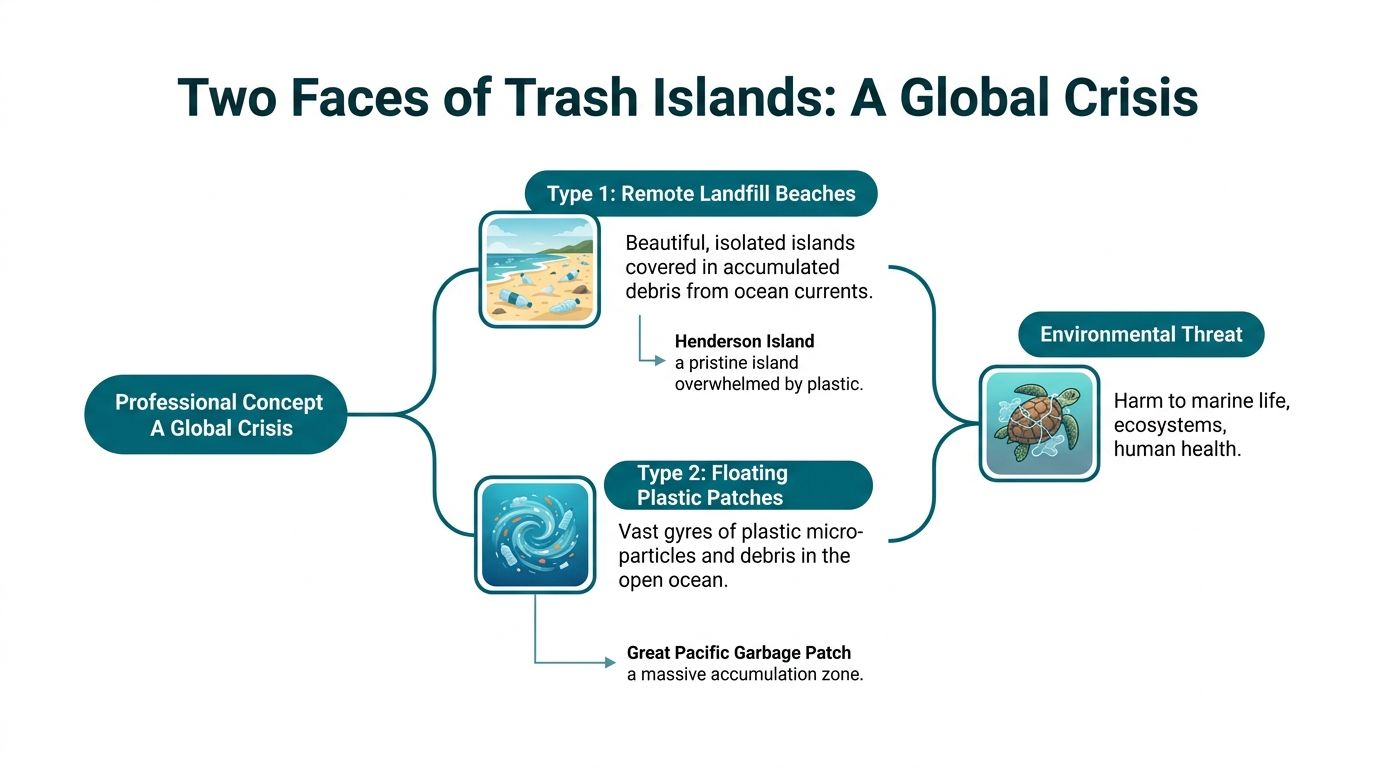
    Infographic

    That misunderstanding matters. People hear “island” and picture something they could step onto with a trash bag and a pair of gloves. Open-water patches do not work like that.

    A simple way to separate them

    Type What it is How it collects trash What it feels like
    Remote landfill beach A real island or shoreline Currents and waves wash debris onto land A beautiful place forced to hold what drifted in
    Floating plastic patch A moving accumulation zone in open ocean Rotating currents keep debris circulating A diffuse, hard-to-reach spread of plastic in many sizes

    Cleanup changes with the setting.

    • On land: People can remove debris from beaches and coves, even when the work is slow and access is difficult.
    • At sea: Crews have to deal with a scattered field of floating and submerged plastic across an enormous area.
    • In both cases: The waste usually started somewhere else.

    That last part stays with me most. An island can suffer from trash it never used. A patch in the ocean can hold pieces from thousands of ordinary decisions made far away.

    Once I saw those two forms separately, I also saw something hopeful. If trash can travel piece by piece, care can travel that way too. One bottle refused. One bag picked up. One beach cleaned with friends. That is how a global mess starts, and it is also how change starts.

    The Unsettling Life on Floating Trash Islands

    The strangest part of this story is that floating plastic does not remain empty for long. Life moves in.

    A bottle cap or polyethylene fragment drifts through the sea, and tiny organisms begin treating it like real habitat. That should unsettle us, because the ocean is adapting to our garbage in ways that make the problem harder, not easier.

    Plastic becomes a raft

    Scientists now describe floating trash islands as novel ecosystems. Plastic’s hydrophobic surfaces show biofouling rates 2 to 5 times higher than natural substrates, and polyethylene fragments can gather up to 1,000 barnacles per square meter within 60 days, according to this report on the research.

    That means the plastic becomes less like litter and more like a raft. Algae cling to it. Barnacles stack onto it. Small creatures use it as shelter or transport.
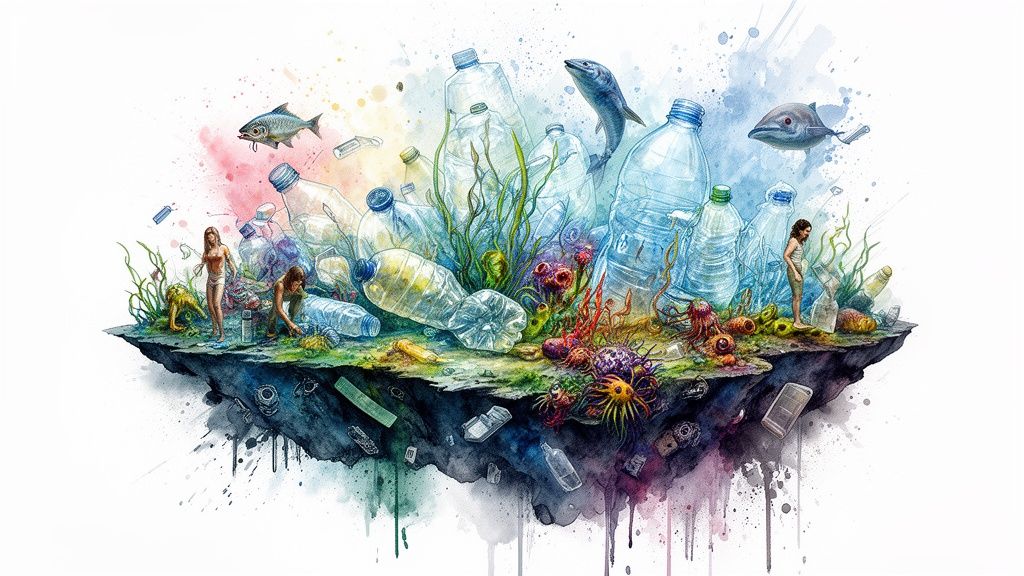
    A surreal illustration of an island made of discarded plastic bottles and waste floating in water.

    Wood and seaweed break down. Plastic lingers. It keeps offering a ride.

    The ocean did not ask for this architecture

    I find that detail hard to shake. We did not just dirty the water. We accidentally built floating neighborhoods.

    Those neighborhoods can carry species across entire ocean basins. Organisms that would never have crossed naturally can now hitch a ride on our debris and arrive in places where they do not belong. That changes competition, feeding patterns, and local balance.

    The visual is almost absurd. A cracked fragment of consumer plastic, once part of a throwaway object, drifts across blue water carrying life on its back like a little stolen continent.

    Why cleanup gets more complicated

    This changes the moral picture in a subtle way. Most of us think of trash as dead matter. Pick it up and the job is done.

    At sea, it is no longer that simple. The debris is still pollution, but it can also host living communities. Removing it remains necessary, yet the delay creates extra ecological knots. Every extra day gives more time for colonization, transport, and disruption.

    A few realities sit side by side here:

    • Plastic is still harmful. Its presence alters where species can live and travel.
    • Life is opportunistic. Organisms use whatever stable surface they can find.
    • Cleanup timing matters. Fresh debris is different from long-drifting debris coated in growth.

    Practical insight: The longer plastic stays afloat, the more it stops behaving like a simple piece of trash and starts behaving like infrastructure.

    That is what makes an island with trash so eerie in open water. It is not only a monument to waste. It is a world we should never have built.

    A World Tour of Infamous Trash Islands

    The first time I saw photos of Henderson Island, I felt the same shame I feel when a junk drawer spills open and proves I have been postponing a mess for too long. Henderson is remote, uninhabited, and famous for its ecological value. Still, waves keep laying our leftovers at its feet.
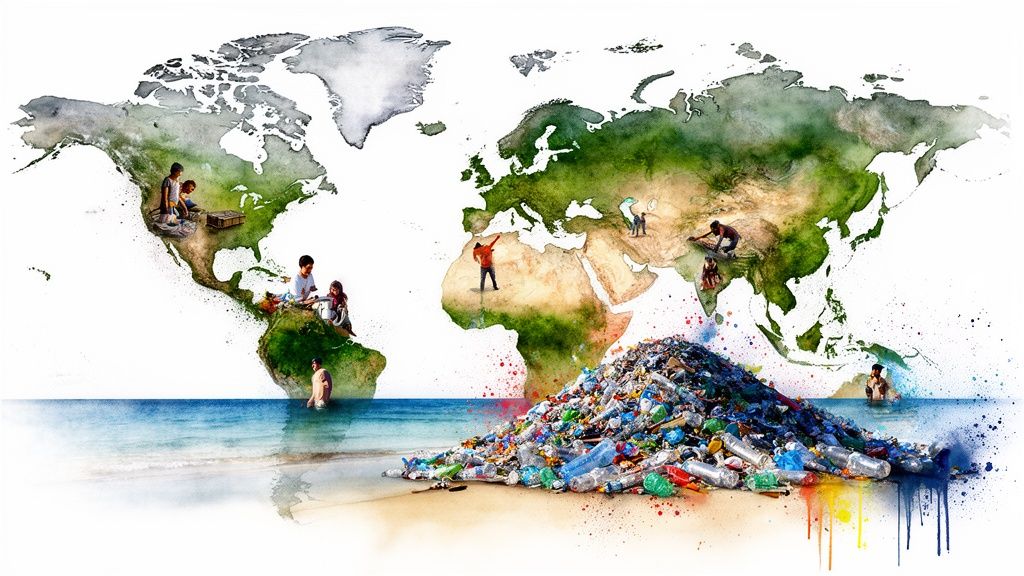
    A conceptual illustration showing a world map with various people and a large pile of plastic waste

    Henderson Island feels like a betrayal

    Researchers found Henderson covered with plastic at a scale that shocked even people who study pollution for a living. As noted earlier, the island holds millions of pieces of trash, much of it plastic, and a large share is buried in the sand rather than sitting plainly on top.

    That buried detail stays with me.

    A beach can look quiet and still be full of evidence. You see a little on the surface, then learn that much more is packed underneath, like personal clutter stuffed into closets before guests arrive. Henderson makes the global crisis feel intimate in that way. We hide nothing from the ocean. We only send it somewhere else, and the tide keeps returning it.

    Scientists tracing the problem have linked debris there to both fishing activity and land-based waste carried by currents. The island did not create this mess. It received it.

    The Great Pacific Garbage Patch is a spread-out trap

    Far offshore, the Great Pacific Garbage Patch gathers waste into a huge circulating zone between California and Hawaii. It is not a neat raft or a solid island. It is a loose field of floating debris, ghost gear, and tiny fragments suspended through the water.

    A 2018 Nature study, summarized by Iberdrola, describes it as spanning 1.6 million square kilometers and containing 80,000 tonnes of plastic made up of 1.8 trillion pieces, with 94% microplastics too small to spot from satellites, according to Iberdrola’s overview of the Great Pacific Garbage Patch.

    That mismatch matters. People hear “island” and picture something they could point to, walk across, and clean in a weekend with enough gloves and grit. The situation is harder. The mess is dispersed, weathered, and constantly moving.

    What the patch reveals about us

    The materials in the patch tell a blunt story about human habits. Iberdrola’s summary says 46% of the mass is fishing gear such as nets, ropes, and buoys. It also notes major origin shares from Japan, China, South Korea, the USA, and Taiwan.

    So this is not only a story about careless beachgoers dropping bottles after a picnic. It is also a story about industry, supply chains, lost gear, and systems big enough to feel faceless. If you want a clearer explanation of how these currents gather debris, the Litter Caterpillars guide to the ocean garbage patch breaks it down in plain language.

    A short visual can help turn those facts into something your brain can hold.

    Two places, one human pattern

    Henderson Island and the Great Pacific Garbage Patch are different forms of the same confession. One catches debris on shore. The other gathers it in motion. Both exist because people made something, used it briefly, and let distance hide the consequence.

    That is why cleanup matters at more than one scale.

    A person picking up a bottle from a park is not solving the Pacific alone. But that act pushes against the same habit that created these infamous trash islands in the first place. The outer mess and the inner mess come from a similar lie, that someone else will deal with it later.

    The hopeful part is simple. Communities can interrupt that pattern. One bag filled on a local walk. One fishing system improved. One crew deciding that service is better than denial. That is how an abstract horror on a world map becomes a personal practice, one piece of trash at a time.

    The Hidden Scars Our Plastic Leaves Behind

    A piece of plastic rarely harms the world in only one way. It keeps changing form, and each form creates a new kind of damage.

    First it is a visible object. Then it becomes fragments. Then it enters bodies, habitats, and food chains. The bottle you ignore today can become tomorrow’s invisible problem.

    Big plastic hurts in obvious ways

    On beaches and in open water, larger debris can trap animals or block their movement. The Henderson findings describe entanglement and ingestion risks to nesting sea turtles and endangered petrels. The Great Pacific Garbage Patch also kills marine animals through ingestion and entanglement, as noted in the earlier section’s cited reporting.

    This is the kind of harm that people can picture fast. A turtle caught in a net. A bird feeding plastic to its chick. A seal dragging line behind it.

    The pain is direct. The cause is direct too.

    Small plastic slips past our defenses

    Then the sun, salt, and wave action grind larger objects into smaller pieces. In the Great Pacific Garbage Patch, 94% of the pieces are microplastics, according to the Iberdrola source cited earlier.

    That detail changes everything. You cannot clean microplastics the same way you pick up a bottle from sand. Tiny fragments spread through water, move through ecosystems, and become easy for animals to swallow. This is comparable to breaking a plate on the kitchen floor. A whole plate is easy to see. The glittering dust afterward is what keeps cutting you.

    The scar is ecological and personal

    Plastic also changes the places it touches. On Henderson, much of the debris is buried in sediment, which means the mess is not only on the surface. It works its way into the structure of the beach itself.

    In floating patches, colonized plastic carries organisms across the sea, altering habitats in motion. That does not stay “out there.” Oceans feed coastlines, wildlife, weather patterns, and human communities. The line from a city sidewalk to the ocean is longer than one might assume, but it is still one line.

    A few connections matter in daily life:

    • Street litter can travel. Rain pulls it into drains, rivers, and eventually larger waters.
    • Single-use habits add up. One item feels trivial until millions of people repeat the same motion.
    • Invisible pollution still counts. When plastic becomes tiny, it becomes harder to confront, not less dangerous.

    Remember: The ugliest part of plastic pollution is not what you can see on top. It is what keeps happening after the item breaks apart.

    That is why cleanup matters so much. You are not just making a place look better. You are interrupting a chain reaction.

    How to Paint the Fence and Clean the World

    I stopped seeing cleanup as punishment when I remembered Tom Sawyer.

    He got stuck painting a fence, then turned the whole thing inside out. He made the task look meaningful, playful, even desirable. His friends wanted in. That old story sticks because it names a deep truth. The frame changes the feeling.

    A chore can become a dare

    When I hit a breaking point in my own life, I realized something odd. Cleaning my own mess felt emotionally loaded. Cleaning somebody else’s mess felt lighter.

    Not because the work was easier in a technical sense. It was easier because the shame was gone. I could step into service instead of self-judgment.

    That shift matters for any island with trash, from a cluttered block to an overwhelmed shoreline. If you tell yourself, “I have to fix everything,” you freeze. If you tell yourself, “I get to help this place breathe,” your body moves.
    A group of happy children painting a colorful picket fence made from recycled plastic bottles together outdoors.

    Shared hardship changes the mood

    Some of my favorite cleanup memories were not comfortable. Cold wind. Wet shoes. Bad timing. The kind of day when any reasonable person would stay home.

    But shared discomfort can turn into glue. When people face a hard task together, the story changes. It stops being “I did a chore.” It becomes “We survived that ridiculous morning together.”

    That is one reason service builds friendship so fast. You are not only collecting trash. You are making a memory in public, with a purpose.

    The practical side of this mindset is simple:

    • Bring symbols of pride. A flag, a shirt color, a team name, a little ritual before you begin.
    • Treat the event like an adventure. Walk a route. Notice the neighborhood. Celebrate weird weather.
    • Measure success by showing up. The habit matters as much as the haul.

    If you want ideas for larger-scale ocean responses, this overview of solutions for pollution in the oceans offers a useful set of approaches.

    Bravery matters more than perfection

    Many individuals wait to help until they feel ready. I think that is backwards.

    Bravery comes first. Readiness often follows. You show up awkward, unsure, underdressed, a little embarrassed, maybe carrying the wrong gloves. Then you learn by doing.

    I love that because it gives ordinary people a real entry point. You do not need to become a perfect environmental saint. You need to become someone willing to touch the mess.

    Best mindset: Do not ask whether cleanup feels glamorous. Ask whether it makes you more alive, more useful, and more connected.

    That question has changed my life. It can change yours too.

    An island with trash can break your heart. It can also train your courage. The same hands that once avoided the mess can become the hands that start clearing it.

    Join the Transformation and Find Your Crew

    A giant ocean patch can make you feel tiny. Your own block can make you feel powerful again.

    That is where I would start. Not with fantasies of solving the whole planet by yourself. Start with one corner, one morning, one bag, one friend.

    Why people hesitate

    The primary obstacle is often emotional before it is practical. On remote islands like Henderson, psychological barriers and isolation can deter volunteers. That same pattern shows up in cities too. Personal “trash stories” and the heaviness we attach to mess can stop us from acting, while cleaning other people’s messes often feels easier and shared hardship can make the work feel fun, according to Atlas Obscura’s reporting on the human side of cleanup.

    That insight gave me relief. If cleanup feels easier in a group, that is not weakness. It is a clue.

    How to build a cleanup crew

    You do not need a complicated system. You need a repeatable one.

    1. Pick a simple time
      Weekend mornings work well because they attract people who want to give their energy, not just squeeze in an obligation.

    2. Protect safety first
      Choose visible areas. Wear gloves. Bring bags. Watch traffic. Stop if conditions feel risky. Service should strengthen people, not grind them down.

    3. Make the group memorable
      Names matter. So do songs, badges, inside jokes, photos, and little traditions. People return to belonging, not just to tasks.

    4. Keep the first event small
      A short route beats an overambitious one. End while people still feel good.

    5. Stay volunteer-first
      Nobody likes feeling used. Build friendship. Share water. Thank people. Let the group become a place where people can breathe.

    For anyone ready to find a hands-on event, this volunteer trash pickup page shows what joining a cleanup community can look like.

    What transformation looks like

    Transformation is not dramatic most days. It is quiet.

    You become the kind of person who notices a bottle and picks it up. You become the kind of friend who invites somebody else. You become the kind of neighbor who leaves a place lighter than you found it.

    That identity grows slowly, like anything alive.

    • You gain trust in yourself because you did what you said you would do.
    • You gain resilience because weather, awkwardness, and inconvenience stop scaring you as much.
    • You gain community because useful people tend to find each other.

    Start where you stand: You do not need to reach a remote island with trash to join this story. Your sidewalk counts.

    I think that is the most hopeful part of all this. The world’s waste crisis is enormous, yes. But service shrinks the distance between helplessness and action. One bag closes that distance. One morning closes it more. One crew closes it faster.

    And somewhere along the way, while you are cleaning the street, you may notice that another mess is clearing too. The one inside you.


    If this way of serving speaks to you, join Litter Caterpillars. Show up for a cleanup, meet people who care, and turn one ordinary morning into a small act of transformation.
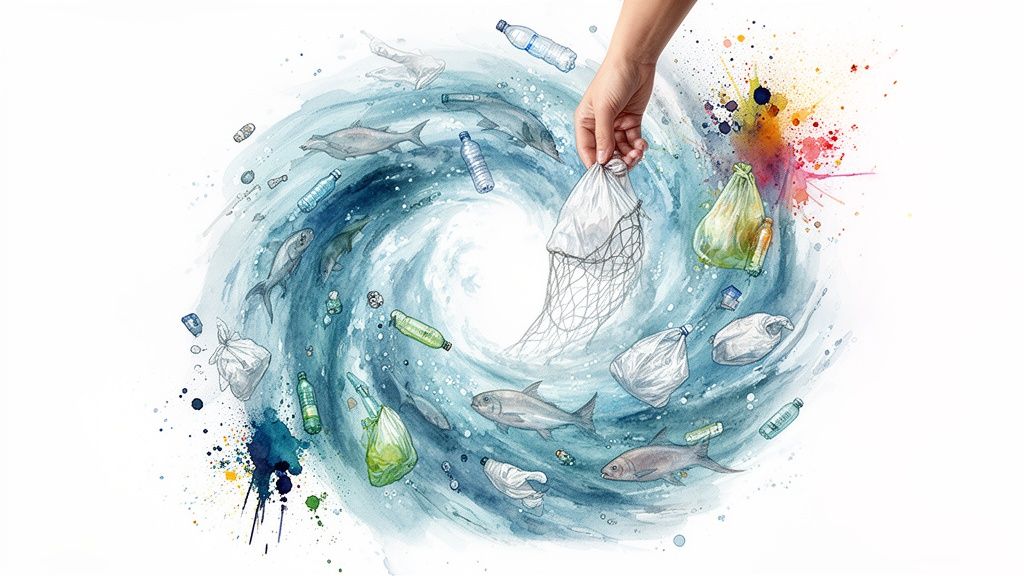
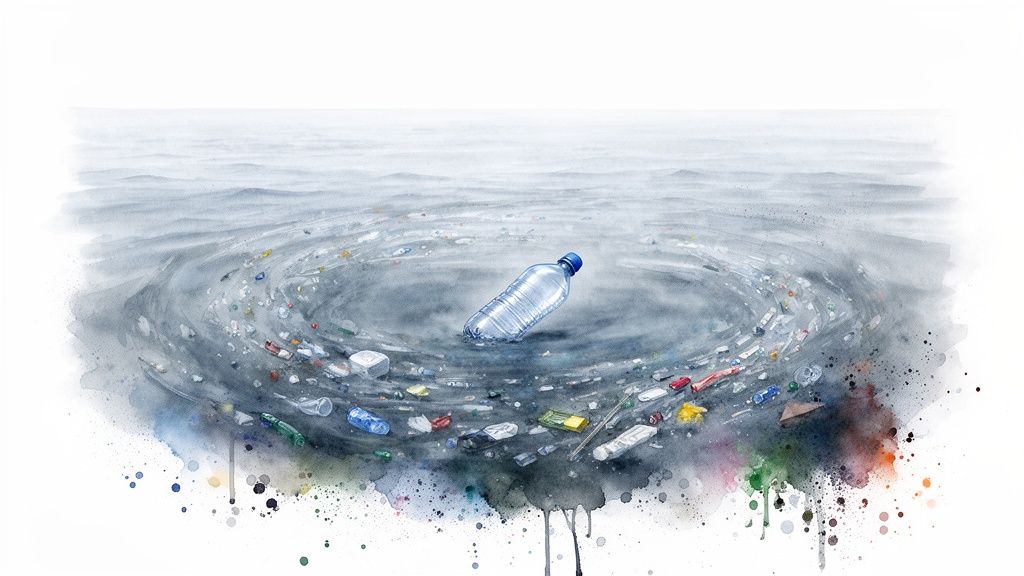
  • What Is the Pacific Ocean Garbage Patch, Really? And How Do We Fix It?

    What Is the Pacific Ocean Garbage Patch, Really? And How Do We Fix It?

    Let me get one thing straight with you. The Great Pacific Garbage Patch isn’t some giant island of trash you can go walk on. I want you to forget that picture. The reality is way, way scarier. Imagine a hazy, swirling soup of plastic confetti, a ghost in the water, stretching for thousands upon thousands of miles. That's the real monster we're up against.

    The Invisible Crisis in the Pacific

    Watercolor artwork illustrating a vast ocean filled with plastic pollution, forming a swirling garbage patch.

    When I first heard about the pacific ocean garbage patch, I pictured it, too. A solid mass, like some monument to all our trash. But that’s not it. It’s sneakier than that. It’s less like a floating landfill and more like a cosmic nebula—but instead of stardust, it’s a swirling vortex of our plastic sins.

    I need you to see it. This whole mess is trapped between Hawaii and California. Huge, rotating ocean currents, which we call gyres, act like a giant bathtub drain. They suck in trash from all over the Pacific Rim, pulling it in and holding it there in a slow, endless, mesmerizing spin.

    The Scale of the Problem

    It’s hard to get your head around how big this thing is. Believe me. This isn’t some problem you can just ignore in a far-off corner of the world. It’s massive. It’s everywhere.

    The Great Pacific Garbage Patch covers 1.6 million square kilometers. That’s twice the size of Texas. Or three times the size of France. And inside that soup, scientists tell me there are between 80,000 and 100,000 tonnes of plastic. It’s so spread out, so hazy and ghost-like, that you can’t even see it from a satellite. An invisible monster.

    Just let that sink into your gut for a second. An area three times the size of a country, completely choked with plastic dust. For me, it’s a gut punch, a brutal reminder that what you and I do on land ends up haunting the oceans.

    Why This Myth Matters

    So why do I care so much about debunking that "trash island" myth? Because if you think it’s a solid island, the solution sounds simple. Just go out there with a big net and scoop it all up. Problem solved, right?

    Wrong. You know it’s never that easy. It's way more complicated. The huge majority of this plastic isn't floating bottles or bags. It’s tiny, almost invisible fragments, what we call microplastics, hanging in the water column like dust motes in a sunbeam. They’re everywhere, from the surface all the way down to the dark, silent ocean floor.

    Facing that truth is the only way you and I can find real solutions. It shows us that cleanup is incredibly hard, and the real fight is stopping more plastic from ever getting there in the first place.

    My whole journey with Litter Caterpillars started with a simple, personal idea: cleaning up someone else’s mess is powerful. It didn't start with me trying to save the world. It started with me trying to clean up the chaos in my own life. Tackling something as huge as the pacific ocean garbage patch starts the same way—with one small, real step you take on the street right where you live.

    How Our Trash Takes a One-Way Trip to the Pacific

    So, why does all this junk end up in the middle of nowhere? It's not a coincidence. I want you to picture the Earth’s oceans as a series of massive, slow-motion whirlpools. We call these gyres, and they’re like giant conveyor belts for absolutely everything that floats.

    A plastic bag you see tossed into a river in Asia or a bottle cap washed off a California beach doesn't just hang around. Oh no. It gets swept up by smaller currents, eventually finding its way into one of these huge, unforgiving systems. The one we’re talking about, the one responsible for the garbage patch, is the North Pacific Subtropical Gyre.

    The Great Pacific Conveyor Belt

    Think of this gyre as a natural trap. I see it as a huge, rotating current that slowly, patiently pulls everything toward its calm, quiet center. Once debris gets caught in this spiral, it’s almost impossible for it to escape. You’re on a one-way ticket, no returns.

    This is how a single piece of your trash can travel thousands of miles to join the plastic soup we now call the Great Pacific Garbage Patch. For me, it’s a powerful, and frankly, heartbreaking lesson in how connected we all are. It shows us, with startling clarity, that our local actions have consequences that ripple across the entire planet.

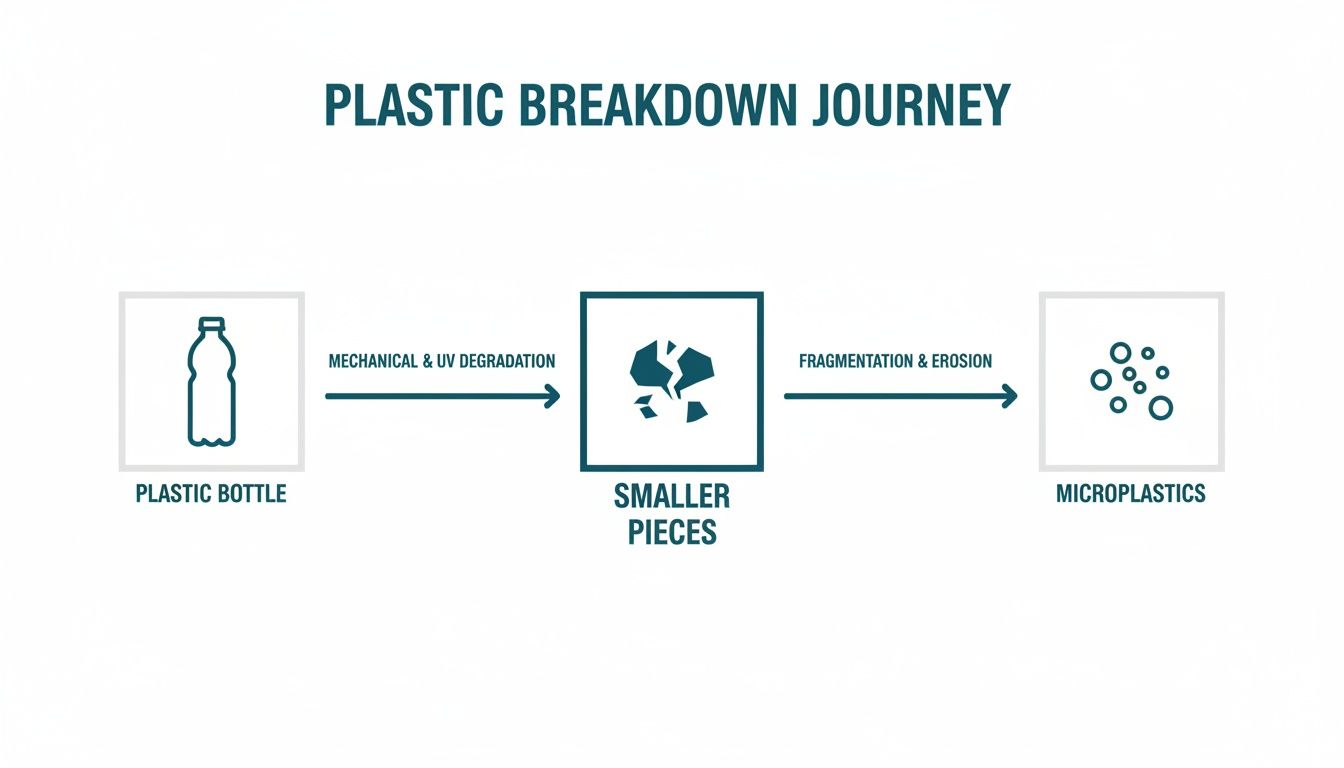
    This is the journey that bottle takes—breaking down from a single object into countless, more dangerous fragments.

    A diagram illustrating the breakdown journey of a plastic bottle into smaller pieces and microplastics.

    When you look at that, it makes it clear: plastic doesn't just disappear. It just becomes a more pervasive and insidious type of pollution that you can't see.

    An Ever-Growing Monster

    And this conveyor belt never stops. This problem isn't just staying the same; you and I know it's getting worse at a terrifying speed. Recent research I read found that the plastic concentration in the Great Pacific Garbage Patch has absolutely exploded.

    It’s an almost unbelievable jump, and it proves this thing is actively growing while we watch.

    Scientists now estimate there are 1.8 trillion pieces of plastic floating in the patch. I did the math. That breaks down to about 250 pieces of debris for every single human on Earth. For you. For me.

    But what’s really revealing is the breakdown of what this trash actually is. The table below shows just how deceptive the numbers can be. While tiny microplastics dominate the piece count, it's the larger, heavier items that make up most of the patch's total weight.

    Plastic Breakdown in the Great Pacific Garbage Patch

    Plastic Category Contribution by Count Contribution by Mass
    Microplastics (0.05–0.5 cm) 94% 8%
    Mesoplastics (0.5–5 cm) ~5% 11%
    Macroplastics (5–50 cm) ~1% 22%
    Megaplastics (>50 cm) <0.01% 53%

    What does this tell you? It shows a shocking truth: a staggering 46% of the patch's total mass is made up of fishing nets, often called "ghost nets." These are nets that were lost or abandoned, and they continue to drift aimlessly, entangling and killing marine life for decades.

    This is exactly why our mission at Litter Caterpillars is so critical. When you pick up a plastic bottle on a Chicago street, you're doing more than just cleaning your neighborhood. You are cutting off the supply chain to this oceanic monster right at the source. You are stopping that bottle from ever starting its long, destructive journey.

    Your local action is a global solution. It's that simple. It really is.

    The Ripple Effect on Marine Life and Our Health

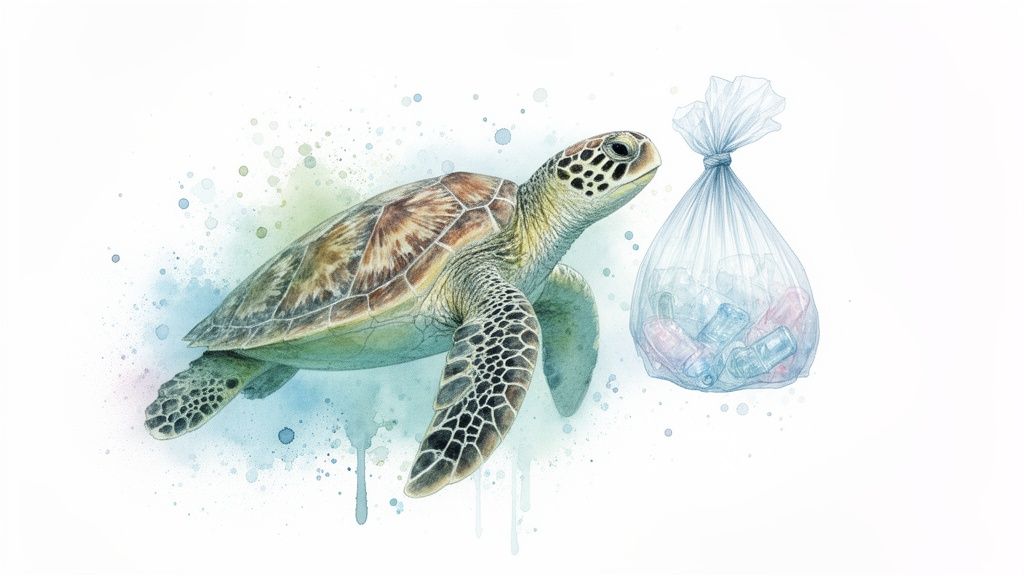
    Watercolor art of a sea turtle approaching a clear plastic bag filled with trash.

    This isn't just a story about trash. I know you know that. It's about life. Now that we've seen how this toxic soup gets stirred up in the ocean, you and I have to face the heartbreaking reality of what it does to the creatures living there. The fallout from our garbage problem doesn't just stay in one place; it touches everything.

    For a second, I want you to imagine you’re a sea turtle. Your entire world runs on ancient instincts, and one of those instincts screams that jellyfish are a great meal. But then you see a flimsy plastic bag, dancing in the current. It looks exactly like your next meal. For thousands of turtles, this simple, tragic mistake is a death sentence.

    The Silent Killers in the Deep

    And it’s not just the turtles. I want you to picture a massive albatross, a bird that soars for thousands of miles over the open sea. It swoops down to grab food for its chicks waiting back at the nest, but its beak closes around colorful bits of plastic and bottle caps instead of squid.

    It flies back and regurgitates this plastic junk into the mouths of its babies. They slowly starve to death, their bellies completely full of our garbage. This is real. It's happening.

    This is the grim, direct impact of the big stuff floating around. But there’s a much more sinister killer lurking in that hazy water. We call them ‘ghost nets.’

    These are gigantic fishing nets, some as big as football fields, that were lost or just ditched at sea. They don't just sink and go away. They keep doing the one thing they were made for: they trap and kill, endlessly. For decades, these nets drift silently through the ocean, entangling whales, dolphins, seals, and sharks in a slow, horrible struggle.

    The Poison on Your Plate

    But the devastation doesn't end with the animals we can see. As you and I have learned, most of the plastic out there isn't in big, floating chunks. The real danger is the microscopic dust it all breaks down into.

    The Great Pacific Garbage Patch holds an estimated 1.8 trillion individual pieces of plastic. But here's the kicker you need to know: microplastics make up 94 percent of that count, while only accounting for 8 percent of the total weight. If you want to dive deeper, you can learn more about these shocking findings on the plastic count versus mass.

    This invisible confetti gets into everything. It's eaten by plankton, the microscopic organisms that are the absolute foundation of the entire marine food web. You can think of plankton as the grass of the ocean—everything above it depends on it.

    Those tiny, plastic-filled plankton get eaten by small fish. Then, bigger fish eat the small fish. And on and on it goes, right up the food chain. At every single step, the concentration of plastic and the toxins stuck to it gets higher and higher.

    We call this process biomagnification. Imagine you eat a slightly spicy pepper. Now imagine another person eating a hundred of those peppers, all at once. That's what happens as plastic moves up the food chain—the toxic load just gets bigger and bigger.

    Eventually, that same fish might end up on a dinner plate. Maybe even yours. All of a sudden, that garbage patch doesn't feel so far away, does it? The plastic we threw out is literally coming back to haunt us, hidden in the food we eat.

    This isn't just some "environmental issue" anymore. It's a human health crisis in the making. We're only just starting to figure out what eating these microplastics does to our bodies, but one thing I know for sure: it can't be good. Facing these hard truths isn't about you feeling guilty—it’s about finding the courage and the motivation to actually do something about it.

    Can We Actually Clean It Up? Finding Hope on the Horizon

    After all that, I bet you're asking the one question that really counts: Is there any hope? Can we actually clean up this overwhelming mess?

    My answer is a loud, clear, "Yes." But it's probably not in the way you're thinking.

    This isn't a story about defeat. For me, it's a story about the incredible people—the innovators and fighters on the front lines—who absolutely refuse to give up. Their fight gives me hope, and I think it should give you hope, too.

    The Bold Dream of Cleaning the Oceans

    When you picture cleaning up the garbage patch, you’re probably imagining some massive, ambitious project. And you'd be right. The most famous effort comes from a non-profit called The Ocean Cleanup. These are the people who dared to dream big, building huge systems to pull plastic straight from the ocean gyres.

    It’s an incredible mission. They use two ships to drag a massive barrier—almost 2,200 meters long—through the water. This net skims the surface, funneling the plastic together so it can be hauled out. Just recently, they pulled a record-breaking 11,400 kilograms of trash from the ocean in one go.

    Their system is now so good it can sweep an area the size of a football field every five seconds. It’s pretty amazing what people can come up with when they try.

    But here’s the biggest lesson they’ve learned, a lesson I want you to remember: cleaning the ocean is like trying to mop a flooded bathroom while the tub is still overflowing. You can mop all day, but you'll never get ahead until you turn off the faucet.

    The Real Front Line in This Fight

    This is where the story gets interesting for me. The folks at The Ocean Cleanup are doing heroic work, but even they'll tell you the real solution isn't out in the middle of the Pacific. The most powerful weapon you and I have is prevention.

    Real hope isn’t some magic-bullet solution out there somewhere. It’s the collective power of people on the ground, stopping plastic at the source. That’s you, and that’s me. We’re the ones who can turn off the faucet.

    This is the whole reason I started Litter Caterpillars. The real battle against the Great Pacific Garbage Patch isn't fought in the Pacific; it's fought on the streets of Chicago, in your town's parks, and along the banks of every local river. Each piece of plastic you and I pick up is one less piece that starts the long journey to the sea.

    You can dive deeper into how we fight back by checking out our guide to practical solutions for pollution in the oceans.

    Our entire mission is built on this one simple truth. When we get together on a weekend morning to clean a neglected lot, we are directly defending the oceans. We are the front line. Every single volunteer who shows up, rain or shine, becomes a guardian of our waterways.

    The real heroes of this story are the everyday people, like you, who decide to do something. Hope isn’t just on the horizon; it’s in your hands, one piece of litter at a time.

    When you think about the Great Pacific Garbage Patch, does it make you feel overwhelmed? I get it. I’ve been there. Staring at a plastic soup a million miles away from a city street corner makes the problem feel impossibly huge and totally disconnected from our lives.

    But I need you to hold onto this one truth: every single piece of plastic in that patch started its journey on land. It started on a street just like yours. A bottle cap that rolled into a gutter. A grocery bag that got snatched by the wind. That’s where the story begins. And that’s where your power is.

    This whole journey for me, starting Litter Caterpillars, didn’t begin with some grand mission to save the planet. It came from a desperate need to clean up the chaos in my own life. In doing that, I stumbled onto something powerful: the simple act of cleaning up somebody else's mess—a park, a sidewalk—was a profoundly healing thing. It brought a strange kind of order to my own world that I never saw coming.

    It Starts with a Single Choice

    Look, I’m not asking you to save the world. I’m here to tell you that you don't have to. You just have to start with one thing.

    The problem of the pacific ocean garbage patch feels impossible, right? But it’s not one single problem. It’s billions of tiny, individual problems all adding up. And that means the solution is also made up of billions of tiny, individual actions you and I can take.

    • Pick up one piece of trash. Seriously, just one. You see that plastic bottle on the sidewalk? Don't walk past it. Pick it up. That’s one less bottle on a journey to the ocean.
    • Refuse one plastic item. When they offer you a plastic straw or a disposable bag, just say no. That one choice you make, repeated over and over, sends a powerful message.
    • Start one conversation. Ask a friend if they’ve ever thought about where their trash goes. You don’t have to preach. Just plant a seed.

    This is how you start. It’s not about some huge, life-changing gesture. It’s about a small, deliberate choice. It's about taking that crushing feeling of helplessness and turning it into one concrete action you can control right now.

    I learned that cleaning other people's messes is way easier than cleaning up our own. And in a strange way, it's what allows you to start cleaning your own. The weight of your own problems feels lighter when your hands are busy solving someone else's.

    You Are the Faucet

    Remember how I said cleaning the ocean is like mopping a flooded bathroom while the tub is still overflowing? You, right here, are standing right next to the faucet. Every single time you stop a piece of litter on your street, you are turning that faucet off, just a tiny bit.

    You are the first line of defense. The cleanup tech out on the ocean is amazing, but it's the last resort. The real fight is won or lost right here—on our streets, in our parks, and along our riverbanks. Most of the plastic choking our oceans starts on land, washed into storm drains and rivers. When you act locally, you have a direct impact on this global crisis. You can also check out our guide on other ways to reduce plastic use in your daily life.

    From Chaos to Transformation

    My life was a mess. Every piece of trash in my house had a story, a memory that made it feel impossible to throw away. It weighed me down. I felt completely stuck. It was only when I decided to clean up messes that weren't even mine that something inside me finally started to shift.

    I took all the chaos, frustration, and hurt from my own life and turned it into action. And what I found was a strange kind of joy. I found real friendship. I found purpose shivering in a hailstorm with two other people, realizing that shared struggle is what forges the strongest bonds.

    That’s what this is all about for me. This isn't just about picking up trash. It's about transforming yourself. It’s about taking something that feels broken and making it whole again—starting with a small patch of your own neighborhood, and maybe, just maybe, a small part of yourself, too.

    Your power isn't way out there in the middle of the ocean. It’s right here, in your hands, on your street. This is how we heal our planet. And this is how we heal ourselves. Together.

    Let's Talk Straight About This Garbage Patch

    When you hear about the Great Pacific Garbage Patch, your mind jumps to all sorts of places. I get it. The whole thing sounds massive, confusing, and honestly, a little hopeless. But getting straight answers is the first step to figuring out how we can actually fight back.

    Here are the questions I hear all the time.

    So, Can You See This Thing From Space?

    Absolutely not. This is probably the biggest myth out there, and you and I need to kill it. We’ve all been shown pictures of a solid island of floating trash, but that’s not what we’re dealing with. The truth is way, way scarier.

    It isn’t a continent of plastic bottles you can stand on. The huge majority of it is tiny microplastics, just like I talked about before. These little fragments are floating under the surface, making the water look like a murky, polluted soup. A satellite can't see it. Heck, even if you were on a boat in the middle of the patch, you might not see a giant pile of junk—just cloudy, dead-looking water. It's an invisible enemy, and that's what makes it so dangerous.

    If We All Stop Using Plastic, Will It Just Go Away?

    I wish it were that easy. I really do. If every single person on the planet stopped using plastic right this second, the garbage patch wouldn't just vanish. The damage is already done. That plastic is already out there, and it's going to stick around for centuries, slowly breaking apart.

    All those pieces swirling in the ocean will just keep getting smaller and smaller, poisoning sea life for hundreds of years. This is exactly why you and I have to fight this war on two fronts. We need prevention to cut off the supply of new plastic, and we need real, hands-on cleanup to deal with the mess we’ve already made.

    It’s like finding a leak in your roof. You can't just put a bucket under the drip and call it a day, right? You have to climb up there and actually patch the hole. We have to do both.

    Isn't Recycling Supposed to Fix This?

    Recycling is part of the answer, but it’s not the magic bullet you might think it is. It helps, sure, but it's not even close to being a complete solution. Think about this with me: globally, only about 9% of all the plastic we produce ever gets recycled. The rest? It goes to landfills, gets burned, or ends up right in our environment.

    The real power is in the old-school mantra: Reduce, Reuse, and then Recycle. The biggest difference you can make is to stop buying so much single-use plastic in the first place. Recycling is the last resort, not your first move. It can't solve a problem that starts with us making way too much of this stuff to begin with.


    At Litter Caterpillars, I believe the strongest action you can take is right here, in your own neighborhood. When you join one of our weekend cleanups, you're not just picking up trash. You’re stopping plastic at the source, meeting people who actually care, and finding a new kind of purpose. Come join us and be part of the solution, one street at a time. You can find your next event at https://www.littercaterpillars.com.

  • The Ocean Garbage Patch: My Journey From a Messy Room to the Sea

    The Ocean Garbage Patch: My Journey From a Messy Room to the Sea

    When you hear "ocean garbage patch," what do you see in your mind? I bet you're picturing a floating continent of trash, a solid island of plastic bottles and bags you could almost walk on. The real story is much stranger, and if I'm being honest, it's more disturbing.

    It's less of a solid island and more of a toxic, plastic soup. Imagine a colossal, swirling cloud of confetti-sized plastic bits, churning for thousands of miles just under the surface, all trapped by powerful, rotating ocean currents called gyres.

    Confronting the Mess, One Piece at a Time

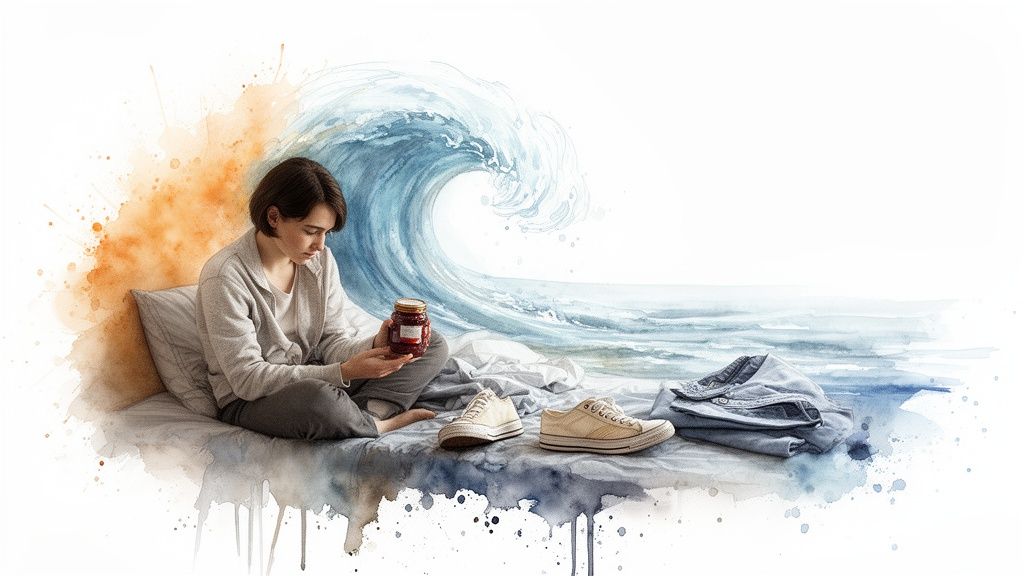
    Young person on a bed with a jar of jam, sneakers, jeans, and a watercolor wave.

    I have a story for you. It's not about some huge, far-off environmental issue. It’s about my messy room. You see, for most of my life, I've had a terrible time cleaning and organizing my own things. As my living space got messier and messier, my life felt messier, too.

    Every single forgotten thing had a story, a sentimental weight that went way beyond its physical form. I'm thinking of an old jam jar shoved in the back of my fridge, a souvenir from a trip to Michigan four years ago. Or a bag of nuts I bought when I tried to eat healthy and failed spectacularly.

    These things weren’t just clutter. To me, they were anchors.

    The Weight of a Single Jar

    That jam jar weighed less than a pound, but in my head, it felt like a 500-pound weight of failure. I just couldn't bring myself to move it. It was so much easier to shut the fridge door and pretend it wasn’t there. I think you might know that feeling. It's the same paralysis that can wash over you when you hear about something as enormous as the ocean garbage patch. It feels too big, too distant, too heavy to even start thinking about.

    But my journey to understand our planet's plastic problem starts right there, in my messy room. It begins with a discovery: facing one tiny, insignificant piece of my own mess gave me the courage to take on the world's.

    This is the idea we’re going to explore together: The bravery you build in your own life is the exact same bravery we need to heal our planet. It’s not about being perfect. It’s about taking that first, hard step.

    This is exactly why I started Litter Caterpillars. I found out a strange truth: cleaning my own life felt impossible, but cleaning up public spaces with friends? That felt inspiring. It turned a chore into a mission.

    Throughout this guide, we'll look at the shocking reality of the ocean garbage patch through this very personal lens. You'll see how:

    • Picking up a single piece of litter connects you to a global fight.
    • Building a community in our own neighborhoods, like we do here in Chicago, is the secret to solving worldwide problems.
    • Finding the courage to do hard things, together, is how we transform ourselves and our world.

    What Is an Ocean Garbage Patch, Really?

    Let's ditch that idea of a floating garbage island. Instead, I want you to imagine a giant, swirling plastic soup. It’s less like a solid mass and more like a nasty smog that hangs just under the water's surface. This isn't one clump of trash. It’s a hazy mess of debris spread out over thousands of miles, where the sun and waves have broken down most of the plastic into countless tiny, confetti-like pieces.

    These little fragments, we call them microplastics, are the real heart of the problem. They turn huge areas of the ocean into a murky, polluted broth. This is what makes the garbage patch practically invisible from a boat and impossible to see on satellite photos. You could sail right through the middle of one on a calm day and not notice anything besides a weird, oily sheen on the water.

    The Great Pacific Garbage Patch

    The most infamous of these zones is the Great Pacific Garbage Patch—a massive monument to our plastic addiction. This is the one you’ve probably heard about, swirling in the ocean halfway between Hawaii and California. Its size just blows my mind.

    To give you some perspective, the Great Pacific Garbage Patch covers an estimated 1.6 million square kilometers. That’s an area twice the size of Texas, or three times the size of France. Inside this zone, scientists figure there are about 1.8 trillion pieces of plastic. That breaks down to roughly 250 pieces for every single person on Earth. While it’s mostly that plastic soup, the total weight is around 80,000 tonnes, which is like having over 740 Boeing 777 jets floating out there. You can get a deeper look at these wild stats over at wifitalents.com.

    This map really shows you the scale of the plastic concentration. It’s not just one spot.

    As you can see, the debris is most dense at the center, but the entire area is a huge soupy mess.

    Not an Island, but a Toxic Cloud

    So, if it’s not an island, what is it? The best analogy I have is a cloud. From far away, a cloud looks solid, right? But if you fly a plane through it, you realize it's just a whole lot of air and water vapor.

    The ocean garbage patch is exactly like that. It's not something solid you can stand on; it’s a three-dimensional pollution zone. The plastic junk is scattered from the surface all the way down to the ocean floor, with the thickest concentration floating in the top layer of the water.

    This is what makes it so dangerous. It’s a toxic, hazy cloud that has basically become part of the ocean itself. It's a permanent feature of our planet now, built one piece of trash at a time—trash that started in our streets, rivers, and on our coastlines. Getting our heads around this truth—that it's not an island, but a pervasive, soupy mess—is the first real step to tackling the challenge ahead of us. It’s a problem that's been woven right into the fabric of our oceans.

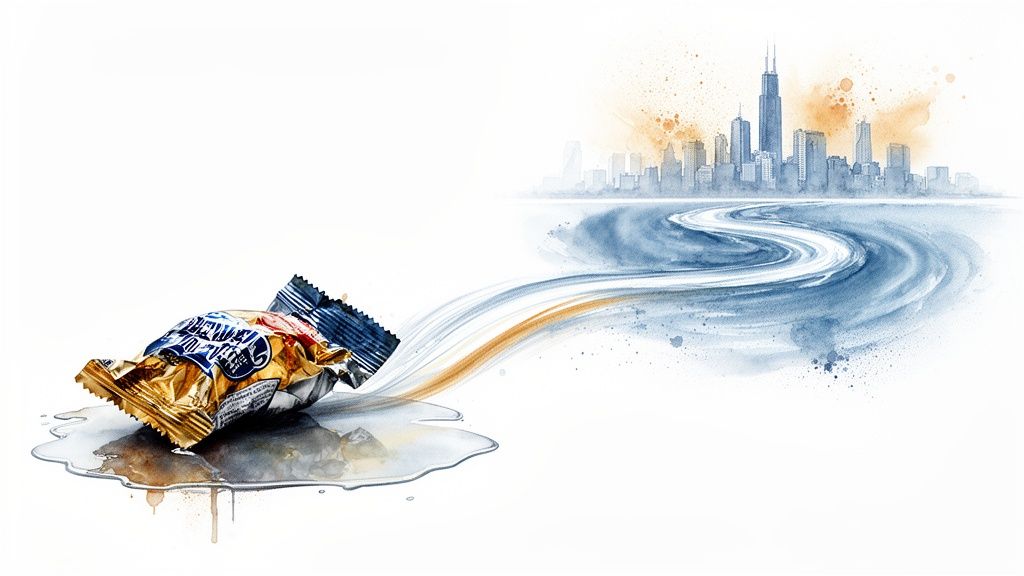
    Tracing a Candy Wrapper from Chicago to the Pacific

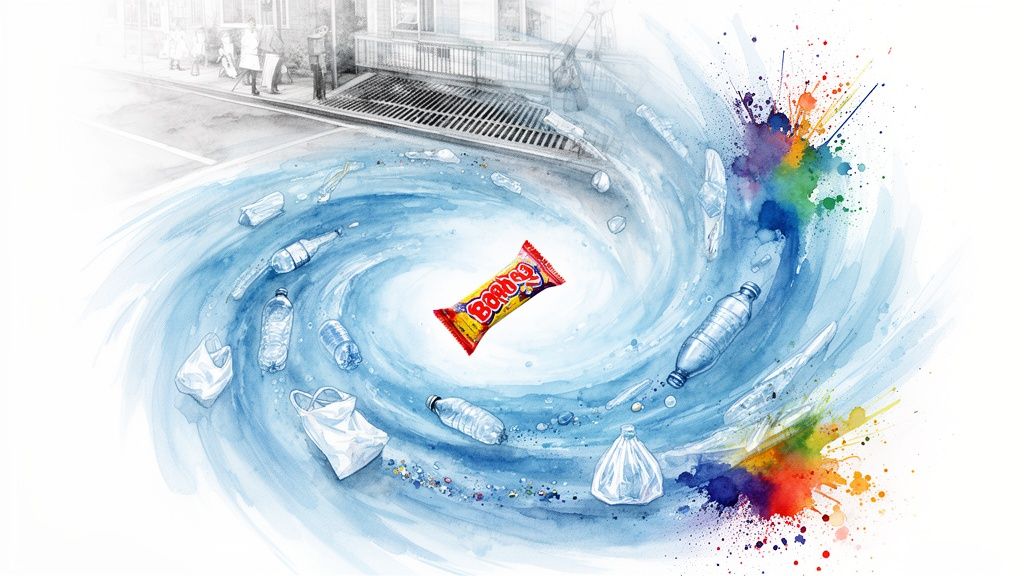
    Watercolor illustration of a candy wrapper spilling liquid, with a path leading to a city skyline.

    This is going to sound crazy, but stick with me. I want you to picture one little candy wrapper, dropped on a busy street right here in Chicago, ending up in a massive ocean garbage patch thousands of miles away. It feels like a problem for someone else, somewhere else. A world away.

    But it’s not. The journey from our sidewalks to the middle of the ocean is terrifyingly direct. Let's follow the path of that single piece of trash. You’ll see exactly how a moment of carelessness in our city becomes part of a global crisis.

    Think about a bright red candy wrapper, let go near a bus stop in the Loop. It gets kicked around for a day or two. Then, a classic Chicago storm hits.

    That rush of rainwater is all it takes. The wrapper is swept into a storm drain, and just like that, its fate is sealed. It’s just entered a one-way highway to the sea.

    The Urban Expressway for Trash

    Our city’s waterways—the Chicago River, the canals, and Lake Michigan—aren't just scenery. I want you to see them for what they’ve become: expressways for our trash. That wrapper is now in the sewer system, which flushes it right into the Chicago River. We see the effects of this firsthand every week, and if you want to understand the real challenge we’re up against, check out our guide on cleaning up a river right here in our community.

    From the river, it's a quick trip into Lake Michigan. Now it’s in the Great Lakes system, starting a much longer trip. It drifts with the current through Lake Huron, Lake Erie, and Lake Ontario. It might take months, maybe years, but it will eventually pass through the St. Lawrence Seaway and get spit out into the North Atlantic.

    It has now officially left our neighborhood and entered the planet’s circulatory system. This is where the story gets truly wild.

    Riding the Great Ocean Conveyor Belt

    Out in the open ocean, that wrapper is grabbed by a force bigger than any river. It gets pulled into a massive, spinning system of currents called an ocean gyre.

    Think of a gyre as a planetary whirlpool, a slow-motion vortex as big as a continent. We have five major ones on Earth. They act like giant drains, sucking in anything that floats from thousands of miles away and trapping it all in their calm, stable center.

    This is the engine that builds an ocean garbage patch. Our little red wrapper from Chicago is now in the Atlantic, where it might get caught in the North Atlantic Gyre. Or, if it rides the currents just right, it could travel south, whip around the tip of Africa, and find its way into the Pacific.

    Once it’s caught in the gigantic North Pacific Gyre, its journey is over. It joins trillions of other plastic pieces—scraps of bags from Tokyo, empty bottles from L.A., and tangled fishing nets from who knows where. It will just sit there, slowly breaking down under the sun, becoming part of that toxic plastic soup we’re all fighting against.

    • Step 1: Trash enters a local waterway (a Chicago storm drain).
    • Step 2: It travels through a regional system (the Great Lakes).
    • Step 3: It enters a major ocean (the Atlantic).
    • Step 4: It is captured by a global force (an ocean gyre).

    That single candy wrapper, from a careless moment in our own city, has finished its journey. It’s now a permanent resident of the Great Pacific Garbage Patch. It’s the proof that when we throw something "away," there is no away. It all connects back.

    This problem is so much bigger than an ugly, littered ocean. The ocean garbage patch isn’t some passive island of trash just floating there. It's an active and devastating menace. To get the full picture, you have to hear the stories of the creatures that call the ocean home.

    I want you to picture a sea turtle, one of those ancient, graceful animals. It’s swimming and sees what looks like a beautiful, shimmering jellyfish—its favorite meal—pulsing in the water. But it’s not food. It's a plastic bag. The turtle eats it, and that single mistake can block its entire digestive system, leading to a slow, agonizing death.

    This isn't some freak accident. It’s happening constantly. Seabirds live out a similar nightmare. They fly for hundreds of miles, scooping up what they believe is food for their chicks. But they come back to the nest with a belly full of sharp, colorful plastic shards. They regurgitate this trash into their babies' mouths, and the chicks, their stomachs full of garbage they can't digest, starve to death.

    The Invisible Killer: Microplastics

    As gut-wrenching as those stories are, they’re only the most obvious part of the crisis. The real tragedy is unfolding on a microscopic level. It's an invisible threat that has already contaminated every corner of the ocean and is now making its way back to us.

    When those bigger pieces of plastic—the bottles, bags, and fishing gear—get beaten down by the sun and waves, they don't break down and disappear like a banana peel. They just shatter. They break into smaller and smaller pieces, becoming what we call microplastics. These are tiny fragments, often smaller than a grain of rice, and they are the true poison of the ocean garbage patch.

    It's like dissolving a poison tablet in a giant jug of water. You can't see the poison anymore, but you know the whole thing is toxic. That's what microplastics have done to our oceans. They’ve turned the water itself into a chemical soup.

    These tiny plastic bits act like little toxic sponges. They soak up all the nasty chemicals floating around in the seawater, like pesticides and industrial waste. So now you have a tiny particle that is both plastic and poison. You can see the shocking reality of this in our post with some powerful plastic pollution pictures.

    A Poison Pill Climbing the Food Chain

    And this is where the problem comes right back to bite us. The journey of these toxic microplastics starts at the very bottom of the food web.

    • First, plankton eat them. These microscopic organisms are the foundation of all life in the sea, and they're mistaking these tiny bits of plastic for food.
    • Next, small fish eat the plankton. With every plankton they swallow, the dose of plastic and the toxins stuck to it grows inside their bodies.
    • Then, bigger predators eat the small fish. A single tuna or swordfish eats hundreds of these smaller fish, accumulating all that plastic contamination into its own body.

    This process is called biomagnification. With every step up the food chain, the concentration of plastic and poison gets stronger. The predators at the very top end up with the highest, most dangerous levels of pollution in their systems.

    And who sits at the top of that food chain? We do. The fish that lands on your dinner plate could be carrying a lifetime of plastic pollution. This isn't a scare tactic; it’s the scientific reality we're just starting to wrap our heads around. The plastic we threw "away" is coming back for us, one microscopic piece at a time. This isn't just about biodiversity or ocean health anymore—it's about our own.

    How Do You Measure a Ghost?

    Trying to get a handle on the sheer scale of the ocean garbage patch is one thing. But how do you even start to measure something so massive, so spread out, and so… hazy? It’s not like you can point a satellite at it and get a clean picture. From space, it's mostly a ghost that haunts our seas.

    This means scientists have to get creative. They have to get tough. You can't fix a problem until you're brave enough to look it right in the eye and size it up. You have to get out there. And that's exactly what they've done, launching some of the most complex expeditions in modern history to map this invisible threat.

    They send out fleets of boats that crisscross the gyres, pulling special nets designed to skim the surface for debris. But that only shows you part of the picture. So, they also fly aircraft low over the water, using advanced sensors and sharp-eyed observers to spot and count the bigger killers the nets can miss—like those deadly "ghost nets."

    Uncovering a Deeper, Harsher Truth

    Early guesses about the size of the garbage patch were disturbingly low. It wasn't because the science was bad, but the tools were still catching up. More recent, groundbreaking studies have painted a much starker—and more accurate—picture.

    The most ambitious sampling project ever done for the Great Pacific Garbage Patch was a monumental effort. It involved 30 different boats, 652 specialized nets, and massive aerial surveys. This heroic work showed the problem was 4 to 16 times larger than we ever thought. The total mass is now estimated at a staggering 100,000 tonnes. You can dive into the incredible science behind these findings at The Ocean Cleanup.

    The data reveals a critical paradox. To truly understand what we're up against, the numbers are key.

    Understanding the Great Pacific Garbage Patch by the Numbers

    Metric Statistic What This Means
    Microplastic Count 94% of total pieces The overwhelming number of items are tiny fragments, creating a plastic "smog."
    Macroplastic Mass 75% of total mass The vast majority of the patch's weight comes from larger, heavier objects.

    This is the central contradiction. By count, the patch is an endless soup of feather-light microplastics. But by weight, it's a junkyard of nets, bottles, and buoys. This explains why it’s an invisible, soupy mess instead of a solid island of trash.

    The Real Dangers Visualized

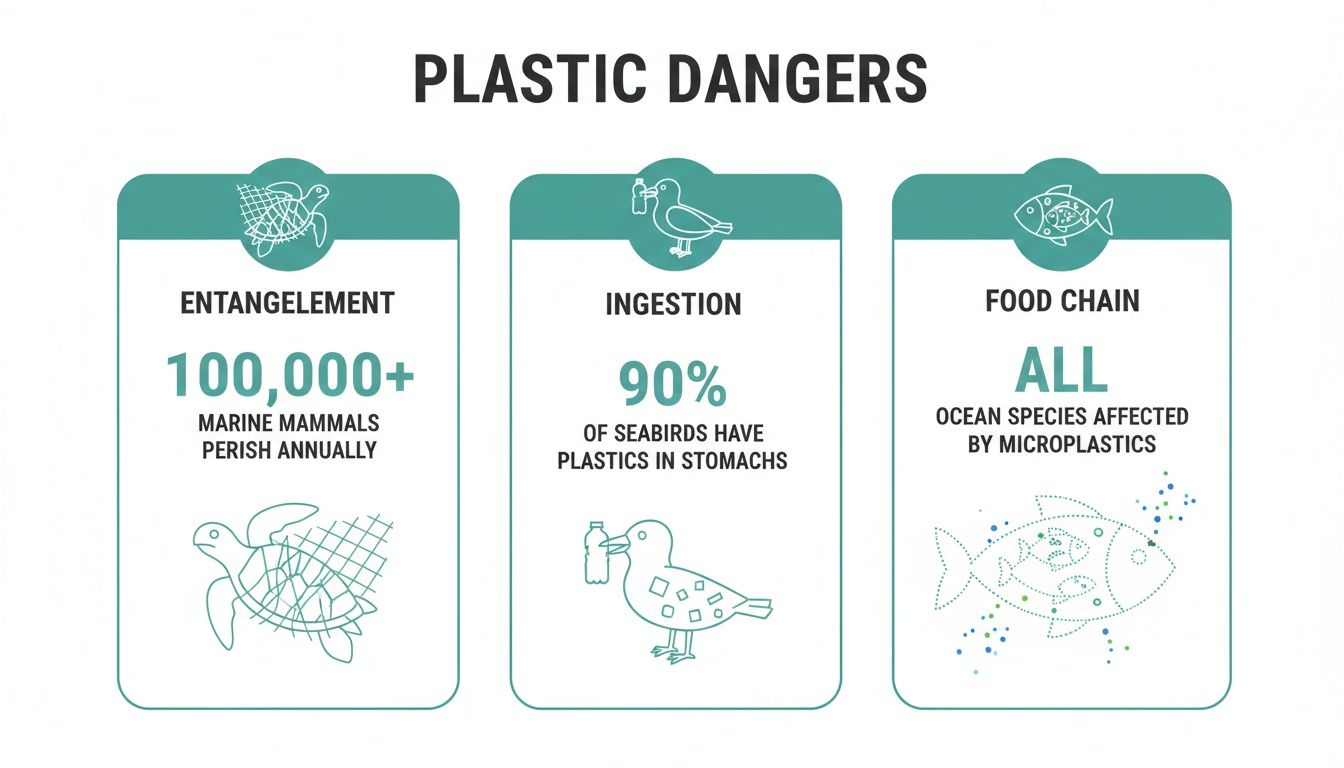
    This infographic cuts through the numbers to show the direct, brutal impact plastic has on the animals that call the ocean home.

    Infographic showing plastic dangers to marine life: entanglement, ingestion, and food chain contamination.

    From a turtle caught in a plastic bag to a seabird feeding plastic to its chick, the image makes the abstract danger of the patch devastatingly real.

    Measuring this mess isn't just about collecting data. It's an act of courage. It shows us exactly what we're facing. This scientific grit is what inspires the rest of us to act. It gives us a target to aim for and proves that even when a problem seems invisible, dedicated people can drag it into the light.

    You Can Be the Hero of This Story

    Thinking about the ocean garbage patch feels huge, doesn't it? It's so massive and far away that it can make you feel completely powerless. What can one person in Chicago possibly do about it?

    It turns out, you can do everything.

    I started Litter Caterpillars because I had trouble cleaning my own life and my own apartment. It was a private, impossible struggle. But I stumbled upon a strange truth: cleaning up public spaces with friends isn't just easier—it's inspiring. It builds a kind of courage and connection I never expected.

    A Chore That Becomes a Mission

    Remember Tom Sawyer? He was stuck with the awful chore of painting a fence, but he reframed it as a fun event that his friends actually paid him to join. That’s the exact spirit we bring to cleaning our city. We take a task that feels like a burden and turn it into a mission filled with friendship, pride, and purpose.

    This is your invitation to join that mission. We’re going to show you a few real, practical steps you can take right now. And the answer isn't just about trying to use less plastic, even though that helps.

    The real answer is about showing up.

    We are not perfect. We are Caterpillars, transforming ourselves and our city through service.

    The first step isn't about saving the world. It’s about discovering the strange, wonderful fun of making a difference right where you stand.

    From One Person to a Community of Power

    It’s normal to feel helpless when you see the scale of the ocean garbage patch. But what you do by yourself, when multiplied by a community, becomes an unstoppable force. This is how we fight back.

    Here are three ways you can start making a real impact today:

    1. Stop Throwing Things “Away.” Every time you hold a piece of plastic, don't think about throwing it "away." Instead, ask yourself, "Where does this actually go?" That simple mental shift is the first step. It forces you to see that there’s no magic place where our trash just disappears.

    2. Pick One Small Sacrifice. Don’t try to become zero-waste overnight. You'll just burn out. Instead, choose one single thing. Maybe you refuse plastic straws. Maybe you commit to always bringing a reusable bag. Maybe you switch to a reusable water bottle. Master that one thing until it’s a habit. That small win will give you the confidence for the next one. For more ideas, check out our guide on practical solutions for pollution in the oceans.

    3. Show Up for Your Community. This is the most important step. Seriously. Join a local cleanup. Feel what it’s like to work next to other people, turning a dirty street corner into something you can all be proud of. The courage you find out there is contagious. It’s the fuel that will power you to do more.

    You don't have to solve the entire ocean garbage patch by yourself. You just have to pick up the first piece of trash. We'll be right there with you, picking up the second.

    Alright, let's cut through the noise. When you start learning about the ocean garbage patch, the questions pile up fast. It feels huge, hopeless even. But every question is a first step. It means you're paying attention.

    Let's tackle some of the big ones head-on.

    So, Can We Just Go Out and Clean It All Up?

    This is always the first question, and I love it. It comes from that gut instinct to just fix the damn thing. The simple answer is yes, people are trying. But it's an unbelievably tough fight.

    The "garbage patch" isn't a solid island of trash you can just walk on. It's more like a thick, soupy plastic smog stretching over an area three times the size of France. Most of it is tiny plastic bits. Imagine trying to scoop smoke out of the air with a fishing net. That's the challenge.

    Big, heroic projects are out there, but they're slow and costly. The real, lasting win? It starts right here on land. We have to turn off the faucet before we even think about mopping the floor.

    Is This Plastic Going to Be There Forever?

    This one's a heavy thought. Plastic doesn't just rot away like an apple core. The sun beats down on it, and it photodegrades—which just means it shatters. It breaks into smaller and smaller and smaller pieces, down to microscopic specks. But it never, ever truly disappears.

    That's right. Every single piece of plastic ever made is still on this planet in some form. It's a terrifying idea. But I see it another way: it makes every bottle, every wrapper, every single piece of trash we stop from reaching the water a permanent victory.

    Why Should I Care? I Live in Chicago, Miles From Any Ocean.

    I get it. The ocean feels a world away. But remember that candy wrapper we found? It gets washed into a storm drain, then into the Chicago River, then Lake Michigan, then the St. Lawrence Seaway, and boom—the Atlantic. We are all upstream from the ocean.

    And this isn't just some far-off problem for fish. This plastic soup comes back to haunt all of us.

    • Our Food: Those tiny plastic bits get eaten by fish, which then end up on our plates. We're literally eating our own trash.
    • Our Climate: The ocean is the planet's lung and heart. Choking it with plastic cripples its ability to keep our climate stable.
    • Our Health: Nasty chemicals love to stick to plastic. As these plastics enter our food and water, those toxins come along for the ride.

    The ocean might seem distant, but its health is tied directly to our own survival. That's why every cleanup we do right here in Chicago is a direct act of ocean rescue.


    The problem is massive. It's easy to feel helpless. But our power isn't in trying to solve it all at once. Our power comes from showing up, together, and doing what we can, right where we are.

    At Litter Caterpillars, we turn that helplessness into action, sweat, and friendship. If you're tired of just worrying and ready to be part of the solution, join us for a cleanup. Come see how good it feels to make a real difference, one piece of trash at a time.

    Find your next chance to volunteer with us!