Tag: ocean conservation

  • 7 Best Sources for Ocean Pollution Images in 2026

    7 Best Sources for Ocean Pollution Images in 2026

    More Than Just a Sad Picture

    I used to think my old jam jars and bags of nuts were just trash. But they felt heavy, like they weighed 500 pounds. Each one carried a little memory, a failed promise, a version of me I didn't know how to let go of.

    Cleaning up my own mess felt impossible. Then I found something strange and freeing. Cleaning up other people's messes was easier, and somehow it helped me start cleaning up my own life. A strong image works the same way. The right ocean pollution images don't only show damage. They give you a before photo that makes someone want to help build the after. If you're trying to move people from sadness to action, the source you choose matters.

    1. NOAA Marine Debris Program Photo Gallery

    When I need an image that feels grounded, I usually start with NOAA's Marine Debris Program photo gallery. It feels like walking into a file cabinet run by people who care about evidence, not drama. You can move from plastics to fishing gear to microplastics to wildlife impact without getting lost in random stock-photo noise.

    That matters because the most dramatic ocean pollution images can distort the story. As The Ocean Agency's plastic image archive notes, the most shareable visuals often overrepresent surface trash and underrepresent microplastics, fisheries gear, and sewage-linked pollution. I like NOAA here because the captions usually push me back toward the actual source of the mess.

    Why I trust it for real campaigns

    For a volunteer flyer, a school slideshow, or a neighborhood cleanup page, rights simplicity saves time and stress. Many NOAA-credited images are public domain, which is great when you don't want to spend your Saturday decoding license terms instead of making posters.

    A few things I like right away:

    • Public-domain potential: Many NOAA-credited photos are free to use, which is a gift for nonprofits, classrooms, and local groups.
    • Strong topic grouping: You can browse by debris type, impact, research, and prevention instead of scrolling forever.
    • Useful U.S. relevance: If you're telling a Chicago-to-Great-Lakes-to-ocean story, NOAA's framing fits naturally.

    Practical rule: Always check the credit line on each NOAA image. Some partner photos have different rights.

    This gallery isn't glossy. That's part of the appeal. It feels more like a field notebook than an ad campaign, and sometimes that honesty is exactly what your story needs.

    2. NOAA Office of Response and Restoration Image Collections

    Some days you don't need a perfect hero image. You need proof. You need shoreline mess, field boots, removal work, and the kind of before-and-after documentation that says, "People showed up and did something." That's when I turn to the NOAA Office of Response and Restoration marine debris image collections.
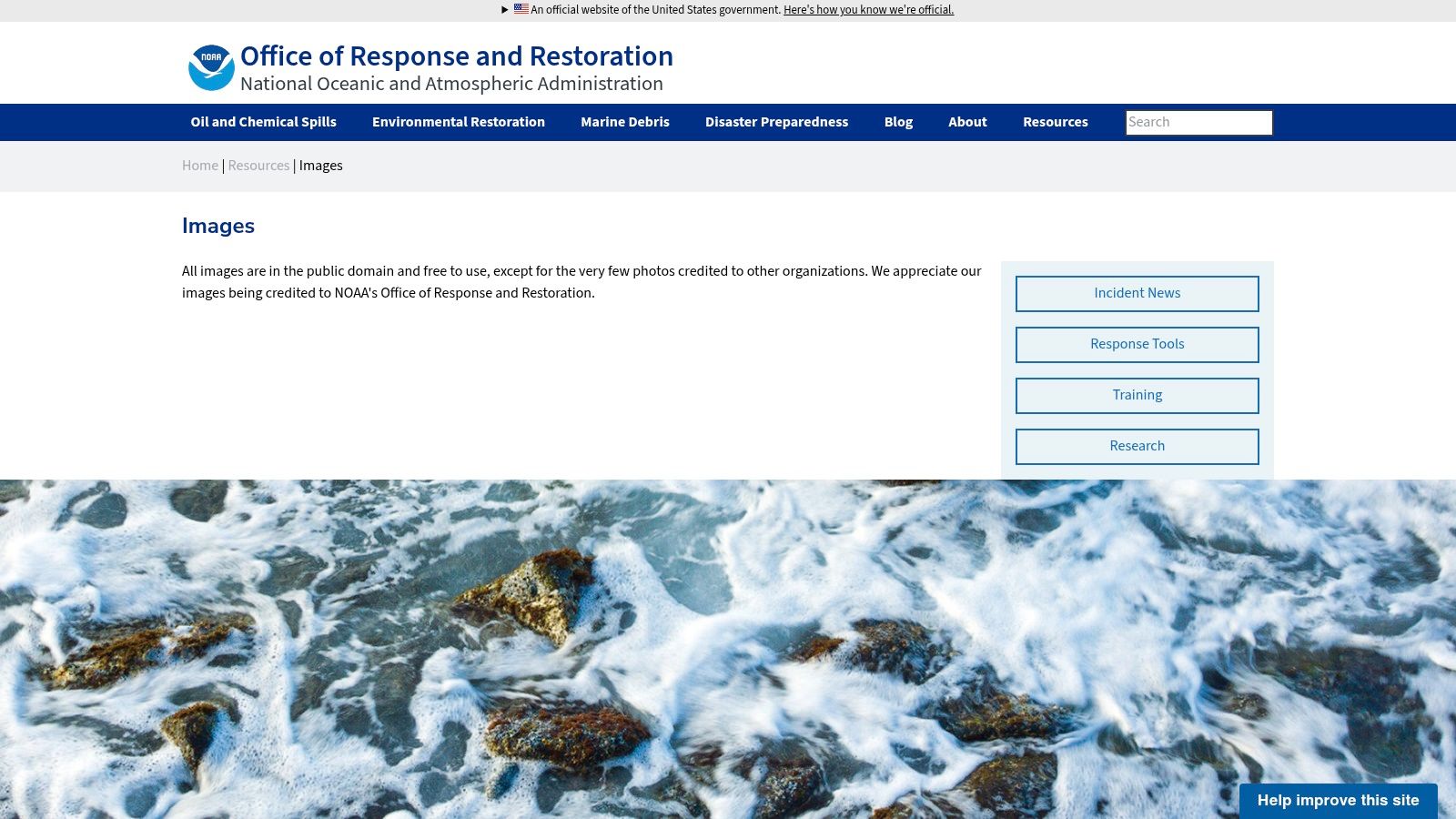
    NOAA Office of Response & Restoration – Image Collections (Marine Debris)

    This archive has a different mood from the first NOAA library. It feels closer to response work. Storm aftermath, debris on shorelines, crews in the field. If your story is about action after impact, these images do the job.

    Best for documenting the work itself

    I think of this collection like work gloves. Not fancy. Very useful.

    You can use it well when you need:

    • Clear response scenes: Debris removal, restoration, and field conditions.
    • Before-and-after framing: Good for explainers, grants, and volunteer recaps.
    • Public-domain guidance: NOAA states that most images are public domain and free to use, though you still need to check details.

    There's another reason these images matter. Roughly 80% of ocean pollution comes from land-based sources, according to The Ocean Cleanup's explainer. So if your photo shows trash caught in a shoreline, canal edge, or storm-battered coast, it may tell a more honest story than a generic "floating island of trash" visual.

    A cleanup story gets stronger when the photo shows where the waste came from, not only where it ended up.

    The downside is style. Some files feel older, some are mixed in quality, and you may need to hunt for the right resolution. Still, if you want images with dirt under the fingernails, this is a good place to dig.

    3. Wikimedia Commons Marine Debris Category

    Wikimedia Commons is where I go when I want range. The Marine debris category on Wikimedia Commons feels a bit like a giant community garage. You can find excellent stuff, odd stuff, very specific stuff, and a few things that need patience.
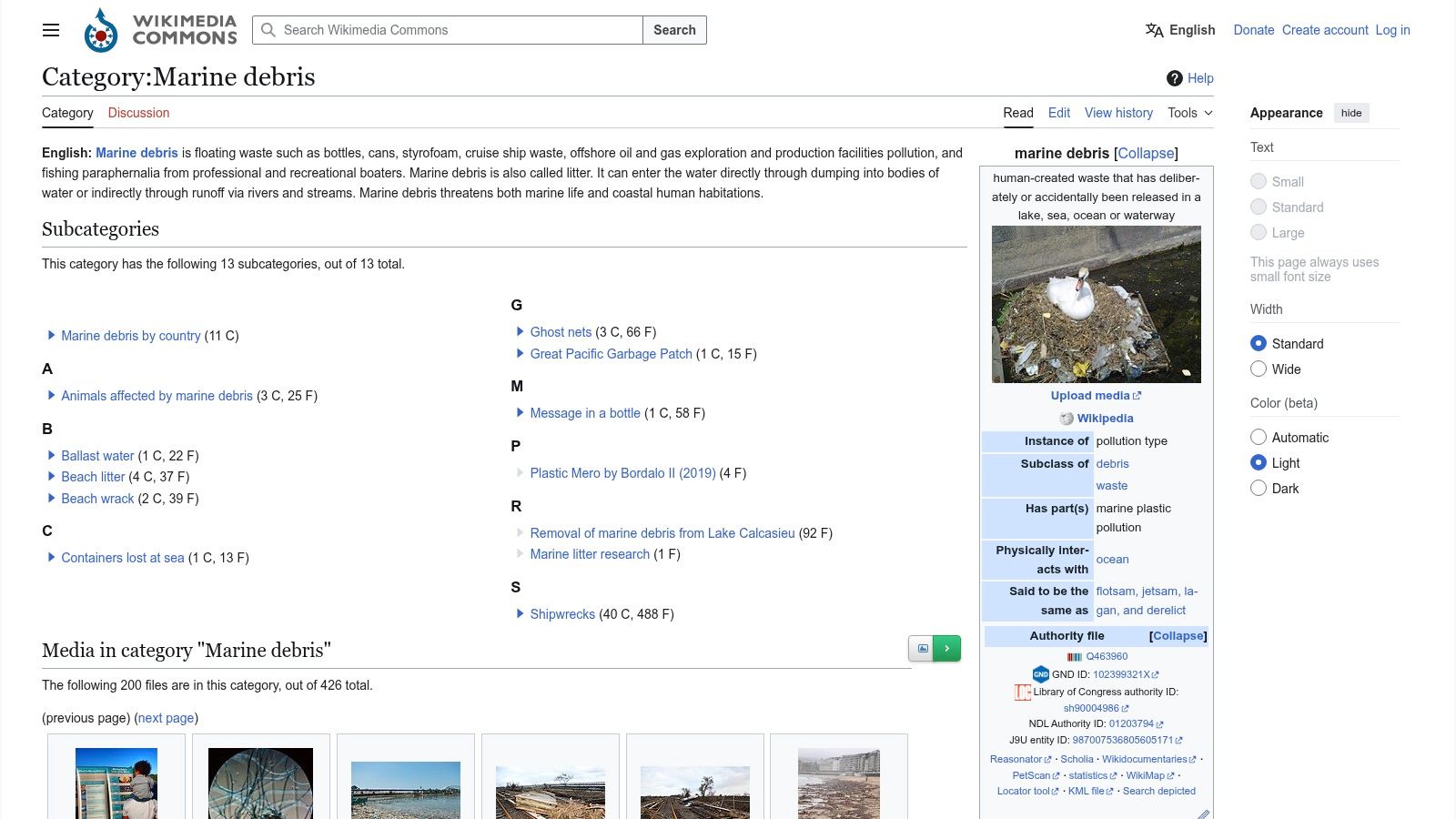
    Wikimedia Commons – Marine Debris category

    I like it because every file page forces me to slow down. Who took this? What year? What license? What am I allowed to do with it? That pause is healthy. Ocean pollution images are easy to recycle until they become generic symbols with no place, no time, and no specific problem attached.

    Best when you need global variety

    This is where Wikimedia shines. You can look beyond one country and one visual style. Beach litter, entanglement, cleanup work, close-up debris, wide shoreline shots. You often get mirrored institutional images too, including public-domain material from government sources.

    Keep these habits in mind:

    • Read each file page: Wikimedia tells you the exact license and the attribution terms.
    • Curate hard: Quality varies a lot, so don't grab the first thing you see.
    • Use the details: Author names, dates, and descriptions make your caption stronger.

    Adobe Stock's ocean pollution search pages point to a real problem with visual repetition. Big image libraries can flatten very different problems into one vague category of "trash in water." Wikimedia helps you fight that because it pushes specificity. Plastic on a beach is not ghost gear. Ghost gear is not oil contamination. Those are different stories, and they need different solutions.

    If you care about context as much as aesthetics, Wikimedia is a strong free option.

    4. Unsplash Ocean Pollution Search

    Last spring, I was building a cleanup sign-up page after a long beach walk that left me angry and oddly hopeful at the same time. The page needed one image. Not ten. One. I opened Unsplash's ocean pollution search, found a sharp photo of plastic scattered along a shoreline, and felt the whole message click into place. Suddenly the event was not a vague good deed. It was a response to a mess people could see.

    That is why I keep Unsplash in the mix. It helps when you need an image that grabs attention fast and still feels human. The library leans polished, which can be a strength if you are making a campaign page, event header, slide deck, or social graphic that needs people to stop scrolling.

    Best for clean, modern visuals that pull people in

    Unsplash works well at the start of the story. You are not always trying to document every detail of the problem. Sometimes you are trying to get one neighbor, one teacher, or one tired volunteer to care enough to take the next step.

    What I like most:

    • Strong visual style: High-resolution images with a modern look that fits websites, presentations, and social posts.
    • Easy reuse: The Unsplash License is simple for many common nonprofit and community uses.
    • Good emotional range: You can find stark litter scenes, cleanup moments, and more symbolic images that set a mood.

    I still slow down before I choose. Some Unsplash photos are closer to visual metaphor than field evidence. A bottle drifting underwater can be striking, but it may not help someone understand what is piling up on their local beach, where it came from, or what kind of cleanup is needed.

    That gap matters.

    A strong ocean pollution image should do more than signal sadness. It should give your audience a foothold. If you are working in the spirit of Litter Caterpillars, the goal is transformation. Mess into mission. Spectator into participant. The right Unsplash image can open that door, especially if you pair it with a caption that names the scene clearly and points to action.

    I use Unsplash for the first spark. Then I make sure the story gets specific.

    5. Pexels Ocean Pollution Search

    Last spring, I was helping put together a beach cleanup flyer for a small neighborhood event. We did not need a polished campaign image. We needed a photo that would still make sense on a phone screen, on a printer at the library, and on a poster taped beside the coffee shop register. That is the kind of moment when I open Pexels' ocean pollution search.

    Pexels is practical. It gives you a wide mix of free images, and I often find vertical shots, tighter crops, or simpler compositions that work better for grassroots outreach than a beautiful image that falls apart the second you resize it.

    That choice shapes the story.

    A cleanup poster with the wrong photo can feel distant or generic. The right one can make a local problem feel local. A bottle half-buried in sand, a volunteer lifting a bag from the shoreline, a tangle of trash caught in rocks. Those scenes give people somewhere to stand emotionally. They can see the mess, and they can see what action looks like.

    Good for flyers, posts, and quick local outreach

    I reach for Pexels when I need fast options and enough variety to match the format, not just the theme.

    What I look for:

    • Orientation variety: Strong mix of horizontal and vertical images for posters, stories, and handouts.
    • Easy reuse: The Pexels License works well for many community and nonprofit projects.
    • Useful range: You can find gritty cleanup photos, beach litter shots, and more composed images for simple awareness pieces.

    The limit is context. Pexels usually will not give you the deeper captioning or institutional detail you would get from a scientific archive, so I treat every image as raw material for a story, not the full story itself. If a photo includes wildlife, people, logos, or branded packaging, I pause and check whether the image supports the message accurately and fits the intended use.

    That matters a lot with ocean pollution work. Wildlife photos can hit hard, but shock alone rarely builds commitment. If you are working in the spirit of Litter Caterpillars, the goal is transformation. Show the harm, yes, then help people see the next step. Add a caption that names what is happening, where action is possible, and how a person can join in.

    Pexels works well when your mission needs motion. It helps you get a real, usable image into the world fast, then turn that image into an invitation to act.

    6. Shutterstock Ocean Plastic Pollution Search

    Last spring, I helped a volunteer group pull together a sponsor deck after a muddy shoreline cleanup. We had strong photos from the day, but they did not fit together. One was raw and grey, another looked like a vacation ad with a stray bottle in the corner, and a third could not be cleared for broader campaign use. We needed visuals that felt consistent, legally usable, and strong enough to carry the story from local mess to public action. That is the moment I open Shutterstock's ocean plastic pollution results.

    Shutterstock helps when the image has to do more than shock. It has to work across a banner, a slide, a paid ad, and a printed handout without sending mixed signals. The filters are a significant advantage. You can sort for commercial use, isolate illustrations from photos, choose horizontal or vertical frames, and build a set that looks like one campaign instead of a pile of unrelated downloads.

    Best for polished campaigns with outside approval

    I use Shutterstock when the audience includes sponsors, schools, local officials, or brand reviewers. Those projects usually need cleaner licensing terms and a more controlled visual style.

    What I look for:

    • Matched image sets: Easier to build a campaign that feels unified across web, print, and social.
    • Commercial-friendly options: Better fit for ads, partner materials, and branded outreach.
    • Precise search control: Useful when you need a specific scene, subject, or composition fast.

    There is a tradeoff. Shutterstock costs money, and the license choice still matters. You have to read the usage terms and make sure the file matches the job.

    I also stay alert for stock-photo drift. A polished image can look convincing while saying almost nothing. Ocean pollution storytelling breaks down fast when every visual is just a lone bottle floating in blue water. The issue gets flattened into a cliché, and people stop seeing the systems, habits, and cleanup work behind the scene.

    That is where the Litter Caterpillars mindset helps me. I do not ask only, "Does this image look professional?" I ask, "Does it move the story from mess to mission?" The right Shutterstock image can do that well. A gloved hand lifting tangled line from rocks. Volunteers sorting plastic by type. A shoreline before cleanup, then after. Those images give people a way in. They show harm, but they also show change.

    If your project needs polish, consistency, and fewer licensing surprises, Shutterstock earns its place. Use it to choose images that do more than decorate the message. Choose ones that help people believe cleanup is possible, and worth joining.

    7. Getty Images Ocean Pollution Collection

    A city council packet lands on your desk at 9 p.m. The meeting is in the morning. You need one image that can survive scrutiny from reporters, staff, and residents who will ask the hard question fast: where did this photo come from? That is when I open Getty Images' ocean pollution collection.

    Getty helps when the image has to carry more than emotion. It often gives you editorial photos tied to real events, with captions that name the place, date, and situation. That context matters. A turtle wrapped in netting can stop a reader for a second. A documented photo from a harbor cleanup, a protest, or a shoreline survey can hold attention longer because it feels anchored to real life.

    I learned to treat Getty like a reporting tool, not just a gallery. If I am building a policy brief, a press page, or a sponsor-facing report, I want visuals that can stand beside serious copy without feeling staged. That is where Getty earns the price.

    Getty is strongest for:

    • Editorial provenance: Useful for news, public affairs, and issue reporting where source details matter.
    • Licensing precision: Helpful when placement, region, and usage terms need close review.
    • High production quality: Good for print layouts, presentation decks, and formal publications.

    The main challenge is still storytelling. A dramatic frame can pull people in, but it cannot prove every claim you make. One shoreline photo shows one shoreline. One cleanup scene shows one moment. If your copy speaks about a neighborhood, choose an image that feels rooted in a neighborhood. If your message is about systems, policy, or consumption habits, say that in the caption and supporting text.

    That is the Litter Caterpillars test I come back to. Does this image leave people stranded in the mess, or does it help them see a path from mess to mission? Getty can do that well when you choose photos with human stakes and traceable context. A fisher hauling plastic from a net. Students cataloging debris after a beach survey. Residents standing beside bags of trash they removed by hand.

    Those images do more than look credible. They help people believe their own work can become part of the story.

    Comparison of 7 Ocean Pollution Image Sources

    Source Complexity 🔄 Resources ⚡ Expected outcomes 📊 Ideal use cases ⭐ Key advantages 💡
    NOAA Marine Debris Program – Photo Gallery Low, curated browsing; check credits per image Low, public domain images; free to download Credible, science‑based visuals for outreach and education Nonprofits, classrooms, local storytelling (U.S. & Great Lakes) Rights‑simple NOAA images with trusted captions; check partner credits
    NOAA Office of Response & Restoration – Image Collections (Marine Debris) Low–Medium, searchable taxonomy; review usage notes Low, many images public domain; some high‑res requests possible Documentary before/after and event imagery useful for explainers Restoration reports, shoreline documentation, field response stories Clear usage notes and response/restoration focus; good for real‑world documentation
    Wikimedia Commons – Marine Debris category Medium, license varies per file; must confirm each file page Low, free but may require CC attribution or SA compliance Wide geographic and topical coverage; variable image quality Research, global examples, supplementary imagery Large repository with explicit license metadata on each file page
    Unsplash – Ocean Pollution collection Low, simple search and license terms Low, free, high‑resolution modern visuals Visually consistent, campaign‑ready hero images Web, slides, social campaigns, marketing Designer‑forward aesthetic and permissive license; vet releases for endorsements
    Pexels – Ocean Pollution searches Low, straightforward UX and filtering Low, free with generous license Flexible assets in many orientations for layouts Social posts, flyers, alternative to Unsplash Rights‑simple alternative with varied orientations; check images with identifiable people
    Shutterstock – Ocean Plastic/Pollution stock Medium, select correct license (Standard/Enhanced) High, subscription or per‑asset costs High‑resolution, cohesive series suitable for campaigns Advertising, sponsorships, high‑print quality campaigns Reliable model/property releases, advanced filters, brand‑safety tools
    Getty Images – Ocean Pollution collection High, rights‑managed vs RF choices; licensing controls needed High, premium per‑asset pricing and plans High‑impact editorial visuals with documented provenance Press, policy reporting, high‑visibility placements Authoritative captions, detailed licensing options, strong editorial coverage

    Start Your Story, Start the Cleanup

    Three volunteers. Wet gloves. A tree that barely blocked the hail.

    That was one of our first cleanup mornings with Litter Caterpillars. We were cold, annoyed, and laughing anyway, watching the weather try to shut the day down. We still picked up trash. We still left with a story. That memory changed how I look at ocean pollution images, because the photo that matters most is rarely the one that only says, "things are bad." The one people remember carries grit, place, and the next step.

    A gull tangled in fishing line can stop a scroll. A child holding a full trash bag on a local beach can start a plan. Both images matter. One shows the wound. The other shows what healing looks like when ordinary people show up.

    That choice is the core work.

    Picking a photo from NOAA, Wikimedia Commons, Unsplash, Pexels, Shutterstock, or Getty is not just filling space on a page. You are deciding what story your reader enters. Do they see a disaster so big it feels hopeless? Or do they see one shoreline, one cleanup crew, one honest mess that a community can face together?

    I keep coming back to transformation. Trash on the sand is the before picture. A volunteer with muddy shoes and a tired grin is the middle. A cleaner shoreline, or even one small cleared patch, is the proof that change has started. That is the spirit behind Litter Caterpillars too. Mess can become mission, and a strong image can help someone believe that before they ever grab a bucket.

    If you are building outreach for a cleanup, keep your visual story simple. Choose one image with real stakes. Add one plain sentence about where the litter comes from. Follow it with one direct invitation people can act on this week.

    Make the image carry more than sadness. Let it carry momentum.

    Go pick the photo that tells the truth and leaves room for courage. That is how a stranger becomes a volunteer. That is how a hard image becomes the start of a cleaner block, beach, or harbor.
  • How I Learned to Volunteer to Clean Up Beaches (And You Can, Too)

    How I Learned to Volunteer to Clean Up Beaches (And You Can, Too)

    To volunteer to clean up beaches is to do something beautifully simple. You show up. You make a small piece of our world visibly better. It’s one of the most direct, most satisfying ways I’ve ever found to really connect with my community, to see an impact I can actually touch.

    The Surprising Joy Of Cleaning Our Shorelines

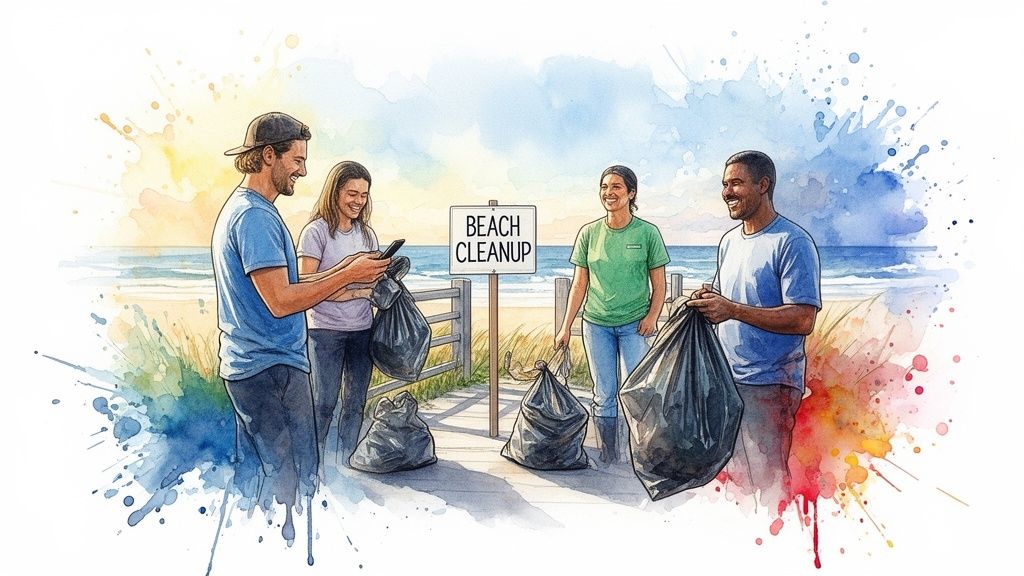
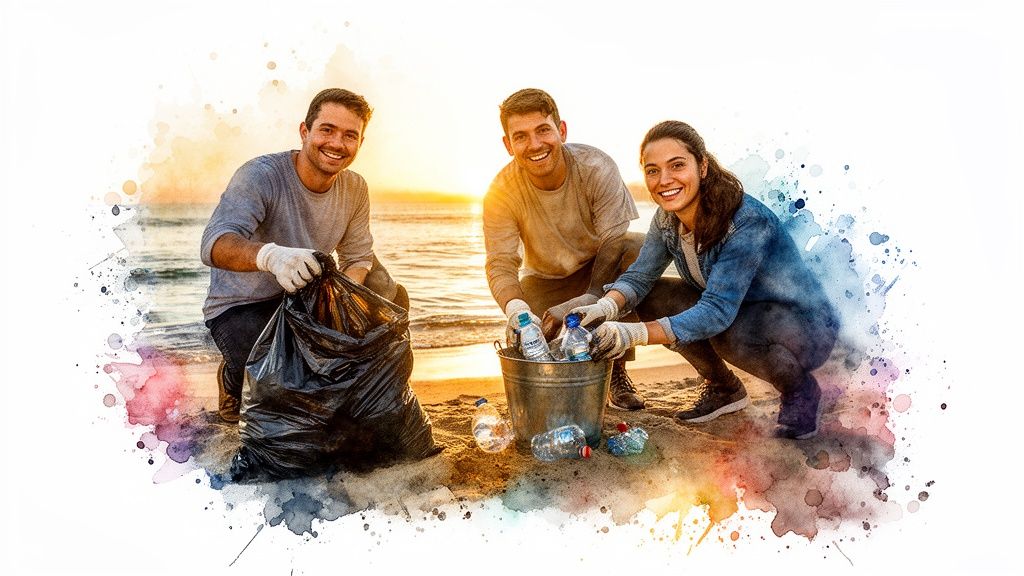
    Three smiling volunteers collect trash and plastic bottles on a beach at sunset.

    Let's be honest with each other. The idea of spending your weekend picking up somebody else's trash doesn't exactly scream 'fun.' I get it. It sounds like a chore. Another item on a never-ending to-do list.

    But what if I told you it’s one of the most fulfilling things you could ever do? I stumbled into this world feeling a bit lost. What I found on those sandy shores was a huge, powerful sense of purpose. Imagine you’re a gardener. You pull the weeds, and suddenly, the flowers can breathe again. That’s what this feels like.

    Finding Purpose One Piece At A Time

    Tackling a problem you can see, like beach litter, is just unbelievably satisfying. You aren't just sending a check or signing a petition. No. You're out there, physically changing the landscape, seeing the impact of your work happen right before your eyes. That instant gratification? It’s a powerful, wonderful feeling.

    It’s a strange, new form of "fun." You suffer a bit, you get dirty, but it adds this flavor to your life. Another page in the story. It advances the plot.

    This guide is my story, but it's also your roadmap. I want to walk you through how you can get out there and volunteer. Not as a duty. But as an adventure. An adventure that connects you with incredible people and leaves you feeling genuinely proud.

    I found that this simple act connects you to something so much bigger. You join a global movement. Your small effort, your one afternoon, contributes to a massive, international database that helps protect our oceans. It’s proof that you’re not alone in caring.

    • You build a real community with others who get it.
    • You gain a unique, firsthand perspective on consumption and waste.
    • You get to leave a place better than you found it.

    So, let's explore how you can get started.

    How To Find Your Beach Cleanup Community

    Diverse group of smiling volunteers holding trash bags at a beach cleanup, watercolor style.

    The first step isn't just finding an event; it's finding your people. Let’s be real. You’re looking for a community, not just another task to check off a to-do list.

    When I started my own group, I realized it’s like trying to find the right band to join. You don't just show up and start playing; you listen to their music first, see if their style clicks with yours. That's why I used platforms like Meetup and Instagram. They let you get a feel for the vibe before you commit.

    Where To Start Your Search

    As you begin your hunt to volunteer to clean up beaches, I want you to look beyond the event title. Scan the photos. Read the descriptions. And ask yourself a few questions:

    • What’s the energy like? Are people laughing and high-fiving, or is it a more quiet, focused group? Both are great, but one will probably suit you better.
    • Do they prioritize safety? Look for mentions of gloves, safety briefings, and clear instructions. A good leader cares about their crew’s well-being.
    • Does the schedule work for you? It’s a lot easier to stick with something when the timing actually fits into your life.

    Finding a group that resonates with your personal style is what turns a one-time volunteer gig into a regular, fulfilling habit.

    You want to find a team that feels like home. When you click with the people, the work becomes secondary, and the experience becomes something you look forward to every time.

    A great place to start is with established organizations or on community-focused platforms. To make it even easier for you, here’s a quick guide to some of the best spots to find your crew.

    Where To Find Beach Cleanup Opportunities

    Use this guide to discover the best online platforms and local resources for finding beach cleanup events and organizations near you.

    Platform / Resource What to Look For Pro Tip
    Local Community Groups Search Facebook, Meetup, or local forums for "beach cleanup [Your Town]" or "coastal conservation." These are often smaller, tight-knit groups. It’s a great way to meet neighbors who care.
    Ocean Conservancy Check for their annual International Coastal Cleanup, a massive global event. Sign up early! Events in popular locations can fill up fast, especially during peak seasons.
    Surfrider Foundation Look for your local chapter on their website. They host regular cleanups and advocacy events. Chapters often have their own social media pages where they post last-minute event details.
    Local Parks & Rec Dept. Visit your city or county’s official website. They often organize or partner on environmental volunteer days. These events are typically well-organized and family-friendly, perfect for bringing the kids along.

    Don't be afraid to try out a few different cleanups. Each group has its own personality. It might take a couple of tries to find the one that feels right. You can also explore more ways for finding environmental volunteering near you.

    Your tribe is out there waiting for you.

    Gearing Up For A Successful Cleanup Day

    Showing up is half the battle. But what you bring with you can make or break the day. When you volunteer to clean up beaches, you’re at the mercy of Mother Nature. I learned this the hard way during a freak hailstorm at our very first event.

    We were soaked. Freezing. Huddled under a tree as Ubers kept canceling on us. It was a miserable, wonderful disaster that taught me a lesson I’ll never forget: preparation is everything. Now, I never leave home without the essentials.

    This isn’t just about grabbing a bag and some gloves. Think of it like packing for a day hike. You need the right gear to stay safe, comfortable, and effective out there.

    Your Essential Cleanup Kit

    You don't need a bunch of expensive equipment to make a difference. It's all about smart, simple choices to protect you from the sun, sand, and the strange things you might find. Here’s my go-to list:

    • Sturdy, closed-toe shoes: This is non-negotiable for me. Beaches are notorious for hiding sharp objects like broken glass and rusty metal just under the surface. Your favorite flip-flops just won't cut it.
    • Reusable work gloves: Ditch the flimsy disposables. I always use a good pair of gardening or work gloves. They’ll protect your hands from anything sharp or just plain gross, and they give you a much better grip.
    • Sun protection: The sun reflecting off the water and sand can be brutal. A wide-brimmed hat, sunglasses, and a good layer of sunscreen are your best friends out there. I learned that lesson the hard way, too.

    Your goal is to be a trash-collecting machine, and you can't do that if you're dealing with a nasty sunburn or a cut on your foot. Your safety and comfort come first—always.

    Beyond that core three, a couple of other items can make your day go a lot smoother. I always pack a full reusable water bottle to stay hydrated and a small first-aid kit with the basics like bandages and antiseptic wipes. Being ready for minor scrapes means you can patch yourself up and get right back to the mission.

    For a deeper dive, you can also check out our other guides on what to expect when you volunteer to pick up trash.

    Your Local Effort And Its Global Impact

    Standing on the shore, picking up a single plastic bottle, it's easy to wonder, "Does this really make a difference?" I'm here to tell you—it absolutely does.

    That one bottle is a world of difference for the sea turtle that won't mistake it for a meal. It's one less piece of plastic that will break down into a million toxic micro-shards, poisoning the sand and sea for generations.

    Every piece of trash you pull from the coastline is a direct win. You're not just tidying up a small patch of sand; you're an essential part of a massive, global movement. Think of us like a giant orchestra. Your part might seem small on its own, but together, we’re creating this powerful symphony of change.

    From Local Hands To Global Data

    Big-picture organizations track this stuff. They prove that what we do on our local beaches adds up to a worldwide impact. You’re not just a volunteer; you're a citizen scientist contributing vital information.

    Take the International Coastal Cleanup, for example. For decades, they've built a massive database on marine debris. All thanks to everyday people like you and me.

    Your hands-on work provides the raw data that shapes our understanding of ocean pollution. You're connecting the dots between a local problem and global solutions, giving scientists the evidence they need to drive policy change.

    This data isn't just filed away in some report. It directly informs policy. It helps researchers pinpoint the real sources of pollution. Since it all began back in 1986, the International Coastal Cleanup has rallied almost nineteen million volunteers. Together, we've removed over 400 million pounds of trash, creating an incredible database that helps protect our oceans. You can check out their website to see the amazing impact of their local cleanups.

    Keeping that bigger picture in my mind is the key to staying motivated. Once the beach is clean and you're ready for the next step, you can learn more about the bigger solutions for pollution in the oceans.

    How To Organize Your Own Beach Cleanup

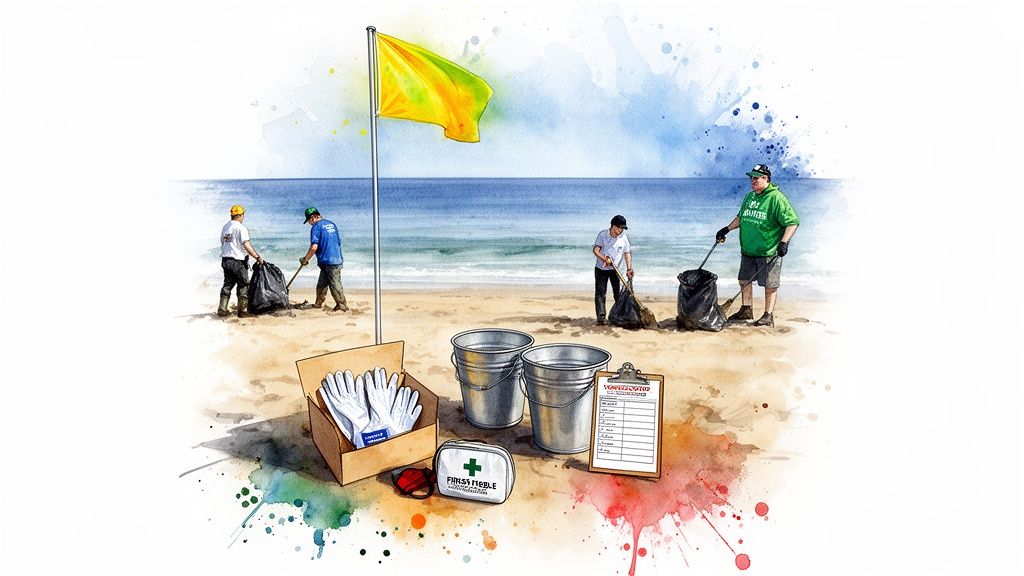
    People volunteer to clean up a sandy beach, collecting trash with supplies and a first aid kit.

    So, you’re feeling the pull to start your own thing? That's awesome. Leading a beach cleanup is one of the most fulfilling things you can do, and I'm here to tell you it's nowhere near as daunting as it sounds.

    My own group, the Litter Caterpillars, started with just three of us caught in a freak hailstorm. You don't need a huge budget or a formal non-profit to make a real impact. The most powerful step you can take is simply to start.

    Getting The Ball Rolling

    Start small. I can't stress this enough. Pick a beach you love, circle a date on the calendar, and invite a handful of friends. It's really just like organizing a casual hangout, except your main activity is giving a little love back to the planet.

    Before you do anything else, go scout your location. I want you to walk the beach you’ve chosen and get the lay of the land. Where's the easiest place for people to park and meet? Where are the worst spots for trash? Are there any potential hazards?

    This initial walk-through isn't just about logistics. It’s about you connecting with the very place you're about to help heal. Once you have a basic idea, you'll want to see if you need any permits. A quick call to the local parks department usually does the trick. Most of the time, they are thrilled that people volunteer to clean up beaches and will be happy to support you.

    Leading isn’t about having all the answers. It’s about creating a space where people feel welcome, safe, and part of something bigger than themselves. Your enthusiasm is the most important tool you have.

    Creating An Unforgettable Vibe

    With the practical stuff sorted, you can focus on the heart of the matter: creating an atmosphere that makes people genuinely excited to be there. This is how you transform a chore into a community-building event people look forward to.

    I've learned that the little things make all the difference. We have a big, colorful flag so new people can spot us easily. I always bring a small Bluetooth speaker for some music—it’s amazing how a good playlist can lift everyone's spirits.

    Here are a few other things that have worked for us:

    • Set a simple, visible goal: It could be "let's clear this whole stretch of dunes" or "let's try to fill 10 bags today." Having a shared target creates an incredible sense of teamwork.
    • Celebrate the weird finds: Someone is going to find something bizarre, guaranteed. A vintage soda bottle, a single left shoe, a message in a bottle. Make a big deal out of it! It’s a great icebreaker and always gets a laugh.
    • Plan a post-cleanup hang: This is huge. Grabbing coffee or tacos together afterward is where the real friendships form. It gives everyone a chance to relax and connect on a personal level.

    Your job is to make people feel like they’re part of a crew on a mission. That shared sense of accomplishment is what turns first-timers into regulars who show up again and again.

    Got Questions? I've Got Answers

    So, you're ready to get your hands sandy, but a few questions are probably rattling around in your head. That's totally normal. Before you jump into your first volunteer beach cleanup, you want to know what you’re getting into.

    I’ve heard pretty much every question under the sun. Let’s get you some answers so you can show up feeling confident and ready to go.

    "What If I Find Something… Sketchy?"

    I'm talking about things that are sharp, look like chemicals, or are medical-related—like a needle. Your safety is, without a doubt, the number one rule. Do not, under any circumstances, touch it.

    Seriously, don't be a hero. Your job is to spot it, not handle it. The best thing I can tell you to do is mark the area. Scuff a big circle in the sand around it or just prop a piece of driftwood up to point it out.

    Then, you go find your event organizer immediately and show them where it is. They’ll have a protocol for this stuff and will know exactly who to call to get it handled safely.

    The goal is to leave the beach cleaner, not to leave the beach in an ambulance. Your well-being comes first, so let the trained leaders handle the dangerous stuff.

    "Can I Bring My Kids? What About My Dog?"

    This really comes down to the specific group organizing the cleanup. I see lots of organizations that are thrilled to see kids getting involved—it’s an amazing real-world lesson for them! Just know they'll almost always require you, a parent or guardian, to be right there with them, supervising.

    Dogs, on the other hand, are usually a different story. More often than not, you can't bring them. This could be due to local beach rules or just for the safety and comfort of the other volunteers.

    The easiest way to find out? Check the event details page or just send a quick email to the organizer. I always think it's better to ask first.

    "So… What Happens to All This Trash?"

    You'd be surprised! A good organizer has this all mapped out. Typically, we sort the collected items right there on the sand, separating recyclables from stuff that’s headed for the landfill.

    From there, the event leader is in charge of getting it all to the right facilities. Some really cool groups I've seen even have partnerships with local artists who upcycle the marine debris they find into amazing sculptures or other products.

    Don't be afraid to ask your group leader about their process. Most of us who run these things are total nerds about it and love to share where it all ends up.


    At Litter Caterpillars, we're all about the power of showing up and making a difference, one piece of trash at a time. If you're ready to see that impact for yourself, check out our story and find an upcoming event at https://www.littercaterpillars.com.

  • Solutions for Pollution in the Oceans: Quick Actions for 2026

    Solutions for Pollution in the Oceans: Quick Actions for 2026

    Have you ever stood on a beach, looked out at the vastness of the water, and felt a pit in your stomach thinking about all the trash out there? I have. It's easy to feel overwhelmed. You might think one person can't possibly make a difference against such a massive problem. I know that feeling because I used to let messes pile up in my own life, in my own apartment. Each little piece of clutter felt like it weighed 500 pounds. It was tied to a memory, a failure, a past I couldn't move on from.

    Then I realized something powerful. Sometimes, cleaning up someone else's mess is way easier than cleaning up your own. It connects you to something bigger. It gives you a sense of control, of purpose, that you can bring back into your own world. This journey isn't about guilt. It’s not about impossible perfection. I want you to find your power, with me, and realize that every piece of litter we pick up in our neighborhood is a direct action. It's an action toward protecting the oceans we all depend on.

    In this guide, we're not just going to stare at the problem. We are going to dive headfirst into 10 real, tangible solutions for pollution in the oceans. We'll explore everything from massive technological projects cleaning the high seas to the simple, brave act of showing up with a trash bag in your own community. This is your playbook. It’s for making a real, measurable impact, starting today. Let's get to work.

    1. Ocean Cleanup Technology & Autonomous Collection Systems

    Imagine a giant, robotic arm. It reaches out into the vast ocean, gently sweeping up the plastic waste that chokes our marine ecosystems. This isn't science fiction. It's the reality of large-scale ocean cleanup technology. Visionaries like Boyan Slat and The Ocean Cleanup have developed massive, floating systems designed to navigate the ocean's great garbage patches. They use natural currents to concentrate and capture debris without harming wildlife.

    These innovative systems are one of the most direct and ambitious solutions for pollution in the oceans. They act like a large-scale filter, passively collecting everything. Big fishing nets (ghost gear). Tiny microplastics. All of it, accumulated for decades in oceanic gyres. The captured plastic is then returned to shore, where we can recycle and repurpose it. We can turn a global problem into a potential resource.

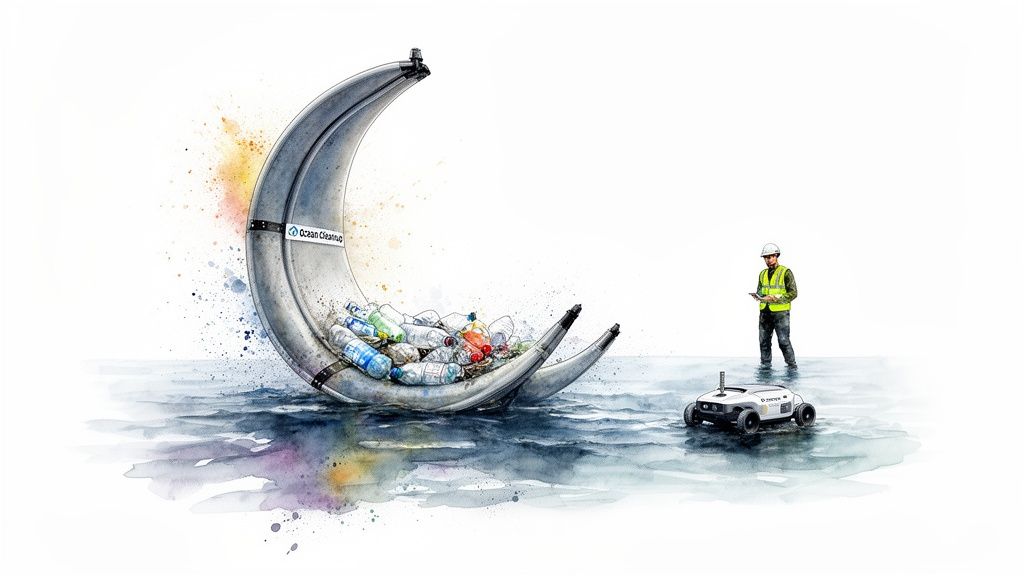
    Watercolor illustration of an ocean cleanup crescent device full of plastic, a worker, and a robotic rover.

    Why It's a Game-Changer

    This approach tackles the pollution that's already out there. It’s the "legacy" plastic that has escaped our coastlines and rivers. While prevention is crucial, you and I can't ignore the millions of tons of plastic already swirling in our seas. These technologies represent a powerful cleanup crew. They work 24/7 in the most remote parts of the world where manual cleanup is impossible.

    The technology isn't just for the high seas. Scaled-down versions like The Ocean Cleanup's Interceptor™ are deployed in major rivers in Jakarta and Bangkok. Think of these autonomous barges as sentinels. They stand guard, catching plastic waste in rivers before it can ever reach the ocean.

    How You Can Get Involved

    You don't need to build your own ocean-sweeping robot to make a difference. Here’s how you can support this technological wave:

    • Support & Advocate: I want you to follow and donate to organizations like The Ocean Cleanup. Your support helps fund research, deployment, and operations.
    • Focus Upstream: Advocate for interceptor technology in your local rivers. Most ocean plastic starts in a river, so stopping it at the source is incredibly effective.
    • Volunteer for Data: You can connect with local environmental groups that partner with research initiatives. Help collect and document plastic waste data from local waterways. You'll provide valuable information that guides where these technologies are needed most.

    2. Single-Use Plastic Bans & Extended Producer Responsibility (EPR) Policies

    Imagine your bathtub is overflowing. You wouldn't just keep mopping up the floor forever, would you? Of course not. You'd turn off the tap. That's the power of strong environmental policy. Banning single-use plastics and implementing Extended Producer Responsibility (EPR) are two of the most effective ways we can stop ocean pollution at its source. We shift the responsibility from us, the consumers, to the corporations that create the waste in the first place.

    These policies are powerful solutions for pollution in the oceans because they fundamentally change the system. EPR makes manufacturers financially and logistically accountable for their products from creation to disposal. When companies have to pay for the cleanup of their plastic packaging, a funny thing happens. Suddenly, they are motivated to design less wasteful, more recyclable, and ocean-friendly alternatives. This is prevention on a massive, global scale.

    Why It's a Game-Changer

    While cleanup tech is crucial for what's already out there, policy changes prevent the problem from getting worse. We see this in action globally. The European Union's Single-Use Plastics Directive has phased out items like plastic cutlery and straws. California's bold EPR laws are forcing producers to rethink packaging. It’s a systemic fix. It reduces the amount of plastic produced, which means less can ever find its way into our rivers and seas.

    This isn't about taking away convenience; it’s about inspiring innovation. When a city or country bans plastic bags, it creates a market for reusable totes. When a corporation is responsible for its plastic bottles, it invests in better recycling systems or plant-based materials. I see policy creating a ripple effect of positive change that protects our blue planet for generations.

    How You Can Get Involved

    Your voice is more powerful than you think. You can champion these policies right in your own community and help turn off the plastic tap for good.

    • Champion Local Legislation: I want you to organize or join a letter-writing campaign to your local and state representatives. Advocate for specific policies like bag bans, foam container restrictions, or comprehensive EPR frameworks.
    • Educate Your Community: Host an event at a local library or community center. Explain the direct link between the litter in your neighborhood and the health of the world's oceans. Show people how their actions and advocacy can make a global impact.
    • Support Responsible Businesses: Use your purchasing power. I encourage you to support and promote local businesses that have already ditched single-use plastics. When others see their success, it builds momentum for wider change.

    3. Wastewater Treatment & Microplastic Filtration Systems

    Think about the water that goes down your drain. Every time you do laundry or wash your face. It seems to just disappear, right? But it carries an invisible threat: microplastics. These tiny fibers from our synthetic clothing and microbeads from cosmetics flow straight into our water systems. Eventually, they reach the ocean. But what if we could stop them at the source?

    Advanced wastewater treatment and filtration systems are one of the most powerful frontline solutions for pollution in the oceans. They act like a city-sized sieve. They catch these microscopic plastic particles before they ever enter our rivers and seas. These facilities use cutting-edge technologies. Ceramic membrane filtration. Activated carbon. UV treatment. All to remove particles smaller than the width of a human hair.

    Why It's a Game-Changer

    This solution tackles the invisible, insidious flow of microplastics that traditional systems miss. Beach cleanups are vital, I know, but they can’t catch particles this small. By upgrading our municipal water treatment plants, we can shut off a massive, continuous source of plastic pollution. Cities like Amsterdam and Stockholm are pioneering these efforts. They're integrating microplastic capture into their public infrastructure. Germany's advanced wastewater standards and Singapore's NEWater facilities prove that this level of filtration isn't just possible. It's scalable.

    This upstream approach prevents the problem from ever reaching the ocean. It protects everything from plankton to whales from ingesting plastic. It’s a systemic fix that works silently in the background, 24/7, safeguarding marine life on a massive scale.

    How You Can Get Involved

    You don’t need an engineering degree to push for cleaner water in your community. Here’s how you can make an impact:

    • Advocate for Upgrades: I suggest you partner with local environmental groups to lobby your municipal water department. Ask about their current microplastic filtration capabilities. Advocate for adopting new technologies.
    • Raise Awareness: Host community events or create online campaigns focused on microplastic sources like synthetic clothing and cosmetics. Many people I talk to don't know the connection between their fleece jacket and ocean pollution.
    • Host a Clothing Swap: Organize a clothing swap event in your neighborhood. This encourages reusing clothes and reduces the demand for new synthetic textiles, which are a primary source of microplastic fibers.

    4. Marine Protected Areas (MPAs) & Ocean Sanctuary Policies

    Picture a national park. But instead of mountains and forests, it’s a vast, underwater world teeming with life. This is the vision behind Marine Protected Areas (MPAs) and ocean sanctuaries. We designate these zones to give fragile marine ecosystems a chance to heal, free from the pressures of human activity. Championed by legends like Sylvia Earle, these "hope spots" are a powerful tool you and I can use to shield our oceans from further harm.

    Establishing these sanctuaries is one of the most vital solutions for pollution in the oceans. How do they work? They restrict or prohibit activities like commercial fishing, oil drilling, and shipping. This prevents new pollutants from entering and allows damaged habitats, from coral reefs to kelp forests, to recover. By creating these safe havens, we give marine life the breathing room it needs to bounce back. We create more resilient ecosystems that are better equipped to handle global stressors.

    Why It's a Game-Changer

    While cleanup technologies remove existing trash, MPAs are about prevention and recovery on a massive scale. They are a promise I make to future generations that some parts of our blue planet will remain wild and pristine. These protected areas, like the massive Palau National Marine Sanctuary or Australia's Great Barrier Reef Marine Park, become living laboratories. They become vibrant nurseries for countless species, with benefits that spill over into surrounding waters.

    This isn't just a far-off concept for remote oceans. I believe protecting our local waterways, like the Chicago River or Lake Michigan, is directly connected to the health of the global ocean. By safeguarding our freshwater sources, we prevent pollution from ever starting its journey downstream.

    How You Can Get Involved

    You can become a guardian for these underwater parks, no matter where you live. Your voice and your actions can help create and expand these critical sanctuaries.

    • Champion Local Waters: Advocate for stronger protections for your local rivers and lakes. I urge you to connect with groups working to preserve freshwater ecosystems, emphasizing that all water is connected.
    • Support the Protectors: Follow and donate to organizations like The Nature Conservancy or the World Wildlife Fund (WWF). They lead the charge in establishing and managing MPAs worldwide.
    • Host an Awareness Event: You can organize a film screening of a documentary about ocean sanctuaries or partner with a local aquarium for an educational event. Highlighting the beauty of what we stand to lose is a powerful motivator for change.

    5. Beach & Coastal Cleanup Programs with Data Collection

    Picture a shoreline. Not littered with plastic bottles and discarded fishing gear. Instead, imagine it lined with volunteers of all ages working together. They aren't just picking up trash. They are environmental detectives. They document every single item they find. This powerful combination of community action and citizen science is the heart of modern beach and coastal cleanup programs.

    These initiatives are one of the most hands-on and impactful solutions for pollution in the oceans. Organizations like the Surfrider Foundation and global events like Coastal Cleanup Day transform a simple act of tidying up into a massive data-gathering operation. Using apps and standardized protocols from groups like the NOAA Marine Debris Program, you and I can record the types and quantities of waste. We can create a clear picture of what's washing ashore and where it's coming from.

    Why It's a Game-Changer

    This approach does more than just clean a beach for a day. It builds a powerful case for long-term change. The data collected by thousands of volunteers like you provides undeniable evidence for policymakers and corporations. It shows which companies produce the most frequently found items. It identifies local pollution hotspots. This leads to targeted policies like plastic bag bans or improved waste management systems.

    This blend of action and information empowers us. When you see charts showing the tons of waste your group has removed, you feel a real sense of accomplishment. I know I do. It turns the overwhelming problem of ocean pollution into a tangible, local fight you can win, one piece of data at a time. It’s a ground-up movement creating top-down change.

    How You Can Get Involved

    Joining a cleanup is one of the most direct ways I know to protect our oceans. You can see the immediate difference you make while contributing to a global cause.

    • Join a Local Chapter: Find a local chapter of an organization like the Surfrider Foundation or look for events on Coastal Cleanup Day. They provide the supplies and training you need.
    • Turn Your Walk into Data: Use an app like Clean Swell® to log the trash you collect on any beach walk. You become a citizen scientist every time you head to the coast.
    • Organize Your Own Event: You don't need a huge organization to start. I want you to gather some friends, grab some bags, and get to work. Learn more about how to start your own volunteer trash pickup in our guide.

    6. Circular Economy & Plastic Recycling Infrastructure Development

    What if we stopped thinking of plastic as “waste”? Imagine a world where every bottle, container, and wrapper has a future life. It circles back endlessly into useful products instead of ending up in the ocean. This is the heart of a circular economy. It’s a system I believe in, designed to eliminate waste by keeping materials in a continuous loop of use and reuse. It’s one of the most fundamental solutions for pollution in the oceans because it tackles the problem at its very source: our throwaway culture.

    This model is about more than just your recycling bin. It involves redesigning products so we can easily disassemble and recycle them. It means investing in advanced sorting technologies like those from TOMRA that use AI to separate plastics. It's about creating strong markets for recycled materials. Pioneers like the Ellen MacArthur Foundation are championing this global shift, proving that we can decouple economic growth from resource consumption.

    Why It's a Game-Changer

    A circular economy is the ultimate preventative measure. By designing waste out of the system, we drastically reduce the volume of new plastic being produced. We reduce the amount that can leak into the environment. When a company like Patagonia creates jackets from recycled bottles or Interface manufactures carpet from old fishing nets, they’re not just cleaning up. They’re building a new, sustainable economic model that makes pollution obsolete. It closes the loop. It turns a linear path to the landfill or ocean into a circle of value.

    This systemic approach requires big thinking. National policies like Kenya's plastic bag ban. City-level roadmaps like those in Amsterdam. It challenges you and me to see every piece of plastic not as trash, but as a valuable resource waiting for its next chapter.

    How You Can Get Involved

    You can become an architect of the circular economy right in your own community. Here’s how you can help build this regenerative future:

    • Champion Repair & Upcycling: I want you to organize or attend community repair workshops. Teach others how to fix electronics, mend clothes, or upcycle old furniture. You can extend the life of products and reduce waste.
    • Advocate for Better Infrastructure: Urge your local representatives to invest in modern recycling facilities. Ask for more transparency about where your city's recycling actually goes. Support policies that improve sorting and processing.
    • Vote with Your Wallet: You should support businesses that use recycled materials and design for circularity. Look for products made from post-consumer content and celebrate brands that take responsibility for their products' end-of-life.

    7. Fishing Net Recovery & Ghost Gear Removal Programs

    Picture a silent, invisible killer lurking beneath the waves. It’s not some mythical sea monster. It's a lost or abandoned fishing net, which I call "ghost gear." These nets drift for decades. They mindlessly trap and kill dolphins, turtles, seals, and countless fish. Thankfully, a dedicated fleet of modern-day ghost hunters is tackling this deadly problem head-on.

    These specialized programs are one of the most critical solutions for pollution in the oceans because they target the deadliest form of plastic pollution. Ghost gear makes up around 10% of all ocean plastic, and it's designed to catch and kill. Organizations like Healthy Seas and Ghost Fishing deploy teams of skilled volunteer divers. They locate, document, and carefully remove these tangled webs of death from reefs and shipwrecks, restoring safety to fragile marine habitats.

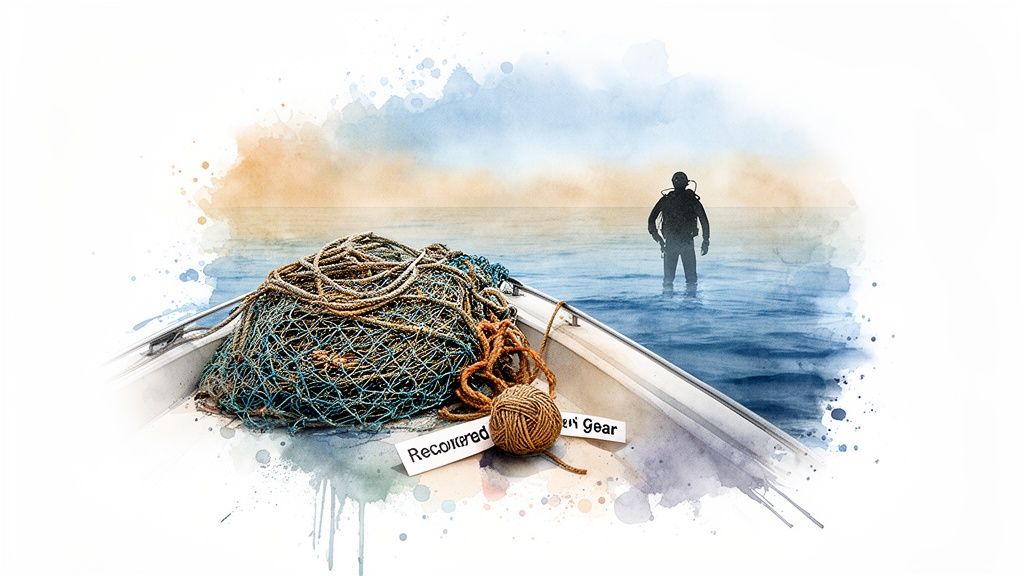
    A watercolor image depicting a boat with recovered fishing gear and a diver in the ocean.

    Why It's a Game-Changer

    This approach is about more than just cleanup; I see it as an underwater rescue mission. By removing a single large net, you can save thousands of marine animals over many years. It directly addresses a lethal threat that continues to harm wildlife long after it has been lost. These initiatives also close the loop. They partner with companies to recycle the recovered nylon nets into new products like swimwear, carpets, and socks. They transform waste into value.

    The impact is immediate and visible. When you see a ghost net pulled from a coral reef, the ecosystem can begin to recover almost instantly. Groups like Sea Shepherd Conservation Society document these removals, showing us the tangible difference that focused, direct action can make.

    How You Can Get Involved

    You don't have to be a deep-sea diver to join the hunt for ghost gear. Your support on land is just as vital to the success of these underwater operations.

    • Support the Divers: Donate to organizations like Ghost Fishing or Healthy Seas. Your contributions help fund dive missions, purchase specialized equipment, and cover logistical costs.
    • Raise Your Voice: I want you to share documentaries and stories about ghost gear on social media. The more people understand the problem, the greater the pressure on the fishing industry to adopt better gear tracking and recovery practices.
    • Choose Consciously: When you buy seafood, ask about the fishing methods used. Support fisheries that are actively working to prevent gear loss and participate in recovery programs. Your consumer choices can drive industry-wide change.

    8. Corporate Accountability & Supply Chain Sustainability Initiatives

    Imagine a world where the price tag on a product told its whole story. Not just the cost in dollars, but its cost to our planet. This is the core idea behind corporate accountability. It’s about shifting responsibility for ocean pollution from just us, the consumers, to the companies that design, produce, and sell the goods that too often end up in our waterways.

    These initiatives are one of the most fundamental solutions for pollution in the oceans because they tackle the problem at its source. By demanding transparency and sustainability throughout a product's entire life cycle—from sourcing raw materials to its final disposal—we can prevent pollution from ever being created. Programs like B-Corp certification or standards set by organizations like Ocean Wise hold companies to a higher standard. They reward those who I see prioritizing planetary health over pure profit.

    Why It's a Game-Changer

    This approach turns the entire system on its head. Instead of just cleaning up the mess, it stops the mess from being made. When a company like Patagonia invests in Fair Trade Certified practices or Unilever commits to a Sustainable Living Plan, it creates a ripple effect. It forces competitors to reconsider their own environmental impact. It empowers you and me to vote with our wallets for a healthier ocean.

    Accountability initiatives are not just about shaming bad actors. They are about celebrating and supporting the leaders. They provide a clear roadmap for businesses to do better. They give us, the public, the tools to see who is genuinely committed. You can explore a wide range of inspiring corporate social responsibility examples on littercaterpillars.com to see how this looks in action.

    How You Can Get Involved

    You hold immense power as a consumer and a citizen. You can directly influence the corporations that shape our world. Here’s how you can put that power to work:

    • Shop Your Values: Support businesses with certifications like B-Corp or those transparent about their supply chains. I want you to read labels and ask questions before you buy.
    • Use Your Voice: Join consumer campaigns led by groups like Greenpeace that target major polluters. A simple tweet, an email, a signature on a petition—these can be part of a massive wave of public pressure.
    • Celebrate the Good Guys: Organize a "sustainable business spotlight" in your community. When you find a local shop or brand doing things right, share their story on social media and with your friends. I believe positive reinforcement encourages more businesses to follow suit.

    9. Education & Behavioral Change Programs (School & Community-Based)

    Picture a classroom of children. Their eyes are wide as they learn about the journey of a sea turtle. Or imagine a community coming together to transform a local park into an "Ocean Friendly Garden." These aren't just feel-good activities; they are powerful engines of change. I believe comprehensive educational initiatives are designed to reshape our understanding of ocean health and inspire the behavioral shifts necessary to protect it.

    These programs are foundational solutions for pollution in the oceans because they tackle the problem at its root: human behavior. By weaving compelling stories and hands-on experiences into school curricula and community workshops, they move you and me from passive awareness to active environmental stewardship. Organizations like National Geographic and programs such as Ocean Wise are bringing the ocean's story into our daily lives, making the distant problem of marine pollution a personal and local one.

    Why It's a Game-Changer

    While technology cleans up existing messes, education prevents future ones. It's the difference between constantly bailing water out of a sinking boat and teaching everyone how to fix the leak. When a child learns how a single plastic bag can harm marine life, they become a lifelong advocate for reusable bags. When a neighborhood participates in a Plastic-Free July challenge, it creates a ripple effect of conscious consumption that reduces waste at the source.

    These programs don't just lecture; they empower. The Surfrider Foundation’s Ocean Friendly Gardens program, for example, teaches communities how to create landscapes that reduce urban runoff, a major source of ocean pollution. I see this transforming abstract knowledge into tangible, local action, proving that protecting the ocean can start right in your own backyard.

    How You Can Get Involved

    You can become a powerful catalyst for change by bringing ocean education into your community. Here’s how you can start:

    • Bring the Ocean to School: I encourage you to partner with local schools to integrate environmental curriculums like Project WILD or Project Learning Tree. You can volunteer to lead a session or help teachers find resources.
    • Start a Community Challenge: Launch a "plastic-free" challenge in your neighborhood or workplace. Use social media and short videos to share tips, celebrate successes, and build a sense of collective achievement.
    • Host an Event: Organize a family-friendly educational event. A documentary screening (think David Attenborough!) followed by a discussion, or a workshop on creating zero-waste home products. I want you to make learning fun and accessible for all ages.

    10. Plastic Reduction & Prevention at Source (Industrial Design & Materials Innovation)

    What if we could stop plastic pollution before a single wrapper or bottle is even made? This is the powerful idea behind redesigning our products and materials at their source. Instead of just cleaning up the mess, brilliant designers and scientists are changing the game. They create products that don't need plastic in the first place. They invent entirely new, ocean-safe materials.

    These forward-thinking approaches are among the most profound solutions for pollution in the oceans because they tackle the problem at its root. Imagine edible water pods made from seaweed, like those from Notpla. Or stylish accessories crafted from mushroom leather by innovators like Ecovative Design. This isn't about compromise. It's about innovating our way to a cleaner future by making waste obsolete from the very beginning.

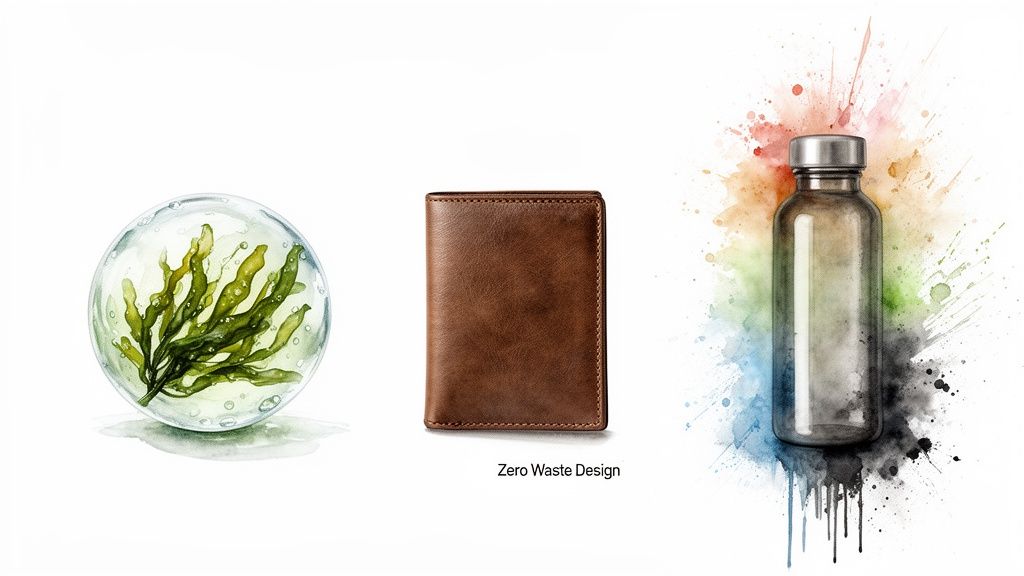
    An illustration featuring seaweed in a bubble, a brown wallet, and a water bottle, representing zero waste design solutions.

    Why It's a Game-Changer

    Source reduction is the ultimate form of prevention. Every product redesigned to eliminate plastic is one less potential piece of litter that you or I need to collect from a beach or river. Companies like Unilever and P&G are embracing this with refillable product lines. Pioneers like Patagonia have long championed sustainable materials. This systemic shift turns off the plastic tap, rather than just mopping up the floor.

    This isn't just about the stuff you buy. It's happening in tech, with companies like HP reducing plastic in printer cartridges. Even in automotive manufacturing. The core principle, which I see championed by organizations like the Ellen MacArthur Foundation, is a move toward a circular economy. A world where we reuse, repurpose, or safely return materials to nature, ensuring they never become pollution.

    How You Can Get Involved

    You can be a powerful force for change. Use your consumer voice and creativity to champion smart design. Here's how you can start:

    • Vote with Your Wallet: Choose products from companies committed to reducing plastic. I want you to support businesses that use innovative, sustainable packaging and tell them why you chose them.
    • Host an "Innovation Spotlight": Organize a small local event or a social media campaign highlighting businesses that are getting it right. Showcase products that use alternative materials and celebrate their commitment.
    • Advocate for Better Design: Encourage your favorite brands to adopt plastic-free alternatives. A single, thoughtful email or social media post from you can spark a conversation within a company's design team. Explore more strategies for how to reduce plastic pollution on littercaterpillars.com.

    10-Point Comparison: Ocean Pollution Solutions

    Solution 🔄 Implementation complexity ⚡ Resource requirements 📊 Expected outcomes 💡 Ideal use cases ⭐ Key advantages
    Ocean Cleanup Technology & Autonomous Collection Systems High — advanced engineering, deployment & maintenance Very high — capital, vessels, AI & skilled ops High for concentrated macro-debris; limited for finest microplastics 📊 ⭐⭐ Ocean gyres, river mouths, port/marina interceptors Autonomous large-scale removal; continuous monitoring; public visibility
    Single-Use Plastic Bans & Extended Producer Responsibility (EPR) Policies Medium–High — legislative design, stakeholder negotiation Moderate — administrative, enforcement, compliance support ⚡ Very high long-term source reduction and systemic change 📊 ⭐⭐⭐⭐ National/state legislation, municipal ordinances, upstream prevention Prevents pollution at source; drives material innovation; reduces cleanup burden
    Wastewater Treatment & Microplastic Filtration Systems High — infrastructure upgrades, retrofitting & monitoring 🔄 High — treatment plants, filters, operation & maintenance High for removing microplastics pre-release; reduces ecosystem exposure 📊 ⭐⭐⭐ Municipal and industrial wastewater systems; household retrofits Targets invisible microplastics early; retrofit-compatible; protects biota
    Marine Protected Areas (MPAs) & Ocean Sanctuary Policies Medium — legal designation, multi-stakeholder coordination Moderate — enforcement, monitoring, governance resources High for biodiversity recovery and resilience; not direct debris removal 📊 ⭐⭐⭐ Biodiversity hotspots, fisheries management, conservation planning Protects ecosystems; measurable ecological recovery; promotes research
    Beach & Coastal Cleanup Programs with Data Collection Low–Medium — volunteer coordination, training & protocols 🔄 Low — volunteers, basic supplies, simple data tools ⚡ Moderate immediate debris removal + actionable data for research 📊 ⭐⭐⭐ Local community engagement, awareness campaigns, citizen science Visible impact; low cost; builds community and credible datasets
    Circular Economy & Plastic Recycling Infrastructure Development High — system redesign, tech integration, market creation High — sorting plants, processing tech, market-building ⚡ High long-term diversion from landfills/oceans; economic benefits 📊 ⭐⭐⭐⭐ Municipal systems, industry partnerships, product redesign programs Keeps materials in use; creates jobs; reduces virgin plastic demand
    Fishing Net Recovery & Ghost Gear Removal Programs High — specialized diving, mapping, safety protocols 🔄 High — trained divers, vessels, sonar & recovery gear High local ecological benefit by removing lethal gear 📊 ⭐⭐⭐ Coastal fisheries, known ghost-gear hotspots, post-storm cleanups Removes high-impact debris; immediate marine-life protection; material recovery
    Corporate Accountability & Supply Chain Sustainability Initiatives Medium — audits, transparency systems, stakeholder engagement Moderate — auditing, certification, advocacy campaigns ⚡ High systemic potential if widely adopted; risk of greenwashing 📊 ⭐⭐⭐ Major brands, suppliers, procurement policies, consumer-facing companies Leverages market forces; increases transparency; incentivizes reduction
    Education & Behavioral Change Programs (School & Community-Based) Low–Medium — curriculum design, outreach consistency 🔄 Low — educators, materials, community partnerships ⚡ High long-term cultural/behavioral shift though slow to manifest 📊 ⭐⭐⭐⭐ Schools, community centers, youth programs, family outreach Cost-effective; builds stewardship; multiplies volunteer impact over time
    Plastic Reduction & Prevention at Source (Industrial Design & Materials Innovation) High — R&D, redesign, regulatory alignment 🔄 High — R&D investment, manufacturing change, scale-up resources ⚡ Very high long-term prevention of pollution and systemic change 📊 ⭐⭐⭐⭐ Product design, packaging industry, manufacturers, material startups Eliminates source of pollution; spurs innovation; creates sustainable markets

    Your Next Chapter Starts Now

    Remember that feeling of being overwhelmed I told you about? That feeling of helplessness. Sometimes it’s easier to just stand by and watch things happen. But I’ve learned something. Showing up, even when it's hard, even when you're suffering a bit, is what adds flavor to life. It’s what advances the plot.

    You stop being a bystander. You become the hero of your own story. The ten solutions we've walked through in this article are more than just a list. They are invitations. Invitations for you to be brave. To connect with others. To be a force for transformation.

    We've seen the sheer power of human ingenuity. I see it in the form of autonomous collection systems and microplastic filtration technologies. These aren't just gadgets. They are humanity’s response to a crisis, a testament to our ability to innovate our way out of problems we created. But I know technology alone is not a silver bullet. It's one thread in a much larger tapestry.

    That's where systemic change comes in. We explored the game-changing potential of policies like Single-Use Plastic Bans and Extended Producer Responsibility (EPR). Imagine a world where the companies producing plastic are also responsible for its end-of-life. That's not a fantasy. It's a structural shift that rewrites the rules of production and consumption. It turns waste from an afterthought into a primary design consideration.

    But what can you do? Where does your personal story intersect with this massive global challenge?

    It intersects on the ground. In your hands. With your voice. It starts with a simple beach cleanup where you don't just pick up trash, you also collect data. It continues when you support a local business committed to a circular economy. It gains momentum when you advocate for Marine Protected Areas, giving our oceans the breathing room they need to heal.

    You don't have to be a scientist or a politician to be a part of these incredible solutions for pollution in the oceans. You just have to be willing to start.

    Picking up a piece of litter. Asking your favorite cafe to switch to sustainable packaging. Supporting a company that takes its supply chain seriously. These are all ways you can write a new page in your story. You are not just one person against a tidal wave of pollution. You are a part of a global current of change, and every action you take adds to its force.

    Just like a caterpillar, none of us are perfect. I'm certainly not. We're all a bit messy, still figuring things out. But every single one of us is capable of incredible, beautiful change. The journey from a neighborhood street to the vast blue ocean seems impossibly long. But it’s a journey that starts with a single step, a single piece of plastic you pick up from the curb.

    So, what's your next move? You don't have to solve everything at once. Just start. Show up. Find your people. The ocean, and your future self, will thank you for it.


    Ready to write your first chapter? Join Litter Caterpillars and connect with a community of changemakers turning local action into global impact, one Chicago neighborhood at a time. Find your next cleanup event and start your story with us at Litter Caterpillars.