
Tag: personal growth

  • 8 Resilience Building Activities That Build Courage

    8 Resilience Building Activities That Build Courage

    Three people huddled under a tree while hail struck the street around us. The cold kept building, Ubers kept canceling, and we faced a simple choice: leave or stay together until it became safe.

    That first cleanup taught me that resilience grows through repeatable action, not a performance of toughness. You practice it when you pick up one piece of trash, make one difficult call, return after missing a week, or ask someone to walk beside you.

    The eight resilience building activities below move from short cleanup walks to neighborhood projects, shared challenges, personal barriers, and volunteer care. Choose by your age, available time, energy, access needs, and comfort with groups. You can do several alone. You can also invite one person and make the task lighter.

    You build trust in yourself one doable action at a time.

    1. Group Cleanup Walks

    On a Saturday morning, I grab a trash picker, a bag, and a few people who want to move. We walk. The trash disappears as we go, and the work gives our attention somewhere concrete to land.

    Cleaning someone else's mess can feel easier than cleaning your own. You don't have to sort through the memories attached to a gum wrapper or an old food container. You pick it up, place it in the bag, and move on. That small motion can teach you to release what doesn't deserve a permanent place in your mind.

    Litter Caterpillars has used this format during a highway cleanup after a bike-event shutdown and through weekly rotations in Englewood, South Shore, Pilsen, and other Chicago neighborhoods. Over time, groups create their own jokes, routines, and small traditions. The cleanup becomes a walk with a shared purpose.

    Make the walk easy to repeat

    Wear clothes you can dirty. Bring water and a snack, especially during hot weather. Talk while you walk, because conversation gives the task a social pulse. Notice which blocks need more attention instead of staring only at the bag.

    • Keep the first route manageable: Choose one block, one path, or one visible problem area.
    • Invite different formats: A solo walker can use the same practice with music or quiet observation.
    • Return at a regular time: Repetition helps turn a good intention into a habit.

    For a first group session, use this volunteer trash pickup guide to prepare. Come for strange fun, not to fix an entire city in one morning.

    2. Neighborhood Transformation Projects

    A cleanup removes a problem. A transformation asks you to stay long enough to create something new.

    Litter Caterpillars won an empty lot at auction in Englewood and turned it into Caterpillar Park. That work required volunteers to move dirt, plant, paint, and return across many weekends. A block transformation with murals and benches follows the same pattern. You begin with a neglected space, then give people a reason to picture its next life.
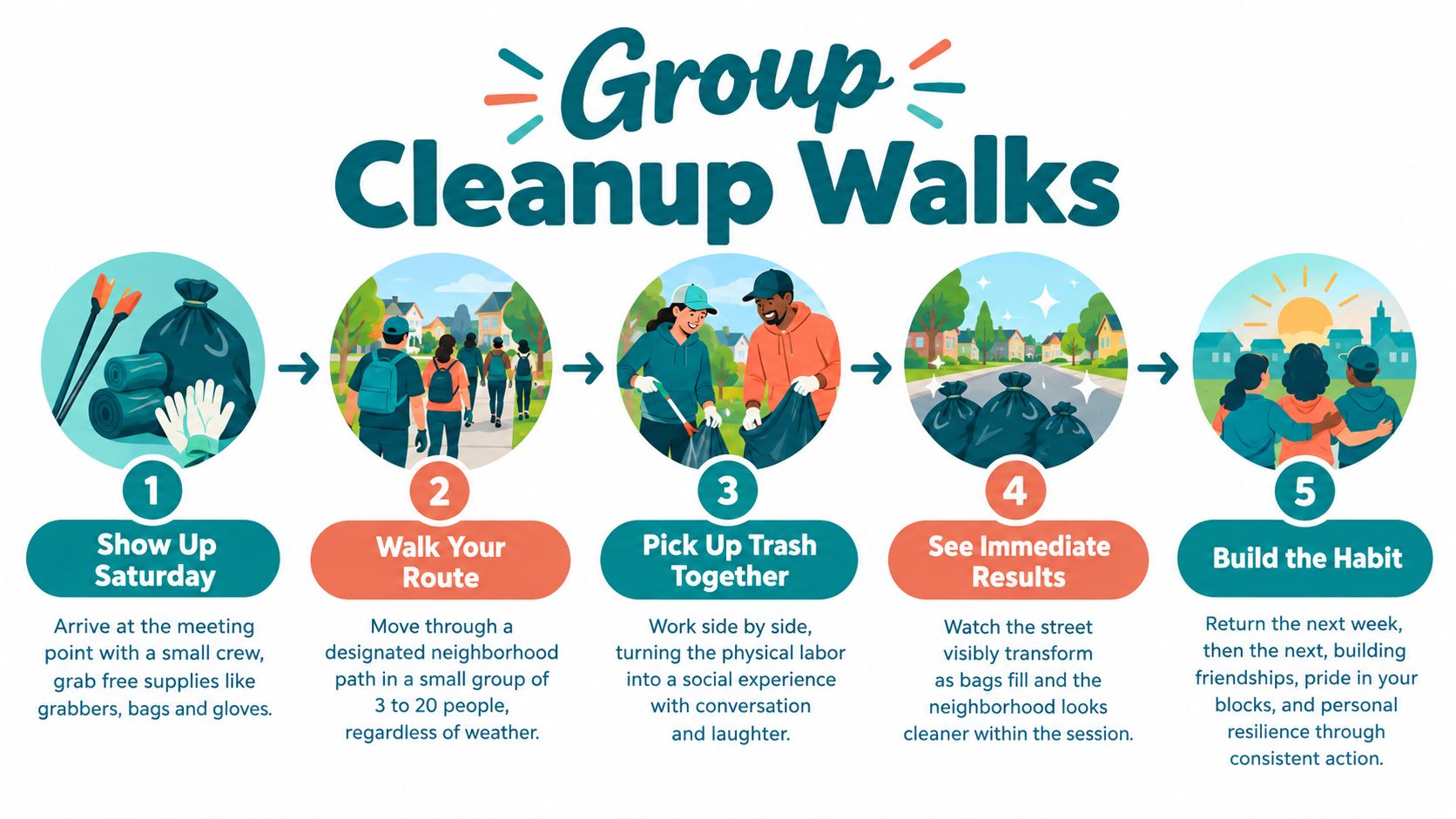
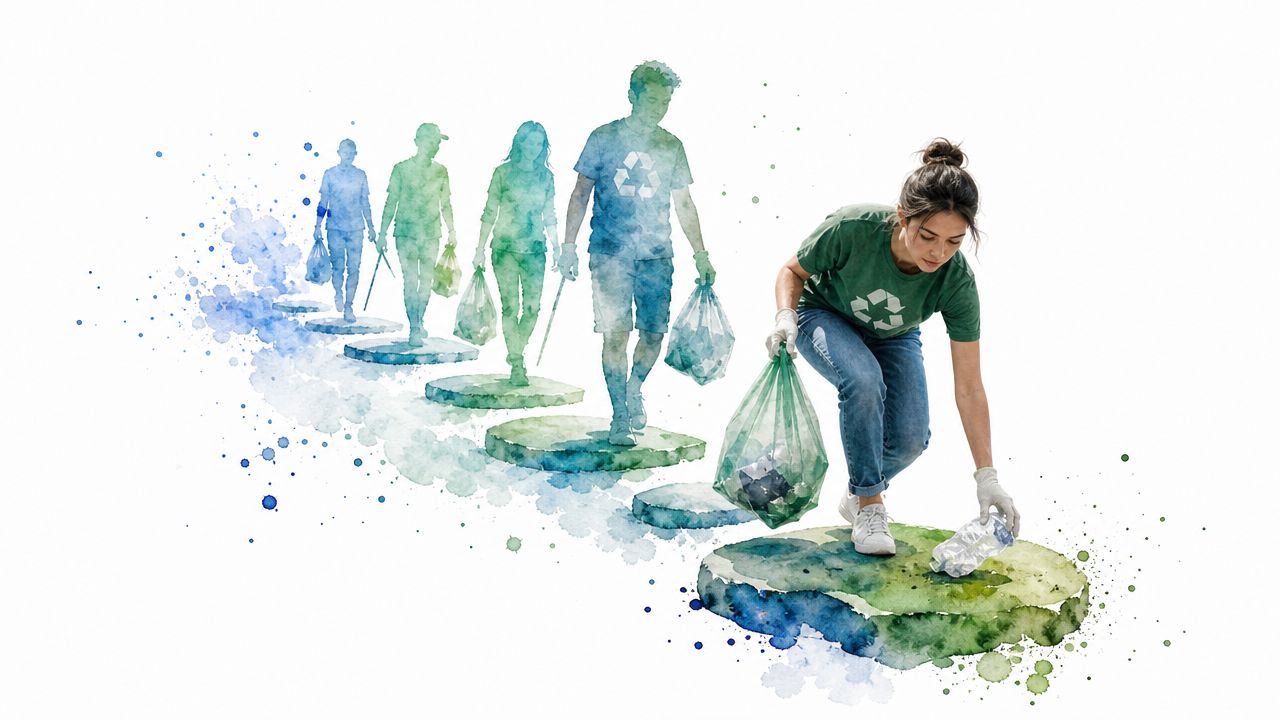
    An illustrated step-by-step guide on organizing group cleanup walks to improve neighborhood cleanliness and social connections.

    When I return to a project months later, I notice more than the physical change. I remember the awkward first meeting, the dirt under my fingernails, and the moment someone finally saw the plan. Each visit gives the group proof that patient work can produce a place people recognize as theirs.

    Build the project in small pieces

    Start with one corner, one lot, or one block face. Get local permission before work begins. Break the project into tasks that fit across multiple weekends, then photograph each stage so volunteers and residents can see what changed.

    Invite nearby residents early. They know the space, its history, and the people who use it. Let them help decide what belongs there.

    Watch this community cleanup video before you plan a workday. Celebrate the first cleared patch, the first planted area, and the first repaired bench. You don't have to wait for a finished park to recognize progress.

    3. Consistent Weekly Commitment

    A volunteer checks the calendar, sees Saturday morning, and laces up before motivation arrives. That small act, repeated through changing moods and weather, gives resilience a practical shape.

    For about three years, I've watched Litter Caterpillars meet weekly through rain, blizzards, negative wind chills, and scorching heat. People join, leave, return, and gradually accept more responsibility. Some volunteers have attended for more than 40 consecutive weeks and grown into team leaders. The meeting remains steady even as the people change.

    Your self-image shifts with that rhythm. You stop waiting to feel ready. You check the calendar, put on your shoes, and go. Courage becomes a door you keep opening.

    Make the promise fit your life

    Choose a recurring time you can protect. A solo cleanup, a neighborhood walk, or a group service hour can all count. Tell one person, add it to your calendar, and use a weekend cleaning schedule to find a regular service window.

    Keep these rules visible:

    • Return the next week: One missed session does not erase the habit.
    • Break the slide: After two missed weeks, restart with a shorter, easier task.
    • Use a backup person: Ask a friend to text when motivation fades.
    • Change the format: Work alone, bring a group, or choose an age-appropriate task for children and older adults.
    • Respect conditions: Wear winter gear, carry water in summer, shorten the route, and stop when safety requires it.

    A steady commitment should stretch you without trapping you. The goal is a practice you can repeat, adjust, and trust.

    4. Shared Suffering and Bonding

    Cold weather changes a conversation. So does heat, rain, a heavy bag, or a long walk back to the meeting point.

    During the first spring hailstorm, three of us huddled under a tree and watched every Uber cancel. We shivered, laughed, and waited until we could move safely. The hardship became part of our shared story. Later, winter cleanups and summer runs in 95-degree heat created more stories that people remembered because everyone had felt the same discomfort.

    Shared challenge can bring people closer, but you need to handle it with care. A freezing cleanup shouldn't become a test of loyalty. Someone who leaves because the conditions feel unsafe hasn't failed. They made a sound decision.

    Three friends sitting under a tree, sharing hot drinks from a thermos during a snowy hike.

    Let safety set the limit

    Check weather conditions before you meet. Bring seasonal gear, plan a warm place to go afterward in winter, and carry water during hot sessions. Choose a shorter route when the group runs low on energy.

    Hardship can become a good story when everyone has permission to stop.

    Name the discomfort instead of pretending it's easy. Then add a small reward, such as coffee after hail or ice cream after heat. A solo version might involve a brisk walk in manageable weather, followed by a warm drink and a short note about what you noticed. A group version can include children or older adults when the route, pace, and conditions fit them.

    5. Identity and Pride Building

    After a cleanup, Ella Duke's volunteer-made theme song can stay in your head. Litter Caterpillars also uses a logo, flags, and badges. These details give a practical task a recognizable shape. You arrive to collect trash and leave with a clearer identity: I'm someone who shows up for my city.

    That feeling can begin with a playful choice. Name the group, give the route a nickname, sew a patch, or take the same closing photo after each session. A solo volunteer might draw the route in a notebook or mark each visit with a personal symbol. Children can design cards, while older adults can choose a quieter tradition that feels comfortable and safe.

    Pride should point back to conduct. A group that values kindness greets newcomers and shares equipment. A group that values bravery makes room for beginners who feel awkward. A group that values unity treats badges as reminders, not rankings.

    Try a small marker, such as a sticker, pin, scarf, or handmade card. Celebrate concrete actions: returning, helping someone new, or making a route safer. Let volunteers add traditions instead of receiving a finished script.

    Keep the ritual human. A photo, a short story, or a sentence about the day can make participation feel real. In a group, share that moment aloud. Alone, write it down before heading home.

    Choose symbols that match the work. A badge cannot replace care, and a slogan cannot create belonging by itself. Identity grows when the marker reminds you what you did, including the ordinary sessions when showing up took effort. That practice can fit a short solo walk, a neighborhood team, or a service project adapted for age, time, and mobility.

    6. Cross-Ward Exploration and Neighborhood Knowledge

    Chicago has 50 wards, yet many residents spend most of their time in only a few familiar areas. Cleanup work can turn the city from an abstract map into a collection of streets, neighbors, storefronts, parks, and stories.

    Through ongoing work in Englewood, volunteers can learn the routes, recurring trouble spots, and people who care for the area. A visit to South Shore can reveal a safer walking path, a friendly neighbor, or a quiet block you hadn't noticed before. You begin to understand a place through contact, not assumption.

    Exploration also asks for humility. You're a guest when you volunteer in a neighborhood you don't know well. The litter tells you one part of the story. Residents can tell you what needs attention, what already works, and what outsiders often misunderstand.

    Turn a route into a learning practice

    Before you arrive, read a little about the ward's history. Talk with residents and listen without treating the conversation like research you need to collect. Look for beauty, ordinary care, and useful local knowledge alongside the trash.

    Keep a map or list of all 50 wards if tracking routes motivates you. Bring photographs back to other volunteers, while respecting people's privacy and asking before you photograph them. A solo version can include a short observation note after each walk. A group version can end with everyone sharing one thing they learned.

    This activity builds courage through unfamiliarity. You practice entering a new place with attention, respect, and a willingness to revise your first impression.

    7. Overcoming Personal Barriers Through Action

    I started Litter Caterpillars because I couldn't clean my own apartment. Each object carried a story. An old jar of blueberry jam could connect to a trip, a failed healthy-eating plan, or a relationship I didn't know how to release. A piece of trash weighed very little, yet moving it felt impossible.

    Cleaning someone else's space gave me a way in. The street didn't carry my memories, so I could pick something up and place it in a bag. Repeating that action taught me that I could begin before I felt ready. Eventually, I could use the same lesson at home.

    Shrink the barrier until you can move

    Start with the smallest action you can complete. You might attend for 20 minutes, greet one person, carry supplies instead of using a picker, or clean one surface at home after a group session. Track whether you showed up and tried. Those answers tell you more than a dramatic promise.

    A social-anxiety barrier may need a gradual plan. You can read this guide on how to overcome social anxiety and choose one low-pressure interaction before attempting a large group event.

    Tell one person what feels hard. Ask them to check in after the session. You don't need to explain every detail to everyone. A short sentence can work: “I'm practicing being around people, so I may stay quiet today.”

    Give the process time. Two weeks won't rewrite every habit. The trash is the task in front of you. The deeper practice is learning that you can act while resistance speaks.

    8. Community Partnership and Volunteer Stewardship

    A cleanup reaches farther when a corner shop, nonprofit, city agency, alderman, and residents each add something useful. One partner may supply gloves. Another may clarify permissions or suggest a neglected route. A shop might offer coffee after the walk. Before the event, agree on the contribution and the volunteer need. That simple exchange prevents confusion.

    Litter Caterpillars works with partners across all 50 wards and uses sponsorships to keep events free for volunteers. Meetup, Instagram, and open group chats help people find events and stay connected. A clear date, location, contact, task, and time commitment can turn good intentions into attendance.

    Volunteer care shapes whether people return. Give a group a short safety briefing, suitable equipment, water or breaks, and tasks that match different ages, abilities, energy levels, and comfort with social contact. A solo volunteer can sort supplies or document a route. A group can divide welcoming, cleanup, and follow-up roles. For extreme weather, unsafe areas, or limited mobility, offer an indoor, shorter, or remote task instead.

    After the event, ask what felt easy, tiring, or unclear. Make it simple to leave early without embarrassment. Thank the person who prepared materials as warmly as the person who filled a bag. Partners need the same reliable communication.

    A workable partnership follows four habits:

    • Start close to home: Choose a nearby partner whose values fit the project.
    • Name the exchange: State what you need and what you can return.
    • Keep events accessible: Offer varied tasks, formats, and time commitments.
    • Recognize real help: Thank people for preparation, welcoming, cleanup, and follow-up.

    NCVO's 2023 Time Well Spent survey found that 92% of recent formal volunteers in England were very or fairly satisfied, while 69% would recommend or had already recommended their volunteering. The survey connected satisfaction with enjoyment, appreciation, visible difference, and safety, according to NCVO's survey summary. Build those conditions into each event, whether you volunteer alone or with a team.

    8-Point Resilience Activities Comparison

    Initiative Implementation Complexity 🔄 Resource Requirements ⚡ Expected Outcomes ⭐📊 Ideal Use Cases 💡 Key Advantages ⭐
    Group Cleanup Walks Low 🔄, simple routes, minimal planning Low ⚡, basic supplies provided Immediate visible cleanliness; short-term pride ⭐⭐ 📊 Onboarding volunteers; regular neighborhood upkeep Accessible, social, low barrier ⭐
    Neighborhood Transformation Projects High 🔄🔄, permits, multi-week coordination High ⚡⚡, funding, skilled labor, materials Permanent physical change; media and donor attention ⭐⭐⭐ 📊 Long-term site rehab, park/lot conversions Lasting impact; skill-building and partnerships ⭐
    Consistent Weekly Commitment Moderate 🔄, schedule management and rotation Low–Moderate ⚡, recurring volunteer time Habit formation; steady volunteer retention ⭐⭐ 📊 Behavior change, leadership development Predictability fosters reliability and identity ⭐
    Shared Suffering and Bonding Low–Moderate 🔄, event safety planning needed Low ⚡, weather gear and contingency plans Rapid, durable friendships; strong cohesion ⭐⭐ 📊 Team-building; deepening volunteer commitment Fast trust-building; memorable shared stories ⭐
    Identity and Pride Building Moderate 🔄, branding and recognition systems Moderate ⚡, merch, media, milestone tracking Strong volunteer identity and sustained engagement ⭐⭐⭐ 📊 Retention strategies; culture- and brand-building Genuine belonging and internal motivation ⭐
    Cross-Ward Exploration & Knowledge Moderate 🔄, logistics for rotating locations Moderate ⚡, transport, maps, time Broader city knowledge; improved advocacy ⭐⭐ 📊 Outreach, education, recruiting diverse volunteers Citywide awareness; cross-neighborhood connections ⭐
    Overcoming Personal Barriers Through Action Low 🔄, individual support within group setting Low ⚡, consistent attendance and peer support Incremental personal growth; better habits ⭐⭐ 📊 Supporting isolated individuals; confidence-building Practical empowerment; compounding small wins ⭐
    Community Partnership & Volunteer Stewardship High 🔄🔄, stakeholder coordination, communications Moderate–High ⚡⚡, partnership management, staff time Sustainable model; institutional trust and resources ⭐⭐⭐ 📊 Scaling, fundraising, institutional collaboration Protects volunteer energy; durable partnerships ⭐

    Choose Your Next Brave Step

    You don't need to choose the hardest activity. Choose the one you can repeat.

    If your energy feels low, take a short solo reset. Walk one block, collect a few safe items with suitable equipment, or write about what made starting difficult. Expressive writing can use a direct 20-minute exercise, where you write continuously about an issue and push toward your deepest thoughts and feelings, as described in this resilience writing practice. Stop if the exercise overwhelms you, and choose a gentler activity instead.

    If you want contact without a large commitment, join a one-hour group session. A cleanup walk gives you a task to hold while you meet people. You won't need to invent conversation from nothing. You can point out a full bag, a difficult corner, or a block that needs another visit.

    If you want a habit, choose a weekly commitment. Pick a realistic weekend morning, tell one person, and put it on your calendar. England's 2023/24 volunteering survey found that 28% of adults, about 12.9 million people, took part in formal volunteering at least once during the previous year, while 16% volunteered at least monthly, according to NCVO's volunteering data. A recurring service time can give your week a reliable point of contact.

    For a longer project, choose one corner, lot, or block face. Get permission, invite residents, divide the work, and photograph the changes. Community resilience planning can include stakeholder engagement, social networks, health-promoting opportunities, plans for at-risk people such as children, and response and rebuilding plans that can activate after a disaster, as outlined in this community resilience framework.

    Your action plan can stay simple:

    • Choose a format: Solo reset, group hour, weekly service, or neighborhood project.
    • Set a small date: Put a specific day and time on your calendar.
    • Invite one person: Ask a friend to join, or join Litter Caterpillars through its website.
    • Record the result: Write what you did, what felt difficult, and what helped.
    • Return once more: Let the second attempt teach you more than the first.

    Challenge needs room for rest, consent, access needs, weather changes, and changing plans. Resilience doesn't require you to ignore pain or prove toughness. It grows when you take a manageable step, care for yourself and others, then decide to continue.

    Turn one Saturday morning into the start of a steadier habit. Choose the route, pack water, invite someone, and show up at a pace you can safely repeat.


    Litter Caterpillars gives Chicago volunteers a weekly way to clean neighborhoods, meet people, and practice courage through hands-on service. Visit Litter Caterpillars to find a cleanup and take your next small step with the group.


  • 8 Service Learning Benefits That Change You Forever

    8 Service Learning Benefits That Change You Forever

    It's easier to clean someone else's mess. I learned that the hard way, standing in a freezing Chicago hailstorm with a trash bag in one hand and my own life feeling like a landfill in the other. When you pick up what other people left behind, you start noticing how much of yourself you can finally carry.

    Service learning didn't feel noble to me at first. It felt wet, cold, awkward, and weirdly honest. That's why it worked. It gave me a place to do hard, physical work with other people, and that work started changing how I handled my friendships, my fear, my city, and even the way I talked to myself.

    1. Building Real Friendships Through Shared Purpose

    You don't build the best friendships by sitting across a polished table and trying to sound impressive. You build them when your hands are cold, your shoes are muddy, and you're both dragging the same trash bag toward the curb. That's what makes service learning benefits feel different from casual socializing, it gives you a reason to keep showing up, and that consistency does the heavy lifting.

    I've seen strangers turn into the kind of people who text each other after pickups, plan side hangouts, and show up for celebrations that have nothing to do with trash. New Chicagoans often find their first real connection through weekly cleanups, because nobody cares if you're polished. They care if you're present. If you move away later, the bond can still hold. That's the kind of friendship that survives weather, schedule chaos, and ordinary life.

    A diverse group of four volunteers smiling and holding a sustainability flag after a community cleanup event.

    Say the unglamorous thing out loud

    If you want real connection, stop trying to look effortless. Introduce yourself to one new person, every week, and mean it. Tell people when you're having a rough day, because honesty builds faster than polish.

    Practical rule: the person who shows up in bad weather often becomes the person you trust in good weather too.

    If you want a group that builds that kind of bond on purpose, the spirit behind Litter Caterpillars' community-building activities for adults is exactly that, repeated effort with real people, not fake networking.

    2. Developing Personal Resilience and Grit

    The first time I worked outside in a spring hailstorm, my body wanted out before my mind did. That's the moment when resilience stops being a word you nod at and turns into a fact you can feel in your fingers. You learn that discomfort isn't the boss of you.

    That lesson matters because service learning asks you to stay put when the weather turns ugly, when the route feels long, and when your motivation drops off a cliff. The federal Learn and Serve America report said high-quality service learning helps school attendance, classroom engagement, and academic achievement, and it also connects students to their communities while reducing risky behaviors, which tells me grit isn't just about toughness, it's about follow-through in real life (federal Learn and Serve America report).

    Hard work gives you evidence

    You don't need to romanticize the cold to get the point. You need proof that you can keep moving when your mood says quit. The first time you finish a miserable pickup, you carry that evidence into everything else, a tough conversation, a job search, a bad week, a lonely stretch.

    You can't always choose the weather. You can choose whether you quit in it.

    That's why the gritty side of service learning benefits sticks. It gives you a body-level memory of strength. You don't just tell yourself you're capable, you've already done the thing, hands numb, bag full, and still standing.

    3. Gaining Practical Civic Knowledge and Neighborhood Literacy

    Three years of picking up trash across Chicago changes the way you see a city. You stop thinking of neighborhoods as names on a map and start reading them like lived-in places with patterns, habits, and pressure points. You notice what gets ignored, what gets maintained, and where people are trying anyway.

    That kind of civic learning beats a lecture because your shoes are in the dirt. The service-learning model has long been tied to active civic understanding, and a national youth leadership summary says it affects civic engagement along with attitudes toward self, school, social skills, and academic performance (National Youth Leadership Council summary). You feel those categories in real time when you're talking to neighbors, watching runoff pile up, or seeing which blocks get attention and which don't.

    City knowledge starts with your feet

    I've watched volunteers start asking sharper questions after a few cleanups. Why does this corner flood? Why does that block look cared for while another one gets buried in litter? Those are civic questions, not just cleanup questions. They lead you toward policy, maintenance, business habits, and the way people treat shared space.

    If you want to turn that attention into action, the mindset behind what is civic engagement is simple, pay attention where you stand, then act like the block belongs to you too.

    4. Developing Leadership and Initiative Skills

    Leadership usually gets described like a title. In real life, it looks more like a person noticing what needs doing and moving first. You grab extra bags, help a newcomer tie one off, or suggest the next street before anyone else says a word.

    That's how service learning builds leadership. You don't wait for permission to care, and nobody hands you a script. The work forces you to practice initiative, especially when the group needs somebody to make a decision fast. Over time, the shy person who barely spoke on day one starts leading a team or organizing a cleanup without making a big speech about it.

    The small moves count

    A lot of people think leadership begins when a crowd starts listening. I think it begins when one person sees a task and does it. That could mean setting the pace, checking on a tired volunteer, or stepping up for a stretch of highway cleanup no one wanted to claim.

    Leadership gets real when you stop waiting to be picked and start picking up the work yourself.

    That matters because service learning benefits don't wait until you feel ready. They show up while you're still learning how to act. You become reliable by being useful, not by sounding like a leader.

    5. Building Environmental Awareness and Stewardship

    You don't understand litter until you've held too much of it in your hands. One fast-food wrapper is an annoyance. Hundreds of wrappers, bottles, bags, and cups tell you a story about habits, convenience, and neglect. You start seeing patterns your old self ignored.

    That's where environmental stewardship gets personal. A lot of people think it starts with a speech. It usually starts with disgust, then curiosity, then responsibility. Volunteers often cut their own household waste after they've seen how much trash collects in the same places again and again. They start caring more about recycling, waste reduction, and the choices they make in their own kitchens and cars.

    Your habits stop feeling abstract

    Once you've cleaned a block, waste stops feeling invisible. You look at packaging differently. You notice how weather pushes trash into drains and parks. You start asking where it came from, who used it, and why it ended up where it did.

    If you want that eye-opening kind of awareness to stick, the lesson behind what is environmental stewardship is blunt, you can't claim to care about a place if you never touch the mess on its ground. That's a hard truth, and it changes you.

    6. Increasing Sense of Personal Agency and Control

    There's a specific kind of hopelessness that hits when you look at a dirty block and think nobody's going to fix this. Then you show up anyway, and by the end of the day the place looks different because of what you did. That's agency, and it feels better than waiting around for someone else to save the day.

    The booby trap for a lot of people is believing that change only counts if it comes from a big institution. Service learning cuts through that lie. You may not control the economy or city hall, but you can control your bag, your time, and your effort. That's enough to start moving your world.

    The Litter Caterpillars story started with Kevin Tao feeling stuck in his own messy apartment and chaotic life, then taking a hard look at the things he avoided. That same move, from helplessness to action, is what makes service learning benefits hit so hard in the body.

    Proof beats worry

    You don't need to feel powerful before you act. You act, then you feel powerful because you've got evidence. Before-and-after photos help, sure, but the proof lives in you, in the way your shoulders feel after a job done and in the way your mind stops repeating the same dead-end story.

    If you can clean one block, you can stop calling yourself helpless.

    That's not motivational fluff. It's a training ground. Once you've seen a real change happen because you showed up, you stop treating your life like a locked room.

    7. Developing Emotional Maturity and Self-Forgiveness

    A lot of people bring their worst self-talk into service work. I've done it too. You show up angry, ashamed, heartbroken, or embarrassed, and then the work asks you to keep going anyway. That's where emotional maturity starts, not in a calm self-help quote, but in the middle of real discomfort.

    Service learning teaches you that you don't have to be perfect to be useful. You don't have to have a spotless apartment, a clean record, or a tidy relationship history to matter to a group. You can be messy and still be welcome. You can be in progress and still be loved.

    The research summary from the Texas Tech service-learning review says service learning has positive effects on personal insight and cognitive development, and another meta-analysis found gains in self-esteem, self-efficacy, educational engagement, altruism, cultural proficiency, and academic achievement versus control groups (Texas Tech service-learning meta-analysis summary, Center for Engaged Learning summary). That lines up with what I've watched happen in the field, people start softening toward themselves because they finally have somewhere to belong while they work.

    You can't heal by hiding

    When someone joins a cleanup group while carrying shame, the work gives them a different mirror. Other people accept them as they are, not as a polished version they invented for public use. That repeated acceptance can be a relief so deep it almost feels strange.

    Self-forgiveness gets easier when your hands are busy and your people are kind.

    That's one of the clearest service learning benefits I know. It turns your inner critic down a notch by giving you a place to prove you're still worth something, even on a bad day.

    8. Creating Visible Community Impact and Pride

    Some kinds of service happen where nobody sees them. Cleanup work doesn't hide. The block changes, the street looks different, and neighbors notice right away. Kids ask questions. Business owners say thank you. People who used to walk past the mess now see a cleaner place and a group that cared enough to do something.

    That visible result matters because it gives you pride with no performance attached. You don't need applause to know the work landed. You can point to a corner, an empty lot, or a street and say, we made that better. The Litter Caterpillars' Caterpillar Park in Englewood does exactly that, turning an empty lot into a place people can use and care for.

    The best service learning benefits leave a trace. They don't vanish when the volunteer shift ends. They change what people expect from a neighborhood and what they expect from themselves.

    Pride gets stronger when people can see the result

    Visible work also builds group identity. Flags, theme songs, badges, and before-and-after photos all matter more than people think because they tell volunteers, this effort counts, and your neighbors can see it too. That kind of public care can pull other people in without a lecture.

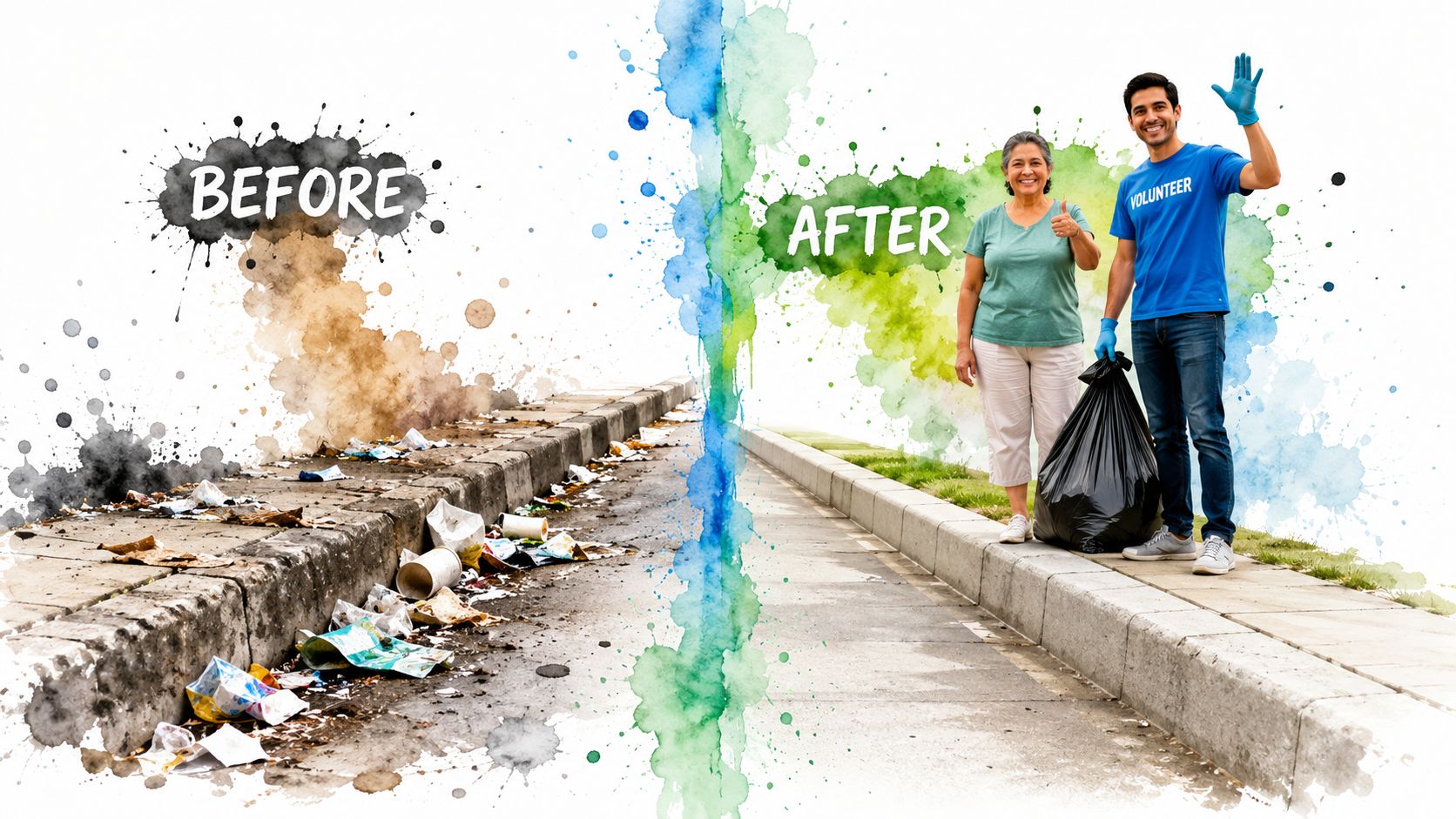
    A split image showing a dirty street before cleanup and a clean street with volunteers after cleanup.

    A cleaner block is more than a cleaner block. It's proof that someone stayed.

    And yes, there's a video worth watching if you want to feel the rhythm of the work in motion.

    8-Point Service-Learning Benefits Comparison

    Outcome 🔄 Implementation Complexity ⚡ Resource Requirements 📊 Expected Outcomes 💡 Ideal Use Cases ⭐ Key Advantages
    Building Real Friendships Through Shared Purpose Low, regular scheduling and group coordination Low, volunteers, basic supplies (bags, grabbers) High social bonding; lasting friendships and trust Newcomer integration, community cohesion, volunteer retention Organic, durable friendships; diverse networks; mutual trust
    Developing Personal Resilience and Grit Medium, exposes volunteers to harsh conditions; safety planning needed Low–Medium, weather gear, safety protocols, buddy systems Increased grit, confidence, tolerance for discomfort Personal growth, resilience training, preparation for stress Builds authentic self-efficacy via real-world challenges
    Gaining Practical Civic Knowledge and Neighborhood Literacy Medium, broad geographic coverage and sustained engagement Medium, travel/time, documentation, local partnerships Deep neighborhood knowledge; civic understanding; advocacy readiness Civic advocacy, urban planning research, community organizing Firsthand insight into policy impacts and local dynamics
    Developing Leadership and Initiative Skills Low, informal roles emerge through action Low, volunteer coordination tools, recognition tokens Improved initiative, decision-making, team coordination Emerging leaders, grassroots project organizers Practice-based leadership with transferable skills
    Building Environmental Awareness and Stewardship Low, routine activities with observational learning Low–Medium, sorting supplies, educational materials Heightened stewardship; reduced personal waste; advocacy Environmental education, behavior-change campaigns Hands-on learning yields sustained behavior change
    Increasing Sense of Personal Agency and Control Low, direct action with immediate feedback loops Low, basic tools and autonomy to choose projects Stronger agency; motivation to initiate local change Empowerment programs, people feeling stuck or powerless Tangible proof of impact; boosts motivation and initiative
    Developing Emotional Maturity and Self-Forgiveness Medium, requires psychological safety and repeated participation Low–Medium, supportive culture; occasional facilitation Greater self-compassion, reduced shame, emotional growth Mental-health support groups, recovery, belonging-focused work Cultivates vulnerability, acceptance, and lasting self-forgiveness
    Creating Visible Community Impact and Pride Low, visible results but needs consistency for recognition Low–Medium, photo documentation, outreach, symbols (flags) Community recognition; increased local pride and engagement Neighborhood revitalization, public awareness efforts Immediate, visible change that inspires community participation

    So, Are You Bold Enough?

    These benefits aren't theory. They show up in the cold, in the heat, and in the awkward, ordinary minutes when you decide to keep going anyway. I'm talking about real friendship, real grit, real city knowledge, real leadership, real agency, real self-forgiveness, and real pride you can point to with your own hands.

    The hard truth is simple. You don't get those service learning benefits by thinking about them in bed on a Sunday night. You get them by showing up with other people, getting uncomfortable, and doing work that leaves a mark on the street and on you. That's where the story changes.

    I've watched people walk in feeling stuck and walk out carrying a different posture. They stand a little straighter, talk a little more openly, and stop acting like their life is already decided. That kind of change doesn't come from waiting for confidence. It comes from earning it.

    So ask yourself straight. Are you ready to stop treating your life like a mess you can't touch? Are you ready to pick up a bag, meet real people, and let hard work make you stronger? Your next version is waiting on the other side of one messy, honest Saturday.


    If you want that kind of change in Chicago, Litter Caterpillars gives you a weekly place to clean, connect, and build grit with people who show up. Come for the trash pickup, stay for the friendship, the pride, and the version of you that gets built while you work.

  • Overcoming Personal Obstacles: Build Habits & Transform

    Overcoming Personal Obstacles: Build Habits & Transform

    I found the jam jar when I was looking for mustard. It sat in the back of my fridge like a tiny haunted object, sticky on the lid, old enough to belong to a different version of me.

    The Mess You Cannot Move

    That jar should've been easy to throw away. It weighed almost nothing. My hand could lift it without effort. But my mind couldn't.

    I knew where I got it. A trip to Michigan. A hopeful weekend. A version of me who bought nice jam and thought life was about to come together. So when I looked at that jar, I didn't see spoiled food. I saw a memory, a promise, and a quiet little accusation.

    Then there was the bag of nuts from the time I tried to become the kind of person who meal-prepped and drank more water. I failed at that too. So the trash wasn't trash. It was evidence.

    A nostalgic still life featuring a dusty jam jar, vintage letters, old photographs, and an antique pocket watch.

    When an object turns into a verdict

    I used to look around my room and feel embarrassed by how small the problem looked from the outside. A plate in the sink. Clothes on a chair. Mail on the floor. Nothing dramatic. Nothing movie-worthy.

    But inside my chest, it felt like I was trying to drag a boulder with fishing line.

    One piece of trash weighed less than a pound, but to me it felt like a 500-pound weight. That was the strange part. I could work, text people back, make jokes, and pretend I was fine. Then I'd freeze in front of a cardboard box or an expired condiment like I was staring down a wild animal.

    You can know something is small and still feel crushed by it.

    Maybe your obstacle isn't a messy room. Maybe it's an email you can't send. A conversation you keep postponing. A gym bag by the door that hasn't moved. A draft, a debt, a breakup, a pile of laundry, a half-finished application. Small things can pin you to the ground when they hook into shame.

    The breaking point

    My life got worse as my space got worse. I don't mean in some poetic, cinematic way. I mean in a plain, ugly way. I stayed in a long, chaotic relationship with someone selfish and always partying, and my own disorder gave that chaos a place to live.

    I let too much slide. I made excuses. I kept stepping around messes, literal and emotional, because touching them meant admitting they were real.

    If you're in that spot now, I want to say something simple. You're not lazy. You're not broken. You're carrying meaning, memory, fear, and self-judgment inside things that other people call easy.

    Before I changed anything, I had to admit that the obstacle was real. Not dramatic. Real.

    Pinpointing the Real Weight of Your Obstacles

    I couldn't start cleaning until I stopped calling my problem "being messy." That label was too cheap. It flattened everything.

    The room wasn't the issue. The stories in the room were.

    Read your mess like a diary

    When I finally got honest, I started asking a rough question about every object I couldn't deal with: What is this thing protecting me from?

    That old jam jar protected a memory. The health food wrappers protected an identity I wanted and couldn't keep. Old gifts protected dead relationships. Random paper piles protected me from deciding what still mattered and what didn't.

    If you want to get serious about overcoming personal obstacles, try this exercise with whatever "mess" you keep avoiding. I don't just mean physical clutter. I mean the thing in your life that keeps staring at you.

    Ask yourself:

    • What story attaches to this thing: Is it failure, guilt, nostalgia, fear, or unfinished hope?
    • What decision am I avoiding: Throwing something out often means admitting a season of life is over.
    • What identity do I lose if I let this go: Sometimes we keep junk because we still want proof that we once tried.
    • What feeling hits me first: Shame feels different from grief. Fear feels different from confusion.

    Write the answers down. Don't try to sound smart. Use ugly, honest language if that's what comes out.

    My clutter had roots

    When I dug into my own mess, I found two roots.

    The first was my chaotic relationship. I kept living in emotional noise, and clutter fit that life too well. Disorder outside matched disorder inside. Cleaning up felt like betrayal because it would've forced me to admit that my life had become something I didn't want.

    The second root was a fear of consistency. A single grand effort felt exciting. Quiet repetition felt terrifying. I could dream about becoming organized. I didn't trust myself to become a person who washed one dish, answered one message, showed up one Saturday at a time.

    Practical rule: If a task feels absurdly heavy, the weight is probably emotional, not practical.

    A quick sorting method

    You don't need a perfect journal routine for this. You need a rough sorting tool. I like three buckets.

    Bucket What it sounds like in your head What it usually means
    Past "I used to be different" grief, regret, nostalgia
    Present "I can't deal with this right now" overload, shame, fatigue
    Future "What if I fail again" fear, perfectionism, avoidance

    Pick one obstacle and sort it.

    If it's that untouched resume, maybe it sits in future because you fear rejection. If it's old clothes, maybe it sits in past because you miss who you were when you wore them. If it's the sink full of dishes, maybe it sits in present because your nervous system is already maxed out.

    Questions that cut deeper

    I had to stop asking, "Why am I like this?" That question is a trap. It turns you into a problem.

    These questions helped more:

    1. What does this obstacle let me postpone?
    2. What pain do I avoid by leaving it untouched?
    3. What small truth would I have to accept if I acted today?

    That last one hits hardest. Throwing away old junk sometimes means saying, "That chapter is dead." Sending the email means saying, "I want this enough to risk looking foolish." Making the appointment means saying, "I can't outrun this anymore."

    That is the actual weight. Once you can name it, the obstacle stops feeling like fog. It becomes something you can grab.

    The Tom Sawyer Method of Motivation

    I didn't beat my own mess by staring at it harder. I beat it sideways.

    I started picking up trash that belonged to strangers, and somehow that made it easier to face the junk in my own life. It sounds ridiculous until you've done it.

    Why other people's mess feels lighter

    When I went outside and picked up litter, the work felt clean in a way my own room never did. A bottle on the curb didn't carry my history. A fast food bag in the grass didn't know my failures. There was no emotional backstory. I saw trash, I grabbed it, and the block looked better.

    That simple loop did something important. It gave me evidence that I could act.

    The old Tom Sawyer story nails this. He got stuck painting a fence, then reframed the whole thing until other people wanted in. I don't care whether you love the story. I care about the trick inside it. The trick is this: when you change the frame, you change the energy.

    Helping other people can do that. Service turns self-improvement from a private courtroom into a visible task.

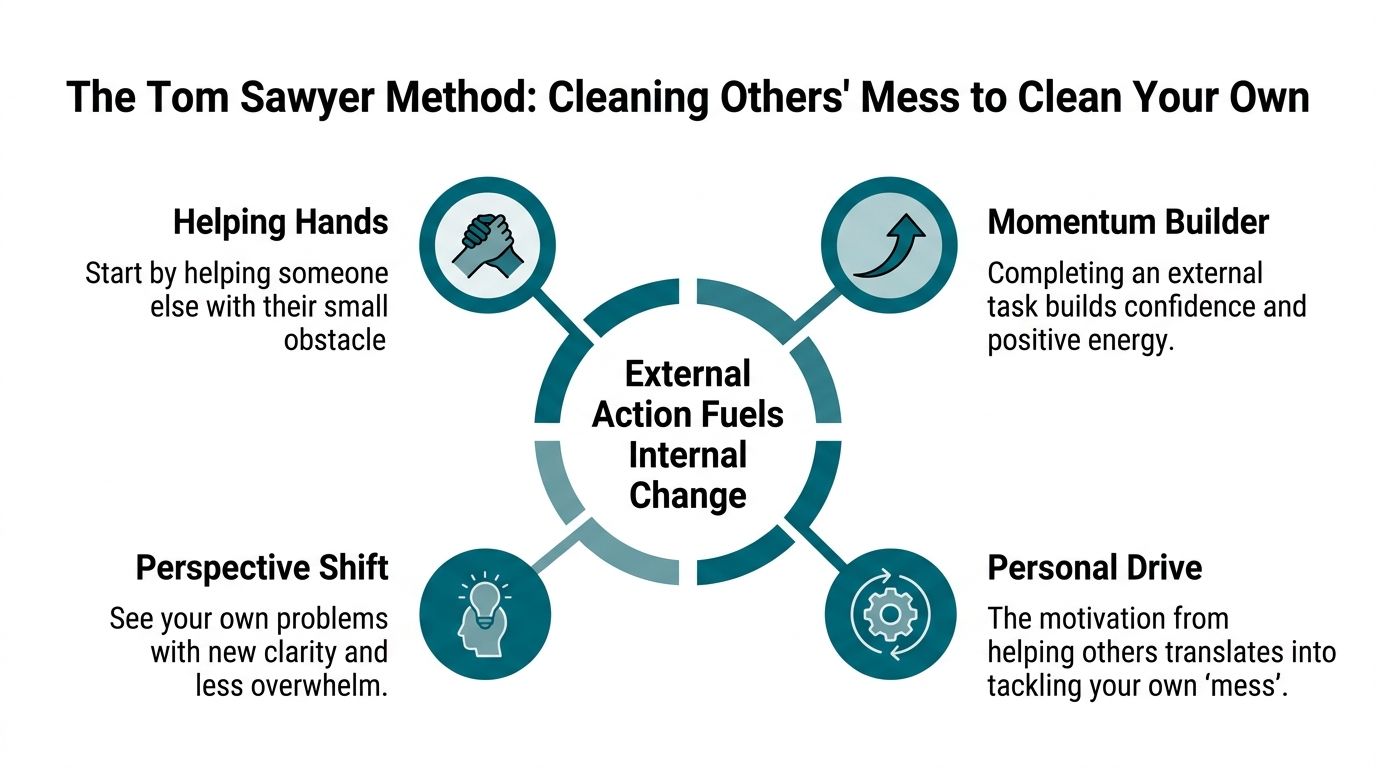
    A diagram explaining the Tom Sawyer method for overcoming personal obstacles through helping others with tasks.

    External action creates internal motion

    When you're stuck in your own head, introspection can become quicksand. You keep thinking, sorting, processing, analyzing. Hours pass. Nothing moves.

    External service breaks that spell.

    You don't need a giant mission. You need a concrete task that gets your body involved and points your attention outward. Pick up litter. Help a friend sort a closet. Walk an older neighbor's groceries upstairs. Sweep a shared hallway. Wipe down the break room at work without making a speech about it.

    Here's why this works:

    • The task is visible: You can see before and after with your own eyes.
    • The stakes are lower: You're not wrestling your whole identity. You're doing one useful thing.
    • Your body joins the process: Motion cuts through rumination.
    • You build trust fast: You keep a promise, even a small one.

    I learned a lot from reading about intrinsic motivation and what keeps action going from the inside. The part that mattered most to me was simple. Lasting drive usually grows better from meaning than from self-scolding.

    Do something useful before you feel ready. Readiness often shows up late.

    Find your fence to paint

    Your "fence" should be tangible, slightly uncomfortable, and easy to repeat. It should also help someone or improve a shared space.

    Try one of these:

    • For mental fog: Take a trash bag and clean one stretch of sidewalk near your home.
    • For loneliness: Join a recurring volunteer shift where people work side by side.
    • For procrastination: Help someone else finish a task with a clear endpoint.
    • For low self-trust: Pick one weekly service habit and protect it.

    I know one option firsthand. Litter Caterpillars runs volunteer trash pickups in Chicago on weekend mornings, which gives people a recurring, physical way to practice service, consistency, and courage in public. But the method matters more than the group name. If you're nowhere near Chicago, your version can be different.

    Why this strange route works

    Your brain loves proof. It doesn't care much about your speeches.

    If you tell yourself, "I'm changing," but your days stay the same, the words rot. If you spend one morning helping clean a block, carrying bags, talking to people, and making a place look better, you have proof. Small proof, yes. But proof has teeth.

    That is why I call this the Tom Sawyer method. Reframe the hard thing. Turn growth into service. Make the job visible. Let action pull your mind behind it.

    Creating Your Caterpillar Transformation Plan

    Big goals can make you freeze. "Get my life together" is too large to hold. Your brain hears that and looks for a place to hide.

    I had to shrink everything until it looked almost silly. That's when I could finally move.

    Start with one block

    A city doesn't get cleaned all at once. You do one block. Then another. Your life works the same way.

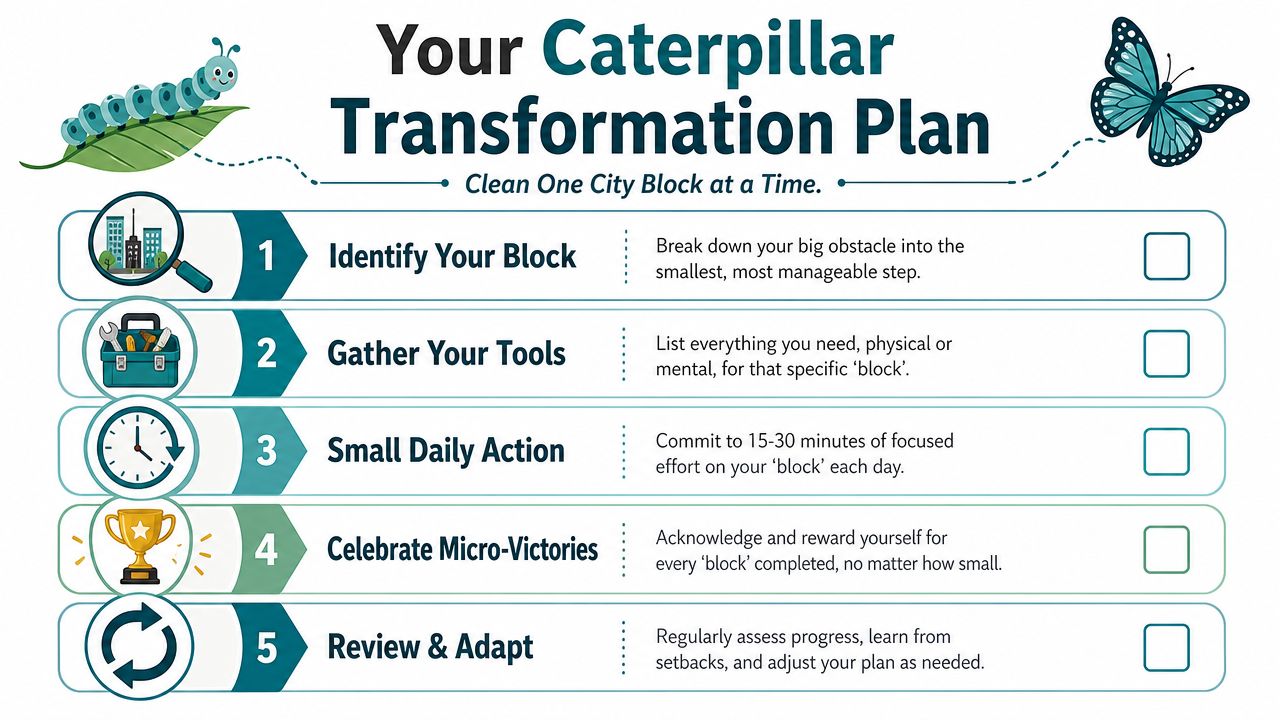
    A checklist infographic titled Your Caterpillar Transformation Plan illustrating five steps for overcoming personal obstacles effectively.

    When you think about overcoming personal obstacles, don't write down the grand identity shift. Write down the smallest version of it that still counts.

    Bad plan: become consistent.
    Better plan: show up for one hour this Saturday with gloves and a trash bag.
    Bad plan: fix my apartment.
    Better plan: clear the kitchen counter and throw away expired food.
    Bad plan: rebuild my social life.
    Better plan: text one reliable person and ask them to join me for a useful errand.

    Build a plan you can actually obey

    I use a simple framework. Keep it ugly and practical.

    1. Name the block
      Choose one obstacle that bothers you enough to matter and feels small enough to touch. One drawer. One phone call. One walk around the block with a bag.

    2. List the tools
      Put down what you need before the moment arrives. Trash bags. Gloves. Calendar reminder. Water bottle. Friend's number. Bus route. Shoes by the door.

    3. Set a tiny time box
      Give yourself a short container. If you feel ambitious, your ambition will betray you. Short is sticky.

    4. Choose a service angle
      Ask, "Who else benefits if I do this?" Shared benefit adds fuel. Cleaning your front step helps your neighbors. Calling your aunt helps her and gets you out of yourself. Returning library books helps the next person too.

    A grounded check: Make the task so small that your excuse sounds a little dramatic.

    A sample plan

    Here is what this can look like in real life.

    Part Example
    Obstacle I avoid my kitchen because it reminds me how scattered I feel
    Small block Throw away expired food and wash what is in the sink
    Tools Gloves, sponge, soap, trash bag, playlist
    Time box One short session on Saturday morning
    Service angle Clean one small patch outside my building after I finish
    Win condition I showed up and completed the block I chose

    The win condition matters. It should focus on showing up, not on becoming a new person overnight.

    Keep the bar low enough to repeat

    A lot of people wreck themselves by treating one good day like a personality transplant. They clean for hours, write a color-coded plan, buy containers, and then disappear for weeks.

    I've done that. It feels productive. It isn't.

    Repeatable action has a different texture. It's plain. It doesn't make a lot of noise. You almost feel unimpressed by it. That's usually a good sign.

    Use these guardrails:

    • Pick one recurring slot: Weekend morning works well because the day hasn't chewed you up yet.
    • Remove setup friction: Put supplies where your hand can find them fast.
    • Pair action with place: If you always start at the same corner, desk, or block, your body learns the route.
    • Track proof, not perfection: Write down "I showed up" every time you do it.

    When you miss a day

    You will miss days. I miss days. Everyone does.

    The trap is making the miss mean something huge. "See, I knew I wasn't disciplined." No. It means you missed a day.

    When you slip, don't redesign your whole life. Resume the block. That is it. Start so small that you can restart while annoyed, tired, or embarrassed.

    That's how a plan becomes real. It doesn't need to impress anyone. It needs to survive contact with your actual life.

    Finding Your People in the Hailstorm

    The first cleanup was absurd.

    There were only three of us. The sky turned ugly, then Chicago did what Chicago does. Hail. Cold wind. Wet hands. We huddled under a tree, shivering, while Uber after Uber canceled on us.

    Three volunteers in rain jackets collecting trash and plastic waste from a beach during snowy weather.

    I should've gone home angry. Instead, I felt weirdly alive.

    Shared hardship has a strange warmth

    When you do something difficult with other people, the day gets a pulse. You remember the details. The wet sleeves. The stupid jokes. The look on someone's face when the weather gets worse and they stay anyway.

    That kind of bond is different from casual hanging out. Talking over drinks is easy. Standing in bad weather with a trash grabber and a half-full bag tells you more about a person.

    I realized something under that tree. I didn't only need better habits. I needed better people around those habits. I needed givers. People who'd show up early, carry weight, laugh when plans got messy, and help without turning everything into a performance.

    Some friendships start with comfort. The durable ones often start with effort.

    How to find the people who stay

    You don't find solid people by making a perfect list of personality traits. You find them while doing useful things in conditions that aren't polished.

    That can mean service work, mutual aid, community gardening, park cleanups, food pantries, church kitchens, neighborhood builds, or any recurring task where people trade convenience for care.

    Look for these signs:

    • They arrive when it's inconvenient: Rain, cold, early mornings, awkward locations.
    • They don't need applause: They work without asking the room to clap.
    • They make hard things lighter: Not easier, lighter. Big difference.
    • They keep their word in small ways: That usually predicts the rest.

    I also think a lot of social anxiety softens when you stop treating social life like performance and start treating it like teamwork. If that's your knot, this piece on how service can help with social anxiety gets at something real. It's easier to talk when your hands have a job.

    Let the story get a little rough

    People chase smooth experiences and then wonder why their lives feel flat. A little weather helps. A little inconvenience gives the day a shape.

    This clip catches some of that spirit:

    I don't mean you should seek danger or ignore safety. I mean stop rejecting every situation that has friction. Friction is where people become memorable to each other.

    Build your circle on purpose

    After that rough first cleanup, I made a quiet promise to myself. I would engineer my social circle more carefully. Less chaos. Less selfishness. More people who like doing good work together.

    You can do that too.

    Try this simple filter:

    1. Go where useful work happens
    2. Return often enough for people to recognize you
    3. Notice who sticks around after the easy part
    4. Invite one person to do one more useful thing

    That last step matters. Community doesn't fall from the sky. Somebody has to text first. Somebody has to say, "Want to help me with this Saturday morning?"

    When people stand with you in the hail, they change your idea of what's possible. Hard days stop feeling like private punishment. They start feeling like story.

    Making Progress a Permanent Part of You

    At some point, progress stops being a project and starts becoming part of your character. That shift is quiet. No trumpet. No montage.

    You just notice that you are the kind of person who shows up.

    Bravery has a rougher texture than people admit

    I used to think bravery would feel clean and noble. It doesn't. Usually it feels awkward, underprepared, slightly embarrassed, and a little cold.

    That is fine.

    I learned to stop treating fear, failure, and suffering like signs to turn back. Sometimes they are just the price of entry. If you're serious about overcoming personal obstacles, you need a relationship with discomfort that isn't so dramatic. It can hurt and still be useful.

    Identity grows from repeated proof

    Pride matters here. I mean earned pride, the kind that comes from doing hard, kind things often enough that you start to believe your own record.

    Sports teams have flags, songs, colors, rituals. They understand something simple. People act differently when they feel part of something and when they feel proud of what they do. You don't need to become corny about it. But you do need to let yourself say, "Yes, this is who I am now."

    You are not just trying to be more reliable.
    You are reliable because you keep returning.

    You are not just trying to be brave.
    You practice brave things on ordinary mornings.

    If procrastination keeps pulling you backward, I like this practical take on how to overcome procrastination through action and repetition. The heart of it is familiar. You build momentum by doing, not by waiting for a cleaner mood.

    Keep this sentence nearby: I don't need a new life today. I need one honest action that matches the person I'm becoming.

    Keep your own receipts

    Make your progress visible to yourself.

    Use a notebook, a notes app, a wall calendar, or a scrap of paper by the door. Record the actions that matter. Showed up. Picked up a bag of trash. Cleaned the sink. Sent the text. Took the walk. Helped the neighbor. Returned after missing last week.

    These are receipts for your identity.

    Bad days will come. You'll feel flat. You'll slide. None of that cancels the person you are building. A rough week is weather. It isn't a verdict.

    What lasts is the pattern. You keep showing up, rain or shine, and eventually your life starts to trust you. That trust is hard to describe if you've lived without it. It feels like standing up straighter inside your own skin.

    And once you feel that, even briefly, you won't want to go back.


    If you want a practical way to get out of your head and into motion, Litter Caterpillars has weekly Chicago cleanup events built around service, friendship, and doing hard things together outdoors. Bring gloves if you have them. Bring yourself if you don't.

  • The Truth: Why Suffering Builds Character & How to Grow

    The Truth: Why Suffering Builds Character & How to Grow

    Three of us stood under a skinny tree in Chicago, getting pelted by hail while our ride-shares kept canceling. We were cold, wet, holding a half-full trash bag, and somehow I was having a great time.

    That Time Freezing in a Hailstorm Felt Fun

    I still remember the sound first. Hail hitting the sidewalk. Hail hitting the trash grabber. Hail hitting the hood of a parked car so hard it sounded like handfuls of gravel.

    There were only three of us that day. We had gone out to do something simple. Pick up trash. That was it. No grand plan. No deep philosophy. Just gloves, bags, and a weird amount of optimism for Chicago weather.

    Then the sky flipped.

    We ran under a tree that barely helped. My hands were stiff. My shoes were soaked. Every time we checked for a ride home, another one canceled. We stood there laughing the kind of laugh you do when things get so inconvenient that your brain gives up and turns it into a joke.

    A diverse group of friends in colorful raincoats carry a large trash bag through a rainy Chicago.

    Misery that tasted oddly good

    That was the day something clicked for me.

    I realized there are at least two kinds of suffering. One kind drains the color out of life. The other kind adds flavor to it. Same cold rain. Same chattering teeth. Totally different meaning.

    That little hailstorm felt alive. It gave the day a plot. If we had picked up trash in perfect weather and gone home easily, I probably would've forgotten it. Instead, I can still feel that moment in my body. I can still see us huddled together, still half proud, half ridiculous, trying to do one decent thing while the city threw ice at us.

    Some hard moments don't feel good while you're in them. They feel good because of what they turn you into afterward.

    I think that's why the phrase suffering builds character hangs around. People have tasted this feeling before. They know that chosen difficulty can wake them up. It can make friendship tighter. It can make a boring life feel like a story again.

    The question people usually skip

    But I also think people say that phrase too casually.

    They use it like a rubber stamp. Lost your job? Suffering builds character. Bad relationship? Suffering builds character. Burned out, anxious, falling apart? Suffering builds character.

    I don't buy that.

    Some pain is a forge. Some pain is a shredder. If we blur those together, we start calling damage growth. That's where people get stuck in places that are hurting them.

    What I learned under that tree wasn't that all pain is good. I learned that chosen hardship in the right setting can feel almost playful. It can pull out bravery you didn't know you had. It can bond people fast. It can make service feel less like punishment and more like adventure.

    Here's the difference I keep coming back to:

    • Shared pain often feels lighter than isolated pain.
    • Chosen discomfort feels different from chaos forced on you.
    • Meaningful effort lands differently than pointless misery.

    That day in the hail didn't answer the whole question. It just made me curious enough to stop repeating slogans and start paying attention.

    Why Hardship Can Remake Your Mind

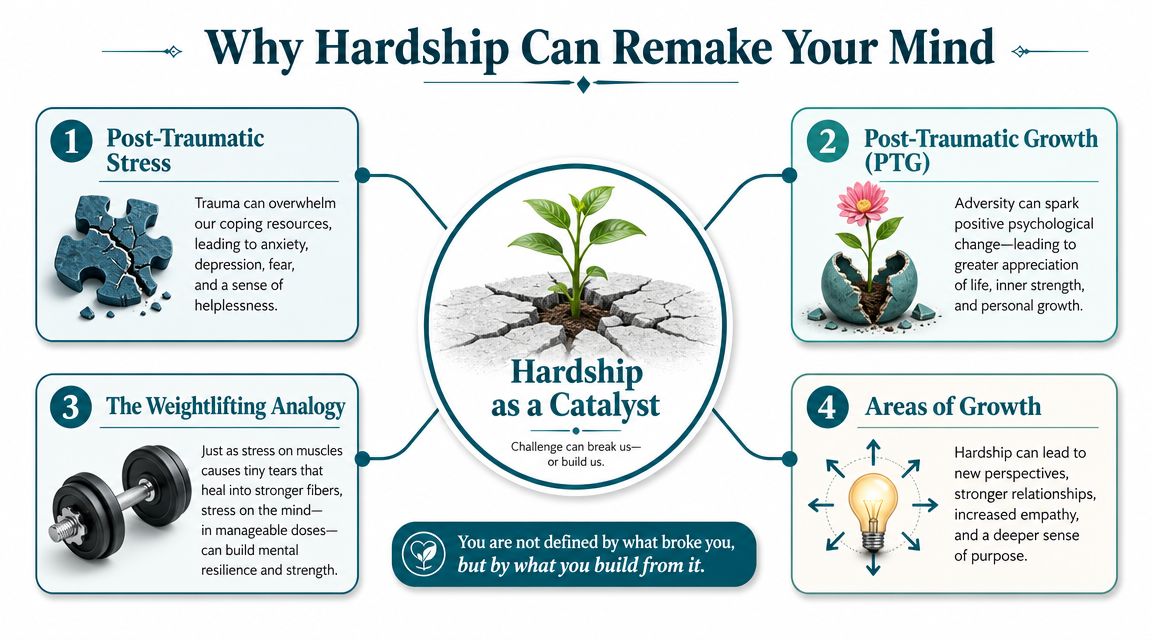
    When I talk about growth through hardship, I think about the gym.

    You lift something heavy. The strain matters. The effort matters. But the growth doesn't happen because the dumbbell is magical. The growth happens because your body responds, adapts, and rebuilds.

    Your mind works a lot like that.

    An infographic illustrating how hardship acts as a catalyst for mental resilience, growth, and personal development.

    A hard event by itself doesn't hand you wisdom like a trophy. You still have to do something with it. You have to digest it. Name it. Fit it into a story you can live with.

    The story in your head changes the outcome

    That's the part people miss when they say suffering builds character as if hardship works automatically.

    Recent research on difficulty-as-improvement says something more careful. The belief that difficulty can mean improvement can sometimes support well-being and effortful engagement, but that depends on how people make meaning of hardship rather than on hardship itself, as described in this USC paper on difficulty-as-improvement in daily life.

    That makes sense to me.

    If I tell myself, "This is hard, so I must be growing," I might stay steady through a cold cleanup, a brutal workout, or a scary conversation. If I tell myself, "This is hard, so my life is falling apart," the exact same event can crush my spirit.

    The event matters. The interpretation matters too.

    Here's a useful way to consider this:

    Experience What hurts What can help
    Voluntary challenge Discomfort, fear, ego Purpose, recovery, supportive people
    Sudden loss or trauma Shock, confusion, overwhelm Safety, care, time, meaning-making
    Daily grind Fatigue, boredom, self-doubt Routine, community, intrinsic reasons

    If you want the inner engine for doing hard things, I like this piece on intrinsic motivation. It gets at a truth I've felt in my own life. You can endure a lot more when the reason comes from inside you.

    Hardship is raw material, not a guarantee

    I don't mean this in a cheesy way. I mean it like clay.

    Hardship gives you raw material. That's all. You can shape it into patience, humility, gratitude, and courage. Or it can harden into bitterness, fear, and numbness. Both outcomes are human.

    Practical rule: Ask, "What story am I building around this pain?" before you ask, "What is this pain doing to me?"

    Sometimes the healthiest story is, "This challenge is making me stronger." Sometimes the healthiest story is, "This situation is hurting me, and I need to leave."

    A short video can help put that mental shift into clearer language:

    That distinction matters more than the slogan. Pain doesn't shape you by default. You shape what pain becomes.

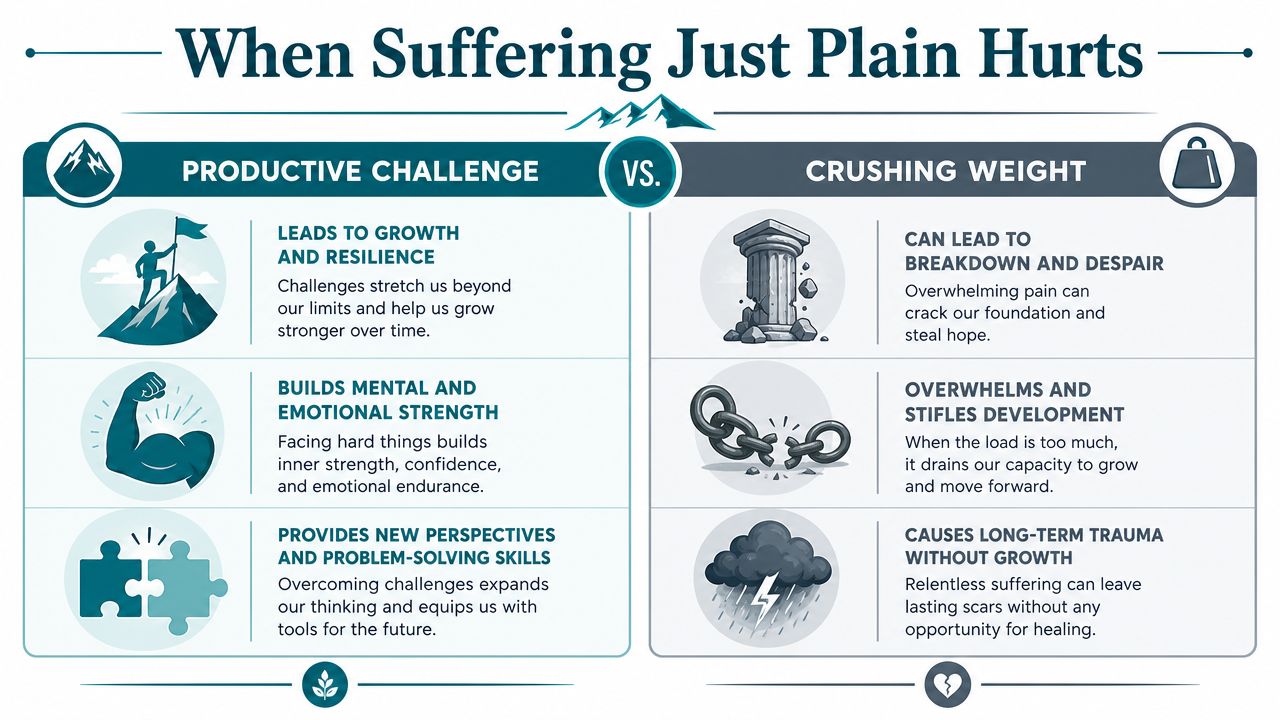
    When Suffering Just Plain Hurts

    I need to say this plainly. Some suffering doesn't build character. It just hurts.

    I've seen people cling to the phrase suffering builds character the way a drowning person clings to driftwood. They use it to justify staying in ugly relationships. They use it to excuse burnout. They use it to make themselves feel noble while they slowly come apart.

    That isn't wisdom. That's self-abandonment dressed up as grit.

    A comparative infographic illustrating the differences between productive challenges that foster growth and crushing weights that cause despair.

    A hard truth from real data

    It is at this point that the romance around suffering breaks down.

    A 2022 longitudinal study published in PMC followed 1,402 flight attendants and found that higher levels of suffering were linked to worse later health and well-being across 16 outcomes measured over time. In that sample, suffering was tied to negative changes in all but two outcomes, according to the PMC study on suffering and later health outcomes.

    I keep coming back to that because it cuts through the motivational poster version of pain.

    More suffering did not automatically turn into more growth. In that study, suffering tracked with decline across a lot of human experience. That doesn't mean growth never happens. It means we shouldn't pretend suffering is some automatic character machine.

    Productive challenge versus crushing weight

    I think about it like carrying groceries.

    One bag in each hand can make you stronger. You stand up straighter. Your grip improves. You get home feeling capable.

    Now imagine someone drops a refrigerator on your back and tells you this is good for your development.

    That's the difference.

    • Productive hardship has edges. You can feel strain, but you can still think, choose, and recover.
    • Damaging hardship floods your system. It leaves no room for reflection, joy, or repair.
    • Healthy struggle usually has purpose and limits.
    • Harmful struggle keeps eating your sleep, focus, body, or sense of self.

    If a challenge keeps shrinking your life, it isn't building your character. It's taking pieces of you.

    Signs you need to stop calling it growth

    I wish someone had told me earlier that walking away can be brave.

    If you need a reality check, ask yourself these questions:

    1. Do I still have agency?
      Can you make choices, set limits, and say no? If not, that's a warning sign.

    2. Can I recover after this?
      Good strain usually leaves room for rest. Harm doesn't.

    3. Do I feel more like myself or less?
      Hard but healthy effort can deepen you. Ongoing damage can hollow you out.

    4. Am I using the phrase to avoid change?
      Sometimes "this is building me" really means "I'm scared to leave."

    I don't glorify suffering anymore. I sort it. I ask what kind it is. I ask who chose it. I ask whether it has a purpose, a boundary, and a way back to rest.

    If the answer is no, then healing matters more than endurance.

    Finding Your Own Fence to Paint

    My apartment used to embarrass me.

    Not in a cute, messy-artist way. I mean real chaos. Old food. Piles of stuff. Random objects carrying weird emotional weight. Every piece of trash had a story attached to it, and because it had a story, I couldn't throw it out.

    The old jar in the fridge was from a trip I didn't want to forget. The bag of nuts on the shelf was from the week I tried to become a healthy person. The receipt on the counter reminded me of some day that felt important for no good reason. Tiny objects became concrete blocks.

    My room looked like my mind felt. Jammed. Avoidant. Heavy.

    The breakup that forced the issue

    After a long, chaotic relationship ended, I hit a wall. I knew I couldn't keep living the same way. I needed to become cleaner, steadier, braver. I needed better habits and better people around me.

    But trying to fix my own mess head-on felt impossible.

    That was the weird part. I could stare at one bag of garbage in my own place and feel stuck. Yet if I saw a fast-food wrapper blowing down the street, I wanted to grab it. My brain resisted personal cleanup and accepted public cleanup.

    So I leaned into that.

    I started cleaning up other people's messes because I couldn't yet handle my own.

    Why service was easier than self-repair

    It still sounds backwards when I say it out loud, but it's true. Community service gave me a side door into my own transformation.

    Picking up litter outside felt simple. The rules were clear. Trash goes in bag. Block gets cleaner. You move your body. You breathe outdoor air. You stand next to other people doing the same thing. There isn't much room for spiraling.

    My private mess had shame in it. Public mess had purpose.

    That's where the Tom Sawyer image always comes back for me. He got stuck painting a fence and turned it into a game people wanted in on. I don't think that story is about manipulation as much as mindset. The task didn't change. The frame changed.

    The same thing happened to me. Hard, dirty work stopped feeling like punishment and started feeling almost mischievous. We were doing something useful, but we were also reclaiming effort itself. We were saying, "This counts as fun."

    Work changes shape when you share it with people who are glad you showed up.

    There's a similar emotional thread in this piece on how to overcome social anxiety. Sometimes you don't heal by staring at yourself harder. Sometimes you heal by moving beside other people toward a simple goal.

    The fence painted me back

    The strange part is that this small act of service started changing things I never meant it to change.

    I got more consistent because other people were expecting me.

    I got braver because weather didn't care about my comfort.

    I got cleaner because once I'd spent a morning filling bags with litter, I had less tolerance for living in chaos myself.

    I got pickier about friendship too. Shared service filters people. Weekend mornings, bad weather, muddy gloves, low glamour. That setup draws a certain kind of person. It tends to pull in people who want to give more than they want to pose.

    The suffering in my old life felt random. It tossed me around.

    This new hardship felt chosen. Small, steady, almost humble. It didn't ask me to be dramatic. It just asked me to show up.

    That kind of suffering built more character in me than all the chaos ever did.

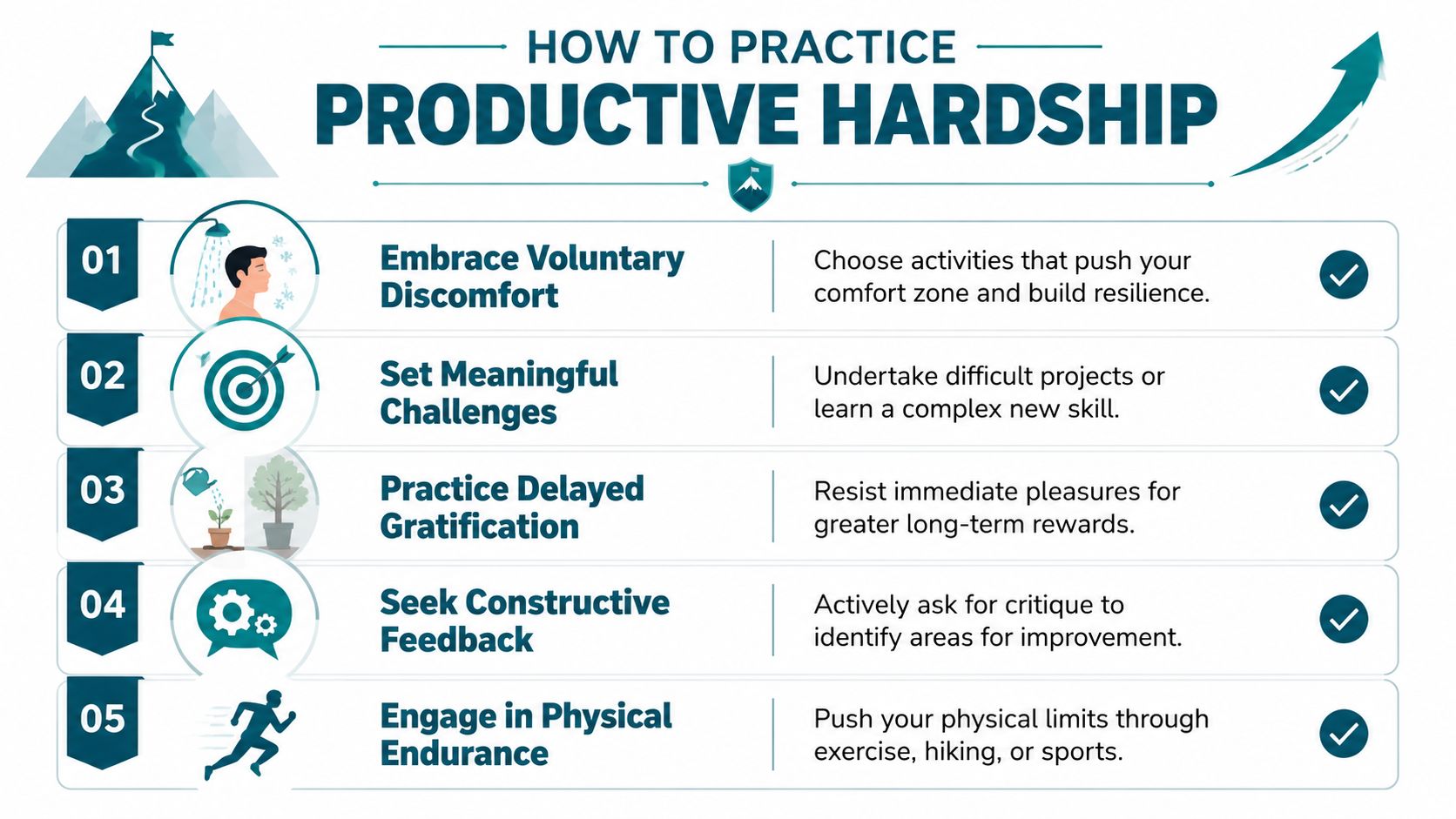
    How to Practice Productive Hardship

    You don't need to wait for life to throw a brick through your window. You can choose a harder, better path on purpose.

    I think that's the cleanest answer I've found. If you want growth, don't worship pain. Design productive hardship instead.

    An infographic titled How to Practice Productive Hardship featuring five tips for building resilience through voluntary challenges.

    What makes hardship productive

    For me, chosen hardship works best when it has three traits:

    • It's voluntary
      You picked it. That matters. Choice changes the whole texture of effort.

    • It has a purpose
      You're not suffering for vibes. You're building skill, courage, discipline, or service.

    • It has a recovery plan
      Hard effort without rest turns into stupidity fast.

    That could mean training for a race. Taking a public speaking class even though your stomach flips every time. Volunteering on cold mornings. Having one difficult conversation you've been postponing for months.

    One practical option is Care for Real, which gives people a way to serve through direct community support. Another option is a volunteer cleanup group like Litter Caterpillars, which organizes regular trash pickups in Chicago. The point isn't which banner you stand under. The point is choosing a form of effort that asks something real from you.

    A simple way to start this week

    If I were sitting across from you with coffee, I'd tell you to start smaller than your ego wants.

    Try one of these:

    1. Pick a weekly discomfort
      Commit to one thing that feels mildly inconvenient but clearly good. A dawn cleanup. A hard workout. A class that scares you.

    2. Tie it to service
      Self-improvement sticks better for me when somebody else benefits too. Service keeps pain from turning narcissistic.

    3. Keep the challenge boring enough to repeat
      You don't need an epic quest. You need something you can still do when you feel lazy.

    4. Reflect after, not during
      While you're in the middle of the hard thing, just do it. Later, ask what it taught you.

    Bravery, unity, consistency

    These are the three words I trust most.

    Bravery means you go anyway, even while your inner voice whines.

    Unity means you stop acting like growth is a solo sport. A friend beside you can turn dread into momentum.

    Consistency is where the identity change happens. Anybody can survive one dramatic day. Character grows when you repeat a modest hard thing until it becomes part of who you are.

    Choose a challenge that makes you a little uncomfortable and a little proud.

    The point of all this isn't to become a martyr. It isn't to collect suffering like merit badges. It is to train your soul gently, the way you train a muscle. Strain, rest, repeat. Enough challenge to wake you up. Enough meaning to keep you going.

    From Caterpillar to Something New

    So, does suffering build character?

    My answer is yes, sometimes. But only sometimes. And that one word matters.

    Unchosen, chaotic suffering can leave scars and confusion. It can shrink your world. It can hurt your health, your joy, your ability to trust yourself. I don't romanticize that anymore.

    Chosen hardship is different.

    When you choose a hard thing with a clear purpose, when you do it with good people, when you leave room for recovery, effort changes shape. Cold rain becomes a memory you laugh about. Service becomes training. Fear becomes proof that you're stretching into a larger self.

    Becoming through effort

    I like the caterpillar image because it gives me room to be unfinished.

    I'm not writing this as someone who mastered pain. I'm writing this as someone who has been shaped by two very different kinds of struggle. One kind left me lost. The other kind helped me become more honest, more useful, and more steady.

    That's what I want for you too.

    If you're in needless pain, I hope you stop calling it growth and get yourself somewhere safer.

    If you're hungry for growth, I hope you don't sit around waiting for tragedy to teach you. Pick your own fence to paint. Pick your own Saturday morning. Pick your own brave little task. Then keep showing up until the person doing it starts to change.

    We are all in some stage of becoming. That's the good news.

    You don't need perfect conditions. You just need a meaningful burden you can carry on purpose, with your eyes open, alongside other people, until your old skin doesn't fit anymore.


    If you want a hands-on way to practice service, friendship, and chosen challenge, take a look at Litter Caterpillars. It's a Chicago volunteer group that organizes regular neighborhood cleanups, and it's a simple way to turn a hard morning into something useful.

  • Community Service Impact: A Guide to Real Change

    Community Service Impact: A Guide to Real Change

    I once stared at a jar of blueberry jam in the back of my fridge and felt defeated. It was old, sticky, useless, and somehow too heavy for me to throw away because it carried a memory from a trip to Michigan.

    Your Impact Starts with One Piece of Trash

    I didn't start cleaning streets because I had my life together. I started because I didn't.

    My apartment had its own archaeology. Old food. Half-used bags of nuts from some failed health kick. Receipts. Clothes on chairs. Every item had a tiny emotional hook in it. I knew each thing weighed almost nothing, but in my body it felt like 500 pounds. I could walk past a mess for weeks and feel my energy drain every time I saw it.

    Then one day I picked up trash outside.

    That sounds small. It didn't feel small to me. It felt like cheating my own broken wiring. Cleaning my own room came with shame, history, self-judgment. Cleaning a sidewalk came with none of that. A bottle in the gutter didn't ask me to relive an old mistake. A fast-food cup in the grass didn't remind me who I used to be. I could just bend down, grab it, and put it in a bag.

    A rustic kitchen scene featuring a jar of raspberry jam, toast, and a person cooking in background.

    That was the first lesson I learned about community service impact. It starts before the neighborhood notices. It starts in your nervous system. It starts in the moment when you do one useful thing and your brain finally goes quiet for a second.

    Why one small act matters

    I think a lot of us carry private chaos. You might hide it better than I did, but you know the feeling. You avoid a drawer, a phone call, a bill, a hard conversation. Then you do one clean action in public, and something unclenches.

    Practical rule: If your own mess feels impossible, start with a mess that isn't yours.

    That's part of why service pulls people in. It gives your hands a job before your mind can argue with you. If you want to see that in action on the ground, I've written more about cleaning up trash in a simple, direct way.

    You are not doing something tiny

    It can feel silly to talk about one person with one bag on one block. I get that. But single acts stack up fast when enough people keep showing up.

    In the United States, about 60.7 million people, or over 23% of people age 16 and up, formally volunteered through an organization between 2020 and 2021. Their work added up to more than 4.1 billion hours with an estimated economic value of $122.9 billion, according to the U.S. Census Bureau and AmeriCorps volunteering data.

    That number helped me stop treating service like a sentimental side hobby. People are out there doing real work. They're feeding neighbors, coaching kids, cleaning blocks, moving supplies, and checking on each other.

    • Formal service matters: It creates visible labor that communities would otherwise need to pay for or go without.
    • Informal help matters too: The same Census story says nearly 51% of Americans, or 124.7 million people, informally helped neighbors during that period.
    • Your first act counts: You don't need a nonprofit title or a polished mission statement to join that current.

    I learned that one piece of trash is never just one piece of trash. It's a vote. It says, “I still believe this place is worth caring for.” Sometimes that sentence is the first honest thing you've said to yourself all week.

    The First Change You See Is in Yourself

    After a chaotic relationship ended, I made a private decision. I was done waiting to become disciplined. I was going to practice it.

    I picked three traits that had always scared me because I lacked them: cleanliness, consistency, and bravery. Street cleanup became my training ground. If it was cold, I went anyway. If it was awkward, I went anyway. If I felt embarrassed carrying a grabber and a trash bag in public, I went anyway.

    That's why the caterpillar idea hit me so hard. A caterpillar is not glamorous. It crawls. It eats leaves. It looks unfinished. I loved that. I felt unfinished too.

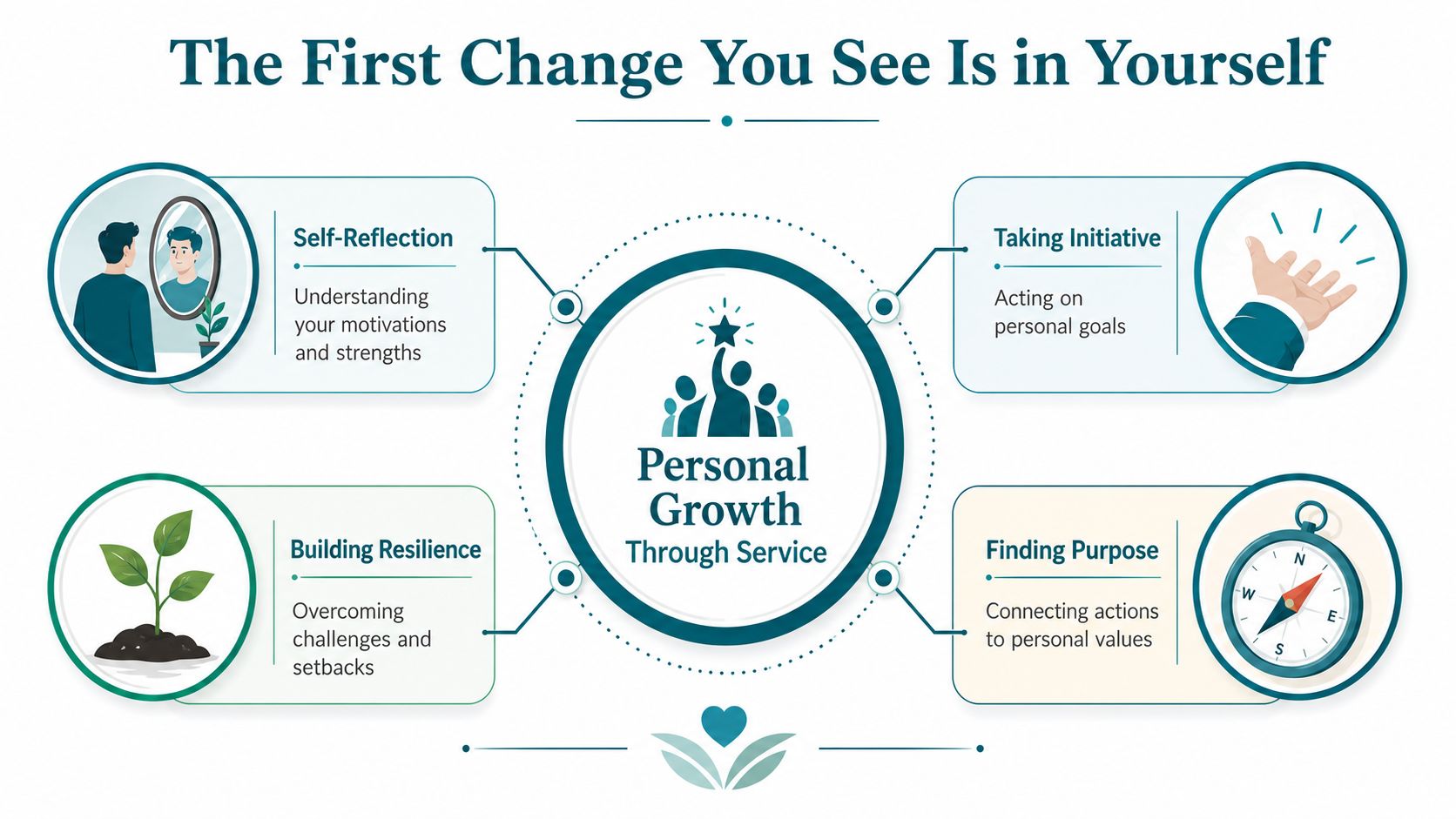
    A diagram illustrating the four key components of personal growth through service: reflection, initiative, resilience, and purpose.

    Service gives you a mirror

    When you volunteer outside, the street reflects you back to yourself. Rain asks if you're still coming. A filthy alley asks whether you quit when a job is ugly. An empty morning asks whether your values are real or just good intentions.

    Here's the pattern I noticed in my own life:

    1. Reflection came first. I had to admit what I kept avoiding.
    2. Action came next. I needed a repeatable behavior, not a dramatic speech.
    3. Resilience grew slowly. You don't become brave in one big movie scene. You become brave by keeping promises on ordinary weekends.
    4. Purpose followed. Meaning arrived after the work, not before it.

    If motivation is hard for you, I think it helps to understand what intrinsic motivation looks like in daily life. External praise fades fast. Internal alignment lasts longer.

    Your body keeps score, and so does your mind

    I used to think volunteering was morally nice but psychologically optional. I don't think that anymore.

    A peer-reviewed study in PMC found that consistent community service from ages 18 to 30 was associated with lower substance use and higher psychological well-being in adulthood. The same paper says other studies linked youth volunteering to improved cardiovascular health and fewer depressive symptoms later in life, as described in this PMC review of community service and health outcomes.

    That matches what I've felt in a plain, human way. When I spend a morning cleaning a block, I breathe deeper that afternoon. My thoughts stop looping so much. I trust myself more because I did something hard on purpose.

    You don't need to feel transformed before you begin. You begin, and then you notice you're changing.

    Four things service taught me

    • It taught me honesty. If I said I'd show up at a certain time, I had to meet myself there.
    • It taught me courage. Public service can feel exposed. People stare. Some people laugh. You keep going.
    • It taught me steadiness. Repeating a simple good act each week is its own kind of therapy.
    • It taught me self-forgiveness. I stopped demanding perfection from myself and started asking for effort.

    That is the first visible layer of community service impact. Before the block changes, you do.

    Watching Your Neighborhood Transform with You

    A clean block has a different sound to it. I don't mean that poetically. I mean you can hear your own footsteps again instead of wrappers scraping along the curb in the wind.

    I've watched this happen over and over. A place starts as “that corner” people avoid. Then a few people show up with gloves and bags. The work is dirty, repetitive, and kind of absurd. A little later, the sidewalk opens up. The lot looks breathable. People slow down and ask what's going on. Someone waves. Someone joins. Someone says, “I've been wanting to do this.”

    That is where “me” turns into “we.”

    Small acts accumulate into a place people can feel

    I've seen volunteers arrive shy and leave with new friends. I've seen strangers compare weird things they found in bushes like they were kids collecting artifacts. I've seen people take photos of a cleaned stretch of sidewalk because they needed proof that effort can leave a mark.

    Neighborhood change rarely arrives as one dramatic event. It's more like brushing your teeth. Miss it for long enough and the damage creeps in. Keep doing it and the results become normal.

    A cleanup group can do more than remove trash. It can help people trust public space again. It can make a block feel cared for. It can turn a vacant lot from a symbol of neglect into a place where people can imagine something better.

    What I look for after a cleanup

    I don't judge impact only by what fits in a trash bag. I look for signs that the place itself is reacting.

    • Resident response: Do people stop to talk, thank us, or ask when we'll be back?
    • Social spillover: Do volunteers exchange numbers, make plans, or return with a friend?
    • Behavior changes on the block: Does the area stay cleaner for a while, or does litter rush back fast?
    • Sense of ownership: Does the space feel anonymous, or does it feel like somebody cares now?

    A neighborhood doesn't change because people talk about civic pride. It changes because somebody bends down and picks something up, then comes back again.

    For organizers, this is where resilience matters. You can't clean one corner once and declare victory. You have to learn what holds. Which spots relapse. Which spots invite conversation. Which routes are safe, visible, and easy for newcomers to join. I think that is the heart of building resilient communities through repeated public action.

    I've learned to love visible progress. I don't apologize for that. A cleaned street is honest. You can see it. You can point to it. You can tell yourself, “We did that this morning.” In a world full of vague effort and endless scrolling, that kind of proof matters.

    How to Measure the Impact You Create

    A lot of people stop at feelings. I don't. Feelings matter, but if you want to understand community service impact, you need a scoreboard.

    I use a gym analogy because it's simple. Your outputs are the reps, sets, and visits. Your outcomes are the strength, energy, and health that show up because you kept training. Cleanup work works the same way.

    Count what you did

    Outputs are the easiest things to track because they are concrete. You can write them down right after an event.

    Metric Type What It Measures Example
    Output Activity completed Volunteer hours logged
    Output Participation Number of returning volunteers
    Output Physical service Bags of trash collected
    Output Reach Blocks, parks, or lots cleaned
    Outcome Change in conditions A previously littered area stays cleaner
    Outcome Human response Residents say the space feels better to use
    Outcome Volunteer development A shy first-timer becomes a regular
    Outcome Experience quality Volunteers report that the work felt meaningful

    That split matters because a lot of organizations overrate hours. Hours can look impressive on paper while the actual place stays the same.

    The guidance I trust says the best way to measure volunteer impact is to pair outputs like hours and retention with outcomes like changes in conditions, beneficiary satisfaction, and volunteer growth. It also recommends using surveys, interviews, and testimonials alongside counts, as explained in VolunteerHub's volunteer impact measurement framework.

    Translate time into a language people understand

    Money is not the soul of service. I still think it helps to know the replacement value of labor.

    According to Independent Sector's 2026 estimate, one volunteer hour is valued at $34.79, which means 1,000 volunteer hours can be valued at $34,790 in service before you even add avoided municipal costs, as noted in Independent Sector's volunteer hour value update.

    That number is useful for one reason. It helps you explain the scale of work to people who think in budgets.

    My simple scorecard

    I keep measurement practical. If you're a solo volunteer or a small group, start with this:

    • Track the effort: Write down hours, people, locations, and the kind of cleanup done.
    • Track the result: Note what changed on the ground by the end of the event.
    • Track the after-effect: Return later and observe whether the area held up.
    • Track the human side: Ask volunteers one question. “How did this feel, and would you come back?”

    If you want a tool-based option, Litter Caterpillars is one example of a volunteer cleanup group that organizes recurring trash pickup events people can join in Chicago. You can also build your own system with a spreadsheet, a shared note, or a group chat check-in after each cleanup.

    Don't confuse activity with impact

    I've made this mistake myself. I used to think more effort automatically meant more good. It doesn't.

    Field note: If you only count bags and hours, you're measuring motion. If you also track cleaner conditions and returning people, you're measuring change.

    When your numbers and your observations agree, you can speak clearly. You know what happened, and you know why it mattered.

    The True Story of Our First Cleanup

    There were three of us.

    That is the whole glamorous founding myth. No crowd. No banners at the start. No neat launch photo with perfect weather. Just three people in Chicago trying to pick up litter, and then the sky turned on us.

    Spring in Chicago can act like a prank. We got hit with a hailstorm that felt halfway to a blizzard. We were underdressed, freezing, and huddled under a tree while trying to keep trash bags from whipping around. We kept checking our phones for a ride. Ubers kept canceling.

    Three volunteers in winter clothing picking up litter during a snowy day in downtown Chicago.

    I should have been miserable. I was miserable. But I was also laughing.

    What the hail taught me

    Standing there, shivering, I realized three things at once.

    First, cleaning other people's messes felt easier than cleaning my own. I think it was because the emotional knots were gone. The work stayed physical. Pick up. Bag it. Move on.

    Second, shared suffering has a weird power. When a hard thing is chosen and mutual, it can become fun in a way comfort never is. You remember it. You bond through it. It gives the day a pulse.

    Third, hardship advances the plot of your life. That phrase came to me because the whole scene felt so absurd that it couldn't be meaningless. It felt like a page turning.

    Why bravery needs identity

    I care a lot about bravery, and not in the macho sense. I mean the courage to do a humble thing in public and keep doing it when it's inconvenient.

    That is where the Tom Sawyer idea helps me. If you can turn a chore into a mission people feel proud of, everything changes. A boring task becomes a shared badge. A rough morning becomes a story.

    So I stopped pretending service had to look plain and serious all the time. I like flags. I like theme songs. I like badges and group identity. I think kind people deserve symbols too. Sports teams understand this. Countries understand this. Why shouldn't people cleaning a sidewalk understand it?

    We don't become brave because the work is easy. We become brave because we give the hard thing a meaning we can carry together.

    Our first cleanup never really ended

    That first stormy cleanup still shapes how I think. If a volunteer event is too polished, too controlled, too obsessed with appearances, it loses some life. I'm not chasing misery. I care about safety first. But I also think people are hungry for real experiences.

    Here's what I took from that day:

    • Discomfort can wake you up. You stop performing and start living.
    • Shared work builds trust fast. People reveal who they are when plans go sideways.
    • Meaning grows in motion. You don't wait until life feels stable to begin. You begin, and stability grows around the action.

    That day in the hail gave me more than an origin story. It gave me a standard. If service can still feel alive in bad weather, it can survive almost anything.

    Strategies to Keep Your Spark Alive

    The fastest way to lose a good volunteer is to treat their energy like an infinite resource. It isn't. Your energy is fragile. Mine is too. If you don't protect it, service turns into resentment.

    I believe in a volunteer-first approach. Safety comes first. Happiness comes second. Pride in sacrifice sounds noble until people burn out and disappear.

    An infographic titled Strategies to Keep Your Spark Alive, featuring four tips for personal well-being.

    What keeps people coming back

    Volunteering can reduce loneliness, but retention is still hard. The design of the experience matters. Social bonds, visible wins, and a low-pressure environment help people return, while repetitive or demanding work can push people toward burnout, as discussed in this article on volunteering, connection, and retention.

    I've found a few habits that keep the spark alive:

    • Make the win visible. People need to see the before and after with their own eyes.
    • Protect the vibe. Don't guilt people. Don't pressure them for money. Let service stay generous.
    • Choose human-friendly timing. Weekend mornings change the whole tone. People arrive clear-headed and ready to give.
    • Build friendship on purpose. A cleanup should feel like work with people, not work near people.

    Burnout often starts quietly

    Burnout rarely announces itself. It usually enters as dread. You start bargaining with yourself. You stop replying. You tell yourself you need a break, then the break becomes a disappearance.

    That's why I think organizers should normalize rest. Let people skip a week. Rotate hard tasks. Keep things simple. End on time. Thank people without making them feel owned.

    If you want service to last, make it something people can love, not just endure.

    Your Questions Answered

    Do I need to be tough to start

    No. I wasn't tough when I started. I was overwhelmed. Toughness grows through repetition. Start with one bag, one block, one hour. Let your confidence catch up later.

    How do I see my impact if I volunteer alone

    Take a before photo in your mind. Then look again when you finish. Notice what changed in the space and in your body. Keep a small log of where you went, what you did, and how you felt after. Over time, that record becomes proof.

    Should I give money or give time

    Give the resource you can give honestly. Money helps many causes. Time changes you while it helps others. If your life feels numb, scattered, or disconnected, time may do more for you than a donation because it puts your body back into the world.

    What if I start and then lose momentum

    That's normal. Don't turn one missed week into a moral failure. Return fast. Momentum is easier to rebuild when you don't waste energy on shame.


    If you want a place to start, join Litter Caterpillars. We organize volunteer trash pickups in Chicago and make it easy to show up, meet people, and do visible good with your hands.

  • What Is Transformational Leadership and How It Changes You

    What Is Transformational Leadership and How It Changes You

    So, what exactly is transformational leadership? I'll tell you. It’s not about barking orders. It’s a leadership style that inspires you, me, and everyone around us to grow, step up, and become leaders ourselves. It’s about igniting a genuine, positive change.

    That Time a Hailstorm Revealed True Leadership

    My life felt like a mess. A total disaster. Old jam in the fridge, stray nuts on the counter, a relationship that was sinking fast. It was all a chaotic mess in my Chicago apartment, and every piece of that clutter felt like it weighed 500 pounds. A weight I just couldn't move.

    Then came the day that changed everything. A freak hailstorm.

    I found myself shivering under a tree with two strangers, watching hail smack the pavement. A wild thought hit me. Cleaning up this public mess, this shared chaos… it actually felt surprisingly good. It was a jolt of something real.

    Diverse young friends laugh while holding trash bags under a snowy tree in a vibrant watercolor street.

    A Spark in the Cold

    That moment, freezing together in the cold, forged an incredible bond between us. It was the spark. The birth of Litter Caterpillars. I didn’t have a business plan. I didn't have a fancy title. I just had a raw, authentic desire to make a change that other people could see and feel right alongside me.

    This story isn't just about picking up trash. You get that, right? It’s about how my personal vision, born from a moment of pure vulnerability, can light a fire under a shared mission. This is the heart of transformational leadership. You start with an authentic drive that pulls others in, even when it’s cold and the odds are stacked against you.

    You'll see how that one event set a new path for me and for everyone who decided to join. We were turning a personal struggle into a collective strength. That’s the kind of power that moves mountains—or in our case, mountains of litter.

    The Power of Inspiring People

    Look, this approach isn’t just for scrappy volunteer groups like mine. It has a massive impact everywhere. In the business world, I’ve seen leaders who inspire instead of just command. They build teams that don't just hit their targets; they blow them away.

    Transformational leadership has been a game-changer for boosting employee productivity and profitability. A global report from Gallup found that companies with highly engaged employees—often a direct result of this kind of visionary leadership—see 17% higher productivity and an incredible 21% greater profitability.

    This isn't just some feel-good idea; you get real, tangible results. When you feel that the people leading you believe in the mission and genuinely care for you, you show up with your best work. I invite you to dig into more of these transformational leadership statistics and see the hard data for yourself.

    My journey with Litter Caterpillars started with a simple, personal need for change. I wanted to build a community of givers and finally face my own challenges with cleanliness and consistency head-on. By sharing that vision, I found others who felt the exact same way. We weren't just cleaning up parks; we were transforming ourselves, together. That, right there, is the core of transformational leadership.

    So What Is Transformational Leadership Really?

    Forget the textbook definitions for a minute. I want you to feel what transformational leadership is in your gut, because it’s a feeling before it’s some theory you read in a book. It’s not about being a boss; it's about starting a fire.

    You can manage people, or you can build a movement with them. That's the choice.

    Let me give you an analogy. Imagine a gardener. The transactional leader is the gardener who just shows up to water the plants. They do the job, sure. The plants don't die. It’s a clean exchange, a box checked. But a transformational leader? That's me. I’m the one down in the dirt, testing the soil, moving plants around to find the best sun, building an environment where the whole garden explodes with life. I'm trying to create something that thrives beyond what anyone thought was possible.

    It's Not a Title, It's a Spark

    This way of leading has nothing to do with power or telling you what to do. It’s about sparking a real, positive change in people. It’s about inspiring you so much that you find the leader inside yourself. When a new person joins Litter Caterpillars, my goal isn't just to hand them a trash bag. My goal is to make them feel that same spark I felt in that hailstorm—that deep pride of making a difference you can see and touch.

    A historian named James MacGregor Burns first put a name to this. He saw leadership as a relationship where both the leader and the "followers" lift each other up to a new level of motivation and purpose. I love that. It’s a powerful idea, and it’s the quiet engine that drives everything we do.

    You’re not just taking orders; you’re buying into a shared dream.

    From a Hailstorm to the Streets of Chicago

    I never read a book and thought, "I'm going to be a transformational leader." I just knew I wanted to build a community of givers—people who showed up because they genuinely cared. The fancy framework came later. The feeling was always there.

    The core ideas of this leadership style are exactly what makes our cleanups feel so different. Here’s how the theory connects to our muddy boots on the ground:

    • A Shared Dream: We’re not just picking up litter. We are taking back our city, one block at a time. And in doing that, we're transforming ourselves.
    • The Real Reward: You don't get a prize at the end. The reward is the work itself. It’s the friendships you make and that feeling of pride when you look back at a clean street.
    • Everyone Leads: I don’t have all the answers. Seriously. Our best ideas for new cleanup spots or community projects come from volunteers who feel like they can speak up and take charge.

    At its heart, transformational leadership is about turning "followers" into more "leaders." It's a leadership style that creates leaders, not just followers.

    In the end, it’s the difference between you asking, “What’s in it for me?” and asking, “What can we build together?” This is what creates that deep sense of purpose and belonging that makes people come back. You don't just volunteer once; you become part of our story.

    The Four 'I's' That Power the Movement

    So, you get it. Transformational leadership isn't some dusty theory from a business textbook; it's the living, breathing engine that powers our Litter Caterpillars movement. But what are the actual gears inside that engine? For me, it all boils down to four key ingredients, which the academics call the "Four I's."

    I know, that sounds a little formal, but I promise you these aren't just buzzwords. They are real actions you'll see and feel at every single one of our cleanups. Let me break down exactly what they mean to me and how you can spot them out in the wild.

    This map helps show how it all connects. The leadership is the spark, but the real magic is the cycle it creates: inspiring a movement while growing the people within it.

    Concept map illustrating transformational leadership as a catalyst that inspires movement and grows people.

    This image nails it. I'm the catalyst, sure, but the power comes from people like you uniting for a shared mission and transforming yourselves along the way.

    To make this super clear, here’s a quick look at how these four big ideas show up in my day-to-day work at Litter Caterpillars.

    The Four 'I's' in Action at Litter Caterpillars

    The Principle (The 'I') What It Means in Simple Terms How You'll See It at Litter Caterpillars
    Idealized Influence Leading by example. "Walking the walk." Me being the first one at every cleanup, rain or shine. I'm not asking you to do anything I'm not already doing myself.
    Inspirational Motivation Creating a vision people are excited to be a part of. We're not "just" picking up trash; we're reclaiming our city. We have a theme song and flags because pride matters.
    Intellectual Stimulation Encouraging everyone to think, question, and innovate. Asking "What if?" A volunteer asking about an empty lot is how Caterpillar Park was born. Your ideas are our future.
    Individualized Consideration Seeing and supporting each person as an individual. I'll know your name. I'll ask how you're doing, not just what you're doing. This is our "volunteer-first" philosophy.

    Let's dig a little deeper into what each of these really looks like on the ground.

    Idealized Influence: Walking the Walk

    This first 'I' sounds fancy, but I think it's the simplest of them all. It means you are a role model. You show up, do the work, and live the values you talk about. You build trust by being reliable, not by giving speeches.

    For me, it’s not about grandstanding. It’s about being the first one at the meetup spot with a smile, whether it's hailing or scorching hot. When you see me out there week after week, you start to believe this isn't just a weekend hobby for me; it’s a deep commitment.

    Idealized influence is about earning trust through action, not words. You lead by example, inspiring respect because people see you living the mission.

    This builds a deep well of credibility. When you see me willing to get my own hands dirty, you're far more likely to roll up your sleeves and join in. It proves I'm not asking you to do something I wouldn’t do myself.

    Inspirational Motivation: Creating a Shared Story

    This one is my favorite. I call it the Tom Sawyer effect. Remember how he turned the chore of painting a fence into such an exciting opportunity that his friends literally paid to be part of it? That's inspirational motivation. I use it to craft a vision so compelling that you're desperate to join in.

    How do I do it?

    • A Shared Goal: We’re not just picking up litter. We are reclaiming our city, one block at a time. We're transforming forgotten spaces into places of community pride.
    • Silly Traditions: We have a theme song! It sounds ridiculous, I know, but singing it together creates a sense of identity and shared joy that you just can’t get from a dry mission statement.
    • The Power of Pride: We carry flags. We earn badges. These symbols give you a tangible sense of belonging and achievement.

    I’m tapping into something deeper than just completing a task. When you feel that spark, the work itself becomes the reward. I'm igniting that fire inside you, and you can learn more by reading our guide on what is intrinsic motivation.

    Intellectual Stimulation: Challenging the 'Why'

    This 'I' is all about making you think. I want to create an environment where you feel safe to question how things are done and to offer up new, sometimes crazy, ideas. A transactional leader says, "Here's the plan." A transformational leader like me asks, "How can we make this even better?"

    At Litter Caterpillars, this happens all the time. Someone saw an abandoned lot and asked, "What if we turned this into a community garden?" That single question was the seed of intellectual stimulation. We didn’t just clean that lot in Englewood; we brainstormed, planned, and eventually won it at auction to create Caterpillar Park.

    That never would have happened if I just gave orders. It happened because I encouraged everyone to see problems as opportunities. I want you to challenge me. I want you to bring your wild ideas to the table. That’s how we really grow.

    Individualized Consideration: You Matter More Than the Task

    This is the heart and soul of our group. Individualized consideration means I see you as a whole person, not just a pair of hands. Your well-being, your happiness, and your personal growth are my top priorities.

    It shows up in the small things I do:

    • I check in to see how you're doing, not just how much trash you've collected.
    • I remember your name and what you’re passionate about.
    • I make sure you feel safe and supported, especially when we’re in a tough neighborhood.

    This is our "volunteer-first" philosophy in action. It’s how strangers become friends and how a group of individuals becomes a true community. When you feel seen and valued, you don’t just show up to work; you show up for each other. That bond is what makes our mission unstoppable.

    Transformational Versus Transactional Leadership

    Let me paint a picture for you. Two very different coaches.

    Imagine the first one. She’s standing on the sidelines with a clipboard. She yells out, "If we win the championship, I'm buying the whole team a pizza party!" It’s a deal. A simple transaction. A reward for a specific outcome.

    That, in a nutshell, is transactional leadership. It’s a straightforward exchange: you do this thing for me, and I’ll give you that reward. It can work, sure, but that motivation only lasts as long as the pizza sounds good.

    Now, picture the second coach. She’s on the field with you, running the same drills, pushing you past what you thought your limits were. She doesn't just talk about winning the next game. She talks about the pride of the journey, about becoming champions together, and about discovering a strength inside you that you never knew you had. That’s transformational.

    This is the core difference I live by at Litter Caterpillars. I'm not offering you a prize. I'm offering you a chance to become part of a bigger story—and to find a stronger, more connected version of yourself in the process.

    The Exchange vs. The Elevation

    A transactional leader runs on a system of rewards and punishments. They are all about maintaining the status quo. I think of it like a vending machine: you put in the right coin (your effort), and you get your snack (the reward). It’s predictable and can be effective for simple, short-term goals.

    But I'm all about transformational leadership. It's about elevating everyone involved. I don't just manage your expectations; I want to shatter them. I'm raising you to a "higher level of motivation and morality," as James MacGregor Burns first put it.

    I see this all the time. A transactional approach would be me offering a gift card to the person who collects the most trash. A transformational approach is what I actually do: I build a community where the real reward is the feeling of pride you get looking at a clean park, the friendships you forge, and the personal growth you experience just by showing up.

    The core of transactional leadership is "What's in it for me?" The core of transformational leadership is "What can we become together?" It's a shift from a self-focused exchange to a group-focused mission.

    Givers vs. Takers

    This distinction is exactly why I schedule our events on weekend mornings. It's a filter. If you're just looking for a quick transaction, an easy reward, or a party, you probably aren't getting up early on a Saturday to pick up trash with me.

    I'm looking for givers. I'm building a community of people who show up because they believe in the mission, not because they’re getting something in return. Transactional leadership tends to attract "takers," while transformational leadership cultivates "givers."

    This isn't just my philosophical preference; it creates real, powerful outcomes. When you are driven by an internal mission, your performance skyrockets. And it's not just my experience—the data backs this up. One study on IT teams found that transformational leadership drove a stunning 78.1% increase in overall output, simply because of the loyalty and trust it built. This isn't a one-off finding, either; a broad review of studies confirmed that this leadership style boosts performance across all sorts of different sectors.

    Which Is Right for You?

    Honestly, both styles have their place. If you need a simple task done quickly and efficiently, a transactional approach can work wonders.

    But if you want to build something that lasts—something that changes people for the better—you have to aim higher.

    You can't build a movement with pizza parties. You build it with a shared vision, genuine care, and by inspiring people to become the best versions of themselves. It’s a different path. It might be harder, but I promise you, it's also where you'll find the most meaningful change. It's also interesting to see how this compares to other styles focused on service, and you might want to check out our guide on what is servant leadership for another perspective.

    How You Can Become a Transformational Leader Today

    You don’t need a promotion. You don’t need a fancy title or a corner office to start leading. Forget all that. This is about you becoming a force for change right now, with what you've got. I'll show you the small, powerful moves you can make today—at work, in your neighborhood, even with your own family.

    A man and woman in a vibrant watercolor illustration, holding a green plant, symbolizing growth and gardening.

    It all starts with one step. The same one I had to take that day we got caught in the hailstorm. You have to find your 'why.'

    Find and Share Your Authentic 'Why'

    My 'why' was brutally honest. I was sick of the mess in my life, and my apartment was the physical proof. I wanted to build a crew of givers and finally get a grip on my own issues with cleaning and just showing up consistently. That’s it. It wasn't some polished mission statement to save the planet; it was a real, raw need for change that I figured you might be feeling, too.

    Your 'why' doesn't have to move mountains. It just has to be yours.

    • At work: Are you tired of pointless meetings that drain your will to live? Maybe your 'why' is to make that time so efficient and respectful that everyone gets a piece of their day back.
    • In your community: Does that run-down park on the corner bum you out every time you see it? Your 'why' could be to rally your neighbors and turn that eyesore into something beautiful.
    • With your family: Do you wish you all did more than just stare at screens in the same room? Your 'why' could be as simple as starting a weekly game night.

    Once you’ve got it, you have to share it. But don't just complain. Paint a picture for me. Instead of saying, "These meetings are a waste of time," try this: "What if our meetings were so productive we could knock them out 15 minutes early every single time?" You see the difference?

    Practice the Art of Listening to Spark Ideas

    Okay, now for the real work. You've got your vision, but a transformational leader doesn't bark orders. You create the space for other people to jump in and build it with you. I call this Intellectual Stimulation, and it starts with shutting up and listening. I mean really listening, not just waiting for your turn to talk.

    When someone offers you an idea, give them your full attention. Ask questions. "That's interesting, tell me more about how that would work." Or, "What roadblocks do you think we'd hit with that approach?"

    You're doing more than just collecting data. You're showing them their voice actually matters. This builds trust and makes you feel safe enough to share your craziest, most brilliant ideas. Those are the ideas that change everything.

    Being a transformational leader isn't about having all the answers. It’s about asking the right questions to unlock the genius that’s already in the room.

    Show You Care About the Person, Not Just the Project

    This is the glue. This is what holds it all together. Individualized Consideration is about seeing people as human beings, not as cogs in a machine to get something done. It's the small things you do, day in and day out, that show you genuinely give a damn.

    How can you start doing this today?

    1. Welcome the New Person: Be the one who walks over and introduces yourself to the new volunteer or the new hire. Ask them what they're excited about. Ask them what they're nervous about.
    2. Give Specific Praise: "Good job" is lazy. Try this instead: "The way you organized that spreadsheet saved me an hour of headaches. Thank you so much."
    3. Be the Positive Force: When things get tough and everyone's stressed, be the one who offers a word of encouragement or suggests taking a five-minute breather.

    These aren't grand, heroic acts. They are small deposits I make into a bank of trust. When you feel seen and supported by me, you will go to the ends of the earth for a shared goal. To dig deeper into creating this kind of supportive vibe for your team, you can check out our guide on volunteer management best practices.

    This isn't about a five-year plan. It's about making a difference in the next five minutes. That’s how your journey starts.

    Answering Your Questions About Transformational Leadership

    You’ve got questions, I’ve got answers. After years of building Litter Caterpillars from a hailstorm moment into a city-wide movement, I've heard every doubt in the book. I want to tackle the most common things people ask about what is transformational leadership, but using my real journey—not some textbook theory.

    I want to get rid of your excuses so you feel ready to start.

    "But I'm Not Charismatic. Can I Still Be a Leader?"

    No, you don't need to be charismatic. Absolutely not. You don't have to be some super-extroverted, smooth-talking person. I’m a total introvert myself, and I’ve learned that being real is way more powerful than faking charisma.

    It’s about having a vision you actually believe in and sharing it from the gut. Your passion and your commitment—that’s what pulls people in. It's the quiet proof that you show up every week, rain or shine, that builds trust. Not a big speech.

    "Does This Stuff Work in a Normal 9-to-5 Job?"

    Definitely. This isn’t just for volunteer groups picking up trash; you can be a spark for change from any desk, in any office. Just start with your immediate team.

    Here's how you can do it:

    • Actually care about your teammates' goals and help them get there.
    • Encourage people to question old, stupid processes and find better ways to work.
    • Create a vision for your team that’s bigger than just hitting quarterly numbers. What can you accomplish together?

    You can start a positive ripple effect no matter what your job title is. You just have to be the one who decides to start it.

    The hardest part of this leadership style? It takes a ton of personal investment and patience. You're not just making a quick deal; you're building trust and inspiring real change. That takes time and emotional energy. But the result—a team that's genuinely motivated and loyal—is always worth it.

    "What’s the 'Dark Side' of This Leadership Style?"

    This is a really important question. I want you to watch out for the "dark side" of this. Because this style uses a strong vision and personal influence, it can absolutely be twisted by people with bad intentions.

    It's the difference between inspiring you toward a shared, positive goal versus manipulating you for my own gain. This is why the entire foundation has to be an ethical vision and real care for the people I'm leading. Without that moral compass, it's not leadership. It's just persuasion.


    At Litter Caterpillars, we believe in the power of service to transform ourselves and our city. If you’re ready to stop waiting and start leading, join us. You can find all the details and sign up for our next event at https://www.littercaterpillars.com.

  • Overcoming Fear of Failure: Real Strategies to Thrive

    Overcoming Fear of Failure: Real Strategies to Thrive

    Beating your fear of failure isn't some dramatic, life-altering leap of faith. It's more like a small, stubborn step forward. You've got to learn to take action even when that voice in your head screams about all the ways you could mess up. I want you to start seeing failure as just a part of the learning process, a way to build your confidence through small, low-risk challenges.

    Confronting the Inner Critic Holding You Back

    You know that voice. I know it. We all have it. It’s the one that whispers, "What if you fail?" the moment you stumble upon a brilliant new idea. I'm intimately familiar with that voice—it’s like a terrible roommate who delights in pointing out every single worst-case scenario, transforming a spark of excitement into a roaring fire of anxiety.

    For me, overcoming this fear wasn't about a grand career change or a terrifying public speaking gig. It started with the disaster zone that was my own apartment after a messy relationship finally imploded.

    A person kneels in despair amid crumpled papers, with a shadowy figure and a bright door symbolizing hope.

    When Your Own Mess Feels Unmovable

    Every single piece of trash felt like a monument to a past failure, a physical anchor holding me in place. An old jar of jam from a trip four years ago. A bag of nuts from a health kick I abandoned. Each item weighed almost nothing, but to me, they were 500-pound anchors of regret and inaction. I was completely paralyzed, trapped in a shame spiral that made even thinking about cleaning my own space feel like an impossible mountain to climb.

    This feeling is universal, even if your "mess" looks different. It's the exact same fear that holds you back from:

    • Finally applying for that dream job you’re almost qualified for.
    • Starting that creative project you've been daydreaming about for years.
    • Just showing up to a local volunteer group like ours where you don't know a single soul.

    That inner critic loves to make you feel isolated, convincing you that you’re the only one who feels this way. It tells you that even trying is a risk, because you might just confirm your deepest fear: that you’re not good enough.

    The Turning Point Is Outside Yourself

    I hit a breaking point that forced me to face the very things I was terrified of: consistency, action, and bravery. I couldn't handle my own mess, so I started with someone else's. I decided to go pick up litter in a public park. Imagine the stakes: they couldn't have been lower, but the act itself felt monumental. It was a physical, tangible way of moving forward—of cleaning up one small corner of the world when my own felt too chaotic to touch.

    That simple act changed everything. It quieted my inner critic because my focus was on something external. I wasn't trying to "fix my life." I was just picking up a bottle. I was learning, in real-time, that this is how real change happens: one simple action, repeated. Figuring out what drives you is a huge part of this journey, and you can learn more about intrinsic motivation in our guide.

    I realized something profound: cleaning other people's messes is way easier than cleaning up your own. It gives you a win when you desperately need one, building the momentum you can bring back into your own life.

    This is the very first step you can take to get over the fear of failure. It's not about shutting that critic up for good. It's about finding an action so simple, so external, that you can do it in spite of that voice. It’s about just showing up.

    Why 'Just Do It' Is the Worst Advice for Fear

    Have you ever been totally frozen by fear, only for some well-meaning person to chirp, “Just do it!”? It’s supposed to be a kick in the pants, but honestly, it lands more like a slap in the face.

    Telling someone you've paralyzed by the fear of failure to "just do it" is like telling someone caught in a Chicago blizzard to "just get warm." It's an instruction that completely misses the point, ignoring the crushing, invisible weight of the problem.

    This isn't some minor personality quirk you can just power through. It’s a massive, global barrier holding people back. In fact, this fear is so powerful it stops nearly half of all potential entrepreneurs before they even write a single line of a business plan.

    And it’s gotten worse. The Global Entrepreneurship Monitor Global Report found the percentage of people who won't start a business because they’re afraid of failing recently jumped from 44% to 49%. That's a huge spike, and it shows you just how much uncertainty has crept into our thinking. You can dig into more of these entrepreneurial trends at phys.org.

    Your Fear Is a Rational Response

    So, let's get one thing straight. Your fear isn't a flaw. It’s often a completely rational response when the stakes feel sky-high. You’ve poured your time, your hopes, and maybe your life's savings into a dream. Of course the thought of it all falling apart is terrifying.

    This is exactly why cleaning up someone else’s mess—like me picking up litter in a park—feels infinitely easier than tackling your own.

    The stakes are beautifully, wonderfully low. There's no emotional baggage. It’s just a simple, direct action with a tangible win. You show up, you fill a bag with trash, and you leave feeling better than when you arrived. It's a powerful way to detach the action from the outcome.

    A Hailstorm and a Huge Realization

    I learned this firsthand during our very first Litter Caterpillars cleanup. There were only three of us, and we got ambushed by a ridiculous Chicago hailstorm. I’m talking ice pellets coming down sideways. We were huddled under a flimsy tree, shivering, watching every single rideshare driver cancel on us. It was, by all objective measures, a miserable situation.

    But right there in that moment, something incredible happened.

    I realized that struggling together, even over something as small and absurd as a hailstorm during a trash pickup, was incredibly empowering. It became a shared experience. A story.

    It wasn't about succeeding or failing. It was about moving the story of my life forward. The cold, the hail, the frustration—it all just became another interesting page in the story. It advanced the plot.

    This mindset shift is everything. When you’re facing a big, scary challenge, stop thinking of failure as the end of the book. It’s not. It’s just an unexpected plot twist. It's the part that makes your journey compelling and teaches you something vital for the chapters still to come. It’s what makes your story worth telling.

    Finding Your Own 'Fence to Paint'

    You know the story of Tom Sawyer, right? His aunt saddles him with the world's most boring chore: painting a giant fence. But instead of moping, he flips the script. Tom turns this punishment into the hottest ticket in town, so much so that his friends actually pay him for the privilege of doing his work.

    That story holds a secret weapon for you to crush the fear of failure. You don't just muscle through a scary task. You completely change what it means.

    This is all about finding your own fence to paint. It's about taking something that feels like a drag—or is downright terrifying—and building a new, powerful story around it.

    Community volunteers joyfully paint a vibrant fence, symbolizing teamwork and positive change.

    Here at Litter Caterpillars, our "fence" is picking up trash. Let's be real, you and I both know nobody gets excited about grabbing soggy fast-food bags off the sidewalk. But we've intentionally reframed it. It’s not a chore; it’s a mission. We’ve turned it into a game of bravery and taking back our community.

    Building Your Narrative of Purpose

    So, how do you actually do this? You create little rituals and symbols that inject the action with meaning. For us, it’s things like flags, badges, and even our own theme song.

    When you’re marching down a street with a flag, you’re suddenly not just a person picking up litter. You're part of a movement. You're a team on an adventure, and that feeling changes everything.

    This isn't about pretending something isn't hard. It's about you wrapping your actions in a story of purpose. You're not just cleaning your junk drawer; you're creating order from chaos. You're not just signing up to volunteer; you're deciding to be someone who shows up.

    This works because fear is so often shaped by the stories we're told. It’s fascinating, actually—your fear of failure looks totally different around the world. A World Economic Forum analysis found that the European Union has the highest fear of failure rate at a whopping 40.7%, while the United States is much lower at 29.66%.

    By creating visible pride through symbols and just showing up, again and again, we prove that fear isn't your destiny. It's just an emotion you can reshape with others. You can dig into these cultural differences in fear of failure on weforum.org.

    The key is to find a task with low stakes and imbue it with high purpose. This flips the script on your fear, turning a potential failure into a noble effort.

    A Checklist to Find Your Fence

    Ready to find your own fence? The goal is for you to pick one low-stakes thing you've been putting off and give it a new story.

    • What's a small mess you can tackle? That pile of mail, the closet that exploded, the weeds taking over your garden bed.
    • What's a simple new skill you can try? Learning one song on the ukulele. Trying that one recipe you saved months ago.
    • What's a community act you can join? Signing up for one volunteer shift. Attending one local meeting.

    Choose one. That's it. This isn't your magnum opus; it's your training ground. It's your fence.

    Now, give it a new story. You’re not just “doing a chore.” You are practicing bravery.

    Building Your Low-Stakes Bravery Lab

    Here’s a secret I've learned: courage isn't something you’re born with. It's a muscle. And you don't build muscle by trying to bench-press 500 pounds on your first day at the gym, right? You start small. You get used to the feeling. You build strength in a safe space.

    Tackling a fear of failure works the exact same way. You need your own personal “Bravery Lab”—a low-risk space where you can practice doing things that make you a little uncomfortable.

    A flat lay of objects symbolizing bravery and effort: cards, dumbbell, calendar, and gloves.

    For us at Litter Caterpillars, every weekend cleanup is a Bravery Lab. The stakes are beautifully, wonderfully low. If you show up and pick up just one single piece of trash, you’ve succeeded. If you get caught in a Chicago downpour and have to bail, you didn't fail—you just left with a great story to tell.

    This idea is so powerful because it separates your actions from some high-stakes outcome. Think about starting a business. The stakes are huge! Data from the U.S. Bureau of Labor Statistics shows a big chunk of new businesses don't make it past ten years, so that fear you might feel is totally rational. You can even read about how fear affects entrepreneurs at Harvard Business Review.

    But picking up a bag of litter? The stakes are nearly zero.

    Micro-Exposure Exercises to Rewire Your Brain

    The whole point of this lab is to rack up small wins for yourself. These little victories teach your brain a new, crucial lesson: failure isn't fatal. It’s just feedback.

    When our volunteers show up in negative wind chills, they're practicing the core skill that separates doers from dreamers: you take action even when it's uncomfortable.

    You can do this in your own life with what I call micro-exposure exercises. These are tiny, intentional actions designed to push the edges of your comfort zone without sending you into a full-blown panic.

    Let's break it down:

    • The Fear: You're terrified of networking and talking to new people.
    • The Big, Scary Action: Going to a massive industry conference all by yourself. (Yikes! Too much, too soon.)
    • The Micro-Action: Tomorrow morning, make eye contact with the barista at the coffee shop and say "good morning."

    That tiny action is your experiment. The risk is basically zero, but the psychological win is very real. You're collecting data that proves you can survive a moment of social risk. And you can.

    Your First Week in the Bravery Lab

    Ready to run a few experiments of your own? This is all about you taking small, manageable steps to build that courage muscle. Here’s a simple 5-day plan to get you started.

    Day Micro-Action Goal
    1 Make eye contact with a cashier and give a genuine "thank you, have a good day." Practice initiating a small, positive social interaction.
    2 Ask for a recommendation at a bookstore or coffee shop, even if you don't plan to buy it. Get comfortable asking for help or an opinion.
    3 Wear an item of clothing you like but are slightly self-conscious about. Survive a minor feeling of being "seen" and realize that nobody really noticed.
    4 Take a different route on your commute or walk, just to see what happens. Break a routine and embrace a tiny bit of the unknown.
    5 Send a text to a friend you haven't spoken to in a while just to say "thinking of you!" Overcome the small hesitation of reconnecting.

    Each action is a small rep. By the end of the week, you've completed a full workout and proven to yourself that you can handle these little moments of discomfort. You survived. You grew.

    Scenarios for Your Next Experiments

    Let's make this even more practical. Here are a few common fears and some lab-safe experiments you can try.

    • If you fear being judged: Post an opinion on a social media story where replies are private. Maybe it's about your favorite pizza topping or a new movie. You get to express yourself without the pressure of a public comment section.
    • If you fear rejection: Ask for a small thing that's easy to say "no" to. For example, ask a bookstore clerk if they have any spare promotional bookmarks. If they say no, you’ve just experienced a tiny, painless rejection. And look at that—you're perfectly fine.
    • If you fear looking incompetent: Try a brand-new, slightly complicated recipe for dinner, but just for yourself. If it's a complete disaster, who cares? No one ever has to know. You just learned what not to do next time.

    The victory isn't in the outcome; it's in the act of trying. Showing up is the win. This is how you build resilience.

    By celebrating the simple act of showing up, you build the mental muscle you need for the bigger challenges. It's the exact same philosophy we bring when we team up with awesome organizations like the Care for Real food pantry. It’s all about taking that one brave first step.

    How to Engineer Your Social Circle for Courage

    Have you ever noticed how your mood completely flips depending on who you're around? Walk into a room of complainers, and suddenly you're spotting problems everywhere. But step into a group of people who are genuinely trying—people who are out there doing the work—and you feel a little braver yourself.

    The people you spend time with are like the air you breathe; they shape your internal world, often without you even realizing it. I learned this the hard way. Years ago, I made a conscious choice to mindfully engineer my social circle to filter out selfish people, and it was a complete game-changer in my own journey. It’s about being intentional with your influences.

    You have the power to curate your own personal team of courageous people.

    Finding the Givers

    Think about your social circle. Is it full of takers who just drain your energy, or givers who lift you up? Takers see obstacles everywhere. Givers, on the other hand, see a challenge and ask, "How can we help?" They make being brave feel normal because it’s just what they do.

    This is exactly why we schedule Litter Caterpillars events on Saturday and Sunday mornings. It’s a natural filter. People who drag themselves out of bed on a weekend to clean up a stranger's neighborhood are, by their very nature, givers. They are the consistent, service-minded people who will support your growth, not hold you back.

    Surrounding yourself with people who act in spite of challenges is the fastest way you can learn how. Their courage becomes contagious.

    So, who are the givers in your life right now? Think about it. Who leaves you feeling more capable and optimistic after you talk to them? Those are your people. I want you to spend more time with them.

    Plugging into the Right Communities

    Finding these communities is easier than you think. You don't have to overhaul your entire life overnight. It’s about taking small, intentional steps to connect with people who align with the person you want to become.

    • Look for action-oriented groups. Find clubs or volunteer opportunities focused on a shared activity, not just talking. Working side-by-side on a real mission is an amazing way for you to build friendships that actually mean something.
    • Identify communities with strong values. Do they celebrate trying? Do they support each other through setbacks? Find a group whose core beliefs resonate with you. We believe failure and suffering are good because they lead to growth.
    • Just show up once. The biggest hurdle is always that first step. I want you to commit to attending one meeting or event. No pressure. No lifelong commitment. Just see how it feels.

    Building a support system that normalizes courage is one of the most powerful things you can do. When your friends are out there facing their own challenges, it makes your own fears seem much more manageable. If you're looking for ideas, you can even check out our guide on how to meet like-minded people in your city.

    Your circle defines your reality—choose one that makes you brave.

    Your First Step Starts This Weekend

    Reading about bravery is one thing. Practicing it is everything. We’ve talked a lot about mindset and small steps, but now comes the hard part. The real part.

    I want you to consider this a direct, personal invitation from me to you: stop thinking, and start doing.

    This weekend, you can take your first real step toward crushing that fear of failure by just showing up.

    Five diverse volunteers in blue shirts and gloves, holding tools, smiling and shaking hands.

    I know exactly what's going through your head right now because I hear the same questions from almost every single person before their first event.

    • "What if I don't know anyone?" Perfect. Nobody does at first. This isn't a networking event. The whole point is for you to work side-by-side on a shared mission. Friendships just happen when you're focused on a task together, not on trying to be cool.
    • "What should I wear?" Clothes you don’t mind getting a little dirty in. That’s literally it. We provide all the gear you need—gloves, pickers, and bags.
    • "What if it rains?" Then we get a little wet and have a better story to tell. We're out there rain or shine, because consistency is part of the practice. Suffering a little together is what makes it fun. It advances the plot.

    You Just Have to Show Up

    I’ll never forget one volunteer, Sarah. She told me she circled the block in her car three times before she finally got the courage to park and get out. She was that terrified.

    Fast forward a year, and now she’s leading her own cleanups.

    Her story isn't some magical, overnight success. It's about one small, messy, imperfect step. She chose action over anxiety. She chose sunlight and new friends over staying home and worrying.

    This isn't about being fearless. It's about you acting despite the fear. You don't have to be perfect to start. You just have to show up.

    The beautiful thing about this first step is that the stakes are incredibly low, but the potential for your growth is massive. You’ll leave with a real, tangible victory—a cleaner park, a satisfyingly heavy trash bag—and a feeling of accomplishment you can't get from reading an article.

    We’re out there every single weekend. Come find out what you're made of.

    Common Questions About Facing Your Fears

    But What if I'm Still Scared After I Try?

    Good! Feeling scared means you’re on the right track. Seriously.

    The point isn't to magically erase your fear forever. That's impossible. The goal is for you to learn to take action while you feel it. I always say, "Fear is good." It’s the compass telling you that you're stepping outside your comfort zone and into the growth zone.

    Just keep showing up. Keep practicing in your low-stakes bravery lab. Celebrate the fact that you tried at all. Pretty soon, you'll look back and realize that feeling of fear is still there, but it's no longer the one driving your car.

    How Can Picking Up Trash Possibly Help My Career?

    Think of it like this: it's mental cross-training for your life.

    When you choose to get up on a cold, rainy Saturday morning to clean up a park with a bunch of strangers, you're doing something hard. You're building muscles like consistency, resilience, and straight-up bravery.

    You are proving to yourself, through real-world action, that you are the kind of person who shows up and does difficult things. That quiet, earned confidence doesn't just stay on the sidewalk after the cleanup is over. You carry that with you into your next big work project, your relationships, and every other part of your life.


    Ready to see what you're made of? Come join Litter Caterpillars this weekend and take that first, real step.

    Find your next cleanup event here: https://www.littercaterpillars.com

  • What Is Intrinsic Motivation and How It Changes Everything

    What Is Intrinsic Motivation and How It Changes Everything

    Let's be real. Intrinsic motivation is that fire in your gut that makes you do something just for the love of it. It’s not about a paycheck, a trophy, or getting a pat on the back. You feel it when you're learning guitar until your fingers are sore, or hiking up a mountain at dawn, or helping a stranger just because it feels right. That’s the force.

    The Hidden Fire That Drives Us All

    I didn't find this concept in some textbook. I stumbled upon it while I was shivering through a freak Chicago hailstorm.

    My life was a complete disaster. I couldn't even manage to clean my own apartment, which had become a sort of museum of my personal failures. Every piece of trash told a story, each one carrying a weight that felt impossible for me to lift. I was just drowning in my own chaos, totally and utterly stuck.

    Then, I hit my breaking point. After a brutal breakup, I made a promise to myself: I would build a new life, one based on three things that had always terrified me—consistency, bravery, and genuine human connection. I decided I'd start by cleaning up someone else’s mess, thinking maybe it could help me figure out my own. That bizarre, desperate idea became Litter Caterpillars.

    That first cleanup was something else. Only three of us showed up, and we were immediately ambushed by a full-blown blizzard in the middle of spring. We found ourselves huddled under a tree, getting pelted by hail, freezing our butts off. It was miserable. It was chaotic. And somehow… it was fun.

    That’s when it clicked for me. That’s when I finally, truly understood what intrinsic motivation really is.

    It's the "why" that comes from inside. It's that deep satisfaction you get from the work itself, completely separate from any prize, payment, or praise.

    This is the spark we're talking about. It’s the magic that transforms a chore into a challenge, and turns suffering into a killer story. You don’t need an external reward because the work is the reward. Think about a hobby you pour hours into or a puzzle you wrestle with just for the thrill of figuring it out. That's the hidden fire.

    This kind of drive isn't about what you get. It's about who you become. For me, picking up trash for my city gave me the strength to finally clean my own apartment and, piece by piece, rebuild my life. That’s the power we're tapping into here—the kind of motivation that doesn't just get a job done, but changes you from the inside out.

    The Three Keys That Unlock Your Inner Drive

    So, where does this powerful internal fire come from? It’s not magic. Psychologists have charted a kind of map for it, often calling it Self-Determination Theory. It boils down to three core human needs that act like keys, unlocking your deepest, most sustainable drive.

    I see these three keys in action every single weekend at our cleanups.

    You Are the Captain of Your Ship

    The first key is Autonomy. This is your need to feel in control of your own life and decisions. You want to feel like you’re the one steering the ship, not just a passenger being told where to go.

    At Litter Caterpillars, autonomy is everything. You show up when you can. You choose which block to tackle. No one is breathing down your neck with a clipboard or barking orders. You’re there because you chose to be, and that feeling of choice makes all the difference.

    The Awesome Feeling of Getting Good

    Next up is Competence. This is the satisfaction you get from mastering a challenge and feeling effective. Think about that incredible feeling when you finally nail a difficult chord on the guitar or see your skills grow over time.

    You feel this deeply when we’re out there. At the start of the day, a street is a mess. But after an hour of focused effort, you can step back and see a tangible result. You made that happen. That visual proof of your impact, of your competence, is incredibly rewarding.

    This graphic breaks down those core drivers in a simple way.

    Diagram illustrating the roots of intrinsic motivation, including enjoyment, alignment, and growth.

    It shows that our motivation often springs from these simple roots: loving the act itself, feeling it aligns with our values, and seeing how it helps us grow.

    We Go Far Together

    Finally, there’s Relatedness. This is our fundamental need to connect with other people, to care for them, and feel like we belong to a community. We’re social creatures, and this might just be the most powerful key of all.

    Relatedness is the heart and soul of Litter Caterpillars. It’s in the jokes we share while picking up soggy pizza boxes. It’s the friendships built while huddling under a tree during a freak blizzard. It’s celebrating our shared wins, knowing we’re all in this together.

    When you satisfy these three needs—autonomy, competence, and relatedness—an activity stops feeling like work. It becomes something that genuinely feeds your soul, turning a simple task into a source of profound fulfillment. This isn't just a nice idea; it's a critical component of our well-being.

    Recent research underscores this, revealing that intrinsic motivation accounts for a staggering 45% of the difference in our work behaviors and overall happiness. A massive global survey confirmed that feeling a sense of autonomy and social connection is what truly ignites our inner drive at work. To learn more about these powerful findings, check out the full breakdown on Psychology Today.

    Understanding Intrinsic vs Extrinsic Motivation

    Let's cut right to it. Two forces get you to do anything: the prize waiting at the finish line, and the simple joy you get from running the race. One is a push from the outside; the other is a pull from within.

    Imagine this scenario: your boss dangles a fat bonus in front of you to work late on a Friday. That's extrinsic motivation. It’s an outside force—money, a prize, or even the fear of being yelled at—shoving you forward. You’re doing it for the bonus, not because you harbor a deep, burning passion for spreadsheets.

    Now, picture this instead: you're up late, hammering away at a personal project you’re completely obsessed with. Hours melt away. You don't even realize you missed dinner. That fire in your belly? That's intrinsic motivation. You’re not doing it for a reward, because the work is the reward.

    The Tom Sawyer Effect

    You remember the story of Tom Sawyer, right? He's punished and has to whitewash a giant fence—a miserable chore if there ever was one. But what does he do? He flips the script. He begins to act as if painting that fence is the most incredible, exclusive privilege a kid could ever have.

    Before you know it, his friends are literally paying him for the chance to do his work for him. Tom masterfully transformed an external punishment into an internal desire. That's the whole game: one feels like a burden, while the other feels like an incredible adventure.

    This is exactly where so many organizations stumble. They attempt to inspire people by dangling carrots—bonuses, promotions, empty "good job" pats on the back. More often than not, this strategy just kills the very creativity they're trying to spark. People start chasing the reward instead of loving the process, and that inner fire sputters out.

    When the reason for doing something shifts from "I want to" to "I have to," the soul of the work dies. It becomes a transaction, not a passion.

    At Litter Caterpillars, we sidestep this trap completely. Our volunteer-first philosophy is non-negotiable, which means we never use external motivators. Your passion, your energy, and your desire to connect with others are the only currencies that matter here. This isn’t just some feel-good fluff; it’s just flat-out more effective.

    The data actually screams this from the rooftops. When it comes to performance, intrinsic motivation absolutely mops the floor with its extrinsic counterpart. A Korn Ferry survey found that a whopping 76% of intrinsically motivated employees blew past performance expectations. That's a huge jump compared to the 60% of people driven by external factors.

    That 16% gap is precisely why groups like ours thrive on pure, unfiltered volunteer passion. The bonus-chaser gets burned out. But the person fueled by an inner fire? They just keep going, because the work itself is what refuels them.

    Turning Motivation Theory into Real-World Action

    Alright, we've dug into the psychology. But how do you actually get that inner fire to catch and spread in the real world? This is where the rubber meets the road—or in our case, where the gloves meet the litter. I’m going to share our exact playbook for turning what could feel like a chore into a genuine adventure.

    It all starts with our core values. They aren't just some nice-sounding words I slapped on a website; they're the tools we use to build a space where you can actually feel that sense of autonomy, competence, and relatedness. These values are the soil where intrinsic motivation takes root and grows.

    Two volunteers in blue uniforms and gloves collect trash, holding black bags in a vibrant watercolor scene.

    Living Our Values Out Loud

    Our first value is Bravery. For us, bravery isn’t about being fearless. It’s about you showing up when it’s cold and rainy and choosing to find the "fun" in the suffering. It's about stepping into a neighborhood you've never explored before, ready to connect with the people who call it home.

    Then there’s Unity and Kindness. This is all about creating a safe, welcoming space where real friendships can blossom. We operate on mutual respect, knowing we’re all out here for the same reasons—to give back and to connect with each other. You can feel this spirit in everything we do, from sharing stories during a cleanup to helping out a local food pantry. To see this in action, check out how our community supports local partners like Care for Real.

    These values aren't just posters on a wall. They guide all the small, intentional things we do to build our culture.

    We don't use gimmicks or prizes. We use tools that help you connect with the mission, the city, and each other on a much deeper level. The goal is to make the work itself the reward.

    Our Toolkit for Building Inner Drive

    So what does this look like day-to-day? It’s about creating rituals and symbols that build a powerful sense of shared identity and purpose. This isn't about managing volunteers; it's about empowering a community.

    Here are some of the practical ways we bring this to life:

    • The Weekend Morning Schedule: We intentionally hold our cleanups on weekend mornings. This simple decision naturally filters for givers—people who are willing to dedicate their personal time to service before anything else. It sets a tone of shared commitment right from the start.
    • Flags and a Theme Song: A little pride goes a long, long way. We bring flags to our events and even have our own theme song. It might sound silly, but these symbols create a powerful feeling of identity and shared purpose, just like for a sports team. It’s a constant reminder that we’re part of something bigger than ourselves.
    • Adventure Through Service: Our mission is to clean all 50 wards of Chicago. This masterstroke transforms a simple cleanup into an exciting city-wide quest. Each week, you’re not just picking up trash; you're exploring a new corner of the city, discovering hidden gems, and making your mark everywhere.
    • Badges That Tell Your Story: We offer badges to celebrate your journey with us. These aren’t cheap rewards for "good performance." They are markers of your commitment and milestones on your personal journey of transformation, recognizing the bravery it takes to show up, week after week.

    The Life-Changing Benefits of Following Your Fire

    So, why does any of this motivation stuff really matter? Because when you're running on that inner fire, the benefits don't just stay in one neat little box. They spill over into every single part of your life, creating positive ripples you never saw coming. It's never just about getting a cleaner city.

    For me, it started with a simple act of service that gave me the consistency I needed to finally tackle the messes in my own life. For our volunteers, it's about so much more than just picking up litter. It’s about building resilience, forging real friendships, and rediscovering a sense of purpose that maybe got lost somewhere along the way.

    More Than Just a Cleanup

    When you show up, week after week, something powerful starts to happen. You’re not just cleaning a street; you're building trust in yourself. Every single bag you fill is proof that you can stick with something, that you can make a difference. For many of us, this regular act of giving becomes a quiet way to learn how to forgive ourselves for past mistakes and start fresh.

    The ripple effect is huge. This is the kind of deep engagement that separates a life of just going through the motions from a life that feels genuinely full of meaning.

    The incredible ROI of volunteering isn't what you get back from others. It's what you give back to yourself—a stronger sense of who you are, a deeper connection to your community, and the quiet pride that comes from simply showing up.

    This isn’t just some nice-sounding idea; it’s a reflection of a much bigger truth about what makes us humans happy and fulfilled.

    The Science of a Meaningful Life

    The search for meaning isn't some fluffy, abstract concept—it has real, measurable effects on our well-being. A Gallup study paints a pretty bleak picture of a disengaged world, revealing that only 15% of employees globally feel genuinely motivated at work. The main reason? They're missing that inner fire.

    But when that fire is lit, everything changes. Motivated individuals are 87% less likely to leave their jobs. Even more incredible, a stunning 74% would take a pay cut for a job that truly feeds their intrinsic drive. This stuff is powerful.

    This is the power we tap into. We aren't offering you a paycheck, but we are offering something far more valuable: a chance to connect with what actually matters. It’s a space where you can build a real community, push your own boundaries, and create a positive impact you can literally see with your own eyes.

    If you're looking for ways to build those connections, we have a great guide on how to meet like-minded people. Ultimately, you find that the most life-changing benefits don't come from a reward at the end, but from the journey itself.

    How to Find Your Fire and Start Your Journey

    If you’ve made it this far, I bet something has sparked in you. Maybe you’re searching for a real community, a way to make an impact you can actually see, or just a new kind of adventure right here in Chicago. My own journey started at rock bottom, fueled by a promise I made to myself to build a better life surrounded by better people.

    Watercolor art of a person walking on a yellow path towards a welcoming team in a city.

    Litter Caterpillars is what grew from that promise. We're more than a cleanup crew; we're a community of givers who are brave enough to show up for themselves and for our city. This is your personal invitation to join the transformation.

    Come find your fire. It’s not about what you’ll get, but about the experience you’ll have and the person you’ll become. That's the core of what intrinsic motivation builds in us.

    Your First Step Is Simple

    There are no barriers, no fees, and absolutely zero pressure. All you have to do is show up. We make it as easy as possible for you to find us and jump into your first event.

    • Follow us on Instagram to get weekly updates, see the stories from our cleanups, and feel the pulse of our community.
    • Join our Meetup group where you can see all our upcoming events and RSVP with a single click.

    That's it. Seriously. Just bring yourself. If you're hunting for even more ways to get plugged into your community, we also put together a guide on how to find volunteer work.

    Let's go far, together.

    A Few Lingering Questions

    Got some questions rolling around in your head? Good. That means you’re already digging into what really drives you. Let’s tackle a few common ones that pop up when we talk about this stuff.

    Can You Have Both Intrinsic and Extrinsic Motivation?

    Of course. It’s completely normal for you to love what you do (that’s the intrinsic fire) and also be glad you get a paycheck for it (the extrinsic reward). Real life is usually a mix of both.

    But there’s a catch, something psychologists call the overjustification effect. It’s what happens when a huge external reward—like a massive, unexpected bonus—makes you feel like you’re only in it for the prize. The joy you once felt from just doing the thing can start to wither.

    That’s why, with Litter Caterpillars, we are 100% focused on the intrinsic side. It’s about the adventure, the friendships, and the pride you feel looking back at a clean street. That keeps our spirit pure and incredibly strong.

    How Do I Get Motivated for Chores?

    This is the eternal question, isn't it? We all have stuff we just have to do. The trick is for you to connect that boring task to a deeper value you hold.

    I’ll be honest, I used to be terrible at keeping my own apartment clean. But after getting out there and cleaning up Chicago's neighborhoods, I found a sense of purpose and pride in cleanliness that finally bled over into my own space. Try to find the hidden "why" inside the chore.

    Does doing the laundry mean you feel organized and in control for the week (autonomy)? Does figuring out that ridiculously complicated spreadsheet make you feel like a rockstar at work (competence)? Find the personal win.

    How Can I Tell If I Am a Good Fit?

    Ask yourself these questions, and be brutally honest. Does the thought of exploring a part of Chicago you've never seen while making it better actually sound kind of fun? Do you feel a pull toward meeting other people who show up and give a damn? Are you curious to see what you're made of, even when it’s cold, or rainy, or just plain tough?

    If you found yourself nodding along, that’s your intrinsic motivation talking. It’s not about what you’ll get, but about the experience itself and the person you might become along the way. That’s the entire vibe of this community.


    Ready to answer that call? Join Litter Caterpillars and find your fire with a crew that shows up, rain or shine, to build something better. Together. Learn more and sign up for an event today!