
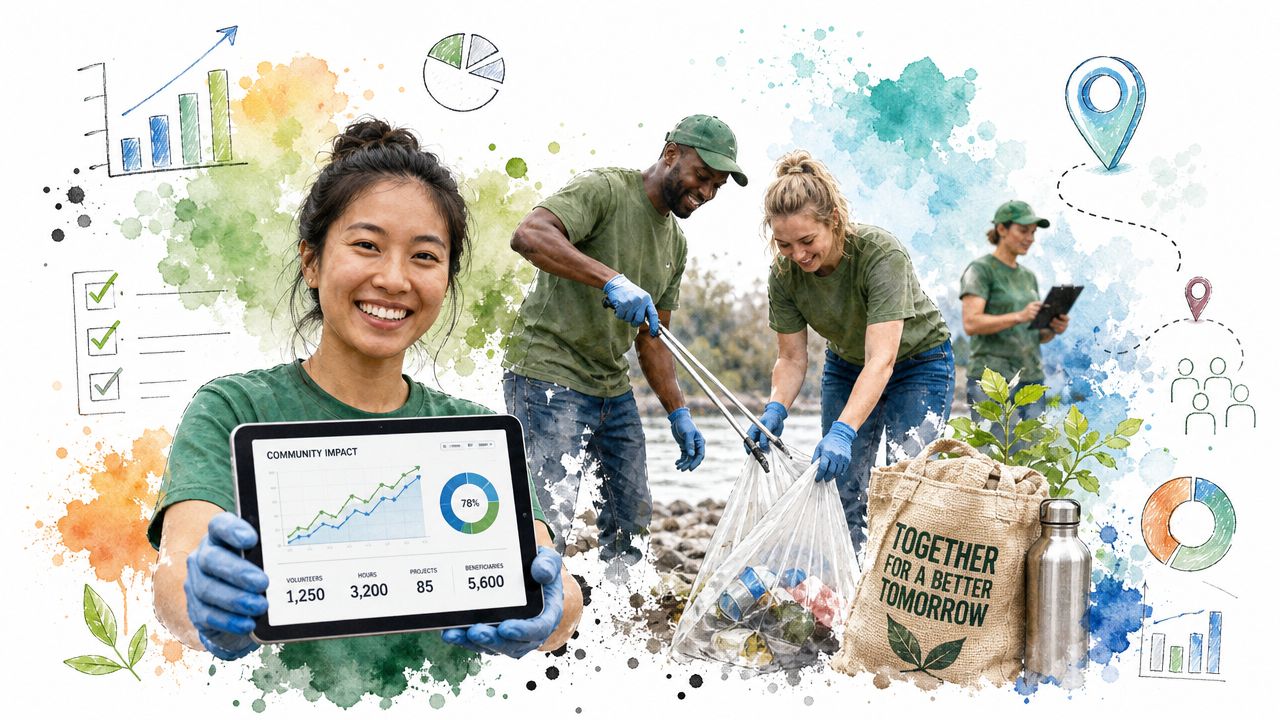
Three people stood under a tree in a Chicago hailstorm, holding trash bags and waiting for rides that never came. We were freezing, half laughing, and already learning the first rule of volunteer work. If you don't decide what counts as progress, the weather, the chaos, and other people's opinions will decide for you.
Your Program is a Story Not a Spreadsheet
After a cleanup, I do not start with the sign-in sheet. I start with the curb.
Did the block feel different. Did the volunteers leave taller than they arrived. Did a neighbor stop to talk instead of walking past with that shut-down look city residents get when they have given up on a corner?
That is evaluation at street level. It starts with what changed in real life, then works backward to the numbers that prove it. Groups that begin with a giant spreadsheet usually end up measuring whatever is easiest to log. Hours. Names. Bags. Posts. Those figures matter, but they are only fragments. A volunteer program lives or dies on whether the work changed the place, the people, or both.
Corporate-style evaluation often strips out the part that matters most. It treats volunteers like labor inputs and outcomes like tidy boxes. That approach misses too much. A cleanup can produce fewer bags than usual and still be one of your best days if a nervous first-timer comes back next week, two neighbors trade numbers, or a teenager realizes they can lead a block instead of complaining about it.
I have learned to treat evaluation more like field notes than office reporting. Gather proof from several angles, then line it up against the mission.
Here is the kind of proof that holds up:
- Visible proof: before-and-after photos, route maps, filled bags, finished tasks
- Behavior proof: turnout, repeat attendance, friend referrals, volunteers who stay to help after the official end
- Experience proof: short feedback forms, comments in the group chat, quick check-ins as the day concludes
- Mission proof: signs that the work changed habits, trust, confidence, pride, or connection to place
Mission proof is where many groups get sloppy. They assume everyone knows what the deeper goal is. They do not. If your mission is cleaner streets, document cleaner streets. If your mission is reducing isolation, ask whether people made new connections. If your mission is building courage, look for the shy volunteer who starts speaking up, leading a team, or inviting someone else.
That is why stories belong in your evaluation system. A page of volunteer testimonials from cleanup experiences can show the human shift behind the numbers. It captures fear turning into confidence, strangers turning into teammates, and one-time volunteers turning into regulars. A spreadsheet cannot carry that by itself.
Litter Caterpillars uses this approach because the mission is bigger than trash removal. We want cleaner blocks, yes. We also want people to feel ownership, pride, and connection in places that often get written off. If we only count bags, we miss half the work. If we only collect stories, we cannot improve the operation. Good evaluation does both. It keeps the soul of the group in view while giving you enough evidence to fix what is weak, repeat what works, and stay honest about what changed.
Start with Your Destination Before You Start Driving
If you got in your car, closed your eyes, and hit the gas, nobody would call that a road trip. They'd call it a bad decision. Yet that's how many groups run evaluation. They collect random data before they define success.
Your mission is the destination. Your evaluation is the map in the glove box.
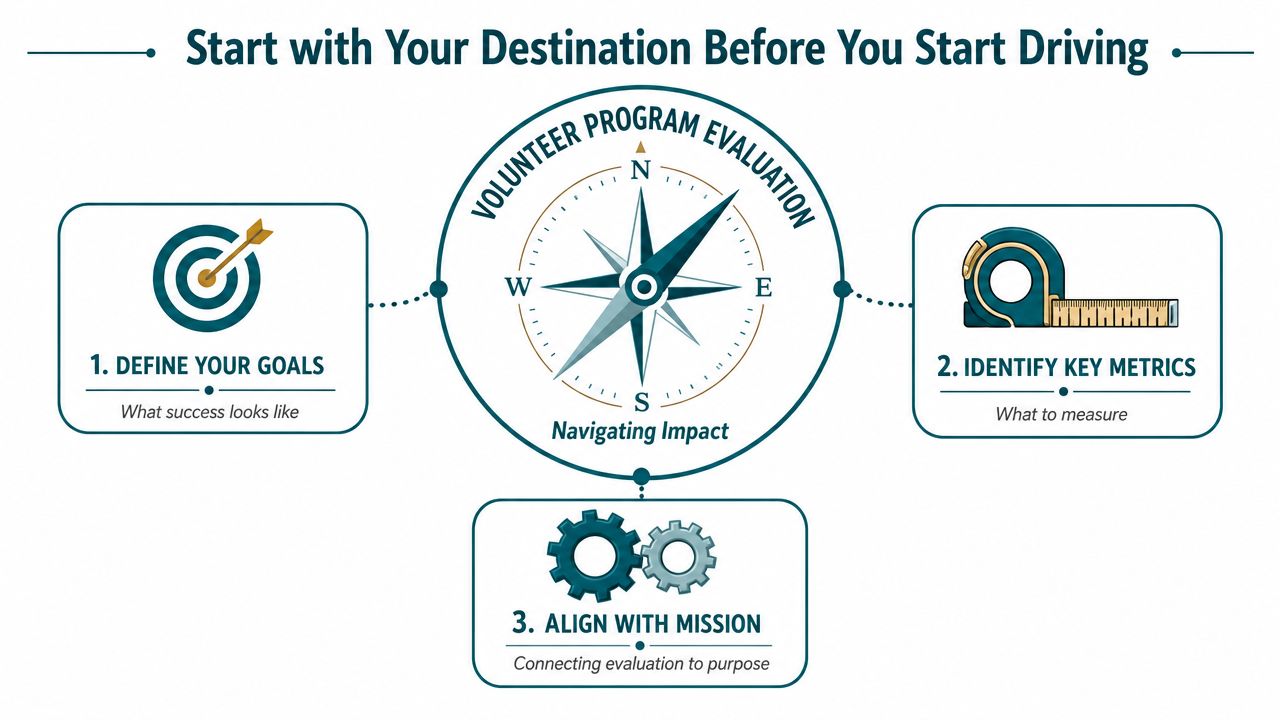
Build a simple map
People hear "logic model" and tense up. Relax. It's just a chain of cause and effect.
You do an activity.
That activity creates an output.
That output should lead to a change.
A volunteer group that picks up trash on weekend mornings might map it like this:
| Part of the map | Plain-English version |
|---|---|
| Inputs | volunteers, gloves, bags, grabbers, time, leaders |
| Activities | cleanups, check-ins, group chats, photo posts |
| Outputs | hours served, blocks cleaned, bags filled, events run |
| Outcomes | stronger habits, new friendships, more neighborhood pride, repeat volunteers |
That map keeps you honest. It also stops you from measuring whatever is easiest.
Start with baseline and mission outcomes
Before you measure anything, set a baseline. VolunteerHub's practical guide to measuring volunteer impact makes that point clearly. You need to know where you are today or your future numbers mean nothing. The same guide says to clarify your top 3 mission outcomes and assign 2 to 3 metrics for each outcome, including at least one output measure and one outcome measure.
That sounds formal, but it is freeing.
If your mission outcome is cleaner public space, your output measure might be hours served and your outcome measure might be visible site improvement documented through photos and field notes.
If your mission outcome is stronger community ties, your output measure might be event attendance and your outcome measure might be volunteer comments about friendships, trust, and whether they'd recommend the experience.
A map doesn't make the work less human. It keeps the human part from getting lost.
Use the five-step cycle
A rigorous volunteer program evaluation follows a five-step methodology: Plan, Collect, Analyze, Report, and Improve, as explained in Qomon's volunteer program evaluation framework. I like this cycle because it cuts through nonprofit fog.
The situation on the ground is as follows:
- Plan: pick the questions that matter.
- Collect: gather only the data you can use.
- Analyze: look for patterns, surprises, and weak spots.
- Report: tell the story in plain language.
- Improve: change the next event, training, or communication.
That's the whole machine. No shrine to paperwork. No giant consultant deck.
One rough example
Say your group values bravery. Fine. Define it.
You might describe bravery as people showing up in uncomfortable conditions, returning after a hard first event, or trying unfamiliar neighborhoods and tasks. Then you can observe it. You can note weather, turnout consistency, and volunteer reflections. Suddenly a value that sounded abstract becomes something you can watch in real life.
That is what a good map does. It turns ideals into observable behavior.
Measure Both the Head Count and the Heart Count
At one of our early cleanups, I made the rookie mistake of calling the day a win because the pile of filled trash bags looked huge. Then I checked what happened after. A lot of first-timers never returned. We had moved a lot of rubbish, but we had not built much staying power.
That is why I track two kinds of proof.
Head Count shows what the group did in the world.
Heart Count shows what the experience did to the people doing it.
You need both if you want a volunteer program that lasts.
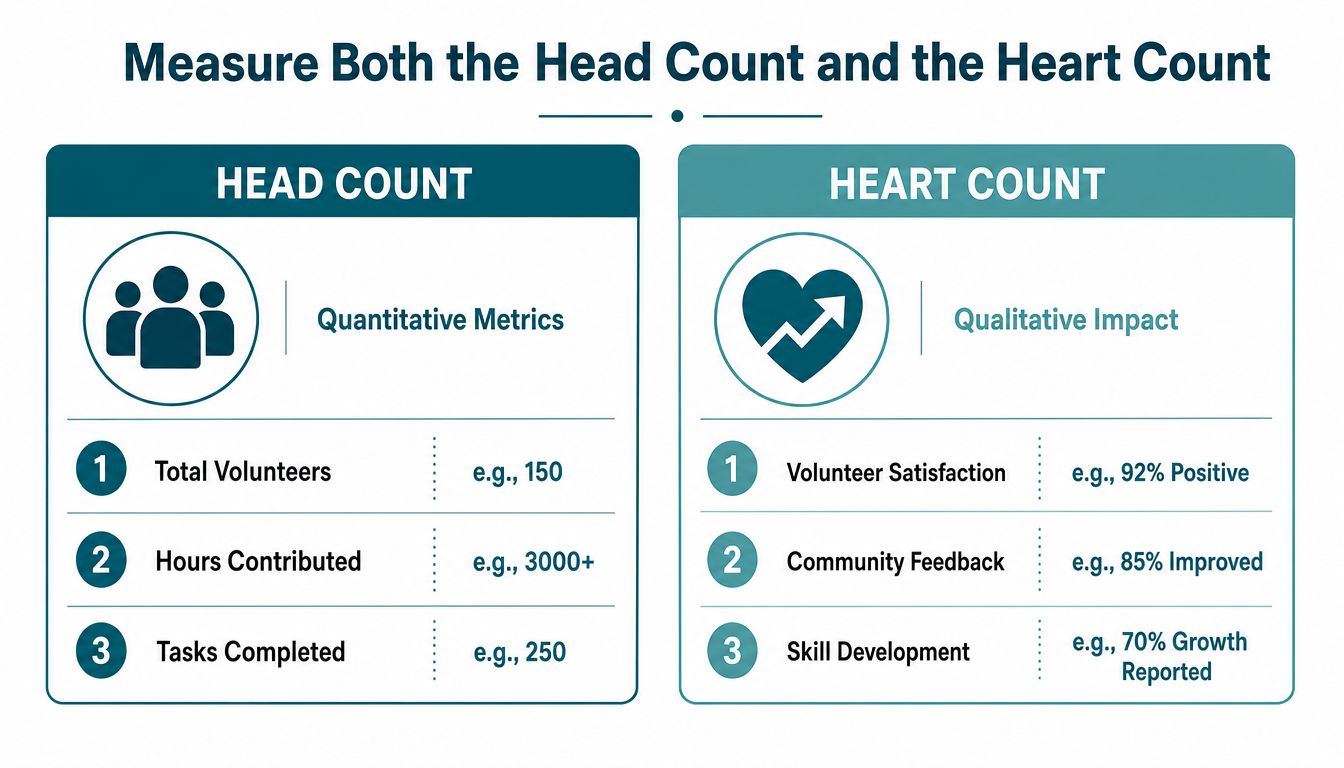
Head Count metrics
These are the plain, visible markers of effort. They matter because grassroots groups can drift into good intentions unless somebody keeps score.
Useful measures include:
- Participation rates: who registered, who showed up, and who came back
- Total hours: how much volunteer time the work required
- Task completion: whether the route, outreach shift, sorting job, or cleanup target got finished
- Opportunity count: how often people had a real chance to serve
- Retention: whether the same volunteers return often enough to build skill and trust
I keep Head Count simple on purpose. If your team needs ten fields and a training manual just to record attendance, the system is too heavy for street-level work.
Heart Count metrics
Heart Count is where volunteer evaluation stops sounding corporate and starts sounding honest.
People join for one reason and stay for another. They may come because a friend invited them, because the mission matters, or because they felt guilty scrolling past a littered park. They return because they felt useful, safe, welcomed, and connected to something real. If you never measure that part, you miss the reason your group grows or fades.
Ask direct questions. Keep them short.
- Did today feel worth your time?
- Would you come again?
- Would you bring a friend?
- Did you feel safe and supported?
- What frustrated you?
- What made you feel proud?
Heart Count can include:
| Heart Count signal | What it tells you |
|---|---|
| Satisfaction score | whether the experience felt good enough to repeat |
| Recommendation likelihood | whether trust is strong |
| Return behavior | whether people want another round |
| Open comments | what the numbers miss |
| Social spillover | whether volunteers stay, talk, and build ties |
I trust return behavior more than smiles in a group photo. Plenty of events look cheerful for ninety minutes and still fail the ultimate test. The ultimate test is whether people come back on a wet Saturday when the novelty is gone.
For more grounded systems, I like volunteer management best practices for grassroots groups because they keep the focus on habits, safety, and repeat participation instead of vanity metrics.
Here's a short video take on the subject before I get more tactical:
Don't confuse output with meaning
A hundred bags of trash can mean the day went well. It can also mean the site was in terrible shape, the route was poorly chosen, or your group spent too much time fixing preventable mess.
I have seen smaller cleanups produce better results. Fewer bags. Better volunteer energy. Safer movement through the area. Stronger conversations with passersby. Higher return rates the next week. That is a better day for a mission-driven group, even if the raw pile looks less dramatic on Instagram.
Litter Caterpillars is a good example of this trade-off. If twelve people clear a modest stretch of street, talk with residents, take before-and-after photos, and eight of them sign up again, that session has more long-term value than a one-off turnout surge that burns people out.
Measure the work. Measure the experience. Then compare them side by side.
If the job gets done and people want to return, the program is healthy. If one side is strong and the other is weak, you found the problem early enough to fix it.
Your Toolkit for Gathering Street-Level Data
You don't need enterprise software. You need a system volunteers won't hate.
The best data tools are the ones people will use while they're tired, dirty, sweaty, cold, or rushing to catch the train home. In practice, that usually means your phone, a free form, a shared sheet, and a habit.
Keep the tools boring and fast
Use simple gear:
- Google Forms: for post-event check-ins and short surveys.
- Google Sheets: for attendance, hours, return visits, and site notes.
- Meetup check-ins or a shared note: for quick turnout tracking.
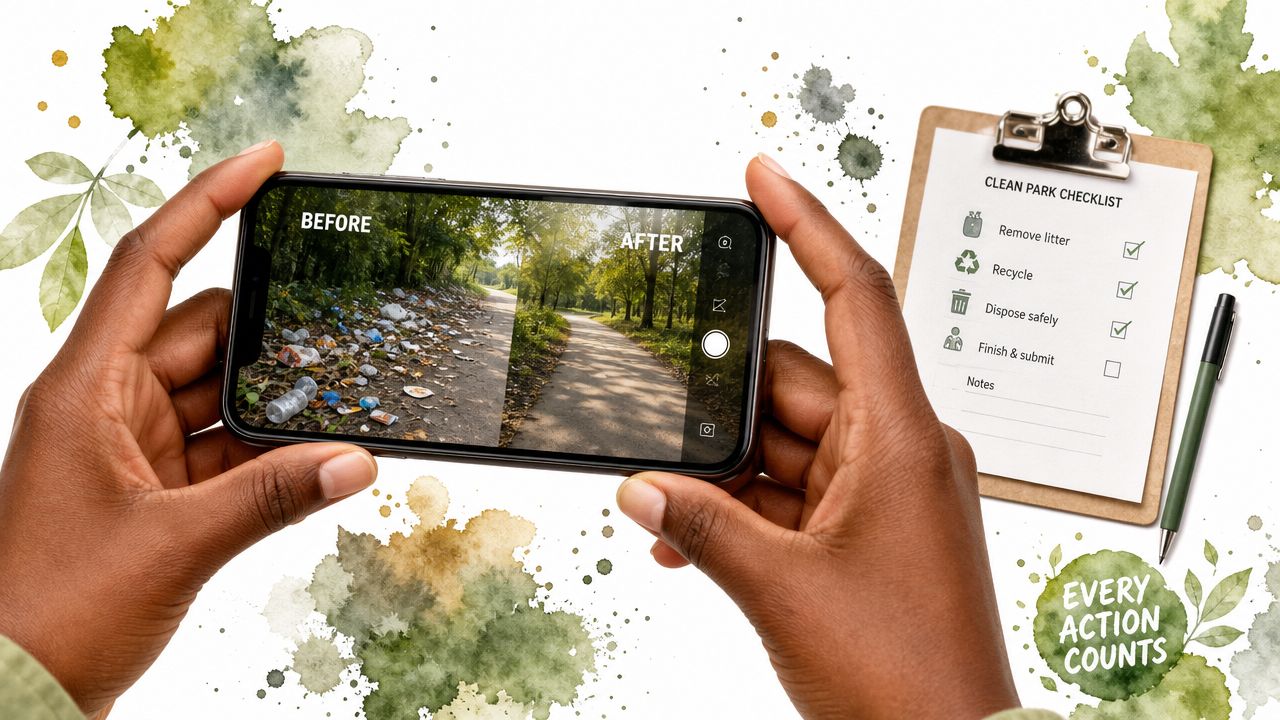
- Phone camera: for before-and-after proof.
- QR codes: so nobody has to type a long survey link on the sidewalk.
- Instagram analytics: to see which impact posts get people talking and sharing.
Often, a lot of groups overbuild. They imagine a giant database when they really need one clean form.
A practical method is the session snapshot. After each event, run a simple 3 to 5 question check-in. Qomon's volunteer impact measurement guide says this approach gives you immediate impact data and avoids burdening volunteers with long surveys, which helps you track things like total hours and task completion in near real time.
The street version of a survey
At the end of an event, ask only what you need. I like questions that fit on one phone screen:
- Rate your experience from 1 to 5.
- Would you recommend this to a friend?
- What did you work on today?
- About how long did you volunteer?
- One word for how today felt.
That's enough to spot trends without turning service into homework.
If your group works in different parts of a city, a route map helps too. A simple neighborhood tracker or geotagged map can show coverage, gaps, and repeated problem spots. A visual tool like the Northeastern Illinois cleanup map makes patterns easier to spot than a raw address list.
Collect more than one kind of evidence
One reason evaluation fails is that people trust only one channel. A survey catches some truth. It misses a lot too.
Use a mixed bag:
- Photos: good for visible change.
- Field notes: good for safety issues and weird on-the-ground details.
- Volunteer comments: good for culture and motivation.
- Attendance logs: good for consistency.
- Observation: good for things people don't write down, like who helps newcomers.
If you're running regular shifts, the data should feel like part of the rhythm. Gloves on, cleanup, group photo, quick QR scan, done. If it takes longer than a few minutes, you will lose people.
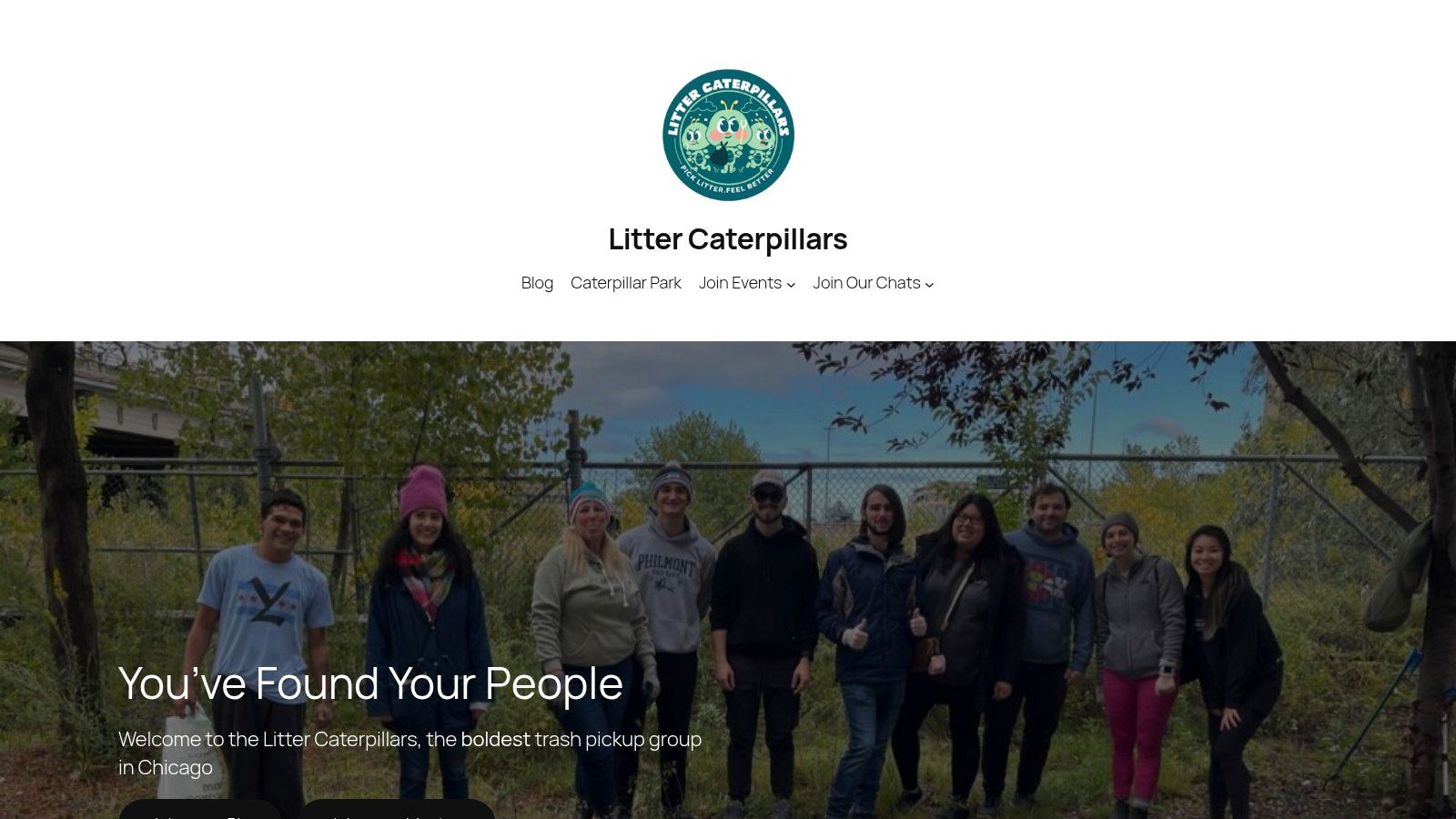
The Litter Caterpillars Case Study From a Mess to a Mission
The first version of a volunteer group is usually messy. That's normal. At the start, the data is often just memory. Who came. What got cleaned. Which corner felt rough. Who stayed cheerful in bad weather.
Over time, the trick is to turn those scraps into a pattern without killing the spirit that made people show up in the first place.
What the raw version looked like
At the beginning, a cleanup group might know only a few things for sure. The weather was bad. The turnout was small. The site looked better at the end than it did at the beginning. Volunteers talked afterward. Somebody said, "That was weirdly fun."
That isn't polished data, but it is data.
The mistake would be to throw that away because it doesn't look formal. The better move is to organize it. Save photos by date and location. Keep a running sheet of turnout and hours. Write down one or two sentences after each event while the details are still fresh.
How the story tightens
Once a group gets more consistent, the pattern gets clearer. Weekend morning events attract a certain type of person. Hard weather filters for dedication. Before-and-after photos bring in fresh interest. Repeat attendance tells you whether the experience has enough pull to become habit.
A strong volunteer program evaluation can use both numbers and narrative at once. For example:
| What happened | What it may mean |
|---|---|
| Same volunteers return across multiple events | the culture is sticky |
| New people join after impact photos are posted | visual proof motivates action |
| Certain routes draw stronger turnout | location and comfort matter |
| Volunteers ask for a permanent project | the group is ready for deeper ownership |
That last point matters. A temporary action like a cleanup can awaken appetite for permanent work. When volunteers start wanting a place to keep building, you're no longer dealing with a one-off event series. You're dealing with a community.
Numbers tell you the shape of the work. Stories tell you why the shape matters.
What this kind of case study teaches
The takeaway isn't that every group should track the exact same things, but that your evaluation should grow up with your mission.
A scrappy city cleanup group might begin with turnout, hours, and photo evidence. Later it might add retention, recommendation likelihood, volunteer comments, and route coverage. Later still it might study which kinds of events produce stronger friendships or steadier habits.
If your values include bravery, kindness, unity, and a volunteer-first culture, your evaluation should include signs of those values in action. Did people feel safe. Did new volunteers get welcomed. Did leaders respect the group's energy. Did people come back because the work made them stronger, calmer, or more connected.
That is how a mess becomes a mission. You don't clean up the story by making it more corporate. You clean it up by making it more honest.
Close the Loop Make Your Data Do Something
I have watched groups collect feedback with good intentions, then do nothing with it. A volunteer says the meetup spot felt unsafe. Another says check-in was chaotic. Three people stop showing up. The form gets saved, everyone stays busy, and the same problem shows up at the next event.
That is how trust leaks out of a volunteer group.
Evaluation has to change the next decision. If a route feels off, move it. If new people keep arriving late because the instructions are muddy, rewrite the text message and post a map pin. If regulars are carrying the whole event, train one more person to lead check-in. Street-level evaluation lives on the calendar, in the group chat, and at the start of Saturday morning.
Where groups get stuck
The pattern is usually simple.
- They over-rely on surveys. A form catches some truth, but not the look on a new volunteer's face when nobody greets them.
- They never ask people why they stopped coming. Departing volunteers often say the quiet part out loud.
- Nobody owns the fix. Feedback gets discussed, then drifts.
- Volunteers never hear what changed. People stop giving useful input when it disappears into a void.
I have learned more from a two-minute conversation after an event than from a polished spreadsheet sent a month later. Forms still help. They just cannot carry the whole load.
Use a loop your volunteers can actually see
Keep it plain.
- Collect it. Ask one or two questions after the event. Ask one honest question when someone leaves.
- Group it. Sort the responses into safety, logistics, culture, and mission fit.
- Pick one fix. Choose something small enough to change before the next event.
- Say it out loud. Tell volunteers what you changed and why.
- Check whether it worked. Ask again after the next few events.
That last step gets skipped all the time. A leader changes one detail and assumes the issue is solved. Sometimes it is. Sometimes the underlying problem was something nearby, like poor signage instead of poor timing, or a cold welcome instead of a long route.
A useful rhythm is to revisit the review process every few months so it still fits the group you have, not the one you had six months ago, as noted in VolPro's guide to outcome metrics for volunteer recruitment and retention.
Give the group proof that feedback matters
Volunteers do not need a glossy report. They need evidence that speaking up changes things.
Say, "You told us the corner by the underpass felt rough, so we switched the start point to the library lot."
Say, "You told us the first fifteen minutes felt awkward, so now one person is assigned to greet every newcomer."
Say, "Several of you wanted shorter routes in the heat, so we split the team in two."
Those sentences build credibility fast. They also protect the culture. People feel taken seriously, which makes them more honest next time.
Do a real yearly review, even if your group is small
A scrappy volunteer group still needs a moment each year to stop, look back, and make decisions on purpose.
One practical model is to include more than one point of view in the review, such as leaders, volunteers, community members, and people affected by the work, as described in this overview of volunteer program performance evaluation. Another useful practice is to review participation, hours, feedback, changes, and ongoing problems in one place so leadership can decide what to keep, stop, or repair, as explained in Lodestar at ASU's guidance on systematic evaluation.
For Litter Caterpillars, that kind of review would not look corporate. It would look like a table at the end of the season, phones out, route photos up, volunteer comments open, and a blunt conversation about what worked. Which cleanup sites built energy. Which ones drained it. Where new people became regulars. Where leaders protected the spirit of the group, and where we let sloppiness chew it up.
The point is improvement you can feel.
If your evaluation never changes the route, the welcome, the pace, the leadership, or the way volunteers experience the mission, it is just record-keeping. If it helps the group become safer, warmer, more effective, and more honest, then the numbers and stories are doing their job.
If you want to join a group that puts this kind of street-level learning into practice, take a look at Litter Caterpillars. We pick up trash across Chicago, build friendships in the process, and treat volunteer energy like something worth protecting.