

We were cleaning along a highway access road when the truck noise got so loud we had to shout from a few feet away. I remember looking at the trash bags in our hands and thinking that some messes sit on the ground, but some messes fill the air.
The Noise We Do Not Have to Accept
I got into noise pollution reduction the same way I got into cleanup work. I got tired of being told to treat ugly, stressful conditions like they were normal.
One of our cleanups ran next to a road that typically only seen through a windshield. The litter was bad, but the sound was worse. Trucks growled, cars hissed over wet pavement, and every conversation felt like a small fight. By the end of that morning, I knew something simple. If a place is so loud that people can barely talk, that place is pushing people away.

I found that in Chicago, noise levels are not evenly spread. They spike near roads and public transit, and they hit mid-to-low income neighborhoods harder, which is often where volunteers like us end up cleaning. When I measured a street during a bike-event shutdown we cleaned, the roar of idling cars hit 85 dBA, the threshold where hearing loss starts after 8 hours of exposure, based on the framing used in this Chicago noise and health research context.
How you know your block is too loud
You don't need a lab to notice trouble. Your body tells you first.
Practical rule: If you're shouting at arm's length to hear someone, the noise around you is already in dangerous territory.
That test changed how I look at ordinary places. A bus stop. A corner store near a major road. A cleanup route under the tracks. Places that look routine can sound punishing.
A lot of people think quiet is a luxury, like a fancy park bench or a nice view. I don't buy that. Quiet is basic working equipment for a neighborhood. Kids need it to focus. Neighbors need it to sleep. Volunteers need it if they're going to stay out long enough to do good work.
What recognition looks like on the ground
When you start paying attention, you notice patterns fast:
- Traffic surges make a block feel jumpy, even when nothing looks chaotic.
- Idling vehicles create a steady wall of pressure that wears people down.
- Transit corridors hit in pulses. Loud, brief, then loud again.
- Cleanup work zones can pile on extra noise if you add engines, tools, and nearby traffic.
That realization is part of why I believe in fixing your neighborhood without waiting for permission. You don't need to wait for a perfect city plan before you start naming the problem out loud.
Noise is real. It is physical. It changes how long you want to stand on your own block. Once you notice that, you stop treating it like background scenery and start treating it like something you can fight.
Why Noise Is More Than Just Annoying
I think of sound like weather hitting the body. Soft sound is a light drizzle. A loud street all day feels more like standing in hard rain with no coat. You might stay upright, but you don't leave untouched.
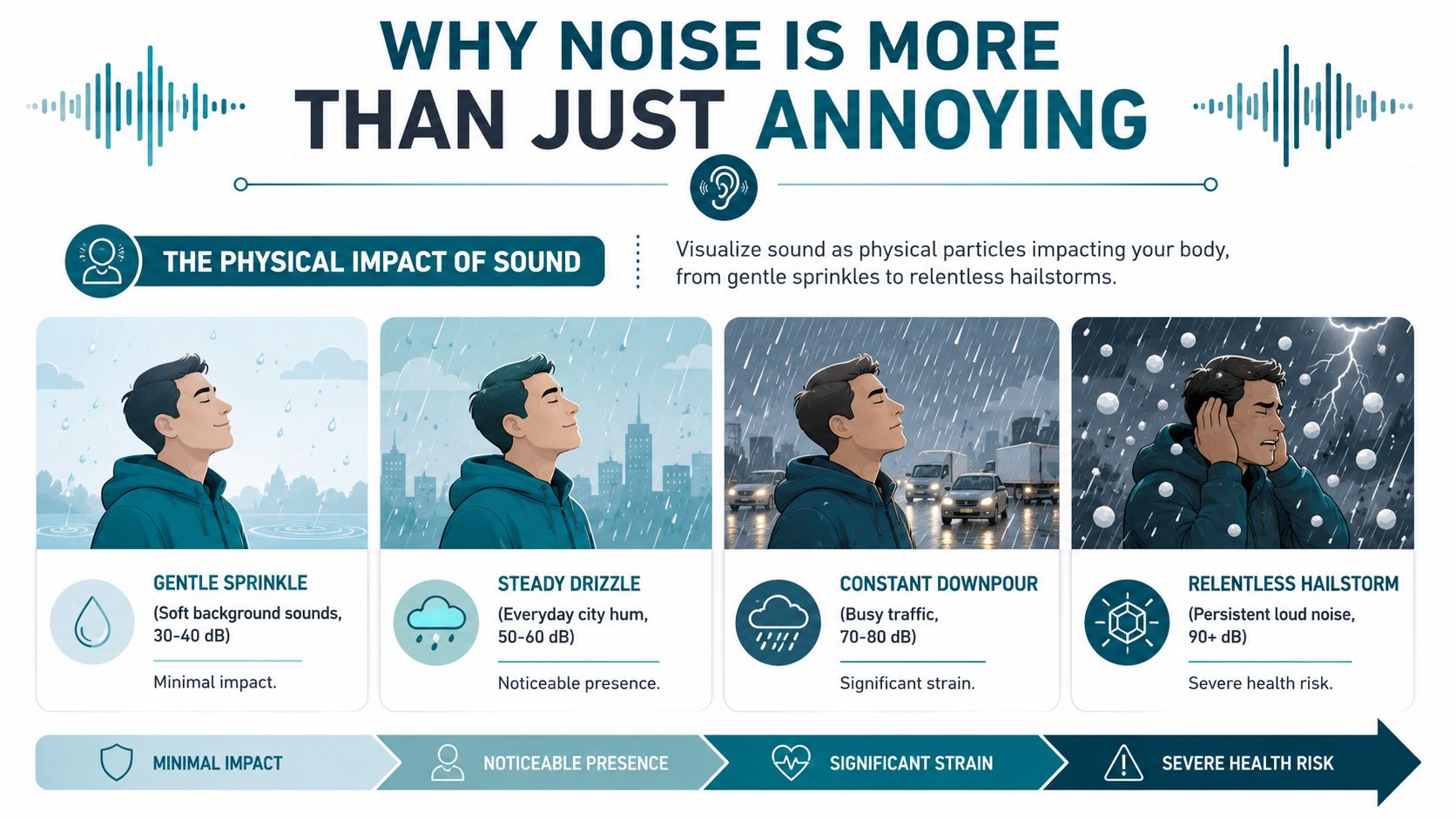
Noise becomes pollution when it is unwanted, repeated, and hard to escape. That last part matters. A loud festival that ends is one thing. A roadway that leans on your apartment every morning and night is another.
The body keeps score
We talk about noise like it's only about annoyance because annoyance is easy to describe. But the harm goes deeper than irritation. According to the European Environment Agency's 2025 report on environmental noise in Europe, transport noise pollution causes 73,000 premature deaths annually across Europe, along with 49,000 new cases of cardiovascular disease and 23,000 new cases of type 2 diabetes. The same report says chronic exposure leads to the loss of 1.5 million healthy life years each year.
That's a public health problem, not a personality problem. The issue isn't that people are too sensitive. The issue is that the sound load is too high.
A simple way to think about decibels
You don't need to memorize a chart to use decibels well. You only need a rough map in your head.
| Sound feel | What it resembles | What it means |
|---|---|---|
| Gentle | Soft indoor background sound | Easy to ignore |
| Noticeable | Normal city hum | Present, but manageable |
| Heavy | Busy traffic | Mentally tiring |
| Harsh | Persistent loud street or tools | Protective action matters |
The point of the number is not trivia. The point is comparison. If one street makes you tense and another lets your shoulders drop, your body is reading a real difference.
Sound is invisible, so people argue with it more than they argue with smoke. Your heart and your sleep don't care whether you can see the source.
A cheap sound meter or even a phone app won't replace formal measurement, but it can wake you up. It can help you stop saying, "Maybe I'm overreacting," and start saying, "No, this corner is rough every day around the same time."
That shift matters in environmental justice work too. If a neighborhood already carries more traffic, more industrial pressure, and more stress, extra noise lands on a body that's already doing too much. If you want a practical frame for that, this piece on environmental justice and how regular people create change is a good place to start.
Your First Steps to a Quieter Life
You can't control the whole city from your couch. You can control more of your home than you think.
When outside noise keeps barging in, I treat my home like a shelter I have to tune. The goal isn't perfect silence. The goal is relief. A room that lets your nervous system unclench is worth a lot.
Start with the room that matters most
Pick one room first. Usually that's the bedroom, or the room where you work, study, or recover.
I always begin with the windows. If sound leaks through them, I use heavier curtains and make sure they cover the edges instead of just decorating the glass. Then I look at the room itself. Bare rooms bounce sound around. Soft rooms absorb it.
A few changes help fast:
- Move soft furniture to outside-facing walls. A bookshelf, couch, or padded chair won't solve street noise, but it can dull the hard echo inside.
- Use rugs where footsteps and reflections feel sharp. A room with fabric on the floor usually feels calmer right away.
- Seal obvious gaps. If you feel air around a window or door, sound is probably slipping through too.
- Choose your sleep position wisely. If one side of the room faces the street, place the bed where the room itself gives you more buffer.
Build a sound routine, not just a soundproof room
People often look for one magic product. Most of the time, noise pollution reduction works better as a stack of small moves.
Here's a home routine I like:
Morning reset
Open windows when the block is calm, then close them before traffic swells.Midday buffer
Use a fan or white noise machine if outside sounds arrive in bursts. A steady indoor sound often feels easier on the brain than random revving and horns.Evening protection
Keep the bedroom darker, softer, and less reflective. Noise and light often gang up on sleep together.Personal gear
Keep earplugs in the same place every day. If you're tired, you won't go hunting for them.
What works and what doesn't
Some fixes help because they reduce pathways or soften reflections. Some fixes only make us feel busy.
Usually worth trying
- Heavy curtains when the room has hard surfaces and street-facing windows
- Door sweeps and simple seals where gaps are obvious
- White noise machines or fans if outside noise comes in unpredictable bursts
- Furniture layout changes that put soft, dense objects between you and the loudest wall
Usually overrated
- Tiny decorative panels in the wrong place
- One houseplant and a prayer
- Moving things around without listening to the room before and after
- Leaving windows cracked on a loud corridor and hoping for peace
I like houseplants, but I don't pretend a fern can beat a bus route. Plants can help a room feel calmer. The bigger win often comes from the habits around them. You close the window at the right time. You create a corner where you can read without bracing for the next engine blast. You make the room act less like a drum.
That matters because the fight outside is easier when you have somewhere to recover inside.
Tackling Noise at the Neighborhood Level
A home fix is personal. A block fix is political, even when it looks simple.
The first time I convinced neighbors to care about noise, I didn't start with theory. I started with a walk. We stood at one corner, then another, then near a calmer side street. Nobody needed a lecture. The loud spots made their own argument.
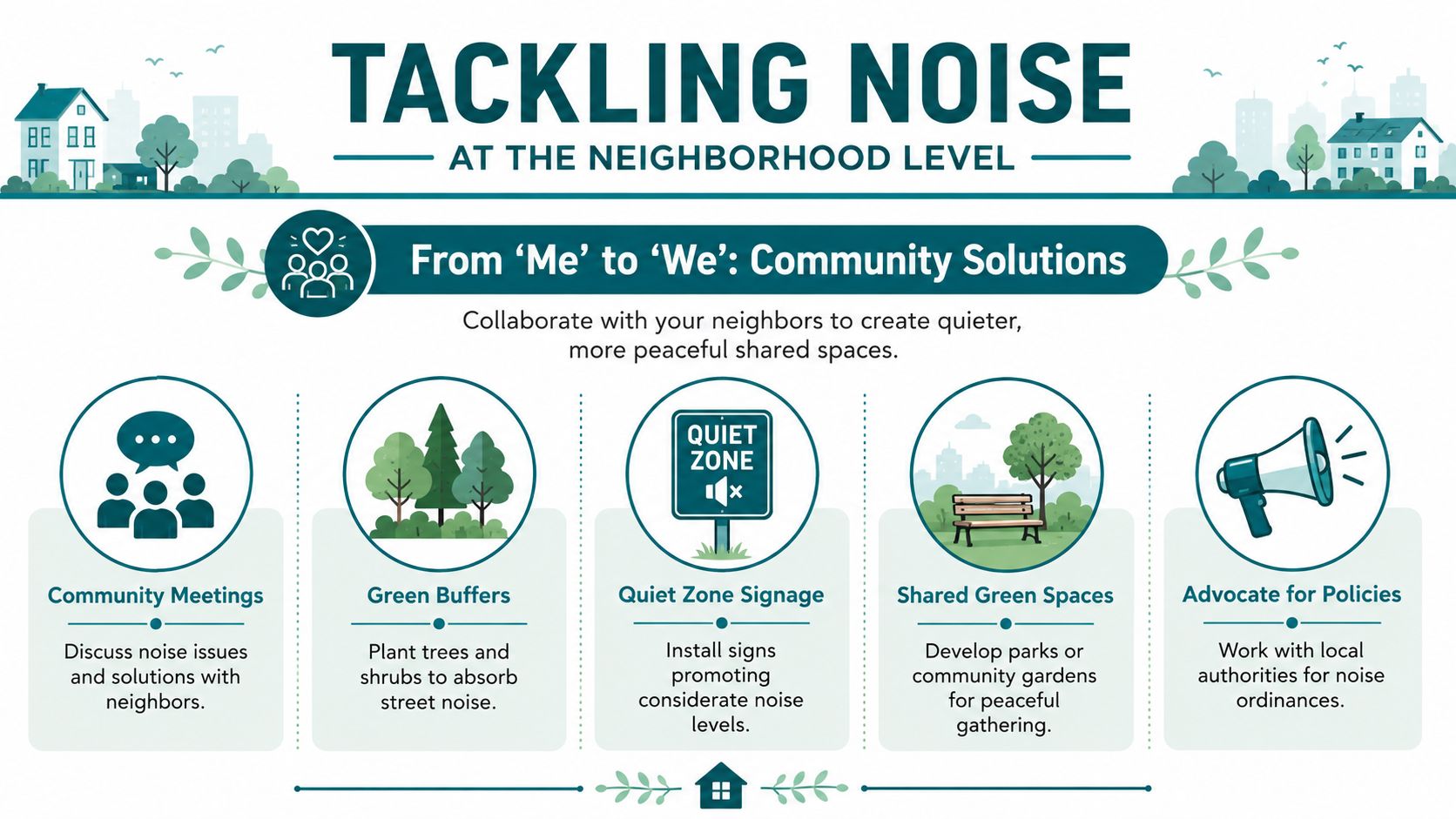
Run a neighborhood noise audit
You can do this with a few people, phones, and a shared note.
Walk the same route at different times. Mark where you have to raise your voice. Mark where kids wait for buses. Mark where traffic stacks up and idles. If a block has a school, a senior building, or homes close to a major road, pay extra attention there.
A simple audit should answer four questions:
- Where is it loudest
- When is it worst
- What is causing it
- What nearby change might help first
That last question keeps a group from drowning in complaints. You want handles, not just frustration.
Pick fixes that match the block
I like neighborhood noise work because you can see the trade-offs up close. A big wall may block sound, but it can also make a sidewalk feel dead or boxed in. Trees feel better, but they take time. New pavement can lower road noise, but only if the city is already planning work there.
I installed noise barriers around our work zone during a downtown cleanup, and measurements showed levels drop from 80+ dBA to 70.09–79.11 dBA, a 10.67–13.95 dBA reduction, according to this study on barrier and porous concrete performance. The same source says porous concrete with crushed stone bases absorbs 0.8–5 dB more than regular concrete, and thicker porous layers boost absorption by 20–30%.
That taught me a useful lesson. Noise work gets real when it touches materials, not just slogans.
What I push for on a block-by-block basis
Some neighborhood asks are more realistic than others. I like the ones that a small group can explain clearly in a meeting.
Green buffers
Trees and shrubs won't erase a road, but they can soften the edge of it. They also make a street feel less exposed, which helps people use it.Quieter surface choices
If a street is already due for repair, ask what material is going down. Pavement texture changes what tires sound like.Temporary barriers during work
Construction and cleanup zones don't have to roar unchecked if crews plan for sound.Better traffic flow
A street with smoother movement often sounds different from a street full of stops, starts, and angry acceleration.
If you want neighbors to join you, don't ask them to love policy first. Ask them to stand with you in the loudest place on the block for five minutes.
That's how "me" turns into "we." One person hears a problem. A few people map it. Then the neighborhood starts asking for changes that fit the actual street instead of generic advice pulled from nowhere.
How We Organize Our Community for Quiet
Trash work taught me that volunteers stay engaged when the mission is clear and the next step is simple. Noise campaigns work the same way.
When a group first notices a loud corner, people usually want to jump straight to outrage. I get it. But outrage burns hot and fast. Organizing needs a slower fire. We document. We compare times. We gather neighbors who live with it every day. Then we choose one ask that a city office or property owner can respond to.
The first move is documentation
I like a shared folder and a simple log. Date, time, location, what happened, how long it lasted, and whether it repeats. Video helps. Short notes help. A rough sound reading can help if you use it carefully and don't pretend it is more official than it is.
Once you have a pattern, you can talk about the issue like an adult instead of like a person having a bad day.
That matters with construction noise. Chicago's construction curfew bans noisy tools between 8 p.m. and 8 a.m., and if you violate it twice in a year, the penalty is $2,500–$5,000, according to this summary of Chicago construction noise rules. Rules like that give residents a clean opening. You're not asking for special treatment. You're asking for enforcement.
The second move is a practical ask
I never bring a complaint by itself if I can help it. I bring a complaint plus a fix.
Here are the asks I trust most:
Adjust timing
If a crew or business can shift the loudest activity out of the most painful hours, that is often the fastest win.Plant screening where homes need it
Vegetation between noise sources and homes can cut sound naturally. I've seen how trees create a better edge between traffic and people trying to live their lives.Smooth the traffic pattern
Changing traffic signals to improve flow can create a 5–10 dB drop, based on the same Chicago rule summary above. That kind of change matters on blocks where drivers race, brake, and lurch forward all day.
Protect the volunteers
Community groups make a mistake when they treat every willing person like unlimited fuel. Nobody is unlimited. If your campaign becomes all meetings and no joy, people vanish.
So I keep a few rules:
Small wins count
One documented hotspot is progress. One resident who speaks up is progress.Safety comes first
If a road is too exposed, the group doesn't prove courage by taking dumb risks.Roles should fit people
One person logs data. Another talks to neighbors. Another takes photos. Another shows up at the meeting.Keep the social glue strong
People stay when they like each other. That's true in cleanup work and noise work.
A quiet campaign should feel like a neighborhood learning to defend itself without becoming harsh. Brave, yes. Mean, no. That's how you last long enough to win changes that don't disappear after one angry week.
Our Story of Turning a Noisy Lot Quiet
An empty lot near a busy street can feel like a mouth with a missing tooth. Wind moves through it. Trash collects in it. Noise slides right across it.
That was the feeling with the lot that became a park in Englewood. It wasn't only ugly. It was exposed. The street had too much say over the space.

We didn't start with a grand theory. We started with irritation, effort, and repetition. People kept showing up to clean. We kept seeing the same truth. If you leave a space open to chaos, chaos keeps renting it for free.
So we worked to turn that lot into something that could absorb care instead of neglect. A place with edges. A place with purpose. A place where people could stop, talk, and breathe without feeling pinned to the road. The story behind that effort lives in this account of the vacant lot transformation.
What changed when the space changed
Noise pollution reduction isn't always one giant intervention. Sometimes it is a chain of ordinary moves that finally start working together.
We added green elements because living buffers change how a place feels. We thought about layout because open, hard, exposed space tends to throw sound around. We paid attention to how volunteers and neighbors moved through the area, because a quiet corner that nobody can use isn't much of a win.
That work also changed how I think about "what's possible." During the COVID-19 lockdowns, seismic noise levels decreased by up to 50% worldwide, according to this research on global noise reduction and policy targets. The same source says the EU set a goal to reduce the number of people chronically disturbed by transport noise by 30% by 2030 compared with 2017 levels, while current outlooks project only about 19% without stronger measures. It also says about 45% reduction is technically achievable between 2017 and 2030.
I take that to mean one thing. Big change is possible, but it doesn't happen from wishing.
A short look at the spirit of that work helps more than any abstract pitch:
Quiet is something you build
I used to think of quiet as the absence of noise. Now I think of it more like a garden. You don't get it by demanding that the air behave. You get it by shaping the conditions.
You slow what can be slowed.
You buffer what can be buffered.
You report what breaks the rules.
You protect the people doing the work.
You keep going.
A noisy lot can become a gathering place. A harsh corner can become bearable. A group of volunteers can learn that cleanup is not only about what they remove, but also about what they restore.
Quiet takes effort. So does every decent thing in a city. But once you've heard the difference between a place that batters you and a place that lets you stay, it's hard to go back to pretending noise is just part of the deal.
If you want to build a cleaner, quieter Chicago with people who show up, join Litter Caterpillars. Bring gloves, bring courage, and bring a friend.