
So, you’re staring at that old vacuum and wondering, can I actually recycle this thing? Let me tell you straight up: you absolutely can. It’s one of the best things you can do to keep a big, clunky piece of e-waste out of our ever-growing landfills. I’ve found the best way to get started is by checking for your city's free e-waste drop-offs or seeing if the big electronics stores have their own take-back programs.
Your Old Vacuum Is More Than Just Trash
I know how it is. That old Hoover, sitting silently in the back of your closet, isn't just a hunk of plastic and metal. It's a silent witness. A keeper of memories. You can probably still hear the ghost of its whir as it sucked up spilled glitter from a chaotic kids' craft day or roared to life minutes before guests arrived for a big holiday feast.
When it finally sputters out, coughing its last breath, it feels like an ending. It’s so damn easy to see it as another piece of junk you need to haul to the curb.
But I’m here to tell you that its story isn’t over. Not even close. It’s just starting a new one.
A Second Life Is Waiting
Just like I stumbled upon a new purpose for my own life by getting my hands dirty cleaning up Chicago’s neighborhoods with the Litter Caterpillars, your old vacuum can be utterly transformed. It has this hidden, vibrant potential we almost always miss. My journey has taught me a profound lesson: what looks like trash is usually just a resource that's found itself in the wrong place.
I’ve learned that everything—and I mean everything, and everyone—deserves a shot at a second life. I see it blossom in the vacant lots we reclaim from neglect and in the unexpected friendships our volunteers forge in the middle of a city street. Your vacuum is no different.
That’s why this guide means so much to me. I'm not just here to point you to the nearest dump. I'm here to help you change the way you see.
You have a few powerful choices, and I promise you, each one makes a real, tangible difference:
- Repair it: Sometimes, a single, simple fix is all that machine needs to roar back to life, saving you a chunk of money and keeping a perfectly good appliance right where it belongs—in action.
- Donate it: If it's still chugging along, your vacuum could be a godsend to a family just getting on their feet or a local charity struggling to make ends meet.
- Recycle it: By recycling vacuum cleaners the right way, you ensure their valuable metals and plastics are recovered and reborn, instead of being left to poison our city's soil.
This isn’t just about tossing something away; it’s about discovering the astonishing potential for renewal in things we’ve already written off as finished. We do it every single week on the streets of Chicago, and you can do it right from your own home. For a deeper look at what our city offers, you can check out my guide on how to recycle in Chicago. Let’s get started.
Deciding Your Vacuum's Next Chapter
So there it is. Your old vacuum cleaner sits there, and your first impulse is probably to just drag it out to the alley and forget it. But hold on a second. Before you write it off as junk, let's you and I play detective. Is it really dead, or is it just having a really, really bad day?
I’ve seen it happen dozens of times at our cleanups. Someone pulls a vacuum out of a dusty garage or finds one abandoned on the curb, looking like a total lost cause. But with a little bit of tinkering, a bit of care, it suddenly sputters and roars back to life. It’s like finding a wildflower stubbornly pushing its way through a crack in the pavement—a small, beautiful sign of resilience you almost missed entirely.
Repair Donate or Recycle Your Vacuum Cleaner
So, what's your game plan? You have to figure out which path makes the most sense for your machine. This isn't about being right or wrong; it's about giving that machine the best possible next chapter instead of a quick, unceremonious trip to the landfill.
I’ll never forget watching one of our volunteers take home a discarded vacuum everyone else had given up on. He spent a few hours with it, like a surgeon with a patient, and found a massive, hidden clog of hair and string deep inside its guts, then swapped out a single $5 belt. Just like that, it was working perfectly again.
That’s the kind of mindset you and I need to have. Before you decide its fate, ask yourself: could one simple fix completely change this story? It’s almost always a tangled brush, a clogged hose, or a broken belt—tiny, insignificant problems with surprisingly easy solutions.
Taking a moment to check can save you money and, more importantly, it keeps a perfectly good appliance out of the ever-growing stream of waste.
Salvaging What You Can
Even if the main motor has officially given up the ghost, the story isn't over. Think about all those forgotten attachments collecting dust in your closet: the crevice tool, the upholstery brush, the extension wands. These parts are often universal, like a secret handshake that fits other vacuums, or they can be used by someone else with the same brand. They’re the unsung heroes of your cleaning toolkit.
Don't let them go to waste. You can offer them up for free on a local buy-nothing group or see if a friend can use them. Think of it as being a good steward of your stuff. You're making sure every single piece gets used to its absolute fullest potential before recycling the vacuum cleaner's main body.
So, how do you decide what to do? I've put together this quick guide to help you figure out the next move for your old vacuum.
Repair Donate or Recycle Your Vacuum Cleaner
Use this quick guide to determine the best next step for your old vacuum cleaner based on its condition.
| Condition | Best Action | Why It Matters |
|---|---|---|
| Still working, but you got an upgrade. | Donate It | A working vacuum is a huge help to a family in need or a local shelter. You're directly supporting someone in your community. |
| Needs a minor, inexpensive fix. | Repair It | You save money, prevent waste, and get more life out of your machine. It’s the most sustainable option if it's feasible for you. |
| It’s completely broken or unsafe. | Recycle It | This is the final, responsible step. Recycling ensures its valuable metals and plastics are recovered, preventing pollution. |
Ultimately, it comes down to a quick, honest assessment. Taking a few minutes to decide whether to repair, donate, or recycle is a small action from you that makes a big, big difference.
How to Prep Your Vacuum for Its Final Mission
Alright, you’ve made the call. Your old vacuum has reached the end of its line. Recycling is its final, best chapter. A little prep work on your end makes a world of difference for the folks down the line. It's like field-stripping your gear after a long day of work. We do it with our cleanup tools to keep them in top shape; you’re doing it to give your vacuum’s guts a fighting chance at a new life.
This quick map shows the journey your vacuum cleaner can take from your home to its next purpose.
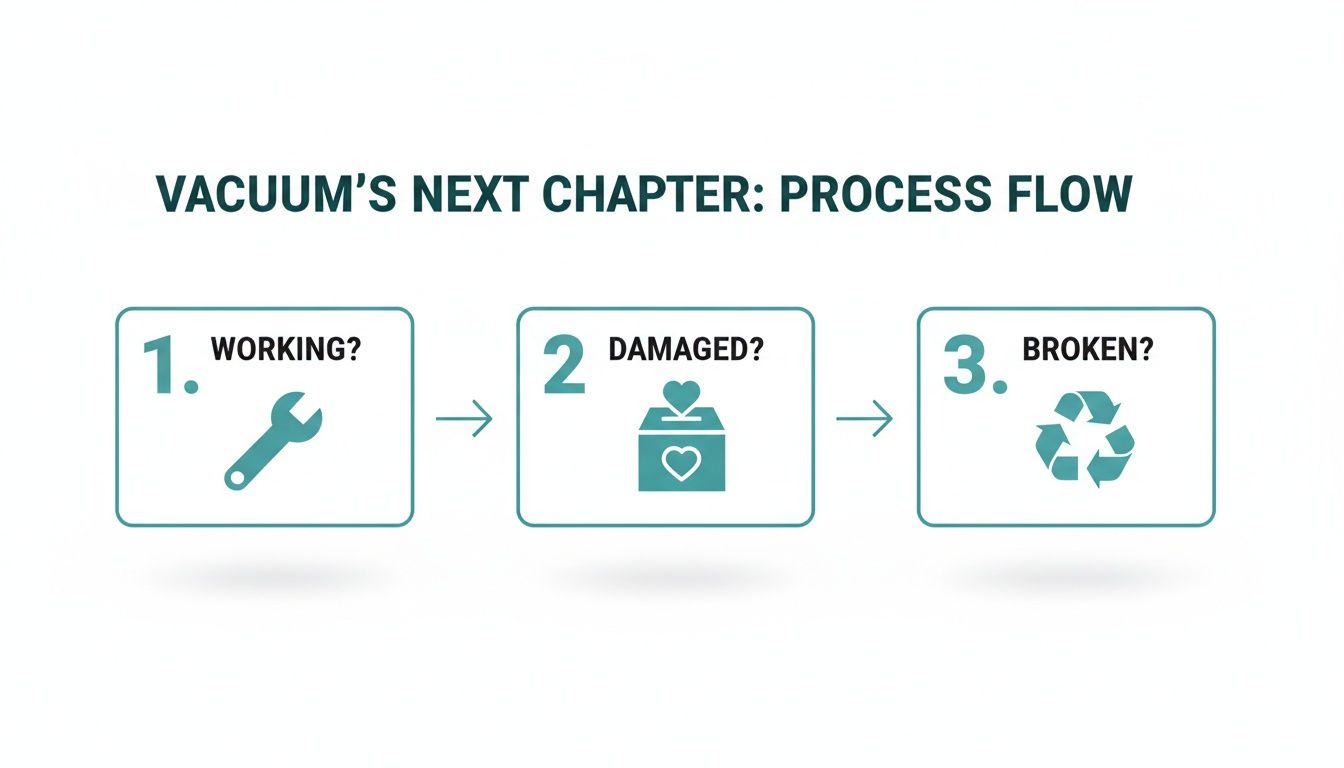
As you can see, even a busted vacuum has a destination beyond the landfill. That’s the whole point. Every part you separate makes the entire recycling process smoother and more successful.
The Most Important First Step
First things first: if your vacuum is cordless, you absolutely must remove the battery. I really can't say this enough. These batteries, especially the lithium-ion ones you find in newer models, are a massive fire hazard at recycling facilities. They are tiny bombs waiting to go off. They can literally explode when crushed, putting workers in real danger and causing catastrophic damage.
It’s a simple but vital safety step you have to take. Once you’ve popped it out, that battery needs to go to a separate, designated recycling spot. You can check out my guide on how to recycle batteries in Chicago to find the right place for it.
Do It for the Next Person in Line
Next, please, do everyone a solid and empty the dust bag or canister. Think of it as a small act of human kindness for the people who will handle your machine next. Put yourself in their shoes for a second—a clean, empty machine is infinitely easier and more pleasant to process than one packed with three years of dirt, dust bunnies, and pet hair.
I see this as a basic principle of respect, whether we're cleaning a public park or getting an old appliance ready for its next journey. You’re handing it off with care.
Taking a few extra minutes to prep your vacuum is a sign of respect for the recycling process and for the people who make it happen. It’s you being an active participant in the solution, not just another bystander.
Separating for Success
Now for the final touches. This part is surprisingly satisfying, like sorting Lego bricks. It's time to snip the power cord and pull off any obvious metal parts from the main plastic body.
- Snip the Power Cord: Grab a sturdy pair of wire cutters and carefully cut that power cord off right at the base of the machine. The copper inside is incredibly valuable and ridiculously easy to recycle. Coil it up separately so it's a simple grab for the recyclers.
- Separate Metal and Plastic: Look for easily removable metal bits, like a handle or a wand. If you can unscrew or detach them without starting a major battle, do it. The more you separate, the more precious material can actually be recovered and reborn.
Countries that are absolute rock stars at recycling often get there because their products are designed for it from the start. Germany, for example, has become a global leader by hitting a remarkable 75% recycling rate for motor parts. They’ve also brilliantly designed 15% of components for easy disassembly, proving that smart design is the real key to recycling vacuum cleaners the right way. You can learn more from these impressive vacuum cleaner recycling statistics.
Where to Recycle Vacuums in Chicago
Alright, you’ve done the hard part. The battery’s out, the dust bag is gone, and the cord is snipped like an umbilical cord. Your old vacuum is prepped and ready for its final journey, but now you need the destination. So, where in Chicago do you actually take this thing?
Thankfully, our city doesn’t make you wander around aimlessly like a lost tourist. I’m going to make finding a drop-off spot just as easy as finding our next cleanup event.
Your Go-To City-Run Options
Chicago gives its residents free and surprisingly easy spots to drop off all kinds of e-waste, and yes, that absolutely includes your old vacuum. These are your best bet for making sure it gets recycled the right way, by the book.
The city’s Household Chemicals & Computer Recycling Facilities (HCCRF) are permanent sites that welcome a whole range of electronics with open arms. Think of them as the official welcoming stations for your retired appliances. They’re set up specifically to handle these items, ensuring every last bit goes exactly where it’s supposed to. We’ve put together a full list and their hours on our site, so be sure to check out my detailed guide on Chicago recycling centers.
Retail Take-Back Programs
Another great route you can take is using retail take-back programs. Places like Best Buy have some pretty solid recycling programs that make dropping off old electronics incredibly simple, and it often doesn't matter where you bought the item in the first place.
They usually let you bring in up to three items per household each day, and they accept most vacuums—corded, cordless, and even the little robot ones that zip around your floor. It’s a walk-in, walk-out system. I find it’s super convenient if you’re already out running errands.
The Litter Caterpillars Way
For my fellow Litter Caterpillars, our process is built on something beautiful: teamwork. We’re always finding abandoned vacuums during our neighborhood cleanups—I remember one time we pulled five of them, like some strange urban harvest, out of a single alley in Logan Square. Instead of five people making five separate trips, we have a much smarter protocol.
We believe, "If you want to go fast, go alone. If you want to go far, go together." This applies to everything we do, including how we handle the mountains of e-waste we find. Teamwork turns a mind-numbing chore into a shared mission.
Our method is simple:
- We pick a central collection spot for all e-waste we find during a cleanup.
- Everything gets piled up there—broken vacuums, old monitors, you name it.
- At the end of the event, one or two volunteers with cars make a single, efficient trip to the recycling facility.
This saves everyone time and gas, turning the logistics of recycling into just one more way we support each other. It’s not just about cleaning up the block; it’s about finishing the job responsibly, together.
And this work is getting more critical every single day. The world is on track to produce over 74 million metric tons of e-waste by 2030, which is a staggering, almost unimaginable number. With the robotic vacuum market alone growing at 10.5% a year, this problem is only getting bigger, faster. This makes the mission of groups like ours—to pull these exact items out of landfills—more vital than ever before. You can read more about these trends and their impact on e-waste on VacuumWars.com. Your single act of recycling is part of a much bigger, much more important movement.
Why This Small Act Matters So Much
I get it. I really do. Tossing an old vacuum can feel like a tiny, insignificant act in the grand scheme of things. But I need you to understand that your choice here is part of something so much bigger. It creates a ripple effect that you can’t see but is powerfully real.
When a vacuum gets dumped in a landfill, it doesn't just sit there and disappear. Its plastic body, that complex motor, all the little bits of electronics—they start to break down and slowly, insidiously, leach all sorts of nasty stuff into our soil and our groundwater. That one appliance becomes a long-term problem for the earth we all have to live on.
I’ve seen this with my own two eyes. We pull so much e-waste out of neglected lots, and you can almost feel the ground sighing in relief when it’s finally gone.
The Coming Wave of Waste
And this problem is about to get a whole lot bigger. The global vacuum cleaner market is projected to swell to an unbelievable USD 31.04 billion by 2033. Just let that sink in. Millions upon millions of new vacuums will be sold, which means millions more will be thrown out, every single year.
Right now, vacuums make up about 1.5% of all e-waste, but that number is only going to climb. You can read more about what this boom means for our environment in the full research from Straits Research.
When you choose recycling vacuum cleaners, you’re personally building a dam against that rising tide of waste. You are actively stopping those chemicals from ever touching Chicago’s soil.
Your Drop in the Bucket Matters
It reminds me of the day Litter Caterpillars started. I remember it so clearly, like a photograph burned into my mind. There were just three of us, caught in a freak Chicago hailstorm, feeling ridiculously, laughably small. Just three people trying to clean an entire city. What difference could we really make?
But we just kept showing up. Week after week. Come rain, shine, or hail.
Now, years later, I see the incredible, breathtaking impact we have when we all decide to do something. It’s never been about one person doing everything; it's always been about everyone doing their part. That’s how we’ve managed to clean up so much of our city.
Your decision to recycle that old vacuum is exactly like that. It’s your own personal contribution to a cleaner Chicago and a healthier planet. You aren't just getting rid of junk; you're casting a vote for a better future.
Trust me when I tell you this: your small act matters more than you will ever know.
A Few Questions I Get All The Time
You’ve got questions. After years of hauling every kind of junk imaginable out of every alley in Chicago, trust me, I've got answers. When it’s time to finally say goodbye to an old vacuum, a few worries always seem to bubble to the surface. Let's get right into it.
It reminds me of when a new volunteer shows up to a cleanup, a little hesitant, not sure what to do but wanting so badly to do the right thing. My job is to cut through the confusion and give them a clear, simple mission. That's what I'll do for you right now.
Can I Just Ditch My Vacuum on the Curb for Bulk Pickup?
I know it’s the easiest thing to do. I get the temptation. But please, I'm asking you, don't. In Chicago, vacuums are classified as e-waste, and they absolutely cannot go out with the regular trash. Leaving it on the curb is just a one-way ticket to the landfill, plain and simple.
Think about it this way: that vacuum sitting on the sidewalk is just another piece of ugly, depressing litter. It adds to the neighborhood blight that we at Litter Caterpillars fight against with our bare hands every single week. It’s the visual noise that makes a place feel forgotten and unloved.
Taking it to a proper facility is a small effort with a huge payoff. It’s the difference between being part of the problem and being part of the solution. Choose to be the solution.
Are the Hoses and Attachments Recyclable?
This one’s a little messy. Most of the time, the answer is no. Those flexible, bendy hoses and weird-shaped plastic tools are usually made of mixed materials that recycling centers just can’t handle. It’s like trying to recycle a burger with the wrapper still on; it just gums up the works for them.
Your best bet is to ask the specific drop-off spot you’re headed to. But here’s a better idea I've seen work miracles: if the parts are still in decent shape, throw them up for free on a local Buy Nothing group or Facebook Marketplace. You’d be shocked who needs that exact crevice tool you were about to chuck. It's all about keeping things out of the ground, piece by piece.
What if I Find an Abandoned Vacuum During a Cleanup?
Now we’re talking! This is our bread and butter. When you’re out with us and we come across a busted, abandoned vacuum, the first rule is always safety. Don't be a hero and try to drag it with you for the next two hours.
We have a simple, effective system for recycling vacuum cleaners we find on the streets:
- Set a collection point. We pick a spot for all the e-waste we find—vacuums, dead TVs, ancient microwaves, you name it.
- Haul it all together. Everything gets piled up in that one spot as we clean the area.
- Make one big run. At the end, a couple of volunteers with a car will load it all up and take it to the nearest e-waste center.
It's all about teamwork. That abandoned piece of junk on the corner becomes a successful team mission. We're not just picking up trash; we're seeing it through to its final, responsible resting place. Together.
At Litter Caterpillars, we turn the chore of cleaning into an act of community and personal growth. If you’re ready to make a real difference in Chicago and find your people, join us for our next cleanup.