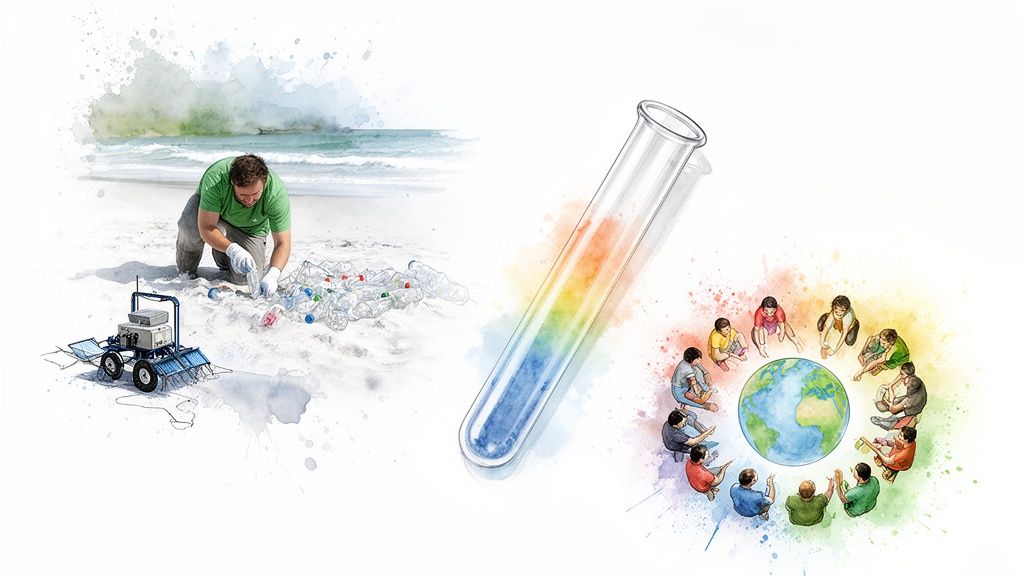
Have you ever stood on a beach, looked out at the vastness of the water, and felt a pit in your stomach thinking about all the trash out there? I have. It's easy to feel overwhelmed. You might think one person can't possibly make a difference against such a massive problem. I know that feeling because I used to let messes pile up in my own life, in my own apartment. Each little piece of clutter felt like it weighed 500 pounds. It was tied to a memory, a failure, a past I couldn't move on from.
Then I realized something powerful. Sometimes, cleaning up someone else's mess is way easier than cleaning up your own. It connects you to something bigger. It gives you a sense of control, of purpose, that you can bring back into your own world. This journey isn't about guilt. It’s not about impossible perfection. I want you to find your power, with me, and realize that every piece of litter we pick up in our neighborhood is a direct action. It's an action toward protecting the oceans we all depend on.
In this guide, we're not just going to stare at the problem. We are going to dive headfirst into 10 real, tangible solutions for pollution in the oceans. We'll explore everything from massive technological projects cleaning the high seas to the simple, brave act of showing up with a trash bag in your own community. This is your playbook. It’s for making a real, measurable impact, starting today. Let's get to work.
1. Ocean Cleanup Technology & Autonomous Collection Systems
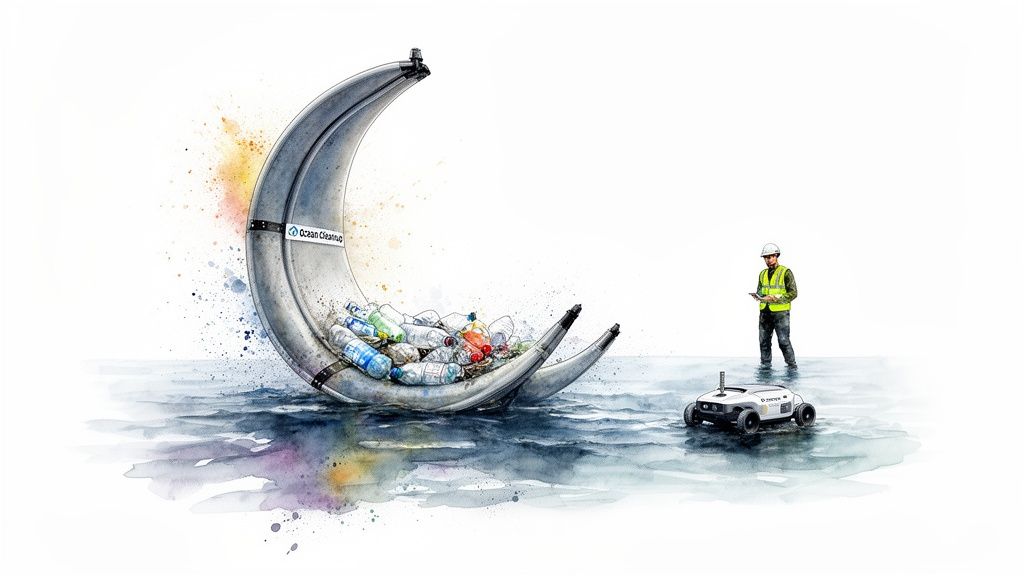
Imagine a giant, robotic arm. It reaches out into the vast ocean, gently sweeping up the plastic waste that chokes our marine ecosystems. This isn't science fiction. It's the reality of large-scale ocean cleanup technology. Visionaries like Boyan Slat and The Ocean Cleanup have developed massive, floating systems designed to navigate the ocean's great garbage patches. They use natural currents to concentrate and capture debris without harming wildlife.
These innovative systems are one of the most direct and ambitious solutions for pollution in the oceans. They act like a large-scale filter, passively collecting everything. Big fishing nets (ghost gear). Tiny microplastics. All of it, accumulated for decades in oceanic gyres. The captured plastic is then returned to shore, where we can recycle and repurpose it. We can turn a global problem into a potential resource.
Why It's a Game-Changer
This approach tackles the pollution that's already out there. It’s the "legacy" plastic that has escaped our coastlines and rivers. While prevention is crucial, you and I can't ignore the millions of tons of plastic already swirling in our seas. These technologies represent a powerful cleanup crew. They work 24/7 in the most remote parts of the world where manual cleanup is impossible.
The technology isn't just for the high seas. Scaled-down versions like The Ocean Cleanup's Interceptor™ are deployed in major rivers in Jakarta and Bangkok. Think of these autonomous barges as sentinels. They stand guard, catching plastic waste in rivers before it can ever reach the ocean.
How You Can Get Involved
You don't need to build your own ocean-sweeping robot to make a difference. Here’s how you can support this technological wave:
- Support & Advocate: I want you to follow and donate to organizations like The Ocean Cleanup. Your support helps fund research, deployment, and operations.
- Focus Upstream: Advocate for interceptor technology in your local rivers. Most ocean plastic starts in a river, so stopping it at the source is incredibly effective.
- Volunteer for Data: You can connect with local environmental groups that partner with research initiatives. Help collect and document plastic waste data from local waterways. You'll provide valuable information that guides where these technologies are needed most.
2. Single-Use Plastic Bans & Extended Producer Responsibility (EPR) Policies
Imagine your bathtub is overflowing. You wouldn't just keep mopping up the floor forever, would you? Of course not. You'd turn off the tap. That's the power of strong environmental policy. Banning single-use plastics and implementing Extended Producer Responsibility (EPR) are two of the most effective ways we can stop ocean pollution at its source. We shift the responsibility from us, the consumers, to the corporations that create the waste in the first place.
These policies are powerful solutions for pollution in the oceans because they fundamentally change the system. EPR makes manufacturers financially and logistically accountable for their products from creation to disposal. When companies have to pay for the cleanup of their plastic packaging, a funny thing happens. Suddenly, they are motivated to design less wasteful, more recyclable, and ocean-friendly alternatives. This is prevention on a massive, global scale.
Why It's a Game-Changer
While cleanup tech is crucial for what's already out there, policy changes prevent the problem from getting worse. We see this in action globally. The European Union's Single-Use Plastics Directive has phased out items like plastic cutlery and straws. California's bold EPR laws are forcing producers to rethink packaging. It’s a systemic fix. It reduces the amount of plastic produced, which means less can ever find its way into our rivers and seas.
This isn't about taking away convenience; it’s about inspiring innovation. When a city or country bans plastic bags, it creates a market for reusable totes. When a corporation is responsible for its plastic bottles, it invests in better recycling systems or plant-based materials. I see policy creating a ripple effect of positive change that protects our blue planet for generations.
How You Can Get Involved
Your voice is more powerful than you think. You can champion these policies right in your own community and help turn off the plastic tap for good.
- Champion Local Legislation: I want you to organize or join a letter-writing campaign to your local and state representatives. Advocate for specific policies like bag bans, foam container restrictions, or comprehensive EPR frameworks.
- Educate Your Community: Host an event at a local library or community center. Explain the direct link between the litter in your neighborhood and the health of the world's oceans. Show people how their actions and advocacy can make a global impact.
- Support Responsible Businesses: Use your purchasing power. I encourage you to support and promote local businesses that have already ditched single-use plastics. When others see their success, it builds momentum for wider change.
3. Wastewater Treatment & Microplastic Filtration Systems
Think about the water that goes down your drain. Every time you do laundry or wash your face. It seems to just disappear, right? But it carries an invisible threat: microplastics. These tiny fibers from our synthetic clothing and microbeads from cosmetics flow straight into our water systems. Eventually, they reach the ocean. But what if we could stop them at the source?
Advanced wastewater treatment and filtration systems are one of the most powerful frontline solutions for pollution in the oceans. They act like a city-sized sieve. They catch these microscopic plastic particles before they ever enter our rivers and seas. These facilities use cutting-edge technologies. Ceramic membrane filtration. Activated carbon. UV treatment. All to remove particles smaller than the width of a human hair.
Why It's a Game-Changer
This solution tackles the invisible, insidious flow of microplastics that traditional systems miss. Beach cleanups are vital, I know, but they can’t catch particles this small. By upgrading our municipal water treatment plants, we can shut off a massive, continuous source of plastic pollution. Cities like Amsterdam and Stockholm are pioneering these efforts. They're integrating microplastic capture into their public infrastructure. Germany's advanced wastewater standards and Singapore's NEWater facilities prove that this level of filtration isn't just possible. It's scalable.
This upstream approach prevents the problem from ever reaching the ocean. It protects everything from plankton to whales from ingesting plastic. It’s a systemic fix that works silently in the background, 24/7, safeguarding marine life on a massive scale.
How You Can Get Involved
You don’t need an engineering degree to push for cleaner water in your community. Here’s how you can make an impact:
- Advocate for Upgrades: I suggest you partner with local environmental groups to lobby your municipal water department. Ask about their current microplastic filtration capabilities. Advocate for adopting new technologies.
- Raise Awareness: Host community events or create online campaigns focused on microplastic sources like synthetic clothing and cosmetics. Many people I talk to don't know the connection between their fleece jacket and ocean pollution.
- Host a Clothing Swap: Organize a clothing swap event in your neighborhood. This encourages reusing clothes and reduces the demand for new synthetic textiles, which are a primary source of microplastic fibers.
4. Marine Protected Areas (MPAs) & Ocean Sanctuary Policies
Picture a national park. But instead of mountains and forests, it’s a vast, underwater world teeming with life. This is the vision behind Marine Protected Areas (MPAs) and ocean sanctuaries. We designate these zones to give fragile marine ecosystems a chance to heal, free from the pressures of human activity. Championed by legends like Sylvia Earle, these "hope spots" are a powerful tool you and I can use to shield our oceans from further harm.
Establishing these sanctuaries is one of the most vital solutions for pollution in the oceans. How do they work? They restrict or prohibit activities like commercial fishing, oil drilling, and shipping. This prevents new pollutants from entering and allows damaged habitats, from coral reefs to kelp forests, to recover. By creating these safe havens, we give marine life the breathing room it needs to bounce back. We create more resilient ecosystems that are better equipped to handle global stressors.
Why It's a Game-Changer
While cleanup technologies remove existing trash, MPAs are about prevention and recovery on a massive scale. They are a promise I make to future generations that some parts of our blue planet will remain wild and pristine. These protected areas, like the massive Palau National Marine Sanctuary or Australia's Great Barrier Reef Marine Park, become living laboratories. They become vibrant nurseries for countless species, with benefits that spill over into surrounding waters.
This isn't just a far-off concept for remote oceans. I believe protecting our local waterways, like the Chicago River or Lake Michigan, is directly connected to the health of the global ocean. By safeguarding our freshwater sources, we prevent pollution from ever starting its journey downstream.
How You Can Get Involved
You can become a guardian for these underwater parks, no matter where you live. Your voice and your actions can help create and expand these critical sanctuaries.
- Champion Local Waters: Advocate for stronger protections for your local rivers and lakes. I urge you to connect with groups working to preserve freshwater ecosystems, emphasizing that all water is connected.
- Support the Protectors: Follow and donate to organizations like The Nature Conservancy or the World Wildlife Fund (WWF). They lead the charge in establishing and managing MPAs worldwide.
- Host an Awareness Event: You can organize a film screening of a documentary about ocean sanctuaries or partner with a local aquarium for an educational event. Highlighting the beauty of what we stand to lose is a powerful motivator for change.
5. Beach & Coastal Cleanup Programs with Data Collection
Picture a shoreline. Not littered with plastic bottles and discarded fishing gear. Instead, imagine it lined with volunteers of all ages working together. They aren't just picking up trash. They are environmental detectives. They document every single item they find. This powerful combination of community action and citizen science is the heart of modern beach and coastal cleanup programs.
These initiatives are one of the most hands-on and impactful solutions for pollution in the oceans. Organizations like the Surfrider Foundation and global events like Coastal Cleanup Day transform a simple act of tidying up into a massive data-gathering operation. Using apps and standardized protocols from groups like the NOAA Marine Debris Program, you and I can record the types and quantities of waste. We can create a clear picture of what's washing ashore and where it's coming from.
Why It's a Game-Changer
This approach does more than just clean a beach for a day. It builds a powerful case for long-term change. The data collected by thousands of volunteers like you provides undeniable evidence for policymakers and corporations. It shows which companies produce the most frequently found items. It identifies local pollution hotspots. This leads to targeted policies like plastic bag bans or improved waste management systems.
This blend of action and information empowers us. When you see charts showing the tons of waste your group has removed, you feel a real sense of accomplishment. I know I do. It turns the overwhelming problem of ocean pollution into a tangible, local fight you can win, one piece of data at a time. It’s a ground-up movement creating top-down change.
How You Can Get Involved
Joining a cleanup is one of the most direct ways I know to protect our oceans. You can see the immediate difference you make while contributing to a global cause.
- Join a Local Chapter: Find a local chapter of an organization like the Surfrider Foundation or look for events on Coastal Cleanup Day. They provide the supplies and training you need.
- Turn Your Walk into Data: Use an app like Clean Swell® to log the trash you collect on any beach walk. You become a citizen scientist every time you head to the coast.
- Organize Your Own Event: You don't need a huge organization to start. I want you to gather some friends, grab some bags, and get to work. Learn more about how to start your own volunteer trash pickup in our guide.
6. Circular Economy & Plastic Recycling Infrastructure Development
What if we stopped thinking of plastic as “waste”? Imagine a world where every bottle, container, and wrapper has a future life. It circles back endlessly into useful products instead of ending up in the ocean. This is the heart of a circular economy. It’s a system I believe in, designed to eliminate waste by keeping materials in a continuous loop of use and reuse. It’s one of the most fundamental solutions for pollution in the oceans because it tackles the problem at its very source: our throwaway culture.
This model is about more than just your recycling bin. It involves redesigning products so we can easily disassemble and recycle them. It means investing in advanced sorting technologies like those from TOMRA that use AI to separate plastics. It's about creating strong markets for recycled materials. Pioneers like the Ellen MacArthur Foundation are championing this global shift, proving that we can decouple economic growth from resource consumption.
Why It's a Game-Changer
A circular economy is the ultimate preventative measure. By designing waste out of the system, we drastically reduce the volume of new plastic being produced. We reduce the amount that can leak into the environment. When a company like Patagonia creates jackets from recycled bottles or Interface manufactures carpet from old fishing nets, they’re not just cleaning up. They’re building a new, sustainable economic model that makes pollution obsolete. It closes the loop. It turns a linear path to the landfill or ocean into a circle of value.
This systemic approach requires big thinking. National policies like Kenya's plastic bag ban. City-level roadmaps like those in Amsterdam. It challenges you and me to see every piece of plastic not as trash, but as a valuable resource waiting for its next chapter.
How You Can Get Involved
You can become an architect of the circular economy right in your own community. Here’s how you can help build this regenerative future:
- Champion Repair & Upcycling: I want you to organize or attend community repair workshops. Teach others how to fix electronics, mend clothes, or upcycle old furniture. You can extend the life of products and reduce waste.
- Advocate for Better Infrastructure: Urge your local representatives to invest in modern recycling facilities. Ask for more transparency about where your city's recycling actually goes. Support policies that improve sorting and processing.
- Vote with Your Wallet: You should support businesses that use recycled materials and design for circularity. Look for products made from post-consumer content and celebrate brands that take responsibility for their products' end-of-life.
7. Fishing Net Recovery & Ghost Gear Removal Programs
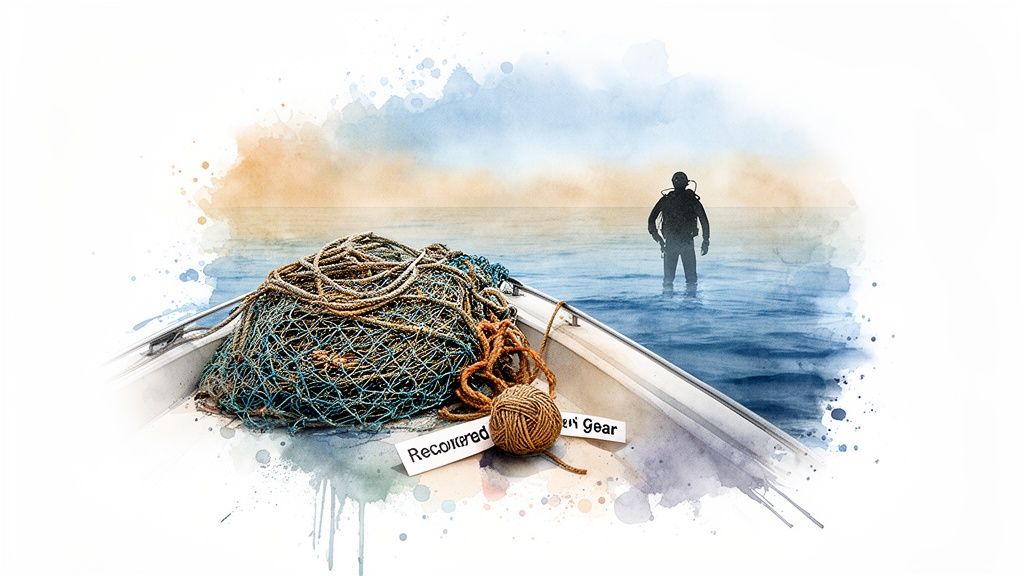
Picture a silent, invisible killer lurking beneath the waves. It’s not some mythical sea monster. It's a lost or abandoned fishing net, which I call "ghost gear." These nets drift for decades. They mindlessly trap and kill dolphins, turtles, seals, and countless fish. Thankfully, a dedicated fleet of modern-day ghost hunters is tackling this deadly problem head-on.
These specialized programs are one of the most critical solutions for pollution in the oceans because they target the deadliest form of plastic pollution. Ghost gear makes up around 10% of all ocean plastic, and it's designed to catch and kill. Organizations like Healthy Seas and Ghost Fishing deploy teams of skilled volunteer divers. They locate, document, and carefully remove these tangled webs of death from reefs and shipwrecks, restoring safety to fragile marine habitats.
Why It's a Game-Changer
This approach is about more than just cleanup; I see it as an underwater rescue mission. By removing a single large net, you can save thousands of marine animals over many years. It directly addresses a lethal threat that continues to harm wildlife long after it has been lost. These initiatives also close the loop. They partner with companies to recycle the recovered nylon nets into new products like swimwear, carpets, and socks. They transform waste into value.
The impact is immediate and visible. When you see a ghost net pulled from a coral reef, the ecosystem can begin to recover almost instantly. Groups like Sea Shepherd Conservation Society document these removals, showing us the tangible difference that focused, direct action can make.
How You Can Get Involved
You don't have to be a deep-sea diver to join the hunt for ghost gear. Your support on land is just as vital to the success of these underwater operations.
- Support the Divers: Donate to organizations like Ghost Fishing or Healthy Seas. Your contributions help fund dive missions, purchase specialized equipment, and cover logistical costs.
- Raise Your Voice: I want you to share documentaries and stories about ghost gear on social media. The more people understand the problem, the greater the pressure on the fishing industry to adopt better gear tracking and recovery practices.
- Choose Consciously: When you buy seafood, ask about the fishing methods used. Support fisheries that are actively working to prevent gear loss and participate in recovery programs. Your consumer choices can drive industry-wide change.
8. Corporate Accountability & Supply Chain Sustainability Initiatives
Imagine a world where the price tag on a product told its whole story. Not just the cost in dollars, but its cost to our planet. This is the core idea behind corporate accountability. It’s about shifting responsibility for ocean pollution from just us, the consumers, to the companies that design, produce, and sell the goods that too often end up in our waterways.
These initiatives are one of the most fundamental solutions for pollution in the oceans because they tackle the problem at its source. By demanding transparency and sustainability throughout a product's entire life cycle—from sourcing raw materials to its final disposal—we can prevent pollution from ever being created. Programs like B-Corp certification or standards set by organizations like Ocean Wise hold companies to a higher standard. They reward those who I see prioritizing planetary health over pure profit.
Why It's a Game-Changer
This approach turns the entire system on its head. Instead of just cleaning up the mess, it stops the mess from being made. When a company like Patagonia invests in Fair Trade Certified practices or Unilever commits to a Sustainable Living Plan, it creates a ripple effect. It forces competitors to reconsider their own environmental impact. It empowers you and me to vote with our wallets for a healthier ocean.
Accountability initiatives are not just about shaming bad actors. They are about celebrating and supporting the leaders. They provide a clear roadmap for businesses to do better. They give us, the public, the tools to see who is genuinely committed. You can explore a wide range of inspiring corporate social responsibility examples on littercaterpillars.com to see how this looks in action.
How You Can Get Involved
You hold immense power as a consumer and a citizen. You can directly influence the corporations that shape our world. Here’s how you can put that power to work:
- Shop Your Values: Support businesses with certifications like B-Corp or those transparent about their supply chains. I want you to read labels and ask questions before you buy.
- Use Your Voice: Join consumer campaigns led by groups like Greenpeace that target major polluters. A simple tweet, an email, a signature on a petition—these can be part of a massive wave of public pressure.
- Celebrate the Good Guys: Organize a "sustainable business spotlight" in your community. When you find a local shop or brand doing things right, share their story on social media and with your friends. I believe positive reinforcement encourages more businesses to follow suit.
9. Education & Behavioral Change Programs (School & Community-Based)
Picture a classroom of children. Their eyes are wide as they learn about the journey of a sea turtle. Or imagine a community coming together to transform a local park into an "Ocean Friendly Garden." These aren't just feel-good activities; they are powerful engines of change. I believe comprehensive educational initiatives are designed to reshape our understanding of ocean health and inspire the behavioral shifts necessary to protect it.
These programs are foundational solutions for pollution in the oceans because they tackle the problem at its root: human behavior. By weaving compelling stories and hands-on experiences into school curricula and community workshops, they move you and me from passive awareness to active environmental stewardship. Organizations like National Geographic and programs such as Ocean Wise are bringing the ocean's story into our daily lives, making the distant problem of marine pollution a personal and local one.
Why It's a Game-Changer
While technology cleans up existing messes, education prevents future ones. It's the difference between constantly bailing water out of a sinking boat and teaching everyone how to fix the leak. When a child learns how a single plastic bag can harm marine life, they become a lifelong advocate for reusable bags. When a neighborhood participates in a Plastic-Free July challenge, it creates a ripple effect of conscious consumption that reduces waste at the source.
These programs don't just lecture; they empower. The Surfrider Foundation’s Ocean Friendly Gardens program, for example, teaches communities how to create landscapes that reduce urban runoff, a major source of ocean pollution. I see this transforming abstract knowledge into tangible, local action, proving that protecting the ocean can start right in your own backyard.
How You Can Get Involved
You can become a powerful catalyst for change by bringing ocean education into your community. Here’s how you can start:
- Bring the Ocean to School: I encourage you to partner with local schools to integrate environmental curriculums like Project WILD or Project Learning Tree. You can volunteer to lead a session or help teachers find resources.
- Start a Community Challenge: Launch a "plastic-free" challenge in your neighborhood or workplace. Use social media and short videos to share tips, celebrate successes, and build a sense of collective achievement.
- Host an Event: Organize a family-friendly educational event. A documentary screening (think David Attenborough!) followed by a discussion, or a workshop on creating zero-waste home products. I want you to make learning fun and accessible for all ages.
10. Plastic Reduction & Prevention at Source (Industrial Design & Materials Innovation)
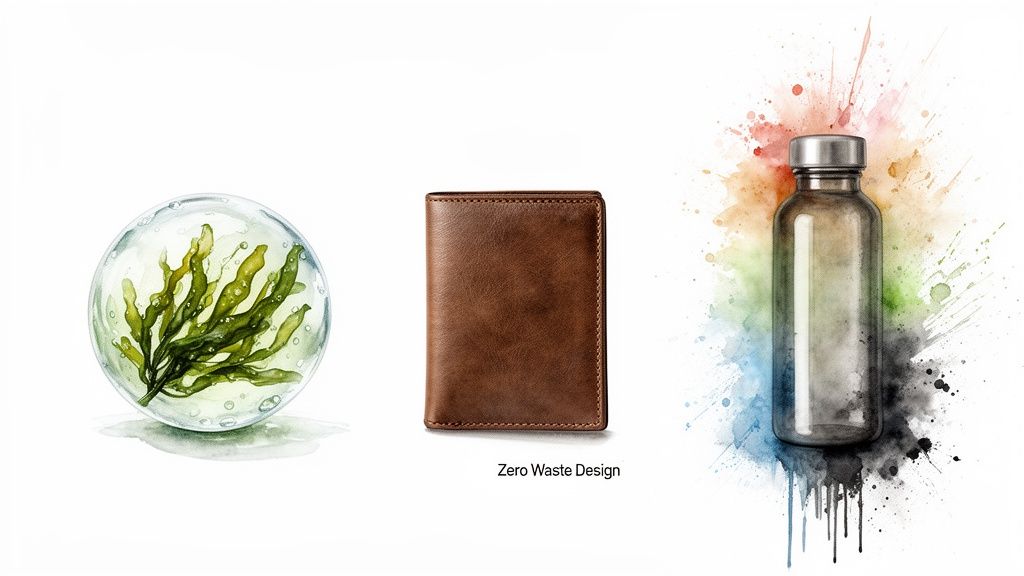
What if we could stop plastic pollution before a single wrapper or bottle is even made? This is the powerful idea behind redesigning our products and materials at their source. Instead of just cleaning up the mess, brilliant designers and scientists are changing the game. They create products that don't need plastic in the first place. They invent entirely new, ocean-safe materials.
These forward-thinking approaches are among the most profound solutions for pollution in the oceans because they tackle the problem at its root. Imagine edible water pods made from seaweed, like those from Notpla. Or stylish accessories crafted from mushroom leather by innovators like Ecovative Design. This isn't about compromise. It's about innovating our way to a cleaner future by making waste obsolete from the very beginning.
Why It's a Game-Changer
Source reduction is the ultimate form of prevention. Every product redesigned to eliminate plastic is one less potential piece of litter that you or I need to collect from a beach or river. Companies like Unilever and P&G are embracing this with refillable product lines. Pioneers like Patagonia have long championed sustainable materials. This systemic shift turns off the plastic tap, rather than just mopping up the floor.
This isn't just about the stuff you buy. It's happening in tech, with companies like HP reducing plastic in printer cartridges. Even in automotive manufacturing. The core principle, which I see championed by organizations like the Ellen MacArthur Foundation, is a move toward a circular economy. A world where we reuse, repurpose, or safely return materials to nature, ensuring they never become pollution.
How You Can Get Involved
You can be a powerful force for change. Use your consumer voice and creativity to champion smart design. Here's how you can start:
- Vote with Your Wallet: Choose products from companies committed to reducing plastic. I want you to support businesses that use innovative, sustainable packaging and tell them why you chose them.
- Host an "Innovation Spotlight": Organize a small local event or a social media campaign highlighting businesses that are getting it right. Showcase products that use alternative materials and celebrate their commitment.
- Advocate for Better Design: Encourage your favorite brands to adopt plastic-free alternatives. A single, thoughtful email or social media post from you can spark a conversation within a company's design team. Explore more strategies for how to reduce plastic pollution on littercaterpillars.com.
10-Point Comparison: Ocean Pollution Solutions
| Solution | 🔄 Implementation complexity | ⚡ Resource requirements | 📊 Expected outcomes | 💡 Ideal use cases | ⭐ Key advantages |
|---|---|---|---|---|---|
| Ocean Cleanup Technology & Autonomous Collection Systems | High — advanced engineering, deployment & maintenance | Very high — capital, vessels, AI & skilled ops | High for concentrated macro-debris; limited for finest microplastics 📊 ⭐⭐ | Ocean gyres, river mouths, port/marina interceptors | Autonomous large-scale removal; continuous monitoring; public visibility |
| Single-Use Plastic Bans & Extended Producer Responsibility (EPR) Policies | Medium–High — legislative design, stakeholder negotiation | Moderate — administrative, enforcement, compliance support ⚡ | Very high long-term source reduction and systemic change 📊 ⭐⭐⭐⭐ | National/state legislation, municipal ordinances, upstream prevention | Prevents pollution at source; drives material innovation; reduces cleanup burden |
| Wastewater Treatment & Microplastic Filtration Systems | High — infrastructure upgrades, retrofitting & monitoring 🔄 | High — treatment plants, filters, operation & maintenance | High for removing microplastics pre-release; reduces ecosystem exposure 📊 ⭐⭐⭐ | Municipal and industrial wastewater systems; household retrofits | Targets invisible microplastics early; retrofit-compatible; protects biota |
| Marine Protected Areas (MPAs) & Ocean Sanctuary Policies | Medium — legal designation, multi-stakeholder coordination | Moderate — enforcement, monitoring, governance resources | High for biodiversity recovery and resilience; not direct debris removal 📊 ⭐⭐⭐ | Biodiversity hotspots, fisheries management, conservation planning | Protects ecosystems; measurable ecological recovery; promotes research |
| Beach & Coastal Cleanup Programs with Data Collection | Low–Medium — volunteer coordination, training & protocols 🔄 | Low — volunteers, basic supplies, simple data tools ⚡ | Moderate immediate debris removal + actionable data for research 📊 ⭐⭐⭐ | Local community engagement, awareness campaigns, citizen science | Visible impact; low cost; builds community and credible datasets |
| Circular Economy & Plastic Recycling Infrastructure Development | High — system redesign, tech integration, market creation | High — sorting plants, processing tech, market-building ⚡ | High long-term diversion from landfills/oceans; economic benefits 📊 ⭐⭐⭐⭐ | Municipal systems, industry partnerships, product redesign programs | Keeps materials in use; creates jobs; reduces virgin plastic demand |
| Fishing Net Recovery & Ghost Gear Removal Programs | High — specialized diving, mapping, safety protocols 🔄 | High — trained divers, vessels, sonar & recovery gear | High local ecological benefit by removing lethal gear 📊 ⭐⭐⭐ | Coastal fisheries, known ghost-gear hotspots, post-storm cleanups | Removes high-impact debris; immediate marine-life protection; material recovery |
| Corporate Accountability & Supply Chain Sustainability Initiatives | Medium — audits, transparency systems, stakeholder engagement | Moderate — auditing, certification, advocacy campaigns ⚡ | High systemic potential if widely adopted; risk of greenwashing 📊 ⭐⭐⭐ | Major brands, suppliers, procurement policies, consumer-facing companies | Leverages market forces; increases transparency; incentivizes reduction |
| Education & Behavioral Change Programs (School & Community-Based) | Low–Medium — curriculum design, outreach consistency 🔄 | Low — educators, materials, community partnerships ⚡ | High long-term cultural/behavioral shift though slow to manifest 📊 ⭐⭐⭐⭐ | Schools, community centers, youth programs, family outreach | Cost-effective; builds stewardship; multiplies volunteer impact over time |
| Plastic Reduction & Prevention at Source (Industrial Design & Materials Innovation) | High — R&D, redesign, regulatory alignment 🔄 | High — R&D investment, manufacturing change, scale-up resources ⚡ | Very high long-term prevention of pollution and systemic change 📊 ⭐⭐⭐⭐ | Product design, packaging industry, manufacturers, material startups | Eliminates source of pollution; spurs innovation; creates sustainable markets |
Your Next Chapter Starts Now
Remember that feeling of being overwhelmed I told you about? That feeling of helplessness. Sometimes it’s easier to just stand by and watch things happen. But I’ve learned something. Showing up, even when it's hard, even when you're suffering a bit, is what adds flavor to life. It’s what advances the plot.
You stop being a bystander. You become the hero of your own story. The ten solutions we've walked through in this article are more than just a list. They are invitations. Invitations for you to be brave. To connect with others. To be a force for transformation.
We've seen the sheer power of human ingenuity. I see it in the form of autonomous collection systems and microplastic filtration technologies. These aren't just gadgets. They are humanity’s response to a crisis, a testament to our ability to innovate our way out of problems we created. But I know technology alone is not a silver bullet. It's one thread in a much larger tapestry.
That's where systemic change comes in. We explored the game-changing potential of policies like Single-Use Plastic Bans and Extended Producer Responsibility (EPR). Imagine a world where the companies producing plastic are also responsible for its end-of-life. That's not a fantasy. It's a structural shift that rewrites the rules of production and consumption. It turns waste from an afterthought into a primary design consideration.
But what can you do? Where does your personal story intersect with this massive global challenge?
It intersects on the ground. In your hands. With your voice. It starts with a simple beach cleanup where you don't just pick up trash, you also collect data. It continues when you support a local business committed to a circular economy. It gains momentum when you advocate for Marine Protected Areas, giving our oceans the breathing room they need to heal.
You don't have to be a scientist or a politician to be a part of these incredible solutions for pollution in the oceans. You just have to be willing to start.
Picking up a piece of litter. Asking your favorite cafe to switch to sustainable packaging. Supporting a company that takes its supply chain seriously. These are all ways you can write a new page in your story. You are not just one person against a tidal wave of pollution. You are a part of a global current of change, and every action you take adds to its force.
Just like a caterpillar, none of us are perfect. I'm certainly not. We're all a bit messy, still figuring things out. But every single one of us is capable of incredible, beautiful change. The journey from a neighborhood street to the vast blue ocean seems impossibly long. But it’s a journey that starts with a single step, a single piece of plastic you pick up from the curb.
So, what's your next move? You don't have to solve everything at once. Just start. Show up. Find your people. The ocean, and your future self, will thank you for it.
Ready to write your first chapter? Join Litter Caterpillars and connect with a community of changemakers turning local action into global impact, one Chicago neighborhood at a time. Find your next cleanup event and start your story with us at Litter Caterpillars.