

The rain had turned the vacant lot into brown soup by the time our crew gathered. Ten volunteers stood around a folding table, trying to choose a cleanup site, set safety rules, and pick a Saturday schedule before the coffee went cold.
Why Group Choices Feel Hard on Volunteer Crews
A volunteer huddle has a different rhythm from a workplace meeting. Nobody clocks in under one boss. People arrive with different experience, different energy, and sometimes different ideas about what “safe” means. A longtime scout may know which alley floods, while a first-time volunteer may notice a broken fence nobody else saw.
That mix helps the crew, but it can also jam the gears. One person wants the South Side lot with the worst litter. Another wants a smaller site that beginners can handle. Someone checks the weather. Someone else worries about transit. Meanwhile, the clock keeps moving and the crew still needs gloves, bags, water, and a starting point.
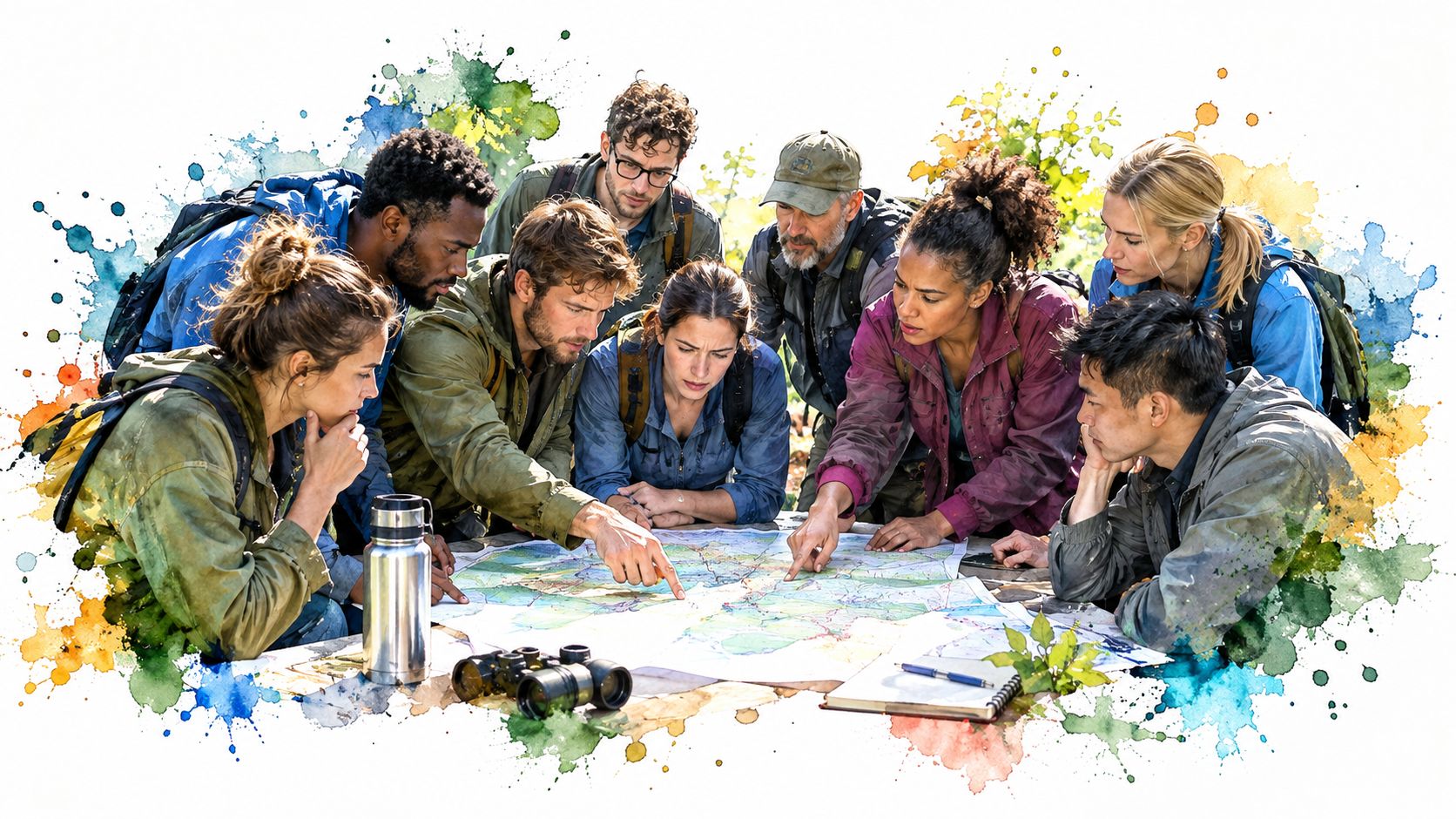
Why volunteers need a clear decision path
Friendship adds another layer. You may hesitate to question a friend's site choice because you don't want to sound difficult. A new volunteer may stay quiet because everyone else seems confident. A safety lead may see a problem but soften the warning until nobody understands how serious it is.
I've learned to treat group decision making as a crew skill, much like sorting sharp objects or tying a full trash bag. You can practice it. You can give it a simple sequence. You can decide in advance which choices need broad agreement, which choices need a vote, and which choices belong with one trained lead.
The research gives us a useful reason to care about that structure. In a review of hierarchical team decisions, team informity, staff validity, and hierarchical sensitivity explained between 25% and 65% of the variance in decision accuracy, while one cited study found team informity alone explained 24% (review of team decision accuracy). In plain language, more people won't automatically produce a better call. The right information must reach the right person, someone must turn field observations into sound advice, and the person with final authority must weigh that advice correctly.
Field rule: Give every decision a method before the discussion gets noisy.
This guide works as a field manual. You'll find a mental model, a method comparison, warning signs, meeting scripts, and short cleanup examples. Use the parts that fit your crew, then adjust them after the next wet Saturday.
What Group Decision Making Really Means
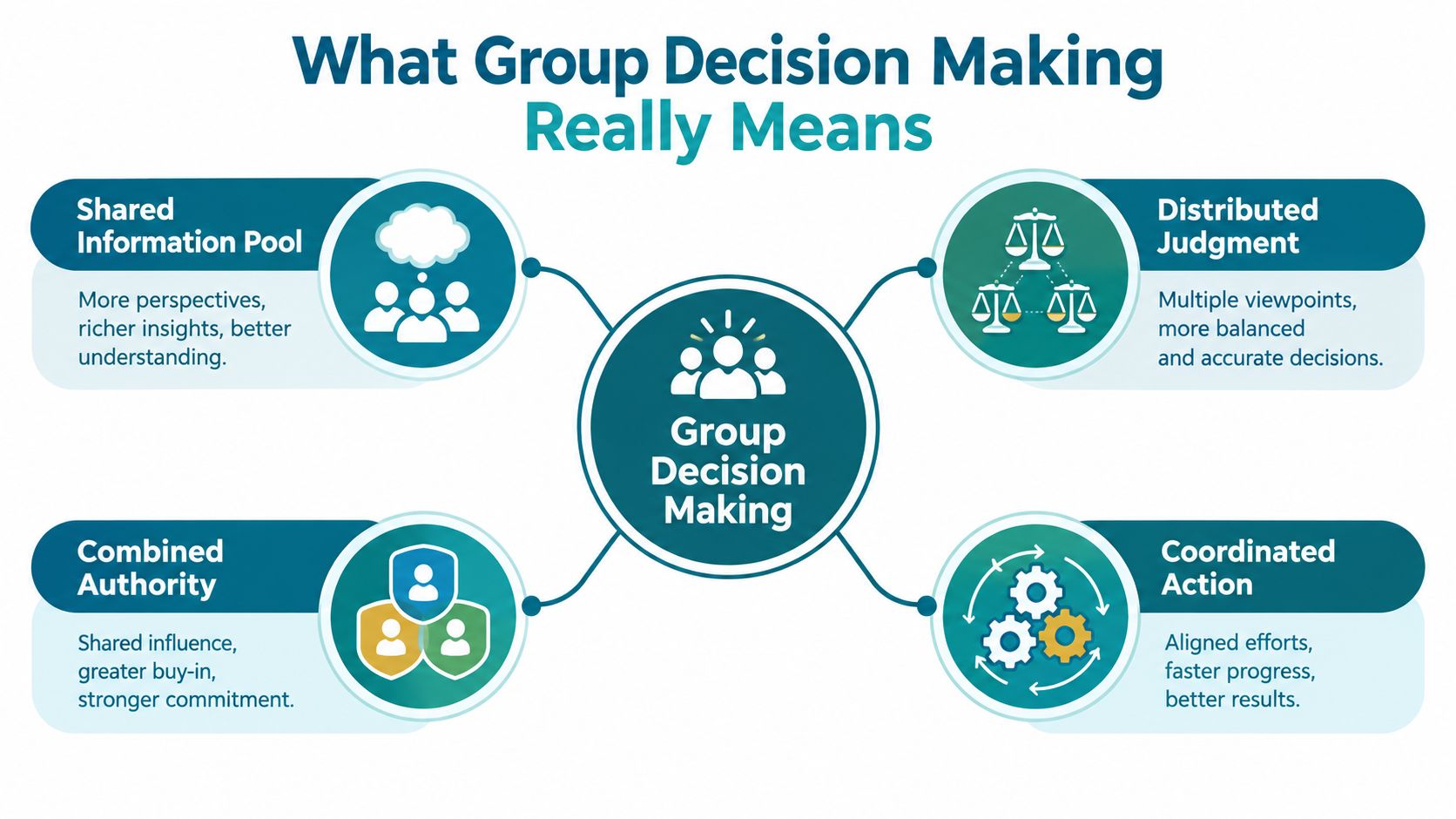
Group decision making means a group gathers information, weighs options, assigns authority, and acts on one choice. That sounds formal, but I see it every time volunteers carry a heavy tarp.
If one person pulls hard, the tarp twists. If three people lift while two people drag, the load swings. The crew moves well when each person shares what they know, listens to the others, and follows a clear call about direction. A decision works the same way.
The information layer
Start with team informity, which means the decision group has access to the information that matters. A scout might report needles near the fence, standing water behind the shed, or a locked gate at the usual entrance. That report only helps if the group hears it before choosing the site.
Use role-specific observations instead of general chatter. Ask the site scout about access. Ask the safety lead about hazards. Ask the scheduler about volunteer availability. Each person brings a different piece of the map.
The judgment layer
Next comes staff validity, the quality of the recommendations people give after they receive and interpret information. A volunteer may see broken glass but still recommend a route that passes directly through it. Another volunteer may connect the hazard to the right action, such as closing that section or adding a tool restriction.
You don't need everyone to become a specialist. You do need people to explain the reasoning behind their advice.
The authority layer
Finally, hierarchical sensitivity describes how well the final decision-maker weighs the information and recommendations from the group. On a volunteer crew, that person might be the safety lead during a storm call or the event lead during a site choice. Authority doesn't erase participation. It tells everyone who makes the final call when time or risk makes full agreement impractical.
A practical decision record can use four questions:
- What do we know? Record direct observations.
- What do we think it means? State the recommendation and its reason.
- Who decides? Name the lead or rule.
- What happens next? Assign the first action.
That model keeps the crew from confusing more voices with better information flow. A large circle can still miss a hazard if nobody reports it clearly or nobody knows who must act.
Five Common Methods Compared and When to Use Each
On a rainy cleanup morning, the crew may need to choose a site, close a path, and set the next workday before anyone has found dry gloves. Each choice calls for a different method. Consensus builds support when local knowledge matters. Majority voting gives a clear result for routine choices. Delegation keeps people safe when waiting would expose them to danger.
I match the method to the decision. A site choice benefits from shared knowledge about access, hazards, and nearby residents. A sudden lightning warning needs a named safety authority. A schedule ranking can use private votes when volunteers have different availability and may not want to defend it aloud.
| Method | How It Works | Speed vs Buy-in | Best Volunteer Use |
|---|---|---|---|
| Consensus | The group discusses options until members can support or accept one choice. | Slower, with strong buy-in. | Site selection when access, safety, and neighborhood knowledge need careful discussion. |
| Majority vote | Members vote, and the option with the most support wins. | Faster, with uneven buy-in. | Choosing among routine dates or locations when the group needs a clear result. |
| Delegated decision | The group gives a lead authority to decide within stated limits. | Fastest, with buy-in tied to trust and follow-up. | Weather calls, hazard closures, equipment limits, and route changes. |
| Delphi | Members give views separately through repeated rounds, often without direct debate. | Slower, with less social pressure. | Planning a recurring schedule when volunteers may hesitate to speak in the room. |
| Multi-voting | Members rank or distribute votes across several options, then the group uses the combined priorities. | Moderate speed, with broad input. | Narrowing several cleanup sites or ranking possible Saturdays. |
Choosing between consensus and voting
Consensus needs a clear rule, or the crew can keep circling the same muddy puddle. Unanimity Minus Two, or U-2, lets a proposal pass when up to two members dissent. The Open Group standards guide describes U-2 for groups of about five to nine people, with U-3 suggested for groups of 10 to 14 and U-4 for groups of 15 to 20 (consensus decision rules).
Majority rule usually moves faster. A comparison of formal decision rules found that majority rule approves proposals more often than unanimity rule within the same group size, while unanimity creates more delay in small and large groups (comparison of majority and unanimity rules). Use the slower agreement process when shared support will affect follow-through. Use a vote when the crew needs a fair, visible result and the stakes allow some members to disagree.
A simple field match keeps the choice practical:
- Use consensus for a site with uncertain hazards.
- Use majority voting for a routine schedule.
- Use delegation for immediate safety.
- Use Delphi when quieter volunteers may hold useful information.
- Use multi-voting when several sites or Saturdays must be narrowed without letting the first loud opinion decide.
Afterward, record the method and result in one sentence. Volunteers who join later can see how the crew chose, not only what it chose.
Hidden Dynamics That Pull Groups Off Course
A friendly huddle can still choose badly. During one rainy cleanup, our crew picked the nearest entrance because a familiar volunteer recommended it. We moved on before checking the flooded gate. A quieter scout already knew the path was blocked, but the discussion ended before that information surfaced.
Research on 37 student decision groups found that groups using a unanimity rule reached more cognitive consensus than groups using a majority rule. Consensus and satisfaction were connected with behaviors such as asking why someone preferred an option, treating other views as legitimate, and using those views in the group's reasoning (study of information exchange and group consensus). Agreement by itself does not make a choice sound. The crew must examine the reasons beneath each view.
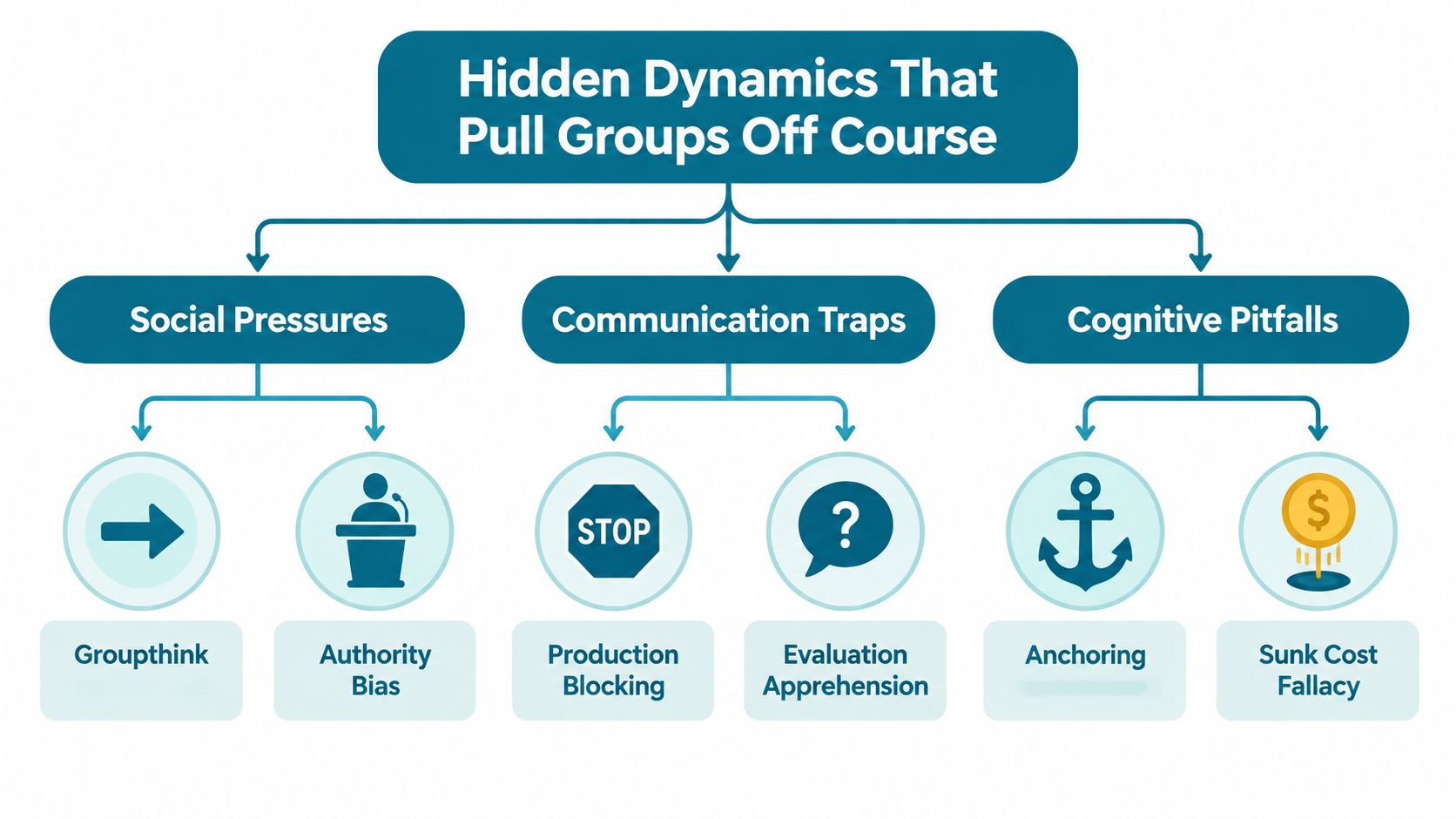
Watch for premature agreement
Listen for “whatever works,” “we always do that,” or “I'm sure the lead knows.” These phrases can signal comfort, but they can also cover uncertainty. Ask, “What could make this choice fail?”
Give a dissenting volunteer a reason to explain, not a reason to retreat. Say, “Tell us what you're seeing,” then leave room for an answer. Structured turn-taking helps quieter people contribute because the fastest speaker no longer controls the whole conversation. On a high-turnover crew, that pause may reveal a hazard known only by someone who arrived last week.
More participation doesn't guarantee a better call
A 2025 randomized experiment with 1,475 participants in 281 five-person groups found that an LLM facilitator increased information sharing and raised the minimum engagement level, yet did not significantly improve the final decision compared with no facilitation (2025 randomized facilitation experiment). For a volunteer lead, the warning is practical. More airtime can improve the process while leaving the final choice unchanged.
Before a vote, ask whether the crew has combined the information or merely collected it. Name the strongest argument for each option, then identify the fact that could disprove it. If the decision concerns a flooded route or unstable bank, keep checking until the safety evidence is clear. For a routine snack order, delegation may be enough.
Diversity can slow the crew
Different backgrounds and experiences can improve decision quality, while differences in perspective can slow execution and reduce commitment. A 2025 social-science study reported a positive effect of team diversity on decision quality alongside a “social categorization tax” that delayed execution and reduced team commitment. The quality effect was strongest when psychological safety was high (study of diversity, decision quality, and execution).
On a volunteer crew, match the discussion to the risk. Use consensus for a site hazard or route affecting inexperienced volunteers. Let one person handle a minor supply choice. Use a quick check-in when weather changes, and explain the safety reason behind the call so a rotating crew can accept it.
If disagreement continues after the practical choice is clear, use this conflict resolution guide for volunteer groups instead of asking a pre-work huddle to settle every relationship issue.
Here's a short visual reminder before the next discussion:
Facilitation Frameworks and Meeting Scripts You Can Run
On a rainy Saturday, I have watched a confident volunteer fill the whiteboard while three quieter people kept their best safety observations to themselves. A fixed process gives every voice a place, especially on crews with high turnover and little formal authority. I often use the Nominal Group Technique when a crew has many ideas or strong personalities. Its five steps are to define the problem, generate ideas without speaking, share them in a round-robin, discuss the list, and vote privately (Nominal Group Technique guide).
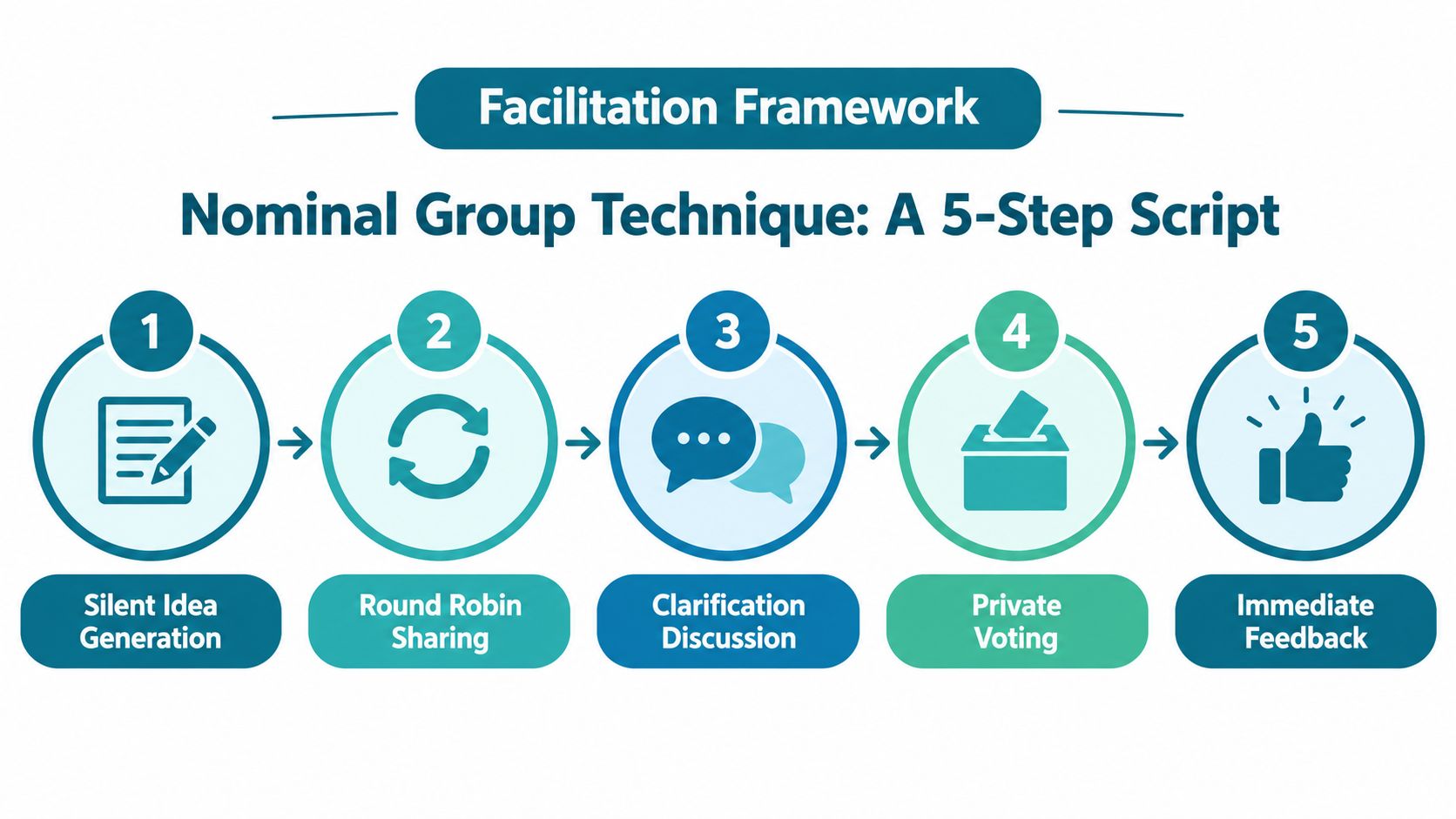
The five-step huddle
- Define the problem. Say, “We need one cleanup site for Saturday that the crew can reach safely.”
- Write in silence. Give everyone paper or a phone note. Allow about 5 to 10 minutes for options and concerns.
- Share one idea at a time. Go around the circle. Record each idea without debate.
- Discuss for clarity. Ask what an option means and what evidence supports it. Hold criticism until the comparison stage.
- Vote privately. Let each person rank or select options, then combine the votes into a group priority list.
Use clear guardrails. During the first round, people write alone, with no discussion or clarification questions. Each person gives one idea per turn, and the group removes an idea only by unanimous agreement or when it duplicates another (ASQ Nominal Group Technique guidance).
A 15-minute script
Set a timer and keep the language plain.
- Minute 1: “Our decision is ____. The decision-maker is ____. Safety limits are ____.”
- Minutes 2 to 5: Everyone writes options and concerns without speaking.
- Minutes 6 to 9: Each person shares one item per turn. Record every distinct option.
- Minutes 10 to 12: Ask, “What reason supports this option?” and “What risk have we missed?”
- Minutes 13 to 14: Vote privately or apply the agreed consensus rule.
- Minute 15: State the result, the reason, the lead, and the first action.
Match the method to the decision. Use consensus for a site hazard that affects inexperienced volunteers. Use a vote when several workable sites remain and the group needs a fair preference. Delegate a time-sensitive weather or safety call to the assigned lead, then explain the reason and invite relevant facts. That approach protects safety without treating buy-in as permission for everyone to control every decision.
Do not turn participation into a performance. Ask volunteers to connect information to a choice, rather than rewarding whoever speaks longest.
A one-page decision note can contain:
- Decision: What must we choose?
- Options: What choices did we consider?
- Facts: What did scouts, safety leads, and schedulers report?
- Rule: Consensus, vote, delegation, Delphi, or multi-voting?
- Authority: Who makes the final call?
- Reason: Why did this option win?
- Action: Who does what first?
- Review: What will we check after the cleanup?
For practice building repeatable huddle habits, see this volunteer coordinator training. If I close a route because of exposed glass, I say, “I made the safety call. Does anyone have information that changes it?” The crew hears the boundary, the reason, and the proper way to add new evidence.
Short Case Studies From Cleanup Crews in Action
On a South Side cleanup morning, a crew had three possible lots. One lot had the worst visible litter. Another had easier transit access. The third had a scout's report of a blocked gate, though it sat near a neighborhood that rarely received cleanup attention.
The lead asked volunteers to write their first choice and their reason. The crew then shared the options in a round-robin and used multi-voting to narrow the list. After discussion, the group used U-2 consensus. Two people still preferred the worst-litter lot, but they accepted the transit-friendly site because more volunteers could arrive safely and the crew could reach the work area without climbing around the blocked gate.
The process took longer than a quick show of hands, yet it kept the scout's information in the decision. Nobody had to win an argument by speaking the loudest.
Site choice takeaway: Gather field facts first, rank options second, and set the agreement rule before debate begins.
A different crew faced a sudden weather call. Rain had started, wind pushed loose branches across the route, and several first-time volunteers waited near the meeting point. The lead had delegated authority for weather safety, so she called off the exposed route rather than asking the whole group to reach agreement in the rain.
She used a short script: “I'm closing this route because the branches and visibility make it unsafe. We can move to the sheltered block if the safety check passes, or we can end today's event. I'll hear concerns now, then I'll make the final call.” The group moved to the alternate block after a quick check, and two volunteers chose to leave without pressure.
The lead acted quickly, though she didn't hide the reasoning. That balance protected safety and gave people a fair chance to share information.
Weather takeaway: Give a trained lead authority for urgent hazards, then explain the call and invite new facts.
Keep Buy-In Strong After the Decision Is Made
A decision isn't finished when hands go up. Volunteers need to know what happened, who made the call, and what they should do next.
I use a simple four-part loop:
- Announce: State the choice in one sentence.
- Explain: Name the rule and the reason.
- Assign: Give each next action to one person.
- Check: Ask about safety and willingness before work begins.
For example: “We chose the transit-friendly lot through multi-voting and U-2 consensus. Maya will check the gate, Luis will bring grabbers, and I'll mark the safe route. Does anyone see a safety problem or need a different task?”
That question gives people a graceful way to speak up. It also prevents the common mistake of treating agreement with the site as agreement with every task.
Keep a short record after each event. Write down what worked, what surprised you, whether the decision rule fit the situation, and what you'll change next time. A crew that reviews its choices learns faster than a crew that repeats its habits.
Pride can help people return. Flags, badges, a theme song, and a sincere shout-out can make service feel shared without pressuring volunteers for money. For more practical ideas, use these volunteer retention strategies.
Before the next huddle, ask yourself:
Did the right information reach the right person? Did we choose the right decision method? Did the final authority act clearly? Did every volunteer leave knowing the next step?
Litter Caterpillars uses structured event signups for volunteer trash pickups, including event pages and shift-based participation. Visit Litter Caterpillars to find a cleanup, join the next crew, and practice group decision making block by block.