
Tag: trail cleanup

  • Palos Trail System: A Guide to Your Wild Chicago Escape

    Palos Trail System: A Guide to Your Wild Chicago Escape

    I first hit the Palos Trail System on a day when my brain felt like Lower Wacker at rush hour. I parked, stepped into the trees, and within ten minutes my shoes were dirty, my lungs were awake, and the city noise in my head had finally shut up.

    Finding the Wild Just Outside the City

    Chicago teaches you to move in straight lines. Streets line up. Buildings box you in. Your day gets cut into little squares on a calendar until you start feeling like one more square yourself.

    Then you go to Palos.

    The first time I went, I expected a nice walk in the woods. I did not expect to feel small in a good way. The trails bent around ravines, climbed ridges, dipped into muddy shade, and kept asking me a simple question. Are you paying attention or not?

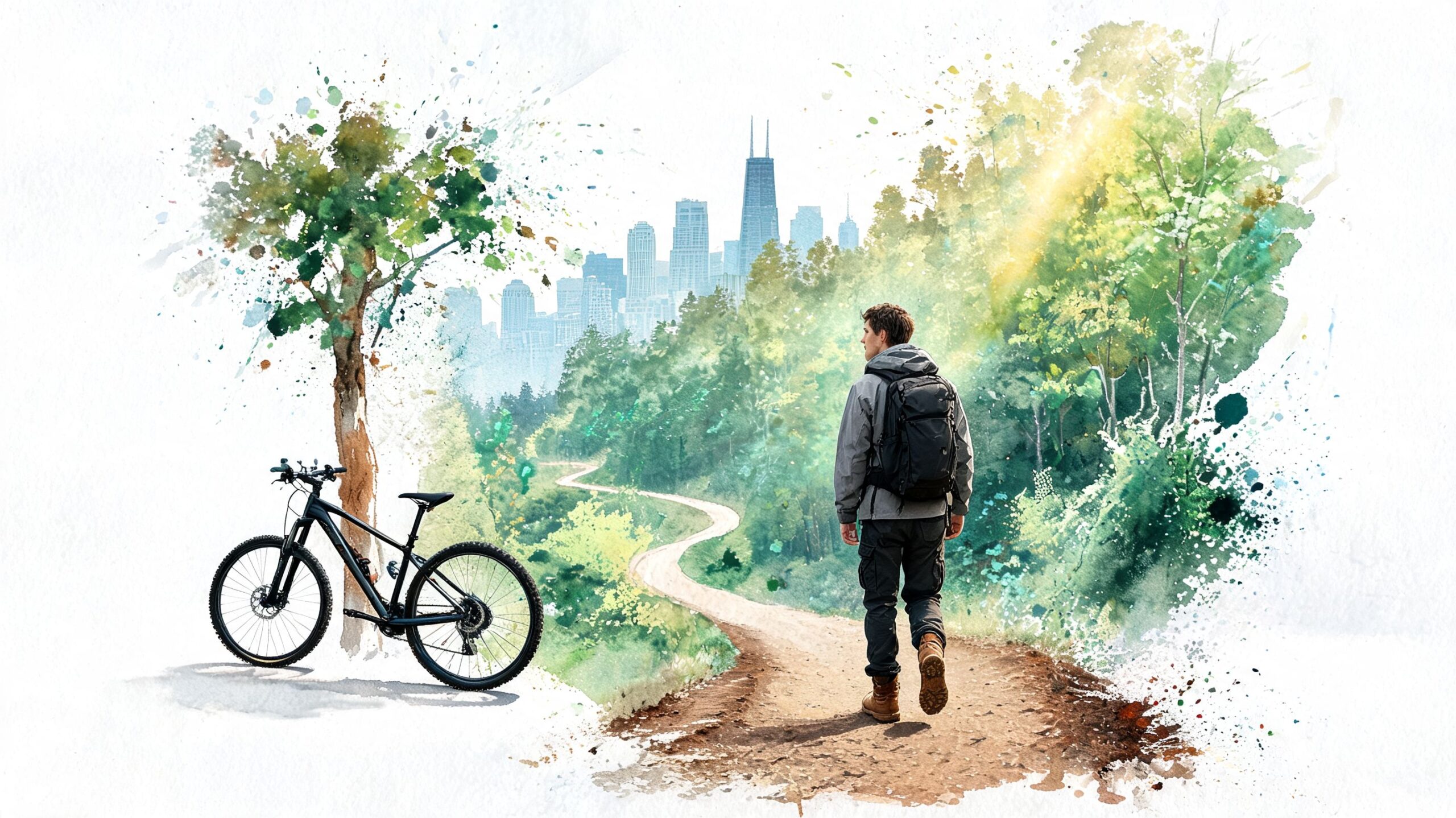
    A young man walking from a grey urban cityscape into a vibrant, sunlit, and blooming forest path.

    I remember standing at an early fork, staring at a marker like it had personally insulted me. In the city, when I feel off, I usually try to solve it by thinking harder. Palos taught me the opposite. Pick a path. Start moving. Adjust as you go.

    That sounds obvious until you're doing it with dirt under your shoes and no coffee shop on the next corner.

    Why Palos hits different

    The palos trail system feels raw in a way that surprised me. You aren't walking through a manicured little patch of decorative trees. You are moving through a place that still feels a little unruly. The hills don't care about your mood. The mud doesn't care if you wore the wrong shoes.

    And that is exactly why it works.

    Practical rule: If a place makes you pay attention to your feet, your breath, and the next turn, it can pull you out of your own spiral fast.

    I've had days out there where I showed up irritated, restless, and half-glued to my phone. After an hour on trail, I stopped checking it. After two, I remembered I had a body, not just a list of problems.

    If you love Chicago but need a break from concrete, this is your pressure valve. If you already spend weekends helping clean local green spaces, you probably know that feeling of getting your hands dirty and feeling cleaner afterward. That same spirit runs through work in the Chicago forest preserve cleanup community.

    Getting a little lost helps

    I don't mean reckless lost. I mean the useful kind. The kind where you stop pretending you control everything and start noticing where you are.

    Palos gave me that. It still does. Every time I go, I come back a little more honest with myself. Tired, usually muddy, sometimes scratched up. Better.

    Your First Steps into the Palos Woods

    The easiest mistake is treating Palos like one park with one front door. It isn't. The Palos Trail System spans 15,000 acres and has 42.1 miles of unpaved trails with 16 entrances open from dawn to dusk, according to the Forest Preserves overview on Wikipedia. If you don't know that before you go, the place can feel bigger than you expected.

    That size is part of the fun. It's also why your first trip should stay simple.

    How I keep the scale from getting in my head

    I don't try to "do Palos." That's like trying to "do Chicago" in one afternoon. I pick one access point, one short route idea, and one backup plan in case I get turned around or the trail is rougher than I want that day.

    Think in neighborhoods, not in the whole preserve.

    Some people like to start near busier trailheads because there are usually more people around and the first decision feels less intimidating. Other people want a quieter start. Either way, the trick is the same. Park, look at the map before you move, and commit to a modest first outing.

    A first-visit game plan

    Use this on day one:

    • Choose one entrance and stick to that zone. Don't bounce around trying to chase the "best" trail. Your best trail is the one you can start without confusion.
    • Take a photo of the trail map at the trailhead. Cell service and confidence can both get weird in the woods.
    • Start earlier than you think you need to. Dawn to dusk sounds generous until you take a wrong turn and spend extra time retracing.
    • Leave room in your schedule. Rushing in Palos is how people stop noticing roots, turns, and their own fatigue.

    Palos gets friendlier the moment you stop trying to conquer it.

    Where to park without overthinking it

    I like parking where the lot makes the first move easy. If I have to stand there for ten minutes wondering where the dirt starts, that's a bad start. Look for a trailhead with posted maps and clear access to the main trail. If you're hiking for the first time, choose an area where you can loop back without needing a giant crossing plan.

    If you're riding, I still say start conservatively. A lot of Chicagoans hear "forest preserve" and picture flat cruising. Palos is not that kind of place. It asks more from your legs and attention than many riders expect.

    Your only real job on the first visit is this. Get out of the car. Put your feet on dirt. Learn one small corner well enough that it stops feeling like a mystery.

    Decoding the Palos Trail Map Colors

    When I first looked at a Palos map, it felt like somebody dropped a bowl of colored spaghetti on paper and called it navigation. Then I learned to read it like a game menu. You aren't choosing a random line. You're choosing the kind of day you want.

    That shift matters.
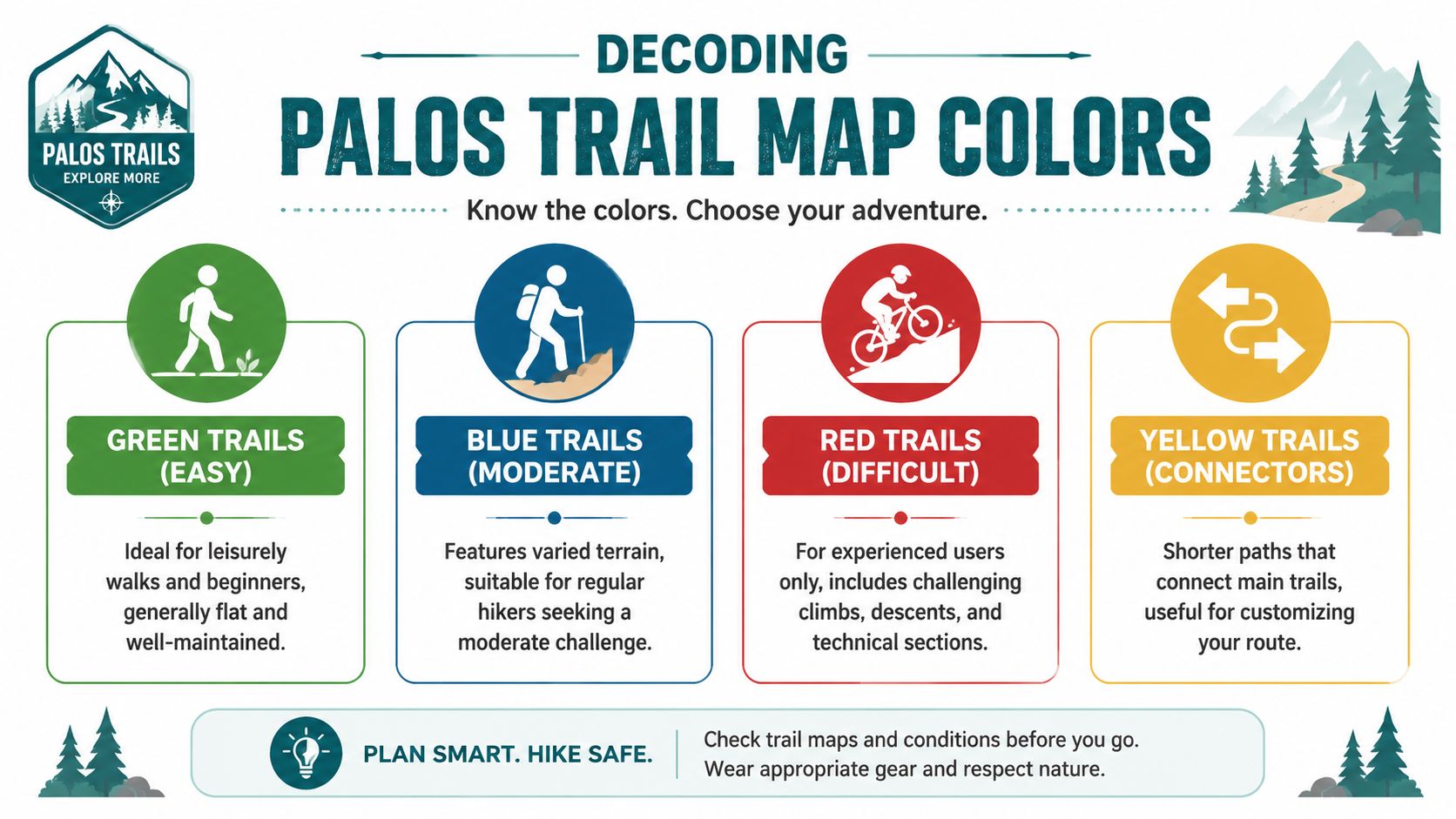
    An infographic titled Decoding Palos Trail Map Colors explaining difficulty levels for green, blue, red, and yellow trails.

    Read the map like a difficulty setting

    Some trails feel forgiving. Some feel like the woods are testing your focus on purpose. In Palos, color coding helps you decide what kind of effort you're signing up for before you're halfway up a climb wondering why your calves hate you.

    I treat the colors like this:

    Color Code Typical Experience Best For
    Green Smoother and more approachable First-timers, easy hikes, relaxed spins
    Blue More varied terrain and more attention required Regular hikers and riders who want a solid workout
    Red Technical, punchy, and mentally demanding Experienced riders and hikers who like challenge
    Yellow Connector mindset, route-building pieces People linking sections into their own custom day

    That table won't replace a real trail map, but it gives you a working brain-map.

    What the trail actually feels like

    The hard part isn't only distance. The trail itself changes your pace. Singletrack in Palos can be less than 24 inches wide, and longer loops can stack up 1,000 to 2,000 feet of elevation gain. The many intersections mapped on Trailforks let you build custom routes, but they can also confuse you if you aren't ready, according to the Palos route page on Fastest Known Time.

    That explains a lot of first visits.

    You're moving along, feeling great, then the wide track narrows, a side spur appears, and suddenly you're making choices faster than your map-reading brain can keep up. On foot, that can mean an accidental detour. On a bike, that can mean a bad line into roots or loose dirt.

    My rule for staying found

    I use one simple filter. If I can't explain to myself where I am in one sentence, I stop.

    • Pause at intersections. A ten-second check beats a twenty-minute correction.
    • Match trail feel to your energy. If you're tired, don't talk yourself into a harder segment because it looks fun on the map.
    • Use connectors on purpose. Yellow-style links can save a day when you want to shorten a loop and still finish strong.

    A good Palos day isn't the one where you rode or hiked the hardest trail. It's the one where your route matched your head and legs.

    That's the whole map game. Read the colors, respect the intersections, and choose your day instead of letting the day choose you.

    My Favorite Routes for Hiking and Biking

    I keep coming back to Palos because it can meet me in two very different moods. Some days I want quiet and steady. Other days I want my heart beating in my ears while I try to keep a front wheel honest on rocky ground.

    Both versions feel real. They just ask different things from you.
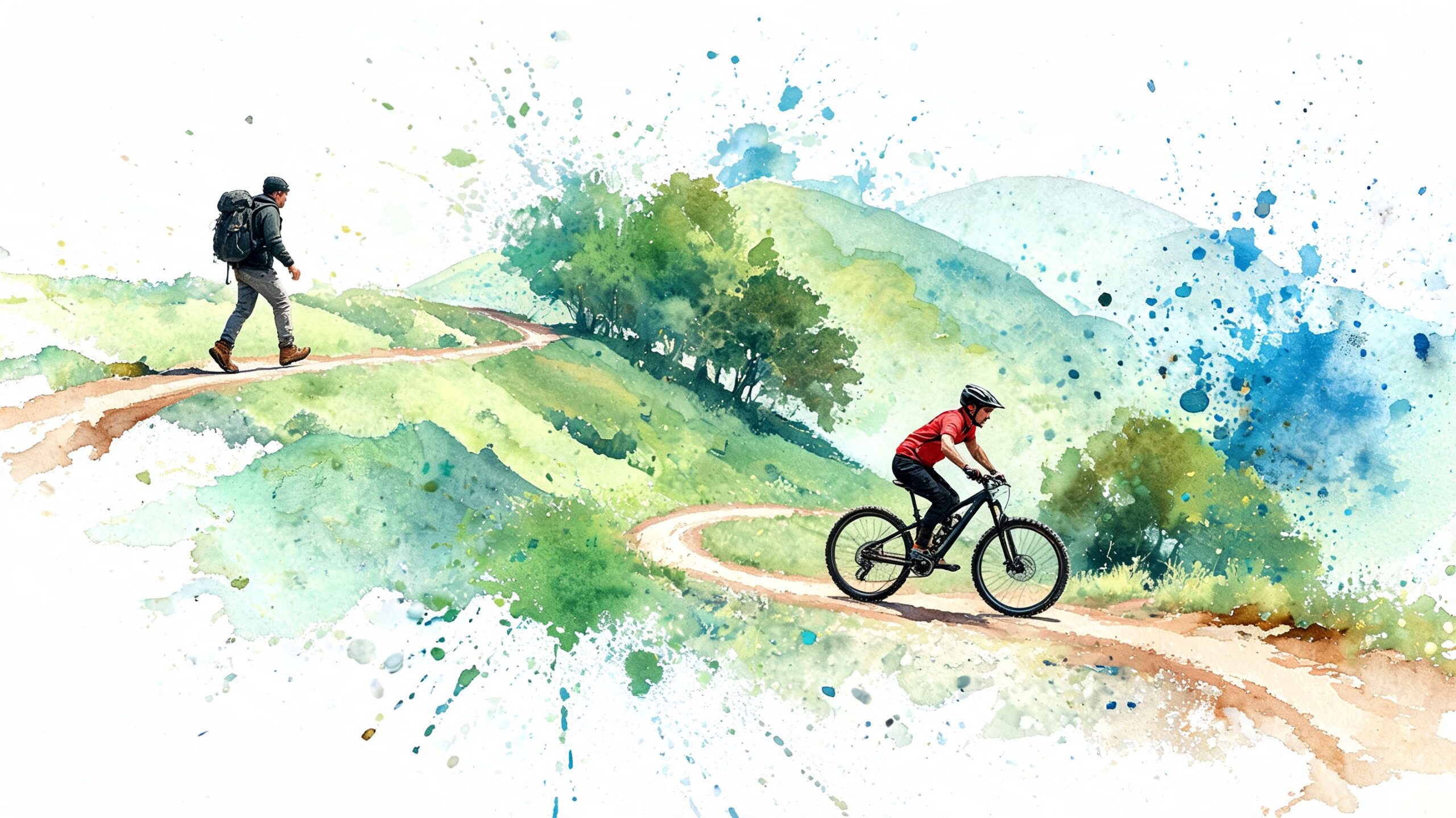
    A watercolor style illustration showing a hiker with a backpack and a cyclist on a mountain trail.

    The hike I take when life feels noisy

    When I need to calm down, I go for a simpler loop and let the trail do the work. I don't chase mileage. I listen for birds, watch the light shift through the trees, and let the first half hour sand off the city edges.

    The best easy hike in Palos, for me, is one where I can settle into rhythm without constantly negotiating technical moves. I want enough variation to stay awake, but not so much that the whole thing becomes a puzzle. In those moments, the woods feel like a stern old friend. They don't coddle me, but they do straighten me out.

    I remember one cold morning when the ground was firm, the air had that metallic bite, and every breath felt clean. I had shown up carrying some personal mess I couldn't solve. By the time I looped back to the car, I hadn't solved it exactly. I just wasn't scared of it anymore.

    That's one of Palos' best tricks. It gives your mind something physical to follow. Step over this root. Climb this rise. Keep moving.

    The ride that wakes up every nerve

    Then there are bike days.

    On those days, I want the version of Palos that feels a little feral. The trails sit on a glacial moraine with elevations rising more than 150 feet above the surrounding area, and the advanced sections have rocky descents with 10 to 15 percent grades and 4 to 6 inch roots and rocks, according to the Forest Preserves trail page. You feel that immediately when the trail tips downward and your line choice starts to matter.

    A technical ride in Palos is never just cardio. It's problem-solving at speed.

    You come into a descent, spot a rock garden, shift your weight, and commit. If you hesitate, the trail punishes you. If you get cocky, same result. When I ride there, I have to be present in a way that's hard to fake anywhere else.

    For riders looking to branch out beyond this system, I also like browsing other spots on this Illinois bike trail guide, but Palos is still the one that gives me that sharp, immediate jolt.

    Here's a visual if you want to get a feel for the terrain before you go.

    How I choose between the two

    I don't pick my route based on ambition. I pick it based on honesty.

    • If my head is cluttered, I hike. I let repetition clear me out.
    • If I need adrenaline and focus, I ride something more technical.
    • If I'm tired but stubborn, I choose the easier option on purpose. Palos punishes ego faster than a gym ever will.

    The trail doesn't care who you think you are. It cares whether you can handle the next turn.

    That's why I trust it. A peaceful loop can give you your breath back. A rough ride can shake loose whatever stale junk you've been carrying all week. Either way, you leave more awake than you arrived.

    What to Know Before You Head Out

    I wish somebody had told me this before my first winter ride and my first swampy summer hike. Palos changes fast. The same trail can feel friendly in one season and rude in another.

    You don't need a giant gear closet. You do need some judgment.

    What I pack every time

    My basic kit is boring on purpose. Boring gear saves bad days.

    • Water you think is slightly too much. Palos climbs more than newcomers expect, and that catches people fast.
    • A charged phone with a map app. I use mapping apps because intersections can blur together when you're tired.
    • A small snack. Nothing fancy. Just enough to keep your brain from getting stupid.
    • An extra layer. In cool weather, sweat turns into a problem the second you stop moving.
    • For bikes, a flat fix and mini tool. Walking a broken bike out on uneven trail is a humbling march.

    Seasonal stuff people learn the hard way

    Summer in Palos can feel thick. The bugs come out, the air sits heavy, and roots get slick after rain. If it's humid and hot, I start earlier and slow my pace on technical ground.

    Fall is maybe the prettiest time to be out there, but leaf cover can hide rocks and ruts. That's a trap. A trail you know well can suddenly ride or hike like a stranger.

    Winter is the one that catches people. Frozen dirt can be amazing. Half-frozen dirt can be a mess. Your hands go numb faster than you think, and shaded sections hold slick patches long after open areas thaw.

    Spring can be the muddiest teacher of them all. If the ground is soft, don't force it.

    If you're leaving deep marks in the trail, it's time to turn around and try another day.

    Safety without paranoia

    I don't go into Palos scared. I go in alert.

    If I see wildlife, I give it room and keep moving calmly. If I meet other trail users, I slow down, make eye contact, and communicate early. If something feels off with my body, my bike, or the weather, I don't try to macho my way through it.

    A few habits matter more than fancy gear:

    1. Tell someone where you're going if you're heading out solo.
    2. Know your turnaround point before you start.
    3. Respect fatigue. Tired feet trip. Tired riders make dumb choices.

    You want the kind of tired that feels earned, not the kind that leaves you limping back to the lot.

    The Unwritten Rules of the Trail

    I don't love the word etiquette because it sounds like folded napkins and fake smiles. Palos has something better than etiquette. It has a code. Respect the trail, respect the other people on it, and don't act like your good time matters more than the place itself.

    That code is simple, but it isn't soft.

    Respect looks practical

    If you yield, slow down, and greet people like a human being, the trail works better for everybody. Hikers, runners, riders, and horse people are all trying to use the same ground. Nobody wins when someone blasts through like they rented the woods by the hour.

    Staying off muddy trails matters for the same reason. A soft trail records your bad choices. Every rut and widened edge sticks around and makes the next person's day worse.

    Pack it out means all of it

    This should be obvious, but apparently the woods still need reminding. If you carried it in, carry it out. Snack wrappers, broken gear, dog waste bags, cans, tissues. All of it.

    I pick up random trash when I see it because I can't stand pretending litter is somebody else's problem. Once you start noticing it, you can't really unsee it.

    The trail gives you a lot. The least you can do is leave it cleaner than you found it.

    Small choices change the whole vibe

    I care about this stuff because I want Palos to stay wild, not sloppy.

    • Keep your ears open. If you block out everything with speakers, you miss warnings, greetings, and the whole point of being outside.
    • Stay on the trail. Shortcuts chew up edges and turn one line into a mess.
    • Match your speed to the situation. Blind corners are not where you prove anything.

    This isn't about being precious. It's about being decent. The best trail people I meet out there are usually the strongest ones too. They know control is cooler than chaos.

    Become Someone Who Protects Palos

    The first time I joined a cleanup in a natural area, I expected it to feel worthy. I did not expect it to feel addictive.

    There's something satisfying about filling a bag with junk that never should've been there. You stop being a visitor and start acting like the place belongs to you in the healthiest way. Not ownership. Responsibility.

    Why cleanup changes your relationship with a trail

    Once you've crouched beside a trail pulling cans from brush or dragging plastic out of a ditch, your eyes change. You notice runoff spots. You notice where people dump things. You notice how quickly a beautiful stretch can get trashed by a few lazy choices.

    Then you notice something better. You realize ordinary people can fix a lot when they stop waiting for perfect conditions.

    Palos already has that spirit in it. Volunteer trail crews and cleanup groups keep the place usable and sane because they care enough to show up. That work isn't glamorous. It is muddy, repetitive, and often weirdly joyful.
    A gentle watercolor illustration showing two hands carefully protecting a small green seedling growing from soil.

    What you get back

    You give labor. You get a stronger bond with the place.

    I think that's why stewardship sticks. A hard hike can change your day. A cleanup can change how you see yourself. You become the kind of person who doesn't just consume outdoor spaces. You protect them.

    If that idea hits something in you, spend time with groups that practice real, hands-on care. I like seeing people move from casual concern to actual action through environmental stewardship programs in Chicago.

    Start small and keep it real

    You don't need to become a full-time trail saint. Start with one bag. One volunteer day. One decision to leave a place better than you found it.

    • Bring gloves and a spare bag on a regular walk if you want a low-pressure start.
    • Join organized workdays when you want company and direction.
    • Talk to other trail users. The people who care about Palos are usually easy to spot. They're the ones fixing, carrying, trimming, hauling, and paying attention.

    The wild part of Cook County doesn't need more spectators. It needs more people who love it enough to do the unglamorous stuff.

    That kind of work changes a trail. It also changes you.


    If this piece lit a fire in you, join Litter Caterpillars. You'll meet people who don't wait around for somebody else to clean up the city and its green spaces. You show up, get your hands dirty, make real friends, and leave a visible difference behind.

  • Your Ultimate Guide to the Old Plank Trail Adventure

    Your Ultimate Guide to the Old Plank Trail Adventure

    The Old Plank Trail. For most, it's just a 22-mile bike path. A pleasant way to get your heart pumping on a sunny Saturday. But I see something more. It's the place where I first understood we could stop just talking and actually build something tangible, something real. It's where I realized we had a chance.

    This Isn’t Your Average Trail Guide

    A person with a backpack walks on a wooden bridge towards a foggy forest on the Old Plank Trail, surrounded by watercolor splashes.

    I want you to see this guide as my personal invitation. Not merely to bike or to walk, but to see this trail through my eyes. As a place that needs us.

    The first time I truly explored the Old Plank Trail, it hit me like a revelation. This wasn't just asphalt and trees. It was a living artery, a vibrant ribbon connecting our communities, our history, and the quiet, forgotten nature that tenaciously hangs on in the suburbs. I saw its immense potential, but I also saw the neglect. The little bits of trash, each one telling a small story of carelessness.

    That’s when it clicked. This trail could be a training ground. A canvas. It's our proving ground, a place where we can show ourselves that we are capable of making a genuine difference. This guide will give you everything you need to know to get out there—the access points, the quietest spots, the deep history. But my real hope, my true aim, is that you’ll see it as a place worth fighting for.

    What is the Old Plank Trail, Really?

    On a map, you see a thin line connecting towns. But in reality, it's so much more. It's a corridor where you can escape the ceaseless noise of life and feel the world slow down to a human pace. It’s a place that ties our scattered suburban lives together, a shared thread in our communal fabric.

    • It’s our shared backyard. The trail weaves through Chicago Heights, Frankfort, New Lenox, and a half-dozen other towns, finally reaching its end in Joliet. It is the common ground for all of us.
    • It’s a lifeline for nature. I see this path as a precious refuge for wildlife, preserving slivers of the prairie and woodlands that once blanketed this entire area. It’s a ghost of a wilder past.
    • It’s a connection to people. You're never really alone out there. You share the path with families teaching their kids to ride, with serious cyclists pushing their limits, and with people just like me, looking for a simple moment of peace.

    The Old Plank Road Trail runs for a remarkable 22 miles across Cook and Will counties. It follows the phantom route of a historic 19th-century railway, connecting communities and preserving a vital green corridor in the heart of Chicagoland. It stands as one of the most significant trail systems we have, and it’s right on our doorstep.

    This isn't just some random path. It’s a massive piece of local infrastructure with a story etched into its very soul. You can lose yourself in the details of its past by reading the story of the Old Plank Road Trail), and when you do, you start to realize just how important it is.

    Before you go, here's my quick-and-dirty summary.

    Old Plank Trail at a Glance

    I’ve put together a quick summary of what you need to know before you head out.

    Feature Details
    Length 22 miles one-way
    Surface Asphalt, fully paved
    Difficulty Easy. Mostly flat, suitable for all skill levels (walking, biking, running).
    Endpoints East: Chicago Heights (Western Ave)
    West: Joliet (Washington St)
    Main Towns Chicago Heights, Park Forest, Matteson, Frankfort, New Lenox, Joliet
    Open Year-round, sunrise to sunset
    Best For Biking, walking, running, inline skating, family outings

    This table gives you the basics, but it can't capture the feeling of the trail. The way the scenery shifts from town to forest preserve. The quiet pride after a long ride. The way the light hits the trees.

    It's More Than a Path. It's a Challenge.

    When you’re out there, you’ll feel it. The quiet. The space. You'll see the profound beauty, but if you look closely, you’ll also see the work that needs to be done. The challenge laid bare.

    This is the experience I want for you. An experience that’s real and a little raw. One that makes you want to do more than just pass through. Join me. Let's see what we can do with this place, together.

    How to Actually Get on the Trail (And Not Get Lost)

    A grey backpack, a folded map, a modern train, and a 'Trail' signpost, all against colorful watercolor splashes.

    Okay, so a 22-mile trail sounds amazing until you’re staring at a map, wondering where the heck you’re supposed to start. It feels a bit like planning our first few Litter Caterpillar cleanups—total chaos at first, but pure gold once you find your entry point. A puzzle waiting to be solved.

    Don't you worry. I’ve already made all the wrong turns for you. Let’s get you on the path.

    My Favorite Starting Lines

    Downtown Frankfort is, hands down, the easiest and most rewarding place for you to start. It's like the trail's welcome mat. The path cuts right through town. Park your car, get your miles in, and then you’ve earned a coffee or lunch at one of the local spots. It’s my personal go-to for a perfect weekend morning.

    If you want something a bit more rugged, I suggest hitting the western end in Joliet. It feels less like a suburban path and more like the beginning of a real adventure, especially since it connects you to the historic I&M Canal trail system. A gateway to something bigger.

    My Personal Pro Tip: The Hickory Creek Preserve trailhead near Mokena is the real hidden gem. I feel like I'm letting you in on a secret. It’s got tons of parking and clean bathrooms (a huge win!), and it drops you onto a gorgeous, wooded stretch of trail that feels like you're a hundred miles from civilization. This is my secret spot for a quiet walk to clear my head.

    Figuring out a trail is a lot like cleaning up a park—you need a strategy. You need a plan. We apply the same kind of planning when we tackle other local spots. If you're looking for another great place to explore, check out our guide on Waterfall Glen Forest.

    Ditch the Car: Riding the Rails to the Trail

    No car? Coming from the city? I’ve got a game-changer for you: the Metra Electric Line. I’ve done this a few times, and it’s brilliant. The train is your chariot, letting you off in Matteson, just a short bike ride from the trail.

    This little trick transforms a simple trail day into a proper journey. A quest. You feel like a real explorer, using public transit to find the wild spots hidden in plain sight.

    • The Move: You grab your bike and hop on the Metra Electric Line, heading south to the Matteson station. Just double-check Metra’s bike rules before you go.
    • The Gap: It’s a safe, easy one-mile ride on local roads from the station to the Old Plank Trail. A small bridge between two worlds.
    • The Payoff: You skip all the weekend traffic, never have to hunt for parking, and get to feel a little smug about your cleverness.

    Choose Your Vibe: Crowds or Quiet?

    Not every part of the Old Plank Trail feels the same, and that’s what makes it great. You can pick your experience like choosing a song.

    The sections winding through Frankfort and New Lenox are the social hubs. On a nice weekend, they're buzzing with families, runners, and cyclists. The energy is fantastic, but it’s not where you go for silent reflection.

    If you’re craving peace and quiet, I head to the bookends of the trail. The eastern miles near Chicago Heights and Park Forest, or the far western approach to Joliet, are your best bets. These stretches are way less traveled. It's where you find those long, uninterrupted moments with just the sound of your own footsteps and the wind. It’s where I go when I really need to think.

    Discovering the Trail's Historic Prairies and Towns

    Artistic watercolor landscape featuring a vibrant field of wildflowers, a wooden plank, and distant homes.

    When you step onto the Old Plank Trail, you're not just on some asphalt path. You're walking on layers of time. It's like a story unfolding right under your feet, a palimpsest of history. This trail has been a Native American path, a 19th-century plank road for wagons clattering westward, and a railroad line that built this entire region. Now? Now it’s our quiet escape.

    I want you to feel that history with me. Each mile marker is a new chapter in a long, unfolding book. As you pass through the towns, the entire personality of the trail changes, showing you a new side of itself.

    A Living Museum of Tallgrass Prairie

    The moments that hit me hardest on this trail were when I first really saw the prairies. These aren't just patches of grass. They're incredible, living pieces of a wilder Illinois, a biological echo. Just think about it—these little strips of nature somehow survived centuries of farming and development, all because they were tucked away on land that was never plowed. They are time capsules.

    The story of this land is amazing. The Old Plank Road Trail was pieced together over a 14-year period between 1992 and 2006. It was a monumental effort to turn 135 acres of a dead railroad line into the living greenway we have today. And the craziest part? Slivers of land along the path still hold original tallgrass prairie, a direct window into what this place looked like back in 1850. You can get lost in this story and see how the trail's history shaped our local landscape.

    When you see these rare plants and flowers, you realize that picking up a single piece of trash is an act of preservation. It connects your small, simple effort to this much bigger story of resilience.

    This is why our cleanup work feels so important to me. When you protect a place like this, you’re not just cleaning up for today. You’re honoring its entire history and fighting for its future. You become a steward.

    The Personalities of the Trail Towns

    As you head west, you'll see that every town brings its own energy to the trail. You're not just biking through suburbs; you're visiting distinct communities, each with its own story to tell.

    • Frankfort: I always call this the trail's living room. It's so welcoming and charming, and there’s always something going on. The path slices right through its historic downtown, making it the perfect spot to start your day or end it with a coffee from a local shop.
    • New Lenox: I think of this part as the trail's beating heart. It feels alive and active, connecting tons of parks and neighborhoods. You’ll see families, runners, and cyclists all sharing the space—a real feeling of community in motion.

    These towns are destinations, not just scenery. Exploring them on foot or by bike is one of my favorite ways to spend a weekend. If you love discovering places this way, you'll probably enjoy our collection of self-guided Chicago walking tours too.

    The Old Plank Trail is a journey that connects us—to nature, to our history, and to each other. It's a powerful reminder of what we can save when we actually work together.

    Staying Safe and Prepared for Your Adventure

    Emergency preparedness kit items: water bottle, first-aid kit, smartphone, and reusable bag.

    Being brave on the trail is one thing. Being prepared is everything.

    Having a great—and safe—day on the Old Plank Trail isn't about luck. It’s about being ready for whatever the trail decides to throw at you, because trails have minds of their own. I've spent countless hours out here, and I want to share what I've learned so you can focus on the journey, not a painful blister or a forgotten water bottle.

    My first rule, especially if you’re riding solo: always tell someone your plan. Just a quick text with your route and when you think you'll be back is a huge safety net. It’s a tiny action that makes a big difference.

    The Unwritten Rules of the Trail

    The Old Plank Trail is a shared space, a communal living room, and that means we have to be good neighbors. It's just like driving—simple rules keep everyone moving safely. This is a multi-use path, so you'll be sharing it with walkers, runners, families pushing strollers, and cyclists of all speeds.

    Your best tool out here is simple awareness.

    • Stay Right, Pass Left: It’s just like the highway. You, if you're slower, keep to the right. If you need to pass, give a clear and friendly "On your left!" a few seconds before you go around. No surprises.
    • Keep Your Ears Open: If you’re listening to music or a podcast, I urge you to keep the volume low or just use one earbud. You absolutely have to hear cyclists or runners coming up behind you.
    • Manage Your Crew: Walking with friends or family? Don't spread out and block the whole path. Fall into a single-file line, especially when it's crowded, to let others get by easily.

    I see being a good trail citizen as simple. It all comes down to respect and awareness. Every time you call out a pass or make room for someone, you're helping create a safe, positive vibe for everyone who loves this trail.

    My Must-Haves for Any Season

    I learned about being prepared the hard way during a surprise springtime hailstorm at one of our very first Litter Caterpillars cleanups. That lesson stuck. It was a baptism by ice. Now, I’ve got a simple checklist that I tweak a little depending on the season.

    A hot summer day means I pack extra water and sunscreen. A crisp fall afternoon calls for a windbreaker and maybe a hat. But a few things are always in my bag, no matter what the weather looks like.

    My non-negotiable kit includes:

    1. Water: Always bring more than you think you’ll need. Dehydration is a silent thief.
    2. Snacks: A simple granola bar or some nuts can be a total lifesaver when your energy crashes.
    3. Basic First-Aid: A few bandages and some antiseptic wipes weigh nothing and can handle minor scrapes and cuts.
    4. A Litter Bag: Of course! I never go anywhere without a small, reusable bag to grab any trash I see. It’s the easiest way to leave the trail a little better than you found it.

    Being ready for anything is a type of freedom. It means you can let go and just enjoy the moment, knowing you can handle whatever comes your way.

    Let's Keep This Place Beautiful, Together

    After you’ve been out here, after you’ve felt the sun and the breeze on the trail, you might feel a little pull. A feeling in your gut. I know I did. It’s that feeling of seeing something special and wanting to protect it. That’s where the real work—the real fun—begins.

    The Old Plank Trail is our shared backyard, but it doesn't stay beautiful on its own. It’s just like my own life used to be. A messy apartment, a messy head. Everything felt chaotic. It wasn't until I started taking small, real actions that things started to change for me. Cleaning up this trail is the same idea, just on a bigger scale. It's therapy for the soul.

    So, this is my personal invitation to you. I don't see this as a chore. It's a chance to join us, the Litter Caterpillars, and do something that actually matters.

    What It's Really Like to Volunteer

    I want you to forget what you think a "cleanup event" is. This isn't quiet, solo work. Think of it more like an outdoor get-together with a mission. We show up, we laugh, and in just a few hours, we make a difference you can literally see with your own eyes.

    You’re not just picking up trash; you're becoming part of the trail's living story.

    • You'll meet real people. Our volunteers are givers. They show up on a weekend morning because they want to build something better, not just talk about it.
    • You'll see instant results. There’s nothing like looking back at a stretch of trail and knowing it’s clean because you were there. It’s satisfying on a deep, primal level.
    • You'll have fun. I promise you this. We make it an adventure. It’s about the stories we share and the mission we're on together.

    The real change isn’t just on the ground—it’s in you. When you start caring for a public space, you start seeing your whole city differently. You become a guardian. An owner. It's an empowering feeling that's hard to describe until you've experienced it yourself.

    We Fill in the Gaps

    Look, the official agencies do what they can, and I think they do a great job with the big stuff. A seven-mile section of this very trail just got a $1.3 million overhaul with new pavement and better access. That’s huge, and it shows our local governments care. You can even see how those major trail projects come together.

    But they can't be everywhere, every day. That’s where we come in.

    We’re the nimble ones. We're the on-the-ground crew that handles the daily stuff—the coffee cups, the plastic bags, the little things that pile up and whisper neglect. We are the connective tissue, filling the gaps between those big-budget projects to keep the trail pristine for every single person who comes out to enjoy it.

    When you join a cleanup, you’re not just picking up a bottle. You’re protecting that $1.3 million investment. You’re making sure the trail stays as amazing as it was meant to be.

    Ready to make a real difference with us? I invite you to check out our upcoming volunteer trash pickup events and find one that works for you. Let's get out there.

    Old Plank Trail: Your Questions, My Answers

    People ask me a lot of questions about the Old Plank Trail. I love it. It shows you’re thinking, you're curious, and you're ready to get out there. It reminds me of our cleanups—a little bit of prep makes all the difference. So let’s get into the nitty-gritty so you can hit the trail feeling like you own it.

    Is the Old Plank Trail Too Hard for a Beginner?

    Not a chance. I promise you this trail is as friendly as they come.

    The whole thing is paved asphalt and almost perfectly flat. Don't you dare picture some tough, rugged hike. Think of it more like a really, really long sidewalk that cuts right through fields and forests. A gentle introduction. It’s perfect if you’re just starting out, have kids in a stroller, or just want an easy, chill day.

    There are no surprise hills waiting to crush your soul. This is a place to build your confidence, to feel what it’s like to cover some ground. It’s how you fall in love with this stuff.

    Can I Bring My Dog?

    Yes! Your dog is welcome on the trail. I love seeing pups out there, enjoying the day just as much as we are. Just be cool about it and follow the basic rules so we can all keep enjoying this privilege.

    • Leash Up: Your dog must be on a leash. Period. It's for their safety, other people's safety, and the local wildlife. I make no exceptions to this in my own mind.
    • Pack It Out: You know the deal. Always pick up after your dog. I always bring more bags than I think I’ll need. This is a non-negotiable part of being a good human on the trail.
    • Keep It Tight: When people are passing, I keep my own dog on a short leash right by my side. Don't let the leash become a tripwire across the path.

    Look, I see bringing a dog on the trail as a privilege we all share. When we all follow these simple rules, we're protecting that privilege for everyone. It’s a small thing, but it’s how we take care of our community and the spaces we love.

    What About Bathrooms and Water?

    Super important question. The short answer from me is: yes, but don't count on them being everywhere.

    You’ll find bathrooms and water fountains at the main trailheads and parks, especially in towns like Frankfort and New Lenox. But once you're on the trail, there can be long, desolate stretches with absolutely nothing.

    Here’s my advice: always start your trip with a full water bottle. Always. And if you see a bathroom, use it. Don't play the "I'll wait for the next one" game. A little planning avoids a lot of misery later. Trust me on that one.


    Ready to turn that inspiration into action? Join me at Litter Caterpillars. Help us keep this trail and other incredible Chicago spaces clean for everyone. Find an event and sign up at https://www.littercaterpillars.com.