

You stare at a garage corner on Friday night. You see a broken dresser, three bags you forgot to set out, a mattress you want gone, and a can of old paint you fear to touch. You want a trash removal service you can trust, and you want a price you can plan around.
I hear you. I help neighbors sort messes like yours into three piles, and I watch relief hit your face when you see a clear path. You send everyday bags to your city crew, you book a hauler for heavy work, and you join neighbors for litter in shared space. You also learn where each option stops, because a wrong choice leaves you with a tagged cart, a soaked mattress, or a bag you should never carry.
Trash Removal Options and What Each Costs
You have three main lanes, and I want you to pick your lane before you lift a thing. Your city truck handles your weekly household bags. A private hauler takes the bulky load your city turns away. A volunteer group clears litter from sidewalks, alleys, and lots you share with neighbors.
Think of your trash like mail. You put a letter in your mailbox for free pickup, you hire a courier for a heavy box, and you help your block sweep paper off a shared sidewalk. Each lane has a payer, a schedule, and a limit, and you save money when you match your item to the right lane.
| Option | Who pays | Typical cost | How service runs | Best for | Main limit |
|---|---|---|---|---|---|
| Municipal pickup | Taxpayers or a city fee | Often included in city services, sometimes a separate utility fee | Fixed weekly or biweekly schedule | Everyday household trash in carts | Rejects bulky items and construction debris |
| Private hauler | You, per booking | Typically $100 to $500 for a single load, more for dumpsters | On demand, booked in advance | Bulky items, moves and renovation debris | Costs money each time and needs scheduling |
| Volunteer cleanup group | Volunteers, often funded by donations or city partners | Free to residents | Scheduled events, often on weekends | Litter and debris in shared public spaces | Cannot take household waste or hazardous items |
Four Things Move Your Quote Up or Down
I tell you to confirm every price locally, because your city, your hauler, and your load move every range. You ask each hauler for a written quote that lists each item and each disposal fee. A verbal guess grows on pickup day, and a written list protects you.
- Volume: You pay for truck space, so a quarter truck costs far less than a full truck, and you save cash when you measure before you call.
- Access: You pay more labor when your crew climbs stairs, walks a long path from curb to pile, or squeezes a sofa through a tight door.
- Item fees: You often pay a surcharge for a mattress, a tire, paint, or an appliance with refrigerant, because your hauler pays a special fee at disposal.
- Timing: You pay more for a rush booking, especially on a weekend, and you pay less when you book a weekday slot with open access.
Say you move a bedroom set from a second floor. You might pay twice what your friend pays for the same set in a ground floor garage, because your crew carries each piece down stairs and across a yard. A dumpster tells a similar story, because your flat fee includes a weight limit and overage charges grow fast when you load heavy remodel debris.
My rule for you: You get a quote in writing, you name every item on the phone, and you ask what changes the price on site.
You never pay to join a volunteer cleanup, and we hold that line at Litter Caterpillars. We will never pressure our volunteers for money, and you should walk away from any group that pressures you at signup. You give time, you grab a bag, and you leave with new neighbors.
Municipal Pickup Covers the Everyday Basics
Your city crew does your weekly basics well, and you often pay nothing extra per visit when your bill already includes service. You help your crew help you when you follow set-out rules every week. A clean routine keeps your cart empty on schedule, and you avoid a smelly wait until next week.
You check your day and your holiday shift on the Chicago trash pickup schedule before you plan a move or a big family dinner. You put your cart out by the time your city names, you close the lid, and you keep the walk clear. Holiday weeks often shift your pickup by a day, so you confirm before you drag a cart to the curb in the cold.
Rules That Keep Your Cart Moving
- Close the lid: You pack bags inside the cart, and you leave nothing beside it, because crews often leave loose piles behind.
- Keep bad items out: You keep batteries, paint, and chemicals out of your cart, and you take them to a proper drop-off instead.
- Respect size: You brake down boxes, you avoid an overflowing cart, and you wait a week with extra bags inside your garage when you must.
An overflowing cart often sits with a tag, and you lose a week. I would rather see you hold one bag for seven days than watch you chase a missed pickup for three days. You report a missed pickup inside your city window, often 24 to 48 hours, and you note your address and cart spot.
You also plan ahead for bulky items. Many cities let you book a bulky pickup and allow a few free items each year, so you check your bulk schedule before you haul a couch outside. A couch you set out early can sit for days in rain, and your neighbors stare at your mistake.
Pros you feel every week
- No per-visit bill: Your fee often covers trash, recycling, and yard waste in the same weekly rhythm.
- Predictable schedule: You plan cleanouts around a fixed day, and you know exactly when your alley clears.
Limits you must respect
- No construction debris: Your cart rejects remodel waste, tires, and hazardous items every time.
- Slow bulky waits: Your bulky slot can sit days or weeks out, so you book before your lease ends.
Hiring a Private Hauler, Step by Step
You open your garage on a Saturday move-out, and you face a sofa, a dresser, three boxes of old paperwork, and a broken treadmill. You lack a truck, you lack a second pair of strong arms, and your landlord wants the keys by Sunday. A private hauler fits you here, because speed beats savings on a deadline.
You watch a junk crew arrive, load your mixed pile, sort items for donation or recycling, and drive away in one visit. You pay for labor and truck space, and you reclaim your afternoon. I recommend this lane for small mixed jobs that mix furniture, boxes, and odd equipment.
Your crew handles the heavy lift for you in this kind of visit.
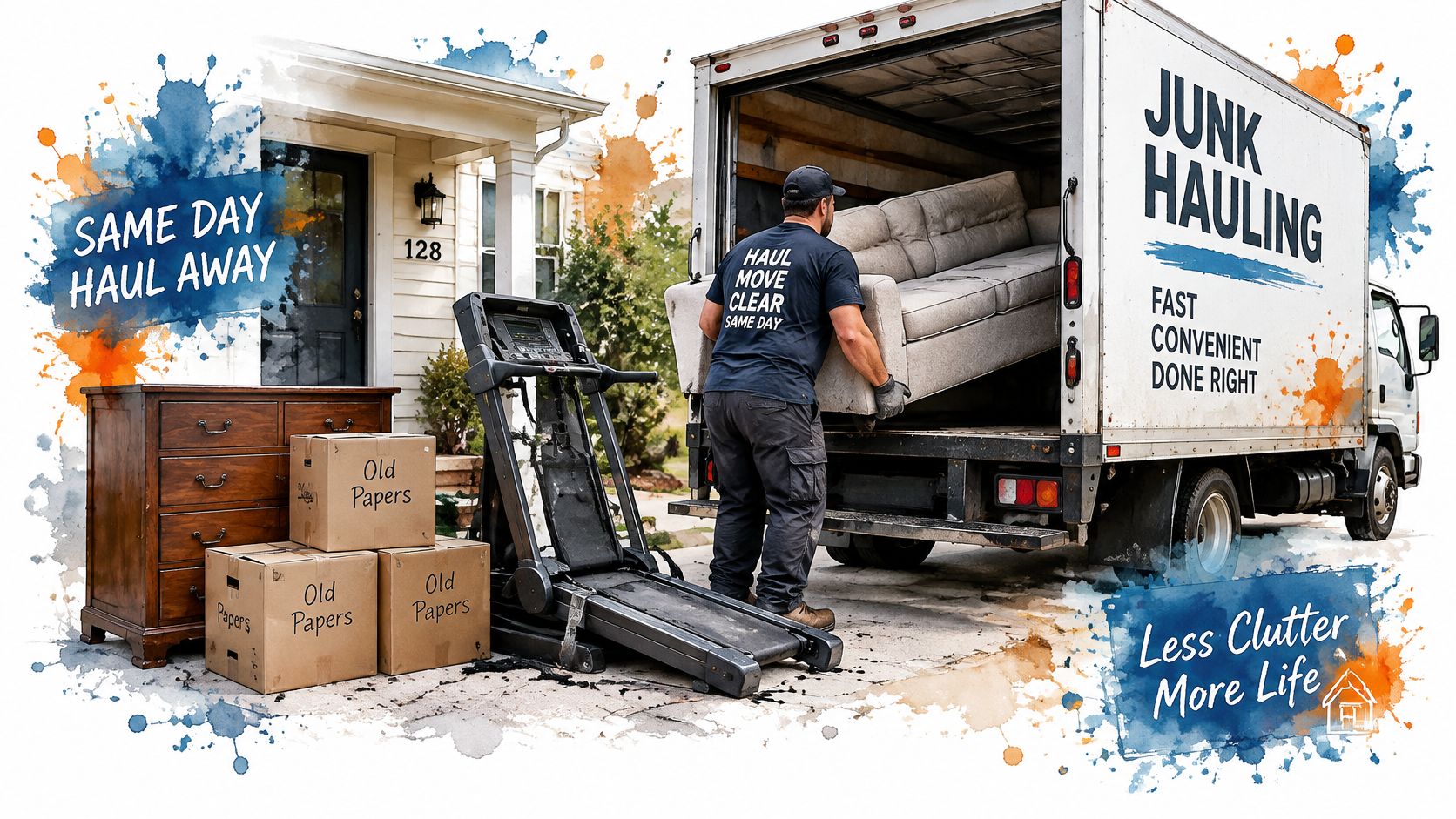
A roll-off dumpster fits a different story. You remodel a bathroom over a week, you load heavy tile and drywall yourself, and you pay a flat fee that includes disposal up to a weight limit. I steer you to a dumpster for large, heavy, single-type work, and I steer you to a junk hauler when you want hands to carry the load.
Six Steps I Want You to Follow
- List every item: You write size, count, and a weight guess for each piece, and you mark your path from curb to pile for your crew.
- Check free city options first: You review bulk and recycling rules, so you skip paying for items your city takes free on a schedule.
- Get three written quotes: You ask each company to list each item and disposal fee, and you compare lines side by side at your kitchen table.
- Verify license and insurance: You check the business license, liability insurance, and reviews from the past six months, and you ask in writing where your material goes.
- Book and stage the job: You confirm date, parking, and the person who meets your crew and approves your final load before the truck leaves.
- Keep your paper: You save receipts and disposal records, and you check your final bill against your quote the same day.
Step four protects you more than any discount saves you. A company that cannot name a dump site puts you at risk, because improper dumping can bring cleanup demands and fines that land on you as the property owner. You build confidence fast when you spend ten minutes understanding licensed waste disposal before you sign, and you ask sharper questions on the phone.
A cheap quote with no disposal address costs you more than a fair quote with a named facility and a receipt.
You also plan your own calendar with care. Our volunteer events run on weekend mornings, so you book a hauler for a private load on a weekday and you save your Saturday morning energy for public litter with neighbors. You keep private work private, and you keep shared work social.
When Volunteer Cleanup Groups Fit and Where They Stop
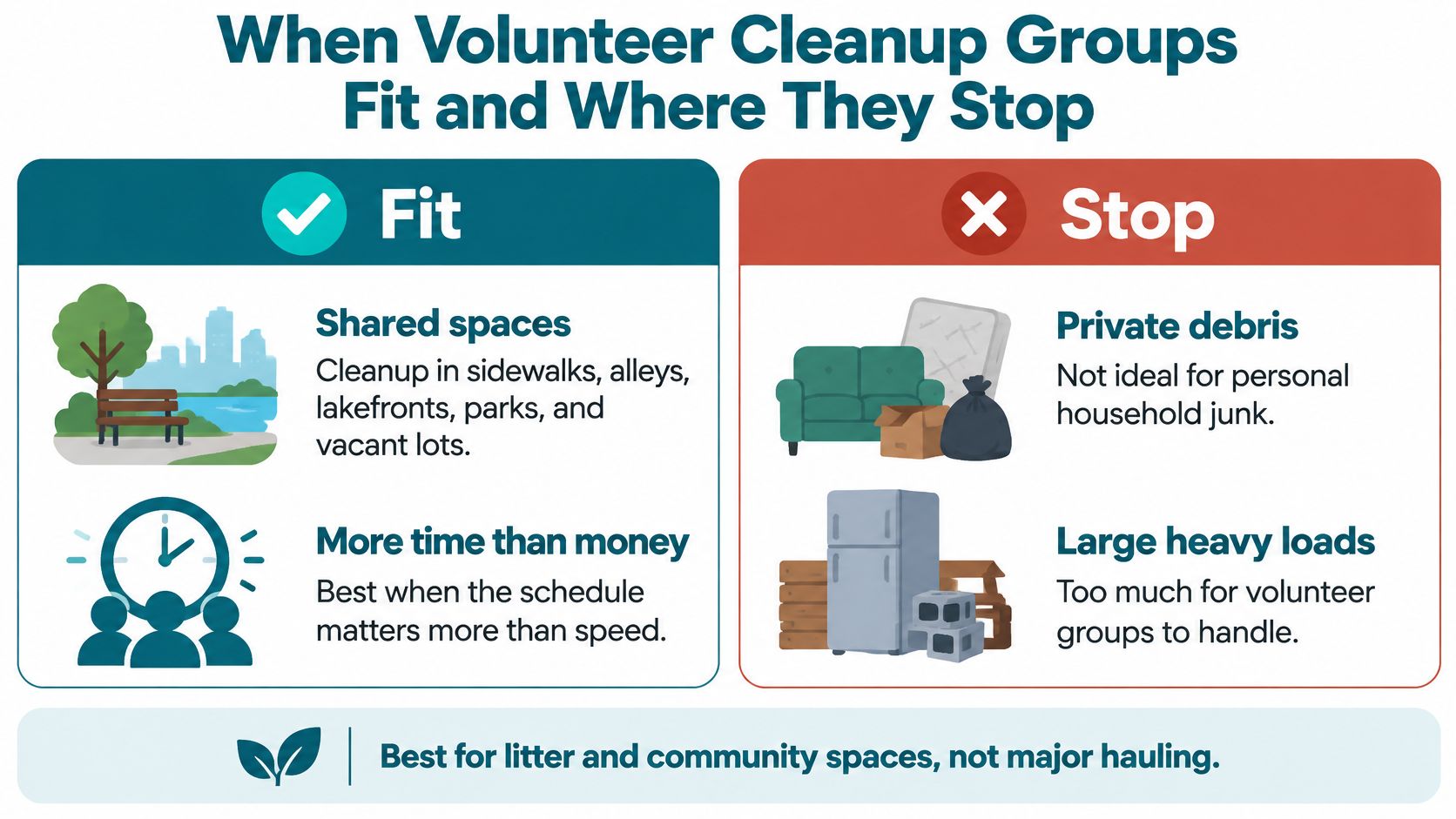
You choose a volunteer cleanup group when mess sits in shared space and you have more time than money. You and I clear litter along sidewalks, alleys, lakefront paths, parks, and vacant lots that everyone sees. You finish a block together, and you feel pride every time you walk past it later.
You see the fit and the stop lines at a glance here.
We show up for you in a steady rhythm. Our group has picked up trash every single week, and we pick up trash rain or shine, including on the coldest days of winter and the hottest days of summer. You trust a group that still meets you on a windy morning, because consistency turns a one-time sweep into a cleaner block.
Where we fit you well
- Shared litter: You get free hands for cups, bottles, wrappers, and windblown debris in public space.
- Visible wins: You see clean ground within an hour, and neighbors thank you on the spot.
- New friends: You meet people from your block while you work side by side with a grabber and a bag.
Where we stop for your safety
- Private junk: We don't haul your sofa, collect your household bags, or clear your garage for you.
- Hazardous finds: We leave sharps, unknown liquids, and pressurized cans alone, and we report them for trained crews.
- Fixed dates: We run scheduled events, so you can't summon us on demand for a same-day emergency.
I ask you to ask an organizer three questions before you join any group. You ask who provides bags, gloves, and high-visibility vests, you ask where collected litter goes, and you ask who decides what volunteers leave behind. Clear answers tell you the leader plans for your safety.
Waste work carries real risk for you, and OSHA guidance on waste management hazards names lifting injuries, slips, trips, falls, cuts, and vehicle strikes as collection hazards. You wear gloves, you watch traffic, and you keep a partner in view on a roadside. You also track results, and Durham, North Carolina's Adopt-a-Street analysis reported 10,914 pounds of litter removed across 93 events, about 9.3 pounds per person-hour. You can log volunteers, hours, pounds, and ward after your event, and you can see whether your route improves month by month.
You can watch a cleanup rhythm in action before you join us.
What Volunteers Should Never Touch
Ambiguous litter causes you the most trouble on a cleanup, and I give you one rule for every mystery item. If you can't name it, you leave it and you report it. You protect your hands, your lungs, and your teammates when you slow down for ten seconds.
Think of a cleanup like berry picking. You eat the berries you know, and you leave the strange ones for someone with training and tools. Pride never beats safety on my route, and a smart refusal keeps you coming back next week.
You use Chicago guidance on hazardous waste disposal when you face paint, chemicals, or fuel at home, and you use the scan table below on site. Your team lead photographs the item, notes the address, and sends the report while you keep working on safe litter nearby.
| Item you find | Action you take | Reason you act this way |
|---|---|---|
| Used motor oil or unknown liquid | Leave it, photograph it, report it | Liquid can burn skin and pollute soil |
| Needle or sharp object | Leave it in place, warn your partner, report it through 311 or your city line | A puncture can infect you fast |
| Lithium-ion battery | Keep it out of bags and carts, hand it to a team lead for special handling | Batteries can spark fires in trucks and plants |
| Aerosol can | Leave a pressurized or damaged can, keep every aerosol can out of a Blue Cart | Pressure and residue create facility danger |
| Remodeling debris | Note the location and leave it for the project owner | The owner carries disposal duty for that material |
| Cardboard box | Flatten it and place it in recycling | Flat cardboard sorts cleanly |
| Can or carton | Keep the shape and place it in recycling | Crushed shapes sort poorly |
| Plastic bag or film | Bag it as trash, keep it out of a Blue Cart | Film tangles sorting equipment |
Sorting Rules You Can Use in Chicago
Chicago's What Goes Where recycling guidance tells you to flatten cardboard boxes and tells you to avoid crushing cans or cartons because crushing makes sorting harder. The same guidance names aerosol cans, lithium-ion batteries, hoses, plastic bags, and other film plastic as contaminants that should never enter Blue Carts. You can search the What Goes Where tool with an item description or a photo when you stall on a choice.
Field habit: You pause, you point, you ask your team lead, and you only lift after you hear a clear yes.
You wash your hands after you remove gloves, you drink water in heat, and you step back from traffic before you bend for a bottle. I want you proud at the end of a route, and I want you unhurt even more.
Bulky Waste and Illegal Dumping Without Shifting the Problem
Bulky items tempt good people into bad shortcuts, and I want you to plan an exit before you move a piece an inch. A mattress in an alley looks like someone else solved a problem, but your neighbors now live with your old bed. You break that cycle when you book a date, confirm a route, and set the item out at the right hour.
New South Wales illegal dumping research from 2025.pdf) found bulky household waste was the most common type of dumped item. The same research found self-reported community dumping fell from 36% in 2014 to 13% in 2025. I read that drop as hope for you, because clear collection access and steady enforcement help neighbors choose the right lane.
You help your block when you time a set-out with care. You put a sofa or mattress out only on a scheduled bulky date, because an early set-out can sit for days in full view. You also check proper routes for sleep items through Chicago mattress recycling options before you assume a landfill has to take your mattress.
Find Your Ward Before You Call Anyone
Chicago's City Council information explains that Chicago divides the city into 50 legislative districts called wards and each ward elects one alderperson to a four-year term. You use the ward map or an address tool, you name your ward on the phone, and a ward office routes your request faster. You also help a cleanup leader log results by ward, so your block gets credit for steady work.
Chicago's sanitation ordinance guidance places responsibility for litter and debris removal on property owners and requires vacant and unimproved lots to remain maintained, with weed growth limited to no more than 10 inches. The same guidance requires owners of apartment buildings to provide enough garbage containers and arrange private or licensed collection. You respect that line during a cleanup, because volunteer bags don't erase an owner's duty.
Say you find remodeling debris behind a fence during a Saturday sweep. You stop, you photograph the pile, you note the address, and you report illegal dumping through 311 with your photo. The project owner rents a dumpster for discarded building materials, and you keep your crew on loose litter everyone can handle safely.
I also warn you about a quiet trap with free help. Residents learn fast when a volunteer crew clears every dumped chair for free, and some people dump again because you made dumping painless. You pair removal with a report, a kind door note about bulky dates, and a ward call, so you clean today and you prevent a repeat next month.
Choose the Right Option for Your Situation
You make a good choice when you match your situation to a lane and confirm details before you book or set out an item. I use the table below with neighbors at a kitchen counter, and I ask you to find your row first. You read the middle column for your fit, and you read the last column to test the trade-off against your time, money, and deadline.
| Situation | Best fit | Why it works |
|---|---|---|
| Weekly household bags and recycling | Municipal pickup | Already paid for and runs on a schedule |
| Old couch, mattress and a few boxes | Junk removal, quarter or half truck | The hauler lifts and hauls the same day |
| Renovation debris from a remodel | Roll-off dumpster | You load it yourself for a flat weekly fee |
| Litter in an alley, park or vacant lot | Volunteer cleanup group | Free labor for shared public space |
| Batteries, paint or motor oil | Hazardous waste drop-off | Regular carts and volunteers cannot take these items |
| Many bags plus one bulky item | Municipal pickup for bags, hauler for the bulky item | Splits cost and effort between two services |
Split a Job When Your Mess Spans Two Lanes
Say you clean out an apartment after a roommate leaves. You fill six weekly bags, you own one sagging sofa, and you notice bottles and cups all over the alley behind your building. You let your city crew take your bags on schedule, you hire a hauler for your sofa on Friday, and you join us on Saturday morning for the alley litter you share with ten other households.
That split saves you money and saves your back. You avoid paying truck space for bags your city already collects, and you avoid asking volunteers to carry furniture that belongs in a paid load. You also meet neighbors who care about the same alley, and you turn a lonely chore into a morning with purpose.
Try a second split during a remodel. You rent a dumpster for tile and wood, you take paint and batteries to a hazardous drop-off yourself, and you keep daily kitchen bags in your city cart. Each stream moves through a safe route, and you avoid a mixed pile that every provider rejects.
You write three facts on a sticky note before you act, and you let those facts pick your lane for you.
- What needs to go: You name bags, furniture, debris, or chemicals in plain words, and you count big pieces out loud.
- Where it sits: You note floor, stairs, alley access, and parking, because access changes labor and price.
- Date it must vanish: You circle your deadline, because a lease end pushes you toward a hauler and a loose deadline lets you wait for a free city slot.
You call with that note in your hand, and you sound clear in thirty seconds. A hauler quotes you faster, a ward office routes you cleaner, and a cleanup leader places you on a route that fits your energy. I want you to feel that calm click when your plan matches your mess.
You started with a corner that stressed you on Friday night. You now own a simple map, you know what to touch and what to report, and you know how to keep a bulky problem from landing on your neighbor. Take your next step this week, book or set out one lane at a time, and watch your space open up for the life you want in it.
You can turn a cleaner block into a Saturday habit with us, and you can meet neighbors across Chicago while you clear litter from streets, parks, and lots. Visit Litter Caterpillars to find your next weekend morning event, grab a bag and gloves with us, and leave your route cleaner than you found it.