

The hail hit halfway through our first Litter Caterpillars cleanup, hard enough to sting through a winter coat. Three strangers stood under one tree, passing trash bags around as makeshift ponchos while every Uber canceled, and nobody left.
What a Chicago Hailstorm Taught Me About Trust
It was a bitter April Saturday along the riverwalk. We had started with a simple plan, pick up litter, fill some bags, and head home before lunch. Halfway through the route, Chicago changed the rules. Hail rattled against the pavement, gloves soaked through, and the wind turned every exposed hand numb.
I had a choice. I could call it and squeeze everyone into a Portillo's, or I could ask three people I barely knew to keep working in miserable weather. I didn't want to confuse toughness with good judgment, so I checked that everyone could get warm and stay safe. Then something surprised me. The group chose to stay.
We tied trash bags over our coats. We moved closer together. One person held the bag open while another grabbed bottles from the mud. We laughed at how ridiculous we looked, then finished the route. We didn't build trust through a speech. We built it by sharing discomfort, watching each other's backs, and doing what we said we'd do when the easy option disappeared.
That experience changed how I think about how to build trust in teams. Trust grows through repeated evidence. People watch whether you arrive when conditions get rough, tell the truth when a plan fails, and protect one another when someone makes a mistake.
Psychological safety gives teams a foundation for that work. Amy Edmondson's 1999 study of 51 work teams connected psychological safety with learning behavior, while learning behavior helped explain the relationship between safety and team performance. Edmondson's study describes a practical condition: people can speak up, ask for help, admit mistakes, and offer ideas before small problems grow.

You can build that kind of team in a volunteer crew, a nonprofit committee, or a workplace squad facing a deadline. The setting changes. The proof stays familiar. Someone shows up, tells the truth, follows through, and makes it easier for the next person to do the same.
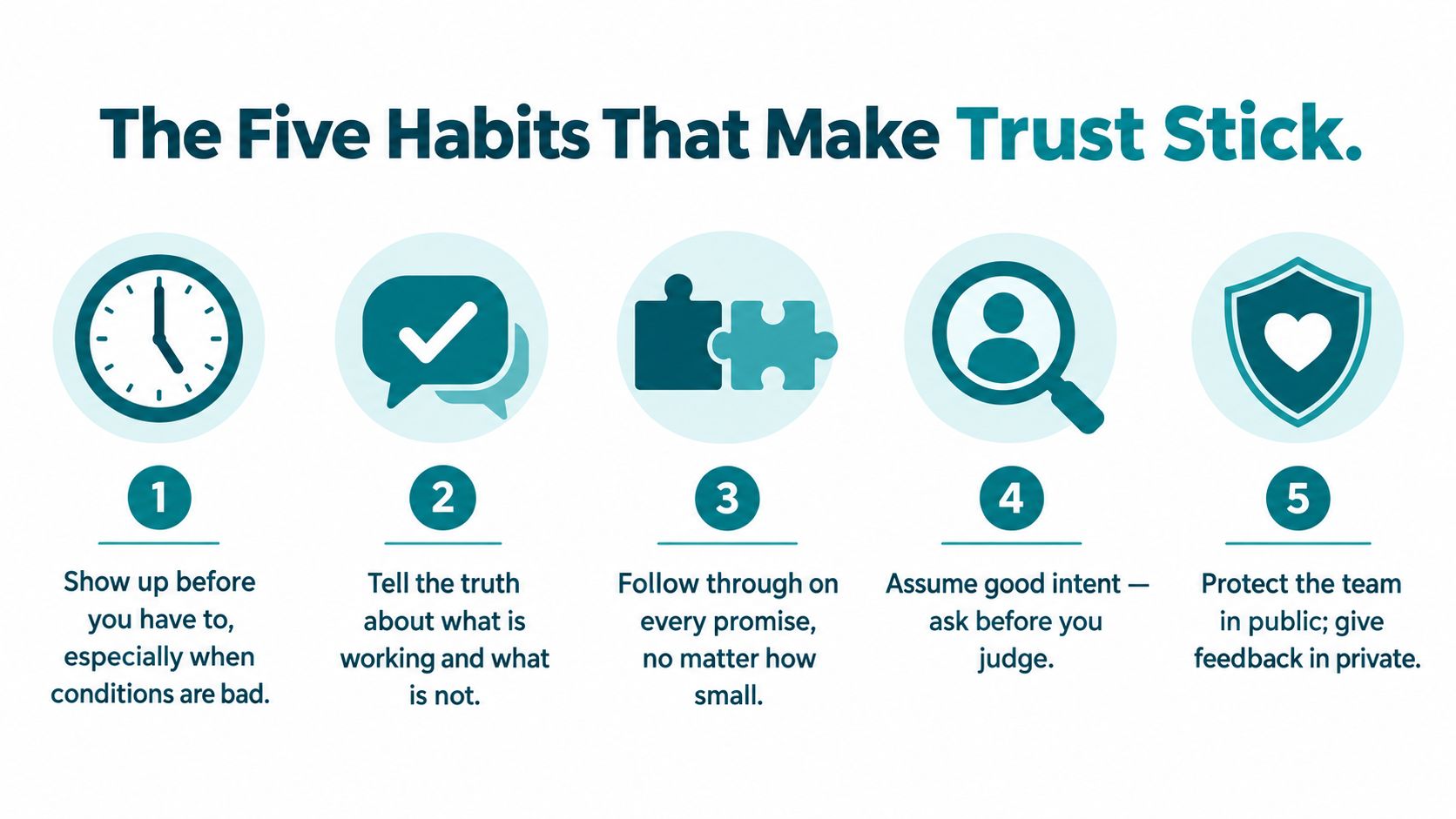
The Five Habits That Make Trust Stick
Trust doesn't arrive because everyone shares pizza or tells one personal story. It forms through small habits that people can see.
Show up before you have to
On bad-weather cleanup days, I arrive early enough to check the route, bags, gloves, and safety concerns before volunteers gather. That quiet preparation tells people they won't have to carry the whole plan themselves.
The same habit works on a work team. Join the call prepared. Read the document before the meeting. Reach out when a deadline looks shaky instead of waiting for someone to chase you.
Tell the truth about what you saw
A Sunday shift almost fell apart because we underestimated the amount of litter near a service road. I could have called the route “fine” and hoped energy would carry us through. Instead, I said, “This area is worse than we expected, and we won't finish it safely with the people and supplies we have.”
That sentence gave us choices. We shortened the route, split the work, and left with a clear plan for the next visit. Honesty gives a team usable information.
Finish small promises
If you say you'll bring extra bags, bring them. If you promise to send notes, send them when you said you would. People accept larger commitments more readily after they watch you complete ordinary ones.
Research supports this practical approach. A meta-analysis of 112 independent studies across 7,763 teams found an above-average positive relationship between intrateam trust and team performance, with ρ = .30. A separate review of 84 studies covering 5,582 teams found a moderate positive association, with a mean r = 0.34 and corrected r = 0.40. The PubMed review also supports recurring measurement because trust results vary by context and measurement method.
Route work toward people's strengths
On our crew, one volunteer remembers every route turn, another talks easily with newcomers, and another spots broken glass before anyone else. I name those strengths and match work accordingly. That doesn't trap people in one role. It lets the team start from competence while people try new tasks.
On a remote team, ask, “What part of this work feels clear to you, and where would a second set of eyes help?” You may learn more from that question than from a generic skills inventory.
Apologize fast, then get specific
A teammate once admitted during a remote retrospective that she had missed a deadline. She didn't hide behind a system problem. She explained what she missed, what the delay affected, and what she would change next time. Her honesty made it easier for others to discuss their own blockers.
Use the same pattern yourself: “I said I would send the route plan Friday. I sent it late, and that left you without enough time to prepare. I'm sorry. I'll send the next plan by Thursday afternoon.”
For a fuller workplace framework, trust-building strategies for HR can help HR teams turn these behaviors into regular team practices. You can also connect these habits with servant leadership, where the leader takes responsibility for the conditions people need to do good work.
Weekly Rituals That Compound Trust Over Time
A trust ritual should fit into the work already happening. If people need a special retreat to practice honesty, they won't practice it often enough.
Friday roundup
Send one short message at the end of the week:
“Here is what worked, and here is what I need help with.”
Then name one real win and one honest worry. On a cleanup crew, that might mean celebrating a full route while admitting that equipment ran short. On a product team, it might mean naming a finished release and a handoff that still feels unclear.
The ritual activates low-stakes honesty. People learn that a worry can enter the group before it becomes a crisis.
Two-minute pickup standup
At the start of every pickup, ask each person two questions:
“What are you bringing today, and where do you need help?”
A person might bring route knowledge, extra gloves, or patience with a new volunteer. Someone else might need help carrying a heavy bag or navigating an unfamiliar block. Keep answers brief and make space for every voice.
Google's Project Aristotle studied 180 teams across 250 attributes and identified psychological safety as the strongest factor separating top-performing teams from the rest. Google's team-effectiveness guide lists psychological safety, dependability, structure and clarity, meaning of work, and impact of work in that order. A short standup touches the first three without turning the meeting into a performance.
Sunday reflection email
Ask one question:
“What surprised the team this week?”
A surprise might reveal a route hazard, an overlooked success, or a communication gap. Read the replies before the next gathering and act on at least one useful point. Reflection loses credibility when people share observations and nothing changes.
Monthly shared meal
Keep it simple. Cold pizza on a tailgate counts. So does soup after a winter pickup or coffee at the end of a Saturday shift. The meal gives people room to meet outside their assigned task, which helps them see one another as full people rather than names on a schedule.
These rituals work because they repeat. A single honest message may feel small. A pattern of honest messages teaches people what happens when they speak plainly. Over time, that pattern helps a team handle larger mistakes, tighter deadlines, and sudden changes without waiting for a perfect meeting.
Handling Conflict Without Burning Trust
A disagreement tells you more about a team than a cheerful team-building exercise. People learn whether trust exists by watching what happens when two reasonable people want different things.
Two regular volunteers nearly quit after a public argument about route safety. One wanted to continue toward a difficult stretch. The other believed the group should leave before traffic and weather made the route unsafe. The argument grew because each person felt the other had ignored a real concern.
I stepped in with one sentence:
“I want to hear both of you fully before we decide anything.”
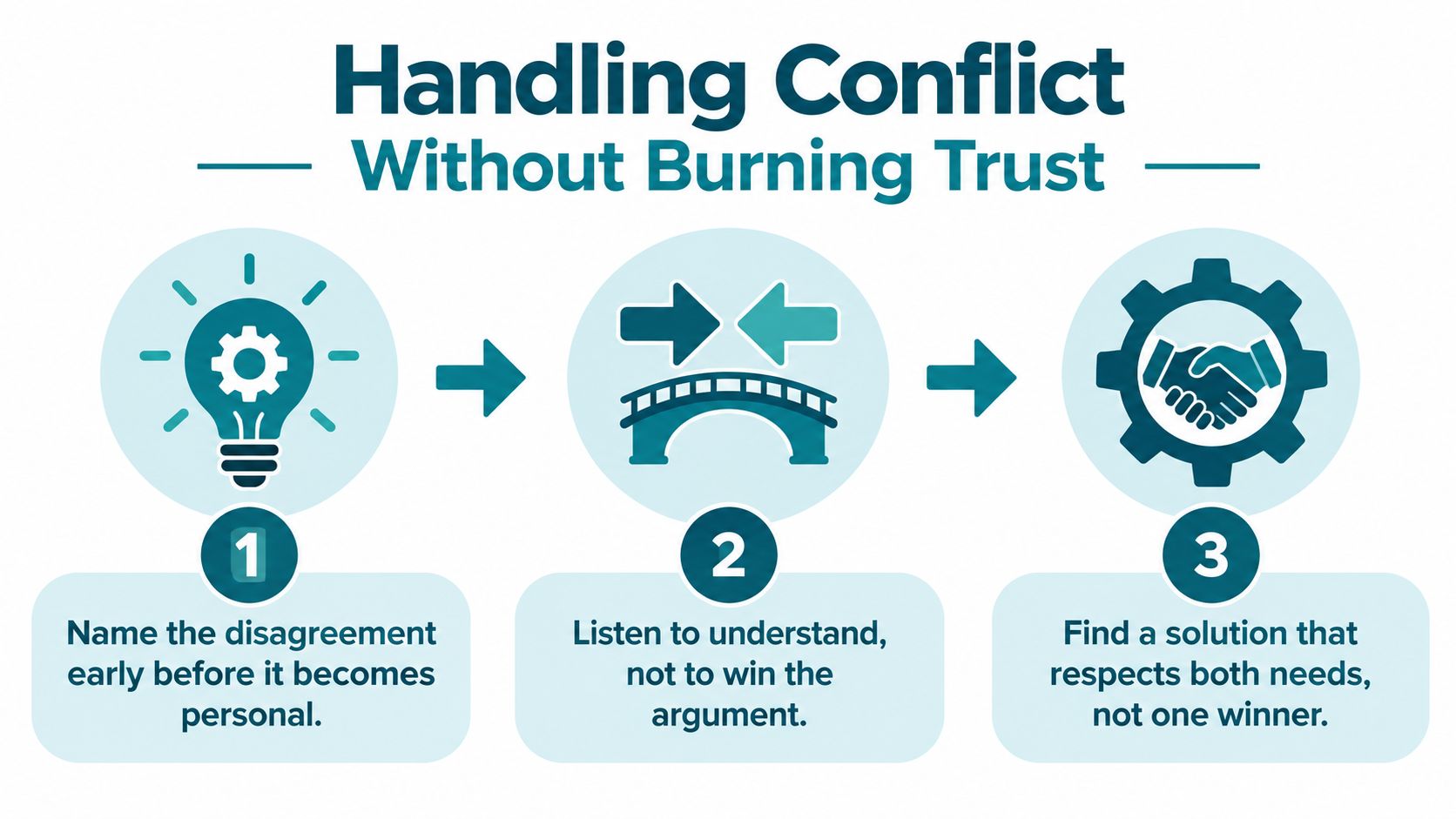
Then I used a simple sequence.
Name what happened
Say what you observed without assigning motives: “We disagreed about whether this route was safe, and the conversation became public and sharp.”
Name the feeling underneath
Ask what the disagreement brought up: “I hear concern about safety. I also hear frustration that the group's time and effort might get wasted.” Naming the feeling gives people a way to discuss the need beneath the position.
Agree on one repair step
The repair might involve a route rule, a private follow-up, a new safety check, or a decision about who can stop the work. Make the step concrete: “We'll pause at the first blocked section, check traffic together, and leave if either safety lead recommends it.”
Follow up next time
Open the next meeting by asking whether the repair worked. Without follow-up, an apology can sound like a way to end the uncomfortable conversation.
Fast apologies often feel fake because people rush to remove tension before they understand the harm. A slower acknowledgment rebuilds credibility more reliably: “I interrupted you twice, dismissed the safety concern, and made it harder for you to speak. I'm sorry. Next time, I'll let you finish before I respond.”
A team can disagree and still trust one another. It needs rules that protect candor, safety, and dignity at the same time.
When the disagreement involves power, identity, or political differences, use structure instead of demanding agreement. State the shared purpose, pair people who rarely work together, and give each person time to speak before the group decides. A divided team needs room for real disagreement and a clear reason to keep working together.
Onboarding New People the Right Way
A new person doesn't experience onboarding as paperwork. They experience it as a series of answers to one question: “Can I rely on these people?”
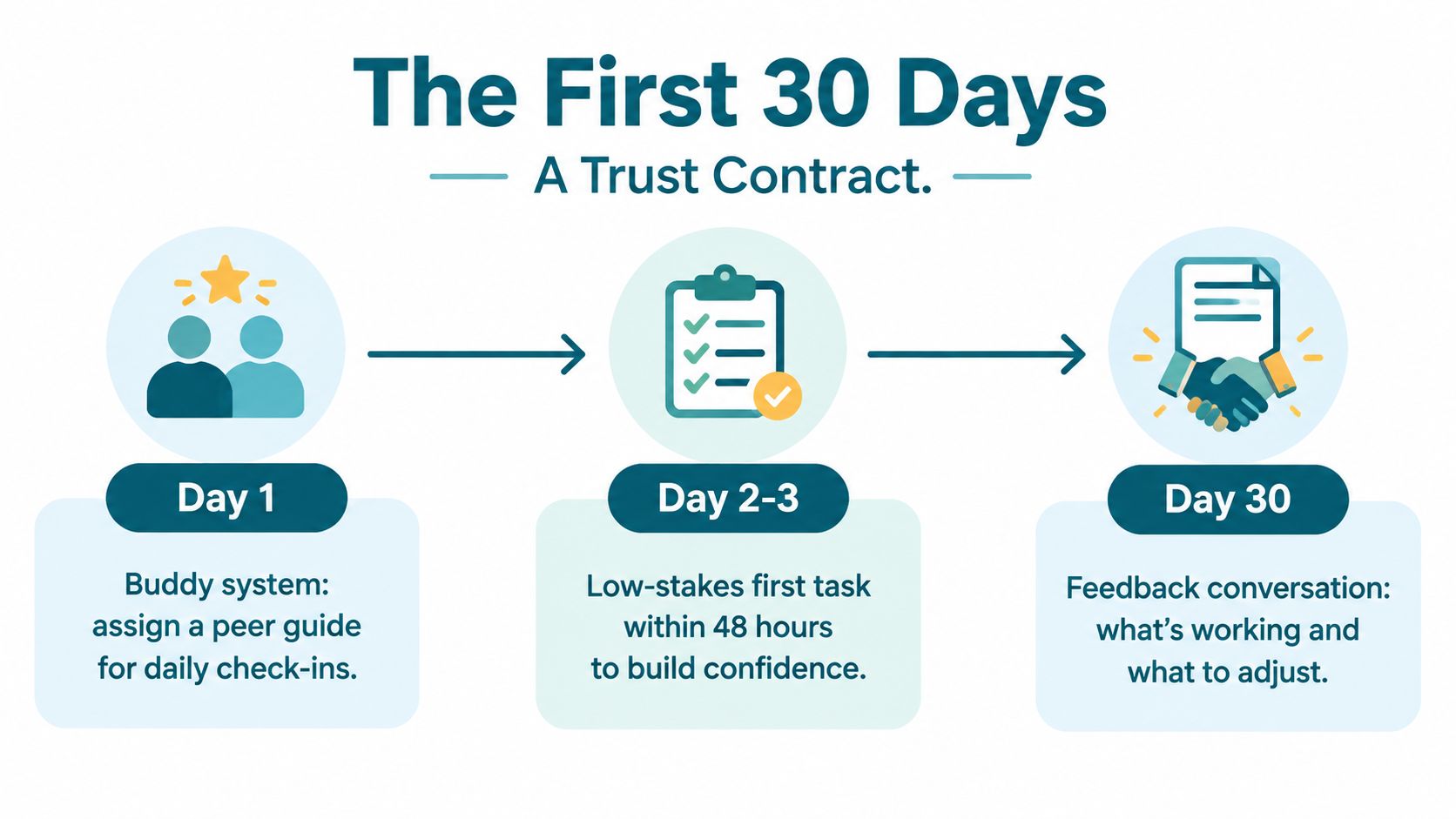
I use a trust contract for the first month. On day one, pair the newcomer with a buddy who can answer ordinary questions without making the person feel foolish. The buddy should explain where supplies sit, how decisions happen, what safety rule matters most, and who to contact when something changes.
Within 48 hours, give the new person a low-stakes task. On a winter pickup, that might mean sorting gloves, carrying bags with a buddy, or helping mark a short route. On a small product team, it might mean updating one straightforward ticket and reviewing the result together.
At the end of the first week, hold a 10-minute check-in. Ask, “What feels clear? What feels confusing? What question haven't you asked yet?” Silence should concern you more than a beginner's mistake. A quiet newcomer may still be trying to figure out whether honesty is welcome.
Build clarity through the month
Use week two for a feedback loop. Tell the person what they already do well, then name one adjustment with a clear example. By week four, explain the full role picture, including decisions they can make, decisions that need approval, and how their work connects to the group's purpose.
A volunteer can review volunteer job descriptions before arriving, while a workplace manager can use an employee onboarding checklist guide to organize conversations and tasks.
Warmth helps people feel welcome. Clarity helps them act with confidence. Give both, then keep the promises you make during the first month.
Simple Ways to Measure Trust as You Go
You don't need a long survey to learn whether people trust the team. Use a small pulse that fits on an index card and ask people to answer privately.
Ask:
- Speaking up: “Would you flag a mistake before it grows?”
- Disagreeing: “Can you disagree with the lead without fearing embarrassment or punishment?”
- Helping: “Would you help a teammate without waiting to be asked?”
Read the answers over time rather than treating one response as a verdict. Psychological safety concerns the team climate that lets members ask questions, offer different viewpoints, and admit mistakes without punishment. The CIPD evidence review also warns that cross-sectional and single-source studies can produce larger trust-performance effects than time-lagged and different-source studies. That gives me a simple rule: pair what people say with what they do.
Watch for these behaviors:
- Meetings start when the team says they will.
- People say “I don't know” before guessing.
- Small problems surface early.
- Teammates ask for help without apologizing for needing it.
- People complete small commitments without repeated reminders.
Don't confuse happiness with trust. A friendly group can avoid hard conversations. A trusting group can disagree, report a mistake, and still expect a fair response.
| Signal | What It Actually Means | Why It Matters |
|---|---|---|
| Early issue reports | People believe the team can handle bad news | Leaders can act before the problem spreads |
| Honest uncertainty | People don't need to perform certainty | The team gets better information |
| Reliable starts and handoffs | Members can predict one another's behavior | Work moves with fewer anxious follow-ups |
| Unprompted help | People feel mutual responsibility | The group can respond when plans change |
| Pulse answers over time | People can describe their experience directly | You can compare perception with behavior |
Use volunteer program evaluation methods when you need a wider view of participation and team experience. Keep the pulse separate from punishment, rankings, or performance pay. The moment people think honesty will cost them, the measurement starts hiding the condition you want to understand.
Your 30 Day Trust Building Checklist
Trust begins in hard weather, then grows through ordinary follow-through. Print this list, put it in your notebook, and check each item with the team.
Week 1
- Set the habits: Introduce showing up, telling the truth, finishing promises, naming strengths, and apologizing specifically at kickoff.
- Name a conflict liaison: Give the team one trusted person to contact when disagreement starts to spread.
- Run the first pulse: Ask about mistakes, disagreement, and unprompted help. Keep responses private.
Week 2
- Install two rituals: Try a Monday intention round and a Friday shoutout, or use the pickup standup and Friday roundup.
- Close one loop: Act on a concern someone raised during the first week.
Week 3
- Practice conflict: Use the sentence, “I want to hear both of you fully before we decide anything.”
- Repair clearly: Name what happened, name the feeling, agree on one repair step, and revisit it at the next meeting.
Week 4
- Onboard one person: Assign a buddy, give a low-stakes task within 48 hours, check in after week one, and hold a feedback conversation by day 30.
- Share the pulse pattern: Tell the team what you learned without exposing individual answers.
- Choose the next habit: Pick one behavior to repeat for the next month.
For more practical reading on team routines and workplace tools, browse the latest articles from Expressify AI. Trust compounds when someone keeps showing up after the forecast turns ugly, the schedule changes, or the first plan falls apart.
Litter Caterpillars gives volunteers a hands-on way to practice these habits through regular Chicago cleanups, shared routes, and real service alongside neighbors. Visit Litter Caterpillars to join an upcoming pickup, meet the crew, and build trust by showing up together.