
Tag: volunteer groups

  • 8 Theme Songs for Teams That Bring People Together

    8 Theme Songs for Teams That Bring People Together

    A volunteer arrives on a cold weekend morning, hands tucked into a coat, wondering whether anyone will notice if they turn around. Then the group's song starts. Someone claps the beat, a newcomer catches the chorus, and the first task suddenly feels less like an entrance exam.

    That's what the best theme songs for teams can do. They give people a shared phrase, a pace for the work, and a memory they can carry home. Football supporters have used chants and songs since the late nineteenth century, with Norwich City's “On the Ball, City” written in the 1890s and still associated with the club today according to The New York Times. A team song can be grand, funny, rough around the edges, or as short as a repeated clap and name.

    Ella Duke's Litter Caterpillars theme song gives us a real reference point for a volunteer group built around bravery, kindness, unity, and service in Chicago. The eight ideas below match specific moments, from personal transformation and first arrival to neighborhood work, friendship, and the closing celebration. Before you use a commercial recording, check permission and licensing. If you commission original music, put ownership and usage rights in writing.

    1. The Anthem of Transformation

    A hail storm can become the first verse.

    Three people huddle beneath a tree, shivering while Ubers repeatedly cancel. The cleanup hasn't gone according to plan, yet the story has already changed. Litter feels easier to move than the private mess each person carried in, and the miserable weather adds a strange spark. That scene gives a transformation anthem its spine.

    The song begins in disorder. It moves through the moment someone picks up the first piece of trash, meets a stranger, or realizes they can return next weekend. Then it rises into a chorus about becoming a little braver through repeated service. A caterpillar works well as the central image because transformation happens gradually. The song can leave room for imperfect people who still show up.

    Build the story from real voices

    Ask volunteers for a short memory. One person might describe arriving after a difficult season. Another might remember the first time they led a task. A third might talk about finding clarity while walking block by block.

    Use those memories to shape verses, then keep the chorus simple enough for everyone to join. A full recording can carry the emotional story, while a short cut can open an event before the group starts moving.

    Practical rule: Let volunteers recognize themselves in the song before you ask them to sing it.

    Play the full version while people gather and talk. Bring in the shorter refrain when you need the room to stand up straighter. The song should make a nervous volunteer think, “I can begin here,” rather than suggest that everyone must already feel fearless.

    A smiling young woman in a recycling t-shirt stands before a watercolor illustration of butterfly metamorphosis.

    2. The Sunday Morning Rally Cry

    The rally song needs to wake up the room before the coffee does.

    Keep the lyric direct. Give people a line they can repeat while they pull on gloves, check supplies, and step toward the first block. A driving beat can turn a quiet weekend morning into a shared departure. The song doesn't need a complicated story. It needs a clear invitation to move.

    Sports teams have long used fight songs and chants before competition. Football supporters often repeat a club name in a clap pattern, creating a call-and-response rhythm that works even when people don't know a full song as described in this overview of football chants. A volunteer group can borrow that mechanic without copying a stadium performance.

    Teach the chorus at the door

    Start with the leader singing one short line. Let the group answer. Repeat it until new volunteers can join without studying a lyric sheet.

    You can use a simple structure:

    • Leader's line: Call the group name or the day's purpose.
    • Group response: Repeat a short phrase about showing up.
    • Clap pattern: Use a steady rhythm that people can follow while standing.
    • Final lift: End with the neighborhood or destination.

    Run the rally cry in the first moments of every event. A newcomer might arrive tense and silent, then discover that participation requires one echoed phrase, not a solo performance. That small success lowers the social barrier.

    Record volunteers singing it together, including the rough edges. A polished track can sound distant. A living version with footsteps, laughter, and uneven voices tells people that the invitation belongs to them.

    3. The Neighborhood Explorer's Ballad

    A Chicago cleanup can feel like a walk through a giant storybook. One block gives you brick walls and corner stores. Another gives you a park, a viaduct, or a view that a newcomer would've missed from a car.

    Build the ballad like a map. Each verse can name a neighborhood, a local detail, or a moment volunteers experienced there. Start with several places and let residents help write the sections that describe them. A person who grew up nearby may supply the image that turns a generic city song into something honest.

    Woody Guthrie used folk songs to name American regions and working people. Local guides and city musicians also use songs to give places a voice. Your group can create a similar travel log through service, with volunteers discovering Chicago while they clean it.

    Let residents write the route

    Invite people from each neighborhood to contribute a line, story, or spoken introduction. Give volunteers a lyric sheet so they can follow the route during the song. A chorus can return to Caterpillar Park in Englewood, while the verses move through the wider city.

    Keep the song flexible. Record each neighborhood section separately, then release or play the relevant verse when the group works there. That approach gives residents room to hear their own place without forcing every event to use the full version.

    For planning, pair the song with Chicago neighborhoods to explore. Ask participants what they noticed, what they learned, and which detail deserves a line next time.

    The ballad should feel like an invitation to pay attention. A volunteer doesn't only collect litter. They learn the rhythm of a street, meet the people who live there, and carry a clearer sense of the city into the next cleanup.

    A pair of hands holding a watercolor map illustration featuring New York City landmarks and musical notes.

    4. The Friendship Multiplier

    A newcomer joins for the cleanup and stays for the person beside them.

    That person might be a nurse, a student, a longtime resident, or someone who also came alone. They bend, pick up, walk, and talk. By the end, they've exchanged names. Later, they text about another event, a difficult week, or a funny piece of trash someone found beneath a bush.

    A friendship song should leave room for that surprise. Make it playful rather than sugary. Write about mismatched personalities, awkward introductions, shared gloves, and the jokes that appear after an hour of work. The chorus can say that people came to move litter and found one another along the way.

    Use real laughter

    Record the song with volunteer voices. Keep a little laughter in the background if it feels natural. A perfectly clean vocal track can lose the warmth that makes a group feel accessible.

    Play the song near the end of an event, when people have already worked side by side. That timing lets the lyric describe something they've just experienced. You can also use it in recruitment posts aimed at people who want community but feel tired of shallow introductions.

    Try a chorus with a simple question and answer:

    • Question: Who showed up today?
    • Answer: We showed up together.
    • Question: Who did we meet?
    • Answer: A friend by the next block.

    The song can point people toward friendship-building activities after the cleanup. Keep the invitation gentle. Some volunteers will sing loudly. Others will listen while they pack their supplies. Both people belong in the circle.

    5. The Bravery Anthem

    Fear walks into the cleanup before the volunteer does.

    A person may worry about entering an unfamiliar neighborhood, talking to strangers, handling a difficult task, or looking clumsy in front of experienced volunteers. A bravery anthem gives that fear a place in the story. It says that showing up counts, especially when confidence hasn't arrived yet.

    Use the hail storm as the central image. The sky turns rough. The group takes cover. The phones keep showing cancelled rides. Nobody looks heroic, yet everyone remains part of the adventure. That scene makes bravery tangible. It isn't a cape. It's a wet coat, cold hands, and one more decision to keep going.

    Make courage repeatable

    Write lyrics that describe small choices. Someone introduces themselves. Someone asks for help. Someone tries a new route. Someone returns after an embarrassing first attempt.

    Volunteer testimonials can supply the strongest lines. Ask when a person felt nervous and what they did anyway. Let the song celebrate action without pretending that suffering feels easy.

    You can play the anthem before a new task or an unfamiliar route. Pair it with a small recognition ritual, perhaps a badge or a spoken thank-you. The badge shouldn't rank people. It should give a visible name to the choice they made.

    “Bravery can sound like a group singing while the weather refuses to cooperate.”

    Keep the melody accessible. If the song demands a dramatic vocal performance, nervous people may stay quiet. If the chorus feels like a promise the whole group can make, they'll have a way into it.
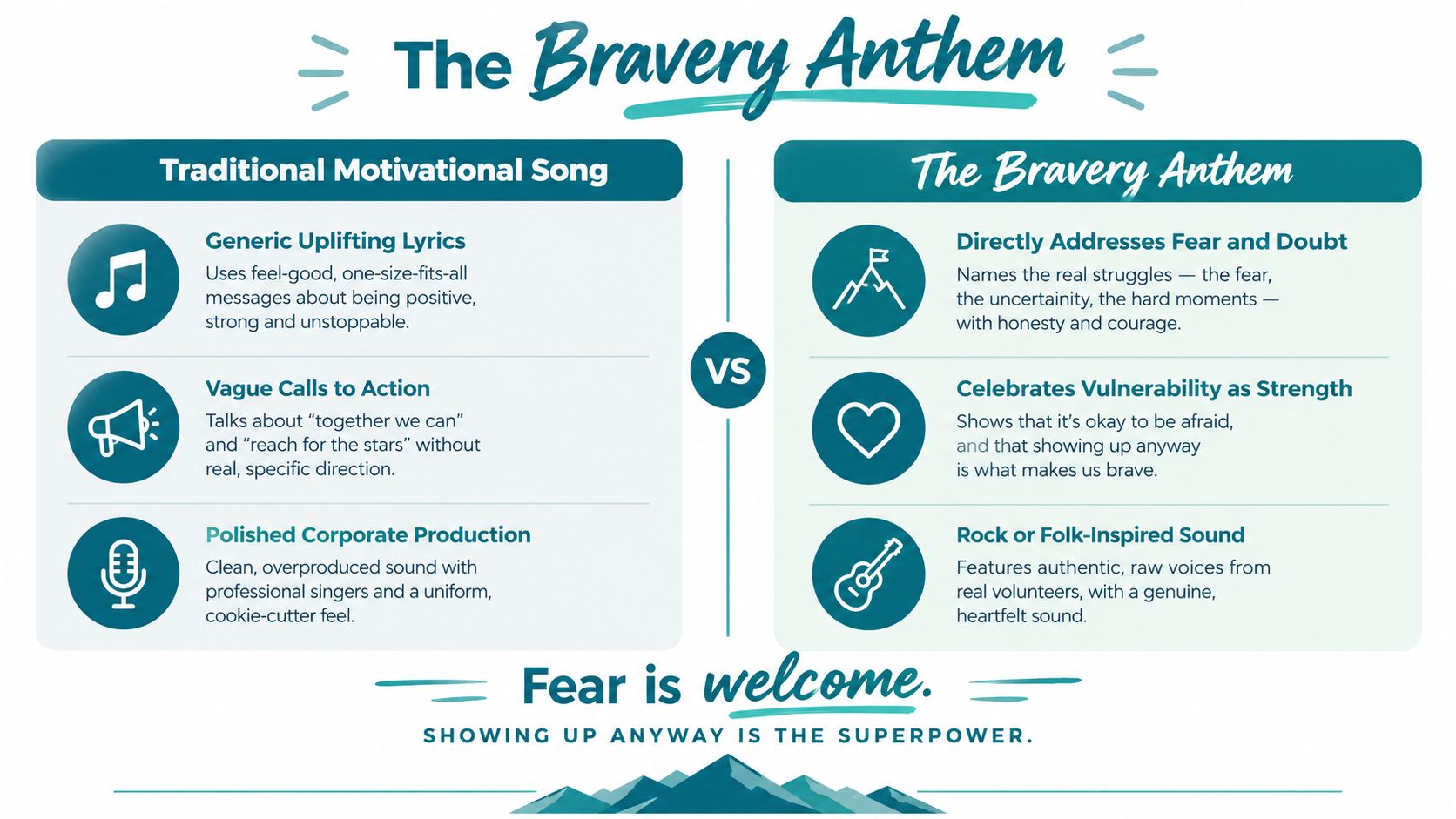
    A comparison chart showing differences between generic traditional motivational songs and authentic, vulnerable bravery anthems for teams.

    6. The Work Song

    The work song needs to fit the hands.

    A volunteer bends. Picks up. Walks. Drops litter into a bag. Repeats. The music should support that cycle without demanding attention. Bass and percussion can provide a steady floor, while a sparse melody leaves enough space for conversation.

    Sailors used sea shanties to coordinate shared physical effort. Labor songs also matched repeated tasks with repeated rhythms. A cleanup group can adapt the idea for gloves, grabbers, bags, and long walks. The song doesn't need to tell people how to work. It can make the pace feel less scattered.

    Test it on the actual route

    Play an early version while volunteers clean. Watch the pace, then ask what felt comfortable. A track that sounds energetic through headphones may feel exhausting outside. Another may leave too much silence between movements.

    Build a loop that can continue through the cleanup, but keep the arrangement light. People need to hear safety instructions, street noise, and one another. Let the refrain return often enough to create structure without turning the task into a drill.

    Use this volunteer team-building activities resource when you pair the work song with a cooperative task. The music can support movement, while the activity gives people a reason to communicate.

    The right work song creates a quiet physical rhythm. A group spreads across a block, then slowly gathers again. Bags fill. Conversations come and go. Nobody needs to announce unity because their steps already share a pace.

    Before you finalize the track, listen to this example for a sense of the kind of rhythmic energy a group song can carry.

    7. The Newcomer's Welcome Song

    The first ten minutes can decide whether someone returns.

    A newcomer stands near the briefing, holding supplies too tightly and scanning faces for a place to land. They don't know the jokes, the route, or the names. A welcome song can give them a clear signal before anyone finds the perfect conversation starter.

    Keep the lyric warm and slightly self-aware. Admit that arriving alone feels strange. Thank people for taking the first step. Say that nobody needs to perform, know every name, or understand the whole group immediately.

    Make the welcome visible

    Have current volunteers sing toward the newcomer rather than leaving them to decode an established circle. Eye contact matters. So does the next action. Follow the song with a low-pressure icebreaker, such as sharing a name and one small reason for coming.

    A camp welcome song can ease homesickness. Greeting rituals in recovery groups can give newcomers a defined place in the room. College orientation programs also use music and group rituals to reduce the awkwardness of arrival. Your version can use the same basic human move, a repeated invitation that people can accept at their own speed.

    Keep the chorus short. A new volunteer may remember only one line, and that's enough. The song should make belonging feel available before the person has completed a task.

    Avoid turning the welcome into a public test. Nobody should have to sing alone, clap on the correct beat, or explain personal details. Let listening count as participation.

    8. The Victory Celebration Song

    The bags sit in a row. The tools return to their containers. People drop onto benches, tired and smiling, with dirt on their shoes and a story from the last block.

    That's when the celebration song begins.

    Sports teams often sing after victories, and some clubs repeat their song during entrance, after a win, and in the clubrooms afterward as described in this overview of music at sporting events. The Chicago Bears even had players sing the “1985 Super Bowl Shuffle,” while the Boston Red Sox turned Neil Diamond's “Sweet Caroline,” released in 1969, into a seventh or eighth-inning Fenway Park ritual since the late 1990s according to Sports Illustrated.

    A volunteer group can create a smaller, kinder version of that ritual. Keep the song short. Let the lyrics mention what the group finished that day, whether they cleared a difficult corner, worked through cold weather, or welcomed several first-time volunteers.

    End with choice, not pressure

    Save the song until everyone sits down. Some people will sing. Some will clap. Others will listen and enjoy the pause. Make every form of participation acceptable.

    Leave a space where the leader can add a line about the day. That detail makes the ending feel earned. The group hears its own work named, then gets a clear emotional finish before people leave.

    You can record the final chorus if everyone agrees, but ask permission before posting anyone's voice or image. The memory should belong to the volunteers first.

    A diverse group of volunteers joining hands in a team spirit gesture during a community cleanup project.

    8-Point Comparison of Team Theme Songs

    Song 🔄 Implementation complexity ⚡ Resource requirements 📊 Expected outcomes 💡 Ideal use cases ⭐ Key advantages
    The Anthem of Transformation 🔄 High, careful narrative crafting and multiple versions ⚡ Moderate–High, songwriting, recording, volunteer stories Deep emotional connection; stronger purpose alignment Pre-event gathering, recruitment, storytelling moments ⭐ Strong cross-demographic resonance; durable storytelling asset
    The Sunday Morning Rally Cry 🔄 Low, simple hook and chant structure ⚡ Low, minimal production, leader to lead chant Immediate energy boost; higher turnout and motivation Event starts, quick social media clips, wake-up reminders ⭐ Highly memorable and easy to teach
    The Neighborhood Explorer's Ballad 🔄 Medium–High, rotating verses and ongoing updates ⚡ Moderate, resident contributions, periodic recording updates Increased local belonging; educates volunteers about places Area-specific events, neighborhood outreach, social storytelling ⭐ Builds place-based pride and talking points
    The Friendship Multiplier 🔄 Medium, authentic voice, playful arrangement ⚡ Low–Moderate, recordings with volunteer voices, informal production Stronger social ties; improved word-of-mouth recruitment Recruitment events, post-event socials, young-professional outreach ⭐ Drives retention by emphasizing social connection
    The Bravery Anthem 🔄 Medium, needs authentic testimonials and rising intensity ⚡ Moderate, careful tonality and quality production Reduces hesitation; attracts growth-oriented volunteers Introducing new tasks/neighborhoods, confidence-building moments ⭐ Powerful at countering imposter syndrome and fear
    The Work Song 🔄 Low–Medium, tempo testing and loopable structure ⚡ Moderate, tempo trials, looped recording, volume management Improved efficiency and synchronized group flow During cleanup work, long-duration physical tasks ⭐ Enhances coordination and creates meditative flow
    The Newcomer's Welcome Song 🔄 Low, short, direct, warm arrangement ⚡ Low, simple recording, consistent playback at events Higher first-time retention; lowers social friction First 10 minutes of event, onboarding, briefing ⭐ Strong immediate impact on newcomer belonging
    The Victory Celebration Song 🔄 Low, short and punchy; timing sensitive ⚡ Low, brief recording or group sing-along Ritual closure; reinforces return likelihood Post-event wrap-ups, group photos, reflection circles ⭐ Leaves a positive final memory that boosts return rates

    Give Your Group a Soundtrack

    Choose the song from the moment that needs help.

    If people arrive nervous, start with the Newcomer's Welcome Song. If the group needs energy before the first task, try the Sunday Morning Rally Cry. If volunteers lose rhythm during physical work, write the Work Song. If fear keeps people from trying unfamiliar tasks, use the Bravery Anthem.

    The other four ideas answer different needs. The Friendship Multiplier fits a group that wants deeper connections. The Neighborhood Explorer's Ballad gives Chicago service a sense of place. The Anthem of Transformation tells the story of why people changed through showing up. The Victory Celebration Song gives the day a warm finish people can remember.

    You don't need a full album. Start with one chorus and test it in the room where you'll use it.

    1. Name the audience: Decide whether you're writing for newcomers, longtime volunteers, children, workers, residents, or everyone together.
    2. Choose the emotion: Pick one feeling for the first version, such as courage, welcome, motion, friendship, pride, or relief.
    3. Write one repeatable line: Keep the words short enough for a person to learn after hearing them once.
    4. Test a brief version: Use the song at one event before you spend time on a polished recording.
    5. Ask what felt true: Invite honest reactions from people who sang, listened, or stayed quiet.
    6. Revise before recording: Remove lines that sound forced, confusing, or too personal for a group setting.

    Music can support cooperation when people hear upbeat songs. In Cornell lab experiments, teams exposed to upbeat music contributed about one-third more to a shared group good than teams hearing unpleasant music, and the effect continued when researchers compared them with a no-music control Cornell's report explains the experiment. For a volunteer team, that points toward familiar, welcoming, low-friction tracks. Aggressive or unpleasant music may create the wrong mood for shared work.

    Choose carefully when the group includes people with different experience levels. Music can build affiliation, yet a group goal can also divide people when the attempt ends in failure or embarrassment, according to research on music-making and group identity from the University of Cambridge repository. A song should invite shared success, not turn singing into another performance test.

    Permission matters too. Check the rights before you play or publish a commercial recording. When you commission original music, write down who owns the composition, recording, and future uses. A distinct sonic identity can help a team avoid relying only on generic licensed tracks. An analysis of 154 brands found that custom or original music made up 6.4% of average brand audio content, while 80% of A-Grade and B-Grade brands used owned music at least some of the time as reported by BestAudioBrands. Treat those figures as context for audio branding, not a promise that every team needs a custom song.

    A group finishing a cleanup hears its own voices. The chorus wobbles. Someone laughs. The last bag moves into place. Next weekend, that sound can bring the memory back before anyone picks up a grabber.


    Litter Caterpillars brings Chicago volunteers together for weekly trash pickups, neighborhood service, friendship, and team identity through flags, badges, and theme songs. Visit Litter Caterpillars to find an upcoming event, meet the group, and help create a shared sound for the next cleanup.

  • How to Start Volunteering and Transform Your Life

    How to Start Volunteering and Transform Your Life

    Starting to volunteer is a lot simpler than you think. You just have to find a problem you care about and look for the people who are already trying to solve it. You don't need some perfect, elaborate plan. I promise you, the biggest changes I've ever seen, both in my life and in my city, started with one small step that gets you out of your head and into the real world.

    From Personal Chaos to Public Purpose

    Smiling young man in a volunteer shirt and green gloves holding a trash bag in a room.

    Let me be straight with you. When I started Litter Caterpillars, my mission wasn't to save the world. I was trying to save myself. My apartment was an absolute disaster, my motivation had bottomed out, and I felt completely, utterly stuck in the mud.

    Every single object in my place told a story of failure. That old jar of blueberry jam hiding in the back of the fridge? It was from a trip I took four years ago. That bag of nuts on the counter? A remnant of a health kick that lasted about a day. Each piece of trash, even if it weighed less than a pound, felt like it weighed 500. It was immovable, a monument to my inertia.

    Things finally hit a breaking point after I got out of a long, chaotic relationship. I remember looking around at my messy life and my even messier apartment and knowing, deep in my bones, that something had to change. The problem was, I was so overwhelmed by my own junk that I couldn't even think about where to begin. It was like trying to climb a mountain of my own making.

    Channeling Messy Energy

    So I tried something weird. Instead of dealing with my own mess, I decided to go clean up someone else’s. It just felt easier, less personal. I grabbed a trash bag and just went outside, no plan, no destination.

    The most incredible thing happened. By focusing on a problem I could actually see and solve—a sidewalk full of litter—I found this strange sense of freedom. The weight of my own chaos, that 500-pound trash, suddenly felt a little lighter.

    That’s the secret I want to share with you, especially if you're trying to figure out how to start volunteering. Sometimes, the best way to fix your own world is to step out your front door and into the bigger one. You don't have to have your life all figured out. In fact, I've found it often works better if you don't.

    That little bit of hesitation you're feeling right now? That worry about starting something new or not knowing anyone? I've been there. I know that feeling. You're not the only one who feels overwhelmed.

    • You feel like you don't have enough time.
    • You worry you don't have the right skills.
    • You're shy and dread the idea of meeting a bunch of new people.

    I get it. But that messy, chaotic energy you feel inside? That's not a weakness; it's fuel. My whole point is to show you how a city-wide movement like Litter Caterpillars can grow from a place of total personal chaos. It’s all about taking that restless energy and turning it into something that builds you, and your community, up.

    Finding Your People and Your First Event

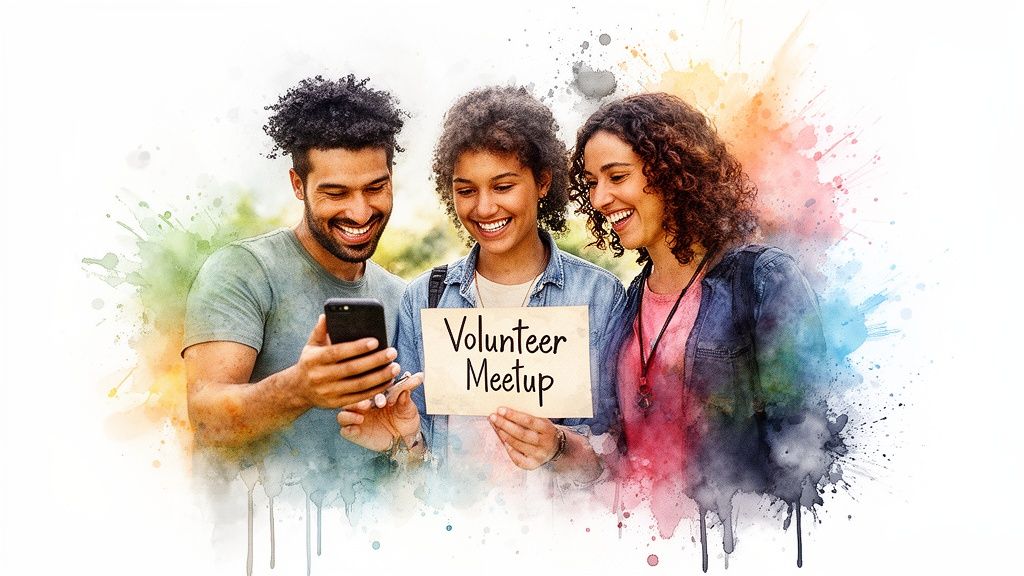
    Three diverse, smiling friends at a volunteer meetup, looking at a smartphone with colorful splashes.

    Alright, you feel that restless energy, that undeniable need to do something. Now it's time to give it a direction. You don't need a grand, five-year plan. You just need a place to start. One single point on the map.

    Finding your first volunteer event is a lot like searching for a good book club. You don't just want any old group—you want the one that geeks out over the same stories you do. The goal isn't just to find any opportunity; it's to find your opportunity.

    How to Find Your People

    Forget those giant, overwhelming databases with thousands of soulless listings. I found the first Litter Caterpillars using the same simple tools you probably use every day. We didn't have a fancy website or a marketing budget. We just grew through real connections, one person at a time.

    And you're not alone in this search. It might feel like it sometimes, but a staggering 2.1 billion people volunteer their time monthly. That’s 34.5% of the world's working-age population! Litter Caterpillars started that way too—just three of us huddled under a tree in a Chicago hailstorm. We were a tiny part of the 860 million people who volunteer somewhere in the world every month.

    Want to know where I would look to find your own crew? This table breaks down the simple methods I use to find like-minded people.

    Finding Your First Volunteer Opportunity

    Platform / Method What to Look For Pro Tip
    Meetup Groups with frequent events, active members, and clear descriptions. Look for photos of past events to see the vibe. This is my #1 tool. I use specific keywords like "trail cleanup" or "community garden," not just "volunteer."
    Instagram & Facebook Search local hashtags like #[yourcity]volunteers or #[yourpassion]. This is where you find the groups with real heart. Look for behind-the-scenes stories and genuine engagement.
    Community Boards Check local coffee shops, libraries, or community centers for flyers. Old school, I know, but it's super effective for finding grassroots efforts that aren't online yet.

    These are the same tools we use to get the word out for our weekend morning cleanups. It’s all about finding the people who share your energy.

    You can spot a great volunteer group a mile away. They communicate clearly, their photos show real people having a good time (not just staged shots), and they have a volunteer-first attitude. Their goal isn't to get your money; it's to get your time and energy.

    Showing Up Is the Hardest Part

    A few months ago, someone named Sarah messaged our Instagram page. She was full of hesitation. "I'm super nervous to come alone," she wrote. "I don't know anyone."

    I told her what I tell everyone: almost everyone comes alone the first time. That's the secret. The beauty of a shared task, like picking up litter, is that it kills the awkward small talk. You have an instant purpose. You're on a mission together.

    She showed up that Saturday, quiet and keeping to herself. But within twenty minutes, I saw her laughing with another first-timer about a weird toy they'd found in a bush. By the end, she was helping organize the group photo.

    That's it. That’s the whole "secret" to starting. You just have to show up once. The biggest step you'll ever take is the first one out your front door. For a deeper dive, you can also check out our complete guide on how to find volunteer work for even more ideas.

    The Adventure of Showing Up No Matter What

    Three smiling friends in raincoats laugh under a tree in the rain, sharing a thermos.

    Let's be real: volunteering isn’t always a feel-good photo op. Sometimes, it’s just plain miserable out there. And honestly? That's where the good stuff happens. It’s in those shared struggles that you find the story, the connection, and the real reason you do this.

    I'll never forget our very first cleanup. There were just three of us, total strangers who met up to pick up some trash. Then, a freak Chicago hailstorm came out of nowhere. We were soaked, freezing, and huddled under a single tree, watching our Ubers cancel on us, one by one.

    It was awful. And it was perfect.

    In that moment of shared misery, shivering together, a bond formed that you just can't fake. We weren't three strangers anymore. We were a team that had survived something together. If you really want to know how to start volunteering, you have to understand this: the best parts are often hidden inside the hardest moments.

    The Power of Showing Up in the Rain

    Bravery isn't about being fearless; it's about being scared and doing it anyway. It's about dragging yourself off the couch when every bone in your body is screaming to stay home.

    That’s where pride comes from. I always think about the story of Tom Sawyer painting that fence. He didn’t treat it like a chore. He reframed it as an honor. He actually convinced his friends that this miserable task was an exclusive, once-in-a-lifetime opportunity.

    That’s exactly what we do at Litter Caterpillars. We bring flags. We have a theme song. We award badges. Why? Because kindness and service deserve the same pride and identity as a sports team or a country. It turns a task into a mission.

    These symbols aren't just for show. They remind us that what we’re doing matters. They help us step into our power, especially when the weather is terrible and the work is hard.

    This isn’t just a Litter Caterpillars thing, either. I see this same spirit in our friends at Care For Real, who consistently show up to serve their community's needs, transforming simple acts of kindness into a powerful, unified force for good.

    Uniting Strangers Through a Shared Goal

    The things that turn volunteering into a life-changing experience aren't complicated. They’re the simple, core values that bring strangers together and turn them into a family.

    • Bravery: Having the guts to show up, especially when it’s uncomfortable or inconvenient.
    • Kindness: Putting the community’s needs first, without expecting a trophy for it.
    • Unity: Realizing that we go so much farther together than we ever could alone.

    This was never just about picking up litter. It’s about embracing the adventure, finding your people in the middle of a hailstorm, and discovering a stronger part of yourself you never knew was there. If you're looking for a real story, not just a task, this is for you.

    How to Build a Volunteering Habit That Sticks

    Showing up once is easy. But how do you make volunteering a real, consistent part of your life? It’s not about having more willpower than everyone else. It’s about being smart and intentionally designing your life—and especially your social circle—for success.

    I learned this firsthand building Litter Caterpillars. I schedule our events for weekend mornings on purpose. It's a natural filter. It weeds out the party people and attracts dedicated givers, the kind of people who choose service over sleeping in.

    It’s how I built a community I actually want to see every week.

    Engineer Your Social Circle for Success

    Think of your motivation like a tiny campfire. If you leave it out in the open, the first gust of wind—a busy week, a rainy day—will blow it right out. But if you build a circle of rocks around it, that fire will burn hotter and longer.

    Your fellow volunteers are those rocks.

    The social connection is the real fuel. When you know you’ll see friends, share some laughs, and maybe grab coffee afterward, the "chore" of volunteering becomes the highlight of your week.

    You stop thinking, "Ugh, I have to go pick up trash," and start thinking, "I can't wait to see my friends."

    Consistency isn't about forcing yourself to do something. It's about creating a system where showing up feels more rewarding than staying home. It’s about finding a group that respects your energy and gives back more than it takes.

    And this approach is catching on. After the pandemic, formal volunteering in the US saw a huge rebound. We’re talking 75.7 million people, or 28.3% of the population, getting back out there and pitching in. That's almost back to pre-2019 levels.

    A lot of that is driven by groups that make it simple and rewarding to join, using tools like Meetup or just a simple group chat to keep everyone connected. When you find the right crew, you'll realize every hour you give—valued at $34.79 by some measures—pays you back tenfold in real, human connection.

    Find Your Rhythm and Don't Burn Out

    You can’t pour from an empty cup. That's just a fact. A real, sustainable volunteer habit has to respect your energy and your time. I've seen too many good people burn out because they joined groups that demanded way too much, way too fast.

    The secret is finding a rhythm that works for you.

    • Start small and own it. Committing to just one event a month is a huge win. Don't compare your first step to someone else's marathon.
    • Find a "no-commitment" first event. Look for drop-in opportunities where there's no pressure to sign your life away. It makes just showing up that much easier.
    • Let your values guide you. Connect with a mission that actually fires you up. For us, it’s bravery and kindness. When the work aligns with your soul, you’ll want to come back.

    Seeing the results of your work is also a game-changer. When we won an empty lot in Englewood to build our volunteer-led Caterpillar Park, it wasn't just a win for the neighborhood. It was proof to every single volunteer that their time, their sweat, their effort—it all mattered.

    You can build a habit that sticks. I did it, and I know you can, too. For more on how we keep our community strong, check out our guide on volunteer retention strategies.

    The Ripple Effect of Your Contribution

    A hand plants a small green tree next to a black garbage bag in a watercolor park.

    It’s easy to get stuck on the small stuff. The gloves, the trash bags, whether you really want to get out of bed on a Saturday morning. But I need you to see what happens when you decide to show up anyway.

    When you start volunteering, you're doing more than just picking up a single piece of trash. You're casting a stone into a pond, starting a ripple. It’s small at first. But then it spreads, getting bigger and stronger until it changes everything.

    That’s the real secret of this work. It’s how one person, one afternoon, one small act, can completely transform a community. It all starts with you.

    From Empty Lots to Community Parks

    One of our proudest moments at Litter Caterpillars was born from a forgotten patch of dirt. It was an abandoned, overgrown lot in Englewood, full of junk and ignored by pretty much everyone. So, we just started showing up. Week after week, we kept clearing it out.

    Then we did something crazy. We entered an auction and, against all odds, we won the lot. That empty patch of dirt is now becoming Caterpillar Park—a green space built entirely by the hands of volunteers. This wasn't some city project. It was us, a community, taking back our own space because we decided our neighborhood was worth fighting for.

    Another time, the city shut down a major highway for a huge bike event. Most people saw a traffic nightmare. We saw our chance. Our crew got permission to get out on that empty expressway and clear out years of caked-on trash. We turned a city-wide headache into a massive win for the environment.

    These aren't just feel-good stories. They’re proof of a simple idea.

    Your small, consistent effort creates massive, beautiful change. You don't need a million-dollar grant or a government decree. You just need to show up with your friends.

    The Real Transformation Happens Inside You

    As incredible as building a park is, the biggest ripple effect is personal. It's the change that happens inside you and the people picking up trash next to you. The most powerful thing we build isn't a park—it's friendship.

    I’ve watched deep, lasting friendships form over shared garbage bags and weekend coffee. I’ve seen shy, nervous first-timers grow into confident leaders who now organize their own cleanups. This is why we call ourselves Caterpillars. We are all transforming.

    Our entire vision is built on three simple things:

    • Service: Giving your time to something bigger than yourself.
    • Sunlight: The healing power of getting outside and into the real world.
    • Friendship: The connections that turn a chore into a joy.

    Volunteering helps you learn to trust yourself again. It’s a reminder that you have the power to make a real difference—not just in your community, but in your own life. Every piece of litter you pick up is a small act of forgiveness for all the times you felt stuck or helpless.

    This is the inspiration I want to leave you with. Your journey to start volunteering isn't just about cleaning up a neighborhood. It's about rebuilding a part of yourself, one small, brave step at a time.

    Answering the Nagging Questions

    Look, I get it. The moment before you jump into something new is always full of “what ifs.” I want to tackle those head-on, with honest answers based on my experience building this community from the ground up and seeing hundreds of people face the same doubts.

    Let’s cut through the noise and talk about what’s really on your mind.

    What if I’m Shy and Don't Know Anyone?

    This is the number one fear I hear, and it's the entire reason groups like ours exist! I can promise you, almost everyone comes alone their first time. I did. We all did.

    The shared mission—picking up trash—is the ultimate icebreaker. There's zero pressure to make small talk because you already have a purpose. You’re in the trenches together, and that creates an instant bond. We've all been that new person standing awkwardly on the sidewalk, so we make sure no one ever feels that way for long. Just show up, grab a bag, and you’ll see people are just happy you’re there.

    Do I Need Any Special Skills or Equipment?

    Nope. Absolutely not. Any good volunteer group, especially for community cleanups, will have everything you need. We bring the gloves, the bags, the trash grabbers—all of it.

    Our rule is volunteer-first. That means we make it as simple as possible for you to show up and help. The only thing you need to bring is yourself. Just wear comfy shoes and clothes you don’t mind getting a little dirty.

    This isn't just a nice idea; it's how successful groups run. Making things accessible is everything. In fact, research I've seen shows that structured programs can have 1.9X higher engagement because they remove these exact barriers. It's why 29% of people find their first opportunities on easy-to-use platforms like Meetup or through social media. If you're curious about the data behind it, you can check out these corporate and individual volunteering trends on Goodera.

    My Schedule Is Crazy. What if I Can't Commit?

    That’s life! Nobody I know has a perfect schedule, and there is zero pressure for perfect attendance here. A healthy volunteer group isn't another stressful obligation to add to your calendar.

    I announce our events, and you come when it works for you. That’s it. Showing up once a month is just as awesome as showing up every week. The whole point is to build a habit that energizes you, not one that drains you.

    When you can't make it, others will be there to carry the flag. That’s the power of community. Just stay in the loop and come when you can. We'll be glad to see you.


    Ready to take that first step? At Litter Caterpillars, we turn the simple act of cleaning up into an adventure of friendship and transformation. I hope you join our next event and see for yourself. You can find your people and your purpose at https://www.littercaterpillars.com.