Tag: volunteer guide

  • Illegal Dumping Prevention Your Community Playbook

    Illegal Dumping Prevention Your Community Playbook

    You know that feeling. You turn the corner by your alley, or pull up beside the lot near the bus stop, and there it is again. A couch with the stuffing ripped out. A busted toilet. A mountain of drywall that showed up overnight like somebody emptied a whole renovation into your block and vanished before sunrise.

    That kind of mess gets under your skin.

    I know because that anger is part of why I started cleaning. My own place was a mess for a long time. I had a weird emotional attachment to trash. Every old container, every dead battery, every forgotten bag in the corner felt heavy to me. Then my life cracked open after a chaotic relationship ended, and I made myself a promise. I was going to build a different kind of life with different kinds of people. Cleaner. Braver. More honest.

    Cleaning other people's trash turned out to be easier than cleaning my own.

    The first time we went out, there were only three of us. Chicago hit us with that classic nonsense weather. Hail, slush, freezing wind, rides canceling one after another while we huddled under a tree laughing at our own bad decisions. But something clicked for me in that storm. Service changed the story. Suffering gave it flavor. We weren't helpless anymore.

    That's the spirit behind illegal dumping prevention. You don't need to wait for a perfect grant, a formal committee, or some polished city plan. You can start with one disgusting pile and one stubborn decision.

    Your Call to Action Starts with a Mess

    A dumped couch is never just a couch.

    It's a message. Somebody looked at your block and thought, “Nobody will stop me here.” That stings. It feels personal even when it isn't. You see the same thing enough times and your brain starts telling you that this is just how your street is now.

    I stopped believing that the day I picked up my first bag.

    The pile that changed me

    For me, it wasn't one dramatic crime scene. It was the slow drip of trash and disorder, outside and inside my own life. I had spent years struggling to clean my room, clear my fridge, throw away things that were obviously dead weight. Then I started cleaning outside with other people, and I felt lighter almost right away.

    That's still one of the strangest truths I know. Cleaning up a stranger's mess can wake you up to your own power.

    One morning we found a stretch of street littered with the usual suspects. Food containers, broken plastic, fast-food cups, random clothes, a shopping cart missing a wheel. We didn't fix the whole neighborhood that day. We just filled bags until our hands hurt and the block looked cared for again. Neighbors started talking to us. One brought water. Another pointed toward a side lot and said, “If you can help over there too, that's where they really dump.”

    That's how it starts. One pile points to another. One cleanup turns into a map in your head.

    You don't need permission to care about a place.

    This isn't a tiny problem. In the United States, people illegally dump about 1.5 million tons of waste each year, and cost avoidance is a common reason people do it. A surprising number of businesses also say they don't know the fines for dumping construction waste, according to these illegal dumping facts from BigRentz.

    Start angry, stay useful

    Anger is fine. I've felt it a hundred times.

    What matters is what you do next. If you let that feeling harden into cynicism, the dumpers win. If you turn it into movement, even small movement, your block starts changing. You start changing too.

    Illegal dumping prevention begins long before cameras, calls, and fines. It begins when you stop walking past the mess like it belongs there.

    Find Your Ground Zero

    Don't try to save the whole city on day one. Pick one place that keeps bothering you. Your alley mouth. That dead-end lot. The side of the viaduct where people toss mattresses like they're feeding a beast.

    That spot is your ground zero.
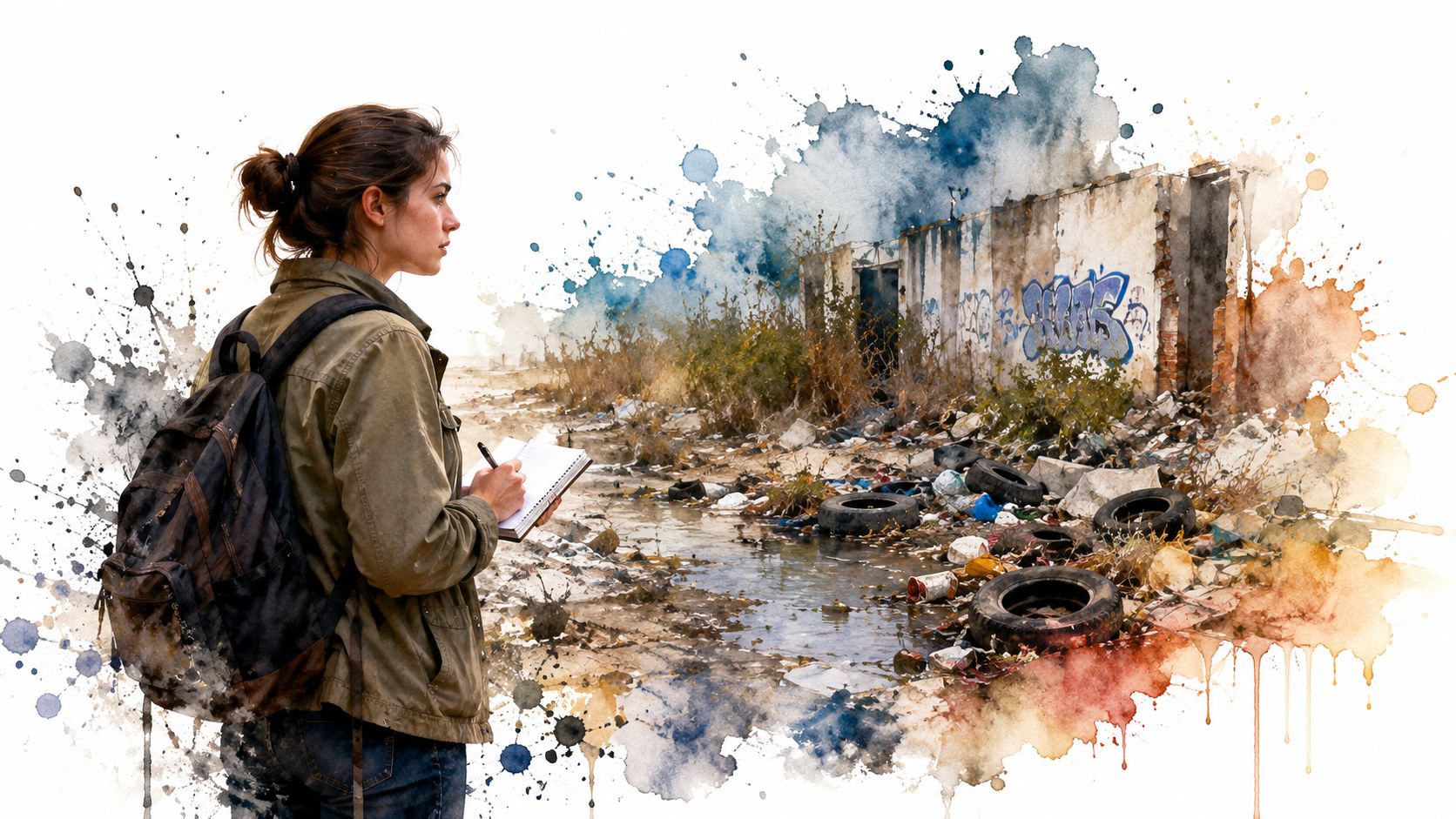
    A woman with a backpack takes notes in front of a ruined building surrounded by illegal trash.

    When I started doing this seriously, I realized many onlookers view a dumping site as a gross blur. You need to look at it like a detective looks at a room. The pile tells a story if you slow down enough to read it.

    If you want to work block by block, it helps to see how your target site fits into the wider area. I like checking a broader neighborhood view with the Northeastern Illinois map and then zooming back into the exact trouble spot.

    Read the trash

    The first clue is the material itself.

    Household bags, old toys, kitchen chairs, and clothing usually point one way. Drywall, shingles, concrete chunks, and paint buckets point another. Tires tell their own story. So do mattresses. You don't need to play detective with perfect certainty. You just need a working theory.

    Use a simple checklist:

    1. What is it
      Write down the types of waste you see. Don't say “junk.” Say “broken dresser, carpet padding, black bags, tire, drywall scraps.”

    2. When did it appear
      If the pile is fresh on Monday morning, weekend activity is a possibility. If it grows in small bits every night, that tells a different story.

    3. How easy is the site
      Look for curb cuts, alley openings, darkness, fences with gaps, and places where a truck can back in fast and leave fast.

    Sketch the scene

    I'm a big believer in ugly field notes. You don't need fancy software. Use your phone, a notebook, or a screenshot with scribbles all over it.

    Mark these things:

    • Access points where a vehicle can pull in
    • Sight lines where nearby homes or stores can see the area
    • Shadows where bad lighting gives cover
    • Nearby anchors like schools, churches, loading docks, and vacant buildings

    A little hand-drawn map can save you weeks of guessing.

    Practical rule: Don't study ten bad spots badly. Study one bad spot well.

    Look for patterns, not drama

    One of the biggest mistakes I see is people reacting only to the latest ugly thing. They chase the newest mattress and ignore the pattern underneath it.

    The pattern is the primary enemy.

    Once you know why a place gets used, your next move gets easier. Maybe the answer is access control. Maybe it's lighting. Maybe it's regular cleanup. Maybe it's a nearby property owner who has stopped paying attention. But you won't know that from a quick glare out the car window. You'll know it because you stood there long enough to understand the place.

    Make Your Spot Un-Dump-Able

    The fastest way to invite dumping is to let a place look abandoned.

    Dumpers love a spot that feels unloved. Dirt patch, busted fence, no lights, no foot traffic, nobody claiming it. That kind of place is like an unsecured bike outside a train station. You don't have to make your site perfect. You just have to make it feel watched, used, and claimed.
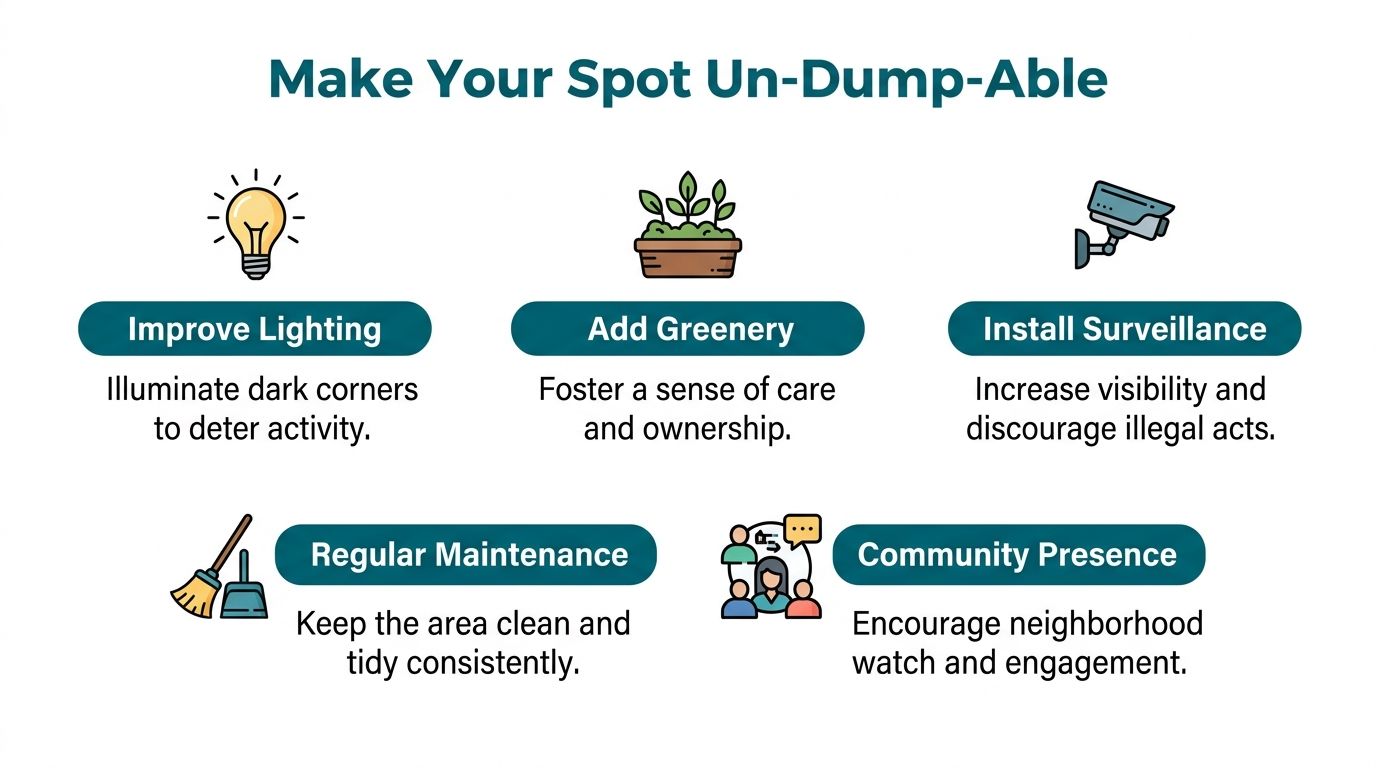
    An infographic titled Make Your Spot Un-Dump-Able with five tips to prevent illegal dumping in areas.

    I think about Tom Sawyer here. He got punished with a fence and turned it into a source of pride. That's how I approach ugly corners. The point isn't to act cheerful about neglect. The point is to flip the script. You make care contagious.

    Make the place feel alive

    I've watched a dead-looking lot change personality with a few simple moves. We cleared the scattered trash, cut back the overgrowth, and gave the edges shape. Once a place has edges, people read it differently. It stops feeling like nowhere.

    Pilot studies show that regular mowing and cleanup make vacant lots less attractive for dumping because they signal active stewardship. Benches, walkways, and high-visibility lighting also remove the secluded feeling dumpers look for, according to this guide on preventing illegal dumping through site design.

    That matches what I've seen with my own eyes. A lot doesn't need to become some fancy mini-park overnight. Even a modest cleanup plus visible care can change behavior.

    Here's the video version of that idea in action.

    Use obstacles that make sense

    You're trying to make illegal dumping inconvenient.

    That can mean beauty. It can also mean friction.

    A few moves work well together:

    • Block the easy drive-in with heavy planters, big rocks, or bollards where cars and trucks usually back up.
    • Light the blind corner with a solar spotlight or other visible lighting.
    • Keep the ground readable by removing scattered debris fast so one bag doesn't invite five more.
    • Give the wall a face with a mural, painted fence, or even bold cleanup signage created by neighbors.

    If you want ideas from groups working on neighborhood care, I'd browse these litter prevention programs and steal what fits your block.

    A quick field table

    Site problem What I'd try first
    Trucks can back right in Planters, rocks, or barriers
    People dump at night Lighting and repeat check-ins
    Lot looks abandoned Mowing, edge cleanup, simple beautification
    Trash returns after each cleanup Faster follow-up and a visible community presence

    A cared-for place is harder to treat like a landfill.

    The point of illegal dumping prevention at the site level is simple. You want the dumper to feel exposed, inconvenienced, and uncertain. You want your neighbors to feel invited. Same block. Different message.

    Build Your Crew Not Just a Volunteer List

    The morning I knew we had something real, three people showed up before sunrise to a nasty little corner lot that kept filling with mattresses and busted cabinets. Nobody asked if enough volunteers had RSVP'd. One neighbor brought coffee in a dented thermos. Another had extra gloves in a grocery bag. We spent two hours hauling wet junk, talking about kids, rent, and who on the block might come next time.

    That is how a crew starts.

    A diverse group of friends smiling and working together on community gardening and home improvement projects.

    A signup sheet can help you count heads. It cannot build trust. Illegal dumping prevention lasts when people feel responsible for each other, not just responsible for a task. On the blocks where we kept the mess from coming back, the difference was never a giant database of names. It was a handful of regulars who knew who needed a ride, who hated lifting tires, and who could make everybody laugh when the work got grim.

    Friendship keeps people coming back.

    Cleanup groups burn out when the whole day feels like free labor with no human warmth. People stay when somebody remembers their name, notices they forgot water, or says, "Take the lighter bags, I got this one." That kind of care turns a Saturday chore into shared ground.

    If you are building from scratch, keep the structure light and the rhythm steady:

    • Start with the people already saying yes. Two committed neighbors beat twenty vague maybes.
    • Use one simple group chat. Fast communication matters more than fancy tools.
    • Pick a repeat time. First Saturday or every other Sunday works better than random calls for help.
    • Give the crew a small identity. A team name, a group photo, or post-cleanup coffee gives people something to belong to.

    If you want practical ways to bring in the right people, these volunteer recruitment strategies can help you start without turning your block into an office job.

    Some of the strongest bonds in our crew were built in bad weather. Cold hands. Muddy boots. A tire that should have taken one person but took three. Those mornings changed people. Neighbors who barely nodded before started checking on each other during the week. Quiet folks began leading corners of the cleanup. A person who came once to "help out" started talking like the block belonged to them, in the best possible way.

    That shift matters. Grassroots dumping prevention works because ordinary people stop seeing themselves as bystanders. They become stewards.

    I would still rather have six steady people than sixty names on a list. Here is what has helped us keep those six coming back:

    If you want Do this
    Better turnout Keep the day and time consistent
    Better retention End with coffee, snacks, or a short hangout
    Better trust Pair new people with regulars
    Better morale Celebrate the strange wins and the hard days

    Litter Caterpillars is one example of a Chicago cleanup group built around recurring meetups and open group chats, which gives neighbors a simple way to join and return.

    People come for the cleanup. They stay because the crew starts to feel like theirs.

    That is the part outsiders miss. We are not just removing trash. We are rebuilding the habit of showing up for one another, and that habit keeps a block cleaner longer than a one-time burst of volunteers ever will.

    Report Smartly and Safely

    When you catch fresh dumping or find a new pile, your first job is not to play hero.

    Your first job is to stay safe.

    Too many people feel pressure to confront someone in the act. I get the urge. I really do. But the smarter move is distance, detail, and documentation. You are much more useful to your neighborhood when you gather clear information and go home safely.
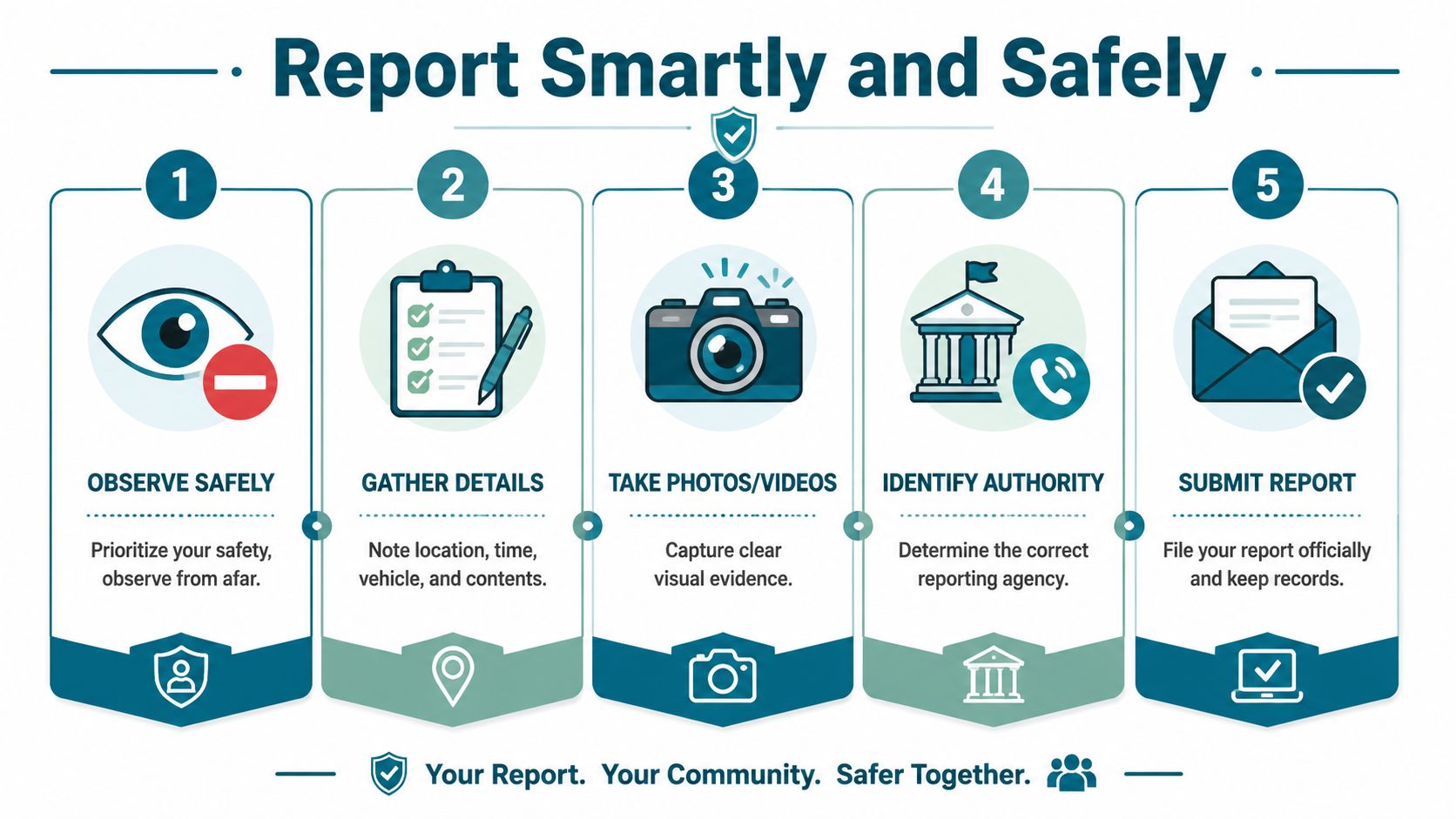
    An infographic detailing five numbered steps to report incidents smartly and safely in your community.

    Evidence beats outrage

    A vague complaint is easy to ignore. A precise report is harder to shrug off.

    If you can do it safely, take photos from a distance. Get the whole pile first. Then capture anything that helps identify the dump, like nearby addresses, alley entrances, company names on debris, or vehicle details if that can be done without risk.

    Use this sequence:

    1. Observe from afar
      If someone is present, don't confront them.

    2. Record the location
      Use the exact address or the nearest cross streets and which side of the alley or lot the waste sits on.

    3. Describe the contents
      Say what's there in plain words. Construction debris, furniture, black bags, tires, appliance parts.

    4. Submit through the right channel
      In Chicago, that often means 311.

    5. Keep your own record
      Save the photos, date, and report confirmation if you get one.

    Know the stakes

    Good reporting matters because the penalties can stack up.

    In Chicago, illegal dumping carries a mandatory fine of at least $300 and up to $600 for each offense, and each day the violation continues can count separately under Chicago Municipal Code 7-28-710.

    That doesn't mean every report leads to consequences. It means your documentation has real value when the city has enough detail to act.

    If you report, report like someone who wants the case to move.

    Protect yourself first

    You don't owe anyone a face-to-face confrontation.

    If you're worried about retaliation, stay even more disciplined. Shoot from farther back. Don't linger. Don't argue. Don't post identifiable details publicly while you're still near the site. Keep the chain simple and official.

    Illegal dumping prevention works better when residents act like calm witnesses, not street enforcers. Your power is in the record.

    Find Your Allies in City Hall

    A report is a transaction. A relationship is a tool.

    Once I learned that, things got easier.

    For a long time, I treated city government like a giant brick wall. You complain, wait, and maybe somebody somewhere sends a truck. But when your crew has field notes, cleanup photos, dates, and a clear ask, the whole interaction changes. You stop sounding like a person venting into the void. You sound like a neighbor who is already doing the work and needs one specific hurdle overcome.

    Show up as a partner

    Your local officials can help with things you can't do alone. They can point you toward the right department, help with special pickups, connect you with property owners, and sometimes support improvements on neglected land.

    I've had much better luck when I send a short message that includes:

    • Who we are
      A neighborhood cleanup crew or a few residents who have been working one site.

    • What we've seen
      The pattern, not just one ugly incident.

    • What we've done
      Cleanup dates, basic documentation, before-and-after photos.

    • What we need
      A sign, a pickup, contact with a landlord, guidance on the lot, or a meeting.

    That last part matters. Ask for one next step, not ten.

    Property owners matter more than people think

    Some blocks get trapped because everybody blames “the city” when the primary choke point is a private owner who stopped caring.

    That's why official connections matter. A survey of successful programs found that 73.1% of respondents rated “Business & Landlord Engagement” as a highly effective intervention, according to the Mattress Recycling Council's illegal dumping best practices report.

    I've seen this play out in a very ordinary way. A lot stays filthy for months. Neighbors keep cleaning the edges. Reports go in. Nothing sticks. Then one conversation finally connects the crew, the office, and the owner or manager who can authorize access, cleanup coordination, or a barrier fix. Suddenly the logjam breaks.

    Bring receipts and invite them outside

    Email is useful. Walking the site together is better.

    If you can get an alderperson's office, ward staffer, or another local official to visit your ground zero, do it. Let them stand where you stand. Let them see the blind corner, the tire ruts, the alley access, the weak fence line.

    People move faster when they can smell the problem.

    That's not about drama. It's about clarity. Your photos help. Your notes help. But a real site visit makes the ask concrete. You are no longer one more complaint in a crowded inbox. You are the organized neighbor who already picked up bags, mapped the problem, and came ready to work with them.

    That's the lane. Stay in it.

    The Real Win Is Keeping It Clean

    On our block, the first cleanup felt like a victory parade. We filled truck beds, stacked busted furniture at the curb, and took the photo everybody takes when a place finally looks like someone loves it again. Four days later, a torn mattress and three contractor bags showed up in the same corner.

    That was the lesson.

    A single cleanup can change the mood of a block. Keeping a place clean changes its future. The work gets quieter after the first big push, and that quieter work is what decides whether a dumping spot dies or keeps coming back.

    I've watched good people burn themselves out by treating one Saturday like the finish line. Then the next mess lands, and it feels personal. It isn't. It usually means the spot still has easy access, weak visibility, or no regular set of eyes on it. A comeback pile does not cancel what you did. It tells you where the next layer of the job is.

    Stewardship beats one-time heroics

    The cleanest corners I know are not maintained by superheroes. They're held by neighbors with a rhythm.

    On one alley we worked, an older guy walking his dog every morning became the first line of defense without ever calling himself an organizer. He noticed new debris fast. A younger neighbor snapped photos and filed reports. Another person could handle a quick bag pickup when it was safe. Nobody did everything. Together, they kept the spot from sliding back into that familiar signal every dumper reads instantly: nobody's watching.

    A simple rotation works:

    • One watcher who notices changes early
    • One reporter who sends clear photos and location details
    • One fixer who handles small, safe touch-up cleanup
    • One connector who keeps nearby neighbors in the loop

    That little bit of structure matters more than hype. A place stays cleaner when care becomes routine.

    Ask why people dump here

    We learned this the hard way too. Some sites attract dumping because they feel hidden. Others attract it because getting rid of bulky trash legally is expensive, confusing, or both.

    Those causes need different answers.

    Research on illegal dumping has found that cost and disposal access can drive the problem, and Los Angeles sanitation officials reported sharp drops in dumping in some areas after free bulky-item collection efforts were expanded, as noted in the City of Los Angeles Bureau of Sanitation report on illegal dumping prevention and bulky item strategies. That matches what we see on the ground. If legal disposal is hard to reach, some people choose the alley and hope nobody stops them.

    So ask the plain question. Is this spot getting hit by opportunists, by contractors dodging fees, by neighbors with no easy pickup option, or by all three? The answer changes your next move.

    Keep the human goal in view

    A clean lot gives people room to breathe.

    You notice it in small ways first. Kids stop skirting around broken glass. The woman from two houses down lingers on the sidewalk instead of rushing past. Somebody drags out a chair. Somebody plants flowers by a fence that used to collect trash. The space starts acting like part of the neighborhood again.

    That is why we keep showing up.

    We may begin with grabbers, gloves, and a pile that makes everybody angry. If we stay with it, we end up with something bigger than a cleanup. We build trust. We build habits. We help each other believe that a block does not have to stay the way we found it.

    Illegal dumping prevention works best when regular people decide a place is worth defending, then keep proving it in public.

    If you want to do this with other people who already know the rhythm of weekend cleanups, hard weather, and stubborn blocks, join Litter Caterpillars. Bring gloves, bring a friend, and start with one mess. That's enough.

  • How to Organize a Neighborhood Cleanup: The Giver’s Guide

    How to Organize a Neighborhood Cleanup: The Giver’s Guide

    I remember standing on a sidewalk with two trash bags, frozen fingers, and no idea if anyone else would come back next week. By the end of that morning, the block looked better, but the stranger thing was this. I did too.

    The Mess That Started It All

    I didn't start cleaning streets because I had my life together. I started because I didn't.

    My apartment was a disaster. Not movie-disaster. Real disaster. The kind where every object had a little emotional hook in it. An old jar of blueberry jam in the back of the fridge from a trip years ago. A stale bag of almonds from the month I tried to become a healthy person. A shirt on the chair that belonged to some version of me I didn't even like anymore.

    A man looking distressed while sitting in a very cluttered, messy, and disorganized apartment living room.

    Why someone else's trash feels lighter

    Here's the weird part. I could barely throw out my own junk, but I could pick up a stranger's burger wrapper all day.

    That wrapper didn't come with memory. It didn't come with guilt. It didn't whisper, “Remember who you were when you bought me?” It was just trash. Easy. Clean decision. In the same way cleaning an old fridge at home can feel like opening a time capsule of your own mistakes, cleaning a sidewalk feels like mercy. You see the problem, you remove it, you move on.

    That's why I tell people this isn't really about trash. Trash is just the handle.

    A cleanup gives you a simple win when the rest of life feels tangled. You bend down. You pick something up. The block changes. You change a little with it.

    Cleaning a public space can feel easier than cleaning your own room because the emotional weight is different. You're not sorting your past. You're practicing action.

    I learned that during a rough stretch after a chaotic relationship ended. I looked around and realized I had let too many selfish patterns into my life. Mess in my home. Mess in my habits. Mess in my relationships. So I made a stubborn decision. I'd start building a life around cleanliness, consistency, and brave acts.

    A neighborhood cleanup is perfect for that. It asks for your body before it asks for your biography. You don't need a polished origin story. You need gloves, a bag, and the willingness to show up.

    The real reason to start a cleanup group

    If you're learning how to organize a neighborhood cleanup, start with the part most guides skip. Ask yourself why you want this.

    Maybe you're angry that your block gets ignored. Maybe you want to meet people who keep their word. Maybe you need a ritual that gets you out of the apartment and back into your body. All of those reasons are good.

    I've found that cleanup groups become a filter. The people who show up to do hard, unglamorous work on a weekend morning tend to bring a certain energy. They're usually generous. They're usually game. They know how to laugh while carrying gross things to a pile.

    That's the weird magic. The bags matter. The friendships matter more.

    • A cleanup gives you motion: When life feels stuck, physical work breaks the spell.
    • A cleanup reveals character: You find out fast who complains, who helps, and who sticks around.
    • A cleanup builds trust: People believe what they can see. A cleaner block is visible proof.

    It's akin to clearing a path through overgrowth. You start by removing litter from a curb. Then you notice you're also removing excuses, stale habits, and a few people who never planned to grow with you anyway.

    Your First Four Weeks The Cleanup Playbook

    The first cleanup I ever ran taught me this fast. Good intentions are cheap. Saturday at 9 a.m. is where the truth lives.

    I had a volunteer named Denise show up early with coffee and work gloves from her garage. I had another guy text me at 8:47 asking if we were still on because it looked “a little cloudy.” By 11, Denise had recruited two neighbors on the spot, and Cloudy Guy never appeared. That morning gave me a better blueprint than any tidy checklist ever could. A cleanup group lasts when you build for real humans, real weather, and real follow-through.

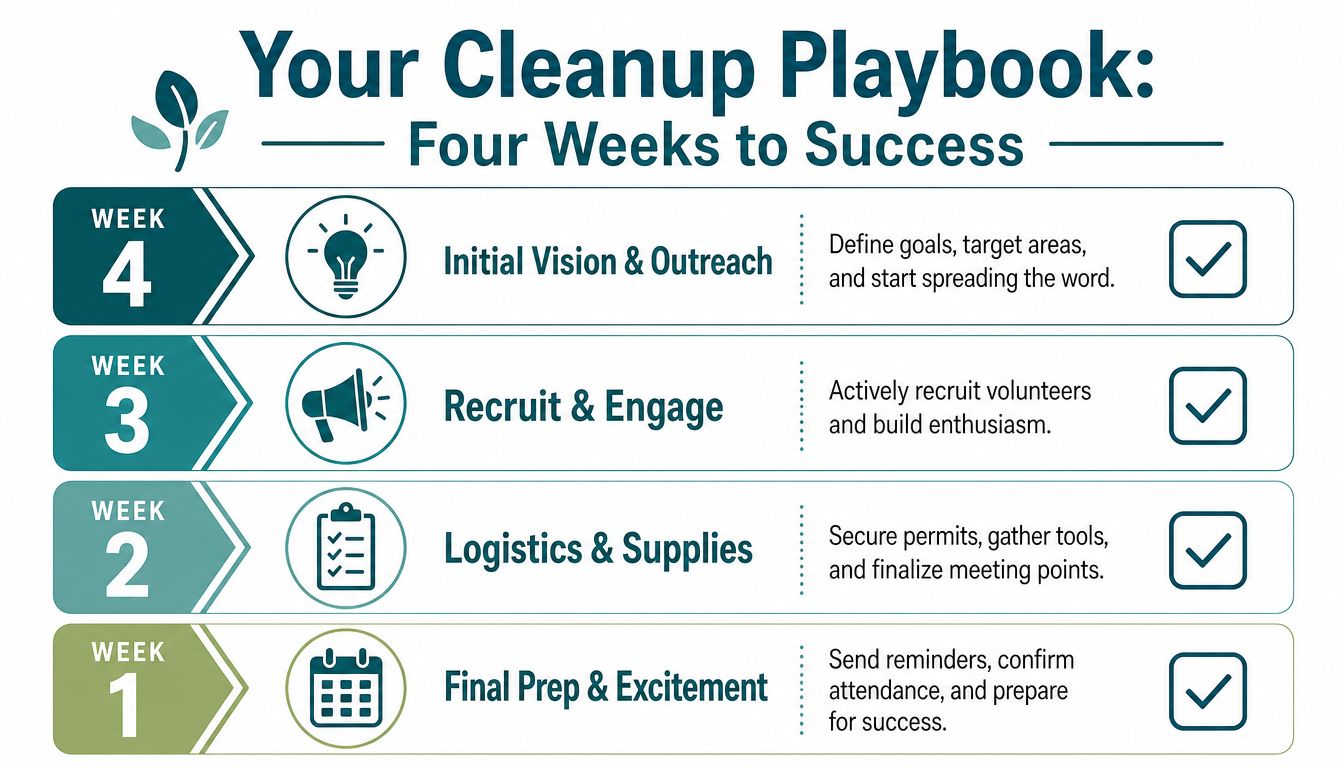
    A four-week roadmap infographic for organizing a successful community cleanup event, from vision to final preparation.

    Week four, walk the ground until the block starts talking

    Do not plan your route from a couch.

    Walk the area at the same time of day you want to clean it. A block can look calm on Tuesday afternoon and turn into a traffic mess on Saturday morning. I learned that after choosing a “perfect” meetup corner that became a parking circus the minute a youth game let out nearby.

    Bring your phone, take notes, and get specific. “The park is dirty” is useless. “South fence line has bottles and chip bags, alley behind the deli has dumped furniture, bus stop has broken glass” gives you something you can act on.

    I break the route into plain chunks:

    • Corner one: cups, wrappers, loose paper
    • Alley stretch: dumped bags, bulky trash
    • Fence line: cans, bottles, food containers
    • Busy curb: experienced volunteers only, bright clothing only

    That walk does more than help you estimate supplies. It starts a relationship with the place. You stop seeing “the neighborhood” as an abstract cause and start seeing Mrs. Alvarez's stoop, the corner kids' snack wrappers, the lot everybody complains about but nobody claims. That shift matters. People return for places they feel connected to.

    Week three, make the city useful and make your plan smaller

    This is phone call week.

    Call sanitation. Call the council office. Call the neighborhood association. Call whoever answers and ask for one clear thing. Bag pickup. Trash collection. A dumpster. Extra gloves. You are giving them a chance to say yes to something concrete, not sending a vague plea into the void.

    Keep your message simple. Date. Rain date. Target area. Estimated turnout. What you need. Then write down the name of the person you spoke with, because nothing tests your patience like hearing, “We never got that request.”

    Also pick your meetup point now, not three days before. Choose a spot people can find without twenty text messages. If there's shade, parking, or a bathroom nearby, even better. Small comforts change the mood. A confused volunteer drifts. A grounded volunteer stays and helps stack bags at the end.

    Week two, gather gear that earns its place

    People get seduced by nonsense.

    You do not need custom banners before you have enough gloves. You do not need branded merch before you have water. A cleanup group gets stronger when people trust that the basics will be there every time.

    Bring what gets the job done:

    Item Worth bringing Why
    Trash bags Yes You always need more than you guessed
    Gloves Yes New people forget, or bring the wrong kind
    Grabbers Yes They help with sharp or gross litter
    Folding table Yes Check-in feels calmer and more organized
    Fancy branded gear No Basics beat aesthetics every time

    Assign a few simple roles before the day arrives. One person handles check-in. One person carries backup supplies. One person tracks full bags and bulky items. One person takes photos if you want them. Order lowers stress, and lower stress makes people kinder to each other.

    If you need a practical guide for finding reliable cleanup volunteers, use it here, before you start sending frantic messages the night before.

    Week one, invite people into a ritual, not just an event

    This week is about tone.

    A flat post that says “community cleanup this Saturday, all welcome” gets casual interest. A better message tells people who this is for and why it matters. I've had stronger turnout from a plain text message that said, “We're cleaning the three blocks around the elementary school because kids deserve better than broken glass on the walk in,” than from polished graphics that looked like they came from a marketing team.

    Put the date, time, rain date, meetup point, and what to bring in every message. Then repeat yourself. Send a reminder a few days before. Send one the night before. Confirm your key helpers directly, one by one. People are busy. Good groups survive because somebody cared enough to follow up.

    By this point, the cleanup is already bigger than trash bags and grabbers. You are building a tiny culture. People are learning whether this group is flaky or steady, warm or cold, all talk or all hands. Four good weeks set that tone. Then Saturday shows you who's ready to build something real.

    Finding Your People Who Shows Up on a Saturday Morning

    A cleanup can get bodies pretty easily. A free Saturday event, a few nice graphics, some feel-good copy, and people click “interested.”

    That's not enough.

    You don't need a crowd that vanishes after one sweaty hour. You need people who like giving more than performing. I'm picky about that now. I'd rather have eight steady volunteers than thirty tourists collecting content for their stories.

    Screenshot from https://www.littercaterpillars.com

    Why Saturday morning works

    There's a reason I like weekend mornings. They act like a filter.

    The NYLCVEF community cleanup guide says the most effective volunteer recruitment strategy is scheduling events on weekend mornings, which yields 45 to 50% higher turnout than other time slots. The same guide says social media with before-and-after photos can boost repeat participation by about 38%.

    That matches real life. Morning volunteers arrive clearer, kinder, and more ready to work. The event starts before the day gets crowded with excuses. You also get the tiny secret reward of being done by lunch, which makes people feel weirdly heroic.

    Recruit for identity, not attendance

    Most volunteer posts read like dentist reminders.

    “Join us this Saturday to beautify the neighborhood.” Fine. Dead. Nobody feels anything.

    Instead, write like you're inviting people into a crew. People return when they feel they belong to something. If you want more ideas on that side of outreach, I like this guide on how to find volunteers who actually stick.

    Here are two templates I'd use.

    Instagram caption

    • Opening line: Saturday morning. Gloves on. We're cleaning this block because someone should, and that someone is us.
    • Details: Meet at 9:00 AM. Wear closed-toe shoes. We'll bring bags and gloves.
    • Tone: Come if you're tired of complaining and ready to help.
    • Closer: Bring a friend who likes doing hard things with kind people.

    Meetup description

    • First sentence: This is for people who want a cleaner neighborhood and better friends.
    • Middle: We'll split into teams, clean a defined route, and take before-and-after photos.
    • Expectation: Show up on time, ready to work, and ready to talk to strangers.
    • Finish: Rain date is listed. If the weather turns, we adapt.

    You're not recruiting “volunteers.” You're recruiting future regulars, future captains, future friends.

    How to ask local businesses for help

    Ask like a partner, not a charity case.

    Walk into the coffee shop, hardware store, or corner market and say: “We're organizing a neighborhood cleanup nearby. We're bringing people to this block. Would you be up for donating water, gloves, or a meetup space?”

    Keep the ask narrow. One business might give bottled water. Another might let you post a flyer. Another might chip in contractor bags. Make it easy to say yes.

    Three things matter here:

    • Specific ask: “Can you donate cases of water for Saturday morning?”
    • Visible connection: “We're cleaning the blocks around your business.”
    • Low drama: “No long sponsorship deck. Just direct neighborhood help.”

    The right people will respond to that. And those right people are the whole game.

    Bravery with a Plan Safety and Handling the Unexpected

    The day I learned this for real, one of our volunteers held up a trash bag with one hand and pointed at a syringe with the other. Nobody panicked. Nobody tried to play hero. We backed the group up, marked the spot, texted the safety lead, and kept moving on the rest of the block. Ten minutes later, people were laughing again and hauling out bottles from the weeds.

    That is what good safety feels like. Calm, clear, a little boring. Boring keeps your group coming back.

    That matters most on the rougher sites. Busy roads. Dumped lots. Broken glass in the grass where kids cut through after school. Those places can pull people into proving something. I'd rather build a crew that knows when to stop, ask for help, and protect each other.

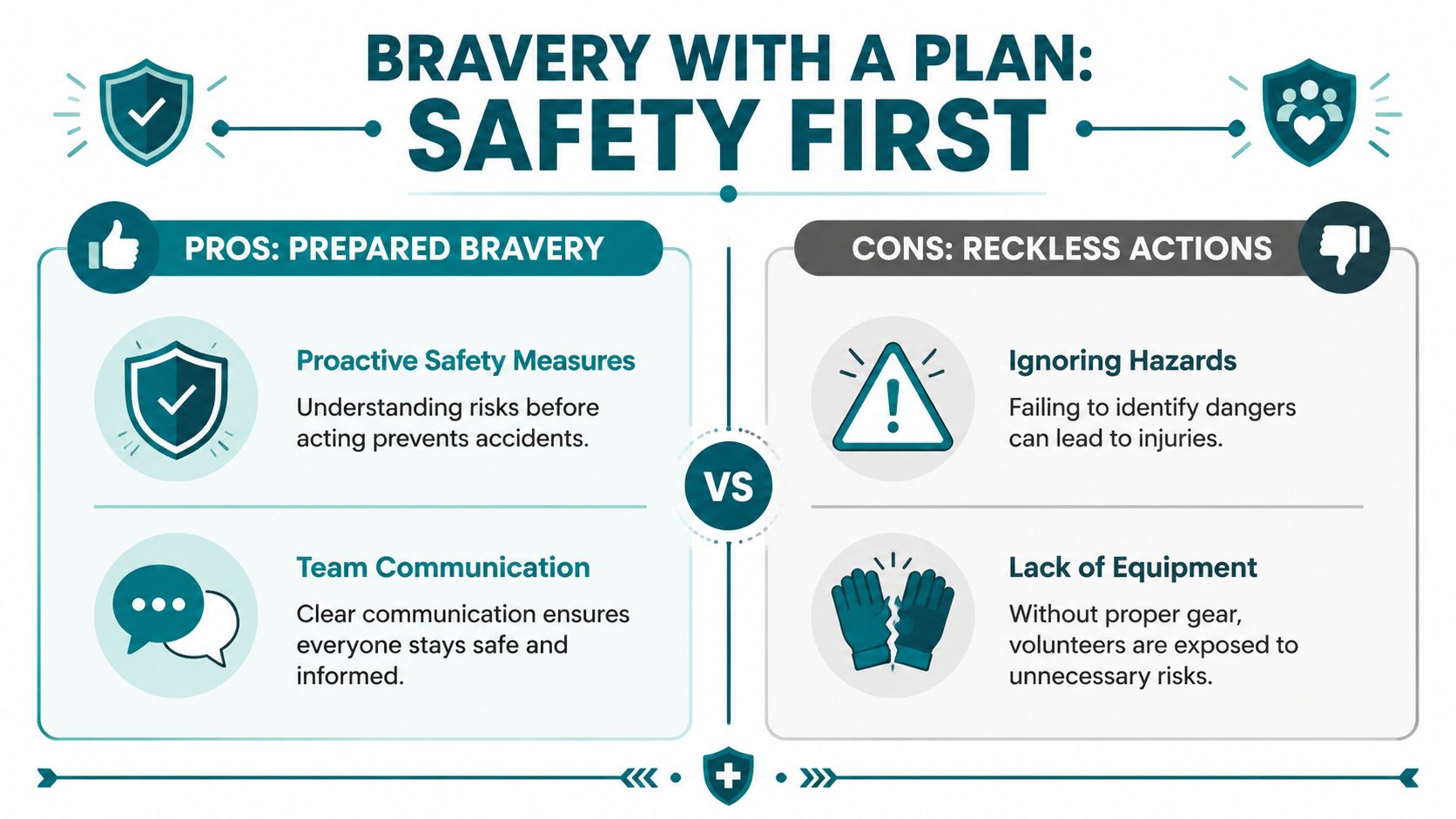
    An infographic comparing prepared bravery through safety measures against the dangers of reckless, unplanned volunteer actions.

    Scout first, assign second

    The strongest safety decision happens before anybody puts on gloves.

    I walk the route ahead of time and make notes like a slightly paranoid neighbor. Where does traffic move fast. Which alley has illegal dumping. Which corner floods. Which lot has thorny brush, busted furniture, or the kind of debris that needs city pickup instead of volunteer enthusiasm.

    Analysts cited on Litter Caterpillars found volunteer injuries rise when organizers skip hazard scouting and clear team assignments. That matches what I've seen on the ground. If people arrive to a vague plan, they start making their own. That is when somebody wanders too close to traffic or grabs something they should have left alone.

    So I sort the route before the event. General litter goes to newer volunteers. Road edges go to trusted people in high-visibility gear. Dump sites get a separate plan, or they wait for the city if the risk is wrong for our crew.

    If you want the insurance side spelled out in plain English, this guide on volunteer liability insurance is worth reading before your first big event.

    The small command center

    A cleanup does better with a tiny core team than with a crowd of half-leaders.

    The Community Tool Box guidance on neighborhood cleanup programs recommends clear coordination roles, and I'm with them. On our best days, three people hold the whole thing steady. One person owns route changes and city calls. One person handles safety questions. One person floats, bringing supplies, helping late arrivals, and solving the weird little problems that pop up every hour.

    Three calm people can settle fifty excited ones.

    If a volunteer has to guess what to do with a hazard, the organizer failed them.

    What volunteers should never touch

    Some finds are trash. Some are a report.

    You need that line clear before the day starts. Needles, suspicious containers, heavy debris, unstable piles, dead animals, and anything that could cut, poke, leak, or trap somebody stays where it is until the right service handles it. I have watched good-hearted people drift toward bad decisions because they wanted to be useful. That instinct needs guardrails.

    Our field rule is short and easy to remember:

    1. Mark the spot.
    2. Take a photo if it helps.
    3. Contact the safety lead.
    4. Keep everybody back.
    5. Report it to the city, property owner, or sanitation contact.

    A group lasts when people feel safe enough to return next month. That is the deeper win here. Cleaning the block matters. Building trust matters more. Every time you protect a volunteer from a dumb injury or an avoidable scare, you are teaching the group something bigger than litter pickup. You are teaching them that this community takes care of its own.

    Running the Big Day From Chaos to Clean

    At our third cleanup, a guy named Marcus showed up in church shoes, holding a gas station coffee and asking, “So what exactly do I do?”

    Ten minutes later he was tying full bags like he'd done it for years, joking with a teenager from two blocks over, and pointing newcomers toward the right team before I could even open my mouth. That is how these mornings usually go. They start scattered. Then, if you run them well, the whole thing clicks and the block starts feeling like a crew instead of a crowd.

    The job on cleanup day is not to control every person. The job is to create enough structure that people can relax, work, and surprise you.

    Check-in should feel like a welcome, not a clipboard ambush

    Your sign-in table sets the tone fast.

    If people walk up and nobody looks at them, they turn into free-floating confusion. If somebody greets them by name, hands them gloves, and says, “Glad you made it, you're with the alley team,” they settle down right away. They stop feeling like extras in somebody else's project.

    I keep the setup plain and easy:

    • Sign-in sheet: name, phone, email
    • Team sheet: captain name and cleanup zone
    • Supply spot: gloves, bags, grabbers, vests
    • One warm human: the person who answers the obvious questions without making anybody feel stupid

    That last part matters more than organizers admit. A lot of people arrive alone. They are wondering whether they belong there. Your check-in table answers that question before the cleanup even starts.

    Give a tight briefing, then get people moving

    Nobody came for a lecture at 9:15 on a Saturday.

    I gather everyone in a half-circle, thank them for showing up, point to the team captains, explain where the full bags go, and remind them what gets reported instead of picked up. Then I send them out while the energy is still high.

    My version usually sounds like this:

    Good morning. We're cleaning this stretch, these alleys, and the park edge. Stay with your team. If you find something sharp, leaking, heavy, or sketchy, call your captain and leave it alone. Full bags go to the pickup point by the table. Take photos if you see a wild before shot. We'll meet back here at the end for the count and a group picture.

    That is enough.

    People remember short instructions. They forget the fancy stuff the second somebody cracks a joke or spots the first tire in the bushes.

    Give each team a piece of the map and a clear win

    A cleanup falls apart when everybody drifts toward the same visible corner and nobody touches the awkward spots.

    Split the area before the start. Put one team on the commercial strip, one on the fence line, one in the alley cluster, one in the park edges. I like captains to have their zone written down on paper or in a text thread, because spoken directions evaporate fast in a parking lot.

    You also need a home base that people can find without thinking. Extra bags, water, first aid, and the growing mountain of filled trash should all land in one obvious place. If someone has to wander three blocks for supplies, you lose momentum and people start peeling off early.

    A simple run sheet keeps the whole morning steady:

    Time What happens
    8:30 AM Setup table, supplies, signs
    9:00 AM Volunteer check-in
    9:15 AM Briefing and team launch
    Mid-event Captain check-in by phone or in person
    End Bag count, group photo, final sweep

    Keep the story of the day, not just the trash count

    I learned this the hard way. If you forget the before photos, people clean half the block and later swear it “wasn't even that bad.”

    Take the photos early, from the exact spots you can return to later. Count the bags. Snap the funny moments too. The kid holding a grabber like a knight's sword. The neighbor who came out “just to say hi” and ended up filling two bags. The retired guy who suddenly becomes your unofficial tire expert.

    Those details do real work for you. They help with future recruiting, they give the city or property owner a clear record, and they remind volunteers that they changed something visible. If your crew pulls recyclable material aside, make sure it goes to the right place. If people ask where they can keep that habit going after the event, send them to local options like these Chicago recycling centers for drop-off and reuse.

    End with a strong finish, not a slow fade

    The last half hour matters more than organizers think.

    This is when people get tired, routes blur, and half-full bags start appearing in random places. I bring captains back in, confirm each zone got covered, stack bags in the pickup area, and do one final pass for the weird leftovers. Then we count what came out of the neighborhood and get the group photo before people disappear.

    A good ending gives the morning a shape. People leave seeing the pile they conquered, the street they changed, and the faces of the strangers who did it with them.

    That is how chaos turns clean. More important, it is how a cleanup starts turning into a community people want to come back to.

    After the Cleanup. Building a Lasting Crew

    Two hours after one of our early cleanups, my phone buzzed with a photo from a volunteer named Marcus. He had dragged an old chair frame out of an alley that morning, laughed about it with three strangers, then gone home and started a group text with them. A week later, they were back out together with coffee, gloves, and one extra friend each.

    That is the part people miss.

    The bags matter. The cleaner block matters. But if everyone heads home with nothing except sore backs and a nice photo, the energy leaks out by Monday. What keeps a cleanup alive is the follow-up, the small rituals, and the feeling that people just joined something bigger than a trash pickup.

    Send proof before the spell breaks

    I send a message the same day, while people still have dirty shoes by the door.

    It is simple. Thank everybody by name if you can. Share the before-and-after shots. Show the pile of bags. Toss in the candid photo where somebody is grinning like they just won a prize fight. People want to see that their morning changed something they can point to.

    Then give them one next move. One. Too many options and the whole thing goes soft. Invite them to the next cleanup, a post-event coffee, or point them toward practical ways to keep going between meetups, like these Chicago recycling centers for drop-off and reuse.

    Give the group a pulse

    I learned this the slow way.

    At first, I thought good organizing meant clipboards, routes, and enough grabbers for everybody. That stuff matters, sure. It just does not make people come back. People return because they remember who teased them for finding a traffic cone in a bush, who handed them water at the right moment, who cheered when the worst corner on the block finally looked human again.

    So build that on purpose.

    • Name the crew: even if it is a little ridiculous
    • Repeat a few rituals: same photo pose, same snack stop, same victory shout
    • Notice people out loud: who hauled the strangest item, who brought a nervous friend, who kept the mood up when everyone got tired
    • Make introductions normal: help the shy person meet someone before they drift out

    The cleanup is the excuse. The community is the thing you're building.

    Turn turnout into habit

    The best sign that your group is working has nothing to do with bag counts.

    It is when somebody starts shaping their week around showing up. They go to bed earlier on Friday. They text a neighbor to come with them. They start recognizing the guy from three buildings down and the teenager who always finds bottle caps under parked cars. A public space gets cleaner, yes. A person gets steadier too.

    That is how a Saturday event becomes part of the neighborhood's rhythm.

    So close the loop. Send the photos. Tell the stories. Keep the jokes alive. Give people a reason to return that goes deeper than civic duty. A clean street feels good for a day. A crew that keeps showing up for one another can change a block for years.

  • A Bold Guide to Litter Prevention Programs

    A Bold Guide to Litter Prevention Programs

    The first time I picked up litter with friends, hail hit us so hard we had to hide under a tree. Our rides kept canceling, our hands went numb, and somehow that miserable little cleanup became one of my favorite memories.

    Start Where You Are With What You Have

    I'll tell you something awkward. Cleaning up a sidewalk was easier for me than cleaning my own apartment.

    For years, I let junk pile up around me. An old jar in the fridge had a memory attached to it. A broken bag had a story. Every useless object felt heavy. Not physically heavy. Soul heavy. I could step over the mess for months and still not move it.

    Then my life cracked open. I got out of a chaotic relationship, looked around at the room I had built around myself, and realized I couldn't keep living like that. I needed practice doing hard things. I needed to train consistency the way some people train for a marathon. I needed one simple act I could repeat.

    So I picked up one piece of trash outside.

    That sounds tiny because it is tiny. But tiny actions are like the first tooth on a zipper. Once it catches, the whole thing can move.

    A woman holding a trash bag standing in a messy living room needing cleaning and organizing.

    Your first cleanup is personal

    Litter prevention programs are often discussed as if they start with a plan, a committee, or a grant. Mine started with shame, then stubbornness, then a trash bag.

    You don't need a polished origin story. You need a corner that bothers you enough to act. Maybe it's the bus stop with fast-food wrappers pinned against the curb. Maybe it's the alley behind your building where the wind keeps making the same joke with the same plastic bag. Maybe it's the park path you walk every morning and complain about every morning.

    Pick that spot.

    Then do something so small your excuses look silly next to it. Fill one bag. Walk one block. Spend twenty minutes.

    Practical rule: Start before you feel ready. Motivation usually arrives after your hands start moving.

    There's another reason I like this beginning. It changes the shape of the problem in your mind. A giant issue can freeze you. A single cup in the gutter can't.

    According to the Keep America Beautiful 2026 National Litter Study, approximately 35 billion pieces of litter still remain across public spaces in the United States, and the country spends about $11.5 billion annually dealing with it. That number is huge, but I take comfort from it too. Every piece you pick up is part of a real collective effort, even if nobody claps for you.

    Inertia is the real enemy

    Trash looks like the obstacle. It usually isn't.

    A significant obstacle is that sticky feeling in your chest that says, “Someone else should handle this.” Or, “It's too far gone.” Or, “One person can't do much.” I've heard every version because I've said every version.

    Litter prevention programs work best when they break that spell. The first win is not a clean block. The first win is proving to yourself that you're a person who shows up.

    I've seen this happen in weird little flashes. Someone bends down for one bottle and then notices five more. A person who felt useless all week goes home sweaty, tired, and proud. A street that looked abandoned starts to look claimed.

    That's how it begins. Not with perfection. With contact.

    A simple first-day playbook

    If you're stuck, do this:

    • Choose one visible spot: Pick a place you already pass often. Repetition matters more than drama.
    • Bring basic gear: Gloves, a bag, and closed-toe shoes are enough for day one.
    • Set a short timer: Twenty or thirty minutes keeps the task from turning into a mental monster.
    • Leave one note for yourself: Take a photo, or write down how you felt before and after. You're building proof.

    I didn't know any of this would change my life when I started. I just knew I needed to stop waiting for a different personality to arrive and save me.

    You might be waiting for that too. Don't. Start where you are. Use what you have. Grab the first piece.

    Find Your First Three People

    My first group was tiny. Three people, a bad weather forecast, and the kind of optimism that looks a lot like poor planning.

    We got caught in a spring hailstorm. We huddled under a tree, laughing and shivering while our phones lit up with canceled rides. I remember thinking that this should feel like failure. Instead it felt like the beginning of a team. Shared discomfort has a way of cutting through small talk fast. You find out who can laugh. You find out who stays calm. You find out who says, “Same time next week?”

    That's what your first cleanup is really for.

    Screenshot from https://www.littercaterpillars.com

    Look for givers, not spectators

    You don't need a crowd. A crowd can make the first day worse. Too many strangers, too much drift, too much pressure to perform.

    You need your first three people. I like three because it has balance. If one person cancels, the cleanup still happens. If one person is shy, two others can carry the conversation. Three people can make a rough morning feel alive.

    Find them in places where people already lean toward service and curiosity. Community chats. School groups. Neighborhood forums. Weekend clubs. Friends of friends who always say yes to helping someone move a couch.

    When I want to explain how to do this clearly, I point people to a practical guide on how to find volunteers for neighborhood cleanup work.

    Don't recruit with polish. Recruit with honesty. “I'm cleaning this block Saturday morning. Want to join me?” beats a fancy pitch most of the time.

    Make the first ask small and clear

    People say yes when the shape of the ask is obvious.

    Compare these two invitations:

    • “I'm starting a citywide anti-litter initiative.”
    • “I'll be at the corner of Ashland and 18th at 9 a.m. Saturday with gloves and bags. We'll clean for an hour.”

    The first one sounds like homework. The second one sounds real.

    A strong first invite has a few simple parts:

    • Time: Weekend mornings work well because they attract people who want to give part of their day.
    • Place: Choose somewhere easy to find.
    • Length: Keep it short enough that people don't fear getting trapped.
    • Tone: Make it human. “Come help” is better than “Join our mission-driven engagement effort.”

    Let the story do the recruiting

    After that first stormy cleanup, I didn't have to sell the experience very hard. The story did the work.

    “Three of us got stuck in hail, picked up trash anyway, and laughed the whole time.”

    That kind of story has a pulse. People can feel it. It tells them this isn't a sterile volunteer shift where everyone signs a form, poses for a photo, and vanishes. It tells them there's room for grit, humor, and a little absurdity.

    Litter prevention programs live or die on repeat attendance. Repeat attendance grows when the first day gives people a memory, not just a task.

    So if something goes wrong on day one, don't panic. Rain starts. Fine. Someone's late. Fine. The route is rougher than expected. Fine. If the group stays kind and keeps moving, the mess-up becomes flavor. People remember flavor.

    Your Simple Plan for Safety and Supplies

    The fastest way I ever lost a volunteer was not boredom. It was a blackberry thorn.

    We were cleaning an alley behind a row of garages, the kind with busted fencing, dumped fast-food bags, and weeds tall enough to hide trouble. A new guy reached into the brush with bare hands before I could stop him. He came back with a scratched wrist and a look that said, "You people do this for fun?" He never returned.

    That morning taught me something plain. Safety is how you prove this group takes care of its own.

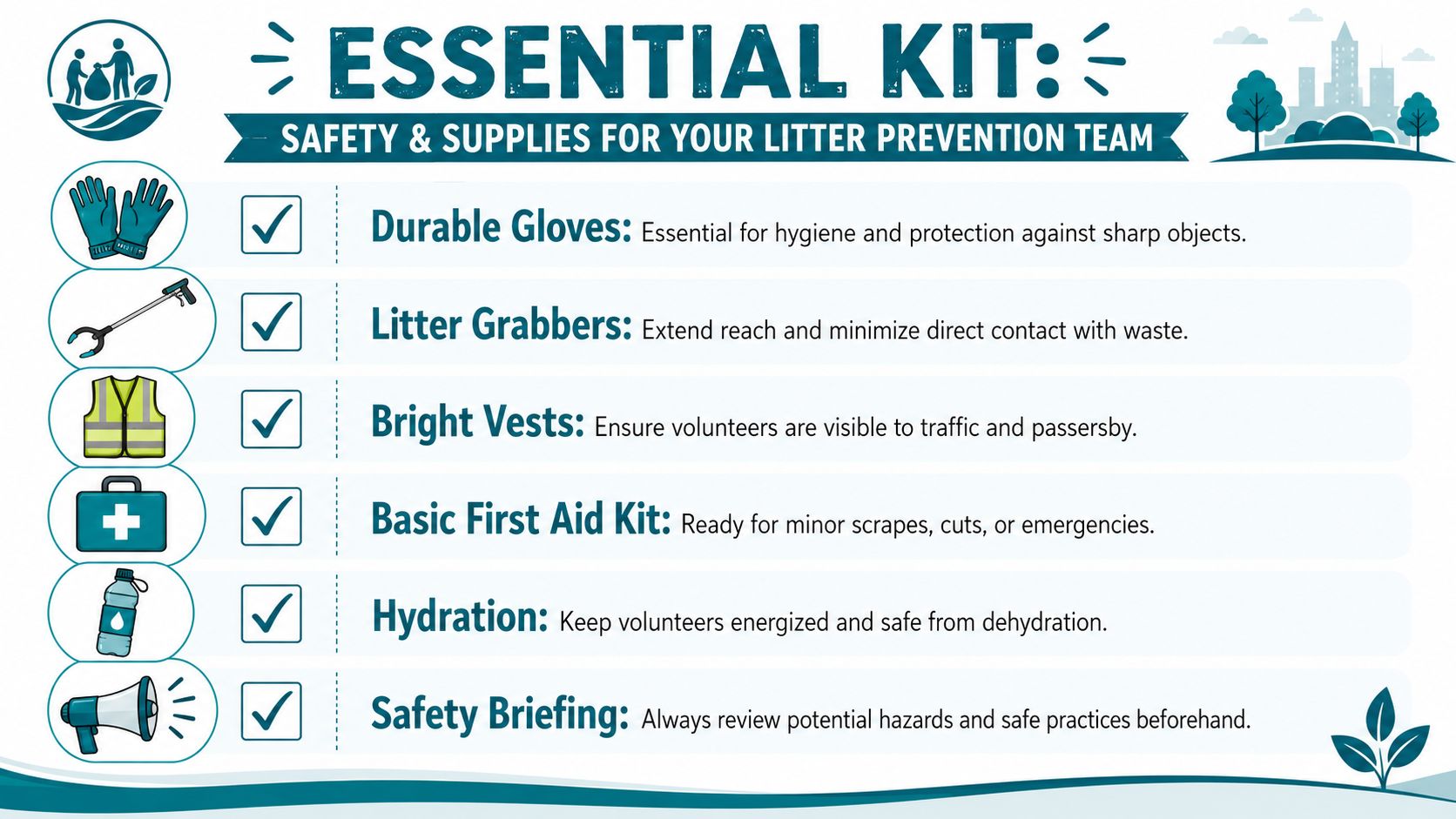
    A safety infographic showing six essential items for volunteer litter prevention teams including protective gear and supplies.

    Pack like you're taking care of friends

    I stopped treating supplies like extras after that. Now I pack for the person who showed up eager, underprepared, and trusting me more than they should.

    My kit stays simple. Sturdy gloves. Litter grabbers. Bright vests. Contractor bags. Hand sanitizer. Sunscreen. Water. A basic first aid kit. Closed-toe shoes are required, and if we are anywhere near traffic, I hand out vests before the first bag comes open.

    None of that is glamorous. That is the point.

    Cheap gloves tear. Thin bags split at the bottom and baptize somebody's shins in old coffee. Short grabbers turn a one-hour cleanup into a lesson in lower-back pain. Good gear changes the mood of the day because people stop bracing for irritation and start paying attention to each other, the street, and the small wins.

    Give the same safety talk every time

    I keep the briefing short enough that nobody zones out and clear enough that nobody has to guess.

    Here's the version I use:

    1. Watch for cars, bikes, loose gravel, and broken pavement.
    2. Do not touch needles, broken glass, or anything suspicious with bare hands.
    3. Stay where someone can see you.
    4. Drink water early, not after you feel lousy.
    5. If a spot feels wrong, leave it and call me over.

    The talk takes about a minute. The effect lasts all morning. It tells people they are not disposable labor. They are teammates.

    If you run public cleanups often, insurance matters too. This guide to volunteer liability insurance for cleanup groups is a good place to sort out the practical side before your group grows.

    A cleanup should send people home tired, proud, and ready to return.

    Pick routes with your eyes open

    I learned route planning from a bad Saturday on a four-lane road.

    On paper, the block looked perfect. Heavy litter, easy parking, visible impact. In real life, it had speeding traffic, no shoulder, nowhere safe to stack full bags, and a bus stop that kept spilling people into our work zone. We spent more energy watching our backs than cleaning. The volunteers were polite about it, but I could feel the trust drain out of the group.

    Now I scout with three questions in mind.

    • Can people enter and leave the area without playing frogger
    • Where do full bags go before pickup
    • What hazards are waiting for us before we even start

    Those questions do more than prevent a rough day. They help match the route to the crew. Families and first-timers get parks, sidewalks, trailheads, and quiet side streets. Experienced volunteers can handle the ugly corners with steeper banks, illegal dumping, or heavier traffic.

    You also start to see the deeper story of a place. A block with constant litter and no working trash can does not have a volunteer problem. It has an infrastructure problem.

    A simple field checklist

    Before I leave home, I run through the same checklist every time:

    Item Why I bring it
    Gloves Protect hands from grime and sharp edges
    Grabbers Save backs and reduce direct contact
    Bright vests Help drivers and cyclists see us
    Water Keeps energy steady
    First aid kit Handles small scrapes fast
    Extra bags Gives the route breathing room

    That list looks almost too plain to matter. Plain works.

    People come back when the day feels cared for. They remember that somebody had extra water. Somebody noticed the blind corner before they stepped into it. Somebody brought enough gloves for the friend who showed up empty-handed. That is how a cleanup stops being a one-off good deed and starts becoming a place where people trust each other.

    Make It an Adventure Not a Chore

    Tom Sawyer understood something a lot of organizers miss. If work feels like punishment, people flee. If work feels like a game with pride attached to it, people lean in.

    That's how I think about retention. You can hand people a grabber and a trash bag, but that alone won't build a team. A team needs flavor. It needs a little theater. It needs something people can belong to.

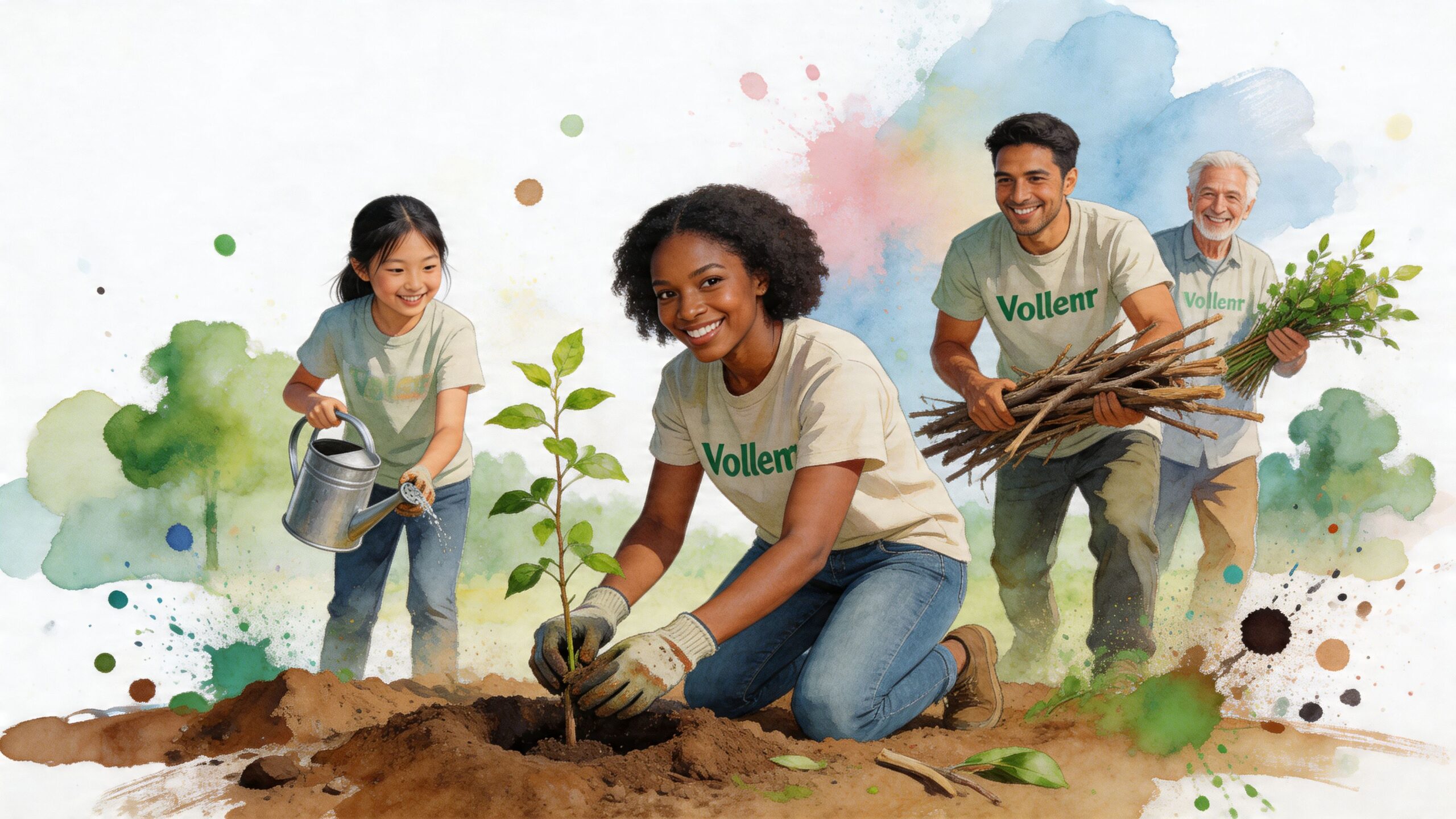
    A diverse group of volunteers cleaning up trash on a beach to promote environmental conservation efforts.

    Pride keeps people coming back

    I've watched the same basic cleanup feel dead in one group and electric in another. The difference usually isn't the amount of trash. It's the mood.

    When people have symbols, rituals, and inside jokes, they stop feeling like random individuals doing civic homework. They start feeling like they're on a mission together. That can be as simple as a group photo pose, a running joke about the weirdest item found that day, or a song you always play after the last bag is tied.

    Texas A&M found that sustained educational campaigns can reduce litter by up to 50%, according to its review of litter control programs and regulations. I take that personally. Culture is education with a pulse. When you build a cleanup group people want to join, you aren't only removing trash. You're teaching a different way to move through public space.

    People return for the feeling. The bags of trash are proof that the feeling had somewhere to go.

    Give the group a personality

    This part is fun, and it matters.

    You can create identity without spending much money. Pick a color. Make a goofy tradition. Give out homemade badges. Name your routes. Celebrate ridiculous wins. “We cleared the wind tunnel block again.” “We found the cursed alley spoon.” That stuff sounds silly until you watch it work.

    Here are a few ideas that tend to stick:

    • Route names: A cleanup with a nickname is easier to remember than one with only an address.
    • Micro-awards: Best attitude. Sharpest eyes. Strongest hill climb. Keep it light.
    • After-action ritual: Tea, coffee, tacos, or just a ten-minute sidewalk debrief.
    • Weather pride: Cold day? Hot day? Let people feel they did something a little hard together.

    For more ideas, I like practical roundups of volunteer team building activities because they remind you that morale doesn't happen by accident.

    A short video can help spark the right energy before a cleanup:

    Fun is not fluff

    Some people get suspicious when service becomes playful. They think seriousness proves sincerity. I don't buy that.

    If you want people to come back through heat, wind, awkward mornings, and blocks that look rough, you need joy in the engine. Adventure is what makes hard things repeatable. It turns “I have to” into “I was there.”

    Litter prevention programs that feel cold and dutiful often stall out. The ones with personality have legs. People bring friends. They wear the same hat every week. They tell stories afterward. That's the fuel.

    Build Bridges and Find Treasure

    Once you start showing up regularly, the city starts talking back.

    I don't mean that in a mystical way. I mean the cashier notices your gloves. The store owner asks why you're carrying bags at 8 a.m. A neighbor points at an illegal dump site behind a fence. A parks worker tells you when the bins overflow. A person who ignored you for three weeks suddenly waves.

    That's how bridges start. You don't build them with a pitch deck first. You build them by becoming familiar.

    Ask for help in ways people can say yes to

    A lot of groups ask for support too vaguely. “Can you sponsor us?” is a big, mushy request. People freeze when they don't know the shape of the favor.

    I prefer smaller asks. “Can your hardware store knock a little off gloves?” “Can your café save cardboard boxes for sorting supplies?” “Can the alderman's office tell us where bagged trash should go after a cleanup?” Those are answerable.

    When you've been visible for a while, those conversations get easier. People trust movement more than ideas. If they've seen you out there week after week, they know you're not daydreaming. You're already in motion.

    Consistency is social proof in work boots.

    Treasure doesn't always look like money

    One of the best things that can happen to a cleanup group is learning that support has many forms. A business might hand over extra bags. A neighbor might provide a hose. A city worker might explain the pickup schedule. Someone might introduce you to someone else, and that second introduction changes everything.

    I've seen an empty lot stop looking like a liability and start looking like possibility. Places the city had mentally written off can change when a few stubborn people keep returning. Sometimes treasure is literal land. Sometimes it's access. Sometimes it's one brave person inside a system saying, “I can help you with that.”

    Protect volunteer energy from money stress

    I'm stubborn on this point. I don't like putting financial pressure on volunteers.

    Research tied to grant-dependent community models notes that volunteer retention can drop by 40% when financial pressure is introduced, and it also points to a real gap in long-term data on purely volunteer-driven groups, as shown in the Georgia rules tied to clean community funding structures. That tracks with what I've felt on the ground. The second people start worrying that showing up means getting squeezed for cash, the emotional temperature changes.

    So I treat volunteer energy like a rare fuel. I want people to bring their time, their jokes, their muscles, their courage. That's already a lot. I'd rather build external partnerships than pass the burden back onto the people doing the work.

    If you stay open-eyed, your city has hidden doors everywhere. The trick is to keep knocking without sounding desperate, and to remember that your group's reliability is a form of currency all its own.

    Measure What Matters and Keep Going

    One Saturday, we cleaned a block that had beaten us before.

    Wind kept dragging fast-food wrappers out of a busted hedge. A guy across the street watched us like we were wasting our time. One volunteer, brand new, barely said a word for the first half hour. Then she found a child's red scooter half-buried behind a fence, laughed, and called three people over like she had discovered pirate gold. By the end of the morning, the man across the street had brought out his own broom, and the quiet volunteer was trading numbers with two strangers she had met in gloves and safety glasses.

    I still count the bags. I still take before-and-after photos. You need proof of work, especially on the days when the street looks rough again by Tuesday.

    But the score I trust most lives in moments like that one.

    The signs I look for after the bags are tied

    As noted earlier, formal litter programs usually track a baseline, make a plan, and check results. That matters. A volunteer-first group needs that discipline too. I just keep a second scorecard in my head, because a true win is not only a cleaner curb. It is a stronger crew.

    I watch for the person who showed up anxious and leaves standing taller.

    I watch for the first-timer who says, “I didn't know this part of town was like this,” and means it in a good way.

    I watch for the shop owner who starts picking up around their own door because our presence changed the mood of the block.

    Those are not soft extras. Those are signs the cleanup is taking root.

    My favorite scorecard

    After a cleanup, I usually ask myself a handful of plain questions:

    • Did people feel safe? If they did not, that gets fixed first.
    • Did anyone connect with someone new? Friendship keeps people coming back.
    • Did the block feel more settled? Cleaner is good. Cared for is better.
    • Did a new volunteer gain confidence? That person may become your future route leader.
    • Did we return when we said we would? Reliability changes how a neighborhood reads you.

    A neighborhood notices patterns before it trusts promises.

    Staying power beats the big heroic day

    I love a dramatic haul as much as anyone. A mountain of tires or a truck bed full of dumped debris makes for a great photo. It also fades fast if nobody comes back.

    What changes a place is rhythm. Saturday at nine. Gloves on. Quick safety talk. One block, then the next, then the next again a month later. Repetition turns strangers into teammates and teammates into the kind of friends who will help each other move a couch, find a job lead, or talk through a hard week after cleanup is over.

    That part surprised me when I first started. I thought we were building a trash crew. We were really building people who keep promises in public.

    So yes, measure the bags. Measure the hot spots that stay cleaner longer. Measure turnout if that helps you plan. Then ask the harder questions too. Are people becoming steadier? Are they braver than they were last season? Does the street feel less abandoned when your group is around?

    If the answer is yes, keep showing up.

    If you want a real-world example of a volunteer-first cleanup group that mixes grit, friendship, and weekly action, take a look at Litter Caterpillars. It's a Chicago group built around brave mornings, safer cleanups, and the idea that picking up trash can also help people rebuild trust in themselves and each other.

  • The Tale Of The Vacant Lot: Unearth Community Hope

    The Tale Of The Vacant Lot: Unearth Community Hope

    The first lot I fell in love with looked terrible. Broken glass flashed in the dirt, a torn plastic bag clung to a fence, and I remember thinking, with total honesty, this place looks exactly like my room used to feel.

    Our Story Begins with a Void

    I didn’t start with urban planning. I started with shame.

    My apartment used to hold little relics of stalled intentions. An old jar from a trip I couldn’t let go of. A bag of healthy snacks from a week when I promised myself I’d change. Receipts, wrappers, random objects with stories attached to them like fishing hooks in my skin. None of it weighed much, but all of it felt impossibly heavy.

    Then I’d walk through Chicago and see vacant lots that gave me the same feeling. Not empty. Burdened. Forgotten. Like the city had one room it was too overwhelmed to clean, so it shut the door and hoped nobody would look too closely.

    That’s why the tale of the vacant lot hit me so hard. In the episode, the trade is never really about shoes or beauty. It’s about hunger. It’s about wanting to escape the pain of feeling ordinary, disappointed, or stuck. That part feels real because a lot of us know the temptation of a shortcut. We want a quick exchange. We want to hand over “something of no value” and become new.

    But life doesn’t work like that. Land doesn’t work like that either.

    A watercolor painting featuring a stack of vintage books, a broken ceramic jar, and an old photograph.

    The lot mirrored the mess inside me

    I remember standing at the edge of one neglected patch of land and noticing how specific the trash felt. Somebody’s fast food cup. A child’s shoe. A busted lawn chair. A crate. A wet magazine turning back into pulp. The lot looked random at first, but it wasn’t random at all. It was a record of abandonment.

    My own life looked like that too. Not dramatic enough to count as collapse, but cluttered enough to make forward motion hard. That kind of mess is sneaky. It doesn’t scream. It dulls you. It convinces you that mediocrity is permanent.

    So I stopped seeing vacant lots as real estate and started seeing them as sleeping parts of a city’s soul. A lot like a neglected corner of your own life, they wait in silence until somebody is brave enough to touch the mess without flinching.

    A vacant lot isn’t just unused land. It’s a story that stalled out and needs somebody to continue it.

    That’s also why I care so much about the emotional side of cleanup. A lot of people talk about beautification like it’s cosmetic. I don’t buy that. The deeper work happens in the volunteer, in the neighbor, in the kid who sees adults care for a space that everybody else wrote off.

    Why superficial gains never satisfy

    The episode’s core theme has a real-world parallel. A 2023 APA-linked discussion of materialism and youth mental health, alongside Chicago’s 2025 vacant lot count of 15,000+ sites notes that materialism correlates with 20 to 30% higher anxiety and depression in teens, and it connects that idea to Chicago’s 15,000+ vacant lots. That matters to me because it points to something bigger than trash. Service pushes against the lie that worth comes from acquiring more.

    I’ve felt that lie in my own body. Buy this. Keep that. Protect every object because maybe it proves something about you. Then one day you’re drowning in souvenirs of versions of yourself that never fully arrived.

    A lot can become the opposite of that trap. It asks less from you and more of you. It asks your labor, your humility, your patience. It gives back something slower and better. Purpose. Camaraderie. A reason to wake up on a cold morning and move.

    The first brave act isn’t glamorous

    People think transformation starts when you unveil a finished park. It doesn’t. It starts when you stop looking away.

    For me, the mental shift looked like this:

    • I quit calling the mess worthless. A place can be damaged without being meaningless.
    • I stopped waiting to feel ready. Readiness is overrated. Showing up matters more.
    • I let service become personal. I wasn’t just helping land. I was training my own character.
    • I accepted that ugliness can be an invitation. If a place repels everyone, then your presence already changes the story.

    There’s a strange relief in admitting that the lot and I had something in common. We both needed patient hands. We both needed repeated care, not one dramatic gesture. We both needed somebody to believe change could happen before there was evidence.

    That belief came first. The shovel came second.

    Waking Up the Sleeping Giant

    The first cleanup always feels a little ridiculous.

    You show up with gloves, bags, grabbers, maybe a rake if you’re lucky, and you stare at a patch of ground that has been ignored for so long it seems almost rude to disturb it. Then you bend down, pick up one bottle, and the spell breaks. The lot is no longer an abstract problem. It’s a physical conversation. You touch it, and it answers.

    Start with your eyes, not your dreams

    On day one, I don’t think like a visionary. I think like a cautious scavenger.

    Before anybody starts cleaning, I walk the edge and scan. I look for sharp metal, broken glass, needles, unstable debris piles, animal waste, deep holes, and anything that suggests somebody might get hurt if we rush. I also look for access points, where trash has accumulated, and where volunteers can stand without tripping over rubble.

    My basic first-day kit stays simple:

    • Work gloves: Cheap gloves beat bare hands every time.
    • Trash bags: Bring more than you think you need.
    • Grabbers: They save your back and keep your hands away from dangerous stuff.
    • Closed-toe shoes: Nobody cleans a lot safely in flimsy footwear.
    • Water: People work better when they’re not dehydrated and cranky.

    That’s enough to begin. Not enough to finish. Enough to wake the place up.

    Keep the first gathering small and honest

    I don’t like overproduced beginnings. You don’t need a giant banner, a polished slogan, or a perfect site plan to start. You need a handful of people willing to do unglamorous work in public.

    So I spread the word plainly. Weekend morning. Gloves if you have them. We’re cleaning this lot. Come if you want to help.

    That directness matters. It filters for people who want to serve. It also keeps expectations clean. Nobody arrives expecting a festival. They arrive ready to work.

    Practical rule: Your first event should be easy to understand and hard to misread. “Come clean this lot with us” beats a paragraph of grand vision.

    The grime is part of the initiation

    I still remember the smell of wet cardboard mashed into soil. The feeling of a grabber clamping onto a half-buried bottle. The weird archaeology of urban neglect. A traffic cone. A doll head. Soggy clothing. Pieces of somebody’s week, month, or year.

    That first cleanup taught me something I didn’t expect. Cleaning other people’s mess is often easier than cleaning your own. Your heart doesn’t cling to the object. You don’t negotiate with the trash. You just remove it.

    And then something even stranger happens. The work becomes fun.

    Not fun in the soft, easy sense. Fun in the way a hard hike becomes fun when your legs burn and your friends are laughing. Fun in the way bad weather improves a story. I’ve cleaned in conditions that made me question my life choices, and those are often the days I remember most clearly. Cold fingers, wet socks, wind in your face, everybody stubborn enough to keep going. That’s flavor. That’s plot.

    How momentum starts

    I’ve never seen momentum arrive because somebody wrote a beautiful document. I’ve seen it arrive when a passerby slows down, notices a few people cleaning, and realizes neglect isn’t permanent after all.

    The first cleanup does a few important things at once:

    1. It changes the visual signal. Even partial cleanup tells the block that somebody cares.
    2. It reveals the actual work. Once the surface trash goes, you can finally see the deeper problems.
    3. It creates memory. The volunteers now have a shared story, and shared stories keep people coming back.
    4. It invites conversation. Neighbors who ignored the lot may suddenly have opinions, concerns, or hopes.

    That’s why I call it waking a sleeping giant. The lot isn’t dead. It’s dormant. The first cleanup is the knock on the door.

    Treat the day like a beginning, not a verdict

    Don’t judge the whole project by the first session. A lot can look better and still look rough. That’s normal.

    I prefer a simple end-of-day check:

    What I look for Why it matters
    Safer walking paths People can move without immediate hazard
    Fewer visible piles The lot starts looking cared for
    Volunteer morale If people leave energized, you can build again
    Neighbor response Curiosity is often the first sign of support

    If you get those four, you’ve done enough for one day. Bag the trash. Take a breath. Thank people properly.

    Then go home tired, a little dirty, and proud in a way that doesn’t need explaining.

    Taming the Paper Dragons

    The lot gets easier once you touch the dirt. It gets harder once you touch the paperwork.

    The tale starts to resemble the old horror story. A mysterious offer appears. The thing everyone ignored might be yours, if you’re willing to enter a system full of veiled costs, unclear steps, and enough waiting to make a sane person mutter at their inbox.

    That’s how bureaucracy feels when you care about a place. Not evil. Just enchanted in the most annoying possible way.

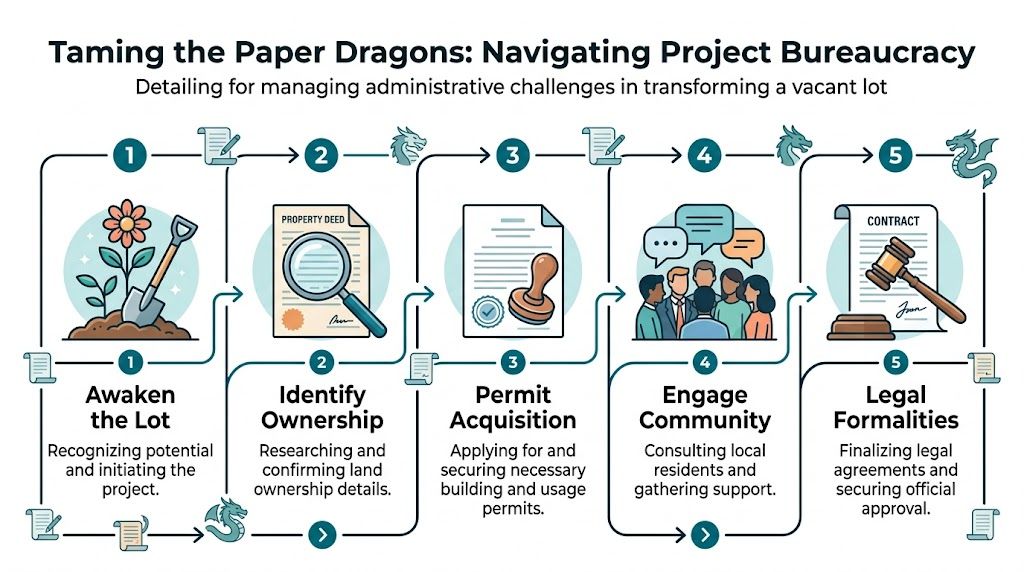
    A flowchart showing five steps to navigate bureaucratic challenges for a vacant lot transformation project.

    The bargain always hides the real price

    In the episode, the dangerous part isn’t just the object being offered. It’s the language. “Something of no value” sounds harmless until the cost lands. That’s why I think the story works so well as a metaphor for city process.

    The fan analysis of the episode’s Faustian bargain structure describes a temptation phase, a trade with hidden terms, and notes an 80% failure rate in simulations of ethically ambiguous bargains. I don’t treat that as urban policy data. I treat it as a sharp metaphor. Red tape often asks for things that sound minor at first. One more form. One more approval. One more week. Then you realize the actual payment is your time, your emotional energy, and your ability to stay hopeful while progress stalls.

    I’ve felt that drain firsthand. A lot that seems worthless to the system can cost you dearly in persistence.

    My rule for paper dragons

    I don’t fight bureaucracy by pretending it’s simple. I fight it by making it visible.

    When I’m trying to move a lot project forward, I break the process into tangible quests:

    • Find the owner: You need clarity before you need optimism.
    • Ask dumb questions early: I’d rather sound inexperienced than lose months to assumptions.
    • Keep a written trail: Names, dates, emails, calls. Memory gets foggy when delays pile up.
    • Expect hidden labor: Every “small step” may contain three unstated sub-steps.
    • Look for human allies: One kind person inside a system can save you from ten dead ends.

    That last point matters most. Systems feel faceless until you meet someone who actually wants to help. Then the maze gains a lantern.

    Winning the right to build

    A lot of people romanticize the build phase and skip over the administrative struggle. I don’t. I think the legal right to care for a place is part of the heroic arc.

    When I dealt with ownership questions, permission layers, and all the little official hurdles that make a project feel slippery, I had to learn patience as a physical skill. Not positive thinking. Actual discipline. Open the email. Follow up again. Save the document. Show up to the meeting. Clarify the requirement. Repeat.

    Sometimes a dream survives because somebody is stubborn enough to keep answering messages.

    Bureaucracy doesn’t just test your plan. It tests whether your care can outlast confusion.

    That’s why I tell people to prepare for hidden costs long before they prepare for landscaping. If you’re entering this process, don’t just ask, “Can we get the lot?” Ask, “What will this ask from our spirit?”

    Gather support without losing your mind

    You can make the paper side less painful if you organize your support early. That support might include neighbors who back the project, volunteers willing to make calls, or practical funding help while the process drags on.

    If you need a starting point for the money side, I’d look at practical ideas for grants for gardens and community green projects. Not because grants solve everything, but because they can give structure to the dream while you’re still cutting through legal fog.

    I also like a simple working chart during this phase:

    Challenge What I do
    Ownership is unclear Confirm records before making promises
    Permits feel vague Ask for the exact next step in writing
    Delays keep stacking Set a follow-up rhythm and stick to it
    Team gets discouraged Share progress in small, concrete updates

    Resilience is part of the permit

    The funniest lie about community work is that land is the hard part and paperwork is just admin. Sometimes the paperwork is the mountain.

    But I don’t hate that fact anymore. The struggle purifies the motive. If you keep going after the novelty is gone, after the forms multiply, after the shiny fantasy of “we should make a park” turns into slow institutional labor, then your dream is real. It has muscle.

    And once you’ve earned your way through the maze, you don’t just hold a parcel. You hold a deeper kind of legitimacy. You fought for the right to imagine in public.

    Building Your Band of Heroes

    A lot never changes because one person has a beautiful vision. It changes because a group of people decides to carry bags, move branches, haul mulch, make calls, share jokes, and come back when the first burst of excitement is gone.

    That’s why I care more about the team than the blueprint.

    A diverse group of volunteers of various ages working together to plant and water a small sapling.

    Choose people before perfection

    I learned early that a volunteer group has to protect its energy the way a campfire protects flame from wind. If the social atmosphere gets sour, if people feel used, if safety gets sloppy, the whole project weakens even when the plan looks impressive on paper.

    So I look for givers. Not saints. Not superheroes. Just people who can wake up on a weekend morning and offer their effort without needing the world to revolve around them.

    Weekend mornings matter for that reason. They create a gentle filter. The people who come are often the people who are ready to build something steadier than a fleeting good intention.

    Culture beats hype

    I love practical tools, but culture is the real engine.

    Give people something to belong to and they stand taller. That can be as simple as a group chat that feels warm, a shared ritual before work begins, a flag, a song, a nickname, a badge, a running joke, or the habit of celebrating gritty effort instead of polished image. Sports teams understand this. Nations understand this. Service groups should understand it too.

    A lot project needs identity because hard work gets easier when people feel they’re part of a brave little fellowship rather than a random pile of strangers holding trash grabbers.

    Here’s what I defend hard in any volunteer culture:

    • Safety comes first: Nobody should feel pressured to take dumb risks.
    • Happiness comes next: A burned-out volunteer doesn’t become a long-term builder.
    • Money pressure stays out: Service should feel clean, not extractive.
    • Friendship is not a side effect: It’s one of the main outcomes.

    The project people remember isn’t the one with the slickest concept. It’s the one where they felt useful, safe, and glad they came.

    A selfless group changes the ending

    One reason I keep thinking about the tale of the vacant lot is its ending. The curse breaks through sacrifice, not cleverness alone. The episode analysis tied to the “Power of Love” trope says that kind of self-sacrifice has 88% efficacy in similar narratives, and it notes that group-centered stakes building performs 92% higher than solo efforts in that framing. Again, I don’t treat that as field research on volunteer management. I treat it as a story truth with real bite. Selfless groups survive setbacks better than isolated heroes.

    That’s exactly what I’ve seen. One person gets sick, tired, discouraged, busy, or overwhelmed. A group absorbs the blow. A group can keep the story going.

    How I recruit without sounding fake

    I don’t like manipulative outreach. I’d rather be clear than flashy.

    When I invite people, I tell them what the work is, where we’re meeting, what they should wear, and why it matters. I don’t promise magic. I promise effort, company, and a visible result. Ironically, that honesty attracts better people than inflated language ever will.

    If you want practical ideas for outreach, this guide on how to find volunteers can help you think through where people gather and what makes them say yes.

    Here’s the recruitment test I use in my head:

    If my message says this It attracts
    “Come be part of something amazing” Curiosity, maybe
    “Come clean this lot with us Saturday morning” Commitment
    “No pressure, all welcome, bring gloves if you have them” Kindness and realism

    A humble invitation often travels farther than a glamorous one.

    Let people become heroes slowly

    Not everybody arrives bold. Some show up shy. Some come because they’re lonely. Some need structure. Some want to do good but haven’t found their people yet.

    I respect that. I don’t need every volunteer to arrive as a crusader. Often the transformation is gradual. A person comes once, then again. They start carrying extra bags for others. They learn names. They suggest ideas. They laugh more easily. They become dependable almost without noticing it.

    Later in the story, that person is part of the backbone.

    A short film can sometimes communicate that spirit better than another paragraph can. This one captures the feeling of people working side by side for something larger than themselves.

    Build the fellowship and the lot will follow

    I’ve seen groups with modest tools do excellent work because the chemistry was strong. I’ve also seen well-resourced efforts sag because the people never bonded.

    That’s why I’ll keep arguing the same point. The park is not the only project. The people are the project too.

    When volunteers trust one another, hard days become stories instead of burdens. Rain becomes a memory. Delays become a shared enemy. Heavy lifting turns into a joke somebody repeats months later. Community isn’t decoration around the work. It’s the force that lets the work continue.

    Crafting the Future from Dirt and Dreams

    Once the lot is legally yours to shape and the team has some rhythm, the dream stops being private. Now it has to survive contact with real preferences, real constraints, and real budgets.

    This is my favorite phase because it turns vague hope into objects you can point at. Paths. Beds. Benches. Fences. Saplings. Seating. Shade. The lot starts answering back in a new language.

    Let the neighborhood draw the map

    I don’t trust a design that only lives in one person’s head.

    A better process starts with listening on site. Walk the perimeter with neighbors. Ask where water pools. Ask what they’re tired of seeing. Ask what would make them use the space. A parent may want room for kids to move. An older resident may want a bench in shade. A volunteer may care about native plants. Somebody else may just want the dumping to stop.

    Write those answers down. Then look for overlap.

    I like a rough three-part sorting method:

    • Needs: Safety, cleanliness, access, visibility
    • Uses: Gathering, resting, gardening, play
    • Character: Color, art, signage, little touches that make the place feel loved

    That keeps design grounded. A lot doesn’t become meaningful because it looks expensive. It becomes meaningful because people recognize themselves in it.

    If the community can’t see its own reflection in the design, the lot may be cleaner, but it still won’t feel awake.

    Use money creatively, not worshipfully

    A lot of people freeze when they think about funding because they assume real transformation needs a massive budget. I don’t think that way.

    I think in layers. What can volunteers do by hand? What can neighbors donate? Which local businesses might offer materials instead of cash? Where can you source reclaimed items? What can be built in phases instead of all at once?

    Grassroots fundraising works best when it feels tangible. A small neighborhood event. A crowdfunding ask tied to a specific object. A request for lumber, soil, tools, or plants rather than an abstract appeal. People like to see what their contribution becomes.

    And sometimes the city itself has overlooked resources if you’re willing to ask around and stay persistent. Wood chips, extra materials, old planters, surplus supplies. Not glamorous. Useful.

    Build with what you have, then improve

    I’d rather start with a modest build that people use than wait forever for an ideal version that never lands.

    That means making decisions like these:

    1. Clear circulation first. People need to move through the space without confusion.
    2. Create one visible focal point. A bench, a garden bed, a sign, a tree. Something that says this place has intention.
    3. Add comfort early. Shade, seating, and simple beauty invite repeat visits.
    4. Leave room to evolve. The best community spaces stay editable.

    If I’m short on resources, I ask one practical question over and over. What can we build right now that makes the next stage easier?

    That approach lowers stress. It also keeps the group from getting trapped in fantasy architecture.

    Resourcefulness makes the place feel alive

    A transformed lot often carries the fingerprints of improvisation. A border made from recovered material. Plants donated by a local nursery. A seating area assembled through favors, sweat, and careful scavenging. Those details matter because they tell the truth about how community spaces emerge.

    If you want examples of what neighborhood green spaces can become in Chicago, this page on community gardens in Chicago, IL offers a useful sense of the possibilities.

    I like projects that show their seams a little. Too much polish can feel distant. A community-built place should retain some evidence of the hands that made it. Not sloppiness. Humanity.

    Keep the dream practical

    I always bring the conversation back to maintenance. If a design element is beautiful but impossible for the group to sustain, it may become tomorrow’s burden.

    So I ask hard questions before installation. Who waters this? Who empties that? Who repairs this edge if it breaks? Who trims this planting bed in late summer? Dreams survive when responsibility has a name attached to it.

    That may sound less romantic, but I think it is true romance. Love is maintenance. Care repeated over time is what turns dirt into trust.

    Your Story Is Waiting to Be Written

    When a lot changes, people often focus on the before-and-after photos. I get it. Those photos are satisfying. Trash, then garden. Blight, then gathering place. Dirt, then laughter.

    But the deeper transformation doesn’t live in the images. It lives in the habits that form afterward.

    A cared-for space needs regular cleanup, seasonal workdays, people who notice when something breaks, and neighbors who use it. It needs birthdays, conversations, quiet afternoons, dog walkers, kids asking questions, adults sitting on benches after hard weeks. It needs life.

    A watercolor illustration showing children playing in a park with adults sitting on benches and a dog.

    The magic stays alive through repetition

    I think maintenance is honorable. Maybe even sacred.

    Anybody can love a ribbon cutting. Fewer people love weeding in awkward weather, picking up new litter after a windy weekend, or showing up when there’s no applause left. But that’s where a space becomes real. Repeated care tells the neighborhood this wasn’t a stunt. It was a promise.

    I also think programming matters. A small cleanup day. A planting morning. A neighborhood meet-up. A simple event gives people another reason to return, and return is everything. Spaces become beloved through familiarity.

    What the lot gave back

    I started this kind of work because my own life felt messy and hard to carry. I thought I was just trying to clean things up.

    I wasn’t. I was learning bravery.

    I was learning that suffering for a good cause has a bright side to it. Rain, cold, delays, setbacks, awkward conversations, sore backs, muddy shoes. Those things don’t ruin the story. They deepen it. They make the final place feel earned.

    The lot may begin as the wounded thing, but if you stay with it long enough, it starts healing you too.

    That’s the secret buried inside the tale of the vacant lot. The cursed trade is always the shortcut. The better path is slower. You give your labor freely. You accept inconvenience. You let community change your pace. In return, you gain something no quick bargain can offer. Self-respect.

    My challenge to you

    Find the neglected space that bothers you. The ugly corner. The sleepy lot. The place everybody has learned to ignore.

    Stand there for a minute and ask a harder question than “Who should fix this?” Ask, “Who could I become if I helped?”

    That question changed my life. It might change yours too.

    You don’t need to begin with mastery. You need gloves, honesty, and the willingness to be a little uncomfortable in public. Start with one cleanup. Talk to one neighbor. Invite two friends. Learn one rule. Carry one bag. Then do it again.

    A lot can wake up. So can you.


    If you want to turn that first brave cleanup into a real neighborhood story, join Litter Caterpillars. You’ll find a volunteer-driven crew in Chicago that shows up in all weather, builds friendships through service, and proves that cleaning a forgotten place can also rebuild the people doing the work.