Month: February 2026

  • Volunteer Trash Pick Up Guide to Transforming Your Community

    Volunteer Trash Pick Up Guide to Transforming Your Community

    I'll tell you a secret. A volunteer trash pick up isn't just about cleaning a street. It’s a strange and powerful way to find your courage, build friendships with incredible people, and start cleaning up the chaos inside your own head.

    How Picking Up Trash Can Change Your Life

    I didn't start picking up trash to save the world. Not even close. I started because my own life was a complete disaster.

    I was stuck. Trapped. I felt suffocated by the clutter of past failures and a chaotic relationship that had just imploded. It was like living in a house where every surface was covered in junk. That old jar of jam in the back of my fridge wasn't just jam anymore; it was a monument to a trip that felt like a lifetime ago. Every piece of trash I couldn't bring myself to throw away felt like it weighed 500 pounds.

    I’d hit a breaking point. I knew something had to change, and I decided to mindfully engineer my social circle, filtering out selfishness and forcing myself to embrace things that terrified me: consistency, cleanliness, and bravery. And I learned something fast—cleaning up other people's messes is way easier than cleaning up your own.
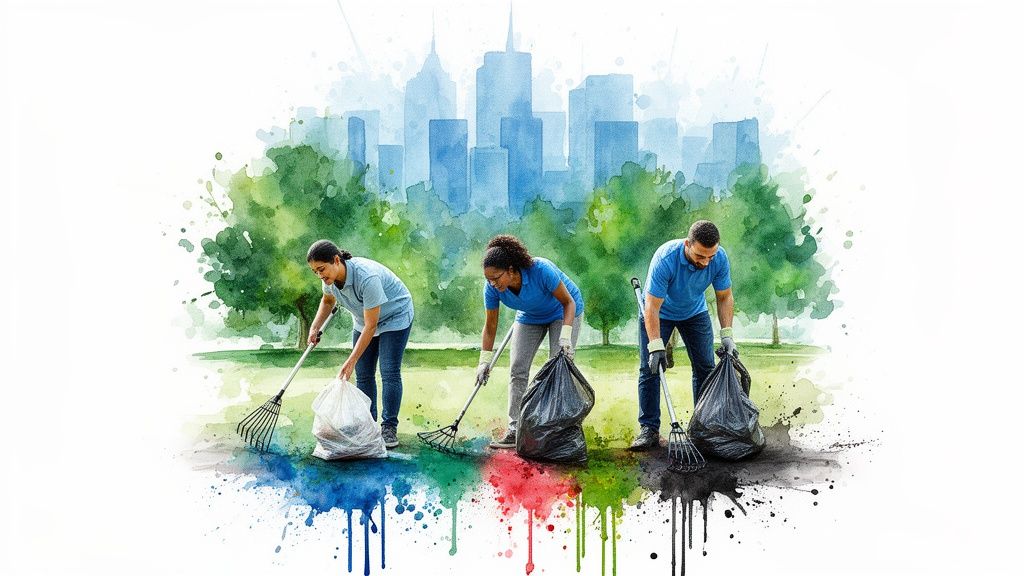
    Three young people in a watercolor style, collecting litter under a tree during a rainy cleanup.

    A Hailstorm and a Beginning

    My very first cleanup? I remember it like it was yesterday. It was just me and two friends. And, of course, a freak Chicago hailstorm decided to join us. We were huddled under a tree, shivering, watching Uber after Uber cancel on us. It was cold. It was absurd. It was, honestly, pretty miserable.

    But in that moment, something clicked. Shared struggle doesn't just build character; it forges unbreakable bonds. That freezing, bizarre experience taught me that facing a challenge together, no matter how small, adds a certain "flavor" to life. It moves the plot forward. It showed me that service is one of the most powerful tools for personal transformation.

    I realized that picking up trash wasn't a punishment. It was an adventure. A way to turn a personal low point into a powerful mission for a cleaner city and a clearer mind.

    Finding Your People and Your Purpose

    This simple act connects you to something so much bigger than yourself. It's not just about what you remove from the environment; it’s about what you build in its place. Every cleanup becomes a chance to meet people who share a fundamental kindness—people who just show up.

    You start to see your city not as a backdrop, but as a home you're actively tending to. It’s a journey where you find both your courage and your community.

    • You prove you can be consistent. Showing up week after week, rain or shine, builds a new level of self-trust. A promise you keep to yourself.
    • You find real connection. Working alongside someone toward a shared goal is one of the most natural ways to form friendships.
    • You see immediate impact. An hour of work results in a visibly cleaner park. A sidewalk transformed. It’s a tangible reward that’s incredibly satisfying.

    And this feeling isn't just happening in Chicago. It’s a global movement. Imagine millions of us banding together—that's the magic of World Cleanup Day. Since 2018, this initiative has rallied over 114 million volunteers across 211 countries to remove more than 708,000 tonnes of waste.

    Groups like ours, the Litter Caterpillars, embody this spirit right here at home, showing up every single week to prove that small actions create huge ripples.

    This guide is about helping you start that same journey. You can learn more about my philosophy on cleaning up trash in other articles. Think of this as your first step toward transforming not only your neighborhood, but yourself.

    Finding Your Cleanup Crew

    So, you feel that fire in your belly. The urge to get out there and actually do something. That’s the hardest part, and you've already done it. But then the big question hits: where do I find my people? It can feel like you’re trying to find a secret club, but I promise, the doors are wide open if you know where to knock.

    Finding the right group for a volunteer trash pick up is more than just plugging a time into your calendar. It's like finding a good coffee shop—some are quiet and intense, others are loud and full of energy. You have to find your spot. You're looking for a vibe, a crew you actually want to hang out with.

    Digital Campfires Where Communities Gather

    When I was just starting out, I hit the internet to find my real-world crew. It felt a bit weird at first, but platforms like Meetup and even Instagram are basically the modern town square where we connect over things we care about. They are powerful.

    I found out pretty fast that Meetup is perfect for this. Just search for "trash pickup" or "community cleanup" and you'll probably find a bunch of groups right in your city that you never knew existed. It's how a ton of people found us, the Litter Caterpillars. They saw a post, felt a connection to our mission of being brave and kind, and just showed up.

    Instagram is another place that's surprisingly good for finding your people. Search hashtags like #chicagocleanup, #trashtag, or #volunteertrashpickup. You’ll see pictures and stories from groups out in the wild, which gives you a real feel for their energy before you even commit.

    A great event post tells you a lot more than just the time and place. It shows you the group's heart. Look for posts that talk about community, safety, and making sure volunteers have a good time—not just getting a job done.

    How to Spot a Great Group

    Okay, so you’ve found a few potential crews. How do you pick one? It’s all about reading between the lines. I’ve learned that a group’s true character really comes through in how they talk about their events. A great group doesn't just want your time; they want you to have a positive, safe experience.

    Here’s the mental checklist I use when I’m checking out a new group:

    • Do they talk about safety? Look for mentions of them providing gloves, bags, and doing a quick safety talk. It shows they put you, the volunteer, first. Always.
    • Is the vibe welcoming? Read their event descriptions. Do they sound friendly? Are they encouraging to newbies? Green flags are phrases like "first-timers welcome" or "come alone and leave with friends."
    • Are they consistent? A group that meets regularly—say, every weekend—is usually more organized and has a solid community. It shows they’re in it for the long haul.

    I’ll never forget one of our regulars telling me he was super nervous to come to his first event alone. He saw our photos on Instagram—just a bunch of people smiling in a blizzard, holding trash bags like they were trophies—and said he knew this was a group that found joy in the work. He showed up. He’s been with us ever since.

    That's the feeling you're looking for. The journey of how to find volunteer work is really about finding that sense of belonging. Your crew is out there. Waiting.

    Your First Volunteer Trash Pick Up

    Showing up to your first volunteer trash pick up can feel a bit like the first day of school. You're excited, maybe a little nervous, and you definitely don't want to show up unprepared. Let’s walk through what you can expect. Think of this as your pre-game pep talk, designed to make your first cleanup so awesome you’ll be hooked.
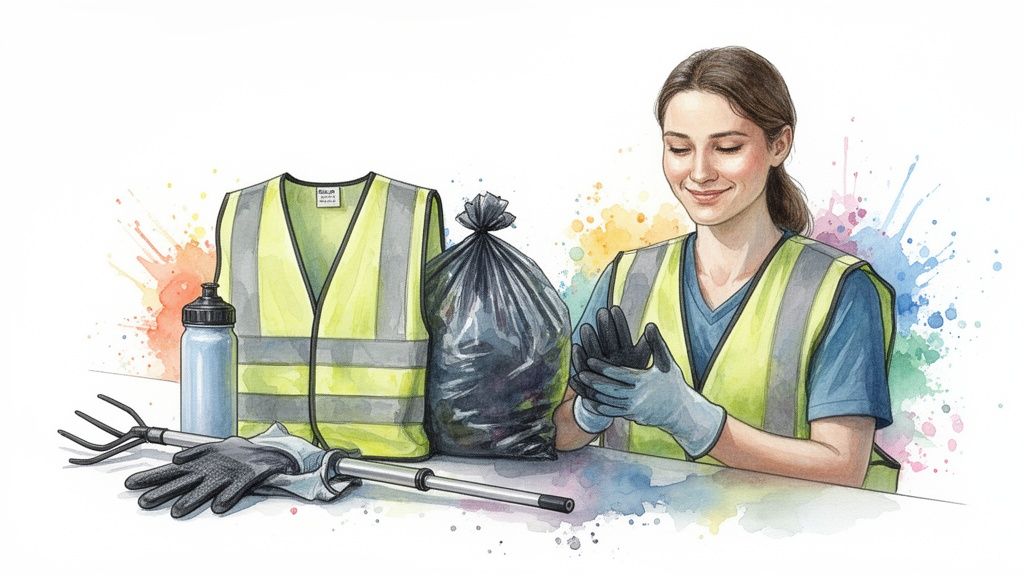
    A smiling woman in a high-visibility vest and gloves, with a trash bag and cleanup tools.

    From my experience, the biggest hurdle isn't the trash itself—it's the uncertainty. You’re putting yourself out there, meeting new people, and diving into something new. That takes real courage. Give yourself credit for even considering it.

    Dressing for the Adventure

    Your outfit is your first line of defense. Remember that hailstorm I mentioned? It taught me a vital lesson: nature doesn’t care about your plans. Comfort and safety are everything. This isn't a fashion show; it's a mission.

    • Closed-toe shoes are non-negotiable. You’ll be walking on uneven ground and encountering things you can't see. Sturdy boots or old sneakers are your best friend.
    • Wear layers you can move in. The weather can turn on a dime, especially in Chicago. A t-shirt, a hoodie, and a light jacket give you options.
    • Choose bright colors if you can. Especially if you're cleaning up near a road, being visible is key to staying safe. Think of yourself as a friendly, helpful traffic cone.

    Think of it like dressing for a hike. Forget fashion; this is all about function. You need to be ready for anything, from a sudden downpour to a surprisingly sunny day.

    What to Bring and What to Expect

    A good organizer will handle the core supplies, but being personally prepared makes the whole experience smoother. It’s the difference between just getting through it and actually having a great time.

    Here's a quick reference for what to bring versus what a great organizer should provide, ensuring you're prepared and safe.

    Your Essential Cleanup Day Checklist

    What You Should Bring What the Group Should Provide
    A reusable water bottle to stay hydrated Heavy-duty, puncture-resistant gloves
    Sunscreen and a hat for sun protection Durable trash bags
    Your phone for photos and emergencies Trash grabbers or "pickers"
    An open mind and a positive attitude Hand sanitizer and a first-aid kit

    Being prepared helps you focus on what really matters: the people and the mission.

    The most important thing you can bring is a willingness to connect. This isn't just a chore; it’s a social event disguised as community service. The trash is just the icebreaker.

    Embracing the Mindset

    Okay, you’re dressed, you’re packed, and you've arrived. Now what? Your first instinct might be to grab a bag and furiously start picking. My advice? Slow down.

    Pace yourself. This is a marathon, not a sprint. Take a moment to look around and introduce yourself to the person next to you. A simple "Hey, I'm new here" is the perfect opener. Every single person here was a first-timer once. We all remember that feeling.

    You will find weird stuff. It’s part of the fun. I’ve found everything from a single high heel to a perfectly preserved (and unopened) can of peas from the 1980s. When you do, share it! It's a great way to start a conversation and get a laugh with your fellow volunteers.

    Focus on the shared mission. You're all there for the same reason—you care. That common ground is a powerful foundation for friendship. By the end of the day, you’ll leave with more than just a full trash bag; you’ll leave with a sense of accomplishment and a few new friends.

    Leading Your Own Community Cleanup

    Do you feel that fire to start your own crew? That's a huge step. A monumental one. When I first started this, I wasn't trying to lead anyone. I was just trying to show up for myself and fix my own life. But leadership is what happens when you keep showing up. If you're feeling that pull, it means you're ready to build something real.

    So, I’m opening up my personal playbook. This is how we plan and run a cleanup that's safe, effective, and honestly, a strange new form of "fun." You're not just picking a spot on a map; you're crafting an experience. Think of yourself as an event planner, but your main guests are your neighbors and the guest of honor is your community. You’re building something from scratch.

    Scouting Your Mission

    First thing's first: you must become a scout. Before you can lead a volunteer trash pick up, you need a location. This is more art than science. I like to just walk or bike through neighborhoods, keeping my eyes peeled for the spots that look forgotten—but are still safe for a group to work in.

    Look for a place that tells a story. Is there a park that’s become an unofficial dumping ground? An underpass people just avoid? These are perfect. Why? Because the "before and after" will be so dramatic it gives your volunteers that incredible feeling of victory.

    I always make sure my route has:

    • Safe access: No one should be dodging fast-moving traffic or climbing over sketchy terrain. The safety of your volunteers is everything. It comes first, always.
    • A clear start and end point: This keeps the group together and makes your life a million times easier. I’ve found a one-mile loop or a half-mile down a single street works perfectly.
    • A "trash hotspot": You want a concentrated mess. A dragon to slay. It gives the crew a clear, satisfying challenge and a visible win at the end.

    Once you think you have a spot, you have to walk the route yourself. Take notes. See some broken glass? Overgrown thorns? Make a mental note. Knowing the territory gives you the confidence to lead everyone else through it.

    Scheduling for Success

    Timing is everything. You might think any weekend afternoon will work, but I’ve found that weekend mornings are pure magic. We intentionally schedule our events for Saturday or Sunday mornings because it filters for a certain kind of person: the giver.

    People who drag themselves out of bed early on a weekend aren't looking for a party. They are there to serve. They’re the ones who are ready to build consistent, positive habits. Kicking off your day with service just sets a powerful tone for the whole weekend.

    The goal isn’t just to get people to show up once. It's to create an experience so positive and fulfilling that it becomes a cherished part of their routine. A weekend morning cleanup can be that anchor.

    This one small choice says a lot about your group's identity. It signals that you're about purpose and connection, not just killing time. It’s a quiet way of saying, "We’re here to do the hard work, together."

    The Unspoken Contract: The Safety Briefing

    This is the most important part of your job. Before a single piece of trash gets picked up, you deliver a safety briefing. Every. Single. Time. It doesn’t need to be some long, dramatic speech, but it is absolutely non-negotiable.

    Your safety talk is an unspoken contract with your volunteers. It tells them, "I see you, I value your time, and I will do everything in my power to keep you from getting hurt."

    I always cover these key points:

    • Point out known hazards: "Watch out for the broken glass over by that fence." I mention what I saw on my scout walk.
    • Explain the "don'ts": No sharp objects (especially needles), no trying to lift heavy furniture by yourself, and no wandering off into sketchy areas alone.
    • Set the boundaries: I clearly define the cleanup zone so nobody gets lost. "We're cleaning from this corner down to the blue building."
    • Have a communication plan: "If you need anything, find me. I’ll be the one in the bright green hat."

    This briefing does more than just keep people safe—it builds trust. It shows you’re a leader who actually cares about their team, not just the task. And that trust is the foundation of any real community. My leadership isn’t measured by how much trash we collect, but by how well I take care of the people who show up to help. You're not just cleaning a street; you are building a movement, one small, safe, and powerful event at a time.

    Building a Community That Lasts

    Let me tell you a secret: a volunteer trash pick up is almost never about the trash. It’s the perfect excuse. The stage we set to build friendships and community, using the shared task as the glue that brings us all together. The real victory isn't a clean street; it's the tough, supportive crew you build along the way.

    But this doesn't just happen. You can't just hope a community forms; you have to intentionally build the container for it. My whole philosophy is “volunteer-first.” This means protecting the energy of the people who show up is your most sacred duty as an organizer. Their time and spirit are the fuel for this whole mission. You must guard it.

    This also means you never, ever pressure people for money. Their presence is the donation.

    The Volunteer-First Philosophy

    When someone decides to spend their Saturday morning with you instead of sleeping in, they’re giving you something incredibly precious. Your job is to honor that gift. This isn't a transaction; it's a relationship built on mutual respect and a shared desire to do some good.

    Think of your volunteer group like a garden. You can't just throw seeds on the ground and expect a harvest. You have to nurture it. This means prioritizing safety, but it also means prioritizing joy. It's about creating an environment where people feel seen, valued, and actually want to come back.

    The goal isn’t just to get people to show up once. It’s to create an experience so positive and fulfilling that it becomes a cherished part of their routine. A weekend morning cleanup can be that anchor.

    This volunteer-first mindset changes everything. When people feel safe and appreciated, they relax. They open up. They stop being just a group of individuals picking up litter and start becoming a team, a family. This is how you build a movement that lasts. If you want to dive deeper, you can check out my guide on effective volunteer retention strategies.

    Fostering Connection Beyond the Cleanup

    So, how do you actually do it? You create spaces for connection that exist outside the two hours you’re filling trash bags. The work itself is a great icebreaker, but the real bonds form when people can just be themselves.

    I use a group chat, not just for event logistics, but for casual conversation. People share photos of their pets, talk about their week, or ask for recommendations. It keeps the community spirit alive long after the gloves come off.

    This process chart shows the basic flow for leading a cleanup, but the real work—the community building—happens between these steps.
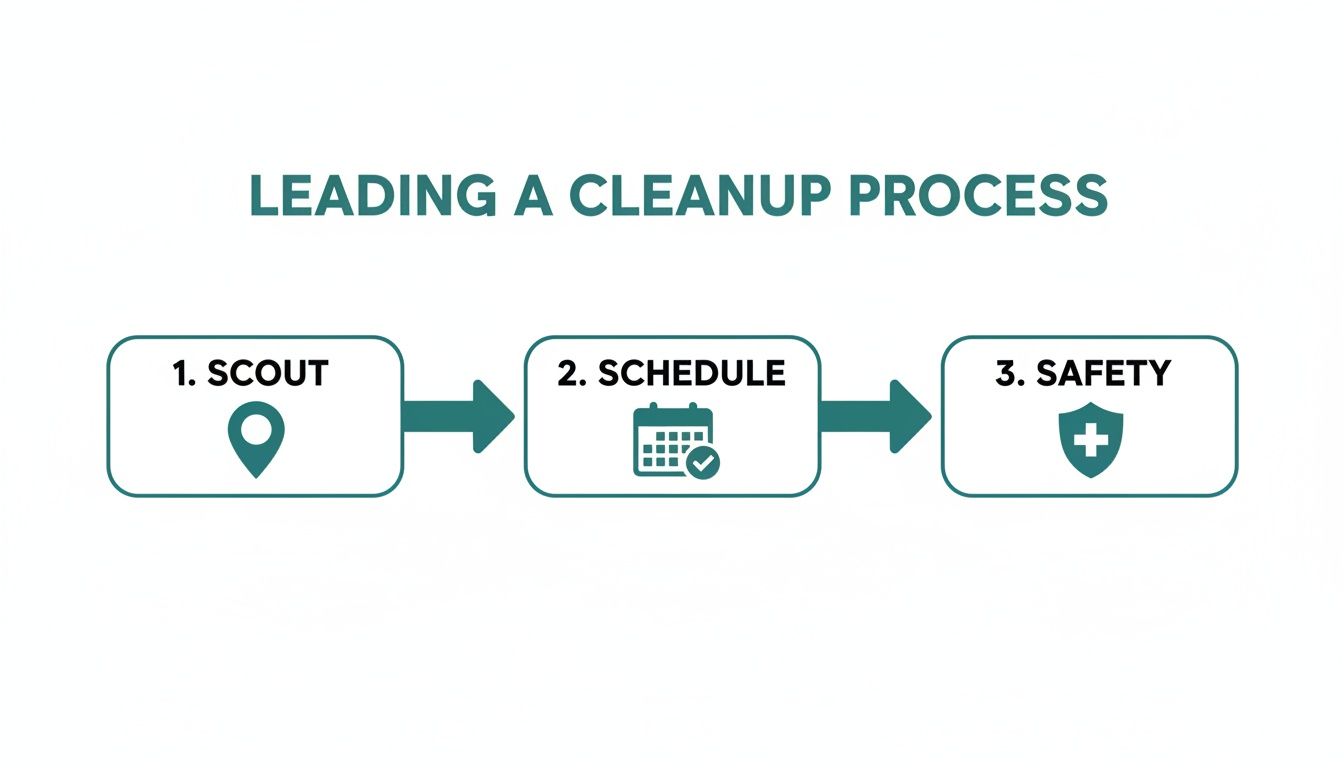
    Flowchart illustrating the three steps to lead a cleanup process: scout, schedule, and safety.

    While scouting, scheduling, and safety are the skeleton of an event, the community is its heart.

    We also celebrate milestones. We have badges for attending a certain number of cleanups or for braving a blizzard. It’s a simple, fun way to acknowledge dedication and create a shared identity. It’s like getting a merit badge for being a good human, and it makes people proud to be a part of something.

    • Create a shared identity. We have flags and a theme song. It sounds a little goofy, I know, but it works. It gives people pride and a sense of belonging.
    • Encourage casual hangouts. After a cleanup, a few of us might grab coffee. It’s not an official part of the event, but it’s where real friendships solidify.
    • Tell your group's story. I share photos and celebrate our wins on social media. I want people to see the impact they’re making and the fun they’re having.

    The power of this is immense. Look at beach cleanups. The Surfrider Foundation shattered records last year, removing 365,000 pounds of trash thanks to 40,000 dedicated volunteers nationwide. Those are huge numbers, but they’re driven by the same spirit we have. It all comes back to prioritizing volunteer joy and safety above everything else.

    From Empty Lot to Community Park

    Let me tell you a story. A few years ago, my little group of friends noticed a forgotten, trash-filled empty lot in Englewood. So we cleaned it. And then we cleaned it again. We started dreaming about what it could be.

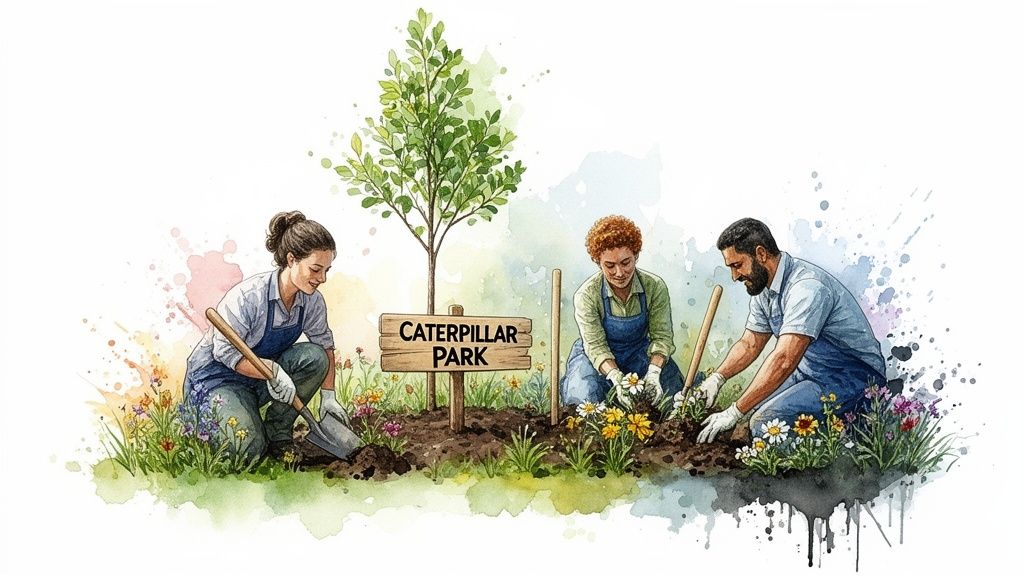
    So we did something crazy. We pooled our money, we entered a city auction, and we won. We bought that empty lot. Today, it’s no longer a dumping ground; it's on its way to becoming Caterpillar Park, a green space for the whole neighborhood.

    That’s what a dedicated community can do. It starts with a few people who decide to show up, and it grows into a force that can literally reshape a city, block by block. It was never just about the trash. It was about building something that would last.

    Common Questions We Get All The Time

    You've got questions, and I've got answers. After years of running these cleanups every single week, in every kind of Chicago weather imaginable, I've heard them all. It's totally normal to wonder about the little details before you dive into your first volunteer trash pick up. Honestly, the fact you're even asking shows you care, and that’s what matters most.

    Here are some of the things people often ask before they grab a bag and join us for the first time.

    What If the Weather Is Terrible?

    I’ll let you in on a little secret: we kind of love it when the weather gets weird. We go out rain or shine, in blizzards and heatwaves. Why? Because suffering and freezing together actually makes things interesting. It gives the day "flavor." It advances the plot!

    Of course, your safety is my number one priority. I’ll absolutely cancel for truly dangerous conditions like lightning or extreme winds. But a little rain or snow? That just makes us feel that much more accomplished at the end. It's a badge of honor.

    A good organizer will always communicate clearly about any weather plans. My advice? Just dress in layers, bring a great attitude, and be ready for an adventure. You might be surprised by how much fun you have when things get a little crazy.

    Do I Have to Bring My Own Bags and Gloves?

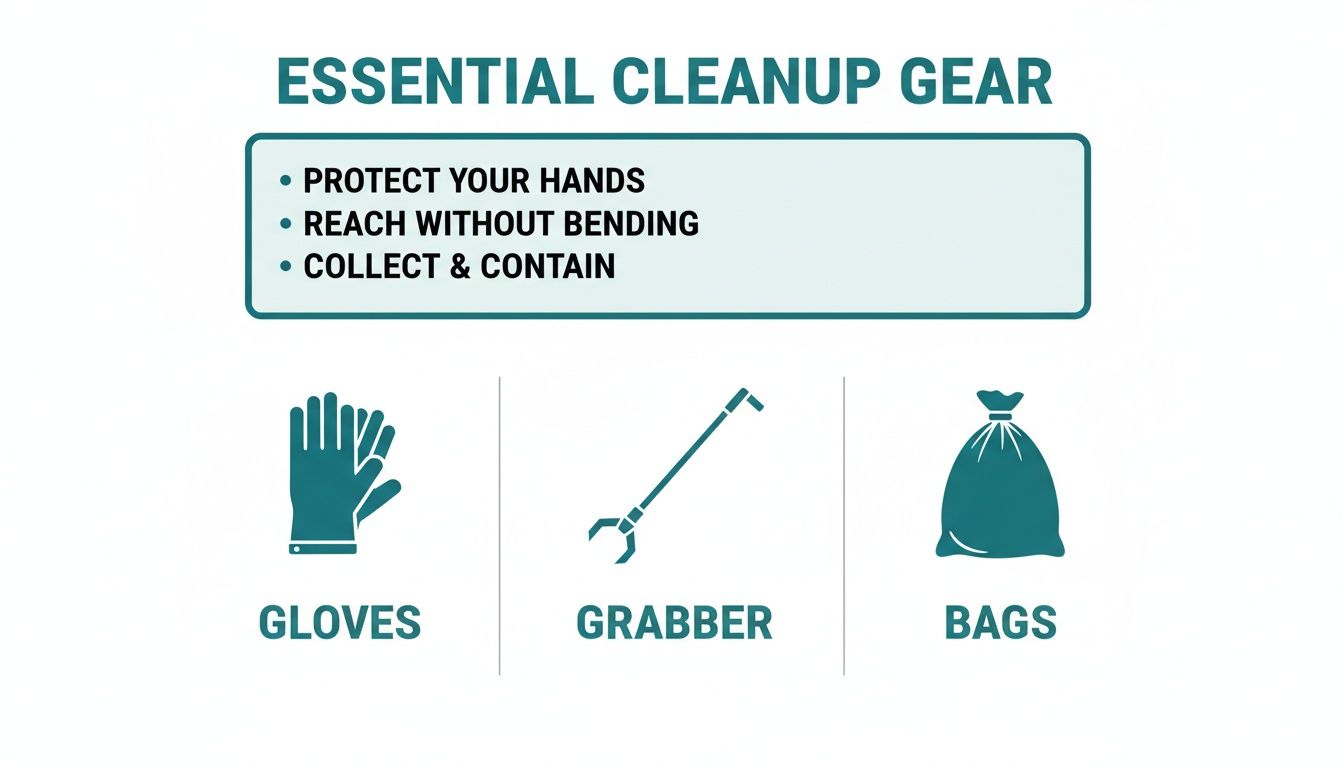
    Nope, you shouldn't have to. Any well-run cleanup will provide the essentials to keep you safe and effective. We always show up with heavy-duty trash bags, puncture-resistant gloves, and plenty of hand sanitizer for everyone.

    Protecting my volunteers is the most important job I have as an organizer, and that starts with having the right gear ready to go. You’re giving me your time; the least I can do is give you the tools. That said, if you have a favorite pair of work gloves or your own trusty trash grabber, by all means, bring them along! Just check the event description, but expect the basics to be covered.

    I'm Coming Alone and I'm a Little Nervous.

    First off, it's incredibly brave to show up to something new by yourself. Be proud of that. Seriously. You are taking a step that most people are too afraid to take. Second, I can almost guarantee you won't be the only one. So many of our most dedicated regulars came alone their very first time.

    My best advice is to just focus on the task at hand. The simple, shared act of working alongside someone is a wonderfully low-pressure way to start a conversation. You can just point to some bizarre piece of trash and ask, "Wow, have you ever seen anything like that before?"

    The shared mission does all the hard work for you. You're all there for the same reason, and that creates an instant connection. Just show up. I promise, the community will find you.

    At our events, I try to create a welcoming vibe from the very start. We have a theme song. We introduce new people. You've already done the hardest part by deciding to come out.

    How Can I Convince My Friends to Join Me?

    Don't frame it as a chore. You have to be like Tom Sawyer painting the fence—make it sound like the coolest, most exclusive club in town. Tell them it’s a weird, fun adventure, a way to explore a new neighborhood you'd never see otherwise and get some fresh air.

    Talk about the deep satisfaction of seeing a tangible result—a clean street that was filthy an hour ago. And definitely highlight the social side: it's a chance to meet other cool, kind people who actually care.

    Be honest about the challenge, too. Say something like, "It might be tough, and the weather might be crazy, but it'll be a story to tell." That sense of shared purpose and adventure is way more compelling than just asking, "Hey, want to pick up garbage with me?"


    Ready to start your own transformation? Join Litter Caterpillars at our next cleanup and see how service, friendship, and a little bravery can change everything. Find our next event and become part of our story at https://www.littercaterpillars.com.
  • 10 Life-Changing Benefits of Volunteering for Students in 2026

    10 Life-Changing Benefits of Volunteering for Students in 2026

    I get it. Your schedule is a beast. Juggling classes, staring down study guides, maybe even slinging coffee for cash, makes volunteering feel like a luxury you can't afford. I was there. My own life was a disaster zone, literally and figuratively. My apartment was a museum of things I'd failed at, and every piece of trash felt like it weighed a ton. I was stuck.

    Then I stumbled onto a secret. Cleaning up someone else's mess is a million times easier than cleaning up your own. It's like hitting the reset button on your own life. For me, that reset switch flipped in a Chicago hailstorm, picking up soggy napkins with a handful of friends. Sounds insane, right? But that single moment—that shared battle against the ridiculous—changed everything. It was the birth of Litter Caterpillars, and it showed me a truth I have to share with you.

    The real benefits of volunteering for students aren't just about fluffing up your resume or checking a box for service hours. It's about building a life that feels lighter. More connected. A life humming with purpose. It's realizing that by showing up for your community, you are, in the most profound way, showing up for yourself. Let’s dive into the 10 ways giving your time can completely rewire your world.

    1. Build a Real Professional Network (Without the Awkward Handshakes)

    Forget those stuffy networking nights where you nervously orbit a cheese plate and swap business cards like they're trading cards. Picture this instead: you're building a powerful connection with a software engineer while pulling a rusty bike frame out of a bush. This is one of the most incredible benefits of volunteering for students: authentic networking. It puts you shoulder-to-shoulder with established pros from every corner of Chicago, all focused on a goal you actually believe in.

    Diverse young volunteers with gloves and trash bags cleaning up a park area.

    You will meet people in tech, healthcare, the arts. Not because you're trying to sell them something, but because you're both dedicated to making the city better. I've personally watched students land amazing internships and find mentors for life just by striking up a conversation over a full trash bag. These aren't just flimsy business connections. They are real friendships, cemented by a shared mission. You're not just a student asking for a favor; you're a teammate making a real difference.

    How to Make it Happen

    • Show Up Consistently: Attend cleanups regularly. This is how you build deep roots with other volunteers. Familiar faces bloom into meaningful conversations.
    • Be Curious: Ask people about what they do and what lights them up. You'll be floored by who you meet.
    • Share Your Goals: Don't be shy about your own dreams. Volunteers genuinely want to lift each other up.
    • Take the Lead: Volunteer for a role like a ward coordinator. It raises your visibility and lets you work side-by-side with community leaders.

    This approach turns networking from a cringe-worthy chore into an adventure. You can find more about building your career through service at our young professional networking events.

    2. Develop Leadership and Responsibility Through Consistent Commitment

    True leadership isn't a title someone gives you; it's the reputation you earn by showing up when it's hard. It's proving you are the person people can count on, especially when the rain is pouring down or the task is gritty. This is where consistent volunteering forges a kind of responsibility that no classroom can teach. It’s one of the most powerful benefits of volunteering for students: building resilience through unwavering dedication.

    This is not a one-and-done event. It is a promise. At Litter Caterpillars, we've been cleaning up Chicago every single weekend for over three years. Rain. Shine. Blizzards. Negative wind chills. When you show up, week after week, you're not just a volunteer anymore; you're a pillar of a team. You build the kind of accountability that defines a true leader. I've seen students like Kevin Tao completely transform their own habits, building a three-year weekly tradition of service that has inspired hundreds of people. That is the kind of story that defines your character.

    How to Make it Happen

    • Start with Attendance: Your first mission is just to show up. Week in, week out. Consistency is the bedrock of trust and responsibility.
    • Lead a Ward: Once you're a familiar face, volunteer to be a ward coordinator. You'll manage logistics, guide others, and take direct ownership of your community's success.
    • Mentor Newcomers: Take a new volunteer under your wing. Guiding someone else is an incredible way to solidify your own leadership chops.
    • Embrace the Challenge: Don't duck out on the tough days. Leading a cleanup during a surprise downpour shows a level of commitment people never forget.

    This journey from participant to leader is at the very core of what we do. You can start building your own leadership legacy by joining one of our upcoming cleanup events.

    3. Improve Mental Health Through Outdoor Service and Community Connection

    The relentless drumbeat of exams, deadlines, and social pressure can seriously mess with your head. Volunteering offers a powerful way out. It's a cocktail of physical activity, sunlight, and genuine human connection. Getting outside and focusing on a simple, tangible mission—like cleaning a park—quiets the frantic buzzing in your brain. Think of it as active mindfulness. It grounds you in the present, pulling you away from academic stress and the endless scroll of digital isolation.

    Smiling woman on a park bench with a full trash bag, holding a coffee cup, surrounded by watercolor art.

    This benefit of volunteering for students is deeply personal for me. I've watched students use our weekend cleanups as their escape hatch, finding that a few hours of service does more for their mood than a whole day locked inside. Research from the University of Chicago even backs this up, confirming that outdoor volunteering can slash symptoms of depression and anxiety. You are not just cleaning a street; you are clearing your mind. Building your own resilience. The simple act of turning a trashed space into a beautiful one is a mirror for the personal growth you're experiencing inside.

    How to Make it Happen

    • Be Consistent: Try to attend cleanups for at least a month. You'll feel the mental health benefits multiply as it becomes a restorative habit.
    • Practice Mindfulness: Focus on the physical task. The sounds of the city, the fresh air, the feeling of making a visible difference. Let your worries dissolve.
    • Connect with Others: Don't be afraid to share what's on your mind. Real community is built on mutual support, and you'll find others who just get it.
    • Invite a Friend: If you know someone who's feeling isolated, invite them to join you. Sharing this experience can strengthen your bond and their well-being.

    Volunteering is this unique space where you get to care for your community and yourself at the exact same time. See how our community comes together at our next neighborhood cleanup event.

    4. Create Lasting Friendships and Find Your People

    College can feel like an island, and making friends who really get you isn't always easy. But imagine finding your tribe not in a chaotic dorm party, but while working together to bring a neglected park back to life. This is one of the most powerful benefits of volunteering for students: it blasts past superficial small talk and forges connections based on shared values and action. It’s about building a real community.

    Five diverse, joyful volunteers in blue shirts embracing, with colorful watercolor art splashes.

    At Litter Caterpillars, we're all about building friendships. Our inside jokes, our badges, and our consistent weekend cleanups create this incredible sense of belonging, like a sports team but with more trash bags. I have seen students who felt completely adrift find their closest friends here, bonding over a shared mission to serve all 50 Chicago wards. These are not flimsy connections. They are friendships forged in the trenches of shared purpose—and sometimes shared absurdity, like when our three co-founders bonded forever during that sudden hailstorm cleanup.

    How to Make it Happen

    • Pick a Ward and Stick With It: Show up at the same neighborhood cleanup consistently. Seeing the same faces week after week is the fastest way to turn strangers into friends.
    • Be Brave, Exchange Info: After a few cleanups, don't be shy. Suggest grabbing a coffee or swap social media handles to stay in touch.
    • Invite a Friend Along: Bringing a buddy can make the first time less intimidating, and the shared mission will strengthen your bond.
    • Get Involved Online: Jump into the group chats and follow the social media pages. Stay plugged into the community vibe between cleanups.

    This transforms the hunt for community from a stressful chore into a natural side effect of doing good. You can find more ideas for connection in our guide to community building activities for adults.

    5. Gain Real-World Environmental and Sustainability Impact

    Reading about climate change can leave you feeling powerless, like a tiny boat in a giant storm. You might wonder if anything you do even matters. When you volunteer with an organization like Litter Caterpillars, you get to see the immediate, undeniable results of your hard work. This is one of the most incredible benefits of volunteering for students: you witness environmental change with your own eyes, one filled trash bag at a time.

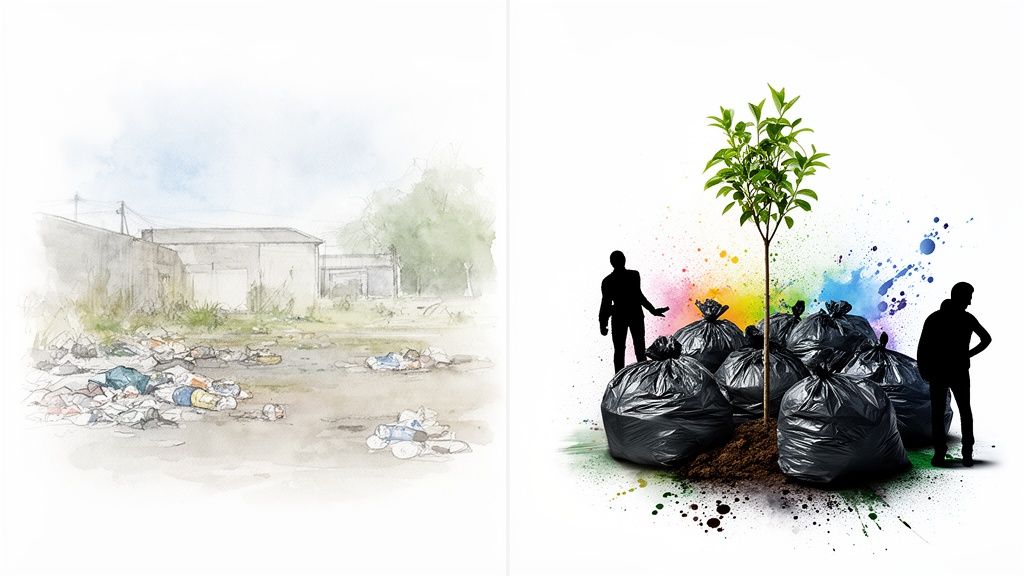
    Contrasting scenes: a polluted lot with trash on the left, and a planted tree, people, and trash bags with vibrant splatters on the right.

    This is not a theoretical discussion. This is direct action. You are physically removing garbage that chokes wildlife, reclaiming public spaces for people to enjoy, and stopping waste from clogging our city's arteries. I have seen our teams transform a neglected, trashed-out lot in Englewood into a beautiful community park. I’ve seen us collect literal tons of litter during a highway shutdown for a bike event. Your efforts create a measurable ecological impact and provide concrete proof that your actions are powerful.

    How to Make it Happen

    • Track Your Impact: Keep a personal log of bags you've filled or blocks you've cleared. Watching the numbers climb is insanely motivating.
    • Document Everything: Snap before-and-after photos of the areas you clean. This visual proof is gold for your portfolio or for sharing on social media to inspire others.
    • Understand the 'Why': Dig into local environmental issues. See how your cleanup work plugs into the bigger picture of urban sustainability.
    • Connect Your Actions: Realize that every piece of plastic you pick up helps protect local birds and improves water quality in our lake.

    This hands-on work transforms abstract environmental worries into a personal, winnable mission. You can explore a deeper understanding of these principles and learn more about what environmental stewardship means on our blog.

    6. Build Resilience and Overcome Fear Through Consistent Courage

    Academic pressure and life's sudden left turns can feel crushing. What if you could train your brain to see challenges not as walls, but as jungle gyms? This is another core benefit of volunteering for students: it builds real psychological armor. It’s about learning that fear, failure, and even suffering are not things to be dodged, but ingredients for a stronger, more interesting you.

    When you show up for a cleanup in a blizzard, with negative wind chills clawing at your face, you're doing more than just picking up trash. You are teaching yourself that you can handle discomfort. That you are tougher than you think. I will never forget our first hailstorm cleanup; that's when it hit me that suffering truly adds flavor to life and moves the plot forward. This mindset, forged in the crucible of Chicago weather, becomes a superpower you can use to ace exams, tackle tough projects, and face down any obstacle life throws at you.

    How to Make it Happen

    • Embrace Discomfort: Intentionally sign up for a cleanup on a day with "bad" weather. Consider it your resilience training ground.
    • Reframe Your Mindset: When you feel challenged, tell yourself, "This is making me stronger." Turn that negative inner voice into your personal hype man.
    • Share Your Fears: Be open with other volunteers about what scares you. Vulnerability is a superpower that builds incredible bonds and shows you you're not alone.
    • Transfer the Skill: Apply the same courage you used to face the freezing cold to that intimidating class presentation or that difficult conversation you've been avoiding.

    This is how you build an unbreakable spirit, one brave choice at a time. You can start practicing this unique form of courage at our next Litter Caterpillars cleanup event.

    7. Explore Chicago Neighborhoods and Discover Community Resources

    Your life as a student can easily become a bubble, trapped between campus and a few favorite haunts. Volunteering pops that bubble. It turns the entire city of Chicago into your living classroom. Imagine truly getting to know the diverse, vibrant soul of this city—from the murals of Pilsen to the lakefront trails of Rogers Park—not as a tourist, but as a community partner. This is a huge benefit of volunteering for students: it’s a ground-level education in urban geography and sociology.

    With Litter Caterpillars' mission to serve all 50 wards, you're not just cleaning a street; you are unlocking a new part of the city every single weekend. You will meet the small business owners who are the beating heart of their communities. You will learn from residents who have watched their neighborhoods change over decades. You will discover incredible local nonprofits you never knew existed. I have seen students find their favorite taco spot in Englewood after a cleanup or connect with a community garden in Humboldt Park that sparks a whole new passion. This is how you weave yourself into the real fabric of the city.

    How to Make it Happen

    • Be a Neighborhood Explorer: Intentionally sign up for cleanups in wards you've never even heard of. Make a goal to volunteer in a new corner of the city each month.
    • Talk to Locals: Ask long-time residents about their neighborhood’s story and what makes it special. Their memories offer insights you'll never find in a guidebook.
    • Support Local Businesses: After your cleanup, grab a coffee or a bite to eat at a neighborhood spot. It's a fantastic way to support the community you just served.
    • Document Your Journey: Take photos and jot down notes about what you discover in each neighborhood. It will deepen your love for Chicago’s incredible diversity.

    This transforms your service into an urban adventure, making you not just a student in Chicago, but a true Chicagoan. Ready to start exploring? Check out our upcoming city-wide cleanup events.

    8. Develop Practical Skills in Project Management and Event Coordination

    Your resume says you have "leadership skills," but what does that even mean? Volunteering is your chance to prove it. Forget abstract classroom theories; this is where you can manage a real project from start to finish. It’s one of the most practical benefits of volunteering for students because it gives you a low-stakes place to gain high-stakes professional skills. You are not just picking up trash; you are coordinating logistics, managing people, and executing a plan that gets real results.

    Imagine telling a future employer you organized a 50-person cleanup event across three different neighborhoods. You had to manage supplies, communicate schedules, pivot when the weather suddenly changed, and make sure everyone had a great experience. That is project management. When I see students step up to lead a ward cleanup, they are learning how to allocate resources, motivate a team, and track outcomes—skills that are directly transferable to any career path you can imagine.

    How to Make it Happen

    • Ask for Responsibility: Raise your hand to be a ward coordinator or help plan a special event. Leadership roles are often just waiting for someone to ask.
    • Document Everything: Create supply checklists, draft communication templates for volunteers, and track key metrics like attendance or bags collected. This is how you build your project portfolio.
    • Shadow an Expert: Learn from experienced coordinators. Watch how they handle curveballs and manage group dynamics before you take the lead yourself.
    • Master the Tools: Get comfortable using platforms like Meetup or group chats to manage RSVPs, send out updates, and keep your team fired up.

    This kind of hands-on experience is worth a thousand lines on a resume. You can start building these skills today by signing up to help lead a local cleanup at our volunteer opportunities page.

    9. Build Confidence and Self-Trust Through Demonstrated Accomplishment

    Classes and exams often test what you know in theory, which can leave you wondering what you're actually capable of in the real world. This is where volunteering offers one of its most life-changing benefits for students: it builds rock-solid confidence through tangible results. You are not just studying theories of social change; you are making change happen, one filled trash bag at a time. It’s about proving to yourself, through undeniable action, that you can make a real impact.

    When you see a park go from neglected to beautiful because of your work, that visual proof is electric. Our founder, Kevin Tao, started out feeling swamped by even the smallest tasks, but consistent, focused action turned that doubt into a city-wide movement. Each cleanup you do provides concrete evidence of your competence and your contribution. This feeling of self-efficacy doesn't stay in the park; it follows you into your exams, your interviews, and your future career challenges, reminding you that you are a person who can overcome obstacles and create real results.

    How to Make it Happen

    • Track Your Impact: Keep a running tally of your attendance or the number of bags you help fill. Seeing those numbers grow over months is undeniable proof of your dedication.
    • Take Before-and-After Photos: Document the spaces you help transform. Visually seeing the change you created is a massive confidence booster.
    • Celebrate Small Wins: Acknowledge every achievement. Filling your first bag. Making a new friend. Leading a small group. Each one is a brick in the foundation of your self-trust.
    • Journal Your Journey: Write down how you feel before and after a cleanup. Notice your own evolution from feeling nervous at your first event to feeling like a seasoned community leader.

    This process turns volunteering into a powerful personal development tool, transforming you just as you transform our neighborhoods. You can start your own transformation story at our next community cleanup event.

    10. Learn Kindness, Unity, and Service-Oriented Values Through Practice

    You can read about values like kindness and unity in a book, but you can only truly learn them by living them. This is where volunteering becomes more than a resume booster; it becomes a character-building forge. It is your chance to actively practice service-oriented values in a community that lives and breathes them, transforming who you are from the inside out. This is one of the most profound benefits of volunteering for students: it’s a workout for your integrity.

    At Litter Caterpillars, I see this magic happen every single weekend. Our "volunteer-first" philosophy means we put your safety and happiness above everything else, rejecting the typical donation-based model to keep the focus purely on service. This culture is deliberate. By showing up on a Saturday morning, you are choosing to be part of a group that values community over comfort. You are internalizing principles not through lectures, but through repeated choices—like deciding to help a new volunteer or working together to clear a tough spot. These small actions build a foundation of character that will guide your decisions for the rest of your life.

    How to Make it Happen

    • Notice Values in Action: Pay attention to how people treat each other. See how decisions are made. Ask yourself what principles are guiding this group.
    • Discuss What You See: Talk with other volunteers about the values you observe. These conversations make your own commitment deeper.
    • Reflect on Your Growth: After each event, take a moment. Think about how your own choices reflected values like kindness or teamwork.
    • Bring Values Elsewhere: Apply the service-oriented mindset you're building to your studies, your friendships, and your future career.

    This is not passive learning; it is an active process of becoming a more compassionate and community-minded person. You can start building your character with us at our next neighborhood cleanup event.

    10-Point Student Volunteering Benefits Comparison

    Program 🔄 Implementation complexity ⚡ Resource requirements 📊 Expected outcomes ⭐ Ideal use cases 💡 Key tips
    Build Professional Network and Career Connections Low–Medium: recurring meetups + informal outreach Low: weekly time, basic social tools New professional contacts, mentorships, internship leads Students seeking internships, career connections Attend consistently, share goals, connect on socials
    Develop Leadership and Responsibility Through Consistent Commitment Medium–High: sustained commitment, coordination roles Medium: time, coordination skills, minimal admin tools Verifiable leadership experience, project ownership Applicants needing leadership evidence, résumé builders Start with steady attendance, volunteer as ward coordinator
    Improve Mental Health Through Outdoor Service and Community Connection Low: simple to join but needs routine Low: time, outdoor attire, travel to sites Reduced anxiety/isolation, improved routine and resilience Students needing routine, mood support, social contact Commit 4–8 weeks, practice mindfulness, bring a friend
    Create Lasting Friendships and Find Your People Low: social engagement through repeat attendance Low: time, participation in events Deepened friendships, sense of belonging Students seeking authentic social networks Attend same ward regularly, exchange contacts, join events
    Gain Real-World Environmental and Sustainability Impact Medium: scalable logistics for measurable projects Medium–High: supplies, coordination, data tracking Tangible cleanup results, park creation, local ecological benefits Environmental coursework, civic engagement, advocacy Track metrics, take before/after photos, partner with orgs
    Build Resilience and Overcome Fear Through Consistent Courage Medium: repeated exposure to discomfort required Low: time, willingness to face challenging conditions Increased grit, growth mindset, greater tolerance for adversity Personal development, resilience training Start with a challenging cleanup, reframe discomfort as growth
    Explore Chicago Neighborhoods and Discover Community Resources Medium: travel logistics across wards Medium: time, transport, basic research Geographic knowledge, community contacts, resource discovery Urban studies, local internships, community research Research wards beforehand, talk with residents, take notes
    Develop Practical Skills in Project Management and Event Coordination High: complex logistics, multi-ward planning Medium: tools, communication platforms, leadership time Project management experience, logistics and budgeting skills Students pursuing nonprofit/business/administration roles Volunteer for coordinator roles, document processes, track metrics
    Build Confidence and Self-Trust Through Demonstrated Accomplishment Low–Medium: consistent participation and reflection Low: time, tracking tools (simple log/journal) Improved self-efficacy, reduced imposter syndrome Those building self-confidence, preparing applications Log attendance and outcomes, celebrate small wins, journal progress
    Learn Kindness, Unity, and Service-Oriented Values Through Practice Low: cultural immersion via repeated service Low: time, engagement in community norms Internalized service values, stronger ethical habits Character development, values-based leadership Discuss values with peers, reflect, model behaviors consistently

    Ready to Start Your Transformation? Here’s Your First Step.

    You’ve reached the end of this list. But you’re really standing at a new beginning. We’ve journeyed through ten powerful benefits of volunteering for students, blowing past the simple resume boost. We've seen how picking up a single piece of litter can be the first move in building a professional network, developing unshakeable confidence, and finding friendships that feel like coming home.

    This isn't just a theory. It's your map. Think of your life as a tangled ball of yarn. Each thread is a different part of you: your career dreams, your hunger for connection, your need for purpose, your mental health. Volunteering is the act of gently pulling on just one of those threads. As you pull, you find it’s connected to all the others. And slowly, the entire knot begins to loosen, revealing a clear, strong line.

    Your Path from Insight to Impact

    The journey from reading this article to changing your life is paved with one simple action: showing up. The gap between the person you are right now and the person you want to become isn't some giant chasm you have to leap across. It's just a series of small, doable steps.

    • You learned that consistent commitment builds leadership. Your first step is to sign up for just one event. Forget next month. Just focus on this weekend.
    • You saw how service forges real friendships. Your first step is to smile and say "hello" to the person working next to you.
    • You discovered that small actions build self-trust. Your first step is to pick up one bag of trash and feel that immediate rush of a job well done.

    This is the real secret behind the benefits of volunteering for students. The transformation isn't a lightning strike. It is the gentle, persistent growth that comes from planting a seed and actually tending to it. We are the Litter Caterpillars because we believe in this process of metamorphosis. We aren't perfect people. We are just people trying to grow. To become something more. Through service, you learn to trust yourself, forgive your past mistakes, and build a life defined not by your plans, but by your purpose.

    It all starts with that first courageous step. You don't have to have it all figured out. You don't have to be the most outgoing person there. You just have to be willing. Your future self is waiting for you to take this chance. Let’s get to work.


    Ready to take that first step and experience the benefits of volunteering firsthand? Join Litter Caterpillars at our next Chicago cleanup. Find an event and connect with a community dedicated to transformation by visiting our website at Litter Caterpillars.

  • Reducing Plastic Use One Small Action at a Time

    Reducing Plastic Use One Small Action at a Time

    Forget some massive, impossible lifestyle overhaul. Cutting back on plastic is just about taking one small step. Just one. The journey away from a world of single-use junk isn't a switch you flip overnight. Imagine it more like building a bridge, one plank at a time. It’s a whole series of tiny, empowering choices that you make, which stack up until you've created a whole new way to walk through the world.

    The Surprising Power of Starting Small

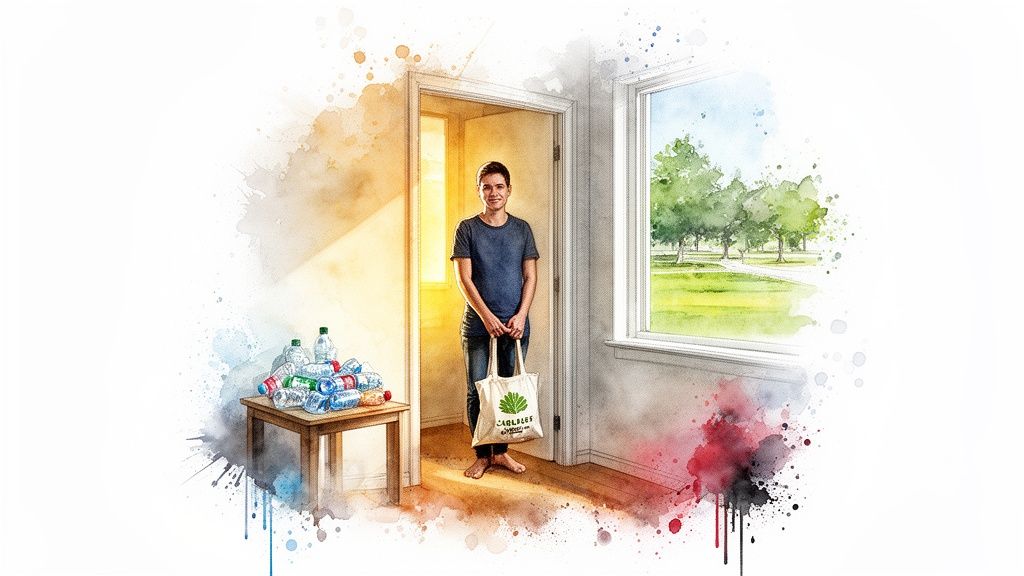
    A young man with a reusable bag stands in a doorway near a pile of plastic bottles, looking towards a park.

    I get it. Another lecture about plastic? No. Hear me out. This isn't about guilt. It's about you finding your own power. For me, this whole thing started in my own apartment, surrounded by my own junk. A mountain of it. Every old takeout container, every forgotten plastic bag, felt like a 500-pound weight pinning me to the floor, a physical anchor to a messy past I desperately wanted to leave behind.

    The real change didn’t come from a perfectly executed plan. It came from a simple, gut-level decision to just do something. Anything. And in that messy process, I stumbled upon a weird truth about myself that I bet you'll recognize, too.

    Why Is It Easier to Clean Someone Else's Mess?

    It's a strange quirk of our minds, but it's true: cleaning up a park, a street corner, a highway—somebody else’s mess—often feels way easier and more satisfying than tackling the clutter in our own homes. What is that about? I think it’s because it’s a pure act. A gift. You have no emotional baggage tied to a stranger’s discarded coffee cup.

    Picking it up is simple. Clear. A straightforward win. You do that over and over, and you start building this weird kind of momentum. It’s like a secret training ground for courage. You start by cleaning up a little patch of grass, and before you know it, you’ve found the strength to finally face the mess in your own life.

    This is the secret behind reducing plastic use that nobody ever talks about.

    This isn't just an environmental chore. It’s a path to reclaim your own space, to simplify your life, and to find a real connection with a community of people who actually care. You start by transforming the world outside your door, and somehow, that transforms you from the inside out.

    The Real Impact of One Small Action

    Your point isn't to become perfectly plastic-free tomorrow. The goal is just to start. Think of your current habits like a well-worn path in the woods. It's the easy trail, the one you can walk down without thinking. Choosing a reusable bag or turning down a plastic straw is like taking the first step off that path to carve out a new one.

    At first, it feels intentional. Maybe even a little awkward. But every single time you do it, that new trail gets clearer, more defined. Soon enough, it’s your new default route. Each time you make that conscious choice, you’re not just stopping one piece of plastic from hitting a landfill or floating in our lake. You're rewiring your own brain and sending a quiet but powerful message to the world. This is a huge part of what environmental stewardship is really about.

    • You reclaim your power. Businesses listen when money talks. Every time you say no to plastic, you're casting a vote for the kind of world you want to live in.
    • You simplify your life. Fewer disposable things means less clutter. Less stuff to manage. More headspace for what actually matters to you.
    • You inspire others without even trying. When you show up with your reusable coffee cup or produce bags, you make it look normal. People see you, and it makes it easier for them to start, too.

    This whole journey kicks off with a single, courageous step. Maybe it’s joining a local cleanup. Maybe it's buying a reusable water bottle. Maybe it's just saying "no thanks" to a plastic bag. That one action is the spark. It proves to you that change is possible and that you have the power to make it happen, right here, right now.

    Building Your Everyday Plastic-Free Toolkit

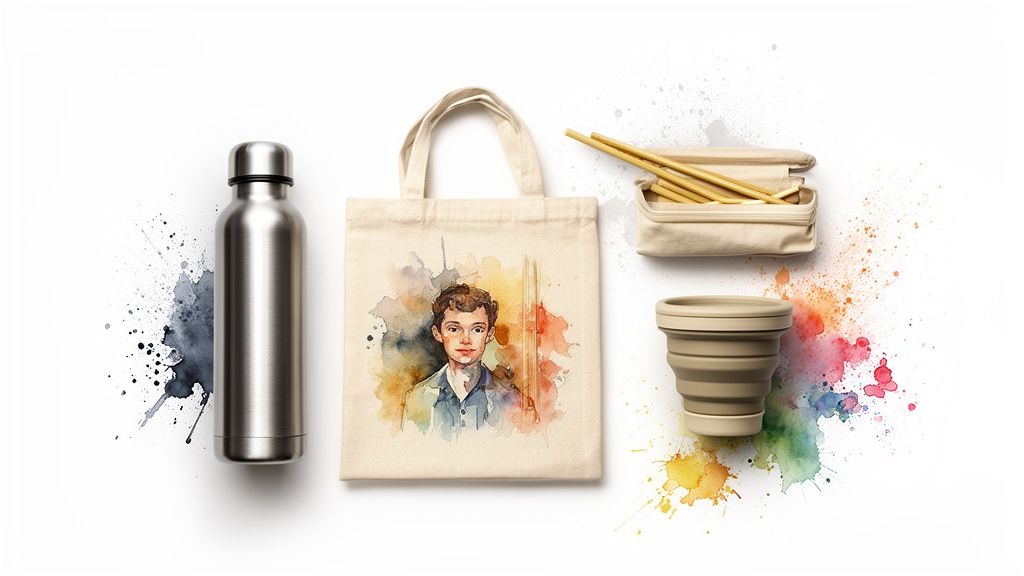
    Sustainable reusable products for reducing plastic waste: a water bottle, tote bag, straw set, and collapsible cup.

    Let's get real. Big, meaningful change doesn't happen in a flash. It's built from tiny, consistent habits—the kind you barely notice until one day you look back and realize everything is different. That’s how we have to tackle plastic. Forget the overwhelming, all-or-nothing guilt trip. We’re starting with simple swaps you can actually manage.

    Think of it like building a muscle. You don't walk into the gym for the first time and try to bench press a car. You start with something you can handle. You do it consistently. You get stronger. That's our game plan here.

    Start With The Big Four

    When I lead our Litter Caterpillars cleanups, I see the same four villains over and over again. Plastic bags, bottles, straws, and coffee cups. They’re scattered across every park and sidewalk in Chicago, and when you see them all piled up together, it cuts through the noise. It shows you exactly where to start your fight.

    Focusing on these "big four" is the smartest way to begin because they're absolutely everywhere. Taking them on first builds momentum and gives you the confidence to keep going.

    Your goal isn't perfection; it's preparation. The entire secret is just having your reusable alternative ready before you need it.

    This is where your toolkit comes in. It’s not about buying a bunch of fancy new gear. It's about putting together a simple "go-kit" that lives in your backpack, your car, or by your front door. You just grab it and go.

    Your First Four Plastic Swaps

    Ready to start? Don't overthink it. Kicking plastic to the curb begins with a few key swaps that have a surprisingly massive impact. Think of this table as your starting line.

    Single-Use Plastic Item Easy Reusable Swap Why It Matters
    Plastic Water Bottles A durable water bottle Saves you money and keeps thousands of bottles out of our parks and waterways.
    Plastic Grocery Bags A few tote bags They're stronger, hold more, and a single one can replace hundreds of flimsy plastic bags over its lifetime.
    Disposable Coffee Cups A travel mug or thermos Most paper cups are lined with plastic, making them unrecyclable. A travel mug is a simple fix.
    Plastic Straws & Utensils Reusable straw/utensil set Easy to carry and refuse the throwaway plastic that pollutes our environment for centuries.

    Nailing these four habits is a massive win. Once these become second nature for you, you'll find it's so much easier to tackle the next set of challenges.

    Assemble Your Simple Go-Kit

    Your kit needs to fit your life, but here's a basic setup that has worked for me and hundreds of our volunteers. It makes ditching plastic feel automatic.

    • Reusable Water Bottle: This is your foundation. Find one you actually like—stainless steel, glass, whatever—and make it your sidekick.
    • A Few Tote Bags: I keep foldable cloth bags everywhere. One in my backpack, a few in my car. They take up no space and save me from ever needing a plastic bag at the store.
    • Travel Mug: If you drink coffee or tea, this is a no-brainer. Lots of Chicago cafes even give you a small discount for bringing your own cup.
    • Simple Utensil Set: You can buy a bamboo set. Or you can just grab a fork and spoon from your kitchen, wrap them in a napkin, and call it a day. It’s that easy.

    Having this kit ready removes the friction. Thirsty? You have your bottle. An unplanned stop at the store? You have your bags. You’ve already made the right choice before you even had to think about it.

    The scale of this problem can feel paralyzing, I know. But your actions really do matter. Projections show that by 2040, plastic pollution could swell to 280 million metric tons a year. Packaging is the main driver, and that’s exactly where our simple swaps hit them where it hurts. You can dig into these global plastic trends to see why every little bit you do helps.

    Make It a Habit

    Once your kit is ready, the real work begins. You need to turn its use into a reflex. I used to forget my tote bags all the time. My fix was stupidly simple—I started hanging them on the doorknob right next to my keys. I couldn’t leave the house without seeing them.

    Find your own tricks. Set a phone reminder. Put a sticky note on your dashboard. Whatever it takes for you. Make your reusable kit as essential as your wallet or phone, and soon enough, you won’t have to think about it at all. It'll just be what you do.

    How to Navigate the Grocery Store Plastic Minefield

    You ever walk into a grocery store, ready to do the right thing, and just get completely overwhelmed? I have. It feels like an impossible maze of plastic. A minefield. Every single step feels like a compromise when you see a cucumber shrink-wrapped for no reason.

    But we can get through it together. This isn't about making shopping some miserable chore. It's about learning to see the store differently—making smarter choices that actually feel good. It’s about turning that frustration into a personal win.

    The amount of packaging we face is insane. By 2025, the world will be drowning in 225 million tonnes of plastic waste, and packaging is the main villain, making up 33% of all plastic produced. You can read more about this global plastic waste challenge to see why what we put in our carts really matters.

    Master the Produce Aisle

    Let’s start where the fight is most obvious: the produce section. This is your first, best chance to make a huge dent in your plastic habit. It’s where I started my own journey.

    My strategy is dead simple. I always choose the naked option. If there’s a loose apple next to a plastic-bagged one, the choice is easy. I bring my own mesh produce bags for stuff like green beans or mushrooms to dodge those flimsy plastic bags on a roll. It’s a tiny action, I know, but man, it feels like a victory every single time.

    Seek Out the Bulk Bins

    The bulk bin section is your secret weapon. For years, I walked right past it. I thought it was too complicated. But it's incredibly simple and one of the best ways to absolutely slash your packaging waste. You get exactly what you need—no more, no less—without any of the plastic baggage.

    Here’s how you can make it work:

    • Bring your own containers. I keep a few lightweight glass jars and cloth bags in my main grocery tote. Just get them weighed by a cashier before you fill them up so you're not paying for the weight of the jar.
    • Start easy. Don't try to go all-in on day one. Start with things like oats, rice, nuts, or dried fruit.
    • Embrace the freedom. This is the best part. You can buy the exact amount you need. Just need one cup of quinoa for a new recipe? No problem. You cut down on food waste and plastic waste in one go.

    This isn't just about avoiding plastic; it's a fundamental shift in how you shop. You go from being a passive consumer grabbing pre-packaged stuff to an active participant, choosing exactly what you want and how you want it.

    Become a Packaging Detective

    Once you get past produce and bulk, you have to become a bit of a detective. For everything else on your list, from pasta sauce to yogurt, you need to train your eye to spot the non-plastic options.

    I have a mental checklist I run through for every item:

    1. Can I get this in glass? (Think sauces, pickles, jams)
    2. Is there an option in a metal can? (Beans, tomatoes, soups)
    3. Is it available in paper or cardboard? (Pasta, crackers, eggs)

    Choosing glass, metal, and paper is a power move. These materials have way higher recycling rates than plastic and can actually be repurposed. It’s a simple hierarchy that guides your hand toward better choices without making your shopping trip take forever.

    And finally, don't forget the power of your own voice. The checkout line is your last stand. A simple, "No bag, thanks, I've got my own," is easy. But you can go further. At the deli counter, I’ll ask, "Can you wrap that cheese in paper instead of plastic?" Sometimes they say no, but a lot of the time, they’re happy to do it. You're not just cutting your own plastic use; you’re planting a seed. You're showing the store that its customers want better options.

    From Personal Action to Community Movement

    Changing your own habits is a huge first step. It proves to you, more than anyone else, that this stuff is actually possible. But the real change—the kind that shifts a whole neighborhood—starts when we connect with each other. It’s when your one action inspires two more people, and their actions inspire ten more. That’s how a real movement catches fire.

    I’ve seen it with my own eyes. Litter Caterpillars wasn’t born from some big strategic plan or a fancy grant. It started with just three of us huddled under a tree, shivering through a freak Chicago hailstorm, wondering if we were completely nuts. We felt so tiny. But that moment of shared suffering and purpose lit something inside us. It proved that even a small, crazy crew could make a difference.

    You don't need to be a nonprofit to do this. You just need an idea and the guts to ask your neighbors to join you.

    Plant the Seeds of a Repair Culture

    We live in a throwaway world. The story goes: if it breaks, toss it and buy a new one—usually wrapped in a ton of plastic. We can push back on that. You and I can create spaces where things get a second chance at life.

    Ever thought about hosting a "Repair Cafe"? It’s way simpler than it sounds. Just pick a date. Find a spot like your garage or a park district room. Then you just put the word out for people to bring their broken stuff. A wobbly chair. A toaster that won't toast. A jacket with a torn pocket.

    Then, you find the fixers. Every neighborhood has them. The retiree who can fix any gadget. The person who’s a wizard with a sewing machine. The bike nerd who can true a wheel in five minutes flat. You bring these two groups together. Suddenly, you're not just fixing stuff. You're weaving a community together, sharing skills, and directly fighting the need for more new, plastic-wrapped junk.

    Make Swapping the New Shopping

    Here’s another powerful move: the "Swap Meet." It’s basically a party with a purpose. Instead of buying new things, we just trade the good stuff we already have. This is a direct hit against the mountains of plastic packaging that comes with every new t-shirt, toy, or gadget.

    A simple blueprint for you to start:

    • Pick a theme. A kids' clothing and toy swap is always a winner. Or try a book or plant exchange.
    • Set some ground rules. Keep it simple. Something like, "Bring 5-10 quality items, take home the same number."
    • Make it fun. Crank up some music. Turn it into a social event, not just a transaction.

    These swaps build a culture that values using what we have and connecting with our neighbors more than just clicking "buy now." It’s a powerful reminder that we already have everything we need, right here.

    This flowchart shows how even a routine chore like grocery shopping can become a powerful act against plastic waste.

    It’s all about those small, intentional shifts—like you choosing loose produce over pre-packaged or hitting the bulk bins—that add up to make a huge difference.

    Turn Volunteering Into a Celebration

    When we started Litter Caterpillars, I knew one thing: this couldn't feel like a chore. People are busy. If you want them to show up on a Saturday morning, you have to offer more than just a garbage bag. You have to offer an experience. You have to offer joy.

    This is our secret: We make service feel like a party. We lean into pride and identity because doing good should feel good. We’re not just cleaning a street; we’re reclaiming it for our community.

    We bring flags. We have a theme song. We hand out badges. Sounds silly, right? But it works. It turns a bunch of strangers into a team. A crew. That shared identity makes people want to come back. That's why we invite everyone to find out how to join a volunteer trash pickup and see it for themselves.

    You don’t need anything fancy to get your own crew together. A post in a neighborhood Facebook group, an event on Meetup, a few stories on Instagram—that’s all it takes to get the ball rolling. Start small. Invite five friends to clean up one block. Celebrate it like you just won the championship. Then you do it again. That’s how you go from one person’s idea to a neighborhood’s movement.

    Finding Your Zero Waste Community in Chicago

    Trying to make a big change all by yourself can feel like shouting into the wind. I’ve been there. The good news? You don’t have to go it alone. Chicago is humming with incredible people and places ready to back you up on this journey. You just have to know where to look.

    This isn’t just about finding stores; it’s about finding your people. Think of this as your personal map to the local sustainability scene, a guide to plugging into the energy that’s already here.

    Where to Find Your Supplies and Your Tribe

    Your first step is often the most practical one: where can you go to shop in a way that feels good? Chicago has some gems that make avoiding plastic not just possible, but genuinely enjoyable. These aren't just stores; they're community hubs.

    • Zero-Waste Refill Shops: Places like these are total game-changers. You bring your own containers—jars, bottles, bags, whatever you've got—and fill them up with everything from laundry detergent and shampoo to spices and olive oil. It’s such a simple concept that directly attacks the problem of single-use packaging.

    • Community Gardens: Joining a local garden is a powerful move. You get to grow your own food, which means zero food miles and absolutely no plastic packaging. Better yet, you get your hands in the dirt alongside neighbors who share your values.

    • Specialized Recycling Centers: Let's be real, recycling can get confusing. Knowing where to take those specific items that can’t go in the blue bin is a huge relief. We put together a guide on where to find Chicago's specialized recycling centers to make sense of it all.

    The scale of the plastic problem is insane. Global production hit 436 million metric tons in 2023 alone. Since the 1950s, we’ve made 8.3 billion tonnes of the stuff, and a staggering 79% of it has ended up in landfills or nature. That’s why finding local solutions and support is so crucial; it turns a global crisis into a manageable, local fight for you and me.

    Join Us on the Front Lines

    If you’re ready to turn that feeling of "I should do something" into real action, I want to personally invite you to join us. At Litter Caterpillars, we're not just picking up trash; we're building a community of givers, doers, and friends, block by block. Showing up for a cleanup is the most direct way I know to see your impact in real-time.

    You can feel the difference you make with your own two hands. It’s an incredible feeling.

    The joy of service is a real and powerful thing. It’s the antidote to feeling helpless. When you work alongside others for a shared cause, you build a connection that goes deeper than just a shared interest—you build hope.

    We meet every single week, no matter the weather. From the North Side all the way to Englewood, where we’re building Caterpillar Park on a lot we won at auction, we are present in our city.

    How to Get Involved with Litter Caterpillars

    Getting started is simple. We've made it as easy as possible for you to plug in and find your place with us.

    1. Find an Event: Check out our schedule on Meetup or Instagram. We post all our weekly cleanups there with details on where and when we'll be.
    2. Just Show Up: That’s it. Seriously. You don’t need to bring anything but yourself and a willingness to help. We provide the bags, gloves, and the good vibes.
    3. Become Part of the Crew: After your first event, you’ll see what I mean. The energy is contagious. You’ll meet amazing people from every corner of Chicago who, just like you, decided it was time to do something.

    This is your invitation. Come experience the joy of service firsthand. Let’s make our city cleaner and our community stronger, together.

    Common Questions About Reducing Plastic Use

    Over the years, I've heard so many great questions from our volunteers and community members. We all start this journey with a bit of uncertainty. We wonder if we're doing it right. If it's even worth the effort. My hope is that sharing my answers to these common hurdles helps light the path for you, too.

    Isn't a Low-Plastic Lifestyle Expensive?

    This is a massive misconception. I'm so glad you asked. It's easy to look at some fancy, branded "eco" products and think this whole thing is for people with money to burn. But the real heart of reducing plastic is actually about saving money, not spending more.

    It’s a shift in your mindset. You go from buying more to using what you already have. You stop spending your hard-earned cash on things you don’t actually need, like endless bottles of water or disposable coffee cups. It pushes you to be resourceful. Shopping the bulk bins, for example, is almost always cheaper per ounce than buying pre-packaged stuff.

    At Litter Caterpillars, our whole vibe is built on resourcefulness, not expensive gadgets. Your most powerful tools are a reusable bag you probably already own and the simple habit of asking yourself, "Do I really need this?" Both of those are completely free.

    What If My Friends and Family Don't Get It?

    I feel this one on a personal level. It can be isolating, and frustrating, when you feel like you're the only one trying, especially around people you love. When I first started this journey, I definitely got some strange looks.

    My best advice? Lead with inspiration, not judgment. Nobody responds well to a lecture. Instead, just live your values. Show up to the picnic with your cool reusable water bottle and your own utensils. When someone asks you why, share your personal story. Tell them about the fun you had at a community cleanup or how good it feels to have a less cluttered life.

    Remember the story of Tom Sawyer? He made the boring chore of painting a fence look like the most exclusive, exciting activity in the world. Frame your choices with joy and positivity. People are drawn to that energy far more than they are to guilt.

    Make your sustainable choices look appealing and easy, and people will naturally get curious. That curiosity is the door to a real conversation.

    Can My Small Actions Really Make a Difference?

    Yes. A thousand times, yes. I know how it feels to stand in front of a huge problem and feel completely powerless. I felt that exact same way when I was staring at the overwhelming mess in my own apartment—it felt impossible.

    But then I cleaned one small corner. Just one. And suddenly, tackling the next corner felt a little bit easier. That is the entire philosophy behind Litter Caterpillars. We don't try to clean the whole city in one day; we clean one block, and we celebrate that victory.

    Every single piece of trash you refuse sends a tiny but clear message to businesses that you, the customer, demand better options. When you join a group, your one action gets multiplied by ten, then a hundred. It creates a ripple of change you can see and feel. Your "small" action is not small at all. It's everything. It's the spark that starts a new habit for you, proves you have power, and changes things right where you are.


    Ready to turn that spark into a flame? Join Litter Caterpillars this weekend and see for yourself how good it feels to make a difference. Find your next cleanup event and your new crew at https://www.littercaterpillars.com.

  • How to Clean Up Rivers: My Guide to Sparking Real Change

    How to Clean Up Rivers: My Guide to Sparking Real Change

    You see it, don't you? The plastic bags snagged on branches, the Styrofoam cups bobbing by the shore. You feel that little sting, that whisper in your gut that says, someone should do something. I know that feeling. It's a fire starter. This guide is everything I've learned about how to clean up rivers—how you and I can turn that frustration into a force of nature, one bag of trash at a time.

    Your River Is Calling, Let's Answer

    Staring at a polluted river can feel like looking at a mountain of debt. Where do you even begin? My whole journey kicked off from that same spot, feeling small and powerless. But I stumbled upon a weird truth: cleaning up our shared spaces, our community's living room, is somehow more energizing and way more fun than cleaning my own apartment.

    You don't need some grand, flawless blueprint. Forget perfect. Just be brave enough to start.

    Why This Work Echoes Louder Than You Think

    It's so easy to drown in despair when you see a river choked with our carelessness. But that feeling? That's not the end. It's the beginning. Every single person who ever made a difference started right there, stewing in that same frustration.

    My first cleanup—I’ll never forget it. Three of us. Just three. A freak hailstorm exploded over us in Chicago. Huddled under a bridge, teeth chattering, I had this lightning-strike thought: there is a strange, powerful joy in tackling a mess that belongs to all of us.

    This isn't just about bagging litter. It's a reclamation. It’s you planting a flag, a small act of rebellion against apathy. We're mending not just the earth but our frayed connections to each other and to the places we call home. The problem is a giant, yes, but so is our collective spirit.

    Look at the Ganges River in India to understand the stakes. A sacred artery for over 500 million people, but it’s suffocating under raw sewage and industrial poison. This isn't just an eyesore; it's a killer, causing over 100,000 deaths a year from waterborne diseases. The story is global: a horrifying 80% of wastewater gushes untreated into our planet's rivers, leading to 485,000 deaths annually.

    I've learned that one person with a trash bag feels like a whisper. But a group of people with trash bags? That's a roar. It becomes a story. And stories are the sparks that light the next fire.

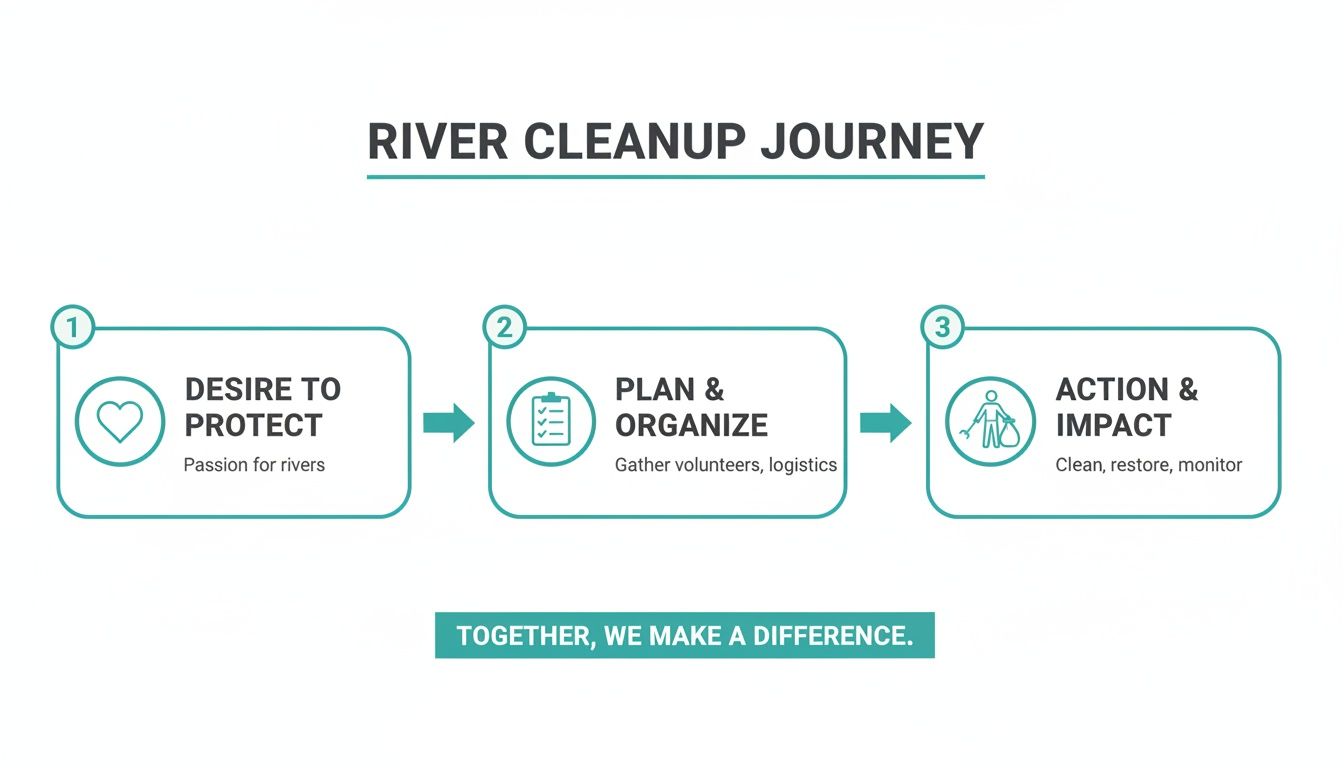
    From Desire to Action

    The path to a clean river always follows a simple, human arc. It ignites with a feeling, solidifies into a plan, and then erupts into action.

    A three-step flowchart illustrating the river cleanup journey from desire to action and impact.

    This map shows you the way. Every colossal cleanup begins with that tiny, personal spark—your desire to fix what's broken. You channel that spark through smart planning, and boom: you create real, visible impact.

    Think of me as your guide through this whole adventure. I’m going to pour out everything I’ve learned on the ground, leading cleanups in sun, sleet, and sideways rain. This is your personal roadmap. You can dive deeper into the whole philosophy behind cleaning up trash in our communities and how it changes us from the inside out.

    Let's do this. Together.

    Your River Cleanup Action Plan at a Glance

    To make this crystal clear, I've mapped out the whole journey in a table. Use this as your compass to navigate from that first flicker of an idea all the way to celebrating your victory.

    Phase Key Actions Why It Matters
    1. The Spark You spot a problem, feel that pull to act, and make a promise to yourself to do something. This is your fuel. Without that genuine fire in your belly, the hard work of planning will feel like a chore.
    2. The Plan You scout the site, tackle permits, round up tools, recruit your crew, and build a rock-solid safety plan. Good planning is the antidote to chaos. It ensures your event is safe, powerful, and doesn't backfire.
    3. The Action You host the event, lead your volunteers, and manage every piece of collected waste like a pro. This is where the magic ignites. Your plan breathes life, and the river starts breathing again, one bag at a time.
    4. The Impact You measure your results, thank your heroes, shout your story from the rooftops, and plan the sequel. This is how you close the loop. It builds a wave of momentum that turns a single day into a true movement.

    Don't see this table as a rigid prison of rules. It’s a flexible framework, a skeleton you can build on. Every river is different, but these core phases will always point you toward success.

    Laying the Groundwork for a Safe and Successful Cleanup

    Before you rally a single soul, you need a battle plan. I want you to think of yourself as a detective for your river. You’re not just spotting trash; you're uncovering opportunities, sniffing out dangers, and mapping out a strategy for a friendly invasion—against grime and neglect.

    This prep work is everything. Skipping it is like trying to build a house on a swamp. It's all the invisible effort that makes the big day feel smooth, safe, and ridiculously triumphant. Trust me, I’ve seen events implode from poor planning, and I want to help you sidestep those landmines from day one.

    Becoming a River Scout

    First mission: get your boots on the ground. You have to walk the turf you plan to clean, but with new eyes. You're looking for more than just the biggest heap of junk.

    You're searching for the site's story. I remember scouting a stretch of the Chicago River and finding a literal mountain of old car tires. I learned that for decades, people used tires for "bank stabilization," a method we now know is a spectacular failure. That bit of history totally reshaped our entire approach to that cleanup.

    Here's what I look for on my first scouting trip:

    • Access Points: Where can your people safely get to the water's edge? I hunt for gentle slopes, existing paths, or park entrances. I steer clear of steep, crumbling banks like they're the plague.
    • Trash Hotspots: Pinpoint where the litter is clustered. What kind of trash is it—plastic bottles, construction debris, an old sofa? This intel tells you what weapons to bring to the fight.
    • Potential Hazards: Are there slick rocks, angry patches of poison ivy, or hornet nests lurking in the trees? Your number one job is to be a guardian for your crew.
    • Staging Area: Where will you build your glorious mountain of collected trash? It needs to be easy for a truck to reach but not blocking a public path.

    Navigating the Permit Maze

    Okay, let's talk about the thing that makes everyone groan: paperwork. Permits. It sounds like a dentist appointment, I know. But getting the right blessing from your city's parks department or local government is the secret key to a stress-free day. It's not about bureaucracy; it's about being a good dance partner.

    Imagine this: you've got 50 fired-up volunteers, and mid-cleanup, a park ranger rolls up and shuts you down because you skipped a step. All that incredible energy just vanishes into thin air. I've watched it happen. It's a gut punch.

    A single phone call can prevent all that heartache.

    Here’s the simple script I use for that first call: "Hi, my name is [Your Name], and I'm a resident who's tired of seeing our river looking sad. I'm getting a small group of volunteers together to clean up the bank at [Location] on [Date]. Could you tell me who I need to talk to, to make sure we do this the right way?"

    This approach shows you're a responsible citizen, not a rogue agent. It flips the city from a potential hurdle into your most powerful ally. Nine times out of ten, they’ll not only say yes but will offer you free trash bags, gloves, or even a special trash pickup.

    Preparing for a Safe Cleanup Day

    Last but not least, let's get serious about safety. Your volunteers are your most precious asset. Protecting them is the most sacred part of your job. A safe, well-run event is an event people will return to, again and again.

    Your safety plan doesn’t need to be some 50-page legal tome. It’s just about smart prep. Start with a solid first-aid kit. You can buy one ready-made, but I always beef mine up with extras from the school of hard knocks:

    • Extra antiseptic wipes (you'll use them all)
    • Tweezers for splinters
    • Saline solution for flushing gunk out of eyes
    • Instant cold packs

    Beyond the kit, your most powerful safety tool is your voice. A clear, confident safety briefing at the start of the day sets the whole tone. It shows everyone you've got their back. This is how you build the trust you need to clean up rivers as a team.

    Building Your Cleanup Crew of Passionate Volunteers

    Three happy diverse volunteers near a river exchanging gloves and coffee at a clean-up meet.

    You cannot do this alone. Believe me, I tried. I once thought my own two hands were enough to tackle a trashed-out stretch of riverbank. It’s like trying to bail out the ocean with a teaspoon—a noble idea, but you’ll just end up soaked, exhausted, and demoralized.

    The real lightning strikes when you build a crew. Your own band of litter-fighting misfits. This is how you transform a solo crusade into a community bonfire. I still see us, that first day—just three of us, shivering through that Chicago hailstorm. Now? Now we're a force.

    I’m going to show you exactly how I grew that tiny, frozen tribe into a steady flame.

    Crafting a Call That Attracts Givers

    First, you have to send up a flare. But not just any flare. You need to write a call for help that resonates with the right kind of people—the givers, the doers, the folks who show up to make a difference, not just to snag a selfie.

    Think of your volunteer post on Meetup or a local Facebook group as a magnet. You want it to pull in people who vibrate on your same frequency. Be honest. Be real. Be a little bit of a poet. Don’t just announce, “We’re picking up trash.” Tell them why this river, this patch of earth, is worth fighting for.

    Here’s a version of what I post:

    "Do you ever walk by the river and feel that little punch in the gut when you see the trash? Me too. I'm getting a group of friendly folks together who want to turn that frustration into action. We bring the bags, gloves, and good vibes—you just bring yourself. Let's make our city a little better, together."

    This simple message does a few powerful things:

    • It validates their feelings: It starts from that place of shared frustration. You're not alone.
    • It’s disarmingly simple: "You just bring yourself" removes every barrier to entry.
    • It sets a positive, can-do tone: It's about being part of the solution.

    When you frame it like this, you’re not begging for free labor; you're inviting them to join a cause. If you want to dive deeper, you can learn a lot more about how to find volunteers who are ready to go all in.

    The Power of Community Partnerships

    Once you get a few regulars, you can start weaving partnerships with local businesses. This is a game-changer. It anchors your little cleanup crew into the very fabric of the neighborhood, making your work visible and proving that the community has your back.

    Start small. I literally started by walking into my favorite coffee shop. I told the owner what we were doing down by the river and just asked, "Hey, would you ever consider donating a big pot of coffee for our crew on Saturday mornings?" He was ecstatic to help. That small gesture—a warm cup of joe on a chilly morning—became a symbol of our community's support.

    Here are a few other ideas that have worked for me:

    • The Coffee Shop: A big dispenser of coffee or hot chocolate is liquid gold.
    • The Hardware Store: Ask for a small discount on heavy-duty gloves or trash grabbers.
    • The Local Pizzeria: See if they'll chip in a couple of free pies for a post-cleanup celebration.
    • A Community Garden: Ask if you can use their bins for any green waste you find.

    These aren't just transactions; you're building relationships. When a business helps you out, you shout them out on social media. You thank them publicly. It creates this beautiful feedback loop of mutual support.

    Making It More Than Just Work

    This is the most critical piece of advice, so listen close. If you want people to come back, you must make it fun. Picking up trash is hard. It can be smelly and gross. But it can also be ridiculously joyful if you create the right atmosphere.

    Think of your cleanup less like a chore and more like a party with a purpose. I always bring a portable speaker and blast an upbeat playlist. We tell bad jokes, we share stories, we high-five over every disgusting, mud-caked thing we pull from the river.

    The work is serious, but our vibe is anything but. We've figured out how to turn the struggle into a shared story, an adventure that bonds us. Simple things, like grabbing a coffee together afterward, transform the entire experience. It gives everyone a chance to connect as human beings, not just as trash-pickers.

    That connection? That's the superglue. That’s what will keep your crew coming back to clean up rivers with you, again and again.

    Turning Passion Into Action on Cleanup Day

    Alright, the day has arrived. You’ve got coffee steaming, the sun is (hopefully) showing its face, and there’s a low hum of anticipation in the air. This is it. This is the moment all your planning and passion gets unleashed.

    Here’s your guide to running a cleanup that’s not just effective, but electric—the kind of day that makes people pull out their phones and block off their calendars for your next one before they even leave.

    It all starts with the morning huddle. This is not a formality. This is where you light the fuse for the entire day. Gather everyone in a circle, look them in the eye, and welcome them like the heroes they are. Their energy is the fuel.

    The All-Important Morning Huddle

    Your safety briefing needs to be quick, clear, and honestly, a little bit thrilling. A good briefing feels more like a pre-game pep talk than a boring lecture. You have to hit the absolute must-knows with confidence and a smile.

    First things first: you thank them. You thank them for showing up, for choosing this over sleeping in. You remind everyone that their time is the most valuable currency you have. Then, you pivot to the crucial safety stuff.

    Here’s my huddle checklist:

    • Acknowledge the Land: If you can, a quick mention of the area's native history adds a layer of respect and deepens the purpose of your work.
    • Point Out the Booby Traps: Be specific. "Watch out for those slick rocks by the water's edge, and the bank gets real steep over there, so find your footing."
    • Explain the Tools: "Use your grabbers for everything. I'm serious. Never, ever pick up anything sharp or unidentifiable with your bare hands."
    • Identify the "Do Not Touch" List: This is non-negotiable. "If you see anything that looks like a chemical drum, a needle, or a dead animal, do not touch it. Mark the spot, and come find me or a team lead. We have a plan for that."
    • Show Them Home Base: "Every full bag of trash comes right back here to this tarp. We're going to build a glorious mountain of accomplishment today!"

    This quick talk does more than keep people safe. It shows them you're in command, that you care about them. That builds trust, and trust is the bedrock of any volunteer army.

    Managing the On-the-Ground Logistics

    Once you break the huddle, it’s go-time. Handing out gear can become a mosh pit if you’re not ready. I like to have everything laid out: piles of gloves by size, stacks of bags, and grabbers ready to go. Let people get kitted out, then you can start pointing them to different zones.

    Think of yourself as a friendly field marshal. You're not just barking orders; you're directing energy. I've found it's a game-changer to divide a large site into smaller, bite-sized zones and assign small teams to each. It gives people a sense of ownership and makes a colossal task feel conquerable. You'd be amazed what a team of four can do to a 50-foot stretch of riverbank.

    Your central trash drop-off is your rallying point. Keep it organized. As volunteers drag back full bags, give them a high-five. Cheer for that bag. Every single one is a trophy. This is how you clean up rivers effectively—you celebrate the small wins, all day long.

    I’ve learned that the little struggles often become the best stories. A sudden downpour, someone slipping in the mud, or a ridiculously heavy tire that takes three people to haul out—these are the moments that forge real bonds.

    Embrace the beautiful chaos of it all. As the leader, your calm, positive energy is a contagion. If you're having fun, they will too. Keep walking the site, checking in with your teams, offering water, and thanking them relentlessly. You’re not just directing a cleanup; you’re hosting an experience. Their passion got them here. Your job is to make sure they leave with that passion burning even hotter.

    Showcasing Your Impact to Build Momentum

    Man with a camera stands by a large pile of 12 black trash bags next to a river.

    The work isn't over when you tie off that last bag of trash. In many ways, the real work is just beginning.

    This is your moment to show the world—and more importantly, to show your volunteers—what you all just accomplished. This is how you take a single day of sweat and grit and turn it into a tidal wave of momentum for the next event.

    You have to tell the story. A pile of trash bags is just a pile of trash bags until you give it a soul. It's a story of change, of community, of defiance. Your job now is to become the storyteller.

    Making the Invisible Visible

    First, let's talk numbers. Numbers have a superpower. They’re a universal language that cuts through the noise and shows undeniable results. It’s like stepping on a scale after a month of hard work; that number proves your effort mattered.

    You don't need a science lab. Just keep it simple but be religious about it. At every single cleanup, I make sure we track a few key things.

    • Bag Count: This is the easiest win. Just count every single bag you fill.
    • Volunteer Hours: Multiply your number of volunteers by how many hours you worked. This number is huge—it shows the incredible gift of time your community gave.
    • Total Weight: This one is a game-changer. I bought a cheap digital luggage scale for $10, and it's one of the best tools in my arsenal. Weighing each bag gives you a jaw-dropping total that a simple bag count can’t touch.

    These numbers become your weapons for good. They prove you're not just "picking up some litter." You're making a measurable dent in the fight to clean up rivers.

    Capturing the Heart of the Story

    Now, let's get visual. A picture truly is worth a thousand words, especially when you’re trying to bottle the spirit of your day.

    During the cleanup, I’m always snapping photos, but I'm not just taking pictures of trash. I’m hunting for moments.

    A shot of two strangers laughing as they wrestle a tire from the mud. A close-up of a volunteer’s muddy, gloved hand. A wide-angle "before" shot of a trashed-out bank, followed by a triumphant "after" shot of that same spot, now breathing again. These are the images that tell the human story behind your numbers.

    Your volunteers are the heroes of this story. Frame them that way. Your photos and videos should be a celebration of their effort, their smiles, their resilience. When people see themselves making a real difference, they come back for more.

    This is also how you connect your little local skirmish to the bigger, global war. It’s easy to feel crushed when you hear that the Yangtze River dumps a mind-boggling 1,469,481 tons of plastic into the ocean every year. But our focused cleanups are a real part of the answer. Groups in the Clean Currents Coalition have already pulled over 7.3 million kilograms of debris from rivers since 2020. This proves our local efforts are part of a massive, winning strategy. You can learn more about how river cleanups are tackling ocean pollution.

    Sharing Your Victory with the World

    After the event, it's time to craft the perfect social media post. This isn't just a "thanks for coming" note. It's a victory speech, a public thank-you card, and a recruitment poster all rolled into one.

    Here’s a simple formula that never fails me:

    1. Lead with Gratitude: Start by worshipping your amazing volunteers. They are the whole story. Tag them if you can.
    2. Show the Proof: Post your absolute best photos and videos. That "before and after" shot is pure gold.
    3. Share the Numbers: Hit them with the cold, hard facts. "Today, 15 volunteers gave 45 hours of their lives to our river and hauled out 527 pounds of trash!"
    4. Tag Your Partners: Give a public high-five to the coffee shop that donated coffee or the business that sponsored your supplies.
    5. A Call to Action: Don't just fade out. End with an invitation to the next battle.

    Each cleanup is a chapter. Sharing the story is how you invite your whole community to help you write the next one.

    Keeping the Current Flowing After the Cleanup

    You did it. The river is breathing a little easier, your crew is heading home with muddy boots and full hearts, and you're exhausted but glowing with pride. The real work, though, isn't just in the bags you collected. It's in what happens now.

    This is how you turn one incredible day into a genuine movement to clean up rivers. The work isn’t done when you tie the last knot. It’s done after you've sent a real, heartfelt thank you, celebrated the win, and taken a moment to heal yourself. This follow-up is the current that keeps everything moving forward.

    From a Single Event to a Lasting Community

    A thank-you email is non-negotiable. And it has to be more than a sterile "thanks for coming." I always make mine personal, sharing the final stats—the total weight, the number of volunteers—so every single person feels the epic scale of what they helped build. A great message makes every person feel seen.

    But don't stop there. This is your chance to bottle that lightning. While everyone is still buzzing, start a simple group chat or a private social media group. It instantly becomes a home for sharing photos, keeping the good vibes alive, and—most importantly—announcing the next event while the fire is still hot. We've written a lot more about specific volunteer retention strategies that have worked magic for our crew.

    Your data is your new superpower. Those numbers—500 pounds of trash, 30 tires, 1,000 plastic bottles—are not just for a social media post. They are evidence. They are ammunition. You can take that data straight to your local city council meeting and push for bigger changes, like more public trash cans or a crackdown on illegal dumping.

    The work can feel like trying to empty the ocean, especially when you think about the scale of the global crisis. But every local cleanup is a piece of the solution. It’s a mirror of the resilience shown at places like Indonesia's Citarum River, one of the world's most polluted.

    There, powerful coalitions have cleared 7.3 million kilograms of debris since 2020. It's a stunning blueprint for how focused, community-powered efforts create monumental change. You can read more about this inspiring Citarum River cleanup story and see how your small acts ripple out into a huge global movement.

    Taking Care of the Leader

    Finally, let’s talk about you. The one who started this whole thing. This work is brave, it is vital, and it can be draining. You pour so much of your soul into this, and it is absolutely essential that you refill your own well.

    Don't just leap into planning the next event. Stop. Breathe. Celebrate your own victory. Take a day off. Go for a quiet walk by the very river you just helped heal, but this time, leave the trash grabber at home.

    Leading with kindness, strength, and relentless optimism requires you to be kind to yourself first. Recharge your spirit. Your river and your community need your fire for the long haul.

    The Questions I Always Get

    When you first decide you want to do this, your brain probably sounds like a pinball machine. I get it. I’ve heard just about every question you can think of. Let's wrestle with some of the big ones.

    People always ask me, "Do I really need a permit just to pick up trash?" It's a fair question. You don't ask for permission to clean your own house, right? But a river is different. It’s a public space, a shared artery.

    Getting the city or park district on your side isn't about red tape. It's about turning them into your most powerful ally. They can handle the massive headache of waste disposal. Think of it less like asking for permission and more like inviting a giant to join your team. It's a game-changer.

    What if I Find Something Dangerous?

    This one comes up constantly: "What if I find something scary, like a needle or a chemical barrel?" It’s a real possibility, and your safety trumps everything. The rule is brutally simple: if you don't know what it is, you do not touch it.

    You are not a hazmat expert. You are the eyes on the ground.

    • Mark the spot: Use bright flagging tape or something to make the location obvious.
    • Tell your leader: Immediately find me or another leader. We have contacts for professional removal.
    • Walk away: Feel proud. You found a real danger and let the experts handle it.

    You are a volunteer, not a superhero. Your bravery is in showing up and working smart, not in taking stupid risks. Protecting yourself is the most important thing you’ll do all day.

    And my favorite question of all: "What if only a few people show up?" I love this one. It gets right to the soul of this work. My very first event had exactly three of us. We got caught in a hailstorm. It was miserable, it was glorious, and I will never forget it.

    Success is not a head count. Success is the fact that you showed up at all. A small, fired-up crew will run circles around a big, uninspired crowd. Every single person who comes out to clean up rivers is a universe of victory. It always, always starts small.


    At Litter Caterpillars, we believe in the raw power of just showing up. We turn that nagging feeling into real, dirty, beautiful action. If you're in Chicago and you want to join a crew that finds joy in service, come get your hands dirty with us. Learn more and sign up at LitterCaterpillars.com.

  • 10 Unforgettable Chicago Neighborhoods to Explore and Transform in 2026

    10 Unforgettable Chicago Neighborhoods to Explore and Transform in 2026

    I get it. You've seen the bean, you've walked the Mag Mile. But what if I told you the real soul of this city isn't in the landmarks, but in its stories, its quiet corners, and the people who show up for it? My own life was once a cluttered room, packed with old memories and things I just couldn't release. Imagine a four-year-old jar of jam, not just as a condiment, but as a story that weighed a thousand pounds.

    I discovered a strange truth: cleaning up someone else’s mess is infinitely easier than sorting through your own. It’s a start. This isn’t just another list of places to see; consider it an invitation to explore Chicago in a way that actually remakes you. You find real friendship not in some dimly lit bar, but huddled under a tree during a freak hailstorm, laughing because you’re doing something brave and a little bit crazy together.

    This guide is your map. It’s for discovering the authentic, thrumming pulse of the city, block by block, one piece of litter at a time. These are the Chicago neighborhoods to explore if you want to find the real city, and maybe, just maybe, a stronger, kinder version of yourself along the way.

    1. Englewood: From Neglected Lots to Community Green Spaces

    When you explore Englewood, you don't just visit a place on a map; you step directly into a story of incredible, community-led alchemy. This South Side neighborhood is a potent testament to how people can reclaim their streets and literally build beauty from the ground up. We looked upon vacant lots, those stark symbols of neglect, and envisioned them as vibrant hubs for human connection.

    This isn't some abstract theory. We, at Litter Caterpillars, experienced this raw and unfiltered by winning an empty lot at auction. With the help of countless volunteers like you, we transformed that forgotten space into Caterpillar Park. It’s now a green oasis where neighbors gather and children play. This is what makes Englewood one of the most inspiring Chicago neighborhoods to explore: you can see and feel the direct, tangible impact of your service.

    Watercolor illustration of three diverse people gardening in Caterpillar Park, planting a tree and flowers.

    Why Volunteer in Englewood?

    Volunteering here offers a unique chance to bridge divides. You work alongside residents who are passionately, fiercely invested in their community's future. It’s about more than just picking up litter; it’s about forging relationships and supporting a genuine grassroots movement.

    Actionable Tips for Your Visit:

    • Connect First: Before starting any cleanup, you have to introduce yourself to residents. Building that initial bridge of trust is the most crucial step you'll take.
    • Safety in Numbers: I invite you to join our scheduled weekly cleanups, which we always hold during daylight hours for everyone's comfort and safety.
    • Celebrate Progress: We make a point to take before-and-after photos. It’s a fantastic way to boost morale and show the palpable difference you are making.
    • Long-Term Vision: This isn't a one-and-done effort. We partner with established neighborhood groups to ensure spaces like Caterpillar Park are maintained for years to come.

    Englewood’s journey from disinvestment to vibrant community gardens shows me that with consistent effort, real change is not just possible; it's inevitable. To see more stories of urban greening, you can learn more about Chicago's community gardens and witness how they are changing the city, one plot at a time.

    2. Pilsen: Vibrant Arts District with Street-Level Stewardship

    Exploring Pilsen is like walking through a living art gallery. This historic Mexican-American neighborhood bursts with color, culture, and a profound sense of community pride. The vibrant murals that adorn the buildings aren't just decorations; they are the neighborhood's very soul, telling stories of heritage, struggle, and resilience. I see our role here as helping to protect this incredible outdoor museum.

    Our work in Pilsen is about more than just tidiness; it’s an act of cultural preservation. When we organize cleanups along the 18th Street corridor, we're ensuring that the stunning artwork remains the main attraction. This is what makes Pilsen one of the most unique Chicago neighborhoods to explore: you get to be a guardian of public art, helping to keep the community’s visual story bright and clean for everyone to enjoy.

    A vibrant watercolor mural of diverse faces, with a man sweeping and another standing nearby.

    Why Volunteer in Pilsen?

    Volunteering in Pilsen gives you the chance to connect directly with the artistic heart of Chicago. You’ll work alongside residents and artists who pour their souls into their streets, and your efforts directly support the cultural fabric that makes this neighborhood so special. It’s a beautiful synthesis of environmental service and cultural appreciation.

    Actionable Tips for Your Visit:

    • Connect with Artists: I always start by connecting with local galleries and cultural centers to understand their needs and show our respect for their work.
    • Time It Right: You should schedule cleanups before big community events like art walks or festivals to help the neighborhood put its best foot forward.
    • Focus on Preservation: Our messaging for these events highlights mural preservation, framing the cleanup as an act of celebrating and protecting local art.
    • Build Diverse Teams: We intentionally build volunteer groups that reflect the diversity of Pilsen itself, creating a welcoming space for all.

    Pilsen teaches us that cleaning can be a form of stewardship, a way to honor the creativity and history that make a place truly alive. By keeping the streets clean, you help ensure the neighborhood’s powerful art continues to inspire.

    3. Rogers Park: Diverse, Student-Friendly North Shore Hub

    The first time we organized a cleanup in Rogers Park, I was struck by the incredible energy. This far North Side neighborhood is a true mosaic, home to Loyola University students, young professionals, and vibrant immigrant communities from every corner of the globe. The constant foot traffic and density present unique cleanup challenges, but they also offer a powerful opportunity for us to build one of our most diverse volunteer teams.

    Exploring Rogers Park means seeing this diversity in action. It's where different cultures, languages, and life experiences converge. For me at Litter Caterpillars, this neighborhood embodies our mission of connection. I’ve seen firsthand how a simple weekend beach cleanup can unite students looking for service hours with longtime residents passionate about their shoreline, creating friendships that bridge generational and cultural divides.

    Why Volunteer in Rogers Park?

    Volunteering here is a chance to tap into the neighborhood's youthful energy and progressive spirit. You’ll work alongside a dynamic mix of people, from university students to established community leaders, all dedicated to preserving the beauty of their shared home.

    Actionable Tips for Your Visit:

    • Partner with Students: We actively recruit through Loyola and other local student organizations, tapping into their passion for service.
    • Build Weekend Habits: Join our weekend morning cleanups. I designed them to be a consistent, accessible way for students and professionals to start their weekend with purpose.
    • Create Buddy Systems: We often pair new volunteers with experienced ones. This helps everyone feel welcome and builds stronger, more inclusive teams.
    • Celebrate Diversity: I believe our strength is in our differences. Our Rogers Park cleanups are a fantastic way for you to build friendships across different ethnic and cultural backgrounds.

    4. Lakeview: East-West Divide and Neighborhood Consciousness

    When you explore Lakeview, you encounter a neighborhood of powerful contrasts. It's home to both affluent, pristine lakefront areas and more transitional blocks further west that often get overlooked. This diversity makes it a fascinating case study in how cleanup efforts can bridge economic divides and foster a unified sense of neighborhood pride. I see this as an opportunity to connect residents who might not otherwise interact.

    The sheer number of young professionals here presents a huge opportunity for volunteer recruitment. Our challenge, and our goal, is to channel that energy strategically, focusing our efforts on the blocks that need the most attention. Lakeview is one of the essential Chicago neighborhoods to explore because it shows how visible, consistent service can shift a community's consciousness toward collective responsibility, connecting people across different streets and backgrounds.

    Why Volunteer in Lakeview?

    Volunteering in Lakeview allows you to be part of an intentional effort to unite a diverse community. It’s about more than just cleaning; it’s about demonstrating that every block deserves care and attention. You can help build those bridges and show that neighborhood pride has no boundaries.

    Actionable Tips for Your Visit:

    • Focus West: We often concentrate our cleanups on the blocks west of Broadway, where I know our efforts can make a more visible impact.
    • Build Bridges: We intentionally create mixed volunteer teams, bringing together people from different parts of the neighborhood to foster new friendships.
    • Inspire Action: We use the cleanliness of the lakefront as a positive example, inspiring a broader effort to bring that same level of care to every street.
    • Partner Locally: We coordinate with Lakeview neighborhood associations and local groups to support their ongoing efforts and ensure our work is aligned with community needs.

    Lakeview’s dynamic landscape offers a powerful lesson in unity. By working together, we can ensure the entire neighborhood shines, proving that community care can connect us all.

    5. Logan Square: Creative Community and Gentrification Frontline

    When you explore Logan Square, you feel its vibrant, creative pulse. It's a place where thriving murals, artist collectives, and historic boulevards converge. But this neighborhood is also a frontline where long-time Latino residents and new arrivals navigate the complex, often painful, realities of rapid gentrification. This is what makes Logan Square one of the most vital Chicago neighborhoods to explore through service.

    Our work here isn't just about cleaning streets; it's about showing up as allies. I’ve learned that true community stewardship means building trust, not just picking up trash. By partnering with established Latino organizations and centering the voices of those who have called this neighborhood home for generations, we practice a form of service rooted in deep respect and solidarity. This is how we ensure our efforts strengthen the community fabric, rather than contributing to displacement.

    Why Volunteer in Logan Square?

    Volunteering here is a powerful lesson in conscious community engagement. It’s an opportunity for you to support the cultural heart of Logan Square while actively practicing anti-gentrification values. You're not just cleaning; you're helping preserve the very soul of a neighborhood.

    Actionable Tips for Your Visit:

    • Build Authentic Relationships: Before organizing a cleanup, we first connect with Latino-serving organizations to understand their needs and priorities.
    • Communicate with Intention: We are always explicit in our messaging. Our goal is community stewardship and support, not paving the way for developers.
    • Center Long-Time Residents: Cleanup planning and execution are guided by the voices of those who know the community best. Their leadership is essential.
    • Strengthen Existing Networks: We use our events as opportunities to connect neighbors and reinforce the strong social bonds that already exist in Logan Square.

    Logan Square teaches me that meaningful service requires deep listening and profound respect for a community's history and future. To understand more about how we approach these complex dynamics, you can read about our commitment to responsible volunteering.

    6. Wicker Park: Neighborhood Transformation Through Consistent Presence

    Wicker Park shows us what happens when people commit to showing up, week after week, rain or shine. This neighborhood’s story isn’t about a single grand event; it's about the powerful, cumulative impact of consistent presence. I’ve seen how this steady effort, from residents and volunteers alike, has been central to its revitalization, transforming it into the vibrant community it is today.

    Exploring Wicker Park with us isn't just a visit; it's a lesson in the long game of community care. When we commit to being there every week, we do more than clean the streets. We become a familiar, trusted presence, building the relationships that are the true foundation of a strong neighborhood. This is why Wicker Park is one of the most rewarding Chicago neighborhoods to explore: you get to witness how persistence truly pays off.

    Why Volunteer in Wicker Park?

    Volunteering here is an opportunity for you to see long-term change unfold before your very eyes. It’s about being part of a sustained effort that honors the neighborhood's history while contributing to its future, proving that small, repeated actions create massive, tectonic shifts.

    Actionable Tips for Your Visit:

    • Be Consistent: Join us for our regularly scheduled cleanups. Showing up at the same time and place builds momentum and deepens our community connections.
    • Document the Journey: I love capturing the long-term transformation with photos. It's a powerful way to celebrate our collective progress and inspire others.
    • Partner with Purpose: We actively build relationships with local institutions like the Wicker Park Bucktown Chamber of Commerce to amplify our impact.
    • Listen First: We prioritize the voices of longtime residents in our planning to ensure our efforts serve the people who call Wicker Park home.

    Wicker Park’s journey teaches us that real change is a marathon, not a sprint. To dive deeper into building these kinds of lasting connections, you can explore our proven community engagement strategies and see how you can apply them.

    7. Uptown: Overlooked Gem with Highest Need for Consistent Service

    When you explore Uptown, you witness a neighborhood rich in history and bursting with a diversity that few other places can claim. Home to vibrant Vietnamese, Cambodian, LGBTQ, and Native American communities, this area is a true cultural mosaic. I saw beyond the outdated stigmas and recognized a community with the highest need for consistent service, a place where showing up truly, deeply matters.

    This isn't just about picking up litter on a Saturday. We, at Litter Caterpillars, see our work in Uptown as an act of solidarity. By committing to weekly cleanups along the historic Broadway corridor and lakefront, we build trust with residents and honor the neighborhood's resilience. This is what makes Uptown one of the most rewarding Chicago neighborhoods to explore: you become part of a story of compassion and unwavering commitment.

    Why Volunteer in Uptown?

    Volunteering here is an opportunity to practice our core value of serving overlooked communities. It's a chance to build deep, meaningful friendships and learn from residents who are fiercely proud of their home, while addressing real challenges with compassion.

    Actionable Tips for Your Visit:

    • Lead with Compassion: We train our volunteers on how to engage with individuals experiencing homelessness and addiction with respect and kindness, sometimes even inviting them to join our efforts.
    • Build Partnerships: We actively collaborate with cultural centers and social service providers to ensure our work supports their long-term community goals.
    • Reframe the Narrative: Our efforts focus on celebrating Uptown's diversity and strength, not on "fixing" a "bad" neighborhood. I use our platform to share positive stories.
    • Show Up Consistently: Our presence every week, rain or shine, demonstrates a reliable commitment that builds trust and encourages residents to join in.

    Uptown’s spirit teaches me that true service is about consistent presence and genuine connection. To see how we support diverse communities across the city, you can learn more about our neighborhood initiatives and find a cleanup that speaks to you.

    8. Bridgeport: Industrial History and Community Pride in Cleanup Work

    Stepping into Bridgeport feels like connecting with the very heart of Chicago's industrial soul. This is a neighborhood built on hard work and deep-rooted pride, a place where generations of families have forged a tough, authentic community. I see its working-class heritage not just in the architecture, but in the residents' incredible commitment to their home.

    The proximity to the Chicago River offers a unique challenge and a powerful opportunity. I envision transforming the waterfront from an industrial remnant into a cherished community space. This makes Bridgeport one of the most rewarding Chicago neighborhoods to explore; you’re not just cleaning a street, you’re helping to reclaim a vital natural artery for the people who live here.

    Why Volunteer in Bridgeport?

    Volunteering in Bridgeport is an exercise in respect and partnership. It’s about showing up consistently and working shoulder-to-shoulder with residents who have a fierce love for their neighborhood. Here, your effort directly supports the pride that has defined this community for decades.

    Actionable Tips for Your Visit:

    • Partner First: You must always connect with established groups like local churches or community organizations before you start. Their trust is essential.
    • Show Up Consistently: Bridgeport residents value commitment. A consistent weekly presence on the same blocks builds familiarity and trust over time.
    • Respect the Identity: You should acknowledge and celebrate the neighborhood's working-class and immigrant heritage in all your interactions.
    • Empower Residents: We make it a priority to include longtime residents in our volunteer leadership teams. Their guidance is invaluable.

    Bridgeport teaches us that community stewardship is built on a foundation of mutual respect and consistent effort. To join a team that values this approach, you can find a volunteer trash pickup event near you and become part of the story.

    9. Humboldt Park: Historical Community Hub with New Volunteer Energy

    When we bring our cleanup efforts to Humboldt Park, I feel the immense pride of a community rich in history and culture. This neighborhood, a long-standing heart of Chicago's Puerto Rican community, is a vibrant tapestry of art, music, and activism. Exploring Humboldt Park isn’t just about seeing the sights; it’s about engaging with a legacy of resilience and profound community strength.

    I see our role here as supporting, not leading. Our work is to amplify the efforts of the incredible people and cultural institutions that have nurtured this neighborhood for generations. It’s a chance to build diverse teams that honor and center the voices of longtime residents, ensuring our service is rooted in respect and genuine partnership.

    Volunteers clean a park near a lake, reflecting the Puerto Rican flag with watercolor effects.

    Why Volunteer in Humboldt Park?

    Volunteering in Humboldt Park gives you a front-row seat to the power of cultural preservation and community action. It's an opportunity to learn, serve, and connect with the activists, artists, and families who are the backbone of this neighborhood. You get to be part of a mission that celebrates history while building a cleaner future.

    Actionable Tips for Your Visit:

    • Partner with Cultural Anchors: We always connect with historic institutions like the National Museum of Puerto Rican Arts & Culture to guide our efforts.
    • Center Local Leadership: Our first step is to listen. We ensure longtime residents and community leaders are at the forefront of planning and decision-making.
    • Use the Park as a Focal Point: The iconic park itself is a source of immense neighborhood pride. Our cleanups here are celebrations of this beloved green space.
    • Be Clear About Your Intentions: We openly communicate our commitment to supporting the community without contributing to displacement, building trust through transparency and action.

    Humboldt Park teaches me that the most meaningful service happens when we honor the cultural fabric of a place. To dive deeper into how community and culture intersect, you can explore our guide to local Chicago arts and culture and see how creativity fuels change.

    10. All 50 Wards Systematic Rotation: The Litter Caterpillars Philosophy of Equitable Service

    This final "neighborhood" isn't one place but our core philosophy for how we explore them all: a systematic rotation through all 50 Chicago wards. Instead of staying in well-resourced areas, I believe in equitable service. This commitment means we show up everywhere, from the South Side to the West Side to the North Side, rain, snow, or shine. It’s our promise to every single community.

    We practice true citywide service. One week, you’ll find us clearing a highway ramp during a bike event in Uptown; the next, we’re nurturing Caterpillar Park in Englewood. This rotation isn't just about logistics; it’s about a deeply held belief that every neighborhood deserves care and attention. By visiting all 50 wards, we get to know the true fabric of Chicago and ensure our volunteer energy is distributed fairly, not just concentrated in a few popular spots.

    Why Volunteer Across All 50 Wards?

    Volunteering with this philosophy allows you to see the entire city and understand its intricate interconnectedness. It’s an opportunity to break out of your bubble and contribute to a unified vision of a cleaner, more connected Chicago, proving that consistent effort across all communities creates the most profound impact.

    Actionable Tips for Your Visit:

    • Follow the Schedule: Check our public rotation schedule to see which ward we're visiting next. It's the best way for you to explore new Chicago neighborhoods.
    • Embrace the Journey: You should use the rotation to learn the city's geography. Each cleanup is a mini-adventure into a new part of Chicago.
    • Share Stories Widely: Help us document and celebrate our work in every community. Your photos and stories highlight the equal importance of all 50 wards.
    • Be Consistent: True transformation happens through consistency, not by picking and choosing the "easy" spots. Show up, and you’ll be part of building something citywide.

    This approach is the foundation of everything we do. To see our philosophy in action and find our next cleanup location, you can view our upcoming events and join us in serving every corner of this great city.

    10 Chicago Neighborhoods: Community & Service Comparison

    Neighborhood / Program 🔄 Implementation complexity ⚡ Resource requirements 📊 Expected outcomes 💡 Ideal use cases ⭐ Key advantages
    Englewood: From Neglected Lots to Community Green Spaces High — safety planning, long-term stewardship Medium‑High — volunteers, maintenance, partnerships Reclaimed lots, visible pride, community gardens Volunteers seeking max environmental impact in underserved areas High visible impact and strong community relationships
    Pilsen: Vibrant Arts District with Street-Level Stewardship Medium — coordinate with cultural orgs and event timing Medium — frequent cleanups due to foot traffic, artist liaisons Preserved murals, cleaner commercial corridors, cultural protection Culturally‑minded volunteers supporting arts districts Protects visual identity; strong local buy‑in
    Rogers Park: Diverse, Student-Friendly North Shore Hub Low‑Medium — student recruitment and scheduling Low — easy campus recruitment, institutional partners Diverse volunteer cohorts, improved lakefront/blocks Students and young professionals seeking regular service High recruitment potential and institutional partnerships
    Lakeview: East‑West Divide and Neighborhood Consciousness Medium — strategic targeting across affluent/transitional blocks Medium — large volunteer pool but targeted deployment Bridges economic divides; shifts neighborhood responsibility Volunteers aiming to bridge socioeconomic gaps Access to resources and broad volunteer base
    Logan Square: Creative Community and Gentrification Frontline High — requires culturally sensitive, anti‑displacement approach Medium — partnerships with resident groups and artists Cultural stewardship when resident‑centered; reduced displacement risk Volunteers committed to anti‑displacement, resident‑centered work Strong cultural engagement when led by community
    Wicker Park: Neighborhood Transformation Through Consistent Presence Low‑Medium — routine scheduling & documentation Medium — sustained weekly commitment Cumulative visible transformation and maintained revitalization Volunteers seeking long‑term impact through consistency Demonstrated long‑term results and established partners
    Uptown: Overlooked Gem with Highest Need for Consistent Service High — anti‑stigma training, safety, sensitive engagement High — ongoing presence, training, social‑service coordination High‑need impact, trust building, cross‑cultural friendships Volunteers prepared for challenging, high‑impact service Deep community appreciation and transformative impact
    Bridgeport: Industrial History and Community Pride in Cleanup Work Medium — respectful outreach, waterfront logistics Medium — some physical demands, community liaisons Authentic resident relationships; waterfront improvements Volunteers seeking authentic working‑class community ties Strong neighborhood pride and fewer competing orgs
    Humboldt Park: Historical Community Hub with New Volunteer Energy Medium‑High — center Puerto Rican leadership; anti‑displacement care Medium — park/event coordination, cultural partnerships Park stewardship, cultural preservation, inclusive teams Volunteers serving culturally‑rooted communities Strong institutional partnerships and cultural relevance
    All 50 Wards Systematic Rotation: Equitable Citywide Service Very High — complex logistics, scheduling, communication High — transportation, coordination, documentation Equitable coverage, citywide visible impact, volunteer growth Volunteers wanting democratic, citywide service experience Ensures equity and comprehensive impact across the city

    Your Turn to Write the Next Page

    You’ve just journeyed through a handful of Chicago’s most dynamic communities, from the artistic streets of Pilsen to the industrial heart of Bridgeport. We've seen how Englewood is reclaiming its green spaces and how Rogers Park thrives on its diverse, student-led energy. Each neighborhood I’ve highlighted isn't just a dot on a map; it's a living, breathing story of resilience, creativity, and change.

    This guide was never meant to be a static list. Think of it as a book of short stories, where each chapter gives you a glimpse into a different world. But here's the secret: the most important chapter is the one that hasn't been written yet. It’s the one you’re about to write.

    More Than Just a Cleanup

    Remember how I mentioned that suffering through hail adds flavor to the story? It’s true. It advances the plot. You can't just read about a city; you have to become a character in its narrative. Every piece of trash you pick up, every new street you walk down in Uptown or Humboldt Park, every conversation you have with a neighbor—that's you, advancing the plot for Chicago.

    I’m not pretending we're perfect saviors. We’re caterpillars, all of us, in a constant state of trying to transform our city and ourselves. This mission was never about one heroic, picture-perfect cleanup. It’s about the small, consistent, sometimes-unseen act of showing up, week after week. It’s about building a new kind of community pride, one rooted in service instead of spectacle.

    Find Your Place in the Story

    Our bright flags, our theme song, our matching gear—they aren't silly distractions. They are symbols. They are our jersey, a reminder that kind people can and should have power. They remind us that we are a team, united in a shared purpose to make our city a little brighter. I believe that caring for our streets is a powerful act of love and defiance against neglect.

    So, I ask you: which of these Chicago neighborhoods to explore will be your first chapter? Will you join us in Lakeview to bridge the east-west divide, or will you help us bring new energy to the historic parks of Humboldt? The invitation is open. The story is waiting for a new hero. And that hero is you. Let’s go far, together.


    Ready to turn your curiosity into action? Join Litter Caterpillars this weekend and explore a new part of the city while making a real difference. Visit our website at Litter Caterpillars to see our schedule and find your next adventure.

  • Your Guide to Becoming a Picking Up Trash Volunteer

    Your Guide to Becoming a Picking Up Trash Volunteer

    I believe becoming a picking up trash volunteer is more than just a good deed. It's a surprisingly simple act that can completely shift your world.

    You're literally sorting through other people's messes, and in doing so, you start organizing your own life, one discarded bottle cap at a time. It's an adventure. It might start with you holding a single trash bag, but I've seen it lead people to real personal growth and a sense of community they never saw coming.

    How Picking Up Trash Can Transform Your Life

    I never would have guessed that dedicating my weekends to sifting through garbage would be the thing that helped me get my own life together. For years, my apartment was a shipwreck, and my life felt just as cluttered. Every single piece of junk—old food, forgotten trinkets—held a story I couldn't seem to let go of. That weight was an anchor, and moving forward felt like trying to swim with it chained to my ankle.

    Smiling diverse volunteers with an umbrella, holding a trash bag during a community cleanup on a street.

    Then, a long, chaotic relationship finally imploded. I knew something had to give. I decided to lean into the things that had always been the hardest for me: cleanliness, consistency, and bravery. And that's how Litter Caterpillars was born—out of my own personal need to create order from chaos.

    The Origin Story in a Hailstorm

    Our very first cleanup was a complete comedy of errors. A tiny crew of three of us showed up, and within minutes, the Chicago sky just ripped open with a wild hailstorm. We were soaked, freezing, huddled under a tree as every single Uber canceled on us, one by one. It should have been a total disaster.

    But it wasn't. It became our origin story.

    In that moment of shared misery, something clicked for me. I realized that cleaning up someone else’s mess was way easier than facing my own. This tiny, miserable adventure bonded us in a way nothing else could. I saw that it was never just about picking up trash; it was about showing up for each other. You can read more about my philosophy on cleaning up trash on our site.

    We discovered that suffering together builds resilience. It forges the most unlikely friendships. It adds a flavor to life, another page to the story. It advances the plot.

    Finding Joy in Simple Service

    Now, three years later, we meet every single week, no matter what. We’ve faced blizzards, negative wind chills, and scorching summer days. And each time we show up, we prove to ourselves that we're capable of more than we think.

    This simple act of service has taught me more than I ever could have imagined:

    • Tangible Impact: You can physically see the difference you're making, block by block. It's an instant reward, a hit of pure satisfaction.
    • Building Resilience: Braving the elements to do something good for your community builds an incredible inner strength. You feel like a low-key superhero.
    • Forging Friendships: There's a special connection, a kind of battlefield camaraderie, that forms when you work alongside others toward a common goal.

    Becoming a picking up trash volunteer isn’t just about the environment. It's about clearing your mind, building your character, and finding your people. I invite you to see the world—and yourself—in a totally new light.

    Finding Your Volunteer Cleanup Crew

    So, you feel that pull. That little spark that says you want to get out there and actually do something. But where do you even start? Where do you find your people? It can feel a bit like you’re trying to find a secret club, but I promise, it's easier than you think to find a community that’s as passionate about picking up trash as you are.

    Diverse volunteers happily cleaning a city street, using an app to locate cleanup areas.

    Think of it like dating—you’ve got to figure out what you’re looking for. Are you after a casual, once-a-month meetup? Or are you ready to join a hardcore crew like mine that shows up every single weekend, no matter what Chicago's weather throws at us? Both exist, and both are awesome.

    Here at Litter Caterpillars, we use platforms like Meetup and Instagram to connect with new faces every week. I see people join our group who are brand new to the city, just looking to make friends and explore neighborhoods they’ve never seen. They find us, show up one Saturday morning, and by noon, they’re laughing with total strangers, feeling like they’ve finally found their tribe.

    How to Find Your People

    Your search can start with a few simple clicks. I want you to just cast a wide net and see what you can catch. These platforms are buzzing with groups just waiting for someone like you to join in.

    • Meetup: This is my personal favorite and how most of our members find us. A quick search for "litter cleanup" or "environmental volunteering" will probably pull up groups right in your neighborhood.
    • Social Media: Instagram and Facebook are goldmines. Search hashtags like #trashcleanup, #plogging, or #[YourCity]volunteers. You’ll discover posts, events, and groups you can join on the spot.
    • Local Organizations: Don’t forget to check the websites for your city’s park district or local environmental non-profits. They’re often hosting or promoting cleanup events.

    A great volunteer group doesn’t just clean up; it builds you up. It should feel like a team where everyone has your back, ensuring you’re safe, valued, and actually having a good time while doing important work.

    Vetting a Group for Safety and Vibe

    Once you find a potential crew, I recommend you do a little homework. Look at their past event photos. Do people look happy? Engaged?

    Most importantly, a good group will make their commitment to volunteer safety crystal clear. At Litter Caterpillars, this is our absolute top priority. I kick off every single event with a safety talk because I want you focused on the fun and the impact, not worrying about hazards.

    Finding a group that matches your energy is everything. I’ve seen people join us who were initially shy and reserved. But after a few cleanups—sharing stories while bagging up litter—they open up and become the heart of our crew. That’s the magic of it.

    For more guidance on finding opportunities, you can explore our tips on environmental volunteering near you. Take that first step; your crew is out there waiting for you.

    The Essential Gear and Safety Checklist

    Showing up is half the battle when you decide to become a picking up trash volunteer. But showing up prepared? That’s what separates a one-time good deed from a legit, safe, and surprisingly fun habit.

    I want you to think of it this way: Batman doesn't just wander out of the Batcave. He has his utility belt. Your gear is your utility belt. It’s what gives you the confidence to face down whatever mess the city throws at you.

    Here at Litter Caterpillars, I’ve seen countless people go from nervously standing on the sidewalk to becoming cleanup pros. That transformation always starts with getting your hands on the right tools. You don't need a ton of stuff, but what you have needs to be right.

    Your Must-Have Cleanup Kit

    First, let's talk about the absolute essentials. I consider these the non-negotiables that keep you safe and make the work a million times easier. I’ve been to enough cleanups to know that the people having the most fun are the ones who feel protected and ready for anything.

    Here’s what I never leave the house without:

    • Sturdy Gloves: This is your first line of defense. Don't even think about those flimsy latex gloves. You need real protection—think gardening or work gloves that can handle sharp edges and mystery goo.
    • A Litter Grabber: This thing is a total game-changer. It saves your back and keeps you a safe distance from whatever you’re picking up. Plus, let's be honest, it’s basically a real-life claw machine where you win every single time.
    • Durable Trash Bags: You need bags that won't give up and split open at the first sign of a pointy stick. Contractor bags are the gold standard, but any heavy-duty bag will work.
    • Closed-Toe Shoes: This is a big one. I'm serious. You’ll be on uneven ground, maybe near broken glass or rusty metal. Protect your feet. Sturdy sneakers or boots are a must.

    To make it even easier, here's a quick rundown of the gear we recommend at Litter Caterpillars, separating the must-haves from the nice-to-haves.

    Essential Cleanup Gear at a Glance

    Item Why You Need It Pro Tip from Me
    Sturdy Gloves Protects your hands from sharp objects, chemicals, and general grossness. We prefer leather-palmed work gloves. They last longer and offer the best protection.
    Litter Grabber Saves your back from endless bending and keeps you from directly touching trash. Look for one with a rubberized grip. It makes grabbing small, slick items way easier.
    Heavy-Duty Bags Prevents rips and spills. A broken bag is a huge mess and morale killer. 30-gallon contractor bags are our go-to. They're tough enough for almost anything.
    Closed-Toe Shoes Shields your feet from glass, nails, and uneven terrain. A top safety rule. Waterproof boots are a godsend on dewy mornings or after it rains. Dry feet = happy volunteer.
    Water Bottle (Optional) Hydration is key, especially during our summer cleanups. You'll be working up a sweat. I suggest you get a reusable bottle with a carabiner clip so you can attach it to your belt or bag.
    Sunscreen/Hat (Optional) Protects you from sunburn. Even on cloudy days, the sun can get you. A wide-brimmed hat is better than a baseball cap for protecting your neck and ears.

    Having the right gear isn't just about safety; it’s about feeling capable and ready to make a real difference without worrying about the small stuff.

    Safety Is the Main Event

    Look, picking up trash in a city like Chicago has its own set of rules. We've cleaned along busy highways, in overgrown lots, and under sketchy bridges. In every single situation, your safety isn't just a talking point—it's everything. Your well-being is always more important than a stray bottle cap.

    I remember we were clearing a dense patch of weeds near an off-ramp, and someone found a little baggie with some weird stuff in it. They didn't touch it. They remembered my rule: when in doubt, leave it out. We marked the spot and moved on. That's the mindset. You're here to pick up litter, not to become a hazmat expert.

    Your most important tool is your awareness. Always pay attention to traffic. Watch where you step. Look at what you’re about to pick up. A safe volunteer is an effective volunteer.

    Always bring water, especially on those hot days that sneak up on you. Wear bright clothes so cars and your teammates can see you. We also insist on working in pairs or groups—it's safer, and honestly, way more fun. You’re part of a crew, never out there alone.

    For things that need special handling, you have to know what to do. My guide on City of Chicago hazardous waste disposal breaks down what to leave for the professionals. Being a great volunteer means knowing your limits. With the right gear and a safety-first attitude, you’re ready to go.

    How to Organize Your Own Neighborhood Cleanup

    See that little spark you're feeling? That voice in your head saying, "I could do this"? That's exactly how I got started with Litter Caterpillars. Leading the charge is an incredible feeling. Putting together your own cleanup multiplies your impact in ways you can’t even imagine yet. It’s like planting a single seed and watching a whole garden bloom.

    This is your roadmap. It doesn't matter if you're wrangling three of your best friends or thirty neighbors you've never met. The principles are the same, and I'm going to share everything I learned turning a personal mission into a city-wide movement.

    Laying the Groundwork for Success

    Before you send a single text or make a social media post, you need a plan. A great cleanup isn't just about showing up with a trash bag. It's about making it easy and inspiring for others to show up with you. I want you to think of yourself as a party host—your job is to create the right vibe and handle the logistics so everyone else can have a good, meaningful time.

    One of my first big lessons was about timing. I quickly learned that scheduling on weekend mornings, especially Saturdays, taps into a unique energy. The people who show up are givers, ready to kick off their weekend with purpose.

    Here’s where you should start:

    • Scout Your Location: Walk around your neighborhood with fresh eyes. Is there a park that needs some love? A specific street that’s always a mess? Pick a spot where your crew's efforts will make a huge, visible difference.
    • Set a Date and Time: Choose a weekend morning a few weeks out. This gives people enough time to plan and builds a little anticipation. A two-hour window is perfect—long enough to make an impact, but short enough that it doesn't feel like a huge commitment.
    • Define a Clear Goal: Is the mission to clear one block? A whole park? Having a specific, achievable goal keeps everyone focused and motivated. "Let's clean the entire city" is daunting. "Let's make this playground beautiful again" is inspiring.

    You’re not just cleaning a street; you’re building a temporary community centered on a shared goal. Your planning is the foundation that makes the whole experience feel powerful and worthwhile for every single picking up trash volunteer.

    Building Your Crew and Gathering Supplies

    Once your plan is in place, it’s time to rally the troops. I know this part can feel intimidating, but people genuinely want to help. You just have to give them a clear and easy way to say "yes."

    I suggest starting with your inner circle—friends, family, coworkers. A simple, personal text or call is incredibly effective. From there, you can branch out. Post in neighborhood Facebook groups or on Nextdoor. Keep the message simple and positive: "Join me for a couple of hours to make our neighborhood shine!"

    As you recruit, you also need to think about supplies. You don't need a massive budget. In fact, you can often get everything you need for free. Before you spend a dime, reach out to local hardware stores or even cafes. You’d be surprised how many businesses are willing to donate a box of trash bags or a case of water to support a local effort.

    For any new organizer, I believe it's crucial to have the essential gear on hand so everyone can participate safely and effectively.

    Essential cleanup gear: gloves, grabber tool, and trash bags for safe and efficient waste collection.

    This picture nails the three non-negotiables: tough gloves, a reliable grabber, and strong bags.

    The final piece of the puzzle is figuring out trash disposal. For a small group, you might be able to use your own residential bins. For a bigger haul, a quick call to your city’s sanitation department is all it takes. Many cities offer special pickups for volunteer cleanups if you schedule it in advance.

    Organizing your first event might feel like a huge leap, but it really just starts with one small step. I remember when my little crew from Litter Caterpillars won a vacant lot at a city auction. It started as just another cleanup spot, but it became a dream. We’re now turning it into a community park.

    That's what's possible when you decide to lead.

    Your Local Effort Is a Global Movement

    I get it. Sometimes, when I'm out on a quiet Chicago street with just a grabber and a bag, it's easy to feel small. You look at the sheer scale of the mess and think, "Am I even making a dent?" It feels like you’re just one person trying to bail out the ocean with a teacup.

    But then I remember something incredible. You aren't just one person. When you decide to start picking up trash, you're stepping into a current, joining a massive river of millions of people all over the world who are doing the exact same thing. You’re part of a global team.

    That little piece of plastic you just snagged? Someone in Tokyo and someone in Rio de Janeiro just did the same thing. That feeling of satisfaction you get from seeing a clean patch of grass? That feeling is being shared right now, across continents.

    The Power of Millions of Teacups

    It's so easy to dismiss our own actions, but when millions of us act together, the numbers become staggering. They paint a picture of what's possible when we all just decide to show up.

    Just look at the International Coastal Cleanup (ICC), an event that shatters records year after year. In one massive push, over 486,000 volunteers worldwide collected more than 7.4 million pounds of trash. That’s not just a statistic; that’s nearly half a million stories of people, just like you, showing up.

    Your single act of service isn't a drop in the ocean. It's the drop that starts the ripple, which joins another ripple, until it becomes a wave of change felt across the globe.

    Think about that for a second. That’s the collective power of individuals who refused to feel small. Among that haul, they scooped up over 1.4 million food wrappers alone, turning ordinary citizens into debris detectives who help scientists and policymakers understand the true scale of our plastic problem.

    You Are Part of the Solution

    Every time you fill a bag, you're adding to this global momentum. You're not just cleaning a single block in your city; you're casting a vote for a cleaner world. You are a crucial part of a worldwide wave of positive change.

    So, the next time you're out there, feeling like your effort is just a tiny gesture, I want you to remember those numbers. Remember the hundreds of thousands of others standing with you in spirit.

    • You're joining a movement that spans borders and languages.
    • You're providing real-world data that drives policy change.
    • You're inspiring others in your own community to join in, even if you don't realize it.

    Your work matters far beyond what you can see at your feet. It’s proof that no act of kindness is too small when we all do it together. You are the movement.

    Your Cleanup Questions Answered

    Jumping into your first trash pickup can feel like the first day of school. You're excited, maybe a little nervous, and you definitely have questions. I've heard them all at our Litter Caterpillars meetups, and I want to tackle the ones that pop up most often.

    Think of this as our little chat before the main event. It's the part where you realize everyone's here for the same reason—to do a little good and meet some great people along the way.

    What If I Can Only Come Sometimes?

    That's totally fine! Life is messy and unpredictable. I believe your volunteer energy is a precious thing, and you should use it when you feel inspired, not because you feel obligated.

    The best groups, including mine, are built on a "come when you can" philosophy. Just showing up once makes a real difference. This is about building a positive, sustainable habit, not adding another chore to your to-do list.

    Your presence is a gift, never an expectation. Whether you join us once a year or every single Saturday, you are a valued part of the crew from the moment you arrive.

    Do I Need to Bring My Own Gear?

    Good question. It really depends on the group. Many established crews like Litter Caterpillars provide all the essentials—we’ve got a stash of grabbers, gloves, and bags ready for you.

    Still, it's always smart to check the event description or shoot the organizer a quick message beforehand. If you get hooked and plan on making this a regular thing, I think investing in your own comfy gloves or a lightweight grabber is a great move. The one thing you should always bring is a pair of sturdy, closed-toe shoes. Your feet will thank you.

    How Safe Is It, Really?

    Your safety is the absolute number one priority. Period. A responsible volunteer group will always start with clear safety guidelines. It’s not about being fearful; it’s about being smart so you can focus on the rewarding work.

    I kick off every single one of our events with a quick safety briefing. This always covers a few key rules:

    • Know what to avoid: Never, ever touch sharps, broken glass, or anything that looks like hazardous waste.
    • Stay aware of your surroundings: Keep an eye on traffic and watch where you step. It's easy to get in the zone.
    • Work with your crew: Sticking together is way safer and honestly, a lot more fun.

    Follow these simple rules, and you'll have an incredibly safe and fulfilling experience.

    What Happens to All the Trash?

    Ah, the logistics puzzle! For smaller cleanups, we might just use our personal waste bins. For our bigger events, I coordinate directly with the city’s sanitation department for a special pickup. We always have a solid disposal plan before the event even starts, so all you have to do is focus on cleaning.


    Ready to turn that inspiration into action? Join Litter Caterpillars at our next cleanup and see for yourself how a simple act of service can build friendships and transform our city. Find our next event and become part of our story at https://www.littercaterpillars.com.
  • 7 Great Community Service Options Chicago Has to Offer in 2026

    7 Great Community Service Options Chicago Has to Offer in 2026

    I remember the exact moment. The click. Standing under a tree, me and two friends, shivering in a freak Chicago hailstorm. We just wanted to do a simple neighborhood cleanup. But the city threw everything at us. Ubers kept canceling. Soaked. And yet…it was fun. Like we were characters in a story, and the plot had just kicked into high gear.

    That was the day I realized cleaning up someone else's mess is a million times easier than dealing with your own. It plugs you into something bigger. If you're reading this, you feel that same pull. You want to connect. You want to make a real, visible dent in this amazing, chaotic city of ours. But where do you start? Finding the right fit can feel like trying to find the perfect deep-dish pizza—everyone has an opinion, and the options? Overwhelming. You just want a place where you can show up, be you, and leave things a little better than you found them.

    Think of me as your friend who already did the homework. I’ve cut through the noise. I'm bringing you the best community service options Chicago has, from on-the-ground groups like the fantastic Litter Caterpillars to giant platforms like Chicago Cares and VolunteerMatch. These are places where you can forge friendships, learn something new about yourself, and see the real-world result of your time and energy.

    Want to get your hands dirty on a weekend morning? Mentor a kid? Lend your professional skills to a cause you believe in? There’s a spot for you here. Each entry breaks down exactly what you'll find, who can join, and how you can sign up, with direct links to get you moving. Let’s dive in and find your perfect match. Together.

    1. Litter Caterpillars

    If you're looking for a community service option in Chicago that feels less like a chore and more like an adventure with friends, I want you to meet Litter Caterpillars. This isn't your average, once-a-year neighborhood cleanup. I want you to imagine a dedicated crew, led by founder Kevin Tao. A crew that gathers every single weekend, rain or shine or blizzard, to make a visible, block-by-block difference across all 50 of Chicago's wards. They’ve been out there in the worst weather, driven by a simple yet powerful mission of bravery, kindness, and unity.

    What started with just three of us in a hailstorm has exploded into a citywide movement. Litter Caterpillars is this incredible mix of direct action and a vibrant, playful culture that makes you want to come back. It’s a community. You show up, grab a picker, and immediately start making things better alongside people who share your passion for this city.

    Litter Caterpillars volunteers cleaning a Chicago neighborhood street

    Why Litter Caterpillars Is a Standout Choice

    What makes this group so special is its volunteer-first philosophy. I’ve seen so many organizations where fundraising becomes the whole point. But Litter Caterpillars flips that script. Their core belief? Your time and energy are the most valuable gifts you can possibly offer. You will never, ever be pressured to donate; the focus is 100% on creating a positive, safe, and empowering experience for you.

    This approach makes it incredibly easy for you to get involved. No long-term commitment. No special skills needed. You just find their next event on Meetup or Instagram, show up on a weekend morning, and you’re in. It's a fantastic way for you to meet people or for you to explore parts of the city you’ve never seen.

    The group’s impact isn't just picking up trash. They have achieved incredible, concrete wins that show you how ambitious they are:

    • Citywide Coverage: They are the first group to consistently clean in all 50 Chicago wards. All of them. Including areas that often get overlooked.
    • Highway Cleanup: They organized a massive cleanup of a highway during a bike event shutdown. Just pure creativity and high-impact thinking.
    • Caterpillar Park: In a truly inspiring move, they won an empty lot at auction and are transforming it into Caterpillar Park in Englewood, a lasting green space for the community.

    What to Expect When You Volunteer

    When you join Litter Caterpillars, it's more than service. You're joining a tribe. They have a strong identity—flags, a theme song, even merit badges to celebrate your milestones. This sense of camaraderie and fun is what turns a one-time volunteer into a regular. The weekly weekend morning schedule is designed to build a consistent habit, creating a reliable rhythm of service and friendship in your life.

    Their social media channels on Instagram and TikTok are bursting with testimonials from people just like you, showing off the joyful and welcoming atmosphere you'll find.

    How to Get Started

    Getting involved is simple. Your best bet is to connect with them on their social channels to see where they'll be this weekend.

    Resource How to Use It
    Official Website Visit their main site so you can understand their mission and values.
    Meetup & Instagram Follow these channels for the most up-to-date event schedules and locations.
    Group Chats Join their open chats to connect with other volunteers before you even show up.

    If you're ready to dive in and learn more about their approach to making a difference, you can find detailed information on how to participate in a volunteer trash pickup on their website.

    Pros:

    • Citywide Impact: Consistently serves all 50 Chicago wards.
    • Community-First Culture: Weekly meetups build strong friendships and consistent habits.
    • Volunteer-Focused: Zero pressure to donate; your time is the priority.
    • Proven Results: Ambitious projects like Caterpillar Park create lasting change.
    • Strong Identity: A fun and engaging culture keeps morale high.

    Cons:

    • Grassroots Model: As a volunteer-run group, resources can fluctuate.
    • Limited Schedule: Events are primarily on weekend mornings, which may not work for everyone.

    Website: https://www.littercaterpillars.com

    2. Chicago Cares

    If you're looking for the Grand Central Station of volunteering in Chicago, you've found it. I want you to think of Chicago Cares as your personal concierge for community service. Instead of you spending hours searching for individual organizations, this platform brings hundreds of vetted, one-time, and recurring opportunities right to your screen. It's the perfect launchpad if you feel that pull to help but you just don't know where to start.

    A group of volunteers working together at a Chicago Cares event, sorting donations and smiling.

    The power of Chicago Cares is its simplicity. Its scope. You create a free account, browse a live calendar packed with projects, and sign up for a spot with just a few clicks. It’s that easy. One Saturday you could be sorting fresh produce at a food pantry in Pilsen. The next, you might be helping seniors with technology in Lincoln Park. The variety is insane. This whole structure just removes the guesswork, making it one of the best community service options Chicago offers for first-timers or anyone with a busy, unpredictable life like mine.

    Making the Most of Chicago Cares

    To get started, you just head to their website and create a profile. It’s free. From there, you can filter opportunities by cause area (like education or hunger relief), day of the week, or neighborhood. This lets you find something that genuinely speaks to you and fits your life.

    A huge benefit here is that every project is led by a trained Chicago Cares volunteer leader. This means you’re never just dropped into a situation cold. When you show up, someone is there to welcome you, explain the tasks, and make sure the whole experience is meaningful and organized. It’s an ideal setup for you as an individual, but they are also masters at coordinating group and corporate volunteer events.

    At a Glance: Chicago Cares

    Feature Details
    Primary Focus Centralized hub for diverse, staff-led volunteer projects across Chicago.
    Best For First-time volunteers, weekend service, corporate teams, trying different causes.
    Time Commitment Flexible; most projects are 2-4 hour, one-time commitments.
    Neighborhoods Citywide, with a searchable calendar to find projects near you.
    Access Free account creation is required to sign up for projects.

    Pro Tip: I have to tell you, popular weekend projects can fill up a week or more in advance. I recommend you browse the calendar on a Monday or Tuesday to snag a spot for the upcoming weekend. A little reminder on your phone can make all the difference.

    While I've found their website can sometimes be a little tricky on a mobile browser, the sheer convenience and reliability of their events are just unmatched. For a structured, impactful, and easy way for you to dive into the local service scene, Chicago Cares is an essential tool.

    Website: https://www.chicagocares.org/

    3. VolunteerMatch (Chicago city page)

    If Chicago Cares is the curated boutique of volunteering, then I see VolunteerMatch as the sprawling, vibrant marketplace. It's a massive, searchable database. A digital warehouse where thousands of nonprofits post their needs, giving you an unparalleled view of the city's entire service landscape. This is where you go when you want to see everything at once. From tiny neighborhood block clubs to major citywide institutions, all in a single feed. It’s less hand-holding, more of a powerful DIY tool for finding your perfect fit.

    The real strength of VolunteerMatch is its powerful filtering tools. You can take a seemingly endless list of possibilities and narrow it down by cause, skills you want to use, age group, and even whether the opportunity is virtual or in-person. This makes it one of the most efficient community service options Chicago has if you have a specific goal in mind. You want to use your graphic design skills for a youth arts program in Logan Square? A few clicks will show you exactly who needs your help.

    Making the Most of VolunteerMatch

    The key to success on VolunteerMatch is using its filters like a pro. Start by creating a free account, then dive into the search page. Don't just browse. You should actively filter by "Homeless & Housing," "Environment," or "Seniors" to connect with your passion. You can also filter by date, which is perfect for finding a last-minute weekend project or something to do on a specific day off. You'll quickly see how this platform is your gateway to finding volunteer work that aligns perfectly with your schedule and your interests.

    I need you to keep one thing in mind: VolunteerMatch is an aggregator, not a direct organizer. When you express interest, your info is sent to the nonprofit, and then the conversation usually moves to email. This means the experience can vary. Some organizations respond in hours. Others might be slower. The platform puts the power of choice directly in your hands, giving you the freedom to explore a huge volume of roles and connect with causes that truly speak to you.

    At a Glance: VolunteerMatch

    Feature Details
    Primary Focus A large, open marketplace connecting volunteers to nonprofits.
    Best For Finding specific roles, using professional skills, exploring a wide variety of causes.
    Time Commitment Highly variable; from one-time event help to long-term, recurring roles.
    Neighborhoods Citywide and suburbs, with strong location and distance-based filtering.
    Access Free account is recommended to track applications and get alerts.

    Pro Tip: You should set up saved searches for your favorite causes or neighborhoods. VolunteerMatch will then email you a digest of new opportunities that match your criteria. It does the searching for you, making sure you never miss a chance to help.

    While you might occasionally find an outdated post, the sheer volume and variety of listings make it an indispensable tool. If you're a self-motivated volunteer who wants to cast a wide net and see all that Chicago has to offer, you have to visit VolunteerMatch.

    Website: https://www.volunteermatch.org/city/Chicago

    4. Idealist (Chicago Hub)

    If you're looking to find a volunteer role that feels less like a task and more like a calling, I think Idealist is your platform. Think of it as the thoughtful, mission-driven cousin to the big volunteer marketplaces. Idealist specializes in connecting passionate people with nonprofits doing impactful work, and its Chicago hub is a curated collection of meaningful opportunities. It's the place you go when you want to align your service with your personal values and even your career goals.

    A screenshot of the Idealist website showing a search for volunteer opportunities in Chicago.

    What I love about Idealist is the quality of its listings. The platform is less about sheer volume and more about depth. You'll find a fantastic mix of one-time events alongside more substantial, ongoing roles. Things like mentoring a high school student, assisting with grant writing, or providing admin support for a cultural institution. This makes it one of the premier community service options Chicago has for students, young professionals, and anyone seeking to build skills while you make a difference.

    Making the Most of Idealist

    The user experience on Idealist is clean. Straightforward. You can immediately filter your search in Chicago by cause, skills you want to use, or even if the role is family-friendly. The real power, I've found, is in its alert system. You can save a specific search—say for "environmental justice volunteer roles on weekends"—and Idealist will email you whenever a new opportunity matching your criteria is posted. This takes the repetitive work out of your search.

    I find this platform particularly useful if you're looking for something more consistent than a single Saturday event. Many organizations on Idealist are seeking volunteers for longer-term commitments, which is perfect for building relationships and seeing the direct impact of your contributions over time. It’s a space built for you to find your nonprofit home.

    At a Glance: Idealist (Chicago Hub)

    Feature Details
    Primary Focus Connecting volunteers with mission-aligned, often skill-based, nonprofit roles.
    Best For Students, professionals, mission-driven individuals, finding long-term roles.
    Time Commitment Varies widely, from one-time events to ongoing weekly commitments.
    Neighborhoods Citywide; listings specify the organization's location.
    Access Free to browse and apply; creating a profile allows you to save searches and get alerts.

    Pro Tip: You have to use the "Skills" filter to your advantage. If you're a graphic designer, accountant, or writer, you can find specific roles where your professional expertise is desperately needed. It's a fantastic way to build your portfolio while you support a great cause.

    While its inventory might not be as vast as some larger platforms, the quality and integrity of the organizations featured are consistently high. For a focused, intentional search that connects your heart and your hands to a cause you believe in, Idealist is an invaluable resource for you.

    Website: https://www.idealist.org/en/volunteer-in-chicago

    5. My CHI. My Future.

    If you know a young person in Chicago eager to make a difference, or if you're an adult looking to support youth-led initiatives, this is your resource. I'm talking about My CHI. My Future. It's the City of Chicago's official digital playground for connecting teens and young adults with safe, meaningful, and impactful opportunities. It’s less of a volunteer clearinghouse and more of a curated launchpad. A launchpad for the next generation of Chicago's leaders, thinkers, and helpers.

    The homepage of the My CHI. My Future. website, showcasing programs for Chicago youth during the winter season.

    What truly sets this platform apart is its youth-centric design and its direct connection to city-vetted programs. You won't find just any listing here. You'll find structured pathways like the Chicago Youth Service Corps, which provides stipends for participants. It's an incredible tool that transforms the abstract idea of "getting involved" into a tangible, browsable map of possibilities. You can join a local park advisory council or participate in a neighborhood beautification project. This focus on structured, supervised engagement makes it one of the most trusted community service options Chicago offers for young people.

    Making the Most of My CHI. My Future.

    The best way for you to dive in is by using the interactive map on their website. You can filter by interest tags like "Helping Your Community" or "Leadership & Activism" to see what's happening right in your neighborhood. The platform is designed to be incredibly user-friendly, especially for a younger audience, with a bright interface and clear program descriptions.

    A key highlight is its emphasis on both one-off events and longer-term, paid opportunities. This mix provides an accessible entry point for someone just starting their service journey. It also offers a clear path toward deeper, skill-building engagement. It's a fantastic resource for parents, educators, and mentors who want to guide young people toward productive and positive activities that look great on a resume and build real-world experience.

    At a Glance: My CHI. My Future.

    Feature Details
    Primary Focus Connecting youth (ages 13-24) to city-vetted programs, jobs, and service opportunities.
    Best For Teens, young adults, parents/mentors, and youth group leaders.
    Time Commitment Varies widely from single-day events to summer-long paid corps programs.
    Neighborhoods Citywide, covering all 77 community areas with a strong focus on local access.
    Access The website and app are completely free to use and browse.

    Pro Tip: You should look for seasonal applications for programs like the Chicago Youth Service Corps. These often open months in advance of the program start date (like spring applications for summer programs). If you sign up for email alerts, you can get a head start.

    While its strength is its focus on youth, if you're an adult looking for general volunteering roles you might find the options limited. However, for its target audience, My CHI. My Future. is an unparalleled, official guide to becoming an active and engaged young citizen in Chicago.

    Website: https://explore.mychimyfuture.org/

    6. United Way of Metro Chicago

    When you want to tap into the deeply rooted network of service in Chicago, United Way is a powerhouse. You should think of it as a strategic partner in your volunteer journey. It connects you not just to random events, but to the core needs identified by community leaders across the metro area. It excels at aggregating opportunities from its vast network of trusted partner agencies and creating large-scale, high-impact events perfect for groups.

    A group of corporate volunteers from United Way of Metro Chicago working together to assemble kits for community members.

    What sets United Way apart is its focus on organized, often turnkey, projects. While you can find individual opportunities like mentoring or helping at a food pantry, their signature strength lies in coordinating "Days of Action" and kit-packing events. These are perfect for corporate teams, school groups, or even a large group of your friends who want to make a tangible impact together. This curated approach makes it one of the most reliable community service options Chicago offers for anyone looking to organize a group effort without the logistical headache.

    Making the Most of United Way

    To get started, you should head to their volunteer portal. There, you can browse a curated list of needs from their partner organizations. The portal allows you to search for opportunities and sign up directly with the agencies that align with your passion, whether it's workforce support or neighborhood beautification. It's a great way to find established and vetted programs.

    The real magic, especially for teams, is in their signature events and turnkey projects. These are pre-organized, high-energy events where all you have to do is show up ready to work. Packing hygiene kits. Assembling school supply bags. Participating in a citywide day of service. These are common examples. This structured format is one of the most effective ways to give back to the community when you have a group ready to mobilize.

    At a Glance: United Way

    Feature Details
    Primary Focus Connecting volunteers to a network of partner agencies and hosting large-scale, turnkey group projects.
    Best For Corporate teams, school groups, organized "Days of Action," and kit-building events.
    Time Commitment Varies; individual opportunities are flexible, while signature events are typically a half-day or full-day commitment.
    Neighborhoods Metro-wide, with projects spanning across the city and suburbs.
    Access Free to browse the portal; some corporate team projects may involve sponsorship or material costs.

    Pro Tip: If you're a team leader at your workplace or school, I recommend you reach out to United Way directly about their corporate engagement opportunities. They can often customize a project that aligns perfectly with your group's size and mission, making you look like a volunteer-coordinating superstar.

    While the portal might have fewer spontaneous, last-minute listings than other platforms, the quality and impact of its partnerships are top-notch. For a structured, reliable, and powerful way for you to engage with Chicago's foundational nonprofit network, United Way is an incredible resource.

    Website: https://liveunitedchicago.org/get-involved/volunteers/

    7. Chicago Park District (Volunteer Programs)

    If the concrete jungle sometimes makes you long for a patch of green, here’s your chance to nurture it. The Chicago Park District isn't just a place for picnics and pickup games. It’s a living, breathing network that depends on hands like yours to thrive. Volunteering here is your direct line to beautifying the spaces you walk, jog, and relax in every single day. It's one of the most personal and impactful community service options Chicago provides.

    A group of volunteers with the Chicago Park District planting flowers and gardening in a public park space.

    What makes this so special is its hyper-local focus. You can literally roll up your sleeves and improve the park at the end of your block. Opportunities range from one-day park cleanups and mulching events to more dedicated roles. You can support the Special Olympics, become a steward for a natural area, or help maintain a community garden. It's a tangible way for you to see your effort bloom right in your own neighborhood.

    Making the Most of the Park District

    The best way for you to get started is by visiting the volunteer portal on their website. For one-day events, the process is often as simple as signing a waiver. If you’re looking for something more consistent, like becoming a regular garden volunteer or a play garden attendant, you’ll likely need to complete a background check. It's a straightforward online process.

    A huge advantage is the sheer variety of roles that cater to different interests. If you love nature, the "Natural Areas Stewardship" program lets you help restore native habitats. If you're great with people and events, you can assist with everything from races to cultural festivals. They are also incredibly welcoming to groups, making it a fantastic choice for a corporate service day or a weekend activity with your friends.

    At a Glance: Chicago Park District

    Feature Details
    Primary Focus Neighborhood beautification, park maintenance, and event support.
    Best For Outdoor enthusiasts, neighborhood groups, group service days, environmentalists.
    Time Commitment Varies; one-day cleanups to recurring stewardship and garden roles.
    Neighborhoods Citywide; opportunities available in nearly every park across Chicago.
    Access Simple waiver for one-day events; background check for long-term roles.

    Pro Tip: Don't just look at the main website. I want you to know that many individual parks have their own Advisory Councils (PACs) that organize specific volunteer days. You should find your local park's page or Facebook group to tap into events that might not be on the central calendar.

    While finding opportunities can sometimes require you to reach out to a specific park's supervisor, the ability to directly serve your immediate community is unparalleled. For a hands-on, see-the-results-of-your-work experience, there’s nothing quite like giving back to Chicago’s beloved green spaces.

    Website: https://www.chicagoparkdistrict.com/volunteer

    7-Way Comparison: Chicago Community Service Options

    Program 🔄 Implementation complexity ⚡ Resource requirements 📊 Expected outcomes 💡 Ideal use cases ⭐ Key advantages
    Litter Caterpillars Low — volunteer-led, repeat weekly meetups Low — volunteers, basic tools, occasional coordination Visible block-by-block cleanup, community habit-building Hands-on neighborhood cleanups, social volunteering, newcomers Citywide ward coverage, strong culture and retention
    Chicago Cares Moderate — staff-organized, scheduled events Moderate — staff, partner orgs, sign-up system Reliable, structured projects across multiple causes First-time volunteers, corporate/group service days Large curated calendar, onboarding and hour-tracking
    VolunteerMatch (Chicago) Low for volunteers; variable by org Low — platform search; orgs supply roles Wide variety of opportunities; quality varies Last-minute, one-off, skill-based searches Huge volume and powerful filters, fast applications
    Idealist (Chicago) Low–Moderate — curated nonprofit listings Low — search tools and alerts Higher-quality, mission-aligned ongoing roles Students, early-career volunteers, recurring commitments Consistent, reputable postings and helpful filters
    My CHI. My Future. Moderate — city-run, program enrollment Moderate — city departments, supervised staff Structured youth pathways and supervised opportunities Teens, youth groups, supervised service programs Official city hub with youth-focused, neighborhood reach
    United Way of Metro Chicago Moderate — partner coordination, signature events Moderate–High — partner logistics, material costs for kits Reliable group experiences and community partner impact Corporate/team days, turnkey kit/pack events Strong partner network and turnkey team projects
    Chicago Park District (Volunteer Programs) Moderate — park coordination, some background checks Moderate — tools, staff liaison, possible clearances Park beautification, stewardship, event support Outdoor cleanups, community gardening, Special Olympics City-run park reach, many outdoor and weekend options

    Your Turn: Go Make Your Mark on Chicago

    So, there you have it. You've journeyed through a landscape of connection. The grassroots energy of Litter Caterpillars. The massive, city-spanning networks of Chicago Cares and VolunteerMatch. We’ve seen how you can find opportunities tailored to your skills on Idealist, mentor the next generation with My CHI. My Future., or join forces with major players like the United Way and the Chicago Park District. Each one is a different door, but they all open onto the same street: a more vibrant, connected Chicago.

    That feeling you have right now? That little spark telling you to get involved? That’s your starting line. I want you to think of it like a seed. It’s small, but it holds immense potential. You can’t just let it sit on a shelf; you have to plant it somewhere it can grow. And the good news is, this city is fertile ground.

    Choosing Your Starting Point

    The list in front of you isn't a ladder you have to climb. It’s a menu. You don't have to pick the "best" one, just the one that feels right for you, right now.

    • Craving Immediate, Tangible Impact? You saw it with Litter Caterpillars. You show up, you clean, you see the difference in ninety minutes. It’s direct, satisfying, and you’re side-by-side with your neighbors.
    • Need Flexibility and Variety? Dive into VolunteerMatch or Chicago Cares. These platforms are your personal volunteering concierges, letting you filter by cause, date, and neighborhood until you find that perfect fit.
    • Ready to Use Your Professional Skills? Head over to Idealist. This is where your day-job expertise in marketing, finance, or tech can become a superpower for a nonprofit that desperately needs it.
    • Passionate About Chicago's Youth? The answer is clear: My CHI. My Future. You can become a mentor, a guide, a consistent presence that can genuinely alter the course of a young person’s life.

    I started my own journey because my life felt messy. I needed to clean something. It began as an external fix for an internal feeling of chaos. But something unexpected happened. Showing up to pick up trash gave me consistency when I felt adrift. Bravery when I felt timid. And a whole new community when I felt alone. That's the beautiful, transformative secret of service. It has a funny way of giving back far more than you put in.

    Your First Step is the Only One That Matters

    The sheer number of community service options in Chicago can feel overwhelming, I get it. It’s so easy to get stuck in "analysis paralysis," endlessly comparing missions and schedules, trying to find the absolute perfect volunteer gig. But perfection is the enemy of action.

    My only real advice is this: just pick one. Don’t overthink it. Click a link from this article, find one event that fits your calendar, and you sign up. Then, the most important part: just show up. See how it feels for you to be there. You might get caught in a little rain. You might meet your new best friend. Or you might just discover a stronger, more connected version of yourself waiting for you. This city isn't just a place you live in; it’s a story you help write. Go find your chapter.


    Ready to make a visible impact and meet awesome people this weekend? Check out the event calendar for Litter Caterpillars. We're a grassroots crew making Chicago neighborhoods sparkle, one block at a time, and we’d love for you to join the story at Litter Caterpillars.

  • 10 Transformative Ways to Give Back to Community in 2026

    10 Transformative Ways to Give Back to Community in 2026

    I’ll let you in on a secret. My life used to be a wreck. A total mess. My apartment was a disaster, and if I'm being honest, so was my head. Every piece of trash had a story, a weight I just couldn't seem to lift. I felt stuck, completely paralyzed. Then, one day, something inside me just snapped. I decided I had to change. I needed to find people who were givers, not takers. So I started by cleaning up someone else's mess—the litter scattered across Chicago's streets.

    Huddled under a tree during a freak hailstorm with two new friends, shivering and laughing hysterically, I had an epiphany. Facing a little hardship together wasn't just fun; it was electric. It was transformative. That’s how my group, Litter Caterpillars, was born. You see, the most powerful ways to give back to community aren't just about changing the world out there; they're about rewiring the world inside you. It's about finding your strength. Your people. Your purpose. One small, brave act at a time.

    This guide is for you, for anyone who feels that same pull. We're going to skip the vague, fluffy advice and dive straight into things you can do today. This weekend. This year. Whether you have 30 minutes or want to lead a movement, I promise there’s a place for you here. Let’s find it together.

    1. Neighborhood Litter Cleanup Drives

    Imagine walking down your street and seeing it completely clean. No discarded wrappers. No bottles. No debris. This isn't a fantasy. It’s what happens when you organize a neighborhood litter cleanup, one of the most direct ways you can give back to your community. It’s a grassroots lightning strike. This effort pulls neighbors together, transforming shared spaces through pure collective action. You don't just clean up trash; you build relationships and shout from the rooftops that you care about your home.

    How It Works & Why It Matters

    A litter cleanup is simple yet profound. You and a group of volunteers gather on a specific day, armed with bags, gloves, and grabbers, and you systematically clear an area. The impact is immediate. It’s inspiring. You are reclaiming your environment, one block at a time. The real magic happens when people see you out there. They get inspired. Maybe they join in, or maybe they just think twice before dropping something. That ripple effect strengthens community pride and weaves a culture of shared responsibility.

    Getting Started: Actionable Tips

    • Rally Your Troops: I use tools like Meetup or Instagram to get the word out. Schedule your cleanups for weekend mornings; that's when you'll get the most people.
    • Equip for Success: You should provide all the necessary supplies, like gloves and trash bags, so anyone can join without a second thought. I've found that partnerships with local waste management can help with getting rid of the trash afterward.
    • Build a Brand: My group, Chicago's own Litter Caterpillars, created a strong identity that now spans all 50 city wards. Think about a fun name. A flag. Even team T-shirts. You need something that builds camaraderie.
    • Celebrate Your Impact: You should always track how many bags of trash you collect and share those numbers with your volunteers. Celebrating these wins builds momentum and keeps everyone fired up.

    Ready to make a visible difference in your neighborhood? Starting your own group is easier than you think. For a step-by-step guide, check out this fantastic resource on how to start a volunteer trash pickup and bring this incredible community-building activity to your own streets.

    2. Community Garden and Green Space Development

    Picture this: an overgrown, forgotten lot in your neighborhood transforms into a vibrant hub of life. I'm talking raised garden beds overflowing with vegetables and neighbors laughing together. This is the reality of community gardening, one of the most powerful ways you can give back to your community. You aren't just planting seeds in the ground; you're planting seeds of connection, improving local food access, and creating beautiful, shared spaces where friendships can bloom. It's like building a living room for your entire neighborhood.

    Three diverse people gardening in raised beds with a city skyline, in a vibrant watercolor style.

    How It Works & Why It Matters

    A community garden is a metamorphosis. It takes underused land and turns it into a productive green space where you and your neighbors can grow your own food or simply enjoy nature. The process builds a deep sense of ownership and pride. By working the soil side-by-side, you create more than just a garden; you weave a stronger social fabric. This effort directly tackles issues like food deserts, beautifies the neighborhood, and provides a peaceful sanctuary for everyone to enjoy. It’s a living testament to what you and your neighbors can achieve together.

    Getting Started: Actionable Tips

    • Build Your Team: Before you even touch a shovel, you need to gather neighbors who share your vision. I suggest using social media or flyers to host an initial interest meeting.
    • Secure the Land: You'll have to identify a vacant lot and work with your local government or the landowners to get permission. Organizations like the Trust for Public Land can be invaluable partners in this process.
    • Create a Plan: Sketch out your garden layout and create a sustainable maintenance plan. You should establish volunteer rotations for watering and weeding to ensure it succeeds long-term.
    • Engage Everyone: Host workshops, potlucks, and planting days in the garden. This keeps the community involved. And make sure you celebrate your first harvest together to build momentum.

    Ready to bring a green oasis to your block? Learn from pioneers like Ron Finley and see how you can start your own urban gardening movement. This is more than just a project; it's a legacy of health and community.

    3. Youth and Student Volunteer Programs

    Imagine taking the raw energy and idealism of students and aiming it directly at your community's challenges. That's the heart of youth and student volunteer programs, one of the most potent ways to give back to community. These initiatives create structured pathways for you and other young people to contribute your skills, learn about civic responsibility, and build a lifelong habit of service. It’s not just about getting a task done. It's about investing in the next generation of leaders and seeing your city through their fresh, determined eyes.

    How It Works & Why It Matters

    Think of it like a matchmaking service. Youth volunteer programs connect students with vetted opportunities that fit their schedules and interests. They often partner with schools, universities, and local nonprofits to address real community needs, from mentoring younger kids to restoring local parks. This matters because it provides a crucial doorway into civic life. For many of us, it's our first taste of meaningful community work, building confidence, leadership skills, and a network of peers who believe in making a difference.

    Getting Started: Actionable Tips

    • Connect with Campuses: If you want to recruit passionate students, partner with local high schools and university service centers, like those at Northwestern or the University of Chicago.
    • Offer Flexibility: You have to provide evening and weekend opportunities to accommodate academic schedules. Be ready to document service hours for school requirements or resumes.
    • Create Peer Leadership: Empower dedicated student volunteers with leadership roles. Let them help manage events and recruit friends. This fosters a deeper sense of ownership.
    • Build Community: You should host social events after service projects to help volunteers connect and build friendships. This transforms a one-time activity into a lasting community.
    • Leverage Social Media: I use platforms like Instagram to share our stories, post opportunities, and celebrate the impact my young volunteers are making.

    Ready to engage the next generation? Look into programs like Chicago ServiceCorps for inspiration on how structured service can empower young adults and transform neighborhoods.

    4. Environmental Education and Awareness Campaigns

    Picking up trash is powerful, I know. But what if you could stop it from ever being dropped in the first place? This is where education becomes one of the most transformative ways to give back to community. When you create awareness campaigns, you move beyond treating the symptoms and start attacking the cause. You’re not just cleaning a park; you’re planting seeds of consciousness that grow into lasting, sustainable change for everyone. You're changing hearts and minds.

    How It Works & Why It Matters

    An awareness campaign is like translating passion into knowledge. You use storytelling, data, and compelling visuals to inform your neighbors about environmental issues and inspire them to act. The goal is to shift mindsets from passive coexistence to active stewardship. When I understand why a plastic bottle harms local wildlife or how my actions contribute to a larger problem, my behavior changes. This creates a powerful, self-sustaining cycle of care that multiplies the impact of every single cleanup event.

    Getting Started: Actionable Tips

    • Tell a Visual Story: You should use social media platforms like Instagram to share dramatic before-and-after photos of cleaned areas. I create short, engaging Reels that show the process and the impact.
    • Partner with Schools: Connect with your local schools to develop simple, age-appropriate presentations or activities. If you educate the next generation, you build a foundation for a cleaner future.
    • Share Shocking Stats: You can create simple, shareable infographics about local environmental data. Something like, "Did you know our neighborhood produces X tons of single-use plastic waste each month?" can be a real eye-opener.
    • Host Community Workshops: Try organizing monthly info sessions at a local library or community center on topics like composting, recycling best practices, or reducing household waste.

    Ready to inspire your neighbors and create a ripple effect of change? You can learn from the masters of environmental storytelling at organizations like the Ocean Conservancy and adapt their powerful techniques to your own local campaigns.

    5. Neighborhood Friendship and Social Connection Networks

    What if volunteering wasn’t just about the task, but about the people I do it with? Giving back to the community can be the most powerful antidote to loneliness. You can create genuine friendships and social bonds that last long after the work is done. This approach recognizes that when we serve together, we don't just transform our environment; we transform ourselves. We build resilience, a sense of belonging, and real, human connections. It's like finding your tribe while changing the world.

    Four smiling volunteers, three men and one woman, enjoy a coffee break after a community cleanup.

    How It Works & Why It Matters

    A friendship network built on service intentionally carves out space for connection beyond the task at hand. Your goal becomes twofold: make a tangible impact and build a supportive "tribe." It's about seeing the same faces each week, learning their stories, and celebrating shared accomplishments. The magic here is simple but profound: a shared purpose forges unbreakable bonds. Organizations like Rotary Clubs and my own Litter Caterpillars prove that when you put people first, the mission becomes even more meaningful and sustainable.

    Getting Started: Actionable Tips

    • Create Social Rituals: Don't let the event end with the cleanup. I always schedule a post-service coffee or meal to let people unwind and connect on a personal level.
    • Build a Buddy System: You should pair new volunteers with experienced members. This mentorship helps newcomers feel welcome and integrated from day one.
    • Celebrate People, Not Just Stats: I make a point to acknowledge volunteer anniversaries and personal milestones. You have to make everyone feel seen and valued as an individual, not just a helper.
    • Foster Group Identity: Create a fun name, a group chat for non-event chatter, or even team T-shirts. This builds a shared sense of pride and belonging.

    Ready to find your community while making a difference? Explore some proven community building activities for adults to see how service and friendship can create an unstoppable force for good in your neighborhood.

    6. Corporate and Business Partnership Programs

    Imagine your grassroots volunteer group suddenly having the resources of a local company behind it. That's the power of corporate and business partnerships. It’s a strategic way for you to amplify your impact. Think of it as a collaboration where businesses offer support—funding, supplies, or employee volunteers—and in return, they boost their community presence and engage their teams. You’re not just asking for a handout; you’re building a symbiotic relationship that fuels positive change for everyone involved.

    How It Works & Why It Matters

    A corporate partnership is like a perfect marriage. You align your community initiative with a business that shares your values. The company might sponsor your cleanup event, provide professional services, or offer matching grants for employee donations. This collaboration gives your project credibility and provides the resources you need to scale up. The magic is in finding that perfect match, where a business’s brand mission and your community goals overlap, creating a powerful story of shared purpose. It’s one of the most effective ways to give back to your community.

    Getting Started: Actionable Tips

    • Find Your Match: You should look for businesses whose mission aligns with yours. For my environmental group, a partnership with a company like Patagonia or Seventh Generation makes perfect sense.
    • Create a Clear Proposal: Outline exactly what you need and what the business gets in return, such as brand visibility or structured volunteer events for their staff. You have to make it a win-win.
    • Offer Turnkey Opportunities: Businesses are busy. You should design volunteer-ready projects that are easy for their employees to join, like a pre-organized park cleanup or a donation sorting day.
    • Showcase the Impact: I always share success stories, photos, and metrics with my partners. Host appreciation events to celebrate your joint achievements and strengthen the relationship.

    Ready to find a business ally for your cause? Building these connections can be a game-changer. For inspiration on how companies integrate giving back, explore how B Corporations are redefining business success to include social and environmental performance.

    7. Accessibility and Inclusive Volunteering Models

    What if everyone who wanted to help their community actually could? This powerful idea is the heart of inclusive volunteering. It’s a model that intentionally designs opportunities to welcome people of all abilities, backgrounds, and life circumstances. It’s about you moving beyond a one-size-fits-all approach and asking, "How can we remove the barriers?" When we do this, we don't just expand our volunteer pool; we create a richer, more representative, and truly unified community effort.

    A diverse group, including a woman in a wheelchair, adults, and a child, plants flowers as community service.

    How It Works & Why It Matters

    Inclusive volunteering means you build flexibility into your program from the ground up. It could look like offering virtual roles for me if I have mobility challenges, providing childcare so parents can participate, or ensuring event instructions are available in multiple languages. This isn't just about being nice; it’s about recognizing that diverse life experiences are a community's greatest asset. By making volunteering accessible, you unlock untapped potential and ensure that the solutions you create are truly for everyone.

    Getting Started: Actionable Tips

    • Audit Your Events: Before you plan, think about accessibility. Is the location wheelchair accessible? Are there clear paths? Is it near public transportation?
    • Offer Flexible Roles: You should create both in-person and virtual tasks. Not everyone can show up on a Saturday morning, but they might be able to help with online outreach or data entry from home.
    • Provide Support: Consider offering childcare or a quiet space for volunteers who may need a sensory break. You should ask volunteers what they need to succeed when they sign up.
    • Use Inclusive Language: Ensure your recruitment materials speak to everyone. A simple phrase like, "We are committed to creating an accessible event; please let us know your needs," makes a huge difference.

    Making your volunteer efforts more inclusive is one of the most powerful ways to give back to your community because it multiplies your impact. To learn more about universal design principles that can guide you, explore the resources from the National Center on Accessibility.

    8. Neighborhood Exploration and City Discovery Initiatives

    Imagine giving back to your community not just in one place, but across every single unique corner of your city. This is the soul of neighborhood exploration initiatives. It's a powerful model that combines volunteer service with intentional city discovery. You get to help clean, build, or support different neighborhoods while connecting with the diverse cultures and people that make your city vibrant. You break out of your bubble, build city-wide relationships, and truly understand the fabric of your home. It’s like being a tourist in your own town, but with a purpose.

    How It Works & Why It Matters

    These initiatives are about purposeful movement. Instead of focusing on a single location, you and your volunteer group systematically plan events in different neighborhoods, often with a goal to visit every single one. This approach turns giving back into an adventure. It combats the geographic and social divisions that can exist in a large city. It’s a profound way to foster a sense of shared identity and responsibility, showing that every community, from the quietest residential street to the busiest downtown corridor, matters equally.

    Getting Started: Actionable Tips

    • Map Your Mission: You should set a clear goal, like visiting all 50 of Chicago’s wards, as we did with the Litter Caterpillars. I use a map to track our progress and build excitement around the journey.
    • Partner with Locals: Before you visit a new neighborhood, connect with local community organizations or long-time residents. Ask them to share stories or highlight specific areas of need.
    • Create Discovery Guides: Develop simple "neighborhood cards" with interesting historical facts, local landmarks, or fun trivia. You can share these with your volunteers and deepen their connection to the area.
    • Document and Share: I use photos and social media to chronicle our journey through the city. This not only celebrates our impact but also inspires others to explore and appreciate the diversity of their own city.

    Ready to see your city in a whole new light while making a tangible difference? For inspiration on city-wide exploration, check out local groups like Chicago Detours to see how they bring neighborhood stories to life.

    9. Resilience Building and Personal Transformation Through Service

    What if giving back to your community could also be a profound journey of self-discovery? This approach to service isn't just about the outcome; it's about what you become in the process. It's you, volunteering with the intentional goal of building your own resilience, courage, and self-compassion by embracing challenges. Whether that’s facing harsh weather, navigating difficult tasks, or overcoming personal fears. This is where service transforms you as much as you transform your community.

    How It Works & Why It Matters

    This isn't your average volunteer gig. It's a framework where I see challenges as opportunities for growth. Think of my Litter Caterpillars crew showing up in a blizzard, not just to clean, but to prove we can. It’s the same transformative spirit you find in military service or Outward Bound programs. When you intentionally step into discomfort for a greater cause, you rewire your brain. You build mental toughness. You discover a strength you never knew you had. It’s a powerful way to give back that also gives you an unshakable sense of purpose.

    Getting Started: Actionable Tips

    • Frame the Challenge: Don't just announce a cleanup; frame it as an opportunity. “Let’s show this heatwave what we’re made of!” I use storytelling to reframe difficulty as an adventure.
    • Create Rituals: You should start with a team huddle or end with a moment of reflection. Celebrate perseverance with group photos, or even create unique team badges for conquering tough conditions.
    • Embrace Vulnerability: Create a safe space where you and other volunteers can share your struggles and triumphs. Brené Brown's research taught me that vulnerability is the birthplace of courage and connection.
    • Build Peer Support: Encourage mentorship and a strong team bond. Knowing you’re facing a challenge together makes it far less daunting and builds lasting friendships.

    Ready to see what you're made of while improving your neighborhood? Explore how groups like the Litter Caterpillars turn tough days into transformative experiences and join a movement that builds stronger communities and stronger people.

    10. Volunteer-Led Advocacy and Policy Change Initiatives

    Picking up a piece of litter is a powerful act, but what if you could stop it from ever hitting the ground? This is where your volunteer efforts can evolve into something even bigger: advocacy. By using the data, stories, and networks from your service work, you can influence systemic change at the city level. This approach transforms you from a volunteer into a community organizer. You start tackling the root causes of problems and not just the symptoms. You become the change.

    How It Works & Why It Matters

    Volunteer-led advocacy turns your on-the-ground experience into a powerful weapon for change. When my cleanup group documents that a certain intersection is always full of trash from an overflowing public can, we have evidence. When I share that evidence with a local alderperson, I’m no longer just cleaning; I’m advocating for better waste management services. This is one of the most impactful ways to give back to your community because it creates lasting solutions that benefit everyone, long after a cleanup event ends.

    Getting Started: Actionable Tips

    • Document Everything: You must take photos and notes during your volunteer activities. Track the types and sources of litter you find. Data is your most persuasive ally.
    • Collect and Share Stories: The human element is powerful. I share my volunteers' firsthand accounts of what they see and how it affects them. You can use these stories on social media and in meetings with officials.
    • Build Relationships: Get to know your city council members and their staff. I attend local meetings and introduce myself. A familiar face is more likely to be heard.
    • Create Clear Asks: Don't just present a problem; you have to propose a solution. Advocate for specific policy changes, like more public bins, better recycling programs, or stronger anti-littering enforcement.

    Ready to take your community service to the next level? You can multiply your impact by organizing for policy change. To get started, learn more about the fundamentals with this great overview of what community organizing is and how you can use its principles to create a better neighborhood.

    10 Ways to Give Back — Comparison

    🔄 Implementation complexity ⚡ Resource requirements & speed 📊 Expected outcomes & ⭐ Ideal use cases 💡 Key advantages / Tips
    Neighborhood Litter Cleanup Drives — Low to Moderate (volunteer coordination, scheduling) ⚡ Low cost; basic supplies; rapid visible results Improved streetscape, recurring volunteer habits — ⭐⭐⭐⭐ Urban blocks, quick wins, community engagement 💡 Weekend mornings; supply provision; partner with waste services
    Community Garden & Green Space Development — High (land, legal, long-term maintenance) ⚡ High upfront capital and labor; slow-to-mature benefits Long-term assets, food access, property value uplift — ⭐⭐⭐⭐ Vacant lots, food-security projects, neighborhood revitalization 💡 Partner with city, clear maintenance plan, diversify funding
    Youth & Student Volunteer Programs — Moderate (supervision, calendar alignment) ⚡ Moderate resources; fast mobilization during term times Leadership development, energetic turnout, networks — ⭐⭐⭐⭐ Universities, high schools, recruitment and skill-building 💡 Offer service-hour docs, peer leaders, social events
    Environmental Education & Awareness Campaigns — Low to Moderate (content, outreach) ⚡ Low cost and highly scalable; behavior change is gradual Increased knowledge and motivation; broader reach — ⭐⭐⭐ Schools, city-wide outreach, digital audiences 💡 Use compelling visuals, school partnerships, shareable infographics
    Neighborhood Friendship & Social Connection Networks — Moderate (facilitation, inclusion) ⚡ Low–medium cost; impact on retention builds over time Strong social cohesion and volunteer retention — ⭐⭐⭐⭐ Newcomer integration, loneliness reduction, retention-focused efforts 💡 Host post-service socials, assign buddies, celebrate milestones
    Corporate & Business Partnership Programs — Moderate to High (relationship mgmt, agreements) ⚡ High resource potential (funding, skills); can scale rapidly Major resource boost, professional expertise; expanded capacity — ⭐⭐⭐⭐ Scaling initiatives, sponsorship needs, skilled pro support 💡 Align missions, clear agreements, protect volunteer-first ethos
    Accessibility & Inclusive Volunteering Models — Moderate to High (accommodations, training) ⚡ Medium resources to implement accommodations; expands pool quickly More diverse participation and equitable access — ⭐⭐⭐⭐ Programs serving diverse abilities, parents, multilingual communities 💡 Audit accessibility, offer multiple roles, provide childcare/transport
    Neighborhood Exploration & City Discovery Initiatives — Moderate (logistics, routing) ⚡ Medium resources (transport, coordination); novelty drives quick engagement Broadened city knowledge and cross-neighborhood ties — ⭐⭐⭐ New residents, adventurous volunteers, city-wide coverage goals 💡 Plan routes, partner with local groups, document stories/photos
    Resilience Building & Personal Transformation — High (skilled facilitation, support) ⚡ Medium–high resources for training and mentorship; outcomes long-term Deep personal growth, resilience, mental-health benefits — ⭐⭐⭐⭐ Cohort programs, leadership development, healing-through-service 💡 Frame challenges as growth, build peer support, share transformation stories
    Volunteer-Led Advocacy & Policy Change Initiatives — High (data, coalition building) ⚡ Medium resources; slower timeline but systemic impact Policy and structural change; scalable long-term improvements — ⭐⭐⭐⭐ Addressing root causes, municipal budget/policy influence 💡 Collect systematic data, train citizen advocates, build official relationships

    Go Far, Go Together

    We've walked through so many different avenues in this guide. We've seen everything from quick, impactful acts of kindness to deep, recurring commitments that reshape our neighborhoods. You've seen how a simple litter cleanup can blossom into a city-wide movement. How a community garden can nourish more than just our bodies. How your voice can spark real policy change. The core lesson isn't just about the what or the how, but the who you become along the way.

    Finding ways to give back to community is like planting a tree. You might not see the full-grown oak overnight, but every single act, every bag of trash I collect, every seed you plant, is a commitment to a future you believe in. It’s a declaration. A statement that you see the potential in your surroundings and, more importantly, in yourself. The journey we've explored is about transforming passive hope into active participation.

    Your Path is Your Own, But You Don't Have to Walk It Alone

    Think about the paths we've covered:

    • The Spark of Connection: You can build friendship networks and simply check on a neighbor.
    • The Power of Green: We can nurture community gardens and reclaim public spaces.
    • The Voice of Change: You can engage in advocacy and shape a more inclusive, accessible community.

    Each of these isn't a separate, isolated task. They are threads in a larger tapestry. When you pick up litter, you're not just cleaning; you're making a space more welcoming for a community gathering. When I teach a child about recycling, I'm not just sharing facts; I'm investing in a more sustainable future. Every action you take creates ripples that you may never fully see, but their effects are undeniable.

    The most crucial takeaway is this: you don't need a grand plan or a perfect moment to start. You just need to take a single step. The old saying is true: if you want to go fast, go alone, but if you want to go far, go together. Finding ways to give back to community is never just about the task. It's about the 'together.' It’s about realizing you’re not the only one who cares.

    It's about building the kind of friendships that can withstand a hailstorm and showing up for each other, week after week. We are Caterpillars because we know we're not perfect, but we are all trying to transform.

    Through service, sunlight, and friendship, you learn to trust and forgive yourself. You find your pride. So find your people, grab a flag, and start your own story. The community, and the person you're becoming, is waiting for you.


    If you're ready to take that first step and find your people in Chicago, join us at Litter Caterpillars. We make giving back to the community fun, social, and deeply rewarding, exploring a new neighborhood every weekend. Find your next adventure and your new friends at Litter Caterpillars.