
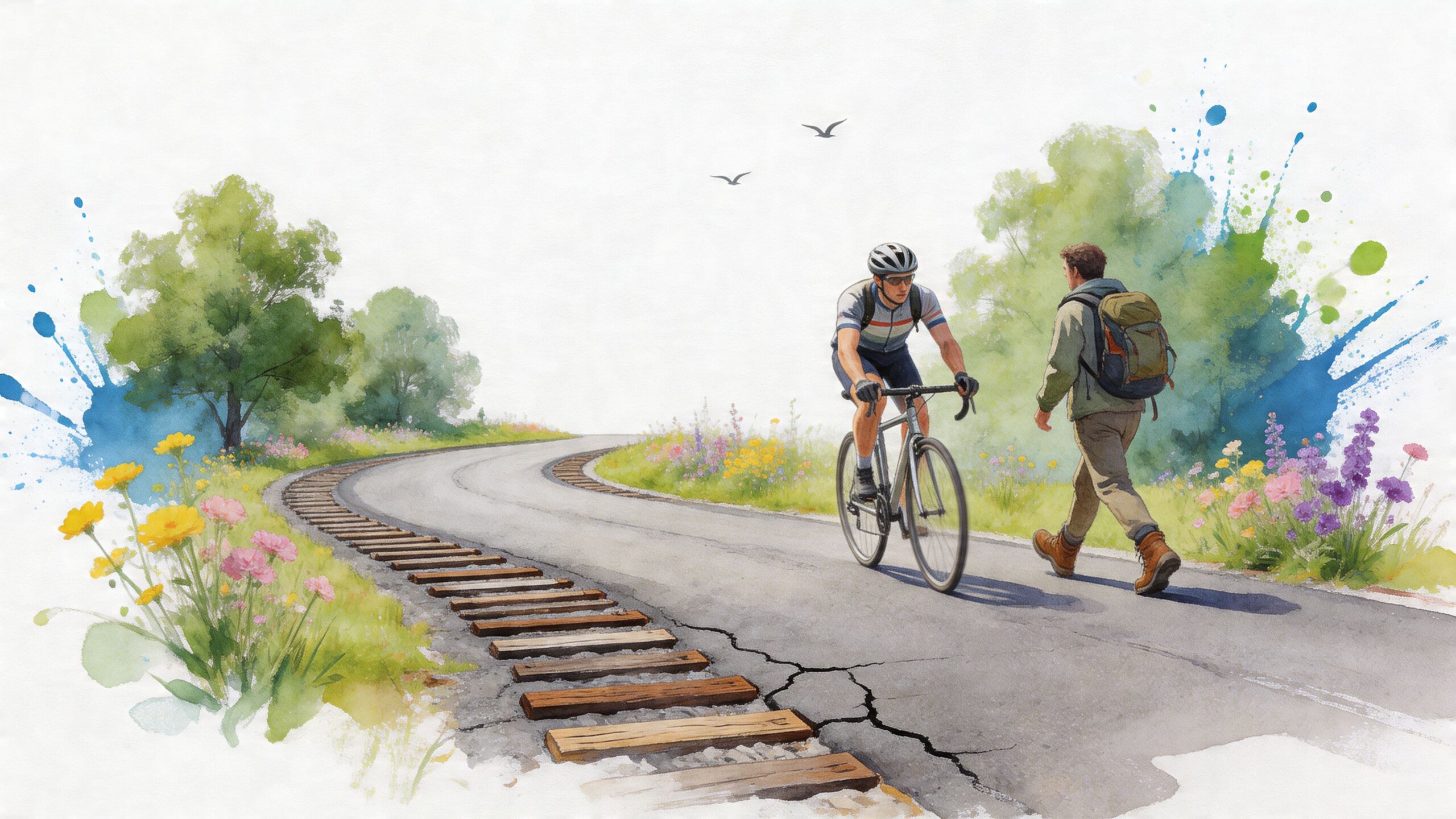
I stood on the erie lackawanna trail with a head full of static and a life that felt harder to carry than it should've. The pavement stretched forward in a straight, honest line, and that morning I understood something simple. You don't fix your whole life at once. You take one step.
Your Journey Begins With a Single Step
There was a time when I couldn't throw away a jar from the back of my fridge.
I'm serious. Old food, dead batteries, random receipts, clothes I didn't wear. Every useless object had a little story attached to it, and that story made it feel too heavy to move. My room looked like a stalled-out train yard. My mind did too.
Then my life cracked open. A relationship ended. The noise stopped. I had to decide whether I'd keep drowning in my own clutter or start doing hard things on purpose.
So I started small.
I walked.
Not because I had a grand plan. Not because I was suddenly disciplined. I walked because movement gave me something my messy apartment didn't. A direction.
The first honest move
The erie lackawanna trail works on you because it asks almost nothing at the start.
You don't need to be fast. You don't need elite gear. You don't need some glowing social media version of yourself. You just need to show up and put your feet on the path.
That's why I love trails like this. They don't negotiate with your excuses. The pavement doesn't care if you feel behind in life. It just waits for your next step.
Practical rule: When life feels jammed, don't ask how to solve everything. Ask where you can walk today.
I've seen this pattern again and again. A person starts with a short walk because they're tired, angry, lonely, or ashamed. Then the walk turns into a habit. The habit turns into self-respect. The self-respect changes what they tolerate from themselves and from other people.
That change doesn't look dramatic from the outside. It looks like someone tying their shoes.
Why this trail hits different
The erie lackawanna trail isn't just a route through Northwest Indiana. It feels like a decision made visible. You move through town, through open stretches, through places that remind you people built this and people can care for it.
That's the thing about a trail. It gives your body a clean assignment. Keep going.
If you've been stuck, come here with humility. Don't come trying to prove you're tough. Come ready to begin. A single mile can do more for you than a month of overthinking.
From Rails to Recreation A Trail's Second Life
Long before anyone came here for a calm ride or a clearing-the-head walk, this corridor carried freight and passengers. Steel wheels ran where sneakers and bike tires now roll.
That matters to me, because I don't trust shallow inspiration. I want proof. I want to know whether something broken, loud, and worn down can become useful again.
This trail says yes.
A corridor that changed its purpose
The story starts with the New York & Erie Railroad Company in 1832, then shifts through a 1960 merger that created the Erie Lackawanna Railroad. After bankruptcy in 1972, absorption by Conrail, and the end of service in 1986, the corridor got a second life as part of the American Discovery Trail, as described by Rails to Trails Conservancy's history of Indiana's Erie Lackawanna Trail.
I love that sequence because it doesn't read like a fairy tale. It reads like real life.
Something begins with purpose.
It grows.
It falters.
It gets abandoned.
Then somebody with vision says, "We're not done with this yet."
That's not just infrastructure. That's personal recovery.
The cocoon stage matters
A lot of us want transformation without the awkward middle. We want the butterfly story without the sealed-up cocoon. But trails like this were built through patience, public effort, and the stubborn belief that old routes still matter.
The erie lackawanna trail follows a former railroad corridor that once linked the Chicago region to the East Coast. Now people use that same line for walking, biking, and ordinary moments that rebuild a life from the inside out.
Old corridors don't beg for pity. They wait for someone to see what they can become.
I've felt that same tension in my own life. I used to think the messy chapters disqualified me. Now I think they trained me to notice potential where other people see waste.
That's one reason I respect rail-trails so much. They don't erase history. They repurpose it.
Why second lives should make you braver
If you're drawn to places like this, you're probably drawn to reinvention too.
The old rails carried industry. The trail carries people. The mission changed, but the route still serves. That's a powerful lesson. Your life may need a new mission, not a new self.
If you enjoy this kind of trail story, you'll probably like this look at the Old Plank Trail, another path where movement and memory sit close together.
When I walk the erie lackawanna trail, I don't just see asphalt. I see evidence that decline isn't always the ending. Sometimes it's the clearing stage before the rebuild.
Charting Your Course on the Erie Lackawanna
The first time I brought a small cleanup crew onto this trail, one teenager wanted to start at the rough northern end because it looked tougher. Another volunteer had never ridden farther than a neighborhood loop and needed a calm, confidence-building start. Same trail. Two very different days waiting to happen.
That is the lesson here. A good route choice is not about proving something. It is about knowing what kind of work, reflection, or recovery the day is asking from you.
The erie lackawanna trail gives you room to make that choice. The corridor runs from Hammond south through communities such as Highland, Griffith, and Schererville to Crown Point, according to the Indiana Dunes tourism overview of the Erie Lackawanna Trail. That spread matters because each segment carries a different mood, and your starting point shapes what you notice.
How I’d break up the day
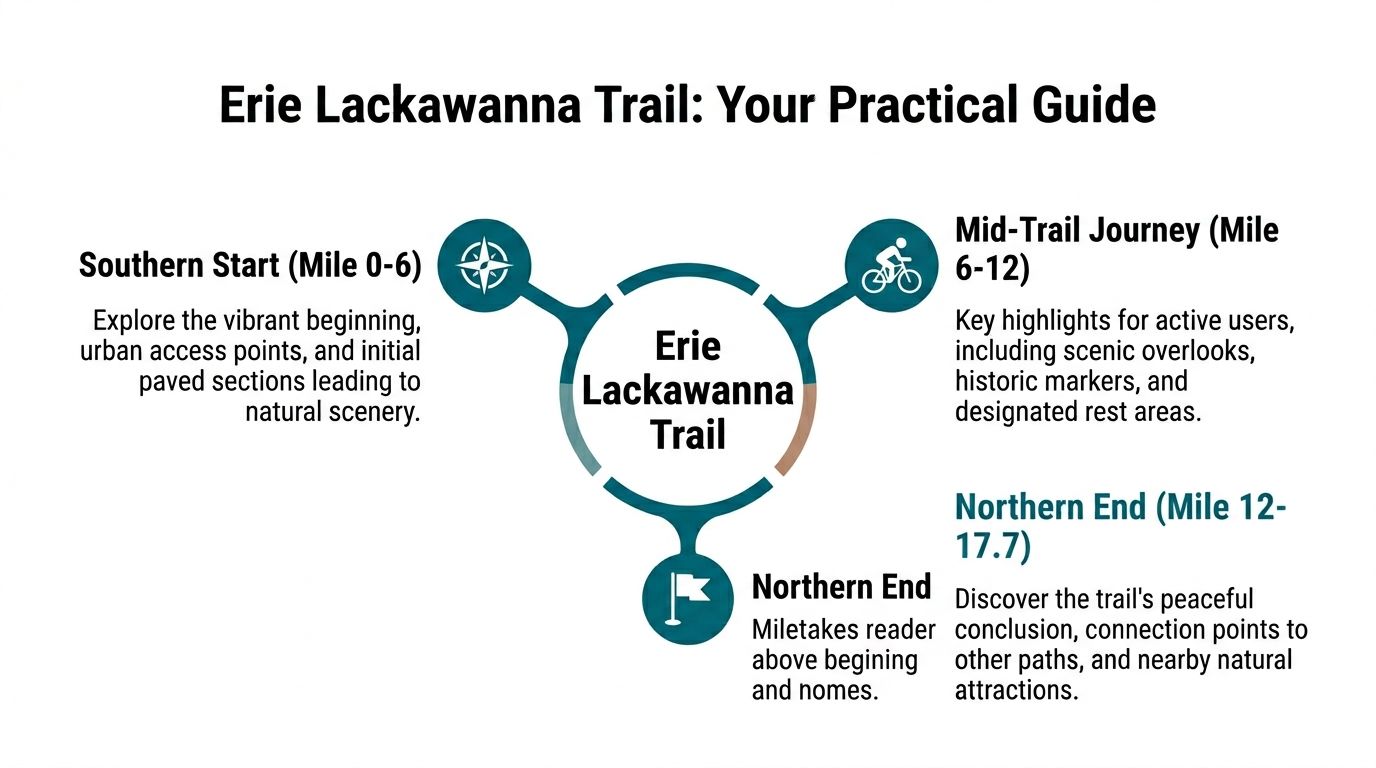
I split this trail into three practical experiences.
Southern start
Crown Point is where I send people who want to build trust in themselves. New walkers, families, and anyone coming back from a hard season usually do better when the day begins with steadier rhythm instead of constant decision-making. You can settle in, listen to your breathing, and remember that progress does not need drama.
Mid-trail flow
The middle stretch is where effort starts turning into focus. You stop checking the clock so often. You notice the pattern of your steps, the way your shoulders finally drop, and the fact that your mind has gotten quieter. That is one reason I care about trails so much. They give people a place to get honest.
Northern approach
The Hammond end asks more from you. You need better awareness at crossings and more patience with the surface. I do not say that to scare anyone off. I say it because adults should choose routes with their eyes open.
Access points that make sense
You need an entry point that matches your purpose, not somebody else's bragging rights.
| Trailhead Location | Parking Availability | Restrooms | Key Features |
|---|---|---|---|
| Crown Point at West Summit Street | Available | Check locally before departure | Southern access, strong option for a longer out-and-back |
| Highland trail access | Available | Check locally before departure | Convenient central access in a more developed area |
| Hammond near Sibley Street and State Street | Limited by context | Check locally before departure | Northern access, urban setting, better for people comfortable with rougher conditions |
I tell our Litter Caterpillars volunteers the same thing before a cleanup. Pick the start that helps you finish strong. There is no prize for beginning in the section that wears you down fastest.
Where you need caution
Local trail guidance from the Northwest Indiana Regional Planning Commission's Erie Lackawanna Trail page describes the route as a major regional corridor, but conditions still vary by segment. The northern end deserves extra attention because street crossings and rougher pavement can break your rhythm fast.
So handle that section with some discipline.
- If you're walking: Stay alert near crossings and broken pavement.
- If you're biking: Ease off speed and give your tires some forgiveness.
- If you're with kids: Start farther south unless your group already handles busier trail conditions well.
- If you're using mobility equipment: Research the segment first and choose the smoother sections for a better outing.
Trails build character when people meet them honestly.
That honesty is part of our mission. At Litter Caterpillars, we do not look at a path and ask only how far it goes. We ask what kind of neighbor it asks us to become. A route like this can give you a workout, a reset, or a reason to serve the place that carried you for a few miles.
If you like comparing how different trails shape different kinds of effort, this guide to the Des Plaines River Trail in Chicago, IL offers a useful contrast with a more natural, less paved corridor.
Gearing Up for Your Trail Experience
One Saturday morning, a father and his daughter showed up for a cleanup walk with us wearing brand-new sneakers straight out of the box. By mile two, the daughter had a blister, the dad was carrying two bottles in his hands because his pack had no side pockets, and both of them looked ready to quit. We slowed down, shared tape from a first-aid kit, shifted their water into a spare bag, and kept going.
They finished the day smiling.
That is the lesson. Good days on the Erie Lackawanna Trail are usually built before you leave the house. At Litter Caterpillars, we see it every season. The people who prepare well do more than enjoy the trail. They stay long enough to notice what needs care, pick up a few pieces of litter, and leave a stretch of public space better than they found it.
What the surface asks from you
As noted earlier, the Erie Lackawanna Trail is largely paved, which makes it friendly to walkers, riders, and many people using mobility equipment. That does not mean every mile feels the same. Some northern sections can ride rougher, and that small mistake in gear choice gets loud fast.
A skinny tire set rock hard can turn a relaxed ride into a rattling one. Shoes with no support can make a short walk feel twice as long. The trail is fair, but it is honest.
Prepare for the actual surface under your feet.
A checklist I trust because it has already failed me once
I used to carry too little water and too much pride. That combination teaches hard lessons. Now I keep the setup simple and repeatable.
For walkers:
- Broken-in shoes: Wear the pair that has already proved itself.
- Water within reach: Easy access means you will drink it.
- One light layer: A steady walk can turn into a longer outing than you planned.
For cyclists:
- Tire pressure with some give: A little mercy helps on rougher pavement.
- Basic repair gear: Tube or patch kit, pump, and the skill to use them.
- Comfort at your hands: Gloves or reliable bar tape can save your shoulders on a longer ride.
For anyone planning to spend real time out there:
- A charged phone
- A small first-aid kit
- A snack that will hold you up
- Sun protection
- A turnaround time you are willing to respect
Flashy gear will not save a sloppy plan
I have seen riders bring expensive bikes and forget a pump. I have seen walkers dress for a photo and suffer through the second half of the day. Public trails do not care about the costume. They reward steadiness.
Bring humility, water, and shoes you trust.
That rule belongs on more than a trail. It belongs in community work too. If you want to help care for a place, show up ready, stay useful, and do not make yourself the emergency.
My rule for longer outings
I divide what I carry into two groups. What keeps me moving. What gets me home.
The first group is water, a layer, and food. The second is a phone, repair basics, and enough honesty to stop when my body starts objecting. That habit has helped me finish cleanup days, training walks, and long rides without turning a good plan into a stupid story.
Use the trail to build that kind of discipline. It matters out there, and it matters everywhere else too.
More Than a Walk Activities for Every Explorer
The erie lackawanna trail can feel like three different places depending on how you use it.
Show up on a bike and the pavement becomes rhythm. Show up on foot and details start surfacing. Bring kids and snacks, and the day turns into a string of little discoveries instead of a mileage project.
The rider's version
A rider I know loves the middle and southern stretches because he can settle into a smooth cadence and stop fighting traffic for a while. The trail's broad usability makes that possible. You can ride for fitness, but you can also ride just to feel your thoughts line up.
That difference matters.
Some days your bike is a machine. Some days it's a broom for the mind.
The walker's version
When I walk, I notice the edges.
The wetlands. The parks. The green cuts alongside the path. The places where birds, insects, and wildflowers push back against the old industrial memory of the corridor. That's one of the quiet gifts of a rail-trail. It lets you move through both history and recovery at the same time.
A walker can have a full day here without covering heroic distance. Slow miles count.
The family version
Families use a trail differently. They don't care about your pace chart.
They care about whether the surface is forgiving, whether the mood stays light, whether there's room for a stroller, a snack break, and one child who suddenly needs to examine a leaf for six full minutes. On this trail, that kind of day makes sense.
And if you want a feel for the ride before you go, this video gives a useful visual sense of the path and atmosphere.
The best trail day usually starts when you stop trying to optimize it.
Other ways to use the path
You don't have to label yourself an athlete to belong here.
- Birding and noticing: The greener stretches reward slow attention.
- Photography: Old corridor, open sky, changing light. That's enough for a good afternoon.
- Reflection: Some people need a quiet bench more than a finish line.
- Training with restraint: If you're serious about mileage, use the smoother sections wisely and respect the rougher ones.
That's why I keep coming back to the erie lackawanna trail. It isn't one thing. It meets you where you are, then nudges you a little farther.
Leave It Better Than You Found It Join Our Mission
I need to say the hard part plainly.
Walking a trail is good. Cleaning one is better.
I don't mean that in a smug way. I mean it in the way a shovel is better than a speech when you've got a hole to fill. If you've ever felt helpless, discouraged, or disgusted by the state of the world, service gives your hands something honest to do.
And honesty changes people.
Why litter work hits so deep
For years I struggled to clean my own messes.
That wasn't laziness in the cartoon sense. It was emotional weight. Every object carried memory, guilt, or some stupid unfinished promise to myself. A bag of trash could feel like a confession.
Then I learned a strange truth. Cleaning up somebody else's mess can teach you how to face your own.
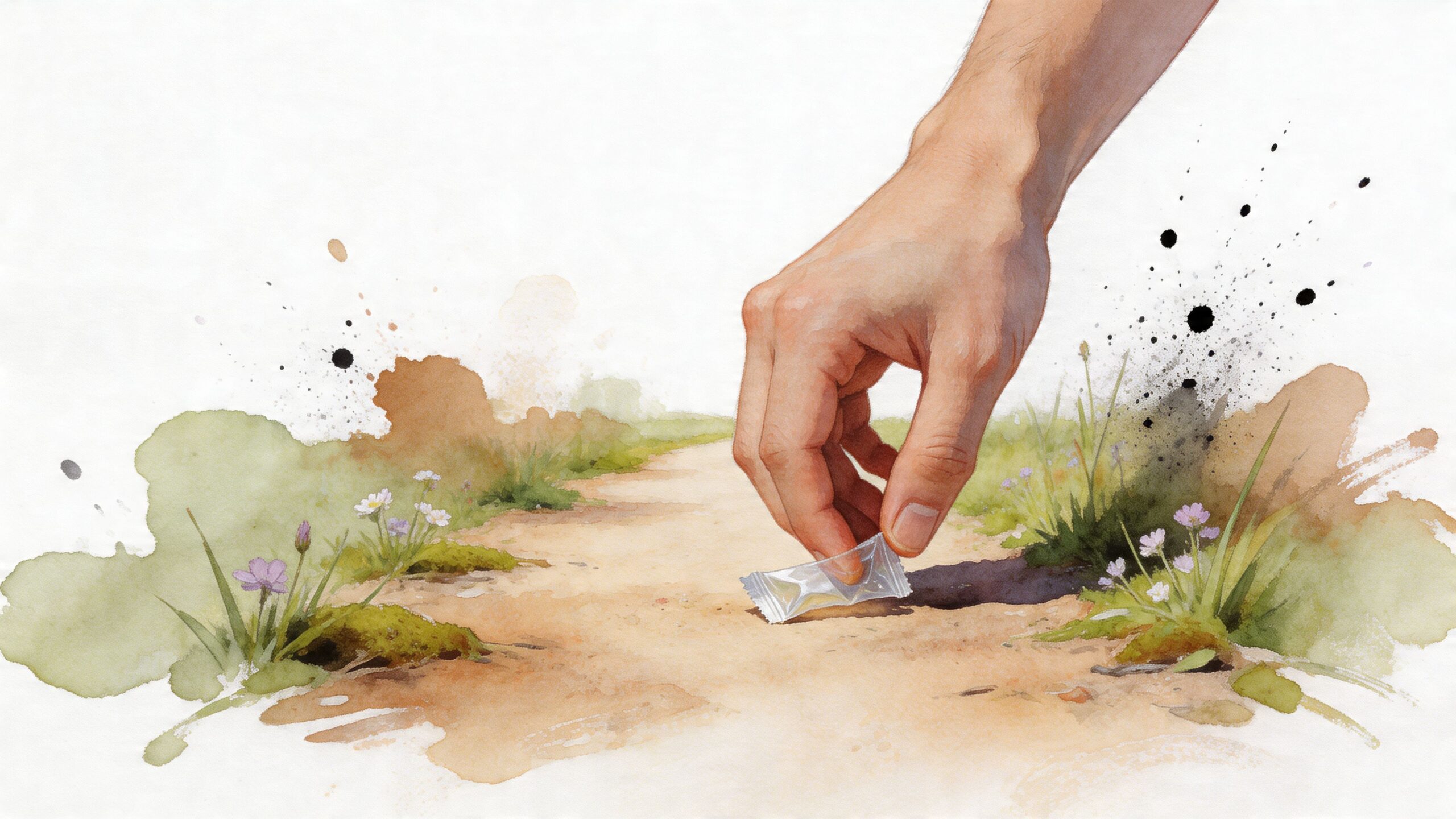
When you bend down, pick up a bottle, pull a wrapper from the weeds, or clear a nasty corner nobody else wants to touch, something in you starts to harden in the right way. Not cruel. Just stronger.
You stop waiting to feel motivated.
You become useful before you feel ready.
The gap on this trail is real
One reason the erie lackawanna trail stands out to me is that there appears to be a real opening for organized cleanup work. Existing attention leans toward recreation, while interest in litter management and group cleanups remains underserved, as discussed in this review of the missing cleanup angle around the Erie Lackawanna Trail.
That should challenge you.
If a place is loved for rides, walks, and family time, then somebody has to love it enough to pick up what gets left behind too. Popularity without stewardship turns into entitlement. People use the place, praise the place, photograph the place, then act surprised when trash collects at the edges.
That's not somebody else's problem.
That's ours.
What service does to a person
I care about cleanup work because it transforms the volunteer faster than it transforms the ground.
The ground changes first in the obvious way. Less litter. Cleaner edges. Better feeling. But the deeper shift happens in your character.
You learn consistency because trash doesn't care about your mood.
You learn bravery because some places are ugly and public and awkward.
You learn kindness because service puts you shoulder to shoulder with people who chose to show up.
A clean path is nice. A person who keeps showing up is better.
I've seen people come to a cleanup nervous, isolated, uncertain where they fit. Give them gloves, a bag, and one hour of shared work, and they start talking differently. Their posture changes. They laugh easier. They stop performing and start participating.
That matters more than people think.
If you want renewal, do the inconvenient thing
A lot of people say they want community.
What they usually mean is that they want the feeling of community without the labor that creates it. They want connection without effort, pride without maintenance, belonging without sacrifice.
It doesn't work like that.
Community grows where people do mildly inconvenient things together on purpose. They wake up. They travel a little. They carry tools. They do work that doesn't make them look glamorous. Then they eat, talk, joke, and head home stronger.
That's how a place gets protected.
That's how a person gets rebuilt.
How I’d approach cleanup on this trail
If I were organizing around the erie lackawanna trail, I'd keep the approach simple and tough-minded.
- Start with the rougher northern zones: Those cracked sections and crossing-heavy areas can collect debris and need more careful attention.
- Work in short segments: A long trail becomes manageable when people own one section at a time.
- Keep volunteers safe first: Crossings, gravel transitions, and uneven pavement demand attention and clear judgment.
- Make the day social, not grim: Service should build courage and friendship, not martyrdom.
That's how you keep people coming back. Not with guilt. With meaning.
Your invitation
If the erie lackawanna trail gives you peace, give something back.
You don't need to arrive as a hardened environmental crusader. You don't need a dramatic origin story. You don't need to pretend you're fearless. Just be willing to show up and do one useful thing with other people.
That's enough to begin.
And if you're ready to turn that impulse into action, this page for volunteer trash pickup is a good place to start finding your lane.
Come for the trail if you want.
Stay for the version of yourself that service builds.
If you're ready to do more than admire clean places, join Litter Caterpillars. Show up on a weekend morning, meet good people, and help turn ordinary ground into a story you're proud to be part of.
Leave a Reply