Tag: chicago volunteering

  • Litter Cleanup Volunteer Guide How to Join and Help

    Litter Cleanup Volunteer Guide How to Join and Help

    The hail started before we finished our first bag. Three of us huddled beneath a tree, shivering while our rides kept canceling, and somehow we were laughing. That was my first litter cleanup, and I learned that cleaning other people's mess can feel easier than facing your own.

    Why I Started Picking Up Trash and Why You Might Too

    For years, I could not keep my own things organized. Every object seemed to demand a memory. An old jar brought back a trip, while a forgotten snack recalled an attempt to eat better. Even a small mess became a decision I kept postponing.

    Street litter asked less of me. A bottle had no personal history, and a wrapper did not make me remember where I bought it. I could reach down with a grabber, drop the item into a bag, and keep walking.

    The first storm changed what volunteering meant to me. The weather was miserable, yet it gave the morning a shared story. We were three people trying to finish an odd little adventure, and the cold made our jokes better.
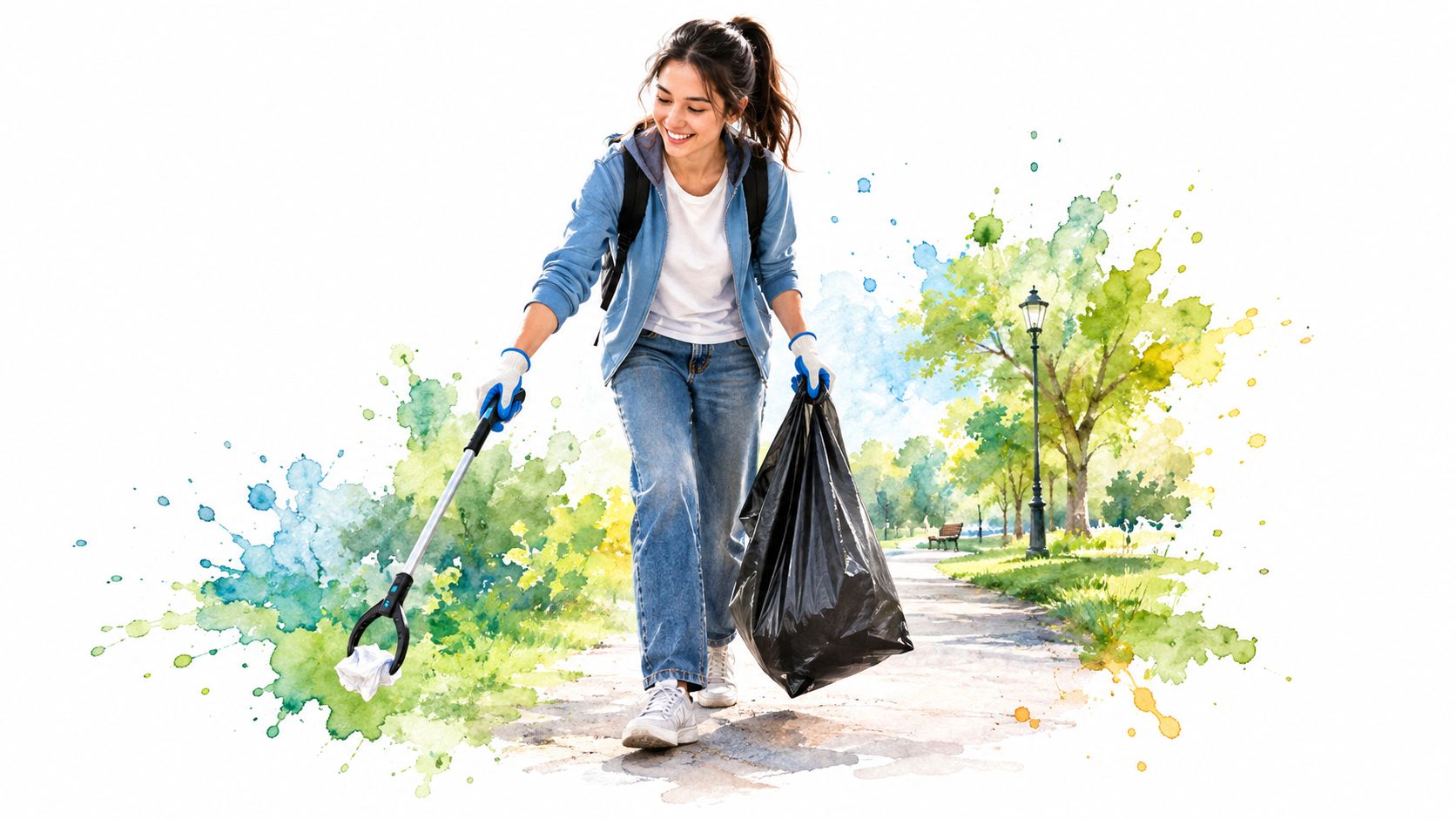
    A young female volunteer happily picks up litter in a scenic park using a grabber tool.

    Why showing up matters

    I returned because the work offered a clear promise. I could arrive, carry a bag, and leave one small place cleaner. I did not have to feel organized first. I needed gloves, some courage, and people willing to stand beside me.

    The Litter Caterpillars follow that same rhythm. The group cleans across Chicago's wards, including areas other groups may avoid, and meets on weekend mornings. Volunteers bring flags, theme songs, and badges, turning an ordinary sidewalk into a place with its own shared identity.

    Rain or shine, that routine changes people. You learn to keep showing up, and familiar faces become friends because you have sweated, shivered, and worked beside them.

    My rule: Choose one cleanup before you decide whether volunteering fits you.

    Litter cleanup also has a broad community history. Keep America Beautiful describes volunteer work spanning community events and public spaces across the United States. Its overview of litter cleanup volunteerism shows how a simple bag-and-grabber routine can connect people at a much larger scale. Keep America Beautiful describes the scale of litter cleanup volunteerism.

    You do not need to fix the whole city. Choose one morning, meet people outdoors, and let the bag fill gradually. Consistency becomes easier when friends are waiting for you, and a small act can leave you braver than when you arrived.

    How to Find and Join a Litter Cleanup Group Near You

    I usually begin with Meetup, because event listings give me a date, meeting place, and host in one screen. Search your city with phrases like “litter cleanup,” “trash pickup,” or “community cleanup,” then filter for upcoming events.

    Read the listing before you RSVP. Look for the meeting point, expected pace, supplied equipment, weather plan, age rules, and contact method. A clear listing should tell you what happens after you arrive, not leave you guessing beside a park entrance.

    Use Meetup and Instagram together

    Instagram helps when groups announce smaller events quickly. Search your city name with “litter pickup” and follow local groups, parks, neighborhood associations, and environmental volunteers. Watch Stories for pop-up cleanups, route changes, and weather notices.

    Send a short direct message:

    Hi, I'm interested in joining your next litter cleanup. Is the event open to new volunteers, and should I bring anything?

    That message does enough. You don't need a personal essay. Hosts can tell you whether they provide grabbers, gloves, and bags, or whether you should bring your own.
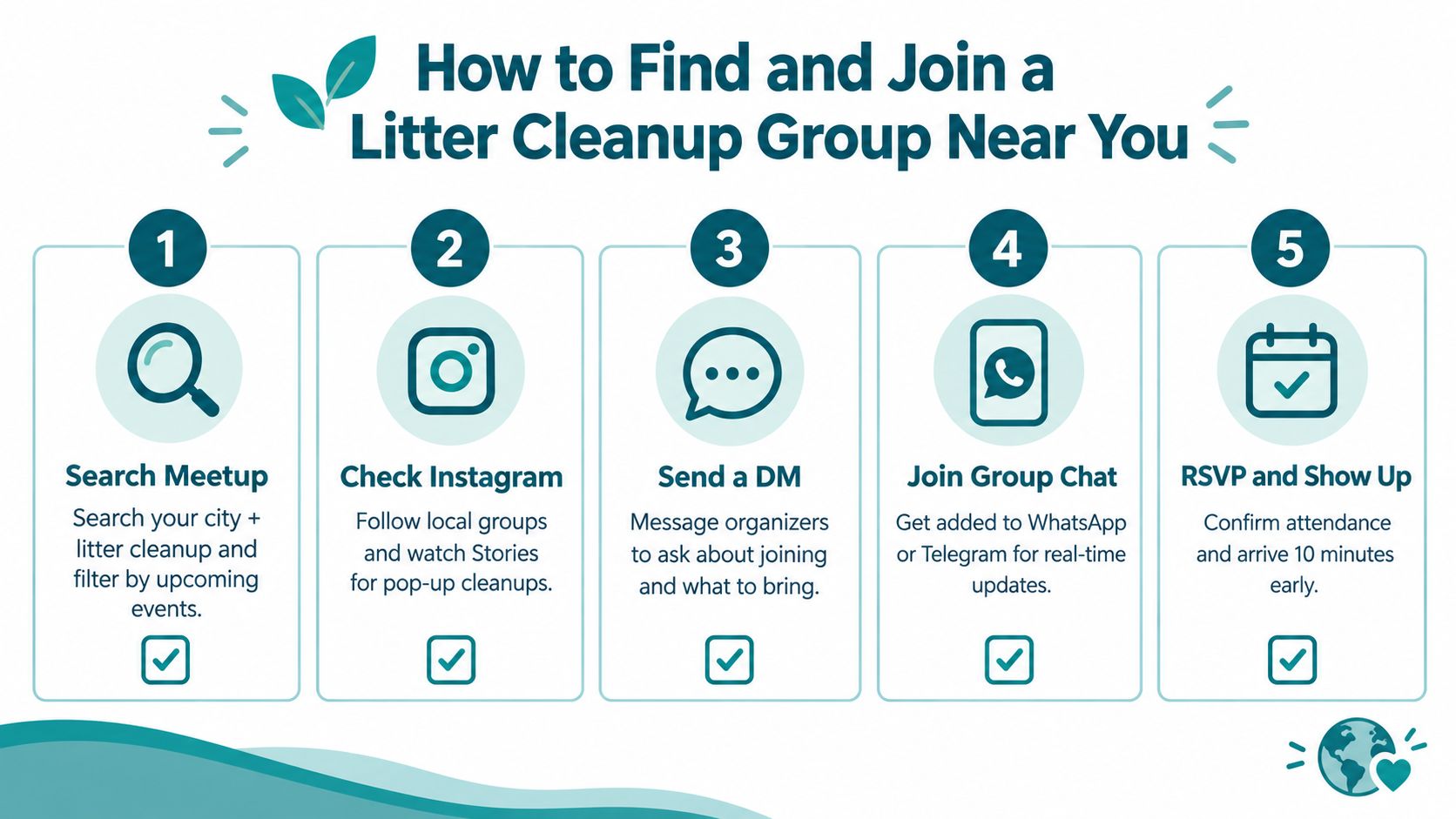
    An infographic showing five easy steps to find and join a local litter cleanup group volunteer event.

    Choose a first event you can actually attend

    Weekend mornings work well for many volunteer groups because the schedule leaves room for service and conversation. Pick a site that feels manageable, with a clear meeting point and a host who answers questions.

    A group chat can make the first visit easier. Ask whether the organizers use WhatsApp, Telegram, or another open chat for last-minute updates. RSVP, save the address, and arrive early enough to find the host without rushing.

    If you're searching around Chicago, browse local volunteer trash pickup events near you and compare the next available meetup with your schedule. Then make the decision concrete. RSVP before you talk yourself out of it, send the host your question, and put the event on your calendar.

    What to Expect at Your First Litter Cleanup Meetup

    My first calm meetup began with a small circle of people near the starting point. The host welcomed everyone, explained the route, and gave a short safety briefing. Nobody expected a speech or a perfect introduction. We signed in, collected supplies, and started talking while we prepared.

    The group split the area into small zones. That choice kept us from crowding one patch of sidewalk while another remained untouched. I paired with a buddy, took a grabber and bag, and followed the boundary of our assigned block.

    At first, I felt awkward. My buddy found a cup beneath a hedge, and I found a tangled receipt near a curb. After a few minutes, the pattern became almost meditative. Reach, squeeze, drop. Reach, squeeze, drop. Between finds, we talked about neighborhoods, pets, jobs, and whatever had happened that week.

    A simple rhythm carries the morning

    The host checked routes and kept the group together without hurrying anyone. We took breaks for water and paused when the ground, traffic, or weather made a section unsuitable. A first-time litter cleanup volunteer doesn't need to compete with anyone. A steady pace works better than a frantic one.

    You may meet students, neighbors, people new to the city, and regulars who know every shortcut around the block. Some people talk constantly. Others work without a word. Both styles fit.
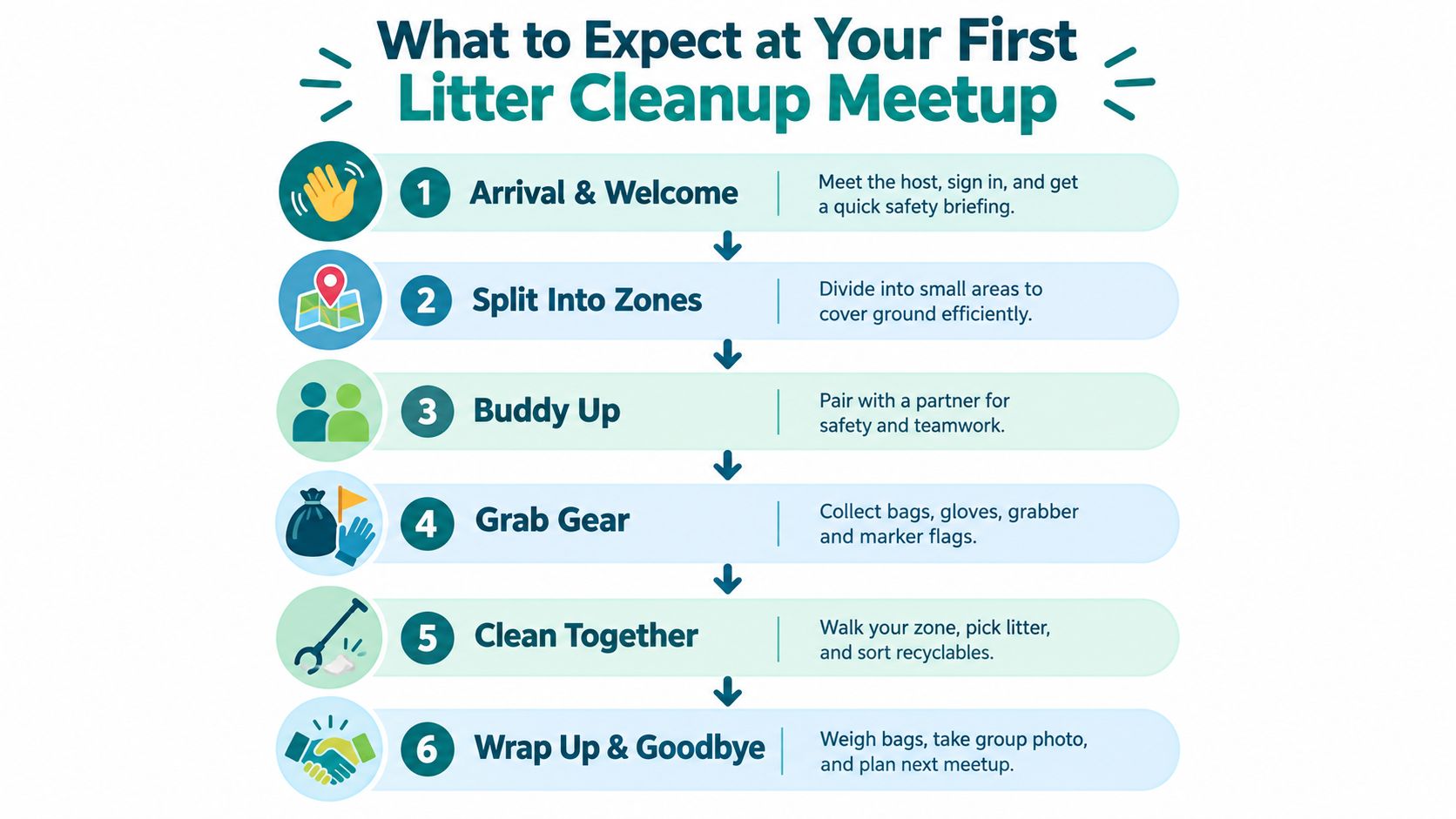
    An infographic titled What to Expect at Your First Litter Cleanup Meetup, outlining six steps to follow.

    Near the end, volunteers bring filled bags to the agreed pickup point. Some groups sort recyclables or record what they find. The group may take a photo, thank everyone, and discuss the next route. The goodbye often feels warmer than the greeting because you've shared a task that leaves visible evidence.

    You don't have to arrive confident. You can borrow confidence from the person walking beside you.

    The meetup may include laughter, quiet concentration, muddy shoes, and an unexpected weather change. That mixture makes the experience memorable. You leave with cleaner streets behind you and a few names you can recognize at the next gathering.

    Safety and Gear Checklist for Litter Cleanup Volunteers

    I pack the night before because a rushed volunteer forgets the item that matters most. Start with gloves, a grabber, high-visibility clothing, closed-toe shoes, water, and sunscreen. Add layers when wind or heat may change the feel of the morning.

    Use this checklist:

    • Gloves: Wear sturdy gloves that protect your hands from hidden sharp edges. Never pick up litter with bare hands.
    • Grabber: Use a grabber instead of reaching into bushes, gaps, or piles. It keeps your hands farther from unknown objects.
    • High-visibility vest: Wear reflective gear near any traffic or parking area so drivers and teammates can see you.
    • Closed-toe footwear: Choose hard-soled shoes or work boots that handle uneven ground and concealed debris.
    • Water and sunscreen: Drink regularly, take breaks, and protect exposed skin during outdoor work.
    • Basic first aid: Carry bandages and hand sanitizer for small needs after you finish handling bags.

    See the litter cleanup equipment options used for trash pickup work before your first event.

    Follow the route, then stop for hazards

    A safe workflow starts with a site inspection. The leader checks for traffic, water, unstable ground, construction, severe weather, and other hazards. The team divides the area into small zones, works in buddy pairs, fills only manageable bags, and places tied bags at a safe pickup point.

    Stay off the roadway. Work in daylight, avoid wet or poor-visibility conditions, and never choose a busy road to collect more litter. Minnesota's Adopt a Highway guidance also tells volunteers to face oncoming traffic, avoid bridges and open water, and leave enough room for crews to tie bags shut. Read the Minnesota volunteer safety guidance.

    Some objects belong to trained responders. Leave needles, broken glass, batteries, dead animals, heavy or bulky objects, sealed containers, and unknown substances alone. Tell the group leader, who can report the item to the right authority.

    Hazard rule: If you can't identify it or lift it safely, don't touch it.

    A county roadside program requires safety training, a vest, gloves, and hard-soled shoes or work boots before participation. Review the Will County roadside terms and conditions. Texas guidance also places volunteers in a defined right-of-way workflow, asks groups to carpool, and says bags should remain tied and reachable for collection. Read the Texas cleanup safety tips.

    When you finish, wash your hands and disinfect reusable equipment. Safety keeps one enjoyable morning from becoming a reason to quit.
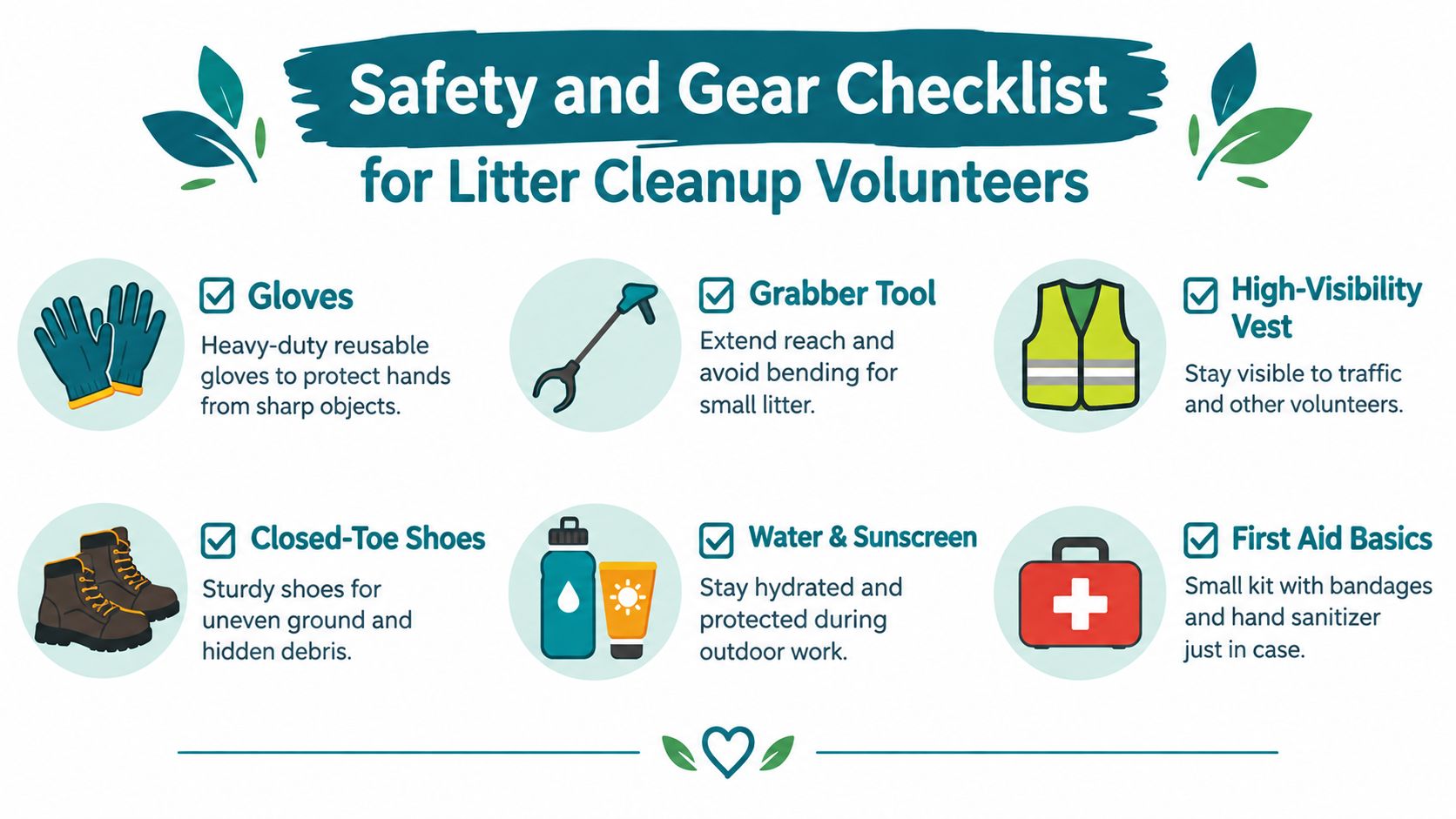
    A safety and gear checklist for litter cleanup volunteers featuring essential items like gloves, tools, and protective equipment.

    Cleanup Etiquette That Keeps Teams Kind and Unified

    A cleanup group works best when nobody treats the morning like a competition. I share the awkward finds, the heavy sections, and the boring stretches. Someone else may take the next bag, hold a flag, or walk with a newer volunteer who feels unsure.

    Keep your footprint light in the neighborhood. Stay aware of entrances, gardens, parked cars, and people using the sidewalk. Keep voices reasonable, leave private property alone, and let the leader handle questions from residents or tricky waste.

    Small teams make the work easier to supervise. Assign one side of a road at a time, keep buddy pairs together, and use a clear handoff for anything hazardous. Never pressure someone to work faster, lift beyond their capacity, or enter a place that feels unsafe.

    Protect the volunteer mood

    A volunteer-first group protects energy. Leaders should explain the plan, notice fatigue, and make breaks normal. Nobody should feel embarrassed for sitting out a difficult patch or leaving when the weather turns.

    Celebration helps too. A flag, a theme song, or a badge can turn a plain bag of litter into a shared achievement without turning service into a performance. I like the moment when everyone sees the same block at the end and recognizes the difference.

    • Do welcome newcomers: Introduce yourself and explain the next simple task.
    • Do share information: Tell the leader about hazards instead of trying to solve them alone.
    • Don't pressure donations: People arrive to give time, and organizers should respect that.
    • Don't shame residents: Clean the space without turning strangers into targets.
    • Do thank the team: A sincere goodbye makes returning feel easy.

    Before joining a group, read its volunteer code of conduct so you understand how it handles respect, safety, and shared work.

    How Volunteering Transforms You and Your City

    The first time hail hit during a cleanup, I nearly headed home. Then a friend tightened her hood, laughed, and kept walking. We filled bags between showers. That morning changed my idea of service. A cleanup clears one sidewalk, while returning regularly changes how you see yourself and your neighborhood.

    The Litter Caterpillars' rain-or-shine, all-wards approach makes that change visible. You learn to show up before you feel ready, work beside people you did not know, and trust a plan when the weather turns. Bravery becomes an ordinary habit, built one meetup at a time.

    Friendship grows through repetition. You meet the same people at the gathering point, follow familiar routes, and learn how someone laughs when a bag snags on a thorn. Those small moments create belonging without demanding an instant friendship.

    Chicago looks different with a grabber in your hand. Walking through its wards has led me down streets I might otherwise overlook. Projects such as Caterpillar Park in Englewood also give volunteers a place where shared work can continue beyond one cleanup morning.

    Turn one morning into a practice

    Keep the first commitment modest. RSVP for one event, bring a friend, and decide beforehand which weather would send you home. Afterward, record the next date while the experience still feels fresh.

    For another community view of waste reduction and local action, read Fillaree's guide to the top reasons Durham is zero-waste capital.

    The broader participation is encouraging. Keep Britain Tidy reports that many adults take part in litter picking regularly, and that hundreds of thousands of volunteers collected hundreds of thousands of rubbish bags in one year. The scale shows that local service can become a shared public habit.

    You do not need a heroic plan. Choose a meeting point, wear shoes you trust, and let the people beside you make the morning lighter. Return before the habit disappears.

    Litter Caterpillars organizes volunteer trash pickup events across Chicago, provides grabbers, bags, and gloves, and offers a practical way to meet people while cleaning local streets. Visit Litter Caterpillars, RSVP for a weekend cleanup, and bring a friend to your first morning.
  • 10 Community Service Opportunities in Chicago

    10 Community Service Opportunities in Chicago

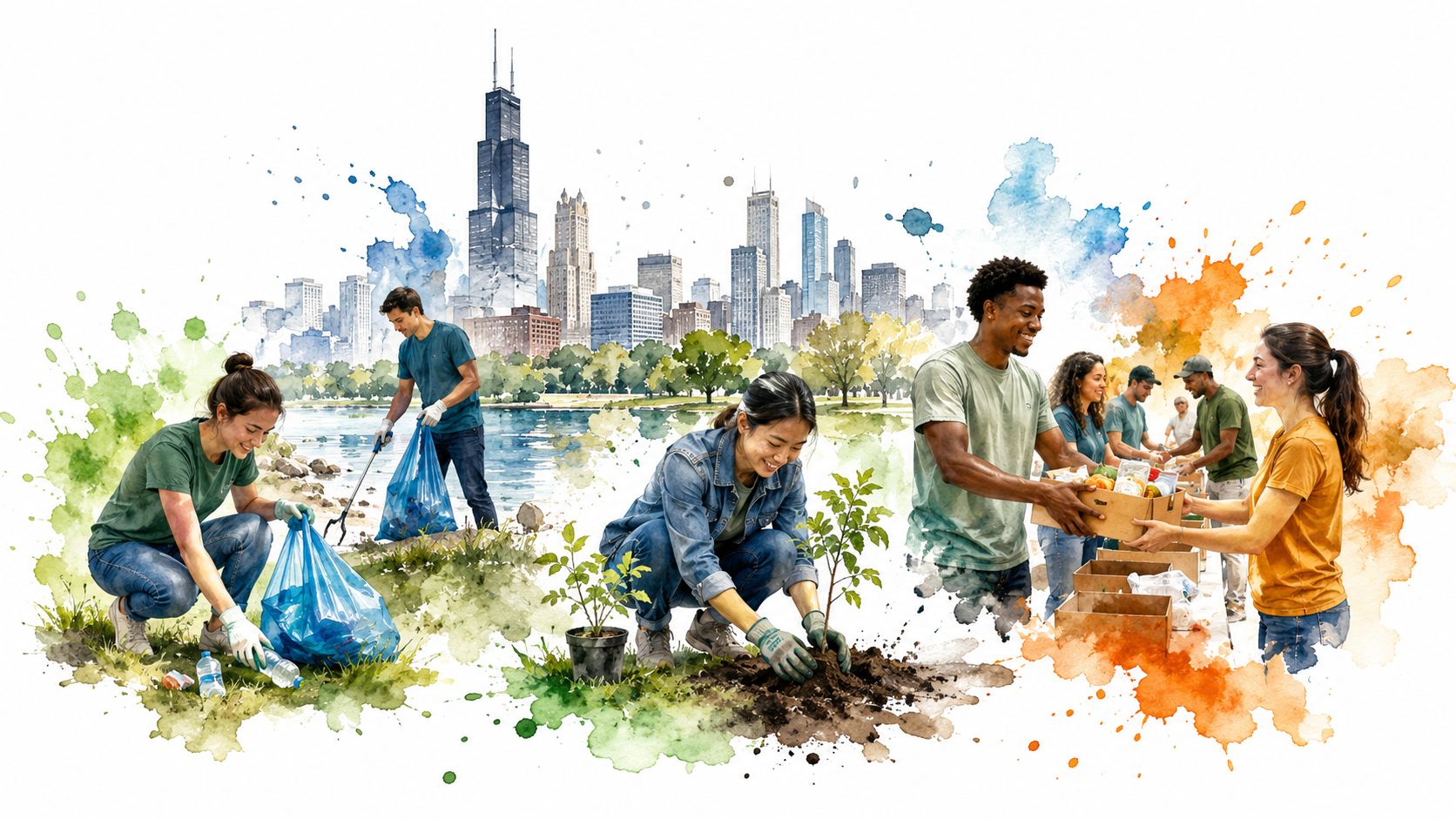
    I bend down for one bottle, then spot a wrapper under a parked car. A minute later, someone beside me fills a bag, and the work feels lighter because we're moving together. Chicago has community service opportunities for a one-hour neighborhood cleanup, a park partnership, a school project, a vacant-lot garden, and plenty between them. Meetup, local nonprofits, schools, neighborhood groups, and open chats can help you find a starting point. Weekend mornings make a practical first try. Choose a place you can reach, a pace your body can keep, and a group that makes returning feel realistic. Litter Caterpillars gives Chicago volunteers one example of that approach, with regular trash pickups built around showing up together.

    1. Weekly Neighborhood Cleanup Groups

    A weekly cleanup gives service a dependable shape. You meet at a familiar time, pick up a bag and gloves, and learn the rhythm of the street. The first visit may feel like a small errand. After a few visits, you start noticing which corner collects cups, which alley needs attention, and which neighbors wave as you pass.

    Litter Caterpillars runs weekly pickups across all 50 Chicago wards, according to the group's publisher information, while neighborhood associations organize cleanups in specific areas. Lincoln Park groups often focus on lakefront paths and park zones. You can also search Meetup for an event that fits your Saturday instead of building a project from scratch.

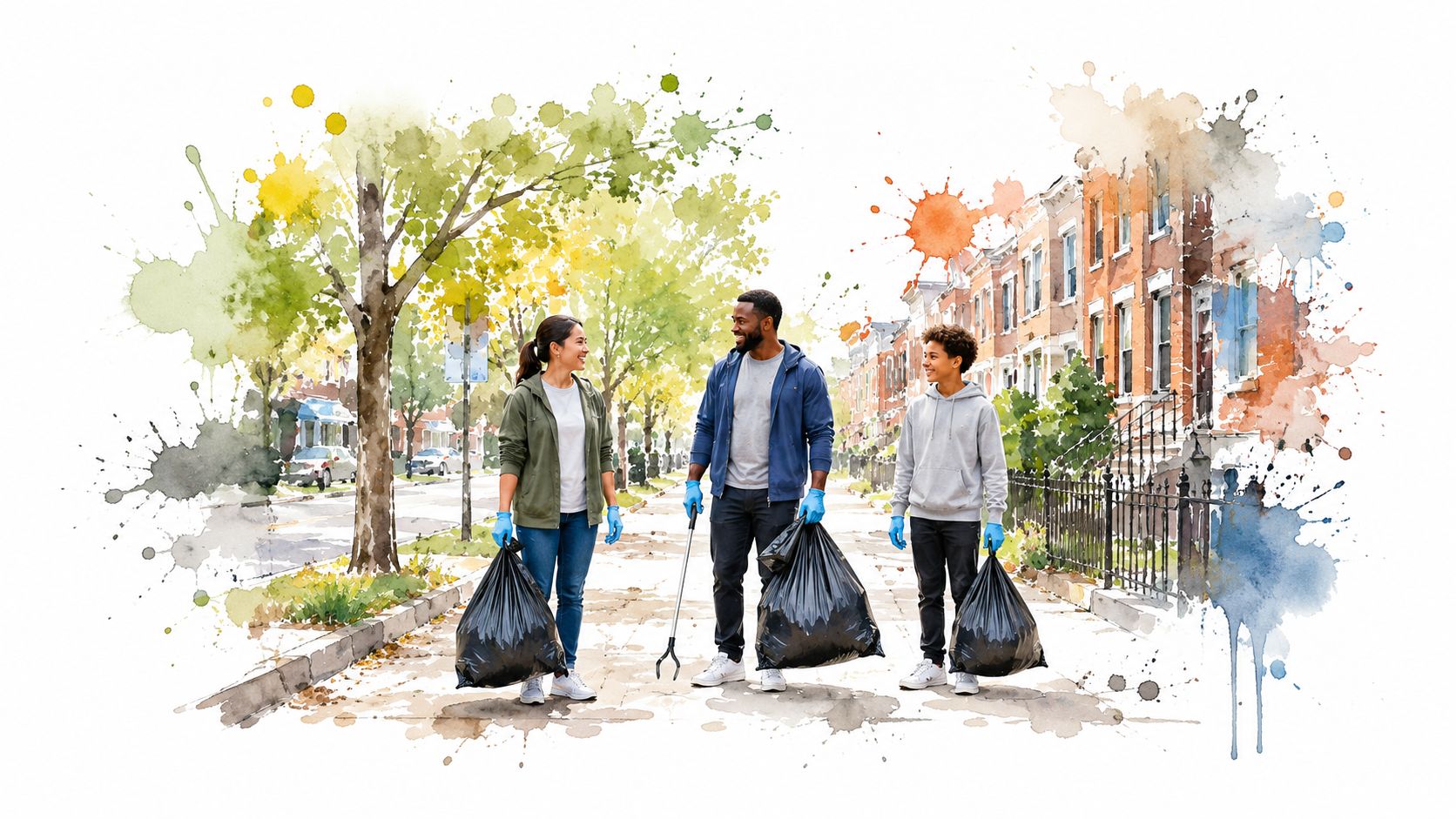
    A diverse group of three people walking down a city street while collecting litter in trash bags.

    Make repetition easy

    Organizers can schedule events at 9 AM or earlier when they want a steady weekend routine. A simple RSVP page removes needless steps. Group shirts, flags, badges, or another shared marker can help strangers recognize one another quickly, while before-and-after photos give the team a small record of each morning.

    Rotate neighborhoods when you can. A cleanup in Lincoln Park feels different from one in Englewood or on the South Side, and moving around Chicago helps volunteers meet more people.

    Practical rule: Choose a recurring time before you choose a grand mission. A routine you can keep beats an ambitious plan you abandon.

    If you're organizing your own crew, use this guide to organize a neighborhood cleanup. The best group may be the one that makes a bag, a meeting point, and a friendly hello feel enough to begin.

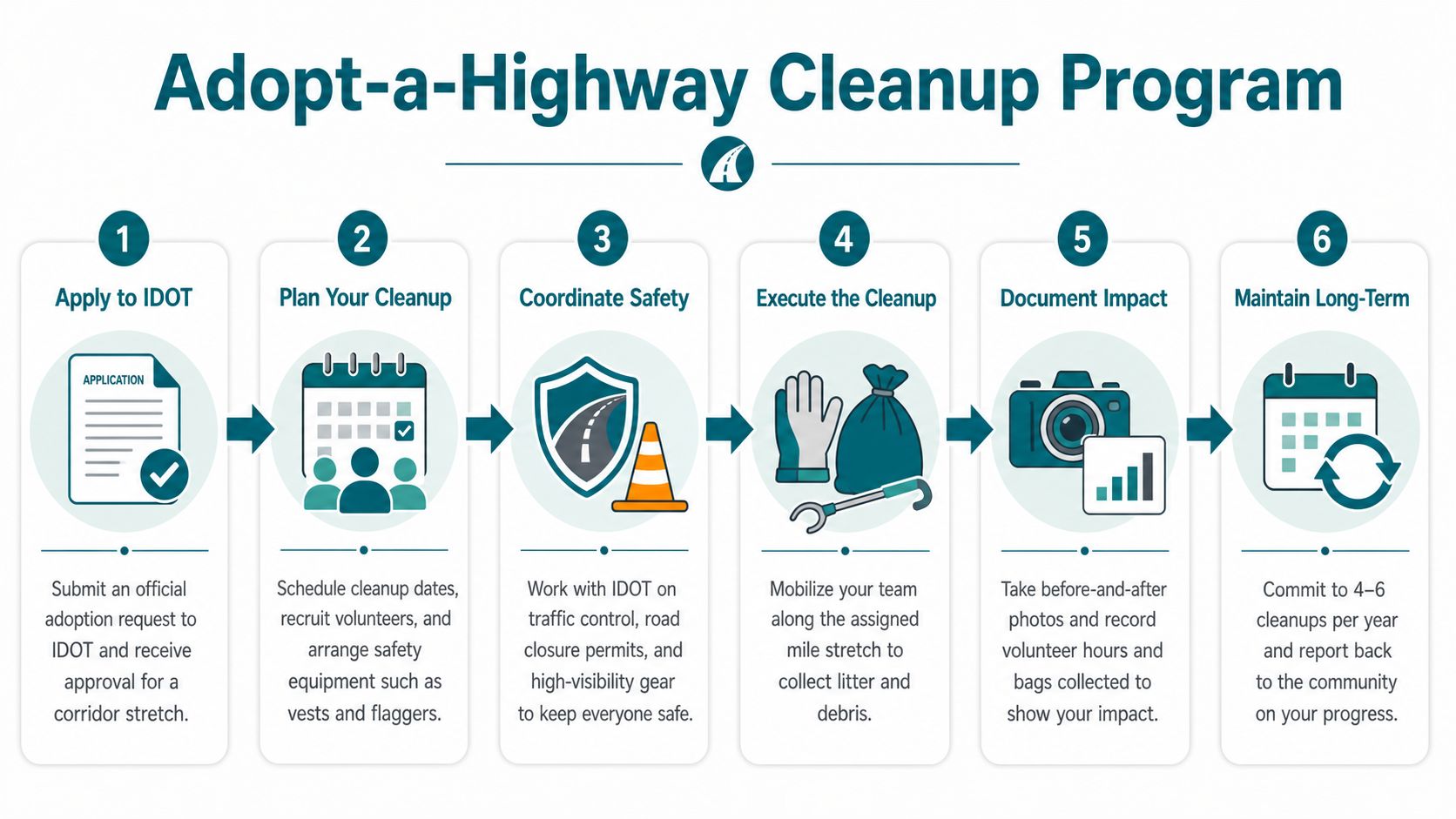
    2. Adopt-a-Highway and Major Corridor Programs

    A major road changes the experience of picking up litter. Cars move quickly, the shoulder can feel exposed, and a loose team needs clear boundaries before anyone lifts a bag. In return, volunteers take responsibility for a defined stretch instead of treating cleanup as a one-off walk.

    Chicago groups can work with IDOT on safety equipment and road-closure coordination. Litter Caterpillars cleaned a highway during the shutdown for the Bike the Drive event, and corporate teams can adopt sections of Lake Shore Drive. Community groups may also maintain portions of Ashland Avenue or Western Avenue.

    Treat the corridor like a worksite

    Schedule service after a large event or a season that leaves extra litter behind. Ask nearby businesses to help with water, bags, gloves, and volunteer recruitment. Give every participant a clear job, such as bag collection, supply support, route observation, or communication with the lead.

    High-visibility vests and trained flaggers belong in the plan. Volunteers should never improvise around moving traffic. Take photos from safe locations, record what the team completed, and use those records in community updates or partnership conversations.

    A corridor project needs more than enthusiasm. It needs a route map, a meeting point, a weather decision, and an exit plan.

    For prevention work beyond pickup, explore ways to prevent illegal dumping. Removing waste helps today. Learning why people dump materials, where repeat problems appear, and whom to contact can shape the next response.

    3. Vacant Lot Transformation and Urban Gardening

    A vacant lot asks for patience. You may begin with broken glass, tangled weeds, old furniture, and soil that needs professional attention. The first cleanup clears the view. Later, neighbors can decide whether the space should become a garden, a gathering place, a play area, or another useful community resource.

    Caterpillar Park in Englewood grew from Litter Caterpillars' work, while Growing Home in Englewood transforms lots into urban farms. The Local Initiatives Support Corporation, or LISC, supports vacant-lot projects across Chicago. Each example points to the same practical truth, a lot needs a plan for its next life before people invite the public in.

    A six-step infographic illustrating the process to join the IDOT Adopt-a-Highway cleanup volunteer program.

    Build the next phase early

    Start with one property. Get the owner's agreement before volunteers invest time, and work with a nonprofit that understands land management, soil questions, permits, and maintenance. Ask neighbors what they want to see, then create a schedule for watering, mowing, repairs, trash removal, and winter care before opening the space.

    • Choose a manageable footprint: A smaller project lets people learn the site before expanding.
    • Invite local design voices: Neighbors should help decide paths, planting, seating, and use.
    • Plan funding carefully: Environmental and community-development funders may support eligible work.

    The transformation takes shape in stages. First, people remove hazards. Then they create a place that asks for regular care.

    See Chicago community gardens for a place-based route into this kind of service. The video below gives the project a more tangible feel.

    4. School and Youth Organization Volunteer Partnerships

    A school cleanup can start with a short walk, a few pairs of gloves, and a teacher who knows how to keep the group moving. Chicago Public Schools can partner with environmental nonprofits for cleanup days. Boys and Girls Clubs can place service inside summer programming, and Kenwood Academy students have taken part in lakefront cleanups.

    Young volunteers need jobs they can understand. One student can track supplies, another can collect safe litter, and another can photograph the work with permission. Give older participants a chance to lead a briefing or welcome new members. A service habit grows more naturally when students can see their own progress.

    A woman and three children smiling while participating in community service activities like cleaning and planting trees.

    Connect service to school life

    Start with an environmental coordinator, service coordinator, teacher, or youth-program director. A cleanup can support lessons about waste, water, wildlife, civic life, or local geography. Libraries and schools can also run low-barrier projects such as making cards for veterans, decorating materials for care homes, or creating bookmarks for young readers, based on examples described by the American Library Association's school-library blog.

    Ontario students who need a comparison for school service requirements can look to Ontario's graduation guidance, which requires 40 hours of unpaid community involvement for the Ontario Secondary School Diploma. Students can begin recording hours in July before Grade 9, and the guidance suggests aiming for about 10 hours per year. Ontario school guidance provides those details.

    Keep the activity hands-on, recognize participation with certificates or a thank-you, and give students a route from helper to team leader.

    5. Corporate Team Building and Volunteer Days

    A company volunteer day works best when nobody has to guess what happens next. Employees arrive at a neighborhood or park, receive a short briefing, split into defined roles, and leave with a clear picture of the site they helped. The day can feel social without turning service into a forced office exercise.

    Chicago environmental groups can work with technology, finance, law, consulting, and other companies. Google and Salesforce organize employee volunteer days, and local nonprofits partner with firms that want a practical group project. Organizers can package the experience around a site, a meeting time, supplies, safety guidance, and a simple follow-up.

    Give the team a story and a job

    Before the event, explain why the neighborhood needs the work without reducing the community to a problem. Show the route, name the local partner, and tell employees what to bring. On site, assign a company lead and a service lead so questions have a clear home.

    Afterward, send before-and-after photos and a concise account of what the team completed. Ask what felt easy, what felt confusing, and whether anyone wants to join a recurring cleanup.

    Small details can make the day feel shared. A group flag, a team photo, or a playful sign can help participants remember the morning. If a project uses branded site markers, organizers can review guidance on designing effective hole signs for ideas about readable, visible messaging, even outside a golf setting.

    The trade-off is simple. A company day can bring many hands at once, while a recurring group builds deeper continuity. A thoughtful organizer can invite both.

    6. Environmental Education and Workshops

    Some volunteers want to understand the route from a discarded cup to a clogged drain or polluted waterway. A cleanup followed by a workshop gives them that connection. You can talk about what litter does in waterways, how materials break down, and which daily choices prevent waste from reaching the street.

    Chicago Public Schools can use environmental lessons about waste and litter. Lincoln Park Zoo can connect wildlife education with plastic concerns, and the League of Women Voters Chicago hosts workshops about environmental sustainability. Schools, libraries, and community centers already have rooms and audiences, so a local partnership can make the first session easier to arrange.

    Teach with objects people can see

    Avoid leading with shame. Put a storm-drain image beside a bag of collected items. Show a clean sorting station, a composting example, or a sealed container that demonstrates how litter can travel through water. Ask participants to name one change they can make that day.

    • Use a local route: Walk from the meeting point to a drain, park edge, or shoreline.
    • Let young people speak: Students can create messages for classmates and neighbors.
    • End with action: Give people a simple next step, such as joining a cleanup or checking local recycling guidance.

    A workshop should leave people with something to do, not only something to worry about. Pair the lesson with a short service activity so the idea becomes physical.

    You can also create remote participation for people who can't attend outdoors. A student might design a litter-prevention poster, a volunteer might help organize event information, and a community member might share a workshop invitation through a local group chat.

    7. Parks and Lakefront Stewardship Programs

    A park volunteer notices more than a bottle. You may spot a damaged bench, a broken sign, a bare planting bed, or a path that needs attention. Stewardship gives you a way to report those problems while you pick up litter and care for the place over time.

    Friends of the Parks organizations run volunteer stewardship programs. The Lakefront Cleanup Initiative coordinates beach and shoreline work, and the Lincoln Park Conservancy works on park improvements and maintenance. A group can adopt one section, establish a recurring schedule, and keep a simple record of what needs follow-up.

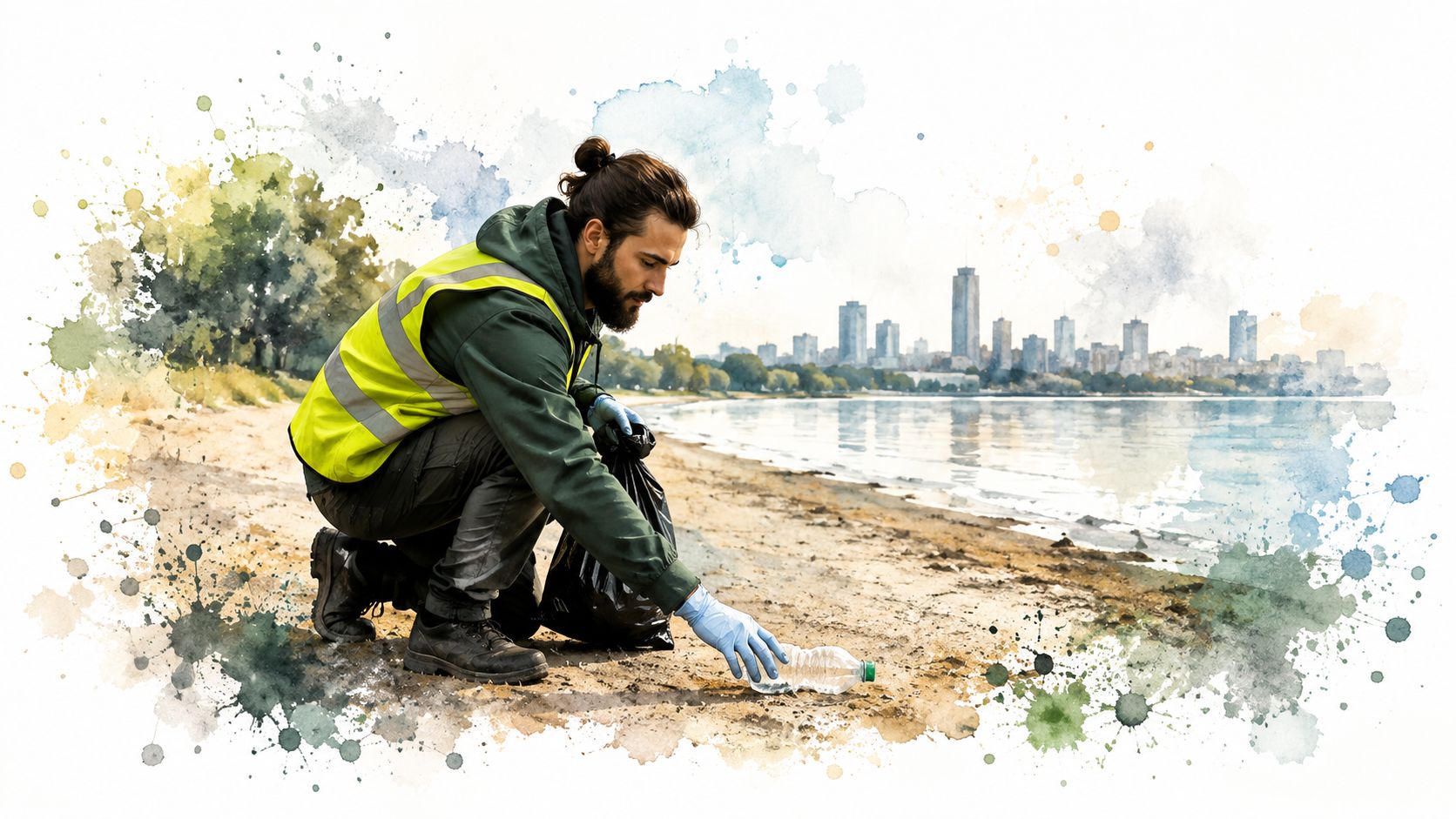
    A volunteer wearing a high-visibility vest picks up a plastic bottle from a beach, cleaning the coastline.

    Care for the place between events

    Build a working relationship with the Chicago Park District or the relevant park partner before assigning tasks. Decide how volunteers should report maintenance issues, where filled bags go, and which work requires staff or trained professionals. Monthly or twice-monthly gatherings can keep the site familiar without making every volunteer promise a permanent obligation.

    Families can join when the activity suits different ages. One person may collect litter, another may photograph conditions, and children may help with safe, supervised tasks. Document the park across seasons so returning volunteers can see changes without relying on memory.

    A beach cleanup also needs a weather plan, sturdy footwear, water, gloves, and a way to avoid sharp or unknown objects. Volunteers should report unsafe conditions, accidents, and injuries immediately, and they should know where first-aid supplies and evacuation routes are located, as described in this volunteer safety training checklist.

    8. Neighborhood Association and Block Club Integration

    A block club already knows who lives on the street, which alley creates frustration, and when neighbors gather. That knowledge can save an organizer from starting with a blank page. Instead of asking people to join a new institution, you can add a cleanup to a communication channel they already use.

    Pilsen neighborhood groups coordinate environmental work. The Lincoln Square Chamber of Commerce can partner on street and alley cleanups, while Rogers Park community organizations organize block cleanups. Each group may have different priorities, so listen before you propose a route.

    Earn trust before asking for turnout

    Attend an association meeting or contact a leader with a short plan. Explain how the cleanup supports the group's existing goals, then offer to handle logistics such as supplies, reminders, route planning, and waste disposal. Schedule around a neighborhood event, a seasonal change, or a day when residents already expect activity outside.

    • Ask about the problem first: Residents may prefer an alley, vacant edge, school route, or business strip.
    • Bring a finished plan: Include a meeting point, time, supply list, and safety contact.
    • Return with updates: Share photos, thank participants, and report what still needs work.

    You can connect cleanup with neighborhood pride without making promises about property values. People usually respond better when they can see a specific place, a reasonable task, and a group that will return.

    This route also works for newcomers. A block club can turn a new city into a set of familiar faces, one street at a time.

    9. Faith-Based Organization Service Programs

    A church, synagogue, mosque, or temple often has a service calendar, a gathering place, and people who already know the surrounding blocks. A cleanup can fit that rhythm when organizers approach the community with respect instead of treating it as a list of available volunteers.

    Trinity United Church of Christ in Chicago runs community service initiatives. The Jewish Federation of Chicago coordinates volunteer projects, and interfaith groups have worked on environmental stewardship in Chicago's South and West sides. These partnerships can bring together people who care about service for different reasons.

    Start with relationship, not recruitment

    Meet with a clergy member or community-service coordinator first. Explain the work, listen to the organization's priorities, and ask where a cleanup might fit. Respect major religious observances and the group's calendar. Bring a plan that includes supplies, safety, accessibility, transportation questions, and a clear end time.

    Invite faith leaders to share why service matters to their community, but don't ask them to promote a project they haven't reviewed. Offer to facilitate the cleanup and manage the details. Afterward, send thanks and a short update about the work.

    • Keep the invitation open: Make room for people who can contribute time, planning, hospitality, or translation.
    • Protect the group's culture: Follow local expectations around food, clothing, prayer, and photographs.
    • Build a return path: Invite interested participants to a recurring cleanup or another service day.

    Groups can use congregation-focused tools such as Taja AI for faith-based communities when they need help communicating with members. The human conversation still comes first.

    10. Social Media and Community Mobilization Networks

    A volunteer may discover Saturday's cleanup while scrolling in bed, then decide to attend because the post gives a time, a place, and a short list of what to bring. That small amount of information can remove the uncertainty that keeps people home. Instagram, Meetup, Facebook groups, and open chats can work as doors into in-person service.

    Litter Caterpillars uses Instagram storytelling and Meetup for events. Chicago Loves Its Parks uses Facebook for volunteer coordination, and environmental groups use branded hashtags to help participants recognize related activities. A clean event post should answer the practical questions before anyone has to send a message.

    Make the post do useful work

    Share photos with clear lighting and framing, then tell a short volunteer story about why that person returns. Before-and-after images give the audience a visible record. Post regularly, respond quickly, and use stories for weather changes, route updates, or last-minute reminders.

    • Write the basics first: Include the time, location, meeting point, duration, and what to bring.
    • Use a consistent identity: A hashtag, flag, shirt, or badge can help people find the same group again.
    • Thank people directly: Public appreciation can make a first-time volunteer feel seen.
    • Keep RSVP simple: Use Meetup or an open chat when a long application would add needless friction.

    You can also draw ideas from this guide for artists on community platforms, especially when you need to make a group feel welcoming online. Digital mobilization works best when it leads to a real meeting, a real task, and a clear way to return.

    Community Service Opportunities: 10-Item Comparison

    Activity 🔄 Implementation Complexity ⚡ Resource Requirements 📊 Expected Outcomes & Ideal Use Cases ⭐ Key Advantages 💡 Tips
    Weekly Neighborhood Cleanup Groups 🔄 Low, recurring coordination and simple logistics ⚡ Low, bags, gloves, grabbers, volunteer time Gradual visible neighborhood improvement; ideal for local blocks/wards ⭐⭐⭐ Strong community-building; low barrier to entry 💡 Schedule mornings; document before/after; create group identity
    Adopt-a-Highway and Major Corridor Programs 🔄 Medium–High, permits, safety planning, agency coordination ⚡ Medium, safety gear, larger crews, formal reporting High-visibility corridor improvements; ideal for long-term adopters and corporate sponsors ⭐⭐⭐ Official recognition; high visibility; sponsor appeal 💡 Coordinate with IDOT; use vests/flaggers; schedule after busy events
    Vacant Lot Transformation and Urban Gardening 🔄 High, land access, remediation, permitting, design ⚡ High, heavy removal, soil testing, funding, skilled partners Lasting beautification and community space; ideal for long-term investment projects ⭐⭐⭐⭐ Creates permanent change; attracts funding and deep ownership 💡 Start small; secure owner buy-in; plan maintenance & funding early
    School and Youth Organization Volunteer Partnerships 🔄 Medium, schedule alignment, supervision, curriculum links ⚡ Low–Medium, adult supervisors, basic supplies, educational materials Builds service habits and environmental literacy; ideal for schools and youth programs ⭐⭐⭐ Reliable volunteer base; educational & leadership benefits 💡 Tie activities to curriculum; provide recognition and leadership roles
    Corporate Team Building and Volunteer Days 🔄 Medium, packaged logistics, single-day coordination ⚡ Medium, supplies, staffing, possible sponsorships Rapid, high-output events; ideal for companies seeking team bonding and PR ⭐⭐⭐ Large short-term impact; potential funding and partnerships 💡 Offer turnkey packages; assign clear roles; follow up with impact metrics
    Environmental Education and Workshops 🔄 Medium, content development and skilled facilitation ⚡ Low–Medium, presenters, materials, demo supplies Behavior change and advocacy; ideal for classrooms, libraries, community centers ⭐⭐⭐ Addresses root causes; builds advocates 💡 Lead with stories and data; include hands-on demos and immediate takeaways
    Parks and Lakefront Stewardship Programs 🔄 Medium, coordinate with Parks Dept and monitoring systems ⚡ Medium, tools, reporting system, regular volunteer schedule Maintained public recreation spaces; ideal for families and intergenerational groups ⭐⭐⭐ City support; visible community benefit 💡 Establish formal Parks relationship; schedule regular stewardship; report issues
    Neighborhood Association and Block Club Integration 🔄 Low–Medium, navigate local governance and meetings ⚡ Low, access to lists, modest supplies, volunteer coordination Efficient recruitment and sustained campaigns; ideal where associations exist ⭐⭐⭐ Trusted channels; potential small grants 💡 Attend meetings first; offer to manage logistics; align with priorities
    Faith-Based Organization Service Programs 🔄 Low–Medium, schedule and cultural coordination with congregations ⚡ Low, volunteer pools, meeting space, occasional meals/supplies Values-driven sustained volunteering; ideal for faith communities and neighborhood outreach ⭐⭐⭐ Deep commitment; strong volunteer base 💡 Meet with clergy; align with calendars; explain mission alignment
    Social Media and Community Mobilization Networks 🔄 Medium, sustained content, moderation, and event management ⚡ Low, platform accounts, time for posts, RSVP tools Rapid recruitment, visibility, and ad-hoc turnout; ideal for outreach and youth engagement ⭐⭐⭐ Low barrier to entry; visual storytelling boosts participation 💡 Post 2–3x/week; use before/after photos; create branded hashtags and quick logistics

    Turn One Cleanup Into Your Regular Thing

    Chicago gives you many ways to begin. You can join a weekend-morning event on Meetup, contact a local nonprofit or school, ask a block club about a service day, or speak with a faith group that already organizes community work. You can explore Litter Caterpillars at littercaterpillars.com and see whether its weekly Chicago pickups fit your routine.

    Before you RSVP, run a quick fit check. How long will travel take from your home, school, or workplace? Can you manage the walking, bending, heat, cold, or uneven ground? Does the organizer explain safety plans, supplies, meeting points, and what happens if weather changes? Do people greet newcomers, answer questions, and respect different abilities? Can you keep the schedule without turning service into another source of stress?

    People volunteer through formal organizations and through direct help in their communities. Updated United Nations Volunteerism reporting estimates that about 2.1 billion people worldwide, or 34.5% of the working-age population, volunteer each month. The same reporting places monthly direct helping at 25.0% and organizational volunteering at 11.7%, showing why a neighborhood group or informal cleanup can be a genuine entry point, not a lesser version of service. Read the United Nations Volunteerism monthly volunteering estimates for the measurement details.

    If you need community service for a housing requirement, check your local housing authority before choosing an event. HUD guidance says many public housing residents in the United States must complete 8 hours per month of community service or an economic self-sufficiency program, with a combined total of 8 hours per month allowed. Residents may bank fewer hours in a month, but they must reach 96 hours before the next annual reexamination, according to this HUD community service and self-sufficiency guide.

    Safety deserves the same attention as scheduling. Wear the clothing the organizer requests, bring water, and ask before handling sharp, heavy, or unknown items. If you have COVID-19 symptoms, stay home. California volunteer guidance also advises keeping 6 feet of distance, washing hands before, during, and after a project, disinfecting surfaces, and covering coughs and sneezes with a tissue or elbow. See California Volunteers' safety guidance before joining a group that uses shared tools or works closely together.

    Make your first test small. RSVP, bring the requested supplies, introduce yourself to one volunteer, and return once before deciding whether the group fits. One morning can show you whether the route, people, pace, and purpose feel right.


    Litter Caterpillars hosts scheduled trash pickups across Chicago, with weekend-morning events, Meetup listings, Instagram updates, and open group chats that help volunteers join without a complicated process. Visit Litter Caterpillars to find an upcoming cleanup, meet people who care about their neighborhoods, and choose a service routine you can keep.

  • Watershed Protection: A Community Guide You Can Use

    Watershed Protection: A Community Guide You Can Use

    On a Saturday morning beside Chicago's North Branch, I watched a volunteer pull cigarette butts from a wet curb. Two feet away, a storm drain waited for the next hard rain.

    Why Litter on Your Curb Is Really a Watershed Story

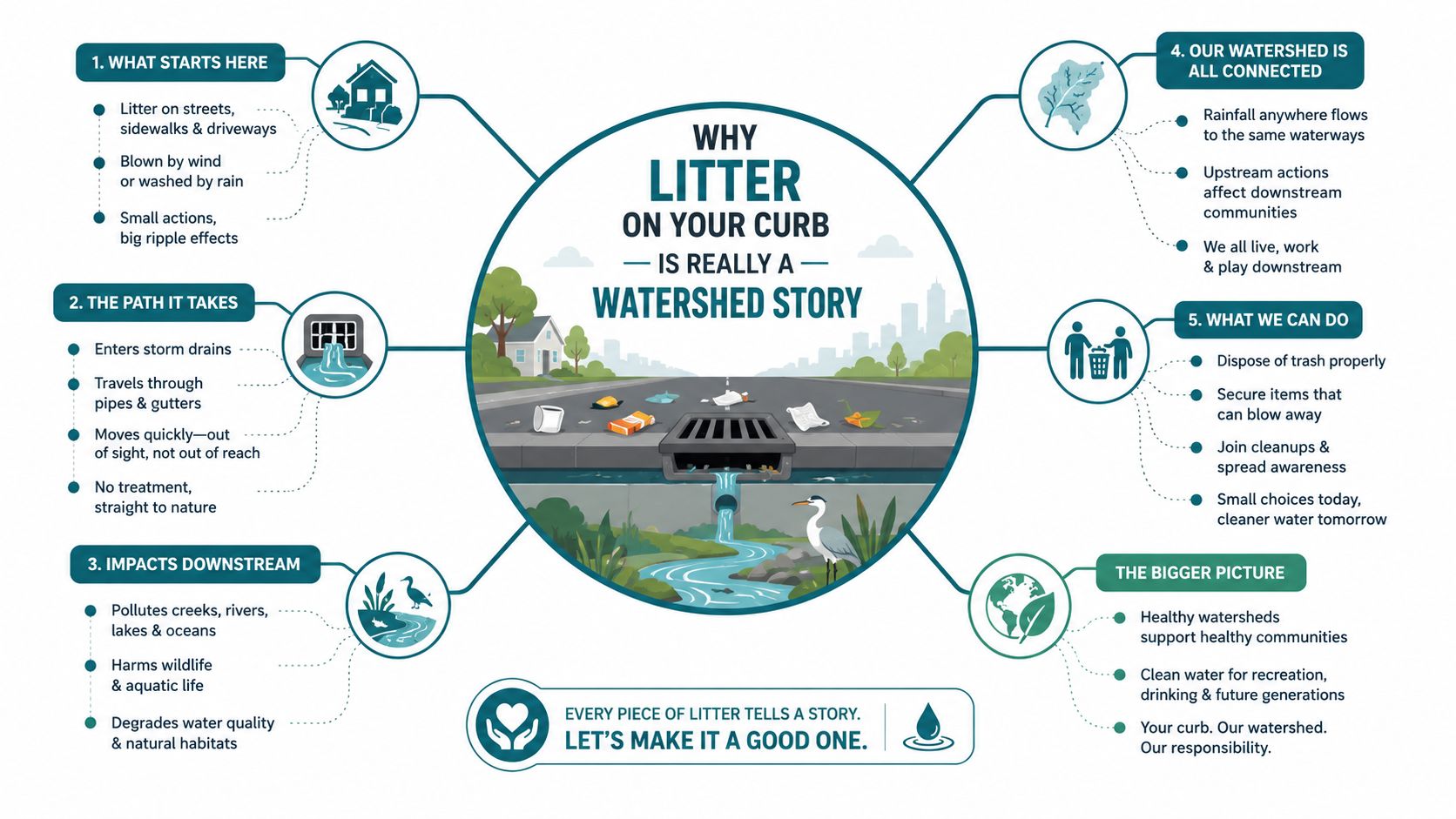
    I've learned to treat every block as a small watershed. A watershed is the land area that sends water toward the same creek, river, lake, or wetland. On our street, a raindrop hits a roof, rolls into a gutter, slips through a storm drain, travels through a sewer or channel, and eventually reaches the Chicago River system and Lake Michigan.

    That trip gives ordinary trash a route. A wrapper near the curb can move with rainwater. Pet waste can wash from a sidewalk into the same drainage network. Lawn chemicals can leave a yard during a storm. The Environmental Protection Agency's explanation of stormwater runoff describes how rain and snowmelt pick up sediment and contaminants from streets, rooftops, and lawns before reaching surface water or groundwater.

    Chicago's combined sewer system adds another layer. During heavy rain, stormwater and wastewater can enter the same system, and that can create overflow problems. A single summer storm can move a day's worth of loose litter off the curb before a crew gets back to it.

    An educational infographic explaining how litter on streets travels through storm drains to impact local watersheds.

    Follow the drop

    Friends of the Chicago River has reported bacteria and nutrient readings over the years that connect street-level behavior with water quality. I don't need a laboratory result to understand the basic chain. When a crew removes waste before rain reaches the drain, we remove material from the water's path.

    Field rule: If you can see trash beside a drain, treat it as a watershed input, not a cosmetic problem.

    The same logic applies to soil. The USDA Natural Resources Conservation Service reports that watershed projects across the United States generate more than $2.2 billion in average annual benefits for more than 48 million people, while reducing 92,341,221 tons of soil erosion per year. Those benefits include flood protection and agricultural and non-agricultural gains, so watershed protection reaches beyond cleaner water to the land around it. You can read the USDA watershed benefits fact sheet for the full breakdown.

    I keep a bag of curb litter separate from the rest of our haul when possible. It helps volunteers see what they removed from the drainage route. That bag becomes a simple, measurable record of what the next storm didn't carry downstream. For more practical reasons to remove it, see this guide to picking up litter before it travels.

    How to Plan a Cleanup That Protects a Watershed

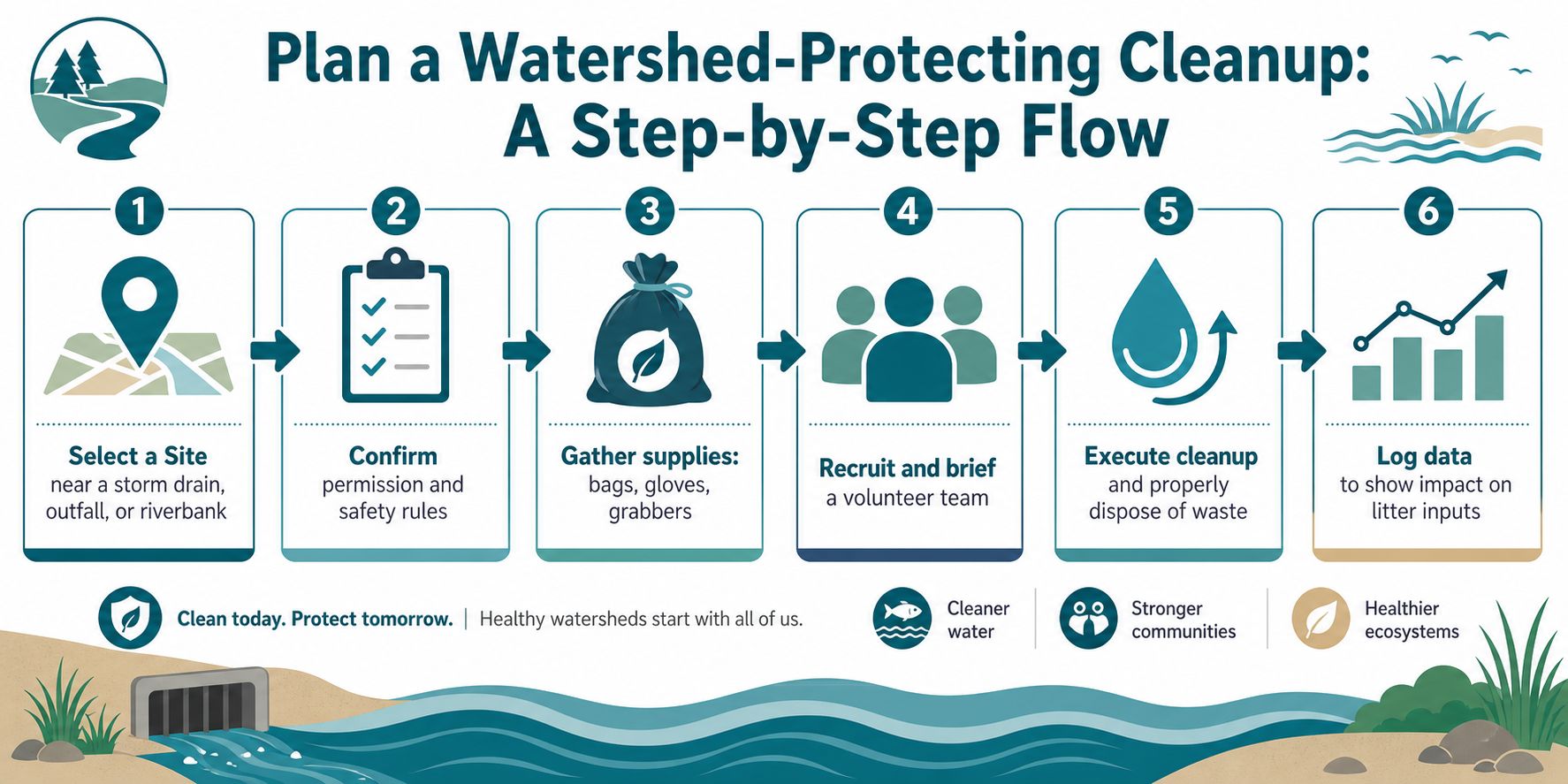
    A cleanup protects a watershed when you choose the site, record the waste, and handle disposal with the next storm in mind. I start with a map, not a stack of bags.

    Two weeks before the cleanup

    Pick a site beside a storm drain, outfall, creek, or riverbank. Walk the route after rain if you can. Look for clogged inlets, low points where wrappers collect, bare soil, and places where people cut across grass toward the water.

    Check event calendars from the Chicago Park District and Friends of the Chicago River before you announce anything. Confirm permission, access, disposal rules, and whether the site needs a permit. Notify Chicago Streets and Sanitation, the ward office, nearby property managers, local sponsors, and any park or river partner connected to the location.

    Recruit through a school, block club, church, neighborhood group, or alderman's office. Give each person a clear meeting point and a short description of the work. A volunteer who knows the route and safety plan arrives ready to help.

    A step-by-step infographic on how to organize a volunteer cleanup event to protect local watersheds.

    One week before the cleanup

    Gather heavy-duty bags, nitrile gloves, work gloves, grabbers, buckets, first-aid supplies, water, reflective vests, sunscreen, hand sanitizer, and a scale. Bring puncture-resistant containers for sharp objects. Arrange transportation for the filled bags and decide who will contact the city if illegal dumping appears.

    Create a simple sorting sheet:

    • Plastic and food packaging: Record the common items and where you found them.
    • Cigarette waste: Keep it separate because it often concentrates along curbs and entrances.
    • Glass and sharp objects: Let a trained adult handle them.
    • Metal and bulky waste: Photograph unusual items and report them through the proper city channel.
    • Pet waste: Use sealed bags and keep it away from other collected material.

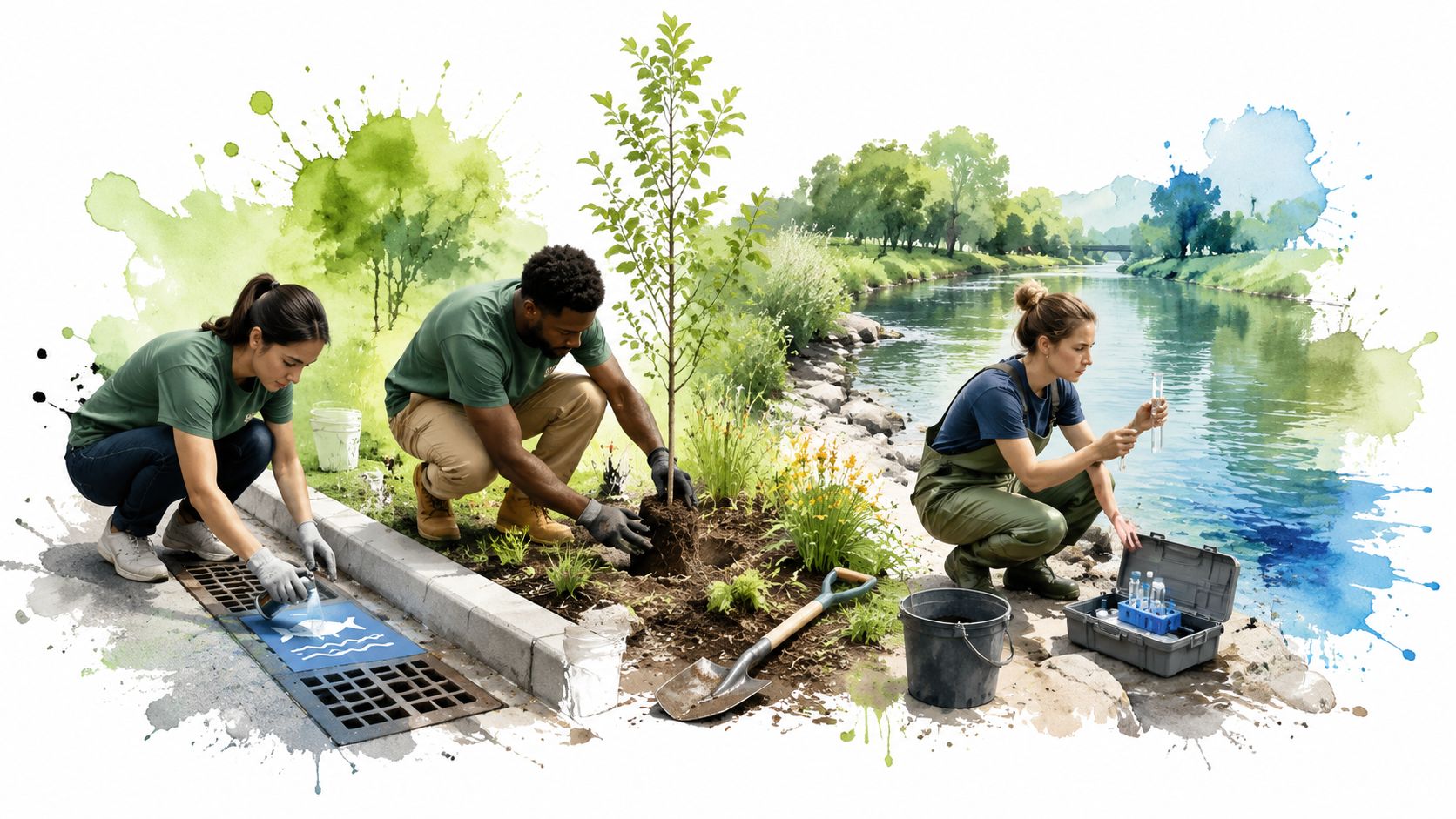
    Use the Alliance for the Great Lakes Adopt-a-Beach app to log the data. Take photos before work begins and after the route looks clear. Stencil storm drains only with permission and approved materials. The message should tell people where the water goes, not just ask them to keep the street tidy.

    Event day and the follow-up

    Open with a safety briefing. Review traffic, broken glass, needles, unstable banks, heat, hydration, and the rule that nobody reaches into hidden spaces. Assign one person to supervise children and one person to track bags, weights, categories, and photographs.

    After the cleanup, place waste where the city or site partner instructed. Weigh and sort before disposal when conditions allow. Meet for a short debrief, write down blocked drains and recurring litter spots, then upload the record and share it with your partners.

    For a practical event model, use this community cleanup planning guide as a starting point. The point of the data isn't to decorate a report. It helps you choose the next drain, the next block, and the next stormwater fix.

    Stormwater Moves You Can Run on Your Block

    I rank stormwater work by effort, cost, and how close it sits to the runoff source. Start where water leaves your property, then work outward with neighbors.

    A roof can send a surprising volume toward the street. One inch of rain on a 1,000-square-foot roof produces about 600 gallons of runoff, according to the National Oceanic and Atmospheric Administration's rain barrel guidance. Check the exact roof area and local rules before choosing a barrel size.

    Start with small habits

    Redirect downspouts toward a lawn or approved rain barrel. Sweep sidewalks instead of hosing them. Pick up pet waste within a day, and avoid spreading fertilizer before rain. These actions take little equipment, and they keep loose material away from the curb.

    Medium-effort projects include a rain barrel, a downspout planter, a small rain garden near a garage or side yard, and native deep-rooted grasses. Disconnect a sump pump from the sewer only where local rules allow it, and confirm the discharge won't send water toward a neighbor's foundation.

    At block scale, plant trees through programs such as TreeKeeper or Openlands' Tree Census. A mature oak can intercept thousands of gallons per year, according to Openlands' tree information. Consider permeable pavers for a parking pad and work with neighbors on bioswales near bus stops. Chicago examples include green alleys in Avalon Park and rain gardens at the Chicago Center for Green Technology.

    Move Effort Estimated Runoff Benefit
    Sweep instead of hosing Low Keeps loose sediment and litter out of drains
    Redirect a downspout Low Sends roof water toward soil instead of pavement
    Pick up pet waste Low Removes a direct contamination source
    Install a rain barrel Medium Stores roof runoff for later garden use
    Build a small rain garden Medium Holds and filters water near the source
    Plant deep-rooted natives Medium Helps soil absorb and hold water
    Plant a street tree High Adds canopy interception and soil uptake
    Install permeable pavers High Lets rainfall enter the ground through the surface
    Partner on a bioswale High Slows and filters runoff across a shared route

    For tree selection and Chicago planting ideas, browse this guide to trees in Illinois. Match the move to the problem. Pooling calls for storage and infiltration. Basement seepage calls for careful grading and downspout control. Hot, dirty runoff calls for shade, soil, and planted filtration.

    Green Infrastructure Options From Easiest to Most Ambitious

    The right project depends on what your block needs, what your soil can absorb, and who controls the land. Chicago's heavy clay can slow infiltration, so a rain garden may need an underdrain or a different soil mix. Don't dig first and investigate later. Check utilities, property lines, drainage patterns, and approval requirements.

    Option Cost Effort Footprint Watershed Impact Permit?
    Rain barrel Low Weekend Small Stores roof runoff for later use Check local rules
    Downspout planter Low to medium Weekend Small Filters water near the building Check local rules
    Rain garden Medium Weekend to several days Small to medium Holds and filters runoff Confirm with local office
    Alley bioswale Medium to high Multi-weekend Medium Slows shared pavement runoff Coordinate with city
    Permeable paver parking pad High Several days Medium Sends rainfall into a porous surface Confirm paving rules
    Tree trench under sidewalk strip High Multi-month Medium to large Adds soil storage and canopy Coordinate with city
    Curb-cut bioswale High Multi-month Large Captures street runoff at the curb Coordinate with city and Space to Grow

    Match the tool to the water

    A rain barrel works when you need to hold roof water and have a safe overflow route. A downspout planter fits a tight side yard. A rain garden needs a low point, but it shouldn't sit beside a foundation or where standing water creates a hazard.

    An alley bioswale makes more sense when several properties send runoff toward the same route. Permeable pavers can help a parking area, but the base must drain properly. A tree trench needs room beneath the sidewalk, cooperation from the city, and a long maintenance plan.

    Curb-cut bioswales require the most coordination. Chicago's Space to Grow program can provide a useful partnership model for schoolyards and public sites, though each project still needs site review and approval.

    Choose by failure point: Fix the place where water pools, seeps, heats up, or carries sediment. A larger project isn't automatically a better one.

    Test the soil before you commit. If water sits in a test hole for too long, ask a qualified designer about underdrains, amended soil, or a different location. Keep overflow away from basements and neighboring lots. Green infrastructure works through placement and maintenance, not appearance alone.

    Monitoring Water Quality Without Fancy Lab Gear

    I've seen volunteers avoid monitoring because the equipment looks technical. Start with observations and keep your notes consistent. A simple record from the same location can tell you more than a single dramatic sample.

    Four field checks

    1. Visual clarity tube: Fill a clear tube and record what you can see through the water. Note floating trash, foam, oil sheen, unusual color, and sediment.
    2. Turbidity check: Use a Secchi disk or a simple DIY disk to track cloudiness. More cloudiness can point to suspended sediment or disturbed material.
    3. Dissolved oxygen: Use a Hach drop kit or another simple chemical kit. The reading helps you understand whether the water holds oxygen for aquatic life.
    4. Bacteria screening: Use E. coli test strips from a science supply store. Treat the result as a screening signal, follow the kit directions, and avoid contact with the sample.

    Record the date, time, weather, recent rainfall, location, water level, smell, color, clarity, and every test result in a shared spreadsheet. Use the same container, method, and sampling spot each time. Add photographs from the same angle so your visual record stays useful.

    Avoid the two common traps

    Testing immediately after rain can make every result look worse because runoff stirs sediment and carries fresh contaminants. That doesn't make post-rain testing useless, but label the conditions clearly and compare it with dry-weather readings.

    The second mistake is waiting for perfect gear. A clear tube, a notebook, photographs, and careful descriptions can establish a baseline. Escalate unusual color, strong odors, fish distress, repeated sewage indicators, or unsafe conditions to Friends of the Chicago River or the Metropolitan Water Reclamation District. Don't handle suspicious material yourself.

    Building Partnerships and Telling the Right People

    A cleanup that happens twice can disappear from a neighborhood's memory. A cleanup that returns on the same route with the same sponsor creates a habit, a record, and a reason for people to keep the drain clear.

    Start with the person who can say yes. For a hardware store donation, ask the store manager instead of sending a message to a corporate office. For an aldermanic support letter, contact the ward office and send a short one-page request. For a school or church base, ask for a recurring weekend meeting place, storage space, or volunteer announcement.

    Use a plain pitch

    “We're organizing a neighborhood cleanup beside [specific site]. We'll remove and sort litter, record the waste, photograph the route, and share the results. Could you provide [specific supplies, space, volunteers, or letter] for [specific event or recurring schedule]?”

    Ask for a concrete in-kind contribution or dollar amount that fits the partner's capacity. Request bags, gloves, grabbers, water, printing, hauling help, or a small project budget. Don't ask for “support” without saying what support means.

    Chicago has several useful doors: local watershed groups, the city's Green Stormwater Infrastructure team, neighborhood chambers, schools, park partners, and nearby businesses. Give each partner a job that connects to its reason for participating. A hardware store can supply tools. A school can recruit families. A ward office can help route a report about blocked drains.

    Follow up after the event with photos, the sorted waste record, and one sentence about what you'll do next. Send a thank-you soon after the work, then return with a specific year-two request when you have a new date and a clear task. Consistency makes the next ask easier because the partner can see where its help went.

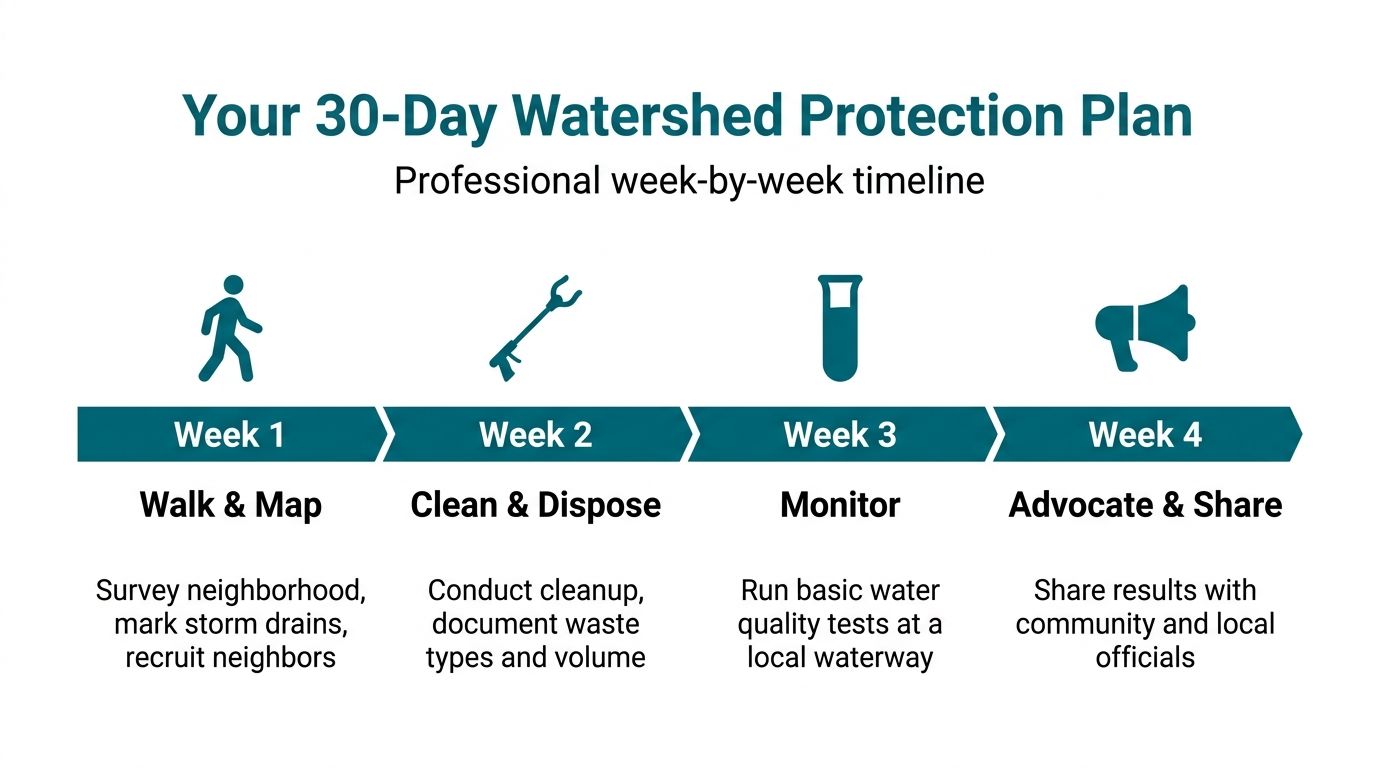
    Your 30 Day Watershed Protection Plan

    I'd start on Monday with one block, one drainage route, and five neighbors. You don't need to solve the whole river. You need to learn where water moves and keep showing up there.

    Week one, walk and map

    Walk the neighborhood and mark storm drains, pooling spots, litter traps, downspouts, and access points near the North Branch Chicago River. Recruit five neighbors for a kickoff cleanup. Choose a safe meeting point and contact the relevant site partner before you set the date.

    Week two, audit and prepare

    Run a household stormwater audit. Trace each downspout, inspect the route from roof to street, look for bare soil, and note where water reaches pavement. Swap a small planting area to native plants, and sign up for monitoring training through Friends of the Chicago River.

    Week three, install one move

    Choose one project that fits the problem. A rain barrel can handle roof runoff. A downspout planter can help a tight side yard. A curb-cut rain garden on a Logan Square boulevard needs permission, design review, and coordination, so treat it as a shared project rather than a casual weekend dig.

    A professional four-week infographic timeline illustrating a step-by-step plan for community watershed protection and environmental cleanup.

    Week four, document and ask

    Hold the public cleanup. Photograph the route before and after, sort and record the waste, and run a basic water-quality check before and after under clearly labeled conditions. Send the photo set and results to the local alderman, then write a specific request for a Green Infrastructure Grant.

    The first time I ran a cleanup, I wanted a heroic result. I wanted one hard morning to fix the block. The work taught me something plainer. Measurable outcomes follow consistency, not heroics.

    Pick one block and show up four Saturdays in a row. Bring a friend, track what you remove, watch what returns, and adjust the next move to the water's path.


    Litter Caterpillars brings Chicago volunteers together for recurring, hands-on cleanups built around safety, friendship, and block-by-block service. Visit Litter Caterpillars to find a cleanup, meet the crew, and turn your next Saturday morning into practical watershed protection.

  • Chicago River Cleanup: Join or Organize Your Own Event

    Chicago River Cleanup: Join or Organize Your Own Event

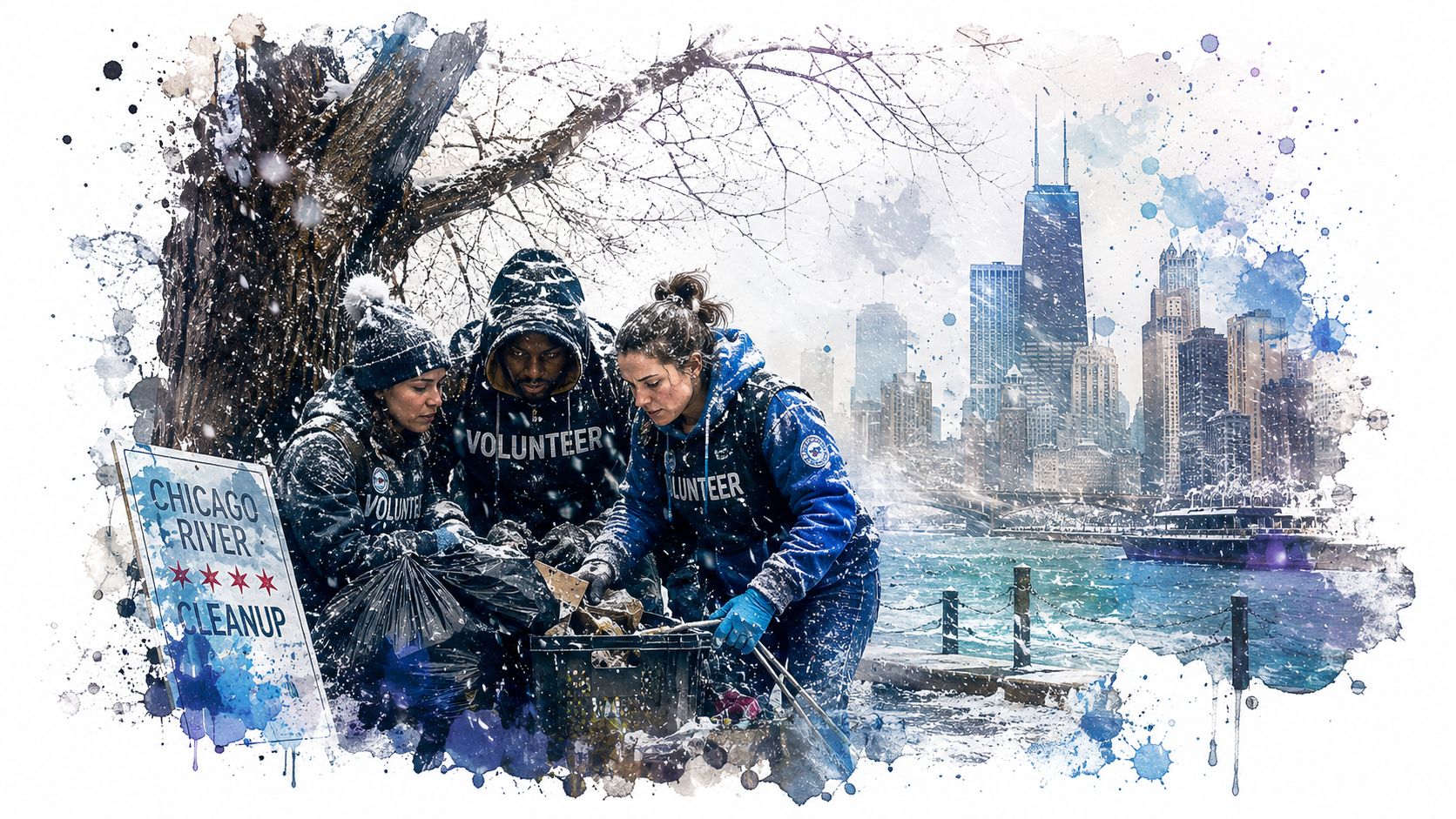
    The first time I hauled trash off the Chicago River bank, a spring hail storm rolled in so hard it felt like somebody was throwing ice cubes at my face. Three of us crouched under a tree, wet through, while every Uber canceled one by one, and we laughed anyway because the river had finally found a way to humble us together.

    That day taught me something I still believe. A Chicago River cleanup is never only about the trash in your bag, it's about the person who shows up beside you when the weather turns rude and the work gets real.

    Why Showing Up Matters More Than You Think

    The weird truth about river cleanup is that the messy part isn't the litter. It's your own excuses, your own comfort, your own habit of saying “next weekend” when the bag is already in your hand. When I think about that hail-storm day, I don't remember the trash pile as much as I remember who stayed cheerful, who helped, and who turned a miserable afternoon into a story we still tell.

    What a rough cleanup day reveals

    You learn fast that cleanup work filters people. The ones who arrive on a freezing Saturday morning and still smile usually bring that same energy to friendship, work, and life. That matters because a cleanup group isn't built on one heroic day, it's built on repeated small acts, the kind that make strangers recognizable and then familiar.

    Practical rule: if someone only shows up when the weather is perfect, they're a visitor. If they show up in sleet, they're part of the crew.

    The culture around the river gets better when people treat service like a habit instead of a performance. That's why weekend mornings work so well for groups that want steady, service-minded volunteers. You're not just collecting trash, you're building a circle of people who don't flinch when the work gets uncomfortable.

    Three volunteers cleaning trash from the Chicago River bank during a snowy winter day in the city.

    Why the best groups feel like a team

    The strongest crews I've seen have a simple rhythm. They greet each other, they divide the load, and they laugh at the absurdity of pulling soda cups and snack wrappers out of cattails while their fingers go numb. That shared grit builds trust faster than small talk ever could.

    Litter Caterpillars talks about bravery, kindness, and unity, and that language makes sense to me because service changes how you carry yourself. You stop asking, “How little can I do?” and start asking, “Who can I help stand up a little straighter today?”

    Planning Your Cleanup From Permits to Site Selection

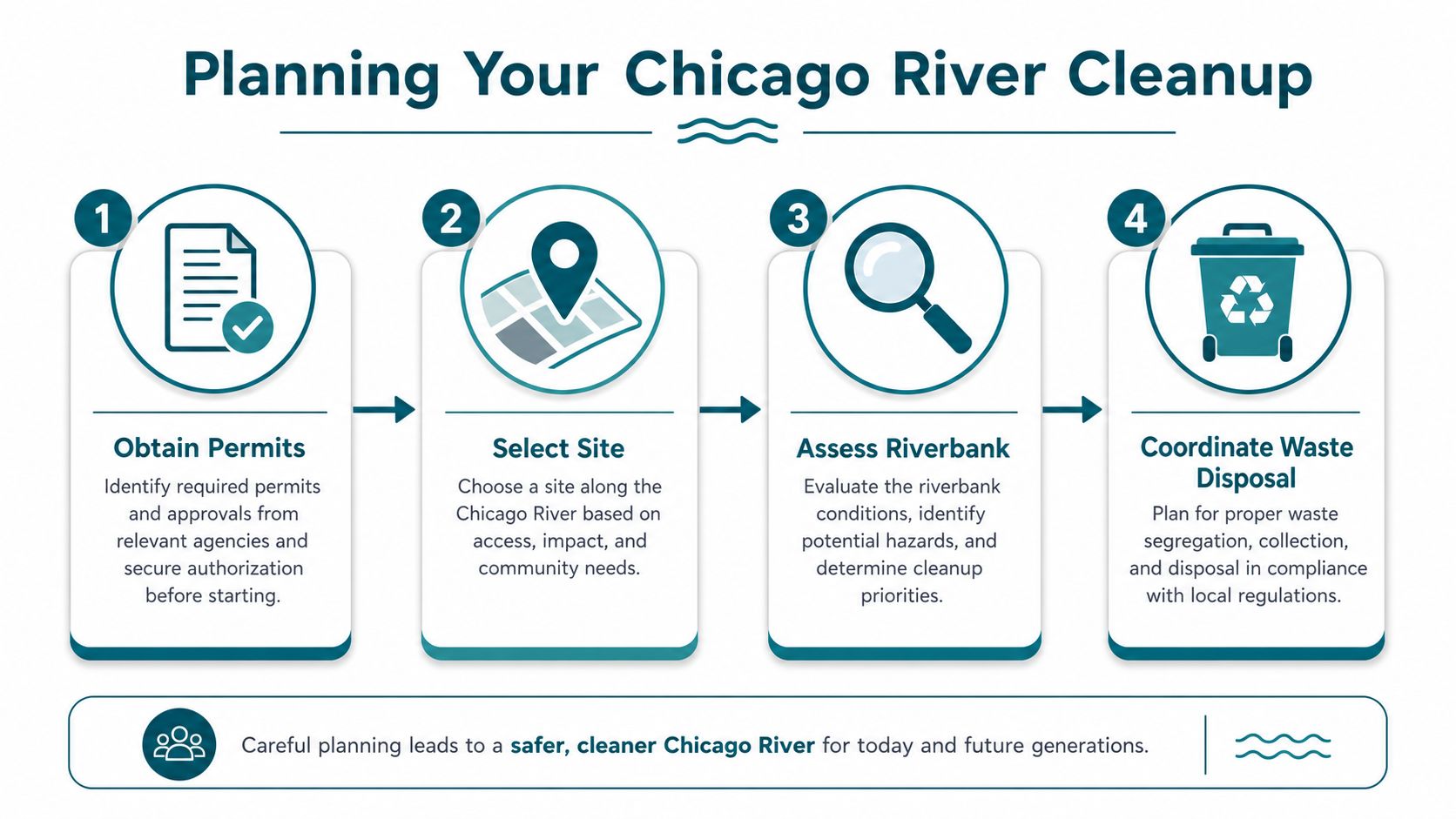
    A good cleanup starts before the first glove goes on. I've watched eager crews waste half a morning because nobody checked who owned the bank, where people could enter, or whether the ground near the water would hold a boot. The Chicago Rivers Demonstration Program handbook says strong projects begin with an in-depth understanding of ownership, permits, bank condition, wildlife use, access, vegetation, and public safety What's Working on Working Rivers.

    Start with the riverbank, not the trash bag

    I always tell people to stand on the site first and look around like they're new to the city. Who controls this stretch of bank? Can volunteers safely reach the edge? Is the ground muddy, steep, fenced, or packed with roots? If you can't answer those questions, you don't have a cleanup site yet, you have a problem in search of a plan.

    A smart organizer also maps where trash keeps coming from. Street runoff, storm drains, and access points often matter more than the single pile of litter you can see from the path. The city's guidance on cleanup work says debris washed from streets can enter the river, which is why street sweeping, source control, and proper trash disposal all belong in the same conversation Chicago River Agenda.

    Practical rule: don't chase every piece of visible litter if the same runoff path keeps feeding the river tomorrow.

    That mindset changes how you choose between a bank cleanup and a boat cleanup. Bank work is great for access points, embankments, and public-facing stretches. Boat work makes sense where litter gathers in the channel or where shore access is poor. I've seen crews get better results when they match the tool to the leak, instead of forcing one method onto every site.

    Use a simple planning checklist

    Before I invite volunteers, I want these questions answered.

    • Permits and permission: Who approves the work, and what limits apply to the site?
    • Access and exits: How do people get in safely, and how do they get out fast if weather shifts?
    • Bank condition: Is the ground stable, slippery, or cluttered with hazards?
    • Wildlife and vegetation: Are there nesting areas, sensitive plants, or protected habitat zones?
    • Waste handling: Where does the collected trash go after the event?

    If you want a practical planning template, I'd point you to Litter Caterpillars' volunteer event planning page, because the right prep makes the day feel calm instead of chaotic.

    An infographic showing four steps for planning a Chicago River cleanup, including permits, site selection, assessment, and disposal.

    If you want the organizing side of cleanup to feel less like guesswork, use the same method every time. Pick the site, walk it, note the leaks, then choose the cleanup style that fits the river instead of the one that looks best in a group photo.

    Safety Protocols for Bank and Boat Cleanups

    I've cleaned the river in scorching heat, in damp cold, and in wind so sharp it made my ears hurt. The day always starts the same way for me. A small crowd gathers, gloves on, coffee in hand, and somebody asks where the worst trash will be hiding. Then I give the same answer, the spots that look ordinary until you bend down and find glass, metal, or something nobody wants to name out loud.

    Safety comes first, then volunteer happiness, because once people feel rushed or exposed, the day goes sideways fast. That is why I never start an event without a briefing, even if everybody looks eager and ready to sprint. The point is to send people home tired, dirty, and proud, not limping back with a story nobody wants.

    What to cover before anyone touches trash

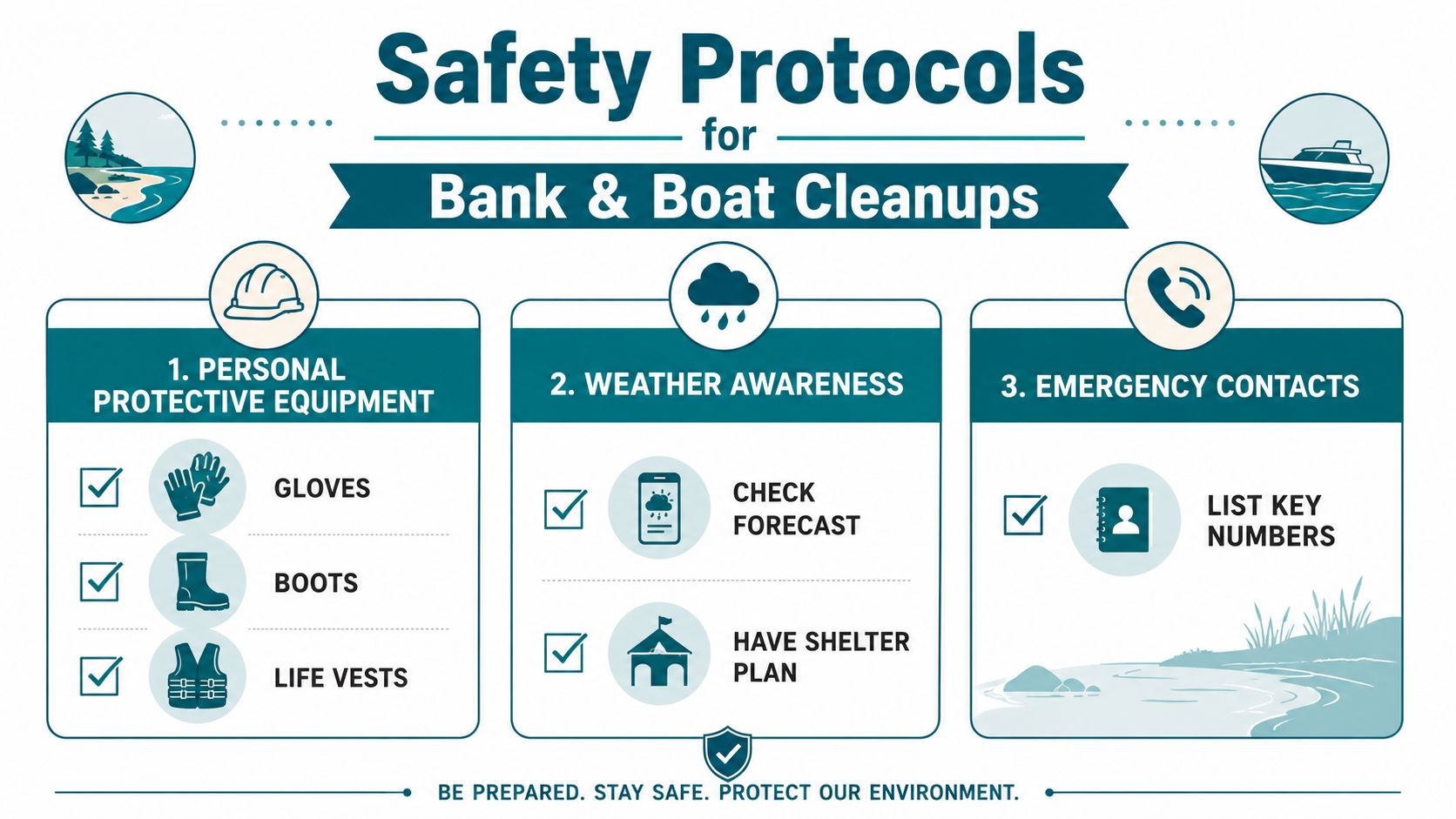
    A good safety talk should be short, direct, and specific. Tell people where sharp objects are likely to hide, how to handle anything that looks like medical waste or chemical waste, and where to go if they need help. Put the emergency contacts in everyone's phone before the event starts, not after someone loses a shoe in mud.

    For bank cleanups, I want gloves, sturdy boots, and a clear rule about staying away from unstable edges. Loose gravel, slick algae, hidden drop-offs, and half-buried rebar can turn a cheerful morning into a bad scene quickly. For boat cleanups, I want life vests, a calm operator, and an honest read on water conditions before launch. If weather changes, I'd rather stop early than pretend grit can cancel lightning, icy wind, or rising water.

    If the forecast looks ugly and the site feels worse, call it early. Volunteers remember that you protected them.

    Build a buddy system and respect the weather

    I like cleanup crews to move in pairs. One person scans the ground, the other watches the surroundings. That simple habit cuts down on missed hazards and keeps nobody isolated if something goes wrong.

    The same goes for temperature. On hot days, you need shade, water, and a pace that doesn't turn volunteers into fried extras in a riverbank movie. On bitter days, you need warm-up breaks and a hard line on frostbite risk. Volunteer-first groups get this right because they treat energy as fragile, not infinite.

    If you're organizing with boats, I'd also look at Litter Caterpillars' urban kayaks page for another example of how people approach water-based work and access.

    A safety infographic for bank and boat cleanups covering protective gear, weather awareness, and emergency contact procedures.

    The best safety culture I've seen is calm, not dramatic. Nobody gets praised for pushing through a bad call. People get praised for saying, “Hold up, this doesn't feel right,” and saving the group from a stupid mistake.

    Supplies, Disposal, and Partner Organizations

    A cleanup starts to feel real the moment the gloves come out of the bin and the trash bags stop looking symbolic. I've seen crews stall because nobody brought a grabber, and I've seen crews finish strong because one neighbor showed up with a box of extra work gloves and a steady hand for the sharp stuff. Good supplies keep the day moving, and good disposal plans keep the river from becoming a temporary storage unit for everything we just pulled out.

    What I pack and why it matters

    For a typical crew, I want gloves, grabbers, heavy-duty bags, and a first aid kit at minimum. I also want a way to separate sharp trash from regular trash, because nobody enjoys fishing a broken bottle out of a sagging sack with their elbow. The city asks residents to report dumping through 311, which helps teams respond where the litter keeps coming from. For hazardous items, I send people to Chicago hazardous waste disposal guidance so they know what belongs in a cleanup bag and what needs a different route.

    Essential Cleanup Supplies and Sources Quantity per 10 Volunteers Where to Source
    Work gloves 10 to 12 pairs Hardware stores, community donations
    Grabbers 4 to 6 Cleanup supply vendors, borrowed gear
    Heavy-duty bags 15 to 20 City supplies, bulk retailers
    First aid kit 1 Pharmacy, outdoor store
    Hand sanitizer 2 bottles Grocery store, pharmacy
    Sharps container or rigid box 1 Medical supply source or approved disposal partner

    How disposal and partnership work together

    The City of Chicago and the Metropolitan Water Reclamation District already run boats that clean the river and respond to citizen complaints. Their work matters because cleanup doesn't stop at the shoreline. It keeps moving through the system, from the street to the storm drain to the channel.

    Friends of the Chicago River keeps that reality in view. The group says the Chicago and Calumet system still gets an average of 3,095 cubic yards of trash a year from the Metropolitan Water Reclamation District and the City of Chicago, and it cites the 2020 National Litter Study showing U.S. litter cleanup costs at $11.5 billion each year, with 80% of that cost paid by businesses, plus property values can drop by over 7% in communities with heavy litter Friends of the Chicago River.

    That's why I like to think in partnerships, not just supplies. A local café can sponsor water. A neighborhood group can recruit hands. A city contact can help with disposal. A cleanup works better when each partner owns one piece of the job and nobody tries to carry the whole river alone.

    The newer floating-trash systems and skimmer boats point in the same direction. City and MWRD boats have pulled about 3,400 cubic yards of debris over two years from the river, and that kind of output comes from routine, not luck.

    Building a Volunteer Culture That Lasts

    A cleanup group can't run on guilt. It runs on belonging. People come back when they feel seen, when the work feels meaningful, and when the room has enough warmth to make a cold morning worth it.

    Identity beats obligation

    I've watched groups grow faster when they give people a shared identity. Flags, theme songs, badges, and inside jokes sound silly until you see them work. They turn “I helped once” into “I'm one of us.”

    That matters because service gets easier when it feels like home. Weekend morning events help with that, because they sort out people who want to give from people who want applause. The result is a crew that feels less like a sign-up sheet and more like a team.

    People don't stay for the trash bags. They stay for the friend who remembers their name and saves them a pair of dry gloves.

    Make joining easy, then protect the energy

    I like simple entry points. Meetup helps people find the event. Instagram helps them see the culture before they arrive. An open group chat helps the first-timer ask, “Where do I park?” without feeling awkward. That low-friction welcome is how strangers become regulars.

    A volunteer-first group also has to guard its tone. Don't pressure people for money. Don't make every conversation about output. Don't treat burnout like a badge of honor. When people trust that their energy won't get squeezed, they come back with friends.

    Litter Caterpillars fits naturally for me as one option among many. It runs cleanup events, uses a volunteer-first approach, and builds social glue around the work, which is exactly what a lot of river cleanup efforts need when they want people to return week after week.

    I've learned that a crew with good chemistry can survive bad weather, ugly debris, and long walks back to the car with soggy bags. A crew without that culture usually falls apart the first time the weather acts like Chicago.

    Your Event Timeline and Day-Of Checklist

    The best cleanup days feel smooth because somebody did the unglamorous prep early. I like a simple timeline that keeps people calm and gets the trash off the ground without turning the event into a circus.

    A timeline you can actually use

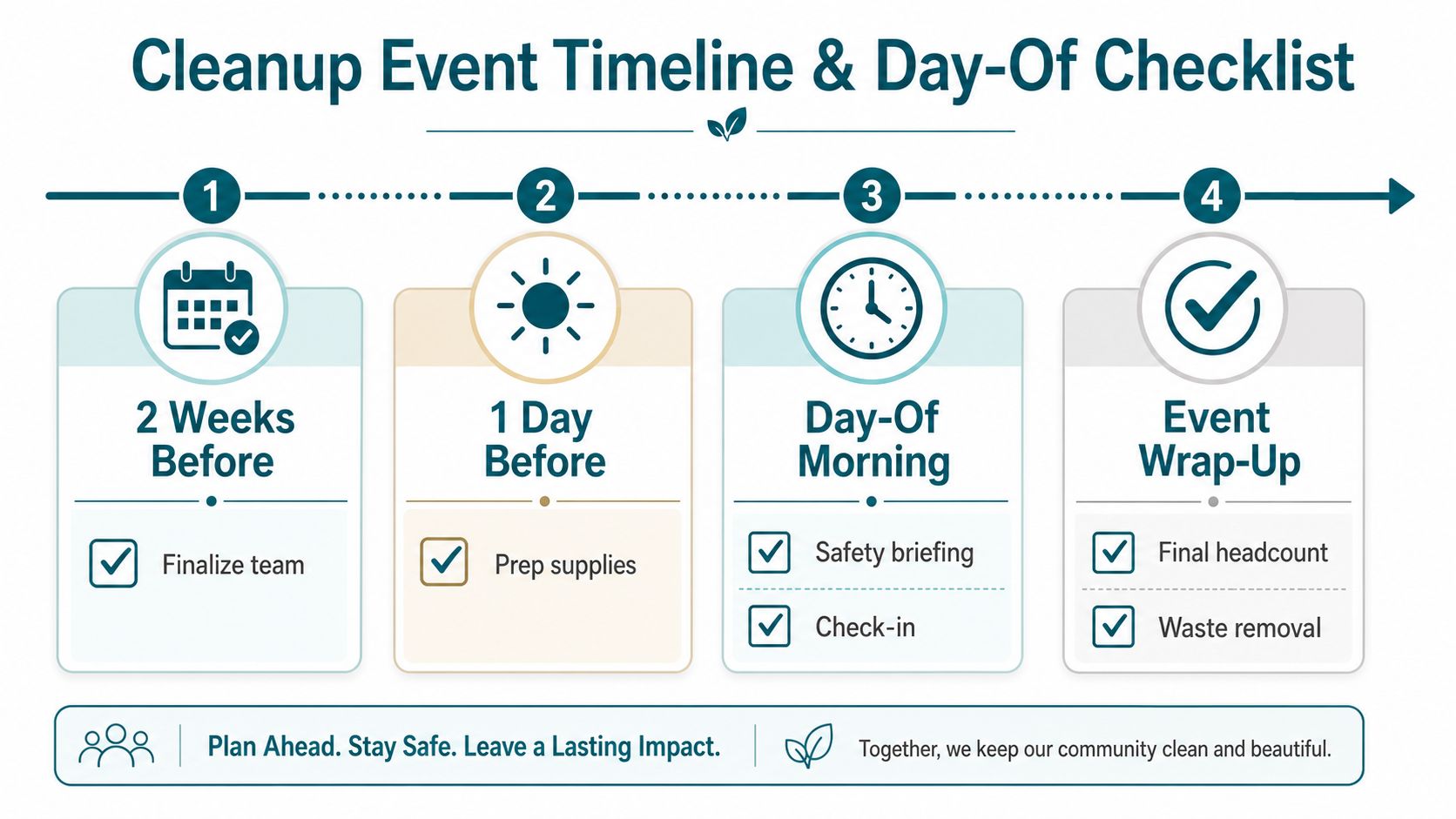
    • Two weeks before: lock the site, confirm permissions, recruit volunteers, and line up disposal.
    • One day before: check the forecast, prep supplies, and message the team with the meeting spot.
    • Day-of morning: do check-in, give the safety briefing, split people into zones, and hand out gear.
    • Event wrap-up: count heads, bag the last load, confirm waste removal, and thank the crew.

    A checklist that keeps the day on rails

    Use this before every event.

    • Permits and site access: confirmed
    • Supplies: gloves, bags, grabbers, first aid kit, water
    • Volunteer communication: meeting time, address, weather note
    • Safety plan: buddy system, emergency contacts, hazard rules
    • Weather watch: forecast checked one last time
    • Disposal plan: pickup or drop-off confirmed
    • Wrap-up plan: headcount, photos, partner updates

    A four-step cleanup event timeline and day-of checklist infographic to organize community cleaning activities successfully.

    A good wrap-up matters because it gives people closure. Send the photos, thank the volunteers, and tell them what changed block by block. That little habit turns one Saturday into the next one, and that's how a cleanup becomes a habit instead of a one-off.


    If you want to turn river cleanup into a real weekend rhythm, Litter Caterpillars runs volunteer-driven cleanup events in Chicago and keeps the focus on safety, friendship, and getting out there together. Visit the site, pick a date, and bring a friend who doesn't mind a little mud, because the river always has room for one more person willing to show up.

  • Les Arends Forest Preserve: The Ultimate Visitor Guide

    Les Arends Forest Preserve: The Ultimate Visitor Guide

    I pulled off Route 31, killed the engine, and heard the Fox River before I saw it. A few steps later, the trees opened, and Les Arends Forest Preserve felt a lot bigger than its 60 acres should've allowed.

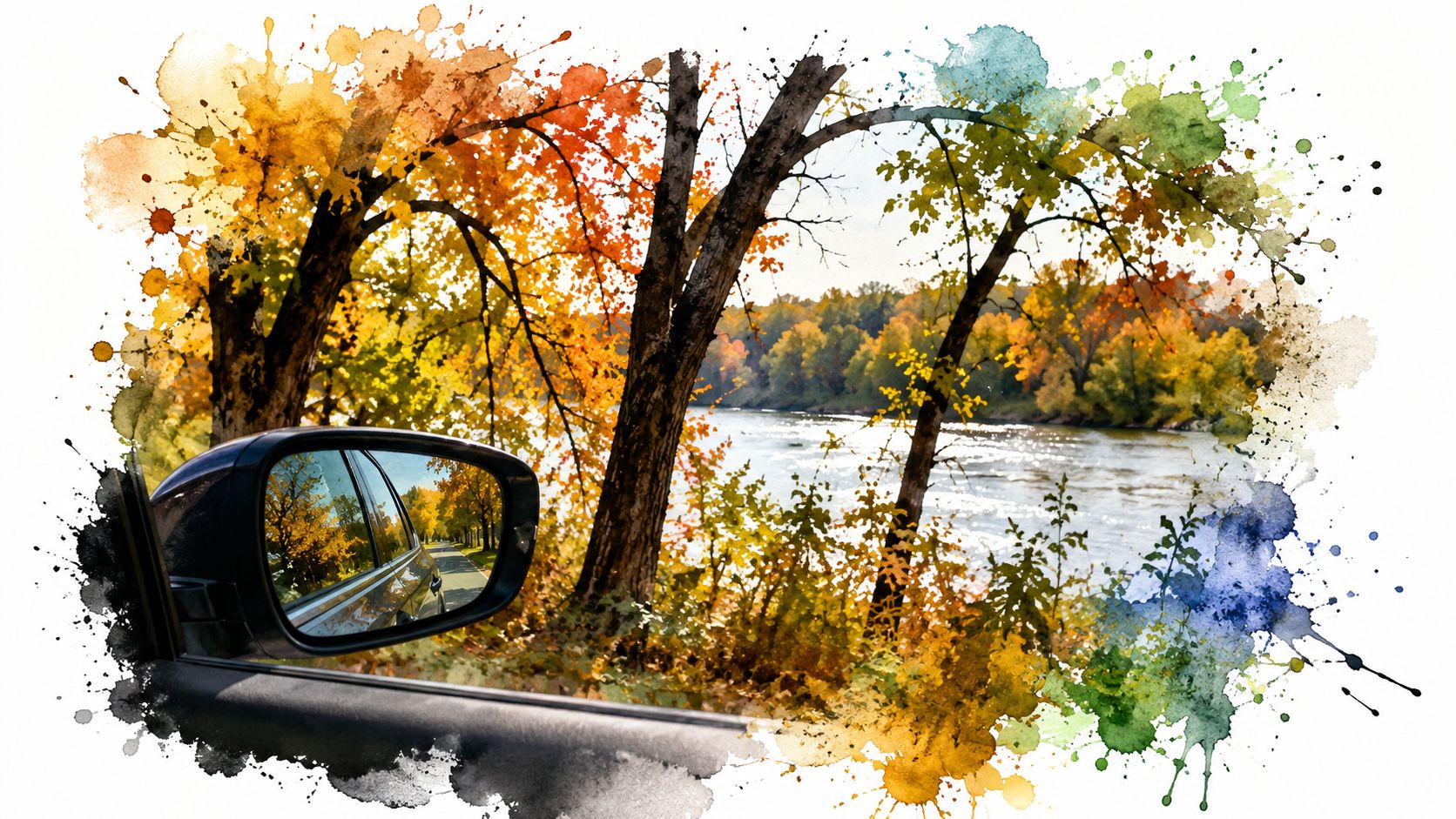
    A car side mirror reflecting an autumn forest landscape view next to a scenic river, watercolor style.

    Why This Small Preserve Deserves Your Attention

    The first time I came here, I expected a quick lap and a quiet drive home. What I got was a trail system that keeps folding back toward the river, then slipping into woods, then opening again where the water talks louder than the traffic on Route 31.

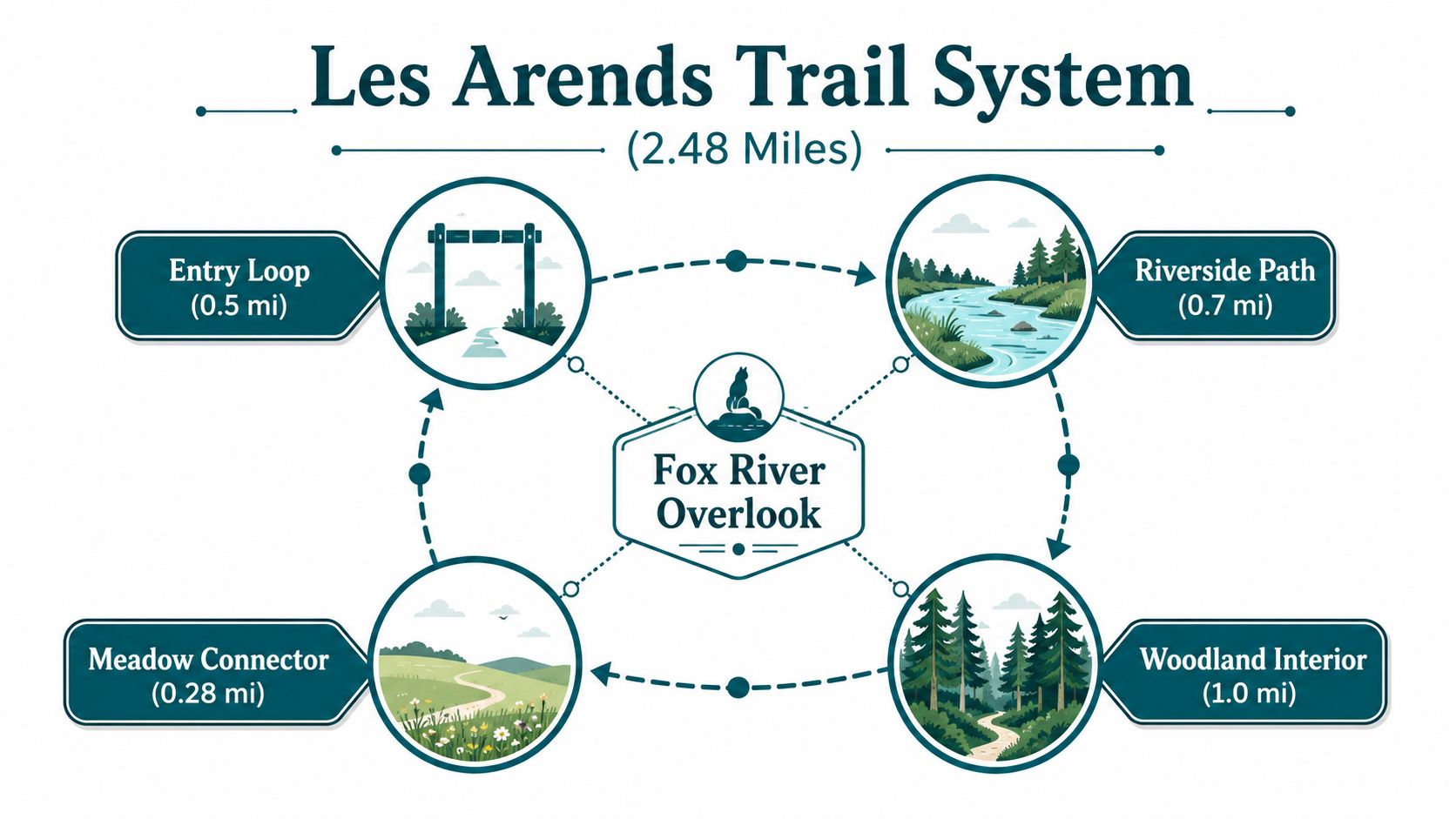
    That's the trick with Les Arends Forest Preserve. On paper, 60 acres and 2.48 miles of total trail mileage sound modest, almost easy to dismiss, but the place doesn't walk like a spreadsheet. It walks like a little puzzle box, with an 0.08-mile entry trail, a 0.52-mile interior trail, a 0.38-mile river trail, and the Fox River Regional Bike Trail running through the site, plus over 3,600 feet of Fox River shoreline to keep your attention trail map.

    I like this preserve on days when I want a break that still feels alive. You can hear the river, watch bikes roll by, and step into a pocket of oak woods without making a big production out of it.

    Practical rule: If you want a place that feels calm without being sleepy, this is your kind of stop.

    If you're trying to decide whether to keep it on your weekend list, you'll get the useful stuff here, trail logic, access notes, seasonal ideas, and a way to plug into stewardship once you've walked it. For a broader look at nearby preserve outings, I also point people to this forest preserve guide for Chicago-area day trips.

    The Story Behind the Name and the Land

    Les Arends wasn't a plaque on a wall. He was an Illinois congressman who, according to a county-produced video, helped push the forest preserve district to buy this property in the 1970s county video. That matters because this preserve didn't just appear as leftover green space. People wanted this strip of the Fox River protected, and they got the paperwork done.

    I think that story shows up when you walk the site. The preserve has white oak and chinkapin oak, floodplain islands, dolomite bedrock outcrops, and Mill Creek entering the Fox River in the southern part of the property site description. The land still feels like a river corridor that was left to keep doing river things.

    What you notice on the ground

    You don't need a history lecture to feel the point. You see the woods, the river edge, the mixed terrain, and you can tell people made a choice to keep this stretch open to the public instead of letting it vanish behind fences and cul-de-sacs.

    That's why the name sticks. Not because of ceremony, but because the site still behaves like the land somebody fought to save.

    Where the Preserve Sits and How to Get There

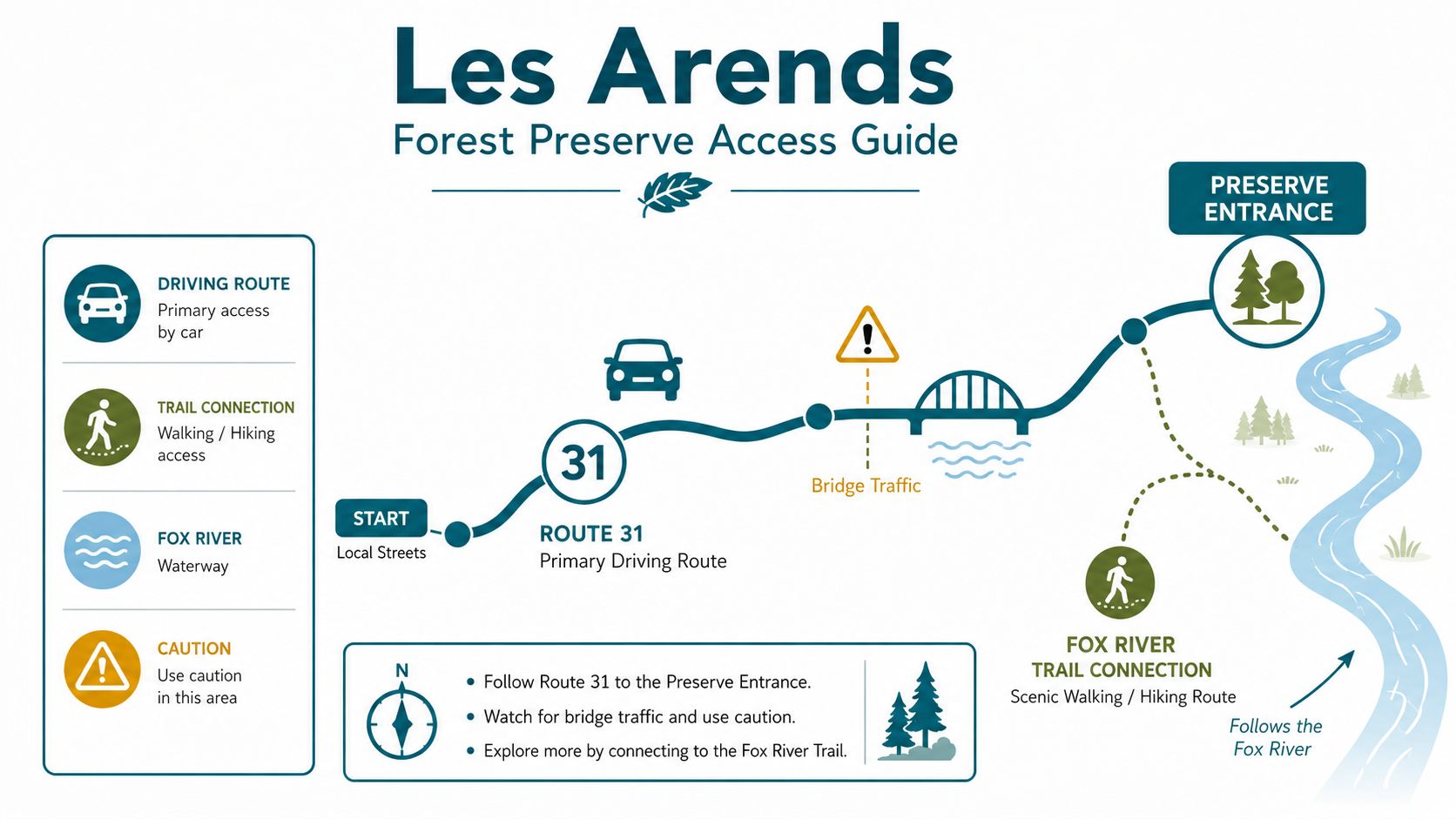
    Les Arends Forest Preserve sits along Route 31 in Batavia, Illinois, and that location makes the trip easy enough to manage if you're driving from most of Kane County. The same road can also back up fast, so I always tell people to treat the approach like a normal suburban errand, not a scenic back-road cruise.

    The preserve is open daily from sunrise to sunset trail map. That's the simple part. The slightly annoying part is that the parking lot, roadway work, and non-ADA-compliant routes are still on the county's radar in the 2024 master plan update, which says staff want to address those issues and bring the site into full ADA compliance master plan update.

    A map showing directions for reaching the Les Arends Forest Preserve by car and hiking trail.

    A simple way to approach the visit

    1. Drive Route 31 with patience. The preserve sits right off the corridor, so you don't need a maze of side streets.
    2. Look for the preserve entrance and parking area near the trail access. That keeps the first part of your walk short and clean.
    3. Plan for a daylight visit. Sunrise to sunset is the operating window, so don't build a late-evening outing around it.
    4. If you use a wheelchair, stroller, or mobility aid, check the current route conditions first. The county's own master plan language tells you access work is ongoing, not finished.

    The smartest visit is the one you don't have to improvise.

    If you're coming without a car, you'll want to do more homework than most preserve pages ask from you. The public materials don't give a tidy transit answer, and that's exactly why I'd treat this as a car-friendly stop until you verify your route and the current site conditions yourself.

    The Trail System and What Each Route Offers

    The trail network here is compact, but it doesn't feel flat or repetitive. I'd think of it as four ways to meet the same river, each with its own mood and its own reason to bother.

    Start with the entry trail

    The 0.08-mile entry trail is the shortest piece of the puzzle, and it's the one I'd use if I wanted a fast look without committing to a full outing trail map. It gets you from the access point into the preserve without wasting time.

    If you're meeting friends, wrangling a kid who hates “long walks,” or just checking whether the place works for your day, this is your low-drama option.

    Move into the interior and river paths

    The 0.52-mile interior trail pulls you farther into the woods, where the pace drops and the river sound gets less obvious for a minute trail map. The 0.38-mile river trail gives you the more direct shoreline feel, with the Fox River close enough to keep you looking sideways trail map.

    For a casual hike, I'd pair those two and give myself enough time to stop and look around. For a quick stop, I'd stay on the shortest loop and save the longer meander for another day.

    Use the bike trail for longer movement

    The Fox River Regional Bike Trail runs through the site trail map. That matters if you want to stitch your visit into a longer ride or you just like the feel of a shared corridor where walkers and cyclists both keep moving.

    Trail choice in plain English: quick errand, use the entry trail. Quiet loop, use the interior and river paths. Longer movement, follow the bike trail connection.

    I'd be straight with you about the surface question. The preserve page gives the mileage and route layout, but it doesn't hand you a neat promise for every stroller, chair, or shoe type, so I'd plan conservatively and expect a mix of conditions until you see the route in person site page.

    A map diagram of the Les Arends Trail System, illustrating four trails connecting to a central overlook.

    Seasonal Highlights and What to Look For

    Spring is the season when I start watching the river trail a little closer. The woods wake up, birds move through fast, and the place feels like it's shaking off winter without making a speech about it.

    Summer changes the preserve into a green tunnel. If you go, go early, because the shade helps, the river edge feels cooler, and the whole route gets quieter before the day gets busy.

    Fall is when the white oak and chinkapin oak stands start to do their best work county video. The leaves shift, the light gets lower, and the preserve turns into one of those places where you keep pretending you're “just taking one more photo.”

    What each season gives you

    • Spring: better bird movement and fresher riverbank color.
    • Summer: early-morning shade and a longer, slower walk.
    • Fall: stronger color in the oak woods and easier photo days.
    • Winter: fewer distractions, more structure, and a louder river.

    Winter is my favorite for hearing the place. The trees strip down, the shoreline looks harder, and the Fox River takes over the soundscape in a way you don't notice when leaves are up.

    The preserve's floodplain islands, 3,600-plus feet of shoreline, Mill Creek entrance in the south, and dolomite bedrock outcrops give different corners of the site their own feel site description. If you like birding, plant spotting, or just a walk that doesn't feel identical every time, those details matter.

    Rules, Safety, and the Accessibility Reality

    The basics are simple. The preserve is open daily from sunrise to sunset trail map, and you should plan your visit inside those hours. I'd also keep your usual riverfront common sense with you, because shoreline trails mean wet spots, quick changes in footing, and more temptation than usual to wander too close to the edge.

    What I'd keep in my bag

    • Water: You'll want it, even on a short walk.
    • Bug protection: Ticks and bugs don't care that you came for a peaceful stroll.
    • Good shoes: The trail mix is short, but you still want traction.
    • A backup plan: If the river level or weather looks rough, come back another day.

    The accessibility picture needs honesty. The county's 2024 master plan update says staff want to deal with the parking lot, roadway conditions, and non-ADA-compliant routes, and it says they want to bring the preserve into full ADA compliance master plan update. That reads like active work, not a finished fix.

    If you use a wheelchair, push a stroller, or visit with limited mobility, I'd treat the site as a maybe until you confirm current conditions. The trail mileage is real, but mileage alone doesn't tell you where the rough patches, grades, or temporary construction issues sit.

    Plain truth: The preserve is worth your time, but you should check access details before you leave home if mobility matters to you.

    Nearby Attractions to Extend Your Visit

    If you're already in Batavia, it makes sense to keep the day moving. I usually think in simple pairings, a trail walk, a coffee stop, a riverfront stroll, maybe one more scenic bit before I head out.

    Downtown Batavia works well after Les Arends because the city already leans into the Fox River rhythm. You can slide from the preserve into a meal, a drink, or a slower walk without feeling like you changed worlds.

    The Batavia Riverwalk pairs nicely if you want a flatter, more urban river view after the preserve's quieter shoreline energy Batavia visit guide. If you want a longer preserve day, another Kane County stop along the Fox River can keep your legs happy without making the trip feel random.

    For a simple route, I'd do preserve first, food second, then one more river stop if daylight still looks good. If you want a fuller outing, this forest preserve adventure guide gives you more ideas for building a day around trail time.

    How to Give Back and Protect the Preserve

    I care about the volunteer side of a place like this because a clean trail doesn't stay clean by accident. People show up, pick up trash, pull invasives, and keep doing it when the weather gets annoying. That's the part of park life most visitors never see, and it's the part that keeps a preserve from turning into a shrug with a parking lot.

    The preserve already hosts hands-on stewardship through “Knockout the Noxious” on Saturday, Sept. 6, from 9:30 a.m. to noon. The Batavia public-works notice says participants take a riverside stroll while learning how to identify native and non-native plants and how invasive species affect the site Batavia notice. That's the kind of event I like, because you leave with dirt on your shoes and a little more respect for what grows where.

    Why volunteer work matters here

    The Fox River corridor keeps pressure on the land. Floodplain edges invite trash, invasives, and the kind of wear that comes from lots of people trying to enjoy the same stretch of shoreline. Infrastructure work matters, sure, but so does a person with gloves and a bag.

    That's where volunteer groups like Litter Caterpillars come in. Kevin Tao started the group after a rough personal stretch, and the crew now shows up weekly, rain or shine, to pick up trash across Chicago and build a habit of service that feels stubborn in the best way. They also keep public stewardship simple, which is the whole point if you want real people to keep coming back.

    If you want to go beyond a single visit, the group's environmental stewardship programs are a clean place to start. You can also follow the same energy at the preserve itself by showing up for cleanup and invasive-plant work when events are posted.

    Screenshot from https://www.littercaterpillars.com

    If you love Les Arends Forest Preserve for the river, the woods, and the easy trail time, give a little back and keep it that way. Litter Caterpillars puts people in the field with gloves on, trash bags in hand, and a no-nonsense habit of showing up. Join them, get your hands dirty, and help make sure your next walk at Les Arends feels just as good as the first one.

  • 7 Volunteer Events This Weekend in Chicago

    7 Volunteer Events This Weekend in Chicago

    Want to Change Your Life? Start by Picking Up Trash. Do you ever feel stuck, like the mess in your apartment follows you around all day? I've been there, and I found out something hard and useful, cleaning other people's messes can teach you how to face your own. If you're searching for volunteer events this weekend that give you a real job to do and a real story to walk away with, start here.

    1. Litter Caterpillars

    Litter Caterpillars

    The first time I heard about Litter Caterpillars, I thought of my own life in piles. One pile was trash, another was fear, another was the kind of inconsistency that makes you avoid your own calendar. Kevin Tao built this Chicago group around a simple idea, if you can keep showing up for the city, you can learn how to show up for yourself.

    What makes me trust this group is the rhythm. It meets every week, rain or shine, and it goes into all 50 wards, including places other people skip. That makes it feel less like a one-off service project and more like training for your character. You don't just pick up litter, you practice bravery, kindness, and unity with your hands in the work.

    Why I'd put this at the top of your list

    Litter Caterpillars has a volunteer-first culture. It puts safety and happiness before fundraising, never pressures people for money, and builds friendship into the event itself. The group's theme song, badges, flags, and group chats give the work a pulse that most cleanups never get.

    Show up tired anyway. That's usually where the change starts.

    It also has a story you can point to. The team won an empty lot at auction and is turning it into Caterpillar Park in Englewood, and it has taken on visible work like a highway cleanup during a bike-event shutdown. If you want to plug in, the group has a clear path through its volunteer pickup page, plus Meetup, Pie, Instagram, and open chats.

    I like that it doesn't pretend service is soft. It treats cleanup like a workout for your habits. You leave with sore arms, a clearer head, and maybe a new friend who gets why you showed up in the first place.

    2. Chicago Chinatown Monthly Cleanup

    Chicago Chinatown Monthly Cleanup

    If Litter Caterpillars feels like a hard reset, the Chicago Chinatown Monthly Cleanup feels like a steady walk home. I like events like this because they don't ask you to become a new person overnight. They ask you to bring your hands, your shoes, and a little patience.

    The Chicago Chinatown Chamber of Commerce runs this cleanup as a recurring neighborhood effort. You show up in the morning, pick up litter, and help keep the business corridors welcoming. That sounds simple, and that's the point. Simple service can still change how a block feels when you pass through it.

    What to expect when you go

    • Clear rhythm: It runs on a monthly cadence, so you can build a habit instead of chasing a random one-time slot.
    • Family-friendly setting: The work stays outdoors and works well for first-timers and small friend groups.
    • Fast visual payoff: You can see the difference in a short stretch of time, which helps if you need momentum to keep going.
    • Low-friction signup: You don't have to wade through a long onboarding maze before you help.

    The Chicago Chinatown site keeps the format practical, which matters more than people admit. When an event is easy to understand, I'm more likely to show up, and you probably are too. If your weekend needs a clean starting point, this is one of the easiest places to begin.

    3. Trash People of Ravenswood Community Clean-Up

    Some cleanups feel like chores. This one feels like a neighborhood walk with purpose. Trash People of Ravenswood, with The Eco Flamingo, pulls together volunteers who want to improve streetscapes without turning the morning into a stiff, formal commitment.

    The thing I'd tell you is this, if you want a social volunteer shift, don't look for ceremony. Look for momentum. A small crew, a walkable route, and a clear task can do more for your Saturday than another hour of scrolling ever will.

    Why it works for first-timers

    The event runs in a two-hour morning window from 10:00 a.m. to 12:00 p.m., which makes it easier to fit into a weekend that's already crowded. Supplies are usually available, so you're not spending your Friday night assembling gear like you're going on a wilderness expedition.

    Bring energy, not excuses. The route will do the rest.

    I also like the neighborhood scale. Ravenswood gives you enough room to work, but not so much that you feel lost in a crowd. If you're trying to meet neighbors without forcing small talk, this is a good setup. You can sweep a block, trade a few words, and leave with the odd satisfaction that your morning mattered.

    4. ChiTownBio August Beach Cleanup

    A beach cleanup changes the mood fast. The water opens up the day, and the trash you collect feels immediate and visible. ChiTownBio organizes this Lake Michigan shoreline cleanup with a community-science energy that draws students, young professionals, and people who like the idea of doing useful work in a place that doesn't feel boxed in.

    The shift runs for two hours on Saturday morning, which is perfect if you want a compact service block. You can still have the rest of your day, but you won't waste the early part of it. That balance matters more than people think, because the easiest volunteer plans are the ones you can keep.

    The part I'd prepare for

    The shoreline can be hot, sandy, and bright, so sunscreen and water matter. Weather and lakefront conditions can also change plans, which is part of the deal when you volunteer outdoors. I've learned that the best volunteers don't wait for perfect conditions, they learn how to work inside imperfect ones.

    ChiTownBio's format is friendly for recruiting a friend, too. You can go with someone who wants something light but meaningful, then spend the ride home comparing what you found. If you want a beach cleanup with a direct, hands-on feel, this one has the right mix of structure and ease.

    For anyone who wants to pair lakefront cleanup with another citywide habit, I'd point back to Litter Caterpillars' public beach focus, because the lesson is the same. Pick the mess you can face, then face it.

    5. Radical Generosity Chicago Back to School Block Party Volunteer

    This one has a different energy from a cleanup, and that's why I like it. A back-to-school block party asks you to serve in the middle of joy, noise, movement, and family life. Radical Generosity Chicago uses volunteers for setup, check-in, supplies, kids' activities, and cleanup, so you can fit into the event wherever your comfort level lands.

    That matters if you want to help but don't want to overthink your role. Some people like logistics. Some people like talking to families. Some people want to carry boxes and keep moving. This event gives you room to do that without pretending everyone should love the same job.

    How I'd read this one

    • Setup work: Good if you like arriving early and getting the space ready.
    • Check-in help: Good if you're calm, organized, and comfortable greeting people.
    • Kids' activities: Good if you want a lively, family-centered role.
    • Cleanup: Good if you prefer closing the loop after the noise settles.

    A block party can do something a quiet cleanup can't. It lets you see how service feels when people are smiling, kids are running around, and your job helps the whole thing hold together. If your weekend needs both heart and motion, this is a strong pick.

    6. Greater Chicago Food Depository Saturday Volunteer Shifts

    I keep coming back to food bank work because it asks for something simple and hard at the same time. You sort, repack, lift, stand, and keep moving because someone else's dinner depends on the boxes you handle well. The Greater Chicago Food Depository offers Saturday volunteer shifts that fit that rhythm, including warehouse repack work and help at partner pantries, and you can read more about the wider Chicago food bank volunteering path through Litter Caterpillars' food bank volunteer guide.

    That kind of shift suits people who want clear direction. You get instructions, orientation, and on-site guidance, so you can show up ready to work instead of guessing your way through the morning. It also works well for groups, which makes the invite easier if you've been trying to get a friend or two to commit with you.

    If you want meaning, don't chase a feeling. Chase a shift that needs your hands.

    The warehouse setting does require closed-toe shoes and some lifting or standing, so treat this like a real work block. Popular shifts can fill quickly, and that tells you something plain, people want in once they know where to start.

    For me, food bank volunteering has the same emotional shape as a hard workout. You may not feel graceful while you're doing it, but you feel straighter afterward. If you want your Saturday to end with a clear sense that you helped real neighbors, this is one of the strongest choices.

    7. Care for Real Saturday Pantry Volunteer

    Care for Real feels personal in a way that stays with you. The Saturday pantry shifts at its Edgewater and Rogers Park locations put you face-to-face with food and clothing support for neighbors who need it right now. You may distribute items, restock shelves, or support clients as they move through the space.

    I like this kind of volunteering because the distance between you and the work stays short. You're not guessing whether your effort matters. You can see the interaction, hear the thank-you, and keep going. That kind of direct service can change how you carry the rest of your day.

    Good reasons to pick this one

    The schedule has multiple shifts and locations, which helps if your weekend is already crowded. Many first-time volunteers can fit in here without a huge learning curve, and return visits make it easier to build real relationships with staff and neighbors. That repeat contact matters, because consistency often feels better than chasing novelty.

    The work can require standing and lifting, so you should go in ready to move. Holiday periods and back-to-school time can fill slots fast, which tells you the community already treats this as a place to show up when things get busy. If you want neighbor-facing service with a practical setup, this one belongs near the top of your list.

    7 Weekend Volunteer Events Comparison

    Item Implementation complexity 🔄 Resource requirements ⚡ Expected outcomes 📊/⭐ Ideal use cases 💡 Key advantages ⭐
    Litter Caterpillars Moderate–High, weekly citywide coordination, volunteer safety protocols Low monetary cost, high volunteer time and logistics (tools provided by group) High visible neighborhood change (ward coverage, park project) ⭐⭐⭐⭐ Regular, social volunteers who want bold, consistent civic action Consistent presence, volunteer-first culture, high visibility
    Chicago Chinatown Monthly Cleanup Low, monthly scheduled meetups with simple coordination Low, tools/supplies typically provided, family‑friendly Local corridor cleanliness with fast visible results ⭐⭐ First‑time volunteers, families, small groups looking for easy commitment Easy signup, strong local business engagement
    Trash People of Ravenswood Low, small neighborhood event with short time window Low, supplies usually available; walkable routes Modest streetscape improvement and neighbor connections ⭐⭐ North Side volunteers seeking casual, social cleanups Small social crews, walkable routes, neighborly atmosphere
    ChiTownBio: August Beach Cleanup Low–Moderate, one-off shore event with environmental focus Low, basic supplies; bring sun/sand gear; weather dependent Immediate shoreline debris removal and ecosystem benefit ⭐⭐⭐ Students, young professionals, science‑minded volunteers Scenic site, photo‑friendly, strong morale and recruitment appeal
    Radical Generosity, Back to School Block Party Moderate, one‑day event logistics and role coordination Moderate, supplies, setup/cleanup crews, child‑friendly materials Direct support for students and families; high community impact ⭐⭐⭐ Volunteers who want family engagement and varied roles Varied tasks, direct benefit to families, high energy event
    Greater Chicago Food Depository, Saturday Shifts Moderate, orientation, scheduling, and operational protocols Moderate–High, warehouse space, training, group slots High operational impact feeding many neighbors across Cook County ⭐⭐⭐⭐ Teams, corporate groups, volunteers seeking structured, repeatable shifts Large scale impact, polished operations, clear guidance
    Care for Real, Saturday Pantry Volunteer Low–Moderate, site distribution with routine procedures Moderate, distribution supplies, some lifting/standing Immediate person‑to‑person assistance and food security impact ⭐⭐⭐ Volunteers wanting direct client interaction and repeat shifts Direct neighbor-facing service, scheduling flexibility, relationship building

    Your Weekend Story Starts Now

    You have seven chances this weekend to write a new page for yourself and for Chicago. Don't wait until you feel more organized, more confident, or more “ready.” I've learned that readiness often shows up after the first hard step, not before it.

    Bring water. Wear comfortable shoes. Introduce yourself to one person you don't know. If you pick the right kind of service, you'll leave with more than a good deed on your record. You'll leave with proof that you can do hard things on purpose.

    I keep coming back to that because it changed me. My life didn't get cleaner by accident, and my mind didn't get clearer by wishing for it. I had to practice the same way you do in service, with repetition, discomfort, and a willingness to keep going when the first impulse is to stay home.

    So pick one event, sign up, and go. Don't turn the weekend into another plan you admire from a distance. Put your name down, show up, and let the work meet you where you are.


    If you want a place that treats volunteering like a habit, not a slogan, Litter Caterpillars is built for that. You can join a Chicago trash pickup crew that meets on weekend mornings, makes room for new people, and turns service into friendship, pride, and real neighborhood change.

  • Service Learning Chicago: A Complete Guide

    Service Learning Chicago: A Complete Guide

    Three of us stood under a tree in a spring hailstorm, laughing while our Uber kept canceling and a strip of trash sat in the gutter like it had nowhere else to go. I remember thinking that cleaning up Chicago can feel weirdly human, messy, cold, a little funny, and a lot more social than people expect. If you want the sidewalk version of service learning Chicago, start right there, not in a worksheet.

    Why Service Learning in Chicago Starts on the Sidewalk

    The first time I really got service learning, I wasn't in a classroom. I was outside, hands cold, shoes damp, trying to grab wrappers before the wind pushed them under parked cars. The whole thing felt less like a school task and more like a small act of paying attention to the block in front of me.

    That's why I like to think of service learning as something you do with your body first. You show up, you notice what's there, and you work with other people who care enough to keep going when the weather turns stupid. If you want a cleaner, more practical way to think about neighborhood action, I've put together a simple guide on how to clean sidewalks, because the details matter when you're on concrete, not in theory.

    What the sidewalk teaches

    The sidewalk tells the truth fast. You learn where the trash gathers, which corners need gloves, and how much easier it is to keep moving when someone next to you is doing the same work. That's the part most guides skip, the human rhythm of service.

    Service learning in Chicago makes the city feel like a classroom without walls. You still need planning, but the lesson changes once you're outside. You see how a weekend cleanup, a school project, or a neighborhood partnership can start with one block and end with a better habit.

    I'd rather talk to you about that than give you a polished slogan. If you've ever wanted to do something useful with a Saturday morning, this is the lane.

    What Service Learning Actually Means

    Service learning isn't just volunteering with a nicer label. I can donate a few hours, take a photo, and leave, and that's still volunteer work. Service learning asks for more structure than that, because it ties the work to learning, reflection, and a real question about the world around you.

    Think of ordinary volunteering like running a race without a coach. You move, you sweat, you finish, and you might feel good. Service learning is more like training with someone who helps you study the route, run the miles, and then look at the splits afterward.

    The three parts that make it learning

    The structure is simple, even if people skip it all the time.

    • Preparation: You learn the issue, the site, the people involved, and what the work asks of you.
    • Action: You do the service in the world, not just in a classroom discussion.
    • Reflection: You write, talk, or think through what happened and what changed.

    That last part matters more than many admit. Without reflection, service can turn into motion with no meaning attached. With reflection, the student starts making sense of the work, the neighborhood, and their own assumptions.

    Chicago's school framing leans hard into classroom integration, which is why this feels different from a one-off volunteer shift. The work gets tied to what students are already studying, so service sits inside the curriculum instead of hanging off the side like an optional extra.

    An infographic explaining the definition, key components, and beneficial results of a service learning educational approach.

    Practical rule: if nobody asks what you learned, who benefited, and what you'd change next time, you're probably looking at volunteering, not service learning.

    That's the cleanest way I know to separate the three. Community service is useful. Volunteer work is useful. Service learning turns the usefulness into a learning loop.

    How Chicago Public Schools Built Service Learning at City Scale

    I keep coming back to Chicago Public Schools because the district did something most systems only talk about. A student could finish school and have real neighborhood work attached to the transcript, not just a line about good citizenship. Beginning with the class of 2001, CPS made 40 hours of community service part of the graduation requirement, and by June 4, 2001, the district reported 82,224 students involved, 96.27% of seniors meeting the requirement, 1,719,747 service hours delivered to city recipients, and 188 agency partners (CPS report). That is a lot of clipboard work, bus rides, phone calls, and Saturday mornings stitched together across the city.

    From hours to projects

    The early model focused on time, which made sense for getting a citywide habit off the ground. Later, CPS pushed the work toward finished projects instead of raw hours. By the 2015-2016 school year, students completed 947 service-learning projects (CPS Ready to Engage). The district then shifted the graduation model in 2016-2017 from 40 service-learning hours to two service-learning projects (CPS service learning page).

    That change matters because it asks for more than attendance. A student has to identify a need, connect it to classwork, and finish something that leaves a mark beyond the day of service. CPS describes the current setup as two classroom-integrated service-learning projects, with one in Civics or AP U.S. Government and the other in a different course (CPS service learning). The district also frames the work around preparation, action, and reflection, along with student voice and curriculum links. That keeps service inside schoolwork, where teachers can connect it to what students are studying.

    A timeline infographic detailing the evolution of the service learning program at Chicago Public Schools since 2001.

    The broader context helps explain why Chicago stands out. CPS pointed to NCES survey data showing that only 32% of public schools nationwide had service-learning at all, including 46% of high schools, 38% of middle schools, and 25% of elementary schools (CPS Ready to Engage). Chicago chose a harder path than most districts, and it made that choice visible at scale.

    When I read the district's materials, I also think about how that structure lines up with the kind of weekend cleanup work I see around the city. A project only feels real when someone has to plan the route, show up, pick up the trash, and explain what changed afterward. That is the same logic behind how service learning benefits students and neighborhoods, even when the work starts with a broom instead of a classroom handout.

    Chicago moved from asking students to count service time to asking them to complete work tied to class, community, and reflection. That change feels concrete because it is concrete.

    The Benefits Students and Communities Feel

    I keep coming back to the same scene: a Saturday morning in Chicago, gloves on, grabbers in hand, and a few students trying to solve a sidewalk problem before the coffee gets cold. That is where service learning stops feeling like a school requirement and starts looking like real work. CPS names collaboration, communication, critical thinking/problem solving, and creativity as part of the learning around service, and those skills show up fast when the route changes, the bags fill up, and the group has to decide what to do next (CPS project-based service learning).

    What students gain and what partners need

    Students usually notice the shift first in their own bodies. They stop treating the day like a performance and start paying attention to the people beside them, the block in front of them, and the problem they are trying to solve together. I've watched that happen when a crew realizes that cleanup takes more than enthusiasm, it takes pacing, communication, and a little patience when one person misses a turn and the work slows down.

    Partner sites feel that difference too. When students show up as learners, they ask better questions, listen before they act, and leave space for the people already doing the work.

    For communities, the harder question sits underneath all of it. Does the project leave anything behind after the semester ends, or does it disappear when the last sign-in sheet gets packed away? A PubMed study on a culturally relevant, community-based service-learning health curriculum found gains for Latinx sixth graders' health knowledge and for nursing students who learned in ways classroom and clinical practicum could not. That tells me service learning can do more than fill a schedule, while also leaving the neighborhood question in place.

    That is why partnership-based work matters so much. Residents need a say in what gets done, how it gets done, and what success looks like once the work is over.

    If you want a plain-language breakdown of the payoff for students, organizers, and neighborhoods, I've also put together an overview of service learning benefits in practice.

    A Chicago Case Study in Service Learning Through Action

    Kevin Tao built Litter Caterpillars out of personal mess, and that matters to me because it keeps the whole thing grounded. He's said he struggled to clean and organize his own space, then decided to engineer his social circle around people who gave a damn about cleanup, consistency, and bravery. That's a very Chicago kind of origin story, blunt and practical, with no fake polish on it.

    The hailstorm that became a logo

    The first cleanup had only three volunteers. They got caught in a spring hailstorm, huddled under a tree, and watched Uber cancel after Uber cancel while trash sat there waiting for them. That moment became the logo story, and I love it because it sounds exactly like service in real life, inconvenient, a little absurd, and somehow fun once you're already in it.

    From there, the group kept going every week, rain or shine, in blizzards, negative wind chills, and scorching heat. They reached all 50 wards, including places other people warned against. That detail matters because it says the work didn't stay in easy neighborhoods or easy weather.

    The group also cleaned a highway during a bike-event shutdown and won an empty lot at auction to turn it into Caterpillar Park in Englewood. That's the part that makes the story feel less like a cleanup club and more like a habit that keeps finding new ground.

    The values that hold the group together

    Litter Caterpillars runs on bravery, kindness, unity, and volunteer-first values. The weekend-morning schedule filters out the energy they don't want, and the group protects volunteer safety and happiness before anything else. I respect that. It's a clean rule.

    Practical rule: if a service group treats people like free labor, I back away. If it treats people like humans who need safety, friendship, and clear expectations, I pay attention.

    The whole setup feels like service learning after the bell rings and after the syllabus closes. You can join, sweat, laugh, and leave with a story that sticks.

    How to Set Up or Join a Service Learning Project in Chicago

    I usually tell students to start with the shape of the class before they start hunting for a site. At CPS, service learning now centers on two service-learning projects, not hours alone, and the work has to connect to curriculum, student voice, and reflection. That means the cleanest projects usually begin with a teacher who already knows what the class is trying to learn, then find a neighborhood need that fits.

    A real example makes this easier. If your school already has an approved partner, use that. If it lets you propose a site, bring a contact person who can answer the phone, and explain why the site belongs in the class instead of just sounding charitable on paper. I've seen projects stall because the match looked good in a slide deck and fell apart once someone needed gloves, a meeting spot, or a backup plan for weather.

    A simple path for students, educators, and nonprofits

    For students, I'd keep the first move practical.

    1. Choose a partner or propose one. Make sure the site can host you and that someone there knows you're coming.
    2. Get the forms approved. Start with permission, not with a surprise.
    3. Do the work with a buddy system. Gloves, high-visibility vests, and weather planning are basics, not extras.
    4. Log what you did. Hours matter in some programs, projects matter in others.
    5. Write the reflection while the work is still fresh. That's where the learning lands.

    I've watched a Saturday cleanup go from awkward to useful once students knew exactly who was leading, what block they were covering, and where trash bags were going at the end. The job gets easier when the rules are plain.

    For educators, I'd build from the community need first, then map the class content onto it. Don't invent a fake problem so the lesson looks tidy. Start with something residents already care about, then build checkpoints for preparation, action, and reflection so the class can see its own progress without losing the neighborhood in the process.

    For nonprofits, the first job is to define the kind of learner you want in the space. Set a point of contact, write down the safety rules, and say what good behavior looks like before the day starts. If you want a model that keeps volunteers organized around repeated neighborhood work, Litter Caterpillars is one option I'd point to, and its service learning programs show how weekend cleanup events, open group chats, and clear social norms can keep people moving in the same direction.

    At the University of Chicago Laboratory Schools, the process gets more formal. Students start service learning in sophomore year, commit to 30 hours of service over the year, submit approved forms before they begin, turn in signed timesheets each quarter, and complete written reflections during and after the service (U-High service learning). It feels like a checkpoint trail, with each form opening the next gate.

    If a school or nonprofit wants a clearer picture of how a volunteer-led project gets organized from the ground up, that structure matters more than a polished slogan.

    Building Service Habits That Outlast a Semester

    One cleanup can feel good for a day. A weekly habit changes how you respond to discomfort, other people's mess, and your own excuses. That's why I keep coming back to repetition, because the first Saturday is about courage, and the twentieth Saturday is about identity.

    Tom Sawyer tricked his friends into painting a fence by making the work look like privilege instead of punishment. I think about that a lot in service learning. Pride changes behavior, and when people feel like they belong to something, hard work stops looking like a chore they have to survive.
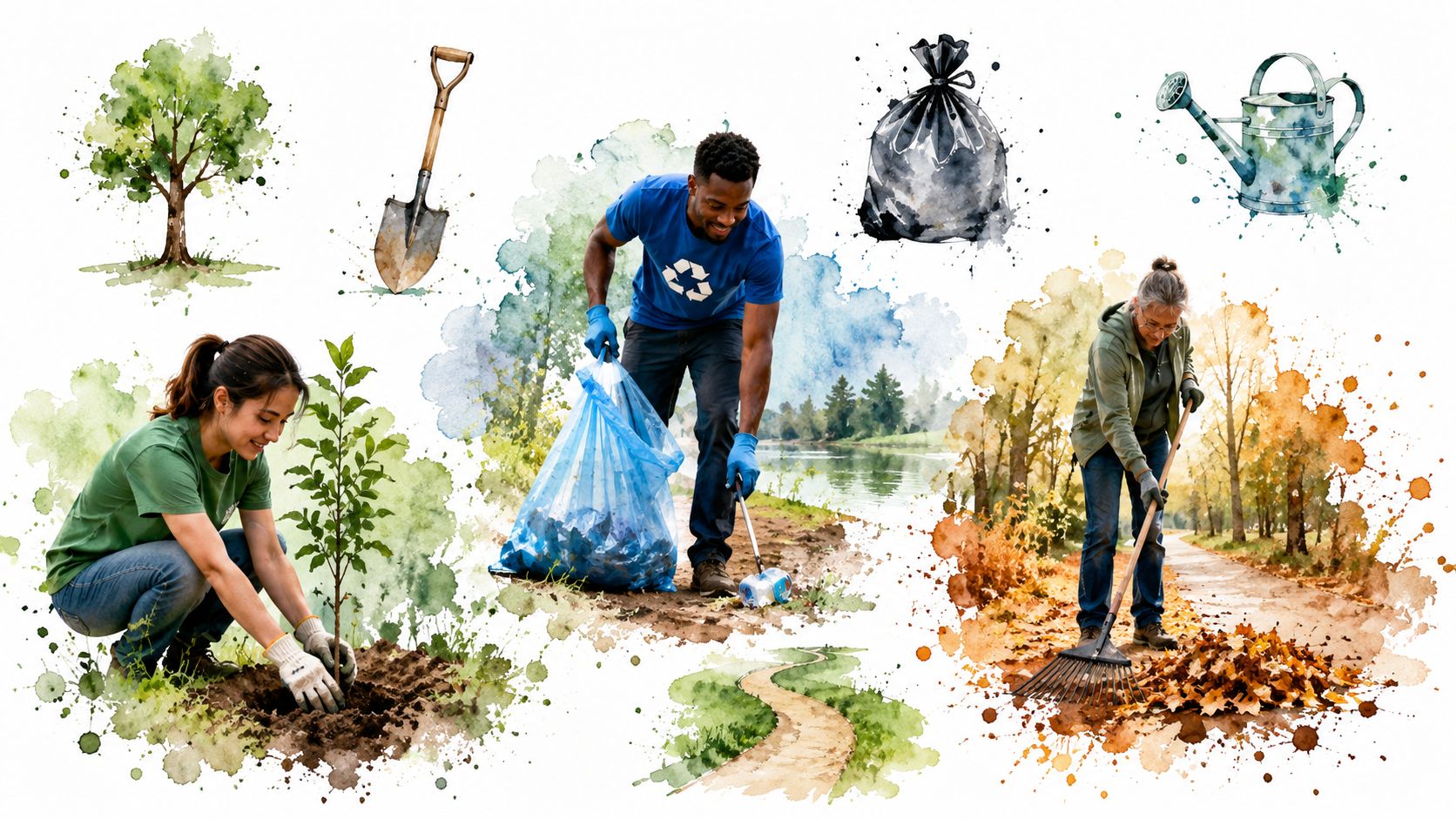
    Chicago works the same way block by block. One ward at a time, one Saturday at a time, one pickup bag at a time, and you start seeing a city built out of ordinary people who kept showing up. That's not a slogan to me. That's a pattern you can join.

    Show up this weekend. Bring a friend. Let the habit do what it does.

    Service Learning Chicago Questions You Might Still Have

    I still get questions on Saturday mornings, usually while people are pulling gloves on, checking trash grabbers, or looking at the block and asking what service learning really means once you step outside the classroom. The quick version is this. It is structured work tied to learning, reflection, and community need, and in Chicago that can look a lot like a cleanup crew meeting before the city wakes up.

    How many hours do Loyola students need? Loyola University Chicago sets a minimum of 20 hours per semester for service-learning courses, and undergraduates also need at least one Engaged Learning course totaling at least 3 credit hours before graduation (Loyola service-learning courses).

    How does U-High handle it? At the University of Chicago Laboratory Schools, students begin in sophomore year, complete 30 hours over the year, get service forms approved before they begin, submit signed timesheets each quarter, and write reflections during and after the work.

    Is this the same as a club requirement? A club can ask for attendance. Service learning asks for preparation, action, and reflection tied to learning, so the work has to connect back to the experience, not just the calendar.

    Can adults outside universities join? Yes. Chicago neighborhood groups and volunteer projects often welcome adults, especially when they follow the site's safety rules and expectations. A weekend cleanup usually needs hands, attention, and people who will stay until the last bag is tied off.

    Litter Caterpillars is one Chicago option if you want weekend cleanup, real neighborhood work, and a group that treats service like a habit, not a performance. If you want to plug into that kind of Saturday morning action, visit Litter Caterpillars and find a way in that fits your schedule.

  • Chicago Neighborhood Safety: A Complete Guide for 2026

    Chicago Neighborhood Safety: A Complete Guide for 2026

    I'm usually on a Chicago block before the coffee shops open, glove box full of trash bags, grabbers rattling in the back seat, and one eye on the street I'm about to walk. Some mornings I'm in a place my friends would never pick for brunch, never mind a lease, and I can tell you this, the curb line, the empty lot, the open corner store, and the way people move on foot tell a better story than a single citywide number ever will.

    If you're trying to judge Chicago neighborhood safety from your couch, I get the urge to search one clean answer. I've done it too. Then I've shown up on a block in work gloves and learned fast that Chicago doesn't hand out one safety score, it hands out blocks, corners, and routines that feel different from one another.

    Why One Chicago Number Is the Wrong Place to Start

    It was 7:30 on a Saturday, and my crew had just rolled up to a block many people I know would simply skip. We were carrying trash bags, grabbers, and the kind of stubborn mood you need when you've decided to spend your morning cleaning up someone else's mess. That block told me more than a citywide crime number ever could, because the garbage, the foot traffic, the broken glass, and the people who lived there all sat in the same frame.

    The citywide average hides the street level truth

    Chicago's own violence dashboard shows why a single number can mislead you. From 2018 through 2020, 15 community areas, only 24% of Chicago's population, accounted for 63% of the city's homicides and non-fatal shootings (Chicago violence dashboard). Between January 1, 2016 and December 31, 2020, the city recorded 3,276 homicides and 13,546 non-fatal shooting victims (Chicago violence dashboard).

    That's the part you miss when they ask, “Is Chicago safe?” Safe where? On what block? At what hour? The city's own dashboard logic treats violence as a spatial concentration problem, not a citywide-average problem, and that's the right way to think about it (Chicago All Safe Data).

    A neighborhood can feel calm on one street and rough two blocks over. That's normal here, and it's why block-by-block reading matters.

    I've seen that pattern up close on cleanup days. One stretch has kids biking past parked cars and a bakery opening its gate. Another stretch nearby has empty storefronts, loose trash, and nobody lingering outside unless they live there. If you only read the city as one number, you flatten both streets into something false.

    An infographic showing that citywide average crime statistics can obscure significant safety differences between Chicago neighborhoods.

    Why that matters when you move, visit, or volunteer

    Averages are useful for headlines, not for your actual life. If you're choosing an apartment, planning a Saturday walk, or organizing a cleanup crew, you need to know what happens on the block you'll touch, not what happens across the whole city. Chicago's own safety tools are built around that idea, because the risk is concentrated in specific community areas, often on the South and West Sides, while many other neighborhoods see far less serious violence (Chicago violence dashboard).

    I trust that reality more than I trust a single clean score. A person can move one mile and land in a totally different rhythm, different lighting, different business density, different sense of ease. That's why I never start with “Chicago is safe” or “Chicago is dangerous.” I start with the block.

    Reading the City's Crime Maps Without Misreading Them

    I've stood at curbs with a trash grabber in one hand and my phone in the other, checking a block before we start a cleanup. One street looks calm because the porches are full, the lighting is decent, and people are outside. Another street a few turns away has broken glass near the alley, a couple of vacant lots, and a different kind of quiet. That is the kind of difference a good map can help me see, if I read it carefully.

    I keep three tabs open when I want a real read on a neighborhood. First, the city's Violence Reduction Dashboard. Second, the Public Safety DataHub. Third, a neighborhood-level crime map that lets me look at the street, not the postcard. Each tool answers a different question, and if you use the wrong one, you end up arguing with the wrong data.

    The tools tell different stories

    The City of Chicago says its violence dashboard and Public Safety DataHub are built to show neighborhood-level crime and safety indicators, not just citywide aggregates (Chicago All Safe Data). That matters because the unit you choose changes the answer. If you look at a whole city, you smooth out the rough patches. If you zoom to a community area, or even tighter to an address-radius slice, you see the risk around a front door.

    That is why I like address-level incident pins and a ½-mile radius when I'm checking a place I might walk, visit, or clean. The city's dashboard approach also tracks violence in real time, which helps with practical choices like patrol routing, volunteer planning, and where to place neighborhood services.

    How I read the map without getting tricked by it

    I don't treat a map pin like a verdict. I look for clusters, repeated incidents, and what else is happening nearby. Building violations, 311 calls, crash patterns, and ordinary street use can change how a block feels long before a crime headline appears. A map that combines those layers gives me a better read than crime alone.

    Practical rule: if I'm choosing between two blocks, I care more about what the immediate radius looks like than what a neighborhood label says.

    I also check more than one source, because the picture shifts depending on how the map is built. One 2026 crime map puts Chicago's total crime index at 119, with an estimated 1 in 230 annual chance of violent crime and 1 in 38 annual chance of property crime (Chicago crime map). Another 2026 neighborhood analysis says 77% of Chicago's 86 analyzed neighborhoods earned an A or B safety grade, while the citywide overall grade was C- (DoorProfit Chicago crime map).

    I read those numbers like I read a street before a cleanup, slowly and with my eyes open. I want the pattern under the surface, the blocks where the same concerns keep showing up, and the corners that feel different once you stand there instead of staring at a summary.

    Safe by Block, Different by Ward, Uneven by Direction

    I notice the difference the minute I cross a few streets in Chicago. One block has porch chairs out front, kids cutting across the sidewalk, and somebody sweeping the stoop. Another block has everyone moving fast, doors shut, and fewer people lingering outside. I've done cleanup work in both kinds of places, and that street-level feel lines up with what I see when I read neighborhood safety by block instead of by broad label.

    The neighborhoods people call safe

    A neighborhood-level Chicago source lists Lincoln Park, Lakeview, River North, Gold Coast, and Hyde Park among the safer neighborhoods (Illinois Crime). Another Chicago guide aimed at homebuyers points to Lincoln Park as a high-demand area with strong school access and lakefront proximity, while also naming Beverly among the safer west-side options for buyers (Grilli Murphy Real Estate).

    Those places still feel different once you stand there. River North runs at a quicker pace than Hyde Park. Lakeview gives off a different rhythm than Gold Coast. Even so, when I'm helping a crew pick a cleanup route or checking a block for the first time, those names tend to come up because the street conditions are usually steadier there.

    The neighborhoods where risk feels heavier

    The same Chicago neighborhood source lists Englewood, Austin, West Garfield Park, Chatham, and Roseland among higher-crime areas (Illinois Crime). That is the part of the map people often talk around instead of naming. I'm not going to do that here. The South and West Sides carry more of the burden, and anyone who works block by block sees that quickly.
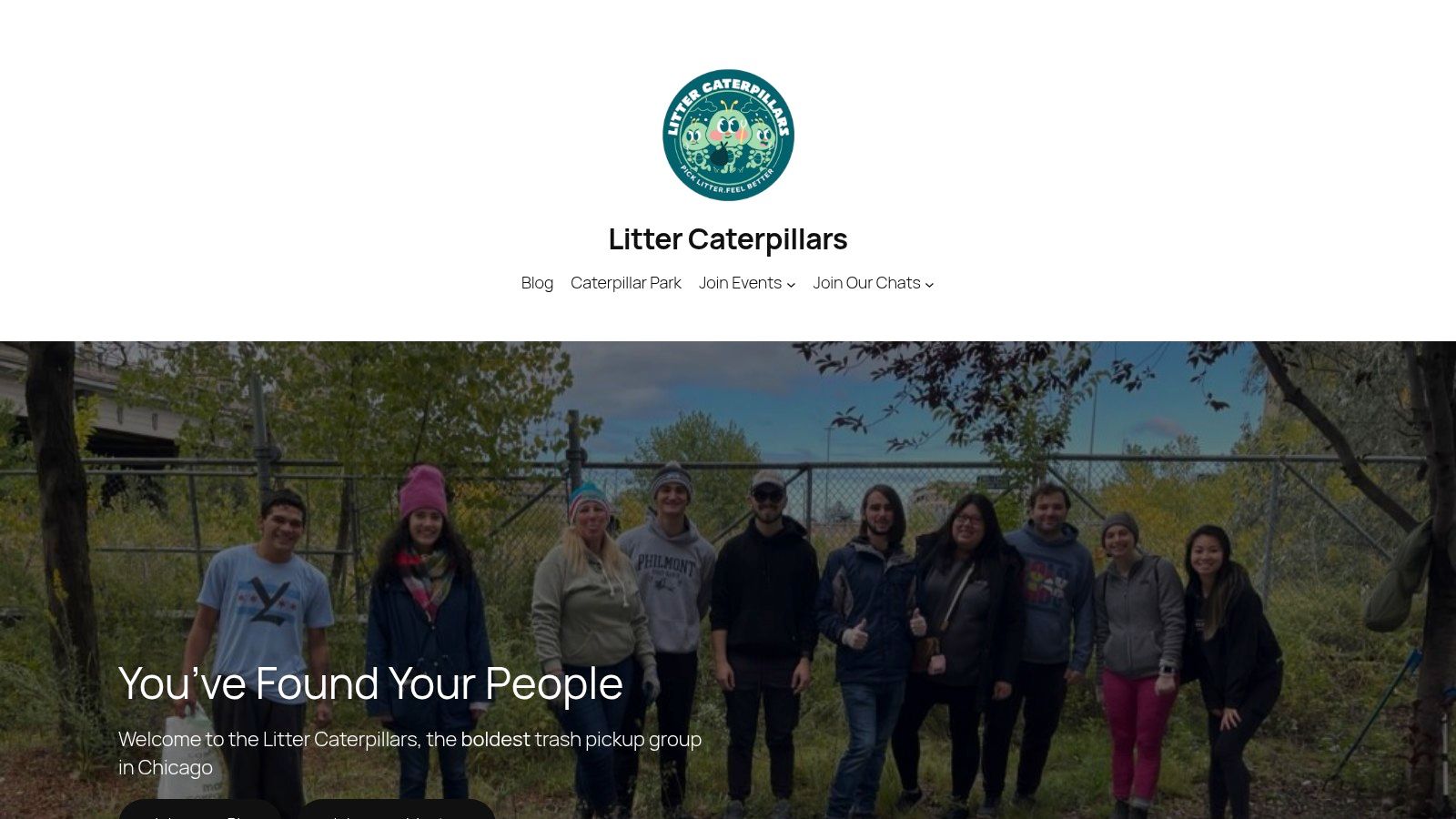
    Chicago Neighborhood Safety Snapshot Ward Area General Safety Profile
    Lincoln Park North Side Commonly cited as safer, with steady street activity
    Lakeview North Side Commonly cited as safer, with active residential blocks
    River North Near North Side Commonly cited as safer, with denser commercial activity
    Gold Coast Near North Side Commonly cited as safer, with high foot traffic and visibility
    Hyde Park South Side Often seen as safer than many nearby areas, with strong neighborhood identity
    Englewood South Side Higher-crime area, requires closer block-level review
    Austin West Side Higher-crime area, needs block-by-block attention
    West Garfield Park West Side Higher-crime area, requires careful route planning
    Chatham South Side Higher-crime area, with mixed block conditions
    Roseland Far South Side Higher-crime area, with sharper local variation

    That is the point I keep coming back to after enough miles on foot. Chicago safety is uneven, and the unevenness shows up by direction as much as by neighborhood name. If you're new here, don't start with a yes-or-no question about the whole city. Ask which side, which ward, which block, and which route you'll use.

    A Simple Framework for Assessing a Block Before You Commit

    I don't trust a block by vibes alone, and I don't think you should either. When I'm thinking about a lease, a weekend stay, or a cleanup site, I run the same quick test in my head. It takes less than ten minutes if I stay disciplined, and it saves me from bad guesses.

    My four-question block check

    A four-step checklist infographic titled A Simple Framework for Assessing a Block Before You Commit.

    1. Check the exact block on a map. I want the specific address area, not just the neighborhood name. If the surrounding pins cluster hard in one direction, I pay attention.

    2. Talk to at least three people who live there. I don't stop at the leasing agent or the first friendly face in a coffee shop. Residents tell you what happens after dark, where people park, and which corners they avoid.

    3. Visit at different times of day. A block can feel easy at 11 a.m. and tense at 8 p.m. I want to know what the street does when work ends and the lights change.

    4. Look for ordinary upkeep. Open businesses, clean sidewalks, active porches, and maintained green space tell me more than slogans do.

    What I watch for when I arrive

    I park where I can leave easily. I keep my crew together when we're on a new block. I don't split up unless I know the area, and I don't wander with my phone out. That sounds basic, because it is, and basic habits save you trouble.

    If a street feels empty, I ask whether it's empty because it's quiet or empty because people don't linger there.

    That question has saved me from bad assumptions more than once. A block with low foot traffic can be fine if it's residential and calm. The same pattern can feel different if storefronts are shuttered and nobody's outside. The point is to read the block in context, then decide.

    I also look at visible investment. Clean corners, functioning lights, and businesses that stay open into the evening tell me a lot about whether people still use the street. When those signs are missing, I slow down.

    The Hidden Layer Safety Actually Controls

    The perception of safety extends beyond the comfort of walking outside. It also impacts the ability to access essential services like grocery stores, pharmacies, and fitness centers without anxiety.

    A Chicago-based study found that poorer perceived neighborhood safety was linked to lower odds of having large grocery stores, pharmacies, and fitness resources within one mile, and that people with prior neighborhood crime exposure were more likely to bypass nearby pharmacies even when they existed (PMC study). That's a hard thing to ignore if you live without a car, or if you're helping a senior who relies on a short walking route.

    Safety shapes errands, not just feelings

    I've seen this in day-to-day cleanup work. A corner can have a pharmacy, a store, and a bus stop nearby, but if people don't feel settled walking there, that access isn't real in practice. It exists on paper and fades in the routine of the people who live there.

    Families feel that most sharply. So do seniors who keep strict habits and don't want to improvise. So do volunteers who want to help a block but don't know whether they can safely bring gear in, unload bags, and leave their cars for an hour.

    When I read that study, I thought about all the times a neighborhood looked “close enough” on a map and still felt too far in real life. Safety changes the radius of ordinary life.

    The access question most guides skip

    That's why I like asking a harder question than “Is this area safe?” I ask, “Can someone here live their day here?” Can they walk to food, medicine, and movement without treating every errand like a mission? That is where neighborhood safety stops being a score and starts shaping habits.

    If you care about that side of the story, the illegal dumping problem usually sits right next to it, because neglected blocks and worn-out routines travel together in the same neighborhoods. I keep coming back to this guide on illegal dumping prevention because the street-level fix is often the same, show up, clean up, and make the block easier to use.

    How Showing Up Changes How a Neighborhood Feels

    I started Litter Caterpillars because my own life was a mess in the same weird way a cluttered room gets under your skin. I held onto trash like it had a story, and I kept telling myself I'd deal with it later. Then came a breakup, a reset, and a decision to get better at the things I had been avoiding, cleanliness, consistency, and bravery.

    The first cleanup was absurd in the best way. There were three of us, and Chicago threw a hail storm at us while we were out there. We huddled under a tree, watched Uber keep canceling, and laughed because we had already committed. That day taught me two things. Cleaning other people's messes is easier than cleaning your own, and a little suffering gives the work a flavor that makes it stick.

    Why repeated presence matters more than a one-off cleanup

    A one-time sweep can make a block look better for a day. Repeated presence changes how people carry themselves. Kids notice. Adults notice. The street starts to feel visited instead of abandoned.

    I've watched that happen when a small, steady group shows up week after week with the same energy and the same bags. People begin to say hello. They stop pretending the block is someone else's problem. The cleanup crew becomes part of the street's rhythm, and that rhythm matters.

    My rule: if we can return to a block with the same faces and the same good mood, the block gets easier for everybody else to use.

    That logic is why we do the work in rain, blizzards, heat, and bad wind. It's also why we've done unusual jobs, like cleaning a highway during a bike-event shutdown and winning an empty lot at auction to build Caterpillar Park in Englewood. Those jobs aren't magic tricks. They're proof that visible service changes what people believe is possible on a street.

    What I've learned from the block

    Safety gets discussed like a fixed property. I don't think it is. It's shaped by what people do on the block, who returns, who stays visible, and whether the street feels cared for. Dashboards can't capture that mood, but a crew picking up trash on the same corner every Saturday can.

    If you want to see how we think about service, friendship, and getting people outside together, I'd point you to Care for Real. The same simple habit keeps showing up there too, people helping in public, on purpose, without acting like they're above the place they're cleaning.
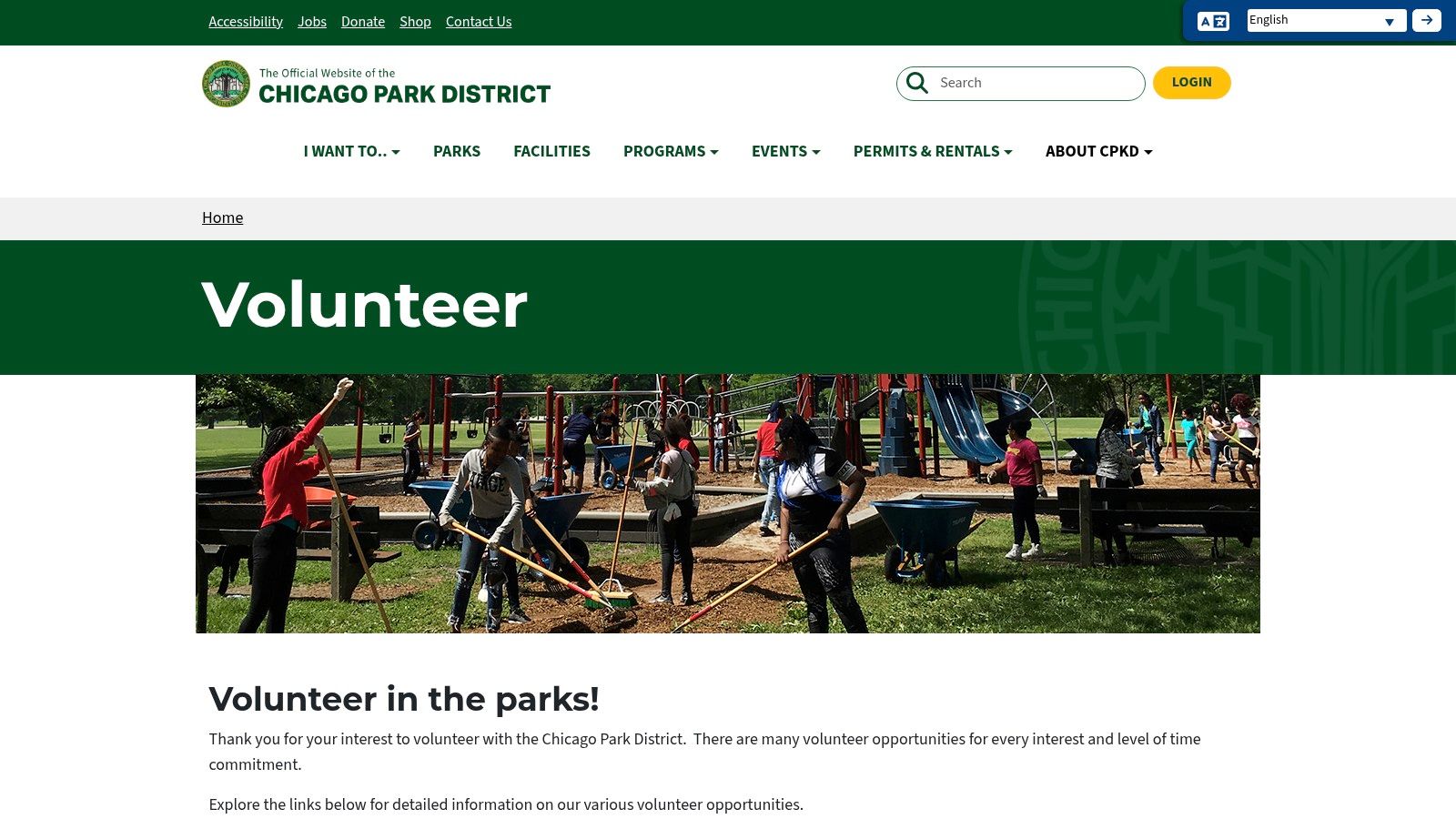
    Plugging In Safely as a Volunteer or Advocate

    If this made you want to do something, start small and start where people already know the drill. Weekend-morning cleanups work well because they attract givers, not people looking to make the day about themselves. That matters to me. I want volunteers to feel safe, useful, and at ease before anyone asks them for more.

    An infographic titled Plugging In Safely with four steps for volunteers or community advocates to follow.

    A low-pressure way to begin

    1. Start with an established group. Litter Caterpillars runs scheduled weekend events, which makes it easier to know when and where to show up.

    2. Go with a friend the first time. I like groups because they keep the work comfortable while you learn the block.

    3. Keep the action small and regular. A steady hour on the same corner does more than a big burst you never repeat.

    4. Let the block introduce you to the rest of the network. Park stewards, CAPS beat meetings, ward cleanups, mutual aid groups, and local hearings all connect naturally once you start showing up.

    If you want to check the safety side of a group before you join, ask whether they brief volunteers on the site, whether they keep cleanup gear on hand, and whether they make room for beginners. If they can't answer plainly, keep looking. Safety and friendship are not extras. They're the whole point.
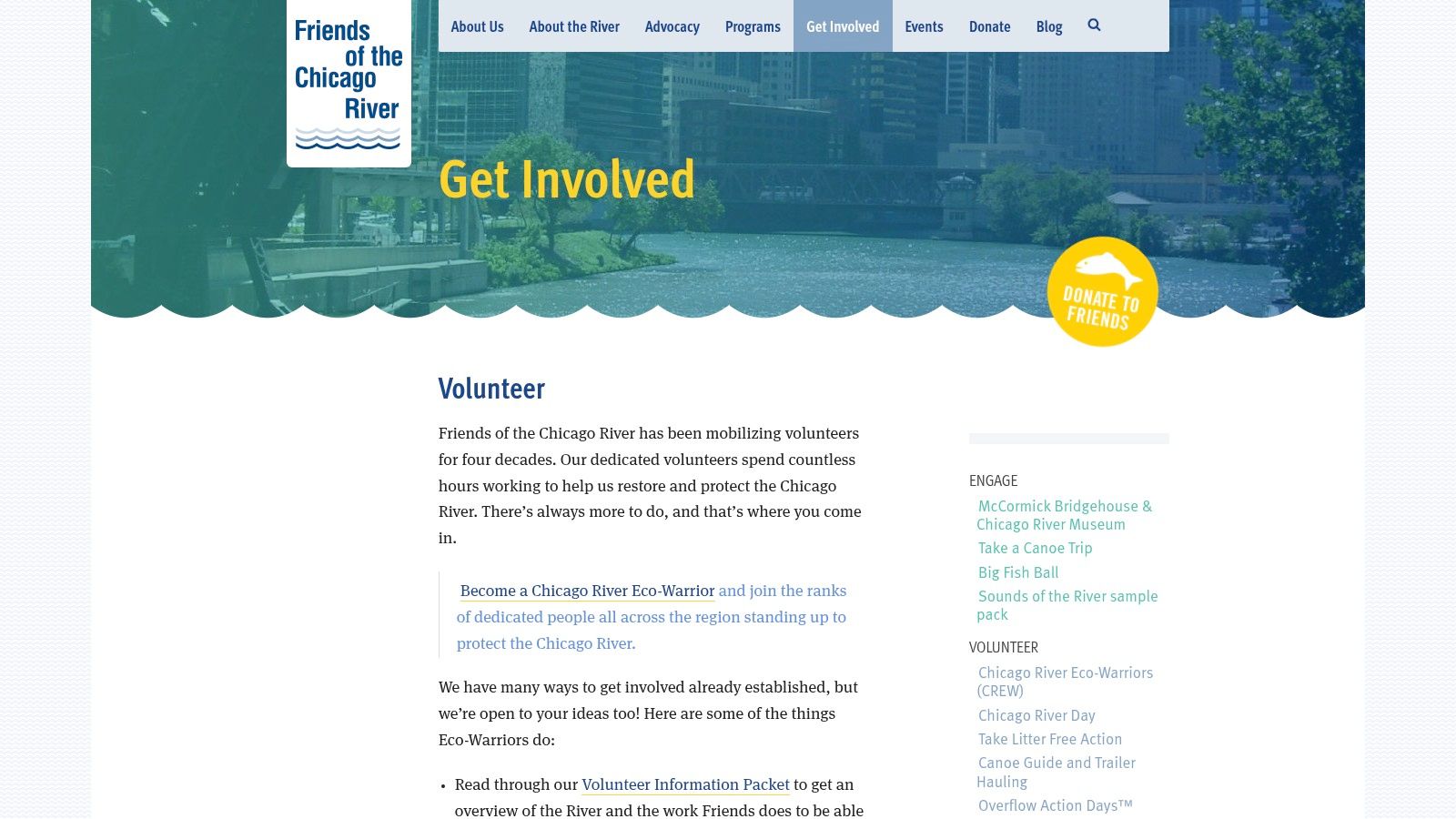
    I also care about liability, because a serious volunteer group should think about it before asking anyone to carry bags into a neighborhood they don't know. If you want to see how I think about that part of the work, look at volunteer liability insurance.


    If you want a first step that feels real, come out to a Litter Caterpillars cleanup, bring a friend, and let the block teach you what a dashboard can't. Visit Litter Caterpillars and plug into a weekend morning where you can pick up trash, meet good people, and get a clearer read on Chicago neighborhood safety while you're standing on the street.

  • 8 Litter Caterpillars Volunteer Testimonials That Inspire

    8 Litter Caterpillars Volunteer Testimonials That Inspire

    More Than Just Picking Up Trash

    You've seen us out there in the snow and the sun, flags flapping, grabbers clicking, coffee going cold in our hands. You might wonder what keeps us coming back when the wind is rude and the sidewalks smell like old beer and wet cardboard.

    I started this because my own life was a mess, and cleaning someone else's mess felt easier than facing my own. Then I found friendship and bravery in freezing hail, and I learned that a rough morning outside can do something strange and good to a person. Here are 8 ways to tell volunteer testimonials that feel real, the kind that come from sore hands, awkward first hellos, and the little shifts that happen when you keep showing up.

    1. The Personal Transformation Story

    The strongest volunteer testimonials usually start before the first trash bag.

    Mine does. My apartment used to feel like a museum of bad decisions. Old food sat around because every item had a memory attached to it. A jar of blueberry jam from a trip years ago. A half-forgotten bag of nuts from the week I promised myself I'd get healthy. None of it weighed much, but in my head it felt impossible to move.

    Then my life cracked open. I got out of a chaotic relationship, looked around at the mess, and realized I needed a different kind of momentum. I couldn't force myself to become perfect, but I could go outside and pick up one bottle, then another, then a whole bag.

    Start with the mess you can name

    That's the shape of a real transformation story. You don't say, “Volunteering changed me.” You say what was broken, what you did next, and what feels different now.

    A good version sounds more like this:

    • Name the exact struggle: “I kept sleeping through weekends and wasting them.”
    • Name the first action: “I dragged myself to a cleanup anyway.”
    • Name the concrete change: “Now I trust myself a little more when I say I'll do something.”

    That kind of honesty lands because it has dirt on it.

    A volunteer stands on a sidewalk by a small plant with a messy living room background overlay.

    I still struggle with mess. I still have days when my brain tries to turn a sock on the floor into a moral failure. But week after week, service taught me something that thinking never did. Action creates traction. If you want language for that inner engine, I like this piece on intrinsic motivation and why people keep showing up.

    Practical rule: Start your testimonial with one ugly, specific memory. Readers trust a stained sink more than a polished slogan.

    2. The Friendship and Community Angle

    One Saturday, you're standing next to a stranger at an hour when many are still in bed. Your nose is running from the cold, you're both pretending this feels normal, and then one of you says something dumb about how a crushed energy drink can has more social life than either of you.

    That's how friendships start here. Not with perfect chemistry. With shared discomfort and a joke that saves the morning.

    I've watched people arrive stiff and careful, doing that city thing where you try to seem unfazed. Then a bag rips. Someone lends gloves. Somebody else starts humming the theme song. By the end, two people who didn't know each other are talking about breakups, job hunts, or where to get soup nearby.

    Show the awkward part

    If you want your volunteer testimonial to feel alive, keep the awkward beat in the story. Don't cut it out.

    Say the part where you worried everyone already knew each other. Say the part where you almost stayed in your car. Say the part where the person who became your friend first looked intimidating because they were carrying a grabber like a spear and drinking coffee like they meant business.

    Three diverse volunteers in colorful sweatshirts smiling while sharing a drink and holding cleanup tools.

    A real friendship story might be simple. You met Maria on a freezing morning because both of you complained about waking up early. Then you kept ending up on the same block. Then you started texting during the week. Then Chicago stopped feeling so anonymous.

    That's why I'd tell anyone new to read our thoughts on how to meet like-minded people in a way that doesn't feel forced. Volunteering gives you a side-by-side way to connect. You don't have to perform. Your hands already have a job.

    People bond faster when they have something concrete to do together. A trash bag is a weirdly good icebreaker.

    3. The Neighborhood Discovery Narrative

    Chicago changes when you walk it slowly with a grabber in your hand.

    A block you used to speed through in a car starts talking back. You notice the mural with chipped paint. The barber sweeping his own sidewalk before opening. The old lady who watches from the window and gives you a nod on the third visit because now you aren't random anymore.

    That's the heart of a neighborhood discovery testimonial. You tell the story of a place becoming real to you.

    Tell me the block, not the idea

    Don't say, “I got to know the city better.” Say where. Say Englewood. Say the lot at 6316 and 6318 S Sangamon. Say how that patch of ground used to be vacant, and how it became Caterpillar Park after I bought the 6,000-square-foot lot for exactly $10,000 in a citywide land auction organized by Hilco in April 2025, then turned it into a garden space with mulch, raised tomato beds, and native Illinois flora including prairie grass and yelloweflow, as reported by the Chicago Tribune's story on Caterpillar Park in Englewood.

    A traveler with a backpack and map walking past colorful city buildings with a compass location pin

    That kind of detail makes a story breathe. A vacant lot isn't an abstraction. It's a place where your boots sink a little after rain. It's a place where you can point and say, “I know what this looked like before.”

    When you write your own version, include one local person if you can. The shop owner who waved. The neighbor who asked for a bag. The kid who wanted to help for five minutes and ended up taking it very seriously. Cities become lovable that way. One face at a time.

    4. The Overcome-Your-Fear Story

    Fear has texture. It makes your stomach tight. It makes your hands weird. It makes you stare at your phone and bargain with yourself.

    A lot of people think bravery means you stop feeling that. I don't buy it. Bravery is when you feel the whole storm in your chest and still lace your boots.

    My favorite fear stories are the ones people almost don't tell because they think the fear sounds small. “I was scared I'd look stupid.” “I was scared of the cold.” “I was scared to go to a neighborhood I didn't know.” Those are real. Those count.

    Put your body back in the story

    If your first cleanup happened in bad weather, say what your body did. Were your ears aching? Did your face sting? Did you keep checking whether anyone else seemed miserable, just to measure if your misery was acceptable?

    We meet every single weekend morning at our lots at 6316 and 6318 S Sangamon, and we do it regardless of blizzards, negative wind chills, or scorching heat, because that's how Litter Caterpillars invites people to help clean all 50 wards of Chicago, according to the Litter Caterpillars Meetup page.

    That matters inside a testimonial because weather and place strip away fantasy fast. You can't fake courage when your fingers are numb.

    • Cold fear: Tell the story of the first morning you almost turned around.
    • Social fear: Tell the story of standing there not knowing where to put your hands.
    • Neighborhood fear: Tell the story of learning that unfamiliar doesn't always mean unsafe, and that being with a group changes your nervous system.

    If social anxiety is your thing, I'd point you toward this page on how to overcome social anxiety through action. It matches what I've seen in the field. Repetition softens fear better than pep talks do.

    I've seen people shake on their first day and laugh on their fourth. That's how courage usually looks. Uneven. Earned.

    5. The Visible Impact Moment

    Some volunteer testimonials need a turning point you can point at with a gloved finger.

    A corner changes. An alley opens up. A lot stops looking abandoned and starts looking claimed. You feel that in your chest because the work is no longer theoretical. It's sitting right there in front of you, cleaner than it was an hour ago.

    A split image showing a messy trash pile on the left and a clean, inviting corner with a volunteer.

    I like these stories because they answer the quiet question people carry into service work. Does this do anything?

    Yes. But your testimonial gets stronger when you show the scene instead of declaring the lesson.

    Use the before, the after, and the witness

    Say what the space felt like before. Maybe it had that defeated look some corners get when everyone assumes nobody cares. Then say what changed after the cleanup. Maybe the sidewalk looked wider. Maybe the storefront looked less tired. Maybe you came back later and noticed it stayed cleaner because somebody nearby had started paying attention too.

    One smart way to build this kind of story is to collect words right after the work. In volunteer impact reporting, beneficiary testimonials are ranked as the second most effective indicator for showing volunteer impact, while “dollar value of time” is fourth even though it's the most commonly collected data point. The same analysis says the strongest reporting blends qualitative stories with concrete outputs into a focused story, and it recommends end-of-shift check-ins with 3 to 5 focused questions so people capture what just happened while it's fresh, as explained in Greater Giving's piece on volunteer impact reporting and testimonial collection.

    That's a fancy way of saying this. Ask people what they saw while their boots are still dirty.

    A quick video can help people feel that shift too.

    When you write your own visible impact story, don't only tell me what you cleaned. Tell me when you realized the place looked loved again.

    6. The Unlikely Volunteer Profile

    Some of the best volunteer testimonials come from the person who almost talked themselves out of coming forever.

    Maybe that's the office worker who thought they were too busy. Maybe it's the person who hates dirt under their nails. Maybe it's the newcomer who doesn't know anybody and worries they'll look like they wandered into the wrong friend group.

    I love those stories because they cut through excuses with honesty instead of shame.

    Let the hesitation stay on the page

    Say, “I thought this wasn't for me.” Then say why.

    Maybe you didn't own gloves. Maybe you assumed everybody else would be more outdoorsy, more socially smooth, more morally organized. Then you arrived and found out the group had all kinds. Some people looked like they came from the gym. Some looked like they rolled out of bed. Some were loud immediately. Some took a month to relax.

    That's normal. Good groups are mixed.

    A strong unlikely-volunteer story often turns on one small detail. Somebody handed you a spare grabber. Somebody remembered your name the second time. Somebody made room for you without making a production out of it.

    What to keep: The awkward outfit, the borrowed gloves, the feeling of being slightly out of place.

    What to cut: The fake “I instantly belonged” line if that's not how it happened.

    I'd tell my former self this. You don't need to already be “the volunteering type.” You become that type by repeating the act. Same as running, gardening, cooking, or making friends. Identity often comes after behavior, not before.

    7. The Ripple Effect Story

    Sometimes you pick up trash. Sometimes you light a fuse.

    A ripple effect testimonial starts with one act and follows what happened next. A friend joins you once and becomes a regular. A neighbor who watched from a stoop starts doing their own stretch of sidewalk. A business owner notices your group and cleans around the storefront more often because now there's a little social gravity pulling in a better direction.

    The point isn't to exaggerate. The point is to notice influence while it's happening.

    Stick to what you actually saw

    This format gets mushy when people start claiming too much. Keep it grounded.

    If a kid asked for a bag and copied what you were doing for ten minutes, say that. If your friend came because you kept talking about the weird fun of cold mornings, then came back alone the next week, say that. If a neighbor thanked you and started sweeping their curb while you worked, that's gold because you witnessed it yourself.

    There's another layer here too. People keep coming back when they feel appreciated. A clinical umbrella review on volunteering found that feeling appreciated is a moderator for positive health outcomes, and all 7 out of 7 unique studies in that review supported a statistically significant positive effect on general well-being when moderators like recipient response, meaning feeling appreciated, were present, with a p-value of .016, according to the umbrella review on volunteering and health outcomes.

    That sounds academic, but the street version is simple. When somebody thanks you, or when your work nudges somebody else to act, your body understands that your effort landed somewhere real.

    So put that in the testimonial. The exact sentence a neighbor said. The grin on your friend's face after they filled their first bag. The tiny copycat behavior that told you the energy had spread.

    8. The Seasonal Consistency Reflection

    Chicago weather is a character, not a backdrop.

    It heckles you. It tests your sincerity. It asks, “Do you mean it, or did you only mean it in mild temperatures?”

    That's why seasonal volunteer testimonials have teeth. They aren't polished. They smell like wet gloves and sunscreen.

    Let the season teach the lesson

    Start with the harshest day you remember. Maybe winter slapped your face so hard your eyes watered before you even opened the car door. Maybe summer cooked the sidewalk and made your shirt stick to your back before the first full bag.

    Then tell the truth. Maybe you almost didn't come. Maybe you stared out the window and tried to make a reasonable case for staying home. Then something tipped you over the line. Pride. Habit. Curiosity. Loyalty to the group. The knowledge that other people were already on their way.

    There's a part of this that still doesn't get talked about enough. A lot of writing about volunteer testimonials talks about feeling better after service, but far less of it really gets into how hardship itself can become part of the story people cherish. Behavioral Health News points to a gap here. Volunteers report confidence and growth after new challenges, but the way discomfort itself gets reframed into resilience and pride is still underexplored in the discussion of how volunteering changes people's lives.

    That rings true to me. Some of our best mornings were objectively miserable. Hail. Slush. heat that made the grabber handle slick. Yet that hardship often became the flavor of the memory. Like the rough edge on a good story that keeps you coming back to tell it again.

    If you write a seasonal story well, people won't just know the weather. They'll feel it in their jaw, their hands, their breath.

    8 Volunteer Testimonial Types Comparison

    Testimonial Format Implementation Complexity 🔄 Resource Requirements ⚡ Expected Outcomes 📊 Ideal Use Cases 💡 Key Advantages ⭐
    The Personal Transformation Story Moderate, requires honest, crafted narrative and vulnerability Low–Moderate: time to reflect and a supporting image High 📊⭐: builds trust and motivates individuals to commit Recruit individuals seeking personal growth and consistent involvement Authenticity and relatability; models long-term commitment
    The Friendship and Community Angle Low, simple social anecdotes and moments suffice Low: group photos, names, short quotes Medium–High 📊⭐: increases sense of belonging and repeat attendance Attract newcomers, social volunteers, and community seekers Conveys fun and belonging; strong social proof
    The Neighborhood Discovery Narrative Moderate, needs place-specific detail and contextual sensitivity Moderate: neighborhood photos, place names, possible permissions Medium–High 📊: appeals to explorers and shows citywide reach Outreach across wards; recruiting volunteers who love discovery Highlights coverage and deepens connection to place
    The Overcome-Your-Fear Story Moderate, requires careful framing around fear and safety Low: personal account, supportive group context Medium 📊⭐: models bravery and lowers psychological barriers Encourage anxious or hesitant potential volunteers Normalizes fear; motivates through attainable, small wins
    The Visible Impact Moment High, requires documentation, before/after visuals and metrics High: photos, counts, follow-up evidence, testimonials High 📊⭐: convinces skeptics with concrete, measurable results Donor appeals, impact reports, persuading skeptical audiences Provides tangible proof of effect; fosters volunteer pride
    The Unlikely Volunteer Profile Low–Moderate, simple profile but requires respectful tone Low: profile photo and concise background details Medium 📊: reduces perceived barriers and broadens appeal Target people who don't see themselves as “volunteer types” Breaks stereotypes; emphasizes inclusivity and accessibility
    The Ripple Effect Story Moderate, requires tracing influence and clear attribution Moderate: follow-ups, quotes from those inspired, timeline detail Medium–High 📊⭐: shows cultural spread and secondary impacts Advocacy, demonstrating broader community or cultural change Demonstrates multiplicative impact beyond direct action
    The Seasonal Consistency Reflection Moderate, needs longitudinal detail across seasons Moderate: seasonal photos, attendance logs, weather anecdotes Medium 📊: signals resilience and long-term commitment Show organizational identity; recruit dedicated, resilient volunteers Emphasizes reliability and shared hardship bonding

    Are You Ready to Write Your Story?

    Every story here starts the same way. Somebody showed up.

    They didn't wait until they felt sorted out. They didn't wait until they had the perfect boots, the perfect confidence, the perfect belief in themselves. They came tired, awkward, curious, lonely, hopeful, skeptical, or all of that at once. Then the story grew around the action.

    That's what I want you to remember when you write volunteer testimonials. Don't reach for the polished version first. Reach for the true version. Start with the moment you almost didn't come. Start with the block you can still picture. Start with the person whose name you still remember because they made the morning easier. Start with the weather. Start with the fear. Start with the ugly little fact that your own life felt heavy and somebody else's litter felt easier to lift.

    There's another reason honesty matters. A lot of nonprofit storytelling slides toward fundraising language, and people can smell that drift fast. For groups that want a volunteer-first, no-donation culture, there's still a real gap in guidance on how to make testimonials inspiring without making them sound transactional, a gap discussed in the Administration for Community Living's brief on volunteer stories and volunteerism. I think the fix is plain. Write like a person who was there. Write to honor effort, friendship, discomfort, and joy. Leave the sales pitch out of it.

    That's how we do it. I protect your volunteer energy by never asking for donations. Our volunteer-first culture puts safety first and happiness second, and you don't have to give money to participate, as we say on the Litter Caterpillars website about our volunteer-first culture.

    So if you're wondering whether you have a story in you, you do. Maybe yours is about consistency. Maybe it's about finding your people. Maybe it's about learning that bravery isn't clean and glorious. Maybe it's just a Saturday morning where you finally felt useful in a way that made your chest loosen.

    We meet every weekend. Come find out what your story is.


    Join Litter Caterpillars if you want your weekends to mean something concrete. Come pick up trash with us, make friends, test your bravery, and help clean Chicago block by block. You don't need to donate. You just need to show up.

  • 7 Outdoor Volunteer Opportunities Near Me to Try in 2026

    7 Outdoor Volunteer Opportunities Near Me to Try in 2026

    I still remember staring at a half-frozen coffee cup on the curb and feeling weirdly relieved. Picking that up was easier than dealing with the mess in my own life. That's why outdoor volunteer opportunities near me stopped feeling like a search term and started feeling like a rope.

    “More Than Just Picking Up Trash”
    I get it. Sometimes life feels like a room that's just too messy to clean. Every little thing feels heavy. You want to make a change, but you don't know where to start. I've been there. The secret I found was that cleaning up someone else's mess is way easier than cleaning up my own. Getting outside, moving my body, and working with other people started a change in me. This isn't just about making a park look nice. It's about finding your strength, your people, and your own story of transformation, one piece of litter or one planted tree at a time.

    Making your search for outdoor volunteer opportunities simple, here are seven Chicago-area options I'd recommend to a friend, and each one gives you a different kind of day, a different kind of dirt under your nails, and a different story to take home.

    1. Litter Caterpillars

    Litter Caterpillars

    The first time I heard about Litter Caterpillars, what got me wasn't the cleanup itself. It was the honesty. A guy was struggling, started picking up trash, and found that one small act gave him something solid to hold onto. I know how real that is. Sometimes you don't need a grand plan. You need gloves, a bag, and a reason to get out the door.

    Litter Caterpillars turns that feeling into a weekly habit. You show up on a Chicago morning, meet strangers who are oddly cheerful about cold weather and dirty work, and head into blocks that have been ignored for too long. Then you watch the place change in your own hands. A sidewalk looks cared for again. An alley stops feeling abandoned. You go home tired, a little gross, and more alive than when you arrived.

    That's why this group sticks with people.

    Founded by Kevin Tao and powered by volunteers, Litter Caterpillars meets week after week, rain or shine, across Chicago. The group has worked in every ward, including corners of the city that rarely get the polished version of civic love. If you want the clearest explanation of why this kind of work matters, their piece on environmental stewardship in everyday language puts it well.

    Why it stays with you

    There's a weird magic in the group's rituals. Flags. Songs. Badges. On paper, it sounds playful. Out on a freezing morning, it gives people courage. Shared rituals turn a cleanup into a crew, and a crew makes it easier to do hard things.

    Kevin's story is a big part of the pull. He started by cleaning up outside because the inside of life felt harder to face. That hit me in the chest when I first learned it. Volunteering can start as service, but sometimes it becomes recovery, confidence, and proof that you can still change something.

    “Suffering and freezing makes things interesting.”

    I love that line because it refuses to dress this up. Some days are uncomfortable. Some sites are messy. You may be hauling bags through wind, heat, or slush. Then someone cracks a joke, you clear a stretch of street that looked hopeless an hour earlier, and suddenly the whole thing feels less like a chore and more like the kind of adventure that changes your posture.

    What you'll probably love, and what might test you

    • Best part: The impact is immediate. You can point to a block, lot, or alley and say, “I helped change that.”
    • Culture: Volunteers come first. Safety matters. The vibe is welcoming, informal, and built for people who want to help instead of perform helping.
    • Community: It's easy to return and get to know people, which matters more than you think when you're trying to build a better life, not just fill a Saturday.
    • Challenge: The work can be physical, and Chicago weather has zero interest in your comfort.
    • Less ideal for: Anyone looking for a polished, corporate-style volunteer program centered on fundraising.

    The stories that come out of this group are part of the appeal too. People don't just pick up litter and disappear. They end up cleaning unusual sites, showing up for neighborhoods that deserve better, and helping create projects big enough to retell later. If you want outdoor volunteer opportunities near me to mean more than a list of places to sign up, start here. Litter Caterpillars makes service feel like the first brave thing you do before the rest of your life catches up.

    2. Chicago Park District Natural Areas Community Stewardship Days

    Chicago Park District – Natural Areas Community Stewardship Days

    Maybe you don't want a big identity shift on day one. Maybe you want to start close to home, in a park you already pass on your dog walk or your commute. That's where Chicago Park District volunteer opportunities make sense.

    These stewardship days focus on natural areas across the city. The work can include beach and dune care, prairie and woodland restoration, trail work, and seasonal cleanups. I like this option for people who want to test the waters without overcomplicating the search for outdoor volunteer opportunities near me.

    Start where you already are

    There's something powerful about helping in a place that already belongs to your weekly life. You stop seeing “the park” as background. You start noticing paths, weeds, shorelines, and the small signs that a place is either cared for or left to slide.

    If you want a better feel for the idea behind this kind of work, I'd read this plain-English take on environmental stewardship. It puts words to the instinct a lot of us already have when we pick up litter or pull invasive growth from a trail edge.

    Practical rule: Pick the site with the easiest commute first. Convenience is underrated. A short trip makes it easier to come back.

    Why you might choose it

    • Near-home access: It's easier to find neighborhood-based service.
    • Flexible rhythm: You can join once or come back regularly.
    • Good for groups: Families, friends, and coworkers can sign up together.
    • Tradeoff: Event timing changes by site, and some tasks depend on the season or the weather.

    This one feels like learning to cook with simple ingredients. Nothing flashy. Just repeated, local action until your hands know what to do.

    3. Friends of the Chicago River Volunteer Stewardship and Chicago River Day

    Friends of the Chicago River – Volunteer Stewardship & Chicago River Day

    The river has a way of making human neglect visible. Trash catches in reeds. Plastic snags against stone. You can't unsee it once you notice. That's why Friends of the Chicago River volunteer programs feel so direct.

    Their stewardship work includes habitat restoration, litter removal, and invasive species work along the Chicago-Calumet river system. If your brain likes the idea of cleaning a place where water, wildlife, and the city all crash into each other, this is a strong choice.

    River work feels immediate

    A river cleanup has a different emotional texture than a park cleanup. Water carries things. It also reveals things. You start thinking about what washes downstream and what gets stuck right where kids walk, birds feed, or plants try to grow.

    If that part of the work pulls you in, this piece on cleaning up a river is worth a read before your first event. It gives you a better sense of why river edges get messy so fast and why regular effort matters.

    One specific route into this world is the Chicago River Eco-Warriors Crew. Their Wildlife Monitor role lets volunteers monitor osprey nesting poles and submit fillable observation sheets monthly to [email protected], according to the CREW Wildlife Monitors page.

    Some days you haul trash. Some days you watch for life returning. Both feel good.

    Good fit for you if

    • You want water-focused work: Riverbanks make impact easy to see.
    • You like options: There are smaller stewardship days and the larger Chicago River Day event.
    • You appreciate guidance: Training and tools are provided on site.
    • You should know: Some sites may be farther from your neighborhood, and popular annual events can fill fast.

    I'd send first-timers here if they want a day that feels earthy and civic at the same time.

    4. Alliance for the Great Lakes Adopt-a-Beach

    The first time I joined a beach cleanup, a kid a few yards away held up a plastic fork like he'd found evidence at a crime scene. He looked at the water, looked at the fork, and just said, “Why is this here?”

    That question stays with you.

    A beach has a way of making the problem feel personal. You're standing where people come to breathe, to swim, to bring their families, and the trash is right there at your feet. That's why Alliance for the Great Lakes volunteer opportunities hit differently for me. The work is simple to understand, and the impact shows up fast.

    Adopt-a-Beach gives you two ways in. You can join a cleanup that already exists, or you can lead one yourself. I love that setup because it meets you where you are. Some people need a low-pressure first step. Some people are ready to text three friends, pick a date, and become the reason a stretch of shoreline looks better by noon.

    That second path matters more than it sounds. A lot of us are waiting to feel qualified before we lead anything. Beach cleanups are a good place to get over that. You show up, learn the system, collect the trash, log what you found, and suddenly you're not just helping. You're becoming the kind of person who starts things.

    For people who want proof their morning mattered

    This program doesn't stop at filling bags. Volunteers also collect standardized litter data, which gives the cleanup a second life after you leave the sand. Your hands do the work. The record of what you found helps show patterns over time.

    The software side of volunteer work has grown with that need. The global volunteer management platforms market was valued at about USD 1.3 billion back in 2024 and is projected to reach USD 3.1 billion by 2033, according to DataHorizzon Research on volunteer management platforms. That makes sense to me. Groups need practical ways to organize people, track events, and keep volunteers coming back.

    Why this one sticks

    • Easy entry point: You can join a local cleanup without taking on a big commitment.
    • Room to grow: If you want more ownership, captain roles let you organize your own site.
    • Clear visual payoff: A dirty beach can look dramatically better in one morning.
    • A little more responsibility: Captaining means handling coordination and reporting, and the busiest months can fill up fast.

    If the Litter Caterpillars story speaks to you, this is one of those places where that spark can turn into courage. You don't have to arrive as an organizer. You can become one by starting here.

    5. Shedd Aquarium Action Days

    Sometimes you want a volunteer day that has a little more scaffolding. You want staff. You want orientation. You want somebody to tell you where the gloves are, what the plan is, and why this patch of shoreline matters. Shedd Aquarium volunteer programs are great for that.

    Action Days include beach and shoreline cleanups, habitat restoration, and citizen-science activities around the Great Lakes. For first-timers, that mix can feel reassuring. You get the outdoor work, but you also get a learning layer that helps the day stick in your mind.

    A good first chapter

    I often think of this option as hiking with a guide your first time on a new trail. Could you stumble through alone? Maybe. But a good guide changes your confidence. They name things. They answer the awkward questions. They make the whole experience less intimidating.

    That's what Shedd does well. If you're nervous about showing up alone, unsure what to wear, or worried you'll do something wrong, this kind of organized day smooths out the fear.

    Small truth: A lot of people don't need more motivation. They need a calmer first experience.

    Best for

    • Beginners: Staff-led events lower the friction.
    • Groups: Classes and companies usually like organized logistics.
    • Curious people: The educational part gives context to the physical work.
    • Limitation: Dates can be limited, events can fill, and some activities may have age requirements.

    I'd also point parents, teachers, and team leaders here. When you're bringing other people, order helps.

    6. Friends of the Forest Preserves Habitat Restoration Workdays

    Friends of the Forest Preserves – Habitat Restoration Workdays (Cook County)

    If city volunteering feels like the shallow end of the pool, Friends of the Forest Preserves volunteer workdays offer an opportunity to swim farther out. These workdays place you in prairies, savannas, wetlands, and woodlands across Cook County. The tasks can include brush cutting, seed collection, trail maintenance, and litter removal.

    I like this option for people who want a routine. Forest work has a rhythm to it. You return to a site and start to recognize what changed since last time, what grew back, what got cleared, what still needs your hands.

    The routine is the point

    A lot of volunteer content treats service like a one-off date. Show up once, smile for a photo, go home. But regular work changes you differently. According to National Environmental Education Foundation guidance on finding outdoor volunteer opportunities, 78% of outdoor volunteers join single-day events, while only 12% take part in weekly recurring programs. That gap is real, and I think it matters.

    Weekly or recurring service gets under your skin in a good way. It becomes less like attending an event and more like becoming the sort of person who shows up.

    If you want language for the bigger project behind this work, this introduction to environmental restoration is useful without getting too academic.

    Why people stick with it

    • Year-round schedule: You can build a habit instead of chasing random dates.
    • Skill growth: Stewardship leaders provide training and tools.
    • Community: You start seeing familiar faces, which changes everything.
    • Tradeoff: Some sites take more travel, and weather exposure is part of the deal.

    This one is for the people who secretly want a harder thing because they know harder things wake them up.

    7. Urban Rivers Wild Mile Chicago Floating Park Volunteers

    Urban Rivers – Wild Mile Chicago (Floating Park) Volunteers

    If you want your volunteer day to feel a little strange in the best way, look at Urban Rivers and the Wild Mile volunteer page. This is floating-park work on the North Branch Canal. You may help maintain floating wetlands, care for shoreline and native plants, remove trash by foot or kayak, or support eco-tours and public events.

    I love that this one feels a little futuristic and handmade at the same time. It's a city project, but it doesn't feel corporate. It feels like a group of people looked at a hard urban edge and said, “We can make this weirder, greener, and more alive.”

    For people who want a memorable first story

    Some volunteer gigs are useful. This one is useful and cinematic. You can end the day having planted on floating habitat or worked beside the water in a place that doesn't look like the Chicago many envision initially.

    There are entry-level roles and leadership paths like Event Facilitator and River Rangers. That range matters if you want to start small and grow into more responsibility later.

    The Forest Preserves of Cook County also has broad outdoor options, including opportunities at nature centers and wooded areas, and even ways to volunteer with a friend instead of alone, according to the Forest Preserves volunteer page. I mention that because some people need a buddy system before they try a more unusual setting like on-water work.

    The Nature Conservancy in Illinois also has outdoor roles that include removing invasive species, collecting native plant seeds, monitoring birds, and tending community gardens, with a zip-code search to find nearby options, according to The Nature Conservancy in Illinois volunteer page. Garfield Park Conservatory has volunteer roles in beekeeping, gardening, composting, and family programs, and notes that most positions have a minimum time commitment while staying flexible for busy adults, according to the Garfield Park Conservatory volunteer page.

    Keep in mind

    • Cool factor: On-water and floating-park work is memorable.
    • Growth path: You can move into leadership if you want more.
    • Good fit: Great for people who like unusual urban nature projects.
    • Watchout: Some roles need comfort near water, and weather can change plans.

    7 Local Outdoor Volunteer Opportunities Comparison

    Program 🔄 Implementation Complexity ⚡ Resource Requirements 📊 Expected Outcomes 💡 Ideal Use Cases ⭐ Key Advantages
    Litter Caterpillars Low coordination overhead; volunteer-led weekly meets Basic cleanup gear; minimal travel; volunteer time Visible neighborhood cleanup; community projects (e.g., park) Residents, students, young professionals seeking social, hands-on work ⭐⭐⭐ Bold identity; strong volunteer retention; easy to join
    Chicago Park District – Natural Areas Stewardship Days Moderate: partner-run schedules vary by site Tools & on-site guidance provided; local travel Native habitat restoration across many parks Hyper-local volunteers, families, recurring stewards ⭐⭐ Neighborhood-scale impact; family/group-friendly
    Friends of the Chicago River – Stewardship & River Day Moderate: site coordination + annual large event Training and tools provided; possible travel to river sites Waterway cleanup, habitat restoration; watershed mobilization Volunteers focused on aquatic ecosystems or large events ⭐⭐⭐ Clear waterway impact; mix of small and large events
    Alliance for the Great Lakes – Adopt-a-Beach Moderate: captain-led or join-a-team options Cleanup supplies; optional data collection/reporting Shoreline litter removal + standardized data for advocacy Flexible volunteers; groups wanting policy-linked data ⭐⭐ Regional reach; data-driven advocacy; flexible scheduling
    Shedd Aquarium – Action Days Higher complexity: staff-led logistics and education Staff supervision, materials, possible age limits Educational restoration and citizen science outcomes First-time volunteers, school groups, corporate teams ⭐⭐ Strong orientation and safety; educational value
    Friends of the Forest Preserves – Habitat Workdays Moderate: recurring calendar with steward leadership Tools, training provided; may require driving Prairie/woodland restoration; year-round opportunities Regular volunteers wanting skills and routine ⭐⭐ Robust schedule; strong restoration community
    Urban Rivers – Wild Mile (Floating Park) Higher: project-based, some on-water coordination Specialized on-water gear; kayak comfort; training High‑visibility urban habitat creation; maintenance of floating wetlands Volunteers seeking unique, skills-building on-water work ⭐⭐⭐ Signature project impact; memorable skill-building experiences

    Your Adventure Starts Now

    The first time I showed up to something like this, I almost bailed. It was early, my shoes were wrong, and part of me still thought volunteering was the kind of thing good people did while the rest of us kept making excuses. Then I spent a morning outside with strangers, picking up trash and talking about life between handfuls of broken glass and coffee cups. I went home tired, muddy, and steadier than I'd felt in months.

    That's the part nobody says clearly enough. These outdoor volunteer opportunities near me gave me more than a cleaner trail or riverbank. They gave me a place to put my restlessness. They gave me proof that I could show up, do something hard, and leave a place better than I found it. For me, that was the start of becoming braver.

    A lot of people already help in informal ways, while fewer connect with organized groups. The same U.S. Census Bureau civic engagement summary notes both that gap and the estimated value of a volunteer hour. I don't bring that up to make kindness sound like bookkeeping. I bring it up because your time matters in both human and practical terms. A few hours on a cold Saturday can clean a shoreline, restore habitat, and change the story you tell yourself about who you are.

    Pick the one that feels alive to you.

    Maybe that's the quick, gritty satisfaction of a neighborhood cleanup. Maybe it's a Park District stewardship day close to home, where you can learn the ropes without feeling overwhelmed. Maybe the river pulls at you, or the lake, or the preserves, or that strange beautiful floating park that makes the city feel new again. Each one gives you a different way in. None of them ask you to arrive as some finished, flawless version of yourself.

    You just have to show up.

    That's why this list matters. It isn't a directory you skim and forget. It's a trailhead. The Litter Caterpillars story carries that spirit. One small act, repeated with other people, can grow into a habit, a community, even a new identity. You start by grabbing a picker or pulling invasive plants. Then one day you notice you've become the person who says yes to hard mornings, fresh air, and work that leaves something real behind.

    If your life feels cramped right now, go outside and help somewhere real. Let the weather be annoying. Let your legs ache. Let your phone stay in your pocket for a few hours.

    You may come home with dirty shoes and a clearer head. You may come home trusting yourself more. Sometimes that's where the whole adventure begins.