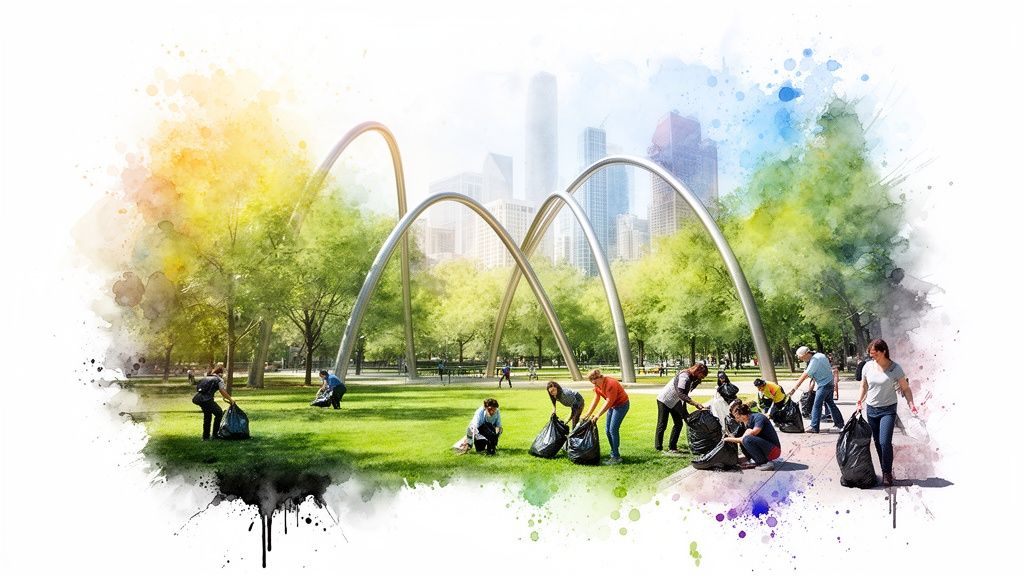
Let me tell you how I started Litter Caterpillars. It wasn't just about cleaning Chicago's parks. It was about cleaning up my own life. I wrote this guide for you—all the other groups out there like ours, people driven by a need to see real, tangible change.
Turning Our Passion into a Partnership
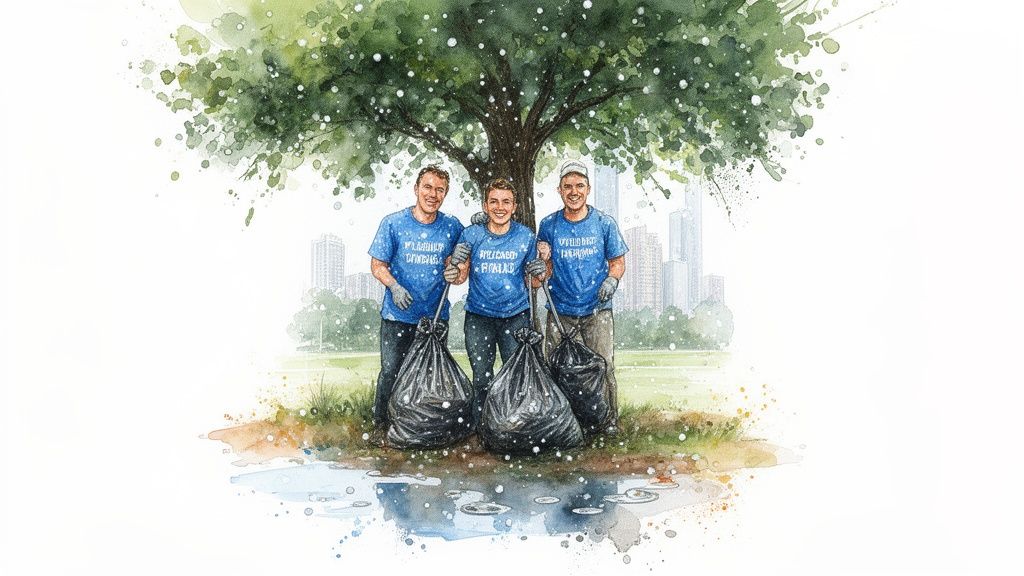
I’ll never forget our first cleanup. Just three of us. We got caught in one of those wild Chicago hailstorms, huddled under a tree, but we felt completely united. I learned something profound that day: cleaning up other people's messes is way easier than cleaning up our own, and it's how you begin to transform yourself and the world around you.
So, you've done the hard part. You've rallied your friends. You've gotten out there and picked up the trash. But what happens next?
This is where you can take all that effort and make it mean even more. It’s time to team up with a big-hitter like Mid America Paper Recycling Co.
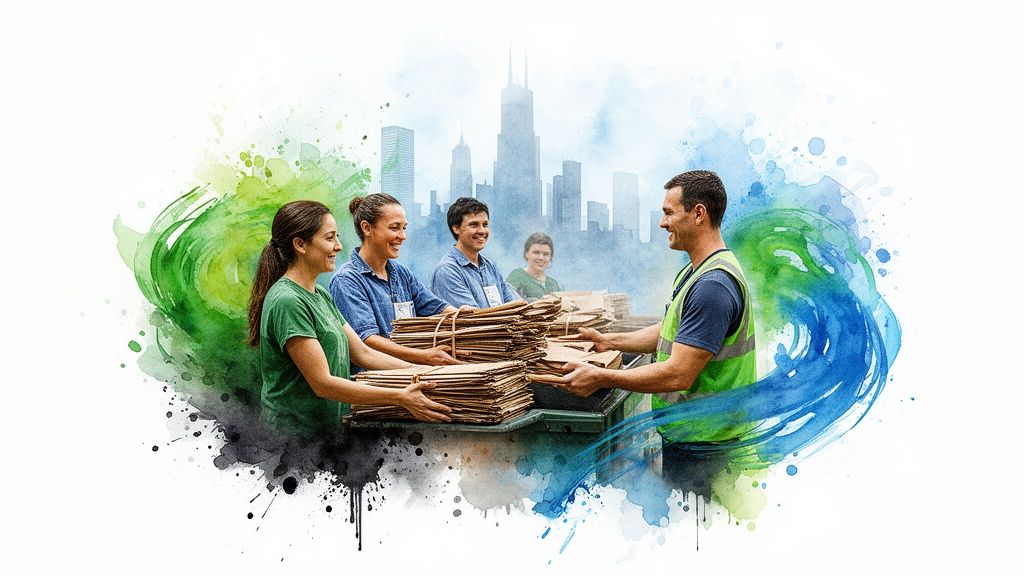
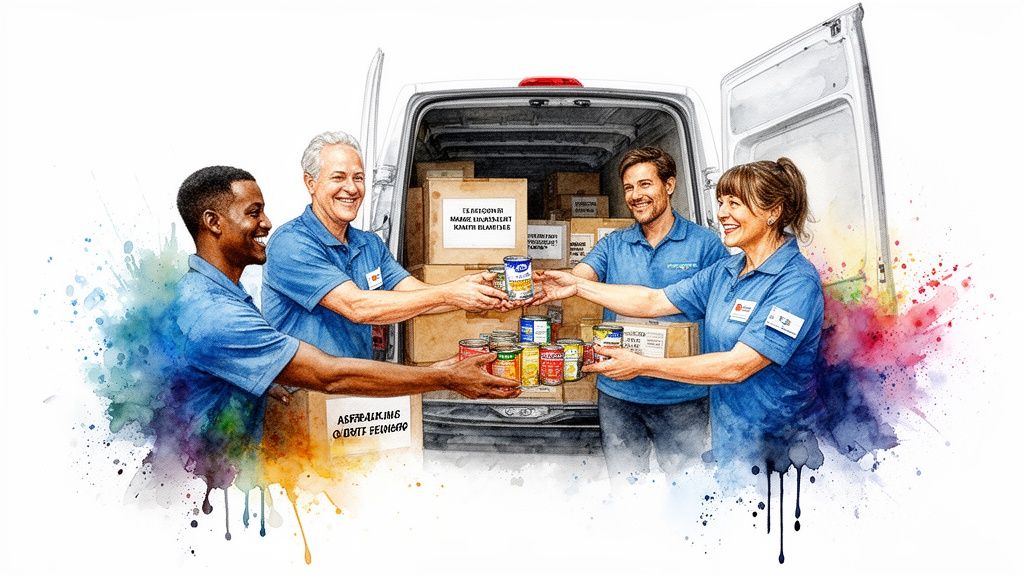
Think about it like this. Those bags of paper and cardboard you collect aren't just trash anymore; they're a resource. When you partner up, every piece you pick up gets a second life, fueling a bigger cycle of sustainability. This is how you take your small acts of service and turn them into something massive.
Who Is Mid America Paper Recycling Co
You’ve definitely seen their big blue trucks rumbling around the city. So, what’s the real story behind Mid America Paper Recycling Co? I think of them as the unsung heavy lifters in Chicago’s recycling world. They're not just another company. They're a true Chicago legacy.
They’ve been at this since 1926. Imagine that—a family business that started way back when and has grown into one of the most serious recycling operations in the entire country.
From their massive, modern facility right here in Chicago, they tackle an insane 51 different grades of paper. They know this stuff inside and out. You can get a real sense of their scale by checking out the story behind their impressive numbers on midamericapaper.com.
When a company has been around that long, it tells you something. It tells me they’re reliable, they know exactly what they’re doing, and they’ve survived by being absolute experts. They're the ones who take all the raw materials we collect and turn them into something new.
Alright, this part is critical. If you get this wrong, all your hard work on a cleanup goes straight to a landfill. This is where you separate the rookies from the pros.
Knowing exactly what Mid America Paper Recycling takes is the difference between a successful haul and a completely wasted effort. So, what's on their "approved" list?
The good news is, it’s a lot of the stuff you find most often. They are hungry for what the industry calls Old Corrugated Containers (OCC)—that’s just the fancy term for all those cardboard boxes you pull out of alleys and parks. They also take mixed paper, office paper, and newspapers. For a group like yours, this is a huge win. It means the mountains of paper and cardboard you collect actually have a place to go.
Following these rules is about respecting the work. It makes sure our effort isn't for nothing and that the stuff we collect actually gets a second chance.
I put together a simple table to make it even easier for you. Think of this as your cheat sheet for sorting on the fly during a cleanup.
Accepted Materials Guide for Volunteer Groups
This table breaks down the common paper and cardboard items we find and tells you exactly how to prep them for Mid America. Keep it simple. Keep it clean.
Material Type
Common Examples
Simple Prep Instructions
Old Corrugated Containers (OCC)
Amazon boxes, shipping cartons, moving boxes
Flatten them completely. Remove any plastic wrap, styrofoam, or excessive tape.
Keep it loose in the collection bag. Make sure it's dry.
Office Paper
Printer paper, letters, envelopes (even with windows!)
No need to shred. Just keep it clean and separate from food waste.
Newspapers
Daily and weekly newspapers, including the inserts
Keep them flat and dry. Don't bundle with string.
Basically, if it's paper or cardboard and it's clean and dry, you're probably in good shape. A little bit of food grease on a pizza box is a no-go. A water-logged newspaper is just trash.
Of course, some things are a definite "no." You can't recycle anything that's been soaked in oil, chemicals, or other nasty stuff. For those items, you need a different game plan. Be sure to check out our guide on what to do with things contaminated by hazardous waste in Chicago.
Navigating Logistics for Your Volunteer Group
You’ve just finished a massive cleanup and now you’re staring at a mountain of perfectly sorted cardboard. What’s next? Getting all that good stuff to a commercial facility like Mid America Paper Recycling Co can feel like a whole new battle. Believe me, I’ve been there.
It’s one thing to pick up the trash; it’s another to get it where it needs to go. Think of it like this: you’ve gathered your army, now you need a battle plan. For a volunteer group like yours, the two most powerful weapons you have are volume and communication.
These big recycling plants are used to dealing with businesses, not weekend warriors like us. But a huge, well-organized haul from a community cleanup? That’s a different story. The best approach I've found is to combine materials from a few different cleanups into one massive load. Show them you mean business.
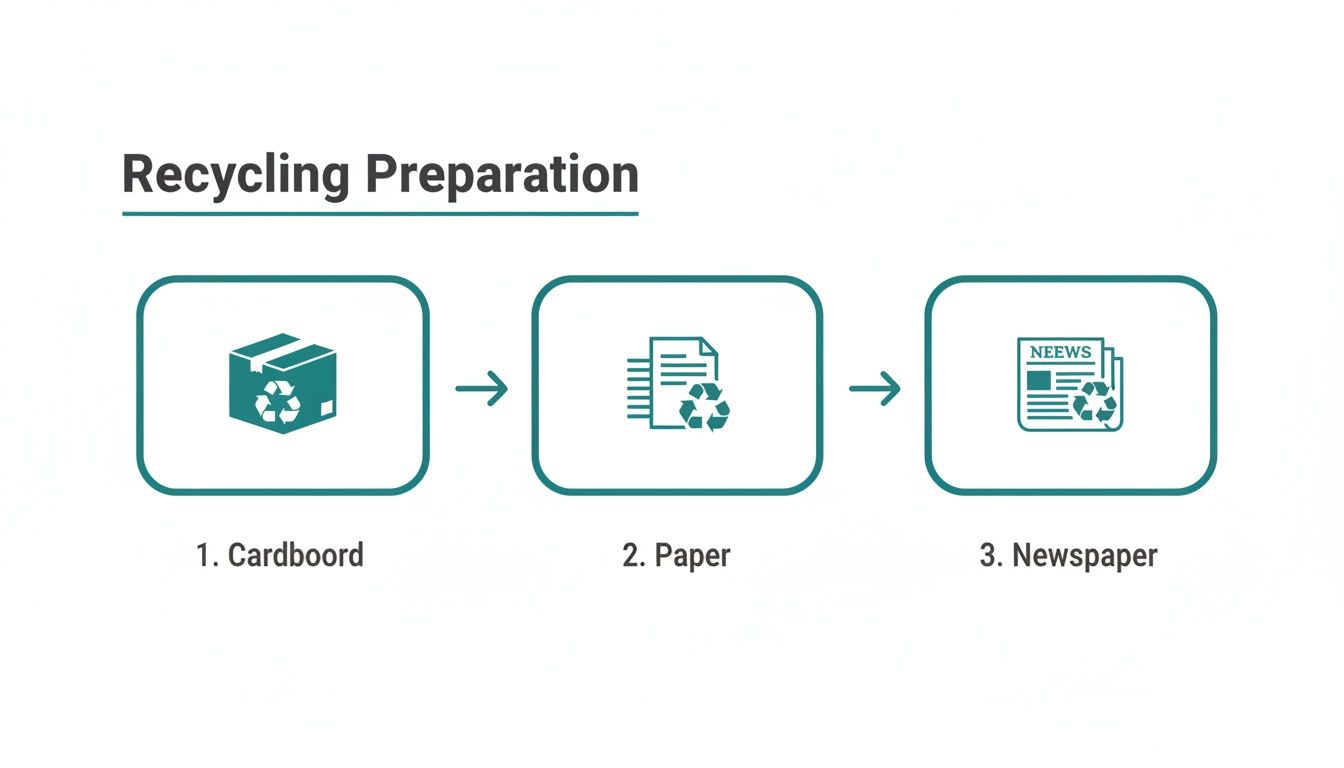
This is how you get your paper and cardboard ready for the big leagues.
When you keep your materials clean, dry, and neatly sorted, you’re not just dropping off trash—you’re delivering a valuable resource. It shows respect and turns you into a professional partner. This kind of planning builds relationships that help everyone, and it’s a good habit to build with all the other Chicago recycling centers out there, too.
So Where Does All Our Hard Work Go?
Have you ever wondered what actually happens after you’ve bagged everything up and called it a day? It’s not the end of the story—it’s where your hard work starts a whole new journey. All that paper and cardboard you collect gets sent to a massive facility run by Mid America Paper Recycling Co, and from there, it’s a wild ride.
Think of it like a giant, high-tech kitchen. The paper gets sorted, cleaned of any gunk, and then squished into massive, dense bales. These aren’t just blocks of old paper; they're the raw ingredients that paper mills all over the world are waiting for. They’ll get transformed into brand new boxes, paper towels, and all sorts of other paper goods.
This is what people call the "circular economy," and it’s a pretty big deal. It means your effort isn't just about cleaning up a block; it's about plugging your neighborhood directly into a global supply chain that gives our trash a second, third, and fourth life.
And partnering with a big, established player like Mid America matters. Even when the economy gets weird, they keep the whole process chugging along. In 2023, for example, cardboard prices totally crashed, but the company reported that their volumes were actually surging. That’s a testament to their stability. You can even nerd out on their market report on midamericapaper.com to see how it all works.
By linking up with them, every cleanup you do becomes part of something so much bigger.
Building a Stronger Future Together
The world of recycling never sits still, and something big just happened that makes our potential partnership with Mid America Paper Recycling Co. even more exciting. You might be wondering, "What does this mean for a small volunteer group like us?" I see it as a huge vote of confidence.
Think of it like two of your favorite bands merging to form an absolute supergroup. In October 2025, FV Recycling acquired the Chicago firm, creating a powerhouse that now handles over 900,000 tons of recyclables every single year. That's a massive operation. You can read more about this game-changing acquisition on resource-recycling.com.
For us on the ground, this means our partner has greater resources, a more resilient network, and a wider reach.
This inspires me. It means our local efforts in Chicago are now feeding into an even stronger national mission. Your work just became part of a bigger story, showing how our weekend cleanups can support larger corporate social responsibility programs. Our small actions just got a whole lot bigger.
Questions You're Probably Asking
I get it. The idea of a small, scrappy group like ours teaming up with a massive industrial recycler like Mid America Paper Recycling Co feels… unlikely. It definitely brings up a lot of questions. Let me walk you through some of the stuff I had to figure out when we first started down this path.
Can a Small Volunteer Group Really Work With a Giant Like Mid America?
Yeah, you can. Look, their bread and butter is huge commercial accounts, not a few bags from somebody's apartment. But a partnership isn't impossible. It all comes down to two things you can actually control: volume and organization.
When your whole crew pools together everything from a massive park cleanup, you suddenly have the kind of volume that makes them pick up the phone. My advice? Don't just show up. Call them with a real plan. Tell them you're the Litter Caterpillars, you have an estimated mountain of clean, sorted cardboard, and you have a smart way to get it to them. Your professionalism is your key.
How Is This Different From Just Using the City's Blue Carts?
Think of it this way: the city's blue cart is your kitchen fridge. It’s perfect for handling a little bit of everything from your house each week—a yogurt cup here, a junk mail flyer there.
A partner like Mid America Paper Recycling Co is a professional, commercial-grade kitchen. They're built to process enormous amounts of very specific ingredients. For them, that's paper and cardboard from businesses. When you collect hundreds of pounds of cardboard at a single cleanup, taking it to a specialist is just way more powerful and efficient.
You can dramatically increase the value of your collected materials with two simple steps: keep it clean and keep it sorted.
How Do We Make Our Trash Valuable to Them?
This is the secret sauce. A greasy pizza box is just trash. It's not a recyclable material. But a clean, dry, flattened stack of cardboard? That's a different story.
When you show up with clean, sorted material in a significant quantity, you completely change the conversation. You’re no longer just dropping off "waste." You become a partner bringing them a valuable "commodity." That simple shift in your approach is the golden ticket to building a real, lasting relationship.
At Litter Caterpillars, we believe in the power of service to transform ourselves and our city. Join us on our next cleanup and become part of the change.
I used to see Chicago's streets as just a grid, a map to get from point A to point B. A blur. Then, one Saturday, I did something different. I grabbed a trash bag, a litter picker, and went for a walk. But I wasn't just walking; I was seeing. The city wasn't just a backdrop anymore. It was alive, and I was a part of it. That simple act, picking up a single discarded coffee cup on the Magnificent Mile, changed everything for me. It turned a mindless stroll into a mission. A story.
I want you to feel that. That profound connection. It's why I'm writing this. I realized the biggest wall between me and helping wasn't a lack of desire, it was just not knowing where to start. How do you explore a new neighborhood and do some good at the same time? I found my answer by pairing my cleanups with some incredible Chicago walking tours self guided apps and websites. These tools became my personal storytellers, whispering secrets of the Loop's architectural giants and Pilsen's vibrant murals right into my ear while I did my part.
In this list, I'm giving you the keys to the kingdom. These are the absolute best platforms I've found. I’ve used every single one, and I'll show you exactly how they work. You'll discover the audio magic of VoiceMap, the gamified quests of Questo, and the hyper-local routes from ChicagoWalkTours. My mission is to give you everything you need to turn your next walk into your own story of discovery and service. Let's find your perfect tour, grab a bag, and explore with purpose.
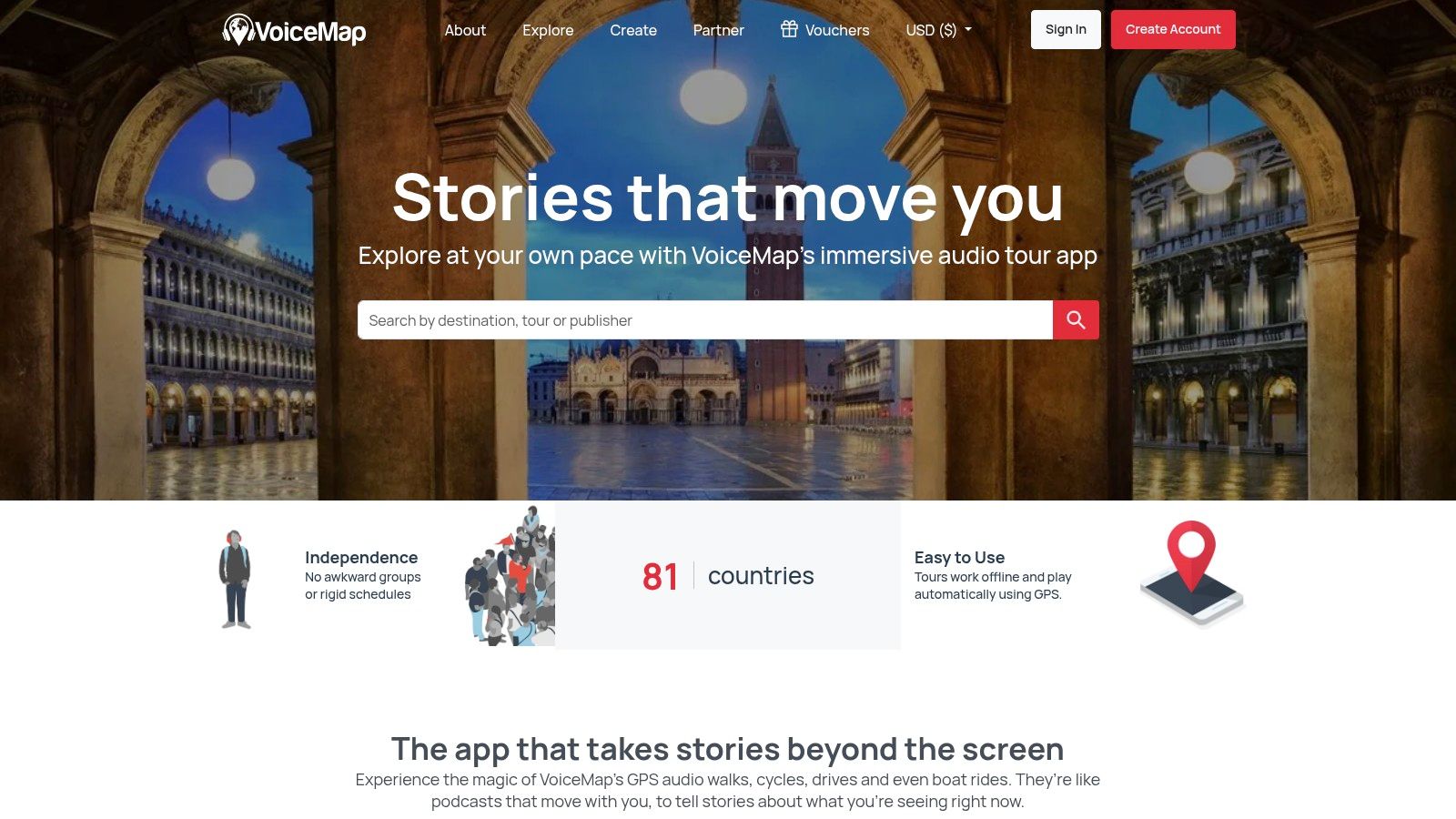
1. VoiceMap (Chicago audio walking tours)
Imagine you're walking downtown. You've got a personal storyteller in your ear, someone who lives and breathes Chicago, pointing out the hidden gargoyles and forgotten histories you’d normally walk right past. That's the feeling VoiceMap gives you. It's like a backstage pass to the city. This platform transforms your smartphone into an expert guide, using your phone’s GPS to automatically play these rich audio narratives as you move. It's perfect for someone like me who loves a good story but wants the freedom to wander off-path for a moment. You download a tour, you pop in your headphones, and you let the city's saga unfold around you.
What I love about VoiceMap is the human element. These aren't robots. They're real Chicagoans—historians, journalists, passionate locals—sharing their world with you. The app hands you a clear map with a starting point, so you know exactly where to begin your adventure, whether it’s by the Art Institute for a journey through the Loop or deep in the glowing Theater District. Once you download the tour, it works offline. A lifesaver for your data and battery.
Why It Stands Out
VoiceMap's magic is its hands-free, immersive experience. The GPS-triggered audio means your eyes are on the city, not on your phone. It’s like a podcast that moves with you, responding to your every step. See a cool coffee shop? A perfect photo op? Just pause the tour. The story will wait for you. This flexibility makes it one of my top choices for a truly self-guided Chicago walking tour.
Pro-Tip: I always check the tour's total distance and time on its page before I start. This helps me plan my whole day, including where I might stop for lunch or a quick Litter Caterpillars cleanup!
Making an Impact with VoiceMap
Weaving a community cleanup into your VoiceMap tour is easy and feels great. Here’s a little game plan for you:
Pre-Tour Prep: Pack a small bag for recyclables and another for trash. The Art Institute, a common starting point, has public bins all around, making it a perfect spot to begin with a clean slate.
Pause for Purpose: When your audio guide points out a major landmark like Millennium Park, hit pause. Give yourself a 10-minute break to collect stray litter around the benches or gardens where people gather.
The Final Sweep: Most tours end near a train station or a busy plaza. Before you call it a day, do one last sweep of the area around the tour's endpoint. It's a powerful way to leave the neighborhood even more beautiful than you found it.
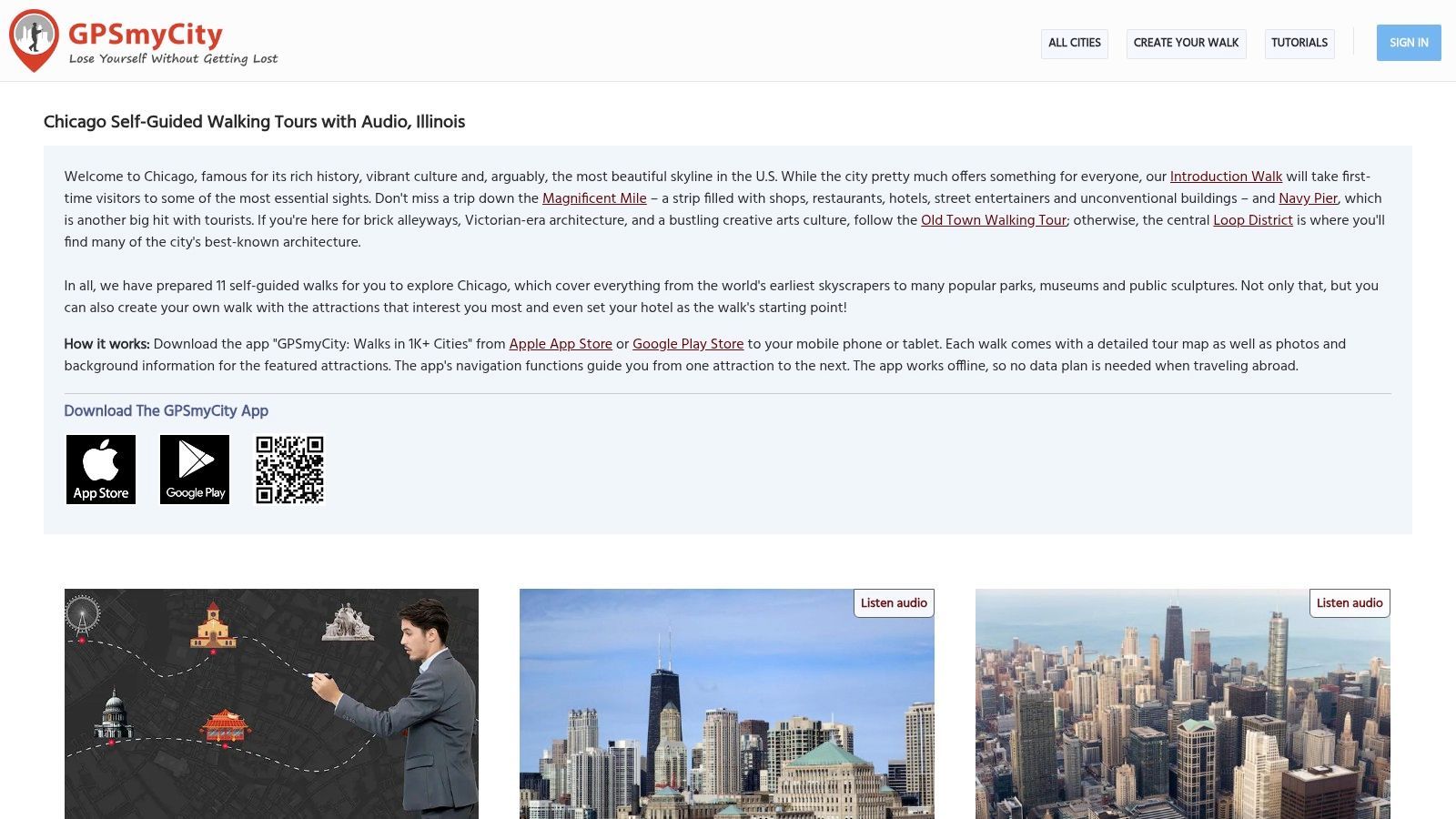
2. GPSmyCity – Walks in 1K+ Cities (Chicago collection)
Think of GPSmyCity as a sprawling, digital library of urban adventures, with a massive Chicago section right at your fingertips. If you're like me and crave variety—wanting to see the architectural canyons of the Loop one day and the quiet, historic streets of Old Town the next—this app is your key. It offers a colossal catalog of self-guided routes, complete with maps and turn-by-turn directions. Many of these walks even have optional audio, giving you a clear path and the stories behind the sights.
What I get a kick out of with GPSmyCity is its sheer breadth. You can explore Millennium Park one weekend and Chinatown the next, all within the same app. The offline maps are a godsend, especially downtown where the skyscrapers can make your signal vanish. I love that I can download my walk and navigate without a single worry about data. The coolest part? You can even build your own custom walk from scratch, connecting your personal points of interest into a unique route that’s all yours.
Why It Stands Out
GPSmyCity's power is its massive volume and wild flexibility. It has one of the widest selections of Chicago neighborhoods and themes available anywhere. That custom route builder is a fantastic tool for us locals. I can use it to plan a specific cleanup route that hits my favorite spots or known problem areas. While the interface and audio quality can vary because the catalog is so huge, having that many options makes it a powerhouse for any chicago walking tours self guided experience.
Pro-Tip: Since the price for each walk is shown inside the app, I suggest browsing the full Chicago catalog first. I make a little wishlist of tours, then decide which ones to grab. This helps me plan my city explorations without any surprises.
Making an Impact with GPSmyCity
With so many routes to choose from, you can turn any neighborhood exploration into a cleanup mission. Here’s how you can make a real difference:
Build a Cleanup Route: I use the "Create Your Own Walk" feature to design a route specifically for a Litter Caterpillars event. I pinpoint known litter hotspots, public parks, and a final drop-off location near recycling bins.
Neighborhood Focus: Choose a specific neighborhood tour, like the one for Old Town or the University of Chicago. Focus your cleanup efforts entirely within that tour's boundaries. The app’s map will keep you on track as you beautify the area, block by block.
Pre-Walk Planning: Before you start, download the tour to use it offline and pack your cleanup kit. The starting points for many tours, like the Magnificent Mile or Navy Pier, are high-traffic zones and perfect places for you to make an immediate, visible impact.
3. Questo (self-guided, gamified walking tours and scavenger hunts)
What if exploring Chicago felt less like a history lecture and more like you were the hero in your own adventure movie? That’s the electrifying twist Questo brings to the game. This app turns your self-guided walking tour into an interactive quest, where you're solving puzzles and cracking codes to unlock the city's hidden secrets. It’s an absolutely brilliant way to engage your brain and your legs, turning a simple walk through the Loop or Chinatown into a story that you are actively creating. You're not just a spectator; you're the main character on a mission.
Questo makes discovering Chicago a challenge, whether you're by yourself or with a team. The app gives you a starting point and a storyline—maybe you're hunting for ghosts in Lincoln Park or solving a fictional murder mystery downtown. As you follow the map, your phone feeds you clues that force you to look closely at architecture, statues, and plaques to find the answers. Every correct solution unlocks the next location, creating this thrilling breadcrumb trail of discovery. Plus, the quests clearly list the distance and time, so you can pick an adventure that fits your day.
Why It Stands Out
Questo's gamified approach is its secret weapon. Instead of just listening, you become an active problem-solver. This makes it incredibly fun for groups, families, or anyone like me with a competitive streak. The excitement of solving a tough clue together turns a walk into a powerful team-building event you’ll actually remember. This unique format really motivates you to keep going, pushing you to explore corners of the city you might have otherwise completely ignored. It’s one of the most hands-on chicago walking tours self guided experiences out there.
Pro-Tip: Some of these clues are really tricky! Don't feel bad about using the in-app hints if you get stuck. I've had to. The point is to have fun and keep the adventure moving, not to get frustrated in one spot for an hour.
Making an Impact with Questo
The mission-based structure of a Questo tour is the perfect skeleton for a community service project. Here’s how you can blend your quest with a cleanup:
Assemble Your Quest Team: Questo is amazing with friends. Turn your cleanup into a social event—it's a great way to meet new people and figure out how to make friends in Chicago. At each stop, you can divide your team into “puzzle solvers” and “litter collectors.”
"Solve and Sweep" Method: When you arrive at a location to solve a puzzle, pause the game. I like to set a 10-minute timer for my group to clean the immediate area while one or two people focus on cracking the clue. This keeps everyone in on the action.
Reward at the Finish Line: A lot of these quests end in a park or plaza. Make this your final cleanup zone. Once you officially complete the quest, celebrate your victory with a dedicated 15-minute sweep of the area, leaving it even better than you found it.
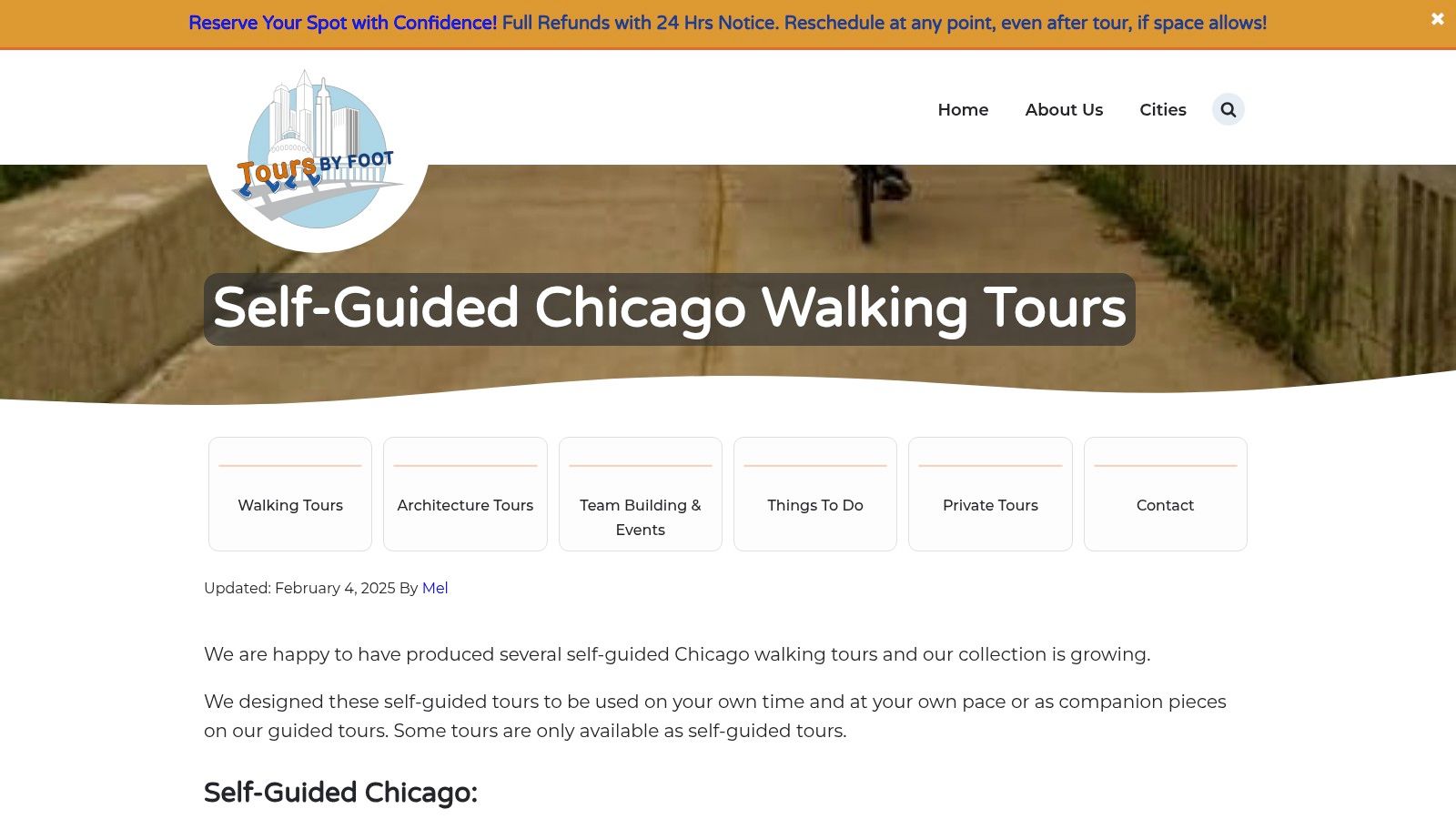
4. Free Tours by Foot (FTBF) – Chicago self-guided routes
What if you could explore Chicago's incredible neighborhoods with a super-detailed, well-researched guide, all without spending a single dollar? That’s exactly what Free Tours by Foot gives you. This website offers these wonderfully thorough, step-by-step written itineraries that you can follow right from your phone's browser. It’s like they handed you a history book and a local’s secret guide all rolled into one, letting you discover everything from Millennium Park to the vibrant streets of Pilsen and Wicker Park at your own speed.
The beauty of FTBF is its simplicity and depth. You don’t need an app. You just pull up the guide on your phone. Each stop on the tour is explained with rich historical context and fun facts. I especially love their food-focused tours, which give you specific restaurant suggestions in neighborhoods like Greektown and Andersonville. The content is impressively current (I saw updates as recent as February 2025), so you know you can trust the information for your Chicago walking tours self guided adventure.
Why It Stands Out
Free Tours by Foot stands out by offering something incredibly valuable for free. The sheer number of neighborhood options they offer takes you far beyond the usual downtown loop, pushing you to dig deeper into Chicago's cultural soul. Unlike an audio tour, a text-based guide lets me absorb information at my own pace—perfect for people like us who like to read and re-read the interesting details. It's a classic, old-school approach in a digital format that just works.
Pro-Tip: Before I head out, I always take a few screenshots of the key directions or map sections. This creates a backup just in case I hit a spot with bad cell service, so I know I can keep navigating without a problem.
Making an Impact with FTBF
The stop-and-read rhythm of these tours creates perfect little windows for a community cleanup. Here's how you can weave your exploration with purpose:
Prep for Pilsen: If you do the Pilsen food tour, you'll be stopping a lot to read about murals and taquerias. Designate one person as the "navigator" to read aloud while others scan the area for litter, especially around the bustling 18th Street corridor.
Wicker Park Cleanup: The Wicker Park route takes you right through high-traffic spots like the Damen and Milwaukee intersection. At each numbered stop on the guide, I challenge myself and my friends to a five-minute micro-cleanup. You'll be amazed at how much you can collect while you're learning about the area's history.
Food Tour Finale: On the food-centric walks in Chinatown or Greektown, your tour ends after you've probably grabbed a bite. I like to pay it forward by cleaning up any stray napkins, containers, or receipts left around the public seating areas or near the restaurant I just enjoyed.
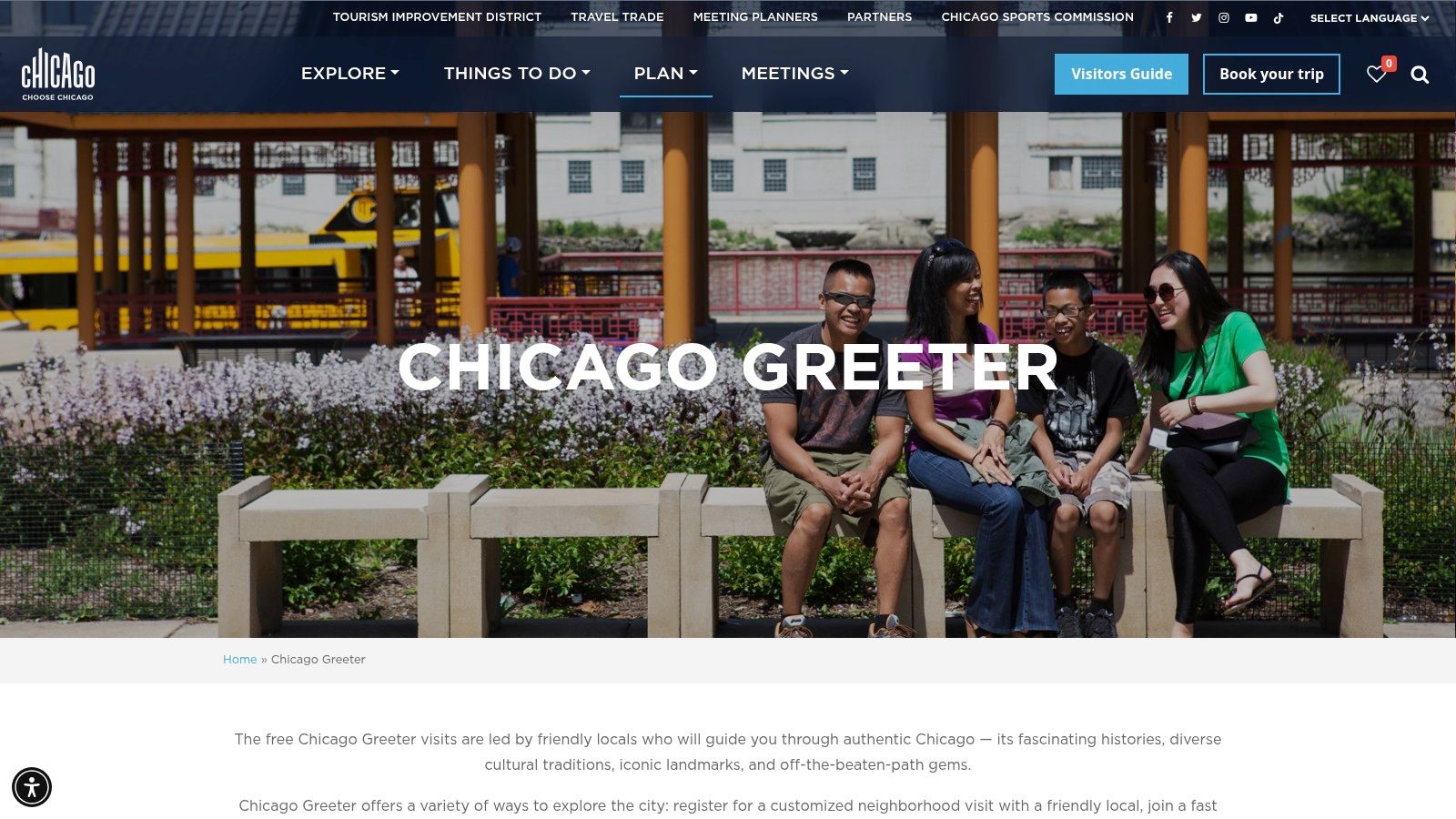
5. Choose Chicago – Chicago Greeter self-guided tours (official tourism board)
What if you could explore Chicago with advice you knew you could trust, straight from the city’s official welcome wagon? That’s what you get with Choose Chicago, the city's tourism board. They've teamed up with the amazing Chicago Greeter program to create a whole series of self-guided walking tours that feel like getting an inside scoop from a local friend. These are not just generic routes. They are thoughtful journeys through our diverse neighborhoods, designed by experts who live and breathe Chicago culture. They offer a fantastic, reliable starting point for anyone new to the city or even for us locals wanting to understand a neighborhood's soul a little better.
The beauty of these tours is their simplicity. Their accessibility. You don’t need a special app or a subscription. The routes are available as printable PDFs or mobile-friendly web pages, complete with a clear map and engaging descriptions of key landmarks. I love this low-tech approach because it lets me disconnect from my notifications and really connect with the streets. One minute I'm learning about historic Polish cathedrals in Wicker Park, and the next, I'm discovering incredible public art in Pilsen. It’s a straightforward, trustworthy way for you to begin your Chicago walking tours self guided adventure.
Why It Stands Out
Choose Chicago stands out because it's the official, authoritative source. You can trust the information is accurate, visitor-friendly, and really highlights what makes each neighborhood so special. While other platforms might focus heavily on the downtown Loop, these guides really encourage you to venture into the vibrant communities that form the city's true heart. It’s a free, no-fuss resource that empowers you to explore with total confidence.
Pro-Tip: The website also explains how you can book a free, in-person Chicago Greeter tour with a local volunteer. I think of the self-guided tour as a "scouting mission" to figure out which neighborhood I'd like to explore even more deeply with a personal guide later on.
Making an Impact with Choose Chicago
These map-based tours are perfect for a structured community cleanup. The clear routes allow you to plan your Litter Caterpillars mission with precision.
Pre-Tour Prep: Before you head out, print the tour map or save it to your phone. Pack your cleanup kit with bags and gloves. Many of these neighborhood tours start near a local park or plaza, which is an ideal spot for an initial sweep.
Pause for Purpose: As you walk from one point of interest to the next, pay attention to the sidewalks and parkways. When you stop to read about a historic building or a unique mural, take five minutes to collect any litter in that immediate area.
The Final Sweep: The tours often conclude near a commercial street with plenty of shops and restaurants. These high-traffic zones are a great place for a final cleanup effort. You'll leave the neighborhood’s main drag looking pristine for residents and visitors alike.
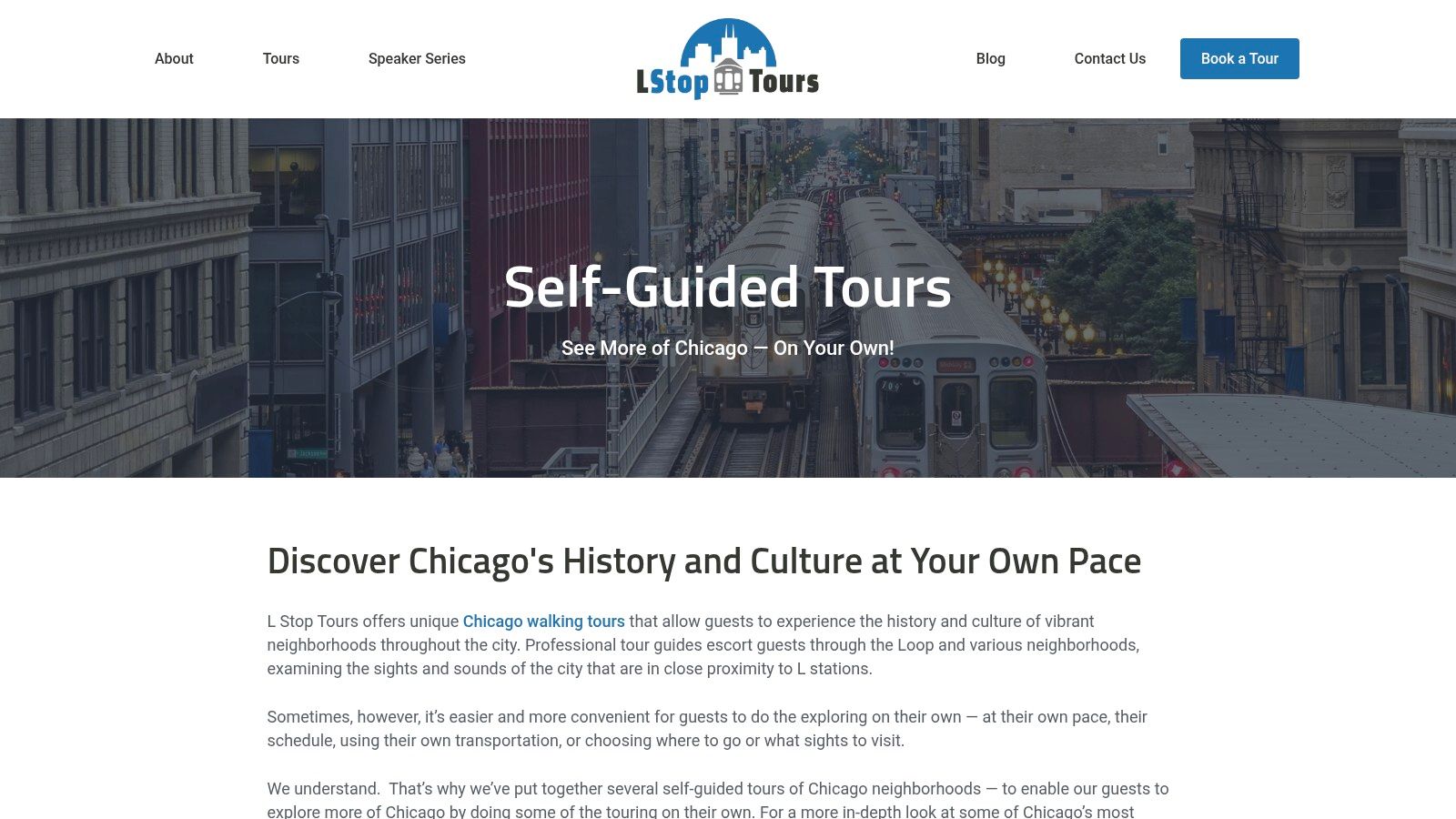
6. L Stop Tours – Self-Guided Neighborhood Tours (local operator)
What if you could explore Chicago's real, authentic neighborhoods just like a local, guided by the very people who lead tours for a living? That’s the brilliant idea behind L Stop Tours. This is a Chicago-based company offering completely free, self-guided walking tours designed by actual, working tour guides. All their routes are built around our city's iconic 'L' train system, making it incredibly easy for you to hop off at a stop and immediately start an adventure in a place like Wicker Park, Andersonville, or even the historic Union Stock Yards.
The tours themselves are presented as simple web pages or downloadable PDFs, packed with historical context, architectural notes, and genuinely useful local tips. It feels like getting insider knowledge without the price tag. You just pull up the guide on your phone and follow the text-based directions. Each route clearly lists the estimated time, so you can plan your day with confidence. This is your chance to discover the places where real Chicagoans live and work, far from the typical tourist traps.
Why It Stands Out
L Stop Tours is all about authenticity. Because the routes are created by professional local guides, you get practical, on-the-ground insights you'll never find in a generic travel app. This makes it an amazing resource for a chicago walking tours self guided experience that feels genuine and truly neighborhood-centric. The focus on 'L' stop access also empowers you to confidently navigate the city using public transit. While it doesn't have fancy GPS audio, its simple, text-based format is a huge plus for anyone who, like me, prefers reading and wants to save their phone battery.
Pro-Tip: Check out their "DIY Pub Crawls" section for a fun twist! I think these routes are perfect for an evening cleanup-and-celebrate event. You and your friends can tidy up a few blocks, then reward yourselves at a historic local tavern recommended by the guide.
Making an Impact with L Stop Tours
The neighborhood-first approach of L Stop Tours is a perfect match for a focused community cleanup. Here's how you can blend your exploration with purpose:
Choose Your Neighborhood: Pick a tour that inspires you, maybe a tour of Wicker Park, which offers a great mix of bustling commercial streets and quieter residential blocks.
Clean Around the CTA: 'L' stations are magnets for traffic and always need a little love. Before you even start the tour's official route, spend 15 minutes cleaning up around the station entrance and platforms.
Follow the Guide, Fill the Bag: As you follow the text-based guide from one point of interest to the next, make it a game to collect any litter you see along the way. The clear, step-by-step route helps you focus your cleanup on a specific, manageable area, ensuring you make a visible difference by the time you reach the final stop.
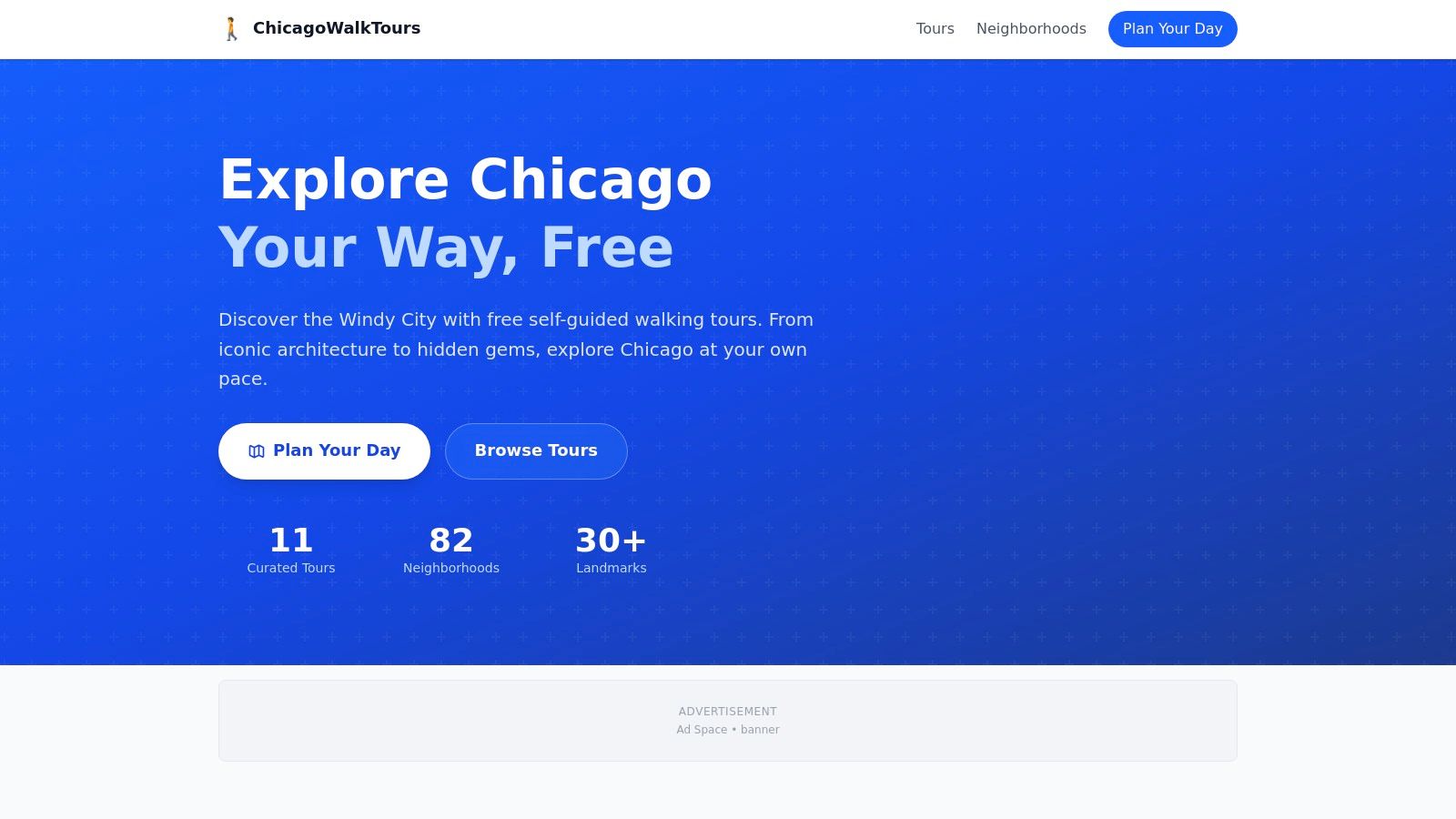
What if you just want a simple map and a list of cool things to see, made by locals who know the city inside and out? No fuss. No frills. That’s exactly what you get with ChicagoWalkTours. This website is a breath of fresh air for me—no app downloads, no logins, just free, beautifully curated routes that you can pull up on your phone's browser. It feels like getting a list of recommendations from a trusted friend who knows all the best spots, from iconic architecture to vibrant neighborhood art.
This platform is unapologetically Chicago-focused, offering themed walks like the "Pilsen Art & Culture Walk" that take you far beyond the downtown core. Each tour clearly lists the estimated time, distance, and difficulty, so you can plan your day perfectly. I personally love the lightweight itinerary builder, which lets me mix and match stops from different tours to create my own unique adventure. It’s perfect for organizing a group cleanup or a weekend outing with friends without any hassle at all.
Why It Stands Out
ChicagoWalkTours shines because of its simplicity and local flavor. Because it’s just text and a map, you have total control. You’re not chained to an audio track; you can read about a stop, look around, and move on whenever you please. I find this format is ideal for group activities because everyone can easily follow along on their own phone. It's a fantastic, free resource for a chicago walking tours self guided experience that feels both authentic and incredibly flexible.
Pro-Tip: I use the itinerary builder all the time to plan cleanup routes. You can combine a few stops from the "Lincoln Park Nature Walk" with your own known litter hotspots. Then just share the custom link with your volunteer group so everyone has the same game plan.
Making an Impact with ChicagoWalkTours
The straightforward nature of these tours makes them perfect for integrating a focused cleanup effort. Here’s how you can make it work:
Pilsen Mural Cleanup: Choose the "Pilsen Art & Culture Walk." The murals are incredible backdrops for your work. Focus on the public spaces and alleyways between the art stops, where litter often accumulates.
Park-to-Park Path: Use the itinerary builder to create a route connecting two or three of Chicago's beautiful parks. Spend 15 minutes at each park clearing litter from benches and pathways before walking to the next one.
The Loop Sweep: On the "Architecture Highlights" tour, I assign each landmark as a mini-cleanup zone. Spend five minutes at the base of each iconic building. You’ll be surprised how much you can collect in these high-traffic spots.
We’ve just journeyed through a digital city of maps, stories, and secret paths. From the game-like adventures of Questo to the local-first insights of ChicagoWalkTours, it’s clear to me that a deeper, more meaningful connection to Chicago is right here, at your fingertips. You now hold a toolkit overflowing with possibilities for your very own chicago walking tours self guided experience.
I like to think of it like this: I’ve just handed you seven different keys. Each key unlocks a different door to the same magnificent house—our city of Chicago. One key, from VoiceMap, might lead you to a grand ballroom filled with historical audio narratives. Another, a scrappy key from Free Tours by Foot, might open a side door into a quiet, sunlit garden no one else seems to know about.
The truth is, there's no single "best" key. The right one is simply the one that feels best in your hand today.
Choosing Your First Key
So, how do you pick? This isn’t about finding the perfect tool; it’s about matching a tool to your mood, your mission, right now. Let me help you sort through that keyring.
If you crave stories and a soundtrack: Start with VoiceMap. It’s like having a local historian whispering in your ear, turning a simple walk into a cinematic journey. It's perfect for those solo days when you want to feel a part of something bigger.
If you’re a planner who loves options:GPSmyCity is your best friend. With its huge library, you can build a personal collection of walks, making it a reliable companion for months of future explorations.
If you have a competitive streak or are walking with friends: Download Questo. The game-like structure and puzzles transform a neighborhood tour into a shared adventure. It’s a fantastic way to break the ice and see the city through a lens of playful discovery.
If you're budget-conscious and self-motivated: The free PDF routes from Free Tours by Foot are a gift. They require a bit more self-direction from you, but they put you firmly in the driver's seat of your own exploration.
If you want the official, trusted path: The Choose Chicago Greeter tours offer a polished, reliable introduction to the city's main attractions, curated by the people who know it best.
The most important thing I can tell you is this isn't a final exam. You can't choose wrong. The beauty of these chicago walking tours self guided tools is their flexibility. Try one this weekend. If it doesn't click for you, try another next weekend. Each walk, each app, each map is just another chance for you to see your city, and maybe yourself, in a new light.
Turning Your Walk into a Legacy
Every single tour we've talked about has a hidden layer, an opportunity that goes beyond just sightseeing. It’s the chance for you to leave each street, each park, each block a little better than you found it. Weaving a quick cleanup into your walk is the most powerful way I know to transform your personal journey into a community gift.
It's a simple, profound act. As you pause to admire a piece of architecture or listen to a story on your audio tour, just take 30 seconds to pick up the litter at your feet. Find that designated checkpoint we mentioned in each guide. It doesn't have to be a huge effort. Even one piece of trash you pull from a gutter is a victory. It’s your small act of rebellion against neglect, your vote for a cleaner, more beautiful Chicago.
You are more than just a tourist in your own city. You are a steward. You are a guardian. Every step you take can be one of purpose. So, download that first app. Pick that first neighborhood. And as you walk, remember that your presence, your attention, and your care are what truly make this city shine. Your first step on that sidewalk isn't just the start of a tour; it's a brave declaration that you are here, you are paying attention, and you are ready to make a difference.
Ready to turn your next walk into a mission of positive change? Join a community event with Litter Caterpillars to connect with fellow city-lovers and make a visible impact. We provide the supplies and the spirit; you bring your new neighborhood knowledge and a desire to help our city thrive. Explore upcoming events and join the movement at Litter Caterpillars.
A community plant sale isn't just about selling a few flowers. It’s an act of creation. It's your group's chance to bring a forgotten corner of your city back to life, and I want to show you how it can get people excited about a mission they can actually see and touch.
Turn Your Passion Into a Community Movement
Think about that neglected patch of land in your neighborhood. It's an eyesore, right? A wound. You and your friends have cleared the trash, and now you’re looking at a blank canvas of soil. This, right here, is where I live. This is where the real magic happens.
I learned this the hard way. My own journey started with a simple, personal mission to clean up my messy life. That small goal somehow spiraled outward, a tiny whirlpool growing into a storm, leading me to clean up my city with the Litter Caterpillars. I quickly discovered that after the litter is gone, the real work—and the real joy—is in bringing nature back, one plant at a time. A native plant sale is the perfect way you can do that.
From Blank Canvas to Living Ecosystem
This isn’t just about making a little money. For me, it was never about that. It’s about inviting your neighbors to be part of the story. Cleaning up the trash is chapter one, but planting? Planting is where the plot thickens. You're not just putting plants in the ground; you're creating a home base for your group, a living, breathing testament to your hard work.
I built this guide from my own experience turning personal messes into thriving ecosystems. It’s your playbook for a plant sale that does more than raise funds—it will grow your group, bring in new friends, and make a real, lasting mark on your neighborhood.
Your sale becomes a magnet for people who care. It’s an easy "yes" for someone who's never volunteered before. They might just buy one little coneflower, but in that moment, they’ve bought into your entire mission. They've become one of us.
Why This Idea Is Exploding Everywhere
And guess what? You’re not the only one thinking this way. The excitement around native plants is surging, like a wave you can feel before you see it. The native plant nursery market was valued at $1.80 billion in 2024 and is expected to rocket to $3.31 billion by 2033.
This isn't just a fleeting trend. It's a huge shift in how people see their local environment. You can read more about these market trends and see how North America is leading the charge. This momentum makes it the perfect time for groups like yours to jump in.
A native plant sale is a no-brainer for any group looking to make a bigger impact.
Why a Native Plant Sale Is Your Next Big Move
I made this quick chart to show you how a plant sale is a direct line to your community service goals.
Benefit for Your Group
Real-World Impact
Visible Progress
Creates a tangible, green space that shows off your group's work.
New Volunteer Magnet
Attracts plant lovers, gardeners, and families looking for a positive activity.
Fundraising with a Purpose
Money raised goes directly back into your projects, funding more cleanups and plantings.
Builds Your Reputation
Positions your group as the local experts in community restoration.
Each plant you sell isn't just a transaction; it's a tiny new habitat for pollinators and a small win for your neighborhood.
This guide will walk you through my story of turning challenges into ecosystems, and I'm offering you a complete, no-fluff playbook for success. Let's get started.
Drawing Up Your Battle Plan
Alright, so you're ready to make this happen. I get it. It can feel huge. But every massive thing we've ever done—from cleaning a single block to buying a whole lot to build Caterpillar Park—started with a simple, crystal-clear 'why.'
Your 'why' is everything. It’s the story you'll tell the business owner when you ask to use their parking lot. It’s the reason you give a new volunteer who asks what the money is for. Are you running this native plant sale to fund new grabbers and bags? To get the cash for a new community garden? Or is it just about getting more people fired up about your mission?
I’ve learned the hard way that a strong mission is the fuel that keeps you going when you hit a wall. It’s the story that keeps your crew inspired when they're exhausted. Before you do another thing, you need to get real with yourself and write down your core purpose.
What's Your Mission? Set Your Targets.
Think of it like this: your mission is the big dream, and your goals are the actual steps you take to get there. It's like navigating by a star. The mission can be broad, like, “We’re going to make Englewood green.” But the goals? They have to be things you can actually count. Footprints in the sand.
Let me spitball a few real-world examples for your sale:
Fundraising Target: We need to raise $500 for a new fleet of grabbers and a handful of tough-as-nails safety vests.
Community Target: We want to talk to enough people to sign up 20 new volunteers who are ready to get their hands dirty with us.
Ecology Target: We’re going to get 150 native plants into the ground in our neighborhood, giving our local pollinators a fighting chance.
These targets give you something to aim for. They turn a fuzzy idea into a real plan. "Let's raise $500" is a mission you can build a strategy around. "Let's make some money" is just a wish whispered into the wind.
Having a clear purpose is like having a map. You might still take a wrong turn, but you’ll always know which way is north. I promise you, every single choice—from the plants you pick to the price you set—gets a thousand times easier when you can ask, "Does this actually help our mission?"
Once you've got this locked down, you can start tackling the real-world stuff.
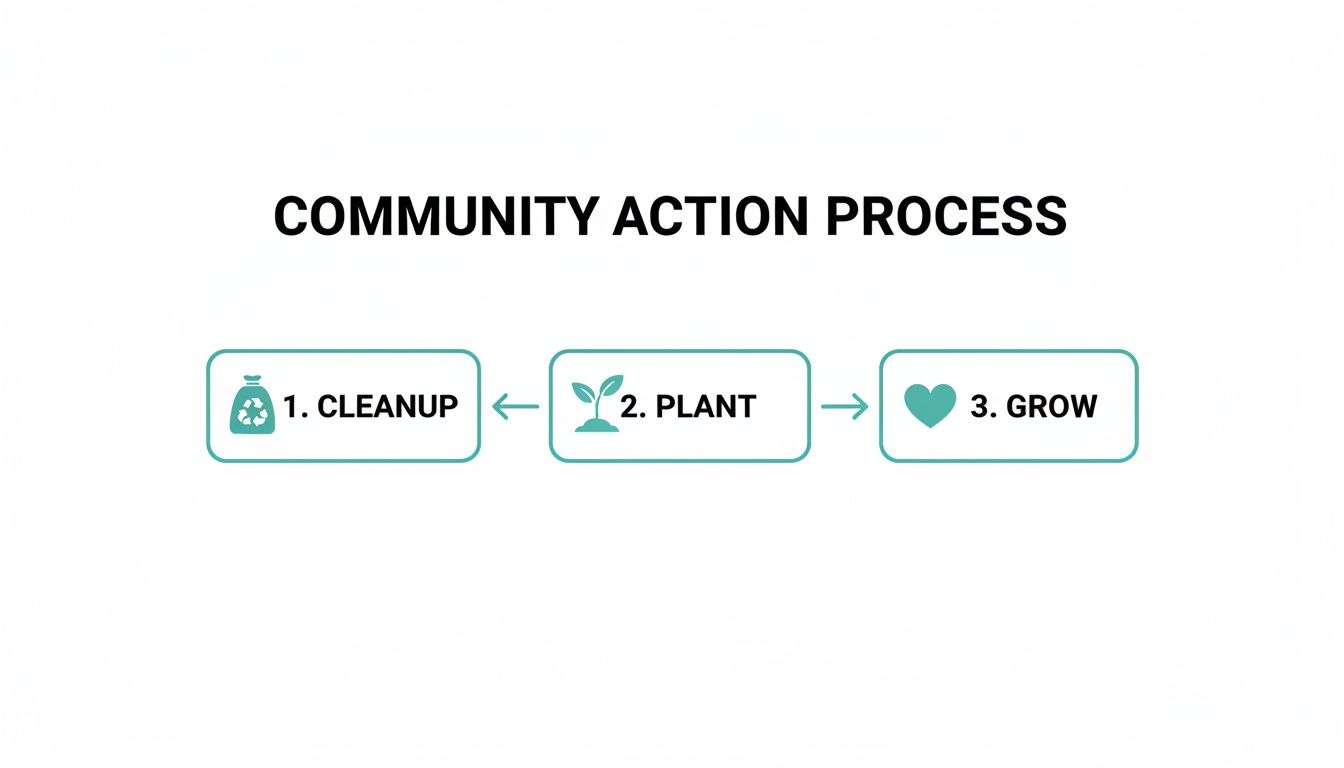
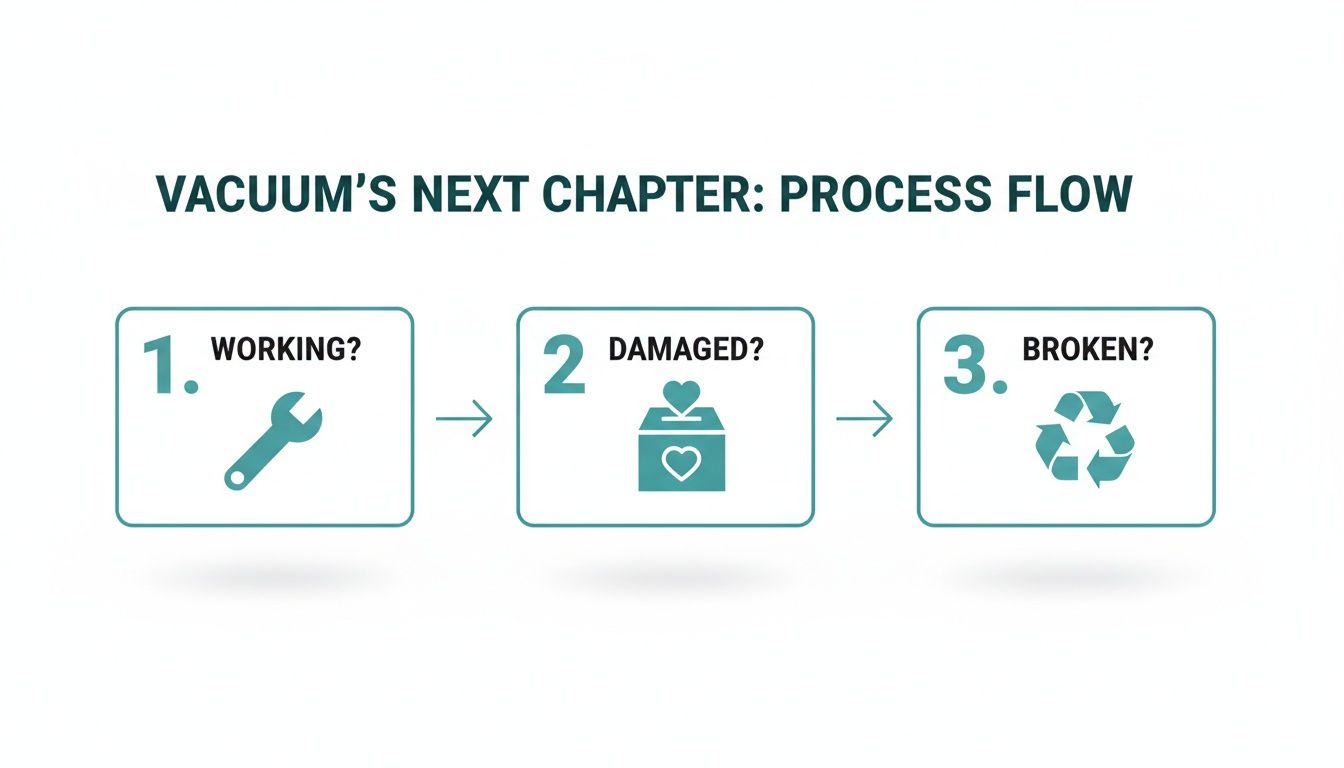
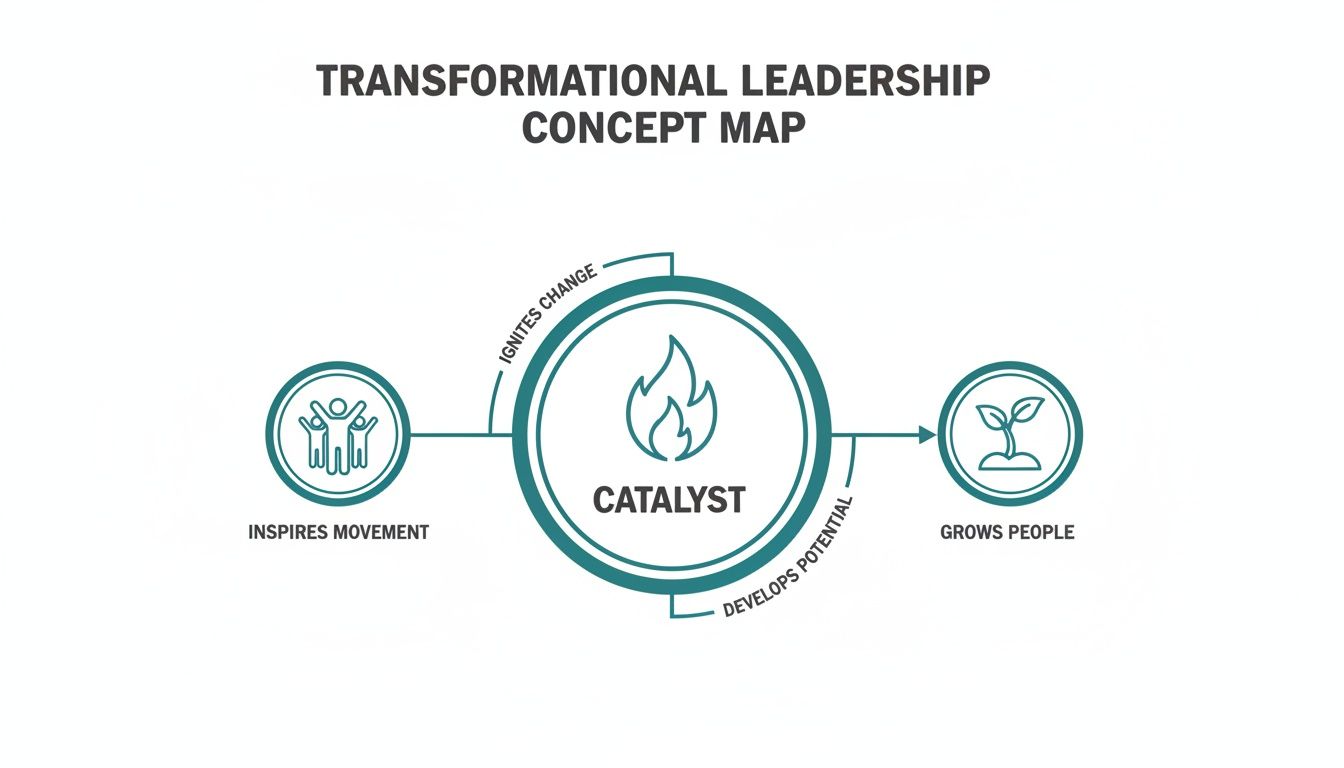
This is the flow we live by. It shows how cleaning up the mess is just the first step. The real magic happens when you start planting and growing.
A native plant sale is the perfect bridge between cleaning up what’s broken and building something beautiful and alive that lasts.
Scout Your Turf and Handle the Paperwork
Now for the part that sounds like a headache: finding a spot and dealing with permits. Don't sweat it. I've learned it’s almost never as bad as you think.
Your location is your stage, so you want somewhere with good energy and people walking by. Think about places where you already have a connection, a story.
That corner of a park you've basically adopted.
The parking lot of a local business that likes you (coffee shops and hardware stores are gold).
A friendly community center or church with some outdoor space.
The empty lot you’ve been cleaning for months! What better way to show the neighborhood what's possible?
When I was starting out, I learned you just have to ask. Walk in, find the manager, and tell them your story. Tell them your why. The worst they can do is say no, and you’d be shocked how many people are eager to help a good cause.
Okay, permits. I know, it sounds awful. But just start with a simple call or email. Find your local park district contact or your alderman’s office and just tell them what you're up to: a small, community native plant sale run by volunteers. Their job is to help people like you.
Honestly, for a small event like this, they might just have you fill out a one-page form. The key is to ask early. Don’t be the person scrambling a week before your sale. This is the boring, foundational stuff that lets the amazing, fun part happen. Get this done, and you’ll have a solid foundation to build on.
Find the Perfect Plants for Your Sale
Let's be real—the plants are the rockstars of this whole show. They're why people will show up, get excited, and open their wallets for your cause. Finding the right ones is everything. Luckily, you’ve got a couple of solid ways to go about it.
Your most direct path is to team up with a local native plant nursery. These aren't just big-box stores; they're run by people who live and breathe this stuff. They're your allies, and you need to treat them that way.
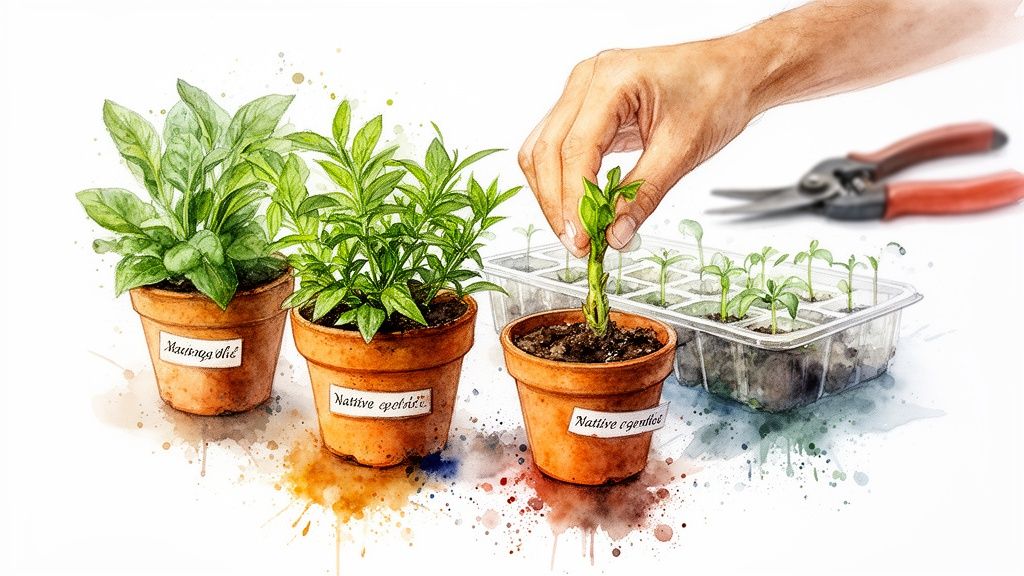
The other route? You grow the plants yourself. This is the long game, no doubt. It takes a saint's patience. But the payoff is immense. Imagine the pride of selling plants that your own crew grew from tiny seeds or cuttings. It builds a story that no one can compete with.
Partner with a Local Nursery
I used to be terrified of walking into a nursery to ask for a deal. It felt like asking for a handout. But I was looking at it all wrong. You're not just asking for cheap plants; you’re offering them a direct line to a whole new crowd of local, passionate customers. You're giving them an opportunity.
So when you approach a nursery, don't lead by asking for a discount. You tell them your story. Show them photos of your cleanups. Get them excited about what you’re building and what this native plant sale will fund.
You're not just another customer; you're a community partner. Frame the conversation that way. You can usually work out one of two deals:
Bulk Discount: This one’s straightforward. You commit to buying a ton of plants, they give you a wholesale price. It’s a great option if you have some cash on hand and feel good about your ability to sell out.
Consignment: This is my personal favorite, especially for your first sale. The nursery gives you the plants with zero upfront cost. After the event, you just pay them for what sold and return the rest. This completely removes the financial risk from your shoulders.
A consignment deal is a game-changer. It means you can host a huge, professional-looking sale without needing a big bank account. It lets you go big without the risk of getting stuck with hundreds of unsold plants.
Finding the right nursery is about finding the right people. I look for the small, independent growers—the ones with dirt under their fingernails and a genuine sparkle in their eye when they talk about pollinators. They’re the ones who will immediately get what you're trying to do.
The Ultimate List of Crowd-Pleaser Plants
When you're picking your inventory, you want plants that are basically guaranteed to fly off the tables. Think like a first-time native plant buyer. They want something pretty, something tough, and something that helps the bees and butterflies.
You're not just selling plants; you're selling people a success story for their own garden. This is exactly why the native plant market is exploding across the U.S. People want the eco-benefits—the pollinators, the biodiversity—and perennials are leading the charge. You're tapping into a massive movement, which you can discover more about this skyrocketing demand in the 2025 Native Plant Market Report.
Here are some absolute winners that I've seen work time and again, they're easy for beginners and adored by wildlife:
Purple Coneflower (Echinacea purpurea): This is the celebrity. Everyone knows it, it's gorgeous, and it’s a magnet for goldfinches and butterflies. A total must-have for you.
Black-Eyed Susan (Rudbeckia hirta): A ridiculously cheerful and tough-as-nails flower. It adds a splash of gold to any spot and seems to bloom forever.
Wild Bergamot (Monarda fistulosa): Those fuzzy, lavender flowers are a favorite of hummingbirds and giant bumblebees. Plus, it smells incredible.
Butterfly Weed (Asclepias tuberosa): With its bright orange flowers, this is non-negotiable for anyone who wants to see monarch butterflies. This is the only thing their caterpillars eat! It's a miracle plant.
Little Bluestem (Schizachyrium scoparium): Don't sleep on the grasses! This one has beautiful blue-green blades in the summer that turn a stunning reddish-bronze in the fall. It also provides critical shelter for insects over the winter.
By focusing on these popular, resilient plants, you're making it easy for your customers to win. When their garden thrives, they'll trust you, and they'll be back for your next native plant sale with even more excitement. You're giving them a garden that isn't just beautiful—it's buzzing with life.
Market Your Sale by Telling a Great Story
Forget everything you think you know about marketing. You’re not selling a product. You’re not even really “selling” anything. You’re telling a story—your story—and inviting people to become a part of it. This is your chance to show everyone the why behind all your sweat and hard work.
I’ve learned that the most powerful tool you have isn't a big budget; it’s your passion. You're not just running a native plant sale; you’re building a movement. Your job is to stop saying "buy this plant" and start saying "help us build this future." That’s what gets people to show up.
Frame It as an Invitation, Not an Ad
When you post on Meetup or Instagram, don't just throw up a date and time. Start with the problem. I always hit them with a gritty "before" picture of that trashed-out lot or forgotten parkway you’ve been fighting to reclaim.
Then, show them the "after"—your team, covered in dirt, smiling, standing on clean ground. That visual punch tells a story of change faster than any words can. It’s a story they can now join just by showing up to your sale.
They aren't just buying a plant; they're buying into that transformation. They’re casting a vote for a greener, better neighborhood.
Use Free Tools to Build Real Excitement
You don’t need a fancy marketing agency. You have a phone and a hell of a story. I use these free tools to build a genuine buzz around my events. Your raw authenticity is your biggest strength.
Social Media Stories: Get on Instagram or Facebook Stories and show the raw, behind-the-scenes chaos. Post quick videos of your volunteers potting plants, laughing while making signs, or hauling tables. These unpolished moments are real, and they show the heart of your group.
Meetup as a Story Hub: Your Meetup event page is more than a calendar entry. Write a powerful description. Explain exactly what the money from the sale will do. Will it buy you new shovels? Help you finally acquire the land for that park? Tell people exactly where their donation is going.
Email Newsletters: If you have an email list, you must use it to build the hype. A week out, send an email highlighting a "plant of the week" and talk about the specific butterflies or birds it’ll bring back. Make it personal and exciting.
The goal isn't just to inform; it's to inspire. When people feel your passion and see the real impact you're making, they won't just come to buy a plant—they'll come to support you.
This is how you build a following, not just a customer list. You're creating a community of believers who are invested in seeing you win.
Give Every Plant a Story
Every single plant has a story. Don't you dare just slap a scientific name on a tag and call it a day. You have to tell their tales. I make little signs or social media posts that bring them to life.
For Butterfly Weed, you could write: "This isn't just a pretty orange flower. It's the only food source for monarch caterpillars. By planting this, you are personally helping bring butterflies back to our city."
Suddenly, it’s not a plant; it's a heroic act. For something like Little Bluestem, I explain how its grassy clumps provide critical shelter for bees and other insects through our brutal Chicago winters.
You're giving people a much deeper reason to care. This simple shift connects their small purchase to a massive ecological impact, and it’s a powerful way to make your native plant sale unforgettable. You’re turning your customers into heroes in their own backyards. And when they look at that plant, they'll remember the story and feel that pride all over again.
It's Go Time: Making Your Plant Sale a Community Celebration
This is it. The day you’ve been working toward. After all the planning, potting, and promoting, your event has finally arrived. This is your chance to shine, not just as organizers, but as hosts of a real community party.
I’ve learned that a successful native plant sale isn’t about retail. It’s about creating a joyful, human experience that leaves everyone feeling energized and connected. It’s all in the choreography, the flow of the event.
You have to think of your site as a story you’re telling. You want to guide people on a journey that feels natural and welcoming. I’ve seen sales where people look lost, wandering aimlessly, and it just kills the vibe. Your goal is to make it so easy and fun that they can focus on what matters: the plants and your mission.
That journey starts the second they arrive.
Think Like a First-Time Visitor
Put yourself in their shoes. What do they see? Where do they go first? You need to map out the physical and emotional journey from start to finish. Let me walk you through the layout that has worked best for us.
The Three Key Stations
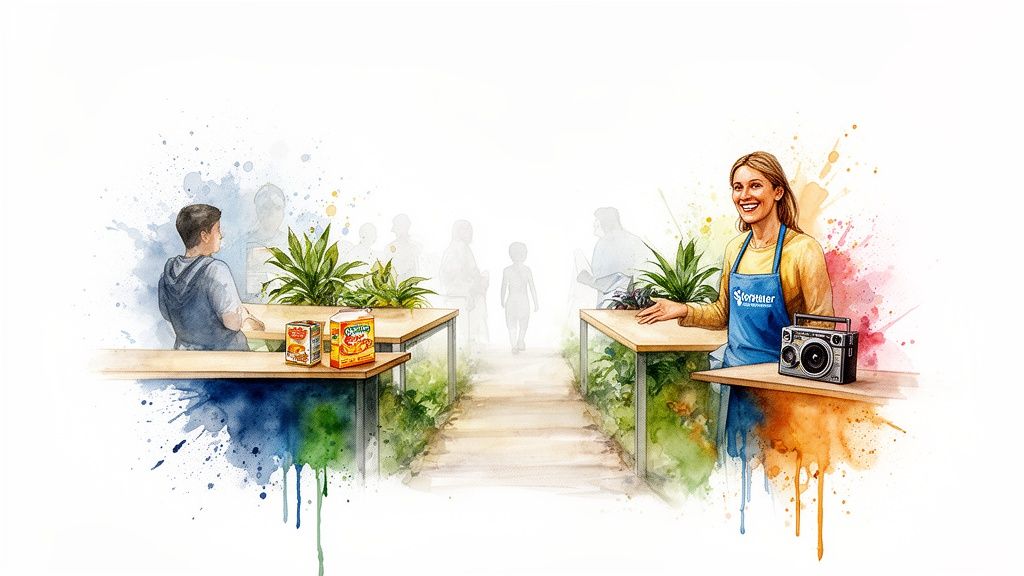
The Welcome Mat: This is your front door, your first impression. Station your friendliest, most outgoing volunteer here. Their only job is to greet people with a huge smile, hand them a box for their plants, and tell them the story of your group in 30 seconds. No selling, just welcoming.
The Plant Zone: This is the heart of your sale. Don't just scatter plants everywhere—that leads to chaos. You must organize them in a way that actually helps people. Simple, clear signs are your best friends. I always organize by sunlight needs: Full Sun, Part Shade, and Full Shade. It’s the number one question gardeners ask.
The Gratitude Station: This is your donation and checkout table, placed right at the end of the plant path. Make it obvious but not pushy. You’ll need another warm, friendly face here to handle payments and, most importantly, thank every single person for their support.
This simple flow turns a potentially confusing event into something smooth and enjoyable. I promise you it keeps the energy positive and makes everyone—customers and volunteers alike—feel totally at ease.
Your Volunteers Are The Soul of The Event
Your volunteers are everything. I give them specific, fun-sounding roles so they feel essential. Think of it like you're casting a play—everyone gets a part that fits their personality.
These are the roles I can't live without:
The Storyteller: Stationed at the entrance, this person’s only job is to welcome people and share the "why" behind your sale. They are the keeper of your mission.
The Plant Guru: You need a couple of these folks roaming the plant section. They answer questions, offer advice, and help people find their perfect plant match. They don’t need to be professional botanists—just passionate and helpful.
The Donation Captain: This person manages the payment station with a smile. They should be comfortable with cash or a card reader and great at thanking everyone who contributes.
The Floater: This is your MVP. They restock plants, bring water to other volunteers, and jump in wherever a need pops up. They are the glue that holds the day together.
The most important thing? You have to make it a celebration for your team. Bring snacks and a big cooler of water. Play some upbeat music. Your joy is infectious. When your volunteers are having a genuinely good time, your customers will feel that energy and want to be part of it.
You are creating a feeling, not just a transaction. People show up because they believe in what you do. And they're ready to invest! In 2021, native plant buyers spent an average of $178 per person. People are drawn to natives because they see them as pollinator magnets (80%), desirable (76%), and a perfect fit for their yards (74%). You can read more about why customers are flocking to native plant sales on Greenhouse Grower.
This is your day to bring your group's story to life. Make it fun, make it meaningful, and you’ll create an unforgettable experience that plants seeds of goodwill all over your community.
The "What Ifs" of Your First Plant Sale
Okay, I get it. Your head is probably spinning with a million "what ifs" right now. That's a good sign. It means you care. When I first started, I had the same fears. What if nobody comes? What if we don't make any money? What if I fail and it's a total disaster?
Let me tell you something I've learned from doing the hard stuff, from cleaning up in blizzards to building a park from scratch: Fear is good. It means you're growing. Let's tackle those fears head-on, based on the messy, real lessons I've learned along the way.
What If We Don’t Make Any Money?
First off, breathe. Now, I want you to ask yourself why you started this. Was it really just to make a pile of cash? I seriously doubt it.
Think about what you've actually accomplished. You got your community together. You started conversations about native plants. You gave your amazing volunteers a new way to make a difference. You created a buzz. That’s huge.
I've run events that, on paper, looked like they lost money. But then I’d see two volunteers who just met making plans to hang out later. Or I’d watch a kid's eyes go wide when they learn that one little plant is a whole world for monarch caterpillars. That’s the real profit. That's the treasure.
The success of your first native plant sale is never just about dollars. It’s in the new friendships, the spark of passion you ignite in someone, and the community you build. A low-profit sale isn’t a failure; it’s a lesson in how to do it even better next time.
How Should We Price the Plants?
This one trips people up. It feels weird and corporate to slap a fixed price on a plant you grew with love. Fixed prices can feel like a transaction, and that's not what we're about. I've found a much better way.
I'm a huge believer in the "suggested donation" model. It completely changes the vibe. People aren't just "buying" something; they're "contributing" to a mission. It lets everyone participate, whether they can give a little or a lot.
Just make some friendly, handwritten signs. No pressure, just guidance.
"Small pots, suggested donation: $8"
"Larger pots, suggested donation: $15"
"Your support helps us turn forgotten lots into living parks!"
This gives people a number to start with but leaves the door wide open for generosity. It frames the whole thing around a shared goal. You'll be shocked at how many people give more than the suggestion because they believe in what you're doing.
How Many Volunteers Do We Really Need?
Don't get stuck thinking you need a giant army. You don't. For your first sale, a core team of 5 to 8 dedicated volunteers is perfect. It's not about the number of people; it's about making sure everyone has a clear role.
Think of it like our cleanup crews: a small, scrappy team where everyone has a job.
The Greeter: One person at the entrance. Their job is to welcome people and tell your story with passion.
The Plant Experts: Two people floating around the plants, answering questions and helping people find the right match for their yard.
The Donation Captain: One person at the checkout table to handle donations with a smile.
The Floater: Your MVP who can restock plants, give others a break, and jump in wherever there's a need.
This is a community project. It should be fun. Keep it simple, focus on creating a great experience, and trust that the right people will show up. It will be enough. I know it will.
This guide is built on the real-world experiences of the Litter Caterpillars. We believe that cleaning up is just the beginning; bringing nature back is how we truly transform our city. Join our movement and help us turn Chicago's forgotten corners into vibrant ecosystems, one cleanup and one plant at a time. Learn more and volunteer with us at LitterCaterpillars.com.
I want to tell you a story. It’s about my fridge. A few years back, that thing was a graveyard of good intentions. You know the scene: four-year-old jam from a Michigan trip, a dusty bag of almonds from a failed health kick. Each item felt like a 500-pound weight of personal failure, a tiny, cold monument to the mess my life had become after a chaotic relationship ended. I just knew something had to change. I craved consistency, bravery, good people.
That craving is actually how I started Litter Caterpillars, a volunteer group that cleans up Chicago. I found out that cleaning up other people's messes was surprisingly easier than tackling my own, and doing it together—even through a freak hailstorm—brought us closer. It taught me the simple, profound power of just showing up.
And that’s exactly what joining a CSA is all about. It's more than just a box of vegetables, believe me. It’s showing up for your local farmer, for your health, for your community. It's like signing a treaty with freshness, a direct pact with the people who grow your food. Just as my cleanup crew helped me transform myself by serving my city, finding a CSA near me transformed my kitchen and my relationship with what I eat. It's a simple, powerful step. A fresh start.
In this guide, I'll walk you through some incredible Chicago-area CSAs. I'll give you all the details you need to find the perfect fit. Let's get you that fresh start.
1. The Urban Canopy – LUCSA: Your Year-Round Produce Lifeline
I want you to imagine something. It's the middle of a brutal Chicago February, snow is everywhere, yet a box brimming with fresh, local food lands on your doorstep. This isn't some fever dream; this is the reality The Urban Canopy delivers. I think of them like that one reliable friend who always has your back, making sure your kitchen is stocked with goodness no matter what the calendar says. They built something truly special: a Local Unified CSA (LUCSA).
This isn’t your typical one-farm CSA. The Urban Canopy acts like a connector, a hub. They gather produce from their own urban farms and then combine it with harvests from a trusted network of regional Midwest farmers. It’s like having a personal shopper for the entire region's bounty. You can see how this model creates incredible resilience, meaning you get consistent variety and availability for about 48 weeks a year.
How It Works & What You Get
Getting started with them is simple. You hop on their website, choose your share frequency—weekly or bi-weekly—and sign up for home delivery. Their delivery zone is huge, covering much of Chicago and nearby suburbs, making it a fantastic option if you’re searching for a "csa near me" that literally comes to you.
Share Options: Weekly or bi-weekly home delivery.
Pricing: A standard weekly share will run you around $55.
Add-Ons: You can customize your order with extras. Think fresh bread, local dairy, mushrooms, and proteins.
Food Access: What truly moves me is their commitment to community. They participate in the LINK Match program. This means if you use a LINK card (Illinois's SNAP program), they match your funds. This simple act cuts the cost of a share in half, making it just $27.50.
What makes The Urban Canopy stand out to me is its beautiful mission of unity. It's a system designed not just to sell you vegetables, but to feed a city, to support a whole network of growers, and to ensure everyone has a seat at the table.
You can’t micromanage the exact contents of your box—that’s a common trait of CSAs—but the incredible variety born from their multi-farm network more than makes up for it. This is an amazing way for you to support a whole ecosystem of local agriculture while enjoying a steady, year-round supply of incredible food.
When I think of Urban Growers Collective, I picture food with a powerful purpose. This Black- and women-led nonprofit isn't just growing vegetables on their eight urban farms; they are cultivating justice, health, and opportunity in Chicago communities. Joining their CSA feels less like a transaction and more like you're becoming part of a movement, a real effort to build a more equitable food system from the ground up.
UGC’s "Collective Supported Agriculture" program is a direct reflection of their mission. You’re not just buying produce; you are investing in local jobs, in educational programs, in increased food access for your neighbors. The connection feels personal and deeply impactful. It makes every carrot and kale leaf taste that much better because you know the story behind it. This is the perfect "csa near me" for those of you who want your food dollars to do double duty.
How It Works & What You Get
UGC organizes their program into distinct seasons, which makes it easy for you to jump in. You simply head to their site, pick your season (like Early Spring, Spring-Summer, or Fall), and choose a share size that fits your household. They offer convenient pickup locations and a home delivery option, and they even send friendly text reminders so you never miss a beat.
Share Options: Seasonal shares in Small (feeds 1-2) or Large (feeds 3-4) sizes.
Pickup/Delivery: You can pick up at their South Chicago Farm or in Lincoln Park. Home delivery is also available for an additional $12 per delivery.
Community First: What really sets my heart on fire is their donation option. If you’re on vacation and have to skip a week, you can choose to donate your share to one of their mutual-aid partners. It’s a simple, beautiful way to ensure nothing goes to waste and that your share supports a neighbor in need.
Food Access: UGC accepts SNAP/EBT for on-farm pickups and participates in the LINK Match program, doubling the value and making fresh, healthy food more affordable for everyone.
The most inspiring part of UGC, for me, is how they embody their name. It is truly a collective effort, weaving together farmers, members, and community partners to create a resilient and just local food web for Chicago.
While the box contents are set by the harvest and you can’t customize them (though they do accommodate allergies), the quality and freshness are undeniable. You’re getting produce grown with immense care and a powerful mission, delivered straight from the farm to your table.
3. Chicago Patchwork Farms – Neighborhood Urban Farm CSA
You know, there’s a certain magic to a farm that feels like it’s woven directly into the fabric of its neighborhood. Chicago Patchwork Farms is that place for me. It’s more than just a source of vegetables; it's a community hub in West Town and Humboldt Park where the mission isn’t just to grow food, but to grow connections and make fresh produce accessible to everyone, without exception.
This is the kind of hyper-local "csa near me" that changes how you see your own city. Instead of forcing you into a single, long-term commitment, they offer seasonal CSA shares for Spring, Summer, and Fall, which you can bundle. This flexibility lets you participate when it works for you. The real heart of their program, though, is its radical accessibility.
How It Works & What You Get
Signing up feels like joining a neighborhood club. You visit their website, pick your season(s), and choose your pickup day. Their model is built on trust and community support, and you can see that clearly in their payment structure.
Share Options: Spring, Summer, and Fall shares (or an All Seasons bundle) with weekly pickups.
Pricing: A revolutionary sliding-scale model. For example, a 16-week Summer share might range from a subsidized cost to a "solidarity" cost that helps others. They also offer weekly SNAP/LINK payment options, which makes it incredibly affordable.
Pickup Only: They focus on being a neighborhood anchor, so all shares are for pickup at the farm. They offer multiple weekly pickup windows for your convenience.
Community Focus: You can feel the community spirit everywhere, from volunteer opportunities to their Solidarity Fund. This is one of many amazing community gardens in Chicago, IL that helps foster local connections.
What strikes me most about Chicago Patchwork Farms is their deep commitment to justice. They don't just talk about food access; they built their entire CSA model around it, ensuring that your finances are never a barrier to eating fresh, healthy, local food.
While you won't find home delivery here, what you gain is a direct connection to the people and the land growing your food. It’s an invitation for you to become part of a system that actively cares for its neighbors, one bunch of kale at a time.
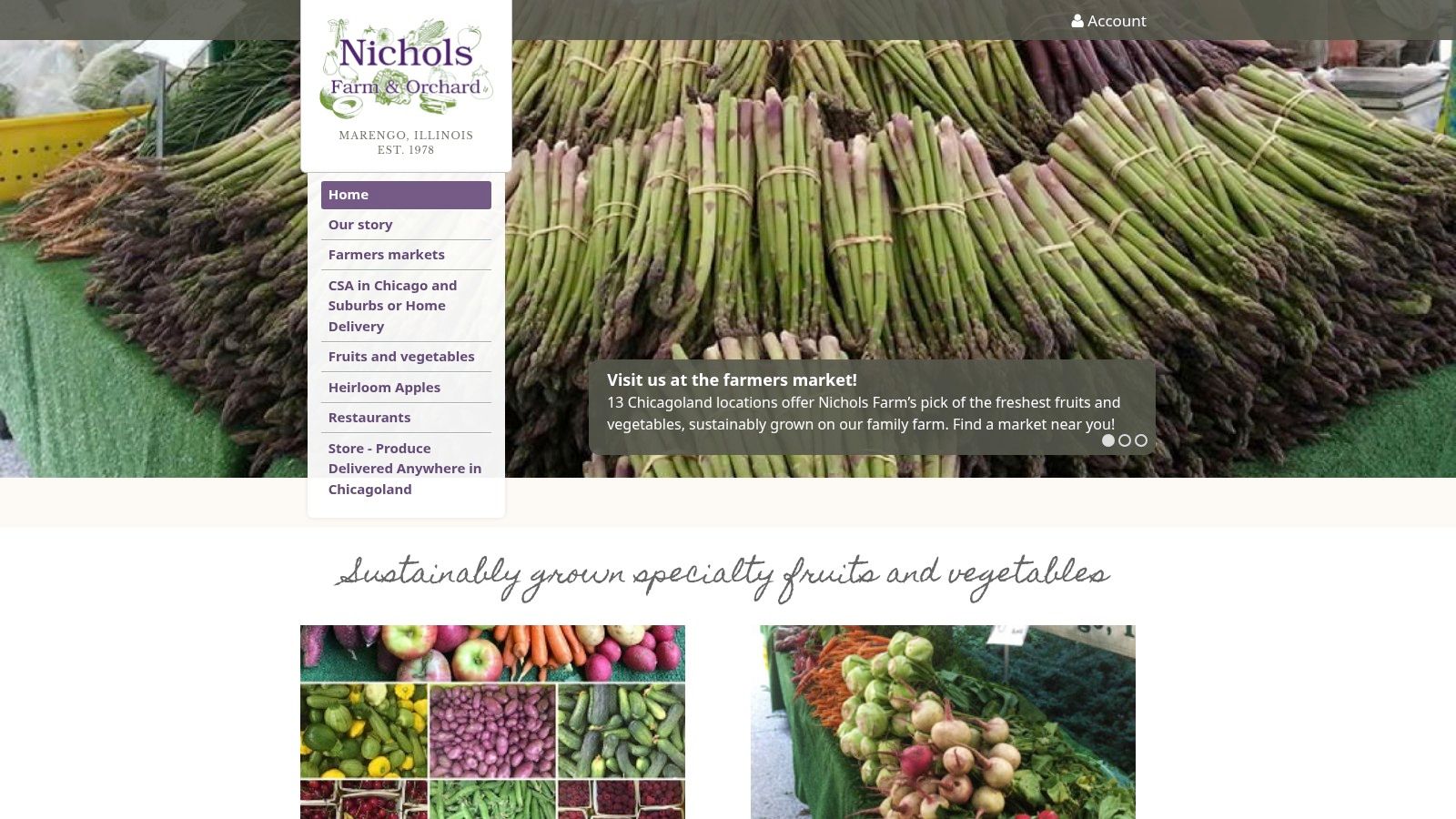
For me, summer isn't just a season; it's a taste. It’s the flavor of a perfectly ripe peach, the crisp bite of a freshly picked apple. Nichols Farm & Orchard captures that feeling and puts it in a box. I think of them as the classic family farm you’ve always dreamed of, delivering generations of expertise directly to your city kitchen. Their CSA feels like a direct line to the heart of Midwest agriculture.
Unlike the hyper-local urban plots, Nichols is a sprawling family-run operation with deep roots in Marengo, Illinois. This scale allows them to grow an incredible diversity of crops, especially fruit. If you've ever felt that standard veggie CSAs were missing something sweet, this is your answer. Their long-standing presence at city farmers markets also means you’re probably already familiar with their quality, making the leap to a full share feel natural and trustworthy for you.
How It Works & What You Get
Joining is straightforward. You head to their website before the season begins and choose your share type and, most importantly, your pickup location. They have one of the most extensive pickup networks I've seen, partnering with businesses across countless Chicago neighborhoods from Andersonville to Hyde Park, plus suburban options. For a fee, you can also opt for Friday home delivery.
Share Options: Fruit & Vegetable shares with an incredibly convenient neighborhood pickup network or home delivery.
Pricing: You’ll need to check their site for the current season's rates, but they often have pro-rated shares available if you join mid-season.
Add-Ons: Since they’re at so many farmers markets, it’s easy for you to supplement your share or grab something extra if you miss a week.
Unique Offerings: The star of the show is the fruit. Their focus on orchard varieties means you get a genuine mix of nature’s candy alongside your staple veggies. Those inevitable vegetable scraps you’ll have are perfect for starting a home system; you can find great advice about composting in Chicago to get you going.
What makes Nichols Farm & Orchard stand out is their mastery of convenience and quality. They've solved the "csa near me" puzzle for thousands of Chicagoans by bringing the farm right to your neighborhood corner.
This is a fantastic choice if you want the classic farm experience with a strong emphasis on fruit. The sheer number of pickup locations makes it one of the most accessible traditional CSAs for you as a city dweller, connecting you directly to the source of your food.
5. Star Farm Chicago – Year-Round CSA (Back of the Yards)
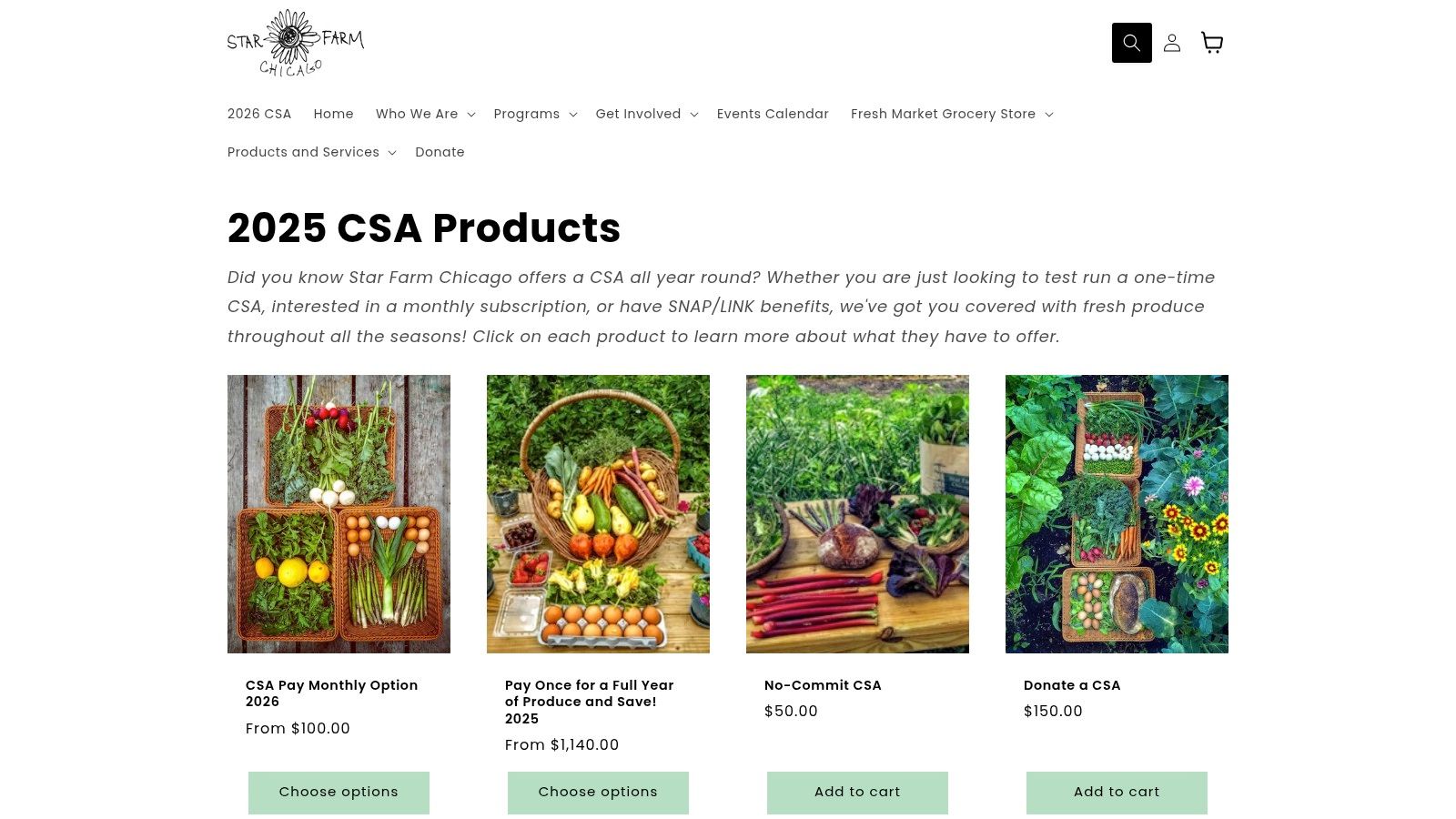
Star Farm Chicago is more than a CSA; it's a heartbeat in the Back of the Yards neighborhood. I think of them as the community anchor, a place where roots run deep and nourishment extends far beyond the produce in your box. They operate with a clear, powerful mission: to bring fresh food to the South Side and build a healthier community from the ground up, all year long.
What makes their approach so special is the flexibility they offer you. Unlike many traditional CSAs that require a full-season commitment, Star Farm understands that life happens. They provide pay-monthly options and sometimes even offer one-time boxes when available. This is a fantastic way for you to try out the program without a big upfront investment. It makes finding a "csa near me" feel less intimidating and more welcoming.
How It Works & What You Get
You’ll find their CSA options on their website, which clearly outlines the program. A key thing to note is that their site sometimes displays information for upcoming seasons, so I recommend you double-check the specifics for the current year or give them a call to confirm pickup locations and schedules.
Share Options: Pay-monthly CSA membership and occasional no-commitment one-time boxes.
Pricing: Monthly memberships provide a steady, affordable way for you to get involved.
Add-Ons: You can easily add on shares for local eggs and fresh bread to complete your grocery needs.
Food Access: Their commitment to the community shines with their Double LINK program. This is similar to efforts I've seen at other local food access points and pantries. For LINK card users, this program dramatically reduces the cost, making fresh, organic produce truly accessible.
Star Farm is a testament to the power of hyperlocal agriculture. They are not just growing vegetables; they are cultivating community health, resilience, and connection right where it's needed most.
While the selection might have more variability during the deep winter months, that’s just the nature of eating with the seasons. Supporting Star Farm means you're investing directly into the food sovereignty of a Chicago neighborhood, and that's a beautiful thing to be a part of.
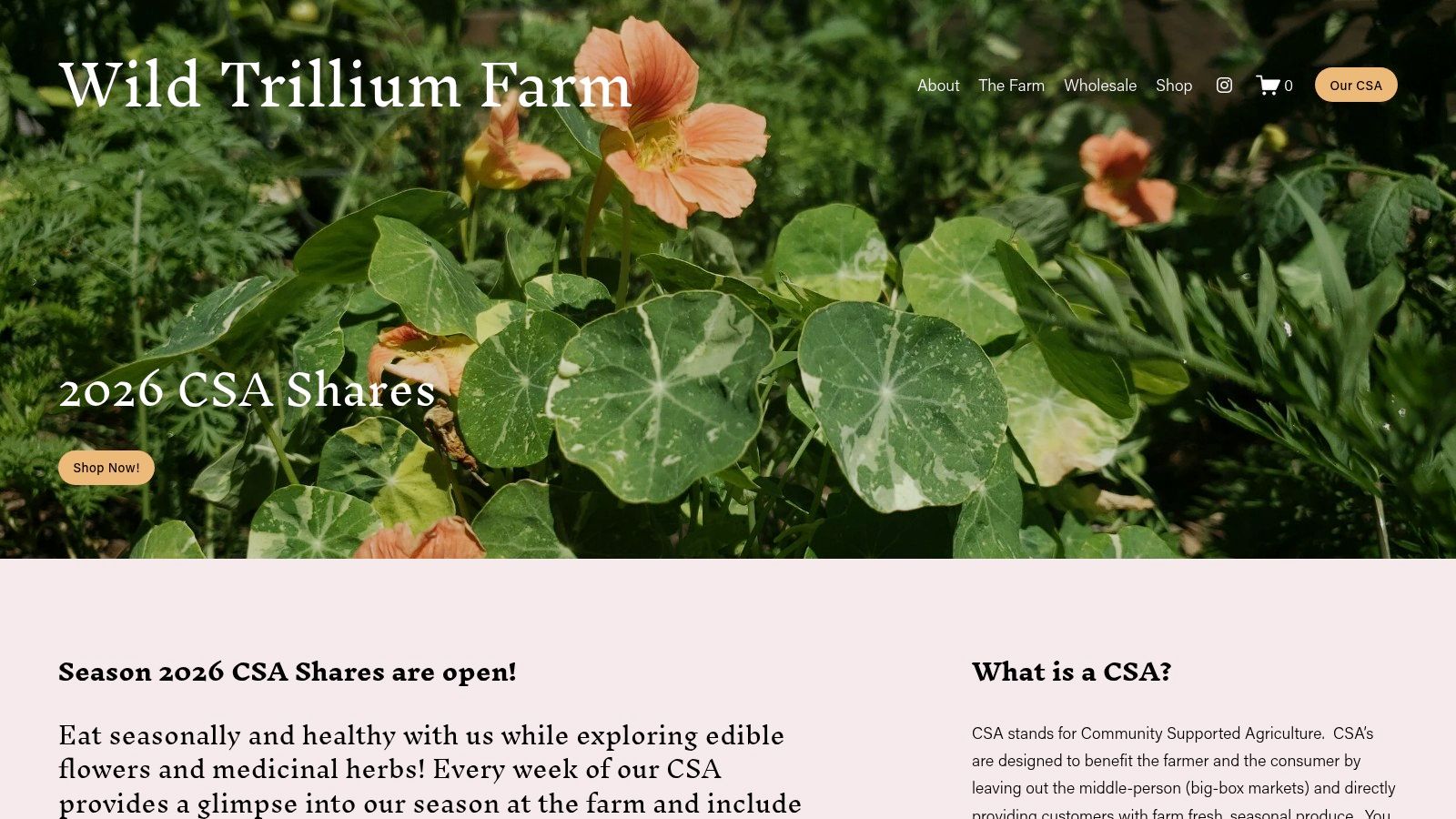
For the adventurous cook in you, for the artist at heart, Wild Trillium Farm is a dream come true. I think of them as the creative spirit of the CSA world, painting with the colors of edible flowers and the flavors of unique herbs. This isn't just about sustenance; it's about adding a touch of magic to your plate. It's about turning a simple salad into a masterpiece with nasturtiums or a cocktail into an experience with fragrant herbs.
What makes this farm special is its dedication to variety that inspires curiosity. Each share is a beautiful mix of familiar staples and what they call a chef-friendly 'something weird' item. This is the perfect "csa near me" for anyone in Chicago looking to expand their culinary horizons beyond the basics and get their hands on produce you'd normally only see on a high-end restaurant menu.
How It Works & What You Get
Signing up on their website is straightforward, with clear dates, prices, and locations laid out for you. You choose your share frequency for the 18-week summer season and select a convenient pickup spot in either Lincoln Square or Logan Square, making it an accessible option for you North Side city dwellers.
Share Options: Weekly (18 weeks) or bi-weekly (9 weeks) vegetable shares during the main season.
Pricing: The bi-weekly share is around $400, and the weekly share is approximately $750 for the season.
Add-Ons: You can often supplement your veggie box with optional shares for eggs and beautiful floral bouquets.
Pickup: Convenient neighborhood pickup sites in Lincoln Square and Logan Square.
Wild Trillium Farm reminds me that food is a form of expression. It's for the person who sees a box of vegetables not just as meals, but as a palette of possibilities for you to play with, create, and enjoy.
Because it's a smaller-scale farm, shares can sell out, so I'd advise you to sign up early. If you're someone who thrives on culinary creativity and loves the idea of getting edible flowers and specialty herbs alongside your weekly greens, this CSA is a perfect match for you.
7. Mint Creek Farm – Meat (and Eggs) CSA with Chicago Delivery
For many of us, the idea of a CSA conjures images of vibrant kale and sun-ripened tomatoes. But what about the heart of the meal, the protein? I've found that finding a reliable source for high-quality, ethically raised meat can be a real challenge. That's where Mint Creek Farm steps in. They offer a vision for a "csa near me" that fills your freezer, not just your crisper drawer.
Mint Creek Farm operates a true pasture-based, Certified Organic livestock farm. This isn't just a label; it's a commitment you can taste. They provide a mixed-species meat and egg CSA that feels like a direct partnership with the land. Your share becomes a journey through the seasons, featuring everything from beef and pork to lamb, goat, and poultry, all raised with incredible care.
How It Works & What You Get
Getting started with Mint Creek is straightforward. You head to their website and choose your share size and delivery frequency. They offer home delivery to Chicago, Oak Park, and Evanston, making it a wonderfully convenient way for you to stock up on premium-quality protein without ever leaving home.
Share Options: You can choose from weekly or monthly deliveries, with share sizes ranging from a small 2 lb box to a family-sized 15 lb box.
Pricing: The cost is transparent and based on weight, starting around $18/lb for smaller shares and decreasing to about $15/lb for larger ones. Home delivery is a flat $9 fee.
Add-Ons: You can easily add their fantastic pasture-raised eggs to any delivery.
Member Perks: I love that they treat you like part of the farm family. Members get 10% off extra purchases, holiday discounts, and invitations to farm dinners and tours.
What makes Mint Creek Farm exceptional is its dedication to a complete pasture-to-plate system for meat. It’s more than just a purchase you make; it's an investment in animal welfare, land stewardship, and your own health.
While you don't get to choose the exact cuts in your box (it's a true farmer's choice model), this encourages you to cook with new and exciting ingredients. This program is a perfect solution for anyone looking to connect more deeply with where their meat comes from and support a truly sustainable farming model.
Per‑pound pricing; delivery to Chicago/Oak Park/Evanston; limited geography
Organic pasture‑raised meat variety; reliable protein supply; member perks
Households seeking organic, pasture‑raised meat with home delivery
Your Turn to Paint the Fence
Do you remember the story of Tom Sawyer? He had this chore he dreaded: whitewashing a long fence. But then he got clever. He reframed the whole task as a privilege, a rare and artistic opportunity. Soon enough, his friends were begging him for a turn, trading their treasures just for the chance to paint a few feet of fence.
Joining a CSA is a lot like that. When you first look at it, you might see the chores. What do I do with all this kohlrabi? Can I really use an entire bunch of cilantro before it wilts? It can feel like a commitment, I get it. A new responsibility on your already full plate. But what you are really being offered is a paintbrush.
I’m inviting you to turn your weekly cooking routine from a chore into an adventure. Each box is a new story unfolding in your kitchen. That mystery vegetable you’ve never seen before? That’s not a burden; it’s an invitation for you to explore, to get creative, to discover a new favorite dish. You’ll find yourself swapping recipes with fellow CSA members, sharing tips on how to use every last leaf and root. Suddenly, you’re not just a consumer; you’re a participant.
Choosing Your Brush and Canvas
We’ve walked through some incredible options, and each one offers you a unique way to engage with Chicago's local food system. Your next step isn’t just to pick a farm, but to decide what kind of artist you want to be.
For the Year-Round Painter: If you crave consistency and want to eat locally through Chicago's distinct seasons, Star Farm Chicago offers you a year-round share that keeps your kitchen stocked no matter the weather.
For the Meat and Potatoes Artist: If your culinary masterpieces center on high-quality protein, Mint Creek Farm’s meat and egg CSA provides the perfect foundation, connecting you directly to ethical animal husbandry.
For the Adventurous Palette: Are you ready to experiment with edible flowers, unique herbs, and heirloom veggies? Wild Trillium Farm will supply you with a box that inspires culinary creativity and beautiful plating.
For the Community Muralist: If you see food as a tool for connection and social change, the missions of The Urban Canopy and Urban Growers Collective will resonate deeply, allowing your dollars to support food justice and community building.
Finding the right "CSA near me" is about matching your lifestyle and your values to a farm's philosophy. It’s about choosing to invest in your health, your community, and the soil beneath our city. You’re not just buying food; you're buying into a relationship with the people who grow it and the land that sustains it. The fence is waiting. It’s your turn to pick up the brush and start painting your own delicious story.
Feeling inspired to connect with your community and make a tangible impact? That same spirit of local action fuels Litter Caterpillars. Just as a CSA connects you to your food's source, we connect you to your neighborhood's well-being, turning cleanups into vibrant social events. Join our next adventure and help beautify Chicago, one block at a time.
So, you’re staring at that old vacuum and wondering, can I actually recycle this thing? Let me tell you straight up: you absolutely can. It’s one of the best things you can do to keep a big, clunky piece of e-waste out of our ever-growing landfills. I’ve found the best way to get started is by checking for your city's free e-waste drop-offs or seeing if the big electronics stores have their own take-back programs.
Your Old Vacuum Is More Than Just Trash
I know how it is. That old Hoover, sitting silently in the back of your closet, isn't just a hunk of plastic and metal. It's a silent witness. A keeper of memories. You can probably still hear the ghost of its whir as it sucked up spilled glitter from a chaotic kids' craft day or roared to life minutes before guests arrived for a big holiday feast.
When it finally sputters out, coughing its last breath, it feels like an ending. It’s so damn easy to see it as another piece of junk you need to haul to the curb.
But I’m here to tell you that its story isn’t over. Not even close. It’s just starting a new one.
A Second Life Is Waiting
Just like I stumbled upon a new purpose for my own life by getting my hands dirty cleaning up Chicago’s neighborhoods with the Litter Caterpillars, your old vacuum can be utterly transformed. It has this hidden, vibrant potential we almost always miss. My journey has taught me a profound lesson: what looks like trash is usually just a resource that's found itself in the wrong place.
I’ve learned that everything—and I mean everything, and everyone—deserves a shot at a second life. I see it blossom in the vacant lots we reclaim from neglect and in the unexpected friendships our volunteers forge in the middle of a city street. Your vacuum is no different.
That’s why this guide means so much to me. I'm not just here to point you to the nearest dump. I'm here to help you change the way you see.
You have a few powerful choices, and I promise you, each one makes a real, tangible difference:
Repair it: Sometimes, a single, simple fix is all that machine needs to roar back to life, saving you a chunk of money and keeping a perfectly good appliance right where it belongs—in action.
Donate it: If it's still chugging along, your vacuum could be a godsend to a family just getting on their feet or a local charity struggling to make ends meet.
Recycle it: By recycling vacuum cleaners the right way, you ensure their valuable metals and plastics are recovered and reborn, instead of being left to poison our city's soil.
This isn’t just about tossing something away; it’s about discovering the astonishing potential for renewal in things we’ve already written off as finished. We do it every single week on the streets of Chicago, and you can do it right from your own home. For a deeper look at what our city offers, you can check out my guide on how to recycle in Chicago. Let’s get started.
Deciding Your Vacuum's Next Chapter
So there it is. Your old vacuum cleaner sits there, and your first impulse is probably to just drag it out to the alley and forget it. But hold on a second. Before you write it off as junk, let's you and I play detective. Is it really dead, or is it just having a really, really bad day?
I’ve seen it happen dozens of times at our cleanups. Someone pulls a vacuum out of a dusty garage or finds one abandoned on the curb, looking like a total lost cause. But with a little bit of tinkering, a bit of care, it suddenly sputters and roars back to life. It’s like finding a wildflower stubbornly pushing its way through a crack in the pavement—a small, beautiful sign of resilience you almost missed entirely.
Repair Donate or Recycle Your Vacuum Cleaner
So, what's your game plan? You have to figure out which path makes the most sense for your machine. This isn't about being right or wrong; it's about giving that machine the best possible next chapter instead of a quick, unceremonious trip to the landfill.
I’ll never forget watching one of our volunteers take home a discarded vacuum everyone else had given up on. He spent a few hours with it, like a surgeon with a patient, and found a massive, hidden clog of hair and string deep inside its guts, then swapped out a single $5 belt. Just like that, it was working perfectly again.
That’s the kind of mindset you and I need to have. Before you decide its fate, ask yourself: could one simple fix completely change this story? It’s almost always a tangled brush, a clogged hose, or a broken belt—tiny, insignificant problems with surprisingly easy solutions.
Taking a moment to check can save you money and, more importantly, it keeps a perfectly good appliance out of the ever-growing stream of waste.
Salvaging What You Can
Even if the main motor has officially given up the ghost, the story isn't over. Think about all those forgotten attachments collecting dust in your closet: the crevice tool, the upholstery brush, the extension wands. These parts are often universal, like a secret handshake that fits other vacuums, or they can be used by someone else with the same brand. They’re the unsung heroes of your cleaning toolkit.
Don't let them go to waste. You can offer them up for free on a local buy-nothing group or see if a friend can use them. Think of it as being a good steward of your stuff. You're making sure every single piece gets used to its absolute fullest potential before recycling the vacuum cleaner's main body.
So, how do you decide what to do? I've put together this quick guide to help you figure out the next move for your old vacuum.
Repair Donate or Recycle Your Vacuum Cleaner
Use this quick guide to determine the best next step for your old vacuum cleaner based on its condition.
Condition
Best Action
Why It Matters
Still working, but you got an upgrade.
Donate It
A working vacuum is a huge help to a family in need or a local shelter. You're directly supporting someone in your community.
Needs a minor, inexpensive fix.
Repair It
You save money, prevent waste, and get more life out of your machine. It’s the most sustainable option if it's feasible for you.
It’s completely broken or unsafe.
Recycle It
This is the final, responsible step. Recycling ensures its valuable metals and plastics are recovered, preventing pollution.
Ultimately, it comes down to a quick, honest assessment. Taking a few minutes to decide whether to repair, donate, or recycle is a small action from you that makes a big, big difference.
How to Prep Your Vacuum for Its Final Mission
Alright, you’ve made the call. Your old vacuum has reached the end of its line. Recycling is its final, best chapter. A little prep work on your end makes a world of difference for the folks down the line. It's like field-stripping your gear after a long day of work. We do it with our cleanup tools to keep them in top shape; you’re doing it to give your vacuum’s guts a fighting chance at a new life.
This quick map shows the journey your vacuum cleaner can take from your home to its next purpose.
As you can see, even a busted vacuum has a destination beyond the landfill. That’s the whole point. Every part you separate makes the entire recycling process smoother and more successful.
The Most Important First Step
First things first: if your vacuum is cordless, you absolutely must remove the battery. I really can't say this enough. These batteries, especially the lithium-ion ones you find in newer models, are a massive fire hazard at recycling facilities. They are tiny bombs waiting to go off. They can literally explode when crushed, putting workers in real danger and causing catastrophic damage.
It’s a simple but vital safety step you have to take. Once you’ve popped it out, that battery needs to go to a separate, designated recycling spot. You can check out my guide on how to recycle batteries in Chicago to find the right place for it.
Do It for the Next Person in Line
Next, please, do everyone a solid and empty the dust bag or canister. Think of it as a small act of human kindness for the people who will handle your machine next. Put yourself in their shoes for a second—a clean, empty machine is infinitely easier and more pleasant to process than one packed with three years of dirt, dust bunnies, and pet hair.
I see this as a basic principle of respect, whether we're cleaning a public park or getting an old appliance ready for its next journey. You’re handing it off with care.
Taking a few extra minutes to prep your vacuum is a sign of respect for the recycling process and for the people who make it happen. It’s you being an active participant in the solution, not just another bystander.
Separating for Success
Now for the final touches. This part is surprisingly satisfying, like sorting Lego bricks. It's time to snip the power cord and pull off any obvious metal parts from the main plastic body.
Snip the Power Cord: Grab a sturdy pair of wire cutters and carefully cut that power cord off right at the base of the machine. The copper inside is incredibly valuable and ridiculously easy to recycle. Coil it up separately so it's a simple grab for the recyclers.
Separate Metal and Plastic: Look for easily removable metal bits, like a handle or a wand. If you can unscrew or detach them without starting a major battle, do it. The more you separate, the more precious material can actually be recovered and reborn.
Countries that are absolute rock stars at recycling often get there because their products are designed for it from the start. Germany, for example, has become a global leader by hitting a remarkable 75% recycling rate for motor parts. They’ve also brilliantly designed 15% of components for easy disassembly, proving that smart design is the real key to recycling vacuum cleaners the right way. You can learn more from these impressive vacuum cleaner recycling statistics.
Where to Recycle Vacuums in Chicago
Alright, you’ve done the hard part. The battery’s out, the dust bag is gone, and the cord is snipped like an umbilical cord. Your old vacuum is prepped and ready for its final journey, but now you need the destination. So, where in Chicago do you actually take this thing?
Thankfully, our city doesn’t make you wander around aimlessly like a lost tourist. I’m going to make finding a drop-off spot just as easy as finding our next cleanup event.
Your Go-To City-Run Options
Chicago gives its residents free and surprisingly easy spots to drop off all kinds of e-waste, and yes, that absolutely includes your old vacuum. These are your best bet for making sure it gets recycled the right way, by the book.
The city’s Household Chemicals & Computer Recycling Facilities (HCCRF) are permanent sites that welcome a whole range of electronics with open arms. Think of them as the official welcoming stations for your retired appliances. They’re set up specifically to handle these items, ensuring every last bit goes exactly where it’s supposed to. We’ve put together a full list and their hours on our site, so be sure to check out my detailed guide on Chicago recycling centers.
Retail Take-Back Programs
Another great route you can take is using retail take-back programs. Places like Best Buy have some pretty solid recycling programs that make dropping off old electronics incredibly simple, and it often doesn't matter where you bought the item in the first place.
They usually let you bring in up to three items per household each day, and they accept most vacuums—corded, cordless, and even the little robot ones that zip around your floor. It’s a walk-in, walk-out system. I find it’s super convenient if you’re already out running errands.
The Litter Caterpillars Way
For my fellow Litter Caterpillars, our process is built on something beautiful: teamwork. We’re always finding abandoned vacuums during our neighborhood cleanups—I remember one time we pulled five of them, like some strange urban harvest, out of a single alley in Logan Square. Instead of five people making five separate trips, we have a much smarter protocol.
We believe, "If you want to go fast, go alone. If you want to go far, go together." This applies to everything we do, including how we handle the mountains of e-waste we find. Teamwork turns a mind-numbing chore into a shared mission.
Our method is simple:
We pick a central collection spot for all e-waste we find during a cleanup.
Everything gets piled up there—broken vacuums, old monitors, you name it.
At the end of the event, one or two volunteers with cars make a single, efficient trip to the recycling facility.
This saves everyone time and gas, turning the logistics of recycling into just one more way we support each other. It’s not just about cleaning up the block; it’s about finishing the job responsibly, together.
And this work is getting more critical every single day. The world is on track to produce over 74 million metric tons of e-waste by 2030, which is a staggering, almost unimaginable number. With the robotic vacuum market alone growing at 10.5% a year, this problem is only getting bigger, faster. This makes the mission of groups like ours—to pull these exact items out of landfills—more vital than ever before. You can read more about these trends and their impact on e-waste on VacuumWars.com. Your single act of recycling is part of a much bigger, much more important movement.
Why This Small Act Matters So Much
I get it. I really do. Tossing an old vacuum can feel like a tiny, insignificant act in the grand scheme of things. But I need you to understand that your choice here is part of something so much bigger. It creates a ripple effect that you can’t see but is powerfully real.
When a vacuum gets dumped in a landfill, it doesn't just sit there and disappear. Its plastic body, that complex motor, all the little bits of electronics—they start to break down and slowly, insidiously, leach all sorts of nasty stuff into our soil and our groundwater. That one appliance becomes a long-term problem for the earth we all have to live on.
I’ve seen this with my own two eyes. We pull so much e-waste out of neglected lots, and you can almost feel the ground sighing in relief when it’s finally gone.
The Coming Wave of Waste
And this problem is about to get a whole lot bigger. The global vacuum cleaner market is projected to swell to an unbelievable USD 31.04 billion by 2033. Just let that sink in. Millions upon millions of new vacuums will be sold, which means millions more will be thrown out, every single year.
Right now, vacuums make up about 1.5% of all e-waste, but that number is only going to climb. You can read more about what this boom means for our environment in the full research from Straits Research.
When you choose recycling vacuum cleaners, you’re personally building a dam against that rising tide of waste. You are actively stopping those chemicals from ever touching Chicago’s soil.
Your Drop in the Bucket Matters
It reminds me of the day Litter Caterpillars started. I remember it so clearly, like a photograph burned into my mind. There were just three of us, caught in a freak Chicago hailstorm, feeling ridiculously, laughably small. Just three people trying to clean an entire city. What difference could we really make?
But we just kept showing up. Week after week. Come rain, shine, or hail.
Now, years later, I see the incredible, breathtaking impact we have when we all decide to do something. It’s never been about one person doing everything; it's always been about everyone doing their part. That’s how we’ve managed to clean up so much of our city.
Your decision to recycle that old vacuum is exactly like that. It’s your own personal contribution to a cleaner Chicago and a healthier planet. You aren't just getting rid of junk; you're casting a vote for a better future.
Trust me when I tell you this: your small act matters more than you will ever know.
A Few Questions I Get All The Time
You’ve got questions. After years of hauling every kind of junk imaginable out of every alley in Chicago, trust me, I've got answers. When it’s time to finally say goodbye to an old vacuum, a few worries always seem to bubble to the surface. Let's get right into it.
It reminds me of when a new volunteer shows up to a cleanup, a little hesitant, not sure what to do but wanting so badly to do the right thing. My job is to cut through the confusion and give them a clear, simple mission. That's what I'll do for you right now.
Can I Just Ditch My Vacuum on the Curb for Bulk Pickup?
I know it’s the easiest thing to do. I get the temptation. But please, I'm asking you, don't. In Chicago, vacuums are classified as e-waste, and they absolutely cannot go out with the regular trash. Leaving it on the curb is just a one-way ticket to the landfill, plain and simple.
Think about it this way: that vacuum sitting on the sidewalk is just another piece of ugly, depressing litter. It adds to the neighborhood blight that we at Litter Caterpillars fight against with our bare hands every single week. It’s the visual noise that makes a place feel forgotten and unloved.
Taking it to a proper facility is a small effort with a huge payoff. It’s the difference between being part of the problem and being part of the solution. Choose to be the solution.
Are the Hoses and Attachments Recyclable?
This one’s a little messy. Most of the time, the answer is no. Those flexible, bendy hoses and weird-shaped plastic tools are usually made of mixed materials that recycling centers just can’t handle. It’s like trying to recycle a burger with the wrapper still on; it just gums up the works for them.
Your best bet is to ask the specific drop-off spot you’re headed to. But here’s a better idea I've seen work miracles: if the parts are still in decent shape, throw them up for free on a local Buy Nothing group or Facebook Marketplace. You’d be shocked who needs that exact crevice tool you were about to chuck. It's all about keeping things out of the ground, piece by piece.
What if I Find an Abandoned Vacuum During a Cleanup?
Now we’re talking! This is our bread and butter. When you’re out with us and we come across a busted, abandoned vacuum, the first rule is always safety. Don't be a hero and try to drag it with you for the next two hours.
We have a simple, effective system for recycling vacuum cleaners we find on the streets:
Set a collection point. We pick a spot for all the e-waste we find—vacuums, dead TVs, ancient microwaves, you name it.
Haul it all together. Everything gets piled up in that one spot as we clean the area.
Make one big run. At the end, a couple of volunteers with a car will load it all up and take it to the nearest e-waste center.
It's all about teamwork. That abandoned piece of junk on the corner becomes a successful team mission. We're not just picking up trash; we're seeing it through to its final, responsible resting place. Together.
At Litter Caterpillars, we turn the chore of cleaning into an act of community and personal growth. If you’re ready to make a real difference in Chicago and find your people, join us for our next cleanup.
Let's be real—the vast blue ocean can feel a million miles away from my life here in Chicago. But the crisis of ocean plastic pollution is closer than you think. It's a problem that connects our city streets directly to the heart of the planet. I want to show you how, through an invisible, relentless river of waste.
The Story That Connects Our Streets to the Sea
I started Litter Caterpillars because my whole life I've had trouble cleaning and organizing my things. As my own living space became more of a mess, my life became more of a mess, too. It felt like our planet was in a similar state, buried under a mountain of plastic that tells a story of fleeting convenience with a disastrous, suffocating ending. I want to tell you how that personal struggle connects our local lives to this massive global challenge.
My own apartment was a disaster. Every piece of trash had its own sentimental story. An old jar of jam from a trip to Michigan four years ago, a bag of nuts from that time I tried to eat healthy but failed—each item was a monument to a past I couldn’t clean up. Each one weighed less than a pound, but to me, it might as well have weighed 500 pounds.
This personal chaos reached a breaking point, and I knew I had to change. I resolved that I would finally tackle the things that have always been the most difficult for me: cleanliness, consistency, and bravery. That’s when I had a powerful realization on a freezing Chicago day.
It’s often much, much easier to clean up a mess that isn’t yours.
This simple idea sparked everything. It turns out that tackling someone else's litter—the anonymous trash on our streets—can be a profound act of self-care. It builds a strange, new form of fun. It turns a chore into an adventure.
The Scale of the Problem We Face
My personal struggle with a messy room is a small-scale version of what our entire planet is up against. The numbers behind the ocean plastic crisis are staggering and can make anyone, even you, feel small.
Imagine standing on a beach, anywhere in the world, and knowing that right now, between 75 and 199 million tonnes of plastic waste are choking our oceans. Every single year, another 8 to 10 million metric tons flood in. It’s like a garbage truck dumping its entire load into the sea every single minute. This relentless influx has birthed five massive garbage patches, with the Great Pacific Garbage Patch now spanning an area three times the size of France. You can discover more insights about the state of the plastic crisis on 4ocean.com.
But I'm here to tell you that these numbers don't have to paralyze us. They can inspire us. This guide will show you how this problem is immediate, personal, and surprisingly solvable, starting right here in our own neighborhoods. We can fight back.
The Unseen River That Connects Your Street to the Sea
You're probably thinking, 'I'm in Chicago, a thousand miles from any ocean. How does my litter possibly end up there?' It’s a fair question, one I've asked myself. But I want you to follow me on a journey.
Picture a single plastic bottle dropped on a street in Logan Square. It just sits there until a heavy rain comes. That downpour washes it into a storm drain, a dark, hidden channel right under our feet. From there, it’s a quick trip into the Chicago River.
From Our River to the World’s Oceans
This is where our local story goes global. Thanks to a massive, century-old engineering project, my city reversed the Chicago River's flow. Instead of flowing into Lake Michigan, it now runs away from it, connecting to a vast system that feeds the mighty Mississippi River.
That one plastic bottle from Logan Square is now on a thousand-mile voyage south. It will drift past St. Louis, Memphis, and New Orleans, eventually spilling into the Gulf of Mexico. And from the Gulf, it’s a straight shot into the Atlantic.
This is the unseen river of trash that connects us all. It flows from our city blocks, through our local waterways, and directly into the heart of the world’s oceans. You aren't separate from this problem; you are a source.
This infographic breaks down the simple, grim journey our plastic takes from land to sea.
This visual drives home a critical point: once plastic gets into our waterways, it inevitably collects in the ocean, creating the infamous garbage patches we hear so much about.
To see just how local this global problem is, let's trace the path step-by-step.
The Journey of a Plastic Bottle from Chicago
Stage
Location
Mechanism
Impact
1. The Drop
Chicago Street
Littered by a person
Visual blight, potential hazard for local wildlife.
2. The Wash
Storm Drain System
Rainwater runoff
Enters the urban water system, unseen and unmanaged.
3. River Entry
Chicago River
Drain outfall
Becomes river pollution, threatening aquatic life.
4. The Long Drift
Mississippi River
River currents
Travels hundreds of miles, breaking down into microplastics.
5. Ocean Entry
Gulf of Mexico
River delta
Contributes to a massive concentration of marine debris.
6. Global Drift
Atlantic Ocean Gyre
Ocean currents
Joins a "garbage patch," harming marine ecosystems for centuries.
That's how a single piece of trash from your neighborhood becomes part of a planetary crisis. The connection is direct, and it starts right here.
A Global Problem with a Local Source
We often hear about major international rivers like the Ganges contributing massively to this crisis—and they do—but it's a mistake to think we're disconnected. I know that an estimated 80% of ocean plastic comes from land-based sources, carried to the sea by rivers just like ours.
Our local waterways act as superhighways for this pollution. Every piece of litter you see has the potential to start this exact journey. The problem isn't just "over there" in some distant country; it starts right here, on our streets, in our parks, and along our riverbanks.
We can’t fix the global issue without tackling our local contribution first. If you're ready to get your hands dirty and stop this problem at the source, you can learn more by checking out our guide on cleaning up a river. It’s where our work truly begins. That bottle's story doesn't have to end in the ocean.
The True Cost of Our Plastic Habit
So, what happens to that plastic bottle we followed from Chicago? It doesn't just vanish when it hits the Gulf of Mexico. No, it starts a second, much darker life, leaving behind a trail of destruction that’s almost hard for me to wrap my head around.
For marine animals, it's a horror show.
Picture a sea turtle, just doing its thing, gliding through the water. It spots something that looks exactly like a jellyfish—its favorite meal. But it's not. It’s a plastic bag. Once swallowed, that bag is a one-way ticket to a slow, miserable death from starvation. It just sits there, clogging its stomach. A gut full of trash it can't ever digest.
A Death Sentence for Marine Life
This isn't some rare, freak accident. This is the daily reality for countless animals out there. I've read that an estimated 100,000 marine mammals die from our plastic trash every single year. Scientists have confirmed that at least 81 out of 123 marine mammal species have either eaten plastic or gotten tangled up in it.
The danger comes in two brutal forms:
Ingestion: Like that poor turtle, animals mistake our junk for food. A plastic bag looks like a squid. A tiny shard of hard plastic looks like a small fish. It's a fatal mistake you or I could never imagine making.
Entanglement: This is a special kind of cruel. Imagine old fishing nets—what I call "ghost nets"—just drifting around for decades, trapping and killing everything in their path. Seals, dolphins, and whales get caught. They can't surface for air. They simply drown.
It's a world gone mad. A world where a sperm whale can wash up on a beach with nearly 30 kilograms of plastic junk in its stomach—a nightmare collection of shopping bags, ropes, and even a jerry can. I feel like we've created a situation where an animal's natural instincts have become a fatal flaw.
From Toxic Confetti to Our Dinner Plates
But the nightmare doesn't stop there. As that bottle from Chicago floats in the ocean, the sun and salt water start to break it apart. It doesn't biodegrade. It just shatters into smaller and smaller pieces until it becomes microplastics.
Think of it like toxic confetti.
These tiny fragments, most smaller than a grain of rice, are everywhere. They get eaten by the smallest creatures, like plankton. Then, a small fish eats the plankton. A bigger fish eats the small fish. And eventually, that same fish ends up on a dinner plate. Maybe even yours.
We made this mess, and now it’s coming right back to us. I've found that microplastics have been found in our drinking water, the air we breathe, and even the salt we use to season our food. This isn't just about saving the whales anymore. It's about saving ourselves.
The future looks grim if we don't act. I've seen projections that the amount of plastic pouring into our oceans could nearly triple by 2040. We are on a collision course with a future where there’s more plastic than fish in the ocean by 2050. That’s not a sci-fi movie plot; it's a real projection based on the path we're on now.
We have to change. The stories of the victims, animal and human, make the stakes painfully clear. If you’re ready to start fighting back, our guide on how to reduce plastic pollution is a good place to begin.
How Tom Sawyer Taught Us to Fight Pollution
Remember when Tom Sawyer got punished and had to paint that giant fence? He could have sulked. He could have complained. But he didn't. Instead, he made that chore look like the most fun, most exclusive privilege in the entire world—and pretty soon, his friends were literally paying him for the chance to help.
That’s exactly what I'm doing at Litter Caterpillars. I'm taking the “chore” of cleaning up Chicago and turning it into an adventure. It’s not a punishment; it's a mission. It’s how you and I can build something real and beautiful together.
This simple flip in how you think about the work is the key to solving a problem as massive as ocean plastic pollution. You have to find the joy in it. You have to find the story, the community, and the fun.
Turning a Global Problem into Your Personal Mission
It’s so easy for me to get crushed by the weight of the plastic crisis. You see those pictures of garbage patches the size of a country and just feel… helpless. But what if you and I stopped trying to look at the whole giant mess at once? What if we just focused on our one little piece of it?
I’ll never forget our very first cleanup. There were only three of us, and we got caught in one of those classic Chicago hailstorms, huddled under a tree, shivering. Every Uber kept canceling on us. In that moment of pure, shared misery, I realized something. Suffering together like that, it adds flavor to the adventure. It advances the plot of your story.
This is our theme song. It’s a fun little tune that captures that spirit of adventure. This song reminds us that what we’re doing isn't just about picking up trash. We're building a powerful, positive identity around service.
Just like Tom Sawyer convinced his friends that painting a fence was an honor, you and I can convince ourselves—and our communities—that cleaning our planet is one of the most rewarding things we can do. It’s not a punishment; it’s a privilege.
This is how a scary global issue becomes your personal mission. The real solution to ocean plastic pollution isn't just about some high-level policy or fancy new tech. It starts the moment you and I decide to find the joy in the work. The moment we make the chore an adventure.
From Mindset to Action
So, how do we take this Tom Sawyer idea and make it bigger? We look at all the big-picture solutions, but we ground them in that same core belief: finding purpose and fun in what we do. It means we can get behind both the huge strategies and the tiny grassroots efforts, because they all come from the same place of inspired action.
Here’s what that actually looks like:
Global Policy: You and I can fight for international agreements that treat plastic pollution seriously. It's not a boring policy debate—it's a thrilling global quest to save our oceans.
Innovative Product Design: We can get behind companies creating amazing plastic-free products. Every dollar you spend becomes a vote for the future you want to live in.
Smarter Waste Management: I want us to push our cities for better recycling and composting systems that are so easy and satisfying, they become a natural part of our day.
Every single one of these solutions starts with the simple decision to act. It starts when you stop seeing it as "someone else's mess" and start seeing it as "our shared adventure." That is how we begin to turn the tide.
Alright, you're fired up. You get it now. You see the straight line from that plastic bag snagged on a fence in your neighborhood all the way to the middle of the ocean. And you're ready to do something about it. Right now.
This isn't your grandpa's "reduce, reuse, recycle" lecture. I know we're past that. This is your playbook for making a real, visible dent in the problem, right here on the streets of Chicago. This is how you turn that feeling in your gut into action that you can see and feel.
This is about more than just picking up trash. It's about finding your people, taking back your community, and starting your own story of transformation.
Find Your Crew
Honestly? The most powerful thing you can do is just show up. When you join a group like mine, a weekend morning stops being a chore. It becomes a mission. An adventure.
Cleaning with a crew means you're not just some person picking up litter alone. You're building something. You’re making friends, exploring parts of the city you've never seen, and creating a story you'll actually be proud to tell. I know some of our best memories were made shivering in a freak hailstorm or laughing under the summer sun, all of us there for the same reason.
Use Your Voice
You don't need to be a lobbyist to make a difference. Your voice is a weapon. It can be as simple as a conversation or a quick email.
Hit Up Your Alderperson: Find out who represents your ward and send them a personal message. Don't be shy. Ask for more trash cans on your block. Ask why your neighborhood doesn't have a community composting program. I promise your story as a resident matters more than you think.
Talk to Local Shops: Next time you grab coffee, just ask the owner if they've ever thought about a discount for people who bring their own mugs. I find that a friendly nudge from a regular customer can be the spark that gets things moving.
This isn't about picket signs and protests—it's about starting conversations. It's about showing the people in charge that you actually care about how your community looks and feels. You're a voter. A customer. A neighbor. They need to listen.
Your Weekend Warrior Action Plan
Ready to jump in this weekend? Here’s a simple checklist of things you can do to get your hands dirty, the Litter Caterpillar way.
Action Step
Why It Matters
Litter Caterpillar Pro-Tip
Go on a "Trash Hunt"
Every single piece of plastic you grab is one less piece on its long journey to the ocean.
I want you to make it an adventure. Pick a neighborhood you’ve never really explored. Throw on a great playlist and see what you can find in an hour. It's a treasure hunt for a cleaner city.
Support a Zero-Waste Shop
"Voting with your wallet" sounds cliché, but it's real. It shows businesses there's a demand for stuff that isn't wrapped in pointless plastic.
I say start small. Don't try to change your whole life overnight. Just switch one thing. Go for bar soap instead of a plastic bottle. Get one reusable produce bag. Easy.
"Adopt" a Local Park
Clean spaces create pride. When a place is clean, people are less likely to trash it. You're starting a positive feedback loop.
Find a small patch of a park near your home and make it yours. Spend 15 minutes there each week. You'll be shocked at the difference one person can make.
I'm not just dreaming about change; we're making it happen.
Be Part of Something Bigger
I'll never forget the time we got permission to clean an entire stretch of highway while it was shut down for a bike event. Dozens of us swarmed it. We turned this dangerous, disgusting eyesore into something clean. That's what happens when a few brave, kind people like you and me decide to stop waiting and start acting.
Every small win builds on the last. It creates momentum. It proves what's possible when we stop feeling helpless and start getting our hands dirty. This is your invitation to join the fight against ocean plastic pollution, starting right here on your block.
Let me be honest. I started Litter Caterpillars because I had to clean up my own life. Seriously. My living space was a mess, and my life was an even bigger mess. I was looking for consistency, a bit of bravery, and a group of people who just wanted to give back—not take.
What I found was that serving others is the fastest way to serve yourself. It can completely transform you from the inside out. That’s the entire reason I call us Caterpillars. We’re all imperfect, kind of messy, and maybe a little lost. But we’re all committed to growing into something better.
Joining us isn't just about picking up trash, even though we do a lot of that. It’s about the simple, powerful act of showing up when it's hard. It’s about making a real friend while you're both shivering under a tree during a classic Chicago hailstorm. It's about earning a deep sense of pride with your own two hands—a pride we symbolize with the flags we fly and the badges we earn.
The Power of Simple, Honest Work
For me, it became a way to forgive myself. I learned to trust myself again through the simple, honest work of cleaning up a small patch of the earth. When my own world felt chaotic, just tidying up a single block brought a weird and wonderful kind of clarity.
I want you to feel that. This is your personal invitation to join a movement built on bravery, kindness, and unity. The fight against ocean plastic pollution can feel impossibly huge. It can make you feel completely helpless.
But I promise you this: the moment you decide to show up, the second you pick up that first piece of trash with us, that feeling of helplessness starts to disappear. It gets replaced by something much better. It gets replaced by purpose.
This is your chance to stop being overwhelmed by the problem and start becoming the solution. Right here, right now. You can start with just one morning and see where it takes you.
What It Means to Be a Caterpillar
Being a Caterpillar isn't about being perfect. It's about being present. It means you're willing to put on a pair of gloves and do something real about the mess we’re all in.
It’s an act of bravery. Just showing up, especially if you’re new or not sure what to expect, is courage.
It’s an act of kindness. You aren't just cleaning for you; you’re doing it for your neighbors and for the planet.
It’s an act of unity. You'll be side-by-side with people from every corner of Chicago who believe we're stronger when we work together.
This is how you change your own life. You start by helping to clean up the world around you. You start by becoming a Caterpillar.
A Few Questions I Get Asked A Lot
You probably have questions. I know I did. The whole problem of ocean plastic pollution is so huge it can make you feel powerless, like what you do doesn't matter. I want to give you some real answers, the kind that got me started and keep me going.
How Does Cleaning a Chicago Street Actually Help the Ocean?
I hear this one all the time, and it’s a fair question. The way I see it, if your bathtub is overflowing, you don’t just grab a mop—you run to turn off the tap. That's what we're doing.
Every single wrapper or bottle you or I pick up on a street in Chicago is one less piece that gets swept into a storm drain. It’s one less piece that travels down the Chicago River, into the Mississippi, and ultimately into the Gulf of Mexico. It’s a direct interception. But it’s more than that. When your neighbors see you out there, it plants a seed. It makes them think, and that’s how we start to change the culture around trash, building the pressure that leads to bigger things.
I’m Not Brave or Super Outgoing. Is This for Me?
Yes. Absolutely. Let me tell you something: bravery isn't about not being scared. It's about showing up even when you are. Many of our regulars started out feeling the exact same way.
Some people come, put in their headphones, and just get lost in the work. It's satisfying. Others end up making lifelong friends. There's zero pressure. You can be as quiet or as social as you feel that day.
We’re here to create a place where the simple act of working together builds you up. Just being here is an act of bravery. We see that, and we respect it.
This is a space for you to grow at your own speed. By just showing up, you’re doing something real for the city and, more importantly, for yourself.
Besides a Cleanup, What’s the Most Impactful Thing I Can Do?
Pick one thing you use, change it, and then talk about it. It’s that simple.
Don’t try to fix everything at once. Just find one single-use plastic you rely on—maybe it's your daily coffee cup, those plastic water bottles, or takeout containers. Find a reusable version you actually like and use it until it’s second nature.
Then, tell people about it. When someone at work asks about your cool new travel mug, tell them your story. That’s how you make this stuff feel normal. I believe it’s a personal, powerful act that ripples out to your friends and family, and eventually, brands and politicians have to listen. That's how a movement starts in your own kitchen.
Ready to do something real? Join Litter Caterpillars. Become part of a group that’s cleaning our city, building friendships, and proving that every single one of us can make a difference. Find our next event and start your own story at https://www.littercaterpillars.com.
You feel that nudge, don't you? A quiet but persistent pulse telling you to do something real for Chicago. I know it well. Becoming a chicago food bank volunteer is one of the most direct ways I’ve found to answer that call, turning my time into a full table for a neighbor.
Why This Work Actually Changes Everything
I know that feeling. It’s a deep pull, a yearning to connect with your city beyond just living in it, to be a participant, not a spectator. It's the same energy that grabbed me and pulled me into community work years ago. This isn’t about checking off a "good deed" box; it's about answering an inner summons.
When you sign up for a shift at a food bank, you make a conscious choice. You choose to be the reason a family gets to sit down together for a meal tonight. You become the hands that bridge a gap too wide for some to cross alone.
From One Person to a Citywide Movement
Your single act of showing up is a stone tossed into Lake Michigan. The ripples spread, touching lives in neighborhoods you might never even visit, spreading outward in unseen waves of impact. You aren't just sorting cans. You aren’t just packing boxes. You are weaving resilience into the very fabric of our city.
I remember my first shift. My stomach was a knot of nerves. I had no idea what to expect. But within minutes, I found myself shoulder-to-shoulder with strangers who felt like teammates, our focus narrowed to one simple, powerful goal. The energy was electric, a shared current running through us all.
Your time is the fuel that powers Chicago’s fight against hunger. It’s not just about the food; it’s about you and me showing up for each other, proving this community takes care of its own.
This collective effort creates a staggering impact. Think about the Greater Chicago Food Depository—every year, more than 25,000 volunteers like you and me put in nearly 100,000 hours of service. Our work gets over 7 million pounds of food repacked and out the door. That's millions of meals. You can read more about the vital role of volunteers on their site to see how it all adds up.
Tying Your "Why" to the Work
What really matters is the "why" that brought you here. Are you moved by a desire to fight injustice? Do you crave a real connection with people? Or is it just a simple, powerful urge to help?
Hold onto that reason. It's the engine that transforms a few hours of your time into something monumental.
You're giving hope. For a family struggling, a box of groceries is a lifeline. It’s breathing room. It’s a moment of peace.
You're building community. When we serve together, we build trust. We tear down the invisible walls that separate us.
You're changing yourself. You will walk away different, with a clearer sense of your own power to make an impact.
Becoming a Chicago food bank volunteer isn't just about what you give. It’s about who you become in the process. You are stepping up to be part of the solution, one shift at a time.
Alright, you’re fired up and ready. But in a city as huge as Chicago, finding the right place can feel like searching for a specific face in a packed L train. It’s not just about finding an opening; it’s about finding your opening. Let’s find the spot where you don’t just show up, but where you truly belong.
Think of it like choosing your spot at a Cubs game. Do you want to be in the bleachers, part of a massive, loud, energetic crowd? Or do you prefer a seat closer to the action, where you can see every play up close?
The big players, like the massive Greater Chicago Food Depository, are the bleachers. They are incredible, well-oiled machines. I’ve volunteered at their repack shifts, and the sheer scale is mind-blowing—you’re part of a huge team making a dent in hunger on an industrial level. It's fast, loud, and you can physically see the pallets of food piling up around you.
But the real heart of Chicago often beats on the side streets.
Discovering Neighborhood Gems
Tucked away in church basements and small storefronts, you'll find hundreds of local food pantries. These places serve their immediate blocks with a fierce, personal dedication. They know their neighbors by name. The St. Cyprian food pantry in Dunning is a perfect example of this.
Volunteering at a smaller spot is a completely different vibe. It’s intimate. You’re not just packing a box; you might be having a real conversation with the person you’re helping. It’s less about the massive numbers and more about that direct, human connection. So, how do you find these hidden spots?
Go hyper-local with your search: I want you to forget generic terms. Try "food pantry near me" or "volunteer [your neighborhood] food bank." This will turn up places you walk by every day and never noticed.
Check the old-school spots: Look for flyers at your local library, coffee shop, or even your alderman’s office. I've found these places are still the central nervous system for community action.
Just walk around your block: Seriously. I have discovered some of the most dedicated, under-the-radar organizations just by being curious about a sign on a church door in my own neighborhood.
Choosing where to be a Chicago food bank volunteer is a gut-check moment. Ask yourself: Do I want the energy of a huge team, or the quiet connection of a small one? There’s no wrong answer, only what’s right for you.
Matching Your Vibe and Your Schedule
Finding the right fit also means being brutally honest with yourself. Can you actually commit to a weekly shift every Tuesday morning, or is a one-off Saturday thing more your speed? Most places have online sign-up calendars where you can see every available slot. If you want to cast a wider net, our guide on the best volunteer opportunities in Chicago has even more ideas for you.
Your personality matters, too. Some roles are all about being on your feet and interacting with people, while others are more focused and behind-the-scenes. I want you to think about what kind of work will leave you feeling energized, not drained.
To give you a better idea, here's a quick breakdown of the most common jobs you'll find. Think about which one sounds less like work and more like you.
Common Chicago Food Bank Volunteer Roles
Volunteer Role
Typical Tasks
Best For You If…
Warehouse Repacker
I've sorted bulk food donations, packed boxes, and labeled cans.
You love a fast-paced, physical task and the energy of a big team. Great for audiobook or podcast lovers.
Pantry Distributor
You'll greet guests, hand out groceries, and help people "shop" for their items.
You're a people person who enjoys direct interaction and making others feel welcome and respected.
Delivery Driver
I've seen volunteers transport food from a central hub to smaller, local pantries across the city.
You enjoy driving, know the city's streets, and prefer working more independently.
The goal here isn't to just fill a slot—it's to find a role that lights you up. When you match what you’re good at with what the community needs, you’re not just helping out. You’re bringing your best self to the table, and that’s an impact that lasts.
What Your First Volunteer Shift Will Really Be Like
I get it. That little knot in your stomach before your first shift is real. You're probably wondering what it's actually going to be like. Will I know what to do? Will I just get in the way? I have been there, and I’m going to pull back the curtain for you.
Forget any ideas about being thrown into chaos. These places are like a well-rehearsed play, and the shift supervisor is your director for the day. Their job is to get you up to speed and put you right where you're needed most.
From Arrival to Action
The moment you walk in, you’ll sign in, get a quick lay of the land, and meet the other folks you’ll be working alongside. The energy is usually upbeat and focused. We’re all there for the same reason—to get things done.
You won't be left to figure things out on your own. The first few minutes are all about orientation. I’ll walk you through it: you’ll learn the basic rules (like how to safely lift boxes), get your specific task for the shift, and have a chance to ask any last-minute questions. It’s a smooth process, and you’re a key part of it for the next few hours.
This simple path from finding an opportunity to joining the team on the floor is designed to be straightforward.
By making it easy for you to find a role that fits, you show up for your shift ready to make a real impact from the get-go.
What You'll Actually Be Doing
Your job for the day depends entirely on the immediate need. A typical chicago food bank volunteer shift could have you doing any number of things:
Repacking Bulk Foods: You might find yourself on an assembly line, transforming giant bags of rice, pasta, or oats into smaller, family-sized packages. I've done this many times; it's rhythmic and satisfying.
Sorting Donations: This is like a treasure hunt with a purpose. You’ll be checking expiration dates and sorting canned goods, fresh produce, and other groceries into the right bins.
Building Emergency Boxes: This is where you assemble pre-packed boxes with a variety of staple foods, getting them ready to ship out to local pantries like the one at Casa Catalina. You can learn more about their work here.
The work is tangible. I love that you can physically see the results of your effort as the pile of unsorted donations shrinks and the pallets of ready-to-go boxes grow taller.
You're not just moving food around a warehouse. You’re moving hope. Every single box you pack is a direct lifeline to a family, a senior, or a child in our city.
This is especially true as food distribution evolves. For instance, I've watched initiatives like Chicago's Community Kitchens work to distribute up to 10,000 prepared meals every day. And now, 32 percent of all food distributed is fresh fruits and vegetables. Your hands-on work is what makes this push for healthier, more dignified food access a reality.
The hours will fly by. Before you know it, the shift manager will call out the final tally—how many pounds of food you sorted or how many boxes you packed. It’s a moment of shared victory with people who were strangers just a few hours before. You’ll leave tired, but you’ll also leave full, knowing you didn’t just spend your time; you invested it.
Think Outside the Box: More Ways to Fight Hunger
So, maybe the fast-paced warehouse shift just isn't your vibe. Or maybe your schedule is as unpredictable as Chicago weather in April. That’s more than okay. The most important thing you bring to this is your will to help.
Fighting hunger is not a single-lane road; it's a giant highway with on-ramps everywhere. If packing boxes feels like a bad fit, I want you to know there are tons of other ways to be a chicago food bank volunteer. It's all about finding the role that just clicks for you.
Your Skills Are a Superpower
Seriously. Your professional talents are a secret weapon. Are you a wizard with spreadsheets? A creative genius with graphic design? A wordsmith who can tell a compelling story? I've seen firsthand how desperately food banks need these skills, and you can often contribute right from your own couch.
It’s a different kind of impact, but it’s huge. Think about it:
Data Entry: You could be the person organizing volunteer lists or donation records from home, creating order from chaos.
Grant Writing: Your writing could be the very thing that secures thousands of dollars in funding for an organization.
Social Media: You could design a single post that brings in a flood of donations for a food drive.
This is the behind-the-scenes work that keeps the whole operation moving. It’s like being the mission control for the rocket ship. While others are on the front lines, you're the one drawing the map that gets everyone where they need to go. You’re using your brain to tackle a massive problem.
Hit the Road or Dig in the Dirt
If you’d rather be out in the world but still want something different, there are some incredible options. Do you love driving and seeing the city? Volunteer drivers are the unsung heroes of this whole thing. I’ve heard stories from guys like Thomas LeClair, who’s put in hundreds of hours and says he meets the “most beautiful people” delivering food across Chicago. It's a way you can feel the real pulse of the city, one delivery at a time.
Sometimes the most powerful work happens far from the main building. Your car can become a vehicle for hope. Your voice can become an engine for change.
Or maybe you’re someone with a green thumb. I’ve seen urban farms and community gardens that supply fresh produce to food pantries, and they are always looking for help. Imagine spending a morning tending to basil and parsley, knowing it will end up on someone’s plate that very week.
It all connects. When we take care of our communities—whether I’m delivering food or you’re beautifying a public space—we’re building a sense of pride and wellness that goes hand-in-hand with food security. You can even see how different acts of service add up by exploring other charities in Chicago and finding your fit. Every small act gets us closer to a stronger Chicago.
From One Shift to Part of the Family
You finish that first shift. You’re tired, your back might be a little sore, but you’re buzzing. It’s a good feeling—a real, earned sense of purpose.
But that buzz from one shift? It’s just the ignition. The real magic happens when you decide to come back. That first time is a spark. Consistency is what builds the fire that keeps a community warm.
Making It Your Thing
I remember feeling that pull. That feeling that once wasn't enough. I needed to make my chicago food bank volunteer work a regular thing. The first real step was simple: I put it on my calendar. I treated it just like a doctor's appointment or a meeting with my boss.
It became “my Tuesday morning shift.” It was no longer a question of if I was going, but when.
This is how a good deed transforms into a habit of service. This is how you go from just helping out to being part of the bedrock of the organization. It's like a single drop of water, which does little, but a steady drip over time can carve stone. Your consistent effort has that same power.
This isn't just a nice thought; it’s how massive change happens. Look at the Greater Chicago Food Depository. They went from distributing 500,000 pounds of food in their first year to 11.2 million pounds just four years later. That’s what a dedicated, volunteer-driven effort does. You can see how that grassroots fire started by learning about the Food Depository's early history.
Finding Your People
Then something else starts to happen. As you keep showing up, the faces you see every week stop being strangers. They become your crew.
You start to learn their stories. You meet the retired firefighter who tends the hydroponic garden. You meet the flight attendant who’s a natural at guiding new volunteers. You meet the group of college friends who make packing produce boxes their weekly catch-up.
You don't just find a place to volunteer; you find your tribe. You find the people who share your commitment to showing up for Chicago, and together, you become an unstoppable force.
This is what keeps you coming back, even on those mornings when you’re tired or the weather sucks. You’re not just accountable to the mission anymore. You’re accountable to each other.
Here’s how you make that happen:
Stick to the same shift. If you can, try to sign up for the same day and time. That's how I built connections with a core group of regulars.
Just be open. Ask people their names. Share a little about yourself. I’ve made some of my closest friends in this city just by starting a conversation over a pallet of potatoes.
Learn the ropes. Once you're a regular, people start to trust you with more. Maybe you’ll train newcomers or take the lead on a specific project. This is you, growing from a helper to a leader.
Before you know it, volunteering stops being something you do. It becomes part of who you are. You start seeing Chicago not just as the place you live, but as the community you are actively building, one shift at a time.
Got Questions? Let's Get Real.
It's normal to have a million questions running through your head before your first shift. I’ve been there. You want to show up and do a good job, not get in the way. Let’s cut through the noise and get you some straight answers based on what I've seen and what I hear other first-timers ask all the time.
Am I Too Young (or Old) for This?
Every place is different, but most have a spot for you. Big operations like the Greater Chicago Food Depository are amazing—they often welcome volunteers as young as 11 as long as an adult is with them. I've seen it myself, and it's an incredible thing for a kid to witness that kind of impact firsthand.
Smaller neighborhood pantries might need you to be 14 or 16 just because of the work or the size of their space. The golden rule is simple: just check the volunteer description before you sign up. They're always crystal clear about age.
Can I Bring My Friends?
Heck yes! Volunteering with your crew is one of the best ways I know to do it. It stops being a "shift" and starts being a bonding experience. I’ve seen corporate teams, high school clubs, and just groups of friends have an absolute blast sorting food and making a difference together.
Most food banks love groups and have a separate sign-up for them. One piece of advice I can give you: plan ahead. Those group spots, especially on weekends or near the holidays, get snatched up months in advance.
The most important skill you can bring to a Chicago food bank is a good attitude and a real willingness to help. I can teach you everything else you need to know in five minutes.
Do I Need Any Special Skills?
For 99% of the roles, you don't need any special skills. I'm serious. The work is designed for everyday people like you and me to show up and get it done. Your most powerful tool is your willingness to just be there and help.
You'll get a quick orientation at the start that shows you exactly what to do, whether it's packing boxes or sorting produce. It's simple, satisfying work that adds up to something huge.
What If I Have to Cancel?
Life happens. Your kid gets sick, your boss moves a meeting, you just feel off. I get it, and so do the food banks. They rely on people like us, and they know that means being flexible.
Most places have an online system where you can cancel your shift with a few clicks. When you do that, your spot opens up for someone else who's been waiting for a chance to help. The key is to give as much notice as you can—they plan their whole day around the number of volunteers they expect. Don't feel guilty, just be courteous and cancel as soon as you know.
At Litter Caterpillars, we believe that showing up for your community—whether you’re packing food boxes or cleaning a park—is how you find your people and build a better Chicago. If you're looking for another way to serve, join us for a cleanup event and see the city change right before your eyes.
That feeling when you open the fridge and it’s almost empty? It’s a heavy weight, a stone in your gut. I get it. I want to help lift some of that weight by walking you through exactly how you can get help at the Casa Catalina Food Pantry Chicago IL. No confusing steps, no judgment—just me giving you a straightforward guide so you know exactly what to expect.
Your Practical Guide to Visiting Casa Catalina
Walking up to a new place to ask for help can feel incredibly intimidating. I’ve been there. My goal here is to vaporize that anxiety. Let's make sure you arrive at Casa Catalina feeling prepared and welcome, not stressed out and lost.
This place is so much more than just a food pantry. Seriously. In the very heart of the Back of the Yards neighborhood, it’s a pillar of hope, a real-life testament to what happens when a community truly cares for its own. Here, they treat you like a neighbor, not a number.
A Beacon in the Back of the Yards
For over 30 years, Casa Catalina has been a steady presence at 4537 S Ashland Ave. It’s run by Catholic Charities, but its doors are flung wide open for everyone, no matter your story or what you believe. It’s a lighthouse, cutting through the fog for this neighborhood.
Every single week, this pantry helps between 300 and 350 families. That’s roughly 1,500 to 1,750 of our Chicago neighbors getting the support they need to get by. This only happens because of the monumental deliveries they get—I'm talking about 5,000 to 7,000 pounds of food from the Greater Chicago Food Depository. It’s an incredible, powerful operation.
I want you to see this not just as giving your time, but as this amazing opportunity for connection, for growth. It's a chance to become part of something truly meaningful in our community.
My whole mission with Litter Caterpillars is to show you how service can transform us. Casa Catalina operates with that same spirit, treating every person who walks through its doors with a deep, profound sense of dignity. It's about so much more than a meal; it’s about respect. If that fires you up, you should check out our guide on how to start volunteering and find even more ways you can make an impact.
What It’s Really Like Inside
Walking into a new place, especially when you’re looking for a little help, can be nerve-wracking. I get it. So let’s walk through the doors of the Casa Catalina food pantry together, you and me, so you know exactly what to expect.
First thing’s first: forget any old, sad picture you might have in your head of grim lines and identical, pre-packed bags of depressing food. What you'll find here is something else entirely. It's a place built on respect, plain and simple.
This Isn't a Handout, It's Your Choice
Casa Catalina was a trailblazer with its "client choice model"—an idea so simple yet so powerful it changes everything. Imagine it less like a pantry and more like a small neighborhood grocery store where you are the shopper. Instead of getting a bag someone else packed, you get to walk the aisles yourself and pick out the items your family will actually eat and enjoy.
It’s about dignity. Do your kids tear through oatmeal for breakfast? Go ahead and grab it. Is your family all about black beans instead of pinto beans? The choice is entirely yours.
This system puts you in the driver's seat. It also brilliantly slashes food waste, making sure groceries end up on a dinner plate, not forgotten in the back of a cupboard. It respects you and what your family needs, with options for things like eggs or no eggs, and meat or no meat, depending on your diet.
"The client choice pantry is a dignified way to help people. It gives them the choices to select food that they want, that they are going to use, and it is a better way to respect people."
And the support doesn't stop with groceries. Casa Catalina often runs extra programs during the winter, fall, and summer to give even more support to families, kids, and teens. You can read more about how they are bridging Chicago's food gap and creating a place where people feel genuinely supported.
The volunteers here are amazing. They aren’t there to rush you along; they are there to guide you with a smile and make you feel like a welcome neighbor.
Why This Pantry Is a Lifeline for Chicago
Food insecurity isn't some abstract concept. It's a quiet crisis hitting our neighbors, right here in Chicago's vibrant Latino communities. It's a real, heavy struggle that's only gotten worse, and I want to show you the reality behind the numbers.
The need for a place like Casa Catalina Food Pantry Chicago IL has absolutely exploded. The reasons are both simple and complicated. Just think about summertime. School's out, and suddenly that safety net of free breakfast and lunch is gone. For a family already stretching every single dollar, their grocery budget is now expected to cover a ton of extra meals.
The Real-Life Impact of the Growing Need
This isn't a vague issue; it's a full-blown crisis you can measure. Food insecurity among Chicago's Latino families has hit staggering, heart-breaking levels, with 28% of households with children struggling to put food on the table.
Casa Catalina felt this surge firsthand. They saw 200 new clients walk through their doors between May and June alone as summer kicked off. It’s not just them, either. Across the city, Catholic Charities agencies have seen a staggering 62% jump in need since 2019. This isn't just a small uptick; it's a seismic shift, an earthquake under our feet. You can get a deeper look into these trends from a WTTW news report on Chicago food insecurity.
This infographic gets to the heart of why Casa Catalina’s client-choice model is so powerful—it’s about giving people control, cutting down on waste, and, most importantly, showing profound respect.
The big takeaway here is that how we give is just as important as what we give. It turns a handout into a powerful, transformative gesture of dignity.
This growing need can feel overwhelming, but that’s exactly why places like Casa Catalina are so vital. They are the frontline defense against hunger, a place of refuge in the storm.
Seeing the "why" isn't about getting discouraged. It's about understanding the incredible purpose behind every single donation and every volunteer hour you give. Every meal you help provide makes a real, tangible difference for a family in our city.
Every can of beans, every hour you spend sorting produce, every dollar you give—it all becomes part of a much bigger story. It's a story of neighbors showing up for each other with incredible resilience and a hell of a lot of heart.
Ready to Actually Do Something?
You know that feeling when you just want to stop talking and start doing? That’s what volunteering at the Casa Catalina Food Pantry Chicago IL is all about. This isn't about feeling good; it's about doing good.
It's a place where your hands can finally do the work your heart has been asking for.
Picture this: you're part of a team unloading a truck packed with 7,000 pounds of food. It's real work. You can feel the satisfying weight of the boxes. You're a critical link in the chain that gets that food from a truck bed into the kitchen of a family down the street. It’s so tangible.
It's Not a Task List, It's Connection
Sure, there's work to do, but it’s not all about heavy lifting. The real magic happens in the small moments.
You might be the person who walks with a mom through the aisles, sharing a smile as she finds her kids' favorite cereal. Or maybe you're the one keeping the shelves stocked, making sure the space feels organized and dignified for everyone who walks in.
There are different jobs for different people, and every single role matters. The team is always looking for new folks to join the crew, and they're flexible with time.
This isn't just about giving away a few hours of your time. It’s an investment. You're building a real connection to your city and seeing firsthand the impact of showing up. It’s the kind of work that sticks with you long after you go home.
This is the kind of hands-on service we live for at Litter Caterpillars. If this gets you fired up, you should check out the other volunteer opportunities in Chicago we've found to keep that incredible momentum going.
Signing up is your first step. It’s your chance to join a community that believes in the simple, powerful act of being there for others. Time to get to work.
How to Support Through Donations
It’s easy to feel overwhelmed by the sheer scale of hunger in a city as big as Chicago. But you don't need to solve the whole problem to make a real, concrete difference.
You can absolutely make sure one family has a good meal on their table tonight. That single can of soup you donate is a direct line of support to a neighbor. It feels incredible to give, doesn't it? Let’s talk about how to turn that powerful feeling into action at the Casa Catalina Food Pantry Chicago IL.
Donating Food The Smart Way
When you're grabbing items to donate, I want you to think like you're stocking a pantry from scratch. What are the absolute essentials? What items form the backbone of a week's worth of meals? That’s where you can make the biggest, most direct impact.
These are the items that are like gold to a food pantry:
Shelf-stable proteins: Canned tuna, chicken, and beans (black, pinto, kidney) are the foundation of so many hearty, filling meals.
Grains and starches: You can never go wrong with rice, pasta, and cereal. They are absolute must-haves for stretching a budget and keeping bellies full.
Jarred and canned goods: Think peanut butter, pasta sauce, and canned vegetables. These provide crucial nutrition and flavor that turn basic ingredients into a real, satisfying meal.
Here's a pro tip from me to you: always check the expiration dates. Handing over food that’s fresh and ready to use is a small detail that shows a huge amount of care and respect.
The Power of a Financial Gift
Donating food is fantastic, but giving money is like handing the pantry a superpower. Why? Because cash is unbelievably flexible.
A financial gift allows the team at Casa Catalina to use their deep expertise and buying power to get exactly what they need, right when they need it most.
Every single can of soup, every dollar you give, is a direct act of kindness that makes a world of difference for a family right here in our city.
This flexibility is a complete game-changer. Maybe they just ran out of eggs, or a local farm is offering a massive discount on fresh produce. Your donation gives them the freedom to jump on those opportunities instantly. Supporting the groups that strengthen our communities is one of the most powerful things we can do. If this fires you up, check out our guide to other impactful charities in Chicago.
Your Questions, Answered
Got questions? Good. Hesitation is normal, but I don't want it to stop you from getting help or giving it. Let's clear up the common stuff people ask about Casa Catalina Food Pantry Chicago IL so you can get moving.
Think of this as the final push from me to you. No more uncertainty. Just clear, direct answers so you can take that first step, whether you're walking through their doors for a bag of groceries or to lend a hand.
What Paperwork Do I Actually Need?
Usually, you'll want to bring some form of ID and proof of address, like a recent utility bill. This is just standard procedure to confirm you're in their service area.
But listen to me, and I mean this: Casa Catalina is a safe zone. They are here for everyone, especially immigrant families who might be worried about this stuff. Don't let a piece of paper stop you from feeding your family. Their mission is food, not gatekeeping.
If you're stressed about what to bring, just call them. Seriously. A two-minute phone call will solve everything. They want to help you, not turn you away.
Can I Bring My Whole Crew to Volunteer?
Hell yes! Volunteering as a group is one of the best ways to make a real dent. It’s like a flash mob of helpfulness—you can knock out a mountain of work in a few hours and have a damn good time doing it.
Just be smart about it. Have your group leader call their volunteer coordinator and schedule a time. That way, they're ready for you and can put your team to work on something meaningful, like sorting a huge delivery before a big distribution day. Don't just show up.
What Food Donations Are Most Needed?
Think basics. Think foundation. The best things you can donate are the non-perishable staples that a family can build a week's worth of meals around.
Pantry Powerhouses: I'm talking rice, pasta, cereal, and peanut butter. The stuff that fills bellies and lasts.
Canned Heroes: Beans (black, pinto, kidney), canned veggies, and proteins like tuna or chicken are always in high demand.
These items are absolute gold because they don't spoil. Just do one simple thing: check the expiration date. It's a small act of respect that goes a very long way.
Here at Litter Caterpillars, we're all about showing up. Whether we're cleaning an abandoned lot or backing up a crucial spot like Casa Catalina, we believe in action. If you're ready to stop thinking about it and start doing it, come find your place with us. We’re out there every single week, making Chicago better and building a community of people who aren't afraid to get their hands dirty. Join the mission at https://www.littercaterpillars.com.
I remember walking through the West Loop when it was all grit and noise. The energy was electric, sure, but frantic. Then you step into Mary Bartelme Park, and it’s like the whole city exhales. This isn't just a patch of grass; it’s a story. This place is the neighborhood's backyard, a living, breathing testament to what happens when you decide to fight for something better.
The Heart of the West Loop
For a group like us at Litter Caterpillars, a park like this is everything. It’s physical proof of our mission. It shouts from the rooftops that when you care enough to get your hands dirty, real change happens. The journey of this park, from a forgotten industrial wasteland to the soul of the community, is our story written on a much larger scale.
From Rubble to Oasis
Not so long ago, I saw the West Loop as all warehouses and steel. As people and families started calling it home, they felt a void. They needed a place to breathe, to play, to just be. So they raised their voices. And they didn't stop until the city listened.
This park is the answer. It cost $3.1 million and rose from the ashes of an old infirmary. We watched them transform what was a contaminated brownfield into a 2.3-acre green space by August 2010. They even salvaged terracotta from the original building, embedding it in the new walls—a beautiful nod to the past. It’s a story of total metamorphosis, like a butterfly emerging.
The design here wasn't some cold, top-down plan. I see it as a direct answer to a neighborhood that was starving for a backyard. It proves what's possible when we actually band together.
A Community's Living Room
Spend any time here, and you'll see what I mean. I watch families spread out on blankets, their kids screaming with pure joy. I see dog owners laughing and catching up at the sunken dog park. You find people stealing a quiet moment in the seating garden. There's even a little six-foot-tall hill that, believe it or not, gives you a killer view of the skyline. It’s a tiny mountain with a giant reward.
This is the kind of place we at Litter Caterpillars dream about creating all over Chicago. It’s what happens when you invest in your shared spaces. If you want to see what that kind of community spirit feels like, I recommend exploring more amazing Chicago neighborhoods. Mary Bartelme Park is all the proof you need that even the most forgotten corners of our city can be brought back to life.
Meet 'Suitcase Mary': The Park's Fearless Namesake
When you walk through Mary Bartelme Park, you're on turf named for a woman who was our kind of person—a true Chicago trailblazer with a ton of heart. Her story fires me up. It’s a perfect example of seeing something broken and deciding, "Nope, I'm going to fix this."
Mary Bartelme wasn't just some historical figure; she was a force. As Illinois' first female judge, she shattered barriers in a world totally dominated by men. But she didn't just sit back and bang a gavel. She got her hands dirty, fighting for the city’s most overlooked kids and young women.
A Legacy of Dignity
Picture this: a young woman, fresh out of the court system, completely alone with nothing. Mary Bartelme didn't see a case number; she saw a human being who needed someone in her corner. That's how she got the incredible nickname that stuck: 'Suitcase Mary.'
She literally gave them suitcases. But this wasn't just an empty gesture. I imagine her filling each one with clothes, toiletries, and basics—everything a person needs to start over with their head held high. It was a simple, powerful message: "You matter. You deserve respect."
For me, her story is a powerful reminder that real change doesn't always come from grand, sweeping laws. Sometimes, it comes from a single, consistent act of showing up for those who are overlooked.
More Than Just a Judge
The sheer scale of what she did blows my mind. In just one decade, she heard over 50,000 cases, a staggering number that cemented her reputation as the single most important figure in the first 25 years of the Cook County Juvenile Court.
But she went even further. She started 'Mary's Club' group homes—one specifically for African-American girls—to give them a safe place to land and learn real-life skills, instead of just being thrown into the system. You can explore more about her groundbreaking career and see how she fought to build dignity into a system that often lacked it.
This is the spirit baked into the DNA of Mary Bartelme Park. It’s the same energy that fuels me and my Litter Caterpillars crew every single weekend. She’s the blueprint for civic courage—someone who showed up, didn't flinch, and proved that one person’s brave, kind effort can change thousands of lives.
A Guided Tour Through The Park's Best Features
Let's walk through Mary Bartelme Park together. I want to show you why this place feels so special to me. It’s not just a patch of grass—the designers were smart. They built it like a good house, with different rooms for different moods, where every space has a purpose.
When you first walk up, you can't miss the five giant, stainless steel arches. They curve up towards the sky like massive sculptures, and they're probably the park's most famous feature. But they have a secret. On a blistering Chicago summer day, they suddenly erupt in a cool mist. Watching the kids (and let's be honest, me too) run laughing through the spray is pure joy. It’s art, but it’s also just plain fun.
The Playground and Dog Park
Once you’re past the fountains, you'll hit the kids' playground. This isn’t the rusty slide and gravel pit I remember from being a kid. It’s a modern play zone with a bouncy, rubberized floor that softens every trip and fall. The equipment is creative, with unique climbers and little interactive spots that get kids' brains working. I’ve seen so many little ones get this look of total victory after finally figuring out a tricky route to the top.
Right next door is maybe the most-loved spot in the whole park: the sunken dog park. This is the social club for every four-legged resident in the West Loop. Because it’s built down below ground level, it feels like a secret world, keeping all the barking and happy chaos contained. It’s a little haven of its own where I see owners chat while their pups go wild.
What I love most is how they separated these zones. It’s brilliant. You can have total, joyful chaos happening in one corner while someone is finding total peace just a few steps away.
A Quiet Escape and a Skyline View
If you’re looking for that peace, I suggest you head to the enclosed seating garden. It’s tucked away and surrounded by all these beautiful native plants and flowers, feeling almost like a private little hideaway. It’s my go-to spot to read a book, finish my coffee, or just sit for a minute and watch the world go by.
Last, we’ll head to the park's highest point—a gentle, grassy hill that only rises about six feet off the ground. It doesn't sound like much, but trust me. When you get to the top, you’re rewarded with this incredible, perfectly clear view of the Chicago skyline. It’s the best seat in the house for watching the sun go down behind the skyscrapers.
If you're hungry to explore more of the city's amazing green spaces, be sure to check out our guide to other fantastic Chicago parks worth your time.
Before we move on, I made a quick rundown of what makes this park tick. It’s a great way for you to see all the key features in one place and figure out where you'll want to spend your time.
Mary Bartelme Park at a Glance
Feature
Best For
My Pro Tip
Misting Archways
Families with kids, hot days
The mist is on a timer—stick around, and you'll catch it!
Playground
Toddlers & young children
The rubber surface is a lifesaver for parents of clumsy climbers.
Sunken Dog Park
Dog owners, social pups
I'd go during "yappy hour" (around 5 PM) to meet other dog people.
Seating Garden
Solo visitors, readers
Grab a corner bench for the most privacy and quiet.
Grassy Hill
Photographers, sunset watchers
The view is best on clear evenings just before sunset.
These are the highlights, but the real magic is just finding your own little corner of the park and making it yours.
When you look at a park, what do you really see? Most people just see grass, maybe a playground. I see something totally different. I see a neighborhood's secret weapon. It’s not an expense on a city budget; it's an investment that pumps life back into the streets, the local shops, and the people who live there. It’s like an engine.
If you don't believe me, just go look at Mary Bartelme Park. It's the perfect proof.
It all started with a simple, almost radical idea in a concrete-heavy part of the city: give people a beautiful green space to just be. That one move set off a chain reaction. Suddenly, the area wasn't just a grid of streets you pass through; it became a place you go to. I watched people show up for the park, and then they'd stick around for a coffee, grab dinner, or pop into a shop. The park didn't just grow grass; it grew a whole local economy.
And this isn't just some feel-good story; the numbers don't lie. Homes just a couple blocks from the park now sell for 50% more than the area average. That's a massive deal, proving that green space is basically gold for property values. The park even pulls in its own money, with over $7,500 a year coming from things like event permits and fitness classes. You can dig into all the data on the park's economic boost and see for yourself how this stuff pays off.
A Community Asset That Shines
This is the kind of transformation that gets me fired up. When we're out there cleaning a park, we're doing more than just picking up trash. We're polishing a community gem, making it shine so it can make our city a better, more valuable place for everyone. The success of Mary Bartelme Park shows exactly what happens when you care for a space—it becomes a source of pride and a magnet for prosperity.
It creates this amazing feedback loop. A beautiful park brings you in. You spend money at local businesses. Thriving businesses and higher home values make the neighborhood more desirable. And that success creates more motivation and resources to keep the park beautiful. It just keeps getting better.
This infographic gives you a quick look at the features that make it all work.
Each one of those areas—the playground, the dog run, that awesome skyline view—is like its own little magnet. They pull in different people all day long, and every one of them adds to the neighborhood's energy. This isn't just pretty landscaping; it’s a brilliant strategy for building community and commerce, side-by-side.
Planning Your Visit to Mary Bartelme Park
Alright, so you're ready to check out Mary Bartelme Park. Good call. I've spent more time here than I can count, so let me give you the real story, the kind of stuff that makes you feel like a regular on your first go. Let's get you there.
First things first, you'll find the gates open every single day from 6 AM to 11 PM. That's a huge stretch of time, perfect for catching a quiet sunrise or just chilling under the archways after dark. You'll find it at 115 S Sangamon Street, smack in the middle of the West Loop.
Getting There and Insider Tips
Getting to the park is easy, which is a big part of why people love it so much. If you're coming by public transit, you've got a couple of solid choices that'll get you close.
CTA 'L' Lines: I usually hop on the Green or Pink Lines to the Morgan station, or take the Blue Line to UIC-Halsted. Either way, you're looking at a nice, easy 10-minute walk.
Bus Routes: The #8 Halsted and the #20 Madison buses are your friends here. They'll drop you off just a stone's throw from the park entrance.
Now, if you're thinking about driving… let's talk. Parking in the West Loop can feel like a contact sport. Sure, there’s street parking on Sangamon and the side streets, but finding a spot, especially on a beautiful weekend? It’s a challenge. My honest advice: if you have to drive, get there early in the morning or just be ready to play the circling game for a bit.
Here's a little secret from me to you: the best time to go is on a weekday morning. The park is practically empty. It's the perfect time to grab a coffee from a nearby spot, claim a bench, and just have the whole place to yourself before the city really gets going.
Bringing your dog? You're in luck. The sunken dog park has this unofficial "yappy hour" that I see happen around 5 PM. It's when all the neighborhood pups and their people show up. The vibe is super friendly and chaotic in the best way. Just be a good neighbor—keep an eye on your dog and clean up after them. It keeps the space great for everyone.
No matter how you make your way to Mary Bartelme Park, I promise you, it's worth it. You're not just visiting some patch of grass; you're stepping into the West Loop's living room.
How You Can Make a Difference in Your Community
Have you ever walked through a beautiful park like Mary Bartelme and felt a little voice in your head say, "I want to be part of making something like this"? You absolutely can. This is your invitation to step into that power.
I know how hard it can be to start. For years, just cleaning my own room felt impossible. Every piece of trash had a story, and I was stuck. But then I found a weird trick: cleaning up a public space with other people? That felt fun. It felt like I was actually accomplishing something.
Join the Litter Caterpillars
That discovery is what led me to create Litter Caterpillars. Every single weekend, we get together to take care of our city's parks. We get our hands dirty, we make real friends, and we see the difference we’re making right away.
It’s not about being perfect. It's about the brave and simple act of showing up. It's about deciding you want to be part of the solution, not just wishing for one.
This is your chance to stop wanting a cleaner Chicago and start building it yourself. We intentionally meet on weekend mornings to filter out the selfishness and bring together people who are givers.
We practice bravery, find joy in the hard work, and prove every week that a few people who care can make a massive impact. If you're ready to see how it feels to transform a space—and maybe transform yourself a little, too—you can find out how to clean up a park with us. We’d love to see you out there.
Your Questions, Answered
People are always asking me about the little things at Mary Bartelme Park. After all the time I've spent here, I've got the real-deal answers, not the generic stuff you find on a city website. Let me get straight to it for you.
Are There Public Restrooms?
Yes, and thank God. There's a field house right by the playground with public restrooms. If you're out with kids, you know this is a game-changer.
The hours can get a little weird depending on the season, but you'll almost always find them open when the park is busy. Just don't push it. My rule of thumb is to assume they lock up a bit before the park itself closes at 11 PM.
Can I Throw a Party or Host an Event Here?
I see it all the time—birthday parties, little community meetups, you name it. To do it right and claim your spot, you need a permit from the Chicago Park District.
It’s not a huge hassle, but my advice is to get on it early, especially if you’re looking at a prime summer weekend. A permit means you won't have to fight for space, which is the last thing you want to deal with.
When Do They Turn the Fountains On?
Ah, the misting gateways. On a hot Chicago day, they're pure magic. They are definitely a seasonal thing, though.
You can usually count on them starting up around Memorial Day weekend. They run all summer and then get shut down sometime after Labor Day once things start to cool off.
Is It Safe at Night?
This is the big one you all ask, and my honest answer is yes, it feels very safe. I've noticed the park has good lighting along the paths and under those big metal arches.
It’s surrounded by homes, so there are always people around, walking dogs or just hanging out, even late into the evening. Of course, it’s still a big city, so you always need to be smart and aware of who's around you. But the vibe here is calm. It’s a park that feels looked after, and that makes all the difference to me.
Feeling inspired by a park that feels cared for? At Litter Caterpillars, we believe in the power of showing up and making our own neighborhoods shine. Come join us for a cleanup and see the difference you can make with your own two hands.
So, what exactly is transformational leadership? I'll tell you. It’s not about barking orders. It’s a leadership style that inspires you, me, and everyone around us to grow, step up, and become leaders ourselves. It’s about igniting a genuine, positive change.
That Time a Hailstorm Revealed True Leadership
My life felt like a mess. A total disaster. Old jam in the fridge, stray nuts on the counter, a relationship that was sinking fast. It was all a chaotic mess in my Chicago apartment, and every piece of that clutter felt like it weighed 500 pounds. A weight I just couldn't move.
Then came the day that changed everything. A freak hailstorm.
I found myself shivering under a tree with two strangers, watching hail smack the pavement. A wild thought hit me. Cleaning up this public mess, this shared chaos… it actually felt surprisingly good. It was a jolt of something real.
A Spark in the Cold
That moment, freezing together in the cold, forged an incredible bond between us. It was the spark. The birth of Litter Caterpillars. I didn’t have a business plan. I didn't have a fancy title. I just had a raw, authentic desire to make a change that other people could see and feel right alongside me.
This story isn't just about picking up trash. You get that, right? It’s about how my personal vision, born from a moment of pure vulnerability, can light a fire under a shared mission. This is the heart of transformational leadership. You start with an authentic drive that pulls others in, even when it’s cold and the odds are stacked against you.
You'll see how that one event set a new path for me and for everyone who decided to join. We were turning a personal struggle into a collective strength. That’s the kind of power that moves mountains—or in our case, mountains of litter.
The Power of Inspiring People
Look, this approach isn’t just for scrappy volunteer groups like mine. It has a massive impact everywhere. In the business world, I’ve seen leaders who inspire instead of just command. They build teams that don't just hit their targets; they blow them away.
Transformational leadership has been a game-changer for boosting employee productivity and profitability. A global report from Gallup found that companies with highly engaged employees—often a direct result of this kind of visionary leadership—see 17% higher productivity and an incredible 21% greater profitability.
This isn't just some feel-good idea; you get real, tangible results. When you feel that the people leading you believe in the mission and genuinely care for you, you show up with your best work. I invite you to dig into more of these transformational leadership statistics and see the hard data for yourself.
My journey with Litter Caterpillars started with a simple, personal need for change. I wanted to build a community of givers and finally face my own challenges with cleanliness and consistency head-on. By sharing that vision, I found others who felt the exact same way. We weren't just cleaning up parks; we were transforming ourselves, together. That, right there, is the core of transformational leadership.
So What Is Transformational Leadership Really?
Forget the textbook definitions for a minute. I want you to feel what transformational leadership is in your gut, because it’s a feeling before it’s some theory you read in a book. It’s not about being a boss; it's about starting a fire.
You can manage people, or you can build a movement with them. That's the choice.
Let me give you an analogy. Imagine a gardener. The transactional leader is the gardener who just shows up to water the plants. They do the job, sure. The plants don't die. It’s a clean exchange, a box checked. But a transformational leader? That's me. I’m the one down in the dirt, testing the soil, moving plants around to find the best sun, building an environment where the whole garden explodes with life. I'm trying to create something that thrives beyond what anyone thought was possible.
It's Not a Title, It's a Spark
This way of leading has nothing to do with power or telling you what to do. It’s about sparking a real, positive change in people. It’s about inspiring you so much that you find the leader inside yourself. When a new person joins Litter Caterpillars, my goal isn't just to hand them a trash bag. My goal is to make them feel that same spark I felt in that hailstorm—that deep pride of making a difference you can see and touch.
A historian named James MacGregor Burns first put a name to this. He saw leadership as a relationship where both the leader and the "followers" lift each other up to a new level of motivation and purpose. I love that. It’s a powerful idea, and it’s the quiet engine that drives everything we do.
You’re not just taking orders; you’re buying into a shared dream.
From a Hailstorm to the Streets of Chicago
I never read a book and thought, "I'm going to be a transformational leader." I just knew I wanted to build a community of givers—people who showed up because they genuinely cared. The fancy framework came later. The feeling was always there.
The core ideas of this leadership style are exactly what makes our cleanups feel so different. Here’s how the theory connects to our muddy boots on the ground:
A Shared Dream: We’re not just picking up litter. We are taking back our city, one block at a time. And in doing that, we're transforming ourselves.
The Real Reward: You don't get a prize at the end. The reward is the work itself. It’s the friendships you make and that feeling of pride when you look back at a clean street.
Everyone Leads: I don’t have all the answers. Seriously. Our best ideas for new cleanup spots or community projects come from volunteers who feel like they can speak up and take charge.
At its heart, transformational leadership is about turning "followers" into more "leaders." It's a leadership style that creates leaders, not just followers.
In the end, it’s the difference between you asking, “What’s in it for me?” and asking, “What can we build together?” This is what creates that deep sense of purpose and belonging that makes people come back. You don't just volunteer once; you become part of our story.
The Four 'I's' That Power the Movement
So, you get it. Transformational leadership isn't some dusty theory from a business textbook; it's the living, breathing engine that powers our Litter Caterpillars movement. But what are the actual gears inside that engine? For me, it all boils down to four key ingredients, which the academics call the "Four I's."
I know, that sounds a little formal, but I promise you these aren't just buzzwords. They are real actions you'll see and feel at every single one of our cleanups. Let me break down exactly what they mean to me and how you can spot them out in the wild.
This map helps show how it all connects. The leadership is the spark, but the real magic is the cycle it creates: inspiring a movement while growing the people within it.
This image nails it. I'm the catalyst, sure, but the power comes from people like you uniting for a shared mission and transforming yourselves along the way.
To make this super clear, here’s a quick look at how these four big ideas show up in my day-to-day work at Litter Caterpillars.
The Four 'I's' in Action at Litter Caterpillars
The Principle (The 'I')
What It Means in Simple Terms
How You'll See It at Litter Caterpillars
Idealized Influence
Leading by example. "Walking the walk."
Me being the first one at every cleanup, rain or shine. I'm not asking you to do anything I'm not already doing myself.
Inspirational Motivation
Creating a vision people are excited to be a part of.
We're not "just" picking up trash; we're reclaiming our city. We have a theme song and flags because pride matters.
Intellectual Stimulation
Encouraging everyone to think, question, and innovate.
Asking "What if?" A volunteer asking about an empty lot is how Caterpillar Park was born. Your ideas are our future.
Individualized Consideration
Seeing and supporting each person as an individual.
I'll know your name. I'll ask how you're doing, not just what you're doing. This is our "volunteer-first" philosophy.
Let's dig a little deeper into what each of these really looks like on the ground.
Idealized Influence: Walking the Walk
This first 'I' sounds fancy, but I think it's the simplest of them all. It means you are a role model. You show up, do the work, and live the values you talk about. You build trust by being reliable, not by giving speeches.
For me, it’s not about grandstanding. It’s about being the first one at the meetup spot with a smile, whether it's hailing or scorching hot. When you see me out there week after week, you start to believe this isn't just a weekend hobby for me; it’s a deep commitment.
Idealized influence is about earning trust through action, not words. You lead by example, inspiring respect because people see you living the mission.
This builds a deep well of credibility. When you see me willing to get my own hands dirty, you're far more likely to roll up your sleeves and join in. It proves I'm not asking you to do something I wouldn’t do myself.
Inspirational Motivation: Creating a Shared Story
This one is my favorite. I call it the Tom Sawyer effect. Remember how he turned the chore of painting a fence into such an exciting opportunity that his friends literally paid to be part of it? That's inspirational motivation. I use it to craft a vision so compelling that you're desperate to join in.
How do I do it?
A Shared Goal: We’re not just picking up litter. We are reclaiming our city, one block at a time. We're transforming forgotten spaces into places of community pride.
Silly Traditions: We have a theme song! It sounds ridiculous, I know, but singing it together creates a sense of identity and shared joy that you just can’t get from a dry mission statement.
The Power of Pride: We carry flags. We earn badges. These symbols give you a tangible sense of belonging and achievement.
I’m tapping into something deeper than just completing a task. When you feel that spark, the work itself becomes the reward. I'm igniting that fire inside you, and you can learn more by reading our guide on what is intrinsic motivation.
Intellectual Stimulation: Challenging the 'Why'
This 'I' is all about making you think. I want to create an environment where you feel safe to question how things are done and to offer up new, sometimes crazy, ideas. A transactional leader says, "Here's the plan." A transformational leader like me asks, "How can we make this even better?"
At Litter Caterpillars, this happens all the time. Someone saw an abandoned lot and asked, "What if we turned this into a community garden?" That single question was the seed of intellectual stimulation. We didn’t just clean that lot in Englewood; we brainstormed, planned, and eventually won it at auction to create Caterpillar Park.
That never would have happened if I just gave orders. It happened because I encouraged everyone to see problems as opportunities. I want you to challenge me. I want you to bring your wild ideas to the table. That’s how we really grow.
Individualized Consideration: You Matter More Than the Task
This is the heart and soul of our group. Individualized consideration means I see you as a whole person, not just a pair of hands. Your well-being, your happiness, and your personal growth are my top priorities.
It shows up in the small things I do:
I check in to see how you're doing, not just how much trash you've collected.
I remember your name and what you’re passionate about.
I make sure you feel safe and supported, especially when we’re in a tough neighborhood.
This is our "volunteer-first" philosophy in action. It’s how strangers become friends and how a group of individuals becomes a true community. When you feel seen and valued, you don’t just show up to work; you show up for each other. That bond is what makes our mission unstoppable.
Transformational Versus Transactional Leadership
Let me paint a picture for you. Two very different coaches.
Imagine the first one. She’s standing on the sidelines with a clipboard. She yells out, "If we win the championship, I'm buying the whole team a pizza party!" It’s a deal. A simple transaction. A reward for a specific outcome.
That, in a nutshell, is transactional leadership. It’s a straightforward exchange: you do this thing for me, and I’ll give you that reward. It can work, sure, but that motivation only lasts as long as the pizza sounds good.
Now, picture the second coach. She’s on the field with you, running the same drills, pushing you past what you thought your limits were. She doesn't just talk about winning the next game. She talks about the pride of the journey, about becoming champions together, and about discovering a strength inside you that you never knew you had. That’s transformational.
This is the core difference I live by at Litter Caterpillars. I'm not offering you a prize. I'm offering you a chance to become part of a bigger story—and to find a stronger, more connected version of yourself in the process.
The Exchange vs. The Elevation
A transactional leader runs on a system of rewards and punishments. They are all about maintaining the status quo. I think of it like a vending machine: you put in the right coin (your effort), and you get your snack (the reward). It’s predictable and can be effective for simple, short-term goals.
But I'm all about transformational leadership. It's about elevating everyone involved. I don't just manage your expectations; I want to shatter them. I'm raising you to a "higher level of motivation and morality," as James MacGregor Burns first put it.
I see this all the time. A transactional approach would be me offering a gift card to the person who collects the most trash. A transformational approach is what I actually do: I build a community where the real reward is the feeling of pride you get looking at a clean park, the friendships you forge, and the personal growth you experience just by showing up.
The core of transactional leadership is "What's in it for me?" The core of transformational leadership is "What can we become together?" It's a shift from a self-focused exchange to a group-focused mission.
Givers vs. Takers
This distinction is exactly why I schedule our events on weekend mornings. It's a filter. If you're just looking for a quick transaction, an easy reward, or a party, you probably aren't getting up early on a Saturday to pick up trash with me.
I'm looking for givers. I'm building a community of people who show up because they believe in the mission, not because they’re getting something in return. Transactional leadership tends to attract "takers," while transformational leadership cultivates "givers."
This isn't just my philosophical preference; it creates real, powerful outcomes. When you are driven by an internal mission, your performance skyrockets. And it's not just my experience—the data backs this up. One study on IT teams found that transformational leadership drove a stunning 78.1% increase in overall output, simply because of the loyalty and trust it built. This isn't a one-off finding, either; a broad review of studies confirmed that this leadership style boosts performance across all sorts of different sectors.
Which Is Right for You?
Honestly, both styles have their place. If you need a simple task done quickly and efficiently, a transactional approach can work wonders.
But if you want to build something that lasts—something that changes people for the better—you have to aim higher.
You can't build a movement with pizza parties. You build it with a shared vision, genuine care, and by inspiring people to become the best versions of themselves. It’s a different path. It might be harder, but I promise you, it's also where you'll find the most meaningful change. It's also interesting to see how this compares to other styles focused on service, and you might want to check out our guide on what is servant leadership for another perspective.
How You Can Become a Transformational Leader Today
You don’t need a promotion. You don’t need a fancy title or a corner office to start leading. Forget all that. This is about you becoming a force for change right now, with what you've got. I'll show you the small, powerful moves you can make today—at work, in your neighborhood, even with your own family.
It all starts with one step. The same one I had to take that day we got caught in the hailstorm. You have to find your 'why.'
Find and Share Your Authentic 'Why'
My 'why' was brutally honest. I was sick of the mess in my life, and my apartment was the physical proof. I wanted to build a crew of givers and finally get a grip on my own issues with cleaning and just showing up consistently. That’s it. It wasn't some polished mission statement to save the planet; it was a real, raw need for change that I figured you might be feeling, too.
Your 'why' doesn't have to move mountains. It just has to be yours.
At work: Are you tired of pointless meetings that drain your will to live? Maybe your 'why' is to make that time so efficient and respectful that everyone gets a piece of their day back.
In your community: Does that run-down park on the corner bum you out every time you see it? Your 'why' could be to rally your neighbors and turn that eyesore into something beautiful.
With your family: Do you wish you all did more than just stare at screens in the same room? Your 'why' could be as simple as starting a weekly game night.
Once you’ve got it, you have to share it. But don't just complain. Paint a picture for me. Instead of saying, "These meetings are a waste of time," try this: "What if our meetings were so productive we could knock them out 15 minutes early every single time?" You see the difference?
Practice the Art of Listening to Spark Ideas
Okay, now for the real work. You've got your vision, but a transformational leader doesn't bark orders. You create the space for other people to jump in and build it with you. I call this Intellectual Stimulation, and it starts with shutting up and listening. I mean really listening, not just waiting for your turn to talk.
When someone offers you an idea, give them your full attention. Ask questions. "That's interesting, tell me more about how that would work." Or, "What roadblocks do you think we'd hit with that approach?"
You're doing more than just collecting data. You're showing them their voice actually matters. This builds trust and makes you feel safe enough to share your craziest, most brilliant ideas. Those are the ideas that change everything.
Being a transformational leader isn't about having all the answers. It’s about asking the right questions to unlock the genius that’s already in the room.
Show You Care About the Person, Not Just the Project
This is the glue. This is what holds it all together. Individualized Consideration is about seeing people as human beings, not as cogs in a machine to get something done. It's the small things you do, day in and day out, that show you genuinely give a damn.
How can you start doing this today?
Welcome the New Person: Be the one who walks over and introduces yourself to the new volunteer or the new hire. Ask them what they're excited about. Ask them what they're nervous about.
Give Specific Praise: "Good job" is lazy. Try this instead: "The way you organized that spreadsheet saved me an hour of headaches. Thank you so much."
Be the Positive Force: When things get tough and everyone's stressed, be the one who offers a word of encouragement or suggests taking a five-minute breather.
These aren't grand, heroic acts. They are small deposits I make into a bank of trust. When you feel seen and supported by me, you will go to the ends of the earth for a shared goal. To dig deeper into creating this kind of supportive vibe for your team, you can check out our guide on volunteer management best practices.
This isn't about a five-year plan. It's about making a difference in the next five minutes. That’s how your journey starts.
Answering Your Questions About Transformational Leadership
You’ve got questions, I’ve got answers. After years of building Litter Caterpillars from a hailstorm moment into a city-wide movement, I've heard every doubt in the book. I want to tackle the most common things people ask about what is transformational leadership, but using my real journey—not some textbook theory.
I want to get rid of your excuses so you feel ready to start.
"But I'm Not Charismatic. Can I Still Be a Leader?"
No, you don't need to be charismatic. Absolutely not. You don't have to be some super-extroverted, smooth-talking person. I’m a total introvert myself, and I’ve learned that being real is way more powerful than faking charisma.
It’s about having a vision you actually believe in and sharing it from the gut. Your passion and your commitment—that’s what pulls people in. It's the quiet proof that you show up every week, rain or shine, that builds trust. Not a big speech.
"Does This Stuff Work in a Normal 9-to-5 Job?"
Definitely. This isn’t just for volunteer groups picking up trash; you can be a spark for change from any desk, in any office. Just start with your immediate team.
Here's how you can do it:
Actually care about your teammates' goals and help them get there.
Encourage people to question old, stupid processes and find better ways to work.
Create a vision for your team that’s bigger than just hitting quarterly numbers. What can you accomplish together?
You can start a positive ripple effect no matter what your job title is. You just have to be the one who decides to start it.
The hardest part of this leadership style? It takes a ton of personal investment and patience. You're not just making a quick deal; you're building trust and inspiring real change. That takes time and emotional energy. But the result—a team that's genuinely motivated and loyal—is always worth it.
"What’s the 'Dark Side' of This Leadership Style?"
This is a really important question. I want you to watch out for the "dark side" of this. Because this style uses a strong vision and personal influence, it can absolutely be twisted by people with bad intentions.
It's the difference between inspiring you toward a shared, positive goal versus manipulating you for my own gain. This is why the entire foundation has to be an ethical vision and real care for the people I'm leading. Without that moral compass, it's not leadership. It's just persuasion.
At Litter Caterpillars, we believe in the power of service to transform ourselves and our city. If you’re ready to stop waiting and start leading, join us. You can find all the details and sign up for our next event at https://www.littercaterpillars.com.