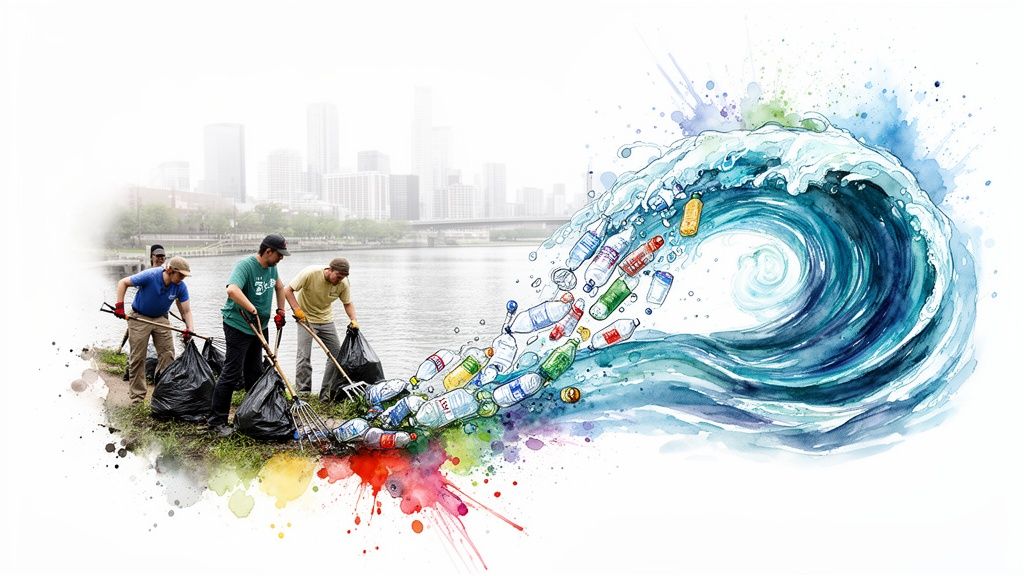
Let's be real—the vast blue ocean can feel a million miles away from my life here in Chicago. But the crisis of ocean plastic pollution is closer than you think. It's a problem that connects our city streets directly to the heart of the planet. I want to show you how, through an invisible, relentless river of waste.
The Story That Connects Our Streets to the Sea
I started Litter Caterpillars because my whole life I've had trouble cleaning and organizing my things. As my own living space became more of a mess, my life became more of a mess, too. It felt like our planet was in a similar state, buried under a mountain of plastic that tells a story of fleeting convenience with a disastrous, suffocating ending. I want to tell you how that personal struggle connects our local lives to this massive global challenge.
My own apartment was a disaster. Every piece of trash had its own sentimental story. An old jar of jam from a trip to Michigan four years ago, a bag of nuts from that time I tried to eat healthy but failed—each item was a monument to a past I couldn’t clean up. Each one weighed less than a pound, but to me, it might as well have weighed 500 pounds.
This personal chaos reached a breaking point, and I knew I had to change. I resolved that I would finally tackle the things that have always been the most difficult for me: cleanliness, consistency, and bravery. That’s when I had a powerful realization on a freezing Chicago day.
It’s often much, much easier to clean up a mess that isn’t yours.
This simple idea sparked everything. It turns out that tackling someone else's litter—the anonymous trash on our streets—can be a profound act of self-care. It builds a strange, new form of fun. It turns a chore into an adventure.
The Scale of the Problem We Face
My personal struggle with a messy room is a small-scale version of what our entire planet is up against. The numbers behind the ocean plastic crisis are staggering and can make anyone, even you, feel small.
Imagine standing on a beach, anywhere in the world, and knowing that right now, between 75 and 199 million tonnes of plastic waste are choking our oceans. Every single year, another 8 to 10 million metric tons flood in. It’s like a garbage truck dumping its entire load into the sea every single minute. This relentless influx has birthed five massive garbage patches, with the Great Pacific Garbage Patch now spanning an area three times the size of France. You can discover more insights about the state of the plastic crisis on 4ocean.com.
But I'm here to tell you that these numbers don't have to paralyze us. They can inspire us. This guide will show you how this problem is immediate, personal, and surprisingly solvable, starting right here in our own neighborhoods. We can fight back.
The Unseen River That Connects Your Street to the Sea
You're probably thinking, 'I'm in Chicago, a thousand miles from any ocean. How does my litter possibly end up there?' It’s a fair question, one I've asked myself. But I want you to follow me on a journey.
Picture a single plastic bottle dropped on a street in Logan Square. It just sits there until a heavy rain comes. That downpour washes it into a storm drain, a dark, hidden channel right under our feet. From there, it’s a quick trip into the Chicago River.
From Our River to the World’s Oceans
This is where our local story goes global. Thanks to a massive, century-old engineering project, my city reversed the Chicago River's flow. Instead of flowing into Lake Michigan, it now runs away from it, connecting to a vast system that feeds the mighty Mississippi River.
That one plastic bottle from Logan Square is now on a thousand-mile voyage south. It will drift past St. Louis, Memphis, and New Orleans, eventually spilling into the Gulf of Mexico. And from the Gulf, it’s a straight shot into the Atlantic.
This is the unseen river of trash that connects us all. It flows from our city blocks, through our local waterways, and directly into the heart of the world’s oceans. You aren't separate from this problem; you are a source.
This infographic breaks down the simple, grim journey our plastic takes from land to sea.
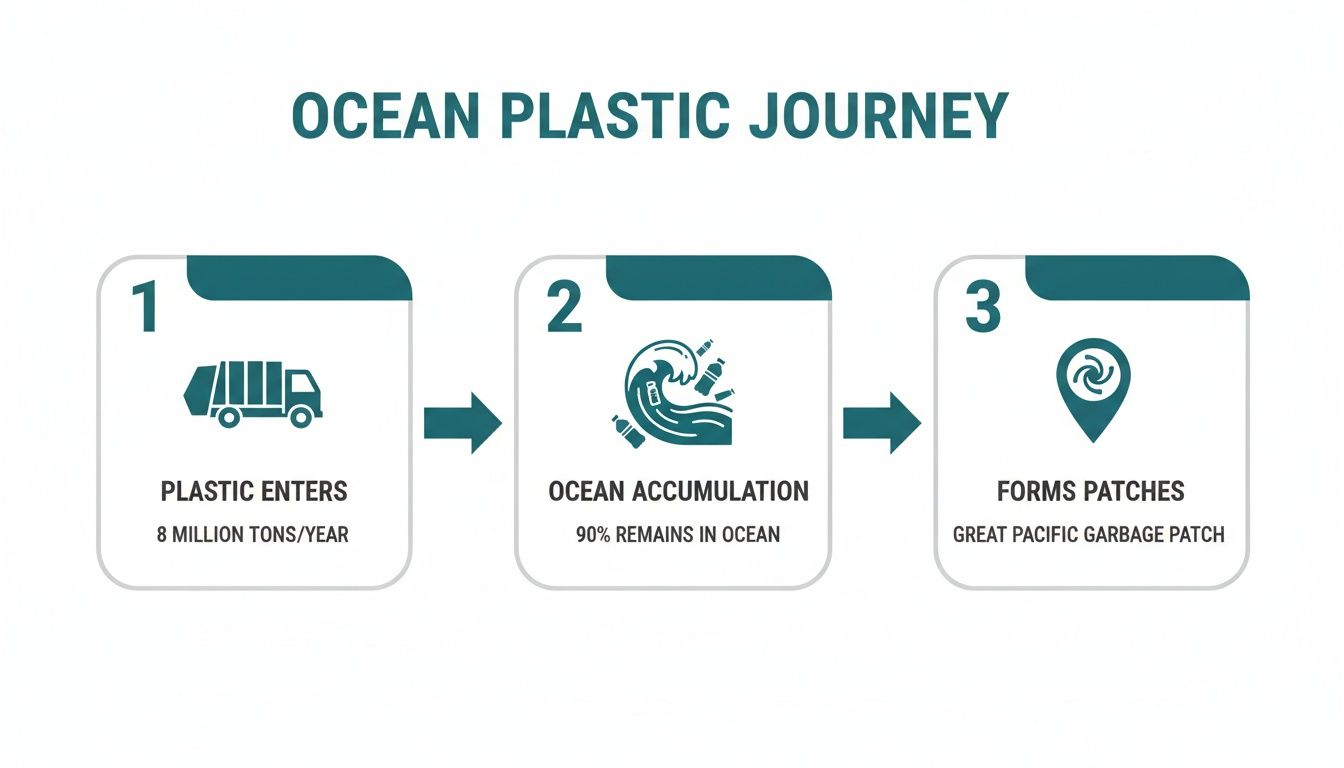
This visual drives home a critical point: once plastic gets into our waterways, it inevitably collects in the ocean, creating the infamous garbage patches we hear so much about.
To see just how local this global problem is, let's trace the path step-by-step.
The Journey of a Plastic Bottle from Chicago
| Stage | Location | Mechanism | Impact |
|---|---|---|---|
| 1. The Drop | Chicago Street | Littered by a person | Visual blight, potential hazard for local wildlife. |
| 2. The Wash | Storm Drain System | Rainwater runoff | Enters the urban water system, unseen and unmanaged. |
| 3. River Entry | Chicago River | Drain outfall | Becomes river pollution, threatening aquatic life. |
| 4. The Long Drift | Mississippi River | River currents | Travels hundreds of miles, breaking down into microplastics. |
| 5. Ocean Entry | Gulf of Mexico | River delta | Contributes to a massive concentration of marine debris. |
| 6. Global Drift | Atlantic Ocean Gyre | Ocean currents | Joins a "garbage patch," harming marine ecosystems for centuries. |
That's how a single piece of trash from your neighborhood becomes part of a planetary crisis. The connection is direct, and it starts right here.
A Global Problem with a Local Source
We often hear about major international rivers like the Ganges contributing massively to this crisis—and they do—but it's a mistake to think we're disconnected. I know that an estimated 80% of ocean plastic comes from land-based sources, carried to the sea by rivers just like ours.
Our local waterways act as superhighways for this pollution. Every piece of litter you see has the potential to start this exact journey. The problem isn't just "over there" in some distant country; it starts right here, on our streets, in our parks, and along our riverbanks.
We can’t fix the global issue without tackling our local contribution first. If you're ready to get your hands dirty and stop this problem at the source, you can learn more by checking out our guide on cleaning up a river. It’s where our work truly begins. That bottle's story doesn't have to end in the ocean.
The True Cost of Our Plastic Habit
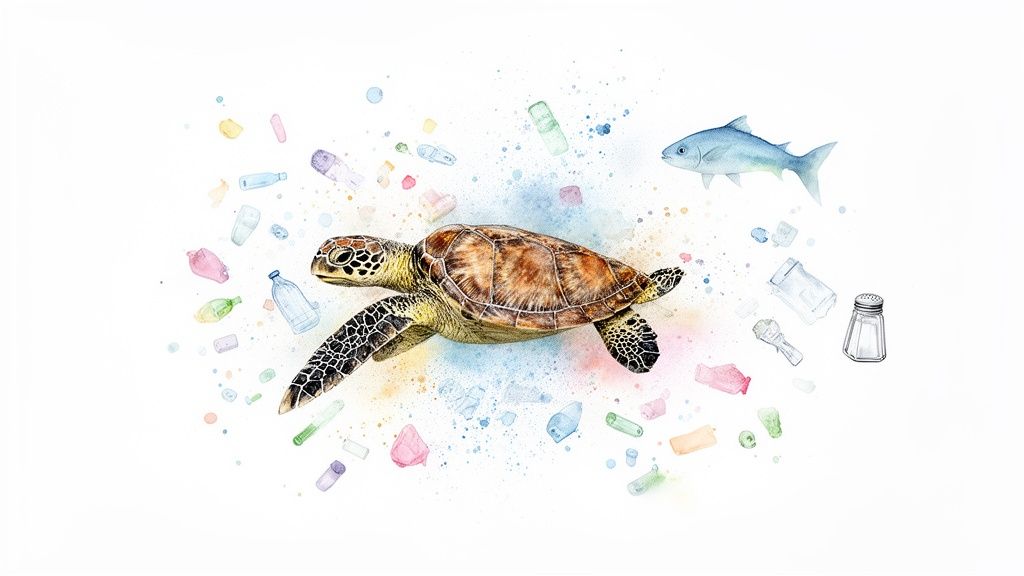
So, what happens to that plastic bottle we followed from Chicago? It doesn't just vanish when it hits the Gulf of Mexico. No, it starts a second, much darker life, leaving behind a trail of destruction that’s almost hard for me to wrap my head around.
For marine animals, it's a horror show.
Picture a sea turtle, just doing its thing, gliding through the water. It spots something that looks exactly like a jellyfish—its favorite meal. But it's not. It’s a plastic bag. Once swallowed, that bag is a one-way ticket to a slow, miserable death from starvation. It just sits there, clogging its stomach. A gut full of trash it can't ever digest.
A Death Sentence for Marine Life
This isn't some rare, freak accident. This is the daily reality for countless animals out there. I've read that an estimated 100,000 marine mammals die from our plastic trash every single year. Scientists have confirmed that at least 81 out of 123 marine mammal species have either eaten plastic or gotten tangled up in it.
The danger comes in two brutal forms:
- Ingestion: Like that poor turtle, animals mistake our junk for food. A plastic bag looks like a squid. A tiny shard of hard plastic looks like a small fish. It's a fatal mistake you or I could never imagine making.
- Entanglement: This is a special kind of cruel. Imagine old fishing nets—what I call "ghost nets"—just drifting around for decades, trapping and killing everything in their path. Seals, dolphins, and whales get caught. They can't surface for air. They simply drown.
It's a world gone mad. A world where a sperm whale can wash up on a beach with nearly 30 kilograms of plastic junk in its stomach—a nightmare collection of shopping bags, ropes, and even a jerry can. I feel like we've created a situation where an animal's natural instincts have become a fatal flaw.
From Toxic Confetti to Our Dinner Plates
But the nightmare doesn't stop there. As that bottle from Chicago floats in the ocean, the sun and salt water start to break it apart. It doesn't biodegrade. It just shatters into smaller and smaller pieces until it becomes microplastics.
Think of it like toxic confetti.
These tiny fragments, most smaller than a grain of rice, are everywhere. They get eaten by the smallest creatures, like plankton. Then, a small fish eats the plankton. A bigger fish eats the small fish. And eventually, that same fish ends up on a dinner plate. Maybe even yours.
We made this mess, and now it’s coming right back to us. I've found that microplastics have been found in our drinking water, the air we breathe, and even the salt we use to season our food. This isn't just about saving the whales anymore. It's about saving ourselves.
The future looks grim if we don't act. I've seen projections that the amount of plastic pouring into our oceans could nearly triple by 2040. We are on a collision course with a future where there’s more plastic than fish in the ocean by 2050. That’s not a sci-fi movie plot; it's a real projection based on the path we're on now.
We have to change. The stories of the victims, animal and human, make the stakes painfully clear. If you’re ready to start fighting back, our guide on how to reduce plastic pollution is a good place to begin.
How Tom Sawyer Taught Us to Fight Pollution
Remember when Tom Sawyer got punished and had to paint that giant fence? He could have sulked. He could have complained. But he didn't. Instead, he made that chore look like the most fun, most exclusive privilege in the entire world—and pretty soon, his friends were literally paying him for the chance to help.
That’s exactly what I'm doing at Litter Caterpillars. I'm taking the “chore” of cleaning up Chicago and turning it into an adventure. It’s not a punishment; it's a mission. It’s how you and I can build something real and beautiful together.
This simple flip in how you think about the work is the key to solving a problem as massive as ocean plastic pollution. You have to find the joy in it. You have to find the story, the community, and the fun.
Turning a Global Problem into Your Personal Mission
It’s so easy for me to get crushed by the weight of the plastic crisis. You see those pictures of garbage patches the size of a country and just feel… helpless. But what if you and I stopped trying to look at the whole giant mess at once? What if we just focused on our one little piece of it?
I’ll never forget our very first cleanup. There were only three of us, and we got caught in one of those classic Chicago hailstorms, huddled under a tree, shivering. Every Uber kept canceling on us. In that moment of pure, shared misery, I realized something. Suffering together like that, it adds flavor to the adventure. It advances the plot of your story.
This is our theme song. It’s a fun little tune that captures that spirit of adventure.
This song reminds us that what we’re doing isn't just about picking up trash. We're building a powerful, positive identity around service.
Just like Tom Sawyer convinced his friends that painting a fence was an honor, you and I can convince ourselves—and our communities—that cleaning our planet is one of the most rewarding things we can do. It’s not a punishment; it’s a privilege.
This is how a scary global issue becomes your personal mission. The real solution to ocean plastic pollution isn't just about some high-level policy or fancy new tech. It starts the moment you and I decide to find the joy in the work. The moment we make the chore an adventure.
From Mindset to Action
So, how do we take this Tom Sawyer idea and make it bigger? We look at all the big-picture solutions, but we ground them in that same core belief: finding purpose and fun in what we do. It means we can get behind both the huge strategies and the tiny grassroots efforts, because they all come from the same place of inspired action.
Here’s what that actually looks like:
- Global Policy: You and I can fight for international agreements that treat plastic pollution seriously. It's not a boring policy debate—it's a thrilling global quest to save our oceans.
- Innovative Product Design: We can get behind companies creating amazing plastic-free products. Every dollar you spend becomes a vote for the future you want to live in.
- Smarter Waste Management: I want us to push our cities for better recycling and composting systems that are so easy and satisfying, they become a natural part of our day.
Every single one of these solutions starts with the simple decision to act. It starts when you stop seeing it as "someone else's mess" and start seeing it as "our shared adventure." That is how we begin to turn the tide.
Alright, you're fired up. You get it now. You see the straight line from that plastic bag snagged on a fence in your neighborhood all the way to the middle of the ocean. And you're ready to do something about it. Right now.
This isn't your grandpa's "reduce, reuse, recycle" lecture. I know we're past that. This is your playbook for making a real, visible dent in the problem, right here on the streets of Chicago. This is how you turn that feeling in your gut into action that you can see and feel.
This is about more than just picking up trash. It's about finding your people, taking back your community, and starting your own story of transformation.
Find Your Crew
Honestly? The most powerful thing you can do is just show up. When you join a group like mine, a weekend morning stops being a chore. It becomes a mission. An adventure.
Cleaning with a crew means you're not just some person picking up litter alone. You're building something. You’re making friends, exploring parts of the city you've never seen, and creating a story you'll actually be proud to tell. I know some of our best memories were made shivering in a freak hailstorm or laughing under the summer sun, all of us there for the same reason.
Use Your Voice
You don't need to be a lobbyist to make a difference. Your voice is a weapon. It can be as simple as a conversation or a quick email.
- Hit Up Your Alderperson: Find out who represents your ward and send them a personal message. Don't be shy. Ask for more trash cans on your block. Ask why your neighborhood doesn't have a community composting program. I promise your story as a resident matters more than you think.
- Talk to Local Shops: Next time you grab coffee, just ask the owner if they've ever thought about a discount for people who bring their own mugs. I find that a friendly nudge from a regular customer can be the spark that gets things moving.
This isn't about picket signs and protests—it's about starting conversations. It's about showing the people in charge that you actually care about how your community looks and feels. You're a voter. A customer. A neighbor. They need to listen.
Your Weekend Warrior Action Plan
Ready to jump in this weekend? Here’s a simple checklist of things you can do to get your hands dirty, the Litter Caterpillar way.
| Action Step | Why It Matters | Litter Caterpillar Pro-Tip |
|---|---|---|
| Go on a "Trash Hunt" | Every single piece of plastic you grab is one less piece on its long journey to the ocean. | I want you to make it an adventure. Pick a neighborhood you’ve never really explored. Throw on a great playlist and see what you can find in an hour. It's a treasure hunt for a cleaner city. |
| Support a Zero-Waste Shop | "Voting with your wallet" sounds cliché, but it's real. It shows businesses there's a demand for stuff that isn't wrapped in pointless plastic. | I say start small. Don't try to change your whole life overnight. Just switch one thing. Go for bar soap instead of a plastic bottle. Get one reusable produce bag. Easy. |
| "Adopt" a Local Park | Clean spaces create pride. When a place is clean, people are less likely to trash it. You're starting a positive feedback loop. | Find a small patch of a park near your home and make it yours. Spend 15 minutes there each week. You'll be shocked at the difference one person can make. |
I'm not just dreaming about change; we're making it happen.
Be Part of Something Bigger
I'll never forget the time we got permission to clean an entire stretch of highway while it was shut down for a bike event. Dozens of us swarmed it. We turned this dangerous, disgusting eyesore into something clean. That's what happens when a few brave, kind people like you and me decide to stop waiting and start acting.
Every small win builds on the last. It creates momentum. It proves what's possible when we stop feeling helpless and start getting our hands dirty. This is your invitation to join the fight against ocean plastic pollution, starting right here on your block.
If you need some inspiration, check out what a real cleanup looks like in our guide to a public beach cleanup on Lake Michigan.
Why Becoming a Caterpillar Will Change Your Life
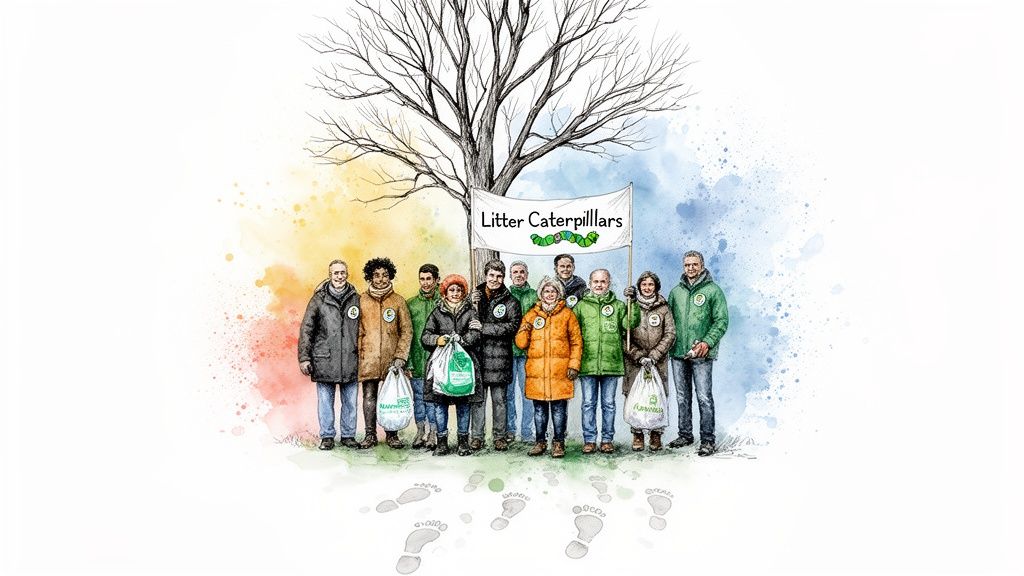
Let me be honest. I started Litter Caterpillars because I had to clean up my own life. Seriously. My living space was a mess, and my life was an even bigger mess. I was looking for consistency, a bit of bravery, and a group of people who just wanted to give back—not take.
What I found was that serving others is the fastest way to serve yourself. It can completely transform you from the inside out. That’s the entire reason I call us Caterpillars. We’re all imperfect, kind of messy, and maybe a little lost. But we’re all committed to growing into something better.
Joining us isn't just about picking up trash, even though we do a lot of that. It’s about the simple, powerful act of showing up when it's hard. It’s about making a real friend while you're both shivering under a tree during a classic Chicago hailstorm. It's about earning a deep sense of pride with your own two hands—a pride we symbolize with the flags we fly and the badges we earn.
The Power of Simple, Honest Work
For me, it became a way to forgive myself. I learned to trust myself again through the simple, honest work of cleaning up a small patch of the earth. When my own world felt chaotic, just tidying up a single block brought a weird and wonderful kind of clarity.
I want you to feel that. This is your personal invitation to join a movement built on bravery, kindness, and unity. The fight against ocean plastic pollution can feel impossibly huge. It can make you feel completely helpless.
But I promise you this: the moment you decide to show up, the second you pick up that first piece of trash with us, that feeling of helplessness starts to disappear. It gets replaced by something much better. It gets replaced by purpose.
This is your chance to stop being overwhelmed by the problem and start becoming the solution. Right here, right now. You can start with just one morning and see where it takes you.
What It Means to Be a Caterpillar
Being a Caterpillar isn't about being perfect. It's about being present. It means you're willing to put on a pair of gloves and do something real about the mess we’re all in.
- It’s an act of bravery. Just showing up, especially if you’re new or not sure what to expect, is courage.
- It’s an act of kindness. You aren't just cleaning for you; you’re doing it for your neighbors and for the planet.
- It’s an act of unity. You'll be side-by-side with people from every corner of Chicago who believe we're stronger when we work together.
This is how you change your own life. You start by helping to clean up the world around you. You start by becoming a Caterpillar.
A Few Questions I Get Asked A Lot
You probably have questions. I know I did. The whole problem of ocean plastic pollution is so huge it can make you feel powerless, like what you do doesn't matter. I want to give you some real answers, the kind that got me started and keep me going.
How Does Cleaning a Chicago Street Actually Help the Ocean?
I hear this one all the time, and it’s a fair question. The way I see it, if your bathtub is overflowing, you don’t just grab a mop—you run to turn off the tap. That's what we're doing.
Every single wrapper or bottle you or I pick up on a street in Chicago is one less piece that gets swept into a storm drain. It’s one less piece that travels down the Chicago River, into the Mississippi, and ultimately into the Gulf of Mexico. It’s a direct interception. But it’s more than that. When your neighbors see you out there, it plants a seed. It makes them think, and that’s how we start to change the culture around trash, building the pressure that leads to bigger things.
I’m Not Brave or Super Outgoing. Is This for Me?
Yes. Absolutely. Let me tell you something: bravery isn't about not being scared. It's about showing up even when you are. Many of our regulars started out feeling the exact same way.
Some people come, put in their headphones, and just get lost in the work. It's satisfying. Others end up making lifelong friends. There's zero pressure. You can be as quiet or as social as you feel that day.
We’re here to create a place where the simple act of working together builds you up. Just being here is an act of bravery. We see that, and we respect it.
This is a space for you to grow at your own speed. By just showing up, you’re doing something real for the city and, more importantly, for yourself.
Besides a Cleanup, What’s the Most Impactful Thing I Can Do?
Pick one thing you use, change it, and then talk about it. It’s that simple.
Don’t try to fix everything at once. Just find one single-use plastic you rely on—maybe it's your daily coffee cup, those plastic water bottles, or takeout containers. Find a reusable version you actually like and use it until it’s second nature.
Then, tell people about it. When someone at work asks about your cool new travel mug, tell them your story. That’s how you make this stuff feel normal. I believe it’s a personal, powerful act that ripples out to your friends and family, and eventually, brands and politicians have to listen. That's how a movement starts in your own kitchen.
Ready to do something real? Join Litter Caterpillars. Become part of a group that’s cleaning our city, building friendships, and proving that every single one of us can make a difference. Find our next event and start your own story at https://www.littercaterpillars.com.
Leave a Reply