Author: Kevin Tao

  • 7 Ways to Find Environmental Volunteering Near Me in 2026

    7 Ways to Find Environmental Volunteering Near Me in 2026

    I get it. You stare at that search bar—'environmental volunteering near me'—and it’s like looking into a closet you haven't opened in years. A jumble. Everything inside feels heavy with forgotten purpose. Where do you even begin? I remember my own room, my own life, feeling just like that. A chaotic mess where every old jam jar and bag of nuts whispered a story, making it impossible to just toss them. My life felt just as cluttered.

    Then, a tectonic shift. I walked away from a messy relationship and knew, with a sudden, gut-wrenching clarity, that I had to conquer the things that felt impossibly heavy: cleanliness, consistency, bravery. And from that personal earthquake, my group, Litter Caterpillars, emerged. One freezing, hailstorm-y Chicago day, huddled under a shivering tree with two friends, a simple truth struck me. Cleaning up someone else’s mess is so much easier than facing your own.

    And when you do it together? Even when it’s miserable? It adds a certain flavor. A bizarre, wonderful 'fun' that transforms suffering into a story. It advances the plot of your life.

    You don’t have to ignite a whole movement to feel that same spark. You just need to find your crew. I’m going to show you exactly where I’ve found the best places to connect with real, impactful environmental work, right in your own backyard. We’ll skip the fluff. We’ll get straight to the groups and platforms that will help you turn that desire to help into actual dirt under your fingernails and new friends by your side. For each option, I’ll give you the screenshots and direct links. Let's find your perfect spot.

    1. Litter Caterpillars

    If you’re searching for "environmental volunteering near me" and crave something that feels less like a chore and more like a shared adventure, let me introduce you to us. Litter Caterpillars. This isn’t your once-a-year park cleanup. We are a bold, volunteer-powered movement reclaiming Chicago's streets every single weekend. We transform forgotten spaces, block by block, and build a genuine community while we do it.

    Our mission is simple yet powerful: show up consistently, be kind, and make a visible difference. We meet weekly. Rain, shine, through biting blizzards and the sweltering humid grasp of summer. This unwavering commitment propelled us to become the first group to clean all 50 of Chicago's wards, diving into neighborhoods that other organizations often glance over. Can you imagine joining a crew so dedicated that we even cleaned a highway during a bike event shutdown? That’s the level of bravery, the level of impact, I’m talking about.
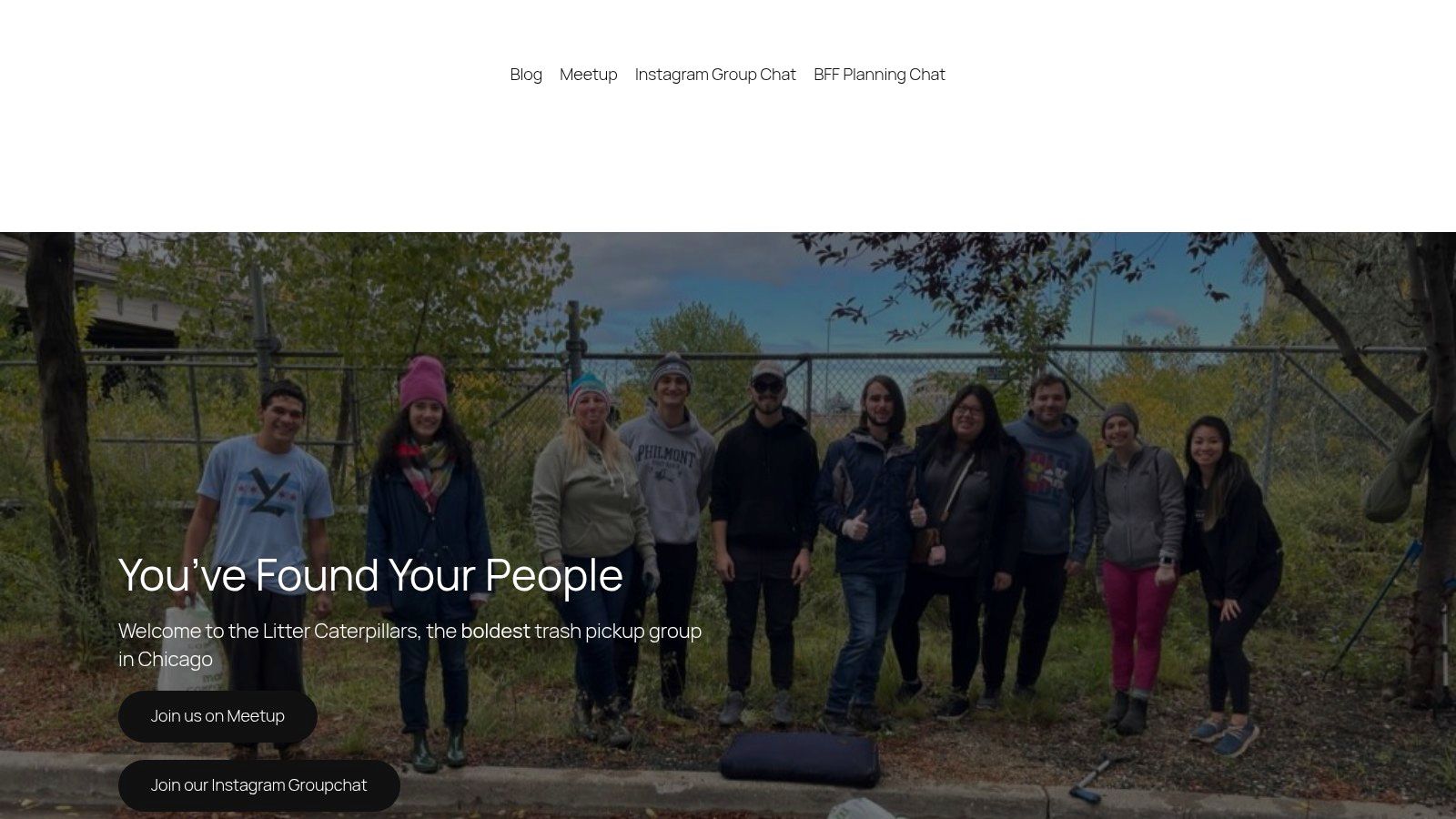
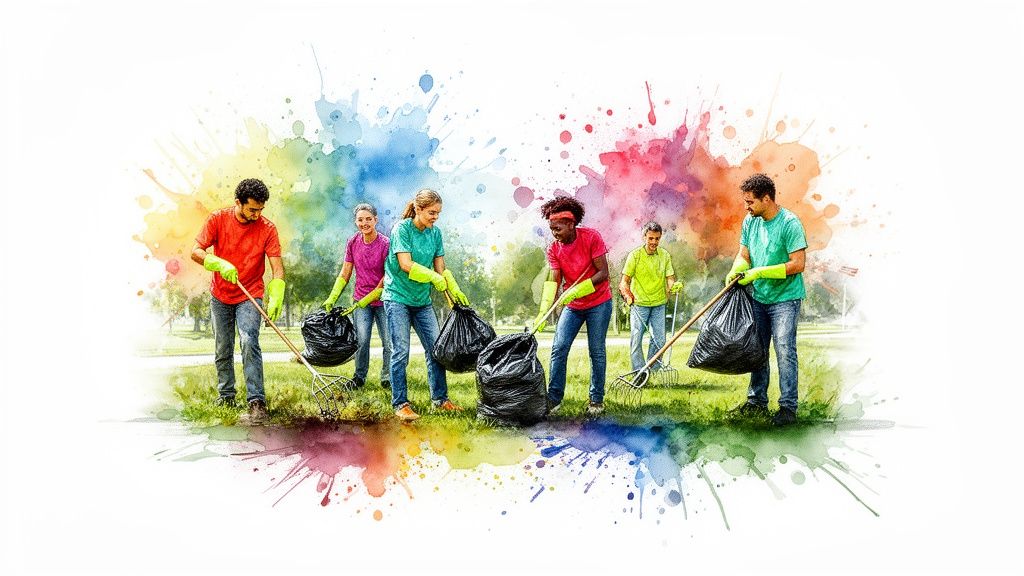
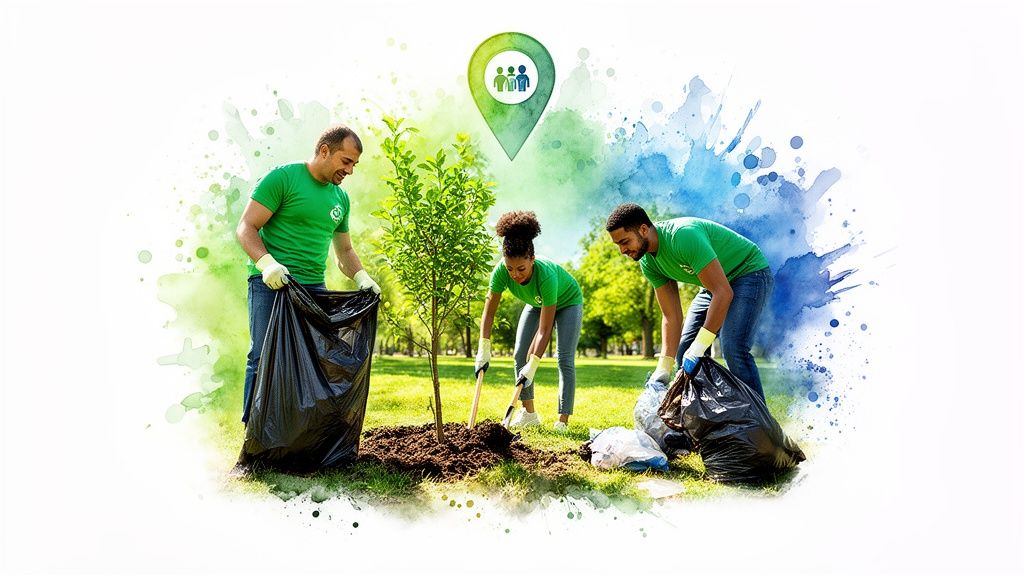
    Litter Caterpillars volunteers cleaning up a Chicago neighborhood

    Why It Stands Out: Beyond Just Picking Up Litter

    What truly sets Litter Caterpillars apart is our volunteer-first culture. I built this on the idea that doing good should also feel good. You'll find no pressure to donate. No formal fundraising asks. No complicated sign-up processes. You just show up. This model creates an atmosphere of pure, grassroots service where your time, your energy, is the most valued currency.

    Our achievements speak for themselves. We famously won an empty lot at a city auction and are now transforming it into Caterpillar Park in the Englewood neighborhood. This isn't just about temporary cleanups; it’s about creating lasting, positive change and tangible community assets.

    "Litter Caterpillars is rooted in four core values: Bravery, Kindness, Unity, and a Volunteer-First Philosophy. It’s about more than just cleaning; it’s about transforming ourselves and our city together."

    I designed the experience to be fun, to build camaraderie. With our colorful flags, a catchy theme song, and achievement badges, we foster a unique and powerful identity. Our volunteers consistently share on social media how they’ve made new friends, discovered hidden corners of Chicago, and found a profound sense of pride in their weekend work. It's a habit-forming routine that feeds your soul.

    How to Get Involved

    Joining us is incredibly straightforward. You don't need to fill out lengthy applications. You don't need prior experience. The best way to find out about our next event is to connect with us directly through our online platforms.

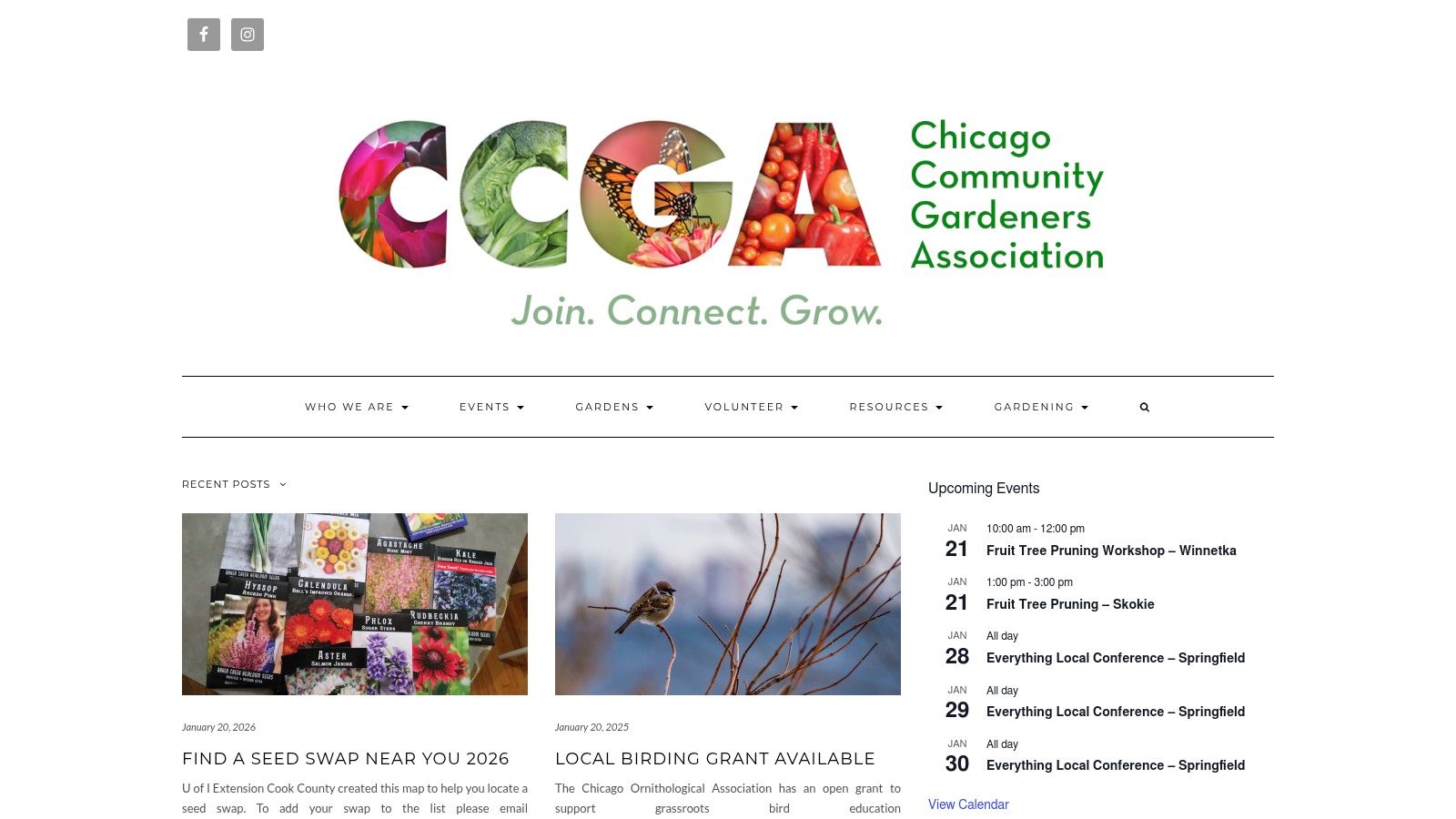
    • Meetup: This is our primary hub for event schedules and RSVPs. Just find our group and join.
    • Instagram: Follow us for inspiring updates, photos, and stories from recent cleanups.
    • Website: Visit our main site for more information about our mission and impact.

    All events are completely free to join. We provide the necessary supplies like bags, gloves, and litter grabbers. You just need to bring a positive attitude and a willingness to get your hands dirty.

    What Makes This a Top Choice?

    Feature Practical Benefit for You
    Consistent Weekly Schedule You can easily build volunteering into your weekend routine, creating a sustainable habit of service and accountability.
    Citywide Reach You get to explore and positively impact all of Chicago's diverse neighborhoods, not just the usual spots.
    Volunteer-First Culture You can enjoy a pressure-free environment focused on your well-being, safety, and happiness. It’s all about the joy of giving back.
    Tangible, Visible Impact You'll see immediate results from your work and contribute to long-term projects like Caterpillar Park, creating a lasting legacy.

    Pros:

    • A powerful, low-barrier model that is free and accessible to everyone.
    • Consistent weekend schedule that fosters true community and friendships.
    • Bold, citywide impact, including the creation of a new community park.
    • A fun and distinctive culture that makes volunteering an adventure.

    Cons:

    • As a volunteer-driven initiative, we lack the formal structure and resources of a traditional nonprofit.
    • The work is physically demanding and takes place in all weather conditions, which may not be suitable for everyone.

    If you're ready to find your tribe and make a real, lasting impact on Chicago, Litter Caterpillars offers one of the most inspiring and effective environmental volunteering opportunities near you.

    Website: https://www.littercaterpillars.com

    2. Idealist (includes VolunteerMatch)

    Imagine you walk into a massive, bustling library, but instead of books, every single shelf overflows with chances to change the world. That’s the feeling I get when I land on Idealist. It’s a powerhouse platform, a true giant dedicated to social impact, and for us, it’s a goldmine for finding local environmental volunteering near me.

    What makes Idealist so special is its sheer, breathtaking scale. In early 2025, it joined forces with VolunteerMatch, another titan in the volunteering world. This merger forged a single, comprehensive hub. Think of it as the ultimate one-stop shop. You can find everything from a weekend park cleanup in Lincoln Park to an ongoing urban gardening project in Pilsen. Instead of bouncing between a dozen different websites, you now have a massive, unified directory right at your fingertips.

    Navigating the Ocean of Opportunity

    The platform’s real strength is its robust filtering system. You aren’t just scrolling endlessly; you’re on a mission. Here’s how I make the most of it:

    • Start with the "Environment" Cause: This is your home base. Select this filter, and you immediately narrow down tens of thousands of listings to those focused on conservation, sustainability, and green initiatives.
    • Filter by Location and Proximity: This is where the magic really happens. You can search by your ZIP code, set a radius (like "within 5 miles"), and even filter by specific neighborhoods. It helps you find something genuinely near you, not halfway across the city.
    • Set Your Schedule: Are you only free on Saturdays? Do you have a few hours after work on Tuesdays? Use the time and schedule filters to find opportunities that fit your life, not the other way around.

    What to Expect

    Once you find a listing that sparks your interest, you’ll see all the key details: the organization’s mission, the specific tasks you’ll be doing, and the time commitment. Some listings let you sign up directly on Idealist. Others might redirect you to the nonprofit’s own website to fill out an application. It’s a small extra step, but that's how many grassroots organizations manage their volunteer intake.

    Key Insight: The merger with VolunteerMatch means Idealist now has an unparalleled network of small, local organizations. You’re just as likely to find an opportunity with a neighborhood block club as you are with a major national nonprofit.

    While the sheer volume of listings is a huge advantage, it means you'll sometimes stumble upon older posts. I always check the date the opportunity was posted to make sure it’s still active. If you're new to the search, exploring different search strategies can be a big help; our guide on how to find the right volunteer work for you offers some great tips for navigating platforms like this.

    Find your next green adventure at: https://www.idealist.org

    3. Points of Light Engage

    If Idealist is the giant library, then I think of Points of Light Engage as a curated, high-energy community center. It’s the successor to the well-known All for Good platform, and it comes with a fresh, modern feel. Backed by the global nonprofit Points of Light, this site is built to mobilize people, making it another fantastic resource for your "local environmental volunteering near me" search.

    What sets Engage apart is its focus on action and empowerment. It’s not just a database; it’s a launchpad. The platform aggregates opportunities from across the country, serving as a powerful complement to other large-scale sites. For someone like me in Chicago, this means I might find a river cleanup in Bridgeport one day and a community garden build in Logan Square the next, all sourced from different local partners but housed in one easy-to-navigate space.
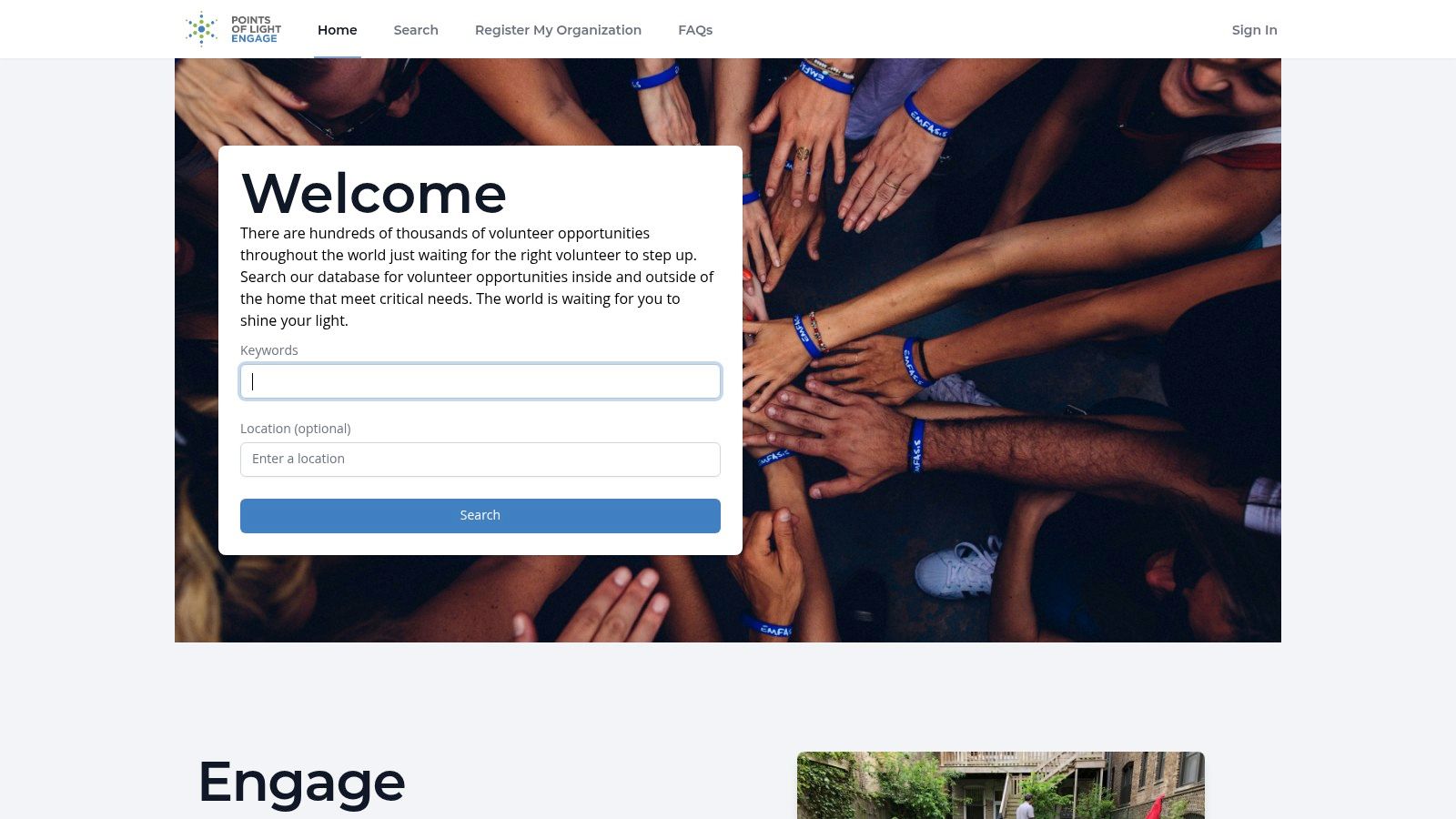
    A screenshot of the Points of Light Engage website showing search filters for environmental volunteering opportunities.

    A Toolkit for Action

    Engage shines with its straightforward search and clear presentation. The interface feels clean and user-friendly, guiding you directly to what you're looking for without overwhelming you with choices. Here’s how you can find your perfect match:

    • Filter by "Environment & Animals": Start here to instantly see all the green opportunities. The platform groups these causes together, giving you a broad look at everything from wildlife conservation to urban sustainability projects.
    • Use Your Location: Pop in your ZIP code or city to zero in on what’s happening in your neighborhood. You can find hyper-local events that might not be listed on larger, more generalized job boards.
    • Search for Groups: This is a standout feature for me. If you’re trying to organize a day of service with friends or coworkers, you can specifically search for opportunities that can accommodate a team.

    What to Expect

    The listings on Engage are typically clear and concise. You'll get the essential details upfront: what the organization does, what your role will be, and how to sign up. The platform also features "DIY" project guides, which are perfect if you're feeling inspired to organize your own neighborhood cleanup or sustainability drive. It provides you with the tools to be a leader, not just a participant.

    Key Insight: Points of Light Engage is excellent for discovering opportunities with organizations you might not have found otherwise. Because it aggregates listings, it acts as a discovery engine, pulling in unique events from a wide array of partners.

    While it has a strong national presence, the number of listings can sometimes vary depending on your specific metro area. Densely populated areas like Chicago usually have a steady stream of new postings, but I always think it's a good idea to check back regularly. The platform’s strength lies in its quality and reliability, ensuring the opportunities you find are from vetted, mission-driven organizations.

    Get started with your next project at: https://engage.pointsoflight.org

    4. Volunteer.gov (Public Lands)

    Have you ever dreamed of trading city streets for forest trails, even for just a day? Volunteer.gov is your direct portal to that experience. This isn't some third-party aggregator; it's the official federal gateway for volunteering on America’s public lands. I think of it as the backstage pass to working with the National Park Service, the U.S. Forest Service, and other agencies that protect our nation’s most stunning natural treasures.

    If you’re looking for genuine, hands-on environmental volunteering near me, this platform connects you directly with the source. You could find yourself restoring habitats for the U.S. Fish & Wildlife Service one weekend or maintaining a beloved trail in a national forest the next. It’s an incredible resource for anyone who feels that deep, primal pull to work directly on the land.
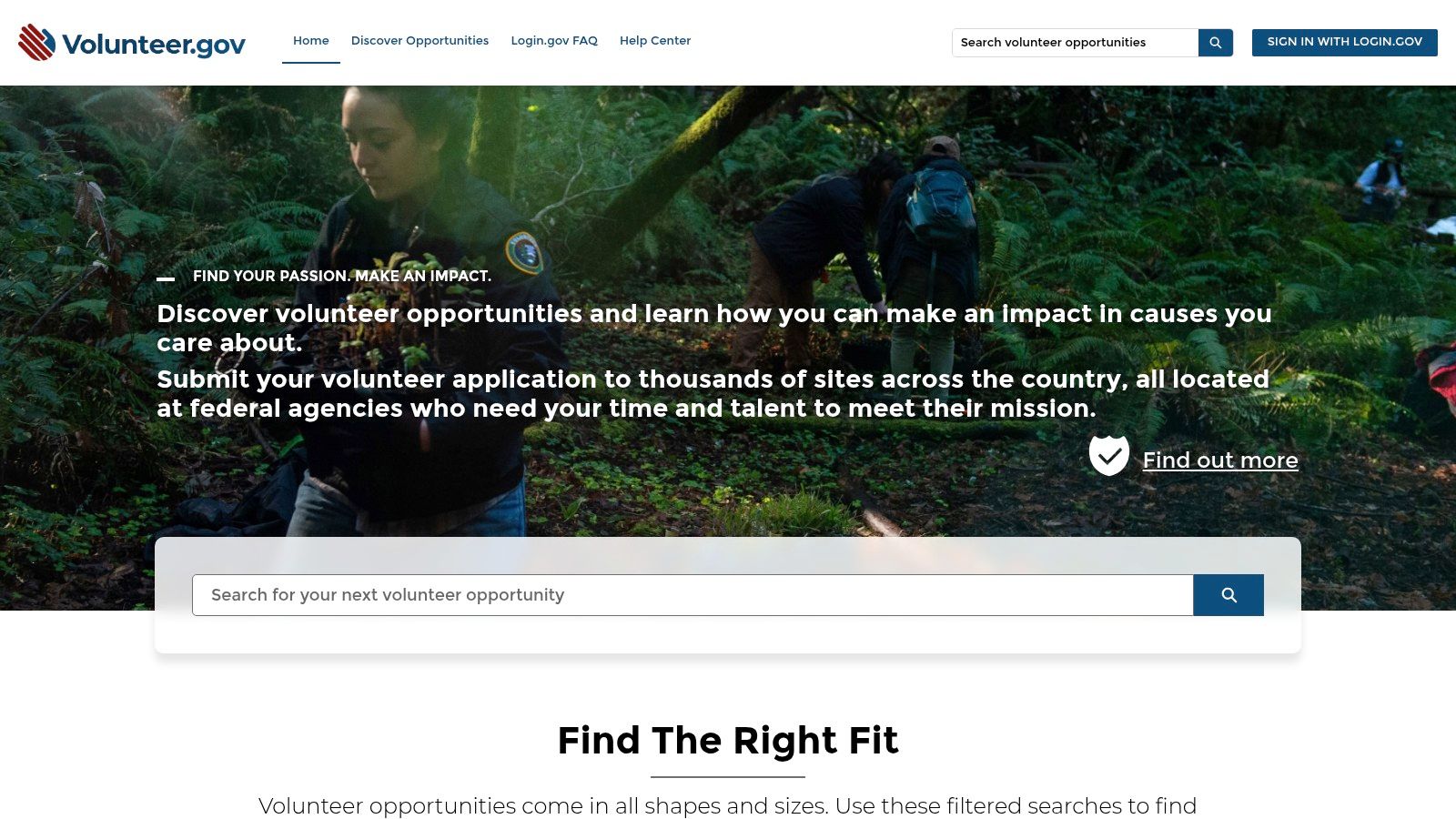
    A volunteer clearing a forest trail, showcasing environmental volunteering opportunities.

    From National Parks to Local Forests

    The beauty of Volunteer.gov is its authoritative and specific nature. The roles are posted by the land managers themselves, so you get clear, detailed descriptions of what you’ll be doing. Here’s how I navigate this treasure map of conservation work:

    • Search Across Agencies: The platform centralizes opportunities from multiple federal land-management bodies. You can search by a specific agency (like the National Park Service) or cast a wider net to see everything available in your region.
    • Filter by Activity and Effort: This is where you can truly tailor the search to you. You can filter by activity type, like "Trail/Campground Maintenance" or "Visitor Services." You can even filter by physical difficulty, from "Easy" to "Strenuous," ensuring you find a role that matches your fitness level.
    • Pinpoint Your Location: Enter your city or ZIP code to find opportunities on federal lands nearby. While many roles are in more rural settings, you might be surprised to find national wildlife refuges or historical sites closer than you think.

    What to Expect

    Each listing provides a wealth of official information: the specific tasks, necessary skills or training, required gear, and the time commitment. Some are single-day events, like those for National Public Lands Day, while others might be seasonal roles for campground hosts or interpretive guides. Applying is straightforward, as you’re connecting directly with the volunteer coordinator for that park or forest.

    Key Insight: This platform is the ultimate source for anyone serious about conservation fieldwork. The roles are often more physically involved and offer a deeper connection to ecological stewardship than a typical urban cleanup.

    Because these are federal lands, many opportunities may be a bit of a drive for city dwellers, so be prepared for a potential day trip. You’ll also notice that some longer-term positions might have specific age or vehicle requirements. But for an authentic, impactful day spent protecting America's wild places, I know there’s no better resource.

    Find your next public lands project at: https://www.volunteer.gov

    5. Keep America Beautiful (KAB) Volunteer Portal and Affiliates

    Have you ever seen a group of neighbors in bright vests, armed with trash bags and grabbers, transforming a local park and thought, "I want to be a part of that"? That’s the exact energy Keep America Beautiful (KAB) channels into a nationwide movement. It’s less like a centralized database and more of a powerful, grassroots network dedicated to making our communities cleaner and greener, one block at a time.

    What sets KAB apart is its hyper-local affiliate model. Instead of just listing opportunities, KAB empowers local chapters across the country to organize their own events, like the famous Great American Cleanup. This means when you find a KAB event, you’re not just signing up for a task; you’re joining your actual neighbors. It’s the ultimate platform for finding environmental volunteering near me that has an immediate, visible impact right outside your front door.

    Joining a Neighborhood Effort

    The KAB portal is your gateway, but the real action happens through its local affiliates. This structure is their strength, connecting you directly with the people leading the charge in your town.

    • Find Your Local Affiliate: Your first step is to use their website to find the KAB chapter in your city or county. This is your direct line to local cleanups, beautification projects, and recycling drives.
    • Explore Seasonal Campaigns: KAB is famous for its large-scale events, especially the Great American Cleanup, which typically runs in the spring. I keep an eye out during this time, as affiliates host a huge number of events that are perfect for first-timers and families.
    • Come as You Are: One of the best parts about KAB events is that they are incredibly accessible. Affiliates often provide all the necessary supplies like gloves, bags, and safety vests. You just need to show up with a positive attitude.

    What to Expect

    When you connect with a local KAB affiliate, you’ll find that events are well-organized and community-focused. The affiliate handles the logistics, like coordinating with local waste management to haul away the collected trash. This makes it a seamless experience for you. You get to focus on the fun part: making a tangible difference and meeting like-minded people.

    The opportunities are primarily centered around litter abatement and beautification, making them a fantastic entry point into environmental work. It’s less about policy and more about direct action.

    Key Insight: The affiliate model means that even if the national KAB portal doesn't show an event right in your ZIP code, your local chapter’s website or social media page is likely buzzing with activity. I always check the local affiliate directly for the most up-to-date schedule.

    While the primary focus is on cleanups, the skills and community connections you build are invaluable. Participating in a volunteer trash pickup is one of the most direct ways you can improve your local environment. The downside is that event frequency can vary by location, and some affiliates are more active than others. But when they happen, they bring the whole community together.

    Find your local chapter at: https://volunteer.kab.org

    6. EarthDay.org – Great Global Cleanup Map

    Imagine a world map. But instead of just showing cities and mountains, every pin on it represents a group of people coming together to heal the planet, one neighborhood at a time. That’s the beautiful vision behind the EarthDay.org Great Global Cleanup Map. It’s a powerful, visual tool that connects you directly to the hands-on work of environmental volunteering near me, turning a global movement into your local mission.
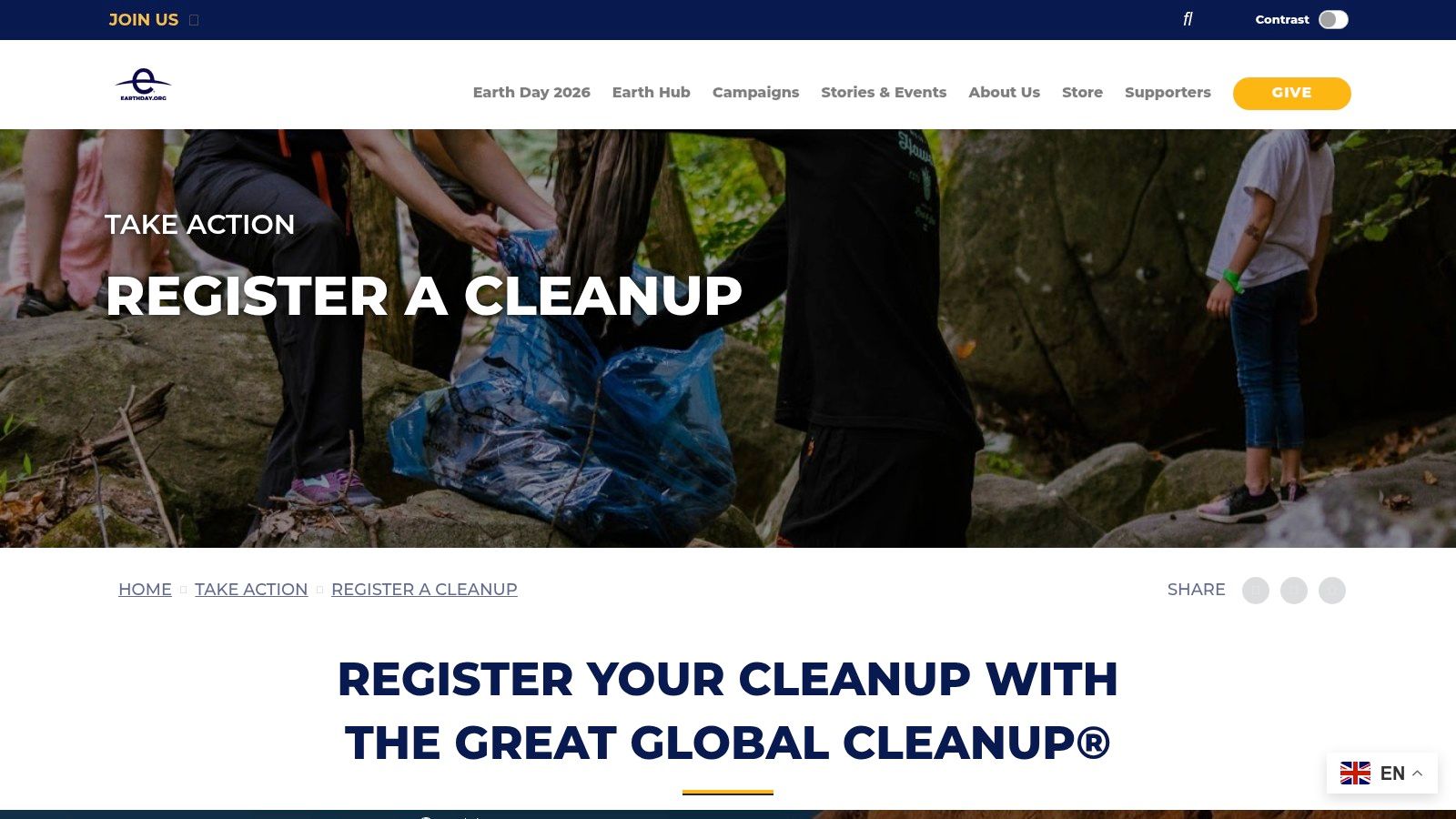
    EarthDay.org – Great Global Cleanup Map

    While many platforms are year-round directories, EarthDay.org shines brightest during its peak season in April, mobilizing millions for Earth Month. This platform isn't just a list; it's a rally point. I think it’s especially brilliant for grassroots organizers who want to put their local park or river cleanup on a global stage, and for volunteers like you looking to join a wave of collective action.

    Navigating the Global Rally Point

    The strength of this platform is its simplicity and focus. You won't get lost in complex features; you'll get straight to the action. Here's how I dive in:

    • Explore the Interactive Map: The core of the experience is the map. You can zoom into your city, like Chicago, and see pins pop up representing registered cleanups. Click on one, and you’ll get the core details: date, time, location, and a link for more information.
    • Search by Location: If you prefer a more direct approach, simply enter your ZIP code or city to find events happening in your immediate vicinity. It’s a fast and efficient way to see what’s happening down the street.
    • Register Your Own Cleanup: Are you feeling inspired to lead? The platform makes it incredibly easy for you to become an organizer. You can register your own event, set it as public or private, and even manage volunteer capacity, all for free.

    What to Expect

    When you find a cleanup, you’ll typically see a brief description and a link that directs you to the organizer’s sign-up page, which could be a Facebook event, an Eventbrite page, or a different volunteer portal. This direct connection ensures you get information straight from the source. The platform is a fantastic starting point for finding dedicated, one-off events that channel the energy of a global celebration into tangible local impact.

    Key Insight: The Great Global Cleanup Map is an outstanding tool for finding and amplifying hyper-local events. An organizer of a small neighborhood cleanup can use EarthDay.org’s massive brand recognition during April to attract more volunteers than they might on their own.

    While the map is most populated around Earth Month in April, many organizers keep their events listed year-round. It’s a powerful reminder that every cleanup is a local act of environmental stewardship, contributing to a much larger story. If you're inspired to learn more about this concept, our guide on what is environmental stewardship offers a deeper look into the philosophy behind these actions.

    Join the global movement at: https://www.earthday.org/actions/register-a-cleanup/

    7. Meetup

    Sometimes, the best way to make a difference is to start with the people on your street. If you're looking for less of a formal application process and more of a "hey, let's meet at the park and pick up trash" kind of vibe, then Meetup is your go-to platform. It’s less like a job board and more like a community bulletin board for passionate locals creating their own environmental volunteering near me events.

    What makes Meetup so powerful is its hyper-local and social-first approach. It’s built around groups, not just one-off events. You can join a "Lincoln Square Cleanup Crew" or a "Hyde Park Gardeners" group and find recurring opportunities that fit into your life. This turns volunteering from a single act into a sustainable habit and, honestly, a great way to meet like-minded neighbors.
    Meetup

    Finding Your Local Crew

    The platform’s location-aware discovery is its secret weapon. It’s designed to connect you with people and events happening just around the corner. Here's how I dive in and find a group:

    • Search by Interest and Location: I start with broad terms like "park cleanup," "sustainability," or "urban gardening" and let Meetup's algorithm show me groups and events nearby. Its location detection is excellent for uncovering hidden gems.
    • Look for Recurring Events: Many of the best environmental groups on Meetup host weekly or monthly cleanups. This consistency is perfect for building a routine and seeing the long-term impact of your work in a specific area.
    • Read Group Descriptions Carefully: Each group is run by an independent organizer, so the vibe and requirements can vary. I always check the "About" section to understand their mission and what they typically do.

    What to Expect

    The experience is often casual and social. You RSVP, show up, and get to work alongside friendly faces. Since these events are often grassroots, communication is key. I always read the event details closely to see what I need to bring, like gloves or a water bottle. Organizers are usually very responsive to questions posted on the event page.

    Key Insight: The true magic of Meetup is community. You aren't just volunteering; you're building relationships with people who share your passion for the local environment. Many groups I know grab coffee or a bite to eat after their events.

    One thing you should keep in mind is that the quality and consistency of events depend entirely on the group organizer. Groups can become inactive if the organizer stops paying the subscription fee or gets too busy. However, the high chance of finding a regular, informal, and friendly cleanup right in your neighborhood makes it an invaluable resource for me.

    Find your next green meetup at: https://www.meetup.com

    Local Environmental Volunteering: 7-Platform Comparison

    Program Implementation complexity 🔄 Resource & speed ⚡ Expected outcomes 📊 Ideal use cases 💡 Key advantages ⭐
    Litter Caterpillars Low 🔄: volunteer-run, informal weekly coordination Low ⚡: minimal funds, quick onboarding; physically demanding High 📊: visible local cleanups, sustained ward coverage, strong retention Local, regular urban litter pickups and community-building ⭐: consistent weekly turnout, bold culture, tangible neighborhood impact
    Idealist (includes VolunteerMatch) Low 🔄: searchable directory; minimal volunteer setup Low ⚡: free search with broad listings; response times vary Variable 📊: wide selection; match quality depends on listing recency Finding diverse local volunteer opportunities across causes by ZIP ⭐: extensive coverage and filters; VolunteerMatch network included
    Points of Light Engage Low 🔄: national catalog with robust filters Low ⚡: free and regularly updated; regional listing variability Moderate 📊: good for discovering vetted opportunities and DIY guides Individuals/groups seeking vetted, cause-filtered opportunities ⭐: reputable nonprofit backing and group-friendly search
    Volunteer.gov (Public Lands) Moderate 🔄: official agency listings with role requirements Medium ⚡: authoritative postings; may require travel or commitments High 📊: hands-on conservation, trail/habitat work with clear roles Trail work, habitat restoration, conservation events on federal lands ⭐: direct agency engagement and detailed role descriptions
    Keep America Beautiful (KAB) Volunteer Portal and Affiliates Low 🔄: national portal plus local affiliates; event registration Medium ⚡: affiliates often supply gear and haul-away support Moderate 📊: accessible, family-friendly beautification and litter abatement Community/suburban cleanups, seasonal campaigns (Earth Month) ⭐: broad affiliate network and supplied resources
    EarthDay.org – Great Global Cleanup Map Low 🔄: map-based listings and event submission Low ⚡: free to list; highest visibility around Earth Month Variable 📊: can boost turnout seasonally; complements local platforms Organizers recruiting volunteers, Earth Month/global cleanups ⭐: global visibility and easy organizer listing
    Meetup Low–Moderate 🔄: group creation or RSVP; organizer subscription may be required Low ⚡: instant RSVPs, recurring events, social features Moderate 📊: builds regular social groups and volunteer habits Building community-oriented, recurring local cleanups and social routines ⭐: excellent for consistent meetups and community building

    It's About More Than Just Trash

    So there you have it. We've journeyed through seven powerful tools, each a unique doorway into the world of environmental volunteering near me. We've seen how a hyper-local force like Litter Caterpillars can transform a neighborhood block by block. We've explored how vast databases like Idealist and Points of Light Engage can connect you to thousands of opportunities with just a few clicks.

    From the rugged, natural beauty protected by volunteers on public lands through Volunteer.gov to the community-driven initiatives championed by Keep America Beautiful affiliates, you have so many paths. We saw how global movements like the Great Global Cleanup find their footing right here in our local parks, and how a simple social platform like Meetup can connect you with neighbors who share your passion for a greener city.

    Rewriting Your Community's Story

    I want to leave you with one final thought. When you show up to a park cleanup, you're doing so much more than just picking up someone else's trash. You are an editor. You’re stepping into a story that has gone a little off track.

    Imagine a small, neglected park. The story it tells now is one of abandonment. Of a community that has turned its back. But then you arrive, bucket and grabber in hand. With every piece of litter you remove, you are deleting a line of that sad story. You and your fellow volunteers are not just cleaning; you are actively rewriting the narrative. You infuse the space with care, with attention, with hope. The new story becomes one of resilience. Of community pride. Of a place that is loved and looked after.

    Your Own Transformation

    And here’s the most incredible part: in rewriting the story of that space, you begin to rewrite your own. It's a subtle but powerful shift. That feeling of helplessness you might have about the state of the environment? It starts to fade. It gets replaced by a tangible sense of agency. You are no longer just a spectator to the problem; you are an active participant in the solution.

    This work is like a compass for the soul. It reconnects you. It connects you to the physical ground beneath your feet, to the neighbors working alongside you, and most importantly, to that part of yourself that believes in a better world. Just like a caterpillar, you're not just moving through the world; you're fundamentally transforming. You build trust in your own ability to make a difference. You connect with people who share your values. You prove to yourself that we can heal our communities one small, brave act at a time.

    Your Next Step: Just Show Up

    The journey from "I want to help" to "I am helping" can feel daunting. We've laid out the map, but you still have to take the first step. The hardest part is simply starting. So, which path resonates with you?

    • Seeking a tight-knit community and immediate local impact? Litter Caterpillars is your answer.
    • Want a massive, searchable database for nonprofit roles? Dive into Idealist or VolunteerMatch.
    • Looking to join a national movement with local chapters? Check out Keep America Beautiful.
    • Craving fresh air and work on public lands? Volunteer.gov is waiting for your boots on the ground.

    Pick one. Just one. Don't overthink it. Click the link, find an event that fits your schedule, and sign up. Then, just show up. I promise you, the simple act of showing up is where the magic begins. You won’t regret it.


    Ready to start your journey with a group that’s all about local impact and building friendships? Join us at Litter Caterpillars for one of our upcoming neighborhood cleanups in Chicago. We make finding "environmental volunteering near me" simple, fun, and incredibly rewarding. Find your first event and see the transformation for yourself at Litter Caterpillars.

  • 10 Volunteer Management Best Practices That Actually Build Community in 2026

    10 Volunteer Management Best Practices That Actually Build Community in 2026

    I'll tell you a secret. The hardest mess I ever cleaned wasn't on some grimy Chicago street corner. It was inside my own apartment, inside my own life. My refrigerator was a grotesque museum of expired dreams, my social life just as chaotic. Every piece of trash I couldn’t toss out held a story, a weight I couldn't seem to shift. It took the painful end of a draining relationship for me to finally see it: I had to change everything.

    I decided to build a life around givers, not takers. To face the things that terrified me most—cleanliness, consistency, bravery. So I started Litter Caterpillars. Just me and two friends in a freak Chicago hailstorm. As we shivered under a tree, a thought struck me like lightning. Cleaning up other people's messes is so much easier than cleaning up our own. And suffering together? It creates an unbreakable bond. It pushes the plot of your life forward.

    That's the real heart of what we do. It’s not about trash. It’s about transformation. Most volunteer programs feel like a cold transaction, a chore you just check off a list. They get it so wrong because they miss the human part, the deep craving for connection and purpose that drives every single one of us. They manage tasks. We lead people.

    This article isn't some dry, corporate checklist. It's our playbook. It was forged in blizzards and brutal heatwaves, a guide for building a volunteer movement that people are genuinely proud to join. We'll dive deep into the 10 volunteer management best practices that turned my personal mess into a city-wide mission. These aren’t just theories. They are the exact strategies I used to grow a tiny group of friends into a powerful community force, creating a space where people find friendship, purpose, and a renewed sense of who they are. Let's get it right, together.

    1. Clear Mission and Values Alignment

    Before you dare post a single sign-up sheet or send one email, you have to answer a powerful, one-word question: Why? I’m not talking about what you do, like picking up litter. I’m talking about the heart thumping behind the work. One of the most critical volunteer management best practices I know is forging a crystal-clear mission and aligning every single action with your core values. This is your organization's soul. It's the magnetic force that pulls the right people straight to you. It’s the difference between asking someone to fill a garbage bag and inviting them to reclaim a neighborhood's spirit.

    At Litter Caterpillars, my mission isn't just "clean Chicago." It’s about transformation. I believe that by cleaning our streets, we transform ourselves and our communities, fueled by values of service, bravery, and kindness. This "why" is a magnet for volunteers who aren’t just looking for a task but for a purpose. They want to be part of a story, a movement that changes how we see our city and each other.

    Man holding a white flag with a heart and leaf logo, standing before a colorful watercolor splash.

    How I Build My "Why"

    So, how do you put this into practice? You have to start with intentional communication. Your mission should feel like an emotional anchor, not some corporate slogan you cooked up in a boardroom.

    • Tell a Human Story: I often share my own story, my personal journey from feeling disconnected to finding purpose by cleaning one block. Stories connect far more deeply than any statistic ever will.
    • Weave Values Everywhere: Your values shouldn't just live on an "About Us" page. You should mention them in your volunteer orientation, your social media posts, your thank-you notes. When I recognize a volunteer, I praise their bravery for showing up in a new neighborhood or their kindness for helping a newcomer.
    • Live It from the Top: As a leader, you are the living, breathing embodiment of your values. Your decisions, your words, and your actions must reflect what you claim to believe. This consistency builds trust and inspires your volunteers to follow your lead.

    When your "why" is clear, you stop recruiting hands and you start attracting hearts. People show up not because you need them, but because they need the mission.

    2. Volunteer Identity and Pride Building

    Once you’ve captured their hearts with your "why," how do you keep them all beating together as one? The answer is creating a shared identity. I’m not talking about uniforms or a bunch of rigid rules. I’m talking about building a tribe. A real tribe, with its own symbols, its own rituals, and a powerful sense of collective spirit. One of the most potent volunteer management best practices is to forge a tangible group identity that makes people feel they belong to something special, something bigger than themselves. It's like turning an individual act of service into a team sport.

    At Litter Caterpillars, we aren’t just a random group of people picking up trash. We are a team, and we have the gear to prove it. Our custom flags wave proudly at every cleanup, our theme song (written by the incredible Ella Duke) gets us fired up, and our volunteers earn badges that celebrate their commitment. These aren’t just trinkets. They are symbols of our shared mission and the pride we take in our work. They turn a simple Saturday morning into a celebrated event.

    Three branded items: a button, a pin, and a flag, displayed on colorful watercolor splashes.

    How You Can Build Your Identity

    So, how can you create these powerful symbols of belonging? You have to make your culture visible. You have to make it felt.

    • Co-Create Your Symbols: Don't just hand down a logo from on high. Involve your volunteers in the creative process. You could host a contest to design a t-shirt or write a group cheer. When they help create it, their sense of ownership deepens immensely.
    • Make Your Presence Known: Use flags or banners at every single event. These aren't just for marketing; they are rallying points. They signal to your volunteers, "We are here," and they tell the community, "We are proud of what we do."
    • Celebrate with Rituals: Start each event by playing your theme song. End with a group photo where everyone holds up their earned badges. These simple, repeated actions reinforce your group identity and create powerful shared memories.
    • Give Wearable Pride: Buttons, patches, and wristbands are small but mighty tools. They let volunteers carry a piece of the mission with them, sparking conversations and strengthening their connection to the group long after the event is over.

    When people feel like part of a team, their commitment just skyrockets. They don't just show up to volunteer; they show up to represent.

    3. Strategic Scheduling for Volunteer Accessibility

    When should you schedule your events? The easy answer is "whenever." But the best answer, one of the most overlooked volunteer management best practices, is far more intentional. When you meet is just as important as why you meet. Your schedule isn't just a logistical detail; it’s a powerful filter and a magnet. It communicates your priorities, shapes your entire culture, and ultimately determines who shows up.

    At Litter Caterpillars, I deliberately chose Saturday mornings. This wasn't some random guess. I wanted to attract people who were ready to start their weekend with purpose, not people looking to end their Friday night with us. The 9 a.m. start time attracts committed, service-minded individuals who see this work as a real priority. That simple choice cultivates a community of givers, not just socializers, and it builds a reliable, consistent core of volunteers who return week after week.

    How You Can Schedule with Purpose

    Building a schedule that works for you and your ideal volunteers requires discipline and a clear vision. It’s less about accommodating everyone and more about serving your mission effectively.

    • Choose a Time that Reflects Your Values: Think about your target volunteer. Is it a student? A working professional? A retiree? Think of it like a CrossFit gym’s 6 a.m. class—it builds a very specific community of dedicated athletes. Your time slot will build your unique volunteer community.
    • Embrace Radical Consistency: Pick a day and time and stick to it. Habitat for Humanity’s predictable Saturday builds and the Rotary Club’s weekly meetings create a powerful habit. Your volunteers don't have to wonder, "Are they meeting this week?" They just know.
    • Communicate Your Commitment: I make it clear that we meet rain, shine, or even snow. This isn't about being tough; it's about being dependable. When volunteers see your unwavering commitment, it inspires theirs. It shows them the work is too important to be derailed by a little bad weather.

    Your schedule is a promise. By keeping it consistently, you build trust and create a reliable rhythm that becomes the very heartbeat of your volunteer program.

    4. Volunteer-First Organizational Philosophy

    What if your most valuable resource isn’t your budget, but your volunteers' goodwill? A true volunteer-first philosophy flips the traditional model completely on its head. It’s a radical commitment you make to prioritize the well-being, the happiness, and the experience of your volunteers above all else—above organizational convenience, above external metrics, and especially, above revenue generation. It's the ultimate expression of respect, treating volunteer energy not as a commodity to be exploited, but as a fragile, precious gift that you must protect.

    At Litter Caterpillars, I have a hard and fast rule: we will never, ever pressure a volunteer for a donation. Their time and their energy are the most valuable contributions they can possibly make. This isn't just a policy; it’s a promise. This approach builds a fortress of trust. It attracts people who are here for the mission, not because they feel obligated. It creates a community where people feel safe, seen, and valued for who they are, not for what they can give.

    How You Can Prioritize Your People

    Adopting this philosophy requires you to make a conscious shift in your organizational mindset. It’s about putting your people at the center of every single decision.

    • Publish a "Volunteer Bill of Rights": Create and publicly share a document that explicitly states your commitments. You should include a no-pressure donation policy, a guarantee of a safe and respectful environment, and a promise to listen to and act on their feedback.
    • Separate Giving from Serving: Develop entirely separate channels for fundraising, like grants, corporate sponsorships, or a dedicated donor circle. This ensures that your communications with volunteers are purely about the mission and their experience, completely free from any financial asks.
    • Prioritize Safety Above All: Your first duty is to protect your volunteers. This means comprehensive safety protocols, thorough training, and never asking someone to do something that makes them feel unsafe, no matter how important the task seems.
    • Celebrate Their Choice to Be There: You must constantly acknowledge that their presence is a choice. Thank them not just for what they do, but for choosing to spend their precious free time with you. This simple act of recognition reinforces that they are valued partners, not just free labor.

    When you truly put your volunteers first, you’re not just managing a workforce; you’re nurturing a community. This is one of the most powerful volunteer management best practices because it fosters a loyalty and passion that no amount of money could ever buy.

    5. Multi-Channel Volunteer Recruitment and Communication

    If your mission is the heart of your organization, then your communication channels are the arteries that carry its lifeblood. You can have the most compelling "why" in the world, but if you're only shouting it from one street corner, you'll miss the crowds on every other block. A key element of volunteer management best practices is meeting people where they already are. This means you have to use a diverse mix of platforms to not only find new volunteers but also to keep your existing community engaged and informed.

    At Litter Caterpillars, I know that a student might find us through an Instagram story, a working professional might discover us on Meetup, and a dedicated regular will rely on our WhatsApp group for last-minute updates. I don’t force everyone into one box. Instead, I build bridges across different digital spaces, making it incredibly easy for anyone, anywhere, to join our movement. This multi-channel approach removes barriers and respects that everyone communicates differently.

    How You Can Build Your Communication Ecosystem

    Creating a robust multi-channel strategy doesn't mean you have to be on every platform. It means being strategic on the right ones.

    • Choose Your Core Platforms: Start with 3-4 channels that align with your audience. For me, Meetup is fantastic for discoverability and event RSVPs. Instagram tells our visual story and attracts a younger, action-oriented crowd. And a private WhatsApp group fosters a tight-knit community for my core team.
    • Create Consistent Cross-Talk: Make your channels work together. Put your Instagram handle in your Meetup event descriptions. Share a "link in bio" on Instagram that directs people to your event schedule. This creates a seamless web that guides people to the information they need. If you're looking for more creative ways to connect with potential helpers, you can find a deeper dive into how to find volunteers for your cause.
    • Tailor Your Content: Don't just copy and paste the same message everywhere. You should use Instagram for powerful before-and-after photos and inspiring video clips. Use Meetup for detailed event logistics like maps and what to bring. Use your group chat for informal reminders and celebrating small wins together.

    When you open multiple doors, you invite more people inside. Your volunteer base becomes more diverse, your communication more resilient, and your community more connected.

    6. Neighborhood-Specific Expansion with Geographic Coverage Goals

    A single spark can light a fire, but how do you make sure that warmth reaches every corner of the city? It’s not enough to just clean; you have to clean with intention and with equity. One of the most powerful volunteer management best practices is moving beyond random acts of service to a systematic, neighborhood-by-neighborhood expansion. It’s the difference between hosting one big, flashy event and building a lasting, citywide movement.

    At Litter Caterpillars, my vision is bold: to serve every single one of Chicago's 50 wards. This isn't just a number; it's a promise. It communicates to residents in every neighborhood, from Rogers Park to Pullman, that they are seen, that they are valued, and that they are part of our mission. This geographic goal transforms our work from a series of disconnected events into a unified, strategic campaign to uplift the entire city.

    How You Can Expand with Purpose

    Expanding your reach requires a map, both literally and figuratively. It’s about building relationships and trust, one block at a time.

    • Visualize Your Impact: Create a public map of your target areas. I have a "Ward Progress Tracker" on our site that visually shows our journey. It’s a powerful motivator for volunteers and a clear signal to communities that we’re on our way.
    • Rotate and Engage: Don't just stay in familiar territory. You must intentionally schedule events in new neighborhoods. This rotation builds momentum and shows you're committed to the entire community, not just a select few. You can learn more about how we foster this in our guide on community engagement best practices.
    • Empower Local Leaders: Identify passionate volunteers and empower them to become "Neighborhood Ambassadors." These local champions can organize smaller, more frequent cleanups, becoming the face of your mission in their own community and building grassroots trust.
    • Celebrate Milestones: When a neighborhood reaches a goal or a ward is fully covered, you have to celebrate it! This reinforces a sense of shared accomplishment and shows everyone that their collective effort is creating tangible, citywide change.

    When you expand with a clear geographic goal, you show people you’re not just visiting; you’re invested in their future. You’re building a legacy of care that blankets the entire city.

    7. Experiential Storytelling and Personal Transformation Narratives

    Beyond the schedules and the tasks, what truly fuels a volunteer movement? It’s the story. People aren't just motivated by what they do; they’re moved by who they can become. One of the most magnetic volunteer management best practices you can use is harnessing the power of personal transformation narratives. This isn’t about marketing slogans. It's about sharing authentic stories of change, showing how picking up a piece of litter can, in fact, pick up a person's spirit.

    At Litter Caterpillars, our most powerful recruitment tool is my own honest story. I often share how my personal life felt messy and directionless before I started. Cleaning up just one block gave me a sense of control and purpose that rippled through every other part of my life. This story doesn't just explain what we do; it invites others who feel that same sense of messiness to find their own transformation with us. It makes the abstract value of "service" a tangible, emotional journey.

    How You Can Share Transformative Stories

    So, how do you turn individual experiences into a compelling invitation? You become a collector and an amplifier of your community's stories.

    • Share Your "Messy" Origin: Don't just share the polished success story. Talk about the struggle, the doubt, the moment of inspiration. My story resonates because it's vulnerable. It shows that service isn't for perfect people; it's a path to becoming better.
    • Create a "Story Spotlight": You should actively collect and share the journeys of your volunteers. Did someone gain confidence? Make their first friend in Chicago? Discover a new career path? Feature these stories in your newsletter, on social media, or at team meetups.
    • Use Video Testimonials: Ask a long-term volunteer to share their "before and after" story on camera. I promise you, a two-minute video capturing their emotional journey from feeling isolated to feeling like part of a family is more powerful than any flyer you could ever design.

    When you focus on transformation, you stop advertising a task and start offering a life-changing experience. People will show up not just to help your cause, but to write the next chapter of their own story.

    8. Low-Barrier Entry and Inclusive Volunteer Onboarding

    The single biggest hurdle for a potential volunteer isn't the work itself; it's the sign-up process. How easy is it to say yes? One of the most impactful volunteer management best practices is to remove every possible point of friction between a person's good intention and their first day of service. You have to create a simple, welcoming, and inclusive onboarding experience that builds confidence from the very first click. It’s the difference between a convoluted application and a simple invitation to just show up.

    At Litter Caterpillars, I built our entire model around this idea. We primarily use Meetup.com, which allows someone to find an event and RSVP with a single tap. There are no lengthy forms, no background checks, and no mandatory orientations before you can pick up a single piece of trash. I recognize that the courage it takes to join a new group of strangers is a far greater challenge than learning how to use a litter grabber. My job is to make that first step feel effortless and safe.

    How You Can Make Showing Up Easy

    Making your volunteer process accessible is an act of radical welcome. It communicates that you value people's time and enthusiasm more than bureaucratic hoops.

    • Simplify the Signup: You can use platforms like Meetup or a super-simple Google Form. Ask for only what you absolutely need: a name and an email. The goal is to get them from "interested" to "attending" in under 60 seconds.
    • Designate a Welcomer: Have a specific person whose only job for the first 15 minutes is to greet newcomers. A warm smile and a friendly "I'm so glad you made it!" can instantly dissolve anxiety.
    • Pair Newcomers with Veterans: I call this the "buddy system." I pair a first-timer with a regular volunteer. This provides an instant friend, a guide for any questions, and an immediate sense of belonging.
    • Give a First-Timer Shout-Out: At the end of every event, I make a point to thank our first-time volunteers by name (with their permission). This public acknowledgment celebrates their courage and makes them feel seen.

    When you lower the barrier to entry, you open the door to a wider, more diverse group of people who want to help but might be intimidated by a formal process. You show them that their presence is the only prerequisite that truly matters.

    9. Safety-First Culture and Risk Management

    Beyond the mission, beyond the schedule, there lies a foundational promise you must make to every single volunteer: you will keep them safe. This isn't just about having a first-aid kit in your car. It’s about building an unwavering, safety-first culture where you weave risk management into the fabric of every decision. It means putting your volunteers' well-being above all else, including the day's goals. It’s the sacred trust that allows people to show up, give their all, and go home unharmed.

    At Litter Caterpillars, I have a simple hierarchy: safety first, happiness second, and getting the work done third. This isn't just a slogan; it's our operational code. If there’s a choice between picking up a dangerous item and leaving it for the city professionals, we always choose safety. This commitment, a core tenet of effective volunteer management best practices, ensures our team feels protected and valued, not just as workers, but as human beings.

    Flat lay of workplace safety essentials: a high-visibility vest, work gloves, first aid kit, and clipboard.

    How You Can Build Your Safety Culture

    Building a culture of safety is an active, ongoing process. It requires clear communication, consistent reinforcement, and you leading by example.

    • Provide the Right Gear and Knowledge: Every volunteer gets thick gloves, a brightly colored safety vest, and a briefing on potential hazards before we start. I demonstrate how to use equipment properly and what to avoid, like broken glass or hazardous materials.
    • Establish Non-Negotiable Protocols: We have clear rules for everything from crossing busy Chicago streets to handling bad weather. If there's lightning, we cancel. No questions asked. These aren't suggestions; they are standards that protect everyone.
    • Empower Volunteers to Speak Up: The most important rule is that anyone can call a "safety stop" at any time, for any reason, without judgment. If someone feels unsafe or sees a potential hazard, their voice is the most important one in that moment.

    When you make safety a visible, celebrated priority, you show your volunteers they are more important than the task at hand. That respect is the ultimate retention tool.

    10. Friendship and Community Building as Core Outcome

    What if the most important thing your volunteers take home isn't just a sense of accomplishment, but a new friend's phone number? A powerful shift in volunteer management best practices is treating social connection not as a happy accident, but as a primary goal. When you stop seeing people as just hands to do a task and start seeing them as humans seeking connection, you unlock a powerful, self-sustaining motivation. It’s the difference between showing up for a cleanup and showing up for your friends.

    At Litter Caterpillars, I'm explicit about this. We market our events as a way to build "friendships and resilience" alongside cleaning our streets. The work is the context, but the community is the outcome. This focus attracts volunteers who are not just looking for a weekend activity but are genuinely searching for their people, their place in the city. They come to pick up litter, but they stay for the laughter and camaraderie.

    Three diverse, happy people laughing together, with vibrant watercolor splashes around them.

    How You Can Make Friendship the Mission

    Building genuine bonds requires intentional design. It doesn't just happen; you have to create the space for it. This is about nurturing the human element of your work.

    • Build in Social Time: Don’t rush from start to finish. I always schedule at least 15-20 minutes before or after our cleanups for people to just hang out, chat, and grab a coffee together. This unstructured time is where the real magic happens.
    • Facilitate Introductions: As a leader, you must act as a social catalyst. Learn names and make personal introductions. Saying, "Sarah, this is Mike. You both live in Logan Square and love dogs," creates an instant, easy bridge for conversation.
    • Create Shared Experiences: Inside jokes and shared stories are the glue of any community. You should lean into the funny moments, like battling a windy day or finding a bizarre piece of trash. These become the "remember when" stories that bond your group together.
    • Celebrate People, Not Just Work: Shift your focus from "we collected 20 bags" to "look at these amazing people connecting." Share photos on social media that highlight volunteers laughing and talking, not just working. You can celebrate personal milestones like birthdays or volunteer anniversaries.

    When you prioritize community, retention soars. People will always return to a place where they feel they belong. For more ideas, you can explore our guide on community building activities for adults.

    Top 10 Volunteer Management Best Practices — Comparison

    Initiative Implementation Complexity 🔄 Resource Requirements ⚡ Expected Outcomes 📊 Ideal Use Cases 💡 Key Advantages ⭐
    Clear Mission and Values Alignment Medium — leadership time and consensus building Low — staff time, some facilitation Strong volunteer alignment and retention Organizations building long-term culture Attracts committed, mission-aligned volunteers
    Volunteer Identity and Pride Building Low–Medium — design and rollout work Low–Medium — branding, merchandise costs Increased pride, visibility, social sharing Groups seeking stronger public identity Boosts morale and memorable volunteer experience
    Strategic Scheduling for Volunteer Accessibility Low — scheduling policy and habit-setting Low — coordinator time, predictable logistics More consistent attendance and reliability Programs needing dependable core volunteers Builds habitual participation and filters commitment
    Volunteer-First Organizational Philosophy Medium — policy changes and culture work Medium — alternative fundraising, training Deep trust, lower burnout, sustained engagement Ethics-focused or volunteer-centric orgs Protects volunteer energy and fosters loyalty
    Multi-Channel Volunteer Recruitment and Communication Medium — platform management and content Medium — time, content creation tools Broader demographic reach and engagement Urban/digital-native target audiences Multiple touchpoints reduce single-point failures
    Neighborhood-Specific Expansion with Geographic Coverage Goals High — planning, mapping, logistics High — transport, staff, partnerships Measurable, equitable local impact across areas Citywide or ward-by-ward campaigns Ensures equitable service and clear milestones
    Experiential Storytelling and Personal Transformation Narratives Low–Medium — story collection and production Low — content creation (video/text) Emotional recruitment and stronger identification Founder-led or transformation-focused missions Makes mission relatable and drives signups
    Low-Barrier Entry and Inclusive Volunteer Onboarding Low — simplify processes and greeter roles Low–Medium — mentors, orientation time Higher participation and greater diversity Newcomer-friendly, casual-entry programs Low friction increases turnout and inclusivity
    Safety-First Culture and Risk Management Medium–High — protocols, training, updates Medium–High — equipment, training resources Fewer incidents, higher volunteer confidence High-risk outdoor or tool-based activities Protects volunteers and reduces liability
    Friendship and Community Building as Core Outcome Low–Medium — event design and facilitation Low — time for social elements and spaces Strong retention, intrinsic motivation, advocacy Programs prioritizing retention and wellbeing Creates durable social bonds that sustain involvement

    Your Turn: Go Make a Beautiful Mess

    Look, I get it. Managing volunteers can feel like trying to paint a fence, just like Tom Sawyer. You can see it as a punishment, a chore you have to get through. Or, you can see it for what it is: an invitation. It's your chance to convince others, and yourself, that showing up for your community is the most fun you can have.

    These ten best practices aren't just abstract theories; they're the engine of Litter Caterpillars. They're how we’ve turned a simple idea into a city-wide movement that turns up every single week, rain or shine, to do the work. This whole thing started with my own personal mess, my own need for connection, and it grew into a community that is cleaning up Chicago, one block at a time. This journey has taught me that effective volunteer management best practices are less about spreadsheets and more about heart.

    The Real Secret: From Chore to Calling

    Let's boil it all down. What's the thread connecting everything we've talked about? It's about shifting your perspective. It's about seeing your volunteers not as a resource to be managed, but as partners in a shared mission.

    • It’s about Identity, not just tasks. You’re not just asking people to pick up trash. You’re inviting them to become a Litter Caterpillar, a guardian of their neighborhood. That pride is more powerful than any incentive you could ever offer.
    • It’s about Connection, not just coordination. A well-organized schedule is great, but it's the friendships forged over a shared task, the laughter echoing down a city block, that will bring people back again and again. You're building a community, not just filling a roster.
    • It’s about Transformation, not just transactions. People don’t just show up to give their time; they show up to find something. A sense of purpose, a new friend, a deeper connection to their city. Your job is to create the space where that personal transformation can happen.

    Remember our volunteer-first philosophy. When you design every single process, from onboarding to communication, around their experience, you build an organization that people are desperate to be a part of. The key isn't having the perfect system on day one. It's having the right mindset.

    Your First Step is the Hardest (and Easiest)

    You don't need a massive budget or a fancy downtown office. You just need a clear 'why,' a bit of bravery, and a relentless commitment to putting your people first.

    Think of it like tending a garden. You can’t force a seed to grow. You can only create the right conditions: good soil, enough water, and plenty of sunlight. These volunteer management best practices are your tools for creating those conditions. Your clear mission is the soil. Your inclusive onboarding and communication are the water. Your celebration of community and friendship? That’s the sunlight.

    So take these ideas. Steal them, adapt them, make them your own. Start small. Maybe you focus on just one thing this month, like telling a better story on your Instagram or making your next onboarding session feel less like an orientation and more like a welcome party. The goal isn’t perfection; it’s momentum.

    Go make your own kind of mess. The good kind. The kind that brings people together, sparks new friendships, and leaves your little corner of the world a whole lot cleaner and more beautiful than you found it.


    Ready to see these volunteer management best practices in action or join a community that puts people first? Come make a beautiful mess with us at Litter Caterpillars and experience firsthand how we're building a cleaner, more connected Chicago, one block at a time. Find your next cleanup event and become part of the story at Litter Caterpillars.

  • A Guide to Volunteer Team Building Activities for Community Cleanup

    A Guide to Volunteer Team Building Activities for Community Cleanup

    Let me tell you a story. It starts with a messy apartment and a chaotic breakup. My life felt like the back of my fridge, full of old things I couldn't bring myself to throw away. Each piece of trash, each forgotten jam jar, was a weight. It wasn't until I faced a different kind of mess, the litter on Chicago's streets, that I found a way forward.

    Huddled under a tree during a freak hailstorm with two other volunteers, shivering and laughing, I realized something profound: cleaning up someone else's mess can actually help you clean up your own. This journey isn't just about making our city sparkle. It's about personal transformation, about forging unbreakable bonds through shared challenges. We, the Litter Caterpillars, believe that the best volunteer team building activities aren't about trust falls or corporate icebreakers; they're about showing up, together, when it's hard.

    These activities are the bedrock of our movement, turning a simple chore into an epic quest and a group of strangers into a chosen family. You'll discover how to create a team that's resilient, deeply connected, and powered by a shared mission. If you're ready to build a volunteer team that feels more like a legendary crew, a group that finds joy and purpose in every collected bottle cap and windswept wrapper, you've come to the right place. This guide is your blueprint for building something that truly matters.

    1. Themed Cleanup Challenges with Pride & Identity

    Ever notice how wearing a team jersey makes you feel part of something bigger? You can bring that same electric energy to your cleanups. Instead of just picking up litter, you’re creating a tribe, a shared mission with its own unique culture. This is one of the most powerful volunteer team building activities because it transforms a chore into a celebrated ritual, building deep bonds and a fierce sense of belonging.

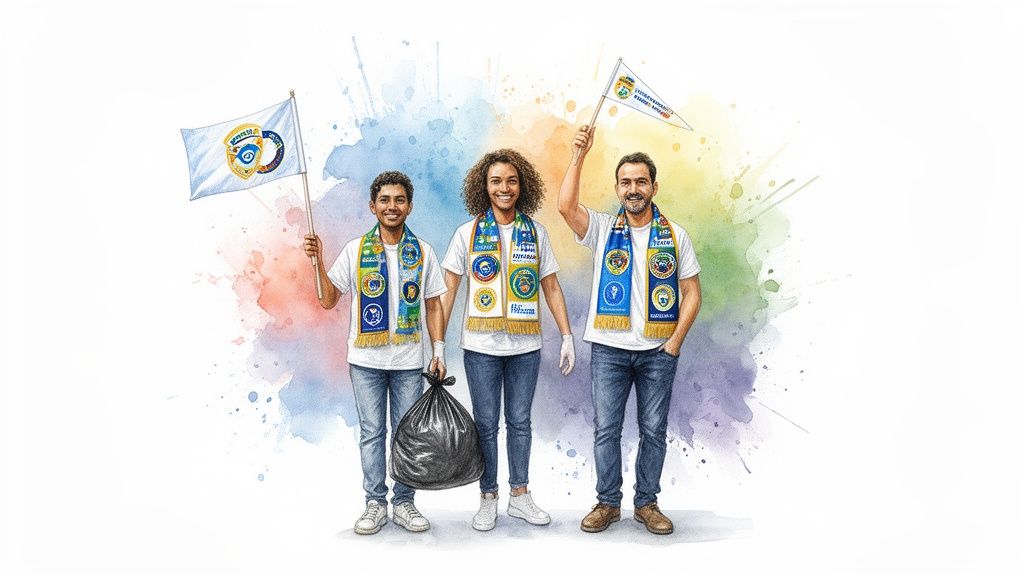
    Three diverse volunteers smiling, holding flags and a trash bag, against a colorful watercolor background.

    I believe this approach is about creating an identity that volunteers are proud to wear. Think of it like a local sports team for neighborhood good. It’s not just about the work; it’s about the symbols, the stories, and the shared victories. My goal is to make every volunteer feel like a hero in an ongoing saga of community improvement.

    How to Bring It to Life

    The key is to build a universe around your cleanup efforts. You can start small and let your volunteers co-create the identity with you.

    • Create Your Team Identity: Brainstorm a team name, colors, and a simple logo. Maybe you're the "Wicker Park Warriors" or the "Lincoln Park Litter Legends." I suggest getting t-shirts printed or simply providing colored bandanas.
    • Develop Rituals and Symbols: Design a team flag to plant at your meeting spot. You can create a simple team chant or song to kick off and close each event. These small rituals build powerful muscle memory for team spirit.
    • Implement a Badge System: Recognize achievements with tangible rewards. The Litter Caterpillars, a Chicago-based group I'm a part of, mastered this by creating a series of collectible badges for milestones like "First Cleanup," "Recycling Rockstar," or "Rainy Day Hero." You can learn more from their detailed guide on community engagement best practices. Awarding these badges in a small ceremony makes each volunteer's contribution feel seen and valued.

    This strategy works because it taps into a fundamental human need: to belong and be recognized. By turning cleanups into themed missions, you’re not just cleaning a street; you’re building a community legend, one piece of litter at a time.

    2. Neighborhood Rotation & Ward-by-Ward Coverage

    Imagine your volunteer group as explorers, charting a map of your entire city, not with ink, but with acts of care. Instead of sticking to the same familiar blocks, you embark on a systematic journey, ensuring no neighborhood is left behind. This is one of the most expansive volunteer team building activities because it breaks down invisible city barriers, fosters a deeper sense of civic unity, and shows every community that they matter.

    I see this model as a tool for equitable impact and shared discovery. By systematically rotating through different wards or districts, your team gains a comprehensive understanding of the city's diverse challenges and charms. It transforms your group from a localized crew into a city-wide force for good, building bonds not just with each other, but with the very fabric of the metropolis.

    How to Bring It to Life

    The key is to create a clear, visible, and exciting schedule that turns your coverage plan into an adventure for everyone.

    • Create a Visible Rotation Map: I recommend you design a large map of your city and color in each neighborhood or ward as you clean it. Post this online and bring it to events. This visual progress tracker builds anticipation and a powerful sense of collective accomplishment.
    • Partner with Local Insiders: Before you visit a new neighborhood, connect with a local community organization, library, or residents' association. They can provide crucial context on problem spots and help you invite local residents to join, making your efforts a true collaboration.
    • Celebrate Each Neighborhood's Story: Use your social media to spotlight the unique character of each area you visit. I’d share before-and-after photos, but also highlight a local landmark, a great coffee shop, or a story you learned from a resident. Frame each cleanup as a chapter in your city-wide exploration. The Litter Caterpillars, for example, are on a mission to cover all 50 of Chicago's wards, using our journey to help volunteers discover the entire city.

    This strategy works because it broadens horizons and demonstrates a profound commitment to fairness. By exploring and serving every corner of your city, you’re not just picking up trash; you're weaving a stronger, more connected community, one neighborhood at a time.

    3. Weather-Defiant Consistency (Rain, Snow, Heat Protocol)

    What separates a casual hobby from a true commitment? I think it’s showing up when it’s hard. By establishing a protocol to serve in almost any weather, you’re not just cleaning up; you’re forging an unbreakable team identity. This is one of the most profound volunteer team building activities because it turns an obstacle into a legendary origin story, attracting the most dedicated and passionate individuals.

    A man in a yellow raincoat and green boots holds an umbrella and a rake in the rain.

    This approach transforms adverse weather from a deterrent into a badge of honor. You communicate a powerful message: our mission is more important than our comfort. The stories born from these challenging days, like the Litter Caterpillars' infamous first cleanup in a hailstorm that I mentioned, become the folklore that binds your group together and inspires new members to join a team that means business.

    How to Bring It to Life

    Your goal should be to frame weather challenges as character-building flavor, not as punishment. Safety and preparation are everything.

    • Establish Clear Safety Thresholds: Your commitment is inspiring, but safety comes first. You must define non-negotiable limits for wind speed, extreme temperatures, or lightning. Communicate these clearly so everyone knows you’re prepared, not reckless.
    • Provide Weather-Appropriate Gear: I suggest building a small "weather library" of extra gloves, rain ponchos, hand warmers, or cooling towels. This simple act shows you care and removes a barrier for volunteers who might not have the right equipment.
    • Celebrate the Survivors: Create a "Weather Warrior" award or a "Legend Board" to publicly recognize those who show up on the toughest days. You can document these moments on social media; a photo of smiling volunteers in the snow is far more powerful than a sunny day shot.
    • Adapt the Mission: Don’t just cancel. You can shorten the event during a heatwave or shift focus to a covered area during rain. For truly severe weather, have a cozy indoor alternative planned, like sorting recyclables or planning the next event at a local coffee shop.

    This strategy works because shared hardship creates the strongest bonds. When your team looks back and says, "Remember that time we cleaned up in a blizzard?" they’re not just recalling an event; they’re celebrating their collective resilience and unwavering dedication to the cause.

    4. Open-Access Digital Community Building (Meetup, Social Media, Group Chats)

    The magic of a great cleanup doesn't have to end when the last bag of litter is tied. Think of your volunteer group like a garden. The cleanup events are when you plant the seeds, but the real growth happens between gatherings. This is where accessible digital tools come in, turning one-time helpers into a vibrant, year-round family. These platforms are powerful volunteer team building activities because they keep the fire of connection burning long after the work is done.

    I believe this strategy is about meeting people where they are: online. By creating low-barrier entry points like a free Meetup group, an engaging Instagram profile, and a casual group chat, you build an ecosystem of connection. You ensure no one feels left out and empower volunteers to build genuine friendships, share their stories, and stay motivated. The goal is to make your volunteer group feel less like an event and more like a social hub with a shared purpose.

    How to Bring It to Life

    Building a digital home for your community is about consistency and authenticity. Let your platforms reflect the warm, welcoming spirit of your in-person events.

    • Be a Beacon on Meetup: This is your front door. I advise you to post your cleanup events at a consistent day and time, like every Saturday morning. This predictability helps volunteers build a routine. Make your event descriptions warm and inviting, emphasizing the social aspect as much as the cleanup itself.
    • Tell Your Story on Instagram: This is your highlight reel. You should post photos that feature your volunteers' smiling faces, not just bags of trash. Share their stories in the captions. Use Instagram Stories during events for real-time updates and Reels to create compelling before-and-after transformation videos.
    • Foster Friendship in Group Chats: This is your living room. Create a space on a platform like WhatsApp or Discord for casual conversation. Sure, you can post logistics, but also encourage members to share photos of their pets, ask for local recommendations, or organize informal social meetups. I always try to keep it personal and fun, not corporate.

    This approach works because it nurtures the human connections that are the true foundation of any volunteer movement. Groups like the Litter Caterpillars have used this model to grow a thriving community, proving that by making it easy to join and stay connected online, you build a resilient, passionate team that shows up offline.

    5. Skill-Building Through Service (Resilience, Consistency, Courage)

    What if volunteering wasn't just about giving back, but also about building yourself up? Imagine framing every cleanup as a workout for your character, a gym for your soul. This approach transforms service from a simple act of charity into a powerful journey of personal development, making it one of the most profound volunteer team building activities you can facilitate.

    The idea is to explicitly connect the physical act of cleaning with the internal growth of virtues like resilience, consistency, and courage. When I see a volunteer show up on a cold, drizzly morning, they aren't just picking up trash; they're practicing resilience. When they attend their tenth event in a row, they are building the muscle of consistency. This reframe makes every action meaningful on multiple levels.

    How to Bring It to Life

    You can intentionally weave personal growth into the fabric of your volunteer program. It starts with being transparent about this dual mission: we’re here to clean our community and to become better versions of ourselves.

    • Define Your Core Skills: Be explicit about the virtues you want to cultivate. The Litter Caterpillars, for example, built our entire mission around developing "bravery, kindness, and unity." You should choose skills that resonate with your group's purpose.
    • Share Transformation Stories: Authenticity is key. I share my own story of how leading or participating has changed me. You can feature volunteer spotlights on social media that go beyond their cleanup efforts and touch on how they've grown personally.
    • Create Growth-Oriented Rituals: Start a "consistency club" with special recognition or badges for attendance streaks. You can end events with a brief reflection circle, asking questions like, "What felt brave for you today?" or "Where did you have to be resilient?"
    • Connect Service to Personal Goals: Help volunteers see the link between showing up for a cleanup and achieving their own dreams. I have found this powerful connection is a cornerstone of effective volunteer retention strategies.

    This strategy works because it offers a dual reward. Volunteers see a tangible impact on their neighborhood and feel a profound, internal shift in themselves. You’re not just creating a cleaner city; you’re building stronger, more courageous citizens.

    6. Weekend Morning Scheduling to Attract 'Givers' and Filter Values Alignment

    Think about the most dedicated communities you know. Military units doing PT at dawn, religious groups gathering for morning services, or committed athletes training before the world wakes up. What do they have in common? I believe they show up when it’s not always easy. This same principle can transform your volunteer group into a tight-knit force for good.

    Strategic scheduling is one of the most underrated volunteer team building activities because it’s a silent filter. By hosting events on weekend mornings, you naturally attract people whose primary motivation is service, not a social alternative to a night out. This isn't about exclusion; it's about building a culture of dedication and shared values from the moment people decide to show up. It sends a clear message: we are here to make a real difference, together.

    How to Bring It to Life

    The magic is in the consistency and the framing. You’re not just asking people to wake up early; you’re inviting them to start their weekend with purpose and a sense of accomplishment that lasts.

    • Communicate Your "Why": Be transparent about your scheduling philosophy in your recruitment materials. You can frame it as a positive: "We meet on Saturday mornings to start our weekend with positive action and a clear mind." This turns the timing into a feature, not a bug.
    • Create Morning Rituals: Make the morning special. I recommend you start with a quick team huddle, a shared coffee, or a simple theme song. These rituals become anchors that make the early start a cherished part of the experience.
    • Share Transformation Stories: Feature volunteers who initially struggled with the timing but now love it. A simple social media post like, "I used to sleep in, but now I can't imagine my Saturday without this team!" is incredibly powerful.
    • Stay Welcoming and Flexible: Emphasize that early rising is part of the culture, not a strict requirement. You must be incredibly kind and welcoming to those who can only make it occasionally. You can also offer a few special weekday evening events a year to include everyone.

    This approach works because it builds a team around a shared sense of discipline and commitment. When people choose to give their weekend morning, they're making a statement about their values, forging powerful bonds with others who made the same choice. You're not just cleaning a park; you're building a culture of givers.

    7. Volunteer-First Fundraising (No Pressure Donations, Partner Sponsorships)

    Nothing drains the energy from a passion project faster than the constant pressure to ask for money. When you start asking your volunteers to open their wallets, you risk changing the entire dynamic. This is why a volunteer-first fundraising model is one of the most powerful, trust-building volunteer team building activities you can adopt. It protects the core mission by ensuring your volunteers’ time and energy are the most valued currency, not their cash.

    This approach reframes your financial strategy to be about community partnership, not participant obligation. It makes your group accessible to everyone, regardless of their financial situation, and keeps the focus purely on the collective action of cleaning up. My goal is to build a sustainable organization where volunteers feel appreciated for their work, not sized up for their donation potential.

    How to Bring It to Life

    Shifting your focus to external support builds incredible goodwill and keeps your internal culture pure. You’re building a movement, and you want everyone to feel they belong.

    • Proactively Seek Partnerships: Instead of asking volunteers for five dollars, I would ask a local coffee shop to sponsor a cleanup. You can approach real estate agents, hardware stores, and local restaurants who benefit directly from cleaner, more beautiful streets. Frame it as a partnership in community improvement.
    • Create Graceful Donation Channels: Have a donation link on your website, but never push it during events. You should frame it for those who want to give financially but may not have the time to volunteer. This respects both forms of contribution equally.
    • Maintain Radical Transparency: One of the best ways I have found to build trust is to show exactly where the money goes. The Litter Caterpillars, for example, maintain a public ledger of all our expenses. When people see that funds are used for essentials like trash bags, gloves, and community grants, they are more inspired to support the mission without ever being asked.
    • Celebrate All Contributions: When you thank your community, always lead by thanking your volunteers for their time and effort. You should acknowledge your financial sponsors and donors separately but equally. This reinforces the core value that time is just as precious as money.

    This strategy works because it removes a major barrier to participation and eliminates the awkwardness of mixing passion with financial asks. By focusing on partnerships, you’re not just funding your activities; you’re weaving your organization into the very fabric of the local economy and community.

    8. Friendship-First Community Building (Social Connection Over Task Completion)

    What if the primary goal of your cleanup wasn't cleaning up? Imagine framing your events so the litter collected is simply the byproduct of a more important mission: building genuine friendships. This approach flips the script, positioning your group as a community hub first and a cleanup crew second. It's one of the most fulfilling volunteer team building activities because it tackles loneliness head-on, creating a support system that lasts long after the trash bags are full.

    This philosophy is about intentionally designing your events for human connection. The cleanup itself becomes the perfect, low-pressure backdrop for conversation and shared experience. You're not just picking up trash side-by-side; you're sharing stories, discovering common interests, and building the foundation of real relationships that make a neighborhood feel like home.

    How to Bring It to Life

    The key is to create dedicated, structured time for socializing and to celebrate the relationships being built. It’s about being explicit that friendship is the real prize.

    • Schedule Social Time: I recommend you formally block out 20-30 minutes before or after every cleanup for coffee, snacks, and unstructured conversation. Don't make it optional; frame it as a core part of the event itself.
    • Pair People Up: Use a buddy system, intentionally pairing newcomers with veteran members. This simple act removes the anxiety of joining a new group and immediately gives someone a friendly face to connect with.
    • Host Social-Only Events: Organize monthly potlucks, game nights, or park hangouts that have nothing to do with cleaning. This reinforces that the group's value lies in its people, not just its work. You can discover more ideas for fostering these connections in this guide to community building activities for adults.
    • Celebrate Friendships Publicly: When you share photos on social media, don't just post pictures of the work. I would post pictures of volunteers laughing together and write captions that celebrate the friendships being formed.

    This strategy works because it addresses a deep human need for connection. By making friendship the mission, you create a powerful, self-sustaining community where people show up for each other first and the cause second, ensuring long-term passion and participation.

    9. Safety-First Protocol & Volunteer Wellbeing as Primary Priority

    Imagine an adventure guide who puts your safety above reaching the summit. That’s the mindset that transforms a good volunteer group into a truly great one. By making volunteer safety and wellbeing the absolute top priority, you build a foundation of trust that is unshakable. This isn't just about avoiding accidents; it’s one of the most profound volunteer team building activities because it communicates a powerful message: "You are more important than the mission."

    This approach establishes a culture where every single person feels secure, respected, and genuinely cared for. When volunteers know you have their back, they can fully invest their energy and spirit into the work and each other. My goal is to create an environment of psychological and physical safety so strong that it becomes the team’s defining characteristic.

    How to Bring It to Life

    Building a safety-first culture requires deliberate, consistent action. It’s about embedding care into every part of your process.

    • Launch with a Safety Huddle: Start every single event with a brief, mandatory safety huddle. This isn't a long lecture; it's a quick, engaging check-in. You should cover the day's potential hazards, review hand signals, and remind everyone that their comfort comes first.
    • Arm Your Team with Knowledge & Gear: Don't just hand out gloves; explain why they're important. I suggest you provide a full kit: thick gloves, hand sanitizer, and bright vests if near traffic. Create and distribute a one-page safety guide before their first event so everyone arrives prepared.
    • Prioritize People Over Goals: Make it a public mantra. Groups like the Litter Caterpillars state it plainly: "Safety of the volunteers always takes first priority. Happiness takes second." I explicitly tell my team that no bag of trash is worth an injury or even just feeling uncomfortable. Empower them to stop, rest, or skip an area if they feel unsure.
    • Train Your Leaders: Equip your team leaders with basic first-aid training and mental health awareness. This prepares them to handle everything from a small cut to noticing if someone seems overwhelmed, ensuring they can provide immediate and compassionate support.

    This strategy works because true community is built on mutual care. When you prioritize the wellbeing of your volunteers above all else, you’re not just managing a cleanup; you’re nurturing a family that looks out for one another.

    10. Transformation Narrative & Storytelling (Origin Story, Volunteer Journeys, Community Impact)

    Facts and figures can show impact, but a story is what truly moves people to action. What’s the spark that started your group? Why does that one volunteer show up every single weekend, rain or shine? These narratives are the emotional core of your mission, transforming abstract goals into deeply human experiences. This is one of the most profound volunteer team building activities because it connects the simple act of picking up litter to a much larger, more inspiring journey of personal and community change.

    I believe this approach is about weaving a compelling tapestry of stories that volunteers can see themselves in. You're not just a group that cleans; you're a collection of individuals who found purpose, friendship, and a way to heal their corner of the world. My goal is to make every volunteer feel like a vital character in an unfolding story of positive transformation, inspiring both current and future members.

    How to Bring It to Life

    The key is to actively find, shape, and share the powerful stories happening within your group. Make storytelling a conscious and consistent part of your culture.

    • Share Your Origin Story: Be vulnerable and authentic about what started it all. Was it a moment of frustration, a personal turning point, or a sudden inspiration? My own Litter Caterpillars origin story, for example, is rooted in a personal crisis that led to a powerful realization about taking control of one's environment. Sharing this creates an immediate, relatable connection.
    • Create a "Volunteer Spotlight" Series: Once a month, you should interview a volunteer. Ask them what brought them here, what they've learned, and how this work has impacted their life. Share their story through your newsletter or social media. This celebrates individual journeys and shows the diverse motivations within your team.
    • Document Neighborhood Transformations: Go beyond simple before-and-after photos. I recommend capturing quotes from residents about how a cleaner park or street has changed their daily experience. Did kids start playing in the park again? Did a local business see more foot traffic? These testimonials connect your work to tangible community benefits.
    • Invite Shared Storytelling: At the end of an event, you can create a space for volunteers to share a small victory or a meaningful moment from the day. It could be a strange item they found or a positive interaction with a neighbor. This builds a shared history and reinforces the value of each person's contribution.

    This strategy works because it taps into our innate desire for meaning and connection. By framing your work through the lens of transformation, you're not just tidying up a neighborhood; you’re co-authoring a powerful story of hope, one volunteer at a time.

    Volunteer Team-Building Activities — 10-Item Comparison

    Item 🔄 Implementation Complexity ⚡ Resource & Operational Efficiency 📊 Expected Outcomes & ⭐ Effectiveness 💡 Ideal Use Cases & Quick Tips
    Themed Cleanup Challenges with Pride & Identity Medium–High: design, branding, creative leadership required Moderate: upfront cost for flags/badges; efficient for retention over time High engagement & retention; strong identity formation — ⭐⭐⭐⭐ Community-building, social media growth — involve volunteers in design; rotate themes
    Neighborhood Rotation & Ward-by-Ward Coverage High: detailed scheduling and logistics across areas Moderate–High: travel/time costs; needs tracking systems Broad city impact and equity; builds diverse networks — ⭐⭐⭐⭐ Ideal for citywide equity campaigns — publish rotation map; partner with local orgs
    Weather-Defiant Consistency (Rain/Snow/Heat) Medium: clear policies and safety protocols needed Moderate: weather gear, emergency planning; operationally demanding in extremes Filters for committed volunteers; creates memorable stories — ⭐⭐⭐ Use to strengthen commitment culture — set safety thresholds; offer indoor alternatives
    Open-Access Digital Community Building (Meetup, Social) Low: platform setup simple, but needs ongoing moderation Low cost monetarily; time cost for content + moderation High discoverability and entry rates; builds ongoing connection — ⭐⭐⭐ Best for onboarding newcomers — post consistently; moderate chats; feature volunteer stories
    Skill-Building Through Service (Resilience, Consistency) Medium: integrate reflection, tracking and leader coaching Low–Moderate: materials and facilitator time Strong personal development and intrinsic motivation — ⭐⭐⭐⭐ Targets growth-minded volunteers — use badges, reflection prompts, share transformations
    Weekend Morning Scheduling to Attract 'Givers' Low: scheduling policy and consistent messaging Low: minimal resource burden; simple logistics Cultivates values-aligned, consistent cohort — ⭐⭐⭐ Use as cultural filter — explain philosophy; offer occasional alternatives for inclusivity
    Volunteer-First Fundraising (No-Pressure) Medium: establish sponsor pipelines and transparent budgets Moderate: time to secure sponsors/grants; reduces volunteer fundraising burden Preserves morale and accessibility; builds authentic partnerships — ⭐⭐⭐ For sustaining events without pressuring volunteers — publish budget; thank sponsors publicly
    Friendship-First Community Building Medium: requires skilled facilitation and social planning Low–Moderate: social events/time investment Very high retention and volunteer satisfaction — ⭐⭐⭐⭐ Ideal for friendship-driven recruitment — schedule post-cleanup social time; use buddy system
    Safety-First Protocol & Volunteer Wellbeing High: comprehensive training, policies, and leader accountability High: PPE, training, incident processes; ongoing review needed High trust, inclusivity, and reduced liability — ⭐⭐⭐⭐ Essential where safety risks exist — mandatory safety huddles; provide PPE; collect feedback
    Transformation Narrative & Storytelling Low–Medium: consistent content creation and authentic sharing Low: time for interviews and documentation; minimal cost Strong emotional engagement and recruitment; brand identity boost — ⭐⭐⭐⭐ Use to inspire and recruit — share founder/volunteer stories; document before/after results

    Your Turn to Paint the Fence

    Remember Tom Sawyer? He was handed the dreaded chore of whitewashing a long, boring fence. Punishment. But with a little bit of flair and a shift in perspective, he transformed that tedious task into the most desirable, exclusive activity in town. Friends were practically begging him for a chance to paint a few planks.

    That’s the exact magic we’ve been exploring together. The ten strategies we've walked through aren't just about picking up litter. They are about turning the "chore" of community service into a profound adventure, a source of deep friendship, and a catalyst for your own personal transformation. Each idea is a brushstroke you can use to paint a more vibrant, connected, and meaningful life for yourself and your neighbors.

    Recapping Your Toolkit for Transformation

    You now have a complete blueprint. I've shown you how to build a powerful community from the ground up, one that thrives not on obligation, but on genuine connection and shared purpose.

    • Identity and Pride: We covered how themed cleanups, team flags, and neighborhood rotations aren't just logistics; they are rituals that build a powerful sense of belonging. You’re not just a random person with a trash bag; you’re part of a tribe, on a mission.
    • Resilience and Consistency: My discussions on weather-defiant scheduling and weekend morning meetups weren't just about timing. They were about building personal resilience and creating a community of people who show up, for the cause and for each other, no matter what. That consistency is where the real change happens.
    • Connection and Safety: We emphasized a "friendship-first" and "safety-first" philosophy. This ensures your group is a haven, a place where people feel seen, valued, and protected. It shifts the focus from the task (cleaning) to the people, which is the secret ingredient that makes volunteers return week after week.
    • Storytelling and Impact: Finally, I talked about the power of narrative. Sharing your origin story, celebrating volunteer journeys, and tracking your impact isn't about vanity metrics. It’s about making the intangible, tangible. It’s about showing everyone, including yourself, that your small, consistent actions are adding up to create a massive, beautiful wave of change.

    You don’t need a massive budget. You don’t need a perfectly polished five-year plan. You don’t need permission from anyone to start making a difference.

    All you need to do is pick one thing.

    Maybe it’s creating a simple, hand-drawn logo for your local crew. Perhaps it’s committing to one specific street corner every Saturday morning, rain or shine, and seeing who joins you. Or maybe it’s just starting a group chat to share photos of your progress and celebrate the small wins.

    The goal was never to have a perfectly clean city overnight. The real prize is in the bonds you forge and the person you become while trying. These volunteer team building activities are a powerful vehicle for discovering your own strength, courage, and capacity for leadership. You are not just cleaning a street; you are building a legacy of connection and rewriting your own story, one piece of litter at a time.

    You have the map. You have the tools. Go be a Caterpillar. Go transform.


    Ready to stop thinking and start doing? At Litter Caterpillars, we put all these principles into practice every weekend, creating a fun, safe, and inspiring community for people just like you. Join a cleanup this weekend and see for yourself how powerful these volunteer team building activities can be at Litter Caterpillars.
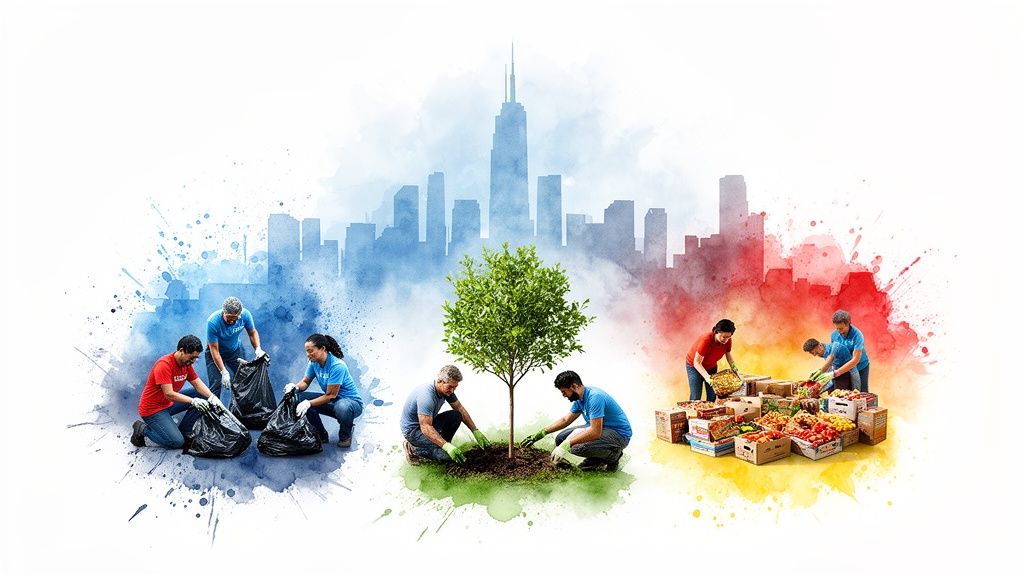
  • What is Community Organizing? what is community organizing

    What is Community Organizing? what is community organizing

    Let's be real. Community organizing is the art of gathering folks together to untangle the messes that affect all of you. It’s about building a muscular kind of power, as a unit, to forge lasting change—not just slapping a flimsy bandage on a wound and calling it healed.

    More Than Just Helping Out

    Have you ever looked around your neighborhood and felt a knot of frustration tighten in your gut? Maybe it's the overflowing trash cans, a dangerous intersection everyone treats like a racetrack, or that overgrown, creepy vacant lot. I know that feeling intimately. My own journey, believe it or not, didn't start on the streets. It began inside my own disastrously messy apartment, a perfect mirror for how I felt inside: completely and utterly stuck.

    I stumbled upon a profound truth: cleaning up someone else’s mess is shockingly easier than facing your own. From that simple, almost selfish realization, Litter Caterpillars was born.

    Through that whole whirlwind, I unearthed the crucial difference between helping, advocating, and organizing. They all have a pulse, they all have a place, but they are not the same animal. To truly get what community organizing is, you first have to understand what it isn't.

    "If you want to go fast, go alone. If you want to go far, go together."

    This isn’t just some pretty quote you'd find on a coffee mug; it's the very heartbeat of organizing. It marks the moment you stop thinking in terms of "I" and start breathing in the world of "we."

    Organizing vs Volunteering vs Advocacy

    To really feel the difference in your bones, here’s a quick guide to how these actions stack up when you’re trying to actually make change happen.

    Action Type Core Goal Focus Example
    Volunteering Provide direct service Addressing immediate needs (the symptom) Picking up litter at the park every weekend.
    Advocacy Influence decision-makers Speaking for a group to people in power Calling the city to complain about the lack of trash cans.
    Organizing Build collective power Mobilizing a group to act for themselves Getting neighbors together to demand more bins and a recycling program from the city.

    Each path is valuable, but it is organizing that fundamentally shifts the power dynamic, creating solutions that have roots and can weather the storm.

    Let’s use an analogy to break it down. Imagine your favorite local park is constantly a mess.

    • Volunteering is you, armed with a trash bag, heading out there every Saturday morning. You’re providing a service. It helps immensely for that single day, but a part of you knows, with a sinking feeling, that the trash will be back next week. You're treating the symptom.

    • Advocacy is you picking up the phone to call the city council or firing off letters. You're speaking for the community, pleading with someone in a position of power to please, for the love of God, fix the problem. You're a representative, a voice, but the real power still rests with them.

    • Organizing? That’s where the lightning strikes. You start talking to your neighbors—the other parents, the dog walkers, the kids kicking a soccer ball around. You discover they're just as fed up as you are. Together, you realize the bins are always overflowing by Thursday. You forge a small team, you map out a plan, and you show up at the city meeting together to demand more bins and a new recycling program.

    Do you see the tectonic shift? You’re not just politely asking for change; you're building the power to demand it. You’re not just cleaning up the mess for a day; you’re rewiring the system so the mess doesn't happen in the first place.

    It's that old saying: give a person a fish, and you feed them for a day. Teach them to fish, and you feed them for a lifetime. But organizing is getting all the fishers together to buy the lake and ensure it never gets polluted.

    When I started my cleanup group, I wasn't some kind of expert. I was just a guy who realized that fixing problems with my neighbors was infinitely more powerful than trying to do it all myself. That is the soul of community organizing: building relationships and transforming shared frustration into collective, unstoppable action.

    Uncovering the History of People Power

    When my friends and I are out there, picking up trash in the middle of a Chicago blizzard, shivering and laughing at the absurdity of it all, I feel like we’re part of something vast. We are. This entire concept of people linking arms to demand change isn’t some new-fangled idea. It has deep, powerful roots right here in our city. It's a history that ignites a fire in me, and I hope it does for you, too.

    The story of modern community organizing practically erupts from the South Side of Chicago back in the 1930s. This was an era of intense struggle, a time when people felt utterly powerless against the crushing weight of big industry and broken systems. A man named Saul Alinsky witnessed this widespread frustration and had a revolutionary thought: what if everyday people could build their own power?

    He believed that power wasn't a gift bestowed from on high; it was something you seized by organizing. So, he began the painstaking work of uniting local churches, unions, and neighborhood groups—people who didn't necessarily agree on everything but who were bound by a shared, desperate desire for better lives.

    From Frustration to a Movement

    This wasn't just about yelling and protesting. Alinsky's method was a meticulous process of building relationships, identifying shared problems, and crafting a real strategy to apply pressure on the people in charge. In 1940, he created the Industrial Areas Foundation (IAF), which became a living blueprint for how regular folks could band together and exert real influence. By the 1940s, this 'Alinsky-style' organizing had already chalked up major victories, like improving wages and living conditions for thousands. Fast forward, and by 2015, you could find at least 180 similar faith-based organizations across the US, all tracing their lineage back to this initial spark. You can trace this incredible growth and learn more about its impact on the history of community organizing.

    This historical thread illuminates how shared frustration can be woven into the fabric of collective action. It's proof that when we feel ignored or overlooked, the answer isn’t to wait for a hero to swoop in. The answer is to find our neighbors and become the heroes ourselves.

    The purpose of an organization is to build power for people. It is a simple, straightforward, and honest statement. Power is the reason for being of organizations.

    This concept is the very bedrock of everything we do. It’s not about winning a single fight; it’s about building a muscle. You begin with small lifts, like getting a stop sign installed. Then you move on to heavier weights, like demanding cleaner air or better schools.

    The journey from one concerned person to a powerful collective often follows a clear path. This timeline shows how individual actions evolve into organized movements that create lasting change.

    A three-step timeline titled 'Creating Change', featuring volunteer, advocate, and organize actions over three years.

    This visual journey highlights that organizing is the ultimate step in building sustainable community power, moving beyond individual service to create systemic solutions.

    Your Place in This Long Legacy

    So, what does this history lesson mean for you and me, today? It means that when you join a group like Litter Caterpillars, you're not just picking up trash. You are stepping into a long and proud tradition of people who refused to accept the status quo. You are part of a legacy that includes:

    • The Civil Rights Movement: Where organizers used community-based strategies like boycotts and sit-ins to dismantle the brutal architecture of segregation.
    • The Labor Movement: Which built power through unions to fight for fair wages, safe working conditions, and the 8-hour workday.
    • Environmental Justice Groups: That organize residents in poisoned neighborhoods to fight for their fundamental right to clean air and water.

    Each of these monumental movements was powered by ordinary people who decided their voices mattered more together than they ever could alone. They understood, deep in their bones, that consistent, organized action was the only way to shift power and create a better world.

    This history isn't just something to read in a book. It’s a living, breathing wellspring of strength. It reminds me that our small, consistent actions are part of a much larger, more magnificent story. It’s the proof that when we stand together, we are unstoppable.

    The Essential Ingredients for Building a Movement

    So, how does a tiny spark of an idea actually catch fire and roar into a real, on-the-ground movement? It’s not magic, I can tell you that. It’s about having the right ingredients, stirred together with a whole lot of heart and a dash of shrewd strategy. I've watched it happen with my own eyes, seeing my own little group grow from just three of us shivering in a blizzard to a city-wide force for good.

    It all begins with something surprisingly simple.

    A diverse group of smiling people look at a map with watercolor splashes.

    Building Authentic Relationships

    Before you can organize anyone, you have to truly connect with them. And I’m not talking about networking or collecting contacts like they're trading cards. I mean building real, genuine relationships, grounded in shared values and mutual respect.

    Think of it like tending a garden. You can’t just fling seeds onto the hard ground and expect a bountiful harvest. You have to first prepare the soil, give them water, and make sure they get sunlight. In the world of community organizing, that rich soil is trust, and the water is shared experience.

    This means you’ve got to spend real time just listening to people. What makes them proud? What keeps them tossing and turning at night? What do they wish was different about the place they call home? These one-on-one conversations are the bedrock upon which everything else is built.

    The purpose of activism is not primarily to win this or that given ‘ask’ but to build power—reflected in the relationships, resilience and self confidence of communities.

    This insight is everything. Wins are fantastic, they’re the fuel, but the real, lasting victory is the strong, interconnected web of people you build along the way. That’s the part that endures. You can learn more about how these connections are the absolute key to building resilient communities in our detailed guide.

    Identifying Natural Leaders

    Once you start genuinely talking to people, you'll begin to notice something fascinating. Leaders are everywhere, but they rarely look the way you'd expect. They aren’t always the loudest person in the room or the one with a fancy title after their name.

    A community leader might be:

    • The grandmother who knows everyone on her block by their first name.
    • The young person who organizes pickup basketball games at the local park.
    • The quiet neighbor who, without fail, always shows up to help when someone is in need.

    These are the people others naturally trust and listen to. Your job as an organizer isn’t to create leaders from scratch; it's to find these folks, lift them up, and give them the tools to become even more effective. You're just identifying and empowering the incredible leaders who are already there.

    This is the alchemical process that transforms a collection of individuals into a coordinated team, poised and ready to act. It's how you turn passive concern into active, potent participation.

    Understanding and Building Power

    Let's talk about the word "power." For a lot of us, it can feel like a dirty word, something that corrupts or oppresses. But in community organizing, we see power through a completely different lens.

    Power is simply the ability to act.

    Imagine you want to move a giant boulder that's blocking a path. By yourself, you have very little power. But if you gather ten of your neighbors, you suddenly possess the collective power to move it. That’s what we’re building.

    Building power is a lot like building a muscle. You don't walk into the gym for the first time and try to lift 500 pounds. You start with small reps, consistently.

    • First, you organize a small cleanup. That's a small win.
    • Next, you get a new trash can installed. That's a bigger win.
    • Then, you partner with local businesses for a neighborhood-wide recycling drive. Now you're building real, undeniable momentum.

    Each small victory builds confidence, deepens relationships, and flexes your collective strength. It shows everyone—including those in charge—that you are a force to be reckoned with. When our group started, our "power" was just the three of us with trash bags. Now, it’s hundreds of people showing up every week, changing the face of our city, block by block.

    This is the heart of what community organizing is. It's the slow, steady, and incredibly rewarding work of turning shared frustration into shared power, and shared power into lasting, meaningful change. You don't need anyone's permission to start. You just need to begin.

    Strategies and Tactics That Actually Work

    So, you’ve gathered your people and built a real foundation of trust. What’s next? This is where the real fun begins. Community organizing isn't just about feeling good together; it’s about doing things together.

    We have a whole toolbox of strategies, and it’s not always about marching in the streets—though that definitely has its time and place.

    Think of it like you're a chef. You wouldn't use a whisk to chop vegetables, would you? Of course not. You need the right tool for the right recipe. The same exact logic applies to organizing. A petition might be the perfect instrument for one goal, while a neighborhood-wide cleanup is a better choice for another.

    An illustration showing community organizing tools: a petition, recycling bin, papers, neighborhood map, and megaphone.

    Building Power Through Action

    The heart of every single tactic is to build your group's power. Each action you take, no matter how small it may seem, sends a clear, ringing message: "We are here, we are united, and we are paying attention." Choosing the right move depends entirely on what you're trying to achieve.

    Here are some of the most effective tools in the organizer's kitchen:

    • One-on-One Meetings: This is the bedrock, the foundation of it all. It's where you sit down with a neighbor, maybe over a cup of coffee, and you just listen. You learn their story, their frustrations, and their deepest hopes. This isn't about recruiting; it's about making a genuine human connection.
    • Community Gatherings: Think bigger than just meetings. This could be a neighborhood potluck, a storytelling night, or a full-blown block party. These events weave the social fabric that transforms a group of strangers into a real, resilient community.
    • Door-to-Door Canvassing: Walking the streets and knocking on doors is one of the oldest and most potent tactics for a reason. It’s personal, it's direct, and it shows an incredible level of commitment. In fact, studies show that simple door-to-door canvassing can spike voter turnout by 2.5 percentage points. This isn't just about politics; it’s a proven method to connect with people right where they live.
    • Direct Action: This is when you collectively and publicly apply pressure to a decision-maker. It could be a rally, a sit-in, or a coordinated call-in day. The goal is to make it impossible for those in power to ignore your community's voice.

    A Story of Winning the Lot

    I want to share a story that shows how these pieces snap together. For years, there was this overgrown, garbage-strewn vacant lot in a neighborhood we cared deeply about. It was a festering symbol of neglect. We decided we wanted to transform it into a community park.

    We started with one-on-one meetings. We talked to everyone living near the lot, hearing their stories of frustration and their dreams for that little patch of land. We did our homework and learned it was owned by the city and was slated to go up for auction.

    Next, we held community gatherings in a local church basement. We shared our research, brainstormed wild ideas for the park, and hammered out a shared strategy. We weren't just a few angry people anymore; we were an organized force with a unified plan.

    Our power doesn't come from money or titles. It comes from our relationships, our numbers, and our commitment to a shared vision.

    Finally, we took direct action. We all showed up at the city auction, a sea of us in matching t-shirts, each of us holding a sign with a kid's crayon drawing of the future park. We made damn sure they saw us. When the auction began, we had a single representative bid on our behalf.

    And we won. We bought that lot for our community. That space is now Caterpillar Park. It wasn't one tactic that won the day; it was the strategic combination of relationship-building, meticulous planning, and bold, collective action. You can discover more about how we apply these lessons in our guide to community engagement best practices.

    Choosing the right strategy is an art, but it always starts with a simple question: What will build our power and get us closer to our goal? Start there, and I promise you, you'll find your path.

    Your First Steps to Making a Difference

    So you’ve got that spark. That little voice in the back of your head whispering, “I’ve got to do something.” That is a powerful, precious feeling. Let's make sure that incredible energy doesn't just fizzle out into nothing.

    This is your roadmap to taking that first brave step, whether you want to join a crew that's already rolling or get something brand new started in your own backyard. This isn't about becoming a full-time activist overnight. It's about channeling that fire into real, tangible action. I know it can feel like a huge, intimidating leap, but just remember, every single big movement in history started with one person simply talking to another.

    Finding Your People

    First things first: you need to find the people who care about the same things you do. I promise you, you are not alone in your frustrations. The real trick is bridging the vast chasm between feeling isolated and finding your allies.

    It’s often simpler than it sounds. You could try:

    • Diving into local forums or social media groups. Just search your neighborhood's name along with words like "improvement," "community," or "safety."
    • Showing up to neighborhood association or local government meetings. This is where you'll find the folks who are already in the game.
    • Just talking to your neighbors. Seriously. The next time you see someone on your block, start a conversation. "Hey, have you ever noticed…?" You'd be amazed how a shared annoyance can blossom into a shared purpose.

    When I started Litter Caterpillars, I used a simple filter to find my kind of people. I always scheduled our events on weekend mornings. This was a deliberate choice. It naturally attracted givers—people willing to trade a lazy Saturday morning for something bigger than themselves. That one tiny decision was key to building our core community of committed, kind-hearted people.

    Set Your First Tiny Goal

    Okay, once you have a few folks on board, you must fight the urge to go solve world hunger. You need a small, achievable win to build momentum. It’s like learning to lift weights; you don't walk in and immediately try to bench press 300 pounds.

    Your first goal should be:

    1. Specific: Not "clean up the neighborhood," but "clear the trash around the bus stop on Elm Street."
    2. Visible: Pick something people will actually see. The visual proof of your work feels amazing.
    3. Achievable: Choose a goal you can realistically knock out in a couple of hours with a small group.

    That first win is everything. It's not really about the trash or the weeds; it's about proving to yourselves that you can work together and make a real, visible difference.

    This idea isn't just a local thing; it's a model that has exploded globally. In Serbia, youth groups organized to get a new community center. In Slovakia, groups scrambled to create mutual aid networks for rural Roma communities during the pandemic. By 2015, Australia's Sydney Alliance was a powerhouse, building its strength entirely on volunteer leaders instead of paid staff. You can read more about the global spread of community organizing and its impact.

    "The most common way people give up their power is by thinking they don't have any." – Alice Walker

    This quote nails it. Your first small goal is all about taking that power back, one tiny victory at a time. For more ideas on getting started, check out our guide on proven community engagement strategies.

    Plan a Meeting People Actually Want to Attend

    Forget everything you know about boring meetings with rigid agendas and formal minutes. Your first get-together should feel more like hanging out with friends. The objective is connection, not bureaucracy. Keep it simple, keep it fun, and make sure every single person feels heard.

    And here’s the most important part: after you crush that first small goal, celebrate it. Grab some pizza. Share the photos online. Give each other high-fives. That celebration is what turns a one-off activity into the start of a real community. It’s the glue that will bring everyone back for the next challenge.

    Some Questions I Get Asked A Lot

    When I first started Litter Caterpillars, people began asking me questions. As we grew, the questions kept coming. People were curious, sometimes a little confused, maybe even a little intimidated. I totally get it. "Community organizing" sounds like this big, serious job for professionals, not for regular people like you and me.

    But that's dead wrong. It's for you, it's for me. It’s for anyone who has ever looked around and thought, "This is messed up. We can do better."

    These are the most common questions I get. I'm going to answer them from my own experience, straight from what I've learned picking up other people's garbage on the streets of Chicago.

    What’s the Difference Between Community Organizing and Activism?

    Great question. The two definitely get tangled up. Here's how I see it.

    Activism is often the loud, urgent response to a specific problem. It’s showing up for a protest, signing a petition, making a sign. It's the fire, the immediate pushback against something wrong. And it's absolutely necessary. We need that raw energy.

    Community organizing, on the other hand, is the slow, patient work of building relationships before the crisis even hits. It’s weaving people together into a resilient web of trust. It's the hundreds of quiet conversations, the shared meals, the check-in texts. It's building the "we" so that when it’s time to act, you’re already a formidable force.

    Think of it this way: activism is the lightning strike. It’s bright, powerful, and gets everyone’s attention. Organizing is the slow work of building the storm cloud, of gathering all that energy in one place so the lightning can happen. One is the moment; the other is the long, hard, beautiful work that makes the moment possible.

    Do I Need to Be an Expert to Be a Community Organizer?

    God, no. Actually, I think being an "expert" can sometimes get in the way.

    The best organizers I've ever met are just people who are stubbornly, deeply in love with their community. They listen far more than they talk. They connect people. They show up when they say they will.

    You don't need a fancy degree. The most important qualities are curiosity and being someone people can count on. Are you willing to listen, really listen, to your neighbors? Will you do what you say you’re going to do? That’s it. That’s the entire magic formula.

    Your lived experience is your expertise. Your passion is your credential.

    I started Litter Caterpillars because my own apartment was a disaster and my life felt just as chaotic. I was the farthest thing from an expert on cleanliness! All I had was a desperate need to change something, anything. Your job isn’t to have all the answers. It’s to get people in a room to find the answers together.

    How Do You Handle Disagreements Within the Group?

    If everyone agrees all the time, you're probably not doing anything important. Disagreements are a sign of life. It means people care enough to have an opinion, to fight for what they believe in.

    The trick isn’t to avoid conflict, but to build a foundation so strong that it can handle the shaking. For Litter Caterpillars, that foundation is our three core values: Bravery, Kindness, and Unity. When we're stuck, we always come back to those. "Is this decision brave? Is it kind? Does it bring us together?"

    We've worked really hard to create a space where it's safe to argue because we trust each other. We've built that trust by showing up for each other, week after week, in the rain and the sun. We all know we're there for the same reason: to make our city better. That shared purpose is the glue. It holds us together even when we're pulling in different directions.

    How Do You Measure the Success of Community Organizing?

    This is my favorite question because the answer isn't about spreadsheets. In a world obsessed with data, the real impact of organizing is often invisible. But it's the most real thing there is.

    Sure, you have the clear wins. You fought for a new stop sign and got it. You cleaned a park and it's staying clean. You should absolutely celebrate those things! They build hope and show people that their work matters.

    But the real success? It’s all about the people.

    • Are new leaders popping up?
    • Are people who were strangers a year ago now close friends?
    • Do people feel less alone, more connected to their home?

    For me, the biggest win is seeing someone who showed up to their first cleanup, quiet and nervous, and six months later they're the one leading the team, cracking jokes, and welcoming the new person. That’s it. That’s the whole game. It means you’re not just picking up trash; you're building a tough, loving, powerful community, one person at a time.


    At Litter Caterpillars, we believe in the power of showing up for each other and our city. If you’re ready to turn your frustration into action and find your people, join us at an upcoming event. Explore our upcoming cleanups and get involved!

  • Discover young professional networking events: 8 Chicago picks for connections

    Discover young professional networking events: 8 Chicago picks for connections

    I remember it. The stale air. The forced smiles. That lukewarm glass of wine in my hand, a flimsy shield against the awkwardness. You’re supposed to be "networking," but it feels like you're performing a role in a play you never auditioned for. It’s a transaction. A hollow exchange of titles and elevator pitches. I’ve been there. You’ve been there. It’s exhausting.

    For a long time, I thought this was just the price of admission. The cost of climbing some ladder I wasn't even sure I wanted to be on. I’d come home with a pocketful of business cards, these little paper tombstones of conversations I’d already forgotten. But here’s the secret: the problem isn’t you. It never was. The problem is the game itself. A game designed for shallow handshakes, not deep hand-holds.

    What if we just ripped up the rulebook? Imagine networking wasn't something you did, but something that happened. Something that grew organically while you were busy doing something else—something meaningful. Like solving a real problem with a small team of brilliant people. Or discovering a hidden corner of your city. That’s what we’re going to explore.

    I’m going to walk you through 8 kinds of young professional networking events that feel less like work and more like life. These aren't about collecting contacts like they're trading cards. This is about finding your people. The ones who get it. The ones you build things with.

    1. Volunteer-First Community Service Events

    Picture this. You're not balancing a tiny plate of cheese cubes and trying to shout over music. Instead, you're side-by-side with someone, both of you covered in a little bit of dirt, working to restore a neighborhood garden. You laugh about a stubborn weed. You high-five after planting a tree. That’s where the real connection happens. Volunteer-first events are like a networking life-hack; they flip the entire script. The goal isn't to network. The goal is to get something done, together. The networking? That’s just the beautiful, inevitable consequence.

    You show up. You grab a tool. You start working. Suddenly, you're not a "Marketing Manager" talking to a "Software Engineer." You're just two people, united in purpose. The conversations flow without effort because they’re rooted in a shared action, not a shared agenda. I promise you, the strongest professional relationships I’ve ever built were forged not in boardrooms, but in parks and on trails.

    Who This Suits Best

    This is for you. If you're done with the performance of networking and you just want something real. It’s a magnet for people who are driven by purpose, not just profit. You’ll find your tribe here if you believe that what you do is more important than what you call yourself.

    Real-World Examples in Action

    • Litter Caterpillars: I have to start here. This Chicago group turned weekly cleanups in all 50 city wards into a movement. You explore the city, you make a real, visible difference, and you meet amazing people. It’s brilliant.
    • Surfrider Foundation: Their beach cleanups are electric. You connect with other young professionals who are just as passionate about protecting our oceans as you are.
    • Sierra Club Chapters: They host trail maintenance days that are perfect for people who want to mix their love for the outdoors with genuine community building.

    Key Insight: Think of it like building a bridge. You can talk about building a bridge all day, or you can pick up a hammer and start building it with someone. Which one creates a stronger bond?

    How to Maximize Your Experience

    To turn these young professional networking events into a core part of your life, you have to treat it like a relationship, not a transaction.

    • Become a Regular: Show up. Again and again. Consistency is the soil where deep roots grow. When people see you week after week, trust builds naturally.
    • Arrive Early, Stay Late: The real gold is often found in the margins. The conversations you have while setting up, or the casual coffee you grab with a few people after the event is done—that’s where friendships start.
    • Mentor a Newcomer: Once you know the ropes, take a new person under your wing. Be their guide for the day. Teaching is one of the most powerful ways to connect and establish yourself as a leader.

    You build your best network when you’re not trying to build a network at all. You just show up to serve. If you feel that spark, go find volunteer work near you that speaks to your soul.

    2. Skills-Swap and Peer Learning Circles

    Forget the sage on the stage. The one-way firehose of information that puts you to sleep. Imagine a circle. A small group where, one minute, you’re the student, soaking up knowledge, and the next, you’re the teacher, sharing your own expertise. This is a skills-swap. It’s a living, breathing workshop where networking is transformed from a passive sport into a collaborative jam session.

    You might show up to learn the basics of SEO from a digital marketing guru. And that same guru might be there to learn your secrets for crafting a killer presentation. The whole pyramid of hierarchy just melts away. Respect here isn't earned from a fancy job title. It’s earned by what you know and your willingness to share it. It’s a community built on a simple, powerful idea: let’s all get better, together.

    Who This Suits Best

    This is your jam if you learn by doing. If you believe that everyone has something to teach and something to learn. This space is built for ambitious people who want to collect skills, not just business cards. If you want a network of people you can actually call when you’re stuck on a problem, you’ve found your home.

    Real-World Examples in Action

    • Lean In Circles: These are powerhouse groups for women. They meet regularly in a confidential space to mentor each other, learn new leadership skills, and tackle challenges as a team.
    • Nonprofit Leadership Cohorts: I’ve seen organizations like Nonprofit HR create these amazing cohorts where emerging leaders come together to share their struggles and master everything from fundraising to board management.
    • Tech Community "Lunch and Learns": A classic for a reason. Developers, designers, and project managers get together over pizza to teach each other the latest coding trick or design tool. It’s simple, effective, and collaborative.

    Key Insight: Teaching is like learning something twice. When you teach a skill, you solidify it for yourself and earn someone's deep respect. When you learn from a peer, you create a bond of gratitude that lasts.

    How to Maximize Your Experience

    To squeeze every drop of value from these young professional networking events, you have to be more than just a face in the crowd. You have to be a participant.

    • Offer to Lead a Session: Don't wait for an invitation. Step up. You have a skill someone else wants to learn, whether it’s managing your inbox or reading a spreadsheet. Proposing a topic is the fastest way to become a leader in the group.
    • Come Prepared to Learn: When it’s your turn to be the student, do your homework. If the topic is new to you, read an article or two beforehand. Showing up with thoughtful questions tells the facilitator you value their time.
    • Follow Up with Action: This is the big one. If someone teaches you a new skill, go use it. Then, circle back and tell them how it went. "Hey, I used that Excel formula you taught me and it saved me an hour." That feedback is pure gold and cements your connection.

    You’re not just trading information. You’re trading trust. You’re building a network of people you’ve actively helped and who have actively helped you.

    3. Themed Neighborhood Exploration Tours

    Stop thinking of networking as an event you have to endure. Start thinking of it as an adventure you get to join. Imagine you’re not in a beige conference room; you’re walking through a historic Chicago neighborhood, uncovering its secrets. Then, you and your new friends roll up your sleeves to help clean a local park. This is what a themed neighborhood tour does—it combines the thrill of discovery with the soul of community service.

    The city becomes your meeting room. Your agenda is a map. The conversations happen naturally as you walk, discovering a hidden piece of street art or learning the story behind an old building. The shared experience of seeing your city with fresh eyes, and then leaving it a little better than you found it, is a powerful glue.

    A young couple walks a city street, man points, holding coffee, map floats by vibrant graffiti wall.

    Who This Suits Best

    This is for the curious. The explorer. The person who believes that the best way to understand a place is to walk its streets. If you want to build a connection to your city while you build connections with people, this is for you. It attracts an adventurous, open-minded crowd that cares about the story of their community.

    Real-World Examples in Action

    • Litter Caterpillars: Their 50-ward model is genius. Each event is a deep dive into a new Chicago neighborhood. You learn its history, meet its people, support its local businesses, and clean its streets.
    • Jane's Walk: These are citizen-led walking tours inspired by the great urbanist Jane Jacobs. They are less of a tour and more of a walking conversation about what makes a neighborhood tick.
    • Neighborhood-Focused Groups: I’ve seen so many young professional groups do this. They'll organize a food tour of a specific neighborhood, or a historical walk that ends at a local brewery. It’s social, educational, and fun.

    Key Insight: Think about your best travel memories. They’re almost always tied to a specific place and a shared experience. These tours do the same thing, but in your own backyard. You’re creating a shared memory, and that's a powerful foundation for any relationship.

    How to Maximize Your Experience

    To make these explorations more than just a pleasant afternoon, you have to be an active participant in the adventure.

    • Create a 'Passport': Get a small notebook. Every time you explore a new neighborhood, jot down one cool fact you learned and the name of one person you connected with. It turns the series of events into a personal quest.
    • Be the Storyteller: Before you go, spend five minutes on Google. Find one fascinating, obscure fact about the neighborhood. Sharing that with the group is a simple, powerful way to add value and start a conversation.
    • Lead a 'Before & After': Offer to be the unofficial photographer. Snap a picture of a spot before the cleanup and another one after. It's a small act of leadership that gets you talking to everyone and creates a great story to share online later.

    When you turn your city into a playground for connection, you build a network that’s as rich and diverse as the neighborhoods themselves.

    4. Purpose-Driven Cohort Programs

    Imagine this. You're not just at a one-off event. You've joined a crew. A team of twenty other passionate people, all committed to tackling a massive challenge together over the next six months—like launching a city-wide composting initiative. You meet every week. You learn together. You push each other. You build something real. That’s a purpose-driven cohort.

    This model is the antithesis of the fleeting, superficial networking event. It’s an investment. It’s a commitment. You're not just meeting people; you're becoming part of a tribe that is moving in a single, powerful direction. The bonds you forge in a cohort are different. They're deeper. They're forged in the fires of shared struggle and shared success. These aren’t just contacts; they become your allies.

    Who This Suits Best

    This is for you if you're hungry for depth and accountability. If you’re tired of conversations that only scratch the surface and you want to be part of something bigger than yourself. A cohort is a launchpad for ambitious people who want a structured journey toward growth, supported by a community that has their back.

    Real-World Examples in Action

    • StartingBloc: They run these incredible fellowship programs that are like a boot camp for social innovators. You go through an intensive institute and then you have this lifelong network of support.
    • Green 2.0 Leadership Program: This is a cohort-based program laser-focused on advancing racial equity in the environmental movement. It’s powerful, necessary work.
    • Local Caterpillar 'Leadership Track': This is the next level. They train small, local cohorts to become leaders who can organize their own community cleanup groups. It’s about creating a ripple effect of impact.

    Key Insight: It’s like the difference between being a fan in the stands and a player on the team. When you’re on the team, you’re invested. You win together, you lose together, and you build a bond that spectators can only imagine.

    How to Maximize Your Experience

    To truly harness the power of these intensive young professional networking events, you have to go all in.

    • Commit Fully: Show up. To everything. The retreats, the weekly calls, the optional coffee meetups. The real magic happens in the consistent, cumulative time you spend together.
    • Be Vulnerable and Open: The strength of the cohort is directly proportional to the honesty of its members. Share your real struggles, not just your polished wins. That’s what allows the group to actually help you.
    • Champion Others: Make it your mission to help your fellow members succeed. Make introductions for them. Share resources that could help them. Celebrate their victories as if they were your own. What you give, you will get back tenfold.

    Joining a cohort isn't like attending an event. It’s like enrolling in a shared destiny. You’re building a network that will be a foundational part of your career for years to come.

    5. Impact-Focused Happy Hours and Social Gatherings

    Picture a happy hour. But instead of the usual forced chatter about quarterly reports, the room is buzzing with conversations about building a better city. The energy is different. It’s inspiring. This is an impact-focused happy hour, where the price of admission isn't a business card, but a shared passion for making a difference.

    These gatherings intentionally lower the stakes. They’re casual, often held in a local coffee shop or a park. The goal is to strip away the pretense and create a space where you can connect as a human first, and a professional second. The conversations naturally shift from "So, what do you do?" to "So, what are you passionate about?" And that one small change makes all the difference in the world.

    Four diverse young professionals networking over coffee and croissants at a vibrant event.

    Who This Suits Best

    This is your scene if you believe your work should mean something. It’s for you if you’re tired of the schmooze-fest and you want to build a network of people who are driven by purpose. If you want to leave a networking event feeling energized and inspired, not drained and cynical, this is your place.

    Real-World Examples in Action

    • Litter Caterpillars: After their weekly cleanups, the group often heads to a local coffee shop. This is where the magic really solidifies. Over a warm drink, volunteers share stories, laugh, and build real friendships.
    • B1G1 (Business for Good): Their mixers are incredible. They bring together entrepreneurs and professionals who are all focused on embedding social impact directly into their business.
    • Impact Hub Chicago: This is a nexus for social innovators. Their community events, from workshops to casual social hours, are a magnet for people who want to change the world.

    Key Insight: It's like tuning a radio. When you tune it to a specific frequency—in this case, "purpose"—you filter out all the static. You attract people who are on your wavelength, and the connection is immediate and clear.

    How to Maximize Your Experience

    To make these young professional networking events more than just a pleasant evening, you need to be a gentle catalyst for connection.

    • Invite a Speaker: Ask a leader from a local nonprofit or a social entrepreneur to come share a five-minute story. It sets the tone and gives everyone something meaningful to talk about.
    • Show Up with Questions: Have a couple of go-to questions that go beyond the surface. Something like, "What's a project you're working on that you're really excited about right now?"
    • Rotate Venues: By hosting these in different neighborhoods each month, you make it easier for new people to join and you get to support a bunch of cool local businesses.
    • Be a Connector: If you see someone standing alone, bring them into your conversation. The simple act of introduction is a powerful form of leadership that makes the whole community stronger.

    When you center your social gatherings on purpose, you create an environment where authentic relationships aren't just possible; they’re inevitable. Dig into these community building activities for adults for more ideas.

    6. Mentorship Matching and One-on-One Programs

    Forget trying to get five minutes with a keynote speaker in a crowded ballroom. Imagine having their undivided attention for an hour, every month. A dedicated guide. Someone who’s already walked the path you’re on, who is there just for you. This is the superpower of mentorship programs. They swap the chaos of the crowd for the focused intimacy of a one-on-one relationship.

    These programs aren’t about random chance. They are about intentional connection. You are thoughtfully paired with an experienced professional whose job is to help you navigate your next steps, build new skills, and avoid the pitfalls they fell into. It’s not about collecting a contact. It's about gaining a champion, an advisor, and a confidante.

    Who This Suits Best

    This is for you if you’re at a crossroads. If you feel stuck, or you’re thinking about a big career change, or you simply want to fast-track your growth. A mentor provides the kind of personalized, strategic guidance you will never find at a happy hour. It’s for people who value the depth of one strong relationship over the breadth of a hundred shallow ones.

    Real-World Examples in Action

    • Green 2.0: This organization runs mentorship programs specifically designed to lift up leaders of color in the environmental sector. It’s about creating real pathways to power and influence.
    • Local Lean In Circles: Many local chapters build mentorship right into their programming, connecting women with experienced leaders who can help them break through barriers.
    • University Partnerships: Your alumni association is a goldmine. Many of them have formal programs that will pair you, a recent grad, with a seasoned pro in your field. It’s a direct line to invaluable industry wisdom.

    Key Insight: A good mentor is like a personal trainer for your career. They don’t lift the weights for you, but they show you the right form, push you to do one more rep, and spot you so you don’t get crushed.

    How to Maximize Your Experience

    To turn a mentorship into a truly life-changing relationship, you have to be the one driving it. You are the CEO of this relationship.

    • Set Clear Goals: Before you even meet, know what you want. A promotion? A new skill? Advice on a specific project? Write it down and share it with your mentor in the first meeting.
    • Drive the Agenda: Don't show up and say, "So, what should we talk about?" That's your job. Come to every single meeting with a list of questions, challenges, and ideas you want to workshop.
    • Follow Through and Report Back: This is crucial. When your mentor gives you advice or suggests an action, go do it. Then, in your next meeting, report back on how it went. This shows them you’re serious and builds momentum.

    When you invest in these structured young professional networking events, you’re not just growing your network. You’re building a personal board of directors for your career.

    7. Project-Based Collaborative Teams

    Let’s move beyond just talking. Let’s build something. Imagine you and a small, dedicated team spend the next three months turning a vacant, trash-filled lot into a beautiful community garden. Or maybe you work together to develop a real policy proposal for your city council. This is the power of a project-based team. It turns networking from a conversation into a creation.

    Four young professionals discuss a landscape design model with miniature trees and blueprints.

    This is a whole different ballgame. It requires you to rely on each other, to solve problems on the fly, to navigate disagreements, and to celebrate a shared victory. The relationships you build in the trenches of a real project are incredibly strong. They are forged in the heat of action.

    Who This Suits Best

    This is for the doers. The builders. The people who get more satisfaction from a finished project than a finished conversation. If you want to develop real, tangible skills—like project management, leadership, and teamwork—while making a visible impact on your community, this is where you belong.

    Real-World Examples in Action

    • Litter Caterpillars: Their "Caterpillar Park" project is the perfect example. A team of volunteers took an empty lot in Englewood and, through sheer teamwork and dedication, transformed it into a vibrant public space.
    • Code for America Brigades: These are local squads of tech professionals who team up to build apps and websites that solve real civic problems for their city. It’s collaborative, high-impact work.
    • Young Invincibles: They often launch project-based campaigns, like advocating for environmental justice policies, where young professionals work together as a team to research, strategize, and make their voices heard.

    Key Insight: When you build something together, you create a shared story of success. The professional connections you make aren't just contacts anymore. They become your co-conspirators, your partners in creation.

    How to Maximize Your Experience

    To make these young professional networking events a success for both you and the project, you need to show up ready to collaborate.

    • Choose a Passion Project: Don't just pick any project. Pick the one that makes your heart beat a little faster. Your genuine passion will be a magnet for other passionate people.
    • Define Roles Early: The first thing your team should do is figure out who is doing what. Having clear roles and responsibilities is the secret to a happy, effective team.
    • Document the Journey: Be the team's storyteller. Take pictures. Write short updates. When you’re done, you’ll have this amazing record of what you accomplished together, which is powerful for everyone's portfolio and for the soul.

    By creating something real with other people, you build a network that is grounded in shared accomplishment. If you want to dive deeper, you can explore these powerful community engagement strategies.

    8. Identity-Driven Community and Cultural Affinity Networking

    Imagine you walk into a room and you can just… breathe. You don't have to explain yourself. You don't have to translate your experiences. You are seen. You are understood. This is the profound power of identity-driven networking. These are events created by and for young professionals who share a common identity—be it race, gender, ethnicity, or sexual orientation.

    These spaces are sanctuaries. They are designed for connection, for solidarity, and for the celebration of shared culture. The networking that happens here is different. It’s less about climbing a ladder and more about building a foundation. It’s about finding your people, sharing strategies for navigating systems that weren't built for you, and drawing incredible strength from the community.

    Who This Suits Best

    This is for you if you've ever felt like the "only one" in the room. If you are tired of code-switching and you just want to connect with peers who get it without you having to say a word. If you see your identity not as a barrier, but as a source of immense power and pride, these are your spaces.

    Real-World Examples in Action

    • Sanctuary 'Queer in Green': These groups create these amazing, vibrant communities across the country for LGBTQ+ professionals in the environmental movement to connect, collaborate, and support each other.
    • Chicago Black Environmental Activists: This group is a vital hub for Black leaders to network, organize, and fight for environmental justice in their own communities.
    • 1% for the Planet: They have specific programs that focus on women in sustainability, creating powerful mentorship opportunities and support systems for female leaders in a male-dominated field.

    Key Insight: Psychological safety is the bedrock of genuine connection. When you feel safe enough to bring your whole, authentic self to the table, networking ceases to be a performance and becomes an act of community building.

    How to Maximize Your Experience

    To honor and contribute to these essential young professional networking events, you have to show up with a spirit of mutual support.

    • Invest in the Community: Don't just be a taker. Be a giver. Actively participate. Offer your help. Share your knowledge. The strength of the community depends on the contributions of its members.
    • Share Your Story: Vulnerability is the currency of trust. Sharing your own journey—the highs and the lows—is what forges the deep, authentic bonds that make these groups so powerful.
    • Become a Mentor or Mentee: Look for ways to lift as you climb. Offer to mentor someone who is just starting out, or seek guidance from someone who has navigated the path ahead of you. This is how we build collective power.

    By connecting with your community, you build a network that is more than just a professional asset. It is a lifeline. A source of strength, resilience, and profound belonging.

    8-Format Comparison: Young Professional Networking Events

    Program 🔄 Implementation complexity ⚡ Resource requirements 📊 Expected outcomes 💡 Ideal use cases ⭐ Key advantages
    Volunteer-First Community Service Events Medium — ongoing coordination, volunteer leadership needed Low–Medium — volunteers, basic supplies, light refreshments Tangible neighborhood impact, steady visibility, authentic friendships Young professionals seeking purpose-driven social bonds and city exploration Builds deep bonds, filters for values-aligned members, habit-forming
    Skills-Swap and Peer Learning Circles Low–Medium — small-group facilitation, rotating leaders Low — space (or virtual), facilitators, simple materials Improved skills, leadership development, stronger professional ties Peers wanting practical skill exchange and leadership practice Empowers participants as teachers; low cost; repeatable
    Themed Neighborhood Exploration Tours Medium–High — route planning, partner coordination, logistics Medium — guides/partners, transit, partner refreshments Discovery-driven engagement, local business support, shareable content Newcomers and adventurous professionals who want exploration + service High appeal for exploration; creates cross-ward connections and social content
    Purpose-Driven Cohort Programs High — curriculum design, cohort management, alumni systems High — facilitators, materials, possible retreat/event costs Deep relationships, measurable growth, ongoing alumni network Professionals seeking sustained development and accountability Creates lasting networks, clear milestones, high retention of committed members
    Impact-Focused Happy Hours & Socials Low — venue booking and light facilitation Low–Medium — venue/refreshments, occasional speaker fees Low-commitment engagement, moderate relationship formation, community outreach Introverts/newcomers and those preferring casual entry to community Accessible, low barrier to entry; easy to run regularly; supports local venues
    Mentorship Matching & One-on-One Programs Medium–High — careful matching, training, ongoing support Medium — mentor recruitment, training, coordination tools High-impact personal growth, retention, leadership development Individuals seeking tailored career guidance and long-term growth Produces highest-impact professional relationships; personalized guidance
    Project-Based Collaborative Teams High — project scoping, team management, deliverable oversight Medium–High — materials, facilitation, sustained volunteer time Tangible community projects, portfolio outcomes, strong team bonds Action-oriented professionals who want measurable community impact Delivers concrete outcomes and develops diverse skills through collaboration
    Identity-Driven Community & Cultural Affinity Networking Medium — skilled facilitation, cultural competency, outreach Low–Medium — facilitators, safe-space resources, accessibility supports Increased belonging, representation, leadership within identity groups Young professionals seeking identity-affirming spaces (e.g., women, BIPOC, LGBTQ+) Fosters belonging and safety; accelerates leadership from underrepresented groups

    Your Network Is Your Life – Start Building It That Way

    So, there you have it. A whole universe of possibilities beyond the stuffy mixer. We’ve journeyed from cleaning up parks to building civic apps, from learning new skills in a small circle to finding strength in a shared identity. The old way—the transactional, soul-crushing way—is dead. It’s over. You have a choice. You can build a network based on something real.

    Modern young professional networking events are an inversion of the old model. They are not about what you can get. They are about what you can give. What you can contribute. What you can build. The connection is the byproduct of the mission. It’s that simple. And each of the paths we explored is just a different door into that same, beautiful truth.

    From Ideas to Action: Your First Step

    I know what you might be thinking. It's so much easier to just stay on the couch. Showing up somewhere new, by yourself, takes courage. I get it. But let me offer you a new frame. Every single person you meet is a potential new direction for your life. The right conversation can unlock an opportunity you never knew existed. The right friendship can change the way you see everything.

    My own life changed forever not at some fancy gala, but while picking up trash in a hailstorm. Seriously. I was huddled under a tree with two strangers, all of us soaked and laughing, and I realized: this is it. This is community. It wasn’t a business card exchange. It was a shared experience. A tiny, perfect moment of shared purpose. And it taught me a lesson I will never forget:

    The strongest bonds aren’t forged over cocktails; they’re forged in collaboration. They are built when you’re side-by-side, working towards a common goal, creating tangible change.

    That’s the secret sauce. You don’t have to be the smoothest talker in the room. You just have to be willing to roll up your sleeves. The pressure to "perform" evaporates when the focus is on the work, not on you.

    Your Challenge: Just Pick One

    So here is my challenge to you. Pick one. That’s it. Just one of these ideas that made something flicker inside you. Don't analyze it to death. Don't wait for the perfect moment.

    • Feel a pull to learn something new? Find a skills-swap.
    • Crave a tangible, visible impact? Sign up for a volunteer event.
    • Longing for a community that just gets you? Seek out an affinity group.

    The goal is to break the inertia. To move from thinking to doing. Show up. Bring your curiosity. Offer your help. The people you’re meant to meet are out there, waiting. They’re not at a mixer. They’re out there, doing the work. Go find them. Your network is not just a tool for your career; it is the fabric of your life. Start weaving it with purpose.


    Ready to put this all into action? The best way to build a network with impact is to start with service. Join me and a community of incredible people at Litter Caterpillars, where we turn neighborhood cleanups into the most meaningful (and fun) young professional networking events in Chicago. Find your next event and sign up at Litter Caterpillars.
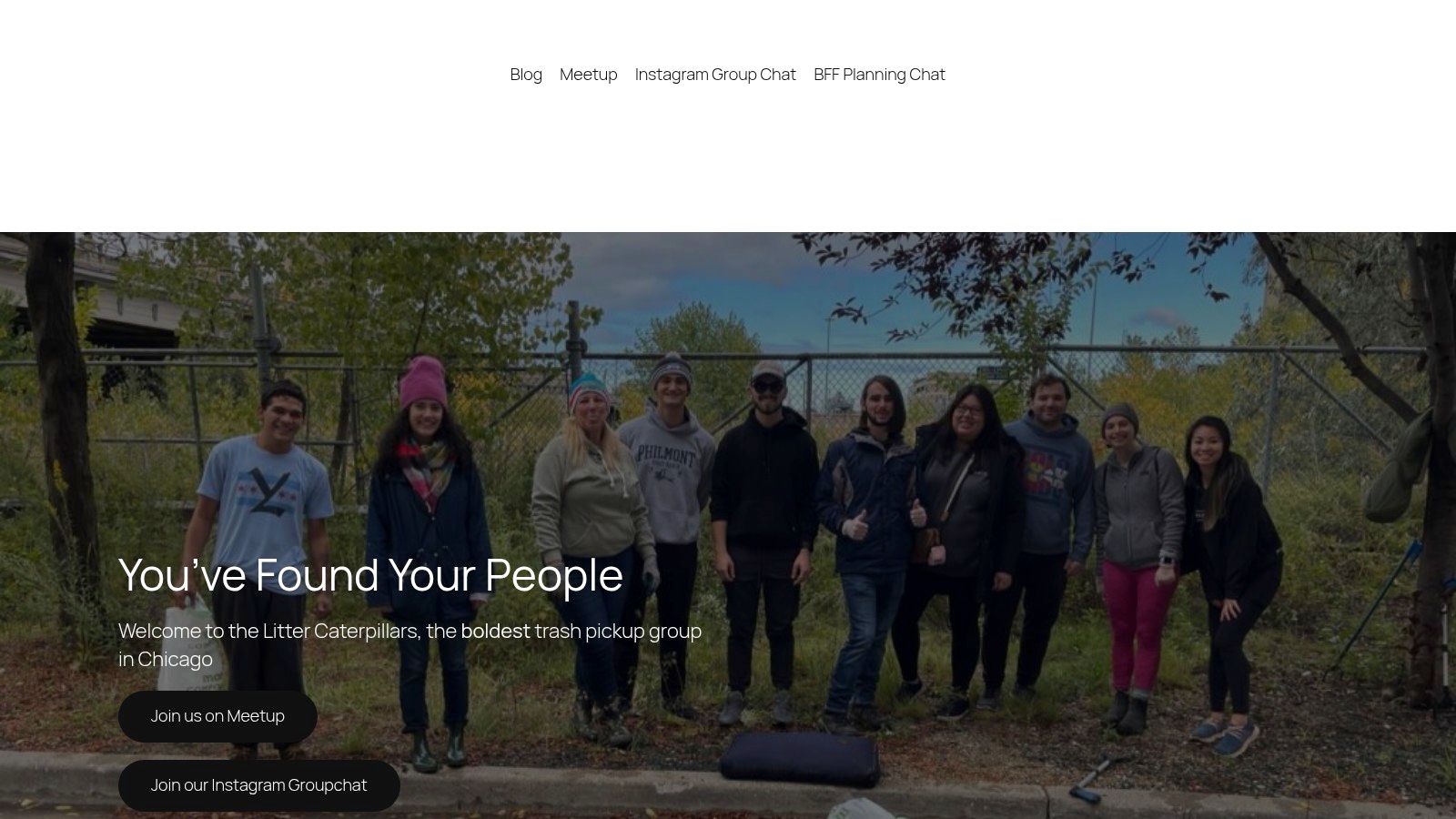
  • 7 Incredible Charities in Chicago You Can Get Behind in 2026

    7 Incredible Charities in Chicago You Can Get Behind in 2026

    I'll tell you a story. For years, my apartment was a perfect mirror of my life: cluttered, chaotic, a fortress built of memories I couldn't part with. Every jam jar, every half-eaten bag of almonds, felt like a 500-pound anchor chaining me to the past. It was a physical manifestation of feeling stuck, a mess so tangled I couldn’t even imagine where to begin.

    My life shattered after a breakup. I knew I needed a change. I craved something simple, something consistent, something that felt… brave. So I started picking up trash. Sounds absurd, right? But out there, on the streets, cleaning up someone else’s mess, I found a strange liberation. It's a peculiar kind of fun, especially when you're huddled with strangers under a tree during a freak Chicago hailstorm, realizing that a little shared suffering adds an incredible flavor to the story.

    This article isn't just another list. Think of it as an invitation. It's for you, if you’re looking to get unstuck, to meet people who actually give a damn, and to find the right charities in Chicago to pour your soul into. This is my guide to making a real, tangible dent in the world, one small, courageous act at a time. I'll walk you through the best platforms and local groups to find your tribe, from city-wide databases like Charity Navigator to the get-your-hands-dirty crew at Litter Caterpillars. I’ll give you the links and the roadmap you need to start right now.
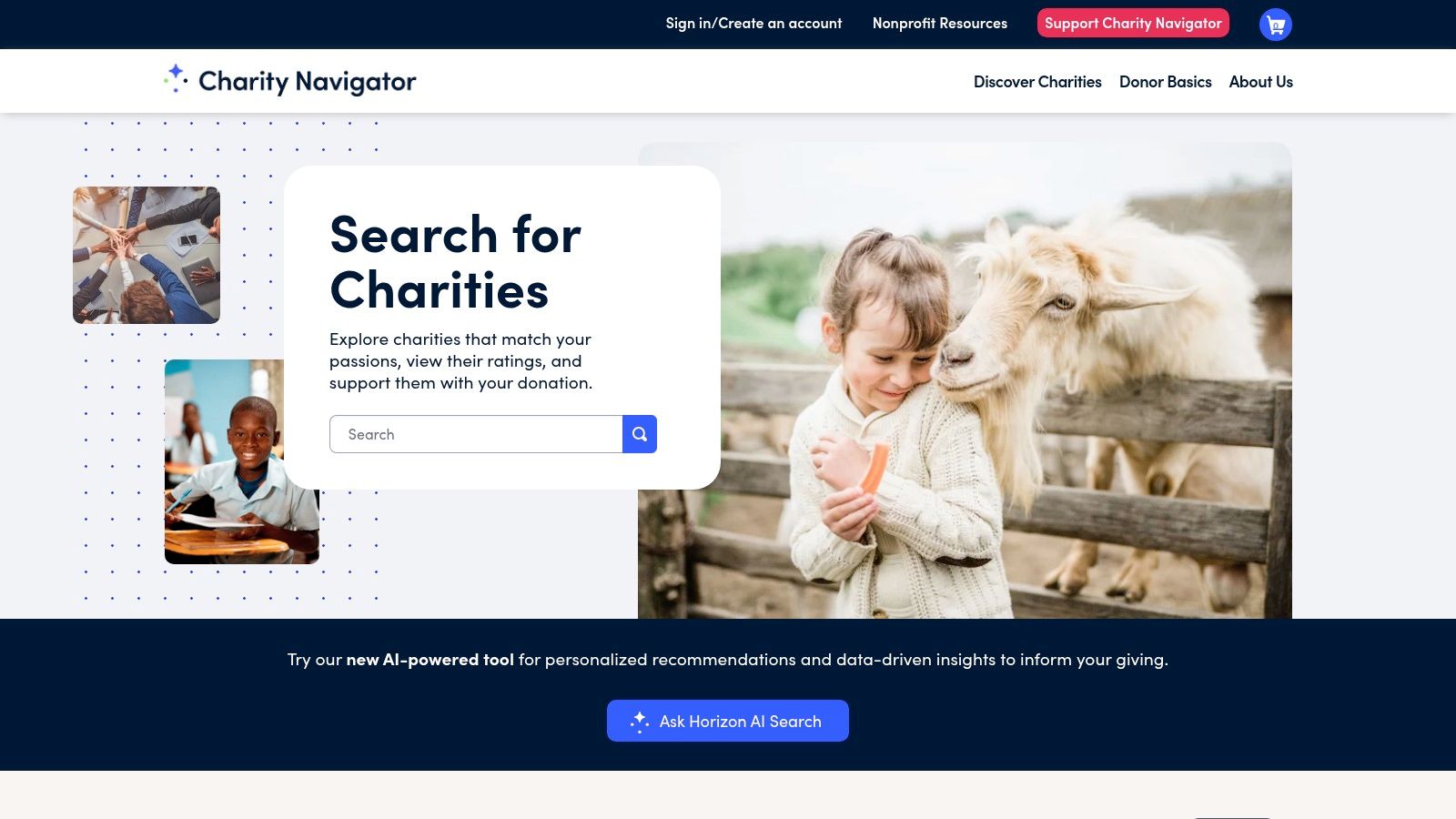
    1. Litter Caterpillars

    When you start digging into charities in Chicago, you'll find a sea of incredible organizations. But if you’re looking for something you can feel, something you can do this weekend, something that gets you on the ground exploring the city’s heart while leaving it better than you found it, let me introduce you to Litter Caterpillars. This isn't your average nonprofit. It’s a volunteer-powered force of nature, a community, and a living testament to what joyful, relentless action can build.
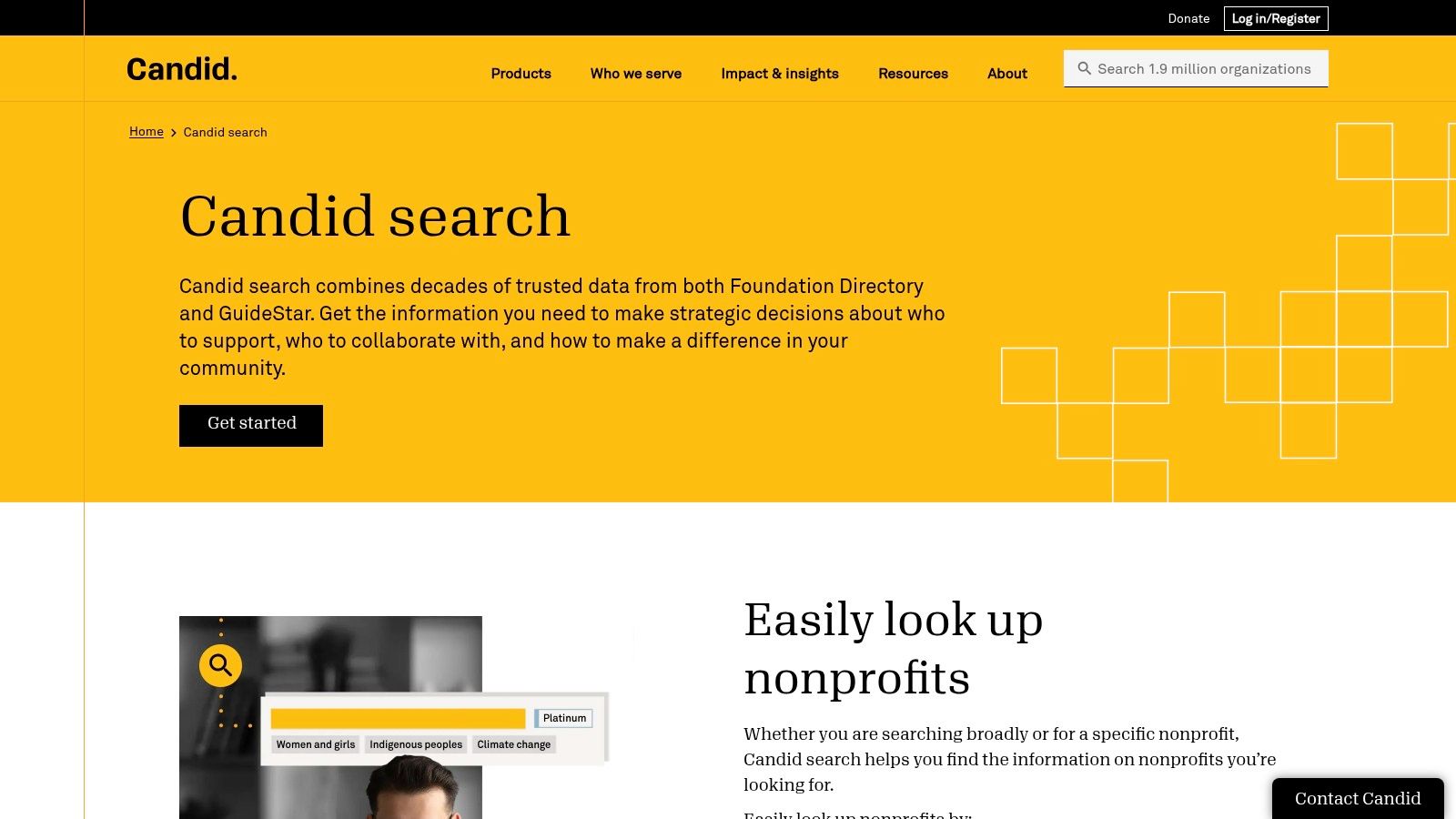
    I remember first hearing about them and thinking, "A trash pickup group? Cool, but how different can it be?" The answer: profoundly different. Kevin Tao founded Litter Caterpillars from the ashes of his own life, rebuilding it one small, steady step at a time. That’s the engine of the group: show up, clean a block, meet someone new, and do it again next week. Rain. Shine. Blizzard. They are out there. That relentless consistency is what sets them apart from everyone else.

    A group of Litter Caterpillars volunteers in Chicago, smiling and holding trash grabbers and bags, with the city skyline in the background.

    This isn't just about picking up litter. It’s a bold, disciplined adventure. This crew has cleaned every single one of Chicago's 50 wards—a feat that speaks volumes about their city-wide commitment. They've tackled audacious projects, like cleaning a highway during a bike event shutdown. Their biggest triumph? Winning an empty lot at a city auction to build "Caterpillar Park" in Englewood, turning a symbol of neglect into a beacon of community hope.

    Why It's a Standout Choice

    What makes Litter Caterpillars so special is its volunteer-first culture. The entire experience is designed around you.

    • Zero Financial Pressure: I promise you, you will never be asked for a donation. The focus is purely on your time, your energy, your happiness. This creates an environment free of obligation, where you show up because you want to be there.
    • Built for Community: From the custom theme song and team flags to the achievement badges and buzzing group chats, every element is engineered to forge connection. You’re not just a volunteer; you're part of a team.
    • Safety and Positivity: The leaders prioritize a safe, welcoming, and uplifting atmosphere. It feels less like a chore and more like a block party with a purpose.

    It's one thing for an organization to say it builds community; it's another thing to see it in action. People join to clean a neighborhood and end up making lifelong friends, exploring corners of Chicago they've never seen, and feeling a genuine surge of accomplishment. The energy is electric. You can feel it just by scrolling through the comments on their social media.

    How to Get Involved

    Getting started is as simple as it gets. Every event is free. You don’t need any experience. Just bring a good attitude.

    1. Find an Event: Head over to their website or check their Meetup and Instagram pages for the weekly schedule. They post crystal-clear details on where and when to meet.
    2. Just Show Up: They provide everything you need: grabbers, bags, gloves, and hand sanitizer.
    3. Make an Impact: Spend a couple of hours cleaning, chatting, and watching the immediate results of your work unfold before your eyes.

    My Take: If you're tired of abstract charity work and crave seeing your effort translate directly into a cleaner block, a new park, and a stronger community, Litter Caterpillars is an unparalleled choice. It's a powerful reminder that changing the world can start with one piece of trash and one new friend.

    Sure, the work can be tough, and you'll be out in every flavor of Chicago weather, but the payoff is immense. This is a grassroots organization running on pure passion, offering a uniquely authentic and impactful way for you to give back. You can dive deeper into their mission and see how their volunteer trash pickup events work on their website.

    Website: https://www.littercaterpillars.com

    2. Charity Navigator

    Imagine you've got a few bucks to give and a heart full of hope for your city, but you're paralyzed. Which of the thousands of incredible charities in Chicago will use your donation to actually move the needle? How can you be sure your gift will do more than just keep the lights on? That's the exact problem Charity Navigator solves for you. Think of it as your personal, data-driven guide to giving with confidence. It's like having a wise, experienced friend who has already done all the meticulous, painstaking research for you.

    Instead of just feeding you a charity's mission statement, Charity Navigator cracks open the books. It dives deep into the numbers and practices that truly matter. It rates organizations on a four-star scale, but what’s truly revolutionary is how it arrives at that rating. It’s moved beyond outdated, simplistic metrics like overhead costs and now paints a much richer, more holistic picture of a nonprofit's health and its real-world impact.

    A screenshot of the Charity Navigator website showing the search bar where users can find charities in Chicago.

    Making Informed Decisions with Powerful Tools

    When you land on the site, you can immediately search for "Chicago" and filter by the causes that set your soul on fire, whether it's animal welfare, housing and homelessness, or arts and culture. Each charity profile gives you a clear, digestible breakdown of its performance.

    • Financial Health: How efficiently do they use their funds?
    • Accountability & Transparency: Do they follow best practices for governance? Are they open about their operations?
    • Leadership & Adaptability: This new "Encompass" rating assesses strategic planning and their ability to pivot in a changing world.
    • Impact & Results: Where available, this score looks at the actual outcomes a charity achieves.

    This multi-faceted approach empowers you to find organizations that are not just well-intentioned but also incredibly well-run.

    How to Use Charity Navigator Effectively

    To get the most out of the platform, I suggest you think like an investigator. Use the search filters to create a shortlist of 3-5 Chicago-based charities working on the same issue. Compare their star ratings and, more importantly, click into their profiles to see why they got those scores. A four-star rating in "Accountability & Transparency" tells you a hell of a lot about an organization's integrity.

    One feature I love is the Giving Basket. You can add multiple charities to your basket and donate to all of them in a single, secure transaction, making it incredibly easy to support a portfolio of causes you believe in. While some people, including me, often prefer donating directly on a charity's site, the Giving Basket is a fantastic tool for streamlined, diversified giving. The platform is completely free for you to use, putting powerful philanthropic tools right at your fingertips.

    Website: https://www.charitynavigator.org

    3. Candid (GuideStar + Foundation Directory)

    If you're the kind of person who likes to lift the hood and see exactly how the engine works before you commit, then Candid is the platform for you. Think of it as the ultimate research library for the nonprofit world. Where other sites give you a great summary, Candid hands you the original blueprints, the raw data, and the forensic tools to conduct a truly deep dive into the charities in Chicago you’re considering. It’s for the donor who wants to move beyond ratings and understand the "why" behind an organization's every move.

    Candid was born from the merger of GuideStar and the Foundation Center, creating an absolute powerhouse of nonprofit information. It offers an unparalleled, comprehensive look into more than 1.9 million organizations. I'm not talking about a surface-level directory; this is a treasure trove of financial data, official IRS filings, and detailed program information that lets you vet potential partners with incredible precision.

    A screenshot of the Candid website showing the search filters available to find charities in Chicago.

    Unlocking In-Depth Due Diligence

    When you search for charities on Candid, you’re not just browsing a list; you're accessing a database that goes light-years beyond a simple mission statement. The platform is designed for serious due diligence, whether you're a major donor, a corporate partner, or simply a citizen like me who wants to be absolutely certain of your impact.

    • Financial Deep Dive: You get direct access to an organization's IRS Form 990, the detailed annual report that tax-exempt organizations file. This gives you a direct look at their revenue, expenses, and even leadership compensation.
    • Seals of Transparency: Nonprofits can earn Bronze, Silver, Gold, and Platinum Seals by sharing more information about their operations, leadership, and results. A Platinum Seal means they're an open book.
    • Powerful Filters: You can zero in on what matters to you. Filter Chicago-based organizations not just by cause but by the specific populations they serve, their budget size, and more.
    • Leadership and Mission: You can review key personnel, board members, and the exact language of their stated mission and programs, ensuring their values truly align with yours.

    This level of detail empowers you to make giving decisions with the same rigor you'd apply to a major financial investment.

    How to Use Candid Effectively

    I'd suggest you start with the free version, which just requires a quick registration. Use the "Nonprofit Profiles" search to look up specific charities in Chicago or browse by cause. A great strategy is to use the Seals of Transparency as your first filter; organizations that have earned Gold or Platinum seals are actively committed to being open about their work.

    Don't let the Form 990 intimidate you. I focus on a few key areas: check the "Program Service Revenue" to see how much of their income is directly related to their mission, and review the "Statement of Functional Expenses" to understand how they allocate their money. While the full feature set is geared toward professionals and costs money, the free access gives you more than enough data to make a highly informed choice.

    Website: https://candid.org/candid-search

    4. United Way of Metro Chicago

    What happens when you want to help, but the sheer number of charities in Chicago feels like a tidal wave? You see the need everywhere—food insecurity in one neighborhood, a lack of after-school programs in another. How can you make the biggest splash without spending weeks researching hundreds of organizations? This is where I find the United Way of Metro Chicago so valuable. Think of it as a powerful, central hub for community impact, a lens that focuses your generosity into a coordinated, region-wide force for good.

    For over 90 years, they have been weaving together a vast network of community partners, donors, and volunteers to tackle Chicago's toughest challenges. Instead of focusing on a single issue, United Way takes a holistic approach. They get that strong neighborhoods are the bedrock of a thriving city. They do the vetting for you, directing your resources to where they are needed most.

    A group of volunteers in blue shirts from United Way of Metro Chicago working together on a community project.

    Uniting for Neighborhood-Level Impact

    When you explore their website, you’ll see their strategy isn't just about funding programs; it's about investing in entire communities. They partner with local leaders and residents through their 17 Neighborhood Networks, ensuring that solutions are born from the community itself and built to last. This model recognizes that the people living in a neighborhood know best what they need to succeed.

    • Pooled Giving: Your donation joins thousands of others in a community fund, tackling systemic issues like economic stability and access to healthcare across the entire region.
    • Designated Giving: If you have a specific partner agency in their network that you’re passionate about, you have the option to direct your funds straight to them.
    • Corporate & Group Volunteering: United Way are masters of logistics, organizing large-scale volunteer projects perfect for companies, friends, or community groups looking to make a hands-on difference together.
    • Impact Reports: They provide clear, accessible reports showing you exactly how your contributions are being used to create measurable change in communities throughout Chicagoland.

    This structure allows you to support a broad, proven strategy for community improvement, trusting that your contribution is part of a much larger, coordinated plan. It’s a powerful way for organizations to keep their helpers engaged, a key component of effective volunteer retention strategies.

    How to Use United Way Effectively

    The easiest way for you to get started is by using the "Donate" or "Volunteer" portals on their website. If you're looking for a simple, fire-and-forget way to support the entire Chicago region, I think donating to their Impact Fund is an excellent choice. It’s a high-trust model where you let their experts allocate the funds based on real-time community needs.

    For those of you who want a bit more control, you can explore their list of over 140 agency partners and designate your gift. The platform offers multiple ways to give, including credit card, stock transfers, and DAFs, making it flexible for any philanthropic style. While you might give up the granular control of donating directly to a small, specific charity, you gain the immense power and strategic oversight of a long-standing community institution. The platform is free to access and explore, offering you a direct path to becoming part of a united force for good in Chicago.

    Website: https://liveunitedchicago.org

    5. 211 Metro Chicago

    Imagine this: someone in your neighborhood is facing eviction. A family is struggling to find their next meal. A senior needs help with their utility bills. These aren't abstract problems; they are urgent, immediate crises happening every single day. But how do you, as a potential donor or volunteer, find the frontline organizations tackling these specific, real-time fires? You use 211 Metro Chicago. It's the city's official information and referral lifeline, which doubles as an incredible, living map to the most pressing needs in our community.

    Think of it as the central nervous system for social services in Chicago. It’s not a donation platform itself. Instead, it’s a powerful directory and referral service that connects people in desperate need with the exact charities in Chicago equipped to help them. For you and me, this provides an unparalleled, ground-level view of where our support can have the most immediate impact. It answers the question, "Who is doing the real work, right here, right now?"

    A screenshot of the 211 Metro Chicago website showing the search function for finding local social services.

    Uncovering Community Needs to Guide Your Giving

    While platforms like Charity Navigator help you vet an organization's financial health, 211 Metro Chicago helps you understand the demand for their services. By exploring their comprehensive online directory, you can see which organizations are on the front lines of specific issues in particular neighborhoods. This is a complete game-changer for strategic giving.

    • Massive Service Directory: You can search for thousands of vetted local health and human service programs covering everything from food pantries and mental health counseling to legal aid and housing assistance.
    • 24/7 Live Support: Trained specialists are available around the clock via phone (by dialing 2-1-1), text, or online chat to guide people to resources. This gives them a real-time pulse on community needs.
    • Hyper-Local Focus: The platform is laser-focused on Chicago and suburban Cook County, ensuring the information is relevant, current, and specific to our local ecosystem.

    This direct line to community challenges allows you to move beyond generalized giving and target your support with surgical precision.

    How to Use 211 Metro Chicago for Philanthropy

    Instead of just searching for charities, I want you to think like a community researcher. Start by exploring a category you care about, like "Food" or "Housing," and filter by your zip code or a neighborhood you want to support. You'll get a list of the specific organizations providing those services on the ground. These are the groups that 211 operators are referring your neighbors to every single day.

    From there, you can visit the websites of these frontline charities to donate or find volunteer opportunities. While 211 Metro Chicago is primarily a service-finder, its greatest strength for donors like you and me is its authenticity. It’s not a curated list; it's a living, breathing database reflecting the real, day-to-day work of making Chicago a better place for everyone. The service is completely free to use, offering you a priceless window into the heart of our city.

    Website: https://211metrochicago.org

    6. VolunteerMatch (Chicago)

    You feel it, don't you? That powerful pull to do more than just write a check. You want to roll up your sleeves, meet people who think like you, and see the impact of your effort with your own two eyes. But where do you even start? Scouring the websites of individual charities in Chicago is exhausting. This is where VolunteerMatch comes in. I think of it as a bustling, vibrant marketplace for your time and talent. It’s less of a research library and more of a community bulletin board, connecting your desire to help directly with the organizations that need you most.

    VolunteerMatch bridges the chasm between good intentions and real-world action. Instead of evaluating financial health, its sole purpose is to show you a massive, searchable database of hands-on opportunities happening right now, in your neighborhood. It's the digital equivalent of walking into a community center and seeing flyers for every park cleanup, food pantry shift, and tutoring session available, all organized perfectly for you.

    Finding Your Perfect Hands-On Role

    The power of VolunteerMatch lies in its incredibly robust search and filtering capabilities. You can instantly search for "Chicago" or your specific zip code and then narrow the results to find the perfect fit for your schedule, your interests, and your skills. Whether you have a Saturday morning free or you want a regular weekly commitment, the platform makes it simple for you.

    • Cause Areas: Filter by what you're passionate about, from animals and the environment to education and literacy.
    • Skills & Interests: Are you a great photographer, a marketing whiz, or just love being outdoors? You can find roles that use your specific talents.
    • Flexibility: Easily find opportunities that are in-person, virtual, great for groups, or suitable for different age groups.

    This personalized approach removes all the friction from finding your next service project, connecting you directly with nonprofits that are actively looking for your help.

    How to Use VolunteerMatch Effectively

    I recommend you think of VolunteerMatch as your starting point. Use the filters to create a list of 3-5 intriguing opportunities. When you find one, click the "I Want to Help!" button, which zips your information directly to the nonprofit coordinator. Because it's a marketplace, not a vetting site, I think it's wise to do a little extra homework. If you find a new-to-you organization, you might cross-reference it on a site like Charity Navigator to make sure it’s a good fit.

    The platform is completely free for you as a volunteer and serves as a fantastic discovery tool. It shines by showcasing the sheer volume and variety of ways you can get involved, from one-off events to ongoing roles. If you're looking for a comprehensive list of service projects, you can explore some of the best volunteer opportunities in Chicago to see what's out there. The key is for you to be proactive; once you express interest, be ready to follow up directly with the organization to get started.

    Website: https://www.volunteermatch.org/city/Chicago

    7. Chicago Cares

    You feel that pull. That urge to do something real, to get your hands dirty and see the immediate impact of your effort right here in your own city. But where do you even start? Finding the right volunteer opportunity can feel like searching for a needle in a haystack. This is where Chicago Cares steps in. I see them as a master connector, a powerful force for good, linking your desire to help with the real, on-the-ground needs of our communities. It's more than a website; it's a bridge between your compassion and Chicago’s heartbeat.

    Chicago Cares specializes in creating and leading structured volunteer projects with a vast network of partner nonprofits and schools. Instead of just listing opportunities, they design experiences. They make them meaningful, accessible, and often group-friendly, making it incredibly easy for you to jump in and make a difference. They handle the logistics so you can focus on the service.

    Volunteers with Chicago Cares working together on a community project.

    Mobilizing a City of Volunteers

    The platform is your central hub for civic engagement. You create an account, browse projects by cause or neighborhood, and sign up with just a few clicks. The variety is immense. You could be revitalizing a community garden in Pilsen or helping students with their reading skills in Englewood. It’s a beautifully simple way for you to explore different charities in Chicago through direct action.

    • Citywide Programs: They design their own signature programs that address pressing needs like food insecurity and educational equity.
    • Partner Projects: They work directly with smaller nonprofits that need volunteers but may not have the resources to recruit and manage them.
    • Corporate Engagement: Chicago Cares is a leader in organizing large-scale service days for companies, turning teams into forces for community good.
    • Staff-Led Events: Many projects are led by a trained Chicago Cares staff member or volunteer leader, ensuring the experience is organized and impactful for everyone.

    This curated approach removes the guesswork. It makes it perfect for you if you're a first-time volunteer or just looking for a well-structured way to give back.

    How to Use Chicago Cares Effectively

    To get started, I suggest you create a profile and explore the project calendar. Don’t be afraid to try something new; you might discover a passion for a cause you never even considered. A great strategy is to sign up for a "New Volunteer Information Session" to get a full overview of how they operate and what you can expect.

    One of the platform’s biggest strengths is its focus on group and team-based volunteering. If you want to organize a service day with friends or coworkers, this is the place I'd start. While project availability can fluctuate and some large-scale signature events might request a registration fee to cover costs, the vast majority of opportunities are free. It’s a powerful tool designed not just to fill volunteer slots, but to build a more connected and caring Chicago, one project at a time.

    Website: https://www.chicagocares.org

    7-Point Comparison of Chicago Charities

    Item 🔄 Complexity ⚡ Resource requirements 📊 Expected outcomes 💡 Ideal use cases ⭐ Key advantages
    Litter Caterpillars Low organizational complexity; high physical demand 🔄 Low funding, high volunteer time & coordination ⚡ Visible neighborhood cleanup and community-built assets 📊 Hands-on cleanups, community building, recurring volunteer commitment 💡 Grassroots, consistent weekly impact; strong volunteer culture ⭐
    Charity Navigator Low user complexity; structured rating process 🔄 Platform-level data aggregation; minimal user time ⚡ Quick, comparable charity ratings to inform donations 📊 Donor due diligence and fast charity comparisons 💡 Clear, componentized ratings and Giving Basket for multiple donations ⭐
    Candid (GuideStar + FD) Moderate to high complexity for deep research 🔄 Extensive data access; paid features for full use ⚡ Comprehensive vetting (financials, Form 990s) for informed funding decisions 📊 Funders, grantseekers, and detailed nonprofit research 💡 Deep, updated nonprofit data and side-by-side comparisons ⭐
    United Way of Metro Chicago Moderate complexity (centralized programs) 🔄 Established admin, pooled funds, partner network ⚡ Broad regional impact and coordinated volunteer projects 📊 Corporate giving, pooled impact, group volunteer projects 💡 Large partner network and multiple giving methods; regional reports ⭐
    211 Metro Chicago Low user complexity; live referral service 🔄 Staffed 24/7 helpline and searchable directory ⚡ Real-time needs mapping and direct service referrals 📊 Residents seeking services; donors mapping frontline needs 💡 Comprehensive, up-to-date local referral hub tied to county systems ⭐
    VolunteerMatch (Chicago) Low complexity to use; variable listing quality 🔄 Platform access; volunteer time; org responsiveness ⚡ Broad discovery of hands-on volunteer opportunities 📊 Individuals/groups seeking specific skills, dates, or locations 💡 High volume of local listings and robust filters for matching ⭐
    Chicago Cares Low volunteer friction; staff-run projects 🔄 Staff coordination, partner sites, occasional fees ⚡ Structured group service and large-scale days of service 📊 Corporate teams, first-time volunteers, organized service days 💡 Chicago-focused, staff-designed projects with citywide reach ⭐

    Your Turn to Paint the Fence

    Do you remember that old story about Tom Sawyer? He was handed a punishment, a chore: paint a massive, boring fence. But Tom, he didn't see a burden. He saw an opportunity. He reframed the whole thing. He acted like painting that fence was the greatest, most exclusive privilege in the entire world. Soon enough, his friends weren't just helping him; they were paying him for the chance to take a turn with the brush.

    That’s the secret, isn't it? Giving back isn't a chore. It's not an obligation you have to dutifully check off some list. It's a mindset. It’s about discovering the joy in the work, the pride in a tangible result, and the profound connection you build with the people standing right beside you, brushes in hand. This entire guide I've laid out for you has been about showing you all the different "fences" across our city and the tools you can use to start painting.

    From Digital Tools to Dirty Hands

    You and I, we’ve covered a lot of ground together, exploring the incredible landscape of charities in Chicago. You've seen how powerful, data-driven platforms can give you the confidence to donate wisely, and how hyper-local networks can connect you with an opportunity just around the corner from your home.

    Let’s quickly revisit the tools in your new toolkit:

    • For the Researcher: You have Charity Navigator and Candid to peel back the layers, inspect the financial health, and ensure your dollars make a real, measurable impact. This is your due diligence, your way of investing smartly in Chicago's future.
    • For the Connector: You have United Way of Metro Chicago and 211 Metro Chicago as your broad-spectrum guides. They paint a picture of the city’s most pressing needs and can direct you to the organizations on the front lines, addressing systemic issues from housing to education.
    • For the Action-Taker: You have VolunteerMatch and Chicago Cares as your personalized search engines for service. I use them to match my specific skills, passions, and availability with the perfect role, whether it’s a one-day event or a long-term commitment.
    • For the Community Builder: And, of course, you have Litter Caterpillars. This isn't just about picking up trash; it's about reclaiming our shared spaces, one block at a time. It's the most direct, hands-on way for you to see your effort transform a street corner right before your eyes.
    How to Pick Up Your Brush

    So, what now? The options can feel overwhelming, but I promise the choice is simpler than you think. It's not about finding the "perfect" charity. It's about finding the one that’s perfect for you, right now.

    I want you to think about what truly energizes you. Is it seeing immediate, visible change? Then grabbing a picker with a group like Litter Caterpillars might be your calling. Are you a planner, a strategist who wants to ensure your contribution has the maximum possible leverage? Then spending an evening diving into reports on Charity Navigator is your first step. Do you crave human connection and want to meet new people from different walks of life? Chicago Cares is waiting for you.

    You don't have to be a superhero. You don't need a grand plan or a massive donation. You just have to show up. Find your crew. Find your cause. Pick up a brush and start painting. You will be absolutely astonished by how much fun you have, how much you learn, and how a simple act of service can make this huge, sprawling city feel like home.


    Ready to make an immediate, visible impact while exploring Chicago's diverse neighborhoods? I invite you to join a cleanup event with Litter Caterpillars and see how a few hours of teamwork can transform our community spaces. Find your next adventure in service and sign up at Litter Caterpillars.
  • Our Top 12 Game-Changing Grants for Gardens in 2026

    Our Top 12 Game-Changing Grants for Gardens in 2026

    It started with a single plastic bag. Just one, snagged on a fence. That’s how I got my group, the Litter Caterpillars, going. A few friends and I, armed with trash grabbers, just fed up. We were cleaning our little corner of Chicago. But as we filled more bags than I can count, something shifted. We saw more than clean grass. We saw potential. We imagined raised beds just bursting with tomatoes and peppers, a butterfly garden humming with life, a simple bench where you could just sit and talk to your neighbor. The dream was big. Our pockets were empty.

    That’s when my real work began. I dove into the world of funding. Headfirst. I spent hours, days, weeks sifting through websites, trying to make sense of grant applications. It’s a whole other language, I swear. I made mistakes. I missed deadlines. I wrote proposals that went straight into the void. But I learned. I figured out what funders are actually looking for, how to tell my story, and where to find the money that matched my vision. I learned how to turn a simple passion for picking up trash into a real, compelling case for planting a park.

    This guide is everything I wish I’d had. It's the shortcut I built from my own long, winding journey. I’ve done the heavy lifting for you, curating a list of the best grants for gardens out there, from huge federal programs to tiny local microgrants. Inside, you’ll find my breakdown of each opportunity with screenshots and direct links, plus the tips I learned the hard way on crafting a winning proposal, finding partners, and even some sample language to get you started. This isn't just a list; it's a roadmap. It's how you turn your own patch of overlooked land into a thriving community oasis. Your dream is possible, and this is how you fund it.

    1. Grants.gov

    If you're dreaming big, really big, and aiming for serious federal funding for your garden project, Grants.gov is your first stop. You have to start here. Think of it as the Grand Central Station for every single competitive federal grant. It’s not just a list; it’s the official place where you find money from agencies like the USDA or EPA and submit your entire application, all in one spot. This is where you go for the kind of funding that can transform a vacant lot into a full-blown urban farm or launch a gardening program across multiple schools.

    A screenshot of the Grants.gov search interface showing results for garden-related grants.

    This platform is so important because it centralizes the whole, often painful, federal application process. You can create saved searches for keywords like "community garden" or "urban agriculture" and get email alerts when new grants pop up. This alone will save you hours of your life.

    Navigating the Federal Landscape

    I'll be honest with you, the website can feel a little clunky and bureaucratic at first. The biggest hurdle you’ll face is the initial registration. It requires getting a Unique Entity ID (UEI) and registering with the System for Award Management (SAM.gov). You must start this process months before you plan to apply, because it can take a long, long time to get approved. It’s a marathon, not a sprint. Once you’re set up, though, the system becomes an incredibly powerful tool for managing your applications.

    • Best For: Ambitious, large-scale projects seeking substantial federal grants for gardens, like urban agriculture initiatives, community food systems, or environmental education programs.
    • Pros: It’s the official, comprehensive source for all federal grant opportunities. It's free to use and standardizes the application process across different agencies.
    • Cons: The learning curve is steep, and the initial SAM.gov registration can be a significant administrative task. It exclusively lists federal grants, so you won't find private or foundation funding here.

    Ready to explore federal funding? Visit the portal at Grants.gov.

    2. USDA Office of Urban Agriculture & Innovative Production (OUAIP)

    If Grants.gov is that giant, bustling station for all federal funding, think of the USDA's OUAIP as your dedicated express train. It takes you right to the powerful grants for gardens focused on urban farming and community food. This office is the USDA’s hub built specifically to support projects just like yours. It’s where you’ll find announcements for the famous Urban Agriculture and Innovative Production (UAIP) competitive grants, which are perfect for turning a neighborhood food desert into a fresh food oasis.

    A screenshot of the USDA Office of Urban Agriculture & Innovative Production website homepage.

    This platform stands out because it cuts through the noise of the bigger federal grant world. You get directly connected with funding cycles, technical help, and inspiring examples of projects they’ve already funded, all tailored to urban agriculture. For me, it was an invaluable resource for understanding what the USDA actually wants and seeing what a successful application looks like.

    Tapping into a Dedicated Funding Stream

    Let me be direct: while this office announces the grants, you will still need to submit the final application through Grants.gov. Think of the OUAIP website as your strategic headquarters. It's where you gather intelligence and prepare for your mission. You should bookmark this page and check it religiously around the time grant cycles typically open. The competition is fierce, so being prepared is your secret weapon. For great examples of what this funding can achieve, you can explore the work of community gardens in Chicago, IL and see the impact for yourself.

    • Best For: Community gardens, urban farms, rooftop gardens, and composting initiatives focused on food access, production, and innovation in metropolitan areas.
    • Pros: It’s a direct source for USDA's premier urban-agriculture funding. The site clearly aligns with community and urban farm priorities, offering fantastic project examples.
    • Cons: These grants are highly competitive. Eligibility and match requirements can vary, and you still have to navigate the separate Grants.gov submission process.

    Ready to see what the USDA has to offer? Visit the office's main page at usda.gov/urban.

    3. USDA Patrick Leahy Farm to School (Food & Nutrition Service)

    If your vision involves weaving a garden deep into a school's curriculum and even its cafeteria, then the USDA's Patrick Leahy Farm to School Grant Program is a monster opportunity. This isn't just about planting a few seeds; it’s about changing a school’s entire relationship with food. This federal program funds huge projects that connect students to where their food comes from, support local farmers, and get fresh, healthy food onto lunch trays. It’s one of the most powerful grants for gardens in the K-12 education world.

    A collage of photos showing students participating in farm-to-school activities like gardening and preparing fresh food.

    This program is a big deal because of its scale and its focus on systemic change. The FNS website is your home base. It gives you all the Request for Applications (RFA) documents, resources for applicants, and a signup for "The Dirt" newsletter to stay updated. Think of it as your direct line to funding that can create edible education programs and school garden infrastructure that last for years.

    Building a K-12 Food Revolution

    Let me be clear with you: this is a competitive, high-stakes grant. The application is heavy on documentation and often requires a non-federal match, meaning you'll need to show you have other resources to contribute. For the FY26 cycle, I saw they noted a 25% match. You'll need to build a strong team of educators, administrators, and community partners. You must start planning your partnerships and documenting your project's goals early, long before they even release the RFA. This level of prep is what separates the winners from the losers.

    • Best For: School districts, non-profits, or state agencies aiming to launch or expand ambitious farm-to-school programs that include school gardens, local food procurement, and agricultural education.
    • Pros: Significant funding awards (often $100k–$500k) that can support multi-year, large-scale projects. It's a national program with a strong focus on K-12 edible education.
    • Cons: The application process is highly competitive and requires extensive documentation. The matching fund requirement can be a barrier for some organizations.

    Ready to bring the farm to school? Visit the program page at USDA FNS.

    4. KidsGardening – Grant Opportunities

    If your garden dream revolves around empowering the next generation, KidsGardening should be your North Star. Seriously. This isn't just a website; it's a whole ecosystem for anyone passionate about connecting kids with nature. It’s like a central hub, gathering multiple grant programs specifically for youth, school, and community garden projects, all in one easy-to-use space. You'll find opportunities from their own programs and also partnerships with big names like Mrs. Meyer’s and Scotts Miracle-Gro.

    A screenshot of the KidsGardening website's grant opportunities page, showing various available grants for youth gardens.

    What makes KidsGardening so special to me is its laser focus. Instead of you having to sift through hundreds of unrelated grants, you get a curated list where every single opportunity is relevant to youth gardening. Their grant calendar and application help are made for real educators and community leaders, helping you build a stronger, more compelling story about your project's impact on children.

    Sowing Seeds for the Future

    The user experience here is just a breath of fresh air. It’s intuitive, it's inspiring, and it’s packed with resources beyond just funding, like curriculum ideas and project planning guides. The biggest thing you have to watch for is the timing. Many of their grant cycles are seasonal and have very specific, often short, application windows. My advice? Bookmark their grants page and set a calendar reminder to check it once a month. That way, you'll never miss the perfect opportunity when it finally sprouts up.

    • Best For: Schools, youth groups, and community organizations looking for targeted grants for gardens that prioritize education, equity, and hands-on learning for kids.
    • Pros: It’s a specialized hub with a strong youth focus, offering frequent award cycles and incredibly clear, helpful eligibility guidance. Many grants offer in-kind donations of tools and supplies.
    • Cons: Application windows can be short and highly seasonal. Eligibility can be strict, often requiring official nonprofit or school status.

    Start growing your youth garden project at KidsGardening.org.

    5. Whole Kids Foundation – Garden Grants

    If your dream is to bring an edible garden to life for students, the Whole Kids Foundation is one of the friendliest and most encouraging places you can start. Backed by Whole Foods Market, this program is designed specifically to help K-12 schools and nonprofits serving children get their hands dirty. They offer straightforward money to plant or expand gardens where kids can learn where their food actually comes from. This isn't about complicated bureaucracy; it's about getting a shovel in the ground and seeds in the soil.

    What makes this foundation stand out is its intense focus on youth and its incredibly supportive application process. They give you webinars, a simple eligibility flowchart, and tools that feel like someone is holding your hand, guiding you through your first grant proposal. I think it’s the perfect entry point if you’re a passionate teacher or parent volunteer new to the whole world of grant writing.

    Cultivating the Next Generation

    Think of this grant as the "starter kit" for school gardens. With a typical award of $3,500, it’s the perfect amount to build your raised beds, buy good soil and tools, and purchase all the seeds you need for a vibrant first season. The biggest hurdle is just the timing. They run one main grant cycle each year, so you’ll need to mark your calendar and get your application ready way in advance. Don't miss that window!

    • Best For: K-12 schools (public, private, charter), and non-profits serving children in the U.S. and Canada who are launching or expanding an edible garden program.
    • Pros: The application is refreshingly straightforward and geared toward first-time applicants. The foundation provides excellent resources, and the recognized brand backing adds credibility to your project.
    • Cons: It's strictly for youth-focused gardens, so it won’t work for adult-only community projects. The single annual grant cycle means if you miss the deadline, you have to wait a full year.

    Ready to grow with your students? Visit the foundation at Whole Kids Foundation.

    6. SeedMoney

    If you love the idea of rallying your community's support and then getting it matched with grant funding, SeedMoney is a brilliant platform you absolutely need to know. It’s not just a grant application; it’s a whole 30-day crowdfunding challenge designed specifically for public food gardens. Imagine turning every small donation from your neighbor into a bigger win. You launch your campaign, you share your story, and every single dollar you raise not only supports your project directly but also helps you compete for extra challenge grants from SeedMoney.

    A collage of photos showing community members happily working in gardens, a key outcome of SeedMoney's funding model.

    This platform’s magic is in its hybrid model. It gives you the power to build a local base of supporters while you’re also chasing grant money. Even better, you get to keep 100% of the funds you raise through your campaign, no matter if you win one of the top challenge grants or not. It’s a true win-win that builds both your garden beds and your community connections at the same time.

    Crowdfund Your Way to a Grant

    Think of SeedMoney as a fundraising coach and a funder all rolled into one. The platform gives you tools and guidance to help you run a successful online campaign. The challenge grants, which can be anywhere from $100 to $1,000, are awarded based on how much you raise, which adds an exciting, competitive spark to your work. The key here is mobilization. You have to plan your 30-day campaign in advance by lining up your supporters and creating powerful stories to share online. Your success in getting larger grants for gardens through this platform is directly tied to how well you can engage your network.

    • Best For: Grassroots community, school, or food bank gardens that have a strong community network ready to be activated for a focused, short-term fundraising push.
    • Pros: Combines fundraising with community engagement, you keep all the money you raise, and it’s open to both U.S. and international projects.
    • Cons: The performance-based model means that groups with smaller or less-resourced networks may struggle to win the larger challenge grants.

    Ready to grow your funding and your community? Get started at SeedMoney.

    7. National Fish & Wildlife Foundation (NFWF) – Five Star & Urban Waters Restoration

    If your garden project is less about growing vegetables and more about creating a sanctuary for wildlife, the National Fish & Wildlife Foundation (NFWF) is where you need to look. Their Five Star & Urban Waters Restoration program is designed for on-the-ground projects that bring nature back. Think pollinator gardens buzzing with life, rain gardens that manage stormwater, or shoreline restoration projects that create vibrant habitats. This is for you visionaries who see your garden as a piece of a much larger ecological puzzle.

    What makes this program special is its focus on partnerships and results you can actually measure. NFWF wants to see you collaborating with your local government, nonprofits, and corporations to make a bigger impact. They give you excellent resources, like program fact sheets and guidance documents, to help you build a competitive application that clearly shows how your project will improve the local ecosystem.

    Focusing on Ecological Impact

    Navigating NFWF's site feels professional and focused, which reflects the scientific nature of their work. The application process is tough because they are funding projects with clear ecological outcomes, not just community beautification. Your proposal has to connect your garden to specific conservation goals, like improving water quality or providing critical habitat for native species. If your main goal is growing food for a food pantry, this grant probably isn't the right fit for you unless you can integrate significant habitat components.

    • Best For: Ecologically-focused garden projects that emphasize habitat restoration, native plants, pollinator support, or green infrastructure with measurable environmental benefits.
    • Pros: Potential for larger awards and national visibility. It strongly supports building powerful community partnerships and achieving real ecological change.
    • Cons: Highly competitive and requires a strong focus on measurable conservation outcomes. It’s not suitable for projects centered exclusively on food production.

    Ready to build a garden that heals the planet? Learn more at the NFWF Five Star & Urban Waters program page.

    8. AARP Community Challenge

    If your garden project is about more than just plants, if it’s about creating a vibrant, accessible space for all ages, the AARP Community Challenge is an incredible opportunity. This is a quick-action grant program made to fund tangible projects that make communities more livable, especially for older adults. Think intergenerational community gardens, accessible raised beds, or therapeutic green spaces that become hubs for connection and well-being.

    AARP Community Challenge

    What makes this grant stand out is its focus on fast, visible impact. AARP wants projects that you can complete quickly, and they provide significant media and storytelling support to the winners. This is your chance to not only get your garden funded but also to share its story with a huge audience, which can be a powerful tool for building momentum and support for you.

    Creating Age-Friendly Green Spaces

    The application process itself is straightforward, but the competition is fierce and the submission window is famously short. You need to have your project planned and ready to go before the application even opens. The key is to frame your garden as a solution that builds social connection and makes public spaces better for everyone, from toddlers to seniors. Highlighting how your project strengthens community engagement strategies is crucial for standing out in the crowd.

    • Best For: Community gardens focused on intergenerational activities, accessibility improvements (like raised beds or paved paths), and projects that create welcoming public spaces for older adults.
    • Pros: The application is relatively simple, and it offers high public visibility and storytelling opportunities for winning projects. The funding is flexible for both physical improvements and programming.
    • Cons: It's a very competitive grant with a short, specific application window each year. Award timelines and funding amounts can also vary, making long-term planning difficult.

    Ready to make your community more age-friendly? Visit the grant homepage at AARP Community Challenge.

    9. Fruit Tree Planting Foundation (FTPF) – Orchard Donations

    Imagine your community garden not just with seasonal vegetables, but with a living legacy of fruit-bearing trees that nourish your neighborhood for generations. The Fruit Tree Planting Foundation (FTPF) makes this dream a real, tangible thing by providing in-kind orchard grants. This isn't a cash grant; it's something I’d argue is even more valuable. They donate the trees, they help you design the orchard, they provide hands-on support for a community planting day, and they offer the training you need to make sure your new orchard thrives.

    Children gathered around a newly planted fruit tree in a community garden setting.

    This platform stands out because it delivers a complete, expert-led experience. Instead of just sending you money and a "good luck," FTPF partners with you to create a permanent source of fresh, healthy food. Their focus is on long-term impact, transforming community spaces, schoolyards, and Tribal lands into productive, beautiful, and educational places.

    Planting a Perennial Legacy

    The application process is straightforward, focusing on your organization's mission and your ability to care for the trees for the long haul. You need a solid plan for watering, pruning, and harvesting. You have to think deeply about your volunteer team's commitment, because an orchard is a multi-year investment of care and attention. Success here is about showing that you have the community support to see these trees through to maturity. It's one of the most fulfilling grants for gardens because you get to watch your work literally bear fruit.

    • Best For: Schools, community gardens, nonprofits, and Tribal communities ready to commit to the long-term care of a perennial food source.
    • Pros: Incredible in-kind value with expert design, installation support, and training included. It creates a lasting community asset and food source.
    • Cons: It's primarily an in-kind donation, not a cash grant. It requires a significant and sustained commitment to maintenance and care from your group.

    Ready to grow a lasting food legacy? Apply for an orchard at FTPF.org.

    10. Wild Ones – Lorrie Otto Seeds for Education (SFE)

    If your project is less about feeding people and more about feeding pollinators, the Wild Ones’ Seeds for Education (SFE) grant is a perfect fit for you. This program is laser-focused on creating vibrant native plant gardens, prairies, and other natural landscapes with direct youth involvement. Think of it as providing the seed money, literally and figuratively, to connect the next generation with their local ecosystem. It’s for projects that aim to restore a patch of land to its natural, wild beauty.

    A young person planting native flowers in a garden, illustrating the youth focus of Wild Ones grants.

    What makes this program so special is its dedication to native species and its accessible scale. You don't need a complex budget or a huge team to apply. The application is straightforward and geared toward smaller organizations like schools, nature centers, or youth clubs that want to make a tangible ecological impact. It’s one of the most direct grants for gardens that champion biodiversity.

    Nurturing Native Habitats

    The application process is refreshingly simple compared to the bigger grants. You'll need a clear plan, a list of the native plants you intend to buy, and a description of how you'll involve kids in the project. They really want to see that this isn't just about planting flowers; it's about teaching powerful lessons. This focus on hands-on learning is a core part of what they fund, making it a fantastic way for you to introduce young minds to the principles of environmental stewardship.

    • Best For: Schools, youth groups, and non-profits focused on creating educational pollinator habitats or native plant gardens.
    • Pros: Highly accessible for small-scale projects, with a clear focus on native species and youth education. The application is uncomplicated.
    • Cons: Funding is modest ($100–$500), and it explicitly excludes vegetable or food-producing gardens. The focus is strictly on native plants.

    Ready to plant some native roots? Learn more at the Wild Ones SFE Program.

    11. Openlands + ComEd Green Region Grants

    If you are in Northern Illinois and you want to bring a native pollinator garden or a local conservation project to life, this partnership between Openlands and ComEd is a game-changer. This isn't just about a few flowers; it's about funding meaningful projects that boost climate resilience, support local wildlife, and beautify your community. Think of it as a powerful local ally dedicated to helping you create vibrant, sustainable green spaces right in your own backyard.

    A lush green garden space funded by the Openlands + ComEd Green Region Grants.

    This grant stands out because it combines funding with regional expertise. You're not just getting a check; you're getting support from an organization that deeply understands the local ecosystem. They specifically look for projects that involve public engagement and education, which makes it perfect for community gardens that also act as outdoor classrooms.

    Cultivating Local Ecosystems

    Navigating this grant requires you to do a bit of local groundwork. The biggest hurdle for grassroots groups is often the requirement for a letter of support from your local government and the 50% cash match. You must start building relationships with your park district or municipal leaders early, and plan your fundraising strategy to meet that match requirement. Don't let the match scare you; it's a way for you to show you have broad community buy-in for your project.

    • Best For: Municipalities and nonprofits in the Northern Illinois/Chicagoland area focused on pollinator gardens, habitat restoration, and open-space conservation projects.
    • Pros: It provides significant regional funding (up to $10,000) and technical guidance. It's an excellent fit for projects that blend conservation with community education.
    • Cons: It's geographically restricted to the ComEd service area. The 50% cash match can be a significant challenge for smaller, volunteer-led organizations.

    Ready to make an impact in your Illinois community? Explore the grant at Openlands.

    12. Instrumentl – Garden Grant Database and Grant Management

    If you're ready to graduate from just casually searching for grants to a strategic, streamlined process, Instrumentl is the powerful upgrade your team needs. You should think of it as your grant-seeking command center. It's a paid platform that uses smart technology to comb through thousands of public and private funders, serving you a curated list of opportunities perfectly matched to your garden project. This isn't just a list; it's an entire project management system built to help you win grants.

    Instrumentl’s magic is in its consolidation. It brings grant discovery, deadline tracking, and team collaboration into one polished interface. It has a specific "Community & School Garden Grants" view that cuts through the noise, showing you only the funders who care about projects like yours. This is how you stop spending your weekends on Google and start spending that time making your proposals better.

    Supercharging Your Grant Search

    While a free search can feel like panning for gold, using Instrumentl is like having a high-tech metal detector that only beeps when it finds treasure. The platform is incredibly user-friendly, but its power comes at a cost. The subscription model is a serious investment, making it a better fit for established non-profits or community groups that have a dedicated fundraising budget. You should take full advantage of the 14-day free trial to build a robust prospect list and decide if the ongoing cost delivers enough value for your team.

    • Best For: Serious grant-seekers, non-profits, and organized groups who want to manage multiple applications and find both foundation and government grants for gardens efficiently.
    • Pros: Saves an immense amount of time with AI-powered grant matching and a built-in tracker. It consolidates discovery and project management in one place.
    • Cons: The subscription fee can be a significant barrier for small, volunteer-run garden projects. It’s a professional tool with a professional price tag.

    Ready to professionalize your grant strategy? Start your trial at Instrumentl.

    Comparison of 12 Garden Grant Resources

    Program Focus / What it funds Best fit (👥) Standout ✨🏆 Cost & access (💰 ★)
    Grants.gov Central portal for federal competitive grants (USDA, EPA, etc.) 👥 Orgs seeking federal funding ✨ One-stop federal listings & submission guides 🏆 💰 Free; ★★★
    USDA OUAIP Urban agriculture & innovative production grants; links to RFAs 👥 Urban farms, community gardens ✨ USDA hub with examples & UAIP focus 🏆 💰 Free; via Grants.gov; ★★★★
    USDA Farm to School (FNS) Large competitive grants for school gardens & local procurement 👥 K–12 schools & districts 🏆 Large awards ($100k–$500k); multi‑year support 💰 Free to apply; often requires match; ★★★
    KidsGardening – Grants Multiple recurring garden grants and youth resources 👥 Youth programs, schools, community gardens ✨ Many cycles + equity/youth planning resources 💰 Free; seasonal windows; ★★★★
    Whole Kids Foundation Annual school garden grants (~$3,500) with webinars 👥 Schools & child‑serving nonprofits ✨ Straightforward process; strong implementation support 💰 Free; annual cycle; ★★★★
    SeedMoney Crowdfunding + challenge mini‑grants for food gardens 👥 Grassroots groups & small projects ✨ Keeps 100% of funds; community engagement boost 💰 Free platform; funds via campaigns; ★★★
    NFWF Five Star & Urban Waters Habitat, pollinator, and urban waters restoration grants 👥 Ecology‑focused groups & partnerships 🏆 Larger awards for measurable ecological outcomes 💰 Competitive; project metrics needed; ★★★★
    AARP Community Challenge Quick‑action livability grants for public spaces & gardens 👥 Intergenerational & accessibility projects ✨ Fast turnaround + public visibility for winners 💰 Competitive; variable awards; ★★★
    Fruit Tree Planting Foundation In‑kind orchard donations: trees, design, install support 👥 Schools, community gardens, parks 🏆 High‑value in‑kind support + training ✨ 💰 Free in‑kind; requires long‑term care; ★★★★
    Wild Ones – Seeds for Education Micro‑grants ($100–$500) for native/pollinator youth projects 👥 Youth/native habitat projects ✨ Simple process; focused on native species & education 💰 Small awards; accessible; ★★★
    Openlands + ComEd Green Region Regional Chicago/Northern IL grants (up to ~$10k) 👥 Chicago/Northern IL orgs 🏆 Local funding + technical guidance for climate/adaptation 💰 May require ~50% match; ★★★
    Instrumentl Paid grant discovery & management platform (garden view) 👥 Staffed teams & nonprofits seeking efficiency ✨ AI matching, deadline tracking & PM tools 🏆 💰 Subscription (paid); 14‑day trial; ★★★★

    Your First Shovel in the Ground: Making the Leap from Dreamer to Doer

    You’ve made it. You’re through the entire toolkit. Your head is probably buzzing with grant deadlines, eligibility rules, and just the sheer possibility of it all. I know that feeling so well. It’s exactly like standing at the edge of an empty lot, seeing not just weeds and broken glass, but a future. A future filled with raised beds and buzzing bees and neighbors sharing fresh tomatoes. This list isn't just a collection of links for you; it's a map to that future.

    Looking back, we’ve journeyed from the vast, sometimes scary, federal landscape of Grants.gov and the USDA all the way to the hyper-local, people-focused power of the AARP Community Challenge and Chicago's own Openlands grants. We’ve seen how organizations like KidsGardening and the Whole Kids Foundation are dedicated to putting tools in the hands of our youngest growers. And we’ve explored the innovative crowdfunding model of SeedMoney, which proves to me that your community’s passion is as valuable as any foundation’s check.

    This journey shows me one powerful truth: there is no single "right" way for you to fund your garden. The best tool for you depends entirely on where you are right now and where you want to go.

    Charting Your Course: From Idea to Action

    So, what’s your next step? I know it's easy to feel overwhelmed, to have a dozen browser tabs open and a sense of paralysis. Let's quiet that noise. Take a deep breath. Ask yourself a few simple questions.

    • Are you a small, volunteer-led group just starting out? Forget the complex federal grants for a moment. Your sweet spot is with microgrants and crowdfunding. I’d have you look directly at SeedMoney to harness your local network’s energy or a KidsGardening grant to get that initial boost of confidence and supplies. These are your quick wins. They are the fuel that gets your engine started.
    • Are you an established school or nonprofit with a track record? This is where you can start aiming higher. The USDA Farm to School Grant or the National Fish & Wildlife Foundation grants are perfect for you. You have the structure and experience to manage the reporting they require, and the rewards can be transformative, funding entire programs, not just a few garden beds.
    • Is your primary goal to bring people together and beautify a specific block? Then the AARP Community Challenge is tailor-made for you. They love projects that are visible, tangible, and build social connections. It's less about crop yield and more about community spirit.

    Remember, applying for grants for gardens is a bit like gardening itself. You don't just throw every seed you have onto the soil and hope for the best. No. You choose the right seeds for your climate, your soil, and the season you’re in. Your "climate" is your organization's size and experience. Your "soil" is your community's needs and support.

    The Real Secret to Success

    The most important thing I want you to take away from this entire guide isn't a specific grant or a secret application tip. It’s this: Your story is your most powerful tool.

    Every funder, from a federal agency to a small family foundation, is looking for impact. They want to know why your garden matters. The sample boilerplate language and the application checklists I've seen are just the trellis; your story is the vine that grows on it. Don’t just tell them you want to build a pollinator garden. Tell them about the kids on your block who have never seen a monarch butterfly. Don’t just say you need funding for a community garden. Describe the elderly neighbors who feel isolated and would find connection and purpose among the vegetables.

    That passion, that specific, human-centered vision, is what will make your application stand out from a stack of a hundred others. It’s what turns a simple request for money into an invitation for them to co-create a better world with you. You are no longer just asking for help; you are offering them a chance to be part of your incredible story.

    So pick one. Just one grant from this list that feels right for you. The one that makes you say, "This is us." Start the application. Your dream garden is waiting, and that first shovel is in your hand. Now, it's time for you to break ground.


    Feeling inspired but need a team to bring your vision to life? At Litter Caterpillars, we turn beautification projects into community-building events, and we’re experts at helping groups like yours organize for impact, whether it's a cleanup day or prepping a new garden plot. Find your crew and make a real difference by joining us at Litter Caterpillars.
  • My Guide to 7 Amazing Chicago Community Gardens & Resources for 2026

    My Guide to 7 Amazing Chicago Community Gardens & Resources for 2026

    I remember standing on a cracked sidewalk, surrounded by the rumble of the ‘L’ and the distant wail of sirens. A freak hailstorm had me huddled under a lonely tree with two strangers, all of us determined to clear trash from a forgotten lot. That awkward, muddy moment unlocked a different Chicago for me—one where shared effort can transform both land and spirit.

    That day planted the seed. An obsession, really. I swapped my digital routine for spades and shovels, and I discovered that these green havens are neighborhood anchors. They’re outdoor living rooms. Even impromptu classrooms. I learned that real change—and real connection—grows best when you get your hands dirty.

    In this roundup, I'll walk you through seven top platforms that guide you straight to Chicago’s greenest corners. You'll meet the Chicago Community Gardeners Association, NeighborSpace land trust, Park District plots, Urban Growers Collective, Windy City Harvest, Gethsemane Garden Center, and The Urban Canopy compost hub. Each entry includes screenshots and direct links so you can instantly:

    • Browse locations by neighborhood
    • Check volunteer and membership details
    • RSVP for upcoming events
    • Access safety, accessibility, and tool lists

    These websites solve the biggest hurdle for newcomers and longtime advocates alike—finding the right plot, the right people, and the right time to step in. You won’t waste hours scrolling generic search results or guessing if a garden needs help. Instead, you’ll dive into clear, actionable info that gets you planting, partnering, or sponsoring. Fast.

    Whether you’re a student, a sustainability advocate, a nonprofit seeking a green partner, or just an adventurous soul craving fresh air and community, this guide points you straight to your perfect patch. Let’s dig in and turn pavement into paradise. Your next garden awaits.

    1. Your First Friend in the Dirt: Chicago Community Gardeners Association (CCGA)

    Imagine you're trying to learn a new language. You could buy a book. Struggle alone. Or you could join a conversation group where everyone is sharing tips, trading vocabulary, and cheering each other on. That's the Chicago Community Gardeners Association (CCGA). They are the city's ultimate conversation group for anyone wanting to get their hands dirty. I remember feeling completely overwhelmed when I first thought about joining one of the many chicago community gardens. Questions just swirled in my head: Where do I get seeds? How do I even build a raised bed?

    The CCGA was the answer. They’re not some faceless organization; they're a grassroots network of people just like you and me who have been there. They centralize everything. A friendly librarian for the city's gardeners. Their website is a lifeline that cuts through the noise and gets you straight to the good stuff: the knowledge and the resources you need to get growing, fast. It’s all about making sure no garden feels like an island.

    Your First Friend in the Dirt: Chicago Community Gardeners Association (CCGA)

    What You'll Find on Their Website

    The CCGA website is your command center for all things community gardening in Chicago. It’s a clean, straightforward platform designed to connect you with what you need without a fuss. You can find more information about the organization’s mission and how they support the city's green spaces by checking out this overview of the CCGA.

    Here are the key features you should explore immediately:

    • Garden Plot Interest Form: If you're looking for a plot, start here. Submitting this form gets you on their list for openings and updates.
    • Events Calendar: This is where the magic happens. Find dates for seasonal plant distributions, educational workshops (on topics like composting or seed saving), and resource days where you can get free materials.
    • Working Groups: Want to get more deeply involved? You can learn about their volunteer-led committees for Education, Resources, Membership, and Communications.

    How to Use CCGA Effectively

    To get the most out of the CCGA, think of it as an active resource, not just a static website. You should sign up for their newsletter to get event alerts delivered directly to your inbox. The seasonal plant distributions are a must-attend. They feel like a holiday, with everyone excitedly swapping stories while picking up flats of seedlings. Just remember to RSVP early, as spots and supplies are limited and go quickly. These distributions are typically pick-up only within specific time windows, so plan accordingly.

    Feature Highlights The Inside Scoop
    Seasonal Plant Distributions Free or low-cost seedlings for community gardens. A fantastic way to fill your plot.
    Citywide Events Calendar Your one-stop-shop for workshops, seed swaps, and garden workdays across the city.
    Directly Tailored Content Everything is focused on the unique needs of community gardeners, not just home gardeners.
    Resource Connections They connect gardens with essential resources like compost, wood chips, and tools.

    Website: https://chicagocommunitygardens.org/

    2. The Guardians of Green Space: NeighborSpace

    If the CCGA is the friendly conversation group, think of NeighborSpace as the wise landlord who ensures you'll always have a place to meet. Ever walked past a vibrant, flourishing community garden and wondered, "What if the owner sells this land for a condo?" That's a real fear. A gut-punching fear for many gardens, and it's the exact problem NeighborSpace was created to solve. They are Chicago's nonprofit urban land trust, the silent guardians who work behind the scenes to protect these precious green oases.

    I used to think a community garden was just about plants and people. But there's so much more. Insurance. Water bills. The constant threat of development. NeighborSpace steps in and takes that burden off our shoulders. They acquire the land, lease it back to the garden group for a nominal fee (often just $1 a year), and handle the legal and logistical headaches. This allows us gardeners to do what we do best: build community and grow food, without worrying that our hard work will be bulldozed away. They are the foundation upon which many of the most beautiful chicago community gardens are built.

    The Guardians of Green Space: NeighborSpace

    What You'll Find on Their Website

    The NeighborSpace website serves as a portfolio of their protected sites and a resource hub for existing and aspiring community garden groups. It’s less about finding an individual plot and more about understanding the framework that keeps these gardens alive for the long haul. You can also explore their effective stewardship models and get inspired by their work; you can learn more about their community engagement best practices here.

    Here are the key features you should explore immediately:

    • Our Gardens Map: An incredible interactive map showcasing the 100+ sites they protect across the city. It’s a great way to discover gardens in your neighborhood and see the sheer scale of their impact.
    • Stewardship Resources: For those already running a garden (or dreaming of starting one), this section is gold. It offers guidance on everything from bylaws and leadership structure to fundraising and conflict resolution.
    • Become a NeighborSpace Garden: This outlines the process and eligibility requirements for a community group to have their garden protected. It’s the starting point for securing a garden's future.

    How to Use NeighborSpace Effectively

    Your primary interaction with NeighborSpace as an individual will likely be through one of their protected gardens. I recommend you use their map to find a garden near you, then visit that garden's specific website or social media to learn about joining. If you are part of a group trying to start a new garden on vacant land, their website is your first and most important stop. Read through their application materials thoroughly to understand what they look for in a partner garden. It’s all about demonstrating long-term community commitment.

    Feature Highlights The Inside Scoop
    Permanent Land Protection The ultimate peace of mind. They ensure a garden site is preserved for community use forever.
    Liability Insurance & Water Access They handle the big, scary administrative tasks that can cripple a volunteer-run garden.
    A Network of Stewards Joining the NeighborSpace family connects your garden to a citywide support system.
    Mini-Grants & Support They offer small grants and direct support to help their gardens thrive and overcome challenges.

    Website: https://neighbor-space.org/

    3. Chicago Park District – Community Gardens in the Parks

    Think of Chicago's vast network of parks as our shared backyard. Now, imagine having your very own patch within that backyard to grow your own food and flowers. That's precisely the opportunity the Chicago Park District offers through its Community Gardens in the Parks program. When I was first exploring the different chicago community gardens, I was amazed to learn how many were located right inside the public parks I already knew and loved. This felt like the most official, direct route to securing a plot of land.

    The Park District’s website isn't just a list. It's the formal gateway. It’s where you go to cross the T's and dot the I's, transforming a dream of gardening into a legitimate, recognized space. They provide the land. The framework. And the rules of engagement, ensuring that these green spaces are well-managed and accessible. It’s a structured path for those of us who want a clear process for starting or joining a garden on public land.

    Chicago Park District – Community Gardens in the Parks

    What You'll Find on Their Website

    The Park District’s Community Gardens portal is your official application center. It’s designed to be a bureaucratic, yet straightforward, hub for all the paperwork and guidelines you need to garden legally on park property. The interface is clean and government-like, focused entirely on process and information.

    Here are the key features you should explore immediately:

    • Garden Directory: An interactive map and list that shows you exactly which parks currently host community gardens, helping you find one in your neighborhood.
    • Application Forms: This is the core of the site. You'll find downloadable PDF packets to apply for an individual allotment plot or to propose an entirely new community garden.
    • Program Guidelines: Essential reading. These documents detail the rules and responsibilities for all park gardeners, covering everything from plot maintenance to approved plant types.

    How to Use the Park District Website Effectively

    To succeed with the Park District, you have to think like you're applying for a permit. Be thorough. Be patient. The most crucial first step is to use their map to identify a garden near you and then contact the designated garden leader or Park District coordinator to check on plot availability. Waitlists are common, so getting your name in early is key. If you're ambitious and want to start a new garden, be prepared to rally your neighbors; the Park District requires a dedicated group of at least 10 members to approve a new site.

    Feature Highlights The Inside Scoop
    Official Plot Access The most direct and legitimate way to secure a gardening plot on public park land.
    Clear, Documented Process No guesswork. The application and renewal processes are spelled out in formal guidelines.
    Variety of Garden Types Supports different models, including individual allotment plots and communal pantry gardens.
    New Garden Proposals Provides a clear pathway for motivated residents to establish a brand-new garden in a local park.

    Website: https://www.chicagoparkdistrict.com/parks-facilities/community-garden

    4. Urban Growers Collective (UGC)

    If the CCGA is the city's friendly librarian for gardeners, then Urban Growers Collective (UGC) is the master chef teaching you how to use your harvest. They just get it. UGC takes the idea of community gardening a step further, connecting your little plot to the entire urban food system. I used to think my garden was just about what I could grow for myself, but seeing UGC's work showed me it can be part of something much bigger. Food justice. Community health. Economic empowerment.

    UGC operates a network of farms across Chicago, focusing on growing food in and for communities that have historically lacked access to fresh produce. Their website isn't just a resource. It's an invitation to join a movement. It connects your passion for gardening with real-world impact, showing you how your efforts in the soil can help build a more equitable city, one harvest at a time. They prove that chicago community gardens can be powerful engines for change.

    Urban Growers Collective (UGC)

    What You'll Find on Their Website

    The UGC website is your gateway to participating in Chicago's local food economy. It’s beautifully designed and easy to navigate, with clear pathways to get involved whether you want to buy produce, learn new skills, or volunteer your time. It’s an inspiring platform that showcases the power of urban agriculture. If you're passionate about hands-on work, you can explore volunteer opportunities with UGC and other amazing local organizations.

    Here are the key features you should explore immediately:

    • CSA & Farm Stands: This is where you can buy directly from their farms. Sign up for a Community Supported Agriculture (CSA) share for a season's worth of fresh veggies, or find the schedule for their farm stands and the Fresh Moves Mobile Market.
    • Community Composting: UGC offers a fantastic compost drop-off program. The site gives you all the details on how to join, what you can bring, and when to drop off your food scraps to be turned into rich soil.
    • Workshops & Volunteering: Find a schedule of on-farm events, from practical workshops on composting to volunteer days where you can help with planting, weeding, and harvesting.

    How to Use UGC Effectively

    To really benefit from UGC, you need to think beyond just your own garden plot. Use their resources to close the loop on your gardening journey. For example, I joined their composting program to turn my kitchen scraps into "black gold" for my garden beds. The compost program is seasonal and has limited slots, so sign up early. Attending one of their volunteer days is also a fantastic way to learn farming techniques at a larger scale, which you can then apply back in your own community garden. Their CSA is priced to be accessible, but shares sell out, so keep an eye on their website for registration dates.

    Feature Highlights The Inside Scoop
    Community Composting Program A practical way to recycle food scraps and get high-quality compost. Great for garden groups.
    Fresh Moves Mobile Market A "produce aisle on wheels" that brings fresh, affordable food to different neighborhoods.
    On-Farm Volunteer Days Get hands-on experience on a working urban farm and connect with like-minded people.
    Strong Equity Mission Your support directly contributes to building food sovereignty in Chicago's South and West side communities.

    Website: https://www.urbangrowerscollective.org/

    5. The Professional Power-Up: Windy City Harvest (Chicago Botanic Garden)

    If the CCGA is your friendly neighborhood conversation group, think of Windy City Harvest as the university program you can enroll in. It’s a different level. This is the Chicago Botanic Garden's urban agriculture arm, and they bring a level of professionalism, deep scientific knowledge, and structured support that can transform a patch of soil into a powerful community engine. I’ve always been amazed by their approach; it’s not just about growing food, it’s about growing skills, jobs, and healthier communities from the ground up.

    Windy City Harvest takes the concept of chicago community gardens and elevates it into a comprehensive ecosystem of learning and production. They provide the kind of institutional backing that can feel like a dream for a small garden group, offering everything from formal training programs to vital resources like safe, tested soil. For gardens that are ready to level up their impact and connect to a larger city-wide food system, this is the ultimate partner.

    Windy City Harvest (Chicago Botanic Garden – Urban Agriculture)

    What You'll Find on Their Website

    The Windy City Harvest section of the Chicago Botanic Garden website is less of a simple directory and more of a portal into their world of urban agriculture. It's clean, professional, and packed with information about their multi-faceted programs. It showcases their mission to create jobs, improve community health, and strengthen the local food system.

    Here are the key features you should explore immediately:

    • Training & Jobs: Explore their acclaimed certificate programs like the Urban Farm Training and an Apprenticeship, which provide a direct pipeline to careers in urban agriculture.
    • Community Support: Learn how they partner with community organizations to establish gardens, providing essentials like raised beds, safe soil, seeds, and ongoing technical assistance.
    • VeggieRx Program: Discover their innovative program that connects fresh produce from the farms directly with healthcare patients to improve health outcomes.
    • Farms & Farm Stands: Find locations and hours for their urban farms and seasonal farm stands where you can buy fresh, locally grown produce and support their mission.

    How to Use Windy City Harvest Effectively

    To truly leverage what Windy City Harvest offers, you need to think in terms of partnership and programs. If you represent a community organization, their support can be a game-changer for starting or sustaining a garden. Explore their partnership criteria to see if your garden qualifies for resources. For individuals, their educational courses are a fantastic way to gain serious skills. These aren't just one-off workshops; they are in-depth training programs that require a commitment but offer incredible rewards. Keep an eye on their site for enrollment periods and information sessions.

    Feature Highlights The Inside Scoop
    Formal Training Programs Go from hobbyist to professional with certificate courses and apprenticeships.
    Partnership Resources Provides qualifying gardens with infrastructure like raised beds, soil, and plants.
    Emphasis on Safe Soil A huge benefit; they are experts in urban soil safety and remediation.
    Health-Focused Initiatives Connects gardening directly to community health through programs like VeggieRx.

    Website: https://www.chicagobotanic.org/urbanagriculture

    6. Gethsemane Garden Center (Andersonville)

    Every community garden needs a reliable source for its lifeblood. Plants. Soil. Tools. Think of Gethsemane Garden Center as the master library for gardeners, a place where you can find not just the supplies, but the wisdom to make things grow. When I was starting my first plot in one of the local chicago community gardens, I felt like an artist with an empty canvas. Gethsemane was the art supply store that didn't just sell me the paint; the staff taught me how to mix the colors.

    This isn't just a big-box store with a few sad-looking tomato plants. No. It's a year-round, independent institution in Andersonville that feels more like a botanical wonderland. Their deep inventory is a huge asset for community gardeners who often need specific, hardy cultivars that can thrive in our unique urban environment. Walking through their aisles, especially during the spring rush, is an experience in itself, filled with the buzz of fellow gardeners sharing tips and inspiration.

    Gethsemane Garden Center (Andersonville)

    What You'll Find on Their Website

    While Gethsemane’s magic is best experienced in person, their website is your go-to guide for planning your visit. It’s a clean, visually appealing site that gives you a preview of their massive selection and keeps you updated on what’s happening at the store. It’s less of an e-commerce platform and more of a digital welcome mat.

    Here are the key features you should check out before you go:

    • Seasonal Departments: Explore what's currently in stock, from annuals and perennials to vegetables, herbs, and even houseplants for your windowsill.
    • Gardening Resources: Find helpful guides, tips, and articles written by their expert staff on topics relevant to Chicago-area growers.
    • Events and Workshops: Check for information on seasonal events, sales, and educational opportunities that can help you level up your gardening skills.

    How to Use Gethsemane Effectively

    The best way to use Gethsemane is to treat its staff as your personal gardening consultants. Don’t be shy. I bring in leaves with strange spots all the time and ask them which tomato variety is best for container gardening. For community garden planning, I recommend visiting during a weekday to avoid the weekend crowds and get more dedicated time with the staff. Follow them on social media for real-time updates on new arrivals; popular and rare plant starts can sell out within a day. Remember, this is a local business deeply invested in the community, so building a relationship here can pay dividends in knowledge and support.

    Feature Highlights The Inside Scoop
    Expert On-Site Staff Invaluable for diagnosing plant problems and getting specific, local advice.
    Vast Plant Selection Find everything from heirloom vegetables to native pollinator-friendly plants.
    Year-Round Availability Open all year, so you can get supplies for season extension or indoor gardening.
    Community Focus They actively support local school and community gardens with donations and resources.

    Website: https://www.gethsemanegardens.com/

    7. The Urban Canopy – Healthy Soil Compost

    Building a garden is like baking a cake. You can have the best pan and the most beautiful decorations, but if you start with subpar flour and sugar, the result will be disappointing. In gardening, your "flour and sugar" is the soil, and in a city like Chicago, you can't always trust what's already in the ground. That’s where The Urban Canopy’s Healthy Soil Compost becomes your secret ingredient. I’ve seen community gardens struggle with nutrient-poor, compacted urban earth, wondering why their plants are failing to thrive.

    The Urban Canopy provides the solution. They offer locally produced, high-quality, finished compost. It’s not just dirt; it's life. This isn't some generic bag from a big-box store; it's a Chicago-born product designed to breathe vitality into our city's green spaces. Their website is a straightforward portal to acquiring this black gold, whether you need a small jar to amend a single container or a massive truckload to build an entire garden from scratch. For the many chicago community gardens built on reclaimed lots, this service isn't just a convenience. It's a necessity.

    What You'll Find on Their Website

    The Urban Canopy's website for Healthy Soil Compost is clean, focused, and mission-driven. It's built for action, helping you get the compost you need without any fuss. The platform makes it clear that good soil is the foundation of any successful urban farm or community garden.

    Here are the key features you should explore immediately:

    • Product Options: Clearly displayed choices for finished compost, from small 1/2-gallon jars to 5-gallon buckets perfect for topping off a few raised beds.
    • Bulk Order Form: A simple request form for large deliveries ranging from 1 to 30 cubic yards, essential for new garden builds or large-scale soil amending projects.
    • Compost Use Guidance: Practical advice on how to use their compost effectively, whether you're filling new beds, top-dressing existing ones, or making container mixes.

    How to Use The Urban Canopy Effectively

    To get the most from their service, start by assessing your garden's true needs. If you're just refreshing your plots for the season, the 5-gallon buckets are a fantastic, manageable option. Pro-tip: if you're already part of their food scrap composting program, you get a discount on the bucket swap. For new garden projects, coordinating a bulk order is the way to go. I recommend getting your garden members together, pooling your funds, and using the online form to schedule a delivery. Just be sure to plan ahead, as bulk deliveries require coordination and scheduling.

    Feature Highlights The Inside Scoop
    Locally Produced Compost Made right here in Chicago, so you're supporting a local, circular food economy.
    Flexible Sizing From tiny jars to massive 30-cubic-yard deliveries, they serve every scale of urban gardener.
    Certified Quality Their compost is USCC-certified, ensuring it's a safe, high-quality product for growing food.
    Bucket Swap Discount A great perk for existing customers that encourages a closed-loop system of sustainability.

    Website: https://www.theurbancanopy.org/healthy-soil-finished-compost

    Chicago Community Gardens — 7-Organization Comparison

    Organization Implementation complexity 🔄 Resource requirements ⚡ Expected outcomes 📊⭐ Ideal use cases 💡 Key advantages ⭐
    Chicago Community Gardeners Association (CCGA) Low — volunteer-run events and swaps Low (volunteer time, donated supplies) ⭐⭐⭐⭐ — improved access to seeds, trainings, peer support New or existing community gardens needing supplies, trainings, and quick resource sharing Tailored garden-focused programs; frequent low-cost/free events
    NeighborSpace (land trust) Moderate — application/eligibility and stewardship agreements Moderate (membership coordination, stewardship commitments) ⭐⭐⭐⭐ — long-term land protection and liability reduction Gardens seeking legal protection, insurance, and land stewardship Long-term land security, insurance support, mini-grants
    Chicago Park District – Community Gardens Moderate–High — formal applications and site approvals Moderate (compliance with park rules, staff coordination) ⭐⭐⭐ — legal access to park plots; formalized operations Groups wanting to start or secure plots on Park District land Official pathway to plots, clear documentation and staff contacts
    Urban Growers Collective (UGC) Low–Moderate — program sign-up for CSA/compost Moderate (CSA fees, volunteer time, seasonal limits) ⭐⭐⭐ — improved composting skills and food access Gardens needing compost know-how, volunteer programs, local market ties Community composting, neighborhood-based produce programs
    Windy City Harvest (Chicago Botanic Garden) Moderate–High — institutional partnerships and program enrollment High (program capacity, targeted resources) ⭐⭐⭐⭐ — technical training, safe-soil practices, health outcomes Gardens seeking formal training, institutional partnerships, wholesale channels Deep technical expertise, training/jobs pipeline, emphasis on safe soil
    Gethsemane Garden Center (Andersonville) Low — retail purchases and in-person advice Moderate (budget for plants, tools, amendments) ⭐⭐⭐⭐ — immediate access to diverse plants, tools, expert guidance Sourcing starts, tools, soil amendments; in-person diagnosis and support Extensive inventory, knowledgeable staff, year-round accessibility
    The Urban Canopy – Healthy Soil Compost Low — ordering or scheduling bulk deliveries Moderate (costs for buckets/bulk, delivery coordination) ⭐⭐⭐⭐ — certified compost for safer raised beds and soil refresh Raised-bed construction, soil remediation, top-dressing in food gardens USCC-certified compost, small/bulk options, guidance on use

    Your Turn to Dig In and Transform Our City

    So there you have it. We've journeyed from the big-picture networks that protect our green spaces to the very soil itself, the literal foundation of this movement. Seeing these incredible resources laid out, I hope you feel what I feel: a powerful, almost electric sense of possibility.

    This city, with all its concrete and steel, isn't just something that happens to us. It's something we can actively shape. Nurture. Transform. Just like we do at Litter Caterpillars, every piece of trash we pick up is a small act of redemption. Every seed you plant in one of these Chicago community gardens is an act of hope.

    It's a vote for a greener, kinder, more connected Chicago. I started my own community work because I needed to clean up my own life. I found that cleaning up my city was the best way to do it. It taught me about consistency, bravery, and the strange, wonderful fun that comes from shared effort.

    Choosing Your First Step

    The list we've explored can feel like a buffet. It's easy to get overwhelmed by all the delicious options. But don't let analysis paralysis stop you. Your path is unique, and the "right" tool is simply the one that gets you started.

    Let me break it down for you:

    • If you're looking for structure and protection: Start with NeighborSpace or the Chicago Park District. These organizations are like the sturdy trellis for a climbing vine. They provide the land, the legal framework, and the security, giving you the freedom to focus purely on growing.
    • If you crave knowledge and skill-building: Your first call should be to the Chicago Community Gardeners Association (CCGA) or Windy City Harvest. Think of them as the wise, experienced gardeners who have seen it all. They'll teach you not just what to do, but why you're doing it, turning your curiosity into genuine expertise.
    • If you're driven by social impact and food justice: You belong with the Urban Growers Collective. They are the heart of this movement, connecting the act of gardening directly to the health and well-being of our communities. Working with them means your effort multiplies, feeding not just your soul but your neighbors, too.
    • If you're ready to get your hands dirty right now: Head to Gethsemane Garden Center to get your supplies and then look into The Urban Canopy for that rich, life-giving compost. These are your tactical resources, the shovel and seeds that turn intention into action today.

    Your own transformation is waiting for you in the soil. It might be in a small pot on a balcony, a shared bed in a park, or a volunteer day at a sprawling city farm. The first step is the hardest. But it's also the most important.

    Pick one of these resources. Send an email. Show up for a volunteer day. Get your hands in the dirt. You won't just be growing plants. You'll be growing a better version of yourself and a better, more beautiful version of our shared home.

    Let's get to work together.


    Ready to take that first step beyond the garden gate? Join us at Litter Caterpillars for a neighborhood cleanup and see how tending to our streets is just as powerful as tending to our soil. Find your next opportunity to make a visible, immediate impact at Litter Caterpillars.
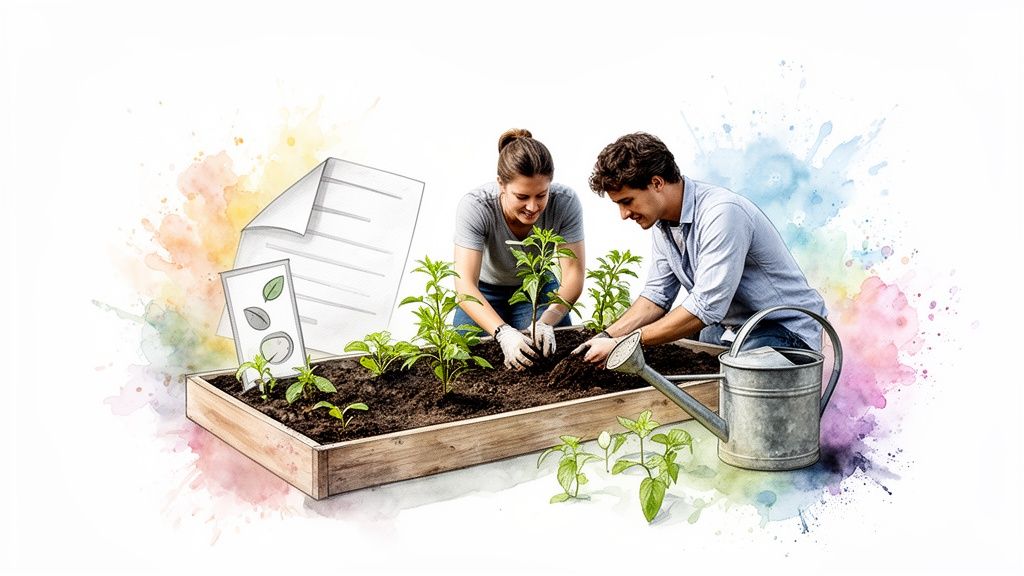
  • Your Guide to Chicago Hazardous Waste Disposal

    Your Guide to Chicago Hazardous Waste Disposal

    Figuring out Chicago hazardous waste disposal is about way more than just making room under the sink. It's about taking care of our neighborhoods, our city. I'm here to turn that dreaded cleaning task into something you can actually feel good about, showing you exactly how to get rid of that stuff safely. You've got the power to protect our city, one old bottle of cleaner at a time.

    Confronting the Hazardous Waste Hiding in Your Home

    A man carefully examines a can labeled "HAZARDOUS" with a Chicago flag under a sink, surrounded by household chemicals.

    I get it. That cabinet crammed with old paint cans, half-used batteries, and mystery chemicals feels like a problem for another day. It’s like those nagging tasks we all put off. For me, as the founder of Litter Caterpillars, that feeling of being swamped by a mess became a turning point.

    My own apartment felt impossible to keep clean. But I learned something profound while picking up trash in Chicago's wildest weather: cleaning up a shared space is far more empowering than staring down your own clutter alone. It gives you a story.

    This guide is the start of your story. I'll walk you through exactly how to handle that hazardous waste—not as a burden, but as an act of personal responsibility and community care.

    A Legacy We Can Change

    This isn't a new problem for our city. In fact, what you and I are dealing with now is a small echo of a much bigger issue from our past. Picture this: back in the early 20th century, Chicago was literally drowning in its own trash, and hazardous waste was just part of the massive, stinking pileup.

    By 1905, the city was churning out a staggering 1,614 tons of refuse every single day, much of it hazardous from industrial runoff and household ashes. Fast forward to the year 2000, and the Chicago area had over 240 Superfund sites, with about one-third right here in the city—hotspots of buried toxins from decades of lazy disposal. You can dig deeper into Chicago's waste history and see how it’s scarred our neighborhoods.

    That history lives beneath our feet. Every battery I recycle, every can of paint you take to a collection site, is a deliberate choice to write a different future for Chicago—one where our water is cleaner and our communities are safer.

    Your Role in a Cleaner Chicago

    So, what does that mean for you and that cabinet of chemicals? It means your small actions are connected to a much bigger mission. You’re not just decluttering; you’re actively participating in reversing a century-old problem.

    Think of it like this:

    • You become a guardian of our water: Preventing a single container of motor oil from going down a storm drain protects Lake Michigan from contamination. Simple.
    • You protect sanitation workers: When you properly dispose of sharps or corrosive chemicals, you're keeping the people who handle our city’s waste safe from injury. It’s about looking out for each other.
    • You inspire others: When you take the time to do things right, it creates a ripple effect. You’re setting a standard for your family, friends, and neighbors.

    Together, we’ll demystify what's 'hazardous,' I’ll show you where to take it, and explain how to do it safely. This isn’t just about following rules. It’s about building a better, healthier city, one responsible choice at a time.

    Identifying Common Household Hazardous Materials

    Okay, let's talk about what’s lurking under your sink or in the back of your garage. I know it can feel overwhelming when you see all those bottles with crazy warning labels and chemical names you can't pronounce. Forget all that for a minute.

    Think of it like sorting your recycling—you just need a few simple categories to make sense of it all. At our cleanups across Chicago, we see everything, and I promise you, almost all of it falls into one of four groups. This is about knowing what you’re dealing with so you can handle it safely.

    The Big Four Categories of Hazardous Waste

    Just remember these four words: Ignitable, Corrosive, Reactive, and Toxic. That’s it. These are the "Big Four," and they cover pretty much every hazardous thing you'll find in your home. I'll break down what they actually mean.

    • Ignitable Items
      This one's simple: these are things that can easily catch fire. You’ve got the obvious stuff like lighter fluid and gasoline, but don't forget about rubbing alcohol, nail polish remover, and a ton of aerosol cans. I remember one cleanup we did near an old garage in West Pullman. We found this rusted can of what looked like old paint. The fumes were so strong and flammable that we had to clear the area immediately. It’s a powerful reminder that even old, forgotten stuff can still be dangerous.

    • Corrosive Substances
      These are the materials that can literally eat through other things, including metal and even your skin. The most common examples are drain cleaners, oven cleaners, and car battery acid. This stuff is powerful, which is exactly why you can't just pour it down the drain or toss it in the regular trash.

    • Reactive Chemicals
      This category is a little trickier. These are chemicals that are fine on their own but become dangerous when they touch something else—like air, water, or other chemicals. The classic example I always use is bleach. Mix it with an ammonia-based cleaner, and suddenly you’ve created toxic chloramine gas. It’s a chemical monster. Many pool chemicals also fall into this group.

    • Toxic Substances
      This is the catch-all category for anything poisonous if you breathe it in, swallow it, or get it on your skin. We're talking pesticides, antifreeze, rat poison, and old paints that might contain lead. These chemicals are designed to be harmful to pests, but they're just as bad for us, our pets, and the local environment.

    You don’t need a chemistry degree to get this right. Just be a detective. Look for signal words on the label like “Danger,” “Warning,” “Poison,” or “Caution.” Those are your clues that an item needs special handling for Chicago hazardous waste disposal.

    A Quick Guide for Spotting These Items

    To make it even easier, I put together a simple reference table. Use this to quickly spot some of the most common things around your house that need a special trip to a disposal facility here in Chicago.

    Your Quick Guide to Identifying Hazardous Waste

    Hazardous Waste Category What It Means Common Household Examples
    Ignitable Can easily catch fire or explode. Lighter fluid, aerosol cans, rubbing alcohol, gasoline, paint thinners.
    Corrosive Can "eat" or burn through materials. Drain cleaners, oven cleaners, car batteries, strong household acids.
    Reactive Can cause explosions or toxic fumes if mixed. Bleach (when mixed with ammonia), pool chemicals, certain fertilizers.
    Toxic Poisonous to people, pets, and the environment. Pesticides, antifreeze, mercury thermometers, lead-based paints.

    Looking at this list, it’s pretty clear why proper Chicago hazardous waste disposal is so important. These aren't just regular trash items; they’re potent materials that you have to manage with care. By taking a few minutes to identify them, you're doing a huge part to protect our city.

    Your Action Plan for Safe Disposal in Chicago

    Okay, you've gone through the garage, the basement, and under the sink. You’ve identified the culprits—the old paint, the mystery cleaners, the dead batteries. Now for the most critical part: getting it out of your house safely and responsibly. This is where we turn that pile of "what-do-I-do-with-this?" into a solid game plan for chicago hazardous waste disposal.

    For us regular Chicago residents, the city has thankfully given us a couple of solid lifelines. You’ve got a permanent drop-off spot and a series of mobile collection events that pop up around town. These are your two best friends in this mission.

    But it’s not as simple as just tossing everything in the trunk and hoping for the best. A little prep work is key. Think of it like packing for a road trip—you want everything sealed up and secure so the journey is safe for you and everyone else.

    Getting Your Hazardous Waste Ready for the Trip

    Before you even think about loading up the car, you need to get everything prepped and ready to go. I've seen some sketchy situations at collection events—leaky bottles, weird chemical cocktails—and it’s all so easily avoided. Let’s not be that person.

    First things first: keep everything in its original container if you can. Those labels have important info. If you have something leaking, don't panic. Just pop the whole container into a bigger, sturdier, leak-proof one. A plastic tub with a lid works perfectly.

    Here's my quick checklist of absolute must-dos:

    • Never, ever mix chemicals. This is the number one rule, and I can't say it enough. Mixing the wrong stuff—like that bleach and ammonia combo we talked about—can create toxic fumes or even start a fire. It’s no joke.
    • Seal it up tight. Double-check that all the lids are screwed on securely. If you’ve got open bags of things like old fertilizer, seal them inside another plastic bag to be safe.
    • Label anything that’s been re-homed. If you put old motor oil in a milk jug (we've all seen it), please grab a permanent marker and label it clearly. It helps the pros at the facility know exactly what they're dealing with.

    This little decision tree can help you visualize the process and figure out what needs special treatment versus what can go in your regular bins.

    A flowchart diagram for household waste disposal, guiding users to hazardous waste facilities or recycling based on toxicity, flammability, and corrosiveness.

    As the chart shows, once you flag something as toxic, flammable, or corrosive, it's on a one-way trip to a specialized facility, far away from your everyday trash and recycling.

    Navigating Chicago's Disposal Options for Residents

    For household hazardous waste, you've got two main choices here in the city. The big one is the permanent Household Chemicals & Computer Recycling Facility. It's an incredible resource and takes a massive range of stuff.

    Then there are the mobile collection events. The city sets these up in different neighborhoods throughout the year, which is a lifesaver if you can't easily trek to the permanent site. Just keep an eye on the city's schedule to see when one is coming your way.

    My Personal Tip: Get there early! These events can get swamped. I always pack my car the night before so I can just get up and go. A little planning can save you a ton of time sitting in line.

    Let's walk through a real-life scenario. Say you just finished a bathroom reno. You're left with two half-empty cans of paint thinner, some old corrosive tile cleaner, and a few cans of spray paint. Your plan is simple:

    1. Check that every container is sealed up tight.
    2. Stick them upright in a cardboard box in your trunk so they won't tip over.
    3. Look up the hours for the permanent facility or find the date for the next mobile event.
    4. Drive over, and the experts will take it from there.

    It’s really that easy. Of course, not everything is considered hazardous waste. For all your normal plastics, paper, and glass, you'll need to know your local recycling rules.

    A Different Path for Local Businesses

    Now, if you’re a business owner, listen up, because the rules are completely different for you. The city's residential programs are strictly for residents. Any commercial business, even a tiny one, has to follow a separate set of regulations.

    Why the split? It all comes down to volume and liability. Businesses tend to produce way more waste, and federal laws like the Resource Conservation and Recovery Act (RCRA) demand a strict "cradle-to-grave" tracking system for any commercial hazardous materials.

    This means you can't just drop your shop's old chemicals off at a community collection day. You’ll need to hire a permitted hazardous waste hauler. These are state-licensed companies that specialize in safely transporting and disposing of this stuff. A quick search for "Illinois permitted hazardous waste haulers" will point you to the right people who can help you stay compliant. It’s an extra step, but it’s a crucial one for keeping our city safe and clean.

    Handling Electronics, Paint, and Medications

    Illustrates e-waste like smartphones and batteries, and hands disposing items into a paint-splattered can, symbolizing different waste types.

    Some stuff just doesn't fit the normal recycling bin or trash can. I'm talking about the junk drawer full of old phones, the half-used paint cans in the garage, or the expired prescriptions in your medicine cabinet. These things need their own special game plan because they carry unique risks if you just toss them.

    This is your guide for those tricky items. I'll get into why the heavy metals in your old electronics (e-waste) are so nasty for landfills. I'll also clear up the confusion around latex paint and why you often have to dry it out first.

    Most importantly, we’ll cover the safest ways to get rid of sharps and unused prescription drugs. This isn't just about following rules; it's about being mindful. Proper disposal prevents unseen harm and makes sure our trash doesn't become someone else's problem down the line.

    The Problem with E-Waste and Batteries

    Think about that old laptop or phone you’ve got stashed away. It's not just plastic and glass—it’s a tiny vault of valuable materials mixed with some seriously toxic stuff. I'm talking lead, mercury, and cadmium, heavy metals you absolutely do not want seeping into our soil and groundwater.

    When e-waste gets dumped in a landfill, those metals can leach out, creating a long-term pollution headache that's a nightmare to clean up. This is exactly why Illinois law bans electronics from landfills. It’s on all of us to keep this stuff out of the regular trash.

    So, what’s the right move for you?

    • City Recycling Programs: The Household Chemicals & Computer Recycling Facility is your best bet for most e-waste, from old computers and TVs to printers and mice.
    • Retailer Take-Back Programs: Big stores like Best Buy and Staples often have their own recycling programs. They’ll usually take a wide range of electronics, even if you didn't buy them there.
    • Specialized Recyclers: For things like batteries, you need to find specific drop-off spots. Lucky for you, we’ve already done the legwork. You can find everything you need in our guide on how to recycle batteries in Chicago.

    Navigating Paint Disposal

    Paint is one of the things people ask me about most. For Chicago hazardous waste disposal, the rules are different depending on what kind of paint you have, so I'll break it down.

    Oil-based paints (also called alkyd) are always hazardous waste. They're full of flammable and toxic solvents, so they must go to a hazardous waste collection site. No exceptions.

    Latex (water-based) paint is a different animal. Because it’s not technically hazardous, you have another option. If the can is less than a quarter full, you can just dry it out and toss it in your regular trash. Just pop the lid off and leave it in a well-ventilated spot away from kids and pets. Pro-tip: add some kitty litter or shredded newspaper to speed things up.

    My personal rule of thumb is simple: If you can't or don't want to deal with drying it out, just take it to the hazardous waste facility. It's the safest, most foolproof way to handle any kind of paint, and you'll know you did the right thing.

    Safely Handling Medications and Sharps

    This is where our personal responsibility really hits home, directly impacting public health and the safety of sanitation workers. Flushing old pills seems easy, but it pumps pharmaceuticals into our water supply—stuff that treatment plants aren't designed to filter out.

    For any unused or expired meds (prescription or over-the-counter), your best bet is a designated drop-box. You can find them at many police stations and pharmacies around Chicago. This keeps them secure and ensures they’re destroyed properly.

    Sharps—needles, syringes, and lancets—are a serious physical threat. They can puncture sanitation workers, spreading disease. Never, ever throw loose sharps in the trash.

    Here’s how you do it right:

    1. Put used sharps in a strong, puncture-proof plastic container with a secure lid. An old laundry detergent bottle or coffee can works great.
    2. Clearly label the container: "SHARPS – DO NOT RECYCLE."
    3. Once the container is about three-quarters full, seal it up with heavy-duty tape.
    4. You can then take this sealed container to a designated sharps collection site, often found at hospitals, clinics, or some fire stations.

    Cutting corners on waste disposal has a dark history in Chicago. The old Northwest Waste-to-Energy plant, for example, failed toxicity tests 29 out of 32 times, yet the city still dumped its ash in regular landfills. That 23,000 tons of potentially toxic ash would have cost an extra $4.6 million a year to handle correctly—a decision that sparked a landmark lawsuit. You can learn more about Chicago's long battle with its trash by reading this historical overview. By taking these extra steps, you're choosing a better, safer path for our city.

    From Personal Action to Community Transformation

    You actually did it. You stared down that messy cabinet, wrangled all those mystery chemicals, and got that hazardous waste out of your life for good.

    Take a second and hold onto that feeling. That shift from having a problem you didn’t know how to solve to feeling empowered and in control? That’s exactly what drives us at Litter Caterpillars.

    Your personal act of cleaning up a single space is the spark. It's the same fire that transforms an entire neighborhood.

    The Power of Showing Up

    When you show up for your neighborhood, week after week, rain or shine, you build more than just clean streets. You build consistency. You build bravery. You build real connections with people who care just as much as you do.

    It’s one thing to handle your own mess. It's something else entirely to reclaim a shared space that everyone had given up on.

    Think about the feeling you got solving your own chicago hazardous waste disposal problem. Now, imagine multiplying that by a dozen neighbors, all working together on a neglected block. That’s where the real magic happens.

    From Empty Lot to Caterpillar Park

    Let me tell you a story. There was this forgotten, empty lot in Englewood. You know the type—a place people just walk past without a second glance, another sad symbol of neglect. We saw something different. We saw potential.

    So we did something a little crazy. As a group of volunteers armed with trash grabbers and a shared vision, we decided to buy it. We pooled our efforts, figured out the city auction process, and we won. We actually bought an empty lot.

    Today, we're turning that patch of dirt into Caterpillar Park. This isn't just about planting flowers. It’s living proof that small, dedicated actions, repeated over and over, lead to incredible, tangible change. A park is literally growing from the same spirit it took for you to clean out your garage.
    This is our invitation to you. If you felt good taking care of your own space, just imagine what you can accomplish with a team. Imagine the pride in looking at a vibrant community park and knowing you helped build it from the ground up.

    Cleaning with a Deeper Purpose

    Our mission to clean every corner of Chicago is also about confronting a hard truth. Hazardous waste in our city has always carried a heavy legacy of racial and social inequity. An analysis from the University of Chicago showed that non-White majority zip codes have shouldered a disproportionate burden of toxic releases since 1990.

    This history was fueled by hazardous landfills crammed onto the Southeast Side. We counter this by showing up for all 50 wards, cleaning every neighborhood with a three-year track record of weekly consistency—building unity among all Chicagoans. You can read more about the research into Chicago's environmental justice challenges.
    This is why our work matters so damn much. We don't just pick up litter; we work to heal divides and bring care to the places that need it most. We show every community that they are seen, valued, and that we are all in this together.

    Each cleanup is a statement. It says that every block deserves to be clean and safe, and that we, the residents, have the power to make it happen. You can see the impact for yourself and learn more about our approach to cleaning up trash throughout Chicago.

    Your journey started with a single decision to handle your waste responsibly. Now, you have a choice. Take that incredible momentum and join a larger movement. Turn your personal victory into a shared triumph for our entire city. We’re out there every weekend, and I'd love for you to be a part of it.

    Your Chicago Hazardous Waste Disposal Questions Answered

    Got questions? Good. It means you’re taking this seriously. I see it every week at our cleanups—people start picking up litter, then they get curious about the really nasty stuff and how to handle it right. These are the details that matter.

    Based on all the questions I get, I've put together the ones that come up most often about chicago hazardous waste disposal. My goal is simple: give you straight answers so you can handle this stuff with total confidence.

    Can I Put Small Amounts of Hazardous Waste in My Regular Trash?

    I get this one a lot. It’s so tempting to think, "It's just a few old batteries," or "This bottle of drain cleaner is almost empty, what's the harm?" But let me put it this way: it’s like adding one drop of poison to a huge glass of water.

    One drop doesn't seem like much, but when thousands of us add our own "one drop," it becomes a massive problem. That toxic sludge builds up in our landfills and seeps into the groundwater we all depend on. It’s a group effort; every single battery and bottle you keep out of the regular trash makes a real difference.

    What Happens If I Get Caught Disposing Waste Improperly?

    Honestly? The chances of the trash police knocking on your door for tossing a bottle of bleach are pretty slim. But that’s not the point. The real consequence isn't some fine you have to pay.

    The real cost is the damage we don't see. It's the sanitation worker who gets a chemical burn, the fluorescent bulb that shatters and releases mercury vapor, or the slow poisoning of Lake Michigan.

    The true cost is paid by our environment and our community. Following the rules for Chicago hazardous waste disposal isn’t about avoiding a slap on the wrist; it’s about actively protecting the city we all call home.

    Why Can’t Businesses Use Residential Drop-Off Sites?

    This is a huge point of confusion. The city's free drop-off sites are funded and built to handle the kind of waste a family produces, not the volume that comes from even a small business. The laws for businesses, like the Resource Conservation and Recovery Act (RCRA), are way stricter.

    Businesses have to follow what's called a "cradle-to-grave" system. Think of it like a chain of custody for evidence in a crime scene. It tracks that hazardous material from the moment it leaves your shop to its final, safe disposal. This process is tough for a reason—it prevents illegal dumping and makes sure everyone is accountable.

    What Is the Single Most Dangerous Item I Might Have?

    If I had to pick just one thing that gives me the chills, it’s mercury. You find it in old-school thermometers, some thermostats, and those curly fluorescent light bulbs. Just one gram of mercury—about the amount in an old thermometer—can contaminate a 20-acre lake and make the fish toxic to eat.

    This stuff is a powerful neurotoxin. It’s so dangerous that if you break something with mercury in it, the EPA has a whole emergency protocol for cleanup. You have to air out the room, and you can never use a vacuum. If you find anything with mercury, treat it like the poison it is and get it to a proper facility. It’s that serious.

    How Can I Stay Updated on Mobile Collection Events?

    The most reliable source is the official City of Chicago website. They post the schedule for mobile drop-off days there first.

    But here are a couple of other tricks I use to stay in the loop:

    • Follow local community pages: Neighborhood Facebook groups are gold for this. People are always sharing reminders. Our group does, too!
    • Sign up for your alderperson's newsletter: This is the best way to get super local info, including ward-specific cleanup days and events.

    A little bit of planning makes it so much easier to do the right thing. Your effort is what builds a cleaner, safer Chicago for everyone.


    Ready to turn that personal effort into something bigger? Join Litter Caterpillars this weekend. We're out there every single week, making a real difference one block at a time. It’s the best way I know to meet people who actually care and feel the power of what we can do together. Find our next event and sign up at https://www.littercaterpillars.com.

  • Your 2026 Guide to the Top 12 Recycling Centers Chicago Volunteers Trust

    Your 2026 Guide to the Top 12 Recycling Centers Chicago Volunteers Trust

    My life felt like a cluttered garage. You know the one. Full of things I couldn't part with. An old bike tire wasn't just rubber; it was that one perfect summer afternoon. Every piece of junk had a story, a weight that pulled me down, even if it was just a few ounces. It’s funny how memories can feel like anchors.

    Then, a sudden storm in my personal life forced me to clean house. I realized I had to build something new, something that demanded the very things I’d always dodged: consistency, cleanliness, courage. And just like that, Litter Caterpillars crawled into existence.

    I remember our first cleanup. Three of us, caught in a freak Chicago hailstorm. We huddled under an oak tree, soaked and shivering, watching Ubers cancel on us one by one. And in that miserable, beautiful moment, a thought struck me like lightning. Cleaning up a stranger's mess is a thousand times easier than facing your own. It was fun. It became a story. We weren't just picking up trash anymore; we were writing a new chapter.

    That day, I learned that tackling a huge, messy problem together makes you stronger. A huge part of that is knowing what to do with everything you find. It’s not just about bagging it. It's about giving it a second chance. This guide isn't just a list of addresses for you. It's my map, our playbook for turning forgotten waste into a resource. These are the very recycling centers Chicago needs to complete the circle, to make our hard work mean something. Think of this as your secret weapon for making a real, lasting mark on our city, one bottle, one box, one piece of forgotten metal at a time.

    1. Recycle by City – Chicago: Your Official Blue Cart Rulebook

    Before you haul anything anywhere, you have to start here. This is your foundation. Think of this website as the official rulebook for the game of Chicago recycling. It’s the ground truth for everyone with a blue cart, cutting through the fog of "I think this is recyclable?" that so often sends our good intentions straight to the dump. I pull it up on my phone constantly. It’s my North Star for sorting.

    Recycle by City – Chicago: Your Official Blue Cart Rulebook

    I tell every Litter Caterpillars volunteer that this resource is non-negotiable. When you’re out there leading a cleanup and someone holds up a greasy pizza box or a weird plastic clamshell, you become the judge and jury. You can settle the debate instantly. The “What Goes Where” search tool is my favorite part; it’s like having a recycling guru in your pocket, whispering the right answer. It makes sure our efforts actually feed the recycling stream, not just clog it with trash. It’s free, it works on your phone, and it’s the first step to understanding the system.

    Key Features & Assessment

    Feature My Take
    "What Goes Where" Tool Your secret weapon for on-the-spot checks. No more "wish-cycling."
    Pickup Schedules Look up your blue cart day by address. Perfect for planning.
    Drop-Off Center Info All the details for the city's Household Chemicals & Computer Recycling Facilities (HCCRF).
    • Pros: It’s the official word, straight from the city. The mobile site is clean and dead simple to use.
    • Cons: It only covers residential blue carts and city-run spots, so you won't find help for commercial needs or specialty items here.

    Website: https://www.recyclebycity.com/chicago

    2. Chicago Recycles (Recycle Coach portal)

    If Recycle by City is the rulebook, think of Chicago Recycles as your personal coach. This isn't just a static website; it’s an active partner. You plug in your address, and it builds a personalized game plan just for you. A calendar. Pickup reminders. Hyper-specific instructions. It’s like having a friend who texts you, "Hey, don't forget the blue cart goes out tomorrow!"

    Chicago Recycles (Recycle Coach portal)

    I love this tool for its pure, simple convenience, especially when I'm organizing a weekend cleanup. You can quickly check pickup days for any address we're targeting, which means the bags we collect don't sit on the curb for a week like sad, forgotten soldiers. The "What Goes Where" search is just as powerful as the main city site, but it's wrapped in a slicker package. This portal also becomes a star during special city events, like the holiday tree recycling program. It’s the perfect digital sidekick for your recycling life, whether for your own home or for a massive neighborhood effort.

    Key Features & Assessment

    Feature My Take
    Address-Based Calendars Takes all the guesswork out of your pickup day. A lifesaver if you're new to a neighborhood or helping out elsewhere.
    Collection Alerts The app pings you so you never miss a collection. It's surprisingly motivating.
    "What Goes Where" Tool A fast, reliable search for tricky items, right in the app or on the site.
    • Pros: It’s an official city tool, totally free, and easy to use. The personalized alerts make it incredibly practical.
    • Cons: This is purely for information and scheduling. It won't help you find private recycling centers in Chicago or book any services.

    Website: https://chicagorecycles.org

    3. Illinois EPA – Household Hazardous Waste (HHW) Collections

    Then you find the weird stuff. The really nasty stuff. A half-empty can of paint from the 90s. Mysterious cleaning chemicals under the sink. A mountain of dead batteries. Your blue cart can't help you here. This is when you turn to the Illinois EPA's website. I see it as the hazardous materials command center, the place you go to learn how to handle the things that could seriously poison our corner of the world. It’s the official source, giving you the confidence that you’re doing it right.

    Illinois EPA – Household Hazardous Waste (HHW) collections

    For Litter Caterpillars, this page is our mission control when we organize a special collection day for electronics or hazardous materials. We use it to lock down the hours and exact location of Chicago's permanent facility on North Branch Street before we even tell anyone about the event. The list of what they take—and what they don't—is critical. It stops us from collecting a pile of, say, latex paint only to find out it’s not accepted (pro-tip: you have to dry it out first!). This site makes our specialized efforts smart and effective.

    Key Features & Assessment

    Feature My Take
    Official HCCRF Info The final word on Chicago’s permanent HHW facility hours and address.
    Statewide Site Listings Great for finding other drop-off points if the Chicago location is out of your way.
    Accepted Materials List A clear, authoritative guide on what you can and cannot bring. Plan your attack with this.
    • Pros: It’s an authoritative, state-level resource that’s regularly updated. It clears up the confusing rules around hazardous and electronic waste.
    • Cons: It's a library, not an interactive tool. You might still need to call the facility if you have a really weird item.

    Website: https://epa.illinois.gov/topics/waste-management/waste-disposal/household-hazardous-waste/collections.html

    4. LRS (Lakeshore Recycling Systems): The Big-Project Powerhouse

    Sometimes you graduate from bags to mountains. A gut rehab. A massive spring cleaning. Or when a Litter Caterpillars cleanup uncovers a huge illegal dump site. Your blue cart will just laugh at you. That's when you call in the big guns. That’s LRS. Think of them as the special forces of recycling for businesses, big apartment buildings, and huge community projects. This isn't a place you drop off your weekly cans; it's who you call for a full-scale assault on waste.

    I remember we once coordinated a vacant lot overhaul in Englewood that needed a massive roll-off dumpster. LRS was the company that made it happen. Their website is your portal to these larger services, from ordering construction and demolition recycling containers to setting up ongoing commercial pickups. They're a key part of the city’s whole recycling machine, running one of the major material recovery facilities (MRFs) where everything gets sorted. Knowing about them helps you see the entire picture of how our city's waste gets a new life.

    Key Features & Assessment

    Feature My Take
    Commercial & Construction Recycling Essential for businesses and contractors who need a reliable, scheduled service.
    Roll-Off Container Ordering The go-to solution for huge cleanups, renovations, or community projects.
    Material Recovery Facility (MRF) They operate key infrastructure, making them a pillar of Chicago's recycling system.
    Service Scalability They handle everything from small business bins to giant industrial compactors.
    • Pros: An established local player with immense capacity for big jobs. They fill a critical gap the city can't.
    • Cons: Not a public walk-in place for you and me. All services are by contract and need a quote, so it’s not for casual drop-offs.

    Website: https://www.lrsrecycles.com/

    5. GreenWay Recycling Services: Get Paid for Your Recycling Efforts

    Your garage is bursting with cardboard from a move. You've collected a mountain of plastic bottles after a block party. The blue cart isn't big enough. You need a place like GreenWay Recycling Services. This is one of the few real-deal recycling centers in Chicago where you, a regular person, can drive right up, weigh your materials, and sometimes even walk away with cash in your pocket. It’s a total game-changer.

    GreenWay Recycling Services

    I’ve brought truckloads here after our biggest Litter Caterpillars events, especially when we’ve sorted out a huge volume of good, clean cardboard. Driving onto their scale feels powerful. It's like you’re pulling back the curtain and seeing the industrial heart of recycling. It reminds you that these materials aren't just trash; they have real value. Seeing that firsthand is incredibly motivating. Their website is your first stop to check their hours—thankfully including Saturdays—and see what they're buying.

    Key Features & Assessment

    Feature My Take
    Public Drop-Off & Scale A drive-through process for dropping off large volumes of recyclables.
    Material Purchasing They buy qualifying materials like cardboard and certain plastics, with rates that change with the market.
    Extended Hours Open on Saturdays, which is a massive help for weekend warriors like us.
    • Pros: You can get paid for your work. Their central location is convenient, and the process is easy for large quantities.
    • Cons: It’s an industrial site, so you have to follow their safety rules. The list of what they buy and how much they pay can change, so always check their site first.

    Website: https://www.greenwayrecycles.com/

    6. Sims Metal – Chicago (Smith Park yard)

    When our cleanups unearth heavy-duty stuff—old pipes, rusty fences, a dead washing machine—it’s a whole different ballgame. This isn’t just about diverting waste from a landfill. It's an opportunity. You can turn that trash into treasure. That's where a professional scrap yard like Sims Metal becomes your secret weapon. You shouldn't think of it as just a drop-off; it’s a fundraising engine fueled by metal.

    Sims Metal – Chicago (Smith Park yard)

    I've organized community scrap drives with our Litter Caterpillars volunteers, and the experience at Sims is surprisingly simple. You haul in your metal, they weigh it on a giant scale, and you get paid on the spot. It's an incredible feeling to watch a pile of blight from a vacant lot transform into actual money that buys more gloves and bags for the next event. Their website is your pre-game strategy guide; use it to see what they accept so you can sort everything and get the biggest payout. It’s one of the most direct ways you can see your hard work pay off.

    Key Features & Assessment

    Feature My Take
    Public Scrap Buying Getting paid for scrap is a game-changer for fundraising.
    Accepted Materials List You have to check their site before you go to avoid rejected items. Pre-sorting is key.
    Location & Hours Convenient weekday and Saturday hours make it accessible for weekend cleanups.
    • Pros: It’s a reputable, professional operation. They offer a transparent way to make money from metal waste. Great for big cleanups.
    • Cons: This is only for metal. It's not a solution for your everyday plastics, paper, or glass. Scrap prices also change every single day.

    Website: https://www.simsmm.com/locations/chicago-artesian/

    7. United Scrap Metal (Cicero)

    Sometimes, you find more than just bottles and cans. When we tackle illegal dump sites or help people clear out alleys, we find metal. Piles of it. Old appliances, rusty pipes, discarded construction materials. My brain immediately switches from the blue cart to a place like United Scrap Metal. This isn't your normal recycling center. It's a place where junk metal transforms from a neighborhood eyesore into actual cash, money we can pour right back into our community projects.

    United Scrap Metal (Cicero)

    They're just outside the city in Cicero, but their public yard and pickup services make them a vital resource for all of us in Chicagoland. I've used their website to figure out exactly what kinds of metals they accept and to get the details I need to schedule a pickup for a really big haul. There’s something empowering about taking a pile of what someone considered worthless trash and watching it get weighed, valued, and properly recycled. This is one of the best recycling centers Chicago volunteers can use for a massive metal clear-out.

    Key Features & Assessment

    Feature My Take
    Public Retail Yard Great for dropping off metal you collected during a cleanup and getting paid for it.
    Commercial Programs For bigger, ongoing projects, this is how you can form a more formal partnership.
    Pickup Scheduling A lifesaver when you’ve collected too much scrap to fit in a volunteer's pickup truck.
    • Pros: They pay you for your scrap metal, which can be a great fundraising source. Their capacity is huge, and they offer convenient pickups for large loads.
    • Cons: It's a commercial operation, so wait times and rates can vary. I always call ahead to confirm the details before I drive over with a full load.

    Website: https://unitedscrap.com/

    8. COM2 Recycling Solutions

    E-waste is one of the biggest monsters we have to face. Finding a place you can trust with your old electronics can feel like a quest. COM2 Recycling Solutions attacks this problem head-on with a process so simple and clear, it removes all the usual excuses. What I love about their website is the transparency. They built an online checkout system for dropping off items, so you know exactly what you'll pay, if anything, before you even leave home. No surprises. No mystery fees.

    COM2 Recycling Solutions

    This system is a revolution for our neighborhood e-waste drives. Instead of guessing, we can point everyone to their site to pre-pay for their old TVs or monitors. It makes our event logistics so much smoother. Knowing they are a certified recycler gives me peace of mind that the devices we collect are being handled with integrity, not just dumped in a landfill overseas. It’s a professional-level solution that’s open to every single resident, making it an essential tool for any group serious about tackling electronic waste in Chicago.

    Key Features & Assessment

    Feature My Take
    Online Checkout/Pre-payment Brilliant. You pay for your TV/monitor recycling online and just bring the receipt. It simplifies everything.
    Free Core E-Waste Recycling They take computers, laptops, tablets, phones, and more for free, which covers most of what you have.
    Clear Fee Structure All potential costs for bulky items are posted right on their website. The transparency is a breath of fresh air.
    • Pros: The pre-payment system is unique and incredibly smart. Their certified status means they do things the right way.
    • Cons: You have to unload your own car, so be ready to lift. The program is only for the electronics listed on their site.

    Website: https://com2recycling.com/checkout.php

    9. AVA Recycling: The E-Waste Professionals with Security in Mind

    When you're dealing with electronics, it's about more than just keeping heavy metals out of the ground. It's about data security. AVA Recycling understands this perfectly. For our Litter Caterpillars events, especially when we partner with local businesses or after a big neighborhood garage sale, we end up with a pile of old computers, monitors, and printers. AVA is my go-to recommendation for anyone worried about the personal info left on those old hard drives. They don't just recycle your hardware; they vaporize your digital ghost.

    AVA Recycling

    What makes them different is their professional touch. They offer scheduled pickups, which is a godsend when you’re dealing with bulky items like an old tube TV or a whole office's worth of desktops. They can even give you certificates of data destruction, which is official proof that your sensitive information was handled properly. This professional-grade service, available for both you and for businesses, makes AVA one of the most trusted e-waste recycling centers in Chicago when you need that extra layer of security and convenience.

    Key Features & Assessment

    Feature My Take
    Scheduled Pickups Incredibly convenient for large quantities or heavy items like TVs and appliances.
    Secure Data Destruction NIST-compliant data wiping with optional certificates. This is a huge peace-of-mind feature.
    Broad Coverage They serve the entire Chicagoland area, making them accessible for almost any project.
    • Pros: They combine secure e-waste recycling with convenience. The certificate of destruction is a major plus for businesses or anyone with sensitive data.
    • Cons: This isn't a free service. Pricing is based on a quote, and certain items like old CRT TVs will have a fee, so you need to plan ahead.

    Website: https://www.avarecycling.com/chicago-recycling

    10. Call2Recycle – Battery drop-off locator

    You’ve found one. A rogue battery during a cleanup. It feels like a tiny, hazardous hot potato. You can't put it in the blue cart, and you definitely can't toss it in the trash where it can leak or start a fire. This is where Call2Recycle becomes one of my most important digital tools. It’s not one single center, but a powerful map that turns places you already go—like Home Depot or Staples—into convenient drop-off points for rechargeable batteries.

    This website is a game-changer for our post-cleanup sorting parties. Instead of hoarding old laptop batteries or power tool cells until someone can make a special trip, we can instantly find a dozen nearby drop-off spots. I especially appreciate their clear instructions on how to safely prep batteries for recycling, like taping the ends. It’s a simple step that prevents fires and shows a level of care that I think reflects our whole mission. For anyone searching for recycling centers in Chicago specifically for batteries, this is where you start.

    Key Features & Assessment

    Feature My Take
    Drop-Off Locator Type in a zip code and get an instant map of participating stores. Simple and brilliant.
    Safe Handling Guides Essential for preventing fires. Their visual guides make it easy to do it right.
    Battery ID Resources Helps you figure out what kind of battery you've got and if they'll take it.
    • Pros: It’s a free, massive network that makes responsible battery disposal incredibly easy. The safety advice is top-notch.
    • Cons: Not all locations take every type of battery, and single-use alkaline battery acceptance can be spotty, so you might need to check with the store first.

    Website: https://www.call2recycle.org/recycle-your-batteries/

    11. Earth911 – Recycling Locator

    The city’s blue cart program is great, but it has its limits. Earth911 is the search engine that takes over where the official resources stop. I think of it as the wise old librarian of recycling. You can bring it your weirdest problems—a pile of old batteries, a can of latex paint, a worn-out yoga mat—and it pulls out a map showing you exactly who in your area wants it. It’s my secret weapon for finding specialty recycling centers in Chicago beyond the usual suspects.

    For Litter Caterpillars, this tool is a lifesaver when we find hazardous or unusual stuff during a cleanup. Instead of just shrugging and bagging something questionable for the landfill, we can quickly search Earth911 by material and zip code. This helps us responsibly handle things that don't belong in a blue cart, like single-use batteries, making our cleanups as sustainable as they can be. For example, I used it to find drop-off points for a bag of old batteries we collected, which you can read more about our battery recycling process.

    Key Features & Assessment

    Feature My Take
    Material & Zip-Code Search The core function is incredibly powerful. You can search for almost anything, from aerosol cans to Ziploc bags.
    Center Details & Accepted Items It gives you addresses, hours, and contact info for each location, saving you a ton of research.
    Educational Articles Great for learning the "why" behind recycling certain things, not just the "where."
    • Pros: The massive size of its database for specialty items is unmatched. It’s an essential tool for finding private recyclers who handle what the city can’t.
    • Cons: Because it's a national database, sometimes the listings can be out of date. I always, always call a place to confirm before I drive over.

    Website: https://search.earth911.com

    12. Resource Center (Chicago)

    If you're looking for a recycling partner with a deep, soulful connection to Chicago, you've found it. The Resource Center is it. They started way back in 1975. This nonprofit isn't just a service; it's part of the city's DNA. I think of them as the seasoned community organizers of the recycling world, focused on a mission, not just on hauling stuff. Their work fits perfectly with the Litter Caterpillars idea of creating real, grassroots change that lasts.

    Resource Center (Chicago)

    For me, the Resource Center is the ideal partner for bigger community events or for setting up a new neighborhood recycling program. When we're planning a big cleanup and need more than just a place to drop bags, this is who I think of. They get the subtleties of community engagement and zero-waste projects from the ground up. Partnering with them means you're not just hiring a hauler; you're investing in a local organization that has been fighting the good fight for sustainability in Chicago for decades.

    Key Features & Assessment

    Feature My Take
    Community Diversion Programs Their expertise goes way beyond bins, focusing on education and community-based solutions.
    Nonprofit Mission Working with them means our efforts support a local nonprofit, not some corporate bottom line.
    Zero-Waste Initiatives Great for event planning when you're trying to have a minimal impact on the landfill.
    Local Focus They have an institutional knowledge of Chicago's neighborhoods that is priceless.
    • Pros: Deep local roots and a mission-driven approach. They're experienced in community programs, making them a perfect partner for events.
    • Cons: Their website and programs can be in flux because of organizational changes. You absolutely have to call to check on their current services, hours, and availability.

    Website: https://theresourcecenterchicago.org/

    Comparison of 12 Chicago Recycling Centers

    Resource Core offering Standout feature ✨ Quality / Access ★ Best for 👥 Cost / Value 💰🏆
    Recycle by City – Chicago Official City recycling guide; address-based rules & HCCRF info Item-level "What Goes Where" + HCCRF details ✨ ★★★★★ — authoritative, mobile-friendly Residents seeking official rules 👥 Free 💰 — official source 🏆
    Chicago Recycles (Recycle Coach) City-backed schedule + app reminders & guidance App + tailored pickup calendars & alerts ✨ ★★★★ — easy onboarding, localized Residents who want reminders & calendars 👥 Free 💰
    Illinois EPA – HHW collections State listing of HHW sites, hours, and policies Statewide HHW site options & policy updates ✨ ★★★★★ — authoritative for hazardous items Residents with hazardous/electronic waste 👥 Free 💰 — authoritative guidance 🏆
    LRS (Lakeshore Recycling Systems) Commercial hauler; roll-off dumpsters & MRF services Scalable commercial & construction services ✨ ★★★★ — large local operator Businesses, multi-unit buildings, projects 👥 Quote/contract pricing 💰
    GreenWay Recycling Services Public drop-off MRF; buys recyclables; dumpsters Public scale house + possible rebates/payments ✨ ★★★ — convenient drop-off, bilingual support Residents & small businesses wanting drop-off 👥 Possible rebates; fees vary 💰
    Sims Metal – Chicago Public scrap-metal yard; instant pay by weight Fast pay-for-scrap for many metals ✨ ★★★★ — reputable, transparent pay Metal-heavy cleanups & fundraising drives 👥 Market-based pay 💰🏆
    United Scrap Metal (Cicero) Regional scrap yard; drop-off & scheduled pickups Woman-owned, pickup dispatch available ✨ ★★★ — good capacity; variable wait times Sellers of scrap metal & large loads 👥 Market rates; call ahead 💰
    COM2 Recycling Solutions Certified e-waste recycler with online checkout Posted fees & pre-payment for TVs/monitors ✨ ★★★★ — transparent pricing for e-waste Residential e-waste drop-offs 👥 Posted fees; receipts provided 💰
    AVA Recycling E-waste pickup + secure data destruction NIST-compliant data destruction certificates ✨ ★★★★ — broad service area & documentation Businesses/residents needing secure disposal 👥 Quote-based; item fees apply 💰
    Call2Recycle – Battery locator Locator for battery drop-off sites & prep guidance Retail network + battery safety prep tips ✨ ★★★★ — widely available network Consumers with rechargeable batteries 👥 Free at participating stores 💰
    Earth911 – Recycling locator National recycling search by material type Broad specialty coverage & education ✨ ★★★ — comprehensive but listings can lag Users seeking specialty recyclers or comparisons 👥 Free 💰
    Resource Center (Chicago) Nonprofit recycling & community diversion programs Mission-driven partnerships & zero-waste support ✨ ★★★ — deep local roots; program variability Events, nonprofits, community partnerships 👥 Variable; mission-aligned value 💰

    Join Us: Let's Go Far, Together

    We've just walked through a hidden map of our city. This isn't a map of 'L' stops or tourist spots. It’s a map of renewal, a network of places from the City of Chicago's official blue cart program to specialized powerhouses like Sims Metal and COM2 Recycling Solutions. Looking at this list, you can see that recycling is so much more than just a bin on the curb.

    It’s a city-wide circulatory system. It's powered by people who believe that waste is just a resource in the wrong place. Each of the recycling centers in Chicago that we explored is like a different organ, each with a special job. One handles the city’s metallic skeleton, another its electronic brain, and yet another safely processes the toxic stuff we can’t just toss away.

    When you know how to navigate this system, something inside you shifts. You’re no longer just a person throwing things away; you become an active participant in our city’s health and rebirth.

    From Information to Action

    I remember feeling overwhelmed when I first started this journey. I had a bag full of dead batteries, a broken laptop, and a can of old paint, and I felt paralyzed. Where do I even start? This guide is the answer I wish I had back then. It’s a tool. A compass.

    • For everyday items: Rely on your blue cart and the Chicago Recycles portal. It’s your foundation for building great habits.
    • For the tricky stuff: Bookmark the Illinois EPA's HHW page and the Earth911 locator. These are your go-to resources for those "what do I do with this?" moments.
    • For large or specialized loads: Places like LRS, GreenWay, and United Scrap Metal are your heavy hitters. They’re built for the big jobs, turning what looks like junk into valuable raw materials.

    Think of it like learning to cook. At first, you follow a recipe exactly. But soon, you understand how the ingredients work together. You start to improvise. To create. This guide is your recipe book. The more you use it, the more you’ll understand the rhythm of recycling in Chicago, and the more confident you'll become in your ability to make a real difference.

    More Than Just Trash

    Remember Tom Sawyer convincing his friends that painting a fence was a grand adventure? I believe cleaning our city is one of the most fun and rewarding things you can do. I can tell you from experience, it’s about so much more than picking up litter.

    It’s about taking tangible pride in our home. It’s about showing up, rain or shine, and doing something real with your hands and your heart. Most of all, it’s about the incredible friendships you forge when you're working side-by-side for a common goal. I’ve met some of my closest friends while sorting recyclables and clearing out a neglected alley.

    We are the Litter Caterpillars because we know we’re not perfect. We’re all just trying to transform, to grow into something better. Through service, you learn to trust yourself, forgive your mistakes, and evolve. This guide to recycling centers in Chicago is a powerful tool, but the real power comes from you. It comes from your decision to show up. To be brave. And to be kind.

    There’s an old saying I love: "If you want to go fast, go alone. If you want to go far, go together." We want to go far. Come with us.


    Ready to turn this knowledge into action and meet amazing people along the way? Join Litter Caterpillars this weekend. We use this guide every week to properly dispose of everything we collect, turning neighborhood cleanups into true recycling missions. Find your community and make a real impact with us at Litter Caterpillars.