Author: Kevin Tao

  • Overcoming Fear of Failure: Real Strategies to Thrive

    Overcoming Fear of Failure: Real Strategies to Thrive

    Beating your fear of failure isn't some dramatic, life-altering leap of faith. It's more like a small, stubborn step forward. You've got to learn to take action even when that voice in your head screams about all the ways you could mess up. I want you to start seeing failure as just a part of the learning process, a way to build your confidence through small, low-risk challenges.

    Confronting the Inner Critic Holding You Back

    You know that voice. I know it. We all have it. It’s the one that whispers, "What if you fail?" the moment you stumble upon a brilliant new idea. I'm intimately familiar with that voice—it’s like a terrible roommate who delights in pointing out every single worst-case scenario, transforming a spark of excitement into a roaring fire of anxiety.

    For me, overcoming this fear wasn't about a grand career change or a terrifying public speaking gig. It started with the disaster zone that was my own apartment after a messy relationship finally imploded.

    A person kneels in despair amid crumpled papers, with a shadowy figure and a bright door symbolizing hope.

    When Your Own Mess Feels Unmovable

    Every single piece of trash felt like a monument to a past failure, a physical anchor holding me in place. An old jar of jam from a trip four years ago. A bag of nuts from a health kick I abandoned. Each item weighed almost nothing, but to me, they were 500-pound anchors of regret and inaction. I was completely paralyzed, trapped in a shame spiral that made even thinking about cleaning my own space feel like an impossible mountain to climb.

    This feeling is universal, even if your "mess" looks different. It's the exact same fear that holds you back from:

    • Finally applying for that dream job you’re almost qualified for.
    • Starting that creative project you've been daydreaming about for years.
    • Just showing up to a local volunteer group like ours where you don't know a single soul.

    That inner critic loves to make you feel isolated, convincing you that you’re the only one who feels this way. It tells you that even trying is a risk, because you might just confirm your deepest fear: that you’re not good enough.

    The Turning Point Is Outside Yourself

    I hit a breaking point that forced me to face the very things I was terrified of: consistency, action, and bravery. I couldn't handle my own mess, so I started with someone else's. I decided to go pick up litter in a public park. Imagine the stakes: they couldn't have been lower, but the act itself felt monumental. It was a physical, tangible way of moving forward—of cleaning up one small corner of the world when my own felt too chaotic to touch.

    That simple act changed everything. It quieted my inner critic because my focus was on something external. I wasn't trying to "fix my life." I was just picking up a bottle. I was learning, in real-time, that this is how real change happens: one simple action, repeated. Figuring out what drives you is a huge part of this journey, and you can learn more about intrinsic motivation in our guide.

    I realized something profound: cleaning other people's messes is way easier than cleaning up your own. It gives you a win when you desperately need one, building the momentum you can bring back into your own life.

    This is the very first step you can take to get over the fear of failure. It's not about shutting that critic up for good. It's about finding an action so simple, so external, that you can do it in spite of that voice. It’s about just showing up.

    Why 'Just Do It' Is the Worst Advice for Fear

    Have you ever been totally frozen by fear, only for some well-meaning person to chirp, “Just do it!”? It’s supposed to be a kick in the pants, but honestly, it lands more like a slap in the face.

    Telling someone you've paralyzed by the fear of failure to "just do it" is like telling someone caught in a Chicago blizzard to "just get warm." It's an instruction that completely misses the point, ignoring the crushing, invisible weight of the problem.

    This isn't some minor personality quirk you can just power through. It’s a massive, global barrier holding people back. In fact, this fear is so powerful it stops nearly half of all potential entrepreneurs before they even write a single line of a business plan.

    And it’s gotten worse. The Global Entrepreneurship Monitor Global Report found the percentage of people who won't start a business because they’re afraid of failing recently jumped from 44% to 49%. That's a huge spike, and it shows you just how much uncertainty has crept into our thinking. You can dig into more of these entrepreneurial trends at phys.org.

    Your Fear Is a Rational Response

    So, let's get one thing straight. Your fear isn't a flaw. It’s often a completely rational response when the stakes feel sky-high. You’ve poured your time, your hopes, and maybe your life's savings into a dream. Of course the thought of it all falling apart is terrifying.

    This is exactly why cleaning up someone else’s mess—like me picking up litter in a park—feels infinitely easier than tackling your own.

    The stakes are beautifully, wonderfully low. There's no emotional baggage. It’s just a simple, direct action with a tangible win. You show up, you fill a bag with trash, and you leave feeling better than when you arrived. It's a powerful way to detach the action from the outcome.

    A Hailstorm and a Huge Realization

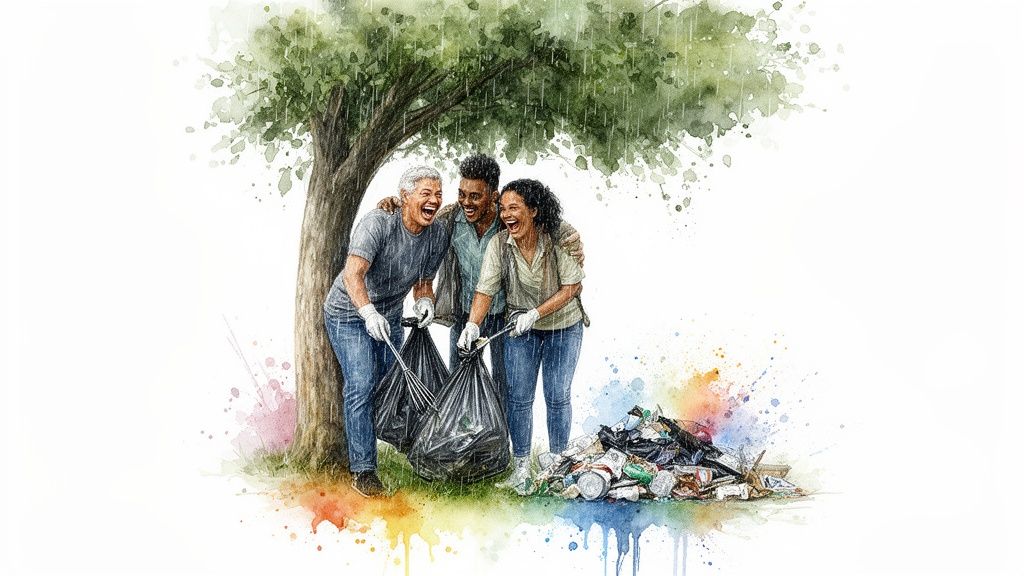
    I learned this firsthand during our very first Litter Caterpillars cleanup. There were only three of us, and we got ambushed by a ridiculous Chicago hailstorm. I’m talking ice pellets coming down sideways. We were huddled under a flimsy tree, shivering, watching every single rideshare driver cancel on us. It was, by all objective measures, a miserable situation.

    But right there in that moment, something incredible happened.

    I realized that struggling together, even over something as small and absurd as a hailstorm during a trash pickup, was incredibly empowering. It became a shared experience. A story.

    It wasn't about succeeding or failing. It was about moving the story of my life forward. The cold, the hail, the frustration—it all just became another interesting page in the story. It advanced the plot.

    This mindset shift is everything. When you’re facing a big, scary challenge, stop thinking of failure as the end of the book. It’s not. It’s just an unexpected plot twist. It's the part that makes your journey compelling and teaches you something vital for the chapters still to come. It’s what makes your story worth telling.

    Finding Your Own 'Fence to Paint'

    You know the story of Tom Sawyer, right? His aunt saddles him with the world's most boring chore: painting a giant fence. But instead of moping, he flips the script. Tom turns this punishment into the hottest ticket in town, so much so that his friends actually pay him for the privilege of doing his work.

    That story holds a secret weapon for you to crush the fear of failure. You don't just muscle through a scary task. You completely change what it means.

    This is all about finding your own fence to paint. It's about taking something that feels like a drag—or is downright terrifying—and building a new, powerful story around it.

    Community volunteers joyfully paint a vibrant fence, symbolizing teamwork and positive change.

    Here at Litter Caterpillars, our "fence" is picking up trash. Let's be real, you and I both know nobody gets excited about grabbing soggy fast-food bags off the sidewalk. But we've intentionally reframed it. It’s not a chore; it’s a mission. We’ve turned it into a game of bravery and taking back our community.

    Building Your Narrative of Purpose

    So, how do you actually do this? You create little rituals and symbols that inject the action with meaning. For us, it’s things like flags, badges, and even our own theme song.

    When you’re marching down a street with a flag, you’re suddenly not just a person picking up litter. You're part of a movement. You're a team on an adventure, and that feeling changes everything.

    This isn't about pretending something isn't hard. It's about you wrapping your actions in a story of purpose. You're not just cleaning your junk drawer; you're creating order from chaos. You're not just signing up to volunteer; you're deciding to be someone who shows up.

    This works because fear is so often shaped by the stories we're told. It’s fascinating, actually—your fear of failure looks totally different around the world. A World Economic Forum analysis found that the European Union has the highest fear of failure rate at a whopping 40.7%, while the United States is much lower at 29.66%.

    By creating visible pride through symbols and just showing up, again and again, we prove that fear isn't your destiny. It's just an emotion you can reshape with others. You can dig into these cultural differences in fear of failure on weforum.org.

    The key is to find a task with low stakes and imbue it with high purpose. This flips the script on your fear, turning a potential failure into a noble effort.

    A Checklist to Find Your Fence

    Ready to find your own fence? The goal is for you to pick one low-stakes thing you've been putting off and give it a new story.

    • What's a small mess you can tackle? That pile of mail, the closet that exploded, the weeds taking over your garden bed.
    • What's a simple new skill you can try? Learning one song on the ukulele. Trying that one recipe you saved months ago.
    • What's a community act you can join? Signing up for one volunteer shift. Attending one local meeting.

    Choose one. That's it. This isn't your magnum opus; it's your training ground. It's your fence.

    Now, give it a new story. You’re not just “doing a chore.” You are practicing bravery.

    Building Your Low-Stakes Bravery Lab

    Here’s a secret I've learned: courage isn't something you’re born with. It's a muscle. And you don't build muscle by trying to bench-press 500 pounds on your first day at the gym, right? You start small. You get used to the feeling. You build strength in a safe space.

    Tackling a fear of failure works the exact same way. You need your own personal “Bravery Lab”—a low-risk space where you can practice doing things that make you a little uncomfortable.

    A flat lay of objects symbolizing bravery and effort: cards, dumbbell, calendar, and gloves.

    For us at Litter Caterpillars, every weekend cleanup is a Bravery Lab. The stakes are beautifully, wonderfully low. If you show up and pick up just one single piece of trash, you’ve succeeded. If you get caught in a Chicago downpour and have to bail, you didn't fail—you just left with a great story to tell.

    This idea is so powerful because it separates your actions from some high-stakes outcome. Think about starting a business. The stakes are huge! Data from the U.S. Bureau of Labor Statistics shows a big chunk of new businesses don't make it past ten years, so that fear you might feel is totally rational. You can even read about how fear affects entrepreneurs at Harvard Business Review.

    But picking up a bag of litter? The stakes are nearly zero.

    Micro-Exposure Exercises to Rewire Your Brain

    The whole point of this lab is to rack up small wins for yourself. These little victories teach your brain a new, crucial lesson: failure isn't fatal. It’s just feedback.

    When our volunteers show up in negative wind chills, they're practicing the core skill that separates doers from dreamers: you take action even when it's uncomfortable.

    You can do this in your own life with what I call micro-exposure exercises. These are tiny, intentional actions designed to push the edges of your comfort zone without sending you into a full-blown panic.

    Let's break it down:

    • The Fear: You're terrified of networking and talking to new people.
    • The Big, Scary Action: Going to a massive industry conference all by yourself. (Yikes! Too much, too soon.)
    • The Micro-Action: Tomorrow morning, make eye contact with the barista at the coffee shop and say "good morning."

    That tiny action is your experiment. The risk is basically zero, but the psychological win is very real. You're collecting data that proves you can survive a moment of social risk. And you can.

    Your First Week in the Bravery Lab

    Ready to run a few experiments of your own? This is all about you taking small, manageable steps to build that courage muscle. Here’s a simple 5-day plan to get you started.

    Day Micro-Action Goal
    1 Make eye contact with a cashier and give a genuine "thank you, have a good day." Practice initiating a small, positive social interaction.
    2 Ask for a recommendation at a bookstore or coffee shop, even if you don't plan to buy it. Get comfortable asking for help or an opinion.
    3 Wear an item of clothing you like but are slightly self-conscious about. Survive a minor feeling of being "seen" and realize that nobody really noticed.
    4 Take a different route on your commute or walk, just to see what happens. Break a routine and embrace a tiny bit of the unknown.
    5 Send a text to a friend you haven't spoken to in a while just to say "thinking of you!" Overcome the small hesitation of reconnecting.

    Each action is a small rep. By the end of the week, you've completed a full workout and proven to yourself that you can handle these little moments of discomfort. You survived. You grew.

    Scenarios for Your Next Experiments

    Let's make this even more practical. Here are a few common fears and some lab-safe experiments you can try.

    • If you fear being judged: Post an opinion on a social media story where replies are private. Maybe it's about your favorite pizza topping or a new movie. You get to express yourself without the pressure of a public comment section.
    • If you fear rejection: Ask for a small thing that's easy to say "no" to. For example, ask a bookstore clerk if they have any spare promotional bookmarks. If they say no, you’ve just experienced a tiny, painless rejection. And look at that—you're perfectly fine.
    • If you fear looking incompetent: Try a brand-new, slightly complicated recipe for dinner, but just for yourself. If it's a complete disaster, who cares? No one ever has to know. You just learned what not to do next time.

    The victory isn't in the outcome; it's in the act of trying. Showing up is the win. This is how you build resilience.

    By celebrating the simple act of showing up, you build the mental muscle you need for the bigger challenges. It's the exact same philosophy we bring when we team up with awesome organizations like the Care for Real food pantry. It’s all about taking that one brave first step.

    How to Engineer Your Social Circle for Courage

    Have you ever noticed how your mood completely flips depending on who you're around? Walk into a room of complainers, and suddenly you're spotting problems everywhere. But step into a group of people who are genuinely trying—people who are out there doing the work—and you feel a little braver yourself.

    The people you spend time with are like the air you breathe; they shape your internal world, often without you even realizing it. I learned this the hard way. Years ago, I made a conscious choice to mindfully engineer my social circle to filter out selfish people, and it was a complete game-changer in my own journey. It’s about being intentional with your influences.

    You have the power to curate your own personal team of courageous people.

    Finding the Givers

    Think about your social circle. Is it full of takers who just drain your energy, or givers who lift you up? Takers see obstacles everywhere. Givers, on the other hand, see a challenge and ask, "How can we help?" They make being brave feel normal because it’s just what they do.

    This is exactly why we schedule Litter Caterpillars events on Saturday and Sunday mornings. It’s a natural filter. People who drag themselves out of bed on a weekend to clean up a stranger's neighborhood are, by their very nature, givers. They are the consistent, service-minded people who will support your growth, not hold you back.

    Surrounding yourself with people who act in spite of challenges is the fastest way you can learn how. Their courage becomes contagious.

    So, who are the givers in your life right now? Think about it. Who leaves you feeling more capable and optimistic after you talk to them? Those are your people. I want you to spend more time with them.

    Plugging into the Right Communities

    Finding these communities is easier than you think. You don't have to overhaul your entire life overnight. It’s about taking small, intentional steps to connect with people who align with the person you want to become.

    • Look for action-oriented groups. Find clubs or volunteer opportunities focused on a shared activity, not just talking. Working side-by-side on a real mission is an amazing way for you to build friendships that actually mean something.
    • Identify communities with strong values. Do they celebrate trying? Do they support each other through setbacks? Find a group whose core beliefs resonate with you. We believe failure and suffering are good because they lead to growth.
    • Just show up once. The biggest hurdle is always that first step. I want you to commit to attending one meeting or event. No pressure. No lifelong commitment. Just see how it feels.

    Building a support system that normalizes courage is one of the most powerful things you can do. When your friends are out there facing their own challenges, it makes your own fears seem much more manageable. If you're looking for ideas, you can even check out our guide on how to meet like-minded people in your city.

    Your circle defines your reality—choose one that makes you brave.

    Your First Step Starts This Weekend

    Reading about bravery is one thing. Practicing it is everything. We’ve talked a lot about mindset and small steps, but now comes the hard part. The real part.

    I want you to consider this a direct, personal invitation from me to you: stop thinking, and start doing.

    This weekend, you can take your first real step toward crushing that fear of failure by just showing up.

    Five diverse volunteers in blue shirts and gloves, holding tools, smiling and shaking hands.

    I know exactly what's going through your head right now because I hear the same questions from almost every single person before their first event.

    • "What if I don't know anyone?" Perfect. Nobody does at first. This isn't a networking event. The whole point is for you to work side-by-side on a shared mission. Friendships just happen when you're focused on a task together, not on trying to be cool.
    • "What should I wear?" Clothes you don’t mind getting a little dirty in. That’s literally it. We provide all the gear you need—gloves, pickers, and bags.
    • "What if it rains?" Then we get a little wet and have a better story to tell. We're out there rain or shine, because consistency is part of the practice. Suffering a little together is what makes it fun. It advances the plot.

    You Just Have to Show Up

    I’ll never forget one volunteer, Sarah. She told me she circled the block in her car three times before she finally got the courage to park and get out. She was that terrified.

    Fast forward a year, and now she’s leading her own cleanups.

    Her story isn't some magical, overnight success. It's about one small, messy, imperfect step. She chose action over anxiety. She chose sunlight and new friends over staying home and worrying.

    This isn't about being fearless. It's about you acting despite the fear. You don't have to be perfect to start. You just have to show up.

    The beautiful thing about this first step is that the stakes are incredibly low, but the potential for your growth is massive. You’ll leave with a real, tangible victory—a cleaner park, a satisfyingly heavy trash bag—and a feeling of accomplishment you can't get from reading an article.

    We’re out there every single weekend. Come find out what you're made of.

    Common Questions About Facing Your Fears

    But What if I'm Still Scared After I Try?

    Good! Feeling scared means you’re on the right track. Seriously.

    The point isn't to magically erase your fear forever. That's impossible. The goal is for you to learn to take action while you feel it. I always say, "Fear is good." It’s the compass telling you that you're stepping outside your comfort zone and into the growth zone.

    Just keep showing up. Keep practicing in your low-stakes bravery lab. Celebrate the fact that you tried at all. Pretty soon, you'll look back and realize that feeling of fear is still there, but it's no longer the one driving your car.

    How Can Picking Up Trash Possibly Help My Career?

    Think of it like this: it's mental cross-training for your life.

    When you choose to get up on a cold, rainy Saturday morning to clean up a park with a bunch of strangers, you're doing something hard. You're building muscles like consistency, resilience, and straight-up bravery.

    You are proving to yourself, through real-world action, that you are the kind of person who shows up and does difficult things. That quiet, earned confidence doesn't just stay on the sidewalk after the cleanup is over. You carry that with you into your next big work project, your relationships, and every other part of your life.


    Ready to see what you're made of? Come join Litter Caterpillars this weekend and take that first, real step.

    Find your next cleanup event here: https://www.littercaterpillars.com

  • What Is Intrinsic Motivation and How It Changes Everything

    What Is Intrinsic Motivation and How It Changes Everything

    Let's be real. Intrinsic motivation is that fire in your gut that makes you do something just for the love of it. It’s not about a paycheck, a trophy, or getting a pat on the back. You feel it when you're learning guitar until your fingers are sore, or hiking up a mountain at dawn, or helping a stranger just because it feels right. That’s the force.

    The Hidden Fire That Drives Us All

    I didn't find this concept in some textbook. I stumbled upon it while I was shivering through a freak Chicago hailstorm.

    My life was a complete disaster. I couldn't even manage to clean my own apartment, which had become a sort of museum of my personal failures. Every piece of trash told a story, each one carrying a weight that felt impossible for me to lift. I was just drowning in my own chaos, totally and utterly stuck.

    Then, I hit my breaking point. After a brutal breakup, I made a promise to myself: I would build a new life, one based on three things that had always terrified me—consistency, bravery, and genuine human connection. I decided I'd start by cleaning up someone else’s mess, thinking maybe it could help me figure out my own. That bizarre, desperate idea became Litter Caterpillars.

    That first cleanup was something else. Only three of us showed up, and we were immediately ambushed by a full-blown blizzard in the middle of spring. We found ourselves huddled under a tree, getting pelted by hail, freezing our butts off. It was miserable. It was chaotic. And somehow… it was fun.

    That’s when it clicked for me. That’s when I finally, truly understood what intrinsic motivation really is.

    It's the "why" that comes from inside. It's that deep satisfaction you get from the work itself, completely separate from any prize, payment, or praise.

    This is the spark we're talking about. It’s the magic that transforms a chore into a challenge, and turns suffering into a killer story. You don’t need an external reward because the work is the reward. Think about a hobby you pour hours into or a puzzle you wrestle with just for the thrill of figuring it out. That's the hidden fire.

    This kind of drive isn't about what you get. It's about who you become. For me, picking up trash for my city gave me the strength to finally clean my own apartment and, piece by piece, rebuild my life. That’s the power we're tapping into here—the kind of motivation that doesn't just get a job done, but changes you from the inside out.

    The Three Keys That Unlock Your Inner Drive

    So, where does this powerful internal fire come from? It’s not magic. Psychologists have charted a kind of map for it, often calling it Self-Determination Theory. It boils down to three core human needs that act like keys, unlocking your deepest, most sustainable drive.

    I see these three keys in action every single weekend at our cleanups.

    You Are the Captain of Your Ship

    The first key is Autonomy. This is your need to feel in control of your own life and decisions. You want to feel like you’re the one steering the ship, not just a passenger being told where to go.

    At Litter Caterpillars, autonomy is everything. You show up when you can. You choose which block to tackle. No one is breathing down your neck with a clipboard or barking orders. You’re there because you chose to be, and that feeling of choice makes all the difference.

    The Awesome Feeling of Getting Good

    Next up is Competence. This is the satisfaction you get from mastering a challenge and feeling effective. Think about that incredible feeling when you finally nail a difficult chord on the guitar or see your skills grow over time.

    You feel this deeply when we’re out there. At the start of the day, a street is a mess. But after an hour of focused effort, you can step back and see a tangible result. You made that happen. That visual proof of your impact, of your competence, is incredibly rewarding.

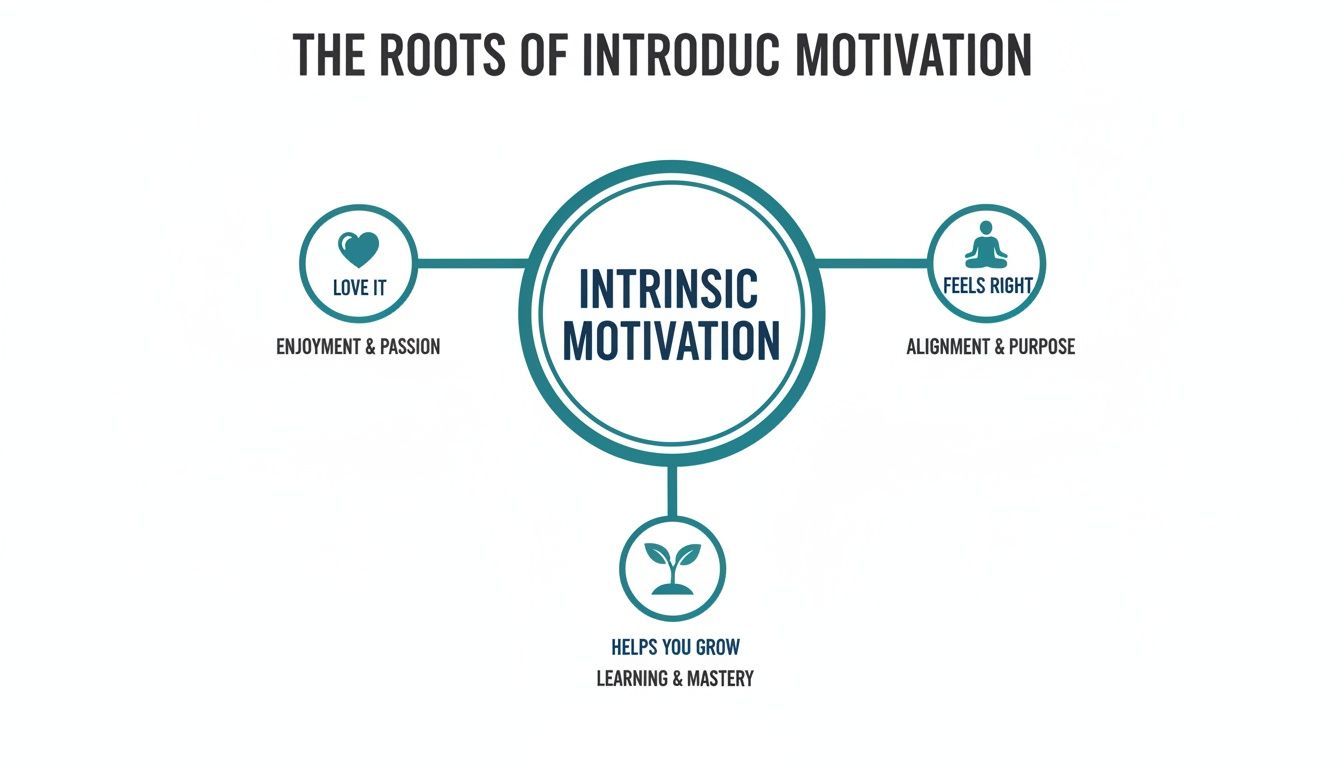
    This graphic breaks down those core drivers in a simple way.

    Diagram illustrating the roots of intrinsic motivation, including enjoyment, alignment, and growth.

    It shows that our motivation often springs from these simple roots: loving the act itself, feeling it aligns with our values, and seeing how it helps us grow.

    We Go Far Together

    Finally, there’s Relatedness. This is our fundamental need to connect with other people, to care for them, and feel like we belong to a community. We’re social creatures, and this might just be the most powerful key of all.

    Relatedness is the heart and soul of Litter Caterpillars. It’s in the jokes we share while picking up soggy pizza boxes. It’s the friendships built while huddling under a tree during a freak blizzard. It’s celebrating our shared wins, knowing we’re all in this together.

    When you satisfy these three needs—autonomy, competence, and relatedness—an activity stops feeling like work. It becomes something that genuinely feeds your soul, turning a simple task into a source of profound fulfillment. This isn't just a nice idea; it's a critical component of our well-being.

    Recent research underscores this, revealing that intrinsic motivation accounts for a staggering 45% of the difference in our work behaviors and overall happiness. A massive global survey confirmed that feeling a sense of autonomy and social connection is what truly ignites our inner drive at work. To learn more about these powerful findings, check out the full breakdown on Psychology Today.

    Understanding Intrinsic vs Extrinsic Motivation

    Let's cut right to it. Two forces get you to do anything: the prize waiting at the finish line, and the simple joy you get from running the race. One is a push from the outside; the other is a pull from within.

    Imagine this scenario: your boss dangles a fat bonus in front of you to work late on a Friday. That's extrinsic motivation. It’s an outside force—money, a prize, or even the fear of being yelled at—shoving you forward. You’re doing it for the bonus, not because you harbor a deep, burning passion for spreadsheets.

    Now, picture this instead: you're up late, hammering away at a personal project you’re completely obsessed with. Hours melt away. You don't even realize you missed dinner. That fire in your belly? That's intrinsic motivation. You’re not doing it for a reward, because the work is the reward.

    The Tom Sawyer Effect

    You remember the story of Tom Sawyer, right? He's punished and has to whitewash a giant fence—a miserable chore if there ever was one. But what does he do? He flips the script. He begins to act as if painting that fence is the most incredible, exclusive privilege a kid could ever have.

    Before you know it, his friends are literally paying him for the chance to do his work for him. Tom masterfully transformed an external punishment into an internal desire. That's the whole game: one feels like a burden, while the other feels like an incredible adventure.

    This is exactly where so many organizations stumble. They attempt to inspire people by dangling carrots—bonuses, promotions, empty "good job" pats on the back. More often than not, this strategy just kills the very creativity they're trying to spark. People start chasing the reward instead of loving the process, and that inner fire sputters out.

    When the reason for doing something shifts from "I want to" to "I have to," the soul of the work dies. It becomes a transaction, not a passion.

    At Litter Caterpillars, we sidestep this trap completely. Our volunteer-first philosophy is non-negotiable, which means we never use external motivators. Your passion, your energy, and your desire to connect with others are the only currencies that matter here. This isn’t just some feel-good fluff; it’s just flat-out more effective.

    The data actually screams this from the rooftops. When it comes to performance, intrinsic motivation absolutely mops the floor with its extrinsic counterpart. A Korn Ferry survey found that a whopping 76% of intrinsically motivated employees blew past performance expectations. That's a huge jump compared to the 60% of people driven by external factors.

    That 16% gap is precisely why groups like ours thrive on pure, unfiltered volunteer passion. The bonus-chaser gets burned out. But the person fueled by an inner fire? They just keep going, because the work itself is what refuels them.

    Turning Motivation Theory into Real-World Action

    Alright, we've dug into the psychology. But how do you actually get that inner fire to catch and spread in the real world? This is where the rubber meets the road—or in our case, where the gloves meet the litter. I’m going to share our exact playbook for turning what could feel like a chore into a genuine adventure.

    It all starts with our core values. They aren't just some nice-sounding words I slapped on a website; they're the tools we use to build a space where you can actually feel that sense of autonomy, competence, and relatedness. These values are the soil where intrinsic motivation takes root and grows.

    Two volunteers in blue uniforms and gloves collect trash, holding black bags in a vibrant watercolor scene.

    Living Our Values Out Loud

    Our first value is Bravery. For us, bravery isn’t about being fearless. It’s about you showing up when it’s cold and rainy and choosing to find the "fun" in the suffering. It's about stepping into a neighborhood you've never explored before, ready to connect with the people who call it home.

    Then there’s Unity and Kindness. This is all about creating a safe, welcoming space where real friendships can blossom. We operate on mutual respect, knowing we’re all out here for the same reasons—to give back and to connect with each other. You can feel this spirit in everything we do, from sharing stories during a cleanup to helping out a local food pantry. To see this in action, check out how our community supports local partners like Care for Real.

    These values aren't just posters on a wall. They guide all the small, intentional things we do to build our culture.

    We don't use gimmicks or prizes. We use tools that help you connect with the mission, the city, and each other on a much deeper level. The goal is to make the work itself the reward.

    Our Toolkit for Building Inner Drive

    So what does this look like day-to-day? It’s about creating rituals and symbols that build a powerful sense of shared identity and purpose. This isn't about managing volunteers; it's about empowering a community.

    Here are some of the practical ways we bring this to life:

    • The Weekend Morning Schedule: We intentionally hold our cleanups on weekend mornings. This simple decision naturally filters for givers—people who are willing to dedicate their personal time to service before anything else. It sets a tone of shared commitment right from the start.
    • Flags and a Theme Song: A little pride goes a long, long way. We bring flags to our events and even have our own theme song. It might sound silly, but these symbols create a powerful feeling of identity and shared purpose, just like for a sports team. It’s a constant reminder that we’re part of something bigger than ourselves.
    • Adventure Through Service: Our mission is to clean all 50 wards of Chicago. This masterstroke transforms a simple cleanup into an exciting city-wide quest. Each week, you’re not just picking up trash; you're exploring a new corner of the city, discovering hidden gems, and making your mark everywhere.
    • Badges That Tell Your Story: We offer badges to celebrate your journey with us. These aren’t cheap rewards for "good performance." They are markers of your commitment and milestones on your personal journey of transformation, recognizing the bravery it takes to show up, week after week.

    The Life-Changing Benefits of Following Your Fire

    So, why does any of this motivation stuff really matter? Because when you're running on that inner fire, the benefits don't just stay in one neat little box. They spill over into every single part of your life, creating positive ripples you never saw coming. It's never just about getting a cleaner city.

    For me, it started with a simple act of service that gave me the consistency I needed to finally tackle the messes in my own life. For our volunteers, it's about so much more than just picking up litter. It’s about building resilience, forging real friendships, and rediscovering a sense of purpose that maybe got lost somewhere along the way.

    More Than Just a Cleanup

    When you show up, week after week, something powerful starts to happen. You’re not just cleaning a street; you're building trust in yourself. Every single bag you fill is proof that you can stick with something, that you can make a difference. For many of us, this regular act of giving becomes a quiet way to learn how to forgive ourselves for past mistakes and start fresh.

    The ripple effect is huge. This is the kind of deep engagement that separates a life of just going through the motions from a life that feels genuinely full of meaning.

    The incredible ROI of volunteering isn't what you get back from others. It's what you give back to yourself—a stronger sense of who you are, a deeper connection to your community, and the quiet pride that comes from simply showing up.

    This isn’t just some nice-sounding idea; it’s a reflection of a much bigger truth about what makes us humans happy and fulfilled.

    The Science of a Meaningful Life

    The search for meaning isn't some fluffy, abstract concept—it has real, measurable effects on our well-being. A Gallup study paints a pretty bleak picture of a disengaged world, revealing that only 15% of employees globally feel genuinely motivated at work. The main reason? They're missing that inner fire.

    But when that fire is lit, everything changes. Motivated individuals are 87% less likely to leave their jobs. Even more incredible, a stunning 74% would take a pay cut for a job that truly feeds their intrinsic drive. This stuff is powerful.

    This is the power we tap into. We aren't offering you a paycheck, but we are offering something far more valuable: a chance to connect with what actually matters. It’s a space where you can build a real community, push your own boundaries, and create a positive impact you can literally see with your own eyes.

    If you're looking for ways to build those connections, we have a great guide on how to meet like-minded people. Ultimately, you find that the most life-changing benefits don't come from a reward at the end, but from the journey itself.

    How to Find Your Fire and Start Your Journey

    If you’ve made it this far, I bet something has sparked in you. Maybe you’re searching for a real community, a way to make an impact you can actually see, or just a new kind of adventure right here in Chicago. My own journey started at rock bottom, fueled by a promise I made to myself to build a better life surrounded by better people.

    Watercolor art of a person walking on a yellow path towards a welcoming team in a city.

    Litter Caterpillars is what grew from that promise. We're more than a cleanup crew; we're a community of givers who are brave enough to show up for themselves and for our city. This is your personal invitation to join the transformation.

    Come find your fire. It’s not about what you’ll get, but about the experience you’ll have and the person you’ll become. That's the core of what intrinsic motivation builds in us.

    Your First Step Is Simple

    There are no barriers, no fees, and absolutely zero pressure. All you have to do is show up. We make it as easy as possible for you to find us and jump into your first event.

    • Follow us on Instagram to get weekly updates, see the stories from our cleanups, and feel the pulse of our community.
    • Join our Meetup group where you can see all our upcoming events and RSVP with a single click.

    That's it. Seriously. Just bring yourself. If you're hunting for even more ways to get plugged into your community, we also put together a guide on how to find volunteer work.

    Let's go far, together.

    A Few Lingering Questions

    Got some questions rolling around in your head? Good. That means you’re already digging into what really drives you. Let’s tackle a few common ones that pop up when we talk about this stuff.

    Can You Have Both Intrinsic and Extrinsic Motivation?

    Of course. It’s completely normal for you to love what you do (that’s the intrinsic fire) and also be glad you get a paycheck for it (the extrinsic reward). Real life is usually a mix of both.

    But there’s a catch, something psychologists call the overjustification effect. It’s what happens when a huge external reward—like a massive, unexpected bonus—makes you feel like you’re only in it for the prize. The joy you once felt from just doing the thing can start to wither.

    That’s why, with Litter Caterpillars, we are 100% focused on the intrinsic side. It’s about the adventure, the friendships, and the pride you feel looking back at a clean street. That keeps our spirit pure and incredibly strong.

    How Do I Get Motivated for Chores?

    This is the eternal question, isn't it? We all have stuff we just have to do. The trick is for you to connect that boring task to a deeper value you hold.

    I’ll be honest, I used to be terrible at keeping my own apartment clean. But after getting out there and cleaning up Chicago's neighborhoods, I found a sense of purpose and pride in cleanliness that finally bled over into my own space. Try to find the hidden "why" inside the chore.

    Does doing the laundry mean you feel organized and in control for the week (autonomy)? Does figuring out that ridiculously complicated spreadsheet make you feel like a rockstar at work (competence)? Find the personal win.

    How Can I Tell If I Am a Good Fit?

    Ask yourself these questions, and be brutally honest. Does the thought of exploring a part of Chicago you've never seen while making it better actually sound kind of fun? Do you feel a pull toward meeting other people who show up and give a damn? Are you curious to see what you're made of, even when it’s cold, or rainy, or just plain tough?

    If you found yourself nodding along, that’s your intrinsic motivation talking. It’s not about what you’ll get, but about the experience itself and the person you might become along the way. That’s the entire vibe of this community.


    Ready to answer that call? Join Litter Caterpillars and find your fire with a crew that shows up, rain or shine, to build something better. Together. Learn more and sign up for an event today!
  • Reducing Plastic Usage: 8 Practical Tips for Home and Community

    Reducing Plastic Usage: 8 Practical Tips for Home and Community

    I know what it’s like to feel stuck. My apartment used to be a fortress of things I couldn't let go of. A four-year-old jar of jam wasn't just old food; it was a trip to Michigan, a ghost of a past me. The jar weighed less than a pound, but emotionally, it was a 500-pound anchor. My life was a landfill of my own making, an impossible mess. I felt completely overwhelmed.

    The change came after a brutal breakup. I decided I had to tackle the hardest things first: cleanliness, consistency, bravery. It’s like learning to swim by jumping into the deep end. I figured if cleaning my own mess felt impossible, maybe cleaning someone else's would be easier. That simple, desperate idea became Litter Caterpillars. What started with three of us shivering in a Chicago hailstorm has grown into a weekly mission. We found a strange, powerful joy in just showing up, facing the elements, and doing something hard together.

    That’s the secret. It’s the secret to transformation, and it’s also the secret to reducing plastic usage in a way that actually sticks. You aren't just swapping a bottle or a bag. You're facing the mess, one piece at a time, and discovering you have the strength to change things, starting with yourself. This guide is your map for that journey. You'll find real strategies here, from personal swaps to community action, that will empower you to tackle plastic waste and, in the process, transform a lot more than just your trash can.

    1. Switch to Reusable Shopping Bags and Containers

    Imagine you're building a new habit. Swapping out flimsy, single-use plastic bags for durable, reusable ones is your cornerstone. It's one of the most powerful first steps you can take in reducing plastic usage. Think of it as your gateway to a more sustainable life. A simple change with a massive ripple effect. You’ll prevent thousands of plastic bags from polluting our streets, our parks, our waterways. When my Litter Caterpillars crew and I head out for a neighborhood cleanup, guess what we find tangled in bushes and fences? Those exact plastic bags. It’s a constant, ugly reminder.

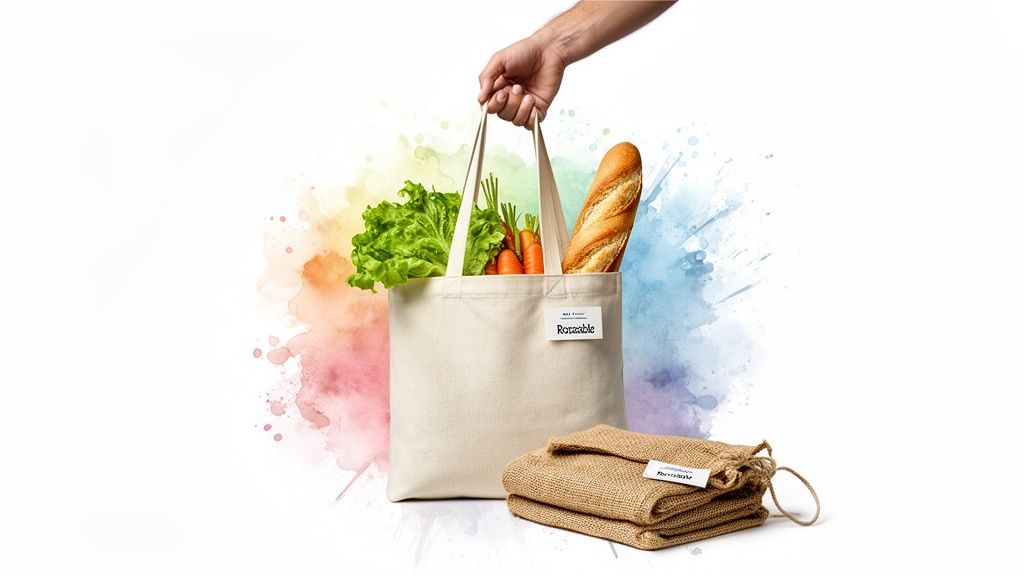
    A hand holds a reusable tote bag with groceries, next to folded burlap reusable produce bags, against a colorful watercolor background.

    This isn't just you. It's a movement. San Francisco banned plastic bags way back in 2007, and even our own Chicago has seen dramatic decreases in litter after similar policies. Retailers like Trader Joe's and Whole Foods now reward you for bringing your own bags. Each time you shop with a reusable bag, you're casting a vote for a cleaner, healthier planet. You’re telling them what you want.

    Key Insight: Bringing your own bag isn't just about avoiding a single piece of plastic. It's a message. You’re sending a clear signal to retailers and policymakers that you demand sustainable options.

    How to Make It a Habit

    Making the switch permanent is all about building a system that works for you. The biggest hurdle? Forgetting. You can beat it.

    • Stash Them Everywhere: I keep a few foldable bags in my car's glove compartment, my work backpack, and my purse. I have a designated "bag hook" right by my front door next to my keys. You can’t miss it.
    • Set Digital Nudges: Create a recurring reminder on your phone. If you usually shop on Saturdays, set an alert: "Got your bags?" It makes all the difference.
    • Think Beyond the Grocery Store: Don't just bring them to the supermarket. Use them for trips to the pharmacy, the library, or the farmer's market. Every single plastic bag you avoid is a win.
    • Lead by Example: When you show up to a Litter Caterpillars event with your snacks in a reusable tote, you inspire others. Your actions are contagious, but in the best way.

    2. Eliminate Single-Use Water Bottles with a Refillable Alternative

    Ditching single-use water bottles is like breaking up with a toxic friend. It’s a commitment to cleaner communities. Each plastic bottle you refuse is one less that could end up on the shores of Lake Michigan or rotting in a landfill for centuries. When my Litter Caterpillars volunteers and I comb through Chicago parks after a hot summer weekend, what do we find? A sea of these disposable bottles. A landscape of unnecessary waste. It’s heartbreaking.

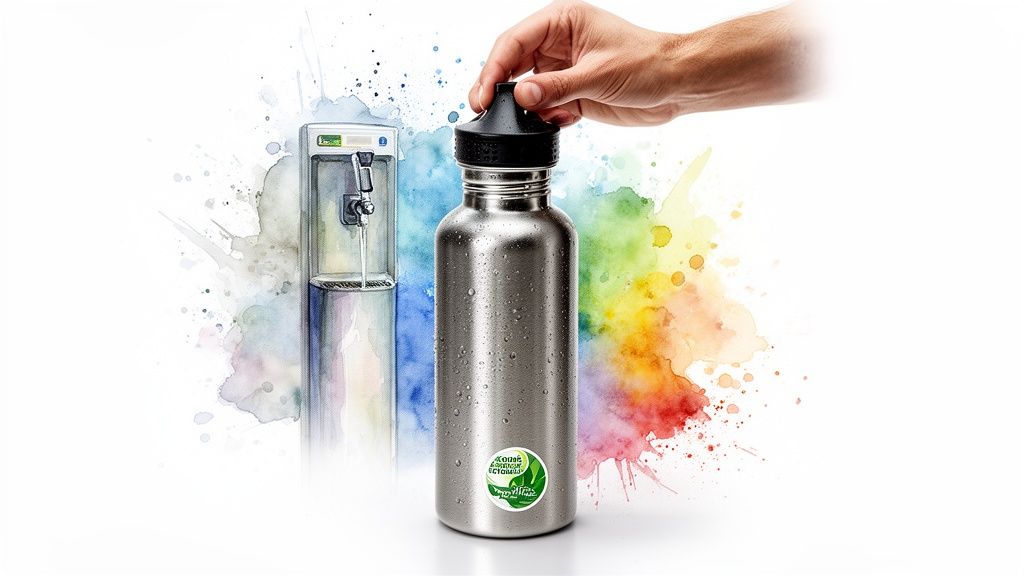
    Hand holding a reusable stainless steel water bottle with a green eco-sticker near a water dispenser.

    This idea is gaining powerful momentum. Programs like Chicago's "Drink Tap" and the explosion of refill stations at universities like Northwestern and UIC make it easier than ever to stay hydrated without the waste. This simple act of reducing plastic usage has a compounding effect. You save resources, cut pollution, and inspire others to join a culture of reuse. Every refill you make is a small act of defiance against our throwaway world.

    Key Insight: Carrying a reusable bottle is a visible statement. It shows everyone around you that there is a better, more responsible way to live. You're normalizing sustainability.

    How to Make It a Habit

    The key to never buying a plastic water bottle again is making your reusable bottle feel as essential as your phone or keys. You have to weave it into your routine.

    • Invest in Your Perfect Bottle: Find one you love. For me, an insulated bottle from Hydro Flask or S'well is a game-changer. It keeps my water cold on a scorching Chicago summer day, making it a joy to use.
    • Find Your Refill Spots: I use a fountain-finder app to locate free water sources when I’m out exploring the city. You'd be surprised how many public refill stations are hiding in plain sight.
    • Make It Your Cleanup Companion: I bring my reusable bottle to every Litter Caterpillars event. It keeps me hydrated while I work and serves as a powerful, practical example for fellow volunteers.
    • Create a "Hydration Station": I set up a dedicated spot at home with my clean bottle, ready to grab and go. I also keep one at my desk at work so it's always within reach.

    3. Refuse Plastic Straws and Use Alternatives

    Saying "no straw, please" is one of the simplest yet most symbolic things you can do. It's a small phrase with a huge impact. You make a daily choice that prevents a piece of plastic from potentially harming wildlife for centuries. When my Litter Caterpillars team cleans along the Chicago Riverwalk, we find countless plastic straws. They were used for a few minutes, but they'll pollute our water for generations. This is a classic story of how a tiny habit can cause a massive problem. But it also shows how a tiny change can be part of the solution.

    A diverse collection of reusable straws made from metal, bamboo, silicone, and glass, promoting sustainability.

    This idea has caught fire globally. It went from a niche activist plea to mainstream policy. Seattle's 2018 ban sparked a nationwide movement. Big chains like Starbucks are phasing them out, and many Chicago restaurants now offer paper or reusable options. This proves that when you demand less plastic, it works. Every time you politely refuse a straw or pull out your own reusable one, you're not just sipping a drink. You’re making a statement that convenience shouldn't cost our planet its health.

    Key Insight: Refusing a plastic straw is more than a personal win. It’s a powerful public signal. It drives corporate and legislative change and makes sustainable choices normal for everyone.

    How to Make It a Habit

    Making the switch from disposable to durable is about being prepared. You have to make your reusable straw just as convenient as the plastic one you’re refusing.

    • Carry It Everywhere: I invested in a compact, collapsible straw set with a cleaning brush and case. I keep it in my purse so I'm never caught without it. You can even find ones that fit on your keychain.
    • Be Proactive When Ordering: Don't wait for the straw to arrive. I always say, "No straw, please," as I order my drink. This prevents the server from bringing one out of habit.
    • Normalize It for Others: When I’m out with friends, I use my reusable straw proudly. My simple action can spark conversations and inspire them to make the switch, too.
    • Gift the Change: I think reusable straw sets make fantastic, affordable gifts. It's a thoughtful way to introduce friends and family to a more sustainable lifestyle and grow the movement for reducing plastic usage.

    4. Choose Plastic-Free Packaging When Shopping

    Your real power isn't just the shopping bag. It's the choices you make down every single aisle. You can actively prioritize products sold in glass, aluminum, or cardboard over plastic. It's a crucial strategy for reducing plastic usage right at the source. Imagine you're voting with your wallet. You're choosing a future where our shelves aren't lined with disposable plastic that clogs our landfills and our beautiful Chicago parks. When my team and I sort through the litter we collect, we see the story of our consumption written in branded plastic wrappers and bottles.

    A watercolor illustration of a jar of grains, an aluminum can, a cardboard box, and an apple.

    This shift is happening everywhere. You see it in zero-waste pioneers like Package Free Shop and in the expanding bulk bin sections at stores like Whole Foods. Brands are even getting creative with services like Loop, which partners with major companies to offer products in durable, returnable containers. When you choose these alternatives, you’re not just buying a product. You’re fueling a market revolution that demands more responsible options for everyone.

    Key Insight: Every time you pick pasta in a cardboard box over a plastic bag, or salsa in a glass jar over a plastic tub, you're directly shaping supply and demand. You’re helping build a less plastic-dependent world.

    How to Make It a Habit

    Turning this into an everyday practice is like going on a treasure hunt. You train your eyes to spot the better alternatives. The prize is a cleaner planet.

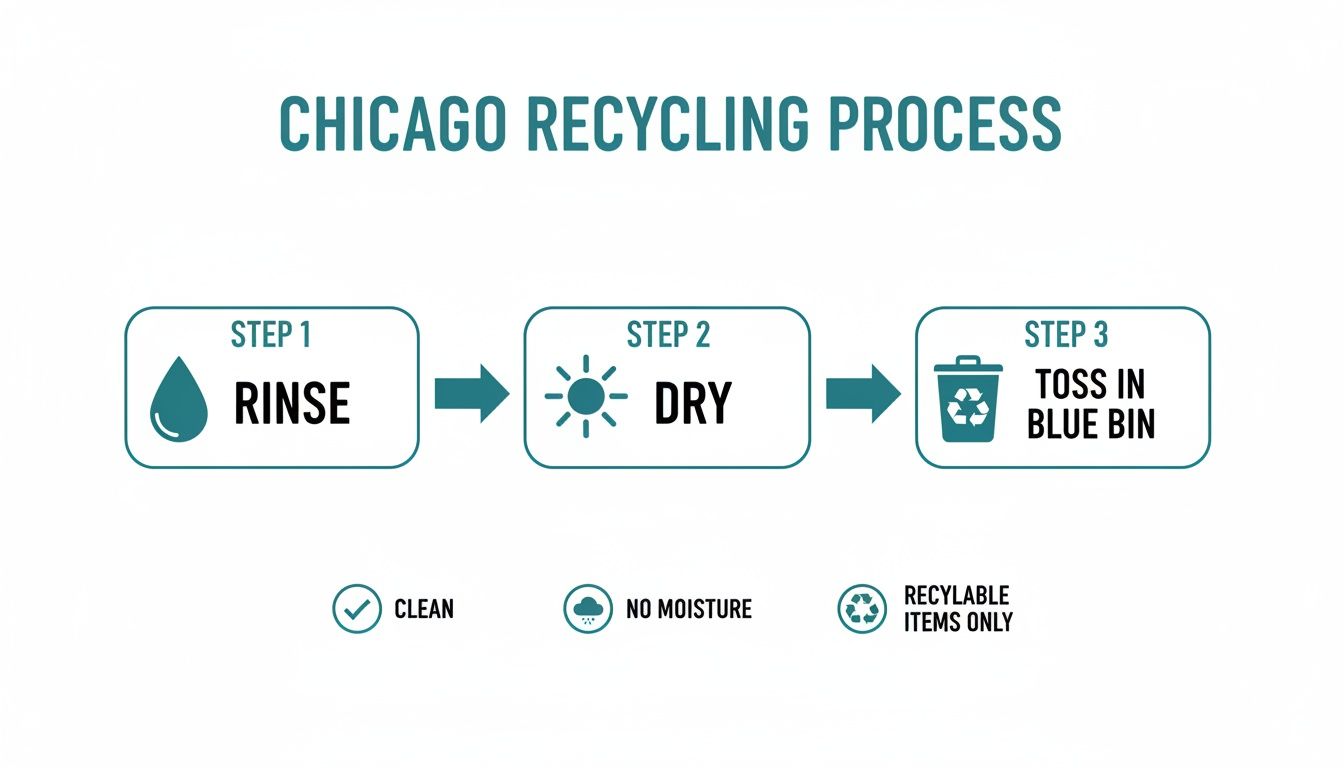
    • Go for Glass, Cans, and Cardboard: When you have a choice, pick the option in more easily recyclable materials. I always choose the glass bottle of juice, the canned tomatoes, or the oats in a paper canister. Understanding the basics helps you make better decisions. You can learn more about Chicago's recycling guidelines to see what’s most effective where you live.
    • Embrace the Bulk Bins: I bring my own jars and bags to stores with bulk sections for things like rice, nuts, spices, and grains. It feels incredibly satisfying to walk away with groceries that have absolutely no new packaging.
    • Shop the Perimeter: I focus my shopping on the outer edges of the grocery store. That's where you'll usually find fresh, unpackaged produce, meat, and bakery items.
    • Support Local Markets: You should visit your neighborhood farmers market. I find that produce there often comes with zero packaging, and I get the bonus of supporting local growers directly.

    5. Practice Mindful Consumption and Buy Less

    Here it is. The most effective way to reduce plastic waste is to attack its source: our own consumption habits. When you practice mindful consumption and simply buy less, you cut off the demand for new plastic products before they're even made. This isn't about depriving yourself. It's about being intentional. It's choosing quality over quantity, a philosophy that directly fights the throwaway culture responsible for so much pollution. When I'm picking up litter along the Chicago River, it’s not just bottles and bags I find. It's countless broken toys and cheap plastic junk that were used once and tossed.

    This shift in mindset is gaining ground. You see it in movements like minimalism and with advocates like The Minimalists and Marie Kondo. You also see it in the rise of thrift culture and programs like Patagonia's "Worn Wear," which celebrate durability and repair. In Chicago, local "Buy Nothing" groups in neighborhoods from Lincoln Park to Hyde Park are powerful examples of this. My neighbors and I share and gift items instead of buying new. Each time you borrow a tool or find a treasure secondhand, you prevent a new plastic-packaged item from ever entering the waste stream.

    Key Insight: Reducing plastic usage starts before you even walk into a store. The most sustainable product is the one you don't buy. The second most sustainable is the one that already exists.

    How to Make It a Habit

    Embracing mindful consumption is a gradual process. You learn to question what you need and discover the joy of having just enough. It’s about being a conscious consumer, not an automatic one.

    • Implement the 30-Day Rule: Before I make a non-essential purchase, I wait 30 days. If I still feel I truly need it after a month, I go for it. This simple pause helps me distinguish between a fleeting want and a genuine need.
    • Shop Secondhand First: Make thrift stores, Facebook Marketplace, and local consignment shops your first stop. I look there first for everything from clothing to furniture. You’ll save money, find unique items, and give existing goods a second life.
    • Join a Sharing Community: You can tap into your local Chicago Buy Nothing Project group or community swap events. Need a power drill for a weekend project? A serving dish for a party? Someone nearby is probably happy to lend you one.
    • Embrace Repair: Instead of tossing a broken item, learn a new skill. I’ve learned to mend a torn shirt. You can take your shoes to a cobbler or visit a local repair cafe. Repairing what you own deepens your connection to your belongings and keeps them out of the landfill.

    6. Transition to Plastic-Free Personal Care and Household Products

    Your bathroom and kitchen sink might be the sneakiest sources of single-use plastic in your entire home. It’s a battlefield. Shampoo bottles, liquid soap dispensers, tubes of toothpaste, spray cleaners. These areas are often overflowing with plastic containers that are destined for the landfill. If you make the switch to plastic-free alternatives, it's a game-changer for reducing plastic usage right where you live. You can transform your daily routines into powerful acts of sustainability.

    This isn't about giving up quality. It’s about discovering innovative, effective products that are kinder to the planet. Brands like Lush and Ethique have perfected solid shampoo and conditioner bars that work wonders for your hair without the plastic bottle. Just think about the countless plastic pump bottles my Litter Caterpillars crew and I pick up from the banks of the Chicago River. When you choose a simple bar of soap, you help eliminate that exact type of waste, one household at a time.

    Key Insight: Your daily self-care and cleaning routines are a major frontier in the fight against plastic. By choosing solid, refillable, or package-free options, you directly reduce the flow of plastic waste from your home.

    How to Make It a Habit

    Transitioning your personal and household products doesn't have to be an expensive or overwhelming overhaul. The key is to start small. You just replace items as you run out. You make the change gradual and sustainable for your lifestyle and your budget.

    • Start with One Swap: Don't try to replace everything at once. When your current toothbrush wears out, buy a bamboo one. When your liquid soap is gone, try a classic bar of soap. I use this “one-in, one-out” method. It makes reducing plastic usage feel effortless.
    • Explore Refill Options: You can look for local Chicago stores that offer refill stations for products like laundry detergent, dish soap, and hand soap. Bringing your own container is a fantastic way to eliminate packaging entirely.
    • Embrace DIY Cleaners: For a simple, effective, and plastic-free all-purpose cleaner, I mix equal parts white vinegar and water in a reusable glass spray bottle. It’s a trick many of us at Litter Caterpillars use in our own homes.
    • Share Your Finds: Found a brand of toothpaste tablets or a deodorant bar you absolutely love? You should share your recommendation in the Litter Caterpillars community forum. Your experience can inspire and help someone else make a successful switch.

    7. Reduce Food Packaging Waste Through Strategic Meal Planning

    Your kitchen can be a plastic minefield, but it doesn't have to be. Strategic meal planning is your secret weapon. It will transform how you shop, cook, and eat, and it will significantly cut down on plastic packaging. You stop grabbing pre-packaged meals and plastic-wrapped produce. Instead, you're making conscious choices that reduce waste and often lead to healthier, more delicious meals. It’s about being intentional with your food. That's a powerful way of reducing plastic usage in your daily life.

    This approach connects you more deeply with your food and your community. When you plan your meals around what's available at a Chicago farmers market, like the one in Logan Square on a Sunday morning, you're not just avoiding plastic. You're supporting local farmers. I love that. Similarly, joining a Community Supported Agriculture (CSA) program delivers a weekly box of fresh, seasonal produce with minimal to no packaging. It turns your grocery routine into a sustainable adventure.

    Key Insight: Meal planning isn’t just about organization. It's a proactive strategy. You design plastic out of your diet and support a more local, sustainable food system.

    How to Make It a Habit

    Integrating meal planning is about creating a new weekly rhythm. A little forethought goes a long way. It will stop plastic from ever entering your home.

    • Plan Your Plate: Before I even think about shopping, I sketch out my meals for the week. Knowing exactly what I need prevents me from making impulse buys of over-packaged convenience foods.
    • Embrace the Bulk Bins: You should seek out stores with bulk sections for items like grains, nuts, and spices. I bring my own jars and containers to create a truly zero-waste shopping experience for my pantry staples.
    • Shop the Perimeter (and the Market): I focus my shopping on whole foods like loose fruits and vegetables. You can make a weekly trip to a local farmers market your new ritual. Just don't forget your reusable produce bags.
    • Rethink Your Storage: You have to ditch the plastic wrap and single-use sandwich bags. I invested in a set of glass containers, beeswax wraps, and silicone pouches for storing leftovers and packing lunches. My food stays fresher, and my conscience is clearer.

    8. Support and Advocate for Plastic Reduction Policies and Legislation

    Your individual actions are the foundation of change. But to create lasting impact in reducing plastic usage, you have to think bigger. Supporting and advocating for policies that tackle plastic pollution at its source is how we turn our personal habits into community-wide standards. It's the difference between you picking up a single plastic bottle and you preventing millions of them from ever being produced in the first place. When my Litter Caterpillars volunteers and I find the same branded wrappers week after week, it’s a clear signal. The problem needs a systemic solution, not just a cleanup crew.

    This is about using your voice to create a ripple effect that benefits everyone. Policies like plastic bag bans, Extended Producer Responsibility (EPR) programs, and restrictions on single-use foam containers are game-changers. Seattle's comprehensive ordinances and California's bold EPR program prove that when communities demand change, governments listen. These laws shift the responsibility from you, the consumer, back to the corporations that profit from single-use plastics.

    Key Insight: Your individual actions are powerful, but your voice as a citizen is your superpower. Advocacy turns your personal passion into public policy. It creates a cleaner future for an entire city, not just for your household.

    How to Make It a Habit

    Becoming an advocate might sound intimidating. It's more accessible than you think. You can integrate it into your life just like any other sustainable practice.

    • Start Local and Stay Informed: Your local alderperson's office is your most direct line to change in Chicago. I signed up for their newsletter to stay informed about environmental proposals and town halls. A five-minute phone call or a short, personal email can have a huge impact.
    • Amplify Your Efforts: You can join forces with established environmental groups like the Sierra Club or local Chicago organizations. They provide scripts, petitions, and organized advocacy days, making it easy for you to participate effectively.
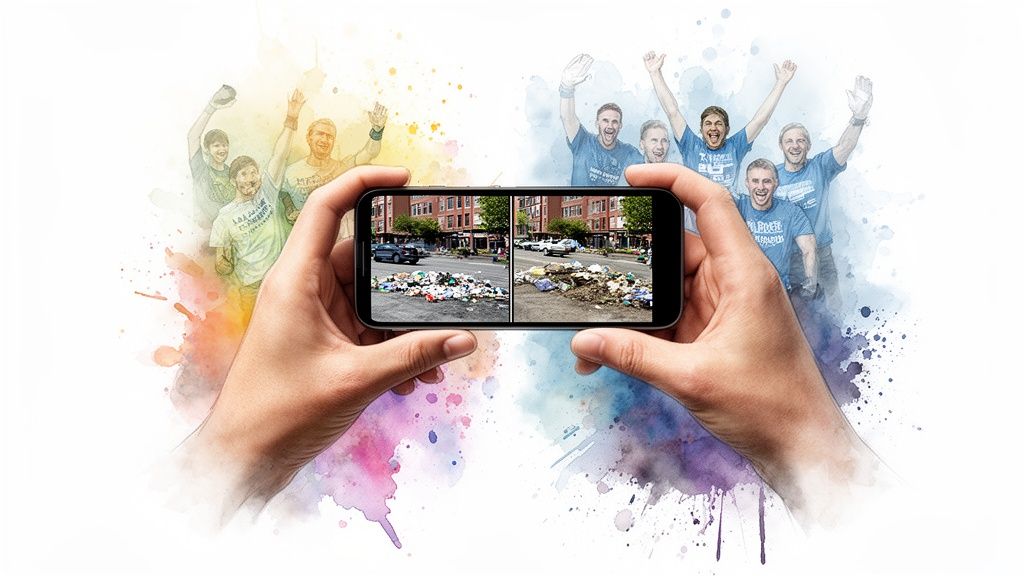
    • Use Your Cleanup as Evidence: The next time you're at a Litter Caterpillars event, snap a photo of the litter you collect. Share it on social media and tag your local representatives. For me, a picture of a park fence tangled with plastic bags is powerful evidence they can't ignore.
    • Show Up and Speak Up: Attending a city council meeting or a public hearing is one of the most direct ways to be heard. Even if you don't speak, your presence shows officials that their constituents care deeply about reducing plastic usage.

    9. Community Engagement: Education, Visible Modeling, and Organized Cleanups

    Reducing plastic usage becomes exponentially more powerful when it transforms from your personal habit into a community movement. This is about making sustainability visible. It’s about making it educational and collaborative. When you share your journey, organize cleanups, and educate others, you create a powerful feedback loop. You inspire widespread change. You move beyond your own actions to shift cultural norms and even policy. This is how you and I turn personal conviction into collective impact.

    When you join a Litter Caterpillars cleanup, you’re doing more than just picking up trash. You’re becoming a visible advocate for a cleaner Chicago. You’re showing your neighbors that you care. This tangible action, combined with sharing your experiences online or with friends, creates social proof. It shows this is a cause worth fighting for. Organizations like Ocean Cleanup document the massive scale of the problem. Grassroots groups like mine bring the reality of it right to our own doorsteps. We generate data that can drive real change.

    Key Insight: Visible action is the most powerful form of education. When people see you making a difference, they are far more likely to believe they can make a difference, too.

    How to Make It a Habit

    Engaging your community doesn't require a bullhorn. It starts with authentic connection and you leading by example. Your personal story is your most powerful tool for inspiring others.

    • Share Your Swaps: I post pictures of my reusable coffee cup or my new solid shampoo bar on social media. You never know who you’ll inspire to make their first switch.
    • Start a Conversation: When a friend compliments your reusable produce bags, share why you made the change. I frame it as a positive choice, not a judgment.
    • Invite, Don't Preach: The best way to show someone the impact of plastic litter is to let them see it firsthand. You should invite a friend to a weekend cleanup. The experience will speak for itself. You can find everything you need to know about how to start a volunteer trash pickup and lead your own event.
    • Celebrate Others: When you see a local coffee shop offer a discount for reusable cups or a neighbor composting, celebrate it! Positive reinforcement builds a stronger, more motivated community.
    10. Challenge the Convenience Culture and Embrace Intentional Living

    This might be the most profound step. Shifting your entire mindset. Modern culture screams at us to value convenience above all else. This message directly fuels the demand for single-use plastics. You can embrace intentional living. That means you consciously reject that script. You choose durability over disposability. You find joy in the process, not just the instant result. When you stop chasing the fastest, easiest option, you naturally sidestep the plastic traps that come with it.

    This philosophy is the heart of movements like Slow Food and Minimalism. It's also at the core of what we do at Litter Caterpillars. I started this organization from a place of personal chaos. The consistent, sometimes difficult, act of showing up to clean our Chicago neighborhoods transformed me. The real change wasn't just cleaner streets. I found profound meaning in the deliberate effort itself. This is the essence of environmental stewardship: a commitment that goes deeper than a simple action.

    Key Insight: Reducing plastic isn't about adding inconvenient tasks to your life. It's about discovering a more meaningful and connected way of living. A life where your daily actions align with your deepest values.

    How to Make It a Habit

    Rewiring your brain to prioritize intention over convenience is a practice. It's not a perfect science. It’s about you building resilience and finding fulfillment in the journey.

    • Reframe the "Inconvenience": Instead of groaning about washing a reusable container, I see it as a two-minute mindful practice. Instead of viewing meal prep as a chore, I see it as an act of self-care that nourishes me all week.
    • Practice Gratitude: You should take a moment to appreciate the durable items you already own. Your favorite coffee mug. Your sturdy water bottle. Your well-loved tote bag. Commit to using them fully and caring for them. It builds a stronger connection to your belongings.
    • Embrace the Power of "No": I politely decline the free plastic pen, the single-use sample, and the unnecessary bag for a single item. Every "no" from you is a quiet vote for a world with less waste.
    • Celebrate the Process: Find joy in making your own coffee, packing your own lunch, or carrying your own bags. These small rituals are powerful anchors to a more intentional, plastic-free life. They remind you that you are in control of your consumption.

    10-Point Plastic Reduction Strategy Comparison

    Item Implementation Complexity 🔄 Resource Requirements ⚡ Expected Outcomes 📊 Ideal Use Cases ⭐ Key Advantages 💡
    Switch to Reusable Shopping Bags and Containers Low — habit change and storage management Low — one‑time purchase, occasional washing Medium–High — noticeably reduces plastic bag litter Grocery trips, everyday shopping, city with bag bans Cost-effective long-term; visible sustainability; keep bags in car/near door
    Eliminate Single‑Use Water Bottles with a Refillable Alternative Low — buy bottle and adopt refill habit Low–Medium — initial purchase, access to clean water High — removes a top littered item type Commuting, outdoor activities, cleanup events Large cost savings and hydration benefits; use insulated bottles
    Refuse Plastic Straws and Use Alternatives Very Low — decline or carry reusable straw Very Low — inexpensive sets, small carry case Medium — prevents iconic, long‑lasting litter pieces Restaurants, cafes, bars, events Conversation‑starting action; carry collapsible straw in pouch
    Choose Plastic‑Free Packaging When Shopping Medium — requires planning and product choice Medium — possible higher prices and travel to bulk/eco stores High — reduces packaging entering homes and streets Grocery shopping, pantry restocking, bulk shoppers Supports circular economy; favor glass/aluminum/bulk bins
    Practice Mindful Consumption and Buy Less High — sustained mindset and behavioral change Low–Medium — time to source secondhand and plan purchases Very High — reduces waste at source and production impacts Major purchases, wardrobe, household goods Saves money and waste; try 30‑day rule and cost‑per‑use analysis
    Transition to Plastic‑Free Personal Care & Household Products Medium — product testing and gradual swaps Medium — research and sometimes higher prices High — eliminates many common single‑use containers Daily personal care routines, travel, household cleaning Longer‑lasting formats and less chemical runoff; transition gradually
    Reduce Food Packaging Waste Through Strategic Meal Planning Medium — weekly planning and prep required Medium — time for meal prep; upfront container cost High — cuts food packaging and spoilage, saves money Families, weekly shoppers, CSA/bulk buyers Supports local food systems; use glass containers and compost
    Support and Advocate for Plastic Reduction Policies & Legislation High — organize, lobby, and sustain campaigns Low–Medium — volunteer time, coalition building Very High — systemic, long‑term reduction of plastic use Community organizers, civic groups, long‑term strategy Scales impact beyond individuals; document litter to support policy
    Community Engagement: Education, Modeling & Organized Cleanups Medium — coordination and ongoing outreach Medium — volunteers, equipment, communication channels High — immediate litter removal plus behavior and policy influence Neighborhoods, schools, nonprofits, public events Builds social proof and data for advocacy; share authentic stories
    Challenge the Convenience Culture and Embrace Intentional Living High — deep cultural and personal transformation Low — mostly time and practice, social support helpful High — addresses root causes of overconsumption Individuals, community leaders, cultural change efforts Fosters resilience and meaning; join supportive groups and celebrate progress

    From Caterpillar to Something More

    We’ve walked through a whole landscape of possibilities together in this guide. We went from the simple swap of a reusable bag to the more profound challenge of reshaping our daily habits and advocating for systemic change. I know it can feel like a lot. When you look at the sheer scale of the plastic problem, it's easy to feel like you, a single person with a single canvas tote bag, are just a tiny, insignificant drop in a vast, polluted ocean. But I want to tell you something my friends and I learned on a stormy Saturday morning in Chicago.

    We were just a handful of volunteers. We huddled under a big oak tree as a freak hail storm came out of nowhere. We were soaked. Cold. And honestly, we were wondering if we had made a huge mistake showing up. But as we stood there, laughing at how absurd it all was, a weird kind of magic happened. Doing something difficult, something that mattered, with other people who cared… it forged a bond. It built a trust not just in each other, but in our own ability to show up and do the hard thing.

    The Practice of Transformation

    That’s what this journey of reducing plastic usage is really about. It's not a quest for perfection. You're not trying to meet some impossible standard. You don't have to beat yourself up when you forget your reusable cup or have to grab a plastic-wrapped snack. It's a practice.

    This isn't about guilt. It's about grace. It's about you choosing, again and again, to align your actions with your values. It’s about forgiving yourself when you fall short. Each small choice you make is like a workout, strengthening your resolve.

    Think of it like this: every single time you refuse a plastic straw, you’re not just saving one piece of plastic. You are casting a vote for a different kind of world. You are sending a signal to businesses that you demand better options. You are reminding yourself that you have power. When you plan your meals to avoid takeout containers or choose the apples that aren't shrink-wrapped, you are practicing bravery over convenience. You are choosing connection to your food and your planet over the hollow ease of just consuming.

    From Individual Acts to Collective Impact

    This is the very heart of the Caterpillar philosophy. We start small, like a caterpillar inching along a leaf. We focus on one piece of litter, one plastic bottle, one small, consistent act.

    • You start with your own choices: The reusable water bottle, the bamboo toothbrush, the bulk bin shopping. These are your foundational steps.
    • You inspire your circle: Your friends see your cool travel mug. Your family gets used to the cloth napkins. Your actions become a quiet, powerful form of advocacy.
    • You join a larger movement: You sign a petition. You show up for a community cleanup. You realize you are not alone in this fight.

    This progression, from your personal habits to community action, is where the real transformation happens. It’s where you and I move from feeling helpless to feeling hopeful. We learn to trust ourselves. We start to believe in our own capacity for change. We see how our individual efforts ripple outward, creating waves we could never have imagined. We start as one, but we become part of something so much bigger, something powerful enough to reshape the world around us. Your own transformation is waiting for you, right inside these small, intentional choices.


    Ready to turn your intention into action and connect with a community that gets it? Join Litter Caterpillars for a neighborhood cleanup event in Chicago and see for yourself how small acts create massive change. Find your next opportunity to make a difference and meet incredible people at Litter Caterpillars.

  • Volunteer Picking Up Trash: How to Start, Join a Crew, and Actually Make a Difference

    Volunteer Picking Up Trash: How to Start, Join a Crew, and Actually Make a Difference

    Let's be real. The idea of picking up someone else's garbage? It doesn't exactly sound like a good time. But what if I told you it’s one of the most powerful things you can possibly do for your own head? When you volunteer picking up trash, you're not just cleaning a street—you're decluttering your life. A weird, beautiful alchemy happens out there.

    The Unexpected Joy of Picking Up Trash

    My name is Kevin, and I started Litter Caterpillars because my own life felt like a total mess. Every piece of junk I owned felt like it weighed a ton. A physical reminder of a past I just couldn't shake. I was completely stuck, paralyzed in a world of my own making.

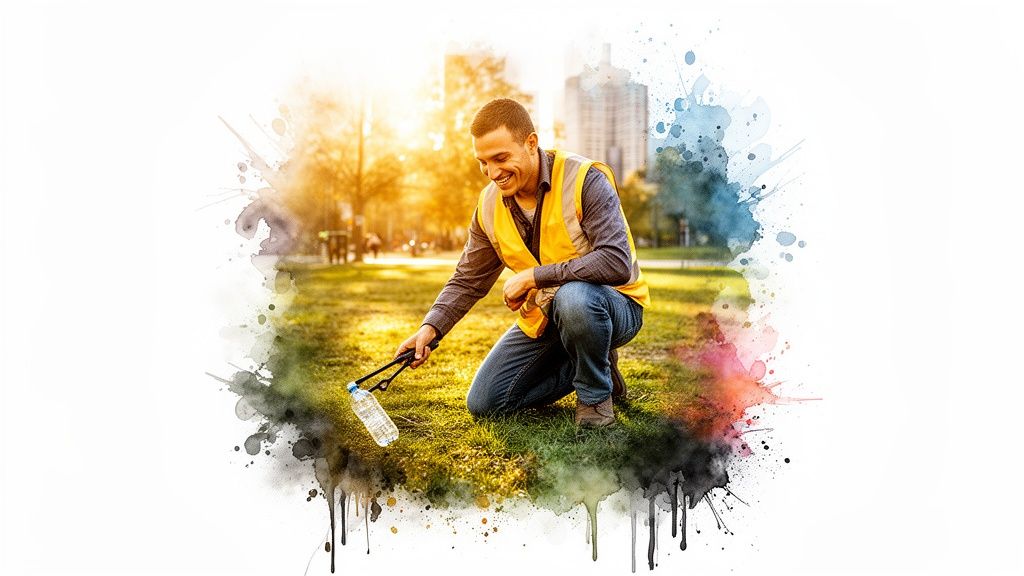
    A smiling man in a yellow vest kneels on grass, picking up a plastic bottle with a trash grabber.

    Then I stumbled on a simple truth that changed everything.

    A Way to Heal Yourself

    Cleaning up someone else’s mess is a thousand times easier than cleaning up your own. I mean it. Have you ever tried to untangle a friend's necklace? It’s just a simple little puzzle. But when it's your own, it’s a frustrating, impossible disaster. This one simple act of service started untangling knots inside of me I didn't even know were there.

    It forces you out of your own head. Back into the world.

    • You feel the sun on your skin.
    • You meet your neighbors—actual people who care.
    • You find a part of yourself that’s ready to grow again.

    I'm sharing everything our group has learned from three years of weekly cleanups here in Chicago. We’ve been out there in blizzards. In heatwaves. Even hailstorms. The weather, the work, the friendship—it all becomes part of the adventure. It adds what I like to call "flavor."

    This isn't just about cleaning a city; it's about transforming ourselves, one piece of litter at a time. It’s about finding clarity in the chaos and building something beautiful from what others have discarded.

    When you join a cleanup, you’re not just a volunteer picking up trash. You're making a statement. You're choosing action over apathy. Community over being alone. You become part of a story of renewal, both for the neighborhood and for yourself. It’s a strange and wonderful kind of fun, trust me.

    Gearing Up For Your First Community Cleanup

    Let’s get one thing straight: you don’t need a bunch of expensive, complicated gear to start picking up trash. Not at all. Getting ready for your first cleanup is way simpler than you think. In fact, our first-ever Litter Caterpillars event taught me exactly what you really need, and it was not what I expected.

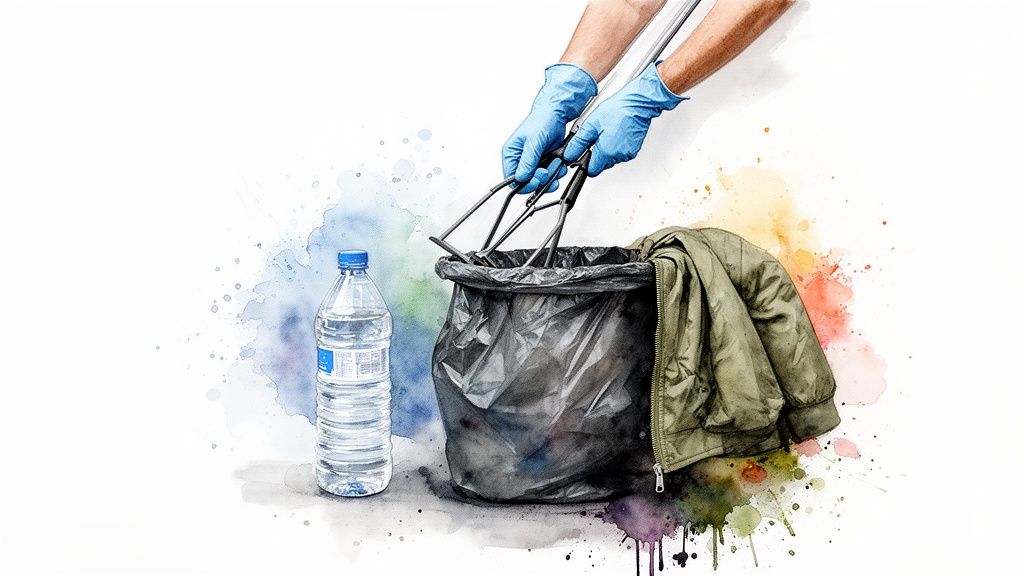
    Hands in blue gloves using a grabber tool to pick up trash into a black bag, beside a water bottle and jacket.

    There were only three of us. The sky looked innocent enough. Then, out of nowhere—a freak Chicago hailstorm in the middle of spring. We were soaked, freezing, huddled under a tree as Ubers kept canceling on us. It was miserable. But it was also a strange kind of fun.

    That day taught us what truly matters. It isn't having the perfect gear. It's having the right gear to stay safe and keep going.

    The Absolute Must-Haves

    Look, you're not gearing up for a Mount Everest expedition. This is a small adventure. In your own neighborhood. My goal is to get you out the door feeling prepared, not paralyzed by a massive checklist. There are only a few things I consider non-negotiable.

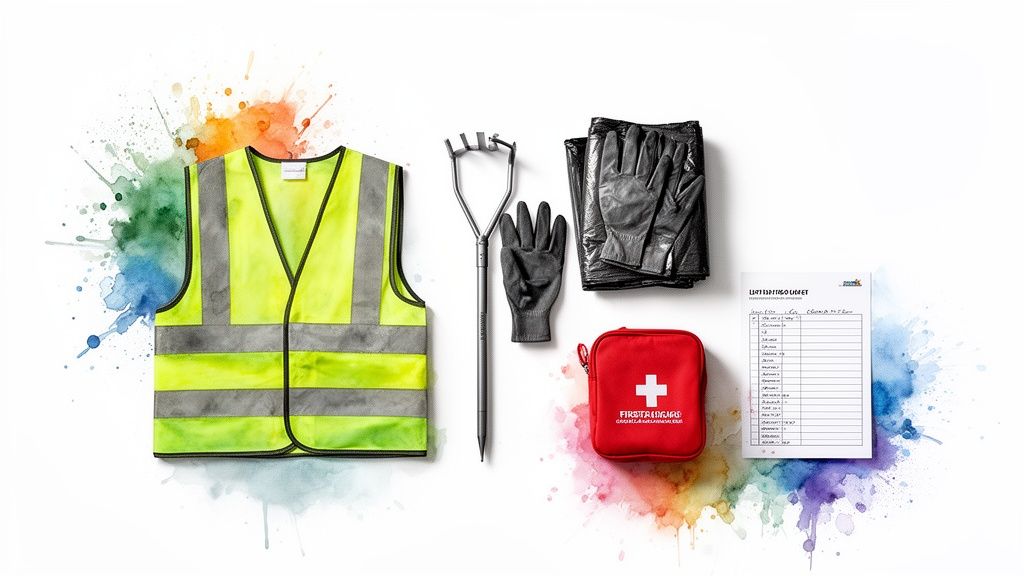
    • Good Gloves: This is your #1 priority. You have no idea what you’re picking up, and your hands are your most important tools. A sturdy pair of work gloves, the kind you’d use for gardening, will protect you from sharp objects, grime, and anything you’d just rather not touch.
    • A Trash Grabber: I call this the back-saver. Constantly bending over gets old fast. A simple grabber tool lets you pick things up without straining yourself, making the whole experience much more enjoyable. Trust me on this one. You'll last longer and have more fun.
    • The Right Bags: Don’t just grab a flimsy kitchen bag. It’ll rip the second you toss in a glass bottle. You need durable, heavy-duty contractor bags. We usually bring a few extra, because you'll almost always collect more than you think. You will.

    Forget perfection. The best gear is the gear that gets you out the door. You're not just grabbing tools; you're equipping yourself to make a real, visible difference. That’s the entire point.

    Dressing For The Adventure

    That hailstorm story? It’s a perfect example of why dressing for the elements is so critical. Here in Chicago, we deal with brutal wind chills and scorching summer humidity. Your comfort, your safety, it all depends on what you wear.

    Think in layers. It's like being a smart onion. A t-shirt, a fleece, and a waterproof or windproof outer shell will prepare you for almost anything. You can always take a layer off. And please, please, wear closed-toe shoes! You’ll be walking over uneven ground and who knows what else. Boots or sturdy sneakers are a must.

    Here's a quick rundown of what we recommend so you can show up ready to go.

    Your Essential Cleanup Gear

    Item Why It's Essential Our Pro Tip
    Sturdy Footwear Protects your feet from glass, nails, and uneven terrain. Hiking boots are great, but any solid, closed-toe shoe works.
    Layered Clothing Allows you to adapt to changing weather conditions. A light, waterproof jacket is a game-changer, even on cloudy days.
    Sun Protection Prevents sunburn and heat exhaustion. A hat, sunglasses, and sunscreen are your best friends. Seriously.
    Water Bottle Staying hydrated is crucial, especially in the summer. Bring more water than you think you’ll need. You can always share.

    Being prepared makes the act of volunteering to pick up trash feel less like a chore and more like a mission. When you're comfortable, you can focus on the real work and the connections you're making with your fellow volunteers.

    If you're interested in learning more about what to expect on the ground, check out our guide to picking up trash as a volunteer. It’s all about showing up ready to make an impact.

    How to Find Your Crew or Start Your Own

    Going it alone is great. I get it. Sometimes you just need to pop in your headphones and have a moment with yourself, the sunshine, and a bag of trash. But doing this work with other people? That’s how you change the world. It is.

    There's an old saying: "If you want to go fast, go alone. If you want to go far, go together." When I started Litter Caterpillars, it was just me and two friends, shivering under a tree in a freak hailstorm. Now, we’re a weekly force for good all across Chicago.

    Building a crew isn’t about being some slick event planner. It’s about creating a gravitational pull around a good cause. It’s like starting a campfire on a cold night—at first, it's just a tiny spark, but soon, its warmth draws people in. It's a magnetic thing.

    Starting With Your Inner Circle

    You don't need a megaphone to start a movement. You just need to send a text. That's how we began. I shot a message to a few friends with a simple idea: "Hey, want to go pick up some trash with me this Saturday?"

    • Keep it casual. Think of it as inviting them to a low-key hangout that just happens to make the world a little better, not a demand for their time.
    • Pick a familiar spot. A local park or a street you all know feels way more approachable than some random, far-flung location.
    • Set a clear, short timeframe. Nobody wants to sign away their entire Saturday. An hour or two is perfect—enough time to make an impact without feeling like a huge commitment.

    The first people who show up are your foundation. They're the ones who believe in you and the idea before it even has a name. Cherish them. Their energy is the fuel for everything that comes next.

    Expanding Your Reach Beyond Friends

    Once you’ve got a small, solid group showing up, it’s time to open the doors. This is where simple tools can make a massive difference. For us, Meetup and Instagram were game-changers. We didn't run any paid ads; we just shared our story.

    We posted photos of our smiling faces and the mountains of trash bags we collected. We told stories about the weird junk we found. The great conversations we had. People weren't just seeing a chore; they were seeing community, joy, and purpose.

    We created a vibe where people showed up for the mission and stayed for the friendships. That’s the secret sauce. This isn’t about building a nonprofit; it’s about building a family.

    Your little group doesn’t have to be some massive organization to be part of something huge. Just the act of volunteering to pick up trash plugs you into a global current of positive change. Think about the International Coastal Cleanup, which has ballooned into a movement mobilizing millions. One recent campaign saw volunteers collect over 17.8 million items of trash worldwide, and the next year, more than 18 million volunteers participated. These efforts, from Chicago to Greece, prove that ordinary people are creating a worldwide shift toward grassroots action. You can learn more about the incredible scale of these global cleanup initiatives.

    Protecting Your Most Valuable Resource

    This is the most important lesson I’ve learned: your volunteers' energy is the most precious resource you have. It's the engine that powers everything. You have to protect it fiercely.

    We call this our "volunteer-first" philosophy. What does that actually mean?

    • Safety is everything. We never, ever put anyone in a risky situation. No amount of trash is worth someone’s well-being.
    • Happiness is the goal. We keep things light and fun. We play music, we celebrate our victories (even the small ones!), and we make sure everyone feels seen and appreciated.
    • Friendship is the reward. We intentionally create space for people to connect. The work is the excuse; the community is the reason people keep coming back.

    Building a crew is less about logistics and more about heart. It's about being brave enough to ask for help and kind enough to make people feel welcome when they show up. If you're looking to find a great group near you, our guide to finding volunteer trash pickup events in your area can help you get started.

    Planning a Safe and Successful Cleanup Event

    A great cleanup is a safe cleanup. A simple idea, but it's the absolute foundation of everything we do. This isn't just about showing up with a bag and good intentions; it's about having a real game plan that keeps everyone safe and makes the biggest dent in the mess.

    I think of it like being a scout for a hiking trip. You wouldn't just send a group of friends into the woods without walking the trail first, right? Of course not. You’d want to know where the sketchy spots are, where it gets muddy, where the cool views are. Planning a cleanup is exactly the same.

    Scout Your Cleanup Location

    Before every single event, I go out and scout the location myself. This isn't just about finding a spot with a lot of trash. It's about seeing the area through a safety lens. Looking for hidden dangers. For things that could make our day a logistical nightmare.

    I always keep an eye out for a few key things:

    • Traffic Patterns: How fast are the cars flying by? Is there a safe shoulder to work on? We once cleaned a highway on-ramp, but only because it was completely shut down for a bike event. Never, ever put your crew near active, high-speed traffic.
    • Hidden Hazards: I'm looking for the nasty stuff—broken glass, sharp metal, or areas with dense, thorny bushes that could trip someone up. Knowing where these things are in advance helps us prepare and warn everyone before we start.
    • Accessibility: Can everyone in the group actually get to the area? Is there a safe, obvious spot for us to meet up before we start?

    This little bit of prep work makes a huge difference. It turns what could be a chaotic day into a smooth, successful mission where everyone feels secure and can just focus on the fun part.

    The journey from one person picking up trash to a full-blown community movement isn't as complicated as it sounds. It grows organically.

    A three-step infographic showing how to start a volunteer group: individual, then friends, then community.

    This shows you don't need a huge following to get started. You just need to start, grab a friend, and then open it up to the neighborhood.

    The Five-Minute Safety Talk

    Before we pick up a single piece of trash, we huddle up for a quick safety talk. This is non-negotiable. It sets the tone for the day. It reminds us all to look out for each other.

    I keep it short and sweet. Here’s the rundown:

    1. Glove Up: Never touch anything with your bare hands. Ever.
    2. Grabber is King: Use your grabber for anything sharp, sketchy, or just plain gross.
    3. Team Up: Work in pairs or small groups. Nobody wanders off alone.
    4. Hydrate: Drink water, even if you don't feel thirsty yet. Especially in the summer.
    5. Listen to Your Body: Take breaks when you need them. This isn't a race; it's a marathon.

    This simple huddle makes sure every new person knows we’re serious about their well-being. It’s all about building trust.

    The most valuable thing at any cleanup isn't the trash you collect; it's the energy and well-being of the volunteers. Protect that above all else. When people feel safe and cared for, they come back.

    Tackling The Big Trash Question

    Okay, you’ve collected a mountain of garbage bags. Amazing! Now what? This is the final, crucial piece of the puzzle. You can't just leave dozens of bags sitting on a street corner and call it a day.

    We've developed a system that works pretty well for us here in Chicago. The first thing we do is try to coordinate directly with city services. A quick call or email to the local sanitation department can often solve the problem—they'll tell you the best spot to pile the bags for a scheduled pickup.

    If that's not an option, we get creative. We've had awesome volunteers with pickup trucks help us haul bags to a proper disposal facility. The key is to have a plan before you start. Knowing how you’ll handle the waste is a critical step for any successful litter clean up.

    Planning isn't the most glamorous part of the job, I get it. But it’s what allows the real magic to happen. It’s how you turn good intentions into real, lasting change.

    Building a Movement People Want to Join

    Why do sports teams have flags, colors, and booming theme songs? Because pride is one of the most powerful motivators on the planet. For too long, kind, service-minded people have shied away from that power. It’s time we claimed it.

    This is about turning your volunteer group into something people feel in their bones. Think about Tom Sawyer, who took a punishment—painting a fence—and made it look so fun that his friends paid him for the privilege of doing the work. That’s the energy we’re channeling here.

    At Litter Caterpillars, we believe service should feel fun. Important. Like something you can be deeply proud of.

    Creating an Identity People Can Rally Behind

    When we first started, we were just a few friends picking up trash. We needed something more. We needed an identity. This isn't about corporate branding; it's about creating a symbol that stands for who you are and what you believe in.

    For us, it started with a flag. We carry it to every single cleanup. When you see that flag flying, you know you’re with your people. It’s a beacon.

    Then came the badges—small tokens of accomplishment that people collect and display with pride. And yeah, we even have our own theme song. It sounds a little silly, but when you hear it, it makes you smile. It reminds you that what we’re doing together is a joyful act, not a grim chore.

    Pride isn’t about ego. It’s about a profound sense of self-respect that comes from doing good, hard things. It’s the feeling that says, "I am part of something that matters, and I am proud of it."

    These symbols give people a sense of belonging. When someone asks a volunteer what they're doing, they're not just a person picking up trash. They're a Litter Caterpillar, part of a city-wide crew making a real, visible difference.

    The Power of Storytelling

    You’re not just asking people to pick up trash. You are inviting them into a story. And the story you tell determines who shows up and why they keep coming back.

    Your story is built from every small, authentic moment.

    • Share the weird finds. Post a picture of that single, lonely high-heel or the ancient-looking video game cartridge you pulled from a bush. It’s hilarious and relatable.
    • Celebrate the small victories. Did you completely clear one block? Snap a before-and-after photo and celebrate it! It shows tangible progress.
    • Highlight your people. Your volunteers are the heroes of this story. Share their smiles, their reasons for showing up, and the friendships they’re building along the way.

    One of our core values is bravery. And part of being brave is being loud and proud about the good you're doing. Your story gives others a reason to feel brave, too. It shows them that cleaning up their community is an act of joy and profound respect for themselves and their neighbors.

    You Are Part of a Global Wave

    It's easy to feel like you're just one person with one bag of trash. You have to remember: you are part of a massive, global movement. The desire to clean our shared home is a powerful, universal human instinct.

    The International Coastal Cleanup (ICC), for example, has grown into a monumental force over nearly four decades. Since it began, almost 19 million volunteers have removed over 400 million pounds of trash from the world's beaches and waterways.

    This sustained effort shows how individual groups, like yours and mine, contribute to a staggering worldwide impact. You can discover more insights about the global impact of local cleanup volunteers.

    Your local effort isn’t a drop in the ocean; it's the ocean itself, made of millions of dedicated drops just like you.

    When you create a movement, you build a culture of consistency. People don't just show up once. They come back week after week because they belong to something bigger than themselves. That is how you transform a neighborhood, a city, and maybe even a little piece of the world.

    Answering Your Cleanup Volunteering Questions

    Thinking about coming out to your first cleanup? I get it. You've got questions bouncing around in your head. It’s new territory! Let's get right into it and tackle those worries with some real talk from years of doing this.

    What If I Show Up and Don't Know Anyone?

    This is the big one, isn't it? That feeling of walking into a room full of strangers. It’s totally normal. But let me tell you why our events are different.

    First off, just think about who shows up to volunteer picking up trash on a weekend morning. These are givers. They are, by nature, kind and helpful people who are there to make a difference. You're walking into a group of people who are already on your team, even if you haven't met them yet.

    We always kick things off with a quick round of intros so you can put some names to faces. But the real connection happens when we get to work. There's something about working side-by-side, tackling a real, visible problem together, that just breaks down all the awkwardness.

    This isn’t some stuffy networking event where you’re forced to make small talk. It's real. I've seen it happen hundreds of times: someone arrives looking a little nervous and leaves two hours later making plans for brunch with their new friends. Just take that first step and show up. I promise, we’ll take it from there.

    Is It Actually Safe to Pick Up Trash?

    Safety is everything. Full stop. I see volunteer energy as this precious, fragile flame, and my number one job is to protect it. We do that by being smart. Prepared.

    We always scout our locations beforehand to spot any potential hazards. We work in groups, we look out for each other, and every single cleanup starts with a safety briefing. We go over the non-negotiables: you must wear gloves, you must use your grabber for anything sharp or sketchy, and you must stay aware of your surroundings.

    Your well-being is way more important than any piece of trash. We've held hundreds of events in all 50 Chicago wards and have a perfect safety record because we don’t take chances. We’re a team, and we have each other's backs.

    You’re never out there alone. I've got you.

    I'm Not Very Physically Fit. Can I Still Help?

    Yes! Absolutely, 100% yes. Get the idea out of your head that this is some kind of extreme sport. It's not. There's a vital role for every single person, and we value every bit of help.

    Everyone just goes at their own pace. We've got all types:

    • Some people are "runners"—they love to cover a lot of ground and fill up bags fast.
    • Others are "nesters," who prefer to zero in on one really messy spot and make it pristine.
    • You could also be the crew’s MVP by holding bags open, handing out water, or snapping photos to show off our hard work.

    The most important thing you bring is your good attitude and your willingness to pitch in. We have volunteers of all ages and abilities, from little kids to seniors. Just listen to your body, take breaks when you need to, and know that whatever you do, it matters.

    Does Picking Up Trash Even Make a Difference?

    I hear this a lot, usually with a hint of doubt. The world's a big place. Can one person with one bag really change anything? The answer is a loud, definite YES. It makes a difference in ways you can see right away, and in ways that ripple out into the ether.

    First, there's the instant gratification. You look back at the block you just cleaned, and it's transformed. Seeing that clean sidewalk or park and knowing you did that? It’s one of the best feelings in the world.

    Second, you inspire people without saying a word. When neighbors see you out there caring for your community, it flips a switch in their minds. It's a silent signal that someone gives a damn, and it makes them think twice about littering. It creates a ripple effect of community pride.

    And finally, you're doing more than just picking up trash. You're building something. You’re taking a stand against neglect and saying, "This is our home, and we care about it." Every can, every wrapper, every cigarette butt you pick up is a small act of defiance. It's a vote for a better world. It all adds up. And it all starts with you.


    Ready to see the difference for yourself? Litter Caterpillars is your crew. Come find us and help transform Chicago, one block at a time. https://www.littercaterpillars.com

  • What is social responsibility? Practical steps to make a difference today

    What is social responsibility? Practical steps to make a difference today

    I used to think social responsibility was a term reserved for corporate boardrooms, a phantom phrase haunting glossy annual reports. It felt colossal, impersonal, and a million miles away from my daily grind.

    Then my own world imploded. A relationship shattered, my apartment became a monument to chaos… I was submerged, drowning in my own life's clutter. Cleaning it up felt impossible. But a peculiar thought surfaced: what if, instead of tackling my own mess, I went out and cleaned up someone else's? The city's mess.

    The moment I stepped out that first day, litter picker in hand, it all clicked into place. Social responsibility isn't about having your own life flawlessly curated. It's about showing up for the world that exists beyond your front door.

    It’s this beautifully simple, profoundly powerful idea that we're all intricately woven together. Imagine society is a vast, sprawling quilt—you, me, every single person—we’re each a single thread. When you tug on one, even the tiniest one, the entire pattern ripples and shifts. That’s it. You’re making choices that fortify the entire fabric, not just your own little patch.

    The Three Layers of Making a Difference

    To really grasp what social responsibility is, you have to see its DNA expressed at different scales—from your own quiet decision to a multinational corporation's sweeping mission.

    This diagram unpacks it perfectly, illustrating how genuine change grows from the ground up, starting with you.

    A hierarchy diagram illustrating social responsibility at individual, community, and corporate levels with specific examples.

    This visual illuminates a crucial truth: real impact isn't a one-way street, trickling down from on high. It's a living feedback loop. Your personal choices ignite community action, and vibrant communities, in turn, compel corporations to elevate their game.

    Let me break down how this dynamic plays out in the real world.

    The Three Dimensions of Social Responsibility

    A straightforward look at how responsibility scales from a single person to a global corporation.

    Dimension Who It Involves Example in Action
    Individual You, me, every single person. You choose to bike to work instead of drive. I volunteer on a Saturday. We simply check in on an elderly neighbor.
    Community & Civic Neighborhood groups, local non-profits, city-wide initiatives. A group like Litter Caterpillars orchestrates weekly cleanups, or a community garden materializes, offering fresh produce for local families.
    Corporate (CSR) Small businesses and global corporations. A local coffee shop meticulously sources fair-trade beans, or a tech giant invests in renewable energy to power its sprawling data centers.

    As you can see, these layers aren't sealed off in silos. They're perpetually dancing with one another.

    One person’s unyielding dedication to recycling can spark a neighborhood-wide composting revolution. A community that passionately demands pristine parks can pressure local businesses to abandon single-use plastics. It all begins with the defiant belief that what you do actually, fundamentally matters.

    This mindset is a kindred spirit to another potent idea, which you can explore in our guide on what is environmental stewardship. Everything ignites the moment you decide to take that first small, powerful step.

    The Surprising Joy of Tackling a Shared Mess

    Three diverse people joyfully collecting trash under a tree in a watercolor painting, promoting environmental cleanup.

    You know that feeling? It's infinitely easier to help a friend conquer their chaotic garage than to confront your own overstuffed closet. A profound psychological truth hides in that sensation, and it's the secret ingredient that makes groups like ours thrive. Let me transport you back to our very first cleanup.

    We were a trio, armed with trash grabbers and only a hazy notion of our mission. Then, in a display of classic Chicago drama, a serene spring day erupted into violence. A freak hailstorm ambushed us, forcing us to huddle beneath a flimsy tree as ice pellets rained down like tiny hammers.

    And in that shared, shivering moment of misery, something profound clicked for me. Confronting a collective mess—the city's litter—felt strangely, wonderfully liberating.

    Detached from Personal Baggage

    This mess wasn't my mess. It carried none of the emotional gravity of my own to-do list, where each piece of clutter whispers a story of procrastination or past failure. The city's trash was just… trash.

    Tackling a problem that doesn't personally belong to you unleashes pure, unfiltered purpose. It vaporizes self-judgment, replacing it with a simple, achievable mission.

    This detachment is a superpower. It transforms a potentially demoralizing chore into an exhilarating adventure. You aren't fixing a personal shortcoming; you are contributing to a collective triumph.

    This is the very point where the idea of what is social responsibility sheds its heavy, obligatory skin and reveals itself as a wellspring of unexpected joy. It's about discovering your own strength by focusing on something orders of magnitude bigger than yourself. When you pivot your focus outward, you unearth a part of you that you never knew existed.

    Turning Struggle into a Story

    That hailstorm could have been the unceremonious end of our fledgling group. Instead, it became our origin story. Why? Because shared struggle forges bonds of steel.

    Facing a challenge together ignites a few spectacular things:

    • It builds resilience: Enduring a small, shared hardship like a sudden storm makes you feel like you can conquer mountains.
    • It creates instant community: Nothing connects people faster than a shared "can you believe this is happening?" moment.
    • It makes the work memorable: The struggle adds flavor, a narrative spice. It elevates a simple task into a story you’ll genuinely want to tell later.

    Suddenly, you’re not just picking up litter anymore. You're part of a crew that stared down a storm. You're a protagonist in a story of progress, where every filled trash bag is a victorious chapter. It’s in these moments that the true meaning of social responsibility reveals itself—not as a duty, but as a path to connection, growth, and even a bit of wild fun.

    How Big Companies and Local Groups Build Trust

    Watercolor image of a businessperson and a volunteer holding a green plant, symbolizing growth and collaboration.

    It's not just us out there, wielding trash grabbers on a brisk Chicago morning. The most gargantuan, powerful corporations on Earth are wrestling with the very same idea we are. They have a more polished name for it: Corporate Social Responsibility, or CSR. But strip away the acronyms, and it boils down to one elemental thing: trust.

    For decades, the gospel of business was brutally simple: a company's sole duty was to enrich its shareholders. The planet? The community? Someone else's problem. But something seismic has shifted in the landscape.

    Today, you, me, and millions of others are raising our voices, demanding more. We expect the brands we champion to be good neighbors. We want them to be accountable for their impact on the world, not just their profit margins. And you know what? They're listening.

    From Afterthought to Essential Strategy

    This isn't some ephemeral trend; it's a tectonic shift in the very mechanics of business. The proof is etched in the data.

    An astonishing 98% of S&P 500 companies now publish dedicated CSR or sustainability reports. Let that sink in. Just a few years ago, that figure was a negligible fraction. This explosive growth signals how social responsibility has morphed from a "nice-to-have" PR maneuver into a core tenet for survival.

    Why the sudden corporate enlightenment? Because they finally deciphered the code: doing good is good for business.

    Trust is the new currency of the modern economy. When a company invests in its community, it’s making a deposit. When it pollutes a river or ignores its workers, it’s making a catastrophic withdrawal.

    This new reality has birthed a playbook for how businesses earn that invaluable trust.

    The Two Sides of the Same Coin

    At first glance, a global behemoth cutting a multi-million dollar check for a climate initiative seems galaxies away from a small crew cleaning a neighborhood park. But I see them as two faces of the same coin. Both actions are grappling with one fundamental question: do you show up for your community?

    • Corporate Level: This is the macro-level stuff. A company might pour capital into renewable energy, enforce fair labor practices throughout its labyrinthine supply chain, or architect programs to diversify its workforce. These are the grand gestures that prove to customers and employees that the company’s values transcend the bottom line.
    • Community Level: This is where we live and breathe. When we show up every weekend, come rain or shine, we are making a tangible, visible promise to our neighbors. We are proving, block by block, that we care.

    Whether it’s a global titan or a handful of us armed with trash bags, the objective is identical. It’s about forging a reputation built on the bedrock of consistent, positive action. For us, the action is picking up litter. For a corporation, it might be an intricate sustainability program. Both are potent declarations saying, "We're here, and we're trying to help."

    We help businesses understand how to forge this connection at a local level—you can learn more about our corporate social responsibility programs. At the end of the day, building a better future begins with proving you can be counted on.

    The Values That Fuel Our Mission

    Three smiling friends in colorful raincoats and casual clothes walking, holding hands, with watercolor splashes.

    It’s one thing to comprehend what is social responsibility as an abstract concept. It’s a whole different beast to breathe life into it, week after grueling week, in the messy real world. That requires more than a solid plan; it demands a pulse. A heartbeat.

    You need a set of values that act as your North Star when the work gets hard, the weather turns hostile, and the siren song of staying home seems irresistible. For us, it all distills down to three core beliefs. These aren’t just words we splash on a website. They're the fuel. They're the reason we show up.

    Bravery to Begin

    First, let's talk about Bravery. I’m referring to the audacity to get uncomfortable. It’s showing up for a cleanup in a corner of the city you’ve never explored. It’s venturing out when the forecast screams rain, or worse. This is the fertile ground where real magic sprouts, because nobody ever grew by remaining cocooned in their comfort zone.

    Think about Tom Sawyer, condemned to the dreary punishment of whitewashing a fence. He could have sulked. He could have complained. Instead, he executed a brilliant psychological maneuver, reframing the chore as an exclusive, can’t-miss opportunity, convincing his friends they were lucky to even try. He made drudgery look like a privilege.

    That's the spirit. We unearth joy in the challenge. We lean into the tempestuous days because those are the ones that weave the best stories and forge the most unbreakable friendships. Real social responsibility ignites with the bravery to simply begin, especially when it’s inconvenient.

    Kindness as Our Compass

    Next up is Kindness. But perhaps not in the way you’re imagining. For us, kindness manifests as a fierce, unwavering protection of our volunteers' energy. Your time, your spirit, your well-being—that is the most precious resource we possess. It is the engine that powers this entire beautiful machine.

    This is precisely why I schedule our events on weekend mornings. It's a deliberate choice to convene a community of givers—people willing to launch their weekend with an act of service. It’s also why we will never, ever ask you for money.

    Your time and positive energy are the only currencies that hold value here. We believe that true service is a gift, not a transaction.

    By prioritizing our volunteers, we ensure this space always remains a sanctuary of joy and connection, not one of obligation. That’s my promise to you. Kindness is our compass, and it always points toward what’s best for the people who make all of this possible.

    Unity in Our Purpose

    Finally, there’s Unity. We are absolutely, unshakeably committed to bringing people together from all 50 wards of Chicago. This city can sometimes feel like an archipelago of disconnected islands, but we know its most profound strength lies in its connections.

    There’s an old proverb: "If you want to go fast, go alone. If you want to go far, go together." We are in this for the long haul.

    Every single cleanup is an act of bridge-building. It's living proof that we are stronger, happier, and exponentially more effective when we work side-by-side. Unity isn't just about showing up in different zip codes; it's about cultivating a shared sense of ownership for our entire city and proving that together, we can manifest the change we all yearn to see.

    So, You In? Here’s Your Personal Invitation

    Hopefully, by this point, you're feeling it—that little ember that starts to glow when you realize you can actually be part of something tangible, something bigger than yourself. If you are, consider this your official, personal invitation from me to you. Come join us.

    This is the exact moment where the concept of what is social responsibility ceases to be mere words on a screen and transforms into a real-life adventure. I've opened the door, and I want to show you just how exhilarating it is to step through it.

    Whether you're a newcomer to Chicago, searching for some of the most genuine, kind-hearted souls in this city, or you just crave the satisfaction of seeing the tangible, visible impact of your own two hands—you belong with us. I've got a spot saved just for you.

    How to Join the Adventure

    Getting involved is as simple as I could possibly make it. We've demolished all the usual barriers because I know the most vital thing you can bring is your own energy. I want you to feel excited, not burdened.

    Here’s the deal:

    • Find Us Easily: We post all our upcoming cleanups on Meetup and Instagram. Give us a follow, and you'll know precisely where we'll be next weekend. No ambiguity.
    • No Gear Needed: I mean it. Just show up. We bring everything—gloves, trash bags, those awesome litter grabber thingies. All you need to bring is yourself.
    • Your Happiness Is the Priority: This isn't about pressure. It’s about connection, fun, and doing something good. You'll discover that a cleaner city is an incredible side effect of forging real friendships.

    This journey isn’t merely about picking up trash. It's about personal metamorphosis. I’ve personally watched new volunteers arrive, shy and hesitant, and within a few months, they’re leading their own neighborhood cleanups, radiating a confidence they never knew they possessed. They discovered their own strength by showing up for others.

    A Community Built on Doing Stuff

    This isn't just my story. It’s a collective narrative we all write together every single weekend—a story penned by incredible people who choose to give their time. Deep friendships have been forged side-by-side, sharing laughs over the absurd things people discard and bolstering each other when the Chicago weather gets a little theatrical. This is where you find your people.

    Sure, corporate philanthropy is a juggernaut. US companies donate billions annually. But when policies shift or that support evaporates, the raw, undeniable power of people on the ground—of grassroots unity—shines through. It’s the untamed energy of volunteers that actually changes worlds.

    This is your chance to step into a story of bravery and kindness. It’s a chance to find the fun in service and see how it changes you from the inside out.

    We’ve seen firsthand how a small group with a shared purpose can ignite a massive, visible change. The only thing missing is you.

    If you’re ready to jump in but aren’t sure where to start, we've got your back. Check out our guide on how to find volunteer work that actually feels right for you.

    Your Questions Answered

    Jumping into something new, especially with a group of strangers, can feel a little strange. I get it. You probably have a few questions swirling in your mind. Let’s cut right to the chase and tackle those head-on.

    My goal is to give you the real answers, no fluff, so you can feel completely at ease about showing up.

    "My Schedule is Crazy. What's the Commitment?"

    Life is a whirlwind. Work is relentless. We know. That's precisely why we don't believe in commitments. Your time and energy are a gift, and we treat them as such.

    There is zero long-term commitment. I'm serious. Come once a year, once a month, or whenever you feel that magnetic pull to get out there and do something real. I post everything on platforms like Meetup so you can just pop in and RSVP when it aligns with your life. No pressure, no guilt. We’re just happy to have you, whenever that may be.

    "Do I Need to Buy a Bunch of Gear?"

    Nope! Not a single thing. We've got all the gear covered, so you don't have to worry about a thing.

    We provide everything you'll need to safely and effectively clean up our city:

    • Heavy-duty gloves to protect your hands.
    • Tough trash bags that won't give up.
    • Litter grabbers so you don't have to break your back.

    We have a 'volunteer-first' rule. That means we obliterate as many hurdles as possible. I want you to focus on the mission and the people you're with, not on remembering to bring a trash poker.

    Just show up. Wear some comfortable clothes and shoes you don’t mind getting a little dirty. That’s it.

    "Is It Safe? We're Going All Over the City."

    Your safety is our absolute, non-negotiable priority. Always. This isn't just rhetoric; it's woven into the very fabric of how we operate.

    The most crucial rule we have is that we always stick together. There’s a powerful safety in numbers, and we look out for each other like a family. When we venture into all 50 wards, we’re sending a profound message that every part of Chicago is worth caring for. We’re not just picking up trash—we’re showing up, building trust, and proving that unity makes us all stronger.


    At Litter Caterpillars, we believe that when you show up for your city, you start to transform yourself. We’re not just cleaning streets; we’re building a community of brave, kind people who are proud to make a real difference. Come find your people. https://www.littercaterpillars.com

  • What Is Servant Leadership? It’s About Flipping the Pyramid Upside Down

    What Is Servant Leadership? It’s About Flipping the Pyramid Upside Down

    Have you ever worked for someone who felt less like a boss and more like a champion? Someone whose first instinct was always to ask, “What do you need to fly?” If you’ve been that lucky, you’ve felt servant leadership—a philosophy that grabs the old top-down power structure and flips it completely on its head.

    So, What Is Servant Leadership, Really?

    Forget that classic corporate pyramid, you know the one, with the CEO perched at the very top. I want you to imagine grabbing that pyramid and turning it upside down. Now, the leader is at the bottom, a solid base, holding everyone else up.

    Their primary role isn’t to sit in a corner office and dictate strategy. It's to serve. That means you'll find them right there in the trenches with the team, clearing roadblocks, finding resources, and unlocking each person's potential. It's a gut-level shift from the old world of 'power over' people to a new reality of 'power with' them.

    This is what it looks like in practice—the leader becomes the support system for the whole team.

    An inverted servant leadership hierarchy pyramid showing leader at the bottom supporting the team.

    The team's success becomes the leader's victory, and it’s all built on a foundation of unwavering support.

    My Own Stumble into Servant Leadership

    When I started Litter Caterpillars, the last thing on my mind was being "in charge." I just wanted to build a little tribe, a community where people felt they belonged and their effort actually mattered. My job, as I saw it, was just to make sure our volunteers had what they needed—sometimes that was trash bags and gloves, other times it was just a shared sense of purpose to keep them moving in the brutal Chicago wind.

    This isn’t about you serving your leader; it’s about your leader genuinely serving you.

    I think of it like this: a traditional boss is like a person standing on their porch, shouting at the garden to grow faster. A servant leader? They're the ones with their hands in the dirt. They're testing the soil, making sure the plants get enough sun and water, and yanking out the weeds that could choke out new life.

    The gardener’s success isn’t measured by how loud they can shout. It's measured by the vibrancy and health of the garden itself.

    The Big Mindset Shift

    This way of leading fundamentally rewires a group’s DNA. The dynamic shifts from a series of transactions—"you do this for me, I pay you"—to relationships built on a bedrock of trust and mutual respect.

    The servant-leader is servant first… It begins with the natural feeling that one wants to serve, to serve first. Then conscious choice brings one to aspire to lead.

    That idea, so simple it's almost jarring, changes everything. It pulls in people who are motivated by a deep desire to contribute, not just to climb a corporate ladder. For a group like ours, it fosters an environment where people feel safe enough to take risks, to share wild ideas, and to bring their whole, messy, wonderful selves to the mission.

    This entire philosophy is about weaving stronger communities. It connects directly to the heart of what is civic engagement—people choosing to come together, to take collective action for the good of everyone.

    Servant Leadership vs Traditional Leadership

    To really get what makes this so different, it helps to put the two models side-by-side. The contrast isn't just in their actions, but in their entire worldview.

    Characteristic Servant Leadership Approach Traditional Leadership Approach
    Primary Focus "How can I help you grow and succeed?" "How can you help me meet my goals?"
    Decision-Making Collaborative and inclusive. Seeks team input. Top-down. Leader makes decisions alone.
    Source of Power Trust, respect, and influence earned. Authority, title, and position held.
    Communication Listening first, then speaking. Open dialogue. Directing and telling. Information flows down.
    Success Metric Team growth, well-being, and shared achievement. Leader's results and personal achievements.
    Team Dynamic A community working together. A hierarchy of command and control.

    When you see it laid out like that, the picture becomes starkly clear. One approach is about lifting others up; the other is about maintaining a position of power. For any mission that relies on heart and soul, the choice isn’t really a choice at all.

    Where Did This Crazy Idea Come From?

    Five diverse, smiling individuals with open hands presenting, one man kneeling, on a watercolor backdrop.

    This whole concept of putting people first feels revolutionary, doesn't it? But it’s not some trendy new management fad. The idea's heart is ancient, but the modern term servant leadership was actually coined back in 1970 by a man named Robert K. Greenleaf. And it all started because he read a story.

    The book was Hermann Hesse’s Journey to the East. It tells the tale of a group of travelers on a mythical quest, accompanied by their servant, a man named Leo.

    Leo, on the surface, was just the guy who handled the daily grind. He carried the baggage, he cooked the meals, he tended to everyone’s needs. But his true role was something much deeper—he was the group's spiritual center. His boundless energy and his songs kept their spirits high. He was their glue.

    The Servant Who Was Actually the Leader

    Then, one day, Leo vanishes. And the group completely disintegrates. Almost overnight, their journey descends into bickering and chaos. The grand mission that once felt so important falls to pieces, and they abandon the quest entirely. It was a total collapse.

    Years later, the narrator stumbles upon Leo again, only to discover a shocking truth. Leo wasn't just a servant. He was the head of the very organization that had sponsored their journey. He was their great and noble leader, who had chosen to lead by serving his people directly.

    This story flipped a switch in Greenleaf’s mind. It sparked the one question that cuts to the very core of what servant leadership is.

    Does the leader start out wanting to serve, or do they chase power first and then decide to be helpful?

    Greenleaf's answer was profound in its simplicity. A true servant leader is a servant first. Their path to leadership begins with a deep, innate desire to help others—not a hunger for a title or the corner office. It’s the polar opposite of the classic power-hungry boss.

    This is the bedrock of what we do at Litter Caterpillars. I'm always looking for the Leos of the world—the givers. The people who show up because they genuinely want to make things better, not because they’re chasing applause. They lead with their hands and their hearts, and that is what inspires everyone else to follow.

    Putting Core Principles into Action

    So, how do you take this beautiful idea and make it breathe? Knowing what servant leadership is means absolutely nothing if you don't live it. This isn't about good intentions; it’s about intentional, consistent action. The entire philosophy is built on practices like deep listening, empathy, healing, and fostering a true sense of community.

    It’s one thing to read about these concepts in a book. It’s another thing entirely to put them into practice when it’s freezing cold, dark, and you’re wondering if anyone is even going to show up for your cleanup. I want to share how these principles become real for us at Litter Caterpillars.

    Turning Concepts into Community

    Some of these principles can sound a little abstract, a little… fuzzy. Take 'healing,' for instance. What on earth does that mean for a volunteer group picking up trash? For me, it was deeply personal. I started Litter Caterpillars as a way to heal from a messy chapter in my own life. By trying to bring some order to the world outside, I was slowly learning how to organize my world inside.

    The act of service can be a powerful medicine, not just for the community, but for the person serving.

    Then you have 'building community.' This is so much more than a buzzword you slap on a website. It’s about deliberately carving out space for real human connections to take root. You can find it in our pre-cleanup rituals, the silly theme songs we sing, and the group chats where genuine friendships are forged long after the last piece of trash is collected. It's about knowing, deep in your bones, that you’re part of something bigger than yourself.

    True community is built not on proximity, but on shared purpose and mutual care. When people feel safe and supported, they can achieve incredible things together.

    This approach creates an ecosystem where people feel seen and valued, which is exactly the fuel you need when you're trying to motivate volunteers to face a Chicago blizzard for a cleanup. And this isn't just a feeling I have; the data tells the same story.

    Scientific research shows a direct, powerful link between servant leadership and a team's engagement. One compelling study found this leadership style positively correlates with work engagement and significantly boosts both employee resilience and feelings of organizational support. In fact, resilience becomes a key pathway through which a servant leader strengthens the entire team. You can read the full research about these compelling findings here.

    From Principles to Practical Steps

    So how do you begin? You don't need some grand, complex strategy. You just need to pick a principle and start.

    • Practice Deep Listening: Instead of just waiting for your turn to talk, truly hear what someone is saying. Ask questions that show you're engaged. Make them feel like they're the only person in the world at that moment.
    • Empathize Actively: Try to understand someone's perspective, especially if you don't agree with it. Acknowledge their feelings before you offer your own thoughts.
    • Focus on Others' Growth: Ask your teammates or volunteers, "What are your goals?" and then actively look for ways you can help them get there.
    • Build Deliberate Connections: Create small rituals. Celebrate wins—big and small. Introduce people you think would hit it off.

    These small, consistent actions are the molecules that build a servant-led culture. When you're working with volunteers, these actions are everything. If you're looking for more ideas, check out our guide on volunteer management best practices for more insights.

    It all starts with a single, intentional choice to put another person first.

    Why People-First Leadership Delivers Better Results

    It feels completely backward, doesn't it? This idea that to achieve audacious goals, you should focus less on the goals themselves and more on the people chasing them. In a world that screams for results, for metrics, for the bottom line, this approach quietly demonstrates that genuine human connection is the ultimate secret weapon for getting things done.

    Think of it like building a huge bonfire to light up a dark field. A traditional leader might just keep heaving logs onto the pile, demanding a bigger flame. But a servant leader? They're the one on their knees, carefully arranging the kindling, making sure there’s enough airflow, and shielding the fragile embers from the wind.

    They understand a fundamental truth: if you take care of the core of the fire, the blaze will take care of itself.

    A man and a woman in a watercolor style, engaged in a focused conversation.

    This isn't just some feel-good platitude; the data is shockingly clear. When you lead in a way that makes people feel seen, trusted, and genuinely cared for, they stop just clocking in and out. They become partners in the mission.

    The Science of Serving First

    You might think this "people-first" stuff is soft, but the results are hard as steel. The research reveals a stunning impact when organizations truly commit to this model.

    Organizations that put servant leadership into practice see 77% higher employee engagement compared to traditional top-down models. At the same time, they achieve 50% lower turnover rates.

    That's a staggering difference. When you build your house on a foundation of trust, your team becomes capable of weathering any storm. They stick around, they invest more of themselves, and they bring their best energy to the work.

    Our Mission Is People

    At Litter Caterpillars, if you ask me what our mission is, I'll say it's cleaning up Chicago. But our real mission? It's our volunteers. They are not tools we use to pick up trash; they are the entire point. Their energy, their passion, their well-being—that is our most precious resource.

    My job is to be the guardian of that resource. By putting the needs of our volunteers first, I'm ensuring their energy is constantly renewed, not depleted. This approach transforms a scattered group of individuals into a powerful, committed force that feels like they can take on the world, one city block at a time. It’s how you build a real movement.

    If you’re curious how this people-first mindset can create ripples far beyond your immediate team, check out these corporate social responsibility examples that show how service can redefine what success even means.

    How We Live Servant Leadership at Litter Caterpillars

    This is where the theory gets its hands dirty. I want to show you how these big ideas about serving others aren't just abstract concepts for us—they are the practical, real-world actions we take every single week.

    At Litter Caterpillars, servant leadership isn't a poster on a wall; it’s a thousand tiny choices. It’s choosing to clean a neighborhood that truly needs our help, not just the one that’s easiest to park in. It’s a culture, a feeling, a promise.

    It’s me, personally, making sure every single volunteer has water, knows how much they are appreciated, and understands their time is the most valuable gift they could possibly give us. It's our absolute 'no-pressure' rule for everything we do, because a person’s well-being is infinitely more important than their output.

    Forged in a Hailstorm

    I will never forget our very first cleanup. There were only three of us, huddled under a little tree as a freak Chicago hailstorm came roaring out of nowhere. It was miserable. It was cold. And it was the exact moment that forged our entire identity.

    In that shared struggle, we discovered something real. Facing a ridiculous, unexpected challenge together builds bonds that simply don't break. I realized my role wasn't to be the "boss" of the cleanup; my job was to serve my tiny, freezing team by turning a wretched experience into an adventure we would never forget.

    My leadership became about one thing: protecting the spirit of the team, no matter what the world threw at us. That’s the core of servant leadership—you serve the people, and the people will serve the mission.

    This servant-first focus is proven to work. When you genuinely place your team's well-being at the forefront, it has a seismic impact on their morale and performance. Research demonstrates that servant leadership can explain an additional 41% of the variance in satisfaction with leaders—a huge leap that shows just how powerful this approach is. You can discover more insights about these findings on Regent.edu.

    It creates a virtuous cycle of trust and commitment. It’s a powerful, generative force.

    Our Values as Actions

    Every decision we make, big or small, gets filtered through our core values. Each one is a direct expression of putting our people first.

    • Bravery: For us, bravery means showing up when it’s hard. It’s serving a community even when you feel out of your comfort zone. My role is to lead by example—to be the first one out in the freezing rain, proving that we’re all in this together.
    • Kindness: This is our volunteer-first policy, plain and simple. We protect our volunteers’ energy above all else. We celebrate them, we support them, and we will never, ever pressure them for anything.
    • Unity: We build community on purpose. We create rituals, we share stories, and we make space for real friendships to blossom. My job is to be the gardener of that community, tending to the connections that make us resilient.

    These aren't just pretty words on a website. They are the practical application of serving first. By living these values, we’re not just picking up litter; we're building a joyful, powerful community from the ground up, one small act of service at a time.

    Answering Your Questions About Servant Leadership

    Three people in raincoats, one offering water bottles to two holding trash bags after a cleanup.

    Alright, you’ve stuck with me this far, which tells me you probably have some questions kicking around in your head. That’s a good thing. It means you’re already thinking beyond the textbook definitions and wondering how this all holds up in the messy reality of life.

    Let's tackle some of the questions I get asked all the time. No theory, just straight talk from the trenches.

    Can I Be a Strong Leader and a Servant Leader?

    Yes. One hundred percent. In fact, I don't believe you can be a truly strong leader without it. This is probably the biggest myth we need to demolish right now: the idea that serving your team makes you a pushover. It is the absolute opposite. It takes profound courage and confidence to put your team's needs ahead of your own ego.

    A servant leader still has a clear vision. They still hold people to high standards. And you better believe they make the tough calls when nobody else wants to. The difference isn't in the action; it's in the why. Every single decision gets filtered through one simple question: "What is best for my people and our mission?"

    Think about a ship's captain steering through a brutal storm. They are in complete command, decisive, and unwavering. But every order they bark is for one single purpose: to get their crew home safely. That's strength through service.

    How Can I Start If I Don't Have a Title?

    You do not need "manager" or "team lead" on a business card to be a leader. Leadership is an action, not a position. You can start being a servant leader today, right where you are, with your coworkers, your family, or your fellow volunteers.

    Here’s how you can start small:

    • Actually listen: Don’t just wait for your turn to talk. Hear people out. Understand what they’re trying to say underneath the words.
    • Offer real help: See a teammate swamped? Jump in and help them, even if it’s not "your job."
    • Amplify others: When someone does something amazing, tell them. Then tell everyone else.
    • Ask better questions: Try things like, "What’s the biggest obstacle in your way right now?" or "What do you need from me to make this happen?"

    Some of the most incredible leaders we have at Litter Caterpillars are simply volunteers who have been with us for a while. They take it upon themselves to make the new folks feel like they belong from the moment they arrive, and that act of service is immeasurably powerful.

    What Are the Big Mistakes to Avoid?

    This is a journey, and you're going to stumble. I know I have, many times. But there are a couple of common traps to watch out for. The biggest one is confusing serving with pleasing. Your job is not to make everyone happy all the time. It's to help them grow and succeed, and sometimes that means delivering tough feedback or saying no to a bad idea. A people-pleaser avoids conflict at all costs; a servant leader walks toward what's right for the team.

    Another massive pitfall is running yourself into the ground. You cannot pour from an empty cup. If you are burned out, you are of no use to anyone. Taking care of yourself isn't selfish; it’s the prerequisite for being able to keep showing up for others.

    And finally, watch out for false humility. Servant leadership is about genuine service, not about pretending you're not in charge. You can own your authority while using it to lift others up instead of holding it over their heads.


    At Litter Caterpillars, we're figuring this out together, one cleanup at a time. If you're ready to see what servant leadership looks like in the wild and want to do some real good for Chicago, we’d love to have you. Find our next event at https://www.littercaterpillars.com.

  • Discover how to find corporate sponsors: A practical guide

    Discover how to find corporate sponsors: A practical guide

    Let me tell you something about learning how to find corporate sponsors: it's not about groveling for cash. You're not passing a hat around. You're inviting someone—a real, breathing company—into an adventure. A story. It’s a narrative of pure grit, of neighbors banding together, of making a tangible difference—a story they can’t just buy off a shelf or cook up in some sterile boardroom. The sponsorships that last? They're forged in the fire of a shared mission, not in the cold, hard calculus of metrics.

    Your Sponsorship Journey Begins With Your Story

    Before you dare to dream about sponsorship tiers or see their logo splashed across a banner, you have to excavate your "why." Why did you even begin this crazy thing? What was that single, crystallizing moment when everything shifted? Corporate partners aren't swayed by your immaculate spreadsheets. They're moved by your fire. They need to feel the heat.

    I didn’t kick off Litter Caterpillars with some grand, laminated business plan. I started it because I was suffocating in my own mess, both literally and metaphorically. My apartment was a disaster zone, my life felt like it was stuck in park. A sudden, sharp realization hit me: I couldn't possibly clean up my own life until I started cleaning up for others. That was my escape hatch.

    Unearthing Your Origin Story

    Every truly great group has an origin story. It’s that singular moment, that one vivid memory that perfectly encapsulates the soul of what you do. It’s the anecdote that makes someone stop their mindless scrolling, lean in closer to the screen, and actually listen.

    For me and my crew, it wasn't some polished, strategic summit. It was just three of us, shivering violently under a lone tree during a freak Chicago hailstorm on our very first cleanup. Every. Single. Uber. Canceled. We were drenched, freezing our tails off, and frankly, it was miserable. But right there, in that moment of shared suffering, I had an epiphany. Cleaning up someone else’s mess was profoundly easier than confronting my own, and the struggle, shared, transformed into an adventure.

    That hailstorm didn't crush us; it forged us. It became the beating heart of our story. It’s the raw, unfiltered evidence of our commitment. Your story doesn’t need a Hollywood polish; it just needs to be brutally true.

    Think about your own defining moment. Was it:

    • A specific, electric conversation that ignited the entire idea?
    • A gnawing, frustrating problem that you just knew you were the one to solve?
    • A moment of pure, unexpected euphoria during your very first event?

    This is the nucleus of your pitch. It’s the emotional grappling hook that makes a potential sponsor see you not as just another nonprofit with its hand out, but as a tribe of passionate humans they desperately want to join.

    Translating Your 'Why' Into a Mission

    Once you’ve gripped that core story, you need to sculpt it into a mission and a set of values a company can actually understand and support. Your story forges the emotional bond; your mission shows them the destination.

    Our values—bravery, kindness, and unity—bloomed directly from that hailstorm and all the grueling weekend cleanups that followed.

    • Bravery: Showing up in a blizzard to pick up someone else's trash? That’s bravery.
    • Kindness: Helping to heal a neighborhood that isn't even yours is an act of profound kindness.
    • Unity: Huddling together under a tree, united against the elements, creates a bond that no corporate trust-fall exercise ever could.

    Your mission isn't just a slick sentence you slap on your website header. It's your North Star. And it’s the real thing you’re offering a sponsor: a chance to become part of something that stands for real, admirable ideals. When you build powerful community engagement strategies, you give them a clear, illuminated path to participate in that mission.

    You’re not just seeking funds. You are offering a company the chance to become the hero in a real, unfolding story. And that, my friend, is the bedrock for finding partners who won't just write you a check once, but will march alongside you for the long haul.

    Finding the Right Corporate Partners—Not Just Any Sponsor

    Two smiling professionals shaking hands over a table with a magnifying glass showing 'CSR aligned values'.

    Okay, you've got your story locked and loaded. Now you need to find the right audience for it.

    Forget the shotgun approach—blasting your pitch into the void and praying something hits. Learning how to find corporate sponsors is more like spearfishing in a clear lagoon than casting a giant, indiscriminate net. You're not looking for a hundred tepid "maybes"; you are hunting for that one perfect partner.

    This is a game of intelligent, focused searching to find companies whose very soul resonates with yours. It’s exactly like trying to make a new friend—you don’t just accost random strangers on the street. You look for people who share your weird hobbies and see the world through a similar lens. It's the same principle.

    Start Your Search in Your Own Backyard

    The most potent partnerships almost always bubble up from local soil. These are the companies that witness the direct shockwaves of your work every single day. They’re your neighbors.

    I started my hunt by zeroing in on businesses right in the Chicago neighborhoods where we were doing the most work. Who was already investing their money and, more importantly, their time into these communities? Who had a real, tangible stake in seeing places like Englewood or Pilsen not just survive, but thrive? That’s ground zero.

    Here's how you can assemble your initial hit list:

    • Local Business Journals: Publications like Crain's Chicago Business are absolute treasure troves. They are constantly profiling companies making community investments, launching new local initiatives, or celebrating homegrown leaders.
    • Chamber of Commerce Websites: These directories are a fantastic way to identify the key economic players in your area who are already actively engaged in civic life.
    • Event Sponsorship Lists: Go look at the sponsor pages for local festivals, charity 5Ks, or community block parties. This is literally a list of companies that are already saying "yes" to community involvement.

    Your first list doesn't need to be some epic tome. Just aim for a "dream list" of 10 to 15 companies that feel like a natural, intuitive fit. Quality over quantity is everything.

    Digging Deeper for True Alignment

    A list is just a starting point. Now, the real detective work begins. You must peer beyond the glossy marketing slogans and find concrete, irrefutable proof that a company actually walks its talk.

    This is my exact research ritual. I dedicate about 30 minutes to each potential partner, plunging into their digital footprint to really get a feel for their soul. I’m not just looking for a "Corporate Social Responsibility" (CSR) page—any intern can write one of those. I'm hunting for evidence.

    You are searching for the company's story. Does their story rhyme with yours? You want a partner who doesn't just see a logo placement, but sees a chance to be part of an adventure that truly matters.

    I use a simple mental checklist. Do they speak openly and often about their core values? Can I find actual photos or blog posts about their employee volunteer days? Does their CEO post about community service on LinkedIn? These are the breadcrumbs that tell you their commitment is real.

    Using Digital Tools for Smart Prospecting

    LinkedIn is your absolute best friend during this phase. It’s so much more than a digital Rolodex for job hunters; it’s an incredibly potent intelligence-gathering weapon.

    Here’s a specific tactic I use constantly:

    1. Navigate to the LinkedIn page of a company you’re targeting.
    2. Click on the "People" tab.
    3. In the employee search bar, type in keywords like "Community," "Social Impact," or "Foundation."

    Boom. This instantly reveals the exact people whose job it is to build these very kinds of partnerships. These are your people. You’re not trying to breach the fortress of the general marketing inbox or the CEO’s executive assistant. You're looking for the person who gets a genuine jolt of excitement from the kind of work you do.

    This focused approach is how you transmute a cold email into a warm introduction—because you’re speaking directly to the person who already shares your sacred mission.

    Crafting Sponsorship Packages That Offer Real Value

    Smiling woman next to infographic boxes for community, brand, and employee engagement strategies.

    Your sponsorship proposal is not a collection plate you're passing around. Think of it more like an invitation to an exclusive, unforgettable party—one where everyone leaves feeling profoundly inspired. This is your moment to show a company how they can step into the hero role of your story.

    You’re not just asking for money. You are offering a partnership that feels like a powerful, resonant investment in something you both deeply believe in.

    So, let's just toss those tired, generic "Bronze, Silver, Gold" tiers right into the garbage. They’re offensively boring. They make the whole exchange feel like you're just hawking ad space on a bus stop bench. We're going to build packages that offer tangible, thrilling benefits that connect directly to your mission and their strategic goals.

    Beyond Logos To Real, Tangible Benefits

    A logo on a banner is fine, I suppose. But it’s utterly forgettable.

    What a company truly craves is to create a memory. They want their employees to feel a surge of pride and their customers to see them as a genuine force for good. That's the electrifying value you bring to the table.

    When I first started creating packages for Litter Caterpillars, I fixated on experiences. Instead of just offering a logo, I offered them a story they could tell.

    • Brand Visibility with Heart: We don’t offer a generic ad. Instead, we offer them logo placement on our cleanup flags—the very ones our volunteers proudly carry through Chicago's neighborhoods every single weekend.
    • Employee Engagement That Matters: We create dedicated volunteer days where their team can get their hands dirty right alongside us. This isn't some stuffy, awkward corporate retreat; it's a genuine team-building crucible that boosts morale and forges real bonds.
    • Authentic Social Media Content: We capture their team in action—sweating, laughing, winning—and share those powerful, unscripted moments on our Instagram, telling the story of their impact to our deeply engaged community.

    You're giving them something their own marketing department can't manufacture on its own: authenticity. This approach transforms a simple sponsorship into a vibrant, living partnership. To see what this looks like in the wild, check out these powerful corporate social responsibility examples.

    The Psychology Of A Great Ask

    Now, let's talk about the competition. Globally, corporate philanthropic funding swelled to about $71 billion in 2022, yet less than a paltry 5% of that found its way to climate and nature initiatives.

    This means you must be a signal in the noise. You do that by framing your work as a transformative service that builds community resilience and deep, lasting friendships.

    In the U.S., a staggering 65% of Fortune 500 companies offer matching gift programs and 40% provide grants for volunteering. This is enormous. It makes it incredibly smart to pitch sponsorships that directly involve their employees joining your events.

    Your sponsorship packages must tell a crystal-clear story of value. Think of it like a menu at a Michelin-star restaurant. Each dish—or tier—should sound absolutely delicious and promise a unique, unforgettable experience.

    You're not just selling a meal; you're selling the feeling of a perfect night out. Frame your sponsorship ROI not in clicks or impressions, but in brand love, employee pride, and genuine community connection—which is priceless.

    A great way to structure this is with a simple, elegant table that clearly lays out the value at each level. It helps potential sponsors immediately grasp what they get and how they can jump in.

    Sample Sponsorship Tiers

    Here's a template you can adapt. Notice the relentless focus on engagement and storytelling, not just logos.

    Tier Level Contribution Brand Recognition Benefits Employee Engagement Opportunity
    Neighborhood Guardian $2,500 Logo on cleanup flags for one month; social media shoutout with team photos. One sponsored volunteer day for up to 20 employees.
    Community Champion $5,000 Logo on all event materials for a quarter; featured story on our blog. Two sponsored volunteer days; priority scheduling.
    City-Wide Hero $10,000 Premier logo placement on our website for a year; co-branded social media campaign. Four sponsored volunteer days; custom team-building activities.

    Giving your tiers evocative names that reflect your mission—like "Neighborhood Guardian" or "Community Champion"—transforms the entire conversation from a cold transaction into a thrilling collaboration.

    Remember, you’re inviting them to join an adventure. Your sponsorship package is the treasure map that shows them exactly how they can become part of something truly special. It’s an invitation to share in the grit, the joy, and the victory of making your community better, one piece of trash at a time.

    Mastering the Outreach and First Connection

    Okay, you’ve got your story, your dream list of companies, and your killer sponsorship packages. Now for the part that requires a deep, centering breath and a little bit of raw courage.

    I get it. Hitting "send" on that first email feels like stepping off a cliff. I’ve been there, stomach in knots.

    But I need you to completely reframe this moment. You aren't bothering anyone. You're not a salesperson or some charity case begging for a handout. You are offering a golden ticket—an invitation for a company to become a main character in a real, unfolding story of impact. This is your moment to be brave.

    Finding the Right Person to Email

    Before you even dream of writing a single word, you have to find the right inbox. Sending your beautiful, heartfelt proposal to a generic [email protected] address is like throwing a message in a bottle into Lake Michigan. Good luck with that.

    And forget the CEO. They’re swimming in a sea of emails. You need to find the person whose actual job it is to care about what you're doing.

    Like I said before, LinkedIn is your secret weapon here. You're hunting for titles that include words like:

    • Community Relations
    • Social Impact
    • Corporate Citizenship
    • Foundation Manager

    These people are the gatekeepers, but more importantly, they are the champions. Their entire professional life revolves around finding inspiring stories just like yours and connecting their company to them. When you email them, you're not interrupting their day; you're actually helping them do their job.

    Crafting an Email That Actually Gets Read

    The perfect first email is short, deeply personal, and hits them right in the heart. It needs to sound like a human being wrote it, not some soulless copy-and-paste bot. Remember, the goal isn't to close the deal in one email; it's just to start a conversation.

    I use a simple, three-part structure for every single outreach email I send.

    1. The Personal Hook: Start with a genuine, specific compliment about their company. Did you see a recent article about their volunteer work? Do you actually use and love one of their products? Show them you’ve done your homework and aren't just spamming a random list.
    2. The Story: In just two or three powerful sentences, share the beating heart of your mission. Don't you dare talk about sponsorship levels or benefits yet. Talk about that hailstorm, or whatever your defining moment is. Make them feel something.
    3. The Easy Ask: End with one simple, low-pressure question. "Would you be open to a quick 15-minute chat next week to hear more about how we're bringing communities together in Chicago?" That's it.

    This isn't about memorizing a script. It's about being devastatingly genuine. Your passion is your superpower. Let it blaze through in your words.

    This approach respects their time and piques their curiosity. You're not overwhelming them with attachments or a daunting wall of text. You're just gently opening a door.

    Nailing the First Meeting

    When you get that "yes" for a meeting—celebrate! Then, it's showtime. But "showtime" doesn't mean you put on some slick performance. It just means showing up as your real, passionate, slightly messy self.

    Forget a memorized 20-page slide deck. I never use one. Instead, I bring our story to life. I show them photos from our cleanups—real people, smiling, covered in a little bit of honest dirt. I tell them about the improbable friendships that have formed during our weekend events.

    The most crucial part of this first meeting is to listen more than you talk. I am dead serious. Kick off the conversation by asking them questions:

    • "What are some of your company's big community goals for this year?"
    • "From your perspective, what does a really successful, knock-your-socks-off partnership look like?"
    • "What kind of stories or projects get your team the most fired up?"

    Their answers are your roadmap. They will literally tell you how to frame your proposal as the perfect, tailor-made solution to their needs.

    You’re not just trying to get a check; you're trying to build a real relationship. And the best way to do that is by showing you care about their world as much as you want them to care about yours. This is how you find the kind of corporate sponsors who stick around for the long haul.

    Turning a Yes into a Lasting Partnership

    Man and woman smiling, exchanging a wooden coin, with a smartphone and watercolor effects.

    That handshake, that signed agreement, that first check—it feels like the finish line, doesn't it? I remember that euphoric feeling. But I learned very quickly that getting a "yes" isn't the end of the race. It's the starting gun.

    The real magic, the part that separates a one-time donation from a true, lasting, soul-deep partnership, happens after the deal is signed. This next phase is all about stewardship. It's about making your sponsors feel like the heroes they are, every single step of the way.

    Beyond the Logo A New Kind of Recognition

    Anyone can slap a logo on a website. It's easy, it's expected, and if I'm being honest, it's a little bit boring. Your partners deserve more. They deserve recognition that feels as real and heartfelt as the work you do together.

    Think of it like giving a gift. You could give someone a generic gift card, or you could give them something thoughtful and specific that shows you truly see them. Stewardship is the thoughtful gift.

    For Litter Caterpillars, we brainstormed ways to make our partners feel like they were truly part of the crew.

    • Custom Badges: We designed a special "Litter Caterpillars Hero" digital badge for their entire team, something they could proudly share internally to celebrate their collective impact. It’s a small gesture, but it builds immense pride.
    • Instagram Story Takeovers: We’ll feature a heartfelt, emotional story on our Instagram, not just about the company, but about their people who showed up for a volunteer day. We share pictures of them smiling, working hard, and making a visible difference.
    • Personalized Impact Videos: I'll sometimes record a quick, raw video on my phone right from a cleanup site and send it directly to our contact. "Hey, just wanted to show you the huge, undeniable impact your support is having in Englewood today. The team is absolutely buzzing."

    These things don't cost a lot of money, but they are incredibly rich in meaning. They show that you see your sponsors as human beings, not just as a line item in your budget.

    Keeping Them in the Loop with Impact Stories

    Nobody likes feeling like an ATM. A sponsor gives you money, and then they hear nothing but radio silence for a year until it's time to ask again. That’s a terrible feeling, and it’s a surefire way to lose a fantastic partner.

    Communication is the very lifeblood of your partnership. It doesn't have to be some complicated, 20-page impact report filled with mind-numbing charts and graphs. In fact, it's better if it isn't.

    Your updates should be simple, wildly inspiring, and direct. They should tell a story, not just list data. You're not just reporting on metrics; you're sharing the adventure.

    I send our partners short, regular updates that get straight to the heart of the matter. Something like, "Quick update! Your support this month helped us clear 50 bags of trash and two abandoned mattresses from the streets around Caterpillar Park. Here’s a photo of the team celebrating."

    It’s simple. It’s visual. It connects their investment directly to a tangible, feel-good result. This consistent storytelling keeps them emotionally invested in your mission, making the renewal conversation at the end of the year feel like a natural, obvious next step.

    Building a Partnership That Renews Itself

    When you treat your sponsors like true, indispensable partners, you’re not just securing funding for one year. You’re laying the foundation for years to come. The goal is to make their decision to renew a complete and utter no-brainer.

    And this matters now more than ever. A game-changing fact is that 94% of major U.S. corporations plan to maintain or even increase their charitable giving. With 76% of U.S. employees preferring to work for companies that positively impact the world, corporate partnerships are a top strategy for sustained revenue. This reveals a growing, fertile pipeline for those who know how to find corporate sponsors and nurture those precious relationships.

    By the end of the year, your sponsor shouldn't just have a folder of your impact reports. They should have a collection of vivid memories.

    They should remember the feeling of their team laughing together on a cold volunteer day. They should remember the surge of pride they felt seeing their company’s name on your cleanup flags, marching through a neighborhood they helped heal. They should remember the personal, unscripted thank-you video you sent them. Our guide to volunteer management best practices can help you craft those unforgettable experiences.

    When you deliver this kind of profound value, you transform the relationship. You're no longer just an organization they support. You become a part of their story, a key player in how they demonstrate their commitment to the community. You become an indispensable part of their mission, just as they have become a part of yours.

    This is how you turn a one-time sponsor into a lifelong champion.

    Common Questions on Finding Sponsors

    When you're just starting out, the questions can feel like a tangled, chaotic mess. It’s like staring at a giant, knotted ball of yarn and having no idea where to even start pulling. I get it. Here are some of the most common questions people throw at me about getting sponsors, with straight-up, honest answers forged in the fires of building Litter Caterpillars from absolutely nothing.

    How Much Should I Ask For From a First-Time Sponsor?

    Start smaller than you think. I'm serious. Your goal with that first ask isn't to hit a grand slam out of the park; it's just to get on base. You want a confident, easy "yes," not a drawn-out, hesitant "maybe" that eventually withers into a no.

    For a first-time local partner, a range of $500 to $2,500 is a perfect, unintimidating starting point. Think of it as a low-risk trial run for them. It’s an amount they can often approve without needing ten layers of management to sign off on it.

    Once you deliver an absolutely amazing experience, show them their tangible impact, and build that real human connection, you can confidently and boldly ask for more next year. The first ask is all about getting them onto your team.

    Don't let your ambition get in the way of building a solid foundation. That first sponsorship is a seed. Your job is just to get it planted; then you can worry about helping it grow into a mighty oak.

    What if a Company Does Not Respond or Says No?

    Rejection is not a judgment on your mission. It is just data. I cannot possibly tell you how many times I've poured my entire soul into a pitch only to be met with deafening silence or a polite, sterile "not at this time." It stings for a second, but then you have to shake it off and remember why you started this whole crazy thing in the first place.

    A "no" could mean a million different things that have absolutely nothing to do with you. Awful timing. Sudden budget freezes. A recent, chaotic change in who's in charge. It’s rarely, if ever, personal.

    My process is brutally simple:

    1. Thank them for their time. Always, always be gracious.
    2. Ask if it's okay to keep them in the loop on your progress. This leaves the door cracked open for the future.
    3. Move on. Your energy is your most precious and finite asset. Spend it on the prospects who are genuinely, electrically excited about what you're building.

    Remember our Litter Caterpillars value of bravery. Getting a "no" just means you're in the arena, swinging the bat. That, in itself, is something to be incredibly proud of.

    Do I Need to Be a Formal 501c3 Nonprofit?

    This is a big one, and it paralyzes so many people with fear. While being a registered 501(c)(3) is definitely helpful because it makes their contribution tax-deductible, it is absolutely not a deal-breaker.

    Many companies have separate, distinct budgets for marketing or community outreach that don't require that 501(c)(3) status. This is especially true if you can offer them incredible brand visibility and a meaningful way for their employees to get involved. You're not just a charity case; you're a marketing opportunity with a soul.

    You can also explore working with a fiscal sponsor—an established nonprofit that can receive the funds on your behalf for a small administrative fee. Don't let paperwork paralyze you before you even start. Focus on building a powerful story and strong, authentic relationships first. The formal structure can and will follow the momentum you create.


    At Litter Caterpillars, we believe in the raw power of showing up and taking that first brave step. If our story of transforming ourselves and our city inspires you, come join us for a weekend cleanup. Learn more and find your next event at https://www.littercaterpillars.com.

  • A Real Guide to How We Recycle in Chicago

    A Real Guide to How We Recycle in Chicago

    Let's be real for a second. Figuring out how to recycle in Chicago can feel like you're trying to solve a puzzle with half the pieces missing. You think you’re doing the right thing, but the rules seem to change with every block. I’m here to cut through that noise and give you a simple, straightforward guide to finally mastering that blue cart.

    Mastering the Blue Cart: Chicago Recycling Basics

    I get it. You’re standing in your kitchen, holding an empty yogurt container, and you just… pause. Blue cart or trash? It’s a tiny moment, but it’s a moment we all face.

    Imagine it this way: every bottle you rinse, every box you flatten, is a small victory for our neighborhoods. It feels insignificant, but those little actions create a ripple. The good news is, you really only need to focus on five main things: paper, plastics, glass, metal, and cartons. That’s it.

    Keeping It Clean and Simple

    The biggest hurdle we face isn't just knowing what to recycle, but how. Contamination is the single greatest villain in this story. It’s like trying to bake a cake and accidentally spilling salt in the sugar bowl; one mistake ruins the whole batch. One greasy pizza box can contaminate an entire bin of otherwise perfect recyclables, sending it all straight to a landfill.

    So, how do you make sure your stuff actually gets a second life? It boils down to a simple rhythm.

    Infographic illustrating the Chicago recycling process: rinse, dry, and toss in a blue bin, emphasizing clean, dry, recyclable items.

    This simple flow—Rinse, Dry, Toss—is the absolute key. A quick rinse to get food residue off and a shake to dry is usually all it takes to make your efforts count.

    Here’s a quick-and-dirty guide to help you sort like a pro.

    Your Quick Chicago Recycling Cheat Sheet

    This table breaks down what goes in your blue cart and what definitely needs to stay out to avoid contaminating the whole load.

    Recyclable Category Yes Please (Clean & Dry) No Thank You (Keep These Out)
    Plastics Bottles, jugs, tubs & jars (#1, #2, #5) Plastic bags, film, bubble wrap, Styrofoam
    Glass Bottles & jars (all colors) Drinking glasses, mirrors, light bulbs
    Paper Newspapers, junk mail, magazines, cardboard Greasy pizza boxes, used paper towels, receipts
    Metal Aluminum cans, tin cans, empty aerosol cans Pots & pans, electronics, batteries, hangers
    Cartons Milk, juice, and soup cartons "Tetra Pak" pouches, waxy paper cups

    Keep this list handy, and you'll be well on your way to becoming a recycling expert.

    The Reality of Our Recycling Efforts

    Making this small effort is more important than you might think. Chicago's recycling rates have been stubbornly low for years, clocking in at a mere 9.4% waste diversion rate recently. It’s a sad story compared to cities like San Francisco, which pushes toward 50% or more.

    A huge culprit is contamination, with some studies finding that up to 30% of items in our blue bins are just plain wrong. You can explore the full data behind Chicago's recycling challenges to get a deeper sense of why our city struggles.

    This isn't just about sorting trash; it's about reclaiming our neighborhoods, one clean container at a time. It’s a mindful act that ripples outward, creating a cleaner, more vibrant city for all of us.

    When you nail the basics of the blue cart, you’re not just following rules. You're taking an active role in a larger story and building a habit of mindfulness that extends beyond your doorstep. And if you're looking to take it a step further, you might be interested in my guide on how you can reduce plastic use in your daily life.

    Why Our Recycling Past Still Matters

    Ever wonder why recycling in Chicago feels so… complicated? It’s not just you. There’s a history here, a ghost story that explains a lot of the confusion and, frankly, the skepticism that many of us feel. It all traces back to the city’s infamous 'Blue Bag' program that kicked off in 1995 and left a pretty deep scar on our collective trust.

    Picture this: You spend years carefully sorting your recyclables, stuffing them into those special blue bags, and putting them out with the trash, just like the city told you to. You think you’re doing your part. We all did.

    A Tale of Two Realities

    The whole idea behind the Blue Bag program was simple. Toss everything in together, and they'd sort it out later. City officials even threw out some huge numbers, claiming the program diverted 2 million tons of material from landfills by 2006. Sounds amazing, right?

    Except it was a fairy tale. An independent study blew the lid off the whole thing, revealing the actual recycling rate was a pathetic 13.3%. That’s less than a third of what they were telling us. Most of those blue bags we all so diligently filled? They were just getting dumped in a landfill right alongside the regular trash. You can read the full, frustrating story behind the Blue Bag program's numbers to see just how bad it was.

    This wasn't just a policy failure; it was a betrayal. It’s like tending a garden for months only to find out the seeds were duds. That kind of thing sticks with you. It created a lingering doubt about recycling in Chicago that we’re still fighting today.

    This history isn't about pointing fingers. It's about understanding why our own hands-on efforts are so ridiculously important. When the big systems fail us, the best way to make a real change is to just grab a bag and clean up our own block.

    Rebuilding Trust from the Ground Up

    This history is exactly why I started Litter Caterpillars. I saw firsthand how big, top-down systems could fail the very people they were supposed to serve. But I also saw the undeniable power of just doing the work yourself.

    When you get together with a few neighbors to clean up a park or a stretch of sidewalk, you completely bypass the bureaucracy. The change you make is immediate. It’s visible. No one can spin the story or fudge the numbers.

    You see the bags of trash you collected with your own eyes. You feel that sense of pride from looking at a clean street. This is how we start to fix that broken trust—not by waiting for a perfect system, but by building our own momentum, one cleanup at a time. We’re proving to ourselves, and to our city, that what we do matters. We're writing a new story.

    Beyond the Blue Cart: Where to Recycle Everything Else

    Okay, so you've mastered the blue cart. Your cardboard is flat, your plastics are rinsed, you're a curbside recycling champion. But then you look around your home… and see the other stuff.

    That old laptop gathering dust in the closet. The bag of dead batteries shoved in a junk drawer. That half-can of paint from a project you finished three years ago. These are the ghosts of projects past, and they can't just be tossed in with your bottles and cans. These tricky items need their own game plan.

    Think of it as finding the right home for everything, even at the end of its life. We’re just trying to make sure we don't move a problem from our garage into the environment.

    Tackling E-Waste and Hazardous Materials

    Your old electronics—phones, computers, TVs—are a double-edged sword. They're packed with valuable stuff like gold and copper, but they also contain toxic materials like lead and mercury. Trashing them is a huge waste and a real environmental hazard.

    Even huge companies are getting in on this. Microsoft, for instance, has a Circular Center right here in Chicago to reuse and recycle server parts from their massive data centers. We can apply that same thinking to our own gadgets.

    • Electronics: Many big-box electronics stores have take-back programs. The city also hosts collection events for this "e-waste" every so often. Don't let that old tech haunt your drawers!
    • Household Chemicals: Things like paint, harsh cleaning products, and automotive fluids are considered Household Hazardous Waste (HHW). They require special handling and absolutely must be taken to a designated facility.

    It all comes down to taking responsibility for the full life of our stuff. Just because something is out of sight doesn't mean it magically disappears. Finding the right drop-off spot is the final, crucial step in this whole journey.

    Beyond the Usual Suspects

    What about all those other awkward items? Plastic bags are a big one. They are notorious for tangling up the machinery at recycling plants like a python strangling its prey, and should never go in your blue cart. Seriously.

    The good news is, most grocery stores have collection bins for plastic bags and film wrap right by the entrance. Just make it a habit to bring them with you on your next shopping trip. For a complete list of where to take these harder-to-recycle items, check out my detailed guide on Chicago recycling centers and drop-off points.

    Even your food scraps have a better destiny than the landfill. Composting is an amazing way to turn kitchen waste into "black gold" for gardens. The city now has 33 free food scrap drop-off sites, making it way easier to keep organic waste out of landfills where it just sits and produces harmful methane gas. It’s a beautiful way to complete the circle—turning yesterday’s leftovers into tomorrow’s soil.

    From Bystander to Changemaker: How to Join the Movement

    Sorting your recycling is a great first step. Seriously. But what happens when you want to do more? When you want to feel that connection to the city in a bigger, more tangible way?

    That's where the real fun begins. It's the difference between tidying your own room and helping repaint a community center. One is just maintenance; the other is about creating something new. That's exactly the feeling that led me to start Litter Caterpillars. I was drowning in my own personal mess, and funny enough, the easiest way for me to start cleaning it up was to go clean up someone else's.

    Various items depicted for recycling and waste disposal: a mobile phone, batteries, a paint can, a trash bag, and styrofoam.

    It turned out to be a lot more interesting, especially when things got a little rough. I’ll never forget the time three of us got caught in a freak hailstorm. As we huddled under a tree, totally soaked and shivering, something clicked. Shared struggle is an incredible glue.

    Finding Your Crew

    That day taught me that real change is built on three things: service, friendship, and a little shared suffering to build resilience. You don't have to start your own group to find that. Dozens of awesome organizations are already out there making a difference every single day.

    Here are a few ways for you to jump in:

    • Join a Community Cleanup: Groups like Litter Caterpillars meet every single week, rain or shine, to clean up neighborhoods across all 50 wards. You just show up, grab a bag, and start making friends.
    • Adopt a Park: The Chicago Park District has programs where you can help take care of your local green space, from planting gardens to yanking out invasive species.
    • Transform Vacant Lots: Some organizations focus on turning neglected empty lots into community gardens or beautiful little parks. They’re creating green oases where there was once just concrete and weeds.

    It’s not just about picking up trash. It’s about taking ownership of your corner of the world.

    It’s About More Than Just Cleanup

    When you join a movement to recycle in Chicago and make its streets cleaner, you’re doing something much bigger than just picking up litter. You are weaving yourself into the very fabric of the city. You are building relationships with people you might never have met otherwise, all united by a common goal.

    It’s the incredible feeling of seeing a street transform because you and a team of new friends showed up. You’re not just removing litter; you’re injecting hope and care back into the community.

    You start to see the city differently. An overflowing bin isn’t just an eyesore anymore; it’s a call to action. An empty lot isn’t a blight; it’s potential. You become an active character in Chicago’s story, not just a bystander watching it happen.

    And the best part? It changes you, too. You become more resilient, more connected, and more hopeful. You prove to yourself, one bag of trash at a time, that you have the power to create the city you want to live in. And that feeling is something you can’t put in a blue cart.

    Meet the People Who Paved the Way

    Change doesn't just happen overnight. Long before blue carts lined our alleys, a bunch of passionate Chicagoans were fighting tooth and nail for a cleaner city. When you and I choose to recycle, we’re walking a path they blazed for us through pure stubbornness and will. That's a powerful legacy.

    It’s easy for me to feel like my own small actions don't add up to much, but their story is proof that they do. Groups like the Chicago Recycling Coalition were laying the groundwork for decades, brick by brick.

    Illustrated volunteers in orange and blue shirts and gloves participate in a joyful community cleanup, collecting litter.

    The Fight for a Better System

    This wasn't just a few meetings here and there; this was a real fight. Kicking off in 1985 as the Coalition for Appropriate Waste Disposal, they actually rallied neighborhoods to shut down the city's last municipal waste incinerator. Think about that. These weren't politicians; they were people like you and me.

    Later, they were the ones who held the city’s feet to the fire over the failed Blue Bag program. They used studies and relentless pressure to get it phased out and pushed for the system we have today. You can actually read the full history of their activist roots and see how much they shaped our city.

    Their story is an incredible lesson in persistence. They refused to accept a broken system and organized until something finally changed.

    This reminds me that our collective voice matters. When we join together, we become part of a legacy of people who refuse to accept the status quo. We are the next chapter in that story.

    We Are the Next Chapter

    When I started Litter Caterpillars, I didn't think of myself as an activist. Honestly, I just wanted to clean up my own life by cleaning up the city around me. But every time we gather for a cleanup, we’re doing more than just picking up trash—we’re honoring that same spirit.

    We are literally continuing their work. We’re the next wave of people who believe in a cleaner Chicago and are willing to show up and do something about it.

    Whether you’re meticulously sorting recyclables in your kitchen or joining us on a Saturday morning with a trash grabber in hand, you're part of this. The people who came before us gave us a foundation to build on. They proved a small group of determined citizens can change the direction of a major city. Now it's our turn to take that legacy and run with it.

    Common Questions About Chicago Recycling

    Look, if you have questions, that's a fantastic sign. It means you’re actually thinking about this and want to get it right. Let's tackle some of the most common things people ask me about trying to recycle in Chicago.

    What Is the Biggest Recycling Mistake People Make

    Hands down, the single biggest mistake I see is "wish-cycling." It’s that moment you stand over the blue cart with something in your hand, not totally sure if it's recyclable, and you toss it in anyway hoping for the best. We've all been there. I have. But that good intention can seriously mess things up.

    Things like plastic bags, greasy food containers, and old electronics are huge contaminants. Plastic bags are the absolute worst—they get tangled in the giant sorting machines, forcing the entire facility to shut down for hours just to cut them out. Even one greasy pizza box can ruin an entire bale of otherwise clean paper.

    It feels totally wrong, I know, but when in doubt, it’s actually better for you to throw the item in the trash. Focusing on recycling the "big five" categories correctly makes a way bigger positive impact than trying to recycle everything and contaminating the whole stream.

    And if you're wrestling with something that feels like it might be hazardous, you should probably check out my guide on how to handle hazardous waste disposal in Chicago.

    My Blue Cart Was Missed What Should I Do

    It’s so frustrating to see your cart is still full long after the truck should have come. The very first thing you should do is walk out there and look for a bright orange "Contamination" sticker. If you see one, it means they spotted something non-recyclable. You'll have to pull it out before your next scheduled pickup.

    No sticker? Then it was probably just a missed pickup. Don't just let it sit there! The best thing you can do is report it right away.

    • Call 311 and tell them about the missed pickup.
    • Use the 311 CHI app on your phone to submit a service request.

    Have your address ready when you report it. Being proactive is the only way to get them to send a truck back out. Your persistence helps keep our alleys clean and holds the system accountable.

    How Can I Recycle in an Apartment Building

    This is a massive challenge for so many of us. The good news is that large apartment buildings are actually required by city ordinance to provide recycling through a private company. The not-so-good news? Many of them just… don't.

    If your building is one of them, your first move should be to talk directly with your landlord or property management. A polite conversation mentioning the city ordinance can sometimes be the nudge they need to get the ball rolling.

    If they blow you off, you can report the building to 311 for non-compliance. In the meantime, you aren't totally stuck. You can find public recycling drop-off centers to take your materials to. It’s definitely an extra effort, but that kind of commitment is what actually inspires change in our communities.


    At Litter Caterpillars, we believe every small act adds up to a city we can all be proud of. Join one of our weekly cleanups to meet some amazing people and make a real, visible difference. Find your next event at https://www.littercaterpillars.com.

  • Litter Clean Up: Plan a Community-Driven Effort That Sparks Change

    Litter Clean Up: Plan a Community-Driven Effort That Sparks Change

    Picking up litter is about so much more than just, well, picking up litter. It’s a way to take back your neighborhood and find a little bit of clarity for yourself. It’s how you turn a trashed-out street corner into something you're proud of, proving that small, steady actions can make a huge, visible difference. I wrote this guide as your playbook for turning that simple idea into a movement.

    Find Your Why and a Place to Start

    I know the feeling. Life gets messy, and the very idea of cleaning up your own space feels like trying to climb a mountain. I've been there. The dishes are piled high, the laundry basket is a monster, and every single piece of clutter seems attached to some memory or emotion that makes it impossible to touch.

    But I stumbled on a secret, a kind of life hack for the soul: cleaning up someone else's mess is a thousand times easier. There’s a strange freedom in it.

    Two women in coats clean litter around a tree, one bagging trash, the other using a grabber.

    From Personal Chaos to Community Action

    My whole journey with Litter Caterpillars kicked off when my own life felt like a total train wreck. The mess in my apartment was a perfect reflection of the chaos in my head. A physical manifestation of my internal static. So, instead of trying to tackle my own disaster, I decided to go after the mess in my neighborhood. It just felt more manageable, something with a clear beginning and end.

    That one decision led me to organize a tiny cleanup with just two friends. Of course, this is Chicago, so a freak hailstorm decided to crash our party. We ended up huddled under a tree, absolutely freezing, watching Ubers cancel on us one by one. And right there, in that moment of shared, ridiculous misery picking up soggy chip bags, we found something real.

    We found clarity.

    That's the unexpected magic of a litter cleanup. You go out thinking you’re going to fix a little piece of the world, and you end up fixing a little piece of yourself. It cuts through the noise. It gives you a real, tangible win in a world that often feels way too complicated.

    You're Not the Only One Who Feels This Way

    This urge to do something, to make a real impact, is a global thing. It’s universal. Look at World Cleanup Day—it shattered records by getting 25 million volunteers on the streets worldwide, with the story reaching a staggering 2.4 billion people through media. That’s a massive wave of regular people deciding to roll up their sleeves and create change, block by block.

    It's the same fire that gets our group out there every single week, hitting all 50 wards of Chicago, even the spots people tell you to avoid. You can read more about this incredible global effort and see how your own cleanup connects to a much bigger story.

    That small act of leaning into a little chaos on a stormy day was the first step in turning my own life around. It taught me that sometimes, the best way to move your own story forward is to step outside of it for a minute and serve something bigger than yourself. A litter cleanup can be that perfect first chapter for you, too.

    Assemble Your Crew and Scout a Location

    First things first: you can’t do this alone. And honestly, you wouldn't want to. The real magic of a cleanup isn’t just the trash you bag; it’s the stories you swap and the friendships you build doing something that actually matters.

    Trying to tackle a big mess by yourself is like trying to move a piano solo. You might budge it an inch, but you'll just end up wiped out and frustrated. Bring a few friends, and suddenly it’s not just doable—it’s an adventure.

    Three smiling men in blue shirts and gloves discuss a map outdoors during a community event.

    Finding Your First Volunteers

    Let's get one thing straight: recruiting doesn't have to be some awkward, salesy pitch. You don’t need to be a charismatic leader or a social media guru. You just have to be real and make the ask simple. Your goal is to find the 'givers'—the kind of people who are just naturally wired to show up.

    I’ve found the best filter for finding these people is scheduling cleanups on weekend mornings. It’s a natural barrier. The ones who drag themselves out of bed at 9 AM on a Saturday are the ones you can build a movement with. They're your people.

    Here are a few low-pressure ways to get your first crew together:

    • The Personal Text: Shoot a message to a couple of friends you know care about the neighborhood. "Hey, I'm doing a quick litter blitz on Saturday morning at [Park Name]. Want to join? No pressure, but it'd be cool to do it together."
    • The Social Media Post: Snap a picture of a spot that's been bugging you and throw it on your Instagram story. Keep it simple: "This corner needs some love. I’m going to clean it up this weekend. DM me if you want to help!"
    • The Group Chat Invite: Drop a line in a group chat—coworkers, neighbors, whatever. You’ll be surprised who raises their hand when given the chance.

    If you want to go deeper on building your team, check out our guide on how to find volunteers who are genuinely committed. It’s full of strategies that have worked for us time and time again.

    How to Scout the Perfect Location

    Once you have a few people saying "I'm in," it's time to choose your battlefield. This is one of my favorite parts. It’s where you start seeing your city with new eyes—not just looking for dirty streets, but for opportunities to make a huge, visible dent.

    A great location is like a good story; it needs a clear beginning, middle, and a satisfying end. I don’t just pick a random block. I look for what I call high-impact zones. These are places that are super visible but constantly ignored. Think about spots like:

    • The grassy medians along a busy road.
    • The forgotten corners of a neighborhood park.
    • The alleys behind local shops.

    These spots are perfect because the transformation you create is immediately obvious to hundreds, if not thousands, of people every single day. It sends a powerful message that someone cares.

    The best cleanups aren't about covering the most ground. They're about creating the most dramatic "before and after" picture in a place that people see every day. That’s how you inspire others to join in.

    When you're out scouting, look for a route that's both safe and satisfying. A good route is usually just a few city blocks long, letting your team focus their energy and see a tangible result in an hour or two. Steer clear of areas with dangerously high-speed traffic or no sidewalk. Your crew's safety is everything.

    Remember, up to 40% of roadside litter comes from unsecured loads falling off trucks. This means hitting major roads can deliver that massive visual payoff you're after. Choosing your spot is where your vision starts to take shape. You're not just picking up trash; you're curating an experience that leaves everyone feeling proud and accomplished.

    Gather Your Gear for a Safe and Effective Cleanup

    Think of it this way: you wouldn't head out for a hike in the woods without water, good shoes, and a map, right? Showing up to a cleanup unprepared is the same deal. It's not just less effective; it can be risky. The energy and enthusiasm of your volunteers is everything, and your number one job is to keep them safe so they can focus on the mission.

    Having the right gear isn't about being fancy—it's about being smart. Good equipment is the armor that protects your crew from the unexpected. It’s the shield.

    A flat lay of safety and clean-up equipment, including a vest, picker, gloves, and first aid kit on a watercolor background.

    The Essentials Your Cleanup Crew Needs

    After three years of weekly cleanups in every kind of Chicago weather, I've learned what you absolutely can't skip. You don’t need a massive budget, but you can’t skimp on the basics. I keep a simple "go-kit" that's ready for every single event.

    Here are the non-negotiables for your kit:

    • Heavy-Duty Gloves: Forget those flimsy, disposable things. You need thick, puncture-resistant work gloves for every single person. This is your first line of defense against broken glass and sharp objects.
    • Durable Trash Bags: Spring for the contractor-grade bags. Yeah, they cost a bit more, but they won't bust open and spill a morning's hard work all over the sidewalk. Trust me, you don't want to learn that lesson the hard way.
    • Litter Grabbers: These are total game-changers. They save your back from bending over a hundred times and create a safe buffer between you and whatever you're picking up.
    • High-Visibility Vests: If you're cleaning anywhere near a street, these are a must. They make your team impossible to miss, which is crucial for staying safe around traffic.

    A great pro-tip: check with your local government. Many cities have programs to support volunteer groups. Your local sanitation or public works department might hook you up with bags, gloves, and even vests for free. All you have to do is ask!

    Your Essential Cleanup Gear Checklist

    Here's a quick reference guide to make sure you have all the must-have supplies before you head out.

    Category Essential Items Pro Tips
    Personal Safety Thick work gloves, high-visibility vests, closed-toe shoes Bring a few extra pairs of gloves. Someone always forgets!
    Cleanup Tools Litter grabbers/pickers, heavy-duty trash bags Bring a few buckets for collecting sharp items like glass or needles separately.
    Health & Comfort First-aid kit, hand sanitizer, water bottles, sunscreen Pack extra water, especially on hot days. Hydration is key.
    Waste Disposal Designated bags for recycling vs. trash, sharps container (optional) Know your local disposal plan in advance. Don't just leave bags by a can.

    Having this stuff ready to go makes everything run smoother and shows your volunteers that you've got their back.

    The Safety Briefing That People Actually Hear

    Before anyone picks up a single piece of trash, you have to run through the safety rules. I know, it sounds like a boring lecture. But it’s all in how you frame it. Don't just read a list of rules; tell a story and connect with your crew.

    I start every event with a quick, five-minute huddle. I make eye contact, keep the energy positive, and focus on the why behind the rules. It's not about being bossy; it's about making sure we can all come back and do this again next week.

    A safety briefing isn't a lecture; it's a pact. It's the moment you all agree to look out for each other. You’re building a team, not just handing out assignments.

    Here’s what I always cover in my briefing:

    1. "If You Don't Know, Don't Touch": This is my golden rule. Needles, sketchy-looking chemical containers, or anything that feels off gets left alone. We mark the spot and report it.
    2. The "Buddy System" on Busy Streets: No one cleans along a busy road by themselves. Period. One person works while a spotter keeps an eye on traffic.
    3. Hydration and Breaks: I always remind everyone that this isn't a race. Listen to your body, take breaks, and drink water. Burnout is the enemy of any long-term movement.

    Dealing with potentially dangerous items is a real part of this work. To get the full rundown, you can learn more about how to handle hazardous waste disposal from our city partners. This knowledge gives your team the confidence to make smart, safe decisions.

    Leading the Cleanup and Making It Fun

    Alright, the moment is here. Your volunteers are rolling in, the sun is out (or maybe it’s hailing, Chicago-style), and it’s time to kick this thing off. This is where all that prep work pays off and the real fun begins.

    You’re not just managing a crew; you’re leading an experience. It’s on you to set the tone from the very first minute. I call this the "Tom Sawyer" principle. Remember how he tricked his friends into believing that painting a fence wasn't a punishment, but a privilege they should pay him for? That's our cleanup. It’s an adventure, not a chore.

    Kicking Things Off with Energy

    As your first volunteers arrive, greet them with real excitement. A simple "I'm so glad you're here!" makes a huge difference. This isn't some corporate meeting; it's a gathering of people who decided to do something awesome together.

    Once everyone’s there, I pull them into a quick huddle. I keep the intro short, hit the safety basics we covered earlier, and then I crank up my portable speaker. A killer playlist is non-negotiable. It instantly changes the vibe from "work" to a block party.

    Another thing I always bring is our Litter Caterpillars flag. The second we finish a particularly nasty stretch, we plant it. It might sound goofy, but it's a powerful symbol of victory. It screams, "We were here, and we made this place better." These little rituals build a shared pride that keeps everyone going.

    This is more than just picking up litter; it's a collective transformation. You're creating a space where people feel connected, powerful, and proud of what they can do together. Never underestimate the power of that feeling.

    The whole point is to create an environment where people feel energized and comfortable enough to connect. You can find more ideas for building this kind of atmosphere in our guide on volunteer team-building activities.

    Managing the Trash Haul

    As the bags start piling up, you’ve got a new problem to solve: where does it all go? A successful cleanup doesn't end when the last wrapper is bagged. It ends when every single bag is properly disposed of. Dropping the ball here is a rookie mistake that can undo all your hard work.

    Here’s my system for handling the haul:

    1. Consolidate Everything: Don't leave a trail of half-full bags scattered everywhere. Pick a single collection point along your route—a spot that’s easy for a truck to get to but won’t block the sidewalk.
    2. Stack with a System: I stack the bags neatly, almost like building a monument to our hard work. It makes for an epic "after" photo and keeps the area tidy while you wait for the pickup. It shows you’re organized and respect the space you just cleaned.
    3. Coordinate the Pickup: This is the most important part. Never assume the city will just find and collect your bags. You need a plan before the event even starts.

    Most cities have a specific process for this. For my cleanups, I call Chicago’s 311 service ahead of time and schedule a bulk pickup for our designated spot. I just give them the address and a rough bag count. It’s a simple phone call that makes all the difference.

    You absolutely cannot skip this step. The scale of our waste problem is insane; global plastic pollution has already hit 130 million tonnes a year, and that's projected to more than double by 2040. When you organize a proper pickup, you make sure your effort is part of the solution, not just moving the problem a few feet down the street. You can learn more about the state of the ocean plastic crisis from 4ocean.com.

    As you finish up, bring everyone together for one last huddle. Thank them genuinely, celebrate the mountain of trash you collected, and, most importantly, snap that final group photo. It’s proof of that moment when a bunch of strangers became a team and left a corner of their city better than they found it.

    Telling Your Story to Build a Movement

    Think your cleanup is done when you tie off that last trash bag? Not even close. That's just the halfway point.

    The real magic happens afterward. The story you tell is the engine that turns one morning of hard work into a movement that actually grows. It’s how you bottle up that amazing energy from the day and share it with everyone else, making them feel what you felt and want to be a part of it.

    You did something real. Something tangible. You took a space someone forgot about and you filled it with care. Now, you’ve got to show people that transformation.

    Hands holding a phone showing street litter, flanked by cheering people in watercolor style.

    Capture the Transformation

    You don't need some fancy camera rig. Your phone is all you need. The trick is to think like you're making a mini-movie—you need a beginning, a middle, and a triumphant finale.

    Before anyone even picks up a grabber, get that "before" shot. I mean really get in there. Get low to the ground and capture the mess in all its chaotic glory. This isn't just a photo of trash; it’s the villain of your story.

    Then, as your crew gets going, snap photos of them in action. People laughing, working side-by-side, those candid moments of teamwork. These are your heroes.

    Finally, the grand finale: the "after" shot. Go back to the exact same spot where you took your "before" photo and frame it the same way. This creates an undeniable, side-by-side visual of the impact you just made. Trust me, it’s the most satisfying photo you’ll ever post online.

    Craft an Inspiring Story

    When you post on social media, your job isn't to lecture or shame people. It's to celebrate. Every single time. Your story should hit these three points, no exceptions:

    • Celebrate the Heroes: This is non-negotiable. Tag your volunteers. Thank them by name. Your post is a tribute to the awesome people who showed up and put in the work.
    • Showcase the Impact: Put that "before" shot right next to the "after." Let the pictures do the heavy lifting. Then, throw in a fun, punchy stat like "25 bags of trash GONE in just one hour!"
    • Extend the Invitation: End with a warm, no-pressure invitation to the next cleanup. Frame it as what it is: a chance to be part of something positive and make new friends.

    This simple formula transforms your social media from a boring report into an ongoing story of a community that cares. It pulls people in.

    Your story isn't just about cleaning up litter. It's about what happens when people decide to show up for each other and for their city. That’s a story everyone wants to be a part of.

    And this isn't just something we feel in our own neighborhood; it's a global current. Just look at the recent Global Ocean Cleanup initiative. It brought together 54 cleanups across 25 countries, pulling a mind-blowing 47.4 tons of waste out of the ocean.

    One person who took part said it was incredible seeing people worldwide give up their weekend just to clean up trash. When you share your story, you’re tapping into that exact same powerful energy. You can learn more about this amazing global effort at Oceanic Society.

    By sharing these small victories, week after week, you're building a library of proof that change is possible. Every post is a seed you plant. Over time, those seeds grow into a forest of givers, making sure your impact gets bigger and stronger with every single cleanup.

    Common Questions I Get About Organizing a Cleanup

    When you start talking about organizing a litter cleanup, the same questions always seem to pop up. After three years of running these events every single week—through Chicago hailstorms, blistering summer heat, and everything in between—I’ve heard them all.

    These aren't just hypotheticals; they're the real worries that can stop good people from starting something amazing. So, let's tackle them head-on. This is me sharing what I’ve learned from being out there on the streets, so you can start your own journey with a little more confidence and a lot less guesswork.

    What If Only a Few People Show Up?

    This is the number one fear I hear. My answer is always the same: that's perfect.

    My very first event had only three people, and it remains one of the most powerful and memorable cleanups I've ever done. We got caught in a freak hailstorm, huddled under a tree, and realized we were onto something special. There's a certain magic in a small crew.

    Small groups are fast. They’re nimble. And you actually get to know each other. You can make an absolutely massive visual impact on a single city block that will blow your mind. Don't fall into the trap of measuring success by the size of the crowd, especially not at first.

    Instead, measure it by the feeling. Did you have a good time? Did you leave a space cleaner than you found it? If the answer is yes, your event was a roaring success. The crowds will come later if you stay consistent and tell your story well.

    How Do You Handle People Who Are Negative?

    Honestly, this happens way less than you'd think. I’ve found that 99% of the interactions you'll have are incredibly positive. People will honk their horns in support, bring you water, or just shout a "Thank you!" from their window. It's amazing.

    But for that rare 1% who might be skeptical or even a little hostile, my strategy is simple: lead with unwavering bravery and kindness. Just smile, keep a friendly posture, and explain what you're doing. "We're just a group of neighbors who love this community and want to help tidy up."

    Kindness is your superpower. It disarms suspicion and turns potential conflict into a non-event. Your positive actions will always, always speak louder than any negative comment.

    When people see you showing up week after week with a great attitude, their curiosity eventually wins out over their skepticism. I've seen it happen time and time again. Your consistency is the most convincing argument you have.

    I'm Worried About the Cost of Supplies

    You can absolutely do this on a shoestring budget. Don't let the thought of expensive gear stop you from getting started. Your passion and willingness to show up are the only tools you really need.

    For your very first litter cleanup, you can get everything you need for less than the price of a pizza. A box of contractor trash bags and a few pairs of sturdy work gloves from the dollar store are more than enough to make a real difference.

    But you might not even have to spend that. Here’s a little secret I've learned:

    • Call your city: Many sanitation or public works departments have programs specifically to support volunteer groups. They often provide free bags, gloves, and sometimes even litter grabbers. Just ask!
    • Talk to local businesses: Walk into your local hardware store and tell them what you're planning. You’d be surprised how many are willing to donate a box of bags or a few pairs of gloves to a good community cause.

    Your most valuable resource isn't money; it's the energy of people who care. Focus on gathering that, and the physical supplies will follow. The goal is just to start.

    What Is the Best Way to Keep Volunteers Coming Back?

    Making a place clean is great, but making people feel seen and valued is what builds a movement. If you want people to come back, you have to make the experience about more than just trash. It has to be about connection.

    This is where you shift from being an organizer to a community builder. I make it a point to learn everyone's name. I introduce people to each other, pointing out shared interests. After the cleanup, we always hang out for a bit—grab coffee, sit in the park we just cleaned, and just talk.

    These moments are just as important as the cleanup itself. People don't just come back to pick up litter. They come back for the friendships, for the feeling of being part of a team, for that sense of shared purpose that is so hard to find. You're not just offering a chance to volunteer; you're offering a chance to belong.


    At Litter Caterpillars, we've built our entire community around this idea of service, friendship, and personal growth. If you’re in Chicago and ready to see the city, make new friends, and be part of a team that shows up no matter what, we’d love for you to join us.

    Find our next event at https://www.littercaterpillars.com.