Community resilience. The phrase sounds like it belongs in a dry city planning document, right? But stick with me. I want to tell you what it really is. Imagine your neighborhood gets knocked down. Hard. A brutal storm, a local factory shutting its doors, or maybe just the slow, silent grind of problems that pile up over time. Community resilience is how quickly—and how well—you and your neighbors get back on your feet.
It’s an almost magical process of turning our shared struggles into our shared strength. And I've learned that strength isn't built on grand plans; it's forged in connection and trust.
What Community Resilience Really Means to Me
A few years back, my life was a mess. My apartment? Even worse. Every little object felt like it weighed a thousand pounds, not because it was heavy, but because it was stuck to a memory. That old jar of jam from a trip I took years ago suddenly felt like an anchor. I was totally paralyzed.
Then, a gut-wrenching breakup became the shove I needed. I knew I had to do something. I had to build my own resilience, to claw my way out of the hole I was in. And in that struggle, I stumbled upon a truth so simple it felt revolutionary: it is a million times easier to clean up someone else's mess than it is to clean up your own.
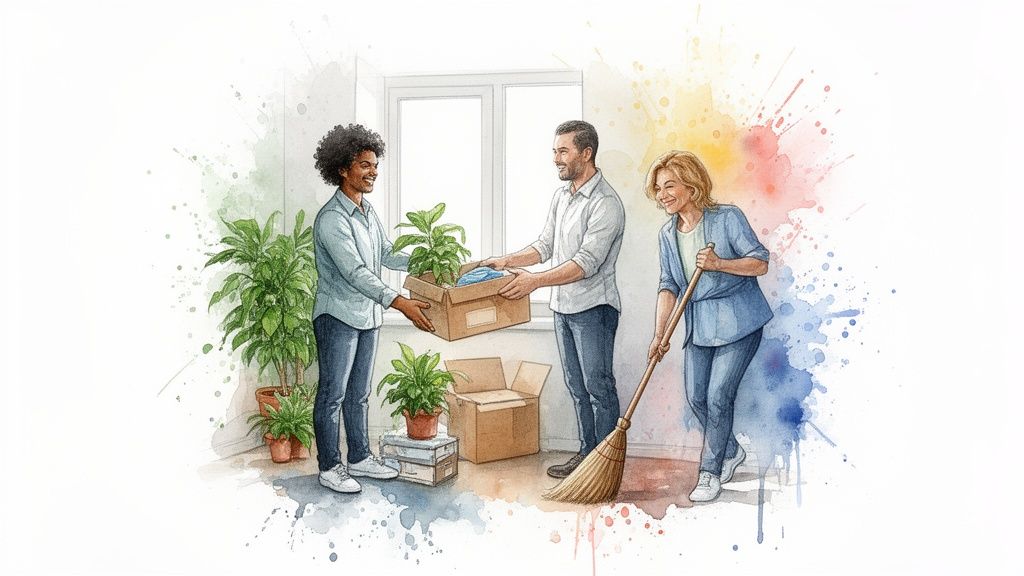
This little epiphany is the beating heart of what community resilience means to me. It's not some abstract theory. It’s a group of people, standing together, deciding to show up. For each other, and for the place they all call home.
From Personal Mess to Our Shared Mission
I discovered that the first real step toward building your own strength often involves taking action for someone else. When I began picking up trash in local parks, I thought I was just cleaning. But something else was happening. I was meeting other people, people who also felt that deep, nagging pull to make things better. We all showed up for our own private reasons, but out there on the street, we stumbled upon a shared purpose.
That shared purpose is the very foundation of a resilient community. It’s knowing your neighbors by name. It’s the quiet trust that they've got your back. It’s the hard work of building that support system before a crisis ever hits. You build it with all the small, consistent things you do, the little actions that silently say, "I care about this place, and I care about you."
"Community resilience is turning our shared struggles into our shared strength. It’s built one block at a time, through actions that foster connection and trust."
The Unseen Power of Showing Up
This isn’t about sitting around, waiting for disaster to strike. It’s a proactive choice. Think of it like this: you're weaving an invisible web of relationships that will hold your neighborhood together when things get rocky. A single thread? Easy to snap. But thousands of them woven together? That becomes a safety net.
Every time you and I show up for a cleanup or a community meeting, we’re weaving another one of those threads. We’re engaging in a form of civic engagement that goes so much deeper than just voting. It’s about getting your hands dirty. (If you want to explore what that really looks like, you can learn more about civic engagement in our guide.)
So, what is community resilience, at its core?
- It’s your active participation, not just sitting on the sidelines hoping for the best.
- It's building those relationships before you desperately need them.
- It’s the collective strength that lets us stand up to whatever comes our way, together.
At the end of the day, it's a simple, powerful belief I hold: we are so much stronger together than we could ever be apart.
The Five Pillars of a Strong Community
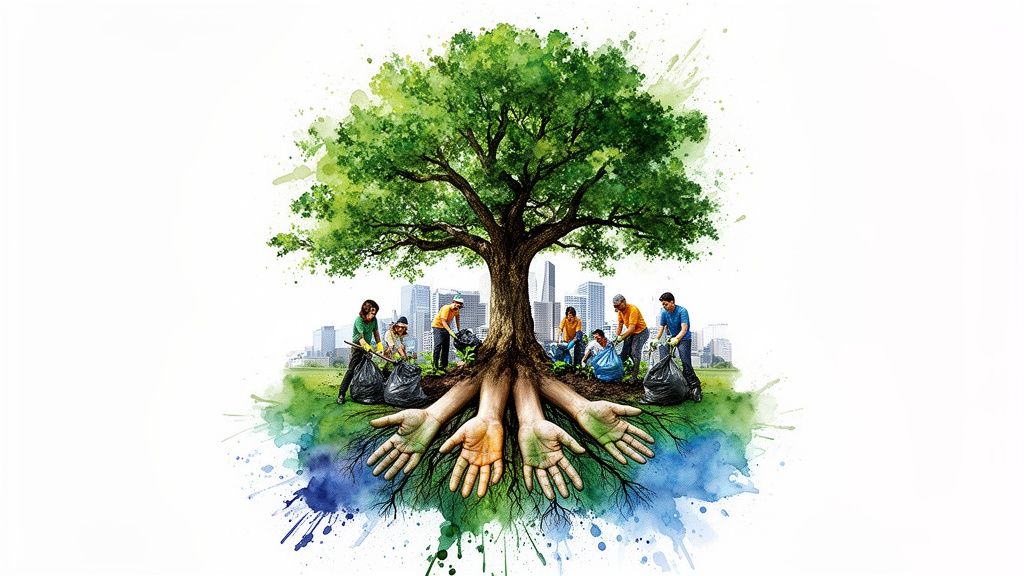
To really get what makes a community resilient, I want you to picture a sturdy oak tree. It’s not just one big trunk. Its real strength comes from a massive system of deep roots and powerful branches, all working together to hold it up. That's exactly how I see a strong community, supported by what I call the ‘five pillars’ of resilience.
These pillars aren't some fuzzy, academic ideas. They are the living, breathing parts of your neighborhood that determine whether it truly thrives or just scrapes by. Each one supports the others, creating a structure that can handle pretty much any storm that comes its way.
The Social Pillar: Our Connections
First up, and maybe the most important, is social connection. This is that invisible web of friendships, trust, and looking out for one another that we build with the people around us. It’s knowing you can knock on your neighbor's door for a cup of sugar, or that someone will check in on you if they haven't seen you for a couple of days.
When a crisis hits, this is the pillar that holds everything else together. It’s not just a feeling; a recent study found that neighborhoods with strong social ties had way better mental health outcomes and recovered faster after natural disasters. At Litter Caterpillars, I see this pillar being built every single weekend. We're not just picking up trash; we're building friendships that make our community tougher.
The Economic Pillar: Our Local Livelihood
Next is economic stability. This is all about the health of your local economy—the small businesses that give a place its character. It means having thriving local shops that create good jobs, letting people earn a decent living and put that money right back into the place they call home. When you and I have financial security, the whole community is less fragile.
A neighborhood with a diverse mix of cafes, hardware stores, and family-run restaurants is far more resilient than one that depends on a single giant employer. If that one factory shuts down, the entire area can crumble. But a network of small, local businesses creates a much more stable foundation.
The Infrastructural Pillar: Our Shared Spaces
The third pillar is infrastructural resilience. This is the physical world around you—the stuff you can see and touch. It’s about having reliable power grids, safe roads and bridges, and clean, accessible parks and public spaces where people can actually connect.
Think about it. Well-maintained parks aren't just pretty; they’re places for us to meet up and de-stress, which boosts our social and mental well-being. Reliable infrastructure makes sure that when a storm hits, emergency services can get where they need to go. Every single piece of litter we pull out of a park or off a sidewalk is a small act of strengthening this vital pillar.
To tie it all together, here’s a quick look at how these pillars show up in real life.
The Five Pillars of Community Resilience
A quick look at the core components that make a community strong and able to bounce back.
| Pillar | What It Looks Like in Action |
|---|---|
| Social | Neighbors knowing each other by name, block parties, volunteer groups like the Litter Caterpillars. |
| Economic | A busy main street with local shops, farmers' markets, and job training programs. |
| Infrastructural | Well-kept parks, reliable public transit, safe sidewalks, and clean public spaces. |
| Environmental | Community gardens, clean rivers and air, and efforts to protect local green spaces. |
| Governance | Town hall meetings where people are actually heard, transparent local government, and active neighborhood associations. |
These aren't just separate categories; they all feed into each other to create a strong, stable whole.
The Environmental and Governance Pillars
Finally, we have two pillars that are deeply connected.
- Environmental resilience is all about our relationship with the natural world and our shared duty to protect it. Clean air, clean water, and healthy green spaces aren't luxuries; they are absolutely essential for a community’s long-term health.
- Governance and leadership means having local leaders who are trustworthy, transparent, and actually listen to the people they serve. Good governance ensures resources are shared fairly and that there's a clear, sensible plan in place for when things go wrong.
Together, these five pillars—Social, Economic, Infrastructural, Environmental, and Governance—create a complete framework for a community that doesn't just survive, but truly thrives. Each one supports the others, building a foundation strong enough to withstand whatever challenges come our way.
Why This Idea Became a Global Movement
You might hear me say "community resilience" and still want to write it off as another feel-good buzzword. But it’s not. This idea has been slowly, quietly taking root for decades, usually in the wake of disasters that expose just how fragile our modern systems are.
The concept really exploded after Hurricane Katrina hit New Orleans in 2005.
That catastrophe was a brutal, heartbreaking wake-up call for me, and for everyone. It showed the world that when disaster strikes, government help isn't always enough—and it's certainly not always fast enough. In those first critical hours and days, it's often you helping your neighbor that saves lives and holds a community together.
A Worldwide Shift in Thinking
Before Katrina, the study of community resilience was a tiny, niche field. In the early 2000s, academics were publishing maybe a handful of articles on it per year. After 2005, everything changed.
The idea went from a footnote in a textbook to a global conversation. Researchers in over 115 countries are now dedicated to figuring out why some communities shatter under pressure while others bend, adapt, and bounce back stronger than before. You can discover more insights about this research growth and see the data for yourself.
This isn’t just an American thing; it’s a deeply human one. Everyone, everywhere, wants to feel safe and connected to the place they call home.
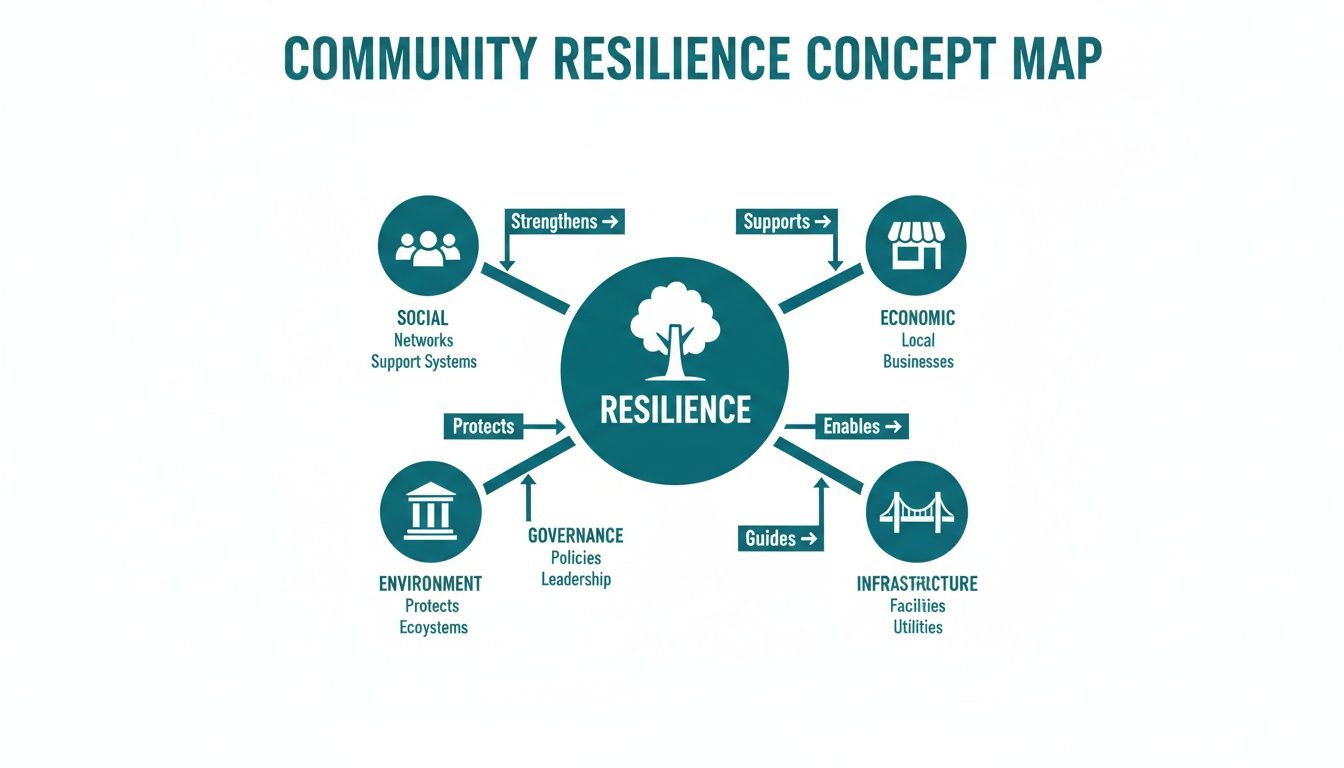
As you can see, real resilience isn't just one thing. It's a whole web of connected strengths—social bonds, economic stability, solid infrastructure, and a healthy environment all working together.
Putting Ideas into Action
This global movement validates what we at Litter Caterpillars feel in our bones every single weekend. We believe that small, consistent, local action is the most powerful tool there is.
We aren’t waiting around for a crisis to start building connections. We’re building them every Saturday morning, one piece of trash at a time, rain or shine.
We see community resilience not as a reaction to disaster, but as a practice of connection. It’s the muscle we build together through shared work and shared purpose.
This hands-on approach is a form of community organizing, where regular people like you and me take the lead in shaping our own neighborhoods. By showing up for each other, we create the trust and relationships that are the true currency of a resilient community.
How We Can See and Measure Resilience
How do you actually measure something as big as "community resilience"? It sounds so abstract, like trying to weigh a feeling. For a long time, it was just that—an idea you could feel in a neighborhood but couldn't really pin down on a map. But that’s changing.
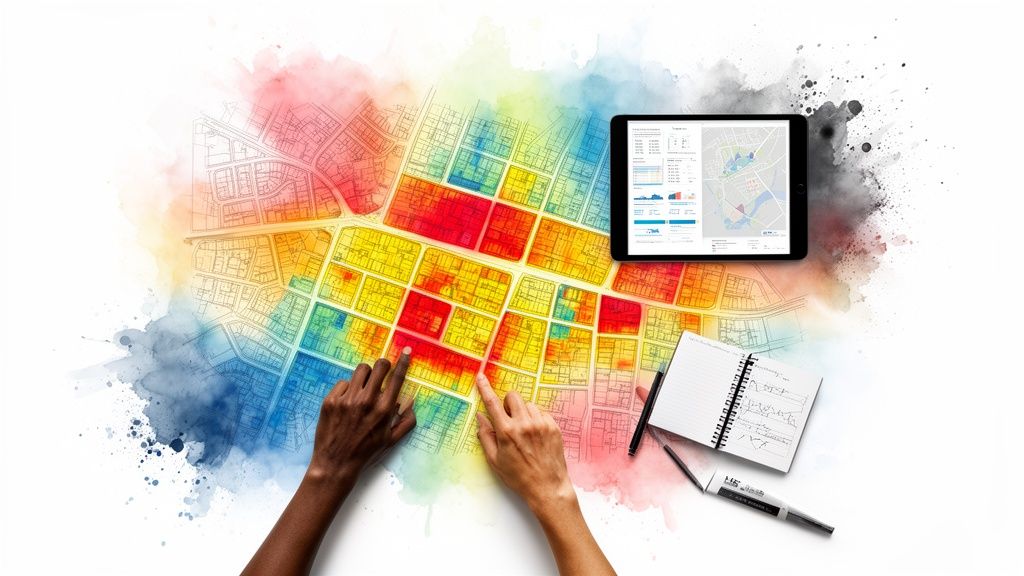
Now, you and I have incredible tools that can pinpoint exactly which neighborhoods need the most support. Imagine a heat map, but instead of showing temperature, it shows vulnerability. That’s the kind of clarity we can get now.
A New Way of Seeing Our Cities
One of the most powerful tools I’ve seen is the U.S. Census Bureau's Community Resilience Estimates (CRE) program. This isn't just another dataset; it's a whole new lens for seeing our cities. The CRE program is so special because it goes way beyond simple income levels, looking at over a dozen different factors to figure out how well a community can handle a shock.
It digs into the nitty-gritty using individual-level Census microdata, giving us a block-by-block understanding of risk. It’s a groundbreaking approach that gives us vulnerability scores for every single neighborhood in the country. You and I finally have a clear, data-driven picture of where help is needed most. You can read the full research on these innovative mapping tools to see exactly how it works.
This data is so important because it proves something many of us have always felt in our bones: resilience isn't spread evenly. Some communities are carrying a much heavier burden than others.
A community's strength isn't just a feeling; it's a measurable reality. Data shows us where the cracks are, so we know exactly where to go to start repairing them.
From Data to Direct Action
For me and the Litter Caterpillars, this information is a call to action. It’s our roadmap. It confirms why our mission—to serve all 50 wards of Chicago, especially the ones others might overlook—is so incredibly important.
The data doesn’t just show us problems; it points us toward opportunities for connection and service. It validates that gut feeling that just showing up, consistently, in every corner of our city can make a tangible difference.
Here’s how we use this kind of insight:
- We target our efforts in areas the data shows have higher vulnerability.
- We build social bridges by bringing volunteers from different neighborhoods together.
- We create visible change that inspires hope and shows people their community is worth fighting for.
We're not just picking up litter. We’re going where the data tells us the need is greatest. We’re showing up to help balance the scales, one small, consistent act of kindness at a time.
You Are the Key to a Stronger Neighborhood
So, how do you and I actually build a resilient community? It doesn't come from a big government grant or some top-down master plan.
It starts with you. It starts with me. It begins with the decision to just show up.
When I started Litter Caterpillars, there were just three of us, huddled under a tree during a freak hailstorm. We were cold, miserable, and probably a little crazy. But we were together.
That shared suffering—and the laughter that erupted right after—created a bond. That’s the real magic of community resilience in action. Small, personal moments bind us together more than any official policy ever could.
Spark Connection Through Shared Action
Consistency builds trust. When you show up on a Saturday morning—especially when you’d rather be in bed—it sends a powerful message.
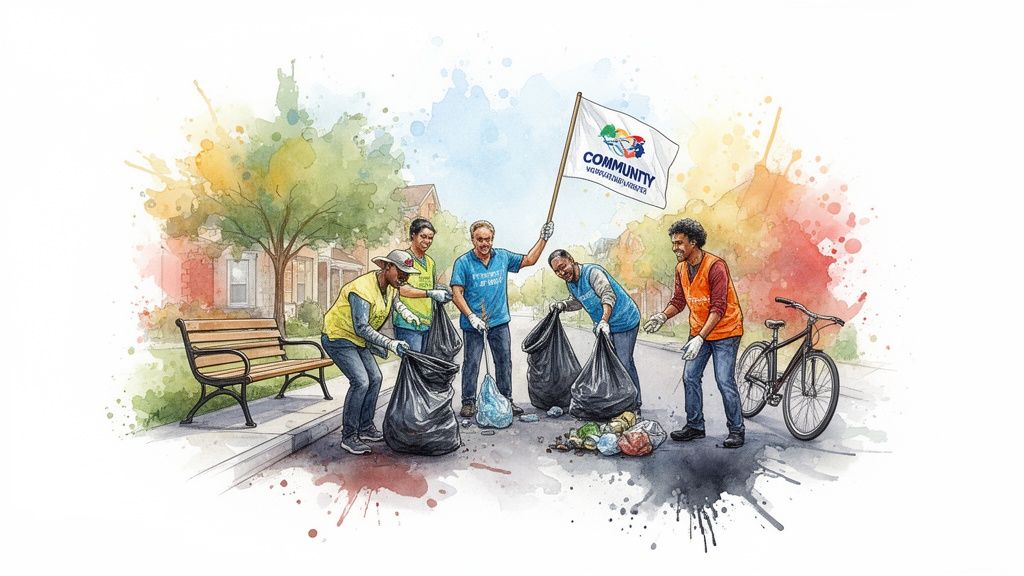
Laughing with a stranger while wrestling a soggy mattress out of a ditch can turn that person into a lifelong friend. This is how you and I flex our resilience muscles, one piece of trash at a time.
“Resilience is built through small, consistent acts of service that ripple out to strengthen the whole community.”
It sounds simple, but look at what happens:
- You meet neighbors you’ve only ever seen through a car window.
- You share stories, build real social capital, and start to rely on each other.
- You create a shared sense of pride in what you've accomplished together.
This simple routine can spark 73% more positive neighbor interactions, according to community studies. It’s not just about clean streets; it’s about building a web of relationships.
Build a Team Identity
Think of your group like a local sports team. You need flags, maybe a goofy theme song, and definitely some matching T-shirts.
That identity matters. It transforms you from a random bunch of people picking up litter into a unified squad protecting your home turf.
It’s a constant reminder of why you choose to show up. That shared identity is a core ingredient in what makes a neighborhood bounce back from any challenge thrown its way.
Want to go deeper on this? Check out our guide on building lasting neighbor engagement.
Every time you rake leaves, paint a fence, or pick up a discarded coffee cup, you’re showing the world what real community resilience looks like.
Your First Steps to Lead
Getting started is way easier than you think. I want you to try this:
- Invite one friend to join you this weekend. Just one.
- Choose a local spot that could use some love—a forgotten park corner, a messy sidewalk, or a neglected alley.
- Bring snacks and upbeat music. Make it feel like a party, not a punishment.
"You don't need permission to start; you just need passion and a pair of gloves."
Every time we gather, we strengthen our social ties. We deepen trust, share the load, and prove that together, we can handle any storm—literal or otherwise.
By understanding that you are the key, you unlock the single greatest force for community resilience: the collective human spirit.
Keep the Momentum Going
After a few events, you’ll feel the change firsthand. You'll see streets sparkle and watch as neighbors start to smile and wave.
This feeling of accomplishment is the fuel that keeps the engine running. It’s like dropping pebbles into a pond; each small ripple reaches further than the last.
Encourage others by sharing photos and stories. Tag your neighborhood on social media or leave friendly notes on mailboxes.
Over time, what started as three of us shivering in a hailstorm can grow into hundreds of neighbors rallying for a cleaner, stronger, and more connected city.
Your Questions About Community Building Answered
After years of doing this, I get a lot of questions from people who feel that same pull to make a difference but aren't sure where to start. Feeling doubtful is totally normal. Here are a few common questions that hit my inbox, and my honest answers about making a real impact in your own neighborhood.
What If I’m Not an Outgoing Person?
Then you're in the right place. I'll let you in on a little secret: I partly started Litter Caterpillars because I was struggling socially and wanted to mindfully engineer a better social circle for myself. You don’t have to be a social butterfly to build community.
Real connection is built on shared action, not just small talk. Just showing up and working alongside other people is an incredibly powerful way to connect without the pressure to be "on."
A lot of our most dedicated volunteers are quiet, thoughtful people. The focus is on our shared mission—cleaning our city—and powerful friendships just sort of happen naturally from there. Your consistent presence and quiet effort speak volumes more than words ever could.
True community isn't about being the loudest person in the room. It’s about being a reliable presence, showing through your actions that you care. That’s a language everyone understands.
Does Picking Up Litter Really Make a Difference?
Yes, one hundred percent. And it’s about so much more than just a clean street. When you and I care for a space so visibly, it sends a powerful message to everyone who sees it: ‘People here matter. This place is valuable.’
This simple act boosts neighborhood pride and social cohesion, which are the absolute cornerstones of what community resilience is. It also directly fights the ‘broken windows’ theory—the idea that visible signs of decay just invite more neglect. By cleaning up, we're actively reversing that negative cycle.
Most importantly, the simple act of coming together to do something positive builds the social fabric—the deep trust and real relationships—that a community leans on during a real crisis. Think of it this way: we’re exercising our ‘resilience muscles’ together every single weekend, so we’re strong when we need it most.
How Can I Start Something Similar Here?
Start exactly how I did: small. Find one or two friends who see what you see. Don't get bogged down trying to create a formal organization with a fancy logo and a five-year plan.
Just pick a time and a place, and go do the work.
Use free and simple tools like Meetup or an Instagram page to get the word out. The single most important thing is consistency. Show up every week at the same time, even if it's just you at first. People will see your dedication, and they will join.
As I learned shivering in that hailstorm, suffering together builds the strongest bonds and makes for the best stories. So be brave, be kind, and always put your volunteers first. That's the secret sauce.
Ready to see what showing up can do? The Litter Caterpillars meet every weekend to clean up Chicago and build a stronger, more connected city. Join a cleanup this weekend and find your community!
Leave a Reply