Tag: chicago cleanup

  • Litter Pickup Tool Guide That Makes Cleanup Easier

    Litter Pickup Tool Guide That Makes Cleanup Easier

    The first time I led a cleanup in a cold Chicago blow, I watched a new volunteer bend for every gum wrapper along the curb. Ten minutes later, I handed her a grabber, and her whole morning changed.

    Why Your First Cleanup Feels Different With the Right Tool

    I still think about one of our early Litter Caterpillars mornings, back when hail came sideways and we huddled under a tree waiting on rides that never showed. We were wet, shivering, and laughing anyway. What kept that cleanup from turning into a miserable slog was simple gear. A bag in one hand, a litter pickup tool in the other, and suddenly the work felt less like punishment and more like a strange little neighborhood adventure.
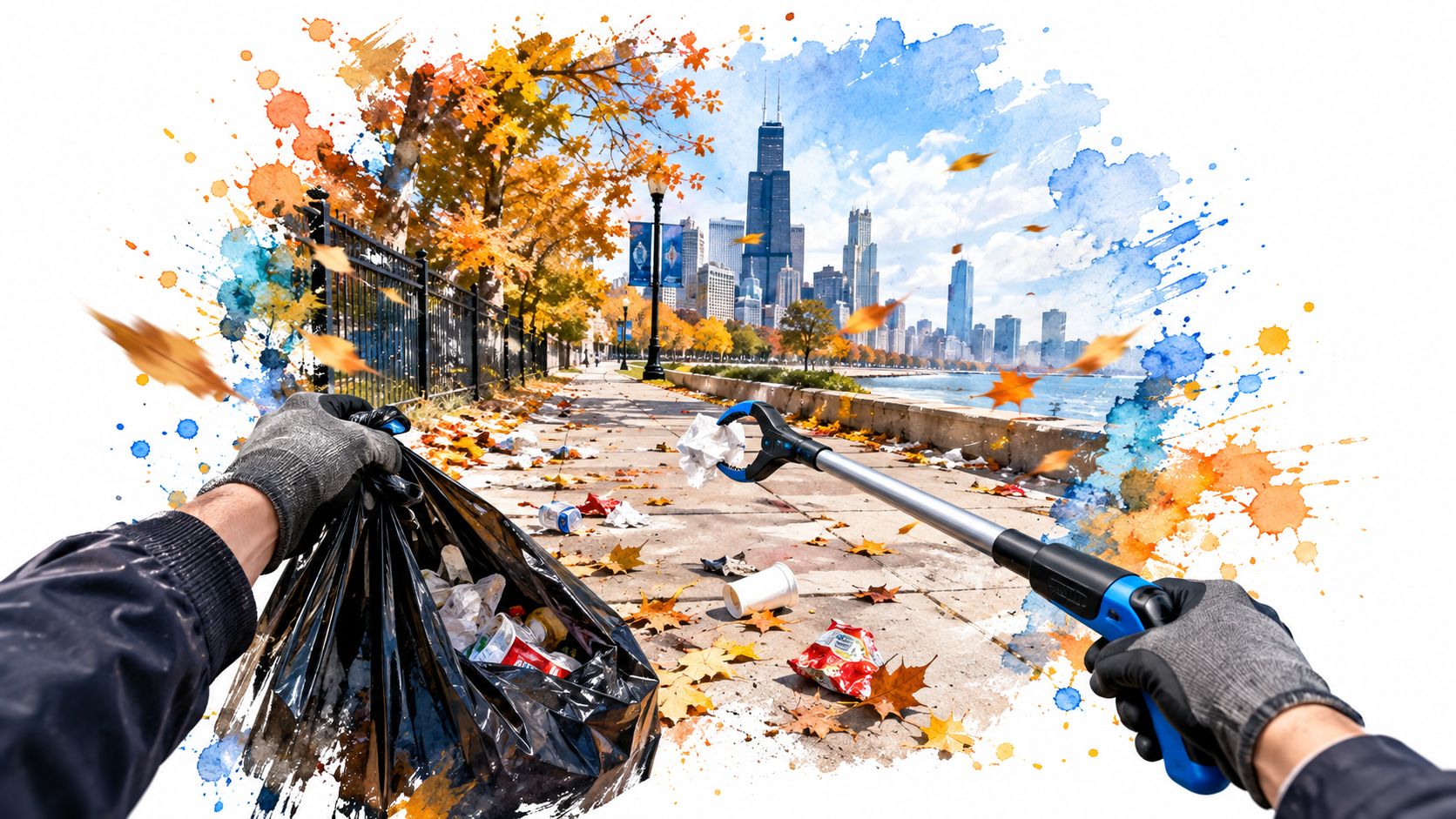
    A first-person view of a person using a litter pickup tool to clean a park in Chicago.

    When you're new, you think pickup is about grit. Just bend down and get it done. I used to think that too. Then I saw what happens over a long sidewalk, a busy alley, or a park fence line. Bending for every cigarette pack and fast-food lid drains you fast. A decent tool keeps you upright, keeps your hands cleaner, and lets you stay in rhythm.

    Why the tool changes the whole mood

    A litter pickup tool doesn't just add reach. It changes your pace.

    You stop doing this:

    • Bend, grab, stand, step
    • Bend again for the next tiny piece
    • Break your rhythm every few seconds

    You start doing this:

    • Walk and scan
    • Pinch and lift
    • Drop into the bag and keep moving

    That feels small until you've worked one long block. Then it feels like the difference between carrying groceries by hand and using a cart.

    Practical rule: If your cleanup pace feels jerky and your back starts talking to you early, your tool choice is off.

    I also want to be honest about the emotional side. The right gear makes cleanup more fun. That's not corny. When your body isn't fighting the work, your brain has room to notice the jokes, the murals, the weird little treasures people find, the conversations that start between strangers.

    What you should expect from a good fit

    I want you to leave your first cleanup thinking, "I can do that again next weekend."

    A good litter pickup tool helps you:

    • Save energy so you don't burn out halfway down the block
    • Stay safer around sharp or nasty trash
    • Move faster without rushing
    • Feel more confident when the ground is muddy, windy, or full of mixed debris

    There's a bigger cleanup economy around these tools too. Washington State's litter programs collected more than 5.2 million pounds of litter and cleaned more than 18,000 miles of road in 2024, and the same market coverage says the global litter picker market reached about USD 1.19 billion in 2024 with a projected 6.3% CAGR to roughly USD 2.06 billion by 2033 (Washington cleanup scale and litter picker market figures). I don't bring that up to sound fancy. I bring it up because these tools get used hard, at scale, by real cleanup crews and volunteers.

    What a Litter Pickup Tool Is and How It Works

    On a Chicago cleanup, I can usually tell who borrowed the wrong tool in the first five minutes. They are poking at a wet flyer by the curb, bending at the waist, then chasing a bottle cap that slips out of the jaws. The tool is in their hand, but it is not doing enough work for them.

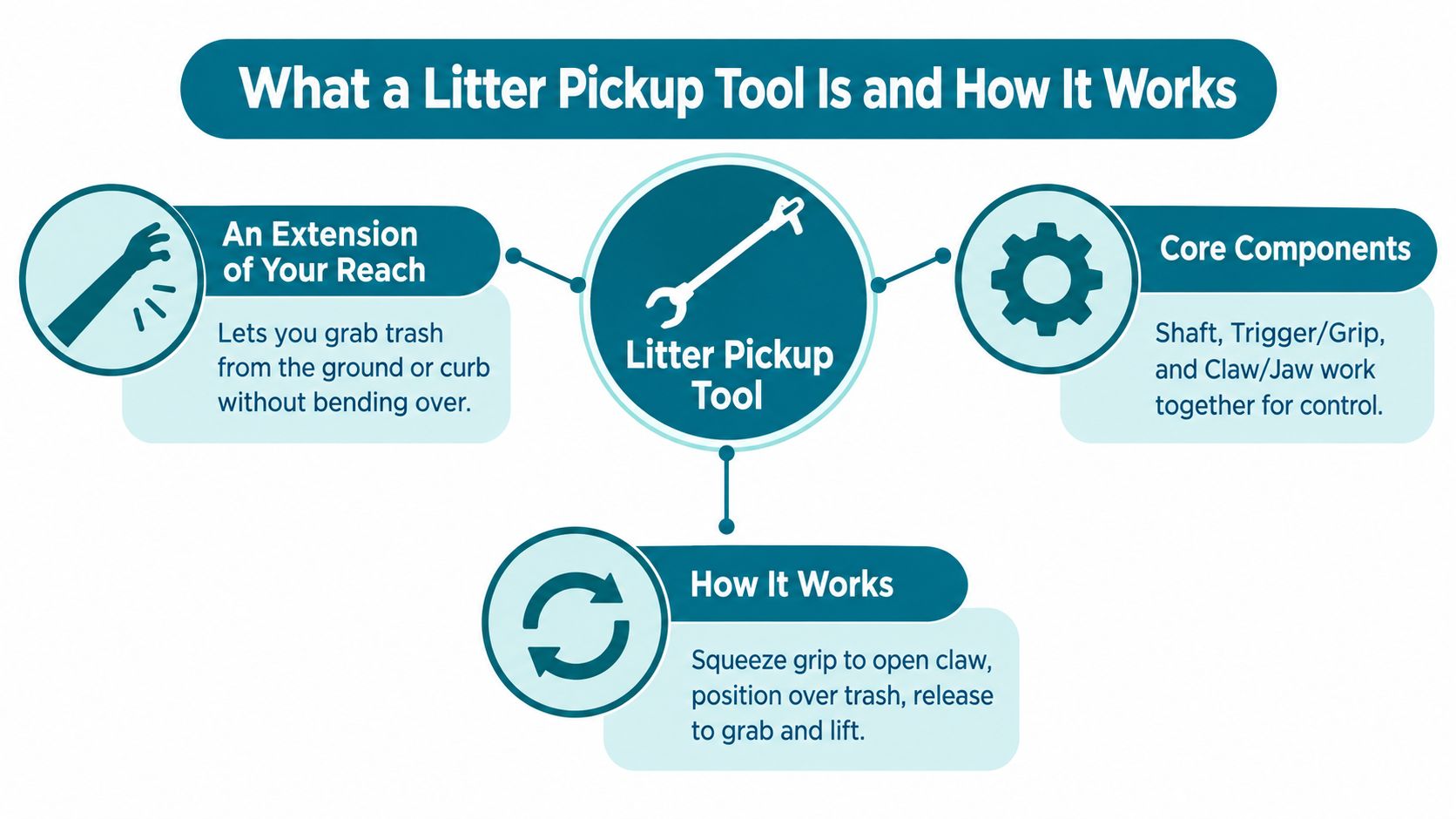
    A litter pickup tool is a handheld tool that extends your reach so you can lift trash without touching it and without folding yourself over every few steps. On our routes, that usually means one thing. A grabber or tong-style picker with a handle, a long shaft, and a gripping end.

    The basic idea works like kitchen tongs on a stick. Your hand makes a small motion at the grip. The tool turns that into a bigger motion at the far end, where the jaws open and close around the trash.
    An infographic explaining what a litter pickup tool is, its core components, and how it works.

    The three parts that matter most

    Nearly every litter pickup tool has three working parts, and each one changes how the tool feels on a real block.

    1. The handle or grip
      This is your control point. Some tools use a trigger. Some use a full-hand squeeze. If you are picking along Milwaukee Avenue for an hour, a stiff grip will wear you out long before the bag is full.

    2. The shaft
      The shaft gives you reach. It also sets your posture. On a flat sidewalk, the right length keeps you more upright. In a weeded lot or along a guardrail, it helps you reach trash without stepping into the mess.

    3. The grabbing end
      This part meets the trash. Wide jaws can catch cups and bottles. Narrow tips do better with cigarette packs, caps, and scraps pinned in grass. That is why one tool can feel great on a boulevard and clumsy near a storm drain.

    How the motion works

    Most tools follow the same cycle:

    • Squeeze the handle
    • Open or close the jaws, depending on the design
    • Set the jaws on the item
    • Grip it firmly
    • Lift and drop it into your bag or bucket

    That cycle repeats hundreds of times in one cleanup.

    A good tool makes that rhythm feel steady. A bad one turns every pickup into two or three tries, which is how a short route starts to feel long. The Conservation Volunteers describes the same basic benefit in its beginner guide. A grabber lets you pick litter at a distance, so you avoid constant bending and direct contact with trash (beginner litter-picking guidance from TCV).

    Why length changes how the tool behaves

    This part trips people up, so I keep it simple. Longer reach helps until it starts to hurt your control.

    On open ground, a longer tool can save steps and cut bending. On a crowded city sidewalk, that same extra length can feel like carrying a canoe paddle into a hallway. You can reach farther, but you lose some precision around fences, parked cars, and bus-stop poles.

    You will also see a big spread in tool lengths on the market, from shorter models around the low-30-inch range to specialty tools that go much longer. Sellers often list the reach and skip the tradeoff. More length can mean less control, more swing weight, and slower pickups in tight spaces (litter tool length and design variation examples).

    Here is the curbside version I give new volunteers:

    • Shorter tools feel quicker in tight spots but ask more from your back
    • Mid-length tools fit the widest range of ward cleanups
    • Very long tools help with ditches, slopes, or barriers, but they can feel awkward on narrow sidewalks

    That is the whole machine. Your hand sends force through the handle. The shaft carries it outward. The jaws turn it into a grip on the trash. Once you see those three pieces working together, picking the right tool gets a lot less confusing.

    Main Types of Litter Pickup Tools and When to Use Each

    Chicago cleanup routes aren't all the same. A lakefront path, an alley behind a restaurant strip, and a highway shoulder each ask for different moves. That's why I don't like generic feature lists. I like matching the tool to the mess.

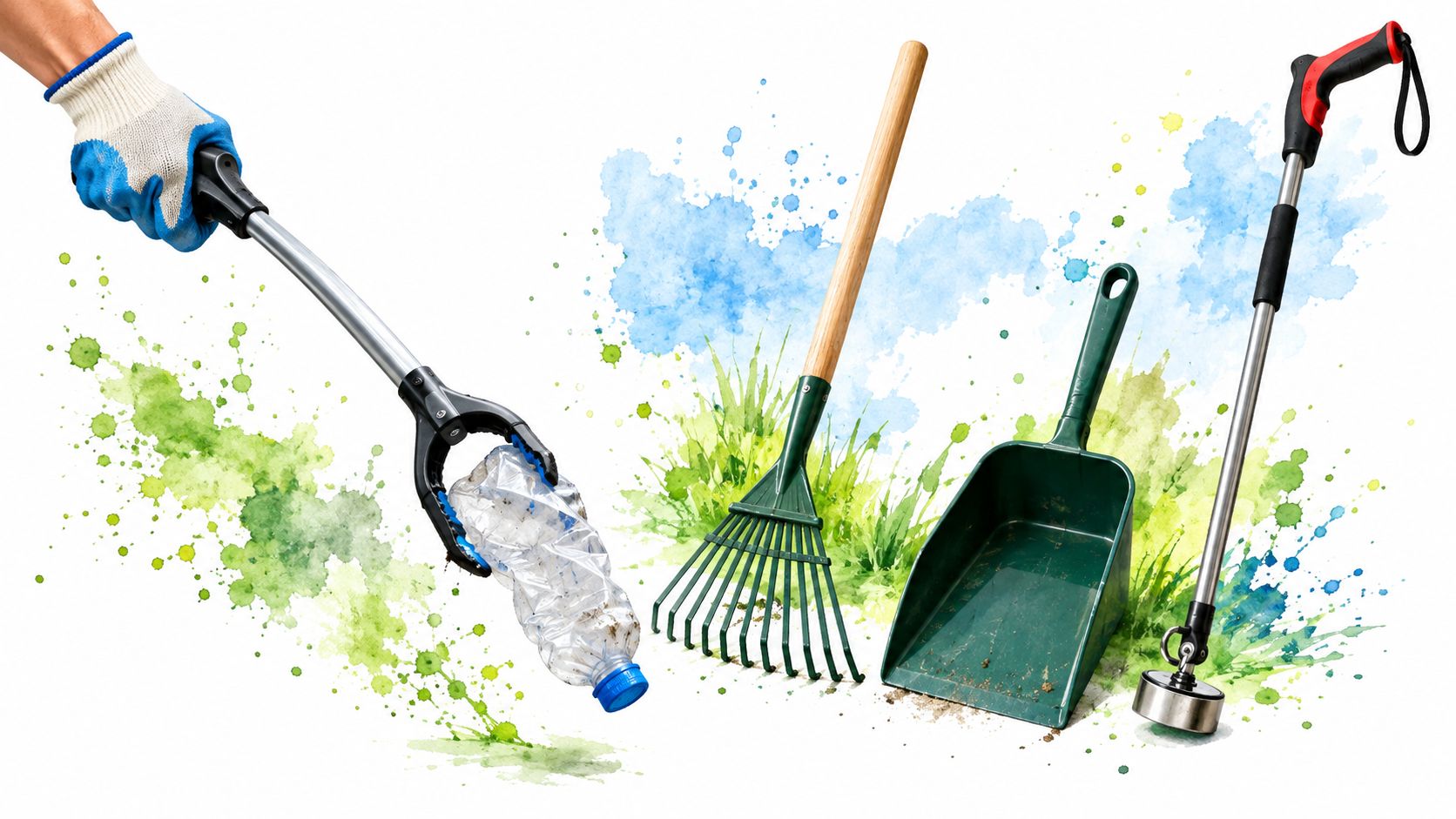
    Grabbers for mixed city trash

    If you only buy one tool, start with a standard grabber. This is the everyday workhorse. It handles wrappers, bottles, cups, cans, and all the annoying little curb pieces that collect around bus stops and chain-link fences.

    I especially like a rotating-head grabber when I'm working parked-car edges or reaching under hedges. You can angle the jaws instead of twisting your whole wrist. That's handy when you're trying to pick a bottle off a sloped curb or fish a can from between weeds.

    Rakes and scoops for light spread-out debris

    A rake is useful when the ground is covered in leaves mixed with paper bits, napkins, or foam cups. I use that kind of setup in park edges and vacant-lot corners where litter sits in a thin layer across dirt or grass.

    Scoops help when tiny scraps pile up in one spot. Think broken bits around a bench, mulch beds full of candy wrappers, or the grit line near a storm drain. A scoop can gather what a claw keeps missing.

    If your route has mostly flat, light debris, a rake or scoop can beat a grabber on speed. If the trash is mixed and awkward, a grabber usually wins on control.

    Magnet poles and simple DIY options

    Magnet poles do one job. They pick up metal. If you're collecting nails, caps, or small ferrous scraps near construction edges, they help. For paper, plastic, or glass, they won't do much.

    DIY tools can work in a pinch. I've seen people use barbecue tongs, improvised sticks, and garden tools. That's fine for a quick solo block if you're careful, but for group cleanups I want actual pickup tools with predictable grip and reach.

    Here's the fast match guide I use.

    Which Litter Pickup Tool Fits Your Cleanup Job

    Tool Type Best For Watch Out For
    Standard grabber Sidewalk litter, bottles, cans, wrappers, park paths Cheap jaws can slip on thin or wet items
    Rotating-head grabber Curbs, fence lines, under bushes, awkward angles More moving parts can feel looser over time
    Rake Leaves mixed with light litter on grass or dirt Hard to control for single items
    Scoop Small scraps gathered in one area Clumsy on uneven ground
    Magnet pole Metal bits near construction or alleys Useless on plastic, paper, and most common street litter
    DIY tongs or improvised tool Very light personal use Weak grip, less safe, poor control

    My Chicago ward rule of thumb

    When I lead volunteers, I think in terrain first.

    • Busy commercial strips: Bring a grabber for cups, receipts, and food containers around curbs and planters.
    • Residential blocks after wind: Use a grabber, and add a small scoop if the tree lawn has shredded paper bits.
    • Alleys: Choose a stronger jaw that can handle bottles, cans, and damp trash.
    • Vacant lots: Mix tools. One person with a grabber, one with a rake for loose litter in grass.
    • Shoulders and rough edges: Longer reach helps, but too much length makes control sloppy.

    If you want to compare common cleanup gear before an event, I like using a practical roundup like trash pickup equipment for volunteer cleanups as a planning reference.

    Safety and Ergonomics That Keep You Picking Longer

    The fastest way to wear out a new volunteer is simple. Hand them a tool that fights their body.

    I learned that on a cold ward cleanup near an alley off Milwaukee. One volunteer brought a short bargain grabber from home. It looked fine in the parking lot. Twenty minutes later, she was bending for every cup and twisting her wrist to reach under parked cars. Another volunteer had a longer, lighter tool with a grip that sat naturally in the hand. Same route. Same trash. One person was fading, and the other was still moving smoothly an hour later.

    A litter pickup tool should feel like a good broom. It should extend your reach without changing the way your body wants to stand and move.
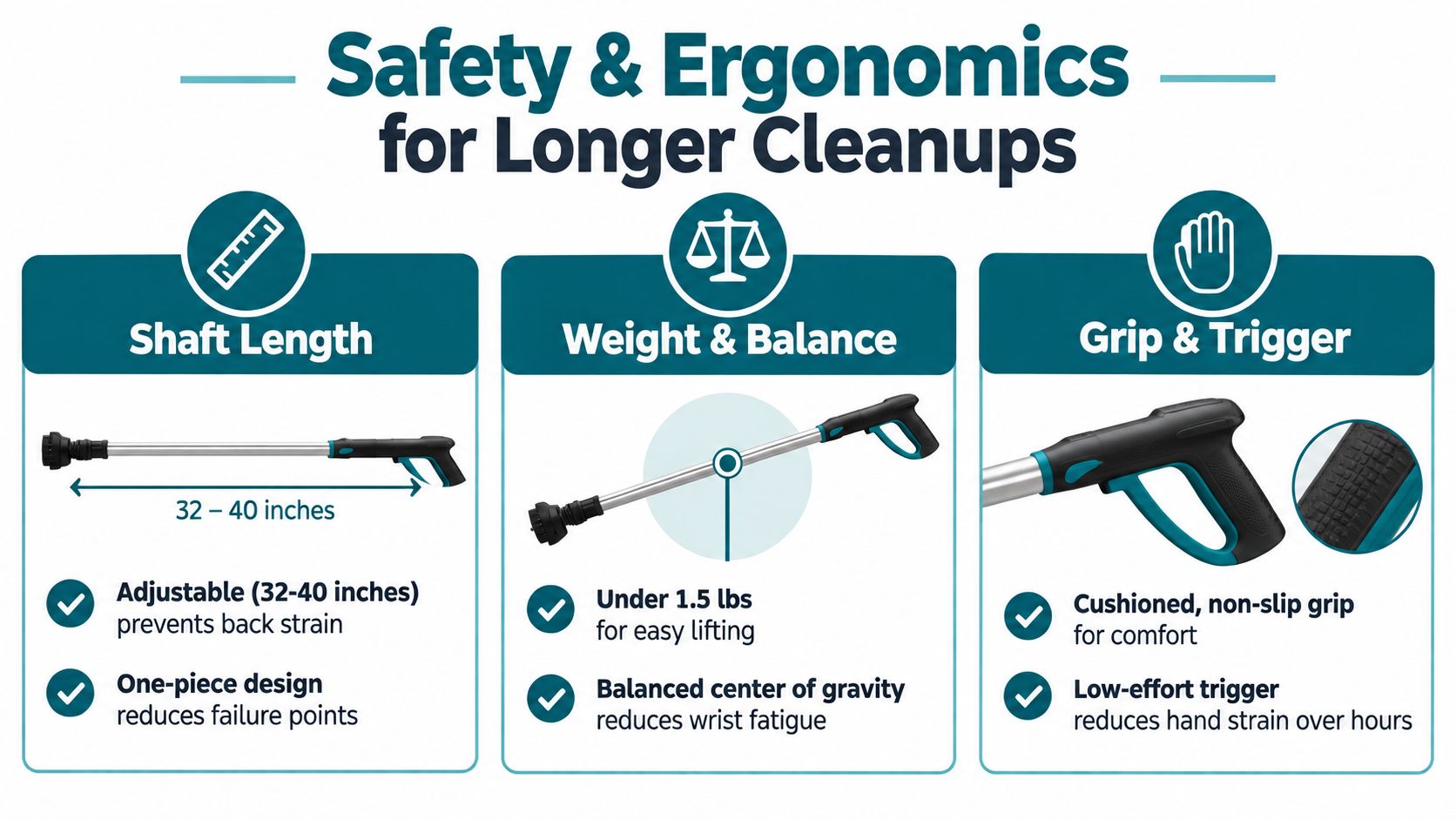
    A safety and ergonomics infographic for a litter pickup tool, highlighting adjustable shaft length, lightweight balance, and comfortable grip features.

    Start with posture, not features

    On Chicago sidewalks, posture usually matters more than an extra gadget on the tool.

    Your back should stay relaxed and fairly upright. Your shoulders should stay low. Your wrist should stay close to straight when the jaws meet the ground. If one of those three starts working too hard, the tool is the problem.

    Length drives most of that. A tool that is too short makes you fold at the waist, especially on long curb runs. A tool that is too long can feel sloppy in tight spots like bus stops, chain-link fence lines, and the space between trash cans in alleys. Weight matters too. A heavy picker may feel solid for the first few grabs, then start dragging on your forearm once you have walked two or three blocks.

    Before I send a group out, I ask people to do a simple test.

    • Stand naturally with the tip near the ground
    • Reach for a spot near your shoe without hunching
    • Check your wrist to see if it stays mostly straight
    • Swap tools if your shoulder lifts or your grip feels strained

    That thirty-second check saves a lot of complaints later.

    Match the tool to the block

    Ergonomics are not just about your body in the abstract. They depend on where you are picking.

    On a flat residential sidewalk with wrappers and cans, a standard reach tool usually lets you keep a nice rhythm. In an alley with damp bags, broken-down boxes, and heavy drink containers, stronger jaws and a steadier shaft matter because you do not want to squeeze twice for every pickup. Along a boulevard edge or a weedy vacant lot, extra reach helps, but only if you can still control the tip. Too much length out there feels like trying to write your name with a yardstick.

    That is why I choose for terrain first, then comfort. The right ergonomic tool is the one that keeps your body neutral while handling the trash sitting in that ward.

    Gloves are required

    I never let volunteers treat gloves as optional.

    You should always wear heavy-duty gloves and use a litter picker when possible. Safety guidance from Keep Britain Tidy warns against picking litter up by hand because sharp objects can hide inside ordinary trash (heavy-duty glove and tool guidance from Keep Britain Tidy).

    Street trash hides surprises. A paper sack can cover broken glass. Wet leaves can hide a can lid. A crushed bottle near the curb can break again when the jaws press down on it. Gloves and a pickup tool give you one more layer between your skin and the mess.

    Build the pause-before-you-pick habit

    Good volunteers get faster by slowing down for one beat.

    I teach people to pause, read the item, then grab. Volunteer risk guidance advises using litter pickers where possible and checking items for sharp edges or contamination before handling them (volunteer litter-picking risk guidance).

    On the street, that habit looks like this:

    • Look first for shine, jagged edges, or leaking spots
    • Notice the surface if the item is wet, torn, or partly buried
    • Grab from the safest angle instead of rushing straight in
    • Leave it and report it if it looks hazardous

    If you want a plain-language refresher, this guide on how to pick up trash safely during community cleanups pairs well with what I teach on weekend routes.

    One last thing. If a tool makes you shrug your shoulders, clamp your hand too hard, or bend every few steps, do not try to tough it out. Switch tools early. A cleanup should leave you tired in the normal way, not sore from fighting your gear.

    Cost Tiers and Volunteer Friendly Models You Can Trust

    You don't need to overthink your first buy. You aren't outfitting a moon mission. You're trying to clean your block without wrecking your back or buying junk that quits after two Saturdays.

    I sort litter pickup tools into three practical tiers. I don't need an exact sticker price to make the decision. I just look at use frequency, trash type, and whether I'm buying for one person or a whole crew.
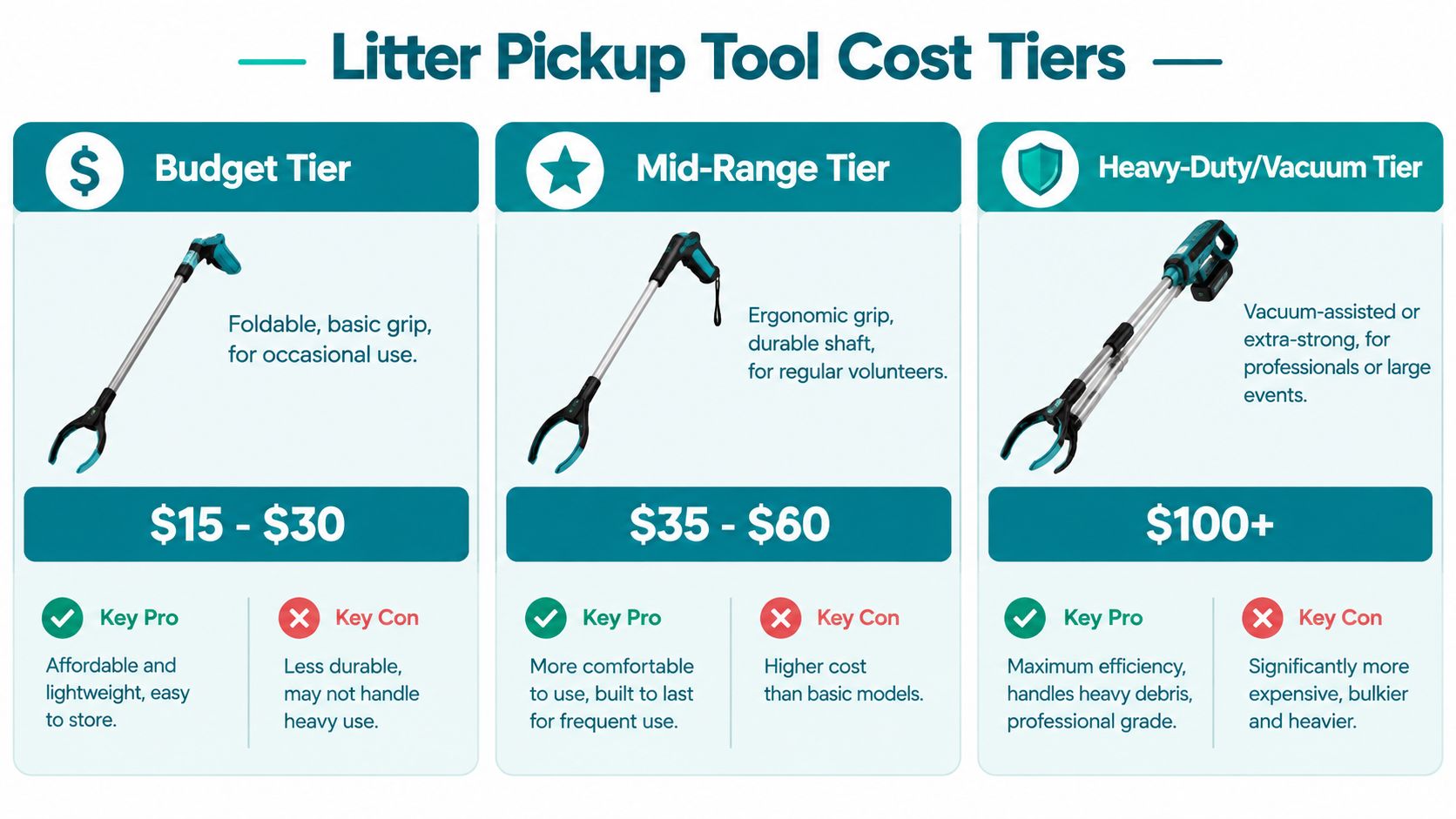
    A comparison chart showing three different tiers of litter pickup tools based on price and features.

    Budget tools for casual block walks

    Foldable grabbers and basic pickup claws usually sit here. They're fine for occasional walks, quick curb checks, or someone who wants to keep a tool in the car.

    The tradeoff is feel. Budget tools can be perfectly usable, but they often have shakier jaws, less comfortable grips, and more flex in the shaft. If you're only doing short sessions, that may not bother you. If you're doing weekly pickups, you'll notice.

    Mid-range tools for regular volunteers

    This is the sweet spot for those I clean with. A stronger shaft, better grip, and more reliable jaw shape make a difference over time. If you pick up mixed litter on sidewalks, alleys, and parks every weekend, this is usually where your money works hardest.

    I also like this tier for student groups and neighborhood captains. The tools usually hold up better when different people use them back-to-back.

    Heavy-duty and machine-assisted setups for big events

    This tier is a different animal. Once you get into municipal or industrial cleanup, the upgrade is the collection system, not just the hand grip.

    Some vacuum-based litter pickers pair with a 240-liter container and suction systems that can ingest mixed debris like cans, bags, and bottles. Larger municipal machines use 80-gallon tanks, 16-gauge steel construction, and about a 2:1 compaction ratio, which extends service time and cuts dump frequency because crews spend less time stopping to unload (industrial litter system container and compaction specs).

    For a volunteer group, that idea matters even if you never touch a machine. Bigger bags, smarter staging, and fewer dump runs keep your crew working instead of walking trash back and forth.

    How I buy for a group

    I don't buy every tool at the same level. I mix the kit.

    • For new volunteers: Keep a batch of simple, dependable grabbers that fit most.
    • For regulars: Add sturdier ergonomic models for longer routes and rougher debris.
    • For specialty jobs: Keep a few oddballs around, like stronger jaws for alley glass or a rake for lot edges.

    If you're joining a cleanup instead of buying your own right away, one practical option is a group that already supplies tools. Litter Caterpillars runs volunteer trash pickups in Chicago where grabbers are part of the event setup, so you can test what feels right before spending money.

    Simple Maintenance and Storage That Extends Tool Life

    I've seen good tools die early from one lazy habit. People toss them in a wet trunk, leave grime in the jaws, and forget about them until next weekend. Then the spring sticks, the grip smells weird, or the claw stops closing cleanly right when the route starts.

    You don't need a fancy routine. You need a repeatable one.

    My three-minute post-cleanup reset

    When I get back from a pickup, I do the same quick sequence every time.

    1. Wipe the shaft
      Dirt and street residue build up fast, especially after rain.

    2. Check the jaws
      Look for lodged plastic, string, or sharp fragments.

    3. Dry the tool fully
      Moisture is what turns a decent tool into a cranky one.

    4. Test the action
      Open and close it a few times. You want a clean snap, not a sluggish chew.

    Clean tools are safer to handle next time. They also make wear easier to spot before a volunteer ends up fighting a half-broken grip.

    Where to store it in real life

    Storage doesn't need to be pretty. It just needs to keep the tool dry and easy to grab.

    • Apartment living: Hang it in a closet corner or behind a door so the jaws don't snag bags or coats.
    • Garage setup: Keep it off the floor. Wall hooks work well.
    • Group shed or shared space: Stand tools upright or hang them by type so people don't crush lighter grabbers under heavier gear.

    What wear looks like before failure

    A tool usually warns you before it quits.

    Watch for:

    • Loose jaws that wiggle side to side
    • Sticky triggers that don't spring back smoothly
    • Hairline cracks near the grip or hinge
    • Bent shafts after rough alley work

    When I see those signs, I pull the tool from group use until I can test it. Mid-route failures waste time, but worse than that, they frustrate new volunteers who are still deciding whether cleanup feels welcoming or annoying.

    Pick Your Tool and Join the Next Chicago Cleanup

    When you strip away the product chatter, the decision is pretty simple. Match your tool to your height, your route, and the kind of trash you see.

    If you're cleaning a regular city sidewalk, start with a mid-length grabber that feels light and controlled in your hand. If you're taller, give yourself more shaft length so you can stay upright. If you're heading into grass, lot edges, or places with spread-out light debris, add a rake or scoop to the plan.

    My simple choice filter

    Ask yourself three questions:

    • Where am I cleaning? Sidewalk, alley, park edge, vacant lot
    • What am I picking up? Wrappers, bottles, cans, leaves, metal bits
    • How long will I be out? Quick block walk or full morning shift

    That gets you most of the way there. The right litter pickup tool should feel obvious once you stop shopping by gimmick and start shopping by route.

    Why this matters on a weekend morning

    When your gear fits the job, your attention shifts. You stop thinking about your lower back, your sore grip, or whether you should've stayed home. You start noticing the people next to you. You talk. You laugh. You finish a block and want one more.

    That's the good stuff.

    If you're ready to test your setup with other people, join a Chicago litter cleanup volunteer event and try your tool on real streets, real curbs, and real mixed trash. One solid morning will teach you more than a week of scrolling product pages.

    Pick one tool. Walk one block. Let the city teach you the rest.


    If you want a place to use a litter pickup tool with other kind, brave people, Litter Caterpillars organizes weekend Chicago cleanups where volunteers can show up, grab gear, and get to work together. It's a simple way to test what tool feels right on real sidewalks, meet people, and help clean the city one block at a time.


  • How to Report Illegal Dumping in Chicago

    How to Report Illegal Dumping in Chicago

    At dawn, I once found an alley packed with broken drywall, rotting mattresses, and black trash bags. A syringe glittered near my boot. I pulled out my phone before I touched anything.

    "Why I Started Caring About Illegal Dumping"

    The smell reached me before the pile came into view. Wet wood, spoiled food, mold, and something sharp hung between the brick walls. Construction debris spilled across the alley, mattresses leaned against a fence, and loose bags crowded the curb. I felt angry, then embarrassed, as if someone had entered our home and thrown their mess across the floor.

    That block already carried more than its share of neglect. Families on Chicago's South and West Sides work hard to keep their homes and streets in order, yet illegal dumping keeps landing in the same alleys, vacant lots, and roadside spaces. I saw how quickly one pile invited another. People treated the first dump as permission.

    A homeless man walking through a city alley filled with trash, debris, and discarded furniture items.

    Anger needs a direction

    For a while, I stood there feeling helpless. I couldn't remove the mattresses alone, and I didn't want to disturb evidence or touch anything dangerous. Then I opened my phone and filed a 311 report.

    That small act changed my relationship with the block. I stopped seeing a dump site as an ugly fact I had to tolerate. I started seeing it as a record I could create, a problem I could route, and a pattern neighbors could document together.

    Practical rule: Photograph first, report second, clean up only when you know the site is safe and the proper agency has what it needs.

    Reporting illegal dumping is a form of community power. Your report gives sanitation workers a location, gives investigators a lead, and gives neighbors a shared starting point. You can learn more about turning concern into hands-on neighborhood care through Litter Caterpillars' community care work.

    I've picked up trash in Chicago rain, heat, blizzards, and wind that cut through three layers of clothing. I've learned that a clean block doesn't happen because one person stays angry. It happens because someone documents the problem, makes the call, and invites others to keep showing up.

    "Gathering Evidence That Actually Gets Results"

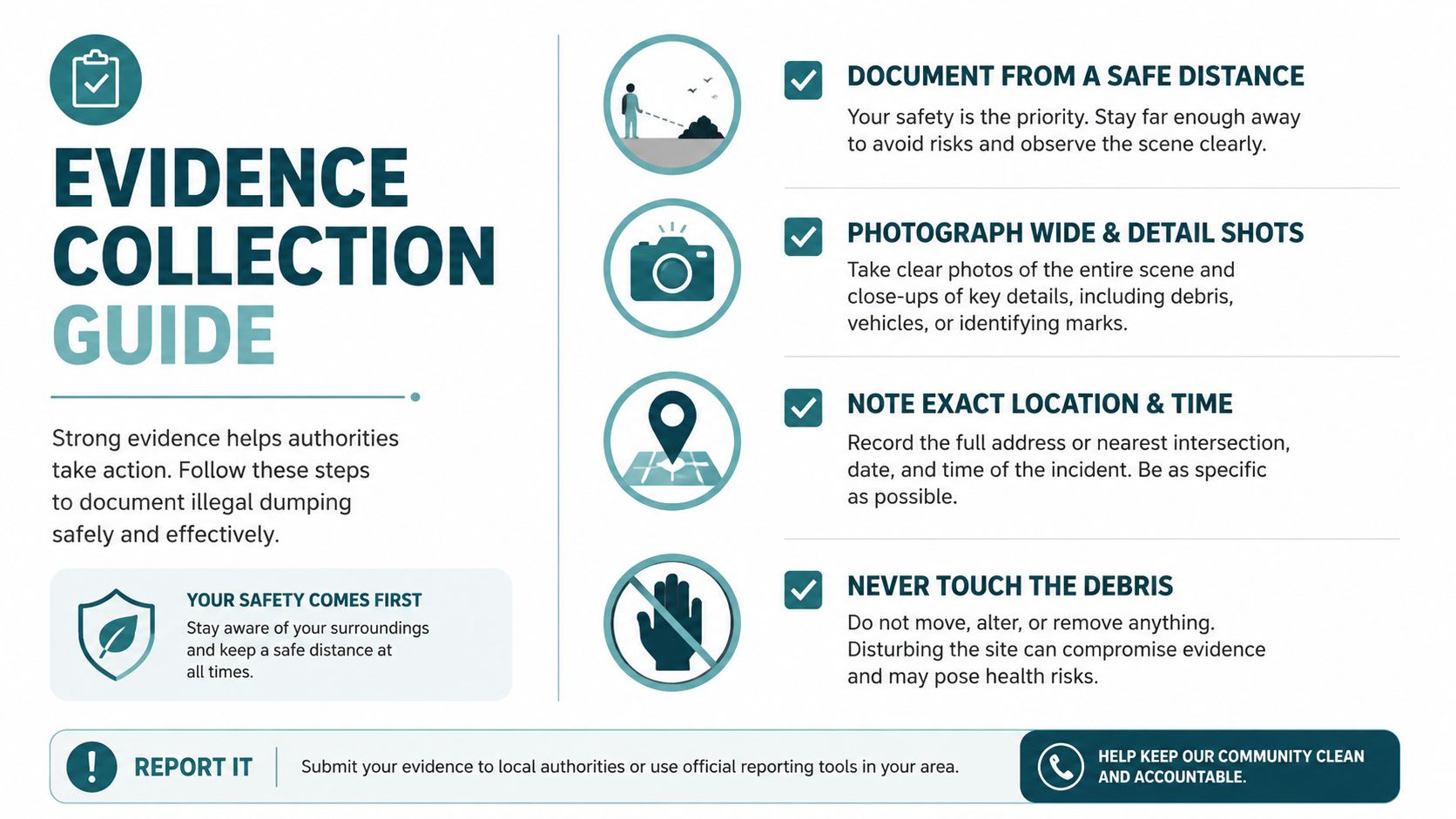
    Treat the site like a scene that can change quickly. Before you move a bag, lift a mattress, or ask someone else to help, step back and document what you see from a safe distance.

    A vague report says, “There's trash in the alley.” A useful report tells an inspector where to stand, what to look for, and whether the material might create a danger.

    Start with the full picture

    Take wide photographs from several angles. Include the alley, curb, vacant lot, fence line, or other surroundings so the agency can understand the site's scale and exact setting. Then take close photographs of details that may connect the waste to a person or business:

    • Vehicle information: Photograph a license plate, vehicle color, make, and model if you see a vehicle near the dump site.
    • Identifying marks: Capture business names, shipping labels, delivery stickers, addresses, and recognizable markings on boxes or materials.
    • Location markers: Photograph street signs, building numbers, alley entrances, landmarks, and nearby intersections.
    • Waste details: Record whether you see construction debris, furniture, household bags, tires, chemicals, or other hazardous material.
    • Activity status: Note whether dumping is happening now, appears to have happened recently, or looks like an older pile that has grown over time.

    Philadelphia asks reporters for a location, suspect description, vehicle make, model, color, license plate, and material details. Philadelphia's illegal-dumping reporting guidance shows the level of detail that helps an agency act. New York City also requests vehicle identification and reporter contact information, along with the date, time, waste type, and amount.

    Write down what your camera can't explain

    Open your phone's notes app and record the date, time, exact address, nearby cross street, and GPS location. Your phone may embed location data in a photograph, but write the location separately so you can paste it into a report.

    Estimate the volume in plain language. You might describe a small cluster of bags, a truckload of construction waste, or debris spread across most of an alley. Don't guess at an exact weight. Describe what you can see.

    An instructional infographic detailing safe and effective steps for documenting illegal dumping evidence for reporting to authorities.

    Never enter a pile, open containers, handle needles, or approach a person who may still be dumping. If a dashcam or security camera captured the event, save the original file when possible and note the camera's location and recording time. Ask a property owner for footage rather than trespassing or confronting anyone.

    For more field-ready precautions, keep a volunteer safety checklist with your phone supplies.

    Here's a short visual guide you can watch before your next cleanup or report:

    "Chicago Hotlines and Apps You Need to Know"

    Chicago residents usually start with 311 for an existing illegal-dumping site. You can call 311, use the CHI 311 mobile app, or submit a request through the city's online portal. Keep your notes and photographs nearby. The request should include the exact location, waste type, visible volume, date and time, and any vehicle or person details you captured safely.

    An active dumper creates a different situation. Don't approach the vehicle or block its path. If someone is dumping right now and you face immediate danger, call emergency services. For a non-emergency report involving suspected criminal activity, use the Chicago Police Department's non-emergency channel and give dispatch the location and vehicle information.

    Chicago's Department of Streets and Sanitation handles cleanup-related requests, while hazardous waste or a large commercial dump may need escalation to the Illinois Environmental Protection Agency. Ask the receiving agency whether it needs a direct inspection, additional photographs, or a separate environmental complaint.

    Choose the channel that fits the scene

    Channel Contact Info Best For Expected Response
    Chicago 311 Call 311, CHI 311 app, or city online portal Existing dumping sites and cleanup requests City routing and follow-up depend on the request
    Chicago Department of Streets and Sanitation Request through Chicago 311 Visible debris on public streets and alleys Inspection or cleanup routing depends on location and material
    Chicago Police Department Emergency services for immediate danger, department non-emergency channel for non-urgent incidents Active dumping, threats, or suspected criminal conduct Dispatch priority depends on safety and urgency
    Illinois EPA State environmental complaint channel Hazardous waste, major spills, or large commercial dumping Agency response depends on hazard and jurisdiction
    Ward and aldermanic office Your ward's aldermanic contact page Repeated sites and unresolved service requests Office follow-up varies by ward and case
    Litter Caterpillars Volunteer reporting network Shared documentation and neighborhood cleanup coordination Volunteer follow-up depends on group capacity

    Don't send the same vague message everywhere. Send a clear 311 request first for a routine site, then add the appropriate agency when the material, scale, or active danger calls for it. England, Scotland, and Wales use a similar split, with local councils handling ordinary fly-tipping and the Environment Agency handling large-scale dumping through its 24-hour hotline at 0800 80 70 60; anonymous reports can go to Crimestoppers at 0800 555 111 through the official fly-tipping reporting guidance.

    "What Happens After You File a Report"

    You press submit, receive a request number, and then the alley looks exactly the same. I know that silence. It can feel as if your report vanished into a machine with no person on the other side.

    A routine request usually enters a city queue for review, routing, inspection, or cleanup. The exact timing can change with the material, location, workload, weather, and whether the site creates an immediate hazard. A status that says “referred to inspector” generally means the request has moved beyond intake and needs someone to assess the site or determine the next agency.

    Cleanup and enforcement follow different paths

    A cleanup crew can remove visible debris without identifying who left it. An enforcement investigation needs evidence that connects the waste to a vehicle, person, business, time, or repeated pattern. That's why your photographs, notes, camera footage, and request number matter.

    New South Wales shows how reports can move through an enforcement pipeline. Over five years, its EPA received and actioned 1,507 illegal-dumping reports, including 641 investigations involving major incidents with more than 200 tonnes of waste. In 2016–17, the agency completed 11 waste prosecutions, with $411,000 in financial penalties, and issued 78 clean-up notices plus 53 penalty notices linked to illegal-dumping investigations. The figures appear in answers from the NSW EPA.

    That same NSW material says 98% of councils reported illegal dumping as an issue in their area, while one in seven spent more than $500,000 per year on cleanup and enforcement. Reporting gives agencies the information they need to decide whether a site needs removal, inspection, surveillance, or legal action.

    Follow up with a record, not a rant

    If the pile remains, use the original request number and submit updated photographs. Contact your alderman's office with the location, date of the first report, request number, current condition, and any new evidence. Ask the office to request a status update from Streets and Sanitation.

    For dangerous material, don't wait for ordinary cleanup. NSW directs people to call 000 for toxic fumes or large chemical spills, 131 555 for immediate threats, and use RIDonline for other reports with a photo and GPS location, according to its illegal-dumping reporting page. The same principle applies in Chicago. Match the channel to the danger.

    "How Volunteer Groups Multiply Your Impact"

    A single report gives a city one location. A group can give neighbors a shared map, repeated observations, photographs from different days, and people who know when a site changes.

    I've watched volunteers walk an alley before a cleanup, photograph every pile, and compare notes afterward. One person notices a contractor label. Another spots a plate. Someone else knows which property owner has a camera facing the alley. Together, they create a clearer account than any one rushed visit can provide.

    Turn scattered observations into a neighborhood record

    Volunteer groups can coordinate walking cleanups, dumping-watch shifts, shared photo folders, and group-chat alerts. They can also help residents keep request numbers organized and notice when the same location appears in multiple reports.

    That work doesn't replace 311, Streets and Sanitation, the police, or an environmental agency. It gives neighbors the structure to use those channels consistently. A group can also bring a chronic site to an aldermanic office with a dated record instead of a stack of disconnected complaints.

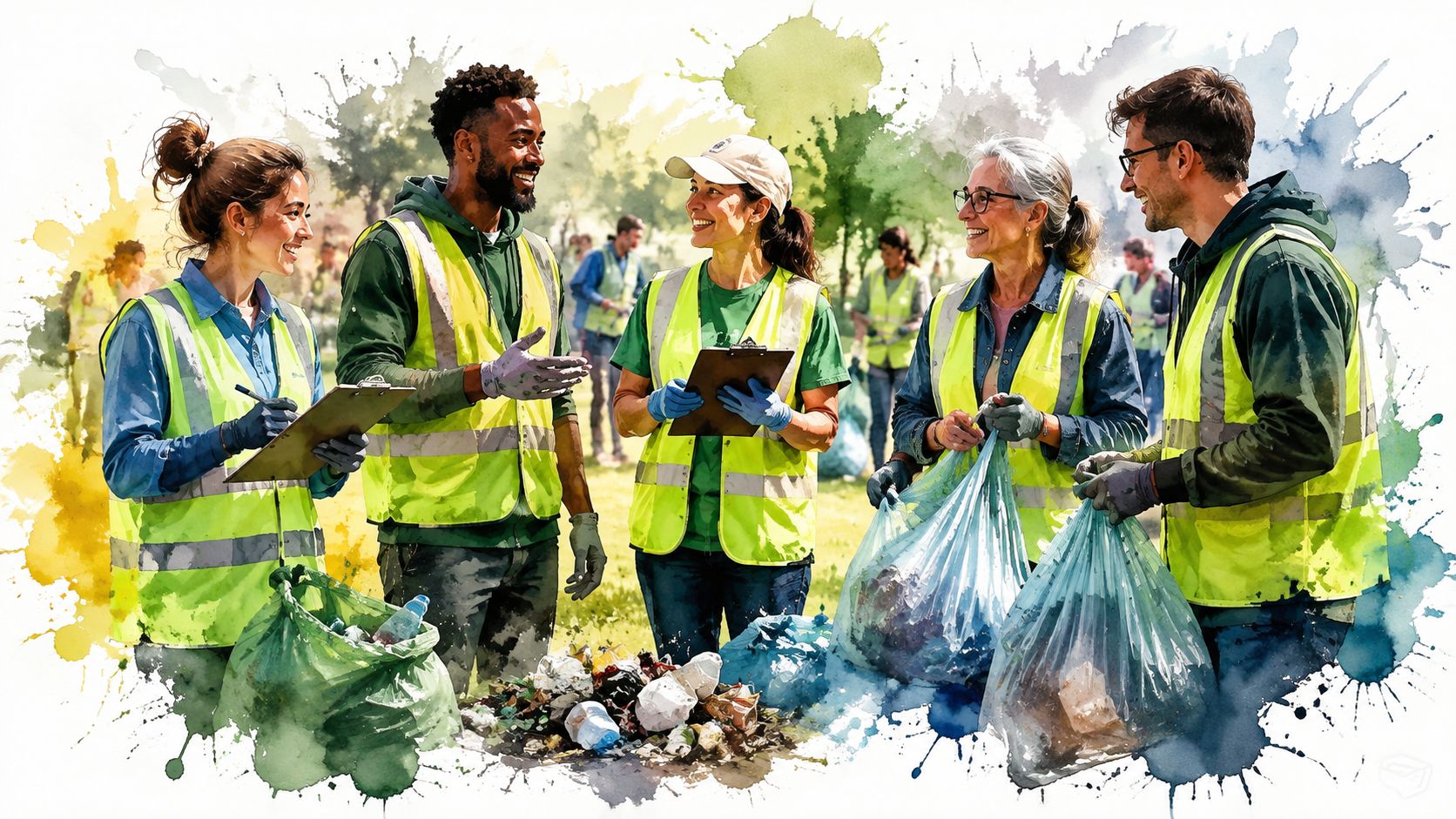
    A diverse group of volunteers in high-visibility safety vests working together to clean up litter in a park.

    Find a role that matches your energy

    You don't have to lift heavy debris to help. You can photograph from a sidewalk, enter report details, check a camera angle with a property owner, translate information for a neighbor, or attend a ward meeting.

    Chicago residents can browse local environmental groups and choose a group that fits their schedule and safety limits. Litter Caterpillars organizes volunteer trash pickups across Chicago, including work in neighborhoods that other cleanup crews may skip, while keeping volunteer safety and happiness ahead of fundraising.

    The work becomes easier when people share it. One neighbor makes the call. Another tracks the request. A third returns after the city visit and photographs what remains. That rhythm turns frustration into a practice.

    "Your Action Plan for Cleaner Streets"

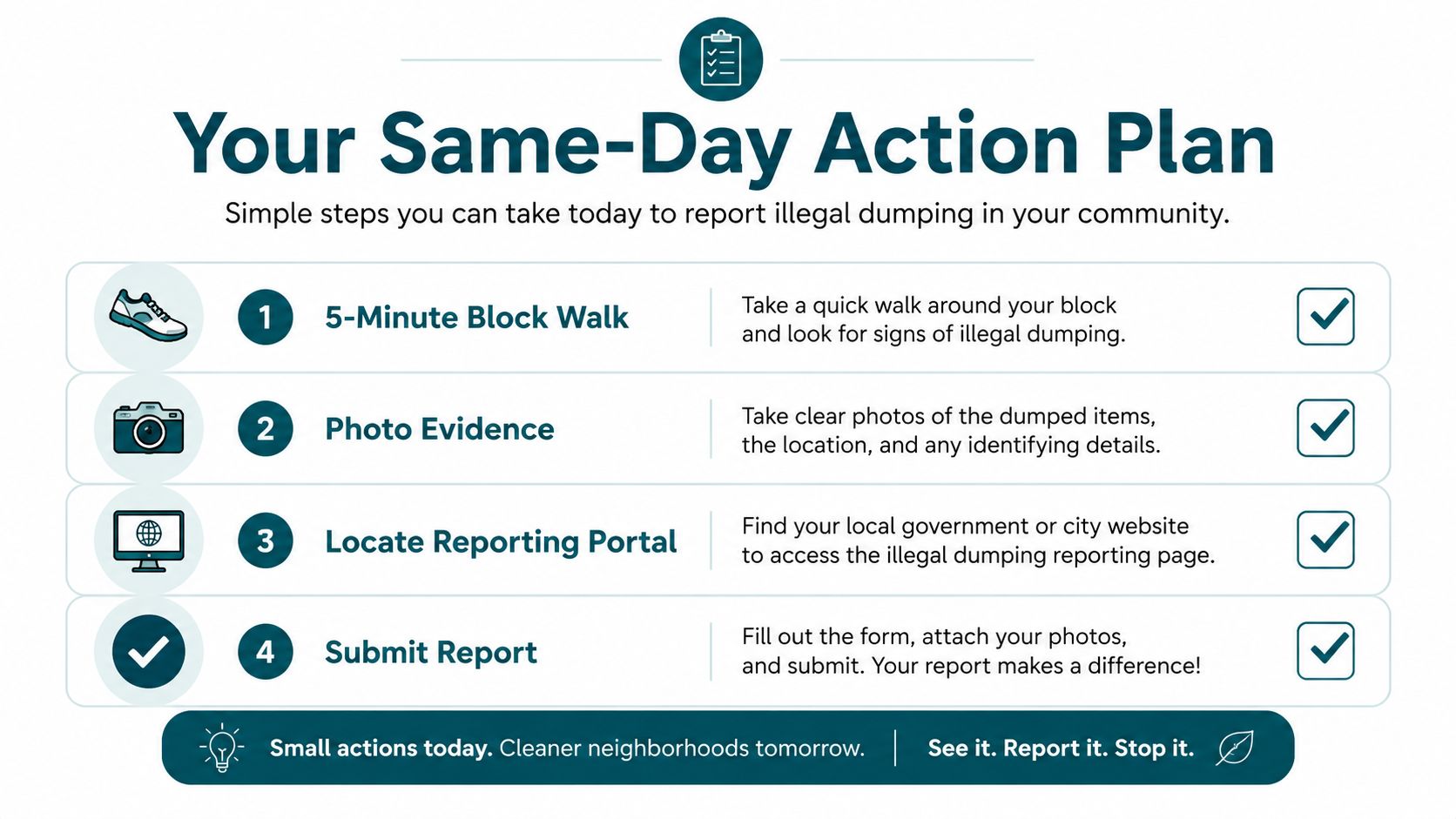
    Start today with a short walk around your block. Keep to public space, stay away from unstable piles and hazardous material, and photograph existing dumping before anyone moves it.

    Then take these steps:

    1. Save the channels: Put 311 and your alderman's contact page in your phone.
    2. Record the facts: Write down the address, cross street, date, time, waste type, and vehicle details.
    3. File the report: Use 311, the CHI 311 app, or Chicago's online portal.
    4. Create the follow-up: Save the request number and set a reminder to check the site again.

    An infographic titled Your Same-Day Action Plan showing four simple steps to report illegal community dumping.

    A report records what happened today. Follow-up reports can show a repeated problem at the same address, while volunteer work helps neighbors protect one another and care for the block.


    Litter Caterpillars organizes Chicago trash pickups, cleanup walks, and neighborhood friendships for people who want to act on problems like illegal dumping. Visit Litter Caterpillars to find a cleanup, join the volunteer network, and take your next step toward a cleaner block.

  • Care For Real: Why Showing Up Is The Only Thing That Matters

    Care For Real: Why Showing Up Is The Only Thing That Matters

    When I talk about care for real, I'm not picturing some caped crusader swooping in to save the day. It’s not about that at all. It’s about the quiet, consistent, often invisible work of just showing up. Especially when it’s hard.

    It’s you, looking at a mess—maybe it’s in your own life, maybe it’s the garbage strewn across your block—and deciding, right then and there, to do something about it. That simple, personal choice? It changes everything.

    Finding Purpose in the Mess

    My life was a dumpster fire. Seriously. My apartment looked like a tornado had a party in it, a perfect, chaotic mirror of the storm raging inside me after a brutal breakup.

    Every cluttered corner mocked me. Every pile of forgotten stuff screamed back at me, reflecting the emotional mess I’d become. I knew I had to build a new life from scratch, one founded on things I was starving for: consistency, real courage, and a tribe of people who actually showed up for each other. But I was paralyzed. It felt like trying to move a mountain of emotional junk, one tiny pebble at a time. It was just too much.

    Then, something clicked. I started thinking, what does it mean to care for real? It isn’t posting a cheesy quote on social media or just talking a big game about making a difference. It’s the opposite. It’s you, pulling on a pair of gloves on a freezing Saturday morning to clean up a mess you didn’t even make. It’s the gritty, unglamorous work nobody else wants to touch.

    To care for real is to dive headfirst into the difficult, the dirty, and the inconvenient, because that’s where you truly grow. It’s choosing service over your couch and real connection over being alone.

    This shift in perspective was my lifeline. I realized that tackling the physical clutter on the streets could be my way of starting to clear the clutter in my own heart. The act of cleaning became my metaphor for rebuilding my life. Every single piece of trash I picked up felt like a tiny victory against the chaos that had consumed me.

    That idea sparked Litter Caterpillars. I wanted to build a community around this one simple rule: show up, especially when it sucks. It's about creating a place where you can find purpose not by dodging the mess, but by wading right into it—together.

    It’s where you and I learn that the best connections aren’t made when life is easy. They’re forged in shared struggle and a common goal. This is how we begin to care, for real.

    Confronting The Overwhelming Mess Around Us

    Let’s get real. It’s so easy to feel completely powerless when you look at the sheer mountain of trash around us. The numbers are staggering, almost numbing.

    I see it every single day on the streets of Chicago, from the gorgeous lakefront to the quiet side streets in my neighborhood. It feels like an endless tide of wrappers, bottles, and plastic bags. It’s the kind of problem that makes you want to just throw your hands up and say, "What can I even do?"

    From Numbers to Neighbors

    The statistics paint a grim picture. The United States is a global champion in trash production. A 2025 report, the Global Waste Index, found that I, you, the average American, now churn out a mind-boggling 951 kilograms of municipal waste each year. Picture this: that's enough trash to fill almost three standard dumpsters every year—for just one person. You can see the full research on the world's biggest waste polluters on waste-management-world.com if you want the stark, unfiltered truth.

    We are just 4% of the world's population, yet we generate 12% of its garbage. This isn’t some abstract number; it’s a reality we live in, and honestly, it’s overwhelming.

    This is exactly where the idea to care for real becomes your superpower. It’s not about you trying to solve the entire global waste crisis by Sunday. That’s impossible. Thinking that way just leads you to burnout and giving up.

    Instead, you shrink the problem. Bring it down to a human scale. You look at the single city block right in front of your feet and decide, "This patch of ground matters. This is my home."

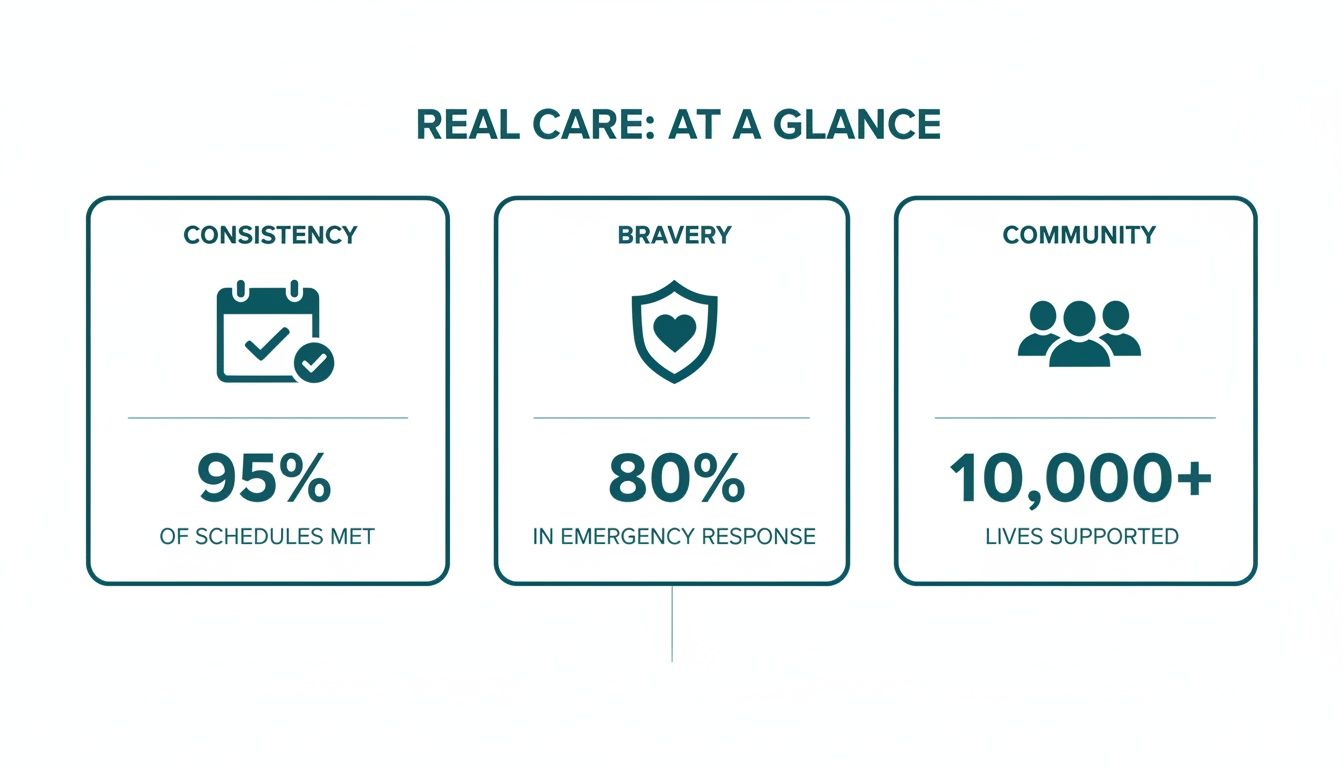
    This infographic shows you the mindset you need to turn that overwhelming feeling into action that actually means something.

    Infographic showing real care metrics: 95% consistency, 80% emergency response, and 10,000+ lives supported.

    These icons for consistency, bravery, and community aren't just feel-good graphics. They are the tools you and I use to transform a massive, terrifying problem into something we can physically touch and solve.

    Taking Back Your Power

    You seize your power not by trying to fix the whole world at once, but by taking direct, visible action in your own small corner of it. Caring for real is about turning those suffocating statistics into a specific problem you can physically solve, one piece of trash at a time. It’s your act of defiance against that feeling of helplessness.

    When you choose to pick up that first bottle, you’re not just cleaning a street. You are making a powerful statement that you refuse to be a bystander in your own community.

    This is the very essence of environmental stewardship. By focusing on what’s right in front of us, you and I create a ripple effect that builds momentum and inspires others to join. It’s a practical approach that turns a global crisis into a local mission. And that is where real change begins. If this idea clicks with you, you might be interested in our guide on what environmental stewardship truly means.

    How We Put Real Care Into Action

    Our very first cleanup was a trial by fire. Or, more accurately, a trial by ice.

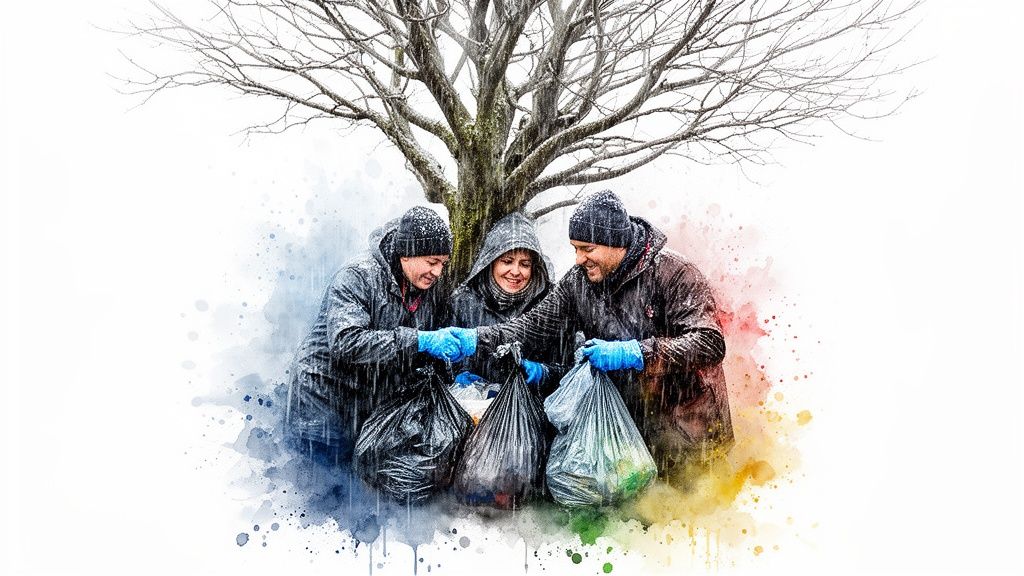
    Picture this: just three of us, ambushed by one of those freak Chicago hailstorms that drops out of a perfectly blue sky. We were huddled under a pathetic, flimsy tree, soaked to the bone and shivering uncontrollably.

    And in that moment of pure misery, something happened. It hit me like a ton of bricks. Facing a stranger’s garbage—no matter how disgusting—was a thousand times easier than facing my own. That shared struggle, that freezing moment under the tree, wasn't just a bad day. It was the beginning of our story.

    This is the beating heart of the Litter Caterpillars philosophy. We show up in blizzards. We show up in brutal heatwaves. You and I believe the hard parts are what make the work real. It's not about being comfortable; it's about being committed. This is what it means to care for real.

    Three smiling volunteers in winter clothing and blue gloves pick up trash under a bare tree.

    Living Our Values Every Single Weekend

    Talk is cheap. Real care is showing up. It’s about building a system where our values aren't just pretty words on a website but are lived out by you and me, every single weekend, on the streets of Chicago.

    We protect our volunteers above all else. Your safety and happiness are my number one priority. I will never pressure you to do more than you're comfortable with or to come out when you can't. I will also never ask you for a dime. Your time and energy are the only currency that matters here.

    Real community isn’t a transaction. It’s built on a shared commitment to showing up for one another and for the city we all call home. It’s about creating a space where you feel valued, not just used.

    There's a reason we meet on weekend mornings. It’s like a natural filter. It brings out people like you who are wired to give—the ones who find genuine joy in service and want to kick off their weekend with a sense of purpose. We're building a community of givers, one tough but incredibly rewarding morning at a time. The bonds we forge are sealed in that shared effort. To see more on how this works, check out our community engagement strategies that build real connection.

    The Litter Caterpillars Philosophy

    Putting these ideas into practice is how we turn a simple cleanup into something more. It's how you find transformation in the trash. Here’s a breakdown of our core values and how we put them into practice every week.

    Our Value What It Means To Us How We Live It
    Bravery Embracing fear, failure, and suffering as your tools for growth. Cleaning in all weather—blizzards, rain, or heat. Taking pride in our work with flags and theme songs.
    Kindness Putting our volunteers' well-being first and building unity. Prioritizing your safety and happiness. Never asking for donations. Fostering real friendships between people like us.
    Service The act of giving transforms you, me, and our environment. Meeting every weekend morning to attract givers. Cleaning all 50 wards, especially neglected areas.

    This isn't just a mission statement. It’s a promise you and I make to ourselves, to each other, and to Chicago every time we grab a trash bag.

    Finding Beauty In The Unwanted

    Hands hold a plastic bottle from which a vibrant plant with flowers grows amidst colorful watercolor splashes, symbolizing growth and care.

    Do you remember that story about Tom Sawyer tricking his friends into painting a fence? A brilliant move. He took a mind-numbing chore and, with a spark of genius, turned it into a privilege—something so special that kids actually paid him for the chance to do the work.

    That’s exactly how I see what you and I do with trash.

    Picking up litter isn't some miserable punishment for living in a messy world. For us, it’s a huge opportunity to transform ourselves. Every bottle cap, every forgotten plastic bag, every crushed can is a chance for you to practice bravery, build real friendships, and find beauty where other people only see garbage. This is the heart of what it means to care for real.

    The Plastic Tide and Our Personal Stand

    This mindset really hits home when you think about plastic. It feels like an unstoppable, suffocating tide washing over our cities, parks, and oceans. While politicians and corporations debate policies and global agreements, you and I choose to take action. Right here. Right now.

    The global numbers are staggering, telling a story of deep inequality. The United States leads the world in plastic production per person, but other countries are drowning in waste with far fewer resources to fight back. Imagine Brazil—it generates over 10 million tons of plastic trash every year but only recycles a tiny 1.28%. The rest just clogs their land and oceans. For us Chicagoans, these global stats aren't abstract; we see the consequences firsthand in our own neighborhoods. You can dig deeper into the global plastic pollution numbers on worldpopulationreview.com.

    This is where our mission gets crystal clear. While the world debates, we believe real change starts with small, consistent work done by people like you who care enough to show up. We make a real dent in a problem that feels impossibly big.

    We are Litter Caterpillars because we know that through service, we can transform not just our city, but ourselves. We are finding profound growth in the grit.

    Finding Growth in the Grit

    Think of it like gardening. You can’t just toss seeds on the ground and hope for a miracle. You have to get your hands dirty.

    You pull weeds, you work the soil, you nurture the ground. It’s tough, messy work, but the reward is seeing something beautiful and alive grow from your effort. That's exactly what you and I are doing every single weekend.

    Here’s how we flip the script on what it means to clean up:

    • The Unwanted Becomes an Opportunity: A trashed-out park isn’t a sign of defeat; for us, it’s a blank canvas for our community to create something amazing.
    • A Chore Becomes a Connection: Picking up trash side-by-side with a stranger builds a bond way faster than small talk ever could. I've seen it happen.
    • Suffering Becomes a Story: Facing a challenge together—like cleaning in the pouring rain—doesn’t just build your resilience. It creates a shared memory, a story that makes our community stronger.

    We aren't just cleaning up. We are actively choosing to find value and potential in the things our society has thrown away. And in doing that, you and I discover a stronger, more connected version of ourselves.

    How You Can Start Caring For Real Today

    So, how do you take this big idea of "caring for real" and actually make it part of your life? It’s not about launching some massive city-wide movement overnight. It starts with one small, consistent action. Just one.

    The first step—and honestly, the most important one—is deciding to show up for something bigger than yourself. It's that choice you make to get off the sidelines and into the game.

    Maybe picking up litter isn't your thing, and that's totally cool. Maybe your heart sings when you're walking dogs at a local shelter. Or maybe it's as simple as spending an hour a week with an elderly neighbor who could use a friend. The what isn't nearly as important as the why and your commitment behind it.

    The Power of Consistent Action

    Something wild happens when you commit to showing up, week after week. It’s like you’ve turned on a homing beacon for other givers.

    Your consistency acts as a magnet. It naturally draws in people who share your values and that same itch to make a difference. These are the people who become your tribe. Your community.

    True belonging isn’t found in what you believe, but in what you do together. Consistent, shared action is the glue that builds the strongest communities.

    This is exactly why we do things at Litter Caterpillars that might look a little silly from the outside. We wave flags. We have a theme song. We celebrate our work with a ton of pride because I believe kind people deserve to feel powerful in the good they do. This is about more than just cleaning up trash; it's about building an identity around service.

    From Small Actions to Big Impact

    Your small, steady efforts ripple out in ways you can't even imagine. It’s easy to feel hopeless. Many developed countries bury over half their waste in landfills. But then you see places like Switzerland, which sends zero waste to landfills, or Estonia, which shot up to be a top-three performer globally.

    Estonia is the perfect story of how committed, small-scale actions can snowball into massive, nationwide change. You can see how different countries stack up at Sensoneo.com. By building a proud identity around service—the same way a sports team does—you and I prove we can redeem both our environment and ourselves.

    So, I’m inviting you to find your thing. Whatever it is that lights a fire in you, commit to it. Show up for it, even when you don't feel like it. And just watch how that one steady act of purpose starts to change not just your neighborhood, but everything inside of you, too.

    Ready to see what that feels like with us? We’ve got a great guide on how to get started with volunteer trash pickup.

    A Few Questions I Hear a Lot

    People often have questions before they join, and I get it. Here are some of the most common things people ask me about Litter Caterpillars and what it really means to show up for your community.

    Do I Have To Be Brave Or Physically Fit To Join

    Absolutely not. When I talk about bravery, I'm not talking about being some fearless superhero or a gym rat. Real bravery is just showing up, especially when you feel nervous or a little out of your element.

    Think of it this way: your bravery is a muscle. You build it over time, and you build it with us. Our cleanups are for everybody, no matter your fitness level. Some people go fast and fill a ton of bags. Others take it slow. Both are exactly what we need from you.

    The biggest thing you can give is just your presence. I put your safety and comfort first, always. You can contribute in whatever way feels right for you.

    What If I Can Only Volunteer Occasionally

    That’s totally fine. The whole point of caring for real is being authentic, not being perfect.

    Look, consistency is what forges those deep bonds in a community, but I know your life gets in the way. It's messy and unpredictable. Showing up even once is infinitely better than never showing up at all.

    There's zero pressure here from me. Every single person who comes out, even if it's just for an hour, makes a difference you can actually see on our streets. Just follow us online, see where we’ll be next, and come when you can. I'll be happy to have you.

    The real work isn't just cleaning the streets; it's about building a resilient, kind, and connected community, one person at a time, whenever you can show up.

    Is This Really Just About Picking Up Trash

    On the surface? Yeah, we pick up trash. But that’s just the beginning. The trash is just the excuse we use to do something much deeper.

    For me, it’s a form of active meditation, a way to clear your head while you clear the sidewalks. It’s a workout that gets you outside. It's an adventure into neighborhoods you've never seen before, showing you a side of the city you've never noticed.

    But more than anything, it's a hell of a filter for finding your people. When you decide to tackle a challenge together—even something as simple as cleaning a park—you build connections that go way deeper than anything you'd find at a bar.

    The trash is just the catalyst. The real change happens inside of you, and between us.


    Ready to see what it feels like to care for real? Join a Litter Caterpillars cleanup and find out what happens when you show up for your city, and for yourself. Find our next event at https://www.littercaterpillars.com.