Tag: chicago hiking

  • Aurora Forest Preserve: Your Complete Guide

    Aurora Forest Preserve: Your Complete Guide

    The first time I walked into aurora forest preserve, I had that tight, overfull feeling in my chest that city weeks can give you. Ten minutes later, I was standing still beside tall grass, listening to wind move through it like someone slowly turning down the volume on my life.

    Discovering a Place to Breathe Near the City

    One Saturday last spring, I met a young volunteer at the trail edge who had come straight from a brutal workweek. He kept checking his phone for the first five minutes. By the time we reached the grasses, he slipped it into his pocket and laughed at himself. "I forgot I could feel this calm without earning it first," he said.

    That is the gift of aurora forest preserve.

    It gives city-tired people a place to soften. No polished outdoor persona required. You arrive carrying too much, and the land does not ask for an explanation.

    A young man with closed eyes enjoys a peaceful moment in a lush green forest park.

    When your mind needs a wider horizon

    I have learned to notice a certain warning sign in myself. My thoughts get cramped. Every small task starts acting bigger than it is. On days like that, I need open ground, a place where my eyes can travel farther than my worry.

    Aurora West offers that feeling of room. You step out, hear wind comb through the grasses, and the body begins to unclench before the mind has caught up. And that sense of space is significant.

    A preserve like this changes your scale. The inbox, the dishes, the awkward conversation you keep replaying, they still exist. They just stop being the only thing in view.

    A walk in a preserve can feel like sweeping a cluttered floor. You still own the room, but now you can move through it again.

    I have felt that same reset in other restored places too, especially on mornings spent walking the quiet trails at Waterfall Glen Forest Preserve, where the first mile can loosen a week of mental knots.

    Why restored land feels personal

    What stays with me here is not perfection. It is recovery.

    Aurora West was not preserved because nobody touched it. People put their hands back into damaged ground and chose to help it heal. Former farmland became habitat again through patient work, season after season. I am moved by that story of restoration. It is a reminder that repair is rarely dramatic.

    That lesson sits close to the heart of the Litter Caterpillars. We show up with bags, gloves, sore backs, and ordinary hope. We pick up what was discarded. We leave a place better than we found it. Then we come back and do it again. A forest preserve teaches the same rhythm. Care is repetitive. So is renewal.

    That is why a visit here never feels like escapism to me. It feels like recalibration.

    What you feel when you stop rushing

    Your first visit does not need to be ambitious. Some of the best hours I have spent in a preserve came from walking one easy stretch, then standing still long enough to hear red-winged blackbirds before I spotted them.

    If you want the day to open up a little more, try this:

    • Start with one easy loop: Let curiosity set the pace.
    • Keep your headphones in your pocket: Wind, birds, and rustling grass do better work than another playlist.
    • Watch the transitions: Prairie meeting marsh, shade meeting sun, still water beside moving stems. Life gathers at those edges.
    • Pause for a full minute: The preserve changes when you stop acting like a person passing through it.

    That small pause can do more than lower your pulse. It can remind you that healing is not always a dramatic turn. Sometimes it is a quiet return to attention, to gratitude, and to your place in a living community that includes soil, water, birds, neighbors, and you.

    Your Guide to Reaching Aurora Forest Preserve

    The first time I drove out there, I missed the mental turn before I ever missed a road. I was still carrying the city in my shoulders. Emails. Noise. That itchy habit of checking the time. Then the streets widened, the buildings thinned, and I remembered a small truth I have learned on cleanup days with the Litter Caterpillars. Sometimes the trip is part of the repair.

    If you are searching for aurora forest preserve, you are usually looking for Aurora West Forest Preserve, as noted earlier. The name matters because a calm morning can get scrambled fast when your map sends you somewhere close, but not quite right.

    I keep the plan simple. Pick your route the night before. Save the location in your map app before you leave. Put water and a pair of trail-ready shoes by the door. Those tiny acts feel ordinary, yet they create the kind of margin that lets you arrive open instead of rushed.

    Driving with less friction

    From Chicago or the inner suburbs, I like an early start.

    Morning light changes the whole approach. The roads feel quieter. The parking area usually feels easier. You step out with more patience, and patience is one of the best things you can bring to a preserve.

    I use the same rule I use for volunteer cleanup mornings. Leave early enough that one wrong turn, one train, or one stretch of traffic does not steal your mood. If you have done longer day trips like Waterfall Glen Forest Preserve, you already know how much smoother the day feels when travel is not a race.

    What to expect when you arrive

    Arrival here is gentle.

    You park, open the door, and the pace shifts. Gravel underfoot. Air that feels less used. Fewer signs asking for your attention. That first minute can do a surprising amount of good if you let it.

    A few habits help:

    1. Use the official entrance information from the forest preserve district before you leave. Access points can be labeled differently across apps.
    2. Bring your own water and a small snack. I have seen good walks cut short by simple underpacking.
    3. Wear shoes that can handle mixed ground. Restored land changes with the weather.
    4. Keep a towel or paper towels in the car. Mud, wet grass, and damp paws have a way of joining the trip home.

    Give the visit room to work on you

    I have brought friends to preserves when they were worn thin by work, grief, or just too much screen light. The ones who got the most from the day were not the ones with the tightest schedule. They were the ones who left space around the outing.

    Build your visit around daylight, weather, and your actual energy. Check the district listing for current hours, parking details, and any notices before you go. Then protect a little unclaimed time on both sides of the trip.

    That extra hour matters. It gives you room to walk slowly, sit longer than planned, and notice what service-minded people learn sooner or later. Care takes time. So does returning to yourself.

    Choose Your Adventure on the Trails

    Some days I want a trail that lets me think. Other days I want one that tires me out enough to stop thinking.

    Aurora forest preserve works well for both moods because the terrain feels varied, even when it stays approachable. You can walk it like a reflective pilgrim, a casual stroller, a birdwatcher, or the friend who says, “Let’s just keep going and see where this leads.”
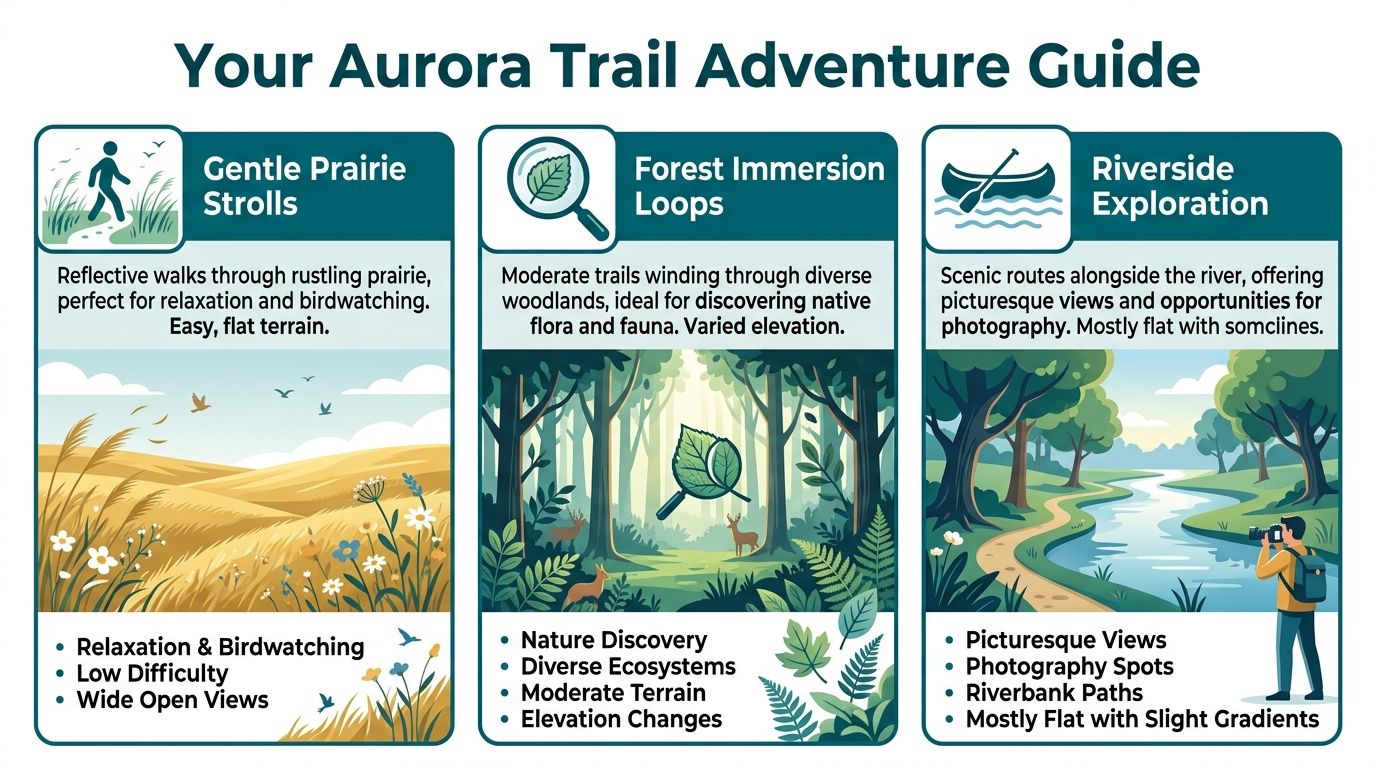
    Infographic

    Three trail moods I come back to

    I do not think of preserve paths as lines on a map. I think of them as different conversations.

    A prairie path talks in long sentences. A woodland loop speaks more softly. A route near water keeps interrupting itself with flashes of movement and reflection.

    Here is the simple version.

    Aurora Forest Preserve Trail Overview Approx. Length (Miles) Difficulty What You'll See
    Gentle Prairie Stroll Varies Easy Open grassland views, breeze moving through tall plants, good sightlines for birds
    Forest Immersion Loop Varies Easy to moderate More shade, layered plant life, quieter stretches for slow walking
    Marsh and Edge Route Varies Easy Wetland scenery, shifting light, strong chance for still-water reflections and animal movement

    I am keeping the distances broad on purpose. Trail conditions, route choices, and your own wandering style can change how long a walk feels. On a preserve day, exact mileage matters less to me than matching the land to my state of mind.

    If you want calm, take the open route

    Open prairie paths do something special.

    They give your eyes distance. That sounds small, but it is not. When I spend too much time indoors, my focus narrows. Screens train you to stare at near things. Prairie trains you to widen again.

    Choose the broadest, flattest-looking route if you want:

    • A gentle reset: Less technical footing, more room to settle into rhythm.
    • Sky therapy: Big cloud views can change the whole emotional tone of a walk.
    • Birdwatching without effort: You can often notice movement from far off.

    This is the route I choose when my brain feels hot and crowded.

    If you want intimacy, take the wooded loop

    Woodland sections feel different right away. The air cools. Sound tightens. Your attention gets pulled closer to bark, leaves, and shadows.

    I like these loops when I need to get out of performance mode. Trees do not care if you have answers. They only ask that you notice them.

    A wooded walk fits you well if you want a bit more enclosure and a slower kind of discovery. It pairs nicely with solo walks, quiet conversation, and the kind of afternoon where you leave your phone in your pocket.

    For a broader look at protected natural spaces across the state, I also like this guide to a forest preserve in IL. It helps frame Aurora West as part of a larger culture of preserved land, not just a one-off escape.

    If you want distance, follow the connection outward

    One of the best features here is the preserve’s multi-purpose trail connection to the Virgil Gilman regional bike trail, noted on the preserve’s official listing earlier in this guide.

    That changes the feel of the place. It means your outing can stay local and contained, or it can become a longer moving day.

    The right trail is not the hardest one. It is the one that meets the version of you who showed up.

    If you are with friends, I suggest asking one question before you start. “Do we want to talk, wander, or move?” That answer usually picks the route for you.

    Meeting the Wild Heart of the Preserve

    I once stopped beside a wet patch at dusk and heard frogs before I saw anything else. The sound came up from the ground like the preserve had switched itself on.

    That is the part I love most. Not the map. Not the parking lot. The life.

    This land is alive because people repaired it

    Aurora West does not hide its history. The beauty here has effort behind it.

    The preserve is part of a restoration story shaped by work on hydrology, wetland recreation, prairie plant reintroduction, and invasive species removal, according to the preserve information cited earlier. You feel that in the variety of habitats. One minute you are looking across open prairie. Then you move toward marsh. Then woodland closes around the trail.

    That mosaic changes the way you walk. You stop scanning for one big attraction and start noticing many small ones.

    A gentle deer peeking through lush green leaves beside a sparkling stream in a watercolor art style.

    What to look for by season

    I do not treat wildlife spotting like a checklist. I treat it like learning the preserve’s mood.

    In spring, I look low first. Fresh growth, wetter ground, the sense that the whole place is waking up from underneath.

    In summer, the preserve feels full-bodied. Taller plants, stronger insect song, thicker greens, more motion if you stand still long enough.

    Fall sharpens everything. Seed heads catch the light. Grasses take on warmer tones. Birds seem to announce themselves differently because the visual texture changes around them.

    Winter strips the place to structure. Trails feel more skeletal, but also more honest. You notice shape, spacing, and the architecture of the land.

    Here are the clues I use:

    • Listen before you scan: Sound often reveals water, birds, and hidden movement first.
    • Watch transition zones: Where marsh meets prairie or woodland meets open ground, life tends to gather.
    • Pause near still water: Reflections pull your eye down, and animals often do the same.
    • Look twice at “empty” spaces: A lot of the preserve’s magic starts as something barely moving.

    Learning to see, not just look

    The first few times you visit a preserve, you may think nothing is happening.

    Then your eyes adjust.

    You notice how one patch of grass bends against the rest. You catch a bird rising where you thought there was only reeds. You see tracks in softer ground. The surroundings stop being background and start becoming conversation.

    That shift matters far beyond the trail. It teaches patience. It teaches attention without force. It reminds you that a restored place can hold more life than a rushed person first notices.

    Nature rewards the second look. Most beauty does not shout.

    When I bring someone new to a preserve, I never try to impress them with names. I just ask, “What changed since we stopped?” That question works almost every time.

    Making Your Trip Comfortable and Safe

    A good preserve day feels loose, but it works better when you prepare with respect. I have learned that simple habits give you more freedom once you are on the trail.

    Pack for comfort, not for fantasy

    I used to overpack for outdoor trips. Then I realized many individuals need less gear and better judgment.

    My standard setup is plain:

    • Water you already trust drinking
    • Shoes with grip
    • One extra layer
    • A snack that does not melt into chaos
    • A small bag for your own trash

    That last one matters. Nothing breaks the spell of a beautiful place faster than leaving a wrapper behind because there is no convenient bin in sight.

    Read the day before the trail reads you

    Weather around northern Illinois can turn quickly. I check conditions before I leave and again when I arrive.

    Wind changes how open areas feel. Recent rain changes footing. Strong sun can tire you out faster than a cool morning forecast suggests.

    A few safety habits carry most of the load:

    1. Stay on marked paths when possible. You protect both yourself and sensitive habitat.
    2. Give wildlife space. A good sighting is one that does not disturb the animal.
    3. Tell someone your rough plan if you are going alone.
    4. Turn back early if the day feels off. Pride is not a trail skill.

    Amenities and expectations

    I do not assume every preserve day comes with polished convenience. That mindset helps.

    Check the official district information before you go if you need specifics on restrooms, accessibility, picnic areas, or seasonal site details. If those features matter to your group, confirm them in advance rather than hoping the trailhead answers the question for you.

    I also keep expectations flexible. A preserve is not a theme park. Sometimes a bench is wet. Sometimes a path is muddy. Sometimes the best seat for lunch is a patch of sun beside the car after your walk.

    Comfort outdoors comes less from perfect amenities and more from bringing what lets you adapt calmly.

    If you are visiting with kids, older relatives, or anyone new to nature walks, start shorter than you think you need. Ending with energy still in the tank makes the next visit much easier.

    Join Us in Protecting These Wild Spaces

    Every preserve asks a quiet question.

    You came here for peace. Will you help protect the place that gave it to you?

    I think that question matters because restoration does not stay restored by accident. Trails need care. Habitats need attention. Invasive plants do not remove themselves. Litter does not walk out on its own.

    Conservation becomes real when you touch the work

    The first time you help care for land, the preserve stops feeling like scenery. It starts feeling like shared responsibility.

    Aurora West already carries the mark of public commitment. In Kane County, a 2001 referendum passed with 52% yes vote and authorized $68.5 million for land acquisition. Surveys also found 72% of residents were concerned about protecting existing open space, as reported in the DuPage Forest Preserve District year in review document that summarizes regional conservation context and Kane County support.

    I love those numbers because they do not feel abstract to me. They feel like trailheads, shade, frogsong, and places where a tired person can recover for an afternoon.

    A diverse group of people planting trees and cleaning up litter to help the environment together.

    Small acts count more than grand intentions

    You do not need to lead a major initiative to become useful.

    Start with one act that is easy to repeat:

    • Pick up a little litter on your way out: Bring a glove or bag and leave a stretch cleaner than you found it.
    • Join an official volunteer day: Habitat work feels better when local staff or stewards guide the effort.
    • Respect closures and restrictions: That includes wildlife protection rules, especially in sensitive areas.
    • Bring one friend next time: Stewardship spreads through relationships faster than speeches.

    That last point matters most. Care is contagious when people watch someone they know practice it.

    Why service changes the person doing it

    I have never believed environmental stewardship is only about the environment.

    It also changes the volunteer. You begin to trust yourself differently when you show up for something that cannot praise you back. Land does not flatter you. It only responds to care over time.

    That is why cleanup work, seed collection, invasive removal, and trail respect all matter. They train a deeper muscle than productivity. They train fidelity. You say you value beauty, and then you act like it.

    If that idea resonates with you, I recommend exploring examples of hands-on environmental stewardship programs. Practical service gives all this inspiration somewhere to go.

    Aurora forest preserve is not just a place to consume peace. It is a place to practice guardianship.


    If this kind of service speaks to you, Litter Caterpillars offers a welcoming way to turn that feeling into action. Join a cleanup, meet people who care, and build the habit of leaving every place better than you found it.
  • Your Guide to Busse Forest South and Its Wonders in 2026

    Your Guide to Busse Forest South and Its Wonders in 2026

    Are you tired of the city's concrete jungle? I know a place. It’s a place where all that noise just dissolves, and you can finally hear yourself think. I call it Busse Forest South, and it's so much more than a park. For me, it's a sanctuary. It’s my training ground. It's where I go to touch something real again.

    Your Adventure into Chicago's Secret Garden

    I want you to think of Busse Forest South as a living, breathing piece of Chicago's soul, like a secret garden that most people just speed past on the highway. My mission here is to personally walk you through this incredible spot, sharing the trails I’ve hiked a hundred times and the lessons this forest has taught me. Consider this guide your key. A key to unlocking its deepest secrets, from the most silent paths for a quiet walk to the easiest places to park your car.

    The air out here just feels different, doesn't it? It’s a place where you can truly breathe again. But like anything precious, keeping it this way takes real work. This isn't just me showing you a pretty trail; it’s an invitation. I'm asking you to join us and become part of its story.

    A Legacy Worth Protecting

    The very ground you're walking on has a story that stretches way, way back. You see, Busse Forest South is just one part of the larger Ned Brown Forest Preserve, a massive area that some incredibly forward-thinking people started protecting way back in 1918. It’s like they left a gift for us, a gift from a century ago. They had the foresight to set this land aside for you and me. That's over 100 years of history right under your feet.

    Knowing that makes our work feel so much bigger than just picking up someone else's trash. When I’m out here cleaning up with my crew, I feel like we’re honoring a promise made a hundred years ago. We are continuing that legacy.

    The map below gives you a bird's-eye view of just how immense the Ned Brown Forest Preserve really is. You can see Busse Lake, a glittering jewel, and the web of trails spun around it—our little corner, Busse Forest South, is tucked right in there.

    This map helps you grasp the scale. It's a huge network of ancient woods and quiet waters, a wild kingdom right in our own backyard.

    More Than Just a Walk in the Park

    My real goal here is to show you how a simple visit can become something more. It's an opportunity to build a community, to push yourself physically and mentally, and to do some actual good for a place that gives us so much. For me and my friends at Litter Caterpillars, this forest preserve in IL is where our core values of service and friendship really come to life.

    This guide is my personal invitation. It’s a challenge, really. I’m daring you to turn a simple weekend walk into something truly meaningful. It's a chance to find your people and become a guardian of this incredible place. Let's start this adventure together.

    Hitting the Trails and Waterways

    Alright, you've made it. Now for the fun part: deciding what to conquer first. Busse Forest South isn't just a park; it's a sprawling, living network of trails and water that practically begs you to explore it. Imagine its nearly 13 miles of paths as arteries, pumping life and adventure throughout the entire landscape.

    I’ll never forget my first time trying to navigate this trail system. It felt like a massive, beautiful maze, a labyrinth of green, until I finally found my way to the main 7.3-mile loop. This paved path is the absolute heart of the preserve. It’s the perfect place for hikers, runners, and cyclists to really stretch their legs. The trail is mostly flat and wide, which makes it an amazing spot for a family bike ride or a long, meditative run where you can just get lost in your own thoughts.

    But here’s the real secret, the bit of magic I want to share with you. The best parts happen when you dare to venture off that main drag. The smaller spurs branching off are where I've discovered my favorite quiet spots—hidden groves and peaceful watersides that most people just pedal right past, completely unaware.

    Charting Your Course

    The trails here cater to just about every mood you could possibly be in. Some are easy, paved paths perfect for a casual stroll with a friend or for pushing a stroller. Others are unpaved, giving you that satisfying, primal crunch of leaves and dirt under your shoes. It’s this rich mix of experiences that keeps me coming back, again and again.

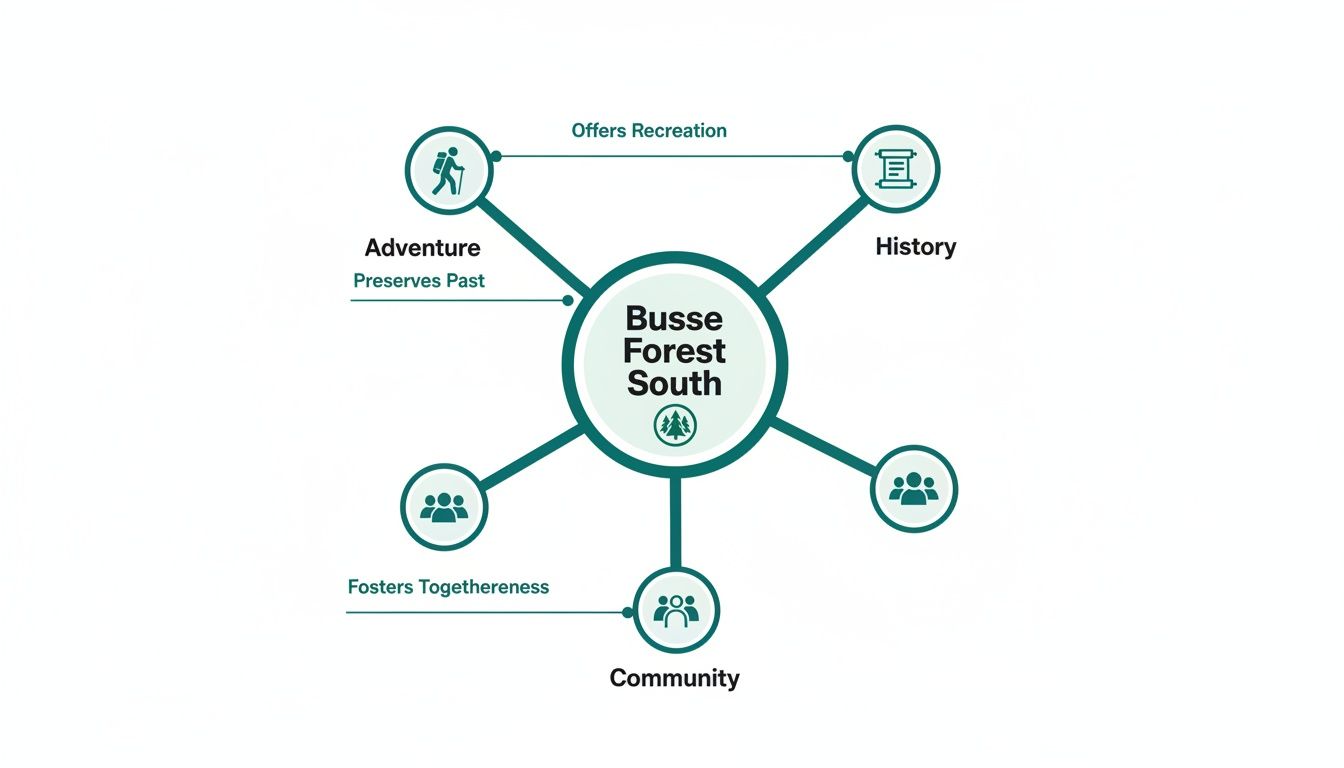
    The forest is so much more than just a place to get your steps in; it's a central hub connecting adventure, history, and our local community.

    A concept map showing Busse Forest South offering adventure, history, community, recreation, and preserving the past.

    You can see how everything weaves together, a beautiful tapestry proving this preserve is a living, breathing part of our area.

    More Than Just Dirt Paths

    Are you looking for something beyond the trails? The massive 590-acre Busse Lake is waiting for you. It’s the largest body of water for paddling in all of Cook County, a shimmering expanse that’s a dream for kayakers, canoers, and anglers. Trust me on this one, there is nothing quite like gliding across that calm water as the sun comes up and the morning mist hangs heavy in the air. It’s a kind of peace that’s hard to find these days.

    To give you a quick idea of what's available, I’ve put together a simple breakdown of the main activities.

    Activities at Busse Forest South

    Activity Best For What to Expect
    Hiking & Running All levels The main 7.3-mile paved loop is flat and totally accessible. The smaller, unpaved trails offer a more rugged, challenging terrain.
    Biking Families, long-distance cyclists You get a smooth, easy ride on the main loop with plenty of room. It’s a fantastic way to cover a lot of ground quickly.
    Paddling Kayakers, canoers A huge, open lake with multiple boat launches awaits you. Perfect for a long, peaceful day spent out on the water.
    Fishing Anglers of all skill levels Shoreline and boat fishing are both super popular here. The lake is regularly stocked with a wide variety of fish species.

    This table is just a starting point. The best way to get to know this forest is to just get out there and explore it for yourself.

    This entire playground is part of the larger 3,700-acre Ned Brown Forest Preserve, which beautifully balances ancient, primeval forests with modern recreation. It's no wonder it's one of Illinois' most-visited natural spots, open every single day from sunrise to sunset.

    The forest has a personality all its own, and the best way I know to get acquainted is by wandering its trails and waterways. If you love exploring trail systems like this one, you should definitely check out our guide to the Des Plaines River Trail for another incredible local adventure.

    A Living Museum of Rare Habitats

    When I tell you Busse Forest South isn't just another walk in the park, I really mean it. This place is different. It’s a living museum, a time capsule holding onto some of Illinois's rarest habitats, and it’s so important that it's officially recognized as a National Natural Landmark.

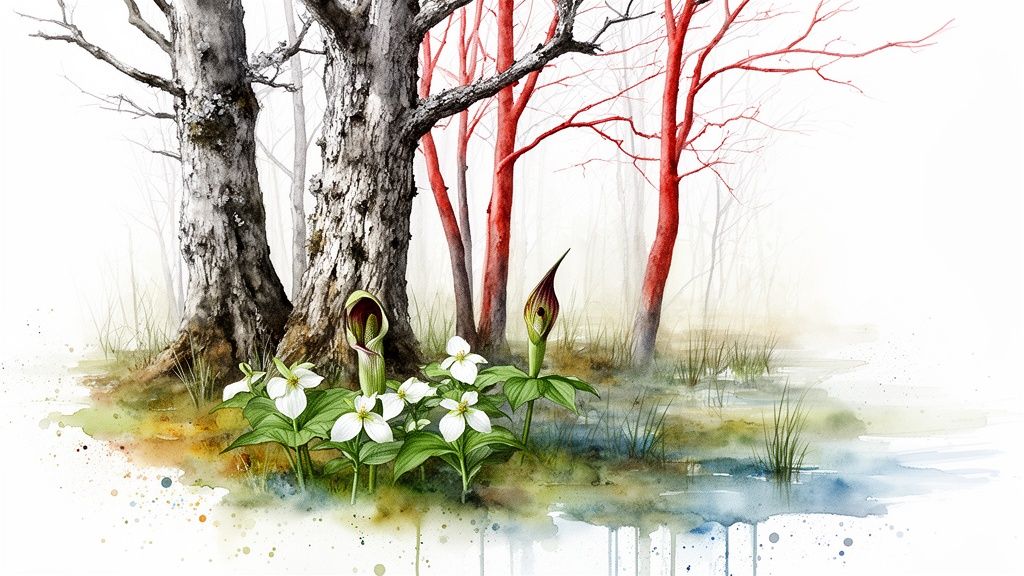
    Watercolor painting of a misty forest with red-barked trees, white trilliums, and Jack-in-the-pulpits by a pond.

    I want you to picture the ground you're standing on as the floor of an ancient, shallow bowl carved out by glaciers thousands of years ago. It's like a geological memory. Those depressions created something very special called "flatwoods," a type of damp-ground forest that used to be common around here but is now incredibly, heartbreakingly rare. This isn't just some random feature of the forest; it is the heart and soul of Busse Forest South.

    A Fragile, Timeless World

    Walking through these flatwoods feels like stepping into the past. It’s a journey back in time. You’re surrounded by towering swamp white oaks and brilliant red maples. In the spring, the ground is a carpet of delicate trilliums and the weird, hooded shape of jack-in-the-pulpit flowers.

    This isn’t just a pretty picture; it's a fragile, delicate ecosystem that desperately needs our protection. That’s why back in January 1965, this specific 440-acre section was designated as the third Illinois Nature Preserve. This status officially protects these flatwoods and all the life they support—from the black ash trees to the vibrant blueflag iris. You can read more about this special designation on the Illinois DNR website.

    Knowing this history really changes how you see the place. It connects you to a story much, much older than any of us.

    The Threats This Museum Faces

    But just like any precious museum, this one is under constant attack. The quiet beauty of these woods is in a constant, silent battle, and it's a fight we can see happening right in front of our eyes.

    Here’s what we’re up against:

    • Invasive Species: These are like bullies on a playground. Aggressive, non-native plants are always trying to push out the native wildflowers and saplings that belong here, stealing space and vital resources.
    • The Emerald Ash Borer: This tiny, destructive beetle has absolutely wrecked ash tree populations all over the Midwest. You can see the damage here, with huge gaps in the canopy where massive trees used to stand proud.
    • Deer Over-browsing: The deer population is so high that the tender shoots of young trees and wildflowers get eaten before they even have a chance to grow. The forest can't regrow on its own.

    Understanding these struggles makes a simple walk in the woods feel so much more meaningful. You’re not just a visitor; you're a witness to a living, breathing history that needs our help to survive.

    This is where service gets personal for me. When you join one of our cleanups, you’re not just picking up a plastic bottle. You’re becoming a guardian of this living museum, actively protecting its story for the future.

    Join Us and Become a Forest Guardian

    This is where you come in. I’ve always found that cleaning up other people's messes is WAY easier than cleaning up our own. This is your chance to prove it. Joining one of our cleanups at Busse Forest South is about so much more than just picking up trash—it’s about finding a strength inside yourself you never knew you had.

    This whole group started in a hailstorm. Seriously. There were only three of us, freezing and laughing at how absurd it all was. In that struggle, we found a strange, profound kind of joy. That’s the spirit we bring to every single event, and it’s something you can find here, too.

    How We Turn Service into Adventure

    We meet on weekend mornings, rain or shine. I schedule them that way on purpose because it acts as a filter. It’s like a magnet for givers—the kind of people who show up not because it's easy, but because it matters. When you volunteer with Litter Caterpillars, you'll find yourself surrounded by folks who just get it, people who believe in bravery, kindness, and sticking together.

    We bring the flags, the theme song, and the community. All you have to bring is yourself.

    Our events are designed to be simple and empowering. Here’s what you can expect:

    • Safety and Happiness First: Your well-being is everything to me. We provide all the supplies—gloves, bags, and litter grabbers—so you can just focus on the mission.
    • No Pressure, Just Purpose: We will never, ever ask you for money. Ever. Your volunteer energy is the most valuable thing we have, and we protect it fiercely.
    • Building Friendships: These events are a powerful way to meet people who think like you. The shared work and seeing the tangible impact you've made creates bonds that last long after the cleanup ends.

    Finding Your Power in the Forest

    This isn't about obligation. It's about you finding your own power in a simple act of service. It’s about turning what some people see as a chore into a real, thrilling adventure. Each piece of trash you pull from the beautiful trails of Busse Forest South is a small victory, a tiny battle won for this incredible place.

    You’re not just cleaning; you are reclaiming the landscape. You are pushing back against neglect and showing the world that people actually care. This is an act of defiance, a powerful statement that this place is worth protecting.

    We see our work as a kind of personal transformation. Through service, we learn to trust ourselves and each other. We prove that small, consistent actions can lead to massive change, both in our parks and deep inside ourselves. It’s a journey of growth, and I'm personally inviting you to take that first step with us.

    If you’re ready to see how service can change your whole perspective, check out our environmental stewardship programs to learn more about our philosophy. We’re building a community of guardians, and there’s a place for you here.

    Finding Your Way to Nature's Doorstep

    Watercolor illustration of a man checking his phone at a trailhead with a car and map.

    Getting to Busse Forest South is your first test. It’s the gatekeeper’s riddle. Pass it, and you're rewarded with something that feels like a hidden treasure. Fail it, and you’ll end up like I did my first time—driving in frustrating circles while my GPS confidently led me to a dead end.

    Don't be that person. Let me give you the cheat codes so your adventure starts the second you step out of your car, not while you’re cursing at a map.

    Finding the right entrance is like knowing a secret handshake. Once you know it, you’re in. There are a few ways in, but not all of them drop you right where you want to be.

    Parking Made Simple

    Listen up. For the easiest, most no-fuss access, you want the lots right off Higgins Road (Route 72). These put you right at the heart of the main trail loop and give you an incredible, sweeping view of Busse Lake right from the get-go.

    • The Main Boating Center: This is your command center. It’s a huge lot and the perfect spot to launch a hike, bike ride, or paddle. On a weekend morning, this place is buzzing. It's where all the action is.
    • Smaller Trailhead Lots: Sometimes you don’t want the buzz. If you’re like me and you need a quieter start, hunt for the smaller, almost-hidden lots along the southern and eastern edges. They’re a much more peaceful gateway into the woods.

    My pro tip? Get here early. I’m serious. Getting here before everyone else doesn’t just mean you get a prime parking spot. It means you get the forest all to yourself, when it’s at its most magical and still.

    Arriving by Public Transit

    No car? No problem at all. You don’t need one. The Pace bus system is your ticket in. Several routes run through Schaumburg and Elk Grove Village, dropping you within walking or biking distance of the preserve.

    I’ve had friends take the bus to a stop near Higgins and just walk the last little bit. Think of it as a small urban warm-up before your real hike begins.

    Just do yourself a huge favor and check the Pace bus schedules online before you leave. Weekend service can be a different beast entirely. Consider it the first leg of your journey.

    Questions I Get All The Time About Busse Forest South

    Got questions before you head out? Good. That means you're already thinking like an adventurer. Whether you're coming out for the first time or you're joining us for a cleanup, a little bit of prep goes a long, long way.

    Here’s the inside scoop on the most common things people ask me. Think of it as our little pre-game huddle.

    Is Busse Forest South a Good Spot for Beginners?

    Totally. You absolutely do not need to be a grizzled, trail-worn expert to have a blast here. The main paved trail is a 7.3-mile loop that’s wide and pretty flat—perfect for a chill hike, a bike ride, or even pushing a stroller. It’s a fantastic first step into the woods.

    And when you feel that little itch for something more, there are plenty of unpaved side trails. You get that real "dirt under your feet" feeling without it being some crazy-hard challenge. It’s the perfect place to level up your outdoor confidence.

    What Gear Do I Need for a Litter Caterpillars Event?

    This is the best question because the answer is so simple: just you. Bring your energy and a good attitude, and you’re set. That’s it. We’ve got the gloves, the bags, the grabbers—all of it. My only advice? Wear comfy shoes you don’t mind getting a little dirty and check the weather before you leave the house.

    Look, we’re here to make volunteering as easy as possible. We’re filtering for givers and good people, not for folks with expensive gear. Your willingness to show up is what truly matters to us.

    Can I Bring My Dog to Busse Forest South?

    Yes! And you absolutely should. You’ll see tons of happy dogs out on the trails. It's a fantastic spot to explore with your four-legged buddy.

    Just be sure to keep them on a leash that's 10 feet or shorter, and—this is a huge one for us—always, always clean up after them. It’s a simple act of kindness that keeps the park beautiful for everyone.

    Where’s the Best Place to Park?

    My go-to spot is the main Boating Center lot right off Higgins Road (Route 72). It’s huge, and it drops you right in the middle of everything. You can’t go wrong.

    If you’re looking for a quieter start or those lots are full, the smaller lots scattered along the southern end of the preserve are great little secrets.


    At Litter Caterpillars, we know that showing up for our parks is how we show up for ourselves and our city. It’s how we transform. If you’re ready to be part of something real, we’d love to have you. Find your next cleanup adventure at https://www.littercaterpillars.com.

  • Your Ultimate Guide to the Old Plank Trail Adventure

    Your Ultimate Guide to the Old Plank Trail Adventure

    The Old Plank Trail. For most, it's just a 22-mile bike path. A pleasant way to get your heart pumping on a sunny Saturday. But I see something more. It's the place where I first understood we could stop just talking and actually build something tangible, something real. It's where I realized we had a chance.

    This Isn’t Your Average Trail Guide

    A person with a backpack walks on a wooden bridge towards a foggy forest on the Old Plank Trail, surrounded by watercolor splashes.

    I want you to see this guide as my personal invitation. Not merely to bike or to walk, but to see this trail through my eyes. As a place that needs us.

    The first time I truly explored the Old Plank Trail, it hit me like a revelation. This wasn't just asphalt and trees. It was a living artery, a vibrant ribbon connecting our communities, our history, and the quiet, forgotten nature that tenaciously hangs on in the suburbs. I saw its immense potential, but I also saw the neglect. The little bits of trash, each one telling a small story of carelessness.

    That’s when it clicked. This trail could be a training ground. A canvas. It's our proving ground, a place where we can show ourselves that we are capable of making a genuine difference. This guide will give you everything you need to know to get out there—the access points, the quietest spots, the deep history. But my real hope, my true aim, is that you’ll see it as a place worth fighting for.

    What is the Old Plank Trail, Really?

    On a map, you see a thin line connecting towns. But in reality, it's so much more. It's a corridor where you can escape the ceaseless noise of life and feel the world slow down to a human pace. It’s a place that ties our scattered suburban lives together, a shared thread in our communal fabric.

    • It’s our shared backyard. The trail weaves through Chicago Heights, Frankfort, New Lenox, and a half-dozen other towns, finally reaching its end in Joliet. It is the common ground for all of us.
    • It’s a lifeline for nature. I see this path as a precious refuge for wildlife, preserving slivers of the prairie and woodlands that once blanketed this entire area. It’s a ghost of a wilder past.
    • It’s a connection to people. You're never really alone out there. You share the path with families teaching their kids to ride, with serious cyclists pushing their limits, and with people just like me, looking for a simple moment of peace.

    The Old Plank Road Trail runs for a remarkable 22 miles across Cook and Will counties. It follows the phantom route of a historic 19th-century railway, connecting communities and preserving a vital green corridor in the heart of Chicagoland. It stands as one of the most significant trail systems we have, and it’s right on our doorstep.

    This isn't just some random path. It’s a massive piece of local infrastructure with a story etched into its very soul. You can lose yourself in the details of its past by reading the story of the Old Plank Road Trail), and when you do, you start to realize just how important it is.

    Before you go, here's my quick-and-dirty summary.

    Old Plank Trail at a Glance

    I’ve put together a quick summary of what you need to know before you head out.

    Feature Details
    Length 22 miles one-way
    Surface Asphalt, fully paved
    Difficulty Easy. Mostly flat, suitable for all skill levels (walking, biking, running).
    Endpoints East: Chicago Heights (Western Ave)
    West: Joliet (Washington St)
    Main Towns Chicago Heights, Park Forest, Matteson, Frankfort, New Lenox, Joliet
    Open Year-round, sunrise to sunset
    Best For Biking, walking, running, inline skating, family outings

    This table gives you the basics, but it can't capture the feeling of the trail. The way the scenery shifts from town to forest preserve. The quiet pride after a long ride. The way the light hits the trees.

    It's More Than a Path. It's a Challenge.

    When you’re out there, you’ll feel it. The quiet. The space. You'll see the profound beauty, but if you look closely, you’ll also see the work that needs to be done. The challenge laid bare.

    This is the experience I want for you. An experience that’s real and a little raw. One that makes you want to do more than just pass through. Join me. Let's see what we can do with this place, together.

    How to Actually Get on the Trail (And Not Get Lost)

    A grey backpack, a folded map, a modern train, and a 'Trail' signpost, all against colorful watercolor splashes.

    Okay, so a 22-mile trail sounds amazing until you’re staring at a map, wondering where the heck you’re supposed to start. It feels a bit like planning our first few Litter Caterpillar cleanups—total chaos at first, but pure gold once you find your entry point. A puzzle waiting to be solved.

    Don't you worry. I’ve already made all the wrong turns for you. Let’s get you on the path.

    My Favorite Starting Lines

    Downtown Frankfort is, hands down, the easiest and most rewarding place for you to start. It's like the trail's welcome mat. The path cuts right through town. Park your car, get your miles in, and then you’ve earned a coffee or lunch at one of the local spots. It’s my personal go-to for a perfect weekend morning.

    If you want something a bit more rugged, I suggest hitting the western end in Joliet. It feels less like a suburban path and more like the beginning of a real adventure, especially since it connects you to the historic I&M Canal trail system. A gateway to something bigger.

    My Personal Pro Tip: The Hickory Creek Preserve trailhead near Mokena is the real hidden gem. I feel like I'm letting you in on a secret. It’s got tons of parking and clean bathrooms (a huge win!), and it drops you onto a gorgeous, wooded stretch of trail that feels like you're a hundred miles from civilization. This is my secret spot for a quiet walk to clear my head.

    Figuring out a trail is a lot like cleaning up a park—you need a strategy. You need a plan. We apply the same kind of planning when we tackle other local spots. If you're looking for another great place to explore, check out our guide on Waterfall Glen Forest.

    Ditch the Car: Riding the Rails to the Trail

    No car? Coming from the city? I’ve got a game-changer for you: the Metra Electric Line. I’ve done this a few times, and it’s brilliant. The train is your chariot, letting you off in Matteson, just a short bike ride from the trail.

    This little trick transforms a simple trail day into a proper journey. A quest. You feel like a real explorer, using public transit to find the wild spots hidden in plain sight.

    • The Move: You grab your bike and hop on the Metra Electric Line, heading south to the Matteson station. Just double-check Metra’s bike rules before you go.
    • The Gap: It’s a safe, easy one-mile ride on local roads from the station to the Old Plank Trail. A small bridge between two worlds.
    • The Payoff: You skip all the weekend traffic, never have to hunt for parking, and get to feel a little smug about your cleverness.

    Choose Your Vibe: Crowds or Quiet?

    Not every part of the Old Plank Trail feels the same, and that’s what makes it great. You can pick your experience like choosing a song.

    The sections winding through Frankfort and New Lenox are the social hubs. On a nice weekend, they're buzzing with families, runners, and cyclists. The energy is fantastic, but it’s not where you go for silent reflection.

    If you’re craving peace and quiet, I head to the bookends of the trail. The eastern miles near Chicago Heights and Park Forest, or the far western approach to Joliet, are your best bets. These stretches are way less traveled. It's where you find those long, uninterrupted moments with just the sound of your own footsteps and the wind. It’s where I go when I really need to think.

    Discovering the Trail's Historic Prairies and Towns

    Artistic watercolor landscape featuring a vibrant field of wildflowers, a wooden plank, and distant homes.

    When you step onto the Old Plank Trail, you're not just on some asphalt path. You're walking on layers of time. It's like a story unfolding right under your feet, a palimpsest of history. This trail has been a Native American path, a 19th-century plank road for wagons clattering westward, and a railroad line that built this entire region. Now? Now it’s our quiet escape.

    I want you to feel that history with me. Each mile marker is a new chapter in a long, unfolding book. As you pass through the towns, the entire personality of the trail changes, showing you a new side of itself.

    A Living Museum of Tallgrass Prairie

    The moments that hit me hardest on this trail were when I first really saw the prairies. These aren't just patches of grass. They're incredible, living pieces of a wilder Illinois, a biological echo. Just think about it—these little strips of nature somehow survived centuries of farming and development, all because they were tucked away on land that was never plowed. They are time capsules.

    The story of this land is amazing. The Old Plank Road Trail was pieced together over a 14-year period between 1992 and 2006. It was a monumental effort to turn 135 acres of a dead railroad line into the living greenway we have today. And the craziest part? Slivers of land along the path still hold original tallgrass prairie, a direct window into what this place looked like back in 1850. You can get lost in this story and see how the trail's history shaped our local landscape.

    When you see these rare plants and flowers, you realize that picking up a single piece of trash is an act of preservation. It connects your small, simple effort to this much bigger story of resilience.

    This is why our cleanup work feels so important to me. When you protect a place like this, you’re not just cleaning up for today. You’re honoring its entire history and fighting for its future. You become a steward.

    The Personalities of the Trail Towns

    As you head west, you'll see that every town brings its own energy to the trail. You're not just biking through suburbs; you're visiting distinct communities, each with its own story to tell.

    • Frankfort: I always call this the trail's living room. It's so welcoming and charming, and there’s always something going on. The path slices right through its historic downtown, making it the perfect spot to start your day or end it with a coffee from a local shop.
    • New Lenox: I think of this part as the trail's beating heart. It feels alive and active, connecting tons of parks and neighborhoods. You’ll see families, runners, and cyclists all sharing the space—a real feeling of community in motion.

    These towns are destinations, not just scenery. Exploring them on foot or by bike is one of my favorite ways to spend a weekend. If you love discovering places this way, you'll probably enjoy our collection of self-guided Chicago walking tours too.

    The Old Plank Trail is a journey that connects us—to nature, to our history, and to each other. It's a powerful reminder of what we can save when we actually work together.

    Staying Safe and Prepared for Your Adventure

    Emergency preparedness kit items: water bottle, first-aid kit, smartphone, and reusable bag.

    Being brave on the trail is one thing. Being prepared is everything.

    Having a great—and safe—day on the Old Plank Trail isn't about luck. It’s about being ready for whatever the trail decides to throw at you, because trails have minds of their own. I've spent countless hours out here, and I want to share what I've learned so you can focus on the journey, not a painful blister or a forgotten water bottle.

    My first rule, especially if you’re riding solo: always tell someone your plan. Just a quick text with your route and when you think you'll be back is a huge safety net. It’s a tiny action that makes a big difference.

    The Unwritten Rules of the Trail

    The Old Plank Trail is a shared space, a communal living room, and that means we have to be good neighbors. It's just like driving—simple rules keep everyone moving safely. This is a multi-use path, so you'll be sharing it with walkers, runners, families pushing strollers, and cyclists of all speeds.

    Your best tool out here is simple awareness.

    • Stay Right, Pass Left: It’s just like the highway. You, if you're slower, keep to the right. If you need to pass, give a clear and friendly "On your left!" a few seconds before you go around. No surprises.
    • Keep Your Ears Open: If you’re listening to music or a podcast, I urge you to keep the volume low or just use one earbud. You absolutely have to hear cyclists or runners coming up behind you.
    • Manage Your Crew: Walking with friends or family? Don't spread out and block the whole path. Fall into a single-file line, especially when it's crowded, to let others get by easily.

    I see being a good trail citizen as simple. It all comes down to respect and awareness. Every time you call out a pass or make room for someone, you're helping create a safe, positive vibe for everyone who loves this trail.

    My Must-Haves for Any Season

    I learned about being prepared the hard way during a surprise springtime hailstorm at one of our very first Litter Caterpillars cleanups. That lesson stuck. It was a baptism by ice. Now, I’ve got a simple checklist that I tweak a little depending on the season.

    A hot summer day means I pack extra water and sunscreen. A crisp fall afternoon calls for a windbreaker and maybe a hat. But a few things are always in my bag, no matter what the weather looks like.

    My non-negotiable kit includes:

    1. Water: Always bring more than you think you’ll need. Dehydration is a silent thief.
    2. Snacks: A simple granola bar or some nuts can be a total lifesaver when your energy crashes.
    3. Basic First-Aid: A few bandages and some antiseptic wipes weigh nothing and can handle minor scrapes and cuts.
    4. A Litter Bag: Of course! I never go anywhere without a small, reusable bag to grab any trash I see. It’s the easiest way to leave the trail a little better than you found it.
    Being ready for anything is a type of freedom. It means you can let go and just enjoy the moment, knowing you can handle whatever comes your way.

    Let's Keep This Place Beautiful, Together

    After you’ve been out here, after you’ve felt the sun and the breeze on the trail, you might feel a little pull. A feeling in your gut. I know I did. It’s that feeling of seeing something special and wanting to protect it. That’s where the real work—the real fun—begins.

    The Old Plank Trail is our shared backyard, but it doesn't stay beautiful on its own. It’s just like my own life used to be. A messy apartment, a messy head. Everything felt chaotic. It wasn't until I started taking small, real actions that things started to change for me. Cleaning up this trail is the same idea, just on a bigger scale. It's therapy for the soul.

    So, this is my personal invitation to you. I don't see this as a chore. It's a chance to join us, the Litter Caterpillars, and do something that actually matters.

    What It's Really Like to Volunteer

    I want you to forget what you think a "cleanup event" is. This isn't quiet, solo work. Think of it more like an outdoor get-together with a mission. We show up, we laugh, and in just a few hours, we make a difference you can literally see with your own eyes.

    You’re not just picking up trash; you're becoming part of the trail's living story.

    • You'll meet real people. Our volunteers are givers. They show up on a weekend morning because they want to build something better, not just talk about it.
    • You'll see instant results. There’s nothing like looking back at a stretch of trail and knowing it’s clean because you were there. It’s satisfying on a deep, primal level.
    • You'll have fun. I promise you this. We make it an adventure. It’s about the stories we share and the mission we're on together.

    The real change isn’t just on the ground—it’s in you. When you start caring for a public space, you start seeing your whole city differently. You become a guardian. An owner. It's an empowering feeling that's hard to describe until you've experienced it yourself.

    We Fill in the Gaps

    Look, the official agencies do what they can, and I think they do a great job with the big stuff. A seven-mile section of this very trail just got a $1.3 million overhaul with new pavement and better access. That’s huge, and it shows our local governments care. You can even see how those major trail projects come together.

    But they can't be everywhere, every day. That’s where we come in.

    We’re the nimble ones. We're the on-the-ground crew that handles the daily stuff—the coffee cups, the plastic bags, the little things that pile up and whisper neglect. We are the connective tissue, filling the gaps between those big-budget projects to keep the trail pristine for every single person who comes out to enjoy it.

    When you join a cleanup, you’re not just picking up a bottle. You’re protecting that $1.3 million investment. You’re making sure the trail stays as amazing as it was meant to be.

    Ready to make a real difference with us? I invite you to check out our upcoming volunteer trash pickup events and find one that works for you. Let's get out there.

    Old Plank Trail: Your Questions, My Answers

    People ask me a lot of questions about the Old Plank Trail. I love it. It shows you’re thinking, you're curious, and you're ready to get out there. It reminds me of our cleanups—a little bit of prep makes all the difference. So let’s get into the nitty-gritty so you can hit the trail feeling like you own it.

    Is the Old Plank Trail Too Hard for a Beginner?

    Not a chance. I promise you this trail is as friendly as they come.

    The whole thing is paved asphalt and almost perfectly flat. Don't you dare picture some tough, rugged hike. Think of it more like a really, really long sidewalk that cuts right through fields and forests. A gentle introduction. It’s perfect if you’re just starting out, have kids in a stroller, or just want an easy, chill day.

    There are no surprise hills waiting to crush your soul. This is a place to build your confidence, to feel what it’s like to cover some ground. It’s how you fall in love with this stuff.

    Can I Bring My Dog?

    Yes! Your dog is welcome on the trail. I love seeing pups out there, enjoying the day just as much as we are. Just be cool about it and follow the basic rules so we can all keep enjoying this privilege.

    • Leash Up: Your dog must be on a leash. Period. It's for their safety, other people's safety, and the local wildlife. I make no exceptions to this in my own mind.
    • Pack It Out: You know the deal. Always pick up after your dog. I always bring more bags than I think I’ll need. This is a non-negotiable part of being a good human on the trail.
    • Keep It Tight: When people are passing, I keep my own dog on a short leash right by my side. Don't let the leash become a tripwire across the path.

    Look, I see bringing a dog on the trail as a privilege we all share. When we all follow these simple rules, we're protecting that privilege for everyone. It’s a small thing, but it’s how we take care of our community and the spaces we love.

    What About Bathrooms and Water?

    Super important question. The short answer from me is: yes, but don't count on them being everywhere.

    You’ll find bathrooms and water fountains at the main trailheads and parks, especially in towns like Frankfort and New Lenox. But once you're on the trail, there can be long, desolate stretches with absolutely nothing.

    Here’s my advice: always start your trip with a full water bottle. Always. And if you see a bathroom, use it. Don't play the "I'll wait for the next one" game. A little planning avoids a lot of misery later. Trust me on that one.


    Ready to turn that inspiration into action? Join me at Litter Caterpillars. Help us keep this trail and other incredible Chicago spaces clean for everyone. Find an event and sign up at https://www.littercaterpillars.com.

  • Your Guide to Exploring Blackwell Forest Preserve

    Your Guide to Exploring Blackwell Forest Preserve

    Sometimes you just need to get away. Not on a plane, not on a long road trip, but just… away. Away from the noise, the concrete, the constant hum of the city. For me, that place is a sprawling 1,366-acre sanctuary just west of Chicago. This is Blackwell Forest Preserve, and I want to tell you why it’s more than a park—it’s my escape hatch.

    Welcome To Your Blackwell Forest Preserve Adventure

    Think of this as me sitting down with you, sharing a map scrawled with my favorite spots. I’m not just going to give you facts; I want to tell you stories about this place, and help you find your own story here. Imagine a world of towering oaks, lakes that catch the sunlight like scattered diamonds, and hills that let you steal a glance at the Chicago skyline, a tiny reminder of how close, yet how wonderfully far, you really are.

    This is where I come to breathe. To move. To feel like myself again. I want to help you find that same feeling.

    A vibrant watercolor painting of a person walking on a path in a park towards a city skyline.

    More Than Just a Park

    Blackwell isn't a patch of green on a map. No. It’s land with a deep story, a history I can feel under my feet when I walk its trails. Glaciers shaped this ground, but it’s the people who gave it a soul.

    It’s a place holding a surprising past. I learned that back in 1967, Dr. Martin Luther King Jr. actually spoke here. He connected the struggle for civil rights to the simple idea of open, public spaces for everyone. He saw that access to nature wasn’t some fancy extra. It was a basic right.

    "Everyone’s welcome in the forest, and I think that’s a wonderful thing."

    That single idea—that’s the soul of Blackwell. It was built for you, for me, for all of us. I promise you, no matter who you are, there's a piece of this place waiting for you.

    Your Adventure Starts Here

    As we dive in, I'll show you what makes the Blackwell Forest Preserve a true gem. I want to walk you through:

    • The unbelievable story of how this land was utterly transformed.
    • My personal favorite trails for a good, heart-pumping hike or just a quiet moment.
    • The amazing wildlife you can actually see if you just stand still and listen.

    I’ve found so much clarity on these paths. I hope by the end of this, you’ll be itching to find your own story here. Let’s go.

    From a Garbage Dump to a Landmark? The Story of Blackwell

    Every place has a story. Most are boring. This one isn't. The story of Blackwell Forest Preserve is something I think about a lot, because it feels like my own life. We all have our messes, right? The parts of our past we'd rather just bury. Well, this land did exactly that. Literally.

    Glaciers carved this whole area thousands of years ago, leaving the rolling hills we climb today. But the really wild part of Blackwell's story, the chapter that gave it its grit, started in 1965. That's when a huge piece of this beautiful land officially became a sanitary landfill.

    Yes. A garbage dump. It's strange to stand in this vibrant, living place and picture it piled high with our trash. It’s like looking at an old photo of yourself you’d rather forget. But that mess became its greatest teacher. It forced the county to get smart about waste, about restoration, and about how to heal a piece of the earth we had broken.

    A Mountain Made of Trash

    Today, that old landfill is Mount Hoy, a massive 150-foot hill that gives you some of the best views in DuPage County. On a clear day, you can see 30 miles out, all the way to the Chicago skyline. Just stop and think about that. The ugliest, most shameful part of this land’s past became its highest point.

    This is the stuff that gets me. It’s a real-life, dirt-under-your-fingernails analogy for our own lives. It’s proof that we can climb out of our own messes to get a better view. This land shows us that even the most scarred places can be reborn into something strong and beautiful. It's a lesson I carry with me every single time I visit.

    This place is a partnership. It’s what happens when we decide to work with nature to fix our mistakes. It’s a testament to nature's will to heal and our ability to give it a helping hand.

    Blackwell Forest Preserve is a giant, a 1,366-acre beast of a park in Warrenville. Its history is layered with glacial savannas, an 1830s grist mill, and a quarry they filled to become Silver Lake. But for me, it’s this story—turning a landfill into a landmark—that defines the place. You can feel that gritty, resilient spirit in the air here. If you want to go deeper, you can dig into the full historical analysis from the DuPage Forest Preserve District.

    How To Choose Your Perfect Trail Adventure

    Alright, let's find your path. I remember my first time standing at a trailhead here, staring at the signs, totally paralyzed by choice. It's like standing in front of an ice cream counter with fifty flavors. But I learned fast that you can't really go wrong. You just have to pick a direction and start walking.

    Think of it like picking a soundtrack for your day. Do you need a long, winding acoustic song or a short, punchy pop hit? Let me show you a few of my personal favorites to help you find your rhythm.

    A Quick Guide to My Favorite Trails

    To make it easy, here’s a quick rundown of the main trails. Each one offers a totally different experience, so you can match the path to your mood.

    | Blackwell Forest Preserve Trail Guide |
    | :— | :— | :— | :— |
    | Trail Name | Distance | Difficulty | Best For |
    | McKee Marsh Loop | 6.1 miles | Moderate | A long, immersive hike with varied scenery. |
    | White Pine Pond Path | 2.3 miles | Easy | A quiet, reflective walk for clearing your head. |

    This little table helps you get started, but the real magic is in the stories of each trail. Let's dive deeper.

    For a Real Escape: The McKee Marsh Loop

    When I need to properly vanish for a few hours, my go-to is the 6.1-mile loop circling McKee Marsh. It’s what hikers call a “lollipop” trail—you walk down a straight path which opens up into a big, beautiful loop before you head back the way you came. It’s a perfect design, giving you a taste of everything.

    You’ll wander through wide-open, sun-drenched prairies that just explode with goldenrod and milkweed in late summer, buzzing with more butterflies than you can count. It's an incredible feeling of being small in a big, beautiful world.

    The trail itself tells a story in two parts:

    • Bobolink Trail: This section is mostly out in the open, taking you right through the heart of the restored prairie. Get ready for some sun.
    • Catbird Trail: Just when you need a break, the path ducks into the cool shade of massive, old oak trees. It’s a welcome change of pace.

    I love this blend of sun and shade, prairie and woods. It makes the loop feel like a complete journey.

    For a Quick Reset: The White Pine Pond Path

    If you're looking for something quieter, more meditative, I always point people toward the 2.3-mile path around White Pine Pond. This one isn’t about a big physical challenge; it’s an invitation to just slow down and breathe.

    This is where I go when my own thoughts feel like a tangled ball of yarn. Something about the simple act of walking among the quiet pines helps everything fall into place. It’s on these shorter walks that I’ve had some of my best wildlife sightings—like watching a family of deer grazing by the water, completely unbothered by me.

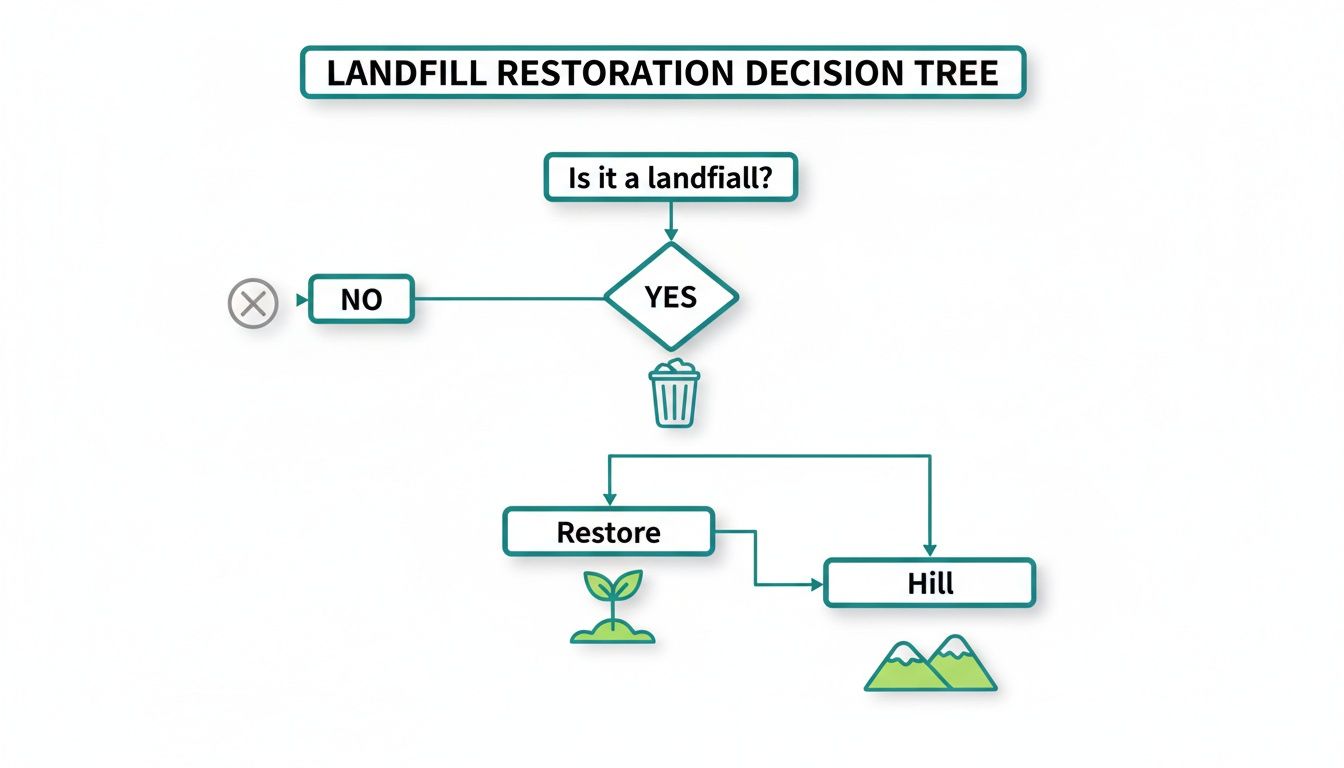
    The story of this place is as powerful as its trails. As you walk, it helps to know that much of Blackwell, including its highest point, was built from a literal landfill.

    A flowchart titled 'Landfill Restoration Decision Tree' showing options for landfills, leading to restoration or hills.

    It’s a real-life example of how we can heal a place, turning forgotten waste into something full of wonder. Every step you take is on land that was intentionally healed. You are walking on a story of redemption.

    No matter which path you choose, you’re not just going for a hike. You’re stepping into a story of resilience. And if you love exploring these kinds of reclaimed natural spaces, you should definitely check out our guide to the incredible trails at Waterfall Glen Forest Preserve.

    Discover The Mammoth Secret Of McKee Marsh

    Alright, let's talk about what I think is the true heart of Blackwell Forest Preserve, the place I always return to: McKee Marsh. This isn't just a pretty wetland. It’s a comeback story. It was DuPage County’s first big wetland restoration project, and now it buzzes with a kind of life you can feel in the air.

    When I walk the trails, it’s like listening to music. The hum of dragonflies, the whisper of wind in the reeds, a heron calling in the distance. If you're into birdwatching, this spot is a gold mine. You’ll see majestic herons, graceful egrets, and that sudden, electric flash of a bluebird. It feels like stepping into a world that's both ancient and brand new.

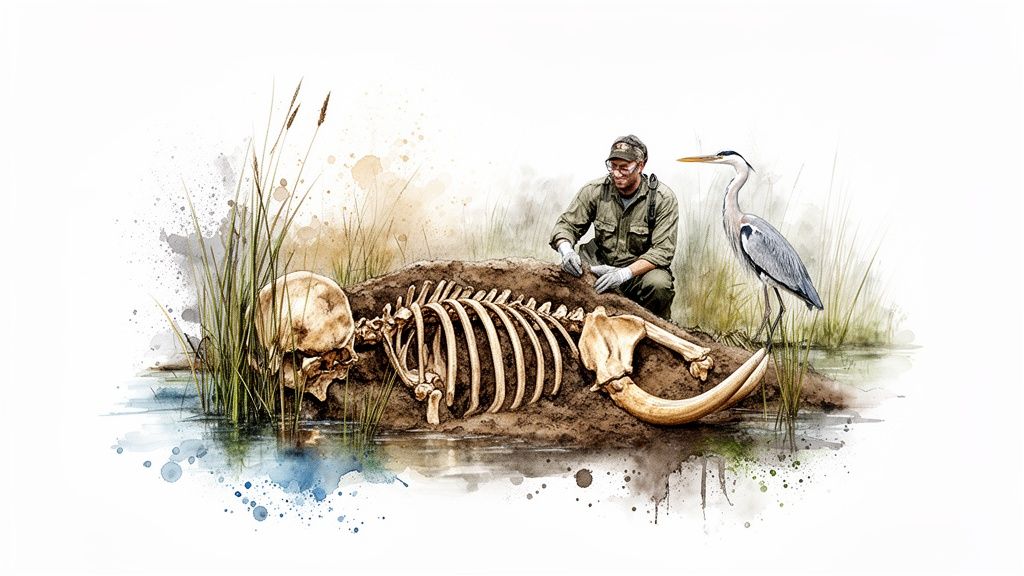
    Watercolor illustration of a paleontologist examining a partially excavated ancient mammoth skeleton in a marsh, observed by a heron.

    An Ice Age Revelation

    But there's a much deeper story buried here. A secret that completely changed how I see this land. Just imagine this for a second: It’s June 21, 1977. An operator, Gary Jones, is digging clay. Just another Tuesday. Then his machine hits something huge. Not a rock. Bone.

    What he pulled from the earth that day was the skeleton of a 13,000-year-old woolly mammoth. It turned out to be one of the oldest ever found in northeastern Illinois. Carbon-14 dating placed the bones at an incredible 13,130 years old, found in soil from before the last glaciers even melted. A single discovery that rewrote the history of Ice Age life right here. You can even learn more about this incredible mammoth find directly from the Forest Preserve.

    Knowing you’re walking on ground that holds such profound history adds a layer of awe to every step. It’s a powerful reminder that the earth beneath our feet is filled with stories we can't even imagine.

    There’s something humbling about walking through that kind of deep time. You're not just on a trail; you’re tracing the path of giants who were here thousands of years before any of us.

    A Living, Breathing Ecosystem

    Today, the marsh is this beautiful, thriving place, all thanks to that restoration work. It’s a living lesson in how nature can bounce back if you just give it a chance.

    The biodiversity is amazing. It's not just a collection of plants and animals; it's a real community.

    • Tall grasses and wildflowers: They provide the food and shelter that insects and small mammals need to survive.
    • Majestic oak trees: These stand like old guardians, offering shade and a home for countless birds.
    • The wetlands themselves: This is the critical habitat for amphibians, reptiles, and all sorts of waterfowl.

    Every single piece works together, creating a tough, resilient system. If this deep history gets you excited about our native ecosystems, you might like my guide on the different kinds of trees in Illinois that make places like McKee Marsh possible. A trip here isn't just a hike; it’s a conversation with history itself.

    Turn Your Visit Into Meaningful Action

    Have you ever left a beautiful place like Blackwell and felt that spark? A pull to do something more than just visit? I want to show you how to take that feeling and turn it into real-world action, the kind that protects these exact places.

    It might sound strange, but I figured something out when I started this journey: cleaning up messes left by other people is a lot easier than facing your own. I started Litter Caterpillars because my life was a complete mess, and I felt stuck. Picking up one piece of trash was a simple action I could control—a small win that started to add up.

    I learned that service is like a muscle. The more you use it, the stronger your sense of bravery, kindness, and community gets. It's a way to get your feet back on the ground when everything else feels shaky.

    From Visitor to Volunteer

    We host cleanup events in spots just like Blackwell all the time. Think of it as trading a weekend morning for a chance to give back and meet new friends who actually show up. You don’t need any special skills—just a willingness to be there with me.

    This is about more than just trash. It’s about taking pride in our shared spaces and, in the process, taking a little more pride in ourselves.

    I truly believe service is the fastest way to build courage. When you show up for a place, you start to show up for yourself in a new way. It’s a chance to give back to this incredible preserve and find a bit of your own strength along the way.

    Joining us is easy. It’s not some huge commitment; it’s just one morning. Let me show you how you can find an event and start your own story.

    How to Join a Cleanup Event

    I made the sign-up process as simple as I could. The hardest part should be dragging yourself out of bed on a Saturday, not fighting with a confusing website. I want you out there with us, not stuck behind a screen.

    Here’s the simple, three-step process:

    1. Visit Our Volunteer Page: This is our main hub for all upcoming events. We post all the dates, times, and locations here.
    2. Choose Your Event: Find a cleanup that works for you. We move all over the Chicago area, so you might find us at Blackwell one week and a city neighborhood the next.
    3. Sign Up: Found one? Just follow the link to sign up. We use platforms like Meetup to keep it simple, so you’ll get all the details and reminders you need.

    That’s it. You’re in. You can check out all our upcoming events and learn more about our mission in my guide to volunteer trash pickup events in the Chicago area. Your next trip to Blackwell could be the start of something amazing.

    Your Blackwell Questions, Answered

    Alright, let's talk logistics. I get it. Before you head out to a new place, even one in your own backyard, you've got questions. I've been there, and I’ve probably forgotten my water bottle more times than I can count, so I've got the answers you're looking for.

    Here’s my rundown on the most common things people ask me about visiting Blackwell Forest Preserve.

    Can I Bring My Dog?

    Absolutely. My dog comes with me all the time—it’s a fantastic spot for them to get their sniff on. Just keep them on a leash. It's a simple rule that keeps the deer from getting spooked and makes sure everyone, two-legged and four-legged, has a good time.

    And this should be obvious, but I have to say it: clean up after your pet. Please. It’s a tiny act of respect that keeps this place beautiful for the next person who comes along.

    What Are the Hours? Does It Cost Anything?

    Here’s the best part. The preserve is open every single day, from one hour after sunrise to one hour after sunset. That gives you a huge window to explore.

    And the price? It's completely free. There is no entrance fee to get in and enjoy the trails.

    That's it. No catch. An incredible natural space, open to everyone. For me, that's exactly how it should be. Sure, if you want to rent a boat or snag a campsite for the night, there are separate fees for those. But just for a day of walking? Zero cost.

    Is Fishing or Boating Allowed?

    You bet. If you're looking for a quiet day on the water, Blackwell is your place. You can fish at both Silver Lake and White Pine Pond, just make sure you have your Illinois fishing license with you.

    You can also bring your own kayak, canoe, or a small boat with an electric motor. In the warmer months, they even have rentals right there, so you can just show up and get out on the water. It’s perfect.


    At Litter Caterpillars, I believe that when you connect with a place like Blackwell, it changes you. It makes you want to protect it. Every can or wrapper we pick up is our way of saying thanks. If you feel that same pull and want to be part of a community that’s making a real, tangible difference, find your next cleanup event with us.