
Tag: nonprofit leadership

  • Volunteer Coordinator Training: Blueprint for Cleanup

    Volunteer Coordinator Training: Blueprint for Cleanup

    Three of us got caught in a Chicago hailstorm on our first cleanup. We huddled under a tree, shaking, while our rides kept canceling, and I realized a volunteer coordinator isn't there to hold a clipboard. You're there to hold the group together when the day goes sideways.

    Why Your Coordinators Need More Than a Clipboard

    That first cleanup taught me more than any neat classroom slide ever could. Bags were wet. Hands were numb. The city felt bigger than us. Yet that ugly little storm gave us a shared story, and shared stories are what turn a casual volunteer into a teammate.

    A lot of volunteer coordinator training still assumes calm rooms, predictable schedules, and controlled conditions. That works if your volunteers are guiding guests through a museum or staffing a check-in table. It falls apart when your crew is on a roadside shoulder, the weather flips, and somebody finds a needle in the grass.

    The job is leadership under pressure

    In rough outdoor work, the coordinator has to do several things at once. You read the street. You read the people. You decide when to push, when to pause, and when to pull everybody out.

    That's why generic training often feels thin. In hospice settings, coordinators have received live lecture-based training averaging 19 hours or less, according to a peer-reviewed hospice volunteer coordinator survey. If demanding care settings get training that short, you can see the problem for outdoor crews facing traffic, weather, sharp objects, and urban unpredictability.

    Practical rule: If your coordinator training fits neatly into a few lectures, you haven't trained for reality. You've trained for a calm day that probably won't happen.

    A street coordinator needs instincts, not just information. They need to know how to stop a volunteer from grabbing broken glass the wrong way. They need to know how to reset morale when turnout is low. They need to know how to say, “We're leaving now,” before pride turns into recklessness.

    Hardship can build the team if the leader knows what to do

    That hailstorm didn't make us strong by magic. The weather was miserable. What mattered was how we handled it. We laughed. We stayed kind. We looked after each other. We turned a rough day into a story worth repeating.

    That's the difference between administration and leadership. Administration tracks names. Leadership gives people a reason to come back.

    I've found that the best coordinators think like servant leaders in the field. They don't stand above the mess. They step into it first. That example gives volunteers courage.

    Here's what doesn't work:

    • Pure lecture: People nod in training, then freeze in the field.
    • Over-scripted plans: The first surprise breaks the script.
    • Safety as paperwork: Volunteers can tell when a leader treats risk like a form instead of a real human issue.

    Here's what does work:

    • Scenario drills: Let people practice calling off a task, redirecting a volunteer, or changing the route.
    • Field shadowing: New coordinators learn faster when they watch a calm leader handle a messy morning.
    • Clear values: Brave and kind beats loud and tough every time.

    If you train coordinators for chaos, they won't panic when it arrives. They'll steady the group, and the group will remember how that felt.

    Building a Volunteer-First Culture

    Before you teach route planning or supply counts, teach this: volunteer energy is precious. If you waste it, drain it, or exploit it, your program gets hollow fast.

    Some organizations still treat volunteers like future donors with free labor attached. I think that poisons trust. If a person shows up to serve and you keep nudging them toward their wallet, they feel the switch.

    A human hand holds a vibrant, colorful sphere surrounded by an artistic explosion of watercolor paint splatters.

    A source on volunteer management training says 42% of new volunteers quit because they felt pressured to donate, and that same piece argues for a volunteer-first model that rejects donation pressure. You can read that claim in Rosterfy's roundup on volunteer management training programs and resources. That number is ugly, but it matches what many people already know in their gut. Nobody likes feeling used.

    Train coordinators to protect energy

    A coordinator's first cultural job is protection. They protect safety, yes, but they also protect mood, trust, and dignity.

    That means your training should teach them how to notice:

    • The volunteer who goes quiet: They may be cold, overwhelmed, or embarrassed to ask for help.
    • The over-giver: They say yes to every task and burn out in silence.
    • The newcomer on the edge: They need one warm conversation to feel included.

    Volunteers give you their Saturday morning, their body, their attention, and their goodwill. Treat that gift with care.

    I like weekend mornings for a reason. People who show up then usually came to give, not to drift around killing time. That changes the tone. It creates a culture where service is normal and friendship grows around the work.

    Friendship is operational, not extra

    Many coordinators get trained on forms, scheduling, and compliance. Fine. You need that. But if you skip friendship, your team stays fragile.

    Friendship is what gets people through cold wind, missed buses, and hard sites. Friendship is what makes someone come back after the glamorous part wears off. Your coordinator training should include simple habits that make people feel seen.

    Try teaching these moves:

    Habit What the coordinator does Why it matters
    Name recall Learn and use names quickly People relax when they feel remembered
    Buddy pairing Match new people with regulars New volunteers stop feeling adrift
    Warm closing End with conversation, not just dismissal People leave with connection, not exhaustion

    A volunteer-first culture also means your coordinators don't squeeze every ounce of output from a person. They leave some energy in the tank. They invite people into a community that can last.

    What to tell coordinators on day one

    I'd put it this plainly in training:

    • Your people are not ATMs: Don't angle for money when they came to help.
    • Guard morale: A tired volunteer can recover. A used volunteer often doesn't come back.
    • Make room for joy: Service can be serious and still feel fun.
    • Watch for belonging: If one person keeps standing alone, that's your job.

    If your culture gets this right, the rest gets easier. Volunteers forgive a lot when they know you care about them for real.

    The Core Training Modules Blueprint

    Good volunteer coordinator training needs structure. Otherwise you get a pile of advice and no repeatable system. I build the curriculum around a simple six-phase method: set goals, create a warm welcome, use hands-on practice, ensure accessibility, track progress, and ask for feedback. That framework comes from Training magazine's piece on crafting an effective volunteer training program, and it fits outdoor cleanup work well because it pushes training out of theory and into action.
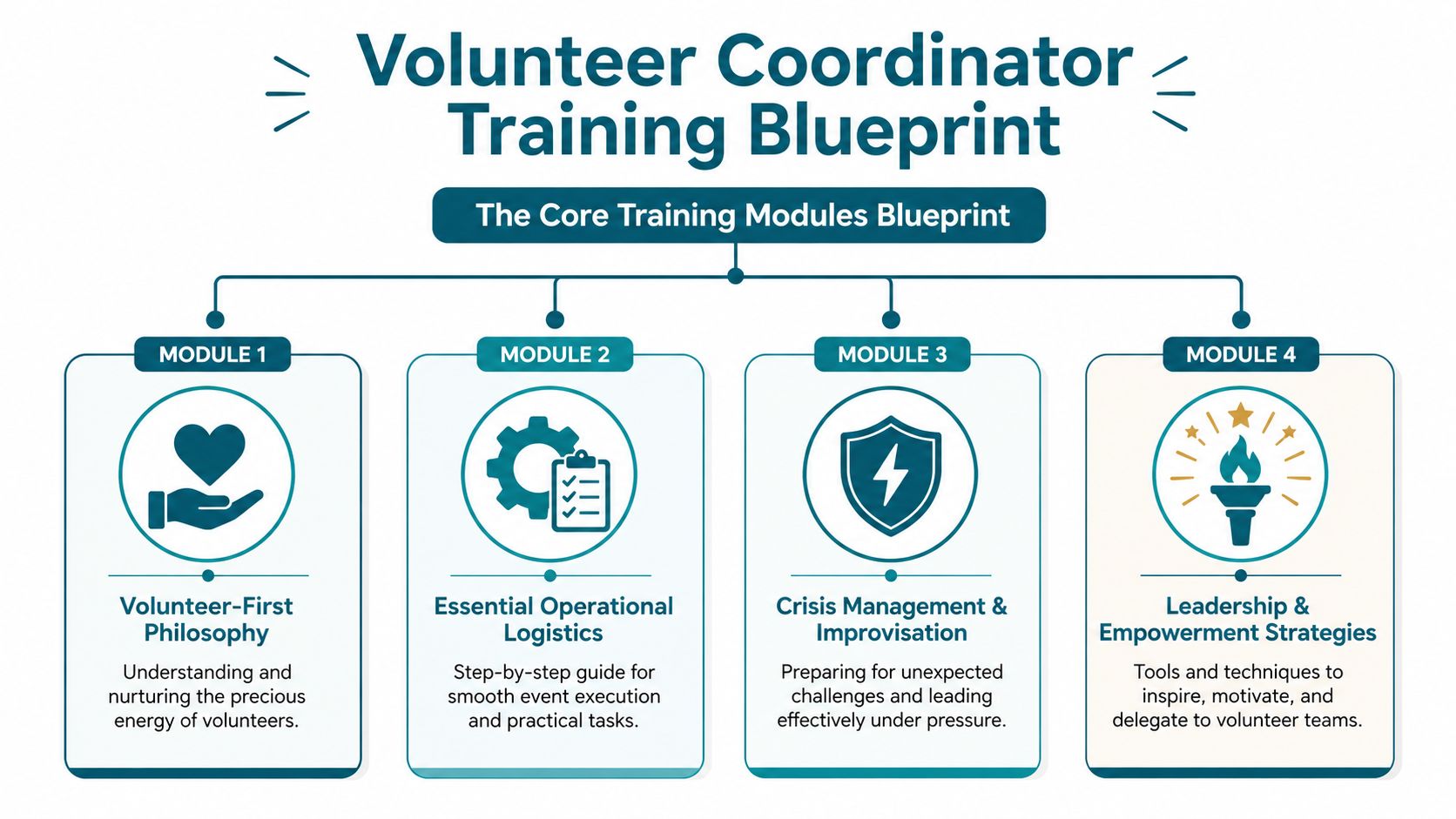
    A diagram titled Volunteer Coordinator Training Blueprint showing four key instructional modules for managing volunteers effectively.

    Module one is philosophy

    Start with the part many groups rush past. Your coordinator needs a moral compass before they need a checklist.

    Teach them how to answer these questions in plain language:

    • Why are we here?
    • What do we do when output conflicts with safety?
    • How do we treat a volunteer who is struggling?
    • What kind of culture are we building when nobody is watching?

    This module should include role-play. One person acts as an eager volunteer who wants to do something unsafe. The trainee has to step in kindly and firmly. If they can't do that in practice, they won't do it in a parking lot with a crowd watching.

    Module two is operational logistics

    At this point, many coordinators either become calm or become frazzled. They need a repeatable system for event flow.

    I train for logistics in sequence:

    1. Scout the site
      Walk access points, traffic risks, likely trash concentration, and safe regroup spots.

    2. Build the morning plan
      Decide where people meet, where supplies go, who watches the edges, and what the exit plan is if conditions change.

    3. Run the huddle
      Keep it short. Cover hazards, roles, boundaries, and how to ask for help.

    4. Close cleanly
      Count people before gear. Debrief before everyone scatters.

    The point isn't perfection. The point is lowering mental clutter so the coordinator can pay attention to humans.

    For practical field systems, I like to compare each trainee's plan against proven volunteer management best practices for organized teams. It helps them see where they're loose, where they're overcomplicating, and where they're forgetting the volunteer experience.

    Module three is crisis management and improvisation

    A cleanup rarely follows the script. Weather changes. A route is blocked. A volunteer gets upset. The wrong training treats these moments like exceptions. Real training treats them like part of the job.

    Field note: Don't ask, “What's the official response to every possible problem?” Ask, “Can this coordinator stay calm, protect the group, and make a decent call fast?”

    Here are scenarios worth drilling:

    • Sharp object discovery: Who approaches, who stays back, who documents, who calls it in if needed.
    • Traffic creep: A site looked safe at scouting, but live conditions feel different.
    • Emotional conflict: Two volunteers are snapping at each other and infecting the group mood.
    • Sudden storm: End early, shelter in place briefly, or relocate.

    Module four is leadership and empowerment

    Some coordinators secretly think leadership means controlling everything. That creates brittle teams. I want leaders who can spread confidence.

    Train them to delegate small ownership fast. Let one volunteer handle sign-in. Let another lead a micro-team. Let a regular welcome newcomers. This has two effects. It lightens the coordinator's load, and it gives volunteers a ladder to grow on.

    A strong coordinator says things like:

    • “You've got a good eye for detail. Can you watch this corner?”
    • “Take our new person with you and show them how we sort this safely.”
    • “I need your judgment on whether this patch is worth the extra time.”

    That language builds leaders. If your volunteer coordinator training never teaches delegation, you're training bottlenecks.

    Training for Chaos with Real Scenarios

    Most training programs miss the mark for groups like ours. They are built for predictable indoor settings and skip the skills needed for blizzards, heatwaves, roadside work, and rough urban zones. A Michigan volunteer training resource page shows how much volunteer management education still centers on general nonprofit operations rather than physical adversity in the field.

    A volunteer coordinator overseeing various aid efforts including sorting donations, construction, and distributing meals to people.

    I learned this the hard way on a cleanup near a highway during a bike-event shutdown. The site looked simple from a distance. Up close, it had fast-moving traffic nearby, debris in ugly places, and the kind of noise that makes communication sloppy. That day wasn't about who could pick up the most trash. It was about who could stay composed and keep the group tight.

    Scenario one is the weather turn

    You start with a normal morning. Then the sky changes. Wind rises. Rain starts hitting sideways.

    A weak coordinator does this:

    • keeps pushing because people already came out
    • mumbles a half-decision
    • waits too long because ending early feels embarrassing

    A trained coordinator does this:

    • regroups everybody fast
    • speaks loudly and clearly
    • chooses shelter, exit, or cancellation without drama
    • counts heads before moving

    That decision needs rehearsal. People don't rise to the occasion in chaos. They fall to the level of their training.

    Scenario two is volunteer conflict

    This one sneaks up on you. One volunteer says another person is working too slowly. The second person fires back. Now half the group can feel the tension.

    I don't train coordinators to act like referees with whistles. I train them to lower the temperature. Pull both people aside. Separate the task from the ego. Give each person something useful to do.

    Try language like this:

    Situation What the coordinator says
    One person feels criticized “I need you with me for a minute. Let's reset this.”
    Two people are escalating “We're not doing this in front of the group. Come talk with me.”
    Group mood is slipping “Quick water break. Then we're splitting into smaller teams.”

    A coordinator should know when an issue is fixable on site and when someone needs to step away. That judgment protects everyone else.

    Before you put someone in charge of people, make sure they understand volunteer liability insurance and risk planning for group service work. Good instincts matter. Clear guardrails matter too.

    Scenario three is morale collapse

    Sometimes the site is just worse than expected. The bags fill slowly. The smell is brutal. People start making jokes that have a tired edge to them.

    Here, your coordinator becomes a storyteller. You don't lie. You don't pretend the work is easy. You help the group frame the hardship as shared effort with meaning.

    “This is a rough one. Stay steady. We'll take it one patch at a time.”

    That kind of line works because it is honest. Honest leadership settles people.

    Here's a quick visual on training volunteers and leaders to coordinate under pressure:

    Role-play these scenarios in training. Then run them outdoors. Let the trainees feel a little confusion while the stakes are still low. That's how they learn to carry confidence into a real event.

    Practical Tools to Equip Your Leaders

    Warm intentions won't carry a coordinator through a messy morning. Tools will. Good tools reduce mental load, standardize judgment, and help a leader stay present with people instead of drowning in little decisions.

    There's also a retention angle here. Volunteers who receive high-quality training are 83% less likely to leave, according to VolunteerHub's guide to nonprofit volunteer management. If you want coordinators to deliver that kind of training experience, give them equipment for the mind, not just gloves for the hands.
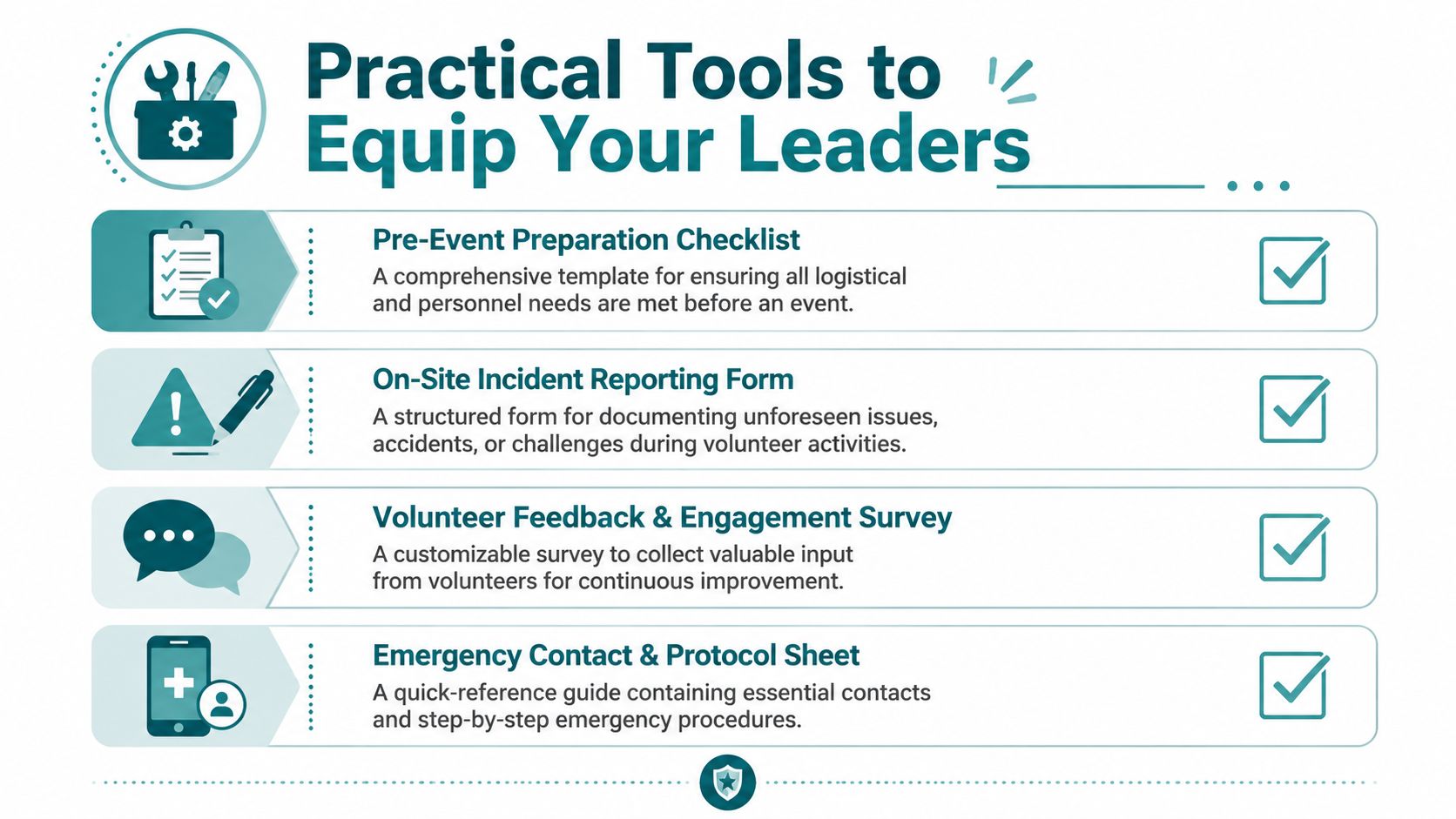
    An infographic titled Practical Tools to Equip Your Leaders listing four essential event management resources for volunteers.

    Four tools I'd hand every new coordinator

    • Pre-event preparation checklist
      Include meeting point, weather review, hazard notes, supply count, team roles, and exit plan. This tool prevents the dumb mistakes that drain a leader before the event starts.

    • On-site incident reporting form
      Keep it simple. Time, place, what happened, who responded, and what changed after. You want clarity, not legal theater.

    • Volunteer feedback and engagement survey
      Ask what felt clear, what felt confusing, and whether the person felt welcomed. Don't bury your coordinators in data. Give them a few questions that lead to action.

    • Emergency contact and protocol sheet
      This should live in every event kit and on every lead coordinator's phone. In a tense moment, nobody wants to dig through old messages.

    What these tools should look like

    I don't like bloated forms. They usually die in a folder. A field tool should be short enough to use with cold hands and a busy brain.

    One hard rule: If a coordinator can't use the form on site in under a minute or two, the form is too fancy.

    Here's a lean setup that works:

    Tool Keep it short by including Leave out
    Checklist top hazards, gear count, roles, weather note long policy text
    Incident form facts, action taken, follow-up needed emotional essays
    Survey welcome, clarity, safety, return interest pages of demographics

    Why tools help people feel safer

    A waiver, for example, isn't just legal paperwork. It's a conversation starter. It tells volunteers, “This work is real. Here are the risks. Here is how we handle them.” That honesty builds trust.

    A shift plan does the same thing. It says nobody is drifting alone. Everybody has a zone, a point person, and a way to ask for help.

    Train your coordinators to carry these tools lightly. They shouldn't hide behind them. They should use them to free up attention for what matters most: reading the room, helping new people settle in, and making good calls while the day moves fast.

    Measuring Success the Caterpillar Way

    A lot of groups judge the day by the pile of bags at the end. I get it. Trash is visible. Weight feels concrete. But if you only measure output, you can miss the health of the team doing the work.

    I'd rather know whether people came back, whether a new volunteer felt included, and whether the group left more steady than they arrived. Those signs tell you if your volunteer coordinator training is working.

    Start with speed into belonging

    One of the easiest ways to lose somebody is to let them linger too long between interest and action. A volunteer management guide warns that a time-to-onboard longer than two months from application to active service drives churn, as explained in VolunteerHub's guide for coordinators reclaiming time and balance. That matches street reality. If people wait too long, life moves on.

    So the first score I care about is simple: how fast does a new person feel like part of the team?

    That doesn't mean rushing safety. It means removing drag. Answer quickly. Give clear instructions. Pair them with a regular. Make the first day easy to understand.

    Use a mixed scorecard

    Don't build your whole dashboard around trash volume. Use a mix of hard signals and human signals.

    • Return rate: Are people showing up again after the first event?
    • Regulars: Do you have a stable core who know the rhythm?
    • Friendship signs: Are people talking after the work instead of vanishing the second it ends?
    • Volunteer-led action: Do people start taking initiative without being pushed?

    Some of this is measurable. Some of it is observational. Both matter.

    If your team leaves with less trash on the block but more strain in their faces, something is off.

    Watch the room after the cleanup

    The best clues usually come after the bags are tied. Do people linger? Do they exchange numbers? Does a first-timer laugh with someone they met an hour ago? Those moments tell you whether your coordinators are building a group people want to belong to.

    I also pay attention to the tone of the debrief. If volunteers feel safe giving honest feedback, your coordinators are doing something right. If everyone is polite but guarded, trust may be thinner than it looks.

    A good training program changes the way leaders see success. They stop asking only, “How much did we collect?” and start asking, “Did we make this a place people want to return to?” That question builds stronger crews.

    Training coordinators for outdoor adversity is really training them to create courage, calm, and connection under strain. When they do that well, the cleanup lasts a morning. The transformation lasts longer.


    If you want to build a tougher, kinder volunteer culture, spend some time with Litter Caterpillars. You'll find a living example of brave, volunteer-first cleanup work in Chicago, plus the kind of energy that turns service into friendship.


  • 10 Volunteer Management Best Practices That Actually Build Community in 2026

    10 Volunteer Management Best Practices That Actually Build Community in 2026

    I'll tell you a secret. The hardest mess I ever cleaned wasn't on some grimy Chicago street corner. It was inside my own apartment, inside my own life. My refrigerator was a grotesque museum of expired dreams, my social life just as chaotic. Every piece of trash I couldn’t toss out held a story, a weight I couldn't seem to shift. It took the painful end of a draining relationship for me to finally see it: I had to change everything.

    I decided to build a life around givers, not takers. To face the things that terrified me most—cleanliness, consistency, bravery. So I started Litter Caterpillars. Just me and two friends in a freak Chicago hailstorm. As we shivered under a tree, a thought struck me like lightning. Cleaning up other people's messes is so much easier than cleaning up our own. And suffering together? It creates an unbreakable bond. It pushes the plot of your life forward.

    That's the real heart of what we do. It’s not about trash. It’s about transformation. Most volunteer programs feel like a cold transaction, a chore you just check off a list. They get it so wrong because they miss the human part, the deep craving for connection and purpose that drives every single one of us. They manage tasks. We lead people.

    This article isn't some dry, corporate checklist. It's our playbook. It was forged in blizzards and brutal heatwaves, a guide for building a volunteer movement that people are genuinely proud to join. We'll dive deep into the 10 volunteer management best practices that turned my personal mess into a city-wide mission. These aren’t just theories. They are the exact strategies I used to grow a tiny group of friends into a powerful community force, creating a space where people find friendship, purpose, and a renewed sense of who they are. Let's get it right, together.

    1. Clear Mission and Values Alignment

    Before you dare post a single sign-up sheet or send one email, you have to answer a powerful, one-word question: Why? I’m not talking about what you do, like picking up litter. I’m talking about the heart thumping behind the work. One of the most critical volunteer management best practices I know is forging a crystal-clear mission and aligning every single action with your core values. This is your organization's soul. It's the magnetic force that pulls the right people straight to you. It’s the difference between asking someone to fill a garbage bag and inviting them to reclaim a neighborhood's spirit.

    At Litter Caterpillars, my mission isn't just "clean Chicago." It’s about transformation. I believe that by cleaning our streets, we transform ourselves and our communities, fueled by values of service, bravery, and kindness. This "why" is a magnet for volunteers who aren’t just looking for a task but for a purpose. They want to be part of a story, a movement that changes how we see our city and each other.

    Man holding a white flag with a heart and leaf logo, standing before a colorful watercolor splash.

    How I Build My "Why"

    So, how do you put this into practice? You have to start with intentional communication. Your mission should feel like an emotional anchor, not some corporate slogan you cooked up in a boardroom.

    • Tell a Human Story: I often share my own story, my personal journey from feeling disconnected to finding purpose by cleaning one block. Stories connect far more deeply than any statistic ever will.
    • Weave Values Everywhere: Your values shouldn't just live on an "About Us" page. You should mention them in your volunteer orientation, your social media posts, your thank-you notes. When I recognize a volunteer, I praise their bravery for showing up in a new neighborhood or their kindness for helping a newcomer.
    • Live It from the Top: As a leader, you are the living, breathing embodiment of your values. Your decisions, your words, and your actions must reflect what you claim to believe. This consistency builds trust and inspires your volunteers to follow your lead.

    When your "why" is clear, you stop recruiting hands and you start attracting hearts. People show up not because you need them, but because they need the mission.

    2. Volunteer Identity and Pride Building

    Once you’ve captured their hearts with your "why," how do you keep them all beating together as one? The answer is creating a shared identity. I’m not talking about uniforms or a bunch of rigid rules. I’m talking about building a tribe. A real tribe, with its own symbols, its own rituals, and a powerful sense of collective spirit. One of the most potent volunteer management best practices is to forge a tangible group identity that makes people feel they belong to something special, something bigger than themselves. It's like turning an individual act of service into a team sport.

    At Litter Caterpillars, we aren’t just a random group of people picking up trash. We are a team, and we have the gear to prove it. Our custom flags wave proudly at every cleanup, our theme song (written by the incredible Ella Duke) gets us fired up, and our volunteers earn badges that celebrate their commitment. These aren’t just trinkets. They are symbols of our shared mission and the pride we take in our work. They turn a simple Saturday morning into a celebrated event.

    Three branded items: a button, a pin, and a flag, displayed on colorful watercolor splashes.

    How You Can Build Your Identity

    So, how can you create these powerful symbols of belonging? You have to make your culture visible. You have to make it felt.

    • Co-Create Your Symbols: Don't just hand down a logo from on high. Involve your volunteers in the creative process. You could host a contest to design a t-shirt or write a group cheer. When they help create it, their sense of ownership deepens immensely.
    • Make Your Presence Known: Use flags or banners at every single event. These aren't just for marketing; they are rallying points. They signal to your volunteers, "We are here," and they tell the community, "We are proud of what we do."
    • Celebrate with Rituals: Start each event by playing your theme song. End with a group photo where everyone holds up their earned badges. These simple, repeated actions reinforce your group identity and create powerful shared memories.
    • Give Wearable Pride: Buttons, patches, and wristbands are small but mighty tools. They let volunteers carry a piece of the mission with them, sparking conversations and strengthening their connection to the group long after the event is over.

    When people feel like part of a team, their commitment just skyrockets. They don't just show up to volunteer; they show up to represent.

    3. Strategic Scheduling for Volunteer Accessibility

    When should you schedule your events? The easy answer is "whenever." But the best answer, one of the most overlooked volunteer management best practices, is far more intentional. When you meet is just as important as why you meet. Your schedule isn't just a logistical detail; it’s a powerful filter and a magnet. It communicates your priorities, shapes your entire culture, and ultimately determines who shows up.

    At Litter Caterpillars, I deliberately chose Saturday mornings. This wasn't some random guess. I wanted to attract people who were ready to start their weekend with purpose, not people looking to end their Friday night with us. The 9 a.m. start time attracts committed, service-minded individuals who see this work as a real priority. That simple choice cultivates a community of givers, not just socializers, and it builds a reliable, consistent core of volunteers who return week after week.

    How You Can Schedule with Purpose

    Building a schedule that works for you and your ideal volunteers requires discipline and a clear vision. It’s less about accommodating everyone and more about serving your mission effectively.

    • Choose a Time that Reflects Your Values: Think about your target volunteer. Is it a student? A working professional? A retiree? Think of it like a CrossFit gym’s 6 a.m. class—it builds a very specific community of dedicated athletes. Your time slot will build your unique volunteer community.
    • Embrace Radical Consistency: Pick a day and time and stick to it. Habitat for Humanity’s predictable Saturday builds and the Rotary Club’s weekly meetings create a powerful habit. Your volunteers don't have to wonder, "Are they meeting this week?" They just know.
    • Communicate Your Commitment: I make it clear that we meet rain, shine, or even snow. This isn't about being tough; it's about being dependable. When volunteers see your unwavering commitment, it inspires theirs. It shows them the work is too important to be derailed by a little bad weather.

    Your schedule is a promise. By keeping it consistently, you build trust and create a reliable rhythm that becomes the very heartbeat of your volunteer program.

    4. Volunteer-First Organizational Philosophy

    What if your most valuable resource isn’t your budget, but your volunteers' goodwill? A true volunteer-first philosophy flips the traditional model completely on its head. It’s a radical commitment you make to prioritize the well-being, the happiness, and the experience of your volunteers above all else—above organizational convenience, above external metrics, and especially, above revenue generation. It's the ultimate expression of respect, treating volunteer energy not as a commodity to be exploited, but as a fragile, precious gift that you must protect.

    At Litter Caterpillars, I have a hard and fast rule: we will never, ever pressure a volunteer for a donation. Their time and their energy are the most valuable contributions they can possibly make. This isn't just a policy; it’s a promise. This approach builds a fortress of trust. It attracts people who are here for the mission, not because they feel obligated. It creates a community where people feel safe, seen, and valued for who they are, not for what they can give.

    How You Can Prioritize Your People

    Adopting this philosophy requires you to make a conscious shift in your organizational mindset. It’s about putting your people at the center of every single decision.

    • Publish a "Volunteer Bill of Rights": Create and publicly share a document that explicitly states your commitments. You should include a no-pressure donation policy, a guarantee of a safe and respectful environment, and a promise to listen to and act on their feedback.
    • Separate Giving from Serving: Develop entirely separate channels for fundraising, like grants, corporate sponsorships, or a dedicated donor circle. This ensures that your communications with volunteers are purely about the mission and their experience, completely free from any financial asks.
    • Prioritize Safety Above All: Your first duty is to protect your volunteers. This means comprehensive safety protocols, thorough training, and never asking someone to do something that makes them feel unsafe, no matter how important the task seems.
    • Celebrate Their Choice to Be There: You must constantly acknowledge that their presence is a choice. Thank them not just for what they do, but for choosing to spend their precious free time with you. This simple act of recognition reinforces that they are valued partners, not just free labor.

    When you truly put your volunteers first, you’re not just managing a workforce; you’re nurturing a community. This is one of the most powerful volunteer management best practices because it fosters a loyalty and passion that no amount of money could ever buy.

    5. Multi-Channel Volunteer Recruitment and Communication

    If your mission is the heart of your organization, then your communication channels are the arteries that carry its lifeblood. You can have the most compelling "why" in the world, but if you're only shouting it from one street corner, you'll miss the crowds on every other block. A key element of volunteer management best practices is meeting people where they already are. This means you have to use a diverse mix of platforms to not only find new volunteers but also to keep your existing community engaged and informed.

    At Litter Caterpillars, I know that a student might find us through an Instagram story, a working professional might discover us on Meetup, and a dedicated regular will rely on our WhatsApp group for last-minute updates. I don’t force everyone into one box. Instead, I build bridges across different digital spaces, making it incredibly easy for anyone, anywhere, to join our movement. This multi-channel approach removes barriers and respects that everyone communicates differently.

    How You Can Build Your Communication Ecosystem

    Creating a robust multi-channel strategy doesn't mean you have to be on every platform. It means being strategic on the right ones.

    • Choose Your Core Platforms: Start with 3-4 channels that align with your audience. For me, Meetup is fantastic for discoverability and event RSVPs. Instagram tells our visual story and attracts a younger, action-oriented crowd. And a private WhatsApp group fosters a tight-knit community for my core team.
    • Create Consistent Cross-Talk: Make your channels work together. Put your Instagram handle in your Meetup event descriptions. Share a "link in bio" on Instagram that directs people to your event schedule. This creates a seamless web that guides people to the information they need. If you're looking for more creative ways to connect with potential helpers, you can find a deeper dive into how to find volunteers for your cause.
    • Tailor Your Content: Don't just copy and paste the same message everywhere. You should use Instagram for powerful before-and-after photos and inspiring video clips. Use Meetup for detailed event logistics like maps and what to bring. Use your group chat for informal reminders and celebrating small wins together.

    When you open multiple doors, you invite more people inside. Your volunteer base becomes more diverse, your communication more resilient, and your community more connected.

    6. Neighborhood-Specific Expansion with Geographic Coverage Goals

    A single spark can light a fire, but how do you make sure that warmth reaches every corner of the city? It’s not enough to just clean; you have to clean with intention and with equity. One of the most powerful volunteer management best practices is moving beyond random acts of service to a systematic, neighborhood-by-neighborhood expansion. It’s the difference between hosting one big, flashy event and building a lasting, citywide movement.

    At Litter Caterpillars, my vision is bold: to serve every single one of Chicago's 50 wards. This isn't just a number; it's a promise. It communicates to residents in every neighborhood, from Rogers Park to Pullman, that they are seen, that they are valued, and that they are part of our mission. This geographic goal transforms our work from a series of disconnected events into a unified, strategic campaign to uplift the entire city.

    How You Can Expand with Purpose

    Expanding your reach requires a map, both literally and figuratively. It’s about building relationships and trust, one block at a time.

    • Visualize Your Impact: Create a public map of your target areas. I have a "Ward Progress Tracker" on our site that visually shows our journey. It’s a powerful motivator for volunteers and a clear signal to communities that we’re on our way.
    • Rotate and Engage: Don't just stay in familiar territory. You must intentionally schedule events in new neighborhoods. This rotation builds momentum and shows you're committed to the entire community, not just a select few. You can learn more about how we foster this in our guide on community engagement best practices.
    • Empower Local Leaders: Identify passionate volunteers and empower them to become "Neighborhood Ambassadors." These local champions can organize smaller, more frequent cleanups, becoming the face of your mission in their own community and building grassroots trust.
    • Celebrate Milestones: When a neighborhood reaches a goal or a ward is fully covered, you have to celebrate it! This reinforces a sense of shared accomplishment and shows everyone that their collective effort is creating tangible, citywide change.

    When you expand with a clear geographic goal, you show people you’re not just visiting; you’re invested in their future. You’re building a legacy of care that blankets the entire city.

    7. Experiential Storytelling and Personal Transformation Narratives

    Beyond the schedules and the tasks, what truly fuels a volunteer movement? It’s the story. People aren't just motivated by what they do; they’re moved by who they can become. One of the most magnetic volunteer management best practices you can use is harnessing the power of personal transformation narratives. This isn’t about marketing slogans. It's about sharing authentic stories of change, showing how picking up a piece of litter can, in fact, pick up a person's spirit.

    At Litter Caterpillars, our most powerful recruitment tool is my own honest story. I often share how my personal life felt messy and directionless before I started. Cleaning up just one block gave me a sense of control and purpose that rippled through every other part of my life. This story doesn't just explain what we do; it invites others who feel that same sense of messiness to find their own transformation with us. It makes the abstract value of "service" a tangible, emotional journey.

    How You Can Share Transformative Stories

    So, how do you turn individual experiences into a compelling invitation? You become a collector and an amplifier of your community's stories.

    • Share Your "Messy" Origin: Don't just share the polished success story. Talk about the struggle, the doubt, the moment of inspiration. My story resonates because it's vulnerable. It shows that service isn't for perfect people; it's a path to becoming better.
    • Create a "Story Spotlight": You should actively collect and share the journeys of your volunteers. Did someone gain confidence? Make their first friend in Chicago? Discover a new career path? Feature these stories in your newsletter, on social media, or at team meetups.
    • Use Video Testimonials: Ask a long-term volunteer to share their "before and after" story on camera. I promise you, a two-minute video capturing their emotional journey from feeling isolated to feeling like part of a family is more powerful than any flyer you could ever design.

    When you focus on transformation, you stop advertising a task and start offering a life-changing experience. People will show up not just to help your cause, but to write the next chapter of their own story.

    8. Low-Barrier Entry and Inclusive Volunteer Onboarding

    The single biggest hurdle for a potential volunteer isn't the work itself; it's the sign-up process. How easy is it to say yes? One of the most impactful volunteer management best practices is to remove every possible point of friction between a person's good intention and their first day of service. You have to create a simple, welcoming, and inclusive onboarding experience that builds confidence from the very first click. It’s the difference between a convoluted application and a simple invitation to just show up.

    At Litter Caterpillars, I built our entire model around this idea. We primarily use Meetup.com, which allows someone to find an event and RSVP with a single tap. There are no lengthy forms, no background checks, and no mandatory orientations before you can pick up a single piece of trash. I recognize that the courage it takes to join a new group of strangers is a far greater challenge than learning how to use a litter grabber. My job is to make that first step feel effortless and safe.

    How You Can Make Showing Up Easy

    Making your volunteer process accessible is an act of radical welcome. It communicates that you value people's time and enthusiasm more than bureaucratic hoops.

    • Simplify the Signup: You can use platforms like Meetup or a super-simple Google Form. Ask for only what you absolutely need: a name and an email. The goal is to get them from "interested" to "attending" in under 60 seconds.
    • Designate a Welcomer: Have a specific person whose only job for the first 15 minutes is to greet newcomers. A warm smile and a friendly "I'm so glad you made it!" can instantly dissolve anxiety.
    • Pair Newcomers with Veterans: I call this the "buddy system." I pair a first-timer with a regular volunteer. This provides an instant friend, a guide for any questions, and an immediate sense of belonging.
    • Give a First-Timer Shout-Out: At the end of every event, I make a point to thank our first-time volunteers by name (with their permission). This public acknowledgment celebrates their courage and makes them feel seen.

    When you lower the barrier to entry, you open the door to a wider, more diverse group of people who want to help but might be intimidated by a formal process. You show them that their presence is the only prerequisite that truly matters.

    9. Safety-First Culture and Risk Management

    Beyond the mission, beyond the schedule, there lies a foundational promise you must make to every single volunteer: you will keep them safe. This isn't just about having a first-aid kit in your car. It’s about building an unwavering, safety-first culture where you weave risk management into the fabric of every decision. It means putting your volunteers' well-being above all else, including the day's goals. It’s the sacred trust that allows people to show up, give their all, and go home unharmed.

    At Litter Caterpillars, I have a simple hierarchy: safety first, happiness second, and getting the work done third. This isn't just a slogan; it's our operational code. If there’s a choice between picking up a dangerous item and leaving it for the city professionals, we always choose safety. This commitment, a core tenet of effective volunteer management best practices, ensures our team feels protected and valued, not just as workers, but as human beings.

    Flat lay of workplace safety essentials: a high-visibility vest, work gloves, first aid kit, and clipboard.

    How You Can Build Your Safety Culture

    Building a culture of safety is an active, ongoing process. It requires clear communication, consistent reinforcement, and you leading by example.

    • Provide the Right Gear and Knowledge: Every volunteer gets thick gloves, a brightly colored safety vest, and a briefing on potential hazards before we start. I demonstrate how to use equipment properly and what to avoid, like broken glass or hazardous materials.
    • Establish Non-Negotiable Protocols: We have clear rules for everything from crossing busy Chicago streets to handling bad weather. If there's lightning, we cancel. No questions asked. These aren't suggestions; they are standards that protect everyone.
    • Empower Volunteers to Speak Up: The most important rule is that anyone can call a "safety stop" at any time, for any reason, without judgment. If someone feels unsafe or sees a potential hazard, their voice is the most important one in that moment.

    When you make safety a visible, celebrated priority, you show your volunteers they are more important than the task at hand. That respect is the ultimate retention tool.

    10. Friendship and Community Building as Core Outcome

    What if the most important thing your volunteers take home isn't just a sense of accomplishment, but a new friend's phone number? A powerful shift in volunteer management best practices is treating social connection not as a happy accident, but as a primary goal. When you stop seeing people as just hands to do a task and start seeing them as humans seeking connection, you unlock a powerful, self-sustaining motivation. It’s the difference between showing up for a cleanup and showing up for your friends.

    At Litter Caterpillars, I'm explicit about this. We market our events as a way to build "friendships and resilience" alongside cleaning our streets. The work is the context, but the community is the outcome. This focus attracts volunteers who are not just looking for a weekend activity but are genuinely searching for their people, their place in the city. They come to pick up litter, but they stay for the laughter and camaraderie.

    Three diverse, happy people laughing together, with vibrant watercolor splashes around them.

    How You Can Make Friendship the Mission

    Building genuine bonds requires intentional design. It doesn't just happen; you have to create the space for it. This is about nurturing the human element of your work.

    • Build in Social Time: Don’t rush from start to finish. I always schedule at least 15-20 minutes before or after our cleanups for people to just hang out, chat, and grab a coffee together. This unstructured time is where the real magic happens.
    • Facilitate Introductions: As a leader, you must act as a social catalyst. Learn names and make personal introductions. Saying, "Sarah, this is Mike. You both live in Logan Square and love dogs," creates an instant, easy bridge for conversation.
    • Create Shared Experiences: Inside jokes and shared stories are the glue of any community. You should lean into the funny moments, like battling a windy day or finding a bizarre piece of trash. These become the "remember when" stories that bond your group together.
    • Celebrate People, Not Just Work: Shift your focus from "we collected 20 bags" to "look at these amazing people connecting." Share photos on social media that highlight volunteers laughing and talking, not just working. You can celebrate personal milestones like birthdays or volunteer anniversaries.

    When you prioritize community, retention soars. People will always return to a place where they feel they belong. For more ideas, you can explore our guide on community building activities for adults.

    Top 10 Volunteer Management Best Practices — Comparison

    Initiative Implementation Complexity 🔄 Resource Requirements ⚡ Expected Outcomes 📊 Ideal Use Cases 💡 Key Advantages ⭐
    Clear Mission and Values Alignment Medium — leadership time and consensus building Low — staff time, some facilitation Strong volunteer alignment and retention Organizations building long-term culture Attracts committed, mission-aligned volunteers
    Volunteer Identity and Pride Building Low–Medium — design and rollout work Low–Medium — branding, merchandise costs Increased pride, visibility, social sharing Groups seeking stronger public identity Boosts morale and memorable volunteer experience
    Strategic Scheduling for Volunteer Accessibility Low — scheduling policy and habit-setting Low — coordinator time, predictable logistics More consistent attendance and reliability Programs needing dependable core volunteers Builds habitual participation and filters commitment
    Volunteer-First Organizational Philosophy Medium — policy changes and culture work Medium — alternative fundraising, training Deep trust, lower burnout, sustained engagement Ethics-focused or volunteer-centric orgs Protects volunteer energy and fosters loyalty
    Multi-Channel Volunteer Recruitment and Communication Medium — platform management and content Medium — time, content creation tools Broader demographic reach and engagement Urban/digital-native target audiences Multiple touchpoints reduce single-point failures
    Neighborhood-Specific Expansion with Geographic Coverage Goals High — planning, mapping, logistics High — transport, staff, partnerships Measurable, equitable local impact across areas Citywide or ward-by-ward campaigns Ensures equitable service and clear milestones
    Experiential Storytelling and Personal Transformation Narratives Low–Medium — story collection and production Low — content creation (video/text) Emotional recruitment and stronger identification Founder-led or transformation-focused missions Makes mission relatable and drives signups
    Low-Barrier Entry and Inclusive Volunteer Onboarding Low — simplify processes and greeter roles Low–Medium — mentors, orientation time Higher participation and greater diversity Newcomer-friendly, casual-entry programs Low friction increases turnout and inclusivity
    Safety-First Culture and Risk Management Medium–High — protocols, training, updates Medium–High — equipment, training resources Fewer incidents, higher volunteer confidence High-risk outdoor or tool-based activities Protects volunteers and reduces liability
    Friendship and Community Building as Core Outcome Low–Medium — event design and facilitation Low — time for social elements and spaces Strong retention, intrinsic motivation, advocacy Programs prioritizing retention and wellbeing Creates durable social bonds that sustain involvement

    Your Turn: Go Make a Beautiful Mess

    Look, I get it. Managing volunteers can feel like trying to paint a fence, just like Tom Sawyer. You can see it as a punishment, a chore you have to get through. Or, you can see it for what it is: an invitation. It's your chance to convince others, and yourself, that showing up for your community is the most fun you can have.

    These ten best practices aren't just abstract theories; they're the engine of Litter Caterpillars. They're how we’ve turned a simple idea into a city-wide movement that turns up every single week, rain or shine, to do the work. This whole thing started with my own personal mess, my own need for connection, and it grew into a community that is cleaning up Chicago, one block at a time. This journey has taught me that effective volunteer management best practices are less about spreadsheets and more about heart.

    The Real Secret: From Chore to Calling

    Let's boil it all down. What's the thread connecting everything we've talked about? It's about shifting your perspective. It's about seeing your volunteers not as a resource to be managed, but as partners in a shared mission.

    • It’s about Identity, not just tasks. You’re not just asking people to pick up trash. You’re inviting them to become a Litter Caterpillar, a guardian of their neighborhood. That pride is more powerful than any incentive you could ever offer.
    • It’s about Connection, not just coordination. A well-organized schedule is great, but it's the friendships forged over a shared task, the laughter echoing down a city block, that will bring people back again and again. You're building a community, not just filling a roster.
    • It’s about Transformation, not just transactions. People don’t just show up to give their time; they show up to find something. A sense of purpose, a new friend, a deeper connection to their city. Your job is to create the space where that personal transformation can happen.

    Remember our volunteer-first philosophy. When you design every single process, from onboarding to communication, around their experience, you build an organization that people are desperate to be a part of. The key isn't having the perfect system on day one. It's having the right mindset.

    Your First Step is the Hardest (and Easiest)

    You don't need a massive budget or a fancy downtown office. You just need a clear 'why,' a bit of bravery, and a relentless commitment to putting your people first.

    Think of it like tending a garden. You can’t force a seed to grow. You can only create the right conditions: good soil, enough water, and plenty of sunlight. These volunteer management best practices are your tools for creating those conditions. Your clear mission is the soil. Your inclusive onboarding and communication are the water. Your celebration of community and friendship? That’s the sunlight.

    So take these ideas. Steal them, adapt them, make them your own. Start small. Maybe you focus on just one thing this month, like telling a better story on your Instagram or making your next onboarding session feel less like an orientation and more like a welcome party. The goal isn’t perfection; it’s momentum.

    Go make your own kind of mess. The good kind. The kind that brings people together, sparks new friendships, and leaves your little corner of the world a whole lot cleaner and more beautiful than you found it.


    Ready to see these volunteer management best practices in action or join a community that puts people first? Come make a beautiful mess with us at Litter Caterpillars and experience firsthand how we're building a cleaner, more connected Chicago, one block at a time. Find your next cleanup event and become part of the story at Litter Caterpillars.

  • 10 Fearless Volunteer Retention Strategies That Actually Work in 2025

    10 Fearless Volunteer Retention Strategies That Actually Work in 2025

    Let's be brutally honest. Most advice on volunteer retention strategies feels like trying to trap a butterfly in a jar. It’s sterile, corporate, and misses the entire point. People don't stick around for a better scheduling app or another free t-shirt. They stay for a feeling. They stay because they found a place where showing up, even when it’s hard- especially when it’s hard- makes them feel more alive.

    This isn't just about keeping names on a roster; it’s about forging a community so strong that people can't imagine leaving. It’s like the difference between a forced team-building exercise and that one time you and your friends got caught in a freak hailstorm and huddled under a tree, laughing. One is an obligation; the other is a story you’ll tell for the rest of your life. We're here to talk about building the hailstorm moments.

    This guide moves beyond generic tips and dives deep into the real, raw, human connections that make volunteering an act of self-transformation, not just a task. You will learn actionable blueprints for fostering true belonging and visible impact, creating a magnetic culture that doesn't just attract volunteers, but turns them into lifelong advocates. You're about to discover that making a massive impact is way easier, and a heck of a lot more fun, than you think. Let's get started.

    1. Clear Mission and Values Alignment

    Before a single piece of litter is picked up, the most powerful of all volunteer retention strategies is already at work: the why. People don't just show up to clean a street; they show up to transform a neighborhood, to stand for something bigger than themselves. When your mission resonates deeply with a volunteer's personal values, their commitment shifts from a casual activity to a core part of their identity.

    Think of it like this: anyone can join a gym to lift weights, but people join a community like CrossFit or a specific yoga studio for the shared philosophy and sense of belonging. Litter Caterpillars isn’t just about trash bags and grabbers. It’s about embodying bravery by tackling neglected spaces, fostering friendship in a disconnected world, and finding personal growth through service. This is the magnetic force that attracts volunteers who are searching not just for an event, but for a purpose.

    Putting Your Mission into Action

    A mission on a website is just words. A mission lived out in every action is a movement. To make your values the heartbeat of your organization, you must make them tangible.

    • Tell Your Origin Story: Share the personal journey that started it all. For Litter Caterpillars, Kevin Tao’s story of finding connection and purpose isn't just history; it’s a constant reminder that one person’s courage can inspire a community. This humanizes the mission and makes it relatable.
    • Live Your Values Loudly: Ensure your leadership team consistently embodies the values you preach. If your value is bravery, leaders should be the first to enter the messiest alleys. If it's friendship, they should be the first to welcome a newcomer.
    • Create Reinforcing Rituals: Small, consistent actions build a powerful culture. Develop a team theme song, design unique badges for milestones, or create a group flag for events. These symbols are more than just fun; they are anchors for your shared identity.
    • Screen for Alignment, Not Just Availability: During your onboarding process, ask questions that reveal a person’s motivations. Instead of just asking "When can you start?" ask "What does making an impact in your community mean to you?" For a deeper dive into connecting with the right people, explore these tips on how to find volunteer work that aligns with your spirit.

    When volunteers see their own aspirations reflected in your organization’s DNA, they don't just show up; they belong. This profound sense of belonging is the ultimate foundation for lasting commitment.

    2. Recognition, Identity, and Pride-Building Systems

    While a shared mission forms the soul of your group, tangible symbols of belonging form its uniform. This isn't about giving away free stuff; it’s about creating a powerful, visible identity that transforms a group of individuals into a unified team. When someone puts on a Litter Caterpillars bandana or earns their first bravery badge, they aren't just a person cleaning a street. They are a Litter Caterpillar, part of a tribe known for its courage and kindness.

    Hands holding a volunteer patch, next to a small flag and a colorful bandana on a white background.

    Think of the fierce loyalty inspired by military unit insignia or the lifelong bond created by sorority letters. These symbols are not just decorations; they are anchors of identity. They give people a way to show their pride, to feel ownership over the work, and to signal their commitment to a shared cause. This sense of collective identity is one of the most effective volunteer retention strategies because it taps into our deep human need to belong to something respected and meaningful.

    Putting Your Identity into Action

    A strong identity must be seen, heard, and felt. It’s built through consistent and creative reinforcement that turns an abstract idea into a concrete reality.

    • Create a Visual Uniform: Design simple, distinctive gear that volunteers can wear with pride. Our flag, with its nod to the blizzard that started it all, isn't just a banner; it’s a story. A unique bandana or a patch for a jacket creates an immediate visual bond during events.
    • Commission an Anthem: Music connects directly to emotion. When our friend Ella Duke created the Litter Caterpillars theme song, it gave us a voice. Singing it together before a cleanup doesn’t just hype us up; it solidifies our shared purpose in a way words alone cannot.
    • Develop a Badge System: Recognize specific achievements with tangible rewards. Earning a "Blizzard Survivor" badge for volunteering in the cold or a "Friendship Ambassador" badge for welcoming new members makes accomplishments visible and celebrated. This gamifies service and encourages continued participation.
    • Reframe the Work: Remember Tom Sawyer getting his friends to paint the fence? He didn't offer them a chore; he offered them a chance to be part of something special. Frame your cleanups not as work, but as an opportunity to earn pride, demonstrate bravery, and build a legendary community together.

    When volunteers can wear, see, and sing your mission, their connection deepens. They are no longer just participating in an event; they are carrying the banner for a movement.

    3. Consistent, Predictable Scheduling and Accessibility

    Human beings are creatures of habit. While spontaneity has its magic, commitment is built on rhythm and reliability. One of the most underrated yet powerful volunteer retention strategies is creating a schedule so consistent that it becomes a non-negotiable part of a volunteer’s weekly routine, as natural as their morning coffee or Sunday brunch.

    Imagine a lighthouse. Its beam doesn't shine whenever it feels like it; it sweeps across the dark water at a steady, predictable pace. Sailors depend on that rhythm. In the same way, your volunteers need a dependable rhythm to anchor their good intentions. Our consistent weekend morning schedule is that lighthouse beam. It cuts through the fog of a busy week and says, "Here. Here is your chance to make a difference. We are always here." This predictability attracts deeply committed people, making the choice to show up effortless.

    Putting Your Schedule into Action

    A predictable schedule is more than a calendar entry; it’s a promise to your community. It says, “We will be here, you can count on us.” This reliability is the bedrock upon which habits and deep-seated friendships are built.

    • Choose a Time That Filters for Your Ideal Volunteer: Our weekend morning slot wasn't an accident. It was chosen to attract service-minded people who prioritize community impact. Consider who you want to attract and design a schedule that aligns with their lifestyle and values.
    • Commit to Consistency, No Matter What: Communicate a 'rain or shine' philosophy. When people see the group out there in less-than-perfect weather, it doesn't deter them; it builds a profound sense of pride and shared resilience. This dedication naturally weeds out casual participants and strengthens the core team.
    • Make the Start a Welcoming Ritual: Dedicate the first 15 minutes of every event to a consistent social ritual. This could be a simple greeting, sharing a weekly win, or a quick icebreaker. This buffer transforms the event from a task into a gathering of friends, making people eager to arrive on time.
    • Automate to Stay Focused: Use tools like Meetup's recurring event feature or a simple, predictable social media posting schedule. This reduces administrative headaches and ensures your communication is as reliable as your events. Volunteers will learn where and when to look for information without constant reminders.

    When your schedule becomes a dependable anchor in the chaos of modern life, volunteers don't just attend an event; they join a movement they can build their lives around. This rhythm transforms participation from an occasional activity into a cherished, identity-affirming habit.

    4. Social Connection and Friendship Development

    The bags of trash are temporary, but the bonds forged while picking them up can last a lifetime. One of the most overlooked yet powerful volunteer retention strategies is the intentional cultivation of friendship. People may come for the mission, but they stay for the community. When a volunteer event feels less like a shift and more like a meetup with friends, their commitment transforms from a task into a cherished part of their social fabric.

    This is the whole secret. The work is just the excuse we use to get together. We’re not a cleanup crew; we’re a friendship factory. The litter is just the raw material. The real product is the connection, the laughter, the feeling that you’ve found your people. That’s the magic that turns a one-time volunteer into a lifelong member of the family.

    Three happy volunteers in blue shirts and gloves, laughing together near a park bench and rake.

    Putting Friendship into Action

    A group of strangers with trash grabbers is just a crew. A group of friends making an impact is a movement. To weave social connection into your organization's DNA, you must design for it.

    • Structure Social Time: Don’t let the event end when the last bag is tied. Plan for a casual coffee, pizza, or just a 15-minute hangout session before or after every cleanup. This dedicated time signals that connection is just as important as the work itself.
    • Pair Up with Purpose: Intentionally pair new volunteers with seasoned veterans. This "buddy system" not only eases anxiety for newcomers but also creates an immediate personal connection and a familiar face for the next event.
    • Create a Digital Campfire: Use a group chat on WhatsApp or a similar platform to keep the conversation going between cleanups. Share photos, celebrate personal wins like birthdays or new jobs, and create a space for the inside jokes and shared memories to flourish.
    • Organize Social-Only Events: Plan occasional gatherings that have nothing to do with cleanup, like a picnic, a happy hour, or a game night. For more inspiration, explore our guide to community building activities for adults that can strengthen your team’s bonds.

    When volunteers know they have friends waiting for them, showing up becomes the easiest decision they’ll make all week. This deep sense of belonging is a magnetic force that keeps your community strong and growing.

    5. Transparent, Volunteer-First Organizational Practices

    Many organizations treat volunteers as a resource to be managed, a means to an end. This is the fastest path to burnout and resentment. A truly powerful volunteer retention strategy is to flip this dynamic entirely: place the volunteer's wellbeing, happiness, and safety above all else, even organizational growth or metrics. It's a radical act of trust.

    Think of it this way: are you building a machine or growing a garden? A machine uses parts to achieve an output. A garden nurtures living things, knowing that if the plants are healthy, the beautiful blooms will follow naturally. Litter Caterpillars is a garden. We make a public promise to never solicit donations from our volunteers and to always prioritize their safety over picking up one more bag of trash. This creates psychological safety and transforms the relationship from transactional to one built on mutual respect and care.

    Putting Your Volunteers First

    Making a promise is one thing; living it is everything. This philosophy must be embedded in your operational DNA, visible in every decision you make.

    • Create a Volunteer Bill of Rights: Publicly state your commitments. This isn't just a document; it's a social contract. Detail their right to a safe environment, their right to be heard, and their right to never be treated as a fundraising tool. This transparency builds profound trust.
    • Default to the Volunteer's Benefit: When a conflict or difficult decision arises, always ask: "What is the best outcome for our volunteers?" Even if it costs more time or means a less "productive" event, prioritizing their experience shows they are truly valued.
    • Train Leaders in a Service Mindset: Your event leaders aren't bosses; they are hosts. Train them to actively listen, to shut down any language that feels transactional, and to constantly check in on their team’s well-being. Their primary job is to ensure every volunteer feels seen, safe, and appreciated.
    • Tell Stories of Putting People Over Metrics: Did you end an event early because of the heat? Share that story. Did you spend money on better safety gear instead of marketing? Celebrate that decision. These actions communicate your values more powerfully than any mission statement ever could.

    When volunteers know, without a doubt, that you have their back, they will give you their heart. They won't just participate; they will become fierce advocates and protectors of the community you’ve built together.

    6. Progression Pathways, Leadership Development, and Shared Decision-Making

    A volunteer who shows up once is a participant. A volunteer who feels a sense of ownership, growth, and influence becomes a leader, the very backbone of the movement. One of the most powerful volunteer retention strategies is to stop seeing people as just "helpers" and start seeing them as future leaders, giving them a clear path to grow their impact and responsibility.

    Think of it like leveling up in a game or earning belts in martial arts. The journey from a first-time caterpillar to a seasoned "Ward Captain" shouldn't be a mystery. It should be an intentional, visible pathway that invites deeper commitment. Litter Caterpillars isn’t just about the work we do on a Saturday morning; it’s about discovering the leader within yourself, the one who can rally a team, organize an event, and truly transform a block from the ground up. This sense of personal progression is what turns a one-time activity into a long-term passion.

    Putting Your Mission into Action

    A pathway to leadership is built with intention, not assumption. It’s about creating clear steps and opportunities that empower your most committed members to take the wheel.

    • Create a Visual Progression Map: Don't just talk about leadership; show what it looks like. Design simple badges or titles for different levels of commitment and skill, such as "Caterpillar Scout," "Team Lead," and "Ward Captain." This makes the journey tangible and aspirational.
    • Start with Shared Decisions: True ownership begins with influence. Start small by letting the group vote on the next cleanup location in your group chat. Create a simple "suggestion box" form where volunteers can submit ideas. When you implement a great idea, publicly credit the person who suggested it.
    • Define and Delegate Real Responsibility: Formalize leadership roles. A "Ward Captain," for example, could be given autonomy over scouting locations, coordinating with neighbors, and leading events in their specific area. Clear responsibilities give people a tangible sense of purpose and authority.
    • Mentor, Don't Just Manage: Pair emerging leaders with experienced ones. A two-month mentorship can provide the guidance and confidence needed to master new skills, from leading a team huddle to organizing logistics. This builds a culture where everyone is invested in each other's growth.

    When volunteers see a future for themselves within your organization, one where their voice matters and their skills can grow, they are no longer just volunteering for a cause. They are investing in their own potential and, in doing so, become the sustainable, driving force of your mission.

    7. Removal of Logistical Friction and Barriers to Entry

    The biggest obstacle standing between a person’s good intentions and their actual participation is often just a handful of small, annoying steps. The most effective volunteer retention strategies recognize that modern life is complicated, and the easier you make it to show up, the more people will. This isn't about coddling; it's about respecting people’s time and energy by making service seamless and joyful.

    Think of it like the difference between ordering a pizza with a one-click app versus having to find a phone number, call, get put on hold, and read your credit card details aloud. Both get you pizza, but you will only use one of them again and again. Litter Caterpillars removes every possible barrier. We provide the tools, the bags, the location, and the plan. All a volunteer has to do is bring their heart and show up. This simple act of removing friction is a profound act of welcome.

    Putting Friction Removal into Action

    Your goal is to make volunteering feel as effortless as meeting a friend for coffee. Scrutinize every step of the journey from a newcomer’s perspective and eliminate anything that feels like a chore.

    • Audit the Entire Volunteer Journey: Map out every single touchpoint: How do they find you? What’s the signup like? How do they get information? What happens when they arrive? What happens when they leave? Identify and crush every single point of friction.
    • Provide All Necessary Tools: This is non-negotiable. Never ask a volunteer to bring their own gloves, grabbers, or bags. Having everything staged and ready when they arrive sends a powerful message: "We are prepared for you, and we value you."
    • Simplify Your Signup Process: Aim for a one-step registration. For Litter Caterpillars, using Meetup's simple RSVP button is ideal. No follow-up confirmation emails, no complex forms, just a single click that means "I'm in."
    • Communicate Clearly and Proactively: Send a friendly reminder one day before and one hour before an event. Include crystal-clear information about parking, public transit, and a map pin. Answering questions before they are even asked builds confidence and reduces anxiety. For more on getting the word out, check out our guide on how to organize a community cleanup.

    When you treat a volunteer's time and energy as the precious resources they are, they repay you with loyalty and enthusiasm. Making it easy to do good is one of the most powerful forms of respect you can show.

    8. Flexible, Judgment-Free Participation and Commitment Expectations

    Life is not a perfect, predictable line, and neither is a volunteer’s journey. One of the most compassionate and effective volunteer retention strategies is to build a culture that honors this reality. This means creating an environment where people can show up, step back, and return without an ounce of shame or guilt. It’s the radical idea that any contribution, no matter how small, is a victory.

    Think of a yoga studio where the instructor constantly reminds you to “take child’s pose anytime you need it.” That permission doesn't make you weaker; it makes you trust the process and listen to your body, ensuring you’ll come back to the mat again. Litter Caterpillars operates with the same philosophy. Our 'rain or shine, show up when you can' mantra isn't a pass for low commitment; it's a profound statement of trust. It says, "We value you as a whole person, not just as a pair of hands."

    Putting Flexibility into Action

    A culture of grace isn’t built by accident; it’s built through intentional words and actions that prioritize psychological safety over rigid attendance sheets.

    • State Your Philosophy Loud and Clear: From the very first welcome email, make your flexibility explicit. Use language like, “Come when you can, leave when you need to. Whatever you can give is exactly what we need.” This sets the tone and removes the unspoken pressure that drives so many people away.
    • Celebrate the Ebb and Flow: When a volunteer needs to step back for a new job, a family matter, or just to rest, announce it as a "sabbatical," not a departure. Publicly wish them well. This transforms a potential moment of shame into a celebrated, normal part of life’s journey.
    • Create a "Welcome Back" Ritual: When someone returns after a break, greet them with genuine enthusiasm, not questions. A simple, "It's so great to have you back!" reinforces that the door is always open. This is the essence of the 'keep coming back' principle that makes support groups so powerful.
    • Focus on Presence, Not Absence: Instead of tracking who isn’t there, celebrate who is. Never call out absent members or use guilt-inducing language like "we really needed you last week." Instead, reach out with genuine care: "We missed seeing you and hope you're doing well!" This simple shift from accusation to curiosity changes everything.

    When you give volunteers the freedom to participate in a way that truly fits their lives, you don't lose them. You earn their loyalty for life.

    9. Visible Impact and Measurable Results

    Volunteering can feel like shouting into the void unless you can see and feel the echo. The most powerful fuel for a volunteer's spirit isn’t praise or a free t-shirt; it's the undeniable proof that their sweat and time mattered. When a person can point to a once-littered park and say, "I did that," they aren’t just a helper anymore. They are a changemaker, a restorer, a creator of beauty.

    Contrasting watercolor artwork: a messy bench with trash versus a bright flower with colorful splashes.

    This is why Litter Caterpillars documents everything. From the stunning transformation of Caterpillar Park to simple before-and-after photos from a Saturday cleanup, we make the impact tangible. It’s the difference between telling someone they filled ten trash bags and showing them a photo of a sparkling clean playground where children can now play safely. One is a statistic; the other is a story. This visual evidence is a core part of our volunteer retention strategies because it connects effort directly to outcome.

    Putting Your Impact into Action

    A story of impact is more powerful than any mission statement alone. To turn your volunteers’ work into a visible legacy, you must become a master storyteller with a camera and a spreadsheet as your tools.

    • Become Relentless Documentarians: The before-and-after photo is your greatest weapon. Assign one person at every event to be the "documentation lead." Their only job is to capture the "before" shot from a specific angle the moment you arrive and the "after" shot from the exact same spot when you leave.
    • Share the Proof Immediately: Don't let the momentum fade. Post those transformation photos to your social media channels and group chats within 24 hours. This instant gratification reinforces the positive feeling of accomplishment and shows everyone what you achieved together.
    • Visualize Your Progress: Create a simple map of your city's wards or neighborhoods and color-code the areas you’ve cleaned. This turns your collective effort into a game, showing a tangible march toward a larger goal and inspiring volunteers to help fill in the map.
    • Quantify the Collective Effort: Numbers tell a powerful story. At the end of each month, share simple metrics like "This month: 8,200 lbs of trash collected, 12 wards visited, 150 volunteers mobilized!" These figures give volunteers a sense of scale and shared accomplishment. For a closer look at our methods, see our guide on the art of cleaning up trash and making it count.

    When people see the world changing right before their eyes because of something they did, they come back. They bring friends. They become the unstoppable force your community has been waiting for.

    10. Inclusivity and Belonging for Diverse Participant Types

    A community cleanup isn’t just about the trash; it’s about the people who show up to claim their neighborhood. One of the most effective volunteer retention strategies is to intentionally design an experience where every single person, regardless of their background, feels not just welcomed, but truly seen and valued. This is about building more than a team; it’s about creating a "friendship factory."

    Imagine your group as a potluck, where every dish adds a unique flavor. Some people bring energy and enthusiasm, others bring quiet dedication. Newcomers to Chicago bring fresh eyes, students bring new ideas, and young professionals bring a drive to connect. Litter Caterpillars isn’t just a cleanup crew; it's an integration point for people seeking a place to belong. When you explicitly create a space for everyone, commitment becomes a natural byproduct of feeling at home.

    Putting Inclusivity into Action

    A statement of inclusivity is passive. A culture of belonging is active, woven into every part of your operation. You must intentionally build the bridges that connect diverse people.

    • Explicitly Invite Everyone In: Use your recruitment messaging to call people in by name. Phrases like, "Newcomers to Chicago, this is YOUR community now!" or "Students, looking for a way to make a real impact?" signal that you are thinking specifically of them. People are more likely to show up if they feel they’ve already been invited.
    • Engineer Connection: Don't leave friendship to chance. Implement a buddy system that pairs a first-timer with a seasoned volunteer. Start events with an icebreaker that encourages people to share something beyond their name and occupation. These small acts of structured connection turn strangers into teammates.
    • Design for All Abilities: True inclusivity means everyone can participate meaningfully. Ensure your events offer a range of tasks, from heavy lifting to lighter duties like sorting recyclables, managing supplies, or greeting newcomers. This ensures that physical ability is never a barrier to making an impact.
    • Show, Don't Just Tell: Your social media, website, and promotional materials should be a mirror reflecting the community you want to build. Feature photos and stories of diverse volunteers in action. When people see someone who looks like them or shares their story, it sends a powerful message: "You belong here, too."

    When your organization becomes a place where anyone can find their people and their purpose, you build a volunteer force held together by the powerful glue of genuine human connection.

    Volunteer Retention — 10-Point Comparison

    Approach Implementation Complexity 🔄 Resource Requirements ⚡ Expected Outcomes 📊 Ideal Use Cases 💡 Key Advantages ⭐
    Clear Mission and Values Alignment Moderate 🔄 — needs consistent messaging & leadership modeling Low–Moderate ⚡ — time for documentation and storytelling High 📊 — stronger long-term commitment; self-selecting volunteers Recruiting purpose-driven volunteers; retention focus 💡 Builds identity & pride; reduces need for incentives ⭐⭐⭐
    Recognition, Identity, and Pride-Building Systems Moderate 🔄 — design assets and ongoing creative upkeep Low–Moderate ⚡ — merch, badges, audio/media production High 📊 — increased visibility & social recruitment (+30–40% retention) Public-facing groups, community events, recruitment campaigns 💡 Low-cost emotional value; social proof; retention boost ⭐⭐⭐
    Consistent, Predictable Scheduling and Accessibility Low–Moderate 🔄 — scheduling systems and leader consistency Low ⚡ — calendar tools and coordinator time High 📊 — habit formation; reliable attendance Programs seeking routine participation; working professionals 💡 Reduces decision fatigue; builds accountability ⭐⭐⭐
    Social Connection and Friendship Development Moderate–High 🔄 — intentional facilitation and programming Moderate ⚡ — time for social activities and community management Very High 📊 — major retention driver (volunteers stay much longer) Community integration; retention-first strategies 💡 Creates deep bonds; generates organic recruitment ⭐⭐⭐⭐
    Transparent, Volunteer-First Organizational Practices Moderate 🔄 — policy changes and cultural reinforcement Low–Moderate ⚡ — communication, leadership training High 📊 — trust, psychological safety, volunteer ambassadors Organizations prioritizing wellbeing over fundraising 💡 Builds trust; differentiates from transactional models ⭐⭐⭐
    Progression Pathways, Leadership Development, and Shared Decision-Making High 🔄 — program design, governance, training systems Moderate–High ⚡ — mentorship, documentation, ongoing meetings Very High 📊 — sustained engagement, leadership pipeline Scaling organizations; succession and capacity building 💡 Retains & develops leaders; distributes workload ⭐⭐⭐⭐
    Removal of Logistical Friction and Barriers to Entry Low 🔄 — audit and streamline participant flow Moderate ⚡ — supplies, platform subscriptions, staging High 📊 — increased signups and repeat participation Early-stage growth; spontaneous or walk-up participation 💡 Lowers barriers; respects volunteer time; easier onboarding ⭐⭐⭐
    Flexible, Judgment-Free Participation and Commitment Expectations Low–Moderate 🔄 — culture-setting and clear communication Low ⚡ — messaging and leader coaching High 📊 — longer lifetime participation; reduced burnout Groups with variable availability; students and busy adults 💡 Psychological safety; sustainable engagement; reduced churn ⭐⭐⭐
    Visible Impact and Measurable Results Moderate 🔄 — documentation processes and consistency Moderate ⚡ — photography, tracking tools, dashboarding Very High 📊 — motivation, recruitment, pride in work Impact-focused campaigns; reporting to volunteers & communities 💡 Tangible evidence of change; strong recruitment content ⭐⭐⭐⭐
    Inclusivity and Belonging for Diverse Participant Types Moderate–High 🔄 — training, outreach, accessibility planning Moderate ⚡ — accommodations, translations, targeted outreach High 📊 — larger, more resilient volunteer pool Diverse cities; targeted demographic growth; newcomer integration 💡 Broader reach; stronger community resilience; diverse perspectives ⭐⭐⭐

    The Only Strategy That Matters: Make It Mean Something

    We’ve journeyed through ten distinct strategies, from the nuts and bolts of scheduling to the high art of building community. We’ve talked about removing friction, celebrating wins, and creating leadership paths. But if you take only one thing away from this comprehensive guide to volunteer retention strategies, let it be this: people don’t show up for trash. They show up for transformation.

    Your true work isn’t about logistics or equipment. It's about storytelling. Not just telling stories, but creating a space where people can step into a new story for themselves. A story where they are brave. Where they are connected. Where their small, consistent acts of kindness ripple outward to create visible, undeniable change.

    Every strategy we covered is just a different tool to help you build that story.

    Weaving the Golden Thread of Meaning

    Think of your volunteer program not as a machine with interchangeable parts, but as a living ecosystem. Each element nourishes the others.

    • Your Mission (#1) is the sun, the source of all energy and purpose.
    • Recognition and Identity (#2) are the vibrant colors of the flowers, giving everyone a unique beauty and a reason to feel proud.
    • Consistent Scheduling (#3) is the predictable rhythm of the seasons, creating a reliable foundation people can build their lives around.
    • Social Connection (#4) is the complex root system, unseen but essential, linking everyone together in a network of mutual support.
    • Transparent Practices (#5) are the clean air and clear water, building the trust necessary for anything to grow.

    When you focus on the ecosystem, the individual plants-the volunteers-thrive. They dig their roots deeper. They stay longer. They weather the occasional storm because they are part of something alive and interconnected. They are part of a narrative that is bigger than any single cleanup event.

    Beyond Management, Toward Movement-Building

    The old model of "volunteer management" is transactional. It’s about filling slots, tracking hours, and preventing churn. It treats people like resources to be managed. But a person is not a spreadsheet entry. A person is a universe of potential waiting for a spark.

    Your real job is to be the keeper of that spark. Your most potent volunteer retention strategy is to create a container so compelling, so full of purpose and genuine friendship, that people want to be there. They don’t show up out of obligation; they show up because it’s where they feel most alive, most connected, and most themselves. They show up because it’s where they get to be the hero of their own story, even if it’s just for two hours on a Saturday morning.

    Ditch the guilt trips and the complicated sign-up forms. Ask a simpler, more powerful question: What story are we inviting people into? Is it a story of drudgery and obligation, or one of adventure, friendship, and collective power?

    This is how you build something that lasts. You stop managing volunteers and start building a movement. A movement isn't held together by schedules and reminders. It's held together by a shared belief that a better world is not only possible, but is being built, right here, right now, by us. By our own two hands. That is the only retention strategy that will ever truly matter.


    Ready to see these volunteer retention strategies in action? Join Litter Caterpillars for a neighborhood cleanup and experience firsthand how we build a community of kindness and bravery. We’ve built our entire model around making it fun, easy, and deeply meaningful to make a difference, and we’d love for you to be a part of our story. Litter Caterpillars

  • How to Find Volunteers Who Will Change Your World

    How to Find Volunteers Who Will Change Your World

    Want to find great volunteers? The secret isn’t some slick sales pitch or a desperate post online. It’s about a gut-level shift in how you see the world.

    Stop begging for help. Start inviting people to a mission they can’t stop thinking about.

    From Asking For Help To Offering A Mission

    Too many groups come from a place of scarcity. Their message screams, “We’re desperate! We need people!” This doesn’t inspire anyone. It feels heavy. It feels like a chore.

    Think of it like building a campfire. You don’t run around town frantically begging strangers for a spare log. You bravely build a warm, bright, inviting fire. You create a space so full of light and laughter that people want to gather. A place where they feel an pull to add their own log, to share their story, and to feel a sense of real belonging.

    This isn’t just some feel-good theory. It’s a strategy built on the courage to share your authentic ‘why’ and the kindness to make the experience joyful from the very first hello.

    We're building a movement, not just filling a roster. It’s a lot easier to make an impact than you think. And it’s fun.

    The Power of an Abundant Mindset

    An abundant mindset flips the whole script. It says, "We have an incredible opportunity for you to find purpose, to grow, and to connect." It’s a genuine invitation to an adventure, not a transaction. This simple shift from a scarcity-based 'ask' to an abundance-based 'offer' changes everything.

    This is what it looks like in practice.

    A diagram illustrating the volunteer mindset shift from scarcity to abundance, listing key differences.

    When you focus on the mission and the community you’re building, you attract people who are looking for more than just a task—they’re searching for connection and a chance to become more of who they are.

    And the good news? People are actively looking for these opportunities. Data shows a huge rebound in volunteering, with 28.3% of people over 16 volunteering through an organization last year. That’s a massive pool of potential changemakers just waiting for the right invitation.

    Here's a quick look at how to reframe your thinking.

    From Scarcity to Abundance Mindset

    Old Tactic (Scarcity) New Approach (Abundance)
    "We desperately need your help." "Join us in making a real difference."
    Focuses on tasks and to-do lists. Focuses on impact and shared purpose.
    Makes people feel obligated. Makes people feel inspired.
    Transactional: "Give us your time." Relational: "Become part of our community."
    Leads to burnout and high turnover. Leads to passion and long-term commitment.

    This isn't about sugarcoating the work. It's about grounding it in purpose.

    The real work is not to convince people to help you. It’s to create something so meaningful that they are inspired to help themselves by helping you. Your mission is the magnet.

    By focusing on the 'why' behind what you do, you give people a powerful reason to care. You offer them a chance to be part of something bigger than themselves.

    If you're wondering where your own journey can begin, our guide on how to find volunteer work can help you discover those meaningful opportunities. This approach is how you find volunteers who don't just show up, but who show up with their whole hearts.

    Craft Your Unforgettable Volunteer Story

    Let's be real. People don't show up to fill a slot on a spreadsheet. They show up for a feeling, a connection, a story they can see themselves in. Before you even think about writing a role description or posting on Instagram, you have to ask yourself one question, and you have to be brutally honest: Why should anyone care?

    This is where you find the emotional heart of your work. Forget the marketing spin and the perfect taglines. This is about finding your truth and sharing it with courage. Think of it like inviting people to your campfire; the story you tell is what makes them pull up a log and listen.

    A diverse group of happy friends sitting around a glowing campfire, some holding a heart.

    Unearth Your Core Narrative

    Your core narrative is the "why" that gets you out of bed on the hard days. It’s the reason this work matters so much that you’d do it in a Chicago blizzard or a scorching heat wave. To find it, you have to dig past the tasks and get to the transformation.

    Start by asking yourself these questions. Don't rush them. Let the real stories bubble up.

    • When did you feel most proud of this work? Get specific. Picture that exact moment. Who was there? What did that feel like in your chest? Don't just say "we cleaned a park." Say, "I remember watching a little girl point at the new playground we cleared, a space that was covered in broken glass just two hours earlier."
    • What problem truly breaks your heart? I mean, really gets under your skin. Is it the loneliness you see in your neighborhood? The litter that makes a beautiful street feel neglected? The lack of safe spaces for kids? Your anger and sadness are fuel for a powerful story.
    • What change do you want to see in a person, not just a place? Maybe you want people to feel less alone, more connected to their neighbors, or prouder of where they live. This is the human impact—the real reason people will show up.

    This isn't about finding volunteers; it’s about finding kindred spirits. Your story is a beacon. When you share it honestly, the right people will find their way to your fire. They won’t just see a task; they’ll see a mission they were already looking for.

    From Task to Invitation

    Once you've got that emotional core, you can reframe every volunteer need. You stop asking for help and start offering an opportunity for growth and connection. This is how you make your mission impossible to ignore.

    Let’s look at a real-world example. A community garden in Chicago’s Englewood neighborhood could post a sign that says, “Volunteers needed for weeding on Saturday.” It's a task. It's functional, but it’s not inspiring.

    Now, let’s inject the story.

    "Tired of the concrete jungle? Come get your hands dirty with us this Saturday. We're not just pulling weeds; we're growing food and friendships, turning this empty lot into a place where our neighbors can connect and find a little peace. No green thumb required—just a good heart."

    See the difference? The first is a chore. The second is an adventure. It speaks to a deeper human need for community, nature, and purpose. It’s an invitation to become part of something beautiful.

    Here’s a simple way to transform your own volunteer posts:

    Instead Of This (The Task) Try This (The Invitation)
    "We need help sorting donations." "Help us turn a box of donated clothes into a warm welcome for a family new to Chicago."
    "Help us pick up trash at the park." "Join our crew and help us reclaim this park for our community, one block at a time."
    "We need someone to manage our social media." "Use your creative skills to share our story and inspire more people to join our movement."

    This isn't about being clever. It's about being authentic. The most powerful way to find volunteers is to bravely share the heart of your mission and trust that it will hit home. Your story isn't just words; it’s the spark that will light up your entire community.

    Find Your People Where They Already Are

    You’ve got your story, your mission is clear. So, where do you find the people who will actually show up? The default move is to post on your own social media and just… wait. That’s like building a campfire in your backyard and just hoping the whole city smells the smoke. It doesn't work.

    To find your volunteers, you have to go to them. You have to join the conversations they're already having and show up in the places they already gather. It's less about shouting into the void and more about finding the right rooms to speak in.

    Hands gently holding a small green plant growing from soil, symbolizing growth and care.

    Go Digital, But Stay Human

    Think of your online presence as a living extension of your group—real, messy, and fun. People connect with authenticity, not a polished corporate brochure.

    Instagram Stories: The Real, Unfiltered View
    Forget the perfect grid for a second. Your Instagram Stories are where you show the real soul of your work. This is the behind-the-scenes pass that makes people feel like they know you.

    • Show the instant impact. Film a quick "before" of a trash-covered alley, then a quick "after" 30 minutes later showing it clean. That immediate transformation is ridiculously powerful.
    • Feature your people (with permission, of course!). A short, candid clip asking a volunteer, "What made you come out today?" is a thousand times more compelling than a perfectly written caption. Show their sweaty, smiling faces. Show them laughing.
    • Use polls and question stickers. Ask simple stuff like, "What neighborhood should we hit next?" This turns people who just watch into people who participate.

    Local Facebook Groups & Meetup: The Community Hubs
    This is where you find the people who are actively looking for something to do. We saw a Chicago group use this exact strategy and they doubled their volunteer numbers in three months. They didn't spam—they became part of the community.

    Find groups like "Logan Square Community" or hobby-based groups that align with your mission (gardening, hiking, etc.). Introduce yourself, but don't just drop a link and run. Comment on other posts. Be a good neighbor first.

    Then, post your invitation.

    Here's a message that works:
    "Hey everyone! We're a crew called the Litter Caterpillars, and we meet up every weekend to clean up different Chicago neighborhoods while making friends. It's surprisingly fun! Last week in Pilsen, we cleared an entire alleyway and found a vintage street sign. We're meeting in Lincoln Park this Saturday if anyone wants to join us in making our city a little brighter. No pressure, just good vibes."

    It’s personal, specific, and low-pressure. It’s an invitation to an experience, not just a chore.

    The Power of Old-School Connection

    Don't sleep on face-to-face interaction. Real-world relationships are the bedrock of community organizing. It's about building trust, one conversation at a time. Think of local businesses as your allies, not just a place to hang a flyer.

    Coffee Shops and Libraries: The Neighborhood Anchors
    These places are the modern-day town square.

    1. Be a regular. Don’t just march in and ask for a favor. Go often. Learn the baristas' or librarians' names.
    2. Tell your "why." When they ask what you do, tell them your story with genuine passion. "I'm part of this amazing group that cleans up our parks. It started because I was just tired of seeing my own neighborhood look neglected."
    3. Make an easy ask. "Would it be cool if I left a small stack of these postcards on your community board? We'd love for more of our neighbors to join us."

    These small acts build a real network. Pretty soon, the barista isn't just letting you put up a flyer; they're telling customers about that cool cleanup crew they met.

    A Simple, Human-First Outreach Plan

    Consistency is key, but you don't need a complicated marketing strategy. Here’s a simple checklist to get you started.

    • [ ] Weekly Instagram Story: Post at least one behind-the-scenes video or volunteer highlight each week.
    • [ ] Bi-Weekly Community Post: Share your invitation in one or two relevant local Facebook or Meetup groups.
    • [ ] Monthly Local Visit: Connect with one new local business, library, or coffee shop. Be a person, not a marketer.
    • [ ] Track Your Wins: Keep a simple note of where new folks are coming from. Is it Instagram? A coffee shop flyer? This tells you where to put your energy.

    By showing up in both digital and physical spaces, you create more doorways for people to find you. Whether they're scrolling for weekend volunteer opportunities near you or just grabbing a latte, they’ll find an open invitation to be part of something real.

    Your Welcome is Everything

    Getting someone to click “RSVP” isn’t the finish line. It’s the starting pistol. The real work—the stuff that turns a curious stranger into a core member of your crew—begins the moment they say yes.

    Think about it. When you invite someone to your home, do you greet them at the door with a rulebook? No. You smile, take their coat, and say, “I’m so glad you could make it.” That’s the vibe. Your welcome for a new volunteer needs to feel just like that: a real, human invitation to belong.

    Ditch the bureaucratic confirmation email packed with sterile instructions. Your first job is to swap out those first-day jitters for genuine excitement. Small, thoughtful gestures are what build long-term commitment.

    The First Touchpoint Has to Be Human

    The second someone signs up, the clock starts. This is your first shot to show them what your group is really about. Sure, an automated confirmation email checks a box, but it's cold. It's forgettable.

    What if you did something bolder?

    A personal text from the group leader within a few hours? Game-changer. It’s totally unexpected and immediately makes the new person feel like they actually matter.

    It doesn’t need to be some long, drawn-out message. Keep it simple.

    Example Welcome Text:
    "Hey, [Name]! Kevin here from Litter Caterpillars. Just saw you signed up for our cleanup on Saturday—awesome! We're super excited to have you. Just wanted to say hi and let you know you can text me if you have any questions before then."

    That one text takes all of 30 seconds. But it tells them, “You’re not just a number on a spreadsheet. You’re a person, and we’re genuinely glad you’re here.” It builds an instant bridge.

    Make Their First Day Feel Like Their Second

    Nobody likes being the new kid in class, awkwardly standing in the corner. Your mission is to shatter that feeling as fast as possible. You have to be intentional about sparking connections from the second they walk up.

    • The Buddy System: Don't just point them to a pile of tools and say "go for it." Pair them up with a friendly veteran volunteer. This isn't some formal mentorship program; it's just giving them a person—a friendly face to stick with, ask dumb questions, and share a laugh.
    • A Simple One-Pager: Forget dense handbooks. Create a single, easy-to-read page that gives them the essential info. What’s our mission in one sentence? What does winning look like today? Who do I talk to if I need help? It shows you respect their time and sets them up to contribute with confidence.

    These little things provide a safety net. It lets the new person relax and actually focus on the work and the people around them.

    The most powerful onboarding tool you have is kindness. When people feel safe and valued from the start, they’re not just volunteering their time; they’re investing their heart.

    Weave In Safety and Scheduling With Care

    Even the boring stuff—the logistics—can be handled with a human touch. Talking about safety isn’t about scaring people; it’s about showing you actually care about them.

    Instead of a dry list of "don'ts," frame it as a collective agreement.

    • For safety: "We look out for each other here. That means always working with a buddy, wearing your gloves, and speaking up if something feels off. Your safety is always our #1 priority, no exceptions."
    • For scheduling: "Look, life happens! If you can't make it, it's no big deal. Just shoot a quick message in the group chat so we know you're okay. We're always happy to see you whenever you can make it out."

    This isn't about rigid rules; it’s about mutual respect. It reinforces that you're a team. When you welcome people with this much intention, you’re not just filling volunteer slots. You're building a community where everyone feels like they belong from day one.

    Keep the Spark Alive for the Long Haul

    Getting people to sign up is one thing. Building a crew that sticks around through thick and thin? That’s a whole different ballgame.

    A thriving community isn’t measured by how many people show up once. It’s measured by how many people stay.

    Keeping that initial spark alive isn’t about perks or free pizza. It’s about bravely and kindly creating a space where people feel seen, where their contribution actually matters, and where they can grow. This is how you turn a first-timer into a lifelong advocate for your cause.

    Two happy people embrace affectionately, one in a beret, with a plant and book nearby.

    Celebrate the Small Wins Like They're Everything

    Think of appreciation as the fuel for your community engine. Without it, even the most passionate volunteer will eventually run out of gas. This isn’t about grand gestures; it’s about consistent, genuine recognition.

    You have to hunt for those moments of impact and hold them up to the light for everyone to see.

    • Handwritten Thank-You Notes: Seriously. In a world of fleeting digital pings, a simple, handwritten card feels monumental. After an event, take five minutes to write a note to someone who went the extra mile. Get specific. "Sarah, watching you help that new person figure out the recycling bags was pure kindness. Thank you."
    • Shoutouts with Substance: Don't just post a generic "thanks to our volunteers!" Dig deeper. A weekly ‘Volunteer Spotlight’ on Instagram that tells a mini-story is incredibly powerful. "This is Maria. On Saturday, she single-handedly cleared the overgrown bushes blocking the sidewalk on 53rd Street. Because of her, our elderly neighbors can now walk there safely. Maria, you’re a rockstar."

    This kind of specific praise does two things. It makes that person feel deeply valued, and it shows everyone else what your group’s values look like in action.

    Create Pathways for Growth

    People don't just volunteer to give their time; they also want to grow. They want to learn new things, challenge themselves, and maybe even discover strengths they didn't know they had. Your job is to create clear paths for that to happen.

    Think of it like a video game. A player starts at level one, but they can always see the next level they can achieve. It keeps them hooked.

    You’re not just managing tasks; you’re nurturing potential. The best way to keep a volunteer is to show them a future where they can become more than they are today.

    Does someone have a knack for getting people excited? Ask them to lead the welcome circle at the next event. Is another person incredibly organized? Invite them to help you plan the logistics for the next big project. This proves you're paying attention to their unique talents.

    It shows you see them as a whole person, not just a pair of hands. For more actionable guidance on fostering this kind of environment, check out our collection of volunteer tips.

    Fearlessly Ask for Feedback

    Asking for feedback is an act of bravery. It opens you up to criticism, and that can be scary. But it's also one of the most powerful ways to show your volunteers you respect them. It says, “Your voice matters here. Your experience matters here.”

    Don’t wait for problems to bubble up. You have to proactively create channels for people to share their thoughts.

    • Simple Surveys: Use a free tool like Google Forms to send out a quick, three-question survey once a quarter. Keep it short. "What's one thing we should start doing?" "What's one thing we should stop doing?"
    • Listen, Then Act: This is the most important part. Share the results with the group—the good and the bad. Then, publicly commit to acting on one or two key pieces of feedback. This closes the loop and builds an incredible amount of trust.

    This feedback loop is crucial because the volunteer world is always shifting. Recent data shows that while sign-ups are growing, retention is a top concern for over a third of organizations. People are short on time, pushing them toward shorter, more flexible opportunities. By listening, you can adapt to these needs instead of losing great people. You can discover more insights about the current state of volunteering on Signupgenius.com.

    When you celebrate wins, foster growth, and listen with an open heart, you build something that sustains itself. You create a resilient, joyful, and powerful force for good.

    Answering the Tough Questions

    Starting a community group is an act of pure guts. You're putting your heart on the line for something you believe in, and let's be real—it's scary. Along the way, you're guaranteed to hit some bumps and face some tricky situations.

    Don't let that stop you. These challenges are part of the deal. They’re a sign that you're doing something real and important. I've been there, and I've heard the same fears from so many other organizers. Let's tackle them head-on.

    What If I Ask for Help and… Crickets? No One Signs Up.

    This is the big one. The number one fear for just about every community leader out there. It’s brave just to admit it. First, take a breath. A slow start isn’t a verdict on you or your mission. It's just feedback.

    Think of yourself as a scientist. If an experiment fails, you don't burn down the lab. You look at the formula and tweak it.

    • Is Your Story Punching Hard Enough? Is your message clear and full of heart? Find a friend who knows absolutely nothing about your project and show them your call for volunteers. Can they tell you why it matters in 30 seconds? If not, you need to simplify. Get back to that core, emotional 'why' that got you started in the first place.
    • Are You Shouting into the Void? Where did you post your ask? If it was just your personal Instagram, you've only hit up your existing circle. Get a little braver. Pick one new place to post—a local neighborhood Facebook group, a bulletin board at the library. Just go introduce yourself.
    • Is Your "Ask" Too Big? A vague "we need help" is overwhelming. People don't know what they're signing up for. Instead, make your first ask ridiculously specific and easy. Don't say "we need volunteers." Try: "I need three people to help me hand out water for just one hour this Saturday." A small, concrete task is so much easier to say "yes" to. It builds that crucial momentum.

    An empty sign-up sheet isn't failure. It's a compass. It’s pointing you toward a clearer message, a different audience, or a smaller first step. It’s just data, not a disaster.

    How Do I Deal with a Volunteer Who Just Isn't Working Out?

    Ugh, this is the toughest. It requires a tricky mix of kindness and courage. But letting a bad fit hang around can poison the atmosphere for everyone else. The kindest thing you can do for the whole group is to handle it—privately, directly, and quickly.

    Pull them aside for a one-on-one chat. Start with "I" statements so they don't get defensive. Instead of "You're always late," try something like, "I've noticed it's been a struggle to get here on time, and I just wanted to check in and see if everything is okay."

    A lot of the time, it's just a mismatch of what they expected versus what the role actually is. Talk about the role again and ask them point-blank if it still feels right for them. Maybe there's a different job where their skills would be a better fit.

    But if the problem is their behavior—constant negativity, flakiness—you have to be lovingly firm. Bring it back to your group's values. It's okay to say, "For this community to feel safe and supportive, we all need to be able to count on each other. It feels like this role might not be the best match for you right now." Protecting the health and energy of your team is your most important job.

    How Can I Find People with Specific Skills?

    Okay, so you don't just need bodies—you need a graphic designer, or someone who actually understands a spreadsheet. This is when you switch from casting a wide net to fishing with a spear.

    You have to be super explicit about what you need and, more importantly, the impact they'll have.

    • Weak Ask: "Looking for a volunteer accountant." (Snooze.)
    • Strong Ask: "Seeking a financial wizard to help our community kitchen manage its budget for two hours a month. Your skills will help us provide 500 more meals to our neighbors."

    See the difference? Frame it as a high-impact, short-term project. This is gold for busy professionals who want to help but can't commit to showing up every single Saturday morning.

    Use platforms like LinkedIn to find people with the right job titles in your area. Post in industry-specific Facebook groups. Ask your current volunteers if they know anyone. You can even reach out to the corporate social responsibility (CSR) person at local companies—they're often looking for skills-based volunteer gigs for their employees. And don't sleep on local universities; a student would probably kill for a real-world project to slap on their resume.


    At Litter Caterpillars, we believe every single act of service, no matter how small, changes our city and changes us. If you’re ready to get your hands dirty, build real friendships, and see the impact you can make with your own two hands, come join us. Find your next chance to make a difference at https://www.littercaterpillars.com.